

Unintended reward costs: the effectiveness of customer referral reward programs for innovative products and services
Open accessThe DOI matches its Crossref record; 75 of the 76 references it cites were found in a registry or an index; 5 of the 48 sources its claims cite were checked for support.
Abstract
To encourage customers’ referral behavior and expand their customer base, providers of innovative products and services often use customer referral reward programs (CRPs), though not all CRPs deliver on their initial promise. With one field experiment and four online experiments, this research investigates the effectiveness of rewarded referrals for recruiting new customers for more innovative (versus less innovative) offerings and outlines the conditions in which public referral rewards have unintended ramifications and decrease customers’ referral likelihood. In addition to establishing these effects for more innovative offerings, this research identifies some moderating consequences, such that the detrimental effect of referral rewards on referral behavior can be attenuated by not disclosing referral rewards (for recommenders) to referral recipients, increasing the referral reward size, and rewarding both recommenders and referral recipients. These findings have theoretical and managerial implications.
Overview
CoChat Summary
TL;DR
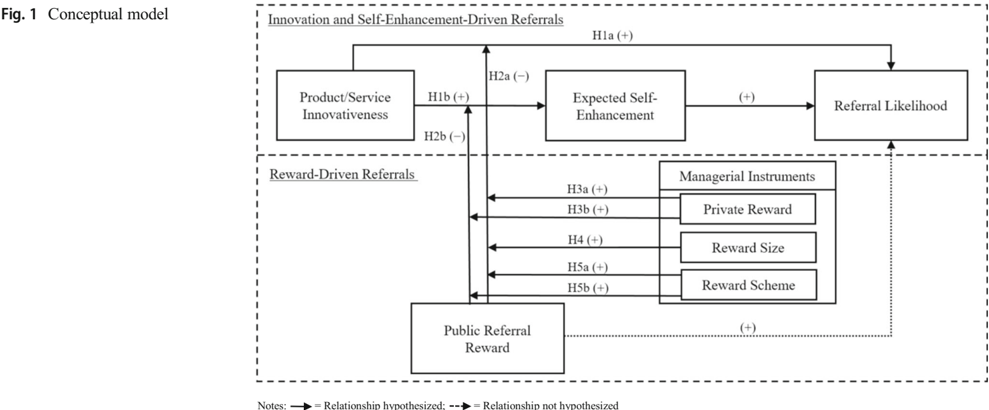
Public referral rewards can backfire for innovative offerings: they reduce referral likelihood by undermining expected self-enhancement, whereas they increase referrals for less innovative offerings. The negative effect is attenuated by private rewards, larger rewards, or rewarding both parties.
Key findings
- Across one field experiment and four online experiments, public referral rewards decreased referral likelihood for more innovative products/services but increased it for less innovative ones. In Study 2, more innovative service: no reward M = 80.04 vs. public reward M = 62.20; less innovative service: no reward M = 58.86 vs. public reward M = 74.37.
- Expected self-enhancement mediated the positive effect of innovativeness on referral likelihood when no reward was offered, but public rewards suppressed this path. In Study 1, the innovativeness × public reward interaction on referral likelihood was b = −8.73, SE = 1.27, p < .001; the indirect effect via expected self-enhancement was b = 2.55 in the no-reward condition and b = .28 in the public-reward condition.
- Private, non-disclosed rewards attenuated the negative effect. In Study 3, for more innovative products, public reward M = 58.70 vs. no reward M = 81.17, while private reward M = 73.41 was not lower than no reward.
- Larger rewards and reward-both schemes attenuated the negative effect. In Study 4, small €5 reward M = 51.23 vs. no reward M = 81.64, while large €50 reward M = 73.20; in Study 5, reward-both M = 87.17 vs. no reward M = 78.60, while reward-me M = 47.73.
Methods
- One field experiment with an established German online shop: 3,363 customers invited from 33,630 recent purchasers, 607 responded, final n = 480; participants reported their last purchased product, perceived innovativeness, expected self-enhancement, and referral likelihood, and were randomly assigned to a public €5 referral reward or no-reward condition.
- Four online experiments (n = 230, 323, 305, 334) using product/service scenarios (gym, suitcase) with between-subjects manipulations of innovativeness and reward visibility, reward size, or reward scheme.
- Main analysis used moderated mediation (Hayes Model 8, bootstrapped with 5,000 draws), with expected self-enhancement as mediator and referral likelihood as outcome; referral likelihood was measured on a 100-point scale.
Limitations
- The paper states that it focuses solely on recommenders and their referral likelihood, not referral recipients’ perceptions or receptivity; that fictitious brands prevented studying brand strength; and that only financial rewards were examined, leaving non-monetary rewards uninvestigated.
- Evident from the text: the studies rely on self-reported referral likelihood rather than observed referral behavior, including in the field experiment; samples are German consumers recruited via an online shop, a market research panel, or street intercepts, which may limit generalizability.
Model-written summary. Check it against the paper before relying on it.
Integrity signals
Registry
Cites
Statistics
Figures
Verification
Claims the paper makes
5 Valid · 2 Not valid · 38 Not checked · 185 Own results and interpretations
The sources with a verdict support this claim; the rest weren’t checked yet, have no full text we could read, or their verdicts aren’t rated yet.
In the paper
“Thus, rewards can be counterproductive if they conflict with individuals ' motivations or goals (Ariely et al. 2009; Deci et al. 1999).”
What the sources say
- Not checked — no full text of the sourcecites Ariely et al. 2009 matched to “Doing Good or Doing Well? Image Motivation and Monetary Incentives in Behaving Prosocially” (2009) source
- Supportedcites Deci et al. 1999 matched to “A meta-analytic review of experiments examining the effects of extrinsic rewards on intrinsic motivation.” (1999) source
On p. 628, the paper explains that rewards experienced as controlling can thwart autonomy and undermine intrinsic motivation. Its concluding discussion (pp. 658–659) reports that tangible rewards tend to reduce intrinsic motivation and forestall self-regulation, supporting the claim that rewards can be counterproductive when they work against a person's motivation. (LLM, conf=0.87)
plainstates a possible cause- Asserted: passes — The authors put it forward as true.
- Checkable: passes — It can be checked against evidence.
- Load-bearing: passes — The paper’s conclusions depend on it.
- Based: passes — The paper gives a reason why it holds.
Every source the paper cites for this claim was checked and supports it.
In the paper
“Such varying effects are due to individuals ' perceptions of the rewards relative to their initial needs (Deci et al. 1999).”
What the sources say
- Supportedcites Deci et al. 1999 matched to “A meta-analytic review of experiments examining the effects of extrinsic rewards on intrinsic motivation.” (1999) source
On p. 628, the paper explains that rewards can be perceived as controlling or as indicators of competence, with different effects on intrinsic motivation depending on whether they thwart or satisfy needs for autonomy and competence. This supports the citing sentence’s paraphrase about varying effects, perceptions, and needs. (LLM, conf=0.92)
plainstates a cause- Asserted: passes — The authors put it forward as true.
- Checkable: passes — It can be checked against evidence.
- Load-bearing: unclear — It is unclear whether the paper’s conclusions depend on it.
- Based: passes — The paper gives a reason why it holds.
- Supported
A result the paper reports from its own data — it cites no other source for it, so there is none to check. The quote shows it is in the paper.
In the paper
“However, self-enhancement does not mediate the effect of innovativeness on referral likelihood with a public reward ( b = .28, SE = .45, 95% CI = [ -.57, 1.20]).”
plain- Asserted: passes — The authors put it forward as true.
- Checkable: passes — It can be checked against evidence.
- Load-bearing: passes — The paper’s conclusions depend on it.
- Based: passes — The paper gives a reason why it holds.
A result the paper reports from its own data — it cites no other source for it, so there is none to check. The quote shows it is in the paper.
In the paper
“Consistent with H2b, public referral rewards suppress the positive effect of innovativeness on expected self-enhancement ( b = .04, SE = .06, p > .05, 95% CI = [ -.07, .16]).”
plainstates a cause- Asserted: passes — The authors put it forward as true.
- Checkable: passes — It can be checked against evidence.
- Load-bearing: passes — The paper’s conclusions depend on it.
- Based: passes — The paper gives a reason why it holds.
A result the paper reports from its own data — it cites no other source for it, so there is none to check. The quote shows it is in the paper.
In the paper
“In support of H2a, there is a negative direct effect of innovativeness on referral likelihood in the public reward condition ( b = -9.59, SE = 4.10, p < .05, 95% CI = [ -17.68, -1.52]).”
plainstates a cause- Asserted: passes — The authors put it forward as true.
- Checkable: passes — It can be checked against evidence.
- Load-bearing: passes — The paper’s conclusions depend on it.
- Based: passes — The paper gives a reason why it holds.
141 more claims
Create a free account to see all 230 claims and to verify the 1 reference still open.
- Probably not a substantial claim. 54
- It may state two separate claims as one. 33
- The quote only partly states this claim. 9
Statistics that don’t add up
Each reported p-value recomputed from its test statistic and degrees of freedom, each partial η² from its F, and each ratio, mean difference or B printed with a p checked against its own confidence interval.
Rated minor: it would not touch a result — a value no result rests on, a p-value that stays on the same side of the significance level, or a conflict that is clerical, resolved elsewhere in the paper, or outside its own findings.
In the paper
“t (81.82) = 2.76, p < .001”
Reported p < .001 · recomputed p = .007
Statistics recomputed
Every reported test result, recomputed from its test statistic and degrees of freedom. A result shows as not adding up only once an independent check has confirmed it.
- Doesn’t add upt(81.82) = 2.76reported p < .001 · recomputed p = .007
“t (81.82) = 2.76, p < .001”
- ConsistentF(5, 474) = 40.75reported p < .001 · recomputed p < .001
“F (5, 474)= 40.75, p < .001”
- ConsistentF(6, 473) = 39.7reported p < .001 · recomputed p < .001
“F (6, 473)= 39.70, p < .001”
- Consistentt(49) = -5.69reported p < .001 · recomputed p < .001
“t (49) = -5.69, p < .001”
- Consistentt(49) = -5.74reported p < .001 · recomputed p < .001
“t (49) = -5.74, p < .001”
26 more recomputed tests
Create a free account to see every test the Stats check recomputed.
Self-check
Percentages, sums and reported differences re-computed from the paper’s own numbers.
Each contradiction between two passages listed here was confirmed by an independent check.
Rated minor: it would not touch a result — a value no result rests on, a p-value that stays on the same side of the significance level, or a conflict that is clerical, resolved elsewhere in the paper, or outside its own findings.
In the paper
§ Discussion · p. 15
“with a large referral reward, referral likelihood increases again (vs. noreward condition).”
§ Results · p. 15
“referral likelihood in the large public reward condition still is lower than in the no-reward condition ( M noreward = 81.64; M largereward = 73.20; t (81.82) = 2.76, p < .001).”
Rated minor: it would not touch a result — a value no result rests on, a p-value that stays on the same side of the significance level, or a conflict that is clerical, resolved elsewhere in the paper, or outside its own findings.
In the paper
§ Results · p. 15
“( M noreward = 61.18; M smallreward = 69.68; t (63) = -1.88, p = .06; Figure W4)”
§ Results · p. 15
“( M noreward = 61.68; M largereward = 81.79; t (43.05) = -5.41, p < .05)”
Rated minor: it would not touch a result — a value no result rests on, a p-value that stays on the same side of the significance level, or a conflict that is clerical, resolved elsewhere in the paper, or outside its own findings.
In the paper
§ Results · p. 13
“| Product innovativeness (PI) | 1.60 | .25 | < .001 | [.69, 1.78]”
§ Results · p. 13
“| No reward | 1.60 | .25 | < .001 | [1.10, 2.10]”
Citations
Cites
(1994) · Journal of the American Dietetic Association · doi:10.1016/0002-8223(94)92216-0 · Cited by 45,910
(2013) · Cited by 44,563
(2025) · doi:10.53555/acr.v2i2 · Cited by 13,264
Production, Information Costs and Economic Organization
Alchian, A. A., & Demsetz, H. (1996) · Firms, Organizations and Contracts · doi:10.1093/oso/9780198774358.003.0005 · Cited by 9,565
Deci, E. L., Koestner, R., & Ryan, R. M. (1999) · Psychological Bulletin · doi:10.1037/0033-2909.125.6.627 · Cited by 7,176
A new product growth for model consumer durables
Bass, F. M. (1969) · Management Science · doi:10.1287/mnsc.15.5.215 · Cited by 6,008
Impure Altruism and Donations to Public Goods: A Theory of Warm-Glow Giving
Andreoni, J. (1990) · The Economic Journal · doi:10.2307/2234133 · Cited by 5,825 · cited 1×
“Thus, with a public reward-me scheme, recommenders may perceive themselves as self-interested and driven by economic benefits, reducing internal satisfaction and positive selfesteem (Andreoni 1990), conflicting with motivations to self-enhance with the referral.”
BackgroundA New Product Growth Model for Consumer Durables
Bass, F. M. (1976) · Lecture Notes in Economics and Mathematical Systems · doi:10.1007/978-3-642-51565-1_107 · Cited by 3,948
Specification, evaluation, and interpretation of structural equation models
Bagozzi, R. P., & Yi, Y. (2012) · Journal of the Academy of Marketing Science · doi:10.1007/s11747-011-0278-x · Cited by 3,735
SOMETHING OLD, SOMETHING NEW: A LONGITUDINAL STUDY OF SEARCH BEHAVIOR AND NEW PRODUCT INTRODUCTION.
Katila, R., & Ahuja, G. (2002) · Academy of Management Journal · doi:10.2307/3069433 · Cited by 3,640
Garcia, R., & Calantone, R. (2002) · Journal of Product Innovation Management · doi:10.1111/1540-5885.1920110 · Cited by 3,470 · cited 1×
“The offerings in our studies are incremental innovations, such that they provide new features, benefits or improvements in an existing market (Garcia and Calantone 2002).”
BackgroundIncentives and Prosocial Behavior
Bénabou, R., & Tirole, J. (2006) · American Economic Review · doi:10.1257/aer.96.5.1652 · Cited by 3,357
The Provision of Incentives in Firms
Prendergast, C. (1999) · Journal of Economic Literature · doi:10.1257/jel.37.1.7 · Cited by 3,338 · cited 1×
“…motivating effect of large rewards tends to be greater than the loss of customers’ initial motivation to self-enhance, as induced by the financial reward (Gneezy 2005), with a monotonic, increasing relationship between financial rewards for an activity and motivation expected (Prendergast 1999).”
BackgroundPay Enough or Don't Pay at All*
Gneezy, U., & Rustichini, A. (2000) · Quarterly Journal of Economics · doi:10.1162/003355300554917 · Cited by 2,175
Customer Satisfaction and Word of Mouth
Anderson, E. W. (1998) · Journal of Service Research · doi:10.1177/109467059800100102 · Cited by 2,103
Investments in Consumer Relationships: A Cross-Country and Cross-Industry Exploration
De Wulf, K., Odekerken-Schröder, G., & Iacobucci, D. (2001) · Journal of Marketing · doi:10.1509/jmkg.65.4.33.18386 · Cited by 2,083
Why sustainability is now the key driver of innovation
Nidumolu, R., Prahalad, C. K., & Rangaswami, M. R. (2013) · IEEE Engineering Management Review · doi:10.1109/emr.2013.6601104 · Cited by 1,799
Doing Good or Doing Well? Image Motivation and Monetary Incentives in Behaving Prosocially
Ariely, D., Bracha, A., & Meier, S. (2009) · American Economic Review · doi:10.1257/aer.99.1.544 · Cited by 1,753
(2009) · American Economic Review · doi:10.1257/aer.99.2.i · Cited by 1,665
(1997) · American Economic Review · Cited by 1,564
Word of mouth and interpersonal communication: A review and directions for future research
Berger, J. (2014) · Journal of Consumer Psychology · doi:10.1016/j.jcps.2014.05.002 · Cited by 1,469 · cited 2×
“I n so ci al m ar ke ts , ef fo rt is in se ns iti ve to an in cr ea se in reducing loneliness) as well as by altruistic motives (e.g., concern for others) (Berger 2014).”
BackgroundWord-of-Mouth Processes within a Services Purchase Decision Context
Bansal, H. S., & Voyer, P. A. (2000) · Journal of Service Research · doi:10.1177/109467050032005 · Cited by 1,334
Brown, T. J. (2005) · Journal of the Academy of Marketing Science · doi:10.1177/0092070304268417 · Cited by 1,135
Word-of-mouth communications in marketing: a meta-analytic review of the antecedents and moderators
de Matos, C. A., & Rossi, C. A. V. (2008) · Journal of the Academy of Marketing Science · doi:10.1007/s11747-008-0121-1 · Cited by 1,078
Hulland, J., Baumgartner, H., & Smith, K. M. (2018) · Journal of the Academy of Marketing Science · doi:10.1007/s11747-017-0532-y · Cited by 1,067
Lichtenstein, D. R., Netemeyer, R. G., & Burton, S. (1990) · Journal of Marketing · doi:10.1177/002224299005400305 · Cited by 1,054
Collaborative and Iterative Translation: An Alternative Approach to Back Translation
Douglas, S. P., & Craig, C. S. (2007) · Journal of International Marketing · doi:10.1509/jimk.15.1.030 · Cited by 989
Innovation diffusion and new product growth models: A critical review and research directions
Peres, R., Muller, E., & Mahajan, V. (2010) · International Journal of Research in Marketing · doi:10.1016/j.ijresmar.2009.12.012 · Cited by 982
Self-Enhancement: Food for Thought
Sedikides, C., & Gregg, A. P. (2008) · Perspectives on Psychological Science · doi:10.1111/j.1745-6916.2008.00068.x · Cited by 880
Effort for Payment: A Tale of Two Markets
Heyman, J., & Ariely, D. (2004) · Psychological Science · doi:10.1111/j.0956-7976.2004.00757.x · Cited by 827
(1998) · ACR North American Advances · Cited by 823
The impact of services versus goods on consumers’ assessment of perceived risk and variability
Murray, K. B., & Schlacter, J. L. (1990) · Journal of the Academy of Marketing Science · doi:10.1007/bf02729762 · Cited by 811
Assessment, enhancement, and verification determinants of the self-evaluation process.
Sedikides, C. (1993) · Journal of Personality and Social Psychology · doi:10.1037/0022-3514.65.2.317 · Cited by 710 · cited 1×
“As a foundation for this surprising prediction, we draw on self-enhancement theory (e.g., Sedikides 1993) and posit that for more innovative Martin Mende served as Area Editor for this article.”
MethodA comparative analysis of four scales of consumer involvement
Mittal, B. (1995) · Psychology & Marketing · doi:10.1002/mar.4220120708 · Cited by 644
Measuring the impact of positive and negative word of mouth on brand purchase probability
East, R., Hammond, K., & Lomax, W. (2008) · International Journal of Research in Marketing · doi:10.1016/j.ijresmar.2008.04.001 · Cited by 629
Agreeable fancy or disagreeable truth? Reconciling self-enhancement and self-verification.
Swann, W. B., Pelham, B. W., & Krull, D. S. (1989) · Journal of Personality and Social Psychology · doi:10.1037/0022-3514.57.5.782 · Cited by 584
American Economic Journal: Economic Policy
Auerbach, A. J. (2009) · American Economic Review · doi:10.1257/aer.99.2.679 · Cited by 525
Adolescent Influence in Family Decision Making: A Replication with Extension
Beatty, S. E., & Talpade, S. (1994) · Journal of Consumer Research · doi:10.1086/209401 · Cited by 465
Self-citation(2014) · Digital Access to Scholarship at Harvard (DASH) (Harvard University) · Cited by 464
Referral Programs and Customer Value
Schmitt, P., Skiera, B., & Van den Bulte, C. (2011) · Journal of Marketing · doi:10.1509/jm.75.1.46 · Cited by 455
Alexandrov, A., Lilly, B., & Babakus, E. (2013) · Journal of the Academy of Marketing Science · doi:10.1007/s11747-012-0323-4 · Cited by 448 · cited 3×
“As viable tools for public self-enhancement (Alexandrov et al. 2013; Wojnicki and Godes 2008), referral behavior of innovative offerings helps consumers present themselves favorably, fulfilling their self-enhancement needs.”
BackgroundInfluentialThe effects of incentives, deal proneness, satisfaction and tie strength on word‐of‐mouth behaviour
Wirtz, J., & Chew, P. (2002) · International Journal of Service Industry Management · doi:10.1108/09564230210425340 · Cited by 393
On Braggarts and Gossips: A Self-Enhancement Account of Word-of-Mouth Generation and Transmission
De Angelis, M., Bonezzi, A., Peluso, A. M., Rucker, D. D., & Costabile, M. (2012) · Journal of Marketing Research · doi:10.1509/jmr.11.0136 · Cited by 381
Lee, Y., & Colarelli O'Connor, G. (2003) · Journal of Product Innovation Management · doi:10.1111/1540-5885.t01-1-201002 · Cited by 348
Self-esteem and direct versus indirect forms of self-enhancement.
Brown, J. D., Collins, R. L., & Schmidt, G. W. (1988) · Journal of Personality and Social Psychology · doi:10.1037/0022-3514.55.3.445 · Cited by 336
Perspective: New Product Failure Rates: Influence of Argumentum ad Populum and Self‐Interest
Castellion, G., & Markham, S. K. (2013) · Journal of Product Innovation Management · doi:10.1111/j.1540-5885.2012.01009.x · Cited by 311
Incentives and Prosocial Behavior
Bénabou, R., & Tirole, J. (2005) · National Bureau of Economic Research · doi:10.3386/w11535 · Cited by 264
A Penny for Your Thoughts: Referral Reward Programs and Referral Likelihood
Ryu, G., & Feick, L. (2007) · Journal of Marketing · doi:10.1509/jmkg.71.1.084 · Cited by 257
Understanding loyalty program effectiveness: managing target and bystander effects
Steinhoff, L., & Palmatier, R. W. (2016) · Journal of the Academy of Marketing Science · doi:10.1007/s11747-014-0405-6 · Cited by 241
Will There Be Blood? Incentives and Displacement Effects in Pro-Social Behavior
Lacetera, N., Macis, M., & Slonim, R. (2012) · American Economic Journal: Economic Policy · doi:10.1257/pol.4.1.186 · Cited by 222 · cited 1×
“Some incentives do not undermine motivation or behavior, such as verbal rewards (Deci et al. 1999), while others have neutral or positive effects on behaviors (Lacetera et al. 2012).”
BackgroundAral, S. (2011) · Marketing Science · doi:10.1287/mksc.1100.0596 · Cited by 205
Word-of-Mouth as Self-EnhancementPreprint
Wojnicki, A. C., & Godes, D. (2006) · SSRN Electronic Journal · doi:10.2139/ssrn.908999 · Cited by 196
Growing Existing Customers’ Revenue Streams through Customer Referral Programs
Garnefeld, I., Eggert, A., Helm, S. V., & Tax, S. S. (2013) · Journal of Marketing · doi:10.1509/jm.11.0423 · Cited by 171
Jin, L., & Huang, Y. (2014) · International Journal of Research in Marketing · doi:10.1016/j.ijresmar.2013.08.005 · Cited by 153
Self-Signaling and Prosocial Behavior: A Cause Marketing Experiment
Dubé, J., Luo, X., & Fang, Z. (2016) · Marketing Science · doi:10.1287/mksc.2016.1012 · Cited by 135
Optimal Referral Bonuses with Asymmetric Information: Firm-Offered and Interpersonal Incentives
Kornish, L. J., & Li, Q. (2010) · Marketing Science · doi:10.1287/mksc.1080.0484 · Cited by 124
Stock, R. M. (2011) · Journal of the Academy of Marketing Science · doi:10.1007/s11747-010-0215-4 · Cited by 122 · cited 6×
“With the three-item scale from Stock (2011), we checked the innovativeness manipulation.”
BackgroundMethodInfluentialThe Role of Metaperception on the Effectiveness of Referral Reward Programs
Wirtz, J., Orsingher, C., Chew, P., & Tambyah, S. K. (2013) · Journal of Service Research · doi:10.1177/1094670512462138 · Cited by 119
The W effect of incentivesPreprint
Gneezy, U. (2003) · RePEc: Research Papers in Economics · Cited by 114
Innovación en tiempos turbulentos
Rigby, D. K., Gruver, K., & Allen, J. (2009) · Harvard business review · Cited by 108
Branding strategies for high-technology products: The effects of consumer and product innovativeness
Truong, Y., Klink, R. R., Simmons, G., Grinstein, A., & Palmer, M. (2016) · Journal of Business Research · doi:10.1016/j.jbusres.2016.07.003 · Cited by 106
No margin, no mission? A field experiment on incentives for public service delivery
Ashraf, N., Bandiera, O., & Jack, B. K. (2014) · Journal of Public Economics · doi:10.1016/j.jpubeco.2014.06.014 · Cited by 101
Motivational Drivers of Content Contribution to Company‐ Versus Consumer‐Hosted Online Communities
Teichmann, K., Stokburger‐Sauer, N. E., Plank, A., & Strobl, A. (2015) · Psychology & Marketing · doi:10.1002/mar.20783 · Cited by 86
When Sharing Consumption Emotions With Strangers Is More Satisfying Than Sharing Them With Friends
López-López, I., Ruiz-de-Maya, S., & Warlop, L. (2014) · Journal of Service Research · doi:10.1177/1094670514538835 · Cited by 72
Reciprocity and incentive pay in the workplace
Dur, R., Non, A., & Roelfsema, H. (2010) · Journal of Economic Psychology · doi:10.1016/j.joep.2010.05.001 · Cited by 50
Successful referral behavior in referral reward programs
Wirtz, J., Tang, C., & Georgi, D. (2018) · Journal of service management · doi:10.1108/josm-04-2018-0111 · Cited by 49
Psychological drivers of referral reward program effectiveness
Orsingher, C., & Wirtz, J. (2018) · Journal of Services Marketing · doi:10.1108/jsm-07-2017-0247 · Cited by 48
Store-choice behavior for pre-owned merchandise
Darley, W. K., & Lim, J.-S. (1993) · Journal of Business Research · doi:10.1016/0148-2963(93)90013-f · Cited by 46
The Impact of Word of Mouth Sources on the Perceived Usefulness of an Innovation
Kawakami, T., & Parry, M. E. (2013) · Journal of Product Innovation Management · doi:10.1111/jpim.12049 · Cited by 43
Customer Referral Reward–Brand–Fit: A Schema Congruity Perspective
Stumpf, C., & Baum, M. (2016) · Psychology & Marketing · doi:10.1002/mar.20896 · Cited by 40
Jin, L., & Huang, Y. (2013) · SSRN Electronic Journal · doi:10.2139/ssrn.2315011 · Cited by 10
Ariely, D., Bracha, A., & Meier, S. (2009) · ICPSR Data Holdings · doi:10.3886/e113292v1
Reciprocity and Incentive Pay in the Workplace
Dur, R., Non, A., & Roelfsema, H. J. (2010) · doi:10.2139/ssrn.1566331
Collaborative and Iterative Translation: An Alternative Approach to Instrument Translation
Douglas, S., & Craig, C. S. (2006) · doi:10.2139/ssrn.946274
Customer Referral Reward-Brand Fit: A Schema Congruity Perspective
Stumpf, C. (2015) · Academy of Management Proceedings · doi:10.5465/ambpp.2015.14168abstract
Self-Signaling and Prosocial Behavior: A Cause Marketing Experiment
Dube, J.-P. H., Luo, X., & Fang, Z. (2016) · SSRN Electronic Journal · doi:10.2139/ssrn.2687535
Research works printed but not linked: 1
- Rosen, E. (2009). The anatomy of buzz revisited: Real-life lessons in word-of-mouth marketing . New York: Doubleday.
Cited by
Babić Rosario, A., de Valck, K., & Sotgiu, F. (2020) · Journal of the Academy of Marketing Science · doi:10.1007/s11747-019-00706-1 · Cited by 462
De Keyser, A., Verleye, K., Lemon, K. N., Keiningham, T. L., & Klaus, P. (2020) · Journal of Service Research · doi:10.1177/1094670520928390 · Cited by 457
Schaarschmidt, M., Walsh, G., & Ivens, S. (2021) · Journal of Vocational Behavior · doi:10.1016/j.jvb.2021.103644 · Cited by 67
Self-citationA Conceptual Approach to Understanding the Customer Experience in E-Commerce: An Empirical Study
Pires, P. B., Prisco, M., Delgado, C., & Santos, J. D. (2024) · Journal of theoretical and applied electronic commerce research · doi:10.3390/jtaer19030096 · Cited by 91
The effect of tokenized rewards on customer loyalty programs
Boukis, A. (2024) · Annals of Tourism Research · doi:10.1016/j.annals.2024.103851 · Cited by 48
Metadata
- Authors
- Dose, D. B., Walsh, G., Beatty, S. E., & Elsner, R.
- Affiliations
- Aston University (GB)
- Friedrich Schiller University Jena (DE)
- University of Alabama (US)
- Steinbeis University Berlin (DE)
- Corresponding author
- Dose, David B.
- Venue
- Journal of the Academy of Marketing Science
- Published
- 2019-02-09
- Volume
- 47
- Issue
- 3
- Pages
- 438-459
- ISSN
- 0092-0703 (ISSN-L)
- 1552-7824
- OpenAlex
- W2914890086
- Cited by
- 60
- References
- 73
- Citations by year
- 2026: 9 · 2025: 10 · 2024: 13 · 2023: 9 · 2022: 6 · 2021: 7 · 2020: 4 · 2019: 2
- FWCI
- 9.57
- Type
- journal article
- Language
- en
- Open access
- hybrid
- doi.org
- Licence
- cc-by
- creativecommons.org/licenses/by/4.0 (tdm)
- Locations
- Journal of the Academy of Marketing Science (publishedVersion, cc-by)
- Aston Publications Explorer (Aston University) (submittedVersion)
- RePEc: Research Papers in Economics (submittedVersion)
- Figshare (submittedVersion, cc-by)
- Open Research Exeter (University of Exeter) (submittedVersion, cc-by)
- Funders
- Aston University
- Topics
- Social Sciences › Business, Management and Accounting › Marketing › Digital Marketing and Social Media
- Social Sciences › Business, Management and Accounting › Marketing › Customer Service Quality and Loyalty
- Social Sciences › Business, Management and Accounting › Marketing › Consumer Market Behavior and Pricing
- Keywords
- referral behavior, innovative products and services, unintended consequences, customer acquisition, word of mouth, customer growth
About these checks
Registry, retraction, Cites and statistics results are computed, not judged, with one exception: a printed reference that no index lists is read once by a model before it counts as a citation error. Claims are extracted by a model and kept only when their quote appears verbatim in the text; each cited source is then checked, with a model’s help, for whether it says what the claim relies on. Those verdicts can be wrong — read the claim’s quote and the cited source before relying on one.
The claim verdicts this report counts are experimental: their accuracy is not yet measured.
A language model drew the claims from the paper on 2026-10-10, under version 3 of the claim definition (model deepseek-v4.1-flash, prompt extract-v3).
A second model labelled each claim on 2026-10-10 (model jev-1.13-20260917, definition revision gold-guideline-v0.2).
Cited sources are checked with a language model’s help (gpt-6-sol).
Statistics and arithmetic are recomputed, not judged.
Confidence bands are shown only for fields calibrated on our annotated test set. None is calibrated yet, so no band is shown.
What counts as a claim ›How we measure confidence ›How we check this ›
Are you an author, or do you see a problem with this page? Request a review
Data sources
Bibliographic data: Semantic Scholar, OpenAlex, Crossref.
Contains information from the Semantic Scholar Academic Graph Datasets, made available under the ODC Attribution License (ODC-BY 1.0).
Semantic Scholar’s data is described in: Kinney, R., et al. (2023). The Semantic Scholar Open Data Platform. arXiv:2301.10140.
