

The future of sleep health: a data-driven revolution in sleep science and medicine
Open accessThe DOI matches its Crossref record; 200 of the 202 references it cites were found in a registry or an index; 30 of the 88 sources its claims cite were checked for support.
Abstract
In recent years, there has been a significant expansion in the development and use of multi-modal sensors and technologies to monitor physical activity, sleep and circadian rhythms. These developments make accurate sleep monitoring at scale a possibility for the first time. Vast amounts of multi-sensor data are being generated with potential applications ranging from large-scale epidemiological research linking sleep patterns to disease, to wellness applications, including the sleep coaching of individuals with chronic conditions. However, in order to realise the full potential of these technologies for individuals, medicine and research, several significant challenges must be overcome. There are important outstanding questions regarding performance evaluation, as well as data storage, curation, processing, integration, modelling and interpretation. Here, we leverage expertise across neuroscience, clinical medicine, bioengineering, electrical engineering, epidemiology, computer science, mHealth and human-computer interaction to discuss the digitisation of sleep from a inter-disciplinary perspective. We introduce the state-of-the-art in sleep-monitoring technologies, and discuss the opportunities and challenges from data acquisition to the eventual application of insights in clinical and consumer settings. Further, we explore the strengths and limitations of current and emerging sensing methods with a particular focus on novel data-driven technologies, such as Artificial Intelligence.
Overview
CoChat Summary
## TL;DR
This is a narrative review that proposes a five-step “Digital Sleep Framework” for moving from sleep data acquisition to clinical and consumer applications. It argues that digital sleep technologies and AI could enable scalable, unobtrusive sleep monitoring, but only if major issues in validation, interoperability, bias, privacy, and reproducibility are addressed.
## Key findings
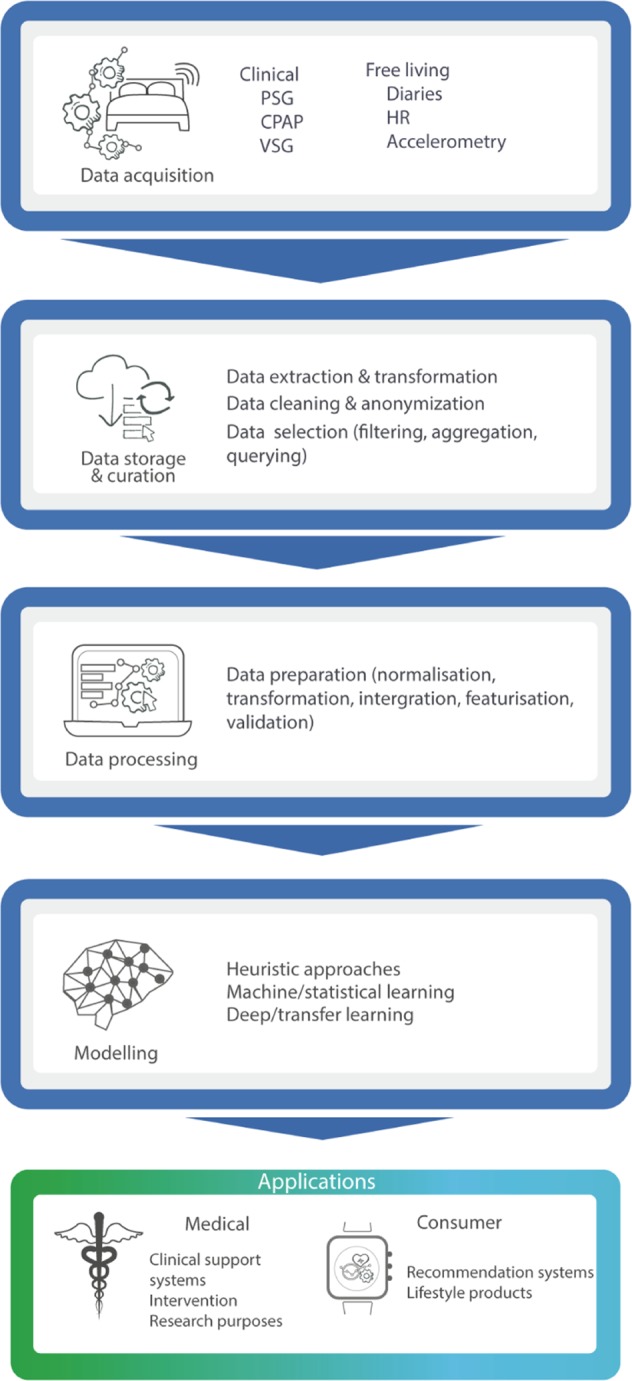
- The paper frames sleep digitization around a five-step framework: data acquisition, data storage and curation, data pre-processing, AI-based sleep modelling, and data-driven applications.
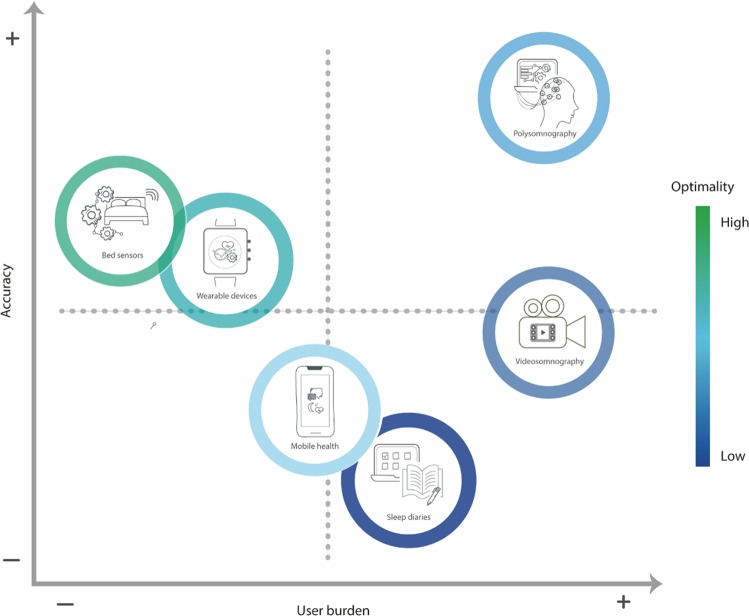
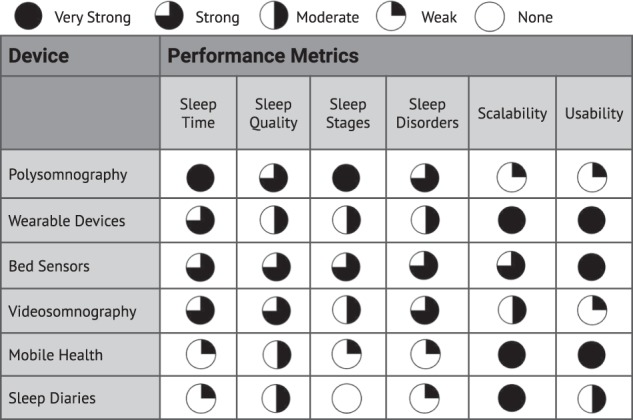
- PSG remains the gold standard, but it is “expensive, time-consuming” and impractical for long-term home use; ambulatory PSG is described as only a partial solution.
- Actigraphy and accelerometry are recognized by the American Academy of Sleep Medicine as valid for sleep assessment, but the paper states three key limitations: lack of validation across consumer devices, lack of standardization in human-activity recognition, and lack of assessment techniques for daytime sleeping.
- Some methods reported specific performance figures: a single-channel EEG ensemble model reached an agreement rate of 0.87 versus expert scoring, in-ear sensor sleep-stage prediction reached 74% agreement with full PSG, ultrasound-based movement detection showed 86% recall and <10% error, and iSleep reported >90% accuracy for event classification.
## Methods
- Narrative review / perspective article synthesizing prior literature on sleep sensing, storage, preprocessing, modelling, and applications; no original participant study is reported.
- The authors organize the discussion using a five-step “Digital Sleep Framework” spanning multi-modal acquisition through end-user application.
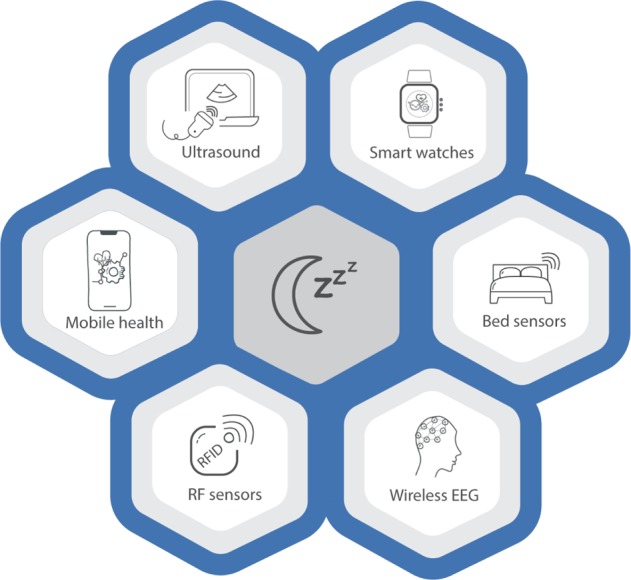
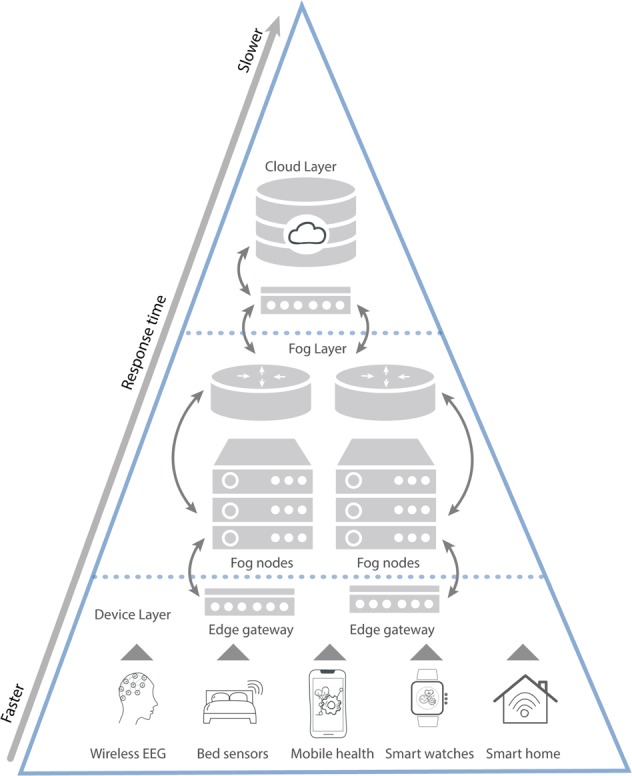
- The analysis is qualitative and literature-based, citing examples across PSG, actigraphy, EEG, mobile sensing, bed sensors, WiFi/radio sensing, cloud/fog architectures, and machine learning/deep learning methods.
## Limitations
- The paper explicitly notes that “few methods have been validated against gold-standard PSG or undergone systematic reliability assessment.”
- It also states that consumer-oriented sleep technologies “lack validation” and that their underlying models “change frequently.”
- Evident from the text: this is not an empirical evaluation of specific devices or algorithms; it is a broad synthesis, so its conclusions depend on the cited literature rather than new data collected in the paper.
Model-written summary. Check it against the paper before relying on it.
Integrity signals
Registry
Cites
Statistics
Figures
Verification
Claims the paper makes
24 Valid · 16 Not valid · 41 Not checked · 47 Own results and interpretations
The cited sources support only part of this claim — read each source’s verdict below.
In the paper
“Traditionally, polysomnography (PSG), paired with clinical evaluation, has been the gold-standard and de-facto technique to study sleep in clinical and laboratory settings, as well as to diagnose a subset of sleep disorders37.”
§ The future of sleep health: a data-driven revolution in sleep science and medicine > Sleep data acquisition
What the sources say
- Partly supportedcites [37] Morgenthaler TI Practice parameters for the clinical evaluation and treatment of circadian rhythm sleep disorders. An American Academy of Sleep Medicine report Sleep 2007 30 1445 1459 10.1093/sleep/30.11.1445 18041479 PMC2082098 sourceExperimental — accuracy not yet measured
Section 3.1.6 says PSG is indicated when a patient with suspected circadian rhythm sleep disorder may also have another primary sleep disorder, such as obstructive sleep apnea. Section 3.2.2.1 describes its use in laboratory studies of simulated jet lag. The paper does not establish PSG as the traditional gold-standard or de-facto technique for studying sleep across clinical and laboratory settings; it says PSG is not routinely indicated to diagnose circadian rhythm sleep disorders. (LLM, conf=0.84)
plain- Asserted: passes — The authors put it forward as true.
- Checkable: passes — It can be checked against evidence.
- Load-bearing: unclear — It is unclear whether the paper’s conclusions depend on it.
- Based: passes — The paper gives a reason why it holds.
- Partly supported
The cited sources support only part of this claim — read each source’s verdict below.
In the paper
“Body movements, breathing and even cardiac activities can be detected by the volume change of the pneumatic underneath an individual whilst they are lying in bed52–54.”
§ The future of sleep health: a data-driven revolution in sleep science and medicine > Sleep data acquisition > Emerging sleep-sensing technologies
What the sources say
- Not checked — no full text of the sourcecites [52] Chow P Nagendra G Abisheganaden J Wang Y Respiratory monitoring using an air-mattress system Physiol. Meas. 2000 21 345 10.1088/0967-3334/21/3/301 10984203 source
- Supportedcites [53] Chee Y Han J Youn J Park K Air mattress sensor system with balancing tube for unconstrained measurement of respiration and heart beat movements Physiol. Meas. 2005 26 413 10.1088/0967-3334/26/4/007 15886436 source
The Introduction explains that respiration and heart-beat movements press on the air mattress and change its air pressure. The Measurement results from the human body show signals from a person lying on the mattress, including breathing, heart beats, and body movement. The paper measures pressure changes in the air cells rather than volume directly, but this supports the claim’s description of pneumatic changes beneath the person. (LLM, conf=0.89)
- Partly supportedcites [54] Arlotto P Grimaldi M Naeck R Ginoux J-M An ultrasonic contactless sensor for breathing monitoring Sensors 2014 14 15371 15386 10.3390/s140815371 25140632 PMC4179033 sourceExperimental — accuracy not yet measured
The Introduction and Section 2.7 describe detecting breathing and subject movements with an ultrasonic Doppler sensor. They do not support detection through volume changes in a pneumatic device beneath a person in bed, or detection of cardiac activity. (LLM, conf=0.88)
plainstates a cause- Asserted: passes — The authors put it forward as true.
- Checkable: passes — It can be checked against evidence.
- Load-bearing: unclear — It is unclear whether the paper’s conclusions depend on it.
- Based: passes — The paper gives a reason why it holds.
Every source the paper cites for this claim was checked and supports it.
In the paper
“These advances facilitate the objective and unobtrusive measurement of sleep characteristics in large, free-living populations at scale, facilitating well-powered epidemiological investigations designed to explore the relationships between sleep and disease35.”
§ The future of sleep health: a data-driven revolution in sleep science and medicine > Introduction
What the sources say
- Supportedcites [35] Willetts M Hollowell S Aslett L Holmes C Doherty A Statistical machine learning of sleep and physical activity phenotypes from sensor data in 96,220 UK Biobank participants Sci. Rep. 2018 8 7961 10.1038/s41598-018-26174-1 29784928 PMC5962537 source
Split into 2 atoms — 2 confirmed, 0 partially supported, 0 disputed, 0 misattributed, 0 unverifiable. Expand the claim to see per-atom verdicts.
plainstates a cause- Asserted: passes — The authors put it forward as true.
- Checkable: passes — It can be checked against evidence.
- Load-bearing: passes — The paper’s conclusions depend on it.
- Based: passes — The paper gives a reason why it holds.
- Supported
Every source the paper cites for this claim was checked and supports it.
In the paper
“Nevertheless, this increased availability of sensors also results in a greater challenges when optimising the match between the end-application and the sensor used43.”
§ The future of sleep health: a data-driven revolution in sleep science and medicine > Sleep data acquisition > Traditional free-living sleep sensing and measurement approaches: actigraphy and accelerometry Actigraphy and accelerometry are non-invasive methods to monitor human activity and rest cycles. They have been used to describe physical activity levels in large-scale populations44, and can also be used to monitor sleep. These methods offer an affordable, scalable alternative to PSG to monitor sleep–wake cycles, and have now been recognised by the American Academy of Sleep Medicine as a valid method for the assessment of sleep45. Recent advances in AI and larger studies in conjunction with PSG have resulted in the refinement of the method46. However, three key limitations of actigraphy and accelerometry remain. These are (1) the lack of validation studies for the different consumer-grade devices, (2) lack of standardisation of approaches for human-activity recognition and (3) the lack of assessment techniques for daytime sleeping. Nowadays, wearable sensors are often used in combination with other minimally invasive sensors (such as heart rate monitors, miniaturised ECG, pulse-oximetry, blood pressure monitors, galvanic skin conduction, light sensors, gyroscopes, barometric altimeters and GPS trackers). Sleep can also be monitored through a combination of wrist actigraphy, hip sensors, smartphone sensors and under-mattress sensors47. Nevertheless, this increased availability of sensors also results in a greater challenges when optimising the match between the end-application and the sensor used43. A description of actigraphy specific sleep metrics is provided in the Supplementary Material. Data on sleep can be also obtained from devices to treat sleep apnoea, such as Continuous Positive Air Pressure (CPAP). For example, Aggarwal et al.48 showed that CPAP can be used to classify and track sleep metrics, which could be used to monitor the response of CPAP therapy in sleep apnoea patients.
What the sources say
- Supportedcites [43] Caulfield B Reginatto B Slevin P Not all sensors are created equal: a framework for evaluating human performance measurement technologies npj Digital Med. 2019 2 7 10.1038/s41746-019-0082-4 PMC6550243 31304357 source
The Abstract states that increased sensor availability and choice make it challenging to match a sensor to a specific application context. The Introduction likewise says the growing availability of devices can create confusion when professionals select technology for particular application requirements. (LLM, conf=0.95)
plainstates a cause- Asserted: passes — The authors put it forward as true.
- Checkable: passes — It can be checked against evidence.
- Load-bearing: unclear — It is unclear whether the paper’s conclusions depend on it.
- Based: passes — The paper gives a reason why it holds.
- Supported
The cited sources that could be checked couldn’t confirm or dispute this claim.
In the paper
“Multiple published works have demonstrated that a single modality sensor representation, such as heart rate alone, is not sufficient to accurately complete sophisticated sleep stage classification42.”
§ The future of sleep health: a data-driven revolution in sleep science and medicine > Sleep data acquisition > Sleep monitoring outside the laboratory
What the sources say
- Could not verifycites [42] Baltrušaitis T Ahuja C Morency L-P Multimodal machine learning: a survey and taxonomy IEEE Trans. Pattern Anal. Mach. Intell. 2018 41 423 443 10.1109/TPAMI.2018.2798607 29994351 sourceExperimental — accuracy not yet measured
The survey discusses multimodal representations (Section 3, p. 3) and fusion applications (Section 6, p. 12), but those passages do not address sleep-stage classification. Searches for sleep stages, heart rate, and physiological sensors found no passage reporting that heart rate alone is insufficient for accurate classification. (LLM, conf=0.76)
boosted- Asserted: passes — The authors put it forward as true.
- Checkable: passes — It can be checked against evidence.
- Load-bearing: unclear — It is unclear whether the paper’s conclusions depend on it.
- Based: passes — The paper gives a reason why it holds.
- Could not verify
50 more claims · 12 with their cited sources checked
Create a free account to see all 128 claims and to verify the 17 references still open.
- It may state two separate claims as one. 34
- Probably not a substantial claim. 54
Citations
Cites
Hochreiter, S., & Schmidhuber, J. (1997) · Neural Computation · doi:10.1162/neco.1997.9.8.1735 · Cited by 102,318
High-performance medicine: the convergence of human and artificial intelligence
Topol, E. J. (2019) · Nature Medicine · doi:10.1038/s41591-018-0300-7 · Cited by 10,450
‘Small Changes' to Diet and Physical Activity Behaviors for Weight Management
Hills, A. P., Byrne, N. M., Lindstrom, R., & Hill, J. O. (2013) · Obesity Facts · doi:10.1159/000345030 · Cited by 9,493
Physical Activity in the United States Measured by Accelerometer
TROIANO, R. P., BERRIGAN, D., DODD, K. W., MÂSSE, L. C., TILERT, T., & MCDOWELL, M. (2008) · Medicine & Science in Sports & Exercise · doi:10.1249/mss.0b013e31815a51b3 · Cited by 7,638
Multimodal Machine Learning: A Survey and Taxonomy
Baltrusaitis, T., Ahuja, C., & Morency, L.-P. (2019) · IEEE Transactions on Pattern Analysis and Machine Intelligence · doi:10.1109/tpami.2018.2798607 · Cited by 5,018
(2010) · Cited by 4,411
Convolutional networks for images, speech, and time series
LeCun, Y., & Bengio, Y. (1998) · HAL (Le Centre pour la Communication Scientifique Directe) · doi:10.5555/303568.303704 · Cited by 4,231
International Classification of Sleep Disorders-Third Edition
Sateia, M. J. (2014) · Chest · doi:10.1378/chest.14-0970 · Cited by 3,860
Federated Learning: Strategies for Improving Communication Efficiency
Konečný, J., McMahan, H. B., Yu, F. X., Richtárik, P., Suresh, A. T., & Bacon, D. (2016) · arXiv · doi:10.48550/arxiv.1610.05492 · Cited by 3,766
International Classification of Sleep Disorders
Thorpy, M. (2017) · Sleep Disorders Medicine · doi:10.1007/978-1-4939-6578-6_27 · Cited by 2,505
Fog and IoT: An Overview of Research Opportunities
Chiang, M., & Zhang, T. (2016) · IEEE Internet of Things Journal · doi:10.1109/jiot.2016.2584538 · Cited by 2,362
Cappuccio, F. P., Cooper, D., D'Elia, L., Strazzullo, P., & Miller, M. A. (2011) · European Heart Journal · doi:10.1093/eurheartj/ehr007 · Cited by 2,146
Automatic Sleep/Wake Identification From Wrist Activity
Cole, R. J., Kripke, D. F., Gruen, W., Mullaney, D. J., & Gillin, J. C. (1992) · Sleep · doi:10.1093/sleep/15.5.461 · Cited by 1,941
Visualization Analysis and Design
Munzner, T. (2014) · A K Peters/CRC Press eBooks · doi:10.1201/b17511 · Cited by 1,697
Activity-Based Sleep-Wake Identification: An Empirical Test of Methodological Issues
Sadeh, A., Sharkey, M., & Carskadon, M. A. (1994) · Sleep · doi:10.1093/sleep/17.3.201 · Cited by 1,487
The role and validity of actigraphy in sleep medicine: an update
Sadeh, A. (2011) · Sleep Medicine Reviews · doi:10.1016/j.smrv.2010.10.001 · Cited by 1,415
All one needs to know about fog computing and related edge computing paradigms: A complete survey
Yousefpour, A., Fung, C., Nguyen, T., Kadiyala, K., Jalali, F., Niakanlahiji, A., Kong, J., & Jue, J. P. (2019) · Journal of Systems Architecture · doi:10.1016/j.sysarc.2019.02.009 · Cited by 1,368
The metabolic consequences of sleep deprivation
Knutson, K. L., Spiegel, K., Penev, P., & Van Cauter, E. (2007) · Sleep Medicine Reviews · doi:10.1016/j.smrv.2007.01.002 · Cited by 1,365
National Sleep Foundation's sleep quality recommendations: first report
Ohayon, M., Wickwire, E. M., Hirshkowitz, M., Albert, S. M., Avidan, A., Daly, F. J., Dauvilliers, Y., Ferri, R., Fung, C., Gozal, D., et al. (2017) · Sleep Health · doi:10.1016/j.sleh.2016.11.006 · Cited by 1,304
The Rise of Consumer Health Wearables: Promises and Barriers
Piwek, L., Ellis, D. A., Andrews, S., & Joinson, A. (2016) · PLOS Medicine · doi:10.1371/journal.pmed.1001953 · Cited by 1,235
Fatigue, alcohol and performance impairment
Dawson, D., & Reid, K. (1997) · Nature · doi:10.1038/40775 · Cited by 1,199
Besedovsky, L., Lange, T., & Born, J. (2012) · Pflügers Archiv - European Journal of Physiology · doi:10.1007/s00424-011-1044-0 · Cited by 1,153
Sleep and circadian rhythm disruption in psychiatric and neurodegenerative disease
Wulff, K., Gatti, S., Wettstein, J. G., & Foster, R. G. (2010) · Nature Reviews Neuroscience · doi:10.1038/nrn2868 · Cited by 1,055
Sleep and Alzheimer disease pathology--a bidirectional relationship
Ju, Y.-E. S., Lucey, B. P., & Holtzman, D. M. (2014) · Nature Reviews Neurology · doi:10.1038/nrneurol.2013.269 · Cited by 996
Artificial intelligence in medicine
Ramesh, A., Kambhampati, C., Monson, J., & Drew, P. (2004) · Annals of The Royal College of Surgeons of England · doi:10.1308/147870804290 · Cited by 991
Smart Homes that Monitor Breathing and Heart Rate
Adib, F., Mao, H., Kabelac, Z., Katabi, D., & Miller, R. C. (2015) · Proceedings of the 33rd Annual ACM Conference on Human Factors in Computing Systems · doi:10.1145/2702123.2702200 · Cited by 916
Sleep duration and risk of type 2 diabetes: a meta-analysis of prospective studies
Shan, Z., Ma, H., Xie, M., Yan, P., Guo, Y., Bao, W., Rong, Y., Jackson, C. L., Hu, F. B., & Liu, L. (2015) · Diabetes Care · doi:10.2337/dc14-2073 · Cited by 902
Sleep Apnea as an Independent Risk Factor for All-Cause Mortality: The Busselton Health Study
(2008) · Sleep · doi:10.5665/sleep/31.8.1079 · Cited by 889
Shift Work Sleep Disorder: Prevalence and Consequences Beyond that of Symptomatic Day Workers
Drake, C. L., Roehrs, T., Richardson, G., Walsh, J. K., & Roth, T. (2004) · Sleep · doi:10.1093/sleep/27.8.1453 · Cited by 860
Research on k-means Clustering Algorithm: An Improved k-means Clustering Algorithm
Na, S., Xumin, L., & Yong, G. (2010) · 2010 Third International Symposium on Intelligent Information Technology and Security Informatics · doi:10.1109/iitsi.2010.74 · Cited by 845
How (and why) the immune system makes us sleep
Imeri, L., & Opp, M. R. (2009) · Nature Reviews Neuroscience · doi:10.1038/nrn2576 · Cited by 710
Effect of Sleep Deprivation on Response to Immunizaton
Spiegel, K. (2002) · JAMA · doi:10.1001/jama.288.12.1469 · Cited by 633
Practice Parameters for the Clinical Evaluation and Treatment of Circadian Rhythm Sleep Disorders
Morgenthaler, T. I., Lee-Chiong, T., Alessi, C., Friedman, L., Aurora, R. N., Boehlecke, B., Brown, T., Chesson, A. L., Kapur, V., Maganti, R., et al. (2007) · Sleep · doi:10.1093/sleep/30.11.1445 · Cited by 629
Why Sleep Matters—The Economic Costs of Insufficient Sleep: A Cross-Country Comparative Analysis
Hafner, M., Štěpánek, M., Taylor, J., Troxel, W., & Stolk, C. V. (2016) · Rand health quarterly · doi:10.7249/rhq-06-04-11 · Cited by 623
Fog Computing and Smart Gateway Based Communication for Cloud of Things
Aazam, M., & Huh, E.-N. (2014) · 2014 International Conference on Future Internet of Things and Cloud · doi:10.1109/ficloud.2014.83 · Cited by 620
Smart Homes for Elderly Healthcare—Recent Advances and Research Challenges
Majumder, S., Aghayi, E., Noferesti, M., Memarzadeh-Tehran, H., Mondal, T., Pang, Z., & Deen, M. (2017) · Sensors · doi:10.3390/s17112496 · Cited by 618
Martin, J. L., & Hakim, A. D. (2011) · Chest · doi:10.1378/chest.10-1872 · Cited by 603
Effects of Diet on Sleep Quality
St-Onge, M.-P., Mikic, A., & Pietrolungo, C. E. (2016) · Advances in Nutrition · doi:10.3945/an.116.012336 · Cited by 558
Henriksen, A., Haugen Mikalsen, M., Woldaregay, A. Z., Muzny, M., Hartvigsen, G., Hopstock, L. A., & Grimsgaard, S. (2018) · Journal of Medical Internet Research · doi:10.2196/jmir.9157 · Cited by 542
The link between short sleep duration and obesity: we should recommend more sleep to prevent obesity
Taheri, S. (2006) · Archives of Disease in Childhood · doi:10.1136/adc.2005.093013 · Cited by 510
Self-citationDigital health: a path to validation
Mathews, S. C., McShea, M. J., Hanley, C. L., Ravitz, A., Labrique, A. B., & Cohen, A. B. (2019) · npj Digital Medicine · doi:10.1038/s41746-019-0111-3 · Cited by 508
Smith, M. T., McCrae, C. S., Cheung, J., Martin, J. L., Harrod, C. G., Heald, J. L., & Carden, K. A. (2018) · Journal of Clinical Sleep Medicine · doi:10.5664/jcsm.7230 · Cited by 483
We are Chronically Sleep Deprived
Bonnet, M. H., & Arand, D. L. (1995) · Sleep · doi:10.1093/sleep/18.10.908 · Cited by 477
Turakhia, M. P., Desai, M., Hedlin, H., Rajmane, A., Talati, N., Ferris, T., Desai, S., Nag, D., Patel, M., Kowey, P., et al. (2019) · American Heart Journal · doi:10.1016/j.ahj.2018.09.002 · Cited by 474
Chen, Z., & Liu, B. (2018) · Synthesis Lectures on Artificial Intelligence and Machine Learning · doi:10.1007/978-3-031-01581-6 · Cited by 466
The American Academy of Sleep Medicine Inter-scorer Reliability Program: Sleep Stage Scoring
Rosenberg, R. S., & Van Hout, S. (2013) · Journal of Clinical Sleep Medicine · doi:10.5664/jcsm.2350 · Cited by 456
Melatonin, sleep disturbance and cancer risk
Blask, D. E. (2009) · Sleep Medicine Reviews · doi:10.1016/j.smrv.2008.07.007 · Cited by 449
Effect of Sleep Deprivation on Response to Immunizaton
Spiegel, K., Sheridan, J. F., & Cauter, E. V. (2002) · JAMA · doi:10.1001/jama.288.12.1471-a · Cited by 423
DANKER‐HOPFE, H., ANDERER, P., ZEITLHOFER, J., BOECK, M., DORN, H., GRUBER, G., HELLER, E., LORETZ, E., MOSER, D., PARAPATICS, S., et al. (2009) · Journal of Sleep Research · doi:10.1111/j.1365-2869.2008.00700.x · Cited by 417
Wireless body sensor networks for health-monitoring applications
Hao, Y., & Foster, R. (2008) · Physiological Measurement · doi:10.1088/0967-3334/29/11/r01 · Cited by 404
The Direct and Indirect Costs of Untreated Insomnia in Adults in the United States
Ozminkowski, R. J., Wang, S., & Walsh, J. K. (2007) · Sleep · doi:10.1093/sleep/30.3.263 · Cited by 403
Bertisch, S. M., Pollock, B. D., Mittleman, M. A., Buysse, D. J., Bazzano, L. A., Gottlieb, D. J., & Redline, S. (2018) · Sleep · doi:10.1093/sleep/zsy047 · Cited by 397
Short sleep duration and incident coronary artery calcification
(2008) · JAMA · doi:10.1001/jama.2008.867 · Cited by 389
Kline, C. E. (2014) · American Journal of Lifestyle Medicine · doi:10.1177/1559827614544437 · Cited by 364
Developing and adopting safe and effective digital biomarkers to improve patient outcomes
Coravos, A., Khozin, S., & Mandl, K. D. (2019) · npj Digital Medicine · doi:10.1038/s41746-019-0090-4 · Cited by 361
The Economic Cost of Sleep Disorders
Hillman, D. R., Murphy, A. S., Antic, R., & Pezzullo, L. (2006) · Sleep · doi:10.1093/sleep/29.3.299 · Cited by 356
Groeger, J. A., Zijlstra, F. R. H., & Dijk, D. ‐. (2004) · Journal of Sleep Research · doi:10.1111/j.1365-2869.2004.00418.x · Cited by 350
Lajnef, T., Chaibi, S., Ruby, P., Aguera, P.-E., Eichenlaub, J.-B., Samet, M., Kachouri, A., & Jerbi, K. (2015) · Journal of Neuroscience Methods · doi:10.1016/j.jneumeth.2015.01.022 · Cited by 318
Scaling Up Scientific Discovery in Sleep Medicine: The National Sleep Research Resource
Dean, D. A., Goldberger, A. L., Mueller, R., Kim, M., Rueschman, M., Mobley, D., Sahoo, S. S., Jayapandian, C. P., Cui, L., Morrical, M. G., et al. (2016) · Sleep · doi:10.5665/sleep.5774 · Cited by 309
Impact of sleep on the risk of cognitive decline and dementia
Spira, A. P., Chen-Edinboro, L. P., Wu, M. N., & Yaffe, K. (2014) · Current Opinion in Psychiatry · doi:10.1097/yco.0000000000000106 · Cited by 308
Sleep Duration as a Risk Factor for Cardiovascular Disease- a Review of the Recent Literature
Nagai, M., Hoshide, S., & Kario, K. (2010) · Current Cardiology Reviews · doi:10.2174/157340310790231635 · Cited by 299
An ensemble system for automatic sleep stage classification using single channel EEG signal
Koley, B., & Dey, D. (2012) · Computers in Biology and Medicine · doi:10.1016/j.compbiomed.2012.09.012 · Cited by 291
Expert-level sleep scoring with deep neural networks
Biswal, S., Sun, H., Goparaju, B., Westover, M. B., Sun, J., & Bianchi, M. T. (2018) · Journal of the American Medical Informatics Association · doi:10.1093/jamia/ocy131 · Cited by 290
Neurophysiology of sleep and wakefulness: basic science and clinical implications
Schwartz, J., & Roth, T. (2008) · Current Neuropharmacology · doi:10.2174/157015908787386050 · Cited by 289
Chandola, T., Ferrie, J. E., Perski, A., Akbaraly, T., & Marmot, M. G. (2010) · Sleep · doi:10.1093/sleep/33.6.739 · Cited by 284
An Activity-Based Sleep Monitor System for Ambulatory Use
Webster, J. B., Kripke, D. F., Messin, S., Mullaney, D. J., & Wyborney, G. (1982) · Sleep · doi:10.1093/sleep/5.4.389 · Cited by 278
Nonato, L. G., & Aupetit, M. (2019) · IEEE Transactions on Visualization and Computer Graphics · doi:10.1109/tvcg.2018.2846735 · Cited by 259
Self-citationWilletts, M., Hollowell, S., Aslett, L., Holmes, C., & Doherty, A. (2018) · Scientific Reports · doi:10.1038/s41598-018-26174-1 · Cited by 250
Automatic Sleep Stage Scoring with Single-Channel EEG Using Convolutional Neural Networks
Tsinalis, O., Matthews, P. M., Guo, Y., & Zafeiriou, S. P. (2016) · arXiv (Cornell University) · doi:10.48550/arxiv.1610.01683 · Cited by 249
Coin Rubbing and Camphor Intoxication—Reply
Bächli, E. B., Rampini, S. K., & Schneemann, M. (2002) · JAMA · doi:10.1001/jama.288.12.1471-b · Cited by 244
Consumer Sleep Technology: An American Academy of Sleep Medicine Position Statement
Khosla, S., Deak, M. C., Gault, D., Goldstein, C. A., Hwang, D., Kwon, Y., O'Hearn, D., Schutte-Rodin, S., Yurcheshen, M., Rosen, I. M., et al. (2018) · Journal of Clinical Sleep Medicine · doi:10.5664/jcsm.7128 · Cited by 242
Data sharing: An open mind on open data
Gewin, V. (2016) · Nature · doi:10.1038/nj7584-117a · Cited by 231
Marshall, N. S., Yee, B. J., Desai, A. V., Buchanan, P. R., Wong, K. K., Crompton, R., Melehan, K. L., Zack, N., Rao, S. G., Gendreau, R. M., et al. (2008) · Sleep · doi:10.1093/sleep/31.6.824 · Cited by 224
Jiang, Y., Wu, D., Deng, Z., Qian, P., Wang, J., Wang, G., Chung, F.-L., Choi, K.-S., & Wang, S. (2017) · IEEE Transactions on Neural Systems and Rehabilitation Engineering · doi:10.1109/tnsre.2017.2748388 · Cited by 221
Automatic sleep scoring using statistical features in the EMD domain and ensemble methods
Hassan, A. R., & Hassan Bhuiyan, M. I. (2016) · Biocybernetics and Biomedical Engineering · doi:10.1016/j.bbe.2015.11.001 · Cited by 220
Lullaby: a capture & access system for understanding the sleep environment
Kay, M., Choe, E. K., Shepherd, J., Greenstein, B., Watson, N., Consolvo, S., & Kientz, J. A. (2012) · Proceedings of the 2012 ACM Conference on Ubiquitous Computing · doi:10.1145/2370216.2370253 · Cited by 219
iSleep: unobtrusive sleep quality monitoring using smartphones
Hao, T., Xing, G., & Zhou, G. (2013) · Proceedings of the 11th ACM Conference on Embedded Networked Sensor Systems · doi:10.1145/2517351.2517359 · Cited by 216
Trait-like individual differences in the human sleep electroencephalogram
Buckelmüller, J., Landolt, H.-P., Stassen, H. H., & Achermann, P. (2006) · Neuroscience · doi:10.1016/j.neuroscience.2005.11.005 · Cited by 214
Hernandez Silva, E., Lawler, S., & Langbecker, D. (2019) · Journal of Cancer Survivorship · doi:10.1007/s11764-018-0730-8 · Cited by 197
History of the Development of Sleep Medicine in the United States
Shepard, J., Buysse, D. J., Chesson, A. L., Dement, W. C., Goldberg, R., Guilleminault, C., Harris, C., Iber, C., Mignot, E. J.-M., Mitler, M. M., et al. (2005) · Journal of Clinical Sleep Medicine · doi:10.5664/jcsm.26298 · Cited by 192
Kam, J. W. Y., Griffin, S., Shen, A., Patel, S., Hinrichs, H., Heinze, H.-J., Deouell, L. Y., & Knight, R. T. (2019) · NeuroImage · doi:10.1016/j.neuroimage.2018.09.012 · Cited by 188
Sleep stage classification from heart-rate variability using long short-term memory neural networks
Radha, M., Fonseca, P., Moreau, A., Ross, M., Cerny, A., Anderer, P., Long, X., & Aarts, R. M. (2019) · Scientific Reports · doi:10.1038/s41598-019-49703-y · Cited by 186
Individual 'Fingerprints' in Human Sleep EEG Topography
Finelli, L. (2001) · Neuropsychopharmacology · doi:10.1016/s0893-133x(01)00320-7 · Cited by 184
DoppleSleep: a contactless unobtrusive sleep sensing system using short-range Doppler radar
Rahman, T., Adams, A. T., Ravichandran, R. V., Zhang, M., Patel, S. N., Kientz, J. A., & Choudhury, T. (2015) · Proceedings of the 2015 ACM International Joint Conference on Pervasive and Ubiquitous Computing · doi:10.1145/2750858.2804280 · Cited by 175
Determination of Sleep and Wakefulness With the Actigraph Data Analysis Software (ADAS)
(1996) · Sleep · doi:10.1093/sleep/19.9.739 · Cited by 170
Khairat, S. S., Dukkipati, A., Lauria, H. A., Bice, T., Travers, D., & Carson, S. S. (2018) · JMIR Human Factors · doi:10.2196/humanfactors.9328 · Cited by 167
Lin, X., Chen, W., Wei, F., Ying, M., Wei, W., & Xie, X. (2015) · Sleep Medicine · doi:10.1016/j.sleep.2015.02.543 · Cited by 163
Signal-to-Noise Ratio in Doppler Radar System for Heart and Respiratory Rate Measurements
Droitcour, A. D., Boric-Lubecke, O., & Kovacs, G. T. A. (2009) · IEEE Transactions on Microwave Theory and Techniques · doi:10.1109/tmtt.2009.2029668 · Cited by 162
Fox, R. S., Ancoli-Israel, S., Roesch, S. C., Merz, E. L., Mills, S. D., Wells, K. J., Sadler, G. R., & Malcarne, V. L. (2020) · Supportive Care in Cancer · doi:10.1007/s00520-019-04834-w · Cited by 161
Dement, W. C., & Vaughan, C. C. (1999) · Cited by 160
Sleep stage and obstructive apneaic epoch classification using single-lead ECG
Yılmaz, B., Asyalı, M. H., Arıkan, E., Yetkin, S., & Özgen, F. (2010) · BioMedical Engineering OnLine · doi:10.1186/1475-925x-9-39 · Cited by 157
Smartphone Applications to Support Sleep Self-Management: Review and Evaluation
Choi, Y. K., Demiris, G., Lin, S.-Y., Iribarren, S. J., Landis, C. A., Thompson, H. J., McCurry, S. M., Heitkemper, M. M., & Ward, T. M. (2018) · Journal of Clinical Sleep Medicine · doi:10.5664/jcsm.7396 · Cited by 156
Yin, Z., Wang, Y., Liu, L., Zhang, W., & Zhang, J. (2017) · Frontiers in Neurorobotics · doi:10.3389/fnbot.2017.00019 · Cited by 155
Chen, Z., & Liu, B. (2018) · Synthesis Lectures on Artificial Intelligence and Machine Learning · doi:10.2200/s00737ed1v01y201610aim033 · Cited by 154
ANALYSIS AND AUTOMATIC IDENTIFICATION OF SLEEP STAGES USING HIGHER ORDER SPECTRA
ACHARYA, U. R., CHUA, E. C.-P., CHUA, K. C., MIN, L. C., & TAMURA, T. (2010) · International Journal of Neural Systems · doi:10.1142/s0129065710002589 · Cited by 153
Dinov, I. D. (2016) · GigaScience · doi:10.1186/s13742-016-0117-6 · Cited by 153
Automatic Human Sleep Stage Scoring Using Deep Neural Networks
Malafeev, A., Laptev, D., Bauer, S., Omlin, X., Wierzbicka, A., Wichniak, A., Jernajczyk, W., Riener, R., Buhmann, J., & Achermann, P. (2018) · Frontiers in Neuroscience · doi:10.3389/fnins.2018.00781 · Cited by 151
Validation of Contact-Free Sleep Monitoring Device with Comparison to Polysomnography
Tal, A., Shinar, Z., Shaki, D., Codish, S., & Goldbart, A. D. (2017) · Journal of Clinical Sleep Medicine · doi:10.5664/jcsm.6514 · Cited by 148
A Smart System for Sleep Monitoring by Integrating IoT With Big Data Analytics
Yacchirema, D. C., Sarabia-Jácome, D., Palau, C. E., & Esteve, M. (2018) · IEEE Access · doi:10.1109/access.2018.2849822 · Cited by 148
Hearables: Automatic Overnight Sleep Monitoring With Standardized In-Ear EEG Sensor
Nakamura, T., Alqurashi, Y. D., Morrell, M. J., & Mandic, D. P. (2020) · IEEE Transactions on Biomedical Engineering · doi:10.1109/tbme.2019.2911423 · Cited by 147
Bhat, S., Ferraris, A., Gupta, D., Mozafarian, M., DeBari, V. A., Gushway-Henry, N., Gowda, S. P., Polos, P. G., Rubinstein, M., Seidu, H., et al. (2015) · Journal of Clinical Sleep Medicine · doi:10.5664/jcsm.4840 · Cited by 144
Adaptive Heartbeat Modeling for Beat-to-Beat Heart Rate Measurement in Ballistocardiograms
Paalasmaa, J., Toivonen, H. T. T., & Partinen, M. (2014) · IEEE Journal of Biomedical and Health Informatics · doi:10.1109/jbhi.2014.2314144 · Cited by 139
Survey of Real-time Processing Technologies of IoT Data Streams
Yasumoto, K., Yamaguchi, H., & Shigeno, H. (2016) · Journal of Information Processing · doi:10.2197/ipsjjip.24.195 · Cited by 139
Monitoring gait in multiple sclerosis with novel wearable motion sensors
Moon, Y., McGinnis, R. S., Seagers, K., Motl, R. W., Sheth, N., Wright, J. A., Ghaffari, R., & Sosnoff, J. J. (2017) · PLOS ONE · doi:10.1371/journal.pone.0171346 · Cited by 134
On Reducing the Effect of Covariate Factors in Gait Recognition: A Classifier Ensemble Method
Guan, Y., Li, C.-T., & Roli, F. (2015) · IEEE Transactions on Pattern Analysis and Machine Intelligence · doi:10.1109/tpami.2014.2366766 · Cited by 128
Self-citationSleep Monitoring Based on a Tri-Axial Accelerometer and a Pressure Sensor
Nam, Y., Kim, Y., & Lee, J. (2016) · Sensors · doi:10.3390/s16050750 · Cited by 124
Overview of smartphone applications for sleep analysis
Ong, A. A., & Gillespie, M. B. (2016) · World Journal of Otorhinolaryngology - Head and Neck Surgery · doi:10.1016/j.wjorl.2016.02.001 · Cited by 123
ShutEye: encouraging awareness of healthy sleep recommendations with a mobile, peripheral display
Bauer, J. S., Consolvo, S., Greenstein, B., Schooler, J., Wu, E., Watson, N. F., & Kientz, J. (2012) · Proceedings of the SIGCHI Conference on Human Factors in Computing Systems · doi:10.1145/2207676.2208600 · Cited by 122
Holmqvist, M., Vincent, N., & Walsh, K. (2014) · Sleep Medicine · doi:10.1016/j.sleep.2013.10.013 · Cited by 119
Chen, Z., Lau, D., Teo, J. T., Ng, S. H., Yang, X., & Kei, P. L. (2014) · Journal of Biomedical Optics · doi:10.1117/1.jbo.19.5.057001 · Cited by 112
Liang, Z., Ploderer, B., Liu, W., Nagata, Y., Bailey, J., Kulik, L., & Li, Y. (2016) · Personal and Ubiquitous Computing · doi:10.1007/s00779-016-0960-6 · Cited by 112
Chee, Y., Han, J., Youn, J., & Park, K. (2005) · Physiological Measurement · doi:10.1088/0967-3334/26/4/007 · Cited by 111
Hassan, A. R., Bashar, S. K., & Bhuiyan, M. I. H. (2015) · International Conference on Advances in Computing, Communications and Informatics (ICACCI) · doi:10.1109/icacci.2015.7275950 · Cited by 107
Depression and quality of life in older adults: Mediation effect of sleep quality
Brandolim Becker, N., Jesus, S. N. D., Viseu, J. N., Stobäus, C. D., Guerreiro, M., & Domingues, R. B. (2018) · International Journal of Clinical and Health Psychology · doi:10.1016/j.ijchp.2017.10.002 · Cited by 106
Mobile Phone Interventions for Sleep Disorders and Sleep Quality: Systematic Review
Shin, J. C., Kim, J. H., & Grigsby‐Toussaint, D. S. (2017) · JMIR mhealth and uhealth · doi:10.2196/mhealth.7244 · Cited by 105
Zhang, X., Kou, W., Chang, E., Gao, H., Fan, Y., & Xu, Y. L. (2018) · Computers in Biology and Medicine · doi:10.1016/j.compbiomed.2018.10.010 · Cited by 105
Smart gateway based communication for cloud of things
Aazam, M., Hung, P. P., & Huh, E. (2014) · International Conference on Intelligent Sensors, Sensor Networks and Information Processing · doi:10.1109/issnip.2014.6827673 · Cited by 105
Benchmark on a large cohort for sleep-wake classification with machine learning techniques
Palotti, J., Mall, R., Aupetit, M., Rueschman, M., Singh, M., Sathyanarayana, A., Taheri, S., & Fernandez-Luque, L. (2019) · npj Digital Medicine · doi:10.1038/s41746-019-0126-9 · Cited by 104
Self-citationDigital Analysis and Technical Specifications
Penzel, T., Hirshkowitz, M., Harsh, J., Chervin, R. D., SUP, N. B. S., Kryger, M. H., Malow, B. A., Vitiello, M. V., Silber, M. H., Kushida, C. A., et al. (2007) · Journal of Clinical Sleep Medicine · doi:10.5664/jcsm.26813 · Cited by 103
KRIPKE, D. F., HAHN, E. K., GRIZAS, A. P., WADIAK, K. H., LOVING, R. T., POCETA, J. S., SHADAN, F. F., CRONIN, J. W., & KLINE, L. E. (2010) · Journal of Sleep Research · doi:10.1111/j.1365-2869.2010.00835.x · Cited by 103
An Ultrasonic Contactless Sensor for Breathing Monitoring
Arlotto, P., Grimaldi, M., Naeck, R., & Ginoux, J.-M. (2014) · Sensors · doi:10.3390/s140815371 · Cited by 102
van Drongelen, A., Boot, C. R., Hlobil, H., Twisk, J. W., Smid, T., & van der Beek, A. J. (2014) · Scandinavian Journal of Work, Environment & Health · doi:10.5271/sjweh.3447 · Cited by 101
SLEEPNET: Automated Sleep Staging System via Deep Learning
Biswal, S., Kulas, J. A., Sun, H., Goparaju, B., Westover, M. B., Bianchi, M. T., & Sun, J. (2017) · arXiv (Cornell University) · doi:10.48550/arxiv.1707.08262 · Cited by 101
Fino, E., & Mazzetti, M. (2018) · Sleep And Breathing · doi:10.1007/s11325-018-1661-3 · Cited by 101
Mikkelsen, K. B., Ebajemito, J. K., Bonmatí‐Carrión, M., Santhi, N., Revell, V. L., Atzori, G., della Monica, C., Debener, S., Dijk, D., Sterr, A., et al. (2018) · Journal of Sleep Research · doi:10.1111/jsr.12786 · Cited by 101
Non-invasive respiration rate monitoring using a single COTS TX-RX pair
Kaltiokallio, O., Yigitler, H., Jantti, R., & Patwari, N. (2014) · IPSN-14 Proceedings of the 13th International Symposium on Information Processing in Sensor Networks · doi:10.1109/ipsn.2014.6846741 · Cited by 101
Unobtrusive Sleep Stage Identification Using a Pressure-Sensitive Bed Sheet
Samy, L., Huang, M.-C., Liu, J. J., Xu, W., & Sarrafzadeh, M. (2014) · IEEE Sensors Journal · doi:10.1109/jsen.2013.2293917 · Cited by 97
Sleep and Cognitive Function in Multiple Sclerosis
Braley, T. J., Kratz, A. L., Kaplish, N., & Chervin, R. D. (2016) · Sleep · doi:10.5665/sleep.6012 · Cited by 97
Zero-Effort In-Home Sleep and Insomnia Monitoring using Radio Signals
Hsu, C.-Y., Ahuja, A., Yue, S., Hristov, R., Kabelac, Z., & Katabi, D. (2017) · Proceedings of the ACM on Interactive, Mobile, Wearable and Ubiquitous Technologies · doi:10.1145/3130924 · Cited by 97
Deep Learning and Insomnia: Assisting Clinicians With Their Diagnosis
Shahin, M., Ahmed, B., Hamida, S. T.-B., Mulaffer, F. L., Glos, M., & Penzel, T. (2017) · IEEE Journal of Biomedical and Health Informatics · doi:10.1109/jbhi.2017.2650199 · Cited by 96
Making Sense of Sleep Sensors: How Sleep Sensing Technologies Support and Undermine Sleep Health
Ravichandran, R., Sien, S.-W., Patel, S. N., Kientz, J. A., & Pina, L. R. (2017) · Proceedings of the 2017 CHI Conference on Human Factors in Computing Systems · doi:10.1145/3025453.3025557 · Cited by 95
Exercise Is Associated with a Reduced Incidence of Sleep-disordered Breathing
Awad, K. M., Malhotra, A., Barnet, J. H., Quan, S. F., & Peppard, P. E. (2012) · The American Journal of Medicine · doi:10.1016/j.amjmed.2011.11.025 · Cited by 91
Finan, P. H., Richards, J. M., Gamaldo, C. E., Han, D., Leoutsakos, J. M., Salas, R., Irwin, M. R., & Smith, M. T. (2016) · Journal of Clinical Sleep Medicine · doi:10.5664/jcsm.6262 · Cited by 90
Lichstein, K. L., Scogin, F., Thomas, S. J., DiNapoli, E. A., Dillon, H. R., & McFadden, A. (2013) · Journal of Clinical Psychology · doi:10.1002/jclp.22030 · Cited by 88
A transition-constrained discrete hidden Markov model for automatic sleep staging
Pan, S.-T., Kuo, C.-E., Zeng, J.-H., & Liang, S.-F. (2012) · BioMedical Engineering OnLine · doi:10.1186/1475-925x-11-52 · Cited by 86
Phelps, A. J., Kanaan, R. A. A., Worsnop, C., Redston, S., Ralph, N., & Forbes, D. (2018) · Sleep · doi:10.1093/sleep/zsx188 · Cited by 81
Non-invasive respiration rate monitoring using a single COTS TX-RX pair
Kaltiokallio, O., Yi̇ği̇tler, H., Jäntti, R., & Patwari, N. (2014) · doi:10.5555/2602339.2602347 · Cited by 78
Looney, D., Goverdovsky, V., Rosenzweig, I., Morrell, M. J., & Mandic, D. P. (2016) · Annals of the American Thoracic Society · doi:10.1513/annalsats.201605-342bc · Cited by 78
Babson, K. A., Ramo, D. E., Baldini, L., Vandrey, R., & Bonn-Miller, M. O. (2015) · JMIR Research Protocols · doi:10.2196/resprot.3852 · Cited by 77
Association between Sleep Duration and Cancer Risk: A Meta-Analysis of Prospective Cohort Studies
Lü, Y., Nong, T., Yin, J., Shi, Y., & Huang, Z. (2013) · PLoS ONE · doi:10.1371/journal.pone.0074723 · Cited by 77
Novel semi-dry electrodes for brain–computer interface applications
Wang, F., Li, G., Chen, J., Duan, Y., & Zhang, D. (2016) · Journal of Neural Engineering · doi:10.1088/1741-2560/13/4/046021 · Cited by 77
Activity-based sleep–wake identification in infants
Sazonov, E., Sazonova, N., Schuckers, S., Neuman, M., & Group, C. S. (2004) · Physiological Measurement · doi:10.1088/0967-3334/25/5/018 · Cited by 75
Tuominen, J., Peltola, K., Saaresranta, T., & Valli, K. (2019) · Journal of Clinical Sleep Medicine · doi:10.5664/jcsm.7682 · Cited by 75
An Impulse Radio Ultrawideband System for Contactless Noninvasive Respiratory Monitoring
Nijsure, Y., Tay, W. P., Gunawan, E., Wen, F., Yang, Z., Guan, Y. L., & Chua, A. P. (2013) · IEEE Transactions on Biomedical Engineering · doi:10.1109/tbme.2012.2237401 · Cited by 74
Self-citationStop the privatization of health data
Wilbanks, J., & Topol, E. J. (2016) · Nature · doi:10.1038/535345a · Cited by 74
Why We Sleep: The New Science of Sleep and Dreams
Storrs, P. (2017) · Nursing Standard · doi:10.7748/ns.32.12.34.s28 · Cited by 69
Duncan, M., Murawski, B., Short, C. E., Rebar, A. L., Schoeppe, S., Alley, S., Vandelanotte, C., & Kirwan, M. (2017) · Interactive Journal of Medical Research · doi:10.2196/ijmr.6685 · Cited by 68
Radha, M., Garcia-Molina, G., Poel, M., & Tononi, G. (2014) · 2014 36th Annual International Conference of the IEEE Engineering in Medicine and Biology Society · doi:10.1109/embc.2014.6943976 · Cited by 67
Ruiz-Castell, M., Makovski, T. T., Bocquet, V., & Stranges, S. (2019) · BMJ Open · doi:10.1136/bmjopen-2018-026942 · Cited by 67
Myllymaa, S., Muraja‐Murro, A., Westeren‐Punnonen, S., Hukkanen, T., Lappalainen, R., Mervaala, E., Töyräs, J., Sipilä, K., & Myllymaa, K. (2016) · Journal of Sleep Research · doi:10.1111/jsr.12425 · Cited by 66
Hidden Markov models for monitoring circadian rhythmicity in telemetric activity data
Huang, Q., Cohen, D., Komarzynski, S., Li, X.-M., Innominato, P., Lévi, F., & Finkenstädt, B. (2018) · Journal of The Royal Society Interface · doi:10.1098/rsif.2017.0885 · Cited by 65
EEG-Based Automatic Sleep Stage Classification
Γιαννακέας, Ν. (2018) · Biomedical Journal of Scientific & Technical Research · doi:10.26717/bjstr.2018.07.001535 · Cited by 65
Capturing sleep–wake cycles by using day-to-day smartphone touchscreen interactions
Borger, J. N., Huber, R., & Ghosh, A. (2019) · npj Digital Medicine · doi:10.1038/s41746-019-0147-4 · Cited by 64
Correa, A. G., & Laciar, E. (2010) · Annual International Conference of the IEEE Engineering in Medicine and Biology Society (EMBC) · doi:10.1109/iembs.2010.5626721 · Cited by 62
Automated EEG sleep staging in the term-age baby using a generative modelling approach
Pillay, K., Dereymaeker, A., Jansen, K., Naulaers, G., Van Huffel, S., & De Vos, M. (2018) · Journal of Neural Engineering · doi:10.1088/1741-2552/aaab73 · Cited by 61
Stenholm, S., Head, J., Kivimäki, M., Magnusson Hanson, L. L., Pentti, J., Rod, N. H., Clark, A. J., Oksanen, T., Westerlund, H., & Vahtera, J. (2019) · The Journals of Gerontology: Series A · doi:10.1093/gerona/gly016 · Cited by 55
Evaluating an mHealth App for Health and Well-Being at Work: Mixed-Method Qualitative Study
de Korte, E. M., Wiezer, N., Janssen, J. H., Vink, P., & Kraaij, W. (2018) · JMIR mHealth and uHealth · doi:10.2196/mhealth.6335 · Cited by 54
Ensemble learning algorithm based on multi-parameters for sleep staging
Wang, Q., Zhao, D., Wang, Y., & Hou, X. (2019) · Medical & Biological Engineering & Computing · doi:10.1007/s11517-019-01978-z · Cited by 54
The Usefulness of Activity Trackers in Elderly with Reduced Mobility: A Case Study
Jonas, L., Adolfo, M., Jose, L. S., & Anton, C. (2013) · Studies in Health Technology and Informatics · doi:10.3233/978-1-61499-289-9-759 · Cited by 53
Multi-modality of polysomnography signals’ fusion for automatic sleep scoring
Yan, R., Zhang, C., Spruyt, K., Wei, L., Wang, Z., Tian, L., Li, X., Ristaniemi, T., Zhang, J., & Cong, F. (2019) · Biomedical Signal Processing and Control · doi:10.1016/j.bspc.2018.10.001 · Cited by 49
Respiratory monitoring using an air-mattress system
Chow, P., Nagendra, G., Abisheganaden, J., & Wang, Y. T. (2000) · Physiological Measurement · doi:10.1088/0967-3334/21/3/301 · Cited by 45
Sleep Disturbance During Smoking Cessation: Withdrawal or Side Effect of Treatment?
Ashare, R. L., Lerman, C., Tyndale, R. F., Hawk, L. W., George, T. P., Cinciripini, P., & Schnoll, R. A. (2017) · Journal of Smoking Cessation · doi:10.1017/jsc.2016.11 · Cited by 42
Personalizing deep learning models for automatic sleep staging
Mikkelsen, K., & de Vos, M. (2018) · arXiv · doi:10.48550/arxiv.1801.02645 · Cited by 42
Sáez, C., Robles, M., & Garcia-Gomez, J. M. (2016) · Statistical Methods in Medical Research · doi:10.1177/0962280214545122 · Cited by 41
Self-citationSubramanian, S., Hesselbacher, S., Mattewal, A., & Surani, S. (2013) · Sleep and Breathing · doi:10.1007/s11325-011-0644-4 · Cited by 41
A study on a non-contacting respiration signal monitoring system using Doppler ultrasound
Min, S. D., Yoon, D. J., Yoon, S. W., Yun, Y. H., & Lee, M. (2007) · Medical & Biological Engineering & Computing · doi:10.1007/s11517-007-0246-2 · Cited by 40
C3-PRO: Connecting ResearchKit to the Health System Using i2b2 and FHIR
Pfiffner, P. B., Pinyol, I., Natter, M. D., & Mandl, K. D. (2016) · PLoS ONE · doi:10.1371/journal.pone.0152722 · Cited by 40
SleepOMICS: How Big Data Can Revolutionize Sleep Science
Bragazzi, N. L., Guglielmi, O., & Garbarino, S. (2019) · International Journal of Environmental Research and Public Health · doi:10.3390/ijerph16020291 · Cited by 40
A comparison of probabilistic classifiers for sleep stage classification
Fonseca, P., den Teuling, N., Long, X., & Aarts, R. M. (2018) · Physiological Measurement · doi:10.1088/1361-6579/aabbc2 · Cited by 39
Sensor data management in the cloud: Data storage, data ingestion, and data retrieval
Sangat, P., Indrawan, M., & Taniar, D. (2017) · Concurrency and Computation Practice and Experience · doi:10.1002/cpe.4354 · Cited by 37
Sáez, C., & Garcia-Gomez, J. M. (2018) · International Journal of Medical Informatics · doi:10.1016/j.ijmedinf.2018.09.015 · Cited by 37
Self-citationSleep apps and behavioral constructs: A content analysis
Grigsby-Toussaint, D. S., Shin, J. C., Reeves, D. M., Beattie, A., Auguste, E., & Jean-Louis, G. (2017) · Preventive Medicine Reports · doi:10.1016/j.pmedr.2017.02.018 · Cited by 36
Pediatric Videosomnography: Can Signal/Video Processing Distinguish Sleep and Wake States?
Schwichtenberg, A. J., Choe, J., Kellerman, A., Abel, E. A., & Delp, E. J. (2018) · Frontiers in Pediatrics · doi:10.3389/fped.2018.00158 · Cited by 35
Jung, D., Lee, K.-M., Kim, W.-H., Lee, J.-Y., Kim, T.-Y., Im, S.-A., Lee, K.-H., Spiegel, D., & Hahm, B.-J. (2016) · Psychosomatic Medicine · doi:10.1097/psy.0000000000000372 · Cited by 33
Why We Sleep: The New Science of Sleep and Dreams
Poulter, C. (2018) · Occupational Medicine · doi:10.1093/occmed/kqy162 · Cited by 33
Quantifying respiratory variation with force sensor measurements
Paalasmaa, J., Leppakorpi, L., & Partinen, M. (2011) · Annual International Conference of the IEEE Engineering in Medicine and Biology Society (EMBC) · doi:10.1109/iembs.2011.6090773 · Cited by 30
Bioradiolocation-based sleep stage classification
Tataraidze, A., Korostovtseva, L., Anishchenko, L., Bochkarev, M., Sviryaev, Y., & Ivashov, S. (2016) · 2016 38th Annual International Conference of the IEEE Engineering in Medicine and Biology Society (EMBC) · doi:10.1109/embc.2016.7591321 · Cited by 30
Caulfield, B., Reginatto, B., & Slevin, P. (2019) · npj Digital Medicine · doi:10.1038/s41746-019-0082-4 · Cited by 30
Adaptive automatic sleep stage classification under covariate shift
Khalighi, S., Sousa, T., & Nunes, U. (2012) · Annual International Conference of the IEEE Engineering in Medicine and Biology Society (EMBC) · doi:10.1109/embc.2012.6346412 · Cited by 28
Exploring the bi-directional relationship between sleep and beta-amyloid
Brown, B. M., Rainey-Smith, S. R., Bucks, R. S., Weinborn, M., & Martins, R. N. (2016) · Current Opinion in Psychiatry · doi:10.1097/yco.0000000000000285 · Cited by 27
A Comparison Study on Multidomain EEG Features for Sleep Stage Classification
Zhang, Y., Wang, B., Jin, J., Zhang, J., Zou, J., & Nakamura, M. (2017) · Computational Intelligence and Neuroscience · doi:10.1155/2017/4574079 · Cited by 24
Secondary outcomes of a behavioral sleep intervention: A randomized clinical trial.
Palesh, O. G., Scheiber, C., Kesler, S. R., Gevirtz, R., Heckler, C. E., Guido, J. J., Janelsins, M. C., Cases, M. G., Tong, B., Miller, J. M., et al. (2019) · Health Psychology · doi:10.1037/hea0000700 · Cited by 23
Multimodal ambulatory sleep detection
Chen, W. '., Sano, A., Lopez-Martinez, D., Taylor, S., McHill, A. W., Phillips, A. J. K., Barger, L. K., Klerman, E. B., & Picard, R. W. (2017) · IEEE-EMBS International Conference on Biomedical and Health Informatics (BHI ...) · doi:10.1109/bhi.2017.7897306 · Cited by 22
Sleep state classification using pressure sensor mats
Pouyan, M. B., Nourani, M., & Pompeo, M. (2015) · Annual International Conference of the IEEE Engineering in Medicine and Biology Society (EMBC) · doi:10.1109/embc.2015.7318583 · Cited by 21
Recognizing Sleep Stages with Wearable Sensors in Everyday Settings
Reimer, U., Emmenegger, S., Maier, E., et al. (2017) · International Conference on Information and Communication Technologies for Ageing Well and e-Health (ICT4AWE) · doi:10.5220/0006346001720179 · Cited by 21
Sadek, I., Bellmunt, J., Kodyš, M., Abdulrazak, B., & Mokhtari, M. (2017) · Lecture Notes in Computer Science · doi:10.1007/978-3-319-66188-9_5 · Cited by 20
A Structured Learning Approach with Neural Conditional Random Fields for Sleep Staging
Aggarwal, K., Khadanga, S., Joty, S., Kazaglis, L., & Srivastava, J. (2018) · 2018 IEEE International Conference on Big Data (Big Data) · doi:10.1109/bigdata.2018.8622286 · Cited by 20
A Continuous Respiratory Monitoring System Using Ultrasound Piezo Transducer
Shahshahani, A., Bhadra, S., & Zilic, Z. (2018) · 2018 IEEE International Symposium on Circuits and Systems (ISCAS) · doi:10.1109/iscas.2018.8351359 · Cited by 19
Mussa, B. M., Schauman, M., Ramalingam, V., Skaria, S., & Abusnana, S. (2019) · Diabetes Metabolic Syndrome and Obesity · doi:10.2147/dmso.s201142 · Cited by 18
Communicating and Interpreting Wearable Sensor Data with Health Coaches
Ryokai, K., Michahelles, F., Kritzler, M., & Syed, S. (2015) · International Conference on Pervasive Computing Technologies for Healthcare · doi:10.4108/icst.pervasivehealth.2015.259055 · Cited by 14
Actigraphy Pattern Analysis for Outpatient Monitoring
Fuster‐García, E., Bresó, A., Martínez-Miranda, J., & Garcia-Gomez, J. M. (2014) · Methods in molecular biology · doi:10.1007/978-1-4939-1985-7_1 · Cited by 13
Self-citationDigitising the way to better sleep health
Jaiswal, S. J., Topol, E. J., & Steinhubl, S. R. (2019) · The Lancet · doi:10.1016/s0140-6736(19)30240-5 · Cited by 13
Dursun, M., Gunes, S., Ozsen, S., et al. (2012) · International Symposium on Innovations in Intelligent SysTems and Applications · doi:10.1109/inista.2012.6246976 · Cited by 12
Recognition of sleep dependent memory consolidation with multi-modal sensor data
Sano, A., & Picard, R. W. (2013) · 2013 IEEE International Conference on Body Sensor Networks · doi:10.1109/bsn.2013.6575479 · Cited by 12
An ultrasonic contactless sensor for breathing monitoring
Arlotto, P., Grimaldi, M., Naeck, R., & Ginoux, J. (2015) · Sleep Medicine · doi:10.1016/j.sleep.2015.02.075 · Cited by 12
Internet of Things Pillow Detecting Sleeping Quality
Hsieh, Y.-Z. (2018) · 2018 1st International Cognitive Cities Conference (IC3) · doi:10.1109/ic3.2018.000-3 · Cited by 10
Signals and Systems in Biomedical Engineering: Signal Processing and Physiological Systems Modeling
Devasahayam, S. R. (2013) · doi:10.1007/978-1-4614-5332-1 · Cited by 9
SVM based dynamic classifier for sleep disorder monitoring wearable device
Park, J., Kim, D., Yang, C., et al. (2016) · International Conference on Consumer Electronics · doi:10.1109/icce.2016.7430624 · Cited by 6
Coping with stress: Firstbeat Lifestyle Assessments for family workers
Sjövall, S. (2015) · Cited by 1
Sleep duration and multimorbidity in Luxembourg. Results from the European Health Examination Survey
Castell, M. R., Makovski, T., Bocquet, V., & Stranges, S. (2018) · Revue d'Épidémiologie et de Santé Publique · doi:10.1016/j.respe.2018.05.485 · Cited by 1
Research works printed but not linked: 4
- Zhao, M., Yue, S., Katabi, D., Jaakkola, T. S. & Bianchi, M. T. Learning sleep stages from radio signals: a conditional adversarial architecture. in Proceedings of the 34th International Conference on Machine Learning, 4100–4109 (2017). https://www.acm.org/publications.
- Van Drongelen, W. Signal Processing for Neuroscientists (Academic Press, 2018).
- Choi YK Smartphone applications to support sleep self-management: review and evaluation J. Clin. Sleep Med. 2018 14 1783 1790 10.5664/jcsm.7396 30353814 PMC6175783 · DOI · Paper page
- IEEE. IEEE VIS 2015 Workshop on Personal Visualization: Exploring Data in Everyday Life. https://www.vis4me.com/personalvis15/papers.html (2015).
Cited by
Genetics of circadian rhythms and sleep in human health and disease
Lane, J. M., Qian, J., Mignot, E., Redline, S., Scheer, F. A. J. L., & Saxena, R. (2023) · Nature Reviews Genetics · doi:10.1038/s41576-022-00519-z · Cited by 236
The translational neuroscience of sleep: A contextual framework
Grandner, M. A., & Fernandez, F.-X. (2021) · Science · doi:10.1126/science.abj8188 · Cited by 196
Shaik, T., Tao, X., Li, L., Xie, H., & Velásquez, J. D. (2024) · Information Fusion · doi:10.1016/j.inffus.2023.102040 · Cited by 196
“The integration of data from diverse sources and ensuring its quality and compatibility across different healthcare systems and modalities can be complex and time-consuming [131].”
BackgroundAsgari Mehrabadi, M., Azimi, I., Sarhaddi, F., Axelin, A., Niela-Vilén, H., Myllyntausta, S., Stenholm, S., Dutt, N., Liljeberg, P., & Rahmani, A. M. (2020) · JMIR mHealth and uHealth · doi:10.2196/20465 · Cited by 155
“Monitoring sleep quality is a vital step in this regard when the individuals' sleep parameters are tracked [5].”
The sleep–circadian interface: A window into mental disorders
Meyer, N., Lok, R., Schmidt, C., Kyle, S. D., McClung, C. A., Cajochen, C., Scheer, F. A. J. L., Jones, M. W., & Chellappa, S. L. (2024) · Proceedings of the National Academy of Sciences · doi:10.1073/pnas.2214756121 · Cited by 219
Metadata
- Authors
- Perez-Pozuelo, I., Zhai, B., Palotti, J., Mall, R., Aupetit, M., Garcia-Gomez, J. M., Taheri, S., Guan, Y., & Fernandez-Luque, L.
- Affiliations
- University of Cambridge (GB)
- Newcastle University (GB)
- Universitat Politècnica de València (ES)
- Weill Cornell Medical College in Qatar (QA)
- Corresponding author
- Perez-Pozuelo, Ignacio
- Mall, Raghvendra
- ORCID
- Venue
- npj Digital Medicine
- Published
- 2020-03-23
- Volume
- 3
- Issue
- 1
- Pages
- 42-42
- ISSN
- 2398-6352 (ISSN-L)
- PMC
- PMC7089984
- OpenAlex
- W3012581557
- Cited by
- 311
- References
- 202
- Citations by year
- 2026: 35 · 2025: 71 · 2024: 55 · 2023: 51 · 2022: 48 · 2021: 38 · 2020: 11
- FWCI
- 5.40
- Type
- journal article
- Language
- en
- Open access
- gold
- doi.org
- Licence
- cc-by
- creativecommons.org/licenses/by/4.0 (tdm)
- creativecommons.org/licenses/by/4.0 (vor)
- Locations
- npj Digital Medicine (publishedVersion, cc-by)
- PubMed Central (publishedVersion, cc-by)
- PubMed (publishedVersion)
- DOAJ (DOAJ: Directory of Open Access Journals) (submittedVersion, cc-by-sa)
- Figshare (submittedVersion, cc-by)
- Apollo (University of Cambridge) (submittedVersion, cc-by)
- Apollo (cc-by)
- Qatar National Library (cc-by)
- Funders
- RCUK | Engineering and Physical Sciences Research Council (iCase 17100053)
- Topics
- Social Sciences › Psychology › Experimental and Cognitive Psychology › Sleep and related disorders
- Physical Sciences › Computer Science › Computer Vision and Pattern Recognition › Context-Aware Activity Recognition Systems
- Physical Sciences › Engineering › Biomedical Engineering › Non-Invasive Vital Sign Monitoring
- Keywords
- sleep monitoring, sleep health, wearable sensors, multi-sensor data, circadian rhythm, physical activity monitoring, sleep coaching, chronic disease, sleep epidemiology, mobile health, consumer health technology
About these checks
Registry, retraction, Cites and statistics results are computed, not judged, with one exception: a printed reference that no index lists is read once by a model before it counts as a citation error. Claims are extracted by a model and kept only when their quote appears verbatim in the text; each cited source is then checked, with a model’s help, for whether it says what the claim relies on. Those verdicts can be wrong — read the claim’s quote and the cited source before relying on one.
The claim verdicts this report counts are experimental: their accuracy is not yet measured.
A language model drew the claims from the paper on 2026-10-10, under version 3 of the claim definition (model deepseek-v4.1-flash, prompt extract-v3).
A second model labelled each claim on 2026-10-10 (model jev-1.13-20260917, definition revision gold-guideline-v0.2).
Cited sources are checked with a language model’s help (gpt-6-sol).
Statistics and arithmetic are recomputed, not judged.
Confidence bands are shown only for fields calibrated on our annotated test set. None is calibrated yet, so no band is shown.
What counts as a claim ›How we measure confidence ›How we check this ›
Are you an author, or do you see a problem with this page? Request a review
Data sources
Bibliographic data: Semantic Scholar, OpenAlex, Crossref.
Contains information from the Semantic Scholar Academic Graph Datasets, made available under the ODC Attribution License (ODC-BY 1.0).
Semantic Scholar’s data is described in: Kinney, R., et al. (2023). The Semantic Scholar Open Data Platform. arXiv:2301.10140.
