

The DOI matches its Crossref record; 474 of the 474 references it cites were found in a registry or an index; 28 of the 453 sources its claims cite were checked for support.
SPIRIT 2025 explanation and elaboration: updated guideline for protocols of randomised trials
Open accessAbstract
High quality protocols facilitate proper planning, conduct, reporting, and external review of randomised trials, yet their completeness varies and key elements are often not considered. To strengthen good reporting of trial protocols, the SPIRIT (Standard Protocol Items: Recommendations for Interventional Trials) 2013 statement has been updated to incorporate new evidence and emerging perspectives. This SPIRIT 2025 explanation and elaboration document provides users with exemplars of reporting in contemporary trial protocols, contextual elaboration, more detailed guidance on reporting, references to key empirical studies, an expanded checklist, and a link to a website for further information. The document is intended to be used in conjunction with the SPIRIT 2025 statement and serves as a resource for researchers planning a trial and for others interested in trial protocols.
Overview
AI snapshot
Written from a shortened version of the paper’s full text (it is longer than we read).
TL;DR
SPIRIT 2025 explanation and elaboration provides updated guidance for reporting protocols of randomised trials, expanding the 34-item SPIRIT 2025 checklist with exemplars, rationale, and references. It is intended to be used with the SPIRIT 2025 statement to improve the completeness and transparency of trial protocols.
Key findings
- SPIRIT 2025 comprises a 34-item checklist of minimum recommended protocol items, plus a schedule-of-enrolment/interventions/assessments diagram; this E&E explains each item and gives published protocol exemplars.
- The update was developed using a scoping review, an online Delphi survey with 317 international participants, and a two-day online expert consensus meeting with 30 international experts; SPIRIT 2025 was developed in parallel with CONSORT 2025.
- The document reports persistent protocol reporting gaps from two 2016 samples of 108 and 292 protocols, including 11% and 17% reporting protocol contributor names, 57% and 78% reporting sponsor name/contact details, and 23% and 32% reporting plans for access to the full dataset.
- It provides an expanded checklist and a joint SPIRIT-CONSORT website to support implementation.
Methods
- Guideline development followed EQUATOR Network guidance; briefly, a project database, scoping review of comments, identification of SPIRIT/CONSORT extensions, evidence collection, Delphi survey (317 participants), and a two-day online consensus meeting (30 experts) informed the updated checklists.
- For this E&E, the authors modelled their approach on the SPIRIT 2013 E&E: each checklist item is presented with at least one exemplar from a protocol, followed by rationale, main issues, and selected references.
- Exemplars were obtained from public websites, journal publications, and appendices to published trials; references to empirical studies were identified through a continuously updated project database, preferring systematic reviews when available.
Limitations
- The paper states challenges in balancing brevity and comprehensiveness, generalisability and specificity, and notes that SPIRIT 2025 focuses on the most prevalent design—parallel group randomised trials—although most items apply to other designs.
- The paper states that some items had little or no identified empirical evidence (e.g., item 1a, Title) and were included based on pragmatic or ethical rationale; it also notes overlap among SPIRIT extensions and the need for better alignment.
- Evident from the text: this is a guidance/explanation document, not an empirical evaluation of whether SPIRIT 2025 improves protocol quality, and the exemplars are selected examples rather than a systematic sample.
Model-written summary. Check it against the paper before relying on it.
Integrity signals
Registry
Cites
Statistics
Figures
Verification
Claims the paper makes
258 Not checked yet · 37 No basis given · 12 Partly supported · 12 Own interpretation · 10 Own method · 4 Supported · accuracy not yet measured
The cited sources support only part of this claim — read each source’s verdict below.
In the paper
“Reviews of two samples of 108 and 292 trial protocols from 2016 found that 23% and 32%, respectively, reported plans for who would have access to the full dataset.9 10”
§ SPIRIT 2025 explanation and elaboration: updated guideline for protocols of randomised trials > Explanation and elaboration of reporting items > Item 6: Where and how the individual deidentified participant data (including data dictionary), statistical code, and any other materials will be accessible
What the sources say
- Partly supportedcites [9] sourceExperimental — accuracy not yet measured
The Results (Characteristics of included trial protocols; page unavailable) confirm that this study included 292 protocols from 2016. The Results (Adherence to SPIRIT; page unavailable) identify reporting who would have access to the full dataset as an item with particularly low adherence, but do not give the claimed 32%; they describe adherence as below 30% in both sponsorship groups. The 108-protocol, 23% finding is not reported by this source. (LLM, conf=0.86)
- Supportedcites [10] source
The Results (Table 4) report that 25 of 108 protocols approved in 2016 (23.2%) identified who would have access to the full dataset. This source supports the first sample and percentage; the sentence attaches a second citation to the 292-protocol, 32% finding. (LLM, conf=0.93)
plainn = 2- Asserted: passes — The authors put it forward as true.
- Checkable: passes — It can be checked against evidence.
- Load-bearing: unclear — It is unclear whether the paper’s conclusions depend on it.
- Based: passes — The paper gives a reason why it holds.
- Partly supported
Every source the paper cites for this claim was checked and supports it.
In the paper
“Data sharing is also associated with an increased number of citations.87 88”
§ SPIRIT 2025 explanation and elaboration: updated guideline for protocols of randomised trials > Explanation and elaboration of reporting items > Item 6: Where and how the individual deidentified participant data (including data dictionary), statistical code, and any other materials will be accessible
What the sources say
- Supportedcites [87] source
The Discussion reports that cancer clinical trials sharing microarray data were cited about 70% more frequently than trials that did not share it. It explicitly describes this as an association, not proof of causation, matching the claim. (LLM, conf=0.93)
- Supportedcites [88] source
The Conclusion reports a citation advantage for articles whose data-availability statements link to a data repository. That supports the citing sentence’s association claim without implying that data sharing causes more citations. (LLM, conf=0.93)
plaincorrelational- Asserted: passes — The authors put it forward as true.
- Checkable: passes — It can be checked against evidence.
- Load-bearing: unclear — It is unclear whether the paper’s conclusions depend on it.
- Based: passes — The paper gives a reason why it holds.
- Supported
The cited sources support only part of this claim — read each source’s verdict below.
In the paper
“and 90% and 91% described the setting of intervention delivery.9 10”
§ SPIRIT 2025 explanation and elaboration: updated guideline for protocols of randomised trials > Explanation and elaboration of reporting items > Item 13: Settings (eg, community, hospital) and locations (eg, countries, sites) where the trial will be conducted
What the sources say
- Partly supportedcites [9] sourceExperimental — accuracy not yet measured
The Results, under ‘Characteristics of included trial protocols’ (page not specified), confirm that this study included 292 protocols from 2016. The passages do not establish that 91% described the setting of intervention delivery, and this study does not report a 108-protocol sample or its claimed 90% figure. (LLM, conf=0.78)
- Partly supportedcites [10] sourceExperimental — accuracy not yet measured
Table 1 in the Results confirms that this paper reviewed 108 trial protocols approved in 2016. The available Results passages do not give a 90% figure for descriptions of the intervention-delivery setting; they also do not report a 292-protocol sample or its 91% figure. Searched for the setting measure and both percentages. (LLM, conf=0.76)
plainn = 2- Asserted: passes — The authors put it forward as true.
- Checkable: passes — It can be checked against evidence.
- Load-bearing: unclear — It is unclear whether the paper’s conclusions depend on it.
- Based: passes — The paper gives a reason why it holds.
- Partly supported
The cited sources support only part of this claim — read each source’s verdict below.
In the paper
“Furthermore, major discrepancies in the primary outcomes designated in protocols, registries, and regulatory submissions versus final trial publications are common.”
§ SPIRIT 2025 explanation and elaboration: updated guideline for protocols of randomised trials > Explanation and elaboration of reporting items > Item 16: Primary and secondary outcomes, including the specific measurement variable (eg, systolic blood pressure), analysis metric (eg, change from baseline, final value, time to event), method of aggregation (eg, median, proportion), and time point for each outcome
What the sources say
- Partly supportedcites [64] sourceExperimental — accuracy not yet measured
The Results (Primary outcome discrepancies; page unavailable) estimate that 29%–37% of studies had at least one primary-outcome discrepancy, supporting the claim that discrepancies between registrations or protocols and publications are common. The paper does not establish that these discrepancies were generally major, and the cited passages do not establish the claim for regulatory submissions specifically. (LLM, conf=0.86)
- Partly supportedcites [256] sourceExperimental — accuracy not yet measured
The Results (Discrepancies in Primary Outcome Reporting) document omissions and additions of primary outcomes between FDA submissions and publications, with changes across 36 trials. The Methods compare FDA reviews with publications, not protocols or registries; the Discussion notes that outcomes in FDA reviews could differ from those in original protocols. The source therefore supports the regulatory-submission comparison but not the claimed comparisons with protocols and registries. (LLM, conf=0.88)
- Partly supportedcites [257] sourceExperimental — accuracy not yet measured
The Main results report that at least one primary outcome was changed, introduced, or omitted in 4–50% of trial reports compared with protocols or registry entries. The Discussion says the review excluded studies comparing regulatory submissions with publications; although it notes that those studies found discrepancies, it does not establish that major primary-outcome discrepancies in regulatory submissions are common. (LLM, conf=0.88)
plain- Asserted: passes — The authors put it forward as true.
- Checkable: passes — It can be checked against evidence.
- Load-bearing: passes — The paper’s conclusions depend on it.
- Based: passes — The paper gives a reason why it holds.
- Partly supported
The cited sources support only part of this claim — read each source’s verdict below.
In the paper
“The discrepancies favour the reporting of statistically significant primary outcomes over non-significant ones, and they are often not acknowledged in final publications.64 256 257 258 259”
§ SPIRIT 2025 explanation and elaboration: updated guideline for protocols of randomised trials > Explanation and elaboration of reporting items > Item 16: Primary and secondary outcomes, including the specific measurement variable (eg, systolic blood pressure), analysis metric (eg, change from baseline, final value, time to event), method of aggregation (eg, median, proportion), and time point for each outcome
What the sources say
- Partly supportedcites [64] sourceExperimental — accuracy not yet measured
In Results, ‘Parameters potentially related to outcome discrepancies’ (page not provided), Table 3 estimates that 49–66% of outcome discrepancies favoured statistically significant results. The analysis does not isolate primary outcomes or directly compare the reporting of significant versus non-significant primary outcomes, so the claim is more specific than the evidence. (LLM, conf=0.84)
- Supportedcites [256] source
The Results section, “Discrepancies in Primary Outcome Reporting” (page unavailable), reports that 20 of 43 primary outcomes that did not favor the test drug were omitted from publications; 35 of those 43 were not statistically significant. It also reports that published papers included additional outcomes favoring the test drug. Together, these findings support the claimed direction of selective reporting. (LLM, conf=0.91)
- Partly supportedcites [257] sourceExperimental — accuracy not yet measured
The Results report that statistically significant outcomes were more likely to be fully reported than nonsignificant outcomes, and separately document discrepancies involving primary outcomes. They do not establish that the significance-related reporting preference applies specifically to primary outcomes. The Results also note that two included studies found no reasons for discrepancies given in their trial reports. (LLM, conf=0.85)
plaincorrelational- Asserted: passes — The authors put it forward as true.
- Checkable: passes — It can be checked against evidence.
- Load-bearing: passes — The paper’s conclusions depend on it.
- Based: passes — The paper gives a reason why it holds.
- Partly supported
The cited sources support only part of this claim — read each source’s verdict below.
In the paper
“Many analyses are described as intention to treat but apply variable definitions in terms of handling missing outcome data (item 27c) or excluding participants who deviate from the intervention or follow-up protocols.421 422”
§ SPIRIT 2025 explanation and elaboration: updated guideline for protocols of randomised trials > Explanation and elaboration of reporting items > Item 27b: Definition of who will be included in each analysis (eg, all randomised participants), and in which group
What the sources say
- Partly supportedcites [421] sourceExperimental — accuracy not yet measured
The Introduction (page not available) says analyses labelled ITT vary in how they handle missing outcome data. But the Methods, Working Definitions (page not available), says participants with available outcomes should be analyzed in their randomized groups regardless of protocol deviations or compliance. The paper therefore does not support treating exclusion for those deviations as another variable definition of ITT. (LLM, conf=0.86)
- Partly supportedcites [422] sourceExperimental — accuracy not yet measured
The Results (Intention-to-treat analysis; page unavailable) say definitions of ITT varied and only 40% of reports using ITT or modified ITT included all randomized participants. The Methods (Content assessment; page unavailable) also say the review checked how missing data were handled. The paper does not establish that participants were excluded specifically because they deviated from intervention or follow-up protocols. (LLM, conf=0.84)
plain- Asserted: passes — The authors put it forward as true.
- Checkable: passes — It can be checked against evidence.
- Load-bearing: unclear — It is unclear whether the paper’s conclusions depend on it.
- Based: passes — The paper gives a reason why it holds.
- Partly supported
The cited sources support only part of this claim — read each source’s verdict below.
In the paper
“Reviews of two samples of 108 and 292 trial protocols from 2016 found that 56% and 32%, respectively, addressed ancillary and post-trial care.9 10”
§ SPIRIT 2025 explanation and elaboration: updated guideline for protocols of randomised trials > Explanation and elaboration of reporting items > Item 34: Provisions, if any, for ancillary and post-trial care, and for compensation to those who suffer harm from trial participation
What the sources say
- Partly supportedcites [9] sourceExperimental — accuracy not yet measured
The Results (Characteristics of included trial protocols; page unavailable) confirm that this study included 292 protocols from 2016. Our copy does not substantiate a separate sample of 108 protocols or the claimed 56% and 32% figures for ancillary and post-trial care; searches for those terms and figures found no matching result. (LLM, conf=0.83)
- Supportedcites [10] source
The Results tables identify 108 protocols approved in 2016 and report that 60 (55.6%) adequately reported ancillary and post-trial care, matching the first sample and rounded percentage. The 292-protocol, 32% result is paired with a separate citation in the citing sentence and is not attributed to this paper. (LLM, conf=0.93)
plainn = 2- Asserted: passes — The authors put it forward as true.
- Checkable: passes — It can be checked against evidence.
- Load-bearing: unclear — It is unclear whether the paper’s conclusions depend on it.
- Based: passes — The paper gives a reason why it holds.
- Partly supported
None of the sources cited for this claim have been checked yet.
In the paper
“Concerns about inadequate reporting of key content in trial protocols3 4 5 provided the impetus for the development of the original SPIRIT (Standard Protocol Items: Recommendations for Interventional Trials) statement published in 2013.6”
§ SPIRIT 2025 explanation and elaboration: updated guideline for protocols of randomised trials > Abstract
What the sources say
plaindirect- Asserted: passes — The authors put it forward as true.
- Checkable: passes — It can be checked against evidence.
- Load-bearing: passes — The paper’s conclusions depend on it.
- Based: passes — The paper gives a reason why it holds.
None of the sources cited for this claim have been checked yet.
In the paper
“Restrictions on publication have been imposed by various groups, including industry sponsors.38 49 50”
§ SPIRIT 2025 explanation and elaboration: updated guideline for protocols of randomised trials > Explanation and elaboration of reporting items > Item 3c: Role of trial sponsor and funders in design, conduct, analysis, and reporting of trial; including any authority over these activities
What the sources say
plain- Asserted: passes — The authors put it forward as true.
- Checkable: passes — It can be checked against evidence.
- Load-bearing: unclear — It is unclear whether the paper’s conclusions depend on it.
- Based: passes — The paper gives a reason why it holds.
In the paper
“as previous reviews have reported frequent discrepancies in the primary outcomes defined in registries compared with those specified in protocols of randomised trials.64”
§ SPIRIT 2025 explanation and elaboration: updated guideline for protocols of randomised trials > Explanation and elaboration of reporting items > Item 4: Name of trial registry, identifying number (with URL), and date of registration. If not yet registered, name of intended registry
What the sources say
- Not checked yetcites [64] source
plaincorrelational- Asserted: passes — The authors put it forward as true.
- Checkable: passes — It can be checked against evidence.
- Load-bearing: passes — The paper’s conclusions depend on it.
- Based: passes — The paper gives a reason why it holds.
- Probably not a substantial claim. 161
- It may state two separate claims as one. 79
Every source the paper cites for this claim was checked and supports it.
In the paper
“A trial registration number can serve to link all of the documents related to a trial, starting with the protocol.65”
§ SPIRIT 2025 explanation and elaboration: updated guideline for protocols of randomised trials > Explanation and elaboration of reporting items > Item 4: Name of trial registry, identifying number (with URL), and date of registration. If not yet registered, name of intended registry
What the sources say
- Supportedcites [65] source
The Background describes trial registration as a potentially powerful way to link protocols, trial reports, and other related publications. The Abstract says trial registries and registration numbers could facilitate this linking, while clarifying that they currently do not do so consistently. The claim describes a potential use, not current practice. (LLM, conf=0.91)
plaincorrelational- Asserted: passes — The authors put it forward as true.
- Checkable: passes — It can be checked against evidence.
- Load-bearing: fails — The paper’s conclusions may not depend on it.
- Based: passes — The paper gives a reason why it holds.
Probably not a substantial claim. The paper’s conclusions may not depend on it.
- Supported
The cited sources support only part of this claim — read each source’s verdict below.
In the paper
“Funding of a trial typically involves direct monetary support, but financial support might also be provided indirectly in the form of free trial drugs, equipment, or services such as statistical analysis or use of medical writers.105”
§ SPIRIT 2025 explanation and elaboration: updated guideline for protocols of randomised trials > Explanation and elaboration of reporting items > Item 7a: Sources of funding and other support (eg, supply of drugs)
What the sources say
- Partly supportedcites [105] sourceExperimental — accuracy not yet measured
The Introduction (page unavailable) distinguishes unrestricted industry funding from free provision of study drugs. The Methods (page unavailable) identifies funder-hired statistical consultants and medical writers as research-service providers. The paper does not establish that trial funding typically takes the form of direct monetary support, or specifically describe free equipment as a form of support. (LLM, conf=0.85)
hedged- Asserted: passes — The authors put it forward as true.
- Checkable: passes — It can be checked against evidence.
- Load-bearing: fails — The paper’s conclusions may not depend on it.
- Based: passes — The paper gives a reason why it holds.
Probably not a substantial claim. The paper’s conclusions may not depend on it. It may state two separate claims as one.
- Partly supported
The cited sources support only part of this claim — read each source’s verdict below.
In the paper
“In articles published in The BMJ family journals, which require a patient and public involvement section, about 40% of these statements reported that such activities were conducted.185”
§ SPIRIT 2025 explanation and elaboration: updated guideline for protocols of randomised trials > Explanation and elaboration of reporting items > Item 11: Details of, or plans for, patient or public involvement in the design, conduct, and reporting of the trial
What the sources say
- Partly supportedcites [185] sourceExperimental — accuracy not yet measured
The Results (p. 3) report that 40 of 101 RCTs reported patient and public involvement, and Strengths and limitations (p. 16) confirms the study selected BMJ-group journals requiring a PPI statement. The 40% figure applies specifically to RCTs addressing chronic conditions, not to articles in those journals generally, as the claim implies. (LLM, conf=0.88)
plain- Asserted: passes — The authors put it forward as true.
- Checkable: passes — It can be checked against evidence.
- Load-bearing: fails — The paper’s conclusions may not depend on it.
- Based: passes — The paper gives a reason why it holds.
Probably not a substantial claim. The paper’s conclusions may not depend on it.
- Partly supported
The cited sources support only part of this claim — read each source’s verdict below.
In the paper
“Reviews of two samples of 108 and 292 trial protocols from 2016 found that 91% and 94%, respectively, described the specific objectives of the trial.9 10”
§ SPIRIT 2025 explanation and elaboration: updated guideline for protocols of randomised trials > Explanation and elaboration of reporting items > Item 10: Specific objectives related to benefits and harms
What the sources say
- Partly supportedcites [9] sourceExperimental — accuracy not yet measured
The Results (Characteristics of included trial protocols; page not provided) confirm that this study reviewed 292 protocols from 2016. Our copy does not report that 94% described specific trial objectives; it also does not document the separate 108-protocol sample or its 91% figure. Searches for 'specific objectives,' '94%,' and the SPIRIT objectives item did not establish those percentages. (LLM, conf=0.83)
- Partly supportedcites [10] sourceExperimental — accuracy not yet measured
The Results (Table 1; page unavailable) confirm that this paper reviewed 108 protocols approved in 2016. The available Results do not give the claimed 91% figure for describing specific trial objectives. The 292-protocol sample appears to be attributed to the sentence’s other citation, not this paper. (LLM, conf=0.81)
plainn = 2- Asserted: passes — The authors put it forward as true.
- Checkable: passes — It can be checked against evidence.
- Load-bearing: fails — The paper’s conclusions may not depend on it.
- Based: passes — The paper gives a reason why it holds.
Probably not a substantial claim. The paper’s conclusions may not depend on it.
- Partly supported
Every source the paper cites for this claim was checked and supports it.
In the paper
“A review of 1000 randomised trials indexed in PubMed in 2016 showed that 85% had a parallel group design, whereas the other main designs were crossover (7%) and cluster (5%).”
§ SPIRIT 2025 explanation and elaboration: updated guideline for protocols of randomised trials > Explanation and elaboration of reporting items > Item 12: Description of trial design including type of trial (eg, parallel group, crossover), allocation ratio, and framework (eg, superiority, equivalence, non-inferiority, exploratory)
What the sources say
- Supportedcites [191] source
The search-strategy passage says the authors selected 1,000 eligible trial reports from a PubMed search for January 2016. Table 2 lists 741 individual double-arm and 114 individual multi-arm trials (855/1,000, approximately 85%), alongside 72 cross-over trials (7.2%) and 51 cluster trials (5.1%). (LLM, conf=0.91)
plain- Asserted: passes — The authors put it forward as true.
- Checkable: passes — It can be checked against evidence.
- Load-bearing: fails — The paper’s conclusions may not depend on it.
- Based: passes — The paper gives a reason why it holds.
Probably not a substantial claim. The paper’s conclusions may not depend on it. It may state two separate claims as one.
- Supported
The cited sources support only part of this claim — read each source’s verdict below.
In the paper
“Reviews of two samples of 108 and 292 trial protocols from 2016 found that the specific measurement variable was reported in 89% to 97%, respectively, whereas fewer specified the analysis metric (83% to 90%) and time point of main interest (82% to 94%).9 10”
§ SPIRIT 2025 explanation and elaboration: updated guideline for protocols of randomised trials > Explanation and elaboration of reporting items > Item 16: Primary and secondary outcomes, including the specific measurement variable (eg, systolic blood pressure), analysis metric (eg, change from baseline, final value, time to event), method of aggregation (eg, median, proportion), and time point for each outcome
What the sources say
- Partly supportedcites [9] sourceExperimental — accuracy not yet measured
Split into 2 atoms — 0 confirmed, 1 partially supported, 0 disputed, 0 misattributed, 1 unverifiable. Expand the claim to see per-atom verdicts.
- Partly supportedcites [10] sourceExperimental — accuracy not yet measured
Split into 2 atoms — 0 confirmed, 1 partially supported, 0 disputed, 0 misattributed, 1 unverifiable. Expand the claim to see per-atom verdicts.
plainn = 2- Asserted: passes — The authors put it forward as true.
- Checkable: passes — It can be checked against evidence.
- Load-bearing: unclear — It is unclear whether the paper’s conclusions depend on it.
- Based: passes — The paper gives a reason why it holds.
It may state two separate claims as one.
- Partly supported
The cited sources support only part of this claim — read each source’s verdict below.
In the paper
“A complete description of the sample size calculation in the protocol enables an assessment of whether the trial will be adequately powered to detect a minimal clinically important difference.293”
§ SPIRIT 2025 explanation and elaboration: updated guideline for protocols of randomised trials > Explanation and elaboration of reporting items > Item 19: How sample size was determined, including all assumptions supporting the sample size calculation
What the sources say
- Partly supportedcites [293] sourceExperimental — accuracy not yet measured
The Introduction (page unavailable) says an a priori sample size calculation aims to determine the number of participants needed to detect a clinically relevant effect and identifies power and expected treatment effect among its parameters. It discusses reporting those calculations in published articles, however, rather than specifically establishing that a complete description in a protocol enables an assessment of whether the trial will be adequately powered. It also cautions that uncertain assumptions can leave a trial with lower power than intended. (LLM, conf=0.82)
plaindirect- Asserted: passes — The authors put it forward as true.
- Checkable: passes — It can be checked against evidence.
- Load-bearing: passes — The paper’s conclusions depend on it.
- Based: passes — The paper gives a reason why it holds.
Probably not a substantial claim.
- Partly supported
The cited sources support only part of this claim — read each source’s verdict below.
In the paper
“Reviews of two samples of 108 and 292 trial protocols from 2016 found that 99% reported the estimated sample size but only 57% to 78%, respectively, reported the assumed outcome values involved.9 10”
§ SPIRIT 2025 explanation and elaboration: updated guideline for protocols of randomised trials > Explanation and elaboration of reporting items > Item 19: How sample size was determined, including all assumptions supporting the sample size calculation
What the sources say
- Partly supportedcites [9] sourceExperimental — accuracy not yet measured
The Results (Characteristics of included trial protocols; page unavailable) confirm that this study reviewed 292 protocols from 2016. The passages on adherence to SPIRIT items do not report that 99% gave an estimated sample size or that 78% gave assumed outcome values. This source also does not account for the separate sample of 108 protocols. (LLM, conf=0.79)
- Partly supportedcites [10] sourceExperimental — accuracy not yet measured
The Results (Tables 1 and 4; page unavailable) identify a 2016 sample of 108 protocols and report that 61/108 (56.5%, approximately 57%) included assumed outcome values. The cited paper does not provide the claimed 292-protocol sample or its 78% figure, and the passages found do not establish the 99% figure for reporting estimated sample size. (LLM, conf=0.85)
plainn = 2- Asserted: passes — The authors put it forward as true.
- Checkable: passes — It can be checked against evidence.
- Load-bearing: unclear — It is unclear whether the paper’s conclusions depend on it.
- Based: passes — The paper gives a reason why it holds.
It may state two separate claims as one.
- Partly supported
Every source the paper cites for this claim was checked and supports it.
In the paper
“Examining differences in subgroups involves assessing the statistical interaction between a variable and the intervention effect.438”
§ SPIRIT 2025 explanation and elaboration: updated guideline for protocols of randomised trials > Explanation and elaboration of reporting items > Item 27d: Methods for any additional analyses (eg, subgroup and sensitivity analyses)
What the sources say
- Supportedcites [438] source
The Introduction describes subgroup analysis as assessing whether a treatment effect differs according to a baseline or demographic factor. Section 2, “Assessment of Statistical Interaction,” explains that this can be assessed by comparing treatment effects across subgroups or by modelling an interaction between treatment and that factor. (LLM, conf=0.94)
plaincorrelational- Asserted: passes — The authors put it forward as true.
- Checkable: passes — It can be checked against evidence.
- Load-bearing: fails — The paper’s conclusions may not depend on it.
- Based: passes — The paper gives a reason why it holds.
Probably not a substantial claim. The paper’s conclusions may not depend on it.
- Supported
In the paper
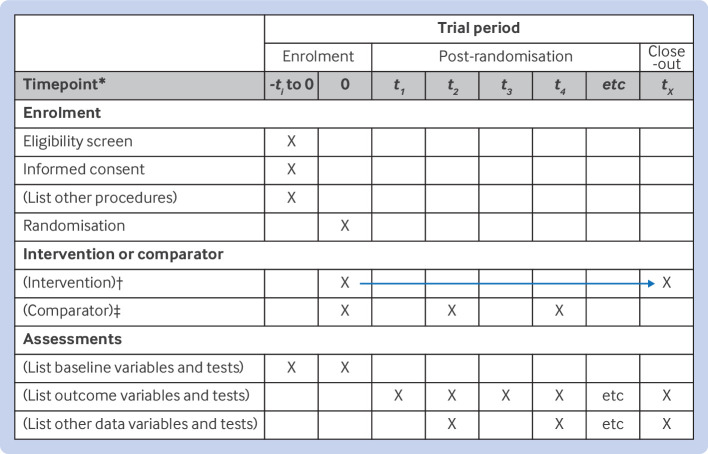
“an international group developed and published the updated SPIRIT 2025 statement13—consisting of a 34 item checklist of the minimum recommended protocol items (table 1); a diagram illustrating the schedule of enrolment, interventions, and assessments (fig 1).”
§ SPIRIT 2025 explanation and elaboration: updated guideline for protocols of randomised trials > Abstract
What the sources say
- Not checked yetcites [13] source
plain- Asserted: passes — The authors put it forward as true.
- Checkable: passes — It can be checked against evidence.
- Load-bearing: passes — The paper’s conclusions depend on it.
- Based: passes — The paper gives a reason why it holds.
Probably not a substantial claim. It may state two separate claims as one.
The paper states this without a source or data behind it here, so there is nothing to check it against. The quote shows it is in the paper.
In the paper
“The SPIRIT 2025 statement comprises a checklist of 34 essential items for reporting protocols of randomised trials”
§ SPIRIT 2025 explanation and elaboration: updated guideline for protocols of randomised trials > Methods
plain- Asserted: passes — The authors put it forward as true.
- Checkable: passes — It can be checked against evidence.
- Load-bearing: passes — The paper’s conclusions depend on it.
- Based: passes — The paper gives a reason why it holds.
Probably not a substantial claim.
What the paper did — it cites no source for this, so there is none to check. The quote shows it is in the paper.
In the paper
“Members of the core writing group (IB, A-WC, GSC, SH, AH, DM, KFS, RT) developed a draft for individual items. The draft was revised iteratively after comments from all authors.”
§ SPIRIT 2025 explanation and elaboration: updated guideline for protocols of randomised trials > Methods
plain- Asserted: passes — The authors put it forward as true.
- Checkable: passes — It can be checked against evidence.
- Load-bearing: fails — The paper’s conclusions may not depend on it.
- Based: passes — The paper gives a reason why it holds.
Probably not a substantial claim. The paper’s conclusions may not depend on it. It may state two separate claims as one.
In the paper
“We modelled our approach for developing the SPIRIT 2025 explanation and elaboration document on the procedures for the SPIRIT 2013 explanation and elaboration document.25”
§ SPIRIT 2025 explanation and elaboration: updated guideline for protocols of randomised trials > Methods
What the sources say
- Not checked yetcites [25] source
plaindirect- Asserted: passes — The authors put it forward as true.
- Checkable: passes — It can be checked against evidence.
- Load-bearing: fails — The paper’s conclusions may not depend on it.
- Based: passes — The paper gives a reason why it holds.
Probably not a substantial claim. The paper’s conclusions may not depend on it.
The paper states this without a source or data behind it here, so there is nothing to check it against. The quote shows it is in the paper.
In the paper
“High quality protocols facilitate proper planning, conduct, reporting, and external review of randomised trials”
§ SPIRIT 2025 explanation and elaboration: updated guideline for protocols of randomised trials > Abstract
plaindirect- Asserted: passes — The authors put it forward as true.
- Checkable: fails — It may be too vague to check against evidence.
- Load-bearing: passes — The paper’s conclusions depend on it.
- Based: fails — The paper may give no reason why it holds.
Probably not a substantial claim. It may be too vague to check against evidence. The paper may give no reason why it holds.
What the paper did — it cites no source for this, so there is none to check. The quote shows it is in the paper.
In the paper
“Some items had little or no identified empirical evidence (eg, item 1a, Title) but their inclusion in the checklist was supported by a strong pragmatic or ethical rationale.”
§ SPIRIT 2025 explanation and elaboration: updated guideline for protocols of randomised trials > Methods
plain- Asserted: passes — The authors put it forward as true.
- Checkable: passes — It can be checked against evidence.
- Load-bearing: fails — The paper’s conclusions may not depend on it.
- Based: passes — The paper gives a reason why it holds.
Probably not a substantial claim. The paper’s conclusions may not depend on it.
What the paper did — it cites no source for this, so there is none to check. The quote shows it is in the paper.
In the paper
“Examples are quoted verbatim from the trial protocol.”
§ SPIRIT 2025 explanation and elaboration: updated guideline for protocols of randomised trials > Methods
plain- Asserted: passes — The authors put it forward as true.
- Checkable: passes — It can be checked against evidence.
- Load-bearing: fails — The paper’s conclusions may not depend on it.
- Based: passes — The paper gives a reason why it holds.
Probably not a substantial claim. The paper’s conclusions may not depend on it.
The paper states this without a source or data behind it here, so there is nothing to check it against. The quote shows it is in the paper.
In the paper
“Also, as the content and context of randomised trials evolve, both SPIRIT and CONSORT statements require periodic updating to reflect new evidence, methodological advances, and feedback from users.”
§ SPIRIT 2025 explanation and elaboration: updated guideline for protocols of randomised trials > Abstract
plaindirect- Asserted: passes — The authors put it forward as true.
- Checkable: fails — It may be too vague to check against evidence.
- Load-bearing: passes — The paper’s conclusions depend on it.
- Based: passes — The paper gives a reason why it holds.
Probably not a substantial claim. It may be too vague to check against evidence.
What the paper did — it cites no source for this, so there is none to check. The quote shows it is in the paper.
In the paper
“To identify examples for each checklist item, we obtained protocols from public websites, journal publications, and appendices to published trials.”
§ SPIRIT 2025 explanation and elaboration: updated guideline for protocols of randomised trials > Methods
plain- Asserted: passes — The authors put it forward as true.
- Checkable: passes — It can be checked against evidence.
- Load-bearing: fails — The paper’s conclusions may not depend on it.
- Based: passes — The paper gives a reason why it holds.
Probably not a substantial claim. The paper’s conclusions may not depend on it.
What the paper did — it cites no source for this, so there is none to check. The quote shows it is in the paper.
In the paper
“When citing empirical evidence, we aimed to reference a systematic review when available.”
§ SPIRIT 2025 explanation and elaboration: updated guideline for protocols of randomised trials > Methods
plain- Asserted: fails — The authors may not put it forward as true.
- Checkable: passes — It can be checked against evidence.
- Load-bearing: fails — The paper’s conclusions may not depend on it.
- Based: passes — The paper gives a reason why it holds.
Probably not a substantial claim. The authors may not put it forward as true. The paper’s conclusions may not depend on it.
In the paper
“For each checklist item, we provided references to core empirical studies supporting its inclusion, which we identified through a continuously updated project database.20”
§ SPIRIT 2025 explanation and elaboration: updated guideline for protocols of randomised trials > Methods
What the sources say
- Not checked yetcites [20] source
plain- Asserted: passes — The authors put it forward as true.
- Checkable: passes — It can be checked against evidence.
- Load-bearing: fails — The paper’s conclusions may not depend on it.
- Based: passes — The paper gives a reason why it holds.
Probably not a substantial claim. The paper’s conclusions may not depend on it.
What the paper did — it cites no source for this, so there is none to check. The quote shows it is in the paper.
In the paper
“Studies were cited if they provided empirical data to support or challenge a given protocol concept.”
§ SPIRIT 2025 explanation and elaboration: updated guideline for protocols of randomised trials > Methods
plain- Asserted: passes — The authors put it forward as true.
- Checkable: passes — It can be checked against evidence.
- Load-bearing: fails — The paper’s conclusions may not depend on it.
- Based: passes — The paper gives a reason why it holds.
Probably not a substantial claim. The paper’s conclusions may not depend on it.
In the paper
“The methods used to update the SPIRIT and CONSORT statements followed the EQUATOR (Enhancing the Quality and Transparency Of Health Research) Network guidance for developers of health research guidelines.16”
§ SPIRIT 2025 explanation and elaboration: updated guideline for protocols of randomised trials > Methods
What the sources say
- Not checked yetcites [16] source
plain- Asserted: passes — The authors put it forward as true.
- Checkable: passes — It can be checked against evidence.
- Load-bearing: fails — The paper’s conclusions may not depend on it.
- Based: passes — The paper gives a reason why it holds.
Probably not a substantial claim. The paper’s conclusions may not depend on it.
None of the sources cited for this claim have been checked yet.
In the paper
“yet their completeness varies and key elements are often not considered”
§ SPIRIT 2025 explanation and elaboration: updated guideline for protocols of randomised trials > Abstract
What the sources say
plain- Asserted: passes — The authors put it forward as true.
- Checkable: passes — It can be checked against evidence.
- Load-bearing: passes — The paper’s conclusions depend on it.
- Based: passes — The paper gives a reason why it holds.
It may state two separate claims as one.
What the paper did — it cites no source for this, so there is none to check. The quote shows it is in the paper.
In the paper
“Exemplars were selected to reflect how key elements could be appropriately described in a trial protocol.”
§ SPIRIT 2025 explanation and elaboration: updated guideline for protocols of randomised trials > Methods
plain- Asserted: passes — The authors put it forward as true.
- Checkable: passes — It can be checked against evidence.
- Load-bearing: fails — The paper’s conclusions may not depend on it.
- Based: passes — The paper gives a reason why it holds.
Probably not a substantial claim. The paper’s conclusions may not depend on it.
None of the sources cited for this claim have been checked yet.
In the paper
“identified relevant SPIRIT or CONSORT extensions and related guidelines (eg,21 22 23 24)”
§ SPIRIT 2025 explanation and elaboration: updated guideline for protocols of randomised trials > Methods
What the sources say
plain- Asserted: passes — The authors put it forward as true.
- Checkable: passes — It can be checked against evidence.
- Load-bearing: fails — The paper’s conclusions may not depend on it.
- Based: passes — The paper gives a reason why it holds.
Probably not a substantial claim. The paper’s conclusions may not depend on it.
What the paper did — it cites no source for this, so there is none to check. The quote shows it is in the paper.
In the paper
“We then generated a list of potential modifications or additions to SPIRIT and CONSORT, which we presented to interested parties in an online Delphi survey involving 317 international participants.”
§ SPIRIT 2025 explanation and elaboration: updated guideline for protocols of randomised trials > Methods
plainn = 317- Asserted: passes — The authors put it forward as true.
- Checkable: passes — It can be checked against evidence.
- Load-bearing: fails — The paper’s conclusions may not depend on it.
- Based: passes — The paper gives a reason why it holds.
Probably not a substantial claim. The paper’s conclusions may not depend on it.
In the paper
“The title provides an important means of trial identification.”
§ SPIRIT 2025 explanation and elaboration: updated guideline for protocols of randomised trials > Explanation and elaboration of reporting items > Item 1a: Title stating the trial design, population, and interventions, with identification as a protocol
What the sources say
- Not checked yetcites [28] source
plain- Asserted: passes — The authors put it forward as true.
- Checkable: fails — It may be too vague to check against evidence.
- Load-bearing: fails — The paper’s conclusions may not depend on it.
- Based: passes — The paper gives a reason why it holds.
Probably not a substantial claim. It may be too vague to check against evidence. The paper’s conclusions may not depend on it.
None of the sources cited for this claim have been checked yet.
In the paper
“SPIRIT 2025 was developed in parallel with the updated CONSORT 2025 to harmonise recommendations and terminology.7 14”
§ SPIRIT 2025 explanation and elaboration: updated guideline for protocols of randomised trials > Abstract
plaindirect- Asserted: passes — The authors put it forward as true.
- Checkable: passes — It can be checked against evidence.
- Load-bearing: fails — The paper’s conclusions may not depend on it.
- Based: passes — The paper gives a reason why it holds.
Probably not a substantial claim. The paper’s conclusions may not depend on it.
In the paper
“conducted a scoping review of published comments suggesting changes to SPIRIT 2013 and CONSORT 2010,18”
§ SPIRIT 2025 explanation and elaboration: updated guideline for protocols of randomised trials > Methods
What the sources say
- Not checked yetcites [18] source
plain- Asserted: passes — The authors put it forward as true.
- Checkable: passes — It can be checked against evidence.
- Load-bearing: fails — The paper’s conclusions may not depend on it.
- Based: passes — The paper gives a reason why it holds.
Probably not a substantial claim. The paper’s conclusions may not depend on it.
The paper states this without a source or data behind it here, so there is nothing to check it against. The quote shows it is in the paper.
In the paper
“A structured summary provides an accessible overview of the planned trial for users of the protocol.”
§ SPIRIT 2025 explanation and elaboration: updated guideline for protocols of randomised trials > Explanation and elaboration of reporting items > Item 1b: Structured summary of trial design and methods, including items from the World Health Organization Trial Registration Data Set
plaindirect- Asserted: passes — The authors put it forward as true.
- Checkable: fails — It may be too vague to check against evidence.
- Load-bearing: passes — The paper’s conclusions depend on it.
- Based: passes — The paper gives a reason why it holds.
Probably not a substantial claim. It may be too vague to check against evidence.
What the paper did — it cites no source for this, so there is none to check. The quote shows it is in the paper.
In the paper
“The Delphi survey results were then discussed at a two day online expert consensus meeting attended by 30 international experts before we drafted the updated SPIRIT 2025 and CONSORT 2025 checklists and finalised them based on further feedback from people who attended the meeting.”
§ SPIRIT 2025 explanation and elaboration: updated guideline for protocols of randomised trials > Methods
plain- Asserted: passes — The authors put it forward as true.
- Checkable: passes — It can be checked against evidence.
- Load-bearing: fails — The paper’s conclusions may not depend on it.
- Based: passes — The paper gives a reason why it holds.
Probably not a substantial claim. The paper’s conclusions may not depend on it.
In the paper
“This dataset defines the minimum information to be included in a trial registry for a trial to be considered fully registered (item 4).30”
§ SPIRIT 2025 explanation and elaboration: updated guideline for protocols of randomised trials > Explanation and elaboration of reporting items > Item 1b: Structured summary of trial design and methods, including items from the World Health Organization Trial Registration Data Set
What the sources say
- Not checked yetcites [30] World Health Organization. WHO Trial Registration Data Set (Version 1.3.1). https://www.who.int/clinical-trials-registry-platform/network/who-data-set [Accessed 12 Mar 2024].
plain- Asserted: passes — The authors put it forward as true.
- Checkable: passes — It can be checked against evidence.
- Load-bearing: fails — The paper’s conclusions may not depend on it.
- Based: passes — The paper gives a reason why it holds.
Probably not a substantial claim. The paper’s conclusions may not depend on it.
In the paper
“A succinct description that conveys the topic (study population, intervention, comparator) and trial design (eg, parallel group randomised trial) will facilitate retrieval from electronic database or internet searches and rapid judgment of relevance.28”
§ SPIRIT 2025 explanation and elaboration: updated guideline for protocols of randomised trials > Explanation and elaboration of reporting items > Item 1a: Title stating the trial design, population, and interventions, with identification as a protocol
What the sources say
- Not checked yetcites [28] source
plaindirect- Asserted: passes — The authors put it forward as true.
- Checkable: fails — It may be too vague to check against evidence.
- Load-bearing: fails — The paper’s conclusions may not depend on it.
- Based: passes — The paper gives a reason why it holds.
Probably not a substantial claim. It may be too vague to check against evidence. The paper’s conclusions may not depend on it.
What the paper did — it cites no source for this, so there is none to check. The quote shows it is in the paper.
In the paper
“SPIRIT 2025 reflects the collaboration and input of multiple contributors, including trial investigators, healthcare professionals, methodologists, statisticians, patient and public contributors, journal editors, and research funders.”
§ SPIRIT 2025 explanation and elaboration: updated guideline for protocols of randomised trials > Abstract
plain- Asserted: passes — The authors put it forward as true.
- Checkable: passes — It can be checked against evidence.
- Load-bearing: fails — The paper’s conclusions may not depend on it.
- Based: passes — The paper gives a reason why it holds.
Probably not a substantial claim. The paper’s conclusions may not depend on it.
None of the sources cited for this claim have been checked yet.
In the paper
“Although the reporting of protocols for randomised trials has improved somewhat since 2013 it remains far from adequate.9 10 11 12”
§ SPIRIT 2025 explanation and elaboration: updated guideline for protocols of randomised trials > Abstract
What the sources say
plain- Asserted: passes — The authors put it forward as true.
- Checkable: passes — It can be checked against evidence.
- Load-bearing: passes — The paper’s conclusions depend on it.
- Based: passes — The paper gives a reason why it holds.
It may state two separate claims as one.
None of the sources cited for this claim have been checked yet.
In the paper
“Naming of authors can also help to identify conflicts of interest (item 7b) and reduce ghost and gift authorship.38 39 40 41”
§ SPIRIT 2025 explanation and elaboration: updated guideline for protocols of randomised trials > Explanation and elaboration of reporting items > Item 3a: Names, affiliations, and roles of protocol contributors
What the sources say
plaindirect- Asserted: passes — The authors put it forward as true.
- Checkable: passes — It can be checked against evidence.
- Load-bearing: passes — The paper’s conclusions depend on it.
- Based: passes — The paper gives a reason why it holds.
It may state two separate claims as one.
In the paper
“For some investigator initiated trials, the principal investigator can be considered to be a sponsor-investigator, assuming the roles of both sponsor and investigator.46”
§ SPIRIT 2025 explanation and elaboration: updated guideline for protocols of randomised trials > Explanation and elaboration of reporting items > Item 3b: Name and contact information for the trial sponsor
What the sources say
- Not checked yetcites [46] International Council for Harmonisation of Technical Requirements for Pharmaceuticals for Human Use (ICH). Integrated addendum to ICH E6(R1): guideline for good clinical practice E6(R2). Step 4 version dated 9 November 2016. https://database.ich.org/sites/default/files/E6_R2_Addendum.pdf.
plain- Asserted: passes — The authors put it forward as true.
- Checkable: passes — It can be checked against evidence.
- Load-bearing: fails — The paper’s conclusions may not depend on it.
- Based: passes — The paper gives a reason why it holds.
Probably not a substantial claim. The paper’s conclusions may not depend on it.
None of the sources cited for this claim have been checked yet.
In the paper
“Documentation of a trial’s existence and prespecified outcomes in a publicly accessible registry helps to increase transparency, decrease unnecessary duplication of research effort, facilitate identification of ongoing trials for prospective participants, and identify and deter selective reporting of study results.63 64”
§ SPIRIT 2025 explanation and elaboration: updated guideline for protocols of randomised trials > Explanation and elaboration of reporting items > Item 4: Name of trial registry, identifying number (with URL), and date of registration. If not yet registered, name of intended registry
plaindirect- Asserted: passes — The authors put it forward as true.
- Checkable: passes — It can be checked against evidence.
- Load-bearing: passes — The paper’s conclusions depend on it.
- Based: passes — The paper gives a reason why it holds.
It may state two separate claims as one.
A conclusion the paper draws from its own results — it cites no other source for it, so there is none to check. The quote shows it is in the paper.
In the paper
“Transparent tracking of versions and amendments facilitates trial conduct, review, and oversight.”
§ SPIRIT 2025 explanation and elaboration: updated guideline for protocols of randomised trials > Explanation and elaboration of reporting items > Item 2: Version date and identifier
plaindirect- Asserted: passes — The authors put it forward as true.
- Checkable: fails — It may be too vague to check against evidence.
- Load-bearing: passes — The paper’s conclusions depend on it.
- Based: passes — The paper gives a reason why it holds.
Probably not a substantial claim. It may be too vague to check against evidence.
In the paper
“Typically, the statistical analysis plan is a separate document that should be read in conjunction with the protocol, but for some trials with simple analyses, it can be included as part of the protocol.72”
§ SPIRIT 2025 explanation and elaboration: updated guideline for protocols of randomised trials > Explanation and elaboration of reporting items > Item 5: Where the trial protocol and statistical analysis plan can be accessed
What the sources say
- Not checked yetcites [72] source
plain- Asserted: passes — The authors put it forward as true.
- Checkable: passes — It can be checked against evidence.
- Load-bearing: fails — The paper’s conclusions may not depend on it.
- Based: passes — The paper gives a reason why it holds.
Probably not a substantial claim. The paper’s conclusions may not depend on it. It may state two separate claims as one.
A conclusion the paper draws from its own results — it cites no other source for it, so there is none to check. The quote shows it is in the paper.
In the paper
“Listing the protocol authors, their affiliations, and their role in the protocol development process provides due recognition, accountability, and transparency.”
§ SPIRIT 2025 explanation and elaboration: updated guideline for protocols of randomised trials > Explanation and elaboration of reporting items > Item 3a: Names, affiliations, and roles of protocol contributors
plaindirect- Asserted: passes — The authors put it forward as true.
- Checkable: fails — It may be too vague to check against evidence.
- Load-bearing: passes — The paper’s conclusions depend on it.
- Based: passes — The paper gives a reason why it holds.
Probably not a substantial claim. It may be too vague to check against evidence. It may state two separate claims as one.
None of the sources cited for this claim have been checked yet.
In the paper
“Reviews of two samples of 108 and 292 trial protocols from 2016 found that 57% and 78%, respectively, reported the name and contact details of the sponsor.9 10”
§ SPIRIT 2025 explanation and elaboration: updated guideline for protocols of randomised trials > Explanation and elaboration of reporting items > Item 3b: Name and contact information for the trial sponsor
plainn = 2- Asserted: passes — The authors put it forward as true.
- Checkable: passes — It can be checked against evidence.
- Load-bearing: fails — The paper’s conclusions may not depend on it.
- Based: passes — The paper gives a reason why it holds.
Probably not a substantial claim. The paper’s conclusions may not depend on it.
A conclusion the paper draws from its own results — it cites no other source for it, so there is none to check. The quote shows it is in the paper.
In the paper
“Reporting of the dataset in the protocol can facilitate the prospective transfer of accurate information to a trial registry (ie, before inclusion of the first trial participant).”
§ SPIRIT 2025 explanation and elaboration: updated guideline for protocols of randomised trials > Explanation and elaboration of reporting items > Item 1b: Structured summary of trial design and methods, including items from the World Health Organization Trial Registration Data Set
plainconditional- Asserted: passes — The authors put it forward as true.
- Checkable: passes — It can be checked against evidence.
- Load-bearing: passes — The paper’s conclusions depend on it.
- Based: passes — The paper gives a reason why it holds.
Probably not a substantial claim.
None of the sources cited for this claim have been checked yet.
In the paper
“Reviews of two samples of 108 and 292 trial protocols from 2016 found that 98% and 92%, respectively, reported the steering committee membership and roles.9 10”
§ SPIRIT 2025 explanation and elaboration: updated guideline for protocols of randomised trials > Explanation and elaboration of reporting items > Item 3d: Composition, roles, and responsibilities of the coordinating site, steering committee, endpoint adjudication committee, data management team, and other individuals or groups overseeing the trial, if applicable
plainn = 2- Asserted: passes — The authors put it forward as true.
- Checkable: passes — It can be checked against evidence.
- Load-bearing: fails — The paper’s conclusions may not depend on it.
- Based: passes — The paper gives a reason why it holds.
Probably not a substantial claim. The paper’s conclusions may not depend on it. It may state two separate claims as one.
None of the sources cited for this claim have been checked yet.
In the paper
“Most industry initiated trials are controlled by the company sponsoring and funding the trial; this authority is often enforced by contractual agreements signed between the company and trial investigators.38 48”
§ SPIRIT 2025 explanation and elaboration: updated guideline for protocols of randomised trials > Explanation and elaboration of reporting items > Item 3c: Role of trial sponsor and funders in design, conduct, analysis, and reporting of trial; including any authority over these activities
plaindirect- Asserted: passes — The authors put it forward as true.
- Checkable: passes — It can be checked against evidence.
- Load-bearing: unclear — It is unclear whether the paper’s conclusions depend on it.
- Based: passes — The paper gives a reason why it holds.
It may state two separate claims as one.
None of the sources cited for this claim have been checked yet.
In the paper
“A randomised trial will often include various committees or groups to facilitate trial coordination and conduct—for example, a trial management group (day-to-day trial conduct) and a trial steering committee (executive decisions).54 55”
§ SPIRIT 2025 explanation and elaboration: updated guideline for protocols of randomised trials > Explanation and elaboration of reporting items > Item 3d: Composition, roles, and responsibilities of the coordinating site, steering committee, endpoint adjudication committee, data management team, and other individuals or groups overseeing the trial, if applicable
plain- Asserted: passes — The authors put it forward as true.
- Checkable: passes — It can be checked against evidence.
- Load-bearing: fails — The paper’s conclusions may not depend on it.
- Based: passes — The paper gives a reason why it holds.
Probably not a substantial claim. The paper’s conclusions may not depend on it.
A conclusion the paper draws from its own results — it cites no other source for it, so there is none to check. The quote shows it is in the paper.
In the paper
“Identification of the trial sponsor provides transparency and accountability and can also help to identify conflicts of interest (item 7b).”
§ SPIRIT 2025 explanation and elaboration: updated guideline for protocols of randomised trials > Explanation and elaboration of reporting items > Item 3b: Name and contact information for the trial sponsor
plainconditional- Asserted: passes — The authors put it forward as true.
- Checkable: passes — It can be checked against evidence.
- Load-bearing: passes — The paper’s conclusions depend on it.
- Based: passes — The paper gives a reason why it holds.
Probably not a substantial claim. It may state two separate claims as one.
In the paper
“In general, the company is the sponsor in industry initiated trials, whereas the institution of the primary investigator is often the sponsor for investigator initiated trials.”
§ SPIRIT 2025 explanation and elaboration: updated guideline for protocols of randomised trials > Explanation and elaboration of reporting items > Item 3b: Name and contact information for the trial sponsor
What the sources say
- Not checked yetcites [46] International Council for Harmonisation of Technical Requirements for Pharmaceuticals for Human Use (ICH). Integrated addendum to ICH E6(R1): guideline for good clinical practice E6(R2). Step 4 version dated 9 November 2016. https://database.ich.org/sites/default/files/E6_R2_Addendum.pdf.
hedgedcorrelational- Asserted: passes — The authors put it forward as true.
- Checkable: passes — It can be checked against evidence.
- Load-bearing: fails — The paper’s conclusions may not depend on it.
- Based: passes — The paper gives a reason why it holds.
Probably not a substantial claim. The paper’s conclusions may not depend on it. It may state two separate claims as one.
None of the sources cited for this claim have been checked yet.
In the paper
“The naming of authors and a description of their roles are standard for protocols published in journals such as Trials and BMJ Open, but they are less common for unpublished protocols.”
§ SPIRIT 2025 explanation and elaboration: updated guideline for protocols of randomised trials > Explanation and elaboration of reporting items > Item 3a: Names, affiliations, and roles of protocol contributors
plaincorrelationaln = 2- Asserted: passes — The authors put it forward as true.
- Checkable: passes — It can be checked against evidence.
- Load-bearing: unclear — It is unclear whether the paper’s conclusions depend on it.
- Based: passes — The paper gives a reason why it holds.
It may state two separate claims as one.
None of the sources cited for this claim have been checked yet.
In the paper
“As mandated by the ICMJE and jurisdictional legislation,31 32 66 registration of clinical trials should occur before recruitment of the first trial participant.”
§ SPIRIT 2025 explanation and elaboration: updated guideline for protocols of randomised trials > Explanation and elaboration of reporting items > Item 4: Name of trial registry, identifying number (with URL), and date of registration. If not yet registered, name of intended registry
What the sources say
- Not checked yetcites [31] European Commission. Clinical trials - Regulation EU No 536/2014. 2022. https://health.ec.europa.eu/medicinal-products/clinical-trials/clinical-trials-regulation-eu-no-5362014_en.
- Not checked yetcites [32] source
- Not checked yetcites [66] United States Congress. Food and Drug Administration Amendments Act of 2007, Title VIII, Section 801. Expanded clinical trial registry data bank. 2007. https://www.govtrack.us/congress/bills/110/hr3580/text.
plain- Asserted: passes — The authors put it forward as true.
- Checkable: passes — It can be checked against evidence.
- Load-bearing: passes — The paper’s conclusions depend on it.
- Based: passes — The paper gives a reason why it holds.
Probably not a substantial claim.
A conclusion the paper draws from its own results — it cites no other source for it, so there is none to check. The quote shows it is in the paper.
In the paper
“Sequentially labelling and dating each protocol version helps to mitigate potential confusion over which document is the most recent.”
§ SPIRIT 2025 explanation and elaboration: updated guideline for protocols of randomised trials > Explanation and elaboration of reporting items > Item 2: Version date and identifier
plaindirect- Asserted: passes — The authors put it forward as true.
- Checkable: passes — It can be checked against evidence.
- Load-bearing: passes — The paper’s conclusions depend on it.
- Based: passes — The paper gives a reason why it holds.
Probably not a substantial claim.
A conclusion the paper draws from its own results — it cites no other source for it, so there is none to check. The quote shows it is in the paper.
In the paper
“This can also signal the need for updates to the registry record when associated protocol sections are amended—thereby promoting consistency of information between the protocol and registry.”
§ SPIRIT 2025 explanation and elaboration: updated guideline for protocols of randomised trials > Explanation and elaboration of reporting items > Item 1b: Structured summary of trial design and methods, including items from the World Health Organization Trial Registration Data Set
plainconditional- Asserted: passes — The authors put it forward as true.
- Checkable: passes — It can be checked against evidence.
- Load-bearing: fails — The paper’s conclusions may not depend on it.
- Based: passes — The paper gives a reason why it holds.
Probably not a substantial claim. The paper’s conclusions may not depend on it.
In the paper
“Changes to the protocol and statistical analysis plan may happen after the trial begins, often for legitimate reasons—for example, in response to new evidence or unanticipated challenges.73”
§ SPIRIT 2025 explanation and elaboration: updated guideline for protocols of randomised trials > Explanation and elaboration of reporting items > Item 5: Where the trial protocol and statistical analysis plan can be accessed
What the sources say
- Not checked yetcites [73] source
hedgedconditional- Asserted: passes — The authors put it forward as true.
- Checkable: passes — It can be checked against evidence.
- Load-bearing: fails — The paper’s conclusions may not depend on it.
- Based: passes — The paper gives a reason why it holds.
Probably not a substantial claim. The paper’s conclusions may not depend on it.
None of the sources cited for this claim have been checked yet.
In the paper
“Amendments to the trial protocol are common.35 36”
§ SPIRIT 2025 explanation and elaboration: updated guideline for protocols of randomised trials > Explanation and elaboration of reporting items > Item 2: Version date and identifier
plain- Asserted: passes — The authors put it forward as true.
- Checkable: passes — It can be checked against evidence.
- Load-bearing: fails — The paper’s conclusions may not depend on it.
- Based: passes — The paper gives a reason why it holds.
Probably not a substantial claim. The paper’s conclusions may not depend on it.
None of the sources cited for this claim have been checked yet.
In the paper
“These standards are supported by the International Committee of Medical Journal Editors (ICMJE), other journal editors, and legislation in many countries.31 32 33”
§ SPIRIT 2025 explanation and elaboration: updated guideline for protocols of randomised trials > Explanation and elaboration of reporting items > Item 1b: Structured summary of trial design and methods, including items from the World Health Organization Trial Registration Data Set
What the sources say
- Not checked yetcites [31] European Commission. Clinical trials - Regulation EU No 536/2014. 2022. https://health.ec.europa.eu/medicinal-products/clinical-trials/clinical-trials-regulation-eu-no-5362014_en.
- Not checked yetcites [32] source
- Not checked yetcites [33] National Institutes of Health Department of Health and Human Services. Final Rule 81 FR 64982: Clinical Trials Registration and Results Information Submission. https://www.federalregister.gov/documents/2016/09/21/2016-22129/clinical-trials-registration-and-results-information-submission. 2016:64982-5157.
plain- Asserted: passes — The authors put it forward as true.
- Checkable: passes — It can be checked against evidence.
- Load-bearing: fails — The paper’s conclusions may not depend on it.
- Based: passes — The paper gives a reason why it holds.
Probably not a substantial claim. The paper’s conclusions may not depend on it.
None of the sources cited for this claim have been checked yet.
In the paper
“Reviews of two samples of 108 and 292 trial protocols from 2016 found that 65% and 62%, respectively, reported declarations of interests.9 10”
§ SPIRIT 2025 explanation and elaboration: updated guideline for protocols of randomised trials > Explanation and elaboration of reporting items > Item 7b: Financial and other conflicts of interest for principal investigators and steering committee members
plainn = 2- Asserted: passes — The authors put it forward as true.
- Checkable: passes — It can be checked against evidence.
- Load-bearing: fails — The paper’s conclusions may not depend on it.
- Based: passes — The paper gives a reason why it holds.
Probably not a substantial claim. The paper’s conclusions may not depend on it.
None of the sources cited for this claim have been checked yet.
In the paper
“Although peer reviewers and journal editors can be biased in favour of positive findings,119 lack of publication seems to be primarily due to trial investigators or sponsors failing to submit negative or null results, rather than journals rejecting them.114 120”
§ SPIRIT 2025 explanation and elaboration: updated guideline for protocols of randomised trials > Explanation and elaboration of reporting items > Item 8: Plans to communicate trial results to participants, healthcare professionals, the public, and other relevant groups (eg, reporting in trial registry, plain language summary, publication)
What the sources say
hedgeddirect- Asserted: passes — The authors put it forward as true.
- Checkable: passes — It can be checked against evidence.
- Load-bearing: unclear — It is unclear whether the paper’s conclusions depend on it.
- Based: passes — The paper gives a reason why it holds.
It may state two separate claims as one.
None of the sources cited for this claim have been checked yet.
In the paper
“In a growing number of jurisdictions (eg, Canada, US, UK), some funders now require a commitment on the part of researchers to share their data (eg, US National Institutes of Health, UK National Institute for Health and Care Research, Gates Foundation). Similarly, some journals require data sharing statements as part of the article submission process (eg, The BMJ, PLOS Medicine).91 92”
§ SPIRIT 2025 explanation and elaboration: updated guideline for protocols of randomised trials > Explanation and elaboration of reporting items > Item 6: Where and how the individual deidentified participant data (including data dictionary), statistical code, and any other materials will be accessible
plain- Asserted: passes — The authors put it forward as true.
- Checkable: passes — It can be checked against evidence.
- Load-bearing: fails — The paper’s conclusions may not depend on it.
- Based: passes — The paper gives a reason why it holds.
Probably not a substantial claim. The paper’s conclusions may not depend on it. It may state two separate claims as one.
In the paper
“A randomised trial requires considerable funding, typically from drug or device companies (ie, industry funded) or from scientific or private foundations, or governmental or non-governmental organisations (ie, non-industry funded).102”
§ SPIRIT 2025 explanation and elaboration: updated guideline for protocols of randomised trials > Explanation and elaboration of reporting items > Item 7a: Sources of funding and other support (eg, supply of drugs)
What the sources say
- Not checked yetcites [102] source
plain- Asserted: passes — The authors put it forward as true.
- Checkable: passes — It can be checked against evidence.
- Load-bearing: fails — The paper’s conclusions may not depend on it.
- Based: passes — The paper gives a reason why it holds.
Probably not a substantial claim. The paper’s conclusions may not depend on it.
In the paper
“Undue influence on trials from non-industry funders with a strong interest in a specific trial result has been described,107 although studied less.”
§ SPIRIT 2025 explanation and elaboration: updated guideline for protocols of randomised trials > Explanation and elaboration of reporting items > Item 7a: Sources of funding and other support (eg, supply of drugs)
What the sources say
- Not checked yetcites [107] source
plain- Asserted: passes — The authors put it forward as true.
- Checkable: passes — It can be checked against evidence.
- Load-bearing: unclear — It is unclear whether the paper’s conclusions depend on it.
- Based: passes — The paper gives a reason why it holds.
It may state two separate claims as one.
None of the sources cited for this claim have been checked yet.
In the paper
“Meta-research studies have found that more than a quarter of unpublished trials in various countries had results available in trial registries, and some data (particularly harms) were more completely reported in registries than in journal publications.113 124 125 126 127”
§ SPIRIT 2025 explanation and elaboration: updated guideline for protocols of randomised trials > Explanation and elaboration of reporting items > Item 8: Plans to communicate trial results to participants, healthcare professionals, the public, and other relevant groups (eg, reporting in trial registry, plain language summary, publication)
What the sources say
plaincorrelational- Asserted: passes — The authors put it forward as true.
- Checkable: passes — It can be checked against evidence.
- Load-bearing: unclear — It is unclear whether the paper’s conclusions depend on it.
- Based: passes — The paper gives a reason why it holds.
It may state two separate claims as one.
In the paper
“One study estimated the median cost for each phase 3 industry funded trial to be $21.4m (£16.9m; €20.5m),103 with substantial variation.”
§ SPIRIT 2025 explanation and elaboration: updated guideline for protocols of randomised trials > Explanation and elaboration of reporting items > Item 7a: Sources of funding and other support (eg, supply of drugs)
What the sources say
- Not checked yetcites [103] source
hedged- Asserted: passes — The authors put it forward as true.
- Checkable: passes — It can be checked against evidence.
- Load-bearing: fails — The paper’s conclusions may not depend on it.
- Based: passes — The paper gives a reason why it holds.
Probably not a substantial claim. The paper’s conclusions may not depend on it. It may state two separate claims as one.
None of the sources cited for this claim have been checked yet.
In the paper
“Reviews of two samples of 108 and 292 trial protocols from 2016 found that 91% and 83%, respectively, described funding sources.9 10”
§ SPIRIT 2025 explanation and elaboration: updated guideline for protocols of randomised trials > Explanation and elaboration of reporting items > Item 7a: Sources of funding and other support (eg, supply of drugs)
plainn = 2- Asserted: passes — The authors put it forward as true.
- Checkable: passes — It can be checked against evidence.
- Load-bearing: fails — The paper’s conclusions may not depend on it.
- Based: passes — The paper gives a reason why it holds.
Probably not a substantial claim. The paper’s conclusions may not depend on it.
None of the sources cited for this claim have been checked yet.
In the paper
“Beyond journal publication, trial registries and preprint servers are important venues for dissemination.121 122 123”
§ SPIRIT 2025 explanation and elaboration: updated guideline for protocols of randomised trials > Explanation and elaboration of reporting items > Item 8: Plans to communicate trial results to participants, healthcare professionals, the public, and other relevant groups (eg, reporting in trial registry, plain language summary, publication)
What the sources say
plain- Asserted: passes — The authors put it forward as true.
- Checkable: passes — It can be checked against evidence.
- Load-bearing: fails — The paper’s conclusions may not depend on it.
- Based: passes — The paper gives a reason why it holds.
Probably not a substantial claim. The paper’s conclusions may not depend on it. It may state two separate claims as one.
In the paper
“For some trials, especially those sponsored by industry, access to the final trial dataset is restricted to the sponsor, which can introduce concerns about potential conflicts of interest (item 3c).99”
§ SPIRIT 2025 explanation and elaboration: updated guideline for protocols of randomised trials > Explanation and elaboration of reporting items > Item 6: Where and how the individual deidentified participant data (including data dictionary), statistical code, and any other materials will be accessible
What the sources say
- Not checked yetcites [99] source
plainconditional- Asserted: passes — The authors put it forward as true.
- Checkable: passes — It can be checked against evidence.
- Load-bearing: unclear — It is unclear whether the paper’s conclusions depend on it.
- Based: passes — The paper gives a reason why it holds.
It may state two separate claims as one.
In the paper
“Conflicts of interest are most often associated with drug and device industries, but they may exist with support from or affiliation with government agencies, charities (not-for-profit organisations), and professional and civic organisations,107 although these associations have been much less investigated.”
§ SPIRIT 2025 explanation and elaboration: updated guideline for protocols of randomised trials > Explanation and elaboration of reporting items > Item 7b: Financial and other conflicts of interest for principal investigators and steering committee members
What the sources say
- Not checked yetcites [107] source
hedgedcorrelational- Asserted: passes — The authors put it forward as true.
- Checkable: passes — It can be checked against evidence.
- Load-bearing: fails — The paper’s conclusions may not depend on it.
- Based: passes — The paper gives a reason why it holds.
Probably not a substantial claim. The paper’s conclusions may not depend on it. It may state two separate claims as one.
In the paper
“The World Medical Association supports the principle that trial investigators retain the right to access the data.98”
§ SPIRIT 2025 explanation and elaboration: updated guideline for protocols of randomised trials > Explanation and elaboration of reporting items > Item 6: Where and how the individual deidentified participant data (including data dictionary), statistical code, and any other materials will be accessible
What the sources say
- Not checked yetcites [98] World Medical Association. World Medical Association statement on conflicts of interest. Adopted by the 60 WMA General Assembly, New Delhi, India, October 2009 and editorially revised by the 201st WMA Council Session, Moscow, Russia, October 2015. https://www.wma.net/policies-post/wma-statement-on-conflict-of-interest/.
plain- Asserted: passes — The authors put it forward as true.
- Checkable: passes — It can be checked against evidence.
- Load-bearing: fails — The paper’s conclusions may not depend on it.
- Based: passes — The paper gives a reason why it holds.
Probably not a substantial claim. The paper’s conclusions may not depend on it.
None of the sources cited for this claim have been checked yet.
In the paper
“Having access to these documents may help with trial appraisal, interpretation, and replication, as well as identification of selective outcome reporting.81 82”
§ SPIRIT 2025 explanation and elaboration: updated guideline for protocols of randomised trials > Explanation and elaboration of reporting items > Item 5: Where the trial protocol and statistical analysis plan can be accessed
hedgedconditional- Asserted: passes — The authors put it forward as true.
- Checkable: passes — It can be checked against evidence.
- Load-bearing: passes — The paper’s conclusions depend on it.
- Based: passes — The paper gives a reason why it holds.
It may state two separate claims as one.
In the paper
“Consent for data sharing can be obtained from trial participants upon enrolment, whereas approval for data sharing is typically obtained from research ethics committees and data access committees.90”
§ SPIRIT 2025 explanation and elaboration: updated guideline for protocols of randomised trials > Explanation and elaboration of reporting items > Item 6: Where and how the individual deidentified participant data (including data dictionary), statistical code, and any other materials will be accessible
What the sources say
- Not checked yetcites [90] source
plain- Asserted: passes — The authors put it forward as true.
- Checkable: passes — It can be checked against evidence.
- Load-bearing: fails — The paper’s conclusions may not depend on it.
- Based: passes — The paper gives a reason why it holds.
Probably not a substantial claim. The paper’s conclusions may not depend on it. It may state two separate claims as one.
None of the sources cited for this claim have been checked yet.
In the paper
“Overall, the medical literature represents a biased subset of existing data, potentially leading to overestimation of benefits, underestimation of harms, and a detrimental impact on patient care and research.112 117 118”
§ SPIRIT 2025 explanation and elaboration: updated guideline for protocols of randomised trials > Explanation and elaboration of reporting items > Item 8: Plans to communicate trial results to participants, healthcare professionals, the public, and other relevant groups (eg, reporting in trial registry, plain language summary, publication)
What the sources say
hedgedconditional- Asserted: passes — The authors put it forward as true.
- Checkable: passes — It can be checked against evidence.
- Load-bearing: passes — The paper’s conclusions depend on it.
- Based: passes — The paper gives a reason why it holds.
It may state two separate claims as one.
In the paper
“For example, among 224 randomised trials of interventions for covid-19, 68 (30%) reported in a trial registry the intention to share data, but only 50 (22%) actually shared individual patient data upon request or in a repository.96”
§ SPIRIT 2025 explanation and elaboration: updated guideline for protocols of randomised trials > Explanation and elaboration of reporting items > Item 6: Where and how the individual deidentified participant data (including data dictionary), statistical code, and any other materials will be accessible
What the sources say
- Not checked yetcites [96] source
plain- Asserted: passes — The authors put it forward as true.
- Checkable: passes — It can be checked against evidence.
- Load-bearing: unclear — It is unclear whether the paper’s conclusions depend on it.
- Based: passes — The paper gives a reason why it holds.
It may state two separate claims as one.
In the paper
“The mean cost of clinical trials funded by the UK National Institute for Health and Care Research was lower but still sizeable at about £1.3m, and also with considerable variation.104”
§ SPIRIT 2025 explanation and elaboration: updated guideline for protocols of randomised trials > Explanation and elaboration of reporting items > Item 7a: Sources of funding and other support (eg, supply of drugs)
What the sources say
- Not checked yetcites [104] source
plain- Asserted: passes — The authors put it forward as true.
- Checkable: passes — It can be checked against evidence.
- Load-bearing: fails — The paper’s conclusions may not depend on it.
- Based: passes — The paper gives a reason why it holds.
Probably not a substantial claim. The paper’s conclusions may not depend on it. It may state two separate claims as one.
In the paper
“One review of eight published meta-epidemiological studies reported that, on average, odds ratios from industry funded trials did not differ significantly from those of non-industry funded trials. However, in the subset of trials with a high risk of industry funder influence (eg, on trial design, conduct, and analysis), the difference was 12% (95% CI 3% to 19%).52”
§ SPIRIT 2025 explanation and elaboration: updated guideline for protocols of randomised trials > Explanation and elaboration of reporting items > Item 7a: Sources of funding and other support (eg, supply of drugs)
What the sources say
- Not checked yetcites [52] source
plain- Asserted: passes — The authors put it forward as true.
- Checkable: passes — It can be checked against evidence.
- Load-bearing: unclear — It is unclear whether the paper’s conclusions depend on it.
- Based: passes — The paper gives a reason why it holds.
It may state two separate claims as one.
In the paper
“Although both industry funded and non-industry funded trials are susceptible to bias, industry funding is associated with conclusions that favour the intervention.”
§ SPIRIT 2025 explanation and elaboration: updated guideline for protocols of randomised trials > Explanation and elaboration of reporting items > Item 7a: Sources of funding and other support (eg, supply of drugs)
What the sources say
- Not checked yetcites [106] source
plaincorrelational- Asserted: passes — The authors put it forward as true.
- Checkable: passes — It can be checked against evidence.
- Load-bearing: unclear — It is unclear whether the paper’s conclusions depend on it.
- Based: passes — The paper gives a reason why it holds.
It may state two separate claims as one.
In the paper
“Many journals routinely publish a statement about sharing of protocols, statistical codes, and datasets for all their published research articles.83”
§ SPIRIT 2025 explanation and elaboration: updated guideline for protocols of randomised trials > Explanation and elaboration of reporting items > Item 5: Where the trial protocol and statistical analysis plan can be accessed
What the sources say
- Not checked yetcites [83] source
plain- Asserted: passes — The authors put it forward as true.
- Checkable: passes — It can be checked against evidence.
- Load-bearing: fails — The paper’s conclusions may not depend on it.
- Based: passes — The paper gives a reason why it holds.
Probably not a substantial claim. The paper’s conclusions may not depend on it.
In the paper
“Some trial groups have worked collaboratively to conduct individual patient data meta-analysis.86”
§ SPIRIT 2025 explanation and elaboration: updated guideline for protocols of randomised trials > Explanation and elaboration of reporting items > Item 6: Where and how the individual deidentified participant data (including data dictionary), statistical code, and any other materials will be accessible
What the sources say
- Not checked yetcites [86] source
plain- Asserted: passes — The authors put it forward as true.
- Checkable: passes — It can be checked against evidence.
- Load-bearing: fails — The paper’s conclusions may not depend on it.
- Based: passes — The paper gives a reason why it holds.
Probably not a substantial claim. The paper’s conclusions may not depend on it.
In the paper
“Concerns about data sharing involve a perceived risk of reidentification of individuals, especially in trials enrolling participants with rare diseases. Also, inappropriate use of the data by other researchers or groups with a particular agenda can be a barrier to sharing.89”
§ SPIRIT 2025 explanation and elaboration: updated guideline for protocols of randomised trials > Explanation and elaboration of reporting items > Item 6: Where and how the individual deidentified participant data (including data dictionary), statistical code, and any other materials will be accessible
What the sources say
- Not checked yetcites [89] source
plainconditional- Asserted: passes — The authors put it forward as true.
- Checkable: passes — It can be checked against evidence.
- Load-bearing: fails — The paper’s conclusions may not depend on it.
- Based: passes — The paper gives a reason why it holds.
Probably not a substantial claim. The paper’s conclusions may not depend on it. It may state two separate claims as one.
In the paper
“Understanding the rationale or theory underpinning an intervention helps readers to understand which aspects or components are likely to be essential to its efficacy or harm, and which are likely to be incidental.24”
§ SPIRIT 2025 explanation and elaboration: updated guideline for protocols of randomised trials > Explanation and elaboration of reporting items > Item 9a: Scientific background and rationale, including summary of relevant studies (published and unpublished) examining benefits and harms for each intervention
What the sources say
- Not checked yetcites [24] source
plaindirect- Asserted: passes — The authors put it forward as true.
- Checkable: fails — It may be too vague to check against evidence.
- Load-bearing: passes — The paper’s conclusions depend on it.
- Based: passes — The paper gives a reason why it holds.
Probably not a substantial claim. It may be too vague to check against evidence.
None of the sources cited for this claim have been checked yet.
In the paper
“Almost all journals are supportive of preprinting trial protocols and completed studies128 before formal journal submission.129 130 131”
§ SPIRIT 2025 explanation and elaboration: updated guideline for protocols of randomised trials > Explanation and elaboration of reporting items > Item 8: Plans to communicate trial results to participants, healthcare professionals, the public, and other relevant groups (eg, reporting in trial registry, plain language summary, publication)
What the sources say
- Not checked yetcites [128] Sherpa Romeo. https://www.sherpa.ac.uk/romeo/ [Accessed 8 Nov 2023].
- Not checked yetcites [129] ASAPbio. Preprint resource centre. https://asapbio.org/preprint-info [Accessed 8 Nov 2023].
- Not checked yetcites [130] source
plain- Asserted: passes — The authors put it forward as true.
- Checkable: passes — It can be checked against evidence.
- Load-bearing: fails — The paper’s conclusions may not depend on it.
- Based: passes — The paper gives a reason why it holds.
Probably not a substantial claim. The paper’s conclusions may not depend on it.
None of the sources cited for this claim have been checked yet.
In the paper
“The choice of comparator has important implications for trial ethics, recruitment, results, and interpretation.”
§ SPIRIT 2025 explanation and elaboration: updated guideline for protocols of randomised trials > Explanation and elaboration of reporting items > Item 9b: Explanation for choice of comparator
plaindirect- Asserted: passes — The authors put it forward as true.
- Checkable: passes — It can be checked against evidence.
- Load-bearing: passes — The paper’s conclusions depend on it.
- Based: passes — The paper gives a reason why it holds.
Probably not a substantial claim.
In the paper
“Substantive contributions to the design, conduct, interpretation, and reporting of a clinical trial are recognised through the granting of authorship on the final trial report.43”
§ SPIRIT 2025 explanation and elaboration: updated guideline for protocols of randomised trials > Explanation and elaboration of reporting items > Item 8: Plans to communicate trial results to participants, healthcare professionals, the public, and other relevant groups (eg, reporting in trial registry, plain language summary, publication)
What the sources say
- Not checked yetcites [43] International Committee of Medical Journal Editors. Defining the Role of Authors and Contributors. https://www.icmje.org/recommendations/browse/roles-and-responsibilities/defining-the-role-of-authors-and-contributors.html.
plaindirect- Asserted: passes — The authors put it forward as true.
- Checkable: passes — It can be checked against evidence.
- Load-bearing: fails — The paper’s conclusions may not depend on it.
- Based: passes — The paper gives a reason why it holds.
Probably not a substantial claim. The paper’s conclusions may not depend on it.
None of the sources cited for this claim have been checked yet.
In the paper
“Several funders request this background information in grant applications.146 147”
§ SPIRIT 2025 explanation and elaboration: updated guideline for protocols of randomised trials > Explanation and elaboration of reporting items > Item 9a: Scientific background and rationale, including summary of relevant studies (published and unpublished) examining benefits and harms for each intervention
What the sources say
- Not checked yetcites [146] Canadian Institutes of Health Research. RCT evaluation criteria and headings. 2024. https://www.cihr.ca/e/39187.html.
- Not checked yetcites [147] British Heart Foundation. Clinical Study Grant full application guidance. https://www.bhf.org.uk/for-professionals/information-for-researchers/what-we-fund/clinical-study/full-clinical-study-grant-application-guidance [Accessed 12 Sep 2023].
plain- Asserted: passes — The authors put it forward as true.
- Checkable: passes — It can be checked against evidence.
- Load-bearing: fails — The paper’s conclusions may not depend on it.
- Based: passes — The paper gives a reason why it holds.
Probably not a substantial claim. The paper’s conclusions may not depend on it.
In the paper
“Twenty three of 147 investigator sponsored trials (16%) reported their results in a trial registry in contrast with 150 of 179 industry sponsored trials (84%).”
§ SPIRIT 2025 explanation and elaboration: updated guideline for protocols of randomised trials > Explanation and elaboration of reporting items > Item 8: Plans to communicate trial results to participants, healthcare professionals, the public, and other relevant groups (eg, reporting in trial registry, plain language summary, publication)
What the sources say
- Not checked yetcites [113] source
plaincorrelational- Asserted: passes — The authors put it forward as true.
- Checkable: passes — It can be checked against evidence.
- Load-bearing: unclear — It is unclear whether the paper’s conclusions depend on it.
- Based: passes — The paper gives a reason why it holds.
It may state two separate claims as one.
In the paper
“This information is particularly important to the trial participants as it provides motivation for contributing to the trial.140”
§ SPIRIT 2025 explanation and elaboration: updated guideline for protocols of randomised trials > Explanation and elaboration of reporting items > Item 9a: Scientific background and rationale, including summary of relevant studies (published and unpublished) examining benefits and harms for each intervention
What the sources say
- Not checked yetcites [140] source
plaindirect- Asserted: passes — The authors put it forward as true.
- Checkable: passes — It can be checked against evidence.
- Load-bearing: fails — The paper’s conclusions may not depend on it.
- Based: passes — The paper gives a reason why it holds.
Probably not a substantial claim. The paper’s conclusions may not depend on it.
None of the sources cited for this claim have been checked yet.
In the paper
“Initial data suggest a few differences between trial results on preprint servers and those on final publication.132 133 134”
§ SPIRIT 2025 explanation and elaboration: updated guideline for protocols of randomised trials > Explanation and elaboration of reporting items > Item 8: Plans to communicate trial results to participants, healthcare professionals, the public, and other relevant groups (eg, reporting in trial registry, plain language summary, publication)
What the sources say
hedgedcorrelational- Asserted: passes — The authors put it forward as true.
- Checkable: passes — It can be checked against evidence.
- Load-bearing: fails — The paper’s conclusions may not depend on it.
- Based: passes — The paper gives a reason why it holds.
Probably not a substantial claim. The paper’s conclusions may not depend on it.
In the paper
“The appropriateness of using comparator groups only receiving placebo has been the subject of extensive debate and merits careful consideration of the existence of other effective treatments, the potential risks to trial participants, and the need for assay sensitivity—that is, the ability to distinguish an effective intervention from less effective or ineffective interventions.160”
§ SPIRIT 2025 explanation and elaboration: updated guideline for protocols of randomised trials > Explanation and elaboration of reporting items > Item 9b: Explanation for choice of comparator
What the sources say
- Not checked yetcites [160] source
plain- Asserted: passes — The authors put it forward as true.
- Checkable: passes — It can be checked against evidence.
- Load-bearing: fails — The paper’s conclusions may not depend on it.
- Based: passes — The paper gives a reason why it holds.
Probably not a substantial claim. The paper’s conclusions may not depend on it.
In the paper
“A plain language summary of results for the wider public also serves to increase public knowledge and inform future patients.137”
§ SPIRIT 2025 explanation and elaboration: updated guideline for protocols of randomised trials > Explanation and elaboration of reporting items > Item 8: Plans to communicate trial results to participants, healthcare professionals, the public, and other relevant groups (eg, reporting in trial registry, plain language summary, publication)
What the sources say
- Not checked yetcites [137] source
plaindirect- Asserted: passes — The authors put it forward as true.
- Checkable: passes — It can be checked against evidence.
- Load-bearing: fails — The paper’s conclusions may not depend on it.
- Based: passes — The paper gives a reason why it holds.
Probably not a substantial claim. The paper’s conclusions may not depend on it. It may state two separate claims as one.
In the paper
“Concerns have been raised that the precise research questions that randomised trials are intended to answer are often unclear.168”
§ SPIRIT 2025 explanation and elaboration: updated guideline for protocols of randomised trials > Explanation and elaboration of reporting items > Item 10: Specific objectives related to benefits and harms
What the sources say
- Not checked yetcites [168] source
plain- Asserted: passes — The authors put it forward as true.
- Checkable: passes — It can be checked against evidence.
- Load-bearing: passes — The paper’s conclusions depend on it.
- Based: passes — The paper gives a reason why it holds.
Probably not a substantial claim.
In the paper
“Communication of the trial results directly to the trial participants is widely considered an ethical responsibility supported by both researchers and participants.136”
§ SPIRIT 2025 explanation and elaboration: updated guideline for protocols of randomised trials > Explanation and elaboration of reporting items > Item 8: Plans to communicate trial results to participants, healthcare professionals, the public, and other relevant groups (eg, reporting in trial registry, plain language summary, publication)
What the sources say
- Not checked yetcites [136] source
boosted- Asserted: passes — The authors put it forward as true.
- Checkable: passes — It can be checked against evidence.
- Load-bearing: fails — The paper’s conclusions may not depend on it.
- Based: passes — The paper gives a reason why it holds.
Probably not a substantial claim. The paper’s conclusions may not depend on it.
In the paper
“Surgical placebo interventions require additional ethical and methodological considerations, as detailed by the Applying Surgical Placebo in Randomised Evaluations (ASPIRE) guidelines.162”
§ SPIRIT 2025 explanation and elaboration: updated guideline for protocols of randomised trials > Explanation and elaboration of reporting items > Item 9b: Explanation for choice of comparator
What the sources say
- Not checked yetcites [162] source
plain- Asserted: passes — The authors put it forward as true.
- Checkable: passes — It can be checked against evidence.
- Load-bearing: fails — The paper’s conclusions may not depend on it.
- Based: passes — The paper gives a reason why it holds.
Probably not a substantial claim. The paper’s conclusions may not depend on it.
In the paper
“The World Medical Association’s Declaration of Helsinki states that biomedical research involving people should be based on a thorough knowledge of the scientific literature, as it is unethical to expose humans unnecessarily to the risks of research.2”
§ SPIRIT 2025 explanation and elaboration: updated guideline for protocols of randomised trials > Explanation and elaboration of reporting items > Item 9a: Scientific background and rationale, including summary of relevant studies (published and unpublished) examining benefits and harms for each intervention
What the sources say
- Not checked yetcites [2] source
plaindirect- Asserted: passes — The authors put it forward as true.
- Checkable: passes — It can be checked against evidence.
- Load-bearing: fails — The paper’s conclusions may not depend on it.
- Based: passes — The paper gives a reason why it holds.
Probably not a substantial claim. The paper’s conclusions may not depend on it. It may state two separate claims as one.
In the paper
“For example, in an analysis of Medicare National Claim files of 167 208 patients undergoing coronary stent surgery, patients treated by high volume doctors and at high volume centres experienced better outcomes compared with those treated by low volume doctors at low volume centres.225”
§ SPIRIT 2025 explanation and elaboration: updated guideline for protocols of randomised trials > Explanation and elaboration of reporting items > Item 14b: If applicable, eligibility criteria for sites and for individuals who will deliver the interventions (eg, surgeons, physiotherapists)
What the sources say
- Not checked yetcites [225] source
plaincorrelationaln = 208- Asserted: passes — The authors put it forward as true.
- Checkable: passes — It can be checked against evidence.
- Load-bearing: fails — The paper’s conclusions may not depend on it.
- Based: passes — The paper gives a reason why it holds.
Probably not a substantial claim. The paper’s conclusions may not depend on it.
None of the sources cited for this claim have been checked yet.
In the paper
“Input from the patient and public contributors and partners186 can help researchers to identify and prioritise research topics and questions, identify relevant outcome measures, boost recruitment and retention, improve trial design and tools, and improve the ethical acceptability of trial protocols to potential participants.186 187 188”
§ SPIRIT 2025 explanation and elaboration: updated guideline for protocols of randomised trials > Explanation and elaboration of reporting items > Item 11: Details of, or plans for, patient or public involvement in the design, conduct, and reporting of the trial
What the sources say
plainconditional- Asserted: passes — The authors put it forward as true.
- Checkable: passes — It can be checked against evidence.
- Load-bearing: passes — The paper’s conclusions depend on it.
- Based: passes — The paper gives a reason why it holds.
It may state two separate claims as one.
None of the sources cited for this claim have been checked yet.
In the paper
“Reviews of two samples of 108 and 292 trial protocols from 2016 found that strategies to improve adherence were addressed in 86% to 90%, respectively.9 10”
§ SPIRIT 2025 explanation and elaboration: updated guideline for protocols of randomised trials > Explanation and elaboration of reporting items > Item 15c: Strategies to improve adherence to intervention/comparator protocols, if applicable, and any procedures for monitoring adherence (eg, drug tablet return, sessions attended)
plainn = 2- Asserted: passes — The authors put it forward as true.
- Checkable: passes — It can be checked against evidence.
- Load-bearing: fails — The paper’s conclusions may not depend on it.
- Based: passes — The paper gives a reason why it holds.
Probably not a substantial claim. The paper’s conclusions may not depend on it.
In the paper
“Of the 1000 trials, 88% had two groups, 8% had three groups, and 4% had four or more groups.191”
§ SPIRIT 2025 explanation and elaboration: updated guideline for protocols of randomised trials > Explanation and elaboration of reporting items > Item 12: Description of trial design including type of trial (eg, parallel group, crossover), allocation ratio, and framework (eg, superiority, equivalence, non-inferiority, exploratory)
What the sources say
- Not checked yetcites [191] source
plain- Asserted: passes — The authors put it forward as true.
- Checkable: passes — It can be checked against evidence.
- Load-bearing: fails — The paper’s conclusions may not depend on it.
- Based: passes — The paper gives a reason why it holds.
Probably not a substantial claim. The paper’s conclusions may not depend on it. It may state two separate claims as one.
None of the sources cited for this claim have been checked yet.
In the paper
“Funding bodies are increasingly encouraging or requiring researchers to include patient and public contributors in grant applications.179 183 184”
§ SPIRIT 2025 explanation and elaboration: updated guideline for protocols of randomised trials > Explanation and elaboration of reporting items > Item 11: Details of, or plans for, patient or public involvement in the design, conduct, and reporting of the trial
What the sources say
- Not checked yetcites [179] NIHR. Briefing notes for researchers - public involvement in NHS, health and social care research. Version 1.0 - April 2021. https://www.nihr.ac.uk/documents/briefing-notes-for-researchers-public-involvement-in-nhs-health-and-social-care-research/27371.
- Not checked yetcites [183] Consumers Health Forum of Australia. Statement on Consumer and Community involvement in Health and Medical Research. 2016. https://www.nhmrc.gov.au/sites/default/files/documents/reports/consumer-community-involvement.pdf.
- Not checked yetcites [184] Canadian Institutes of Health Research. Strategy for Patient-Oriented Research: Patient Engagement Framework. https://cihr-irsc.gc.ca/e/documents/spor_framework-en.pdf [Accessed 9 Sep 2023].
plain- Asserted: passes — The authors put it forward as true.
- Checkable: passes — It can be checked against evidence.
- Load-bearing: fails — The paper’s conclusions may not depend on it.
- Based: passes — The paper gives a reason why it holds.
Probably not a substantial claim. The paper’s conclusions may not depend on it.
None of the sources cited for this claim have been checked yet.
In the paper
“Reviews of two samples of 108 and 292 trial protocols from 2016 found that patient eligibility criteria were reported in 100% of protocols.9 10”
§ SPIRIT 2025 explanation and elaboration: updated guideline for protocols of randomised trials > Explanation and elaboration of reporting items > Item 14a: Eligibility criteria for participants
plainn = 2- Asserted: passes — The authors put it forward as true.
- Checkable: passes — It can be checked against evidence.
- Load-bearing: fails — The paper’s conclusions may not depend on it.
- Based: passes — The paper gives a reason why it holds.
Probably not a substantial claim. The paper’s conclusions may not depend on it.
In the paper
“Most trials are designed to identify the superiority of an intervention, whereas others are designed to assess non-inferiority or equivalence.196”
§ SPIRIT 2025 explanation and elaboration: updated guideline for protocols of randomised trials > Explanation and elaboration of reporting items > Item 12: Description of trial design including type of trial (eg, parallel group, crossover), allocation ratio, and framework (eg, superiority, equivalence, non-inferiority, exploratory)
What the sources say
- Not checked yetcites [196] source
plain- Asserted: passes — The authors put it forward as true.
- Checkable: passes — It can be checked against evidence.
- Load-bearing: fails — The paper’s conclusions may not depend on it.
- Based: passes — The paper gives a reason why it holds.
Probably not a substantial claim. The paper’s conclusions may not depend on it. It may state two separate claims as one.
In the paper
“The estimands framework provides a structured description of the treatment effect in an attempt to bring clarity to specifying the research question, which can be used to guide the study design, data collection, and statistical analysis methods.”
§ SPIRIT 2025 explanation and elaboration: updated guideline for protocols of randomised trials > Explanation and elaboration of reporting items > Item 10: Specific objectives related to benefits and harms
What the sources say
- Not checked yetcites [169] source
plain- Asserted: passes — The authors put it forward as true.
- Checkable: passes — It can be checked against evidence.
- Load-bearing: fails — The paper’s conclusions may not depend on it.
- Based: passes — The paper gives a reason why it holds.
Probably not a substantial claim. The paper’s conclusions may not depend on it.
In the paper
“Most of these trials included patient and public contributors at the trial design stage.185”
§ SPIRIT 2025 explanation and elaboration: updated guideline for protocols of randomised trials > Explanation and elaboration of reporting items > Item 11: Details of, or plans for, patient or public involvement in the design, conduct, and reporting of the trial
What the sources say
- Not checked yetcites [185] source
plain- Asserted: passes — The authors put it forward as true.
- Checkable: passes — It can be checked against evidence.
- Load-bearing: fails — The paper’s conclusions may not depend on it.
- Based: passes — The paper gives a reason why it holds.
Probably not a substantial claim. The paper’s conclusions may not depend on it.
In the paper
“A systematic review of 135 trials found that 71% observed a positive association between hospital volume and outcomes and 70% observed an association between care provider volume and outcomes.223”
§ SPIRIT 2025 explanation and elaboration: updated guideline for protocols of randomised trials > Explanation and elaboration of reporting items > Item 14b: If applicable, eligibility criteria for sites and for individuals who will deliver the interventions (eg, surgeons, physiotherapists)
What the sources say
- Not checked yetcites [223] source
plaincorrelational- Asserted: passes — The authors put it forward as true.
- Checkable: passes — It can be checked against evidence.
- Load-bearing: unclear — It is unclear whether the paper’s conclusions depend on it.
- Based: passes — The paper gives a reason why it holds.
It may state two separate claims as one.
In the paper
“Recently, some trials are being designed using the estimands framework to define the research question and trial objectives.177”
§ SPIRIT 2025 explanation and elaboration: updated guideline for protocols of randomised trials > Explanation and elaboration of reporting items > Item 10: Specific objectives related to benefits and harms
What the sources say
- Not checked yetcites [177] source
plain- Asserted: passes — The authors put it forward as true.
- Checkable: passes — It can be checked against evidence.
- Load-bearing: fails — The paper’s conclusions may not depend on it.
- Based: passes — The paper gives a reason why it holds.
Probably not a substantial claim. The paper’s conclusions may not depend on it.
In the paper
“Similar findings were observed for a sample of protocols of published oncology trials.266”
§ SPIRIT 2025 explanation and elaboration: updated guideline for protocols of randomised trials > Explanation and elaboration of reporting items > Item 16: Primary and secondary outcomes, including the specific measurement variable (eg, systolic blood pressure), analysis metric (eg, change from baseline, final value, time to event), method of aggregation (eg, median, proportion), and time point for each outcome
What the sources say
- Not checked yetcites [266] source
plain- Asserted: passes — The authors put it forward as true.
- Checkable: passes — It can be checked against evidence.
- Load-bearing: fails — The paper’s conclusions may not depend on it.
- Based: passes — The paper gives a reason why it holds.
Probably not a substantial claim. The paper’s conclusions may not depend on it.
None of the sources cited for this claim have been checked yet.
In the paper
“Such bias can only be identified and deterred if trial outcomes are clearly defined a priori in the protocol, and if protocol information is made public.78 260 261 262”
§ SPIRIT 2025 explanation and elaboration: updated guideline for protocols of randomised trials > Explanation and elaboration of reporting items > Item 16: Primary and secondary outcomes, including the specific measurement variable (eg, systolic blood pressure), analysis metric (eg, change from baseline, final value, time to event), method of aggregation (eg, median, proportion), and time point for each outcome
What the sources say
plaindirect- Asserted: passes — The authors put it forward as true.
- Checkable: passes — It can be checked against evidence.
- Load-bearing: passes — The paper’s conclusions depend on it.
- Based: passes — The paper gives a reason why it holds.
It may state two separate claims as one.
None of the sources cited for this claim have been checked yet.
In the paper
“and in 18% and 25% of randomised trial protocols that received ethics approval in Switzerland and Denmark, respectively.249 255”
§ SPIRIT 2025 explanation and elaboration: updated guideline for protocols of randomised trials > Explanation and elaboration of reporting items > Item 16: Primary and secondary outcomes, including the specific measurement variable (eg, systolic blood pressure), analysis metric (eg, change from baseline, final value, time to event), method of aggregation (eg, median, proportion), and time point for each outcome
plain- Asserted: passes — The authors put it forward as true.
- Checkable: passes — It can be checked against evidence.
- Load-bearing: unclear — It is unclear whether the paper’s conclusions depend on it.
- Based: passes — The paper gives a reason why it holds.
It may state two separate claims as one.
In the paper
“These factors can also affect the decision of potential investigators and participants to join the trial (item 20).286”
§ SPIRIT 2025 explanation and elaboration: updated guideline for protocols of randomised trials > Explanation and elaboration of reporting items > Item 18: Time schedule of enrolment, interventions (including any run-ins and washouts), assessments, and visits for participants. A schematic diagram is highly recommended (see fig 1)
What the sources say
- Not checked yetcites [286] source
plainconditional- Asserted: passes — The authors put it forward as true.
- Checkable: passes — It can be checked against evidence.
- Load-bearing: fails — The paper’s conclusions may not depend on it.
- Based: passes — The paper gives a reason why it holds.
Probably not a substantial claim. The paper’s conclusions may not depend on it.
In the paper
“A trial might knowingly be undertaken despite being underpowered, when the intent is for the trial to be incorporated into a prospectively planned meta-analysis.292”
§ SPIRIT 2025 explanation and elaboration: updated guideline for protocols of randomised trials > Explanation and elaboration of reporting items > Item 19: How sample size was determined, including all assumptions supporting the sample size calculation
What the sources say
- Not checked yetcites [292] Cochrane Prospective Meta-Analysis (PMA) Methods Group . https://methods.cochrane.org/pma/ 2024.
hedgedconditional- Asserted: passes — The authors put it forward as true.
- Checkable: passes — It can be checked against evidence.
- Load-bearing: fails — The paper’s conclusions may not depend on it.
- Based: passes — The paper gives a reason why it holds.
Probably not a substantial claim. The paper’s conclusions may not depend on it.
In the paper
“This information could be particularly important to evaluate the risk of bias owing to deviations from the intended intervention or comparator234; an important domain of the risk of bias tool developed by the Cochrane Collaboration.”
§ SPIRIT 2025 explanation and elaboration: updated guideline for protocols of randomised trials > Explanation and elaboration of reporting items > Item 15b: Criteria for discontinuing or modifying allocated intervention/comparator for a trial participant (eg, drug dose change in response to harms, participant request, or improving/worsening disease)
What the sources say
- Not checked yetcites [234] source
hedgedcorrelational- Asserted: passes — The authors put it forward as true.
- Checkable: fails — It may be too vague to check against evidence.
- Load-bearing: passes — The paper’s conclusions depend on it.
- Based: passes — The paper gives a reason why it holds.
Probably not a substantial claim. It may be too vague to check against evidence.
- Rests on an assumption: Assessing the risk of bias domain for deviations from the intended intervention requires a clear understanding of deviations that occur as planned in the protocol and deviations that arise owing to the experimental context.
In the paper
“Harms outcomes are often grouped by seriousness, severity, body system, discontinuation of interventions owing to harms, and attribution of causality.276”
§ SPIRIT 2025 explanation and elaboration: updated guideline for protocols of randomised trials > Explanation and elaboration of reporting items > Item 17: How harms are defined and will be assessed (eg, systematically, non-systematically)
What the sources say
- Not checked yetcites [276] source
plain- Asserted: passes — The authors put it forward as true.
- Checkable: passes — It can be checked against evidence.
- Load-bearing: fails — The paper’s conclusions may not depend on it.
- Based: passes — The paper gives a reason why it holds.
Probably not a substantial claim. The paper’s conclusions may not depend on it.
In the paper
“During a clinical trial, situations can emerge that necessitate changes in, or the discontinuation of, the allocated intervention or comparator for a participant. These events can be caused by a variety of factors, including harms, improved health status, lack of efficacy, and withdrawal of participant consent.233”
§ SPIRIT 2025 explanation and elaboration: updated guideline for protocols of randomised trials > Explanation and elaboration of reporting items > Item 15b: Criteria for discontinuing or modifying allocated intervention/comparator for a trial participant (eg, drug dose change in response to harms, participant request, or improving/worsening disease)
What the sources say
- Not checked yetcites [233] US Food and Drug Administration. CFR - Code of Federal Regulations Title 21, Chapter I, Subchapter D, Part 312: Investigational new drug application. https://www.accessdata.fda.gov/scripts/cdrh/cfdocs/cfcfr/CFRSearch.cfm?CFRPart=312&showFR=1&subpartNode=21:5.0.1.1.3.4 [Accessed 12 Sep 2023].
plaindirect- Asserted: passes — The authors put it forward as true.
- Checkable: passes — It can be checked against evidence.
- Load-bearing: fails — The paper’s conclusions may not depend on it.
- Based: passes — The paper gives a reason why it holds.
Probably not a substantial claim. The paper’s conclusions may not depend on it.
In the paper
“a process that is defined by local regulation.284”
§ SPIRIT 2025 explanation and elaboration: updated guideline for protocols of randomised trials > Explanation and elaboration of reporting items > Item 17: How harms are defined and will be assessed (eg, systematically, non-systematically)
What the sources say
- Not checked yetcites [284] source
plain- Asserted: passes — The authors put it forward as true.
- Checkable: passes — It can be checked against evidence.
- Load-bearing: fails — The paper’s conclusions may not depend on it.
- Based: passes — The paper gives a reason why it holds.
Probably not a substantial claim. The paper’s conclusions may not depend on it.
The paper states this without a source or data behind it here, so there is nothing to check it against. The quote shows it is in the paper.
In the paper
“The association between sample size and detectable difference is not linear: for small differences, enormous sample sizes are required for a trial to be sufficiently powered to detect them.”
§ SPIRIT 2025 explanation and elaboration: updated guideline for protocols of randomised trials > Explanation and elaboration of reporting items > Item 19: How sample size was determined, including all assumptions supporting the sample size calculation
plaincorrelational- Asserted: passes — The authors put it forward as true.
- Checkable: passes — It can be checked against evidence.
- Load-bearing: fails — The paper’s conclusions may not depend on it.
- Based: passes — The paper gives a reason why it holds.
Probably not a substantial claim. The paper’s conclusions may not depend on it.
In the paper
“The COMET (Core Outcome Measures in Effectiveness Trials) initiative aims to facilitate the development and application of such standardised sets of core outcomes for clinical trials of specific conditions.265”
§ SPIRIT 2025 explanation and elaboration: updated guideline for protocols of randomised trials > Explanation and elaboration of reporting items > Item 16: Primary and secondary outcomes, including the specific measurement variable (eg, systolic blood pressure), analysis metric (eg, change from baseline, final value, time to event), method of aggregation (eg, median, proportion), and time point for each outcome
What the sources say
- Not checked yetcites [265] The COMET Initiative. https://www.comet-initiative.org/ [Accessed 19 Jun 2024].
plaindirect- Asserted: passes — The authors put it forward as true.
- Checkable: passes — It can be checked against evidence.
- Load-bearing: fails — The paper’s conclusions may not depend on it.
- Based: passes — The paper gives a reason why it holds.
Probably not a substantial claim. The paper’s conclusions may not depend on it.
In the paper
“Although the many types of monitoring methods have limitations,243 they can inform the interpretation of the trial result.”
§ SPIRIT 2025 explanation and elaboration: updated guideline for protocols of randomised trials > Explanation and elaboration of reporting items > Item 15c: Strategies to improve adherence to intervention/comparator protocols, if applicable, and any procedures for monitoring adherence (eg, drug tablet return, sessions attended)
What the sources say
- Not checked yetcites [243] source
plaincorrelational- Asserted: passes — The authors put it forward as true.
- Checkable: passes — It can be checked against evidence.
- Load-bearing: unclear — It is unclear whether the paper’s conclusions depend on it.
- Based: passes — The paper gives a reason why it holds.
It may state two separate claims as one.
The paper states this without a source or data behind it here, so there is nothing to check it against. The quote shows it is in the paper.
In the paper
“Sample size calculations need to balance ethical, logistical, clinical, and statistical considerations to ensure the scientific question can be reliably and precisely answered without unnecessarily exposing individuals to ineffective or harmful interventions.”
§ SPIRIT 2025 explanation and elaboration: updated guideline for protocols of randomised trials > Explanation and elaboration of reporting items > Item 19: How sample size was determined, including all assumptions supporting the sample size calculation
plain- Asserted: passes — The authors put it forward as true.
- Checkable: fails — It may be too vague to check against evidence.
- Load-bearing: fails — The paper’s conclusions may not depend on it.
- Based: passes — The paper gives a reason why it holds.
Probably not a substantial claim. It may be too vague to check against evidence. The paper’s conclusions may not depend on it.
In the paper
“In the context of clinical trials, it can be difficult to accurately ascribe causation for an adverse event experienced by an individual participant.275”
§ SPIRIT 2025 explanation and elaboration: updated guideline for protocols of randomised trials > Explanation and elaboration of reporting items > Item 17: How harms are defined and will be assessed (eg, systematically, non-systematically)
What the sources say
- Not checked yetcites [275] source
plain- Asserted: passes — The authors put it forward as true.
- Checkable: passes — It can be checked against evidence.
- Load-bearing: fails — The paper’s conclusions may not depend on it.
- Based: passes — The paper gives a reason why it holds.
Probably not a substantial claim. The paper’s conclusions may not depend on it.
A conclusion the paper draws from its own results — it cites no other source for it, so there is none to check. The quote shows it is in the paper.
In the paper
“A concise timeline of the planned study visits, enrolment process, interventions, and assessments performed on participants can help to guide the conduct of a trial and enable external review of participant burden and feasibility.”
§ SPIRIT 2025 explanation and elaboration: updated guideline for protocols of randomised trials > Explanation and elaboration of reporting items > Item 18: Time schedule of enrolment, interventions (including any run-ins and washouts), assessments, and visits for participants. A schematic diagram is highly recommended (see fig 1)
plainconditional- Asserted: passes — The authors put it forward as true.
- Checkable: fails — It may be too vague to check against evidence.
- Load-bearing: passes — The paper’s conclusions depend on it.
- Based: passes — The paper gives a reason why it holds.
Probably not a substantial claim. It may be too vague to check against evidence. It may state two separate claims as one.
None of the sources cited for this claim have been checked yet.
In the paper
“The sample size calculation is a key component in the design of a randomised trial.290 291”
§ SPIRIT 2025 explanation and elaboration: updated guideline for protocols of randomised trials > Explanation and elaboration of reporting items > Item 19: How sample size was determined, including all assumptions supporting the sample size calculation
plain- Asserted: passes — The authors put it forward as true.
- Checkable: passes — It can be checked against evidence.
- Load-bearing: fails — The paper’s conclusions may not depend on it.
- Based: passes — The paper gives a reason why it holds.
Probably not a substantial claim. The paper’s conclusions may not depend on it.
The paper states this without a source or data behind it here, so there is nothing to check it against. The quote shows it is in the paper.
In the paper
“For trials with more than one primary outcome, a separate calculation can be performed for each, and the largest sample size used.”
§ SPIRIT 2025 explanation and elaboration: updated guideline for protocols of randomised trials > Explanation and elaboration of reporting items > Item 19: How sample size was determined, including all assumptions supporting the sample size calculation
plain- Asserted: passes — The authors put it forward as true.
- Checkable: passes — It can be checked against evidence.
- Load-bearing: fails — The paper’s conclusions may not depend on it.
- Based: passes — The paper gives a reason why it holds.
Probably not a substantial claim. The paper’s conclusions may not depend on it.
- Rests on an assumption: The sample size calculation is generally based on one primary outcome.
The paper states this without a source or data behind it here, so there is nothing to check it against. The quote shows it is in the paper.
In the paper
“Successful randomisation in practice depends on two interrelated factors the adequate generation of an unpredictable allocation sequence and the concealment of that sequence until assignment occurs.”
§ SPIRIT 2025 explanation and elaboration: updated guideline for protocols of randomised trials > Explanation and elaboration of reporting items > Item 21a: Who will generate the random allocation sequence and the method used
plaindirect- Asserted: passes — The authors put it forward as true.
- Checkable: passes — It can be checked against evidence.
- Load-bearing: passes — The paper’s conclusions depend on it.
- Based: passes — The paper gives a reason why it holds.
Probably not a substantial claim. It may state two separate claims as one.
In the paper
“Blinding the interventions, using larger block sizes, and randomly varying the block size helps to avoid this problem.321”
§ SPIRIT 2025 explanation and elaboration: updated guideline for protocols of randomised trials > Explanation and elaboration of reporting items > Item 21b: Type of randomisation (simple or restricted) and details of any factors for stratification. To reduce predictability of a random sequence, other details of any planned restriction (eg, blocking) should be provided in a separate document that is unavailable to those who enrol participants or assign interventions
What the sources say
- Not checked yetcites [321] Schulz KF Grimes DA . Essential Concepts in Clinical Research: randomized controlled trials and observational epidemiology. 2nd ed. Elsevier, 2019.
plaindirect- Asserted: passes — The authors put it forward as true.
- Checkable: passes — It can be checked against evidence.
- Load-bearing: unclear — It is unclear whether the paper’s conclusions depend on it.
- Based: passes — The paper gives a reason why it holds.
It may state two separate claims as one.
The paper states this without a source or data behind it here, so there is nothing to check it against. The quote shows it is in the paper.
In the paper
“Knowledge of these details might undermine randomisation by facilitating deciphering of the allocation sequence.”
§ SPIRIT 2025 explanation and elaboration: updated guideline for protocols of randomised trials > Explanation and elaboration of reporting items > Item 21b: Type of randomisation (simple or restricted) and details of any factors for stratification. To reduce predictability of a random sequence, other details of any planned restriction (eg, blocking) should be provided in a separate document that is unavailable to those who enrol participants or assign interventions
hedgedconditional- Asserted: passes — The authors put it forward as true.
- Checkable: passes — It can be checked against evidence.
- Load-bearing: passes — The paper’s conclusions depend on it.
- Based: passes — The paper gives a reason why it holds.
Probably not a substantial claim.
In the paper
“Use of terms such as randomisation without further elaboration in the protocol is not sufficient to describe the allocation process, as these terms have been used inappropriately to describe non-random, deterministic allocation methods such as alternation or allocation by date of birth.322”
§ SPIRIT 2025 explanation and elaboration: updated guideline for protocols of randomised trials > Explanation and elaboration of reporting items > Item 21a: Who will generate the random allocation sequence and the method used
What the sources say
- Not checked yetcites [322] source
plaindirect- Asserted: passes — The authors put it forward as true.
- Checkable: passes — It can be checked against evidence.
- Load-bearing: passes — The paper’s conclusions depend on it.
- Based: passes — The paper gives a reason why it holds.
Probably not a substantial claim.
The paper states this without a source or data behind it here, so there is nothing to check it against. The quote shows it is in the paper.
In the paper
“Stratification requires some form of restriction (eg, blocking within strata) to be effective.”
§ SPIRIT 2025 explanation and elaboration: updated guideline for protocols of randomised trials > Explanation and elaboration of reporting items > Item 21b: Type of randomisation (simple or restricted) and details of any factors for stratification. To reduce predictability of a random sequence, other details of any planned restriction (eg, blocking) should be provided in a separate document that is unavailable to those who enrol participants or assign interventions
plaindirect- Asserted: passes — The authors put it forward as true.
- Checkable: passes — It can be checked against evidence.
- Load-bearing: fails — The paper’s conclusions may not depend on it.
- Based: fails — The paper may give no reason why it holds.
Probably not a substantial claim. The paper’s conclusions may not depend on it. The paper may give no reason why it holds.
None of the sources cited for this claim have been checked yet.
In the paper
“In general, these non-random allocation methods introduce selection bias and biased estimates of an intervention’s effect size.323 324 325 326 327 328”
§ SPIRIT 2025 explanation and elaboration: updated guideline for protocols of randomised trials > Explanation and elaboration of reporting items > Item 21a: Who will generate the random allocation sequence and the method used
What the sources say
plaindirect- Asserted: passes — The authors put it forward as true.
- Checkable: passes — It can be checked against evidence.
- Load-bearing: passes — The paper’s conclusions depend on it.
- Based: passes — The paper gives a reason why it holds.
It may state two separate claims as one.
None of the sources cited for this claim have been checked yet.
In the paper
“The allocation concealment mechanism aims to prevent participants and recruiters from knowing the study group to which the next participant will be assigned.336 346”
§ SPIRIT 2025 explanation and elaboration: updated guideline for protocols of randomised trials > Explanation and elaboration of reporting items > Item 22: Mechanism used to implement the random allocation sequence (eg, central computer/telephone; sequentially numbered, opaque, sealed containers), describing any steps to conceal the sequence until interventions are assigned
plaindirect- Asserted: passes — The authors put it forward as true.
- Checkable: passes — It can be checked against evidence.
- Load-bearing: fails — The paper’s conclusions may not depend on it.
- Based: passes — The paper gives a reason why it holds.
Probably not a substantial claim. The paper’s conclusions may not depend on it.
None of the sources cited for this claim have been checked yet.
In the paper
“Although most trials will use strategies to promote enrolment of participants, this information is often incompletely reported in trial protocols.9 10 317”
§ SPIRIT 2025 explanation and elaboration: updated guideline for protocols of randomised trials > Explanation and elaboration of reporting items > Item 20: Strategies for achieving adequate participant enrolment to reach target sample size
What the sources say
plainn = 2- Asserted: passes — The authors put it forward as true.
- Checkable: passes — It can be checked against evidence.
- Load-bearing: passes — The paper’s conclusions depend on it.
- Based: passes — The paper gives a reason why it holds.
It may state two separate claims as one.
The paper states this without a source or data behind it here, so there is nothing to check it against. The quote shows it is in the paper.
In the paper
“Design issues such as the number and stringency of eligibility criteria will also directly affect the number of eligible trial participants.”
§ SPIRIT 2025 explanation and elaboration: updated guideline for protocols of randomised trials > Explanation and elaboration of reporting items > Item 20: Strategies for achieving adequate participant enrolment to reach target sample size
plaindirect- Asserted: passes — The authors put it forward as true.
- Checkable: passes — It can be checked against evidence.
- Load-bearing: fails — The paper’s conclusions may not depend on it.
- Based: fails — The paper may give no reason why it holds.
Probably not a substantial claim. The paper’s conclusions may not depend on it. The paper may give no reason why it holds.
The paper states this without a source or data behind it here, so there is nothing to check it against. The quote shows it is in the paper.
In the paper
“Without stratification, study groups might not be well matched for baseline characteristics, such as age and stage of disease, especially in small trials.”
§ SPIRIT 2025 explanation and elaboration: updated guideline for protocols of randomised trials > Explanation and elaboration of reporting items > Item 21b: Type of randomisation (simple or restricted) and details of any factors for stratification. To reduce predictability of a random sequence, other details of any planned restriction (eg, blocking) should be provided in a separate document that is unavailable to those who enrol participants or assign interventions
hedgedconditional- Asserted: passes — The authors put it forward as true.
- Checkable: passes — It can be checked against evidence.
- Load-bearing: passes — The paper’s conclusions depend on it.
- Based: passes — The paper gives a reason why it holds.
Probably not a substantial claim.
The paper states this without a source or data behind it here, so there is nothing to check it against. The quote shows it is in the paper.
In the paper
“However, simple randomisation procedures could be reported in detail in the protocol because simple randomisation is perfectly unpredictable.”
§ SPIRIT 2025 explanation and elaboration: updated guideline for protocols of randomised trials > Explanation and elaboration of reporting items > Item 21b: Type of randomisation (simple or restricted) and details of any factors for stratification. To reduce predictability of a random sequence, other details of any planned restriction (eg, blocking) should be provided in a separate document that is unavailable to those who enrol participants or assign interventions
plain- Asserted: passes — The authors put it forward as true.
- Checkable: passes — It can be checked against evidence.
- Load-bearing: passes — The paper’s conclusions depend on it.
- Based: fails — The paper may give no reason why it holds.
Probably not a substantial claim. The paper may give no reason why it holds.
The paper states this without a source or data behind it here, so there is nothing to check it against. The quote shows it is in the paper.
In the paper
“Stratification is used to ensure a good balance in characteristics of participants between each group.”
§ SPIRIT 2025 explanation and elaboration: updated guideline for protocols of randomised trials > Explanation and elaboration of reporting items > Item 21b: Type of randomisation (simple or restricted) and details of any factors for stratification. To reduce predictability of a random sequence, other details of any planned restriction (eg, blocking) should be provided in a separate document that is unavailable to those who enrol participants or assign interventions
plaindirect- Asserted: passes — The authors put it forward as true.
- Checkable: passes — It can be checked against evidence.
- Load-bearing: fails — The paper’s conclusions may not depend on it.
- Based: passes — The paper gives a reason why it holds.
Probably not a substantial claim. The paper’s conclusions may not depend on it.
The paper states this without a source or data behind it here, so there is nothing to check it against. The quote shows it is in the paper.
In the paper
“It can also be a problem in trials where everyone is supposedly blinded (masked), but the blinding is ineffective, or the harms from the intervention provide clues such that treatments can be guessed.”
§ SPIRIT 2025 explanation and elaboration: updated guideline for protocols of randomised trials > Explanation and elaboration of reporting items > Item 21b: Type of randomisation (simple or restricted) and details of any factors for stratification. To reduce predictability of a random sequence, other details of any planned restriction (eg, blocking) should be provided in a separate document that is unavailable to those who enrol participants or assign interventions
plainconditional- Asserted: passes — The authors put it forward as true.
- Checkable: passes — It can be checked against evidence.
- Load-bearing: fails — The paper’s conclusions may not depend on it.
- Based: passes — The paper gives a reason why it holds.
Probably not a substantial claim. The paper’s conclusions may not depend on it.
The paper states this without a source or data behind it here, so there is nothing to check it against. The quote shows it is in the paper.
In the paper
“Selection bias is mainly a problem in open label trials where everyone becomes aware of the intervention after assignment.”
§ SPIRIT 2025 explanation and elaboration: updated guideline for protocols of randomised trials > Explanation and elaboration of reporting items > Item 21b: Type of randomisation (simple or restricted) and details of any factors for stratification. To reduce predictability of a random sequence, other details of any planned restriction (eg, blocking) should be provided in a separate document that is unavailable to those who enrol participants or assign interventions
plaindirect- Asserted: passes — The authors put it forward as true.
- Checkable: passes — It can be checked against evidence.
- Load-bearing: fails — The paper’s conclusions may not depend on it.
- Based: fails — The paper may give no reason why it holds.
Probably not a substantial claim. The paper’s conclusions may not depend on it. The paper may give no reason why it holds.
The paper states this without a source or data behind it here, so there is nothing to check it against. The quote shows it is in the paper.
In the paper
“Blocked randomisation (also called permuted block randomisation) assures that study groups of about the same size will be generated when an allocation ratio of 1:1 is used.”
§ SPIRIT 2025 explanation and elaboration: updated guideline for protocols of randomised trials > Explanation and elaboration of reporting items > Item 21b: Type of randomisation (simple or restricted) and details of any factors for stratification. To reduce predictability of a random sequence, other details of any planned restriction (eg, blocking) should be provided in a separate document that is unavailable to those who enrol participants or assign interventions
plaindirect- Asserted: passes — The authors put it forward as true.
- Checkable: passes — It can be checked against evidence.
- Load-bearing: fails — The paper’s conclusions may not depend on it.
- Based: passes — The paper gives a reason why it holds.
Probably not a substantial claim. The paper’s conclusions may not depend on it.
A conclusion the paper draws from its own results — it cites no other source for it, so there is none to check. The quote shows it is in the paper.
In the paper
“Bias presumably arises from the inability to adequately conceal (item 22) these more predictable, non-random sequence generation systems.”
§ SPIRIT 2025 explanation and elaboration: updated guideline for protocols of randomised trials > Explanation and elaboration of reporting items > Item 21a: Who will generate the random allocation sequence and the method used
hedgedconditional- Asserted: passes — The authors put it forward as true.
- Checkable: passes — It can be checked against evidence.
- Load-bearing: fails — The paper’s conclusions may not depend on it.
- Based: fails — The paper may give no reason why it holds.
Probably not a substantial claim. The paper’s conclusions may not depend on it. The paper may give no reason why it holds.
None of the sources cited for this claim have been checked yet.
In the paper
“Such elements are often not described in final trial reports,299 300 301 302 and they are infrequently specified in the protocol.303”
§ SPIRIT 2025 explanation and elaboration: updated guideline for protocols of randomised trials > Explanation and elaboration of reporting items > Item 19: How sample size was determined, including all assumptions supporting the sample size calculation
What the sources say
plain- Asserted: passes — The authors put it forward as true.
- Checkable: passes — It can be checked against evidence.
- Load-bearing: passes — The paper’s conclusions depend on it.
- Based: passes — The paper gives a reason why it holds.
It may state two separate claims as one.
In the paper
“Randomisation decreases selection bias in allocation, helps to facilitate blinding after allocation, and enables the use of probability theory to test whether any difference in outcome between trial groups reflects chance.321”
§ SPIRIT 2025 explanation and elaboration: updated guideline for protocols of randomised trials > Explanation and elaboration of reporting items > Item 21a: Who will generate the random allocation sequence and the method used
What the sources say
- Not checked yetcites [321] Schulz KF Grimes DA . Essential Concepts in Clinical Research: randomized controlled trials and observational epidemiology. 2nd ed. Elsevier, 2019.
plaindirect- Asserted: passes — The authors put it forward as true.
- Checkable: passes — It can be checked against evidence.
- Load-bearing: passes — The paper’s conclusions depend on it.
- Based: passes — The paper gives a reason why it holds.
It may state two separate claims as one.
The paper states this without a source or data behind it here, so there is nothing to check it against. The quote shows it is in the paper.
In the paper
“Conversely, minimisation lacks the theoretical basis for eliminating bias on all known and unknown factors.”
§ SPIRIT 2025 explanation and elaboration: updated guideline for protocols of randomised trials > Explanation and elaboration of reporting items > Item 21b: Type of randomisation (simple or restricted) and details of any factors for stratification. To reduce predictability of a random sequence, other details of any planned restriction (eg, blocking) should be provided in a separate document that is unavailable to those who enrol participants or assign interventions
plain- Asserted: passes — The authors put it forward as true.
- Checkable: passes — It can be checked against evidence.
- Load-bearing: fails — The paper’s conclusions may not depend on it.
- Based: passes — The paper gives a reason why it holds.
Probably not a substantial claim. The paper’s conclusions may not depend on it.
None of the sources cited for this claim have been checked yet.
In the paper
“Successful randomisation in practice depends on two interrelated factors: generation of an unpredictable allocation sequence (item 21), and concealment of that sequence until assignment irreversibly occurs.336 346”
§ SPIRIT 2025 explanation and elaboration: updated guideline for protocols of randomised trials > Explanation and elaboration of reporting items > Item 22: Mechanism used to implement the random allocation sequence (eg, central computer/telephone; sequentially numbered, opaque, sealed containers), describing any steps to conceal the sequence until interventions are assigned
plaindirect- Asserted: passes — The authors put it forward as true.
- Checkable: passes — It can be checked against evidence.
- Load-bearing: passes — The paper’s conclusions depend on it.
- Based: passes — The paper gives a reason why it holds.
It may state two separate claims as one.
None of the sources cited for this claim have been checked yet.
In the paper
“Different recruitment methods can substantially affect the number and type of trial participants recruited206 309 312 313 and can incur different costs.314 315 316”
§ SPIRIT 2025 explanation and elaboration: updated guideline for protocols of randomised trials > Explanation and elaboration of reporting items > Item 20: Strategies for achieving adequate participant enrolment to reach target sample size
What the sources say
plaindirect- Asserted: passes — The authors put it forward as true.
- Checkable: passes — It can be checked against evidence.
- Load-bearing: passes — The paper’s conclusions depend on it.
- Based: passes — The paper gives a reason why it holds.
It may state two separate claims as one.
In the paper
“When uncertainty about a sample size estimate is acknowledged, there are methods to re-estimate sample size.296”
§ SPIRIT 2025 explanation and elaboration: updated guideline for protocols of randomised trials > Explanation and elaboration of reporting items > Item 19: How sample size was determined, including all assumptions supporting the sample size calculation
What the sources say
- Not checked yetcites [296] source
plain- Asserted: passes — The authors put it forward as true.
- Checkable: passes — It can be checked against evidence.
- Load-bearing: fails — The paper’s conclusions may not depend on it.
- Based: passes — The paper gives a reason why it holds.
Probably not a substantial claim. The paper’s conclusions may not depend on it.
A conclusion the paper draws from its own results — it cites no other source for it, so there is none to check. The quote shows it is in the paper.
In the paper
“Inadequate enrolment reduces statistical power and can lead to early trial stoppage or to extensions resulting in delayed results and greater costs.”
§ SPIRIT 2025 explanation and elaboration: updated guideline for protocols of randomised trials > Explanation and elaboration of reporting items > Item 20: Strategies for achieving adequate participant enrolment to reach target sample size
plaindirect- Asserted: passes — The authors put it forward as true.
- Checkable: passes — It can be checked against evidence.
- Load-bearing: passes — The paper’s conclusions depend on it.
- Based: passes — The paper gives a reason why it holds.
It may state two separate claims as one.
The paper states this without a source or data behind it here, so there is nothing to check it against. The quote shows it is in the paper.
In the paper
“Nevertheless, in general, trials that use minimisation are usually considered methodologically similar to randomised trials, even when a random element is not incorporated.”
§ SPIRIT 2025 explanation and elaboration: updated guideline for protocols of randomised trials > Explanation and elaboration of reporting items > Item 21b: Type of randomisation (simple or restricted) and details of any factors for stratification. To reduce predictability of a random sequence, other details of any planned restriction (eg, blocking) should be provided in a separate document that is unavailable to those who enrol participants or assign interventions
hedged- Asserted: passes — The authors put it forward as true.
- Checkable: passes — It can be checked against evidence.
- Load-bearing: fails — The paper’s conclusions may not depend on it.
- Based: passes — The paper gives a reason why it holds.
Probably not a substantial claim. The paper’s conclusions may not depend on it.
None of the sources cited for this claim have been checked yet.
In the paper
“The method of sequence generation was not described in three quarters of randomised trial protocols approved by a research ethics committee in Denmark in 1994-95, and a US cooperative cancer research group in 1968-2006.329 330”
§ SPIRIT 2025 explanation and elaboration: updated guideline for protocols of randomised trials > Explanation and elaboration of reporting items > Item 21a: Who will generate the random allocation sequence and the method used
plain- Asserted: passes — The authors put it forward as true.
- Checkable: passes — It can be checked against evidence.
- Load-bearing: unclear — It is unclear whether the paper’s conclusions depend on it.
- Based: passes — The paper gives a reason why it holds.
It may state two separate claims as one.
In the paper
“Standard processes are often implemented by local study staff to enhance data quality and reduce bias by detecting and reducing the amount of missing or incomplete data, inaccuracies, and excessive variability in measurements.390”
§ SPIRIT 2025 explanation and elaboration: updated guideline for protocols of randomised trials > Explanation and elaboration of reporting items > Item 25a: Plans for assessment and collection of trial data, including any related processes to promote data quality (eg, duplicate measurements, training of assessors) and a description of trial instruments (eg, questionnaires, laboratory tests) along with their reliability and validity, if known. Reference to where data collection forms can be accessed, if not in the protocol
What the sources say
- Not checked yetcites [390] source
hedgeddirect- Asserted: passes — The authors put it forward as true.
- Checkable: passes — It can be checked against evidence.
- Load-bearing: fails — The paper’s conclusions may not depend on it.
- Based: passes — The paper gives a reason why it holds.
Probably not a substantial claim. The paper’s conclusions may not depend on it.
In the paper
“Modified versions of validated instruments might no longer be considered validated, and use of unpublished measurement scales can introduce bias and inflate treatment effect sizes.388”
§ SPIRIT 2025 explanation and elaboration: updated guideline for protocols of randomised trials > Explanation and elaboration of reporting items > Item 25a: Plans for assessment and collection of trial data, including any related processes to promote data quality (eg, duplicate measurements, training of assessors) and a description of trial instruments (eg, questionnaires, laboratory tests) along with their reliability and validity, if known. Reference to where data collection forms can be accessed, if not in the protocol
What the sources say
- Not checked yetcites [388] source
hedgedconditional- Asserted: passes — The authors put it forward as true.
- Checkable: passes — It can be checked against evidence.
- Load-bearing: unclear — It is unclear whether the paper’s conclusions depend on it.
- Based: passes — The paper gives a reason why it holds.
It may state two separate claims as one.
In the paper
“Also, when compared with paper based data collection, the use of mobile devices and electronic data capture systems has the potential to improve protocol adherence, data accuracy, user acceptability, and timeliness of receiving data.385”
§ SPIRIT 2025 explanation and elaboration: updated guideline for protocols of randomised trials > Explanation and elaboration of reporting items > Item 25a: Plans for assessment and collection of trial data, including any related processes to promote data quality (eg, duplicate measurements, training of assessors) and a description of trial instruments (eg, questionnaires, laboratory tests) along with their reliability and validity, if known. Reference to where data collection forms can be accessed, if not in the protocol
What the sources say
- Not checked yetcites [385] source
hedgedconditional- Asserted: passes — The authors put it forward as true.
- Checkable: passes — It can be checked against evidence.
- Load-bearing: unclear — It is unclear whether the paper’s conclusions depend on it.
- Based: passes — The paper gives a reason why it holds.
It may state two separate claims as one.
In the paper
“Yet, reviews of two samples of 108 and 292 trial protocols from 2016 found that 82% to 94% of protocols addressed the blinding status of participants and care providers, and 68% to 70% reported the blinding status of outcome assessors.9 10”
§ SPIRIT 2025 explanation and elaboration: updated guideline for protocols of randomised trials > Explanation and elaboration of reporting items > Item 24a: Who will be blinded after assignment to interventions (eg, participants, care providers, outcome assessors, data analysts)
What the sources say
- Not checked yetcites 9 10
plainn = 2- Asserted: passes — The authors put it forward as true.
- Checkable: passes — It can be checked against evidence.
- Load-bearing: unclear — It is unclear whether the paper’s conclusions depend on it.
- Based: passes — The paper gives a reason why it holds.
It may state two separate claims as one.
In the paper
“The reporting in trial protocols of plans for inducing and maintaining blinding was studied in a sample of protocols from 1994.5 Out of 55 protocols of trials planned as double blind, five (9%) provided no information beyond double blind, 25 (45%) reported a double dummy procedure, and 32 (58%) reported the compared interventions as being similar.”
§ SPIRIT 2025 explanation and elaboration: updated guideline for protocols of randomised trials > Explanation and elaboration of reporting items > Item 24b: If blinded, how blinding will be achieved and description of the similarity of interventions
What the sources say
- Not checked yetcites [5] source
plain- Asserted: passes — The authors put it forward as true.
- Checkable: passes — It can be checked against evidence.
- Load-bearing: unclear — It is unclear whether the paper’s conclusions depend on it.
- Based: passes — The paper gives a reason why it holds.
It may state two separate claims as one.
In the paper
“Blinding of data monitoring committee members is generally discouraged.363”
§ SPIRIT 2025 explanation and elaboration: updated guideline for protocols of randomised trials > Explanation and elaboration of reporting items > Item 24a: Who will be blinded after assignment to interventions (eg, participants, care providers, outcome assessors, data analysts)
What the sources say
- Not checked yetcites [363] source
plain- Asserted: passes — The authors put it forward as true.
- Checkable: passes — It can be checked against evidence.
- Load-bearing: fails — The paper’s conclusions may not depend on it.
- Based: passes — The paper gives a reason why it holds.
Probably not a substantial claim. The paper’s conclusions may not depend on it.
The paper states this without a source or data behind it here, so there is nothing to check it against. The quote shows it is in the paper.
In the paper
“The exception is in trials with patient or participant reported outcomes (eg, pain) where the patient is the outcome assessor.”
§ SPIRIT 2025 explanation and elaboration: updated guideline for protocols of randomised trials > Explanation and elaboration of reporting items > Item 24a: Who will be blinded after assignment to interventions (eg, participants, care providers, outcome assessors, data analysts)
plain- Asserted: passes — The authors put it forward as true.
- Checkable: passes — It can be checked against evidence.
- Load-bearing: fails — The paper’s conclusions may not depend on it.
- Based: passes — The paper gives a reason why it holds.
Probably not a substantial claim. The paper’s conclusions may not depend on it.
The paper states this without a source or data behind it here, so there is nothing to check it against. The quote shows it is in the paper.
In the paper
“Instruments with low interrater reliability will reduce statistical power, whereas those with low validity will not accurately measure the intended outcome variable.”
§ SPIRIT 2025 explanation and elaboration: updated guideline for protocols of randomised trials > Explanation and elaboration of reporting items > Item 25a: Plans for assessment and collection of trial data, including any related processes to promote data quality (eg, duplicate measurements, training of assessors) and a description of trial instruments (eg, questionnaires, laboratory tests) along with their reliability and validity, if known. Reference to where data collection forms can be accessed, if not in the protocol
plaindirect- Asserted: passes — The authors put it forward as true.
- Checkable: passes — It can be checked against evidence.
- Load-bearing: unclear — It is unclear whether the paper’s conclusions depend on it.
- Based: passes — The paper gives a reason why it holds.
It may state two separate claims as one.
The paper states this without a source or data behind it here, so there is nothing to check it against. The quote shows it is in the paper.
In the paper
“Allocation concealment helps to ensure that a participant’s decision to provide informed consent, or a recruiter’s decision to enrol a participant, is not influenced by knowledge of the group to which they will be allocated if they join the trial.”
§ SPIRIT 2025 explanation and elaboration: updated guideline for protocols of randomised trials > Explanation and elaboration of reporting items > Item 22: Mechanism used to implement the random allocation sequence (eg, central computer/telephone; sequentially numbered, opaque, sealed containers), describing any steps to conceal the sequence until interventions are assigned
plainconditional- Asserted: passes — The authors put it forward as true.
- Checkable: passes — It can be checked against evidence.
- Load-bearing: passes — The paper’s conclusions depend on it.
- Based: passes — The paper gives a reason why it holds.
Probably not a substantial claim.
In the paper
“Routinely collected data, such as from administrative databases, are increasingly used for data collection in randomised trials, although they may be associated with reduced effect estimates.389”
§ SPIRIT 2025 explanation and elaboration: updated guideline for protocols of randomised trials > Explanation and elaboration of reporting items > Item 25a: Plans for assessment and collection of trial data, including any related processes to promote data quality (eg, duplicate measurements, training of assessors) and a description of trial instruments (eg, questionnaires, laboratory tests) along with their reliability and validity, if known. Reference to where data collection forms can be accessed, if not in the protocol
What the sources say
- Not checked yetcites [389] source
hedgedcorrelational- Asserted: passes — The authors put it forward as true.
- Checkable: passes — It can be checked against evidence.
- Load-bearing: fails — The paper’s conclusions may not depend on it.
- Based: passes — The paper gives a reason why it holds.
Probably not a substantial claim. The paper’s conclusions may not depend on it. It may state two separate claims as one.
The paper states this without a source or data behind it here, so there is nothing to check it against. The quote shows it is in the paper.
In the paper
“It is important that emergency unblinding procedures are constrained to a single participant and that unblinding of additional participants is avoided (item 24b).”
§ SPIRIT 2025 explanation and elaboration: updated guideline for protocols of randomised trials > Explanation and elaboration of reporting items > Item 24c: If blinded, circumstances under which unblinding is permissible, and procedure for revealing a participant’s allocated intervention during the trial
plain- Asserted: passes — The authors put it forward as true.
- Checkable: passes — It can be checked against evidence.
- Load-bearing: passes — The paper’s conclusions depend on it.
- Based: passes — The paper gives a reason why it holds.
Probably not a substantial claim. It may state two separate claims as one.
The paper states this without a source or data behind it here, so there is nothing to check it against. The quote shows it is in the paper.
In the paper
“Emergency unblinding reveals the assigned intervention of a trial participant, typically when the participant experiences potential harm from the intervention.”
§ SPIRIT 2025 explanation and elaboration: updated guideline for protocols of randomised trials > Explanation and elaboration of reporting items > Item 24c: If blinded, circumstances under which unblinding is permissible, and procedure for revealing a participant’s allocated intervention during the trial
plaindirect- Asserted: passes — The authors put it forward as true.
- Checkable: passes — It can be checked against evidence.
- Load-bearing: fails — The paper’s conclusions may not depend on it.
- Based: passes — The paper gives a reason why it holds.
Probably not a substantial claim. The paper’s conclusions may not depend on it.
In the paper
“Many groups can be blinded: trial participants, care providers, data collectors, outcome assessors, data analysts,362 and manuscript writers.”
§ SPIRIT 2025 explanation and elaboration: updated guideline for protocols of randomised trials > Explanation and elaboration of reporting items > Item 24a: Who will be blinded after assignment to interventions (eg, participants, care providers, outcome assessors, data analysts)
What the sources say
- Not checked yetcites [362] source
plain- Asserted: passes — The authors put it forward as true.
- Checkable: passes — It can be checked against evidence.
- Load-bearing: fails — The paper’s conclusions may not depend on it.
- Based: passes — The paper gives a reason why it holds.
Probably not a substantial claim. The paper’s conclusions may not depend on it. It may state two separate claims as one.
The paper states this without a source or data behind it here, so there is nothing to check it against. The quote shows it is in the paper.
In the paper
“Achieving blinding of trial participants or staff requires adequate procedures for both induction and maintenance of blinding.”
§ SPIRIT 2025 explanation and elaboration: updated guideline for protocols of randomised trials > Explanation and elaboration of reporting items > Item 24b: If blinded, how blinding will be achieved and description of the similarity of interventions
plaindirect- Asserted: passes — The authors put it forward as true.
- Checkable: passes — It can be checked against evidence.
- Load-bearing: fails — The paper’s conclusions may not depend on it.
- Based: passes — The paper gives a reason why it holds.
Probably not a substantial claim. The paper’s conclusions may not depend on it.
In the paper
“Participant retention can be improved,205 235 395 such as by financial reimbursement, systematic methods and reminders for contacting patients, scheduling appointments, and monitoring retention, as well as limiting participant burden related to follow-up visits and procedures (item 18).”
§ SPIRIT 2025 explanation and elaboration: updated guideline for protocols of randomised trials > Explanation and elaboration of reporting items > Item 25b: Plans to promote participant retention and complete follow-up, including list of any outcome data to be collected for participants who discontinue or deviate from intervention protocols
What the sources say
- Not checked yetcites 205 235 395
plaindirect- Asserted: passes — The authors put it forward as true.
- Checkable: passes — It can be checked against evidence.
- Load-bearing: fails — The paper’s conclusions may not depend on it.
- Based: passes — The paper gives a reason why it holds.
Probably not a substantial claim. The paper’s conclusions may not depend on it. It may state two separate claims as one.
In the paper
“Blinding (masking)—the process of keeping the study group assignment hidden after allocation—is commonly used to reduce the risk of bias in randomised trials.355 356”
§ SPIRIT 2025 explanation and elaboration: updated guideline for protocols of randomised trials > Explanation and elaboration of reporting items > Item 24a: Who will be blinded after assignment to interventions (eg, participants, care providers, outcome assessors, data analysts)
What the sources say
- Not checked yetcites 355 356
plaindirect- Asserted: passes — The authors put it forward as true.
- Checkable: passes — It can be checked against evidence.
- Load-bearing: fails — The paper’s conclusions may not depend on it.
- Based: passes — The paper gives a reason why it holds.
Probably not a substantial claim. The paper’s conclusions may not depend on it.
In the paper
“Most trials will have some degree of non-retention, and the number of these off-study participants usually increases with the duration of follow-up.394”
§ SPIRIT 2025 explanation and elaboration: updated guideline for protocols of randomised trials > Explanation and elaboration of reporting items > Item 25b: Plans to promote participant retention and complete follow-up, including list of any outcome data to be collected for participants who discontinue or deviate from intervention protocols
What the sources say
- Not checked yetcites [394] source
plaindirect- Asserted: passes — The authors put it forward as true.
- Checkable: passes — It can be checked against evidence.
- Load-bearing: unclear — It is unclear whether the paper’s conclusions depend on it.
- Based: passes — The paper gives a reason why it holds.
It may state two separate claims as one.
A conclusion the paper draws from its own results — it cites no other source for it, so there is none to check. The quote shows it is in the paper.
In the paper
“For example, the individual who generated the allocation sequence will likely have access to a copy of the sequence list and could consult it if they were enrolling and assigning participants in a trial. Thus, that individual could bias the enrolment or assignment process.”
§ SPIRIT 2025 explanation and elaboration: updated guideline for protocols of randomised trials > Explanation and elaboration of reporting items > Item 23: Whether the personnel who will enrol and those who will assign participants to the interventions will have access to the random allocation sequence
hedgedconditional- Asserted: passes — The authors put it forward as true.
- Checkable: passes — It can be checked against evidence.
- Load-bearing: passes — The paper’s conclusions depend on it.
- Based: passes — The paper gives a reason why it holds.
It may state two separate claims as one.
The paper states this without a source or data behind it here, so there is nothing to check it against. The quote shows it is in the paper.
In the paper
“The validity and reliability of trial data depend on the quality of the data collection methods.”
§ SPIRIT 2025 explanation and elaboration: updated guideline for protocols of randomised trials > Explanation and elaboration of reporting items > Item 25a: Plans for assessment and collection of trial data, including any related processes to promote data quality (eg, duplicate measurements, training of assessors) and a description of trial instruments (eg, questionnaires, laboratory tests) along with their reliability and validity, if known. Reference to where data collection forms can be accessed, if not in the protocol
plaindirect- Asserted: passes — The authors put it forward as true.
- Checkable: passes — It can be checked against evidence.
- Load-bearing: passes — The paper’s conclusions depend on it.
- Based: fails — The paper may give no reason why it holds.
Probably not a substantial claim. The paper may give no reason why it holds.
The paper states this without a source or data behind it here, so there is nothing to check it against. The quote shows it is in the paper.
In the paper
“Although independent double data entry is performed to detect data entry errors, the time and costs need to be weighed against the magnitude of reduction in error rates compared with single data entry.”
§ SPIRIT 2025 explanation and elaboration: updated guideline for protocols of randomised trials > Explanation and elaboration of reporting items > Item 26: Plans for data entry, coding, security, and storage, including any related processes to promote data quality (eg, double data entry; range checks for data values). Reference to where details of data management procedures can be accessed, if not in the protocol
plaindirect- Asserted: passes — The authors put it forward as true.
- Checkable: fails — It may be too vague to check against evidence.
- Load-bearing: fails — The paper’s conclusions may not depend on it.
- Based: passes — The paper gives a reason why it holds.
Probably not a substantial claim. It may be too vague to check against evidence. The paper’s conclusions may not depend on it. It may state two separate claims as one.
The paper states this without a source or data behind it here, so there is nothing to check it against. The quote shows it is in the paper.
In the paper
“Differences in data entry methods can affect the trial in terms of data accuracy, cost, and efficiency.”
§ SPIRIT 2025 explanation and elaboration: updated guideline for protocols of randomised trials > Explanation and elaboration of reporting items > Item 26: Plans for data entry, coding, security, and storage, including any related processes to promote data quality (eg, double data entry; range checks for data values). Reference to where details of data management procedures can be accessed, if not in the protocol
plainconditional- Asserted: passes — The authors put it forward as true.
- Checkable: passes — It can be checked against evidence.
- Load-bearing: fails — The paper’s conclusions may not depend on it.
- Based: passes — The paper gives a reason why it holds.
Probably not a substantial claim. The paper’s conclusions may not depend on it.
The paper states this without a source or data behind it here, so there is nothing to check it against. The quote shows it is in the paper.
In the paper
“Plans to handle the data collected from trial participants helps to promote data validity and integrity.”
§ SPIRIT 2025 explanation and elaboration: updated guideline for protocols of randomised trials > Explanation and elaboration of reporting items > Item 26: Plans for data entry, coding, security, and storage, including any related processes to promote data quality (eg, double data entry; range checks for data values). Reference to where details of data management procedures can be accessed, if not in the protocol
plaindirect- Asserted: passes — The authors put it forward as true.
- Checkable: fails — It may be too vague to check against evidence.
- Load-bearing: fails — The paper’s conclusions may not depend on it.
- Based: passes — The paper gives a reason why it holds.
Probably not a substantial claim. It may be too vague to check against evidence. The paper’s conclusions may not depend on it.
The paper states this without a source or data behind it here, so there is nothing to check it against. The quote shows it is in the paper.
In the paper
“A clear and comprehensive account of the planned statistical methods for a trial facilitates implementation, replication, and critical assessment.”
§ SPIRIT 2025 explanation and elaboration: updated guideline for protocols of randomised trials > Explanation and elaboration of reporting items > Item 27a: Statistical methods used to compare groups for primary and secondary outcomes, including harms
plaindirect- Asserted: passes — The authors put it forward as true.
- Checkable: fails — It may be too vague to check against evidence.
- Load-bearing: passes — The paper’s conclusions depend on it.
- Based: passes — The paper gives a reason why it holds.
Probably not a substantial claim. It may be too vague to check against evidence.
In the paper
“Details of all statistical analyses are often reported in a full statistical analysis plan—a document that accompanies a trial protocol.71”
§ SPIRIT 2025 explanation and elaboration: updated guideline for protocols of randomised trials > Explanation and elaboration of reporting items > Item 27a: Statistical methods used to compare groups for primary and secondary outcomes, including harms
What the sources say
- Not checked yetcites [71] source
plain- Asserted: passes — The authors put it forward as true.
- Checkable: passes — It can be checked against evidence.
- Load-bearing: fails — The paper’s conclusions may not depend on it.
- Based: passes — The paper gives a reason why it holds.
Probably not a substantial claim. The paper’s conclusions may not depend on it.
In the paper
“Standard processes are often implemented to improve the accuracy of data entry and coding.390 404”
§ SPIRIT 2025 explanation and elaboration: updated guideline for protocols of randomised trials > Explanation and elaboration of reporting items > Item 26: Plans for data entry, coding, security, and storage, including any related processes to promote data quality (eg, double data entry; range checks for data values). Reference to where details of data management procedures can be accessed, if not in the protocol
What the sources say
- Not checked yetcites 390 404
plaindirect- Asserted: passes — The authors put it forward as true.
- Checkable: passes — It can be checked against evidence.
- Load-bearing: fails — The paper’s conclusions may not depend on it.
- Based: passes — The paper gives a reason why it holds.
Probably not a substantial claim. The paper’s conclusions may not depend on it.
In the paper
“Because missing data can be a major threat to trial validity and statistical power, data collection is often continued until a participant withdraws from the study.396”
§ SPIRIT 2025 explanation and elaboration: updated guideline for protocols of randomised trials > Explanation and elaboration of reporting items > Item 25b: Plans to promote participant retention and complete follow-up, including list of any outcome data to be collected for participants who discontinue or deviate from intervention protocols
What the sources say
- Not checked yetcites [396] PRincipleS for handling end-of-participation EVEnts in clinical trials REsearch: the PeRSEVERE principles. https://persevereprinciples.org/the-persevere-principles/ [Accessed 8 Nov 2023].
plaindirect- Asserted: passes — The authors put it forward as true.
- Checkable: passes — It can be checked against evidence.
- Load-bearing: fails — The paper’s conclusions may not depend on it.
- Based: passes — The paper gives a reason why it holds.
Probably not a substantial claim. The paper’s conclusions may not depend on it.
The paper states this without a source or data behind it here, so there is nothing to check it against. The quote shows it is in the paper.
In the paper
“Local data entry can enable fast correction of missing or inaccurate data, whereas central data entry facilitates blinding (masking), standardisation, and training of a core group of data entry staff.”
§ SPIRIT 2025 explanation and elaboration: updated guideline for protocols of randomised trials > Explanation and elaboration of reporting items > Item 26: Plans for data entry, coding, security, and storage, including any related processes to promote data quality (eg, double data entry; range checks for data values). Reference to where details of data management procedures can be accessed, if not in the protocol
plaindirect- Asserted: passes — The authors put it forward as true.
- Checkable: passes — It can be checked against evidence.
- Load-bearing: fails — The paper’s conclusions may not depend on it.
- Based: passes — The paper gives a reason why it holds.
Probably not a substantial claim. The paper’s conclusions may not depend on it. It may state two separate claims as one.
In the paper
“For example, when compared with paper case report forms, electronic data capture can reduce the time required for data entry and allow for efficient data validation, resolution of queries, and database release by combining data entry with data collection (item 25a).385 403”
§ SPIRIT 2025 explanation and elaboration: updated guideline for protocols of randomised trials > Explanation and elaboration of reporting items > Item 26: Plans for data entry, coding, security, and storage, including any related processes to promote data quality (eg, double data entry; range checks for data values). Reference to where details of data management procedures can be accessed, if not in the protocol
What the sources say
- Not checked yetcites 385 403
plaindirect- Asserted: passes — The authors put it forward as true.
- Checkable: passes — It can be checked against evidence.
- Load-bearing: fails — The paper’s conclusions may not depend on it.
- Based: passes — The paper gives a reason why it holds.
Probably not a substantial claim. The paper’s conclusions may not depend on it. It may state two separate claims as one.
None of the sources cited for this claim have been checked yet.
In the paper
“Although no standardised rules exist for dealing with multiplicity, guidance is available on key problems to consider.411 412”
§ SPIRIT 2025 explanation and elaboration: updated guideline for protocols of randomised trials > Explanation and elaboration of reporting items > Item 27a: Statistical methods used to compare groups for primary and secondary outcomes, including harms
plain- Asserted: passes — The authors put it forward as true.
- Checkable: passes — It can be checked against evidence.
- Load-bearing: fails — The paper’s conclusions may not depend on it.
- Based: passes — The paper gives a reason why it holds.
Probably not a substantial claim. The paper’s conclusions may not depend on it.
In the paper
“Furthermore, planning a prospective meta-analysis can in some situations help achieve sufficient power by pooling the results from multiple trials.414”
§ SPIRIT 2025 explanation and elaboration: updated guideline for protocols of randomised trials > Explanation and elaboration of reporting items > Item 27a: Statistical methods used to compare groups for primary and secondary outcomes, including harms
What the sources say
- Not checked yetcites [414] source
plainconditional- Asserted: passes — The authors put it forward as true.
- Checkable: passes — It can be checked against evidence.
- Load-bearing: fails — The paper’s conclusions may not depend on it.
- Based: passes — The paper gives a reason why it holds.
Probably not a substantial claim. The paper’s conclusions may not depend on it.
None of the sources cited for this claim have been checked yet.
In the paper
“An intention-to-treat analysis population is defined by the inclusion of outcome data from all participants in their originally allocated group—this is widely recommended as the preferred analysis population.360 419 420”
§ SPIRIT 2025 explanation and elaboration: updated guideline for protocols of randomised trials > Explanation and elaboration of reporting items > Item 27b: Definition of who will be included in each analysis (eg, all randomised participants), and in which group
What the sources say
boosted- Asserted: passes — The authors put it forward as true.
- Checkable: fails — It may be too vague to check against evidence.
- Load-bearing: passes — The paper’s conclusions depend on it.
- Based: passes — The paper gives a reason why it holds.
Probably not a substantial claim. It may be too vague to check against evidence.
None of the sources cited for this claim have been checked yet.
In the paper
“Some trials are designed based on bayesian methods.416 417”
§ SPIRIT 2025 explanation and elaboration: updated guideline for protocols of randomised trials > Explanation and elaboration of reporting items > Item 27a: Statistical methods used to compare groups for primary and secondary outcomes, including harms
plain- Asserted: passes — The authors put it forward as true.
- Checkable: passes — It can be checked against evidence.
- Load-bearing: fails — The paper’s conclusions may not depend on it.
- Based: passes — The paper gives a reason why it holds.
Probably not a substantial claim. The paper’s conclusions may not depend on it.
None of the sources cited for this claim have been checked yet.
In the paper
“Among protocols for randomised trials approved in 2016, 87% detailed the main analysis plan for the primary outcome.9 10”
§ SPIRIT 2025 explanation and elaboration: updated guideline for protocols of randomised trials > Explanation and elaboration of reporting items > Item 27a: Statistical methods used to compare groups for primary and secondary outcomes, including harms
plain- Asserted: passes — The authors put it forward as true.
- Checkable: passes — It can be checked against evidence.
- Load-bearing: fails — The paper’s conclusions may not depend on it.
- Based: passes — The paper gives a reason why it holds.
Probably not a substantial claim. The paper’s conclusions may not depend on it.
None of the sources cited for this claim have been checked yet.
In the paper
“Reviews of two samples of 108 and 292 trial protocols from 2016 reported that 69% and 74%, respectively, specified the analysis population.9 10”
§ SPIRIT 2025 explanation and elaboration: updated guideline for protocols of randomised trials > Explanation and elaboration of reporting items > Item 27b: Definition of who will be included in each analysis (eg, all randomised participants), and in which group
plainn = 2- Asserted: passes — The authors put it forward as true.
- Checkable: passes — It can be checked against evidence.
- Load-bearing: fails — The paper’s conclusions may not depend on it.
- Based: passes — The paper gives a reason why it holds.
Probably not a substantial claim. The paper’s conclusions may not depend on it.
In the paper
“Simple imputation methods (eg, last observation carried forward) may seem appealing but are not advisable as they introduce bias and ignore the uncertainty induced by missing data, leading to confidence intervals that are too narrow.433”
§ SPIRIT 2025 explanation and elaboration: updated guideline for protocols of randomised trials > Explanation and elaboration of reporting items > Item 27c: How missing data will be handled in the analysis
What the sources say
- Not checked yetcites [433] source
hedgeddirect- Asserted: passes — The authors put it forward as true.
- Checkable: passes — It can be checked against evidence.
- Load-bearing: passes — The paper’s conclusions depend on it.
- Based: passes — The paper gives a reason why it holds.
It may state two separate claims as one.
None of the sources cited for this claim have been checked yet.
In the paper
“The mechanism resulting in missing data affects the risk of bias and decisions on how best to handle the missing data.428 429”
§ SPIRIT 2025 explanation and elaboration: updated guideline for protocols of randomised trials > Explanation and elaboration of reporting items > Item 27c: How missing data will be handled in the analysis
plaindirect- Asserted: passes — The authors put it forward as true.
- Checkable: passes — It can be checked against evidence.
- Load-bearing: passes — The paper’s conclusions depend on it.
- Based: passes — The paper gives a reason why it holds.
It may state two separate claims as one.
In the paper
“Some reasons for missingness could be related to the treatment allocation, prognostic factors, or a particular adverse event or health outcome.427”
§ SPIRIT 2025 explanation and elaboration: updated guideline for protocols of randomised trials > Explanation and elaboration of reporting items > Item 27c: How missing data will be handled in the analysis
What the sources say
- Not checked yetcites [427] source
hedgedcorrelational- Asserted: passes — The authors put it forward as true.
- Checkable: passes — It can be checked against evidence.
- Load-bearing: fails — The paper’s conclusions may not depend on it.
- Based: passes — The paper gives a reason why it holds.
Probably not a substantial claim. The paper’s conclusions may not depend on it. It may state two separate claims as one.
In the paper
“It is often recommended that participants with missing data be included in the analysis using multiple imputation, wherein the missing outcomes or covariates are estimated using other variables.432”
§ SPIRIT 2025 explanation and elaboration: updated guideline for protocols of randomised trials > Explanation and elaboration of reporting items > Item 27c: How missing data will be handled in the analysis
What the sources say
- Not checked yetcites [432] source
hedged- Asserted: passes — The authors put it forward as true.
- Checkable: passes — It can be checked against evidence.
- Load-bearing: fails — The paper’s conclusions may not depend on it.
- Based: passes — The paper gives a reason why it holds.
Probably not a substantial claim. The paper’s conclusions may not depend on it.
In the paper
“Missing data negatively affect trials by reducing statistical power and introducing potential bias.426”
§ SPIRIT 2025 explanation and elaboration: updated guideline for protocols of randomised trials > Explanation and elaboration of reporting items > Item 27c: How missing data will be handled in the analysis
What the sources say
- Not checked yetcites [426] source
plaindirect- Asserted: passes — The authors put it forward as true.
- Checkable: passes — It can be checked against evidence.
- Load-bearing: passes — The paper’s conclusions depend on it.
- Based: passes — The paper gives a reason why it holds.
It may state two separate claims as one.
None of the sources cited for this claim have been checked yet.
In the paper
“When planning to handle anticipated missing data, protocol authors have a choice between various methods, including imputing data, fitting a mixed effects model to repeated measures data, or omitting participants.428 429”
§ SPIRIT 2025 explanation and elaboration: updated guideline for protocols of randomised trials > Explanation and elaboration of reporting items > Item 27c: How missing data will be handled in the analysis
plain- Asserted: passes — The authors put it forward as true.
- Checkable: passes — It can be checked against evidence.
- Load-bearing: fails — The paper’s conclusions may not depend on it.
- Based: passes — The paper gives a reason why it holds.
Probably not a substantial claim. The paper’s conclusions may not depend on it.
In the paper
“Many trials do not, however, need a formal data monitoring committee450; typically trials with a short duration or known minimal risks.”
§ SPIRIT 2025 explanation and elaboration: updated guideline for protocols of randomised trials > Explanation and elaboration of reporting items > Item 28a: Composition of data monitoring committee (DMC); summary of its role and reporting structure; statement of whether it is independent from the sponsor and funder; conflicts of interest and reference to where further details about its charter can be found, if not in the protocol. Alternatively, an explanation of why a DMC is not needed
What the sources say
- Not checked yetcites [450] source
plaincorrelational- Asserted: passes — The authors put it forward as true.
- Checkable: passes — It can be checked against evidence.
- Load-bearing: fails — The paper’s conclusions may not depend on it.
- Based: passes — The paper gives a reason why it holds.
Probably not a substantial claim. The paper’s conclusions may not depend on it. It may state two separate claims as one.
None of the sources cited for this claim have been checked yet.
In the paper
“When the findings from a sensitivity analysis are consistent with the primary results, confidence that the primary results are valid can be increased.445 447”
§ SPIRIT 2025 explanation and elaboration: updated guideline for protocols of randomised trials > Explanation and elaboration of reporting items > Item 27d: Methods for any additional analyses (eg, subgroup and sensitivity analyses)
plainconditional- Asserted: passes — The authors put it forward as true.
- Checkable: passes — It can be checked against evidence.
- Load-bearing: fails — The paper’s conclusions may not depend on it.
- Based: passes — The paper gives a reason why it holds.
Probably not a substantial claim. The paper’s conclusions may not depend on it.
None of the sources cited for this claim have been checked yet.
In the paper
“A data monitoring committee will often comprise members from a variety of disciplines.363 451 452”
§ SPIRIT 2025 explanation and elaboration: updated guideline for protocols of randomised trials > Explanation and elaboration of reporting items > Item 28a: Composition of data monitoring committee (DMC); summary of its role and reporting structure; statement of whether it is independent from the sponsor and funder; conflicts of interest and reference to where further details about its charter can be found, if not in the protocol. Alternatively, an explanation of why a DMC is not needed
What the sources say
hedged- Asserted: passes — The authors put it forward as true.
- Checkable: passes — It can be checked against evidence.
- Load-bearing: fails — The paper’s conclusions may not depend on it.
- Based: passes — The paper gives a reason why it holds.
Probably not a substantial claim. The paper’s conclusions may not depend on it.
None of the sources cited for this claim have been checked yet.
In the paper
“The use of a data monitoring committee was reported for 29% of trial protocols approved from 2000 to 2003 in Switzerland, Germany, and Canada,453 454 and for about 40% of trials registered on ClinicalTrials.gov from 2007 to 2010.”
§ SPIRIT 2025 explanation and elaboration: updated guideline for protocols of randomised trials > Explanation and elaboration of reporting items > Item 28a: Composition of data monitoring committee (DMC); summary of its role and reporting structure; statement of whether it is independent from the sponsor and funder; conflicts of interest and reference to where further details about its charter can be found, if not in the protocol. Alternatively, an explanation of why a DMC is not needed
plain- Asserted: passes — The authors put it forward as true.
- Checkable: passes — It can be checked against evidence.
- Load-bearing: fails — The paper’s conclusions may not depend on it.
- Based: passes — The paper gives a reason why it holds.
Probably not a substantial claim. The paper’s conclusions may not depend on it. It may state two separate claims as one.
None of the sources cited for this claim have been checked yet.
In the paper
“Independence, particularly from the sponsor and trial investigators, is a key characteristic of the data monitoring committee and can be broadly defined as the committee comprising members who are “completely uninvolved in the running of the trial and who cannot be unfairly influenced (either directly or indirectly) by people, or institutions, involved in the trial.”363 452”
§ SPIRIT 2025 explanation and elaboration: updated guideline for protocols of randomised trials > Explanation and elaboration of reporting items > Item 28a: Composition of data monitoring committee (DMC); summary of its role and reporting structure; statement of whether it is independent from the sponsor and funder; conflicts of interest and reference to where further details about its charter can be found, if not in the protocol. Alternatively, an explanation of why a DMC is not needed
plain- Asserted: passes — The authors put it forward as true.
- Checkable: passes — It can be checked against evidence.
- Load-bearing: fails — The paper’s conclusions may not depend on it.
- Based: passes — The paper gives a reason why it holds.
Probably not a substantial claim. The paper’s conclusions may not depend on it.
In the paper
“Criteria for stopping for harm are often different from those for benefit and may or may not employ a formal statistical criterion.458”
§ SPIRIT 2025 explanation and elaboration: updated guideline for protocols of randomised trials > Explanation and elaboration of reporting items > Item 28b: Explanation of any interim analyses and stopping guidelines, including who will have access to these interim results and make the final decision to terminate the trial
What the sources say
- Not checked yetcites [458] source
hedged- Asserted: passes — The authors put it forward as true.
- Checkable: passes — It can be checked against evidence.
- Load-bearing: fails — The paper’s conclusions may not depend on it.
- Based: passes — The paper gives a reason why it holds.
Probably not a substantial claim. The paper’s conclusions may not depend on it. It may state two separate claims as one.
In the paper
“Aside from informing stopping guidelines, prespecified interim analyses can be used for other trial adaptations such as sample size re-estimation, alteration of the proportion of participants allocated to each study group, and changes to eligibility criteria.460”
§ SPIRIT 2025 explanation and elaboration: updated guideline for protocols of randomised trials > Explanation and elaboration of reporting items > Item 28b: Explanation of any interim analyses and stopping guidelines, including who will have access to these interim results and make the final decision to terminate the trial
What the sources say
- Not checked yetcites [460] source
plaindirect- Asserted: passes — The authors put it forward as true.
- Checkable: passes — It can be checked against evidence.
- Load-bearing: fails — The paper’s conclusions may not depend on it.
- Based: passes — The paper gives a reason why it holds.
Probably not a substantial claim. The paper’s conclusions may not depend on it.
In the paper
“A third of protocols for industry initiated randomised trials that received ethics approval in Denmark in 1994-95 stated that the sponsor had access to accumulating trial data, which can introduce potential bias due to conflicts of interests.38”
§ SPIRIT 2025 explanation and elaboration: updated guideline for protocols of randomised trials > Explanation and elaboration of reporting items > Item 28b: Explanation of any interim analyses and stopping guidelines, including who will have access to these interim results and make the final decision to terminate the trial
What the sources say
- Not checked yetcites [38] source
plainconditional- Asserted: passes — The authors put it forward as true.
- Checkable: passes — It can be checked against evidence.
- Load-bearing: fails — The paper’s conclusions may not depend on it.
- Based: passes — The paper gives a reason why it holds.
Probably not a substantial claim. The paper’s conclusions may not depend on it. It may state two separate claims as one.
In the paper
“The results of these analyses, along with non-statistical criteria, can be part of a stopping guideline that helps inform whether the trial should be continued, modified, or halted earlier than intended for benefit, harm, or futility.457”
§ SPIRIT 2025 explanation and elaboration: updated guideline for protocols of randomised trials > Explanation and elaboration of reporting items > Item 28b: Explanation of any interim analyses and stopping guidelines, including who will have access to these interim results and make the final decision to terminate the trial
What the sources say
- Not checked yetcites [457] source
plainconditional- Asserted: passes — The authors put it forward as true.
- Checkable: passes — It can be checked against evidence.
- Load-bearing: fails — The paper’s conclusions may not depend on it.
- Based: passes — The paper gives a reason why it holds.
Probably not a substantial claim. The paper’s conclusions may not depend on it.
In the paper
“Interim analyses were described in a third of 894 trial protocols approved from 2000 to 2003 in Switzerland, Germany, and Canada.454”
§ SPIRIT 2025 explanation and elaboration: updated guideline for protocols of randomised trials > Explanation and elaboration of reporting items > Item 28b: Explanation of any interim analyses and stopping guidelines, including who will have access to these interim results and make the final decision to terminate the trial
What the sources say
- Not checked yetcites [454] source
plain- Asserted: passes — The authors put it forward as true.
- Checkable: passes — It can be checked against evidence.
- Load-bearing: fails — The paper’s conclusions may not depend on it.
- Based: passes — The paper gives a reason why it holds.
Probably not a substantial claim. The paper’s conclusions may not depend on it.
None of the sources cited for this claim have been checked yet.
In the paper
“Reviews of two samples of 108 and 292 trial protocols from 2016 found that 58% reported whether a data monitoring committee would or would not be planned.9 10”
§ SPIRIT 2025 explanation and elaboration: updated guideline for protocols of randomised trials > Explanation and elaboration of reporting items > Item 28a: Composition of data monitoring committee (DMC); summary of its role and reporting structure; statement of whether it is independent from the sponsor and funder; conflicts of interest and reference to where further details about its charter can be found, if not in the protocol. Alternatively, an explanation of why a DMC is not needed
plainn = 2- Asserted: passes — The authors put it forward as true.
- Checkable: passes — It can be checked against evidence.
- Load-bearing: fails — The paper’s conclusions may not depend on it.
- Based: passes — The paper gives a reason why it holds.
Probably not a substantial claim. The paper’s conclusions may not depend on it.
In the paper
“Multiple analyses of the accumulating data increase the risk of a false positive (type I error), and various statistical strategies have been developed to compensate for this inflated risk.459”
§ SPIRIT 2025 explanation and elaboration: updated guideline for protocols of randomised trials > Explanation and elaboration of reporting items > Item 28b: Explanation of any interim analyses and stopping guidelines, including who will have access to these interim results and make the final decision to terminate the trial
What the sources say
- Not checked yetcites [459] source
plaindirect- Asserted: passes — The authors put it forward as true.
- Checkable: passes — It can be checked against evidence.
- Load-bearing: fails — The paper’s conclusions may not depend on it.
- Based: passes — The paper gives a reason why it holds.
Probably not a substantial claim. The paper’s conclusions may not depend on it.
In the paper
“Such analyses were also reported in 71% (106/150) of cancer trial protocols with time-to-event outcomes in Italy from 2000 to 2005461; among 86 protocols with plans for efficacy interim analyses, 100% reported the timing of the analyses, 90% specified the overall reason for stopping (eg, superiority, futility), and 94% detailed the statistical approach.461”
§ SPIRIT 2025 explanation and elaboration: updated guideline for protocols of randomised trials > Explanation and elaboration of reporting items > Item 28b: Explanation of any interim analyses and stopping guidelines, including who will have access to these interim results and make the final decision to terminate the trial
What the sources say
- Not checked yetcites [461] source
plain- Asserted: passes — The authors put it forward as true.
- Checkable: passes — It can be checked against evidence.
- Load-bearing: fails — The paper’s conclusions may not depend on it.
- Based: passes — The paper gives a reason why it holds.
Probably not a substantial claim. The paper’s conclusions may not depend on it. It may state two separate claims as one.
None of the sources cited for this claim have been checked yet.
In the paper
“Rather than reviewing 100% of accumulating data and processes, it is widely recommended that trials adopt a risk based approach to monitoring that focuses on the trial data and processes that are critical to study integrity, data validity, and the wellbeing of participants.46 467”
§ SPIRIT 2025 explanation and elaboration: updated guideline for protocols of randomised trials > Explanation and elaboration of reporting items > Item 29: Frequency and procedures for monitoring trial conduct. If there is no monitoring, give explanation
What the sources say
- Not checked yetcites [46] International Council for Harmonisation of Technical Requirements for Pharmaceuticals for Human Use (ICH). Integrated addendum to ICH E6(R1): guideline for good clinical practice E6(R2). Step 4 version dated 9 November 2016. https://database.ich.org/sites/default/files/E6_R2_Addendum.pdf.
- Not checked yetcites [467] source
boosted- Asserted: passes — The authors put it forward as true.
- Checkable: fails — It may be too vague to check against evidence.
- Load-bearing: fails — The paper’s conclusions may not depend on it.
- Based: passes — The paper gives a reason why it holds.
Probably not a substantial claim. It may be too vague to check against evidence. The paper’s conclusions may not depend on it.
In the paper
“New, decentralised monitoring options are also becoming more widely available.468”
§ SPIRIT 2025 explanation and elaboration: updated guideline for protocols of randomised trials > Explanation and elaboration of reporting items > Item 29: Frequency and procedures for monitoring trial conduct. If there is no monitoring, give explanation
What the sources say
- Not checked yetcites [468] source
plain- Asserted: passes — The authors put it forward as true.
- Checkable: passes — It can be checked against evidence.
- Load-bearing: fails — The paper’s conclusions may not depend on it.
- Based: passes — The paper gives a reason why it holds.
Probably not a substantial claim. The paper’s conclusions may not depend on it.
In the paper
“The implementation and communication of amendments is also burdensome and potentially costly.474”
§ SPIRIT 2025 explanation and elaboration: updated guideline for protocols of randomised trials > Explanation and elaboration of reporting items > Item 31: Plans for communicating important protocol modifications to relevant parties
What the sources say
- Not checked yetcites [474] source
plain- Asserted: passes — The authors put it forward as true.
- Checkable: passes — It can be checked against evidence.
- Load-bearing: unclear — It is unclear whether the paper’s conclusions depend on it.
- Based: passes — The paper gives a reason why it holds.
It may state two separate claims as one.
None of the sources cited for this claim have been checked yet.
In the paper
“Before participants are enrolled, a universal requirement for the ethical conduct of clinical trials is the review and approval of the protocol by qualified individuals who are not associated with the research team and have no disqualifying conflicts of interest as reviewers.46 471”
§ SPIRIT 2025 explanation and elaboration: updated guideline for protocols of randomised trials > Explanation and elaboration of reporting items > Item 30: Plans for seeking research ethics committee/institutional review board approval
What the sources say
- Not checked yetcites [46] International Council for Harmonisation of Technical Requirements for Pharmaceuticals for Human Use (ICH). Integrated addendum to ICH E6(R1): guideline for good clinical practice E6(R2). Step 4 version dated 9 November 2016. https://database.ich.org/sites/default/files/E6_R2_Addendum.pdf.
- Not checked yetcites [471] World Medical Association. WMA Declaration of Helsinki - ethical principles for medical research involving human subjects. 2022. https://www.wma.net/policies-post/wma-declaration-of-helsinki/
plain- Asserted: passes — The authors put it forward as true.
- Checkable: passes — It can be checked against evidence.
- Load-bearing: fails — The paper’s conclusions may not depend on it.
- Based: passes — The paper gives a reason why it holds.
Probably not a substantial claim. The paper’s conclusions may not depend on it.
None of the sources cited for this claim have been checked yet.
In the paper
“Reviews of two samples of 108 and 292 trial protocols from 2016 found that 15% to 18% of trials protocols approved in 2016 did not describe the process of obtaining informed consent.9 10”
§ SPIRIT 2025 explanation and elaboration: updated guideline for protocols of randomised trials > Explanation and elaboration of reporting items > Item 32a: Who will obtain informed consent or assent from potential trial participants or authorised proxies, and how
plainn = 2- Asserted: passes — The authors put it forward as true.
- Checkable: passes — It can be checked against evidence.
- Load-bearing: fails — The paper’s conclusions may not depend on it.
- Based: passes — The paper gives a reason why it holds.
Probably not a substantial claim. The paper’s conclusions may not depend on it.
None of the sources cited for this claim have been checked yet.
In the paper
“It is generally agreed that trial sponsors and investigators have an ethical obligation to plan to provide care for participants’ healthcare needs that arise as a direct consequence of participation in a trial.2 501 502”
§ SPIRIT 2025 explanation and elaboration: updated guideline for protocols of randomised trials > Explanation and elaboration of reporting items > Item 34: Provisions, if any, for ancillary and post-trial care, and for compensation to those who suffer harm from trial participation
What the sources say
plain- Asserted: passes — The authors put it forward as true.
- Checkable: passes — It can be checked against evidence.
- Load-bearing: fails — The paper’s conclusions may not depend on it.
- Based: passes — The paper gives a reason why it holds.
Probably not a substantial claim. The paper’s conclusions may not depend on it.
None of the sources cited for this claim have been checked yet.
In the paper
“The content, quantity, and mode of delivery of consent information can affect trial recruitment; participant comprehension, anxiety, and retention rates; and costs.207 486 487 488 489”
§ SPIRIT 2025 explanation and elaboration: updated guideline for protocols of randomised trials > Explanation and elaboration of reporting items > Item 32a: Who will obtain informed consent or assent from potential trial participants or authorised proxies, and how
What the sources say
- Not checked yetcites [207] source
- Not checked yetcites [486] source
- Not checked yetcites [487] Fayter D, McDaid C, Ritchie G, Stirk L, Eastwood A. Systematic review of barriers, modifiers and benefits involved in participation in cancer trials. Centre for Reviews and Dissemination report 31. University of York; 2006. Report No 31.
plainconditional- Asserted: passes — The authors put it forward as true.
- Checkable: passes — It can be checked against evidence.
- Load-bearing: unclear — It is unclear whether the paper’s conclusions depend on it.
- Based: passes — The paper gives a reason why it holds.
It may state two separate claims as one.
None of the sources cited for this claim have been checked yet.
In the paper
“Reviews of two samples of 108 and 292 trial protocols approved in 2016 found that 76% and 88%, respectively, considered confidentiality of data.9 10”
§ SPIRIT 2025 explanation and elaboration: updated guideline for protocols of randomised trials > Explanation and elaboration of reporting items > Item 33: How personal information about potential and enrolled participants will be collected, shared, and maintained in order to protect confidentiality before, during, and after the trial
plainn = 2- Asserted: passes — The authors put it forward as true.
- Checkable: passes — It can be checked against evidence.
- Load-bearing: fails — The paper’s conclusions may not depend on it.
- Based: passes — The paper gives a reason why it holds.
Probably not a substantial claim. The paper’s conclusions may not depend on it.
The paper relies on this without support.
Funding agencies, research ethics committees or institutional review boards, regulatory agencies, medical journals, systematic reviewers, and others rely on protocols to appraise the conduct and reporting of clinical trials.
“Funding agencies, research ethics committees or institutional review boards, regulatory agencies, medical journals, systematic reviewers, and others rely on protocols to appraise the conduct and reporting of clinical trials.”
The paper relies on this without support.
The usefulness of trial results to patients, healthcare providers, and policy makers depends on how well the trial was planned.
“The usefulness of trial results to patients, healthcare providers, and policy makers depends on how well the trial was planned.”
The paper relies on this without support.
Adequate reporting of a trial protocol conveys that the core methodological and logistical challenges of running the trial have been considered, and possibly dealt with, before the trial commences.
“Adequate reporting of a trial protocol conveys that the core methodological and logistical challenges of running the trial have been considered, and possibly dealt with, before the trial commences.”
The paper relies on this without support.
Trials are typically funded by drug or device companies or by scientific, private, or governmental foundations or organisations.
“Trials are typically funded by drug or device companies (ie, industry funded) or by scientific, private, or governmental foundations or organisations (ie, non-industry funded).”
The paper relies on this without support.
The various types of funders differ in their overall agenda, reasons for funding a trial, and propensity to influence the trial.
“The various types of funders differ in their overall agenda, reasons for funding a trial, and propensity to influence the trial.”
The paper relies on this without support.
A funder will typically provide direct monetary support for a trial, but funding may also be provided indirectly, such as through free trial drugs, equipment, or services.
“A funder will typically provide direct monitory support for a trial, but funding may also be provided indirectly, such as through free trial drugs, equipment, or services (eg, statistical analysis or use of medical writers) (item 7a).”
The paper relies on this without support.
The more direct the influence a trial funder with a strong interest in a specific study result has on the design, conduct, analysis, and reporting of a trial, the higher is the risk that their interests interfere with the scientific purpose of the trial.
“The more direct the influence a trial funder (or sponsor) with a strong interest in a specific study result has on the design, conduct, analysis, and reporting of a trial, the higher is the risk that their interests interfere with the scientific purpose of the trial.”
The paper relies on this without support.
Undue influence can result in methodological problems and bias.
“Undue influence can result in methodological problems (eg, inappropriate comparator group or narrow patient eligibility criteria) and bias.”
The paper relies on this without support.
Information on the types, conduct, and membership of committees helps ensure roles and responsibilities are clearly understood at the onset of the trial and facilitates communication from external parties about the trial.
“Information on the types, conduct, and membership of such committees helps to ensure that roles and responsibilities are clearly understood at the onset of the trial and facilitates communication from external parties about the trial.”
The paper relies on this without support.
Information on committees enables readers to understand the mandate and expertise of those responsible for overseeing participant safety, trial design, database integrity, and study conduct.
“Information also enables readers to understand the mandate and expertise of those responsible for overseeing participant safety, trial design, database integrity, and study conduct.”
The paper relies on this without support.
The complexity of a trial, and the need for a clear division of responsibilities and a transparent organisational structure, increase with the number of included sites and participants.
“The complexity of a trial, and the need for a clear division of responsibilities and a transparent organisational structure, increase with the number of included sites and participants.”
The paper relies on this without support.
Most trial registries allow the full protocol and statistical analysis plan to be included along with the trial’s registration record.
“Most trial registries allow the full protocol and statistical analysis plan to be included along with the trial’s registration record.”
The paper relies on this without support.
Data sharing increases transparency, facilitates reproducibility, reduces research waste, and provides data for additional exploration.
“Data sharing increases transparency, facilitates reproducibility, reduces research waste, and provides data for additional exploration.”
The paper relies on this without support.
Access to trial data is sometimes restricted for trial investigators, and not only for individuals outside the trial.
“Access to the trial data is also sometimes restricted for trial investigators, and not only for individuals outside the trial.”
The paper relies on this without support.
Results from randomised trials might be more reproducible and trustworthy when the complete final dataset can be accessed by multiple investigators who contributed the data.
“Results from randomised trials might be more reproducible and trustworthy when the complete final dataset can be accessed by multiple investigators who contributed the data.”
The paper relies on this without support.
For some multicentre trials, only the trial steering committee has access to the full trial dataset.
“For some multicentre trials, only the trial steering committee has access to the full trial dataset.”
The paper relies on this without support.
Many of these trials will allow site investigators to access the full dataset if the steering committee approves a formal request describing their plans.
“Many of these trials will allow site investigators to access the full dataset if the steering committee approves a formal request describing their plans.”
The paper relies on this without support.
Various types of funders differ in their overall agenda, reasons for funding a trial, and propensity to influence the trial.
“The various types of funders differ in their overall agenda, reasons for funding a trial, and propensity to influence the trial.”
The paper relies on this without support.
There is no clear consensus on a threshold for when funding from a source with conflicting interests becomes problematic, nor on the characteristics of a possible dose-response association.
“There is no clear consensus on a threshold for when funding from a source with conflicting interests becomes problematic, nor on the characteristics of a possible dose-response association.”
The paper relies on this without support.
Indirect financial support, such as provision of various medical services, will impact differently on various stages of a trial.
“Indirect financial support, such as provision of various medical services, will impact differently on various stages of a trial.”
The paper relies on this without support.
Reporting the funding source and the role of the trial funder provides important context for readers of a protocol when ascertaining the feasibility of the trial as well as its overall methodological quality and risk of bias.
“Reporting the funding source and the role of the trial funder (item 3c) provides important context for readers of a protocol when ascertaining the feasibility of the trial as well as its overall methodological quality (for example, the relevance of the type of comparator intervention and eligibility criteria for patients) and risk of bias (for example, the risk of selective reporting of favourable”
The paper relies on this without support.
Disclosure of interests enables a management plan to be developed and implemented and facilitates full ascertainment of conflicts of interest, risk of bias, and overall methodological quality.
“Disclosure of interests enables a management plan to be developed and implemented and facilitates full ascertainment of conflicts of interest, risk of bias, and overall methodological quality—for example, the relevance of the type of comparator intervention.”
The paper relies on this without support.
Journal publication remains a key means of reporting trial results.
“Journal publication remains a key means of reporting trial results.”
The paper relies on this without support.
Open access publishing provides patients, the public, and other interested parties with immediate and free access to read the trial’s results, with reduced copyright barriers.
“Open access publishing provides patients, the public, and other interested parties with immediate and free access to read the trial’s results, with reduced copyright barriers.”
The paper relies on this without support.
Trials would not be possible without the voluntary contributions of participants.
“Trials would not be possible without the voluntary contributions of participants.”
The paper relies on this without support.
The ethical and scientific justification for a trial depends on the uncertainty of the benefit or harm of the intervention to be tested, which depends on what is known on the topic before the trial commences.
“The ethical and scientific justification for a trial depends on the uncertainty of the benefit or harm of the intervention to be tested. This uncertainty depends in turn on what is known on the topic before the trial commences.”
The paper relies on this without support.
Background information is relevant to funders, research ethics committees or institutional review boards, and other groups who evaluate the scientific and ethical basis for trial approval.
“It is also relevant to funders, research ethics committees or institutional review boards, and other groups who evaluate the scientific and ethical basis for trial approval.”
The paper relies on this without support.
What constitutes usual care differs substantially across clinical settings.
“What constitutes usual care differs substantially across clinical settings.”
The paper relies on this without support.
The environment in which a trial will be conducted may differ considerably from the setting in which the trial’s results are later used to guide practice and policy.
“The environment in which the trial will be conducted may differ considerably from the setting in which the trial’s results are later used to guide practice and policy.”
The paper relies on this without support.
The appropriateness of restrictive participant selection depends on the objectives of the trial.
“The appropriateness of restrictive participant selection depends on the objectives of the trial.218”
The paper relies on this without support.
Composite outcomes increase event rates and statistical power.
“Although composite outcomes increase event rates and statistical power, their relevance and interpretation can be unclear if the individual component outcomes vary greatly for event rates, direction of effect, importance to patients, or amount of missing data.”
The paper relies on this without support.
The relevance and interpretation of composite outcomes can be unclear if the individual component outcomes vary greatly for event rates, direction of effect, importance to patients, or amount of missing data.
“Although composite outcomes increase event rates and statistical power, their relevance and interpretation can be unclear if the individual component outcomes vary greatly for event rates, direction of effect, importance to patients, or amount of missing data.”
The paper relies on this without support.
In explanatory randomised trials, the intervention is usually highly standardised, with close monitoring of fidelity and adherence and use of strategies to increase them.
“In explanatory randomised trials, where the aim is to determine the treatment effect under ideal circumstances, the intervention is usually highly standardised, with close monitoring of fidelity and adherence and use of strategies to increase them.”
The paper relies on this without support.
Low fidelity and adherence can have a substantial effect on statistical power and interpretation of results.
“Although no consensus exists on the acceptable minimum fidelity and adherence level in explanatory randomised trials, low fidelity and adherence can have a substantial effect on statistical power and interpretation of results.”
The paper relies on this without support.
In pragmatic randomised trials, interventions are usually highly flexible, with less focus on measuring fidelity and adherence and less use of strategies to maintain or improve them.
“In pragmatic randomised trials, which aim to determine the treatment effect in typical clinical settings, interventions are usually highly flexible, with less focus on measuring fidelity and adherence and less use of strategies to maintain or improve them.”
The paper relies on this without support.
In a randomised trial, a key goal is to have comparable study groups that differ only by the intervention being evaluated.
“In a randomised trial, a key goal is to have comparable study groups that differ only by the intervention being evaluated.”
The paper relies on this without support.
Assessing fidelity and adherence to the intervention or comparator, or at least recording the most important components, is necessary to understand what was administered to participants.
“Nevertheless, assessing fidelity and adherence to the intervention or comparator, or at least recording the most important components, is necessary to understand what was administered to participants.”
The paper relies on this without support.
Assessing fidelity and adherence is particularly important for complex interventions when diversity in the implementation of the intervention or comparator is expected.
“This is particularly important for complex interventions when diversity in the implementation of the intervention or comparator is expected.”
The paper relies on this without support.
Recording key elements of the intervention is essential to provide a relevant description of the intervention that was provided when the trial was completed.
“This information is essential to provide a relevant description of the intervention that was provided when the trial was completed.”
The paper relies on this without support.
Trials may differ in what is meant by the intervention being evaluated.
“Trials may differ in what is meant by the intervention being evaluated.”
The paper relies on this without support.
In some trials with a marked explanatory approach, the intervention might be defined narrowly as the experimental intervention tested.
“In some trials (with a marked explanatory approach), the intervention might be defined narrowly as the experimental intervention tested.”
The paper relies on this without support.
In other trials with a more pragmatic approach, the intervention might be defined as the experimental intervention plus allowed concomitant interventions and procedures, such as rescue interventions.
“In other trials (with a more pragmatic approach), the intervention might be defined as the experimental intervention plus allowed concomitant interventions and procedures, such as rescue interventions.”
The paper relies on this without support.
In some multicentre trials an intervention could be added to usual care that might differ considerably in content between centres.
“Also, in some multicentre trials an intervention could be added to usual care that might differ considerably in content between centres (item 15a).”
The paper relies on this without support.
To increase statistical power, harms outcomes are sometimes grouped in a composite outcome.
“To increase statistical power, harms outcomes are sometimes grouped in a composite outcome (eg, cardiovascular events).”
The paper relies on this without support.
Assessing the risk of bias domain for deviations from the intended intervention requires a clear understanding of deviations that occur as planned in the protocol and deviations that arise owing to the experimental context.
“Assessing this domain requires a clear understanding of deviations that occur as planned in the protocol and deviations that arise owing to the experimental context.”
The paper relies on this without support.
Key considerations determining the need to report an adverse event to external groups include severity, potential causality, and whether the adverse event represents an unexpected event.
“Key considerations determining the need to report an adverse event to external groups include severity, potential causality, and whether the adverse event represents an unexpected event.”
The paper relies on this without support.
The sample size calculation is generally based on one primary outcome.
“The sample size calculation is generally based on one primary outcome.”
The paper relies on this without support.
The results for primary and secondary outcomes can be substantially affected by the choice of methods used for analysis.
“The results for the primary and secondary outcomes can be substantially affected by the choice of methods used for analysis, which should align with the trial objectives, and, if used, the estimands framework (item 10).”
The paper relies on this without support.
When more than one analysis method is applied to an outcome, there is potential for inappropriately selecting the approach that leads to the most “interesting” finding.
“When more than one analysis method is applied to an outcome, there is potential for inappropriately selecting the approach that leads to the most “interesting” finding.”
The paper relies on this without support.
Attrition bias can be avoided when outcome data are obtained from all participants and included in the analysis, regardless of adherence to the protocol.
“Attrition bias can be avoided when outcome data are obtained from all participants and included in the analysis, regardless of adherence to the protocol.”
The paper relies on this without support.
Imputation of missing outcomes does not guarantee avoidance of bias except under strong assumptions about the missing data.
“Although imputation of missing outcomes would allow an intention-to-treat analysis, it does not guarantee avoidance of bias except under strong assumptions about the missing data.”
The paper relies on this without support.
Methods for handling missing data (including analysis of complete cases only) typically rely on unverifiable assumptions.
“Methods for handling missing data (including analysis of complete cases only) typically rely on unverifiable assumptions.”
The paper relies on this without support.
If randomised participants with missing data are omitted (a complete case analysis), then the analysis deviates from the intention-to-treat principle and can introduce bias depending on the amount of missing data and the mechanism resulting in the missing data.
“If randomised participants with missing data are omitted (a complete case analysis), then the analysis deviates from the intention-to-treat principle and can introduce bias (item 27b) depending on the amount of missing data and the mechanism resulting in the missing data.”
The paper relies on this without support.
A complete case analysis diminishes statistical power by reducing the sample size.
“A complete case analysis also diminishes statistical power by reducing the sample size.”
The paper relies on this without support.
Categorisation of continuous variables to define subgroups leads to loss of information and a reduction of statistical power.
“Categorisation also leads to the loss of information and a reduction of statistical power.”
The paper relies on this without support.
Cut-off points to define subgroups are often arbitrarily chosen without clinical or biological rationale.
“Cut-off points to define subgroups are often arbitrarily chosen without clinical or biological rationale.”
The paper relies on this without support.
Personal information about trial participants is acquired during the process of recruitment, eligibility screening, and data collection.
“Personal information about trial participants is acquired during the process of recruitment, eligibility screening, and data collection.”
The paper relies on this without support.
Much of the personal information collected consists of private details of which many people wish to maintain control, such as health status, personal genotype, and social and family history.
“Much of this information consists of private details of which many people wish to maintain control, such as their health status, personal genotype, and social and family history.”
The paper relies on this without support.
Provision of care for ancillary needs reflects the fact that participants implicitly, but unavoidably, entrust certain aspects of their health to the research team.
“Provision of care for ancillary needs reflects the fact that participants implicitly, but unavoidably, entrust certain aspects of their health to the research team.”
The paper relies on this without support.
The scope of entrustment varies depending on the nature of the trial (eg, setting, health condition under study, investigations performed).
“The scope of entrustment will vary depending on the nature of the trial (eg, setting, health condition under study, investigations performed).”
The paper relies on this without support.
Additional factors that influence the strength of the responsibility to provide ancillary care include participants’ vulnerabilities, uncompensated burdens and harms, the intensity and duration of the participant-researcher relationship, and the degree to which participants are uniquely dependent on the research team for healthcare.
“Additional factors that influence the strength of the responsibility to provide ancillary care include participants’ vulnerabilities, uncompensated burdens and harms, the intensity and duration of the participant-researcher relationship, and the degree to which participants are uniquely dependent on the research team for healthcare.”
The paper relies on this without support.
Public access to trial protocols enables readers to compare what was planned in a protocol with what was reported in a publication.
“Public access to trial protocols (in addition to trial publications) enables readers (eg, patients, peer reviewers, editors, healthcare providers, funders, researchers conducting systematic reviews, and guideline developers) to compare what was planned in a protocol with what was reported in a publication.”
The paper relies on this without support.
The review of a clinical trial protocol is typically conducted by a formal research ethics board or committee in accordance with jurisdictional policy.
“The review is typically conducted by a formal research ethics board or committee (also called an institutional review board) in accordance with jurisdictional policy.”
The paper relies on this without support.
The acquisition and storage of data and biological specimens for ancillary studies are increasingly common in the context of clinical trials.
“The acquisition and storage of data and biological specimens for ancillary studies are increasingly common in the context of clinical trials.”
Claims other papers make about this one
Each is checked against this paper’s own text: does it say what the citing paper says it does?
In the citing paper
“It is feasible to address all SPIRIT 2025 checklist items in a single protocol document, as illustrated by the examples we identified from existing protocols for every item.28”
From SPIRIT 2025 statement: updated guideline for protocols of randomised trials (2025) · cites this paper as [28]
In the citing paper
“An accompanying SPIRIT 2025 explanation and elaboration document provides background and context for each checklist item along with examples of good reporting.28”
From SPIRIT 2025 statement: updated guideline for protocols of randomised trials (2025) · cites this paper as [28]
In the citing paper
“The expanded checklist comprises an abridged version of elements presented in the SPIRIT 2025 explanation and elaboration document,28 with examples and references removed.”
From SPIRIT 2025 statement: updated guideline for protocols of randomised trials (2025) · cites this paper as [28]
Self-check
Percentages, sums and reported differences re-computed from the paper’s own numbers.
Each contradiction between two passages listed here was confirmed by an independent check.
Rated major: it would touch a result — a value a result rests on, reported and recomputed p-values on opposite sides of the significance level, two passages that conflict with no sign which is right, or a cited work retracted before this paper was published.
In the paper
“The trial is designed to detect a reduction in hospitalisation or mortality rate of 7.5% at 1 year in patients identified with cardiac dysfunction from 15% anticipated in patients randomised to the standard pathway [reference]. Given approximately one third of patients in both randomised arms are estimated to have cardiac dysfunction, a 7.5% reduction would be diluted to a 9% overall reduction in the enhanced pathway arm.”
§ SPIRIT 2025 explanation and elaboration: updated guideline for protocols of randomised trials > Explanation and elaboration of reporting items > Item 19: How sample size was determined, including all assumptions supporting the sample size calculation
Reported 9 · recomputed 12.5
Rated minor: it would not touch a result — a value no result rests on, a p-value that stays on the same side of the significance level, or a conflict that is clerical, resolved elsewhere in the paper, or outside its own findings.
In the paper
§ SPIRIT 2025 explanation and elaboration: updated guideline for protocols of randomised trials > Explanation and elaboration of reporting items > Item 28a: Composition of data monitoring committee (DMC); summary of its role and reporting structure; statement of whether it is independent from the sponsor and funder; conflicts of interest and reference to where further details about its charter can be found, if not in the protocol. Alternatively, an explanation of why a DMC is not needed
“five predetermined milestones”
§ SPIRIT 2025 explanation and elaboration: updated guideline for protocols of randomised trials > Explanation and elaboration of reporting items > Item 28a: Composition of data monitoring committee (DMC); summary of its role and reporting structure; statement of whether it is independent from the sponsor and funder; conflicts of interest and reference to where further details about its charter can be found, if not in the protocol. Alternatively, an explanation of why a DMC is not needed
“(200, 500, 1000, and 1500 enrolled patients)”
Citations
Cites
RoB 2: a revised tool for assessing risk of bias in randomised trials
Sterne, J. A. C., Savović, J., Page, M. J., Elbers, R. G., Blencowe, N. S., Boutron, I., Cates, C. J., Cheng, H.-Y., Corbett, M. S., Eldridge, S. M., et al. (2019) · BMJ · doi:10.1136/bmj.l4898 · Cited by 34,787
Self-citationHoffmann, T. C., Glasziou, P. P., Boutron, I., Milne, R., Perera, R., Moher, D., Altman, D. G., Barbour, V., Macdonald, H., Johnston, M., et al. (2014) · BMJ · doi:10.1136/bmj.g1687 · Cited by 10,548
Self-citationCONSORT 2010 Statement: updated guidelines for reporting parallel group randomised trials
Schulz, K. F., Altman, D. G., Moher, D., & for the CONSORT Group (2010) · BMJ · doi:10.1136/bmj.c332 · Cited by 9,329
Self-citationMoher, D., Hopewell, S., Schulz, K. F., Montori, V., Gotzsche, P. C., Devereaux, P. J., Elbourne, D., Egger, M., & Altman, D. G. (2010) · BMJ · doi:10.1136/bmj.c869 · Cited by 8,883
Self-citationSPIRIT 2013 Statement: Defining Standard Protocol Items for Clinical Trials
Chan, A.-W., Tetzlaff, J. M., Altman, D. G., Laupacis, A., Gøtzsche, P. C., Krleža-Jerić, K., Hróbjartsson, A., Mann, H., Dickersin, K., Berlin, J. A., et al. (2013) · Annals of Internal Medicine · doi:10.7326/0003-4819-158-3-201302050-00583 · Cited by 7,363
Self-citationSterne, J. A. C., White, I. R., Carlin, J. B., Spratt, M., Royston, P., Kenward, M. G., Wood, A. M., & Carpenter, J. R. (2009) · BMJ · doi:10.1136/bmj.b2393 · Cited by 7,299
Self-citationSPIRIT 2013 explanation and elaboration: guidance for protocols of clinical trials
Chan, A.-W., Tetzlaff, J. M., Gotzsche, P. C., Altman, D. G., Mann, H., Berlin, J. A., Dickersin, K., Hrobjartsson, A., Schulz, K. F., Parulekar, W. R., et al. (2013) · BMJ · doi:10.1136/bmj.e7586 · Cited by 6,251
Self-citationSchulz (1995) · doi:10.1001/jama.1995.03520290060030 · Cited by 5,634
Self-citationConsort 2010 statement: extension to cluster randomised trials
Campbell, M. K., Piaggio, G., Elbourne, D. R., Altman, D. G., & for the CONSORT Group (2012) · BMJ · doi:10.1136/bmj.e5661 · Cited by 3,510
Self-citation
Research works printed but not linked: 8
- JAMA Network. JAMA Instructions for Authors: authorship and disclosures. 2024. https://jamanetwork.com/journals/jama/pages/instructions-for-authors#SecAuthorshipandDisclosures.
- Institute of Medicine . Conflict of interest in medical research, education, and practice. National Academies Press, 2009.
- ASAPbio. Preprint resource centre. https://asapbio.org/preprint-info [Accessed 8 Nov 2023].
- Schulz KF Grimes DA . Essential Concepts in Clinical Research: randomized controlled trials and observational epidemiology. 2nd ed. Elsevier, 2019.
- 10.7326/0003-4819-144-4-200602210-00007 · DOI · Paper page
- Chappell L, Alfirevich Z, Chien P, Jarvis S, Thornton JG. A comparison of the published version of randomized controlled trials in a specialist clinical journal with the original trial protocols [abstract]. International Congress on Peer Review and Biomedical Publication; 16-18 Sept 2005; Chicago, Illinois, USA. 2005:27.
- European Commission. Detailed guidance on the request to the competent authorities for authorisation of a clinical trial on a medicinal product for human use, the notification of substantial amendments and the declaration of the end of the trial (CT-1) (2010/C 82/01). Official Journal of the European Union. 2010.
- Fayter D, McDaid C, Ritchie G, Stirk L, Eastwood A. Systematic review of barriers, modifiers and benefits involved in participation in cancer trials. Centre for Reviews and Dissemination report 31. University of York; 2006. Report No 31.
Cited by
Sorted by citations
Items 101–171 of 171
da Silva, W. L., Cerbaro, J. T., & de Amorim, R. L. O. (2026) · Research Square · doi:10.21203/rs.3.rs-9839211/v1
Asgari, P., Ghazi, S. F., & Samaei, F. M. (2026) · BMJ Open · doi:10.1136/bmjopen-2026-117507
Rui-Jie, S. U. N., Zheng-Li, L. O. N. G., Xue, C. A. O., Meng-Qi, W. A. N. G., & Liu, J. (2026) · 世界针灸杂志:英文版 · doi:10.1016/j.wjam.2026.06.002
Kearney, P. M., McCarthy, M. J., Rengarajan, S., O’Keeffe, L. M., AVERY, K. N. L., Chan, A., Devane, D., Davies, G., Gale, C., Hemkens, L. G., et al. (2026) · BMJ · doi:10.1136/bmj-2025-087095
Self-citationHuang, Z., Shi, C., Xue, E., Qiu, G., Jing, Y., Wang, Z., Ao, X., Xu, D., & Wang, Y. (2026) · The Journal of Prevention of Alzheimer s Disease · doi:10.1016/j.tjpad.2026.100623 · Cited by 1
Edward, H., Macedo, L., Wojkowski, S., Mukherjee, S. D., & Smith‐Turchyn, J. (2026) · PLoS ONE · doi:10.1371/journal.pone.0351761
Najar, H., Jedenius, E., Fröberg, A., Olofsson, A., Holmbom, C., Björlin, C. K., Hagberg, C., Saari-Bladmyr, E., Hantelius, E., Wålinder, E., et al. (2026) · BMC Psychiatry · doi:10.1186/s12888-026-08315-3
Liebetrau, B., Grejs, A. M., Meyer, M., Andersen, L. P. K., Möller, S., Mølstrøm, S., Møller, J. E., Schmidt, H., Christensen, S., Kjærgaard, J., et al. (2026) · Acta Anaesthesiologica Scandinavica · doi:10.1111/aas.70289
Maldonado‐Martín, S., Zeberio, I., de Rituerto-Zeberio, M. M., Madinabeitia-Murillo, J., Tous‐Espelosin, M., de Viñaspre, A. V. G., & González, E. G. (2026) · Cancer Control · doi:10.1177/10732748261463777
Khurana, P., Murryam, S., Gilman, H., Phillips, K., Benaouda, F., Lawrence, K. P., Aly, M. M. S., Santos, A. F., Jones, S. A., & Flohr, C. (2026) · Skin Health and Disease · doi:10.1093/skinhd/vzag046
Ioannidis, J. P. A. (2026) · European Journal of Clinical Investigation · doi:10.1111/eci.70240
Self-citationSchmill, P., Hudson, J. L., Greenwood, S. A., & Chilcot, J. (2026) · medRxiv · doi:10.64898/2026.06.29.26356845
Promoting palliative care for people with heart failure: the P3HF study protocol
Men, Y., Wright, N., O’Connor, G., Han, L., Kaur, H., Suh, E. Y. J., Chen, J., Kadhim, B. A., Ahmad, T., Beasley, M., et al. (2026) · BMC Palliative Care · doi:10.1186/s12904-026-02206-w
Nilsagård, Y. E., Udumyan, R., Nyman, M. H., & Wäneskog, A. H. (2026) · BMJ Open · doi:10.1136/bmjopen-2025-115430
Santer, M., Becque, T., Essery, R., Hooper, J., Feuvre, R. L., Sach, T., Henaghan‐Sykes, K., Soulsby, I., Steele, M., Slodkowska‐Barabasz, J., et al. (2026) · NIHR Open Research · doi:10.3310/nihropenres.14302.1
Moncion, K., Rodrigues, L., Bon, A., Sutoski, A., Sikorska, K., Allison, E. Y., Abreu, J., Golchi, S., Arbour, N., Gauthier, C. J., et al. (2026) · BMJ Open · doi:10.1136/bmjopen-2026-123336
Chua, M. T., Pan, D. S. T., Ng, A. J. Y., Soh, C. H. W., & Kuan, W. S. (2026) · JMIR Research Protocols · doi:10.2196/93391
Winkle, G. V., Tillman, B. F., Choi, L., Berardi, S., Dear, M. L., Lewis, A., & Rice, T. W. (2026) · BMJ Open · doi:10.1136/bmjopen-2025-114634
Liu, L., Wei, B., Zhang, F., Wen, L., Yao, W., Yuan, X., Gou, X., Li, K., Wang, Z., Zhu, Y., et al. (2026) · BMJ Open · doi:10.1136/bmjopen-2025-115218
A feasibility study of behavioural activation for haemodialysis: The BEACH study protocol
Carswell, C., Metcalfe, S., Agyekum, R. E., Awan, F., Bhandari, S., Bramham, K., Chilcot, J., Millar, J., & Gega, L. (2026) · PLoS ONE · doi:10.1371/journal.pone.0353407
Wagner, S., Haigis, D., Bîlc, M. I., Beiner, E., Niess, A. M., Fallgatter, A. J., Eschweiler, G. W., Krauß, I., & Cramer, H. (2026) · medRxiv · doi:10.64898/2026.08.05.26359785
Standardising outcomes in cannabis use disorder trials: The next step is a core outcome set
Burke, C., & Paterson, C. A. (2026) · Addiction · doi:10.1111/add.70578
Zhang, X., She, D., Shi, Y., Bai, Y., Fang, Y., Niu, W., Xin, R., Yang, N., Xie, L., Wang, F., et al. (2026) · Infection · doi:10.1007/s15010-026-02897-6
包振斌, Li, Z., Han, T., Mi, L., Qian, G., Li, B., Ossowski, Z. M., Mao, S., Niu, Y., Lei, T., et al. (2026) · Frontiers in Psychiatry · doi:10.3389/fpsyt.2026.1863839
Chan, L. M. L., Lam, W., Chan, K. H., Pang, S., Auyeung, M., & Kwok, J. Y. Y. (2026) · JMIR Research Protocols · doi:10.2196/105727
Aasdahl, L., Bach, K., Nilsen, T. I. L., Ottersen, S. G., Klevanger, N. E., Eder, C., Øverås, C. K., Granviken, F., Debik, J., Lervik, L. C. N., et al. (2026) · BMJ Open · doi:10.1136/bmjopen-2026-122680
Rolfsen, M. L., Murphy, T. J., Birdrow, C. I., Chandrasekhar, R., Mastalerz, N., Wurtz, M. J., Lee, J., Thompson, J., Mart, M. F., Rivera, E. L., et al. (2026) · BMJ Open · doi:10.1136/bmjopen-2026-118830
Zeng, X., Kong, Y., Shi, Y., Ye, Y., & Gu, C. (2026) · BMJ Open · doi:10.1136/bmjopen-2026-119064
Tavenier, J., Berglind, M., Hach, L. F., Christensen, L. W. S., Masarikova, M. J., Yahya, R., Lindstroem, M. B., Jawad, B. N., Zatkova, A., Nielsen, R. L., et al. (2026) · Basic & Clinical Pharmacology & Toxicology · doi:10.1111/bcpt.70290
Ribeiro, J. A. D. O., Trindade, A. D. D. S., Herzer, M. F., Soares, G., & Korelo, R. I. G. (2026) · Revista Brasileira de Cancerologia · doi:10.32635/2176-9745.rbc.2026v72n4.5767
Yang, T., Wang, Y., Wei, S., & Bai, D. (2026) · medRxiv · doi:10.64898/2026.08.23.26361088
Stanton, A. M., Rabie, S., Shin, H. J., Kabel, K. E., Tyelo, L., Ashar, D. A., Jakavula, Y., Fertig, M. R., Joska, J. A., Psaros, C., et al. (2026) · Women s Health · doi:10.1177/17455057261474454
Liu, C., Zhuang, S., Shang, Y., Miao, X., Wang, H., & Yan, B. (2026) · Frontiers in Medicine · doi:10.3389/fmed.2026.1924469
Wu, F., Long, M., Li, X., Zeng, Z., Ma, S., Zhou, S., Zhang, L., Gong, H., & Huang, J. (2026) · Frontiers in Psychiatry · doi:10.3389/fpsyt.2026.1915709
Yang, T., Wei, S., Wang, Y., & Bai, D. (2026) · medRxiv · doi:10.64898/2026.08.28.26361691
Kaushik, D., & Bhat, R. (2026) · Journal of Bodywork and Movement Therapies · doi:10.1016/j.jbmt.2026.09.003
Chadha, M., Lindor, E., Millard, O., Moss, S. A., & Rinehart, N. (2026) · BMJ Open · doi:10.1136/bmjopen-2026-122285
Flood, D., Mazariegos, M., Hidalgo, S. H., Martin, Y. J., Gómez, W. A. R., Moniz, M. H., Lu, C., Miller, A. C., Ramírez‐Zea, M., & Rohloff, P. (2026) · medRxiv · doi:10.64898/2026.09.08.26362539
Pouilloux, G., Henault, M., Vinais, T., Bodeau, N., Laplace, B., & Paquet, A. (2026) · BMC Psychiatry · doi:10.1186/s12888-026-08347-9
Mas, M. T., de Prado-Bert, P., Bragg, R., Pálsdóttir, A. M., Luciano, J. V., Cook, P., Domènech-Panicello, C., Howarth, M., Cristóbal-Narváez, P., Montero‐Marín, J., et al. (2026) · Open Research Europe · doi:10.12688/openreseurope.24389.1
Wezenberg, D., Hailer, N. P., Sköldenberg, O. G., Stefánsdóttir, A., Tsikandylakis, G., Wildeman, P., Kärrholm, J., Söderquist, B., Nilsson, L. E., & Schilcher, J. (2026) · BMJ Open · doi:10.1136/bmjopen-2025-114161
Zaworski, K., Baj–Korpak, J., Kręgiel-Rosiak, A., Nazarewicz, A., Plażuk, E., Colloca, L., Newell, D., Cook, C. E., & Rossettini, G. (2026) · Pain Management · doi:10.1080/17581869.2026.2731962
Alburquerque‐Sendín, F., & Rodrigues‐de‐Souza, D. P. (2026) · Brazilian Journal of Physical Therapy · doi:10.1016/j.bjpt.2026.101653 · Cited by 1
Bösl, S., Pendergrass, A., Graessel, E., Lauer, N., Mesloh, A., Hüttenrauch, E., Keck, A., & Schmidt, J. (2026) · Pilot and Feasibility Studies · doi:10.1186/s40814-026-01925-4
Tobinick, E. L., & GÜRBÜZ, G. (2026) · Expert Opinion on Biological Therapy · doi:10.1080/14712598.2026.2724147
Lin, Y., Jiang, C., You, M., Chen, S., Huang, H., Zhang, H., Chen, L., & Lin, Z. (2026) · Frontiers in Medicine · doi:10.3389/fmed.2026.1915832
Rosenkranz, E., Luttenberger, K., Schmidt, S., & Greffin, K. (2026) · Mental Health & Prevention · doi:10.1016/j.mhp.2026.200567
Stanworth, S. J., Churchill, D., Bain, C., Hudson, C., Brown, R., Hounslea, E., Griffiths, J., Lax, S. J., Murray, J., Spiby, H., et al. (2026) · BMJ Open · doi:10.1136/bmjopen-2026-122579
Self-citationChen, Q., Zhu, Y., Ye, S., Wang, Y., & Lin, H. (2026) · Frontiers in Immunology · doi:10.3389/fimmu.2026.1936815
Fujii, T., Yu, A., Endo, A., Iguchi, N., Imahase, H., Kawazoe, Y., Miyamoto, K., Okuzawa, H., Tanaka, A., Yamamoto, R., et al. (2026) · Critical Care and Resuscitation · doi:10.1016/j.ccrj.2026.100223
Smoktunowicz, E., Akis, S., Stepien, M., Maciejewski, J., Lesnierowska, M., Gutral, J., & Roczniewska, M. A. (2026) · doi:10.2196/preprints.112074
Wolfsberger, C. H., Schwaberger, B., Baik‐Schneditz, N., Avian, A., Holter, M., & Pichler, G. (2026) · Frontiers in Pediatrics · doi:10.3389/fped.2026.1939771
Ribeiro, J. A. D. O., Trindade, A. D. D. S., Herzer, M. F., Soares, G., & Korelo, R. I. G. (2026) · Revista Brasileira de Cancerologia · doi:10.32635/0876-9745.rbc.2026v72n4.5767
Ribeiro, J. A. D. O., Trindade, A. D. D. S., Herzer, M. F., Soares, G., & Korelo, R. I. G. (2026) · Revista Brasileira de Cancerologia · doi:10.32635/0876-9745.rbc.2026v72n4.5767en
Ribeiro, J. A. D. O., Trindade, A. D. D. S., Herzer, M. F., Soares, G., & Korelo, R. I. G. (2026) · Revista Brasileira de Cancerologia · doi:10.32635/0876-9745.rbc.2026v72n4.5767es
Xie, H., Lin, W., Zheng, Y., Lin, M., Fang, X., Ma, S., Xue, F., Zheng, X., Wang, D., & Gao, F. (2026) · JMIR Serious Games · doi:10.2196/92207
Turning back the ageing clock? Brain age in neuroprotective and clinical interventions
Luo, Y., Cole, J. R., & Lu, H. (2026) · Ageing Research Reviews · doi:10.1016/j.arr.2026.103420
Waikar, S., & Ramanathan, M. K. (2026) · Frontiers in Pharmacology · doi:10.3389/fphar.2026.1955011
Tehrani, M. V., Nahayati, M., Farkhani, E. M., Shafaei, S., Nematshahi, M., & Taghanaki, H. B. (2026) · Healthcare · doi:10.3390/healthcare14203467
Bruno, J., Salerno, P., & Chávez-Guevara, I. A. (2026) · RESEARCH IN PHYSICAL EDUCATION SPORT AND HEALTH · doi:10.2478/rpesh-2026-0010
Sreeram, R. V., Rao, R., Kumar, N., Unnikrishnan, B., Thapar, R., Mithra, P., Holla, R., & Aishwarya, L. (2026) · MethodsX · doi:10.1016/j.mex.2026.104214
Blanco, D., Chen, D., Cadellans-Arróniz, A., Donadio, M. V. F., Édouard, P., Iatropoulos, S., Dandrieux, P., Casals, M., Cortés, J., Struthers, C., et al. (2026) · BMJ · doi:10.1136/bmj-2026-100917
Schol, J., Ambrosio, L., Ruiz‐Fernández, C., Sakai, D., Vadalà, G., VERTEBRA Working Group, Diwan, A. D., Voskamp, C., Nguyen, C., O’Neill, C. W., et al. (2026) · European Spine Journal · doi:10.1007/s00586-026-10373-w
Guidance for defining outcomes in clinical trials
Ying, X., Li, T., McKenzie, J. E., Page, M. J., Ninan, K., Oberste, J.-P., Vorland, C. J., Brown, A. W., Qureshı, R., DeVito, N., et al. (2026) · PLoS Medicine · doi:10.1371/journal.pmed.1005275
Self-citationRantala, E., Valtanen, M., Kaasalainen, K. S., Saarelainen, E., Aittola, K., Färm, M., Grénman, J., Hekkala, A., Martikainen, J. A., Pusa, T., et al. (2026) · JMIR Research Protocols · doi:10.2196/98070
Szabó, P. T., Vásárhelyi, B. R., Lajkó, P., Stankovic, M., Fekete, M., Sosity, B. P., Chovanec, S., & Bakk, Á. K. (2026) · Frontiers in Medical Technology · doi:10.3389/fmedt.2026.1940940
dos Santos, R. L., Rosa, T. D. S., Sezana-Costa, S., Lisboa, S. R., Estivalet, M. A. M., Ferreira, C. E. S., de Melo, G. F., Deus, L. A., Adeirton, J., Souza, M. K., et al. (2026) · Frontiers in Nephrology · doi:10.3389/fneph.2026.1972911
Philippot, A., Ibanez, I., Coppens, M., Eeckhout, C., Cescutti, C., Beine, A., Meers, E., Damme, T. V., Francaux, M., Dubois, V., et al. (2026) · PLoS ONE · doi:10.1371/journal.pone.0360292
Flood, D., Mazariegos, M., Hernandez, S., Martin, Y. J., Gómez, W. A. R., Moniz, M. H., Lu, C., Miller, A. C., Ramírez‐Zea, M., & Rohloff, P. J. (2026) · BMJ Paediatrics Open · doi:10.1136/bmjpo-2026-005165
Nogueiras‐Álvarez, R., Roncato, R., Benić, M. S., Kapo, S. M., Potočnjak, I., & Belančić, A. (2026) · Expert Review of Pharmacoeconomics & Outcomes Research · doi:10.1080/14737167.2026.2754563
Ko, J. E., Hwang, J. W., Kim, S. M., & Kwon, J. Y. (2026) · Journal of Medical Internet Research · doi:10.2196/94543
Metadata
- Authors
- Hróbjartsson, A., Boutron, I., Hopewell, S., Moher, D., Schulz, K. F., Collins, G. S., Tunn, R., Aggarwal, R., Berkwits, M., Berlin, J. A., Bhandari, N., Butcher, N. J., Campbell, M. K., Chidebe, R. C. W., Elbourne, D. R., Farmer, A. J., Fergusson, D. A., Golub, R. M., Goodman, S. N., Hoffmann, T. C., Ioannidis, J. P. A., Kahan, B. C., Knowles, R. L., Lamb, S. E., Lewis, S., Loder, E., Offringa, M., Ravaud, P., Richards, D. P., Rockhold, F. W., Schriger, D. L., Siegfried, N. L., Staniszewska, S., Taylor, R. S., Thabane, L., Torgerson, D. J., Vohra, S., White, I. R., & Chan, A.-W.
- Affiliations
- University of Southern Denmark (DK)
- Inserm (FR)
- University of Oxford (GB)
- Ottawa Hospital Research Institute (CA)
- University of North Carolina at Chapel Hill (US)
- Jawaharlal Institute of Post Graduate Medical Education and Research (IN)
- Rutgers, The State University of New Jersey (US)
- Society for Applied Studies (IN)
- University of Toronto (CA)
- University of Aberdeen (GB)
- Miami University (US)
- London School of Hygiene & Tropical Medicine (GB)
- Northwestern University (US)
- Stanford University (US)
- Bond University (AU)
- MRC Clinical Trials Unit at UCL (GB)
- University College London (GB)
- University of Exeter (GB)
- University of Edinburgh (GB)
- Brigham and Women's Hospital (US)
- Hospital for Sick Children (CA)
- MaRS (CA)
- Duke University (US)
- University of California, Los Angeles (US)
- South African Medical Research Council (ZA)
- University of Warwick (GB)
- MRC/CSO Social and Public Health Sciences Unit (GB)
- St. Joseph’s Healthcare Hamilton (CA)
- University of York (GB)
- University of Alberta (CA)
- Corresponding author
- Hróbjartsson, Asbjørn
- ORCID
- Hróbjartsson, Asbjørn
- Boutron, Isabelle
- Hopewell, Sally
- Moher, David
- Schulz, Kenneth F
- Collins, Gary S
- Tunn, Ruth
- Aggarwal, Rakesh
- Berkwits, Michael
- Berlin, Jesse A
- Bhandari, Nita
- Butcher, Nancy J
- Campbell, Marion K
- Chidebe, Runcie C W
- Elbourne, Diana R
- Farmer, Andrew J
- Fergusson, Dean A
- Goodman, Steven N
- Hoffmann, Tammy C
- Ioannidis, John P A
- Kahan, Brennan C
- Knowles, Rachel L
- Lamb, Sarah E
- Lewis, Steff
- Loder, Elizabeth
- Offringa, Martin
- Ravaud, Philippe
- Richards, Dawn P
- Rockhold, Frank W
- Schriger, David L
- Siegfried, Nandi L
- Staniszewska, Sophie
- Taylor, Rod S
- Thabane, Lehana
- Torgerson, David J
- Vohra, Sunita
- White, Ian R
- Chan, An-Wen
- Venue
- BMJ
- Publisher
- BMJ
- Published
- 2025-04-28
- Volume
- 389
- Pages
- e081660
- ISSN
- 1756-1833 (ISSN-L)
- PMC
- PMC12128891
- OpenAlex
- W4409954495
- Semantic Scholar
- b8007d80648965edd52f9adabbed370abea54993
- Cited by
- 171
- References
- 469
- Citations by year
- 2026: 140 · 2025: 31
- FWCI
- 109.37
- Type
- journal article
- Language
- en
- Open access
- hybrid
- doi.org
- Locations
- BMJ (publishedVersion, cc-by)
- PubMed Central (publishedVersion, cc-by)
- PubMed (publishedVersion)
- University of Birmingham Research Portal (University of Birmingham) (publishedVersion, cc-by)
- Pure Amsterdam UMC (acceptedVersion, cc-by)
- ENLIGHTEN (Jurnal Bimbingan dan Konseling Islam) (acceptedVersion, cc-by-sa)
- Aberdeen University Research Archive (Aberdeen University) (submittedVersion, cc-by)
- Bond University Research Portal (Bond University) (submittedVersion, cc-by)
- UCL Discovery (University College London) (submittedVersion)
- Edinburgh Research Explorer (University of Edinburgh) (submittedVersion, cc-by)
- University of Southern Denmark Research Portal (University of Southern Denmark) (submittedVersion, cc-by)
- Funders
- Pfizer (GA6120A8)
- National Institute for Health and Care Research
- Department of Health and Social Care
- University of Queensland
- Medical Research Council (MC_UU_00004/09)
- National Health and Medical Research Council (1140756, 1037220)
- Topics
- Social Sciences › Decision Sciences › Statistics, Probability and Uncertainty › Meta-analysis and systematic reviews
- Physical Sciences › Mathematics › Statistics and Probability › Statistical Methods in Clinical Trials
- Health Sciences › Medicine › Public Health, Environmental and Occupational Health › Clinical practice guidelines implementation
- Keywords
- trial protocol reporting, reporting guidelines, randomised trials, trial planning, reporting quality
About these checks
Registry, retraction, Cites and statistics results are computed, not judged, with one exception: a printed reference that no index lists is read once by a model before it counts as a citation error. Claims are extracted by a model and kept only when their quote appears verbatim in the text; each cited source is then checked, with a model’s help, for whether it says what the claim relies on. Those verdicts can be wrong — read the claim’s quote and the cited source before relying on one.
A language model drew the claims from the paper on 2026-10-07, under version 3 of the claim definition (model deepseek-v4.1-flash, prompt extract-v3).
A second model labelled each claim on 2026-10-07 (model jev-1.13-20260917, definition revision gold-guideline-v0.2).
Cited sources are checked with a language model’s help (gpt-6-sol).
Statistics and arithmetic are recomputed, not judged.
Confidence bands are shown only for fields calibrated on our annotated test set. None is calibrated yet, so no band is shown.
What counts as a claim ›How we measure confidence ›How we check this ›
Are you an author, or do you see a problem with this page? Request a review
