

Predicting modular functions and neural coding of behavior from a synaptic wiring diagram
Open accessPublished version of a preprint
The DOI matches its Crossref record; 130 of the 132 references it cites were found in a registry or an index, and 2 are not checked yet; 28 of the 58 sources its claims cite were checked for support.
Abstract
A long-standing goal in neuroscience is to understand how a circuit’s form influences its function. Here, we reconstruct and analyze a synaptic wiring diagram of the larval zebrafish brainstem to predict key functional properties and validate them through comparison with physiological data. We identify modules of strongly connected neurons that turn out to be specialized for different behavioral functions, the control of eye and body movements. The eye movement module is further organized into two three-block cycles that support the positive feedback long hypothesized to underlie low-dimensional attractor dynamics in oculomotor control. We construct a neural network model based directly on the reconstructed wiring diagram that makes predictions for the cellular-resolution coding of eye position and neural dynamics. These predictions are verified statistically with calcium imaging-based neural activity recordings. This work demonstrates how connectome-based brain modeling can reveal previously unknown anatomical structure in a neural circuit and provide insights linking network form to function.
Verified 2026-11-20 · 2 references not checked yet
Overview
CoChat Summary
TL;DR
The paper reconstructs a synaptic wiring diagram of the larval zebrafish brainstem and shows that it has a hierarchical modular organization that maps onto eye- and body-movement functions. By inserting the connectome into a network model, the authors statistically predict single-neuron eye-position coding and low-dimensional dynamics that match calcium-imaging data.
Key findings
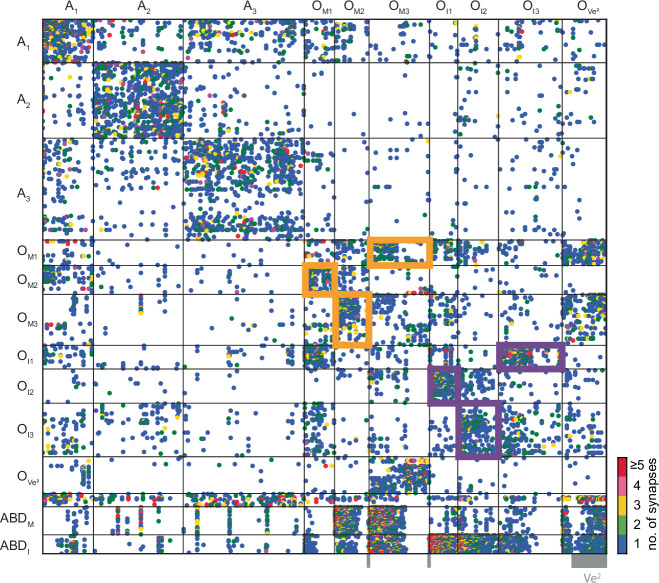
- The reconstructed dataset contained 2,884 neurons, 44,949 connections, and 75,163 synapses; 65% of connections had one synapse, with others having 2 (19%), 3 (7.9%), 4 (3.7%), or more (4.0%) synapses.
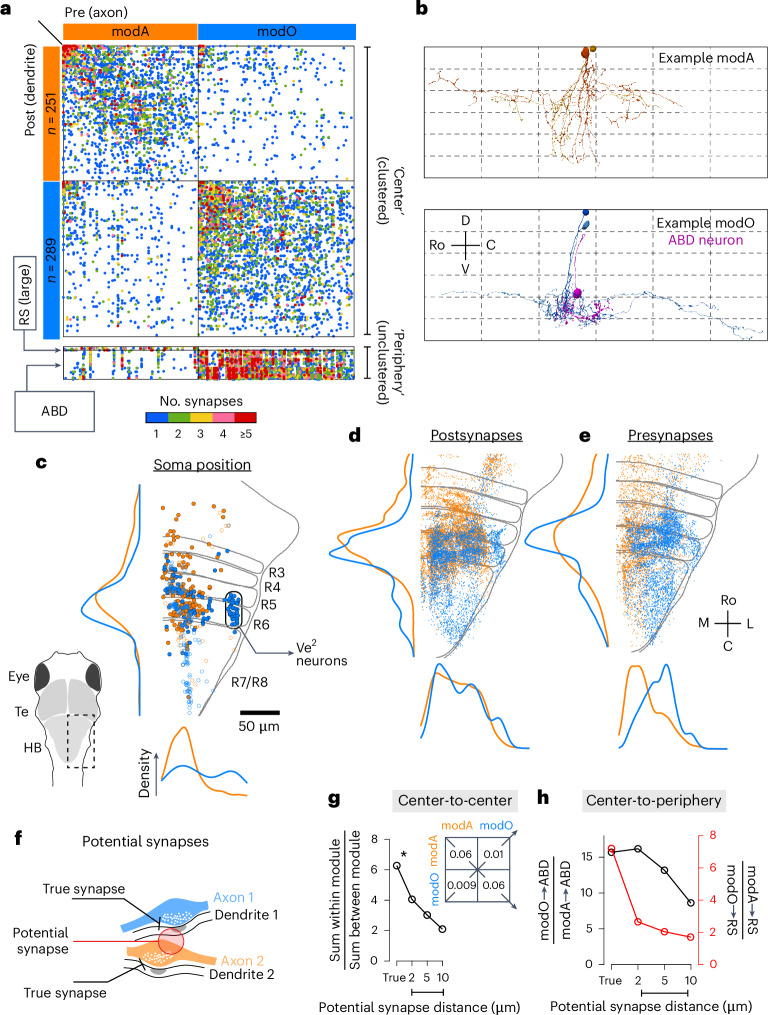
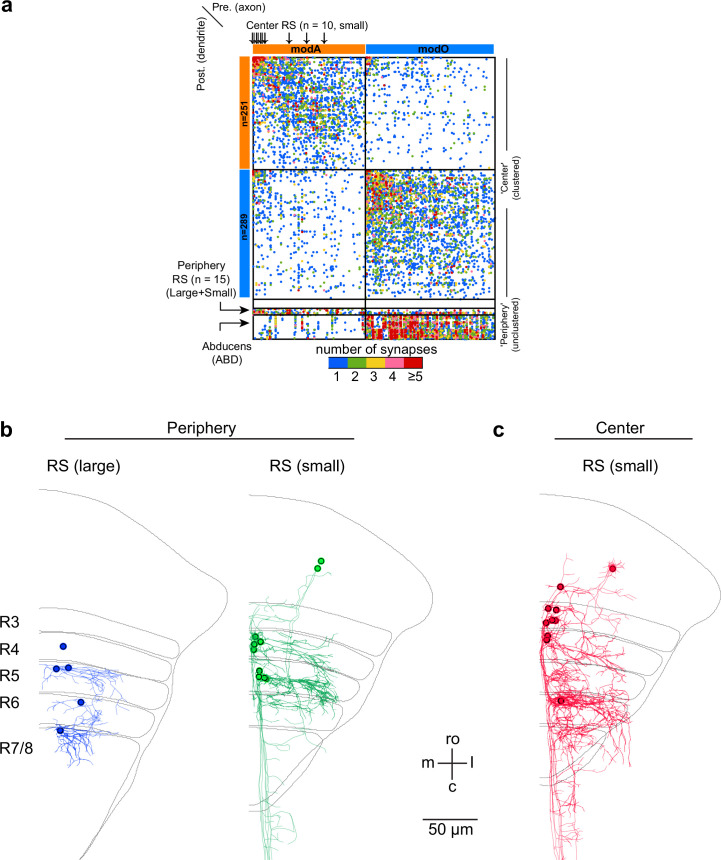
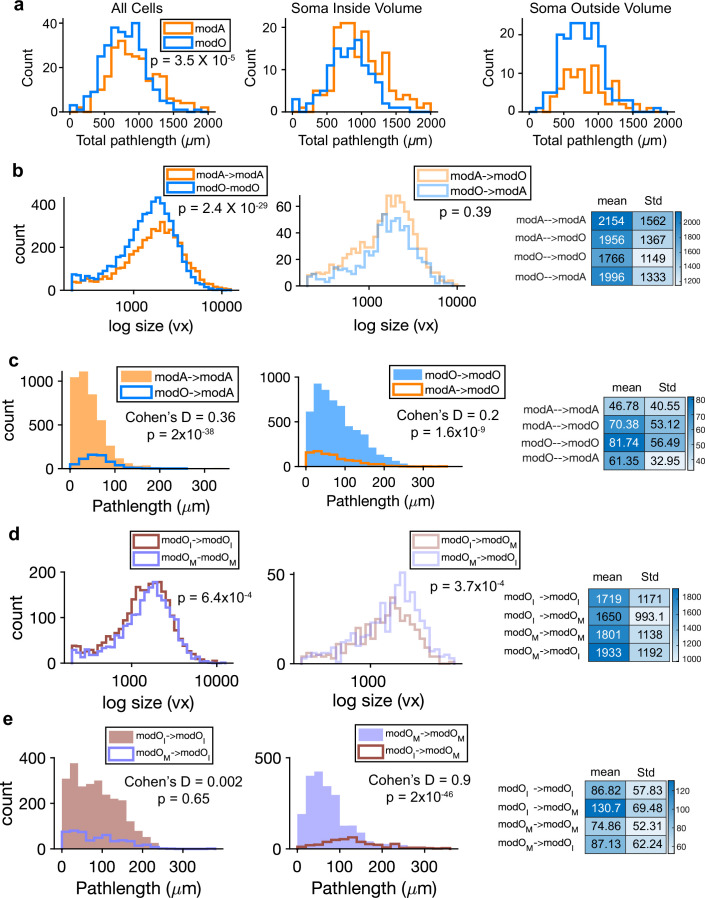
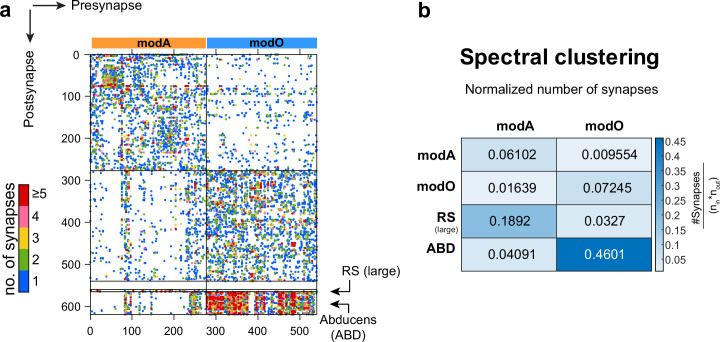
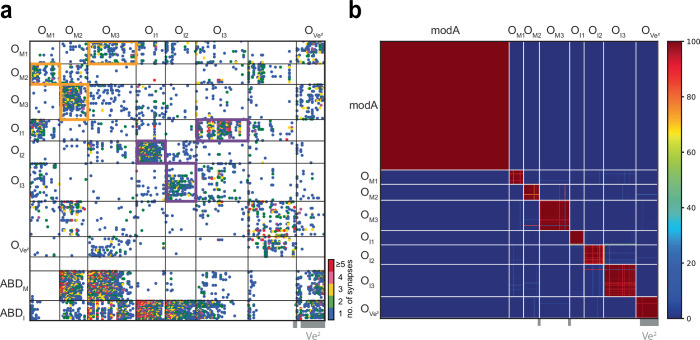
- At the highest level, the recurrent “center” divided into two supermodules: modA (axial/body movement) and modO (oculomotor/eye movement). Based on actual synapses, the wiring specificity index was roughly 6 for center neurons.
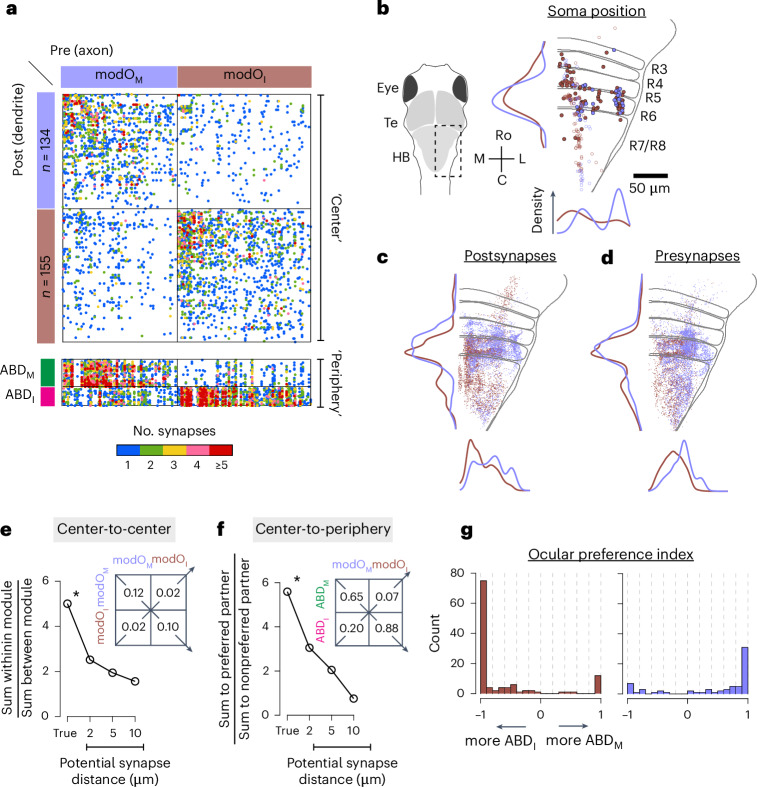
- modO further split into two submodules: modOM and modOI, with neurons in one preferentially connected to ABDM neurons and the other to ABDI neurons; the wiring specificity was almost 6 and the paper reports 5.9 for the hierarchical seven-block organization.
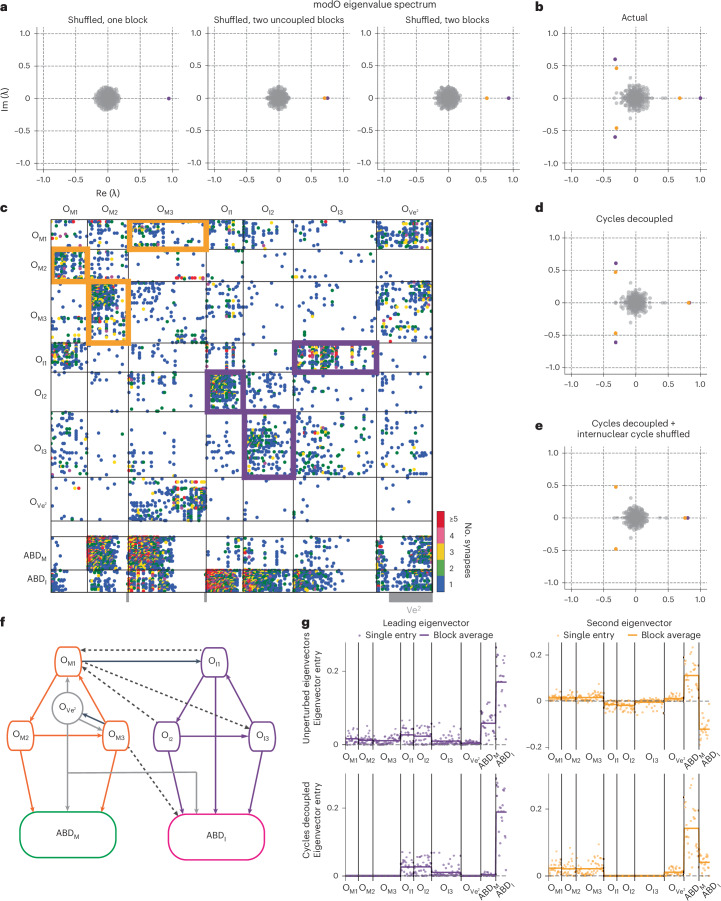
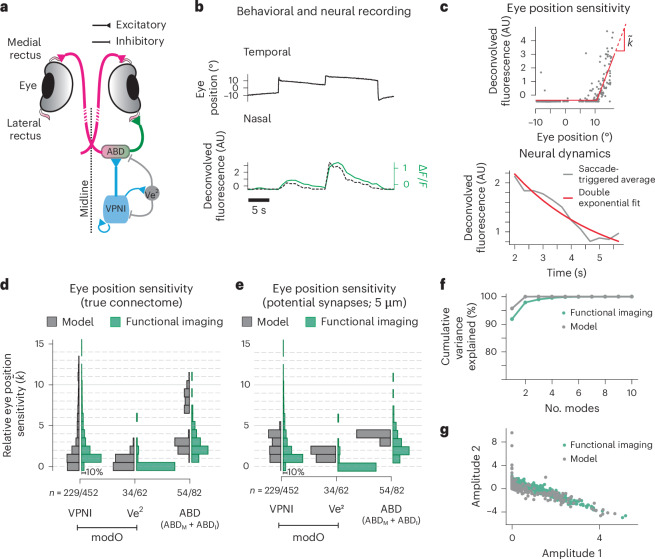
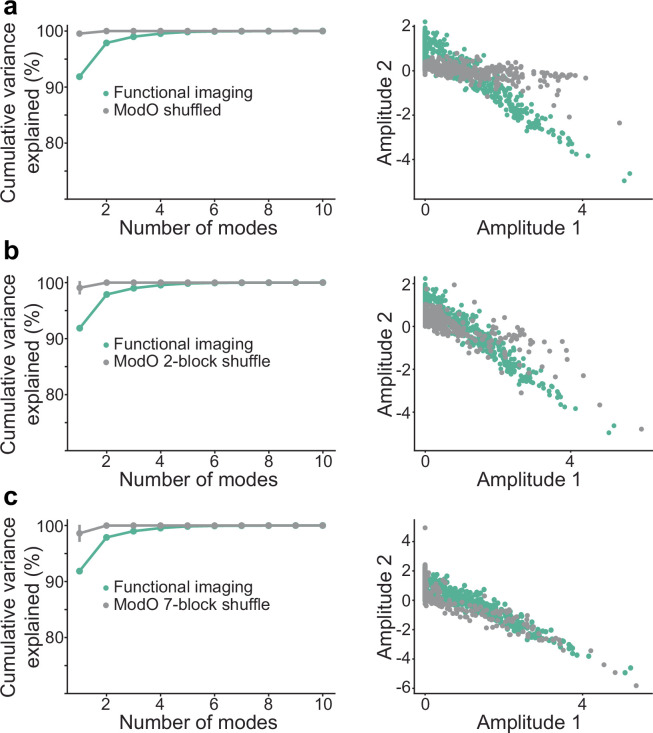
- The modO eigenspectrum indicated two weakly coupled three-block cycles; the paper reports that the motor cycle OM1–OM3 contained 83% of its cells from modOM, while the internuclear cycle OI1–OI3 contained 98% from modOI, and the seventh block was mostly Ve2 neurons (32/34).
Methods
- The authors extended and re-aligned a larval zebrafish brainstem serial-section EM dataset, then used convolutional networks for boundary and synapse detection, followed by human proofreading in Eyewire and skeletonization; the final reconstruction was based on a single animal and included the R4 to R7/R8 region.
- They used graph methods to divide neurons into center vs periphery by eigencentrality, then applied Louvain, spectral clustering, and degree-corrected stochastic block models to identify modules and submodules.
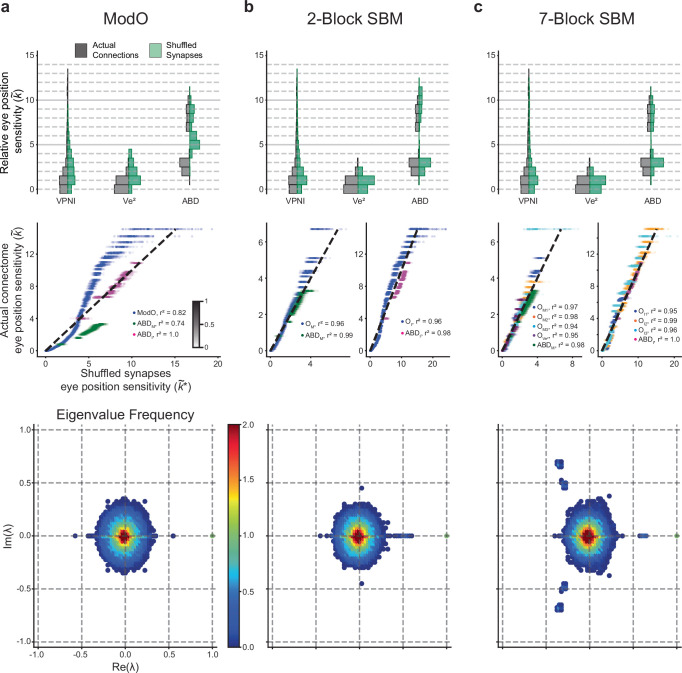
- They built a linear network model directly from the EM-derived synapse counts, normalized by total inputs, and compared simulated eye-position sensitivities and decay dynamics to two-photon calcium imaging data from 20 animals; statistical comparisons included ANOVA on saccade-triggered averages and population-level distribution matching.
Limitations
- The paper explicitly notes that the EM data were acquired from one reimaged animal, and the authors state that they did not predetermine sample size.
- The network model used a minimal set of physiological constraints and a simplified linear rate model; the paper says that single-cell matching might require more sophisticated cell- and synapse-specific biophysics.
- The text makes evident that the imaging and EM datasets came from different fish for the main population-level comparison, so the authors could not do one-to-one cell matching between structure and function.
Model-written summary. Check it against the paper before relying on it.
Integrity signals
Registry
Cites
Statistics
Figures

Verification
Claims the paper makes
14 Valid · 2 Not valid · 15 Not checked · 119 Own results and interpretations
Every source the paper cites for this claim was checked and supports it.
In the paper
“The imaged volume includes neurons involved in eye movements16,21,22,28.”
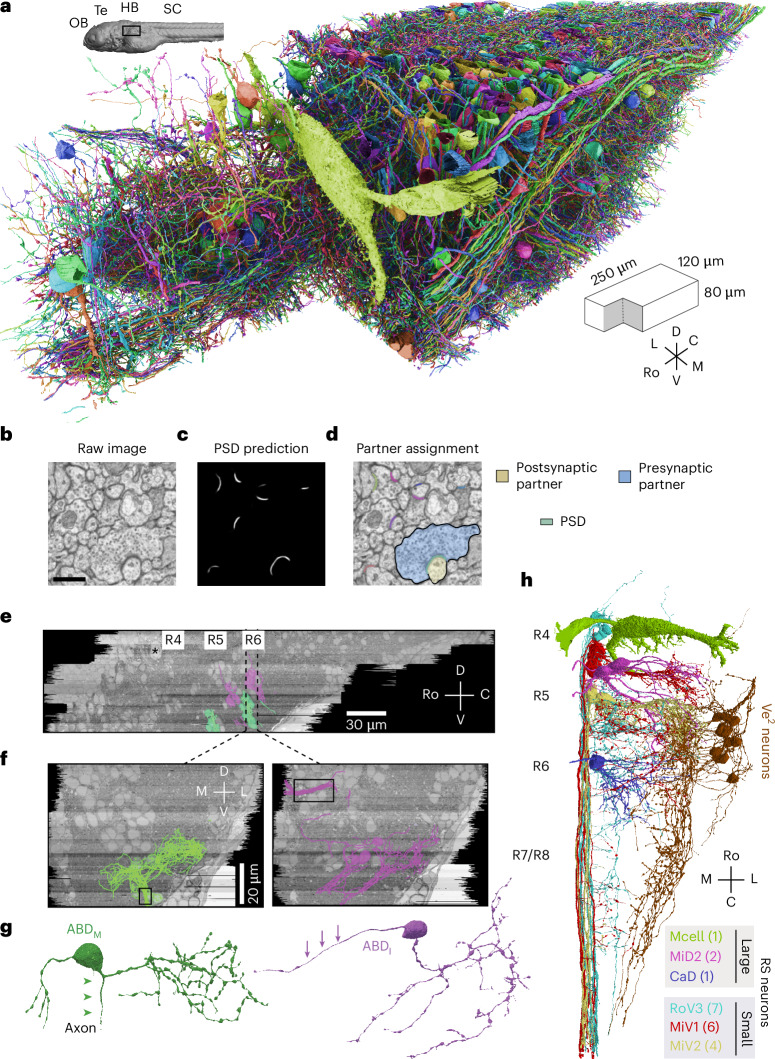
§ Predicting modular functions and neural coding of behavior from a synaptic wiring diagram > Results > Neuronal wiring diagram reconstructed from a vertebrate brainstem We applied serial section EM to reconstruct synaptic connections between neurons in a larval zebrafish brainstem (Fig. 1). The imaged volume includes neurons involved in eye movements16,21,22,28. First, the dataset of Vishwanathan et al.22 was extended by additional imaging of the same serial sections. By improving the alignment of EM images relative to our original work, we created a 3D image stack that was amenable to semiautomated reconstruction29 of 100× more neurons than before. We trained a convolutional neural network to detect neuronal boundaries (Methods)29 and automatically segment the volume. To correct errors in segmentation, we repurposed Eyewire, which was originally developed for proofreading mouse retinal neurons14. Eyewirers proofread ~3,000 objects, which included neurons with cell bodies in the volume as well as ‘orphan’ neurites with no cell body in the volume (Fig. 1a). We will refer to all such objects as ‘neurons’ of the reconstructed network. Convolutional networks were used to automatically detect synaptic clefts and assign presynaptic and postsynaptic partner neurons to each cleft30 (Fig. 1b–d and Methods). The reconstructed dataset contained 2,884 neurons, 44,949 connections between pairs of neurons and 75,163 synapses (additional relevant features are summarized in Supplementary Fig. 1). Most connections (65%) involved just one synapse, but some involved two (19%), three (7.9%), four (3.7%) or more (4.0%) synapses, up to a maximum of 21 (Supplementary Fig. 1a). After registration of our EM volume to the Z-Brain reference atlas31 (Supplementary Fig. 2), several important groups of neurons and neurites were identified (Methods). Comparison with transgenic lines and cranial nerves in the atlas identified the abducens (ABD) neurons that control extraocular muscles, secondary vestibular (Ve2) neurons32 involved in sensorimotor transformations such as the vestibulo-ocular reflex (Fig. 1e–h, Supplementary Fig. 3 and Methods), and two populations of reticulospinal (RS) projection neurons involved in escape behaviors and controlling body movements33–35. The neurons of one RS population were large and dorsally located, and the neurons of the other RS population were smaller and ventromedially located (Fig. 1h and Supplementary Fig. 4).
What the sources say
- Supportedcites [16] Daie, K., Goldman, M. S. & Aksay, E. R. F. Spatial patterns of persistent neural activity vary with the behavioral context of short-term memory. Neuron 85, 847–860 (2015). 25661184 PMC4336549 source
The Results section (“Persistent activity after saccadic and optokinetic stimulation”; page not supplied) says the authors imaged neurons in the horizontal oculomotor integrator of larval zebrafish and recorded their activity during saccadic and optokinetic eye movements. This supports the claim that the imaged volume includes neurons involved in eye movements. (LLM, conf=0.92)
- Supportedcites [21] Lee, M. M., Arrenberg, A. B. & Aksay, E. R. F. A structural and genotypic scaffold underlying temporal integration. J. Neurosci. 35, 7903–7920 (2015). 25995475 PMC4438132 source
The paper's methods and results state that two-photon calcium imaging covered a dorsoventral window in rhombomeres 7-8 of the zebrafish hindbrain ("Two-photon calcium imaging," Methods; "Spatial distribution of the VPNI on a hindbrain genotypic scaffold"), and that neurons within this imaged volume were identified as eye movement-related via correlation of fluorescence with eye position/velocity ("Analysis of cell fluorescence activity"; same Results section, where VPNI cell fluorescence rose with ipsilateral saccades and tracked eye position during OKR). The Abstract likewise frames this cell group (VPNI) as mediating eye-velocity-to-eye-position integration. Thus our copy supports that the imaged volume contains neurons involved in eye movements. (LLM, conf=0.90)
- Supportedcites [22] Vishwanathan, A. et al. Electron microscopic reconstruction of functionally identified cells in a neural integrator. Curr. Biol. 27, 2137–2147 (2017). 28712570 PMC5569574 source
The Introduction says the study imaged and reconstructed neurons in the larval zebrafish oculomotor neural integrator, a circuit involved in controlling eye position. The Abstract identifies the reconstructed neurons by activity correlated with eye position during spontaneous eye movements. (LLM, conf=0.91)
- Supportedcites [28] Schoonheim, P. J., Arrenberg, A. B., Del Bene, F. & Baier, H. Optogenetic localization and genetic perturbation of saccade-generating neurons in zebrafish. J. Neurosci. 30, 7111–7120 (2010). 20484654 PMC3842466 source
The paper's Results section 'Optical stimulation of a small hindbrain area is sufficient for saccade generation' states that the illuminated (and Kaede-photoconverted, hence imaged) volume in the larval zebrafish hindbrain — a narrow column of <100 cells ~20 μm lateral from the midline — contains the neurons necessary and sufficient to elicit a saccade. The section 'A small hindbrain region in rhombomere 5 is necessary for saccade generation' adds that NpHR silencing of that same volume blocked OKR saccades while other regions (pretectum, tectum) had no effect, and the Discussion frames this as localization of eye-movement-generating circuitry. So the volume the paper images/stimulates does include neurons involved in eye movements. (LLM, conf=0.85)
plainSingle case- Asserted: passes — The authors put it forward as true.
- Checkable: passes — It can be checked against evidence.
- Load-bearing: unclear — It is unclear whether the paper’s conclusions depend on it.
- Based: passes — The paper gives a reason why it holds.
- Supported
The cited sources that could be checked couldn’t confirm or dispute this claim.
In the paper
“normalizing by the total number of incoming synapses provides a form of homeostatic synaptic scaling46.”
§ Predicting modular functions and neural coding of behavior from a synaptic wiring diagram > Results > Predicting neural coding and dynamics from the wiring diagram
What the sources say
- Could not verifycites [46] Turrigiano, G. Homeostatic synaptic plasticity: local and global mechanisms for stabilizing neuronal function. Cold Spring Harb. Perspect. Biol. 4, a005736 (2012). 22086977 PMC3249629 sourceExperimental — accuracy not yet measured
The ‘Cell-autonomous, global synaptic scaling of excitatory synapses’ section describes compensatory changes in synaptic strength in response to activity, but does not say that dividing by the total number of incoming synapses produces such scaling. Searches for that normalization rule and for synapse-count normalization found no passage addressing it; the indexed passages provide no page numbers. (LLM, conf=0.76)
plainstates a cause- Asserted: passes — The authors put it forward as true.
- Checkable: passes — It can be checked against evidence.
- Load-bearing: passes — The paper’s conclusions depend on it.
- Based: passes — The paper gives a reason why it holds.
- Could not verify
The cited sources support only part of this claim — read each source’s verdict below.
In the paper
“Together, these subnetworks could provide for maintenance of conjugate and disconjugate eye movements56–58.”
§ Predicting modular functions and neural coding of behavior from a synaptic wiring diagram > Discussion
What the sources say
- Supportedcites [56] Debowy, O. & Baker, R. Encoding of eye position in the goldfish horizontal oculomotor neural integrator. J. Neurophysiol. 105, 896–909 (2011). 21160010 PMC4103780 source
The source's INTRODUCTION (p. 1) lays out exactly this architecture: if eye position is separately encoded for the ipsilateral temporal and contralateral nasal hemifield, 'two subpopulations of neurons are co-localized in each integrator,' bilaterally at least four relatively independent sets of HPNI neurons, with inhibitory/commissural connections 'envisioned to coordinate the nasal and temporal eye position integrator subpopulations for each eye.' The DISCUSSION sections ('Monocular versus conjugate HPNI' and the midline-lesion discussion) report results 'consistent with the presence of monocular and conjugate pathways' and with separate encoding of each eye's time constant (i.e., maintenance of eye position), while the Abstract assigns the ipsilateral vs. conjugate/contralateral populations to abducens motoneurons vs. internuclear neurons and proposes the commissural pathway selects the conjugate/contralateral neurons. The citing sentence is hedged ('could provide'), matching the source's own propositional framing, and covers both conjugate and disconjugate (monocular) maintenance. (LLM, conf=0.82)
- Supportedcites [57] Brysch, C., Leyden, C. & Arrenberg, A. B. Functional architecture underlying binocular coordination of eye position and velocity in the larval zebrafish hindbrain. BMC Biol. 17, 110 (2019). 31884959 PMC6936144 source
The Background describes the oculomotor integrator as maintaining eye position. The Discussion identifies distinct monocular and binocular neuron types, with recruitment differing between monocular and binocular eye movements. Together, these passages support the hedged proposal that the subnetworks could help maintain conjugate and disconjugate movements. (LLM, conf=0.86)
- Partly supportedcites [58] Feierstein, C. E. et al. Dimensionality reduction reveals separate translation and rotation populations in the zebrafish hindbrain. Curr. Biol. 33, 3911–3925 (2023). 37689065 PMC10524920 sourceExperimental — accuracy not yet measured
The Discussion (page unavailable) identifies separate activity modes related to conjugate and vergent eye movements, supporting the proposed distinction between subnetworks. But the Results (page unavailable) describe the vergence cluster mainly in terms of eye velocity, while eye-position representations in the rotation clusters are conjugate. The paper does not establish that these populations maintain both conjugate and disconjugate eye movements. (LLM, conf=0.84)
hedgedstates a possible cause- Asserted: passes — The authors put it forward as true.
- Checkable: passes — It can be checked against evidence.
- Load-bearing: passes — The paper’s conclusions depend on it.
- Based: passes — The paper gives a reason why it holds.
- Supported
Every source the paper cites for this claim was checked and supports it.
In the paper
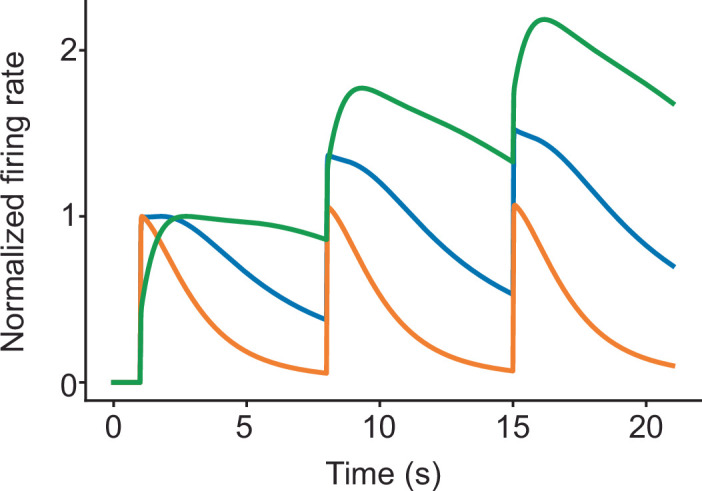
“the best fits were obtained with an intrinsic time constant of ~1 s”
§ Predicting modular functions and neural coding of behavior from a synaptic wiring diagram > Results > Predicting neural coding and dynamics from the wiring diagram
What the sources say
- Supportedcites [43] Fisher, D., Olasagasti, I., Tank, D. W., Aksay, E. R. F. & Goldman, M. S. A modeling framework for deriving the structural and functional architecture of a short-term memory microcircuit. Neuron 79, 987–1000 (2013). 24012010 PMC3768012 source
The Results section on drift after inactivation says reproducing the observed drift rates required a recurrent excitatory synaptic time constant of approximately 1 second. The Discussion describes the fitted process as intrinsic cellular or synaptic; the claim should not be read as specifying the membrane time constant. Page numbers are unavailable in our copy. (LLM, conf=0.88)
plain- Asserted: passes — The authors put it forward as true.
- Checkable: passes — It can be checked against evidence.
- Load-bearing: passes — The paper’s conclusions depend on it.
- Based: passes — The paper gives a reason why it holds.
- Supported
The sources with a verdict support this claim; the rest weren’t checked yet, have no full text we could read, or their verdicts aren’t rated yet.
In the paper
“Our work similarly informs line attractor network models, for which the VPNI has served as a model system53,54.”
§ Predicting modular functions and neural coding of behavior from a synaptic wiring diagram > Discussion
What the sources say
- Not checked — no full text of the sourcecites [53] Major, G. & Tank, D. Persistent neural activity: prevalence and mechanisms. Curr. Opin. Neurobiol. 14, 675–684 (2004). 15582368 source
- Supportedcites [54] Joshua, M. & Lisberger, S. G. A tale of two species: neural integration in zebrafish and monkeys. Neuroscience 296, 80–91 (2015). 24797331 PMC4216779 source
In “The architecture of the neural integrator” (page unavailable), the paper describes the oculomotor integrator as a system studied through computational models and says it can operate as a line attractor. “Bridging from zebrafish to monkeys” (page unavailable) models an integrator containing vestibular and prepositus neurons, supporting the identification of the VPNI as a model system. (LLM, conf=0.88)
plainstates an association- Asserted: passes — The authors put it forward as true.
- Checkable: passes — It can be checked against evidence.
- Load-bearing: unclear — It is unclear whether the paper’s conclusions depend on it.
- Based: passes — The paper gives a reason why it holds.
62 more claims
Create a free account to see all 150 claims and to verify the 12 references still open.
- It may state two separate claims as one. 53
- Probably not a substantial claim. 37
- The quote only partly states this claim. 1
Self-check
Percentages, sums and reported differences re-computed from the paper’s own numbers.
Each contradiction between two passages listed here was confirmed by an independent check.
Rated minor: it would not touch a result — a value no result rests on, a p-value that stays on the same side of the significance level, or a conflict that is clerical, resolved elsewhere in the paper, or outside its own findings.
In the paper
§ Predicting modular functions and neural coding of behavior from a synaptic wiring diagram > Methods > Convolutional net training
“We implemented the training and inference of our boundary detectors with the Caffe deep learning framework71.”
§ Predicting modular functions and neural coding of behavior from a synaptic wiring diagram > Methods > Convolutional net training
“The patches were fed into the convolutional network model to perform inference in PyTorch75.”
Citations
Cites
U-Net: Convolutional Networks for Biomedical Image Segmentation
Ronneberger, O., Fischer, P., & Brox, T. (2015) · Lecture notes in computer science · doi:10.1007/978-3-319-24574-4_28 · Cited by 99,404 · cited 2×
“The final model used an RS-U-Net architecture 73 implemented using PyTorch 75 and was trained using a manual learning rate schedule, decreasing the rate by a factor of 10 when the smoothed validation error converged.”
Adam: A Method for Stochastic Optimization
Kingma, D. P., & Ba, J. (2014) · arXiv · doi:10.48550/arxiv.1412.6980 · Cited by 98,946
Batch Normalization: Accelerating Deep Network Training by Reducing Internal Covariate Shift
Ioffe, S., & Szegedy, C. (2015) · arXiv · doi:10.48550/arxiv.1502.03167 · Cited by 27,818
Fast unfolding of communities in large networks
Blondel, V. D., Guillaume, J.-L., Lambiotte, R., & Lefebvre, E. (2008) · Journal of Statistical Mechanics: Theory and Experiment · doi:10.1088/1742-5468/2008/10/p10008 · Cited by 21,424 · cited 1×
“Graph clustering was performed using the Louvain clustering algorithm 83 for identifying different ‘communities’ or ‘modules’ in an interconnected network by optimizing the ‘modularity’ of the network, where modularity measures the (weighted) density of connections within a module compared to…”
(2017) · Cited by 11,625
Complex network measures of brain connectivity: Uses and interpretations
Rubinov, M., & Sporns, O. (2010) · NeuroImage · doi:10.1016/j.neuroimage.2009.10.003 · Cited by 11,522
Caffe: Convolutional Architecture for Fast Feature Embedding
Jia, Y., Shelhamer, E., Donahue, J., Karayev, S., Long, J., Girshick, R., Guadarrama, S., & Darrell, T. (2014) · Proceedings of the 22nd ACM international conference on Multimedia · doi:10.1145/2647868.2654889 · Cited by 11,077 · cited 1×
“We implemented the training and inference of our boundary detectors with the Caffe deep learning framework 71 .”
Caffe: Convolutional Architecture for Fast Feature Embedding
Jia, Y., Shelhamer, E., Donahue, J., Karayev, S., Long, J., Girshick, R., Guadarrama, S., & Darrell, T. J. (2014) · arXiv (Cornell University) · doi:10.48550/arxiv.1408.5093 · Cited by 3,752 · cited 1×
“We implemented the training and inference of our boundary detectors with the Caffe deep learning framework 71 .”
Design Rules: The Power of Modularity
Baldwin, C. Y., & Clark, K. B. (2000) · doi:10.7551/mitpress/2366.001.0001 · Cited by 3,504
Stochastic blockmodels: First steps
Holland, P. W., Laskey, K. B., & Leinhardt, S. (1983) · Social Networks · doi:10.1016/0378-8733(83)90021-7 · Cited by 2,755 · cited 8×
“We separately applied an SBM to modA and examined how axial sub-modules aligned with those from modO.”
InfluentialA mesoscale connectome of the mouse brain
Oh, S. W., Harris, J. A., Ng, L., Winslow, B., Cain, N., Mihalas, S., Wang, Q., Lau, C., Kuan, L., Henry, A. M., et al. (2014) · Nature · doi:10.1038/nature13186 · Cited by 2,612
Estimating regression models with unknown break‐points
Muggeo, V. M. R. (2003) · Statistics in Medicine · doi:10.1002/sim.1545 · Cited by 2,371 · cited 1×
“We then determined the threshold E th using an iterative estimation technique based on a Taylor series approximation of [ x ]+ described by Muggeo 94 .”
Newman, M. (2018) · doi:10.1093/oso/9780198805090.001.0001 · Cited by 2,297 · cited 1×
“The division of the reconstructed wiring diagram into center and periphery is based on standard measures of ‘centrality’, which have https://doi.org/10.1038/s41593-024-01784-3 been devised in network science 82 .”
InfluentialStatistical mechanics of community detection
Reichardt, J., & Bornholdt, S. (2006) · Physical Review E · doi:10.1103/physreve.74.016110 · Cited by 2,048
Stochastic blockmodels and community structure in networks
Karrer, B., & Newman, M. E. J. (2011) · Physical Review E · doi:10.1103/physreve.83.016107 · Cited by 2,025 · cited 1×
“…definition that uses average edge counts from the observation e rs = n r n s p rs to replace the probability parameters, and we construct a degree-corrected stochastic block model 88 that further specifies the in-and out-degree sequences { k + i , k − i } of the graph as additional parameters.”
Reconstruction and Simulation of Neocortical Microcircuitry
Markram, H., Muller, E., Ramaswamy, S., Reimann, M. W., Abdellah, M., Sanchez, C. A., Ailamaki, A., Alonso-Nanclares, L., Antille, N., Arsever, S., et al. (2015) · Cell · doi:10.1016/j.cell.2015.09.029 · Cited by 1,557 · cited 1×
“Also, we use neurons reconstructed from a single animal, whereas the light microscopic approach aggregates neurons from multiple animals or ‘clones’ a single neuron many times 91 .”
Sporns, O., & Betzel, R. F. (2016) · Annual Review of Psychology · doi:10.1146/annurev-psych-122414-033634 · Cited by 1,334 · cited 1×
“Potential degeneracy in graph clustering was addressed by computing the consensus of the clustering similar to Sporns and Betzel 84 .”
Homeostatic Synaptic Plasticity: Local and Global Mechanisms for Stabilizing Neuronal Function
Turrigiano, G. (2012) · Cold Spring Harbor Perspectives in Biology · doi:10.1101/cshperspect.a005736 · Cited by 1,288 · cited 1×
“First, normalizing by the total number of incoming synapses provides a form of homeostatic synaptic scaling 46 .”
Simultaneous Denoising, Deconvolution, and Demixing of Calcium Imaging Data
Pnevmatikakis, E. A., Soudry, D., Gao, Y., Machado, T. A., Merel, J., Pfau, D., Reardon, T., Mu, Y., Lacefield, C., Yang, W., et al. (2016) · Neuron · doi:10.1016/j.neuron.2015.11.037 · Cited by 1,029 · cited 1×
“Neuronal firing rates were estimated, up to an unknown scaling factor, by decon-volving the raw calcium fluorescence traces using the deconvolution algorithm with non-negativity constraint described in Pnevmatikakis et al. 93 .”
Zhang, K. (1996) · The Journal of Neuroscience · doi:10.1523/jneurosci.16-06-02112.1996 · Cited by 1,001 · cited 1×
“Twenty-five years ago, ‘line attractor’ and ‘ring attractor’ network models were proposed for low-dimensional neural dynamics in the oculomotor 15 and head direction systems 51,52 , respectively.”
Path integration and cognitive mapping in a continuous attractor neural network model
Samsonovich, A., & McNaughton, B. L. (1997) · The Journal of Neuroscience · doi:10.1523/jneurosci.17-15-05900.1997 · Cited by 989
Wagner, G. P., Pavlicev, M., & Cheverud, J. M. (2007) · Nature Reviews Genetics · doi:10.1038/nrg2267 · Cited by 987
CaImAn an open source tool for scalable calcium imaging data analysis
Giovannucci, A., Friedrich, J., Gunn, P., Kalfon, J., Brown, B. L., Koay, S. A., Taxidis, J., Najafi, F., Gauthier, J. L., Zhou, P., et al. (2019) · eLife · doi:10.7554/elife.38173 · Cited by 947 · cited 1×
“We used CalmAn-MATLAB software to extract the neuronal locations from fluorescence movies 92 .”
The mechanics of human saccadic eye movement
Robinson, D. A. (1964) · The Journal of Physiology · doi:10.1113/jphysiol.1964.sp007485 · Cited by 893 · cited 1×
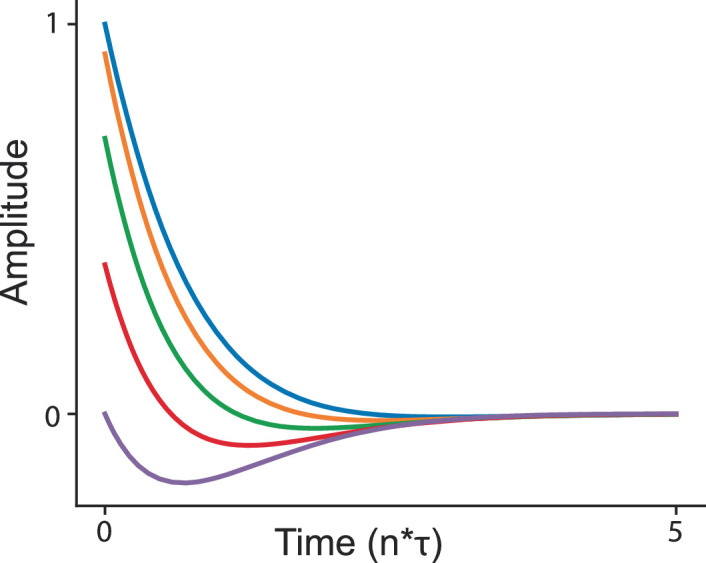
“…of the eye plant, which can be approximated as a highly damped mass-spring system whose impulse-response function exhibits overdamped oscillations 59 and may suggest the importance of a weak, but non-negligible, mass term in the plant that is commonly ignored in simplified descriptions 55,60 .”
Wiring specificity in the direction-selectivity circuit of the retina
Briggman, K. L., Helmstaedter, M., & Denk, W. (2011) · Nature · doi:10.1038/nature09818 · Cited by 883 · cited 2×
“Recent connectomic efforts have enabled the generation of wiring diagrams in the fly and in vertebrate circuits like the retina 1,2 , utricular system 3,4 , olfactory bulb 5 , visual thalamus 6 , visual cortex 7,8 and somatosensory cortex 9 .”
Network anatomy and in vivo physiology of visual cortical neurons
Bock, D. D., Lee, W.-C. A., Kerlin, A. M., Andermann, M. L., Hood, G., Wetzel, A. W., Yurgenson, S., Soucy, E. R., Kim, H. S., & Reid, R. C. (2011) · Nature · doi:10.1038/nature09802 · Cited by 870
Structural Properties of the Caenorhabditis elegans Neuronal Network
Varshney, L. R., Chen, B. L., Paniagua, E., Hall, D. H., & Chklovskii, D. B. (2011) · PLoS Computational Biology · doi:10.1371/journal.pcbi.1001066 · Cited by 867
Neuronal correlates of parametric working memory in the prefrontal cortex
Romo, R., Brody, C. D., Hernández, A., & Lemus, L. (1999) · Nature · doi:10.1038/20939 · Cited by 822
Neural Networks of the Mouse Neocortex
Zingg, B., Hintiryan, H., Gou, L., Song, M. Y., Bay, M., Bienkowski, M. S., Foster, N. N., Yamashita, S., Bowman, I., Toga, A. W., et al. (2014) · Cell · doi:10.1016/j.cell.2014.02.023 · Cited by 797
Accurate Path Integration in Continuous Attractor Network Models of Grid Cells
Burak, Y., & Fiete, I. R. (2009) · PLoS Computational Biology · doi:10.1371/journal.pcbi.1000291 · Cited by 779
Loss of the neural integrator of the oculomotor system from brain stem lesions in monkey
Cannon, S. C., & Robinson, D. A. (1987) · Journal of Neurophysiology · doi:10.1152/jn.1987.57.5.1383 · Cited by 728
A visual motion detection circuit suggested by Drosophila connectomics
Takemura, S.-Y., Bharioke, A., Lu, Z., Nern, A., Vitaladevuni, S., Rivlin, P. K., Katz, W. T., Olbris, D. J., Plaza, S. M., Winston, P., et al. (2013) · Nature · doi:10.1038/nature12450 · Cited by 686 · cited 1×
“Likewise, in the early visual system of both invertebrates 13 and vertebrates 14 , con-nectomics has provided a strong anatomical basis for the computations underlying motion processing.”
Computation Through Neural Population Dynamics
Vyas, S., Golub, M. D., Sussillo, D., & Shenoy, K. V. (2020) · Annual Review of Neuroscience · doi:10.1146/annurev-neuro-092619-094115 · Cited by 671
Jefferis, G. S. X. E., Potter, C. J., Chan, A. M., Marin, E. C., Rohlfing, T., Maurer, C. R., & Luo, L. (2007) · Cell · doi:10.1016/j.cell.2007.01.040 · Cited by 647
From the connectome to brain function
Bargmann, C. I., & Marder, E. (2013) · Nature Methods · doi:10.1038/nmeth.2451 · Cited by 561
Laplacians and the Cheeger Inequality for Directed Graphs
Chung, F. (2005) · Annals of Combinatorics · doi:10.1007/s00026-005-0237-z · Cited by 535 · cited 2×
“We used a generalized spectral clustering algo-rithm for weighted directed graphs to bisect the zebrafish ‘center’ sub-graph, as proposed by Chung 39 .”
How the brain keeps the eyes still
Seung, H. S. (1996) · Proceedings of the National Academy of Sciences · doi:10.1073/pnas.93.23.13339 · Cited by 534 · cited 3×
“Twenty-five years ago, ‘line attractor’ and ‘ring attractor’ network models were proposed for low-dimensional neural dynamics in the oculomotor 15 and head direction systems 51,52 , respectively.”
Self-citationWhole-brain activity mapping onto a zebrafish brain atlas
Randlett, O., Wee, C. L., Naumann, E. A., Nnaemeka, O., Schoppik, D., Fitzgerald, J. E., Portugues, R., Lacoste, A. M. B., Riegler, C., Engert, F., et al. (2015) · Nature Methods · doi:10.1038/nmeth.3581 · Cited by 528 · cited 2×
“The locations of each neuron were then registered to the Z-Brain atlas 31 (see Ramirez and Aksay 50 for complete details).”
Anatomy and function of an excitatory network in the visual cortex
Lee, W.-C. A., Bonin, V., Reed, M., Graham, B. J., Hood, G., Glattfelder, K., & Reid, R. C. (2016) · Nature · doi:10.1038/nature17192 · Cited by 510
Beyond the connectome: how neuromodulators shape neural circuits
Bargmann, C. I. (2012) · BioEssays · doi:10.1002/bies.201100185 · Cited by 505
The Connectome of a Decision-Making Neural Network
Jarrell, T. A., Wang, Y., Bloniarz, A. E., Brittin, C. A., Xu, M., Thomson, J. N., Albertson, D. G., Hall, D. H., & Emmons, S. W. (2012) · Science · doi:10.1126/science.1221762 · Cited by 474
Space–time wiring specificity supports direction selectivity in the retina
EyeWirers, T., Kim, J. S., Greene, M. J., Zlateski, A., Lee, K., Richardson, M., Turaga, S. C., Purcaro, M., Balkam, M., Robinson, A., et al. (2014) · Nature · doi:10.1038/nature13240 · Cited by 450 · cited 4×
“This approach has worked well for direction selectivity in the retina 1,14,27 but is not guaranteed to generalize to other brain structures that seem less stereotyped and precisely organized than the retina.”
InfluentialSelf-citationThe isodendritic core of the brain stem
Ramón‐Moliner, E., & Nauta, W. J. H. (1966) · Journal of Comparative Neurology · doi:10.1002/cne.901260301 · Cited by 442 · cited 1×
“Classical anatomical studies have suggested that brainstem reticular circuitry within which the studied regions lie is ‘undifferentiated’ 23 or ‘diffuse’ 24 .”
Ring attractor dynamics in the Drosophila central brain
Kim, S. S., Rouault, H., Druckmann, S., & Jayaraman, V. (2017) · Science · doi:10.1126/science.aal4835 · Cited by 417
Random matrices: Universality of ESDs and the circular law
Tao, T., Vu, V., & Krishnapur, M. (2010) · The Annals of Probability · doi:10.1214/10-aop534 · Cited by 415 · cited 1×
“Such a pattern of eigenvalues is characteristic of a wide class of matrices with random entries 40,41 , with the radius proportional to the standard deviation and the leading eigenvalue proportional to the mean of the matrix entries.”
(1995) · PubMed · Cited by 411
Volume electron microscopy for neuronal circuit reconstruction
Briggman, K. L., & Bock, D. D. (2012) · Current Opinion in Neurobiology · doi:10.1016/j.conb.2011.10.022 · Cited by 335
Discrete attractor dynamics underlies persistent activity in the frontal cortex
Inagaki, H. K., Fontolan, L., Romani, S., & Svoboda, K. (2019) · Nature · doi:10.1038/s41586-019-0919-7 · Cited by 334
Dense connectomic reconstruction in layer 4 of the somatosensory cortex
Motta, A., Berning, M., Boergens, K. M., Staffler, B., Beining, M., Loomba, S., Hennig, P., Wissler, H., & Helmstaedter, M. (2019) · Science · doi:10.1126/science.aay3134 · Cited by 333
A neural circuit architecture for angular integration in Drosophila
Green, J., Adachi, A., Shah, K. K., Hirokawa, J. D., Magani, P. S., & Maimon, G. (2017) · Nature · doi:10.1038/nature22343 · Cited by 331
Elastic volume reconstruction from series of ultra-thin microscopy sections
Saalfeld, S., Fetter, R., Cardona, A., & Tomancak, P. (2012) · Nature Methods · doi:10.1038/nmeth.2072 · Cited by 329 · cited 1×
“After the errors had been corrected by filtering bad matches, the tiles were modeled as individual spring meshes attached via the matches 66 , and the linear system was solved using conjugate gradient descent.”
McFarland, J. L., & Fuchs, A. F. (1992) · Journal of Neurophysiology · doi:10.1152/jn.1992.68.1.319 · Cited by 323 · cited 1×
“Linear model neurons 47 were used for simplicity because most VPNI cells have firing rates that vary linearly with position for ipsilateral eye positions 48,49 .”
Persistent neural activity: prevalence and mechanisms
Major, G., & Tank, D. (2004) · Current Opinion in Neurobiology · doi:10.1016/j.conb.2004.10.017 · Cited by 320 · cited 1×
“Our work similarly informs line attractor network models, for which the VPNI has served as a model system 53,54 .”
Geometry and structural plasticity of synaptic connectivity
Stepanyants, A., Hof, P. R., & Chklovskii, D. B. (2002) · Neuron · doi:10.1016/s0896-6273(02)00652-9 · Cited by 312
Blair, H., & Sharp, P. (1995) · The Journal of Neuroscience · doi:10.1523/jneurosci.15-09-06260.1995 · Cited by 310
Kimura, Y., Okamura, Y., & Higashijima, S.-I. (2006) · The Journal of Neuroscience · doi:10.1523/jneurosci.4993-05.2006 · Cited by 302 · cited 1×
“…were found to have somata primarily within a medial glutamatergic parasagittal https://doi.org/10.1038/s41593-024-01784-3 stripe associated with the Alx transcription factor and the latter with a more lateral GABAergic parasagittal stripe associated with the Abx1b transcription factor 21,95,96 .”
InfluentialSpecific evidence of low-dimensional continuous attractor dynamics in grid cells
Yoon, K., Buice, M. A., Barry, C., Hayman, R., Burgess, N., & Fiete, I. R. (2013) · Nature Neuroscience · doi:10.1038/nn.3450 · Cited by 296 · cited 1×
“Therefore, we decided to probe to what extent these distributions could be contributing to modularity. to reduction of noise in sensory and cognitive representations 16,17 .”
Girko, V. L. (1985) · Theory of Probability & Its Applications · doi:10.1137/1129095 · Cited by 292
Segmental homologies among reticulospinal neurons in the hindbrain of the zebrafish larva
Metcalfe, W. K., Mendelson, B., & Kimmel, C. B. (1986) · Journal of Comparative Neurology · doi:10.1002/cne.902510202 · Cited by 286 · cited 1×
“These were identified by their stereotypic locations 81 and by comparison with the Z-Brain atlas (Supplementary Fig.”
Hayworth, K. J., Morgan, J. L., Schalek, R., Berger, D. R., Hildebrand, D. G. C., & Lichtman, J. W. (2014) · Frontiers in Neural Circuits · doi:10.3389/fncir.2014.00068 · Cited by 282 · cited 1×
“The images were acquired using a Zeiss Field-Emission Scanning Electron Microscope using WaferMapper software 65 .”
Control of visually guided behavior by distinct populations of spinal projection neurons
Orger, M. B., Kampff, A. R., Severi, K. E., Bollmann, J. H., & Engert, F. (2008) · Nature Neuroscience · doi:10.1038/nn2048 · Cited by 274 · cited 2×
“Likewise, we omitted interactions between modO and modA based on their separate roles in controlling eye movement versus body movement behaviors 34,35,45 and the body-fixed nature of the oculomotor behavior being investigated.”
Bianconi, G. (2009) · Physical Review E · doi:10.1103/physreve.79.036114 · Cited by 273
The Fuzzy Logic of Network Connectivity in Mouse Visual Thalamus
Morgan, J. L., Berger, D. R., Wetzel, A. W., & Lichtman, J. W. (2016) · Cell · doi:10.1016/j.cell.2016.02.033 · Cited by 268 · cited 1×
“Recent connectomic efforts have enabled the generation of wiring diagrams in the fly and in vertebrate circuits like the retina 1,2 , utricular system 3,4 , olfactory bulb 5 , visual thalamus 6 , visual cortex 7,8 and somatosensory cortex 9 .”
Digital Museum of Retinal Ganglion Cells with Dense Anatomy and Physiology
Bae, J. A., Mu, S., Kim, J. S., Turner, N. L., Tartavull, I., Kemnitz, N., Jordan, C. S., Norton, A. D., Silversmith, W. M., Prentki, R., et al. (2018) · Cell · doi:10.1016/j.cell.2018.04.040 · Cited by 263
Self-citationGeometric and functional organization of cortical circuits
Shepherd, G. M. G., Stepanyants, A., Bureau, I., Chklovskii, D., & Svoboda, K. (2005) · Nature Neuroscience · doi:10.1038/nn1447 · Cited by 256
Neurogeometry and potential synaptic connectivity
STEPANYANTS, A., & CHKLOVSKII, D. (2005) · Trends in Neurosciences · doi:10.1016/j.tins.2005.05.006 · Cited by 254 · cited 2×
“2f), similar to the conventional definition as an axo-dendritic apposition within some threshold distance 37 .”
Species-specific wiring for direction selectivity in the mammalian retina
Ding, H., Smith, R. G., Poleg-Polsky, A., Diamond, J. S., & Briggman, K. L. (2016) · Nature · doi:10.1038/nature18609 · Cited by 252 · cited 1×
“This approach has worked well for direction selectivity in the retina 1,14,27 but is not guaranteed to generalize to other brain structures that seem less stereotyped and precisely organized than the retina.”
Hierarchical Block Structures and High-Resolution Model Selection in Large Networks
Peixoto, T. P. (2014) · Physical Review X · doi:10.1103/physrevx.4.011047 · Cited by 248
Robinson, D. A. (1968) · Science · doi:10.1126/science.161.3847.1219 · Cited by 238
Architecture of the cerebral cortical association connectome underlying cognition
Bota, M., Sporns, O., & Swanson, L. W. (2015) · Proceedings of the National Academy of Sciences · doi:10.1073/pnas.1504394112 · Cited by 231
A proposed neural network for the integrator of the oculomotor system
Cannon, S. C., Robinson, D. A., & Shamma, S. (1983) · Biological Cybernetics · doi:10.1007/bf00320393 · Cited by 220 · cited 1×
“Linear model neurons 47 were used for simplicity because most VPNI cells have firing rates that vary linearly with position for ipsilateral eye positions 48,49 .”
Robust registration of calcium images by learned contrast synthesis
Bogovic, J. A., Hanslovsky, P., Wong, A., & Saalfeld, S. (2016) · 2016 IEEE 13th International Symposium on Biomedical Imaging (ISBI) · doi:10.1109/isbi.2016.7493463 · Cited by 220 · cited 1×
“To do this, we selected corresponding points such as neuronal clusters and fiber tracts using the tool BigWarp 79 .”
Building an allocentric travelling direction signal via vector computation
Lyu, C., Abbott, L. F., & Maimon, G. (2022) · Nature · doi:10.1038/s41586-021-04067-0 · Cited by 215 · cited 1×
“…of the head direction system were literally realized in the ring-like structure of the central complex 10 , and the topographically organized sinusoidally varying synaptic connectivity weights directly suggested the trigonometric identities required to encode coordinate transformations 11,12 .”
Berger, D. R., Seung, H. S., & Lichtman, J. W. (2018) · Frontiers in Neural Circuits · doi:10.3389/fncir.2018.00088 · Cited by 214 · cited 2×
“Four expert brain image analysts (D. Visser, Princeton Neuro-science Institute; K.W.; M. Moore, Princeton Neuroscience Institute; and S.K.) manually segmented neuronal cell boundaries from six subvol-umes of EM images with the manual annotation tool VAST 67 , labeling 194.4 million voxels in total.”
InfluentialSelf-citationA structural and functional ground plan for neurons in the hindbrain of zebrafish
Kinkhabwala, A., Riley, M., Koyama, M., Monen, J., Satou, C., Kimura, Y., Higashijima, S.-I., & Fetcho, J. (2011) · Proceedings of the National Academy of Sciences · doi:10.1073/pnas.1012185108 · Cited by 203 · cited 1×
“…were found to have somata primarily within a medial glutamatergic parasagittal https://doi.org/10.1038/s41593-024-01784-3 stripe associated with the Alx transcription factor and the latter with a more lateral GABAergic parasagittal stripe associated with the Abx1b transcription factor 21,95,96 .”
InfluentialIn vivo intracellular recording and perturbation of persistent activity in a neural integrator
Aksay, E., Gamkrelidze, G., Seung, H. S., Baker, R., & Tank, D. W. (2001) · Nature Neuroscience · doi:10.1038/84023 · Cited by 201 · cited 2×
“…approach also incorporated a minimal set of key anatomical and physiological constraints such as known signs of connections 21,32 , physiological observations about the approximate linearity of oculomotor responses 18,49 and functional independence of the bilateral halves of the circuit 20,56 .”
Self-citationSuperhuman Accuracy on the SNEMI3D Connectomics Challenge
Lee, K., Zung, J., Li, P. H., Jain, V., & Seung, H. S. (2017) · arXiv (Cornell University) · doi:10.48550/arxiv.1706.00120 · Cited by 196 · cited 1×
“…rotations by 90°, (2) brightness and contrast augmentation, (3) random warping by combining five types of linear transformation (continuous rotation, shear, twist, scale and perspective stretch) and (4) misalignment augmentation 73 with a maximum displacement of 20 pixels in the x and y dimensions.”
Self-citationStructural neurobiology: missing link to a mechanistic understanding of neural computation
Denk, W., Briggman, K. L., & Helmstaedter, M. (2012) · Nature Reviews Neuroscience · doi:10.1038/nrn3169 · Cited by 191
Mapping a sensory-motor network onto a structural and functional ground plan in the hindbrain
Koyama, M., Kinkhabwala, A., Satou, C., Higashijima, S.-I., & Fetcho, J. (2011) · Proceedings of the National Academy of Sciences · doi:10.1073/pnas.1012189108 · Cited by 190 · cited 1×
“Furthermore, this region contains a tightly interwoven mixture of neurons involved in eye movements and, separately, body movements controlled by the spinal cord 25 .”
Optogenetic Localization and Genetic Perturbation of Saccade-Generating Neurons in Zebrafish
Schoonheim, P. J., Arrenberg, A. B., Del Bene, F., & Baier, H. (2010) · The Journal of Neuroscience · doi:10.1523/jneurosci.5193-09.2010 · Cited by 185 · cited 1×
“The imaged volume includes neurons involved in eye movements 16,21,22,28 .”
Kim, S., Kim, Y.-U., & Ma, E. (2011) · Molecules · doi:10.3390/molecules17010355 · Cited by 184
Evidence for a Widespread Brain Stem Escape Network in Larval Zebrafish
Gahtan, E., Sankrithi, N., Campos, J. B., & O'Malley, D. M. (2002) · Journal of Neurophysiology · doi:10.1152/jn.00596.2001 · Cited by 169 · cited 1×
“3 and Methods), and two populations of reticulospinal (RS) projection neurons involved in escape behaviors and controlling body movements 33–35 .”
The Neuroanatomical Ultrastructure and Function of a Biological Ring Attractor
Turner-Evans, D. B., Jensen, K. T., Ali, S., Paterson, T., Sheridan, A., Ray, R. P., Wolff, T., Lauritzen, J. S., Rubin, G. M., Bock, D. D., et al. (2020) · Neuron · doi:10.1016/j.neuron.2020.08.006 · Cited by 168
The neuroanatomical ultrastructure and function of a biological ring attractor
Turner-Evans, D. B., Jensen, K. T., Ali, S., Paterson, T., Sheridan, A., Ray, R. P., Wolff, T., Lauritzen, S., Rubin, G. M., Bock, D., et al. (2019) · doi:10.1101/847152 · Cited by 166 · cited 2×
“…system, models for the organization of the head direction system were literally realized in the ring-like structure of the central complex 10 , and the topographically organized sinusoidally varying synaptic connectivity weights directly suggested the trigonometric identities required to…”
Reading the Book of Memory: Sparse Sampling versus Dense Mapping of Connectomes
Seung, H. S. (2009) · Neuron · doi:10.1016/j.neuron.2009.03.020 · Cited by 153 · cited 1×
“When relating the wiring diagram to function, a common approach starts by extracting rules of synaptic connectivity between cell types and then applies these rules to explain function 26 .”
Self-citationNeuronal Cell Types and Connectivity: Lessons from the Retina
Seung, H. S., & Sümbül, U. (2014) · Neuron · doi:10.1016/j.neuron.2014.08.054 · Cited by 143
Self-citationSpatial gradients and multidimensional dynamics in a neural integrator circuit
Miri, A., Daie, K., Arrenberg, A. B., Baier, H., Aksay, E., & Tank, D. W. (2011) · Nature Neuroscience · doi:10.1038/nn.2888 · Cited by 138 · cited 4×
“55) and with previous reports of eye position signals in R4–R6 neurons that are not from ABD neurons 50,57 .”
InfluentialSelf-citationSensorimotor computation underlying phototaxis in zebrafish
Wolf, S., Dubreuil, A. M., Bertoni, T., Böhm, U. L., Bormuth, V., Candelier, R., Karpenko, S., Hildebrand, D. G. C., Bianco, I. H., Monasson, R., et al. (2017) · Nature Communications · doi:10.1038/s41467-017-00310-3 · Cited by 138
Functional dissection of circuitry in a neural integrator
Aksay, E., Olasagasti, I., Mensh, B. D., Baker, R., Goldman, M. S., & Tank, D. W. (2007) · Nature Neuroscience · doi:10.1038/nn1877 · Cited by 134 · cited 5×
“We did not include modA neurons, assuming that input from modA cells fell below a threshold needed to drive modO neurons, similar to the manner in which bilateral interactions have been shown to be negligible for the maintenance of persistent activity 20,43 .”
InfluentialSelf-citationSpinal projection neurons control turning behaviors in zebrafish
Huang, K.-H., Ahrens, M. B., Dunn, T. W., & Engert, F. (2013) · Current Biology · doi:10.1016/j.cub.2013.06.044 · Cited by 133 · cited 2×
“Likewise, we omitted interactions between modO and modA based on their separate roles in controlling eye movement versus body movement behaviors 34,35,45 and the body-fixed nature of the oculomotor behavior being investigated.”
Connectome-constrained networks predict neural activity across the fly visual system
Lappalainen, J. K., Tschopp, F. D., Prakhya, S., McGill, M., Nern, A., Shinomiya, K., Takemura, S.-Y., Gruntman, E., Macke, J. H., & Turaga, S. C. (2024) · Nature · doi:10.1038/s41586-024-07939-3 · Cited by 128
Hartline, D. K. (1979) · Biological Cybernetics · doi:10.1007/bf00337411 · Cited by 124 · cited 1×
“The forward approach has been feasible for small nervous systems in which the weight matrix can be directly observed and completely mapped by synaptic physiology 61 .”
TEASAR: tree-structure extraction algorithm for accurate and robust skeletons
Sato, M., Bitter, I., Bender, M. A., Kaufman, A. E., & Nakajima, M. (2002) · Proceedings the Eighth Pacific Conference on Computer Graphics and Applications · doi:10.1109/pccga.2000.883951 · Cited by 122 · cited 1×
“Finally, a modified version of the skeletonization algorithm TEASAR was applied 78 .”
Aksay, E., Baker, R., Seung, H. S., & Tank, D. W. (2000) · Journal of Neurophysiology · doi:10.1152/jn.2000.84.2.1035 · Cited by 119 · cited 7×
“Linear model neurons 47 were used for simplicity because most VPNI cells have firing rates that vary linearly with position for ipsilateral eye positions 48,49 .”
InfluentialSelf-citationAn algorithm to predict the connectome of neural microcircuits
Reimann, M. W., King, J. G., Muller, E. B., Ramaswamy, S., & Markram, H. (2015) · Frontiers in Computational Neuroscience · doi:10.3389/fncom.2015.00120 · Cited by 117
Visual Threat Assessment and Reticulospinal Encoding of Calibrated Responses in Larval Zebrafish
Bhattacharyya, K., McLean, D. L., & MacIver, M. A. (2017) · Current Biology · doi:10.1016/j.cub.2017.08.012 · Cited by 97
Transforming a head direction signal into a goal-oriented steering command
Westeinde, E. A., Kellogg, E., Dawson, P. M., Lu, J., Hamburg, L., Midler, B., Druckmann, S., & Wilson, R. I. (2022) · doi:10.1101/2022.11.10.516039 · Cited by 85
Transforming a head direction signal into a goal-oriented steering command
Westeinde, E. A., Kellogg, E., Dawson, P. M., Lu, J., Hamburg, L., Midler, B., Druckmann, S., & Wilson, R. I. (2024) · Nature · doi:10.1038/s41586-024-07039-2 · Cited by 85
Pujala, A., & Koyama, M. (2019) · eLife · doi:10.7554/elife.42135 · Cited by 80 · cited 1×
“Likewise, we omitted interactions between modO and modA based on their separate roles in controlling eye movement versus body movement behaviors 34,35,45 and the body-fixed nature of the oculomotor behavior being investigated.”
Whitening of odor representations by the wiring diagram of the olfactory bulb
Wanner, A. A., & Friedrich, R. W. (2020) · Nature Neuroscience · doi:10.1038/s41593-019-0576-z · Cited by 79 · cited 2×
“Recent connectomic efforts have enabled the generation of wiring diagrams in the fly and in vertebrate circuits like the retina 1,2 , utricular system 3,4 , olfactory bulb 5 , visual thalamus 6 , visual cortex 7,8 and somatosensory cortex 9 .”
Fisher, D., Olasagasti, I., Tank, D. W., Aksay, E. R. F., & Goldman, M. S. (2013) · Neuron · doi:10.1016/j.neuron.2013.06.041 · Cited by 75 · cited 4×
“https://doi.org/10.1038/s41593-024-01784-3 indicating that persistent activity in the oculomotor integrator is generated independently by each half of the brain 20,43,44 .”
InfluentialSelf-citationElectron Microscopic Reconstruction of Functionally Identified Cells in a Neural Integrator
Vishwanathan, A., Daie, K., Ramirez, A. D., Lichtman, J. W., Aksay, E. R. F., & Seung, H. S. (2017) · Current Biology · doi:10.1016/j.cub.2017.06.028 · Cited by 74 · cited 8×
“16,21,22,55).”
InfluentialSelf-citationStochastic Blockmodeling of the Modules and Core of the Caenorhabditis elegans Connectome
Pavlovic, D. M., Vértes, P. E., Bullmore, E. T., Schafer, W. R., & Nichols, T. E. (2014) · PLoS ONE · doi:10.1371/journal.pone.0097584 · Cited by 69
New observations in neuroscience using superresolution microscopy
Igarashi, M., Nozumi, M., Wu, L., Zanacchi, F. C., Katona, I., Barna, L., Xu, P., Zhang, M., Xue, F., & Boyden, E. S. (2018) · Journal of Neuroscience · doi:10.1523/jneurosci.1678-18.2018 · Cited by 58
Lee, K., Turner, N., Macrina, T., Wu, J., Lu, R., & Seung, H. S. (2019) · Current Opinion in Neurobiology · doi:10.1016/j.conb.2019.04.001 · Cited by 52 · cited 2×
“By improving the alignment of EM images relative to our original work, we created a 3D image stack that was amenable to semiautomated reconstruction 29 of 100× more neurons than before.”
Self-citationOrganization of the gravity-sensing system in zebrafish
Liu, Z., Hildebrand, D. G. C., Morgan, J. L., Jia, Y., Slimmon, N., & Bagnall, M. W. (2022) · Nature Communications · doi:10.1038/s41467-022-32824-w · Cited by 51 · cited 1×
“Recent connectomic efforts have enabled the generation of wiring diagrams in the fly and in vertebrate circuits like the retina 1,2 , utricular system 3,4 , olfactory bulb 5 , visual thalamus 6 , visual cortex 7,8 and somatosensory cortex 9 .”
Central Vestibular Tuning Arises from Patterned Convergence of Otolith Afferents
Liu, Z., Kimura, Y., Higashijima, S.-I., Hildebrand, D. G. C., Morgan, J. L., & Bagnall, M. W. (2020) · Neuron · doi:10.1016/j.neuron.2020.08.019 · Cited by 50
Do We Understand the Emergent Dynamics of Grid Cell Activity?: Figure 1.
Burak, Y., & Fiete, I. (2006) · The Journal of Neuroscience · doi:10.1523/jneurosci.2857-06.2006 · Cited by 50
Sklavos, S., Porrill, J., Kaneko, C. R. S., & Dean, P. (2005) · Vision Research · doi:10.1016/j.visres.2005.01.005 · Cited by 49 · cited 1×
“…of the eye plant, which can be approximated as a highly damped mass-spring system whose impulse-response function exhibits overdamped oscillations 59 and may suggest the importance of a weak, but non-negligible, mass term in the plant that is commonly ignored in simplified descriptions 55,60 .”
Dense connectomic reconstruction in layer 4 of the somatosensory cortexPreprint
Motta, A., Berning, M., Boergens, K. M., et al. (2018) · bioRxiv (Cold Spring Harbor Laboratory) · doi:10.1101/460618 · Cited by 48
A tale of two species: Neural integration in zebrafish and monkeys
Joshua, M., & Lisberger, S. G. (2015) · Neuroscience · doi:10.1016/j.neuroscience.2014.04.048 · Cited by 47 · cited 1×
“Our work similarly informs line attractor network models, for which the VPNI has served as a model system 53,54 .”
Aksay, E., Baker, R., Seung, H. S., & Tank, D. W. (2003) · The Journal of Neuroscience · doi:10.1523/jneurosci.23-34-10852.2003 · Cited by 45
Self-citationSpatial Patterns of Persistent Neural Activity Vary with the Behavioral Context of Short-Term Memory
Daie, K., Goldman, M. S., & Aksay, E. R. F. (2015) · Neuron · doi:10.1016/j.neuron.2015.01.006 · Cited by 42 · cited 7×
“Future connectomes incorporating the different classes of anatomical inputs targeting the VPNI may additionally explain the previously observed context dependence of these low-dimensional dynamics 16 .”
InfluentialSelf-citationSynaptic Partner Assignment Using Attentional Voxel Association Networks
Turner, N. L., Lee, K., Lu, R., Wu, J., Ih, D., & Seung, H. S. (2020) · 2020 IEEE 17th International Symposium on Biomedical Imaging (ISBI) · doi:10.1109/isbi45749.2020.9098489 · Cited by 41 · cited 3×
“Convolutional networks were used to automatically detect synaptic clefts and assign presynaptic and post-synaptic partner neurons to each cleft 30 (Fig.”
Self-citationAn Error Detection and Correction Framework for ConnectomicsPreprint
Zung, J., Tartavull, I., Lee, K., & Seung, H. S. (2017) · arXiv (Cornell University) · doi:10.48550/arxiv.1708.02599 · Cited by 39
Self-citationChunkflow: hybrid cloud processing of large 3D images by convolutional nets
Wu, J., Silversmith, W., Lee, K., & Seung, H. S. (2021) · Nature Methods · doi:10.1038/s41592-021-01088-5 · Cited by 37 · cited 1×
“The above trained network was used to produce an affinity map of the whole dataset using the ChunkFlow. jl package 74 .”
Self-citationImage Segmentation by Size-Dependent Single Linkage Clustering of a Watershed Basin Graph
Zlateski, A., & Seung, H. S. (2015) · arXiv (Cornell University) · doi:10.48550/arxiv.1505.00249 · Cited by 36 · cited 2×
“A convolutional neural network 30 was trained to match the postsynaptic density, using 107 μm 3 as a training set and 36 μm 3 as a validation set and leaving the remaining 76 μm 3 as an initial test set.”
Self-citationEncoding of Eye Position in the Goldfish Horizontal Oculomotor Neural Integrator
Debowy, O., & Baker, R. (2011) · Journal of Neurophysiology · doi:10.1152/jn.00313.2010 · Cited by 29 · cited 4×
“…approach also incorporated a minimal set of key anatomical and physiological constraints such as known signs of connections 21,32 , physiological observations about the approximate linearity of oculomotor responses 18,49 and functional independence of the bilateral halves of the circuit 20,56 .”
InfluentialOptogenetic perturbations reveal the dynamics of an oculomotor integrator
Gonçalves, P. J., Arrenberg, A. B., Hablitzel, B., Baier, H., & Machens, C. K. (2014) · Frontiers in Neural Circuits · doi:10.3389/fncir.2014.00010 · Cited by 28 · cited 1×
“https://doi.org/10.1038/s41593-024-01784-3 indicating that persistent activity in the oculomotor integrator is generated independently by each half of the brain 20,43,44 .”
InfluentialA Structural and Genotypic Scaffold Underlying Temporal Integration
Lee, M. M., Arrenberg, A. B., & Aksay, E. R. F. (2015) · The Journal of Neuroscience · doi:10.1523/jneurosci.3045-14.2015 · Cited by 27 · cited 7×
“…were found to have somata primarily within a medial glutamatergic parasagittal https://doi.org/10.1038/s41593-024-01784-3 stripe associated with the Alx transcription factor and the latter with a more lateral GABAergic parasagittal stripe associated with the Abx1b transcription factor 21,95,96 .”
InfluentialSelf-citationBrysch, C., Leyden, C., & Arrenberg, A. B. (2019) · BMC Biology · doi:10.1186/s12915-019-0720-y · Cited by 26
Ramp-to-threshold dynamics in a hindbrain population controls the timing of spontaneous saccades
Ramirez, A. D., & Aksay, E. R. F. (2021) · Nature Communications · doi:10.1038/s41467-021-24336-w · Cited by 24 · cited 13×
“We characterized each STA using a scalar index, named ϕ in Ramirez and Aksay 50 , created from that STA’s projections onto the first two principal components.”
InfluentialSelf-citationA Connectome Based Hexagonal Lattice Convolutional Network Model of the Drosophila Visual System
Tschopp, F. D., Reiser, M. B., & Turaga, S. C. (2018) · arXiv · doi:10.48550/arxiv.1806.04793 · Cited by 24
Cabrera, B., Torres, B., Pásaro, R., Pastor, A. M., & Delgado-García, J. M. (1992) · Brain Research Bulletin · doi:10.1016/0361-9230(92)90241-o · Cited by 23 · cited 1×
“The ABD I neurons were just dorsal and caudal to the ABD M neurons, and their axons crossed the midline 80 .”
Nassim, C. (2018) · The MIT Press eBooks · doi:10.7551/mitpress/9993.001.0001 · Cited by 16
Wang, X., Pereira, U., Rosa, M. G. P., & Kennedy, H. (2020) · Current Opinion in Neurobiology · doi:10.1016/j.conb.2020.11.002 · Cited by 15 · cited 1×
“At a lower, ‘mesoscopic’ level of resolution, interarea projection maps in primates have been used to explain the temporal dynamics of cortical responses 63 .”
Pastor, A. M., Calvo, P. M., de la Cruz, R. R., Baker, R., & Straka, H. (2019) · Journal of Neurophysiology · doi:10.1152/jn.00772.2018 · Cited by 14
Cyclic structure with cellular precision in a vertebrate sensorimotor neural circuit
Yang, R., Vishwanathan, A., Wu, J., Kemnitz, N., Ih, D., Turner, N., Lee, K., Tartavull, I., Silversmith, W. M., Jordan, C. S., et al. (2023) · Current Biology · doi:10.1016/j.cub.2023.05.010 · Cited by 11 · cited 1×
“Indeed, our recent analysis of three-cell single cell motifs in cellular connectivity in this system revealed an overrepresentation of three-cell cycles that could support cyclic block structure 42 .”
Self-citationFeierstein, C. E., de Goeij, M. H. M., Ostrovsky, A. D., Laborde, A., Portugues, R., Orger, M. B., & Machens, C. K. (2023) · Current Biology · doi:10.1016/j.cub.2023.08.037 · Cited by 10
A Recurrent Network Model of Somatosensory Parametric Working Memory in the Prefrontal Cortex
Miller, P. C., Brody, C. D., Romo, R., & Wang, X. (2005) · Cerebral Cortex · doi:10.1093/cercor/bhi102 · Cited by 7
Central vestibular tuning arises from patterned convergence of otolith afferentsPreprint
Liu, Z., Kimura, Y., Higashijima, S., et al. (2020) · bioRxiv (Cold Spring Harbor Laboratory) · doi:10.1101/2020.02.14.948356 · Cited by 5 · cited 1×
“Recent connectomic efforts have enabled the generation of wiring diagrams in the fly and in vertebrate circuits like the retina 1,2 , utricular system 3,4 , olfactory bulb 5 , visual thalamus 6 , visual cortex 7,8 and somatosensory cortex 9 .”
Feierstein, C. E., de Goeij, M. H. M., Ostrovsky, A. D., et al. (2023) · bioRxiv (Cold Spring Harbor Laboratory) · doi:10.1101/2023.03.12.532285 · Cited by 1 · cited 1×
“Together, these subnet-works could provide for maintenance of conjugate and disconjugate eye movements 56–58 .”
Research works printed but not linked: 3
- Anderson, J. R. et al. Exploring the retinal connectome. Mol. Vis. 17, 355–379 (2011). 21311605 PMC3036568
- Allen, W. F. Formatio reticularis and reticulospinal tracts, their visceral functions and possible relationships to tonicity and clonic contractions. J. Wash. Acad. Sci. 22, 490–495 (1932).
- Newman, M. Networks (Oxford University Press, 2018).
Cited by
A brainstem integrator for self-location memory and positional homeostasis in zebrafish
Yang, E., Zwart, M., James, B., Rubinov, M., Wei, Z., Narayan, S., Vladimirov, N., Mensh, B. D., Fitzgerald, J. E., & Ahrens, M. B. (2022) · Cell · doi:10.1016/j.cell.2022.11.022 · Cited by 72
Dowell, C. K., Hawkins, T. A., & Bianco, I. H. (2025) · Current Biology · doi:10.1016/j.cub.2024.12.010 · Cited by 18
“This independence of the two neuronal types in nVI is supported by a recent connectomics study, which identified two oculomotor submodules in the zebrafish tegmentum, which are preferentially connected to either INNs or LRMNs. 65 70 In zebrafish, a likely candidate for these EBNs are the neurons we reconstructed in dorsa…”
Prediction of neural activity in connectome-constrained recurrent networks
Beirán, M., & Litwin-Kumar, A. (2025) · Nature Neuroscience · doi:10.1038/s41593-025-02080-4 · Cited by 39
“5), we modeled systems for which detailed descriptions of the function of individual cell types exist 16,41,42 .”
InfluentialPrediction of neural activity in connectome-constrained recurrent networks
Beiran, M., & Litwin-Kumar, A. (2024) · doi:10.1101/2024.02.22.581667 · Cited by 16
Infrequent strong connections constrain connectomic predictions of neuronal function
Currier, T. A., & Clandinin, T. R. (2025) · Cell · doi:10.1016/j.cell.2025.05.007 · Cited by 20
Metadata
- Authors
- Vishwanathan, A., Sood, A., Wu, J., Ramirez, A. D., Yang, R., Kemnitz, N., Ih, D., Turner, N., Lee, K., Tartavull, I., Silversmith, W. M., Jordan, C. S., David, C., Bland, D., Sterling, A., Seung, H. S., Goldman, M. S., Aksay, E. R. F., Eyewirers, T., Wille, K., Silverman, B., Willie, R., Morejohn, S., Koolman, S., Sorek, M., Jones, D., Sterling, A., David, C., Reddy, S., Pelegrino, A., & Williams, S.
- Affiliations
- Princeton University (US)
- University of California, Davis (US)
- SUNY Downstate Health Sciences University (US)
- Weill Cornell Medicine (US)
- Corresponding author
- Vishwanathan, Ashwin
- Goldman, Mark S.
- Aksay, Emre R. F.
- ORCID
- Venue
- Nature Neuroscience
- Published
- 2024-11-22
- Volume
- 27
- Issue
- 12
- Pages
- 2443-2454
- ISSN
- 1097-6256 (ISSN-L)
- 1546-1726
- PMC
- PMC11614741
- OpenAlex
- W4404612853
- Cited by
- 36
- References
- 100
- Citations by year
- 2026: 5 · 2025: 17 · 2024: 1
- FWCI
- 4.32
- Type
- journal article
- Language
- en
- Open access
- hybrid
- doi.org
- Licence
- cc-by-nc-nd
- creativecommons.org/licenses/by-nc-nd/4.0 (tdm)
- creativecommons.org/licenses/by-nc-nd/4.0 (vor)
- Locations
- Nature Neuroscience (publishedVersion, cc-by-nc-nd)
- bioRxiv (Cold Spring Harbor Laboratory) (submittedVersion, cc-by-nd)
- PubMed Central (publishedVersion, cc-by-nc-nd)
- PubMed (publishedVersion)
- eScholarship (California Digital Library) (submittedVersion, cc-by-nc-nd)
- Funders
- U.S. Department of Health & Human Services | NIH | National Eye Institute (EY021581, EY027036, EY027017)
- U.S. Department of Health & Human Services | NIH | National Institute of Neurological Disorders and Stroke (NS104682)
- U.S. Department of Health & Human Services | NIH | NCI | Division of Cancer Epidemiology and Genetics, National Cancer Institute (CA203710)
- Topics
- Life Sciences › Neuroscience › Cognitive Neuroscience › Neural dynamics and brain function
- Life Sciences › Neuroscience › Cellular and Molecular Neuroscience › Neuroscience and Neuropharmacology Research
- Social Sciences › Education › Undergraduate Neuroscience Education and Research
- Keywords
- connectome, oculomotor control, eye movements, body movement, positive feedback, attractor dynamics, neural coding, eye position, neural network model, calcium imaging
- MeSH terms
- Animals, Behavior, Animal, Brain Stem, Eye Movements, Larva, Models, Neurological, Nerve Net, Neural Pathways, Neurons, Synapses, Zebrafish, Neural Networks, Computer, Connectome
About these checks
Registry, retraction, Cites and statistics results are computed, not judged, with one exception: a printed reference that no index lists is read once by a model before it counts as a citation error. Claims are extracted by a model and kept only when their quote appears verbatim in the text; each cited source is then checked, with a model’s help, for whether it says what the claim relies on. Those verdicts can be wrong — read the claim’s quote and the cited source before relying on one.
The claim verdicts this report counts are experimental: their accuracy is not yet measured.
A language model drew the claims from the paper on 2026-10-10, under version 3 of the claim definition (model deepseek-v4.1-flash, prompt extract-v3).
A second model labelled each claim on 2026-10-10 (model jev-1.13-20260917, definition revision gold-guideline-v0.2).
Cited sources are checked with a language model’s help (gpt-6-sol and qwen3.8-omni-flash).
Statistics and arithmetic are recomputed, not judged.
Confidence bands are shown only for fields calibrated on our annotated test set. None is calibrated yet, so no band is shown.
What counts as a claim ›How we measure confidence ›How we check this ›
Are you an author, or do you see a problem with this page? Request a review
Data sources
Bibliographic data: Semantic Scholar, OpenAlex, Crossref.
Contains information from the Semantic Scholar Academic Graph Datasets, made available under the ODC Attribution License (ODC-BY 1.0).
Semantic Scholar’s data is described in: Kinney, R., et al. (2023). The Semantic Scholar Open Data Platform. arXiv:2301.10140.
