

The DOI matches its Crossref record; 191 of the 191 references it cites were found in a registry or an index; 6 of the 469 sources its claims cite were checked for support.
Carbon Sequestration by Perennial Energy Crops: Is the Jury Still Out?
Open accessAbstract
Soil organic carbon (SOC) changes associated with land conversion to energy crops are central to the debate on bioenergy and their potential carbon neutrality. Here, the experimental evidence on SOC under perennial energy crops (PECs) is synthesised to parameterise a whole systems model and to identify uncertainties and knowledge gaps determining PECs being a sink or source of greenhouse gas (GHG). For Miscanthus and willow ( Salix spp.) and their analogues (switchgrass, poplar), we examine carbon (C) allocation to above- and belowground residue inputs, turnover rates and retention in the soil. A meta-analysis showed that studies on dry matter partitioning and C inputs to soils are plentiful, whilst data on turnover are rare and rely on few isotopic C tracer studies. Comprehensive studies on SOC dynamics and GHG emissions under PECs are limited and subsoil processes and C losses through leaching remain unknown. Data showed dynamic changes of gross C inputs and SOC stocks depending on stand age. C inputs and turnover can now be specifically parameterised in whole PEC system models, whilst dependencies on soil texture, moisture and temperature remain empirical. In conclusion, the annual net SOC storage change exceeds the minimum mitigation requirement (0.25 Mg C ha −1 year −1 ) under herbaceous and woody perennials by far (1.14 to 1.88 and 0.63 to 0.72 Mg C ha −1 year −1 , respectively). However, long-term time series of field data are needed to verify sustainable SOC enrichment, as the physical and chemical stabilities of SOC pools remain uncertain, although they are essential in defining the sustainability of C sequestration (half-life >25 years).
Overview
AI snapshot
Written from the paper’s full text.
TL;DR
This review synthesises experimental evidence on soil organic carbon (SOC) under perennial energy crops (PECs) and parameterises a whole-systems model to assess whether PECs are a carbon sink or source. It concludes that annual net SOC storage exceeds the minimum mitigation requirement, but long-term SOC stability and key turnover, subsoil and leaching processes remain uncertain.
Key findings
- Annual net SOC storage change exceeds the minimum mitigation requirement of 0.25 Mg C ha−1 year−1 under herbaceous and woody perennials by far: 1.14–1.88 and 0.63–0.72 Mg C ha−1 year−1, respectively.
- Both herbaceous crops/grasses and short-rotation woody crops can deliver up to 40–50 % of captured C to soil as litter and belowground biomass, varying from <1 to >4 Mg C ha−1 year−1.
- Switchgrass showed an overall 25 % higher average stock change than Miscanthus (1.59 vs. 1.21 Mg C ha−1 year−1), likely due to lower root inputs from Miscanthus; willow and poplar averaged 0.56 and 0.63 Mg C ha−1 year−1, respectively.
- C retention was higher in herbaceous systems (30–55 %) than in woody systems (19–33 %), but data on turnover are rare and rely on few isotopic C tracer studies, while subsoil processes and C losses through leaching remain unknown.
Methods
- Literature search used ISI Web of Knowledge and Google Scholar for 1994–2014, refined by key genera; papers were grouped into global inventory/GIS/LCA, process-based modelling, and experimental evidence. Experimental evidence was reported in 85 papers, including 44 specific field trials and 57 studies with data useful for parameterising C sequestration; 25 modelling papers from 2000–2013 used RothC, CENTURY/DayCENT, or both.
- Data were extracted from tables and figures and scaled to Mg C ha−1 year−1; C inputs were measured directly or estimated from dry biomass assuming 45 % C unless stated otherwise. Mean residence time was calculated from mass loss assuming zero-order kinetics, with first-order laboratory rates scaled for temperature using a Q10 of 2.
- RothC was expanded to accept disaggregated C inputs (litter, rhizomes, roots, root exudates) and calibrated using a 14-year-old Miscanthus experiment at Rothamsted, UK, followed by sensitivity analysis of SOC response to input and turnover rates.
Limitations
- The paper states that long-term time series of field data are needed to verify sustainable SOC enrichment, as the physical and chemical stabilities of SOC pools remain uncertain; a half-life >25 years is considered essential for sustainable C sequestration.
- The paper states that severe restrictions apply to the validity of current in situ residue turnover rates due to technical limitations (litter bags) and steady-state assumptions, and that alternative methods described dynamics in young plantations that may not be extrapolated to mature stands.
- The paper states that environmental, fertility and management effects (e.g. harvest intensity) are not covered in dose–response experiments, and evidence for target ecosystems such as marginal land is underrepresented; the text also notes that the synthesis did not account for differences in temperature or other experimental variables.
Model-written summary. Check it against the paper before relying on it.
Integrity signals
Registry
Cites
Statistics
Figures
Verification
Claims the paper makes
206 Not checked yet · 44 Own interpretation · 26 No basis given · 20 Own result · 1 Supported so far · 1 Partly supported · 1 Mixed support · 1 Own method · accuracy not yet measured
The sources with a verdict support this claim; the rest weren’t checked yet, have no full text we could read, or their verdicts aren’t rated yet.
In the paper
“For the BGB, inputs from HCG roots and rhizomes needed to be separated, which was not always done [45, 57, 86, 106].”
§ Carbon Sequestration by Perennial Energy Crops: Is the Jury Still Out? > Experimental Evidence for Model Parameters > Carbon Retention and Storage in Soil
What the sources say
- Supportedcites [45] Dondini M, Van Groenigen KJ, Del Galdo I, Jones MB (2009) Carbon sequestration under Miscanthus: a study of 13C distribution in soil aggregates. Glob Chang Biol Bioenergy 1(5):321–330. doi: 10.1111/j.1757-1707.2009.01025.x source
Table 1 (Discussion, p. 326) reports a single estimate for recycled belowground Miscanthus biomass. Its footnote, reproduced in the Intramicroaggregates POM section, says the estimate was derived from an aboveground-to-belowground biomass ratio; it does not separate root and rhizome inputs. The paper therefore supports the citation as an example of a study that did not make that separation, while the judgment that separation was needed belongs to the citing authors. (LLM, conf=0.84)
- Not checked yetcites [57] Anderson-Teixeira KJ, Masters MD, Black CK, Zeri M, Hussain MZ, Bernacchi CJ, DeLucia EH (2013) Altered belowground carbon cycling following land-use change to perennial bioenergy crops. Ecosystems 16(3):508–520. doi: 10.1007/s10021-012-9628-x source
- Supportedcites [86] Zatta A, Clifton-Brown J, Robson P, Hastings A, Monti A (2014) Land use change from C3 grassland to C4 Miscanthus: effects on soil carbon content and estimated mitigation benefit after six years. GCB Bioenergy 6(4):360–370. doi: 10.1111/gcbb.12054 source
The Belowground biomass section (p. 5) defines belowground biomass as including both roots and rhizomes, and its figure reports them together. This paper therefore supports the citation as an example in which the two inputs were not separated; the recommendation to separate them is the citing authors’ framing. (LLM, conf=0.90)
- Not checked yetcites [106] Hansen EM, Christensen BT, Jensen LS, Kristensen K (2004) Carbon sequestration in soil beneath long-term Miscanthus plantations as determined by 13C abundance. Biomass Bioenergy 26(2):97–105. doi: 10.1016/s0961-9534(03)00102-8 source
plain- Asserted: passes — The authors put it forward as true.
- Checkable: passes — It can be checked against evidence.
- Load-bearing: passes — The paper’s conclusions depend on it.
- Based: passes — The paper gives a reason why it holds.
- Supported
A result the paper reports from its own data — it cites no other source for it, so there is none to check. The quote shows it is in the paper.
In the paper
“the annual net SOC storage change exceeds the minimum mitigation requirement (0.25 Mg C ha−1 year−1) under herbaceous and woody perennials by far (1.14 to 1.88 and 0.63 to 0.72 Mg C ha−1 year−1, respectively)”
§ Carbon Sequestration by Perennial Energy Crops: Is the Jury Still Out? > Abstract
plaindirect- Asserted: passes — The authors put it forward as true.
- Checkable: passes — It can be checked against evidence.
- Load-bearing: passes — The paper’s conclusions depend on it.
- Based: passes — The paper gives a reason why it holds.
The paper states this without a source or data behind it here, so there is nothing to check it against. The quote shows it is in the paper.
In the paper
“Comprehensive studies on SOC dynamics and GHG emissions under PECs are limited”
§ Carbon Sequestration by Perennial Energy Crops: Is the Jury Still Out? > Abstract
plain- Asserted: passes — The authors put it forward as true.
- Checkable: passes — It can be checked against evidence.
- Load-bearing: passes — The paper’s conclusions depend on it.
- Based: passes — The paper gives a reason why it holds.
The paper states this without a source or data behind it here, so there is nothing to check it against. The quote shows it is in the paper.
In the paper
“whilst dependencies on soil texture, moisture and temperature remain empirical”
§ Carbon Sequestration by Perennial Energy Crops: Is the Jury Still Out? > Abstract
plain- Asserted: passes — The authors put it forward as true.
- Checkable: passes — It can be checked against evidence.
- Load-bearing: passes — The paper’s conclusions depend on it.
- Based: passes — The paper gives a reason why it holds.
A result the paper reports from its own data — it cites no other source for it, so there is none to check. The quote shows it is in the paper.
In the paper
“Data showed dynamic changes of gross C inputs and SOC stocks depending on stand age.”
§ Carbon Sequestration by Perennial Energy Crops: Is the Jury Still Out? > Abstract
plaincorrelational- Asserted: passes — The authors put it forward as true.
- Checkable: passes — It can be checked against evidence.
- Load-bearing: unclear — It is unclear whether the paper’s conclusions depend on it.
- Based: passes — The paper gives a reason why it holds.
The paper states this without a source or data behind it here, so there is nothing to check it against. The quote shows it is in the paper.
In the paper
“little experimental evidence is available to describe C sequestration after land use change (LUC) to PECs, where in the soil and when SOC will reach its equilibrium and how long it will last if PECs are replaced by other crops.”
§ Carbon Sequestration by Perennial Energy Crops: Is the Jury Still Out? > Introduction
plain- Asserted: passes — The authors put it forward as true.
- Checkable: passes — It can be checked against evidence.
- Load-bearing: passes — The paper’s conclusions depend on it.
- Based: unclear — It is unclear why the paper says it holds.
- Rests on an assumption: Data from switchgrass and poplar are appropriate proxies for Miscanthus and willow.
A result the paper reports from its own data — it cites no other source for it, so there is none to check. The quote shows it is in the paper.
In the paper
“the annual net SOC storage change exceeds the minimum mitigation requirement (0.25 Mg C ha−1 year−1) under herbaceous and woody perennials by far (1.14 to 1.88 and 0.63 to 0.72 Mg C ha−1 year−1, respectively)”
§ Carbon Sequestration by Perennial Energy Crops: Is the Jury Still Out? > Abstract
plaindirect- Asserted: passes — The authors put it forward as true.
- Checkable: passes — It can be checked against evidence.
- Load-bearing: passes — The paper’s conclusions depend on it.
- Based: passes — The paper gives a reason why it holds.
The paper states this without a source or data behind it here, so there is nothing to check it against. The quote shows it is in the paper.
In the paper
“The critical components that affect C sequestration rate are inputs and turnover rates, but data on these are very limited in PEC systems.”
§ Carbon Sequestration by Perennial Energy Crops: Is the Jury Still Out? > Introduction
plain- Asserted: passes — The authors put it forward as true.
- Checkable: passes — It can be checked against evidence.
- Load-bearing: passes — The paper’s conclusions depend on it.
- Based: passes — The paper gives a reason why it holds.
- Rests on an assumption: Inputs and turnover rates are the critical components affecting carbon sequestration rate.
None of the sources cited for this claim have been checked yet.
In the paper
“Although some papers recorded specific fractions of SOC [11, 45, 46], little information was available on parameters affecting SOC accumulation in slowly decomposable or ‘recalcitrant’ forms [25, 35, 47].”
§ Carbon Sequestration by Perennial Energy Crops: Is the Jury Still Out? > Components of Perennial Energy Cropping (PEC) Systems > Review Method: Meta-Analysis and Data Synthesis
What the sources say
- Not checked yetcites [11] Poeplau C, Don A (2014) Soil carbon changes under Miscanthus driven by C4 accumulation and C3 decomposition—toward a default sequestration function. GCB Bioenergy 6(4):327–338. doi: 10.1111/gcbb.12043 source
- Not checked yetcites [45] Dondini M, Van Groenigen KJ, Del Galdo I, Jones MB (2009) Carbon sequestration under Miscanthus: a study of 13C distribution in soil aggregates. Glob Chang Biol Bioenergy 1(5):321–330. doi: 10.1111/j.1757-1707.2009.01025.x source
- Not checked yetcites [46] Zimmermann J, Styles D, Hastings A, Dauber J, Jones MB (2014) Assessing the impact of within crop heterogeneity (‘patchiness’) in young Miscanthus × giganteus fields on economic feasibility and soil carbon sequestration. GCB Bioenergy 6(5):566–576. doi: 10.1111/gcbb.12084 source
- Not checked yetcites [25] Garten CT, Wullschleger SD (2000) Soil carbon dynamics beneath switchgrass as indicated by stable isotope analysis. J Environ Qual 29(2):645–653. doi: 10.2134/jeq2000.00472425002900020036x source
- Not checked yetcites [35] Marschner B, Brodowski S, Dreves A, Gleixner G, Gude A, Grootes P (2008) How relevant is recalcitrance for the stabilization of organic matter in soils? J Plant Nutr Soil Sci 171:91–110 source
- Not checked yetcites [47] Collins HP, Smith JL, Fransen S, Alva AK, Kruger CE, Granatstein DM (2010) Carbon sequestration under irrigated switchgrass (Panicum virgatum L.) production. Soil Sci Soc Am J 74(6):2049–2058. doi: 10.2136/sssaj2010.0020 source
plain- Asserted: passes — The authors put it forward as true.
- Checkable: passes — It can be checked against evidence.
- Load-bearing: unclear — It is unclear whether the paper’s conclusions depend on it.
- Based: passes — The paper gives a reason why it holds.
The paper states this without a source or data behind it here, so there is nothing to check it against. The quote shows it is in the paper.
In the paper
“On average, the C input to soil from HCG litter ranges from <1 to 3 Mg C ha−1 year−1.”
§ Carbon Sequestration by Perennial Energy Crops: Is the Jury Still Out? > Experimental Evidence for Model Parameters > Gross C Input Rates to Soil
plain- Asserted: passes — The authors put it forward as true.
- Checkable: passes — It can be checked against evidence.
- Load-bearing: unclear — It is unclear whether the paper’s conclusions depend on it.
- Based: passes — The paper gives a reason why it holds.
- Probably not a substantial claim. 50
- It may state two separate claims as one. 103
Some cited sources support this claim and some don’t — read each source’s verdict below.
In the paper
“Considering the enrichment in the labile fraction [86, 135, 139], it was suggested that at least 20 years was needed to evaluate the impact of Miscanthus in terms of sustainable SOC enrichment, which contradicted earlier estimates [19, 45, 106, 135].”
§ Carbon Sequestration by Perennial Energy Crops: Is the Jury Still Out? > Experimental Evidence for Model Parameters > Carbon Retention and Storage in Soil
What the sources say
- Partly supportedcites [86] Zatta A, Clifton-Brown J, Robson P, Hastings A, Monti A (2014) Land use change from C3 grassland to C4 Miscanthus: effects on soil carbon content and estimated mitigation benefit after six years. GCB Bioenergy 6(4):360–370. doi: 10.1111/gcbb.12054 sourceExperimental — accuracy not yet measured
In ‘Soil carbon stocks and the saturation point’ (p. 9), the paper says 20 years is needed to establish the soil’s real carbon sequestration. But its Abstract (p. 2) reports that labile Miscanthus carbon replaced grassland carbon and projects no significant change in total SOC over 20 years; it does not suggest sustainable SOC enrichment or establish the claimed contradiction with earlier estimates. (LLM, conf=0.84)
- Partly supportedcites [135] Dondini M, Hastings A, Saiz G, Jones MB, Smith P (2009) The potential of Miscanthus to sequester carbon in soils: comparing field measurements in Carlow, Ireland to model predictions. Glob Chang Biol Bioenergy 1(6):413–425. doi: 10.1111/j.1757-1707.2010.01033.x sourceExperimental — accuracy not yet measured
The discussion (p. 421) examines stable soil-carbon fractions and reports that Miscanthus-derived organic matter was more stable in an 18-year-old field than in an 11-year-old field. But the paper does not say that at least 20 years are needed to evaluate sustainable SOC enrichment or that such a threshold contradicts earlier estimates; its 20-year period (p. 417) is a modelling horizon. (LLM, conf=0.80)
- Not checked yetcites [139] Zimmermann J, Dondini M, Jones MB (2013) Assessing the impacts of the establishment of Miscanthus on soil organic carbon on two contrasting land-use types in Ireland. Eur J Soil Sci 64(6):747–756. doi: 10.1111/ejss.12087 source
- Not checked yetcites [19] Clifton-Brown JC, Breuer J, Jones MB (2007) Carbon mitigation by the energy crop, Miscanthus. Glob Chang Biol 13(11):2296–2307 source
- Disputedcites [45] Dondini M, Van Groenigen KJ, Del Galdo I, Jones MB (2009) Carbon sequestration under Miscanthus: a study of 13C distribution in soil aggregates. Glob Chang Biol Bioenergy 1(5):321–330. doi: 10.1111/j.1757-1707.2009.01025.x sourceExperimental — accuracy not yet measured
The Discussion reports a 40% increase in soil carbon stocks after 14 years, and its concluding passage says the change from arable land to Miscanthus increased carbon sequestration in stable, protected soil fractions. The paper does not suggest that at least 20 years is needed to evaluate sustainable SOC enrichment. Its reference to 20 years concerns a separate meta-analysis of no-tillage soils, not a minimum period for Miscanthus. (LLM, conf=0.86)
Checked by a reasoning model — may be wrong.
- Not checked yetcites [106] Hansen EM, Christensen BT, Jensen LS, Kristensen K (2004) Carbon sequestration in soil beneath long-term Miscanthus plantations as determined by 13C abundance. Biomass Bioenergy 26(2):97–105. doi: 10.1016/s0961-9534(03)00102-8 source
hedged- Asserted: passes — The authors put it forward as true.
- Checkable: passes — It can be checked against evidence.
- Load-bearing: passes — The paper’s conclusions depend on it.
- Based: passes — The paper gives a reason why it holds.
Probably not a substantial claim. It may state two separate claims as one.
- Partly supported
The cited sources support only part of this claim — read each source’s verdict below.
In the paper
“Experimental evidence for directly measured GHG emissions was found in 12 papers from eight different experiments, mainly on nitrous oxide (N2O) from Miscanthus [48–51], switchgrass [52, 53], SRC willow and/or SRC poplar, mainly following arable [48, 49, 54] but some also after grassland [55, 56].”
§ Carbon Sequestration by Perennial Energy Crops: Is the Jury Still Out? > Components of Perennial Energy Cropping (PEC) Systems > Review Method: Meta-Analysis and Data Synthesis
What the sources say
- Not checked yetcites [48] Drewer J, Finch J, Lloyd R, Baggs E, Skiba U (2011) How do soil emission of N20, CH4 and CO2 from perennial bioenergy crops differ from arable annual crops? GCB Bioenergy. doi: 10.1111/j.1757-1707.2011.01136
- Not checked yetcites [49] Gauder M, Butterbach-Bahl K, Graeff-Hoenninger S, Claupein W, Wiegel R (2012) Soil-derived trace gas fluxes from different energy crops-results from a field experiment in Southwest Germany. Glob Chang Biol Bioenergy 4(3):289–301. doi: 10.1111/j.1757-1707.2011.01135.x source
- Not checked yetcites [50] Jorgensen RN, Jorgensen BJ, Nielsen NE, Maag M, Lind AM (1997) N2O emission from energy crop fields of Miscanthus “Giganteus” and winter rye. Atmos Environ 31(18):2899–2904 source
- Partly supportedcites [51] Toma Y, Fernandez FG, Sato S, Izumi M, Hatano R, Yamada T, Nishiwaki A, Bollero G, Stewart JR (2011) Carbon budget and methane and nitrous oxide emissions over the growing season in a Miscanthus sinensis grassland in Tomakomai, Hokkaido, Japan. Glob Chang Biol Bioenergy 3(2):116–134. doi: 10.1111/j.1757-1707.2010.01070.x sourceExperimental — accuracy not yet measured
Split into 2 atoms — 1 confirmed, 1 partially supported, 0 disputed, 0 misattributed, 0 unverifiable. Expand the claim to see per-atom verdicts.
- Not checked yetcites [52] Nikiema P, Rothstein DE, Min D-H, Kapp CJ (2011) Nitrogen fertilization of switchgrass increases biomass yield and improves net greenhouse gas balance in northern Michigan, USA. Biomass Bioenergy 35(10):4356–4367. doi: 10.1016/j.biombioe.2011.08.006 source
- Not checked yetcites [53] Schmer MR, Liebig MA, Hendrickson JR, Tanaka DL, Phillips RL (2012) Growing season greenhouse gas flux from switchgrass in the northern Great Plains. Biomass Bioenergy 45:315–319. doi: 10.1016/j.biombioe.2012.05.026 source
- Not checked yetcites [54] Hellebrand HJ, Straehle M, Scholz V, Kern J (2010) Soil carbon, soil nitrate, and soil emissions of nitrous oxide during cultivation of energy crops. Nutr Cycl Agroecosyst 87(2):175–186. doi: 10.1007/s10705-009-9326-z source
plain- Asserted: passes — The authors put it forward as true.
- Checkable: passes — It can be checked against evidence.
- Load-bearing: unclear — It is unclear whether the paper’s conclusions depend on it.
- Based: passes — The paper gives a reason why it holds.
It may state two separate claims as one.
A result the paper reports from its own data — it cites no other source for it, so there is none to check. The quote shows it is in the paper.
In the paper
“A meta-analysis showed that studies on dry matter partitioning and C inputs to soils are plentiful, whilst data on turnover are rare and rely on few isotopic C tracer studies.”
§ Carbon Sequestration by Perennial Energy Crops: Is the Jury Still Out? > Abstract
plain- Asserted: passes — The authors put it forward as true.
- Checkable: passes — It can be checked against evidence.
- Load-bearing: passes — The paper’s conclusions depend on it.
- Based: passes — The paper gives a reason why it holds.
It may state two separate claims as one.
None of the sources cited for this claim have been checked yet.
In the paper
“Although there have been previous reviews on C sequestration under PECs [8–11], some of these were either unrelated to SOC [12, 13], or did not report any experimental evidence [1, 14, 15], or focused on specific geographical regions [16].”
§ Carbon Sequestration by Perennial Energy Crops: Is the Jury Still Out? > Introduction
What the sources say
- Not checked yetcites [8] Garten CT (2012) Review and model-based analysis of factors influencing soil carbon sequestration beneath switchgrass (Panicum virgatum). Bioenergy Res 5(1):124–138. doi: 10.1007/s12155-011-9154-2 source
- Not checked yetcites [9] Bransby DI, McLaughlin SB, Parrish DJ (1998) A review of carbon and nitrogen balances in switchgrass grown for energy. Biomass Bioenergy 14(4):379–384 source
- Not checked yetcites [10] Garten CT, Wullschleger SD, Classen AT (2011) Review and model-based analysis of factors influencing soil carbon sequestration under hybrid poplar. Biomass Bioenergy 35(1):214–226. doi: 10.1016/j.biombioe.2010.08.013 source
- Not checked yetcites [11] Poeplau C, Don A (2014) Soil carbon changes under Miscanthus driven by C4 accumulation and C3 decomposition—toward a default sequestration function. GCB Bioenergy 6(4):327–338. doi: 10.1111/gcbb.12043 source
- Not checked yetcites [12] Don A, Osborne B, Hastings A (2011) Land-use change to bioenergy production in Europe: implications for the greenhouse gas balance and soil carbon. Glob Chang Biol Bionergy 4:372–391 source
- Not checked yetcites [13] Heaton E, Dohleman FG, Miguez AF (2010) Miscanthus: a promising biomass crop. Adv Bot Res 56:75–137 source
- Not checked yetcites [1] Lemus R, Lal R (2005) Bioenergy crops and carbon sequestration. Crit Rev Plant Sci 24(1):1–21. doi: 10.1080/07352680590910393 source
- Not checked yetcites [14] Battle-Aguilar J, Brovelli A, Porporato A, Barry DA (2010) Modelling soil carbon and nitrogen cycles during land use change. A review. Agron Sustain Dev 31(2):251–274. doi: 10.1051/agro/2010007 source
- Not checked yetcites [15] Thomas ARC, Bond AJ, Hiscock KM (2013) A multi-criteria based review of models that predict environmental impacts of land use-change for perennial energy crops on water, carbon and nitrogen cycling. GCB Bioenergy 5(3):227–242. doi: 10.1111/j.1757-1707.2012.01198.x source
plain- Asserted: passes — The authors put it forward as true.
- Checkable: passes — It can be checked against evidence.
- Load-bearing: passes — The paper’s conclusions depend on it.
- Based: passes — The paper gives a reason why it holds.
It may state two separate claims as one.
The paper states this without a source or data behind it here, so there is nothing to check it against. The quote shows it is in the paper.
In the paper
“the physical and chemical stabilities of SOC pools remain uncertain”
§ Carbon Sequestration by Perennial Energy Crops: Is the Jury Still Out? > Abstract
plain- Asserted: passes — The authors put it forward as true.
- Checkable: passes — It can be checked against evidence.
- Load-bearing: passes — The paper’s conclusions depend on it.
- Based: fails — The paper may give no reason why it holds.
Probably not a substantial claim. The paper may give no reason why it holds.
- Rests on an assumption: The physical and chemical stabilities of soil organic carbon pools are essential in defining the sustainability of carbon sequestration, with a half-life greater than 25 years.
The paper states this without a source or data behind it here, so there is nothing to check it against. The quote shows it is in the paper.
In the paper
“subsoil processes and C losses through leaching remain unknown”
§ Carbon Sequestration by Perennial Energy Crops: Is the Jury Still Out? > Abstract
plain- Asserted: passes — The authors put it forward as true.
- Checkable: passes — It can be checked against evidence.
- Load-bearing: passes — The paper’s conclusions depend on it.
- Based: passes — The paper gives a reason why it holds.
It may state two separate claims as one.
A result the paper reports from its own data — it cites no other source for it, so there is none to check. The quote shows it is in the paper.
In the paper
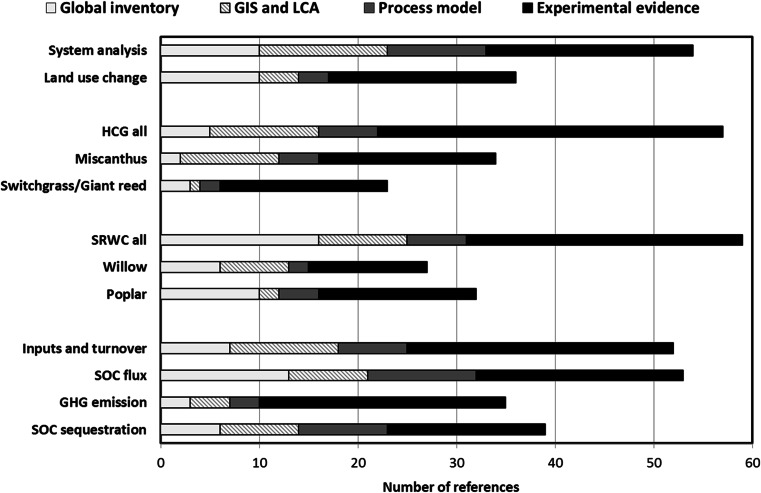
“A considerable number of papers using process models were published (47), but few studies modelled C specifically under Miscanthus (nine) and willow (six).”
§ Carbon Sequestration by Perennial Energy Crops: Is the Jury Still Out? > Components of Perennial Energy Cropping (PEC) Systems > Review Method: Meta-Analysis and Data Synthesis
plain- Asserted: passes — The authors put it forward as true.
- Checkable: passes — It can be checked against evidence.
- Load-bearing: unclear — It is unclear whether the paper’s conclusions depend on it.
- Based: passes — The paper gives a reason why it holds.
It may state two separate claims as one.
None of the sources cited for this claim have been checked yet.
In the paper
“Litter inputs from leaves vary greatly under switchgrass due to management; they were highest in riparian buffer strips [72] and lowest under subsoil amelioration [73] and were affected by land quality [74–76] or water [47].”
§ Carbon Sequestration by Perennial Energy Crops: Is the Jury Still Out? > Experimental Evidence for Model Parameters > Gross C Input Rates to Soil
What the sources say
- Not checked yetcites [72] Tufekcioglu A, Raich JW, Isenhart TM, Schultz RC (2003) Biomass, carbon and nitrogen dynamics of multi-species riparian buffers within an agricultural watershed in Iowa, USA. Agrofor Syst 57(3):187–198. doi: 10.1023/a:1024898615284 source
- Not checked yetcites [73] Al-Kaisi MM, Grote JB (2007) Cropping systems effects on improving soil carbon stocks of exposed subsoil. Soil Sci Soc Am J 71(4):1381–1388. doi: 10.2136/sssaj2006.0200 source
- Not checked yetcites [74] Hartman JC, Nippert JB, Orozco RA, Springer CJ (2011) Potential ecological impacts of switchgrass (Panicum virgatum L.) biofuel cultivation in the Central Great Plains, USA. Biomass Bioenergy 35(8):3415–3421. doi: 10.1016/j.biombioe.2011.04.055 source
- Not checked yetcites [75] Lee DK, Owens VN, Doolittle JJ (2007) Switchgrass and soil carbon sequestration response to ammonium nitrate, manure, and harvest frequency on conservation reserve program land. Agron J 99(2):462–468. doi: 10.2134/agronj2006.0152 source
- Not checked yetcites [76] Zenone T, Gelfand I, Chen J, Hamilton SK, Robertson GP (2013) From set-aside grassland to annual and perennial cellulosic biofuel crops: effects of land use change on carbon balance. Agric For Meteorol 182:1–12. doi: 10.1016/j.agrformet.2013.07.015 source
plaincorrelational- Asserted: passes — The authors put it forward as true.
- Checkable: passes — It can be checked against evidence.
- Load-bearing: unclear — It is unclear whether the paper’s conclusions depend on it.
- Based: passes — The paper gives a reason why it holds.
It may state two separate claims as one.
The paper states this without a source or data behind it here, so there is nothing to check it against. The quote shows it is in the paper.
In the paper
“Such inputs differ considerably in the literature (Table 1), even for the same kind of residue, mainly due to environment but also due to differences in sampling and analytical methods.”
§ Carbon Sequestration by Perennial Energy Crops: Is the Jury Still Out? > Experimental Evidence for Model Parameters > Gross C Input Rates to Soil
plaindirect- Asserted: passes — The authors put it forward as true.
- Checkable: passes — It can be checked against evidence.
- Load-bearing: unclear — It is unclear whether the paper’s conclusions depend on it.
- Based: passes — The paper gives a reason why it holds.
It may state two separate claims as one.
None of the sources cited for this claim have been checked yet.
In the paper
“Some papers cover other GHGs, like CO2 and/or methane [48, 49, 53–55, 57].”
§ Carbon Sequestration by Perennial Energy Crops: Is the Jury Still Out? > Components of Perennial Energy Cropping (PEC) Systems > Review Method: Meta-Analysis and Data Synthesis
What the sources say
- Not checked yetcites [48] Drewer J, Finch J, Lloyd R, Baggs E, Skiba U (2011) How do soil emission of N20, CH4 and CO2 from perennial bioenergy crops differ from arable annual crops? GCB Bioenergy. doi: 10.1111/j.1757-1707.2011.01136
- Not checked yetcites [49] Gauder M, Butterbach-Bahl K, Graeff-Hoenninger S, Claupein W, Wiegel R (2012) Soil-derived trace gas fluxes from different energy crops-results from a field experiment in Southwest Germany. Glob Chang Biol Bioenergy 4(3):289–301. doi: 10.1111/j.1757-1707.2011.01135.x source
- Not checked yetcites [53] Schmer MR, Liebig MA, Hendrickson JR, Tanaka DL, Phillips RL (2012) Growing season greenhouse gas flux from switchgrass in the northern Great Plains. Biomass Bioenergy 45:315–319. doi: 10.1016/j.biombioe.2012.05.026 source
- Not checked yetcites [54] Hellebrand HJ, Straehle M, Scholz V, Kern J (2010) Soil carbon, soil nitrate, and soil emissions of nitrous oxide during cultivation of energy crops. Nutr Cycl Agroecosyst 87(2):175–186. doi: 10.1007/s10705-009-9326-z source
- Not checked yetcites [55] Nikiema P, Rothstein DE, Miller RO (2012) Initial greenhouse gas emissions and nitrogen leaching losses associated with converting pastureland to short-rotation woody bioenergy crops in northern Michigan, USA. Biomass Bioenergy 39:413–426. doi: 10.1016/j.biombioe.2012.01.037 source
- Not checked yetcites [57] Anderson-Teixeira KJ, Masters MD, Black CK, Zeri M, Hussain MZ, Bernacchi CJ, DeLucia EH (2013) Altered belowground carbon cycling following land-use change to perennial bioenergy crops. Ecosystems 16(3):508–520. doi: 10.1007/s10021-012-9628-x source
plain- Asserted: passes — The authors put it forward as true.
- Checkable: passes — It can be checked against evidence.
- Load-bearing: fails — The paper’s conclusions may not depend on it.
- Based: passes — The paper gives a reason why it holds.
Probably not a substantial claim. The paper’s conclusions may not depend on it.
In the paper
“Initially, the largest number of papers dealt with assessing GHG emissions or offsets based on LCA or GIS modelling, which carry the main uncertainty that underlying C sequestration models were not specifically calibrated for PECs [44].”
§ Carbon Sequestration by Perennial Energy Crops: Is the Jury Still Out? > Components of Perennial Energy Cropping (PEC) Systems > Review Method: Meta-Analysis and Data Synthesis
What the sources say
- Not checked yetcites [44] Andrén O, Kätterer T (2001) Basic principles for soil carbon sequestration and calculating dynamic country-level balances including future scenarios. Assessment methods for soil carbon. Edited by R. Lal, J.M. Kimble, R.F. Follett, and B. A. Stewart, Lewis Publishers:495–511
plaincorrelational- Asserted: passes — The authors put it forward as true.
- Checkable: passes — It can be checked against evidence.
- Load-bearing: passes — The paper’s conclusions depend on it.
- Based: passes — The paper gives a reason why it holds.
It may state two separate claims as one.
The paper states this without a source or data behind it here, so there is nothing to check it against. The quote shows it is in the paper.
In the paper
“Another large subset of papers took a global perspective extrapolating field trials using models assuming a generalised management.”
§ Carbon Sequestration by Perennial Energy Crops: Is the Jury Still Out? > Components of Perennial Energy Cropping (PEC) Systems > Review Method: Meta-Analysis and Data Synthesis
plain- Asserted: passes — The authors put it forward as true.
- Checkable: passes — It can be checked against evidence.
- Load-bearing: fails — The paper’s conclusions may not depend on it.
- Based: passes — The paper gives a reason why it holds.
Probably not a substantial claim. The paper’s conclusions may not depend on it.
A result the paper reports from its own data — it cites no other source for it, so there is none to check. The quote shows it is in the paper.
In the paper
“Experimental evidence was reported in 85 papers, of which 44 were specific field trials for the PECs under consideration and a total of 57 studies had data useful for parameterising C sequestration (Tables 1, 2 and 3).”
§ Carbon Sequestration by Perennial Energy Crops: Is the Jury Still Out? > Components of Perennial Energy Cropping (PEC) Systems > Review Method: Meta-Analysis and Data Synthesis
plain- Asserted: passes — The authors put it forward as true.
- Checkable: passes — It can be checked against evidence.
- Load-bearing: passes — The paper’s conclusions depend on it.
- Based: passes — The paper gives a reason why it holds.
It may state two separate claims as one.
None of the sources cited for this claim have been checked yet.
In the paper
“BGB is concentrated in the upper part of the profile [61]; in spite of large amounts of roots under M. giganteus observed down to 1 to 1.8 m [57, 61, 66, 80, 84], more than 50 % were in the top 30 cm.”
§ Carbon Sequestration by Perennial Energy Crops: Is the Jury Still Out? > Experimental Evidence for Model Parameters > Gross C Input Rates to Soil
What the sources say
- Not checked yetcites [61] Monti A, Zatta A (2009) Root distribution and soil moisture retrieval in perennial and annual energy crops in Northern Italy. Agric Ecosyst Environ 132(3–4):252–259. doi: 10.1016/j.agee.2009.04.007 source
- Not checked yetcites [57] Anderson-Teixeira KJ, Masters MD, Black CK, Zeri M, Hussain MZ, Bernacchi CJ, DeLucia EH (2013) Altered belowground carbon cycling following land-use change to perennial bioenergy crops. Ecosystems 16(3):508–520. doi: 10.1007/s10021-012-9628-x source
- Not checked yetcites [66] Dohleman FG, Heaton EA, Arundale RA, Long SP (2012) Seasonal dynamics of above- and below-ground biomass and nitrogen partitioning in Miscanthus x giganteus and Panicum virgatum across three growing seasons. Glob Chang Biol Bionergy 4(5):534–544 source
- Not checked yetcites [80] Richter GM, Agostini F, Redmile-Gordon M, White R, Goulding KWT (2015) Sequestration of C in soils under Miscanthus can be marginal and is affected by genotype-specific root distribution. Agric Ecosyst Environ 200(1):169–177. doi: 10.1016/j.agee.2014.11.011 source
- Not checked yetcites [84] Neukirchen D, Himken M, Lammel J, Czypionka-Krause U, Olfs H-W (1999) Spatial and temporal distribution of the root system and root nutrient content of an established Miscanthus crop. Eur J Agron 11:301–309 source
plain- Asserted: passes — The authors put it forward as true.
- Checkable: passes — It can be checked against evidence.
- Load-bearing: unclear — It is unclear whether the paper’s conclusions depend on it.
- Based: passes — The paper gives a reason why it holds.
It may state two separate claims as one.
The paper states this without a source or data behind it here, so there is nothing to check it against. The quote shows it is in the paper.
In the paper
“On average, BGB inputs appear similar to that from litter under Miscanthus, switchgrass and willow but much smaller under poplar.”
§ Carbon Sequestration by Perennial Energy Crops: Is the Jury Still Out? > Experimental Evidence for Model Parameters > Gross C Input Rates to Soil
hedgedcorrelational- Asserted: passes — The authors put it forward as true.
- Checkable: passes — It can be checked against evidence.
- Load-bearing: unclear — It is unclear whether the paper’s conclusions depend on it.
- Based: passes — The paper gives a reason why it holds.
It may state two separate claims as one.
None of the sources cited for this claim have been checked yet.
In the paper
“Variable fractions of willow biomass can be found belowground dependent on stand age and soil texture [58]; 48–58 % of total biomass was allocated in the first year and 40 % allocated in succeeding years [26].”
§ Carbon Sequestration by Perennial Energy Crops: Is the Jury Still Out? > Experimental Evidence for Model Parameters > Gross C Input Rates to Soil
What the sources say
- Not checked yetcites [58] Rytter RM (2001) Biomass production and allocation, including fine-root turnover, and annual N uptake in lysimeter-grown basket willows. For Ecol Manag 140:177–192 source
- Not checked yetcites [26] Rytter RM (2012) The potential of willow and poplar plantations as carbon sinks in Sweden. Biomass Bioenergy 36:86–95 source
plaincorrelational- Asserted: passes — The authors put it forward as true.
- Checkable: passes — It can be checked against evidence.
- Load-bearing: unclear — It is unclear whether the paper’s conclusions depend on it.
- Based: passes — The paper gives a reason why it holds.
It may state two separate claims as one.
None of the sources cited for this claim have been checked yet.
In the paper
“Consistent across species and different locations, observed inputs seem to increase with stand age [60, 78], which is not reflected in long-term extrapolations [26].”
§ Carbon Sequestration by Perennial Energy Crops: Is the Jury Still Out? > Experimental Evidence for Model Parameters > Gross C Input Rates to Soil
What the sources say
- Not checked yetcites [60] Arevalo CBM, Bhatti JS, Chang SX, Sidders D (2011) Land use change effects on ecosystem carbon balance: from agricultural to hybrid poplar plantation. Agric Ecosyst Environ 141(3–4):342–349. doi: 10.1016/j.agee.2011.03.013 source
- Not checked yetcites [78] Cotrufo MF, De Angelis P, Polle A (2005) Leaf litter production and decomposition in a poplar short-rotation coppice exposed to free air CO2 enrichment (POPFACE). Glob Chang Biol 11:971–982 source
- Not checked yetcites [26] Rytter RM (2012) The potential of willow and poplar plantations as carbon sinks in Sweden. Biomass Bioenergy 36:86–95 source
hedgeddirect- Asserted: passes — The authors put it forward as true.
- Checkable: passes — It can be checked against evidence.
- Load-bearing: unclear — It is unclear whether the paper’s conclusions depend on it.
- Based: passes — The paper gives a reason why it holds.
It may state two separate claims as one.
None of the sources cited for this claim have been checked yet.
In the paper
“Observed values of C input from fine roots of SRWC poplar range between 0.46 and 1.28 Mg C ha−1 year−1, and between 0.16 and 1.45 Mg C ha−1 year−1 can be found in coarse roots (Table 1).”
§ Carbon Sequestration by Perennial Energy Crops: Is the Jury Still Out? > Experimental Evidence for Model Parameters > Gross C Input Rates to Soil
plain- Asserted: passes — The authors put it forward as true.
- Checkable: passes — It can be checked against evidence.
- Load-bearing: unclear — It is unclear whether the paper’s conclusions depend on it.
- Based: passes — The paper gives a reason why it holds.
It may state two separate claims as one.
None of the sources cited for this claim have been checked yet.
In the paper
“For different species in SRWC systems, 25–35 % of total tree biomass was found in the roots [87], with 10 % specified as fine roots, confirmed for a 10-year-old poplar plantation [5].”
§ Carbon Sequestration by Perennial Energy Crops: Is the Jury Still Out? > Experimental Evidence for Model Parameters > Gross C Input Rates to Soil
What the sources say
- Not checked yetcites [87] Whittaker RH, Marks PL (1975) Methods of assessing terrestrial productivity. In: Primary productivity of the biosphere, ed H Lieth and R Whittaker:55–118 source
- Not checked yetcites [5] Sartori F, Lal R, Ebinger MH, Eaton JA (2007) Changes in soil carbon and nutrient pools along a chronosequence of poplar plantations in the Columbia Plateau, Oregon, USA. Agric Ecosyst Environ 122(3):325–339. doi: 10.1016/j.agee.2007.01.026 source
plain- Asserted: passes — The authors put it forward as true.
- Checkable: passes — It can be checked against evidence.
- Load-bearing: unclear — It is unclear whether the paper’s conclusions depend on it.
- Based: passes — The paper gives a reason why it holds.
It may state two separate claims as one.
In the paper
“This C turned over very fast and only 2 % was found in the soil microbial biomass.”
§ Carbon Sequestration by Perennial Energy Crops: Is the Jury Still Out? > Experimental Evidence for Model Parameters > Gross C Input Rates to Soil
What the sources say
- Not checked yetcites [98] De Neergaard A, Porter JR, Gorissen A (2002) Distribution of assimilated carbon in plants and rhizosphere soil of basket willow (Salix viminalis L.). Plant Soil 245(2):307–314 source
plainSingle case- Asserted: passes — The authors put it forward as true.
- Checkable: passes — It can be checked against evidence.
- Load-bearing: unclear — It is unclear whether the paper’s conclusions depend on it.
- Based: passes — The paper gives a reason why it holds.
It may state two separate claims as one.
In the paper
“However, living roots can decrease (50 %) or increase (380 %) SOC mineralisation rates causing losses equivalent to the root C input to soil, the range depending on plant species and age [103].”
§ Carbon Sequestration by Perennial Energy Crops: Is the Jury Still Out? > Experimental Evidence for Model Parameters > Gross C Input Rates to Soil
What the sources say
- Not checked yetcites [103] Cheng W (2009) Rhizosphere priming effect: its functional relationships with microbial turnover, evapotranspiration, and C-N budgets. Soil Biol Biochem 41:1795–1801 source
plaindirect- Asserted: passes — The authors put it forward as true.
- Checkable: passes — It can be checked against evidence.
- Load-bearing: unclear — It is unclear whether the paper’s conclusions depend on it.
- Based: passes — The paper gives a reason why it holds.
It may state two separate claims as one.
In the paper
“The loss of existing SOC increased with root biomass in a poplar plantation subjected to free air C enrichment (FACE) [99] but did not appear to impair SOC increase.”
§ Carbon Sequestration by Perennial Energy Crops: Is the Jury Still Out? > Experimental Evidence for Model Parameters > Gross C Input Rates to Soil
What the sources say
- Not checked yetcites [99] Gielen B, Calfapietra C, Lukac M, Wittig VE, De Angelis P, Janssens IA, Moscatelli MC, Grego S, Cotrufo MF, Godbold DL, Hoosbeek MR, Long SP, Miglietta F, Polle A, Bernacchi CJ, Davey PA, Ceulemans R, Scarascia-Mugnozza GE (2005) Net carbon storage in a poplar plantation (POPFACE) after three years of free-air CO2 enrichment. Tree Physiol 25(11):1399–1408 source
hedgeddirectSingle case- Asserted: passes — The authors put it forward as true.
- Checkable: passes — It can be checked against evidence.
- Load-bearing: unclear — It is unclear whether the paper’s conclusions depend on it.
- Based: passes — The paper gives a reason why it holds.
It may state two separate claims as one.
None of the sources cited for this claim have been checked yet.
In the paper
“In SRWC systems, similar discrepancies due to experimental procedures occur: Only 15–18 % of the original mass was lost from litter bags over 8 months [78], whilst a loss of 80 % of the same litter was estimated during an 11-month period using 13C-labelled material [109].”
§ Carbon Sequestration by Perennial Energy Crops: Is the Jury Still Out? > Experimental Evidence for Model Parameters > Residue Dynamics and Turnover Rates
What the sources say
- Not checked yetcites [78] Cotrufo MF, De Angelis P, Polle A (2005) Leaf litter production and decomposition in a poplar short-rotation coppice exposed to free air CO2 enrichment (POPFACE). Glob Chang Biol 11:971–982 source
- Not checked yetcites [109] Rubino M, Dungait JAJ, Evershed RP, Bertolini T, De Angelis P, D’Onofrio A, Lagomarsino A, Lubritto C, Merola A, Terrasi F (2010) Carbon input belowground is the major C flux contributing to leaf litter mass loss: evidences from a 13C labelled-leaf litter experiment. Soil Biol Biochem 42(7):1009–1016. doi: 10.1016/j.soilbio.2010.02.018 source
plain- Asserted: passes — The authors put it forward as true.
- Checkable: passes — It can be checked against evidence.
- Load-bearing: unclear — It is unclear whether the paper’s conclusions depend on it.
- Based: passes — The paper gives a reason why it holds.
It may state two separate claims as one.
The paper states this without a source or data behind it here, so there is nothing to check it against. The quote shows it is in the paper.
In the paper
“Available literature on decomposition rates for PECs was patchy, and usable data were limited to 15 experimental papers (Table 2).”
§ Carbon Sequestration by Perennial Energy Crops: Is the Jury Still Out? > Experimental Evidence for Model Parameters > Residue Dynamics and Turnover Rates
plain- Asserted: passes — The authors put it forward as true.
- Checkable: passes — It can be checked against evidence.
- Load-bearing: passes — The paper’s conclusions depend on it.
- Based: passes — The paper gives a reason why it holds.
It may state two separate claims as one.
None of the sources cited for this claim have been checked yet.
In the paper
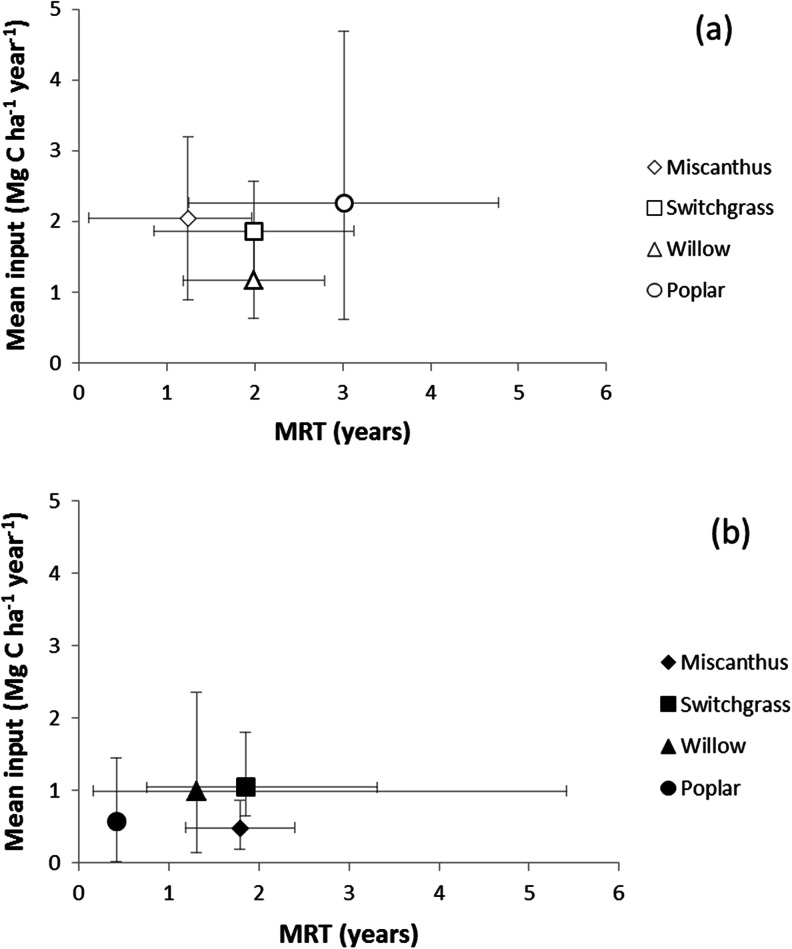
“MRT for leaves, alone or combined with other aboveground residues, ranged between 0.9 and 3.19 years and were longer under drier [62] and colder conditions [108].”
§ Carbon Sequestration by Perennial Energy Crops: Is the Jury Still Out? > Experimental Evidence for Model Parameters > Residue Dynamics and Turnover Rates
What the sources say
- Not checked yetcites [62] Beuch S, Boelcke B, Belau L (2000) Effect of the organic residues of Miscanthus x giganteus on the soil organic matter level of arable soils. J Agron Crop Sci-Z-Acker Pflanzenbau 184(2):111–119 source
- Not checked yetcites [108] Magid J, Luxhoi J, Lyshede OB (2004) Decomposition of plant residues at low temperatures separates turnover of nitrogen and energy rich tissue components in time. Plant Soil 258(1):351–365 source
plaincorrelational- Asserted: passes — The authors put it forward as true.
- Checkable: passes — It can be checked against evidence.
- Load-bearing: unclear — It is unclear whether the paper’s conclusions depend on it.
- Based: passes — The paper gives a reason why it holds.
It may state two separate claims as one.
In the paper
“About 35 % of leaf C was stabilised as recalcitrant plant debris or as microbial biomass [64], but the amount of C stabilised in humus remains unknown.”
§ Carbon Sequestration by Perennial Energy Crops: Is the Jury Still Out? > Experimental Evidence for Model Parameters > Residue Dynamics and Turnover Rates
What the sources say
- Not checked yetcites [64] Amougou N, Bertrand I, Machet JM, Recous S (2011) Quality and decomposition in soil of rhizome, root and senescent leaf from Miscanthus x giganteus, as affected by harvest date and N fertilization. Plant Soil 338(1–2):83–97. doi: 10.1007/s11104-010-0443-x source
plain- Asserted: passes — The authors put it forward as true.
- Checkable: passes — It can be checked against evidence.
- Load-bearing: unclear — It is unclear whether the paper’s conclusions depend on it.
- Based: passes — The paper gives a reason why it holds.
It may state two separate claims as one.
None of the sources cited for this claim have been checked yet.
In the paper
“Potential decomposition rates of Miscanthus residues, both in situ (litter bags) and by laboratory incubation, decreased in order from young rhizome to litter and roots, with MRT ranging from 1.2 to 2.4 years [64, 69], similar to other results [62].”
§ Carbon Sequestration by Perennial Energy Crops: Is the Jury Still Out? > Experimental Evidence for Model Parameters > Residue Dynamics and Turnover Rates
What the sources say
- Not checked yetcites [64] Amougou N, Bertrand I, Machet JM, Recous S (2011) Quality and decomposition in soil of rhizome, root and senescent leaf from Miscanthus x giganteus, as affected by harvest date and N fertilization. Plant Soil 338(1–2):83–97. doi: 10.1007/s11104-010-0443-x source
- Not checked yetcites [69] Amougou N, Bertrand I, Cadoux S, Recous S (2012) Miscanthus × giganteus leaf senescence, decomposition and C and N inputs to soil. Glob Chang Biol Bionergy 4(6):698–707. doi: 10.1111/j.1757-1707.2012.01192.x source
- Not checked yetcites [62] Beuch S, Boelcke B, Belau L (2000) Effect of the organic residues of Miscanthus x giganteus on the soil organic matter level of arable soils. J Agron Crop Sci-Z-Acker Pflanzenbau 184(2):111–119 source
plaincorrelational- Asserted: passes — The authors put it forward as true.
- Checkable: passes — It can be checked against evidence.
- Load-bearing: unclear — It is unclear whether the paper’s conclusions depend on it.
- Based: passes — The paper gives a reason why it holds.
It may state two separate claims as one.
None of the sources cited for this claim have been checked yet.
In the paper
“These losses translated into MRTs about four times longer (4.3–5.3 years) than those determined from isotope ratios (1.15 years) and about twice those calculated when accounting for the 10 °C difference in incubation temperatures.”
§ Carbon Sequestration by Perennial Energy Crops: Is the Jury Still Out? > Experimental Evidence for Model Parameters > Residue Dynamics and Turnover Rates
What the sources say
- Not checked yetcites [78] Cotrufo MF, De Angelis P, Polle A (2005) Leaf litter production and decomposition in a poplar short-rotation coppice exposed to free air CO2 enrichment (POPFACE). Glob Chang Biol 11:971–982 source
- Not checked yetcites [109] Rubino M, Dungait JAJ, Evershed RP, Bertolini T, De Angelis P, D’Onofrio A, Lagomarsino A, Lubritto C, Merola A, Terrasi F (2010) Carbon input belowground is the major C flux contributing to leaf litter mass loss: evidences from a 13C labelled-leaf litter experiment. Soil Biol Biochem 42(7):1009–1016. doi: 10.1016/j.soilbio.2010.02.018 source
plaindirect- Asserted: passes — The authors put it forward as true.
- Checkable: passes — It can be checked against evidence.
- Load-bearing: unclear — It is unclear whether the paper’s conclusions depend on it.
- Based: passes — The paper gives a reason why it holds.
It may state two separate claims as one.
In the paper
“Leaf material accessible to earthworms almost completely disappeared from the large mesh litter bags within 1 year (95 %; MRT ∼1 year), whilst material accessible only to fungal decomposition only lost between 40 and 80 % (MRT 2.5 to 1.25 years).”
§ Carbon Sequestration by Perennial Energy Crops: Is the Jury Still Out? > Experimental Evidence for Model Parameters > Residue Dynamics and Turnover Rates
What the sources say
- Not checked yetcites [111] Slapokas T, Granhall U (1991) Decomposition of willow-leaf litter in a short-rotation forest in relation to fungal colonization and palatability for earthworms. Biol Fertil Soils 10:241–248 source
plain- Asserted: passes — The authors put it forward as true.
- Checkable: passes — It can be checked against evidence.
- Load-bearing: unclear — It is unclear whether the paper’s conclusions depend on it.
- Based: passes — The paper gives a reason why it holds.
It may state two separate claims as one.
A result the paper reports from its own data — it cites no other source for it, so there is none to check. The quote shows it is in the paper.
In the paper
“Grasses and poplar have similar C inputs from AGB litter, larger than willow SRC (∼2 vs. 1 Mg C ha−1 year−1) with a wide range of MRT (<1 to >4 years), some of which may be overestimated.”
§ Carbon Sequestration by Perennial Energy Crops: Is the Jury Still Out? > Experimental Evidence for Model Parameters > Carbon Retention and Storage in Soil
hedgedcorrelational- Asserted: passes — The authors put it forward as true.
- Checkable: passes — It can be checked against evidence.
- Load-bearing: unclear — It is unclear whether the paper’s conclusions depend on it.
- Based: passes — The paper gives a reason why it holds.
It may state two separate claims as one.
None of the sources cited for this claim have been checked yet.
In the paper
“Coarse roots (CR) represent a variable fraction of the root biomass (10 and 40 %; [58, 99]), but much smaller values emerged recently [82].”
§ Carbon Sequestration by Perennial Energy Crops: Is the Jury Still Out? > Experimental Evidence for Model Parameters > Residue Dynamics and Turnover Rates
What the sources say
- Not checked yetcites [58] Rytter RM (2001) Biomass production and allocation, including fine-root turnover, and annual N uptake in lysimeter-grown basket willows. For Ecol Manag 140:177–192 source
- Not checked yetcites [99] Gielen B, Calfapietra C, Lukac M, Wittig VE, De Angelis P, Janssens IA, Moscatelli MC, Grego S, Cotrufo MF, Godbold DL, Hoosbeek MR, Long SP, Miglietta F, Polle A, Bernacchi CJ, Davey PA, Ceulemans R, Scarascia-Mugnozza GE (2005) Net carbon storage in a poplar plantation (POPFACE) after three years of free-air CO2 enrichment. Tree Physiol 25(11):1399–1408 source
- Not checked yetcites [82] Rytter RM (2013) The effect of limited availability of N or water on C allocation to fine roots and annual fine root turnover in Alnus incana and Salix viminalis. Tree Physiol 33(9):924–939. doi: 10.1093/treephys/tpt060 source
plain- Asserted: passes — The authors put it forward as true.
- Checkable: passes — It can be checked against evidence.
- Load-bearing: unclear — It is unclear whether the paper’s conclusions depend on it.
- Based: passes — The paper gives a reason why it holds.
It may state two separate claims as one.
The paper states this without a source or data behind it here, so there is nothing to check it against. The quote shows it is in the paper.
In the paper
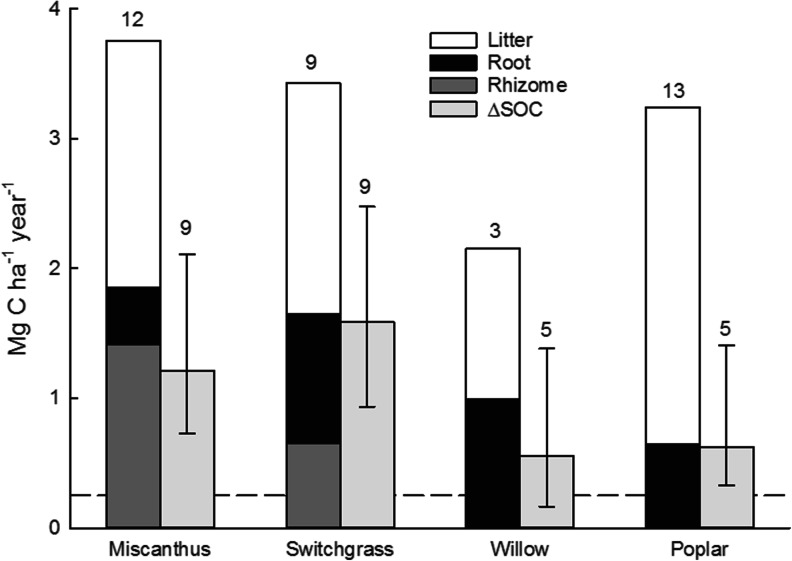
“For switchgrass, similar average inputs appear to cause an overall 25 % higher average stock change (∆SOC, Fig. 4) than Miscanthus (1.59 vs 1.21 Mg C ha−1 year−1), likely due to the lower root inputs from Miscanthus (Fig. 3b).”
§ Carbon Sequestration by Perennial Energy Crops: Is the Jury Still Out? > Experimental Evidence for Model Parameters > Carbon Retention and Storage in Soil
hedgedconditional- Asserted: passes — The authors put it forward as true.
- Checkable: passes — It can be checked against evidence.
- Load-bearing: unclear — It is unclear whether the paper’s conclusions depend on it.
- Based: passes — The paper gives a reason why it holds.
It may state two separate claims as one.
In the paper
“The annual average C input to the soil as fine root under SRWC is between 0.4 and 1 Mg C ha−1 year−1, but their fast turnover is diminishing the contribution to SOC storage and retention to about 10 % [82].”
§ Carbon Sequestration by Perennial Energy Crops: Is the Jury Still Out? > Experimental Evidence for Model Parameters > Carbon Retention and Storage in Soil
What the sources say
- Not checked yetcites [82] Rytter RM (2013) The effect of limited availability of N or water on C allocation to fine roots and annual fine root turnover in Alnus incana and Salix viminalis. Tree Physiol 33(9):924–939. doi: 10.1093/treephys/tpt060 source
plaindirect- Asserted: passes — The authors put it forward as true.
- Checkable: passes — It can be checked against evidence.
- Load-bearing: passes — The paper’s conclusions depend on it.
- Based: passes — The paper gives a reason why it holds.
It may state two separate claims as one.
None of the sources cited for this claim have been checked yet.
In the paper
“Under switchgrass, a large number of studies [8, 9, 47, 57, 75, 77, 137, 138] showed sequestration rates, which were similar (Table 3) but higher on average (Fig. 4).”
§ Carbon Sequestration by Perennial Energy Crops: Is the Jury Still Out? > Experimental Evidence for Model Parameters > Carbon Retention and Storage in Soil
What the sources say
- Not checked yetcites [8] Garten CT (2012) Review and model-based analysis of factors influencing soil carbon sequestration beneath switchgrass (Panicum virgatum). Bioenergy Res 5(1):124–138. doi: 10.1007/s12155-011-9154-2 source
- Not checked yetcites [9] Bransby DI, McLaughlin SB, Parrish DJ (1998) A review of carbon and nitrogen balances in switchgrass grown for energy. Biomass Bioenergy 14(4):379–384 source
- Not checked yetcites [47] Collins HP, Smith JL, Fransen S, Alva AK, Kruger CE, Granatstein DM (2010) Carbon sequestration under irrigated switchgrass (Panicum virgatum L.) production. Soil Sci Soc Am J 74(6):2049–2058. doi: 10.2136/sssaj2010.0020 source
- Not checked yetcites [57] Anderson-Teixeira KJ, Masters MD, Black CK, Zeri M, Hussain MZ, Bernacchi CJ, DeLucia EH (2013) Altered belowground carbon cycling following land-use change to perennial bioenergy crops. Ecosystems 16(3):508–520. doi: 10.1007/s10021-012-9628-x source
- Not checked yetcites [75] Lee DK, Owens VN, Doolittle JJ (2007) Switchgrass and soil carbon sequestration response to ammonium nitrate, manure, and harvest frequency on conservation reserve program land. Agron J 99(2):462–468. doi: 10.2134/agronj2006.0152 source
- Not checked yetcites [77] Wienhold BJ, Varvel GE, Johnson JMF, Wilhelm WW (2013) Carbon source quality and placement effects on soil organic carbon status. Bioenergy Res 6(2):786–796. doi: 10.1007/s12155-013-9301-z source
- Not checked yetcites [137] Bonin CL, Lal R (2014) Aboveground productivity and soil carbon storage of biofuel crops in Ohio. Glob Chang Biol Bioenergy 6(1):67–75. doi: 10.1111/gcbb.12041 source
- Not checked yetcites [138] Follett RF, Vogel KP, Varvel GE, Mitchell RB, Kimble J (2012) Soil carbon sequestration by switchgrass and no-till maize grown for bioenergy. Bioenergy Res 5(4):866–875. doi: 10.1007/s12155-012-9198-y source
plaincorrelational- Asserted: passes — The authors put it forward as true.
- Checkable: passes — It can be checked against evidence.
- Load-bearing: unclear — It is unclear whether the paper’s conclusions depend on it.
- Based: passes — The paper gives a reason why it holds.
It may state two separate claims as one.
In the paper
“These low-storage changes were supported by findings for SRF using labelled C [142], which also showed that new C accumulated in SOC pools was characterised by high turnover rates.”
§ Carbon Sequestration by Perennial Energy Crops: Is the Jury Still Out? > Experimental Evidence for Model Parameters > Carbon Retention and Storage in Soil
What the sources say
- Not checked yetcites [142] Lichter J, Barron SH, Bevacqua CE, Finzi AC, Irving KE, Stemmler EA, Schlesinger WH (2005) Soil carbon sequestration and turnover in a pine forest. Ecology 86 (7):1835–1847. doi: 10.1890/04-1205 source
plaincorrelational- Asserted: passes — The authors put it forward as true.
- Checkable: passes — It can be checked against evidence.
- Load-bearing: unclear — It is unclear whether the paper’s conclusions depend on it.
- Based: passes — The paper gives a reason why it holds.
It may state two separate claims as one.
A result the paper reports from its own data — it cites no other source for it, so there is none to check. The quote shows it is in the paper.
In the paper
“Based on Table 3, the C retention is higher in herbaceous (Miscanthus) than woody PEC systems (21–72 vs. 12–23 % retained of original input), which is confirmed by comparing independent averages (Fig. 4).”
§ Carbon Sequestration by Perennial Energy Crops: Is the Jury Still Out? > Experimental Evidence for Model Parameters > Carbon Retention and Storage in Soil
plaincorrelational- Asserted: passes — The authors put it forward as true.
- Checkable: passes — It can be checked against evidence.
- Load-bearing: passes — The paper’s conclusions depend on it.
- Based: passes — The paper gives a reason why it holds.
It may state two separate claims as one.
None of the sources cited for this claim have been checked yet.
In the paper
“On the other hand, a priming effect was suggested for Miscanthus root exudates [86], and a two- to fourfold increase in the mineralisation rate was reported after establishment of switchgrass [43].”
§ Carbon Sequestration by Perennial Energy Crops: Is the Jury Still Out? > Experimental Evidence for Model Parameters > Carbon Retention and Storage in Soil
What the sources say
- Not checked yetcites [86] Zatta A, Clifton-Brown J, Robson P, Hastings A, Monti A (2014) Land use change from C3 grassland to C4 Miscanthus: effects on soil carbon content and estimated mitigation benefit after six years. GCB Bioenergy 6(4):360–370. doi: 10.1111/gcbb.12054 source
- Not checked yetcites [43] Ma Z, Wood CW, Bransby DI (2000) Carbon dynamics subsequent to establishment of switchgrass. Biomass Bioenergy 18(2):93–104 source
hedgedconditional- Asserted: passes — The authors put it forward as true.
- Checkable: passes — It can be checked against evidence.
- Load-bearing: unclear — It is unclear whether the paper’s conclusions depend on it.
- Based: passes — The paper gives a reason why it holds.
It may state two separate claims as one.
None of the sources cited for this claim have been checked yet.
In the paper
“New data show high sequestration rates for switchgrass on arable soils [137] but no long-term change for SRC-willow on former grassland soils [143].”
§ Carbon Sequestration by Perennial Energy Crops: Is the Jury Still Out? > Experimental Evidence for Model Parameters > Carbon Retention and Storage in Soil
What the sources say
- Not checked yetcites [137] Bonin CL, Lal R (2014) Aboveground productivity and soil carbon storage of biofuel crops in Ohio. Glob Chang Biol Bioenergy 6(1):67–75. doi: 10.1111/gcbb.12041 source
- Not checked yetcites [143] Pacaldo RS, Volk TA, Briggs RD (2013) No significant differences in soil organic carbon contents along a chronosequence of shrub willow biomass crop fields. Biomass Bioenergy 58:136–142. doi: 10.1016/j.biombioe.2013.10.018 source
plain- Asserted: passes — The authors put it forward as true.
- Checkable: passes — It can be checked against evidence.
- Load-bearing: unclear — It is unclear whether the paper’s conclusions depend on it.
- Based: passes — The paper gives a reason why it holds.
It may state two separate claims as one.
The paper states this without a source or data behind it here, so there is nothing to check it against. The quote shows it is in the paper.
In the paper
“For Table 3, we interpolated after the initial loss an average annual SOC gain of 2.29 Mg ha−1 year−1 between years 4 and 11, which over the whole period would have been an increase of only 1.87 Mg ha−1 year−1.”
§ Carbon Sequestration by Perennial Energy Crops: Is the Jury Still Out? > Experimental Evidence for Model Parameters > Carbon Retention and Storage in Soil
plain- Asserted: passes — The authors put it forward as true.
- Checkable: passes — It can be checked against evidence.
- Load-bearing: unclear — It is unclear whether the paper’s conclusions depend on it.
- Based: passes — The paper gives a reason why it holds.
It may state two separate claims as one.
None of the sources cited for this claim have been checked yet.
In the paper
“Two papers dealt with a generic description of the C balance under poplar [10] and switchgrass [8].”
§ Carbon Sequestration by Perennial Energy Crops: Is the Jury Still Out? > Modelling Approaches Adopted for SOC Under PEC Systems > Process-Based Models
What the sources say
- Not checked yetcites [10] Garten CT, Wullschleger SD, Classen AT (2011) Review and model-based analysis of factors influencing soil carbon sequestration under hybrid poplar. Biomass Bioenergy 35(1):214–226. doi: 10.1016/j.biombioe.2010.08.013 source
- Not checked yetcites [8] Garten CT (2012) Review and model-based analysis of factors influencing soil carbon sequestration beneath switchgrass (Panicum virgatum). Bioenergy Res 5(1):124–138. doi: 10.1007/s12155-011-9154-2 source
plain- Asserted: passes — The authors put it forward as true.
- Checkable: passes — It can be checked against evidence.
- Load-bearing: fails — The paper’s conclusions may not depend on it.
- Based: passes — The paper gives a reason why it holds.
Probably not a substantial claim. The paper’s conclusions may not depend on it.
A result the paper reports from its own data — it cites no other source for it, so there is none to check. The quote shows it is in the paper.
In the paper
“A total of 25 papers modelling C in PECs systems were published between 2000 and 2013: 16 used RothC and derived models, five used CENTURY or DayCENT and two used both models (Table 4).”
§ Carbon Sequestration by Perennial Energy Crops: Is the Jury Still Out? > Modelling Approaches Adopted for SOC Under PEC Systems > Process-Based Models
plain- Asserted: passes — The authors put it forward as true.
- Checkable: passes — It can be checked against evidence.
- Load-bearing: unclear — It is unclear whether the paper’s conclusions depend on it.
- Based: passes — The paper gives a reason why it holds.
It may state two separate claims as one.
The paper states this without a source or data behind it here, so there is nothing to check it against. The quote shows it is in the paper.
In the paper
“However, the simulated cumulative CO2 emission was 20 % higher than under Miscanthus, because the turnover of fine willow roots is 17 times faster than Miscanthus roots.”
§ Carbon Sequestration by Perennial Energy Crops: Is the Jury Still Out? > Modelling Approaches Adopted for SOC Under PEC Systems > Modelling Using Disaggregated C Inputs
plaindirect- Asserted: passes — The authors put it forward as true.
- Checkable: passes — It can be checked against evidence.
- Load-bearing: unclear — It is unclear whether the paper’s conclusions depend on it.
- Based: passes — The paper gives a reason why it holds.
It may state two separate claims as one.
In the paper
“Although not significant, initial SOC gains are greater on former arable than on former grassland when planted with Miscanthus in spite of greater—probably yield-dependent—sequestration rates on grassland [134].”
§ Carbon Sequestration by Perennial Energy Crops: Is the Jury Still Out? > Modelling Approaches Adopted for SOC Under PEC Systems > Further Development Needs
What the sources say
- Not checked yetcites [134] Zimmermann J, Dauber J, Jones MB (2012) Soil carbon sequestration during the establishment phase of Miscanthus × giganteus: a regional-scale study on commercial farms using 13C natural abundance. GCB Bioenergy 4(4):453–461. doi: 10.1111/j.1757-1707.2011.01117.x source
hedgedcorrelational- Asserted: passes — The authors put it forward as true.
- Checkable: passes — It can be checked against evidence.
- Load-bearing: unclear — It is unclear whether the paper’s conclusions depend on it.
- Based: passes — The paper gives a reason why it holds.
It may state two separate claims as one.
In the paper
“PECs are considered to be a nearly C-neutral source of energy [4]”
§ Carbon Sequestration by Perennial Energy Crops: Is the Jury Still Out? > Introduction
What the sources say
- Not checked yetcites [4] Johnson JMF, Barbour NW, Weyers SL (2007) Chemical composition of crop biomass impacts its decomposition. Soil Sci Soc Am J 71(1):155–162 source
plain- Asserted: passes — The authors put it forward as true.
- Checkable: passes — It can be checked against evidence.
- Load-bearing: passes — The paper’s conclusions depend on it.
- Based: passes — The paper gives a reason why it holds.
Probably not a substantial claim.
A conclusion the paper draws from its own results — it cites no other source for it, so there is none to check. The quote shows it is in the paper.
In the paper
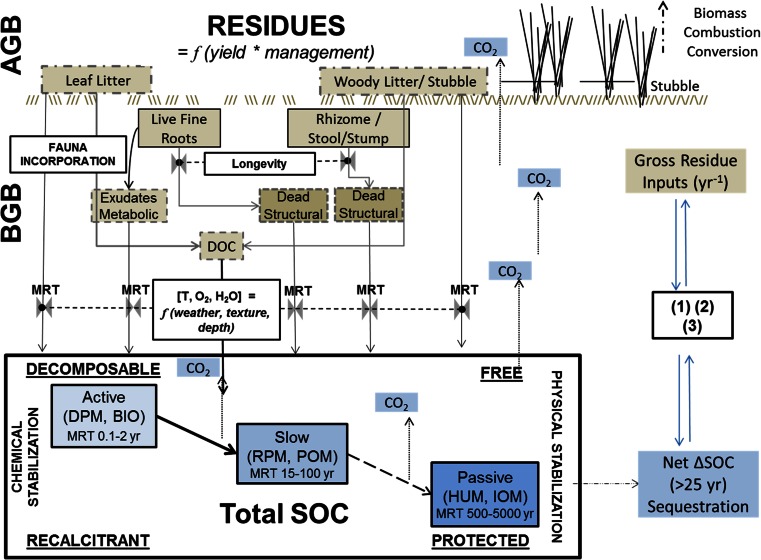
“Eventually, the reversion of the perennials to arable will destroy the BGB in the plough layer, which could be removed or retained, decomposed and humified to become part of SOC (Fig. 1).”
§ Carbon Sequestration by Perennial Energy Crops: Is the Jury Still Out? > Components of Perennial Energy Cropping (PEC) Systems > PEC Systems
hedgeddirect- Asserted: passes — The authors put it forward as true.
- Checkable: passes — It can be checked against evidence.
- Load-bearing: unclear — It is unclear whether the paper’s conclusions depend on it.
- Based: passes — The paper gives a reason why it holds.
It may state two separate claims as one.
In the paper
“It has been proposed that C sequestration under PECs should be at least 0.25 Mg C ha−1 year−1 in order to make the crop C-neutral when converted to biofuel [7].”
§ Carbon Sequestration by Perennial Energy Crops: Is the Jury Still Out? > Introduction
What the sources say
- Not checked yetcites [7] Volk TA, Verwijst T, Tharakan PJ, Abrahamson LP, White EH (2004) Growing fuel a sustainability assessment of willow biomass crops. Front Ecol Environ 2(8):411–418 source
hedgeddirect- Asserted: fails — The authors may not put it forward as true.
- Checkable: passes — It can be checked against evidence.
- Load-bearing: fails — The paper’s conclusions may not depend on it.
- Based: passes — The paper gives a reason why it holds.
Probably not a substantial claim. The authors may not put it forward as true. The paper’s conclusions may not depend on it.
None of the sources cited for this claim have been checked yet.
In the paper
“PECs are fast-growing (perennial) species that can be grown on marginal soils with low inputs [1, 2] to generate energy either from direct combustion or via conversion to liquid fuels.”
§ Carbon Sequestration by Perennial Energy Crops: Is the Jury Still Out? > Introduction
What the sources say
- Not checked yetcites [1] Lemus R, Lal R (2005) Bioenergy crops and carbon sequestration. Crit Rev Plant Sci 24(1):1–21. doi: 10.1080/07352680590910393 source
- Not checked yetcites [2] Lewandowski I, Scurlock JMO, Lindvall E, Christou M (2003) The development and current status of perennial rhizomatous grasses as energy crops in the US and Europe. Biomass Bioenergy 25(4):335–361 source
plain- Asserted: passes — The authors put it forward as true.
- Checkable: passes — It can be checked against evidence.
- Load-bearing: fails — The paper’s conclusions may not depend on it.
- Based: passes — The paper gives a reason why it holds.
Probably not a substantial claim. The paper’s conclusions may not depend on it. It may state two separate claims as one.
- Rests on an assumption: The area of land devoted to perennial energy crops is likely to increase.
In the paper
“LCA on data from the USA found poplar and switchgrass provided the largest overall GHG sinks [18], with poplar superior due to the fact that in grass systems, nearly all AGB is removed.”
§ Carbon Sequestration by Perennial Energy Crops: Is the Jury Still Out? > Components of Perennial Energy Cropping (PEC) Systems > PEC Systems
What the sources say
- Not checked yetcites [18] Adler PR, Del Grosso SJ, Parton WJ (2007) Life-cycle assessment of net greenhouse-gas flux for bioenergy cropping systems. Ecol Appl 17(3):675–691 source
plaindirect- Asserted: passes — The authors put it forward as true.
- Checkable: passes — It can be checked against evidence.
- Load-bearing: unclear — It is unclear whether the paper’s conclusions depend on it.
- Based: passes — The paper gives a reason why it holds.
It may state two separate claims as one.
None of the sources cited for this claim have been checked yet.
In the paper
“Miscanthus seems to be the best choice in terms of C sequestration and input efficiency [23] due to its slow decay of residues and high BGB [13].”
§ Carbon Sequestration by Perennial Energy Crops: Is the Jury Still Out? > Components of Perennial Energy Cropping (PEC) Systems > PEC Systems
What the sources say
- Not checked yetcites [23] Lewandowski I, Schmidt U (2006) Nitrogen, energy and land use efficiencies of Miscanthus, reed canary grass and triticale as determined by the boundary line approach. Agric Ecosyst Environ 112(4):335–346 source
- Not checked yetcites [13] Heaton E, Dohleman FG, Miguez AF (2010) Miscanthus: a promising biomass crop. Adv Bot Res 56:75–137 source
hedgeddirect- Asserted: passes — The authors put it forward as true.
- Checkable: passes — It can be checked against evidence.
- Load-bearing: unclear — It is unclear whether the paper’s conclusions depend on it.
- Based: passes — The paper gives a reason why it holds.
It may state two separate claims as one.
None of the sources cited for this claim have been checked yet.
In the paper
“Both HCG and SRWC can potentially deliver up to 40–50 % of the C they capture from the atmosphere to the soil as litter and BGB, which can vary from <1 to >4 Mg C ha−1 year−1 [59–61].”
§ Carbon Sequestration by Perennial Energy Crops: Is the Jury Still Out? > Experimental Evidence for Model Parameters > Gross C Input Rates to Soil
What the sources say
- Not checked yetcites [59] Davis SC, Parton WJ, Dohleman FG, Smith CM, Grosso SD, Kent AD, DeLucia EH (2009) Comparative biogeochemical cycles of bioenergy crops reveal nitrogen-fixation and low greenhouse gas emissions in a Miscanthus × giganteus agro-ecosystem. Ecosystems 13(1):144–156. doi: 10.1007/s10021-009-9306-9 source
- Not checked yetcites [60] Arevalo CBM, Bhatti JS, Chang SX, Sidders D (2011) Land use change effects on ecosystem carbon balance: from agricultural to hybrid poplar plantation. Agric Ecosyst Environ 141(3–4):342–349. doi: 10.1016/j.agee.2011.03.013 source
- Not checked yetcites [61] Monti A, Zatta A (2009) Root distribution and soil moisture retrieval in perennial and annual energy crops in Northern Italy. Agric Ecosyst Environ 132(3–4):252–259. doi: 10.1016/j.agee.2009.04.007 source
hedgedconditional- Asserted: passes — The authors put it forward as true.
- Checkable: passes — It can be checked against evidence.
- Load-bearing: unclear — It is unclear whether the paper’s conclusions depend on it.
- Based: passes — The paper gives a reason why it holds.
It may state two separate claims as one.
The paper states this without a source or data behind it here, so there is nothing to check it against. The quote shows it is in the paper.
In the paper
“Whilst harvested AGB will be converted to atmospheric CO2 by combustion, litter and harvest residues undergo a phase of surface decomposition and incorporation.”
§ Carbon Sequestration by Perennial Energy Crops: Is the Jury Still Out? > Components of Perennial Energy Cropping (PEC) Systems > Components of the C Cycle Under PEC Systems
plaindirect- Asserted: passes — The authors put it forward as true.
- Checkable: passes — It can be checked against evidence.
- Load-bearing: fails — The paper’s conclusions may not depend on it.
- Based: fails — The paper may give no reason why it holds.
Probably not a substantial claim. The paper’s conclusions may not depend on it. The paper may give no reason why it holds. It may state two separate claims as one.
None of the sources cited for this claim have been checked yet.
In the paper
“Willow and poplar are favoured for SRC due to their high growth rates and broad genetic variability, which allows adaptation to different soil and climate conditions [27, 28].”
§ Carbon Sequestration by Perennial Energy Crops: Is the Jury Still Out? > Components of Perennial Energy Cropping (PEC) Systems > PEC Systems
What the sources say
- Not checked yetcites [27] Kuzovkina YA, Volk TA (2009) The characterization of willow (Salix L.) varieties for use in ecological engineering applications: co-ordination of structure, function and autecology. Ecol Eng 35(8):1178–1189. doi: 10.1016/j.ecoleng.2009.03.010 source
- Not checked yetcites [28] Lasch P, Kollas C, Rock J, Suckow F (2009) Potentials and impacts of short-rotation coppice plantation with aspen in Eastern Germany under conditions of climate change. Reg Environ Chang 10(2):83–94. doi: 10.1007/s10113-009-0095-7 source
plaindirect- Asserted: passes — The authors put it forward as true.
- Checkable: passes — It can be checked against evidence.
- Load-bearing: fails — The paper’s conclusions may not depend on it.
- Based: passes — The paper gives a reason why it holds.
Probably not a substantial claim. The paper’s conclusions may not depend on it. It may state two separate claims as one.
A conclusion the paper draws from its own results — it cites no other source for it, so there is none to check. The quote shows it is in the paper.
In the paper
“Some parameter gaps could be filled using data in papers on switchgrass (four) and poplar (four), but it is questionable whether parameters from other woody systems (e.g. evergreen forest) were appropriate for this purpose.”
§ Carbon Sequestration by Perennial Energy Crops: Is the Jury Still Out? > Components of Perennial Energy Cropping (PEC) Systems > Review Method: Meta-Analysis and Data Synthesis
hedged- Asserted: passes — The authors put it forward as true.
- Checkable: passes — It can be checked against evidence.
- Load-bearing: unclear — It is unclear whether the paper’s conclusions depend on it.
- Based: passes — The paper gives a reason why it holds.
It may state two separate claims as one.
- Rests on an assumption: Data from switchgrass and poplar are appropriate proxies for Miscanthus and willow.
In the paper
“Under SRWC, litter production varies across species and genotypes, as leaf litter is proportional to LAI, and generally accumulates at the end of the season in a layer on the soil surface before being progressively incorporated into the top 10 to 15 cm of soil [78].”
§ Carbon Sequestration by Perennial Energy Crops: Is the Jury Still Out? > Experimental Evidence for Model Parameters > Gross C Input Rates to Soil
What the sources say
- Not checked yetcites [78] Cotrufo MF, De Angelis P, Polle A (2005) Leaf litter production and decomposition in a poplar short-rotation coppice exposed to free air CO2 enrichment (POPFACE). Glob Chang Biol 11:971–982 source
plaincorrelational- Asserted: passes — The authors put it forward as true.
- Checkable: passes — It can be checked against evidence.
- Load-bearing: unclear — It is unclear whether the paper’s conclusions depend on it.
- Based: passes — The paper gives a reason why it holds.
It may state two separate claims as one.
In the paper
“Harvest method can have a profound impact on losses, but woody harvest residues <5 % seem achievable [22].”
§ Carbon Sequestration by Perennial Energy Crops: Is the Jury Still Out? > Experimental Evidence for Model Parameters > Gross C Input Rates to Soil
What the sources say
- Not checked yetcites [22] Berhongaray G, El Kasmioui O, Ceulemans R (2013) Comparative analysis of harvesting machines on an operational high-density short rotation woody crop (SRWC) culture: one-process versus two-process harvest operation. Biomass Bioenergy 58:333–342. doi: 10.1016/j.biombioe.2013.07.003 source
hedgedconditional- Asserted: passes — The authors put it forward as true.
- Checkable: passes — It can be checked against evidence.
- Load-bearing: unclear — It is unclear whether the paper’s conclusions depend on it.
- Based: passes — The paper gives a reason why it holds.
It may state two separate claims as one.
None of the sources cited for this claim have been checked yet.
In the paper
“It was suggested that about 20 % of SRC poplar biomass was allocated to structural roots [95] which may contribute significantly to biomass C, whilst fine roots contribute to SOC due to their faster turnover compared to structural components [26, 82].”
§ Carbon Sequestration by Perennial Energy Crops: Is the Jury Still Out? > Experimental Evidence for Model Parameters > Gross C Input Rates to Soil
What the sources say
- Not checked yetcites [95] Grigal DF, Berguson WE (1998) Soil carbon changes associated with short-rotation systems. Biomass Bioenergy 14(4):371–377 source
- Not checked yetcites [26] Rytter RM (2012) The potential of willow and poplar plantations as carbon sinks in Sweden. Biomass Bioenergy 36:86–95 source
- Not checked yetcites [82] Rytter RM (2013) The effect of limited availability of N or water on C allocation to fine roots and annual fine root turnover in Alnus incana and Salix viminalis. Tree Physiol 33(9):924–939. doi: 10.1093/treephys/tpt060 source
hedgedconditional- Asserted: passes — The authors put it forward as true.
- Checkable: passes — It can be checked against evidence.
- Load-bearing: unclear — It is unclear whether the paper’s conclusions depend on it.
- Based: passes — The paper gives a reason why it holds.
It may state two separate claims as one.
In the paper
“Quantification of fine roots is challenging, and indirect methods were proposed although roots concentrate in the upper 5–10 cm of soil [94].”
§ Carbon Sequestration by Perennial Energy Crops: Is the Jury Still Out? > Experimental Evidence for Model Parameters > Gross C Input Rates to Soil
What the sources say
- Not checked yetcites [94] Al Afas N, Marron N, Zavalloni C, Ceulemans R (2008) Growth and production of a short-rotation coppice culture of poplar-IV: fine root characteristics of five poplar clones. Biomass Bioenergy 32(6):494–502. doi: 10.1016/j.biombioe.2007.11.007 source
plain- Asserted: passes — The authors put it forward as true.
- Checkable: passes — It can be checked against evidence.
- Load-bearing: fails — The paper’s conclusions may not depend on it.
- Based: passes — The paper gives a reason why it holds.
Probably not a substantial claim. The paper’s conclusions may not depend on it. It may state two separate claims as one.
A conclusion the paper draws from its own results — it cites no other source for it, so there is none to check. The quote shows it is in the paper.
In the paper
“Inputs from roots may depend on soil texture and other environmental factors, but the dataset is too small to derive a rule; however, longevity of roots and their turnover depends on root diameter [30, 31].”
§ Carbon Sequestration by Perennial Energy Crops: Is the Jury Still Out? > Experimental Evidence for Model Parameters > Gross C Input Rates to Soil
hedgedconditional- Asserted: passes — The authors put it forward as true.
- Checkable: passes — It can be checked against evidence.
- Load-bearing: unclear — It is unclear whether the paper’s conclusions depend on it.
- Based: passes — The paper gives a reason why it holds.
It may state two separate claims as one.
None of the sources cited for this claim have been checked yet.
In the paper
“The longevity of aboveground plant parts is clearly defined by their abscission, but the decay of aboveground litter depends on its incorporation into the soil [107] and accessibility [34].”
§ Carbon Sequestration by Perennial Energy Crops: Is the Jury Still Out? > Experimental Evidence for Model Parameters > Residue Dynamics and Turnover Rates
What the sources say
- Not checked yetcites [107] Moorhead DL, Currie WS, Rastetter BW, Parton J, Harmon ME (1999) Climate and litter quality controls on decomposition: an analysis of modeling approaches. Glob Biogechemical Cycles 13(2):575–589 source
- Not checked yetcites [34] Dungait J, Hopkins D, Gregory A, Whitmore A (2012) Soil organic matter turnover is governed by accessibility not recalcitrance. Glob Chang Biol 18:1781–1796 source
boosteddirect- Asserted: passes — The authors put it forward as true.
- Checkable: passes — It can be checked against evidence.
- Load-bearing: unclear — It is unclear whether the paper’s conclusions depend on it.
- Based: passes — The paper gives a reason why it holds.
It may state two separate claims as one.
In the paper
“For a 3-year-old poplar stand, it was suggested that C from fine roots (including exudates) could stimulate the microbial biomass and induce turnover of already stored SOC [99].”
§ Carbon Sequestration by Perennial Energy Crops: Is the Jury Still Out? > Experimental Evidence for Model Parameters > Gross C Input Rates to Soil
What the sources say
- Not checked yetcites [99] Gielen B, Calfapietra C, Lukac M, Wittig VE, De Angelis P, Janssens IA, Moscatelli MC, Grego S, Cotrufo MF, Godbold DL, Hoosbeek MR, Long SP, Miglietta F, Polle A, Bernacchi CJ, Davey PA, Ceulemans R, Scarascia-Mugnozza GE (2005) Net carbon storage in a poplar plantation (POPFACE) after three years of free-air CO2 enrichment. Tree Physiol 25(11):1399–1408 source
hedgedconditionalSingle case- Asserted: passes — The authors put it forward as true.
- Checkable: passes — It can be checked against evidence.
- Load-bearing: fails — The paper’s conclusions may not depend on it.
- Based: passes — The paper gives a reason why it holds.
Probably not a substantial claim. The paper’s conclusions may not depend on it. It may state two separate claims as one.
None of the sources cited for this claim have been checked yet.
In the paper
“Hromadko’s data [96] were an order of magnitude larger than those presented by Kaňova [97] which seems unrealistically large.”
§ Carbon Sequestration by Perennial Energy Crops: Is the Jury Still Out? > Experimental Evidence for Model Parameters > Gross C Input Rates to Soil
What the sources say
- Not checked yetcites [96] Hromadko L, Vranova V, Techer D, Laval-Gilly P (2010) Composition of root exudates of Miscanthus × giganteus Greef Et Deu. Acta Universitatis Agriculturae Et Silviculturae Mendelianae Brunensis LVIII 1:71–76 source
- Not checked yetcites [97] Kaňova H, Carre J, Vranova V, Rejšek K (2010) Organic compounds in root exudates of Miscanthus × giganteus Greef Et Deu and limitation of microorganisms in its rhizosphere by nutrients. Acta Univ Agric Et Silviculturae Mendelianae Brunensis LVIII 5:203–210 source
plain- Asserted: passes — The authors put it forward as true.
- Checkable: passes — It can be checked against evidence.
- Load-bearing: unclear — It is unclear whether the paper’s conclusions depend on it.
- Based: passes — The paper gives a reason why it holds.
It may state two separate claims as one.
None of the sources cited for this claim have been checked yet.
In the paper
“Earthworms clearly enhance the incorporation of residues into the soil and accelerate their decay [110, 111].”
§ Carbon Sequestration by Perennial Energy Crops: Is the Jury Still Out? > Experimental Evidence for Model Parameters > Residue Dynamics and Turnover Rates
What the sources say
- Not checked yetcites [110] Ernst G, Henseler I, Felten D, Emmerling C (2009) Decomposition and mineralization of energy crop residues governed by earthworms. Soil Biol Biochem 41(7):1548–1554. doi: 10.1016/j.soilbio.2009.04.015 source
- Not checked yetcites [111] Slapokas T, Granhall U (1991) Decomposition of willow-leaf litter in a short-rotation forest in relation to fungal colonization and palatability for earthworms. Biol Fertil Soils 10:241–248 source
boosteddirect- Asserted: passes — The authors put it forward as true.
- Checkable: passes — It can be checked against evidence.
- Load-bearing: unclear — It is unclear whether the paper’s conclusions depend on it.
- Based: passes — The paper gives a reason why it holds.
It may state two separate claims as one.
A conclusion the paper draws from its own results — it cites no other source for it, so there is none to check. The quote shows it is in the paper.
In the paper
“Little is known about the effect of root exudates on SOC.”
§ Carbon Sequestration by Perennial Energy Crops: Is the Jury Still Out? > Experimental Evidence for Model Parameters > Gross C Input Rates to Soil
plain- Asserted: passes — The authors put it forward as true.
- Checkable: passes — It can be checked against evidence.
- Load-bearing: fails — The paper’s conclusions may not depend on it.
- Based: passes — The paper gives a reason why it holds.
Probably not a substantial claim. The paper’s conclusions may not depend on it.
None of the sources cited for this claim have been checked yet.
In the paper
“Rhizodeposition and root exudates can cause a priming effect on the turnover of C stored in the soil [100], which could increase soil C emission [101, 102] and lower the sequestration rate.”
§ Carbon Sequestration by Perennial Energy Crops: Is the Jury Still Out? > Experimental Evidence for Model Parameters > Gross C Input Rates to Soil
What the sources say
- Not checked yetcites [100] Rasse DP, Rumpel C, Digna MF (2005) Is soil carbon mostly root carbon? Mechanisms for a specific stabilisation. Plant Soil 269:341–356 source
- Not checked yetcites [101] Kell DB (2011) Breeding crop plants with deep roots: their role in sustainable carbon, nutrient and water sequestration. Ann Bot 108:407–418 source
- Not checked yetcites [102] Kuzyakov Y (2002) Review: factors affecting rhizosphere priming effects. J Plant Nutr Soil Sci 165:382–396 source
hedgedconditional- Asserted: passes — The authors put it forward as true.
- Checkable: passes — It can be checked against evidence.
- Load-bearing: unclear — It is unclear whether the paper’s conclusions depend on it.
- Based: passes — The paper gives a reason why it holds.
It may state two separate claims as one.
None of the sources cited for this claim have been checked yet.
In the paper
“In general terms, litter decay is proportional to its nutrient content and inversely proportional to lignin content [64]; it is also controlled by nutrient availability (particularly N) in the soil [112, 113].”
§ Carbon Sequestration by Perennial Energy Crops: Is the Jury Still Out? > Experimental Evidence for Model Parameters > Residue Dynamics and Turnover Rates
What the sources say
- Not checked yetcites [64] Amougou N, Bertrand I, Machet JM, Recous S (2011) Quality and decomposition in soil of rhizome, root and senescent leaf from Miscanthus x giganteus, as affected by harvest date and N fertilization. Plant Soil 338(1–2):83–97. doi: 10.1007/s11104-010-0443-x source
- Not checked yetcites [112] Oren R, Ellsworth DS, Johnsen KH (2001) Soil fertility limits carbon sequestration by forest ecosystems in a CO2-enriched atmosphere. Nature 411:469–471 source
- Not checked yetcites [113] Hoffmann B, Muller T, Joergensen RG (2010) Carbon dioxide production and oxygen consumption during the early decomposition of different litter types over a range of temperatures in soil-inoculated quartz sand. J Plant Nutr Soil Sci 173(2):217–223. doi: 10.1002/jpln.200800187 source
plaindirect- Asserted: passes — The authors put it forward as true.
- Checkable: passes — It can be checked against evidence.
- Load-bearing: unclear — It is unclear whether the paper’s conclusions depend on it.
- Based: passes — The paper gives a reason why it holds.
It may state two separate claims as one.
The paper states this without a source or data behind it here, so there is nothing to check it against. The quote shows it is in the paper.
In the paper
“With age and distance to the ‘growing edge’, old parts of the rhizome lose their vitality, become inert and start decomposing whilst the younger parts remain alive and store C for quite a long time before this can be available to soil.”
§ Carbon Sequestration by Perennial Energy Crops: Is the Jury Still Out? > Experimental Evidence for Model Parameters > Residue Dynamics and Turnover Rates
plaindirect- Asserted: passes — The authors put it forward as true.
- Checkable: passes — It can be checked against evidence.
- Load-bearing: unclear — It is unclear whether the paper’s conclusions depend on it.
- Based: passes — The paper gives a reason why it holds.
It may state two separate claims as one.
None of the sources cited for this claim have been checked yet.
In the paper
“Miscanthus rhizomes and roots are potentially the most easily decomposable parts [64], but in its [19] function as a storage organ, the carbohydrate and crude protein content of the rhizome changes seasonally to support regrowth of the plants in spring [105].”
§ Carbon Sequestration by Perennial Energy Crops: Is the Jury Still Out? > Experimental Evidence for Model Parameters > Residue Dynamics and Turnover Rates
What the sources say
- Not checked yetcites [64] Amougou N, Bertrand I, Machet JM, Recous S (2011) Quality and decomposition in soil of rhizome, root and senescent leaf from Miscanthus x giganteus, as affected by harvest date and N fertilization. Plant Soil 338(1–2):83–97. doi: 10.1007/s11104-010-0443-x source
- Not checked yetcites [105] Masuzawa T, Hogetsu K (1977) Seasonal changes in amount of carbohydrate and crude protein in rhizome of Miscanthus sacchariflorus. Bot Mag-Tokyo 90(1019):181–191 source
hedgeddirect- Asserted: passes — The authors put it forward as true.
- Checkable: passes — It can be checked against evidence.
- Load-bearing: unclear — It is unclear whether the paper’s conclusions depend on it.
- Based: passes — The paper gives a reason why it holds.
It may state two separate claims as one.
A conclusion the paper draws from its own results — it cites no other source for it, so there is none to check. The quote shows it is in the paper.
In the paper
“Further investigations showed that these root exudates contributed to soil respiration and may affect SOC pools in multiple ways.”
§ Carbon Sequestration by Perennial Energy Crops: Is the Jury Still Out? > Experimental Evidence for Model Parameters > Gross C Input Rates to Soil
hedgedconditional- Asserted: passes — The authors put it forward as true.
- Checkable: passes — It can be checked against evidence.
- Load-bearing: fails — The paper’s conclusions may not depend on it.
- Based: passes — The paper gives a reason why it holds.
Probably not a substantial claim. The paper’s conclusions may not depend on it. It may state two separate claims as one.
None of the sources cited for this claim have been checked yet.
In the paper
“Longevity of roots was found to vary greatly [30], likely to be controlled by diameter [31].”
§ Carbon Sequestration by Perennial Energy Crops: Is the Jury Still Out? > Experimental Evidence for Model Parameters > Residue Dynamics and Turnover Rates
What the sources say
- Not checked yetcites [30] Block RMA, Rees KCJ, Knight JD (2006) A review of fine root dynamics in Populus plantations. Agrofor Syst 67(1):73–84. doi: 10.1007/s10457-005-2002-7 source
- Not checked yetcites [31] Gill RA, Burke IC, Lauenroth WK, Milchunas DG (2002) Longevity and turnover of roots in the shortgrass steppe: influence of diameter and depth. Plant Ecol 159(2):241–251. doi: 10.1023/A:1015529507670 source
hedgedconditional- Asserted: passes — The authors put it forward as true.
- Checkable: passes — It can be checked against evidence.
- Load-bearing: unclear — It is unclear whether the paper’s conclusions depend on it.
- Based: passes — The paper gives a reason why it holds.
It may state two separate claims as one.
A conclusion the paper draws from its own results — it cites no other source for it, so there is none to check. The quote shows it is in the paper.
In the paper
“The production of fine roots and root exudates could vary greatly between species, genotypes, management and the age of the perennial and is tedious to assess.”
§ Carbon Sequestration by Perennial Energy Crops: Is the Jury Still Out? > Experimental Evidence for Model Parameters > Gross C Input Rates to Soil
hedgedcorrelational- Asserted: passes — The authors put it forward as true.
- Checkable: passes — It can be checked against evidence.
- Load-bearing: fails — The paper’s conclusions may not depend on it.
- Based: fails — The paper may give no reason why it holds.
Probably not a substantial claim. The paper’s conclusions may not depend on it. The paper may give no reason why it holds. It may state two separate claims as one.
A conclusion the paper draws from its own results — it cites no other source for it, so there is none to check. The quote shows it is in the paper.
In the paper
“Inputs from perennials are continuous, vary over their life time and their variable size and composition are likely to affect their decomposition.”
§ Carbon Sequestration by Perennial Energy Crops: Is the Jury Still Out? > Experimental Evidence for Model Parameters > Gross C Input Rates to Soil
hedgedconditional- Asserted: passes — The authors put it forward as true.
- Checkable: passes — It can be checked against evidence.
- Load-bearing: fails — The paper’s conclusions may not depend on it.
- Based: fails — The paper may give no reason why it holds.
Probably not a substantial claim. The paper’s conclusions may not depend on it. The paper may give no reason why it holds. It may state two separate claims as one.
None of the sources cited for this claim have been checked yet.
In the paper
“Litter mineralisation depends also on the soil fauna [119, 120], which may vary according to location [113].”
§ Carbon Sequestration by Perennial Energy Crops: Is the Jury Still Out? > Experimental Evidence for Model Parameters > Residue Dynamics and Turnover Rates
What the sources say
- Not checked yetcites [119] Falloon P, Smith P, Szabo J, Pasztor L (2002) Comparison of approaches for estimating carbon sequestration at the regional scale. Soil Use Manag 18(3):164–174. doi: 10.1079/sum2002118 source
- Not checked yetcites [120] Felten D, Emmerling C (2011) Effects of bioenergy crop cultivation on earthworm communities—a comparative study of perennial (Miscanthus) and annual crops with consideration of graded land-use intensity. Appl Soil Ecol 49:167–177. doi: 10.1016/j.apsoil.2011.06.001 source
- Not checked yetcites [113] Hoffmann B, Muller T, Joergensen RG (2010) Carbon dioxide production and oxygen consumption during the early decomposition of different litter types over a range of temperatures in soil-inoculated quartz sand. J Plant Nutr Soil Sci 173(2):217–223. doi: 10.1002/jpln.200800187 source
hedgedconditional- Asserted: passes — The authors put it forward as true.
- Checkable: passes — It can be checked against evidence.
- Load-bearing: unclear — It is unclear whether the paper’s conclusions depend on it.
- Based: passes — The paper gives a reason why it holds.
It may state two separate claims as one.
None of the sources cited for this claim have been checked yet.
In the paper
“The commonly used litter bag method [64, 69, 78] prevents physical incorporation of the debris into the soil and does not allow access of larger biota (e.g. earthworms).”
§ Carbon Sequestration by Perennial Energy Crops: Is the Jury Still Out? > Experimental Evidence for Model Parameters > Residue Dynamics and Turnover Rates
What the sources say
- Not checked yetcites [64] Amougou N, Bertrand I, Machet JM, Recous S (2011) Quality and decomposition in soil of rhizome, root and senescent leaf from Miscanthus x giganteus, as affected by harvest date and N fertilization. Plant Soil 338(1–2):83–97. doi: 10.1007/s11104-010-0443-x source
- Not checked yetcites [69] Amougou N, Bertrand I, Cadoux S, Recous S (2012) Miscanthus × giganteus leaf senescence, decomposition and C and N inputs to soil. Glob Chang Biol Bionergy 4(6):698–707. doi: 10.1111/j.1757-1707.2012.01192.x source
- Not checked yetcites [78] Cotrufo MF, De Angelis P, Polle A (2005) Leaf litter production and decomposition in a poplar short-rotation coppice exposed to free air CO2 enrichment (POPFACE). Glob Chang Biol 11:971–982 source
plaindirect- Asserted: passes — The authors put it forward as true.
- Checkable: passes — It can be checked against evidence.
- Load-bearing: passes — The paper’s conclusions depend on it.
- Based: passes — The paper gives a reason why it holds.
It may state two separate claims as one.
None of the sources cited for this claim have been checked yet.
In the paper
“C losses may be solely a function of microbial respiration within the litter bag [109], and other fundamental soil processes affecting turnover, such as adsorption to clay and occlusion within the soil matrix [35, 121], were not accounted for.”
§ Carbon Sequestration by Perennial Energy Crops: Is the Jury Still Out? > Experimental Evidence for Model Parameters > Residue Dynamics and Turnover Rates
What the sources say
- Not checked yetcites [109] Rubino M, Dungait JAJ, Evershed RP, Bertolini T, De Angelis P, D’Onofrio A, Lagomarsino A, Lubritto C, Merola A, Terrasi F (2010) Carbon input belowground is the major C flux contributing to leaf litter mass loss: evidences from a 13C labelled-leaf litter experiment. Soil Biol Biochem 42(7):1009–1016. doi: 10.1016/j.soilbio.2010.02.018 source
- Not checked yetcites [35] Marschner B, Brodowski S, Dreves A, Gleixner G, Gude A, Grootes P (2008) How relevant is recalcitrance for the stabilization of organic matter in soils? J Plant Nutr Soil Sci 171:91–110 source
- Not checked yetcites [121] von Lützow M, Kögel-Knabner I, Ekschmitt K, Flessa H, Guggenberger G, Matzner E, Marschner B (2007) SOM fractionation methods: relevance to functional pools and to stabilization mechanisms. Soil Biol Biochem 39(9):2183–2207. doi: 10.1016/j.soilbio.2007.03.007 source
hedgedconditional- Asserted: passes — The authors put it forward as true.
- Checkable: passes — It can be checked against evidence.
- Load-bearing: unclear — It is unclear whether the paper’s conclusions depend on it.
- Based: passes — The paper gives a reason why it holds.
It may state two separate claims as one.
None of the sources cited for this claim have been checked yet.
In the paper
“However, physical protection and chemical adsorption, both controlled by soil texture (e.g. clay content and cation exchange capacity), may play an important role for long-term C retention [4, 34, 35, 101].”
§ Carbon Sequestration by Perennial Energy Crops: Is the Jury Still Out? > Experimental Evidence for Model Parameters > Carbon Retention and Storage in Soil
What the sources say
- Not checked yetcites [4] Johnson JMF, Barbour NW, Weyers SL (2007) Chemical composition of crop biomass impacts its decomposition. Soil Sci Soc Am J 71(1):155–162 source
- Not checked yetcites [34] Dungait J, Hopkins D, Gregory A, Whitmore A (2012) Soil organic matter turnover is governed by accessibility not recalcitrance. Glob Chang Biol 18:1781–1796 source
- Not checked yetcites [35] Marschner B, Brodowski S, Dreves A, Gleixner G, Gude A, Grootes P (2008) How relevant is recalcitrance for the stabilization of organic matter in soils? J Plant Nutr Soil Sci 171:91–110 source
- Not checked yetcites [101] Kell DB (2011) Breeding crop plants with deep roots: their role in sustainable carbon, nutrient and water sequestration. Ann Bot 108:407–418 source
hedgedconditional- Asserted: passes — The authors put it forward as true.
- Checkable: passes — It can be checked against evidence.
- Load-bearing: unclear — It is unclear whether the paper’s conclusions depend on it.
- Based: passes — The paper gives a reason why it holds.
It may state two separate claims as one.
A conclusion the paper draws from its own results — it cites no other source for it, so there is none to check. The quote shows it is in the paper.
In the paper
“C retention is the net result of annual gross inputs/production, mortality and turnover of the components.”
§ Carbon Sequestration by Perennial Energy Crops: Is the Jury Still Out? > Experimental Evidence for Model Parameters > Carbon Retention and Storage in Soil
plaindirect- Asserted: passes — The authors put it forward as true.
- Checkable: passes — It can be checked against evidence.
- Load-bearing: fails — The paper’s conclusions may not depend on it.
- Based: fails — The paper may give no reason why it holds.
Probably not a substantial claim. The paper’s conclusions may not depend on it. The paper may give no reason why it holds.
None of the sources cited for this claim have been checked yet.
In the paper
“Very coarse, anchoring roots are likely to have a long MRT (e.g. lifetime of the stand), but there are no reports on decomposition of those [81, 82, 99].”
§ Carbon Sequestration by Perennial Energy Crops: Is the Jury Still Out? > Experimental Evidence for Model Parameters > Residue Dynamics and Turnover Rates
What the sources say
- Not checked yetcites [81] Berhongaray G, Janssens IA, King JS, Ceulemans R (2013) Fine root biomass and turnover of two fast-growing poplar genotypes in a short-rotation coppice culture. Plant Soil 373(1–2):269–283. doi: 10.1007/s11104-013-1778-x source
- Not checked yetcites [82] Rytter RM (2013) The effect of limited availability of N or water on C allocation to fine roots and annual fine root turnover in Alnus incana and Salix viminalis. Tree Physiol 33(9):924–939. doi: 10.1093/treephys/tpt060 source
- Not checked yetcites [99] Gielen B, Calfapietra C, Lukac M, Wittig VE, De Angelis P, Janssens IA, Moscatelli MC, Grego S, Cotrufo MF, Godbold DL, Hoosbeek MR, Long SP, Miglietta F, Polle A, Bernacchi CJ, Davey PA, Ceulemans R, Scarascia-Mugnozza GE (2005) Net carbon storage in a poplar plantation (POPFACE) after three years of free-air CO2 enrichment. Tree Physiol 25(11):1399–1408 source
hedgedconditional- Asserted: passes — The authors put it forward as true.
- Checkable: passes — It can be checked against evidence.
- Load-bearing: unclear — It is unclear whether the paper’s conclusions depend on it.
- Based: passes — The paper gives a reason why it holds.
It may state two separate claims as one.
A conclusion the paper draws from its own results — it cites no other source for it, so there is none to check. The quote shows it is in the paper.
In the paper
“The large range of MRT reflects the experimental conditions, long MRT being an artefact of litter bag usage.”
§ Carbon Sequestration by Perennial Energy Crops: Is the Jury Still Out? > Experimental Evidence for Model Parameters > Residue Dynamics and Turnover Rates
plaindirect- Asserted: passes — The authors put it forward as true.
- Checkable: passes — It can be checked against evidence.
- Load-bearing: unclear — It is unclear whether the paper’s conclusions depend on it.
- Based: passes — The paper gives a reason why it holds.
It may state two separate claims as one.
None of the sources cited for this claim have been checked yet.
In the paper
“It is disputed whether fine roots contribute most to SOC in woody systems due to their relatively rapid decomposition [5, 99, 126].”
§ Carbon Sequestration by Perennial Energy Crops: Is the Jury Still Out? > Experimental Evidence for Model Parameters > Residue Dynamics and Turnover Rates
What the sources say
- Not checked yetcites [5] Sartori F, Lal R, Ebinger MH, Eaton JA (2007) Changes in soil carbon and nutrient pools along a chronosequence of poplar plantations in the Columbia Plateau, Oregon, USA. Agric Ecosyst Environ 122(3):325–339. doi: 10.1016/j.agee.2007.01.026 source
- Not checked yetcites [99] Gielen B, Calfapietra C, Lukac M, Wittig VE, De Angelis P, Janssens IA, Moscatelli MC, Grego S, Cotrufo MF, Godbold DL, Hoosbeek MR, Long SP, Miglietta F, Polle A, Bernacchi CJ, Davey PA, Ceulemans R, Scarascia-Mugnozza GE (2005) Net carbon storage in a poplar plantation (POPFACE) after three years of free-air CO2 enrichment. Tree Physiol 25(11):1399–1408 source
- Not checked yetcites [126] Nadelhoffeer KJ, Aber JD, Melillo JM (1985) Fine roots, net primary production, and soil nitrogen availability: a new hypothesis. Ecology 66:1377–1390. doi: 10.2307/1939190 source
plain- Asserted: passes — The authors put it forward as true.
- Checkable: passes — It can be checked against evidence.
- Load-bearing: fails — The paper’s conclusions may not depend on it.
- Based: passes — The paper gives a reason why it holds.
Probably not a substantial claim. The paper’s conclusions may not depend on it.
A conclusion the paper draws from its own results — it cites no other source for it, so there is none to check. The quote shows it is in the paper.
In the paper
“Rhizome inputs from switchgrass were much smaller than from Miscanthus which explains the evidence that switchgrass sequestered twice the amount of SOC (Fig. 4).”
§ Carbon Sequestration by Perennial Energy Crops: Is the Jury Still Out? > Experimental Evidence for Model Parameters > Carbon Retention and Storage in Soil
plaindirect- Asserted: passes — The authors put it forward as true.
- Checkable: passes — It can be checked against evidence.
- Load-bearing: unclear — It is unclear whether the paper’s conclusions depend on it.
- Based: unclear — It is unclear why the paper says it holds.
It may state two separate claims as one.
None of the sources cited for this claim have been checked yet.
In the paper
“Potential, default C sequestration rates for arable crops, grassland and forests have been estimated to be 0.3, 0.5–0.7 and 0.1–0.2 Mg C ha−1 year−1, respectively [132]; others found 0.33 Mg C ha−1 year−1 for both grassland and forest systems [133].”
§ Carbon Sequestration by Perennial Energy Crops: Is the Jury Still Out? > Experimental Evidence for Model Parameters > Carbon Retention and Storage in Soil
What the sources say
- Not checked yetcites [132] Soussana JF, Loiseau P, Vuichard N, Ceschia E, Balesdent J, Chevallier T, Arrouays D (2004) Carbon cycling and sequestration opportunities in temperate grasslands. Soil Use Manag 20:219–230 source
- Not checked yetcites [133] Post WM, Kwon KC (2000) Soil carbon sequestration and land-use change: processes and potential. Glob Chang Biol 6:317–328 source
hedged- Asserted: passes — The authors put it forward as true.
- Checkable: passes — It can be checked against evidence.
- Load-bearing: passes — The paper’s conclusions depend on it.
- Based: passes — The paper gives a reason why it holds.
It may state two separate claims as one.
None of the sources cited for this claim have been checked yet.
In the paper
“Sequestration rates are not predictive when based on single early or late observations [19, 135, 140], average C inputs and turnover rates.”
§ Carbon Sequestration by Perennial Energy Crops: Is the Jury Still Out? > Experimental Evidence for Model Parameters > Carbon Retention and Storage in Soil
What the sources say
- Not checked yetcites [19] Clifton-Brown JC, Breuer J, Jones MB (2007) Carbon mitigation by the energy crop, Miscanthus. Glob Chang Biol 13(11):2296–2307 source
- Not checked yetcites [135] Dondini M, Hastings A, Saiz G, Jones MB, Smith P (2009) The potential of Miscanthus to sequester carbon in soils: comparing field measurements in Carlow, Ireland to model predictions. Glob Chang Biol Bioenergy 1(6):413–425. doi: 10.1111/j.1757-1707.2010.01033.x source
- Not checked yetcites [140] Cattaneo F, Barbanti L, Gioacchini P, Ciavatta C, Marzadori C (2014) C-13 abundance shows effective soil carbon sequestration in Miscanthus and giant reed compared to arable crops under Mediterranean climate. Biol Fertil Soils 50(7):1121–1128. doi: 10.1007/s00374-014-0931-x source
plain- Asserted: passes — The authors put it forward as true.
- Checkable: passes — It can be checked against evidence.
- Load-bearing: passes — The paper’s conclusions depend on it.
- Based: passes — The paper gives a reason why it holds.
It may state two separate claims as one.
None of the sources cited for this claim have been checked yet.
In the paper
“Yields and litter inputs increased during the establishment phase [65] and the postulated delay for rhizome decomposition [106] contradict such assumptions.”
§ Carbon Sequestration by Perennial Energy Crops: Is the Jury Still Out? > Experimental Evidence for Model Parameters > Carbon Retention and Storage in Soil
What the sources say
- Not checked yetcites [65] Christian DG, Poulton PR, Riche AB, Yates NE, Todd AD (2006) The recovery over several seasons of N-15-labelled fertilizer applied to Miscanthus x giganteus ranging from 1 to 3 years old. Biomass Bioenergy 30(2):125–133 source
- Not checked yetcites [106] Hansen EM, Christensen BT, Jensen LS, Kristensen K (2004) Carbon sequestration in soil beneath long-term Miscanthus plantations as determined by 13C abundance. Biomass Bioenergy 26(2):97–105. doi: 10.1016/s0961-9534(03)00102-8 source
plaindirect- Asserted: passes — The authors put it forward as true.
- Checkable: passes — It can be checked against evidence.
- Load-bearing: passes — The paper’s conclusions depend on it.
- Based: passes — The paper gives a reason why it holds.
It may state two separate claims as one.
None of the sources cited for this claim have been checked yet.
In the paper
“The analogue in the SRWC system is to be found in the coarse roots (1–2 mm) with longer MRT [82] or woody roots, the stump or stool [4] for which no evidence of turnover and retention exists.”
§ Carbon Sequestration by Perennial Energy Crops: Is the Jury Still Out? > Experimental Evidence for Model Parameters > Carbon Retention and Storage in Soil
What the sources say
- Not checked yetcites [82] Rytter RM (2013) The effect of limited availability of N or water on C allocation to fine roots and annual fine root turnover in Alnus incana and Salix viminalis. Tree Physiol 33(9):924–939. doi: 10.1093/treephys/tpt060 source
- Not checked yetcites [4] Johnson JMF, Barbour NW, Weyers SL (2007) Chemical composition of crop biomass impacts its decomposition. Soil Sci Soc Am J 71(1):155–162 source
plain- Asserted: passes — The authors put it forward as true.
- Checkable: passes — It can be checked against evidence.
- Load-bearing: unclear — It is unclear whether the paper’s conclusions depend on it.
- Based: passes — The paper gives a reason why it holds.
It may state two separate claims as one.
In the paper
“Zimmermann et al. [141] also showed that BGB has a greater effect on SOC than litter inputs, possibly due to delayed incorporation of the latter.”
§ Carbon Sequestration by Perennial Energy Crops: Is the Jury Still Out? > Experimental Evidence for Model Parameters > Carbon Retention and Storage in Soil
What the sources say
- Not checked yetcites [141] Zimmermann M, Leifeld J, Schmidt MWI, Smith P, Fuhrer J (2007) Measured soil organic matter fractions can be related to pools in the RothC model. Eur J Soil Sci 58(3):658–667. doi: 10.1111/j.1365-2389.2006.00855.x source
hedgedconditional- Asserted: passes — The authors put it forward as true.
- Checkable: passes — It can be checked against evidence.
- Load-bearing: unclear — It is unclear whether the paper’s conclusions depend on it.
- Based: passes — The paper gives a reason why it holds.
It may state two separate claims as one.
A conclusion the paper draws from its own results — it cites no other source for it, so there is none to check. The quote shows it is in the paper.
In the paper
“Retention rates were also higher on average (50 %), probably due to large fraction of root inputs.”
§ Carbon Sequestration by Perennial Energy Crops: Is the Jury Still Out? > Experimental Evidence for Model Parameters > Carbon Retention and Storage in Soil
hedgedconditional- Asserted: passes — The authors put it forward as true.
- Checkable: passes — It can be checked against evidence.
- Load-bearing: unclear — It is unclear whether the paper’s conclusions depend on it.
- Based: passes — The paper gives a reason why it holds.
It may state two separate claims as one.
None of the sources cited for this claim have been checked yet.
In the paper
“C inputs originate from and feed into pools of different stability [45, 141], and initially, C is stored as particulate organic matter (POM) [139], which is a relatively slow SOC pool under switchgrass [25, 47].”
§ Carbon Sequestration by Perennial Energy Crops: Is the Jury Still Out? > Experimental Evidence for Model Parameters > Carbon Retention and Storage in Soil
What the sources say
- Not checked yetcites [45] Dondini M, Van Groenigen KJ, Del Galdo I, Jones MB (2009) Carbon sequestration under Miscanthus: a study of 13C distribution in soil aggregates. Glob Chang Biol Bioenergy 1(5):321–330. doi: 10.1111/j.1757-1707.2009.01025.x source
- Not checked yetcites [141] Zimmermann M, Leifeld J, Schmidt MWI, Smith P, Fuhrer J (2007) Measured soil organic matter fractions can be related to pools in the RothC model. Eur J Soil Sci 58(3):658–667. doi: 10.1111/j.1365-2389.2006.00855.x source
- Not checked yetcites [139] Zimmermann J, Dondini M, Jones MB (2013) Assessing the impacts of the establishment of Miscanthus on soil organic carbon on two contrasting land-use types in Ireland. Eur J Soil Sci 64(6):747–756. doi: 10.1111/ejss.12087 source
- Not checked yetcites [25] Garten CT, Wullschleger SD (2000) Soil carbon dynamics beneath switchgrass as indicated by stable isotope analysis. J Environ Qual 29(2):645–653. doi: 10.2134/jeq2000.00472425002900020036x source
- Not checked yetcites [47] Collins HP, Smith JL, Fransen S, Alva AK, Kruger CE, Granatstein DM (2010) Carbon sequestration under irrigated switchgrass (Panicum virgatum L.) production. Soil Sci Soc Am J 74(6):2049–2058. doi: 10.2136/sssaj2010.0020 source
plaindirect- Asserted: passes — The authors put it forward as true.
- Checkable: passes — It can be checked against evidence.
- Load-bearing: passes — The paper’s conclusions depend on it.
- Based: passes — The paper gives a reason why it holds.
It may state two separate claims as one.
None of the sources cited for this claim have been checked yet.
In the paper
“Although annual rhizome inputs are similar to those from litter, its MRT is large due to its longevity [1, 68] which delays their decomposition and incorporation into SOC.”
§ Carbon Sequestration by Perennial Energy Crops: Is the Jury Still Out? > Experimental Evidence for Model Parameters > Carbon Retention and Storage in Soil
What the sources say
- Not checked yetcites [1] Lemus R, Lal R (2005) Bioenergy crops and carbon sequestration. Crit Rev Plant Sci 24(1):1–21. doi: 10.1080/07352680590910393 source
- Not checked yetcites [68] Hansen EM (1993) Soil carbon sequestration beneath hybrid poplar plantations in the North Central United States. Biomass Bioenergy 5(6):431–436 source
plaindirect- Asserted: passes — The authors put it forward as true.
- Checkable: passes — It can be checked against evidence.
- Load-bearing: unclear — It is unclear whether the paper’s conclusions depend on it.
- Based: passes — The paper gives a reason why it holds.
It may state two separate claims as one.
In the paper
“Losses of SOC under Miscanthus genotypes with higher BGB were suggested to indicate higher soil respiration rate and C turnover induced by root exudates, causing a priming effect [86].”
§ Carbon Sequestration by Perennial Energy Crops: Is the Jury Still Out? > Experimental Evidence for Model Parameters > Carbon Retention and Storage in Soil
What the sources say
- Not checked yetcites [86] Zatta A, Clifton-Brown J, Robson P, Hastings A, Monti A (2014) Land use change from C3 grassland to C4 Miscanthus: effects on soil carbon content and estimated mitigation benefit after six years. GCB Bioenergy 6(4):360–370. doi: 10.1111/gcbb.12054 source
hedgedconditional- Asserted: passes — The authors put it forward as true.
- Checkable: passes — It can be checked against evidence.
- Load-bearing: fails — The paper’s conclusions may not depend on it.
- Based: passes — The paper gives a reason why it holds.
Probably not a substantial claim. The paper’s conclusions may not depend on it.
None of the sources cited for this claim have been checked yet.
In the paper
“However, lignin decomposition rates are highly variable depending on soils and land use and are not necessarily linked to the stability of the derived soil C pool [146, 149].”
§ Carbon Sequestration by Perennial Energy Crops: Is the Jury Still Out? > Experimental Evidence for Model Parameters > Carbon Retention and Storage in Soil
What the sources say
- Not checked yetcites [146] Davidson EA, Janssens IA (2006) Temperature sensitivity of soil carbon decomposition and feedbacks to climate change. Nature 440(7081):165–173. doi: 10.1038/nature04514 source
- Not checked yetcites [149] Thevenot M, Dignac MF, Rumpel C (2010) Fate of lignins in soils: a review. Soil Biol Biochem 42(8):1200–1211. doi: 10.1016/j.soilbio.2010.03.017 source
plaincorrelational- Asserted: passes — The authors put it forward as true.
- Checkable: passes — It can be checked against evidence.
- Load-bearing: unclear — It is unclear whether the paper’s conclusions depend on it.
- Based: passes — The paper gives a reason why it holds.
It may state two separate claims as one.
None of the sources cited for this claim have been checked yet.
In the paper
“The amount of C occluded, which is considered as a main index of long-term sequestered C in soils under forest [148] as well under Miscanthus [11], remains to be quantified.”
§ Carbon Sequestration by Perennial Energy Crops: Is the Jury Still Out? > Experimental Evidence for Model Parameters > Carbon Retention and Storage in Soil
What the sources say
- Not checked yetcites [148] Mueller L, Carsten W, Koegel-Knabner I (2008) Soil organic carbon stocks, distribution, and composition affected by historic land use changes on adjacent sites. Biol Fertil Soils 45(4):347–359. doi: 10.1007/s00374-008-0336-9 source
- Not checked yetcites [11] Poeplau C, Don A (2014) Soil carbon changes under Miscanthus driven by C4 accumulation and C3 decomposition—toward a default sequestration function. GCB Bioenergy 6(4):327–338. doi: 10.1111/gcbb.12043 source
plain- Asserted: passes — The authors put it forward as true.
- Checkable: passes — It can be checked against evidence.
- Load-bearing: fails — The paper’s conclusions may not depend on it.
- Based: passes — The paper gives a reason why it holds.
Probably not a substantial claim. The paper’s conclusions may not depend on it.
A conclusion the paper draws from its own results — it cites no other source for it, so there is none to check. The quote shows it is in the paper.
In the paper
“The average sequestration rates (Fig. 4) are largely based on all residues and require further analysis in terms of component-specific contributions.”
§ Carbon Sequestration by Perennial Energy Crops: Is the Jury Still Out? > Experimental Evidence for Model Parameters > Carbon Retention and Storage in Soil
plain- Asserted: passes — The authors put it forward as true.
- Checkable: passes — It can be checked against evidence.
- Load-bearing: fails — The paper’s conclusions may not depend on it.
- Based: passes — The paper gives a reason why it holds.
Probably not a substantial claim. The paper’s conclusions may not depend on it. It may state two separate claims as one.
None of the sources cited for this claim have been checked yet.
In the paper
“Miscanthus, whose litter is higher in lignin than other grasses [69], seems to reduce the turnover rate of existing SOC by increasing the insoluble C fraction resistant to microbial attack [116, 150].”
§ Carbon Sequestration by Perennial Energy Crops: Is the Jury Still Out? > Experimental Evidence for Model Parameters > Carbon Retention and Storage in Soil
What the sources say
- Not checked yetcites [69] Amougou N, Bertrand I, Cadoux S, Recous S (2012) Miscanthus × giganteus leaf senescence, decomposition and C and N inputs to soil. Glob Chang Biol Bionergy 4(6):698–707. doi: 10.1111/j.1757-1707.2012.01192.x source
- Not checked yetcites [116] Foereid B, de Neergaard A, Høgh-Jensen H (2004) Turnover of organic matter in a Miscanthus field: effect of time in Miscanthus cultivation and inorganic nitrogen supply. Soil Biol Biochem 36(7):1075–1085. doi: 10.1016/j.soilbio.2004.03.002 source
- Not checked yetcites [150] Kahle P, Beuch S, Boelcke B, Leinweber P, Schulten HR (2001) Cropping of Miscanthus in Central Europe: biomass production and influence on nutrients and soil organic matter. Eur J Agron 15(3):171–184 source
hedgedconditional- Asserted: passes — The authors put it forward as true.
- Checkable: passes — It can be checked against evidence.
- Load-bearing: unclear — It is unclear whether the paper’s conclusions depend on it.
- Based: passes — The paper gives a reason why it holds.
It may state two separate claims as one.
None of the sources cited for this claim have been checked yet.
In the paper
“Under SRWC systems, the predominance of decomposable fine roots could explain the initial loss of SOC [60] and higher losses under FACE [99].”
§ Carbon Sequestration by Perennial Energy Crops: Is the Jury Still Out? > Experimental Evidence for Model Parameters > Carbon Retention and Storage in Soil
What the sources say
- Not checked yetcites [60] Arevalo CBM, Bhatti JS, Chang SX, Sidders D (2011) Land use change effects on ecosystem carbon balance: from agricultural to hybrid poplar plantation. Agric Ecosyst Environ 141(3–4):342–349. doi: 10.1016/j.agee.2011.03.013 source
- Not checked yetcites [99] Gielen B, Calfapietra C, Lukac M, Wittig VE, De Angelis P, Janssens IA, Moscatelli MC, Grego S, Cotrufo MF, Godbold DL, Hoosbeek MR, Long SP, Miglietta F, Polle A, Bernacchi CJ, Davey PA, Ceulemans R, Scarascia-Mugnozza GE (2005) Net carbon storage in a poplar plantation (POPFACE) after three years of free-air CO2 enrichment. Tree Physiol 25(11):1399–1408 source
hedgedconditional- Asserted: passes — The authors put it forward as true.
- Checkable: passes — It can be checked against evidence.
- Load-bearing: unclear — It is unclear whether the paper’s conclusions depend on it.
- Based: passes — The paper gives a reason why it holds.
It may state two separate claims as one.
None of the sources cited for this claim have been checked yet.
In the paper
“The intra-aggregate fraction of POM [45, 139] is small but could be a close approximation.”
§ Carbon Sequestration by Perennial Energy Crops: Is the Jury Still Out? > Experimental Evidence for Model Parameters > Carbon Retention and Storage in Soil
What the sources say
- Not checked yetcites [45] Dondini M, Van Groenigen KJ, Del Galdo I, Jones MB (2009) Carbon sequestration under Miscanthus: a study of 13C distribution in soil aggregates. Glob Chang Biol Bioenergy 1(5):321–330. doi: 10.1111/j.1757-1707.2009.01025.x source
- Not checked yetcites [139] Zimmermann J, Dondini M, Jones MB (2013) Assessing the impacts of the establishment of Miscanthus on soil organic carbon on two contrasting land-use types in Ireland. Eur J Soil Sci 64(6):747–756. doi: 10.1111/ejss.12087 source
hedged- Asserted: passes — The authors put it forward as true.
- Checkable: passes — It can be checked against evidence.
- Load-bearing: fails — The paper’s conclusions may not depend on it.
- Based: passes — The paper gives a reason why it holds.
Probably not a substantial claim. The paper’s conclusions may not depend on it. It may state two separate claims as one.
None of the sources cited for this claim have been checked yet.
In the paper
“The view that roots contribute more to SOC than aboveground sources [100] seems to be reflected in Figs. 3b and 4, and recent data showed a tight relationship between root and Miscanthus-derived SOC [80].”
§ Carbon Sequestration by Perennial Energy Crops: Is the Jury Still Out? > Experimental Evidence for Model Parameters > Carbon Retention and Storage in Soil
What the sources say
- Not checked yetcites [100] Rasse DP, Rumpel C, Digna MF (2005) Is soil carbon mostly root carbon? Mechanisms for a specific stabilisation. Plant Soil 269:341–356 source
- Not checked yetcites [80] Richter GM, Agostini F, Redmile-Gordon M, White R, Goulding KWT (2015) Sequestration of C in soils under Miscanthus can be marginal and is affected by genotype-specific root distribution. Agric Ecosyst Environ 200(1):169–177. doi: 10.1016/j.agee.2014.11.011 source
hedgedcorrelational- Asserted: passes — The authors put it forward as true.
- Checkable: passes — It can be checked against evidence.
- Load-bearing: unclear — It is unclear whether the paper’s conclusions depend on it.
- Based: passes — The paper gives a reason why it holds.
It may state two separate claims as one.
In the paper
“Occluded POM is particularly stable, and root C has been found to accumulate in this pool even under arable crops [147].”
§ Carbon Sequestration by Perennial Energy Crops: Is the Jury Still Out? > Experimental Evidence for Model Parameters > Carbon Retention and Storage in Soil
What the sources say
- Not checked yetcites [147] Wander M, Xueming Y (2000) Influence of tillage on the dynamics of loose- and occluded-particulate and humified organic matter fractions. Soil Biol Biochem 32:1151–1160 source
plaincorrelational- Asserted: passes — The authors put it forward as true.
- Checkable: passes — It can be checked against evidence.
- Load-bearing: unclear — It is unclear whether the paper’s conclusions depend on it.
- Based: passes — The paper gives a reason why it holds.
It may state two separate claims as one.
In the paper
“In general terms, C losses from soil come from root respiration (ca. 20–40 % of plant-fixed C; [151]), microbial respiration (40 % of SOC in decomposable pools [151]) and leaching of DOC.”
§ Carbon Sequestration by Perennial Energy Crops: Is the Jury Still Out? > Experimental Evidence for Model Parameters > Carbon Retention and Storage in Soil
What the sources say
- Not checked yetcites [151] Smith PL, Kutsch G, Werner L et al (2010) Measurements necessary for assessing the net ecosystem carbon budget of croplands. Agric Ecosyst Environ 139(3):302–315. doi: 10.1016/j.agee.2010.04.004 source
plaindirect- Asserted: passes — The authors put it forward as true.
- Checkable: passes — It can be checked against evidence.
- Load-bearing: unclear — It is unclear whether the paper’s conclusions depend on it.
- Based: passes — The paper gives a reason why it holds.
It may state two separate claims as one.
What the paper did — it cites no source for this, so there is none to check. The quote shows it is in the paper.
In the paper
“We did not account for differences in temperature or other experimental variables.”
§ Carbon Sequestration by Perennial Energy Crops: Is the Jury Still Out? > Components of Perennial Energy Cropping (PEC) Systems > Review Method: Meta-Analysis and Data Synthesis
plain- Asserted: passes — The authors put it forward as true.
- Checkable: passes — It can be checked against evidence.
- Load-bearing: fails — The paper’s conclusions may not depend on it.
- Based: passes — The paper gives a reason why it holds.
Probably not a substantial claim. The paper’s conclusions may not depend on it.
A conclusion the paper draws from its own results — it cites no other source for it, so there is none to check. The quote shows it is in the paper.
In the paper
“The bio-physicochemical complexity of SOC could explain its turnover variability under PECs.”
§ Carbon Sequestration by Perennial Energy Crops: Is the Jury Still Out? > Experimental Evidence for Model Parameters > Carbon Retention and Storage in Soil
hedgedconditional- Asserted: passes — The authors put it forward as true.
- Checkable: passes — It can be checked against evidence.
- Load-bearing: fails — The paper’s conclusions may not depend on it.
- Based: passes — The paper gives a reason why it holds.
Probably not a substantial claim. The paper’s conclusions may not depend on it.
In the paper
“Particulate (POM) and mineral-associated organic matter (MOM) are formed in the soil, which stabilise SOC, e.g. limiting the access of soil microbes [25].”
§ Carbon Sequestration by Perennial Energy Crops: Is the Jury Still Out? > Experimental Evidence for Model Parameters > Carbon Retention and Storage in Soil
What the sources say
- Not checked yetcites [25] Garten CT, Wullschleger SD (2000) Soil carbon dynamics beneath switchgrass as indicated by stable isotope analysis. J Environ Qual 29(2):645–653. doi: 10.2134/jeq2000.00472425002900020036x source
plaindirect- Asserted: passes — The authors put it forward as true.
- Checkable: passes — It can be checked against evidence.
- Load-bearing: unclear — It is unclear whether the paper’s conclusions depend on it.
- Based: passes — The paper gives a reason why it holds.
It may state two separate claims as one.
In the paper
“The popularity of RothC may lie in the minimal data requirement, its adaptability, which allows its integration, and the easier calibration of residue pools compared to CENTURY [163].”
§ Carbon Sequestration by Perennial Energy Crops: Is the Jury Still Out? > Modelling Approaches Adopted for SOC Under PEC Systems > Process-Based Models
What the sources say
- Not checked yetcites [163] Xianli X, Liu W, Kiely G (2011) Modeling the change in soil organic carbon of grassland in response to climate change: effects of measured versus modelled carbon pools for initializing the Rothamsted Carbon model. Agric Ecosyst Environ 140(3–4):372–381. doi: 10.1016/j.agee.2010.12.018
hedgedconditional- Asserted: passes — The authors put it forward as true.
- Checkable: passes — It can be checked against evidence.
- Load-bearing: fails — The paper’s conclusions may not depend on it.
- Based: passes — The paper gives a reason why it holds.
Probably not a substantial claim. The paper’s conclusions may not depend on it. It may state two separate claims as one.
None of the sources cited for this claim have been checked yet.
In the paper
“CENTURY [160] and RothC [159] were identified as especially important.”
§ Carbon Sequestration by Perennial Energy Crops: Is the Jury Still Out? > Modelling Approaches Adopted for SOC Under PEC Systems > Process-Based Models
What the sources say
- Not checked yetcites [160] Parton WJ, Hartman M, Ojima D, Schimel D (1998) DAYCENT and its land surface submodel: description and testing. Glob Planet Chang 19(1–4):35–48. doi: 10.1016/S0921-8181(98)00040-X source
- Not checked yetcites [159] Coleman K, Jenkinson DS, Crocker GJ, Grace PR, Klir J, Korschens M, Poulton PR, Richter DD (1997) Simulating trends in soil organic carbon in long-term experiments using RothC-26.3. Geoderma 81(1–2):29–44 source
plain- Asserted: passes — The authors put it forward as true.
- Checkable: passes — It can be checked against evidence.
- Load-bearing: fails — The paper’s conclusions may not depend on it.
- Based: passes — The paper gives a reason why it holds.
Probably not a substantial claim. The paper’s conclusions may not depend on it.
None of the sources cited for this claim have been checked yet.
In the paper
“Dondini et al. [45] applied a soil fractionation technique [141] to improve the calibration of SOC pools and to account for the recalcitrant nature of plant residues.”
§ Carbon Sequestration by Perennial Energy Crops: Is the Jury Still Out? > Modelling Approaches Adopted for SOC Under PEC Systems > Process-Based Models
What the sources say
- Not checked yetcites [45] Dondini M, Van Groenigen KJ, Del Galdo I, Jones MB (2009) Carbon sequestration under Miscanthus: a study of 13C distribution in soil aggregates. Glob Chang Biol Bioenergy 1(5):321–330. doi: 10.1111/j.1757-1707.2009.01025.x source
- Not checked yetcites [141] Zimmermann M, Leifeld J, Schmidt MWI, Smith P, Fuhrer J (2007) Measured soil organic matter fractions can be related to pools in the RothC model. Eur J Soil Sci 58(3):658–667. doi: 10.1111/j.1365-2389.2006.00855.x source
plaindirect- Asserted: passes — The authors put it forward as true.
- Checkable: passes — It can be checked against evidence.
- Load-bearing: fails — The paper’s conclusions may not depend on it.
- Based: passes — The paper gives a reason why it holds.
Probably not a substantial claim. The paper’s conclusions may not depend on it.
The paper states this without a source or data behind it here, so there is nothing to check it against. The quote shows it is in the paper.
In the paper
“The models APSIM, CENTURY and STICS include a component for litter decomposition using a rate-modifying function for soil depth, which account for changes of temperature and moisture along the soil profile.”
§ Carbon Sequestration by Perennial Energy Crops: Is the Jury Still Out? > Modelling Approaches Adopted for SOC Under PEC Systems > Process-Based Models
plaindirect- Asserted: passes — The authors put it forward as true.
- Checkable: passes — It can be checked against evidence.
- Load-bearing: fails — The paper’s conclusions may not depend on it.
- Based: passes — The paper gives a reason why it holds.
Probably not a substantial claim. The paper’s conclusions may not depend on it.
In the paper
“They also suggested locally calibrated decomposition rates to account for soil temperature and water content gradients [166].”
§ Carbon Sequestration by Perennial Energy Crops: Is the Jury Still Out? > Modelling Approaches Adopted for SOC Under PEC Systems > Process-Based Models
What the sources say
- Not checked yetcites [166] Paul KI, Polglase PJ (2004) Prediction of decomposition of litter under eucalypts and pines using the FullCAM model. For Ecol Manag 191(1–3):73–92. doi: 10.1016/j.foreco.2003.11.007 source
plain- Asserted: passes — The authors put it forward as true.
- Checkable: passes — It can be checked against evidence.
- Load-bearing: fails — The paper’s conclusions may not depend on it.
- Based: passes — The paper gives a reason why it holds.
Probably not a substantial claim. The paper’s conclusions may not depend on it.
In the paper
“The use of more pools implies more calibrating parameters which improve long-term prediction [8] but increase the uncertainty of the model.”
§ Carbon Sequestration by Perennial Energy Crops: Is the Jury Still Out? > Modelling Approaches Adopted for SOC Under PEC Systems > Process-Based Models
What the sources say
- Not checked yetcites [8] Garten CT (2012) Review and model-based analysis of factors influencing soil carbon sequestration beneath switchgrass (Panicum virgatum). Bioenergy Res 5(1):124–138. doi: 10.1007/s12155-011-9154-2 source
plaindirect- Asserted: passes — The authors put it forward as true.
- Checkable: passes — It can be checked against evidence.
- Load-bearing: fails — The paper’s conclusions may not depend on it.
- Based: passes — The paper gives a reason why it holds.
Probably not a substantial claim. The paper’s conclusions may not depend on it.
None of the sources cited for this claim have been checked yet.
In the paper
“In addition, decomposition of old SOM can be affected by root priming [103], which varies with root density along the soil profile and crop C balance [99].”
§ Carbon Sequestration by Perennial Energy Crops: Is the Jury Still Out? > Modelling Approaches Adopted for SOC Under PEC Systems > Process-Based Models
What the sources say
- Not checked yetcites [103] Cheng W (2009) Rhizosphere priming effect: its functional relationships with microbial turnover, evapotranspiration, and C-N budgets. Soil Biol Biochem 41:1795–1801 source
- Not checked yetcites [99] Gielen B, Calfapietra C, Lukac M, Wittig VE, De Angelis P, Janssens IA, Moscatelli MC, Grego S, Cotrufo MF, Godbold DL, Hoosbeek MR, Long SP, Miglietta F, Polle A, Bernacchi CJ, Davey PA, Ceulemans R, Scarascia-Mugnozza GE (2005) Net carbon storage in a poplar plantation (POPFACE) after three years of free-air CO2 enrichment. Tree Physiol 25(11):1399–1408 source
plainconditional- Asserted: passes — The authors put it forward as true.
- Checkable: passes — It can be checked against evidence.
- Load-bearing: unclear — It is unclear whether the paper’s conclusions depend on it.
- Based: passes — The paper gives a reason why it holds.
It may state two separate claims as one.
In the paper
“Similar conclusions were reached for DOC in forest soils [157], where the soil microbial biomass assimilated 70 % of the DOC and respired the remaining 30 %.”
§ Carbon Sequestration by Perennial Energy Crops: Is the Jury Still Out? > Experimental Evidence for Model Parameters > Carbon Retention and Storage in Soil
What the sources say
- Not checked yetcites [157] van Hees PAW, Jones DL, Finlay R, Godbold DL, Lundström US (2005) The carbon we do not see—the impact of low molecular weight compounds on carbon dynamics and respiration in forest soils: a review. Soil Biol Biochem 37(1):1–13. doi: 10.1016/j.soilbio.2004.06.010 source
plaindirect- Asserted: passes — The authors put it forward as true.
- Checkable: passes — It can be checked against evidence.
- Load-bearing: fails — The paper’s conclusions may not depend on it.
- Based: passes — The paper gives a reason why it holds.
Probably not a substantial claim. The paper’s conclusions may not depend on it. It may state two separate claims as one.
In the paper
“Finally, non-linear interactions between decomposition rate and temperature can exist for different pools, with the effect being greatest at lower temperatures and for ‘slowly decomposable’ compounds but least for ‘old’ SOC [14].”
§ Carbon Sequestration by Perennial Energy Crops: Is the Jury Still Out? > Modelling Approaches Adopted for SOC Under PEC Systems > Process-Based Models
What the sources say
- Not checked yetcites [14] Battle-Aguilar J, Brovelli A, Porporato A, Barry DA (2010) Modelling soil carbon and nitrogen cycles during land use change. A review. Agron Sustain Dev 31(2):251–274. doi: 10.1051/agro/2010007 source
plaincorrelational- Asserted: passes — The authors put it forward as true.
- Checkable: passes — It can be checked against evidence.
- Load-bearing: fails — The paper’s conclusions may not depend on it.
- Based: passes — The paper gives a reason why it holds.
Probably not a substantial claim. The paper’s conclusions may not depend on it. It may state two separate claims as one.
In the paper
“However, under grassland, 20–30 % of DOC was rapidly decomposed by microbial respiration, <5 % was retained in the soil, whilst the rest was assimilated by the soil microbial biomass [156].”
§ Carbon Sequestration by Perennial Energy Crops: Is the Jury Still Out? > Experimental Evidence for Model Parameters > Carbon Retention and Storage in Soil
What the sources say
- Not checked yetcites [156] Boddy E, Hill PW, Farrar J, Jones DL (2007) Fast turnover of low molecular weight components of the dissolved organic carbon pool of temperate grassland field soils. Soil Biol Biochem 39(4):827–835 source
plaindirect- Asserted: passes — The authors put it forward as true.
- Checkable: passes — It can be checked against evidence.
- Load-bearing: unclear — It is unclear whether the paper’s conclusions depend on it.
- Based: passes — The paper gives a reason why it holds.
It may state two separate claims as one.
None of the sources cited for this claim have been checked yet.
In the paper
“The half-life of >25 years considered for a C pool to be ‘inert’ [121], and similar times as a criterion for SOC sequestration [5, 35, 151, 158] seems rather short.”
§ Carbon Sequestration by Perennial Energy Crops: Is the Jury Still Out? > Experimental Evidence for Model Parameters > Carbon Retention and Storage in Soil
What the sources say
- Not checked yetcites [121] von Lützow M, Kögel-Knabner I, Ekschmitt K, Flessa H, Guggenberger G, Matzner E, Marschner B (2007) SOM fractionation methods: relevance to functional pools and to stabilization mechanisms. Soil Biol Biochem 39(9):2183–2207. doi: 10.1016/j.soilbio.2007.03.007 source
- Not checked yetcites [5] Sartori F, Lal R, Ebinger MH, Eaton JA (2007) Changes in soil carbon and nutrient pools along a chronosequence of poplar plantations in the Columbia Plateau, Oregon, USA. Agric Ecosyst Environ 122(3):325–339. doi: 10.1016/j.agee.2007.01.026 source
- Not checked yetcites [35] Marschner B, Brodowski S, Dreves A, Gleixner G, Gude A, Grootes P (2008) How relevant is recalcitrance for the stabilization of organic matter in soils? J Plant Nutr Soil Sci 171:91–110 source
- Not checked yetcites [151] Smith PL, Kutsch G, Werner L et al (2010) Measurements necessary for assessing the net ecosystem carbon budget of croplands. Agric Ecosyst Environ 139(3):302–315. doi: 10.1016/j.agee.2010.04.004 source
- Not checked yetcites [158] McLaughlin SB, Kszos LA (2005) Development of switchgrass (Panicum virgatum) as a bioenergy feedstock in the United States. Biomass Bioenergy 28(6):515–535 source
plain- Asserted: passes — The authors put it forward as true.
- Checkable: fails — It may be too vague to check against evidence.
- Load-bearing: passes — The paper’s conclusions depend on it.
- Based: passes — The paper gives a reason why it holds.
Probably not a substantial claim. It may be too vague to check against evidence.
In the paper
“Jenkinson and Coleman [40] introduced a similar empirical coefficient to reduce SOM decomposition in the subsoil.”
§ Carbon Sequestration by Perennial Energy Crops: Is the Jury Still Out? > Modelling Approaches Adopted for SOC Under PEC Systems > Process-Based Models
What the sources say
- Not checked yetcites [40] Jenkinson DS, Coleman K (2008) The turnover of organic carbon in subsoils. Part 2. Modelling carbon turnover. Eur J Soil Sci 59(2):400–413. doi: 10.1111/j.1365-2389.2008.01026.x source
plaindirect- Asserted: passes — The authors put it forward as true.
- Checkable: passes — It can be checked against evidence.
- Load-bearing: fails — The paper’s conclusions may not depend on it.
- Based: passes — The paper gives a reason why it holds.
Probably not a substantial claim. The paper’s conclusions may not depend on it.
The paper states this without a source or data behind it here, so there is nothing to check it against. The quote shows it is in the paper.
In the paper
“CENTURY and APSIM decrease the decomposition rate of litter accumulating on the soil surface.”
§ Carbon Sequestration by Perennial Energy Crops: Is the Jury Still Out? > Modelling Approaches Adopted for SOC Under PEC Systems > Process-Based Models
plaindirect- Asserted: passes — The authors put it forward as true.
- Checkable: passes — It can be checked against evidence.
- Load-bearing: fails — The paper’s conclusions may not depend on it.
- Based: fails — The paper may give no reason why it holds.
Probably not a substantial claim. The paper’s conclusions may not depend on it. The paper may give no reason why it holds.
None of the sources cited for this claim have been checked yet.
In the paper
“Authors have modified and coupled RothC by adding and calibrating new specific soil and residue C pools, accounting for tree [164] and crop [165] residues.”
§ Carbon Sequestration by Perennial Energy Crops: Is the Jury Still Out? > Modelling Approaches Adopted for SOC Under PEC Systems > Process-Based Models
What the sources say
- Not checked yetcites [164] Nieto OM, Castro J, Fernandez E, Smith P (2010) Simulation of soil organic carbon stocks in a Mediterranean olive grove under different soil-management systems using the RothC model. Soil Use Manag 26(2):118–125. doi: 10.1111/j.1475-2743.2010.00265.x source
- Not checked yetcites [165] Powlson DS, Glendining MJ, Coleman K, Whitmore AP (2011) Implications for soil properties of removing cereal straw: results from long-term studies. Agron J 103(1):279–287. doi: 10.2134/agronj2010.0146s source
plain- Asserted: passes — The authors put it forward as true.
- Checkable: passes — It can be checked against evidence.
- Load-bearing: fails — The paper’s conclusions may not depend on it.
- Based: passes — The paper gives a reason why it holds.
Probably not a substantial claim. The paper’s conclusions may not depend on it.
In the paper
“However, previous work [168] showed that the C cycle in forest systems needed a chemical model for litter decomposition to integrate RothC with plant residues.”
§ Carbon Sequestration by Perennial Energy Crops: Is the Jury Still Out? > Modelling Approaches Adopted for SOC Under PEC Systems > Process-Based Models
What the sources say
- Not checked yetcites [168] Paul KI, Polglase PJ, Richards GP (2003) Predicted change in soil carbon following afforestation or reforestation, and analysis of controlling factors by linking a C accounting model (CAMFor) to models of forest growth (3PG), litter decomposition (GENDEC) and soil C turnover (RothC). For Ecol Manag 177(1–3):485–501 source
plaindirect- Asserted: passes — The authors put it forward as true.
- Checkable: passes — It can be checked against evidence.
- Load-bearing: fails — The paper’s conclusions may not depend on it.
- Based: passes — The paper gives a reason why it holds.
Probably not a substantial claim. The paper’s conclusions may not depend on it.
The paper states this without a source or data behind it here, so there is nothing to check it against. The quote shows it is in the paper.
In the paper
“Each pool decomposes following first-order kinetics integrated with temperature and moisture functions.”
§ Carbon Sequestration by Perennial Energy Crops: Is the Jury Still Out? > Modelling Approaches Adopted for SOC Under PEC Systems > Process-Based Models
plaindirect- Asserted: passes — The authors put it forward as true.
- Checkable: passes — It can be checked against evidence.
- Load-bearing: fails — The paper’s conclusions may not depend on it.
- Based: passes — The paper gives a reason why it holds.
Probably not a substantial claim. The paper’s conclusions may not depend on it.
None of the sources cited for this claim have been checked yet.
In the paper
“In summary, depth-dependent decomposition has been implemented by introducing (i) water and heat flux models [14, 169] or (ii) empirical coefficients [40] or (iii) including C transport, i.e. diffusion and adsorption of DOC [42].”
§ Carbon Sequestration by Perennial Energy Crops: Is the Jury Still Out? > Modelling Approaches Adopted for SOC Under PEC Systems > Process-Based Models
What the sources say
- Not checked yetcites [14] Battle-Aguilar J, Brovelli A, Porporato A, Barry DA (2010) Modelling soil carbon and nitrogen cycles during land use change. A review. Agron Sustain Dev 31(2):251–274. doi: 10.1051/agro/2010007 source
- Not checked yetcites [169] Herbst M, Hellebrand HJ, Bauer J, Huisman JA, Simunek J, Weihermuller L, Graf A, Vanderborght J, Vereecken H (2008) Multiyear heterotrophic soil respiration: evaluation of a coupled CO2 transport and carbon turnover model. Ecol Model 214(2–4):271–283. doi: 10.1016/j.ecolmodel.2008.02.007 source
- Not checked yetcites [40] Jenkinson DS, Coleman K (2008) The turnover of organic carbon in subsoils. Part 2. Modelling carbon turnover. Eur J Soil Sci 59(2):400–413. doi: 10.1111/j.1365-2389.2008.01026.x source
- Not checked yetcites [42] Braakhekke MC, Christian Beer M, Hoosbeek MR, Reichstein M, Kruijt B, Schrumpf M, Kabat P (2011) SOMPROF: a vertically explicit soil organic matter model. Ecol Model 222:1712–1730 source
plaindirect- Asserted: passes — The authors put it forward as true.
- Checkable: passes — It can be checked against evidence.
- Load-bearing: unclear — It is unclear whether the paper’s conclusions depend on it.
- Based: passes — The paper gives a reason why it holds.
It may state two separate claims as one.
None of the sources cited for this claim have been checked yet.
In the paper
“The modelling of SOC fractionation seems essential for the persistence and sustainability of C sequestration, showing that initially new SOC is part of easily decomposable POM [139] and later part of the inter-aggregate fraction [25, 45].”
§ Carbon Sequestration by Perennial Energy Crops: Is the Jury Still Out? > Modelling Approaches Adopted for SOC Under PEC Systems > Further Development Needs
What the sources say
- Not checked yetcites [139] Zimmermann J, Dondini M, Jones MB (2013) Assessing the impacts of the establishment of Miscanthus on soil organic carbon on two contrasting land-use types in Ireland. Eur J Soil Sci 64(6):747–756. doi: 10.1111/ejss.12087 source
- Not checked yetcites [25] Garten CT, Wullschleger SD (2000) Soil carbon dynamics beneath switchgrass as indicated by stable isotope analysis. J Environ Qual 29(2):645–653. doi: 10.2134/jeq2000.00472425002900020036x source
- Not checked yetcites [45] Dondini M, Van Groenigen KJ, Del Galdo I, Jones MB (2009) Carbon sequestration under Miscanthus: a study of 13C distribution in soil aggregates. Glob Chang Biol Bioenergy 1(5):321–330. doi: 10.1111/j.1757-1707.2009.01025.x source
plaindirect- Asserted: passes — The authors put it forward as true.
- Checkable: passes — It can be checked against evidence.
- Load-bearing: passes — The paper’s conclusions depend on it.
- Based: passes — The paper gives a reason why it holds.
It may state two separate claims as one.
In the paper
“Other research differentiated inter- and intra-aggregate and particulate OM to derive pools fitting the different model concepts [45].”
§ Carbon Sequestration by Perennial Energy Crops: Is the Jury Still Out? > Modelling Approaches Adopted for SOC Under PEC Systems > Process-Based Models
What the sources say
- Not checked yetcites [45] Dondini M, Van Groenigen KJ, Del Galdo I, Jones MB (2009) Carbon sequestration under Miscanthus: a study of 13C distribution in soil aggregates. Glob Chang Biol Bioenergy 1(5):321–330. doi: 10.1111/j.1757-1707.2009.01025.x source
plain- Asserted: passes — The authors put it forward as true.
- Checkable: passes — It can be checked against evidence.
- Load-bearing: fails — The paper’s conclusions may not depend on it.
- Based: passes — The paper gives a reason why it holds.
Probably not a substantial claim. The paper’s conclusions may not depend on it.
None of the sources cited for this claim have been checked yet.
In the paper
“Decomposition rates of LC residues can vary with temperature, or through interaction between temperature and ‘recalcitrance’, which could depend on their chemical composition [4, 109].”
§ Carbon Sequestration by Perennial Energy Crops: Is the Jury Still Out? > Modelling Approaches Adopted for SOC Under PEC Systems > Process-Based Models
What the sources say
- Not checked yetcites [4] Johnson JMF, Barbour NW, Weyers SL (2007) Chemical composition of crop biomass impacts its decomposition. Soil Sci Soc Am J 71(1):155–162 source
- Not checked yetcites [109] Rubino M, Dungait JAJ, Evershed RP, Bertolini T, De Angelis P, D’Onofrio A, Lagomarsino A, Lubritto C, Merola A, Terrasi F (2010) Carbon input belowground is the major C flux contributing to leaf litter mass loss: evidences from a 13C labelled-leaf litter experiment. Soil Biol Biochem 42(7):1009–1016. doi: 10.1016/j.soilbio.2010.02.018 source
hedgedconditional- Asserted: passes — The authors put it forward as true.
- Checkable: passes — It can be checked against evidence.
- Load-bearing: fails — The paper’s conclusions may not depend on it.
- Based: passes — The paper gives a reason why it holds.
Probably not a substantial claim. The paper’s conclusions may not depend on it. It may state two separate claims as one.
In the paper
“The effect of soil moisture is complex and non-linear; a single moisture threshold for decreased microbial activity and soil respiration does not exist [14].”
§ Carbon Sequestration by Perennial Energy Crops: Is the Jury Still Out? > Modelling Approaches Adopted for SOC Under PEC Systems > Further Development Needs
What the sources say
- Not checked yetcites [14] Battle-Aguilar J, Brovelli A, Porporato A, Barry DA (2010) Modelling soil carbon and nitrogen cycles during land use change. A review. Agron Sustain Dev 31(2):251–274. doi: 10.1051/agro/2010007 source
plain- Asserted: passes — The authors put it forward as true.
- Checkable: passes — It can be checked against evidence.
- Load-bearing: unclear — It is unclear whether the paper’s conclusions depend on it.
- Based: passes — The paper gives a reason why it holds.
It may state two separate claims as one.
In the paper
“Recalcitrance can also be modelled using a delay time of decomposition in dependence of accessible soil pore space, which simulate the physical protective effect of soil from microbial activity [176].”
§ Carbon Sequestration by Perennial Energy Crops: Is the Jury Still Out? > Modelling Approaches Adopted for SOC Under PEC Systems > Process-Based Models
What the sources say
- Not checked yetcites [176] Ludwig B, Kuka K, Franko U, von Luetzow M (2008) Comparison of two quantitative soil organic carbon models with a conceptual model using data from an agricultural long-term experiment. J Plant Nutr Soil Sci 171(1):83–90. doi: 10.1002/jpln.200700053 source
plaindirect- Asserted: passes — The authors put it forward as true.
- Checkable: passes — It can be checked against evidence.
- Load-bearing: fails — The paper’s conclusions may not depend on it.
- Based: passes — The paper gives a reason why it holds.
Probably not a substantial claim. The paper’s conclusions may not depend on it.
A conclusion the paper draws from its own results — it cites no other source for it, so there is none to check. The quote shows it is in the paper.
In the paper
“In perennials, however, biological protection (longevity) of coarse roots, stool and rhizomes (see above) is a major conceptual challenge that has not been met.”
§ Carbon Sequestration by Perennial Energy Crops: Is the Jury Still Out? > Modelling Approaches Adopted for SOC Under PEC Systems > Process-Based Models
plain- Asserted: passes — The authors put it forward as true.
- Checkable: passes — It can be checked against evidence.
- Load-bearing: fails — The paper’s conclusions may not depend on it.
- Based: fails — The paper may give no reason why it holds.
Probably not a substantial claim. The paper’s conclusions may not depend on it. The paper may give no reason why it holds.
A conclusion the paper draws from its own results — it cites no other source for it, so there is none to check. The quote shows it is in the paper.
In the paper
“Fourth, effects from the environment, fertility and management, e.g. harvest intensity of the systems, are not covered in dose–response experiments, and evidence for target ecosystems, like marginal land, is underrepresented.”
§ Carbon Sequestration by Perennial Energy Crops: Is the Jury Still Out? > Concluding Remarks
plain- Asserted: passes — The authors put it forward as true.
- Checkable: passes — It can be checked against evidence.
- Load-bearing: passes — The paper’s conclusions depend on it.
- Based: passes — The paper gives a reason why it holds.
It may state two separate claims as one.
In the paper
“Data for ∆SOC from marginal soils with a low baseline SOC, such as the site in Ireland [135], are target areas but are not available to validate a generalised model.”
§ Carbon Sequestration by Perennial Energy Crops: Is the Jury Still Out? > Modelling Approaches Adopted for SOC Under PEC Systems > Further Development Needs
What the sources say
- Not checked yetcites [135] Dondini M, Hastings A, Saiz G, Jones MB, Smith P (2009) The potential of Miscanthus to sequester carbon in soils: comparing field measurements in Carlow, Ireland to model predictions. Glob Chang Biol Bioenergy 1(6):413–425. doi: 10.1111/j.1757-1707.2010.01033.x source
plainSingle case- Asserted: passes — The authors put it forward as true.
- Checkable: passes — It can be checked against evidence.
- Load-bearing: passes — The paper’s conclusions depend on it.
- Based: passes — The paper gives a reason why it holds.
It may state two separate claims as one.
A conclusion the paper draws from its own results — it cites no other source for it, so there is none to check. The quote shows it is in the paper.
In the paper
“Experimental evidence for the SOC dynamics, size and persistence of the SOC pools prior to establishment, during the lifetime and after termination of the PECs must underpin modelling.”
§ Carbon Sequestration by Perennial Energy Crops: Is the Jury Still Out? > Concluding Remarks
plain- Asserted: passes — The authors put it forward as true.
- Checkable: fails — It may be too vague to check against evidence.
- Load-bearing: passes — The paper’s conclusions depend on it.
- Based: fails — The paper may give no reason why it holds.
Probably not a substantial claim. It may be too vague to check against evidence. The paper may give no reason why it holds.
None of the sources cited for this claim have been checked yet.
In the paper
“Bulk density in particular is a dynamic property when changing from arable to perennial agricultural systems [24], and its variation increases the uncertainty of stock changes [80, 164, 184] and needs to be accounted for to capture the effect of spatial heterogeneity on SOC dynamics and sequestration.”
§ Carbon Sequestration by Perennial Energy Crops: Is the Jury Still Out? > Modelling Approaches Adopted for SOC Under PEC Systems > Further Development Needs
What the sources say
- Not checked yetcites [80] Richter GM, Agostini F, Redmile-Gordon M, White R, Goulding KWT (2015) Sequestration of C in soils under Miscanthus can be marginal and is affected by genotype-specific root distribution. Agric Ecosyst Environ 200(1):169–177. doi: 10.1016/j.agee.2014.11.011 source
- Not checked yetcites [164] Nieto OM, Castro J, Fernandez E, Smith P (2010) Simulation of soil organic carbon stocks in a Mediterranean olive grove under different soil-management systems using the RothC model. Soil Use Manag 26(2):118–125. doi: 10.1111/j.1475-2743.2010.00265.x source
- Not checked yetcites [184] Schmer MR, Liebig MA, Vogel KP, Mitchell RB (2011) Field-scale soil property changes under switchgrass managed for bioenergy. Glob Chang Biol Bioenergy 3(6):439–448. doi: 10.1111/j.1757-1707.2011.01099.x source
plaindirect- Asserted: passes — The authors put it forward as true.
- Checkable: passes — It can be checked against evidence.
- Load-bearing: unclear — It is unclear whether the paper’s conclusions depend on it.
- Based: passes — The paper gives a reason why it holds.
It may state two separate claims as one.
A conclusion the paper draws from its own results — it cites no other source for it, so there is none to check. The quote shows it is in the paper.
In the paper
“C sequestration implies a long-term view and analysis on SOC fractions that represent a turnover time in excess of 25 to 50 years.”
§ Carbon Sequestration by Perennial Energy Crops: Is the Jury Still Out? > Concluding Remarks
plain- Asserted: passes — The authors put it forward as true.
- Checkable: fails — It may be too vague to check against evidence.
- Load-bearing: passes — The paper’s conclusions depend on it.
- Based: fails — The paper may give no reason why it holds.
Probably not a substantial claim. It may be too vague to check against evidence. The paper may give no reason why it holds.
None of the sources cited for this claim have been checked yet.
In the paper
“Usually, process-based SOC models [41, 182] have decomposition reduction functions based on soil moisture, derived from the soil water potential or soil water content.”
§ Carbon Sequestration by Perennial Energy Crops: Is the Jury Still Out? > Modelling Approaches Adopted for SOC Under PEC Systems > Further Development Needs
What the sources say
- Not checked yetcites [41] Bauer J, Herbst M, Huisman JA, Weihermuller L, Vereecken H (2008) Sensitivity of simulated soil heterotrophic respiration to temperature and moisture reduction functions. Geoderma 145(1–2):17–27. doi: 10.1016/j.geoderma.2008.01.026 source
- Not checked yetcites [182] Findeling A, Garnier P, Coppens F, Lafolie F, Recous S (2007) Modelling water, carbon and nitrogen dynamics in soil covered with decomposing mulch. Eur J Soil Sci 58:196–206 source
plaincorrelational- Asserted: passes — The authors put it forward as true.
- Checkable: passes — It can be checked against evidence.
- Load-bearing: fails — The paper’s conclusions may not depend on it.
- Based: passes — The paper gives a reason why it holds.
Probably not a substantial claim. The paper’s conclusions may not depend on it.
A conclusion the paper draws from its own results — it cites no other source for it, so there is none to check. The quote shows it is in the paper.
In the paper
“Laborious alternative methods have filled knowledge gaps but described dynamics in young plantations, which may not be extrapolated to mature stands.”
§ Carbon Sequestration by Perennial Energy Crops: Is the Jury Still Out? > Concluding Remarks
hedgedconditional- Asserted: passes — The authors put it forward as true.
- Checkable: passes — It can be checked against evidence.
- Load-bearing: passes — The paper’s conclusions depend on it.
- Based: passes — The paper gives a reason why it holds.
It may state two separate claims as one.
In the paper
“An alternative up-scaling technique is to run C process models (i.e. RothC) at small scales to initialise larger spatial regression models [185].”
§ Carbon Sequestration by Perennial Energy Crops: Is the Jury Still Out? > Modelling Approaches Adopted for SOC Under PEC Systems > Further Development Needs
What the sources say
- Not checked yetcites [185] Guo L, Falloon P, Coleman K, Zhou B, Li Y, Lin E, Zhang F (2007) Application of the RothC model to the results of long-term experiments on typical upland soils in northern China. Soil Use Manag 23(1):63–70. doi: 10.1111/j.1475-2743.2006.00056.x source
plaindirect- Asserted: passes — The authors put it forward as true.
- Checkable: passes — It can be checked against evidence.
- Load-bearing: fails — The paper’s conclusions may not depend on it.
- Based: passes — The paper gives a reason why it holds.
Probably not a substantial claim. The paper’s conclusions may not depend on it.
In the paper
“Bauer et al. [41] compared various decomposition routines in a unique modified version of RothC and showed 2 % sensitivity of CO2 emissions due to soil moisture variation.”
§ Carbon Sequestration by Perennial Energy Crops: Is the Jury Still Out? > Modelling Approaches Adopted for SOC Under PEC Systems > Further Development Needs
What the sources say
- Not checked yetcites [41] Bauer J, Herbst M, Huisman JA, Weihermuller L, Vereecken H (2008) Sensitivity of simulated soil heterotrophic respiration to temperature and moisture reduction functions. Geoderma 145(1–2):17–27. doi: 10.1016/j.geoderma.2008.01.026 source
plaindirect- Asserted: passes — The authors put it forward as true.
- Checkable: passes — It can be checked against evidence.
- Load-bearing: fails — The paper’s conclusions may not depend on it.
- Based: passes — The paper gives a reason why it holds.
Probably not a substantial claim. The paper’s conclusions may not depend on it.
None of the sources cited for this claim have been checked yet.
In the paper
“Their assumptions that the soil-crop system was at potential productivity, and equilibrium could be wrong where net SOC formation is delayed [86], cover is patchy [46, 139] or residues vary in their decomposability [108].”
§ Carbon Sequestration by Perennial Energy Crops: Is the Jury Still Out? > Modelling Approaches Adopted for SOC Under PEC Systems > Further Development Needs
What the sources say
- Not checked yetcites [86] Zatta A, Clifton-Brown J, Robson P, Hastings A, Monti A (2014) Land use change from C3 grassland to C4 Miscanthus: effects on soil carbon content and estimated mitigation benefit after six years. GCB Bioenergy 6(4):360–370. doi: 10.1111/gcbb.12054 source
- Not checked yetcites [46] Zimmermann J, Styles D, Hastings A, Dauber J, Jones MB (2014) Assessing the impact of within crop heterogeneity (‘patchiness’) in young Miscanthus × giganteus fields on economic feasibility and soil carbon sequestration. GCB Bioenergy 6(5):566–576. doi: 10.1111/gcbb.12084 source
- Not checked yetcites [139] Zimmermann J, Dondini M, Jones MB (2013) Assessing the impacts of the establishment of Miscanthus on soil organic carbon on two contrasting land-use types in Ireland. Eur J Soil Sci 64(6):747–756. doi: 10.1111/ejss.12087 source
- Not checked yetcites [108] Magid J, Luxhoi J, Lyshede OB (2004) Decomposition of plant residues at low temperatures separates turnover of nitrogen and energy rich tissue components in time. Plant Soil 258(1):351–365 source
hedgedconditional- Asserted: passes — The authors put it forward as true.
- Checkable: passes — It can be checked against evidence.
- Load-bearing: passes — The paper’s conclusions depend on it.
- Based: passes — The paper gives a reason why it holds.
It may state two separate claims as one.
A conclusion the paper draws from its own results — it cites no other source for it, so there is none to check. The quote shows it is in the paper.
In the paper
“Indeed, topography and soil distribution maps can be included as inputs to process-based models to simulate the impacts on growth and SOC for PECs.”
§ Carbon Sequestration by Perennial Energy Crops: Is the Jury Still Out? > Modelling Approaches Adopted for SOC Under PEC Systems > Further Development Needs
plaindirect- Asserted: passes — The authors put it forward as true.
- Checkable: passes — It can be checked against evidence.
- Load-bearing: fails — The paper’s conclusions may not depend on it.
- Based: passes — The paper gives a reason why it holds.
Probably not a substantial claim. The paper’s conclusions may not depend on it.
A conclusion the paper draws from its own results — it cites no other source for it, so there is none to check. The quote shows it is in the paper.
In the paper
“It is difficult to obtain sufficiently detailed and widespread data to generalise and verify a generic process description.”
§ Carbon Sequestration by Perennial Energy Crops: Is the Jury Still Out? > Modelling Approaches Adopted for SOC Under PEC Systems > Further Development Needs
plain- Asserted: passes — The authors put it forward as true.
- Checkable: fails — It may be too vague to check against evidence.
- Load-bearing: passes — The paper’s conclusions depend on it.
- Based: passes — The paper gives a reason why it holds.
Probably not a substantial claim. It may be too vague to check against evidence.
A conclusion the paper draws from its own results — it cites no other source for it, so there is none to check. The quote shows it is in the paper.
In the paper
“In terms of modelling, reliable projections can only be achieved if simulations capture short- and long-term dynamics, synthesising data from chrono-sequences, disaggregating inputs and understanding C fluxes within SOC fractions.”
§ Carbon Sequestration by Perennial Energy Crops: Is the Jury Still Out? > Concluding Remarks
plaindirect- Asserted: passes — The authors put it forward as true.
- Checkable: fails — It may be too vague to check against evidence.
- Load-bearing: passes — The paper’s conclusions depend on it.
- Based: fails — The paper may give no reason why it holds.
Probably not a substantial claim. It may be too vague to check against evidence. The paper may give no reason why it holds.
A conclusion the paper draws from its own results — it cites no other source for it, so there is none to check. The quote shows it is in the paper.
In the paper
“Turnover is derived from time series estimating productivity/mortality over standing biomass, but time series are the exception over single ‘snapshot’ observations.”
§ Carbon Sequestration by Perennial Energy Crops: Is the Jury Still Out? > Concluding Remarks
plain- Asserted: passes — The authors put it forward as true.
- Checkable: passes — It can be checked against evidence.
- Load-bearing: passes — The paper’s conclusions depend on it.
- Based: unclear — It is unclear why the paper says it holds.
It may state two separate claims as one.
The authors state this as an assumption.
The carbon cycle of perennial energy crops can be divided into qualitatively different inputs from aboveground biomass and belowground biomass.
“The C cycle of PECs is assumed to be divided into qualitatively different inputs from AGB and BGB (Fig. 1).”
The paper relies on this without support.
Data from switchgrass and poplar are appropriate proxies for Miscanthus and willow.
“due to the scarcity of some direct experimental evidence in these crops, data from two proxy crops, switchgrass and poplar, have also been used.”
The paper relies on this without support.
Inputs and turnover rates are the critical components affecting carbon sequestration rate.
“The critical components that affect C sequestration rate are inputs and turnover rates”
The paper relies on this without support.
The area of land devoted to perennial energy crops is likely to increase.
“The area of land devoted to PECs is likely to increase as countries seek to reduce their dependence on fossil fuels and greenhouse gas (GHG) emissions for climate change mitigation.”
The paper relies on this without support.
The physical and chemical stabilities of soil organic carbon pools are essential in defining the sustainability of carbon sequestration, with a half-life greater than 25 years.
“although they are essential in defining the sustainability of C sequestration (half-life >25 years).”
Claims other papers make about this one
Each is checked against this paper’s own text: does it say what the citing paper says it does?
The source backs part of the claim, not all of it — or backs it for a different population, condition or comparison.
In the citing paper
“Soil organic carbon increase by switchgrass ranges from -0.6 to 4.3 Mg C ha -1 year -1 , depending on climate, soil properties, land use history and so on (Agostini et al., 2015; Dheri et al., 2022; Follett et al., 2012; Jin et al., 2019; Lee et al., 2007; Lemus & Lal, 2005; Liebig et al., 2008; Slessarev et al., 2020; Valdez et al., 2017).”
From Global warming intensity of biofuel derived from switchgrass grown on marginal land in Michigan (2023) · cites this paper as Agostini et al., 2015
Experimental — accuracy not yet measuredThe cited source says what the claim attributes to it.
In the citing paper
“As a result of this high C input to the soil (Agostini et al., 2015; Klimešová & Martínková, 2018), PECs have shown high soil C sequestration rates (Chimento et al., 2016; Lemus & Lal, 2005; Sartori et al., 2006).”
From Belowground biomass C outweighs soil organic C of perennial energy crops: Insights from a long‐term multispecies trial (2021) · cites this paper as Agostini et al., 2015
In the citing paper
“It is reported that these values are well above the proposed sequestration requirement (0.25 tCha -1 year -1 ) to make the crop carbon neutral once converted to biofuels (Agostini et al. 2015).”
From Strategies for mitigation of climate change: a review (2020) · cites this paper as Agostini et al. 2015
Self-check
Percentages, sums and reported differences re-computed from the paper’s own numbers.
Each contradiction between two passages listed here was confirmed by an independent check.
Rated minor: it would not touch a result — a value no result rests on, a p-value that stays on the same side of the significance level, or a conflict that is clerical, resolved elsewhere in the paper, or outside its own findings.
In the paper
§ Carbon Sequestration by Perennial Energy Crops: Is the Jury Still Out? > Experimental Evidence for Model Parameters > Gross C Input Rates to Soil
“Observed values of C input from fine roots of SRWC poplar range between 0.46 and 1.28 Mg C ha−1 year−1”
§ Carbon Sequestration by Perennial Energy Crops: Is the Jury Still Out? > Components of Perennial Energy Cropping (PEC) Systems > Review Method: Meta-Analysis and Data Synthesis
“| SRWC | P | Fine root | 2 | 0–15 cm | Sandy | 9.5 °C; 726 mm | Soil coring | 0.17 | Berhongaray [81] | |”
Rated minor: it would not touch a result — a value no result rests on, a p-value that stays on the same side of the significance level, or a conflict that is clerical, resolved elsewhere in the paper, or outside its own findings.
In the paper
§ Carbon Sequestration by Perennial Energy Crops: Is the Jury Still Out? > Experimental Evidence for Model Parameters > Carbon Retention and Storage in Soil
“Rhizome inputs from switchgrass were much smaller than from Miscanthus which explains the evidence that switchgrass sequestered twice the amount of SOC (Fig. 4).”
§ Carbon Sequestration by Perennial Energy Crops: Is the Jury Still Out? > Experimental Evidence for Model Parameters > Carbon Retention and Storage in Soil
“For switchgrass, similar average inputs appear to cause an overall 25 % higher average stock change (∆SOC, Fig. 4) than Miscanthus (1.59 vs 1.21 Mg C ha−1 year−1)”
Citations
Cites
Temperature sensitivity of soil carbon decomposition and feedbacks to climate change
Davidson, E. A., & Janssens, I. A. (2006) · Nature · doi:10.1038/nature04514 · Cited by 6,919
Soil carbon sequestration and land‐use change: processes and potential
Post, W. M., & Kwon, K. C. (2000) · Global Change Biology · doi:10.1046/j.1365-2486.2000.00308.x · Cited by 2,602
Is soil carbon mostly root carbon? Mechanisms for a specific stabilisation
Rasse, D. P., Rumpel, C., & Dignac, M.-F. (2005) · Plant and Soil · doi:10.1007/s11104-004-0907-y · Cited by 1,861
Conant, R. T., Ryan, M. G., Ågren, G. I., Birge, H. E., Davidson, E. A., Eliasson, P. E., Evans, S. E., Frey, S. D., Giardina, C. P., Hopkins, F. M., et al. (2011) · Global Change Biology · doi:10.1111/j.1365-2486.2011.02496.x · Cited by 1,635
Soil organic matter turnover is governed by accessibility not recalcitrance
Dungait, J. A. J., Hopkins, D. W., Gregory, A. S., & Whitmore, A. P. (2012) · Global Change Biology · doi:10.1111/j.1365-2486.2012.02665.x · Cited by 1,616
Self-citationSOM fractionation methods: Relevance to functional pools and to stabilization mechanisms
von Lützow, M., Kögel-Knabner, I., Ekschmitt, K., Flessa, H., Guggenberger, G., Matzner, E., & Marschner, B. (2007) · Soil Biology and Biochemistry · doi:10.1016/j.soilbio.2007.03.007 · Cited by 1,590
Lal, R. (2008) · Philosophical Transactions of the Royal Society B: Biological Sciences · doi:10.1098/rstb.2007.2185 · Cited by 1,413
Lewandowski, I., Scurlock, J. M. O., Lindvall, E., & Christou, M. (2003) · Biomass and Bioenergy · doi:10.1016/s0961-9534(03)00030-8 · Cited by 1,360
Global patterns of root turnover for terrestrial ecosystems
GILL, R. A., & JACKSON, R. B. (2000) · New Phytologist · doi:10.1046/j.1469-8137.2000.00681.x · Cited by 1,300
Assessment Methods for Soil Carbon
Kimble, J. M., Follett, R. F., & Stewart, B. A. (2000) · CRC Press eBooks · doi:10.1201/9781482278644 · Cited by 1,095
Research works printed but not linked: 2
- Kollas CP, Lasch JR, Suckow F (2009) Bioenergy potential in Germany—assessing spatial patterns of biomass production. Int Agrophysics 23:343–352
- Drewer J, Finch J, Lloyd R, Baggs E, Skiba U (2011) How do soil emission of N20, CH4 and CO2 from perennial bioenergy crops differ from arable annual crops? GCB Bioenergy. doi: 10.1111/j.1757-1707.2011.01136 · DOI
Cited by
Sorted by citations
Strategies for mitigation of climate change: a review
Fawzy, S., Osman, A. I., Doran, J., & Rooney, D. W. (2020) · Environmental Chemistry Letters · doi:10.1007/s10311-020-01059-w · Cited by 1,522
Environmental costs and benefits of growing Miscanthus for bioenergy in the UK
McCalmont, J. P., Hastings, A., McNamara, N. P., Richter, G. M., Robson, P., Donnison, I. S., & Clifton‐Brown, J. (2017) · GCB Bioenergy · doi:10.1111/gcbb.12294 · Cited by 244
Self-citationMicrobial competition for nitrogen and carbon is as intense in the subsoil as in the topsoil
Jones, D. L., Magthab, E. A., Gleeson, D. B., Hill, P. W., Sánchez‐Rodríguez, A. R., Roberts, P., Ge, T., & Murphy, D. V. (2017) · Soil Biology and Biochemistry · doi:10.1016/j.soilbio.2017.10.024 · Cited by 203
Beneficial management of biomass combustion ashes
Zhai, J., Burke, I. T., & Stewart, D. I. (2021) · Renewable and Sustainable Energy Reviews · doi:10.1016/j.rser.2021.111555 · Cited by 158
What Agriculture Can Learn from Native Ecosystems in Building Soil Organic Matter: A Review
Crews, T. E., & Rumsey, B. (2017) · Sustainability · doi:10.3390/su9040578 · Cited by 170
Mosier, S. L., Córdova, S. C., & Robertson, G. P. (2021) · Frontiers in Sustainable Food Systems · doi:10.3389/fsufs.2021.706142 · Cited by 155
Pulighe, G., Bonati, G., Colangeli, M., Morese, M. M., Traverso, L., Lupia, F., Khawaja, C., Janssen, R., & Fava, F. (2019) · Renewable and Sustainable Energy Reviews · doi:10.1016/j.rser.2018.12.043 · Cited by 101
Amaducci, S., Facciotto, G., Bergante, S., Perego, A., Serra, P., Ferrarini, A., & Chimento, C. (2016) · GCB Bioenergy · doi:10.1111/gcbb.12341 · Cited by 108
Kluts, I. N., Wicke, B., Leemans, R., & Faaij, A. P. C. (2016) · Renewable and Sustainable Energy Reviews · doi:10.1016/j.rser.2016.11.036 · Cited by 94
Ferrarini, A., Serra, P., Almagro, M., Trevisan, M., & Amaducci, S. (2017) · Renewable and Sustainable Energy Reviews · doi:10.1016/j.rser.2017.01.052 · Cited by 91
Cunniff, J., Purdy, S., Barraclough, T. J. P., Castle, M., Maddison, A. L., Jones, L. E., Shield, I. F., Gregory, A. S., & Karp, A. (2015) · Biomass and Bioenergy · doi:10.1016/j.biombioe.2015.04.020 · Cited by 88
Self-citationFuture landscapes: opportunities and challenges
Stanturf, J. A. (2015) · New Forests · doi:10.1007/s11056-015-9500-x · Cited by 80
Cost-optimal pathways towards net-zero chemicals and plastics based on a circular carbon economy
Zibunas, C., Meys, R., Kätelhön, A., & Bardow, A. (2022) · Computers & Chemical Engineering · doi:10.1016/j.compchemeng.2022.107798 · Cited by 72
Ferrarini, A., Fornasier, F., Serra, P., Ferrari, F., Trevisan, M., & Amaducci, S. (2017) · GCB Bioenergy · doi:10.1111/gcbb.12340 · Cited by 60
Kane, J. L., Schartiger, R. G., Daniels, N. K., Freedman, Z. B., McDonald, L. M., Skousen, J. G., & Morrissey, E. M. (2023) · Soil Biology and Biochemistry · doi:10.1016/j.soilbio.2023.109178 · Cited by 59
Soil Erosion Mitigation by Perennial Species Under Mediterranean Environment
Cosentino, S., Copani, V., Scalici, G., Scordia, D., & Testa, G. (2015) · Bioenergy Research · doi:10.1007/s12155-015-9690-2 · Cited by 52
Berhongaray, G., Verlinden, M. S., Broeckx, L. S., Janssens, I. A., & Ceulemans, R. (2016) · GCB Bioenergy · doi:10.1111/gcbb.12369 · Cited by 54
A Miscanthus plantation can be carbon neutral without increasing soil carbon stocks
Robertson, A. D., Whitaker, J., Morrison, R., Davies, C. A., Smith, P., & McNamara, N. P. (2017) · GCB Bioenergy · doi:10.1111/gcbb.12397 · Cited by 52
Accumulation of soil organic carbon after cropland conversion to short‐rotation willow and poplar
Georgiadis, P., Vesterdal, L., Stupak, I., & Raulund‐Rasmussen, K. (2017) · GCB Bioenergy · doi:10.1111/gcbb.12416 · Cited by 57
Oliveira, N., Rodríguez‐Soalleiro, R., Pérez‐Cruzado, C., Cañellas, I., Sixto, H., & Ceulemans, R. (2018) · Forest Ecology and Management · doi:10.1016/j.foreco.2018.06.031 · Cited by 48
The role of temperate agroforestry in mitigating climate change: A review
Dmuchowski, W., Baczewska-Dąbrowska, A. H., & Gworek, B. (2023) · Forest Policy and Economics · doi:10.1016/j.forpol.2023.103136 · Cited by 46
Martani, E., Ferrarini, A., Serra, P., Pilla, M., Marcone, A., & Amaducci, S. (2021) · GCB Bioenergy · doi:10.1111/gcbb.12785 · Cited by 43
Giant reed for selenium phytoremediation under changing climate
El-Ramady, H. R., Abdalla, N. A., Alshaal, T., El-Henawy, A. S., Shams, M. S., Faizy, S. E.-D. A., Belal, E. B., Shehata, S. A., Ragab, M. I., Amer, M. M., et al. (2015) · Environmental Chemistry Letters · doi:10.1007/s10311-015-0523-5 · Cited by 43
Danelli, T., Sepulcri, A., Masetti, G., Colombo, F., Sangiorgio, S., Cassani, E., Anelli, S., Adani, F., & Pilu, R. (2021) · Applied Sciences · doi:10.3390/app11031147 · Cited by 42
Bosco, S., Nasso, N. N. O. D., Roncucci, N., Mazzoncini, M., & Bonari, E. (2016) · European Journal of Agronomy · doi:10.1016/j.eja.2016.04.006 · Cited by 40
Environmental assessment of the Ecuadorian cocoa value chain with statistics-based LCA
Avadí, Á. (2023) · The International Journal of Life Cycle Assessment · doi:10.1007/s11367-023-02142-4 · Cited by 39
Ruf, T., Makselon, J., Udelhoven, T., & Emmerling, C. (2018) · GCB Bioenergy · doi:10.1111/gcbb.12513 · Cited by 38
Martinez‐Feria, R., & Basso, B. (2020) · GCB Bioenergy · doi:10.1111/gcbb.12726 · Cited by 38
Carbon farming practices for European cropland: A review on the effect on soil organic carbon
Petersson, T., Antoniella, G., Perugini, L., Chiriacò, M. V., & Chiti, T. (2024) · Soil and Tillage Research · doi:10.1016/j.still.2024.106353 · Cited by 40
Rytter, R.-M. (2015) · Forest Ecology and Management · doi:10.1016/j.foreco.2015.12.026 · Cited by 37
Rytter, R.-M., Rytter, L., & Högbom, L. (2015) · Biomass and Bioenergy · doi:10.1016/j.biombioe.2015.10.009 · Cited by 36
Climate impact and energy efficiency of woody bioenergy systems from a landscape perspective
Hammar, T., Stendahl, J., Sundberg, C., Holmström, H., & Hansson, P. (2018) · Biomass and Bioenergy · doi:10.1016/j.biombioe.2018.11.026 · Cited by 38
Fortier, J., Truax, B., Gagnon, D., & Lambert, F. (2016) · Forests · doi:10.3390/f7020037 · Cited by 36
Plastic Allometry in Coarse Root Biomass of Mature Hybrid Poplar Plantations
Fortier, J., Truax, B., Gagnon, D., & Lambert, F. (2015) · BioEnergy Research · doi:10.1007/s12155-015-9621-2 · Cited by 32
Das, N., Maheshwari, D. K., & Pandey, P. (2024) · Progress in Energy and Combustion Science · doi:10.1016/j.pecs.2024.101161 · Cited by 31
Albers, A., Avadí, Á., Benoist, A., Collet, P., & Hélias, A. (2019) · The Science of The Total Environment · doi:10.1016/j.scitotenv.2019.135278 · Cited by 31
Bazrgar, A. B., Ng, A., Coleman, B., Ashiq, M. W., Gordon, A. D., & Thevathasan, N. V. (2020) · Sustainability · doi:10.3390/su12093901 · Cited by 35
Gregory, A. S., Dungait, J. A. J., Shield, I. F., Macalpine, W. J., Cunniff, J., Durenkamp, M., White, R. P., Joynes, A., & Richter, G. M. (2018) · BioEnergy Research · doi:10.1007/s12155-018-9903-6 · Cited by 31
Self-citationIncreasing Dairy Sustainability with Integrated Crop–Livestock Farming
Wiesner, S., Duff, A. J., Desai, A. R., & Panke-Buisse, K. (2020) · Sustainability · doi:10.3390/su12030765 · Cited by 31
McCalmont, J. P., McNamara, N. P., Donnison, I. S., Farrar, K., & Brown, J. C. (2015) · GCB Bioenergy · doi:10.1111/gcbb.12323 · Cited by 29
Storage of Miscanthus -derived carbon in rhizomes, roots, and soil
Christensen, B. T., Lærke, P. E., Jørgensen, U., Kandel, T. P., & Thomsen, I. K. (2016) · Canadian Journal of Soil Science · doi:10.1139/cjss-2015-0135 · Cited by 29
Ventura, M., Panzacchi, P., Muzzi, E., Magnani, F., & Tonon, G. (2019) · New Forests · doi:10.1007/s11056-019-09709-w · Cited by 29
Bioenergy carbon emissions footprint considering the biogenic carbon and secondary effects
Fan, Y. V., Klemeš, J. J., & Ko, C. (2020) · International Journal of Energy Research · doi:10.1002/er.5409 · Cited by 32
Zahorec, A., Reid, M. L., Tiemann, L. K., & Landis, D. A. (2021) · GCB Bioenergy · doi:10.1111/gcbb.12903 · Cited by 30
Sumiyoshi, Y., Crow, S. E., Litton, C. M., Deenik, J. L., Taylor, A. D., Turano, B., & Ogoshi, R. M. (2016) · GCB Bioenergy · doi:10.1111/gcbb.12379 · Cited by 31
Wiesner, S., Desai, A. R., Duff, A. J., Metzger, S., & Stoy, P. C. (2022) · Journal of Geophysical Research Biogeosciences · doi:10.1029/2022jg006895 · Cited by 28
Black, C. K., Masters, M. D., LeBauer, D. S., Anderson‐Teixeira, K. J., & DeLucia, E. H. (2017) · Plant and Soil · doi:10.1007/s11104-017-3333-7 · Cited by 27
Boros-Lajszner, E., Wyszkowska, J., Borowik, A., & Kucharski, J. (2021) · Energies · doi:10.3390/en14164903 · Cited by 27
Biomass Yield of 37 Different SRC Poplar Varieties Grown on a Typical Site in North Eastern Germany
Landgraf, D., Carl, C., & Neupert, M. (2020) · Forests · doi:10.3390/f11101048 · Cited by 26
Rytter, R.-M., & Rytter, L. (2020) · Forest Ecology and Management · doi:10.1016/j.foreco.2020.118129 · Cited by 25
Ferrarini, A., Martani, E., Fornasier, F., & Amaducci, S. (2021) · Agriculture, Ecosystems & Environment · doi:10.1016/j.agee.2020.107247 · Cited by 25
Maddhesiya, P. K., Singh, K., & Singh, R. P. (2020) · Land Degradation and Development · doi:10.1002/ldr.3742 · Cited by 25
Manouchehrinejad, M., Sahoo, K., Kaliyan, N., Singh, H., & Mani, S. (2019) · The International Journal of Life Cycle Assessment · doi:10.1007/s11367-019-01667-x · Cited by 24
Global warming intensity of biofuel derived from switchgrass grown on marginal land in Michigan
Kim, S., Dale, B. E., Martinez‐Feria, R., Basso, B., Thelen, K., Maravelias, C. T., Landis, D., Lark, T. J., & Robertson, G. P. (2023) · GCB Bioenergy · doi:10.1111/gcbb.13024 · Cited by 21
Panoutsou, C., von Cossel, M., Ciria, P., Ciria, C. S., Baraniecki, P., Monti, A., Zanetti, F., & Dubois, J. (2022) · Biofuels Bioproducts and Biorefining · doi:10.1002/bbb.2376 · Cited by 23
Martani, E., Ferrarini, A., Hastings, A., & Amaducci, S. (2023) · Agronomy · doi:10.3390/agronomy13020447 · Cited by 22
DeBruyn, J. M., Bevard, D. A., Essington, M. E., McKnight, J. Y., Schaeffer, S. M., Baxter, H. L., Mazarei, M., Mann, D. G. J., Dixon, R. A., Chen, F., et al. (2016) · GCB Bioenergy · doi:10.1111/gcbb.12407 · Cited by 21
Dynamic, Intermediate Soil Carbon Pools May Drive Future Responsiveness to Environmental Change
Crow, S. E., & Sierra, C. A. (2018) · Journal of Environmental Quality · doi:10.2134/jeq2017.07.0280 · Cited by 22
Grace, O. M., Lovett, J. C., Gore, C. J. N., Moat, J. F., Ondo, I., Pironon, S., Langat, M. K., Pérez-Escobar, O. A., Ross, A. B., Abbo, M. S., et al. (2020) · Plants People Planet · doi:10.1002/ppp3.10147 · Cited by 20
Biotechnology towards energy crops
Dida, G. (2024) · CABI Agriculture and Bioscience · doi:10.1186/s43170-024-00245-y · Cited by 19
Impact of agroforestry ecosystem on carbon sequestration potential and climate change
Patel, R., Patel, B., Jaison, M., Dash, B., & Mukherjee, S. (2023) · Elsevier eBooks · doi:10.1016/b978-0-323-95911-7.00002-5 · Cited by 18
Nocentini, A., Field, J., Monti, A., & Paustian, K. H. (2017) · Food and Energy Security · doi:10.1002/fes3.125 · Cited by 18
Reversion of Perennial Biomass Crops to Conserve C and N: A Meta-Analysis
Martani, E., Ferrarini, A., & Amaducci, S. (2022) · Agronomy · doi:10.3390/agronomy12020232 · Cited by 20
Economic comparative advantage of willow biomass in the Northeast USA
Langholtz, M., Eaton, L., Davis, M., Shedden, M., Brandt, C., Volk, T., & Richard, T. (2019) · Biofuels, Bioproducts and Biorefining · doi:10.1002/bbb.1939 · Cited by 17
Zumkeller, M., Yu, R., Torres, N., Marigliano, L. E., Zaccaria, D., & Kurtural, S. K. (2022) · Frontiers in Plant Science · doi:10.3389/fpls.2022.1024606 · Cited by 17
Jarecki, M. K., Kariyapperuma, K. A., Deen, B., Graham, J., Bazrgar, A. B., Vijayakumar, S., Thimmanagari, M., Gordon, A., Voroney, P. R., & Thevathasan, N. V. (2020) · Land · doi:10.3390/land9120509 · Cited by 19
Cerasuolo, M., Richter, G. M., Richard, B., Cunniff, J., Girbau, S., Shield, I. F., Purdy, S., & Karp, A. (2015) · Journal of Experimental Botany · doi:10.1093/jxb/erv507 · Cited by 17
Self-citationUpscaling miscanthus production in the United Kingdom : The benefits, challenges, and trade‐offs
Hodgson, E., McCalmont, J. P., Rowe, R. L., Whitaker, J., Holder, A. J., Brown, J. C., Thornton, J., Hastings, A., Robson, P. R. H., Webster, R., et al. (2024) · GCB Bioenergy · doi:10.1111/gcbb.13177 · Cited by 17
Ishimoto, Y., Yabuta, S., Kgokong, S., Motsepe, M., Tominaga, J., Teramoto, S., Konaka, T., Mmopelwa, G., Kawamitsu, Y., Akashi, K., et al. (2018) · Biomass and Bioenergy · doi:10.1016/j.biombioe.2017.12.026 · Cited by 16
Luo, Y., Zhao, X., Li, Y., Liu, X., Wang, L., Wang, X., & Du, Z. (2021) · Ecological Engineering · doi:10.1016/j.ecoleng.2021.106373 · Cited by 16
Land-use change from poplar to switchgrass and giant reed increases soil organic carbon
Nocentini, A., & Monti, A. (2017) · Agronomy for Sustainable Development · doi:10.1007/s13593-017-0435-9 · Cited by 17
Quantifying soil organic carbon stocks in herbaceous biomass crops grown in Ontario, Canada
Graham, J., Voroney, P. R., Coleman, B., Deen, B., Gordon, A. D., Thimmanagari, M., & Thevathasan, N. V. (2018) · Agroforestry Systems · doi:10.1007/s10457-018-0272-0 · Cited by 18
Plant roots and GHG mitigation in native perennial bioenergy cropping systems
Jungers, J. M., Eckberg, J. O., Betts, K. J., Mangan, M. E., Wyse, D. L., & Sheaffer, C. C. (2015) · GCB Bioenergy · doi:10.1111/gcbb.12321 · Cited by 18
Rössert, S., Gosling, E., Gandorfer, M., & Knoke, T. (2022) · Agricultural Systems · doi:10.1016/j.agsy.2022.103372 · Cited by 15
Ciria, C. S., Barro, R., Gallego, M. S., & Ciria, P. (2020) · Agronomy · doi:10.3390/agronomy10071051 · Cited by 17
Kalita, S., Karlsson, H., Weih, M., Baum, C., Nordberg, Å., & Hansson, P. (2021) · Forests · doi:10.3390/f12111529 · Cited by 14
Namoi, N., Jang, C., Behnke, G. D., Lee, J. W., Yang, W., & Lee, D. (2024) · GCB Bioenergy · doi:10.1111/gcbb.13139 · Cited by 13
Zucaro, A., Forte, A., Faugno, S., Impagliazzo, A., & Fierro, A. (2016) · Journal of Cleaner Production · doi:10.1016/j.jclepro.2016.12.017 · Cited by 13
Is switchgrass good for carbon savings? Long‐term results in marginal land
Zegada‐Lizarazu, W., Zanetti, F., Virgilio, N. D., & Monti, A. (2022) · GCB Bioenergy · doi:10.1111/gcbb.12944 · Cited by 13
Wästljung, A.-C. R., Dufour, L., Gao, J., Hansson, P., Herrmann, A. M., Jebrane, M., Johansson, A., Kalita, S., Molinder, R., Nordh, N., et al. (2022) · GCB Bioenergy · doi:10.1111/gcbb.12991 · Cited by 12
Biofuel consumption and global climate change: Solutions and challenges
Usmani, R. A. (2022) · Elsevier eBooks · doi:10.1016/b978-0-323-91159-7.00019-9 · Cited by 12
Life-Cycle Assessment of Agricultural Feedstock for Biorefineries
Dufossé, K., Aoun, W. B., & Gabrielle, B. (2017) · Elsevier eBooks · doi:10.1016/b978-0-444-63585-3.00003-6 · Cited by 12
Multidimensional Aspects of Sustainable Biofuel Feedstock Production
Raschke, A., Hernandez‐Suarez, J. S., Nejadhashemi, A. P., & Deb, K. (2021) · Sustainability · doi:10.3390/su13031424 · Cited by 12
Menefee, D. S., Collins, H. P., Smith, D. R., Haney, R. L., Fay, P. A., & Polley, W. (2021) · Journal of Environmental Quality · doi:10.1002/jeq2.20315 · Cited by 14
Hassall, K. L., Coleman, K., Dixit, P. N., Granger, S. J., Zhang, Y., Sharp, R. T., Wu, L., Whitmore, A. P., Richter, G. M., Collins, A. L., et al. (2021) · The Science of The Total Environment · doi:10.1016/j.scitotenv.2022.153824 · Cited by 12
Self-citationLife cycle inventory of Miscanthus production on a commercial farm in the US
Adler, P. R. (2023) · Frontiers in Plant Science · doi:10.3389/fpls.2023.1029141 · Cited by 12
Ruf, T., & Emmerling, C. (2021) · GCB Bioenergy · doi:10.1111/gcbb.12830 · Cited by 11
Global land-use and sustainability implications of enhanced bioenergy import of China
Wu, Y., Депперманн, А., Havlík, P., Frank, S., Ren, M., Zhao, H., Ma, L., Fang, C., Chen, Q., & Dai, H. (2023) · Applied Energy · doi:10.1016/j.apenergy.2023.120769 · Cited by 11
Multi‐year carbon budget of a mature commercial short rotation coppice willow plantation
Morrison, R., Rowe, R. L., Cooper, H. K., & McNamara, N. P. (2019) · GCB Bioenergy · doi:10.1111/gcbb.12608 · Cited by 11
Wilts, H. D. M., Burton, D. L., Farooque, A. A., Schroeder, W. R., Murray, B. J., Murphy, E. K., & Ramsay, M. (2024) · Biomass and Bioenergy · doi:10.1016/j.biombioe.2024.107118 · Cited by 10
Hou, W., Xu, Y., Xue, S., Li, J., Yang, Y., Yi, Z., & Fu, T. (2022) · GCB Bioenergy · doi:10.1111/gcbb.13019 · Cited by 12
Advancing the SWAT model to simulate perennial bioenergy crops: A case study on switchgrass growth
Dangol, S., Zhang, X., Liang, X., & Blanc‐Betes, E. (2023) · Environmental Modelling & Software · doi:10.1016/j.envsoft.2023.105834 · Cited by 11
Chen, H., Dong, X. Y., Lei, J., Zhang, N., Wang, Q., Shi, Z., & Yang, J. (2024) · Sustainability · doi:10.3390/su16020697 · Cited by 10
Martinez‐Feria, R. A., Basso, B., & Kim, S. (2022) · Environmental Research Letters · doi:10.1088/1748-9326/ac541b · Cited by 10
Di Virgilio, N., Facini, O., Nocentini, A., Nardino, M., Rossi, F., & Monti, A. (2019) · GCB Bioenergy · doi:10.1111/gcbb.12523 · Cited by 9
Bertola, M., Magenau, E., Martani, E., Kontek, M., Ashman, C., Jurišić, V., Lamy, I., Kam, J., Fornasier, F., McCalmont, J., et al. (2024) · GCB Bioenergy · doi:10.1111/gcbb.13145 · Cited by 9
Dixit, P. N., Richter, G. M., Coleman, K., & Collins, A. L. (2023) · The Science of The Total Environment · doi:10.1016/j.scitotenv.2023.166390 · Cited by 9
Self-citationMafa‐Attoye, T., Thevathasan, N. V., & Dunfield, K. E. (2019) · Agroforestry Systems · doi:10.1007/s10457-019-00445-w · Cited by 10
Zhou, W., Qian, M., Wang, S., Li, S., & Cao, Y. (2022) · Forests · doi:10.3390/f13020345 · Cited by 9
Wöhl, L., Ruf, T., Emmerling, C., Thiele, J., & Schrader, S. (2023) · Agriculture · doi:10.3390/agriculture13020494 · Cited by 8
Metadata
- Authors
- Agostini, F., Gregory, A. S., & Richter, G. M.
- Affiliations
- Rothamsted Research (GB)
- Corresponding author
- Richter, Goetz M.
- Venue
- BioEnergy Research
- Published
- 2015-01-15
- Volume
- 8
- Issue
- 3
- Pages
- 1057-1080
- ISSN
- 1939-1234 (ISSN-L)
- 1939-1242
- PMC
- PMC4732603
- OpenAlex
- W2026172647
- Cited by
- 155
- References
- 191
- Citations by year
- 2026: 5 · 2025: 9 · 2024: 17 · 2023: 19 · 2022: 18 · 2021: 15 · 2020: 15 · 2019: 7 · 2018: 14 · 2017: 12 · 2016: 13 · 2015: 11
- FWCI
- 2.89
- Type
- journal article
- Language
- en
- Open access
- hybrid
- doi.org
- Locations
- BioEnergy Research (publishedVersion, cc-by)
- PubMed Central (publishedVersion, cc-by)
- PubMed (publishedVersion)
- Rothamsted Repository (Rothamsted Repository) (submittedVersion)
- Funders
- Directorate for Biological Sciences
- Engineering and Physical Sciences Research Council (EP/K036734/1)
- Biotechnology and Biological Sciences Research Council (BBS/E/C/00005214, BBS/E/C/00005201)
- Natural Environment Research Council (NE/H010718/1, NE/H010742/1)
- Topics
- Life Sciences › Agricultural and Biological Sciences › Agronomy and Crop Science › Bioenergy crop production and management
- Life Sciences › Agricultural and Biological Sciences › Soil Science › Soil Carbon and Nitrogen Dynamics
- Life Sciences › Agricultural and Biological Sciences › Soil Science › Soil erosion and sediment transport
- Keywords
- carbon sequestration, perennial energy crops, soil organic carbon, bioenergy, Miscanthus, willow, switchgrass, poplar, carbon allocation, carbon turnover, greenhouse gas emissions, land conversion, carbon leaching, stand age, carbon neutrality
About these checks
Registry, retraction, Cites and statistics results are computed, not judged, with one exception: a printed reference that no index lists is read once by a model before it counts as a citation error. Claims are extracted by a model and kept only when their quote appears verbatim in the text; each cited source is then checked, with a model’s help, for whether it says what the claim relies on. Those verdicts can be wrong — read the claim’s quote and the cited source before relying on one.
A language model drew the claims from the paper on 2026-10-10, under version 3 of the claim definition (model deepseek-v4.1-flash, prompt extract-v3).
A second model labelled each claim on 2026-10-10 (model jev-1.13-20260917, definition revision gold-guideline-v0.2).
Cited sources are checked with a language model’s help (gpt-6-sol).
Statistics and arithmetic are recomputed, not judged.
Confidence bands are shown only for fields calibrated on our annotated test set. None is calibrated yet, so no band is shown.
What counts as a claim ›How we measure confidence ›How we check this ›
Are you an author, or do you see a problem with this page? Request a review
