

The DOI matches its Crossref record; 211 of the 213 references it cites were found in a registry or an index; 5 of the 137 sources its claims cite were checked for support.
A catalog of single nucleotide changes distinguishing modern humans from archaic hominins
Open accessPublished version of a preprint
Abstract
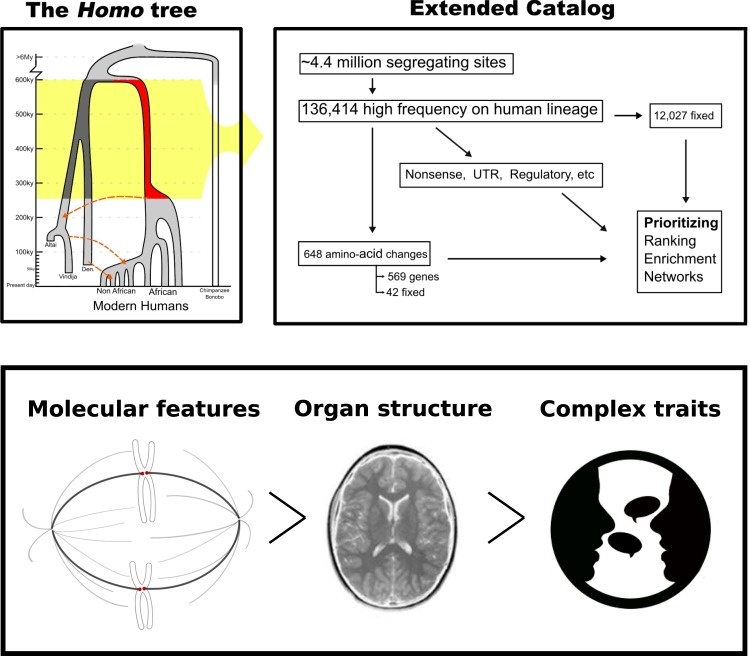
Throughout the past decade, studying ancient genomes has provided unique insights into human prehistory, and differences between modern humans and other branches like Neanderthals can enrich our understanding of the molecular basis of unique modern human traits. Modern human variation and the interactions between different hominin lineages are now well studied, making it reasonable to go beyond fixed genetic changes and explore changes that are observed at high frequency in present-day humans. Here, we identify 571 genes with non-synonymous changes at high frequency. We suggest that molecular mechanisms in cell division and networks affecting cellular features of neurons were prominently modified by these changes. Complex phenotypes in brain growth trajectory and cognitive traits are likely influenced by these networks and other non-coding changes presented here. We propose that at least some of these changes contributed to uniquely human traits, and should be prioritized for experimental validation.
Overview
AI snapshot
Written from the paper’s full text.
TL;DR
This paper catalogs single nucleotide changes that distinguish modern humans from archaic hominins, extending beyond fixed differences to high-frequency variants. It reports 647 protein-altering changes in 571 genes at ≥90% frequency in present-day humans, plus 42 fixed amino acid changes in 36 genes, and highlights cell-division, neuronal, craniofacial, and life-history candidates.
Key findings
- The authors identify 12,027 fixed human-specific single nucleotide changes, fewer than the previously reported 31,389, but find 29,358 positions with allele frequencies >0.995, indicating similar near-fixation.
- They report 42 fixed amino acid changes in 36 genes and 647 protein-altering changes in 571 genes at high frequency (≥90%) in present-day humans; Neanderthals carry 159 fixed amino acid changes in the text.
- Among archaic-lineage high-frequency missense changes, 1,542 genes carry at least one such change, with an overlap of 122 genes between human and archaic high-frequency missense sets, more than expected from random gene sets.
- Enrichment analyses find 12 GO categories enriched on the human lineage, 17 GWAS traits enriched for genes with human high-frequency missense changes and 11 for archaic ones, and significant protein-protein interaction enrichment among HHMC gene products (P = 0.006).
Methods
- The study used publicly available high-coverage genotypes from three archaic individuals: one Denisovan, one Altai Neanderthal, and one Vindija Neanderthal, plus exome and chromosome 21 data from Vindija and El Sidrón Neanderthals, mapped to hg19 and covering ~1.8 billion base pairs.
- Variants were annotated with Ensembl VEP and scored with SIFT, PolyPhen, CADD, GWAVA, and Grantham; allele frequencies came from dbSNP build 147, the 1000 Genomes Project, and ExAC, with ancestral alleles inferred from multiple genome alignments or macaque.
- Fixed differences required all present-day humans to carry the derived allele and at least two of three archaics to carry the ancestral allele; high-frequency differences required >90% derived in present-day humans and at least the Denisovan and one Neanderthal to carry the ancestral allele.
Limitations
- The paper states that its data are “not fully exhaustive,” that some loci are variable or less reliable due to low coverage in archaics, and that some previously described protein-altering substitutions were absent because of different genotype-calling and filtering procedures.
- The authors state that permissive filters may yield incorrect genotypes in some cases, that networks modified by multiple changes cannot be tested with current technologies, and that experimental validation is ultimately needed.
- Evident from the text: only three archaic individuals are analyzed, archaic variation is not represented equally, the high-frequency cutoff is “somewhat arbitrary,” and enrichment/network results may be biased by gene length or mutation density.
Model-written summary. Check it against the paper before relying on it.
Integrity signals
Registry
Cites
Statistics
Figures
Verification
Claims the paper makes
76 Not checked yet · 48 Own result · 34 Own interpretation · 6 Own method · 6 No basis given · 1 Supported so far · 1 Partly supported · accuracy not yet measured
A result the paper reports from its own data — it cites no other source for it, so there is none to check. The quote shows it is in the paper.
In the paper
“Here, we identify 571 genes with non-synonymous changes at high frequency.”
§ A catalog of single nucleotide changes distinguishing modern humans from archaic hominins > Abstract
plain- Asserted: passes — The authors put it forward as true.
- Checkable: passes — It can be checked against evidence.
- Load-bearing: passes — The paper’s conclusions depend on it.
- Based: passes — The paper gives a reason why it holds.
A result the paper reports from its own data — it cites no other source for it, so there is none to check. The quote shows it is in the paper.
In the paper
“1,542 genes carry at least one HF missense change on the archaic lineage (archaic-lineage high-frequency missense change, referred to as AHMC, Tables S3, S4).”
§ A catalog of single nucleotide changes distinguishing modern humans from archaic hominins > Results > Genetic differences between present-day humans and archaic hominins
plain- Asserted: passes — The authors put it forward as true.
- Checkable: passes — It can be checked against evidence.
- Load-bearing: passes — The paper’s conclusions depend on it.
- Based: passes — The paper gives a reason why it holds.
A result the paper reports from its own data — it cites no other source for it, so there is none to check. The quote shows it is in the paper.
In the paper
“We find a smaller number of only 12,027 positions in the genome, in part due to the inclusion of another archaic individual and different filters, but mainly because of a richer picture of present-day human variation.”
§ A catalog of single nucleotide changes distinguishing modern humans from archaic hominins > Results > Genetic differences between present-day humans and archaic hominins
plainn = 3- Asserted: passes — The authors put it forward as true.
- Checkable: passes — It can be checked against evidence.
- Load-bearing: passes — The paper’s conclusions depend on it.
- Based: passes — The paper gives a reason why it holds.
A result the paper reports from its own data — it cites no other source for it, so there is none to check. The quote shows it is in the paper.
In the paper
“Here, we present a revised list of 36 genes that carry missense substitutions that are fixed across thousands of human individuals and for which all archaic hominin individuals sequenced so far carry the ancestral state.”
§ A catalog of single nucleotide changes distinguishing modern humans from archaic hominins > Introduction
plain- Asserted: passes — The authors put it forward as true.
- Checkable: passes — It can be checked against evidence.
- Load-bearing: passes — The paper’s conclusions depend on it.
- Based: passes — The paper gives a reason why it holds.
A result the paper reports from its own data — it cites no other source for it, so there is none to check. The quote shows it is in the paper.
In the paper
“We find no GO enrichment for genes with an excess of changes on the archaic lineage.”
§ A catalog of single nucleotide changes distinguishing modern humans from archaic hominins > Results > Ranking and enrichment
plain- Asserted: passes — The authors put it forward as true.
- Checkable: passes — It can be checked against evidence.
- Load-bearing: unclear — It is unclear whether the paper’s conclusions depend on it.
- Based: passes — The paper gives a reason why it holds.
The paper states this without a source or data behind it here, so there is nothing to check it against. The quote shows it is in the paper.
In the paper
“Together with 323 SNCs on the human lineage with low confidence (Methods, Table S2), almost 1,000 putative protein-altering changes were found across most present-day humans.”
§ A catalog of single nucleotide changes distinguishing modern humans from archaic hominins > Results > Genetic differences between present-day humans and archaic hominins
hedged- Asserted: passes — The authors put it forward as true.
- Checkable: passes — It can be checked against evidence.
- Load-bearing: passes — The paper’s conclusions depend on it.
- Based: passes — The paper gives a reason why it holds.
A result the paper reports from its own data — it cites no other source for it, so there is none to check. The quote shows it is in the paper.
In the paper
“We applied a test for the ratio of the number of gene-wise HF changes on one lineage over the other lineage, finding an enrichment for 12 GO categories on the human lineage (Table S6), with “soft palate development”, “negative regulation of adenylate cyclase activity”, “collagen catabolic process” and “cell adhesion” in the biological process category.”
§ A catalog of single nucleotide changes distinguishing modern humans from archaic hominins > Results > Ranking and enrichment
plaincorrelational- Asserted: passes — The authors put it forward as true.
- Checkable: passes — It can be checked against evidence.
- Load-bearing: passes — The paper’s conclusions depend on it.
- Based: passes — The paper gives a reason why it holds.
A result the paper reports from its own data — it cites no other source for it, so there is none to check. The quote shows it is in the paper.
In the paper
“Among these, the collagen COL20A1 and the Epididymal Peptidase Inhibitor EPPIN carry HHMCs.”
§ A catalog of single nucleotide changes distinguishing modern humans from archaic hominins > Results > Ranking and enrichment
plaincorrelational- Asserted: passes — The authors put it forward as true.
- Checkable: passes — It can be checked against evidence.
- Load-bearing: unclear — It is unclear whether the paper’s conclusions depend on it.
- Based: passes — The paper gives a reason why it holds.
A result the paper reports from its own data — it cites no other source for it, so there is none to check. The quote shows it is in the paper.
In the paper
“In total, 647 protein-altering changes in 571 genes reached a frequency of at least 90% in the present-day human population.”
§ A catalog of single nucleotide changes distinguishing modern humans from archaic hominins > Introduction
plain- Asserted: passes — The authors put it forward as true.
- Checkable: passes — It can be checked against evidence.
- Load-bearing: passes — The paper’s conclusions depend on it.
- Based: passes — The paper gives a reason why it holds.
A result the paper reports from its own data — it cites no other source for it, so there is none to check. The quote shows it is in the paper.
In the paper
“We find a significant enrichment of protein-protein interactions (P = 0.006) among the gene products of HHMC genes (Fig. S3), meaning that these proteins interact with each other more than expected.”
§ A catalog of single nucleotide changes distinguishing modern humans from archaic hominins > Results > Ranking and enrichment
plaincorrelational- Asserted: passes — The authors put it forward as true.
- Checkable: passes — It can be checked against evidence.
- Load-bearing: unclear — It is unclear whether the paper’s conclusions depend on it.
- Based: passes — The paper gives a reason why it holds.
- It may state two separate claims as one. 64
- The quote only partly states this claim. 1
- Probably not a substantial claim. 39
The cited sources support only part of this claim — read each source’s verdict below.
In the paper
“Some of these facial properties may have been present in the earliest fossils attributed to H. sapiens, like the Jebel Irhoud fossils4, deviating from craniofacial features which emerged in earlier forms of Homo145, and may have become established before some brain-related changes discussed here11,146.”
§ A catalog of single nucleotide changes distinguishing modern humans from archaic hominins > Discussion > The craniofacial phenotype
What the sources say
- Supportedcites [4] Hublin, J.-J. et al. New fossils from Jebel Irhoud, Morocco and the pan-African origin of Homo sapiens. Nature 546, 289 (2017). source
Split into 2 atoms — 2 confirmed, 0 partially supported, 0 disputed, 0 misattributed, 0 unverifiable. Expand the claim to see per-atom verdicts.
- Partly supportedcites [145] Lacruz, R. S. et al. Facial Morphogenesis of the Earliest Europeans. PLoS One 8, e65199 (2013). sourceExperimental — accuracy not yet measured
Split into 2 atoms — 1 confirmed, 1 partially supported, 0 disputed, 0 misattributed, 0 unverifiable. Expand the claim to see per-atom verdicts.
- Supportedcites [11] Neubauer, S., Hublin, J.-J. & Gunz, P. The evolution of modern human brain shape. Sci. Adv. 4 (2018). source
Split into 2 atoms — 2 confirmed, 0 partially supported, 0 disputed, 0 misattributed, 0 unverifiable. Expand the claim to see per-atom verdicts.
hedged- Asserted: passes — The authors put it forward as true.
- Checkable: passes — It can be checked against evidence.
- Load-bearing: unclear — It is unclear whether the paper’s conclusions depend on it.
- Based: passes — The paper gives a reason why it holds.
It may state two separate claims as one.
- Supported
The sources with a verdict support this claim; the rest weren’t checked yet, have no full text we could read, or their verdicts aren’t rated yet.
In the paper
“NOVA1101, which is an interactor of ELAVL4102, a gene that codes for a neuronal-specific RNA-binding protein and might have been under positive selection in humans33,36.”
§ A catalog of single nucleotide changes distinguishing modern humans from archaic hominins > Discussion > Cellular features of neurons
What the sources say
- Not checked yetcites [101] Jensen, K. B. et al. Nova-1 Regulates Neuron-Specific Alternative Splicing and Is Essential for Neuronal Viability. Neuron 25, 359–371 (2000). source
- Supportedcites [102] Ratti, A. et al. Post-transcriptional regulation of neuro-oncological ventral antigen 1 by the neuronal RNA-binding proteins ELAV. J. Biol. Chem., https://doi.org/10.1074/jbc.M706082200 (2008). source
The Results (page not available) report that neuronal ELAV proteins, including HuD, bind Nova1 mRNA. The paper also describes HuD as a neuron-selective RNA-binding protein. The positive-selection suggestion has separate citations in the citing sentence and is not attributed to this source; the interaction shown here is with Nova1 mRNA, not NOVA1 protein. (LLM, conf=0.88)
- Could not verifycites [33] Peyrégne, S., Boyle, M. J., Dannemann, M. & Prüfer, K. Detecting ancient positive selection in humans using extended lineage sorting. Genome Res. 27, 1563–1572 (2017). sourceExperimental — accuracy not yet measured
The Discussion identifies other brain-related candidates for ancient selection, including SLIT2, ROBO2, and DCX. Searches for ELAVL4 and its description as a neuronal RNA-binding protein found no passage addressing whether ELAVL4 was under positive selection. The source also does not address the stated NOVA1–ELAVL4 interaction. (LLM, conf=0.72)
hedgedcorrelational- Asserted: passes — The authors put it forward as true.
- Checkable: passes — It can be checked against evidence.
- Load-bearing: unclear — It is unclear whether the paper’s conclusions depend on it.
- Based: passes — The paper gives a reason why it holds.
It may state two separate claims as one.
A result the paper reports from its own data — it cites no other source for it, so there is none to check. The quote shows it is in the paper.
In the paper
“Indeed, 17,453 (88.9%) of these genes do not carry any fixed human-specific change, and 80.5% do not carry fixed archaic-specific changes.”
§ A catalog of single nucleotide changes distinguishing modern humans from archaic hominins > Results > Ranking and enrichment
plain- Asserted: passes — The authors put it forward as true.
- Checkable: passes — It can be checked against evidence.
- Load-bearing: unclear — It is unclear whether the paper’s conclusions depend on it.
- Based: passes — The paper gives a reason why it holds.
It may state two separate claims as one.
A result the paper reports from its own data — it cites no other source for it, so there is none to check. The quote shows it is in the paper.
In the paper
“This correlation is weaker for HF human SNCs (R = 0.73) and fixed human-specific SNCs (R = 0.25), as well as for fixed (R = 0.37) and HF (R = 0.82) SNCs in archaics.”
§ A catalog of single nucleotide changes distinguishing modern humans from archaic hominins > Results > Ranking and enrichment
plaincorrelational- Asserted: passes — The authors put it forward as true.
- Checkable: passes — It can be checked against evidence.
- Load-bearing: passes — The paper’s conclusions depend on it.
- Based: passes — The paper gives a reason why it holds.
It may state two separate claims as one.
A result the paper reports from its own data — it cites no other source for it, so there is none to check. The quote shows it is in the paper.
In the paper
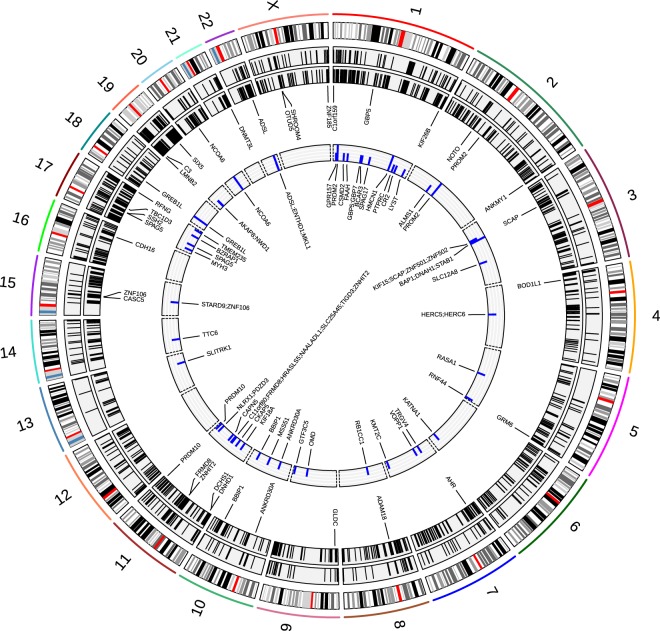
“Present-day humans carry 42 fixed amino acid-changes in 36 genes (Table 2, Fig. 2), while Neanderthals carry 159 such changes.”
§ A catalog of single nucleotide changes distinguishing modern humans from archaic hominins > Results > Genetic differences between present-day humans and archaic hominins
plain- Asserted: passes — The authors put it forward as true.
- Checkable: passes — It can be checked against evidence.
- Load-bearing: passes — The paper’s conclusions depend on it.
- Based: passes — The paper gives a reason why it holds.
It may state two separate claims as one.
In the paper
“We find 78 known or putative transcription factors among the HHMC genes (Table S9) on the modern human lineage57, which is no overrepresentation among genes with HHMCs (with 49.2% of random genes sets containing fewer HHMCs).”
§ A catalog of single nucleotide changes distinguishing modern humans from archaic hominins > Results > Ranking and enrichment
What the sources say
- Not checked yetcites [57] Chawla, K., Tripathi, S., Thommesen, L., Lægreid, A. & Kuiper, M. TFcheckpoint: a curated compendium of specific DNA-binding RNA polymerase II transcription factors. Bioinformatics 29, 2519–2520 (2013). source
plain- Asserted: passes — The authors put it forward as true.
- Checkable: passes — It can be checked against evidence.
- Load-bearing: unclear — It is unclear whether the paper’s conclusions depend on it.
- Based: passes — The paper gives a reason why it holds.
It may state two separate claims as one.
A result the paper reports from its own data — it cites no other source for it, so there is none to check. The quote shows it is in the paper.
In the paper
“We assessed the impact of mutations for different deleteriousness scores (Table 2), finding 12 genes with deleterious HHMCs according to SIFT, 3 according to PolyPhen, and 16 when using the Grantham score (>180), measuring the physical properties of amino acid changes.”
§ A catalog of single nucleotide changes distinguishing modern humans from archaic hominins > Results > Ranking and enrichment
plain- Asserted: passes — The authors put it forward as true.
- Checkable: passes — It can be checked against evidence.
- Load-bearing: unclear — It is unclear whether the paper’s conclusions depend on it.
- Based: passes — The paper gives a reason why it holds.
It may state two separate claims as one.
A result the paper reports from its own data — it cites no other source for it, so there is none to check. The quote shows it is in the paper.
In the paper
“However, proteins encoded by genes with synonymous changes on the modern human lineage seem to be enriched for interactions as well (P = 0.003), as are proteins encoded by genes with AHMCs (P = 1.68 × 10⁻¹⁴), with an enrichment in GO categories related to the extracellular matrix and the cytoskeleton, and proteins with more than 40 interactions (Table S8).”
§ A catalog of single nucleotide changes distinguishing modern humans from archaic hominins > Results > Ranking and enrichment
hedgedcorrelational- Asserted: passes — The authors put it forward as true.
- Checkable: passes — It can be checked against evidence.
- Load-bearing: unclear — It is unclear whether the paper’s conclusions depend on it.
- Based: passes — The paper gives a reason why it holds.
It may state two separate claims as one.
A result the paper reports from its own data — it cites no other source for it, so there is none to check. The quote shows it is in the paper.
In the paper
“However, when increasing the frequency cutoff, the number declines sharply, while decreasing it results in a near-linear increase of sites (Fig. S1).”
§ A catalog of single nucleotide changes distinguishing modern humans from archaic hominins > Results > Genetic differences between present-day humans and archaic hominins
plaindirect- Asserted: passes — The authors put it forward as true.
- Checkable: passes — It can be checked against evidence.
- Load-bearing: unclear — It is unclear whether the paper’s conclusions depend on it.
- Based: passes — The paper gives a reason why it holds.
It may state two separate claims as one.
A result the paper reports from its own data — it cites no other source for it, so there is none to check. The quote shows it is in the paper.
In the paper
“Functional enrichment is found for the biological process “cellular component assembly involved in morphogenesis”, most strongly for the cellular components cytoskeleton and microtubule, as well as the molecular function “cytoskeletal protein binding”.”
§ A catalog of single nucleotide changes distinguishing modern humans from archaic hominins > Results > Ranking and enrichment
boostedcorrelational- Asserted: passes — The authors put it forward as true.
- Checkable: passes — It can be checked against evidence.
- Load-bearing: unclear — It is unclear whether the paper’s conclusions depend on it.
- Based: passes — The paper gives a reason why it holds.
It may state two separate claims as one.
A result the paper reports from its own data — it cites no other source for it, so there is none to check. The quote shows it is in the paper.
In the paper
“Furthermore, when testing the genes with HHMCs and using the set of genes with AHMCs as background, “gray matter of forebrain” at adolescent age (12–19 years) is enriched, while no enrichment was found for genes with AHMCs.”
§ A catalog of single nucleotide changes distinguishing modern humans from archaic hominins > Results > Ranking and enrichment
plaincorrelational- Asserted: passes — The authors put it forward as true.
- Checkable: passes — It can be checked against evidence.
- Load-bearing: passes — The paper’s conclusions depend on it.
- Based: passes — The paper gives a reason why it holds.
It may state two separate claims as one.
A result the paper reports from its own data — it cites no other source for it, so there is none to check. The quote shows it is in the paper.
In the paper
“Generally, synonymous changes are found at a similar magnitude as missense changes, but only few SNCs altering start and stop codons, and thousands of changes in putative regulatory and untranslated regions.”
§ A catalog of single nucleotide changes distinguishing modern humans from archaic hominins > Results > Genetic differences between present-day humans and archaic hominins
plain- Asserted: passes — The authors put it forward as true.
- Checkable: passes — It can be checked against evidence.
- Load-bearing: unclear — It is unclear whether the paper’s conclusions depend on it.
- Based: passes — The paper gives a reason why it holds.
It may state two separate claims as one.
A result the paper reports from its own data — it cites no other source for it, so there is none to check. The quote shows it is in the paper.
In the paper
“Gene Ontology (GO) categories are neither enriched for HHMCs on the human lineage in a hypergeometric test, nor for genes carrying AHMCs, HF changes in UTRs or transcription factor binding sites.”
§ A catalog of single nucleotide changes distinguishing modern humans from archaic hominins > Results > Ranking and enrichment
plain- Asserted: passes — The authors put it forward as true.
- Checkable: passes — It can be checked against evidence.
- Load-bearing: passes — The paper’s conclusions depend on it.
- Based: passes — The paper gives a reason why it holds.
It may state two separate claims as one.
A result the paper reports from its own data — it cites no other source for it, so there is none to check. The quote shows it is in the paper.
In the paper
“Among these, TSGA10IP (Testis Specific 10 Interacting Protein) and ABCC12 (ATP Binding Cassette Subfamily C Member 12) carry four such changes, and seven more genes (MUC5B, NPAP1, OR10AG1, OR5M9, PIGZ, SLX4, VCAN) carry three HHMCs.”
§ A catalog of single nucleotide changes distinguishing modern humans from archaic hominins > Results > Genetic differences between present-day humans and archaic hominins
plain- Asserted: passes — The authors put it forward as true.
- Checkable: passes — It can be checked against evidence.
- Load-bearing: unclear — It is unclear whether the paper’s conclusions depend on it.
- Based: passes — The paper gives a reason why it holds.
It may state two separate claims as one.
A result the paper reports from its own data — it cites no other source for it, so there is none to check. The quote shows it is in the paper.
In the paper
“Additionally, modern humans carry 605 amino acid-changes at high frequency (human-lineage high-frequency missense changes, referred to as HHMCs), amounting to a total of 647 such changes in 571 genes (Table S1).”
§ A catalog of single nucleotide changes distinguishing modern humans from archaic hominins > Results > Genetic differences between present-day humans and archaic hominins
plain- Asserted: passes — The authors put it forward as true.
- Checkable: passes — It can be checked against evidence.
- Load-bearing: passes — The paper’s conclusions depend on it.
- Based: passes — The paper gives a reason why it holds.
It may state two separate claims as one.
A result the paper reports from its own data — it cites no other source for it, so there is none to check. The quote shows it is in the paper.
In the paper
“We find a high ratio of HHMCs over synonymous changes for chromosome 21 (1.75-fold), and a very small ratio (0.18-fold) for chromosome 13.”
§ A catalog of single nucleotide changes distinguishing modern humans from archaic hominins > Results > Genetic differences between present-day humans and archaic hominins
plaincorrelational- Asserted: passes — The authors put it forward as true.
- Checkable: passes — It can be checked against evidence.
- Load-bearing: unclear — It is unclear whether the paper’s conclusions depend on it.
- Based: passes — The paper gives a reason why it holds.
It may state two separate claims as one.
A result the paper reports from its own data — it cites no other source for it, so there is none to check. The quote shows it is in the paper.
In the paper
“We find an enrichment of gene expression in the orbital frontal cortex at infant age (0–2 years) for genes with HHMCs, but no enrichment for genes with AHMCs.”
§ A catalog of single nucleotide changes distinguishing modern humans from archaic hominins > Results > Ranking and enrichment
plaincorrelational- Asserted: passes — The authors put it forward as true.
- Checkable: passes — It can be checked against evidence.
- Load-bearing: passes — The paper’s conclusions depend on it.
- Based: passes — The paper gives a reason why it holds.
It may state two separate claims as one.
A result the paper reports from its own data — it cites no other source for it, so there is none to check. The quote shows it is in the paper.
In the paper
“We performed a systematic enrichment screen, finding 17 unique traits enriched for genes with HHMCs, and 11 for genes with AHMCs (Table S7).”
§ A catalog of single nucleotide changes distinguishing modern humans from archaic hominins > Results > Ranking and enrichment
plaincorrelational- Asserted: passes — The authors put it forward as true.
- Checkable: passes — It can be checked against evidence.
- Load-bearing: passes — The paper’s conclusions depend on it.
- Based: passes — The paper gives a reason why it holds.
It may state two separate claims as one. The quote only partly states this claim.
A result the paper reports from its own data — it cites no other source for it, so there is none to check. The quote shows it is in the paper.
In the paper
“Among the genes enriched for changes on the modern human lineage, 18 carry no HF changes on the archaic lineage, and ten of these also fall within the 5% of genes carrying many changes considering their length (ARSJ, CLUAP1, COL20A1, EPPIN, KLHL31, MKNK1, PALMD, RIC3, TDRD7, UBE2H).”
§ A catalog of single nucleotide changes distinguishing modern humans from archaic hominins > Results > Ranking and enrichment
plaincorrelational- Asserted: passes — The authors put it forward as true.
- Checkable: passes — It can be checked against evidence.
- Load-bearing: unclear — It is unclear whether the paper’s conclusions depend on it.
- Based: passes — The paper gives a reason why it holds.
It may state two separate claims as one.
A result the paper reports from its own data — it cites no other source for it, so there is none to check. The quote shows it is in the paper.
In the paper
“Only one gene, SPAG5, carries three such SNCs, and four genes (ADAM18, CASC5, SSH2 and ZNHIT2) carry two fixed protein-coding changes in all modern humans.”
§ A catalog of single nucleotide changes distinguishing modern humans from archaic hominins > Results > Genetic differences between present-day humans and archaic hominins
plain- Asserted: passes — The authors put it forward as true.
- Checkable: passes — It can be checked against evidence.
- Load-bearing: unclear — It is unclear whether the paper’s conclusions depend on it.
- Based: passes — The paper gives a reason why it holds.
It may state two separate claims as one.
In the paper
“We attempted to determine whether an enrichment of genes with HHMCs on the human lineage can be observed in the ventricular zone59, but instead find an enrichment in the intermediate zone, where less than 5% of random gene sets of the same size are expressed.”
§ A catalog of single nucleotide changes distinguishing modern humans from archaic hominins > Discussion > Cell division and the brain growth trajectory
What the sources say
- Not checked yetcites [59] Miller, J. A. et al. Transcriptional Landscape of the Prenatal Human Brain. Nature 508, 199–206 (2014). source
plaincorrelational- Asserted: passes — The authors put it forward as true.
- Checkable: passes — It can be checked against evidence.
- Load-bearing: passes — The paper’s conclusions depend on it.
- Based: passes — The paper gives a reason why it holds.
It may state two separate claims as one.
In the paper
“a deleterious HHMC in ABHD14A, which is a target of ZIC188.”
§ A catalog of single nucleotide changes distinguishing modern humans from archaic hominins > Discussion > Cell division and the brain growth trajectory
What the sources say
- Not checked yetcites [88] Hoshino, J., Aruga, J., Ishiguro, A. & Mikoshiba, K. Dorz1, a novel gene expressed in differentiating cerebellar granule neurons, is down-regulated in Zic1-deficient mouse. Mol. Brain Res. 120, 57–64 (2003). source
plaincorrelational- Asserted: passes — The authors put it forward as true.
- Checkable: passes — It can be checked against evidence.
- Load-bearing: unclear — It is unclear whether the paper’s conclusions depend on it.
- Based: passes — The paper gives a reason why it holds.
It may state two separate claims as one.
None of the sources cited for this claim have been checked yet.
In the paper
“an interactor of KIF18A, KIF1597, might have been under positive selection in modern humans33, and contains two HHMCs.”
§ A catalog of single nucleotide changes distinguishing modern humans from archaic hominins > Discussion > Cellular features of neurons
What the sources say
- Not checked yetcites [97] Kevenaar, J. T. et al. Kinesin-Binding Protein Controls Microtubule Dynamics and Cargo Trafficking by Regulating Kinesin Motor Activity. Curr. Biol. 26, 849–861 (2017). source
- Not checked yetcites [33] Peyrégne, S., Boyle, M. J., Dannemann, M. & Prüfer, K. Detecting ancient positive selection in humans using extended lineage sorting. Genome Res. 27, 1563–1572 (2017). source
hedgedcorrelational- Asserted: passes — The authors put it forward as true.
- Checkable: passes — It can be checked against evidence.
- Load-bearing: unclear — It is unclear whether the paper’s conclusions depend on it.
- Based: passes — The paper gives a reason why it holds.
It may state two separate claims as one.
The paper states this without a source or data behind it here, so there is nothing to check it against. The quote shows it is in the paper.
In the paper
“The changes in KIF18A, KIF16A and NEK6 can no longer be considered as fixed, but occur at very high frequencies (>99.9%) in present-day humans.”
§ A catalog of single nucleotide changes distinguishing modern humans from archaic hominins > Discussion > Cell division and the brain growth trajectory
plain- Asserted: passes — The authors put it forward as true.
- Checkable: passes — It can be checked against evidence.
- Load-bearing: unclear — It is unclear whether the paper’s conclusions depend on it.
- Based: passes — The paper gives a reason why it holds.
It may state two separate claims as one.
A result the paper reports from its own data — it cites no other source for it, so there is none to check. The quote shows it is in the paper.
In the paper
“Several fixed SNCs on the modern human lineage are observed for CASC5 (two changes) and SPAG5 (three changes), which is also among genes with a relatively high proportion of HF changes (Table S5).”
§ A catalog of single nucleotide changes distinguishing modern humans from archaic hominins > Discussion > Cell division and the brain growth trajectory
plaincorrelational- Asserted: passes — The authors put it forward as true.
- Checkable: passes — It can be checked against evidence.
- Load-bearing: unclear — It is unclear whether the paper’s conclusions depend on it.
- Based: passes — The paper gives a reason why it holds.
It may state two separate claims as one.
A result the paper reports from its own data — it cites no other source for it, so there is none to check. The quote shows it is in the paper.
In the paper
“We were able to broadly recapitulate the observation of an enrichment of expression in the ventricular zone if restricting the test to genes with non-synonymous changes at a frequency greater than 99.9% in present-day humans, which is not observed for corresponding synonymous and archaic non-synonymous changes (Table S10).”
§ A catalog of single nucleotide changes distinguishing modern humans from archaic hominins > Discussion > Cell division and the brain growth trajectory
plaincorrelational- Asserted: passes — The authors put it forward as true.
- Checkable: passes — It can be checked against evidence.
- Load-bearing: passes — The paper’s conclusions depend on it.
- Based: passes — The paper gives a reason why it holds.
It may state two separate claims as one.
A result the paper reports from its own data — it cites no other source for it, so there is none to check. The quote shows it is in the paper.
In the paper
“The gene encoding the transcription factor PRDM10 stands out for carrying HHMCs, being found in selective sweep regions and the second-most interacting protein within the HHMC dataset.”
§ A catalog of single nucleotide changes distinguishing modern humans from archaic hominins > Discussion > The craniofacial phenotype
plaincorrelational- Asserted: passes — The authors put it forward as true.
- Checkable: passes — It can be checked against evidence.
- Load-bearing: unclear — It is unclear whether the paper’s conclusions depend on it.
- Based: passes — The paper gives a reason why it holds.
It may state two separate claims as one.
In the paper
“SSH2 (two HHMCs) might be involved in neurite outgrowth99.”
§ A catalog of single nucleotide changes distinguishing modern humans from archaic hominins > Discussion > Cellular features of neurons
What the sources say
- Not checked yetcites [99] Cuberos, H. et al. Roles of LIM kinases in central nervous system function and dysfunction. FEBS Lett. 589, 3795–3806 (2015). source
hedgedconditional- Asserted: passes — The authors put it forward as true.
- Checkable: passes — It can be checked against evidence.
- Load-bearing: fails — The paper’s conclusions may not depend on it.
- Based: passes — The paper gives a reason why it holds.
Probably not a substantial claim. The paper’s conclusions may not depend on it. It may state two separate claims as one.
In the paper
“we find one of the most deleterious regulatory SNCs in the Netrin receptor UNC5D, which is critical for axon guidance103.”
§ A catalog of single nucleotide changes distinguishing modern humans from archaic hominins > Discussion > Cellular features of neurons
What the sources say
- Not checked yetcites [103] Takemoto, M. et al. Laminar and Areal Expression of Unc5d and Its Role in Cortical Cell Survival. Cereb. Cortex 21, 1925–1934 (2011). source
plain- Asserted: passes — The authors put it forward as true.
- Checkable: passes — It can be checked against evidence.
- Load-bearing: unclear — It is unclear whether the paper’s conclusions depend on it.
- Based: passes — The paper gives a reason why it holds.
It may state two separate claims as one.
In the paper
“Versican (VCAN), which promotes neurite outgrowth98, carries three HHMCs”
§ A catalog of single nucleotide changes distinguishing modern humans from archaic hominins > Discussion > Cellular features of neurons
What the sources say
- Not checked yetcites [98] Wu, Y. et al. Versican V1 Isoform Induces Neuronal Differentiation and Promotes Neurite Outgrowth. Mol. Biol. Cell 15, 2093–2104 (2004). source
plain- Asserted: passes — The authors put it forward as true.
- Checkable: passes — It can be checked against evidence.
- Load-bearing: fails — The paper’s conclusions may not depend on it.
- Based: passes — The paper gives a reason why it holds.
Probably not a substantial claim. The paper’s conclusions may not depend on it.
In the paper
“PIEZO1, which carries a non-synonymous change that is almost fixed in modern humans, is another factor in axon guidance100”
§ A catalog of single nucleotide changes distinguishing modern humans from archaic hominins > Discussion > Cellular features of neurons
What the sources say
- Not checked yetcites [100] Koser, D. E. et al. Mechanosensing is critical for axon growth in the developing brain. Nat. Neurosci. 19, 1592 (2016). source
plaincorrelational- Asserted: passes — The authors put it forward as true.
- Checkable: passes — It can be checked against evidence.
- Load-bearing: unclear — It is unclear whether the paper’s conclusions depend on it.
- Based: passes — The paper gives a reason why it holds.
It may state two separate claims as one.
In the paper
“The HHMC is located nearby and three 5′-UTR variants within a putatively selected region36, with an estimated time of selection at around 150 kya (assuming a slow mutation rate).”
§ A catalog of single nucleotide changes distinguishing modern humans from archaic hominins > Discussion > Life history and other phenotypic traits
What the sources say
- Not checked yetcites [36] Zhou, H. et al. A Chronological Atlas of Natural Selection in the Human Genome during the Past Half-million Years. bioRxiv (2015). source
hedgedcorrelational- Asserted: passes — The authors put it forward as true.
- Checkable: passes — It can be checked against evidence.
- Load-bearing: unclear — It is unclear whether the paper’s conclusions depend on it.
- Based: passes — The paper gives a reason why it holds.
It may state two separate claims as one.
- The authors state this as an assumption: The mutation rate is slow.
None of the sources cited for this claim have been checked yet.
In the paper
“This putative transcription factor is enriched in HF changes and has been suggested to have been under positive selection on the modern human lineage33,122.”
§ A catalog of single nucleotide changes distinguishing modern humans from archaic hominins > Discussion > Life history and other phenotypic traits
What the sources say
- Not checked yetcites [33] Peyrégne, S., Boyle, M. J., Dannemann, M. & Prüfer, K. Detecting ancient positive selection in humans using extended lineage sorting. Genome Res. 27, 1563–1572 (2017). source
- Not checked yetcites [122] Racimo, F., Kuhlwilm, M. & Slatkin, M. A test for ancient selective sweeps and an application to candidate sites in modern humans. Mol. Biol. Evol. 31, 3344–3358 (2014). source
hedgedcorrelational- Asserted: passes — The authors put it forward as true.
- Checkable: passes — It can be checked against evidence.
- Load-bearing: fails — The paper’s conclusions may not depend on it.
- Based: passes — The paper gives a reason why it holds.
Probably not a substantial claim. The paper’s conclusions may not depend on it. It may state two separate claims as one.
None of the sources cited for this claim have been checked yet.
In the paper
“we find that several proteins in spermatogenesis seem to carry two HHMCs: Sperm Specific Antigen 2 (SSFA2), Sperm Associated Antigen 17 (SPAG17), ADAM18172 and WDR52173, out of which ADAM18 and SPAG17 also carry AHMCs.”
§ A catalog of single nucleotide changes distinguishing modern humans from archaic hominins > Discussion > Life history and other phenotypic traits
What the sources say
- Not checked yetcites [172] Zhu, G.-Z., Lin, Y., Myles, D. G. & Primakoff, P. Identification of four novel ADAMs with potential roles in spermatogenesis and fertilization. Gene 234, 227–237 (1999). source
- Not checked yetcites [173] Tang, S. et al. Biallelic Mutations in CFAP43 and CFAP44 Cause Male Infertility with Multiple Morphological Abnormalities of the Sperm Flagella. Am. J. Hum. Genet. 100, 854–864 (2017). source
hedged- Asserted: passes — The authors put it forward as true.
- Checkable: passes — It can be checked against evidence.
- Load-bearing: unclear — It is unclear whether the paper’s conclusions depend on it.
- Based: passes — The paper gives a reason why it holds.
It may state two separate claims as one.
In the paper
“Another possible SNC that might be relevant in this context is a splice site change in IZUMO4, since proteins encoded by the IZUMO family form complexes on mammalian sperm175.”
§ A catalog of single nucleotide changes distinguishing modern humans from archaic hominins > Discussion > Life history and other phenotypic traits
What the sources say
- Not checked yetcites [175] Ellerman, D. A. et al. Izumo is part of a multiprotein family whose members form large complexes on mammalian sperm. Mol. Reprod. Dev. 76, 1188–1199 (2009). source
hedgedconditional- Asserted: passes — The authors put it forward as true.
- Checkable: passes — It can be checked against evidence.
- Load-bearing: fails — The paper’s conclusions may not depend on it.
- Based: passes — The paper gives a reason why it holds.
Probably not a substantial claim. The paper’s conclusions may not depend on it. It may state two separate claims as one.
A result the paper reports from its own data — it cites no other source for it, so there is none to check. The quote shows it is in the paper.
In the paper
“The gene encoding for the Testis Expressed 2 protein (TEX2) is enriched for HF changes in both humans and archaics, with one HHMC and five AHMCs, but its function is not yet known.”
§ A catalog of single nucleotide changes distinguishing modern humans from archaic hominins > Discussion > Life history and other phenotypic traits
plaincorrelational- Asserted: passes — The authors put it forward as true.
- Checkable: passes — It can be checked against evidence.
- Load-bearing: unclear — It is unclear whether the paper’s conclusions depend on it.
- Based: passes — The paper gives a reason why it holds.
It may state two separate claims as one.
In the paper
“Another gene harboring a HHMC with similar functions is EPPIN174, which shows no HF changes on the archaic, but 27 such SNCs on the modern human lineage.”
§ A catalog of single nucleotide changes distinguishing modern humans from archaic hominins > Discussion > Life history and other phenotypic traits
What the sources say
- Not checked yetcites [174] Wang, Z., Widgren, E. E., Sivashanmugam, P., O’Rand, M. G. & Richardson, R. T. Association of Eppin with Semenogelin on Human Spermatozoa1. Biol. Reprod. 72, 1064–1070 (2005). source
plain- Asserted: passes — The authors put it forward as true.
- Checkable: passes — It can be checked against evidence.
- Load-bearing: unclear — It is unclear whether the paper’s conclusions depend on it.
- Based: passes — The paper gives a reason why it holds.
It may state two separate claims as one.
In the paper
“three HHMCs are observed in NPAP1, which might be associated with the Prader-Willi syndrome, involving behavioral problems and a high pain threshold182.”
§ A catalog of single nucleotide changes distinguishing modern humans from archaic hominins > Discussion > Life history and other phenotypic traits
What the sources say
- Not checked yetcites [182] Buiting, K. et al. C15orf2 and a novel noncoding transcript from the Prader–Willi/Angelman syndrome region show monoallelic expression in fetal brain. Genomics 89, 588–595 (2007). source
hedgedcorrelational- Asserted: passes — The authors put it forward as true.
- Checkable: passes — It can be checked against evidence.
- Load-bearing: unclear — It is unclear whether the paper’s conclusions depend on it.
- Based: passes — The paper gives a reason why it holds.
It may state two separate claims as one.
In the paper
“Thus, it seems reasonable to conclude that there were differences between anatomically modern human and Neanderthal brains, and that these underlie at least some of the characteristics of our lineage42.”
§ A catalog of single nucleotide changes distinguishing modern humans from archaic hominins > Introduction
What the sources say
- Not checked yetcites [42] Wynn, T. & Coolidge, F. L. The expert Neandertal mind. J. Hum. Evol. 46, 467–487 (2004). source
hedgedconditional- Asserted: passes — The authors put it forward as true.
- Checkable: passes — It can be checked against evidence.
- Load-bearing: passes — The paper’s conclusions depend on it.
- Based: passes — The paper gives a reason why it holds.
It may state two separate claims as one.
None of the sources cited for this claim have been checked yet.
In the paper
“while the brain size and encephalization of humans and Neanderthals is similar9,13,14.”
§ A catalog of single nucleotide changes distinguishing modern humans from archaic hominins > Introduction
What the sources say
- Not checked yetcites [9] Hublin, J.-J., Neubauer, S. & Gunz, P. Brain ontogeny and life history in Pleistocene hominins. Philos. Trans. R. Soc. B Biol. Sci. 370 (2015). source
- Not checked yetcites [13] Trinkaus, E. & Howells, W. W. The Neanderthals. Sci. Am. 241, 118–133 (1979). source
- Not checked yetcites [14] Schoenemann, P. T. Brain Size Scaling and Body Composition in Mammals. Brain. Behav. Evol. 63, 47–60 (2004). source
plain- Asserted: passes — The authors put it forward as true.
- Checkable: passes — It can be checked against evidence.
- Load-bearing: fails — The paper’s conclusions may not depend on it.
- Based: passes — The paper gives a reason why it holds.
Probably not a substantial claim. The paper’s conclusions may not depend on it. It may state two separate claims as one.
What the paper did — it cites no source for this, so there is none to check. The quote shows it is in the paper.
In the paper
“We caution that these networks might be biased due to more mutations and possibly more interactions in longer, multi-domain genes.”
§ A catalog of single nucleotide changes distinguishing modern humans from archaic hominins > Results > Ranking and enrichment
hedgedconditional- Asserted: passes — The authors put it forward as true.
- Checkable: passes — It can be checked against evidence.
- Load-bearing: passes — The paper’s conclusions depend on it.
- Based: passes — The paper gives a reason why it holds.
Probably not a substantial claim.
A conclusion the paper draws from its own results — it cites no other source for it, so there is none to check. The quote shows it is in the paper.
In the paper
“Despite no enrichment as a category, single transcription factors on the modern human lineage might have been important, particularly those with an excess of modern human over archaic HF changes (AHR, MACC1, PRDM2, TCF3, ZNF420, ZNF516).”
§ A catalog of single nucleotide changes distinguishing modern humans from archaic hominins > Results > Ranking and enrichment
hedgedconditional- Asserted: passes — The authors put it forward as true.
- Checkable: passes — It can be checked against evidence.
- Load-bearing: unclear — It is unclear whether the paper’s conclusions depend on it.
- Based: passes — The paper gives a reason why it holds.
It may state two separate claims as one.
None of the sources cited for this claim have been checked yet.
In the paper
“Others, like RB1CC120 or PRDM10 and NCOA633 have been found in selective sweep screens, suggesting contributions of individual transcription factors, rather than the whole class of proteins.”
§ A catalog of single nucleotide changes distinguishing modern humans from archaic hominins > Results > Ranking and enrichment
What the sources say
- Not checked yetcites [20] Prüfer, K. et al. The complete genome sequence of a Neanderthal from the Altai Mountains. Nature 505, 43–9 (2014). source
- Not checked yetcites [33] Peyrégne, S., Boyle, M. J., Dannemann, M. & Prüfer, K. Detecting ancient positive selection in humans using extended lineage sorting. Genome Res. 27, 1563–1572 (2017). source
hedgedcorrelational- Asserted: passes — The authors put it forward as true.
- Checkable: passes — It can be checked against evidence.
- Load-bearing: unclear — It is unclear whether the paper’s conclusions depend on it.
- Based: passes — The paper gives a reason why it holds.
It may state two separate claims as one.
A conclusion the paper draws from its own results — it cites no other source for it, so there is none to check. The quote shows it is in the paper.
In the paper
“We conclude that some genes with a large number of human-specific changes might carry these large numbers by chance, while others are depleted.”
§ A catalog of single nucleotide changes distinguishing modern humans from archaic hominins > Results > Ranking and enrichment
hedged- Asserted: passes — The authors put it forward as true.
- Checkable: passes — It can be checked against evidence.
- Load-bearing: passes — The paper’s conclusions depend on it.
- Based: passes — The paper gives a reason why it holds.
It may state two separate claims as one.
A conclusion the paper draws from its own results — it cites no other source for it, so there is none to check. The quote shows it is in the paper.
In the paper
“Of note, genes that have attracted attention in the context of traits related to the “human condition” like CNTNAP2 and AUTS2 are among the longest genes in the genome, hence changes in these genes should be interpreted with caution as they are not unexpected.”
§ A catalog of single nucleotide changes distinguishing modern humans from archaic hominins > Results > Ranking and enrichment
plaincorrelational- Asserted: passes — The authors put it forward as true.
- Checkable: passes — It can be checked against evidence.
- Load-bearing: passes — The paper’s conclusions depend on it.
- Based: passes — The paper gives a reason why it holds.
Probably not a substantial claim. It may state two separate claims as one.
In the paper
“However, changes in structural variants or regions of the genome that are not accessible by current sequencing technologies will most likely complement our results45.”
§ A catalog of single nucleotide changes distinguishing modern humans from archaic hominins > Results > Genetic differences between present-day humans and archaic hominins
What the sources say
- Not checked yetcites [45] O’Bleness, M., Searles, V. B., Varki, A., Gagneux, P. & Sikela, J. M. Evolution of genetic and genomic features unique to the human lineage. Nat. Rev. Genet. 13, 853–866 (2012). source
hedgedconditional- Asserted: passes — The authors put it forward as true.
- Checkable: fails — It may be too vague to check against evidence.
- Load-bearing: fails — The paper’s conclusions may not depend on it.
- Based: passes — The paper gives a reason why it holds.
Probably not a substantial claim. It may be too vague to check against evidence. The paper’s conclusions may not depend on it.
A conclusion the paper draws from its own results — it cites no other source for it, so there is none to check. The quote shows it is in the paper.
In the paper
“Changes in genes associated to “Cognitive decline (age-related)”, “Rheumatoid arthritis” or “Major depressive disorder” might point to pathways that could have been influenced by protein-coding changes on the human lineage.”
§ A catalog of single nucleotide changes distinguishing modern humans from archaic hominins > Results > Ranking and enrichment
hedgedconditional- Asserted: passes — The authors put it forward as true.
- Checkable: passes — It can be checked against evidence.
- Load-bearing: fails — The paper’s conclusions may not depend on it.
- Based: passes — The paper gives a reason why it holds.
Probably not a substantial claim. The paper’s conclusions may not depend on it. It may state two separate claims as one.
A conclusion the paper draws from its own results — it cites no other source for it, so there is none to check. The quote shows it is in the paper.
In the paper
“In archaics, genes are enriched, among others, for associations to traits related to body mass index or cholesterol levels, which might reflect differences in their physiology.”
§ A catalog of single nucleotide changes distinguishing modern humans from archaic hominins > Results > Ranking and enrichment
hedgedcorrelational- Asserted: passes — The authors put it forward as true.
- Checkable: passes — It can be checked against evidence.
- Load-bearing: unclear — It is unclear whether the paper’s conclusions depend on it.
- Based: passes — The paper gives a reason why it holds.
It may state two separate claims as one.
A conclusion the paper draws from its own results — it cites no other source for it, so there is none to check. The quote shows it is in the paper.
In the paper
“We do not find such extreme ratios for AHMCs and corresponding synonymous changes, suggesting differences in the distribution of amino acid changes between both lineages (Fig. S2).”
§ A catalog of single nucleotide changes distinguishing modern humans from archaic hominins > Results > Genetic differences between present-day humans and archaic hominins
hedged- Asserted: passes — The authors put it forward as true.
- Checkable: passes — It can be checked against evidence.
- Load-bearing: passes — The paper’s conclusions depend on it.
- Based: passes — The paper gives a reason why it holds.
It may state two separate claims as one.
A conclusion the paper draws from its own results — it cites no other source for it, so there is none to check. The quote shows it is in the paper.
In the paper
“It is noteworthy that the number of fixed SNCs decreased substantially, and it is possible that single individuals will be found to carry some of the ancestral alleles for the remaining fixed sites.”
§ A catalog of single nucleotide changes distinguishing modern humans from archaic hominins > Results > Genetic differences between present-day humans and archaic hominins
hedged- Asserted: passes — The authors put it forward as true.
- Checkable: passes — It can be checked against evidence.
- Load-bearing: passes — The paper’s conclusions depend on it.
- Based: passes — The paper gives a reason why it holds.
It may state two separate claims as one.
None of the sources cited for this claim have been checked yet.
In the paper
“while most mutations may be rather neutral and have little effect on the phenotype, some may have had deleterious effects or side-effects, possibly increasing the risks for neurodevelopmental or neurodegenerative disorders in humans46–48.”
§ A catalog of single nucleotide changes distinguishing modern humans from archaic hominins > Introduction
What the sources say
- Not checked yetcites [46] Bufill, E., Blesa, R. & Augusti, J. Alzheimer’s disease: an evolutionary approach. J. Anthropol. Sci.=Riv. di Antropol. JASS 91, 135–157 (2013).
- Not checked yetcites [47] Bufill, E., Agustí, J. & Blesa, R. Human neoteny revisited: The case of synaptic plasticity. Am. J. Hum. Biol. 23, 729–739 (2011). source
- Not checked yetcites [48] Bruner, E. & Jacobs, H. I. L. Alzheimer’s disease: the downside of a highly evolved parietal lobe? J. Alzheimers. Dis. 35, 227–240 (2013). source
hedgedconditional- Asserted: passes — The authors put it forward as true.
- Checkable: passes — It can be checked against evidence.
- Load-bearing: fails — The paper’s conclusions may not depend on it.
- Based: passes — The paper gives a reason why it holds.
Probably not a substantial claim. The paper’s conclusions may not depend on it. It may state two separate claims as one.
In the paper
“The 42 protein-altering changes for which the ancestral allele has not been observed in any present-day human, most of which have been presented before1, constitute without doubt the strongest entry points into a molecular understanding of the human condition, and should be prime candidates for experimental validation.”
§ A catalog of single nucleotide changes distinguishing modern humans from archaic hominins > Results > Genetic differences between present-day humans and archaic hominins
What the sources say
- Not checked yetcites [1] Pääbo, S. The Human Condition—A Molecular Approach. Cell 157, 216–226 (2014). source
boosted- Asserted: passes — The authors put it forward as true.
- Checkable: fails — It may be too vague to check against evidence.
- Load-bearing: passes — The paper’s conclusions depend on it.
- Based: passes — The paper gives a reason why it holds.
Probably not a substantial claim. It may be too vague to check against evidence.
A conclusion the paper draws from its own results — it cites no other source for it, so there is none to check. The quote shows it is in the paper.
In the paper
“The enrichment of broad categories above suggests traits prominently represented by HHMCs, some of which are possibly brain-related.”
§ A catalog of single nucleotide changes distinguishing modern humans from archaic hominins > Discussion
hedgedcorrelational- Asserted: passes — The authors put it forward as true.
- Checkable: passes — It can be checked against evidence.
- Load-bearing: passes — The paper’s conclusions depend on it.
- Based: passes — The paper gives a reason why it holds.
It may state two separate claims as one.
What the paper did — it cites no source for this, so there is none to check. The quote shows it is in the paper.
In the paper
“We admit that some of the loci presented here are variable across the phylogenetic tree, or less reliable due to low coverage in the archaics, but we accept this since our intention is retrieve an inclusive picture of possibly functional recent changes.”
§ A catalog of single nucleotide changes distinguishing modern humans from archaic hominins > Results > Genetic differences between present-day humans and archaic hominins
plain- Asserted: passes — The authors put it forward as true.
- Checkable: passes — It can be checked against evidence.
- Load-bearing: passes — The paper’s conclusions depend on it.
- Based: passes — The paper gives a reason why it holds.
It may state two separate claims as one.
A conclusion the paper draws from its own results — it cites no other source for it, so there is none to check. The quote shows it is in the paper.
In the paper
“Hence, we suggest that the “full modernity” of modern humans is constituted from a network of changes, where the presence of single ancestral alleles in some individuals would not lead to “partially modern” phenotype.”
§ A catalog of single nucleotide changes distinguishing modern humans from archaic hominins > Discussion
hedged- Asserted: passes — The authors put it forward as true.
- Checkable: passes — It can be checked against evidence.
- Load-bearing: passes — The paper’s conclusions depend on it.
- Based: passes — The paper gives a reason why it holds.
It may state two separate claims as one.
In the paper
“It has been claimed20 that genes with fixed non-synonymous changes in humans are also more often expressed in the ventricular zone of the developing neocortex, compared to fixed synonymous changes.”
§ A catalog of single nucleotide changes distinguishing modern humans from archaic hominins > Discussion > Cell division and the brain growth trajectory
What the sources say
- Not checked yetcites [20] Prüfer, K. et al. The complete genome sequence of a Neanderthal from the Altai Mountains. Nature 505, 43–9 (2014). source
hedgedcorrelational- Asserted: fails — The authors may not put it forward as true.
- Checkable: passes — It can be checked against evidence.
- Load-bearing: fails — The paper’s conclusions may not depend on it.
- Based: passes — The paper gives a reason why it holds.
Probably not a substantial claim. The authors may not put it forward as true. The paper’s conclusions may not depend on it.
None of the sources cited for this claim have been checked yet.
In the paper
“Among the 15 fixed protein-coding changes identified here but absent from previous analyses1,20, some might have also contributed to complex modifications of pathways in cell division, like AHR65 or DNHD166 (Supplementary Information 1), as well as other genes with HHMCs, like CHEK167 or the gene encoding for the protein TOP2A68, which shows the largest number of interactions with other HHMC-carry”
§ A catalog of single nucleotide changes distinguishing modern humans from archaic hominins > Discussion > Cell division and the brain growth trajectory
What the sources say
- Not checked yetcites [1] Pääbo, S. The Human Condition—A Molecular Approach. Cell 157, 216–226 (2014). source
- Not checked yetcites [20] Prüfer, K. et al. The complete genome sequence of a Neanderthal from the Altai Mountains. Nature 505, 43–9 (2014). source
- Not checked yetcites [65] Puga, A., Xia, Y. & Elferink, C. Role of the aryl hydrocarbon receptor in cell cycle regulation. Chem. Biol. Interact. 141, 117–130 (2002). source
hedgedconditional- Asserted: passes — The authors put it forward as true.
- Checkable: passes — It can be checked against evidence.
- Load-bearing: unclear — It is unclear whether the paper’s conclusions depend on it.
- Based: passes — The paper gives a reason why it holds.
It may state two separate claims as one.
None of the sources cited for this claim have been checked yet.
In the paper
“Studies conducted on avian vocal learners89,90 have shown a convergent differential regulation of axon guidance genes of the SLIT-ROBO families in the pallial motor nucleus of the learning species, allowing for the formation of connections virtually absent in the brains of vocal non-learners.”
§ A catalog of single nucleotide changes distinguishing modern humans from archaic hominins > Discussion > Cellular features of neurons
What the sources say
- Not checked yetcites [89] Pfenning, A. R. et al. Convergent transcriptional specializations in the brains of humans and song-learning birds. Science (80-.). 346 (2014). source
- Not checked yetcites [90] Wang, R. et al. Convergent Differential Regulation of SLIT-ROBO Axon Guidance Genes in the Brains of Vocal Learners. J. Comp. Neurol. 523, 892–906 (2015). source
plaindirect- Asserted: passes — The authors put it forward as true.
- Checkable: passes — It can be checked against evidence.
- Load-bearing: fails — The paper’s conclusions may not depend on it.
- Based: passes — The paper gives a reason why it holds.
Probably not a substantial claim. The paper’s conclusions may not depend on it.
A conclusion the paper draws from its own results — it cites no other source for it, so there is none to check. The quote shows it is in the paper.
In the paper
“suggesting that the disease phenotype of macrocephaly might point to genes relevant in the context of brain growth as well.”
§ A catalog of single nucleotide changes distinguishing modern humans from archaic hominins > Discussion > Cell division and the brain growth trajectory
hedgedcorrelational- Asserted: passes — The authors put it forward as true.
- Checkable: passes — It can be checked against evidence.
- Load-bearing: fails — The paper’s conclusions may not depend on it.
- Based: passes — The paper gives a reason why it holds.
Probably not a substantial claim. The paper’s conclusions may not depend on it.
In the paper
“It has been claimed that mutations in PTEN alter the brain growth trajectory and allocation of cell types through elevated Beta-Catenin signaling77.”
§ A catalog of single nucleotide changes distinguishing modern humans from archaic hominins > Discussion > Cell division and the brain growth trajectory
What the sources say
- Not checked yetcites [77] Chen, Y., Huang, W.-C., Séjourné, J., Clipperton-Allen, A. E. & Page, D. T. Pten Mutations Alter Brain Growth Trajectory and Allocation of Cell Types through Elevated β-Catenin Signaling. J. Neurosci. 35, 10252 LP–10267 (2015). source
hedgeddirect- Asserted: fails — The authors may not put it forward as true.
- Checkable: passes — It can be checked against evidence.
- Load-bearing: fails — The paper’s conclusions may not depend on it.
- Based: passes — The paper gives a reason why it holds.
Probably not a substantial claim. The authors may not put it forward as true. The paper’s conclusions may not depend on it.
In the paper
“centrosome-related proteins are overrepresented in studies on the microcephaly phenotype in humans70.”
§ A catalog of single nucleotide changes distinguishing modern humans from archaic hominins > Discussion > Cell division and the brain growth trajectory
What the sources say
- Not checked yetcites [70] Megraw, T. L., Sharkey, J. T. & Nowakowski, R. S. Cdk5rap2 exposes the centrosomal root of microcephaly syndromes. Trends Cell Biol. 21, 470–480 (2011). source
plaincorrelational- Asserted: passes — The authors put it forward as true.
- Checkable: passes — It can be checked against evidence.
- Load-bearing: fails — The paper’s conclusions may not depend on it.
- Based: passes — The paper gives a reason why it holds.
Probably not a substantial claim. The paper’s conclusions may not depend on it.
In the paper
“The centrosome-cilium interface is known to be critical for early brain development”
§ A catalog of single nucleotide changes distinguishing modern humans from archaic hominins > Discussion > Cell division and the brain growth trajectory
What the sources say
- Not checked yetcites [70] Megraw, T. L., Sharkey, J. T. & Nowakowski, R. S. Cdk5rap2 exposes the centrosomal root of microcephaly syndromes. Trends Cell Biol. 21, 470–480 (2011). source
boosteddirect- Asserted: passes — The authors put it forward as true.
- Checkable: passes — It can be checked against evidence.
- Load-bearing: fails — The paper’s conclusions may not depend on it.
- Based: passes — The paper gives a reason why it holds.
Probably not a substantial claim. The paper’s conclusions may not depend on it.
In the paper
“Indeed, three genes (CASC5, SPAG5, and KIF18A) have been singled out as involved in spindle pole assembly during mitosis1.”
§ A catalog of single nucleotide changes distinguishing modern humans from archaic hominins > Discussion > Cell division and the brain growth trajectory
What the sources say
- Not checked yetcites [1] Pääbo, S. The Human Condition—A Molecular Approach. Cell 157, 216–226 (2014). source
plaincorrelational- Asserted: passes — The authors put it forward as true.
- Checkable: passes — It can be checked against evidence.
- Load-bearing: fails — The paper’s conclusions may not depend on it.
- Based: passes — The paper gives a reason why it holds.
Probably not a substantial claim. The paper’s conclusions may not depend on it.
A conclusion the paper draws from its own results — it cites no other source for it, so there is none to check. The quote shows it is in the paper.
In the paper
“Our extended catalog of changes appears to provide additional support for some of these hypotheses.”
§ A catalog of single nucleotide changes distinguishing modern humans from archaic hominins > Discussion
hedgedcorrelational- Asserted: passes — The authors put it forward as true.
- Checkable: passes — It can be checked against evidence.
- Load-bearing: fails — The paper’s conclusions may not depend on it.
- Based: passes — The paper gives a reason why it holds.
Probably not a substantial claim. The paper’s conclusions may not depend on it.
In the paper
“the HHMC-carrying transcription factor TCF3, which is known to repress Wnt-Beta-Catenin signaling and maintain the neural stem cell population during neocortical development79.”
§ A catalog of single nucleotide changes distinguishing modern humans from archaic hominins > Discussion > Cell division and the brain growth trajectory
What the sources say
- Not checked yetcites [79] Kuwahara, A. et al. Tcf3 Represses Wnt–β-Catenin Signaling and Maintains Neural Stem Cell Population during Neocortical Development. PLoS One 9, e94408 (2014). source
boosteddirect- Asserted: passes — The authors put it forward as true.
- Checkable: passes — It can be checked against evidence.
- Load-bearing: fails — The paper’s conclusions may not depend on it.
- Based: passes — The paper gives a reason why it holds.
Probably not a substantial claim. The paper’s conclusions may not depend on it. It may state two separate claims as one.
None of the sources cited for this claim have been checked yet.
In the paper
“It has been proposed previously that protein-coding changes in cell cycle-related genes are highly relevant candidates for human-specific traits1,20, with the brain being specifically sensitive to such changes61.”
§ A catalog of single nucleotide changes distinguishing modern humans from archaic hominins > Discussion > Cell division and the brain growth trajectory
What the sources say
- Not checked yetcites [1] Pääbo, S. The Human Condition—A Molecular Approach. Cell 157, 216–226 (2014). source
- Not checked yetcites [20] Prüfer, K. et al. The complete genome sequence of a Neanderthal from the Altai Mountains. Nature 505, 43–9 (2014). source
- Not checked yetcites [61] Omer Javed, A. et al. Microcephaly Modeling of Kinetochore Mutation Reveals a Brain-Specific Phenotype. Cell Rep. 25, 368–382.e5 (2018). source
hedgedcorrelational- Asserted: passes — The authors put it forward as true.
- Checkable: passes — It can be checked against evidence.
- Load-bearing: fails — The paper’s conclusions may not depend on it.
- Based: passes — The paper gives a reason why it holds.
Probably not a substantial claim. The paper’s conclusions may not depend on it. It may state two separate claims as one.
A conclusion the paper draws from its own results — it cites no other source for it, so there is none to check. The quote shows it is in the paper.
In the paper
“However, synonymous HF changes also show an enrichment in this layer, as well as genes with AHMCs (Table S10), suggesting an overrepresentation of genes that carry mutations in the coding regions rather than lineage-specific effects.”
§ A catalog of single nucleotide changes distinguishing modern humans from archaic hominins > Discussion > Cell division and the brain growth trajectory
hedgedcorrelational- Asserted: passes — The authors put it forward as true.
- Checkable: passes — It can be checked against evidence.
- Load-bearing: passes — The paper’s conclusions depend on it.
- Based: passes — The paper gives a reason why it holds.
It may state two separate claims as one.
None of the sources cited for this claim have been checked yet.
In the paper
“given their similar brain sizes160, humans and Neanderthals might both have needed a long overall maturation time161,162.”
§ A catalog of single nucleotide changes distinguishing modern humans from archaic hominins > Discussion > Life history and other phenotypic traits
What the sources say
- Not checked yetcites [160] Hofman, M. a. Encephalization in hominids: evidence for the model of punctuationalism. Brain. Behav. Evol., https://doi.org/10.1159/000121511 (1983). source
- Not checked yetcites [161] Ponce de León, M. S., Bienvenu, T., Akazawa, T. & Zollikofer, C. P. E. Brain development is similar in Neanderthals and modern humans. Curr. Biol. 26, R665–R666 (2017). source
- Not checked yetcites [162] Rosas, A. et al. The growth pattern of Neandertals, reconstructed from a juvenile skeleton from El Sidrón (Spain). Science (80-.). 357, 1282 LP–1287 (2017). source
hedgedconditional- Asserted: passes — The authors put it forward as true.
- Checkable: passes — It can be checked against evidence.
- Load-bearing: fails — The paper’s conclusions may not depend on it.
- Based: passes — The paper gives a reason why it holds.
Probably not a substantial claim. The paper’s conclusions may not depend on it.
None of the sources cited for this claim have been checked yet.
In the paper
“Although little is known about PRDM10, it may be related to dendrite growth147 and neural crest related changes that contributed to the formation of our distinct modern face148.”
§ A catalog of single nucleotide changes distinguishing modern humans from archaic hominins > Discussion > The craniofacial phenotype
What the sources say
- Not checked yetcites [147] Siegel, D. A., Huang, M. K. & Becker, S. F. Ectopic dendrite initiation: CNS pathogenesis as a model of CNS development. Int. J. Dev. Neurosci. 20, 373–389 (2002). source
- Not checked yetcites [148] Park, J.-A. & Kim, K. C. Expression patterns of PRDM10 during mouse embryonic development. BMB Rep. 43, 29–33 (2010). source
hedgedconditional- Asserted: passes — The authors put it forward as true.
- Checkable: passes — It can be checked against evidence.
- Load-bearing: fails — The paper’s conclusions may not depend on it.
- Based: passes — The paper gives a reason why it holds.
Probably not a substantial claim. The paper’s conclusions may not depend on it.
None of the sources cited for this claim have been checked yet.
In the paper
“It is noteworthy that among traits associated with cognitive functions such as language or theory of mind, the timing of myelination appears to be a good predictor of computational abilities109,110.”
§ A catalog of single nucleotide changes distinguishing modern humans from archaic hominins > Discussion > Cellular features of neurons
What the sources say
- Not checked yetcites [109] Skeide, M. A. & Friederici, A. D. The ontogeny of the cortical language network. Nat. Rev. Neurosci. 17, 323 (2016). source
- Not checked yetcites [110] Grosse Wiesmann, C., Schreiber, J., Singer, T., Steinbeis, N. & Friederici, A. D. White matter maturation is associated with the emergence of Theory of Mind in early childhood. Nat. Commun. 8, 14692 (2017). source
hedgedcorrelational- Asserted: passes — The authors put it forward as true.
- Checkable: passes — It can be checked against evidence.
- Load-bearing: fails — The paper’s conclusions may not depend on it.
- Based: passes — The paper gives a reason why it holds.
Probably not a substantial claim. The paper’s conclusions may not depend on it.
In the paper
“mutations in the HHMC-carrying gene encoding for the transcription factor ATRX cause facial dysmorphism138.”
§ A catalog of single nucleotide changes distinguishing modern humans from archaic hominins > Discussion > The craniofacial phenotype
What the sources say
- Not checked yetcites [138] Moncini, S. et al. ATRX mutation in two adult brothers with non-specific moderate intellectual disability identified by exome sequencing. Meta Gene 1, 102–108 (2013). source
plaindirect- Asserted: passes — The authors put it forward as true.
- Checkable: passes — It can be checked against evidence.
- Load-bearing: fails — The paper’s conclusions may not depend on it.
- Based: passes — The paper gives a reason why it holds.
Probably not a substantial claim. The paper’s conclusions may not depend on it.
None of the sources cited for this claim have been checked yet.
In the paper
“Computational processing might have been facilitated by some of the changes presented here, at least in some of the circuits that have expanded in our lineage111,112, since subtle maturational differences early in development113 may have had a considerable impact on the phenotype.”
§ A catalog of single nucleotide changes distinguishing modern humans from archaic hominins > Discussion > Cellular features of neurons
What the sources say
- Not checked yetcites [111] Mars, R. B., Eichert, N., Jbabdi, S., Verhagen, L. & Rushworth, M. F. S. Connectivity and the search for specializations in the language-capable brain. Curr. Opin. Behav. Sci. 21, 19–26 (2018). source
- Not checked yetcites [112] Ardesch, D. J. et al. Evolutionary expansion of connectivity between multimodal association areas in the human brain compared with chimpanzees. Proc. Natl. Acad. Sci. 116, 7101 LP–7106 (2019). source
- Not checked yetcites [113] Dubois, J. et al. Exploring the Early Organization and Maturation of Linguistic Pathways in the Human Infant Brain. Cereb. Cortex 26, 2283–2298 (2016). source
hedgedconditional- Asserted: passes — The authors put it forward as true.
- Checkable: passes — It can be checked against evidence.
- Load-bearing: fails — The paper’s conclusions may not depend on it.
- Based: passes — The paper gives a reason why it holds.
Probably not a substantial claim. The paper’s conclusions may not depend on it.
None of the sources cited for this claim have been checked yet.
In the paper
“We know that archaic hominins likely had certain language-like abilities123,124”
§ A catalog of single nucleotide changes distinguishing modern humans from archaic hominins > Discussion > Cellular features of neurons
What the sources say
- Not checked yetcites [123] Dediu, D. & Levinson, S. C. On the antiquity of language: The reinterpretation of neandertal linguistic capacities and its consequences. Front. Psychol. 4, 1–17 (2013). source
- Not checked yetcites [124] Dediu, D. & Levinson, S. C. Neanderthal language revisited: not only us. Curr. Opin. Behav. Sci. 21, 49–55 (2018). source
hedged- Asserted: passes — The authors put it forward as true.
- Checkable: passes — It can be checked against evidence.
- Load-bearing: fails — The paper’s conclusions may not depend on it.
- Based: passes — The paper gives a reason why it holds.
Probably not a substantial claim. The paper’s conclusions may not depend on it.
In the paper
“These genes appear to be important in determining bone density, mineralization and remodeling, hence they may underlie differences between archaic and modern human facial growth144.”
§ A catalog of single nucleotide changes distinguishing modern humans from archaic hominins > Discussion > The craniofacial phenotype
What the sources say
- Not checked yetcites [144] Lacruz, R. S. et al. Ontogeny of the maxilla in Neanderthals and their ancestors. Nat. Commun. 6, 8996 (2015). source
hedgedconditional- Asserted: passes — The authors put it forward as true.
- Checkable: passes — It can be checked against evidence.
- Load-bearing: unclear — It is unclear whether the paper’s conclusions depend on it.
- Based: passes — The paper gives a reason why it holds.
It may state two separate claims as one.
In the paper
“hybrids of modern and archaic humans must have survived in their communities125”
§ A catalog of single nucleotide changes distinguishing modern humans from archaic hominins > Discussion > Cellular features of neurons
What the sources say
- Not checked yetcites [125] Fu, Q. et al. An early modern human from Romania with a recent Neanderthal ancestor. Nature 524, 216–219 (2015). source
boosted- Asserted: passes — The authors put it forward as true.
- Checkable: passes — It can be checked against evidence.
- Load-bearing: fails — The paper’s conclusions may not depend on it.
- Based: passes — The paper gives a reason why it holds.
Probably not a substantial claim. The paper’s conclusions may not depend on it.
None of the sources cited for this claim have been checked yet.
In the paper
“We suggest that modifications of a complex network in cognition or learning took place in modern human evolution128, possibly related to other brain-related9,16,129,130, vocal tract131 or neural changes132.”
§ A catalog of single nucleotide changes distinguishing modern humans from archaic hominins > Discussion > Cellular features of neurons
What the sources say
- Not checked yetcites [128] Boeckx, C. & Benítez-Burraco, A. Globularity and language-readiness: generating new predictions by expanding the set of genes of interest. Frontiers in Psychology 5, 1324 (2014).
- Not checked yetcites [9] Hublin, J.-J., Neubauer, S. & Gunz, P. Brain ontogeny and life history in Pleistocene hominins. Philos. Trans. R. Soc. B Biol. Sci. 370 (2015). source
- Not checked yetcites [16] Boeckx, C. The language-ready head: Evolutionary considerations. Psychon. Bull. Rev. 24, 194–199 (2017). source
hedgedcorrelational- Asserted: passes — The authors put it forward as true.
- Checkable: fails — It may be too vague to check against evidence.
- Load-bearing: fails — The paper’s conclusions may not depend on it.
- Based: passes — The paper gives a reason why it holds.
Probably not a substantial claim. It may be too vague to check against evidence. The paper’s conclusions may not depend on it. It may state two separate claims as one.
None of the sources cited for this claim have been checked yet.
In the paper
“which has been pointed out before as under positive selection31,33,34,122.”
§ A catalog of single nucleotide changes distinguishing modern humans from archaic hominins > Discussion > Cellular features of neurons
What the sources say
- Not checked yetcites [31] Castellano, S. et al. Patterns of coding variation in the complete exomes of three Neandertals. Proc. Natl. Acad. Sci. USA 111, 6666–71 (2014). source
- Not checked yetcites [33] Peyrégne, S., Boyle, M. J., Dannemann, M. & Prüfer, K. Detecting ancient positive selection in humans using extended lineage sorting. Genome Res. 27, 1563–1572 (2017). source
- Not checked yetcites [34] Racimo, F. Testing for Ancient Selection Using Cross-population Allele Frequency Differentiation. Genetics 202, 733 LP–750 (2016). source
plaincorrelational- Asserted: passes — The authors put it forward as true.
- Checkable: passes — It can be checked against evidence.
- Load-bearing: fails — The paper’s conclusions may not depend on it.
- Based: passes — The paper gives a reason why it holds.
Probably not a substantial claim. The paper’s conclusions may not depend on it.
In the paper
“an introgressed indel from Neanderthals causes an earlier onset of menarche in present-day humans30, supporting at least the existence of alleles for earlier maturation in the Neanderthal population.”
§ A catalog of single nucleotide changes distinguishing modern humans from archaic hominins > Discussion > Life history and other phenotypic traits
What the sources say
- Not checked yetcites [30] Chintalapati, M., Dannemann, M. & Prüfer, K. Using the Neandertal genome to study the evolution of small insertions and deletions in modern humans. BMC Evol. Biol. 17, 179 (2017). source
plaindirect- Asserted: passes — The authors put it forward as true.
- Checkable: passes — It can be checked against evidence.
- Load-bearing: unclear — It is unclear whether the paper’s conclusions depend on it.
- Based: passes — The paper gives a reason why it holds.
It may state two separate claims as one.
None of the sources cited for this claim have been checked yet.
In the paper
“It has been found that Neanderthal alleles contribute to addiction and, possibly, pain sensitivity in modern humans176,177.”
§ A catalog of single nucleotide changes distinguishing modern humans from archaic hominins > Discussion > Life history and other phenotypic traits
What the sources say
- Not checked yetcites [176] Simonti, C. N. et al. The phenotypic legacy of admixture between modern humans and Neandertals. Science (80-.). 351, 737 LP–741 (2016). source
- Not checked yetcites [177] Dannemann, M., Prüfer, K. & Kelso, J. Functional implications of Neandertal introgression in modern humans. Genome Biol. 18, 61 (2017). source
hedgeddirect- Asserted: passes — The authors put it forward as true.
- Checkable: passes — It can be checked against evidence.
- Load-bearing: unclear — It is unclear whether the paper’s conclusions depend on it.
- Based: passes — The paper gives a reason why it holds.
It may state two separate claims as one.
None of the sources cited for this claim have been checked yet.
In the paper
“It has been suggested that differences in childhood adolescence time existed between humans and Neanderthals, after a general developmental delay in the hominin lineage166,167.”
§ A catalog of single nucleotide changes distinguishing modern humans from archaic hominins > Discussion > Life history and other phenotypic traits
What the sources say
hedgedcorrelational- Asserted: fails — The authors may not put it forward as true.
- Checkable: passes — It can be checked against evidence.
- Load-bearing: fails — The paper’s conclusions may not depend on it.
- Based: passes — The paper gives a reason why it holds.
Probably not a substantial claim. The authors may not put it forward as true. The paper’s conclusions may not depend on it. It may state two separate claims as one.
A conclusion the paper draws from its own results — it cites no other source for it, so there is none to check. The quote shows it is in the paper.
In the paper
“hence additional human-specific modifications during this period might have taken place, possibly linked to changes in myelination described above.”
§ A catalog of single nucleotide changes distinguishing modern humans from archaic hominins > Discussion > Life history and other phenotypic traits
hedgedcorrelational- Asserted: passes — The authors put it forward as true.
- Checkable: passes — It can be checked against evidence.
- Load-bearing: fails — The paper’s conclusions may not depend on it.
- Based: passes — The paper gives a reason why it holds.
Probably not a substantial claim. The paper’s conclusions may not depend on it. It may state two separate claims as one.
What the paper did — it cites no source for this, so there is none to check. The quote shows it is in the paper.
In the paper
“we caution that in some cases genotypes might be incorrect.”
§ A catalog of single nucleotide changes distinguishing modern humans from archaic hominins > Methods
hedged- Asserted: passes — The authors put it forward as true.
- Checkable: passes — It can be checked against evidence.
- Load-bearing: fails — The paper’s conclusions may not depend on it.
- Based: passes — The paper gives a reason why it holds.
Probably not a substantial claim. The paper’s conclusions may not depend on it.
A conclusion the paper draws from its own results — it cites no other source for it, so there is none to check. The quote shows it is in the paper.
In the paper
“A delay in reproductive age may influence overall longevity”
§ A catalog of single nucleotide changes distinguishing modern humans from archaic hominins > Discussion > Life history and other phenotypic traits
hedgedconditional- Asserted: passes — The authors put it forward as true.
- Checkable: passes — It can be checked against evidence.
- Load-bearing: fails — The paper’s conclusions may not depend on it.
- Based: fails — The paper may give no reason why it holds.
Probably not a substantial claim. The paper’s conclusions may not depend on it. The paper may give no reason why it holds.
In the paper
“Dental evidence suggests an earlier maturation in Neanderthals than modern humans168”
§ A catalog of single nucleotide changes distinguishing modern humans from archaic hominins > Discussion > Life history and other phenotypic traits
What the sources say
- Not checked yetcites [168] Smith, T. M. et al. Dental evidence for ontogenetic differences between modern humans and Neanderthals. Proc Natl Acad Sci USA 107, 20923–20928 (2010). source
hedgedcorrelational- Asserted: passes — The authors put it forward as true.
- Checkable: passes — It can be checked against evidence.
- Load-bearing: fails — The paper’s conclusions may not depend on it.
- Based: passes — The paper gives a reason why it holds.
Probably not a substantial claim. The paper’s conclusions may not depend on it.
A conclusion the paper draws from its own results — it cites no other source for it, so there is none to check. The quote shows it is in the paper.
In the paper
“Lineage-specific differences in genes related to sperm function or spermatogenesis might have been relevant for the genetic compatibility between humans and Neanderthals.”
§ A catalog of single nucleotide changes distinguishing modern humans from archaic hominins > Discussion > Life history and other phenotypic traits
hedgedconditional- Asserted: passes — The authors put it forward as true.
- Checkable: passes — It can be checked against evidence.
- Load-bearing: fails — The paper’s conclusions may not depend on it.
- Based: passes — The paper gives a reason why it holds.
Probably not a substantial claim. The paper’s conclusions may not depend on it.
What the paper did — it cites no source for this, so there is none to check. The quote shows it is in the paper.
In the paper
“Although these permissive filters increase power compared to previous studies”
§ A catalog of single nucleotide changes distinguishing modern humans from archaic hominins > Methods
plaindirect- Asserted: passes — The authors put it forward as true.
- Checkable: passes — It can be checked against evidence.
- Load-bearing: fails — The paper’s conclusions may not depend on it.
- Based: passes — The paper gives a reason why it holds.
Probably not a substantial claim. The paper’s conclusions may not depend on it.
None of the sources cited for this claim have been checked yet.
In the paper
“Among the genes carrying fixed HHMCs, NCOA6 has also been linked to age at menarche and onset of puberty170, as well as placental function171.”
§ A catalog of single nucleotide changes distinguishing modern humans from archaic hominins > Discussion > Life history and other phenotypic traits
What the sources say
- Not checked yetcites [170] Day, F. R. et al. Genomic analyses identify hundreds of variants associated with age at menarche and support a role for puberty timing in cancer risk. Nat. Genet. 49, 834–841 (2017). source
- Not checked yetcites [171] Antonson, P. et al. Inactivation of the Nuclear Receptor Coactivator RAP250 in Mice Results in Placental Vascular Dysfunction. Mol. Cell. Biol. 23, 1260–1268 (2003). source
plaincorrelational- Asserted: passes — The authors put it forward as true.
- Checkable: passes — It can be checked against evidence.
- Load-bearing: unclear — It is unclear whether the paper’s conclusions depend on it.
- Based: passes — The paper gives a reason why it holds.
It may state two separate claims as one.
In the paper
“it has been claimed that Neanderthals might have reached adulthood earlier169.”
§ A catalog of single nucleotide changes distinguishing modern humans from archaic hominins > Discussion > Life history and other phenotypic traits
What the sources say
- Not checked yetcites [169] Ramirez Rozzi, F. V. & de Castro, J. M. surprisingly rapid growth in Neanderthals. Nature 428 (2004). source
hedged- Asserted: fails — The authors may not put it forward as true.
- Checkable: passes — It can be checked against evidence.
- Load-bearing: fails — The paper’s conclusions may not depend on it.
- Based: passes — The paper gives a reason why it holds.
Probably not a substantial claim. The authors may not put it forward as true. The paper’s conclusions may not depend on it.
A conclusion the paper draws from its own results — it cites no other source for it, so there is none to check. The quote shows it is in the paper.
In the paper
“Such changes may point to differences in levels of resilience to pain between Neanderthals and modern humans.”
§ A catalog of single nucleotide changes distinguishing modern humans from archaic hominins > Discussion > Life history and other phenotypic traits
hedgedconditional- Asserted: passes — The authors put it forward as true.
- Checkable: passes — It can be checked against evidence.
- Load-bearing: fails — The paper’s conclusions may not depend on it.
- Based: passes — The paper gives a reason why it holds.
Probably not a substantial claim. The paper’s conclusions may not depend on it.
A conclusion the paper draws from its own results — it cites no other source for it, so there is none to check. The quote shows it is in the paper.
In the paper
“The adjacent exon is not present in all transcripts of this gene, suggesting a functional role of this splice site SNC.”
§ A catalog of single nucleotide changes distinguishing modern humans from archaic hominins > Discussion > Life history and other phenotypic traits
hedgedconditional- Asserted: passes — The authors put it forward as true.
- Checkable: passes — It can be checked against evidence.
- Load-bearing: unclear — It is unclear whether the paper’s conclusions depend on it.
- Based: passes — The paper gives a reason why it holds.
It may state two separate claims as one.
None of the sources cited for this claim have been checked yet.
In the paper
“Other mutations in this gene are associated to heroin addiction178, and pain perception179, but also sociality traits180.”
§ A catalog of single nucleotide changes distinguishing modern humans from archaic hominins > Discussion > Life history and other phenotypic traits
What the sources say
- Not checked yetcites [178] Shi, J. et al. Sequence variations in the mu-opioid receptor gene (OPRM1) associated with human addiction to heroin. Hum. Mutat. 19, 459–460 (2002). source
- Not checked yetcites [179] Tan, E. et al. Ethnicity and OPRM variant independently predict pain perception and patient-controlled analgesia usage for post-operative pain. Mol. Pain 5, 32 (2009). source
- Not checked yetcites [180] Pearce, E., Wlodarski, R., Machin, A. & Dunbar, R. I. M. Variation in the β-endorphin, oxytocin, and dopamine receptor genes is associated with different dimensions of human sociality. Proc. Natl. Acad. Sci. 114, 5300 LP–5305 (2017). source
plaincorrelational- Asserted: passes — The authors put it forward as true.
- Checkable: passes — It can be checked against evidence.
- Load-bearing: unclear — It is unclear whether the paper’s conclusions depend on it.
- Based: passes — The paper gives a reason why it holds.
It may state two separate claims as one.
The authors state this as an assumption.
The mutation rate is slow.
“assuming a slow mutation rate”
Claims other papers make about this one
Each is checked against this paper’s own text: does it say what the citing paper says it does?
The cited source says what the claim attributes to it.
In the citing paper
“We compiled the ages of all fixed or nearly fixed human-specific derived mutations within archaic hominin deserts that either were annotated as nonsynonymous substitutions (34) or fell within annotated regulatory element binding sites. The age distribution of these mutations is centered around 600 ka ago (Fig. 5A).”
From An ancestral recombination graph of human, Neanderthal, and Denisovan genomes (2021) · cites this paper as [34]
In the citing paper
“(v) the thus far most detailed study systematically exploring high-frequency (HF) (>90%) changes in modern humans for which archaic humans carry the ancestral state, which found BAZ1B enriched for mutations in modern humans (most of which fall in the regulatory regions of the gene) (15).”
From Dosage analysis of the 7q11.23 Williams region identifies BAZ1B as a major human gene patterning the modern human face and underlying self-domestication (2019) · cites this paper as [15]
In the citing paper
“the list of genes harboring (nearly) fixed mutations in moderns versus archaics contains three classes: (i) genes harboring high-frequency changes (15), (ii) genes harboring high-frequency missense mutations (red barplot), and (iii) genes enriched for high-frequency mutations in regulatory regions (green barplot) [data based on (15)]”
From Dosage analysis of the 7q11.23 Williams region identifies BAZ1B as a major human gene patterning the modern human face and underlying self-domestication (2019) · cites this paper as [15]
In the citing paper
“Third, despite the spuriously inflated number of apparently fixed mutations in archaics (15), the overall extent of overlap between genes affected by BAZ1B dosage and our modern and archaic sets does not reveal significantly more hits for archaics.”
From Dosage analysis of the 7q11.23 Williams region identifies BAZ1B as a major human gene patterning the modern human face and underlying self-domestication (2019) · cites this paper as [15]
In the citing paper
“Similarly, a large proportion of selective sweeps or highfrequency changes on glutamate receptor genes in AMH relative to archaic Homo are found in regulatory regions that control gene expression (Peyrégne et al., 2017;Kuhlwilm and Boeckx, 2019).”
From Glutamate receptors in domestication and modern human evolution (2020) · cites this paper as Kuhlwilm and Boeckx, 2019
Self-check
Percentages, sums and reported differences re-computed from the paper’s own numbers.
Each contradiction between two passages listed here was confirmed by an independent check.
Rated minor: it would not touch a result — a value no result rests on, a p-value that stays on the same side of the significance level, or a conflict that is clerical, resolved elsewhere in the paper, or outside its own findings.
In the paper
§ A catalog of single nucleotide changes distinguishing modern humans from archaic hominins > Results > Genetic differences between present-day humans and archaic hominins
“When analyzing the 647 HHMCs, 68 genes carry more than one amino acid-altering change. Among these, TSGA10IP (Testis Specific 10 Interacting Protein) and ABCC12 (ATP Binding Cassette Subfamily C Member 12) carry four such changes, and seven more genes (MUC5B, NPAP1, OR10AG1, OR5M9, PIGZ, SLX4, VCAN) carry three HHMCs.”
§ A catalog of single nucleotide changes distinguishing modern humans from archaic hominins > Introduction
“In total, 647 protein-altering changes in 571 genes reached a frequency of at least 90% in the present-day human population.”
Citations
Cites
Items 201–211 of 211
The Role of Ellis‐Van Creveld 2(EVC2) in Mice During Cranial Bone Development
Kwon, E. K., Louie, K., Kulkarni, A., Yatabe, M., Ruellas, A. C. D. O., Snider, T. N., Mochida, Y., Cevidanes, L. H. S., Mishina, Y., & Zhang, H. (2018) · The Anatomical Record · doi:10.1002/ar.23692 · Cited by 17
Cheng, Y.-Z., Eley, L., Hynes, A.-M., Overman, L. M., Simms, R. J., Barker, A., Dawe, H. R., Lindsay, S., & Sayer, J. A. (2012) · PLoS ONE · doi:10.1371/journal.pone.0044975 · Cited by 16
Pearce, E., Wlodarski, R., Machin, A., & Dunbar, R. (2017) · Proceedings of the National Academy of Sciences · Cited by 15
Chintalapati, M., Dannemann, M., & Prüfer, K. (2017) · BMC Evolutionary Biology · doi:10.1186/s12862-017-1018-8 · Cited by 13
Moncini, S., Bedeschi, M. F., Castronovo, P., Crippa, M., Calvello, M., Garghentino, R. R., Scuvera, G., Finelli, P., & Venturin, M. (2013) · Meta Gene · doi:10.1016/j.mgene.2013.09.004 · Cited by 10
Cholinergic regulation of striatal Nova mRNAs
Jelen, N., Ule, J., & Živin, M. (2010) · Neuroscience · doi:10.1016/j.neuroscience.2010.05.013 · Cited by 10
Evolutionary Dynamics Do Not Motivate a Single-Mutant Theory of Human Language
de Boer, B., Thompson, B., Ravignani, A., & Boeckx, C. (2019) · doi:10.1101/517029 · Cited by 10
Self-citationMechanisms behind Topoisomerase II SUMOylation in chromosome segregation
Yoshida, M. M., & Azuma, Y. (2016) · Cell Cycle · doi:10.1080/15384101.2016.1216928 · Cited by 9
Lüders, J. (2016) · Springer eBooks · doi:10.1007/978-3-7091-1903-7 · Cited by 7
Jeong, J.-W., Sundaram, S., Behen, M. E., & Chugani, H. T. (2016) · Journal of Magnetic Resonance Imaging · doi:10.1002/jmri.25306 · Cited by 5
From Human Past to Human Future
Bednarik, R. G. (2013) · Humanities · doi:10.3390/h2010020 · Cited by 1
Research works printed but not linked: 1
- Gokhman, D. et al. Extensive Regulatory Changes in Genes Affecting Vocal and Facial Anatomy Separate Modern from Archaic Humans. bioRxiv (2017).
Cited by
Sorted by citations
A global catalog of whole-genome diversity from 233 primate species
Kuderna, L. F. K., Gao, H., Janiak, M. C., Kuhlwilm, M., Orkin, J. D., Bataillon, T. M., Manu, S., Valenzuela, A., Bergman, J., Rousselle, M. M. C., et al. (2023) · Science · doi:10.1126/science.abn7829 · Cited by 222
Self-citationAn ancestral recombination graph of human, Neanderthal, and Denisovan genomes
Schaefer, N. K., Shapiro, B., & Green, R. E. (2021) · Science Advances · doi:10.1126/sciadv.abc0776 · Cited by 106
“We compiled the ages of all fixed or nearly fixed human-specific derived mutations within archaic hominin deserts that either were annotated as nonsynonymous substitutions (34) or fell within annotated regulatory element binding sites.”
BackgroundZanella, M., Vitriolo, A., Andirko, A., Martins, P. T., Sturm, S., O’Rourke, T., Laugsch, M., Malerba, N., Skaros, A., Trattaro, S., et al. (2019) · Science Advances · doi:10.1126/sciadv.aaw7908 · Cited by 101
Self-citationIndigenous Genomic Databases: Pragmatic Considerations and Cultural Contexts
Caron, N. R., Chongo, M., Hudson, M. L., Arbour, L. T., Wasserman, W. W., Robertson, S. P., Correard, S., & Wilcox, P. (2020) · Frontiers in Public Health · doi:10.3389/fpubh.2020.00111 · Cited by 88
Basal Progenitor Morphology and Neocortex Evolution
Kalebic, N., & Huttner, W. Β. (2020) · Trends in Neurosciences · doi:10.1016/j.tins.2020.07.009 · Cited by 86
Metadata
- Authors
- Kuhlwilm, M., & Boeckx, C.
- Affiliations
- Universitat Pompeu Fabra (ES)
- Institució Catalana de Recerca i Estudis Avançats (ES)
- Corresponding author
- Boeckx, Cedric
- Venue
- Scientific Reports
- Published
- 2019-06-11
- Volume
- 9
- Issue
- 1
- Pages
- 8463-8463
- ISSN
- 2045-2322 (ISSN-L)
- PMC
- PMC6560109
- OpenAlex
- W2952005553
- Cited by
- 108
- References
- 213
- Citations by year
- 2026: 6 · 2025: 16 · 2024: 25 · 2023: 17 · 2022: 13 · 2021: 14 · 2020: 8 · 2019: 8
- FWCI
- 49.25
- Type
- journal article
- Language
- en
- Open access
- gold
- doi.org
- Locations
- Scientific Reports (publishedVersion, cc-by)
- bioRxiv (Cold Spring Harbor Laboratory) (acceptedVersion, cc-by-nc-nd)
- PubMed Central (publishedVersion, cc-by)
- PubMed (publishedVersion)
- DIGITAL.CSIC (Spanish National Research Council (CSIC)) (submittedVersion, cc-by)
- Dipòsit Digital de la Universitat de Barcelona (Universitat de Barcelona) (submittedVersion, cc-by)
- DOAJ (DOAJ: Directory of Open Access Journals) (submittedVersion)
- Repositori digital de la UPF (Universitat Pompeu Fabra) (submittedVersion, cc-by)
- Funders
- European Commission (PIRG-GA-2009-256,413, 256413)
- Deutsche Forschungsgemeinschaft (KU 3467/1-1)
- Ministry of Education, Culture, Sports, Science and Technology (JP17H06379)
- Generalitat de Catalunya (2017- SGR-341, 2017-SGR)
- Ministerio de Economía y Competitividad (2017-SGR-341, FFI2016-78034-C2-1-P)
- Fundació Bosch i Gimpera (JP17H06379)
- Japan Society for the Promotion of Science (JP17H06379)
- Topics
- Social Sciences › Anthropology › Pleistocene-Era Hominins and Archaeology
- Life Sciences › Biochemistry, Genetics and Molecular Biology › Genetics › Forensic and Genetic Research
- Life Sciences › Biochemistry, Genetics and Molecular Biology › Genetics › Genetic Associations and Epidemiology
- Keywords
- single nucleotide polymorphisms, modern human evolution, archaic humans, Neanderthals, non-synonymous variants, brain growth trajectories, cognitive characteristics, ancient genomes
- MeSH terms
- Animals, Humans, Neurons, Nucleotides, Phenotype, Phylogeny, Selection, Genetic, Hominidae, Genome, Human
About these checks
Registry, retraction, Cites and statistics results are computed, not judged, with one exception: a printed reference that no index lists is read once by a model before it counts as a citation error. Claims are extracted by a model and kept only when their quote appears verbatim in the text; each cited source is then checked, with a model’s help, for whether it says what the claim relies on. Those verdicts can be wrong — read the claim’s quote and the cited source before relying on one.
A language model drew the claims from the paper on 2026-10-10, under version 3 of the claim definition (model deepseek-v4.1-flash, prompt extract-v3).
A second model labelled each claim on 2026-10-10 (model jev-1.13-20260917, definition revision gold-guideline-v0.2).
Cited sources are checked with a language model’s help (gpt-6-sol).
Statistics and arithmetic are recomputed, not judged.
Confidence bands are shown only for fields calibrated on our annotated test set. None is calibrated yet, so no band is shown.
What counts as a claim ›How we measure confidence ›How we check this ›
Are you an author, or do you see a problem with this page? Request a review
