

A Systematic Review and New Analyses of the Gender-Equality Paradox
Open accessThe DOI matches its Crossref record; 112 of the 118 references it cites were found in a registry or an index; 53 of the 238 sources its claims cite were checked for support.
Abstract
Some studies show that living conditions, such as economy, gender equality, and education, are associated with the magnitude of psychological sex differences. We systematically and quantitatively reviewed 54 articles and conducted new analyses on 27 meta-analyses and large-scale studies to investigate the association between living conditions and psychological sex differences. We found that sex differences in personality, verbal abilities, episodic memory, and negative emotions are more pronounced in countries with higher living conditions. In contrast, sex differences in sexual behavior, partner preferences, and math are smaller in countries with higher living conditions. We also observed that economic indicators of living conditions, such as gross domestic product, are most sensitive in predicting the magnitude of sex differences. Taken together, results indicate that more sex differences are larger, rather than smaller, in countries with higher living conditions. It should therefore be expected that the magnitude of most psychological sex differences will remain unchanged or become more pronounced with improvements in living conditions, such as economy, gender equality, and education.
Overview
CoChat Summary
## TL;DR
This systematic review and reanalysis of 54 articles found that many psychological sex differences are larger, not smaller, in countries with higher living conditions, especially for personality, verbal abilities, episodic memory, and negative emotions. By contrast, sex differences in sexual behavior, partner preferences, and math are smaller in higher-living-condition countries, and economic indicators such as GDP were the most sensitive predictors.
## Key findings
- The authors summarized 54 studies and 133 dependent variables in the old analyses and analyzed 27 studies and 45 dependent variables in the new analyses; together, they examined more than 70 indicators of living conditions.
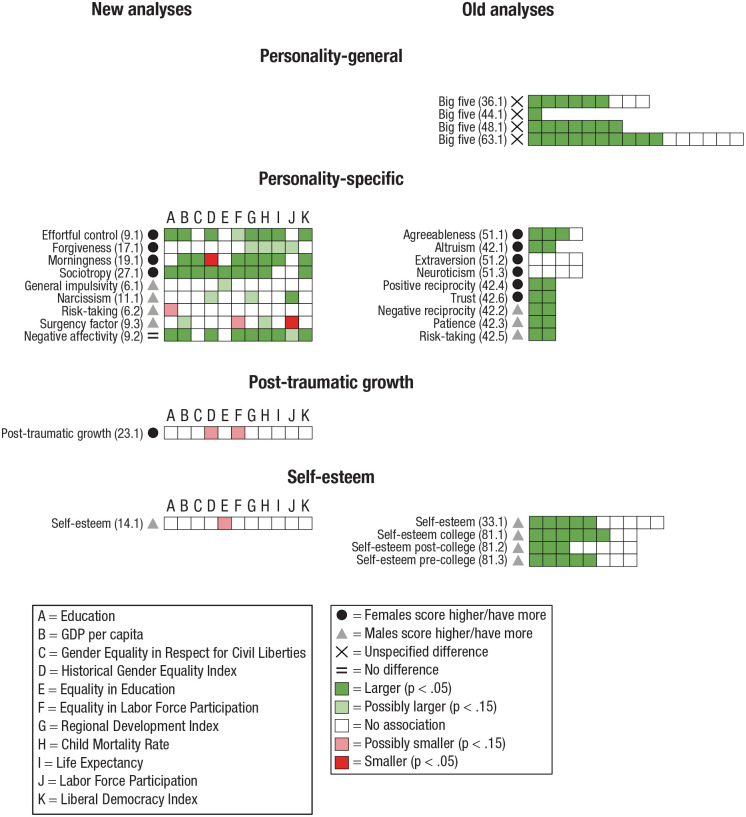
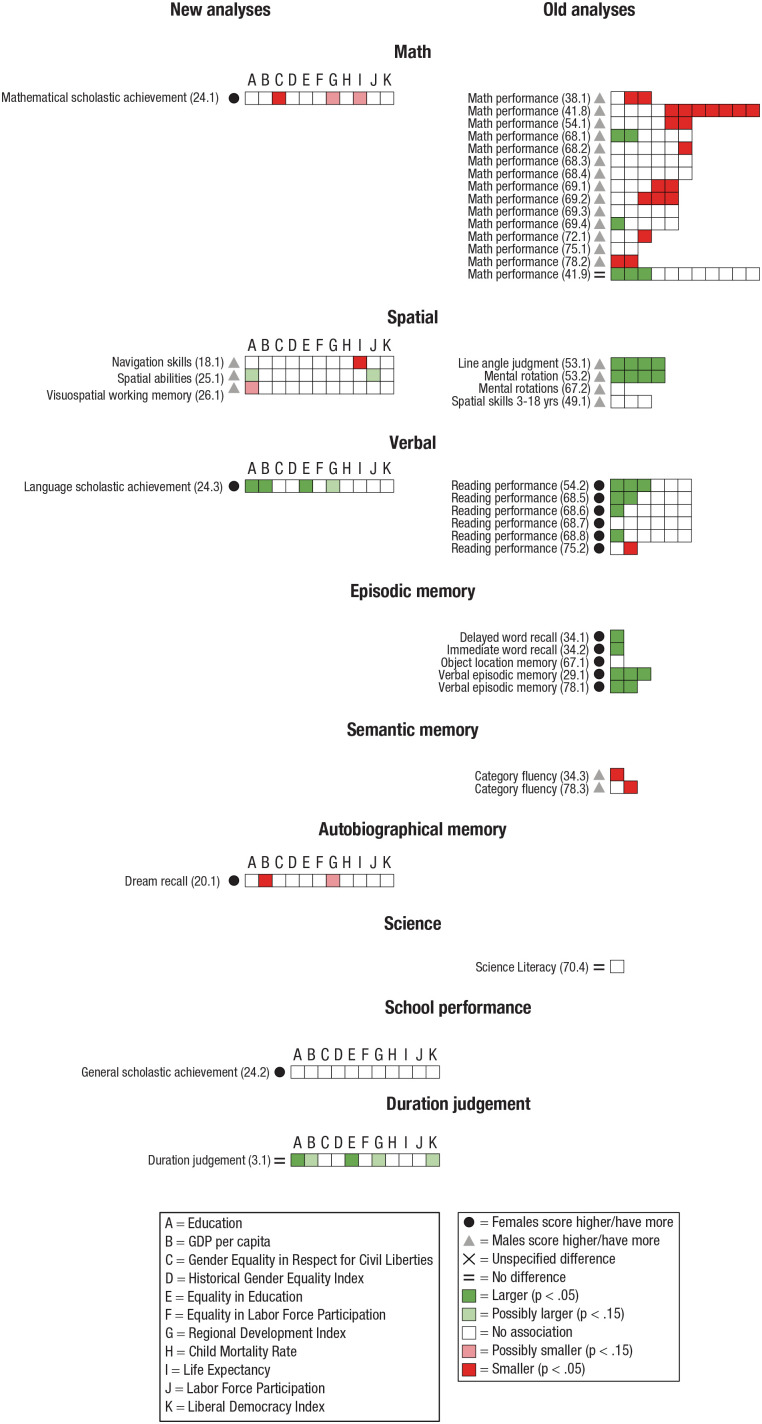
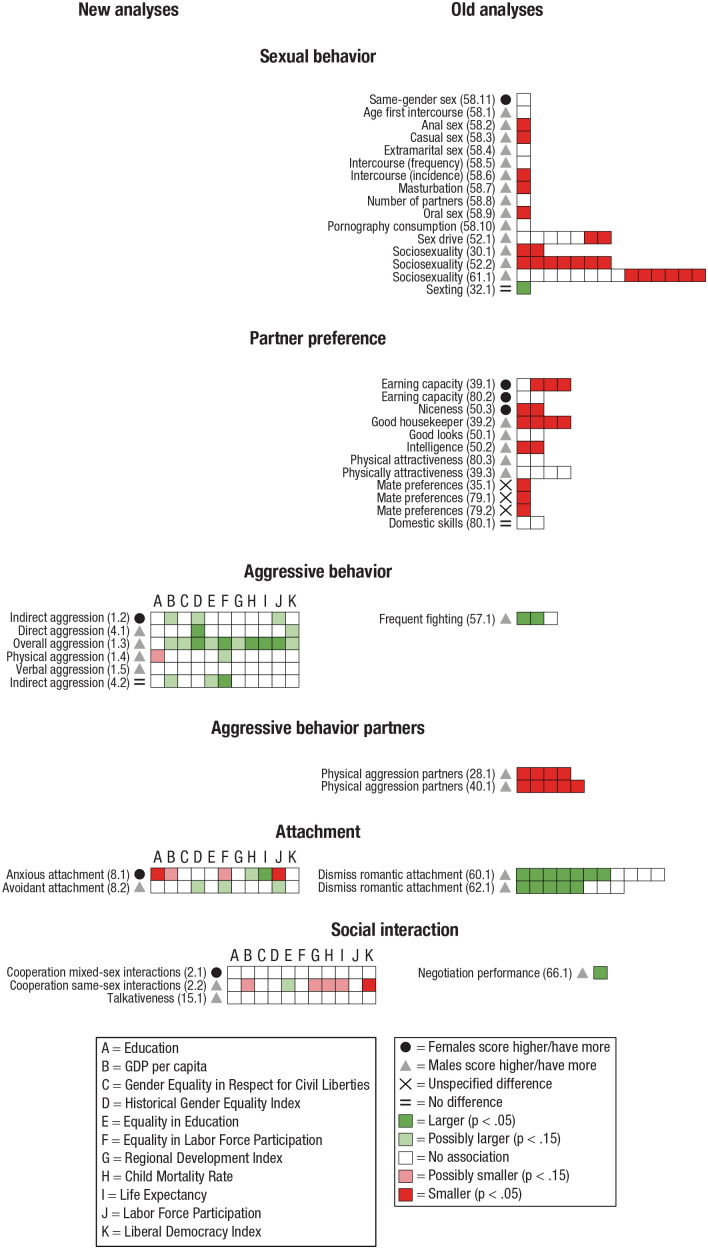
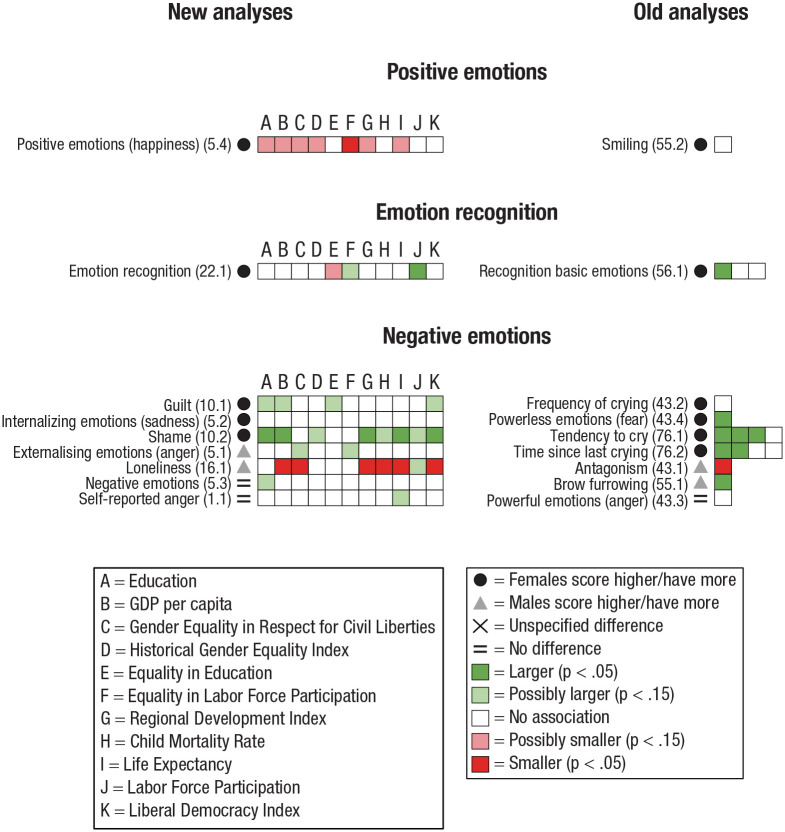
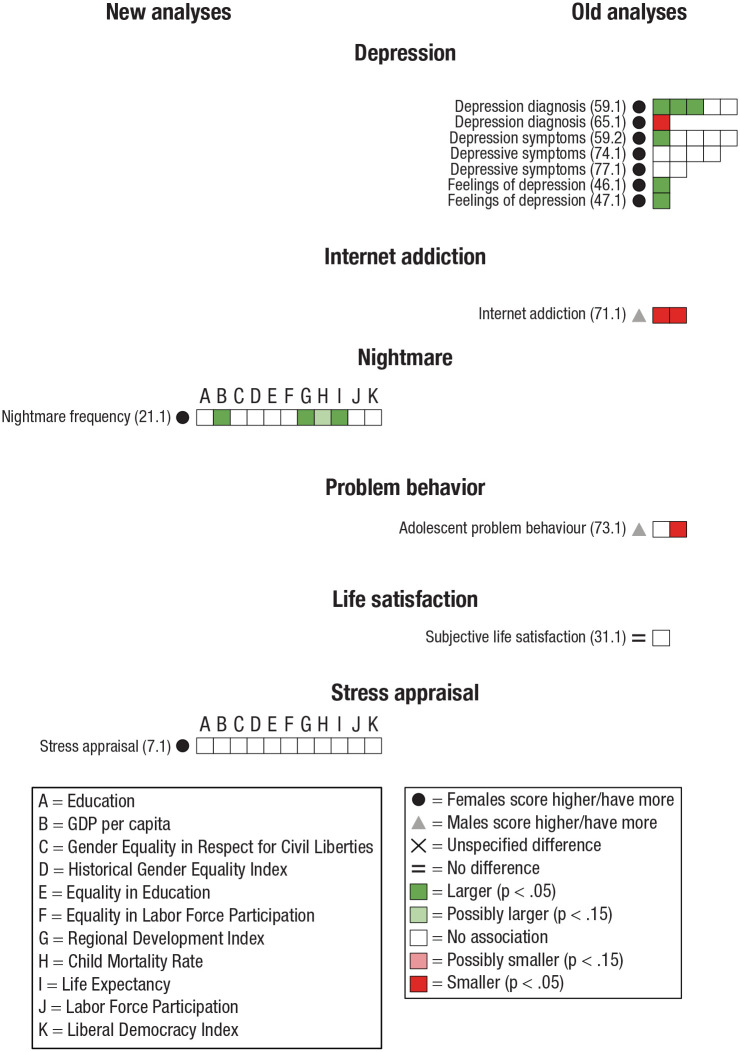
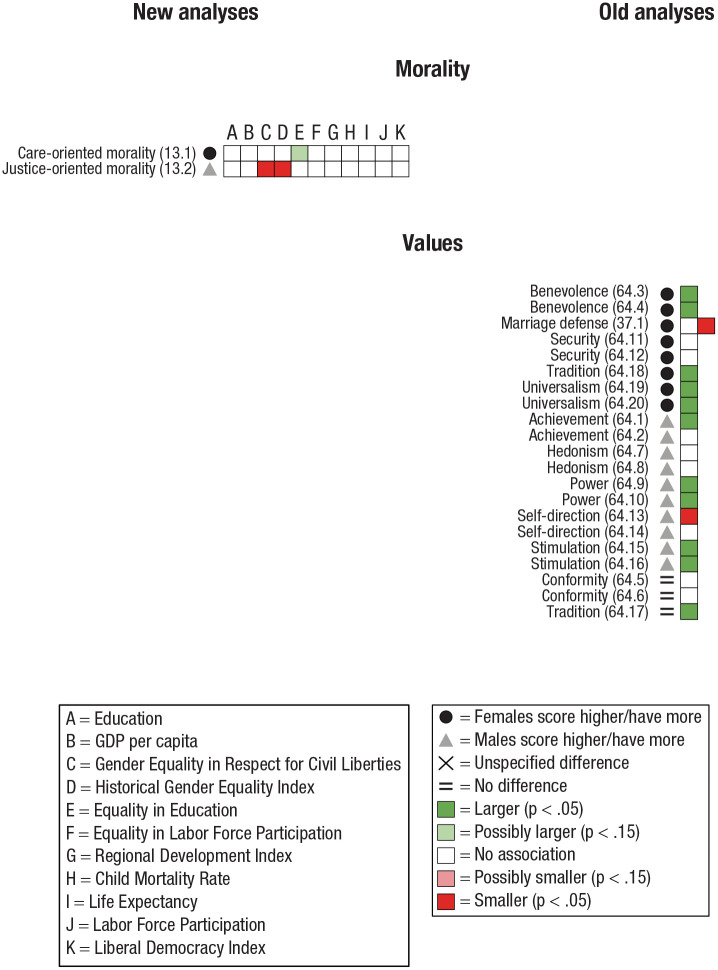
- They report that sex differences were larger in countries with higher living conditions for personality, verbal episodic memory, verbal ability, aggressive behavior, female negative emotions, depression, and general self-esteem.
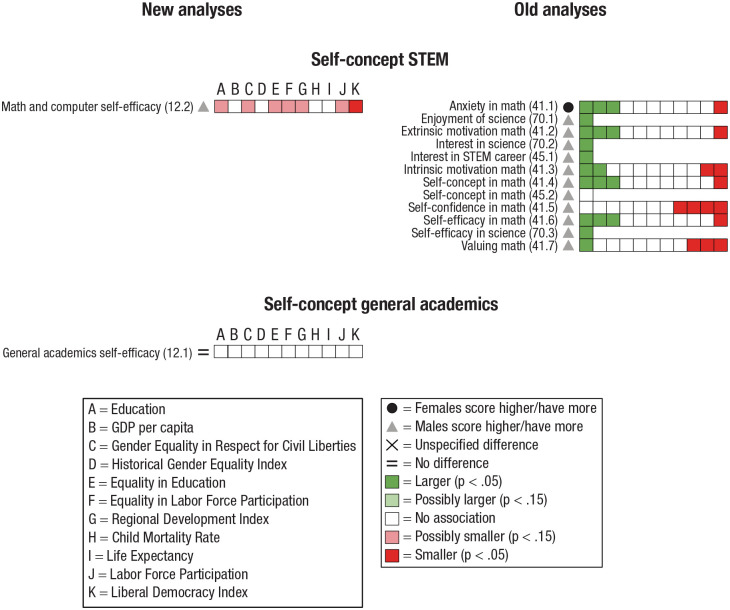
- They report that sex differences were smaller in countries with higher living conditions for mathematics, semantic memory, sexual behavior, partner preferences, and aggression toward partners.
- Across indicator categories, Economy was the most sensitive predictor; the paper reports that economy-related indicators were more often significantly associated with sex differences than gender-equality indicators. In the old analyses, the authors report approximately 48% significant associations overall, versus 15% in the new analyses (30% if p < .15 is included).
## Methods
- The paper combined a systematic review of prior country-level studies with new analyses of effect sizes from meta-analyses and large-scale studies.
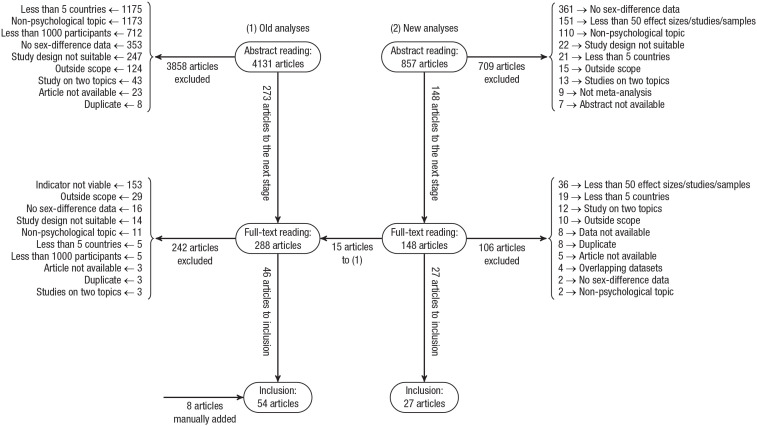
- The literature search used Web of Science and produced 4,131 abstracts for the old analyses and 857 abstracts for the new analyses; the final pool included 54 articles for the old analyses and 27 meta-analyses for the new analyses.
- For the new analyses, the authors computed Cohen’s d effect sizes and ran four-level meta-regressions with random-effects models to test whether sex differences varied with living-conditions indicators.
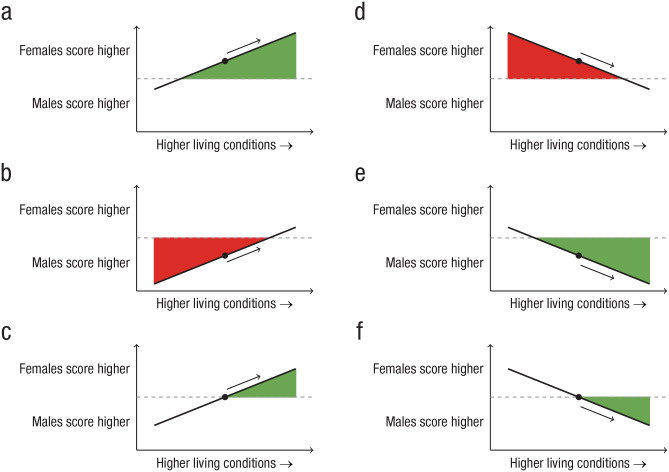
- They grouped living conditions into Economy, Education, Gender equality, Human development, and Other and interpreted whether each sex difference was larger or smaller in higher-living-condition countries.
## Limitations
- The authors explicitly state that a meta-analytic approach was not possible for the full set because of substantial content variation, so some categories were too small for meta-analysis.
- They state that relatively few studies collected data from enough countries, and that some reliance on the same datasets created duplicate findings, especially in the old analyses.
- They note that available living-condition indicators are often crude summary measures, may be missing for some years/countries, and may underestimate the true associations because they may not capture participants’ formative-year conditions.
- Evident from the text: many subcategories rely on only one or a few studies, so several conclusions are based on thin evidence rather than broad replication.
Model-written summary of a shortened version of the paper’s full text (it is longer than we read). Check it against the paper before relying on it.
Integrity signals
Registry
Cites
Statistics
Figures
Verification
Claims the paper makes
36 Valid · 9 Not valid · 83 Not checked · 130 Own results and interpretations
At least one cited source doesn’t support this claim or points to a different paper, and none confirmed it — see the verdicts below.
In the paper
“Likewise, Stoet and Geary (2013) reported associations in 15- and 16-year-olds and found smaller sex differences in mathematics performance and larger sex differences in reading comprehension in countries with higher living conditions.”
§ A Systematic Review and New Analyses of the Gender-Equality Paradox > Sex Differences and Living Conditions
What the sources say
- Disputedcites Stoet and Geary (2013) matched to “Sex Differences in Mathematics and Reading Achievement Are Inversely Related: Within- and Across-Nation Assessment of 10 Years of PISA Data” (2013) sourceExperimental — accuracy not yet measured
The Discussion says countries with higher living standards showed larger, not smaller, sex differences in mathematics. The Results section, “Gender Equality and Sex Differences in Achievement,” likewise reports a larger mathematics gap in OECD than non-OECD countries (10.5 versus 5.4 points). (LLM, conf=0.95)
Checked by a reasoning model — may be wrong.
plainstates an association- Asserted: passes — The authors put it forward as true.
- Checkable: passes — It can be checked against evidence.
- Load-bearing: passes — The paper’s conclusions depend on it.
- Based: passes — The paper gives a reason why it holds.
- Disputed
At least one cited source doesn’t support this claim or points to a different paper, and none confirmed it — see the verdicts below.
In the paper
“Likewise, Stoet and Geary (2013) reported associations in 15- and 16-year-olds and found smaller sex differences in mathematics performance and larger sex differences in reading comprehension in countries with higher living conditions.”
§ A Systematic Review and New Analyses of the Gender-Equality Paradox > Sex Differences and Living Conditions
What the sources say
- Disputedcites Stoet and Geary (2013) matched to “Sex Differences in Mathematics and Reading Achievement Are Inversely Related: Within- and Across-Nation Assessment of 10 Years of PISA Data” (2013) sourceExperimental — accuracy not yet measured
The Results section (‘Gender Equality and Sex Differences in Achievement’; page unavailable) reports no consistent correlation between sex differences in reading and living-standard measures across the decade. The Discussion says the reading sex difference was smaller—not larger—at the high end of achievement in countries with higher living standards. The study describes its PISA participants as 15-year-olds, rather than 15- and 16-year-olds. (LLM, conf=0.90)
Checked by a reasoning model — may be wrong.
plainstates an association- Asserted: passes — The authors put it forward as true.
- Checkable: passes — It can be checked against evidence.
- Load-bearing: passes — The paper’s conclusions depend on it.
- Based: passes — The paper gives a reason why it holds.
- Disputed
At least one cited source doesn’t support this claim or points to a different paper, and none confirmed it — see the verdicts below.
In the paper
“or Science (Stoet & Geary, 2018)”
§ A Systematic Review and New Analyses of the Gender-Equality Paradox > Results and Discussion > Cognition
What the sources say
- Disputedcites Stoet & Geary, 2018 matched to “The Gender-Equality Paradox in Science, Technology, Engineering, and Mathematics Education” (2018) sourceExperimental — accuracy not yet measured
The 'Sex Differences in Science Literacy' section reports statistically significant sex differences in 41 of 67 countries or regions; only 26 had no significant difference. The near-zero mean national effect does not support the unqualified claim that no sex differences were found for science. Page numbers are not provided in our copy. (LLM, conf=0.88)
Checked by a reasoning model — may be wrong.
plain- Asserted: passes — The authors put it forward as true.
- Checkable: passes — It can be checked against evidence.
- Load-bearing: unclear — It is unclear whether the paper’s conclusions depend on it.
- Based: passes — The paper gives a reason why it holds.
- Rests on an assumption not shown here.
- Disputed
Every source the paper cites for this claim was checked and supports it.
In the paper
“For example, we have reported that for cognitive performance, higher living conditions are associated with larger sex differences in cognitive tasks in which there is an overall female advantage (e.g., episodic memory) and smaller in those in which there is an overall male advantage (e.g., numeracy; Asperholm, Nagar, et al., 2019; Weber et al., 2014).”
§ A Systematic Review and New Analyses of the Gender-Equality Paradox > Sex Differences and Living Conditions
What the sources say
- Supportedcites Asperholm, Nagar, et al., 2019 matched to “The magnitude of sex differences in verbal episodic memory increases with social progress: Data from 54 countries across 40 years” (2019) source
The Discussion reports that higher population education and employment are associated with a larger female advantage across verbal episodic memory tasks. The Conclusions describe these conditions as proxies for a more enriching environment, supporting the cited example of higher living conditions. (LLM, conf=0.91)
- Supportedcites Weber et al., 2014 matched to “The changing face of cognitive gender differences in Europe” (2014) source
The paper's opening summary states directly that 'improved living conditions and less gender-restricted educational opportunities are associated with increased gender differences favoring women in some cognitive functions (i.e., episodic memory),' which is exactly the attributed point. The Results (regional development index analysis) corroborate it: in countries with a higher RDI episodic memory performance is higher and the significant RDI-by-gender interaction shows women's performance in particular rises with higher RDI, so the female advantage widens; the Conclusions and Implications repeat that in societies with greater equity/gender-specific patterns, women have a relative strength in episodic memory while the male advantage in numeracy shrinks. The only qualifier the paraphrase drops is the paper's population (middle-aged and older adults across European regions and birth cohorts, 1970-2001 cohorts), and the paper frames the effect as an association driven by women's larger gains, not a causal claim. (LLM, conf=0.90)
plainstates an association- Asserted: passes — The authors put it forward as true.
- Checkable: passes — It can be checked against evidence.
- Load-bearing: passes — The paper’s conclusions depend on it.
- Based: passes — The paper gives a reason why it holds.
- Supported
The sources with a verdict support this claim; the rest weren’t checked yet, have no full text we could read, or their verdicts aren’t rated yet.
In the paper
“altruism (SMD = 0.11)”
§ A Systematic Review and New Analyses of the Gender-Equality Paradox > Results and Discussion > Personal characteristics
What the sources say
- Not checked — no full text of the sourcecites Else-Quest et al., 2006 matched to “Gender differences in temperament: A meta-analysis.” (2006) source
- Supportedcites Falk & Hermle, 2018 matched to “Relationship of gender differences in preferences to economic development and gender equality” (2018) source
The Data and Measures section reports that women scored higher on altruism by 0.106 standard deviations, which rounds to the claimed SMD of 0.11. A supplementary individual-level regression also reports a gender difference of 0.110 for altruism. (LLM, conf=0.93)
- Not checked yetcites Lippa, 2008 matched to “Sex Differences and Sexual Orientation Differences in Personality: Findings from the BBC Internet Survey” (2008) source
plain- Asserted: passes — The authors put it forward as true.
- Checkable: passes — It can be checked against evidence.
- Load-bearing: unclear — It is unclear whether the paper’s conclusions depend on it.
- Based: passes — The paper gives a reason why it holds.
158 more claims · 34 with their cited sources checked
Create a free account to see all 258 claims and to verify the 39 references still open.
- It may state two separate claims as one. 62
- Probably not a substantial claim. 41
- The quote only partly states this claim. 2
Claims other papers make about this one
Each is checked against this paper’s own text: does it say what the citing paper says it does?
The cited source says what the claim attributes to it.
In the citing paper
“Although some previous studies have identified other variables as stronger predictors than gender equality (4, 37), we found no such tendencies, nor did any of the other variables survive controls more systematically, illustrating the consistent cultural/methodological confound across predictors.”
From Simpson’s gender-equality paradox (2025) · cites this paper as [37]
Citations
Cites
Conducting Meta-Analyses in R with the metafor Package
Viechtbauer, W. (2010) · Journal of Statistical Software · doi:10.18637/jss.v036.i03 · Cited by 20,464 · cited 1×
“These analyses were done using the rma.mv function of the Metafor package (Viechtbauer, 2010) for R with a random-effects model taking into account the hierarchical structure of studies and samples.”
Cultures and Organizations: Software of the Mind.
Triandis, H. C., & Hofstede, G. (1993) · Administrative Science Quarterly · doi:10.2307/2393257 · Cited by 17,696
Parental Investment and Sexual Selection
(2017) · Sexual Selection and the Descent of Man · doi:10.4324/9781315129266-7 · Cited by 9,510
Sexual Selection and the Descent of Man: The Darwinian Pivot
(2017) · Routledge eBooks · doi:10.4324/9781315129266 · Cited by 7,252
Sex differences in human mate preferences: Evolutionary hypotheses tested in 37 cultures
Buss, D. M. (1989) · Behavioral and Brain Sciences · doi:10.1017/s0140525x00023992 · Cited by 4,484 · cited 1×
“Data collected by Buss (1989) were analyzed by Eagly and Wood (1999), Conroy-Beam et al. (2015), and Zentner and Mitura (2012).”
A new data set of educational attainment in the world, 1950–2010
Barro, R. J., & Lee, J. W. (2013) · Journal of Development Economics · doi:10.1016/j.jdeveco.2012.10.001 · Cited by 4,333 · cited 2×
“These measures were taken from Version 2.2 of the Barro-Lee Educational Attainment Dataset (Barro & Lee, 2013).”
InfluentialThe international personality item pool and the future of public-domain personality measures
Goldberg, L. R., Johnson, J. A., Eber, H. W., Hogan, R., Ashton, M. C., Cloninger, C. R., & Gough, H. G. (2006) · Journal of Research in Personality · doi:10.1016/j.jrp.2005.08.007 · Cited by 3,185 · cited 1×
“Note that both Giolla and Kajonius (2019) and Kaiser (2019) used data from International Personality Item Pool (Goldberg et al., 2006); however, because they have used substantially different sample sizes and number of countries, the overlap in analyses appears to be small.”
Gender differences in personality traits across cultures: Robust and surprising findings.
Costa, P. T., Terracciano, A., & McCrae, R. R. (2001) · Journal of Personality and Social Psychology · doi:10.1037/0022-3514.81.2.322 · Cited by 2,986 · cited 6×
“Sixteen studies investigated sex differences in Personal characteristics: eight in the old analyses (Bleidorn et al., 2016; Costa et al., 2001; Falk & Hermle, 2018; Giolla & Kajonius, 2019; Kaiser, 2019; Lippa, 2008; Schmitt et al., 2008; Zuckerman et al., 2016) and eight in the new analyses (Cross…”
InfluentialVoyer, D., Voyer, S., & Bryden, M. P. (1995) · Psychological Bulletin · doi:10.1037/0033-2909.117.2.250 · Cited by 2,868 · cited 7×
“Studies: (6 Voyer et al., 1995, 2017), respectively.”
InfluentialSalk, R. H., Hyde, J. S., & Abramson, L. Y. (2017) · Psychological Bulletin · doi:10.1037/bul0000102 · Cited by 2,622 · cited 6×
“In areas of psychological functioning other than cognition, men have been reported to experience fewer depressive symptoms (Salk et al., 2017; Wang et al., 2016), whereas women seem to be less affected by suicide or addictive behaviors (Glenn et al., 2020; Su et al., 2019).”
InfluentialMassive IQ gains in 14 nations: What IQ tests really measure.
Flynn, J. R. (1987) · Psychological Bulletin · doi:10.1037/0033-2909.101.2.171 · Cited by 1,918 · cited 1×
“These data suggest that more than men, females benefit cognitively from societal improvements, giving rise to larger sex differences in episodic memory and verbal abilities and smaller sex differences in math ; Flynn, 1987; Pietschnig & Voracek, 2015).”
Card, N. A., Stucky, B. D., Sawalani, G. M., & Little, T. D. (2008) · Child Development · doi:10.1111/j.1467-8624.2008.01184.x · Cited by 1,917 · cited 8×
“…old analyses and the new analyses indicated that there are sex differences in Aggressive behavior toward others; there are higher levels for men in almost all types of aggression (e.g., physical, verbal; odds ratio = 2.68, SMDs = 0.29–0.62; Archer, 2004; Card et al., 2008; Nivette et al., 2019).”
InfluentialSex Differences in Aggression in Real-World Settings: A Meta-Analytic Review
Archer, J. (2004) · Review of General Psychology · doi:10.1037/1089-2680.8.4.291 · Cited by 1,916 · cited 14×
“…old analyses and the new analyses indicated that there are sex differences in Aggressive behavior toward others; there are higher levels for men in almost all types of aggression (e.g., physical, verbal; odds ratio = 2.68, SMDs = 0.29–0.62; Archer, 2004; Card et al., 2008; Nivette et al., 2019).”
InfluentialEagly, A. H., & Wood, W. (2012) · Handbook of Theories of Social Psychology · doi:10.4135/9781446249222.n49 · Cited by 1,853 · cited 1×
“This point is central to the social-role theory proposed by Eagly and Wood (1999, 2012).”
Cross-national patterns of gender differences in mathematics: A meta-analysis.
Else-Quest, N. M., Hyde, J. S., & Linn, M. C. (2010) · Psychological Bulletin · doi:10.1037/a0018053 · Cited by 1,630 · cited 27×
“Six studies in the old analyses used data from PISA (2000–2012) and TIMSS (2003).”
InfluentialSeedat, S., Scott, K. M., Angermeyer, M. C., Berglund, P., Bromet, E. J., Brugha, T. S., Demyttenaere, K., de Girolamo, G., Haro, J. M., Jin, R., et al. (2009) · Archives of General Psychiatry · doi:10.1001/archgenpsychiatry.2009.36 · Cited by 1,518 · cited 6×
“Six studies, all in the old analyses, investigated Depression (Hopcroft & Bradley, 2007; Hopcroft & McLaughlin, 2012; Salk et al., 2017; Seedat et al., 2009; Van de Velde et al., 2013; Wang et al., 2016).”
InfluentialThe origins of sex differences in human behavior: Evolved dispositions versus social roles.
Eagly, A. H., & Wood, W. (1999) · American Psychologist · doi:10.1037/0003-066x.54.6.408 · Cited by 1,499
Gender differences in self-esteem: A meta-analysis.
Kling, K. C., Hyde, J. S., Showers, C. J., & Buswell, B. N. (1999) · Psychological Bulletin · doi:10.1037/0033-2909.125.4.470 · Cited by 1,438 · cited 4×
“Self-esteem was examined in a single study in the new analyses (Kling et al., 1999) and in two studies in the old analyses (Bleidorn et al., 2016; Zuckerman et al., 2016).”
InfluentialSchmitt, D. P., Realo, A., Voracek, M., & Allik, J. (2008) · Journal of Personality and Social Psychology · doi:10.1037/0022-3514.94.1.168 · Cited by 1,391 · cited 4×
“There were reliable sex differences in Personality-general: The magnitude of the difference was Mahalanobis distance = 0.89 to 1.97 (Costa et al., 2001; Falk & Hermle, 2018; Giolla & Kajonius, 2019; Kaiser, 2019; Schmitt et al., 2008).”
InfluentialGender differences in scholastic achievement: A meta-analysis.
Voyer, D., & Voyer, S. D. (2014) · Psychological Bulletin · doi:10.1037/a0036620 · Cited by 1,337 · cited 14×
“Seven studies in the old analyses (Dickerson et al., 2015; Else-Quest et al., 2010; Marks, 2008; Stoet & Geary, 2013, 2015; Tao & Michalopoulos, 2018; van Hek et al., 2019; Weber et al., 2014) and one in the new analyses (Voyer & Voyer, 2014) assessed sex differences in math performance.”
InfluentialGender differences in emotion expression in children: A meta-analytic review.
Chaplin, T. M., & Aldao, A. (2013) · Psychological Bulletin · doi:10.1037/a0030737 · Cited by 1,247 · cited 13×
“On the other hand, if anything, an opposite pattern seems to be present for self-reported anger and brow furrowing, that is, there are larger sex differences in countries with higher living conditions (Chaplin & Aldao, 2013; McDuff et al., 2017).”
InfluentialMen and things, women and people: A meta-analysis of sex differences in interests.
Su, R., Rounds, J., & Armstrong, P. I. (2009) · Psychological Bulletin · doi:10.1037/a0017364 · Cited by 1,187 · cited 1×
“There are also sex differences when it comes to vocational interest; females prefer to work with people, and males prefer to work with things (Stoet & Geary, 2022; Su et al., 2009).”
Gender differences in temperament: A meta-analysis.
Else-Quest, N. M., Hyde, J. S., Goldsmith, H. H., & Van Hulle, C. A. (2006) · Psychological Bulletin · doi:10.1037/0033-2909.132.1.33 · Cited by 1,169 · cited 6×
“Two of these were in the old analyses (Falk & Hermle, 2018; Lippa, 2008) and six in the new analyses (Cross et al., 2011; Else-Quest et al., 2006; Grijalva et al., 2015; Miller et al., 2008; Randler & Engelke, 2019; Yang & Girgus, 2019).”
InfluentialThe Gender-Equality Paradox in Science, Technology, Engineering, and Mathematics Education
Stoet, G., & Geary, D. C. (2018) · Psychological Science · doi:10.1177/0956797617741719 · Cited by 1,054 · cited 20×
“We subdivided the category Cognition into Math (Dickerson et al., 2015; Else-Quest et al., 2010; Marks, 2008; Stoet & Geary, 2013, 2015; Tao & Michalopoulos, 2018; van Hek et al., 2019; Voyer & Voyer, 2014; Weber et al., 2014), Spatial skills (e.g., line-angle judgment, mental rotation; Lauer et al., 2019; Lippa et al…”
InfluentialIndulging Our Gendered Selves? Sex Segregation by Field of Study in 44 Countries
Charles, M., & Bradley, K. (2009) · American Journal of Sociology · doi:10.1086/595942 · Cited by 996 · cited 1×
“…reason as to why economic indicators are particularly sensitive in detecting associations with psychological sex differences concerns the way greater economic prosperity alters educational and occupational structures (e.g., K. Block et al., 2022; Charles & Bradley, 2009; Wong & Charles, 2020).”
Schmitt, D. P. (2005) · Behavioral and Brain Sciences · doi:10.1017/s0140525x05000051 · Cited by 974 · cited 8×
“…extramarital sex, frequency of intercourse, sociosexuality, sexting; Barber, 2008; Baumgartner et al., 2014; Lippa, 2009; Petersen & Hyde, 2010; Schmitt, 2005), Aggressive behavior toward others (e.g., frequent fighting, physical aggression, verbal aggression; Archer, 2004; Card et al., 2008;…”
InfluentialA meta-analytic review of research on gender differences in sexuality, 1993–2007.
Petersen, J. L., & Hyde, J. S. (2010) · Psychological Bulletin · doi:10.1037/a0017504 · Cited by 931 · cited 6×
“…Sexual behavior (e.g., extramarital sex, frequency of intercourse, sociosexuality, sexting; Barber, 2008; Baumgartner et al., 2014; Lippa, 2009; Petersen & Hyde, 2010; Schmitt, 2005), Aggressive behavior toward others (e.g., frequent fighting, physical aggression, verbal aggression; Archer,…”
InfluentialSex differences in impulsivity: A meta-analysis.
Cross, C. P., Copping, L. T., & Campbell, A. (2011) · Psychological Bulletin · doi:10.1037/a0021591 · Cited by 866 · cited 5×
“…Costa et al., 2001; Giolla & Kajonius, 2019; Kaiser, 2019; Schmitt et al., 2008), Personality-specific (e.g., risk-taking, narcis-sism, patience; Cross et al., 2011; Else-Quest et al., 2006; Falk & Hermle, 2018; Grijalva et al., 2015; Lippa, 2008; Miller et al., 2008; Randler & Engelke, 2019;…”
InfluentialGender differences in moral orientation: A meta-analysis.
Jaffee, S., & Hyde, J. S. (2000) · Psychological Bulletin · doi:10.1037/0033-2909.126.5.703 · Cited by 739 · cited 6×
“We subdivided Morals and values into Morality (justice-and care-oriented morality; Jaffee & Hyde, 2000) and Values (e.g., marriage defense, hedonism, tradition; Day et al., 2011; Schwartz & Rubel-Lifschitz, 2009).”
InfluentialGender differences in academic self-efficacy: a meta-analysis
Huang, C. (2013) · European Journal of Psychology of Education · doi:10.1007/s10212-011-0097-y · Cited by 686
Age and gender differences in self-esteem—A cross-cultural window.
(2015) · doi:10.1037/pspp0000078 · Cited by 684
Gender differences in narcissism: A meta-analytic review.
Grijalva, E., Newman, D. A., Tay, L., Donnellan, M. B., Harms, P. D., Robins, R. W., & Yan, T. (2015) · Psychological Bulletin · doi:10.1037/a0038231 · Cited by 654 · cited 5×
“…et al., 2008), Personality-specific (e.g., risk-taking, narcis-sism, patience; Cross et al., 2011; Else-Quest et al., 2006; Falk & Hermle, 2018; Grijalva et al., 2015; Lippa, 2008; Miller et al., 2008; Randler & Engelke, 2019; Yang & Girgus, 2019), Self-esteem (Bleidorn et al., 2016; Kling et…”
InfluentialA Framework for the Study of Personality and Political Behaviour
MONDAK, J. J., & HALPERIN, K. D. (2008) · British Journal of Political Science · doi:10.1017/s0007123408000173 · Cited by 645 · cited 1×
“To illustrate, people who score high in openness to experience and low in conscientiousness tend to be more left-leaning (Mondak & Halperin, 2008).”
Gender and Culture Differences in Emotion.
Fischer, A. H., Rodriguez Mosquera, P. M., van Vianen, A. E. M., & Manstead, A. S. R. (2004) · Emotion · doi:10.1037/1528-3542.4.1.87 · Cited by 521 · cited 8×
“…emotions, higher living conditions seem to predict that they express and feel even more negative emotions (e.g., guilt and crying) compared with men (Archer, 2004; Chaplin & Aldao, 2013; Else-Quest et al., 2012; Fischer et al., 2004; Maes et al., 2019; McDuff et al., 2017; van Hemert et al., 2011).”
InfluentialTop 10 Replicated Findings From Behavioral Genetics
Plomin, R., DeFries, J. C., Knopik, V. S., & Neiderhiser, J. M. (2016) · Perspectives on Psychological Science · doi:10.1177/1745691615617439 · Cited by 517 · cited 2×
“%) implies that environmental factors also affect the phenotype (Plomin et al., 2016).”
Mate Preferences and Their Behavioral Manifestations
Buss, D. M., & Schmitt, D. P. (2019) · Annual Review of Psychology · doi:10.1146/annurev-psych-010418-103408 · Cited by 503 · cited 2×
“Regarding partner preferences, men and women tend to value somewhat different capacities in their partners ( r s = .48– .84; Buss & Schmitt, 2019; Conroy-Beam et al., 2015; Zentner & Mitura, 2012).”
Cross-Cultural Differences in Physical Aggression Between Partners: A Social-Role Analysis
Archer, J. (2006) · Personality and Social Psychology Review · doi:10.1207/s15327957pspr1002_3 · Cited by 494 · cited 6×
“Men also display higher levels of Aggressive behavior partners (SMDs = 0.04– 9.075; Archer, 2006; Ebbeler et al., 2017).”
InfluentialSex differences in the ability to recognise non-verbal displays of emotion: A meta-analysis
Thompson, A. E., & Voyer, D. (2014) · Cognition and Emotion · doi:10.1080/02699931.2013.875889 · Cited by 476 · cited 5×
“Finally, for Emotion recognition, the studies in the old analyses and new analyses (Merten, 2005; Thompson & Voyer, 2014) indicated that the sex differences favoring females are larger in countries with higher living conditions, but the evidence is weak.”
InfluentialGender differences in self-conscious emotional experience: A meta-analysis.
Else-Quest, N. M., Higgins, A., Allison, C., & Morton, L. C. (2012) · Psychological Bulletin · doi:10.1037/a0027930 · Cited by 464 · cited 4×
“Three studies in the old analyses (Fischer et al., 2004; McDuff et al., 2017; van Hemert et al., 2011) and four studies in the new analyses (Archer, 2004; Chaplin & Aldao, 2013; Else-Quest et al., 2012; Maes et al., 2019) investigated Negative emotions.”
InfluentialSex Differences in Romantic Attachment: A Meta-Analysis
Del Giudice, M. (2011) · Personality and Social Psychology Bulletin · doi:10.1177/0146167210392789 · Cited by 441 · cited 7×
“One study in the new analyses (Del Giudice, 2011) and two in the old analyses (Schmitt, 2008; Schmitt et al., 2003) examined Attachment.”
InfluentialGender differences in loneliness across the lifespan: a meta-analysis
Maes, M., Qualter, P., Vanhalst, J., Van den Noortgate, W., & Goossens, L. (2019) · European Journal of Personality · doi:10.1002/per.2220 · Cited by 405 · cited 6×
“…emotions, higher living conditions seem to predict that they express and feel even more negative emotions (e.g., guilt and crying) compared with men (Archer, 2004; Chaplin & Aldao, 2013; Else-Quest et al., 2012; Fischer et al., 2004; Maes et al., 2019; McDuff et al., 2017; van Hemert et al., 2011).”
InfluentialSex differences in visual-spatial working memory: A meta-analysis
Voyer, D., Voyer, S. D., & Saint-Aubin, J. (2017) · Psychonomic Bulletin & Review · doi:10.3758/s13423-016-1085-7 · Cited by 400
Stoet, G., & Geary, D. C. (2013) · PLoS ONE · doi:10.1371/journal.pone.0057988 · Cited by 398 · cited 9×
“…et al., 2010; Nazareth et al., 2019; Silverman et al., 2007; Voyer et al., 1995, 2017), Verbal abilities (PISA reading performance; Marks, 2008; Stoet & Geary, 2013; van Hek et al., 2019; Voyer & Voyer, 2014), Episodic memory (verbal episodic, object location; Asperholm, Högman, et al., 2019;…”
InfluentialCross-national variation in the size of sex differences in values: Effects of gender equality.
Schwartz, S. H., & Rubel-Lifschitz, T. (2009) · Journal of Personality and Social Psychology · doi:10.1037/a0015546 · Cited by 395 · cited 6×
“We subdivided Morals and values into Morality (justice-and care-oriented morality; Jaffee & Hyde, 2000) and Values (e.g., marriage defense, hedonism, tradition; Day et al., 2011; Schwartz & Rubel-Lifschitz, 2009).”
InfluentialAnnual Research Review: A meta‐analytic review of worldwide suicide rates in adolescents
Glenn, C. R., Kleiman, E. M., Kellerman, J., Pollak, O., Cha, C. B., Esposito, E. C., Porter, A. C., Wyman, P. A., & Boatman, A. E. (2020) · Journal of Child Psychology and Psychiatry · doi:10.1111/jcpp.13106 · Cited by 391
Gender Differences in Self-Reported Posttraumatic Growth: A Meta-Analysis
Vishnevsky, T., Cann, A., Calhoun, L. G., Tedeschi, R. G., & Demakis, G. J. (2010) · Psychology of Women Quarterly · doi:10.1111/j.1471-6402.2009.01546.x · Cited by 387 · cited 4×
“Finally, Post-traumatic growth (resilience after trauma) was examined in a single study in the new analyses (Vishnevsky et al., 2010).”
InfluentialRelationship of gender differences in preferences to economic development and gender equality
Falk, A., & Hermle, J. (2018) · Science · doi:10.1126/science.aas9899 · Cited by 378 · cited 12×
“Sixteen studies investigated sex differences in Personal characteristics: eight in the old analyses (Bleidorn et al., 2016; Costa et al., 2001; Falk & Hermle, 2018; Giolla & Kajonius, 2019; Kaiser, 2019; Lippa, 2008; Schmitt et al., 2008; Zuckerman et al., 2016) and eight in the new analyses (Cross…”
InfluentialThe Hunter-Gatherer Theory of Sex Differences in Spatial Abilities: Data from 40 Countries
Silverman, I., Choi, J., & Peters, M. (2007) · Archives of Sexual Behavior · doi:10.1007/s10508-006-9168-6 · Cited by 350 · cited 12×
“Four studies, all in the old analyses (Asperholm, Nagar, et al., 2019; Bonsang et al., 2017; Silverman et al., 2007; Weber et al., 2014), investigated Episodic memory.”
InfluentialSex differences in cooperation: A meta-analytic review of social dilemmas.
Balliet, D., Li, N. P., Macfarlan, S. J., & Van Vugt, M. (2011) · Psychological Bulletin · doi:10.1037/a0025354 · Cited by 349 · cited 7×
“Women are more likely to cooperate in mixed-sex interactions (SMD = 0.24; Balliet et al., 2011).”
InfluentialGender and Forgiveness: A Meta–Analytic Review and Research Agenda
Miller, A. J., Worthington, E. L., & McDaniel, M. A. (2008) · Journal of Social and Clinical Psychology · doi:10.1521/jscp.2008.27.8.843 · Cited by 343 · cited 5×
“Two of these were in the old analyses (Falk & Hermle, 2018; Lippa, 2008) and six in the new analyses (Cross et al., 2011; Else-Quest et al., 2006; Grijalva et al., 2015; Miller et al., 2008; Randler & Engelke, 2019; Yang & Girgus, 2019).”
InfluentialLeaper, C., & Ayres, M. M. (2007) · Personality and Social Psychology Review · doi:10.1177/1088868307302221 · Cited by 323 · cited 5×
“…2017; Lippa, 2007, 2009; Nivette et al., 2019; Petersen & Hyde, 2010; Schmitt, 2005; Schmitt et al., 2003; Shan et al., 2019; Zentner & Mitura, 2012; Zhang et al., 2019) and five in the new analyses (Archer, 2004; Balliet et al., 2011; Card et al., 2008; Del Giudice, 2011; Leaper & Ayres, 2007).”
InfluentialOne Century of Global IQ Gains: A Formal Meta-Analysis of the Flynn Effect (1909–2013)
Pietschnig, J., & Voracek, M. (2015) · Perspectives on Psychological Science · doi:10.1177/1745691615577701 · Cited by 316 · cited 3×
“Some living conditions associated with cognitive improvements across generations are increased education, shifts in family size, and improved health care (Pietschnig & Voracek, 2015; Williams, 2013).”
Lippa, R. A., Collaer, M. L., & Peters, M. (2010) · Archives of Sexual Behavior · doi:10.1007/s10508-008-9460-8 · Cited by 273
Batz-Barbarich, C., Tay, L., Kuykendall, L., & Cheung, H. K. (2018) · Psychological Science · doi:10.1177/0956797618774796 · Cited by 253 · cited 5×
“There were 11 studies that investigated sex differences in Mental health: nine in the old analyses (Batz-Barbarich et al., 2018; Hopcroft & Bradley, 2007; Hopcroft & McLaughlin, 2012; Salk et al., 2017; Seedat et al., 2009; Su et al., 2019; Thijs et al., 2015; Van de Velde et al., 2013; Wang et…”
InfluentialLippa, R. A. (2009) · Archives of Sexual Behavior · doi:10.1007/s10508-007-9242-8 · Cited by 244 · cited 5×
“…good earning capacity (Eagly & Wood, 1999; Zhang et al., 2019) and niceness (SMD = 0.20; Lippa, 2007) to a higher extent than men do, men value physical attractiveness (SMD = 0.55; Eagly & Wood, 1999; Lippa, 2007; Zhang et al., 2019) and intelligence (SMD = 0.10; Lippa, 2007) more than women do.”
InfluentialSchmitt, D. P. (2003) · Personal Relationships · doi:10.1111/1475-6811.00052 · Cited by 241 · cited 7×
“…Conroy-Beam et al., 2015; Eagly & Wood, 1999; Ebbeler et al., 2017; Lippa, 2007, 2009; Nivette et al., 2019; Petersen & Hyde, 2010; Schmitt, 2005; Schmitt et al., 2003; Shan et al., 2019; Zentner & Mitura, 2012; Zhang et al., 2019) and five in the new analyses (Archer, 2004; Balliet et al.,…”
InfluentialThe development of gender differences in spatial reasoning: A meta-analytic review.
Lauer, J. E., Yhang, E., & Lourenco, S. F. (2019) · Psychological Bulletin · doi:10.1037/bul0000191 · Cited by 239 · cited 8×
“However, some studies have reported that living conditions have little or no impact on the magnitude of sex differences (Lauer et al., 2019; Van de Velde et al., 2013; Zhang et al., 2019).”
InfluentialSex differences in academic achievement are not related to political, economic, or social equality
Stoet, G., & Geary, D. C. (2015) · Intelligence · doi:10.1016/j.intell.2014.11.006 · Cited by 227 · cited 5×
“…Bonsang et al., 2017; Dickerson et al., 2015; Else-Quest et al., 2010; Lauer et al., 2019; Lippa et al., 2010; Marks, 2008; Silverman et al., 2007; Stoet & Geary, 2013, 2015, 2018; Tao & Michalopoulos, 2018; van Hek et al., 2019; Weber et al., 2014) and six in the new analyses (R. A. Block et…”
InfluentialMarks, G. N. (2008) · Oxford Review of Education · doi:10.1080/03054980701565279 · Cited by 219 · cited 9×
“…al., 2019; Lippa et al., 2010; Nazareth et al., 2019; Silverman et al., 2007; Voyer et al., 1995, 2017), Verbal abilities (PISA reading performance; Marks, 2008; Stoet & Geary, 2013; van Hek et al., 2019; Voyer & Voyer, 2014), Episodic memory (verbal episodic, object location; Asperholm, Högman,…”
InfluentialMac Giolla, E., & Kajonius, P. J. (2019) · International Journal of Psychology · doi:10.1002/ijop.12529 · Cited by 217
Su, W., Han, X., Jin, C., Yan, Y., & Potenza, M. N. (2019) · Computers in Human Behavior · doi:10.1016/j.chb.2019.04.021 · Cited by 211 · cited 6×
“In areas of psychological functioning other than cognition, men have been reported to experience fewer depressive symptoms (Salk et al., 2017; Wang et al., 2016), whereas women seem to be less affected by suicide or addictive behaviors (Glenn et al., 2020; Su et al., 2019).”
InfluentialDavis, M. C., Matthews, K. A., & Twamley, E. W. (1999) · Annals of Behavioral Medicine · doi:10.1007/bf02895038 · Cited by 208 · cited 6×
“All other subcategories were investigated in single studies: Nightmare (frequency; Schredl & Reinhard, 2011) and Stress appraisal (Davis et al., 1999) were assessed in the new analyses, whereas Internet addiction (Su et al., 2019), Problem behavior in adolescents (Thijs et al., 2015), and Life…”
InfluentialLippa, R. A. (2008) · Archives of Sexual Behavior · doi:10.1007/s10508-007-9267-z · Cited by 204 · cited 5×
“…good earning capacity (Eagly & Wood, 1999; Zhang et al., 2019) and niceness (SMD = 0.20; Lippa, 2007) to a higher extent than men do, men value physical attractiveness (SMD = 0.55; Eagly & Wood, 1999; Lippa, 2007; Zhang et al., 2019) and intelligence (SMD = 0.10; Lippa, 2007) more than women do.”
InfluentialA meta-analysis of sex differences in human navigation skills
Nazareth, A., Huang, X., Voyer, D., & Newcombe, N. (2019) · Psychonomic Bulletin & Review · doi:10.3758/s13423-019-01633-6 · Cited by 201 · cited 4×
“…2010; Marks, 2008; Silverman et al., 2007; Stoet & Geary, 2013, 2015, 2018; Tao & Michalopoulos, 2018; van Hek et al., 2019; Weber et al., 2014) and six in the new analyses (R. A. Block et al., 2000; Nazareth et al., 2019; Schredl & Reinhard, 2008; Voyer et al., 1995, 2017; Voyer & Voyer, 2014).”
InfluentialGender differences in nightmare frequency: A meta-analysis
Schredl, M., & Reinhard, I. (2011) · Sleep Medicine Reviews · doi:10.1016/j.smrv.2010.06.002 · Cited by 192 · cited 5×
“All other subcategories were investigated in single studies: Nightmare (frequency; Schredl & Reinhard, 2011) and Stress appraisal (Davis et al., 1999) were assessed in the new analyses, whereas Internet addiction (Su et al., 2019), Problem behavior in adolescents (Thijs et al., 2015), and Life…”
InfluentialHow Sexually Dimorphic Are Human Mate Preferences?
Conroy-Beam, D., Buss, D. M., Pham, M. N., & Shackelford, T. K. (2015) · Personality and Social Psychology Bulletin · doi:10.1177/0146167215590987 · Cited by 187 · cited 5×
“Data collected by Buss (1989) were analyzed by Eagly and Wood (1999), Conroy-Beam et al. (2015), and Zentner and Mitura (2012).”
InfluentialWhat did you do yesterday? A meta-analysis of sex differences in episodic memory.
Asperholm, M., Högman, N., Rafi, J., & Herlitz, A. (2019) · Psychological Bulletin · doi:10.1037/bul0000197 · Cited by 182
Self-citationRandler, C., & Engelke, J. (2019) · Chronobiology International · doi:10.1080/07420528.2019.1585867 · Cited by 169 · cited 5×
“Two of these were in the old analyses (Falk & Hermle, 2018; Lippa, 2008) and six in the new analyses (Cross et al., 2011; Else-Quest et al., 2006; Grijalva et al., 2015; Miller et al., 2008; Randler & Engelke, 2019; Yang & Girgus, 2019).”
InfluentialCoppedge, M., Gerring, J., Knutsen, C. H., Lindberg, S. I., Teorell, J., Altman, D., Bernhard, M., Cornell, A., Fish, M. S., Gastaldi, L., et al. (2021) · SSRN Electronic Journal · doi:10.2139/ssrn.3802627 · Cited by 167 · cited 5×
“The indicator is a composite measure that “takes a ‘negative’ view of political power insofar as it judges the quality of democracy by the limits placed on government” (Coppedge et al., 2021, p. 44).”
InfluentialThe Sex Difference in Depression Across 29 Countries
Hopcroft, R. L., & Bradley, D. B. (2007) · Social Forces · doi:10.1353/sof.2007.0071 · Cited by 164 · cited 8×
“There were 11 studies that investigated sex differences in Mental health: nine in the old analyses (Batz-Barbarich et al., 2018; Hopcroft & Bradley, 2007; Hopcroft & McLaughlin, 2012; Salk et al., 2017; Seedat et al., 2009; Su et al., 2019; Thijs et al., 2015; Van de Velde et al., 2013; Wang et…”
InfluentialThe changing face of cognitive gender differences in Europe
Weber, D., Skirbekk, V., Freund, I., & Herlitz, A. (2014) · Proceedings of the National Academy of Sciences · doi:10.1073/pnas.1319538111 · Cited by 162 · cited 18×
“…Hek et al., 2019; Voyer & Voyer, 2014), Episodic memory (verbal episodic, object location; Asperholm, Högman, et al., 2019; Silverman et al., 2007; Weber et al., 2014), Autobiographical memory (dream recall; Schredl & Reinhard, 2008), Semantic memory (category fluency; Bonsang et al., 2017; Weber…”
InfluentialSelf-citationWhen men and women differ in self-esteem and when they don’t: A meta-analysis
Zuckerman, M., Li, C., & Hall, J. A. (2016) · Journal of Research in Personality · doi:10.1016/j.jrp.2016.07.007 · Cited by 161 · cited 4×
“…analyses (Bleidorn et al., 2016; Costa et al., 2001; Falk & Hermle, 2018; Giolla & Kajonius, 2019; Kaiser, 2019; Lippa, 2008; Schmitt et al., 2008; Zuckerman et al., 2016) and eight in the new analyses (Cross et al., 2011; Else-Quest et al., 2006; Grijalva et al., 2015; Kling et al., 1999; Miller…”
InfluentialIntroducing the Historical Gender Equality Index
Dilli, S., Carmichael, S. G., & Rijpma, A. (2018) · Feminist Economics · doi:10.1080/13545701.2018.1442582 · Cited by 160 · cited 4×
“The final measure ranges from 0 to 100, “where 100 is a score indicating women have at least achieved an equal position to men on each of the indicators” (Dilli et al., 2019, pp. 42–43).”
InfluentialSex differences in duration judgments: A meta-analytic review
Block, R. A., Hancock, P. A., & Zakay, D. (2000) · Memory & Cognition · doi:10.3758/bf03211834 · Cited by 157 · cited 4×
“…subcategories were investigated only in single studies: Autobiographical memory (dream recall; Schredl & Reinhard, 2008), Duration judgment (R. A. Block et al., 2000), and School performance (Voyer & Voyer, 2014) were assessed in the new analyses, and Science was assessed in the old analyses…”
InfluentialGender differences in dream recall: a meta‐analysis
SCHREDL, M., & REINHARD, I. (2008) · Journal of Sleep Research · doi:10.1111/j.1365-2869.2008.00626.x · Cited by 151 · cited 4×
“…2010; Marks, 2008; Silverman et al., 2007; Stoet & Geary, 2013, 2015, 2018; Tao & Michalopoulos, 2018; van Hek et al., 2019; Weber et al., 2014) and six in the new analyses (R. A. Block et al., 2000; Nazareth et al., 2019; Schredl & Reinhard, 2008; Voyer et al., 1995, 2017; Voyer & Voyer, 2014).”
InfluentialZentner, M., & Mitura, K. (2012) · Psychological Science · doi:10.1177/0956797612441004 · Cited by 151 · cited 5×
“Data collected by Buss (1989) were analyzed by Eagly and Wood (1999), Conroy-Beam et al. (2015), and Zentner and Mitura (2012).”
InfluentialNivette, A., Sutherland, A., Eisner, M., & Murray, J. (2019) · Aggressive Behavior · doi:10.1002/ab.21799 · Cited by 128
The BBC Internet Study: General Methodology
Reimers, S. J. (2007) · Archives of Sexual Behavior · doi:10.1007/s10508-006-9143-2 · Cited by 127 · cited 2×
“Else-Quest et al. (2010) used data from both PISA and TIMSS from 2003, Goldman and Penner (2016) used TIMSS data from 2007, and Stoet and Geary (2018) used PISA data from 2015.”
Does country context matter? Investigating the predictors of teen sexting across Europe
Baumgartner, S. E., Sumter, S. R., Peter, J., Valkenburg, P. M., & Livingstone, S. (2014) · Computers in Human Behavior · doi:10.1016/j.chb.2014.01.041 · Cited by 123 · cited 5×
“Women engage more in same-gender sex (SMD = 0.05; Petersen & Hyde, 2010), and there are no sex differences in sexting (Baumgartner et al., 2014).”
InfluentialMacro‐level gender equality and depression in men and women in Europe
Van de Velde, S., Huijts, T., Bracke, P., & Bambra, C. (2013) · Sociology of Health & Illness · doi:10.1111/j.1467-9566.2012.01521.x · Cited by 109
Dekhtyar, S., Weber, D., Helgertz, J., & Herlitz, A. (2018) · Intelligence · doi:10.1016/j.intell.2017.11.007 · Cited by 98 · cited 3×
“Research shows that cognitive strengths are related to academic strengths and that individuals adjust their educational and occupational choices with their academic strengths (Dekhtyar et al., 2018).”
InfluentialSelf-citationSex differences in adolescents’ occupational aspirations: Variations across time and place
Stoet, G., & Geary, D. C. (2022) · PLoS ONE · doi:10.1371/journal.pone.0261438 · Cited by 98 · cited 1×
“There are also sex differences when it comes to vocational interest; females prefer to work with people, and males prefer to work with things (Stoet & Geary, 2022; Su et al., 2009).”
Williams, R. L. (2013) · Intelligence · doi:10.1016/j.intell.2013.04.010 · Cited by 92 · cited 1×
“Some living conditions associated with cognitive improvements across generations are increased education, shifts in family size, and improved health care (Pietschnig & Voracek, 2015; Williams, 2013).”
System justification and the defense of committed relationship ideology.
Day, M. V., Kay, A. C., Holmes, J. G., & Napier, J. L. (2011) · Journal of Personality and Social Psychology · doi:10.1037/a0023197 · Cited by 90 · cited 5×
“We subdivided Morals and values into Morality (justice-and care-oriented morality; Jaffee & Hyde, 2000) and Values (e.g., marriage defense, hedonism, tradition; Day et al., 2011; Schwartz & Rubel-Lifschitz, 2009).”
InfluentialDo the maths: An analysis of the gender gap in mathematics in Africa
Dickerson, A., McIntosh, S., & Valente, C. (2015) · Economics of Education Review · doi:10.1016/j.econedurev.2015.02.005 · Cited by 89
Hopcroft, R. L., & McLaughlin, J. (2012) · Social Science Research · doi:10.1016/j.ssresearch.2011.12.006 · Cited by 82 · cited 5×
“Six studies, all in the old analyses, investigated Depression (Hopcroft & Bradley, 2007; Hopcroft & McLaughlin, 2012; Salk et al., 2017; Seedat et al., 2009; Van de Velde et al., 2013; Wang et al., 2016).”
InfluentialLippa, R. A. (2007) · Archives of Sexual Behavior · doi:10.1007/s10508-006-9146-z · Cited by 81 · cited 5×
“…good earning capacity (Eagly & Wood, 1999; Zhang et al., 2019) and niceness (SMD = 0.20; Lippa, 2007) to a higher extent than men do, men value physical attractiveness (SMD = 0.55; Eagly & Wood, 1999; Lippa, 2007; Zhang et al., 2019) and intelligence (SMD = 0.10; Lippa, 2007) more than women do.”
InfluentialExploring international gender differences in mathematics self-concept
Goldman, A. D., & Penner, A. M. (2016) · International Journal of Adolescence and Youth · doi:10.1080/02673843.2013.847850 · Cited by 80 · cited 6×
“Else-Quest et al. (2010) used data from both PISA and TIMSS from 2003, Goldman and Penner (2016) used TIMSS data from 2007, and Stoet and Geary (2018) used PISA data from 2015.”
InfluentialYang, K., & Girgus, J. S. (2018) · Sex Roles · doi:10.1007/s11199-018-0980-y · Cited by 79
Educational Systems and Gender Differences in Reading: A Comparative Multilevel Analysis
van Hek, M., Buchmann, C., & Kraaykamp, G. (2019) · European Sociological Review · doi:10.1093/esr/jcy054 · Cited by 72 · cited 6×
“…al., 2010; Lauer et al., 2019; Lippa et al., 2010; Marks, 2008; Silverman et al., 2007; Stoet & Geary, 2013, 2015, 2018; Tao & Michalopoulos, 2018; van Hek et al., 2019; Weber et al., 2014) and six in the new analyses (R. A. Block et al., 2000; Nazareth et al., 2019; Schredl & Reinhard, 2008;…”
InfluentialGender differences in moral orientation: A meta-analysis.
Jaffee, S. R., & Hyde, J. S. (2000) · Psychological Bulletin · doi:10.1037//0033-2909.126.5.703 · Cited by 69
Ebbeler, C., Grau, I., & Banse, R. (2017) · Journal of Cross-Cultural Psychology · doi:10.1177/0022022117719497 · Cited by 65 · cited 5×
“Men also display higher levels of Aggressive behavior partners (SMDs = 0.04– 9.075; Archer, 2006; Ebbeler et al., 2017).”
InfluentialCulture and Crying: Prevalences and Gender Differences
van Hemert, D. A., van de Vijver, F. J. R., & Vingerhoets, A. J. J. M. (2011) · Cross-Cultural Research · doi:10.1177/1069397111404519 · Cited by 63 · cited 5×
“…emotions, such as guilt, shame, crying, and fear (SMDs = 0.12–1.11; Chaplin & Aldao, 2013; Else-Quest et al., 2010; Fischer et al., 2004; van Hemert et al., 2011), whereas males had higher levels of externalizing anger, antagonism, brow furrowing, and loneliness (SMDs = 0.07–0.11;…”
InfluentialSchmitt, D. P. (2008) · Cross-Cultural Research · doi:10.1177/1069397108317485 · Cited by 62 · cited 4×
“Moreover, men dismiss or avoid romantic attachment more than women do (SMDs = 0.12–0.18; Del Giudice, 2011; Schmitt, 2008; Schmitt et al., 2003), whereas anxious attachment is higher in women (SMD = 0.08; Del Giudice, 2011).”
InfluentialLarge-Scale Observational Evidence of Cross-Cultural Differences in Facial Behavior
McDuff, D., Girard, J. M., & Kaliouby, R. E. (2017) · Journal of Nonverbal Behavior · doi:10.1007/s10919-016-0244-x · Cited by 60
As You Sow, So Shall You Reap: Gender-Role Attitudes and Late-Life Cognition
Bonsang, E., Skirbekk, V., & Staudinger, U. M. (2017) · Psychological Science · doi:10.1177/0956797617708634 · Cited by 60 · cited 8×
“By contrast, two studies that investigated Semantic memory (category fluency) indicated that there is a male advantage (Bonsang et al., 2017; Weber et al., 2014).”
InfluentialShan, W., Keller, J., & Joseph, D. (2019) · Journal of Organizational Behavior · doi:10.1002/job.2357 · Cited by 60 · cited 4×
“Finally, three studies investigated Social interaction: two in the old analyses (Balliet et al., 2011; Leaper & Ayres, 2007) and one in the new analyses (Shan et al., 2019).”
InfluentialEagly, A. H., & Revelle, W. (2022) · Perspectives on Psychological Science · doi:10.1177/17456916211046006 · Cited by 60 · cited 1×
“Although many of the psychological sex differences are minor, several small sex differences in fundamental areas of psychological functioning may generate larger differences in everyday composite behaviors (Eagly & Revelle, 2022).”
“Female Preponderance” of Depression in Non-clinical Populations: A Meta-Analytic Study
Wang, K., Lu, H., Cheung, E. F. C., Neumann, D. L., Shum, D. H. K., & Chan, R. C. K. (2016) · Frontiers in Psychology · doi:10.3389/fpsyg.2016.01398 · Cited by 54 · cited 6×
“In areas of psychological functioning other than cognition, men have been reported to experience fewer depressive symptoms (Salk et al., 2017; Wang et al., 2016), whereas women seem to be less affected by suicide or addictive behaviors (Glenn et al., 2020; Su et al., 2019).”
InfluentialAsperholm, M., Nagar, S., Dekhtyar, S., & Herlitz, A. (2019) · PLOS ONE · doi:10.1371/journal.pone.0214945 · Cited by 54 · cited 5×
“Four studies, all in the old analyses (Asperholm, Nagar, et al., 2019; Bonsang et al., 2017; Silverman et al., 2007; Weber et al., 2014), investigated Episodic memory.”
InfluentialSelf-citationCULTURE, GENDER AND THE RECOGNITION OF THE BASIC EMOTIONS
MERTEN, J. (2005) · PSYCHOLOGIA · doi:10.2117/psysoc.2005.306 · Cited by 50 · cited 5×
“Finally, for Emotion recognition, the studies in the old analyses and new analyses (Merten, 2005; Thompson & Voyer, 2014) indicated that the sex differences favoring females are larger in countries with higher living conditions, but the evidence is weak.”
InfluentialSchmitt, D. P., Realo, A., Voracek, M., & Allïk, J. (2009) · Journal of Personality and Social Psychology · doi:10.1037/a0014651 · Cited by 49
Lager, A., Seblova, D., Falkstedt, D., & Lövdén, M. (2016) · International Journal of Epidemiology · doi:10.1093/ije/dyw093 · Cited by 46
Zhang, L., Lee, A. J., DeBruine, L. M., & Jones, B. C. (2019) · Evolutionary Psychology · doi:10.1177/1474704919852921 · Cited by 40 · cited 7×
“No sex difference was seen for preference for domestic skills (Zhang et al., 2019).”
InfluentialKaiser, T. (2019) · Personality and Individual Differences · doi:10.1016/j.paid.2019.05.011 · Cited by 38 · cited 6×
“Mirroring this, we categorized the available studies into Personality-general (Big Five; Costa et al., 2001; Giolla & Kajonius, 2019; Kaiser, 2019; Schmitt et al., 2008), Personality-specific (e.g., risk-taking, narcis-sism, patience; Cross et al., 2011; Else-Quest et al., 2006; Falk & Hermle,…”
InfluentialCross-National Variation in the Motivation for Uncommitted Sex: The Role of Disease and Social Risks
Barber, N. (2008) · Evolutionary Psychology · doi:10.1177/147470490800600203 · Cited by 37 · cited 8×
“For example, evidence suggests that sex differences in partner preferences and sexual behavior are smaller in countries with higher living conditions (Barber, 2008; Eagly & Wood, 1999; Lippa, 2009).”
InfluentialThe Flynn effect in Europe – Effects of sex and region
Weber, D., Dekhtyar, S., & Herlitz, A. (2017) · Intelligence · doi:10.1016/j.intell.2016.11.003 · Cited by 33 · cited 2×
“…memory, sex differences favoring women appear to be larger in countries with higher living conditions (Asperholm, Nagar, et al., 2019; Bonsang et al., 2017; Weber et al., 2017), although one study that examined object-location memory did not find such an association (Silverman et al., 2007).”
Self-citationAdolescent problem behaviour: The gender gap in European perspective
Thijs, P. E., van Dijk, I. K., Stoof, R., & Notten, N. (2015) · European Journal of Criminology · doi:10.1177/1477370815578195 · Cited by 28 · cited 5×
“…Schredl & Reinhard, 2011) and Stress appraisal (Davis et al., 1999) were assessed in the new analyses, whereas Internet addiction (Su et al., 2019), Problem behavior in adolescents (Thijs et al., 2015), and Life satisfaction (Batz-Barbarich et al., 2018) were assessed in the old analyses.”
InfluentialGENDER EQUALITY AND THE GENDER GAP IN MATHEMATICS
Tao, H., & Michalopoulos, C. (2017) · Journal of Biosocial Science · doi:10.1017/s0021932017000141 · Cited by 19 · cited 4×
“Seven studies in the old analyses (Dickerson et al., 2015; Else-Quest et al., 2010; Marks, 2008; Stoet & Geary, 2013, 2015; Tao & Michalopoulos, 2018; van Hek et al., 2019; Weber et al., 2014) and one in the new analyses (Voyer & Voyer, 2014) assessed sex differences in math performance.”
InfluentialGender and Occupational Segregation
Wong, Y. L. A., & Charles, M. (2020) · Companion to Women's and Gender Studies · doi:10.1002/9781119315063.ch16 · Cited by 18 · cited 2×
“For instance, globally, a large part of people working in health care, education, and social services are female, whereas a greater share of males is found in areas requiring physical strength and technical skills (e.g., Statistics Sweden, 2020; Wong & Charles, 2020).”
Block, K., olsson, M. I. T., Schmader, T., van Laar, C., Martiny, S. E., Schuster, C., Van Grootel, S., Meeussen, L., & Croft, A. (2022) · doi:10.31234/osf.io/k6g5d · Cited by 7
Fellman, D., Bränström, R., & Herlitz, A. (2021) · Humanities and Social Sciences Communications · doi:10.1057/s41599-021-00897-5 · Cited by 4 · cited 1×
“For example, in a previous study (Fellman et al., 2021), we investigated whether the tendency to be more verbally or numerically aligned was influenced by growing up in a gender-typed environment.”
Self-citation
Research works printed but not linked: 1
- Börsch-Supan A. Jürges H. (Eds.). (2005). The survey of health, ageing and retirement in Europe – Methodology. Mannheim Research Institute for the Economics of Aging (MEA).
Cited by
Simpson’s gender-equality paradox
Berggren, M., & Bergh, R. (2025) · Proceedings of the National Academy of Sciences · doi:10.1073/pnas.2422247122 · Cited by 17
“…results using outcomes beyond preference - based ones that have shown a gender - equality paradox, using a literature review with two recently published meta - analyses on cross - cultural gender differences that comprise 201 (36) and 89 (37) studies, as well as reviewer and editor recommendations.”
The Gender-Equality Paradox in Intraindividual Academic Strengths: A Cross-Temporal Analysis
Balducci, M., Larose, M., Stoet, G., & Geary, D. C. (2024) · Psychological Science · doi:10.1177/09567976241271330 · Cited by 27
“The data available in the PISA do not allow for a full exploration of these nuances, but our findings and others’ (Herlitz et al., 2024) indicate that a blanket convergence of the sexes across all traits will not follow from changes in gender equality.”
Kitole, F. A., Ali, Z., Song, J., Ali, M. N., Fahlevi, M., Aljuaid, M. M., Heidler, P., Yahya, M., & Shahid, M. (2025) · Healthcare · doi:10.3390/healthcare13091063 · Cited by 35
“Although research on gender preferences in healthcare exists, it remains geographically fragmented and often limited to specific medical specialties, making it difficult to draw broad conclusions [31,32].”
The development of ambivalent sexism: Proposals for an expanded model
Leaper, C. (2024) · British Journal of Developmental Psychology · doi:10.1111/bjdp.12521 · Cited by 18
“Several studies have documented ways that average gender differences in children's or adults' abilities, attitudes and behaviours vary depending on a country's ranking on indices of gender equality (see Herlitz et al., 2024).”
Deconstructing the gender-equality paradox.
Ilmarinen, V., & Lönnqvist, J. (2024) · Journal of Personality and Social Psychology · doi:10.1037/pspp0000508 · Cited by 23
Metadata
- Authors
- Herlitz, A., Hönig, I., Hedebrant, K., & Asperholm, M.
- Affiliations
- Karolinska Institutet (SE)
- Corresponding author
- Herlitz, Agneta
- Venue
- Perspectives on Psychological Science
- Publisher
- SAGE Publications
- Published
- 2024-01-03
- Volume
- 20
- Issue
- 3
- Pages
- 503-539
- ISSN
- 1745-6916 (ISSN-L)
- 1745-6924
- PMC
- PMC12065958
- OpenAlex
- W4390546074
- Cited by
- 59
- References
- 118
- Citations by year
- 2026: 25 · 2025: 24 · 2024: 10
- FWCI
- 4.35
- Type
- journal article
- Language
- en
- Open access
- hybrid
- doi.org
- Licence
- cc-by
- creativecommons.org/licenses/by/4.0/ (unspecified)
- journals.sagepub.com/page/policies/text-and-data-mining-license (tdm)
- Locations
- Perspectives on Psychological Science (publishedVersion, cc-by)
- PubMed Central (publishedVersion, cc-by)
- PubMed (publishedVersion)
- Funders
- Vetenskapsrådet (2018-01334)
- Topics
- Social Sciences › Psychology › Experimental and Cognitive Psychology › Evolutionary Psychology and Human Behavior
- Social Sciences › Gender Studies › Gender Roles and Identity Studies
- Social Sciences › Gender Studies › Gender and Feminist Studies
- Keywords
- gender-equality paradox, living conditions, gross domestic product, gender equality, personality, verbal ability, episodic memory, negative emotions, sexual behavior, mate preferences, mathematical ability, cross-cultural comparison
- MeSH terms
- Gender Equity, Female, Humans, Male, Personality, Sexual Behavior, Sex Characteristics, Sex Factors, Socioeconomic Factors
About these checks
Registry, retraction, Cites and statistics results are computed, not judged, with one exception: a printed reference that no index lists is read once by a model before it counts as a citation error. Claims are extracted by a model and kept only when their quote appears verbatim in the text; each cited source is then checked, with a model’s help, for whether it says what the claim relies on. Those verdicts can be wrong — read the claim’s quote and the cited source before relying on one.
The claim verdicts this report counts are experimental: their accuracy is not yet measured.
A language model drew the claims from the paper on 2026-10-10, under version 3 of the claim definition (model deepseek-v4.1-flash, prompt extract-v3).
A second model labelled each claim on 2026-10-10 (model jev-1.13-20260917, definition revision gold-guideline-v0.2).
Cited sources are checked with a language model’s help (gpt-6-sol and qwen3.8-omni-flash).
Statistics and arithmetic are recomputed, not judged.
Confidence bands are shown only for fields calibrated on our annotated test set. None is calibrated yet, so no band is shown.
What counts as a claim ›How we measure confidence ›How we check this ›
Are you an author, or do you see a problem with this page? Request a review
Data sources
Bibliographic data: Semantic Scholar, OpenAlex, Crossref.
Contains information from the Semantic Scholar Academic Graph Datasets, made available under the ODC Attribution License (ODC-BY 1.0).
Semantic Scholar’s data is described in: Kinney, R., et al. (2023). The Semantic Scholar Open Data Platform. arXiv:2301.10140.
