

The DOI matches its Crossref record; 444 of the 444 references it cites were found in a registry or an index; 130 of the 363 sources its claims cite were checked for support.
Three-Dimensional Quantum Black Holes: A Primer
Open accessAbstract
We review constructions of three-dimensional ‘quantum’ black holes. Such spacetimes arise via holographic braneworlds and are exact solutions to an induced higher-derivative theory of gravity consistently coupled to a large-c quantum field theory with an ultraviolet cutoff, accounting for all orders of semi-classical backreaction. Notably, such quantum-corrected black holes are much larger than the Planck length. We describe the geometry and horizon thermodynamics of a host of asymptotically (anti-) de Sitter and flat quantum black holes. A summary of higher-dimensional extensions is given. We survey multiple applications of quantum black holes and braneworld holography.
Overview
AI snapshot
Written from the paper’s full text.
TL;DR
This review explains how holographic braneworlds construct exact three-dimensional “quantum” black holes as classical AdS₄ C-metric black holes localized on an end-of-the-world brane, dual to a cutoff large-c CFT₃. These solutions solve the induced higher-derivative semi-classical brane theory to all orders in backreaction, yielding quantum-corrected BTZ, dS₃, and flat-space black holes with exact horizon thermodynamics.
Key findings
- Classical AdS₄ C-metric black holes localized on a Karch-Randall or Randall-Sundrum brane map to three-dimensional quantum black holes, including all orders of backreaction. The static quantum BTZ metric has a \(1/r\) correction with scale \(\ell \sim c_3 L_P \gg L_P\), so the horizon can be much larger than the Planck length.
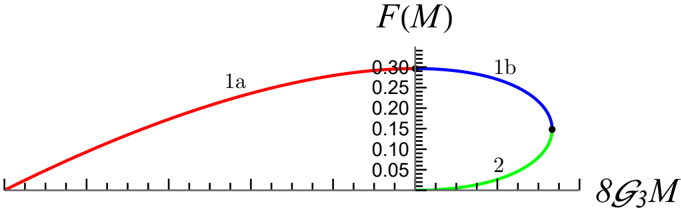
- The static quantum BTZ family has mass range \(-\frac{1}{8G_3} \le M \le \frac{1}{24G_3}\), with branches 1a, 1b, and 2. Backreaction smoothly connects classically disconnected conical defects and BTZ black holes, and can induce horizons where classical vacuum 3D gravity has none. Rotating, charged, dS₃, and flat-space quantum black holes are also constructed.
- Bulk Bekenstein-Hawking entropy is reinterpreted on the brane as generalized entropy \(S_{\rm gen}\), and the first law becomes \(dM = T dS_{\rm gen} + \cdots\), e.g. \(dM = T dS_{\rm gen} + \Omega dJ\) for rotating qBTZ and \(dM = T dS_{\rm gen} + \mu_e dQ_e + \mu_g dQ_g\) for charged qBTZ. This holds exactly for all backreaction orders.
- Large backreaction can trigger reentrant phase transitions for static quantum BTZ: thermal AdS → quantum BTZ → thermal AdS, involving a first-order Hawking-Page-like transition and a zeroth-order transition. All AdS₃ quantum black holes obey a quantum reverse isoperimetric inequality except a subspace of rotating, thermodynamically unstable black holes.
Methods
- Review and synthesis of holographic braneworld constructions: AdS/CFT, holographic renormalization, Karch-Randall/Randall-Sundrum branes, Israel junction conditions, and the AdS₄ C-metric as the bulk geometry.
- Exact solution analysis for static, rotating, and charged quantum BTZ, quantum Schwarzschild-de Sitter, quantum Kerr-de Sitter, and asymptotically flat quantum Schwarzschild/Kerr black holes.
- Thermodynamics computed from bulk Euclidean on-shell action, surface gravity, Bekenstein-Hawking entropy, Iyer-Wald entropy, and generalized entropy; no new experimental data are used.
Limitations
- The paper states that non-holographic perturbative backreaction gives horizon radii proportional to the Planck length, so those results cannot be trusted; a large-c holographic framework is needed to make the quantum black holes larger than \(L_P\).
- For higher dimensions, the paper states there are no known exact stationary braneworld black holes for \(d \ge 4\), a no-go theorem alleges the exterior cannot be static, and arguments for evaporation have flaws and counterexamples; large-D effective descriptions also do not induce a well-characterized lower-dimensional brane gravity.
- The review is non-exhaustive and several applications are preliminary: holographic complexity “complexity=action” does not simplify to the classical proposal plus corrections, QNM studies are early, and some quantum inequalities/cosmic censorship statements remain conjectural or tested only in specific cases.
Model-written summary. Check it against the paper before relying on it.
Integrity signals
Registry
Cites
Statistics
Figures
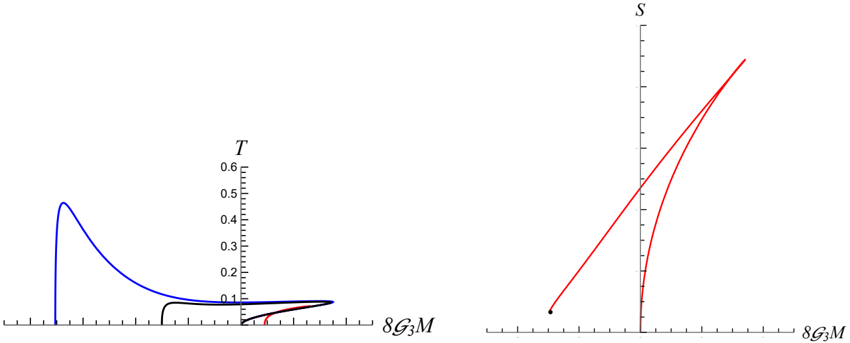
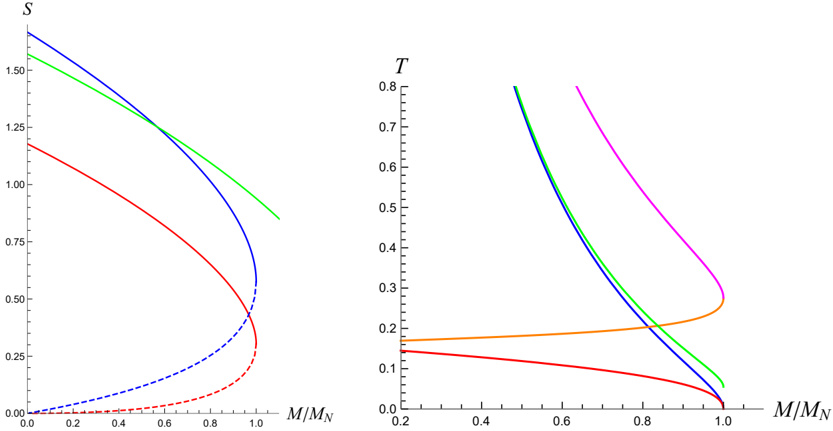
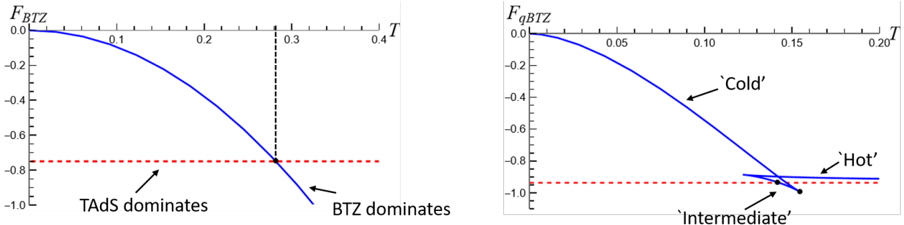
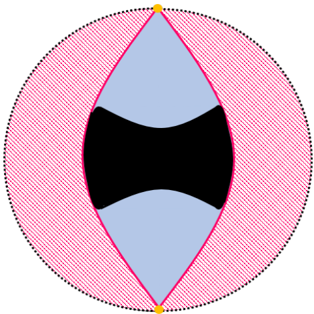
Verification
Claims the paper makes
581 No basis given · 197 Own interpretation · 137 Not checked yet · 31 No full text of the sources · 29 Partly supported · 23 Supported · 13 Own result · 8 Mixed support · 7 Couldn’t confirm · 4 Supported so far · 2 Own method · 1 Sources not found · accuracy not yet measured
Some cited sources support this claim and some don’t — read each source’s verdict below.
In the paper
“Indeed, one must account for both the black hole and cosmic string, leading to a modified first law including variations of the tension of the cosmic string [118][119][120][121].”
§ IFT-UAM/CSIC > 5.1 Bulk thermodynamics
What the sources say
- Disputedcites [118] Appels, 2016, Thermodynamics of Accelerating Black Holes, Phys. Rev. Lett. sourceExperimental — accuracy not yet measured
The paper accounts for the black hole and cosmic string, but it explicitly holds the string tension fixed. In the passage surrounding Eq. (16) (labeled Abstract in our copy), it requires δμ = 0 and derives a first law without a tension-variation term. The concluding discussion likewise says the string cannot change tension. (LLM, conf=0.89)
Checked by a reasoning model — may be wrong.
- Supportedcites [119] Appels, 2017, Black Hole Thermodynamics with Conical Defects, J. High Energy Phys. source
The Introduction (§1) says the paper derives a first law for black holes with varying conical-defect tension. Section 2 gives the modified first law with a term for variation of cosmic-string tension, accounting for the black hole–string system. (LLM, conf=0.94)
- Supportedcites [120] Appels, 2018, Holographic Thermodynamics of Accelerating Black Holes, Phys. Rev. D source
The Abstract identifies the conical singularity attached to the black hole as a cosmic string whose tension drives acceleration. In the FIG. 1 section, Eq. (11) gives a first law with variations of both string tensions, and the text following Eq. (12) explicitly says the authors allow those tensions to vary. (LLM, conf=0.94)
- Not checked yetcites [121] Appels, M. (2018). Thermodynamics of Accelerating Black Holes. [PhD Thesis, Department of Mathematical, Durham University].
plaindirect- Asserted: passes — The authors put it forward as true.
- Checkable: passes — It can be checked against evidence.
- Load-bearing: unclear — It is unclear whether the paper’s conclusions depend on it.
- Based: passes — The paper gives a reason why it holds.
- Disputed
The cited sources support only part of this claim — read each source’s verdict below.
In the paper
“More specifically, in a large-N expansion, the planar diagram limit of the CFT, the bulk is well-approximated by classical gravity (we will state this dictionary more precisely below).”
§ IFT-UAM/CSIC > 1 Overview
What the sources say
- Partly supportedcites [6] Maldacena, 1998, The Large N limit of superconformal field theories and supergravity, Adv. Theor. Math. Phys. sourceExperimental — accuracy not yet measured
The D3-brane discussion (p. 5) identifies quantum effects in the bulk with 1/N effects in the gauge theory and suggests that the large-N master field is an anti-de Sitter supergravity solution. But it also says supergravity calculations can be trusted in a coupling regime where gauge-theory calculations cannot; the planar large-N limit alone is not presented as sufficient for a classical-gravity approximation. (LLM, conf=0.83)
boostedcorrelational- Asserted: passes — The authors put it forward as true.
- Checkable: passes — It can be checked against evidence.
- Load-bearing: passes — The paper’s conclusions depend on it.
- Based: passes — The paper gives a reason why it holds.
- Partly supported
Every source the paper cites for this claim was checked and supports it.
In the paper
“Crucially, the geometry of the end-of-the-world (ETW) brane is dynamical, having an induced theory of gravity.”
§ IFT-UAM/CSIC > 1 Overview
What the sources say
- Supportedcites [11] Skenderis, 2001, Gravity in warped compactifications and the holographic stress tensor, Class. Quant. Grav. source
Section 1, “Warped Compactifications and AdS/CFT holography” (page not supplied), says the bulk spacetime ends on the brane and that gravity becomes dynamical there. Section 2 derives Einstein’s equation for the induced brane metric, supporting the claim that the brane has an induced theory of gravity. (LLM, conf=0.94)
plain- Asserted: passes — The authors put it forward as true.
- Checkable: passes — It can be checked against evidence.
- Load-bearing: passes — The paper’s conclusions depend on it.
- Based: passes — The paper gives a reason why it holds.
- Supported
Every source the paper cites for this claim was checked and supports it.
In the paper
“Meanwhile, classical black holes do exist in three-dimensional Einstein gravity with a negative cosmological constant [30,31], a consequence of the tendency for gravitational collapse afforded by the negatively curved geometry.”
§ IFT-UAM/CSIC > 1 Overview
What the sources say
- Supportedcites [30] Banados, 1992, The Black hole in three-dimensional space-time, Phys. Rev. Lett. source
On p. 1, the authors state that a black-hole solution exists in 2+1-dimensional Einstein theory with a negative cosmological constant. They explicitly say they first ignore the Maxwell field, so the result supports the claim about Einstein gravity. (LLM, conf=0.95)
- Supportedcites [31] Banados, 1993, Geometry of the (2+1) black hole, Phys. Rev. D source
The Abstract describes black holes in standard Einstein theory in 2+1 dimensions with a negative cosmological constant. Section 2.5 identifies the horizon of a solution that describes a black hole. These passages support the existence claim attributed to the source. (LLM, conf=0.94)
plain- Asserted: passes — The authors put it forward as true.
- Checkable: passes — It can be checked against evidence.
- Load-bearing: unclear — It is unclear whether the paper’s conclusions depend on it.
- Based: passes — The paper gives a reason why it holds.
- Supported
The cited sources support only part of this claim — read each source’s verdict below.
In the paper
“Such dilaton models of gravity admit exactly solvable black hole solutions including semi-classical backreaction, e.g., [85][86][87][88].”
§ IFT-UAM/CSIC > B B ∂M
What the sources say
- Supportedcites [85] Russo, 1992, The Endpoint of Hawking radiation, Phys. Rev. D source
The Introduction says the authors modify a two-dimensional dilaton-gravity model to make its semiclassical equations exactly solvable; it also identifies Hawking-radiation backreaction as part of the model. Section 2, “Exact solutions,” states that the resulting equations can be solved exactly and gives black-hole solutions. The claim is supported for this modified model, not for every dilaton-gravity model. (LLM, conf=0.92)
- Supportedcites [86] Susskind, 1993, The Stretched horizon and black hole complementarity, Phys. Rev. D source
Section 2.3 (p. 13) says that adding a term for leading-order quantum backreaction to two-dimensional dilaton gravity led to semi-classical equations that can be solved exactly, specifically in the modified RST model. Section 2.4 (p. 16) describes the resulting semi-classical black hole solutions. The paper distinguishes this from the original CGHS equations, which it says have not been solved in closed form. (LLM, conf=0.92)
- Supportedcites [87] Fiola, 1994, Black hole thermodynamics and information loss in two-dimensions, Phys. Rev. D source
Section II (pp. 10–12) describes a two-dimensional dilaton black hole model with semiclassical backreaction and states that the RST version can be solved exactly when a local counterterm is added. The paper therefore supports the cited example, with exact solvability applying to that modified model in the large-N approximation. (LLM, conf=0.91)
- Could not verifycites [88] Emparan, 2000, Black holes radiate mainly on the brane, Phys. Rev. Lett. sourceExperimental — accuracy not yet measured
The Introduction and Detailed calculations discuss higher-dimensional black holes on a brane and their Hawking evaporation. Searches for dilaton gravity, exact solvability, and semiclassical backreaction found no passage addressing whether dilaton models admit the claimed solutions. (LLM, conf=0.76)
plaindirect- Asserted: passes — The authors put it forward as true.
- Checkable: passes — It can be checked against evidence.
- Load-bearing: unclear — It is unclear whether the paper’s conclusions depend on it.
- Based: passes — The paper gives a reason why it holds.
- Supported
The cited sources that could be checked couldn’t confirm or dispute this claim.
In the paper
“Combined, this leads to an effective dimensionless coupling g eff quantifying the size of the effects the CFT 3 has on the brane geometry [92]”
- Also stated in: § Karch-Randall braneworld holography · plain
“g eff ∼ |I CFT | |I Bgrav | ∼ G 3 c 3 L 3 . (4.22)”
§ IFT-UAM/CSIC > Karch-Randall braneworld holography
What the sources say
- Could not verifycites [92] Cremonini, 2010, Higher Derivative Corrections to R-charged Black Holes: Boundary Counterterms and the Mass-Charge Relation, J. High Energy Phys. sourceExperimental — accuracy not yet measured
Section VI discusses higher-derivative corrections to five-dimensional black holes and central charges of dual four-dimensional CFTs, not the effect of a three-dimensional CFT on brane geometry. Searches for the effective coupling, the action ratio, and three-dimensional brane backreaction found no passage establishing g_eff ∼ G3 c3/L3. Page numbers were unavailable in our copy. (LLM, conf=0.76)
plaindirect- Asserted: passes — The authors put it forward as true.
- Checkable: passes — It can be checked against evidence.
- Load-bearing: passes — The paper’s conclusions depend on it.
- Based: passes — The paper gives a reason why it holds.
- Also stated in: § Karch-Randall braneworld holography · plain
The cited sources support only part of this claim — read each source’s verdict below.
In the paper
“For ℓ ̸ = 0, the non-vanishing components of the renormalized quantum-stress tensor (4.31) are found to be [25]”
§ IFT-UAM/CSIC > Quantum black hole
What the sources say
- Partly supportedcites [25] Emparan, 2020, Quantum BTZ black hole, J. High Energy Phys. sourceExperimental — accuracy not yet measured
The source lists five non-vanishing stress-tensor components in equations (3.20)–(3.24), each with an ℓ prefactor. But it explicitly says these are only the leading-order piece, T⁽⁰⁾; section 2.4, equation (2.43), includes higher-order terms. It therefore does not establish that the cited expressions give the full renormalized tensor for ℓ ≠ 0. (LLM, conf=0.84)
plain- Asserted: passes — The authors put it forward as true.
- Checkable: passes — It can be checked against evidence.
- Load-bearing: passes — The paper’s conclusions depend on it.
- Based: passes — The paper gives a reason why it holds.
- Partly supported
The cited sources support only part of this claim — read each source’s verdict below.
In the paper
“When r -→ 0, i.e., κ c and κ + simplify to the surface gravities of the cosmological horizon and black hole horizon of the qSdS black hole [26].”
§ IFT-UAM/CSIC > Horizon structure
What the sources say
- Partly supportedcites [26] Emparan, 2022, Black holes in dS3, J. High Energy Phys. sourceExperimental — accuracy not yet measured
Equation (5.19) gives the surface gravities κc and κh for the cosmological and black-hole horizons of the qSdS solution. The paper does not state that κc and κ+ reduce to those values when r− → 0, so the claimed limiting relationship is unsupported by our copy. (LLM, conf=0.83)
plaindirect- Asserted: passes — The authors put it forward as true.
- Checkable: passes — It can be checked against evidence.
- Load-bearing: unclear — It is unclear whether the paper’s conclusions depend on it.
- Based: passes — The paper gives a reason why it holds.
- Partly supported
Every source the paper cites for this claim was checked and supports it.
In the paper
“the Nariai mass was found to live in the finite range [26] 11 27 < 8G 3 M < 1 ,(4.113)”
§ IFT-UAM/CSIC > 4.3.2 Quantum Schwarzschild-de Sitter
What the sources say
- Supportedcites [26] Emparan, 2022, Black holes in dS3, J. High Energy Phys. source
Equation (4.36) in our copy states the claimed range for the Nariai mass exactly. The surrounding discussion identifies the lower bound with the limit R₃ ≈ ℓ and the upper bound with R₃/ℓ → ∞. (LLM, conf=0.95)
plain- Asserted: passes — The authors put it forward as true.
- Checkable: passes — It can be checked against evidence.
- Load-bearing: unclear — It is unclear whether the paper’s conclusions depend on it.
- Based: passes — The paper gives a reason why it holds.
- Supported
Every source the paper cites for this claim was checked and supports it.
In the paper
“In the near-horizon regime, the geometries appear as fibered products of a circle and two-dimensional anti-de Sitter, de Sitter, and Minkowski space, respectively.”
§ IFT-UAM/CSIC > Extremal limits.
What the sources say
- Supportedcites [27] Panella, 2023, Quantum Kerr-de Sitter black holes in three dimensions, J. High Energy Phys. source
Section 3.3 describes the near-horizon extremal geometry as a fibered product of AdS₂ and a circle, the rotating Nariai geometry as dS₂ fibered over a circle, and the ultracold geometry as a fibered product of two-dimensional Minkowski space and a circle. These are the three geometries and the order stated in the claim. (LLM, conf=0.94)
hedgedcorrelational- Asserted: passes — The authors put it forward as true.
- Checkable: passes — It can be checked against evidence.
- Load-bearing: unclear — It is unclear whether the paper’s conclusions depend on it.
- Based: passes — The paper gives a reason why it holds.
- Supported
- It may state two separate claims as one. 299
- The quote only partly states this claim. 39
- Probably not a substantial claim. 225
Some cited sources support this claim and some don’t — read each source’s verdict below.
In the paper
“However, static braneworld black holes in higher-dimensions have been found numerically, e.g., [67][68][69][70][71][72], and the qualitative argument was shown to have flaws [69].”
§ IFT-UAM/CSIC > B B ∂M
What the sources say
- Partly supportedcites [67] Kudoh, 2003, Small localized black holes in brane world: Formulation and numerical method, Phys. Rev. D sourceExperimental — accuracy not yet measured
The Summary reports numerical, approximate solutions for black holes localized on a brane, but only with horizons small relative to the bulk curvature scale. The Introduction mentions an argument against static localized black holes; neither it nor the Summary shows that the argument has flaws. The Summary also cautions that the imposed boundary conditions do not guarantee the absence of naked singularities. (LLM, conf=0.88)
- Not checked — no full text of the sourcecites [68] Kudoh, 2004, Six-dimensional localized black holes: Numerical solutions, Phys. Rev. D source
- Supportedcites [69] Fitzpatrick, 2006, On the existence and dynamics of braneworld black holes, J. High Energy Phys. source
The Introduction and summary reports that numerical work found static localized braneworld black holes, while noting that large ones had not been constructed. Section 2 challenges the argument that static solutions cannot exist, presenting a counterexample and explaining why the predicted enhanced Hawking radiation need not occur. (LLM, conf=0.91)
- Disputedcites [70] Yoshino, 2009, On the existence of a static black hole on a brane, J. High Energy Phys. sourceExperimental — accuracy not yet measured
Citation [69] is attached both to the numerical-finding claim and to the claim about flaws in a qualitative argument. Yoshino’s Summary and discussion reports nonsystematic numerical errors and says its results raise strong doubts that the specified static braneworld black-hole solutions exist, rather than establishing them numerically. The Introduction notes differing opinions about the AdS/CFT argument, but does not show that the argument has flaws. (LLM, conf=0.86)
Checked by a reasoning model — may be wrong.
- Supportedcites [71] Figueras, 2011, Gravity and large black holes in Randall-Sundrum II braneworlds, Phys. Rev. Lett. source
Section III reports the numerical construction of static five-dimensional RSII braneworld black holes. The Introduction identifies a flaw in the qualitative non-existence argument: it applies free-field intuition to a strongly coupled CFT, an extrapolation the paper says may not be justified. Page numbers are unavailable in our copy. (LLM, conf=0.89)
- Partly supportedcites [72] Emparan, 2023, Holographic duals of evaporating black holes, J. High Energy Phys. sourceExperimental — accuracy not yet measured
Section 2.4 describes static, stable black droplets on a brane, and Section 5 reports numerically built equilibrium funnels in an AdS5 braneworld. Our copy does not say that the qualitative argument mentioned in the citing sentence was shown to have flaws. (LLM, conf=0.82)
plain- Asserted: passes — The authors put it forward as true.
- Checkable: passes — It can be checked against evidence.
- Load-bearing: unclear — It is unclear whether the paper’s conclusions depend on it.
- Based: passes — The paper gives a reason why it holds.
It may state two separate claims as one.
- Partly supported
Some cited sources support this claim and some don’t — read each source’s verdict below.
In the paper
“Notably, δg tt > 0, indicating gravitational attraction [32,33].”
§ IFT-UAM/CSIC > Backreaction and quantum dressing
What the sources say
- Disputedcites [32] Souradeep, 1992, Quantum effects near a point mass in (2+1)-Dimensional gravity, Phys. Rev. D sourceExperimental — accuracy not yet measured
Section 4 (eqs. 4.10, 4.13–4.15; page unavailable) gives a negative correction to g_tt for the attractive Newtonian potential and states that acceleration is −∇Φ. Section 6 (eq. 6.10; page unavailable) permits a positive correction for twisted fields, but does not identify that case as gravitational attraction. The claimed link between δg_tt > 0 and attraction is therefore contrary to the paper’s treatment. (LLM, conf=0.87)
Checked by a reasoning model — may be wrong.
- Supportedcites [33] Soleng, 1993, Inverse square law of gravitation in (2+1) dimensional space-time as a consequence of Casimir energy, Phys. Scr. source
In §2, equations (11) and (15) give A² = 1 − 2ℓ/r, while equation (1) defines g_tt = −A². The paper states that ℓ is positive, so the correction δg_tt = 2ℓ/r is positive; the same section says test particles experience gravitational attraction in this geometry. Page numbers are unavailable in our copy. (LLM, conf=0.91)
hedgeddirect- Asserted: passes — The authors put it forward as true.
- Checkable: passes — It can be checked against evidence.
- Load-bearing: passes — The paper’s conclusions depend on it.
- Based: passes — The paper gives a reason why it holds.
It may state two separate claims as one.
- Disputed
Some cited sources support this claim and some don’t — read each source’s verdict below.
In the paper
“From the mass identification (4.27), M takes values in the finite range [23,24],”
- Also stated in: § 4.2.1 Static quantum BTZ · plain
“- 1 8G 3 ≤ M ≤ 1 24G 3 , (4.37”
§ IFT-UAM/CSIC > 4.2.1 Static quantum BTZ
What the sources say
- Disputedcites [23] Emparan, 2000, Exact description of black holes on branes, J. High Energy Phys. sourceExperimental — accuracy not yet measured
Section 3.3 (eq. 3.26; page unavailable) gives the limiting three-dimensional mass as 1/(4G₃), not 1/(24G₃). Section 3.2 treats the small-mass limit as positive and approaching zero, rather than −1/(8G₃). The source supports a finite limiting mass, but contradicts the stated endpoints. (LLM, conf=0.88)
Checked by a reasoning model — may be wrong.
- Supportedcites [24] Emparan, 2000, Exact description of black holes on branes. 2. Comparison with BTZ black holes and black strings, J. High Energy Phys. source
Section 3.2 gives the lower endpoint, stating that the negative-mass localized solutions run from −1/(8G₃) to zero, and gives 1/(24G₃) as the maximum positive mass for localized black holes. Section 6 clarifies that the lower endpoint is pure AdS rather than a black hole. Thus the stated finite range matches the paper’s mass identification for localized solutions, though it does not bound BTZ black strings. (LLM, conf=0.87)
plaincorrelational- Asserted: passes — The authors put it forward as true.
- Checkable: passes — It can be checked against evidence.
- Load-bearing: passes — The paper’s conclusions depend on it.
- Based: passes — The paper gives a reason why it holds.
The quote only partly states this claim.
- Also stated in: § 4.2.1 Static quantum BTZ · plain
Some cited sources support this claim and some don’t — read each source’s verdict below.
In the paper
“In fact, there are several examples of higher-dimensional static braneworld black holes, both analytically and numerically constructed [67][68][69][70][71][72][201][202][203][204][205][206][207][208].”
§ IFT-UAM/CSIC > Such a reduction thus
What the sources say
- Supportedcites [67] Kudoh, 2003, Small localized black holes in brane world: Formulation and numerical method, Phys. Rev. D source
This paper is an example of the numerically constructed higher-dimensional static braneworld black holes cited in the sentence. The Introduction describes a numerical construction in the Randall–Sundrum braneworld, and the Summary reports small localized black-hole solutions. The citation need not itself provide an analytical example within the cited group. (LLM, conf=0.92)
- Not checked — no full text of the sourcecites [68] Kudoh, 2004, Six-dimensional localized black holes: Numerical solutions, Phys. Rev. D source
- Supportedcites [69] Fitzpatrick, 2006, On the existence and dynamics of braneworld black holes, J. High Energy Phys. source
The Introduction reports numerically constructed localized static black holes, including Kudoh’s solutions. Section 2.1 constructs an analytic five-dimensional static braneworld solution, the uniformly warped black string. Together, these passages support the cited sentence’s broad statement about analytic and numerical examples. (LLM, conf=0.87)
- Disputedcites [70] Yoshino, 2009, On the existence of a static black hole on a brane, J. High Energy Phys. sourceExperimental — accuracy not yet measured
The Introduction (page unavailable) describes an exact static brane black hole in four-dimensional spacetime, but says finding a solution in five dimensions has been difficult and earlier numerical results require caution. The Summary and discussion (page unavailable) says this paper’s numerical results raise strong doubts that the five-dimensional static brane-black-hole solution studied exists, rather than providing a constructed example. (LLM, conf=0.85)
Checked by a reasoning model — may be wrong.
- Supportedcites [71] Figueras, 2011, Gravity and large black holes in Randall-Sundrum II braneworlds, Phys. Rev. Lett. source
Section III, “5D Static RSII Black Holes,” reports the paper’s numerical construction of five-dimensional static braneworld black holes. The Introduction also describes earlier numerical constructions and perturbative constructions of small black holes. This paper therefore supports the cited sentence as an example within its list of sources. (LLM, conf=0.91)
- Supportedcites [72] Emparan, 2023, Holographic duals of evaporating black holes, J. High Energy Phys. source
Section 2.4 describes static black holes on branes, identifies the uniform funnel as an exact solution, and says static stable droplets can be found on the brane. Section 2.2 says droplet solutions can be constructed numerically. Together these provide analytical and numerical examples of the kind cited. (LLM, conf=0.89)
- Supportedcites [201] Tanahashi, 2008, Time-symmetric initial data of large brane-localized black hole in RS-II model, J. High Energy Phys. source
The Introduction reports numerically constructed static brane-localized black holes whose horizons are not much larger than the bulk curvature scale. Section IV describes an exact analytic brane-localized black-hole solution in the four-dimensional RS-II case. The paper reports these examples; it does not claim to have constructed a static large black hole itself. (LLM, conf=0.86)
- Supportedcites [202] Gregory, 2008, Classical and quantum gravity of brane black holes, J. High Energy Phys. source
The introductory discussion (page not supplied) reports numerically constructed static, nonsingular braneworld black holes and identifies an explicit black-string solution. The later discussion describes that black string as a suitable brane-plus-bulk solution for a range of parameters. Together, these support the cited sentence's broad claim about numerical and analytic examples. (LLM, conf=0.90)
- Partly supportedcites [203] Figueras, 2011, Ricci solitons, Ricci flow, and strongly coupled CFT in the Schwarzschild Unruh or Boulware vacua, Class. Quant. Grav. sourceExperimental — accuracy not yet measured
Section 4 discusses the existence of Randall–Sundrum braneworld black holes, and the References list a work titled “Exact description of black holes on branes,” supporting the analytical-example part of the claim. The passages found do not establish that this paper constructs a braneworld black hole numerically or report several analytically and numerically constructed examples. (LLM, conf=0.78)
- Supportedcites [204] Abdolrahimi, 2013, Large Randall-Sundrum II Black Holes, Phys. Lett. B source
The Abstract states that the authors constructed large static Randall–Sundrum II braneworld black-hole solutions using a numerical method. The Conclusion describes independent numerical evidence for those solutions. This paper therefore supplies a numerical example in the cited group; the sentence does not require every cited paper to provide both an analytical and a numerical construction. (LLM, conf=0.91)
plain- Asserted: passes — The authors put it forward as true.
- Checkable: passes — It can be checked against evidence.
- Load-bearing: fails — The paper’s conclusions may not depend on it.
- Based: passes — The paper gives a reason why it holds.
Probably not a substantial claim. The paper’s conclusions may not depend on it.
- Supported
Some cited sources support this claim and some don’t — read each source’s verdict below.
In the paper
“In particular, in scenarios of gravity induced due to matter loops [221,222], the Bekenstein-Hawking entropy is solely due to entanglement due to vacuum fluctuations [223][224][225], where the UV-cutoff dependence can be absorbed in a renormalization of Newton's constant [130].”
§ IFT-UAM/CSIC > Holographic entanglement and gravitational entropy
What the sources say
- Not checked — no full text of the sourcecites [221] Sakharov, 1967, Vacuum quantum fluctuations in curved space and the theory of gravitation, Dokl. Akad. Nauk Ser. Fiz. source
- Not checked yetcites [222] Visser, 2002, Sakharov’s induced gravity: A Modern perspective, Mod. Phys. Lett. A source
Checked before — its earlier verdict is held back until a new check runs.
- Not checked yetcites [223] Jacobson, T. (1994). Black hole entropy and induced gravity. arXiv. source
Checked before — its earlier verdict is held back until a new check runs.
- Disputedcites [224] Frolov, 1997, Statistical origin of black hole entropy in induced gravity, Nucl. Phys. B sourceExperimental — accuracy not yet measured
Section 4 (Eq. 4.30; page unavailable) says that, in the induced-gravity model studied, Bekenstein–Hawking entropy is not solely a statistical-mechanical entropy: it also requires a horizon term involving scalar-field fluctuations. The authors say that term is not related to counting states and removes divergences. The UV-cutoff renormalization clause is attached to a different citation in the citing sentence. (LLM, conf=0.90)
Checked by a reasoning model — may be wrong.
- Not checked yetcites [225] Frolov, 1997, Mechanism of generation of black hole entropy in Sakharov’s induced gravity, Phys. Rev. D source
Checked before — its earlier verdict is held back until a new check runs.
- Supportedcites [130] Susskind, 1994, Black hole entropy in canonical quantum gravity and superstring theory, Phys. Rev. D source
The citation to this paper is attached to the UV-cutoff and Newton’s-constant clause, not the preceding claim that entropy is solely due to entanglement. Section 3 (pp. 13, 15) says the entropy’s quadratic divergence also enters the renormalization of the gravitational coupling, and that the divergences in entropy are the same ones that renormalize it. (LLM, conf=0.93)
plaindirect- Asserted: passes — The authors put it forward as true.
- Checkable: passes — It can be checked against evidence.
- Load-bearing: unclear — It is unclear whether the paper’s conclusions depend on it.
- Based: passes — The paper gives a reason why it holds.
It may state two separate claims as one.
Some cited sources support this claim and some don’t — read each source’s verdict below.
In the paper
“Notably, thus far, all 3 + 1-dimensional braneworld models that have been explored and exhibit island formation are described by massive gravity theories; islands disappear in the limit the graviton on the brane becomes massless [267] (see, e.g., [268] for a review).”
§ IFT-UAM/CSIC > The entropy of Hawking radiation
What the sources say
- Supportedcites [267] Geng, 2020, Massive islands, J. High Energy Phys. source
The Introduction describes the explored four-dimensional RS-brane island models as having massive gravitons, and §5 says islands are lost in the massless-graviton limit. The paper qualifies that result: in its RS model, the limit also makes G vanish, which the authors identify as the driver of the disappearance; they do not rule out islands in every possible massless-graviton theory. (LLM, conf=0.88)
- Disputedcites [268] Geng, H. (2023). Revisiting Recent Progress in the Karch-Randall Braneworld. arXiv. sourceExperimental — accuracy not yet measured
The Introduction acknowledges that an earlier Karch-Randall setup has massive gravity, but then describes island surfaces and a Page curve despite massless gravity on the brane. It also explicitly states that islands exist with massless gravity, contrary to the claim that they disappear when the graviton becomes massless. Page numbers are not available in our copy. (LLM, conf=0.90)
Checked by a reasoning model — may be wrong.
hedgeddirect- Asserted: passes — The authors put it forward as true.
- Checkable: passes — It can be checked against evidence.
- Load-bearing: passes — The paper’s conclusions depend on it.
- Based: passes — The paper gives a reason why it holds.
It may state two separate claims as one.
- Supported
Some cited sources support this claim and some don’t — read each source’s verdict below.
In the paper
“Generally, however, the thermodynamic volume (5.90) differs from the geometric volume[142][143][144].”
§ IFT-UAM/CSIC > Thermodynamics in the canonical ensemble
What the sources say
- Disputedcites [142] Dolan, 2011, The cosmological constant and the black hole equation of state, Class. Quant. Grav. sourceExperimental — accuracy not yet measured
In §2 (Enthalpy), equation (8) gives the thermodynamic volume as 4πrₕ³/3 and says the naïve volume is the correct one for thermodynamic relations. Section 5 likewise calls the higher-dimensional thermodynamic volume the naïve result. Section 6 identifies a narrower exception: quantum corrections reduce the BTZ black hole’s volume below its classical value. These passages run contrary to the unqualified claim that the volumes generally differ. (LLM, conf=0.86)
Checked by a reasoning model — may be wrong.
- Supportedcites [143] Cvetic, 2011, Black Hole Enthalpy and an Entropy Inequality for the Thermodynamic Volume, Phys. Rev. D source
The Conclusions state that the thermodynamic volume differs from the geometric volume when a black hole rotates, while they can coincide without rotation. The Introduction likewise distinguishes the two volumes for Kerr-AdS black holes. This supports the claim’s general, rather than universal, wording. (LLM, conf=0.94)
- Supportedcites [144] Johnson, 2014, Thermodynamic Volumes for AdS-Taub-NUT and AdS-Taub-Bolt, Class. Quant. Grav. source
Section 2.1 states that Taub-NUT is a case where thermodynamic and naive geometric volumes differ, and Section 2.3 specifies that its naive geometric volume is zero while its thermodynamic volume is nonzero. The paper also notes that the volumes coincide for static black holes, which is consistent with the claim’s qualifier “generally,” rather than “always.” (LLM, conf=0.87)
plain- Asserted: passes — The authors put it forward as true.
- Checkable: passes — It can be checked against evidence.
- Load-bearing: fails — The paper’s conclusions may not depend on it.
- Based: passes — The paper gives a reason why it holds.
Probably not a substantial claim. The paper’s conclusions may not depend on it.
- Disputed
Every source the paper cites for this claim was checked and supports it.
In the paper
“Born out of studies in string theory, AdS/CFT is a non-perturbative candidate model of quantum gravity, where gravitational physics in a bulk d + 1-dimensional asymptotically AdS spacetime has a dual description in terms of a CFT living on the d-dimensional conformal boundary of AdS.”
§ IFT-UAM/CSIC > 1 Overview
What the sources say
- Supportedcites [6] Maldacena, 1998, The Large N limit of superconformal field theories and supergravity, Adv. Theor. Math. Phys. source
Split into 2 atoms — 2 confirmed, 0 partially supported, 0 disputed, 0 misattributed, 0 unverifiable. Expand the claim to see per-atom verdicts.
plaincorrelational- Asserted: passes — The authors put it forward as true.
- Checkable: passes — It can be checked against evidence.
- Load-bearing: passes — The paper’s conclusions depend on it.
- Based: passes — The paper gives a reason why it holds.
Probably not a substantial claim.
- Supported
Every source the paper cites for this claim was checked and supports it.
In the paper
“In any case, the Green function of the quantum scalar field in the BTZ background is in the Hartle-Hawking state, satisfying the Kubo-Martin-Schwinger (KMS) condition at the black hole temperature [42].”
§ IFT-UAM/CSIC > Backreaction and quantum dressing
What the sources say
- Supportedcites [42] Lifschytz, 1994, Scalar field quantization on the (2+1)-dimensional black hole background, Phys. Rev. D source
Section III identifies the BTZ scalar-field Green function as a Hartle–Hawking Green function. Section III.B states that it satisfies the KMS condition outside the horizon at a local temperature related by the Tolman relation to the black hole temperature. (LLM, conf=0.94)
plaincorrelational- Asserted: passes — The authors put it forward as true.
- Checkable: passes — It can be checked against evidence.
- Load-bearing: unclear — It is unclear whether the paper’s conclusions depend on it.
- Based: passes — The paper gives a reason why it holds.
It may state two separate claims as one.
- Supported
The sources with a verdict support this claim; the rest weren’t checked yet, have no full text we could read, or their verdicts aren’t rated yet.
In the paper
“The AdS/CFT correspondence [6], in its strongest form, describes a duality between a theory of gravity and conformal field theory at the level of their partition functions, summarized by Gubser, Klebanov, Polyakov and Witten (GKPW) [46,47]”
§ IFT-UAM/CSIC > 3.1 AdS/CFT dictionary and holographic renormalization
What the sources say
- Supportedcites [6] Maldacena, 1998, The Large N limit of superconformal field theories and supergravity, Adv. Theor. Math. Phys. source
The citation to Maldacena identifies the AdS/CFT correspondence; the citing sentence separately attributes its partition-function formulation to GKPW [46,47]. In “General Idea” (p. 1), Maldacena conjectures that quantum M/string theory on AdS, with suitable boundary conditions, is dual to the corresponding conformal brane theory. (LLM, conf=0.91)
- Not checked yetcites [46] Gubser, 1998, Gauge theory correlators from noncritical string theory, Phys. Lett. B source
Checked before — its earlier verdict is held back until a new check runs.
- Supportedcites [47] Witten, 1998, Anti-de Sitter space and holography, Adv. Theor. Math. Phys. source
Section 2.3 explicitly identifies the CFT/AdS correspondence with equality between the CFT partition function and the supergravity or string-theory partition function, subject to specified boundary conditions. This supports the attributed duality at the level of partition functions. (LLM, conf=0.94)
boostedcorrelational- Asserted: passes — The authors put it forward as true.
- Checkable: passes — It can be checked against evidence.
- Load-bearing: fails — The paper’s conclusions may not depend on it.
- Based: passes — The paper gives a reason why it holds.
Probably not a substantial claim. The paper’s conclusions may not depend on it.
- Supported
The cited sources support only part of this claim — read each source’s verdict below.
In the paper
“Conjecture: Classical black holes which localize on a brane in AdS d+1 exactly map to d-dimensional quantum-corrected black holes including all orders of backreaction.”
§ IFT-UAM/CSIC > 3.3 Holographic quantum black holes: a conjecture
What the sources say
- Partly supportedcites [22] Emparan, 2002, Quantum black holes as holograms in AdS brane worlds, J. High Energy Phys. sourceExperimental — accuracy not yet measured
The Introduction states the conjecture that classical black holes localized on an AdS brane correspond to quantum-corrected black holes in one fewer dimension. It also specifies that the correspondence captures quantum effects from all planar diagrams in the large-N limit; it does not claim all orders of backreaction without that limitation. (LLM, conf=0.86)
plaincorrelational- Asserted: passes — The authors put it forward as true.
- Checkable: passes — It can be checked against evidence.
- Load-bearing: passes — The paper’s conclusions depend on it.
- Based: passes — The paper gives a reason why it holds.
Probably not a substantial claim.
- Partly supported
The cited sources support only part of this claim — read each source’s verdict below.
In the paper
“With this restriction, H(r) has a single positive root r + representing a black hole horizon, 22 and the C-metric describes a single 'slowly accelerating' black hole suspended away from the center of AdS 4 by a cosmic string attached at the horizon [91].”
§ IFT-UAM/CSIC > Horizons and bulk regularity
What the sources say
- Partly supportedcites [91] Emparan, 2022, Holographic complexity of quantum black holes, J. High Energy Phys. sourceExperimental — accuracy not yet measured
Section 2.1 (page unavailable) gives an AdS₄ C-metric with H(r), and section 4.4 identifies r₊ as a black-hole horizon. But section 2.1 describes a geometry formed by gluing two copies at a tension-bearing brane, not a single slowly accelerating black hole suspended by a cosmic string. The copy does not establish that latter description. (LLM, conf=0.82)
plaindirect- Asserted: passes — The authors put it forward as true.
- Checkable: passes — It can be checked against evidence.
- Load-bearing: passes — The paper’s conclusions depend on it.
- Based: passes — The paper gives a reason why it holds.
It may state two separate claims as one.
- Partly supported
Every source the paper cites for this claim was checked and supports it.
In the paper
“The non-holographic stress-tensor may be expressed as an infinite sum over images, e.g.,”
§ IFT-UAM/CSIC > Quantum black hole
What the sources say
- Supportedcites [25] Emparan, 2020, Quantum BTZ black hole, J. High Energy Phys. source
Section 3.3, equations (3.29)–(3.33), expresses the free-CFT stress-tensor components in a rotating BTZ background as infinite sums. The following passage says the sums arise from the method of images and that their coefficients are complicated functions of M and J. The cited paper uses different equation numbers from the citing document’s (4.68). (LLM, conf=0.92)
- Supportedcites [45] Casals, 2019, Quantum-corrected rotating black holes and naked singularities in (2+1) dimensions, Phys. Rev. D source
In “RSET for the rotating nonextremal BTZ black hole” (Eqs. 3.20–3.31; page unavailable), the paper writes multiple stress-tensor components as infinite sums with coefficients expressed through parameters of the black hole’s mass M and angular momentum J. The “Renormalized stress-energy tensor” section (Eq. 3.16; page unavailable) explicitly gives the image-sum form. Equation 4.68 is not an equation in this source and is not needed for the attributed point. (LLM, conf=0.90)
hedgedcorrelational- Asserted: passes — The authors put it forward as true.
- Checkable: passes — It can be checked against evidence.
- Load-bearing: unclear — It is unclear whether the paper’s conclusions depend on it.
- Based: passes — The paper gives a reason why it holds.
It may state two separate claims as one.
- Supported
The cited sources support only part of this claim — read each source’s verdict below.
In the paper
“For x 1 = 1 this coincides with the familiar angular velocity of Kerr-AdS 4 (e.g., [95,96]).”
§ IFT-UAM/CSIC > Quantum black hole
What the sources say
- Supportedcites [95] Gibbons, 2005, The First law of thermodynamics for Kerr-anti-de Sitter black holes, Class. Quant. Grav. source
Section 2.1 (equations 2.6–2.8) gives the angular velocity of a four-dimensional Kerr–AdS black hole, distinguishing the value measured in a non-rotating frame at infinity from one measured in a rotating frame. The citation supports the reference to a familiar Kerr–AdS₄ angular velocity; x₁ = 1 is the citing authors’ specialization, not a parameter used in this source. (LLM, conf=0.85)
- Could not verifycites [96] Lemos, 2021, All fundamental electrically charged thin shells in general relativity: From star shells to tension shell black holes, regular black holes, and beyond, Phys. Rev. D sourceExperimental — accuracy not yet measured
The provided passages and the searched Additional information section discuss static charged shells in Reissner–Nordström spacetime, not Kerr-AdS₄ angular velocity. Searches for Kerr-AdS₄, Ω±, x₁, and angular velocity found no passage addressing the claimed coincidence. (LLM, conf=0.76)
plaincorrelational- Asserted: passes — The authors put it forward as true.
- Checkable: passes — It can be checked against evidence.
- Load-bearing: fails — The paper’s conclusions may not depend on it.
- Based: passes — The paper gives a reason why it holds.
Probably not a substantial claim. The paper’s conclusions may not depend on it.
- Supported
The cited sources support only part of this claim — read each source’s verdict below.
In the paper
“Interestingly, the temporal component vanishes in the limit ℓ → 0 while the azimuthal component is independent of backreaction.This is consistent with three-dimensional dyonic defect in conical AdS 3 or a BTZ black hole [99].”
§ IFT-UAM/CSIC > Quantum black hole
What the sources say
- Partly supportedcites [99] Feng, Y., Ma, H., Mann, R.B., Xue, Y., and Zhang, M. (2024). Quantum Charged Black Holes. arXiv. sourceExperimental — accuracy not yet measured
Section 3.1 (eq. 3.15; page unavailable) gives a temporal gauge potential proportional to ℓ, supporting its vanishing as ℓ → 0. It gives no azimuthal component or three-dimensional dyonic defect. The same section says the charged solution resembles RN-AdS rather than a charged BTZ black hole, so it does not support the claimed interpretation. (LLM, conf=0.87)
plaindirect- Asserted: passes — The authors put it forward as true.
- Checkable: passes — It can be checked against evidence.
- Load-bearing: passes — The paper’s conclusions depend on it.
- Based: passes — The paper gives a reason why it holds.
It may state two separate claims as one.
- Partly supported
Every source the paper cites for this claim was checked and supports it.
In the paper
“The superextremal black hole solutions are possible due to the combined non-linear effects of the rotation and quantum backreaction, and are consequently dubbed nonperturbative rotating black holes [135].”
§ IFT-UAM/CSIC > 5.2.2 Rotating quantum BTZ
What the sources say
- Supportedcites [135] Frassino, A.M., Hennigar, R.A., Pedraza, J.F., and Svesko, A. (2024). Quantum inequalities for quantum black holes. arXiv. source
The Quantum Penrose inequality section states that the rotating black holes past the classical extremality bound exist because of the combined, non-linear effects of rotation and backreaction, and explicitly calls them “nonperturbative rotating black holes.” (LLM, conf=0.95)
plaindirect- Asserted: passes — The authors put it forward as true.
- Checkable: passes — It can be checked against evidence.
- Load-bearing: passes — The paper’s conclusions depend on it.
- Based: passes — The paper gives a reason why it holds.
It may state two separate claims as one.
- Supported
Every source the paper cites for this claim was checked and supports it.
In the paper
“To see this, consider the boundary CFT stress-tensor, which can be computed in full using holographic renormalization methods, leading to [202]”
§ IFT-UAM/CSIC > Such a reduction thus
What the sources say
- Supportedcites [202] Gregory, 2008, Classical and quantum gravity of brane black holes, J. High Energy Phys. source
In “Why do we see simply a Schwarzschild-AdS 4 geometry?” (eqs. 7–11; page not provided), the authors say they evaluate the full boundary stress tensor using holographic renormalization and give the stated result in eq. 11. (LLM, conf=0.94)
plaindirect- Asserted: passes — The authors put it forward as true.
- Checkable: passes — It can be checked against evidence.
- Load-bearing: passes — The paper’s conclusions depend on it.
- Based: passes — The paper gives a reason why it holds.
It may state two separate claims as one.
- Supported
The cited sources support only part of this claim — read each source’s verdict below.
In the paper
“For example, for even-dimensional homogeneous and isotropic FRW cosmologies, the trace anomaly for conformal quantum fields is known [178,179].”
§ IFT-UAM/CSIC > 6 Braneworld black holes in higher dimensions
What the sources say
- Partly supportedcites [178] Hawking, 2001, Trace anomaly driven inflation, Phys. Rev. D sourceExperimental — accuracy not yet measured
Section 2.1 describes homogeneous, isotropic FRW universes in four dimensions, and Section 2.2 gives the trace anomaly for the conformal field theory considered there. These passages support the claim for four-dimensional cosmologies, but the paper does not establish it for even dimensions generally. Page numbers are unavailable in our copy. (LLM, conf=0.86)
- Supportedcites [179] Herzog, 2013, Stress Tensors from Trace Anomalies in Conformal Field Theories, Phys. Rev. D source
The Introduction (page unavailable) gives the trace anomaly for even-dimensional conformal field theories in curved spacetime. The paper also treats conformally flat backgrounds, a class that includes homogeneous and isotropic FRW cosmologies; it does not need to name FRW explicitly for the claim to follow. (LLM, conf=0.86)
plain- Asserted: passes — The authors put it forward as true.
- Checkable: passes — It can be checked against evidence.
- Load-bearing: fails — The paper’s conclusions may not depend on it.
- Based: passes — The paper gives a reason why it holds.
Probably not a substantial claim. The paper’s conclusions may not depend on it.
- Partly supported
The cited sources support only part of this claim — read each source’s verdict below.
In the paper
“Quantum AdS black holes also undergo thermal phase transitions [124,169].In fact, large backreaction effects can trigger new transitions unseen by their classical counterparts.”
§ IFT-UAM/CSIC > 5.6 Phase transitions of quantum black holes
What the sources say
- Partly supportedcites [124] Kudoh, 2004, Thermodynamics of four-dimensional black objects in the warped compactification, Phys. Rev. D sourceExperimental — accuracy not yet measured
The canonical-ensemble comparison reports a thermal Hawking–Page-like transition between a BTZ black string and thermal AdS branes. The paper analyzes classical braneworld solutions; these passages do not establish that quantum backreaction triggers a new transition absent from classical counterparts. (LLM, conf=0.84)
- Supportedcites [169] Frassino, 2024, Reentrant phase transitions of quantum black holes, Phys. Rev. D source
The paper’s Abstract states that quantum-field backreaction can trigger new thermal phase transitions in a three-dimensional quantum-corrected AdS black hole. The ‘Phase transitions of the quantum BTZ black hole’ section says reentrant transitions occur only with large backreaction and identifies a zeroth-order transition with no classical counterpart. (LLM, conf=0.93)
plaindirect- Asserted: passes — The authors put it forward as true.
- Checkable: passes — It can be checked against evidence.
- Load-bearing: unclear — It is unclear whether the paper’s conclusions depend on it.
- Based: passes — The paper gives a reason why it holds.
It may state two separate claims as one.
- Partly supported
The cited sources support only part of this claim — read each source’s verdict below.
In the paper
“The classical BTZ black hole also undergoes a HP phase transition [167,168].To wit, the canonical free energy F BTZ = -T log Z of a static BTZ black hole is F BTZ = M -T S = - π 2 ℓ 2 3 2G 3 T 2 , (5.99) for temperature T = r + /2πℓ 2 3 .Comparing to the free energy of thermal AdS, F AdS = M AdS = -1/8G 3 , a first-order phase transition occurs at a temperature T HP = 1 2πℓ 3 .”
§ IFT-UAM/CSIC > 5.6 Phase transitions of quantum black holes
What the sources say
- Supportedcites [167] Maldacena, 1998, AdS(3) black holes and a stringy exclusion principle, J. High Energy Phys. source
Split into 2 atoms — 2 confirmed, 0 partially supported, 0 disputed, 0 misattributed, 0 unverifiable. Expand the claim to see per-atom verdicts.
- Partly supportedcites [168] Birmingham, 2003, Relaxation in conformal field theory, Hawking-Page transition, and quasinormal normal modes, Phys. Rev. D sourceExperimental — accuracy not yet measured
Split into 2 atoms — 0 confirmed, 2 partially supported, 0 disputed, 0 misattributed, 0 unverifiable. Expand the claim to see per-atom verdicts.
plaindirect- Asserted: passes — The authors put it forward as true.
- Checkable: passes — It can be checked against evidence.
- Load-bearing: unclear — It is unclear whether the paper’s conclusions depend on it.
- Based: passes — The paper gives a reason why it holds.
It may state two separate claims as one.
- Supported
The cited sources support only part of this claim — read each source’s verdict below.
In the paper
“Fitzpatrick, Randall, and Wiseman also argue that the dynamical instability dual to semi-classical evaporation is unlikely to occur [69].”
§ IFT-UAM/CSIC > Such a reduction thus
What the sources say
- Partly supportedcites [69] Fitzpatrick, 2006, On the existence and dynamics of braneworld black holes, J. High Energy Phys. sourceExperimental — accuracy not yet measured
The Introduction and summary calls dynamically unstable static solutions the less likely option, and §3.3 finds a Gregory–Laflamme instability very unlikely in the region examined. But the Introduction explicitly describes the proposed instability as unrelated to Hawking radiation, so the characterization of it as dual to semi-classical evaporation is not supported. (LLM, conf=0.88)
hedged- Asserted: passes — The authors put it forward as true.
- Checkable: passes — It can be checked against evidence.
- Load-bearing: fails — The paper’s conclusions may not depend on it.
- Based: passes — The paper gives a reason why it holds.
Probably not a substantial claim. The paper’s conclusions may not depend on it.
- Partly supported
The cited sources support only part of this claim — read each source’s verdict below.
In the paper
“Previously thought to be a problem only quantum gravity would solve, the paradox can be addressed in semi-classical gravity, for which the extremization prescription (7.4) plays a prominent role [254][255][256].”
§ IFT-UAM/CSIC > The entropy of Hawking radiation
What the sources say
- Supportedcites [254] Penington, 2020, Entanglement Wedge Reconstruction and the Information Paradox, J. High Energy Phys. source
Section 2.3 says the quantum extremal surface calculated in section 2.2 explains the Page curve and Hayden–Preskill decoding criterion for black-hole evaporation. The paper also says these results follow from the surface being an extremum of generalized entropy, supporting the claimed role of extremization in addressing the paradox within a semiclassical treatment. (LLM, conf=0.88)
- Partly supportedcites [255] Almheiri, 2019, The entropy of bulk quantum fields and the entanglement wedge of an evaporating black hole, J. High Energy Phys. sourceExperimental — accuracy not yet measured
The paper defines quantum extremal surfaces by extremizing generalized entropy (§4.1) and says a semiclassical calculation recovers the expected Page curve (JHEP12(2019)063). But it explicitly says this does not resolve the information paradox, because the calculation does not explain the required correlations between early and late Hawking radiation. The source therefore supports the role of extremization in addressing an aspect of the paradox, not an unqualified solution. (LLM, conf=0.86)
- Supportedcites [256] Almheiri, 2020, Replica Wormholes and the Entropy of Hawking Radiation, J. High Energy Phys. source
Section 1.3 explains that including a replica-wormhole saddle in the gravitational path integral yields a Page curve consistent with unitarity, addressing the information paradox in the models studied. Sections 1.3 and 2.2 describe the quantum extremal surface prescription and show that its extremality condition follows from extremizing the generalized entropy. (LLM, conf=0.90)
plaincorrelational- Asserted: passes — The authors put it forward as true.
- Checkable: passes — It can be checked against evidence.
- Load-bearing: passes — The paper’s conclusions depend on it.
- Based: passes — The paper gives a reason why it holds.
It may state two separate claims as one.
- Supported
The cited sources support only part of this claim — read each source’s verdict below.
In the paper
“Indeed, while some bulk black holes get stuck on the brane and never shrink ('black droplets') [71] and hence dynamically stable, there are other bulk black solutions that evaporate due to a Gregory-Laflamme instability [72], as originally suggested in [22,34].”
§ IFT-UAM/CSIC > 6.2 Evaporating braneworld black holes
What the sources say
- Partly supportedcites [71] Figueras, 2011, Gravity and large black holes in Randall-Sundrum II braneworlds, Phys. Rev. Lett. sourceExperimental — accuracy not yet measured
Section III describes static RSII black holes whose horizons intersect the brane and reports evidence that they should have no dynamical instabilities, at least under axisymmetric perturbations. It does not call them “black droplets” or establish that they never shrink; the citing sentence also presents qualified stability evidence as an unqualified conclusion. The available passages have no page numbers. (LLM, conf=0.86)
plaindirect- Asserted: passes — The authors put it forward as true.
- Checkable: passes — It can be checked against evidence.
- Load-bearing: unclear — It is unclear whether the paper’s conclusions depend on it.
- Based: passes — The paper gives a reason why it holds.
It may state two separate claims as one.
- Partly supported
The cited sources support only part of this claim — read each source’s verdict below.
In the paper
“A notable exception, however, is the classical rotating BTZ black hole, where the backreaction is mild enough such that the inner horizon does not become singular, indicating a violation in strong cosmic censorship [298,299].”
§ IFT-UAM/CSIC > Singularity probes and quantum cosmic censorship
What the sources say
- Partly supportedcites [298] Dias, 2019, The BTZ black hole violates strong cosmic censorship, J. High Energy Phys. sourceExperimental — accuracy not yet measured
The Abstract and Introduction report that smooth classical linear perturbations leave the inner horizon regular enough to violate strong cosmic censorship, but only for sufficiently near-extremal rotating BTZ black holes. Section 5.1 says vacuum-polarization backreaction does not render that horizon singular under the conditions studied. The citing sentence omits the near-extremal restriction and presents the absence of a singularity more generally than the paper establishes. (LLM, conf=0.88)
- Partly supportedcites [299] Hollands, 2020, Quantum instability of the Cauchy horizon in Reissner–Nordström–deSitter spacetime, Class. Quant. Grav. sourceExperimental — accuracy not yet measured
Section 6 reports that, as the BTZ black hole approaches extremality, the classical stress tensor becomes arbitrarily regular across the Cauchy horizon, implying a violation of strong cosmic censorship. It does not establish that backreaction leaves the inner horizon nonsingular for rotating BTZ black holes generally; the finding is qualified by proximity to extremality. (LLM, conf=0.84)
hedgeddirect- Asserted: passes — The authors put it forward as true.
- Checkable: passes — It can be checked against evidence.
- Load-bearing: fails — The paper’s conclusions may not depend on it.
- Based: passes — The paper gives a reason why it holds.
Probably not a substantial claim. The paper’s conclusions may not depend on it.
- Partly supported
Every source the paper cites for this claim was checked and supports it.
In the paper
“Such perturbations display characteristic patterns of damped oscillations, dubbed quasi-normal modes (QNMs), that capture deviations away from equilibrium [314,315].”
§ IFT-UAM/CSIC > Imprints of quantum backreaction beyond thermal equilibrium
What the sources say
- Supportedcites [314] Berti, 2009, Quasinormal modes of black holes and black branes, Class. Quant. Grav. source
The Introduction calls QNMs the characteristic oscillations of black holes and says their complex frequencies encode the decay timescale of perturbations. Section 2 identifies QNMs as modes of linear perturbations of black-hole backgrounds, while the discussion of boundary conditions says they decay exponentially with time. Together, these passages support the description of damped oscillations as deviations from a stationary background. (LLM, conf=0.92)
- Supportedcites [315] Konoplya, 2011, Quasinormal modes of black holes: From astrophysics to string theory, Rev. Mod. Phys. source
The introductory passage describes a perturbed black hole returning toward its unperturbed background through a period of damped oscillations dominated by quasinormal modes. Section IV identifies the quasinormal spectrum of a stable black hole as frequencies describing damped oscillations, and discusses both Schwarzschild and Kerr black holes. Page numbers are not supplied in our copy. (LLM, conf=0.93)
plaincorrelational- Asserted: passes — The authors put it forward as true.
- Checkable: passes — It can be checked against evidence.
- Load-bearing: fails — The paper’s conclusions may not depend on it.
- Based: passes — The paper gives a reason why it holds.
Probably not a substantial claim. The paper’s conclusions may not depend on it.
- Supported
Every source the paper cites for this claim was checked and supports it.
In the paper
“A detailed study of QNMs of the quantum BTZ black hole provides some preliminary insights [317].”
§ IFT-UAM/CSIC > Imprints of quantum backreaction beyond thermal equilibrium
What the sources say
- Supportedcites [317] Cartwright, C., Gürsoy, U., Pedraza, J.F., and Planella Planas, G. (2024). Perturbing a quantum black hole. arXiv. source
The Abstract says the paper computes the qBTZ quasinormal-mode spectrum and analyzes how its leading modes and overtones behave. Section 6 (Discussion) describes the work as an initial exploration, consistent with the citing sentence’s characterization of its insights as preliminary. (LLM, conf=0.94)
hedgedcorrelational- Asserted: passes — The authors put it forward as true.
- Checkable: passes — It can be checked against evidence.
- Load-bearing: fails — The paper’s conclusions may not depend on it.
- Based: passes — The paper gives a reason why it holds.
Probably not a substantial claim. The paper’s conclusions may not depend on it.
- Supported
Every source the paper cites for this claim was checked and supports it.
In the paper
“Traditionally this accomplished either by the method of background subtraction, or, in the case of asymptotically AdS spacetimes including a local counterterm action [18,345].”
§ IFT-UAM/CSIC > On-shell Euclidean action
What the sources say
- Supportedcites [18] Emparan, 1999, Surface terms as counterterms in the AdS / CFT correspondence, Phys. Rev. D source
The introductory discussion contrasts background subtraction with a counterterm-subtraction approach for AdS spacetimes. Section III, “Counterterm Action,” explains that boundary counterterms cancel divergences in the gravitational action without a reference background. The paper notes limits to this approach for some boundary geometries, but supports the cited sentence’s description of the two methods. (LLM, conf=0.91)
- Supportedcites [345] Balasubramanian, 1999, A Stress tensor for Anti-de Sitter gravity, Commun. Math. Phys. source
The Introduction describes subtraction using a reference spacetime and removal of divergences by adding local counterterms. Section 2, “Defining the Stress Tensor,” explicitly contrasts the reference-spacetime approach with the paper’s local boundary-counterterm procedure for asymptotically AdS spacetimes. The supplied passages do not give page numbers. (LLM, conf=0.94)
plain- Asserted: passes — The authors put it forward as true.
- Checkable: passes — It can be checked against evidence.
- Load-bearing: fails — The paper’s conclusions may not depend on it.
- Based: passes — The paper gives a reason why it holds.
Probably not a substantial claim. The paper’s conclusions may not depend on it. It may state two separate claims as one.
- Supported
The cited sources support only part of this claim — read each source’s verdict below.
In the paper
“Meanwhile, a dS 3 slicing, where -1 < λ < 0, obeys A > L -1 4 , such that the bulk solution is interpreted as two black holes separated by an acceleration horizon [344], and the system is not in thermal equilibrium.”
§ IFT-UAM/CSIC > On-shell Euclidean action
What the sources say
- Partly supportedcites [344] Dias, 2003, Pair of accelerated black holes in anti-de Sitter background: AdS C metric, Phys. Rev. D sourceExperimental — accuracy not yet measured
The Causal Structure section distinguishes the A > 1/ℓ regime, and the Conclusions interpret its massive solutions as two black holes approaching an acceleration horizon. The cited passages do not establish the dS3 slicing or the range −1 < λ < 0, and a search for thermal equilibrium and horizon temperatures found no statement that this system is out of thermal equilibrium. Page numbers are unavailable in our copy. (LLM, conf=0.86)
plaindirect- Asserted: passes — The authors put it forward as true.
- Checkable: passes — It can be checked against evidence.
- Load-bearing: unclear — It is unclear whether the paper’s conclusions depend on it.
- Based: passes — The paper gives a reason why it holds.
It may state two separate claims as one.
- Partly supported
The cited sources that could be checked couldn’t confirm or dispute this claim.
In the paper
“One way to circumvent this problem is to work in a regime in which the black hole is slowly accelerating, where A < L -1 4 [91].This translates to A < A √ 1 + λ, i.e., λ > 0, or, an AdS 3 slicing on the brane.”
§ IFT-UAM/CSIC > On-shell Euclidean action
What the sources say
- Could not verifycites [91] Emparan, 2022, Holographic complexity of quantum black holes, J. High Energy Phys. sourceExperimental — accuracy not yet measured
Section 2.1, “Metric and parameters” (page unavailable), describes an AdS₃ brane and a four-dimensional bulk, but does not give the claimed acceleration bound. Searches for “slowly accelerating,” an acceleration horizon, and the λ condition found no passage connecting A < L₄⁻¹ to λ > 0 or presenting it as a way around a non-equilibrium problem. (LLM, conf=0.70)
plaindirect- Asserted: passes — The authors put it forward as true.
- Checkable: passes — It can be checked against evidence.
- Load-bearing: passes — The paper’s conclusions depend on it.
- Based: passes — The paper gives a reason why it holds.
It may state two separate claims as one.
- Could not verify
The cited sources that could be checked couldn’t confirm or dispute this claim.
In the paper
“Notably, the parameters ϵ and γ do not affect the geometry of the solution, as they do not appear in any curvature invariants [90], and sometimes dubbed 'kinematical parameters'.”
§ IFT-UAM/CSIC > D.1 C-metric from Plebanski-Demianski
What the sources say
- Could not verifycites [90] Podolsky, 2002, Accelerating black holes in anti-de Sitter universe, Czech. J. Phys. sourceExperimental — accuracy not yet measured
The section on the physical interpretation of the C-metric gives its metric in terms of A, m, e and the cosmological constant, but does not discuss parameters ε and γ. Searches for those parameters, curvature invariants and “kinematical parameters” found no passage addressing the claim in our copy. (LLM, conf=0.76)
plain- Asserted: passes — The authors put it forward as true.
- Checkable: passes — It can be checked against evidence.
- Load-bearing: unclear — It is unclear whether the paper’s conclusions depend on it.
- Based: passes — The paper gives a reason why it holds.
It may state two separate claims as one.
- Could not verify
Every source the paper cites for this claim was checked and supports it.
In the paper
“Rather, one realization is that of a D5-probe brane intersecting a stack of D3 branes [16,327], leading to a doubly holographic interpretation (Section 3.1).”
§ IFT-UAM/CSIC > Stringy connections
What the sources say
- Supportedcites [16] Karch, 2001, Open and closed string interpretation of SUSY CFT’s on branes with boundaries, J. High Energy Phys. source
Section 3.1 describes a probe D5 brane intersecting D3 branes and occupying an AdS4 subspace of the D3 near-horizon geometry. Section 2 describes the resulting gravity setup as holographically dual to a CFT with a boundary or defect, then invokes AdS holography again to reduce that description further. This supports the citing sentence’s doubly holographic interpretation. (LLM, conf=0.91)
- Supportedcites [327] DeWolfe, 2002, Holography and defect conformal field theories, Phys. Rev. D source
The Introduction describes Karch and Randall’s D3/D5 system, with a D5-brane treated as a probe in the near-horizon geometry of a stack of D3-branes. It also says they speculated that AdS/CFT would “act twice” in this system, supporting the claimed doubly holographic interpretation. (LLM, conf=0.91)
plaindirect- Asserted: passes — The authors put it forward as true.
- Checkable: passes — It can be checked against evidence.
- Load-bearing: unclear — It is unclear whether the paper’s conclusions depend on it.
- Based: passes — The paper gives a reason why it holds.
It may state two separate claims as one.
- Supported
Every source the paper cites for this claim was checked and supports it.
In the paper
“Similarly, a (4) (which we did not explicitly compute; see[19]) has the coefficient in front replaced with 1/2 when d = 4.”
§ IFT-UAM/CSIC > Thermodynamics in the canonical ensemble
What the sources say
- Supportedcites [19] Solodukhin, 2001, Holographic reconstruction of space-time and renormalization in the AdS / CFT correspondence, Commun. Math. Phys. source
Appendix B, equations (B.1)–(B.2), writes a^(4) with a coefficient b^(4) and explicitly gives b^(4)(d = 4) = 1/2. This directly supports the stated replacement when d = 4. (LLM, conf=0.95)
plaindirect- Asserted: passes — The authors put it forward as true.
- Checkable: passes — It can be checked against evidence.
- Load-bearing: fails — The paper’s conclusions may not depend on it.
- Based: passes — The paper gives a reason why it holds.
Probably not a substantial claim. The paper’s conclusions may not depend on it.
- Supported
The cited sources that could be checked couldn’t confirm or dispute this claim.
In the paper
“Alternatively, the intersection term naturally arises using deformed braneworlds[84].”
§ IFT-UAM/CSIC > Thermodynamics in the canonical ensemble
What the sources say
- Could not verifycites [84] Callan, 1992, Evanescent black holes, Phys. Rev. D sourceExperimental — accuracy not yet measured
The discussion of the two-dimensional dilaton-gravity action (p. 2) and its higher-dimensional black-hole interpretation (p. 4) does not address deformed braneworlds or an intersection term. Searches for those terms in our copy found no passage supporting the attributed claim. (LLM, conf=0.76)
plaindirect- Asserted: passes — The authors put it forward as true.
- Checkable: passes — It can be checked against evidence.
- Load-bearing: fails — The paper’s conclusions may not depend on it.
- Based: passes — The paper gives a reason why it holds.
Probably not a substantial claim. The paper’s conclusions may not depend on it.
- Could not verify
Every source the paper cites for this claim was checked and supports it.
In the paper
“The homology constraint for the RT surfaces depends on which perspective in double holography is being employed[262].”
§ IFT-UAM/CSIC > Thermodynamics in the canonical ensemble
What the sources say
- Supportedcites [262] Neuenfeld, 2022, Homology conditions for RT surfaces in double holography, Class. Quant. Grav. source
Section 2 explicitly says that the homology constraint for bulk RT surfaces changes depending on whether entropy is computed from the boundary or brane perspective. Section 3 further explains that the two perspectives apply different homology constraints. (LLM, conf=0.94)
plaincorrelational- Asserted: passes — The authors put it forward as true.
- Checkable: passes — It can be checked against evidence.
- Load-bearing: fails — The paper’s conclusions may not depend on it.
- Based: passes — The paper gives a reason why it holds.
Probably not a substantial claim. The paper’s conclusions may not depend on it.
- Supported
The cited sources support only part of this claim — read each source’s verdict below.
In the paper
“There are, however, accelerating black holes in AdS3, cf.[187][188][189][190][191].”
§ IFT-UAM/CSIC > Thermodynamics in the canonical ensemble
What the sources say
- Supportedcites [187] Astorino, 2011, Accelerating black hole in 2+1 dimensions and 3+1 black (st)ring, J. High Energy Phys. source
Section 2 describes the 2+1-dimensional metric as an accelerating black hole and explicitly considers the Λ < 0 sector, corresponding to AdS3. The paper therefore supports the existence claim. (LLM, conf=0.94)
- Supportedcites [188] Xu, 2012, Accelerating BTZ spacetime, Class. Quant. Grav. source
Section 4 explicitly describes an AdS black hole spacetime with an acceleration parameter. Section 6 identifies the solution as an accelerating BTZ spacetime and discusses its black hole horizons, supporting the claim that accelerating black holes exist in AdS3. (LLM, conf=0.94)
- Partly supportedcites [189] Gregory, 2022, On acceleration in three dimensions, J. High Energy Phys. sourceExperimental — accuracy not yet measured
Section 4 discusses AdS₃ BTZ black-hole solutions with a finite acceleration parameter, supporting the existence of the black-hole solutions the claim refers to. But the Conclusions caution that, unlike the accelerating particles studied in the paper, there is no established meaningful sense in which these three-dimensional black holes themselves accelerate. The unqualified word “accelerating” overstates the paper’s conclusion. (LLM, conf=0.86)
plain- Asserted: passes — The authors put it forward as true.
- Checkable: passes — It can be checked against evidence.
- Load-bearing: fails — The paper’s conclusions may not depend on it.
- Based: passes — The paper gives a reason why it holds.
Probably not a substantial claim. The paper’s conclusions may not depend on it.
- Supported
Every source the paper cites for this claim was checked and supports it.
In the paper
“Note that the A → ∞ limit of the C-metric with a de Sitter slicing on the x = 0 hypersurface is a double-Wick rotation of the hyperbolic AdS 4 metric (see Appendix C of [26] for details).”
§ IFT-UAM/CSIC > Additional information
What the sources say
- Supportedcites [26] Emparan, 2022, Black holes in dS3, J. High Energy Phys. source
Appendix C states that the ℓ → 0 limit of the AdS₄ C-metric is related by a double Wick rotation to the hyperbolic AdS₄ black hole. It also identifies the x = 0 boundary geometry as conformally equivalent to conical dS₃. Section 4.1 defines A = 1/ℓ, so this is the A → ∞ limit described in the claim. (LLM, conf=0.94)
plaindirect- Asserted: passes — The authors put it forward as true.
- Checkable: passes — It can be checked against evidence.
- Load-bearing: fails — The paper’s conclusions may not depend on it.
- Based: passes — The paper gives a reason why it holds.
Probably not a substantial claim. The paper’s conclusions may not depend on it.
- Supported
Every source the paper cites for this claim was checked and supports it.
In the paper
“Stringy realizations of the KR construction were uncovered in[16,[326][327][328] (and more recently,[59]).”
§ IFT-UAM/CSIC > Thermodynamics in the canonical ensemble
What the sources say
- Supportedcites [16] Karch, 2001, Open and closed string interpretation of SUSY CFT’s on branes with boundaries, J. High Energy Phys. source
The Conclusions state that the paper gives a stringy realization of the boundary-CFT/AdS-brane duality conjecture in reference [2]. The References identify [2] as Karch and Randall’s “Locally localized gravity,” linking the realization to the KR construction. (LLM, conf=0.88)
- Supportedcites [326] Karch, 2001, Localized gravity in string theory, Phys. Rev. Lett. source
The Abstract identifies the paper’s contribution as a string realization of the gravity-localizing AdS4 brane in AdS5. The Positive Tension section says intersecting branes are sufficient to realize four-dimensional gravity, while noting that the full supergravity solution remains to be found. This supports citing the paper as a stringy realization of the KR construction. (LLM, conf=0.91)
- Supportedcites [327] DeWolfe, 2002, Holography and defect conformal field theories, Phys. Rev. D source
The Introduction (page not supplied) describes the D3/D5-brane system as a string-theory realization of an AdS4 brane inside AdS5. Section 3.2 then studies the D5-brane action for the Karch–Randall system, supporting this paper’s citation as a stringy realization of the construction. (LLM, conf=0.88)
plain- Asserted: passes — The authors put it forward as true.
- Checkable: passes — It can be checked against evidence.
- Load-bearing: fails — The paper’s conclusions may not depend on it.
- Based: passes — The paper gives a reason why it holds.
Probably not a substantial claim. The paper’s conclusions may not depend on it.
- Supported
The sources with a verdict support this claim; the rest weren’t checked yet, have no full text we could read, or their verdicts aren’t rated yet.
In the paper
“The argument of[53,260] requires DGP couplings be turned on, couplings which can affect the growth rate of entanglement entropy of subregions of the dual CFT[263].”
§ IFT-UAM/CSIC > Thermodynamics in the canonical ensemble
What the sources say
- Not checked — no full text of the sourcecites [53] Israel, 1966, Singular hypersurfaces and thin shells in general relativity, Nuovo Cim. B source
- Could not verifycites [260] Almheiri, 2020, The Page curve of Hawking radiation from semiclassical geometry, J. High Energy Phys. sourceExperimental — accuracy not yet measured
Section 2 describes a dilaton-gravity action on a dynamical Planck brane, and §3.2 says the black hole–bath coupling is turned on. Neither passage identifies a DGP coupling or says the paper’s argument requires one. I searched for “DGP couplings,” “Dvali Gabadadze Porrati,” and brane-localized gravity terms without finding a passage that establishes the attributed requirement. The sentence separately cites [263] for the effect on entanglement-entropy growth. (LLM, conf=0.72)
- Supportedcites [263] Lee, 2022, Bounds on gravitational brane couplings and tomography in AdS3 black hole microstates, J. High Energy Phys. source
The Introduction states that adding gravitational couplings to the brane affects the growth rate of holographic entanglement entropy of subregions in the dual CFT. This supports the clause attached to this source’s citation, [263]; the separate assertion about what the arguments of [53,260] require is not attributed to this paper. (LLM, conf=0.94)
plaindirect- Asserted: passes — The authors put it forward as true.
- Checkable: passes — It can be checked against evidence.
- Load-bearing: fails — The paper’s conclusions may not depend on it.
- Based: passes — The paper gives a reason why it holds.
Probably not a substantial claim. The paper’s conclusions may not depend on it. It may state two separate claims as one.
In the paper
“Next, a static black hole stuck to the brane will neither eat the brane or slide off it.”
§ IFT-UAM/CSIC > B B ∂M
What the sources say
- Not checked — no full text of the sourcecites [89] Plebanski, 1976, Rotating, charged, and uniformly accelerating mass in general relativity, Ann. Phys. source
plain- Asserted: passes — The authors put it forward as true.
- Checkable: passes — It can be checked against evidence.
- Load-bearing: passes — The paper’s conclusions depend on it.
- Based: passes — The paper gives a reason why it holds.
It may state two separate claims as one.
The paper states this without a source or data behind it here, so there is nothing to check it against. The quote shows it is in the paper.
In the paper
“Thus, the matter contributions enter at order O(ℓ) while higher-curvature corrections appear at O(ℓ 2 ).”
§ IFT-UAM/CSIC > Karch-Randall braneworld holography
plaincorrelational- Asserted: passes — The authors put it forward as true.
- Checkable: passes — It can be checked against evidence.
- Load-bearing: passes — The paper’s conclusions depend on it.
- Based: passes — The paper gives a reason why it holds.
It may state two separate claims as one.
The paper states this without a source or data behind it here, so there is nothing to check it against. The quote shows it is in the paper.
In the paper
“Proceeding, the typical value of I CFT is |I CFT | ∼ c 3 , while the typical value of the gravitational part of the action (4.15)”
- Also stated in: § Karch-Randall braneworld holography · plain
“is |I Bgrav | ∼ L 3 G 3 .”
§ IFT-UAM/CSIC > Karch-Randall braneworld holography
plain- Asserted: passes — The authors put it forward as true.
- Checkable: passes — It can be checked against evidence.
- Load-bearing: passes — The paper’s conclusions depend on it.
- Based: passes — The paper gives a reason why it holds.
It may state two separate claims as one.
- Also stated in: § Karch-Randall braneworld holography · plain
The paper states this without a source or data behind it here, so there is nothing to check it against. The quote shows it is in the paper.
In the paper
“As it happens, there are no conical singularities in the restricted range 0 ≤ x ≤ x 1 ; for µ > 0 the remaining conical singularities live in the range x < 0.”
§ IFT-UAM/CSIC > Karch-Randall braneworld construction
plain- Asserted: passes — The authors put it forward as true.
- Checkable: passes — It can be checked against evidence.
- Load-bearing: passes — The paper’s conclusions depend on it.
- Based: passes — The paper gives a reason why it holds.
It may state two separate claims as one.
The paper states this without a source or data behind it here, so there is nothing to check it against. The quote shows it is in the paper.
In the paper
“Notice further, in the limit of small backreaction (ν < 1), the 1/r term in (4.26) is proportional to ℓ ∼ cG 3 ≫ L P (4.23), such that the horizon size of the quantum BTZ black hole is large compared to the Planck length.”
§ IFT-UAM/CSIC > 4.2.1 Static quantum BTZ
plaindirect- Asserted: passes — The authors put it forward as true.
- Checkable: passes — It can be checked against evidence.
- Load-bearing: passes — The paper’s conclusions depend on it.
- Based: passes — The paper gives a reason why it holds.
It may state two separate claims as one.
The paper states this without a source or data behind it here, so there is nothing to check it against. The quote shows it is in the paper.
In the paper
“The tensionless limit corresponds to ℓ → ∞, where ℓ 3 → L 4 by virtue of (4.3).”
§ IFT-UAM/CSIC > Karch-Randall braneworld construction
plaindirect- Asserted: passes — The authors put it forward as true.
- Checkable: passes — It can be checked against evidence.
- Load-bearing: unclear — It is unclear whether the paper’s conclusions depend on it.
- Based: passes — The paper gives a reason why it holds.
It may state two separate claims as one.
The paper states this without a source or data behind it here, so there is nothing to check it against. The quote shows it is in the paper.
In the paper
“We emphasize, however, that the 1/r correction in g tt (2.12) is perturbative, while it is exact in (4.26).”
§ IFT-UAM/CSIC > 4.2.1 Static quantum BTZ
plain- Asserted: passes — The authors put it forward as true.
- Checkable: passes — It can be checked against evidence.
- Load-bearing: passes — The paper’s conclusions depend on it.
- Based: passes — The paper gives a reason why it holds.
It may state two separate claims as one.
The paper states this without a source or data behind it here, so there is nothing to check it against. The quote shows it is in the paper.
In the paper
“Applying the formalism of Section 3, the induced brane action is (setting d = 3 in (3.13))”
- Also stated in: § Karch-Randall braneworld holography · plain
“with induced Newton's constant G 3 = G 4 2L 4 (4.16) and effective (AdS 3 ) brane cosmological constant and curvature scale,”
- Also stated in: § Karch-Randall braneworld holography · plain
“Λ 3 = - 1 L 2 3 , 1 L 2 3 = 2 L 2 4 1 - L 4 ℓ ,(4.17)”
§ IFT-UAM/CSIC > Karch-Randall braneworld holography
plaincorrelational- Asserted: passes — The authors put it forward as true.
- Checkable: passes — It can be checked against evidence.
- Load-bearing: passes — The paper’s conclusions depend on it.
- Based: passes — The paper gives a reason why it holds.
It may state two separate claims as one.
- Also stated in: § Karch-Randall braneworld holography · plain
The paper states this without a source or data behind it here, so there is nothing to check it against. The quote shows it is in the paper.
In the paper
“Here the singularity at r = 0 sits behind the horizon at r = r+ , the largest positive root of the metric function H(r), where the time-translation Killing vector ζi = η∂ i t goes null.”
§ IFT-UAM/CSIC > 4.2.1 Static quantum BTZ
plaincorrelational- Asserted: passes — The authors put it forward as true.
- Checkable: passes — It can be checked against evidence.
- Load-bearing: unclear — It is unclear whether the paper’s conclusions depend on it.
- Based: passes — The paper gives a reason why it holds.
It may state two separate claims as one.
The paper states this without a source or data behind it here, so there is nothing to check it against. The quote shows it is in the paper.
In the paper
“Expanding for small (ℓ/ℓ 3 ) gives”
- Also stated in: § Karch-Randall braneworld holography · plain
“2c 3 G 3 = L 4 ≈ ℓ 1 - ℓ 2 2ℓ 2 3 + 3 8 ℓ 4 ℓ 4 3 + ... ,(4.21)”
- Also stated in: § Karch-Randall braneworld holography · plain
“and c 3 ∼ ℓ G 3 , which observe enters at linear order in ℓ.”
§ IFT-UAM/CSIC > Karch-Randall braneworld holography
plaincorrelational- Asserted: passes — The authors put it forward as true.
- Checkable: passes — It can be checked against evidence.
- Load-bearing: passes — The paper’s conclusions depend on it.
- Based: passes — The paper gives a reason why it holds.
It may state two separate claims as one.
- Also stated in: § Karch-Randall braneworld holography · plain
The paper states this without a source or data behind it here, so there is nothing to check it against. The quote shows it is in the paper.
In the paper
“The desired parameter range follows from taking x 1 > 0 and x 1 ∈ (0, 1] for κ = +1 ,”
- Also stated in: § Horizons and bulk regularity · plain
“x 1 ∈ (0, ∞) for κ = -1, 0 .”
§ IFT-UAM/CSIC > Horizons and bulk regularity
plaindirect- Asserted: passes — The authors put it forward as true.
- Checkable: passes — It can be checked against evidence.
- Load-bearing: passes — The paper’s conclusions depend on it.
- Based: passes — The paper gives a reason why it holds.
It may state two separate claims as one.
- Also stated in: § Horizons and bulk regularity · plain
The paper states this without a source or data behind it here, so there is nothing to check it against. The quote shows it is in the paper.
In the paper
“The solution is valid for all 0 ≤ ℓ < ∞, however, we will be primarily interested in the case where the brane is near the AdS 4 boundary (before it has been removed via the ETW brane).”
§ IFT-UAM/CSIC > Karch-Randall braneworld construction
plain- Asserted: passes — The authors put it forward as true.
- Checkable: passes — It can be checked against evidence.
- Load-bearing: fails — The paper’s conclusions may not depend on it.
- Based: passes — The paper gives a reason why it holds.
Probably not a substantial claim. The paper’s conclusions may not depend on it.
The paper states this without a source or data behind it here, so there is nothing to check it against. The quote shows it is in the paper.
In the paper
“From (4.21) it follows”
- Also stated in: § Karch-Randall braneworld holography · plain
“ℓ ∼ c 3 ℏG 3 = c 3 L P ≫ L P ,(4.23)”
- Also stated in: § Karch-Randall braneworld holography · plain
“since the holographic cutoff CFT 3 obeys c 3 ≫ 1.”
§ IFT-UAM/CSIC > Karch-Randall braneworld holography
plaindirect- Asserted: passes — The authors put it forward as true.
- Checkable: passes — It can be checked against evidence.
- Load-bearing: passes — The paper’s conclusions depend on it.
- Based: passes — The paper gives a reason why it holds.
It may state two separate claims as one.
- Also stated in: § Karch-Randall braneworld holography · plain
The paper states this without a source or data behind it here, so there is nothing to check it against. The quote shows it is in the paper.
In the paper
“We see for the range of x 1 , the function G ′ (x 1 ) = -”
- Also stated in: § Horizons and bulk regularity · plain
“and that ∆ϕ is independent of ℓ and ℓ 3 .Moreover, ∆ϕ grows monotonically from 0 to 2π.”
§ IFT-UAM/CSIC > Horizons and bulk regularity
plaindirect- Asserted: passes — The authors put it forward as true.
- Checkable: passes — It can be checked against evidence.
- Load-bearing: unclear — It is unclear whether the paper’s conclusions depend on it.
- Based: passes — The paper gives a reason why it holds.
It may state two separate claims as one.
- Also stated in: § Horizons and bulk regularity · plain
In the paper
“Succinctly, the qBTZ solution is characterized by the two branches (4.38), however, a finer subdivision of the two branches is [25] Branch 1a:”
- Also stated in: § 4.2.1 Static quantum BTZ · plain
“κ = +1 , 0 < x 1 < 1 , Branch 1b: κ = -1 , 0 < x 1 < √ 3 , Branch 2: κ = -1 , √ 3 < x 1 < ∞ .”
§ IFT-UAM/CSIC > 4.2.1 Static quantum BTZ
What the sources say
- Not checked yetcites [25] Emparan, 2020, Quantum BTZ black hole, J. High Energy Phys. source
plain- Asserted: passes — The authors put it forward as true.
- Checkable: passes — It can be checked against evidence.
- Load-bearing: unclear — It is unclear whether the paper’s conclusions depend on it.
- Based: passes — The paper gives a reason why it holds.
It may state two separate claims as one.
- Also stated in: § 4.2.1 Static quantum BTZ · plain
The paper states this without a source or data behind it here, so there is nothing to check it against. The quote shows it is in the paper.
In the paper
“Since the backreaction is turned off as ℓ → 0, the metric (4.26) in this limit may be interpreted as 'classical'; indeed the 1/r correction is eliminated and the resulting geometry solves the three-dimensional vacuum Einstein equations.”
§ IFT-UAM/CSIC > 4.2.1 Static quantum BTZ
hedgedconditional- Asserted: passes — The authors put it forward as true.
- Checkable: passes — It can be checked against evidence.
- Load-bearing: passes — The paper’s conclusions depend on it.
- Based: passes — The paper gives a reason why it holds.
It may state two separate claims as one.
The paper states this without a source or data behind it here, so there is nothing to check it against. The quote shows it is in the paper.
In the paper
“Thus, for small ℓ < ℓ 3 , we see g eff ≈ ν ≪ 1, and backreaction effects are 'small', and the induced theory is effectively characterized by the action (4.19).”
§ IFT-UAM/CSIC > Karch-Randall braneworld holography
plaindirect- Asserted: passes — The authors put it forward as true.
- Checkable: passes — It can be checked against evidence.
- Load-bearing: passes — The paper’s conclusions depend on it.
- Based: passes — The paper gives a reason why it holds.
It may state two separate claims as one.
The paper states this without a source or data behind it here, so there is nothing to check it against. The quote shows it is in the paper.
In the paper
“In the tensionless limit, ℓ → ∞, then σ b = 0, cutting the bulk in half through the equator.”
§ IFT-UAM/CSIC > Karch-Randall braneworld construction
plaindirect- Asserted: passes — The authors put it forward as true.
- Checkable: passes — It can be checked against evidence.
- Load-bearing: unclear — It is unclear whether the paper’s conclusions depend on it.
- Based: passes — The paper gives a reason why it holds.
It may state two separate claims as one.
A result the paper reports from its own data — it cites no other source for it, so there is none to check. The quote shows it is in the paper.
In the paper
“Unlike the classical BTZ black hole, the quantum BTZ (4.26) has a curvature singularity at r = 0, as evidenced by the Kretschmann invariant,”
- Also stated in: § 4.2.1 Static quantum BTZ · plain
“R ijkl R ijkl = 12 ℓ 4 3 + 6F (M ) 2 ℓ 2 r6 . (4.35”
§ IFT-UAM/CSIC > 4.2.1 Static quantum BTZ
plaindirect- Asserted: passes — The authors put it forward as true.
- Checkable: passes — It can be checked against evidence.
- Load-bearing: passes — The paper’s conclusions depend on it.
- Based: passes — The paper gives a reason why it holds.
It may state two separate claims as one.
- Also stated in: § 4.2.1 Static quantum BTZ · plain
The paper states this without a source or data behind it here, so there is nothing to check it against. The quote shows it is in the paper.
In the paper
“Decomposing the holographic stress-tensor in an expansion in ℓ 2 , i.e.,”
- Also stated in: § 4.2.1 Static quantum BTZ · plain
“Substituting in the metric (4.26) we obtain for the renormalized stress-energy tensor,”
§ IFT-UAM/CSIC > 4.2.1 Static quantum BTZ
plaindirect- Asserted: passes — The authors put it forward as true.
- Checkable: passes — It can be checked against evidence.
- Load-bearing: passes — The paper’s conclusions depend on it.
- Based: passes — The paper gives a reason why it holds.
It may state two separate claims as one.
- Also stated in: § 4.2.1 Static quantum BTZ · plain
The paper states this without a source or data behind it here, so there is nothing to check it against. The quote shows it is in the paper.
In the paper
“All negative mass solutions occur for κ = +1 and for x 1 ∈ (0, 1], while all positive mass solutions occur for κ = -1 and x 1 ∈ (0, ∞).”
§ IFT-UAM/CSIC > 4.2.1 Static quantum BTZ
plaincorrelational- Asserted: passes — The authors put it forward as true.
- Checkable: passes — It can be checked against evidence.
- Load-bearing: passes — The paper’s conclusions depend on it.
- Based: passes — The paper gives a reason why it holds.
It may state two separate claims as one.
The paper states this without a source or data behind it here, so there is nothing to check it against. The quote shows it is in the paper.
In the paper
“The x = 0 brane amounts to surfaces of fixed”
- Also stated in: § Karch-Randall braneworld construction · plain
“σ = σ b obeying cosh(σ b ) = ℓ 3 L 4 = 1 + ℓ 2 3 ℓ 2 ,(4.13)”
- Also stated in: § Karch-Randall braneworld construction · plain
“and the brane geometry is AdS 3 with curvature radius ℓ 3 , i.e., a Karch-Randall brane.”
§ IFT-UAM/CSIC > Karch-Randall braneworld construction
plaincorrelational- Asserted: passes — The authors put it forward as true.
- Checkable: passes — It can be checked against evidence.
- Load-bearing: passes — The paper’s conclusions depend on it.
- Based: passes — The paper gives a reason why it holds.
It may state two separate claims as one.
- Also stated in: § Karch-Randall braneworld construction · plain
The paper states this without a source or data behind it here, so there is nothing to check it against. The quote shows it is in the paper.
In the paper
“The lower bound, meanwhile, occurs for κ = +1 and x 1 = 1 (where µ = 0 according to (4.7)), and M = 0 for either x 1 = 0 or κ = 0.”
§ IFT-UAM/CSIC > 4.2.1 Static quantum BTZ
plaincorrelational- Asserted: passes — The authors put it forward as true.
- Checkable: passes — It can be checked against evidence.
- Load-bearing: passes — The paper’s conclusions depend on it.
- Based: passes — The paper gives a reason why it holds.
It may state two separate claims as one.
The paper states this without a source or data behind it here, so there is nothing to check it against. The quote shows it is in the paper.
In the paper
“Notice ⟨T ij ⟩ 2 has a non-zero trace, a consequence of breaking the conformal symmetry due to the cutoff ℓ.”
§ IFT-UAM/CSIC > 4.2.1 Static quantum BTZ
plaindirect- Asserted: passes — The authors put it forward as true.
- Checkable: passes — It can be checked against evidence.
- Load-bearing: passes — The paper’s conclusions depend on it.
- Based: passes — The paper gives a reason why it holds.
It may state two separate claims as one.
The paper states this without a source or data behind it here, so there is nothing to check it against. The quote shows it is in the paper.
In the paper
“In fact, the solution may be categorized into physically distinct branches:”
- Also stated in: § 4.2.1 Static quantum BTZ · plain
“Branch 1: -1 < -κx 2 1 < 3 , Branch 2: 3 < -κx 2 1 < ∞ .”
§ IFT-UAM/CSIC > 4.2.1 Static quantum BTZ
plain- Asserted: passes — The authors put it forward as true.
- Checkable: passes — It can be checked against evidence.
- Load-bearing: unclear — It is unclear whether the paper’s conclusions depend on it.
- Based: passes — The paper gives a reason why it holds.
It may state two separate claims as one.
- Also stated in: § 4.2.1 Static quantum BTZ · plain
The paper states this without a source or data behind it here, so there is nothing to check it against. The quote shows it is in the paper.
In the paper
“The most advantageous geometric feature of the C-metric (4.1), for any µ and κ, is that the x = 0 timelike hypersurface is umbilic.That is, the extrinsic curvature K ij of the hypersurface is proportional to the induced metric h ij on x = 0.”
§ IFT-UAM/CSIC > Karch-Randall braneworld construction
plaincorrelational- Asserted: passes — The authors put it forward as true.
- Checkable: passes — It can be checked against evidence.
- Load-bearing: passes — The paper’s conclusions depend on it.
- Based: passes — The paper gives a reason why it holds.
It may state two separate claims as one.
The paper states this without a source or data behind it here, so there is nothing to check it against. The quote shows it is in the paper.
In the paper
“with ℓ ∼ L 4 ≪ ℓ 3 .In this limit, the induced theory is”
- Also stated in: § Karch-Randall braneworld holography · plain
“such that the higher-curvature expansion can be viewed as an expansion in an effective cutoff scale ℓ.”
§ IFT-UAM/CSIC > Karch-Randall braneworld holography
plaindirect- Asserted: passes — The authors put it forward as true.
- Checkable: passes — It can be checked against evidence.
- Load-bearing: passes — The paper’s conclusions depend on it.
- Based: passes — The paper gives a reason why it holds.
It may state two separate claims as one.
- Also stated in: § Karch-Randall braneworld holography · plain
The paper states this without a source or data behind it here, so there is nothing to check it against. The quote shows it is in the paper.
In the paper
“The line element for the brane metric is now”
- Also stated in: § 4.2.1 Static quantum BTZ · hedged
“Here we have suggestively identified the three-dimensional mass”
- Also stated in: § 4.2.1 Static quantum BTZ · plain
“M ≡ - κ 8G 3 ℓ L 4 η 2 = - 1 2G 3 κx 2 1 (3 -κx 2 1 ) 2 , G 3 ≡ G 3 L 4 ℓ = G 3 √ 1 -ν 2 , (4.27)”
§ IFT-UAM/CSIC > 4.2.1 Static quantum BTZ
plaincorrelational- Asserted: passes — The authors put it forward as true.
- Checkable: passes — It can be checked against evidence.
- Load-bearing: passes — The paper’s conclusions depend on it.
- Based: passes — The paper gives a reason why it holds.
Probably not a substantial claim. It may state two separate claims as one.
- Also stated in: § 4.2.1 Static quantum BTZ · hedged
The paper states this without a source or data behind it here, so there is nothing to check it against. The quote shows it is in the paper.
In the paper
“Note further M = 0 for either x 1 = 0 (for both κ = ±1) or x 1 → ∞ (and κ = +1).”
§ IFT-UAM/CSIC > 4.2.1 Static quantum BTZ
plain- Asserted: passes — The authors put it forward as true.
- Checkable: passes — It can be checked against evidence.
- Load-bearing: unclear — It is unclear whether the paper’s conclusions depend on it.
- Based: passes — The paper gives a reason why it holds.
It may state two separate claims as one.
The paper states this without a source or data behind it here, so there is nothing to check it against. The quote shows it is in the paper.
In the paper
“Further, for the range of µ and κ we are interested in, G(x) has three distinct zeros, each of which leads to a distinct conical singularity.”
§ IFT-UAM/CSIC > Horizons and bulk regularity
plaindirect- Asserted: passes — The authors put it forward as true.
- Checkable: passes — It can be checked against evidence.
- Load-bearing: passes — The paper’s conclusions depend on it.
- Based: unclear — It is unclear why the paper says it holds.
It may state two separate claims as one.
The paper states this without a source or data behind it here, so there is nothing to check it against. The quote shows it is in the paper.
In the paper
“When µ = 0 the geometry is more complicated, but the C-metrics have the nice feature that the surface x = 0 is always totally umbilic.”
§ IFT-UAM/CSIC > Karch-Randall braneworld construction
plaincorrelational- Asserted: passes — The authors put it forward as true.
- Checkable: passes — It can be checked against evidence.
- Load-bearing: unclear — It is unclear whether the paper’s conclusions depend on it.
- Based: passes — The paper gives a reason why it holds.
It may state two separate claims as one.
The paper states this without a source or data behind it here, so there is nothing to check it against. The quote shows it is in the paper.
In the paper
“Peeling off ℓ/16πG 3 r3 , identify the form function”
§ IFT-UAM/CSIC > Quantum black hole
plaincorrelational- Asserted: passes — The authors put it forward as true.
- Checkable: passes — It can be checked against evidence.
- Load-bearing: passes — The paper’s conclusions depend on it.
- Based: passes — The paper gives a reason why it holds.
It may state two separate claims as one.
The paper states this without a source or data behind it here, so there is nothing to check it against. The quote shows it is in the paper.
In the paper
“and form functions”
§ IFT-UAM/CSIC > Quantum black hole
plain- Asserted: passes — The authors put it forward as true.
- Checkable: passes — It can be checked against evidence.
- Load-bearing: fails — The paper’s conclusions may not depend on it.
- Based: passes — The paper gives a reason why it holds.
Probably not a substantial claim. The paper’s conclusions may not depend on it. It may state two separate claims as one.
The paper states this without a source or data behind it here, so there is nothing to check it against. The quote shows it is in the paper.
In the paper
“Further, near the ring singularity, there exists the possibility of closed timelike curves.Indeed, consider the norm of the axial Killing vector ∂ φ of (4.53) is”
§ IFT-UAM/CSIC > Quantum black hole
hedgedconditional- Asserted: passes — The authors put it forward as true.
- Checkable: passes — It can be checked against evidence.
- Load-bearing: unclear — It is unclear whether the paper’s conclusions depend on it.
- Based: passes — The paper gives a reason why it holds.
It may state two separate claims as one. The quote only partly states this claim.
In the paper
“With the coordinate change (4.48), the brane metric does not quite have the canonical asymptotic form of a rotating AdS black hole.To do so, one introduces a normalized radial coordinate r such that [25].”
§ IFT-UAM/CSIC > 4.2.2 Rotating quantum BTZ Bulk and brane geometry
What the sources say
- Not checked yetcites [25] Emparan, 2020, Quantum BTZ black hole, J. High Energy Phys. source
plaindirect- Asserted: passes — The authors put it forward as true.
- Checkable: passes — It can be checked against evidence.
- Load-bearing: unclear — It is unclear whether the paper’s conclusions depend on it.
- Based: passes — The paper gives a reason why it holds.
It may state two separate claims as one.
The paper states this without a source or data behind it here, so there is nothing to check it against. The quote shows it is in the paper.
In the paper
“Despite complicating the geometry by including rotation, the x = 0 hypersurface remains umbilic, such that K ij = ℓ -1 h ij (4.11) and a Karch-Randall brane at x = 0 has tension (4.12).”
§ IFT-UAM/CSIC > 4.2.2 Rotating quantum BTZ Bulk and brane geometry
plain- Asserted: passes — The authors put it forward as true.
- Checkable: passes — It can be checked against evidence.
- Load-bearing: passes — The paper’s conclusions depend on it.
- Based: passes — The paper gives a reason why it holds.
It may state two separate claims as one.
The paper states this without a source or data behind it here, so there is nothing to check it against. The quote shows it is in the paper.
In the paper
“A gauge has been chosen for the gauge potential (4.74) such that it remains regular at the largest root of H(r) = 0, denoted r + , and x = x 1 .”
§ IFT-UAM/CSIC > 4.2.3 Charged quantum BTZ Bulk and brane geometry
plain- Asserted: passes — The authors put it forward as true.
- Checkable: passes — It can be checked against evidence.
- Load-bearing: fails — The paper’s conclusions may not depend on it.
- Based: passes — The paper gives a reason why it holds.
Probably not a substantial claim. The paper’s conclusions may not depend on it.
In the paper
“The Maxwell field strength also has junction conditions to obey.In particular, let n a denote the normal to the brane at x = 0 (pointing towards increasing values of x) and let e a i be a basis for tangent vectors to the brane.Then, projecting F ab onto the brane such that F ij ≡ F ab e a i e b j and f i ≡ F ab e a i n b , one has the following junction conditions [97] for a purely tensional brane”
§ IFT-UAM/CSIC > 4.2.3 Charged quantum BTZ Bulk and brane geometry
What the sources say
- Not checked yetcites [97] Taylor, M. (2000). More on counterterms in the gravitational action and anomalies. arXiv.
plain- Asserted: passes — The authors put it forward as true.
- Checkable: passes — It can be checked against evidence.
- Load-bearing: unclear — It is unclear whether the paper’s conclusions depend on it.
- Based: passes — The paper gives a reason why it holds.
It may state two separate claims as one.
A result the paper reports from its own data — it cites no other source for it, so there is none to check. The quote shows it is in the paper.
In the paper
“The U (1) gauge field A a for the charged C-metric (4.71)”
§ IFT-UAM/CSIC > 4.2.3 Charged quantum BTZ Bulk and brane geometry
plain- Asserted: passes — The authors put it forward as true.
- Checkable: passes — It can be checked against evidence.
- Load-bearing: fails — The paper’s conclusions may not depend on it.
- Based: passes — The paper gives a reason why it holds.
Probably not a substantial claim. The paper’s conclusions may not depend on it. It may state two separate claims as one. The quote only partly states this claim.
The paper states this without a source or data behind it here, so there is nothing to check it against. The quote shows it is in the paper.
In the paper
“As for the neutral black hole, real roots of G(x) correspond to symmetry axes of the Killing vector ∂ a ϕ , and we work in the restricted regime 0 ≤ x ≤ x 1 .”
§ IFT-UAM/CSIC > 4.2.3 Charged quantum BTZ Bulk and brane geometry
plaincorrelational- Asserted: passes — The authors put it forward as true.
- Checkable: passes — It can be checked against evidence.
- Load-bearing: fails — The paper’s conclusions may not depend on it.
- Based: passes — The paper gives a reason why it holds.
Probably not a substantial claim. The paper’s conclusions may not depend on it. It may state two separate claims as one.
The paper states this without a source or data behind it here, so there is nothing to check it against. The quote shows it is in the paper.
In the paper
“As an exact solution to the full semi-classical theory (4.19), the metric (4.53) is known as the rotating quantum BTZ black hole.”
§ IFT-UAM/CSIC > Quantum black hole
boostedcorrelational- Asserted: passes — The authors put it forward as true.
- Checkable: passes — It can be checked against evidence.
- Load-bearing: passes — The paper’s conclusions depend on it.
- Based: passes — The paper gives a reason why it holds.
Probably not a substantial claim.
The paper states this without a source or data behind it here, so there is nothing to check it against. The quote shows it is in the paper.
In the paper
“Despite µ = 0, a BTZ black hole lives on the brane at x = 0 with mass M ≥ 0 in the canonically normalized coordinates ( t, r, φ), however, the geometry is uncorrected from its classical counterpart since the quantum stress tensor vanishes (on account of F (M ) = 0 for all M ≥ 0).”
§ IFT-UAM/CSIC > 4.2.1 Static quantum BTZ
plaindirect- Asserted: passes — The authors put it forward as true.
- Checkable: passes — It can be checked against evidence.
- Load-bearing: passes — The paper’s conclusions depend on it.
- Based: passes — The paper gives a reason why it holds.
It may state two separate claims as one.
The paper states this without a source or data behind it here, so there is nothing to check it against. The quote shows it is in the paper.
In the paper
“Here the mass is identified to be”
§ IFT-UAM/CSIC > Quantum black hole
plaincorrelational- Asserted: passes — The authors put it forward as true.
- Checkable: passes — It can be checked against evidence.
- Load-bearing: passes — The paper’s conclusions depend on it.
- Based: passes — The paper gives a reason why it holds.
Probably not a substantial claim.
The paper states this without a source or data behind it here, so there is nothing to check it against. The quote shows it is in the paper.
In the paper
“For simplicity, setting rotation to zero, the line element is of the same form as (4.1), except the metric functions (4.2) receive an additional term:”
§ IFT-UAM/CSIC > 4.2.3 Charged quantum BTZ Bulk and brane geometry
plaindirect- Asserted: passes — The authors put it forward as true.
- Checkable: passes — It can be checked against evidence.
- Load-bearing: unclear — It is unclear whether the paper’s conclusions depend on it.
- Based: passes — The paper gives a reason why it holds.
The quote only partly states this claim.
The paper states this without a source or data behind it here, so there is nothing to check it against. The quote shows it is in the paper.
In the paper
“Meanwhile, the angular velocity Ω ′ relative to a rotating frame at spatial infinity is”
§ IFT-UAM/CSIC > Quantum black hole
plaincorrelational- Asserted: passes — The authors put it forward as true.
- Checkable: passes — It can be checked against evidence.
- Load-bearing: unclear — It is unclear whether the paper’s conclusions depend on it.
- Based: unclear — It is unclear why the paper says it holds.
It may state two separate claims as one. The quote only partly states this claim.
The paper states this without a source or data behind it here, so there is nothing to check it against. The quote shows it is in the paper.
In the paper
“Then, treating ℓ < ℓ 3 such that L 4 ∼ ℓ, the effective theory on the brane (4.19) is now”
§ IFT-UAM/CSIC > Induced brane theory
plaindirect- Asserted: passes — The authors put it forward as true.
- Checkable: passes — It can be checked against evidence.
- Load-bearing: unclear — It is unclear whether the paper’s conclusions depend on it.
- Based: passes — The paper gives a reason why it holds.
The quote only partly states this claim.
The paper states this without a source or data behind it here, so there is nothing to check it against. The quote shows it is in the paper.
In the paper
“Firstly, notice that the Killing vector ∂ ϕ of the bulk C-metric (4.40) no longer has vanishing norm at a zero x i of G(x).Rather, it is the Killing vector”
§ IFT-UAM/CSIC > 4.2.2 Rotating quantum BTZ Bulk and brane geometry
plain- Asserted: passes — The authors put it forward as true.
- Checkable: passes — It can be checked against evidence.
- Load-bearing: passes — The paper’s conclusions depend on it.
- Based: passes — The paper gives a reason why it holds.
It may state two separate claims as one.
The paper states this without a source or data behind it here, so there is nothing to check it against. The quote shows it is in the paper.
In the paper
“Altogether, having imposed bulk regularity conditions, the brane geometry (4.42) in the canonically normalized coordinates ( t, r, φ) is”
§ IFT-UAM/CSIC > 4.2.2 Rotating quantum BTZ Bulk and brane geometry
plaindirect- Asserted: passes — The authors put it forward as true.
- Checkable: passes — It can be checked against evidence.
- Load-bearing: passes — The paper’s conclusions depend on it.
- Based: passes — The paper gives a reason why it holds.
The quote only partly states this claim.
The paper states this without a source or data behind it here, so there is nothing to check it against. The quote shows it is in the paper.
In the paper
“Similarly, the magnetic charge Q g is”
§ IFT-UAM/CSIC > Quantum black hole
plain- Asserted: passes — The authors put it forward as true.
- Checkable: passes — It can be checked against evidence.
- Load-bearing: unclear — It is unclear whether the paper’s conclusions depend on it.
- Based: passes — The paper gives a reason why it holds.
It may state two separate claims as one. The quote only partly states this claim.
The paper states this without a source or data behind it here, so there is nothing to check it against. The quote shows it is in the paper.
In the paper
“By evaluating the Kretschmann scalar invariant R abcd R abcd , there is a curvature singularity when r 2 Σ = r 2 + a 2 x 2 = 0, i.e., where r = x = 0.This is the familiar ring singularity of Kerr black holes.”
§ IFT-UAM/CSIC > 4.2.2 Rotating quantum BTZ Bulk and brane geometry
plaindirect- Asserted: passes — The authors put it forward as true.
- Checkable: passes — It can be checked against evidence.
- Load-bearing: unclear — It is unclear whether the paper’s conclusions depend on it.
- Based: passes — The paper gives a reason why it holds.
It may state two separate claims as one.
The paper states this without a source or data behind it here, so there is nothing to check it against. The quote shows it is in the paper.
In the paper
“To ensure ∂ 2 ϕ ≥ 0, requires an additional restriction of the solution parameters: (i) 1 -ã2 ≥ 0, and (ii) η > 0, which implies -κx 2 1 > ã2 -3.Notice the second condition is always implied by (i) if κ = -1.”
§ IFT-UAM/CSIC > Quantum black hole
plaindirect- Asserted: passes — The authors put it forward as true.
- Checkable: passes — It can be checked against evidence.
- Load-bearing: passes — The paper’s conclusions depend on it.
- Based: passes — The paper gives a reason why it holds.
It may state two separate claims as one.
The paper states this without a source or data behind it here, so there is nothing to check it against. The quote shows it is in the paper.
In the paper
“This occurs when”
§ IFT-UAM/CSIC > Quantum black hole
plaincorrelational- Asserted: passes — The authors put it forward as true.
- Checkable: passes — It can be checked against evidence.
- Load-bearing: passes — The paper’s conclusions depend on it.
- Based: passes — The paper gives a reason why it holds.
It may state two separate claims as one.
A result the paper reports from its own data — it cites no other source for it, so there is none to check. The quote shows it is in the paper.
In the paper
“The O(ℓ 2 ) components ⟨T ij ⟩ 2 (4.32) are cumbersome to express in canonically normalized coordinates, however, in naive coordinates ⟨T ij ⟩ 2 is not traceless, indicating the presence of the a UV cutoff breaking the conformal symmetry of the CFT 3 .”
§ IFT-UAM/CSIC > Quantum black hole
hedgeddirect- Asserted: passes — The authors put it forward as true.
- Checkable: passes — It can be checked against evidence.
- Load-bearing: unclear — It is unclear whether the paper’s conclusions depend on it.
- Based: passes — The paper gives a reason why it holds.
It may state two separate claims as one.
The paper states this without a source or data behind it here, so there is nothing to check it against. The quote shows it is in the paper.
In the paper
“Lastly, as usual, the x = 0 hypersurface is totally umbilic, such that the Israel junction conditions fix the brane tension to be τ = (2πG 4 ℓ) -1 .”
§ IFT-UAM/CSIC > 4.2.3 Charged quantum BTZ Bulk and brane geometry
plaindirect- Asserted: passes — The authors put it forward as true.
- Checkable: passes — It can be checked against evidence.
- Load-bearing: unclear — It is unclear whether the paper’s conclusions depend on it.
- Based: passes — The paper gives a reason why it holds.
It may state two separate claims as one.
The paper states this without a source or data behind it here, so there is nothing to check it against. The quote shows it is in the paper.
In the paper
“Substituting the metric (4.85) into the stress-tensor at leading order in ℓ is equivalent to the neutral static qBTZ stress-tensor (4.33), while the effects of charge arise at O(ℓ 2 ).”
§ IFT-UAM/CSIC > Quantum black hole
plaindirect- Asserted: passes — The authors put it forward as true.
- Checkable: passes — It can be checked against evidence.
- Load-bearing: passes — The paper’s conclusions depend on it.
- Based: passes — The paper gives a reason why it holds.
It may state two separate claims as one.
The paper states this without a source or data behind it here, so there is nothing to check it against. The quote shows it is in the paper.
In the paper
“Further, in coordinates ( t, r, φ), the projected components of the electromagnetic tensor are”
§ IFT-UAM/CSIC > Quantum black hole
plain- Asserted: passes — The authors put it forward as true.
- Checkable: passes — It can be checked against evidence.
- Load-bearing: unclear — It is unclear whether the paper’s conclusions depend on it.
- Based: passes — The paper gives a reason why it holds.
It may state two separate claims as one.
The paper states this without a source or data behind it here, so there is nothing to check it against. The quote shows it is in the paper.
In the paper
“In particular, the electric chemical potential equals the electric component of the bulk gauge field (4.74) at the boundary intersecting the brane at x = 0 (where r bdry → -∞),”
§ IFT-UAM/CSIC > Quantum black hole
plaincorrelational- Asserted: passes — The authors put it forward as true.
- Checkable: passes — It can be checked against evidence.
- Load-bearing: passes — The paper’s conclusions depend on it.
- Based: passes — The paper gives a reason why it holds.
The quote only partly states this claim.
The paper states this without a source or data behind it here, so there is nothing to check it against. The quote shows it is in the paper.
In the paper
“where we have suggestively identified the mass and angular momentum J of the black hole,”
§ IFT-UAM/CSIC > Quantum black hole
hedgedcorrelational- Asserted: passes — The authors put it forward as true.
- Checkable: passes — It can be checked against evidence.
- Load-bearing: passes — The paper’s conclusions depend on it.
- Based: passes — The paper gives a reason why it holds.
It may state two separate claims as one. The quote only partly states this claim.
The paper states this without a source or data behind it here, so there is nothing to check it against. The quote shows it is in the paper.
In the paper
“There is another extremal bound among the branch 2 black holes, founding by minimizing the mass M for fixed J,”
§ IFT-UAM/CSIC > Quantum black hole
plaincorrelational- Asserted: passes — The authors put it forward as true.
- Checkable: passes — It can be checked against evidence.
- Load-bearing: unclear — It is unclear whether the paper’s conclusions depend on it.
- Based: passes — The paper gives a reason why it holds.
It may state two separate claims as one. The quote only partly states this claim.
The paper states this without a source or data behind it here, so there is nothing to check it against. The quote shows it is in the paper.
In the paper
“Similarly, under electromagnetic duality of the bulk solution, the magnetic chemical potential µ g has the same form as (4.95), except with e ↔ g.Notice µ g Q e -µ e Q g = 0.”
§ IFT-UAM/CSIC > Quantum black hole
plaincorrelational- Asserted: passes — The authors put it forward as true.
- Checkable: passes — It can be checked against evidence.
- Load-bearing: unclear — It is unclear whether the paper’s conclusions depend on it.
- Based: passes — The paper gives a reason why it holds.
It may state two separate claims as one.
The paper states this without a source or data behind it here, so there is nothing to check it against. The quote shows it is in the paper.
In the paper
“Using the junction conditions (4.77), the induced current density is”
§ IFT-UAM/CSIC > Quantum black hole
plaindirect- Asserted: passes — The authors put it forward as true.
- Checkable: passes — It can be checked against evidence.
- Load-bearing: unclear — It is unclear whether the paper’s conclusions depend on it.
- Based: passes — The paper gives a reason why it holds.
The quote only partly states this claim.
The paper states this without a source or data behind it here, so there is nothing to check it against. The quote shows it is in the paper.
In the paper
“This is a solution to four-dimensional Einstein-Maxwell gravity with negative cosmological constant -2Λ 4 = 6/L 2 4 ,”
§ IFT-UAM/CSIC > 4.2.3 Charged quantum BTZ Bulk and brane geometry
plain- Asserted: passes — The authors put it forward as true.
- Checkable: passes — It can be checked against evidence.
- Load-bearing: passes — The paper’s conclusions depend on it.
- Based: passes — The paper gives a reason why it holds.
The quote only partly states this claim.
The paper states this without a source or data behind it here, so there is nothing to check it against. The quote shows it is in the paper.
In the paper
“The conical singularity at x = x 1 is removed via the identification”
§ IFT-UAM/CSIC > 4.2.3 Charged quantum BTZ Bulk and brane geometry
plaindirect- Asserted: passes — The authors put it forward as true.
- Checkable: passes — It can be checked against evidence.
- Load-bearing: passes — The paper’s conclusions depend on it.
- Based: passes — The paper gives a reason why it holds.
It may state two separate claims as one. The quote only partly states this claim.
The paper states this without a source or data behind it here, so there is nothing to check it against. The quote shows it is in the paper.
In the paper
“Firstly, branch 1a contains the ground state M = -1 8G 3 , where F (M ) = 0”
§ IFT-UAM/CSIC > 4.2.1 Static quantum BTZ
plaincorrelational- Asserted: passes — The authors put it forward as true.
- Checkable: passes — It can be checked against evidence.
- Load-bearing: passes — The paper’s conclusions depend on it.
- Based: passes — The paper gives a reason why it holds.
It may state two separate claims as one.
The paper states this without a source or data behind it here, so there is nothing to check it against. The quote shows it is in the paper.
In the paper
“Having included q, the parameter x 1 depends on q belongs to a different range than the static (4.8) or rotating case.”
§ IFT-UAM/CSIC > Quantum black hole
plaindirect- Asserted: passes — The authors put it forward as true.
- Checkable: passes — It can be checked against evidence.
- Load-bearing: unclear — It is unclear whether the paper’s conclusions depend on it.
- Based: passes — The paper gives a reason why it holds.
It may state two separate claims as one.
None of the sources cited for this claim have been checked yet.
In the paper
“To determine this range, two conditions are imposed [99]: (i) the bulk has a horizon r 0 > 0, and (ii) x 1 is finite, having a maximum x max 1 , such that constant (t, r)-surfaces are compact.”
§ IFT-UAM/CSIC > Quantum black hole
What the sources say
- Not checked yetcites [99] Feng, Y., Ma, H., Mann, R.B., Xue, Y., and Zhang, M. (2024). Quantum Charged Black Holes. arXiv. source
Checked before — its earlier verdict is held back until a new check runs.
plain- Asserted: passes — The authors put it forward as true.
- Checkable: passes — It can be checked against evidence.
- Load-bearing: passes — The paper’s conclusions depend on it.
- Based: passes — The paper gives a reason why it holds.
It may state two separate claims as one.
- Not checked yet
The paper states this without a source or data behind it here, so there is nothing to check it against. The quote shows it is in the paper.
In the paper
“Let r + denote the largest positive, real root of H(r), corresponding to the radius of the outer black hole.As with Kerr-AdS 4 , there is a second positive real root r -, satisfying r -< r + , which corresponds to the inner black hole horizon.”
§ IFT-UAM/CSIC > Quantum black hole
plaincorrelational- Asserted: passes — The authors put it forward as true.
- Checkable: passes — It can be checked against evidence.
- Load-bearing: passes — The paper’s conclusions depend on it.
- Based: passes — The paper gives a reason why it holds.
It may state two separate claims as one.
The paper states this without a source or data behind it here, so there is nothing to check it against. The quote shows it is in the paper.
In the paper
“Including rotation in the bulk, the Killing vector”
§ IFT-UAM/CSIC > Quantum black hole
plaincorrelational- Asserted: passes — The authors put it forward as true.
- Checkable: passes — It can be checked against evidence.
- Load-bearing: passes — The paper’s conclusions depend on it.
- Based: passes — The paper gives a reason why it holds.
The quote only partly states this claim.
The paper states this without a source or data behind it here, so there is nothing to check it against. The quote shows it is in the paper.
In the paper
“Notice Q 2 does not explicitly appear in the blackening factor (4.85).”
§ IFT-UAM/CSIC > Quantum black hole
plain- Asserted: passes — The authors put it forward as true.
- Checkable: passes — It can be checked against evidence.
- Load-bearing: fails — The paper’s conclusions may not depend on it.
- Based: passes — The paper gives a reason why it holds.
Probably not a substantial claim. The paper’s conclusions may not depend on it.
The paper states this without a source or data behind it here, so there is nothing to check it against. The quote shows it is in the paper.
In the paper
“where in addition to the induced scales (4.16) G 3 = G 4 /2L 4 , and L 3 (4.17),there is an effective three-dimensional gauge coupling”
§ IFT-UAM/CSIC > Induced brane theory
plaincorrelational- Asserted: passes — The authors put it forward as true.
- Checkable: passes — It can be checked against evidence.
- Load-bearing: unclear — It is unclear whether the paper’s conclusions depend on it.
- Based: passes — The paper gives a reason why it holds.
It may state two separate claims as one. The quote only partly states this claim.
In the paper
“The first contribution is a boundary term with respect to the bulk Maxwell term necessary to keep the Dirichlet variational problem well-posed.The second contribution describes local counterterms associated with the four-dimensional bulk Maxwell action that are included in holographic renormalization 28 [98]”
§ IFT-UAM/CSIC > Induced brane theory
What the sources say
- Not checked yetcites [98] Climent, 2024, Chemical Potential and Charge in Quantum Black Holes, J. High Energy Phys. source
plaincorrelational- Asserted: passes — The authors put it forward as true.
- Checkable: passes — It can be checked against evidence.
- Load-bearing: passes — The paper’s conclusions depend on it.
- Based: passes — The paper gives a reason why it holds.
It may state two separate claims as one.
The paper states this without a source or data behind it here, so there is nothing to check it against. The quote shows it is in the paper.
In the paper
“With these, the leading order O(ℓ) contribution to the semi-classical current density (4.84) has components”
§ IFT-UAM/CSIC > Quantum black hole
plaincorrelational- Asserted: passes — The authors put it forward as true.
- Checkable: passes — It can be checked against evidence.
- Load-bearing: passes — The paper’s conclusions depend on it.
- Based: passes — The paper gives a reason why it holds.
It may state two separate claims as one.
The paper states this without a source or data behind it here, so there is nothing to check it against. The quote shows it is in the paper.
In the paper
“Further, relative to ζb , the surface gravity of the inner and outer horizons is”
§ IFT-UAM/CSIC > Quantum black hole
plaincorrelational- Asserted: passes — The authors put it forward as true.
- Checkable: passes — It can be checked against evidence.
- Load-bearing: unclear — It is unclear whether the paper’s conclusions depend on it.
- Based: passes — The paper gives a reason why it holds.
It may state two separate claims as one. The quote only partly states this claim.
The paper states this without a source or data behind it here, so there is nothing to check it against. The quote shows it is in the paper.
In the paper
“In the limit of vanishing backreaction, ℓ → 0, the classical rotating BTZ black hole is recovered for κ = -1, while for κ = +1 the geometry is that of a rotating AdS 3 conical defect.”
§ IFT-UAM/CSIC > Quantum black hole
plaindirect- Asserted: passes — The authors put it forward as true.
- Checkable: passes — It can be checked against evidence.
- Load-bearing: passes — The paper’s conclusions depend on it.
- Based: passes — The paper gives a reason why it holds.
It may state two separate claims as one.
The paper states this without a source or data behind it here, so there is nothing to check it against. The quote shows it is in the paper.
In the paper
“When µ ̸ = 0, the bulk black hole horizon is projected onto the brane resulting in an induced geometry”
§ IFT-UAM/CSIC > 4.3.1 Bulk set-up
plaindirect- Asserted: passes — The authors put it forward as true.
- Checkable: passes — It can be checked against evidence.
- Load-bearing: passes — The paper’s conclusions depend on it.
- Based: passes — The paper gives a reason why it holds.
The quote only partly states this claim.
The paper states this without a source or data behind it here, so there is nothing to check it against. The quote shows it is in the paper.
In the paper
“where we identify”
§ IFT-UAM/CSIC > 4.3.2 Quantum Schwarzschild-de Sitter
plaincorrelational- Asserted: passes — The authors put it forward as true.
- Checkable: passes — It can be checked against evidence.
- Load-bearing: passes — The paper’s conclusions depend on it.
- Based: passes — The paper gives a reason why it holds.
Probably not a substantial claim. It may state two separate claims as one.
The paper states this without a source or data behind it here, so there is nothing to check it against. The quote shows it is in the paper.
In the paper
“Evidently, extremality occurs when backreaction is non-vanishing (ν ̸ = 0) or charge is non-zero for κ = +1.”
§ IFT-UAM/CSIC > Quantum black hole
boosteddirect- Asserted: passes — The authors put it forward as true.
- Checkable: passes — It can be checked against evidence.
- Load-bearing: passes — The paper’s conclusions depend on it.
- Based: passes — The paper gives a reason why it holds.
It may state two separate claims as one.
The paper states this without a source or data behind it here, so there is nothing to check it against. The quote shows it is in the paper.
In the paper
“That is, while the bulk acceleration horizon is generally non-compact (since it extends to the asymptotic boundary at σ → ∞), its intersection with the brane is compact.”
§ IFT-UAM/CSIC > 4.3.1 Bulk set-up
plaindirect- Asserted: passes — The authors put it forward as true.
- Checkable: passes — It can be checked against evidence.
- Load-bearing: passes — The paper’s conclusions depend on it.
- Based: passes — The paper gives a reason why it holds.
It may state two separate claims as one.
The paper states this without a source or data behind it here, so there is nothing to check it against. The quote shows it is in the paper.
In the paper
“In terms of the empty dS 3 geometry (4.104), the brane sits at sinh(σ b ) = R 3 L 4 , (4.107)”
§ IFT-UAM/CSIC > 4.3.1 Bulk set-up
plaincorrelational- Asserted: passes — The authors put it forward as true.
- Checkable: passes — It can be checked against evidence.
- Load-bearing: passes — The paper’s conclusions depend on it.
- Based: passes — The paper gives a reason why it holds.
It may state two separate claims as one. The quote only partly states this claim.
The paper states this without a source or data behind it here, so there is nothing to check it against. The quote shows it is in the paper.
In the paper
“In the naive coordinates, a computation of the Kretschmann scalar reveals a curvature singularity at r = 0, corresponding to a ring singularity at r = r s in canonically normalized coordinates.”
§ IFT-UAM/CSIC > Horizon structure
plaincorrelational- Asserted: passes — The authors put it forward as true.
- Checkable: passes — It can be checked against evidence.
- Load-bearing: unclear — It is unclear whether the paper’s conclusions depend on it.
- Based: passes — The paper gives a reason why it holds.
It may state two separate claims as one.
The paper states this without a source or data behind it here, so there is nothing to check it against. The quote shows it is in the paper.
In the paper
“and (ii) mass M also vanishes when x 1 = √ 9 -ã2 , however, J ̸ = 0 and µ ̸ = 0, resulting in quantum rotating dS 3 .”
§ IFT-UAM/CSIC > 4.3.3 Quantum Kerr-de Sitter
plaindirect- Asserted: passes — The authors put it forward as true.
- Checkable: passes — It can be checked against evidence.
- Load-bearing: unclear — It is unclear whether the paper’s conclusions depend on it.
- Based: passes — The paper gives a reason why it holds.
It may state two separate claims as one.
The paper states this without a source or data behind it here, so there is nothing to check it against. The quote shows it is in the paper.
In the paper
“Explicitly,”
§ IFT-UAM/CSIC > Horizon structure
plain- Asserted: passes — The authors put it forward as true.
- Checkable: passes — It can be checked against evidence.
- Load-bearing: fails — The paper’s conclusions may not depend on it.
- Based: passes — The paper gives a reason why it holds.
Probably not a substantial claim. The paper’s conclusions may not depend on it.
The paper states this without a source or data behind it here, so there is nothing to check it against. The quote shows it is in the paper.
In the paper
“As with classical Kerr-dS spacetimes, the qKdS black hole has a stationary limit surface and two ergoregions associated with the outer black hole and cosmological horizons.”
§ IFT-UAM/CSIC > Horizon structure
plaincorrelational- Asserted: passes — The authors put it forward as true.
- Checkable: passes — It can be checked against evidence.
- Load-bearing: passes — The paper’s conclusions depend on it.
- Based: passes — The paper gives a reason why it holds.
It may state two separate claims as one.
The paper states this without a source or data behind it here, so there is nothing to check it against. The quote shows it is in the paper.
In the paper
“Alternatively, for κ = -1, there exists an extremal radius, r (-1) 0 = ℓ 3 / √ 3, even when q = 0. and where µ (-1) ext < 0.”
§ IFT-UAM/CSIC > Quantum black hole
plain- Asserted: passes — The authors put it forward as true.
- Checkable: passes — It can be checked against evidence.
- Load-bearing: passes — The paper’s conclusions depend on it.
- Based: passes — The paper gives a reason why it holds.
It may state two separate claims as one.
The paper states this without a source or data behind it here, so there is nothing to check it against. The quote shows it is in the paper.
In the paper
“The locus of points where N = 0 yields a stationary limit surface, satisfying r(R 2 3 -r 2 ) = R 2 3 µℓ.”
§ IFT-UAM/CSIC > Horizon structure
plaindirect- Asserted: passes — The authors put it forward as true.
- Checkable: passes — It can be checked against evidence.
- Load-bearing: passes — The paper’s conclusions depend on it.
- Based: passes — The paper gives a reason why it holds.
It may state two separate claims as one.
The paper states this without a source or data behind it here, so there is nothing to check it against. The quote shows it is in the paper.
In the paper
“• κ = -1: for q = 0, x 1 covers the whole real line, approaching x 1 = 0 from above as µ → ∞ and vice versa.Turning on q ≪ 1, the maximum”
§ IFT-UAM/CSIC > Quantum black hole
plaindirectSingle case- Asserted: passes — The authors put it forward as true.
- Checkable: passes — It can be checked against evidence.
- Load-bearing: unclear — It is unclear whether the paper’s conclusions depend on it.
- Based: passes — The paper gives a reason why it holds.
It may state two separate claims as one.
The paper states this without a source or data behind it here, so there is nothing to check it against. The quote shows it is in the paper.
In the paper
“In this range, given the mass identification (4.111), the qSdS always has M ≥ 0, with M = 1/8G 3 and F = 8/27 at x 1 = 0, and M = F = 0 at x 1 = 1.”
§ IFT-UAM/CSIC > 4.3.2 Quantum Schwarzschild-de Sitter
plaincorrelational- Asserted: passes — The authors put it forward as true.
- Checkable: passes — It can be checked against evidence.
- Load-bearing: passes — The paper’s conclusions depend on it.
- Based: passes — The paper gives a reason why it holds.
It may state two separate claims as one.
The paper states this without a source or data behind it here, so there is nothing to check it against. The quote shows it is in the paper.
In the paper
“The cosmological horizon in (4.104) corresponds to the (non-compact) acceleration horizon ρ = L 4 , with horizon temperature T R = (2πL 4 ) -1 .”
§ IFT-UAM/CSIC > 4.3.1 Bulk set-up
plaincorrelational- Asserted: passes — The authors put it forward as true.
- Checkable: passes — It can be checked against evidence.
- Load-bearing: unclear — It is unclear whether the paper’s conclusions depend on it.
- Based: passes — The paper gives a reason why it holds.
It may state two separate claims as one.
The paper states this without a source or data behind it here, so there is nothing to check it against. The quote shows it is in the paper.
In the paper
“The starting point in the bulk is again the AdS 4 C-metric (4.1) with metric functions (4.2), except with fixed κ = +1 and ℓ 2 3 = -R 2 3 (or Wick rotate ℓ 3 → iR 3 ).”
§ IFT-UAM/CSIC > 4.3.1 Bulk set-up
plain- Asserted: passes — The authors put it forward as true.
- Checkable: passes — It can be checked against evidence.
- Load-bearing: passes — The paper’s conclusions depend on it.
- Based: passes — The paper gives a reason why it holds.
Probably not a substantial claim.
The paper states this without a source or data behind it here, so there is nothing to check it against. The quote shows it is in the paper.
In the paper
“In fact, generally µ (-1) ext can become negative (whenever q < 1 √ 12ν ), as does F (M, q), for κ = -1; meanwhile κ = +1, 0 gives µ (-1) ext ≥ 0.”
§ IFT-UAM/CSIC > Quantum black hole
plainconditional- Asserted: passes — The authors put it forward as true.
- Checkable: passes — It can be checked against evidence.
- Load-bearing: passes — The paper’s conclusions depend on it.
- Based: passes — The paper gives a reason why it holds.
It may state two separate claims as one.
The paper states this without a source or data behind it here, so there is nothing to check it against. The quote shows it is in the paper.
In the paper
“Notice the cosmological horizon surface gravity κ c vanishes when r c = r + or r c = r -, and similarly for the other surface gravities.”
§ IFT-UAM/CSIC > Horizon structure
plaindirect- Asserted: passes — The authors put it forward as true.
- Checkable: passes — It can be checked against evidence.
- Load-bearing: unclear — It is unclear whether the paper’s conclusions depend on it.
- Based: passes — The paper gives a reason why it holds.
It may state two separate claims as one.
The paper states this without a source or data behind it here, so there is nothing to check it against. The quote shows it is in the paper.
In the paper
“where the upper limit corresponds to when ℓ/R 3 → 0, while the lower limit occurs for ν ≈ 1.”
§ IFT-UAM/CSIC > 4.3.2 Quantum Schwarzschild-de Sitter
plaincorrelational- Asserted: passes — The authors put it forward as true.
- Checkable: passes — It can be checked against evidence.
- Load-bearing: passes — The paper’s conclusions depend on it.
- Based: passes — The paper gives a reason why it holds.
It may state two separate claims as one.
The paper states this without a source or data behind it here, so there is nothing to check it against. The quote shows it is in the paper.
In the paper
“The positive roots r i to H(r) correspond to rotating horizons with rotation Ω i ,”
§ IFT-UAM/CSIC > Horizon structure
plaincorrelational- Asserted: passes — The authors put it forward as true.
- Checkable: passes — It can be checked against evidence.
- Load-bearing: fails — The paper’s conclusions may not depend on it.
- Based: passes — The paper gives a reason why it holds.
Probably not a substantial claim. The paper’s conclusions may not depend on it. The quote only partly states this claim.
The paper states this without a source or data behind it here, so there is nothing to check it against. The quote shows it is in the paper.
In the paper
“Further, x max 1 is determined by substituting the extremal parameter (4.96) into (4.76) and solving for the resulting x 1 in terms of q and ν.”
§ IFT-UAM/CSIC > Quantum black hole
plaindirect- Asserted: passes — The authors put it forward as true.
- Checkable: passes — It can be checked against evidence.
- Load-bearing: fails — The paper’s conclusions may not depend on it.
- Based: passes — The paper gives a reason why it holds.
Probably not a substantial claim. The paper’s conclusions may not depend on it.
The paper states this without a source or data behind it here, so there is nothing to check it against. The quote shows it is in the paper.
In the paper
“As ν increases for a fixed q, an extremal black hole forms, and even stronger backreaction results in naked singularities.”
§ IFT-UAM/CSIC > Quantum black hole
plaindirect- Asserted: passes — The authors put it forward as true.
- Checkable: passes — It can be checked against evidence.
- Load-bearing: passes — The paper’s conclusions depend on it.
- Based: passes — The paper gives a reason why it holds.
It may state two separate claims as one.
The paper states this without a source or data behind it here, so there is nothing to check it against. The quote shows it is in the paper.
In the paper
“Moreover, the surface gravity κ i associated with each horizon r i is given by”
§ IFT-UAM/CSIC > Horizon structure
plaincorrelational- Asserted: passes — The authors put it forward as true.
- Checkable: passes — It can be checked against evidence.
- Load-bearing: fails — The paper’s conclusions may not depend on it.
- Based: passes — The paper gives a reason why it holds.
Probably not a substantial claim. The paper’s conclusions may not depend on it. The quote only partly states this claim.
The paper states this without a source or data behind it here, so there is nothing to check it against. The quote shows it is in the paper.
In the paper
“• κ = 0: in the neutral case, the parameter range is equivalent to the κ = -1 case, however, for q ≪ 1 then”
§ IFT-UAM/CSIC > Quantum black hole
plaincorrelationalSingle case- Asserted: passes — The authors put it forward as true.
- Checkable: passes — It can be checked against evidence.
- Load-bearing: unclear — It is unclear whether the paper’s conclusions depend on it.
- Based: passes — The paper gives a reason why it holds.
It may state two separate claims as one. The quote only partly states this claim.
The paper states this without a source or data behind it here, so there is nothing to check it against. The quote shows it is in the paper.
In the paper
“• κ = 1: for q = 0, x 1 is bounded above by 1, as µ → 0. For q ≪ 1, this upper bound is lowered to”
§ IFT-UAM/CSIC > Quantum black hole
plaindirectSingle case- Asserted: passes — The authors put it forward as true.
- Checkable: passes — It can be checked against evidence.
- Load-bearing: unclear — It is unclear whether the paper’s conclusions depend on it.
- Based: passes — The paper gives a reason why it holds.
It may state two separate claims as one.
The paper states this without a source or data behind it here, so there is nothing to check it against. The quote shows it is in the paper.
In the paper
“The limit r -→ 0 coincides with a = 0, while r + = r -= 0 corresponds to µ → 0, resulting in the Kerr-dS 3 geometry with a single cosmological horizon.”
§ IFT-UAM/CSIC > Horizon structure
plaindirect- Asserted: passes — The authors put it forward as true.
- Checkable: passes — It can be checked against evidence.
- Load-bearing: unclear — It is unclear whether the paper’s conclusions depend on it.
- Based: passes — The paper gives a reason why it holds.
It may state two separate claims as one.
The paper states this without a source or data behind it here, so there is nothing to check it against. The quote shows it is in the paper.
In the paper
“Meanwhile, real roots of G(x) correspond to orbits of ∂ ϕ , and to ensure a finite black hole horizon we again restrict to the range 0 ≤ x ≤ x 1 , where x 1 is the smallest root of G(x).”
§ IFT-UAM/CSIC > 4.3.1 Bulk set-up
plaincorrelational- Asserted: passes — The authors put it forward as true.
- Checkable: passes — It can be checked against evidence.
- Load-bearing: passes — The paper’s conclusions depend on it.
- Based: passes — The paper gives a reason why it holds.
It may state two separate claims as one.
The paper states this without a source or data behind it here, so there is nothing to check it against. The quote shows it is in the paper.
In the paper
“The zero ã2 = 1/2, meanwhile, is unique only to the ⟨T tt ⟩ 0 component, with the remaining components of the holographic stress-tensor being non-zero for this value of ã.”
§ IFT-UAM/CSIC > 4.3.3 Quantum Kerr-de Sitter
plain- Asserted: passes — The authors put it forward as true.
- Checkable: passes — It can be checked against evidence.
- Load-bearing: unclear — It is unclear whether the paper’s conclusions depend on it.
- Based: passes — The paper gives a reason why it holds.
It may state two separate claims as one.
The paper states this without a source or data behind it here, so there is nothing to check it against. The quote shows it is in the paper.
In the paper
“Consider the case when there are four real roots: three positive roots correspond to the cosmological horizon r c , the outer black hole horizon r + , and inner black hole horizon r -, obeying r -≤ r + ≤ r c , while the fourth root, r n = -(r c + r + + r -) < 0 and resides behind the singularity at r = 0.”
§ IFT-UAM/CSIC > Horizon structure
plaincorrelational- Asserted: passes — The authors put it forward as true.
- Checkable: passes — It can be checked against evidence.
- Load-bearing: passes — The paper’s conclusions depend on it.
- Based: passes — The paper gives a reason why it holds.
It may state two separate claims as one.
The paper states this without a source or data behind it here, so there is nothing to check it against. The quote shows it is in the paper.
In the paper
“Now the function F (M, J) from evaluating the large-r behavior of ⟨T tt ⟩ 0 is”
§ IFT-UAM/CSIC > 4.3.3 Quantum Kerr-de Sitter
plain- Asserted: passes — The authors put it forward as true.
- Checkable: passes — It can be checked against evidence.
- Load-bearing: fails — The paper’s conclusions may not depend on it.
- Based: passes — The paper gives a reason why it holds.
Probably not a substantial claim. The paper’s conclusions may not depend on it. The quote only partly states this claim.
The paper states this without a source or data behind it here, so there is nothing to check it against. The quote shows it is in the paper.
In the paper
“Notice, moreover, the area of the bulk horizon at r = R 3 is finite,”
§ IFT-UAM/CSIC > 4.3.1 Bulk set-up
plaincorrelational- Asserted: passes — The authors put it forward as true.
- Checkable: passes — It can be checked against evidence.
- Load-bearing: unclear — It is unclear whether the paper’s conclusions depend on it.
- Based: passes — The paper gives a reason why it holds.
The quote only partly states this claim.
The paper states this without a source or data behind it here, so there is nothing to check it against. The quote shows it is in the paper.
In the paper
“Specifically, since κ = +1, it follows x 1 ∈ (0, 1] (4.8),where µ, via (4.7), is monotonically decreasing from +∞ to zero, with µ = 0 for x 1 = 1.”
§ IFT-UAM/CSIC > 4.3.1 Bulk set-up
plaindirect- Asserted: passes — The authors put it forward as true.
- Checkable: passes — It can be checked against evidence.
- Load-bearing: passes — The paper’s conclusions depend on it.
- Based: passes — The paper gives a reason why it holds.
It may state two separate claims as one.
The paper states this without a source or data behind it here, so there is nothing to check it against. The quote shows it is in the paper.
In the paper
“Again, here, the 1/r correction is exact, and the metric is an exact solution to the whole tower of higher-derivative terms of the induced action.”
§ IFT-UAM/CSIC > 4.3.2 Quantum Schwarzschild-de Sitter
plain- Asserted: passes — The authors put it forward as true.
- Checkable: passes — It can be checked against evidence.
- Load-bearing: passes — The paper’s conclusions depend on it.
- Based: passes — The paper gives a reason why it holds.
It may state two separate claims as one.
The paper states this without a source or data behind it here, so there is nothing to check it against. The quote shows it is in the paper.
In the paper
“The naive metric (4.109) is not cast in canonically normalized coordinates, as ϕ has periodicity ϕ ∼ ϕ + ∆ϕ.”
§ IFT-UAM/CSIC > 4.3.2 Quantum Schwarzschild-de Sitter
plaindirect- Asserted: passes — The authors put it forward as true.
- Checkable: passes — It can be checked against evidence.
- Load-bearing: fails — The paper’s conclusions may not depend on it.
- Based: passes — The paper gives a reason why it holds.
Probably not a substantial claim. The paper’s conclusions may not depend on it.
The paper states this without a source or data behind it here, so there is nothing to check it against. The quote shows it is in the paper.
In the paper
“The geometry becomes that of a charged defect in conical AdS 3 or Mink 3 (κ = +1) or a black hole (κ = -1).”
§ IFT-UAM/CSIC > Quantum black hole
plaincorrelational- Asserted: passes — The authors put it forward as true.
- Checkable: passes — It can be checked against evidence.
- Load-bearing: passes — The paper’s conclusions depend on it.
- Based: passes — The paper gives a reason why it holds.
It may state two separate claims as one.
The paper states this without a source or data behind it here, so there is nothing to check it against. The quote shows it is in the paper.
In the paper
“Further, rearranging (4.102) yields ℓ < L 4 -the opposite of the quantum BTZ construction.”
§ IFT-UAM/CSIC > 4.3.1 Bulk set-up
plaindirect- Asserted: passes — The authors put it forward as true.
- Checkable: passes — It can be checked against evidence.
- Load-bearing: passes — The paper’s conclusions depend on it.
- Based: passes — The paper gives a reason why it holds.
It may state two separate claims as one.
The paper states this without a source or data behind it here, so there is nothing to check it against. The quote shows it is in the paper.
In the paper
“Clearly, constant-σ slices give dS 3 in static patch coordinates with radius R 3 = L 4 sinh(σ), and cosmological horizon at r = R 3 .”
§ IFT-UAM/CSIC > 4.3.1 Bulk set-up
boosteddirect- Asserted: passes — The authors put it forward as true.
- Checkable: passes — It can be checked against evidence.
- Load-bearing: passes — The paper’s conclusions depend on it.
- Based: passes — The paper gives a reason why it holds.
It may state two separate claims as one.
None of the sources cited for this claim have been checked yet.
In the paper
“These closed timelike curves can be eliminated via an appropriate periodic identification [108], such that constant t hypersurfaces are closed and span two black hole regions with opposite spin, cutting through intersections of r = r c and r = r + .”
§ IFT-UAM/CSIC > Horizon structure
What the sources say
- Not checked yetcites [108] Bhattacharya, 2018, Kerr-de Sitter spacetime, Penrose process and the generalized area theorem, Phys. Rev. D source
Checked before — its earlier verdict is held back until a new check runs.
plaindirect- Asserted: passes — The authors put it forward as true.
- Checkable: passes — It can be checked against evidence.
- Load-bearing: unclear — It is unclear whether the paper’s conclusions depend on it.
- Based: passes — The paper gives a reason why it holds.
It may state two separate claims as one.
- Not checked yet
The paper states this without a source or data behind it here, so there is nothing to check it against. The quote shows it is in the paper.
In the paper
“Formally, the bulk regularity analysis is the same, however, some of the expressions are simpler because in this limit ã = 0, a consequence of the G(x) function losing its quartic term compared to its (A)dS siblings.”
§ IFT-UAM/CSIC > 4.4.3 Quantum Kerr black hole
plaindirect- Asserted: passes — The authors put it forward as true.
- Checkable: passes — It can be checked against evidence.
- Load-bearing: fails — The paper’s conclusions may not depend on it.
- Based: passes — The paper gives a reason why it holds.
Probably not a substantial claim. The paper’s conclusions may not depend on it.
The paper states this without a source or data behind it here, so there is nothing to check it against. The quote shows it is in the paper.
In the paper
“It is straightforward to verify the bulk geometry is an Einstein metric with a negative cosmological constant where the bulk length scale is”
§ IFT-UAM/CSIC > 4.4.1 Bulk set-up
plain- Asserted: passes — The authors put it forward as true.
- Checkable: passes — It can be checked against evidence.
- Load-bearing: passes — The paper’s conclusions depend on it.
- Based: passes — The paper gives a reason why it holds.
It may state two separate claims as one.
The paper states this without a source or data behind it here, so there is nothing to check it against. The quote shows it is in the paper.
In the paper
“There is also a 'lukewarm' limit, where the surface gravities κ c = κ + at a value different from the surface gravity of the Nariai black hole.”
§ IFT-UAM/CSIC > Extremal limits.
plain- Asserted: passes — The authors put it forward as true.
- Checkable: passes — It can be checked against evidence.
- Load-bearing: fails — The paper’s conclusions may not depend on it.
- Based: fails — The paper may give no reason why it holds.
Probably not a substantial claim. The paper’s conclusions may not depend on it. The paper may give no reason why it holds.
The paper states this without a source or data behind it here, so there is nothing to check it against. The quote shows it is in the paper.
In the paper
“The Bekenstein-Hawking entropy, meanwhile, is (setting c = ℏ = k B = 1)”
§ IFT-UAM/CSIC > 5.1 Bulk thermodynamics
plain- Asserted: passes — The authors put it forward as true.
- Checkable: passes — It can be checked against evidence.
- Load-bearing: passes — The paper’s conclusions depend on it.
- Based: fails — The paper may give no reason why it holds.
Probably not a substantial claim. The paper may give no reason why it holds.
None of the sources cited for this claim have been checked yet.
In the paper
“Specifically, (i) extremal or 'cold' limit, where r + = r -; (ii) rotating Nariai limit, where r c = r + , and (iii) the 'ultracold' limit where r c = r + = r -.”
§ IFT-UAM/CSIC > Extremal limits.
plain- Asserted: passes — The authors put it forward as true.
- Checkable: passes — It can be checked against evidence.
- Load-bearing: passes — The paper’s conclusions depend on it.
- Based: passes — The paper gives a reason why it holds.
It may state two separate claims as one.
The paper states this without a source or data behind it here, so there is nothing to check it against. The quote shows it is in the paper.
In the paper
“Keeping parameters ℓ 3 and ν fixed, we can identify the energy E via”
§ IFT-UAM/CSIC > 5.1 Bulk thermodynamics
plaindirect- Asserted: passes — The authors put it forward as true.
- Checkable: passes — It can be checked against evidence.
- Load-bearing: passes — The paper’s conclusions depend on it.
- Based: passes — The paper gives a reason why it holds.
It may state two separate claims as one. The quote only partly states this claim.
The paper states this without a source or data behind it here, so there is nothing to check it against. The quote shows it is in the paper.
In the paper
“Using (5.5) -(5.7), the temperature can be recast in terms of z and ν,”
§ IFT-UAM/CSIC > 5.1 Bulk thermodynamics
plaindirect- Asserted: passes — The authors put it forward as true.
- Checkable: passes — It can be checked against evidence.
- Load-bearing: passes — The paper’s conclusions depend on it.
- Based: passes — The paper gives a reason why it holds.
The quote only partly states this claim.
The paper states this without a source or data behind it here, so there is nothing to check it against. The quote shows it is in the paper.
In the paper
“In particular, solving H(r + ) = 0 for x 2 1 yields”
§ IFT-UAM/CSIC > 5.1 Bulk thermodynamics
plaindirect- Asserted: passes — The authors put it forward as true.
- Checkable: passes — It can be checked against evidence.
- Load-bearing: passes — The paper’s conclusions depend on it.
- Based: passes — The paper gives a reason why it holds.
Probably not a substantial claim.
The paper states this without a source or data behind it here, so there is nothing to check it against. The quote shows it is in the paper.
In the paper
“With κ = +1, x 1 ∈ (0, 1] (4.8),where µ is defined in (4.7).”
§ IFT-UAM/CSIC > 4.4.1 Bulk set-up
plain- Asserted: passes — The authors put it forward as true.
- Checkable: passes — It can be checked against evidence.
- Load-bearing: fails — The paper’s conclusions may not depend on it.
- Based: passes — The paper gives a reason why it holds.
Probably not a substantial claim. The paper’s conclusions may not depend on it. It may state two separate claims as one.
The paper states this without a source or data behind it here, so there is nothing to check it against. The quote shows it is in the paper.
In the paper
“The black hole system in question has multiple non-degenerate horizons, as in the case with the dS 3 Randall-Sundrum brane.”
§ IFT-UAM/CSIC > Gravitational path integral approach
plain- Asserted: passes — The authors put it forward as true.
- Checkable: passes — It can be checked against evidence.
- Load-bearing: passes — The paper’s conclusions depend on it.
- Based: fails — The paper may give no reason why it holds.
Probably not a substantial claim. The paper may give no reason why it holds.
The paper states this without a source or data behind it here, so there is nothing to check it against. The quote shows it is in the paper.
In the paper
“The x = 0 hypersurface is umbilic.”
§ IFT-UAM/CSIC > 4.4.1 Bulk set-up
plain- Asserted: passes — The authors put it forward as true.
- Checkable: passes — It can be checked against evidence.
- Load-bearing: fails — The paper’s conclusions may not depend on it.
- Based: fails — The paper may give no reason why it holds.
Probably not a substantial claim. The paper’s conclusions may not depend on it. The paper may give no reason why it holds.
The paper states this without a source or data behind it here, so there is nothing to check it against. The quote shows it is in the paper.
In the paper
“In particular, the energy E is explicitly found to be”
§ IFT-UAM/CSIC > 5.1 Bulk thermodynamics
plaincorrelational- Asserted: passes — The authors put it forward as true.
- Checkable: passes — It can be checked against evidence.
- Load-bearing: passes — The paper’s conclusions depend on it.
- Based: passes — The paper gives a reason why it holds.
It may state two separate claims as one. The quote only partly states this claim.
The paper states this without a source or data behind it here, so there is nothing to check it against. The quote shows it is in the paper.
In the paper
“Rearranging z (5.4) and substituting in x 2 1 above gives”
§ IFT-UAM/CSIC > 5.1 Bulk thermodynamics
plaindirect- Asserted: passes — The authors put it forward as true.
- Checkable: passes — It can be checked against evidence.
- Load-bearing: fails — The paper’s conclusions may not depend on it.
- Based: passes — The paper gives a reason why it holds.
Probably not a substantial claim. The paper’s conclusions may not depend on it. The quote only partly states this claim.
The paper states this without a source or data behind it here, so there is nothing to check it against. The quote shows it is in the paper.
In the paper
“The energy is then identified by demanding the first law hold, which is subsequently found to coincide with the mass M identified geometric construction.”
§ IFT-UAM/CSIC > 5.1 Bulk thermodynamics
plaindirect- Asserted: passes — The authors put it forward as true.
- Checkable: passes — It can be checked against evidence.
- Load-bearing: passes — The paper’s conclusions depend on it.
- Based: passes — The paper gives a reason why it holds.
It may state two separate claims as one.
The paper states this without a source or data behind it here, so there is nothing to check it against. The quote shows it is in the paper.
In the paper
“At the horizon the time-translation Killing vector ζi = η∂ i t goes null, having surface gravity”
§ IFT-UAM/CSIC > 4.4.2 Quantum Schwarzschild black hole
plaincorrelational- Asserted: passes — The authors put it forward as true.
- Checkable: passes — It can be checked against evidence.
- Load-bearing: passes — The paper’s conclusions depend on it.
- Based: passes — The paper gives a reason why it holds.
It may state two separate claims as one. The quote only partly states this claim.
The paper states this without a source or data behind it here, so there is nothing to check it against. The quote shows it is in the paper.
In the paper
“For µ ̸ = 0, the bulk geometry has a black hole horizon at H(r + ) = 0, r + = µℓ , (4.127) hiding the curvature singularity at r = 0.”
§ IFT-UAM/CSIC > 4.4.1 Bulk set-up
plaindirect- Asserted: passes — The authors put it forward as true.
- Checkable: passes — It can be checked against evidence.
- Load-bearing: passes — The paper’s conclusions depend on it.
- Based: passes — The paper gives a reason why it holds.
It may state two separate claims as one.
The paper states this without a source or data behind it here, so there is nothing to check it against. The quote shows it is in the paper.
In the paper
“There is an extremal black hole when the inner and outer horizons coincide, r + = r -≡ r ex , i.e., when µℓ = 2a.In this limit the surface gravities (4.142) vanish.”
§ IFT-UAM/CSIC > Horizon structure
plaindirect- Asserted: passes — The authors put it forward as true.
- Checkable: passes — It can be checked against evidence.
- Load-bearing: unclear — It is unclear whether the paper’s conclusions depend on it.
- Based: passes — The paper gives a reason why it holds.
It may state two separate claims as one.
The paper states this without a source or data behind it here, so there is nothing to check it against. The quote shows it is in the paper.
In the paper
“Meanwhile, xr = -ℓ maps to the asymptotic boundary w = 0 and r → ∞ to the AdS 4 horizon w → ∞.”
§ IFT-UAM/CSIC > 4.4.1 Bulk set-up
plaincorrelational- Asserted: passes — The authors put it forward as true.
- Checkable: passes — It can be checked against evidence.
- Load-bearing: unclear — It is unclear whether the paper’s conclusions depend on it.
- Based: passes — The paper gives a reason why it holds.
It may state two separate claims as one.
The paper states this without a source or data behind it here, so there is nothing to check it against. The quote shows it is in the paper.
In the paper
“With some work the on-shell action for the static, neutral black hole is”
§ IFT-UAM/CSIC > Gravitational path integral approach
plaindirect- Asserted: passes — The authors put it forward as true.
- Checkable: passes — It can be checked against evidence.
- Load-bearing: passes — The paper’s conclusions depend on it.
- Based: passes — The paper gives a reason why it holds.
It may state two separate claims as one. The quote only partly states this claim.
The paper states this without a source or data behind it here, so there is nothing to check it against. The quote shows it is in the paper.
In the paper
“Instead, ℓ ≤ L 4 .”
§ IFT-UAM/CSIC > 5.1 Bulk thermodynamics
plain- Asserted: passes — The authors put it forward as true.
- Checkable: passes — It can be checked against evidence.
- Load-bearing: fails — The paper’s conclusions may not depend on it.
- Based: fails — The paper may give no reason why it holds.
Probably not a substantial claim. The paper’s conclusions may not depend on it. The paper may give no reason why it holds.
The paper states this without a source or data behind it here, so there is nothing to check it against. The quote shows it is in the paper.
In the paper
“Meanwhile, for large-z but νz ≪ 1, S”
§ IFT-UAM/CSIC > Entropy
plaincorrelational- Asserted: passes — The authors put it forward as true.
- Checkable: passes — It can be checked against evidence.
- Load-bearing: passes — The paper’s conclusions depend on it.
- Based: passes — The paper gives a reason why it holds.
It may state two separate claims as one.
The paper states this without a source or data behind it here, so there is nothing to check it against. The quote shows it is in the paper.
In the paper
“It is easy to verify the mass is a monotonically increasing function of x, with a minimum M = 0 (at x = r + = 0) and a maximum at M = 1 8G 3 , at x → ∞.”
§ IFT-UAM/CSIC > 5.4.1 Quantum Schwarzschild black hole
plaindirect- Asserted: passes — The authors put it forward as true.
- Checkable: passes — It can be checked against evidence.
- Load-bearing: unclear — It is unclear whether the paper’s conclusions depend on it.
- Based: passes — The paper gives a reason why it holds.
It may state two separate claims as one.
The paper states this without a source or data behind it here, so there is nothing to check it against. The quote shows it is in the paper.
In the paper
“Putting together the mass (5.55), temperatures (5.56) and entropy (5.58), there is a separate first law for the black hole and cosmological horizons, dM = T h dS (3) gen,h ,(5.61 ) and dM = -T c dS (3) gen,c .(5.62)”
§ IFT-UAM/CSIC > Entropy and the first law
plaindirect- Asserted: passes — The authors put it forward as true.
- Checkable: passes — It can be checked against evidence.
- Load-bearing: passes — The paper’s conclusions depend on it.
- Based: passes — The paper gives a reason why it holds.
It may state two separate claims as one.
The paper states this without a source or data behind it here, so there is nothing to check it against. The quote shows it is in the paper.
In the paper
“In summary, the thermodynamic variables of the bulk AdS 4 black hole are mass (5.79), temperature (5.81), and entropy (5.82), and obey the first law 41 dM = T dS (4) BH .”
§ IFT-UAM/CSIC > 5.4.1 Quantum Schwarzschild black hole
plaindirect- Asserted: passes — The authors put it forward as true.
- Checkable: passes — It can be checked against evidence.
- Load-bearing: passes — The paper’s conclusions depend on it.
- Based: passes — The paper gives a reason why it holds.
It may state two separate claims as one.
The paper states this without a source or data behind it here, so there is nothing to check it against. The quote shows it is in the paper.
In the paper
“Together with the standard thermodynamic variables (5.22), it is straightforward to verify the extended first law (5.94) is obeyed.”
§ IFT-UAM/CSIC > 5.5 Extended black hole thermodynamics
plain- Asserted: passes — The authors put it forward as true.
- Checkable: passes — It can be checked against evidence.
- Load-bearing: fails — The paper’s conclusions may not depend on it.
- Based: passes — The paper gives a reason why it holds.
Probably not a substantial claim. The paper’s conclusions may not depend on it.
The paper states this without a source or data behind it here, so there is nothing to check it against. The quote shows it is in the paper.
In the paper
“Naively, setting r c = r h leads to the horizon temperatures (5.56) vanishing.This is a consequence of working with surface gravities κ h and κ c defined with respect to the time-translation Killing vector ξ = ∂t:”
§ IFT-UAM/CSIC > Nariai limit
plaindirect- Asserted: passes — The authors put it forward as true.
- Checkable: passes — It can be checked against evidence.
- Load-bearing: unclear — It is unclear whether the paper’s conclusions depend on it.
- Based: passes — The paper gives a reason why it holds.
It may state two separate claims as one.
The paper states this without a source or data behind it here, so there is nothing to check it against. The quote shows it is in the paper.
In the paper
“Due to its dependence on ν, S”
§ IFT-UAM/CSIC > Entropy
plaindirect- Asserted: passes — The authors put it forward as true.
- Checkable: passes — It can be checked against evidence.
- Load-bearing: passes — The paper’s conclusions depend on it.
- Based: passes — The paper gives a reason why it holds.
It may state two separate claims as one.
The paper states this without a source or data behind it here, so there is nothing to check it against. The quote shows it is in the paper.
In the paper
“Substituting in parameters (5.5) and (5.6), notice”
§ IFT-UAM/CSIC > Entropy
plaindirect- Asserted: passes — The authors put it forward as true.
- Checkable: passes — It can be checked against evidence.
- Load-bearing: passes — The paper’s conclusions depend on it.
- Based: passes — The paper gives a reason why it holds.
The quote only partly states this claim.
The paper states this without a source or data behind it here, so there is nothing to check it against. The quote shows it is in the paper.
In the paper
“In the limit ν → 0, the black hole temperature vanishes, since z h diverges, while the cosmological horizon temperature reduces to lim ν→0 T c = 1 πR 3 z c 3z 2 c -1 ≡ T SdS 3 .”
§ IFT-UAM/CSIC > Temperature
plaindirect- Asserted: passes — The authors put it forward as true.
- Checkable: passes — It can be checked against evidence.
- Load-bearing: unclear — It is unclear whether the paper’s conclusions depend on it.
- Based: passes — The paper gives a reason why it holds.
It may state two separate claims as one.
None of the sources cited for this claim have been checked yet.
In the paper
“In the case of D = 3, the quantum reverse isoperimetric inequality (5.97) has been shown to hold for all AdS 3 quantum black holes at all orders of backreaction -except for a subspace of rotating black holes (those belonging to the red region in Figure 12), which are all found to be thermodynamically unstable, in accordance with Johnson's conjecture [165] regarding the classical inequality.”
§ IFT-UAM/CSIC > Quantum reverse isoperimetric inequality
What the sources say
- Not checked yetcites [165] Johnson, 2020, Instability of super-entropic black holes in extended thermodynamics, Mod. Phys. Lett. A source
Checked before — its earlier verdict is held back until a new check runs.
boostedcorrelational- Asserted: passes — The authors put it forward as true.
- Checkable: passes — It can be checked against evidence.
- Load-bearing: passes — The paper’s conclusions depend on it.
- Based: passes — The paper gives a reason why it holds.
It may state two separate claims as one.
- Not checked yet
The paper states this without a source or data behind it here, so there is nothing to check it against. The quote shows it is in the paper.
In the paper
“Because we have the full bulk solution, S”
§ IFT-UAM/CSIC > Entropy
plaindirect- Asserted: passes — The authors put it forward as true.
- Checkable: passes — It can be checked against evidence.
- Load-bearing: passes — The paper’s conclusions depend on it.
- Based: passes — The paper gives a reason why it holds.
It may state two separate claims as one.
The paper states this without a source or data behind it here, so there is nothing to check it against. The quote shows it is in the paper.
In the paper
“Among these solutions (those belonging to the red region) are black holes which are both thermodynamically unstable (having a negative heat capacity) and violate the so-called quantum reverse isoperimetric inequality (see Eq. (5.97)).”
§ IFT-UAM/CSIC > 5.2.2 Rotating quantum BTZ
plaincorrelational- Asserted: passes — The authors put it forward as true.
- Checkable: passes — It can be checked against evidence.
- Load-bearing: unclear — It is unclear whether the paper’s conclusions depend on it.
- Based: passes — The paper gives a reason why it holds.
It may state two separate claims as one.
The paper states this without a source or data behind it here, so there is nothing to check it against. The quote shows it is in the paper.
In the paper
“There are thus two distinct types of rotating black holes: (i) those which respect the classical extremality bound, 0 ≤ α ≤ α ext , where T and J are monotonic in α, and (ii) the 'superextremal', i.e., α > α ext , where T and J are non-monotonic.”
§ IFT-UAM/CSIC > 5.2.2 Rotating quantum BTZ
plaincorrelational- Asserted: passes — The authors put it forward as true.
- Checkable: passes — It can be checked against evidence.
- Load-bearing: passes — The paper’s conclusions depend on it.
- Based: passes — The paper gives a reason why it holds.
It may state two separate claims as one.
A result the paper reports from its own data — it cites no other source for it, so there is none to check. The quote shows it is in the paper.
In the paper
“The thermodynamic variables of the static bulk black hole worked out above are”
§ IFT-UAM/CSIC > 5.2.1 Static quantum BTZ
plain- Asserted: passes — The authors put it forward as true.
- Checkable: passes — It can be checked against evidence.
- Load-bearing: passes — The paper’s conclusions depend on it.
- Based: passes — The paper gives a reason why it holds.
Probably not a substantial claim.
The paper states this without a source or data behind it here, so there is nothing to check it against. The quote shows it is in the paper.
In the paper
“Further, for small x the temperature goes like T ∼ 1/x and T ∼ 1/x 2 for large x, while the entropy behaves as S (3) gen ≈ πℓx 2 2G 3 (small x) , S (3) gen ≈ πℓx 3G 3 (large x) .”
§ IFT-UAM/CSIC > 5.4.1 Quantum Schwarzschild black hole
plaincorrelational- Asserted: passes — The authors put it forward as true.
- Checkable: passes — It can be checked against evidence.
- Load-bearing: passes — The paper’s conclusions depend on it.
- Based: passes — The paper gives a reason why it holds.
It may state two separate claims as one.
The paper states this without a source or data behind it here, so there is nothing to check it against. The quote shows it is in the paper.
In the paper
“Lastly, two limiting cases include the quantum de Sitter, at z = 1 or µ = 0, leading to M = J = Ω i = 0 ,(5.76) S = 2πR 3 4G 3 √ 1 -ν 2 1 + ν , T c = 1 2πR 3 ,(5.77 )”
§ IFT-UAM/CSIC > 5.3.2 Quantum Kerr-de Sitter
plaindirectn = 2- Asserted: passes — The authors put it forward as true.
- Checkable: passes — It can be checked against evidence.
- Load-bearing: unclear — It is unclear whether the paper’s conclusions depend on it.
- Based: passes — The paper gives a reason why it holds.
It may state two separate claims as one.
The paper states this without a source or data behind it here, so there is nothing to check it against. The quote shows it is in the paper.
In the paper
“Notice that in the limit ν → 0 the chemical potentials µ e and µ g vanish (as does the charge, which is readily apparent from (4.93)).”
§ IFT-UAM/CSIC > 5.2.3 Charged quantum BTZ
plaindirect- Asserted: passes — The authors put it forward as true.
- Checkable: passes — It can be checked against evidence.
- Load-bearing: passes — The paper’s conclusions depend on it.
- Based: passes — The paper gives a reason why it holds.
It may state two separate claims as one.
The paper states this without a source or data behind it here, so there is nothing to check it against. The quote shows it is in the paper.
In the paper
“The quantum Kerr-dS 3 black hole has limits where two or more horizons become degenerate.These include the extremal (r + = r -) black hole, where T ext = 0, the lukewarm black hole (T c = T + ), and the Nariai geometry (r c = r + ).”
§ IFT-UAM/CSIC > 5.3.2 Quantum Kerr-de Sitter
plaincorrelational- Asserted: passes — The authors put it forward as true.
- Checkable: passes — It can be checked against evidence.
- Load-bearing: unclear — It is unclear whether the paper’s conclusions depend on it.
- Based: passes — The paper gives a reason why it holds.
It may state two separate claims as one.
The paper states this without a source or data behind it here, so there is nothing to check it against. The quote shows it is in the paper.
In the paper
“Since in general r h < r c , and hence z c < z h , the black hole horizon has a higher temperature than the cosmological horizon, T h > T c .”
§ IFT-UAM/CSIC > Temperature
plaindirect- Asserted: passes — The authors put it forward as true.
- Checkable: passes — It can be checked against evidence.
- Load-bearing: passes — The paper’s conclusions depend on it.
- Based: passes — The paper gives a reason why it holds.
It may state two separate claims as one.
A result the paper reports from its own data — it cites no other source for it, so there is none to check. The quote shows it is in the paper.
In the paper
“Focusing on the quantum BTZ black hole, as the temperature monotonically increases, there are reentrant phase transitions from thermal AdS to qBTZ and back to thermal AdS: (i) for temperatures up to a critical temperature (where ∆F ≡ F qBTZ -F qTAdS = 0), thermal AdS has lower free energy, until at the critical temperature there is a discontinuity in the slope of the free energy, i.e., a first-”
§ IFT-UAM/CSIC > 5.6 Phase transitions of quantum black holes
plaindirect- Asserted: passes — The authors put it forward as true.
- Checkable: passes — It can be checked against evidence.
- Load-bearing: passes — The paper’s conclusions depend on it.
- Based: passes — The paper gives a reason why it holds.
It may state two separate claims as one.
The paper states this without a source or data behind it here, so there is nothing to check it against. The quote shows it is in the paper.
In the paper
“When T < T HP , thermal AdS has a lower free energy than the black hole and is, therefore, the dominant contribution to the partition function; for T > T HP the black hole has lower free energy and becomes the dominant contribution to the partition function.”
§ IFT-UAM/CSIC > 5.6 Phase transitions of quantum black holes
plaindirect- Asserted: passes — The authors put it forward as true.
- Checkable: passes — It can be checked against evidence.
- Load-bearing: passes — The paper’s conclusions depend on it.
- Based: passes — The paper gives a reason why it holds.
It may state two separate claims as one.
The paper states this without a source or data behind it here, so there is nothing to check it against. The quote shows it is in the paper.
In the paper
“Substituting in the AdS 4 -Schwarzschild geometry (6.8), the anomaly reads”
§ IFT-UAM/CSIC > Such a reduction thus
plaindirect- Asserted: passes — The authors put it forward as true.
- Checkable: passes — It can be checked against evidence.
- Load-bearing: passes — The paper’s conclusions depend on it.
- Based: passes — The paper gives a reason why it holds.
The quote only partly states this claim.
The paper states this without a source or data behind it here, so there is nothing to check it against. The quote shows it is in the paper.
In the paper
“Observe, moreover, the correction to the cosmological constant is independent of the black hole mass, and hence its temperature.”
§ IFT-UAM/CSIC > Such a reduction thus
plain- Asserted: passes — The authors put it forward as true.
- Checkable: passes — It can be checked against evidence.
- Load-bearing: passes — The paper’s conclusions depend on it.
- Based: passes — The paper gives a reason why it holds.
It may state two separate claims as one.
The paper states this without a source or data behind it here, so there is nothing to check it against. The quote shows it is in the paper.
In the paper
“There is no Hawking emission, and, up to the term generating the Weyl anomaly, the quantum stress tensor is everywhere vanishing.”
§ IFT-UAM/CSIC > Such a reduction thus
plain- Asserted: passes — The authors put it forward as true.
- Checkable: passes — It can be checked against evidence.
- Load-bearing: passes — The paper’s conclusions depend on it.
- Based: passes — The paper gives a reason why it holds.
It may state two separate claims as one.
The paper states this without a source or data behind it here, so there is nothing to check it against. The quote shows it is in the paper.
In the paper
“It is preferable to express the action in terms of the induced metric h ij (ϵ, x) = L 2 ϵ g ij (ϵ, x).”
§ IFT-UAM/CSIC > B.3.1 Regulated action on boundary
hedgedcorrelational- Asserted: passes — The authors put it forward as true.
- Checkable: passes — It can be checked against evidence.
- Load-bearing: fails — The paper’s conclusions may not depend on it.
- Based: passes — The paper gives a reason why it holds.
Probably not a substantial claim. The paper’s conclusions may not depend on it.
The paper states this without a source or data behind it here, so there is nothing to check it against. The quote shows it is in the paper.
In the paper
“Alternatively, in braneworld holography, where ϵ ̸ = 0, a local counterterm need not be introduced.”
§ IFT-UAM/CSIC > B.3.1 Regulated action on boundary
plain- Asserted: passes — The authors put it forward as true.
- Checkable: passes — It can be checked against evidence.
- Load-bearing: fails — The paper’s conclusions may not depend on it.
- Based: passes — The paper gives a reason why it holds.
Probably not a substantial claim. The paper’s conclusions may not depend on it.
The paper states this without a source or data behind it here, so there is nothing to check it against. The quote shows it is in the paper.
In the paper
“The leading order change to the Ricci tensor is then”
§ IFT-UAM/CSIC > B.3.1 Regulated action on boundary
plain- Asserted: passes — The authors put it forward as true.
- Checkable: passes — It can be checked against evidence.
- Load-bearing: fails — The paper’s conclusions may not depend on it.
- Based: passes — The paper gives a reason why it holds.
Probably not a substantial claim. The paper’s conclusions may not depend on it. The quote only partly states this claim.
The paper states this without a source or data behind it here, so there is nothing to check it against. The quote shows it is in the paper.
In the paper
“Substituting this into the divergent action (B.42), along with coefficients (B.39) gives,”
§ IFT-UAM/CSIC > B.3.1 Regulated action on boundary
plaindirect- Asserted: passes — The authors put it forward as true.
- Checkable: passes — It can be checked against evidence.
- Load-bearing: fails — The paper’s conclusions may not depend on it.
- Based: passes — The paper gives a reason why it holds.
Probably not a substantial claim. The paper’s conclusions may not depend on it.
The paper states this without a source or data behind it here, so there is nothing to check it against. The quote shows it is in the paper.
In the paper
“Therefore, the GHY term becomes”
§ IFT-UAM/CSIC > B.3 Regulated bulk action
plaindirect- Asserted: passes — The authors put it forward as true.
- Checkable: passes — It can be checked against evidence.
- Load-bearing: fails — The paper’s conclusions may not depend on it.
- Based: passes — The paper gives a reason why it holds.
Probably not a substantial claim. The paper’s conclusions may not depend on it.
The paper states this without a source or data behind it here, so there is nothing to check it against. The quote shows it is in the paper.
In the paper
“With the divergent action in hand, holographic renormalization is completed via minimal subtraction by adding to the regulated action (B.37) a local counterterm action of the form I ct = -I div , rendering the action finite in as ϵ → 0.”
§ IFT-UAM/CSIC > B.3.1 Regulated action on boundary
plaindirect- Asserted: passes — The authors put it forward as true.
- Checkable: passes — It can be checked against evidence.
- Load-bearing: fails — The paper’s conclusions may not depend on it.
- Based: passes — The paper gives a reason why it holds.
Probably not a substantial claim. The paper’s conclusions may not depend on it.
The paper states this without a source or data behind it here, so there is nothing to check it against. The quote shows it is in the paper.
In the paper
“Following this procedure, it is also straightforward to show that h (d) is traceless, i.e., g ij (0) h (0)ij = 0. Likewise, g ij (0) g (3)ij = g ij (0) g (5)ij = 0.”
§ IFT-UAM/CSIC > B.2 Perturbatively solving Einstein's equations
plain- Asserted: passes — The authors put it forward as true.
- Checkable: passes — It can be checked against evidence.
- Load-bearing: unclear — It is unclear whether the paper’s conclusions depend on it.
- Based: passes — The paper gives a reason why it holds.
It may state two separate claims as one.
The paper states this without a source or data behind it here, so there is nothing to check it against. The quote shows it is in the paper.
In the paper
“Thus, taking into account this term, the divergent contribution to I reg bulk is I div = L 16πG d d x g (0) ϵ -d/2 a (0) + ϵ -d/2+1 a (2) + ϵ -d/2+2 a (4) + ... + ϵ -1 a (d-2) -log(ϵ)a (d) ,”
§ IFT-UAM/CSIC > B.3 Regulated bulk action
plain- Asserted: passes — The authors put it forward as true.
- Checkable: passes — It can be checked against evidence.
- Load-bearing: unclear — It is unclear whether the paper’s conclusions depend on it.
- Based: passes — The paper gives a reason why it holds.
The quote only partly states this claim.
The paper states this without a source or data behind it here, so there is nothing to check it against. The quote shows it is in the paper.
In the paper
“Consequently, the non-zero components of the Riemann curvature tensor are”
§ IFT-UAM/CSIC > B.1 Fefferman-Graham expansion and Einstein's equations
plain- Asserted: passes — The authors put it forward as true.
- Checkable: passes — It can be checked against evidence.
- Load-bearing: fails — The paper’s conclusions may not depend on it.
- Based: passes — The paper gives a reason why it holds.
Probably not a substantial claim. The paper’s conclusions may not depend on it.
The paper states this without a source or data behind it here, so there is nothing to check it against. The quote shows it is in the paper.
In the paper
“Further, the computation differs for d = 2 and d > 2 in that the expansion truncates in d = 2.”
§ IFT-UAM/CSIC > B.2 Perturbatively solving Einstein's equations
plaindirect- Asserted: passes — The authors put it forward as true.
- Checkable: passes — It can be checked against evidence.
- Load-bearing: fails — The paper’s conclusions may not depend on it.
- Based: passes — The paper gives a reason why it holds.
Probably not a substantial claim. The paper’s conclusions may not depend on it.
The paper states this without a source or data behind it here, so there is nothing to check it against. The quote shows it is in the paper.
In the paper
“So, including the ρ d/2 Tr(g (d) ) contribution to the metric determinant, adding to I fin and a logarithmic divergence to I div”
§ IFT-UAM/CSIC > B.3 Regulated bulk action
plaindirect- Asserted: passes — The authors put it forward as true.
- Checkable: passes — It can be checked against evidence.
- Load-bearing: passes — The paper’s conclusions depend on it.
- Based: passes — The paper gives a reason why it holds.
It may state two separate claims as one.
The paper states this without a source or data behind it here, so there is nothing to check it against. The quote shows it is in the paper.
In the paper
“To evaluate the bulk contribution, we use that, on-shell, R = -d(d+1)/L 2 near the boundary.”
§ IFT-UAM/CSIC > B.3 Regulated bulk action
plain- Asserted: passes — The authors put it forward as true.
- Checkable: passes — It can be checked against evidence.
- Load-bearing: passes — The paper’s conclusions depend on it.
- Based: passes — The paper gives a reason why it holds.
Probably not a substantial claim.
The paper states this without a source or data behind it here, so there is nothing to check it against. The quote shows it is in the paper.
In the paper
“The non-vanishing Christoffel symbols with respect to metric (B.1) are”
§ IFT-UAM/CSIC > B.1 Fefferman-Graham expansion and Einstein's equations
plain- Asserted: passes — The authors put it forward as true.
- Checkable: passes — It can be checked against evidence.
- Load-bearing: fails — The paper’s conclusions may not depend on it.
- Based: passes — The paper gives a reason why it holds.
Probably not a substantial claim. The paper’s conclusions may not depend on it.
The paper states this without a source or data behind it here, so there is nothing to check it against. The quote shows it is in the paper.
In the paper
“the sum of an IR divergent term I div = L 16πG d d x g (0) ϵ -d/2 a (0) + ϵ -d/2+1 a (2) + ϵ -d/2+2 a (4) + ... ,”
§ IFT-UAM/CSIC > B.3 Regulated bulk action
plaincorrelational- Asserted: passes — The authors put it forward as true.
- Checkable: passes — It can be checked against evidence.
- Load-bearing: fails — The paper’s conclusions may not depend on it.
- Based: passes — The paper gives a reason why it holds.
Probably not a substantial claim. The paper’s conclusions may not depend on it.
The paper states this without a source or data behind it here, so there is nothing to check it against. The quote shows it is in the paper.
In the paper
“Then, the linear variation of the Christoffel symbol is”
§ IFT-UAM/CSIC > B.3.1 Regulated action on boundary
plain- Asserted: passes — The authors put it forward as true.
- Checkable: passes — It can be checked against evidence.
- Load-bearing: fails — The paper’s conclusions may not depend on it.
- Based: passes — The paper gives a reason why it holds.
Probably not a substantial claim. The paper’s conclusions may not depend on it.
The paper states this without a source or data behind it here, so there is nothing to check it against. The quote shows it is in the paper.
In the paper
“Substituting these expressions into our perturbative expression for √ g (0) (B.45), we find”
§ IFT-UAM/CSIC > B.3.1 Regulated action on boundary
plaindirect- Asserted: passes — The authors put it forward as true.
- Checkable: passes — It can be checked against evidence.
- Load-bearing: fails — The paper’s conclusions may not depend on it.
- Based: passes — The paper gives a reason why it holds.
Probably not a substantial claim. The paper’s conclusions may not depend on it.
The paper states this without a source or data behind it here, so there is nothing to check it against. The quote shows it is in the paper.
In the paper
“The trace K is K = ĝij K ij = - 1 L d -ρg ij ∂ ρ g ij .”
§ IFT-UAM/CSIC > B.3 Regulated bulk action
plain- Asserted: passes — The authors put it forward as true.
- Checkable: passes — It can be checked against evidence.
- Load-bearing: passes — The paper’s conclusions depend on it.
- Based: passes — The paper gives a reason why it holds.
Probably not a substantial claim.
The paper states this without a source or data behind it here, so there is nothing to check it against. The quote shows it is in the paper.
In the paper
“Specifically, for a Z 2 -symmetric brane configuration as utilized in the main text, the junction conditions give,”
§ IFT-UAM/CSIC > Geometry
plaindirect- Asserted: passes — The authors put it forward as true.
- Checkable: passes — It can be checked against evidence.
- Load-bearing: passes — The paper’s conclusions depend on it.
- Based: passes — The paper gives a reason why it holds.
It may state two separate claims as one. The quote only partly states this claim.
None of the sources cited for this claim have been checked yet.
In the paper
“Adding together the Einstein-Hilbert, GHY, and brane actions, and accounting for the Z 2 symmetry, the total on-shell Euclidean action is [124] I on-shell = ℓ 2 8πG 4 ∆t E ∆ϕ (1 + λ) (x 1 -y + ) 2 -1 x 2 1 -λ y 2 + ,”
§ IFT-UAM/CSIC > On-shell Euclidean action
What the sources say
- Not checked yetcites [124] Kudoh, 2004, Thermodynamics of four-dimensional black objects in the warped compactification, Phys. Rev. D source
Checked before — its earlier verdict is held back until a new check runs.
plain- Asserted: passes — The authors put it forward as true.
- Checkable: passes — It can be checked against evidence.
- Load-bearing: passes — The paper’s conclusions depend on it.
- Based: passes — The paper gives a reason why it holds.
It may state two separate claims as one.
- Not checked yet
The paper states this without a source or data behind it here, so there is nothing to check it against. The quote shows it is in the paper.
In the paper
“Each zero of H(y) corresponds to a Killing horizon associated with the time translation Killing vector ∂ t .”
§ IFT-UAM/CSIC > Conical singularities.
plaincorrelational- Asserted: passes — The authors put it forward as true.
- Checkable: passes — It can be checked against evidence.
- Load-bearing: fails — The paper’s conclusions may not depend on it.
- Based: fails — The paper may give no reason why it holds.
Probably not a substantial claim. The paper’s conclusions may not depend on it. The paper may give no reason why it holds.
The paper states this without a source or data behind it here, so there is nothing to check it against. The quote shows it is in the paper.
In the paper
“Incidentally, the choice n = -mA 2 which ultimately factorizes the metric functions, leads to a solution with vanishing NUT charge.”
§ IFT-UAM/CSIC > Factorized C-metric
plaindirect- Asserted: passes — The authors put it forward as true.
- Checkable: passes — It can be checked against evidence.
- Load-bearing: unclear — It is unclear whether the paper’s conclusions depend on it.
- Based: passes — The paper gives a reason why it holds.
It may state two separate claims as one.
The paper states this without a source or data behind it here, so there is nothing to check it against. The quote shows it is in the paper.
In the paper
“This line element is simply AdS 5 × S 5 , with AdS 5 length L 5 = √ 4πg s N ℓ 2 s and a 5-sphere of the same radius.”
§ IFT-UAM/CSIC > Stringy connections
plaincorrelational- Asserted: passes — The authors put it forward as true.
- Checkable: passes — It can be checked against evidence.
- Load-bearing: unclear — It is unclear whether the paper’s conclusions depend on it.
- Based: passes — The paper gives a reason why it holds.
It may state two separate claims as one.
The paper states this without a source or data behind it here, so there is nothing to check it against. The quote shows it is in the paper.
In the paper
“produces the constant t-ϕ geometry”
§ IFT-UAM/CSIC > Flat foliations
plaindirect- Asserted: passes — The authors put it forward as true.
- Checkable: passes — It can be checked against evidence.
- Load-bearing: fails — The paper’s conclusions may not depend on it.
- Based: passes — The paper gives a reason why it holds.
Probably not a substantial claim. The paper’s conclusions may not depend on it. It may state two separate claims as one. The quote only partly states this claim.
The paper states this without a source or data behind it here, so there is nothing to check it against. The quote shows it is in the paper.
In the paper
“In Euclidean signature, there will be a conical singularity at the location of the black hole horizon, y = y + .To have a regular Euclidean section, the Euclidean time t E ∼ t E + ∆t E is periodicially identified with period ∆t E = 4π |H ′ (y + )| .”
§ IFT-UAM/CSIC > Geometry
plaindirect- Asserted: passes — The authors put it forward as true.
- Checkable: passes — It can be checked against evidence.
- Load-bearing: passes — The paper’s conclusions depend on it.
- Based: passes — The paper gives a reason why it holds.
It may state two separate claims as one.
The paper states this without a source or data behind it here, so there is nothing to check it against. The quote shows it is in the paper.
In the paper
“From here it is easy to verify F = E -β -1 S.”
§ IFT-UAM/CSIC > Thermodynamics in the canonical ensemble
plain- Asserted: passes — The authors put it forward as true.
- Checkable: passes — It can be checked against evidence.
- Load-bearing: fails — The paper’s conclusions may not depend on it.
- Based: passes — The paper gives a reason why it holds.
Probably not a substantial claim. The paper’s conclusions may not depend on it.
The paper states this without a source or data behind it here, so there is nothing to check it against. The quote shows it is in the paper.
In the paper
“brings the metric on the constant t and ϕ slice to”
§ IFT-UAM/CSIC > Conical singularities.
plaindirect- Asserted: passes — The authors put it forward as true.
- Checkable: passes — It can be checked against evidence.
- Load-bearing: unclear — It is unclear whether the paper’s conclusions depend on it.
- Based: passes — The paper gives a reason why it holds.
It may state two separate claims as one. The quote only partly states this claim.
The paper states this without a source or data behind it here, so there is nothing to check it against. The quote shows it is in the paper.
In the paper
“Recall that the surfaces x = 0 and y = 0 are umbilic, satisfying K”
§ IFT-UAM/CSIC > Geometry
plaincorrelational- Asserted: passes — The authors put it forward as true.
- Checkable: passes — It can be checked against evidence.
- Load-bearing: unclear — It is unclear whether the paper’s conclusions depend on it.
- Based: passes — The paper gives a reason why it holds.
It may state two separate claims as one.
The paper states this without a source or data behind it here, so there is nothing to check it against. The quote shows it is in the paper.
In the paper
“It is possible to for the metric function G(x) has degenerate roots.For example, when k = -1 and mA = 1/3 √ 3, G(x) has a double root x d .”
§ IFT-UAM/CSIC > Conical singularities.
hedgeddirect- Asserted: passes — The authors put it forward as true.
- Checkable: passes — It can be checked against evidence.
- Load-bearing: unclear — It is unclear whether the paper’s conclusions depend on it.
- Based: passes — The paper gives a reason why it holds.
It may state two separate claims as one.
None of the sources cited for this claim have been checked yet.
In the paper
“Further, the factorized C-metric, line element (D.6) with functions (D.21), can be brought to a more standard Boyer-Lindquist form (cf. Eq. (2.31) of [121]).”
§ IFT-UAM/CSIC > Factorized C-metric
plaindirect- Asserted: passes — The authors put it forward as true.
- Checkable: passes — It can be checked against evidence.
- Load-bearing: fails — The paper’s conclusions may not depend on it.
- Based: passes — The paper gives a reason why it holds.
Probably not a substantial claim. The paper’s conclusions may not depend on it.
The paper states this without a source or data behind it here, so there is nothing to check it against. The quote shows it is in the paper.
In the paper
“Empty AdS 4 can also be foliated by Mink 3 , and can be understood as a limiting case of either the AdS 3 and dS 3 foliations as, respectively, ℓ 3 and R 3 tend to infinity.”
§ IFT-UAM/CSIC > Flat foliations
plaindirect- Asserted: passes — The authors put it forward as true.
- Checkable: passes — It can be checked against evidence.
- Load-bearing: unclear — It is unclear whether the paper’s conclusions depend on it.
- Based: passes — The paper gives a reason why it holds.
It may state two separate claims as one.
The paper states this without a source or data behind it here, so there is nothing to check it against. The quote shows it is in the paper.
In the paper
“which we recognize as the four-dimensional Rindler metric in cylindrical coordinates.An acceleration horizon with acceleration A occurs at ξ = 0, or, equivalently, y = 1.”
§ IFT-UAM/CSIC > C-metric used for braneworld black hole
plaindirect- Asserted: passes — The authors put it forward as true.
- Checkable: passes — It can be checked against evidence.
- Load-bearing: unclear — It is unclear whether the paper’s conclusions depend on it.
- Based: passes — The paper gives a reason why it holds.
It may state two separate claims as one.
The paper states this without a source or data behind it here, so there is nothing to check it against. The quote shows it is in the paper.
In the paper
“We can similarly bring the C-metric used to study braneworld black holes, line element (D.10) with metric functions (D.11), into a factorized form.All that is required is to use gauge freedom to set”
§ IFT-UAM/CSIC > Factorized C-metric
plaindirect- Asserted: passes — The authors put it forward as true.
- Checkable: passes — It can be checked against evidence.
- Load-bearing: unclear — It is unclear whether the paper’s conclusions depend on it.
- Based: passes — The paper gives a reason why it holds.
It may state two separate claims as one. The quote only partly states this claim.
The paper states this without a source or data behind it here, so there is nothing to check it against. The quote shows it is in the paper.
In the paper
“Further, the canonical energy E and entropy S are defined via E ≡ -∂ β log Z , S = βE + log Z , (E.24) yielding (where we keep ν, ℓ and G 4 fixed)”
§ IFT-UAM/CSIC > Thermodynamics in the canonical ensemble
plaindirect- Asserted: passes — The authors put it forward as true.
- Checkable: passes — It can be checked against evidence.
- Load-bearing: passes — The paper’s conclusions depend on it.
- Based: passes — The paper gives a reason why it holds.
It may state two separate claims as one.
The paper states this without a source or data behind it here, so there is nothing to check it against. The quote shows it is in the paper.
In the paper
“for a black hole localized on the brane at x = 0, the x, y coordinate ranges are restricted to be 0 ≤ x ≤ x 1 , and -∞ ≤ y ≤ x, where y = -∞ corresponds to a curvature singularity hidden behind the bulk horizon, located at y = y + , the smallest root of H(y).”
§ IFT-UAM/CSIC > Geometry
plain- Asserted: passes — The authors put it forward as true.
- Checkable: passes — It can be checked against evidence.
- Load-bearing: passes — The paper’s conclusions depend on it.
- Based: passes — The paper gives a reason why it holds.
It may state two separate claims as one.
The paper states this without a source or data behind it here, so there is nothing to check it against. The quote shows it is in the paper.
In the paper
“In fact, for constant t and ϕ the C-metric only covers half of the disk (here we have chosen the σ > 0 range).Nonetheless, the rest of the disk is recovered by rotation of the ϕ coordinate.”
§ IFT-UAM/CSIC > Conical singularities.
plaindirect- Asserted: passes — The authors put it forward as true.
- Checkable: passes — It can be checked against evidence.
- Load-bearing: unclear — It is unclear whether the paper’s conclusions depend on it.
- Based: passes — The paper gives a reason why it holds.
It may state two separate claims as one.
The paper states this without a source or data behind it here, so there is nothing to check it against. The quote shows it is in the paper.
In the paper
“For a range of values of mA and k, there will be three distinct real zeros 81 to G(x), {x 0 , x 1 , x 2 }, with each zero leading to a distinct conical singularity.”
§ IFT-UAM/CSIC > Conical singularities.
plaindirect- Asserted: passes — The authors put it forward as true.
- Checkable: passes — It can be checked against evidence.
- Load-bearing: passes — The paper’s conclusions depend on it.
- Based: passes — The paper gives a reason why it holds.
It may state two separate claims as one.
The paper states this without a source or data behind it here, so there is nothing to check it against. The quote shows it is in the paper.
In the paper
“Moreover, the coordinate transformation (D.46) is not one-to-one across the whole range of (x, r) coordinates.To make it so, we restrict the range of x for a given r to -ℓ/r < x ≤ 1 r > 0 x > 1 r < 0 .”
§ IFT-UAM/CSIC > Conical singularities.
plain- Asserted: passes — The authors put it forward as true.
- Checkable: passes — It can be checked against evidence.
- Load-bearing: fails — The paper’s conclusions may not depend on it.
- Based: passes — The paper gives a reason why it holds.
Probably not a substantial claim. The paper’s conclusions may not depend on it. It may state two separate claims as one.
The paper states this without a source or data behind it here, so there is nothing to check it against. The quote shows it is in the paper.
In the paper
“Once the period of ϕ has been fixed in this way (say at x = x 1 ), the coordinate ϕ cannot be readjusted to eliminate the remaining conical singularities at x = x 0 , x 2 .Thus, in general there will be a conical singularity along the axis x = x i ̸ = x 1 with angular deficit δ = ∆ϕ(x 1 ) -4π G ′ (x i ) .”
§ IFT-UAM/CSIC > Conical singularities.
plaindirect- Asserted: passes — The authors put it forward as true.
- Checkable: passes — It can be checked against evidence.
- Load-bearing: passes — The paper’s conclusions depend on it.
- Based: passes — The paper gives a reason why it holds.
It may state two separate claims as one.
The paper states this without a source or data behind it here, so there is nothing to check it against. The quote shows it is in the paper.
In the paper
“To recover the thermodynamic relations of the static qBTZ black hole stated in the main text, simply rescale z → νz in the above quantities:”
§ IFT-UAM/CSIC > Thermodynamics in the canonical ensemble
plaindirect- Asserted: passes — The authors put it forward as true.
- Checkable: passes — It can be checked against evidence.
- Load-bearing: fails — The paper’s conclusions may not depend on it.
- Based: passes — The paper gives a reason why it holds.
Probably not a substantial claim. The paper’s conclusions may not depend on it. The quote only partly states this claim.
The paper states this without a source or data behind it here, so there is nothing to check it against. The quote shows it is in the paper.
In the paper
“The C-metric has the nice property that its x = 0 and y = 0 hypersurfaces are umbilic, i.e., when the extrinsic curvature of the hypersurface is proportional to the induced metric.”
§ IFT-UAM/CSIC > Additional information
plain- Asserted: passes — The authors put it forward as true.
- Checkable: passes — It can be checked against evidence.
- Load-bearing: fails — The paper’s conclusions may not depend on it.
- Based: passes — The paper gives a reason why it holds.
Probably not a substantial claim. The paper’s conclusions may not depend on it.
The paper states this without a source or data behind it here, so there is nothing to check it against. The quote shows it is in the paper.
In the paper
“The asymptotic AdS 4 boundary is located at y = x.”
§ IFT-UAM/CSIC > Additional information
plaincorrelational- Asserted: passes — The authors put it forward as true.
- Checkable: passes — It can be checked against evidence.
- Load-bearing: fails — The paper’s conclusions may not depend on it.
- Based: fails — The paper may give no reason why it holds.
Probably not a substantial claim. The paper’s conclusions may not depend on it. The paper may give no reason why it holds.
The paper states this without a source or data behind it here, so there is nothing to check it against. The quote shows it is in the paper.
In the paper
“The zeros x i of G(x) now correspond to fixed orbits of the rotational Killing vector ξ = ∂ ϕ -ax 2 i ∂ t , (D.37)”
§ IFT-UAM/CSIC > Additional information
plaincorrelational- Asserted: passes — The authors put it forward as true.
- Checkable: passes — It can be checked against evidence.
- Load-bearing: fails — The paper’s conclusions may not depend on it.
- Based: passes — The paper gives a reason why it holds.
Probably not a substantial claim. The paper’s conclusions may not depend on it.
The paper states this without a source or data behind it here, so there is nothing to check it against. The quote shows it is in the paper.
In the paper
“The black string can be replaced by a uniform black funnel, and the ETW branes may be replaced with Randall-Sundrum branes.”
§ IFT-UAM/CSIC > Thermodynamics in the canonical ensemble
hedgedconditional- Asserted: passes — The authors put it forward as true.
- Checkable: passes — It can be checked against evidence.
- Load-bearing: fails — The paper’s conclusions may not depend on it.
- Based: fails — The paper may give no reason why it holds.
Probably not a substantial claim. The paper’s conclusions may not depend on it. The paper may give no reason why it holds. It may state two separate claims as one.
The paper states this without a source or data behind it here, so there is nothing to check it against. The quote shows it is in the paper.
In the paper
“Since here we work with metric (E.1), which differs from metric (D.25) by H(y) → -H(y), the √ -λ coefficient in (D.34) is replaced with -√ λ.”
§ IFT-UAM/CSIC > Thermodynamics in the canonical ensemble
plaindirect- Asserted: passes — The authors put it forward as true.
- Checkable: passes — It can be checked against evidence.
- Load-bearing: fails — The paper’s conclusions may not depend on it.
- Based: passes — The paper gives a reason why it holds.
Probably not a substantial claim. The paper’s conclusions may not depend on it.
The paper states this without a source or data behind it here, so there is nothing to check it against. The quote shows it is in the paper.
In the paper
“Right: A positive and negative tension brane in bulk AdS, with the shaded (blue) region being retained.The dotted (magenta) regions are excluded and are identified.”
§ IFT-UAM/CSIC > Thermodynamics in the canonical ensemble
plain- Asserted: passes — The authors put it forward as true.
- Checkable: passes — It can be checked against evidence.
- Load-bearing: fails — The paper’s conclusions may not depend on it.
- Based: passes — The paper gives a reason why it holds.
Probably not a substantial claim. The paper’s conclusions may not depend on it. It may state two separate claims as one.
The paper states this without a source or data behind it here, so there is nothing to check it against. The quote shows it is in the paper.
In the paper
“An AdS 5 black string stretches between two two end-of-the-world AdS 4 branes, such that all magenta regions (including the AdS 5 boundary) is removed.”
§ IFT-UAM/CSIC > Thermodynamics in the canonical ensemble
plain- Asserted: passes — The authors put it forward as true.
- Checkable: passes — It can be checked against evidence.
- Load-bearing: fails — The paper’s conclusions may not depend on it.
- Based: passes — The paper gives a reason why it holds.
Probably not a substantial claim. The paper’s conclusions may not depend on it.
The paper states this without a source or data behind it here, so there is nothing to check it against. The quote shows it is in the paper.
In the paper
“When m ̸ = 0, there is a curvature singularity when 1/y 2 Σ(x, y) = 0, i.e., when both y → -∞ and x = 0, which may be understood as a ring singularity familiar to Kerr black holes.”
§ IFT-UAM/CSIC > Additional information
hedgeddirect- Asserted: passes — The authors put it forward as true.
- Checkable: passes — It can be checked against evidence.
- Load-bearing: unclear — It is unclear whether the paper’s conclusions depend on it.
- Based: passes — The paper gives a reason why it holds.
It may state two separate claims as one.
The paper states this without a source or data behind it here, so there is nothing to check it against. The quote shows it is in the paper.
In the paper
“The bulk Ricci tensor satisfies RAB = -(3/L 2 4 )ĝ AB where L 4 ≡ (A √ λ + 1) -1 sets the scale for the bulk cosmological constant.”
§ IFT-UAM/CSIC > Thermodynamics in the canonical ensemble
plaindirect- Asserted: passes — The authors put it forward as true.
- Checkable: passes — It can be checked against evidence.
- Load-bearing: passes — The paper’s conclusions depend on it.
- Based: unclear — It is unclear why the paper says it holds.
It may state two separate claims as one.
The paper states this without a source or data behind it here, so there is nothing to check it against. The quote shows it is in the paper.
In the paper
“Note that, naively, a (2) is not valid when d = 2.”
§ IFT-UAM/CSIC > Thermodynamics in the canonical ensemble
hedged- Asserted: passes — The authors put it forward as true.
- Checkable: passes — It can be checked against evidence.
- Load-bearing: fails — The paper’s conclusions may not depend on it.
- Based: passes — The paper gives a reason why it holds.
Probably not a substantial claim. The paper’s conclusions may not depend on it.
None of the sources cited for this claim have been checked yet.
In the paper
“Notably, the A → ∞ limit of the rotating C-metric (see below), with k = +1, is a double-Wick rotation of Kerr-AdS 4 metric considered in [9] (see Appendix B of [25]).”
§ IFT-UAM/CSIC > Additional information
What the sources say
- Not checked yetcites [9] Hubeny, 2010, Hawking radiation in large N strongly-coupled field theories, Class. Quant. Grav. source
Checked before — its earlier verdict is held back until a new check runs.
- Not checked yetcites [25] Emparan, 2020, Quantum BTZ black hole, J. High Energy Phys. source
Checked before — its earlier verdict is held back until a new check runs.
plaindirect- Asserted: passes — The authors put it forward as true.
- Checkable: passes — It can be checked against evidence.
- Load-bearing: fails — The paper’s conclusions may not depend on it.
- Based: passes — The paper gives a reason why it holds.
Probably not a substantial claim. The paper’s conclusions may not depend on it.
- Not checked yet
The paper states this without a source or data behind it here, so there is nothing to check it against. The quote shows it is in the paper.
In the paper
“The total action I + I brane will be stationary provided the bulk Einstein equations hold and the Neumann boundary condition (A.11) is modified to ϵK ab | ∂M = (ϵK -T )h ab | ∂M , (A.13)”
§ IFT-UAM/CSIC > Additional information
plaindirect- Asserted: passes — The authors put it forward as true.
- Checkable: passes — It can be checked against evidence.
- Load-bearing: passes — The paper’s conclusions depend on it.
- Based: passes — The paper gives a reason why it holds.
It may state two separate claims as one.
- The authors state this as an assumption: The manifold M is void of codimension-2 corners.
The paper states this without a source or data behind it here, so there is nothing to check it against. The quote shows it is in the paper.
In the paper
“This line element describes a black hole with a Killing horizon located at values of x which coincide with the zeros y i of H(y), i.e., x = y i .”
§ IFT-UAM/CSIC > Additional information
plaincorrelational- Asserted: passes — The authors put it forward as true.
- Checkable: passes — It can be checked against evidence.
- Load-bearing: fails — The paper’s conclusions may not depend on it.
- Based: passes — The paper gives a reason why it holds.
Probably not a substantial claim. The paper’s conclusions may not depend on it.
The paper states this without a source or data behind it here, so there is nothing to check it against. The quote shows it is in the paper.
In the paper
“Then, for d = 4, (L (5) P ) 3 = L5(L (4) P ) 2 .”
§ IFT-UAM/CSIC > Thermodynamics in the canonical ensemble
plain- Asserted: passes — The authors put it forward as true.
- Checkable: passes — It can be checked against evidence.
- Load-bearing: fails — The paper’s conclusions may not depend on it.
- Based: passes — The paper gives a reason why it holds.
Probably not a substantial claim. The paper’s conclusions may not depend on it.
The paper states this without a source or data behind it here, so there is nothing to check it against. The quote shows it is in the paper.
In the paper
“Nonetheless, for any z the relation (5.25) holds.”
§ IFT-UAM/CSIC > Thermodynamics in the canonical ensemble
plain- Asserted: passes — The authors put it forward as true.
- Checkable: passes — It can be checked against evidence.
- Load-bearing: fails — The paper’s conclusions may not depend on it.
- Based: fails — The paper may give no reason why it holds.
Probably not a substantial claim. The paper’s conclusions may not depend on it. The paper may give no reason why it holds.
The paper states this without a source or data behind it here, so there is nothing to check it against. The quote shows it is in the paper.
In the paper
“Lastly, as in the static case, the x = 0 and y = 0 hypersurfaces are umbilic.”
§ IFT-UAM/CSIC > Additional information
plain- Asserted: passes — The authors put it forward as true.
- Checkable: passes — It can be checked against evidence.
- Load-bearing: fails — The paper’s conclusions may not depend on it.
- Based: passes — The paper gives a reason why it holds.
Probably not a substantial claim. The paper’s conclusions may not depend on it.
The paper states this without a source or data behind it here, so there is nothing to check it against. The quote shows it is in the paper.
In the paper
“The asymptotic AdS 4 boundary is again at x = y and again gives rise to boundary black holes.”
§ IFT-UAM/CSIC > Additional information
plaindirect- Asserted: passes — The authors put it forward as true.
- Checkable: passes — It can be checked against evidence.
- Load-bearing: unclear — It is unclear whether the paper’s conclusions depend on it.
- Based: passes — The paper gives a reason why it holds.
It may state two separate claims as one.
A result the paper reports from its own data — it cites no other source for it, so there is none to check. The quote shows it is in the paper.
In the paper
“The curvature invariants RABCD RABCD = 24A 4 [2A 2 m 2 (x -y) 6 + (1 + λ) 2 ] , ĈABCD ĈABCD = 48A 6 m 2 (x -y) 2 , (D.27) reveal curvature singularities at y ± ∞ and x = ±∞, while the Weyl tensor vanishes asymptotically at y = x.”
§ IFT-UAM/CSIC > Thermodynamics in the canonical ensemble
plaindirect- Asserted: passes — The authors put it forward as true.
- Checkable: passes — It can be checked against evidence.
- Load-bearing: unclear — It is unclear whether the paper’s conclusions depend on it.
- Based: passes — The paper gives a reason why it holds.
It may state two separate claims as one.
The paper states this without a source or data behind it here, so there is nothing to check it against. The quote shows it is in the paper.
In the paper
“The simplest such solution to the bulk Einstein equations plus Israel junction conditions is the warped geometry (in horospherical coordinates) ds 2 5 = dy 2 + e -2|y|/L 5 η ij dx i dx j , (C.3)”
§ IFT-UAM/CSIC > Additional information
plain- Asserted: passes — The authors put it forward as true.
- Checkable: passes — It can be checked against evidence.
- Load-bearing: fails — The paper’s conclusions may not depend on it.
- Based: passes — The paper gives a reason why it holds.
Probably not a substantial claim. The paper’s conclusions may not depend on it.
- The authors state this as an assumption: A Z2 reflection symmetry is assumed across each boundary plane.
The paper states this without a source or data behind it here, so there is nothing to check it against. The quote shows it is in the paper.
In the paper
“The action is stationary when either Dirichlet boundary conditions are imposed, δh ab | ∂M = 0, or Neumann boundary conditions are imposed (K ab -Kh ab )| ∂M = 0 .”
§ IFT-UAM/CSIC > Additional information
plaindirect- Asserted: passes — The authors put it forward as true.
- Checkable: passes — It can be checked against evidence.
- Load-bearing: unclear — It is unclear whether the paper’s conclusions depend on it.
- Based: passes — The paper gives a reason why it holds.
It may state two separate claims as one.
- The authors state this as an assumption: The manifold M is void of codimension-2 corners.
The paper states this without a source or data behind it here, so there is nothing to check it against. The quote shows it is in the paper.
In the paper
“Taking the trace, the tension is T = ϵ(d -1) d K , (A.14) such that the brane equation of motion (A.13) becomes ϵK ab | ∂M = T (d -1) h ab | ∂M . (A.15)”
§ IFT-UAM/CSIC > Additional information
plaindirect- Asserted: passes — The authors put it forward as true.
- Checkable: passes — It can be checked against evidence.
- Load-bearing: fails — The paper’s conclusions may not depend on it.
- Based: passes — The paper gives a reason why it holds.
Probably not a substantial claim. The paper’s conclusions may not depend on it. It may state two separate claims as one.
The paper states this without a source or data behind it here, so there is nothing to check it against. The quote shows it is in the paper.
In the paper
“Right: A positive and negative tension brane in bulk AdS, with the shaded (blue) region being retained.The dotted (magenta) regions are excluded and are identified.”
§ IFT-UAM/CSIC > Thermodynamics in the canonical ensemble
plain- Asserted: passes — The authors put it forward as true.
- Checkable: passes — It can be checked against evidence.
- Load-bearing: fails — The paper’s conclusions may not depend on it.
- Based: passes — The paper gives a reason why it holds.
Probably not a substantial claim. The paper’s conclusions may not depend on it. It may state two separate claims as one.
The paper states this without a source or data behind it here, so there is nothing to check it against. The quote shows it is in the paper.
In the paper
“Semi-classical gravity should be viewed as an approximation and only valid in a certain regime.”
§ IFT-UAM/CSIC > 1 Overview
plain- Asserted: passes — The authors put it forward as true.
- Checkable: passes — It can be checked against evidence.
- Load-bearing: unclear — It is unclear whether the paper’s conclusions depend on it.
- Based: passes — The paper gives a reason why it holds.
It may state two separate claims as one.
The paper states this without a source or data behind it here, so there is nothing to check it against. The quote shows it is in the paper.
In the paper
“A powerful feature of the AdS/CFT correspondence is strong-weak coupling duality: coupling constants between the bulk and boundary theories are inversely related, G N ∼ N -1 .”
§ IFT-UAM/CSIC > 1 Overview
plaincorrelational- Asserted: passes — The authors put it forward as true.
- Checkable: passes — It can be checked against evidence.
- Load-bearing: fails — The paper’s conclusions may not depend on it.
- Based: passes — The paper gives a reason why it holds.
Probably not a substantial claim. The paper’s conclusions may not depend on it.
None of the sources cited for this claim have been checked yet.
In the paper
“We review constructions of three-dimensional 'quantum' black holes.Such spacetimes arise via holographic braneworlds and are exact solutions to an induced higher-derivative theory of gravity consistently coupled to a large-c quantum field theory with an ultraviolet cutoff, accounting for all orders of semi-classical backreaction.”
- Also stated in: § 1 Overview · hedged
“In particular, classical AdS d+1 black holes which localize on the ETW brane are conjectured to precisely map to black holes in d-dimensions, including all orders of quantum backreaction [22], i.e., 'quantum' black holes.”
§ IFT-UAM/CSIC > Abstract
What the sources say
- Not checked yetcites [22] Emparan, 2002, Quantum black holes as holograms in AdS brane worlds, J. High Energy Phys. source
Checked before — its earlier verdict is held back until a new check runs.
plaindirect- Asserted: passes — The authors put it forward as true.
- Checkable: passes — It can be checked against evidence.
- Load-bearing: passes — The paper’s conclusions depend on it.
- Based: passes — The paper gives a reason why it holds.
It may state two separate claims as one.
- The authors state this as an assumption: The holographic CFT is in its planar limit.
- Also stated in: § 1 Overview · hedged
In the paper
“To be static, the brane intersects the black hole orthogonally, otherwise the black hole would grow by eating the brane.”
§ IFT-UAM/CSIC > B B ∂M
What the sources say
- Not checked — no full text of the sourcecites [89] Plebanski, 1976, Rotating, charged, and uniformly accelerating mass in general relativity, Ann. Phys. source
plaindirect- Asserted: passes — The authors put it forward as true.
- Checkable: passes — It can be checked against evidence.
- Load-bearing: passes — The paper’s conclusions depend on it.
- Based: passes — The paper gives a reason why it holds.
It may state two separate claims as one.
The paper states this without a source or data behind it here, so there is nothing to check it against. The quote shows it is in the paper.
In the paper
“Unfortunately, it is thus far unknown how to solve the backreaction problem with such a large number of fields via non-holographic methods.”
§ IFT-UAM/CSIC > 1.1 Road map and high-level summary
plain- Asserted: passes — The authors put it forward as true.
- Checkable: passes — It can be checked against evidence.
- Load-bearing: passes — The paper’s conclusions depend on it.
- Based: fails — The paper may give no reason why it holds.
Probably not a substantial claim. The paper may give no reason why it holds.
The paper states this without a source or data behind it here, so there is nothing to check it against. The quote shows it is in the paper.
In the paper
“In particular, when J = 0, the states with -1 < 8G 3 M < 0 correspond to conical defects with angular deficit δ = 2π(1-√ -8G 3 M ), while for 8G 3 M < -1 the geometry has a conical excess; at 8G 3 M = -1, the BTZ geometry is exactly empty AdS 3 .”
§ IFT-UAM/CSIC > Three-dimensional black holes and conical defects
plaincorrelational- Asserted: passes — The authors put it forward as true.
- Checkable: passes — It can be checked against evidence.
- Load-bearing: passes — The paper’s conclusions depend on it.
- Based: passes — The paper gives a reason why it holds.
It may state two separate claims as one.
The paper states this without a source or data behind it here, so there is nothing to check it against. The quote shows it is in the paper.
In the paper
“Alternatively, there are no black holes in dS 3 ; the positively curved dS 3 background leads to an inability for collapse.”
§ IFT-UAM/CSIC > Three-dimensional black holes and conical defects
plaindirect- Asserted: passes — The authors put it forward as true.
- Checkable: passes — It can be checked against evidence.
- Load-bearing: passes — The paper’s conclusions depend on it.
- Based: passes — The paper gives a reason why it holds.
It may state two separate claims as one.
A conclusion the paper draws from its own results — it cites no other source for it, so there is none to check. The quote shows it is in the paper.
In the paper
“Thus, a static black hole localized on the brane experiences a restoring force due to the tension of the brane and does not slide off.”
§ IFT-UAM/CSIC > B B ∂M
plaindirect- Asserted: passes — The authors put it forward as true.
- Checkable: passes — It can be checked against evidence.
- Load-bearing: passes — The paper’s conclusions depend on it.
- Based: passes — The paper gives a reason why it holds.
It may state two separate claims as one.
A conclusion the paper draws from its own results — it cites no other source for it, so there is none to check. The quote shows it is in the paper.
In the paper
“We refer to this higherderivative tower as 'corrections' because in most cases of interest one treats the brane action as an effective theory, thereby assuming L d ≫ L d+1 and guaranteeing the higher-derivative terms are suppressed by at least O(L 2 d+1 /L 2 d ).”
§ IFT-UAM/CSIC > 3.3 Holographic quantum black holes: a conjecture
plaindirect- Asserted: passes — The authors put it forward as true.
- Checkable: passes — It can be checked against evidence.
- Load-bearing: passes — The paper’s conclusions depend on it.
- Based: passes — The paper gives a reason why it holds.
Probably not a substantial claim.
- The authors state this as an assumption: L_d ≫ L_{d+1}.
A conclusion the paper draws from its own results — it cites no other source for it, so there is none to check. The quote shows it is in the paper.
In the paper
“Indeed, both gravitational and quantum effects are in play: a large c ≫ 1 number of conformally coupled scalars results in a combined quantum effect ∝ cℏ which may gravitate to yield semi-classical black holes, i.e., those with horizon radius ∼ Gcℏ = cL P ≫ L P , for which quantum gravity effects may be safely neglected.”
§ IFT-UAM/CSIC > Backreaction and quantum dressing
hedgedconditional- Asserted: passes — The authors put it forward as true.
- Checkable: passes — It can be checked against evidence.
- Load-bearing: passes — The paper’s conclusions depend on it.
- Based: passes — The paper gives a reason why it holds.
It may state two separate claims as one.
A conclusion the paper draws from its own results — it cites no other source for it, so there is none to check. The quote shows it is in the paper.
In the paper
“The first of these transitions can be understood as a quantum analog of the familiar first-order Hawking-Page transition of AdS black holes, while the second transition back to thermal AdS is entirely a consequence of non-perturbative backreaction effects.”
§ IFT-UAM/CSIC > Holographic braneworlds and quantum black holes.
plaindirect- Asserted: passes — The authors put it forward as true.
- Checkable: passes — It can be checked against evidence.
- Load-bearing: passes — The paper’s conclusions depend on it.
- Based: passes — The paper gives a reason why it holds.
It may state two separate claims as one.
The paper states this without a source or data behind it here, so there is nothing to check it against. The quote shows it is in the paper.
In the paper
“The bulk perspective is that of classical dynamical gravity in AdS d+1 coupled to an asymptotically AdS d ETW brane of tension τ .”
§ IFT-UAM/CSIC > Double holography
plaincorrelational- Asserted: passes — The authors put it forward as true.
- Checkable: passes — It can be checked against evidence.
- Load-bearing: passes — The paper’s conclusions depend on it.
- Based: passes — The paper gives a reason why it holds.
Probably not a substantial claim.
The paper states this without a source or data behind it here, so there is nothing to check it against. The quote shows it is in the paper.
In the paper
“A subset of these graviton modes are light states with mass controlled by the tension; hence, the induced brane theory is an example of a massive theory of gravity.”
§ IFT-UAM/CSIC > Double holography
plaindirect- Asserted: passes — The authors put it forward as true.
- Checkable: passes — It can be checked against evidence.
- Load-bearing: unclear — It is unclear whether the paper’s conclusions depend on it.
- Based: passes — The paper gives a reason why it holds.
It may state two separate claims as one.
The paper states this without a source or data behind it here, so there is nothing to check it against. The quote shows it is in the paper.
In the paper
“From the bulk perspective, I characterizes a theory of a (d+1)-dimensional system with dynamics ruled by Einstein gravity coupled to an end-of-the-world brane obeying appropriate boundary conditions.”
§ IFT-UAM/CSIC > 3.3 Holographic quantum black holes: a conjecture
plaindirect- Asserted: passes — The authors put it forward as true.
- Checkable: passes — It can be checked against evidence.
- Load-bearing: passes — The paper’s conclusions depend on it.
- Based: passes — The paper gives a reason why it holds.
Probably not a substantial claim.
A conclusion the paper draws from its own results — it cites no other source for it, so there is none to check. The quote shows it is in the paper.
In the paper
“Thus, a black hole which localizes on the brane is in an accelerating frame; likewise for any observer glued to the brane.”
§ IFT-UAM/CSIC > B B ∂M
plaindirect- Asserted: passes — The authors put it forward as true.
- Checkable: passes — It can be checked against evidence.
- Load-bearing: unclear — It is unclear whether the paper’s conclusions depend on it.
- Based: passes — The paper gives a reason why it holds.
It may state two separate claims as one.
A conclusion the paper draws from its own results — it cites no other source for it, so there is none to check. The quote shows it is in the paper.
In the paper
“The 'horizon' radius, however, is proportional to the Planck length, the scale when quantum gravitational effects are expected to become important.Consequently, the above perturbative semi-classical analysis cannot be trusted, and we are not able to conclude the backreacted geometry results in a genuine horizon.”
§ IFT-UAM/CSIC > Backreaction and quantum dressing
plaindirect- Asserted: passes — The authors put it forward as true.
- Checkable: passes — It can be checked against evidence.
- Load-bearing: passes — The paper’s conclusions depend on it.
- Based: passes — The paper gives a reason why it holds.
It may state two separate claims as one.
A conclusion the paper draws from its own results — it cites no other source for it, so there is none to check. The quote shows it is in the paper.
In the paper
“After assessing arguments that imply four and higherdimensional quantum black holes must be evaporating, we describe static four-dimensional braneworld black holes and their peculiar features when viewed as quantum black holes.”
§ IFT-UAM/CSIC > Holographic braneworlds and quantum black holes.
plaindirect- Asserted: passes — The authors put it forward as true.
- Checkable: passes — It can be checked against evidence.
- Load-bearing: fails — The paper’s conclusions may not depend on it.
- Based: fails — The paper may give no reason why it holds.
Probably not a substantial claim. The paper’s conclusions may not depend on it. The paper may give no reason why it holds.
The paper states this without a source or data behind it here, so there is nothing to check it against. The quote shows it is in the paper.
In the paper
“Israel-junction conditions determine the location of the brane in the bulk, such that, for a purely tensional brane, tuning the tension constitutes changing the position of the brane.”
§ IFT-UAM/CSIC > Double holography
plaindirect- Asserted: passes — The authors put it forward as true.
- Checkable: passes — It can be checked against evidence.
- Load-bearing: fails — The paper’s conclusions may not depend on it.
- Based: passes — The paper gives a reason why it holds.
Probably not a substantial claim. The paper’s conclusions may not depend on it. It may state two separate claims as one.
None of the sources cited for this claim have been checked yet.
In the paper
“So far the higher-derivative contributions have been computed up to quintic order in curvature for arbitrary d, and sextic order for d = 3 [51].”
§ IFT-UAM/CSIC > 3.2 Braneworld holography
What the sources say
- Not checked yetcites [51] Elvang, 2016, A Practical Approach to the Hamilton-Jacobi Formulation of Holographic Renormalization, J. High Energy Phys. source
Checked before — its earlier verdict is held back until a new check runs.
plain- Asserted: passes — The authors put it forward as true.
- Checkable: passes — It can be checked against evidence.
- Load-bearing: fails — The paper’s conclusions may not depend on it.
- Based: passes — The paper gives a reason why it holds.
Probably not a substantial claim. The paper’s conclusions may not depend on it. It may state two separate claims as one.
- Not checked yet
The paper states this without a source or data behind it here, so there is nothing to check it against. The quote shows it is in the paper.
In the paper
“Further, when 8G 3 M < 0 (for arbitrary J) the metric components are well-defined everywhere, i.e., there is no horizon and the conical singularity at r = 0 is 'naked'.”
§ IFT-UAM/CSIC > Three-dimensional black holes and conical defects
plaindirect- Asserted: passes — The authors put it forward as true.
- Checkable: passes — It can be checked against evidence.
- Load-bearing: passes — The paper’s conclusions depend on it.
- Based: passes — The paper gives a reason why it holds.
It may state two separate claims as one.
None of the sources cited for this claim have been checked yet.
In the paper
“In [22,34], for d ≥ 4, it was qualitatively argued the obstruction to having static quantum black holes can be understood as a consequence of backreaction due to Hawking effects, such that any black hole that localizes on the brane must evaporate.”
§ IFT-UAM/CSIC > B B ∂M
What the sources say
- Not checked yetcites [22] Emparan, 2002, Quantum black holes as holograms in AdS brane worlds, J. High Energy Phys. source
Checked before — its earlier verdict is held back until a new check runs.
- Not checked yetcites [34] Tanaka, 2003, Classical black hole evaporation in Randall–Sundrum infinite brane world, Prog. Theor. Phys. Suppl. source
Checked before — its earlier verdict is held back until a new check runs.
plaindirect- Asserted: fails — The authors may not put it forward as true.
- Checkable: passes — It can be checked against evidence.
- Load-bearing: fails — The paper’s conclusions may not depend on it.
- Based: passes — The paper gives a reason why it holds.
Probably not a substantial claim. The authors may not put it forward as true. The paper’s conclusions may not depend on it.
- Not checked yet
A conclusion the paper draws from its own results — it cites no other source for it, so there is none to check. The quote shows it is in the paper.
In the paper
“If there is a large-c amount of such quantum fields, it is conceivable that their combined quantum effect is to produce a correction proportional to cL P ≫ L P , for which quantum gravity effects can be neglected.”
§ IFT-UAM/CSIC > 1.1 Road map and high-level summary
hedgedconditional- Asserted: passes — The authors put it forward as true.
- Checkable: passes — It can be checked against evidence.
- Load-bearing: passes — The paper’s conclusions depend on it.
- Based: fails — The paper may give no reason why it holds.
Probably not a substantial claim. The paper may give no reason why it holds.
A conclusion the paper draws from its own results — it cites no other source for it, so there is none to check. The quote shows it is in the paper.
In the paper
“This attractive effect suggests a horizon induced due to semi-classical backreaction appears to dress the naked AdS 3 conical singularity or, in the case of conical dS 3 , lead to a black hole horizon in addition to its classical cosmological horizon.”
§ IFT-UAM/CSIC > Backreaction and quantum dressing
hedgedconditional- Asserted: passes — The authors put it forward as true.
- Checkable: passes — It can be checked against evidence.
- Load-bearing: passes — The paper’s conclusions depend on it.
- Based: passes — The paper gives a reason why it holds.
Probably not a substantial claim. It may state two separate claims as one.
None of the sources cited for this claim have been checked yet.
In the paper
“Specific models exhibiting this type of 'double holography' -holographic spacetimes dual to a BCFT that have three equivalent descriptions -have top-down string theoretic realizations [59].”
§ IFT-UAM/CSIC > Double holography
What the sources say
- Not checked yetcites [59] Karch, 2022, Double holography in string theory, J. High Energy Phys. source
Checked before — its earlier verdict is held back until a new check runs.
plaincorrelational- Asserted: passes — The authors put it forward as true.
- Checkable: passes — It can be checked against evidence.
- Load-bearing: fails — The paper’s conclusions may not depend on it.
- Based: passes — The paper gives a reason why it holds.
Probably not a substantial claim. The paper’s conclusions may not depend on it.
- Not checked yet
A conclusion the paper draws from its own results — it cites no other source for it, so there is none to check. The quote shows it is in the paper.
In the paper
“Intriguingly, all AdS 3 quantum black holes obey a semi-classical generalization of the reverse isoperimetric inequality, indicating quantum black holes have a maximal entropy state at fixed volume.”
§ IFT-UAM/CSIC > Holographic braneworlds and quantum black holes.
hedgeddirect- Asserted: passes — The authors put it forward as true.
- Checkable: passes — It can be checked against evidence.
- Load-bearing: passes — The paper’s conclusions depend on it.
- Based: unclear — It is unclear why the paper says it holds.
It may state two separate claims as one.
The paper states this without a source or data behind it here, so there is nothing to check it against. The quote shows it is in the paper.
In the paper
“The intermediate brane viewpoint describes induced dynamical gravity coupled to a UV cutoff CFT d UV, which further communicates with a boundary CFT d (BCFT d ) via transparent boundary conditions.”
§ IFT-UAM/CSIC > Double holography
plaincorrelational- Asserted: passes — The authors put it forward as true.
- Checkable: passes — It can be checked against evidence.
- Load-bearing: fails — The paper’s conclusions may not depend on it.
- Based: passes — The paper gives a reason why it holds.
Probably not a substantial claim. The paper’s conclusions may not depend on it.
A conclusion the paper draws from its own results — it cites no other source for it, so there is none to check. The quote shows it is in the paper.
In the paper
“The 1/r-correction -which is solely a quantum effect -modifies the original blackening factor and its root structure, implying a black horizon may arise due to backreaction.”
§ IFT-UAM/CSIC > 1.1 Road map and high-level summary
hedgedconditional- Asserted: passes — The authors put it forward as true.
- Checkable: passes — It can be checked against evidence.
- Load-bearing: passes — The paper’s conclusions depend on it.
- Based: passes — The paper gives a reason why it holds.
It may state two separate claims as one.
None of the sources cited for this claim have been checked yet.
In the paper
“Indeed, while we focus on three-dimensional quantum black holes, the conjecture [22,34] that classical bulk black holes correspond to quantum-corrected black holes on the brane, in principle, holds in arbitrary spacetime dimensions.”
§ IFT-UAM/CSIC > Holographic braneworlds and quantum black holes.
What the sources say
- Not checked yetcites [22] Emparan, 2002, Quantum black holes as holograms in AdS brane worlds, J. High Energy Phys. source
Checked before — its earlier verdict is held back until a new check runs.
- Not checked yetcites [34] Tanaka, 2003, Classical black hole evaporation in Randall–Sundrum infinite brane world, Prog. Theor. Phys. Suppl. source
Checked before — its earlier verdict is held back until a new check runs.
hedgedcorrelational- Asserted: passes — The authors put it forward as true.
- Checkable: passes — It can be checked against evidence.
- Load-bearing: fails — The paper’s conclusions may not depend on it.
- Based: passes — The paper gives a reason why it holds.
Probably not a substantial claim. The paper’s conclusions may not depend on it.
- Not checked yet
In the paper
“In fact, there is a no-go theorem [66] which alleges the exterior geometry on the brane in d ≥ 4 cannot be static.”
§ IFT-UAM/CSIC > B B ∂M
What the sources say
- Not checked yetcites [66] Bruni, 2001, Gravitational collapse on the brane, Phys. Rev. Lett. source
hedged- Asserted: passes — The authors put it forward as true.
- Checkable: passes — It can be checked against evidence.
- Load-bearing: fails — The paper’s conclusions may not depend on it.
- Based: passes — The paper gives a reason why it holds.
Probably not a substantial claim. The paper’s conclusions may not depend on it.
A conclusion the paper draws from its own results — it cites no other source for it, so there is none to check. The quote shows it is in the paper.
In the paper
“However, since the correction is on the order of the Planck length, this conclusion is tenuous since quantum gravity effects are expected to play a role at this scale.”
§ IFT-UAM/CSIC > 1.1 Road map and high-level summary
hedgedconditional- Asserted: passes — The authors put it forward as true.
- Checkable: passes — It can be checked against evidence.
- Load-bearing: passes — The paper’s conclusions depend on it.
- Based: passes — The paper gives a reason why it holds.
It may state two separate claims as one.
The paper states this without a source or data behind it here, so there is nothing to check it against. The quote shows it is in the paper.
In the paper
“This is because, typically, the holographic field theories are non-abelian gauge theories with gauge group of rank N and 't Hooft coupling λ, where, at large-N and λ ≫ 1 (the planar-diagram limit) the dynamics are effectively classical, with O(1/N ) corrections in the dual field theory corresponding to bulk gravity quantum corrections O(G).”
§ IFT-UAM/CSIC > 3.1 AdS/CFT dictionary and holographic renormalization
plaindirect- Asserted: passes — The authors put it forward as true.
- Checkable: passes — It can be checked against evidence.
- Load-bearing: unclear — It is unclear whether the paper’s conclusions depend on it.
- Based: passes — The paper gives a reason why it holds.
It may state two separate claims as one.
A conclusion the paper draws from its own results — it cites no other source for it, so there is none to check. The quote shows it is in the paper.
In the paper
“The metric (4.26) is highly reminiscent of the perturbative geometry (2.12) incorporating semi-classical backreaction effects of a conformally coupled scalar.”
§ IFT-UAM/CSIC > 4.2.1 Static quantum BTZ
plaincorrelational- Asserted: passes — The authors put it forward as true.
- Checkable: passes — It can be checked against evidence.
- Load-bearing: fails — The paper’s conclusions may not depend on it.
- Based: passes — The paper gives a reason why it holds.
Probably not a substantial claim. The paper’s conclusions may not depend on it.
The paper states this without a source or data behind it here, so there is nothing to check it against. The quote shows it is in the paper.
In the paper
“Lastly, the positive parameter ℓ 3 will be related to the AdS 3 brane curvature scale, however, with 0 ≤ ℓ < ∞, such that ℓ 3 > L 4 .”
§ IFT-UAM/CSIC > 4.1 Bulk geometry: AdS C-metric
plaincorrelational- Asserted: passes — The authors put it forward as true.
- Checkable: passes — It can be checked against evidence.
- Load-bearing: fails — The paper’s conclusions may not depend on it.
- Based: passes — The paper gives a reason why it holds.
Probably not a substantial claim. The paper’s conclusions may not depend on it. It may state two separate claims as one.
The paper states this without a source or data behind it here, so there is nothing to check it against. The quote shows it is in the paper.
In the paper
“We are interested in a specific sub-class of solutions, namely the AdS 4 Cmetric, which can be interpreted as a single or pair of accelerating black holes in an AdS 4 background, depending on the parameters of the solution.”
§ IFT-UAM/CSIC > 4.1 Bulk geometry: AdS C-metric
plaincorrelational- Asserted: passes — The authors put it forward as true.
- Checkable: passes — It can be checked against evidence.
- Load-bearing: fails — The paper’s conclusions may not depend on it.
- Based: passes — The paper gives a reason why it holds.
Probably not a substantial claim. The paper’s conclusions may not depend on it.
The paper states this without a source or data behind it here, so there is nothing to check it against. The quote shows it is in the paper.
In the paper
“To ensure a finite black hole horizon in the bulk, one must be in the parameter space where there exists at least one positive root of G(x), the smallest of which will be denoted x 1 , and then work in the restricted range 0 ≤ x ≤ x 1 .”
§ IFT-UAM/CSIC > Horizons and bulk regularity
plaindirect- Asserted: passes — The authors put it forward as true.
- Checkable: passes — It can be checked against evidence.
- Load-bearing: passes — The paper’s conclusions depend on it.
- Based: passes — The paper gives a reason why it holds.
It may state two separate claims as one.
In the paper
“The most general metric solving the Einstein-Maxwell-Λ gravity is the Plebiański-Demiański type-D metric [90].”
§ IFT-UAM/CSIC > 4.1 Bulk geometry: AdS C-metric
What the sources say
- Not checked yetcites [90] Podolsky, 2002, Accelerating black holes in anti-de Sitter universe, Czech. J. Phys. source
plain- Asserted: passes — The authors put it forward as true.
- Checkable: passes — It can be checked against evidence.
- Load-bearing: fails — The paper’s conclusions may not depend on it.
- Based: passes — The paper gives a reason why it holds.
Probably not a substantial claim. The paper’s conclusions may not depend on it.
A conclusion the paper draws from its own results — it cites no other source for it, so there is none to check. The quote shows it is in the paper.
In the paper
“In fact, we will primarily be interested in the case when L 3 ≈ ℓ 3 .This is because we interested in the case when the three-dimensional graviton becomes effectively massless, i.e., when the brane is near the boundary.”
§ IFT-UAM/CSIC > Karch-Randall braneworld holography
plaindirect- Asserted: passes — The authors put it forward as true.
- Checkable: passes — It can be checked against evidence.
- Load-bearing: passes — The paper’s conclusions depend on it.
- Based: passes — The paper gives a reason why it holds.
It may state two separate claims as one.
A conclusion the paper draws from its own results — it cites no other source for it, so there is none to check. The quote shows it is in the paper.
In the paper
“From the brane perspective, these black holes may be interpreted as 'quantum' black holes -those which exactly solve the induced semi-classical brane gravity including all orders of backreaction due to a large-c holographic CFT 3 with a UV cutoff.”
§ IFT-UAM/CSIC > 4 Quantum black hole taxonomy
hedgedcorrelational- Asserted: passes — The authors put it forward as true.
- Checkable: passes — It can be checked against evidence.
- Load-bearing: passes — The paper’s conclusions depend on it.
- Based: fails — The paper may give no reason why it holds.
Probably not a substantial claim. The paper may give no reason why it holds.
A conclusion the paper draws from its own results — it cites no other source for it, so there is none to check. The quote shows it is in the paper.
In the paper
“Recalling the induced brane metric (4.14), notice the blackening factor includes a O(r -1 ) term which goes like µℓ.We can anticipate this term as a semi-classical correction which sets the size of the braneworld black hole to be much larger than the Planck length.”
§ IFT-UAM/CSIC > Karch-Randall braneworld holography
plaindirect- Asserted: passes — The authors put it forward as true.
- Checkable: passes — It can be checked against evidence.
- Load-bearing: passes — The paper’s conclusions depend on it.
- Based: passes — The paper gives a reason why it holds.
It may state two separate claims as one.
A conclusion the paper draws from its own results — it cites no other source for it, so there is none to check. The quote shows it is in the paper.
In the paper
“However, the induced theory on the brane is a higher-derivative theory, and thus the definition of mass is expected to be modified due to higher-derivative corrections, starting at O(ℓ 2 ).”
§ IFT-UAM/CSIC > 4.2.1 Static quantum BTZ
hedgedconditional- Asserted: passes — The authors put it forward as true.
- Checkable: passes — It can be checked against evidence.
- Load-bearing: passes — The paper’s conclusions depend on it.
- Based: passes — The paper gives a reason why it holds.
It may state two separate claims as one.
A conclusion the paper draws from its own results — it cites no other source for it, so there is none to check. The quote shows it is in the paper.
In the paper
“The curvature singularity descends from the curvature singularity of the bulk four-dimensional C-metric at r = 0, and is hidden behind the (bulk) horizon r = r + .”
§ IFT-UAM/CSIC > 4.2.1 Static quantum BTZ
plaindirect- Asserted: passes — The authors put it forward as true.
- Checkable: passes — It can be checked against evidence.
- Load-bearing: passes — The paper’s conclusions depend on it.
- Based: passes — The paper gives a reason why it holds.
It may state two separate claims as one.
The paper states this without a source or data behind it here, so there is nothing to check it against. The quote shows it is in the paper.
In the paper
“The non-negative parameter µ is related to the mass of the bulk black hole.”
§ IFT-UAM/CSIC > 4.1 Bulk geometry: AdS C-metric
plaincorrelational- Asserted: passes — The authors put it forward as true.
- Checkable: passes — It can be checked against evidence.
- Load-bearing: fails — The paper’s conclusions may not depend on it.
- Based: fails — The paper may give no reason why it holds.
Probably not a substantial claim. The paper’s conclusions may not depend on it. The paper may give no reason why it holds.
The paper states this without a source or data behind it here, so there is nothing to check it against. The quote shows it is in the paper.
In the paper
“These include the quantum BTZ family of black holes (static, rotating, and charged), and their de Sitter/Minkowski analogs.”
§ IFT-UAM/CSIC > 4 Quantum black hole taxonomy
plain- Asserted: passes — The authors put it forward as true.
- Checkable: passes — It can be checked against evidence.
- Load-bearing: fails — The paper’s conclusions may not depend on it.
- Based: passes — The paper gives a reason why it holds.
Probably not a substantial claim. The paper’s conclusions may not depend on it.
The paper states this without a source or data behind it here, so there is nothing to check it against. The quote shows it is in the paper.
In the paper
“When interpreted as an accelerating black hole, the parameter ℓ ≥ 0 equals the inverse acceleration, A = ℓ -1 , and is related to the bulk AdS 4 length scale L 4 via”
§ IFT-UAM/CSIC > 4.1 Bulk geometry: AdS C-metric
plaincorrelational- Asserted: passes — The authors put it forward as true.
- Checkable: passes — It can be checked against evidence.
- Load-bearing: fails — The paper’s conclusions may not depend on it.
- Based: passes — The paper gives a reason why it holds.
Probably not a substantial claim. The paper’s conclusions may not depend on it. It may state two separate claims as one.
The paper states this without a source or data behind it here, so there is nothing to check it against. The quote shows it is in the paper.
In the paper
“For now, κ = ±1, 0 describes different possible slicings of the brane geometry, e.g., κ = -1 will recover the classical BTZ geometry on the brane, however, here we leave κ unspecified, thereby describing a family of braneworld black holes.”
§ IFT-UAM/CSIC > 4.1 Bulk geometry: AdS C-metric
plaindirect- Asserted: passes — The authors put it forward as true.
- Checkable: passes — It can be checked against evidence.
- Load-bearing: unclear — It is unclear whether the paper’s conclusions depend on it.
- Based: passes — The paper gives a reason why it holds.
It may state two separate claims as one.
The paper states this without a source or data behind it here, so there is nothing to check it against. The quote shows it is in the paper.
In the paper
“Each of these braneworld black holes arise from specific parametrizations of the AdS 4 C-metric coupled to a Randall-Sundrum or Karch-Randall brane.”
§ IFT-UAM/CSIC > 4 Quantum black hole taxonomy
plaindirect- Asserted: passes — The authors put it forward as true.
- Checkable: passes — It can be checked against evidence.
- Load-bearing: fails — The paper’s conclusions may not depend on it.
- Based: fails — The paper may give no reason why it holds.
Probably not a substantial claim. The paper’s conclusions may not depend on it. The paper may give no reason why it holds.
The paper states this without a source or data behind it here, so there is nothing to check it against. The quote shows it is in the paper.
In the paper
“Written this way, the role of κ becomes apparent: for constant σ, κ = +1, -1 and 0 respectively correspond to global AdS 3 , BTZ and Poincaré AdS 3 .”
§ IFT-UAM/CSIC > 4.1 Bulk geometry: AdS C-metric
plaincorrelational- Asserted: passes — The authors put it forward as true.
- Checkable: passes — It can be checked against evidence.
- Load-bearing: unclear — It is unclear whether the paper’s conclusions depend on it.
- Based: passes — The paper gives a reason why it holds.
It may state two separate claims as one.
None of the sources cited for this claim have been checked yet.
In the paper
“When treated as corrections to Einstein gravity, the mass M may still be identified as the constant term in g tt , however, now the classical Newton's constant G 3 is 'renormalized' by the higher-derivative terms [93]”
§ IFT-UAM/CSIC > 4.2.1 Static quantum BTZ
What the sources say
- Not checked yetcites [93] Chernicoff, 2024, Quantum backreactions in (A)dS3 massive gravity and logarithmic asymptotic behavior, Phys. Rev. D source
Checked before — its earlier verdict is held back until a new check runs.
hedgedconditional- Asserted: passes — The authors put it forward as true.
- Checkable: passes — It can be checked against evidence.
- Load-bearing: passes — The paper’s conclusions depend on it.
- Based: passes — The paper gives a reason why it holds.
It may state two separate claims as one.
- Not checked yet
The paper states this without a source or data behind it here, so there is nothing to check it against. The quote shows it is in the paper.
In the paper
“The mass identification (4.27) is primarily motivated by the fact that for in Einstein-AdS gravity, the mass corresponds to the subleading constant term in the g tt metric in appropriate coordinates.”
§ IFT-UAM/CSIC > 4.2.1 Static quantum BTZ
plaindirect- Asserted: passes — The authors put it forward as true.
- Checkable: passes — It can be checked against evidence.
- Load-bearing: passes — The paper’s conclusions depend on it.
- Based: passes — The paper gives a reason why it holds.
Probably not a substantial claim.
A conclusion the paper draws from its own results — it cites no other source for it, so there is none to check. The quote shows it is in the paper.
In the paper
“The effect of these conical singularities is a distortion to the black hole horizon, which may be viewed as a cosmic string with a tension proportional to the angular deficit pulling the black hole away from the center of AdS 4 toward the boundary, generating the black hole acceleration (see Figure 4).”
§ IFT-UAM/CSIC > Horizons and bulk regularity
hedgedconditional- Asserted: passes — The authors put it forward as true.
- Checkable: passes — It can be checked against evidence.
- Load-bearing: passes — The paper’s conclusions depend on it.
- Based: passes — The paper gives a reason why it holds.
It may state two separate claims as one.
In the paper
“As such, G 3 in mass (4.29) is interpreted as an all-order resummation of the higher-derivative corrections to the mass [25], whilst G 3 is the 'bare' Newton constant, since it is the physical constant G 3 M which is being corrected.”
§ IFT-UAM/CSIC > 4.2.1 Static quantum BTZ
What the sources say
- Not checked yetcites [25] Emparan, 2020, Quantum BTZ black hole, J. High Energy Phys. source
plaincorrelational- Asserted: passes — The authors put it forward as true.
- Checkable: passes — It can be checked against evidence.
- Load-bearing: passes — The paper’s conclusions depend on it.
- Based: passes — The paper gives a reason why it holds.
It may state two separate claims as one.
The paper states this without a source or data behind it here, so there is nothing to check it against. The quote shows it is in the paper.
In the paper
“Further, G 3 ≡ L 4 G 3 /ℓ is again the renormalized Newton's constant, which now also plays the role of accounting for higher-derivative corrections to the angular momentum.”
§ IFT-UAM/CSIC > Quantum black hole
plaindirect- Asserted: passes — The authors put it forward as true.
- Checkable: passes — It can be checked against evidence.
- Load-bearing: fails — The paper’s conclusions may not depend on it.
- Based: passes — The paper gives a reason why it holds.
Probably not a substantial claim. The paper’s conclusions may not depend on it.
A conclusion the paper draws from its own results — it cites no other source for it, so there is none to check. The quote shows it is in the paper.
In the paper
“Classically, the conical defects are horizonless, while when ℓ > 0 the quantum Casimir stress tensor shrouds the conical singularity in a horizon.”
§ IFT-UAM/CSIC > 4.2.1 Static quantum BTZ
plaindirect- Asserted: passes — The authors put it forward as true.
- Checkable: passes — It can be checked against evidence.
- Load-bearing: passes — The paper’s conclusions depend on it.
- Based: passes — The paper gives a reason why it holds.
It may state two separate claims as one.
A conclusion the paper draws from its own results — it cites no other source for it, so there is none to check. The quote shows it is in the paper.
In the paper
“Although each of the mass branches (4.39) smoothly connect, each branch has a different physical interpretation.”
§ IFT-UAM/CSIC > 4.2.1 Static quantum BTZ
plaincorrelational- Asserted: passes — The authors put it forward as true.
- Checkable: passes — It can be checked against evidence.
- Load-bearing: unclear — It is unclear whether the paper’s conclusions depend on it.
- Based: passes — The paper gives a reason why it holds.
It may state two separate claims as one.
A conclusion the paper draws from its own results — it cites no other source for it, so there is none to check. The quote shows it is in the paper.
In the paper
“Notice, however, in the limit ℓ → 0 the q-dependent correction vanishes, indicating the charge of the braneworld black is a consequence of backreaction.”
§ IFT-UAM/CSIC > Quantum black hole
hedgeddirect- Asserted: passes — The authors put it forward as true.
- Checkable: passes — It can be checked against evidence.
- Load-bearing: passes — The paper’s conclusions depend on it.
- Based: passes — The paper gives a reason why it holds.
It may state two separate claims as one.
The paper states this without a source or data behind it here, so there is nothing to check it against. The quote shows it is in the paper.
In the paper
“In the static case, roots of the bulk metric function H(r) correspond to the bulk Killing horizon of the time-translation Killing vector ∂ t .”
§ IFT-UAM/CSIC > Quantum black hole
plaincorrelational- Asserted: passes — The authors put it forward as true.
- Checkable: passes — It can be checked against evidence.
- Load-bearing: fails — The paper’s conclusions may not depend on it.
- Based: fails — The paper may give no reason why it holds.
Probably not a substantial claim. The paper’s conclusions may not depend on it. The paper may give no reason why it holds.
The paper states this without a source or data behind it here, so there is nothing to check it against. The quote shows it is in the paper.
In the paper
“It is relatively straightforward to generalize the neutral quantum BTZ solutions to a charged system.Now the bulk is characterized by the charged AdS 4 C-metric.”
§ IFT-UAM/CSIC > 4.2.3 Charged quantum BTZ Bulk and brane geometry
plaindirect- Asserted: passes — The authors put it forward as true.
- Checkable: passes — It can be checked against evidence.
- Load-bearing: unclear — It is unclear whether the paper’s conclusions depend on it.
- Based: passes — The paper gives a reason why it holds.
It may state two separate claims as one.
A conclusion the paper draws from its own results — it cites no other source for it, so there is none to check. The quote shows it is in the paper.
In the paper
“It is clear that in the limit ℓ → 0, the coupling g 3 → ∞ becomes non-dynamical.Indeed, we will see how this 'charge' contribution to the metric disappears.”
§ IFT-UAM/CSIC > Induced brane theory
boosteddirect- Asserted: passes — The authors put it forward as true.
- Checkable: passes — It can be checked against evidence.
- Load-bearing: passes — The paper’s conclusions depend on it.
- Based: passes — The paper gives a reason why it holds.
It may state two separate claims as one.
A conclusion the paper draws from its own results — it cites no other source for it, so there is none to check. The quote shows it is in the paper.
In the paper
“Evidently, semi-classical backreaction smoothly connects these solutions, such that the quantum BTZ geometry represents a family of quantum black holes.”
§ IFT-UAM/CSIC > 4.2.1 Static quantum BTZ
boosteddirect- Asserted: passes — The authors put it forward as true.
- Checkable: passes — It can be checked against evidence.
- Load-bearing: passes — The paper’s conclusions depend on it.
- Based: passes — The paper gives a reason why it holds.
It may state two separate claims as one.
None of the sources cited for this claim have been checked yet.
In the paper
“As with mass or angular momentum, computing charge Q from the brane perspective would require a resummation of the infinite tower of higher-derivative terms appearing in the induced theory.Alternatively, the bulk theory performs this resummation, and the charge of the brane black hole is identified with the electric charge of the bulk black hole [99] (see also [102])”
§ IFT-UAM/CSIC > Quantum black hole
What the sources say
- Not checked yetcites [99] Feng, Y., Ma, H., Mann, R.B., Xue, Y., and Zhang, M. (2024). Quantum Charged Black Holes. arXiv. source
Checked before — its earlier verdict is held back until a new check runs.
- Not checked yetcites [102] Maldacena, J. (2010). Vacuum decay into Anti de Sitter space. arXiv.
hedgedcorrelational- Asserted: passes — The authors put it forward as true.
- Checkable: passes — It can be checked against evidence.
- Load-bearing: passes — The paper’s conclusions depend on it.
- Based: passes — The paper gives a reason why it holds.
It may state two separate claims as one.
- Not checked yet
A conclusion the paper draws from its own results — it cites no other source for it, so there is none to check. The quote shows it is in the paper.
In the paper
“Unlike the three branches (4.39), this braneworld black hole has no upper bound on M and hence solutions with M > 1/24G 3 are induced by a BTZ black string localized on the AdS 3 brane.”
§ IFT-UAM/CSIC > 4.2.1 Static quantum BTZ
plaindirect- Asserted: passes — The authors put it forward as true.
- Checkable: passes — It can be checked against evidence.
- Load-bearing: passes — The paper’s conclusions depend on it.
- Based: passes — The paper gives a reason why it holds.
It may state two separate claims as one.
A conclusion the paper draws from its own results — it cites no other source for it, so there is none to check. The quote shows it is in the paper.
In the paper
“Notably, while the holographic stress-tensor is manifestly non-singular away from the ring singularity r = r s , it is not clear whether the same is true for the perturbative stress-tensor.”
§ IFT-UAM/CSIC > Quantum black hole
hedged- Asserted: passes — The authors put it forward as true.
- Checkable: passes — It can be checked against evidence.
- Load-bearing: fails — The paper’s conclusions may not depend on it.
- Based: passes — The paper gives a reason why it holds.
Probably not a substantial claim. The paper’s conclusions may not depend on it. It may state two separate claims as one.
A conclusion the paper draws from its own results — it cites no other source for it, so there is none to check. The quote shows it is in the paper.
In the paper
“Notably, however, this ground state is valid for any ℓ ≥ 0, and thus for ℓ ̸ = 0 can be thought of as three-dimensional quantum anti-de Sitter spacetime, qAdS 3 , accounting for a large-c cutoff CFT 3 living in AdS 3 with vanishing renormalized stress-tensor.”
§ IFT-UAM/CSIC > 4.2.1 Static quantum BTZ
plaincorrelational- Asserted: passes — The authors put it forward as true.
- Checkable: passes — It can be checked against evidence.
- Load-bearing: passes — The paper’s conclusions depend on it.
- Based: passes — The paper gives a reason why it holds.
It may state two separate claims as one.
The paper states this without a source or data behind it here, so there is nothing to check it against. The quote shows it is in the paper.
In the paper
“When κ = -1 this four-dimensional geometry is dubbed the 'BTZ black string' since sections of constant σ contain a BTZ black hole.”
§ IFT-UAM/CSIC > 4.2.1 Static quantum BTZ
plaindirect- Asserted: passes — The authors put it forward as true.
- Checkable: passes — It can be checked against evidence.
- Load-bearing: fails — The paper’s conclusions may not depend on it.
- Based: passes — The paper gives a reason why it holds.
Probably not a substantial claim. The paper’s conclusions may not depend on it.
In the paper
“Pictorially, the branches of quantum black holes have a similar representation as Figure 6 (see Figure 6 of [25]).”
§ IFT-UAM/CSIC > Quantum black hole
What the sources say
- Not checked yetcites [25] Emparan, 2020, Quantum BTZ black hole, J. High Energy Phys. source
plain- Asserted: passes — The authors put it forward as true.
- Checkable: passes — It can be checked against evidence.
- Load-bearing: fails — The paper’s conclusions may not depend on it.
- Based: passes — The paper gives a reason why it holds.
Probably not a substantial claim. The paper’s conclusions may not depend on it.
The paper states this without a source or data behind it here, so there is nothing to check it against. The quote shows it is in the paper.
In the paper
“Geometrically, the Nariai black hole is one in which the (typically smaller) black hole horizon r h coincides with the (typically larger) cosmological horizon r c , i.e., r h = r c ≡ r N , the Nariai horizon radius.”
§ IFT-UAM/CSIC > 4.3.2 Quantum Schwarzschild-de Sitter
plain- Asserted: passes — The authors put it forward as true.
- Checkable: passes — It can be checked against evidence.
- Load-bearing: fails — The paper’s conclusions may not depend on it.
- Based: passes — The paper gives a reason why it holds.
Probably not a substantial claim. The paper’s conclusions may not depend on it.
A conclusion the paper draws from its own results — it cites no other source for it, so there is none to check. The quote shows it is in the paper.
In the paper
“Unlike the neutral set-up, however, whether a horizon appears depends on a balance between µ and qbackreaction does not always dress the conical defects with a horizon.”
§ IFT-UAM/CSIC > Quantum black hole
plainconditional- Asserted: passes — The authors put it forward as true.
- Checkable: passes — It can be checked against evidence.
- Load-bearing: passes — The paper’s conclusions depend on it.
- Based: passes — The paper gives a reason why it holds.
It may state two separate claims as one.
A conclusion the paper draws from its own results — it cites no other source for it, so there is none to check. The quote shows it is in the paper.
In the paper
“The metric (4.114) is dubbed the quantum Kerr-dS 3 black hole since when ℓ → 0 the geometry of the classical Kerr-ds 3 conical defect is recovered.”
§ IFT-UAM/CSIC > 4.3.3 Quantum Kerr-de Sitter
plaindirect- Asserted: passes — The authors put it forward as true.
- Checkable: passes — It can be checked against evidence.
- Load-bearing: fails — The paper’s conclusions may not depend on it.
- Based: passes — The paper gives a reason why it holds.
Probably not a substantial claim. The paper’s conclusions may not depend on it.
A conclusion the paper draws from its own results — it cites no other source for it, so there is none to check. The quote shows it is in the paper.
In the paper
“For such deficits, the quantum SdS solution no longer exists, and the resulting geometry is described by a naked conical defect spacetime, analogous to the braneworld geometry induced by the bulk BTZ black string.”
§ IFT-UAM/CSIC > 4.3.2 Quantum Schwarzschild-de Sitter
plaindirect- Asserted: passes — The authors put it forward as true.
- Checkable: passes — It can be checked against evidence.
- Load-bearing: passes — The paper’s conclusions depend on it.
- Based: passes — The paper gives a reason why it holds.
It may state two separate claims as one.
A conclusion the paper draws from its own results — it cites no other source for it, so there is none to check. The quote shows it is in the paper.
In the paper
“Since the latter is a black hole geometry, backreaction (ν ̸ = 0) produces a quantum-corrected charged black hole, i.e., the horizon is not induced solely due to backreaction.”
§ IFT-UAM/CSIC > Quantum black hole
plaindirect- Asserted: passes — The authors put it forward as true.
- Checkable: passes — It can be checked against evidence.
- Load-bearing: passes — The paper’s conclusions depend on it.
- Based: passes — The paper gives a reason why it holds.
It may state two separate claims as one.
The paper states this without a source or data behind it here, so there is nothing to check it against. The quote shows it is in the paper.
In the paper
“Orbits of the Rindler-time translation Killing vector ∂ t R correspond to uniformly accelerating trajectories.”
§ IFT-UAM/CSIC > 4.3.1 Bulk set-up
plaincorrelational- Asserted: passes — The authors put it forward as true.
- Checkable: passes — It can be checked against evidence.
- Load-bearing: fails — The paper’s conclusions may not depend on it.
- Based: fails — The paper may give no reason why it holds.
Probably not a substantial claim. The paper’s conclusions may not depend on it. The paper may give no reason why it holds.
The paper states this without a source or data behind it here, so there is nothing to check it against. The quote shows it is in the paper.
In the paper
“This stands in contrast with the rotating qBTZ black hole, for which every component vanishes when ã2 = 1.”
§ IFT-UAM/CSIC > 4.3.3 Quantum Kerr-de Sitter
plaindirect- Asserted: passes — The authors put it forward as true.
- Checkable: passes — It can be checked against evidence.
- Load-bearing: fails — The paper’s conclusions may not depend on it.
- Based: passes — The paper gives a reason why it holds.
Probably not a substantial claim. The paper’s conclusions may not depend on it.
A conclusion the paper draws from its own results — it cites no other source for it, so there is none to check. The quote shows it is in the paper.
In the paper
“Thus the brane emits an infinite amount of radiation, thereby causing a piling of rays at future/past Cauchy horizons.”
§ IFT-UAM/CSIC > 4.3.1 Bulk set-up
plaindirect- Asserted: passes — The authors put it forward as true.
- Checkable: passes — It can be checked against evidence.
- Load-bearing: passes — The paper’s conclusions depend on it.
- Based: passes — The paper gives a reason why it holds.
It may state two separate claims as one.
A conclusion the paper draws from its own results — it cites no other source for it, so there is none to check. The quote shows it is in the paper.
In the paper
“The M = 0 solution with ℓ ̸ = 0 is dubbed quantum dS 3 , accounting for a large-c cutoff CFT living in dS 3 .”
§ IFT-UAM/CSIC > 4.3.2 Quantum Schwarzschild-de Sitter
plaincorrelational- Asserted: passes — The authors put it forward as true.
- Checkable: passes — It can be checked against evidence.
- Load-bearing: fails — The paper’s conclusions may not depend on it.
- Based: passes — The paper gives a reason why it holds.
Probably not a substantial claim. The paper’s conclusions may not depend on it. It may state two separate claims as one.
The paper states this without a source or data behind it here, so there is nothing to check it against. The quote shows it is in the paper.
In the paper
“The mass identification is motivated by how the mass of de Sitter black holes in Einstein-dS gravity is typically given by the subleading constant term in the g tt component of the metric.”
§ IFT-UAM/CSIC > 4.3.2 Quantum Schwarzschild-de Sitter
plaindirect- Asserted: passes — The authors put it forward as true.
- Checkable: passes — It can be checked against evidence.
- Load-bearing: passes — The paper’s conclusions depend on it.
- Based: fails — The paper may give no reason why it holds.
Probably not a substantial claim. The paper may give no reason why it holds.
None of the sources cited for this claim have been checked yet.
In the paper
“This largest mass black hole is known as the Nariai black hole [107], with mass M N .”
§ IFT-UAM/CSIC > 4.3.2 Quantum Schwarzschild-de Sitter
What the sources say
- Not checked yetcites [107] Booth, 1999, Cosmological pair production of charged and rotating black holes, Nucl. Phys. B source
Checked before — its earlier verdict is held back until a new check runs.
boosted- Asserted: passes — The authors put it forward as true.
- Checkable: passes — It can be checked against evidence.
- Load-bearing: fails — The paper’s conclusions may not depend on it.
- Based: passes — The paper gives a reason why it holds.
Probably not a substantial claim. The paper’s conclusions may not depend on it.
- Not checked yet
A conclusion the paper draws from its own results — it cites no other source for it, so there is none to check. The quote shows it is in the paper.
In the paper
“The limit of vanishing backreaction, ν → 0, is more subtle than the neutral quantum BTZ solutions.As is usual, in this limit the brane is sent closer to the asymptotic AdS 4 boundary, where both gravity and the gauge theory become frozen.”
§ IFT-UAM/CSIC > Quantum black hole
plaindirect- Asserted: passes — The authors put it forward as true.
- Checkable: passes — It can be checked against evidence.
- Load-bearing: passes — The paper’s conclusions depend on it.
- Based: passes — The paper gives a reason why it holds.
It may state two separate claims as one.
A conclusion the paper draws from its own results — it cites no other source for it, so there is none to check. The quote shows it is in the paper.
In the paper
“This observation is bolstered using braneworld holography.”
§ IFT-UAM/CSIC > 4.3 Quantum dS black holes
plaindirect- Asserted: passes — The authors put it forward as true.
- Checkable: passes — It can be checked against evidence.
- Load-bearing: fails — The paper’s conclusions may not depend on it.
- Based: fails — The paper may give no reason why it holds.
Probably not a substantial claim. The paper’s conclusions may not depend on it. The paper may give no reason why it holds.
None of the sources cited for this claim have been checked yet.
In the paper
“It is well known that classical SdS black holes (in four or higher spacetime dimensions) have an upper bound on their mass in order to avoid the presence of a naked singularity.”
§ IFT-UAM/CSIC > 4.3.2 Quantum Schwarzschild-de Sitter
What the sources say
- Not checked yetcites [107] Booth, 1999, Cosmological pair production of charged and rotating black holes, Nucl. Phys. B source
Checked before — its earlier verdict is held back until a new check runs.
boosteddirect- Asserted: passes — The authors put it forward as true.
- Checkable: passes — It can be checked against evidence.
- Load-bearing: fails — The paper’s conclusions may not depend on it.
- Based: passes — The paper gives a reason why it holds.
Probably not a substantial claim. The paper’s conclusions may not depend on it.
- Not checked yet
The paper states this without a source or data behind it here, so there is nothing to check it against. The quote shows it is in the paper.
In the paper
“With respect to the partition function (5.13), the thermodynamic energy E and entropy S are defined as”
§ IFT-UAM/CSIC > Gravitational path integral approach
plaindirect- Asserted: passes — The authors put it forward as true.
- Checkable: passes — It can be checked against evidence.
- Load-bearing: passes — The paper’s conclusions depend on it.
- Based: passes — The paper gives a reason why it holds.
Probably not a substantial claim. It may state two separate claims as one.
A conclusion the paper draws from its own results — it cites no other source for it, so there is none to check. The quote shows it is in the paper.
In the paper
“Since there exist regions in between the outer and cosmological horizons where ∂ t is timelike, there are two ergoregions, where an observer is forced to move in the direction of rotation of the outer black hole horizon or cosmological horizon.”
§ IFT-UAM/CSIC > Horizon structure
plaindirect- Asserted: passes — The authors put it forward as true.
- Checkable: passes — It can be checked against evidence.
- Load-bearing: passes — The paper’s conclusions depend on it.
- Based: passes — The paper gives a reason why it holds.
It may state two separate claims as one.
None of the sources cited for this claim have been checked yet.
In the paper
“This regime is precisely the 'slowly accelerating' black hole [91] where the (inverse) acceleration and AdS 4 length scale satisfy Slowly accelerating: ℓ > L 4 .”
§ IFT-UAM/CSIC > 5.1 Bulk thermodynamics
What the sources say
- Not checked yetcites [91] Emparan, 2022, Holographic complexity of quantum black holes, J. High Energy Phys. source
Checked before — its earlier verdict is held back until a new check runs.
plaincorrelational- Asserted: passes — The authors put it forward as true.
- Checkable: passes — It can be checked against evidence.
- Load-bearing: passes — The paper’s conclusions depend on it.
- Based: passes — The paper gives a reason why it holds.
It may state two separate claims as one.
- Not checked yet
A conclusion the paper draws from its own results — it cites no other source for it, so there is none to check. The quote shows it is in the paper.
In the paper
“The metric (4.136) is dubbed the quantum Kerr 3 black hole.”
§ IFT-UAM/CSIC > 4.4.3 Quantum Kerr black hole
plaincorrelational- Asserted: passes — The authors put it forward as true.
- Checkable: passes — It can be checked against evidence.
- Load-bearing: fails — The paper’s conclusions may not depend on it.
- Based: passes — The paper gives a reason why it holds.
Probably not a substantial claim. The paper’s conclusions may not depend on it.
The paper states this without a source or data behind it here, so there is nothing to check it against. The quote shows it is in the paper.
In the paper
“Recall in this scenario the acceleration horizon does not localize on the brane (as in the dS 3 Randall-Sundrum brane) such that the acceleration horizon may be ignored.”
§ IFT-UAM/CSIC > 5.1 Bulk thermodynamics
plain- Asserted: passes — The authors put it forward as true.
- Checkable: passes — It can be checked against evidence.
- Load-bearing: passes — The paper’s conclusions depend on it.
- Based: passes — The paper gives a reason why it holds.
It may state two separate claims as one.
A conclusion the paper draws from its own results — it cites no other source for it, so there is none to check. The quote shows it is in the paper.
In the paper
“In some respects, the asymptotically flat quantum black holes may be viewed as a special limit, R 3 → ∞, of the dS 3 black holes.”
§ IFT-UAM/CSIC > 4.4 Quantum black holes in flat space
hedgedconditional- Asserted: passes — The authors put it forward as true.
- Checkable: passes — It can be checked against evidence.
- Load-bearing: fails — The paper’s conclusions may not depend on it.
- Based: fails — The paper may give no reason why it holds.
Probably not a substantial claim. The paper’s conclusions may not depend on it. The paper may give no reason why it holds.
The paper states this without a source or data behind it here, so there is nothing to check it against. The quote shows it is in the paper.
In the paper
“For example, the first law relates a variation in mass M to variations of the other thermodynamic variables”
§ IFT-UAM/CSIC > 5 Quantum black hole thermodynamics
plaindirect- Asserted: passes — The authors put it forward as true.
- Checkable: passes — It can be checked against evidence.
- Load-bearing: fails — The paper’s conclusions may not depend on it.
- Based: passes — The paper gives a reason why it holds.
Probably not a substantial claim. The paper’s conclusions may not depend on it.
A conclusion the paper draws from its own results — it cites no other source for it, so there is none to check. The quote shows it is in the paper.
In the paper
“Hence, black holes may be treated as genuine thermal systems with energy, entropy, and temperature, and other thermodynamic variables depending on the type of black hole.”
§ IFT-UAM/CSIC > 5 Quantum black hole thermodynamics
hedgedcorrelational- Asserted: passes — The authors put it forward as true.
- Checkable: passes — It can be checked against evidence.
- Load-bearing: passes — The paper’s conclusions depend on it.
- Based: passes — The paper gives a reason why it holds.
It may state two separate claims as one.
The paper states this without a source or data behind it here, so there is nothing to check it against. The quote shows it is in the paper.
In the paper
“A point mass in three-dimensional Minkowski space, Mink 3 , is described by a conical singularity with no horizon; the Schwarzschild solution in three dimensions is not a black hole.”
§ IFT-UAM/CSIC > 4.4 Quantum black holes in flat space
plain- Asserted: passes — The authors put it forward as true.
- Checkable: passes — It can be checked against evidence.
- Load-bearing: passes — The paper’s conclusions depend on it.
- Based: fails — The paper may give no reason why it holds.
Probably not a substantial claim. The paper may give no reason why it holds. It may state two separate claims as one.
The paper states this without a source or data behind it here, so there is nothing to check it against. The quote shows it is in the paper.
In the paper
“Firstly, in the braneworld construction, there is no cosmic string; instead, there is a brane.”
§ IFT-UAM/CSIC > 5.1 Bulk thermodynamics
plain- Asserted: passes — The authors put it forward as true.
- Checkable: passes — It can be checked against evidence.
- Load-bearing: passes — The paper’s conclusions depend on it.
- Based: passes — The paper gives a reason why it holds.
It may state two separate claims as one.
The paper states this without a source or data behind it here, so there is nothing to check it against. The quote shows it is in the paper.
In the paper
“In the literature on the exact three-dimensional braneworld black holes, typically one assumes the Bekenstein-Hawking entropy formula (5.1) and Hawking temperature.”
§ IFT-UAM/CSIC > 5.1 Bulk thermodynamics
plain- Asserted: passes — The authors put it forward as true.
- Checkable: passes — It can be checked against evidence.
- Load-bearing: fails — The paper’s conclusions may not depend on it.
- Based: fails — The paper may give no reason why it holds.
Probably not a substantial claim. The paper’s conclusions may not depend on it. The paper may give no reason why it holds.
The paper states this without a source or data behind it here, so there is nothing to check it against. The quote shows it is in the paper.
In the paper
“As is now standard, real roots of G(x) correspond to orbits of ∂ ϕ .”
§ IFT-UAM/CSIC > 4.4.1 Bulk set-up
boostedcorrelational- Asserted: passes — The authors put it forward as true.
- Checkable: passes — It can be checked against evidence.
- Load-bearing: fails — The paper’s conclusions may not depend on it.
- Based: fails — The paper may give no reason why it holds.
Probably not a substantial claim. The paper’s conclusions may not depend on it. The paper may give no reason why it holds.
A conclusion the paper draws from its own results — it cites no other source for it, so there is none to check. The quote shows it is in the paper.
In the paper
“Strictly speaking, however, in such situations, the complete system is not in thermal equilibrium and it is not clear how to define a thermal partition function (without further modification).”
§ IFT-UAM/CSIC > Gravitational path integral approach
plain- Asserted: passes — The authors put it forward as true.
- Checkable: passes — It can be checked against evidence.
- Load-bearing: passes — The paper’s conclusions depend on it.
- Based: passes — The paper gives a reason why it holds.
It may state two separate claims as one.
A conclusion the paper draws from its own results — it cites no other source for it, so there is none to check. The quote shows it is in the paper.
In the paper
“Thus, it is not obvious how an accelerating black hole could possibly be in equilibrium.”
§ IFT-UAM/CSIC > 5.1 Bulk thermodynamics
hedged- Asserted: passes — The authors put it forward as true.
- Checkable: passes — It can be checked against evidence.
- Load-bearing: fails — The paper’s conclusions may not depend on it.
- Based: passes — The paper gives a reason why it holds.
Probably not a substantial claim. The paper’s conclusions may not depend on it.
In the paper
“Such is the case, for example, of Kerr-Newman black holes in AdS, where thermal equilibrium is unambiguously defined [116].”
§ IFT-UAM/CSIC > 5.1 Bulk thermodynamics
What the sources say
- Not checked — no full text of the sourcecites [116] Hawking, 1983, Thermodynamics of Black Holes in anti-De Sitter Space, Commun. Math. Phys. source
plain- Asserted: passes — The authors put it forward as true.
- Checkable: passes — It can be checked against evidence.
- Load-bearing: fails — The paper’s conclusions may not depend on it.
- Based: passes — The paper gives a reason why it holds.
Probably not a substantial claim. The paper’s conclusions may not depend on it.
The paper states this without a source or data behind it here, so there is nothing to check it against. The quote shows it is in the paper.
In the paper
“Alternatively, for a dS 3 Randall-Sundrum brane, the bulk acceleration horizon cannot ignored because one is not in the slow acceleration regime thus complicating the thermal analysis.”
§ IFT-UAM/CSIC > 5.1 Bulk thermodynamics
plaindirect- Asserted: passes — The authors put it forward as true.
- Checkable: passes — It can be checked against evidence.
- Load-bearing: passes — The paper’s conclusions depend on it.
- Based: passes — The paper gives a reason why it holds.
It may state two separate claims as one.
A conclusion the paper draws from its own results — it cites no other source for it, so there is none to check. The quote shows it is in the paper.
In the paper
“Higher-derivative terms enter at order O(ℓ 2 ), and treating the cutoff as small, ℓ ≤ 1, the higher-derivative contributions serve as corrections to three-dimensional Einstein gravity.”
§ IFT-UAM/CSIC > 4.4.1 Bulk set-up
plaindirect- Asserted: passes — The authors put it forward as true.
- Checkable: passes — It can be checked against evidence.
- Load-bearing: passes — The paper’s conclusions depend on it.
- Based: passes — The paper gives a reason why it holds.
Probably not a substantial claim. It may state two separate claims as one.
None of the sources cited for this claim have been checked yet.
In the paper
“This is encapsulated by the Bekenstein-Hawking entropy-area relation,”
§ IFT-UAM/CSIC > 5 Quantum black hole thermodynamics
What the sources say
- Not checked — no full text of the sourcecites [111] Bekenstein, 1972, Black holes and the second law, Lett. Nuovo Cim. source
- Not checked — no full text of the sourcecites [112] Bekenstein, 1973, Black holes and entropy, Phys. Rev. D source
- Not checked yetcites [113] Hawking, 1975, Particle Creation by Black Holes, Commun. Math. Phys. source
- Not checked — no full text of the sourcecites [114] Hawking, 1976, Black Holes and Thermodynamics, Phys. Rev. D source
plaincorrelational- Asserted: passes — The authors put it forward as true.
- Checkable: passes — It can be checked against evidence.
- Load-bearing: fails — The paper’s conclusions may not depend on it.
- Based: passes — The paper gives a reason why it holds.
Probably not a substantial claim. The paper’s conclusions may not depend on it.
The paper states this without a source or data behind it here, so there is nothing to check it against. The quote shows it is in the paper.
In the paper
“The area law states black holes carry a thermodynamic entropy proportional to the area of a codimension-2 cross-section of their event horizon H.”
§ IFT-UAM/CSIC > 5 Quantum black hole thermodynamics
plaincorrelational- Asserted: passes — The authors put it forward as true.
- Checkable: passes — It can be checked against evidence.
- Load-bearing: passes — The paper’s conclusions depend on it.
- Based: passes — The paper gives a reason why it holds.
Probably not a substantial claim.
The paper states this without a source or data behind it here, so there is nothing to check it against. The quote shows it is in the paper.
In the paper
“Working at fixed β thus defines working in a canonical ensemble of fixed temperature T = β -1 .”
§ IFT-UAM/CSIC > Gravitational path integral approach
plaindirect- Asserted: passes — The authors put it forward as true.
- Checkable: passes — It can be checked against evidence.
- Load-bearing: passes — The paper’s conclusions depend on it.
- Based: passes — The paper gives a reason why it holds.
Probably not a substantial claim.
The paper states this without a source or data behind it here, so there is nothing to check it against. The quote shows it is in the paper.
In the paper
“Notably, however, in this case, the tension is tuned to its critical value (since L 4 = ℓ) such that no cosmological horizon appears.Therefore, only the thermodynamics of the black hole horizons in the bulk are imprinted on the brane.”
§ IFT-UAM/CSIC > 5.4 Quantum black holes in flat space
plaindirect- Asserted: passes — The authors put it forward as true.
- Checkable: passes — It can be checked against evidence.
- Load-bearing: passes — The paper’s conclusions depend on it.
- Based: passes — The paper gives a reason why it holds.
It may state two separate claims as one.
In the paper
“That is, S is identified as the generalized entropy [126]:”
§ IFT-UAM/CSIC > Entropy
What the sources say
- Not checked — no full text of the sourcecites [126] Bekenstein, 1974, Generalized second law of thermodynamics in black hole physics, Phys. Rev. D source
plaincorrelational- Asserted: passes — The authors put it forward as true.
- Checkable: passes — It can be checked against evidence.
- Load-bearing: passes — The paper’s conclusions depend on it.
- Based: passes — The paper gives a reason why it holds.
Probably not a substantial claim.
A conclusion the paper draws from its own results — it cites no other source for it, so there is none to check. The quote shows it is in the paper.
In the paper
“The claim is that these thermodynamic variables are to be interpreted as the thermodynamic quantities of the quantum black hole.”
§ IFT-UAM/CSIC > 5.2.1 Static quantum BTZ
plaincorrelational- Asserted: passes — The authors put it forward as true.
- Checkable: passes — It can be checked against evidence.
- Load-bearing: passes — The paper’s conclusions depend on it.
- Based: fails — The paper may give no reason why it holds.
Probably not a substantial claim. The paper may give no reason why it holds.
None of the sources cited for this claim have been checked yet.
In the paper
“Glossing over the details, allowing for the cosmological constant to be a dynamical pressure has the thermodynamics of anti-de Sitter black holes, in particular, acquire a richer structure than their asymptotically flat counterparts; behaving as Van der Waals fluids [145,146], polymers [147], and allowing for the construction of black hole heat engines [148].”
§ IFT-UAM/CSIC > 5.5 Extended black hole thermodynamics
What the sources say
- Not checked yetcites [145] Chamblin, 1999, Charged AdS black holes and catastrophic holography, Phys. Rev. D source
Checked before — its earlier verdict is held back until a new check runs.
- Not checked yetcites [146] Kubiznak, 2012, P-V criticality of charged AdS black holes, J. High Energy Phys. source
Checked before — its earlier verdict is held back until a new check runs.
- Not checked yetcites [147] Kubiznak, 2015, Black hole chemistry, Can. J. Phys. source
Checked before — its earlier verdict is held back until a new check runs.
- Not checked yetcites [148] Johnson, 2014, Holographic Heat Engines, Class. Quant. Grav. source
Checked before — its earlier verdict is held back until a new check runs.
plaindirect- Asserted: passes — The authors put it forward as true.
- Checkable: passes — It can be checked against evidence.
- Load-bearing: unclear — It is unclear whether the paper’s conclusions depend on it.
- Based: passes — The paper gives a reason why it holds.
It may state two separate claims as one.
- Not checked yet
A conclusion the paper draws from its own results — it cites no other source for it, so there is none to check. The quote shows it is in the paper.
In the paper
“So, for small µ, the entropy S BH ≈ π(µℓ) 2 G 4 , having the behavior of a classical four-dimensional Schwarzschild black hole of mass 2M G 4 = µℓ and temperature T = (4πµℓ) -1 .”
§ IFT-UAM/CSIC > 5.4.1 Quantum Schwarzschild black hole
plaincorrelational- Asserted: passes — The authors put it forward as true.
- Checkable: passes — It can be checked against evidence.
- Load-bearing: unclear — It is unclear whether the paper’s conclusions depend on it.
- Based: passes — The paper gives a reason why it holds.
It may state two separate claims as one.
A conclusion the paper draws from its own results — it cites no other source for it, so there is none to check. The quote shows it is in the paper.
In the paper
“The proportionality to T 2 is consistent with the behavior of a 2 + 1-dimensional conformal gas, implying the entropy is thermal.”
§ IFT-UAM/CSIC > Entropy
plaindirect- Asserted: passes — The authors put it forward as true.
- Checkable: passes — It can be checked against evidence.
- Load-bearing: passes — The paper’s conclusions depend on it.
- Based: passes — The paper gives a reason why it holds.
It may state two separate claims as one.
The paper states this without a source or data behind it here, so there is nothing to check it against. The quote shows it is in the paper.
In the paper
“The leading order divergence is of the form A[H]/ϵ D-2 for UV regulator ϵ, while there will also be subleading divergences in ϵ.”
§ IFT-UAM/CSIC > Entropy
plaincorrelational- Asserted: passes — The authors put it forward as true.
- Checkable: passes — It can be checked against evidence.
- Load-bearing: passes — The paper’s conclusions depend on it.
- Based: passes — The paper gives a reason why it holds.
It may state two separate claims as one.
A conclusion the paper draws from its own results — it cites no other source for it, so there is none to check. The quote shows it is in the paper.
In the paper
“Consequently, tension variation dτ induces extended thermodynamics on the brane.Particularly, the bulk first law (5.93)maps to the extended first law on the brane dM = T dS gen + V dP d + ... ,(5.94)”
§ IFT-UAM/CSIC > 5.5 Extended black hole thermodynamics
plaindirect- Asserted: passes — The authors put it forward as true.
- Checkable: passes — It can be checked against evidence.
- Load-bearing: passes — The paper’s conclusions depend on it.
- Based: passes — The paper gives a reason why it holds.
It may state two separate claims as one.
The paper states this without a source or data behind it here, so there is nothing to check it against. The quote shows it is in the paper.
In the paper
“While black holes have a thermodynamic description, they are peculiar in that the first law (5.2) lacks a pressure-volume work term.This is because for general black holes there is no clear notion of pressure or volume.”
§ IFT-UAM/CSIC > 5.5 Extended black hole thermodynamics
plaindirect- Asserted: passes — The authors put it forward as true.
- Checkable: passes — It can be checked against evidence.
- Load-bearing: unclear — It is unclear whether the paper’s conclusions depend on it.
- Based: passes — The paper gives a reason why it holds.
It may state two separate claims as one.
A conclusion the paper draws from its own results — it cites no other source for it, so there is none to check. The quote shows it is in the paper.
In the paper
“This mass can be thought of as the negative Casimir energy of the cutoff CFT 3 , thus explaining the non-thermality of the matter entropy (5.35).”
§ IFT-UAM/CSIC > The first law of thermodynamics
plaindirect- Asserted: passes — The authors put it forward as true.
- Checkable: passes — It can be checked against evidence.
- Load-bearing: passes — The paper’s conclusions depend on it.
- Based: passes — The paper gives a reason why it holds.
It may state two separate claims as one.
A conclusion the paper draws from its own results — it cites no other source for it, so there is none to check. The quote shows it is in the paper.
In the paper
“Note that the minus here does not imply the entanglement entropy is negative.Rather, here S”
§ IFT-UAM/CSIC > Entropy
plain- Asserted: passes — The authors put it forward as true.
- Checkable: passes — It can be checked against evidence.
- Load-bearing: passes — The paper’s conclusions depend on it.
- Based: passes — The paper gives a reason why it holds.
It may state two separate claims as one.
The paper states this without a source or data behind it here, so there is nothing to check it against. The quote shows it is in the paper.
In the paper
“On the brane the black hole and cosmological horizons will appear to emit radiation at the Hawking and Gibbons-Hawking temperatures T h , T c , respectively.”
§ IFT-UAM/CSIC > Temperature
hedgeddirect- Asserted: passes — The authors put it forward as true.
- Checkable: passes — It can be checked against evidence.
- Load-bearing: passes — The paper’s conclusions depend on it.
- Based: passes — The paper gives a reason why it holds.
It may state two separate claims as one.
A conclusion the paper draws from its own results — it cites no other source for it, so there is none to check. The quote shows it is in the paper.
In the paper
“The Bekenstein-Hawking contribution to S IW (with renormalized Newton's constant) regularizes the area divergence of the matter entropy, while the subleading divergences are regulated via the higher-derivative contributions to S IW .”
§ IFT-UAM/CSIC > Entropy
plaindirect- Asserted: passes — The authors put it forward as true.
- Checkable: passes — It can be checked against evidence.
- Load-bearing: passes — The paper’s conclusions depend on it.
- Based: passes — The paper gives a reason why it holds.
It may state two separate claims as one.
The paper states this without a source or data behind it here, so there is nothing to check it against. The quote shows it is in the paper.
In the paper
“Going one step further, treating the cosmological constant as a dynamical variable leads to an extended framework of black hole thermodynamics, resulting in the first law of extended black hole thermodynamics dM = T dS + V dP d+1 + ... . (5.91)”
§ IFT-UAM/CSIC > 5.5 Extended black hole thermodynamics
plaindirect- Asserted: passes — The authors put it forward as true.
- Checkable: passes — It can be checked against evidence.
- Load-bearing: passes — The paper’s conclusions depend on it.
- Based: passes — The paper gives a reason why it holds.
It may state two separate claims as one.
A conclusion the paper draws from its own results — it cites no other source for it, so there is none to check. The quote shows it is in the paper.
In the paper
“Comparing the two limits of the matter entropy, we can infer z ≪ 1 characterizes states where thermal effects dominate, while z ≫ 1 describes states dominated by non-thermal effects.”
§ IFT-UAM/CSIC > Entropy
plaincorrelational- Asserted: passes — The authors put it forward as true.
- Checkable: passes — It can be checked against evidence.
- Load-bearing: passes — The paper’s conclusions depend on it.
- Based: passes — The paper gives a reason why it holds.
It may state two separate claims as one.
A conclusion the paper draws from its own results — it cites no other source for it, so there is none to check. The quote shows it is in the paper.
In the paper
“This is indicative of the fact the charge of the brane black hole is a quantum effect, and the charged quantum BTZ black hole does not reduce to the classical charged quantum BTZ black hole.”
§ IFT-UAM/CSIC > 5.2.3 Charged quantum BTZ
hedgeddirect- Asserted: passes — The authors put it forward as true.
- Checkable: passes — It can be checked against evidence.
- Load-bearing: passes — The paper’s conclusions depend on it.
- Based: passes — The paper gives a reason why it holds.
It may state two separate claims as one.
The paper states this without a source or data behind it here, so there is nothing to check it against. The quote shows it is in the paper.
In the paper
“The essential new feature is to identify the cosmological constant as thermodynamic pressure P d+1 ≡ - Λ d+1 8πG d+1 . (5.89 )”
§ IFT-UAM/CSIC > 5.5 Extended black hole thermodynamics
plaincorrelational- Asserted: passes — The authors put it forward as true.
- Checkable: passes — It can be checked against evidence.
- Load-bearing: passes — The paper’s conclusions depend on it.
- Based: passes — The paper gives a reason why it holds.
Probably not a substantial claim.
A conclusion the paper draws from its own results — it cites no other source for it, so there is none to check. The quote shows it is in the paper.
In the paper
“In fact, as we will see momentarily, the large and small-z limits respectively coincide with quantum states having large and small Casimir effects.”
§ IFT-UAM/CSIC > Entropy
plaincorrelational- Asserted: passes — The authors put it forward as true.
- Checkable: passes — It can be checked against evidence.
- Load-bearing: unclear — It is unclear whether the paper’s conclusions depend on it.
- Based: unclear — It is unclear why the paper says it holds.
It may state two separate claims as one.
The paper states this without a source or data behind it here, so there is nothing to check it against. The quote shows it is in the paper.
In the paper
“This is because the generalized entropy associated with a black hole horizon is, generally, S gen = S IW + S mat vN , (5.32)”
§ IFT-UAM/CSIC > Entropy
plaincorrelational- Asserted: passes — The authors put it forward as true.
- Checkable: passes — It can be checked against evidence.
- Load-bearing: passes — The paper’s conclusions depend on it.
- Based: passes — The paper gives a reason why it holds.
Probably not a substantial claim.
None of the sources cited for this claim have been checked yet.
In the paper
“Thence, the generalized entropy is UV finite and independent of the UV cutoff [130][131][132].”
§ IFT-UAM/CSIC > Entropy
What the sources say
- Not checked yetcites [130] Susskind, 1994, Black hole entropy in canonical quantum gravity and superstring theory, Phys. Rev. D source
- Not checked yetcites [131] Solodukhin, 2011, Entanglement entropy of black holes, Living Rev. Rel. source
Checked before — its earlier verdict is held back until a new check runs.
- Not checked yetcites [132] Cooperman, 2014, Renormalization of Entanglement Entropy and the Gravitational Effective Action, J. High Energy Phys. source
Checked before — its earlier verdict is held back until a new check runs.
plain- Asserted: passes — The authors put it forward as true.
- Checkable: passes — It can be checked against evidence.
- Load-bearing: passes — The paper’s conclusions depend on it.
- Based: passes — The paper gives a reason why it holds.
It may state two separate claims as one.
The paper states this without a source or data behind it here, so there is nothing to check it against. The quote shows it is in the paper.
In the paper
“For example, classically, the Hawking-Page transition is between thermal AdS and stable black holes (small AdS black holes are unstable).”
§ IFT-UAM/CSIC > 5.6 Phase transitions of quantum black holes
plaincorrelational- Asserted: passes — The authors put it forward as true.
- Checkable: passes — It can be checked against evidence.
- Load-bearing: fails — The paper’s conclusions may not depend on it.
- Based: passes — The paper gives a reason why it holds.
Probably not a substantial claim. The paper’s conclusions may not depend on it. It may state two separate claims as one.
A conclusion the paper draws from its own results — it cites no other source for it, so there is none to check. The quote shows it is in the paper.
In the paper
“Thus, while the horizon area of the bulk black hole does not shrink, the area of the horizon localized on the brane shrinks.”
§ IFT-UAM/CSIC > Predictions from holography
plaindirect- Asserted: passes — The authors put it forward as true.
- Checkable: passes — It can be checked against evidence.
- Load-bearing: passes — The paper’s conclusions depend on it.
- Based: passes — The paper gives a reason why it holds.
It may state two separate claims as one.
The paper states this without a source or data behind it here, so there is nothing to check it against. The quote shows it is in the paper.
In the paper
“At large 't Hooft coupling λ, AdS/CFT says the field theory is dual to closed string theory, where the glueball states correspond to perturbative string excitations in the ambient spacetime.”
§ IFT-UAM/CSIC > Such a reduction thus
plaindirect- Asserted: passes — The authors put it forward as true.
- Checkable: passes — It can be checked against evidence.
- Load-bearing: fails — The paper’s conclusions may not depend on it.
- Based: fails — The paper may give no reason why it holds.
Probably not a substantial claim. The paper’s conclusions may not depend on it. The paper may give no reason why it holds. It may state two separate claims as one.
The paper states this without a source or data behind it here, so there is nothing to check it against. The quote shows it is in the paper.
In the paper
“In particular, the full AdS/CFT duality in this case is between type IIB string theory on AdS 5 × S 5 and N = 4 super Yang-Mills SU (N ) gauge theory, with AdS length L 5 = L such that large N = L 5 /L (4) P coincides with the four-dimensional Planck length going to zero.”
§ IFT-UAM/CSIC > Predictions from holography
plaincorrelational- Asserted: passes — The authors put it forward as true.
- Checkable: passes — It can be checked against evidence.
- Load-bearing: fails — The paper’s conclusions may not depend on it.
- Based: fails — The paper may give no reason why it holds.
Probably not a substantial claim. The paper’s conclusions may not depend on it. The paper may give no reason why it holds. It may state two separate claims as one.
The paper states this without a source or data behind it here, so there is nothing to check it against. The quote shows it is in the paper.
In the paper
“On the other hand, the Unruh vacuum describes a time-dependent evaporating black hole (there is a thermal flux of radiation at future null infinity).”
§ IFT-UAM/CSIC > Predictions from holography
plaindirect- Asserted: passes — The authors put it forward as true.
- Checkable: passes — It can be checked against evidence.
- Load-bearing: passes — The paper’s conclusions depend on it.
- Based: passes — The paper gives a reason why it holds.
Probably not a substantial claim. It may state two separate claims as one.
The paper states this without a source or data behind it here, so there is nothing to check it against. The quote shows it is in the paper.
In the paper
“Despite its dynamical instability, this is an example of a static braneworld black hole, where the black hole on the brane is simply the four-dimensional Schwarzschild geometry.”
§ IFT-UAM/CSIC > Such a reduction thus
plain- Asserted: passes — The authors put it forward as true.
- Checkable: passes — It can be checked against evidence.
- Load-bearing: unclear — It is unclear whether the paper’s conclusions depend on it.
- Based: passes — The paper gives a reason why it holds.
It may state two separate claims as one.
The paper states this without a source or data behind it here, so there is nothing to check it against. The quote shows it is in the paper.
In the paper
“remains fixed as ℏ → 0 and keeping L 5 , G 4 fixed.”
§ IFT-UAM/CSIC > Predictions from holography
plain- Asserted: passes — The authors put it forward as true.
- Checkable: passes — It can be checked against evidence.
- Load-bearing: passes — The paper’s conclusions depend on it.
- Based: passes — The paper gives a reason why it holds.
Probably not a substantial claim.
A conclusion the paper draws from its own results — it cites no other source for it, so there is none to check. The quote shows it is in the paper.
In the paper
“In such an instance, the CFT only renormalizes the effective brane cosmological constant, and thus does not lead to any quantum-corrected geometry.”
§ IFT-UAM/CSIC > Such a reduction thus
plaindirect- Asserted: passes — The authors put it forward as true.
- Checkable: passes — It can be checked against evidence.
- Load-bearing: passes — The paper’s conclusions depend on it.
- Based: passes — The paper gives a reason why it holds.
It may state two separate claims as one.
A conclusion the paper draws from its own results — it cites no other source for it, so there is none to check. The quote shows it is in the paper.
In the paper
“However, as we now review, the status of finding higher-dimensional quantum black holes via braneworlds is more complicated.”
§ IFT-UAM/CSIC > 6 Braneworld black holes in higher dimensions
plain- Asserted: passes — The authors put it forward as true.
- Checkable: passes — It can be checked against evidence.
- Load-bearing: fails — The paper’s conclusions may not depend on it.
- Based: fails — The paper may give no reason why it holds.
Probably not a substantial claim. The paper’s conclusions may not depend on it. The paper may give no reason why it holds.
None of the sources cited for this claim have been checked yet.
In the paper
“Black holes belonging to branches A and C have a negative heat capacity and are thus unstable, while branch B black holes have a positive heat capacity and are thermally stable.”
§ IFT-UAM/CSIC > 5.6 Phase transitions of quantum black holes
plaindirect- Asserted: passes — The authors put it forward as true.
- Checkable: passes — It can be checked against evidence.
- Load-bearing: passes — The paper’s conclusions depend on it.
- Based: passes — The paper gives a reason why it holds.
It may state two separate claims as one.
A conclusion the paper draws from its own results — it cites no other source for it, so there is none to check. The quote shows it is in the paper.
In the paper
“Again, the zeroth-order phase transitions only occur for large enough backreaction.In this regime, the brane has decreasing tension and the gravitational theory on the brane becomes more massive and effectively four-dimensional.”
§ IFT-UAM/CSIC > 5.6 Phase transitions of quantum black holes
plaindirect- Asserted: passes — The authors put it forward as true.
- Checkable: passes — It can be checked against evidence.
- Load-bearing: passes — The paper’s conclusions depend on it.
- Based: passes — The paper gives a reason why it holds.
It may state two separate claims as one.
None of the sources cited for this claim have been checked yet.
In the paper
“One possibility, originally put forth in [34] (see also [199]) is that the semi-classical evaporation is linked to a classical instability of the bulk five-dimensional solution.”
§ IFT-UAM/CSIC > Predictions from holography
What the sources say
- Not checked yetcites [34] Tanaka, 2003, Classical black hole evaporation in Randall–Sundrum infinite brane world, Prog. Theor. Phys. Suppl. source
Checked before — its earlier verdict is held back until a new check runs.
- Not checked yetcites [199] Chamblin, 2005, Hawking and Page on the brane, Phys. Rev. D source
Checked before — its earlier verdict is held back until a new check runs.
hedgedcorrelational- Asserted: passes — The authors put it forward as true.
- Checkable: passes — It can be checked against evidence.
- Load-bearing: passes — The paper’s conclusions depend on it.
- Based: passes — The paper gives a reason why it holds.
Probably not a substantial claim.
- Not checked yet
A conclusion the paper draws from its own results — it cites no other source for it, so there is none to check. The quote shows it is in the paper.
In the paper
“It is simply that the quantum corrections to the geometry are suppressed.”
§ IFT-UAM/CSIC > Such a reduction thus
plain- Asserted: passes — The authors put it forward as true.
- Checkable: passes — It can be checked against evidence.
- Load-bearing: passes — The paper’s conclusions depend on it.
- Based: passes — The paper gives a reason why it holds.
Probably not a substantial claim.
The paper states this without a source or data behind it here, so there is nothing to check it against. The quote shows it is in the paper.
In the paper
“Seemingly, the geometry has no quantum corrections due to the backreacting holographic field theory living on the brane.”
§ IFT-UAM/CSIC > Such a reduction thus
hedged- Asserted: passes — The authors put it forward as true.
- Checkable: passes — It can be checked against evidence.
- Load-bearing: fails — The paper’s conclusions may not depend on it.
- Based: fails — The paper may give no reason why it holds.
Probably not a substantial claim. The paper’s conclusions may not depend on it. The paper may give no reason why it holds.
The paper states this without a source or data behind it here, so there is nothing to check it against. The quote shows it is in the paper.
In the paper
“The C-metric is a special limit of such a geometry, singled out as a metric where the string has a milder singularity along its axis and better-behaved asymptotics than its brethren.”
§ IFT-UAM/CSIC > 6.1 Higher-dimensional quantum black holes?
plaincorrelational- Asserted: passes — The authors put it forward as true.
- Checkable: passes — It can be checked against evidence.
- Load-bearing: fails — The paper’s conclusions may not depend on it.
- Based: passes — The paper gives a reason why it holds.
Probably not a substantial claim. The paper’s conclusions may not depend on it.
The paper states this without a source or data behind it here, so there is nothing to check it against. The quote shows it is in the paper.
In the paper
“A caveat to this reasoning, however, is that in the flat space limit R → ∞ the mass gap might disappear.”
§ IFT-UAM/CSIC > Such a reduction thus
hedgedconditional- Asserted: passes — The authors put it forward as true.
- Checkable: passes — It can be checked against evidence.
- Load-bearing: fails — The paper’s conclusions may not depend on it.
- Based: fails — The paper may give no reason why it holds.
Probably not a substantial claim. The paper’s conclusions may not depend on it. The paper may give no reason why it holds.
The paper states this without a source or data behind it here, so there is nothing to check it against. The quote shows it is in the paper.
In the paper
“Working perturbatively in ℏ, one can construct analytic asymptotically flat, static, spherically symmetric solutions, while numerics yields non-perturbative corrections in ℏ.”
§ IFT-UAM/CSIC > 6 Braneworld black holes in higher dimensions
plaindirect- Asserted: passes — The authors put it forward as true.
- Checkable: passes — It can be checked against evidence.
- Load-bearing: unclear — It is unclear whether the paper’s conclusions depend on it.
- Based: unclear — It is unclear why the paper says it holds.
It may state two separate claims as one.
The paper states this without a source or data behind it here, so there is nothing to check it against. The quote shows it is in the paper.
In the paper
“Further, the black string extends to the AdS 5 horizon at y = ∞ and where the black hole horizon becomes singular with diverging scalar curvature invariants.”
§ IFT-UAM/CSIC > 6.1 Higher-dimensional quantum black holes?
plaincorrelational- Asserted: passes — The authors put it forward as true.
- Checkable: passes — It can be checked against evidence.
- Load-bearing: passes — The paper’s conclusions depend on it.
- Based: passes — The paper gives a reason why it holds.
It may state two separate claims as one.
None of the sources cited for this claim have been checked yet.
In the paper
“Seemingly then, the cutoff CFT on the brane does not modify the geometry: from the looks of it, the brane geometry consists of a non-trivial zero mode and no excited Kaluza-Klein modes [69].”
§ IFT-UAM/CSIC > Such a reduction thus
What the sources say
- Not checked yetcites [69] Fitzpatrick, 2006, On the existence and dynamics of braneworld black holes, J. High Energy Phys. source
Checked before — its earlier verdict is held back until a new check runs.
hedged- Asserted: passes — The authors put it forward as true.
- Checkable: passes — It can be checked against evidence.
- Load-bearing: fails — The paper’s conclusions may not depend on it.
- Based: passes — The paper gives a reason why it holds.
Probably not a substantial claim. The paper’s conclusions may not depend on it. It may state two separate claims as one.
- Not checked yet
The paper states this without a source or data behind it here, so there is nothing to check it against. The quote shows it is in the paper.
In the paper
“Further, a black hole stuck to a brane is accelerating away from the center of AdS, thus producing gravitational waves.”
§ IFT-UAM/CSIC > Predictions from holography
plaindirect- Asserted: passes — The authors put it forward as true.
- Checkable: passes — It can be checked against evidence.
- Load-bearing: passes — The paper’s conclusions depend on it.
- Based: passes — The paper gives a reason why it holds.
It may state two separate claims as one.
The paper states this without a source or data behind it here, so there is nothing to check it against. The quote shows it is in the paper.
In the paper
“Recall that the Hartle-Hawking state describes a black hole in a thermal bath in equilibrium with its own radiation, producing a non-dynamical configuration.”
§ IFT-UAM/CSIC > Predictions from holography
plaindirect- Asserted: passes — The authors put it forward as true.
- Checkable: passes — It can be checked against evidence.
- Load-bearing: passes — The paper’s conclusions depend on it.
- Based: fails — The paper may give no reason why it holds.
Probably not a substantial claim. The paper may give no reason why it holds.
A conclusion the paper draws from its own results — it cites no other source for it, so there is none to check. The quote shows it is in the paper.
In the paper
“Altogether, this suggests black holes cannot remain static on the brane: they shrink and evaporate in a finite time.”
§ IFT-UAM/CSIC > Predictions from holography
hedgeddirect- Asserted: passes — The authors put it forward as true.
- Checkable: passes — It can be checked against evidence.
- Load-bearing: passes — The paper’s conclusions depend on it.
- Based: passes — The paper gives a reason why it holds.
It may state two separate claims as one.
The paper states this without a source or data behind it here, so there is nothing to check it against. The quote shows it is in the paper.
In the paper
“Indeed, from the brane perspective, the Hawking quanta are modeled by the large-c CFT, corresponding to bulk Kaluza-Klein gravitons.”
§ IFT-UAM/CSIC > Predictions from holography
plaincorrelational- Asserted: passes — The authors put it forward as true.
- Checkable: passes — It can be checked against evidence.
- Load-bearing: passes — The paper’s conclusions depend on it.
- Based: passes — The paper gives a reason why it holds.
It may state two separate claims as one.
A conclusion the paper draws from its own results — it cites no other source for it, so there is none to check. The quote shows it is in the paper.
In the paper
“Another view is that semi-classical radiation corresponds to gravitational radiation of the bulk black hole.”
§ IFT-UAM/CSIC > Predictions from holography
hedgedcorrelational- Asserted: fails — The authors may not put it forward as true.
- Checkable: passes — It can be checked against evidence.
- Load-bearing: passes — The paper’s conclusions depend on it.
- Based: passes — The paper gives a reason why it holds.
Probably not a substantial claim. The authors may not put it forward as true.
A conclusion the paper draws from its own results — it cites no other source for it, so there is none to check. The quote shows it is in the paper.
In the paper
“Thus, the situation for solving the backreaction problem in d + 1 ≥ 4 is more complicated and subject to quantum gravitational corrections.”
§ IFT-UAM/CSIC > 6 Braneworld black holes in higher dimensions
plaincorrelational- Asserted: passes — The authors put it forward as true.
- Checkable: passes — It can be checked against evidence.
- Load-bearing: passes — The paper’s conclusions depend on it.
- Based: passes — The paper gives a reason why it holds.
It may state two separate claims as one.
None of the sources cited for this claim have been checked yet.
In the paper
“Historically, the first attempt at finding a four-dimensional braneworld black hole embedded in a five-dimensional bulk was carried out by Chamblin, Hawking and Reall [194].”
§ IFT-UAM/CSIC > 6.1 Higher-dimensional quantum black holes?
What the sources say
- Not checked yetcites [194] Chamblin, 2000, Brane world black holes, Phys. Rev. D source
Checked before — its earlier verdict is held back until a new check runs.
plain- Asserted: passes — The authors put it forward as true.
- Checkable: passes — It can be checked against evidence.
- Load-bearing: fails — The paper’s conclusions may not depend on it.
- Based: passes — The paper gives a reason why it holds.
Probably not a substantial claim. The paper’s conclusions may not depend on it.
- Not checked yet
A conclusion the paper draws from its own results — it cites no other source for it, so there is none to check. The quote shows it is in the paper.
In the paper
“Since ⟨T i i ⟩ is non-vanishing, one expects the AdS 4 -Schwarzschild black hole to become quantumcorrected due to backreaction.”
§ IFT-UAM/CSIC > Such a reduction thus
hedgedconditional- Asserted: passes — The authors put it forward as true.
- Checkable: passes — It can be checked against evidence.
- Load-bearing: passes — The paper’s conclusions depend on it.
- Based: passes — The paper gives a reason why it holds.
Probably not a substantial claim.
None of the sources cited for this claim have been checked yet.
In the paper
“Nonetheless, Fitzpatrick, Randall, and Wiseman argued the dual quantum black hole description might be consistent with the existence of such static localized black hole solutions.”
§ IFT-UAM/CSIC > Such a reduction thus
What the sources say
- Not checked yetcites [69] Fitzpatrick, 2006, On the existence and dynamics of braneworld black holes, J. High Energy Phys. source
Checked before — its earlier verdict is held back until a new check runs.
hedgedcorrelational- Asserted: passes — The authors put it forward as true.
- Checkable: passes — It can be checked against evidence.
- Load-bearing: fails — The paper’s conclusions may not depend on it.
- Based: passes — The paper gives a reason why it holds.
Probably not a substantial claim. The paper’s conclusions may not depend on it.
- Not checked yet
None of the sources cited for this claim have been checked yet.
In the paper
“Without branes, this system has an instability when r + /ℓ 4 < 1 (small black holes of horizon radius r + ), while is stable for large black holes, r + /ℓ 4 > 1 [210].”
§ IFT-UAM/CSIC > Such a reduction thus
What the sources say
- Not checked yetcites [210] Hirayama, 2001, Stable black strings in anti-de Sitter space, Phys. Rev. D source
Checked before — its earlier verdict is held back until a new check runs.
plaindirect- Asserted: passes — The authors put it forward as true.
- Checkable: passes — It can be checked against evidence.
- Load-bearing: unclear — It is unclear whether the paper’s conclusions depend on it.
- Based: passes — The paper gives a reason why it holds.
It may state two separate claims as one.
- Not checked yet
A claim is checked only against the cited paper’s full text, never its abstract, and none is available for its sources.
In the paper
“Conceivably, however, the infinitely blue-shifted energy of a particle entering from the exterior of the black hole should result in a large backreaction so as to turn the smooth (regular) inner Cauchy horizon into a non-smooth barrier [294,295].”
§ IFT-UAM/CSIC > Singularity probes and quantum cosmic censorship
What the sources say
hedgedconditional- Asserted: passes — The authors put it forward as true.
- Checkable: passes — It can be checked against evidence.
- Load-bearing: fails — The paper’s conclusions may not depend on it.
- Based: passes — The paper gives a reason why it holds.
Probably not a substantial claim. The paper’s conclusions may not depend on it.
A conclusion the paper draws from its own results — it cites no other source for it, so there is none to check. The quote shows it is in the paper.
In the paper
“The brane black hole thus does not radiate, consistent with no excited Kaluza-Klein modes.”
§ IFT-UAM/CSIC > Such a reduction thus
plain- Asserted: passes — The authors put it forward as true.
- Checkable: passes — It can be checked against evidence.
- Load-bearing: passes — The paper’s conclusions depend on it.
- Based: passes — The paper gives a reason why it holds.
It may state two separate claims as one.
A conclusion the paper draws from its own results — it cites no other source for it, so there is none to check. The quote shows it is in the paper.
In the paper
“Qualitatively, the disconnected phase corresponds to the situation where, according to beings confined to the brane, no quantum extremal islands are formed, while in the connected phase extremal islands appear.”
§ IFT-UAM/CSIC > The entropy of Hawking radiation
plaincorrelational- Asserted: passes — The authors put it forward as true.
- Checkable: passes — It can be checked against evidence.
- Load-bearing: passes — The paper’s conclusions depend on it.
- Based: passes — The paper gives a reason why it holds.
It may state two separate claims as one.
The paper states this without a source or data behind it here, so there is nothing to check it against. The quote shows it is in the paper.
In the paper
“When the system is comprised of smaller subsystems, S vN quantifies how entangled the subsystems are.”
§ IFT-UAM/CSIC > Holographic entanglement and gravitational entropy
plaincorrelational- Asserted: passes — The authors put it forward as true.
- Checkable: passes — It can be checked against evidence.
- Load-bearing: fails — The paper’s conclusions may not depend on it.
- Based: passes — The paper gives a reason why it holds.
Probably not a substantial claim. The paper’s conclusions may not depend on it.
The paper states this without a source or data behind it here, so there is nothing to check it against. The quote shows it is in the paper.
In the paper
“If the system is in a pure quantum state, the entropy (7.1) is identically zero.”
§ IFT-UAM/CSIC > Holographic entanglement and gravitational entropy
plain- Asserted: passes — The authors put it forward as true.
- Checkable: passes — It can be checked against evidence.
- Load-bearing: fails — The paper’s conclusions may not depend on it.
- Based: passes — The paper gives a reason why it holds.
Probably not a substantial claim. The paper’s conclusions may not depend on it.
A conclusion the paper draws from its own results — it cites no other source for it, so there is none to check. The quote shows it is in the paper.
In the paper
“Singularities moreover, mark a lack of predictive power in an otherwise classically deterministic theory.”
§ IFT-UAM/CSIC > Singularity probes and quantum cosmic censorship
plaindirect- Asserted: passes — The authors put it forward as true.
- Checkable: passes — It can be checked against evidence.
- Load-bearing: fails — The paper’s conclusions may not depend on it.
- Based: passes — The paper gives a reason why it holds.
Probably not a substantial claim. The paper’s conclusions may not depend on it.
The paper states this without a source or data behind it here, so there is nothing to check it against. The quote shows it is in the paper.
In the paper
“The cutoff CFT, however, is special in that it does not explicitly backreact on the brane geometry, and only serves to renormalize the induced cosmological constant.”
§ IFT-UAM/CSIC > Such a reduction thus
plain- Asserted: passes — The authors put it forward as true.
- Checkable: passes — It can be checked against evidence.
- Load-bearing: passes — The paper’s conclusions depend on it.
- Based: passes — The paper gives a reason why it holds.
It may state two separate claims as one.
A conclusion the paper draws from its own results — it cites no other source for it, so there is none to check. The quote shows it is in the paper.
In the paper
“Thus, while the horizon on the brane reduces its size (evaporation), the horizon in the bulk does not shrink, consistent with the classical evolution of black hole horizons.”
§ IFT-UAM/CSIC > 6.2 Evaporating braneworld black holes
plaindirect- Asserted: passes — The authors put it forward as true.
- Checkable: passes — It can be checked against evidence.
- Load-bearing: passes — The paper’s conclusions depend on it.
- Based: passes — The paper gives a reason why it holds.
It may state two separate claims as one.
None of the sources cited for this claim have been checked yet.
In the paper
“In combination with the RT prescription, it readily follows that the area-entropy of black holes localized on an ETW brane is exactly equal to entanglement entropy [55] the minimal surface coincides with the bulk black hole horizon intersecting the brane.”
§ IFT-UAM/CSIC > Holographic entanglement and gravitational entropy
What the sources say
- Not checked yetcites [55] Emparan, 2006, Black hole entropy as entanglement entropy: A Holographic derivation, J. High Energy Phys. source
Checked before — its earlier verdict is held back until a new check runs.
boosteddirect- Asserted: passes — The authors put it forward as true.
- Checkable: passes — It can be checked against evidence.
- Load-bearing: passes — The paper’s conclusions depend on it.
- Based: passes — The paper gives a reason why it holds.
It may state two separate claims as one.
- Not checked yet
None of the sources cited for this claim have been checked yet.
In the paper
“The rotating quantum BTZ black hole, on the other hand, which exactly accounts for all orders of backreaction, has essentially the structure of an AdS 4 -Kerr black hole.”
§ IFT-UAM/CSIC > Singularity probes and quantum cosmic censorship
plaindirect- Asserted: passes — The authors put it forward as true.
- Checkable: passes — It can be checked against evidence.
- Load-bearing: passes — The paper’s conclusions depend on it.
- Based: passes — The paper gives a reason why it holds.
It may state two separate claims as one.
A conclusion the paper draws from its own results — it cites no other source for it, so there is none to check. The quote shows it is in the paper.
In the paper
“We have seen how holographic braneworlds provide a means to exactly study the problem of semi-classical backreaction.”
§ IFT-UAM/CSIC > 7 Outlook and applications
plaindirect- Asserted: passes — The authors put it forward as true.
- Checkable: passes — It can be checked against evidence.
- Load-bearing: fails — The paper’s conclusions may not depend on it.
- Based: fails — The paper may give no reason why it holds.
Probably not a substantial claim. The paper’s conclusions may not depend on it. The paper may give no reason why it holds.
The paper states this without a source or data behind it here, so there is nothing to check it against. The quote shows it is in the paper.
In the paper
“(i) a small AdS black string stretched between two branes with black holes localizing on both branes.The string instability triggers either the evaporation of both black holes into a single bulk black hole, or the evaporation of one brane black hole into the other brane black hole;”
§ IFT-UAM/CSIC > 6.2 Evaporating braneworld black holes
plaindirect- Asserted: passes — The authors put it forward as true.
- Checkable: passes — It can be checked against evidence.
- Load-bearing: unclear — It is unclear whether the paper’s conclusions depend on it.
- Based: passes — The paper gives a reason why it holds.
It may state two separate claims as one.
In the paper
“Alternatively, if the black hole plus radiation obeys standard quantum principles, the radiation entropy instead follows a unitary Page curve [253], never exceeding the black hole entropy.”
§ IFT-UAM/CSIC > The entropy of Hawking radiation
What the sources say
- Not checked yetcites [253] Page, 1993, Information in black hole radiation, Phys. Rev. Lett. source
plaindirect- Asserted: passes — The authors put it forward as true.
- Checkable: passes — It can be checked against evidence.
- Load-bearing: passes — The paper’s conclusions depend on it.
- Based: passes — The paper gives a reason why it holds.
It may state two separate claims as one.
The paper states this without a source or data behind it here, so there is nothing to check it against. The quote shows it is in the paper.
In the paper
“Further, the Hawking-Penrose singularity theorems imply their inevitability.”
§ IFT-UAM/CSIC > Singularity probes and quantum cosmic censorship
plaindirect- Asserted: passes — The authors put it forward as true.
- Checkable: passes — It can be checked against evidence.
- Load-bearing: fails — The paper’s conclusions may not depend on it.
- Based: passes — The paper gives a reason why it holds.
Probably not a substantial claim. The paper’s conclusions may not depend on it.
A conclusion the paper draws from its own results — it cites no other source for it, so there is none to check. The quote shows it is in the paper.
In the paper
“holographic braneworlds have a number of applications, particularly in the interdisciplinary field of holographic information theory.”
§ IFT-UAM/CSIC > 7 Outlook and applications
plaincorrelational- Asserted: passes — The authors put it forward as true.
- Checkable: fails — It may be too vague to check against evidence.
- Load-bearing: fails — The paper’s conclusions may not depend on it.
- Based: fails — The paper may give no reason why it holds.
Probably not a substantial claim. It may be too vague to check against evidence. The paper’s conclusions may not depend on it. The paper may give no reason why it holds.
The paper states this without a source or data behind it here, so there is nothing to check it against. The quote shows it is in the paper.
In the paper
“and S bulk A is the entanglement entropy of bulk fields across the entanglement wedge of A, Σ γ , such that the quantity in brackets is recognized to be the generalized entropy S gen (γ).”
§ IFT-UAM/CSIC > Holographic entanglement and gravitational entropy
plaincorrelational- Asserted: passes — The authors put it forward as true.
- Checkable: passes — It can be checked against evidence.
- Load-bearing: fails — The paper’s conclusions may not depend on it.
- Based: passes — The paper gives a reason why it holds.
Probably not a substantial claim. The paper’s conclusions may not depend on it. It may state two separate claims as one.
None of the sources cited for this claim have been checked yet.
In the paper
“The RT prescription generalizes the Bekenstein-Hawking entropy formula for black holes: a black hole horizon is an example of a minimal surface, and the bulk AdS spacetime need not contain a black hole.”
§ IFT-UAM/CSIC > Holographic entanglement and gravitational entropy
plaindirect- Asserted: passes — The authors put it forward as true.
- Checkable: passes — It can be checked against evidence.
- Load-bearing: unclear — It is unclear whether the paper’s conclusions depend on it.
- Based: passes — The paper gives a reason why it holds.
It may state two separate claims as one.
In the paper
“The entropy-area relation ( 7.2) is clearly reminiscent of the Bekenstein-Hawking entropy formula for black holes, suggesting black hole entropy arises from vacuum entanglement due to quantum fields across the horizon, tracing out the interior degrees of freedom [131,[216][217][218][219][220].”
§ IFT-UAM/CSIC > Holographic entanglement and gravitational entropy
What the sources say
- Not matchedcites [131,[216][217][218][219][220]
Couldn’t be matched to a paper in Crossref, so it can’t be checked.
hedgeddirect- Asserted: passes — The authors put it forward as true.
- Checkable: passes — It can be checked against evidence.
- Load-bearing: unclear — It is unclear whether the paper’s conclusions depend on it.
- Based: passes — The paper gives a reason why it holds.
It may state two separate claims as one.
- Not matched
The paper states this without a source or data behind it here, so there is nothing to check it against. The quote shows it is in the paper.
In the paper
“For example, charged and rotating black holes, whose inner horizons are Cauchy horizons, the past timelike singularity heralds a lack of predictivity beyond the inner horizon.”
§ IFT-UAM/CSIC > Singularity probes and quantum cosmic censorship
plaindirect- Asserted: passes — The authors put it forward as true.
- Checkable: passes — It can be checked against evidence.
- Load-bearing: fails — The paper’s conclusions may not depend on it.
- Based: passes — The paper gives a reason why it holds.
Probably not a substantial claim. The paper’s conclusions may not depend on it.
A conclusion the paper draws from its own results — it cites no other source for it, so there is none to check. The quote shows it is in the paper.
In the paper
“This suggests, from the bulk perspective, such braneworld black holes remain stuck to the brane, while from the brane perspective, black hole evaporation is disallowed due to the large-N and large 't Hooft coupling of the holographic CFT.”
§ IFT-UAM/CSIC > Such a reduction thus
hedgeddirect- Asserted: passes — The authors put it forward as true.
- Checkable: passes — It can be checked against evidence.
- Load-bearing: passes — The paper’s conclusions depend on it.
- Based: passes — The paper gives a reason why it holds.
It may state two separate claims as one.
The paper states this without a source or data behind it here, so there is nothing to check it against. The quote shows it is in the paper.
In the paper
“Despite the lack of thermal radiation near infinity, the static state of the CFT is in thermal equilibrium with the black hole since they nonetheless obey the Kubo-Martin-Schwinger (KMS) condition.”
§ IFT-UAM/CSIC > Such a reduction thus
plaindirect- Asserted: passes — The authors put it forward as true.
- Checkable: passes — It can be checked against evidence.
- Load-bearing: passes — The paper’s conclusions depend on it.
- Based: passes — The paper gives a reason why it holds.
It may state two separate claims as one.
In the paper
“Hawking's discovery that black holes emit thermal radiation leads to the information puzzle [252]: do black holes evolve unitarily or not?”
§ IFT-UAM/CSIC > The entropy of Hawking radiation
What the sources say
- Not checked — no full text of the sourcecites [252] Hawking, 1976, Breakdown of Predictability in Gravitational Collapse, Phys. Rev. D source
plaindirect- Asserted: passes — The authors put it forward as true.
- Checkable: passes — It can be checked against evidence.
- Load-bearing: passes — The paper’s conclusions depend on it.
- Based: passes — The paper gives a reason why it holds.
Probably not a substantial claim. It may state two separate claims as one.
None of the sources cited for this claim have been checked yet.
In the paper
“Here S DC denote the Dong-Camps anomaly terms [247,248], analogous to the Wald corrections to the Bekenstein-Hawking entropy”
§ IFT-UAM/CSIC > Holographic entanglement and gravitational entropy
What the sources say
- Not checked — no full text of the sourcecites [247] Dong, 2014, Holographic Entanglement Entropy for General Higher Derivative Gravity, J. High Energy Phys. source
- Not checked yetcites [248] Camps, 2014, Generalized entropy and higher derivative Gravity, J. High Energy Phys. source
Checked before — its earlier verdict is held back until a new check runs.
plaincorrelational- Asserted: passes — The authors put it forward as true.
- Checkable: passes — It can be checked against evidence.
- Load-bearing: fails — The paper’s conclusions may not depend on it.
- Based: passes — The paper gives a reason why it holds.
Probably not a substantial claim. The paper’s conclusions may not depend on it.
None of the sources cited for this claim have been checked yet.
In the paper
“As such, it has led to numerous insights into gravitational physics, notably in understanding the emergence of gravity from quantum entanglement [233][234][235][236][237][238]”
§ IFT-UAM/CSIC > Holographic entanglement and gravitational entropy
What the sources say
- Not checked yetcites [233] Lashkari, 2014, Gravitational dynamics from entanglement ‘thermodynamics’, J. High Energy Phys. source
Checked before — its earlier verdict is held back until a new check runs.
- Not checked — no full text of the sourcecites [234] Faulkner, 2014, Gravitation from Entanglement in Holographic CFTs, J. High Energy Phys. source
- Not checked yetcites [235] Haehl, 2018, Higher Curvature Gravity from Entanglement in Conformal Field Theories, Phys. Rev. Lett. source
Checked before — its earlier verdict is held back until a new check runs.
- Not checked yetcites [236] Swingle, B., and Van Raamsdonk, M. (2014). Universality of Gravity from Entanglement. arXiv.
- Not checked yetcites [237] Pedraza, 2021, Bit threads, Einstein’s equations and bulk locality, J. High Energy Phys. source
Checked before — its earlier verdict is held back until a new check runs.
- Not checked yetcites [238] Pedraza, 2022, Quantum bit threads and holographic entanglement, J. High Energy Phys. source
Checked before — its earlier verdict is held back until a new check runs.
plaindirect- Asserted: passes — The authors put it forward as true.
- Checkable: passes — It can be checked against evidence.
- Load-bearing: fails — The paper’s conclusions may not depend on it.
- Based: passes — The paper gives a reason why it holds.
Probably not a substantial claim. The paper’s conclusions may not depend on it.
- Not checked yet
A conclusion the paper draws from its own results — it cites no other source for it, so there is none to check. The quote shows it is in the paper.
In the paper
“Black hole singularities reflect the fact that classical gravity is incomplete.”
§ IFT-UAM/CSIC > Singularity probes and quantum cosmic censorship
plaindirect- Asserted: passes — The authors put it forward as true.
- Checkable: passes — It can be checked against evidence.
- Load-bearing: fails — The paper’s conclusions may not depend on it.
- Based: fails — The paper may give no reason why it holds.
Probably not a substantial claim. The paper’s conclusions may not depend on it. The paper may give no reason why it holds.
A claim is checked only against the cited paper’s full text, never its abstract, and none is available for its sources.
In the paper
“More specifically, braneworlds come in three types: (i) the Arkani-Hamed-Dimopoulos-Dvali (ADD) model [12], (ii) Randall-Sundrum (RS) [13,14] and Karch-Randall (KR) models [15], and the Dvali-Gabadadze-Porrati (DGP) model [261].”
§ IFT-UAM/CSIC > C Braneworld basics
What the sources say
- Not checked — no full text of the sourcecites [12] Dimopoulos, 1998, The Hierarchy problem and new dimensions at a millimeter, Phys. Lett. B source
- Not checked — no full text of the sourcecites [13] Randall, 1999, A Large mass hierarchy from a small extra dimension, Phys. Rev. Lett. source
- Not checked — no full text of the sourcecites [14] Randall, 1999, An Alternative to compactification, Phys. Rev. Lett. source
- Not checked — no full text of the sourcecites [15] Karch, 2001, Locally localized gravity, J. High Energy Phys. source
plain- Asserted: passes — The authors put it forward as true.
- Checkable: passes — It can be checked against evidence.
- Load-bearing: fails — The paper’s conclusions may not depend on it.
- Based: passes — The paper gives a reason why it holds.
Probably not a substantial claim. The paper’s conclusions may not depend on it.
In the paper
“An important extension of the RS-II model is the Karch-Randall braneworld model [15].”
§ IFT-UAM/CSIC > KR model.
What the sources say
- Not checked — no full text of the sourcecites [15] Karch, 2001, Locally localized gravity, J. High Energy Phys. source
plain- Asserted: passes — The authors put it forward as true.
- Checkable: passes — It can be checked against evidence.
- Load-bearing: fails — The paper’s conclusions may not depend on it.
- Based: passes — The paper gives a reason why it holds.
Probably not a substantial claim. The paper’s conclusions may not depend on it.
The paper states this without a source or data behind it here, so there is nothing to check it against. The quote shows it is in the paper.
In the paper
“While the Penrose inequality has not been proven in general, any spacetime violating (7.11) is believed to be a counterexample to weak cosmic censorship.”
§ IFT-UAM/CSIC > Singularity probes and quantum cosmic censorship
hedgedcorrelational- Asserted: passes — The authors put it forward as true.
- Checkable: passes — It can be checked against evidence.
- Load-bearing: passes — The paper’s conclusions depend on it.
- Based: passes — The paper gives a reason why it holds.
Probably not a substantial claim.
The paper states this without a source or data behind it here, so there is nothing to check it against. The quote shows it is in the paper.
In the paper
“Notably, the case in which the bulk spacetime is five-dimensional is ruled out because the one-dimensional volume of the compactified directions is on astrophysical distance scales; ADD models with at least three extra dimensions are in principle observationally viable.”
§ IFT-UAM/CSIC > C Braneworld basics
plaindirect- Asserted: passes — The authors put it forward as true.
- Checkable: passes — It can be checked against evidence.
- Load-bearing: fails — The paper’s conclusions may not depend on it.
- Based: fails — The paper may give no reason why it holds.
Probably not a substantial claim. The paper’s conclusions may not depend on it. The paper may give no reason why it holds. It may state two separate claims as one.
In the paper
“Motivated by resolving the hierarchy problem in particle physics, the original braneworld construction, the ADD model consists of a tensionless brane inside a large bulk spacetime where the extra dimensions are compactified in a manner similar to KK reduction.”
§ IFT-UAM/CSIC > C Braneworld basics
What the sources say
- Not checked — no full text of the sourcecites [12] Dimopoulos, 1998, The Hierarchy problem and new dimensions at a millimeter, Phys. Lett. B source
plain- Asserted: passes — The authors put it forward as true.
- Checkable: passes — It can be checked against evidence.
- Load-bearing: fails — The paper’s conclusions may not depend on it.
- Based: passes — The paper gives a reason why it holds.
Probably not a substantial claim. The paper’s conclusions may not depend on it.
In the paper
“In the RS-II model the negative tension brane is sent to asymptotic infinity.”
§ IFT-UAM/CSIC > RS models.
What the sources say
- Not checked — no full text of the sourcecites [14] Randall, 1999, An Alternative to compactification, Phys. Rev. Lett. source
plain- Asserted: passes — The authors put it forward as true.
- Checkable: passes — It can be checked against evidence.
- Load-bearing: fails — The paper’s conclusions may not depend on it.
- Based: passes — The paper gives a reason why it holds.
Probably not a substantial claim. The paper’s conclusions may not depend on it.
What the paper did — it cites no source for this, so there is none to check. The quote shows it is in the paper.
In the paper
“Deriving the Einstein equations in this relied on using (B.5), i.e., that the Weyl tensor vanishes near the boundary.”
§ IFT-UAM/CSIC > B.1 Fefferman-Graham expansion and Einstein's equations
plaindirect- Asserted: passes — The authors put it forward as true.
- Checkable: passes — It can be checked against evidence.
- Load-bearing: passes — The paper’s conclusions depend on it.
- Based: passes — The paper gives a reason why it holds.
Probably not a substantial claim.
The paper states this without a source or data behind it here, so there is nothing to check it against. The quote shows it is in the paper.
In the paper
“Alternatively, braneworlds provide a mechanism in which a lower-dimensional 'brane' (or domain wall) lives in a higher-dimensional 'bulk' spacetime, where the brane effectively describes the observable world.”
§ IFT-UAM/CSIC > C Braneworld basics
plaindirect- Asserted: passes — The authors put it forward as true.
- Checkable: passes — It can be checked against evidence.
- Load-bearing: fails — The paper’s conclusions may not depend on it.
- Based: passes — The paper gives a reason why it holds.
Probably not a substantial claim. The paper’s conclusions may not depend on it.
The paper states this without a source or data behind it here, so there is nothing to check it against. The quote shows it is in the paper.
In the paper
“Realistic, astrophysical black holes are generally thought to be dynamical.”
§ IFT-UAM/CSIC > Imprints of quantum backreaction beyond thermal equilibrium
plain- Asserted: passes — The authors put it forward as true.
- Checkable: passes — It can be checked against evidence.
- Load-bearing: passes — The paper’s conclusions depend on it.
- Based: fails — The paper may give no reason why it holds.
Probably not a substantial claim. The paper may give no reason why it holds.
In the paper
“In the RS-I model, the bulk is bounded two codimension-1 branes, one with positive tension τ + and the other with negative tension τ -.”
§ IFT-UAM/CSIC > RS models.
What the sources say
- Not checked — no full text of the sourcecites [13] Randall, 1999, A Large mass hierarchy from a small extra dimension, Phys. Rev. Lett. source
plain- Asserted: passes — The authors put it forward as true.
- Checkable: passes — It can be checked against evidence.
- Load-bearing: fails — The paper’s conclusions may not depend on it.
- Based: passes — The paper gives a reason why it holds.
Probably not a substantial claim. The paper’s conclusions may not depend on it.
The paper states this without a source or data behind it here, so there is nothing to check it against. The quote shows it is in the paper.
In the paper
“Further, certain quasi-normal resonances serve as black hole signatures in gravitational wave astronomy.”
§ IFT-UAM/CSIC > Imprints of quantum backreaction beyond thermal equilibrium
plaincorrelational- Asserted: passes — The authors put it forward as true.
- Checkable: passes — It can be checked against evidence.
- Load-bearing: fails — The paper’s conclusions may not depend on it.
- Based: passes — The paper gives a reason why it holds.
Probably not a substantial claim. The paper’s conclusions may not depend on it.
A conclusion the paper draws from its own results — it cites no other source for it, so there is none to check. The quote shows it is in the paper.
In the paper
“This implies the existence of weak quantum cosmic censorship 64 in non-perturbative semiclassical gravity, for which the quantum Penrose inequality would be a logical input.”
§ IFT-UAM/CSIC > Singularity probes and quantum cosmic censorship
plaindirect- Asserted: passes — The authors put it forward as true.
- Checkable: passes — It can be checked against evidence.
- Load-bearing: passes — The paper’s conclusions depend on it.
- Based: passes — The paper gives a reason why it holds.
It may state two separate claims as one.
A claim is checked only against the cited paper’s full text, never its abstract, and none is available for its sources.
In the paper
“In both models, the bulk is taken to be asymptotically AdS spacetime.”
§ IFT-UAM/CSIC > RS models.
What the sources say
plain- Asserted: passes — The authors put it forward as true.
- Checkable: passes — It can be checked against evidence.
- Load-bearing: fails — The paper’s conclusions may not depend on it.
- Based: passes — The paper gives a reason why it holds.
Probably not a substantial claim. The paper’s conclusions may not depend on it.
The paper states this without a source or data behind it here, so there is nothing to check it against. The quote shows it is in the paper.
In the paper
“The observable universe, however, is well described by a four-dimensional spacetime, whose local gravitational dynamics is governed by Einstein's general relativity on macroscopic scales and the background on which Standard Model of particle physics lives.”
§ IFT-UAM/CSIC > C Braneworld basics
boosteddirect- Asserted: passes — The authors put it forward as true.
- Checkable: passes — It can be checked against evidence.
- Load-bearing: fails — The paper’s conclusions may not depend on it.
- Based: fails — The paper may give no reason why it holds.
Probably not a substantial claim. The paper’s conclusions may not depend on it. The paper may give no reason why it holds. It may state two separate claims as one.
The paper states this without a source or data behind it here, so there is nothing to check it against. The quote shows it is in the paper.
In the paper
“String theory is a candidate model of quantum gravity which requires the existence of extra dimensions.”
§ IFT-UAM/CSIC > C Braneworld basics
plaindirect- Asserted: passes — The authors put it forward as true.
- Checkable: passes — It can be checked against evidence.
- Load-bearing: fails — The paper’s conclusions may not depend on it.
- Based: fails — The paper may give no reason why it holds.
Probably not a substantial claim. The paper’s conclusions may not depend on it. The paper may give no reason why it holds.
The paper states this without a source or data behind it here, so there is nothing to check it against. The quote shows it is in the paper.
In the paper
“Massive KK modes in the extra dimensions are largely ignored such that, upon integrating out the extra dimensions, the effective action is four-dimensional Einstein gravity with scales induced by the higher-dimensional parent theory.”
§ IFT-UAM/CSIC > C Braneworld basics
plaindirect- Asserted: passes — The authors put it forward as true.
- Checkable: passes — It can be checked against evidence.
- Load-bearing: fails — The paper’s conclusions may not depend on it.
- Based: fails — The paper may give no reason why it holds.
Probably not a substantial claim. The paper’s conclusions may not depend on it. The paper may give no reason why it holds.
The paper states this without a source or data behind it here, so there is nothing to check it against. The quote shows it is in the paper.
In the paper
“The characteristic quasi-normal mode frequencies ω that solve the fluctuation equation are generally complex, ω = ω R -iω I , with a negative imaginary part indicating the decay of perturbations.”
§ IFT-UAM/CSIC > Imprints of quantum backreaction beyond thermal equilibrium
plaindirect- Asserted: passes — The authors put it forward as true.
- Checkable: passes — It can be checked against evidence.
- Load-bearing: fails — The paper’s conclusions may not depend on it.
- Based: passes — The paper gives a reason why it holds.
Probably not a substantial claim. The paper’s conclusions may not depend on it. It may state two separate claims as one.
The paper states this without a source or data behind it here, so there is nothing to check it against. The quote shows it is in the paper.
In the paper
“Such non-stationary black holes lack an equilibrium thermodynamic description, and their horizons change shape and oscillate.”
§ IFT-UAM/CSIC > Imprints of quantum backreaction beyond thermal equilibrium
plaindirect- Asserted: passes — The authors put it forward as true.
- Checkable: passes — It can be checked against evidence.
- Load-bearing: fails — The paper’s conclusions may not depend on it.
- Based: passes — The paper gives a reason why it holds.
Probably not a substantial claim. The paper’s conclusions may not depend on it. It may state two separate claims as one.
None of the sources cited for this claim have been checked yet.
In the paper
“Our expressions match Eqs. ( 7) -( 9) of [74].”
§ IFT-UAM/CSIC > B.1 Fefferman-Graham expansion and Einstein's equations
What the sources say
- Not checked yetcites [74] Carlip, 2005, Dynamics of asymptotic diffeomorphisms in (2+1)-dimensional gravity, Class. Quant. Grav. source
Checked before — its earlier verdict is held back until a new check runs.
plain- Asserted: passes — The authors put it forward as true.
- Checkable: passes — It can be checked against evidence.
- Load-bearing: fails — The paper’s conclusions may not depend on it.
- Based: passes — The paper gives a reason why it holds.
Probably not a substantial claim. The paper’s conclusions may not depend on it.
- Not checked yet
The paper states this without a source or data behind it here, so there is nothing to check it against. The quote shows it is in the paper.
In the paper
“Historically, the simplest way to reduce the number of extra dimensions is via Kaluza-Klein (KK) dimensional reduction, where the extra dimensions are compactified into a small but finite-dimensional internal manifold.”
§ IFT-UAM/CSIC > C Braneworld basics
plaindirect- Asserted: passes — The authors put it forward as true.
- Checkable: passes — It can be checked against evidence.
- Load-bearing: fails — The paper’s conclusions may not depend on it.
- Based: passes — The paper gives a reason why it holds.
Probably not a substantial claim. The paper’s conclusions may not depend on it.
The paper states this without a source or data behind it here, so there is nothing to check it against. The quote shows it is in the paper.
In the paper
“The brane geometry is either asymptotically Minkowski or de Sitter.”
§ IFT-UAM/CSIC > RS models.
plain- Asserted: passes — The authors put it forward as true.
- Checkable: passes — It can be checked against evidence.
- Load-bearing: fails — The paper’s conclusions may not depend on it.
- Based: fails — The paper may give no reason why it holds.
Probably not a substantial claim. The paper’s conclusions may not depend on it. The paper may give no reason why it holds. It may state two separate claims as one.
The paper states this without a source or data behind it here, so there is nothing to check it against. The quote shows it is in the paper.
In the paper
“Going beyond the planar limit corresponds to including bulk quantum effects.”
§ IFT-UAM/CSIC > Thermodynamics in the canonical ensemble
plaindirect- Asserted: passes — The authors put it forward as true.
- Checkable: passes — It can be checked against evidence.
- Load-bearing: fails — The paper’s conclusions may not depend on it.
- Based: fails — The paper may give no reason why it holds.
Probably not a substantial claim. The paper’s conclusions may not depend on it. The paper may give no reason why it holds.
The paper states this without a source or data behind it here, so there is nothing to check it against. The quote shows it is in the paper.
In the paper
“For bulk AdS d+1 M with conformal boundary ∂M, the d-dimensional field theory lives on a d-dimensional manifold that belongs to the conformal class of ∂M.”
§ IFT-UAM/CSIC > Thermodynamics in the canonical ensemble
plaincorrelational- Asserted: passes — The authors put it forward as true.
- Checkable: passes — It can be checked against evidence.
- Load-bearing: fails — The paper’s conclusions may not depend on it.
- Based: fails — The paper may give no reason why it holds.
Probably not a substantial claim. The paper’s conclusions may not depend on it. The paper may give no reason why it holds.
In the paper
“The precise connection to AdS/CFT is different for the Karch-Randall construction [15].This is because in such a set-up one is no longer in a near-horizon limit of a stack of D3branes.”
§ IFT-UAM/CSIC > Stringy connections
What the sources say
- Not checked — no full text of the sourcecites [15] Karch, 2001, Locally localized gravity, J. High Energy Phys. source
plaindirect- Asserted: passes — The authors put it forward as true.
- Checkable: passes — It can be checked against evidence.
- Load-bearing: unclear — It is unclear whether the paper’s conclusions depend on it.
- Based: passes — The paper gives a reason why it holds.
It may state two separate claims as one.
The paper states this without a source or data behind it here, so there is nothing to check it against. The quote shows it is in the paper.
In the paper
“Massive gravity theories have the behavior that gravitational attraction becomes short-ranged as opposed to long range, and where gravity waves propagate at subluminal speeds.”
§ IFT-UAM/CSIC > KR model.
plaindirect- Asserted: passes — The authors put it forward as true.
- Checkable: passes — It can be checked against evidence.
- Load-bearing: unclear — It is unclear whether the paper’s conclusions depend on it.
- Based: passes — The paper gives a reason why it holds.
It may state two separate claims as one.
None of the sources cited for this claim have been checked yet.
In the paper
“The (extended) thermodynamics of this form of the factorized C-metric was analyzed in [118][119][120].”
§ IFT-UAM/CSIC > Factorized C-metric
What the sources say
- Not checked yetcites [118] Appels, 2016, Thermodynamics of Accelerating Black Holes, Phys. Rev. Lett. source
Checked before — its earlier verdict is held back until a new check runs.
- Not checked yetcites [119] Appels, 2017, Black Hole Thermodynamics with Conical Defects, J. High Energy Phys. source
Checked before — its earlier verdict is held back until a new check runs.
- Not checked yetcites [120] Appels, 2018, Holographic Thermodynamics of Accelerating Black Holes, Phys. Rev. D source
Checked before — its earlier verdict is held back until a new check runs.
plain- Asserted: passes — The authors put it forward as true.
- Checkable: passes — It can be checked against evidence.
- Load-bearing: fails — The paper’s conclusions may not depend on it.
- Based: passes — The paper gives a reason why it holds.
Probably not a substantial claim. The paper’s conclusions may not depend on it.
- Not checked yet
None of the sources cited for this claim have been checked yet.
In the paper
“The C-metric, as noted in the main text, can be interpreted as an accelerating or a pair of accelerating black holes.”
§ IFT-UAM/CSIC > D Geometric elements of the C-metric
plaincorrelational- Asserted: passes — The authors put it forward as true.
- Checkable: passes — It can be checked against evidence.
- Load-bearing: fails — The paper’s conclusions may not depend on it.
- Based: passes — The paper gives a reason why it holds.
Probably not a substantial claim. The paper’s conclusions may not depend on it. It may state two separate claims as one.
The paper states this without a source or data behind it here, so there is nothing to check it against. The quote shows it is in the paper.
In the paper
“Alternatively, m, n, e, g are said to be 'dynamical parameters' in that they generate curvature; setting m = n = e = g = 0 results in a maximally symmetric background with cosmological constant Λ.”
§ IFT-UAM/CSIC > D.1 C-metric from Plebanski-Demianski
plaindirect- Asserted: passes — The authors put it forward as true.
- Checkable: passes — It can be checked against evidence.
- Load-bearing: fails — The paper’s conclusions may not depend on it.
- Based: passes — The paper gives a reason why it holds.
Probably not a substantial claim. The paper’s conclusions may not depend on it. It may state two separate claims as one.
The paper states this without a source or data behind it here, so there is nothing to check it against. The quote shows it is in the paper.
In the paper
“Since string theories have a low energy effective description in terms of an appropriate theory of supergravity, a D-brane or a stack of coincident Dp-branes have a realization as a supergravity solution with of a corresponding mass and charge.”
§ IFT-UAM/CSIC > Stringy connections
plaindirect- Asserted: passes — The authors put it forward as true.
- Checkable: passes — It can be checked against evidence.
- Load-bearing: fails — The paper’s conclusions may not depend on it.
- Based: passes — The paper gives a reason why it holds.
Probably not a substantial claim. The paper’s conclusions may not depend on it.
The paper states this without a source or data behind it here, so there is nothing to check it against. The quote shows it is in the paper.
In the paper
“When these N parallel Dp-branes are coincident at the same location, the resulting string theory has a particle spectrum which in part describes a U (N ) gauge theory.”
§ IFT-UAM/CSIC > Stringy connections
plaindirect- Asserted: passes — The authors put it forward as true.
- Checkable: passes — It can be checked against evidence.
- Load-bearing: fails — The paper’s conclusions may not depend on it.
- Based: passes — The paper gives a reason why it holds.
Probably not a substantial claim. The paper’s conclusions may not depend on it.
The paper states this without a source or data behind it here, so there is nothing to check it against. The quote shows it is in the paper.
In the paper
“In the large-N limit, stringy interactions are thus suppressed and λ ≫ 1 forces curvatures to be small, such that the string theory may be replaced by an effectively classical gravity.”
§ IFT-UAM/CSIC > Thermodynamics in the canonical ensemble
plainconditional- Asserted: passes — The authors put it forward as true.
- Checkable: passes — It can be checked against evidence.
- Load-bearing: passes — The paper’s conclusions depend on it.
- Based: passes — The paper gives a reason why it holds.
It may state two separate claims as one.
The paper states this without a source or data behind it here, so there is nothing to check it against. The quote shows it is in the paper.
In the paper
“A concrete realization of AdS/CFT duality is that of N = 4 super-Yang-Mills theory, a superconformal field theory, which is dual to type IIB string theory on AdS5 × S 5 , where the 't Hooft coupling λ controls curvature scale of AdS5 whilst the string coupling is gs ∼ N -1 .”
§ IFT-UAM/CSIC > Thermodynamics in the canonical ensemble
plaincorrelational- Asserted: passes — The authors put it forward as true.
- Checkable: passes — It can be checked against evidence.
- Load-bearing: fails — The paper’s conclusions may not depend on it.
- Based: passes — The paper gives a reason why it holds.
Probably not a substantial claim. The paper’s conclusions may not depend on it.
The paper states this without a source or data behind it here, so there is nothing to check it against. The quote shows it is in the paper.
In the paper
“Of these, only e and g have a clear physical interpretation, corresponding to electric and magnetic charge, respectively.”
§ IFT-UAM/CSIC > D.1 C-metric from Plebanski-Demianski
plaincorrelational- Asserted: passes — The authors put it forward as true.
- Checkable: passes — It can be checked against evidence.
- Load-bearing: fails — The paper’s conclusions may not depend on it.
- Based: passes — The paper gives a reason why it holds.
Probably not a substantial claim. The paper’s conclusions may not depend on it.
None of the sources cited for this claim have been checked yet.
In the paper
“The key insight of [124] is that, to recover the thermodynamics of the bulk black hole and, hence, the black hole localized on the brane, no background subtraction or local counterterms are needed.Rather, the potential IR divergences in the total on-shell action are exactly cancelled when branes at x = 0 and y = 0 are included.”
§ IFT-UAM/CSIC > On-shell Euclidean action
What the sources say
- Not checked yetcites [124] Kudoh, 2004, Thermodynamics of four-dimensional black objects in the warped compactification, Phys. Rev. D source
Checked before — its earlier verdict is held back until a new check runs.
plaindirect- Asserted: passes — The authors put it forward as true.
- Checkable: passes — It can be checked against evidence.
- Load-bearing: passes — The paper’s conclusions depend on it.
- Based: passes — The paper gives a reason why it holds.
It may state two separate claims as one.
- Not checked yet
The paper states this without a source or data behind it here, so there is nothing to check it against. The quote shows it is in the paper.
In the paper
“In the case of N parallel Dp-branes, each open string endpoint can lie on one of N different branes, yielding a total od N 2 choices.”
§ IFT-UAM/CSIC > Stringy connections
plaindirect- Asserted: passes — The authors put it forward as true.
- Checkable: passes — It can be checked against evidence.
- Load-bearing: fails — The paper’s conclusions may not depend on it.
- Based: passes — The paper gives a reason why it holds.
Probably not a substantial claim. The paper’s conclusions may not depend on it.
The paper states this without a source or data behind it here, so there is nothing to check it against. The quote shows it is in the paper.
In the paper
“Second, in the evaluation of the on-shell action, it is common to encounter infrared divergences as a boundary is approached, thereby requiring some regularization scheme.”
§ IFT-UAM/CSIC > On-shell Euclidean action
plaindirect- Asserted: passes — The authors put it forward as true.
- Checkable: passes — It can be checked against evidence.
- Load-bearing: passes — The paper’s conclusions depend on it.
- Based: passes — The paper gives a reason why it holds.
Probably not a substantial claim.
A conclusion the paper draws from its own results — it cites no other source for it, so there is none to check. The quote shows it is in the paper.
In the paper
“When the cosmic string hits the boundary it produces a conical defect in the boundary geometry, which may or may not be hidden by a horizon on the boundary.”
§ IFT-UAM/CSIC > Conical singularities.
hedgedconditional- Asserted: passes — The authors put it forward as true.
- Checkable: passes — It can be checked against evidence.
- Load-bearing: unclear — It is unclear whether the paper’s conclusions depend on it.
- Based: passes — The paper gives a reason why it holds.
It may state two separate claims as one.
The paper states this without a source or data behind it here, so there is nothing to check it against. The quote shows it is in the paper.
In the paper
“In this context, q represents both electric and magnetic charge, A is the 'acceleration' parameter, a the angular rotation, and n is the NUT parameter.”
§ IFT-UAM/CSIC > C-metric used for braneworld black hole
plain- Asserted: passes — The authors put it forward as true.
- Checkable: passes — It can be checked against evidence.
- Load-bearing: fails — The paper’s conclusions may not depend on it.
- Based: passes — The paper gives a reason why it holds.
Probably not a substantial claim. The paper’s conclusions may not depend on it. It may state two separate claims as one.
The paper states this without a source or data behind it here, so there is nothing to check it against. The quote shows it is in the paper.
In the paper
“Parameters m, n, ϵ and γ have a less clear interpretation in general, however, often m and n play the role of the mass and NUT parameters, respectively, while in certain instances γ and ϵ are interpreted as angular momentum and acceleration.”
§ IFT-UAM/CSIC > D.1 C-metric from Plebanski-Demianski
hedgedcorrelational- Asserted: passes — The authors put it forward as true.
- Checkable: passes — It can be checked against evidence.
- Load-bearing: fails — The paper’s conclusions may not depend on it.
- Based: passes — The paper gives a reason why it holds.
Probably not a substantial claim. The paper’s conclusions may not depend on it. It may state two separate claims as one.
A conclusion the paper draws from its own results — it cites no other source for it, so there is none to check. The quote shows it is in the paper.
In the paper
“Consequently, the factorized and non-factorized forms of the C-metric are physically distinct, and are not related by a coordinate transformation.”
§ IFT-UAM/CSIC > Factorized C-metric
plain- Asserted: passes — The authors put it forward as true.
- Checkable: passes — It can be checked against evidence.
- Load-bearing: passes — The paper’s conclusions depend on it.
- Based: passes — The paper gives a reason why it holds.
It may state two separate claims as one.
None of the sources cited for this claim have been checked yet.
In the paper
“Recall that in string theory Dp-branes are extended objects p (spatial)-dimensional objects open strings with endpoints obeying Dirichlet boundary conditions end on.”
§ IFT-UAM/CSIC > Stringy connections
What the sources say
- Not checked yetcites [329] Polchinski, 1995, Dirichlet Branes and Ramond-Ramond charges, Phys. Rev. Lett. source
Checked before — its earlier verdict is held back until a new check runs.
plain- Asserted: passes — The authors put it forward as true.
- Checkable: passes — It can be checked against evidence.
- Load-bearing: fails — The paper’s conclusions may not depend on it.
- Based: passes — The paper gives a reason why it holds.
Probably not a substantial claim. The paper’s conclusions may not depend on it.
- Not checked yet
None of the sources cited for this claim have been checked yet.
In the paper
“D-branes are to be viewed as physical, dynamical objects with their own mass and (Ramond-Ramond) charges, charges carried by the string endpoints [329].”
§ IFT-UAM/CSIC > Stringy connections
What the sources say
- Not checked yetcites [329] Polchinski, 1995, Dirichlet Branes and Ramond-Ramond charges, Phys. Rev. Lett. source
Checked before — its earlier verdict is held back until a new check runs.
plaincorrelational- Asserted: passes — The authors put it forward as true.
- Checkable: passes — It can be checked against evidence.
- Load-bearing: fails — The paper’s conclusions may not depend on it.
- Based: passes — The paper gives a reason why it holds.
Probably not a substantial claim. The paper’s conclusions may not depend on it.
- Not checked yet
The paper states this without a source or data behind it here, so there is nothing to check it against. The quote shows it is in the paper.
In the paper
“The solution is completely characterized by seven parameters, namely, the cosmological constant Λ, and the real parameters g, e, n, m, ϵ, γ.”
§ IFT-UAM/CSIC > D.1 C-metric from Plebanski-Demianski
plain- Asserted: passes — The authors put it forward as true.
- Checkable: passes — It can be checked against evidence.
- Load-bearing: fails — The paper’s conclusions may not depend on it.
- Based: passes — The paper gives a reason why it holds.
Probably not a substantial claim. The paper’s conclusions may not depend on it.
A conclusion the paper draws from its own results — it cites no other source for it, so there is none to check. The quote shows it is in the paper.
In the paper
“Second, in taking the near-horizon limit of the stack of D3-branes, the RS model may be viewed as effectively cutting off the spacetime outside of the stack of D-branes, such that the RS-brane serves as an end-of-the-world brane.”
§ IFT-UAM/CSIC > Stringy connections
hedgedconditional- Asserted: passes — The authors put it forward as true.
- Checkable: passes — It can be checked against evidence.
- Load-bearing: fails — The paper’s conclusions may not depend on it.
- Based: fails — The paper may give no reason why it holds.
Probably not a substantial claim. The paper’s conclusions may not depend on it. The paper may give no reason why it holds.
In the paper
“In the DGP model, an Einstein-Hilbert term is added to the brane action.”
§ IFT-UAM/CSIC > KR model.
What the sources say
- Not checked — no full text of the sourcecites [261] Dvali, 2000, 4-D gravity on a brane in 5-D Minkowski space, Phys. Lett. B source
plaindirect- Asserted: passes — The authors put it forward as true.
- Checkable: passes — It can be checked against evidence.
- Load-bearing: fails — The paper’s conclusions may not depend on it.
- Based: passes — The paper gives a reason why it holds.
Probably not a substantial claim. The paper’s conclusions may not depend on it.
None of the sources cited for this claim have been checked yet.
In the paper
“In 2003 and 2004 Hong and Teo [339,340] found a way to express the C-metric in a factorized form, which not only simplified some calculations, but also showed the factorized version of the rotating C-metric is physically distinct from its original non-factorized form.”
§ IFT-UAM/CSIC > Factorized C-metric
What the sources say
- Not checked yetcites [339] Hong, 2003, A New form of the C metric, Class. Quant. Grav. source
Checked before — its earlier verdict is held back until a new check runs.
- Not checked yetcites [340] Hong, 2005, A New form of the rotating C-metric, Class. Quant. Grav. source
Checked before — its earlier verdict is held back until a new check runs.
plaindirect- Asserted: passes — The authors put it forward as true.
- Checkable: passes — It can be checked against evidence.
- Load-bearing: unclear — It is unclear whether the paper’s conclusions depend on it.
- Based: passes — The paper gives a reason why it holds.
It may state two separate claims as one.
- Not checked yet
The paper states this without a source or data behind it here, so there is nothing to check it against. The quote shows it is in the paper.
In the paper
“The codimension-1 branes described above are not the same types of branes which appear in string theory, however, there is a stringy connection via AdS/CFT duality.”
§ IFT-UAM/CSIC > Stringy connections
plaincorrelational- Asserted: passes — The authors put it forward as true.
- Checkable: passes — It can be checked against evidence.
- Load-bearing: fails — The paper’s conclusions may not depend on it.
- Based: fails — The paper may give no reason why it holds.
Probably not a substantial claim. The paper’s conclusions may not depend on it. The paper may give no reason why it holds. It may state two separate claims as one.
The paper states this without a source or data behind it here, so there is nothing to check it against. The quote shows it is in the paper.
In the paper
“The choice of boundary metric fixes the boundary condition the bulk saddlepoint geometry must obey and amounts to fixing the non-normalizable mode of the bulk graviton.”
§ IFT-UAM/CSIC > Thermodynamics in the canonical ensemble
plaindirect- Asserted: passes — The authors put it forward as true.
- Checkable: passes — It can be checked against evidence.
- Load-bearing: fails — The paper’s conclusions may not depend on it.
- Based: fails — The paper may give no reason why it holds.
Probably not a substantial claim. The paper’s conclusions may not depend on it. The paper may give no reason why it holds. It may state two separate claims as one.
None of the sources cited for this claim have been checked yet.
In the paper
“As reported in[98], for a d + 1-dimensional bulk, when d < 2p there are no divergences while a logarithmic divergence appears for d = 2p and there will be divergences for d > 2p.”
§ IFT-UAM/CSIC > Thermodynamics in the canonical ensemble
What the sources say
- Not checked yetcites [98] Climent, 2024, Chemical Potential and Charge in Quantum Black Holes, J. High Energy Phys. source
Checked before — its earlier verdict is held back until a new check runs.
plaindirect- Asserted: passes — The authors put it forward as true.
- Checkable: passes — It can be checked against evidence.
- Load-bearing: unclear — It is unclear whether the paper’s conclusions depend on it.
- Based: passes — The paper gives a reason why it holds.
It may state two separate claims as one.
- Not checked yet
The paper states this without a source or data behind it here, so there is nothing to check it against. The quote shows it is in the paper.
In the paper
“In this sense, moreover, the definition of the thermodynamic volume is independent of treating the cosmological constant as a thermodynamic variable.”
§ IFT-UAM/CSIC > Thermodynamics in the canonical ensemble
plain- Asserted: passes — The authors put it forward as true.
- Checkable: passes — It can be checked against evidence.
- Load-bearing: fails — The paper’s conclusions may not depend on it.
- Based: passes — The paper gives a reason why it holds.
Probably not a substantial claim. The paper’s conclusions may not depend on it.
The paper states this without a source or data behind it here, so there is nothing to check it against. The quote shows it is in the paper.
In the paper
“First, recall two-dimensional hyperbolic space H 2 can be embedded in three-dimensional Minkowski space coordinatized by x µ = {x 0 , x 1 , x 2 } and obeying η µν x µ x ν = -1.”
§ IFT-UAM/CSIC > Additional information
plain- Asserted: passes — The authors put it forward as true.
- Checkable: passes — It can be checked against evidence.
- Load-bearing: fails — The paper’s conclusions may not depend on it.
- Based: fails — The paper may give no reason why it holds.
Probably not a substantial claim. The paper’s conclusions may not depend on it. The paper may give no reason why it holds.
The paper states this without a source or data behind it here, so there is nothing to check it against. The quote shows it is in the paper.
In the paper
“To have a well-posed variational problem, Gibbons-Hawking-York boundary (GHY) terms are needed for each brane,By d 3 x h (y) K (y) .(E.9)”
§ IFT-UAM/CSIC > Thermodynamics in the canonical ensemble
plaindirect- Asserted: passes — The authors put it forward as true.
- Checkable: passes — It can be checked against evidence.
- Load-bearing: fails — The paper’s conclusions may not depend on it.
- Based: passes — The paper gives a reason why it holds.
Probably not a substantial claim. The paper’s conclusions may not depend on it.
The paper states this without a source or data behind it here, so there is nothing to check it against. The quote shows it is in the paper.
In the paper
“Unlike the RS-I model, the RS-II model is not used to solve the hierarchy problem.”
§ IFT-UAM/CSIC > Additional information
plain- Asserted: passes — The authors put it forward as true.
- Checkable: passes — It can be checked against evidence.
- Load-bearing: fails — The paper’s conclusions may not depend on it.
- Based: passes — The paper gives a reason why it holds.
Probably not a substantial claim. The paper’s conclusions may not depend on it.
None of the sources cited for this claim have been checked yet.
In the paper
“A first law for the charged C-metric with vanishing cosmological constant was derived in[122] using covariant phase space methods, where, moreover, 'boost time' was treated as canonical time.”
§ IFT-UAM/CSIC > Thermodynamics in the canonical ensemble
What the sources say
- Not checked yetcites [122] Ball, 2021, Accelerating black hole thermodynamics with boost time, Class. Quant. Grav. source
Checked before — its earlier verdict is held back until a new check runs.
plain- Asserted: passes — The authors put it forward as true.
- Checkable: passes — It can be checked against evidence.
- Load-bearing: fails — The paper’s conclusions may not depend on it.
- Based: passes — The paper gives a reason why it holds.
Probably not a substantial claim. The paper’s conclusions may not depend on it.
- Not checked yet
None of the sources cited for this claim have been checked yet.
In the paper
“Furthermore, a general hydrodynamic framework for chaotic dynamics in 1+1 CFTs has been established[320], linking it to the field theory of soft modes associated with holomorphic and antiholomorphic parameterizations.”
§ IFT-UAM/CSIC > Thermodynamics in the canonical ensemble
What the sources say
- Not checked yetcites [320] Haehl, 2018, Effective Field Theory for Chaotic CFTs, J. High Energy Phys. source
Checked before — its earlier verdict is held back until a new check runs.
boostedcorrelational- Asserted: passes — The authors put it forward as true.
- Checkable: passes — It can be checked against evidence.
- Load-bearing: fails — The paper’s conclusions may not depend on it.
- Based: passes — The paper gives a reason why it holds.
Probably not a substantial claim. The paper’s conclusions may not depend on it.
- Not checked yet
A conclusion the paper draws from its own results — it cites no other source for it, so there is none to check. The quote shows it is in the paper.
In the paper
“This suggests a resummation of the infinite tower of higher-derivative terms in the induced action (the O(ℓ 2 ) term being that of new massive gravity) eliminate the logarithmic dependence.”
§ IFT-UAM/CSIC > Thermodynamics in the canonical ensemble
hedgeddirect- Asserted: passes — The authors put it forward as true.
- Checkable: passes — It can be checked against evidence.
- Load-bearing: fails — The paper’s conclusions may not depend on it.
- Based: fails — The paper may give no reason why it holds.
Probably not a substantial claim. The paper’s conclusions may not depend on it. The paper may give no reason why it holds.
None of the sources cited for this claim have been checked yet.
In the paper
“A notion of double holography was proposed in a Randall-Sundrum set-up[26], where the analog of defect CFT d-1 is given by two Euclidean CFTs, disconnected from the boundary viewpoint.”
§ IFT-UAM/CSIC > Thermodynamics in the canonical ensemble
What the sources say
- Not checked yetcites [26] Emparan, 2022, Black holes in dS3, J. High Energy Phys. source
Checked before — its earlier verdict is held back until a new check runs.
plaincorrelational- Asserted: passes — The authors put it forward as true.
- Checkable: passes — It can be checked against evidence.
- Load-bearing: fails — The paper’s conclusions may not depend on it.
- Based: passes — The paper gives a reason why it holds.
Probably not a substantial claim. The paper’s conclusions may not depend on it.
- Not checked yet
None of the sources cited for this claim have been checked yet.
In the paper
“While beyond the scope of this review, it is worth highlighting that, in the context of the AdS/CFT correspondence, specific limits of the AdS 4 C-metric are dual to holographic CFTs living on fixed three-dimensional black hole backgrounds [9,342].”
§ IFT-UAM/CSIC > Additional information
What the sources say
- Not checked yetcites [9] Hubeny, 2010, Hawking radiation in large N strongly-coupled field theories, Class. Quant. Grav. source
Checked before — its earlier verdict is held back until a new check runs.
- Not checked yetcites [342] Hubeny, 2010, Black funnels and droplets from the AdS C-metrics, Class. Quant. Grav. source
Checked before — its earlier verdict is held back until a new check runs.
plaincorrelational- Asserted: passes — The authors put it forward as true.
- Checkable: passes — It can be checked against evidence.
- Load-bearing: fails — The paper’s conclusions may not depend on it.
- Based: passes — The paper gives a reason why it holds.
Probably not a substantial claim. The paper’s conclusions may not depend on it.
- Not checked yet
A conclusion the paper draws from its own results — it cites no other source for it, so there is none to check. The quote shows it is in the paper.
In the paper
“Consequently, beings confined to the negative tension brane would experience weak gravity, while beings on the positive tension ('Planck') brane would experience strong gravity.”
§ IFT-UAM/CSIC > Additional information
hedgeddirect- Asserted: passes — The authors put it forward as true.
- Checkable: passes — It can be checked against evidence.
- Load-bearing: passes — The paper’s conclusions depend on it.
- Based: passes — The paper gives a reason why it holds.
It may state two separate claims as one.
The paper states this without a source or data behind it here, so there is nothing to check it against. The quote shows it is in the paper.
In the paper
“This issue is alleviated in braneworld models as they typically contain a massive graviton.”
§ IFT-UAM/CSIC > Thermodynamics in the canonical ensemble
plaindirect- Asserted: passes — The authors put it forward as true.
- Checkable: passes — It can be checked against evidence.
- Load-bearing: fails — The paper’s conclusions may not depend on it.
- Based: fails — The paper may give no reason why it holds.
Probably not a substantial claim. The paper’s conclusions may not depend on it. The paper may give no reason why it holds.
The paper states this without a source or data behind it here, so there is nothing to check it against. The quote shows it is in the paper.
In the paper
“As with classical de Sitter black holes, the black hole horizon is generally hotter than the cosmological horizon.”
§ IFT-UAM/CSIC > Additional information
plaincorrelational- Asserted: passes — The authors put it forward as true.
- Checkable: passes — It can be checked against evidence.
- Load-bearing: fails — The paper’s conclusions may not depend on it.
- Based: fails — The paper may give no reason why it holds.
Probably not a substantial claim. The paper’s conclusions may not depend on it. The paper may give no reason why it holds.
The paper states this without a source or data behind it here, so there is nothing to check it against. The quote shows it is in the paper.
In the paper
“In simple cases, e.g., static black holes in d + 1 ≥ 4, v coincides with the geometric volume occupied by the black hole, i.e., the amount of spacetime volume excluded by the black hole horizon.”
§ IFT-UAM/CSIC > Thermodynamics in the canonical ensemble
plaincorrelational- Asserted: passes — The authors put it forward as true.
- Checkable: passes — It can be checked against evidence.
- Load-bearing: fails — The paper’s conclusions may not depend on it.
- Based: fails — The paper may give no reason why it holds.
Probably not a substantial claim. The paper’s conclusions may not depend on it. The paper may give no reason why it holds.
The paper states this without a source or data behind it here, so there is nothing to check it against. The quote shows it is in the paper.
In the paper
“Namely, two classes of asymptotically AdS 4 solutions include: (i) black funnels, i.e., solutions that have a single connected but noncompact horizon, and (ii) black droplets, i.e., solutions with two disconnected horizons.”
§ IFT-UAM/CSIC > Additional information
plain- Asserted: passes — The authors put it forward as true.
- Checkable: passes — It can be checked against evidence.
- Load-bearing: fails — The paper’s conclusions may not depend on it.
- Based: passes — The paper gives a reason why it holds.
Probably not a substantial claim. The paper’s conclusions may not depend on it.
A conclusion the paper draws from its own results — it cites no other source for it, so there is none to check. The quote shows it is in the paper.
In the paper
“According to a static patch observer, then, the system is characterized by two generally unequal temperatures and thus not in thermal equilibrium.”
§ IFT-UAM/CSIC > Additional information
plaindirect- Asserted: passes — The authors put it forward as true.
- Checkable: passes — It can be checked against evidence.
- Load-bearing: passes — The paper’s conclusions depend on it.
- Based: passes — The paper gives a reason why it holds.
It may state two separate claims as one.
The paper states this without a source or data behind it here, so there is nothing to check it against. The quote shows it is in the paper.
In the paper
“Geometrically, the chief difference between the quantum BTZ and dS 3 black holes is that the latter are equipped with a cosmological horizon.”
§ IFT-UAM/CSIC > Additional information
plaincorrelational- Asserted: passes — The authors put it forward as true.
- Checkable: passes — It can be checked against evidence.
- Load-bearing: fails — The paper’s conclusions may not depend on it.
- Based: passes — The paper gives a reason why it holds.
Probably not a substantial claim. The paper’s conclusions may not depend on it.
The paper states this without a source or data behind it here, so there is nothing to check it against. The quote shows it is in the paper.
In the paper
“Different choices of coordinates y i on H 2 correspond to different ways of embedding H 2 .”
§ IFT-UAM/CSIC > Additional information
plaindirect- Asserted: passes — The authors put it forward as true.
- Checkable: passes — It can be checked against evidence.
- Load-bearing: fails — The paper’s conclusions may not depend on it.
- Based: passes — The paper gives a reason why it holds.
Probably not a substantial claim. The paper’s conclusions may not depend on it.
The paper states this without a source or data behind it here, so there is nothing to check it against. The quote shows it is in the paper.
In the paper
“Indeed, in classical gravity, the thermodynamic volume has a geometric definition in terms of Komar integrals.”
§ IFT-UAM/CSIC > Thermodynamics in the canonical ensemble
plaincorrelational- Asserted: passes — The authors put it forward as true.
- Checkable: passes — It can be checked against evidence.
- Load-bearing: fails — The paper’s conclusions may not depend on it.
- Based: fails — The paper may give no reason why it holds.
Probably not a substantial claim. The paper’s conclusions may not depend on it. The paper may give no reason why it holds.
The paper states this without a source or data behind it here, so there is nothing to check it against. The quote shows it is in the paper.
In the paper
“This is because the qBTZ represents a family of black hole solutions and a specific x1 must be chosen to match to the classical black hole.”
§ IFT-UAM/CSIC > Thermodynamics in the canonical ensemble
plaincorrelational- Asserted: passes — The authors put it forward as true.
- Checkable: passes — It can be checked against evidence.
- Load-bearing: passes — The paper’s conclusions depend on it.
- Based: passes — The paper gives a reason why it holds.
It may state two separate claims as one.
None of the sources cited for this claim have been checked yet.
In the paper
“Alternatively, one can study topological black holes on the brane, e.g.,[53,65].In this context, the bulk is d + 1-dimensional AdS-Rindler, for which the Rindler horizon induces a Rindler horizon on the brane.”
§ IFT-UAM/CSIC > Thermodynamics in the canonical ensemble
What the sources say
- Not checked — no full text of the sourcecites [53] Israel, 1966, Singular hypersurfaces and thin shells in general relativity, Nuovo Cim. B source
- Not checked yetcites [65] Chen, 2020, Quantum Extremal Islands Made Easy, Part II: Black Holes on the Brane, J. High Energy Phys. source
Checked before — its earlier verdict is held back until a new check runs.
plaindirect- Asserted: passes — The authors put it forward as true.
- Checkable: passes — It can be checked against evidence.
- Load-bearing: unclear — It is unclear whether the paper’s conclusions depend on it.
- Based: passes — The paper gives a reason why it holds.
It may state two separate claims as one.
The authors state this as an assumption.
The brane is purely tensional.
“For simplicity, assume the brane is purely tensional, having an action”
The authors state this as an assumption.
The scalar field obeys transparent boundary conditions.
“For non-rotating backgrounds 9 and assuming transparent boundary conditions, the renormalized stress-tensor has the form”
The authors state this as an assumption.
The holographic CFT is in its planar limit.
“Here Λ d and G d are induced cosmological and Newton constants on the brane, and the righthand side indicates the holographic CFT is in its planar limit.3”
The authors state this as an assumption.
The brane has a negative cosmological constant such that the bulk theory is coupled to a Karch-Randall brane.
“As written, it has been assumed the brane has a negative cosmological constant such that the bulk theory is coupled to a Karch-Randall brane [15].”
The authors state this as an assumption.
The series of higher-derivative terms is not truncated.
“In the present case, however, provided the series of higher-derivative terms is not truncated, the brane theory is not expected to inherit these usual pathologies since the starting bulk theory and the procedure of integrating out bulk degrees of freedom are not pathological.”
The authors state this as an assumption.
L_d ≫ L_{d+1}.
“We refer to this higherderivative tower as 'corrections' because in most cases of interest one treats the brane action as an effective theory, thereby assuming L d ≫ L d+1 and guaranteeing the higher-derivative terms are suppressed by at least O(L 2 d+1 /L 2 d ).”
The authors state this as an assumption.
The renormalized Newton's constant is identified as G3 ≡ G3 L4/ℓ at all orders in ℓ.
“Alternatively, here it is assumed that the renormalized Newton's constant be identified as”
“G 3 ≡ G 3 L 4 ℓ at all orders in ℓ, though this differs from (4.29) at order O (ℓ/L 3 ) 4 .”
The authors state this as an assumption.
The brane is two-sided, with Z2 orbifold boundary conditions on it.
“We take the brane to be two-sided, with Z 2 orbifold boundary conditions on it (our main results extend to one-sided branes changing only factors of 2).”
The authors state this as an assumption.
The simplest set-up assumes Einstein gravity plus a purely tensional brane.
“The simplest set-up assumes Einstein gravity plus a purely tensional brane, however, it is in principle possible to include higher-curvature corrections or fields to the bulk or brane actions.”
The authors state this as an assumption.
The bulk AdS4 gravity is taken to be Einstein-Maxwell theory.
“In this review, the bulk AdS 4 gravity is taken to be Einstein-Maxwell theory.”
The authors state this as an assumption.
Transparent boundary conditions are imposed on the CFT or the free scalar.
“This match between the holographic and free field results is because transparent boundary conditions have been imposed on the CFT or the free scalar.”
The authors state this as an assumption.
The inner and outer horizons are distinct, r+ ≠ r-, when deriving the expressions for µℓ and a^2.
“Using H(r ± ) = 0 and assuming r + ̸ = r -, it is straightforward to express”
The authors state this as an assumption.
In analyzing the periodicity, one assumes t ∼ t, leading to t ∼ t - 2πηax1^2.
“indeed, from (4.46) we see that assuming t ∼ t then t ∼ t -2πηax 2 1 , for η ≡ ∆ϕ/2π.”
The paper relies on this without support.
Classically, the rotating BTZ black hole obeys the extremality bound M ≥ J/ℓ3.
“Classically, the rotating BTZ black hole obeys the extremality bound M ≥ J/ℓ 3 .”
The authors state this as an assumption.
The derivative ∂rΦ is regular such that A(r)(∂rΦ)² vanishes at r = rh.
“assuming ∂ r Φ is regular such that A(r)(∂ r Φ) 2 vanishes at r = r h”
The authors state this as an assumption.
The identification of the thermodynamic variables is correct.
“assuming the identification of the thermodynamic variables is correct”
The authors state this as an assumption.
There are no naked singularities and collapsing matter settles to a Kerr black hole.
“assuming there are no naked singularities and collapsing matter settles to a Kerr black hole”
The authors state this as an assumption.
The manifold M is void of codimension-2 corners.
“where we have assumed the manifold M is void of codimension-2 corners.”
The authors state this as an assumption.
A Z2 reflection symmetry is assumed across each boundary plane.
“To complete the space, a Z 2 reflection symmetry is assumed across each boundary plane, leading to a jump discontinuity in the extrinsic curvature of each brane.”
The authors state this as an assumption.
The metric obeys Dirichlet or Neumann boundary conditions at boundary ∂M.
“The GHY term makes the variational problem well-posed assuming the metric obeys Dirichlet or Neumann (see below) boundary conditions at boundary ∂M.”
Self-check
Percentages, sums and reported differences re-computed from the paper’s own numbers.
Each contradiction between two passages listed here was confirmed by an independent check.
Rated minor: it would not touch a result — a value no result rests on, a p-value that stays on the same side of the significance level, or a conflict that is clerical, resolved elsewhere in the paper, or outside its own findings.
In the paper
§ IFT-UAM/CSIC > 4.4.3 Quantum Kerr black hole
“Σ(x, r) = 1 + a 2 x 2 r 3 .”
§ IFT-UAM/CSIC > 4.2.2 Rotating quantum BTZ Bulk and brane geometry
“Σ(x, r) = 1 + a 2 x 2 r 2 .”
Rated minor: it would not touch a result — a value no result rests on, a p-value that stays on the same side of the significance level, or a conflict that is clerical, resolved elsewhere in the paper, or outside its own findings.
In the paper
§ IFT-UAM/CSIC > 4.2.1 Static quantum BTZ
“M = 0 for either x 1 = 0 (for both κ = ±1) or x 1 → ∞ (and κ = +1).”
§ IFT-UAM/CSIC > Horizons and bulk regularity
“x 1 ∈ (0, 1] for κ = +1 , (4.8) x 1 ∈ (0, ∞) for κ = -1, 0 .”
Rated minor: it would not touch a result — a value no result rests on, a p-value that stays on the same side of the significance level, or a conflict that is clerical, resolved elsewhere in the paper, or outside its own findings.
In the paper
§ IFT-UAM/CSIC > Quantum black hole
“Z(M, q) ≡ q 2 η 4 = 16q 2 x 4 1 (3 -κx 2 1 -q 2 x 4 1 ) 4 .”
§ IFT-UAM/CSIC > Quantum black hole
“M ≡ - κ 8G 3 η 2 = - κ 8G 3 4x 2 1 (3 -κx 2 1 + q 2 x 4 1 ) 2”
Rated minor: it would not touch a result — a value no result rests on, a p-value that stays on the same side of the significance level, or a conflict that is clerical, resolved elsewhere in the paper, or outside its own findings.
In the paper
§ IFT-UAM/CSIC > Holographic braneworlds and quantum black holes.
“Intriguingly, all AdS 3 quantum black holes obey a semi-classical generalization of the reverse isoperimetric inequality, indicating quantum black holes have a maximal entropy state at fixed volume.”
§ IFT-UAM/CSIC > Quantum reverse isoperimetric inequality
“the quantum reverse isoperimetric inequality (5.97) has been shown to hold for all AdS 3 quantum black holes at all orders of backreaction -except for a subspace of rotating black holes”
Rated minor: it would not touch a result — a value no result rests on, a p-value that stays on the same side of the significance level, or a conflict that is clerical, resolved elsewhere in the paper, or outside its own findings.
In the paper
§ IFT-UAM/CSIC > 4.2.1 Static quantum BTZ
“G 3 ≡ G 3 L 4 ℓ = G 3 √ 1 -ν 2 , (4.27)”
§ IFT-UAM/CSIC > Entropy
“G 4 = 2G 3 L 4 = 2G 3 ℓ/ √ 1 + ν 2 .”
Citations
Cites
Items 401–444 of 444
Back-reaction of a conformal field on a three-dimensional black hole
Martinez, C., & Zanelli, J. (1996) · arXiv · doi:10.48550/arxiv.gr-qc/9610050
Black hole entropy as entanglement entropy: a holographic derivation
Emparan, R. (2006) · arXiv · doi:10.48550/arxiv.hep-th/0603081
Complementarity of the Maldacena and Randall-Sundrum Pictures
Duff, M. J., & Liu, J. T. (2000) · arXiv · doi:10.48550/arxiv.hep-th/0003237
Gravitational collapse on the brane: a no-go theorem
Bruni, M., Germani, C., & Maartens, R. (2001) · arXiv · doi:10.48550/arxiv.gr-qc/0108013
Small localized black holes in a braneworld: Formulation and numerical method
Kudoh, H., Tanaka, T., & Nakamura, T. (2003) · arXiv · doi:10.48550/arxiv.gr-qc/0301089
On the existence and dynamics of braneworld black holes
Fitzpatrick, A. L., Randall, L., & Wiseman, T. (2006) · arXiv · doi:10.48550/arxiv.hep-th/0608208
Quantum effective action from the AdS/CFT correspondence
Skenderis, K., & Solodukhin, S. N. (1999) · arXiv · doi:10.48550/arxiv.hep-th/9910023
Dynamics of Asymptotic Diffeomorphisms in (2+1)-Dimensional Gravity
Carlip, S. (2005) · arXiv · doi:10.48550/arxiv.gr-qc/0501033
Accelerating black holes in anti-de Sitter universe
Podolsky, J. (2002) · arXiv · doi:10.48550/arxiv.gr-qc/0202033
The First Law of Thermodynamics for Kerr-Anti-de Sitter Black Holes
Gibbons, G. W., Perry, M. J., & Pope, C. N. (2004) · arXiv · doi:10.48550/arxiv.hep-th/0408217
Charged Rotating Black Hole in Three Spacetime Dimensions
Martinez, C., Teitelboim, C., & Zanelli, J. (1999) · arXiv · doi:10.48550/arxiv.hep-th/9912259
Emparan, R., Gregory, R., & Santos, C. (2000) · arXiv · doi:10.48550/arxiv.hep-th/0012100
Cosmological Pair Production of Charged and Rotating Black Holes
Booth, I. S., & Mann, R. B. (1998) · arXiv · doi:10.48550/arxiv.gr-qc/9806056
Radiation from accelerated black holes in an anti-de Sitter universe
Podolsky, J., Ortaggio, M., & Krtous, P. (2003) · arXiv · doi:10.48550/arxiv.gr-qc/0307108
Thermodynamics of four-dimensional black objects in the warped compactification
Kudoh, H., & Kurita, Y. (2004) · arXiv · doi:10.48550/arxiv.gr-qc/0406107
Some Properties of Noether Charge and a Proposal for Dynamical Black Hole Entropy
Iyer, V., & Wald, R. M. (1994) · arXiv · doi:10.48550/arxiv.gr-qc/9403028
Pair Creation of Black Holes During Inflation
Bousso, R., & Hawking, S. W. (1996) · arXiv · doi:10.48550/arxiv.gr-qc/9606052
Charged AdS Black Holes and Catastrophic Holography
Chamblin, A., Emparan, R., Johnson, C. V., & Myers, R. C. (1999) · arXiv · doi:10.48550/arxiv.hep-th/9902170
AdS3 Black Holes and a Stringy Exclusion Principle
Maldacena, J., & Strominger, A. (1998) · arXiv · doi:10.48550/arxiv.hep-th/9804085
Trace anomaly driven inflation
Hawking, S. W., Hertog, T., & Reall, H. S. (2000) · arXiv · doi:10.48550/arxiv.hep-th/0010232
Chamblin, A., Hawking, S. W., & Reall, H. S. (1999) · arXiv · doi:10.48550/arxiv.hep-th/9909205
Black string instabilities in anti-de Sitter space
Gregory, R. (2000) · arXiv · doi:10.48550/arxiv.hep-th/0004101
The Instability of Charged Black Strings and p-Branes
Gregory, R., & Laflamme, R. (1994) · arXiv · doi:10.48550/arxiv.hep-th/9404071
Black Hole Astrophysics in AdS Braneworlds
Emparan, R., Garcia-Bellido, J., & Kaloper, N. (2002) · arXiv · doi:10.48550/arxiv.hep-th/0212132
Chamblin, A., & Karch, A. (2004) · arXiv · doi:10.48550/arxiv.hep-th/0412017
Stable Black Strings in Anti-de Sitter Space
Hirayama, T., & Kang, G. (2001) · arXiv · doi:10.48550/arxiv.hep-th/0104213
Srednicki, M. (1993) · arXiv · doi:10.48550/arxiv.hep-th/9303048
Sakharov's induced gravity: a modern perspective
Visser, M. (2002) · arXiv · doi:10.48550/arxiv.gr-qc/0204062
Mechanism of Generation of Black Hole Entropy in Sakharov's Induced Gravity
Frolov, V. P., & Fursaev, D. V. (1997) · arXiv · doi:10.48550/arxiv.hep-th/9703178
DeSitter entropy, quantum entanglement and ADS/CFT
Hawking, S., Maldacena, J., & Strominger, A. (2000) · arXiv · doi:10.48550/arxiv.hep-th/0002145
On the nature of black hole entropy
Jacobson, T. (1999) · arXiv · doi:10.48550/arxiv.gr-qc/9908031
Quasinormal Modes of AdS Black Holes and the Approach to Thermal Equilibrium
Horowitz, G. T., & Hubeny, V. E. (1999) · arXiv · doi:10.48550/arxiv.hep-th/9909056
Gravity, Stability and Energy Conservation on the Randall-Sundrum Brane-World
Sasaki, M., Shiromizu, T., & Maeda, K.-I. (1999) · arXiv · doi:10.48550/arxiv.hep-th/9912233
Gravity in the Randall-Sundrum Brane World
Garriga, J., & Tanaka, T. (1999) · arXiv · doi:10.48550/arxiv.hep-th/9911055
Universal Aspects of Gravity Localized on Thick Branes
Csaki, C., Erlich, J., Hollowood, T. J., & Shirman, Y. (2000) · arXiv · doi:10.48550/arxiv.hep-th/0001033
Localized Gravity in String Theory
Karch, A., & Randall, L. (2001) · arXiv · doi:10.48550/arxiv.hep-th/0105108
Holography and Defect Conformal Field Theories
DeWolfe, O., Freedman, D. Z., & Ooguri, H. (2001) · arXiv · doi:10.48550/arxiv.hep-th/0111135
Defect Conformal Field Theory and Locally Localized Gravity
Aharony, O., DeWolfe, O., Freedman, D. Z., & Karch, A. (2003) · arXiv · doi:10.48550/arxiv.hep-th/0303249
A new look at the Plebanski-Demianski family of solutions
Griffiths, J. B., & Podolsky, J. (2005) · arXiv · doi:10.48550/arxiv.gr-qc/0511091
Accelerating Kerr-Newman black holes in (anti-)de Sitter space-time
Podolsky, J., & Griffiths, J. B. (2006) · arXiv · doi:10.48550/arxiv.gr-qc/0601130
Griffiths, J. B., Krtous, P., & Podolsky, J. (2006) · arXiv · doi:10.48550/arxiv.gr-qc/0609056
Hong, K., & Teo, E. (2003) · arXiv · doi:10.48550/arxiv.gr-qc/0305089
A new form of the rotating C-metric
Hong, K., & Teo, E. (2004) · arXiv · doi:10.48550/arxiv.gr-qc/0410002
Pair of accelerated black holes in an anti-de Sitter background: the AdS C-metric
Dias, O. J. C., & Lemos, J. P. S. (2002) · arXiv · doi:10.48550/arxiv.hep-th/0210065
Research works printed but not linked: 10
- Wald, R.M. (1995). Quantum Field Theory in Curved Space-Time and Black Hole Thermodynamics, University of Chicago Press. Chicago Lectures in Physics.
- Maldacena, J. (2010). Vacuum decay into Anti de Sitter space. arXiv.
- Appels, M. (2018). Thermodynamics of Accelerating Black Holes. [PhD Thesis, Department of Mathematical, Durham University].
- Morvan, E.K., van der Schaar, J.P., and Visser, M.R. (2022). Action, entropy and pair creation rate of charged black holes in de Sitter space. arXiv.
- Penrose, 1969, Gravitational collapse: The role of general relativity, Riv. Nuovo Cim., 1, 252
- Swingle, B., and Van Raamsdonk, M. (2014). Universality of Gravity from Entanglement. arXiv.
- Swingle, B. (2012). Constructing holographic spacetimes using entanglement renormalization. arXiv. · DOI · Paper page
- 1974, Gravitational Collapse, Gravitational Radiation and Gravitational Collapse, Volume 64, 82
- Penrose, R. (1980). Singularities and time asymmetry. General Relativity: An Einstein Centenary Survey, Cambridge University Press.
- Ehlers, J., and Kundt, W. (1962). Exact Solutions of the Gravitational Field Equations, John Wiley & Sons.
Cited by
Sorted by citations
Quantum Inequalities for Quantum Black Holes
Frassino, A. M., Hennigar, R. A., Pedraza, J. F., & Svesko, A. (2024) · Physical Review Letters · doi:10.1103/physrevlett.133.181501 · Cited by 20
Self-citationKasner interiors from analytic hairy black holes
Areán, D., Jeong, H.-S., Pedraza, J. F., & Qu, L.-C. (2024) · Journal of High Energy Physics · doi:10.1007/jhep11(2024)138 · Cited by 20
Self-citationCriticality and thermodynamic geometry of quantum BTZ black holes
Mansoori, S. A. H., Pedraza, J. F., & Rafiee, M. (2025) · Physical review. D/Physical review. D. · doi:10.1103/physrevd.111.024012 · Cited by 17
Self-citationDissipative dynamics of an open quantum battery in the BTZ spacetime
Tian, Z., Liu, X., Wang, J., & Jing, J. (2025) · Journal of High Energy Physics · doi:10.1007/jhep04(2025)188 · Cited by 15
On regular charged black holes in three dimensions
Bueno, P., Andino, Ó. L., Moreno, J., & van der Velde, G. (2025) · Journal of High Energy Physics · doi:10.1007/jhep08(2025)132 · Cited by 11
Metadata
- Authors
- Panella, E., Pedraza, J. F., & Svesko, A.
- Affiliations
- University College London (GB)
- Consejo Superior de Investigaciones Científicas (ES)
- King's College London (GB)
- Venue
- Universe
- Publisher
- MDPI AG
- Published
- 2024-09-06
- Volume
- 10
- Issue
- 9
- Pages
- 358
- ISSN
- 2218-1997 (ISSN-L)
- OpenAlex
- W4402313091
- Cited by
- 24
- References
- 335
- Citations by year
- 2026: 4 · 2025: 16 · 2024: 4
- FWCI
- 1.68
- Type
- journal article
- Language
- en
- Open access
- gold
- doi.org
- Licence
- Locations
- Universe (publishedVersion, cc-by)
- DIGITAL.CSIC (Spanish National Research Council (CSIC)) (acceptedVersion)
- arXiv (Cornell University) (submittedVersion)
- DOAJ (DOAJ: Directory of Open Access Journals) (submittedVersion, cc-by-sa)
- arXiv (Cornell University)
- Funders
- Cosmoparticle Initiative at UCL (2020-T1/TIC-20495, CEX2020-001007-S, PID2021-123017NB-I00)
- ‘Atracción de Talento’ program (2020-T1/TIC-20495, CEX2020-001007-S, PID2021-123017NB-I00)
- Spanish Research Agency (2020-T1/TIC-20495, CEX2020-001007-S, PID2021-123017NB-I00)
- Topics
- Physical Sciences › Physics and Astronomy › Nuclear and High Energy Physics › Black Holes and Theoretical Physics
- Physical Sciences › Physics and Astronomy › Nuclear and High Energy Physics › Noncommutative and Quantum Gravity Theories
- Physical Sciences › Physics and Astronomy › Astronomy and Astrophysics › Cosmology and Gravitation Theories
- Keywords
- quantum black holes, three-dimensional black holes, higher-derivative gravity, ultraviolet cutoff, AdS black holes, de Sitter black holes, higher-dimensional extension
About these checks
Registry, retraction, Cites and statistics results are computed, not judged, with one exception: a printed reference that no index lists is read once by a model before it counts as a citation error. Claims are extracted by a model and kept only when their quote appears verbatim in the text; each cited source is then checked, with a model’s help, for whether it says what the claim relies on. Those verdicts can be wrong — read the claim’s quote and the cited source before relying on one.
A language model drew the claims from the paper on 2026-11-10, under version 3 of the claim definition (model deepseek-v4.1-flash, prompt extract-v3).
A second model labelled each claim on 2026-11-10 (model jev-1.13-20260917, definition revision gold-guideline-v0.2).
Cited sources are checked with a language model’s help (gpt-6-sol).
Statistics and arithmetic are recomputed, not judged.
Confidence bands are shown only for fields calibrated on our annotated test set. None is calibrated yet, so no band is shown.
What counts as a claim ›How we measure confidence ›How we check this ›
Are you an author, or do you see a problem with this page? Request a review
