

The DOI matches its Crossref record; 197 of the 198 references it cites were found in a registry or an index; 38 of the 239 sources its claims cite were checked for support.
Chinese guideline for the diagnosis and treatment of drug-induced liver injury: an update
Open accessAbstract
Drug-induced liver injury (DILI) is an important adverse drug reaction that can lead to acute liver failure or even death in severe cases. Currently, the diagnosis of DILI still follows the strategy of exclusion. Therefore, a detailed history taking and a thorough and careful exclusion of other potential causes of liver injury is the key to correct diagnosis. This guideline was developed based on evidence-based medicine provided by the latest research advances and aims to provide professional guidance to clinicians on how to identify suspected DILI timely and standardize the diagnosis and management in clinical practice. Based on the clinical settings in China, the guideline also specifically focused on DILI in chronic liver disease, drug-induced viral hepatitis reactivation, common causing agents of DILI (herbal and dietary supplements, anti-tuberculosis drugs, and antineoplastic drugs), and signal of DILI in clinical trials and its assessment.
Overview
AI snapshot
Written from the paper’s full text.
TL;DR
This 2024 update from Chinese societies provides evidence-based guidance for diagnosing and managing drug-induced liver injury (DILI), emphasizing exclusion-based diagnosis, causality assessment, and management of special populations and common etiologies. It covers epidemiology, classification, risk factors, diagnosis, chronic DILI, HDS/anti-TB/antineoplastic DILI, HBV reactivation, biomarkers, clinical-trial signals, and treatment.
Key findings
- In China, the estimated annual DILI incidence is at least 23.80/100,000, higher than other countries and increasing annually; hospitalized DILI incidence is approximately 1–6%, and DILI accounts for about 2–10% of patients with jaundice, 11.3% of patients hospitalized for severe acute liver injury, and 2.7% of hospitalized patients with liver diseases.
- Common causes in China include TCM, HDS, anti-TB drugs, antineoplastic agents, and immunomodulators; HDS-DILI/HILI accounts for approximately 20–30% of DILI in China, anti-TB DILI incidence is 9.5–10.6% in China and accounts for 22–31.3% of investigated DILI cases, and antineoplastic agents account for approximately 10% of DILI cases in China.
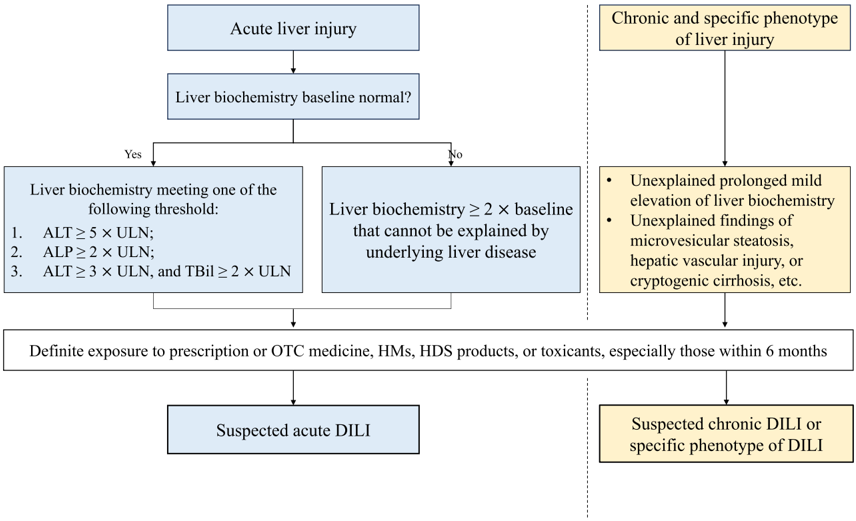
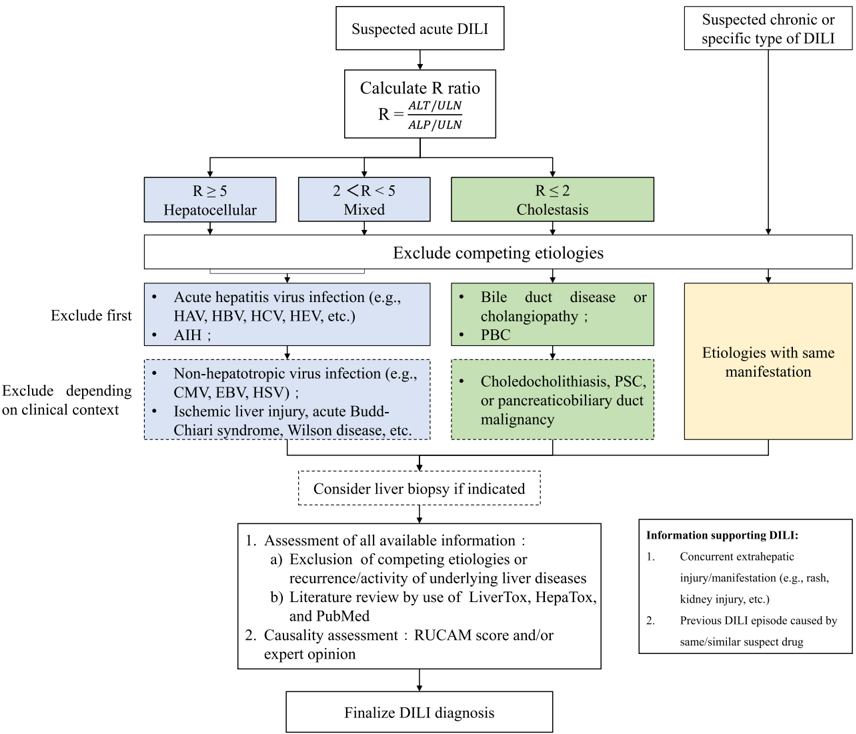
- Diagnosis uses R ratio classification: hepatocellular R ≥ 5, cholestatic R ≤ 2, mixed 2 < R < 5; acute DILI thresholds are ALT ≥ 5 × ULN, ALP ≥ 2 × ULN, or ALT ≥ 3 × ULN plus TBil ≥ 2 × ULN; RUCAM is recommended as the primary causality assessment method, with expert opinion in specific scenarios.
- Approximately 7–13% of patients may not normalize liver biochemistry 6 months or 1 year after acute DILI; about 10% of cases fulfilling Hy’s law progress to ALF; liver transplantation can increase survival up to 66.2% in DI-ALF/ACLF; NAC is recommended for adult DI-ALF/SALF, and magnesium isoglycyrrhizinate and bicyclol are recommended for acute hepatocellular or mixed DILI with significant ALT elevation.
Methods
- This is an updated clinical guideline developed according to the basic processes and procedures of guideline development promulgated by authoritative academic organizations; all expert writers signed a conflict-of-interest statement.
- Evidence assessment used the 2011 Oxford Centre for Evidence-Based Medicine levels of evidence and grades of recommendation; evidence collection and assessment were performed by the Health Data Science Institute of Lanzhou University, an independent third party.
- Recommendations are graded and cover diagnosis, differential diagnosis, causality assessment, severity/prognosis, chronic DILI and specific phenotypes, DILI with pre-existing liver disease, HBV reactivation, common etiologies, biomarkers, clinical-trial signals, treatment, prevention, and future research directions.
Limitations
- Stated: the guideline cannot cover or address all issues of DILI diagnosis and treatment arising in clinical practice and is not mandatory standards; it will be updated in due course as research progresses.
- Stated/evident: many recommendations rely on low-level evidence or expert consensus; the text notes no high-level evidence for conventional corticosteroid use in DILI, limited evidence for prophylactic liver-protective drugs, and that currently reported biomarkers have not been clinically validated for approval.
- Evident from text: RUCAM has ambiguities and suboptimal reliability, with reduced reliability in TCM/HDS-DILI, multiple suspected drugs, pre-existing liver disease, and new-drug trials; RECAM requires external validation outside the US and Spain, and its reliability in herb-induced liver injury remains unknown.
Model-written summary. Check it against the paper before relying on it.
Integrity signals
Registry
Cites
Statistics
Figures
Verification
Claims the paper makes
64 Not checked yet · 47 No full text of the sources · 16 Partly supported · 16 Own interpretation · 8 Supported · 4 Sources not found · 4 Own method · 2 Supported so far · 1 Not supported · accuracy not yet measured
At least one cited source doesn’t support this claim or points to a different paper, and none confirmed it — see the verdicts below.
In the paper
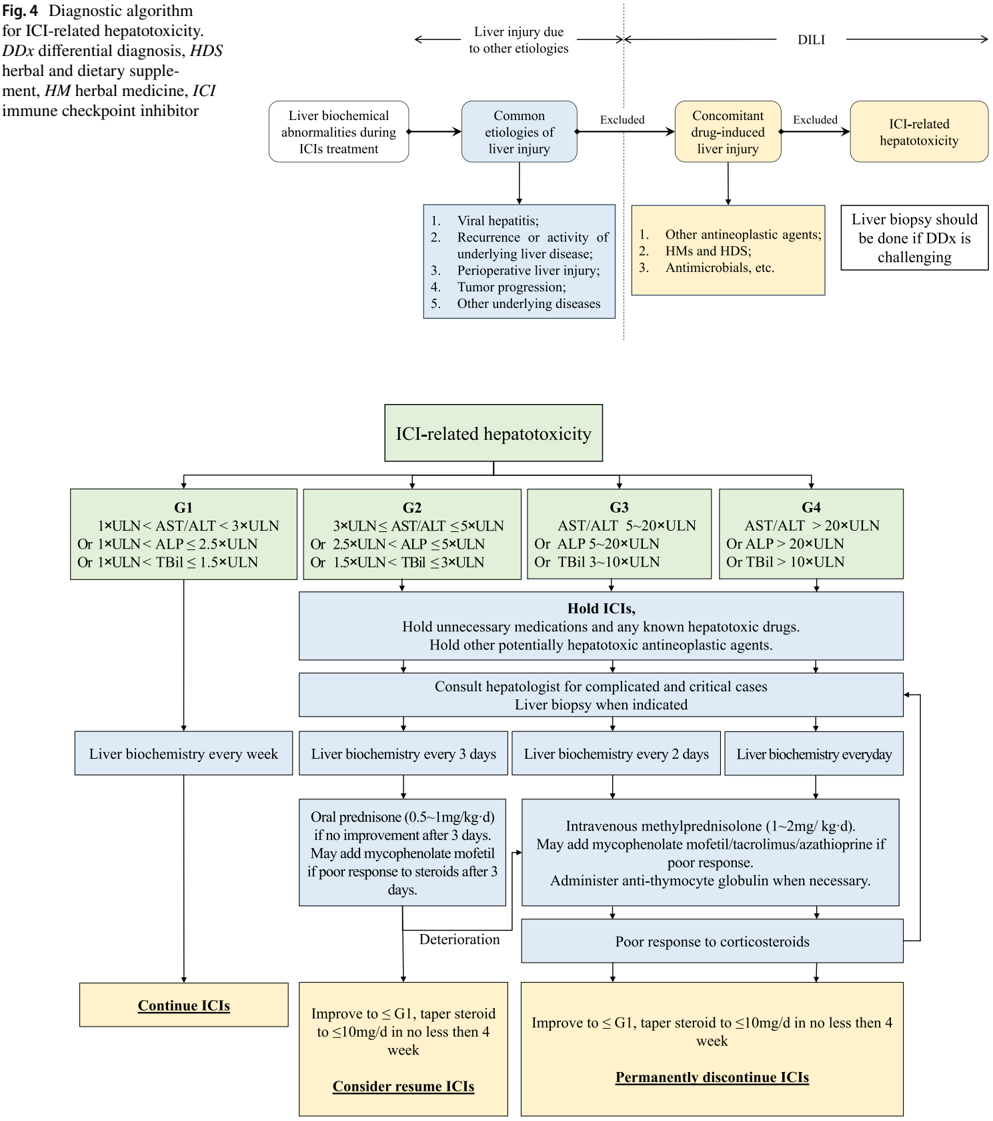
“the incidence of liver injury induced by cytotoxic T-lymphocyte antigen 4 inhibitors is higher than that induced by programmed cell death 1 inhibitors, particularly at high doses.”
§ Chinese guideline for the diagnosis and treatment of drug-induced liver injury: an update > Antineoplastic agents
What the sources say
- Not checked — no full text of the sourcecites [152] Peeraphatdit TB, Wang J, Odenwald MA, Hu S, Hart J, Charlton MR. Hepatotoxicity from immune checkpoint inhibitors: a systematic review and management recommendation. Hepatology. 2020;72:315–329 source
- Disputedcites [153] Lei XH, Tang YY, Li J, Mao YM. Hepatotoxicity associated with tumor immune checkpoint inhibitors. (Zhonghua Gan Zang Bing Za Zhi = Zhonghua Ganzangbing Zazhi) Chin J Hepatol. 2020;28:175–178 sourceExperimental — accuracy not yet measured
In “二、ICPIs相关肝毒性的发生率” (p. 2), the paper says that although CTLA-4 antibodies may cause more adverse reactions overall, current data show no clear difference in hepatotoxicity compared with PD-1/PD-L1 antibodies. In “四、ICPIs相关肝毒性的风险因素” (p. 2), the high-dose ipilimumab figures concern immune-related adverse reactions overall, not liver injury specifically. (LLM, conf=0.90)
Checked by a reasoning model — may be wrong.
plaindirect- Asserted: passes — The authors put it forward as true.
- Checkable: passes — It can be checked against evidence.
- Load-bearing: unclear — It is unclear whether the paper’s conclusions depend on it.
- Based: passes — The paper gives a reason why it holds.
The cited sources support only part of this claim — read each source’s verdict below.
In the paper
“Meanwhile, the importance of antibiotics, and non-steroidal anti-inflammatory drugs such as APAP should not be overlooked since these are still the commonest causing agents of DILI in most western countries [21].”
§ Chinese guideline for the diagnosis and treatment of drug-induced liver injury: an update > Drugs causing DILI
What the sources say
- Partly supportedcites [21] Chalasani N, Bonkovsky HL, Fontana R, et al. Features and outcomes of 899 patients with drug-induced liver injury: the DILIN prospective study. Gastroenterology. 2015;148(7):1340–1352 sourceExperimental — accuracy not yet measured
The Results section reports that antimicrobials, mostly antibiotics, were the most common causative class in this U.S. cohort (45%). It reports only 3% of cases attributed to analgesics, largely nonsteroidal anti-inflammatory drugs, so it does not support calling them the commonest agents. The Methods specify enrollment for suspected non-acetaminophen DILI, and this U.S. study does not establish what is commonest across most Western countries. (LLM, conf=0.91)
plaindirect- Asserted: passes — The authors put it forward as true.
- Checkable: passes — It can be checked against evidence.
- Load-bearing: unclear — It is unclear whether the paper’s conclusions depend on it.
- Based: passes — The paper gives a reason why it holds.
- Partly supported
The cited sources support only part of this claim — read each source’s verdict below.
In the paper
“Liver biochemistry in approximately 7-13% of patients may not return to normal or baseline levels 6 months or 1 year after an acute DILI episode, which indicates that acute liver injury may develop into a chronic injury or delayed recovery [8].”
§ Chinese guideline for the diagnosis and treatment of drug-induced liver injury: an update > Chronicity of acute DILI and delayed recovery
What the sources say
- Partly supportedcites [8] Shen T, Liu Y, Shang J, et al. Incidence and etiology of drug-induced liver injury in Mainland China. Gastroenterology. 2019;156:2230–2241 sourceExperimental — accuracy not yet measured
The Clinical presentations section reports that 13.00% of all DILI cases had persistent evidence of liver injury at least six months after onset. It also says that some patients classified as chronic at six months later normalized their liver chemistries, suggesting delayed recovery. The cited passages do not establish the 7% figure or a one-year rate, and the 13% denominator is all DILI cases rather than patients with acute DILI. (LLM, conf=0.86)
hedgedconditional- Asserted: passes — The authors put it forward as true.
- Checkable: passes — It can be checked against evidence.
- Load-bearing: unclear — It is unclear whether the paper’s conclusions depend on it.
- Based: passes — The paper gives a reason why it holds.
- Partly supported
Every source the paper cites for this claim was checked and supports it.
In the paper
“Prolonged cholestasis with progressive reduction of the interlobular bile ducts can lead to vanishing bile duct syndrome with a poor prognosis [74].”
§ Chinese guideline for the diagnosis and treatment of drug-induced liver injury: an update > Chronicity of acute DILI and delayed recovery
What the sources say
- Supportedcites [74] Bonkovsky HL, Kleiner DE, Gu J, et al. Clinical presentations and outcomes of bile duct loss caused by drugs and herbal and dietary supplements. Hepatology. 2017;65:1267–1277 source
The Conclusions (page not available) describe bile duct loss during cholestatic hepatitis as an ominous early indicator of possible vanishing bile duct syndrome. The Discussion (page not available) says bile duct loss has a poor prognosis, especially when moderate or severe, and reports cases of progressive cholestatic injury resulting in death or transplantation. (LLM, conf=0.88)
plaindirect- Asserted: passes — The authors put it forward as true.
- Checkable: passes — It can be checked against evidence.
- Load-bearing: unclear — It is unclear whether the paper’s conclusions depend on it.
- Based: passes — The paper gives a reason why it holds.
- Supported
The cited sources support only part of this claim — read each source’s verdict below.
In the paper
“In China, a large cohort study suggests that HDS accounts for 57% of druginduced ALF [70].”
§ Chinese guideline for the diagnosis and treatment of drug-induced liver injury: an update > Clinical phenotypes and diagnosis
What the sources say
- Partly supportedcites [70] Han L, Huang A, Chen J, et al. Clinical characteristics and prognosis of non-APAP drug-induced acute liver failure: a large multicenter cohort study. Hepatol Int. 2023. https://doi.org/10.1007/s12072-023-10541-w sourceExperimental — accuracy not yet measured
The Results (Drugs implicated in non-APAP drug-induced ALF) report that HDS accounted for 57.01% of cases in this Chinese cohort. The claim omits the study’s non-APAP restriction, so the figure is not established for all drug-induced ALF. (LLM, conf=0.88)
hedgedcorrelational- Asserted: passes — The authors put it forward as true.
- Checkable: passes — It can be checked against evidence.
- Load-bearing: unclear — It is unclear whether the paper’s conclusions depend on it.
- Based: passes — The paper gives a reason why it holds.
- Partly supported
The cited sources support only part of this claim — read each source’s verdict below.
In the paper
“Studies have shown that approximately 10% of cases that fulfill Hy's law will progress to ALF [5,64], and is associated increased mortality or need for liver transplantation [65][66][67][68].”
§ Chinese guideline for the diagnosis and treatment of drug-induced liver injury: an update > Prognosis, natural history, and follow-up
What the sources say
- Partly supportedcites [5] Andrade RJ, Lucena MI, Fernández MC, et al. Drug-induced liver injury: an analysis of 461 incidences submitted to the Spanish registry over a 10-year period. Gastroenterology. 2005;129:512–521 sourceExperimental — accuracy not yet measured
The Discussion (page not provided) says Hy’s rule predicts at least 10% liver transplantation and/or death in drug-induced hepatocellular jaundice, and the study observed 11.7% for those outcomes. The paper also says these patients are more prone to acute liver failure, but it does not report that approximately 10% of cases fulfilling Hy’s rule progress to acute liver failure; the claim substitutes a different outcome for the reported percentage. (LLM, conf=0.88)
- Partly supportedcites [64] Björnsson E, Olsson R. Outcome and prognostic markers in severe drug-induced liver disease. Hepatology. 2005;42:481–489 sourceExperimental — accuracy not yet measured
The Discussion (page not supplied) says hepatocellular jaundice consistent with Hy’s rule had approximately 10% mortality. The Comparison Between Nonsurvivors and Survivors section reports a 0.13 positive predictive value for death or transplantation among patients meeting the stated laboratory criteria. Neither passage establishes that approximately 10% progressed to acute liver failure (ALF); the cited outcome is different. (LLM, conf=0.87)
plaindirect- Asserted: passes — The authors put it forward as true.
- Checkable: passes — It can be checked against evidence.
- Load-bearing: unclear — It is unclear whether the paper’s conclusions depend on it.
- Based: passes — The paper gives a reason why it holds.
- Partly supported
Every source the paper cites for this claim was checked and supports it.
In the paper
“The novel DI-ALF-5 model was developed to predict transplant-free survival in non-APAP DI-ALF [70].”
§ Chinese guideline for the diagnosis and treatment of drug-induced liver injury: an update > Prognosis, natural history, and follow-up
What the sources say
- Supportedcites [70] Han L, Huang A, Chen J, et al. Clinical characteristics and prognosis of non-APAP drug-induced acute liver failure: a large multicenter cohort study. Hepatol Int. 2023. https://doi.org/10.1007/s12072-023-10541-w source
The Results (Novel prediction nomogram development) state that the authors constructed the DIALF-5 model and evaluated its accuracy in predicting 21-day transplant-free survival. The Discussion states that it was developed for patients with non-APAP drug-induced acute liver failure. The claim’s “DI-ALF-5” refers to the paper’s “DIALF-5.” (LLM, conf=0.95)
plain- Asserted: passes — The authors put it forward as true.
- Checkable: passes — It can be checked against evidence.
- Load-bearing: unclear — It is unclear whether the paper’s conclusions depend on it.
- Based: passes — The paper gives a reason why it holds.
- Supported
Every source the paper cites for this claim was checked and supports it.
In the paper
“In a randomized placebo-controlled trial of adult non-APAP ALF (including DILI as the etiology), intravenous NAC improved transplant-free survival in early stage ALF with grade I-II coma [185].”
§ Chinese guideline for the diagnosis and treatment of drug-induced liver injury: an update > N-Acetylcysteine
What the sources say
- Supportedcites [185] Lee WM, Hynan LS, Rossaro L, et al. Intravenous N-acetylcysteine improves transplant-free survival in early stage non-acetaminophen acute liver failure. Gastroenterology. 2009;137:3 source
Methods > Study Population specifies adult eligibility and exclusion of acetaminophen overdose; Results > Study Population identifies 45 participants with drug-induced liver injury. Abstract > Methods describes random assignment to intravenous NAC or placebo, and Results > Study outcomes reports higher transplant-free survival with NAC among patients with grade I–II coma (52% versus 30%). Page numbers are unavailable in our copy. (LLM, conf=0.94)
plaindirect- Asserted: passes — The authors put it forward as true.
- Checkable: passes — It can be checked against evidence.
- Load-bearing: passes — The paper’s conclusions depend on it.
- Based: passes — The paper gives a reason why it holds.
- Supported
The cited sources support only part of this claim — read each source’s verdict below.
In the paper
“In clinical trials, the incidence of all-grade liver injury due to different smallmolecule targeted drugs such as tyrosine kinase inhibitors is reportedly 5-55% [144-149].”
§ Chinese guideline for the diagnosis and treatment of drug-induced liver injury: an update > Antineoplastic agents
What the sources say
- Partly supportedcites [144] Mok TS, Wu Y-L, Thongprasert S, et al. Gefitinib or carboplatin-paclitaxel in pulmonary adenocarcinoma. N Engl J Med. 2009;361:947–957 sourceExperimental — accuracy not yet measured
The Safety and Adverse-Event Profile reports that elevated liver aminotransferase levels were significantly more common with gefitinib than with carboplatin–paclitaxel. It does not provide the claimed 5–55% all-grade liver-injury range across different small-molecule targeted drugs; this trial examines gefitinib, not that broader drug class. (LLM, conf=0.84)
- Not checked — no full text of the sourcecites [145] Mitsudomi T, Morita S, Yatabe Y, et al. Gefitinib versus cisplatin plus docetaxel in patients with non-small-cell lung cancer harbouring mutations of the epidermal growth factor receptor (WJTOG3405): an open label, randomised phase 3 trial. Lancet Oncol. 2010;11:121–128 source
- Not checked — no full text of the sourcecites [146] Maemondo M, Inoue A, Kobayashi K, et al. Gefitinib or chemotherapy for non-small-cell lung cancer with mutated EGFR. N Engl J Med. 2010;362:2380–2388 source
- Not checked — no full text of the sourcecites [147] Rosell R, Carcereny E, Gervais R, et al. Erlotinib versus standard chemotherapy as first-line treatment for European patients with advanced EGFR mutation-positive non-small-cell lung cancer (EURTAC): a multicentre, open-label, randomised phase 3 trial. Lancet Oncol. 2012;13:239–246 source
- Not checked — no full text of the sourcecites [148] Wu Y-L, Zhou C, Hu C-P, et al. Afatinib versus cisplatin plus gemcitabine for first-line treatment of Asian patients with advanced non-small-cell lung cancer harbouring EGFR mutations (LUX-Lung 6): an open-label, randomised phase 3 trial. Lancet Oncol. 2014;15:213–222 source
- Not checked — no full text of the sourcecites [149] Shi YK, Wang L, Han BH, et al. First-line icotinib versus cisplatin/pemetrexed plus pemetrexed maintenance therapy for patients with advanced EGFR mutation-positive lung adenocarcinoma (CONVINCE): a phase 3, open-label, randomized study. Ann Oncol. 2017;28:2443–2450 source
plaindirect- Asserted: passes — The authors put it forward as true.
- Checkable: passes — It can be checked against evidence.
- Load-bearing: unclear — It is unclear whether the paper’s conclusions depend on it.
- Based: passes — The paper gives a reason why it holds.
- Partly supported
The cited sources support only part of this claim — read each source’s verdict below.
In the paper
“Liver transplantation can significantly increase survival by up to 66.2% [66,211,212].”
§ Chinese guideline for the diagnosis and treatment of drug-induced liver injury: an update > Liver transplantation in DI-ALF/ACLF
What the sources say
- Could not verifycites [66] Hayashi PH, Rockey DC, Fontana RJ, et al. Death and liver transplantation within 2 years of onset of drug-induced liver injury. Hepatology. 2017;66:1275–1285 sourceExperimental — accuracy not yet measured
The Results section (page unavailable) reports how often patients with drug-induced liver failure received transplants, but not whether transplantation improved survival. A search for the 66.2% figure and for post-transplant survival comparisons found neither a survival benefit estimate nor that figure in our copy. (LLM, conf=0.74)
- Partly supportedcites [211] Reuben A, Koch DG, Lee WM. Drug-induced acute liver failure: results of a US multicenter, prospective study. Hepatology. 2010;52:2065–2076 sourceExperimental — accuracy not yet measured
The Results (Outcomes) report 92.9% survival among transplant recipients and 66.2% overall survival in the drug-induced acute liver failure cohort. The 66.2% figure is overall survival, not the amount by which transplantation increased survival; the passage does not establish a statistically significant increase or address acute-on-chronic liver failure. (LLM, conf=0.89)
- Partly supportedcites [212] Stravitz RT, Lee WM. Acute liver failure. Lancet. 2019;394:869–881 sourceExperimental — accuracy not yet measured
The Liver transplantation section (page not provided) says transplantation contributed to lower overall mortality in acute liver failure and that transplant recipients had lower two-year mortality than specified non-transplanted survivors. It does not report a survival increase of 66.2%. The paper distinguishes acute liver failure from acute-on-chronic liver failure, so it does not support extending this claim to that population. (LLM, conf=0.88)
plaindirect- Asserted: passes — The authors put it forward as true.
- Checkable: passes — It can be checked against evidence.
- Load-bearing: passes — The paper’s conclusions depend on it.
- Based: passes — The paper gives a reason why it holds.
- Could not verify
The cited sources support only part of this claim — read each source’s verdict below.
In the paper
“L-ornithine-L-aspartate may be beneficial for the treatment of hyperammonemia in critical cases or liver failure [213][214][215][216][217].”
§ Chinese guideline for the diagnosis and treatment of drug-induced liver injury: an update > Liver transplantation in DI-ALF/ACLF
What the sources say
- Partly supportedcites [213] Goh ET, Stokes CS, Sidhu SS, Vilstrup H, Gluud LL, Morgan MY. l-Ornithine l-aspartate for prevention and treatment of hepatic encephalopathy in people with cirrhosis. Cochrane Database Syst Rev. 2018;5:CD012410 sourceExperimental — accuracy not yet measured
The review’s Exploratory outcomes section reports reduced blood ammonia concentrations with L-ornithine L-aspartate, and its discussion says the treatment might benefit people with hepatic encephalopathy. Its own review, however, concerns people with cirrhosis; it does not establish a benefit for critical cases or liver failure generally. (LLM, conf=0.84)
- Not checked — no full text of the sourcecites [214] Schmid M, Peck-Radosavljevic M, König F, Mittermaier C, Gangl A, Ferenci P. A double-blind, randomized, placebo-controlled trial of intravenous l-ornithine-l-aspartate on postural control in patients with cirrhosis. Liver Int. 2010;30:574–582 source
- Not checked — no full text of the sourcecites [215] Jain A, Sharma BC, Mahajan B, et al. l-Ornithine l-aspartate in acute treatment of severe hepatic encephalopathy: a double-blind randomized controlled trial. Hepatology. 2022;75:1194–1203 source
- Partly supportedcites [216] Sidhu SS, Sharma BC, Goyal O, Kishore H, Kaur N. l-Ornithine l-aspartate in bouts of overt hepatic encephalopathy. Hepatology. 2018;67:700–710 sourceExperimental — accuracy not yet measured
The Secondary Outcome Analyses report a significant reduction in blood ammonia with L-ornithine-L-aspartate versus placebo. However, Patients and Methods limits the trial to adults with cirrhosis and overt hepatic encephalopathy; terminally ill patients and those with acute-on-chronic liver failure were excluded. The result therefore does not establish benefit for critical cases or liver failure generally. (LLM, conf=0.88)
- Not checked — no full text of the sourcecites [217] Acharya SK, Bhatia V, Sreenivas V, Khanal S, Panda SK. Efficacy of l-ornithine l-aspartate in acute liver failure: a double-blind, randomized, placebo-controlled study. Gastroenterology. 2009;136:2159–2168 source
hedgedconditional- Asserted: passes — The authors put it forward as true.
- Checkable: passes — It can be checked against evidence.
- Load-bearing: unclear — It is unclear whether the paper’s conclusions depend on it.
- Based: passes — The paper gives a reason why it holds.
- Partly supported
Every source the paper cites for this claim was checked and supports it.
In the paper
“A history of exposure to suspected HMs or HDS is the cornerstone of diagnosis [123].”
§ Chinese guideline for the diagnosis and treatment of drug-induced liver injury: an update > Clinical phenotypes and diagnosis
What the sources say
- Supportedcites [123] Navarro VJ, Barnhart H, Bonkovsky HL, et al. Liver injury from herbals and dietary supplements in the US drug-induced liver injury network. Hepatology. 2014;60:1399–1408 source
The Methods (Inclusion Criteria and Patient Ascertainment Procedures; page not provided) say investigators obtained patients’ chronological history of drug and HDS use. The Methods (Causality Assessment and Outcomes; page not provided) then describe assessing whether that use could have caused the liver injury. Together, these support the claim that exposure history is central to diagnosis, though the paper also requires evaluation for other causes. (LLM, conf=0.84)
plaindirect- Asserted: passes — The authors put it forward as true.
- Checkable: passes — It can be checked against evidence.
- Load-bearing: passes — The paper’s conclusions depend on it.
- Based: passes — The paper gives a reason why it holds.
- Supported
The cited sources support only part of this claim — read each source’s verdict below.
In the paper
“while 40-60 mg/d prednisone taper over 1-3 months may improve normalization of liver enzyme for iDILI [82,191].”
§ Chinese guideline for the diagnosis and treatment of drug-induced liver injury: an update > Corticosteroids
What the sources say
- Partly supportedcites [82] Fontana RJ, Liou I, Reuben A, et al. AASLD practice guidance on drug, herbal, and dietary supplement-induced liver injury. Hepatology. 2023;77:1036–1065 sourceExperimental — accuracy not yet measured
Table 9 in “Medical management of idiosyncratic patients with DILI” lists 40–60 mg of prednisone for selected patients and says corticosteroids can frequently be tapered over 1–3 months. The same section says a short course may benefit such patients, but it does not specifically say it improves normalization of liver enzymes; it also notes that the optimal dose and duration are unknown. (LLM, conf=0.85)
- Partly supportedcites [191] Niu H, Ma J, Medina-Caliz I, et al. Potential benefit and lack of serious risk from corticosteroids in drug-induced liver injury: an international, multicentre, propensity score-matched analysis. Aliment Pharmacol Ther. 2023;57:886–896 sourceExperimental — accuracy not yet measured
Section 3.4 reports a higher liver-enzyme normalisation rate among corticosteroid-treated DILI patients. Section 3.1 reports a median initial dose of 40 mg/day and a median treatment duration of 59 days, but the Discussion says dosing and tapering varied and that the study could not evaluate outcomes specifically in patients with an autoimmune phenotype. It therefore does not establish the claimed benefit for a 40–60 mg/day prednisone taper over 1–3 months in immune-mediated DILI. (LLM, conf=0.90)
hedgedconditional- Asserted: passes — The authors put it forward as true.
- Checkable: passes — It can be checked against evidence.
- Load-bearing: passes — The paper’s conclusions depend on it.
- Based: passes — The paper gives a reason why it holds.
- Partly supported
The cited sources support only part of this claim — read each source’s verdict below.
In the paper
“The overall prognosis of DI-ALF/ACLF is poor, with 24% or 27.1% transplant-free survival.”
§ Chinese guideline for the diagnosis and treatment of drug-induced liver injury: an update > Liver transplantation in DI-ALF/ACLF
What the sources say
- Not checked yetcites [66] Hayashi PH, Rockey DC, Fontana RJ, et al. Death and liver transplantation within 2 years of onset of drug-induced liver injury. Hepatology. 2017;66:1275–1285 source
Checked before — its earlier verdict is held back until a new check runs.
- Partly supportedcites [211] Reuben A, Koch DG, Lee WM. Drug-induced acute liver failure: results of a US multicenter, prospective study. Hepatology. 2010;52:2065–2076 sourceExperimental — accuracy not yet measured
The Results (Outcomes; page not available) report 27.1% transplant-free survival for drug-induced acute liver failure, supporting the claim that its prognosis is poor. The paper does not report 24% transplant-free survival, and its Patients and Methods define the study population as having no apparent chronic liver disease, so its finding does not establish the prognosis of acute-on-chronic liver failure. (LLM, conf=0.90)
- Partly supportedcites [212] Stravitz RT, Lee WM. Acute liver failure. Lancet. 2019;394:869–881 sourceExperimental — accuracy not yet measured
The Drug-induced liver injury section describes a worse prognosis and says fewer than 25% recover after encephalopathy develops, but that is not an overall transplant-free survival rate. The Outcomes section gives 41% transplant-free survival for drug-induced liver injury, not 24% or 27.1%. The paper also distinguishes acute liver failure from acute-on-chronic liver failure rather than reporting an outcome for the latter. (LLM, conf=0.87)
plain- Asserted: passes — The authors put it forward as true.
- Checkable: passes — It can be checked against evidence.
- Load-bearing: passes — The paper’s conclusions depend on it.
- Based: passes — The paper gives a reason why it holds.
- Not checked yet
Every source the paper cites for this claim was checked and supports it.
In the paper
“However, no significant benefits were observed with NAC in pediatric non-APAP-induced ALF [186].”
§ Chinese guideline for the diagnosis and treatment of drug-induced liver injury: an update > N-Acetylcysteine
What the sources say
- Supportedcites [186] Squires RH, Dhawan A, Alonso E, et al. Intravenous N-acetylcysteine in pediatric patients with nonacetaminophen acute liver failure: a placebo-controlled clinical trial. Hepatology. 2013;57:1542–1549 source
The Results (Study outcomes) found no significant difference in one-year survival between NAC and placebo, including in the reported subgroups. The Discussion likewise states that NAC did not improve one-year survival in children with non-APAP acute liver failure; it also reports significantly lower transplant-free survival with NAC. (LLM, conf=0.92)
plain- Asserted: passes — The authors put it forward as true.
- Checkable: passes — It can be checked against evidence.
- Load-bearing: passes — The paper’s conclusions depend on it.
- Based: passes — The paper gives a reason why it holds.
- Supported
In the paper
“The most common drugs that cause liver injury in China include TCM, HDS, anti-TB drugs, antineoplastic agents, and immunomodulators [8].”
§ Chinese guideline for the diagnosis and treatment of drug-induced liver injury: an update > Drugs causing DILI
What the sources say
- Not checked yetcites [8] Shen T, Liu Y, Shang J, et al. Incidence and etiology of drug-induced liver injury in Mainland China. Gastroenterology. 2019;156:2230–2241 source
plaindirect- Asserted: passes — The authors put it forward as true.
- Checkable: passes — It can be checked against evidence.
- Load-bearing: unclear — It is unclear whether the paper’s conclusions depend on it.
- Based: passes — The paper gives a reason why it holds.
None of the sources cited for this claim have been checked yet.
In the paper
“The drugs that cause liver injury vary across countries and regions owing to the epidemiology of the primary disease, variations in prescribing habits, and population heterogeneity [15].”
§ Chinese guideline for the diagnosis and treatment of drug-induced liver injury: an update > Drugs causing DILI
What the sources say
- Not checked yetcites [15] Low EXS, Zheng Q, Chan E, Lim SG. Drug induced liver injury: east versus west—a systematic review and meta-analysis. Clin Mol Hepatol. 2020;26:142–154 source
Checked before — its earlier verdict is held back until a new check runs.
plaindirect- Asserted: passes — The authors put it forward as true.
- Checkable: passes — It can be checked against evidence.
- Load-bearing: unclear — It is unclear whether the paper’s conclusions depend on it.
- Based: passes — The paper gives a reason why it holds.
- Not checked yet
None of the sources cited for this claim have been checked yet.
In the paper
“In Asian countries, such as South Korea [7], Malaysia [16], Thailand [17], Singapore [18], Taiwan [19], India [20], and China [8], anti-TB drugs, herbal and alternative medications such as traditional Chinese medicine (TCM), and antibiotics are the leading causes of DILI.”
§ Chinese guideline for the diagnosis and treatment of drug-induced liver injury: an update > Drugs causing DILI
What the sources say
- Not checked — no full text of the sourcecites [7] Suk KT, Kim DJ, Kim CH, et al. A prospective nationwide study of drug-induced liver injury in Korea. Am J Gastroenterol. 2012;107:1380–1387 source
- Not matchedcites [16] Marzuki OA, Fauzi ARM, Ayoub S, Kamarul IM. Prevalence and risk factors of anti-tuberculosis drug-induced hepatitis in Malaysia. Singap Med J. 2008;49:688–693
Couldn’t be matched to a paper in Crossref, so it can’t be checked.
- Not checked yetcites [17] Chirapongsathorn S, Sukeepaisarnjaroen W, Treeprasertsuk S, et al. Characteristics of drug-induced liver injury in chronic liver disease: results from the Thai Association for the Study of the Liver (THASL) DILI Registry. J Clin Transl Hepatol. 2023;11:88–96 source
Checked before — its earlier verdict is held back until a new check runs.
plaindirect- Asserted: passes — The authors put it forward as true.
- Checkable: passes — It can be checked against evidence.
- Load-bearing: unclear — It is unclear whether the paper’s conclusions depend on it.
- Based: passes — The paper gives a reason why it holds.
None of the sources cited for this claim have been checked yet.
In the paper
“Unlike AIH, most cases of DI-ALH rarely relapse in the long-term follow-up after the discontinuation of corticosteroid or immunosuppressive therapy [83,84], which is the key information that indicates the probability of DI-ALH, particularly for patients with a history of classical drug exposure.”
§ Chinese guideline for the diagnosis and treatment of drug-induced liver injury: an update > Specific phenotypes
What the sources say
- Not checked yetcites [83] Björnsson E, Talwalkar J, Treeprasertsuk S, et al. Drug-induced autoimmune hepatitis: clinical characteristics and prognosis. Hepatology. 2010;51:2040–2048 source
Checked before — its earlier verdict is held back until a new check runs.
- Not checked — no full text of the sourcecites [84] Björnsson ES, Bergmann O, Jonasson JG, Grondal G, Gudbjornsson B, Olafsson S. Drug-induced autoimmune hepatitis: response to corticosteroids and lack of relapse after cessation of steroids. Clin Gastroenterol Hepatol. 2017;15:1635–1636 source
plain- Asserted: passes — The authors put it forward as true.
- Checkable: passes — It can be checked against evidence.
- Load-bearing: passes — The paper’s conclusions depend on it.
- Based: passes — The paper gives a reason why it holds.
- Not checked yet
None of the sources cited for this claim have been checked yet.
In the paper
“Genetic polymorphism of the CYP 450 enzyme may be associated with an increased risk of liver injury induced by certain drugs [46,47].”
§ Chinese guideline for the diagnosis and treatment of drug-induced liver injury: an update > Host-related risk factors
What the sources say
- Not checked — no full text of the sourcecites [46] Stephens C, Lucena MI, Andrade RJ. Genetic risk factors in the development of idiosyncratic drug-induced liver injury. Expert Opin Drug Metab Toxicol. 2021;17:153–169 source
- Not checked yetcites [47] Zanger UM, Schwab M. Cytochrome P450 enzymes in drug metabolism: regulation of gene expression, enzyme activities, and impact of genetic variation. Pharmacol Ther. 2013;138:103–141 source
hedgedcorrelational- Asserted: passes — The authors put it forward as true.
- Checkable: passes — It can be checked against evidence.
- Load-bearing: unclear — It is unclear whether the paper’s conclusions depend on it.
- Based: passes — The paper gives a reason why it holds.
None of the sources cited for this claim have been checked yet.
In the paper
“Similarly, some small-sample-size studies suggest that NAFLD may increase the risk of all-cause DILI [101][102][103].”
§ Chinese guideline for the diagnosis and treatment of drug-induced liver injury: an update > DILI with pre-existing liver disease
What the sources say
- Not checked — no full text of the sourcecites [101] Lammert C, Imler T, Teal E, Chalasani N. Patients with chronic liver disease suggestive of nonalcoholic fatty liver disease may be at higher risk for drug-induced liver injury. Clin Gastroenterol Hepatol. 2019;17:2814–2815 source
- Not checked yetcites [102] Liu Y-H, Guo Y, Xu H, Feng H, Chen D-Y. Impact of non-alcoholic simple fatty liver disease on antituberculosis drug-induced liver injury. Infect Drug Resist. 2021;14:3667–3671 source
Checked before — its earlier verdict is held back until a new check runs.
- Not checked — no full text of the sourcecites [103] Tarantino G, Conca P, Basile V, et al. A prospective study of acute drug-induced liver injury in patients suffering from non-alcoholic fatty liver disease. Hepatol Res. 2007;37:410–415 source
hedgedconditional- Asserted: passes — The authors put it forward as true.
- Checkable: passes — It can be checked against evidence.
- Load-bearing: unclear — It is unclear whether the paper’s conclusions depend on it.
- Based: passes — The paper gives a reason why it holds.
None of the sources cited for this claim have been checked yet.
In the paper
“Liver biopsy can provide valuable histopathological information that may help clarify the diagnosis of DILI when it is difficult to exclude competing etiologies [52].”
§ Chinese guideline for the diagnosis and treatment of drug-induced liver injury: an update > Liver biopsy
What the sources say
- Not checked yetcites [52] Ahmad J, Barnhart HX, Bonacini M, et al. Value of liver biopsy in the diagnosis of drug-induced liver injury. J Hepatol. 2022;76:1070–1078 source
Checked before — its earlier verdict is held back until a new check runs.
hedgedconditional- Asserted: passes — The authors put it forward as true.
- Checkable: passes — It can be checked against evidence.
- Load-bearing: passes — The paper’s conclusions depend on it.
- Based: passes — The paper gives a reason why it holds.
- Not checked yet
None of the sources cited for this claim have been checked yet.
In the paper
“However, in populations with chronic liver disease including NAFLD, the risk of statin-induced DILI did not increase [104][105][106].”
§ Chinese guideline for the diagnosis and treatment of drug-induced liver injury: an update > DILI with pre-existing liver disease
What the sources say
- Not checked — no full text of the sourcecites [104] Chalasani N, Aljadhey H, Kesterson J, Murray MD, Hall SD. Patients with elevated liver enzymes are not at higher risk for statin hepatotoxicity. Gastroenterology. 2004;126:1287–1292 source
- Not checked — no full text of the sourcecites [105] Cohen DE, Anania FA, Chalasani N. An assessment of statin safety by hepatologists. Am J Cardiol. 2006;97:77C-81C source
- Not checked yetcites [106] Lewis JH, Mortensen ME, Zweig S, Fusco MJ, Medoff JR, Belder R. Efficacy and safety of high-dose pravastatin in hypercholesterolemic patients with well-compensated chronic liver disease: results of a prospective, randomized, double-blind, placebo-controlled, multicenter trial. Hepatology. 2007;46:1453–1463 source
Checked before — its earlier verdict is held back until a new check runs.
plain- Asserted: passes — The authors put it forward as true.
- Checkable: passes — It can be checked against evidence.
- Load-bearing: passes — The paper’s conclusions depend on it.
- Based: passes — The paper gives a reason why it holds.
In the paper
“Current evidence suggests that decompensated cirrhosis may affect drug metabolism in the liver and hepatocyte regeneration after acute liver injury, which may increase the risk of critical illness or prolong the time to recovery [100,[109][110][111].”
§ Chinese guideline for the diagnosis and treatment of drug-induced liver injury: an update > DILI with pre-existing liver disease
What the sources say
- Not matchedcites [100,[109][110][111]
Couldn’t be matched to a paper in Crossref, so it can’t be checked.
hedgedconditional- Asserted: passes — The authors put it forward as true.
- Checkable: passes — It can be checked against evidence.
- Load-bearing: passes — The paper’s conclusions depend on it.
- Based: passes — The paper gives a reason why it holds.
- Not matched
In the paper
“HLA polymorphisms associated with certain drugs have also been reported [1].”
§ Chinese guideline for the diagnosis and treatment of drug-induced liver injury: an update > Host-related risk factors
What the sources say
- Not checked — no full text of the sourcecites [1] Li X, Tang J, Mao Y. Incidence and risk factors of drug-induced liver injury. Liver Int. 2022;42:1999–2014 source
plaincorrelational- Asserted: passes — The authors put it forward as true.
- Checkable: passes — It can be checked against evidence.
- Load-bearing: unclear — It is unclear whether the paper’s conclusions depend on it.
- Based: passes — The paper gives a reason why it holds.
None of the sources cited for this claim have been checked yet.
In the paper
“Prospective research conducted in the DILIN used a structured expert opinion process (SEOP) for causality assessment [62].”
§ Chinese guideline for the diagnosis and treatment of drug-induced liver injury: an update > Causality assessment
What the sources say
- Not checked yetcites [62] Rockey DC, Seeff LB, Rochon J, et al. Causality assessment in drug-induced liver injury using a structured expert opinion process: comparison to the Roussel–Uclaf causality assessment method. Hepatology. 2010;51:2117–2126 source
Checked before — its earlier verdict is held back until a new check runs.
plain- Asserted: passes — The authors put it forward as true.
- Checkable: passes — It can be checked against evidence.
- Load-bearing: unclear — It is unclear whether the paper’s conclusions depend on it.
- Based: passes — The paper gives a reason why it holds.
- Not checked yet
A conclusion the paper draws from its own results — it cites no other source for it, so there is none to check. The quote shows it is in the paper.
In the paper
“However, due to various confounding factors in most retrospective cohorts, the risk of HBV or HCV infection remains in doubt.”
§ Chinese guideline for the diagnosis and treatment of drug-induced liver injury: an update > DILI with pre-existing liver disease
hedged- Asserted: passes — The authors put it forward as true.
- Checkable: passes — It can be checked against evidence.
- Load-bearing: passes — The paper’s conclusions depend on it.
- Based: passes — The paper gives a reason why it holds.
None of the sources cited for this claim have been checked yet.
In the paper
“Although the exact mechanism of PA-HSOS remains known, the destruction of hepatic sinusoidal endothelial cells in the liver acinus by toxic metabolites of PA and long persistence of PA metabolites especially pyrrole protein adducts in vivo may play an important role in the toxicity [86][87][88].”
§ Chinese guideline for the diagnosis and treatment of drug-induced liver injury: an update > Specific phenotypes
What the sources say
- Not checked yetcites [86] Wang Z, Han H, Wang C, et al. Hepatotoxicity of pyrrolizidine alkaloid compound intermedine: comparison with other pyrrolizidine alkaloids and its toxicological mechanism. Toxins (Basel). 2021;13:849 source
Checked before — its earlier verdict is held back until a new check runs.
- Not checked yetcites [87] Yang X-Q, Ye J, Li X, Li Q, Song Y-H. Pyrrolizidine alkaloids-induced hepatic sinusoidal obstruction syndrome: Pathogenesis, clinical manifestations, diagnosis, treatment, and outcomes. World J Gastroenterol. 2019;25:3753–3763 source
Checked before — its earlier verdict is held back until a new check runs.
- Not checked — no full text of the sourcecites [88] Chen Y, Xiong F, Wang W, et al. The long persistence of pyrrolizidine alkaloid-derived pyrrole-protein adducts in vivo: Kinetic study following multiple exposures of a pyrrolizidine alkaloid containing extract of Gynura japonica. Toxicol Lett. 2020;323:41–47 source
hedgedconditional- Asserted: passes — The authors put it forward as true.
- Checkable: passes — It can be checked against evidence.
- Load-bearing: unclear — It is unclear whether the paper’s conclusions depend on it.
- Based: passes — The paper gives a reason why it holds.
- Not checked yet
None of the sources cited for this claim have been checked yet.
In the paper
“Another validated model incorporating the Model for End-Stage Liver Disease score, the serum albumin level, and the Charlson comorbidity index as parameters may be useful in predicting the 6-month risk of death in patients with DILI [71].”
§ Chinese guideline for the diagnosis and treatment of drug-induced liver injury: an update > Prognosis, natural history, and follow-up
What the sources say
- Not checked yetcites [71] Ghabril M, Gu J, Yoder L, et al. Development and validation of a model consisting of comorbidity burden to calculate risk of death within 6 months for patients with suspected drug-induced liver injury. Gastroenterology. 2019;157(5):1245–1252 source
Checked before — its earlier verdict is held back until a new check runs.
hedgedcorrelational- Asserted: passes — The authors put it forward as true.
- Checkable: passes — It can be checked against evidence.
- Load-bearing: unclear — It is unclear whether the paper’s conclusions depend on it.
- Based: passes — The paper gives a reason why it holds.
- Not checked yet
A claim is checked only against the cited paper’s full text, never its abstract, and none is available for its sources.
In the paper
“There is insufficient evidence suggesting that currently reported drug-and host-related risk factors can increase all-cause susceptibility to iDILI [1,27].”
§ Chinese guideline for the diagnosis and treatment of drug-induced liver injury: an update > Risk factors
What the sources say
- Not checked — no full text of the sourcecites [1] Li X, Tang J, Mao Y. Incidence and risk factors of drug-induced liver injury. Liver Int. 2022;42:1999–2014 source
- Not checked — no full text of the sourcecites [27] Chalasani NP, Maddur H, Russo MW, Wong RJ, Reddy KR. ACG clinical guideline: diagnosis and management of idiosyncratic drug-induced liver injury. Am J Gastroenterol. 2021;116:878–898 source
hedged- Asserted: passes — The authors put it forward as true.
- Checkable: passes — It can be checked against evidence.
- Load-bearing: unclear — It is unclear whether the paper’s conclusions depend on it.
- Based: passes — The paper gives a reason why it holds.
None of the sources cited for this claim have been checked yet.
In the paper
“Recent studies suggest that liver biopsy can significantly affect the score of Roussel-Uclaf causality assessment method (RUCAM) [52].”
§ Chinese guideline for the diagnosis and treatment of drug-induced liver injury: an update > History taking
What the sources say
- Not checked yetcites [52] Ahmad J, Barnhart HX, Bonacini M, et al. Value of liver biopsy in the diagnosis of drug-induced liver injury. J Hepatol. 2022;76:1070–1078 source
Checked before — its earlier verdict is held back until a new check runs.
hedgeddirect- Asserted: passes — The authors put it forward as true.
- Checkable: passes — It can be checked against evidence.
- Load-bearing: unclear — It is unclear whether the paper’s conclusions depend on it.
- Based: passes — The paper gives a reason why it holds.
- Not checked yet
None of the sources cited for this claim have been checked yet.
In the paper
“Current evidence does not support the opinion that diabetes or obesity increase susceptibility to all-cause DILI [5], although they may increase the risk of liver injury induced by certain drugs such as tamoxifen and methotrexate [44,45].”
§ Chinese guideline for the diagnosis and treatment of drug-induced liver injury: an update > Host-related risk factors
What the sources say
- Not checked yetcites [44] Bruno S, Maisonneuve P, Castellana P, et al. Incidence and risk factors for non-alcoholic steatohepatitis: prospective study of 5408 women enrolled in Italian tamoxifen chemoprevention trial. BMJ. 2005;330:932 source
Checked before — its earlier verdict is held back until a new check runs.
- Not checked — no full text of the sourcecites [45] Rosenberg P, Urwitz H, Johannesson A, et al. Psoriasis patients with diabetes type 2 are at high risk of developing liver fibrosis during methotrexate treatment. J Hepatol. 2007;46:1111–1118 source
hedgedconditional- Asserted: passes — The authors put it forward as true.
- Checkable: passes — It can be checked against evidence.
- Load-bearing: unclear — It is unclear whether the paper’s conclusions depend on it.
- Based: passes — The paper gives a reason why it holds.
- Not checked yet
None of the sources cited for this claim have been checked yet.
In the paper
“Approximately 7-24% of acute DILI cases can transition to chronic injury, which presents with signs of chronic DILI [3,5,21,24,25].”
§ Chinese guideline for the diagnosis and treatment of drug-induced liver injury: an update > Clinical phenotype
What the sources say
- Not checked — no full text of the sourcecites [3] Björnsson ES, Bergmann OM, Björnsson HK, Kvaran RB, Olafsson S. Incidence, presentation, and outcomes in patients with drug-induced liver injury in the general population of Iceland. Gastroenterology. 2013;144(7):1419–1425 source
- Not checked yetcites [5] Andrade RJ, Lucena MI, Fernández MC, et al. Drug-induced liver injury: an analysis of 461 incidences submitted to the Spanish registry over a 10-year period. Gastroenterology. 2005;129:512–521 source
Checked before — its earlier verdict is held back until a new check runs.
- Not checked yetcites [21] Chalasani N, Bonkovsky HL, Fontana R, et al. Features and outcomes of 899 patients with drug-induced liver injury: the DILIN prospective study. Gastroenterology. 2015;148(7):1340–1352 source
plaindirect- Asserted: passes — The authors put it forward as true.
- Checkable: passes — It can be checked against evidence.
- Load-bearing: unclear — It is unclear whether the paper’s conclusions depend on it.
- Based: passes — The paper gives a reason why it holds.
In the paper
“However, this method requires external validation from regions other than US and Spain since it was developed based on case data from Drug-Induced Liver Injury Network (DILIN) and the Spanish DILI Registry [61].”
§ Chinese guideline for the diagnosis and treatment of drug-induced liver injury: an update > Causality assessment
What the sources say
- Not checked — no full text of the sourcecites [61] Hayashi PH, Lucena MI, Fontana RJ. RECAM: a new and improved, computerized causality assessment tool for DILI diagnosis. Am J Gastroenterol. 2022;117:1387–1389 source
plaindirect- Asserted: passes — The authors put it forward as true.
- Checkable: passes — It can be checked against evidence.
- Load-bearing: unclear — It is unclear whether the paper’s conclusions depend on it.
- Based: passes — The paper gives a reason why it holds.
In the paper
“Tetracycline is currently the only known drug to increase the risk of DILI development during pregnancy [43].”
§ Chinese guideline for the diagnosis and treatment of drug-induced liver injury: an update > Host-related risk factors
What the sources say
- Not checked — no full text of the sourcecites [43] Kunelis CT, Peters JL, Edmondson HA. Fatty liver of pregnancy and its relationship to tetracycline therapy. Am J Med. 1965;38:359–377 source
plaindirect- Asserted: passes — The authors put it forward as true.
- Checkable: passes — It can be checked against evidence.
- Load-bearing: unclear — It is unclear whether the paper’s conclusions depend on it.
- Based: passes — The paper gives a reason why it holds.
None of the sources cited for this claim have been checked yet.
In the paper
“Similarly, rifampin, a strong CYP inducer, has been demonstrated to increase the incidence of hepatotoxicity when administered together with isoniazid as an anti-TB treatment [36,37].”
§ Chinese guideline for the diagnosis and treatment of drug-induced liver injury: an update > Drug-related risk factors
What the sources say
- Not checked yetcites [36] Zhuang X, Li L, Liu T, et al. Mechanisms of isoniazid and rifampicin-induced liver injury and the effects of natural medicinal ingredients: a review. Front Pharmacol. 2022;13:1037814 source
Checked before — its earlier verdict is held back until a new check runs.
- Not checked yetcites [37] Rifadin IV (rifampin for injection USP). [package insert]. 2010. https://www.accessdata.fda.gov/drugsatfda_docs/label/2010/050420s073,050627s012lbl.pdf. Accessed 31 Oct 2023
boosteddirect- Asserted: passes — The authors put it forward as true.
- Checkable: passes — It can be checked against evidence.
- Load-bearing: unclear — It is unclear whether the paper’s conclusions depend on it.
- Based: passes — The paper gives a reason why it holds.
- Not checked yet
None of the sources cited for this claim have been checked yet.
In the paper
“However, older age is associated with an increased risk of liver injury induced by isoniazid, amoxicillin-clavulanate, and nitrofurantoin [38][39][40].”
§ Chinese guideline for the diagnosis and treatment of drug-induced liver injury: an update > Host-related risk factors
What the sources say
- Not checked — no full text of the sourcecites [38] Lucena MI, Sanabria J, García-Cortes M, Stephens C, Andrade RJ. Drug-induced liver injury in older people. Lancet Gastroenterol Hepatol. 2020;5:862–874 source
- Not checked yetcites [39] Gaude GS, Chaudhury A, Hattiholi J. Drug-induced hepatitis and the risk factors for liver injury in pulmonary tuberculosis patients. J Fam Med Prim Care. 2015;4:238–243 source
Checked before — its earlier verdict is held back until a new check runs.
- Not checked yetcites [40] Weersink RA, Alvarez-Alvarez I, Medina-Cáliz I, et al. Clinical characteristics and outcome of drug-induced liver injury in the older patients: from the young-old to the oldest-old. Clin Pharmacol Ther. 2021;109:1147–1158 source
Checked before — its earlier verdict is held back until a new check runs.
plaincorrelational- Asserted: passes — The authors put it forward as true.
- Checkable: passes — It can be checked against evidence.
- Load-bearing: unclear — It is unclear whether the paper’s conclusions depend on it.
- Based: passes — The paper gives a reason why it holds.
A conclusion the paper draws from its own results — it cites no other source for it, so there is none to check. The quote shows it is in the paper.
In the paper
“The actual incidence of HDS-DILI remains unclear because of the lack of high-quality epidemiologic data.”
§ Chinese guideline for the diagnosis and treatment of drug-induced liver injury: an update > Epidemiology
plaindirect- Asserted: passes — The authors put it forward as true.
- Checkable: passes — It can be checked against evidence.
- Load-bearing: unclear — It is unclear whether the paper’s conclusions depend on it.
- Based: passes — The paper gives a reason why it holds.
A conclusion the paper draws from its own results — it cites no other source for it, so there is none to check. The quote shows it is in the paper.
In the paper
“Failure to recover from liver injury within 6 months after acute DILI suggests an increased risk of delayed recovery or chronic injury.”
§ Chinese guideline for the diagnosis and treatment of drug-induced liver injury: an update > Chronic DILI
hedgedconditional- Asserted: passes — The authors put it forward as true.
- Checkable: passes — It can be checked against evidence.
- Load-bearing: passes — The paper’s conclusions depend on it.
- Based: passes — The paper gives a reason why it holds.
None of the sources cited for this claim have been checked yet.
In the paper
“Some patients may present with unexplained chronic liver injury, chronic hepatitis, or even cirrhosis at their first medical visit [78].”
§ Chinese guideline for the diagnosis and treatment of drug-induced liver injury: an update > Chronic DILI
What the sources say
- Not checked yetcites [78] Medina-Caliz I, Robles-Diaz M, Garcia-Muñoz B, et al. Definition and risk factors for chronicity following acute idiosyncratic drug-induced liver injury. J Hepatol. 2016;65:532–542 source
Checked before — its earlier verdict is held back until a new check runs.
hedged- Asserted: passes — The authors put it forward as true.
- Checkable: passes — It can be checked against evidence.
- Load-bearing: unclear — It is unclear whether the paper’s conclusions depend on it.
- Based: passes — The paper gives a reason why it holds.
- Not checked yet
In the paper
“In China, HMs such as Polygonum multiflorum, Tripterygium wilfordii, Dioscorea bulbifera, Cullen corylifolium, Senecio scandens, Epimedium, Gynura japonica, and their decoctions or patent medicines have been reported to potentially cause liver injury.”
§ Chinese guideline for the diagnosis and treatment of drug-induced liver injury: an update > Epidemiology
What the sources say
- Not matchedcites Online Resource 2
Couldn’t be matched to a paper in Crossref, so it can’t be checked.
hedgedconditional- Asserted: passes — The authors put it forward as true.
- Checkable: passes — It can be checked against evidence.
- Load-bearing: unclear — It is unclear whether the paper’s conclusions depend on it.
- Based: passes — The paper gives a reason why it holds.
- Not matched
A conclusion the paper draws from its own results — it cites no other source for it, so there is none to check. The quote shows it is in the paper.
In the paper
“Therefore, there is insufficient evidence to suggest that an underlying liver disease increases the risk of all-cause DILI.”
§ Chinese guideline for the diagnosis and treatment of drug-induced liver injury: an update > DILI with pre-existing liver disease
hedged- Asserted: passes — The authors put it forward as true.
- Checkable: passes — It can be checked against evidence.
- Load-bearing: passes — The paper’s conclusions depend on it.
- Based: passes — The paper gives a reason why it holds.
None of the sources cited for this claim have been checked yet.
In the paper
“Studies have shown that approximately 10% of cases that fulfill Hy's law will progress to ALF [5,64], and is associated increased mortality or need for liver transplantation [65][66][67][68].”
§ Chinese guideline for the diagnosis and treatment of drug-induced liver injury: an update > Prognosis, natural history, and follow-up
What the sources say
- Not checked — no full text of the sourcecites [65] Wang Y, Zou C, Wee A, et al. Comparison of the prognostic models for mortality in idiosyncratic drug-induced liver injury. Hepatol Int. 2023;17:488–498 source
- Not checked yetcites [66] Hayashi PH, Rockey DC, Fontana RJ, et al. Death and liver transplantation within 2 years of onset of drug-induced liver injury. Hepatology. 2017;66:1275–1285 source
Checked before — its earlier verdict is held back until a new check runs.
- Not checked — no full text of the sourcecites [67] Ye J-H, Ho Y-F, On AWF, et al. Trends in reporting drug-associated liver injuries in Taiwan: a focus on amiodarone. Int J Clin Pharm. 2018;40:911–920 source
plaincorrelational- Asserted: passes — The authors put it forward as true.
- Checkable: passes — It can be checked against evidence.
- Load-bearing: passes — The paper’s conclusions depend on it.
- Based: passes — The paper gives a reason why it holds.
None of the sources cited for this claim have been checked yet.
In the paper
“Current evidence does not support the opinion that diabetes or obesity increase susceptibility to all-cause DILI [5], although they may increase the risk of liver injury induced by certain drugs such as tamoxifen and methotrexate [44,45].”
§ Chinese guideline for the diagnosis and treatment of drug-induced liver injury: an update > Host-related risk factors
What the sources say
- Not checked yetcites [5] Andrade RJ, Lucena MI, Fernández MC, et al. Drug-induced liver injury: an analysis of 461 incidences submitted to the Spanish registry over a 10-year period. Gastroenterology. 2005;129:512–521 source
Checked before — its earlier verdict is held back until a new check runs.
plain- Asserted: passes — The authors put it forward as true.
- Checkable: passes — It can be checked against evidence.
- Load-bearing: passes — The paper’s conclusions depend on it.
- Based: passes — The paper gives a reason why it holds.
- Not checked yet
In the paper
“Concomitant drugs can modulate the metabolism of other drugs through induction, inhibition, or substrate competition, and particularly the CYP 450 reaction, thus affecting the individual risk of iDILI [35].”
§ Chinese guideline for the diagnosis and treatment of drug-induced liver injury: an update > Drug-related risk factors
What the sources say
- Not checked — no full text of the sourcecites [35] Yu K, Geng X, Chen M, et al. High daily dose and being a substrate of cytochrome P450 enzymes are two important predictors of drug-induced liver injury. Drug Metab Dispos. 2014;42:744–750 source
plaindirect- Asserted: passes — The authors put it forward as true.
- Checkable: passes — It can be checked against evidence.
- Load-bearing: unclear — It is unclear whether the paper’s conclusions depend on it.
- Based: passes — The paper gives a reason why it holds.
In the paper
“Older age, dyslipidemia, and acute episode severity are risk factors for chronic injury and delayed recovery [75].”
§ Chinese guideline for the diagnosis and treatment of drug-induced liver injury: an update > Chronicity of acute DILI and delayed recovery
What the sources say
- Not checked — no full text of the sourcecites [75] Amacher DE, Chalasani N. Drug-induced hepatic steatosis. Semin Liver Dis. 2014;34:205–214 source
plaindirect- Asserted: passes — The authors put it forward as true.
- Checkable: passes — It can be checked against evidence.
- Load-bearing: passes — The paper’s conclusions depend on it.
- Based: passes — The paper gives a reason why it holds.
In the paper
“The in vivo formation of RM plays an important role in iDILI pathophysiology, and integration of RM into the new “rule-of-two” model can precisely predict the risk and severity of iDILI [31].”
§ Chinese guideline for the diagnosis and treatment of drug-induced liver injury: an update > Drug-related risk factors
What the sources say
- Not checked — no full text of the sourcecites [31] Chen M, Borlak J, Tong W. High lipophilicity and high daily dose of oral medications are associated with significant risk for drug-induced liver injury. Hepatology. 2013;58:388–396 source
plaindirect- Asserted: passes — The authors put it forward as true.
- Checkable: passes — It can be checked against evidence.
- Load-bearing: passes — The paper’s conclusions depend on it.
- Based: passes — The paper gives a reason why it holds.
None of the sources cited for this claim have been checked yet.
In the paper
“DILI patients with pre-existing liver disease have reported to demonstrate an increased risk of 6-month mortality at 4.5% in validation cohort and 8.5% in discovery cohort in a DILIN study [71].”
§ Chinese guideline for the diagnosis and treatment of drug-induced liver injury: an update > DILI with pre-existing liver disease
What the sources say
- Not checked yetcites [71] Ghabril M, Gu J, Yoder L, et al. Development and validation of a model consisting of comorbidity burden to calculate risk of death within 6 months for patients with suspected drug-induced liver injury. Gastroenterology. 2019;157(5):1245–1252 source
Checked before — its earlier verdict is held back until a new check runs.
boosteddirect- Asserted: passes — The authors put it forward as true.
- Checkable: passes — It can be checked against evidence.
- Load-bearing: passes — The paper’s conclusions depend on it.
- Based: passes — The paper gives a reason why it holds.
- Not checked yet
None of the sources cited for this claim have been checked yet.
In the paper
“For example, in patients with Child-Pugh class B and decompensated cirrhosis (class C), the hepatotoxicity of protease inhibitors for hepatitis C and obeticholic acid for primary biliary cholangitis is significantly increased [107,108].”
§ Chinese guideline for the diagnosis and treatment of drug-induced liver injury: an update > DILI with pre-existing liver disease
What the sources say
- Not checked — no full text of the sourcecites [107] Hoofnagle JH. Hepatic decompensation during direct-acting antiviral therapy of chronic hepatitis C. J Hepatol. 2016;64:763–765 source
- Not checked yetcites [108] LiverTox: Clinical and Research Information on Drug-Induced Liver Injury [Internet]. Bethesda (MD): National Institute of Diabetes and Digestive and Kidney Diseases; 2012. Obeticholic Acid. https://www.ncbi.nlm.nih.gov/books/NBK548806/. Accessed 10 Dec 2019.
plaindirect- Asserted: passes — The authors put it forward as true.
- Checkable: passes — It can be checked against evidence.
- Load-bearing: passes — The paper’s conclusions depend on it.
- Based: passes — The paper gives a reason why it holds.
In the paper
“However, female are more susceptible to minocycline-and nitrofurantoin-induced autoimmune hepatitis (AIH) than are male [41].”
§ Chinese guideline for the diagnosis and treatment of drug-induced liver injury: an update > Host-related risk factors
What the sources say
- Not checked yetcites [41] Andrade RJ, Aithal GP, de Boer YS, et al. Nomenclature, diagnosis and management of drug-induced autoimmune-like hepatitis (DI-ALH): an expert opinion meeting report. J Hepatol. 2023;79:853–866 source
plaincorrelational- Asserted: passes — The authors put it forward as true.
- Checkable: passes — It can be checked against evidence.
- Load-bearing: unclear — It is unclear whether the paper’s conclusions depend on it.
- Based: passes — The paper gives a reason why it holds.
In the paper
“HDS-DILI in Asia is mainly associated with HMs, termed HILI [59].”
§ Chinese guideline for the diagnosis and treatment of drug-induced liver injury: an update > Epidemiology
What the sources say
- Not checked — no full text of the sourcecites [59] Devarbhavi H, Aithal G, Treeprasertsuk S, et al. Drug-induced liver injury: Asia Pacific Association of Study of liver consensus guidelines. Hepatol Int. 2021;15:258–282 source
plaincorrelational- Asserted: passes — The authors put it forward as true.
- Checkable: passes — It can be checked against evidence.
- Load-bearing: unclear — It is unclear whether the paper’s conclusions depend on it.
- Based: passes — The paper gives a reason why it holds.
None of the sources cited for this claim have been checked yet.
In the paper
“Recently developed Drum Tower Severity Scoring (DTSS) system integrating the levels of ALT, TBil, fibrinogen, and peak portal vein velocity was reported to predict the outcome of anticoagulation therapy in PA-HSOS [92].”
§ Chinese guideline for the diagnosis and treatment of drug-induced liver injury: an update > Specific phenotypes
What the sources say
- Not checked yetcites [92] Wang X, Zhang W, Zhang M, et al. Development of a Drum Tower Severity Scoring (DTSS) system for pyrrolizidine alkaloid-induced hepatic sinusoidal obstruction syndrome. Hepatol Int. 2022;16:669–679 source
Checked before — its earlier verdict is held back until a new check runs.
plaincorrelational- Asserted: passes — The authors put it forward as true.
- Checkable: passes — It can be checked against evidence.
- Load-bearing: passes — The paper’s conclusions depend on it.
- Based: passes — The paper gives a reason why it holds.
- Not checked yet
A conclusion the paper draws from its own results — it cites no other source for it, so there is none to check. The quote shows it is in the paper.
In the paper
“It is important to note that the currently reported genetic polymorphisms (HLA or non-HLA) associated with an increased risk of drug-specific DILI may also be associated with certain physiologic or other diseases; thus, further validation is required before its clinical use.”
§ Chinese guideline for the diagnosis and treatment of drug-induced liver injury: an update > Host-related risk factors
hedgedcorrelational- Asserted: passes — The authors put it forward as true.
- Checkable: passes — It can be checked against evidence.
- Load-bearing: passes — The paper’s conclusions depend on it.
- Based: passes — The paper gives a reason why it holds.
None of the sources cited for this claim have been checked yet.
In the paper
“Study have shown that heavy alcohol consumption is not a risk factor for worse outcomes in iDILI [42].”
§ Chinese guideline for the diagnosis and treatment of drug-induced liver injury: an update > Host-related risk factors
What the sources say
- Not checked yetcites [42] Dakhoul L, Ghabril M, Gu J, Navarro V, Chalasani N, Serrano J. Heavy consumption of alcohol is not associated with worse outcomes in patients with idiosyncratic drug-induced liver injury compared to non-drinkers. Clin Gastroenterol Hepatol. 2018;16:722–729 source
Checked before — its earlier verdict is held back until a new check runs.
boosted- Asserted: passes — The authors put it forward as true.
- Checkable: passes — It can be checked against evidence.
- Load-bearing: unclear — It is unclear whether the paper’s conclusions depend on it.
- Based: passes — The paper gives a reason why it holds.
- Not checked yet
In the paper
“The original criteria of risk factors in RUCAM is removed in RECAM for lack of diagnostic value, so is competing medications to encourage assessment of each culprit drug.”
§ Chinese guideline for the diagnosis and treatment of drug-induced liver injury: an update > Causality assessment
What the sources say
- Not checked yetcites [60] Hayashi PH, Lucena MI, Fontana RJ, et al. A revised electronic version of RUCAM for the diagnosis of DILI. Hepatology. 2022;76:18–31 source
plaindirect- Asserted: passes — The authors put it forward as true.
- Checkable: passes — It can be checked against evidence.
- Load-bearing: unclear — It is unclear whether the paper’s conclusions depend on it.
- Based: passes — The paper gives a reason why it holds.
A claim is checked only against the cited paper’s full text, never its abstract, and none is available for its sources.
In the paper
“Although there are some ambiguities regarding how to score certain sections as well as suboptimal reliability, RUCAM can provide systematic and framed guidance for the assessment of patients with suspected DILI and is the most widely used tool [26,27,51,59].”
§ Chinese guideline for the diagnosis and treatment of drug-induced liver injury: an update > Causality assessment
What the sources say
- Not checked — no full text of the sourcecites [26] EASL Clinical Practice Guidelines. Drug-induced liver injury. J Hepatol. 2019;70:1222–1261 source
- Not checked — no full text of the sourcecites [27] Chalasani NP, Maddur H, Russo MW, Wong RJ, Reddy KR. ACG clinical guideline: diagnosis and management of idiosyncratic drug-induced liver injury. Am J Gastroenterol. 2021;116:878–898 source
- Not checked — no full text of the sourcecites [51] Drug-induced liver injury (DILI): current status and future directions for drug development and the post-market setting. A consensus by a CIOMS Working Group. Geneva, Switzerland: Council for International Organizations of Medical Sciences (CIOMS). 2020. https://cioms.ch/wp-content/uploads/2020/06/CIOMS_DILI_Web_16Jun2020.pdf. Accessed 1 Apr 2023 source
- Not checked — no full text of the sourcecites [59] Devarbhavi H, Aithal G, Treeprasertsuk S, et al. Drug-induced liver injury: Asia Pacific Association of Study of liver consensus guidelines. Hepatol Int. 2021;15:258–282 source
plain- Asserted: passes — The authors put it forward as true.
- Checkable: passes — It can be checked against evidence.
- Load-bearing: unclear — It is unclear whether the paper’s conclusions depend on it.
- Based: passes — The paper gives a reason why it holds.
A claim is checked only against the cited paper’s full text, never its abstract, and none is available for its sources.
In the paper
“Although there are some ambiguities regarding how to score certain sections as well as suboptimal reliability, RUCAM can provide systematic and framed guidance for the assessment of patients with suspected DILI and is the most widely used tool [26,27,51,59].”
§ Chinese guideline for the diagnosis and treatment of drug-induced liver injury: an update > Causality assessment
What the sources say
- Not checked — no full text of the sourcecites [26] EASL Clinical Practice Guidelines. Drug-induced liver injury. J Hepatol. 2019;70:1222–1261 source
- Not checked — no full text of the sourcecites [27] Chalasani NP, Maddur H, Russo MW, Wong RJ, Reddy KR. ACG clinical guideline: diagnosis and management of idiosyncratic drug-induced liver injury. Am J Gastroenterol. 2021;116:878–898 source
- Not checked — no full text of the sourcecites [51] Drug-induced liver injury (DILI): current status and future directions for drug development and the post-market setting. A consensus by a CIOMS Working Group. Geneva, Switzerland: Council for International Organizations of Medical Sciences (CIOMS). 2020. https://cioms.ch/wp-content/uploads/2020/06/CIOMS_DILI_Web_16Jun2020.pdf. Accessed 1 Apr 2023 source
- Not checked — no full text of the sourcecites [59] Devarbhavi H, Aithal G, Treeprasertsuk S, et al. Drug-induced liver injury: Asia Pacific Association of Study of liver consensus guidelines. Hepatol Int. 2021;15:258–282 source
plaindirect- Asserted: passes — The authors put it forward as true.
- Checkable: passes — It can be checked against evidence.
- Load-bearing: passes — The paper’s conclusions depend on it.
- Based: passes — The paper gives a reason why it holds.
A conclusion the paper draws from its own results — it cites no other source for it, so there is none to check. The quote shows it is in the paper.
In the paper
“Patients with cholestasis have a higher risk of chronicity or delayed recovery.”
§ Chinese guideline for the diagnosis and treatment of drug-induced liver injury: an update > Chronic DILI
plaincorrelational- Asserted: passes — The authors put it forward as true.
- Checkable: passes — It can be checked against evidence.
- Load-bearing: passes — The paper’s conclusions depend on it.
- Based: passes — The paper gives a reason why it holds.
In the paper
“In China, vascular liver diseases such as HSOS and hepatic vein occlusive disease (caused by the consumption of plants containing pyrrolizidine alkaloids [PA] such as Gynura segetum) are common [85].”
§ Chinese guideline for the diagnosis and treatment of drug-induced liver injury: an update > Specific phenotypes
What the sources say
- Not checked yetcites [85] Hepatobiliary Cooperative Group of Chinese Society of Gastroenterology. Expert consensus on diagnosis and treatment of pyrrolidine alkaloids-related sinusoidal obstruction syndrome (2017, Nanjing). Zhong Hua Xiao Hua Za Zhi. 2017;513–22.
plaindirect- Asserted: passes — The authors put it forward as true.
- Checkable: passes — It can be checked against evidence.
- Load-bearing: unclear — It is unclear whether the paper’s conclusions depend on it.
- Based: passes — The paper gives a reason why it holds.
A claim is checked only against the cited paper’s full text, never its abstract, and none is available for its sources.
In the paper
“Although some methods have been reported to assess causality in adverse drug reactions, including DILI, the value of non-liver-specific methods are limited [55,56].”
§ Chinese guideline for the diagnosis and treatment of drug-induced liver injury: an update > Causality assessment
What the sources say
- Not checked — no full text of the sourcecites [55] García-Cortés M, Lucena MI, Pachkoria K, Borraz Y, Hidalgo R, Andrade RJ. Evaluation of naranjo adverse drug reactions probability scale in causality assessment of drug-induced liver injury. Aliment Pharmacol Ther. 2008;27:780–789 source
- Not checked — no full text of the sourcecites [56] Lucena MI, Camargo R, Andrade RJ, Perez-Sanchez CJ, De La Cuesta FS. Comparison of two clinical scales for causality assessment in hepatotoxicity. Hepatology. 2001;33:123–130 source
plain- Asserted: passes — The authors put it forward as true.
- Checkable: passes — It can be checked against evidence.
- Load-bearing: passes — The paper’s conclusions depend on it.
- Based: passes — The paper gives a reason why it holds.
In the paper
“A drug with high lipophilicity (log of octanol-water partition coefficient, LogP > 3) and daily dose > 100 mg, referred to as the “ruleof-two,” may be associated with an increased risk of iDILI [31].”
§ Chinese guideline for the diagnosis and treatment of drug-induced liver injury: an update > Drug-related risk factors
What the sources say
- Not checked — no full text of the sourcecites [31] Chen M, Borlak J, Tong W. High lipophilicity and high daily dose of oral medications are associated with significant risk for drug-induced liver injury. Hepatology. 2013;58:388–396 source
hedgedcorrelational- Asserted: passes — The authors put it forward as true.
- Checkable: passes — It can be checked against evidence.
- Load-bearing: unclear — It is unclear whether the paper’s conclusions depend on it.
- Based: passes — The paper gives a reason why it holds.
In the paper
“The ALF study group models based on etiology and coma severity can predict transplantfree survival in ALF [69].”
§ Chinese guideline for the diagnosis and treatment of drug-induced liver injury: an update > Prognosis, natural history, and follow-up
What the sources say
- Not checked yetcites [69] Koch DG, Tillman H, Durkalski V, Lee WM, Reuben A. Development of a model to predict transplant-free survival of patients with acute liver failure. Clin Gastroenterol Hepatol. 2016;14:1199–1206 source
plaincorrelational- Asserted: passes — The authors put it forward as true.
- Checkable: passes — It can be checked against evidence.
- Load-bearing: unclear — It is unclear whether the paper’s conclusions depend on it.
- Based: passes — The paper gives a reason why it holds.
A claim is checked only against the cited paper’s full text, never its abstract, and none is available for its sources.
In the paper
“Hepatotoxicity of cyclosporin A, bosentan, troglitazone, and imatinib are probably associated with inhibition of BSEP function [32][33][34].”
§ Chinese guideline for the diagnosis and treatment of drug-induced liver injury: an update > Drug-related risk factors
What the sources say
- Not checked — no full text of the sourcecites [32] Aleo MD, Luo Y, Swiss R, Bonin PD, Potter DM, Will Y. Human drug-induced liver injury severity is highly associated with dual inhibition of liver mitochondrial function and bile salt export pump. Hepatology. 2014;60:1015–1022 source
- Not checked — no full text of the sourcecites [33] Tazuma S. Cyclosporin A and cholestasis: Its mechanism(s) and clinical relevancy. Hepatol Res. 2006;34:135–136 source
- Not checked — no full text of the sourcecites [34] Morgan RE, Trauner M, van Staden CJ, et al. Interference with bile salt export pump function is a susceptibility factor for human liver injury in drug development. Toxicol Sci. 2010;118:485–500 source
hedgedcorrelational- Asserted: passes — The authors put it forward as true.
- Checkable: passes — It can be checked against evidence.
- Load-bearing: unclear — It is unclear whether the paper’s conclusions depend on it.
- Based: passes — The paper gives a reason why it holds.
None of the sources cited for this claim have been checked yet.
In the paper
“A recent genome-wide association study suggested that a missense variant (rs2476601) in protein tyrosine phosphatase non-receptor type 22 can increase the risk of liver injury induced by various drugs (e.g., amoxicillin-clavulanate, terbinafine, flucloxacillin, and haloperidol) [48].”
§ Chinese guideline for the diagnosis and treatment of drug-induced liver injury: an update > Host-related risk factors
What the sources say
- Not checked yetcites [48] Cirulli ET, Nicoletti P, Abramson K, et al. A missense variant in PTPN22 is a risk factor for drug-induced liver injury. Gastroenterology. 2019;156(6):1707–1716 source
Checked before — its earlier verdict is held back until a new check runs.
hedgeddirect- Asserted: passes — The authors put it forward as true.
- Checkable: passes — It can be checked against evidence.
- Load-bearing: unclear — It is unclear whether the paper’s conclusions depend on it.
- Based: passes — The paper gives a reason why it holds.
- Not checked yet
In the paper
“Pyrrole protein adducts detected in the patient's blood have a retrospective significance for diagnosis [91].”
§ Chinese guideline for the diagnosis and treatment of drug-induced liver injury: an update > Specific phenotypes
What the sources say
- Not checked yetcites [91] Gao H, Ruan JQ, Chen J, et al. Blood pyrrole-protein adducts as a diagnostic and prognostic index in pyrrolizidine alkaloid-hepatic sinusoidal obstruction syndrome. Drug Des Dev Ther. 2015;9:4861–4868 source
plaincorrelational- Asserted: passes — The authors put it forward as true.
- Checkable: passes — It can be checked against evidence.
- Load-bearing: unclear — It is unclear whether the paper’s conclusions depend on it.
- Based: passes — The paper gives a reason why it holds.
In the paper
“The in vivo formation of RM plays an important role in iDILI pathophysiology, and integration of RM into the new “rule-of-two” model can precisely predict the risk and severity of iDILI [31].”
§ Chinese guideline for the diagnosis and treatment of drug-induced liver injury: an update > Drug-related risk factors
What the sources say
- Not checked — no full text of the sourcecites [31] Chen M, Borlak J, Tong W. High lipophilicity and high daily dose of oral medications are associated with significant risk for drug-induced liver injury. Hepatology. 2013;58:388–396 source
plaindirect- Asserted: passes — The authors put it forward as true.
- Checkable: passes — It can be checked against evidence.
- Load-bearing: passes — The paper’s conclusions depend on it.
- Based: passes — The paper gives a reason why it holds.
In the paper
“High lipophilicity of a drug may increase the risk of iDILI [30].”
§ Chinese guideline for the diagnosis and treatment of drug-induced liver injury: an update > Drug-related risk factors
What the sources say
- Not checked — no full text of the sourcecites [30] Hughes JD, Blagg J, Price DA, et al. Physiochemical drug properties associated with in vivo toxicological outcomes. Bioorg Med Chem Lett. 2008;18:4872–4875 source
hedgedconditional- Asserted: passes — The authors put it forward as true.
- Checkable: passes — It can be checked against evidence.
- Load-bearing: unclear — It is unclear whether the paper’s conclusions depend on it.
- Based: passes — The paper gives a reason why it holds.
In the paper
“DILI with pre-existing liver disease is not rare because of the high global prevalence of non-alcoholic fatty liver disease (NAFLD) and the heavy burden of hepatitis B virus (HBV) infection and NAFLD in China [21].”
§ Chinese guideline for the diagnosis and treatment of drug-induced liver injury: an update > DILI with pre-existing liver disease
What the sources say
- Not checked yetcites [21] Chalasani N, Bonkovsky HL, Fontana R, et al. Features and outcomes of 899 patients with drug-induced liver injury: the DILIN prospective study. Gastroenterology. 2015;148(7):1340–1352 source
plaindirect- Asserted: passes — The authors put it forward as true.
- Checkable: passes — It can be checked against evidence.
- Load-bearing: unclear — It is unclear whether the paper’s conclusions depend on it.
- Based: passes — The paper gives a reason why it holds.
In the paper
“For instance, during anti-infection therapy with vancomycin and anti-epileptic treatment with lamotrigine, standardized therapeutic drug monitoring can reduce the toxicity caused by the irrational use of medication [220].”
§ Chinese guideline for the diagnosis and treatment of drug-induced liver injury: an update > Rational use of medication
What the sources say
- Not checked — no full text of the sourcecites [220] He N, Su S, Ye Z, et al. Evidence-based guideline for therapeutic drug monitoring of vancomycin: 2020 update by the division of therapeutic drug monitoring. Chin Pharmacol Soc Clin Infect Dis. 2020;71:S363–S371 source
plaindirect- Asserted: passes — The authors put it forward as true.
- Checkable: passes — It can be checked against evidence.
- Load-bearing: unclear — It is unclear whether the paper’s conclusions depend on it.
- Based: passes — The paper gives a reason why it holds.
In the paper
“Cases fulfilling Hy's law in clinical trials have both predictive and prognostic value for the risk of hepatotoxicity associated with new drugs.”
§ Chinese guideline for the diagnosis and treatment of drug-induced liver injury: an update > Signal detection
What the sources say
- Not checked yetcites [183] U.S. Department of Health and Human Services FDA, Center for Drug Evaluation and Research (CDER), Center for Biologics Evaluation and Research (CBER). Guidance for Industry. Drug-Induced Liver Injury: Premarketing Clinical Evaluation. 2009. https://www.fda.gov/media/116737/download.
plaincorrelational- Asserted: passes — The authors put it forward as true.
- Checkable: passes — It can be checked against evidence.
- Load-bearing: passes — The paper’s conclusions depend on it.
- Based: passes — The paper gives a reason why it holds.
In the paper
“In China, AT-DILI accounted for 22-31.3% of the investigated cases of DILI [119].”
§ Chinese guideline for the diagnosis and treatment of drug-induced liver injury: an update > Epidemiology
What the sources say
- Not checked — no full text of the sourcecites [119] Zhou Y, Yang L, Liao Z, He X, Zhou Y, Guo H. Epidemiology of drug-induced liver injury in China: a systematic analysis of the Chinese literature including 21,789 patients. Eur J Gastroenterol Hepatol. 2013;25:825–829 source
plain- Asserted: passes — The authors put it forward as true.
- Checkable: passes — It can be checked against evidence.
- Load-bearing: unclear — It is unclear whether the paper’s conclusions depend on it.
- Based: passes — The paper gives a reason why it holds.
In the paper
“Therefore, the RUCAM score may show reduced reliability in the causality assessment of suspected HDS-DILI or HILI [27].”
§ Chinese guideline for the diagnosis and treatment of drug-induced liver injury: an update > Clinical phenotypes and diagnosis
What the sources say
- Not checked — no full text of the sourcecites [27] Chalasani NP, Maddur H, Russo MW, Wong RJ, Reddy KR. ACG clinical guideline: diagnosis and management of idiosyncratic drug-induced liver injury. Am J Gastroenterol. 2021;116:878–898 source
hedgedconditional- Asserted: passes — The authors put it forward as true.
- Checkable: passes — It can be checked against evidence.
- Load-bearing: passes — The paper’s conclusions depend on it.
- Based: passes — The paper gives a reason why it holds.
None of the sources cited for this claim have been checked yet.
In the paper
“The incidence of ICI-related hepatitis depends on the class of drugs, dose, and whether they are used as monotherapy or combination therapy [152,153].”
§ Chinese guideline for the diagnosis and treatment of drug-induced liver injury: an update > Antineoplastic agents
What the sources say
- Not checked — no full text of the sourcecites [152] Peeraphatdit TB, Wang J, Odenwald MA, Hu S, Hart J, Charlton MR. Hepatotoxicity from immune checkpoint inhibitors: a systematic review and management recommendation. Hepatology. 2020;72:315–329 source
- Not checked yetcites [153] Lei XH, Tang YY, Li J, Mao YM. Hepatotoxicity associated with tumor immune checkpoint inhibitors. (Zhonghua Gan Zang Bing Za Zhi = Zhonghua Ganzangbing Zazhi) Chin J Hepatol. 2020;28:175–178 source
Checked before — its earlier verdict is held back until a new check runs.
plaindirect- Asserted: passes — The authors put it forward as true.
- Checkable: passes — It can be checked against evidence.
- Load-bearing: unclear — It is unclear whether the paper’s conclusions depend on it.
- Based: passes — The paper gives a reason why it holds.
In the paper
“the severity grading of liver injury caused by antineoplastic drugs is usually based on a single liver biochemical marker according to the Common Terminology Criteria for Adverse Events in clinical trials of antineoplastic drugs [173]”
§ Chinese guideline for the diagnosis and treatment of drug-induced liver injury: an update > Special considerations in diagnosis of antineoplastic agent-induced liver injuries
What the sources say
- Not checked yetcites [173] US Department Of Health And Human Services, National Institutes of Health, National Cancer Institute. Common Terminology Criteria for Adverse Events (CTCAE), Version 4.03. 2009. https://evs.nci.nih.gov/ftp1/CTCAE/CTCAE_4.03/CTCAE_4.03_2010-06-14_QuickReference_8.5x11.pdf. Accessed 1 Apr 2023
plain- Asserted: passes — The authors put it forward as true.
- Checkable: passes — It can be checked against evidence.
- Load-bearing: passes — The paper’s conclusions depend on it.
- Based: passes — The paper gives a reason why it holds.
In the paper
“High mobility group box 1, a damage-associated molecular pattern molecule, has been reported to be associated with the pathogenesis of DILI [176].”
§ Chinese guideline for the diagnosis and treatment of drug-induced liver injury: an update > New biomarkers
What the sources say
- Not checked — no full text of the sourcecites [176] Clarke JI, Dear JW, Antoine DJ. Recent advances in biomarkers and therapeutic interventions for hepatic drug safety—false dawn or new horizon? Expert Opin Drug Saf. 2016;15:625–634 source
hedgedcorrelational- Asserted: passes — The authors put it forward as true.
- Checkable: passes — It can be checked against evidence.
- Load-bearing: unclear — It is unclear whether the paper’s conclusions depend on it.
- Based: passes — The paper gives a reason why it holds.
In the paper
“Antineoplastic agents are important causes of DILI.”
§ Chinese guideline for the diagnosis and treatment of drug-induced liver injury: an update > Antineoplastic agents
What the sources say
- Not checked — no full text of the sourcecites [1] Li X, Tang J, Mao Y. Incidence and risk factors of drug-induced liver injury. Liver Int. 2022;42:1999–2014 source
plaindirect- Asserted: passes — The authors put it forward as true.
- Checkable: passes — It can be checked against evidence.
- Load-bearing: unclear — It is unclear whether the paper’s conclusions depend on it.
- Based: passes — The paper gives a reason why it holds.
In the paper
“Most patients present with hepatocellular ICI-related hepatitis, which is characterized by a significant elevation in ALT or AST levels [155]”
§ Chinese guideline for the diagnosis and treatment of drug-induced liver injury: an update > ICI-related hepatotoxicity
What the sources say
- Not checked — no full text of the sourcecites [155] De Martin E, Michot J-M, Papouin B, et al. Characterization of liver injury induced by cancer immunotherapy using immune checkpoint inhibitors. J Hepatol. 2018;68:1181–1190 source
plaincorrelational- Asserted: passes — The authors put it forward as true.
- Checkable: passes — It can be checked against evidence.
- Load-bearing: unclear — It is unclear whether the paper’s conclusions depend on it.
- Based: passes — The paper gives a reason why it holds.
In the paper
“Studies have suggested that an artificial liver (e.g., plasma replacement therapy or a double plasma molecular absorption system) may improve transplant-free survival [218].”
§ Chinese guideline for the diagnosis and treatment of drug-induced liver injury: an update > Liver transplantation in DI-ALF/ACLF
What the sources say
- Not checked — no full text of the sourcecites [218] Larsen FS, Schmidt LE, Bernsmeier C, et al. High-volume plasma exchange in patients with acute liver failure: an open randomised controlled trial. J Hepatol. 2016;64:69–78 source
hedgedconditional- Asserted: passes — The authors put it forward as true.
- Checkable: passes — It can be checked against evidence.
- Load-bearing: unclear — It is unclear whether the paper’s conclusions depend on it.
- Based: passes — The paper gives a reason why it holds.
A conclusion the paper draws from its own results — it cites no other source for it, so there is none to check. The quote shows it is in the paper.
In the paper
“Therefore, liver transplantation is currently the most effective treatment for patients with DI-ALF and ACLF.”
§ Chinese guideline for the diagnosis and treatment of drug-induced liver injury: an update > Liver transplantation in DI-ALF/ACLF
plaindirect- Asserted: passes — The authors put it forward as true.
- Checkable: passes — It can be checked against evidence.
- Load-bearing: passes — The paper’s conclusions depend on it.
- Based: passes — The paper gives a reason why it holds.
None of the sources cited for this claim have been checked yet.
In the paper
“Its potential value in confirming or excluding hepatocellular injury in cases of elevated ALT levels from a suspected extrahepatic origin (e.g., muscle) has been evaluated [26,175].”
§ Chinese guideline for the diagnosis and treatment of drug-induced liver injury: an update > New biomarkers
What the sources say
- Not checked — no full text of the sourcecites [26] EASL Clinical Practice Guidelines. Drug-induced liver injury. J Hepatol. 2019;70:1222–1261 source
- Not checked yetcites [175] McGill MR, Staggs VS, Sharpe MR, Lee WM, Jaeschke H. Serum mitochondrial biomarkers and damage-associated molecular patterns are higher in acetaminophen overdose patients with poor outcome. Hepatology. 2014;60:1336–1345 source
Checked before — its earlier verdict is held back until a new check runs.
plaincorrelational- Asserted: passes — The authors put it forward as true.
- Checkable: passes — It can be checked against evidence.
- Load-bearing: unclear — It is unclear whether the paper’s conclusions depend on it.
- Based: passes — The paper gives a reason why it holds.
A claim is checked only against the cited paper’s full text, never its abstract, and none is available for its sources.
In the paper
“However, ICI-related hepatotoxicity is an indirect form of DILI [22,152].”
§ Chinese guideline for the diagnosis and treatment of drug-induced liver injury: an update > ICI-related hepatotoxicity
What the sources say
- Not checked — no full text of the sourcecites [22] Hoofnagle JH, Björnsson ES. Drug-induced liver injury—types and phenotypes. N Engl J Med. 2019;381:264–273 source
- Not checked — no full text of the sourcecites [152] Peeraphatdit TB, Wang J, Odenwald MA, Hu S, Hart J, Charlton MR. Hepatotoxicity from immune checkpoint inhibitors: a systematic review and management recommendation. Hepatology. 2020;72:315–329 source
plaindirect- Asserted: passes — The authors put it forward as true.
- Checkable: passes — It can be checked against evidence.
- Load-bearing: passes — The paper’s conclusions depend on it.
- Based: passes — The paper gives a reason why it holds.
In the paper
“Studies suggest that indicators of impaired liver function such as TBil, INR, and albumin are more severe in patients with AT-DILI than in those with DILI caused by other drugs [138]; however, additional studies are needed for validation.”
§ Chinese guideline for the diagnosis and treatment of drug-induced liver injury: an update > Clinical characteristics and diagnosis
What the sources say
- Not checked — no full text of the sourcecites [138] Devarbhavi H, Dierkhising R, Kremers WK, Sandeep MS, Karanth D, Adarsh CK. Single-center experience with drug-induced liver injury from India: causes, outcome, prognosis, and predictors of mortality. Am J Gastroenterol. 2010;105:2396–2404 source
hedgedcorrelational- Asserted: passes — The authors put it forward as true.
- Checkable: passes — It can be checked against evidence.
- Load-bearing: unclear — It is unclear whether the paper’s conclusions depend on it.
- Based: passes — The paper gives a reason why it holds.
In the paper
“patients may present with ICIrelated cholangitis characterized by a significant elevation in ALP or GGT levels [156].”
§ Chinese guideline for the diagnosis and treatment of drug-induced liver injury: an update > ICI-related hepatotoxicity
What the sources say
- Not checked — no full text of the sourcecites [156] Yildirim S, Deniz K, Doğan E, Başkol M, Gürsoy Ş, Özkan M. Ipilimumab-associated cholestatic hepatitis: a case report and literature review. Melanoma Res. 2017;27:380–382 source
hedgedcorrelational- Asserted: passes — The authors put it forward as true.
- Checkable: passes — It can be checked against evidence.
- Load-bearing: unclear — It is unclear whether the paper’s conclusions depend on it.
- Based: passes — The paper gives a reason why it holds.
None of the sources cited for this claim have been checked yet.
In the paper
“ICI-related hepatotoxicity usually occurs in the first 4-12 weeks or after the administration of 1-3 doses [154].”
§ Chinese guideline for the diagnosis and treatment of drug-induced liver injury: an update > ICI-related hepatotoxicity
What the sources say
- Not checked yetcites [154] Suzman DL, Pelosof L, Rosenberg A, Avigan MI. Hepatotoxicity of immune checkpoint inhibitors: an evolving picture of risk associated with a vital class of immunotherapy agents. Liver Int. 2018;38:976–987 source
Checked before — its earlier verdict is held back until a new check runs.
plain- Asserted: passes — The authors put it forward as true.
- Checkable: passes — It can be checked against evidence.
- Load-bearing: unclear — It is unclear whether the paper’s conclusions depend on it.
- Based: passes — The paper gives a reason why it holds.
- Not checked yet
A conclusion the paper draws from its own results — it cites no other source for it, so there is none to check. The quote shows it is in the paper.
In the paper
“patients who do not develop liver injury with the previous regimen and develop liver injury after the administration of the latter regimen have an increased likelihood of the latter causing DILI.”
§ Chinese guideline for the diagnosis and treatment of drug-induced liver injury: an update > Special considerations in diagnosis of antineoplastic agent-induced liver injuries
hedgedcorrelational- Asserted: passes — The authors put it forward as true.
- Checkable: passes — It can be checked against evidence.
- Load-bearing: passes — The paper’s conclusions depend on it.
- Based: unclear — It is unclear why the paper says it holds.
In the paper
“A small number of patients may present with a specific clinical phenotype, such as nodular regenerative hyperplasia [157].”
§ Chinese guideline for the diagnosis and treatment of drug-induced liver injury: an update > ICI-related hepatotoxicity
What the sources say
- Not checked — no full text of the sourcecites [157] LoPiccolo J, Brener MI, Oshima K, Lipson EJ, Hamilton JP. Nodular regenerative hyperplasia associated with immune checkpoint blockade. Hepatology. 2018;68:2431–2433 source
hedgedcorrelational- Asserted: passes — The authors put it forward as true.
- Checkable: passes — It can be checked against evidence.
- Load-bearing: unclear — It is unclear whether the paper’s conclusions depend on it.
- Based: passes — The paper gives a reason why it holds.
In the paper
“It has been shown to promote ALT and AST normalization in patients with acute DILI when administrated intravenously 200 mg/ day for at least 2 weeks [194].”
§ Chinese guideline for the diagnosis and treatment of drug-induced liver injury: an update > Other drugs indicated for liver injury
What the sources say
- Not checked — no full text of the sourcecites [194] Wang Y, Wang Z, Gao M, et al. Efficacy and safety of magnesium isoglycyrrhizinate injection in patients with acute drug-induced liver injury: a phase II trial. Liver Int. 2019;39:2102–2111 source
plaindirect- Asserted: passes — The authors put it forward as true.
- Checkable: passes — It can be checked against evidence.
- Load-bearing: passes — The paper’s conclusions depend on it.
- Based: passes — The paper gives a reason why it holds.
None of the sources cited for this claim have been checked yet.
In the paper
“However, the exact efficacy remains to be confirmed by a high-level of evidence [196].”
§ Chinese guideline for the diagnosis and treatment of drug-induced liver injury: an update > Other drugs indicated for liver injury
What the sources say
- Not checked yetcites [196] Niu H, Sanabria-Cabrera J, Alvarez-Alvarez I, et al. Prevention and management of idiosyncratic drug-induced liver injury: systematic review and meta-analysis of randomised clinical trials. Pharmacol Res. 2021;164: 105404 source
Checked before — its earlier verdict is held back until a new check runs.
plain- Asserted: passes — The authors put it forward as true.
- Checkable: passes — It can be checked against evidence.
- Load-bearing: passes — The paper’s conclusions depend on it.
- Based: passes — The paper gives a reason why it holds.
- Not checked yet
A claim is checked only against the cited paper’s full text, never its abstract, and none is available for its sources.
In the paper
“The RUCAM score, combined with expert opinion, may be the best current practical causality assessment method for establishing a diagnosis of HDS-DILI or HILI [27,59].”
§ Chinese guideline for the diagnosis and treatment of drug-induced liver injury: an update > Clinical phenotypes and diagnosis
What the sources say
- Not checked — no full text of the sourcecites [27] Chalasani NP, Maddur H, Russo MW, Wong RJ, Reddy KR. ACG clinical guideline: diagnosis and management of idiosyncratic drug-induced liver injury. Am J Gastroenterol. 2021;116:878–898 source
- Not checked — no full text of the sourcecites [59] Devarbhavi H, Aithal G, Treeprasertsuk S, et al. Drug-induced liver injury: Asia Pacific Association of Study of liver consensus guidelines. Hepatol Int. 2021;15:258–282 source
hedgedconditional- Asserted: passes — The authors put it forward as true.
- Checkable: passes — It can be checked against evidence.
- Load-bearing: passes — The paper’s conclusions depend on it.
- Based: passes — The paper gives a reason why it holds.
In the paper
“More than half of patients with ICI-related hepatotoxicity have extrahepatic immune-related adverse events (irAEs) [158]”
§ Chinese guideline for the diagnosis and treatment of drug-induced liver injury: an update > ICI-related hepatotoxicity
What the sources say
- Not checked — no full text of the sourcecites [158] Huffman BM, Kottschade LA, Kamath PS, Markovic SN. Hepatotoxicity after immune checkpoint inhibitor therapy in melanoma: natural progression and management. Am J Clin Oncol. 2018;41:760–765 source
plaincorrelational- Asserted: passes — The authors put it forward as true.
- Checkable: passes — It can be checked against evidence.
- Load-bearing: unclear — It is unclear whether the paper’s conclusions depend on it.
- Based: passes — The paper gives a reason why it holds.
None of the sources cited for this claim have been checked yet.
In the paper
“Although rare, ALF may occur in 0.1-0.2% of patients [159][160][161][162].”
§ Chinese guideline for the diagnosis and treatment of drug-induced liver injury: an update > ICI-related hepatotoxicity
What the sources say
- Not checked yetcites [159] Yervoy (Ipilimumab) Prescribing Information. 2015. https://www.accessdata.fda.gov/drugsatfda_docs/label/2015/125377s073lbl.pdf. Accessed 1 Apr 2023
- Not checked yetcites [160] Imfinzi (Durvalumab) Prescribing Information. 2020. https://www.accessdata.fda.gov/drugsatfda_docs/label/2020/761069s018lbl.pdf. Accessed 1 Apr 2023
- Not checked yetcites [161] Tecentriq (Atezolizumab) Prescribing Information. 2021. https://www.accessdata.fda.gov/drugsatfda_docs/label/2021/761034s042lbl.pdf. Accessed 1 Apr 2023
- Not checked yetcites [162] Bavencio (Avelumab) Prescribing Information. 2019. Available from: https://www.accessdata.fda.gov/drugsatfda_docs/label/2019/761049s006lbl.pdf. Accessed 1 Apr 2023
plainconditional- Asserted: passes — The authors put it forward as true.
- Checkable: passes — It can be checked against evidence.
- Load-bearing: unclear — It is unclear whether the paper’s conclusions depend on it.
- Based: passes — The paper gives a reason why it holds.
In the paper
“A more definite sign of severe hepatotoxicity is the presence of elevated liver enzyme levels accompanied by elevated TBil levels after drug administration [183].”
§ Chinese guideline for the diagnosis and treatment of drug-induced liver injury: an update > Non-Hy's law
What the sources say
- Not checked yetcites [183] U.S. Department of Health and Human Services FDA, Center for Drug Evaluation and Research (CDER), Center for Biologics Evaluation and Research (CBER). Guidance for Industry. Drug-Induced Liver Injury: Premarketing Clinical Evaluation. 2009. https://www.fda.gov/media/116737/download.
boostedcorrelational- Asserted: passes — The authors put it forward as true.
- Checkable: passes — It can be checked against evidence.
- Load-bearing: passes — The paper’s conclusions depend on it.
- Based: passes — The paper gives a reason why it holds.
In the paper
“For instance, during anti-infection therapy with vancomycin and anti-epileptic treatment with lamotrigine, standardized therapeutic drug monitoring can reduce the toxicity caused by the irrational use of medication [220].”
§ Chinese guideline for the diagnosis and treatment of drug-induced liver injury: an update > Rational use of medication
What the sources say
- Not checked — no full text of the sourcecites [220] He N, Su S, Ye Z, et al. Evidence-based guideline for therapeutic drug monitoring of vancomycin: 2020 update by the division of therapeutic drug monitoring. Chin Pharmacol Soc Clin Infect Dis. 2020;71:S363–S371 source
plaindirect- Asserted: passes — The authors put it forward as true.
- Checkable: passes — It can be checked against evidence.
- Load-bearing: unclear — It is unclear whether the paper’s conclusions depend on it.
- Based: passes — The paper gives a reason why it holds.
In the paper
“The integrated evidence-chain method [136] emphasizes excluding concomitant chemical drugs and sourcing the suspected herb, which is theoretically helpful in defining HDS-DILI or HILI.”
§ Chinese guideline for the diagnosis and treatment of drug-induced liver injury: an update > Clinical phenotypes and diagnosis
What the sources say
- Not matchedcites [136] China State Drug Administration. Technical guidelines for clinical evaluation of liver injury induced by traditional Chinese medicine. Lin Chuang Gan Dan Bing Za Zhi 2018;34:1403–9
Couldn’t be matched to a paper in Crossref, so it can’t be checked.
hedgedconditional- Asserted: passes — The authors put it forward as true.
- Checkable: passes — It can be checked against evidence.
- Load-bearing: passes — The paper’s conclusions depend on it.
- Based: passes — The paper gives a reason why it holds.
- Not matched
None of the sources cited for this claim have been checked yet.
In the paper
“Cytokeratin 18, macrophage colonystimulating factor receptor 1, and osteopontin have also been identified as DILI biomarkers that predict a poor prognosis [177].”
§ Chinese guideline for the diagnosis and treatment of drug-induced liver injury: an update > New biomarkers
What the sources say
- Not checked yetcites [177] Church RJ, Kullak-Ublick GA, Aubrecht J, et al. Candidate biomarkers for the diagnosis and prognosis of drug-induced liver injury: an international collaborative effort. Hepatology. 2019;69:760–773 source
Checked before — its earlier verdict is held back until a new check runs.
plaincorrelational- Asserted: passes — The authors put it forward as true.
- Checkable: passes — It can be checked against evidence.
- Load-bearing: unclear — It is unclear whether the paper’s conclusions depend on it.
- Based: passes — The paper gives a reason why it holds.
- Not checked yet
In the paper
“a low titer of anti-nuclear antibody may be detected in a small number of patients [155].”
§ Chinese guideline for the diagnosis and treatment of drug-induced liver injury: an update > ICI-related hepatotoxicity
What the sources say
- Not checked — no full text of the sourcecites [155] De Martin E, Michot J-M, Papouin B, et al. Characterization of liver injury induced by cancer immunotherapy using immune checkpoint inhibitors. J Hepatol. 2018;68:1181–1190 source
hedgedcorrelational- Asserted: passes — The authors put it forward as true.
- Checkable: passes — It can be checked against evidence.
- Load-bearing: unclear — It is unclear whether the paper’s conclusions depend on it.
- Based: passes — The paper gives a reason why it holds.
None of the sources cited for this claim have been checked yet.
In the paper
“several potential biomarkers associated with the risk of liver injury caused by specific drugs or HMs have been reported, such as HLA-B*35:01, immune factors, and metabolic markers that may be associated with the risk of Polygonum multiflorum-induced liver injury [178][179][180].”
§ Chinese guideline for the diagnosis and treatment of drug-induced liver injury: an update > New biomarkers
What the sources say
- Not checked — no full text of the sourcecites [178] Li C, Rao T, Chen X, et al. HLA-B*35:01 allele is a potential biomarker for predicting polygonum multiflorum-induced liver injury in humans. Hepatology. 2019;70:346–357 source
- Not checked yetcites [179] Tu C, Niu M, Wei A-W, et al. Susceptibility-related cytokine panel for prediction of polygonum multiflorum-induced hepatotoxicity in humans. J Inflamm Res. 2021;14:645–655 source
Checked before — its earlier verdict is held back until a new check runs.
- Not checked — no full text of the sourcecites [180] Zhang L, Niu M, Wei A-W, et al. Risk profiling using metabolomic characteristics for susceptible individuals of drug-induced liver injury caused by polygonum multiflorum. Arch Toxicol. 2020;94:245–256 source
hedgedcorrelational- Asserted: passes — The authors put it forward as true.
- Checkable: passes — It can be checked against evidence.
- Load-bearing: unclear — It is unclear whether the paper’s conclusions depend on it.
- Based: passes — The paper gives a reason why it holds.
In the paper
“and some present with cholestatic or mixed type.”
§ Chinese guideline for the diagnosis and treatment of drug-induced liver injury: an update > ICI-related hepatotoxicity
What the sources say
- Not checked — no full text of the sourcecites [155] De Martin E, Michot J-M, Papouin B, et al. Characterization of liver injury induced by cancer immunotherapy using immune checkpoint inhibitors. J Hepatol. 2018;68:1181–1190 source
plain- Asserted: passes — The authors put it forward as true.
- Checkable: passes — It can be checked against evidence.
- Load-bearing: unclear — It is unclear whether the paper’s conclusions depend on it.
- Based: passes — The paper gives a reason why it holds.
In the paper
“Finding one to two such cases in clinical trials is considered highly predictive that the drug has a higher risk of causing ALF when administered to a larger population.”
§ Chinese guideline for the diagnosis and treatment of drug-induced liver injury: an update > Signal detection
What the sources say
- Not checked yetcites [183] U.S. Department of Health and Human Services FDA, Center for Drug Evaluation and Research (CDER), Center for Biologics Evaluation and Research (CBER). Guidance for Industry. Drug-Induced Liver Injury: Premarketing Clinical Evaluation. 2009. https://www.fda.gov/media/116737/download.
boostedcorrelationaln = 2- Asserted: passes — The authors put it forward as true.
- Checkable: passes — It can be checked against evidence.
- Load-bearing: passes — The paper’s conclusions depend on it.
- Based: passes — The paper gives a reason why it holds.
A conclusion the paper draws from its own results — it cites no other source for it, so there is none to check. The quote shows it is in the paper.
In the paper
“The conventional use of corticosteroids for DILI is not supported by a high-level of evidence.”
§ Chinese guideline for the diagnosis and treatment of drug-induced liver injury: an update > Corticosteroids
plain- Asserted: passes — The authors put it forward as true.
- Checkable: passes — It can be checked against evidence.
- Load-bearing: passes — The paper’s conclusions depend on it.
- Based: passes — The paper gives a reason why it holds.
A conclusion the paper draws from its own results — it cites no other source for it, so there is none to check. The quote shows it is in the paper.
In the paper
“The presence of irAEs in other organs may also contribute to the diagnosis of ICI-related hepatotoxicity.”
§ Chinese guideline for the diagnosis and treatment of drug-induced liver injury: an update > Special considerations in diagnosis of antineoplastic agent-induced liver injuries
hedgedconditional- Asserted: passes — The authors put it forward as true.
- Checkable: passes — It can be checked against evidence.
- Load-bearing: unclear — It is unclear whether the paper’s conclusions depend on it.
- Based: unclear — It is unclear why the paper says it holds.
None of the sources cited for this claim have been checked yet.
In the paper
“The incidence of any grade of ICI-related hepatitis is usually < 10% with monotherapy”
§ Chinese guideline for the diagnosis and treatment of drug-induced liver injury: an update > Antineoplastic agents
What the sources say
- Not checked — no full text of the sourcecites [152] Peeraphatdit TB, Wang J, Odenwald MA, Hu S, Hart J, Charlton MR. Hepatotoxicity from immune checkpoint inhibitors: a systematic review and management recommendation. Hepatology. 2020;72:315–329 source
- Not checked yetcites [153] Lei XH, Tang YY, Li J, Mao YM. Hepatotoxicity associated with tumor immune checkpoint inhibitors. (Zhonghua Gan Zang Bing Za Zhi = Zhonghua Ganzangbing Zazhi) Chin J Hepatol. 2020;28:175–178 source
Checked before — its earlier verdict is held back until a new check runs.
plain- Asserted: passes — The authors put it forward as true.
- Checkable: passes — It can be checked against evidence.
- Load-bearing: unclear — It is unclear whether the paper’s conclusions depend on it.
- Based: passes — The paper gives a reason why it holds.
- It may state two separate claims as one. 38
- Probably not a substantial claim. 28
- The quote only partly states this claim. 1
The cited sources support only part of this claim — read each source’s verdict below.
In the paper
“Hepatocellular injury accounts for 42-59% of DILI cases and is the most common clinical phenotype, which presents with an acute-hepatitislike significant elevation of ALT or AST level following administration of the suspected drug.”
§ Chinese guideline for the diagnosis and treatment of drug-induced liver injury: an update > Clinical phenotype
What the sources say
- Not checked — no full text of the sourcecites [3] Björnsson ES, Bergmann OM, Björnsson HK, Kvaran RB, Olafsson S. Incidence, presentation, and outcomes in patients with drug-induced liver injury in the general population of Iceland. Gastroenterology. 2013;144(7):1419–1425 source
- Partly supportedcites [5] Andrade RJ, Lucena MI, Fernández MC, et al. Drug-induced liver injury: an analysis of 461 incidences submitted to the Spanish registry over a 10-year period. Gastroenterology. 2005;129:512–521 sourceExperimental — accuracy not yet measured
The Results section (Comparison of Demographics and Clinical and Laboratory Findings by Type of Liver Damage; page unavailable) reports hepatocellular injury as the predominant pattern, at 58% of cases in the Spanish registry. That supports its being the most common phenotype and a figure within the cited range, but this paper does not establish the 42% lower bound or the range across DILI cases generally. (LLM, conf=0.84)
- Partly supportedcites [21] Chalasani N, Bonkovsky HL, Fontana R, et al. Features and outcomes of 899 patients with drug-induced liver injury: the DILIN prospective study. Gastroenterology. 2015;148(7):1340–1352 sourceExperimental — accuracy not yet measured
The Results section (demographic and clinical comparisons; page unavailable) reports that hepatocellular injury occurred in 54% of the 899 DILI cases, more than either cholestatic or mixed injury at 23% each. This supports its being the most common pattern in this cohort, but the paper does not establish the stated 42–59% range across DILI cases generally. (LLM, conf=0.86)
plain- Asserted: passes — The authors put it forward as true.
- Checkable: passes — It can be checked against evidence.
- Load-bearing: unclear — It is unclear whether the paper’s conclusions depend on it.
- Based: passes — The paper gives a reason why it holds.
It may state two separate claims as one.
The cited sources support only part of this claim — read each source’s verdict below.
In the paper
“Cholestatic injury is also a typical phenotype and accounts for 20-32% of DILI cases, which present with ALP or gamma-glutamyl transferase (GGT) elevation.”
§ Chinese guideline for the diagnosis and treatment of drug-induced liver injury: an update > Clinical phenotype
What the sources say
- Not checked — no full text of the sourcecites [3] Björnsson ES, Bergmann OM, Björnsson HK, Kvaran RB, Olafsson S. Incidence, presentation, and outcomes in patients with drug-induced liver injury in the general population of Iceland. Gastroenterology. 2013;144(7):1419–1425 source
- Partly supportedcites [5] Andrade RJ, Lucena MI, Fernández MC, et al. Drug-induced liver injury: an analysis of 461 incidences submitted to the Spanish registry over a 10-year period. Gastroenterology. 2005;129:512–521 sourceExperimental — accuracy not yet measured
Table 2 reports 89 cholestatic cases among 446 cases of idiosyncratic hepatotoxicity (about 20%) and higher mean alkaline phosphatase in the cholestatic group. The Materials and Methods define the cholestatic pattern using the ALT-to-alkaline-phosphatase ratio. Our copy does not establish the upper end of the claimed 20–32% range or identify GGT elevation as a feature. (LLM, conf=0.88)
- Partly supportedcites [21] Chalasani N, Bonkovsky HL, Fontana R, et al. Features and outcomes of 899 patients with drug-induced liver injury: the DILIN prospective study. Gastroenterology. 2015;148(7):1340–1352 sourceExperimental — accuracy not yet measured
The Results section on patterns of liver injury reports cholestatic injury in 23% of the 899 DILI cases, within the claimed 20–32% range. The Methods section defines the cholestatic pattern using an ALT-to-alkaline-phosphatase (ALP) ratio, but the paper does not establish GGT elevation as an alternative presentation or document the full 20–32% range. Page numbers are not available in our copy. (LLM, conf=0.88)
plain- Asserted: passes — The authors put it forward as true.
- Checkable: passes — It can be checked against evidence.
- Load-bearing: unclear — It is unclear whether the paper’s conclusions depend on it.
- Based: passes — The paper gives a reason why it holds.
It may state two separate claims as one.
The sources with a verdict support this claim; the rest weren’t checked yet, have no full text we could read, or their verdicts aren’t rated yet.
In the paper
“In addition, evidence shows that the cholestatic type is more prone to the development of chronic injury and delayed recovery than other types and requires more time for recovery [21,73].”
§ Chinese guideline for the diagnosis and treatment of drug-induced liver injury: an update > Chronicity of acute DILI and delayed recovery
What the sources say
- Supportedcites [21] Chalasani N, Bonkovsky HL, Fontana R, et al. Features and outcomes of 899 patients with drug-induced liver injury: the DILIN prospective study. Gastroenterology. 2015;148(7):1340–1352 source
The Results section on injury patterns reports that cholestatic cases had a significantly more protracted course than mixed or hepatocellular cases. It also reports chronic or unresolved injury at six months in 31% of cholestatic cases, versus 13% of hepatocellular and 14% of mixed cases. (LLM, conf=0.94)
- Not checked yetcites [73] Fontana RJ, Hayashi PH, Gu J, et al. Idiosyncratic drug-induced liver injury is associated with substantial morbidity and mortality within 6 months from onset. Gastroenterology. 2014;147(1):96–108 source
Checked before — its earlier verdict is held back until a new check runs.
plaindirect- Asserted: passes — The authors put it forward as true.
- Checkable: passes — It can be checked against evidence.
- Load-bearing: unclear — It is unclear whether the paper’s conclusions depend on it.
- Based: passes — The paper gives a reason why it holds.
It may state two separate claims as one.
- Supported
Every source the paper cites for this claim was checked and supports it.
In the paper
“The Nanjing criteria have recently been clinically validated in a retrospective cohort and demonstrated excellent performance with a sensitivity and specificity of 95.35% and 100%, in which the study also highlighted the importance of differential diagnosis from Budd-Chiari syndrome due to similar imaging features [90].”
§ Chinese guideline for the diagnosis and treatment of drug-induced liver injury: an update > Specific phenotypes
What the sources say
- Supportedcites [90] Zhang W, Liu L, Zhang M, et al. Validation of the Nanjing criteria for diagnosing pyrrolizidine alkaloids-induced hepatic sinusoidal obstruction syndrome. J Clin Transl Hepatol. 2021;9:345–352 source
The Methods report a retrospective analysis of patients from multiple hospitals. The Results report 95.35% sensitivity and 100% specificity for the Nanjing criteria in diagnosing PA-HSOS. The Results and Discussion also describe overlapping imaging features with Budd–Chiari syndrome and caution that the conditions require differential diagnosis. (LLM, conf=0.94)
boostedcorrelational- Asserted: passes — The authors put it forward as true.
- Checkable: passes — It can be checked against evidence.
- Load-bearing: unclear — It is unclear whether the paper’s conclusions depend on it.
- Based: passes — The paper gives a reason why it holds.
It may state two separate claims as one.
- Supported
Every source the paper cites for this claim was checked and supports it.
In the paper
“The likelihood of DILI can be divided into five probability groups: definite, > 95% likelihood; highly likely, 75-95% likelihood; probable, 50-74% likelihood; possible, 25-49% likelihood; and unlikely, < 25% likelihood [62].”
§ Chinese guideline for the diagnosis and treatment of drug-induced liver injury: an update > Causality assessment
What the sources say
- Supportedcites [62] Rockey DC, Seeff LB, Rochon J, et al. Causality assessment in drug-induced liver injury using a structured expert opinion process: comparison to the Roussel–Uclaf causality assessment method. Hepatology. 2010;51:2117–2126 source
The Patients and Methods section (DILIN Adjudication Process) defines the five DILIN likelihood categories and their percentage ranges. Its wording gives probable as 50%–75% and possible as 25%–50%; the citing sentence expresses these as nonoverlapping whole-number bands ending at 74% and 49%. (LLM, conf=0.93)
plain- Asserted: passes — The authors put it forward as true.
- Checkable: passes — It can be checked against evidence.
- Load-bearing: passes — The paper’s conclusions depend on it.
- Based: passes — The paper gives a reason why it holds.
Probably not a substantial claim.
- Supported
The cited sources support only part of this claim — read each source’s verdict below.
In the paper
“Therapies are classified into high, intermediate, low, and uncertain risk groups according to the risk level for HBVr [112] (Table 7).”
§ Chinese guideline for the diagnosis and treatment of drug-induced liver injury: an update > Drug-induced reactivation of hepatitis virus
What the sources say
- Partly supportedcites [112] Lau G, Yu M-L, Wong G, et al. APASL clinical practice guideline on hepatitis B reactivation related to the use of immunosuppressive therapy. Hepatol Int. 2021;15:1031–1048 sourceExperimental — accuracy not yet measured
The Methods section on HBV reactivation risk stratifies immunosuppressive therapies as low (<1%), moderate (1–10%), and high (>10%), with Table 4 listing therapies by risk level and HBV serology. The guideline does not identify an additional “uncertain risk” group; the cited classification therefore supports three of the four claimed categories, with “intermediate” corresponding to its “moderate” category. (LLM, conf=0.88)
plain- Asserted: passes — The authors put it forward as true.
- Checkable: passes — It can be checked against evidence.
- Load-bearing: fails — The paper’s conclusions may not depend on it.
- Based: passes — The paper gives a reason why it holds.
Probably not a substantial claim. The paper’s conclusions may not depend on it.
- Partly supported
The cited sources support only part of this claim — read each source’s verdict below.
In the paper
“In the US, HDS accounts for approximately 20% of DILI cases, ranking second [123], and 8-16% in Europe and Latin America [3,124,125].”
§ Chinese guideline for the diagnosis and treatment of drug-induced liver injury: an update > Epidemiology
What the sources say
- Partly supportedcites [123] Navarro VJ, Barnhart H, Bonkovsky HL, et al. Liver injury from herbals and dietary supplements in the US drug-induced liver injury network. Hepatology. 2014;60:1399–1408 sourceExperimental — accuracy not yet measured
The Results (Temporal Trends in Liver Injury) report that HDS accounted for 20% of DILIN cases in the final study period, and the introductory passage says an earlier DILIN report ranked HDS second. But the Discussion states that DILIN is not population-based, so the 20% figure cannot be presented as the proportion of all US DILI cases. The Europe and Latin America figure has separate citations and is not attributed to this source. (LLM, conf=0.90)
- Not checked — no full text of the sourcecites [3] Björnsson ES, Bergmann OM, Björnsson HK, Kvaran RB, Olafsson S. Incidence, presentation, and outcomes in patients with drug-induced liver injury in the general population of Iceland. Gastroenterology. 2013;144(7):1419–1425 source
- Not checked — no full text of the sourcecites [124] Bessone F, García-Cortés M, Medina-Caliz I, et al. Herbal and dietary supplements-induced liver injury in latin America: experience from the LATINDILI network. Clin Gastroenterol Hepatol. 2022;20:e548–e563 source
- Not checked — no full text of the sourcecites [125] Robles-Diaz M, Gonzalez-Jimenez A, Medina-Caliz I, et al. Distinct phenotype of hepatotoxicity associated with illicit use of anabolic androgenic steroids. Aliment Pharmacol Ther. 2015;41:116–125 source
plain- Asserted: passes — The authors put it forward as true.
- Checkable: passes — It can be checked against evidence.
- Load-bearing: fails — The paper’s conclusions may not depend on it.
- Based: passes — The paper gives a reason why it holds.
Probably not a substantial claim. The paper’s conclusions may not depend on it. It may state two separate claims as one.
- Partly supported
The cited sources support only part of this claim — read each source’s verdict below.
In the paper
“The proportion of patients with fatal adverse clinical outcomes varies from country to country owing to differences in study design, methods, and populations [8].”
§ Chinese guideline for the diagnosis and treatment of drug-induced liver injury: an update > Prognosis, natural history, and follow-up
What the sources say
- Partly supportedcites [8] Shen T, Liu Y, Shang J, et al. Incidence and etiology of drug-induced liver injury in Mainland China. Gastroenterology. 2019;156:2230–2241 sourceExperimental — accuracy not yet measured
In the discussion (page not available), the authors report a lower DILI fatality rate in their Chinese cohort than in other registries. They suggest that inclusion of milder cases and differences in how transplantation is counted may have contributed, but say the reasons are unclear. The claim presents differences in study design, methods, and populations as an established explanation across countries, which the paper does not establish. (LLM, conf=0.85)
plaindirect- Asserted: passes — The authors put it forward as true.
- Checkable: passes — It can be checked against evidence.
- Load-bearing: fails — The paper’s conclusions may not depend on it.
- Based: passes — The paper gives a reason why it holds.
Probably not a substantial claim. The paper’s conclusions may not depend on it.
- Partly supported
The cited sources support only part of this claim — read each source’s verdict below.
In the paper
“Multiple studies from Asia, Europe, and Latin-America have shown that liver injury caused by HMs/HDS is more severe than that caused by other drugs, with a higher risk of death or requirement of liver transplantation [120,124,134].”
§ Chinese guideline for the diagnosis and treatment of drug-induced liver injury: an update > Clinical phenotypes and diagnosis
What the sources say
- Not checked — no full text of the sourcecites [120] Huang Y-S, Chang T-T, Peng C-Y, et al. Herbal and dietary supplement-induced liver injury in Taiwan: comparison with conventional drug-induced liver injury. Hepatol Int. 2021;15:1456–1465 source
- Not checked — no full text of the sourcecites [124] Bessone F, García-Cortés M, Medina-Caliz I, et al. Herbal and dietary supplements-induced liver injury in latin America: experience from the LATINDILI network. Clin Gastroenterol Hepatol. 2022;20:e548–e563 source
- Partly supportedcites [134] Medina-Caliz I, Garcia-Cortes M, Gonzalez-Jimenez A, et al. Herbal and dietary supplement-induced liver injuries in the Spanish DILI Registry. Clin Gastroenterol Hepatol. 2018;16:1495–1502 sourceExperimental — accuracy not yet measured
The indexed copy’s LATINDILI results report more severe and fatal/liver-transplantation outcomes for HDS-related injury than for injury from conventional drugs in Latin America (21% versus 12%). Its comparison with Asian and Spanish registries reports outcomes among HDS cases, but does not establish the same comparison with other drugs in those regions. The claim’s Asia-and-Europe extension is therefore unsupported by this copy. (LLM, conf=0.86)
plaindirect- Asserted: passes — The authors put it forward as true.
- Checkable: passes — It can be checked against evidence.
- Load-bearing: passes — The paper’s conclusions depend on it.
- Based: passes — The paper gives a reason why it holds.
It may state two separate claims as one.
The cited sources support only part of this claim — read each source’s verdict below.
In the paper
“While some studies have suggested that corticosteroids ameliorate liver injury [187][188][189][190][191], others have suggested that they increase adverse events without significant benefits [192,193].”
§ Chinese guideline for the diagnosis and treatment of drug-induced liver injury: an update > Corticosteroids
What the sources say
- Not checked — no full text of the sourcecites [187] Hu PF, Wang PQ, Chen H, et al. Beneficial effect of corticosteroids for patients with severe drug-induced liver injury. J Dig Dis. 2016;17:618–627 source
- Supportedcites [188] Sundaram S, Vuppalanchi R, Saxena R, Chalasani N. Treatment of idiosyncratic drug-induced liver injury using steroids. ACG Case Rep J. 2020;7: e00319 source
The citation supports the first clause, that corticosteroids may ameliorate liver injury. The Abstract reports two DILI cases that improved with corticosteroid therapy, and the Case Report sections describe improved liver tests after budesonide. The separately cited adverse-events clause is not attributed to this source. (LLM, conf=0.92)
- Not checked — no full text of the sourcecites [189] Wree A, Dechêne A, Herzer K, et al. Steroid and ursodesoxycholic acid combination therapy in severe drug-induced liver injury. Digestion. 2011;84:54–59 source
- Supportedcites [190] Wang J-B, Huang A, Wang Y, et al. Corticosteroid plus glycyrrhizin therapy for chronic drug- or herb-induced liver injury achieves biochemical and histological improvements: a randomised open-label trial. Aliment Pharmacol Ther. 2022;55:1297–1310 source
This source is cited among the studies offered for the first clause, not the studies cited for adverse events without benefit. Its Discussion reports significant biochemical and histological improvement with corticosteroid plus glycyrrhizin therapy in chronic drug- or herb-induced liver injury and also describes earlier studies suggesting benefits from steroids. The trial tested the combination, not corticosteroids alone. (LLM, conf=0.90)
- Supportedcites [191] Niu H, Ma J, Medina-Caliz I, et al. Potential benefit and lack of serious risk from corticosteroids in drug-induced liver injury: an international, multicentre, propensity score-matched analysis. Aliment Pharmacol Ther. 2023;57:886–896 source
The Introduction reports studies finding improved liver outcomes with corticosteroids and others finding no survival benefit or potentially detrimental outcomes, including higher mortality. The Discussion also reports this paper’s own finding of a higher liver-enzyme normalisation rate without evidence of additional harm. The claim describes differing study findings, not a conclusion that this paper found increased adverse events. (LLM, conf=0.88)
- Not checked — no full text of the sourcecites [192] Ma J, Gu J, Lammert C. Characterization of steroid therapy for drug-induced liver injury. Gastroenterology. 2020;158:S-1304 source
- Partly supportedcites [193] Wan Y-M, Wu J-F, Li Y-H, Wu H-M, Wu X-N, Xu Y. Prednisone is not beneficial for the treatment of severe drug-induced liver injury: an observational study (STROBE compliant). Medicine (Baltimore). 2019;98: e15886 sourceExperimental — accuracy not yet measured
The Discussion reports no benefit of prednisone for patients with severe drug-induced liver injury. It does not support the attributed increase in adverse events: infection rates did not differ significantly, no patient had gastrointestinal bleeding, and the authors describe its safety as favorable. (LLM, conf=0.90)
hedgeddirect- Asserted: passes — The authors put it forward as true.
- Checkable: passes — It can be checked against evidence.
- Load-bearing: passes — The paper’s conclusions depend on it.
- Based: passes — The paper gives a reason why it holds.
It may state two separate claims as one.
Every source the paper cites for this claim was checked and supports it.
In the paper
“Genetic polymorphisms may be associated with an increased risk of AT-DILI in people carrying the HLA-B*52:01 allele and in ultraslow metabolizers carrying NAT2*6 or NAT2*7 variants [140].”
§ Chinese guideline for the diagnosis and treatment of drug-induced liver injury: an update > Risk factors
What the sources say
- Supportedcites [140] Nicoletti P, Devarbhavi H, Goel A, et al. Genetic risk factors in drug-induced liver injury due to isoniazid-containing antituberculosis drug regimens. Clin Pharmacol Ther. 2021;109:1125–1135 source
The HLA analysis (page unavailable) reports a significant association between HLA-B*52:01 and anti-TB drug-induced liver injury. The NAT2 genotypes section (page unavailable) reports that ultraslow acetylators carrying two NAT2*6 and/or NAT2*7 alleles were enriched among cases. The claim’s hedged wording is consistent with these findings. (LLM, conf=0.92)
hedgedcorrelational- Asserted: passes — The authors put it forward as true.
- Checkable: passes — It can be checked against evidence.
- Load-bearing: unclear — It is unclear whether the paper’s conclusions depend on it.
- Based: passes — The paper gives a reason why it holds.
It may state two separate claims as one.
- Supported
The sources with a verdict support this claim; the rest weren’t checked yet, have no full text we could read, or their verdicts aren’t rated yet.
In the paper
“Usually, AT-DILI occurs within the first 2 months of ATT, but the risk of liver injury persists throughout the course of treatment [141,142].”
§ Chinese guideline for the diagnosis and treatment of drug-induced liver injury: an update > Clinical characteristics and diagnosis
What the sources say
- Not checked — no full text of the sourcecites [141] Devarbhavi H, Singh R, Patil M, Sheth K, Adarsh CK, Balaraju G. Outcome and determinants of mortality in 269 patients with combination anti-tuberculosis drug-induced liver injury. J Gastroenterol Hepatol. 2013;28:161–167 source
- Supportedcites [142] Abbara A, Chitty S, Roe JK, et al. Drug-induced liver injury from antituberculous treatment: a retrospective study from a large TB centre in the UK. BMC Infect Dis. 2017;17:231 source
The Discussion reports that 87% of probable ATT-associated DILI cases occurred within the first two months. The remaining cases occurred later, supporting the claim that risk does not end at two months, though the paper does not quantify risk at every point in treatment. (LLM, conf=0.87)
plain- Asserted: passes — The authors put it forward as true.
- Checkable: passes — It can be checked against evidence.
- Load-bearing: unclear — It is unclear whether the paper’s conclusions depend on it.
- Based: passes — The paper gives a reason why it holds.
It may state two separate claims as one.
What the paper did — it cites no source for this, so there is none to check. The quote shows it is in the paper.
In the paper
“The methodology of evidence assessment used in the production of the guideline was based on the 2011 Oxford centre for evidence-based medicine levels of evidence and grades of recommendation (Tables 1, 2).”
§ Chinese guideline for the diagnosis and treatment of drug-induced liver injury: an update > Background
plain- Asserted: passes — The authors put it forward as true.
- Checkable: passes — It can be checked against evidence.
- Load-bearing: fails — The paper’s conclusions may not depend on it.
- Based: passes — The paper gives a reason why it holds.
Probably not a substantial claim. The paper’s conclusions may not depend on it.
What the paper did — it cites no source for this, so there is none to check. The quote shows it is in the paper.
In the paper
“The guideline has been developed according to the basic processes and procedures of guideline development promulgated by authoritative academic organizations worldwide.”
§ Chinese guideline for the diagnosis and treatment of drug-induced liver injury: an update > Background
plain- Asserted: passes — The authors put it forward as true.
- Checkable: passes — It can be checked against evidence.
- Load-bearing: fails — The paper’s conclusions may not depend on it.
- Based: passes — The paper gives a reason why it holds.
Probably not a substantial claim. The paper’s conclusions may not depend on it.
What the paper did — it cites no source for this, so there is none to check. The quote shows it is in the paper.
In the paper
“All evidence collection and assessment were performed by the Health Data Science Institute of Lanzhou University, an independent third party.”
§ Chinese guideline for the diagnosis and treatment of drug-induced liver injury: an update > Background
plain- Asserted: passes — The authors put it forward as true.
- Checkable: passes — It can be checked against evidence.
- Load-bearing: fails — The paper’s conclusions may not depend on it.
- Based: passes — The paper gives a reason why it holds.
Probably not a substantial claim. The paper’s conclusions may not depend on it.
What the paper did — it cites no source for this, so there is none to check. The quote shows it is in the paper.
In the paper
“All experts who wrote the guideline signed a conflict-ofinterest statement.”
§ Chinese guideline for the diagnosis and treatment of drug-induced liver injury: an update > Background
plain- Asserted: passes — The authors put it forward as true.
- Checkable: passes — It can be checked against evidence.
- Load-bearing: fails — The paper’s conclusions may not depend on it.
- Based: passes — The paper gives a reason why it holds.
Probably not a substantial claim. The paper’s conclusions may not depend on it.
None of the sources cited for this claim have been checked yet.
In the paper
“At least 1000 drugs have been reported to cause liver injury.”
§ Chinese guideline for the diagnosis and treatment of drug-induced liver injury: an update > Drugs causing DILI
What the sources say
- Not checked yetcites [13] LiverTox: Clinical and Research Information on Drug-Induced Liver Injury [Internet]. Bethesda (MD): National Institute of Diabetes and Digestive and Kidney Diseases; 2012. https://www.ncbi.nlm.nih.gov/books/NBK547852/. Accessed 1 Apr 2023
- Not matchedcites [14] Mao Y. HepaTox: a professional website that promotes clincial and translational research of DILI in China. Gan Zang. 2014;8:575–576
Couldn’t be matched to a paper in Crossref, so it can’t be checked.
plaindirect- Asserted: passes — The authors put it forward as true.
- Checkable: passes — It can be checked against evidence.
- Load-bearing: fails — The paper’s conclusions may not depend on it.
- Based: passes — The paper gives a reason why it holds.
Probably not a substantial claim. The paper’s conclusions may not depend on it.
In the paper
“DILI can be classified as direct, idiosyncratic, or indirect based on its mechanisms [22].”
§ Chinese guideline for the diagnosis and treatment of drug-induced liver injury: an update > DILI classification
What the sources say
- Not checked — no full text of the sourcecites [22] Hoofnagle JH, Björnsson ES. Drug-induced liver injury—types and phenotypes. N Engl J Med. 2019;381:264–273 source
plain- Asserted: passes — The authors put it forward as true.
- Checkable: passes — It can be checked against evidence.
- Load-bearing: fails — The paper’s conclusions may not depend on it.
- Based: passes — The paper gives a reason why it holds.
Probably not a substantial claim. The paper’s conclusions may not depend on it.
None of the sources cited for this claim have been checked yet.
In the paper
“In addition, the absence of proper labeling on the medicine as a common phenomenon has made it hard for physicians to pinpoint the exact culprit ingredient [121], all of which have created obstacles to conduct rigorous studies.”
§ Chinese guideline for the diagnosis and treatment of drug-induced liver injury: an update > Epidemiology
What the sources say
- Not checked yetcites [121] Philips CA, Augustine P, Rajesh S, Praveen Kumar Y, Madhu D. Complementary and alternative medicine-related drug-induced liver injury in Asia. J Clin Transl Hepatol. 2019;7:263–274 source
Checked before — its earlier verdict is held back until a new check runs.
plaindirect- Asserted: passes — The authors put it forward as true.
- Checkable: passes — It can be checked against evidence.
- Load-bearing: unclear — It is unclear whether the paper’s conclusions depend on it.
- Based: passes — The paper gives a reason why it holds.
It may state two separate claims as one.
- Not checked yet
In the paper
“RECAM is a recently reported evidence-based update with similar diagnostic efficacy to RUCAM but better precision and reliability because of its increased objectivity and clarity since it is an electronic algorithm integrated with LiverTox likelihood category [60].”
§ Chinese guideline for the diagnosis and treatment of drug-induced liver injury: an update > Causality assessment
What the sources say
- Not checked yetcites [60] Hayashi PH, Lucena MI, Fontana RJ, et al. A revised electronic version of RUCAM for the diagnosis of DILI. Hepatology. 2022;76:18–31 source
plaindirect- Asserted: passes — The authors put it forward as true.
- Checkable: passes — It can be checked against evidence.
- Load-bearing: passes — The paper’s conclusions depend on it.
- Based: passes — The paper gives a reason why it holds.
It may state two separate claims as one.
In the paper
“Several studies have shown that patients comorbid with HBV, and hepatitis C virus (HCV) infection are at greater risk of developing DILI during anti-TB therapy and highly active antiretroviral therapy for human immunodeficiency virus (HIV) infection while active HBV infection may be associated with fatal cases [19,[96][97][98][99][100].”
§ Chinese guideline for the diagnosis and treatment of drug-induced liver injury: an update > DILI with pre-existing liver disease
What the sources say
- Not matchedcites [19,[96][97][98][99][100]
Couldn’t be matched to a paper in Crossref, so it can’t be checked.
hedgedcorrelational- Asserted: passes — The authors put it forward as true.
- Checkable: passes — It can be checked against evidence.
- Load-bearing: passes — The paper’s conclusions depend on it.
- Based: passes — The paper gives a reason why it holds.
It may state two separate claims as one.
- Not matched
None of the sources cited for this claim have been checked yet.
In the paper
“However, the following HILI-specific risk factors may cause liver injury [126-133]: (1) quality of products: different places of origin and improper preparation may cause differences in components, thereby increasing the risk of hepatotoxicity; (2) identical names but different substances, counterfeit drug misuse, mixing, or adulteration; (3) environmental contaminants, such as pesticide residues,”
§ Chinese guideline for the diagnosis and treatment of drug-induced liver injury: an update > Risk factors
What the sources say
- Not checked yetcites [126] Lin L, Li H, Lin H, et al. A new perspective on liver injury by traditional chinese herbs such as : the geographical area of harvest as an important contributory factor. Front Pharmacol. 2017;8:349 source
Checked before — its earlier verdict is held back until a new check runs.
- Not matchedcites [127] Cui H-R, Bai Z-F, Song H-B, Jia T-Z, Wang J-B, Xiao X-H. Investigation of potential toxic factors for fleece-flower root: from perspective of processing methods evolution. Zhong Guo Zhong Yao Za Zhi. 2016;41:333–339
Couldn’t be matched to a paper in Crossref, so it can’t be checked.
- Not matchedcites [128] Teschke R. Traditional Chinese medicine induced liver injury. J Clin Transl Hepatol. 2014;2:80–94
Couldn’t be matched to a paper in Crossref, so it can’t be checked.
- Not checked yetcites [129] Fasinu PS, Bouic PJ, Rosenkranz B. An overview of the evidence and mechanisms of herb-drug interactions. Front Pharmacol. 2012;3:69 source
Checked before — its earlier verdict is held back until a new check runs.
- Not matchedcites [130] Wu S-X, Sun H-F, Yang X-H, et al. “Re-evaluation upon suspected event” is an approach for post-marketing clinical study: lessons from adverse drug events related to Bupleuri Radix preparations. Zhong Guo Zhong Yao Za Zhi. 2014;39:2983–2988
Couldn’t be matched to a paper in Crossref, so it can’t be checked.
- Not checked yetcites [131] Tian D. Huang Di Nei Jing Su Wen. Beijing: People’s Medical Publishing House; 2005. p. 189–190
- Not checked yetcites [132] Key technical issues of herbal medicines with reference to interaction with other medicines. Geneva: World Health Organization; 2021. Licence: CC BY-NC-SA 3.0 IGO. https://www.who.int/publications/i/item/9789240019140.
- Not matchedcites [133] Song H-B, Han L. Epidemiologic characteristics, risk factors and safety evaluation of traditional Chinese medicine induced liver injury. Zhong Guo Yao Li Xue Yu Du Li Xue Za Zhi. 2016;30:291–305
Couldn’t be matched to a paper in Crossref, so it can’t be checked.
hedgedconditional- Asserted: passes — The authors put it forward as true.
- Checkable: passes — It can be checked against evidence.
- Load-bearing: unclear — It is unclear whether the paper’s conclusions depend on it.
- Based: passes — The paper gives a reason why it holds.
It may state two separate claims as one.
- Not checked yet
In the paper
“Stepwise therapy with anticoagulants (low-molecular-weight heparin and/or warfarin) and transjugular intrahepatic portosystemic shunt (TIPS) is currently the recommended standard therapy, which has been confirmed in multiple retrospective studies [89].”
§ Chinese guideline for the diagnosis and treatment of drug-induced liver injury: an update > Specific phenotypes
What the sources say
- Not checked — no full text of the sourcecites [89] Zhuge Y, Liu Y, Xie W, Zou X, Xu J, Wang J. Expert consensus on the clinical management of pyrrolizidine alkaloid-induced hepatic sinusoidal obstruction syndrome. J Gastroenterol Hepatol. 2019;34:634–642 source
boosteddirect- Asserted: passes — The authors put it forward as true.
- Checkable: passes — It can be checked against evidence.
- Load-bearing: passes — The paper’s conclusions depend on it.
- Based: passes — The paper gives a reason why it holds.
Probably not a substantial claim. It may state two separate claims as one.
In the paper
“The original criteria of risk factors in RUCAM is removed in RECAM for lack of diagnostic value, so is competing medications to encourage assessment of each culprit drug.”
§ Chinese guideline for the diagnosis and treatment of drug-induced liver injury: an update > Causality assessment
What the sources say
- Not checked yetcites [60] Hayashi PH, Lucena MI, Fontana RJ, et al. A revised electronic version of RUCAM for the diagnosis of DILI. Hepatology. 2022;76:18–31 source
plaindirect- Asserted: passes — The authors put it forward as true.
- Checkable: passes — It can be checked against evidence.
- Load-bearing: fails — The paper’s conclusions may not depend on it.
- Based: passes — The paper gives a reason why it holds.
Probably not a substantial claim. The paper’s conclusions may not depend on it.
None of the sources cited for this claim have been checked yet.
In the paper
“HMs are the leading cause of DILI in many Asian countries such as Korea [7], Thailand [17], and Singapore [18], and accounts for 27.5%, 41.5%, and 61.4% respectively.”
§ Chinese guideline for the diagnosis and treatment of drug-induced liver injury: an update > Epidemiology
What the sources say
- Not checked — no full text of the sourcecites [7] Suk KT, Kim DJ, Kim CH, et al. A prospective nationwide study of drug-induced liver injury in Korea. Am J Gastroenterol. 2012;107:1380–1387 source
- Not checked yetcites [17] Chirapongsathorn S, Sukeepaisarnjaroen W, Treeprasertsuk S, et al. Characteristics of drug-induced liver injury in chronic liver disease: results from the Thai Association for the Study of the Liver (THASL) DILI Registry. J Clin Transl Hepatol. 2023;11:88–96 source
Checked before — its earlier verdict is held back until a new check runs.
- Not checked yetcites [18] Teo DCH, Ng PSL, Tan SH, et al. Drug-induced liver injury associated with complementary and alternative medicine: a review of adverse event reports in an Asian community from 2009 to 2014. BMC Complement Altern Med. 2016;16:192 source
Checked before — its earlier verdict is held back until a new check runs.
plaindirect- Asserted: passes — The authors put it forward as true.
- Checkable: passes — It can be checked against evidence.
- Load-bearing: fails — The paper’s conclusions may not depend on it.
- Based: passes — The paper gives a reason why it holds.
Probably not a substantial claim. The paper’s conclusions may not depend on it. It may state two separate claims as one.
In the paper
“It demonstrated a better overall agreement with expert opinion and greater sensitivity for detecting patients in extreme DILI diagnostic categories (e.g., highly likely/probable; unlikely/excluded).”
§ Chinese guideline for the diagnosis and treatment of drug-induced liver injury: an update > Causality assessment
What the sources say
- Not checked yetcites [60] Hayashi PH, Lucena MI, Fontana RJ, et al. A revised electronic version of RUCAM for the diagnosis of DILI. Hepatology. 2022;76:18–31 source
boostedcorrelational- Asserted: passes — The authors put it forward as true.
- Checkable: passes — It can be checked against evidence.
- Load-bearing: passes — The paper’s conclusions depend on it.
- Based: passes — The paper gives a reason why it holds.
It may state two separate claims as one.
A conclusion the paper draws from its own results — it cites no other source for it, so there is none to check. The quote shows it is in the paper.
In the paper
“Quality control and safety assessment significantly differ across regulatory categories of HMs, which has brought great challenges to the prevention, clinical evaluation, and management of HILI; this is also one of the reasons why HDS-DILI, including HILI, is rapidly increasing worldwide.”
§ Chinese guideline for the diagnosis and treatment of drug-induced liver injury: an update > Regulatory measures
plaindirect- Asserted: passes — The authors put it forward as true.
- Checkable: passes — It can be checked against evidence.
- Load-bearing: passes — The paper’s conclusions depend on it.
- Based: passes — The paper gives a reason why it holds.
It may state two separate claims as one.
A conclusion the paper draws from its own results — it cites no other source for it, so there is none to check. The quote shows it is in the paper.
In the paper
“The likelihood of DI-ALH increases in the absence of relapse.”
§ Chinese guideline for the diagnosis and treatment of drug-induced liver injury: an update > Specific phenotypes
plaindirect- Asserted: passes — The authors put it forward as true.
- Checkable: passes — It can be checked against evidence.
- Load-bearing: passes — The paper’s conclusions depend on it.
- Based: unclear — It is unclear why the paper says it holds.
The quote only partly states this claim.
None of the sources cited for this claim have been checked yet.
In the paper
“The proportion are reported to be 13.9% and 6% in India and Japan, respectively [20,117].”
§ Chinese guideline for the diagnosis and treatment of drug-induced liver injury: an update > Epidemiology
What the sources say
- Not checked yetcites [20] Devarbhavi H, Joseph T, Sunil Kumar N, et al. The Indian network of drug-induced liver injury: etiology, clinical features, outcome and prognostic markers in 1288 patients. J Clin Exp Hepatol. 2021;11:288–298 source
Checked before — its earlier verdict is held back until a new check runs.
- Not checked — no full text of the sourcecites [117] Aiso M, Takikawa H, Tsuji K, et al. Analysis of 307 cases with drug-induced liver injury between 2010 and 2018 in Japan. Hepatol Res. 2019;49:105–110 source
plain- Asserted: passes — The authors put it forward as true.
- Checkable: passes — It can be checked against evidence.
- Load-bearing: fails — The paper’s conclusions may not depend on it.
- Based: passes — The paper gives a reason why it holds.
Probably not a substantial claim. The paper’s conclusions may not depend on it. It may state two separate claims as one.
- Not checked yet
A claim is checked only against the cited paper’s full text, never its abstract, and none is available for its sources.
In the paper
“High TBil and ALP levels in the second month after an acute DILI episode and the biochemical nonresolution-6 model may help predict the risk of chronic injury and delayed recovery [26,72].”
§ Chinese guideline for the diagnosis and treatment of drug-induced liver injury: an update > Chronicity of acute DILI and delayed recovery
What the sources say
- Not checked — no full text of the sourcecites [26] EASL Clinical Practice Guidelines. Drug-induced liver injury. J Hepatol. 2019;70:1222–1261 source
- Not checked — no full text of the sourcecites [72] Wang C-Y, Deng Y, Li P, et al. Prediction of biochemical nonresolution in patients with chronic drug-induced liver injury: a large multicenter study. Hepatology. 2022;75:1373–1385 source
hedgedcorrelational- Asserted: passes — The authors put it forward as true.
- Checkable: passes — It can be checked against evidence.
- Load-bearing: passes — The paper’s conclusions depend on it.
- Based: passes — The paper gives a reason why it holds.
It may state two separate claims as one.
A conclusion the paper draws from its own results — it cites no other source for it, so there is none to check. The quote shows it is in the paper.
In the paper
“The increased risk of hepatotoxicity of certain drugs in this population may be associated with specific drugs or impaired liver function due to underlying liver diseases, particularly the latter.”
§ Chinese guideline for the diagnosis and treatment of drug-induced liver injury: an update > DILI with pre-existing liver disease
hedgedcorrelational- Asserted: passes — The authors put it forward as true.
- Checkable: passes — It can be checked against evidence.
- Load-bearing: passes — The paper’s conclusions depend on it.
- Based: passes — The paper gives a reason why it holds.
It may state two separate claims as one.
A claim is checked only against the cited paper’s full text, never its abstract, and none is available for its sources.
In the paper
“Clinically, some cases with chronic DILI develop from the chronicity of acute DILI, however, some might be a specific phenotype caused by drugs (e.g., drug-associated fatty liver disease [75], druginduced fibrosis/cirrhosis, nodular regenerative hyperplasia [76], drug-induced autoimmune-like hepatitis [DI-ALH], and peliosis hepatis [77]).”
§ Chinese guideline for the diagnosis and treatment of drug-induced liver injury: an update > Chronic DILI
What the sources say
- Not checked — no full text of the sourcecites [75] Amacher DE, Chalasani N. Drug-induced hepatic steatosis. Semin Liver Dis. 2014;34:205–214 source
- Not checked — no full text of the sourcecites [76] Ghabril M, Vuppalanchi R. Drug-induced nodular regenerative hyperplasia. Semin Liver Dis. 2014;34:240–245 source
- Not checked — no full text of the sourcecites [77] Tsokos M, Erbersdobler A. Pathology of peliosis. Forensic Sci Int. 2005;149:25–33 source
hedgedconditional- Asserted: passes — The authors put it forward as true.
- Checkable: passes — It can be checked against evidence.
- Load-bearing: unclear — It is unclear whether the paper’s conclusions depend on it.
- Based: passes — The paper gives a reason why it holds.
It may state two separate claims as one.
In the paper
“RUCAM: The RUCAM causality assessment score includes seven distinct domains [57].”
§ Chinese guideline for the diagnosis and treatment of drug-induced liver injury: an update > Causality assessment
What the sources say
- Not checked — no full text of the sourcecites [57] Danan G, Benichou C. Causality assessment of adverse reactions to drugs—I. A novel method based on the conclusions of international consensus meetings: application to drug-induced liver injuries. J Clin Epidemiol. 1993;46:1323–1330 source
plain- Asserted: passes — The authors put it forward as true.
- Checkable: passes — It can be checked against evidence.
- Load-bearing: fails — The paper’s conclusions may not depend on it.
- Based: passes — The paper gives a reason why it holds.
Probably not a substantial claim. The paper’s conclusions may not depend on it.
None of the sources cited for this claim have been checked yet.
In the paper
“In China, this proportion has been reported to be approximately 20-30% [118-120].”
§ Chinese guideline for the diagnosis and treatment of drug-induced liver injury: an update > Epidemiology
What the sources say
- Not matchedcites [118] Zhu C, Wang H, Yuan J. Clinical features of drug-induced liver injury: an analysis of 445 cases. Lin Chuang Gan Dan Bing Za Zhi. 2018;34:354–358
Couldn’t be matched to a paper in Crossref, so it can’t be checked.
- Not checked — no full text of the sourcecites [119] Zhou Y, Yang L, Liao Z, He X, Zhou Y, Guo H. Epidemiology of drug-induced liver injury in China: a systematic analysis of the Chinese literature including 21,789 patients. Eur J Gastroenterol Hepatol. 2013;25:825–829 source
- Not checked — no full text of the sourcecites [120] Huang Y-S, Chang T-T, Peng C-Y, et al. Herbal and dietary supplement-induced liver injury in Taiwan: comparison with conventional drug-induced liver injury. Hepatol Int. 2021;15:1456–1465 source
hedged- Asserted: passes — The authors put it forward as true.
- Checkable: passes — It can be checked against evidence.
- Load-bearing: fails — The paper’s conclusions may not depend on it.
- Based: passes — The paper gives a reason why it holds.
Probably not a substantial claim. The paper’s conclusions may not depend on it.
- Not matched
None of the sources cited for this claim have been checked yet.
In the paper
“Withania somnifera, Curcuma longa, Psoralea corylifolia, and etc. are associated with hepatotoxicity in traditional Indian Ayurvedic herbs [122].”
§ Chinese guideline for the diagnosis and treatment of drug-induced liver injury: an update > Epidemiology
What the sources say
- Not checked yetcites [122] Philips CA, Ahamed R, Rajesh S, George T, Mohanan M, Augustine P. Comprehensive review of hepatotoxicity associated with traditional Indian Ayurvedic herbs. World J Hepatol. 2020;12:574–595 source
Checked before — its earlier verdict is held back until a new check runs.
plaincorrelational- Asserted: passes — The authors put it forward as true.
- Checkable: passes — It can be checked against evidence.
- Load-bearing: fails — The paper’s conclusions may not depend on it.
- Based: passes — The paper gives a reason why it holds.
Probably not a substantial claim. The paper’s conclusions may not depend on it.
- Not checked yet
In the paper
“The updated score was published in 2016 [58], but remains to be validated.”
§ Chinese guideline for the diagnosis and treatment of drug-induced liver injury: an update > Causality assessment
What the sources say
- Not checked yetcites [58] Danan G, Teschke R. RUCAM in drug and herb induced liver injury: the update. Int J Mol Sci. 2015;17(1):14 source
plain- Asserted: passes — The authors put it forward as true.
- Checkable: passes — It can be checked against evidence.
- Load-bearing: fails — The paper’s conclusions may not depend on it.
- Based: passes — The paper gives a reason why it holds.
Probably not a substantial claim. The paper’s conclusions may not depend on it.
In the paper
“These interactions between TCM, chemical drugs, and dietary supplements are complex and may cause systematic pharmacokinetic changes by altering the absorption, distribution, metabolism, and excretion of medicinal components, resulting in adverse effects including hepatotoxicity and nephrotoxicity [132].”
§ Chinese guideline for the diagnosis and treatment of drug-induced liver injury: an update > Risk factors
What the sources say
- Not checked yetcites [132] Key technical issues of herbal medicines with reference to interaction with other medicines. Geneva: World Health Organization; 2021. Licence: CC BY-NC-SA 3.0 IGO. https://www.who.int/publications/i/item/9789240019140.
hedgedconditional- Asserted: passes — The authors put it forward as true.
- Checkable: passes — It can be checked against evidence.
- Load-bearing: unclear — It is unclear whether the paper’s conclusions depend on it.
- Based: passes — The paper gives a reason why it holds.
It may state two separate claims as one.
A claim is checked only against the cited paper’s full text, never its abstract, and none is available for its sources.
In the paper
“Patients with specific phenotypes such as eosinophilia and systemic symptoms (DRESS syndrome) may present with various symptoms such as fever, rash, and other extrahepatic symptoms [49,50].”
§ Chinese guideline for the diagnosis and treatment of drug-induced liver injury: an update > Clinical presentation
What the sources say
- Not checked — no full text of the sourcecites [49] Devarbhavi H, Kurien SS, Raj S, et al. Idiosyncratic drug-induced liver injury associated with and without drug reaction with eosinophilia and systemic symptoms. Am J Gastroenterol. 2022;117:1709–1713 source
- Not checked — no full text of the sourcecites [50] Huang Y-S, Wu C-Y, Chang T-T, et al. Drug-induced liver injury associated with severe cutaneous adverse drug reactions: a nationwide study in Taiwan. Liver Int. 2021;41:2671–2680 source
hedgedcorrelational- Asserted: passes — The authors put it forward as true.
- Checkable: passes — It can be checked against evidence.
- Load-bearing: fails — The paper’s conclusions may not depend on it.
- Based: passes — The paper gives a reason why it holds.
Probably not a substantial claim. The paper’s conclusions may not depend on it.
None of the sources cited for this claim have been checked yet.
In the paper
“In the United States and China, 10% and 23% of patients with DILI have underlying liver disease, respectively [8,21].”
§ Chinese guideline for the diagnosis and treatment of drug-induced liver injury: an update > DILI with pre-existing liver disease
What the sources say
- Not checked yetcites [8] Shen T, Liu Y, Shang J, et al. Incidence and etiology of drug-induced liver injury in Mainland China. Gastroenterology. 2019;156:2230–2241 source
- Not checked yetcites [21] Chalasani N, Bonkovsky HL, Fontana R, et al. Features and outcomes of 899 patients with drug-induced liver injury: the DILIN prospective study. Gastroenterology. 2015;148(7):1340–1352 source
plain- Asserted: passes — The authors put it forward as true.
- Checkable: passes — It can be checked against evidence.
- Load-bearing: fails — The paper’s conclusions may not depend on it.
- Based: passes — The paper gives a reason why it holds.
Probably not a substantial claim. The paper’s conclusions may not depend on it. It may state two separate claims as one.
None of the sources cited for this claim have been checked yet.
In the paper
“the analysis of biomarkers and clinical validation are necessary steps for biomarker evaluation by regulatory agencies.”
§ Chinese guideline for the diagnosis and treatment of drug-induced liver injury: an update > New biomarkers
What the sources say
- Not checked yetcites [181] Roth SE, Avigan MI, Bourdet D, et al. Next-generation DILI biomarkers: prioritization of biomarkers for qualification and best practices for biospecimen collection in drug development. Clin Pharmacol Ther. 2020;107:333–346 source
Checked before — its earlier verdict is held back until a new check runs.
plain- Asserted: passes — The authors put it forward as true.
- Checkable: passes — It can be checked against evidence.
- Load-bearing: passes — The paper’s conclusions depend on it.
- Based: passes — The paper gives a reason why it holds.
Probably not a substantial claim.
- Not checked yet
None of the sources cited for this claim have been checked yet.
In the paper
“currently reported biomarkers have yet to be clinically validated for approval, and studies using large DILI cohorts are required for biomarker validation, highlighting the importance of collaborative DILI registry studies [181,182].”
§ Chinese guideline for the diagnosis and treatment of drug-induced liver injury: an update > New biomarkers
What the sources say
- Not checked yetcites [181] Roth SE, Avigan MI, Bourdet D, et al. Next-generation DILI biomarkers: prioritization of biomarkers for qualification and best practices for biospecimen collection in drug development. Clin Pharmacol Ther. 2020;107:333–346 source
Checked before — its earlier verdict is held back until a new check runs.
- Not checked yetcites [182] US Department of Health and Human Services FDA, Center for Drug Evaluation and Research. Letter of Support for Drug-Induced Liver Injury (DILI) Biomarker(s). 2016. https://fda.report/media/99532/Letter-of-Support-for-Drug-Induced-Liver-Injury-%28DILI%29-Biomarker%28s%29-7-25-16.pdf.
plain- Asserted: passes — The authors put it forward as true.
- Checkable: passes — It can be checked against evidence.
- Load-bearing: passes — The paper’s conclusions depend on it.
- Based: passes — The paper gives a reason why it holds.
It may state two separate claims as one.
- Not checked yet
None of the sources cited for this claim have been checked yet.
In the paper
“Possible risk factors for ICI-related hepatotoxicity include organ transplantation, comorbidity with autoimmune disease, history of ICI-induced irAEs, high doses of ICIs (particularly cytotoxic T-lymphocyte antigen 4 inhibitors), combination therapy with multiple ICIs, or a combination of an ICI with targeted therapy [165][166][167].”
§ Chinese guideline for the diagnosis and treatment of drug-induced liver injury: an update > ICI-related hepatotoxicity
What the sources say
- Not checked — no full text of the sourcecites [165] Johnson DB, Sullivan RJ, Ott PA, et al. Ipilimumab therapy in patients with advanced melanoma and preexisting autoimmune disorders. JAMA Oncol. 2016;2:234–240 source
- Not checked yetcites [166] Menzies AM, Johnson DB, Ramanujam S, et al. Anti-PD-1 therapy in patients with advanced melanoma and preexisting autoimmune disorders or major toxicity with ipilimumab. Ann Oncol. 2017;28:368–376 source
Checked before — its earlier verdict is held back until a new check runs.
- Not checked — no full text of the sourcecites [167] Abdel-Wahab N, Shah M, Lopez-Olivo MA, Suarez-Almazor ME. Use of immune checkpoint inhibitors in the treatment of patients with cancer and preexisting autoimmune disease: a systematic review. Ann Intern Med. 2018;168:121–130 source
hedgedconditional- Asserted: passes — The authors put it forward as true.
- Checkable: passes — It can be checked against evidence.
- Load-bearing: unclear — It is unclear whether the paper’s conclusions depend on it.
- Based: passes — The paper gives a reason why it holds.
It may state two separate claims as one.
None of the sources cited for this claim have been checked yet.
In the paper
“Therefore, the reliability of the RUCAM score for causality assessment in clinical trials of new drugs may be lowered, and a combination with expert opinions may be a better option [51,183].”
§ Chinese guideline for the diagnosis and treatment of drug-induced liver injury: an update > Diagnosis and management in individual participants
What the sources say
- Not checked — no full text of the sourcecites [51] Drug-induced liver injury (DILI): current status and future directions for drug development and the post-market setting. A consensus by a CIOMS Working Group. Geneva, Switzerland: Council for International Organizations of Medical Sciences (CIOMS). 2020. https://cioms.ch/wp-content/uploads/2020/06/CIOMS_DILI_Web_16Jun2020.pdf. Accessed 1 Apr 2023 source
- Not checked yetcites [183] U.S. Department of Health and Human Services FDA, Center for Drug Evaluation and Research (CDER), Center for Biologics Evaluation and Research (CBER). Guidance for Industry. Drug-Induced Liver Injury: Premarketing Clinical Evaluation. 2009. https://www.fda.gov/media/116737/download.
hedgedconditional- Asserted: passes — The authors put it forward as true.
- Checkable: passes — It can be checked against evidence.
- Load-bearing: passes — The paper’s conclusions depend on it.
- Based: passes — The paper gives a reason why it holds.
It may state two separate claims as one.
- Rests on an assumption: In most cases, the risk of DILI and associated risk factors for new drugs in clinical development are unknown and information and literature on previous liver injury caused by these drugs are limited.
- Rests on an assumption: Once participants in clinical trials develop liver injury, they are usually not rechallenged.
In the paper
“which is different from the DILIN or international DILI severity grading and may not truly reflect the clinical severity of liver-related adverse events [152].”
§ Chinese guideline for the diagnosis and treatment of drug-induced liver injury: an update > Special considerations in diagnosis of antineoplastic agent-induced liver injuries
What the sources say
- Not checked — no full text of the sourcecites [152] Peeraphatdit TB, Wang J, Odenwald MA, Hu S, Hart J, Charlton MR. Hepatotoxicity from immune checkpoint inhibitors: a systematic review and management recommendation. Hepatology. 2020;72:315–329 source
hedgedconditional- Asserted: passes — The authors put it forward as true.
- Checkable: passes — It can be checked against evidence.
- Load-bearing: unclear — It is unclear whether the paper’s conclusions depend on it.
- Based: passes — The paper gives a reason why it holds.
It may state two separate claims as one.
None of the sources cited for this claim have been checked yet.
In the paper
“Sunitinib, lapatinib, pazopanib, regorafenib, ponatinib, pexidartinib, and idelalisib are targeted drugs that have been assigned box warnings for hepatotoxicity by the United States Food and Drug Administration (FDA) [150,151].”
§ Chinese guideline for the diagnosis and treatment of drug-induced liver injury: an update > Antineoplastic agents
What the sources say
- Not checked — no full text of the sourcecites [150] Zhao Q, Wu ZE, Li B, Li F. Recent advances in metabolism and toxicity of tyrosine kinase inhibitors. Pharmacol Ther. 2022;237: 108256 source
- Not checked yetcites [151] Coutré SE, Barrientos JC, Brown JR, et al. Management of adverse events associated with idelalisib treatment: expert panel opinion. Leuk Lymphoma. 2015;56:2779–2786 source
Checked before — its earlier verdict is held back until a new check runs.
plain- Asserted: passes — The authors put it forward as true.
- Checkable: passes — It can be checked against evidence.
- Load-bearing: fails — The paper’s conclusions may not depend on it.
- Based: passes — The paper gives a reason why it holds.
Probably not a substantial claim. The paper’s conclusions may not depend on it.
In the paper
“The FDA is at present rigorously applying Hy's law to screen for potentially hepatotoxic drugs [183].”
§ Chinese guideline for the diagnosis and treatment of drug-induced liver injury: an update > Signal detection
What the sources say
- Not checked yetcites [183] U.S. Department of Health and Human Services FDA, Center for Drug Evaluation and Research (CDER), Center for Biologics Evaluation and Research (CBER). Guidance for Industry. Drug-Induced Liver Injury: Premarketing Clinical Evaluation. 2009. https://www.fda.gov/media/116737/download.
plain- Asserted: passes — The authors put it forward as true.
- Checkable: passes — It can be checked against evidence.
- Load-bearing: fails — The paper’s conclusions may not depend on it.
- Based: passes — The paper gives a reason why it holds.
Probably not a substantial claim. The paper’s conclusions may not depend on it.
In the paper
“In randomized controlled trials (RCT), an imbalance in liver enzyme levels between the trial and placebo (or positive control) groups or the presence of severe DILI cases in the trial group, characterized by elevated bilirubin, jaundice, and/or coagulation dysfunction accompanied by obvious symptoms of liver disease, are the two major signals that the trial drug has potential hepatotoxicity [51].”
§ Chinese guideline for the diagnosis and treatment of drug-induced liver injury: an update > DILI signal in clinical trials and assessment
What the sources say
- Not checked — no full text of the sourcecites [51] Drug-induced liver injury (DILI): current status and future directions for drug development and the post-market setting. A consensus by a CIOMS Working Group. Geneva, Switzerland: Council for International Organizations of Medical Sciences (CIOMS). 2020. https://cioms.ch/wp-content/uploads/2020/06/CIOMS_DILI_Web_16Jun2020.pdf. Accessed 1 Apr 2023 source
plaincorrelational- Asserted: passes — The authors put it forward as true.
- Checkable: passes — It can be checked against evidence.
- Load-bearing: passes — The paper’s conclusions depend on it.
- Based: passes — The paper gives a reason why it holds.
It may state two separate claims as one.
In the paper
“In Western countries, antineoplastic agent-induced liver injury accounts for 5-8% of DILI.”
§ Chinese guideline for the diagnosis and treatment of drug-induced liver injury: an update > Antineoplastic agents
What the sources say
- Not checked — no full text of the sourcecites [1] Li X, Tang J, Mao Y. Incidence and risk factors of drug-induced liver injury. Liver Int. 2022;42:1999–2014 source
plaindirect- Asserted: passes — The authors put it forward as true.
- Checkable: passes — It can be checked against evidence.
- Load-bearing: fails — The paper’s conclusions may not depend on it.
- Based: passes — The paper gives a reason why it holds.
Probably not a substantial claim. The paper’s conclusions may not depend on it.
In the paper
“In a phase II trial, bicyclol effectively reduced level of aminotransferase in patients with acute DILI and promoted recovery from liver injury when given 25 or 50 mg 3 times a day [195].”
§ Chinese guideline for the diagnosis and treatment of drug-induced liver injury: an update > Other drugs indicated for liver injury
What the sources say
- Not checked — no full text of the sourcecites [195] Tang J, Gu J, Chu N, et al. Efficacy and safety of bicyclol for treating patients with idiosyncratic acute drug-induced liver injury: a multicenter, randomized, phase II trial. Liver Int. 2022;42:1803–1813 source
plaindirect- Asserted: passes — The authors put it forward as true.
- Checkable: passes — It can be checked against evidence.
- Load-bearing: passes — The paper’s conclusions depend on it.
- Based: passes — The paper gives a reason why it holds.
It may state two separate claims as one.
A conclusion the paper draws from its own results — it cites no other source for it, so there is none to check. The quote shows it is in the paper.
In the paper
“The magnitude of elevation in transaminase levels after drug administration may be a better indicator of severe DILI than the frequency of elevation, with higher peaks (10-15 × ULN) indicating specificity.”
§ Chinese guideline for the diagnosis and treatment of drug-induced liver injury: an update > Non-Hy's law
hedgedcorrelational- Asserted: passes — The authors put it forward as true.
- Checkable: passes — It can be checked against evidence.
- Load-bearing: passes — The paper’s conclusions depend on it.
- Based: unclear — It is unclear why the paper says it holds.
It may state two separate claims as one.
A claim is checked only against the cited paper’s full text, never its abstract, and none is available for its sources.
In the paper
“The currently reported risk factors for AT-DILI include old age; female sex; Asian ethnicity; HBV, HCV, or HIV infection; and concomitant use of multiple hepatotoxic anti-TB treatments (ATT) [51,59]”
§ Chinese guideline for the diagnosis and treatment of drug-induced liver injury: an update > Risk factors
What the sources say
- Not checked — no full text of the sourcecites [51] Drug-induced liver injury (DILI): current status and future directions for drug development and the post-market setting. A consensus by a CIOMS Working Group. Geneva, Switzerland: Council for International Organizations of Medical Sciences (CIOMS). 2020. https://cioms.ch/wp-content/uploads/2020/06/CIOMS_DILI_Web_16Jun2020.pdf. Accessed 1 Apr 2023 source
- Not checked — no full text of the sourcecites [59] Devarbhavi H, Aithal G, Treeprasertsuk S, et al. Drug-induced liver injury: Asia Pacific Association of Study of liver consensus guidelines. Hepatol Int. 2021;15:258–282 source
plaincorrelational- Asserted: passes — The authors put it forward as true.
- Checkable: passes — It can be checked against evidence.
- Load-bearing: unclear — It is unclear whether the paper’s conclusions depend on it.
- Based: passes — The paper gives a reason why it holds.
It may state two separate claims as one.
A conclusion the paper draws from its own results — it cites no other source for it, so there is none to check. The quote shows it is in the paper.
In the paper
“Similarly, we have no definite evidence suggesting that corticosteroids can improve the survival of patients with DI-ALF or the prognosis of cholestatic DILI or vanishing bile duct syndrome.”
§ Chinese guideline for the diagnosis and treatment of drug-induced liver injury: an update > Corticosteroids
plain- Asserted: passes — The authors put it forward as true.
- Checkable: passes — It can be checked against evidence.
- Load-bearing: passes — The paper’s conclusions depend on it.
- Based: passes — The paper gives a reason why it holds.
It may state two separate claims as one.
None of the sources cited for this claim have been checked yet.
In the paper
“MicroRNA-122 is a hepatocyte-specific miRNA that is elevated in the plasma of patients with APAP overdose before the ALT level is elevated and is considered able to predict the onset of liver injury at an early time point [174].”
§ Chinese guideline for the diagnosis and treatment of drug-induced liver injury: an update > New biomarkers
What the sources say
- Not checked yetcites [174] Dear JW, Clarke JI, Francis B, et al. Risk stratification after paracetamol overdose using mechanistic biomarkers: results from two prospective cohort studies. Lancet Gastroenterol Hepatol. 2018;3:104–113 source
Checked before — its earlier verdict is held back until a new check runs.
plaincorrelational- Asserted: passes — The authors put it forward as true.
- Checkable: passes — It can be checked against evidence.
- Load-bearing: unclear — It is unclear whether the paper’s conclusions depend on it.
- Based: passes — The paper gives a reason why it holds.
It may state two separate claims as one.
- Not checked yet
In the paper
“Approximately 10% and 8.34% of DILI cases in China and Japan, respectively, are caused by antineoplastic agents [1].”
§ Chinese guideline for the diagnosis and treatment of drug-induced liver injury: an update > Antineoplastic agents
What the sources say
- Not checked — no full text of the sourcecites [1] Li X, Tang J, Mao Y. Incidence and risk factors of drug-induced liver injury. Liver Int. 2022;42:1999–2014 source
plaindirect- Asserted: passes — The authors put it forward as true.
- Checkable: passes — It can be checked against evidence.
- Load-bearing: fails — The paper’s conclusions may not depend on it.
- Based: passes — The paper gives a reason why it holds.
Probably not a substantial claim. The paper’s conclusions may not depend on it. It may state two separate claims as one.
In the paper
“The incidence of AT-DILI is 9.5-10.6% in China and 3.8-10.0%in India [137].”
§ Chinese guideline for the diagnosis and treatment of drug-induced liver injury: an update > Epidemiology
What the sources say
- Not checked yetcites [137] Chinese society for tuberculosis. Guidelines for anti-tuberculosis drug-induced liver injury (2019 version). Zhong Hua Jie He He Hu Xi Za Zhi. 2019;42:343–56
plain- Asserted: passes — The authors put it forward as true.
- Checkable: passes — It can be checked against evidence.
- Load-bearing: fails — The paper’s conclusions may not depend on it.
- Based: passes — The paper gives a reason why it holds.
Probably not a substantial claim. The paper’s conclusions may not depend on it. It may state two separate claims as one.
A claim is checked only against the cited paper’s full text, never its abstract, and none is available for its sources.
In the paper
“Therefore, AT-DILI is the most common cause of DILI and a common cause of ALF and acute-on-chronic liver failure (ACLF) in Asian countries [138,139].”
§ Chinese guideline for the diagnosis and treatment of drug-induced liver injury: an update > Epidemiology
What the sources say
- Not checked — no full text of the sourcecites [138] Devarbhavi H, Dierkhising R, Kremers WK, Sandeep MS, Karanth D, Adarsh CK. Single-center experience with drug-induced liver injury from India: causes, outcome, prognosis, and predictors of mortality. Am J Gastroenterol. 2010;105:2396–2404 source
- Not checked — no full text of the sourcecites [139] Devarbhavi H, Choudhury AK, Sharma MK, et al. Drug-induced acute-on-chronic liver failure in Asian Patients. Am J Gastroenterol. 2019;114:929–937 source
plaindirect- Asserted: passes — The authors put it forward as true.
- Checkable: passes — It can be checked against evidence.
- Load-bearing: unclear — It is unclear whether the paper’s conclusions depend on it.
- Based: passes — The paper gives a reason why it holds.
It may state two separate claims as one.
None of the sources cited for this claim have been checked yet.
In the paper
“The DDInter covers approximately 240,000 DDI drugs reviewed and revised by clinical pharmacists, providing practical information on mechanisms of action, severity, potential risks, and drug-switching options [219].”
§ Chinese guideline for the diagnosis and treatment of drug-induced liver injury: an update > Rational use of medication
What the sources say
- Not checked yetcites [219] Xiong G, Yang Z, Yi J, et al. DDInter: an online drug-drug interaction database towards improving clinical decision-making and patient safety. Nucleic Acids Res. 2022;50:D1200–D1207 source
Checked before — its earlier verdict is held back until a new check runs.
plain- Asserted: passes — The authors put it forward as true.
- Checkable: passes — It can be checked against evidence.
- Load-bearing: fails — The paper’s conclusions may not depend on it.
- Based: passes — The paper gives a reason why it holds.
Probably not a substantial claim. The paper’s conclusions may not depend on it.
- Not checked yet
In the paper
“in clinical trials, the severity of liver-related adverse events, including DILI, is usually assessed using the Common Terminology Criteria for Adverse Events, which may not accurately reflect the clinical severity of DILI [51].”
§ Chinese guideline for the diagnosis and treatment of drug-induced liver injury: an update > Diagnosis and management in individual participants
What the sources say
- Not checked — no full text of the sourcecites [51] Drug-induced liver injury (DILI): current status and future directions for drug development and the post-market setting. A consensus by a CIOMS Working Group. Geneva, Switzerland: Council for International Organizations of Medical Sciences (CIOMS). 2020. https://cioms.ch/wp-content/uploads/2020/06/CIOMS_DILI_Web_16Jun2020.pdf. Accessed 1 Apr 2023 source
hedgedconditional- Asserted: passes — The authors put it forward as true.
- Checkable: passes — It can be checked against evidence.
- Load-bearing: unclear — It is unclear whether the paper’s conclusions depend on it.
- Based: passes — The paper gives a reason why it holds.
It may state two separate claims as one.
A conclusion the paper draws from its own results — it cites no other source for it, so there is none to check. The quote shows it is in the paper.
In the paper
“Significant improvement and recovery from liver injury after discontinuation of a single agent in the combination regimens (dechallenge) may help clarify the suspected agent.”
§ Chinese guideline for the diagnosis and treatment of drug-induced liver injury: an update > Special considerations in diagnosis of antineoplastic agent-induced liver injuries
hedgedconditional- Asserted: passes — The authors put it forward as true.
- Checkable: passes — It can be checked against evidence.
- Load-bearing: passes — The paper’s conclusions depend on it.
- Based: fails — The paper may give no reason why it holds.
Probably not a substantial claim. The paper may give no reason why it holds.
In the paper
“The incidence of any grade of ICI-related hepatitis in combination therapy is higher than that in monotherapy, for both the combination of two ICIs and a combination of an ICI with targeted therapy [152].”
§ Chinese guideline for the diagnosis and treatment of drug-induced liver injury: an update > Antineoplastic agents
What the sources say
- Not checked — no full text of the sourcecites [152] Peeraphatdit TB, Wang J, Odenwald MA, Hu S, Hart J, Charlton MR. Hepatotoxicity from immune checkpoint inhibitors: a systematic review and management recommendation. Hepatology. 2020;72:315–329 source
plaincorrelational- Asserted: passes — The authors put it forward as true.
- Checkable: passes — It can be checked against evidence.
- Load-bearing: unclear — It is unclear whether the paper’s conclusions depend on it.
- Based: passes — The paper gives a reason why it holds.
It may state two separate claims as one.
The paper relies on this without support.
Currently, the diagnosis of DILI still follows the strategy of exclusion.
“Currently, the diagnosis of DILI still follows the strategy of exclusion.”
The paper relies on this without support.
Early detection, diagnosis, prognosis, management, and prevention of DILI is challenging owing to complex drug classes, differences in prescribing habits, limitations in understanding of population heterogeneity, mechanisms of injury, risk factors, and phenotypes, and lack of specific diagnostic biomarkers and effective interventions.
“The early detection, diagnosis, prognosis, management, and prevention of DILI is challenging owing to the following factors: complex drug classes causing liver injury; differences in prescribing habits; limitations in the understanding of population heterogeneity, mechanisms of injury, risk factors, and phenotypes; and lack of specific diagnostic biomarkers and effective interventions.”
The paper relies on this without support.
DILI is an important adverse drug reaction that can lead to acute liver failure or even death in severe cases.
“Drug-induced liver injury (DILI) is an important adverse drug reaction that can lead to acute liver failure or even death in severe cases.”
The paper relies on this without support.
Liver injury caused by the use of herbal and dietary supplements (HDS) and herbal medicines (HMs) has been a global concern, especially in Asian and African countries where such complementary and alternative medicine (CAM) are frequently used and recently in western countries where HDS-DILI has also increased.
“Liver injury caused by the use of herbal and dietary supplements (HDS) and herbal medicines (HMs) has been a global concern, especially in Asian and African countries where such complementary and alternative medicine (CAM) are frequently used and recently in western countries where HDS-DILI has also increased.”
The paper relies on this without support.
With the recent approval of targeted therapies and immune checkpoint inhibitors (ICIs), new challenges such as immune-mediated ICI-related hepatotoxicity have been posed in the field of DILI.
“Moreover, with the recent approval of targeted therapies and immune checkpoint inhibitors (ICIs), new challenges such as immune-mediated ICIrelated hepatotoxicity have been posed in the field of DILI.”
The paper relies on this without support.
In direct DILI, the risk of liver injury is dose dependent.
“In direct DILI, the risk of liver injury is dose dependent.”
The paper relies on this without support.
iDILI is largely dose-independent.
“Idiosyncratic DILI (iDILI) is largely doseindependent, although some studies have suggested that a dose threshold is usually required [28,29].”
The paper relies on this without support.
Drugs that affect both ATP-dependent BSEP and mitochondrial function are associated with an increased risk of DILI.
“Drugs that affect both adenosine triphosphate-dependent BSEP and mitochondrial function are associated with an increased risk of DILI.”
The paper relies on this without support.
Concomitant use of certain drugs may increase the risk of hepatotoxicity.
“Drug interactions: Concomitant use of certain drugs may increase the risk of hepatotoxicity.”
The paper relies on this without support.
Age is not a general risk factor for DILI.
“Age is not a general risk factor for DILI.”
The paper relies on this without support.
There is insufficient evidence suggesting that female are at a higher risk of DILI than men.
“There is insufficient evidence suggesting that female are at a higher risk of DILI than men.”
The paper relies on this without support.
High alcohol consumption increases the risk of liver injury induced by certain drugs such as APAP, isoniazid, methotrexate, and halothane.
“However, high alcohol consumption increases the risk of liver injury induced by certain drugs such as APAP, isoniazid, methotrexate, and halothane.”
The paper relies on this without support.
DILI during pregnancy is rare because of conservative drug use.
“DILI during pregnancy is rare because of conservative drug use.”
The paper relies on this without support.
Limited evidence suggests that comorbidities increase the risk of developing DILI.
“Limited evidence suggests that comorbidities increase the risk of developing DILI.”
The paper relies on this without support.
Polymorphisms in drug-metabolizing enzymes, transporters, and human leukocyte antigen (HLA) may be important determinants of DILI.
“Polymorphisms in drug-metabolizing enzymes, transporters, and human leukocyte antigen (HLA) may be important determinants of DILI.”
The paper relies on this without support.
The clinical presentation of DILI is usually nonspecific, similar to that of other acute and chronic liver diseases.
“The clinical presentation of DILI is usually nonspecific, similar to that of other acute and chronic liver diseases.”
The paper relies on this without support.
Serum ALT, AST, and ALP levels are markers of liver injury, whereas TBil, albumin, and international normalized ratio (INR) are markers of severity.
“Serum ALT, AST, and ALP levels are the markers of liver injury, whereas TBil, albumin, and international normalized ratio (INR) are markers of severity.”
The paper relies on this without support.
The histologic features of DILI are complex and include almost all pathologic changes in the liver.
“The histologic features of DILI are complex and include almost all pathologic changes in the liver.”
The paper relies on this without support.
The type of injured target cell at the onset of DILI largely determines the clinical phenotype.
“The type of injured target cell at the onset of DILI largely determines the clinical phenotype.”
The paper relies on this without support.
Currently, there is no uniform histologic scoring system for DILI.
“Currently, there is no uniform histologic scoring system for DILI.”
The paper relies on this without support.
Usually, DILI occurs within the first 6 months after starting a new medication; however, there are exceptions.
“Usually, DILI occurs within the first 6 months after starting a new medication; however, there are exceptions.”
The paper relies on this without support.
DILI remains a diagnosis of exclusion based on a detailed history, clinical manifestations, serum biochemistry, imaging, and liver biopsy, owing to the lack of specific diagnostic biomarkers.
“DILI remains a diagnosis of exclusion based on a detailed history, clinical manifestations, serum biochemistry, imaging, and liver biopsy, owing to the lack of specific diagnostic biomarkers.”
The paper relies on this without support.
Causality assessment is the key to DILI diagnosis and can be used to determine whether a drug is the cause of liver injury.
“Causality assessment is the key to DILI diagnosis and can be used to determine whether a drug is the cause of liver injury.”
The paper relies on this without support.
In most cases, the diagnosis of DILI cannot be made solely based on pathology.
“Although in most cases, the diagnosis of DILI cannot be made solely based on pathology, liver biopsy is of great value for providing information on the histopathological type, area, and severity of injury.”
The paper relies on this without support.
In certain clinical scenarios (TCM/HDS-DILI, multiple suspected drugs, pre-existing liver disease, clinical trials of new drugs), rote use of the RUCAM score may result in misdiagnosis or missed diagnosis owing to lowered reliability.
“In certain clinical scenarios (e.g., TCM/HDS-DILI, DILI caused by multiple suspected drugs, DILI in patients with pre-existing liver disease, and evaluation of hepatotoxicity in clinical trials of new drugs), rote use of the RUCAM score may result in misdiagnosis or missed diagnosis owing to lowered reliability.”
The paper relies on this without support.
Expert opinion is an important causality assessment method for the diagnosis of DILI.
“Expert opinion is an important causality assessment method for the diagnosis of DILI.”
The paper relies on this without support.
The advantages of expert opinion include the ability to account for different or rare-specific phenotypes of DILI, thereby achieving a more detailed differential diagnosis.
“The advantages of expert opinion include the ability to account for different or rare-specific phenotypes of DILI, thereby achieving a more detailed differential diagnosis.”
The paper relies on this without support.
The SEOP overcomes some shortcomings of the RUCAM score, is not externally validated, and is not suitable for daily clinical practice because of its complex procedures.
“Although the SEOP overcomes some shortcomings of the RUCAM score, it is not externally validated and is not suitable for daily clinical practice because of its complex procedures.”
The paper relies on this without support.
In clinical practice, most rechallenges are performed unintentionally or because of their importance in the treatment of the primary disease.
“In clinical practice, most rechallenges are performed unintentionally or because of their importance in the treatment of the primary disease.”
The paper relies on this without support.
A positive rechallenge is the most powerful evidence in the causality assessment of suspected DILI and helps in a definite diagnosis.
“A positive rechallenge is the most powerful evidence in the causality assessment of suspected DILI and helps in a definite diagnosis.”
The paper relies on this without support.
Rechallenge may result in a rapid and severe liver injury that may progress to ALF, particularly when the initial exposure has already caused liver injury fulfilling Hy's law or when the liver injury after initial exposure is due to immune-related reactions.
“However, rechallenge may result in a rapid and severe liver injury that may progress to ALF, particularly when the initial exposure has already caused liver injury fulfilling Hy's law or when the liver injury after initial exposure is due to immune-related reactions.”
The paper relies on this without support.
Most patients with acute DILI can recover from liver injury with a good prognosis within 6 months of discontinuation of the suspected drug.
“Most patients with acute DILI can recover from liver injury with a good prognosis within 6 months of discontinuation of the suspected drug.”
The paper relies on this without support.
A small number of patients with acute DILI can become critically ill or progress to ALF/SALF requiring liver transplantation or even death.
“However, a small number of patients can become critically ill or progress to ALF/SALF requiring liver transplantation or even death.”
The paper relies on this without support.
Some patients may present with chronic manifestations after an acute DILI episode, which eventually transforms into chronic liver injury as a clinical outcome.
“Some patients may present with chronic manifestations after an acute DILI episode, which eventually transforms into chronic liver injury as a clinical outcome.”
The paper relies on this without support.
The updated RUCAM score remains to be validated.
“The updated score was published in 2016 [58], but remains to be validated.”
The paper relies on this without support.
RECAM's reliability in herb-induced liver injury (HILI) remains unknown since there is still insufficient data regarding these HMs/HDS.
“In addition, its reliability in herb-induced liver injury (HILI) remains unknown since there is still insufficient data regarding these HMs/HDS.”
The paper relies on this without support.
Some patients with chronic DILI may develop varying degrees of liver fibrosis or cirrhosis despite discontinuation of the suspected drug, which is an important etiology of cryptogenic cirrhosis.
“Some patients with chronic DILI may develop varying degrees of liver fibrosis or cirrhosis despite discontinuation of the suspected drug, which is an important etiology of cryptogenic cirrhosis.”
The paper relies on this without support.
DILI in AIH belongs to the category of DILI with pre-existing liver disease.
“Notably, DILI in AIH also presents with liver injury with autoimmune features, but it belongs to the category of DILI with pre-existing liver disease.”
The paper relies on this without support.
In most cases, the mechanism of injury of DILI in AIH differs from that of DI-ALH, which is under the category of indirect DILI.
“In most cases, the mechanism of injury differs from that of DI-ALH which is under the category of indirect DILI and should be distinguished.”
The paper relies on this without support.
Pretreatment with high-dose chemotherapy after HSCT, chemotherapy for solid tumors, and post-transplantation immunosuppressive therapy are important causes of HSOS.
“Pretreatment with high-dose chemotherapy after hematopoietic stem cell transplantation (HSCT), chemotherapy for solid tumors, and post-transplantation immunosuppressive therapy are also important causes of HSOS.”
The paper relies on this without support.
The RUCAM score may have reduced reliability in patients with pre-existing liver disease.
“The RUCAM score may have reduced reliability in this setting and expert opinion may be useful for making a comprehensive judgment after obtaining detailed information about the suspected drug, liver injury, and underlying liver disease.”
The paper relies on this without support.
HBV reactivation is more common among cases of drug-induced reactivation of hepatitis virus because of the heavy HBV burden in China.
“HBV reactivation (HBVr) is more common among cases of drug-induced reactivation of hepatitis virus because of the heavy HBV burden in China.”
The paper relies on this without support.
Reactivation is caused by risk drugs such as immunosuppressants, high-dose glucocorticoids, cytotoxic chemotherapeutic agents, anti-CD20 monoclonal antibody, and anti-tumor necrosis factor drugs that alter the original liver and immune status of HBV-infected patients or carriers, leading to increased viral replication and immune-mediated liver injury.
“Reactivation is caused by risk drugs such as immunosuppressants, high-dose glucocorticoids, cytotoxic chemotherapeutic agents, anti-CD20 monoclonal antibody, and anti-tumor necrosis factor drugs that alter the original liver and immune status of HBV-infected patients or carriers, leading to increased viral replication and immune-mediated liver injury.”
The paper relies on this without support.
Patients with HBVr may present with significant elevation in ALT levels with or without jaundice, positive HBV DNA, or increased viral load compared with pre-exposure to risky drugs and may progress to ALF and even death in severe cases.
“Patients may present with a significant elevation in ALT levels with or without jaundice, positive HBV DNA, or increased viral load compared with pre-exposure to risky drugs and may progress to ALF and even death in severe cases.”
The paper relies on this without support.
Immunosuppressive therapy such as chemotherapy is usually suspended once HBVr occurs, owing to possible severe clinical outcomes, thereby delaying the treatment of the primary disease.
“Immunosuppressive therapy such as chemotherapy is usually suspended once HBVr occurs, owing to possible severe clinical outcomes, thereby delaying the treatment of the primary disease.”
The paper relies on this without support.
Stratified management of high-risk drugs and patients can effectively reduce the incidence of HBVr.
“Stratified management of high-risk drugs and patients can effectively reduce the incidence of HBVr.”
The paper relies on this without support.
Lamivudine increases the risk of drug resistance.
“Lamivudine is not recommended as the first-line treatment because it increases the risk of drug resistance.”
The paper relies on this without support.
The discontinuation of NAs may result in HBV relapse.
“The discontinuation of NAs may result in HBV relapse.”
The paper relies on this without support.
The incidence of HDS-DILI is rapidly increasing worldwide and is becoming a key concern for academics and regulatory agencies.
“The incidence of HDS-DILI is rapidly increasing worldwide and is becoming a key concern for academics and regulatory agencies.”
The paper relies on this without support.
Most patients with mild elevation of liver enzymes after anti-tuberculosis treatment can tolerate reintroduction of first-line drugs.
“For patients who present with mild elevation of liver enzymes after ATT, although most can tolerate the reintroduction of first-line drugs, a comprehensive assessment of benefits/risks should be performed before planning to use the same ATT regimen”
The paper relies on this without support.
Most patients with grade ≥3 immune checkpoint inhibitor-related hepatitis respond well to high-daily-dose corticosteroids without relapse after discontinuation.
“Most patients with grade ≥ 3 ICI-related hepatitis respond well to high-daily-dose corticosteroids (1-2 mg/kg day methylprednisolone or equivalents) without relapse after discontinuation.”
The paper relies on this without support.
DILI in patients with chronic liver disease is usually severe.
“Because DILI in patients with chronic liver disease is usually severe, conservative thresholds should be used in this population”
The paper relies on this without support.
In most cases, the risk of DILI and associated risk factors for new drugs in clinical development are unknown and information and literature on previous liver injury caused by these drugs are limited.
“In most cases, the risk of DILI and the associated risk factors for new drugs in the clinical development phase are unknown, information and literature on previous liver injury caused by these drugs are limited”
The paper relies on this without support.
Once participants in clinical trials develop liver injury, they are usually not rechallenged.
“once participants in clinical trials develop a liver injury, they are usually not rechallenged.”
The paper relies on this without support.
Liver injury in most acute DILI cases is self-limiting after discontinuation of the suspected drug.
“Liver injury in most acute DILI cases is self-limiting after discontinuation of the suspected drug.”
The paper relies on this without support.
A small number of patients with acute DILI become critically ill or develop chronic injuries that require other therapies.
“A small number of patients become critically ill or develop chronic injuries that require other therapies.”
The paper relies on this without support.
The DILI prevention and treatment situation in China is serious.
“The DILI prevention and treatment situation in China is serious”
The paper relies on this without support.
China is becoming an aging society with a huge population taking multiple medications for multiple morbidities.
“China is becoming an aging society with a huge population taking multiple medications for multiple morbidities”
The paper relies on this without support.
Widespread irrational medication use exists.
“widespread irrational medication use”
The paper relies on this without support.
Healthcare providers other than hepatologists are unfamiliar with the diagnosis and management of DILI.
“healthcare providers other than hepatologists are unfamiliar with the diagnosis and management of DILI”
The paper relies on this without support.
Post-market surveillance of pharmaceutical companies is poorly developed.
“the post-market surveillance of pharmaceutical companies is poorly developed”
The paper relies on this without support.
There is a lack of public awareness concerning drug safety, particularly DILI.
“lack of public awareness concerning drug safety, particularly DILI”
The paper relies on this without support.
N-acetylcysteine is the only antidote approved by the FDA for the treatment of APAP-induced intrinsic DILI.
“N-Acetylcysteine (NAC) is the only antidote approved by the FDA for the treatment of APAP-induced intrinsic DILI.”
The paper relies on this without support.
Currently, magnesium isoglycyrrhizinate is the only drug indicated for acute DILI.
“Currently, MgIG is the only drug indicated for acute DILI.”
The paper relies on this without support.
Bicyclol is the first oral drug indicated for acute DILI registered for clinical trial.
“Bicyclol is the first oral drug indicated for acute DILI registered for clinical trial.”
The paper relies on this without support.
There is no standardized dose or duration for immune-mediated DILI.
“However, there is no standardized dose or duration for iDILI.”
The paper relies on this without support.
There is no evidence suggesting better efficacy of a combination of two or more drugs that reduce ALT levels.
“There is no evidence suggesting better efficacy of a combination of two or more of these drugs.”
The paper relies on this without support.
The prophylactic use of these drugs for liver injury to reduce the occurrence of DILI in the context of high-risk drug therapies such as antineoplastic therapy and anti-tuberculosis treatment is not well documented.
“The prophylactic use of these drugs for liver injury to reduce the occurrence of DILI in the context of high-risk drug therapies such as antineoplastic therapy and ATT is not well documented.”
The paper relies on this without support.
Evidence of the efficacy of other drugs in DILI is mostly provided by small-sample-size randomized controlled trials or retrospective real-world studies.
“Evidence of the efficacy of other drugs in DILI is mostly provided by small-sample-size RCTs or retrospective realworld studies.”
The paper relies on this without support.
The LiverTox and Hepatox websites provide healthcare providers and the public with information on several hepatotoxic drugs.
“The Liver-Tox and Hepatox websites provide healthcare providers and the public with information on several hepatotoxic drugs.”
The paper relies on this without support.
The combination of orally targeted drugs with CYP3A4 inhibitors (e.g., erythromycin and itraconazole) may lead to increased blood levels of targeted drugs and increase the risk of DILI.
“For example, the combination of orally targeted drugs with CYP3A4 inhibitors (e.g., erythromycin and itraconazole) may lead to increased blood levels of targeted drugs and increase the risk of DILI.”
The paper relies on this without support.
Inappropriate medication habits may increase the risk of DILI.
“In addition, inappropriate medication habits may increase the risk of DILI.”
The paper relies on this without support.
Catechol and caffeine in tea and coffee beverages can lead to increased concentrations of drugs metabolized by CYP2E1, such as acyclovir and quinolone.
“For example, catechol and caffeine in tea and coffee beverages can lead to increased concentrations of drugs metabolized by CYP2E1, such as acyclovir and quinolone.”
The paper relies on this without support.
Grapefruit juice can increase the concentration of immunosuppressants, statins, and other drugs metabolized by CYP3A4.
“Grapefruit juice can increase the concentration of immunosuppressants, statins, and other drugs metabolized by CYP3A4.”
Self-check
Percentages, sums and reported differences re-computed from the paper’s own numbers.
Each contradiction between two passages listed here was confirmed by an independent check.
Rated major: it would touch a result — a value a result rests on, reported and recomputed p-values on opposite sides of the significance level, two passages that conflict with no sign which is right, or a cited work retracted before this paper was published.
In the paper
§ Chinese guideline for the diagnosis and treatment of drug-induced liver injury: an update > History taking
“peak ALP does not decrease > 50% in 30-60 days in cholestasis type after discontinuation of suspect drug”
§ Chinese guideline for the diagnosis and treatment of drug-induced liver injury: an update > History taking
“peak ALP does not decrease > 50% in 180 days in cholestatic type”
Citations
Cites
Gefitinib or Carboplatin–Paclitaxel in Pulmonary Adenocarcinoma
Mok, T. S., Wu, Y.-L., Thongprasert, S., Yang, C.-H., Chu, D.-T., Saijo, N., Sunpaweravong, P., Han, B., Margono, B., Ichinose, Y., et al. (2009) · New England Journal of Medicine · doi:10.1056/nejmoa0810699 · Cited by 8,261
Gefitinib or Chemotherapy for Non–Small-Cell Lung Cancer with Mutated EGFR
Maemondo, M., Inoue, A., Kobayashi, K., Sugawara, S., Oizumi, S., Isobe, H., Gemma, A., Harada, M., Yoshizawa, H., Kinoshita, I., et al. (2010) · New England Journal of Medicine · doi:10.1056/nejmoa0909530 · Cited by 5,525
Rosell, R., Carcereny, E., Gervais, R., Vergnenegre, A., Massuti, B., Felip, E., Palmero, R., Garcia-Gomez, R., Pallares, C., Sanchez, J. M., et al. (2012) · The Lancet Oncology · doi:10.1016/s1470-2045(11)70393-x · Cited by 5,489
Immune-Related Adverse Events Associated with Immune Checkpoint Blockade
Postow, M. A., Sidlow, R., & Hellmann, M. D. (2018) · New England Journal of Medicine · doi:10.1056/nejmra1703481 · Cited by 4,849
Terrault, N. A., Lok, A. S. F., McMahon, B. J., Chang, K., Hwang, J. P., Jonas, M. M., Brown, R. S., Bzowej, N. H., & Wong, J. B. (2018) · Hepatology · doi:10.1002/hep.29800 · Cited by 4,306
Zanger, U. M., & Schwab, M. (2013) · Pharmacology & Therapeutics · doi:10.1016/j.pharmthera.2012.12.007 · Cited by 4,169
Mitsudomi, T., Morita, S., Yatabe, Y., Negoro, S., Okamoto, I., Tsurutani, J., Seto, T., Satouchi, M., Tada, H., Hirashima, T., et al. (2010) · The Lancet Oncology · doi:10.1016/s1470-2045(09)70364-x · Cited by 4,090
Schneider, B. J., Naidoo, J., Santomasso, B., Lacchetti, C., Adkins, S., Anadkat, M. J., Atkins, M. B., Brassil, K. J., Caterino, J. M., Chau, I., et al. (2021) · Journal of Clinical Oncology · doi:10.1200/jco.21.01440 · Cited by 2,536
Wu, Y.-L., Zhou, C., Hu, C.-P., Feng, J., Lu, S., Huang, Y., Li, W., Hou, M., Shi, J. H., Lee, K. Y., et al. (2014) · The Lancet Oncology · doi:10.1016/s1470-2045(13)70604-1 · Cited by 1,978
Nahid, P., Dorman, S. E., Alipanah, N., Barry, P. M., Brożek, J., Cattamanchi, A., Chaisson, L. H., Chaisson, R. E., Daley, C. L., Grzemska, M., et al. (2016) · Clinical Infectious Diseases · doi:10.1093/cid/ciw376 · Cited by 1,542
Research works printed but not linked: 18
- LiverTox: Clinical and Research Information on Drug-Induced Liver Injury [Internet]. Bethesda (MD): National Institute of Diabetes and Digestive and Kidney Diseases; 2012. https://www.ncbi.nlm.nih.gov/books/NBK547852/. Accessed 1 Apr 2023
- Mao Y. HepaTox: a professional website that promotes clincial and translational research of DILI in China. Gan Zang. 2014;8:575–576
- LiverTox: Clinical and Research Information on Drug-Induced Liver Injury [Internet]. Bethesda (MD): National Institute of Diabetes and Digestive and Kidney Diseases; 2012. Obeticholic Acid. https://www.ncbi.nlm.nih.gov/books/NBK548806/. Accessed 10 Dec 2019.
- Dakhoul L, Ghabril M, Gu J, Navarro V, Chalasani N, Serrano J. Heavy consumption of alcohol is not associated with worse outcomes in patients with idiosyncratic drug-induced liver injury compared to non-drinkers. Clin Gastroenterol Hepatol. 2018;16(5):722–729 · DOI · Paper page
- Zhu C, Wang H, Yuan J. Clinical features of drug-induced liver injury: an analysis of 445 cases. Lin Chuang Gan Dan Bing Za Zhi. 2018;34:354–358
- Cui H-R, Bai Z-F, Song H-B, Jia T-Z, Wang J-B, Xiao X-H. Investigation of potential toxic factors for fleece-flower root: from perspective of processing methods evolution. Zhong Guo Zhong Yao Za Zhi. 2016;41:333–339
- Wu S-X, Sun H-F, Yang X-H, et al. “Re-evaluation upon suspected event” is an approach for post-marketing clinical study: lessons from adverse drug events related to Bupleuri Radix preparations. Zhong Guo Zhong Yao Za Zhi. 2014;39:2983–2988
- Tian D. Huang Di Nei Jing Su Wen. Beijing: People’s Medical Publishing House; 2005. p. 189–190
- Song H-B, Han L. Epidemiologic characteristics, risk factors and safety evaluation of traditional Chinese medicine induced liver injury. Zhong Guo Yao Li Xue Yu Du Li Xue Za Zhi. 2016;30:291–305
- China State Drug Administration. Technical guidelines for clinical evaluation of liver injury induced by traditional Chinese medicine. Lin Chuang Gan Dan Bing Za Zhi 2018;34:1403–9
- Chinese society for tuberculosis. Guidelines for anti-tuberculosis drug-induced liver injury (2019 version). Zhong Hua Jie He He Hu Xi Za Zhi. 2019;42:343–56
- Liu W, Chen Z, Chen J. Efficacy of liver protection of Wuling Pills in outpatient anti-tuberculosis treatment: an observational study. Zhong Xi Yi Jie He Gan Bing Za Zhi. 2012;22:122–123
- Yan Y, Mo Y, Zhang D. Magnesium isoglycyrrhizinate prevention of chemotherapy-induced liver damage during initial treatment of patients with gastrointestinal tumors. (Zhonghua Gan Zang Bing Za Zhi = Zhonghua Ganzangbing Zazhi) Chin J Hepatol. 2015;23:204–208
- Li G, Chen R, Wang W. A multicenter study of magnesium isoglycyrrhizinate injection to prevent liver injury induced by chemotherapy in hematological malignancies. Shaan Xi Yi Xue Za Zhi. 2019;48:787–790
- Wu Y, Zhang J, Yang Y. Systematic review of efficacy and safety of magnesium lsoglycyrrhizinate in the prevention of liver injury induced by chemotherapy. Zhong Guo Yi Yuan Yong Yao Ping Jia Yu Fen Xi 2021;21:333–7
- Qin S, Yang L, Wang K, et al. Efficacy and safety of magnesium isoglycyrrhizinate injection to prevent chemotherapy-induced acute liver injury (MAGIC-301): a multicenter, randomized, controlled clinical study. Lin Chuang Zhong Liu Xue Za Zhi. 2017;22:97–106
- Leng N, Liu Y, Qiu Y, et al. Network meta-analysis of five liver protective drugs in the treatment of drug-induced liver injury. Zhong Guo Yi Yao Ke Xue. 2022;12:42–47
- Li T, Chen R, Li J-R, Song Q-Y, Wu B. Economic evaluation of protecting liver and lowering transaminase regimens for chronic hepatitis B with elevated ALT. Zhong Guo Yao Fang. 2013;24:4321–4324
Cited by
Sorted by citations
Mak, L., Liu, K., Chirapongsathorn, S., Yew, K. C., Tamaki, N., Rajaram, R. B., Panlilio, M. T., Lui, R. N.-S., Lee, H. W., Lai, J. C., et al. (2024) · Nature Reviews Gastroenterology & Hepatology · doi:10.1038/s41575-024-00967-4 · Cited by 206
Mitochondrial dysfunction in drug-induced hepatic steatosis: Recent findings and current concept
Borgne‐Sanchez, A., & Fromenty, B. (2025) · Clinics and Research in Hepatology and Gastroenterology · doi:10.1016/j.clinre.2025.102529 · Cited by 24
Wen, J., Li, A., Wang, Z., Guo, X., Zhang, G. L., Litzow, M. R., & Liu, Q. (2025) · Frontiers in Pharmacology · doi:10.3389/fphar.2025.1536388 · Cited by 22
Self-citationMethods for causality assessment of idiosyncratic drug‐induced liver injury
García‐Cortés, M., Matilla‐Cabello, G., & Lucena, M. I. (2025) · Liver International · doi:10.1111/liv.16083 · Cited by 15
Zhang, Z., Gao, J., Jia, L., Kong, S., Zhai, M., Wang, S., Li, W., Wang, S., Su, Y., Li, W., et al. (2024) · World Journal of Surgical Oncology · doi:10.1186/s12957-024-03626-9 · Cited by 15
Metadata
- Authors
- Mao, Y., Ma, S., Liu, C., Liu, X., Su, M., Li, D., Li, Y., Chen, G., Chen, J., Chen, J., Zhao, J., Guo, X., Tang, J., Zhuge, Y., Xie, Q., Xie, W., Lai, R., Cai, D., Cai, Q., Zhi, Y., Li, X., & the Technology Committee on DILI Prevention, M.
- Affiliations
- Shanghai Jiao Tong University (CN)
- Shanghai University of Traditional Chinese Medicine (CN)
- First Affiliated Hospital of GuangXi Medical University (CN)
- Chinese People's Liberation Army (CN)
- First Hospital of China Medical University (CN)
- Affiliated Hospital of Hangzhou Normal University (CN)
- Nanfang Hospital (CN)
- Chinese PLA General Hospital (CN)
- Second Affiliated Hospital of Xi'an Jiaotong University (CN)
- Nanjing Drum Tower Hospital (CN)
- Capital Medical University (CN)
- Second Affiliated Hospital of Chongqing Medical University (CN)
- Shenzhen Third People’s Hospital (CN)
- Corresponding author
- Mao, Yimin
- ORCID
- Venue
- Hepatology International
- Published
- 2024-02-24
- Volume
- 18
- Issue
- 2
- Pages
- 384-419
- ISSN
- 1936-0533 (ISSN-L)
- 1936-0541
- OpenAlex
- W4392146720
- Cited by
- 62
- References
- 198
- Citations by year
- 2026: 28 · 2025: 26 · 2024: 8
- Type
- journal article
- Language
- en
- Open access
- hybrid
- doi.org
- Licence
- Locations
- Hepatology International (publishedVersion, cc-by-nc-sa)
- PubMed (publishedVersion)
- Funders
- Key Technologies Research and Development Program (2022YFC3502101)
- National Major Science and Technology Projects of China (2017ZX09304016)
- National Natural Science Foundation of China (NSFC 81970513, NSFC 82270619)
- Topics
- Life Sciences › Pharmacology, Toxicology and Pharmaceutics › Pharmacology › Drug-Induced Hepatotoxicity and Protection
- Life Sciences › Pharmacology, Toxicology and Pharmaceutics › Toxicology › Pharmacovigilance and Adverse Drug Reactions
- Health Sciences › Medicine › Hepatology › Liver Disease Diagnosis and Treatment
- Keywords
- drug-induced liver injury, adverse drug reactions, acute liver failure, diagnosis of exclusion, chronic liver disease, herbal and dietary supplements, antitubercular agents, anticancer agents, diagnosis and treatment
- MeSH terms
- Antineoplastic Agents, China, Humans, Risk Factors, Liver Failure, Acute, Chemical and Drug Induced Liver Injury
About these checks
Registry, retraction, Cites and statistics results are computed, not judged, with one exception: a printed reference that no index lists is read once by a model before it counts as a citation error. Claims are extracted by a model and kept only when their quote appears verbatim in the text; each cited source is then checked, with a model’s help, for whether it says what the claim relies on. Those verdicts can be wrong — read the claim’s quote and the cited source before relying on one.
A language model drew the claims from the paper on 2026-11-10, under version 3 of the claim definition (model deepseek-v4.1-flash, prompt extract-v3).
A second model labelled each claim on 2026-11-10 (model jev-1.13-20260917, definition revision gold-guideline-v0.2).
Cited sources are checked with a language model’s help (gpt-6-sol).
Statistics and arithmetic are recomputed, not judged.
Confidence bands are shown only for fields calibrated on our annotated test set. None is calibrated yet, so no band is shown.
What counts as a claim ›How we measure confidence ›How we check this ›
Are you an author, or do you see a problem with this page? Request a review
