

The Mental Health of Elite-Level Coaches: A Systematic Scoping Review
Open accessPublished version of a preprint
The DOI matches its Crossref record; 121 of the 124 references it cites were found in a registry or an index, and 2 are not checked yet; 81 of the 168 sources its claims cite were checked for support.
Abstract
Background: Elite-level coaches are exposed to multiple performance, organisational and personal stressors which may contribute to reduced mental health and wellbeing. This systematic scoping review examined the current body of evidence to explore what is known about the mental health of elite-level coaches (i.e. wellbeing and mental ill-health), the risk and protective factors that influence coach mental health, and the relationship between mental health and coaching effectiveness. Methods: The review adhered to the Preferred Reporting Items for Systematic reviews and Meta-Analyses extension for Scoping Reviews (PRISMA-ScR) guidelines. A systematic search was undertaken and updated in September 2022 using six electronic databases. Results: 12,376 studies were identified and screened, with 42 studies satisfying the inclusion criteria. Despite the paucity of high-quality research, findings indicated that 40% of the included studies examined themes connected to wellbeing, with 76% assessing the nature or prevalence of mental ill-health in elite-level coaches. Among studies exploring mental ill-health, coach burnout was the primary focus, while scant research examined symptoms associated with clinical disorders (e.g. anxiety and depression). Overall, psychological outcomes for elite-level coaches were shaped by risk and protective factors operating at the individual, interpersonal, organisational and societal level. Preliminary evidence was also found to suggest that poor mental health may contribute to reduced coaching effectiveness. It is proposed that coaching effectiveness could therefore be employed as a ‘hook’ to engage elite-level coaches in greater consideration of their mental health needs. Conclusion: Alongside the development of methodologically robust research, there is a need to examine dynamic individual (e.g. psychological skills), interpersonal (e.g. strong social supports) and organisational (e.g. workload) factors that aim to preserve the mental health and optimise the efficacy of elite-level coaches. © The Author(s) 2024.
Verified 2026-11-25 · 2 references not checked yet
Overview
CoChat Summary
## TL;DR
This systematic scoping review mapped 42 studies on elite-level coaches’ mental health and found that research has focused mostly on wellbeing and burnout, with much less on clinical mental disorders. The evidence suggests coaches generally report moderate to high wellbeing, but mental ill-health is shaped by individual, interpersonal, organisational, and societal factors, and may be linked to reduced coaching effectiveness.
## Key findings
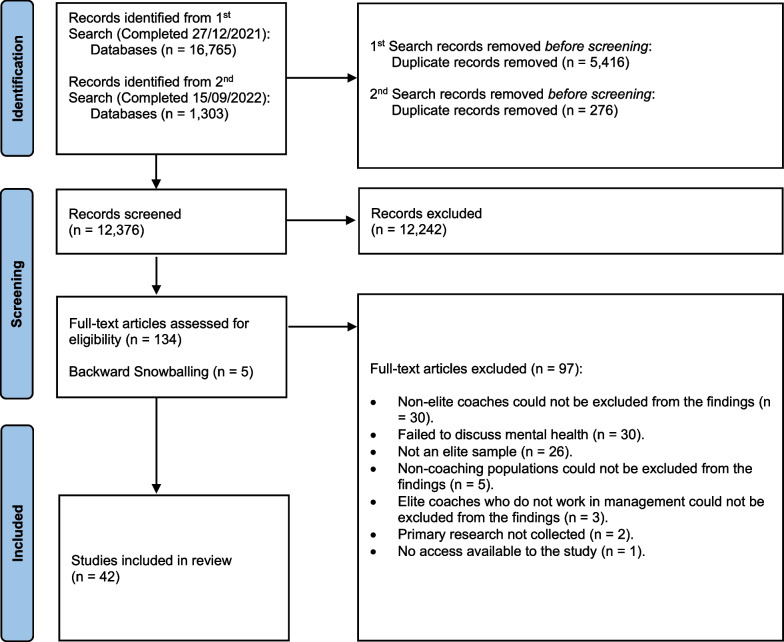
- The search identified 18,068 records; after removing 5,692 duplicates, 12,376 records were screened, 134 went to full text, and 42 studies met inclusion criteria.
- Of the 42 studies, 40.5% (17 studies) examined wellbeing and 76.2% (32 studies) examined mental ill-health; 50% (21 studies) focused on burnout, 23.8% (10) on anxiety, and 19% (8) on depression.
- Across the included studies there were 4,576 participants in total; 72.7% were male (3,325), 17.9% female (821), and <0.1% gender diverse (1).
- Reported prevalence/rates included high psychological distress ranging from 10.3% to 19.3%, sleep disturbance from 23.4% to 25.2%, risky alcohol consumption from 19.3% to 48.3%, at-risk eating disorder symptoms in 38.1% of one NCAA Division I coach sample, and risky gambling in 6% of one professional Swedish coach sample.
- The review found preliminary evidence that poor mental health may reduce coaching effectiveness; examples included burnout being linked with presenteeism, reduced motivation, and changes in leadership style, while 14% of included studies examined coaching effectiveness.
## Methods
- Systematic scoping review following PRISMA-ScR and a JBI scoping review framework; protocol was pre-registered on 9 December 2021.
- Searched five electronic databases (PsycINFO, MEDLINE, CINAHL, SPORTDiscus, Scopus) plus Google Scholar (first 200 listings), with a search updated in September 2022; included peer-reviewed English-language primary studies published post-2000, plus interpretable professional abstracts.
- Data were charted using an adapted extraction tool and synthesized narratively; quality appraisal used the Mixed Methods Appraisal Tool (MMAT).
## Limitations
- The paper states that terms such as “coaching effectiveness” and “elite” are broad and ill-defined, so the inclusion criteria may have excluded studies that would fit alternative definitions.
- The review was limited to English-language studies published after 2000, so it may have missed relevant research; it also notes that, as a scoping review, statistical synthesis/meta-analysis was beyond scope.
- The paper says only one reviewer performed the quality appraisal, and that the MMAT’s broad criteria limit how detailed the appraisal could be.
- Evident from the text: the evidence base is methodologically weak, with 79% of studies scoring 60% or below on quality appraisal; many prevalence studies were cross-sectional (89%) and often had fewer than 100 participants (67%), and the sample was predominantly male (72%), which the authors note limits generalisability.
Model-written summary. Check it against the paper before relying on it.
Integrity signals
Registry
Cites
Statistics
Figures
Verification
Claims the paper makes
54 Valid · 3 Not valid · 42 Not checked · 110 Own results and interpretations
The cited sources support only part of this claim — read each source’s verdict below.
In the paper
“Similarly, coaches are also confronted with various personal stressors, including social isolation and relationship issues [4, 6, 10–12].”
§ The Mental Health of Elite-Level Coaches: A Systematic Scoping Review > Background Coaches who operate in elite and professional sports encounter a range of stressors that have the potential to influence or compromise mental health. These demands emanate from the diverse set of roles and responsibilities elite-level coaches are required to perform and fulfil. In addition to their technical, tactical, and strategic expertise, coaches also serve as educators, motivators, counsellors and even friends [1–4]. Despite the perception that coaches primarily shape the performing outcomes of an athlete or sports team, researchers have proposed that elite-level coaches should also be considered as performers in their own right (e.g. competition preparation and psychological state) [5, 6]. On top of performance pressures, elite-level coaches also encounter multiple organisational challenges, including long working hours, job insecurity, media scrutiny and pressures to satisfy board/management expectations [1, 6–9]. Similarly, coaches are also confronted with various personal stressors, including social isolation and relationship issues [4, 6, 10–12]. Much like the elite athletes they coach, this combination of performance, organisational, and personal-related stressors may contribute to a coach’s experience of mental health. With exposure to these multiple stressors, it is critical to ensure that coaches possess appropriate coping or stress management strategies, in conjunction with robust social networks and organisational supports that look to protect and preserve the mental health of elite-level coaches [13, 14]. Over the past decade, research into the mental health of elite sportspeople has gathered considerable momentum. To date, research has primarily examined the mental health outcomes of elite athletes [15–18], with comparatively less research focusing on understanding these psychological experiences among coaches [19]. This is significant as coaches operate in the same elite-level environments as athletes, but arguably possess a greater set of performance and organisational responsibilities, given they are often expected to manage and oversee the performances of multiple athletes [7], whilst simultaneously acting as the public face and cultural identity of a sporting organisation [1]. Although coaches who operate within community and recreational settings encounter a variety of stressors that may threaten an individual’s mental health (e.g. parental pressures, lack of participation) [20], elite-level coaches generally operate within high-pressure environments, where the margin between success and failure may be scrutinised by a range of individuals who operate within the public domain (e.g. fans, the media, former elite sportspeople) [21, 22], and can negatively impact one’s employment status if a coach is perceived to have regularly underperformed [23, 24]. The mental health experiences and literacy of elite-level coaches should therefore not be overlooked or underestimated. Moreover, given these individuals hold prominent leadership roles, coaches play a role in cultivating an organisational or team environment that facilitates optimal wellbeing [25]. This may include a decisive role in shaping the cultural and institutional attitudes towards mental health in elite sports organisations (e.g. help-seeking) [26, 27]. The evolving fields of sports psychology and psychiatry have operationalised mental health in myriad ways. Keyes' [28, 29] dual-continua model of mental health has emerged as a prominent theoretical framework throughout elite sport [30, 31]. This framework employs a bivariate conceptualisation to assert that mental health should be perceived as a complete state comprising of two distinct but related phenomena: mental wellbeing and mental ill-health. For instance, the model’s first dimension is characterised by an individual’s level of mental wellbeing. This dimension broadly reflects the experience of positive feelings and happiness (i.e. hedonic wellbeing), as well as the satisfaction and perception of purpose within one’s life (i.e. eudaimonic wellbeing). This dimension can be generally determined by a combination of emotional (e.g. affective states), psychological (e.g. individual functioning) and social (e.g. societal functioning) wellbeing [32]. Keyes’ model postulates that these three factors determine whether an individual is experiencing high (flourishing), moderate or low (languishing) mental wellbeing. In contrast, the model’s second dimension refers to the presence or absence of symptoms and diagnoses associated with mental ill-health (e.g. anxiety disorders, depression). This dimension can be perceived as a spectrum, ranging from the absence of symptoms to the manifestation of mild to severe symptoms of mental ill-health. With both dimensions in mind, when alluding to mental health, this review will subsequently employ Keyes’ holistic conceptualisation, and refer to mental health as a complete state determined by the presence and absence of both wellbeing and mental ill-health [32, 33]. It is emphasised that a coach can therefore experience high levels of wellbeing and flourish within their profession (e.g. career progression and strong social connections) despite the diagnosis of a mental disorder (e.g. generalised anxiety disorder) [34]. In the extant literature, several reviews have explored the psychological health and experiences of coaches. These studies have summarised key concepts around stressors [21, 22, 35, 36], wellbeing [21, 35, 36], coping strategies [3, 21, 36] and burnout [37]. In adding to these, this review provides a unique overview of coach mental health by addressing current research gaps in four distinct ways. This is achieved by exploring mental health using an empirically supported framework, assessing elite-level coaches exclusively, exploring the risk and protective factors that influence coach mental health, and examining the relationship between mental health and coaching effectiveness. Given previous reviews have failed to adopt a mental health framework to contextualise findings, the present review seeks to employ Keyes’ empirical framework to uniquely investigate the mental health of elite-level coaches. The model sets the review apart, as novel insights associated with the presence and prevalence of clinical symptoms and disorders in elite-level coaches will be considered concurrently with experiences of mental wellbeing for the first time. In adding to this, previous reviews have also largely examined coach mental health across various competitive levels, including those operating in both community and elite sports environments [21, 22, 36, 37]. In line with Olsen et al.’s [3] systematic review investigating coping among elite-level coaches, the present review will solely examine the mental health of elite-level coaches, to refine and focus the findings to a specific subset of the coaching population. Beyond the exploration of mental health outcomes, the review will also seek to examine the various risk and protective factors that shape and influence the mental health of elite-level coaches. Purcell et al. propose that an ecological systems approach is beneficial to assess the various influences that impact the mental health of an elite athlete [38]. This socioecological approach asserts that an athlete’s mental health is influenced by factors that operate at the individual, microsystem (interpersonal), exosystem (organisational) and macrosystem (societal) level. Previous studies have employed this ecological approach to assess the risk and protective factors that contribute to the mental health of elite sportspeople [39]. Given the value of this socioecological approach, this review will seek to identify the various influences that operate as risk and protective factors for the mental health of elite-level coaches. Finally, the present review seeks to examine the relationship between mental health (i.e. both wellbeing and mental ill-health) and coaching effectiveness. Often shaped by varying subjective and contextual objectives, coaching effectiveness is a term that has been expressed in multiple forms. The evaluation of performance for example, can fluctuate between intrapersonal and interpersonal viewpoints, as well as continuous (e.g. times and distance) and ordinal (e.g. ranking or league position) metrics [40]. Previous research has largely operationalised coaching effectiveness by employing Côté and Gilbert’s [41] proposed definition, “the consistent application of integrated professional, interpersonal and intrapersonal knowledge to improve athletes’ competence, confidence, connection, and character in specific coaching contexts” (Côté and Gilbert (2009, p.316). Recently however, Lyle [42] has suggested that coaching effectiveness should be considered as a superordinate concept as opposed to a root definition. Lyle argues that effectiveness should refer to the application of a coach’s expertise with the resources made available, rather than the satisfaction or achievement of certain criteria, whether that be process (e.g. improving athlete’s confidence) or outcome-oriented (e.g. performance output) objectives. This conceptualisation refrains from confining effectiveness to the achievement or satisfaction of a particular set of standardised criteria (as put forward by Côté and Gilbert), but rather shifts the focus towards a broad and non-exhaustive range of factors that may influence the satisfaction of specific and relative goals and objectives set by a coach or sports organisation. These objectives may encompass targets associated with coaching practices, coach development and even performance-related outcomes. Ultimately, this perspective implies that effectiveness should be attainable for all coaches, and that excellence should not solely be confused with or utilised as a proxy for effectiveness. Considering the importance of performing effectively, there may be an opportunity to utilise coaching effectiveness as a ‘hook’ to engage elite-level coaches in greater consideration of their mental health needs. It has been proposed that future research should examine coaching effectiveness from a wellbeing perspective [43], since preliminary evidence indicates that mental health may contribute positively and negatively towards factors such as productivity and motivation [13, 44–46]. Given elite-level coaches generally experience time-related challenges due to internally and externally imposed pressures [1, 4, 8], coaches may not consider the management of their own mental health as a competitive priority when compared with other influences (e.g. tactical advantages) [47]. Exploring the link between mental health and coaching effectiveness could therefore have potential value from a performance and ecological perspective. Coaches with a vested interest in mental health may subsequently enhance both their own psychological wellbeing and coaching effectiveness, as well as the mental health of individuals and communities who operate within their interpersonal environment (e.g. athletes and support staff). Considering the features discussed, the present review aims to discern: (1) elite-level coaches’ experiences of mental wellbeing; (2) the nature and prevalence of mental ill-health in elite-level coaches; (3) the risk and protective factors that influence coach mental health; (4) how coaching effectiveness is conceptualised from a mental health perspective; and (5) the relationship between mental health and coaching effectiveness.
What the sources say
- Not checked — no full text of the sourcecites [4] Olusoga P Butt J Hays K Maynard I Stress in elite sports coaching: identifying stressors J Appl Sport Psychol 2009 21 4 442 459 10.1080/10413200903222921 source
- Not checked — no full text of the sourcecites [6] Thelwell RC Weston NJV Greenlees IA Hutchings NV Stressors in elite sport: a coach perspective J Sports Sci 2008 26 9 905 918 10.1080/02640410801885933 18569556 source
- Not checked — no full text of the sourcecites [10] Baldock L Cropley B Neil R Mellalieu SD Stress and mental well-being experiences of professional football coaches The Sport Psychologist 2021 35 2 108 122 10.1123/tsp.2020-0087 source
- Supportedcites [11] Kegelaers J Wylleman P van Bree INA Wessels F Oudejans RRD Mental health in elite-level coaches: prevalence rates and associated impact of coach stressors and psychological resilience Int Sport Coach J 2021 8 3 338 347 10.1123/iscj.2020-0066 source
The paper’s discussion of coach stressors (section labelled Abstract; page unavailable) identifies loneliness and isolation, along with lack of time for family and social life, as personal stressors. Table 1 also lists feeling isolated and lack of social support as personal stressors experienced by coaches. These passages support the citing sentence’s broad reference to social isolation and relationship-related difficulties. (LLM, conf=0.88)
- Partly supportedcites [12] Pilkington V Rice SM Walton CC Gwyther K Olive L Butterworth M Prevalence and correlates of mental health symptoms and well-being among elite sport coaches and high-performance support staff Sports Med Open 2022 8 1 89 10.1186/s40798-022-00479-y 35792942 PMC9259770 sourceExperimental — accuracy not yet measured
The Background (page not provided) identifies long periods away from home and missing children’s education as personal challenges for coaches. The Methods (page not provided) assess social isolation, and the Results report that some coaches lack social support. The copy does not specifically identify relationship issues as a stressor or report how many coaches experienced social isolation. (LLM, conf=0.78)
plain- Asserted: passes — The authors put it forward as true.
- Checkable: passes — It can be checked against evidence.
- Load-bearing: unclear — It is unclear whether the paper’s conclusions depend on it.
- Based: passes — The paper gives a reason why it holds.
The sources with a verdict support this claim; the rest weren’t checked yet, have no full text we could read, or their verdicts aren’t rated yet.
In the paper
“To date, research has primarily examined the mental health outcomes of elite athletes [15–18], with comparatively less research focusing on understanding these psychological experiences among coaches [19].”
§ The Mental Health of Elite-Level Coaches: A Systematic Scoping Review > Background Coaches who operate in elite and professional sports encounter a range of stressors that have the potential to influence or compromise mental health. These demands emanate from the diverse set of roles and responsibilities elite-level coaches are required to perform and fulfil. In addition to their technical, tactical, and strategic expertise, coaches also serve as educators, motivators, counsellors and even friends [1–4]. Despite the perception that coaches primarily shape the performing outcomes of an athlete or sports team, researchers have proposed that elite-level coaches should also be considered as performers in their own right (e.g. competition preparation and psychological state) [5, 6]. On top of performance pressures, elite-level coaches also encounter multiple organisational challenges, including long working hours, job insecurity, media scrutiny and pressures to satisfy board/management expectations [1, 6–9]. Similarly, coaches are also confronted with various personal stressors, including social isolation and relationship issues [4, 6, 10–12]. Much like the elite athletes they coach, this combination of performance, organisational, and personal-related stressors may contribute to a coach’s experience of mental health. With exposure to these multiple stressors, it is critical to ensure that coaches possess appropriate coping or stress management strategies, in conjunction with robust social networks and organisational supports that look to protect and preserve the mental health of elite-level coaches [13, 14]. Over the past decade, research into the mental health of elite sportspeople has gathered considerable momentum. To date, research has primarily examined the mental health outcomes of elite athletes [15–18], with comparatively less research focusing on understanding these psychological experiences among coaches [19]. This is significant as coaches operate in the same elite-level environments as athletes, but arguably possess a greater set of performance and organisational responsibilities, given they are often expected to manage and oversee the performances of multiple athletes [7], whilst simultaneously acting as the public face and cultural identity of a sporting organisation [1]. Although coaches who operate within community and recreational settings encounter a variety of stressors that may threaten an individual’s mental health (e.g. parental pressures, lack of participation) [20], elite-level coaches generally operate within high-pressure environments, where the margin between success and failure may be scrutinised by a range of individuals who operate within the public domain (e.g. fans, the media, former elite sportspeople) [21, 22], and can negatively impact one’s employment status if a coach is perceived to have regularly underperformed [23, 24]. The mental health experiences and literacy of elite-level coaches should therefore not be overlooked or underestimated. Moreover, given these individuals hold prominent leadership roles, coaches play a role in cultivating an organisational or team environment that facilitates optimal wellbeing [25]. This may include a decisive role in shaping the cultural and institutional attitudes towards mental health in elite sports organisations (e.g. help-seeking) [26, 27]. The evolving fields of sports psychology and psychiatry have operationalised mental health in myriad ways. Keyes' [28, 29] dual-continua model of mental health has emerged as a prominent theoretical framework throughout elite sport [30, 31]. This framework employs a bivariate conceptualisation to assert that mental health should be perceived as a complete state comprising of two distinct but related phenomena: mental wellbeing and mental ill-health. For instance, the model’s first dimension is characterised by an individual’s level of mental wellbeing. This dimension broadly reflects the experience of positive feelings and happiness (i.e. hedonic wellbeing), as well as the satisfaction and perception of purpose within one’s life (i.e. eudaimonic wellbeing). This dimension can be generally determined by a combination of emotional (e.g. affective states), psychological (e.g. individual functioning) and social (e.g. societal functioning) wellbeing [32]. Keyes’ model postulates that these three factors determine whether an individual is experiencing high (flourishing), moderate or low (languishing) mental wellbeing. In contrast, the model’s second dimension refers to the presence or absence of symptoms and diagnoses associated with mental ill-health (e.g. anxiety disorders, depression). This dimension can be perceived as a spectrum, ranging from the absence of symptoms to the manifestation of mild to severe symptoms of mental ill-health. With both dimensions in mind, when alluding to mental health, this review will subsequently employ Keyes’ holistic conceptualisation, and refer to mental health as a complete state determined by the presence and absence of both wellbeing and mental ill-health [32, 33]. It is emphasised that a coach can therefore experience high levels of wellbeing and flourish within their profession (e.g. career progression and strong social connections) despite the diagnosis of a mental disorder (e.g. generalised anxiety disorder) [34]. In the extant literature, several reviews have explored the psychological health and experiences of coaches. These studies have summarised key concepts around stressors [21, 22, 35, 36], wellbeing [21, 35, 36], coping strategies [3, 21, 36] and burnout [37]. In adding to these, this review provides a unique overview of coach mental health by addressing current research gaps in four distinct ways. This is achieved by exploring mental health using an empirically supported framework, assessing elite-level coaches exclusively, exploring the risk and protective factors that influence coach mental health, and examining the relationship between mental health and coaching effectiveness. Given previous reviews have failed to adopt a mental health framework to contextualise findings, the present review seeks to employ Keyes’ empirical framework to uniquely investigate the mental health of elite-level coaches. The model sets the review apart, as novel insights associated with the presence and prevalence of clinical symptoms and disorders in elite-level coaches will be considered concurrently with experiences of mental wellbeing for the first time. In adding to this, previous reviews have also largely examined coach mental health across various competitive levels, including those operating in both community and elite sports environments [21, 22, 36, 37]. In line with Olsen et al.’s [3] systematic review investigating coping among elite-level coaches, the present review will solely examine the mental health of elite-level coaches, to refine and focus the findings to a specific subset of the coaching population. Beyond the exploration of mental health outcomes, the review will also seek to examine the various risk and protective factors that shape and influence the mental health of elite-level coaches. Purcell et al. propose that an ecological systems approach is beneficial to assess the various influences that impact the mental health of an elite athlete [38]. This socioecological approach asserts that an athlete’s mental health is influenced by factors that operate at the individual, microsystem (interpersonal), exosystem (organisational) and macrosystem (societal) level. Previous studies have employed this ecological approach to assess the risk and protective factors that contribute to the mental health of elite sportspeople [39]. Given the value of this socioecological approach, this review will seek to identify the various influences that operate as risk and protective factors for the mental health of elite-level coaches. Finally, the present review seeks to examine the relationship between mental health (i.e. both wellbeing and mental ill-health) and coaching effectiveness. Often shaped by varying subjective and contextual objectives, coaching effectiveness is a term that has been expressed in multiple forms. The evaluation of performance for example, can fluctuate between intrapersonal and interpersonal viewpoints, as well as continuous (e.g. times and distance) and ordinal (e.g. ranking or league position) metrics [40]. Previous research has largely operationalised coaching effectiveness by employing Côté and Gilbert’s [41] proposed definition, “the consistent application of integrated professional, interpersonal and intrapersonal knowledge to improve athletes’ competence, confidence, connection, and character in specific coaching contexts” (Côté and Gilbert (2009, p.316). Recently however, Lyle [42] has suggested that coaching effectiveness should be considered as a superordinate concept as opposed to a root definition. Lyle argues that effectiveness should refer to the application of a coach’s expertise with the resources made available, rather than the satisfaction or achievement of certain criteria, whether that be process (e.g. improving athlete’s confidence) or outcome-oriented (e.g. performance output) objectives. This conceptualisation refrains from confining effectiveness to the achievement or satisfaction of a particular set of standardised criteria (as put forward by Côté and Gilbert), but rather shifts the focus towards a broad and non-exhaustive range of factors that may influence the satisfaction of specific and relative goals and objectives set by a coach or sports organisation. These objectives may encompass targets associated with coaching practices, coach development and even performance-related outcomes. Ultimately, this perspective implies that effectiveness should be attainable for all coaches, and that excellence should not solely be confused with or utilised as a proxy for effectiveness. Considering the importance of performing effectively, there may be an opportunity to utilise coaching effectiveness as a ‘hook’ to engage elite-level coaches in greater consideration of their mental health needs. It has been proposed that future research should examine coaching effectiveness from a wellbeing perspective [43], since preliminary evidence indicates that mental health may contribute positively and negatively towards factors such as productivity and motivation [13, 44–46]. Given elite-level coaches generally experience time-related challenges due to internally and externally imposed pressures [1, 4, 8], coaches may not consider the management of their own mental health as a competitive priority when compared with other influences (e.g. tactical advantages) [47]. Exploring the link between mental health and coaching effectiveness could therefore have potential value from a performance and ecological perspective. Coaches with a vested interest in mental health may subsequently enhance both their own psychological wellbeing and coaching effectiveness, as well as the mental health of individuals and communities who operate within their interpersonal environment (e.g. athletes and support staff). Considering the features discussed, the present review aims to discern: (1) elite-level coaches’ experiences of mental wellbeing; (2) the nature and prevalence of mental ill-health in elite-level coaches; (3) the risk and protective factors that influence coach mental health; (4) how coaching effectiveness is conceptualised from a mental health perspective; and (5) the relationship between mental health and coaching effectiveness.
What the sources say
- Supportedcites [15] Gouttebarge V Castaldelli-Maia JM Gorczynski P Hainline B Hitchcock ME Kerkhoffs GM Occurrence of mental health symptoms and disorders in current and former elite athletes: a systematic review and meta-analysis Br J Sports Med 2019 53 11 700 706 10.1136/bjsports-2019-100671 31097451 PMC6579497 source
The Introduction describes increasing research on mental health symptoms and disorders in elite athletes, and the Discussion reports that 32 of the 34 studies reviewed were published after 2010. This source supports the athlete-research portion cited to [15–18]; the comparison with research on coaches is separately cited to [19]. (LLM, conf=0.90)
- Not checked — no full text of the sourcecites [16] Poucher ZA Tamminen KA Kerr G Cairney J A commentary on mental health research in elite sport J Appl Sport Psychol 2021 33 1 60 82 10.1080/10413200.2019.1668496 source
- Supportedcites [17] Rice SM Purcell R De Silva S Mawren D McGorry PD Parker AG The mental health of elite athletes: a narrative systematic review Sports Med 2016 46 9 1333 1353 10.1007/s40279-016-0492-2 26896951 PMC4996886 source
The Discussion describes this paper as a review synthesising research on mental ill-health and wellbeing in elite athletes, supporting the clause attributed to citations [15–18]. The separate claim that coaches have received less research is attached to [19], not to this source. (LLM, conf=0.91)
- Not checked — no full text of the sourcecites [18] Purcell R Rice S Butterworth M Clements M Rates and correlates of mental health symptoms in currently competing elite athletes from the Australian national high-performance sports system Sports Med 2020 50 9 1683 1694 10.1007/s40279-020-01266-z 32026315 source
- Not checked — no full text of the sourcecites [19] Purcell R, Frost J, Pilkington V. Mental health of elite sport coaches and entourage. Clin Sports Med. 2023. 37949512 source
plainstates an association- Asserted: passes — The authors put it forward as true.
- Checkable: passes — It can be checked against evidence.
- Load-bearing: passes — The paper’s conclusions depend on it.
- Based: passes — The paper gives a reason why it holds.
- Supported
The cited sources support only part of this claim — read each source’s verdict below.
In the paper
“This may include a decisive role in shaping the cultural and institutional attitudes towards mental health in elite sports organisations (e.g. help-seeking) [26, 27].”
§ The Mental Health of Elite-Level Coaches: A Systematic Scoping Review > Background Coaches who operate in elite and professional sports encounter a range of stressors that have the potential to influence or compromise mental health. These demands emanate from the diverse set of roles and responsibilities elite-level coaches are required to perform and fulfil. In addition to their technical, tactical, and strategic expertise, coaches also serve as educators, motivators, counsellors and even friends [1–4]. Despite the perception that coaches primarily shape the performing outcomes of an athlete or sports team, researchers have proposed that elite-level coaches should also be considered as performers in their own right (e.g. competition preparation and psychological state) [5, 6]. On top of performance pressures, elite-level coaches also encounter multiple organisational challenges, including long working hours, job insecurity, media scrutiny and pressures to satisfy board/management expectations [1, 6–9]. Similarly, coaches are also confronted with various personal stressors, including social isolation and relationship issues [4, 6, 10–12]. Much like the elite athletes they coach, this combination of performance, organisational, and personal-related stressors may contribute to a coach’s experience of mental health. With exposure to these multiple stressors, it is critical to ensure that coaches possess appropriate coping or stress management strategies, in conjunction with robust social networks and organisational supports that look to protect and preserve the mental health of elite-level coaches [13, 14]. Over the past decade, research into the mental health of elite sportspeople has gathered considerable momentum. To date, research has primarily examined the mental health outcomes of elite athletes [15–18], with comparatively less research focusing on understanding these psychological experiences among coaches [19]. This is significant as coaches operate in the same elite-level environments as athletes, but arguably possess a greater set of performance and organisational responsibilities, given they are often expected to manage and oversee the performances of multiple athletes [7], whilst simultaneously acting as the public face and cultural identity of a sporting organisation [1]. Although coaches who operate within community and recreational settings encounter a variety of stressors that may threaten an individual’s mental health (e.g. parental pressures, lack of participation) [20], elite-level coaches generally operate within high-pressure environments, where the margin between success and failure may be scrutinised by a range of individuals who operate within the public domain (e.g. fans, the media, former elite sportspeople) [21, 22], and can negatively impact one’s employment status if a coach is perceived to have regularly underperformed [23, 24]. The mental health experiences and literacy of elite-level coaches should therefore not be overlooked or underestimated. Moreover, given these individuals hold prominent leadership roles, coaches play a role in cultivating an organisational or team environment that facilitates optimal wellbeing [25]. This may include a decisive role in shaping the cultural and institutional attitudes towards mental health in elite sports organisations (e.g. help-seeking) [26, 27]. The evolving fields of sports psychology and psychiatry have operationalised mental health in myriad ways. Keyes' [28, 29] dual-continua model of mental health has emerged as a prominent theoretical framework throughout elite sport [30, 31]. This framework employs a bivariate conceptualisation to assert that mental health should be perceived as a complete state comprising of two distinct but related phenomena: mental wellbeing and mental ill-health. For instance, the model’s first dimension is characterised by an individual’s level of mental wellbeing. This dimension broadly reflects the experience of positive feelings and happiness (i.e. hedonic wellbeing), as well as the satisfaction and perception of purpose within one’s life (i.e. eudaimonic wellbeing). This dimension can be generally determined by a combination of emotional (e.g. affective states), psychological (e.g. individual functioning) and social (e.g. societal functioning) wellbeing [32]. Keyes’ model postulates that these three factors determine whether an individual is experiencing high (flourishing), moderate or low (languishing) mental wellbeing. In contrast, the model’s second dimension refers to the presence or absence of symptoms and diagnoses associated with mental ill-health (e.g. anxiety disorders, depression). This dimension can be perceived as a spectrum, ranging from the absence of symptoms to the manifestation of mild to severe symptoms of mental ill-health. With both dimensions in mind, when alluding to mental health, this review will subsequently employ Keyes’ holistic conceptualisation, and refer to mental health as a complete state determined by the presence and absence of both wellbeing and mental ill-health [32, 33]. It is emphasised that a coach can therefore experience high levels of wellbeing and flourish within their profession (e.g. career progression and strong social connections) despite the diagnosis of a mental disorder (e.g. generalised anxiety disorder) [34]. In the extant literature, several reviews have explored the psychological health and experiences of coaches. These studies have summarised key concepts around stressors [21, 22, 35, 36], wellbeing [21, 35, 36], coping strategies [3, 21, 36] and burnout [37]. In adding to these, this review provides a unique overview of coach mental health by addressing current research gaps in four distinct ways. This is achieved by exploring mental health using an empirically supported framework, assessing elite-level coaches exclusively, exploring the risk and protective factors that influence coach mental health, and examining the relationship between mental health and coaching effectiveness. Given previous reviews have failed to adopt a mental health framework to contextualise findings, the present review seeks to employ Keyes’ empirical framework to uniquely investigate the mental health of elite-level coaches. The model sets the review apart, as novel insights associated with the presence and prevalence of clinical symptoms and disorders in elite-level coaches will be considered concurrently with experiences of mental wellbeing for the first time. In adding to this, previous reviews have also largely examined coach mental health across various competitive levels, including those operating in both community and elite sports environments [21, 22, 36, 37]. In line with Olsen et al.’s [3] systematic review investigating coping among elite-level coaches, the present review will solely examine the mental health of elite-level coaches, to refine and focus the findings to a specific subset of the coaching population. Beyond the exploration of mental health outcomes, the review will also seek to examine the various risk and protective factors that shape and influence the mental health of elite-level coaches. Purcell et al. propose that an ecological systems approach is beneficial to assess the various influences that impact the mental health of an elite athlete [38]. This socioecological approach asserts that an athlete’s mental health is influenced by factors that operate at the individual, microsystem (interpersonal), exosystem (organisational) and macrosystem (societal) level. Previous studies have employed this ecological approach to assess the risk and protective factors that contribute to the mental health of elite sportspeople [39]. Given the value of this socioecological approach, this review will seek to identify the various influences that operate as risk and protective factors for the mental health of elite-level coaches. Finally, the present review seeks to examine the relationship between mental health (i.e. both wellbeing and mental ill-health) and coaching effectiveness. Often shaped by varying subjective and contextual objectives, coaching effectiveness is a term that has been expressed in multiple forms. The evaluation of performance for example, can fluctuate between intrapersonal and interpersonal viewpoints, as well as continuous (e.g. times and distance) and ordinal (e.g. ranking or league position) metrics [40]. Previous research has largely operationalised coaching effectiveness by employing Côté and Gilbert’s [41] proposed definition, “the consistent application of integrated professional, interpersonal and intrapersonal knowledge to improve athletes’ competence, confidence, connection, and character in specific coaching contexts” (Côté and Gilbert (2009, p.316). Recently however, Lyle [42] has suggested that coaching effectiveness should be considered as a superordinate concept as opposed to a root definition. Lyle argues that effectiveness should refer to the application of a coach’s expertise with the resources made available, rather than the satisfaction or achievement of certain criteria, whether that be process (e.g. improving athlete’s confidence) or outcome-oriented (e.g. performance output) objectives. This conceptualisation refrains from confining effectiveness to the achievement or satisfaction of a particular set of standardised criteria (as put forward by Côté and Gilbert), but rather shifts the focus towards a broad and non-exhaustive range of factors that may influence the satisfaction of specific and relative goals and objectives set by a coach or sports organisation. These objectives may encompass targets associated with coaching practices, coach development and even performance-related outcomes. Ultimately, this perspective implies that effectiveness should be attainable for all coaches, and that excellence should not solely be confused with or utilised as a proxy for effectiveness. Considering the importance of performing effectively, there may be an opportunity to utilise coaching effectiveness as a ‘hook’ to engage elite-level coaches in greater consideration of their mental health needs. It has been proposed that future research should examine coaching effectiveness from a wellbeing perspective [43], since preliminary evidence indicates that mental health may contribute positively and negatively towards factors such as productivity and motivation [13, 44–46]. Given elite-level coaches generally experience time-related challenges due to internally and externally imposed pressures [1, 4, 8], coaches may not consider the management of their own mental health as a competitive priority when compared with other influences (e.g. tactical advantages) [47]. Exploring the link between mental health and coaching effectiveness could therefore have potential value from a performance and ecological perspective. Coaches with a vested interest in mental health may subsequently enhance both their own psychological wellbeing and coaching effectiveness, as well as the mental health of individuals and communities who operate within their interpersonal environment (e.g. athletes and support staff). Considering the features discussed, the present review aims to discern: (1) elite-level coaches’ experiences of mental wellbeing; (2) the nature and prevalence of mental ill-health in elite-level coaches; (3) the risk and protective factors that influence coach mental health; (4) how coaching effectiveness is conceptualised from a mental health perspective; and (5) the relationship between mental health and coaching effectiveness.
What the sources say
- Partly supportedcites [26] Bissett JE Kroshus E Hebard S Determining the role of sport coaches in promoting athlete mental health: a narrative review and Delphi approach BMJ Open Sport Exerc Med 2020 6 1 e000676 10.1136/bmjsem-2019-000676 32095271 PMC7011013 sourceExperimental — accuracy not yet measured
The Results (Exploration phase: narrative review) say coaches can shape team culture around mental health and the expected consequences of help-seeking. The Discussion likewise says coaches can affect cultural change, but it describes organisational context as shaping coaches’ behaviour; it does not establish that coaches decisively shape institutional attitudes across elite sports organisations. (LLM, conf=0.84)
- Partly supportedcites [27] Gorczynski P Gibson K Clarke N Mensah T Summers R Examining mental health literacy, help-seeking behaviours, distress, and wellbeing in UK coaches Eur Phys Educ Rev 2020 26 3 713 726 10.1177/1356336X19887772 sourceExperimental — accuracy not yet measured
The Introduction (p. 3) says coaches can encourage youth athletes to seek support, and p. 4 says coaches with greater mental health literacy may help reduce stigma. Those passages support a possible influence on help-seeking attitudes, but they do not establish a decisive role in shaping cultural or institutional attitudes in elite sports organisations. (LLM, conf=0.86)
hedgedstates a possible cause- Asserted: passes — The authors put it forward as true.
- Checkable: passes — It can be checked against evidence.
- Load-bearing: passes — The paper’s conclusions depend on it.
- Based: passes — The paper gives a reason why it holds.
- Partly supported
The cited sources support only part of this claim — read each source’s verdict below.
In the paper
“given these individuals hold prominent leadership roles, coaches play a role in cultivating an organisational or team environment that facilitates optimal wellbeing [25].”
§ The Mental Health of Elite-Level Coaches: A Systematic Scoping Review > Background Coaches who operate in elite and professional sports encounter a range of stressors that have the potential to influence or compromise mental health. These demands emanate from the diverse set of roles and responsibilities elite-level coaches are required to perform and fulfil. In addition to their technical, tactical, and strategic expertise, coaches also serve as educators, motivators, counsellors and even friends [1–4]. Despite the perception that coaches primarily shape the performing outcomes of an athlete or sports team, researchers have proposed that elite-level coaches should also be considered as performers in their own right (e.g. competition preparation and psychological state) [5, 6]. On top of performance pressures, elite-level coaches also encounter multiple organisational challenges, including long working hours, job insecurity, media scrutiny and pressures to satisfy board/management expectations [1, 6–9]. Similarly, coaches are also confronted with various personal stressors, including social isolation and relationship issues [4, 6, 10–12]. Much like the elite athletes they coach, this combination of performance, organisational, and personal-related stressors may contribute to a coach’s experience of mental health. With exposure to these multiple stressors, it is critical to ensure that coaches possess appropriate coping or stress management strategies, in conjunction with robust social networks and organisational supports that look to protect and preserve the mental health of elite-level coaches [13, 14]. Over the past decade, research into the mental health of elite sportspeople has gathered considerable momentum. To date, research has primarily examined the mental health outcomes of elite athletes [15–18], with comparatively less research focusing on understanding these psychological experiences among coaches [19]. This is significant as coaches operate in the same elite-level environments as athletes, but arguably possess a greater set of performance and organisational responsibilities, given they are often expected to manage and oversee the performances of multiple athletes [7], whilst simultaneously acting as the public face and cultural identity of a sporting organisation [1]. Although coaches who operate within community and recreational settings encounter a variety of stressors that may threaten an individual’s mental health (e.g. parental pressures, lack of participation) [20], elite-level coaches generally operate within high-pressure environments, where the margin between success and failure may be scrutinised by a range of individuals who operate within the public domain (e.g. fans, the media, former elite sportspeople) [21, 22], and can negatively impact one’s employment status if a coach is perceived to have regularly underperformed [23, 24]. The mental health experiences and literacy of elite-level coaches should therefore not be overlooked or underestimated. Moreover, given these individuals hold prominent leadership roles, coaches play a role in cultivating an organisational or team environment that facilitates optimal wellbeing [25]. This may include a decisive role in shaping the cultural and institutional attitudes towards mental health in elite sports organisations (e.g. help-seeking) [26, 27]. The evolving fields of sports psychology and psychiatry have operationalised mental health in myriad ways. Keyes' [28, 29] dual-continua model of mental health has emerged as a prominent theoretical framework throughout elite sport [30, 31]. This framework employs a bivariate conceptualisation to assert that mental health should be perceived as a complete state comprising of two distinct but related phenomena: mental wellbeing and mental ill-health. For instance, the model’s first dimension is characterised by an individual’s level of mental wellbeing. This dimension broadly reflects the experience of positive feelings and happiness (i.e. hedonic wellbeing), as well as the satisfaction and perception of purpose within one’s life (i.e. eudaimonic wellbeing). This dimension can be generally determined by a combination of emotional (e.g. affective states), psychological (e.g. individual functioning) and social (e.g. societal functioning) wellbeing [32]. Keyes’ model postulates that these three factors determine whether an individual is experiencing high (flourishing), moderate or low (languishing) mental wellbeing. In contrast, the model’s second dimension refers to the presence or absence of symptoms and diagnoses associated with mental ill-health (e.g. anxiety disorders, depression). This dimension can be perceived as a spectrum, ranging from the absence of symptoms to the manifestation of mild to severe symptoms of mental ill-health. With both dimensions in mind, when alluding to mental health, this review will subsequently employ Keyes’ holistic conceptualisation, and refer to mental health as a complete state determined by the presence and absence of both wellbeing and mental ill-health [32, 33]. It is emphasised that a coach can therefore experience high levels of wellbeing and flourish within their profession (e.g. career progression and strong social connections) despite the diagnosis of a mental disorder (e.g. generalised anxiety disorder) [34]. In the extant literature, several reviews have explored the psychological health and experiences of coaches. These studies have summarised key concepts around stressors [21, 22, 35, 36], wellbeing [21, 35, 36], coping strategies [3, 21, 36] and burnout [37]. In adding to these, this review provides a unique overview of coach mental health by addressing current research gaps in four distinct ways. This is achieved by exploring mental health using an empirically supported framework, assessing elite-level coaches exclusively, exploring the risk and protective factors that influence coach mental health, and examining the relationship between mental health and coaching effectiveness. Given previous reviews have failed to adopt a mental health framework to contextualise findings, the present review seeks to employ Keyes’ empirical framework to uniquely investigate the mental health of elite-level coaches. The model sets the review apart, as novel insights associated with the presence and prevalence of clinical symptoms and disorders in elite-level coaches will be considered concurrently with experiences of mental wellbeing for the first time. In adding to this, previous reviews have also largely examined coach mental health across various competitive levels, including those operating in both community and elite sports environments [21, 22, 36, 37]. In line with Olsen et al.’s [3] systematic review investigating coping among elite-level coaches, the present review will solely examine the mental health of elite-level coaches, to refine and focus the findings to a specific subset of the coaching population. Beyond the exploration of mental health outcomes, the review will also seek to examine the various risk and protective factors that shape and influence the mental health of elite-level coaches. Purcell et al. propose that an ecological systems approach is beneficial to assess the various influences that impact the mental health of an elite athlete [38]. This socioecological approach asserts that an athlete’s mental health is influenced by factors that operate at the individual, microsystem (interpersonal), exosystem (organisational) and macrosystem (societal) level. Previous studies have employed this ecological approach to assess the risk and protective factors that contribute to the mental health of elite sportspeople [39]. Given the value of this socioecological approach, this review will seek to identify the various influences that operate as risk and protective factors for the mental health of elite-level coaches. Finally, the present review seeks to examine the relationship between mental health (i.e. both wellbeing and mental ill-health) and coaching effectiveness. Often shaped by varying subjective and contextual objectives, coaching effectiveness is a term that has been expressed in multiple forms. The evaluation of performance for example, can fluctuate between intrapersonal and interpersonal viewpoints, as well as continuous (e.g. times and distance) and ordinal (e.g. ranking or league position) metrics [40]. Previous research has largely operationalised coaching effectiveness by employing Côté and Gilbert’s [41] proposed definition, “the consistent application of integrated professional, interpersonal and intrapersonal knowledge to improve athletes’ competence, confidence, connection, and character in specific coaching contexts” (Côté and Gilbert (2009, p.316). Recently however, Lyle [42] has suggested that coaching effectiveness should be considered as a superordinate concept as opposed to a root definition. Lyle argues that effectiveness should refer to the application of a coach’s expertise with the resources made available, rather than the satisfaction or achievement of certain criteria, whether that be process (e.g. improving athlete’s confidence) or outcome-oriented (e.g. performance output) objectives. This conceptualisation refrains from confining effectiveness to the achievement or satisfaction of a particular set of standardised criteria (as put forward by Côté and Gilbert), but rather shifts the focus towards a broad and non-exhaustive range of factors that may influence the satisfaction of specific and relative goals and objectives set by a coach or sports organisation. These objectives may encompass targets associated with coaching practices, coach development and even performance-related outcomes. Ultimately, this perspective implies that effectiveness should be attainable for all coaches, and that excellence should not solely be confused with or utilised as a proxy for effectiveness. Considering the importance of performing effectively, there may be an opportunity to utilise coaching effectiveness as a ‘hook’ to engage elite-level coaches in greater consideration of their mental health needs. It has been proposed that future research should examine coaching effectiveness from a wellbeing perspective [43], since preliminary evidence indicates that mental health may contribute positively and negatively towards factors such as productivity and motivation [13, 44–46]. Given elite-level coaches generally experience time-related challenges due to internally and externally imposed pressures [1, 4, 8], coaches may not consider the management of their own mental health as a competitive priority when compared with other influences (e.g. tactical advantages) [47]. Exploring the link between mental health and coaching effectiveness could therefore have potential value from a performance and ecological perspective. Coaches with a vested interest in mental health may subsequently enhance both their own psychological wellbeing and coaching effectiveness, as well as the mental health of individuals and communities who operate within their interpersonal environment (e.g. athletes and support staff). Considering the features discussed, the present review aims to discern: (1) elite-level coaches’ experiences of mental wellbeing; (2) the nature and prevalence of mental ill-health in elite-level coaches; (3) the risk and protective factors that influence coach mental health; (4) how coaching effectiveness is conceptualised from a mental health perspective; and (5) the relationship between mental health and coaching effectiveness.
What the sources say
- Partly supportedcites [25] Thelwell RC Wagstaff CRD Rayner A Chapman M Barker J Exploring athletes’ perceptions of coach stress in elite sport environments J Sports Sci 2017 35 1 44 55 10.1080/02640414.2016.1154979 26933762 sourceExperimental — accuracy not yet measured
The introduction (p. 4) says coaches influence athlete well-being and the organisation, while the Discussion (p. 21) describes effects of coach stress on the training, competitive and organisational environments. These passages support coaches’ role in shaping the environment, but the paper does not establish that they cultivate an environment that facilitates optimal well-being. (LLM, conf=0.82)
plainstates a cause- Asserted: passes — The authors put it forward as true.
- Checkable: passes — It can be checked against evidence.
- Load-bearing: passes — The paper’s conclusions depend on it.
- Based: passes — The paper gives a reason why it holds.
- Partly supported
The sources with a verdict support this claim; the rest weren’t checked yet, have no full text we could read, or their verdicts aren’t rated yet.
In the paper
“These studies have summarised key concepts around stressors [21, 22, 35, 36], wellbeing [21, 35, 36], coping strategies [3, 21, 36] and burnout [37].”
§ The Mental Health of Elite-Level Coaches: A Systematic Scoping Review > Background Coaches who operate in elite and professional sports encounter a range of stressors that have the potential to influence or compromise mental health. These demands emanate from the diverse set of roles and responsibilities elite-level coaches are required to perform and fulfil. In addition to their technical, tactical, and strategic expertise, coaches also serve as educators, motivators, counsellors and even friends [1–4]. Despite the perception that coaches primarily shape the performing outcomes of an athlete or sports team, researchers have proposed that elite-level coaches should also be considered as performers in their own right (e.g. competition preparation and psychological state) [5, 6]. On top of performance pressures, elite-level coaches also encounter multiple organisational challenges, including long working hours, job insecurity, media scrutiny and pressures to satisfy board/management expectations [1, 6–9]. Similarly, coaches are also confronted with various personal stressors, including social isolation and relationship issues [4, 6, 10–12]. Much like the elite athletes they coach, this combination of performance, organisational, and personal-related stressors may contribute to a coach’s experience of mental health. With exposure to these multiple stressors, it is critical to ensure that coaches possess appropriate coping or stress management strategies, in conjunction with robust social networks and organisational supports that look to protect and preserve the mental health of elite-level coaches [13, 14]. Over the past decade, research into the mental health of elite sportspeople has gathered considerable momentum. To date, research has primarily examined the mental health outcomes of elite athletes [15–18], with comparatively less research focusing on understanding these psychological experiences among coaches [19]. This is significant as coaches operate in the same elite-level environments as athletes, but arguably possess a greater set of performance and organisational responsibilities, given they are often expected to manage and oversee the performances of multiple athletes [7], whilst simultaneously acting as the public face and cultural identity of a sporting organisation [1]. Although coaches who operate within community and recreational settings encounter a variety of stressors that may threaten an individual’s mental health (e.g. parental pressures, lack of participation) [20], elite-level coaches generally operate within high-pressure environments, where the margin between success and failure may be scrutinised by a range of individuals who operate within the public domain (e.g. fans, the media, former elite sportspeople) [21, 22], and can negatively impact one’s employment status if a coach is perceived to have regularly underperformed [23, 24]. The mental health experiences and literacy of elite-level coaches should therefore not be overlooked or underestimated. Moreover, given these individuals hold prominent leadership roles, coaches play a role in cultivating an organisational or team environment that facilitates optimal wellbeing [25]. This may include a decisive role in shaping the cultural and institutional attitudes towards mental health in elite sports organisations (e.g. help-seeking) [26, 27]. The evolving fields of sports psychology and psychiatry have operationalised mental health in myriad ways. Keyes' [28, 29] dual-continua model of mental health has emerged as a prominent theoretical framework throughout elite sport [30, 31]. This framework employs a bivariate conceptualisation to assert that mental health should be perceived as a complete state comprising of two distinct but related phenomena: mental wellbeing and mental ill-health. For instance, the model’s first dimension is characterised by an individual’s level of mental wellbeing. This dimension broadly reflects the experience of positive feelings and happiness (i.e. hedonic wellbeing), as well as the satisfaction and perception of purpose within one’s life (i.e. eudaimonic wellbeing). This dimension can be generally determined by a combination of emotional (e.g. affective states), psychological (e.g. individual functioning) and social (e.g. societal functioning) wellbeing [32]. Keyes’ model postulates that these three factors determine whether an individual is experiencing high (flourishing), moderate or low (languishing) mental wellbeing. In contrast, the model’s second dimension refers to the presence or absence of symptoms and diagnoses associated with mental ill-health (e.g. anxiety disorders, depression). This dimension can be perceived as a spectrum, ranging from the absence of symptoms to the manifestation of mild to severe symptoms of mental ill-health. With both dimensions in mind, when alluding to mental health, this review will subsequently employ Keyes’ holistic conceptualisation, and refer to mental health as a complete state determined by the presence and absence of both wellbeing and mental ill-health [32, 33]. It is emphasised that a coach can therefore experience high levels of wellbeing and flourish within their profession (e.g. career progression and strong social connections) despite the diagnosis of a mental disorder (e.g. generalised anxiety disorder) [34]. In the extant literature, several reviews have explored the psychological health and experiences of coaches. These studies have summarised key concepts around stressors [21, 22, 35, 36], wellbeing [21, 35, 36], coping strategies [3, 21, 36] and burnout [37]. In adding to these, this review provides a unique overview of coach mental health by addressing current research gaps in four distinct ways. This is achieved by exploring mental health using an empirically supported framework, assessing elite-level coaches exclusively, exploring the risk and protective factors that influence coach mental health, and examining the relationship between mental health and coaching effectiveness. Given previous reviews have failed to adopt a mental health framework to contextualise findings, the present review seeks to employ Keyes’ empirical framework to uniquely investigate the mental health of elite-level coaches. The model sets the review apart, as novel insights associated with the presence and prevalence of clinical symptoms and disorders in elite-level coaches will be considered concurrently with experiences of mental wellbeing for the first time. In adding to this, previous reviews have also largely examined coach mental health across various competitive levels, including those operating in both community and elite sports environments [21, 22, 36, 37]. In line with Olsen et al.’s [3] systematic review investigating coping among elite-level coaches, the present review will solely examine the mental health of elite-level coaches, to refine and focus the findings to a specific subset of the coaching population. Beyond the exploration of mental health outcomes, the review will also seek to examine the various risk and protective factors that shape and influence the mental health of elite-level coaches. Purcell et al. propose that an ecological systems approach is beneficial to assess the various influences that impact the mental health of an elite athlete [38]. This socioecological approach asserts that an athlete’s mental health is influenced by factors that operate at the individual, microsystem (interpersonal), exosystem (organisational) and macrosystem (societal) level. Previous studies have employed this ecological approach to assess the risk and protective factors that contribute to the mental health of elite sportspeople [39]. Given the value of this socioecological approach, this review will seek to identify the various influences that operate as risk and protective factors for the mental health of elite-level coaches. Finally, the present review seeks to examine the relationship between mental health (i.e. both wellbeing and mental ill-health) and coaching effectiveness. Often shaped by varying subjective and contextual objectives, coaching effectiveness is a term that has been expressed in multiple forms. The evaluation of performance for example, can fluctuate between intrapersonal and interpersonal viewpoints, as well as continuous (e.g. times and distance) and ordinal (e.g. ranking or league position) metrics [40]. Previous research has largely operationalised coaching effectiveness by employing Côté and Gilbert’s [41] proposed definition, “the consistent application of integrated professional, interpersonal and intrapersonal knowledge to improve athletes’ competence, confidence, connection, and character in specific coaching contexts” (Côté and Gilbert (2009, p.316). Recently however, Lyle [42] has suggested that coaching effectiveness should be considered as a superordinate concept as opposed to a root definition. Lyle argues that effectiveness should refer to the application of a coach’s expertise with the resources made available, rather than the satisfaction or achievement of certain criteria, whether that be process (e.g. improving athlete’s confidence) or outcome-oriented (e.g. performance output) objectives. This conceptualisation refrains from confining effectiveness to the achievement or satisfaction of a particular set of standardised criteria (as put forward by Côté and Gilbert), but rather shifts the focus towards a broad and non-exhaustive range of factors that may influence the satisfaction of specific and relative goals and objectives set by a coach or sports organisation. These objectives may encompass targets associated with coaching practices, coach development and even performance-related outcomes. Ultimately, this perspective implies that effectiveness should be attainable for all coaches, and that excellence should not solely be confused with or utilised as a proxy for effectiveness. Considering the importance of performing effectively, there may be an opportunity to utilise coaching effectiveness as a ‘hook’ to engage elite-level coaches in greater consideration of their mental health needs. It has been proposed that future research should examine coaching effectiveness from a wellbeing perspective [43], since preliminary evidence indicates that mental health may contribute positively and negatively towards factors such as productivity and motivation [13, 44–46]. Given elite-level coaches generally experience time-related challenges due to internally and externally imposed pressures [1, 4, 8], coaches may not consider the management of their own mental health as a competitive priority when compared with other influences (e.g. tactical advantages) [47]. Exploring the link between mental health and coaching effectiveness could therefore have potential value from a performance and ecological perspective. Coaches with a vested interest in mental health may subsequently enhance both their own psychological wellbeing and coaching effectiveness, as well as the mental health of individuals and communities who operate within their interpersonal environment (e.g. athletes and support staff). Considering the features discussed, the present review aims to discern: (1) elite-level coaches’ experiences of mental wellbeing; (2) the nature and prevalence of mental ill-health in elite-level coaches; (3) the risk and protective factors that influence coach mental health; (4) how coaching effectiveness is conceptualised from a mental health perspective; and (5) the relationship between mental health and coaching effectiveness.
What the sources say
- Supportedcites [21] Norris LA Didymus FF Kaiseler M Stressors, coping, and well-being among sports coaches: a systematic review Psychol Sport Exerc 2017 33 93 112 10.1016/j.psychsport.2017.08.005 source
The Discussion describes this systematic review as an analysis of research on coaches’ stressors, coping strategies, and psychological well-being, and summarizes findings on each. In the citing sentence, burnout is attached only to reference [37], so it is not attributed to this source. (LLM, conf=0.93)
- Not checked — no full text of the sourcecites [22] Santos F Costa V Stress among sports coaches: a systematic review Cuadernos de Psicología del Deporte 2018 18 3 268 292
- Supportedcites [35] Fletcher D Scott M Psychological stress in sports coaches: a review of concepts, research, and practice J Sports Sci 2010 28 2 127 137 10.1080/02640410903406208 20035490 source
The Introduction (p. 1) states the paper 'critically reviews the psychological literature pertaining to stress in sport coaches', organised into conceptual/definitional, theoretical/empirical, and applied-practice sections. Our copy contains dedicated review sub-sections covering exactly the concepts the claim lists: 'Performance and organizational stressors' (summarising Frey, 2007 and Thelwell et al., 2008b), 'Effects on well-being and performance' (which reviews 20+ quantitative burnout studies), and 'Coping process and strategies' (problem- vs emotion-focused coping in coaches). As one of the works cited in the citing sentence's list, it is indeed such a review. (LLM, conf=0.90)
- Supportedcites [36] Potts AJ, Didymus FF, Kaiseler M. Psychological stress and psychological well-being among sports coaches: a meta-synthesis of the qualitative research evidence. Int Rev Sport Exerc Psychol. 2021:1–30. source
The Results section identifies stressors, coping, and the impact on psychological well-being as themes of this meta-synthesis of coaches’ experiences. The Introduction also discusses burnout in describing an earlier review, though the citing sentence attaches a separate citation to burnout. (LLM, conf=0.91)
- Not checked — no full text of the sourcecites [3] Olsen MG Haugan JA Hrozanova M Moen F Coping amongst elite-level sports coaches: a systematic review Int Sport Coach J 2021 8 1 34 47 10.1123/iscj.2019-0051 source
- Not checked — no full text of the sourcecites [37] Olusoga P Bentzen M Kentta G Coach burnout: a scoping review Int Sport Coach J 2019 6 1 42 62 10.1123/iscj.2017-0094 source
plain- Asserted: passes — The authors put it forward as true.
- Checkable: passes — It can be checked against evidence.
- Load-bearing: passes — The paper’s conclusions depend on it.
- Based: passes — The paper gives a reason why it holds.
- Supported
142 more claims · 32 with their cited sources checked
Create a free account to see all 209 claims and to verify the 5 references still open.
- Probably not a substantial claim. 39
- It may state two separate claims as one. 36
Citations
Cites
Diagnostic and Statistical Manual of Mental Disorders
American Psychiatric Association (2013) · doi:10.1176/appi.books.9780890425596 · Cited by 116,369
PRISMA Extension for Scoping Reviews (PRISMA-ScR): Checklist and Explanation
Tricco, A. C., Lillie, E., Zarin, W., O'Brien, K. K., Colquhoun, H., Levac, D., Moher, D., Peters, M. D. J., Horsley, T., Weeks, L., et al. (2018) · Annals of Internal Medicine · doi:10.7326/m18-0850 · Cited by 43,565 · cited 1×
“The study implemented a scoping review framework developed by the Joanna Briggs Institute (JBI) [50], and was consistent with the Preferred Reporting Items for Systematic reviews and Meta-Analyses extension for Scoping Reviews (PRISMA-ScR) guidelines [51] (see Additional file 1).”
Method(1991) · Cited by 15,554
Munn, Z., Peters, M. D. J., Stern, C., Tufanaru, C., McArthur, A., & Aromataris, E. (2018) · BMC Medical Research Methodology · doi:10.1186/s12874-018-0611-x · Cited by 11,385 · cited 2×
“A systematic scoping review methodology (as opposed to a systematic review) was employed due to the nascence of the field [48].”
BackgroundMethodUpdated methodological guidance for the conduct of scoping reviews
Peters, M. D. J., Marnie, C., Tricco, A. C., Pollock, D., Munn, Z., Alexander, L., McInerney, P., Godfrey, C. M., & Khalil, H. (2020) · JBI Evidence Synthesis · doi:10.11124/jbies-20-00167 · Cited by 9,046 · cited 2×
“The study implemented a scoping review framework developed by the Joanna Briggs Institute (JBI) [50], and was consistent with the Preferred Reporting Items for Systematic reviews and Meta-Analyses extension for Scoping Reviews (PRISMA-ScR) guidelines [51] (see Additional file 1).”
MethodGuidance for conducting systematic scoping reviews
Peters, M. D. J., Godfrey, C. M., Khalil, H., McInerney, P., Parker, D., & Soares, C. B. (2015) · International Journal of Evidence-Based Healthcare · doi:10.1097/xeb.0000000000000050 · Cited by 7,472 · cited 1×
“The inclusion and exclusion criteria were established using the Population-Concept-Context (PCC) framework developed by the JBI Scoping Review Methodology Group [50, 52].”
MethodThe mental health continuum: from languishing to flourishing in life.
Keyes, C. L. M. (2002) · Journal of Health and Social Behavior · doi:10.2307/3090197 · Cited by 5,133 · cited 2×
“Keyes’ [28, 29] dual-continua model of mental health has emerged as a prominent theoretical framework throughout elite sport [30, 31].”
BackgroundMethodThe Mixed Methods Appraisal Tool (MMAT) version 2018 for information professionals and researchers
Hong, Q. N., Fàbregues, S., Bartlett, G., Boardman, F., Cargo, M., Dagenais, P., Gagnon, M.-P., Griffiths, F., Nicolau, B., O’Cathain, A., et al. (2018) · Education for Information · doi:10.3233/efi-180221 · Cited by 4,737 · cited 2×
“As a result, this review employed Hong et al.’s [75] Mixed Methods Appraisal Tool (MMAT), as the instrument provides reviewers with a single tool to assess quantitative, qualitative and mixed methods research, and has shown improved content validity over recent years [76].”
BackgroundMethodWohlin, C. (2014) · Proceedings of the 18th International Conference on Evaluation and Assessment in Software Engineering · doi:10.1145/2601248.2601268 · Cited by 4,234 · cited 1×
“Following data charting, the first author (JF) conducted backward snowballing to ensure all relevant records had been identified within the included studies [71].”
MethodMental illness and/or mental health? Investigating axioms of the complete state model of health
Keyes, C. L. M. (2005) · Journal of Consulting and Clinical Psychology · doi:10.1037/0022-006x.73.3.539 · Cited by 3,357 · cited 2×
“Keyes’ [28, 29] dual-continua model of mental health has emerged as a prominent theoretical framework throughout elite sport [30, 31].”
BackgroundMethodThe role of google scholar in evidence reviews and its applicability to grey literature searching
Haddaway, N. R., Collins, A. M., Coughlin, D., & Kirk, S. (2015) · PLOS ONE · doi:10.1371/journal.pone.0138237 · Cited by 2,387 · cited 1×
“In conjunction with the five electronic databases, Google Scholar was also utilised as a supplementary database, with the first 200 listings being examined to ensure all relevant studies had been identified [69].”
MethodPeters, M., Godfrey, C., McInerney, P., Munn, Z., Tricco, A., & Khalil, H. (2019) · JBI Reviewer's Manual · doi:10.46658/jbirm-20-01 · Cited by 2,222
Popay, J., Roberts, H., Sowden, A., Petticrew, M., Arai, L., Rodgers, M., Britten, N., Roen, K., & Duffy, S. (2006) · Lancaster University · doi:10.13140/2.1.1018.4643 · Cited by 2,070
Updated methodological guidance for the conduct of scoping reviews
Peters, M. D. J., Marnie, C., Tricco, A. C., Pollock, D., Munn, Z., Alexander, L., McInerney, P., Godfrey, C. M., & Khalil, H. (2021) · JBI Evidence Implementation · doi:10.1097/xeb.0000000000000277 · Cited by 1,461
Mental Illness and Mental Health: The Two Continua Model Across the Lifespan
Westerhof, G. J., & Keyes, C. L. M. (2010) · Journal of Adult Development · doi:10.1007/s10804-009-9082-y · Cited by 1,345 · cited 3×
“This dimen-sion can be generally determined by a combination of emotional (e.g. affective states), psychological (e.g. individual functioning) and social (e.g. societal functioning) wellbeing [32].”
BackgroundMethodHow Many Studies Do You Need?: A Primer on Statistical Power for Meta-Analysis
Valentine, J. C., Pigott, T. D., & Rothstein, H. R. (2010) · Journal of Educational and Behavioral Statistics · doi:10.3102/1076998609346961 · Cited by 1,294
Mental health in elite athletes: International Olympic Committee consensus statement (2019)
Reardon, C. L., Hainline, B., Aron, C. M., Baron, D., Baum, A. L., Bindra, A., Budgett, R., Campriani, N., Castaldelli-Maia, J. M., Currie, A., et al. (2019) · British Journal of Sports Medicine · doi:10.1136/bjsports-2019-100715 · Cited by 1,277 · cited 1×
“Although the term ‘elite’ has historically evaded a conceptually unified definition throughout sport, this research aligns with the International Olympic Committee (IOC) [54] and Reardon et al.’s [55] conceptualisation of elite sport.”
ResultSelf-citationThe Mental Health of Elite Athletes: A Narrative Systematic Review
Rice, S. M., Purcell, R., De Silva, S., Mawren, D., McGorry, P. D., & Parker, A. G. (2016) · Sports Medicine · doi:10.1007/s40279-016-0492-2 · Cited by 1,205 · cited 1×
“In order to fully understand the extent to which elite-level coaches experience symptoms of mental ill-health, future research should seek to identify periods where coaches may experience heightened symptomatology, and also utilise more representative coaching samples ( n > 100) [17].”
BackgroundSelf-citationAn integrative definition of coaching effectiveness and expertise
Côté, J., & Gilbert, W. (2009) · International Journal of Sports Science & Coaching · doi:10.1260/174795409789623892 · Cited by 1,131 · cited 1×
“Previous research has largely opera-tionalised coaching effectiveness by employing Côté and Gilbert’s [41] proposed definition, “the consistent application of integrated professional, interpersonal and intrapersonal knowledge to improve athletes’ competence, confidence, connection, and character in…”
MethodImproving the content validity of the mixed methods appraisal tool: a modified e-Delphi study
Hong, Q. N., Pluye, P., Fàbregues, S., Bartlett, G., Boardman, F., Cargo, M., Dagenais, P., Gagnon, M.-P., Griffiths, F., Nicolau, B., et al. (2019) · Journal of Clinical Epidemiology · doi:10.1016/j.jclinepi.2019.03.008 · Cited by 1,082
Defining elite athletes: Issues in the study of expert performance in sport psychology
Swann, C., Moran, A., & Piggott, D. (2015) · Psychology of Sport and Exercise · doi:10.1016/j.psychsport.2014.07.004 · Cited by 998 · cited 2×
“This definition was employed since previous characterisations and taxonomies tailored for elite athletes could not be directly translated or applied to elite-level coaches [56].”
BackgroundMethodBurnout–Depression Overlap: A Review
Bianchi, R., Schonfeld, I. S., & Laurent, E. (2015) · Clinical Psychology Review · doi:10.1016/j.cpr.2015.01.004 · Cited by 868
Change in Level of Positive Mental Health as a Predictor of Future Risk of Mental Illness
Keyes, C. L. M., Dhingra, S. S., & Simoes, E. J. (2010) · American Journal of Public Health · doi:10.2105/ajph.2010.192245 · Cited by 778 · cited 1×
“Understanding the wellbeing of elite-level coaches is important to both researchers and practitioners, as evidence suggests that low levels of wellbeing may increase the risk of experiencing mental ill-health over time [116–118].”
BackgroundThe National Collegiate Athletic Association
Pierce, P. E. (1912) · American Physical Education Review · doi:10.1080/23267224.1912.10651691 · Cited by 767
Wood, A. M., & Joseph, S. (2010) · Journal of Affective Disorders · doi:10.1016/j.jad.2009.06.032 · Cited by 624
Gouttebarge, V., Castaldelli-Maia, J. M., Gorczynski, P., Hainline, B., Hitchcock, M. E., Kerkhoffs, G. M., Rice, S. M., & Reardon, C. L. (2019) · British Journal of Sports Medicine · doi:10.1136/bjsports-2019-100671 · Cited by 604 · cited 1×
“To date, research has primarily examined the mental health outcomes of elite athletes [15–18], with comparatively less research focusing on understanding these psychological experiences among coaches [19].”
BackgroundSelf-citationDavey, J., Turner, R. M., Clarke, M. J., & Higgins, J. P. (2011) · BMC Medical Research Methodology · doi:10.1186/1471-2288-11-160 · Cited by 404 · cited 1×
“…coaches that experience specific outcomes associated with mental ill-health, it is suggested that the field would benefit from a future meta-analysis that is not limited to a small number of studies ( 5 studies) due to challenges associated with estimating the between-study variance [126].”
BackgroundPurcell, R., Gwyther, K., & Rice, S. M. (2019) · Sports Medicine - Open · doi:10.1186/s40798-019-0220-1 · Cited by 394 · cited 2×
“In line with the socioecological approach described by Purcell and colleagues [38], this review identified a variety of factors influencing coach mental health from within the broader ecology of elite sport (see Additional file 5).”
BackgroundResultSelf-citationCoaching effectiveness: the coach–athlete relationship at its heart
Jowett, S. (2017) · Current Opinion in Psychology · doi:10.1016/j.copsyc.2017.05.006 · Cited by 385 · cited 1×
“Since the coach-athlete relationship is argued to operate at the heart of coaching [122], further research is needed to explore how mental health outcomes could affect ways in which both coaches and athletes function.”
BackgroundGouttebarge, V., Bindra, A., Blauwet, C., Campriani, N., Currie, A., Engebretsen, L., Hainline, B., Kroshus, E., McDuff, D., Mountjoy, M., et al. (2021) · British Journal of Sports Medicine · doi:10.1136/bjsports-2020-102411 · Cited by 357 · cited 1×
“…comparisons across coaching samples and communities (e.g. elite athletes and the general population), researchers are encouraged to employ consistent and validated measures to foster methodological coherence (measures proposed by Gouttebarge et al. [121] may serve as useful starting point).”
BackgroundSelf-citationRisk and protective factors for mental health in elite athletes: a scoping review
Kuettel, A., & Larsen, C. H. (2020) · International Review of Sport and Exercise Psychology · doi:10.1080/1750984x.2019.1689574 · Cited by 311 · cited 1×
“…the present review employed Keyes’ [28, 29] dual-continua model of mental health to guide the classification of results, given this framework has been endorsed in an elite sports context [34, 63, 64] and empirically validated across a range of studies in the general population [32, 65, 66].”
MethodPsychological stress in sports coaches: A review of concepts, research, and practice
Fletcher, D., & Scott, M. (2010) · Journal of Sports Sciences · doi:10.1080/02640410903406208 · Cited by 285 · cited 1×
“These studies have summarised key concepts around stressors [21, 22, 35, 36], wellbeing [21, 35, 36], coping strategies [3, 21, 36] and burnout [37].”
BackgroundMental Health as a Complete State: How the Salutogenic Perspective Completes the Picture
Keyes, C. L. M. (2014) · Bridging Occupational, Organizational and Public Health · doi:10.1007/978-94-007-5640-3_11 · Cited by 278 · cited 1×
“With both dimensions in mind, when alluding to mental health, this review will subsequently employ Keyes’ holistic conceptualisation, and refer to mental health as a complete state determined by the presence and absence of both wellbeing and mental ill-health [32, 33].”
MethodIasiello, M., van Agteren, J., & Muir Cochrane, E. (2020) · Evidence Base · doi:10.21307/eb-2020-001 · Cited by 270 · cited 1×
“…the present review employed Keyes’ [28, 29] dual-continua model of mental health to guide the classification of results, given this framework has been endorsed in an elite sports context [34, 63, 64] and empirically validated across a range of studies in the general population [32, 65, 66].”
MethodGuidance to best tools and practices for systematic reviews
Kolaski, K., Logan, L. R., & Ioannidis, J. P. A. (2023) · Systematic Reviews · doi:10.1186/s13643-023-02255-9 · Cited by 241 · cited 1×
“Although the MMAT helps to broadly assess the coherence and methodological robustness of the included studies [49], a more rigorous tool could build upon the review’s initial assessment and equip the field with a set of detailed and comprehensive insights (e.g. AMSTAR-2 or ROBIS) [127].”
MethodGould, D., Greenleaf, C., Guinan, D., & Chung, Y. (2002) · The Sport Psychologist · doi:10.1123/tsp.16.3.229 · Cited by 239
Sport-Related Concussion and Mental Health Outcomes in Elite Athletes: A Systematic Review
Rice, S. M., Parker, A. G., Rosenbaum, S., Bailey, A., Mawren, D., & Purcell, R. (2018) · Sports Medicine · doi:10.1007/s40279-017-0810-3 · Cited by 211 · cited 1×
“Given a number of previous studies have advocated for the inclusion of U.S. collegiate competitions as part of the elite sports domain [16, 56, 58, 59], this review sought to incorporate NCAA Division I coaches, but excluded those operating within Division II or III due to the regional emphasis of…”
BackgroundSelf-citationStress in Elite Sports Coaching: Identifying Stressors
Olusoga, P., Butt, J., Hays, K., & Maynard, I. (2009) · Journal of Applied Sport Psychology · doi:10.1080/10413200903222921 · Cited by 206 · cited 3×
“Given elite-level coaches generally experience time-related challenges due to internally and externally imposed pressures [1, 4, 8], coaches may not consider the management of their own mental health as a competitive priority when compared with other influences (e.g. tactical advantages) [47].”
BackgroundStressors in elite sport: A coach perspective
Thelwell, R. C., Weston, N. J. V., Greenlees, I. A., & Hutchings, N. V. (2008) · Journal of Sports Sciences · doi:10.1080/02640410801885933 · Cited by 199 · cited 3×
“On top of performance pressures, elite-level coaches also encounter multiple organisational challenges, including long working hours, job insecurity, media scrutiny and pressures to satisfy board/ management expectations [1, 6–9].”
BackgroundStressors, coping, and well-being among sports coaches: A systematic review
Norris, L. A., Didymus, F. F., & Kaiseler, M. (2017) · Psychology of Sport and Exercise · doi:10.1016/j.psychsport.2017.08.005 · Cited by 190 · cited 3×
“In adding to this, previous reviews have also largely examined coach mental health across various competitive levels, including those operating in both community and elite sports environments [21, 22, 36, 37].”
BackgroundWell-Being and the Risk of Depression under Stress
Grant, F., Guille, C., & Sen, S. (2013) · PLoS ONE · doi:10.1371/journal.pone.0067395 · Cited by 189
Stress and Coping: A Study of World Class Coaches
Olusoga, P., Butt, J., Maynard, I., & Hays, K. (2010) · Journal of Applied Sport Psychology · doi:10.1080/10413201003760968 · Cited by 166 · cited 3×
“Seven of these studies investigated wellbeing using semi-structured interviews [10, 13, 24, 83–86].”
BackgroundAn Evidence-Informed Framework to Promote Mental Wellbeing in Elite Sport
Purcell, R., Pilkington, V., Carberry, S., Reid, D., Gwyther, K., Hall, K., Deacon, A., Manon, R., Walton, C. C., & Rice, S. (2022) · Frontiers in Psychology · doi:10.3389/fpsyg.2022.780359 · Cited by 156 · cited 2×
“It is emphasised that a coach can therefore experience high levels of wellbeing and flourish within their profession (e.g. career progression and strong social connections) despite the diagnosis of a mental disorder (e.g. generalised anxiety disorder) [34].”
BackgroundMethodSelf-citationBeyond Winning and Losing: Guidelines for Evaluating High Performance Coaches
Mallett, C., & Côté, J. (2006) · The Sport Psychologist · doi:10.1123/tsp.20.2.213 · Cited by 154 · cited 1×
“…variables that may influence a subjective construct like coaching effectiveness, it would also be valuable for future research to utilise validated measures to examine this relationship in further detail (e.g. the Coaching Behavior Scale for Sport; see Côté et al. [123] and Mallett and Côté [124]).”
Bissett, J. E., Kroshus, E., & Hebard, S. (2020) · BMJ Open Sport & Exercise Medicine · doi:10.1136/bmjsem-2019-000676 · Cited by 147 · cited 1×
“This may include a decisive role in shaping the cultural and institutional attitudes towards mental health in elite sports organisations (e.g. help-seeking) [26, 27].”
BackgroundDefining “elite” status in sport: from chaos to clarity
McAuley, A. B. T., Baker, J. R., & Kelly, A. L. (2021) · German Journal of Exercise and Sport Research · doi:10.1007/s12662-021-00737-3 · Cited by 141
How many studies do you need? A primer on statistical power for meta-analysis
Valentine, J. C., Pigott, T., & Rothstein, H. R. (2011) · Quality Engineering · Cited by 136
A Commentary on Mental Health Research in Elite Sport
Poucher, Z. A., Tamminen, K. A., Kerr, G., & Cairney, J. (2021) · Journal of Applied Sport Psychology · doi:10.1080/10413200.2019.1668496 · Cited by 127 · cited 1×
“Given a number of previous studies have advocated for the inclusion of U.S. collegiate competitions as part of the elite sports domain [16, 56, 58, 59], this review sought to incorporate NCAA Division I coaches, but excluded those operating within Division II or III due to the regional emphasis of…”
BackgroundLundqvist, C., & Andersson, G. (2021) · Frontiers in Psychology · doi:10.3389/fpsyg.2021.700829 · Cited by 122 · cited 1×
“Keyes’ [28, 29] dual-continua model of mental health has emerged as a prominent theoretical framework throughout elite sport [30, 31].”
BackgroundSystematic literature reviews in software engineering
Wohlin, C., & Prikladnicki, R. (2013) · Information and Software Technology · doi:10.1016/j.infsof.2013.02.002 · Cited by 120
Psychological Safety for Mental Health in Elite Sport: A Theoretically Informed Model
Walton, C. C., Purcell, R., Pilkington, V., Hall, K., Kenttä, G., Vella, S. A., & Rice, S. (2023) · Sports Medicine · doi:10.1007/s40279-023-01912-2 · Cited by 118 · cited 1×
“For example, cultivating psycho-logically safe environments in elite sport may not only enhance the mental health of elite-level coaches [128], but extend to performance and organisational benefits (the latter including less staff turnover and associated financial costs).”
BackgroundSelf-citationAffectivity, Emotional Labor, Emotional Exhaustion, and Emotional Intelligence in Coaching
Lee, Y. H., & Chelladurai, P. (2016) · Journal of Applied Sport Psychology · doi:10.1080/10413200.2015.1092481 · Cited by 107 · cited 4×
“[45, 78–80, 83, 87–89, 93, 96–107], anxiety ( n = 10, 23.8”
BackgroundMethodResultInfluentialCoach Burnout: A Scoping Review
Olusoga, P., Bentzen, M., & Kentta, G. (2019) · International Sport Coaching Journal · doi:10.1123/iscj.2017-0094 · Cited by 106 · cited 3×
“In adding to this, previous reviews have also largely examined coach mental health across various competitive levels, including those operating in both community and elite sports environments [21, 22, 36, 37].”
BackgroundAn interpretative phenomenological analysis of burnout and recovery in elite soccer coaches
Lundkvist, E., Gustafsson, H., Hjälm, S., & Hassmén, P. (2012) · Qualitative Research in Sport, Exercise and Health · doi:10.1080/2159676x.2012.693526 · Cited by 101 · cited 5×
“For example, it was reported that elite-level coaches experiencing symptoms associated with anxiety may encounter challenges in pursuing short-and long-term goals [100, 103].”
BackgroundInfluentialOlympic and international level sports coaches’ experiences of stressors, appraisals, and coping
Didymus, F. F. (2017) · Qualitative Research in Sport, Exercise and Health · doi:10.1080/2159676x.2016.1261364 · Cited by 101 · cited 1×
“…as athletes, but arguably possess a greater set of performance and organisational responsibilities, given they are often expected to manage and oversee the performances of multiple athletes [7], whilst simultaneously acting as the public face and cultural identity of a sporting organisation [1].”
BackgroundPurcell, R., Rice, S., Butterworth, M., & Clements, M. (2020) · Sports Medicine · doi:10.1007/s40279-020-01266-z · Cited by 100
Self-citationBentzen, M., Lemyre, P.-N., & Kenttä, G. (2016) · Psychology of Sport and Exercise · doi:10.1016/j.psychsport.2015.06.004 · Cited by 93 · cited 5×
“The results ranged from low [83, 93, 96, 104–106], to moderate [83, 99, 101, 105], to high [99] levels of emotional exhaustion, depersonalisation and personal accomplishment.”
BackgroundMethodInfluentialKuettel, A., Pedersen, A. K., & Larsen, C. H. (2021) · Psychology of Sport and Exercise · doi:10.1016/j.psychsport.2020.101837 · Cited by 89 · cited 1×
“…the present review employed Keyes’ [28, 29] dual-continua model of mental health to guide the classification of results, given this framework has been endorsed in an elite sports context [34, 63, 64] and empirically validated across a range of studies in the general population [32, 65, 66].”
MethodMindfulness Training for Coaches: A Mixed-Method Exploratory Study
Longshore, K., & Sachs, M. (2015) · Journal of Clinical Sport Psychology · doi:10.1123/jcsp.2014-0038 · Cited by 86 · cited 7×
“Much like Longshore and Sachs [91] and Hägglund et al. [84], intervention studies should continue to explore the influence of protective factors such as psychological skills (e.g. resilience and self-reflection) and coping strategies (e.g. emotion-focused strategies), to protect and enhance the…”
BackgroundMethodInfluentialExploring athletes’ perceptions of coach stress in elite sport environments
Thelwell, R. C., Wagstaff, C. R. D., Rayner, A., Chapman, M., & Barker, J. (2017) · Journal of Sports Sciences · doi:10.1080/02640414.2016.1154979 · Cited by 85 · cited 2×
“Thelwell et al. for instance, investigated ways that stress experienced by elite-level coaches may impact the coach-athlete relationship (including coach effectiveness) [25].”
BackgroundFrom Mental Health to Mental Wealth in Athletes: Looking Back and Moving Forward
Uphill, M., Sly, D., & Swain, J. (2016) · Frontiers in Psychology · doi:10.3389/fpsyg.2016.00935 · Cited by 78 · cited 1×
“Keyes’ [28, 29] dual-continua model of mental health has emerged as a prominent theoretical framework throughout elite sport [30, 31].”
BackgroundExamining coaches’ perceptions of how their stress influences the coach–athlete relationship
Thelwell, R. C., Wagstaff, C. R. D., Chapman, M. T., & Kenttä, G. (2017) · Journal of Sports Sciences · doi:10.1080/02640414.2016.1241422 · Cited by 78 · cited 1×
“It has been proposed that future research should examine coaching effectiveness from a wellbeing perspective [43], since pre-liminary evidence indicates that mental health may contribute positively and negatively towards factors such as productivity and motivation [13, 44–46].”
BackgroundPilkington, V., Rice, S. M., Walton, C. C., Gwyther, K., Olive, L., Butterworth, M., Clements, M., Cross, G., & Purcell, R. (2022) · Sports Medicine - Open · doi:10.1186/s40798-022-00479-y · Cited by 77 · cited 10×
“A number of measures were also utilised to explore the various dimensions of wellbeing, including the Satisfaction with Life Scale (SWLS; n = 3) [12, 87, 88], Positive and Negative Affect Schedule (PANAS, multiple versions; n = 3) [89–91], Warwick-Edinburgh Mental Well-being Scale (WEMWBS; n = 2)…”
BackgroundMethodInfluentialSelf-citationScoping reviews and rapid reviews
Sabiston, C. M., Vani, M., de Jonge, M., & Nesbitt, A. (2022) · International Review of Sport and Exercise Psychology · doi:10.1080/1750984x.2021.1964095 · Cited by 74 · cited 6×
“This provided an opportunity to generate a broad set of research questions aimed at mapping out the current evidence associated with elite coach mental health [49].”
BackgroundMethodInfluentialChallenges Experienced by Women High-Performance Coaches: Sustainability in the Profession
Kenttä, G., Bentzen, M., Dieffenbach, K., & Olusoga, P. (2020) · International Sport Coaching Journal · doi:10.1123/iscj.2019-0029 · Cited by 72 · cited 1×
“This support should also be extended to help address and manage broader cultural factors, as hypermasculine cultures for example, have been reported to impact the mental wellbeing of elite coaches, particularly among those who identify as women [85].”
BackgroundKegelaers, J., Wylleman, P., van Bree, I. (. N. A., Wessels, F., & Oudejans, R. R. D. (2021) · International Sport Coaching Journal · doi:10.1123/iscj.2020-0066 · Cited by 71 · cited 10×
“[11, 12, 78–80, 108, 110, 111], psychological distress ( n = 5, 11.9”
BackgroundMethodInfluentialPotts, A. J., Didymus, F. F., & Kaiseler, M. (2023) · International Review of Sport and Exercise Psychology · doi:10.1080/1750984x.2021.1907853 · Cited by 67 · cited 2×
“In adding to this, previous reviews have also largely examined coach mental health across various competitive levels, including those operating in both community and elite sports environments [21, 22, 36, 37].”
BackgroundDesperate to Quit: A Narrative Analysis of Burnout and Recovery in High-Performance Sports Coaching
Olusoga, P., & Kenttä, G. (2017) · The Sport Psychologist · doi:10.1123/tsp.2016-0010 · Cited by 66 · cited 5×
“In addition to quantitative measures, 5 studies also utilised semi-structured interviews to explore burnout [45, 83, 97, 98, 100].”
BackgroundInfluentialMental health and elite female athletes: A scoping review
Perry, C., Champ, F. M., Macbeth, J. L., & Spandler, H. (2021) · Psychology of sport and exercise · doi:10.1016/j.psychsport.2021.101961 · Cited by 66 · cited 1×
“Given a number of previous studies have advocated for the inclusion of U.S. collegiate competitions as part of the elite sports domain [16, 56, 58, 59], this review sought to incorporate NCAA Division I coaches, but excluded those operating within Division II or III due to the regional emphasis of…”
BackgroundÅkesdotter, C., Kenttä, G., Eloranta, S., Håkansson, A., & Franck, J. (2022) · BMJ Open Sport & Exercise Medicine · doi:10.1136/bmjsem-2021-001264 · Cited by 63 · cited 8×
“Clinical interviews ( n = 1) [108] and semi-structured interviews ( n = 1) [110] were also employed to investigate symptoms of anxiety and depression.”
BackgroundMethodInfluentialBentzen, M., Lemyre, P.-N., & Kenttä, G. (2016) · Journal of Applied Sport Psychology · doi:10.1080/10413200.2015.1053160 · Cited by 61 · cited 6×
“A number of measures were also utilised to explore the various dimensions of wellbeing, including the Satisfaction with Life Scale (SWLS; n = 3) [12, 87, 88], Positive and Negative Affect Schedule (PANAS, multiple versions; n = 3) [89–91], Warwick-Edinburgh Mental Well-being Scale (WEMWBS; n = 2)…”
BackgroundMethodInfluentialExploring Parent-Related Coaching Stressors in British Tennis: A Developmental Investigation
Knight, C. J., & Harwood, C. G. (2009) · International Journal of Sports Science & Coaching · doi:10.1260/174795409790291448 · Cited by 61 · cited 1×
“…settings encounter a variety of stressors that may threaten an individual’s mental health (e.g. parental pressures, lack of participation) [20], elite-level coaches generally operate within high-pressure environments, where the margin between success and failure may be scrutinised by a…”
BackgroundCoping with stressors in elite sport: A coach perspective
Thelwell, R., Weston, N. J. V., & Greenlees, I. (2010) · European Journal of Sport Science · doi:10.1080/17461390903353390 · Cited by 60 · cited 1×
“With exposure to these multiple stressors, it is critical to ensure that coaches possess appropriate coping or stress management strategies, in conjunction with robust social networks and organisational supports that look to protect and preserve the mental health of elite-level coaches [13, 14].”
BackgroundExamining mental health literacy, help-seeking behaviours, distress, and wellbeing in UK coaches
Gorczynski, P., Gibson, K., Clarke, N., Mensah, T., & Summers, R. (2020) · European Physical Education Review · doi:10.1177/1356336x19887772 · Cited by 59 · cited 1×
“This may include a decisive role in shaping the cultural and institutional attitudes towards mental health in elite sports organisations (e.g. help-seeking) [26, 27].”
BackgroundBentzen, M., Lemyre, P.-N., & Kenttä, G. (2014) · Sports Coaching Review · doi:10.1080/21640629.2015.1035050 · Cited by 57 · cited 3×
“Another cross-sectional study carried out with ‘highly exhausted’ coaches at risk of burnout [97], found that a coach’s perception of their sports organisation (e.g. poor relations with upper management and leaders) and their everyday work environment (e.g. high workload and athlete win or loss…”
BackgroundEvidence of gender imbalance across samples in sport and exercise psychology
Walton, C. C., Gwyther, K., Gao, C. X., Purcell, R., & Rice, S. M. (2024) · International Review of Sport and Exercise Psychology · doi:10.1080/1750984x.2022.2150981 · Cited by 57 · cited 1×
“The over-representation of male coaches in the current evidence base conforms to the broader sex/gender representation and imbalance that prevails throughout the field of sports psychology [114].”
BackgroundSelf-citationWillis, S., Neil, R., Mellick, M. C., & Wasley, D. (2019) · Frontiers in Psychology · doi:10.3389/fpsyg.2019.00393 · Cited by 55 · cited 1×
“After full-text screening was complete, information was charted using a data extraction tool adapted from Willis et al. [72] and the JBI’s extraction template [73] (see Additional file 3).”
MethodImpact of Job Insecurity on Psychological Well- and Ill-Being among High Performance Coaches
Bentzen, M., Kenttä, G., Richter, A., & Lemyre, P.-N. (2020) · International Journal of Environmental Research and Public Health · doi:10.3390/ijerph17196939 · Cited by 54 · cited 5×
“This is critical as preliminary evidence indi - cates that job insecurity may negatively predict a coach’s hedonic and eudaimonic wellbeing [88], with job dis-missals leading to emotional distress and negative affective states [24, 86].”
BackgroundMethodInfluentialExperiences of occupational stress and social support in Australian Football League senior coaches
Knights, S., & Ruddock-Hudson, M. (2016) · International Journal of Sports Science & Coaching · doi:10.1177/1747954116636711 · Cited by 53 · cited 4×
“On top of performance pressures, elite-level coaches also encounter multiple organisational challenges, including long working hours, job insecurity, media scrutiny and pressures to satisfy board/ management expectations [1, 6–9].”
BackgroundInfluentialExamining the Mental Well-Being of Australian Sport Coaches
Carson, F., Malakellis, M., Walsh, J., Main, L. C., & Kremer, P. (2019) · International Journal of Environmental Research and Public Health · doi:10.3390/ijerph16234601 · Cited by 47 · cited 2×
“…88], Positive and Negative Affect Schedule (PANAS, multiple versions; n = 3) [89–91], Warwick-Edinburgh Mental Well-being Scale (WEMWBS; n = 2) [83, 92], Subjective Vitality Scale (SVS; n = 2) [87, 88], Utrecht Work Engagement Scale (UWES; n = 2) [90, 93], Recovery-Stress-Questionnaire (RESTQ,…”
BackgroundBentzen, M., Kenttä, G., & Lemyre, P.-N. (2020) · International Journal of Environmental Research and Public Health · doi:10.3390/ijerph17145196 · Cited by 44 · cited 4×
“Seven of these studies investigated wellbeing using semi-structured interviews [10, 13, 24, 83–86].”
BackgroundInfluentialRecovery–stress imbalance in Australian Football League coaches: A pilot longitudinal study
Kellmann, M., Altfeld, S., & Mallett, C. J. (2016) · International Journal of Sport and Exercise Psychology · doi:10.1080/1612197x.2015.1020662 · Cited by 41 · cited 1×
“…n = 3) [89–91], Warwick-Edinburgh Mental Well-being Scale (WEMWBS; n = 2) [83, 92], Subjective Vitality Scale (SVS; n = 2) [87, 88], Utrecht Work Engagement Scale (UWES; n = 2) [90, 93], Recovery-Stress-Questionnaire (RESTQ, multiple versions; n = 2) [94, 95] and Brunel Mood Scale ( n = 1) [91].”
BackgroundCuadernos de Psicología del Deporte
Chirivella, E. C., & Zarceño, E. L. (2005) · Cited by 41
Kim, S. S. Y., Hamiliton, B., Beable, S., Cavadino, A., & Fulcher, M. L. (2020) · BMJ Open Sport & Exercise Medicine · doi:10.1136/bmjsem-2019-000719 · Cited by 40
Exploring Mental Health and Illness in the UK Sports Coaching Workforce
Smith, A., Haycock, D., Jones, J., Greenough, K., Wilcock, R., & Braid, I. (2020) · International Journal of Environmental Research and Public Health · doi:10.3390/ijerph17249332 · Cited by 40 · cited 1×
“[11, 12, 81, 93, 96, 99, 111–113] also examined the prevalence of mental ill-health amongst general elite-level coaching populations, and one study (2.4”
BackgroundInfluentialVinberg, M., Durbeej, N., & Rosendahl, I. (2020) · International Gambling Studies · doi:10.1080/14459795.2020.1726990 · Cited by 39 · cited 2×
“[112].”
BackgroundStress and Mental Well-Being Experiences of Professional Football Coaches
Baldock, L., Cropley, B., Neil, R., & Mellalieu, S. D. (2021) · The Sport Psychologist · doi:10.1123/tsp.2020-0087 · Cited by 39 · cited 4×
“Seven of these studies investigated wellbeing using semi-structured interviews [10, 13, 24, 83–86].”
BackgroundInfluentialThe under representation of women coaches in high-performance sport
Serpell, B. G., Harrison, D., Dower, R., & Cook, C. J. (2023) · International Journal of Sports Science & Coaching · doi:10.1177/17479541231160229 · Cited by 38 · cited 1×
“Although this underrepresentation may reflect the true proportion of coaches that identify as female in elite sport [115], more research is required to understand how female and non-binary coaches experience mental health to assist with targeted interventions.”
BackgroundBalk, Y. A., de Jonge, J., Geurts, S. A. E., & Oerlemans, W. G. M. (2019) · Psychology of Sport and Exercise · doi:10.1016/j.psychsport.2019.04.020 · Cited by 37 · cited 3×
“Findings also revealed that sleep disturbances were associated with symptoms of burn-out [45, 97, 100], and that sleep quality has the potential influence a coach’s mental wellbeing (e.g. positive affect) [90].”
BackgroundHägglund, K., Kenttä, G., Thelwell, R., & Wagstaff, C. R. D. (2022) · Journal of Applied Sport Psychology · doi:10.1080/10413200.2021.1925782 · Cited by 36 · cited 3×
“Much like Longshore and Sachs [91] and Hägglund et al. [84], intervention studies should continue to explore the influence of protective factors such as psychological skills (e.g. resilience and self-reflection) and coping strategies (e.g. emotion-focused strategies), to protect and enhance the…”
BackgroundResultLevels and Prevalence of Mental Health Functioning in Canadian University Student-Athletes
Van Slingerland, K. J., Durand-Bush, N., & Rathwell, S. (2018) · Canadian Journal of Higher Education · doi:10.47678/cjhe.v48i2.188105 · Cited by 36
Burnout among Judo Coaches in Turkey
Gencay, S., & Gencay, O. A. (2011) · Journal of Occupational Health · doi:10.1539/joh.10-0064-fs · Cited by 35 · cited 2×
“The results ranged from low [83, 93, 96, 104–106], to moderate [83, 99, 101, 105], to high [99] levels of emotional exhaustion, depersonalisation and personal accomplishment.”
BackgroundMethodLifting the veil of depression and alcoholism in sport coaching: how do we care for carers?
Roberts, S. J., Baker, M., Reeves, M. J., Jones, G., & Cronin, C. (2019) · Qualitative Research in Sport, Exercise and Health · doi:10.1080/2159676x.2018.1556182 · Cited by 35 · cited 3×
“[11, 12, 78–80, 108, 110, 111], psychological distress ( n = 5, 11.9”
MethodInfluentialBurnout symptoms and recovery processes in eight elite soccer coaches over 10 years
Hassmén, P., Kenttä, G., Hjälm, S., Lundkvist, E., & Gustafsson, H. (2019) · International Journal of Sports Science & Coaching · doi:10.1177/1747954119851246 · Cited by 34 · cited 3×
“…measured using a version of the Maslach Burnout Inventory (MBI), including a non-specified version ( n = 9) [78–80, 89, 101, 102, 104–106], the MBI-General Scale (MBI-GS) ( n = 4) [87, 88, 93, 96], MBI-Educators Survey (MBI-ES) ( n = 2) [98, 99] and MBI-Coach (MBI-C) survey ( n = 1) [83].”
BackgroundMethodKüttel, A., Durand‐Bush, N., & Larsen, C. H. (2021) · Journal of Clinical Sport Psychology · doi:10.1123/jcsp.2021-0035 · Cited by 34 · cited 1×
“For instance, researchers could replicate studies evaluating the mental health profiles of elite athletes, to examine whether coaches who are flourishing have greater protection against symptoms of mental ill-health than those languishing [66, 119].”
BackgroundKaski, S. S., & Kinnunen, U. (2021) · International Journal of Sports Science & Coaching · doi:10.1177/1747954120967794 · Cited by 33 · cited 7×
“The results ranged from low [83, 93, 96, 104–106], to moderate [83, 99, 101, 105], to high [99] levels of emotional exhaustion, depersonalisation and personal accomplishment.”
BackgroundMethodResultInfluentialSupporting The Mental Health Of Elite‐Level Coaches Through Early Intervention
Frost, J., Walton, C. C., Purcell, R., & Rice, S. (2023) · Arthroscopy Sports Medicine and Rehabilitation · doi:10.1016/j.asmr.2023.04.017 · Cited by 32 · cited 2×
“…was classified as elite-level coaches who operate as part of the management team or leadership group, and regularly work with athletes or teams competing at the Olympic, Paralympic, international, national, professional or National Collegiate Ath-letic Association (NCAA) Division I level [53].”
BackgroundSelf-citationWhat Is Performance? A Scoping Review of Performance Outcomes as Study Endpoints in Athletics
Raysmith, B. P., Jacobsson, J., Drew, M. K., & Timpka, T. (2019) · Sports · doi:10.3390/sports7030066 · Cited by 28
EPILOGUE A Commentary and Reflection on Sport Psychology in the Discipline of Sports Coaching
Cropley, B., Thelwell, R., Mallett, C. J., & Dieffenbach, K. D. (2019) · Journal of Applied Sport Psychology · doi:10.1080/10413200.2019.1695690 · Cited by 27 · cited 1×
“It has been proposed that future research should examine coaching effectiveness from a wellbeing perspective [43], since pre-liminary evidence indicates that mental health may contribute positively and negatively towards factors such as productivity and motivation [13, 44–46].”
BackgroundRisk and protective factors for mental ill-health in elite para- and non-para athletes
Olive, L. S., Rice, S. M., Gao, C., Pilkington, V., Walton, C. C., Butterworth, M., Abbott, L., Cross, G., Clements, M., & Purcell, R. (2022) · Frontiers in Psychology · doi:10.3389/fpsyg.2022.939087 · Cited by 26 · cited 2×
“Previous studies have employed this ecological approach to assess the risk and protective factors that contribute to the mental health of elite sportspeo-ple [39].”
BackgroundMethodSelf-citationKenttä, G., Mellalieu, S., & Roberts, C.-M. (2016) · The Sport Psychologist · doi:10.1123/tsp.2015-0134 · Cited by 25 · cited 2×
“Seven of these studies investigated wellbeing using semi-structured interviews [10, 13, 24, 83–86].”
BackgroundA Longitudinal Examination of Stress and Mental Ill-/Well-Being in Elite Football Coaches
Baldock, L., Cropley, B., Mellalieu, S. D., & Neil, R. (2022) · The Sport Psychologist · doi:10.1123/tsp.2021-0184 · Cited by 25 · cited 7×
“The findings indicate that elite-level coaches generally experience moderate to high levels of mental wellbeing [83].”
BackgroundMethodInfluential(2013) · International journal of sport psychology · Cited by 25
Coping Amongst Elite-Level Sports Coaches: A Systematic Review
Olsen, M. G., Haugan, J. A., Hrozanova, M., & Moen, F. (2021) · International Sport Coaching Journal · doi:10.1123/iscj.2019-0051 · Cited by 24 · cited 2×
“In line with Olsen et al.’s [3] systematic review investigating coping among elite-level coaches, the present review will solely examine the mental health of elite-level coaches, to refine and focus the findings to a specific subset of the coaching population.”
BackgroundAn Examination of a Burnout Model in Basketball Coaches
Apostolidis, N. (2012) · Journal of Physical Education and Sport · Cited by 22
Coaching Effectiveness: A Personal Discourse on Bringing Clarity to an Overused Concept
Lyle, J. (2020) · International Sport Coaching Journal · doi:10.1123/iscj.2020-0025 · Cited by 19 · cited 2×
“Although evidence associated with coaching effectiveness was not a prerequisite to satisfy the inclusion criteria, this review operationalised coaching effectiveness using Lyle’s [42] superordinate conceptualisation.”
BackgroundMethodPlaying the game: how football directors make sense of dismissing the coach
Nissen, R. (2014) · International Journal of Sport Management and Marketing · doi:10.1504/ijsmm.2014.072009 · Cited by 18
Foretić, N., Николовски, З., Marić, D., Gabrilo, G., Sekulić, D., Jakšić, D., & Drid, P. (2022) · International Journal of Environmental Research and Public Health · doi:10.3390/ijerph191610251 · Cited by 17 · cited 2×
“[11, 12, 78–80, 82, 91, 103, 108, 109], depression ( n = 8, 19”
MethodSeo, E., Kim, H., Sim, Y., Ha, M.-S., Kim, U., & Kim, H. (2022) · International Journal of Environmental Research and Public Health · doi:10.3390/ijerph19105912 · Cited by 15 · cited 3×
“Other measurement tools included the Coach Burnout Questionnaire (CBQ) ( n = 1) [103] and Coach Burnout Affect Survey ( n = 1) [107].”
BackgroundMethodInfluentialExpert Coaches' Perceptions of Athlete Performance Optimization
Tracey, J., & Elcombe, T. (2015) · International Journal of Sports Science & Coaching · doi:10.1260/1747-9541.10.6.1001 · Cited by 14 · cited 1×
“Given elite-level coaches generally experience time-related challenges due to internally and externally imposed pressures [1, 4, 8], coaches may not consider the management of their own mental health as a competitive priority when compared with other influences (e.g. tactical advantages) [47].”
BackgroundThe impact of job-burnout on Australian Football League coaches: Mental health and well-being
Ruddock, S., Ruddock-Hudson, M., & Rahimi-Golkhandan, S. (2017) · Journal of Science and Medicine in Sport · doi:10.1016/j.jsams.2017.09.341 · Cited by 14 · cited 10×
“Of the included studies, 5 were classified as either a professional abstract [78–81] or editorial letter [82].”
BackgroundMethodInfluentialMental Health of Elite Sport Coaches and Entourage
Purcell, R., Frost, J., & Pilkington, V. (2024) · Clinics in Sports Medicine · doi:10.1016/j.csm.2023.06.005 · Cited by 14 · cited 1×
“To date, research has primarily examined the mental health outcomes of elite athletes [15–18], with comparatively less research focusing on understanding these psychological experiences among coaches [19].”
BackgroundSelf-citationRuddock, S., Rahimi-Golkhanden, S., Ruddock-Hudson, M., & Wollersheim, D. (2019) · Journal of Science and Medicine in Sport · doi:10.1016/j.jsams.2019.08.241 · Cited by 13 · cited 7×
“[11, 12, 78–80, 108, 110, 111], psychological distress ( n = 5, 11.9”
MethodInfluential(2012) · Journal of sport behavior · Cited by 12
Lee, Y. H. (2021) · The American Journal of Psychology · doi:10.5406/amerjpsyc.134.3.0269 · Cited by 12 · cited 5×
“Other measurement tools included the Coach Burnout Questionnaire (CBQ) ( n = 1) [103] and Coach Burnout Affect Survey ( n = 1) [107].”
BackgroundMethodInfluentialRuddock, S., Ruddock-Hudson, M., & Rahimi-Golkhandan, S. (2018) · Journal of Science and Medicine in Sport · doi:10.1016/j.jsams.2018.09.096 · Cited by 11 · cited 4×
“Symptoms of both anxiety and depression were measured using the General Health Questionnaire (GHQ, 12-and 28-item; n = 4) [11, 12, 78, 79] and Depression Anxiety Stress Scale (DASS-21; n = 3) [78–80], whilst the State-Trait Anxiety Inventory (STAI; n = 2) [91, 109] and Sport Emotion Questionnaire…”
BackgroundMethodInfluentialCarling, C., Leprince, C., Pavillon, T., Guétin, S., & Thivilier, F. (2021) · Journal of Sports Science and Medicine · doi:10.52082/jssm.2021.546 · Cited by 11 · cited 4×
“[11, 12, 78–80, 82, 91, 103, 108, 109], depression ( n = 8, 19”
BackgroundMethodInfluentialGrey, M. A., Mallett, C. J., O’Brien, K. A., & Rynne, S. B. (2020) · Routledge eBooks · doi:10.4324/9781315187228-24 · Cited by 10
Srem-Sai, M., Hagan, J. E., Ogum, P. N., & Schack, T. (2022) · Frontiers in Sports and Active Living · doi:10.3389/fspor.2022.938619 · Cited by 9 · cited 1×
“On top of performance pressures, elite-level coaches also encounter multiple organisational challenges, including long working hours, job insecurity, media scrutiny and pressures to satisfy board/ management expectations [1, 6–9].”
BackgroundGeorgios, K., & Apostolidis, N. G. (2012) · Journal of Physical Education and Sport · Cited by 8
The Prevalence of Emotional Exhaustion in Professional and Semiprofessional Coaches
Lundkvist, E., Gustafsson, H., Madigan, D., Hjälm, S., & Kalén, A. (2023) · Journal of Clinical Sport Psychology · doi:10.1123/jcsp.2021-0039 · Cited by 7 · cited 2×
“The results ranged from low [83, 93, 96, 104–106], to moderate [83, 99, 101, 105], to high [99] levels of emotional exhaustion, depersonalisation and personal accomplishment.”
BackgroundMethod(2018) · LA Referencia (Red Federada de Repositorios Institucionales de Publicaciones Científicas) · Cited by 6
Prevelance of Eating Disorder Risk and Body Image Perceptions of Collegiate Cheerleading Coaches
Smith, A., Torres-McGehee, T., Monsma, E., & Gay, J. (2018) · Journal of Sports Medicine and Allied Health Sciences: Official Journal of the Ohio Athletic Trainers' Association · doi:10.25035/jsmahs.04.01.07 · Cited by 1
Evidence of gender imbalance across samples in sport and exercise psychology
Walton, C. C., Gwyther, K., Gao, C. X., Purcell, R., & Rice, S. (2022) · doi:10.31234/osf.io/ucbdz
Self-citation
Research works printed but not linked: 4
- Lyle J Sports coaching concepts: a framework for coaches' behaviour 2002 London Routledge
- Veritas Health Innovation. Covidence systematic review software. 2022. http://www.covidence.org.
- de Sousa PG Túlio de Mello M Gustavo dos Santos F Fiorese L Teoldo da Costa V Analysis of stress level and recovery of formative football coaches. Case studies Retos: Nuevas Perspectivas de Educación Física Deporte y Recreación 2021 41 345 353
- Hjälm S Kenttä G Hassmén P Gustafsson H Burnout among elite soccer coaches J Sport Behav 2007 30 4 415 427
Cited by
Work Demands, Responses, and Coping Strategies for Staff in High-Performance Sport: A Scoping Review
Mercer, R. A. J., Russell, J. L., Strack, D. S., Coutts, A. J., & McLean, B. D. (2025) · Sports Medicine · doi:10.1007/s40279-025-02324-0 · Cited by 18
Leprince, C., Maurin, M., & Carling, C. (2024) · Sports Medicine · doi:10.1007/s40279-024-02044-x · Cited by 15
“Perhaps more importantly, few practical recommendations to help support coaches have been made [4, 10].”
BackgroundAndersson, M. J., Rahim, Y. A., Kenttä, G., Håkansson, A., & Claesdotter‐Knutsson, E. (2025) · Psychology of sport and exercise · doi:10.1016/j.psychsport.2025.102859 · Cited by 22
“…to which they ascribe to the performance narrative in the high-performance context, and their levels of emotional self-awareness, mindfulness, self-compassion, can either exacerbate their susceptibility or enhance their resilience to these stressors (Frost et al., 2024; Kentt ¨ a et al., 2024).”
Mental health and well‐being in esports: A scoping review
Poulus, D., Nicholson, M., Obine, E. A. C., Drew, M., FISHER, K., Vella, S. A., Seidler, Z. E., & Sharpe, B. T. (2026) · Applied Psychology · doi:10.1111/apps.70055 · Cited by 19
Self-citationFrost, J., Walton, C. C., Donaldson, A., Rice, S., & Purcell, R. (2025) · British Journal of Sports Medicine · doi:10.1136/bjsports-2024-109247 · Cited by 6
Self-citation
Metadata
- Authors
- Frost, J., Walton, C. C., Purcell, R., Fisher, K., Gwyther, K., Kocherginsky, M., & Rice, S. M.
- Affiliations
- The University of Melbourne (AU)
- Corresponding author
- Frost, Joshua
- Venue
- Sports Medicine - Open
- Published
- 2024-02-11
- Volume
- 10
- Issue
- 1
- Pages
- 16-16
- ISSN
- 2198-9761 (ISSN-L)
- PMC
- PMC10859359
- OpenAlex
- W4391734950
- Cited by
- 59
- References
- 112
- Citations by year
- 2026: 37 · 2025: 19 · 2024: 3
- FWCI
- 5.71
- Type
- journal article
- Language
- en
- Open access
- gold
- doi.org
- Licence
- cc-by
- creativecommons.org/licenses/by/4.0 (tdm)
- creativecommons.org/licenses/by/4.0 (vor)
- Locations
- Sports Medicine - Open (publishedVersion, cc-by)
- Research Square (acceptedVersion, cc-by)
- PubMed Central (publishedVersion, cc-by)
- PubMed (publishedVersion)
- DOAJ (DOAJ: Directory of Open Access Journals) (submittedVersion, cc-by-sa)
- Minerva Access (University of Melbourne) (submittedVersion, cc-by)
- Topics
- Social Sciences › Psychology › Developmental and Educational Psychology › Sport Psychology and Performance
- Social Sciences › Psychology › Social Psychology › Stress and Burnout Research
- Social Sciences › Psychology › Applied Psychology › Coaching Methods and Impact
- Keywords
- mental illness, coach burnout, risk and protective factors, coaching effectiveness, organisational stressors, workload, social support, anxiety and depression
About these checks
Registry, retraction, Cites and statistics results are computed, not judged, with one exception: a printed reference that no index lists is read once by a model before it counts as a citation error. Claims are extracted by a model and kept only when their quote appears verbatim in the text; each cited source is then checked, with a model’s help, for whether it says what the claim relies on. Those verdicts can be wrong — read the claim’s quote and the cited source before relying on one.
The claim verdicts this report counts are experimental: their accuracy is not yet measured.
A language model drew the claims from the paper on 2026-10-11, under version 3 of the claim definition (model deepseek-v4.1-flash, prompt extract-v3).
A second model labelled each claim on 2026-10-11 (model jev-1.13-20260917, definition revision gold-guideline-v0.2).
Cited sources are checked with a language model’s help (gpt-6-sol and qwen3.8-omni-flash).
Statistics and arithmetic are recomputed, not judged.
Confidence bands are shown only for fields calibrated on our annotated test set. None is calibrated yet, so no band is shown.
What counts as a claim ›How we measure confidence ›How we check this ›
Are you an author, or do you see a problem with this page? Request a review
Data sources
Bibliographic data: Semantic Scholar, OpenAlex, Crossref.
Contains information from the Semantic Scholar Academic Graph Datasets, made available under the ODC Attribution License (ODC-BY 1.0).
Semantic Scholar’s data is described in: Kinney, R., et al. (2023). The Semantic Scholar Open Data Platform. arXiv:2301.10140.
