

The DOI matches its Crossref record; 164 of the 167 references it cites were found in a registry or an index; 3 of the 141 sources its claims cite were checked for support.
Acetylcholinesterase Inhibitory Potential of Various Sesquiterpene Analogues for Alzheimer’s Disease Therapy
Open accessAbstract
Alzheimer’s disease (AD) is a gradually growing irreversible illness of the brain that almost affects every fifth person (aged > 80 years) in the world. World Health Organization (WHO) also revealed that the prevalence of this disease will enhance (upto double) significantly upto 2030. The poor cholinergic transmission at the synapse is considered to be one of the main reasons behind the progression and occurrence of this disorder. Natural inhibitors of acetylcholine (ACh) such as galanthamine and rivastigmine are used commercially in the treatmentof AD. The biomolecules such assesquiterpenes, possess a great structural diversity and are responsible for a plethora of pharmacological properties. The potential of various sesquiterpenes as anticholinesterase has been reviewed in this article. For this purpose, the various databases, mainly PubMed, Scopus, and Web of Science were investigatedwith different keywords such as “sesquiterpenes+acetylcholinesterase” and “sesquiterpenes+cholinesterase+inhibitors” in the surveyed time frame (2010–2020). A vast literature was evident in the last decade, which affirms the potential of various sesquiterpenes in the improvement of cholinergic transmission by inhibiting the AChE. After data analysis, it was found that 12 compounds out of a total of 58 sesquiterpenes were reported to possess IC50 < 9 μM and can be considered as potential candidates for the improvement of learning and memory. Sesquiterpene is an important category of terpenoids, found to possess a large spectrum of biological activities. The outcome of the review clearly states that sesquiterpenes (such as amberboin, lipidiol, etc.) from herbs could offer fresh, functional compounds for possible prevention and treatment of AD.
Overview
AI snapshot
Written from the paper’s full text.
TL;DR
This narrative review surveys sesquiterpenes and sesquiterpene-containing extracts as acetylcholinesterase (AChE) inhibitors for Alzheimer’s disease, drawing on literature from 2010–2020. It reports that 12 of 58 sesquiterpenes had AChE IC50 <9 µM and highlights amberboin and lipidiol as promising leads, while noting assay and safety caveats.
Key findings
- Across 58 sesquiterpenes reviewed, 12 had AChE IC50 <9 µM and were considered potential candidates for improving learning and memory.
- Amberboin and lipidiol from *Volutaria abyssinica* inhibited AChE with IC50 = 0.8 ± 0.03 µM and 0.5 ± 0.01 µM, respectively; amberboin also inhibited BChE (IC50 = 0.6 ± 0.13 µM), compared with galanthamine (AChE IC50 = 3 ± 0.2 µM; BChE IC50 = 47 ± 1 µM).
- Volvalerenic acid K had in vitro AChE IC50 = 0.16 µM and improved learning/memory in APPswe/PS1E9 mice; Huperzine-A showed reversible AChE inhibition (IC50 = 22 µM) and is described as the only sesquiterpene alkaloid clinically established and USFDA-approved for AD.
- Sesquiterpenes were also linked to alternate AD targets: Stigmene A and B reduced Aβ aggregation by 82.9 ± 2.52% and 70.1 ± 3.01% vs 69.8 ± 1.55% for positive control; bilobalide antagonized GABA_A receptors (IC50 = 4.6 ± 0.5 µM); nootkatone and ambrosin reduced NF-κβp65 expression.
Methods
- Narrative review; PubMed, Scopus, and Web of Science were searched with keywords “sesquiterpenes+acetylcholinesterase” and “sesquiterpenes+cholinesterase+inhibitors” for 2010–2020.
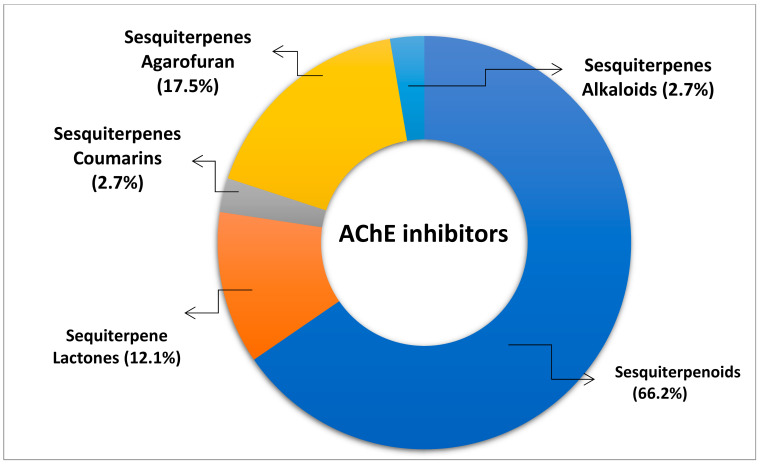
- Synthesized studies on sesquiterpenoids, sesquiterpene lactones, coumarins, agarofuran, and alkaloids; AChE inhibition was commonly assessed by Ellman’s method, with some docking and in vivo mouse studies.
- Qualitative synthesis; the paper reports counting 58 sesquiterpenes and identifying 12 with IC50 <9 µM.
Limitations
- Stated: IC50 alone should not determine anti-Alzheimer potential; Ellman assays with carbonyl-containing compounds can produce false positives; most plant actives were not evaluated for unwanted side effects; animal-model and clinical confirmation are needed; galliardin has cytotoxic properties.
- Evident: as a narrative review, it lacks a formal systematic protocol, explicit inclusion/exclusion criteria, risk-of-bias assessment, or meta-analysis; evidence is heterogeneous (in vitro IC50 values, essential-oil mixtures, docking, and mouse models) and IC50 units vary (µM, µg/mL, mg/mL).
- Evident: many compounds are discussed without blood-brain barrier permeability, bioavailability, or toxicity data, though the paper notes lipophilicity may aid bioavailability and calls for toxicological profiling.
Model-written summary. Check it against the paper before relying on it.
Integrity signals
Registry
Cites
Statistics
Figures
Verification
Claims the paper makes
102 Not checked yet · 18 Own interpretation · 13 No basis given · 2 Partly supported · 1 Own result · accuracy not yet measured
The cited sources support only part of this claim — read each source’s verdict below.
In the paper
“Hence ambrosin and nootkatone, as novel sesquiterpenes, could significantly reduce the expression of this transcription factor (NF-κβp65) in experimental groups.”
§ Acetylcholinesterase Inhibitory Potential of Various Sesquiterpene Analogues for Alzheimer’s Disease Therapy > 3. Sesquiterpenes for Alternate AD Targets
What the sources say
- Not checked yetcites [143] Wanga, 2018, Nootkatone, a neuroprotective agent from AlpiniaeOxyphyllae Fructus, improves cognitive impairment in lipopolysaccharide-induced mouse model of Alzheimer’s disease, Int. Immunopharmacol. source
- Partly supportedcites [144] Khalil, M.N., Choucry, M.A., El Senousy, A.S., Hassan, A., El-Marasy, S.A., El Awdan, S.A., and Omar, F.A. (2019). Ambrosin, a potent NF-κβ inhibitor, ameliorates lipopolysaccharide induced memory impairment, comparison to curcumin. PLoS ONE, 14. sourceExperimental — accuracy not yet measured
The Results (‘Curcumin and ambrosin reduced NF-κβp65 transcript and protein levels’; page unavailable) report that ambrosin significantly reduced NF-κβp65 expression in the LPS-treated experimental model. The paper compares ambrosin with curcumin; it does not report a nootkatone experimental group or establish the claimed effect for nootkatone. (LLM, conf=0.90)
hedgedconditional- Asserted: passes — The authors put it forward as true.
- Checkable: passes — It can be checked against evidence.
- Load-bearing: passes — The paper’s conclusions depend on it.
- Based: passes — The paper gives a reason why it holds.
In the paper
“Both the oils showed significant AChE and BChE inhibitory activity (p < 0.05) in a dose-dependent manner at the concentration of 416 µg/mL.”
§ Acetylcholinesterase Inhibitory Potential of Various Sesquiterpene Analogues for Alzheimer’s Disease Therapy > 2. Review Methodology and Current Developments > 2.1. Sesquiterpenoids
What the sources say
- Not checked yetcites [96] Olawuni, 2018, In vitro anti-cholinesterase and cognitive enhancing properties of essential oils from Piper nigrum L. and Monodora myristica (Gaertn) dunal, Int.J. Pharmacol. Toxicol. source
plaincorrelational- Asserted: passes — The authors put it forward as true.
- Checkable: passes — It can be checked against evidence.
- Load-bearing: unclear — It is unclear whether the paper’s conclusions depend on it.
- Based: passes — The paper gives a reason why it holds.
In the paper
“In contrast, the extract exhibited 63 ± 0.8% activity only against BChE at the concentration of 500 μg/mL.”
§ Acetylcholinesterase Inhibitory Potential of Various Sesquiterpene Analogues for Alzheimer’s Disease Therapy > 2. Review Methodology and Current Developments > 2.1. Sesquiterpenoids
What the sources say
- Not checked yetcites [94] Tel, 2010, Chemical composition of the essential oil and hexane extract of Salvia chionantha and their antioxidant and anticholinesterase activities, Food Chem. Toxicol. source
plain- Asserted: passes — The authors put it forward as true.
- Checkable: passes — It can be checked against evidence.
- Load-bearing: unclear — It is unclear whether the paper’s conclusions depend on it.
- Based: passes — The paper gives a reason why it holds.
In the paper
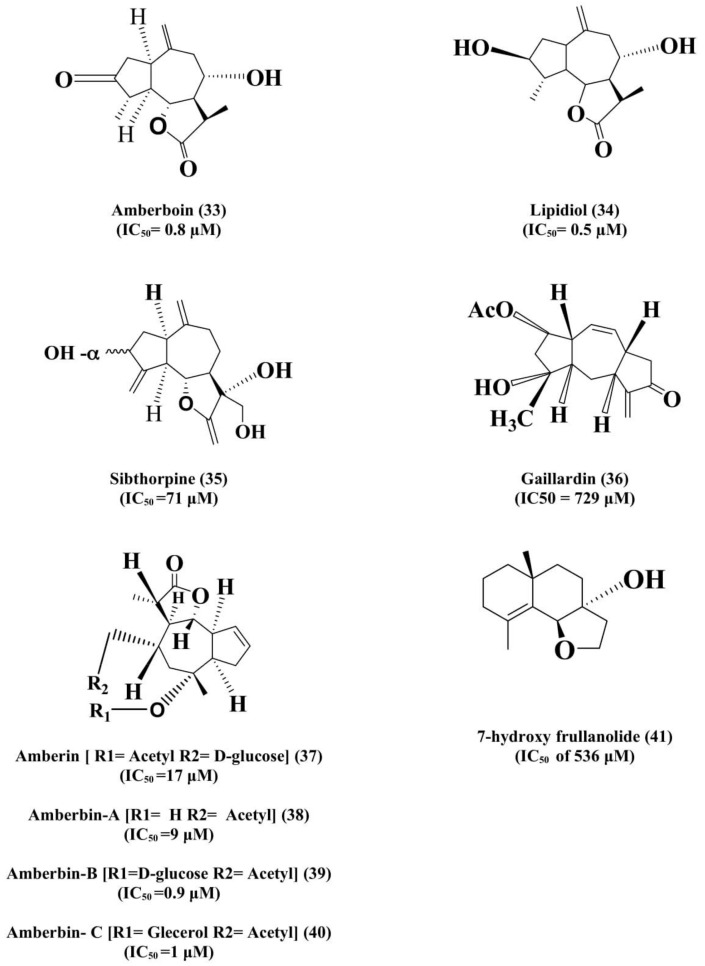
“Further, amberboin also inhibited the BChE at IC50 of 0.6 ± 0.13 µM.”
§ Acetylcholinesterase Inhibitory Potential of Various Sesquiterpene Analogues for Alzheimer’s Disease Therapy > 2. Review Methodology and Current Developments > 2.2. Sesquiterpene Lactones (SLs)
What the sources say
- Not checked yetcites [121] Elsebaia, 2018, Amberboin and lipidiol: X-ray crystalographic data, absolute configuration and inhibition of cholinesterase, Phytochem. Lett. source
plaindirect- Asserted: passes — The authors put it forward as true.
- Checkable: passes — It can be checked against evidence.
- Load-bearing: unclear — It is unclear whether the paper’s conclusions depend on it.
- Based: passes — The paper gives a reason why it holds.
In the paper
“Petroleum ether fraction was found to be loaded with SLs (about 80%), accounting for its anti-AChE activity.”
§ Acetylcholinesterase Inhibitory Potential of Various Sesquiterpene Analogues for Alzheimer’s Disease Therapy > 2. Review Methodology and Current Developments > 2.2. Sesquiterpene Lactones (SLs)
What the sources say
- Not checked yetcites [125] Patel, M.B., and Amin, D. (2012). Sphaeranthus indicus flower derived constituents exhibits synergistic effect against acetylcholinesterase and possess potential antiamnestic activity. J. Complement. Integr. Med., 9. source
plaindirect- Asserted: passes — The authors put it forward as true.
- Checkable: passes — It can be checked against evidence.
- Load-bearing: unclear — It is unclear whether the paper’s conclusions depend on it.
- Based: passes — The paper gives a reason why it holds.
In the paper
“The oil was observed to exhibit AChE inhibitory activity with an IC50 = 8 ± 0.6 mg/mL, which can be helpful in the treatment of AD.”
§ Acetylcholinesterase Inhibitory Potential of Various Sesquiterpene Analogues for Alzheimer’s Disease Therapy > 2. Review Methodology and Current Developments > 2.1. Sesquiterpenoids
What the sources say
- Not checked yetcites [92] Christianah, 2018, Acetylcholinesterase inhibitory effect and characterization of the essential oil of Plectranthusa egyptiacus (Forssk.) C. Chr. growing in Nigeria, Med. Aromat. Plants
plaindirect- Asserted: passes — The authors put it forward as true.
- Checkable: passes — It can be checked against evidence.
- Load-bearing: unclear — It is unclear whether the paper’s conclusions depend on it.
- Based: passes — The paper gives a reason why it holds.
- Rests on an assumption: In vitro AChE inhibition by a sesquiterpene is sufficient to indicate potential for treating AD or improving learning and memory.
In the paper
“It was concluded that essential oil from flower buds of Hertia cheirifolia are rich in the anti-AChE activity of 1.86 mg Eq donepezil/g of essential oil due to the presence of Germacrene d.”
§ Acetylcholinesterase Inhibitory Potential of Various Sesquiterpene Analogues for Alzheimer’s Disease Therapy > 2. Review Methodology and Current Developments > 2.1. Sesquiterpenoids
What the sources say
- Not checked yetcites [93] Rahali, 2017, Antioxidant, α-amylase, and acetylcholinesterase inhibitory activities of Hertiacheiri folia essential oils: Influence of plant organs and seasonal variation, Int. J. Food Prop.
boosteddirect- Asserted: passes — The authors put it forward as true.
- Checkable: passes — It can be checked against evidence.
- Load-bearing: unclear — It is unclear whether the paper’s conclusions depend on it.
- Based: passes — The paper gives a reason why it holds.
- Rests on an assumption: In vitro AChE inhibition by a sesquiterpene is sufficient to indicate potential for treating AD or improving learning and memory.
In the paper
“Furthermore, the bisabolane-type sesquiterpenoid derivatives from plants, such as (+)-(7S,9S)-ar-turmerol, (+)-(7S,9R)-ar-turmerol, (+)-(7S,9S)-dihydro-ar-turmerol, (+)-(7S,9R)-dihydro-ar-turmerol, (+)-(S)-ar-curcumene, and (+)-(S)-dihydro-ar-curcumene, were synthesized which were found to exhibit the acetylcholinesterase inhibitory activity in the order hydrocarbons <alcohols < ketones.”
§ Acetylcholinesterase Inhibitory Potential of Various Sesquiterpene Analogues for Alzheimer’s Disease Therapy > 2. Review Methodology and Current Developments > 2.1. Sesquiterpenoids
What the sources say
- Not checked yetcites [90] Fujiwara, 2010, Acetylcholinesterase inhibitory activity of volatile oil from Peltophorum dasyrachis Kurz ex Bakar (yellow batai) and bisabolane-type sesquiterpenoids, J. Agric. Food Chem. source
plaincorrelational- Asserted: passes — The authors put it forward as true.
- Checkable: passes — It can be checked against evidence.
- Load-bearing: unclear — It is unclear whether the paper’s conclusions depend on it.
- Based: passes — The paper gives a reason why it holds.
In the paper
“The β-asarone showed the maximum inhibition against AChE [95].”
§ Acetylcholinesterase Inhibitory Potential of Various Sesquiterpene Analogues for Alzheimer’s Disease Therapy > 2. Review Methodology and Current Developments > 2.1. Sesquiterpenoids
What the sources say
- Not checked yetcites [95] Mukherjee, 2007, In vitro acetylcholinesterase inhibitory activity of the essential oil from Acorus calamus and its main constituents, Planta Medica source
plaindirect- Asserted: passes — The authors put it forward as true.
- Checkable: passes — It can be checked against evidence.
- Load-bearing: unclear — It is unclear whether the paper’s conclusions depend on it.
- Based: passes — The paper gives a reason why it holds.
In the paper
“The maximum activity was observed through the oxidation of the functional group at C9 position and C10–C11 structure of single-bond moiety, (+)-(S)-dihydro-ar-turmerone.”
§ Acetylcholinesterase Inhibitory Potential of Various Sesquiterpene Analogues for Alzheimer’s Disease Therapy > 2. Review Methodology and Current Developments > 2.1. Sesquiterpenoids
What the sources say
- Not checked yetcites [90] Fujiwara, 2010, Acetylcholinesterase inhibitory activity of volatile oil from Peltophorum dasyrachis Kurz ex Bakar (yellow batai) and bisabolane-type sesquiterpenoids, J. Agric. Food Chem. source
plaindirect- Asserted: passes — The authors put it forward as true.
- Checkable: passes — It can be checked against evidence.
- Load-bearing: unclear — It is unclear whether the paper’s conclusions depend on it.
- Based: passes — The paper gives a reason why it holds.
- Probably not a substantial claim. 22
- It may state two separate claims as one. 62
- The quote only partly states this claim. 1
The cited sources support only part of this claim — read each source’s verdict below.
In the paper
“Furthermore, it has been established that for the proper functioning of neurons, there should be a critical balance between the excitatory and inhibitory neurotransmitters [155,156,157,158].”
§ Acetylcholinesterase Inhibitory Potential of Various Sesquiterpene Analogues for Alzheimer’s Disease Therapy > 5. Final Remarks and Future Prospects
What the sources say
- Partly supportedcites [155] Kehrer, C., Maziashvili, N., Dugladze, T., and Gloveli, T. (2008). Altered excitatory-inhibitory balance in the NMDA-hypofunction model of schizophrenia. Front. Mol. Neurosci., 1. sourceExperimental — accuracy not yet measured
The Abstract describes a functional imbalance between excitatory and inhibitory transmission at the network level in schizophrenia. The NMDA-Hypofunction Theory section says loss of inhibition is likely to compromise network activity, but it does not establish a critical balance required for the proper functioning of individual neurons generally. Page numbers were not available in our copy. (LLM, conf=0.78)
- Not checked yetcites [156] Cummings, 2009, Alterations in cortical excitation and inhibition in genetic mouse models of Huntington’s disease, J. Neurosci. source
- Supportedcites [157] Sun, 2009, Imbalance between GABAergic and glutamatergic transmission impairs adult neurogenesis in an animal model of Alzheimer’s disease, Cell Stem Cell source
The Introduction says adult hippocampal neurogenesis is tightly regulated by the balance between GABAergic and glutamatergic inputs. It also links neurological deficits to aberrant excitatory and inhibitory activity, supporting the citing sentence’s broad point about neuronal function. (LLM, conf=0.86)
- Not checked yetcites [158] Gueli, 2013, Alzheimer’s disease: Amino acid levels and brain metabolic status, Neurol. Sci. source
boosteddirect- Asserted: passes — The authors put it forward as true.
- Checkable: passes — It can be checked against evidence.
- Load-bearing: fails — The paper’s conclusions may not depend on it.
- Based: passes — The paper gives a reason why it holds.
Probably not a substantial claim. The paper’s conclusions may not depend on it.
- Partly supported
A result the paper reports from its own data — it cites no other source for it, so there is none to check. The quote shows it is in the paper.
In the paper
“After data analysis, it was found that 12 compounds out of a total of 58 sesquiterpenes were reported to possess IC50 < 9 μM and can be considered as potential candidates for the improvement of learning and memory.”
§ Acetylcholinesterase Inhibitory Potential of Various Sesquiterpene Analogues for Alzheimer’s Disease Therapy > Abstract
plain- Asserted: passes — The authors put it forward as true.
- Checkable: passes — It can be checked against evidence.
- Load-bearing: passes — The paper’s conclusions depend on it.
- Based: passes — The paper gives a reason why it holds.
It may state two separate claims as one.
- Rests on an assumption: An IC50 below 9 μM is an appropriate threshold for considering a sesquiterpene a potential candidate for improving learning and memory.
- Rests on an assumption: In vitro AChE inhibition by a sesquiterpene is sufficient to indicate potential for treating AD or improving learning and memory.
In the paper
“The leaf oil inhibited the AChE with IC50 = 85 µg/mL), On the other hand, stem oil showed the same inhibition with IC50 = 92 μg/mL. It indicated the leaf oil as a stronger inhibitor of AChE activity than the stem oil.”
§ Acetylcholinesterase Inhibitory Potential of Various Sesquiterpene Analogues for Alzheimer’s Disease Therapy > 2. Review Methodology and Current Developments > 2.1. Sesquiterpenoids
What the sources say
- Not checked yetcites [91] Miyazawa, 2016, Chemical composition, aroma evaluation, and inhibitory activity towards acetylcholinesterase of essential oils from Gynura bicolor DC, J. Nat. Med. source
hedgeddirect- Asserted: passes — The authors put it forward as true.
- Checkable: passes — It can be checked against evidence.
- Load-bearing: unclear — It is unclear whether the paper’s conclusions depend on it.
- Based: passes — The paper gives a reason why it holds.
It may state two separate claims as one.
In the paper
“The results clearly stated that the two isolated sesquiterpene lactones are the better inhibitors of AChE and BChEas compared to the reference, galanthamine (IC50 = 3 ± 0.2 μM and 47 ± 1 μM for AChE and BChE, respectively).”
§ Acetylcholinesterase Inhibitory Potential of Various Sesquiterpene Analogues for Alzheimer’s Disease Therapy > 2. Review Methodology and Current Developments > 2.2. Sesquiterpene Lactones (SLs)
What the sources say
- Not checked yetcites [121] Elsebaia, 2018, Amberboin and lipidiol: X-ray crystalographic data, absolute configuration and inhibition of cholinesterase, Phytochem. Lett. source
boosteddirect- Asserted: passes — The authors put it forward as true.
- Checkable: passes — It can be checked against evidence.
- Load-bearing: passes — The paper’s conclusions depend on it.
- Based: passes — The paper gives a reason why it holds.
It may state two separate claims as one.
In the paper
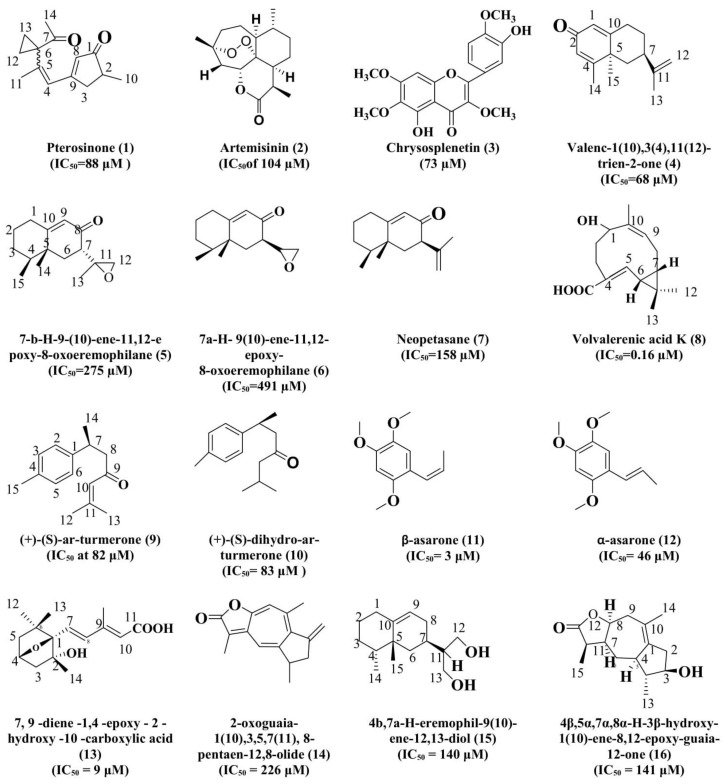
“The IC50 values for alcoholic extract, essential oil, and two chief constituents of oil, i.e., β-asarone (11) and α-asarone (12) were reported as 182 ± 17 μg/mL, 11 ± 0.8 μg/mL, 3 ± 0.02 μM, and 46 ± 3 μM, respectively.”
§ Acetylcholinesterase Inhibitory Potential of Various Sesquiterpene Analogues for Alzheimer’s Disease Therapy > 2. Review Methodology and Current Developments > 2.1. Sesquiterpenoids
What the sources say
- Not checked yetcites [95] Mukherjee, 2007, In vitro acetylcholinesterase inhibitory activity of the essential oil from Acorus calamus and its main constituents, Planta Medica source
plain- Asserted: passes — The authors put it forward as true.
- Checkable: passes — It can be checked against evidence.
- Load-bearing: passes — The paper’s conclusions depend on it.
- Based: passes — The paper gives a reason why it holds.
It may state two separate claims as one.
In the paper
“Their IC50 (μM) for AChE inhibition was reported as 17 ± 0.01, 9 ± 0.2, 0.9 ± 0.02 and 1 ± 0.08 for sesquiterpene lactones Amberin (37), Amberbin-A (38), Amberbin-B (39), and Amberbin-C (40), respectively”
§ Acetylcholinesterase Inhibitory Potential of Various Sesquiterpene Analogues for Alzheimer’s Disease Therapy > 2. Review Methodology and Current Developments > 2.2. Sesquiterpene Lactones (SLs)
What the sources say
- Not checked yetcites [124] Ibrahim, 2013, Acetyl and butyryl cholinesterase inhibitory sesquiterpene lactones from Amberboaramosa, Chem. Cent. J. source
plain- Asserted: passes — The authors put it forward as true.
- Checkable: passes — It can be checked against evidence.
- Load-bearing: passes — The paper’s conclusions depend on it.
- Based: passes — The paper gives a reason why it holds.
It may state two separate claims as one.
In the paper
“Di hydro derivative of turmerone is most potent with IC50 at 82 ± 0.2 μM, followed by volatile oil (IC50 = 83 ± 3 μg/mL).”
§ Acetylcholinesterase Inhibitory Potential of Various Sesquiterpene Analogues for Alzheimer’s Disease Therapy > 2. Review Methodology and Current Developments > 2.1. Sesquiterpenoids
What the sources say
- Not checked yetcites [90] Fujiwara, 2010, Acetylcholinesterase inhibitory activity of volatile oil from Peltophorum dasyrachis Kurz ex Bakar (yellow batai) and bisabolane-type sesquiterpenoids, J. Agric. Food Chem. source
plain- Asserted: passes — The authors put it forward as true.
- Checkable: passes — It can be checked against evidence.
- Load-bearing: unclear — It is unclear whether the paper’s conclusions depend on it.
- Based: passes — The paper gives a reason why it holds.
It may state two separate claims as one.
In the paper
“The crude extract with artemisinin and chrysosplenetin showed the inhibition of AChE activity by 72% and 80% at 0.1 mg/mL with IC50 of 104 µM and 73 µM.”
§ Acetylcholinesterase Inhibitory Potential of Various Sesquiterpene Analogues for Alzheimer’s Disease Therapy > 2. Review Methodology and Current Developments > 2.1. Sesquiterpenoids
What the sources say
- Not checked yetcites [51] Duan, 2001, Immunosuppressive sesquiterpene alkaloids from Tripterygium wilfordii, J. Nat. Prod. source
plaindirect- Asserted: passes — The authors put it forward as true.
- Checkable: passes — It can be checked against evidence.
- Load-bearing: unclear — It is unclear whether the paper’s conclusions depend on it.
- Based: passes — The paper gives a reason why it holds.
It may state two separate claims as one.
In the paper
“M. myristica elicited stronger inhibition for AChE and BChE with IC50 of 205 ± 0.06 µg/mL and 178 ± 0.02 µg/mL with 79% and 89% inhibition”
§ Acetylcholinesterase Inhibitory Potential of Various Sesquiterpene Analogues for Alzheimer’s Disease Therapy > 2. Review Methodology and Current Developments > 2.1. Sesquiterpenoids
What the sources say
- Not checked yetcites [96] Olawuni, 2018, In vitro anti-cholinesterase and cognitive enhancing properties of essential oils from Piper nigrum L. and Monodora myristica (Gaertn) dunal, Int.J. Pharmacol. Toxicol. source
plaindirect- Asserted: passes — The authors put it forward as true.
- Checkable: passes — It can be checked against evidence.
- Load-bearing: unclear — It is unclear whether the paper’s conclusions depend on it.
- Based: passes — The paper gives a reason why it holds.
It may state two separate claims as one.
In the paper
“Long term exposure to chloroform extract improved the cognitive abilities while performing the behavioral tasks, increased the glutathione peroxidase (GSH-px) activities, decreased the acetylcholinesterase (AChE), malondialdehyde level (MDA), and β-amyloid (Aβ), and ultimately overturned the microglia activation, neuronal acidophilia degeneration, and cortex and hippocampus nuclear condensation.”
§ Acetylcholinesterase Inhibitory Potential of Various Sesquiterpene Analogues for Alzheimer’s Disease Therapy > 2. Review Methodology and Current Developments > 2.1. Sesquiterpenoids
What the sources say
- Not checked yetcites [89] Shi, S.H., Zhao, X., Liu, B., Li, H., Liu, A.J., Wu, B., Bi, K.S., and Jia, Y. (2014). The effects of sesquiterpenes-rich extract of Alpinia oxyphylla Miq. on amyloid-𝛽-induced cognitive impairment and neuronal abnormalities in the cortex and hippocampus of mice. Oxidative Med. Cell. Longev. source
plaindirect- Asserted: passes — The authors put it forward as true.
- Checkable: passes — It can be checked against evidence.
- Load-bearing: passes — The paper’s conclusions depend on it.
- Based: passes — The paper gives a reason why it holds.
It may state two separate claims as one.
In the paper
“It was observed that petroleum ether fraction was the only portion with AChE inhibitory potential with an IC50 of 37 mg/mL and the extract at a dose of 10 mg/kg, per orally. in mice considerably inverted the cognitive damages caused through the passive avoidance test (p < 0.05).”
§ Acetylcholinesterase Inhibitory Potential of Various Sesquiterpene Analogues for Alzheimer’s Disease Therapy > 2. Review Methodology and Current Developments > 2.2. Sesquiterpene Lactones (SLs)
What the sources say
- Not checked yetcites [125] Patel, M.B., and Amin, D. (2012). Sphaeranthus indicus flower derived constituents exhibits synergistic effect against acetylcholinesterase and possess potential antiamnestic activity. J. Complement. Integr. Med., 9. source
plaindirect- Asserted: passes — The authors put it forward as true.
- Checkable: passes — It can be checked against evidence.
- Load-bearing: unclear — It is unclear whether the paper’s conclusions depend on it.
- Based: passes — The paper gives a reason why it holds.
It may state two separate claims as one.
In the paper
“Similarly, the greenish-yellow color essential oil from the Salvia chionantha moderate AChE and BChE activity, i.e., 57 ± 2% and 41 ± 9%, respectively.”
§ Acetylcholinesterase Inhibitory Potential of Various Sesquiterpene Analogues for Alzheimer’s Disease Therapy > 2. Review Methodology and Current Developments > 2.1. Sesquiterpenoids
What the sources say
- Not checked yetcites [94] Tel, 2010, Chemical composition of the essential oil and hexane extract of Salvia chionantha and their antioxidant and anticholinesterase activities, Food Chem. Toxicol. source
plain- Asserted: passes — The authors put it forward as true.
- Checkable: passes — It can be checked against evidence.
- Load-bearing: unclear — It is unclear whether the paper’s conclusions depend on it.
- Based: passes — The paper gives a reason why it holds.
It may state two separate claims as one.
In the paper
“whereas the P. nigrum oil inhibited the AChE (75%) and BChE (85%) with IC50 = 0.3 ± 0.02 µg/mL and 223 ± 0.002 µg/mL, respectively.”
§ Acetylcholinesterase Inhibitory Potential of Various Sesquiterpene Analogues for Alzheimer’s Disease Therapy > 2. Review Methodology and Current Developments > 2.1. Sesquiterpenoids
What the sources say
- Not checked yetcites [96] Olawuni, 2018, In vitro anti-cholinesterase and cognitive enhancing properties of essential oils from Piper nigrum L. and Monodora myristica (Gaertn) dunal, Int.J. Pharmacol. Toxicol. source
plaindirect- Asserted: passes — The authors put it forward as true.
- Checkable: passes — It can be checked against evidence.
- Load-bearing: unclear — It is unclear whether the paper’s conclusions depend on it.
- Based: passes — The paper gives a reason why it holds.
It may state two separate claims as one.
In the paper
“Moreover, the Turmerone was analyzed to be a competitive inhibitor of AChE, whereas the dihydro derivative is the non-competitive inhibitor of this enzyme.”
§ Acetylcholinesterase Inhibitory Potential of Various Sesquiterpene Analogues for Alzheimer’s Disease Therapy > 2. Review Methodology and Current Developments > 2.1. Sesquiterpenoids
What the sources say
- Not checked yetcites [90] Fujiwara, 2010, Acetylcholinesterase inhibitory activity of volatile oil from Peltophorum dasyrachis Kurz ex Bakar (yellow batai) and bisabolane-type sesquiterpenoids, J. Agric. Food Chem. source
plaindirect- Asserted: passes — The authors put it forward as true.
- Checkable: passes — It can be checked against evidence.
- Load-bearing: unclear — It is unclear whether the paper’s conclusions depend on it.
- Based: passes — The paper gives a reason why it holds.
It may state two separate claims as one.
In the paper
“Docking study of both compounds confirms the affinity of them towards the active sites of AChE, which indicated inhibitory activity against AChE at IC50 = 0.8 ± 0.03 µM and 0.5 ± 0.01 µM, respectively.”
§ Acetylcholinesterase Inhibitory Potential of Various Sesquiterpene Analogues for Alzheimer’s Disease Therapy > 2. Review Methodology and Current Developments > 2.2. Sesquiterpene Lactones (SLs)
What the sources say
- Not checked yetcites [121] Elsebaia, 2018, Amberboin and lipidiol: X-ray crystalographic data, absolute configuration and inhibition of cholinesterase, Phytochem. Lett. source
hedgeddirect- Asserted: passes — The authors put it forward as true.
- Checkable: passes — It can be checked against evidence.
- Load-bearing: passes — The paper’s conclusions depend on it.
- Based: passes — The paper gives a reason why it holds.
It may state two separate claims as one.
- Rests on an assumption: Molecular docking scores predict binding affinity and AChE inhibitory activity.
In the paper
“Isolated compounds were found out to be 7-β-H-9-(10)-ene-11,12-epoxy-8-oxoeremophilane (5) (48 ± 2% inhibition at 50 mg/mL with IC50 = 275 ± 5 µM); 7α-H-9(10)-ene-11,12-epoxy-8-oxoeremophilane (6) with 31 ± 1% inhibition at 50 mg/mL with IC50 = 491 ± 4 µM); neopetasane (7) (62 ± 1% inhibition at 50 mg/mL with IC50 = 158 ± 4 µM).”
§ Acetylcholinesterase Inhibitory Potential of Various Sesquiterpene Analogues for Alzheimer’s Disease Therapy > 2. Review Methodology and Current Developments > 2.1. Sesquiterpenoids
What the sources say
- Not checked yetcites [87] Yang, 2014, Fragrant agarofuran and eremophilane sesquiterpenes in agarwood ‘Qi-Nan’ from Aquilaria sinensis, Phytochem. Lett. source
plaindirect- Asserted: passes — The authors put it forward as true.
- Checkable: passes — It can be checked against evidence.
- Load-bearing: unclear — It is unclear whether the paper’s conclusions depend on it.
- Based: passes — The paper gives a reason why it holds.
It may state two separate claims as one.
In the paper
“The oil exhibited the AChE inhibitory potential with IC50 = 0.08 μg/mL, and this activity is attributed to the higher binding affinity of δ-cadinene and γ-cadinene (oil constituents) toward AChE as predicted by the docking score of –7.35 and –6.77, respectively [97].”
§ Acetylcholinesterase Inhibitory Potential of Various Sesquiterpene Analogues for Alzheimer’s Disease Therapy > 2. Review Methodology and Current Developments > 2.1. Sesquiterpenoids
What the sources say
- Not checked yetcites [97] Holanda, 2020, Chemical composition and acetylcholinesterase inhibitory potential, in silico, of Myrciaria floribunda (H. West ex Willd.) O. Berg fruit peel essential oil, Ind. Crops Prod. source
plaindirect- Asserted: passes — The authors put it forward as true.
- Checkable: passes — It can be checked against evidence.
- Load-bearing: unclear — It is unclear whether the paper’s conclusions depend on it.
- Based: passes — The paper gives a reason why it holds.
It may state two separate claims as one.
- Rests on an assumption: Molecular docking scores predict binding affinity and AChE inhibitory activity.
In the paper
“The compounds showed potential inhibitory activity against AChE (IC50 = 6 ± 0.03 μM and 1 ± 0.01 μM, respectively) and BChE (IC50 = 10 ± 0.24μM and 1 ± 0.19 μM, respectively) and established the plant as an emerging source in AD treatment.”
§ Acetylcholinesterase Inhibitory Potential of Various Sesquiterpene Analogues for Alzheimer’s Disease Therapy > 2. Review Methodology and Current Developments > 2.3. Miscellaneous Sesquiterpenes
What the sources say
- Not checked yetcites [129] Guvenalp, 2017, Cholinesterase inhibition and molecular docking studies of sesquiterpene coumarin ethers from Heptapteracilicica, Rec. Nat. Prod. source
plaindirect- Asserted: passes — The authors put it forward as true.
- Checkable: passes — It can be checked against evidence.
- Load-bearing: unclear — It is unclear whether the paper’s conclusions depend on it.
- Based: passes — The paper gives a reason why it holds.
It may state two separate claims as one.
In the paper
“This compound exhibited significant butyrylcholinesterase activity with the IC50 = 68 μM when compared to the positive control, berberine (IC50 = 19 μM)”
§ Acetylcholinesterase Inhibitory Potential of Various Sesquiterpene Analogues for Alzheimer’s Disease Therapy > 2. Review Methodology and Current Developments > 2.1. Sesquiterpenoids
What the sources say
- Not checked yetcites [86] Jung, 2017, Sesquiterpenoids from the heartwood of Juniperus chinensis, Nat. Prod. Sci. source
plaincorrelational- Asserted: passes — The authors put it forward as true.
- Checkable: passes — It can be checked against evidence.
- Load-bearing: unclear — It is unclear whether the paper’s conclusions depend on it.
- Based: passes — The paper gives a reason why it holds.
It may state two separate claims as one.
In the paper
“The results of the study showed that, in mice (APPswe/PS1E9 double-transgenic mouse) from middle and high dose groups, the AChT (acetylcholine transferase) activity had been improved in the brain tissues, while the AChE activity was significantly decreased causing an increase in the learning memory.”
§ Acetylcholinesterase Inhibitory Potential of Various Sesquiterpene Analogues for Alzheimer’s Disease Therapy > 2. Review Methodology and Current Developments > 2.1. Sesquiterpenoids
What the sources say
- Not checked yetcites [88] Chen, 2016, Sesquiterpenes and a monoterpenoid with acetylcholinesterase (AchE) inhibitory activity from Valeriana officinalis var. latiofolia in vitro and in vivo, Fitoterapia source
plaindirect- Asserted: passes — The authors put it forward as true.
- Checkable: passes — It can be checked against evidence.
- Load-bearing: passes — The paper’s conclusions depend on it.
- Based: passes — The paper gives a reason why it holds.
It may state two separate claims as one.
In the paper
“It was observed that the Volvalerenic acid K (8) improved the learning and memory abilities of mice, with IC50 = 0.16 µM in vitro.”
§ Acetylcholinesterase Inhibitory Potential of Various Sesquiterpene Analogues for Alzheimer’s Disease Therapy > 2. Review Methodology and Current Developments > 2.1. Sesquiterpenoids
What the sources say
- Not checked yetcites [88] Chen, 2016, Sesquiterpenes and a monoterpenoid with acetylcholinesterase (AchE) inhibitory activity from Valeriana officinalis var. latiofolia in vitro and in vivo, Fitoterapia source
plaindirect- Asserted: passes — The authors put it forward as true.
- Checkable: passes — It can be checked against evidence.
- Load-bearing: unclear — It is unclear whether the paper’s conclusions depend on it.
- Based: passes — The paper gives a reason why it holds.
It may state two separate claims as one.
- Rests on an assumption: In vitro AChE inhibition by a sesquiterpene is sufficient to indicate potential for treating AD or improving learning and memory.
In the paper
“GC–MS analysis confirmed the presence of (E)-β-caryophyllene (31%) and bicycle germacrene (8%) as the major sesquiterpenoids from the Gynura bicolor DC leaves oil.”
§ Acetylcholinesterase Inhibitory Potential of Various Sesquiterpene Analogues for Alzheimer’s Disease Therapy > 2. Review Methodology and Current Developments > 2.1. Sesquiterpenoids
What the sources say
- Not checked yetcites [91] Miyazawa, 2016, Chemical composition, aroma evaluation, and inhibitory activity towards acetylcholinesterase of essential oils from Gynura bicolor DC, J. Nat. Med. source
boosted- Asserted: passes — The authors put it forward as true.
- Checkable: passes — It can be checked against evidence.
- Load-bearing: unclear — It is unclear whether the paper’s conclusions depend on it.
- Based: passes — The paper gives a reason why it holds.
It may state two separate claims as one.
In the paper
“Pterosinone was reported to have mild inhibitory activity against acetyl and butyl cholinesterase enzymes with IC50 = 88 μM and 73 μM, respectively.”
§ Acetylcholinesterase Inhibitory Potential of Various Sesquiterpene Analogues for Alzheimer’s Disease Therapy > 2. Review Methodology and Current Developments > 2.1. Sesquiterpenoids
What the sources say
- Not checked yetcites [85] Choi, 2018, (−)-Pteroside N and pterosinone, new BACE1 and cholinesterase inhibitors from Pteridium aquilinum, Phytochem. Lett. source
plaindirect- Asserted: passes — The authors put it forward as true.
- Checkable: passes — It can be checked against evidence.
- Load-bearing: unclear — It is unclear whether the paper’s conclusions depend on it.
- Based: passes — The paper gives a reason why it holds.
It may state two separate claims as one.
A conclusion the paper draws from its own results — it cites no other source for it, so there is none to check. The quote shows it is in the paper.
In the paper
“AChE inhibition can help in maintaining the normal neurotransmission mediated by ACh in a healthy brain and could prevent the occurrence or slow down the progression of AD.”
§ Acetylcholinesterase Inhibitory Potential of Various Sesquiterpene Analogues for Alzheimer’s Disease Therapy > 1. Introduction
hedgedconditional- Asserted: passes — The authors put it forward as true.
- Checkable: passes — It can be checked against evidence.
- Load-bearing: passes — The paper’s conclusions depend on it.
- Based: unclear — It is unclear why the paper says it holds.
It may state two separate claims as one.
The paper states this without a source or data behind it here, so there is nothing to check it against. The quote shows it is in the paper.
In the paper
“The poor cholinergic transmission at the synapse is considered to be one of the main reasons behind the progression and occurrence of this disorder.”
§ Acetylcholinesterase Inhibitory Potential of Various Sesquiterpene Analogues for Alzheimer’s Disease Therapy > Abstract
plaindirect- Asserted: passes — The authors put it forward as true.
- Checkable: passes — It can be checked against evidence.
- Load-bearing: passes — The paper’s conclusions depend on it.
- Based: fails — The paper may give no reason why it holds.
Probably not a substantial claim. The paper may give no reason why it holds.
A conclusion the paper draws from its own results — it cites no other source for it, so there is none to check. The quote shows it is in the paper.
In the paper
“Moreover, the reduction in substrate concentration (AChE) by these inhibitors may affect the Aβ plaque formation and thus justify the use of ChEi as multi-target therapy for AD.”
§ Acetylcholinesterase Inhibitory Potential of Various Sesquiterpene Analogues for Alzheimer’s Disease Therapy > 1. Introduction
hedgedconditional- Asserted: passes — The authors put it forward as true.
- Checkable: passes — It can be checked against evidence.
- Load-bearing: fails — The paper’s conclusions may not depend on it.
- Based: fails — The paper may give no reason why it holds.
Probably not a substantial claim. The paper’s conclusions may not depend on it. The paper may give no reason why it holds. It may state two separate claims as one.
A conclusion the paper draws from its own results — it cites no other source for it, so there is none to check. The quote shows it is in the paper.
In the paper
“In the light of the above-cited examples, various SLs (Figure 3) seem to be promising acetylcholinesterase inhibitors and helpful in improving the equilibrium between the excitatory and inhibitory potential of neurons and thus can be used in the possible management of AD.”
§ Acetylcholinesterase Inhibitory Potential of Various Sesquiterpene Analogues for Alzheimer’s Disease Therapy > 2. Review Methodology and Current Developments > 2.2. Sesquiterpene Lactones (SLs)
hedgedconditional- Asserted: passes — The authors put it forward as true.
- Checkable: passes — It can be checked against evidence.
- Load-bearing: passes — The paper’s conclusions depend on it.
- Based: passes — The paper gives a reason why it holds.
It may state two separate claims as one.
- Rests on an assumption: In vitro AChE inhibition by a sesquiterpene is sufficient to indicate potential for treating AD or improving learning and memory.
None of the sources cited for this claim have been checked yet.
In the paper
“One of the chemotypes contained prenylated 4-hydroxycoumarins, which are toxic while the second one demonstrated therapeutic activity because of the presence of the SC ethers [127,128].”
§ Acetylcholinesterase Inhibitory Potential of Various Sesquiterpene Analogues for Alzheimer’s Disease Therapy > 2. Review Methodology and Current Developments > 2.3. Miscellaneous Sesquiterpenes
What the sources say
boosteddirect- Asserted: passes — The authors put it forward as true.
- Checkable: passes — It can be checked against evidence.
- Load-bearing: unclear — It is unclear whether the paper’s conclusions depend on it.
- Based: passes — The paper gives a reason why it holds.
It may state two separate claims as one.
In the paper
“It was concluded that the Alpinia oxyphylla ameliorates the learning and memory deficits by attenuating the oxidative stress, regulating the activation of the microglia, and degeneration of the neuronal acidophilia to reinforce the cholinergic functions.”
§ Acetylcholinesterase Inhibitory Potential of Various Sesquiterpene Analogues for Alzheimer’s Disease Therapy > 2. Review Methodology and Current Developments > 2.1. Sesquiterpenoids
What the sources say
- Not checked yetcites [89] Shi, S.H., Zhao, X., Liu, B., Li, H., Liu, A.J., Wu, B., Bi, K.S., and Jia, Y. (2014). The effects of sesquiterpenes-rich extract of Alpinia oxyphylla Miq. on amyloid-𝛽-induced cognitive impairment and neuronal abnormalities in the cortex and hippocampus of mice. Oxidative Med. Cell. Longev. source
boosteddirect- Asserted: passes — The authors put it forward as true.
- Checkable: passes — It can be checked against evidence.
- Load-bearing: passes — The paper’s conclusions depend on it.
- Based: passes — The paper gives a reason why it holds.
It may state two separate claims as one.
- Rests on an assumption: In vitro AChE inhibition by a sesquiterpene is sufficient to indicate potential for treating AD or improving learning and memory.
In the paper
“However, during the late stages of AD, the concentration of AChE decreases significantly (upto 45%) and BuChE is enhanced (upto 40–90%).”
§ Acetylcholinesterase Inhibitory Potential of Various Sesquiterpene Analogues for Alzheimer’s Disease Therapy > 1. Introduction
What the sources say
- Not checked yetcites [34] Arendt, 1992, Changes in acetylcholinesterase and butyrylcholinesterase in Alzheimer’s disease resemble embryonic development—A study of molecular forms, Neurochem. Int. source
plaindirect- Asserted: passes — The authors put it forward as true.
- Checkable: passes — It can be checked against evidence.
- Load-bearing: passes — The paper’s conclusions depend on it.
- Based: passes — The paper gives a reason why it holds.
It may state two separate claims as one.
A conclusion the paper draws from its own results — it cites no other source for it, so there is none to check. The quote shows it is in the paper.
In the paper
“The essential oils containing sesquiterpenoids in comparison to the oils containing monoterpenoids were found to be more effective inhibitors of AChE activity, and the same is the case of mixtures where it ruled by monoterpenoids showed weaker inhibition than the mixture dominated by sesquiterpenoids.”
§ Acetylcholinesterase Inhibitory Potential of Various Sesquiterpene Analogues for Alzheimer’s Disease Therapy > 2. Review Methodology and Current Developments > 2.1. Sesquiterpenoids
plaindirect- Asserted: passes — The authors put it forward as true.
- Checkable: passes — It can be checked against evidence.
- Load-bearing: passes — The paper’s conclusions depend on it.
- Based: passes — The paper gives a reason why it holds.
It may state two separate claims as one.
None of the sources cited for this claim have been checked yet.
In the paper
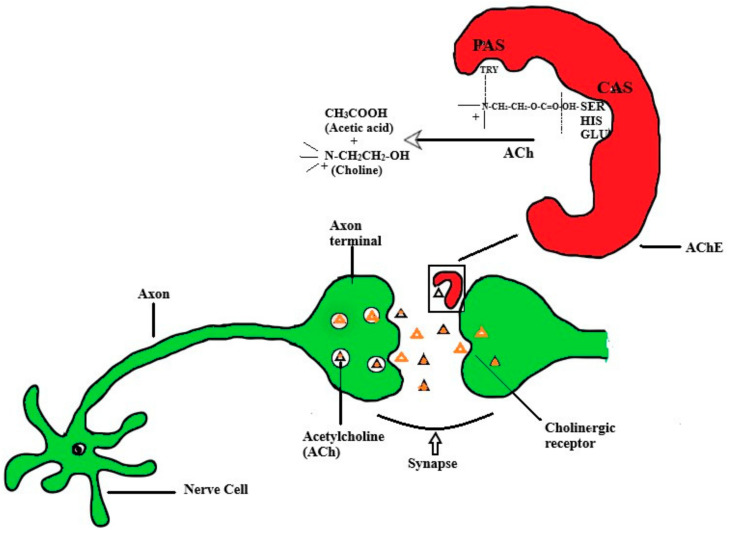
“The ACh temporarily sequesters to the PAS through π-cation interaction between tryptophan on enzyme surface and quaternary amine of ACh.”
§ Acetylcholinesterase Inhibitory Potential of Various Sesquiterpene Analogues for Alzheimer’s Disease Therapy > 1. Introduction
What the sources say
plaindirect- Asserted: passes — The authors put it forward as true.
- Checkable: passes — It can be checked against evidence.
- Load-bearing: fails — The paper’s conclusions may not depend on it.
- Based: passes — The paper gives a reason why it holds.
Probably not a substantial claim. The paper’s conclusions may not depend on it.
In the paper
“Qi et al. [138] investigated the waste produced of Stigma maydis (maize) industry and isolated macrocarpene type sesquiterpenes compounds, namely Stigmene A and Stigmene B”
§ Acetylcholinesterase Inhibitory Potential of Various Sesquiterpene Analogues for Alzheimer’s Disease Therapy > 3. Sesquiterpenes for Alternate AD Targets
What the sources say
- Not checked yetcites [138] Qi, 2018, Sesquiterpenes from stigma maydis (Zea mays) as a crop by-product & their potential neuroprotection and inhibitory activities of Aβ aggregation, Ind. Crops Prod. source
plain- Asserted: passes — The authors put it forward as true.
- Checkable: passes — It can be checked against evidence.
- Load-bearing: unclear — It is unclear whether the paper’s conclusions depend on it.
- Based: passes — The paper gives a reason why it holds.
It may state two separate claims as one.
In the paper
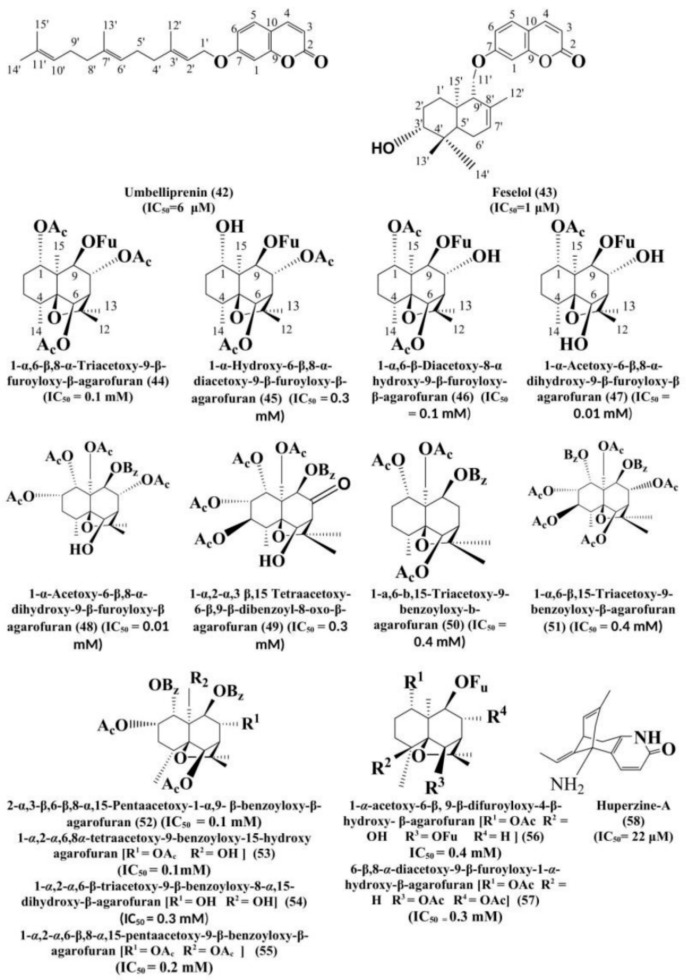
“The compounds and their AChE inhibitory potential of (IC50 in mg/mL) were found to be, 1-α,2-α,6,8α-tetraacetoxy-9-benzoyloxy-15-hydroxy agarofuran (52) (0.1 ± 0.01)”
- Also stated in: § 2.3. Miscellaneous Sesquiterpenes · plain
“1-α-acetoxy-6-β, 9-β-difuroyloxy-4-β-hydroxy- β-agarofuran (56) (0.4 ± 0.04), and 6-β,8-α-diacetoxy-9-β-furoyloxy-1-α-hydroxy-β-agarofuran(57) (0.3 ± 0.02).”
§ Acetylcholinesterase Inhibitory Potential of Various Sesquiterpene Analogues for Alzheimer’s Disease Therapy > 2. Review Methodology and Current Developments > 2.3. Miscellaneous Sesquiterpenes
What the sources say
- Not checked yetcites [132] Astudillo, 2008, Inhibition of acetylcholinesterase activity by dihydro-β-agarofuran sesquiterpenes isolated from Chilean Celastraceae, Zeitschriftfür Naturforschung
plain- Asserted: passes — The authors put it forward as true.
- Checkable: passes — It can be checked against evidence.
- Load-bearing: passes — The paper’s conclusions depend on it.
- Based: passes — The paper gives a reason why it holds.
The quote only partly states this claim.
- Also stated in: § 2.3. Miscellaneous Sesquiterpenes · plain
None of the sources cited for this claim have been checked yet.
In the paper
“Later, a tetrahedral intermediate forms at CAS (at the deeper gorge of enzyme) by a reaction between the oxygen atom of the acetyl group of ACh and serine–histidine–glutamate residue of the enzyme through a covalent bond (Figure 1) [27,28].”
§ Acetylcholinesterase Inhibitory Potential of Various Sesquiterpene Analogues for Alzheimer’s Disease Therapy > 1. Introduction
What the sources say
plaindirect- Asserted: passes — The authors put it forward as true.
- Checkable: passes — It can be checked against evidence.
- Load-bearing: fails — The paper’s conclusions may not depend on it.
- Based: passes — The paper gives a reason why it holds.
Probably not a substantial claim. The paper’s conclusions may not depend on it.
In the paper
“Moreover, the active constituents of different essential oils such as farnesol, caryophyllene, and α-humulene significantly alter the various intracellular signaling parameters of inflammation [64].”
§ Acetylcholinesterase Inhibitory Potential of Various Sesquiterpene Analogues for Alzheimer’s Disease Therapy > 1. Introduction
What the sources say
- Not checked yetcites [64] Andrade, 2015, Sesquiterpenes from essential oils and anti-inflammatory activity, Nat. Prod. Commun.
plaindirect- Asserted: passes — The authors put it forward as true.
- Checkable: passes — It can be checked against evidence.
- Load-bearing: fails — The paper’s conclusions may not depend on it.
- Based: passes — The paper gives a reason why it holds.
Probably not a substantial claim. The paper’s conclusions may not depend on it.
In the paper
“Halting the expression of this factor could reduce the production of β-amyloid (Aβ), which results in enhancement of cholinergic transmission at the synapse.”
§ Acetylcholinesterase Inhibitory Potential of Various Sesquiterpene Analogues for Alzheimer’s Disease Therapy > 3. Sesquiterpenes for Alternate AD Targets
What the sources say
- Not checked yetcites [144] Khalil, M.N., Choucry, M.A., El Senousy, A.S., Hassan, A., El-Marasy, S.A., El Awdan, S.A., and Omar, F.A. (2019). Ambrosin, a potent NF-κβ inhibitor, ameliorates lipopolysaccharide induced memory impairment, comparison to curcumin. PLoS ONE, 14. source
hedgeddirect- Asserted: passes — The authors put it forward as true.
- Checkable: passes — It can be checked against evidence.
- Load-bearing: passes — The paper’s conclusions depend on it.
- Based: passes — The paper gives a reason why it holds.
It may state two separate claims as one.
The paper states this without a source or data behind it here, so there is nothing to check it against. The quote shows it is in the paper.
In the paper
“The enzyme mainly has two active sites, peripheral anionic site (PAS) and catalytic active site (CAS), for the binding of substrate, i.e., acetylcholine.”
§ Acetylcholinesterase Inhibitory Potential of Various Sesquiterpene Analogues for Alzheimer’s Disease Therapy > 1. Introduction
plain- Asserted: passes — The authors put it forward as true.
- Checkable: passes — It can be checked against evidence.
- Load-bearing: fails — The paper’s conclusions may not depend on it.
- Based: passes — The paper gives a reason why it holds.
Probably not a substantial claim. The paper’s conclusions may not depend on it.
In the paper
“and can enhance cognitive abilities and task switching functions rapidly in people suffering from AD.”
§ Acetylcholinesterase Inhibitory Potential of Various Sesquiterpene Analogues for Alzheimer’s Disease Therapy > 2. Review Methodology and Current Developments > 2.3. Miscellaneous Sesquiterpenes
What the sources say
- Not checked yetcites [133] Gul, 2019, Huperzine: A response to cognitive impairment and task switching deficits in patients with Alzheimer’s disease, J. Chin. Med. Assoc. source
plaindirect- Asserted: passes — The authors put it forward as true.
- Checkable: passes — It can be checked against evidence.
- Load-bearing: unclear — It is unclear whether the paper’s conclusions depend on it.
- Based: passes — The paper gives a reason why it holds.
It may state two separate claims as one.
In the paper
“The potency level of bilobalide decreased with increasing GABA concentrations indicating a module of competitive antagonism.”
§ Acetylcholinesterase Inhibitory Potential of Various Sesquiterpene Analogues for Alzheimer’s Disease Therapy > 3. Sesquiterpenes for Alternate AD Targets
What the sources say
- Not checked yetcites [139] Huanga, 2003, Bilobalide, a sesquiterpene trilactone from Ginkgo biloba, is an antagonist at recombinant α1β2Ƴ2L GABAA receptors, Eur. J. Pharmacol. source
hedgeddirect- Asserted: passes — The authors put it forward as true.
- Checkable: passes — It can be checked against evidence.
- Load-bearing: unclear — It is unclear whether the paper’s conclusions depend on it.
- Based: passes — The paper gives a reason why it holds.
It may state two separate claims as one.
In the paper
“This study indicated that the compound, nootkatone, might play a role as a potent therapeutic agent in treating AD and neuroinflammation via improvement in cholinergic transmission, clearing amyloid-β-peptide, and reducing oxidative stress.”
§ Acetylcholinesterase Inhibitory Potential of Various Sesquiterpene Analogues for Alzheimer’s Disease Therapy > 3. Sesquiterpenes for Alternate AD Targets
What the sources say
- Not checked yetcites [143] Wanga, 2018, Nootkatone, a neuroprotective agent from AlpiniaeOxyphyllae Fructus, improves cognitive impairment in lipopolysaccharide-induced mouse model of Alzheimer’s disease, Int. Immunopharmacol. source
hedgedconditional- Asserted: passes — The authors put it forward as true.
- Checkable: passes — It can be checked against evidence.
- Load-bearing: passes — The paper’s conclusions depend on it.
- Based: passes — The paper gives a reason why it holds.
It may state two separate claims as one.
- Rests on an assumption: Findings from animal models of AD translate to humans.
In the paper
“It was observed that (%) decrease in Aβ aggregation was found more in the case of Stigmene A (82.9 ± 2.52%) and Stigmene B (70.1 ± 3.01%) when compared against a positive control, (69.8 ± 1.55%).”
§ Acetylcholinesterase Inhibitory Potential of Various Sesquiterpene Analogues for Alzheimer’s Disease Therapy > 3. Sesquiterpenes for Alternate AD Targets
What the sources say
- Not checked yetcites [138] Qi, 2018, Sesquiterpenes from stigma maydis (Zea mays) as a crop by-product & their potential neuroprotection and inhibitory activities of Aβ aggregation, Ind. Crops Prod. source
plaindirect- Asserted: passes — The authors put it forward as true.
- Checkable: passes — It can be checked against evidence.
- Load-bearing: passes — The paper’s conclusions depend on it.
- Based: passes — The paper gives a reason why it holds.
It may state two separate claims as one.
In the paper
“PAS of AChE also reported to have an affinity toward the peptide of Aβ and the binding of this protein to enzyme promotes the amyloid fibrogenesis and converts the non-amyloidogenic form of Aβ to amyloidogenic form [29].”
§ Acetylcholinesterase Inhibitory Potential of Various Sesquiterpene Analogues for Alzheimer’s Disease Therapy > 1. Introduction
What the sources say
- Not checked yetcites [29] Valenzuela, 2006, Dual binding site acetylcholinesterase inhibitors: Potential new disease-modifying agents for AD, J Mol. Neurosci. source
hedgeddirect- Asserted: passes — The authors put it forward as true.
- Checkable: passes — It can be checked against evidence.
- Load-bearing: fails — The paper’s conclusions may not depend on it.
- Based: passes — The paper gives a reason why it holds.
Probably not a substantial claim. The paper’s conclusions may not depend on it. It may state two separate claims as one.
In the paper
“The bilobalide IC50 (4.6 ± 0.5 μM) was reported as comparable to conventional antagonists of GABA receptors, picrotoxinin (2.4 ± 0.5 μM) and bicuculline (2.0 ± 0.1 μM) at α1β2γ2LGABAA receptors against GABA neurotransmitter.”
§ Acetylcholinesterase Inhibitory Potential of Various Sesquiterpene Analogues for Alzheimer’s Disease Therapy > 3. Sesquiterpenes for Alternate AD Targets
What the sources say
- Not checked yetcites [139] Huanga, 2003, Bilobalide, a sesquiterpene trilactone from Ginkgo biloba, is an antagonist at recombinant α1β2Ƴ2L GABAA receptors, Eur. J. Pharmacol. source
plain- Asserted: passes — The authors put it forward as true.
- Checkable: passes — It can be checked against evidence.
- Load-bearing: unclear — It is unclear whether the paper’s conclusions depend on it.
- Based: passes — The paper gives a reason why it holds.
It may state two separate claims as one.
In the paper
“Sesquiterpene such as nerolidol was reported to reduce the damage to biomolecules (DNA, protein, lipids) due to elevated levels of reactive oxygen species in cells [62].”
§ Acetylcholinesterase Inhibitory Potential of Various Sesquiterpene Analogues for Alzheimer’s Disease Therapy > 1. Introduction
What the sources say
- Not checked yetcites [62] Chan, W.K., Tan, L.T.H., Chan, K.G., Lee, L.H., and Goh, B.H. (2016). Nerolidol: A sesquiterpene alcohol with multi-faceted pharmacological and biological activities. Molecules, 21. source
plaindirect- Asserted: passes — The authors put it forward as true.
- Checkable: passes — It can be checked against evidence.
- Load-bearing: fails — The paper’s conclusions may not depend on it.
- Based: passes — The paper gives a reason why it holds.
Probably not a substantial claim. The paper’s conclusions may not depend on it.
In the paper
“This natural compound showed reversible AChE inhibitory activity (IC50 = 22 μM)”
§ Acetylcholinesterase Inhibitory Potential of Various Sesquiterpene Analogues for Alzheimer’s Disease Therapy > 2. Review Methodology and Current Developments > 2.3. Miscellaneous Sesquiterpenes
What the sources say
- Not checked yetcites [133] Gul, 2019, Huperzine: A response to cognitive impairment and task switching deficits in patients with Alzheimer’s disease, J. Chin. Med. Assoc. source
plaindirect- Asserted: passes — The authors put it forward as true.
- Checkable: passes — It can be checked against evidence.
- Load-bearing: unclear — It is unclear whether the paper’s conclusions depend on it.
- Based: passes — The paper gives a reason why it holds.
It may state two separate claims as one.
None of the sources cited for this claim have been checked yet.
In the paper
“This factor upregulates the expression of inflammatory cytokines and genes related to oxidative stress and BACE-1 (B-site APP Cleaving Enzyme), responsible for the production of β-amyloid [141,142].”
§ Acetylcholinesterase Inhibitory Potential of Various Sesquiterpene Analogues for Alzheimer’s Disease Therapy > 3. Sesquiterpenes for Alternate AD Targets
What the sources say
- Not checked yetcites [141] Shi, 2016, Upstream regulators and downstream effectors of NF-κB in Alzheimer’s disease, J. Neurol. Sci. source
- Not checked yetcites [142] Srinivasan, 2015, Significance of NF-κB as a pivotal therapeutic target in the neurodegenerative pathologies of Alzheimer’s disease and multiple sclerosis, Expert Opin. Ther. Targets source
plaindirect- Asserted: passes — The authors put it forward as true.
- Checkable: passes — It can be checked against evidence.
- Load-bearing: passes — The paper’s conclusions depend on it.
- Based: passes — The paper gives a reason why it holds.
It may state two separate claims as one.
In the paper
“Bilobalide amplified the levels of GABA in the cerebral cortex and hippocampus of mice; in addition, bilobalide also enhanced the neuronal excitability in hippocampus sites through the blockade of GABAergic neurotransmission, which is directly correlated with the learning and memory motions.”
§ Acetylcholinesterase Inhibitory Potential of Various Sesquiterpene Analogues for Alzheimer’s Disease Therapy > 3. Sesquiterpenes for Alternate AD Targets
What the sources say
- Not checked yetcites [139] Huanga, 2003, Bilobalide, a sesquiterpene trilactone from Ginkgo biloba, is an antagonist at recombinant α1β2Ƴ2L GABAA receptors, Eur. J. Pharmacol. source
plaindirect- Asserted: passes — The authors put it forward as true.
- Checkable: passes — It can be checked against evidence.
- Load-bearing: unclear — It is unclear whether the paper’s conclusions depend on it.
- Based: passes — The paper gives a reason why it holds.
It may state two separate claims as one.
None of the sources cited for this claim have been checked yet.
In the paper
“Cholinesterase inhibitors (ChEi) such as galantamine and rivastigmine mainly bind to the peripheral site in a competitive and reversible manner and spare the ACh at the synapse and thus help in the improvement of cholinergic transmission [31,32].”
§ Acetylcholinesterase Inhibitory Potential of Various Sesquiterpene Analogues for Alzheimer’s Disease Therapy > 1. Introduction
What the sources say
- Not checked yetcites [31] Heinrich, 2010, Galanthamine from galanthus and other amaryllidaceae—Chemistry and biology based on traditional use, Alkaloids Chem. Biol. source
- Not checked yetcites [32] Thomsen, 1990, Selective inhibition of human acetylcholinesterase by galanthamine in vitro and in vivo, Life Sci. source
plaindirect- Asserted: passes — The authors put it forward as true.
- Checkable: passes — It can be checked against evidence.
- Load-bearing: fails — The paper’s conclusions may not depend on it.
- Based: passes — The paper gives a reason why it holds.
Probably not a substantial claim. The paper’s conclusions may not depend on it. It may state two separate claims as one.
In the paper
“Huang et al. [3] investigation about the compound provided a marked base for the establishment of this compound as a reversible, selective, potent, and finely tolerated inhibitor of acetylcholinesterase which can considerably improve the memory and learning deficit in the persons suffering from Alzheimer’s disease.”
§ Acetylcholinesterase Inhibitory Potential of Various Sesquiterpene Analogues for Alzheimer’s Disease Therapy > 2. Review Methodology and Current Developments > 2.3. Miscellaneous Sesquiterpenes
What the sources say
- Not checked yetcites [3] Huang, 2013, Natural products as sources of new lead compounds for the treatment of Alzheimer’s disease, Curr. Top. Med. Chem. source
boosteddirect- Asserted: passes — The authors put it forward as true.
- Checkable: passes — It can be checked against evidence.
- Load-bearing: unclear — It is unclear whether the paper’s conclusions depend on it.
- Based: passes — The paper gives a reason why it holds.
It may state two separate claims as one.
In the paper
“The above-stated SLs compounds showed a considerable effect on oxidative stress and enhanced the memory power in animals that received Aβ-42 infusion.”
§ Acetylcholinesterase Inhibitory Potential of Various Sesquiterpene Analogues for Alzheimer’s Disease Therapy > 3. Sesquiterpenes for Alternate AD Targets
What the sources say
- Not checked yetcites [140] Amoah, 2015, Inhibitory effect of sesquiterpene lactones and these squiterpene alcohol aromadendrane-4β, 10α-diol on memory impairment in a mouse model of Alzheimer, Eur. J. Pharmacol. source
plaindirect- Asserted: passes — The authors put it forward as true.
- Checkable: passes — It can be checked against evidence.
- Load-bearing: passes — The paper’s conclusions depend on it.
- Based: passes — The paper gives a reason why it holds.
It may state two separate claims as one.
In the paper
“This study confirmed that ARD, HDS, and PDA, the constituents of H. brasiliense, are efficient in inhibiting the cognitive deficits of animals and may be used in treating AD.”
§ Acetylcholinesterase Inhibitory Potential of Various Sesquiterpene Analogues for Alzheimer’s Disease Therapy > 3. Sesquiterpenes for Alternate AD Targets
What the sources say
- Not checked yetcites [140] Amoah, 2015, Inhibitory effect of sesquiterpene lactones and these squiterpene alcohol aromadendrane-4β, 10α-diol on memory impairment in a mouse model of Alzheimer, Eur. J. Pharmacol. source
boostedconditional- Asserted: passes — The authors put it forward as true.
- Checkable: passes — It can be checked against evidence.
- Load-bearing: passes — The paper’s conclusions depend on it.
- Based: passes — The paper gives a reason why it holds.
It may state two separate claims as one.
- Rests on an assumption: Findings from animal models of AD translate to humans.
In the paper
“Hence, this could be the possible rationale for the inclusion of these herbs as food supplements for AD.”
§ Acetylcholinesterase Inhibitory Potential of Various Sesquiterpene Analogues for Alzheimer’s Disease Therapy > 4. Market Formulations to Alleviate AD Symptoms
What the sources say
- Not checked yetcites [41] Mancuso, 2012, Natural substances and Alzheimer’s disease: From preclinical studies to evidence based medicine, Biochimica Biophysica Acta (BBA) Mol. Basis Dis. source
hedgedconditional- Asserted: passes — The authors put it forward as true.
- Checkable: fails — It may be too vague to check against evidence.
- Load-bearing: passes — The paper’s conclusions depend on it.
- Based: passes — The paper gives a reason why it holds.
Probably not a substantial claim. It may be too vague to check against evidence.
None of the sources cited for this claim have been checked yet.
In the paper
“In recent years, the treatment paradigm for AD is moving toward alleviating the inflammation associated with the development of this disease [163,164].”
§ Acetylcholinesterase Inhibitory Potential of Various Sesquiterpene Analogues for Alzheimer’s Disease Therapy > 5. Final Remarks and Future Prospects
What the sources say
- Not checked yetcites [163] Karunaweera, 2015, Plant polyphenols as inhibitors of NF-κB induced cytokine production—A potential anti-inflammatory treatment for Alzheimer’s disease?, Front. Mol. Neurosci. source
- Not checked yetcites [164] Carrillo, 2016, The roles of inflammation and immune mechanisms in Alzheimer’s disease, Alzheimers Dement. Transl. Res. Clin. Interv. source
plaincorrelational- Asserted: passes — The authors put it forward as true.
- Checkable: passes — It can be checked against evidence.
- Load-bearing: fails — The paper’s conclusions may not depend on it.
- Based: passes — The paper gives a reason why it holds.
Probably not a substantial claim. The paper’s conclusions may not depend on it.
A conclusion the paper draws from its own results — it cites no other source for it, so there is none to check. The quote shows it is in the paper.
In the paper
“The above-cited compounds may potentially be used as moieties in the building of a better multi-target anti-AD drug for possible prevention and treatment of AD.”
§ Acetylcholinesterase Inhibitory Potential of Various Sesquiterpene Analogues for Alzheimer’s Disease Therapy > 3. Sesquiterpenes for Alternate AD Targets
hedgedconditional- Asserted: passes — The authors put it forward as true.
- Checkable: fails — It may be too vague to check against evidence.
- Load-bearing: passes — The paper’s conclusions depend on it.
- Based: passes — The paper gives a reason why it holds.
Probably not a substantial claim. It may be too vague to check against evidence.
- Rests on an assumption: In vitro AChE inhibitory activity of sesquiterpenes predicts clinical efficacy in Alzheimer's disease.
- Rests on an assumption: Findings from animal models of AD translate to humans.
In the paper
“However, mere possession of significant IC50 (for AChE) should not be the criteria for the selection of a compound for anti-Alzheimer potential. Because the evaluation of cholinesterase inhibition potential of compounds, with carbonyl group, by in vitro methods such as Ellman reagent could produce the false positive [149].”
§ Acetylcholinesterase Inhibitory Potential of Various Sesquiterpene Analogues for Alzheimer’s Disease Therapy > 5. Final Remarks and Future Prospects
What the sources say
- Not checked yetcites [149] Rhee, 2003, Qualitative determination of false-positive effects in the acetylcholinesterase assay using thin layer chromatography, Phytochem. Anal. source
hedgeddirect- Asserted: passes — The authors put it forward as true.
- Checkable: passes — It can be checked against evidence.
- Load-bearing: passes — The paper’s conclusions depend on it.
- Based: passes — The paper gives a reason why it holds.
It may state two separate claims as one.
The paper states this without a source or data behind it here, so there is nothing to check it against. The quote shows it is in the paper.
In the paper
“The extracts of these herbs are reported to contain sesquiterpenes such asBilabolide and Jatanolides/Jatamansone as main ingredients.”
§ Acetylcholinesterase Inhibitory Potential of Various Sesquiterpene Analogues for Alzheimer’s Disease Therapy > 4. Market Formulations to Alleviate AD Symptoms
plain- Asserted: passes — The authors put it forward as true.
- Checkable: passes — It can be checked against evidence.
- Load-bearing: fails — The paper’s conclusions may not depend on it.
- Based: passes — The paper gives a reason why it holds.
Probably not a substantial claim. The paper’s conclusions may not depend on it.
The paper states this without a source or data behind it here, so there is nothing to check it against. The quote shows it is in the paper.
In the paper
“Nowadays, the paradigm for AD management has shifted toward the management of neuroinflammation by novel compounds.”
§ Acetylcholinesterase Inhibitory Potential of Various Sesquiterpene Analogues for Alzheimer’s Disease Therapy > 6. Conclusions
plaindirect- Asserted: passes — The authors put it forward as true.
- Checkable: passes — It can be checked against evidence.
- Load-bearing: fails — The paper’s conclusions may not depend on it.
- Based: fails — The paper may give no reason why it holds.
Probably not a substantial claim. The paper’s conclusions may not depend on it. The paper may give no reason why it holds.
A conclusion the paper draws from its own results — it cites no other source for it, so there is none to check. The quote shows it is in the paper.
In the paper
“Critically analyzing the literature, it has been found that 12 compounds out of total 58 sesquiterpenes were reported to possess IC50 < 9 µM and can be considered as potential candidates for the improvement of learning and memory.”
§ Acetylcholinesterase Inhibitory Potential of Various Sesquiterpene Analogues for Alzheimer’s Disease Therapy > 5. Final Remarks and Future Prospects
plain- Asserted: passes — The authors put it forward as true.
- Checkable: passes — It can be checked against evidence.
- Load-bearing: passes — The paper’s conclusions depend on it.
- Based: passes — The paper gives a reason why it holds.
It may state two separate claims as one.
In the paper
“It was concluded that memory enhancement could be a result of the facilitation of cholinergic transmission in the brain becausethe extract showed potential against scopolamine-induced impairment.”
§ Acetylcholinesterase Inhibitory Potential of Various Sesquiterpene Analogues for Alzheimer’s Disease Therapy > 3. Sesquiterpenes for Alternate AD Targets
What the sources say
- Not checked yetcites [146] Joshi, 2006, Nardostachysjatamansi improves learning and memory in mice, J. Med. Food source
hedgedconditional- Asserted: passes — The authors put it forward as true.
- Checkable: passes — It can be checked against evidence.
- Load-bearing: passes — The paper’s conclusions depend on it.
- Based: passes — The paper gives a reason why it holds.
It may state two separate claims as one.
In the paper
“Recent clinical studies have shown that the AChE inhibitors significantly alleviate Alzheimer’s symptoms and also lessen the rates of related mortality [154].”
§ Acetylcholinesterase Inhibitory Potential of Various Sesquiterpene Analogues for Alzheimer’s Disease Therapy > 5. Final Remarks and Future Prospects
What the sources say
- Not checked yetcites [154] Castells, 2017, Discontinuation, efficacy, and safety of cholinesterase inhibitors for Alzheimer’s disease: A meta-analysis and metaregression of 43 randomized clinical trials enrolling 16 106 patients, Int. J. Neuropsychopharmacol. source
plaindirect- Asserted: passes — The authors put it forward as true.
- Checkable: passes — It can be checked against evidence.
- Load-bearing: unclear — It is unclear whether the paper’s conclusions depend on it.
- Based: passes — The paper gives a reason why it holds.
It may state two separate claims as one.
In the paper
“Preclinical studies prove the neuroprotective role of these herbs due to reduction in neuronal damage by free radicals and restoration of calcium homeostasis [41].”
§ Acetylcholinesterase Inhibitory Potential of Various Sesquiterpene Analogues for Alzheimer’s Disease Therapy > 4. Market Formulations to Alleviate AD Symptoms
What the sources say
- Not checked yetcites [41] Mancuso, 2012, Natural substances and Alzheimer’s disease: From preclinical studies to evidence based medicine, Biochimica Biophysica Acta (BBA) Mol. Basis Dis. source
boosteddirect- Asserted: passes — The authors put it forward as true.
- Checkable: passes — It can be checked against evidence.
- Load-bearing: unclear — It is unclear whether the paper’s conclusions depend on it.
- Based: passes — The paper gives a reason why it holds.
It may state two separate claims as one.
None of the sources cited for this claim have been checked yet.
In the paper
“Hence, the exploration of novel sesquiterpenes for the expression of NF-κβp65 could be a target for scientists for the management of neurodegenerative disorderssuch asAD.”
§ Acetylcholinesterase Inhibitory Potential of Various Sesquiterpene Analogues for Alzheimer’s Disease Therapy > 5. Final Remarks and Future Prospects
What the sources say
- Not checked yetcites [163] Karunaweera, 2015, Plant polyphenols as inhibitors of NF-κB induced cytokine production—A potential anti-inflammatory treatment for Alzheimer’s disease?, Front. Mol. Neurosci. source
- Not checked yetcites [164] Carrillo, 2016, The roles of inflammation and immune mechanisms in Alzheimer’s disease, Alzheimers Dement. Transl. Res. Clin. Interv. source
hedgedconditional- Asserted: passes — The authors put it forward as true.
- Checkable: fails — It may be too vague to check against evidence.
- Load-bearing: fails — The paper’s conclusions may not depend on it.
- Based: passes — The paper gives a reason why it holds.
Probably not a substantial claim. It may be too vague to check against evidence. The paper’s conclusions may not depend on it.
None of the sources cited for this claim have been checked yet.
In the paper
“The Jatanolides, Jatamansone, and Jatamansic acid are the main sesquiterpene alkaloids isolated from the Nardostachys jatamansi, which are helpful in cognitive disorders as they improve the learning and memory supremacy of a person [145,146].”
§ Acetylcholinesterase Inhibitory Potential of Various Sesquiterpene Analogues for Alzheimer’s Disease Therapy > 3. Sesquiterpenes for Alternate AD Targets
What the sources say
plaindirect- Asserted: passes — The authors put it forward as true.
- Checkable: passes — It can be checked against evidence.
- Load-bearing: unclear — It is unclear whether the paper’s conclusions depend on it.
- Based: passes — The paper gives a reason why it holds.
It may state two separate claims as one.
In the paper
“Furthermore, the extract also reversed the aging-related amnesia proving it as a beneficial memory restorative constituent in elderly individuals with dementia.”
§ Acetylcholinesterase Inhibitory Potential of Various Sesquiterpene Analogues for Alzheimer’s Disease Therapy > 3. Sesquiterpenes for Alternate AD Targets
What the sources say
- Not checked yetcites [146] Joshi, 2006, Nardostachysjatamansi improves learning and memory in mice, J. Med. Food source
boosteddirect- Asserted: passes — The authors put it forward as true.
- Checkable: passes — It can be checked against evidence.
- Load-bearing: unclear — It is unclear whether the paper’s conclusions depend on it.
- Based: passes — The paper gives a reason why it holds.
It may state two separate claims as one.
- Rests on an assumption: Findings from animal models of AD translate to humans.
None of the sources cited for this claim have been checked yet.
In the paper
“It is evident that β-amyloid (Aβ) could also enhance the translation of GABAA receptor (at α6 subunit) by the phosphorylation of mTOR and ERK in the cerebellum of experimental mice [28,159,160], and hence an increase in inhibitory transmission at synapse affects the learning and memory process [161].”
§ Acetylcholinesterase Inhibitory Potential of Various Sesquiterpene Analogues for Alzheimer’s Disease Therapy > 5. Final Remarks and Future Prospects
What the sources say
- Not checked yetcites [28] Li, 2016, Implications of GABAergic neurotransmission in Alzheimer’s disease, Front. Aging Neurosci. source
- Not checked yetcites [159] Zhan, 2014, A β40 modulates GABAA receptor α6 subunit expression and rat cerebellar granule neuron maturation through the ERK/mTOR pathway, J. Neurochem. source
- Not checked yetcites [160] Schweizer, 2003, The γ2 subunit of GABAA receptors is required for maintenance of receptors at mature synapses, Mol. Cell. Neurosci. source
- Not checked yetcites [161] Palop, 2007, Aberrant excitatory neuronal activity and compensatory remodeling of inhibitory hippocampal circuits in mouse models of Alzheimer’s disease, Neuron source
hedgedconditional- Asserted: passes — The authors put it forward as true.
- Checkable: passes — It can be checked against evidence.
- Load-bearing: unclear — It is unclear whether the paper’s conclusions depend on it.
- Based: passes — The paper gives a reason why it holds.
It may state two separate claims as one.
A conclusion the paper draws from its own results — it cites no other source for it, so there is none to check. The quote shows it is in the paper.
In the paper
“Hence, it can also be concluded that the use of suggested herbs as nutraceuticals/dietary supplements could significantly alleviate the symptoms of AD and prove highly beneficial for mankind.”
§ Acetylcholinesterase Inhibitory Potential of Various Sesquiterpene Analogues for Alzheimer’s Disease Therapy > 6. Conclusions
hedgeddirect- Asserted: passes — The authors put it forward as true.
- Checkable: fails — It may be too vague to check against evidence.
- Load-bearing: passes — The paper’s conclusions depend on it.
- Based: fails — The paper may give no reason why it holds.
Probably not a substantial claim. It may be too vague to check against evidence. The paper may give no reason why it holds. It may state two separate claims as one.
- Rests on an assumption: In vitro AChE inhibitory activity of sesquiterpenes predicts clinical efficacy in Alzheimer's disease.
- Rests on an assumption: Findings from animal models of AD translate to humans.
None of the sources cited for this claim have been checked yet.
In the paper
“Furthermore, the pathophysiology of Alzheimer’s disease includes the degeneration of neurons at vulnerable spots in the brain such as thehippocampus and cortex region [150,151,152].”
§ Acetylcholinesterase Inhibitory Potential of Various Sesquiterpene Analogues for Alzheimer’s Disease Therapy > 5. Final Remarks and Future Prospects
What the sources say
- Not checked yetcites [150] Selkoe, 1998, The cell biology of β-amyloid precursor protein and presenilin in Alzheimer’s disease, Trends Cell Biol. source
- Not checked yetcites [151] Hu, J., Liu, C.C., Chen, X.F., Zhang, Y.W., Xu, H., and Bu, G. (2015). Opposing effects of viral mediated brain expression of apolipoprotein E2 (apoE2) and apoE4 on apoElipidation and Aβ metabolism in apoE4- targeted replacement mice. Mol. Neurodegener., 10. source
- Not checked yetcites [152] Stancu, I.C., Vasconcelos, B., Terwel, D., and Dewachter, I. (2014). Models of β-amyloid induced Tau-pathology: The long and “folded” road to understand the mechanism. Mol. Neurodegener., 9. source
plain- Asserted: passes — The authors put it forward as true.
- Checkable: passes — It can be checked against evidence.
- Load-bearing: fails — The paper’s conclusions may not depend on it.
- Based: passes — The paper gives a reason why it holds.
Probably not a substantial claim. The paper’s conclusions may not depend on it.
In the paper
“Moreover, the Aβ application also increases the concentration of AChE in cultures and the simultaneous feeding of experimental animals with farnesene (a sesquiterpene) significantly reduces the enzyme concentration [162].”
§ Acetylcholinesterase Inhibitory Potential of Various Sesquiterpene Analogues for Alzheimer’s Disease Therapy > 5. Final Remarks and Future Prospects
What the sources say
- Not checked yetcites [162] Mehmet, E.A., Hasan, T., and Adil, M. (2020). In vitro neuroprotective effects of farnesene sesquiterpene on Alzheimer’s disease model of differentiated neuroblastoma cell line. Int. J. Neurosci., 1–10.
plaindirect- Asserted: passes — The authors put it forward as true.
- Checkable: passes — It can be checked against evidence.
- Load-bearing: unclear — It is unclear whether the paper’s conclusions depend on it.
- Based: passes — The paper gives a reason why it holds.
It may state two separate claims as one.
A conclusion the paper draws from its own results — it cites no other source for it, so there is none to check. The quote shows it is in the paper.
In the paper
“The described sesquiterpenes are supposed to act as novel compounds for the researchers willing to find some other alternatives than the existing ones for the possible treatment of neurodegenerative diseases, i.e., Alzheimer’s disease.”
§ Acetylcholinesterase Inhibitory Potential of Various Sesquiterpene Analogues for Alzheimer’s Disease Therapy > 5. Final Remarks and Future Prospects
hedgedconditional- Asserted: passes — The authors put it forward as true.
- Checkable: fails — It may be too vague to check against evidence.
- Load-bearing: passes — The paper’s conclusions depend on it.
- Based: passes — The paper gives a reason why it holds.
Probably not a substantial claim. It may be too vague to check against evidence.
- Rests on an assumption: In vitro AChE inhibitory activity of sesquiterpenes predicts clinical efficacy in Alzheimer's disease.
- Rests on an assumption: Findings from animal models of AD translate to humans.
A conclusion the paper draws from its own results — it cites no other source for it, so there is none to check. The quote shows it is in the paper.
In the paper
“Moreover, the sesquiterpenes such as Farnesene, Bilabolide, and Jatamansone were found to exert a significant effect on different AD targets such as Aβ plaque, neuron excitability, and oxidative stress.”
§ Acetylcholinesterase Inhibitory Potential of Various Sesquiterpene Analogues for Alzheimer’s Disease Therapy > 6. Conclusions
plaindirect- Asserted: passes — The authors put it forward as true.
- Checkable: passes — It can be checked against evidence.
- Load-bearing: passes — The paper’s conclusions depend on it.
- Based: passes — The paper gives a reason why it holds.
It may state two separate claims as one.
In the paper
“Joshi and Parle [146] studied the ethanolic extract of Nardostachys jatmansi in mice to evaluate its memory enhancing property and found it capable of significantly improving the learning and memory at a dose of 200 mg/kg and also reversed the scopolamine (0.4 mg/kg, i.p.) and diazepam (1 mg/kg, i.p.) induced amnesia.”
§ Acetylcholinesterase Inhibitory Potential of Various Sesquiterpene Analogues for Alzheimer’s Disease Therapy > 3. Sesquiterpenes for Alternate AD Targets
What the sources say
- Not checked yetcites [146] Joshi, 2006, Nardostachysjatamansi improves learning and memory in mice, J. Med. Food source
plaindirect- Asserted: passes — The authors put it forward as true.
- Checkable: passes — It can be checked against evidence.
- Load-bearing: unclear — It is unclear whether the paper’s conclusions depend on it.
- Based: passes — The paper gives a reason why it holds.
It may state two separate claims as one.
The paper states this without a source or data behind it here, so there is nothing to check it against. The quote shows it is in the paper.
In the paper
“In addition, the large number of formulations having extracts of Ginkgo biloba and Nardostachys jatamansi are mentioned in Table 2 and mainly prescribed as a nutraceutical for delaying symptoms (such as amnesia) of AD.”
§ Acetylcholinesterase Inhibitory Potential of Various Sesquiterpene Analogues for Alzheimer’s Disease Therapy > 4. Market Formulations to Alleviate AD Symptoms
plain- Asserted: passes — The authors put it forward as true.
- Checkable: passes — It can be checked against evidence.
- Load-bearing: fails — The paper’s conclusions may not depend on it.
- Based: passes — The paper gives a reason why it holds.
Probably not a substantial claim. The paper’s conclusions may not depend on it. It may state two separate claims as one.
In the paper
“Furthermore, the Galliardin, a guainolide-type sesquiterpene, possesses good AChE inhibitory potential, but it also has significant cytotoxic properties [123].”
§ Acetylcholinesterase Inhibitory Potential of Various Sesquiterpene Analogues for Alzheimer’s Disease Therapy > 5. Final Remarks and Future Prospects
What the sources say
- Not checked yetcites [123] Hajimehdipoor, 2014, Natural sesquiterpene lactones as acetylcholinesterase inhibitors, Anais da Academia Brasileira de Ciências source
plaincorrelational- Asserted: passes — The authors put it forward as true.
- Checkable: passes — It can be checked against evidence.
- Load-bearing: passes — The paper’s conclusions depend on it.
- Based: passes — The paper gives a reason why it holds.
It may state two separate claims as one.
The paper states this without a source or data behind it here, so there is nothing to check it against. The quote shows it is in the paper.
In the paper
“In spite of the availability of bulk knowledge related to this progressive disorder, we have access only to symptomatic treatment, not to a complete cure.”
§ Acetylcholinesterase Inhibitory Potential of Various Sesquiterpene Analogues for Alzheimer’s Disease Therapy > 6. Conclusions
plain- Asserted: passes — The authors put it forward as true.
- Checkable: passes — It can be checked against evidence.
- Load-bearing: passes — The paper’s conclusions depend on it.
- Based: fails — The paper may give no reason why it holds.
Probably not a substantial claim. The paper may give no reason why it holds. It may state two separate claims as one.
A conclusion the paper draws from its own results — it cites no other source for it, so there is none to check. The quote shows it is in the paper.
In the paper
“Hence, to be a potential candidate for Alzheimer’s therapy, a compound must pass the blood-brain barrier (BBB) and should be sufficiently bioavailable in the affected area of the brain.”
§ Acetylcholinesterase Inhibitory Potential of Various Sesquiterpene Analogues for Alzheimer’s Disease Therapy > 5. Final Remarks and Future Prospects
plain- Asserted: passes — The authors put it forward as true.
- Checkable: passes — It can be checked against evidence.
- Load-bearing: passes — The paper’s conclusions depend on it.
- Based: passes — The paper gives a reason why it holds.
Probably not a substantial claim. It may state two separate claims as one.
In the paper
“Sesquiterpenes such asBilabolide could help in achieving the equilibrium of excitatory and inhibitory transmission because it was reported as an antagonist to α1β2γ21 subunits of GABAA receptors that enhanced the excitability of neurons in hippocampal slices [139].”
§ Acetylcholinesterase Inhibitory Potential of Various Sesquiterpene Analogues for Alzheimer’s Disease Therapy > 5. Final Remarks and Future Prospects
What the sources say
- Not checked yetcites [139] Huanga, 2003, Bilobalide, a sesquiterpene trilactone from Ginkgo biloba, is an antagonist at recombinant α1β2Ƴ2L GABAA receptors, Eur. J. Pharmacol. source
hedgeddirect- Asserted: passes — The authors put it forward as true.
- Checkable: passes — It can be checked against evidence.
- Load-bearing: passes — The paper’s conclusions depend on it.
- Based: passes — The paper gives a reason why it holds.
It may state two separate claims as one.
The paper states this without a source or data behind it here, so there is nothing to check it against. The quote shows it is in the paper.
In the paper
“Moreover, Huperzine A is the only sesquiterpene alkaloid that is clinically established as an AChE inhibitor and receivedthe approval of USFDA to manage AD.”
§ Acetylcholinesterase Inhibitory Potential of Various Sesquiterpene Analogues for Alzheimer’s Disease Therapy > 4. Market Formulations to Alleviate AD Symptoms
boosted- Asserted: passes — The authors put it forward as true.
- Checkable: passes — It can be checked against evidence.
- Load-bearing: unclear — It is unclear whether the paper’s conclusions depend on it.
- Based: unclear — It is unclear why the paper says it holds.
It may state two separate claims as one.
The paper relies on this without support.
An IC50 below 9 μM is an appropriate threshold for considering a sesquiterpene a potential candidate for improving learning and memory.
“After data analysis, it was found that 12 compounds out of a total of 58 sesquiterpenes were reported to possess IC50 < 9 μM and can be considered as potential candidates for the improvement of learning and memory.”
The paper relies on this without support.
In vitro AChE inhibition by a sesquiterpene is sufficient to indicate potential for treating AD or improving learning and memory.
“The outcome of the review clearly states that sesquiterpenes (such as amberboin, lipidiol, etc.) from herbs could offer fresh, functional compounds for possible prevention and treatment of AD.”
The paper relies on this without support.
Molecular docking scores predict binding affinity and AChE inhibitory activity.
“Docking study of both compounds confirms the affinity of them towards the active sites of AChE, which indicated inhibitory activity against AChE at IC50 = 0.8 ± 0.03 µM and 0.5 ± 0.01 µM, respectively.”
The authors state this as an assumption.
AChE lyses acetylcholine at a very fast rate, up to 10,000 molecules per second.
“AChE is assumed to lyse the acetylcholine at a very fast rate (up to 10,000 molecules per second).”
The paper relies on this without support.
Structural features such as double bonds at C1–10, C3–4, and C11–12 with a ketone group at C2 increase AChE inhibitory activity.
“this property might be attributed to its structural configuration where two double bonds at C1–10 and C3–4 and C11–12with a ketone group at C2 are supposed to increase the inhibitory activity.”
The paper relies on this without support.
In vitro AChE inhibitory activity of sesquiterpenes predicts clinical efficacy in Alzheimer's disease.
“Therefore, it was observed that the agarofuran compounds isolated from the aerial parts of Maytenus disticha and seeds of Maytenus boaria have good signs for their further use in the treatment of AD or as acetylcholinesterase inhibitors.”
The paper relies on this without support.
Agarofuran compounds have low toxicity.
“It was concluded from the above-cited examples that the selective inhibitory potential of agarofuran compounds for AChE and low toxicity might lead to the development of novel therapeutic agents for possible AD management.”
The paper relies on this without support.
Findings from animal models of AD translate to humans.
“This study confirmed that ARD, HDS, and PDA, the constituents of H. brasiliense, are efficient in inhibiting the cognitive deficits of animals and may be used in treating AD.”
The paper relies on this without support.
AChE inhibition is a valid therapeutic strategy that delays AD progression and relieves AD-associated symptoms.
“Improvement in cholinergic transmission by inhibiting the AChE was considered to delay the AD progression and relieve the AD-associated symptoms.”
Claims other papers make about this one
Each is checked against this paper’s own text: does it say what the citing paper says it does?
In the citing paper
“Arya et al. [168] carried out an analysis of lipidiol and amberboin sesquiterpenes belonging to an important category of terpenoids found mainly in herbaceous plants and capable of causing inhibition in cholinesterases with an IC50 < 9 M, being potential candidates for learning and memory improvement in patients with AD, and possible preventive treatment for this neurodegenerative pathology.”
From Multi-Target Mechanisms of Phytochemicals in Alzheimer’s Disease: Effects on Oxidative Stress, Neuroinflammation and Protein Aggregation (2022) · cites this paper as [168]
Self-check
Percentages, sums and reported differences re-computed from the paper’s own numbers.
Each contradiction between two passages listed here was confirmed by an independent check.
Rated minor: it would not touch a result — a value no result rests on, a p-value that stays on the same side of the significance level, or a conflict that is clerical, resolved elsewhere in the paper, or outside its own findings.
In the paper
§ Acetylcholinesterase Inhibitory Potential of Various Sesquiterpene Analogues for Alzheimer’s Disease Therapy > Abstract
“World Health Organization (WHO) also revealed that the prevalence of this disease will enhance (upto double) significantly upto 2030.”
§ Acetylcholinesterase Inhibitory Potential of Various Sesquiterpene Analogues for Alzheimer’s Disease Therapy > 1. Introduction
“The World Health Organization (WHO) has estimated that there will be more than 100% growth of this number by the end of the year 2030.”
Citations
Cites
A new and rapid colorimetric determination of acetylcholinesterase activity
Ellman, G. L., Courtney, K. D., Andres, V., & Featherstone, R. M. (1961) · Biochemical Pharmacology · doi:10.1016/0006-2952(61)90145-9 · Cited by 27,221
Molecular properties that influence the oral bioavailability of drug candidates
Veber, D. F., Johnson, S. R., Cheng, H.-Y., Smith, B. R., Ward, K. W., & Kopple, K. D. (2002) · Journal of Medicinal Chemistry · doi:10.1021/jm020017n · Cited by 8,420
The cholinergic hypothesis of geriatric memory dysfunction
Bartus, R. T., Dean, R. L., Beer, B., & Lippa, A. S. (1982) · Science · doi:10.1126/science.7046051 · Cited by 5,545 · cited 1×
“It has also been observed that cholinergic neurons are highly damaged in the forebrain during the progression of AD [16,17].”
BackgroundThe role of acetylcholine in learning and memory
Hasselmo, M. E. (2006) · Current Opinion in Neurobiology · doi:10.1016/j.conb.2006.09.002 · Cited by 1,693
Palop, J. J., Chin, J., Roberson, E. D., Wang, J., Thwin, M. T., Bien-Ly, N., Yoo, J., Ho, K. O., Yu, G.-Q., Kreitzer, A., et al. (2007) · Neuron · doi:10.1016/j.neuron.2007.07.025 · Cited by 1,653
Anti-infective potential of natural products: How to develop a stronger in vitro ‘proof-of-concept’
Cos, P., Vlietinck, A. J., Berghe, D. V., & Maes, L. J. R. M. (2006) · Journal of Ethnopharmacology · doi:10.1016/j.jep.2006.04.003 · Cited by 1,615 · cited 1×
“penes+cholinesterase+inhibitors” in the surveyed time frame (2010–2020) [75].”
BackgroundMolecular and cellular biology of cholinesterases
Massoulié, J., Pezzementi, L., Bon, S., Krejci, E., & Vallette, F.-M. (1993) · Progress in Neurobiology · doi:10.1016/0301-0082(93)90040-y · Cited by 1,214
Acetylcholinesterase: Enzyme structure, reaction dynamics, and virtual transition states
Quinn, D. M. (1987) · Chemical Reviews · doi:10.1021/cr00081a005 · Cited by 1,072
Biosynthesis and Biological Functions of Terpenoids in Plants
Tholl, D. (2015) · Advances in biochemical engineering, biotechnology · doi:10.1007/10_2014_295 · Cited by 991
The cell biology of β-amyloid precursor protein and presenilin in Alzheimer's disease
Selkoe, D. (1998) · Trends in Cell Biology · doi:10.1016/s0962-8924(98)01363-4 · Cited by 862
Acetylcholinesterase: From 3D structure to function
Dvir, H., Silman, I., Harel, M., Rosenberry, T. L., & Sussman, J. L. (2010) · Chemico-Biological Interactions · doi:10.1016/j.cbi.2010.01.042 · Cited by 832 · cited 1×
“Later, a tetrahedral intermediate forms at CAS (at the deeper gorge of enzyme) by a reaction between the oxygen atom of the acetyl group of ACh and serine–histidine–glutamate residue of the enzyme through a covalent bond (Figure 1) [27,28].”
BackgroundBartus, R. T. (2000) · Experimental Neurology · doi:10.1006/exnr.2000.7397 · Cited by 829 · cited 1×
“It has also been observed that cholinergic neurons are highly damaged in the forebrain during the progression of AD [16,17].”
BackgroundAcetylcholinesterase inhibitors from plants
Mukherjee, P. K., Kumar, V., Mal, M., & Houghton, P. J. (2007) · Phytomedicine · doi:10.1016/j.phymed.2007.02.002 · Cited by 809
Oxidative stress in Alzheimer’s disease
Chen, Z., & Zhong, C. (2014) · Neuroscience Bulletin · doi:10.1007/s12264-013-1423-y · Cited by 797
Clinical trials of new drugs for Alzheimer disease
Huang, L.-K., Chao, S.-P., & Hu, C.-J. (2020) · Journal of Biomedical Science · doi:10.1186/s12929-019-0609-7 · Cited by 702
Sesquiterpenoids Lactones: Benefits to Plants and People
Chadwick, M., Trewin, H., Gawthrop, F., & Wagstaff, C. (2013) · International Journal of Molecular Sciences · doi:10.3390/ijms140612780 · Cited by 698 · cited 1×
“Moreover, according to folk remedies, SLs are active ingredients to treat influenza, inflammation, diarrhea, burns, and neuron degradation [70,117].”
BackgroundAlzheimer's disease drug development pipeline: 2018
Cummings, J., Lee, G., Ritter, A., & Zhong, K. (2018) · Alzheimer's & Dementia: Translational Research & Clinical Interventions · doi:10.1016/j.trci.2018.03.009 · Cited by 697
Acetylcholinesterase inhibitors from plants and fungi
Houghton, P. J., Ren, Y., & Howes, M.-J. (2006) · Natural Product Reports · doi:10.1039/b508966m · Cited by 584
Neuroprotective potential of phytochemicals
Kumar, G., & Khanum, F. (2012) · Pharmacognosy Reviews/Bioinformatics Trends/Pharmacognosy review · doi:10.4103/0973-7847.99898 · Cited by 526 · cited 1×
“AD is a gradually growing irreversible illness of the brain and is characterized by the loss of memory, language impairment, disorientation, abstract thinking impairment, mood swings, behavior changes, loss of initiative, and trouble in performing the regular tasks on a daily basis [6,7].”
BackgroundNerolidol: A Sesquiterpene Alcohol with Multi-Faceted Pharmacological and Biological Activities
Chan, W. K., Tan, L. T., Chan, K., Lee, L., & Goh, B. H. (2016) · Molecules · doi:10.3390/molecules21050529 · Cited by 504 · cited 1×
“Sesquiterpene such as nerolidol was reported to reduce the damage to biomolecules (DNA, protein, lipids) due to elevated levels of reactive oxygen species in cells [62].”
BackgroundProgress in studies of huperzine A, a natural cholinesterase inhibitor from Chinese herbal medicine1
WANG, R., YAN, H., & TANG, X.-C. (2006) · Acta Pharmacologica Sinica · doi:10.1111/j.1745-7254.2006.00255.x · Cited by 470
Rhee, I. K., van de Meent, M. H. M., Ingkaninan, K., & Verpoorte, R. (2001) · Journal of Chromatography A · doi:10.1016/s0021-9673(01)00624-0 · Cited by 465
Therapeutic strategies for Alzheimer's disease in clinical trials
Godyń, J., Jończyk, J., Panek, D., & Malawska, B. (2015) · Pharmacological Reports · doi:10.1016/j.pharep.2015.07.006 · Cited by 462
Howes, M. R., & Houghton, P. J. (2003) · Pharmacology Biochemistry and Behavior · doi:10.1016/s0091-3057(03)00128-x · Cited by 443
Natural products as a source of Alzheimer's drug leads
Williams, P., Sorribas, A., & Howes, M.-J. R. (2011) · Nat. Prod. Rep. · doi:10.1039/c0np00027b · Cited by 404
Cholinesterase Inhibitors for the Treatment of Alzheimer's Disease:
Grossberg, G. T. (2003) · Current Therapeutic Research · doi:10.1016/s0011-393x(03)00059-6 · Cited by 384
Acetylcholinesterase inhibitory activity of some Amaryllidaceae alkaloids and Narcissus extracts
López, S., Bastida, J., Viladomat, F., & Codina, C. J. (2002) · Life Sciences · doi:10.1016/s0024-3205(02)02034-9 · Cited by 359
Oxidative stress in Alzheimer's disease
Chauhan, V. P. S., & Chauhan, A. (2006) · Pathophysiology · doi:10.1016/j.pathophys.2006.05.004 · Cited by 349
Marston, A., Kissling, J., & Hostettmann, K. (2002) · Phytochemical Analysis · doi:10.1002/pca.623 · Cited by 345
Alzheimer's Disease and Mild Cognitive Impairment
Kelley, B. J., & Petersen, R. C. (2007) · Neurologic Clinics · doi:10.1016/j.ncl.2007.03.008 · Cited by 335
Johnson, G., & Moore, S. W. (2005) · Current Pharmaceutical Design · doi:10.2174/138161206775193127 · Cited by 322 · cited 1×
“Moreover, as per the data available, it can be stated that AD affects almost every fifth person at the age of 80 years and up [4,5].”
BackgroundWidely spread butyrylcholinesterase can hydrolyze acetylcholine in the normal and Alzheimer brain
Mesulam, M., Guillozet, A., Shaw, P., & Quinn, B. (2002) · Neurobiology of Disease · doi:10.1006/nbdi.2001.0462 · Cited by 314
Arendt, T., Brückner, M. K., Lange, M., & Bigl, V. (1992) · Neurochemistry International · doi:10.1016/0197-0186(92)90189-x · Cited by 314 · cited 1×
“Thus, ChEi, which are effective against both enzymes, are highly desirable in AD therapy [34].”
BackgroundBond, M., Rogers, G., Peters, J., Anderson, R., Hoyle, M., Miners, A. H., Moxham, T., Davis, S., Thokala, P., Wailoo, A., et al. (2012) · Health Technology Assessment · doi:10.3310/hta16210 · Cited by 308 · cited 1×
“Preclinical and clinical studies witnessed the effectiveness of the natural compounds isolated from the plants for the neuroprotective consequences through various invitro and invivo methods [40,41].”
BackgroundThe interplay of neurotransmitters in Alzheimer's disease
Francis, P. T. (2005) · CNS Spectrums · doi:10.1017/s1092852900014164 · Cited by 302
Altered excitatory-inhibitory balance in the NMDA-hypofunction model of schizophrenia
Kehrer, C. (2008) · Frontiers in Molecular Neuroscience · doi:10.3389/neuro.02.006.2008 · Cited by 287
Implications of GABAergic Neurotransmission in Alzheimer’s Disease
Li, Y., Sun, H., Chen, Z., Xu, H., Bu, G., & Zheng, H. (2016) · Frontiers in Aging Neuroscience · doi:10.3389/fnagi.2016.00031 · Cited by 282
Neuroprotective effect of natural products against Alzheimer’s disease
Essa, M. M., Vijayan, R. K., Castellano-Gonzalez, G., Memon, M. A., Braidy, N., & Guillemin, G. J. (2012) · Neurochemical Research · doi:10.1007/s11064-012-0799-9 · Cited by 278 · cited 1×
“The sesquiterpene lactones (SLs) are biosynthesized in the medicinal plants by the oxidative transformation and cyclization of three isoprene units [1].”
BackgroundSchnee, C., Köllner, T. G., Gershenzon, J., & Degenhardt, J. (2002) · PLANT PHYSIOLOGY · doi:10.1104/pp.008326 · Cited by 267
A comparative study in rodents of standardized extracts of Bacopa monniera and Ginkgo biloba
Das, A., Shanker, G., Nath, C., Pal, R., Singh, S., & Singh, H. K. (2002) · Pharmacology Biochemistry and Behavior · doi:10.1016/s0091-3057(02)00940-1 · Cited by 264 · cited 1×
“Among the various constituents that evolved with AChE inhibitory activity, alkaloids type sesquiterpenes have snatched a crowning position [38].”
BackgroundThe γ2 subunit of GABAA receptors is required for maintenance of receptors at mature synapses
Schweizer, C. (2003) · Molecular and Cellular Neuroscience · doi:10.1016/s1044-7431(03)00202-1 · Cited by 264
Perspectives on Sesquiterpene Lactones in Inflammation and Cancer
Merfort, I. (2011) · Current Drug Targets · doi:10.2174/138945011798109437 · Cited by 262
Models of β-amyloid induced Tau-pathology: The long and “folded” road to understand the mechanism
Stancu, I.-C., Vasconcelos, B., Terwel, D., & Dewachter, I. (2014) · Molecular Neurodegeneration · doi:10.1186/1750-1326-9-51 · Cited by 256
The roles of inflammation and immune mechanisms in Alzheimer's disease
Eldik, L. J. V., Carrillo, M. C., Cole, P. E., Feuerbach, D., Greenberg, B., Hendrix, J. A., Kennedy, M. E., Kozauer, N., Margolin, R. A., Molinuevo, J. L., et al. (2016) · Alzheimer s & Dementia Translational Research & Clinical Interventions · doi:10.1016/j.trci.2016.05.001 · Cited by 238
Anti-neuroinflammatory Potential of Natural Products in Attenuation of Alzheimer’s Disease
Shal, B., Ding, W., Ali, H., Kim, Y. S., & Khan, S. (2018) · Frontiers in Pharmacology · doi:10.3389/fphar.2018.00548 · Cited by 234
Masson, P., & Lockridge, O. (2010) · Archives of Biochemistry and Biophysics · doi:10.1016/j.abb.2009.12.005 · Cited by 233
Cheng, A., Xiang, C.-Y., Li, J., Yang, C., Hu, W., Wang, L.-J., Lou, Y., & Chen, X. (2007) · Phytochemistry · doi:10.1016/j.phytochem.2007.04.008 · Cited by 220
Ayurvedic medicinal plants for Alzheimer’s disease: A review
Rao, R. V., Descamps, O., John, V., & Bredesen, D. E. (2012) · Alzheimer's Research & Therapy · doi:10.1186/alzrt125 · Cited by 213
Self-citationTargeting beta-amyloid pathogenesis through acetylcholinesterase inhibitors
Castro, A., & Martinez, A. (2006) · Current Pharmaceutical Design · doi:10.2174/138161206778792985 · Cited by 207 · cited 1×
“Moreover, the conformational changes due to AChE-Aβ complex formation also enhanced the metabolism of Aβ and senile plaque generation [30].”
BackgroundSelective inhibition of human acetylcholinesterase by galanthamine in vitro and in vivo
Thomsen, T., & Kewitz, H. (1990) · Life Sciences · doi:10.1016/0024-3205(90)90429-u · Cited by 207 · cited 1×
“Cholinesterase inhibitors (ChEi) such as galantamine and rivastigmine mainly bind to the peripheral site in a competitive and reversible manner and spare the ACh at the synapse and thus help in the improvement of cholinergic transmission [31,32].”
BackgroundSun, B., Halabisky, B., Zhou, Y., Palop, J. J., Yu, G., Mucke, L., & Gan, L. (2009) · Cell Stem Cell · doi:10.1016/j.stem.2009.10.003 · Cited by 205
Sesquiterpene Lactones from Artemisia Genus: Biological Activities and Methods of Analysis
Ivanescu, B., Miron, A., & Corciova, A. (2015) · Journal of Analytical Methods in Chemistry · doi:10.1155/2015/247685 · Cited by 201
Camps, P., Achab, R. E., Morral, J., Muñoz‐Torrero, D., Badı́a, A., Baños, J.-E., Vivas, N. M., Barril, X., Orozco, M., & Luque, F. J. (2000) · Journal of Medicinal Chemistry · doi:10.1021/jm000980y · Cited by 201 · cited 1×
“Moreover, as per the data available, it can be stated that AD affects almost every fifth person at the age of 80 years and up [4,5].”
BackgroundResveratrol and Neuroprotection: Impact and Its Therapeutic Potential in Alzheimer's Disease
Rahman, M. H., Akter, R., Bhattacharya, T., Abdel‐Daim, M. M., Alkahtani, S. H., Arafah, M. W., AL–Johani, N. S., Alhoshani, N. M., Alkeraishan, N., Alhenaky, A., et al. (2020) · Frontiers in Pharmacology · doi:10.3389/fphar.2020.619024 · Cited by 201
Self-citationThe Role of Phytochemicals in the Treatment and Prevention of Dementia
Howes, M. R., & Perry, E. K. (2011) · Drugs & Aging · doi:10.2165/11591310-000000000-00000 · Cited by 187
Rhee, I. K., van Rijn, R. M., & Verpoorte, R. (2003) · Phytochemical Analysis · doi:10.1002/pca.675 · Cited by 186
Synaptic pathology: A shared mechanism in neurological disease
Henstridge, C. M., Pickett, E. K., & Spires‐Jones, T. L. (2016) · Ageing Research Reviews · doi:10.1016/j.arr.2016.04.005 · Cited by 176
Neuroprotective effects of huperzine A: New therapeutic targets for neurodegenerative disease
Zhang, H. Y., & Tang, X. C. (2006) · Trends in Pharmacological Sciences · doi:10.1016/j.tips.2006.10.004 · Cited by 174
The present and future of pharmacotherapy of Alzheimer's disease: a comprehensive review
Anand, A., Patience, A. A., Sharma, N., & Khurana, N. (2017) · European Journal of Pharmacology · doi:10.1016/j.ejphar.2017.09.043 · Cited by 174
The role of acetylcholinesterase in the pathogenesis of Alzheimer's disease
Rees, T. M., & Brimijoin, S. (2003) · Drugs of today · doi:10.1358/dot.2003.39.1.740206 · Cited by 171
Alterations in Cortical Excitation and Inhibition in Genetic Mouse Models of Huntington's Disease
Cummings, D. M., André, V., Uzgil, B., Gee, S. M., Fisher, Y. E., Cepeda, C., & Levine, M. S. (2009) · Journal of Neuroscience · doi:10.1523/jneurosci.1592-09.2009 · Cited by 167
Karunaweera, N., Raju, R., Gyengési, E., & nch, G. M. (2015) · Frontiers in Molecular Neuroscience · doi:10.3389/fnmol.2015.00024 · Cited by 164
Srinivasan, M., & Lahiri, D. K. (2015) · Expert Opinion on Therapeutic Targets · doi:10.1517/14728222.2014.989834 · Cited by 164
Hu, J., Liu, C.-C., Chen, X.-F., Zhang, Y.-W., Xu, H., & Bu, G. (2015) · Molecular Neurodegeneration · doi:10.1186/s13024-015-0001-3 · Cited by 161
Structure-Activity Relationships of Sesquiterpene Lactones
Schmidt, T. J. (2006) · Studies in natural products chemistry · doi:10.1016/s1572-5995(06)80030-x · Cited by 150 · cited 1×
“In an exploration of novel biologically active natural compounds, many traditionally used medicinal plants are being screened and evaluated for their pharmacological activities [35].”
BackgroundAlzheimer’s disease: amino acid levels and brain metabolic status
Gueli, M. C., & Taibi, G. (2013) · Neurological Sciences · doi:10.1007/s10072-013-1289-9 · Cited by 140
Nardostachys jatamansi Improves Learning and Memory in Mice
Joshi, H., & Parle, M. (2006) · Journal of Medicinal Food · doi:10.1089/jmf.2006.9.113 · Cited by 136
Mukherjee, P., Kumar, V., Mal, M., & Houghton, P. (2007) · Planta Medica · doi:10.1055/s-2007-967114 · Cited by 136 · cited 1×
“The β-asarone showed the maximum inhibition against AChE [95].”
BackgroundBlanco-Silvente, L., Castells, X., Sáez, M., Barceló, M., Garre-Olmo, J., Vilalta-Franch, J., & Capellà, D. (2017) · International Journal of Neuropsychopharmacology · doi:10.1093/ijnp/pyx012 · Cited by 133
Upstream regulators and downstream effectors of NF-κB in Alzheimer’s disease
Shi, Z.-M., Han, Y.-W., Han, X.-H., Zhang, K., Chang, Y.-N., Hu, Z.-M., Qi, H.-X., Ting, C., Zhen, Z., & Hong, W. (2016) · Journal of the Neurological Sciences · doi:10.1016/j.jns.2016.05.022 · Cited by 125
Giovanni, S. D., Borloz, A., Urbain, A., Marston, A., Hostettmann, K., Carrupt, P., & Reist, M. (2007) · European Journal of Pharmaceutical Sciences · doi:10.1016/j.ejps.2007.10.004 · Cited by 121
In-vitro anti-cholinesterase activity of essential oil from four tropical medicinal plants
Owokotomo, I. A., Ekundayo, O., Abayomi, T. G., & Chukwuka, A. V. (2015) · Toxicology Reports · doi:10.1016/j.toxrep.2015.05.003 · Cited by 116
Little, D. B., & Croteau, R. (2002) · Archives of Biochemistry and Biophysics · doi:10.1016/s0003-9861(02)00068-1 · Cited by 109
Butyrylcholinesterase and the cholinergic system
Reid, G. A., Chilukuri, N., & Darvesh, S. (2013) · Neuroscience · doi:10.1016/j.neuroscience.2012.12.054 · Cited by 105
Ethnobotanical Treatment Strategies Against Alzheimers Disease
Howes, M. R., & Houghton, P. J. (2012) · Current Alzheimer Research · doi:10.2174/156720512799015046 · Cited by 104
Sesquiterpenes from Essential Oils and Anti-Inflammatory Activity
Sá, R. D. C. D. S. E., Andrade, L. N., & de Sousa, D. P. (2015) · Natural Product Communications · doi:10.1177/1934578x1501001033 · Cited by 95 · cited 1×
“Moreover, the active constituents of different essential oils such as farnesol, caryophyllene, and α-humulene significantly alter the various intracellular signaling parameters of inflammation [64].”
BackgroundPhytochemicals Having Neuroprotective Properties from Dietary Sources and Medicinal Herbs
Kumar, G. P., Anilakumar, K. R., & Naveen, S. (2015) · Pharmacognosy Journal · doi:10.5530/pj.2015.1.1 · Cited by 94
Orhan, G., Orhan, I., Subutay-Oztekin, N., Ak, F., & Sener, B. (2009) · Recent Patents on CNS Drug Discovery · doi:10.2174/157488909787002582 · Cited by 90
Natural substances and Alzheimer's disease: From preclinical studies to evidence based medicine
Mancuso, C., Siciliano, R., Barone, E., & Preziosi, P. (2011) · Biochimica et Biophysica Acta (BBA) - Molecular Basis of Disease · doi:10.1016/j.bbadis.2011.09.004 · Cited by 89 · cited 2×
“Preclinical and clinical studies witnessed the effectiveness of the natural compounds isolated from the plants for the neuroprotective consequences through various invitro and invivo methods [40,41].”
BackgroundWang, Y., Wang, M., Xu, M., Li, T., Fan, K., Yan, T., Xiao, F., Bi, K., & Jia, Y. (2018) · International Immunopharmacology · doi:10.1016/j.intimp.2018.06.042 · Cited by 86
Heinrich, M. (2010) · The Alkaloids. Chemistry and biology/The alkaloids. Chemistry and biology · doi:10.1016/s1099-4831(10)06804-5 · Cited by 85 · cited 1×
“Cholinesterase inhibitors (ChEi) such as galantamine and rivastigmine mainly bind to the peripheral site in a competitive and reversible manner and spare the ACh at the synapse and thus help in the improvement of cholinergic transmission [31,32].”
BackgroundArruda, M., Viana, H., Rainha, N., Neng, N. R., Rosa, J. S., Nogueira, J. M. F., & Barreto, M. D. C. (2012) · Molecules · doi:10.3390/molecules17033082 · Cited by 82
Huang, S. H., Duke, R. K., Chebib, M., Sasaki, K., Wada, K., & Johnston, G. A. R. (2003) · European Journal of Pharmacology · doi:10.1016/s0014-2999(03)01344-x · Cited by 82
Cloning and expression of sesquiterpene synthase genes from lettuce (Lactuca sativa L.)
Bennett, M. H. (2002) · Phytochemistry · doi:10.1016/s0031-9422(02)00103-6 · Cited by 82
Barbosa, D. C. D. S., Holanda, V. N., Assis, C. R. D., de Aguiar, J. C. R. D. O. F., doNascimento, P. H., da Silva, W. V., Navarro, D. M. D. A. F., da Silva, M. V., Lima, V. L. D. M., & Correia, M. T. D. S. (2020) · Industrial Crops and Products · doi:10.1016/j.indcrop.2020.112372 · Cited by 82
Gliszczyńska, A., & Brodelius, P. E. (2011) · Phytochemistry Reviews · doi:10.1007/s11101-011-9220-6 · Cited by 82
Natural Products as Sources of New Lead Compounds for the Treatment of Alzheimer’s Disease
Huang, L., Su, T., & Li, X. (2013) · Current Topics in Medicinal Chemistry · doi:10.2174/15680266113139990142 · Cited by 79 · cited 1×
“[3] investigation about the compound provided a marked base for the establishment of this compound as a reversible, selective, potent, and finely tolerated inhibitor of acetylcholinesterase which can considerably improve the memory and learning deficit in the persons suffering from Alzheimer’s disease.”
BackgroundFive new eudesmane-type sesquiterpenoids from Chinese agarwood induced by artificial holing
Li, W., Cai, C.-H., Guo, Z., Wang, H., Zuo, W., Dong, W.-H., Mei, W.-L., & Dai, H. (2014) · Fitoterapia · doi:10.1016/j.fitote.2014.11.010 · Cited by 78
The prevention of the dementia epidemic
Korczyn, A. D., & Vakhapova, V. (2007) · Journal of the Neurological Sciences · doi:10.1016/j.jns.2007.01.081 · Cited by 78
Immunosuppressive Sesquiterpene Alkaloids from Tripterygium wilfordii
Duan, H., Takaishi, Y., Momota, H., Ohmoto, Y., Taki, T., Jia, Y., & Li, D. (2001) · Journal of Natural Products · doi:10.1021/np000504a · Cited by 76 · cited 1×
“[51] isolated artemisinin (2) and chrysosplenetin (3) from the ethanol extract of Artemisia annua Linn.”
BackgroundCurrent perspectives on pharmacotherapy of Alzheimer's disease
Chopra, K., Misra, S., & Kuhad, A. (2011) · Expert Opinion on Pharmacotherapy · doi:10.1517/14656566.2011.520702 · Cited by 75
Fujiwara, M., Yagi, N., & Miyazawa, M. (2010) · Journal of Agricultural and Food Chemistry · doi:10.1021/jf9042387 · Cited by 75 · cited 1×
“[90] evaluated the essential oil obtained from the bark of Peltophorum dasyrachis Kurz ex Bakar and the main sesquiterpenoids found were, (+)(S)-ar-turmerone (9) and (+)-(S)-dihydro-ar-turmerone (10).”
BackgroundFraga, B. M. (2008) · Natural Product Reports · doi:10.1039/b806216c · Cited by 67
Huperzine A attenuates cognitive deficits and brain injury in neonatal rats after hypoxia ischemia
Wang, L. S., Zhou, J., Shao, X. M., & Tang, X. C. (2002) · Brain Research · doi:10.1016/s0006-8993(02)02977-3 · Cited by 65
Tel, G., Öztürk, M., Duru, M. E., Harmandar, M., & Topçu, G. (2010) · Food and Chemical Toxicology · doi:10.1016/j.fct.2010.08.020 · Cited by 63 · cited 1×
“The results indicated the moderate potential of essential oil in the prevention of AD [94].”
BackgroundQin, X., Rauwolf, T. J., Li, P., et al. (2019) · Angewandte Chemie International Edition · doi:10.1002/anie.201814421 · Cited by 63
Fragrant agarofuran and eremophilane sesquiterpenes in agarwood ‘Qi-Nan’ from Aquilaria sinensis
Yang, D., Wang, H., Guo, Z., Li, W., Mei, W.-L., & Dai, H. (2014) · Phytochemistry Letters · doi:10.1016/j.phytol.2014.03.003 · Cited by 62 · cited 1×
“[87] reported the isolation of eremophilane sesquiterpenes from the Aquilaria sinensis (Lour.”
BackgroundThe role of β-amyloid peptide in neurodegenerative diseases
Maltsev, A. V., Bystryak, S. M., & Galzitskaya, O. V. (2011) · Ageing Research Reviews · doi:10.1016/j.arr.2011.03.002 · Cited by 57
Sesquiterpenoids from Chloranthus henryi and Their Anti‐neuroinflammatory Activities
Wang, L., Xiong, J., Liu, S., Liu, X., & Hu, J. (2014) · Chemistry & Biodiversity · doi:10.1002/cbdv.201300283 · Cited by 56
Natural Sesquiterpenoids as Cytotoxic Anticancer Agents
Chen, Q., Liu, Z.-P., & Wang, F.-P. (2011) · Mini-Reviews in Medicinal Chemistry · doi:10.2174/138955711797655399 · Cited by 55
Torres-Romero, D., Jiménez, I. A., Rojas, R., Gilman, R. H., López, M., & Bazzocchi, I. L. (2011) · Bioorganic & Medicinal Chemistry · doi:10.1016/j.bmc.2011.02.034 · Cited by 54
Screening of β-secretase and acetylcholinesterase inhibitors from plant resources
Murata, K., Matsumura, S., Yoshioka, Y., et al. (2014) · Journal of Natural Medicines · doi:10.1007/s11418-014-0859-3 · Cited by 52
Gul, A., Bakht, J., & Mehmood, F. (2019) · Journal of the Chinese Medical Association · doi:10.1016/j.jcma.2018.07.004 · Cited by 52
Antiulcerogenic Activity of Some Sesquiterpene Lactones Isolated from Artemisia annua
Foglio, M. A., Dias, P. C., Antônio, M. A., Possenti, A., Rodrigues, R. A. F., da Silva, É. F., Rehder, V. L. G., & de Carvalho, J. E. (2002) · Planta Medica · doi:10.1055/s-2002-32570 · Cited by 49
Chemical Constituents and Bioactivities of Plants of Chloranthaceae
Cao, C., Peng, Y. L., Shi, Q., et al. (2008) · Chemistry & Biodiversity · doi:10.1002/cbdv.200890020 · Cited by 49 · cited 1×
“SLs are reputable across the plant kingdom that widespread in the families such as Asteraceae, Cactaceae, Euphorbiaceae, Solanaceae, Apiaceae, Acanthaceae, Amaranthaceae, Polygonaceae, Aristolochiaceae, Burseraceae, Illiciaceae, Magnoliaceae, Menispermaceae, Coriariaceae, Chloranthaceae, Lamiaceae, Lauraceae, and Wint…”
BackgroundIridoids and sesquiterpenoids from the roots of Valeriana jatamansi Jones
Dong, F.-W., Yang, L., Wu, Z., et al. (2015) · Fitoterapia · doi:10.1016/j.fitote.2015.01.021 · Cited by 48 · cited 1×
“of 50 μM showed AChE inhibition potential activity [101]”
BackgroundSesquiterpenoids from Chinese Agarwood Induced by Artificial Holing
Li, W., Liao, G., Dong, W.-H., Kong, F., Wang, P., Wang, H., Mei, W.-L., & Dai, H. (2016) · Molecules · doi:10.3390/molecules21030274 · Cited by 48 · cited 1×
“) (Thymelaeaceae) EtOH (95%) 3-oxo-7-hydroxyl holosericin A (20) 1,5;8,12-diepoxy-guaia12-one (21) 8αβ)-octahydro-7-[1(hydroxymethyl (22) 7α Hethenyl]-1,8α-dimethyl naphthalen-4α(2H)o (23) Neopetasane (24) Moderate inhibitory activities against Acetylcholinesterase (AChE) at 50 μg/mL, IC50 (20) = 75 μM IC50 (21) = 53…”
The Role of Oxidative Stress in Alzheimer ’ s Disease
Madeo, J. (2013) · Journal of Alzheimer’s Disease & Parkinsonism · doi:10.4172/2161-0460.1000116 · Cited by 44 · cited 1×
“Lycopodiastrum casuarinoides Whole plants (Lycopodiaceae) EtOH (75%) 7, 9 -diene -1,4 -epoxy-2 -hydroxy -10 -carboxylic acid [13] Potential inhibitory effects against AChE and BuChE with an IC50 = 9 ± 1 μM and 9 ± 1 μM respectively [98]”
BackgroundArslan, M. E., Türkez, H., & Mardinoğlu, A. (2020) · International Journal of Neuroscience · doi:10.1080/00207454.2020.1754211 · Cited by 43
Costunolide: A novel anti-cancer sesquiterpene lactone
Rasul, A., Parveen, S., & Ma, T. (2012) · Bangladesh Journal of Pharmacology · doi:10.3329/bjp.v7i1.10066 · Cited by 42
Chen, H.-W., He, X.-H., Yuan, R., Wei, B.-J., Chen, Z., Dong, J.-X., & Wang, J. (2016) · Fitoterapia · doi:10.1016/j.fitote.2016.03.011 · Cited by 41 · cited 1×
“[88] extracted the sesquiterpenoids from the root of Valeriana officinalis var.”
Shi, S.-H., Zhao, X., Liu, B., Li, H., Liu, A.-J., Wu, B., Bi, K.-S., & Jia, Y. (2014) · Oxidative Medicine and Cellular Longevity · doi:10.1155/2014/451802 · Cited by 40 · cited 1×
“[89] extracted some bioactive sesquiterpenes, oxyphyllanene A, teuhetenone A, oxyphyllol B, and nootkatone from the chloroform extract of Alpinia oxyphylla fruits and evaluated for their cognitive potential.”
BackgroundAmoah, S. K. S., Dalla Vecchia, M. T., Pedrini, B., Carnhelutti, G. L., Gonçalves, A. E., dos Santos, D. A., Biavatti, M. W., & de Souza, M. M. (2015) · European Journal of Pharmacology · doi:10.1016/j.ejphar.2015.11.018 · Cited by 40
Wang, Q., Wang, C., Zuo, Y., Wang, Z., Yang, B., & Kuang, H. (2012) · Molecules · doi:10.3390/molecules171215013 · Cited by 38
Acetyl and butyryl cholinesterase inhibitory sesquiterpene lactones from Amberboa ramosa
Ibrahim, M., Farooq, T., Hussain, N., Hussain, A., Gulzar, T., Hussain, I., Akash, M. S. H., & Rehmani, F. S. (2013) · Chemistry Central Journal · doi:10.1186/1752-153x-7-116 · Cited by 38
Chougouo, R. D., Nguekeu, Y. M. M., Dzoyem, J. P., Awouafack, M. D., Kouamouo, J., Tane, P., McGaw, L. J., & Eloff, J. N. (2016) · SpringerPlus · doi:10.1186/s40064-016-3199-9 · Cited by 38
Anti‐Inflammatory Sesquiterpene Lactones fromLychnophora trichocarphaSpreng. (Brazilian Arnica)
Ferrari, F. C., Ferreira, L. C., de Souza, M. R., et al. (2012) · Phytotherapy Research · doi:10.1002/ptr.4736 · Cited by 37
Sesquiterpene coumarins from the fruits ofFerula badrakema
Iranshahi, M., Rezaee, R., Sahebkar, A., et al. (2009) · Pharmaceutical Biology · doi:10.1080/13880200902752884 · Cited by 37
Zhou, Q.-Y., Yang, X., Zhang, Z.-X., et al. (2018) · Fitoterapia · doi:10.1016/j.fitote.2018.07.018 · Cited by 37
Pharmacological Activity of Sesquiterpene Lactones
Matejić, J. S., Šarac, Z., & Ranđelović, V. (2010) · Biotechnology & Biotechnological Equipment · doi:10.1080/13102818.2010.10817819 · Cited by 35
Oh, M. S., Huh, Y., Bae, H., et al. (2005) · Neuroscience Letters · doi:10.1016/j.neulet.2004.12.077 · Cited by 34
Miyazawa, M., Nakahashi, H., Usami, A., & Matsuda, N. (2016) · Journal of Natural Medicines · doi:10.1007/s11418-015-0961-1 · Cited by 34 · cited 1×
“[91] investigated the leaf and stem oil of Gynura bicolor DC for AChE inhibitory potential.”
BackgroundYang, J., Đào, T. T., Hiền, T. T., et al. (2019) · Bioorganic & Medicinal Chemistry Letters · doi:10.1016/j.bmcl.2019.03.031 · Cited by 34
Improved conditions for production of recombinant plant sesquiterpene synthases in Escherichia coli
Picaud, S., Olsson, M. E., & Brodelius, P. E. (2007) · Protein Expression and Purification · doi:10.1016/j.pep.2006.06.025 · Cited by 33
Zhang, J., Fan, P., Zhu, R., Li, R., Lin, Z., Sun, B., Zhang, C., Zhou, J., & Lou, H. (2014) · Journal of Natural Products · doi:10.1021/np4009255 · Cited by 33
Alarcón, J., Cespedes, C. L., Muñoz, E., Balbontin, C., Valdes, F., Gutierrez, M., Astudillo, L., & Seigler, D. S. (2015) · Journal of Agricultural and Food Chemistry · doi:10.1021/acs.jafc.5b04168 · Cited by 33
Dual Binding Site Acetylcholinesterase Inhibitors: Potential New Disease-Modifying Agents for AD
del Monte-Millán, M., García‐Palomero, E., Valenzuela, R., Usán, P., de Austria, C., Muñoz-Ruiz, P., Rubio, L., Dorronsoro, I., Martı́nez, A., & Medina, M. (2006) · Journal of Molecular Neuroscience · doi:10.1385/jmn:30:1:85 · Cited by 32
Sesquiterpene lactones from Gynoxys verrucosa and their anti-MRSA activity
Ordóñez, P. E., Quave, C. L., Reynolds, W. F., et al. (2011) · Journal of Ethnopharmacology · doi:10.1016/j.jep.2011.07.012 · Cited by 31 · cited 1×
“SLs are reputable across the plant kingdom that widespread in the families such as Asteraceae, Cactaceae, Euphorbiaceae, Solanaceae, Apiaceae, Acanthaceae, Amaranthaceae, Polygonaceae, Aristolochiaceae, Burseraceae, Illiciaceae, Magnoliaceae, Menispermaceae, Coriariaceae, Chloranthaceae, Lamiaceae, Lauraceae, and Wint…”
BackgroundAcetylcholinesterase inhibitors and compounds promoting SIRT1 expression from Curcuma xanthorrhiza
Zhang, C., Ji, J., Ji, M., & Fan, P. (2015) · Phytochemistry Letters · doi:10.1016/j.phytol.2015.04.007 · Cited by 30
Sesquiterpenoids and Lignans from the Roots of Valeriana officinalis L.
Wang, P., Ran, X., Chen, R., Luo, H., Ma, Q., Liu, Y., Hu, J., Huang, S., Jiang, H., Chen, Z., et al. (2011) · Chemistry & Biodiversity · doi:10.1002/cbdv.201000247 · Cited by 30
Hegazy, M. F., Ibrahim, A. Y., Mohamed, T. A., Shahat, A. A., Halawany, A. M. E., Abdel‐Azim, N. S., Alsaid, M. S., & Paré, P. W. (2015) · Planta Medica · doi:10.1055/s-0035-1558088 · Cited by 30
Genetic differentiation of two distinct chemotypes of Ferula communis (Apiaceae) in Sardinia (Italy)
Marchi, A., Appendino, G., Pirisi, I., et al. (2003) · Biochemical Systematics and Ecology · doi:10.1016/s0305-1978(03)00117-0 · Cited by 27
Two new sesquiterpene coumarins from the seeds of Ferula sinkiangensis
Li, G., Wang, J., Li, X., et al. (2015) · Phytochemistry Letters · doi:10.1016/j.phytol.2015.06.002 · Cited by 26
Misra, B. B., & Dey, S. (2013) · Natural Product Communications · doi:10.1177/1934578x1300800231 · Cited by 25
Main plant extracts’active properties effective on scopolamine-induced memory loss
Balmus, I.-M., & Ciobica, A. (2017) · American Journal of Alzheimer's Disease & Other Dementiasr · doi:10.1177/1533317517715906 · Cited by 25
Khalil, M. N. A., Choucry, M. A., El Senousy, A. S., Hassan, A., El-Marasy, S. A., El Awdan, S. A., & Omar, F. A. (2019) · PLOS ONE · doi:10.1371/journal.pone.0219378 · Cited by 25
Li, Y., Zhang, X.-Q., Jiang, L., et al. (2015) · Chemical Biology & Drug Design · doi:10.1111/cbdd.12550 · Cited by 23 · cited 1×
“AD is a gradually growing irreversible illness of the brain and is characterized by the loss of memory, language impairment, disorientation, abstract thinking impairment, mood swings, behavior changes, loss of initiative, and trouble in performing the regular tasks on a daily basis [6,7].”
BackgroundA new sesquiterpene lactone fromSarcandra glabra
Hu, X.-R., Wu, H., Zhang, X., et al. (2012) · Natural Product Research · doi:10.1080/14786419.2012.722084 · Cited by 22 · cited 1×
“SLs are reputable across the plant kingdom that widespread in the families such as Asteraceae, Cactaceae, Euphorbiaceae, Solanaceae, Apiaceae, Acanthaceae, Amaranthaceae, Polygonaceae, Aristolochiaceae, Burseraceae, Illiciaceae, Magnoliaceae, Menispermaceae, Coriariaceae, Chloranthaceae, Lamiaceae, Lauraceae, and Wint…”
BackgroundNatural sesquiterpen lactones as acetylcholinesterase inhibitors
HAJIMEHDIPOOR, H., MOSADDEGH, M., NAGHIBI, F., HAERI, A., & HAMZELOO-MOGHADAM, M. (2014) · Anais da Academia Brasileira de Ciências · doi:10.1590/0001-3765201420130005 · Cited by 22
Sesquiterpenes of agarwood from Gyrinops salicifolia
Shao, H., Mei, W.-L., Kong, F., Dong, W.-H., Gai, C., Li, W., Zhu, G., & Dai, H. (2016) · Fitoterapia · doi:10.1016/j.fitote.2016.07.015 · Cited by 21
Qi, X.-L., Zhao, P., Zhang, Y.-Y., Bai, M., Lin, B., Huang, X.-X., & Song, S.-J. (2018) · Industrial Crops and Products · doi:10.1016/j.indcrop.2018.05.038 · Cited by 19
Zhan, X., Yao, J., Liu, D., Ma, Q., & Mei, Y. (2013) · Journal of Neurochemistry · doi:10.1111/jnc.12471 · Cited by 18
Rahali, N., Mehdi, S., Younsi, F., Boussaïd, M., & Messaoud, C. (2017) · International Journal of Food Properties · doi:10.1080/10942912.2017.1352597 · Cited by 18 · cited 1×
“[93] studied the essential oil obtained from flower buds of Hertia cheirifolia and showed significant antioxidant activity along with the efficient acetylcholinesterase enzyme inhibitory activity for the prevention of AD.”
Background(‒)-Pteroside N and pterosinone, new BACE1 and cholinesterase inhibitors from Pteridium aquilinum
Choi, Y., Choi, C. W., Kim, J. K., et al. (2018) · Phytochemistry Letters · doi:10.1016/j.phytol.2018.06.021 · Cited by 18 · cited 1×
“[85] isolated a novel seco-illudoid sesquiterpene, pterosinone(1) from the ethanolic extract of Pteridium aquilinum.”
BackgroundBendjedou, H., Barboni, L., Maggi, F., et al. (2019) · Natural Product Research · doi:10.1080/14786419.2019.1666386 · Cited by 18 · cited 1×
“Roots and leaves (Solanaceae) Ethanol Ethanolic fraction Ethanolic fraction of leaves (at 15 mg/kg) exhibited effect on learning and memory of experimental animals with IC50 = 76 ± 2 mg/mL [99]”
BackgroundKhan, S., Khan, H., Ali, F., et al. (2015) · Natural Product Research · doi:10.1080/14786419.2015.1055743 · Cited by 17
A new sesquiterpenoid from the rhizomes ofHomalomena sagittifolia
Wong, K. C., Hamid, A., Eldeen, I. M. S., et al. (2011) · Natural Product Research · doi:10.1080/14786419.2010.551770 · Cited by 17
Patel, M. B., & Amin, D. (2012) · Journal of Complementary and Integrative Medicine · doi:10.1515/1553-3840.1618 · Cited by 17
Anti-cholinesterase activities of constituents isolated from Lycopodiastrum casuarinoides
Liu, Y., Li, J., Li, D., et al. (2019) · Fitoterapia · doi:10.1016/j.fitote.2019.104366 · Cited by 17 · cited 1×
“Lycopodiastrum casuarinoides Whole plants (Lycopodiaceae) EtOH (75%) 7, 9 -diene -1,4 -epoxy-2 -hydroxy -10 -carboxylic acid [13] Potential inhibitory effects against AChE and BuChE with an IC50 = 9 ± 1 μM and 9 ± 1 μM respectively [98]”
BackgroundAlarcón, J., Astudillo, L. A., & Gutiérrez, M. (2008) · Zeitschrift für Naturforschung C · doi:10.1515/znc-2008-11-1212 · Cited by 16
β-amyloid cytotoxicity is prevented by natural achillolide A
Elmann, A., Telerman, A., Ofir, R., Kashman, Y., & Lazarov, O. (2018) · Journal of Natural Medicines · doi:10.1007/s11418-018-1191-0 · Cited by 14 · cited 1×
“In addition, the cytotoxicity of neuroblastoma cells by Aβ deposition decreased significantly by sesquiterpene lactones [63].”
BackgroundTwo New Guaiane Sesquiterpenoids from Daphne holosericea (Diels) Hamaya
Ma, Q., Chen, Y.-C., Huang, S., et al. (2014) · Molecules · doi:10.3390/molecules190914266 · Cited by 12
Güvenalp, Z., Özbek, H., Yerdelen, K. Ö., et al. (2017) · Records of Natural Products · doi:10.25135/rnp.58.17.03.051 · Cited by 12
Sesquiterpenoids from the heartwood of Juniperu s chinensis
Jung, H. J., Min, B.-S., Jung, H. A., et al. (2017) · Natural Product Sciences · doi:10.20307/nps.2017.23.3.208 · Cited by 11
Xu, J., Ji, F., Cao, X., et al. (2016) · Journal of Functional Foods · doi:10.1016/j.jff.2016.01.012 · Cited by 9
Leitolis, A., Amoah, S. K. S., Biavatti, M. W., et al. (2016) · Revista Brasileira de Farmacognosia · doi:10.1016/j.bjp.2016.01.005 · Cited by 9
[The mechanical wound transcriptome of three-year-old Aquilaria sinensis].
Zhang, Z., Gao, Z., Wei, J.-H., Xu, Y., Li, Y., Yang, Y., Meng, H., Sui, C., & Wang, M.-X. (2012) · PubMed · Cited by 7
Elsebai, M. F., Ghabbour, H. A., Marzouk, A. M., Salmas, R. E., Orhan, I. E., & Senol, F. S. (2018) · Phytochemistry Letters · doi:10.1016/j.phytol.2018.06.023 · Cited by 5
[The sesquiterpene lactone "azerin" has memory enhancing properties].
Melikov, E. M., Serkerov, S. V., Gd, M., et al. (1993) · PubMed · Cited by 4
Medimagh, S., Daami-Remadi, M., Jabnoun-Khiareddine, H., Ben Jannet, H., & Hamza, M. A. (2012) · Mediterranean Journal of Chemistry · doi:10.13171/mjc.2.2.2012.21.12.08 · Cited by 3
Guaiasistanol: A new guaiane sesquiterpenoid from Teucrium persicum Boiss.
Miri, A., & Sharifi‐Rad, J. (2015) · PubMed · Cited by 3
Antiamnesic properties of the sesquiterpene lactone azerin
Melikov, E. M., Serkerov, S. V., Gd, M., et al. (1993) · Bulletin of Experimental Biology and Medicine · doi:10.1007/bf00847183 · Cited by 2
Elusiyan, C. A., Olawuni, I. J., Olugbade, T. A., et al. (2018) · Medicinal & Aromatic Plants · doi:10.4172/2167-0412.1000316 · Cited by 2
I J, O., S A, N., E E, E., F S, B., & E M, O. (2018) · International Journal of Pharmacology and Toxicology · doi:10.14419/ijpt.v6i2.13578 · Cited by 2 · cited 1×
“[96] extracted the essential oils of Monodora myristica and Piper nigrum Linn.”
Cited by
Sorted by citations
Sharifi-Rad, J., Rapposelli, S., Sestito, S., Herrera-Bravo, J., Arancibia-Diaz, A., Salazar, L. A., Yeskaliyeva, B., Beyatli, A., Leyva-Gómez, G., González-Contreras, C., et al. (2022) · Journal of Personalized Medicine · doi:10.3390/jpm12091515 · Cited by 125
Comprehensive review on naringenin and naringin polyphenols as a potent anticancer agent
Rauf, A., Shariati, M. A., Imran, M., et al. (2022) · Environmental Science and Pollution Research · doi:10.1007/s11356-022-18754-6 · Cited by 106
“Conclusively, naringenin inhibited the expression of COX-2 and iNOS due to the activation of SOCS-3 by PKCδ and AMPKα signaling ways (Arya et al. 2021).”
BackgroundPharmacological activities and pharmacokinetics of liquiritin: A review
Qin, J., Chen, J., Peng, F., Sun, C., Lei, Y., Chen, G., Li, G., Yin, Y., Lin, Z., Wu, L., et al. (2022) · Journal of Ethnopharmacology · doi:10.1016/j.jep.2022.115257 · Cited by 101
Liu, Y., Wei, X., Chen, J., Yu, Y., Wang, J., & Qiu, H. (2022) · Analytical Chemistry · doi:10.1021/acs.analchem.2c00428 · Cited by 57
Free radical biology in neurological manifestations: mechanisms to therapeutics interventions
Tripathi, R. S., Gupta, R. V., Sahu, M., Srivastava, D., Das, A., Ambasta, R. K., & Kumar, P. (2021) · Environmental Science and Pollution Research · doi:10.1007/s11356-021-16693-2 · Cited by 54
“chemic brain injury, cerebral edema, intracranial hemorrhage, and intracranial hypertension (Eisenberg et al. 1990; Rosomoff et al. 1996; Arya et al. 2021).”
Background
Metadata
- Authors
- Arya, A., Chahal, R., Rao, R., Rahman, M. H., Kaushik, D., Akhtar, M. F., Saleem, A., Khalifa, S. M. A., El-Seedi, H. R., Kamel, M., Albadrani, G. M., Abdel-Daim, M. M., & Mittal, V.
- Affiliations
- Maharshi Dayanand University (IN)
- Guru Jambheshwar University of Science and Technology (IN)
- Yonsei University (KR)
- Riphah International University (PK)
- Government College University, Faisalabad (PK)
- Department of Molecular Biosciences, The Wenner-Gren Institute, Stockholm University, S-106 91 Stockholm, Sweden
- Jiangsu University (CN)
- Cairo University (EG)
- Princess Nourah bint Abdulrahman University (SA)
- Pharmacology Department, Faculty of Veterinary Medicine, Suez Canal University, Ismailia 41522, Egypt
- Corresponding author
- Mittal, Vineet
- ORCID
- Venue
- Biomolecules
- Publisher
- MDPI AG
- Published
- 2021-02-25
- Volume
- 11
- Issue
- 3
- Pages
- 350
- ISSN
- 2218-273X (ISSN-L)
- PMC
- PMC7996600
- OpenAlex
- W3133291488
- Semantic Scholar
- c774a72404128cca19bd1f2f1d48e529250d165d
- Cited by
- 111
- References
- 167
- Citations by year
- 2026: 15 · 2025: 18 · 2024: 18 · 2023: 25 · 2022: 26 · 2021: 9
- FWCI
- 2.47
- Type
- journal article
- Language
- en
- Open access
- gold
- doi.org
- Licence
- Locations
- Biomolecules (publishedVersion, cc-by)
- PubMed Central (publishedVersion, cc-by)
- PubMed (publishedVersion)
- Uppsala University Publications (Uppsala University) (submittedVersion, other-oa)
- DOAJ (DOAJ: Directory of Open Access Journals) (submittedVersion, cc-by-sa)
- Funders
- Deanship of Scientific Research at Princess Nourah bint Abdulrahman University (Fast-track Research Funding Program.)
- Topics
- Health Sciences › Medicine › Pharmacology (medical) › Cholinesterase and Neurodegenerative Diseases
- Life Sciences › Neuroscience › Cellular and Molecular Neuroscience › Alzheimer's disease research and treatments
- Health Sciences › Medicine › Complementary and alternative medicine › Medicinal Plants and Neuroprotection
- Keywords
- sesquiterpenes, acetylcholinesterase inhibitors, Alzheimer's disease, cholinergic neurotransmission, anticholinesterase activity, terpenoids, learning and memory, natural product drug candidates
- MeSH terms
- Rivastigmine, Acetylcholinesterase, Alzheimer Disease, Animals, Cholinesterase Inhibitors, Galantamine, Humans, Sesquiterpenes
About these checks
Registry, retraction, Cites and statistics results are computed, not judged, with one exception: a printed reference that no index lists is read once by a model before it counts as a citation error. Claims are extracted by a model and kept only when their quote appears verbatim in the text; each cited source is then checked, with a model’s help, for whether it says what the claim relies on. Those verdicts can be wrong — read the claim’s quote and the cited source before relying on one.
A language model drew the claims from the paper on 2026-10-10, under version 3 of the claim definition (model deepseek-v4.1-flash, prompt extract-v3).
A second model labelled each claim on 2026-10-10 (model jev-1.13-20260917, definition revision gold-guideline-v0.2).
Cited sources are checked with a language model’s help (gpt-6-sol).
Statistics and arithmetic are recomputed, not judged.
Confidence bands are shown only for fields calibrated on our annotated test set. None is calibrated yet, so no band is shown.
What counts as a claim ›How we measure confidence ›How we check this ›
Are you an author, or do you see a problem with this page? Request a review
