

The DOI matches its Crossref record; 178 of the 181 references it cites were found in a registry or an index; 8 of the 215 sources its claims cite were checked for support.
Interacting epidemics? Sleep curtailment, insulin resistance, and obesity
Open accessAbstract
In the last 50 years, the average self‐reported sleep duration in the United States has decreased by 1.5–2 hours in parallel with an increasing prevalence of obesity and diabetes. Epidemiological studies and meta‐analyses report a strong relationship between short or disturbed sleep, obesity, and abnormalities in glucose metabolism. This relationship is likely to be bidirectional and causal in nature, but many aspects remain to be elucidated. Sleep and the internal circadian clock influence a host of endocrine parameters. Sleep curtailment in humans alters multiple metabolic pathways, leading to more insulin resistance, possibly decreased energy expenditure, increased appetite, and immunological changes. On the other hand, psychological, endocrine, and anatomical abnormalities in individuals with obesity and/or diabetes can interfere with sleep duration and quality, thus creating a vicious cycle. In this review, we address mechanisms linking sleep with metabolism, highlight the need for studies conducted in real‐life settings, and explore therapeutic interventions to improve sleep, with a potential beneficial effect on obesity and its comorbidities.
Overview
AI snapshot
Written from the paper’s full text.
TL;DR
This review argues that short or disturbed sleep is bidirectionally linked with obesity, insulin resistance, and type 2 diabetes through endocrine, metabolic, immune, and circadian pathways. It concludes that improving sleep may help counter obesity/diabetes epidemics, but causality and optimal interventions remain unresolved.
Key findings
- In the last 50 years, average self-reported U.S. sleep duration decreased by 1.5–2 hours alongside rising obesity and diabetes; a meta-analysis of 45 cross-sectional studies (604,509 adults, 30,002 children) found short sleep associated with obesity (OR 1.55, 95% CI 1.43–1.68 in adults; OR 1.89, 95% CI 1.46–2.43 in children).
- Short sleep is associated with diabetes: a study of 174,542 middle-aged subjects reported OR 1.46 (1.31–1.63) after 3–10 years, and a meta-analysis of 10 prospective studies reported pooled OR 1.28 (1.03–1.60), with the association present only in men (OR 2.07; 1.16–3.72).
- Experimental sleep curtailment impairs glucose metabolism: e.g., 20% increase in insulin resistance by ivGTT and 11% by clamp after 7 nights of 5-hour bedtimes; 21% increased insulin resistance after 3 nights of 4-hour bedtimes in type 1 diabetes; 25% increased insulin resistance after sleep fragmentation.
- Sleep loss also alters appetite/energy balance: increased hunger, increased food intake (e.g., 22% in one study; 12% in another), decreased leptin (~18% after partial sleep deprivation), increased ghrelin, and reduced resting/postprandial energy expenditure in some acute studies.
Methods
- Narrative review synthesizing epidemiologic evidence, meta-analyses, physiological studies of normal sleep, and experimental human sleep-curtailment studies.
- Central evidence table summarizes 37 human experimental studies of total sleep deprivation, partial sleep deprivation, and sleep fragmentation, with outcomes including glucose tolerance, insulin sensitivity, energy expenditure, appetite hormones, cortisol, thyroid hormones, GH, sympathovagal balance, and inflammatory markers.
- The review also discusses reverse pathways (obesity/diabetes affecting sleep), circadian/melatonin mechanisms, and proposed therapeutic interventions; no new primary data are reported.
Limitations
- The paper states that causality remains unclear even in prospective studies, because sleep extension/curtailment cannot be blinded and participants may not adhere to allocation; existing prospective studies are observational.
- The paper states that experimental studies are mostly acute, conducted in healthy lean volunteers, not in real-life settings, often with small sample sizes and variable control of food intake and physical activity; effects may differ in chronic sleep deprivation, natural short sleepers, obese/insulin-resistant individuals, and chronic insomniacs.
- The paper notes that epidemiologic studies often lack objective sleep duration measurement, that experimental studies are mostly conducted in males, and that melatonin’s metabolic benefits remain unproven in rigorous randomized trials; evident from the text, many findings are heterogeneous and some are based on very small samples.
Model-written summary. Check it against the paper before relying on it.
Integrity signals
Registry
Cites
Statistics
Figures
Verification
Claims the paper makes
107 Not checked yet · 36 Own interpretation · 25 No basis given · 3 Partly supported · accuracy not yet measured
None of the sources cited for this claim have been checked yet.
In the paper
“Difficulty in falling asleep resulted in a greater incidence of diabetes after 4.2–14.8 years of follow up.32–34”
§ Interacting epidemics? Sleep curtailment, insulin resistance, and obesity > Epidemiologic evidence for an association among sleep duration, obesity, and diabetes
What the sources say
- Not checked yetcites [32] Kawakami N Takatsuka N Shimizu H Sleep disturbance and onset of type 2 diabetes Diabetes Care 2004 27 282 283 14694011 source
- Not checked yetcites [33] Nilsson PM Rööst M Engström G Hedblad B Berglund G Incidence of diabetes in middle-aged men is related to sleep disturbances Diabetes Care 2004 27 2464 2469 15451917 source
- Could not verifycites [34] Chaput JP Després JP Bouchard C Astrup A Tremblay A Sleep duration as a risk factor for the development of type 2 diabetes or impaired glucose tolerance: analyses of the Quebec Family Study Sleep Med 2009 10 919 924 19332380 sourceExperimental — accuracy not yet measured
The Sleep duration assessment section measures hours slept, not difficulty falling asleep; the Results report higher diabetes/IGT incidence among short- and long-duration sleepers over approximately six years. The Discussion mentions difficulty maintaining sleep in another study, but does not report a finding about difficulty falling asleep. Our copy therefore cannot verify the attributed association or the stated follow-up range. (LLM, conf=0.75)
plaindirect- Asserted: passes — The authors put it forward as true.
- Checkable: passes — It can be checked against evidence.
- Load-bearing: passes — The paper’s conclusions depend on it.
- Based: passes — The paper gives a reason why it holds.
The cited sources support only part of this claim — read each source’s verdict below.
In the paper
“Effects of sleep curtailment on CRP levels are inconsistent: they have been reported lower,96 unchanged,124 or higher.108,112”
§ Interacting epidemics? Sleep curtailment, insulin resistance, and obesity > Effects of sleep restriction on metabolic parameters > Effects on the immune system
What the sources say
- Not checked yetcites [96] Frey DJ Fleshner M Wright KP The effects of 40 hours of total sleep deprivation on inflammatory markers in healthy young adults Brain Behav. Immun 2007 21 1050 1057 17524614 source
- Partly supportedcites [124] Stamatakis KA Punjabi NM Effects of sleep fragmentation on glucose metabolism in normal subjects Chest 2010 137 95 101 19542260 PMC2803120 sourceExperimental — accuracy not yet measured
The paper reports unchanged mean hs-CRP after two nights of sleep fragmentation (Heart Rate Variability Analysis; Table 3, Discussion), supporting the cited 'unchanged' CRP result. But the Results state that total sleep time remained constant, so this study tested fragmentation rather than sleep curtailment. (LLM, conf=0.88)
- Partly supportedcites [108] Haack M Sanchez E Mullington JM Elevated inflammatory markers in response to prolonged sleep restriction are associated with increased pain experience in healthy volunteers Sleep 2007 30 1145 1152 17910386 PMC1978405 sourceExperimental — accuracy not yet measured
The Results report that CRP in the 4-hour sleep group rose numerically, but neither that change nor the difference between sleep conditions was statistically significant. Thus the paper supports ‘unchanged’ only in the sense of no statistically significant change; it describes a nonsignificant increase rather than stable CRP levels. (LLM, conf=0.84)
- Supportedcites [112] van Leeuwen WM Lehto M Karisola P Sleep restriction increases the risk of developing cardiovascular diseases by augmenting proinflammatory responses through IL-17 and CRP PLoS One 2009 4 e4589 19240794 PMC2643002 source
This source is cited for the “higher” CRP finding, not for the lower or unchanged findings attributed to other citations. The Results (CRP, Heart rate, blood pressure, and cortisol) report a significant increase in serum CRP after sleep restriction. (LLM, conf=0.94)
plain- Asserted: passes — The authors put it forward as true.
- Checkable: passes — It can be checked against evidence.
- Load-bearing: unclear — It is unclear whether the paper’s conclusions depend on it.
- Based: passes — The paper gives a reason why it holds.
The paper states this without a source or data behind it here, so there is nothing to check it against. The quote shows it is in the paper.
In the paper
“Sleep curtailment in humans alters multiple metabolic pathways, leading to more insulin resistance, possibly decreased energy expenditure, increased appetite, and immunological changes.”
§ Interacting epidemics? Sleep curtailment, insulin resistance, and obesity > Abstract
hedgeddirect- Asserted: passes — The authors put it forward as true.
- Checkable: passes — It can be checked against evidence.
- Load-bearing: passes — The paper’s conclusions depend on it.
- Based: passes — The paper gives a reason why it holds.
The paper states this without a source or data behind it here, so there is nothing to check it against. The quote shows it is in the paper.
In the paper
“Sleep curtailment in humans alters multiple metabolic pathways, leading to more insulin resistance, possibly decreased energy expenditure, increased appetite, and immunological changes.”
§ Interacting epidemics? Sleep curtailment, insulin resistance, and obesity > Abstract
plaindirect- Asserted: passes — The authors put it forward as true.
- Checkable: passes — It can be checked against evidence.
- Load-bearing: passes — The paper’s conclusions depend on it.
- Based: passes — The paper gives a reason why it holds.
The paper states this without a source or data behind it here, so there is nothing to check it against. The quote shows it is in the paper.
In the paper
“Sleep curtailment in humans alters multiple metabolic pathways, leading to more insulin resistance, possibly decreased energy expenditure, increased appetite, and immunological changes.”
§ Interacting epidemics? Sleep curtailment, insulin resistance, and obesity > Abstract
hedgedconditional- Asserted: passes — The authors put it forward as true.
- Checkable: passes — It can be checked against evidence.
- Load-bearing: unclear — It is unclear whether the paper’s conclusions depend on it.
- Based: unclear — It is unclear why the paper says it holds.
The paper states this without a source or data behind it here, so there is nothing to check it against. The quote shows it is in the paper.
In the paper
“Sleep curtailment in humans alters multiple metabolic pathways, leading to more insulin resistance, possibly decreased energy expenditure, increased appetite, and immunological changes.”
§ Interacting epidemics? Sleep curtailment, insulin resistance, and obesity > Abstract
plaindirect- Asserted: passes — The authors put it forward as true.
- Checkable: passes — It can be checked against evidence.
- Load-bearing: unclear — It is unclear whether the paper’s conclusions depend on it.
- Based: unclear — It is unclear why the paper says it holds.
A conclusion the paper draws from its own results — it cites no other source for it, so there is none to check. The quote shows it is in the paper.
In the paper
“On the other hand, psychological, endocrine, and anatomical abnormalities in individuals with obesity and/or diabetes can interfere with sleep duration and quality, thus creating a vicious cycle.”
§ Interacting epidemics? Sleep curtailment, insulin resistance, and obesity > Abstract
plaindirect- Asserted: passes — The authors put it forward as true.
- Checkable: passes — It can be checked against evidence.
- Load-bearing: passes — The paper’s conclusions depend on it.
- Based: passes — The paper gives a reason why it holds.
In the paper
“In the last 50 years, the average self-reported sleep duration in the United States has decreased by 1.5–2 hours in parallel with an increasing prevalence of obesity and diabetes.”
- Also stated in: § Introduction · plain
“In the last 50 years, self-reported sleep duration in the United States has decreased by 1.5–2 hours due to lifestyle changes in our society.11”
§ Interacting epidemics? Sleep curtailment, insulin resistance, and obesity > Abstract
What the sources say
- Not checked yetcites [11] National Sleep Foundation Sleep in America Poll 2005 Washington DC National Sleep Foundation
plain- Asserted: passes — The authors put it forward as true.
- Checkable: passes — It can be checked against evidence.
- Load-bearing: unclear — It is unclear whether the paper’s conclusions depend on it.
- Based: passes — The paper gives a reason why it holds.
- Also stated in: § Introduction · plain
A conclusion the paper draws from its own results — it cites no other source for it, so there is none to check. The quote shows it is in the paper.
In the paper
“Sleep curtailment in humans alters multiple metabolic pathways, leading to more insulin resistance, possibly decreased energy expenditure, increased appetite, and immunological changes.”
§ Interacting epidemics? Sleep curtailment, insulin resistance, and obesity > Abstract
plaindirect- Asserted: passes — The authors put it forward as true.
- Checkable: passes — It can be checked against evidence.
- Load-bearing: passes — The paper’s conclusions depend on it.
- Based: passes — The paper gives a reason why it holds.
In the paper
“The relationship between short sleep and BMI was also confirmed by actigraphy in 612 participants (35–50 years old).17”
§ Interacting epidemics? Sleep curtailment, insulin resistance, and obesity > Epidemiologic evidence for an association among sleep duration, obesity, and diabetes
What the sources say
- Not checked yetcites [17] Lauderdale DS Knutson KL Rathouz PJ Cross-sectional and longitudinal associations between objectively measured sleep duration and body mass index: the CARDIA Sleep Study Am. J. Epidemiol 2009 170 805 813 19651664 PMC2765362 source
plaincorrelationaln = 612- Asserted: passes — The authors put it forward as true.
- Checkable: passes — It can be checked against evidence.
- Load-bearing: unclear — It is unclear whether the paper’s conclusions depend on it.
- Based: passes — The paper gives a reason why it holds.
- It may state two separate claims as one. 58
- Probably not a substantial claim. 45
The cited sources support only part of this claim — read each source’s verdict below.
In the paper
“In addition, subjects had a 35% and 31% greater chance of gaining more than 5 kg in 6 years, and gaining more than 15 kg in 16 years, respectively.18,19”
§ Interacting epidemics? Sleep curtailment, insulin resistance, and obesity > Epidemiologic evidence for an association among sleep duration, obesity, and diabetes
What the sources say
- Partly supportedcites [18] Patel SR Malhotra A White DP Gottlieb DJ Hu FB Association between reduced sleep and weight gain in women Am. J. Epidemiol 2006 164 947 954 16914506 PMC3496783 sourceExperimental — accuracy not yet measured
The Results (Major weight gain; page unavailable) report that over 16 years, women sleeping five hours or less were 32% more likely to gain 15 kg than women sleeping 7–8 hours—close to the claimed 31%. The Methods (Measures of weight; page unavailable) specify a 16-year follow-up and a 15-kg weight-gain outcome. The paper does not support the separate claim of a 35% greater chance of gaining more than 5 kg in six years. (LLM, conf=0.88)
- Supportedcites [19] Chaput JP Després JP Bouchard C Tremblay A The association between sleep duration and weight gain in adults: a 6-year prospective study from the Quebec Family Study Sleep 2008 31 517 523 18457239 PMC2279744 source
The results passage under “Measurement of Covariates” reports that short-duration sleepers were 35% more likely than normal-duration sleepers to gain at least 5 kg over six years. In the citing sentence, “respectively” pairs this source with that first finding; the 16-year finding is attributed to the other citation. Our copy does not provide a page number for the passage. (LLM, conf=0.90)
plaincorrelational- Asserted: passes — The authors put it forward as true.
- Checkable: passes — It can be checked against evidence.
- Load-bearing: passes — The paper’s conclusions depend on it.
- Based: passes — The paper gives a reason why it holds.
It may state two separate claims as one.
- Partly supported
The cited sources support only part of this claim — read each source’s verdict below.
In the paper
“Increased plasma levels of IL-6 were reported after partial and total sleep deprivation in most cases,93,106,107,108,112 although two studies only reported a loss of circadian rhythms82,96”
§ Interacting epidemics? Sleep curtailment, insulin resistance, and obesity > Effects of sleep restriction on metabolic parameters > Effects on the immune system
What the sources say
- Not checked yetcites [93] Shearer WT Reuben JM Mullington JM Soluble TNA-alpha receptor 1 and IL-6 plasma levels in humans subjected to the sleep deprivation model of spaceflight J. Allergy Clin. Immunol 2001 107 165 170 11150007 source
- Not checked yetcites [106] Vgontzas AN Zoumakis E Bixler EO Adverse effects of modest sleep restriction on sleepiness, performance, and inflammatory cytokines J. Clin. Endocrinol. Metab 2004 89 2119 2126 15126529 source
- Not checked yetcites [107] Irwin MR Wang M Campomayor CO Sleep deprivation and activation of morning levels of cellular and genomic markers of inflammation Arch. Intern. Med 2006 166 1756 1762 16983055 source
- Supportedcites [108] Haack M Sanchez E Mullington JM Elevated inflammatory markers in response to prolonged sleep restriction are associated with increased pain experience in healthy volunteers Sleep 2007 30 1145 1152 17910386 PMC1978405 source
The Introduction reports increased IL-6 after acute sleep loss and after sleep reduced by 25%–50% across consecutive days. The Discussion and Results also report higher plasma IL-6 after ten days of restricted sleep. The separate circadian-rhythm clause is attached to different citations, not this source. (LLM, conf=0.91)
- Partly supportedcites [112] van Leeuwen WM Lehto M Karisola P Sleep restriction increases the risk of developing cardiovascular diseases by augmenting proinflammatory responses through IL-17 and CRP PLoS One 2009 4 e4589 19240794 PMC2643002 sourceExperimental — accuracy not yet measured
The Results section (Cytokine production of PHA activated PBMC; page unavailable) reports increased IL-6 expression after partial sleep restriction. But the study measured IL-6 in stimulated blood cells, not plasma, and did not test total sleep deprivation. The circadian-rhythm qualification is attached to other citations in the citing sentence. (LLM, conf=0.88)
- Not checked yetcites [82] Born J Lange T Hansen K Effects of sleep and circadian rhythm on human circulating immune cells J. Immul 1997 158 4454 4464 9127011 source
- Not checked yetcites [96] Frey DJ Fleshner M Wright KP The effects of 40 hours of total sleep deprivation on inflammatory markers in healthy young adults Brain Behav. Immun 2007 21 1050 1057 17524614 source
plaindirect- Asserted: passes — The authors put it forward as true.
- Checkable: passes — It can be checked against evidence.
- Load-bearing: passes — The paper’s conclusions depend on it.
- Based: passes — The paper gives a reason why it holds.
It may state two separate claims as one.
In the paper
“We recently reported that obese subjects often suffer from sleep-disordered breathing, which induces frequent microawakenings and loss of SWS.148”
§ Interacting epidemics? Sleep curtailment, insulin resistance, and obesity > The other side of the coin: metabolic dysfunction influencing sleep
What the sources say
- Not checked yetcites [148] Knutson KL Zhao X Mattingly M Galli G Cizza G Predictors of sleep-disordered breathing in obese adults who are chronic short sleepers Sleep Med 2012 13 484 489 22326831 PMC3323698 source
plaindirect- Asserted: passes — The authors put it forward as true.
- Checkable: passes — It can be checked against evidence.
- Load-bearing: passes — The paper’s conclusions depend on it.
- Based: passes — The paper gives a reason why it holds.
It may state two separate claims as one.
In the paper
“A recent review article summarizing 12 studies from 15 countries from 1960 to 2000 did not find a consistent decrease in self-reported adult sleep duration: self-reported sleep duration had increased in seven countries, decreased in six, and results were inconsistent for the United States and Sweden.12”
§ Interacting epidemics? Sleep curtailment, insulin resistance, and obesity > Introduction
What the sources say
- Not checked yetcites [12] Bin YS Marshall NS Glozier N Secular trends in adult sleep duration: A systematic review Sleep Med. Rev 2012 16 223 230 22075214 source
plain- Asserted: passes — The authors put it forward as true.
- Checkable: passes — It can be checked against evidence.
- Load-bearing: unclear — It is unclear whether the paper’s conclusions depend on it.
- Based: passes — The paper gives a reason why it holds.
It may state two separate claims as one.
A conclusion the paper draws from its own results — it cites no other source for it, so there is none to check. The quote shows it is in the paper.
In the paper
“Imprecision in assessing sleep duration, as well as socioeconomic and demographic factors may play a role in this heterogeneity.”
§ Interacting epidemics? Sleep curtailment, insulin resistance, and obesity > Introduction
hedgedconditional- Asserted: passes — The authors put it forward as true.
- Checkable: passes — It can be checked against evidence.
- Load-bearing: fails — The paper’s conclusions may not depend on it.
- Based: passes — The paper gives a reason why it holds.
Probably not a substantial claim. The paper’s conclusions may not depend on it. It may state two separate claims as one.
None of the sources cited for this claim have been checked yet.
In the paper
“Accumulating evidence has pointed to an association between sleep curtailment and obesity,4,5 type 2 diabetes,6–9 and possibly mortality (see Ref. 10 for a review).”
§ Interacting epidemics? Sleep curtailment, insulin resistance, and obesity > Introduction
What the sources say
- Not checked yetcites [4] Hasler G Buysse DJ Klaghofer R The association between short sleep duration and obesity in young adults: a 13-Year prospective study Sleep 2004 27 661 666 15283000 source
- Not checked yetcites [5] Taheri S Lin L Austin D Young T Mignot E Short sleep duration is associated with reduced leptin, elevated ghrelin, and increased Body Mass Index (BMI) Sleep 2004 27 A146 A147 PMC535701 15602591
- Not checked yetcites [6] Ayas NT White DP Al-Delaimy WK A prospective study of sleep duration and coronary heart disease in women Arch. Intern. Med 2003 163 205 209 12546611 source
- Not checked yetcites [7] Björkelund C Bondyr-Carlsson D Lapidus L Sleep disturbances in midlife unrelated to 32-year diabetes incidence: the prospective population study of women in Gothenburg Diabetes Care 2005 28 2739 2744 16249549 source
- Not checked yetcites [8] Yaggi HK Araujo AB McKinlay JB Sleep duration as a risk factor for the development of type 2 diabetes Diabetes Care 2006 29 657 661 16505522 source
- Not checked yetcites [9] Gangwisch JE Heymsfield SB Boden-Albala B Sleep duration as a risk factor for diabetes incidence in a large US sample Sleep 2007 30 1667 1673 18246976 PMC2276127 source
plaincorrelational- Asserted: passes — The authors put it forward as true.
- Checkable: passes — It can be checked against evidence.
- Load-bearing: passes — The paper’s conclusions depend on it.
- Based: passes — The paper gives a reason why it holds.
It may state two separate claims as one.
A conclusion the paper draws from its own results — it cites no other source for it, so there is none to check. The quote shows it is in the paper.
In the paper
“This relationship is likely to be bidirectional and causal in nature, but many aspects remain to be elucidated.”
§ Interacting epidemics? Sleep curtailment, insulin resistance, and obesity > Abstract
hedgeddirect- Asserted: passes — The authors put it forward as true.
- Checkable: passes — It can be checked against evidence.
- Load-bearing: passes — The paper’s conclusions depend on it.
- Based: passes — The paper gives a reason why it holds.
It may state two separate claims as one.
In the paper
“Worldwide, secular trends in adult sleep duration may be more variable.”
§ Interacting epidemics? Sleep curtailment, insulin resistance, and obesity > Introduction
What the sources say
- Not checked yetcites [12] Bin YS Marshall NS Glozier N Secular trends in adult sleep duration: A systematic review Sleep Med. Rev 2012 16 223 230 22075214 source
hedged- Asserted: passes — The authors put it forward as true.
- Checkable: passes — It can be checked against evidence.
- Load-bearing: fails — The paper’s conclusions may not depend on it.
- Based: passes — The paper gives a reason why it holds.
Probably not a substantial claim. The paper’s conclusions may not depend on it.
In the paper
“A meta-analysis of 45 cross-sectional studies, including 604,509 adults and 30,002 children, confirmed the relationship between short sleep (generally fewer than five hours per night in adults and fewer than 10 hours per night in children) and obesity, and quantified the associated risk (OR 1.55; 1.43–1.68; OR 1.89; 1.46–2.43, for adults and children, respectively).13”
§ Interacting epidemics? Sleep curtailment, insulin resistance, and obesity > Epidemiologic evidence for an association among sleep duration, obesity, and diabetes
What the sources say
- Not checked yetcites [13] Cappuccio FP Taggart FM Kandala NB Meta-analysis of short sleep duration and obesity in children and adults Sleep 2008 31 619 626 18517032 PMC2398753 source
plaincorrelationaln = 604,509- Asserted: passes — The authors put it forward as true.
- Checkable: passes — It can be checked against evidence.
- Load-bearing: passes — The paper’s conclusions depend on it.
- Based: passes — The paper gives a reason why it holds.
It may state two separate claims as one.
None of the sources cited for this claim have been checked yet.
In the paper
“Circadian rhythms are endogenously generated in the suprachiasmatic nucleus of the hypothalamus by feedback loops of transcripts of a group of “core clock” genes, including the CLOCK gene.40,41”
§ Interacting epidemics? Sleep curtailment, insulin resistance, and obesity > Physiological changes of metabolism during normal sleep
What the sources say
- Not checked yetcites [40] Kohsaka A Laposky AD Ramsey KM High-fat diet disrupts behavioral and molecular circadian rhythms in mice Cell Metab 2007 6 414 421 17983587 source
- Not checked yetcites [41] Asher G Schibler U Crosstalk between components of circadian and metabolic cycles in mammals Cell Metab 13 125 137 21284980 source
plaindirect- Asserted: passes — The authors put it forward as true.
- Checkable: passes — It can be checked against evidence.
- Load-bearing: fails — The paper’s conclusions may not depend on it.
- Based: passes — The paper gives a reason why it holds.
Probably not a substantial claim. The paper’s conclusions may not depend on it.
None of the sources cited for this claim have been checked yet.
In the paper
“Short sleepers (fewer than five to six hours) gained 2 kg more in a 6-year study,19 and 0.4 kg more in another 16-year study.18”
§ Interacting epidemics? Sleep curtailment, insulin resistance, and obesity > Epidemiologic evidence for an association among sleep duration, obesity, and diabetes
What the sources say
- Not checked yetcites [19] Chaput JP Després JP Bouchard C Tremblay A The association between sleep duration and weight gain in adults: a 6-year prospective study from the Quebec Family Study Sleep 2008 31 517 523 18457239 PMC2279744 source
- Not checked yetcites [18] Patel SR Malhotra A White DP Gottlieb DJ Hu FB Association between reduced sleep and weight gain in women Am. J. Epidemiol 2006 164 947 954 16914506 PMC3496783 source
plaincorrelational- Asserted: passes — The authors put it forward as true.
- Checkable: passes — It can be checked against evidence.
- Load-bearing: passes — The paper’s conclusions depend on it.
- Based: passes — The paper gives a reason why it holds.
It may state two separate claims as one.
In the paper
“In addition, this variability may be real and differ on the basis of ethnic group and socio-economic status: a study found increased risk of developing diabetes only in Whites and Hispanics who slept fewer than seven hours.36”
§ Interacting epidemics? Sleep curtailment, insulin resistance, and obesity > Epidemiologic evidence for an association among sleep duration, obesity, and diabetes
What the sources say
- Not checked yetcites [36] Beihl DA Liese AD Haffner SM Sleep duration as a risk factor for incident type 2 diabetes in a multiethnic cohort Ann. Epidemiol 2009 19 351 357 19362278 source
hedgedcorrelational- Asserted: passes — The authors put it forward as true.
- Checkable: passes — It can be checked against evidence.
- Load-bearing: unclear — It is unclear whether the paper’s conclusions depend on it.
- Based: passes — The paper gives a reason why it holds.
It may state two separate claims as one.
In the paper
“Both long sleep (OR 1.48; 1.13–1.96) and decreased sleep efficiency also resulted in greater chances of developing diabetes.31”
§ Interacting epidemics? Sleep curtailment, insulin resistance, and obesity > Epidemiologic evidence for an association among sleep duration, obesity, and diabetes
What the sources say
- Not checked yetcites [31] Cappuccio FP D’Elia L Strazzullo P Miller MA Quantity and quality of sleep and incidence of type 2 diabetes: a systematic review and meta-analysis Diabetes Care 2010 33 414 420 19910503 PMC2809295 source
plaindirect- Asserted: passes — The authors put it forward as true.
- Checkable: passes — It can be checked against evidence.
- Load-bearing: passes — The paper’s conclusions depend on it.
- Based: passes — The paper gives a reason why it holds.
It may state two separate claims as one.
A conclusion the paper draws from its own results — it cites no other source for it, so there is none to check. The quote shows it is in the paper.
In the paper
“For example, short sleep may affect metabolism differently in natural “short sleepers” versus chronically sleep-deprived individuals.”
§ Interacting epidemics? Sleep curtailment, insulin resistance, and obesity > Epidemiologic evidence for an association among sleep duration, obesity, and diabetes
hedgedconditional- Asserted: passes — The authors put it forward as true.
- Checkable: passes — It can be checked against evidence.
- Load-bearing: fails — The paper’s conclusions may not depend on it.
- Based: fails — The paper may give no reason why it holds.
Probably not a substantial claim. The paper’s conclusions may not depend on it. The paper may give no reason why it holds.
The paper states this without a source or data behind it here, so there is nothing to check it against. The quote shows it is in the paper.
In the paper
“Many metabolic parameters display diurnal rhythms, which are the resultant of both homeostatic and circadian mechanisms.”
§ Interacting epidemics? Sleep curtailment, insulin resistance, and obesity > Physiological changes of metabolism during normal sleep
plaindirect- Asserted: passes — The authors put it forward as true.
- Checkable: passes — It can be checked against evidence.
- Load-bearing: fails — The paper’s conclusions may not depend on it.
- Based: passes — The paper gives a reason why it holds.
Probably not a substantial claim. The paper’s conclusions may not depend on it.
In the paper
“Many mechanisms may be responsible for the frequently observed insulin resistance in obese individuals, including increased release of free fatty acids, leptin, and TNF-α from adipose tissue.26”
§ Interacting epidemics? Sleep curtailment, insulin resistance, and obesity > Epidemiologic evidence for an association among sleep duration, obesity, and diabetes
What the sources say
- Not checked yetcites [26] Boden G Shulman GI Free fatty acids in obesity and type 2 diabetes: defining their role in the development of insulin resistance and beta-cell dysfunction Eur. J. Clin. Invest 2002 32 14 23 12028371 source
hedgedconditional- Asserted: passes — The authors put it forward as true.
- Checkable: passes — It can be checked against evidence.
- Load-bearing: fails — The paper’s conclusions may not depend on it.
- Based: passes — The paper gives a reason why it holds.
Probably not a substantial claim. The paper’s conclusions may not depend on it.
A conclusion the paper draws from its own results — it cites no other source for it, so there is none to check. The quote shows it is in the paper.
In the paper
“The amount of weight gain over time, however, varied greatly, ranging from less than 1 kg to several kg, and age may be one of the parameters modulating this association.”
§ Interacting epidemics? Sleep curtailment, insulin resistance, and obesity > Epidemiologic evidence for an association among sleep duration, obesity, and diabetes
hedgedcorrelational- Asserted: passes — The authors put it forward as true.
- Checkable: passes — It can be checked against evidence.
- Load-bearing: unclear — It is unclear whether the paper’s conclusions depend on it.
- Based: passes — The paper gives a reason why it holds.
It may state two separate claims as one.
A conclusion the paper draws from its own results — it cites no other source for it, so there is none to check. The quote shows it is in the paper.
In the paper
“Thus, there is a large variability among studies in weight gain associated with short sleep for unknown reasons: the magnitude of this effect may be gender dependent or depend on other yet-to-be identified genetic and environmental factors.”
§ Interacting epidemics? Sleep curtailment, insulin resistance, and obesity > Epidemiologic evidence for an association among sleep duration, obesity, and diabetes
hedgedconditional- Asserted: passes — The authors put it forward as true.
- Checkable: passes — It can be checked against evidence.
- Load-bearing: fails — The paper’s conclusions may not depend on it.
- Based: passes — The paper gives a reason why it holds.
Probably not a substantial claim. The paper’s conclusions may not depend on it. It may state two separate claims as one.
The paper states this without a source or data behind it here, so there is nothing to check it against. The quote shows it is in the paper.
In the paper
“Thyroid hormones are important determinants of EE; cortisol and GH are powerful modulators of circadian rhythms of glucose metabolism.”
§ Interacting epidemics? Sleep curtailment, insulin resistance, and obesity > Physiological changes of metabolism during normal sleep
plaindirect- Asserted: passes — The authors put it forward as true.
- Checkable: passes — It can be checked against evidence.
- Load-bearing: fails — The paper’s conclusions may not depend on it.
- Based: passes — The paper gives a reason why it holds.
Probably not a substantial claim. The paper’s conclusions may not depend on it.
In the paper
“Plasma insulin levels also display a modest diurnal variation with a 10% excursion, a nadir between midnight and 6 am and a peak between noon and 6 pm.60”
§ Interacting epidemics? Sleep curtailment, insulin resistance, and obesity > Physiological changes of metabolism during normal sleep
What the sources say
- Not checked yetcites [60] Boden G Ruiz J Ubrain J Chen X Evidence for a circadian rhythm of insulin secretion Am. J. Physiol 1996 271 E246 E252 8770017 source
plain- Asserted: passes — The authors put it forward as true.
- Checkable: passes — It can be checked against evidence.
- Load-bearing: unclear — It is unclear whether the paper’s conclusions depend on it.
- Based: passes — The paper gives a reason why it holds.
It may state two separate claims as one.
In the paper
“Adiponectin is a hormone secreted by the adipocytes in an inverse fashion compared to fat mass.61”
§ Interacting epidemics? Sleep curtailment, insulin resistance, and obesity > Physiological changes of metabolism during normal sleep
What the sources say
- Not checked yetcites [61] Stanley K Wynne K McGowan B Bloom S Hormonal regulation of food intake Physiol. Rev 2005 85 1131 1158 16183909 source
plaincorrelational- Asserted: passes — The authors put it forward as true.
- Checkable: passes — It can be checked against evidence.
- Load-bearing: fails — The paper’s conclusions may not depend on it.
- Based: passes — The paper gives a reason why it holds.
Probably not a substantial claim. The paper’s conclusions may not depend on it.
In the paper
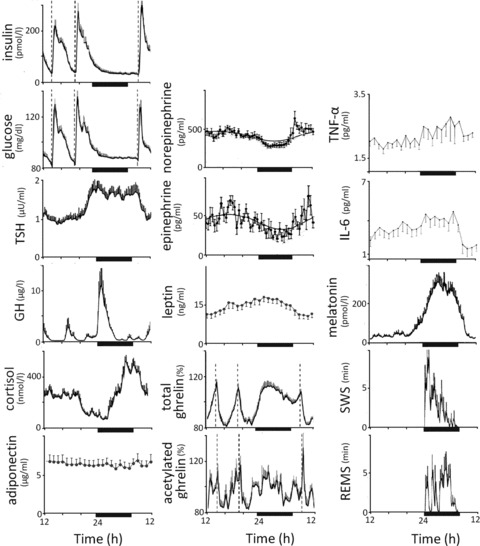
“Thyroid stimulating hormone (TSH) levels rise at night, mostly due to increased hypothalamic secretion of thyroid releasing hormone (TRH) (Fig. 2).48”
§ Interacting epidemics? Sleep curtailment, insulin resistance, and obesity > Physiological changes of metabolism during normal sleep
What the sources say
- Not checked yetcites [48] Van Coevorden A Mockel J Laurent E Neuroendocrine rhythms and sleep in aging men Am. J. Physiol 1991 260 E651 E661 2018128 source
plaindirectn = 8- Asserted: passes — The authors put it forward as true.
- Checkable: passes — It can be checked against evidence.
- Load-bearing: fails — The paper’s conclusions may not depend on it.
- Based: passes — The paper gives a reason why it holds.
Probably not a substantial claim. The paper’s conclusions may not depend on it.
The paper states this without a source or data behind it here, so there is nothing to check it against. The quote shows it is in the paper.
In the paper
“Somatostatin and GHRH are secreted in alternation, thus generating the typical pulsatile pattern of GH secretion.”
§ Interacting epidemics? Sleep curtailment, insulin resistance, and obesity > Physiological changes of metabolism during normal sleep
plaindirect- Asserted: passes — The authors put it forward as true.
- Checkable: passes — It can be checked against evidence.
- Load-bearing: fails — The paper’s conclusions may not depend on it.
- Based: passes — The paper gives a reason why it holds.
Probably not a substantial claim. The paper’s conclusions may not depend on it.
The paper states this without a source or data behind it here, so there is nothing to check it against. The quote shows it is in the paper.
In the paper
“GH secretion is under dual hypothalamic control: somatostatin is inhibitory and growth hormone releasing hormone (GHRH) is stimulatory.”
§ Interacting epidemics? Sleep curtailment, insulin resistance, and obesity > Physiological changes of metabolism during normal sleep
plaindirect- Asserted: passes — The authors put it forward as true.
- Checkable: passes — It can be checked against evidence.
- Load-bearing: fails — The paper’s conclusions may not depend on it.
- Based: passes — The paper gives a reason why it holds.
Probably not a substantial claim. The paper’s conclusions may not depend on it. It may state two separate claims as one.
None of the sources cited for this claim have been checked yet.
In the paper
“Time-keeping signals are passed on from the suprachiasmatic nucleus to oscillators in peripheral tissues also containing core clock genes.”
§ Interacting epidemics? Sleep curtailment, insulin resistance, and obesity > Physiological changes of metabolism during normal sleep
What the sources say
- Not checked yetcites [40] Kohsaka A Laposky AD Ramsey KM High-fat diet disrupts behavioral and molecular circadian rhythms in mice Cell Metab 2007 6 414 421 17983587 source
- Not checked yetcites [41] Asher G Schibler U Crosstalk between components of circadian and metabolic cycles in mammals Cell Metab 13 125 137 21284980 source
plaindirect- Asserted: passes — The authors put it forward as true.
- Checkable: passes — It can be checked against evidence.
- Load-bearing: fails — The paper’s conclusions may not depend on it.
- Based: passes — The paper gives a reason why it holds.
Probably not a substantial claim. The paper’s conclusions may not depend on it.
The paper states this without a source or data behind it here, so there is nothing to check it against. The quote shows it is in the paper.
In the paper
“Adiponectin has anti-inflammatory properties: in vitro exposure to adiponectin decreases macrophage activation and TNF-α production.”
§ Interacting epidemics? Sleep curtailment, insulin resistance, and obesity > Physiological changes of metabolism during normal sleep
plaindirect- Asserted: passes — The authors put it forward as true.
- Checkable: passes — It can be checked against evidence.
- Load-bearing: fails — The paper’s conclusions may not depend on it.
- Based: fails — The paper may give no reason why it holds.
Probably not a substantial claim. The paper’s conclusions may not depend on it. The paper may give no reason why it holds. It may state two separate claims as one.
None of the sources cited for this claim have been checked yet.
In the paper
“GH levels were lower in SWS-deprived individuals50 and higher in individuals with pharmacologically induced SWS.51”
§ Interacting epidemics? Sleep curtailment, insulin resistance, and obesity > Physiological changes of metabolism during normal sleep
What the sources say
- Not checked yetcites [50] Karacan I Rosenbloom AL Williams RL Finley WW Hursch CJ Slow wave sleep deprivation in relation to plasma growth hormone concentration Behav. Neuropsychiatry 1971 2 11 14 4327760
- Not checked yetcites [51] Van Cauter E Plat L Scharf MB Simultaneous stimulation of slow-wave sleep and growth hormone secretion by gamma-hydroxybutyrate in normal young men J. Clin. Invest 1997 100 745 753 9239423 PMC508244 source
plaincorrelational- Asserted: passes — The authors put it forward as true.
- Checkable: passes — It can be checked against evidence.
- Load-bearing: unclear — It is unclear whether the paper’s conclusions depend on it.
- Based: passes — The paper gives a reason why it holds.
It may state two separate claims as one.
None of the sources cited for this claim have been checked yet.
In the paper
“In humans, plasma adiponectin levels correlated negatively with insulin resistance, and higher levels correlated with future weight gain in 1,063 women.63,64”
§ Interacting epidemics? Sleep curtailment, insulin resistance, and obesity > Physiological changes of metabolism during normal sleep
What the sources say
- Not checked yetcites [63] Hivert MF Sullivan LM Fox CS Associations of adiponectin, resistin, and tumor necrosis factor-alpha with insulin resistance J. Clin. Endocrinol. Metab 2008 93 3165 3172 18492747 PMC2515087 source
- Not checked yetcites [64] Hivert MF Sun Q Shrader P Higher adiponectin levels predict greater weight gain in healthy women in the Nurses’ Health Study Obesity 2011 19 409 415 20814416 PMC3119857 source
plaincorrelationaln = 1,063- Asserted: passes — The authors put it forward as true.
- Checkable: passes — It can be checked against evidence.
- Load-bearing: unclear — It is unclear whether the paper’s conclusions depend on it.
- Based: passes — The paper gives a reason why it holds.
It may state two separate claims as one.
None of the sources cited for this claim have been checked yet.
In the paper
“GHRH injection increased glucose levels at awakening by almost 50%56 and GH administration rapidly decreased muscular glucose uptake.55,57”
§ Interacting epidemics? Sleep curtailment, insulin resistance, and obesity > Physiological changes of metabolism during normal sleep
What the sources say
- Not checked yetcites [56] Byrne M Sturis J Blackman JD Polonsky KS van Cauter E 1992 Decreased glucose tolerance during sleep may be partially mediated by GH. Program of the 74th Annual Meeting of The Endocrine Society, San Antonio, TX (Abstract 40)
- Not checked yetcites [55] Møller N Jorgensen JOL Schmitz O Effects of a growth hormone pulse on total and forearm substrate fluxes in humans Am. J. Physiol. Endocrinol. Metab 1990 258 E86 E91 2405702 source
- Not checked yetcites [57] Møller N Butler PC Antsiferov MA Alberti KGMM Effects of growth hormone on insulin sensitivity and forearm metabolism in normal man Diabetologia 1989 32 105 110 2656349 source
plaindirect- Asserted: passes — The authors put it forward as true.
- Checkable: passes — It can be checked against evidence.
- Load-bearing: passes — The paper’s conclusions depend on it.
- Based: passes — The paper gives a reason why it holds.
It may state two separate claims as one.
In the paper
“Individuals with type 2 diabetes typically have low adiponectin levels, even when adjusted for body weight.65”
§ Interacting epidemics? Sleep curtailment, insulin resistance, and obesity > Physiological changes of metabolism during normal sleep
What the sources say
- Not checked yetcites [65] Lilja M Rolandsson O Norberg M Soderberg S The impact of leptin and adiponectin on incident type 2 diabetes is modified by sex and insulin resistance Metab. Syndr. Relat. Disord 2012 10 143 151 22283633 source
plaincorrelational- Asserted: passes — The authors put it forward as true.
- Checkable: passes — It can be checked against evidence.
- Load-bearing: fails — The paper’s conclusions may not depend on it.
- Based: passes — The paper gives a reason why it holds.
Probably not a substantial claim. The paper’s conclusions may not depend on it.
The paper states this without a source or data behind it here, so there is nothing to check it against. The quote shows it is in the paper.
In the paper
“EE and glucose metabolism are modulated by a number of hormones.”
§ Interacting epidemics? Sleep curtailment, insulin resistance, and obesity > Physiological changes of metabolism during normal sleep
plaindirect- Asserted: passes — The authors put it forward as true.
- Checkable: passes — It can be checked against evidence.
- Load-bearing: fails — The paper’s conclusions may not depend on it.
- Based: passes — The paper gives a reason why it holds.
Probably not a substantial claim. The paper’s conclusions may not depend on it.
The paper states this without a source or data behind it here, so there is nothing to check it against. The quote shows it is in the paper.
In the paper
“Endogenous rhythms, in turn, are synchronized to the outside world by various environmental clues, mostly by light via the retina.”
§ Interacting epidemics? Sleep curtailment, insulin resistance, and obesity > Physiological changes of metabolism during normal sleep
plaindirect- Asserted: passes — The authors put it forward as true.
- Checkable: passes — It can be checked against evidence.
- Load-bearing: fails — The paper’s conclusions may not depend on it.
- Based: passes — The paper gives a reason why it holds.
Probably not a substantial claim. The paper’s conclusions may not depend on it.
The paper states this without a source or data behind it here, so there is nothing to check it against. The quote shows it is in the paper.
In the paper
“Adiponectin knockout mice develop insulin resistance and increased TNF-α levels when fed a high fat diet.”
§ Interacting epidemics? Sleep curtailment, insulin resistance, and obesity > Physiological changes of metabolism during normal sleep
plaindirect- Asserted: passes — The authors put it forward as true.
- Checkable: passes — It can be checked against evidence.
- Load-bearing: fails — The paper’s conclusions may not depend on it.
- Based: passes — The paper gives a reason why it holds.
Probably not a substantial claim. The paper’s conclusions may not depend on it.
The paper states this without a source or data behind it here, so there is nothing to check it against. The quote shows it is in the paper.
In the paper
“Thyroid hormones are important determinants of EE; cortisol and GH are powerful modulators of circadian rhythms of glucose metabolism.”
§ Interacting epidemics? Sleep curtailment, insulin resistance, and obesity > Physiological changes of metabolism during normal sleep
plaindirect- Asserted: passes — The authors put it forward as true.
- Checkable: passes — It can be checked against evidence.
- Load-bearing: fails — The paper’s conclusions may not depend on it.
- Based: passes — The paper gives a reason why it holds.
Probably not a substantial claim. The paper’s conclusions may not depend on it.
In the paper
“Cortisol concentrations reach their zenith in the morning, experience a gradual fall during the day, which is briefly interrupted by meals, and have their nadir around 3 am (Fig. 2).48”
§ Interacting epidemics? Sleep curtailment, insulin resistance, and obesity > Physiological changes of metabolism during normal sleep
What the sources say
- Not checked yetcites [48] Van Coevorden A Mockel J Laurent E Neuroendocrine rhythms and sleep in aging men Am. J. Physiol 1991 260 E651 E661 2018128 source
plain- Asserted: passes — The authors put it forward as true.
- Checkable: passes — It can be checked against evidence.
- Load-bearing: unclear — It is unclear whether the paper’s conclusions depend on it.
- Based: passes — The paper gives a reason why it holds.
It may state two separate claims as one.
In the paper
“Its role in energy homeostasis is unclear: increases, decreases, or no changes in energy balance are derived from peripheral adiponectin administration in rodents.62”
§ Interacting epidemics? Sleep curtailment, insulin resistance, and obesity > Physiological changes of metabolism during normal sleep
What the sources say
- Not checked yetcites [62] Dridi S Taouis M Adiponectin and energy homeostasis: consensus and controversy J. Nutr. Biochem 2009 20 831 839 19716279 source
plain- Asserted: passes — The authors put it forward as true.
- Checkable: passes — It can be checked against evidence.
- Load-bearing: fails — The paper’s conclusions may not depend on it.
- Based: passes — The paper gives a reason why it holds.
Probably not a substantial claim. The paper’s conclusions may not depend on it.
The paper states this without a source or data behind it here, so there is nothing to check it against. The quote shows it is in the paper.
In the paper
“The sympathovagal system and adiponectin influence both EE and glucose metabolism.”
§ Interacting epidemics? Sleep curtailment, insulin resistance, and obesity > Physiological changes of metabolism during normal sleep
plaindirect- Asserted: passes — The authors put it forward as true.
- Checkable: passes — It can be checked against evidence.
- Load-bearing: fails — The paper’s conclusions may not depend on it.
- Based: passes — The paper gives a reason why it holds.
Probably not a substantial claim. The paper’s conclusions may not depend on it.
In the paper
“In contrast, patients with type 1 diabetes have higher than expected adiponectin levels: an observation that is poorly understood.66”
§ Interacting epidemics? Sleep curtailment, insulin resistance, and obesity > Physiological changes of metabolism during normal sleep
What the sources say
- Not checked yetcites [66] Maahs DM Ogden LG Snell-Bergeon JK Determinants of serum adiponectin in persons with and without type 1 diabetes Am. J. Epidemiol 2007 166 731 740 17591595 source
plaincorrelational- Asserted: passes — The authors put it forward as true.
- Checkable: passes — It can be checked against evidence.
- Load-bearing: fails — The paper’s conclusions may not depend on it.
- Based: passes — The paper gives a reason why it holds.
Probably not a substantial claim. The paper’s conclusions may not depend on it. It may state two separate claims as one.
In the paper
“IL-1β decreases during the night and reaches its nadir at 8 am in the morning.82”
§ Interacting epidemics? Sleep curtailment, insulin resistance, and obesity > Physiological changes of metabolism during normal sleep
What the sources say
- Not checked yetcites [82] Born J Lange T Hansen K Effects of sleep and circadian rhythm on human circulating immune cells J. Immul 1997 158 4454 4464 9127011 source
plaindirect- Asserted: passes — The authors put it forward as true.
- Checkable: passes — It can be checked against evidence.
- Load-bearing: fails — The paper’s conclusions may not depend on it.
- Based: passes — The paper gives a reason why it holds.
Probably not a substantial claim. The paper’s conclusions may not depend on it.
In the paper
“Leptin is secreted by the white adipose tissue in a highly pulsatile fashion.74”
§ Interacting epidemics? Sleep curtailment, insulin resistance, and obesity > Physiological changes of metabolism during normal sleep
What the sources say
- Not checked yetcites [74] Licinio J Mantzoros C Negrao AB Human leptin levels are pulsatile and inversely related to pituitary-adrenal function Nat. Med 1997 3 575 579 9142131 source
plain- Asserted: passes — The authors put it forward as true.
- Checkable: passes — It can be checked against evidence.
- Load-bearing: fails — The paper’s conclusions may not depend on it.
- Based: passes — The paper gives a reason why it holds.
Probably not a substantial claim. The paper’s conclusions may not depend on it.
In the paper
“Leptin reflects fat stores: its levels increase after meals and during the night and are associated with decreased appetite (Fig. 2).74”
§ Interacting epidemics? Sleep curtailment, insulin resistance, and obesity > Physiological changes of metabolism during normal sleep
What the sources say
- Not checked yetcites [74] Licinio J Mantzoros C Negrao AB Human leptin levels are pulsatile and inversely related to pituitary-adrenal function Nat. Med 1997 3 575 579 9142131 source
plaindirect- Asserted: passes — The authors put it forward as true.
- Checkable: passes — It can be checked against evidence.
- Load-bearing: unclear — It is unclear whether the paper’s conclusions depend on it.
- Based: passes — The paper gives a reason why it holds.
It may state two separate claims as one.
A conclusion the paper draws from its own results — it cites no other source for it, so there is none to check. The quote shows it is in the paper.
In the paper
“It is important to note that experimentally induced sleep alterations may not be representative of changes occurring in clinical condition of chronic sleep deprivation.”
§ Interacting epidemics? Sleep curtailment, insulin resistance, and obesity > Effects of sleep restriction on metabolic parameters
hedged- Asserted: passes — The authors put it forward as true.
- Checkable: passes — It can be checked against evidence.
- Load-bearing: fails — The paper’s conclusions may not depend on it.
- Based: fails — The paper may give no reason why it holds.
Probably not a substantial claim. The paper’s conclusions may not depend on it. The paper may give no reason why it holds.
The paper states this without a source or data behind it here, so there is nothing to check it against. The quote shows it is in the paper.
In the paper
“Melatonin is a sleep-promoting hormone that is produced by the pineal gland.”
§ Interacting epidemics? Sleep curtailment, insulin resistance, and obesity > Physiological changes of metabolism during normal sleep
plaindirect- Asserted: passes — The authors put it forward as true.
- Checkable: passes — It can be checked against evidence.
- Load-bearing: fails — The paper’s conclusions may not depend on it.
- Based: fails — The paper may give no reason why it holds.
Probably not a substantial claim. The paper’s conclusions may not depend on it. The paper may give no reason why it holds. It may state two separate claims as one.
In the paper
“Total and acetylated ghrelin levels rise with fasting and during sleep (Fig. 2).76”
§ Interacting epidemics? Sleep curtailment, insulin resistance, and obesity > Physiological changes of metabolism during normal sleep
What the sources say
- Not checked yetcites [76] Spiegel K Tasali E Leproult R Scherberg N van Cauter E Twenty-four-hour profiles of acylated and total ghrelin: relationship with glucose levels and impact of time of day and sleep J. Clin. Endocrinol. Metab 2011 96 486 493 21106712 PMC3206394 source
plaindirect- Asserted: passes — The authors put it forward as true.
- Checkable: passes — It can be checked against evidence.
- Load-bearing: unclear — It is unclear whether the paper’s conclusions depend on it.
- Based: passes — The paper gives a reason why it holds.
It may state two separate claims as one.
None of the sources cited for this claim have been checked yet.
In the paper
“Orexin neurons are active during waking and quiescent during sleep; consistently, orexin levels in the CSF are maximal at the end of the waking period.80,81”
§ Interacting epidemics? Sleep curtailment, insulin resistance, and obesity > Physiological changes of metabolism during normal sleep
What the sources say
- Not checked yetcites [80] Van den Top M Lee K Whyment AD Blanks AM Spanswick D Orexigensensitive NPY/AgRP pacemaker neurons in the hypothalamic arcuate nucleus Nat. Neurosci 2004 7 493 494 15097991 source
- Not checked yetcites [81] Zeitzer JM Buckmaster CL Lyons DM Mignot E Increasing length of wakefulness and modulation of hypocretin-1 in the wake-consolidated squirrel monkey Am. J. Physiol. Regul. Integr. Comp. Physiol 2007 293 R1736 R1742 17686881 source
plaincorrelational- Asserted: passes — The authors put it forward as true.
- Checkable: passes — It can be checked against evidence.
- Load-bearing: unclear — It is unclear whether the paper’s conclusions depend on it.
- Based: passes — The paper gives a reason why it holds.
It may state two separate claims as one.
In the paper
“Ghrelin has the opposite effect on the arcuate nucleus, stimulating appetite, and prolonging postprandial glucose responses, while stimulating GH release.79”
§ Interacting epidemics? Sleep curtailment, insulin resistance, and obesity > Physiological changes of metabolism during normal sleep
What the sources say
- Not checked yetcites [79] Hataya Y Akamizu T Takaya K A low dose of ghrelin stimulates growth hormone (GH) release synergistically with GH-releasing hormone in humans J. Clin. Endocrinol. Metab 2001 86 4552 11549707 source
plaindirect- Asserted: passes — The authors put it forward as true.
- Checkable: passes — It can be checked against evidence.
- Load-bearing: unclear — It is unclear whether the paper’s conclusions depend on it.
- Based: passes — The paper gives a reason why it holds.
It may state two separate claims as one.
The paper states this without a source or data behind it here, so there is nothing to check it against. The quote shows it is in the paper.
In the paper
“Acetylated ghrelin, the active form, is necessary for most of its endocrine actions, including GH release, appetite stimulation, and gastric emptying.”
§ Interacting epidemics? Sleep curtailment, insulin resistance, and obesity > Physiological changes of metabolism during normal sleep
plaindirect- Asserted: passes — The authors put it forward as true.
- Checkable: passes — It can be checked against evidence.
- Load-bearing: fails — The paper’s conclusions may not depend on it.
- Based: fails — The paper may give no reason why it holds.
Probably not a substantial claim. The paper’s conclusions may not depend on it. The paper may give no reason why it holds.
The paper states this without a source or data behind it here, so there is nothing to check it against. The quote shows it is in the paper.
In the paper
“Orexin A and B, two neuropeptides released by lateral hypothalamic neurons, stimulate appetite.”
§ Interacting epidemics? Sleep curtailment, insulin resistance, and obesity > Physiological changes of metabolism during normal sleep
plaindirect- Asserted: passes — The authors put it forward as true.
- Checkable: passes — It can be checked against evidence.
- Load-bearing: fails — The paper’s conclusions may not depend on it.
- Based: passes — The paper gives a reason why it holds.
Probably not a substantial claim. The paper’s conclusions may not depend on it.
The paper states this without a source or data behind it here, so there is nothing to check it against. The quote shows it is in the paper.
In the paper
“Most of the experiments on the effects of acute sleep deprivation were conducted in healthy, lean volunteers.”
§ Interacting epidemics? Sleep curtailment, insulin resistance, and obesity > Effects of sleep restriction on metabolic parameters
plain- Asserted: passes — The authors put it forward as true.
- Checkable: passes — It can be checked against evidence.
- Load-bearing: fails — The paper’s conclusions may not depend on it.
- Based: passes — The paper gives a reason why it holds.
Probably not a substantial claim. The paper’s conclusions may not depend on it.
The paper states this without a source or data behind it here, so there is nothing to check it against. The quote shows it is in the paper.
In the paper
“The orexin system is activated by ghrelin and inhibited by leptin and glucose.”
§ Interacting epidemics? Sleep curtailment, insulin resistance, and obesity > Physiological changes of metabolism during normal sleep
plaindirect- Asserted: passes — The authors put it forward as true.
- Checkable: passes — It can be checked against evidence.
- Load-bearing: unclear — It is unclear whether the paper’s conclusions depend on it.
- Based: unclear — It is unclear why the paper says it holds.
It may state two separate claims as one.
None of the sources cited for this claim have been checked yet.
In the paper
“The relationship between sleep and metabolism has been extensively studied in human subjects under varying conditions, such as total sleep deprivation,87–100 partial sleep deprivation,101–122 and sleep fragmentation123–125 (Table 1).”
§ Interacting epidemics? Sleep curtailment, insulin resistance, and obesity > Effects of sleep restriction on metabolic parameters
What the sources say
- Not checked yetcites [87] Kuhn E Brodan V Brodanova M Rysanek K Metabolic reflection of sleep deprivation Act. Nerv. Super 1969 11 165 174 5798779
- Not checked yetcites [88] Parker DC Rossman LG Pekary AE Hershman JM Effect of 64-hour sleep deprivation on the circadian waveform of thyrotropin (TSH): further evidence of sleep-related inhibition of TSH release J. Clin. Endocrinol. Metab 1987 64 157 161 3782430 source
- Not checked yetcites [89] VanHelder T Symons JD Radomski MW Effects of sleep deprivation and exercise on glucose tolerance Aviat. Space Environ. Med 1993 64 487 492 8338493
- Not checked yetcites [90] Gonzáles-Ortiz M Martínez-Abundis E Balcázar-Muñoz BR Pascoe-González S Effect of sleep deprivation on insulin sensitivity and cortisol concentration in healthy subjects Diabetes Nutr. Metab 2000 13 80 83 10898125
- Not checked yetcites [91] Thomas M Sing H Belenky G Neural basis of alertness and cognitive performance impairments during sleepiness: I. Effects of 24 h of sleep deprivation on waking human regional brain activity J. Sleep Res 2000 9 335 352 11123521 source
- Not checked yetcites [92] Garfinkel D Zorin M Wainstein J Efficacy and safety of prolonged-release melatonin in insomnia patients with diabetes: a randomized, double-blind, crossover study Diabetes Metab. Syndr. Obes 2011 4 307 313 21887103 PMC3160855
- Not checked yetcites [93] Shearer WT Reuben JM Mullington JM Soluble TNA-alpha receptor 1 and IL-6 plasma levels in humans subjected to the sleep deprivation model of spaceflight J. Allergy Clin. Immunol 2001 107 165 170 11150007 source
- Not checked yetcites [94] Mullington JM Chan JL van Dongen HP Sleep loss reduces diurnal rhythm amplitude of leptin in healthy men J. Neuroendocrinol 2003 15 851 854 12899679 source
- Not checked yetcites [95] Dzaja A Dalal MA Himmerich H Sleep enhances nocturnal plasma ghrelin levels in healthy subjects Am. J. Physiol. Endocrinol. Metab 2004 286 E963 E967 14871884 source
- Not checked yetcites [96] Frey DJ Fleshner M Wright KP The effects of 40 hours of total sleep deprivation on inflammatory markers in healthy young adults Brain Behav. Immun 2007 21 1050 1057 17524614 source
boosted- Asserted: passes — The authors put it forward as true.
- Checkable: passes — It can be checked against evidence.
- Load-bearing: fails — The paper’s conclusions may not depend on it.
- Based: passes — The paper gives a reason why it holds.
Probably not a substantial claim. The paper’s conclusions may not depend on it.
In the paper
“IL-6 and TNF-α stimulate secretion of cortisol and, in turn, cortisol inhibits their secretion.84”
§ Interacting epidemics? Sleep curtailment, insulin resistance, and obesity > Physiological changes of metabolism during normal sleep
What the sources say
- Not checked yetcites [84] Tsigos C Papanicolaou DA Defensor R Dose effects of recombinant human interleukin-6 on pituitary hormone secretion and energy expenditure Neuroendocrinology 1997 66 54 62 9258919 source
plaindirect- Asserted: passes — The authors put it forward as true.
- Checkable: passes — It can be checked against evidence.
- Load-bearing: unclear — It is unclear whether the paper’s conclusions depend on it.
- Based: passes — The paper gives a reason why it holds.
It may state two separate claims as one.
None of the sources cited for this claim have been checked yet.
In the paper
“Reports on diurnal variability of CRP are few and inconsistent: some report no diurnal variance,85 whereas others find increased morning levels.86”
§ Interacting epidemics? Sleep curtailment, insulin resistance, and obesity > Physiological changes of metabolism during normal sleep
What the sources say
- Not checked yetcites [85] Meier-Ewert HK Ridker PM Rifai N Absence of diurnal variation of C-reactive protein concentration in healthy human subjects Clin. Chem 2001 47 426 430 11238292 source
- Not checked yetcites [86] Koc M Karaarslan O Abali G Batur MK Variations in high-sensitivity C-reactive protein levels over 24 hours in patients with stable coronary artery disease Tex. Heart. Inst. J 2010 37 42 48 20200626 PMC2829811
plain- Asserted: passes — The authors put it forward as true.
- Checkable: passes — It can be checked against evidence.
- Load-bearing: fails — The paper’s conclusions may not depend on it.
- Based: passes — The paper gives a reason why it holds.
Probably not a substantial claim. The paper’s conclusions may not depend on it. It may state two separate claims as one.
The paper states this without a source or data behind it here, so there is nothing to check it against. The quote shows it is in the paper.
In the paper
“Partial sleep deprivation affects SWS less than other sleep stages.”
§ Interacting epidemics? Sleep curtailment, insulin resistance, and obesity > Effects of sleep restriction on metabolic parameters
plaindirect- Asserted: passes — The authors put it forward as true.
- Checkable: passes — It can be checked against evidence.
- Load-bearing: fails — The paper’s conclusions may not depend on it.
- Based: fails — The paper may give no reason why it holds.
Probably not a substantial claim. The paper’s conclusions may not depend on it. The paper may give no reason why it holds.
In the paper
“Insulin, while peripherally lowering blood glucose and stimulating appetite, inhibits appetite centrally in a leptin-like manner.78”
§ Interacting epidemics? Sleep curtailment, insulin resistance, and obesity > Physiological changes of metabolism during normal sleep
What the sources say
- Not checked yetcites [78] Morton GJ Schwartz MW Leptin and the central nervous system control of glucose metabolism Physiol. Rev 2011 91 389 411 21527729 PMC3379883 source
plaindirect- Asserted: passes — The authors put it forward as true.
- Checkable: passes — It can be checked against evidence.
- Load-bearing: unclear — It is unclear whether the paper’s conclusions depend on it.
- Based: passes — The paper gives a reason why it holds.
It may state two separate claims as one.
The paper states this without a source or data behind it here, so there is nothing to check it against. The quote shows it is in the paper.
In the paper
“Food intake and physical activity were often, but not always, strictly controlled (Table 1).”
§ Interacting epidemics? Sleep curtailment, insulin resistance, and obesity > Effects of sleep restriction on metabolic parameters
plain- Asserted: passes — The authors put it forward as true.
- Checkable: passes — It can be checked against evidence.
- Load-bearing: fails — The paper’s conclusions may not depend on it.
- Based: passes — The paper gives a reason why it holds.
Probably not a substantial claim. The paper’s conclusions may not depend on it.
None of the sources cited for this claim have been checked yet.
In the paper
“IL-6 displays a circadian rhythm, with a first peak around 2 am and a second peak around 5 am (Fig. 2).82,83”
§ Interacting epidemics? Sleep curtailment, insulin resistance, and obesity > Physiological changes of metabolism during normal sleep
What the sources say
- Not checked yetcites [82] Born J Lange T Hansen K Effects of sleep and circadian rhythm on human circulating immune cells J. Immul 1997 158 4454 4464 9127011 source
- Not checked yetcites [83] Vgontzas AN Zoumakis M Papanicolaou DA Chronic insomnia is associated with a shift of interleukin-6 and tumor necrosis factor secretion from nighttime to daytime Metabolism 2002 51 887 892 12077736 source
plain- Asserted: passes — The authors put it forward as true.
- Checkable: passes — It can be checked against evidence.
- Load-bearing: fails — The paper’s conclusions may not depend on it.
- Based: passes — The paper gives a reason why it holds.
Probably not a substantial claim. The paper’s conclusions may not depend on it.
In the paper
“Ghrelin, produced in the stomach, stimulates appetite and circulates mainly in a nonacetylated form.75”
§ Interacting epidemics? Sleep curtailment, insulin resistance, and obesity > Physiological changes of metabolism during normal sleep
What the sources say
- Not checked yetcites [75] Badman MK Flier JS The gut and energy balance: visceral allies in the obesity wars Science 2005 307 1909 1914 15790843 source
plaindirect- Asserted: passes — The authors put it forward as true.
- Checkable: passes — It can be checked against evidence.
- Load-bearing: fails — The paper’s conclusions may not depend on it.
- Based: passes — The paper gives a reason why it holds.
Probably not a substantial claim. The paper’s conclusions may not depend on it. It may state two separate claims as one.
In the paper
“In a small study of eight lean males, plasma catecholamines were consistently lower during the night with no differences among sleep stages (Fig. 2).73”
§ Interacting epidemics? Sleep curtailment, insulin resistance, and obesity > Physiological changes of metabolism during normal sleep
What the sources say
- Not checked yetcites [73] Linsell CR Lightman SL Mullen PE Brown MJ Causon RC Circadian rythms of epinephrine and norepinephrine in man J. Clin. Endocrinol. Metab 1985 60 1210 1205 3998066 source
plain- Asserted: passes — The authors put it forward as true.
- Checkable: passes — It can be checked against evidence.
- Load-bearing: unclear — It is unclear whether the paper’s conclusions depend on it.
- Based: passes — The paper gives a reason why it holds.
It may state two separate claims as one.
The paper states this without a source or data behind it here, so there is nothing to check it against. The quote shows it is in the paper.
In the paper
“Melatonin is exclusively secreted during the dark, as light inhibits its production (Fig. 2).”
§ Interacting epidemics? Sleep curtailment, insulin resistance, and obesity > Physiological changes of metabolism during normal sleep
plaindirect- Asserted: passes — The authors put it forward as true.
- Checkable: passes — It can be checked against evidence.
- Load-bearing: fails — The paper’s conclusions may not depend on it.
- Based: fails — The paper may give no reason why it holds.
Probably not a substantial claim. The paper’s conclusions may not depend on it. The paper may give no reason why it holds.
The paper states this without a source or data behind it here, so there is nothing to check it against. The quote shows it is in the paper.
In the paper
“Leptin and ghrelin exert their effects in the arcuate nucleus of the hypothalamus, through anorexigenic proopiomelanocortin/cocaine- and amphetamine-regulated transcript (POMC/CART) and orexigenic neuropeptide Y/agouti-related protein (NPY/AgRP) neurons.”
§ Interacting epidemics? Sleep curtailment, insulin resistance, and obesity > Physiological changes of metabolism during normal sleep
plaindirect- Asserted: passes — The authors put it forward as true.
- Checkable: passes — It can be checked against evidence.
- Load-bearing: fails — The paper’s conclusions may not depend on it.
- Based: passes — The paper gives a reason why it holds.
Probably not a substantial claim. The paper’s conclusions may not depend on it.
The paper states this without a source or data behind it here, so there is nothing to check it against. The quote shows it is in the paper.
In the paper
“Interleukin 6 (IL-6), interleukin 1β (IL-1β), TNF-α, and C-reactive protein (CRP) are pro-inflammatory factors.”
§ Interacting epidemics? Sleep curtailment, insulin resistance, and obesity > Physiological changes of metabolism during normal sleep
plain- Asserted: passes — The authors put it forward as true.
- Checkable: passes — It can be checked against evidence.
- Load-bearing: fails — The paper’s conclusions may not depend on it.
- Based: fails — The paper may give no reason why it holds.
Probably not a substantial claim. The paper’s conclusions may not depend on it. The paper may give no reason why it holds.
None of the sources cited for this claim have been checked yet.
In the paper
“Finally, adiponectin displays some diurnal variability, with lower levels at night (Fig. 2).68,69”
§ Interacting epidemics? Sleep curtailment, insulin resistance, and obesity > Physiological changes of metabolism during normal sleep
What the sources say
- Not checked yetcites [68] Scheer FA Chan JL Fargnoli J Day/night variations of high-molecular-weight adiponectin and lipocalin-2 in healthy men studied under fed and fasted conditions Diabetologia 2010 53 2401 2405 20703446 PMC3111077 source
- Not checked yetcites [69] Cizza G Nguyen VT Eskandari F Low 24-hour adiponectin and high nocturnal leptin concentrations in a case-control study of community-dwelling premenopausal women with major depressive disorder: the Premenopausal, Ostopenia/Osteoporosis, Women, Alendronate, Depression (POWER) study J. Clin. Psychiatry 2010 71 1079 1087 20492842 PMC3277206 source
plaincorrelational- Asserted: passes — The authors put it forward as true.
- Checkable: passes — It can be checked against evidence.
- Load-bearing: fails — The paper’s conclusions may not depend on it.
- Based: passes — The paper gives a reason why it holds.
Probably not a substantial claim. The paper’s conclusions may not depend on it.
In the paper
“Plasma norepinephrine (NE) and epinephrine (EPI) are produced by the sympathetic system: EPI is secreted exclusively from the adrenal medulla, whereas NE can also be released from postganglionic sympathetic nerves.72”
§ Interacting epidemics? Sleep curtailment, insulin resistance, and obesity > Physiological changes of metabolism during normal sleep
What the sources say
- Not checked yetcites [72] Hjemdahl P Plasma catecholamines—analytical challenges and physiological limitations Baillieres Clin. Endocrinol. Metab 1993 7 307 353 8489483 source
plaindirect- Asserted: passes — The authors put it forward as true.
- Checkable: passes — It can be checked against evidence.
- Load-bearing: fails — The paper’s conclusions may not depend on it.
- Based: passes — The paper gives a reason why it holds.
Probably not a substantial claim. The paper’s conclusions may not depend on it. It may state two separate claims as one.
In the paper
“Projections from orexin neurons in the lateral hypothalamus activate NPY neurons in the arcuate nucleus.80”
§ Interacting epidemics? Sleep curtailment, insulin resistance, and obesity > Physiological changes of metabolism during normal sleep
What the sources say
- Not checked yetcites [80] Van den Top M Lee K Whyment AD Blanks AM Spanswick D Orexigensensitive NPY/AgRP pacemaker neurons in the hypothalamic arcuate nucleus Nat. Neurosci 2004 7 493 494 15097991 source
plaindirect- Asserted: passes — The authors put it forward as true.
- Checkable: passes — It can be checked against evidence.
- Load-bearing: fails — The paper’s conclusions may not depend on it.
- Based: passes — The paper gives a reason why it holds.
Probably not a substantial claim. The paper’s conclusions may not depend on it.
None of the sources cited for this claim have been checked yet.
In the paper
“Leptin activates POMC/CART neurons, which induces hunger and inhibits NPY/AgRP neurons,77,78 which induces satiety.”
§ Interacting epidemics? Sleep curtailment, insulin resistance, and obesity > Physiological changes of metabolism during normal sleep
What the sources say
- Not checked yetcites [77] Elias CF Aschkenasi C Lee C Leptin differentially regulates NPY and POMC neurons projecting to the lateral hypothalamic area Neuron 1999 23 775 786 10482243 source
- Not checked yetcites [78] Morton GJ Schwartz MW Leptin and the central nervous system control of glucose metabolism Physiol. Rev 2011 91 389 411 21527729 PMC3379883 source
plaindirect- Asserted: passes — The authors put it forward as true.
- Checkable: passes — It can be checked against evidence.
- Load-bearing: fails — The paper’s conclusions may not depend on it.
- Based: passes — The paper gives a reason why it holds.
Probably not a substantial claim. The paper’s conclusions may not depend on it. It may state two separate claims as one.
In the paper
“Two weeks of partial sleep deprivation (5.5 hours) decreased resting metabolic rate and increased RQ in a randomized, cross-over study109”
§ Interacting epidemics? Sleep curtailment, insulin resistance, and obesity > Effects of sleep restriction on metabolic parameters > Effects on EE
What the sources say
- Not checked yetcites [109] Nedeltcheva AV Kessler L Imperial J Penev PD Exposure to recurrent sleep restriction in the setting of high caloric intake and physical inactivity results in increased insulin resistance and reduced glucose tolerance J. Clin. Endocrinol. Metab 2009 94 3242 3250 19567526 PMC2819825 source
plaindirect- Asserted: passes — The authors put it forward as true.
- Checkable: passes — It can be checked against evidence.
- Load-bearing: passes — The paper’s conclusions depend on it.
- Based: passes — The paper gives a reason why it holds.
It may state two separate claims as one.
None of the sources cited for this claim have been checked yet.
In the paper
“Partial sleep deprivation did not affect 24-h levels of GH in lean or obese individuals,101,109,118 but six 4-h nights changed GH nocturnal secretory patterns: sleep deprivation was associated with a biphasic pattern compared to the usual single large GH peak at sleep onset.102”
§ Interacting epidemics? Sleep curtailment, insulin resistance, and obesity > Effects of sleep restriction on metabolic parameters > Additional endocrine mechanisms linking sleep, glucose metabolism, and energy expenditure
What the sources say
- Not checked yetcites [101] Spiegel K Leproult R Van Cauter E Impact of sleep debt on metabolic and endocrine function Lancet 1999 354 1435 1439 10543671 source
- Not checked yetcites [109] Nedeltcheva AV Kessler L Imperial J Penev PD Exposure to recurrent sleep restriction in the setting of high caloric intake and physical inactivity results in increased insulin resistance and reduced glucose tolerance J. Clin. Endocrinol. Metab 2009 94 3242 3250 19567526 PMC2819825 source
- Not checked yetcites [118] Nedeltcheva AV Kilkus JM Imperial J Schoeller DA Penev PD Insufficient sleep undermies dietary efforts to reduce adiposity Ann. Intern. Med 2010 153 435 441 20921542 PMC2951287 source
- Not checked yetcites [102] Spiegel K Leproult R Colecchia EF Adaptation of the 24 h growth hormone profile to a state of sleep debt Am. J. Psychiol 2000 279 R874 R883 10956244 source
plaincorrelational- Asserted: passes — The authors put it forward as true.
- Checkable: passes — It can be checked against evidence.
- Load-bearing: passes — The paper’s conclusions depend on it.
- Based: passes — The paper gives a reason why it holds.
It may state two separate claims as one.
None of the sources cited for this claim have been checked yet.
In the paper
“Acute sleep deprivation is associated with increased sympathetic activity, decreased parasympathetic tone and therefore, with increased sympathovagal balance101,109,123,124”
§ Interacting epidemics? Sleep curtailment, insulin resistance, and obesity > Effects of sleep restriction on metabolic parameters > Additional endocrine mechanisms linking sleep, glucose metabolism, and energy expenditure
What the sources say
- Not checked yetcites [101] Spiegel K Leproult R Van Cauter E Impact of sleep debt on metabolic and endocrine function Lancet 1999 354 1435 1439 10543671 source
- Not checked yetcites [109] Nedeltcheva AV Kessler L Imperial J Penev PD Exposure to recurrent sleep restriction in the setting of high caloric intake and physical inactivity results in increased insulin resistance and reduced glucose tolerance J. Clin. Endocrinol. Metab 2009 94 3242 3250 19567526 PMC2819825 source
- Not checked yetcites [123] Tasali E Leproult R Ehrmann DA Van Cauter E Slow-wave sleep and the risk of type 2 diabetes in humans Proc. Natl. Acad. Sci. USA 2008 105 1044 1049 18172212 PMC2242689 source
- Not checked yetcites [124] Stamatakis KA Punjabi NM Effects of sleep fragmentation on glucose metabolism in normal subjects Chest 2010 137 95 101 19542260 PMC2803120 source
plaincorrelational- Asserted: passes — The authors put it forward as true.
- Checkable: passes — It can be checked against evidence.
- Load-bearing: passes — The paper’s conclusions depend on it.
- Based: passes — The paper gives a reason why it holds.
It may state two separate claims as one.
A conclusion the paper draws from its own results — it cites no other source for it, so there is none to check. The quote shows it is in the paper.
In the paper
“In addition, important differences exist between acute and chronic sleep deprivation.”
§ Interacting epidemics? Sleep curtailment, insulin resistance, and obesity > Effects of sleep restriction on metabolic parameters
plain- Asserted: passes — The authors put it forward as true.
- Checkable: passes — It can be checked against evidence.
- Load-bearing: fails — The paper’s conclusions may not depend on it.
- Based: fails — The paper may give no reason why it holds.
Probably not a substantial claim. The paper’s conclusions may not depend on it. The paper may give no reason why it holds.
None of the sources cited for this claim have been checked yet.
In the paper
“Two groups found that one night of total sleep deprivation increased EE during the night, whereas the following day, resting and postprandial EE were reduced by 5% and 20%, respectively, overall leading to a positive energy balance43,100”
§ Interacting epidemics? Sleep curtailment, insulin resistance, and obesity > Effects of sleep restriction on metabolic parameters > Effects on EE
What the sources say
- Not checked yetcites [43] Jung CM Melanson EL Frydelhall EJ Energy expenditure during sleep, sleep deprivation and sleep following sleep deprivation in adult humans J. Physiol 2011 589 235 244 21059762 PMC3039272 source
- Not checked yetcites [100] Benedict C Hallschmid M Lassen A Acute sleep deprivation reduces energy expenditure in healthy men Am. J. Clin. Nutr 2011 93 1229 1236 21471283 source
plaindirect- Asserted: passes — The authors put it forward as true.
- Checkable: passes — It can be checked against evidence.
- Load-bearing: passes — The paper’s conclusions depend on it.
- Based: passes — The paper gives a reason why it holds.
It may state two separate claims as one.
A conclusion the paper draws from its own results — it cites no other source for it, so there is none to check. The quote shows it is in the paper.
In the paper
“Thus, almost all studies find decreased glucose tolerance and a dampened compensatory insulin response after sleep curtailment.”
§ Interacting epidemics? Sleep curtailment, insulin resistance, and obesity > Effects of sleep restriction on metabolic parameters > Effects on glucose metabolism
plaindirect- Asserted: passes — The authors put it forward as true.
- Checkable: passes — It can be checked against evidence.
- Load-bearing: passes — The paper’s conclusions depend on it.
- Based: passes — The paper gives a reason why it holds.
It may state two separate claims as one.
None of the sources cited for this claim have been checked yet.
In the paper
“Acute total sleep deprivation increased TSH and free T4 levels,88 whereas partial sleep deprivation of 5.5-h nights for two weeks or six 4-h nights decreased TSH and T4 levels, suggesting a dose-related effect104,116”
§ Interacting epidemics? Sleep curtailment, insulin resistance, and obesity > Effects of sleep restriction on metabolic parameters > Additional endocrine mechanisms linking sleep, glucose metabolism, and energy expenditure
What the sources say
- Not checked yetcites [88] Parker DC Rossman LG Pekary AE Hershman JM Effect of 64-hour sleep deprivation on the circadian waveform of thyrotropin (TSH): further evidence of sleep-related inhibition of TSH release J. Clin. Endocrinol. Metab 1987 64 157 161 3782430 source
- Not checked yetcites [104] Spiegel K Tasali E Penev P Van Cauter E Brief communication: sleep curtailment in healthy young men is associated with decreased leptin levels, elevated ghrelin levels, and increased hunger and appetite Ann. Intern Med 2004a 141 846 850 15583226 source
- Not checked yetcites [116] Kessler L Nedeltcheva A Imperial J Penev PD Changes in serum TSH and free T4 during human sleep restriction Sleep 2010 33 1115 1118 20815195 PMC2910542 source
hedgeddirect- Asserted: passes — The authors put it forward as true.
- Checkable: passes — It can be checked against evidence.
- Load-bearing: unclear — It is unclear whether the paper’s conclusions depend on it.
- Based: passes — The paper gives a reason why it holds.
It may state two separate claims as one.
None of the sources cited for this claim have been checked yet.
In the paper
“Mean 24-h levels of plasma cortisol often remain unchanged by sleep deprivation,43,95,96,99,106,109,123 but the circadian cortisol-pattern changes, as described above.”
§ Interacting epidemics? Sleep curtailment, insulin resistance, and obesity > Effects of sleep restriction on metabolic parameters > Additional endocrine mechanisms linking sleep, glucose metabolism, and energy expenditure
What the sources say
- Not checked yetcites [43] Jung CM Melanson EL Frydelhall EJ Energy expenditure during sleep, sleep deprivation and sleep following sleep deprivation in adult humans J. Physiol 2011 589 235 244 21059762 PMC3039272 source
- Not checked yetcites [95] Dzaja A Dalal MA Himmerich H Sleep enhances nocturnal plasma ghrelin levels in healthy subjects Am. J. Physiol. Endocrinol. Metab 2004 286 E963 E967 14871884 source
- Not checked yetcites [96] Frey DJ Fleshner M Wright KP The effects of 40 hours of total sleep deprivation on inflammatory markers in healthy young adults Brain Behav. Immun 2007 21 1050 1057 17524614 source
- Not checked yetcites [99] Pejovic S Vgontzas AN Basta M Leptin and hunger levels in young healthy adults after one night of sleep loss J. Sleep. Res 2010 19 552 558 20545838 PMC3734788 source
- Not checked yetcites [106] Vgontzas AN Zoumakis E Bixler EO Adverse effects of modest sleep restriction on sleepiness, performance, and inflammatory cytokines J. Clin. Endocrinol. Metab 2004 89 2119 2126 15126529 source
- Not checked yetcites [109] Nedeltcheva AV Kessler L Imperial J Penev PD Exposure to recurrent sleep restriction in the setting of high caloric intake and physical inactivity results in increased insulin resistance and reduced glucose tolerance J. Clin. Endocrinol. Metab 2009 94 3242 3250 19567526 PMC2819825 source
- Not checked yetcites [123] Tasali E Leproult R Ehrmann DA Van Cauter E Slow-wave sleep and the risk of type 2 diabetes in humans Proc. Natl. Acad. Sci. USA 2008 105 1044 1049 18172212 PMC2242689 source
hedged- Asserted: passes — The authors put it forward as true.
- Checkable: passes — It can be checked against evidence.
- Load-bearing: unclear — It is unclear whether the paper’s conclusions depend on it.
- Based: passes — The paper gives a reason why it holds.
It may state two separate claims as one.
None of the sources cited for this claim have been checked yet.
In the paper
“In addition, a delay and/or a reduction in the acrophase of cortisol have been reported after partial and total sleep deprivation.95,102,109”
§ Interacting epidemics? Sleep curtailment, insulin resistance, and obesity > Effects of sleep restriction on metabolic parameters > Additional endocrine mechanisms linking sleep, glucose metabolism, and energy expenditure
What the sources say
- Not checked yetcites [95] Dzaja A Dalal MA Himmerich H Sleep enhances nocturnal plasma ghrelin levels in healthy subjects Am. J. Physiol. Endocrinol. Metab 2004 286 E963 E967 14871884 source
- Not checked yetcites [102] Spiegel K Leproult R Colecchia EF Adaptation of the 24 h growth hormone profile to a state of sleep debt Am. J. Psychiol 2000 279 R874 R883 10956244 source
- Not checked yetcites [109] Nedeltcheva AV Kessler L Imperial J Penev PD Exposure to recurrent sleep restriction in the setting of high caloric intake and physical inactivity results in increased insulin resistance and reduced glucose tolerance J. Clin. Endocrinol. Metab 2009 94 3242 3250 19567526 PMC2819825 source
plaindirect- Asserted: passes — The authors put it forward as true.
- Checkable: passes — It can be checked against evidence.
- Load-bearing: unclear — It is unclear whether the paper’s conclusions depend on it.
- Based: passes — The paper gives a reason why it holds.
It may state two separate claims as one.
A conclusion the paper draws from its own results — it cites no other source for it, so there is none to check. The quote shows it is in the paper.
In the paper
“In summary, EE may be differentially affected by chronic versus acute sleep curtailment and may also depend on differences in reasons of sleep curtailment (experimentally induced short sleep vs. chronic insomnia).”
§ Interacting epidemics? Sleep curtailment, insulin resistance, and obesity > Effects of sleep restriction on metabolic parameters > Effects on EE
hedgedconditional- Asserted: passes — The authors put it forward as true.
- Checkable: passes — It can be checked against evidence.
- Load-bearing: passes — The paper’s conclusions depend on it.
- Based: passes — The paper gives a reason why it holds.
It may state two separate claims as one.
None of the sources cited for this claim have been checked yet.
In the paper
“Partial and total sleep deprivation resulted in elevated salivary and plasma cortisol the following afternoon and evening100,101,109,114,117 (Table 1), while morning cortisol levels may be unchanged or even decreased.90,97,117”
§ Interacting epidemics? Sleep curtailment, insulin resistance, and obesity > Effects of sleep restriction on metabolic parameters > Additional endocrine mechanisms linking sleep, glucose metabolism, and energy expenditure
What the sources say
- Not checked yetcites [100] Benedict C Hallschmid M Lassen A Acute sleep deprivation reduces energy expenditure in healthy men Am. J. Clin. Nutr 2011 93 1229 1236 21471283 source
- Not checked yetcites [101] Spiegel K Leproult R Van Cauter E Impact of sleep debt on metabolic and endocrine function Lancet 1999 354 1435 1439 10543671 source
- Not checked yetcites [109] Nedeltcheva AV Kessler L Imperial J Penev PD Exposure to recurrent sleep restriction in the setting of high caloric intake and physical inactivity results in increased insulin resistance and reduced glucose tolerance J. Clin. Endocrinol. Metab 2009 94 3242 3250 19567526 PMC2819825 source
- Not checked yetcites [114] Buxton OM Marcelli E Short and long sleep are positively associated with obesity, diabetes, hypertension, and cardiovascular disease among adults in the United States Soc. Sci. Med 2010 71 1027 1036 20621406 source
- Not checked yetcites [117] Omisade A Buxton OM Rusak B Impact of acute sleep restriction on cortisol and leptin levels in young women Physiol. Behav 2010 99 651 656 20138072 source
- Not checked yetcites [90] Gonzáles-Ortiz M Martínez-Abundis E Balcázar-Muñoz BR Pascoe-González S Effect of sleep deprivation on insulin sensitivity and cortisol concentration in healthy subjects Diabetes Nutr. Metab 2000 13 80 83 10898125
- Not checked yetcites [97] Schmid SM Hallschmid M Jauch-Chara K Sleep loss alters basal metabolic hormone secretion and modulates the dynamic counterregulatory response to hypoglycemia J. Clin. Endocrinol. Metab 2007 92 3044 3051 17519315 source
hedgeddirect- Asserted: passes — The authors put it forward as true.
- Checkable: passes — It can be checked against evidence.
- Load-bearing: passes — The paper’s conclusions depend on it.
- Based: passes — The paper gives a reason why it holds.
It may state two separate claims as one.
In the paper
“However, subgroup analysis revealed that effects of sleep restriction on adiponectin levels may be gender and race dependent: adiponectin decreased in Caucasian women and increased in African American women, while adiponectin levels in males did not change after short sleep121”
§ Interacting epidemics? Sleep curtailment, insulin resistance, and obesity > Effects of sleep restriction on metabolic parameters > Additional endocrine mechanisms linking sleep, glucose metabolism, and energy expenditure
What the sources say
- Not checked yetcites [121] Simpson NS Banks S Arroyo S Dinges DF Effects of sleep restriction on adiponectin levels in healthy men and women Physiol. Behav 2010 101 693 698 20723551 PMC2975754 source
hedgedconditional- Asserted: passes — The authors put it forward as true.
- Checkable: passes — It can be checked against evidence.
- Load-bearing: unclear — It is unclear whether the paper’s conclusions depend on it.
- Based: passes — The paper gives a reason why it holds.
It may state two separate claims as one.
A conclusion the paper draws from its own results — it cites no other source for it, so there is none to check. The quote shows it is in the paper.
In the paper
“This is mediated by multiple factors, such as decreased thyroid hormones and, possibly, adiponectin levels; increased sympathovagal balance; and altered patterns of cortisol secretion, while the role of GH is still unclear (Fig. 3).”
§ Interacting epidemics? Sleep curtailment, insulin resistance, and obesity > Effects of sleep restriction on metabolic parameters > Additional endocrine mechanisms linking sleep, glucose metabolism, and energy expenditure
hedgedconditional- Asserted: passes — The authors put it forward as true.
- Checkable: passes — It can be checked against evidence.
- Load-bearing: passes — The paper’s conclusions depend on it.
- Based: passes — The paper gives a reason why it holds.
It may state two separate claims as one.
- Rests on an assumption: Decreased adiponectin levels worsen insulin resistance.
None of the sources cited for this claim have been checked yet.
In the paper
“TNF-α levels are most often,82,93,112 but not always,107 unchanged after partial sleep restriction.”
§ Interacting epidemics? Sleep curtailment, insulin resistance, and obesity > Effects of sleep restriction on metabolic parameters > Effects on the immune system
What the sources say
- Not checked yetcites [82] Born J Lange T Hansen K Effects of sleep and circadian rhythm on human circulating immune cells J. Immul 1997 158 4454 4464 9127011 source
- Not checked yetcites [93] Shearer WT Reuben JM Mullington JM Soluble TNA-alpha receptor 1 and IL-6 plasma levels in humans subjected to the sleep deprivation model of spaceflight J. Allergy Clin. Immunol 2001 107 165 170 11150007 source
- Not checked yetcites [112] van Leeuwen WM Lehto M Karisola P Sleep restriction increases the risk of developing cardiovascular diseases by augmenting proinflammatory responses through IL-17 and CRP PLoS One 2009 4 e4589 19240794 PMC2643002 source
- Not checked yetcites [107] Irwin MR Wang M Campomayor CO Sleep deprivation and activation of morning levels of cellular and genomic markers of inflammation Arch. Intern. Med 2006 166 1756 1762 16983055 source
plain- Asserted: passes — The authors put it forward as true.
- Checkable: passes — It can be checked against evidence.
- Load-bearing: unclear — It is unclear whether the paper’s conclusions depend on it.
- Based: passes — The paper gives a reason why it holds.
It may state two separate claims as one.
None of the sources cited for this claim have been checked yet.
In the paper
“However, morning total ghrelin levels were increased after one night of sleep deprivation95,98 and in individuals with shorter habitual sleep durations.5”
§ Interacting epidemics? Sleep curtailment, insulin resistance, and obesity > Effects of sleep restriction on metabolic parameters > Effects on appetite
What the sources say
- Not checked yetcites [95] Dzaja A Dalal MA Himmerich H Sleep enhances nocturnal plasma ghrelin levels in healthy subjects Am. J. Physiol. Endocrinol. Metab 2004 286 E963 E967 14871884 source
- Not checked yetcites [98] Schmid SM Hallschmid M Jauchchara K Born J Schultes B A single night of sleep deprivation increases ghrelin levels and feelings of hunger in normal-weight healthy men J. Sleep Res 2008 17 331 334 18564298 source
- Not checked yetcites [5] Taheri S Lin L Austin D Young T Mignot E Short sleep duration is associated with reduced leptin, elevated ghrelin, and increased Body Mass Index (BMI) Sleep 2004 27 A146 A147 PMC535701 15602591
plaindirect- Asserted: passes — The authors put it forward as true.
- Checkable: passes — It can be checked against evidence.
- Load-bearing: passes — The paper’s conclusions depend on it.
- Based: passes — The paper gives a reason why it holds.
It may state two separate claims as one.
A conclusion the paper draws from its own results — it cites no other source for it, so there is none to check. The quote shows it is in the paper.
In the paper
“We conclude that short sleep promotes a proinflammatory state, which, in turn, exerts its negative consequences on insulin resistance.”
§ Interacting epidemics? Sleep curtailment, insulin resistance, and obesity > Effects of sleep restriction on metabolic parameters > Effects on the immune system
plaindirect- Asserted: passes — The authors put it forward as true.
- Checkable: passes — It can be checked against evidence.
- Load-bearing: passes — The paper’s conclusions depend on it.
- Based: passes — The paper gives a reason why it holds.
It may state two separate claims as one.
A conclusion the paper draws from its own results — it cites no other source for it, so there is none to check. The quote shows it is in the paper.
In the paper
“In summary, sleep deprivation and obesity may potentiate each other in a vicious reverberating circuit; short sleep may induce weight gain, via the mechanisms outlined in this paper, whereas obesity, in turn, via sleep apnea and other symptoms, may disrupt sleep.”
§ Interacting epidemics? Sleep curtailment, insulin resistance, and obesity > The other side of the coin: metabolic dysfunction influencing sleep
hedgedconditional- Asserted: passes — The authors put it forward as true.
- Checkable: passes — It can be checked against evidence.
- Load-bearing: passes — The paper’s conclusions depend on it.
- Based: passes — The paper gives a reason why it holds.
It may state two separate claims as one.
None of the sources cited for this claim have been checked yet.
In the paper
“If food is provided ad libitum, partial or total sleep deprivation may not change hunger ratings, while likely increasing food intake.99,117,120”
§ Interacting epidemics? Sleep curtailment, insulin resistance, and obesity > Effects of sleep restriction on metabolic parameters > Effects on appetite
What the sources say
- Not checked yetcites [99] Pejovic S Vgontzas AN Basta M Leptin and hunger levels in young healthy adults after one night of sleep loss J. Sleep. Res 2010 19 552 558 20545838 PMC3734788 source
- Not checked yetcites [117] Omisade A Buxton OM Rusak B Impact of acute sleep restriction on cortisol and leptin levels in young women Physiol. Behav 2010 99 651 656 20138072 source
- Not checked yetcites [120] Simpson NS Banks S Dinges DF Sleep restriction is associated with increased morning plasma leptin concentrations, especially in women Biol. Res. Nurs 2010 12 47 53 20453022 PMC3564645 source
hedgedconditional- Asserted: passes — The authors put it forward as true.
- Checkable: passes — It can be checked against evidence.
- Load-bearing: passes — The paper’s conclusions depend on it.
- Based: passes — The paper gives a reason why it holds.
It may state two separate claims as one.
In the paper
“The effects of sleep deprivation on appetite may not be immediate: one 4-h night of sleep deprivation was associated with increases in food intake 36 h later, while this parameter was unaffected immediately following sleep deprivation.113”
§ Interacting epidemics? Sleep curtailment, insulin resistance, and obesity > Effects of sleep restriction on metabolic parameters > Effects on appetite
What the sources say
- Not checked yetcites [113] Brondel L Romer MA Nougues PM Touyarou P Davenne D Acute partial sleep deprivation increases food intake in healthy men Am. J. Clin. Nutr 2010 91 1550 1559 20357041 source
plaincorrelational- Asserted: passes — The authors put it forward as true.
- Checkable: passes — It can be checked against evidence.
- Load-bearing: unclear — It is unclear whether the paper’s conclusions depend on it.
- Based: passes — The paper gives a reason why it holds.
It may state two separate claims as one.
A conclusion the paper draws from its own results — it cites no other source for it, so there is none to check. The quote shows it is in the paper.
In the paper
“In summary, sleep loss impairs glucose metabolism and may decrease EE.”
§ Interacting epidemics? Sleep curtailment, insulin resistance, and obesity > Effects of sleep restriction on metabolic parameters > Additional endocrine mechanisms linking sleep, glucose metabolism, and energy expenditure
hedgedconditional- Asserted: passes — The authors put it forward as true.
- Checkable: passes — It can be checked against evidence.
- Load-bearing: passes — The paper’s conclusions depend on it.
- Based: passes — The paper gives a reason why it holds.
It may state two separate claims as one.
In the paper
“After two 4-h nights, there was a 24% increase in daytime appetite ratings;105 in addition, sleep deprivation specifically increased appetite for sweet and salty foods.”
§ Interacting epidemics? Sleep curtailment, insulin resistance, and obesity > Effects of sleep restriction on metabolic parameters > Effects on appetite
What the sources say
- Not checked yetcites [105] Spiegel K Leproult R L’Hermite-Baleriaux M Leptin levels are dependent on sleep duration: relationships with sympathovagal balance, carbohydrate regulation, cortisol, and thyrotropin J. Clin. Endocrinol. Metab 2004b 89 5762 5771 15531540 source
plaindirect- Asserted: passes — The authors put it forward as true.
- Checkable: passes — It can be checked against evidence.
- Load-bearing: passes — The paper’s conclusions depend on it.
- Based: passes — The paper gives a reason why it holds.
It may state two separate claims as one.
None of the sources cited for this claim have been checked yet.
In the paper
“IL-1β was elevated after partial,106,112 and total sleep deprivation,96 but one study did not find any changes after total sleep deprivation82”
§ Interacting epidemics? Sleep curtailment, insulin resistance, and obesity > Effects of sleep restriction on metabolic parameters > Effects on the immune system
What the sources say
- Not checked yetcites [106] Vgontzas AN Zoumakis E Bixler EO Adverse effects of modest sleep restriction on sleepiness, performance, and inflammatory cytokines J. Clin. Endocrinol. Metab 2004 89 2119 2126 15126529 source
- Not checked yetcites [112] van Leeuwen WM Lehto M Karisola P Sleep restriction increases the risk of developing cardiovascular diseases by augmenting proinflammatory responses through IL-17 and CRP PLoS One 2009 4 e4589 19240794 PMC2643002 source
- Not checked yetcites [96] Frey DJ Fleshner M Wright KP The effects of 40 hours of total sleep deprivation on inflammatory markers in healthy young adults Brain Behav. Immun 2007 21 1050 1057 17524614 source
- Not checked yetcites [82] Born J Lange T Hansen K Effects of sleep and circadian rhythm on human circulating immune cells J. Immul 1997 158 4454 4464 9127011 source
plaindirect- Asserted: passes — The authors put it forward as true.
- Checkable: passes — It can be checked against evidence.
- Load-bearing: unclear — It is unclear whether the paper’s conclusions depend on it.
- Based: passes — The paper gives a reason why it holds.
It may state two separate claims as one.
In the paper
“White artificial light greater than 200 lux completely suppressed nocturnal plasma melatonin production, dim room light (106 lux) reduced melatonin by 88% and light intensities lower than 80 lux did not affect melatonin levels.159”
§ Interacting epidemics? Sleep curtailment, insulin resistance, and obesity > Possible therapeutic role of melatonin
What the sources say
- Not checked yetcites [159] Zeitzer JM Dijk DJ Kronauer R Brown E Czeisler C Sensitivity of the human circadian pacemaker to nocturnal light: melatonin phase resetting suppression J. Physiol 2000 526 695 702 10922269 PMC2270041 source
plaindirect- Asserted: passes — The authors put it forward as true.
- Checkable: passes — It can be checked against evidence.
- Load-bearing: passes — The paper’s conclusions depend on it.
- Based: passes — The paper gives a reason why it holds.
It may state two separate claims as one.
A conclusion the paper draws from its own results — it cites no other source for it, so there is none to check. The quote shows it is in the paper.
In the paper
“Of note, studies that found decreased leptin after short sleep controlled food intake, whereas when sleep-deprived subjects were allowed to eat ad libitum, leptin levels were unchanged or even increased.”
§ Interacting epidemics? Sleep curtailment, insulin resistance, and obesity > Effects of sleep restriction on metabolic parameters > Effects on appetite
plaindirect- Asserted: passes — The authors put it forward as true.
- Checkable: passes — It can be checked against evidence.
- Load-bearing: unclear — It is unclear whether the paper’s conclusions depend on it.
- Based: passes — The paper gives a reason why it holds.
It may state two separate claims as one.
A conclusion the paper draws from its own results — it cites no other source for it, so there is none to check. The quote shows it is in the paper.
In the paper
“Most studies find worsened glucose tolerance after sleep curtailment, which may be beneficial from a teleological perspective, at least in the short term.”
§ Interacting epidemics? Sleep curtailment, insulin resistance, and obesity > Discussion and future directions
hedgedconditional- Asserted: passes — The authors put it forward as true.
- Checkable: fails — It may be too vague to check against evidence.
- Load-bearing: fails — The paper’s conclusions may not depend on it.
- Based: passes — The paper gives a reason why it holds.
Probably not a substantial claim. It may be too vague to check against evidence. The paper’s conclusions may not depend on it.
In the paper
“Sleep efficiency improved after five months of treatment with 2 mg prolonged-release melatonin administered two hours before bedtime, while total sleep time was unaffected in 26 subjects with type 2 diabetes.170”
§ Interacting epidemics? Sleep curtailment, insulin resistance, and obesity > Possible therapeutic role of melatonin
What the sources say
- Not checked yetcites [170] Garfinkel D Zorin M Wainstein J Efficacy and safety of prolonged-release melatonin in insomnia patients with diabetes: a randomized, double-blind, crossover study Diabetes Metab. Syndr. Obes 2011 4 307 313 21887103 PMC3160855
plaindirectn = 26- Asserted: passes — The authors put it forward as true.
- Checkable: passes — It can be checked against evidence.
- Load-bearing: passes — The paper’s conclusions depend on it.
- Based: passes — The paper gives a reason why it holds.
It may state two separate claims as one.
A conclusion the paper draws from its own results — it cites no other source for it, so there is none to check. The quote shows it is in the paper.
In the paper
“Overall, improving sleep duration and quality is a potential tool to counteract the epidemics of obesity and diabetes.”
§ Interacting epidemics? Sleep curtailment, insulin resistance, and obesity > Discussion and future directions
hedgedconditional- Asserted: passes — The authors put it forward as true.
- Checkable: passes — It can be checked against evidence.
- Load-bearing: passes — The paper’s conclusions depend on it.
- Based: passes — The paper gives a reason why it holds.
Probably not a substantial claim.
- Rests on an assumption: Short sleep has negative effects on health.
- Rests on an assumption: Sleep curtailment causes metabolic disturbances.
The paper relies on this without support.
The exact mechanisms explaining the relationship between short sleep, obesity, and diabetes remain unclear.
“The exact mechanisms explaining the relationship between short sleep, obesity, and diabetes remain unclear.”
The paper relies on this without support.
Insulin resistance can result from increases in insulin counter-regulatory hormones, including GH and cortisol.
“Insulin resistance can result from increases in insulin counter-regulatory hormones, including GH and cortisol (Fig. 3).”
The paper relies on this without support.
Decreased adiponectin levels worsen insulin resistance.
“Besides influencing energy homeostasis, decreased adiponectin levels worsen insulin resistance.”
The paper relies on this without support.
Leptin inhibits appetite and ghrelin stimulates appetite.
“Leptin and ghrelin inhibit and stimulate appetite, respectively (Fig. 3).”
The paper relies on this without support.
In obese subjects, leptin levels are elevated but several of its actions are impaired (leptin resistance).
“In obese subjects, leptin levels are elevated but several of its actions are impaired, a concept referred to as leptin resistance.”
The paper relies on this without support.
The melatonin receptor 1B is present on pancreatic β-cells, and melatonin has an inhibitory effect on insulin secretion.
“Interestingly, the melatonin receptor 1B is present on pancreatic β-cells, and melatonin has an inhibitory effect on insulin secretion.”
The paper relies on this without support.
Sleep is regulated by circadian and homeostatic mechanisms.
“Sleep is regulated by circadian and homeostatic mechanisms.”
The paper relies on this without support.
There is large individual variability in sleep needs.
“Nevertheless, it is certain that there is a large individual variability in sleep needs.”
The paper relies on this without support.
Chronotype modulates metabolism.
“Chronotype, the individual attribute determining morning or evening preference, modulates metabolism.”
The paper relies on this without support.
Seasonality is greatly attenuated in modern humans due to artificial lighting and other environmental modifications.
“As a consequence of artificial lighting and other environmental modifications, seasonality is greatly attenuated in modern humans.”
The paper relies on this without support.
Melatonin promotes sleep.
“As melatonin promotes sleep, the decrease in obesity and improvement in insulin resistance could be due to longer and better sleep per se, but it could also relate to other melatonin-dependent pathways yet to be identified (Fig. 3).”
The paper relies on this without support.
Sleep deprivation is more common in minorities.
“Similarly, sleep deprivation is more common in minorities but the effects of socioeconomic status per se versus ethnicity remain to be determined.”
The paper relies on this without support.
Individual susceptibility within these categories varies greatly.
“Individual susceptibility within these categories varies greatly: identification of contributing factors will greatly help prevention and treatment and be one of the tenets of individualized medicine.176”
The paper relies on this without support.
The biological need for optimal sleep duration varies and cannot be estimated at an individual level.
“As already mentioned, causality can be addressed best in long-term studies where “prescribed” sleep duration is randomized, but this may present with practical difficulties and significant challenges, including the fact that the biological need for optimal sleep duration varies and cannot be estimated at an individual level.”
The paper relies on this without support.
Classic experiments of parabiosis support the notion of endogenous sleep-promoting substances.
“Classic experiments of parabiosis seem to support the notion of endogenous “sleep-promoting” substances.”
The paper relies on this without support.
ob/ob mice that lack leptin and db/db mice that lack the leptin receptor both display sleep disturbances that are reverted by leptin replacement.
“Furthermore, ob/ob mice that lack leptin and db/db mice that lack the leptin receptor, both display sleep disturbances that are reverted by leptin replacement.”
The paper relies on this without support.
Short sleep has negative effects on health.
“At this point, there is a general consensus that short sleep has negative effects on health”
The paper relies on this without support.
Sleep curtailment causes metabolic disturbances.
“the amount of sleep curtailment causing metabolic disturbances is unclear”
The paper relies on this without support.
The amount of sleep curtailment causing metabolic disturbances is unclear.
“the amount of sleep curtailment causing metabolic disturbances is unclear”
The paper relies on this without support.
Specific groups at greater risk are yet to be identified.
“specific groups at greater risk are yet to be identified”
The paper relies on this without support.
Whether melatonin would benefit obese/diabetic subjects, or a subset of these individuals, remains to be proven in rigorous randomized clinical trials.
“Whether melatonin would benefit obese/diabetic subjects, or a subset of these individuals, remains to be proven in rigorous randomized clinical trials.”
Claims other papers make about this one
Each is checked against this paper’s own text: does it say what the citing paper says it does?
In the citing paper
“Sleep deprivation alters glucose homeostasis, leading to insulin resistance and risk of diabetes(17, 18, 24, 59-61).”
From Sleep: important considerations for the prevention of cardiovascular disease (2016) · cites this paper as [60]
Self-check
Percentages, sums and reported differences re-computed from the paper’s own numbers.
Each contradiction between two passages listed here was confirmed by an independent check.
Rated major: it would touch a result — a value a result rests on, reported and recomputed p-values on opposite sides of the significance level, two passages that conflict with no sign which is right, or a cited work retracted before this paper was published.
In the paper
§ Interacting epidemics? Sleep curtailment, insulin resistance, and obesity > Effects of sleep restriction on metabolic parameters
“Increased insulin levels stimulate orexin secretion and orexic arcuate neurons, while decreasing the activity of anorexic arcuate neurons, leading to a further increase in appetite.”
§ Interacting epidemics? Sleep curtailment, insulin resistance, and obesity > Physiological changes of metabolism during normal sleep
“Insulin, while peripherally lowering blood glucose and stimulating appetite, inhibits appetite centrally in a leptin-like manner.”
Rated minor: it would not touch a result — a value no result rests on, a p-value that stays on the same side of the significance level, or a conflict that is clerical, resolved elsewhere in the paper, or outside its own findings.
In the paper
“3 females, 4 males (n = 9)”
§ Interacting epidemics? Sleep curtailment, insulin resistance, and obesity > Effects of sleep restriction on metabolic parameters
Reported 9 · recomputed 7
Rated minor: it would not touch a result — a value no result rests on, a p-value that stays on the same side of the significance level, or a conflict that is clerical, resolved elsewhere in the paper, or outside its own findings.
In the paper
§ Interacting epidemics? Sleep curtailment, insulin resistance, and obesity > Physiological changes of metabolism during normal sleep
“Leptin activates POMC/CART neurons, which induces hunger and inhibits NPY/AgRP neurons,77,78 which induces satiety.”
§ Interacting epidemics? Sleep curtailment, insulin resistance, and obesity > Effects of sleep restriction on metabolic parameters > Effects on appetite
“Leptin and ghrelin inhibit and stimulate appetite, respectively (Fig. 3).”
Rated minor: it would not touch a result — a value no result rests on, a p-value that stays on the same side of the significance level, or a conflict that is clerical, resolved elsewhere in the paper, or outside its own findings.
In the paper
§ Interacting epidemics? Sleep curtailment, insulin resistance, and obesity > Effects of sleep restriction on metabolic parameters
“Stamatakis et al.123 Consecutive phases study”
§ Interacting epidemics? Sleep curtailment, insulin resistance, and obesity > References
“123. Tasali E Leproult R Ehrmann DA Van Cauter E Slow-wave sleep and the risk of type 2 diabetes in humans”
Rated minor: it would not touch a result — a value no result rests on, a p-value that stays on the same side of the significance level, or a conflict that is clerical, resolved elsewhere in the paper, or outside its own findings.
In the paper
§ Interacting epidemics? Sleep curtailment, insulin resistance, and obesity > Effects of sleep restriction on metabolic parameters > Additional endocrine mechanisms linking sleep, glucose metabolism, and energy expenditure
“partial sleep deprivation of 5.5-h nights for two weeks or six 4-h nights decreased TSH and T4 levels”
§ Interacting epidemics? Sleep curtailment, insulin resistance, and obesity > Effects of sleep restriction on metabolic parameters
“↓ TSH (26%), ↑fT4 (7%)a”
Rated minor: it would not touch a result — a value no result rests on, a p-value that stays on the same side of the significance level, or a conflict that is clerical, resolved elsewhere in the paper, or outside its own findings.
In the paper
§ Interacting epidemics? Sleep curtailment, insulin resistance, and obesity > Effects of sleep restriction on metabolic parameters
“Dzaja et al.96 Randomized cross-over study”
§ Interacting epidemics? Sleep curtailment, insulin resistance, and obesity > References
“96. Frey DJ Fleshner M Wright KP The effects of 40 hours of total sleep deprivation on inflammatory markers in healthy young adults”
Citations
Cites
Prevalence of obesity and trends in the distribution of body mass index among US adults, 1999-2010.
Flegal, K., Carroll, M., Kit, B., & Ogden, C. (2012) · Journal of the American Medical Association (JAMA) · doi:10.1001/jama.2012.39 · Cited by 5,523
Impact of sleep debt on metabolic and endocrine function
Spiegel, K., Leproult, R., & Van Cauter, E. (1999) · The Lancet · doi:10.1016/s0140-6736(99)01376-8 · Cited by 3,668
Ohayon, M. M., Carskadon, M. A., Guilleminault, C., & Vitiello, M. V. (2004) · Sleep · doi:10.1093/sleep/27.7.1255 · Cited by 3,349
Taheri, S., Lin, L., Austin, D., Young, T., & Mignot, E. (2004) · PLoS Medicine · doi:10.1371/journal.pmed.0010062 · Cited by 2,477
Spiegel, K., Tasali, E., Penev, P., & Cauter, E. V. (2004) · Annals of Internal Medicine · doi:10.7326/0003-4819-141-11-200412070-00008 · Cited by 2,459
Meta-Analysis of Short Sleep Duration and Obesity in Children and Adults
Cappuccio, F. P., Taggart, F. M., Kandala, N.-B., Currie, A., Peile, E., Stranges, S., & Miller, M. A. (2008) · Sleep · doi:10.1093/sleep/31.5.619 · Cited by 2,076
Quantity and Quality of Sleep and Incidence of Type 2 Diabetes
Cappuccio, F. P., D'Elia, L., Strazzullo, P., & Miller, M. A. (2010) · Diabetes Care · doi:10.2337/dc09-1124 · Cited by 1,670
Sympathetic-Nerve Activity during Sleep in Normal Subjects
Somers, V. K., Dyken, M. E., Mark, A. L., & Abboud, F. M. (1993) · New England Journal of Medicine · doi:10.1056/nejm199302043280502 · Cited by 1,574
High-Fat Diet Disrupts Behavioral and Molecular Circadian Rhythms in Mice
Kohsaka, A., Laposky, A. D., Ramsey, K. M., Estrada, C., Joshu, C., Kobayashi, Y., Turek, F. W., & Bass, J. (2007) · Cell Metabolism · doi:10.1016/j.cmet.2007.09.006 · Cited by 1,528
Boden, G., & Shulman, G. I. (2002) · European Journal of Clinical Investigation · doi:10.1046/j.1365-2362.32.s3.3.x · Cited by 1,300
Research works printed but not linked: 2
- National Sleep Foundation, 2005, Sleep in America Poll
- Garfinkel D., 2011, Efficacy and safety of prolonged‐release melatonin in insomnia patients with diabetes: a randomized, double‐blind, crossover study, Diabetes Metab. Syndr. Obes., 4, 307
Cited by
Sorted by citations
St-Onge, M.-P., Grandner, M. A., Brown, D., Conroy, M. B., Jean-Louis, G., Coons, M., & Bhatt, D. L. (2016) · Circulation · doi:10.1161/cir.0000000000000444 · Cited by 1,044
Crosstalk between metabolism and circadian clocks
Reinke, H., & Asher, G. (2019) · Nature Reviews Molecular Cell Biology · doi:10.1038/s41580-018-0096-9 · Cited by 598
How might circadian rhythms control mood? Let me count the ways
McClung, C. A. (2013) · Biological Psychiatry · doi:10.1016/j.biopsych.2013.02.019 · Cited by 507
Sex differences in circadian timing systems: implications for disease
Bailey, M., & Silver, R. (2014) · Frontiers in Neuroendocrinology · doi:10.1016/j.yfrne.2013.11.003 · Cited by 348
Koopman, A. D. M., Rauh, S. P., Riet, E. V. ‘., Groeneveld, L., van der Heijden, A. A. W. A., Elders, P. J. M., Dekker, J. M., Nijpels, G., Beulens, J. W. J., & Rutters, F. (2017) · Journal of Biological Rhythms · doi:10.1177/0748730417713572 · Cited by 251
Metadata
- Authors
- Lucassen, E. A., Rother, K. I., & Cizza, G.
- Affiliations
- National Institutes of Health (US)
- Venue
- Annals of the New York Academy of Sciences
- Publisher
- Wiley
- Published
- 2012-07-24
- Volume
- 1264
- Issue
- 1
- Pages
- 110-134
- ISSN
- 0077-8923 (ISSN-L)
- 1749-6632
- PMC
- PMC3418485
- OpenAlex
- W1711695767
- Cited by
- 191
- References
- 181
- Citations by year
- 2026: 2 · 2025: 7 · 2024: 9 · 2023: 16 · 2022: 16 · 2021: 16 · 2020: 11 · 2019: 10 · 2018: 15 · 2017: 13 · 2016: 17 · 2015: 19 · 2014: 25 · 2013: 14 · 2012: 1
- FWCI
- 2.76
- Type
- journal article
- Language
- en
- Open access
- bronze
- doi.org
- Locations
- Annals of the New York Academy of Sciences (publishedVersion)
- Europe PMC (PubMed Central) (publishedVersion, cc-by)
- PubMed Central (publishedVersion, cc-by)
- PubMed (publishedVersion)
- Data Archiving and Networked Services (DANS) (submittedVersion)
- Leiden Repository (Leiden University) (submittedVersion)
- Funders
- Universiteit Leiden
- National Institutes of Health
- National Institute of Diabetes and Digestive and Kidney Diseases (ZIADK047054)
- Topics
- Social Sciences › Psychology › Experimental and Cognitive Psychology › Sleep and related disorders
- Life Sciences › Neuroscience › Endocrine and Autonomic Systems › Circadian rhythm and melatonin
- Social Sciences › Psychology › Experimental and Cognitive Psychology › Sleep and Work-Related Fatigue
- Keywords
- sleep duration, sleep disorders, obesity, insulin resistance, diabetes mellitus, glucose metabolism, circadian clock, energy expenditure, appetite, sleep quality, sleep interventions
- MeSH terms
- Appetite, Diabetes Mellitus, Energy Metabolism, Female, Glucose, Humans, Insulin Resistance, Male, Melatonin, Obesity, Risk Factors, Sleep Deprivation, Sleep Wake Disorders, Leptin, Adiponectin, Ghrelin
About these checks
Registry, retraction, Cites and statistics results are computed, not judged, with one exception: a printed reference that no index lists is read once by a model before it counts as a citation error. Claims are extracted by a model and kept only when their quote appears verbatim in the text; each cited source is then checked, with a model’s help, for whether it says what the claim relies on. Those verdicts can be wrong — read the claim’s quote and the cited source before relying on one.
A language model drew the claims from the paper on 2026-10-10, under version 3 of the claim definition (model deepseek-v4.1-flash, prompt extract-v3).
A second model labelled each claim on 2026-10-10 (model jev-1.13-20260917, definition revision gold-guideline-v0.2).
Cited sources are checked with a language model’s help (gpt-6-sol).
Statistics and arithmetic are recomputed, not judged.
Confidence bands are shown only for fields calibrated on our annotated test set. None is calibrated yet, so no band is shown.
What counts as a claim ›How we measure confidence ›How we check this ›
Are you an author, or do you see a problem with this page? Request a review
