

The DOI matches its Crossref record; 161 of the 161 references it cites were found in a registry or an index; 2 of the 155 sources its claims cite were checked for support.
Association between the reproductive health of young women and cardiovascular disease in later life: umbrella review
Open accessAbstract
Objective: To consolidate evidence from systematic reviews and meta-analyses investigating the association between reproductive factors in women of reproductive age and their subsequent risk of cardiovascular disease. Design: Umbrella review. Data sources: Medline, Embase, and Cochrane databases for systematic reviews and meta-analyses from inception until 31 August 2019. Review methods: Two independent reviewers undertook screening, data extraction, and quality appraisal. The population was women of reproductive age. Exposures were fertility related factors and adverse pregnancy outcomes. Outcome was cardiovascular diseases in women, including ischaemic heart disease, heart failure, peripheral arterial disease, and stroke. Results: 32 reviews were included, evaluating multiple risk factors over an average follow-up period of 7-10 years. All except three reviews were of moderate quality. A narrative evidence synthesis with forest plots and tabular presentations was performed. Associations for composite cardiovascular disease were: twofold for pre-eclampsia, stillbirth, and preterm birth; 1.5-1.9-fold for gestational hypertension, placental abruption, gestational diabetes, and premature ovarian insufficiency; and less than 1.5-fold for early menarche, polycystic ovary syndrome, ever parity, and early menopause. A longer length of breastfeeding was associated with a reduced risk of cardiovascular disease. The associations for ischaemic heart disease were twofold or greater for pre-eclampsia, recurrent pre-eclampsia, gestational diabetes, and preterm birth; 1.5-1.9-fold for current use of combined oral contraceptives (oestrogen and progesterone), recurrent miscarriage, premature ovarian insufficiency, and early menopause; and less than 1.5-fold for miscarriage, polycystic ovary syndrome, and menopausal symptoms. For stroke outcomes, the associations were twofold or more for current use of any oral contraceptive (combined oral contraceptives or progesterone only pill), pre-eclampsia, and recurrent pre-eclampsia; 1.5-1.9-fold for current use of combined oral contraceptives, gestational diabetes, and preterm birth; and less than 1.5-fold for polycystic ovary syndrome. The association for heart failure was fourfold for pre-eclampsia. No association was found between cardiovascular disease outcomes and current use of progesterone only contraceptives, use of non-oral hormonal contraceptive agents, or fertility treatment. Conclusions: From menarche to menopause, reproductive factors were associated with cardiovascular disease in women. In this review, presenting absolute numbers on the scale of the problem was not feasible; however, if these associations are causal, they could account for a large proportion of unexplained risk of cardiovascular disease in women, and the risk might be modifiable. Identifying reproductive risk factors at an early stage in the life of women might facilitate the initiation of strategies to modify potential risks. Policy makers should consider incorporating reproductive risk factors as part of the assessment of cardiovascular risk in clinical guidelines. Systematic review registration: PROSPERO CRD42019120076.
Overview
AI snapshot
Written from the paper’s full text.
TL;DR
This umbrella review consolidates systematic reviews and meta-analyses on reproductive factors in women of reproductive age and later cardiovascular disease. It reports that multiple fertility-related factors and adverse pregnancy outcomes are associated with increased cardiovascular risk, while longer breastfeeding is associated with reduced risk.
Key findings
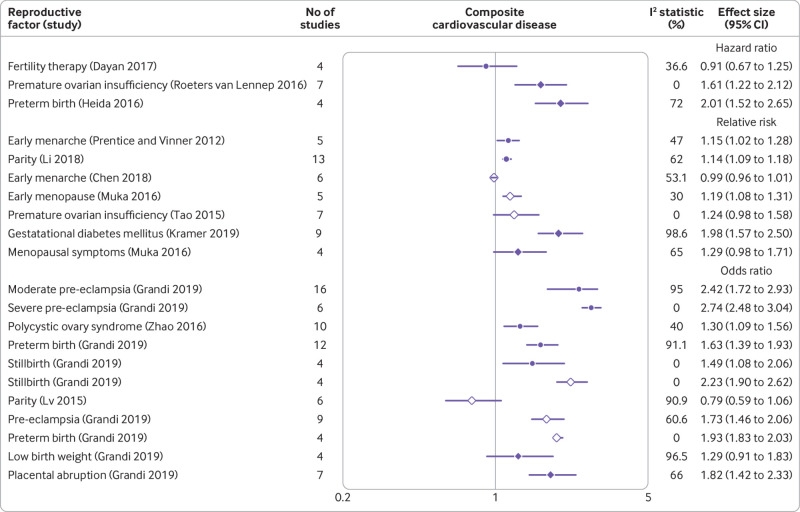
- Among 32 included reviews, composite cardiovascular disease associations were twofold for pre-eclampsia, stillbirth, and preterm birth; 1.5-1.9-fold for gestational hypertension, placental abruption, gestational diabetes, and premature ovarian insufficiency; and less than 1.5-fold for early menarche, polycystic ovary syndrome, ever parity, and early menopause. Longer breastfeeding was associated with reduced cardiovascular disease risk.
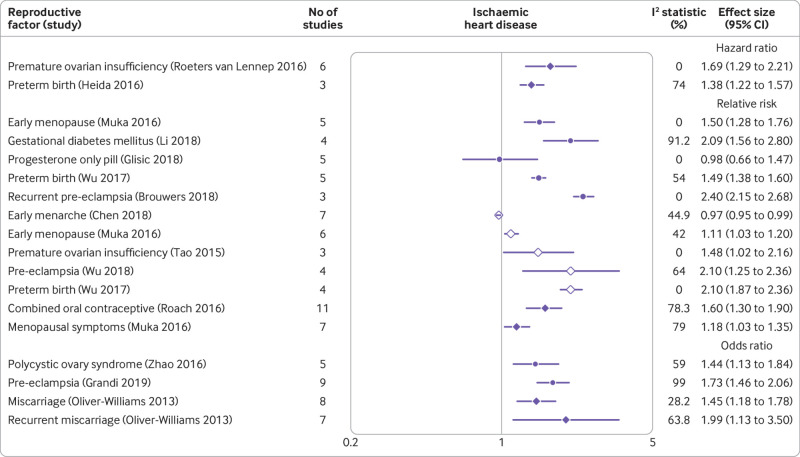
- For ischaemic heart disease, associations were twofold or greater for pre-eclampsia, recurrent pre-eclampsia, gestational diabetes, and preterm birth; 1.5-1.9-fold for current combined oral contraceptive use, recurrent miscarriage, premature ovarian insufficiency, and early menopause; and less than 1.5-fold for miscarriage, polycystic ovary syndrome, and menopausal symptoms.
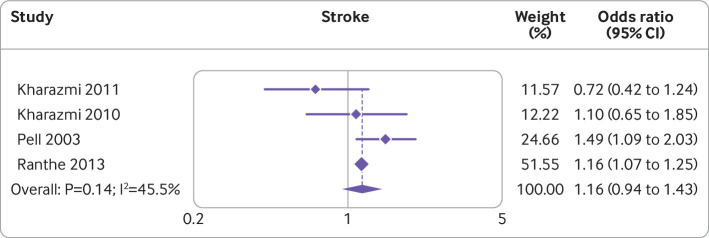
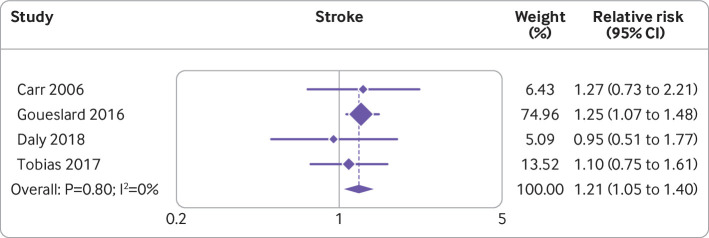
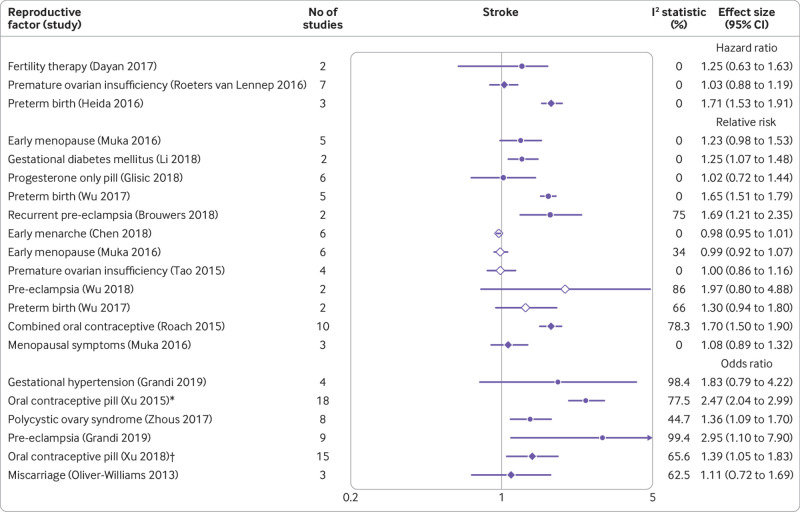
- For stroke, associations were twofold or more for current use of any oral contraceptive, pre-eclampsia, and recurrent pre-eclampsia; 1.5-1.9-fold for current combined oral contraceptive use, gestational diabetes, and preterm birth; and less than 1.5-fold for polycystic ovary syndrome. Pre-eclampsia was associated with a fourfold risk of heart failure.
- No association was found between cardiovascular disease outcomes and current use of progesterone only contraceptives, use of non-oral hormonal contraceptive agents, or fertility treatment.
Methods
- Umbrella review of systematic reviews and meta-analyses; population was women of reproductive age; exposures were fertility-related factors and adverse pregnancy outcomes; outcomes included ischaemic heart disease, heart failure, peripheral arterial disease, stroke, and composite cardiovascular disease.
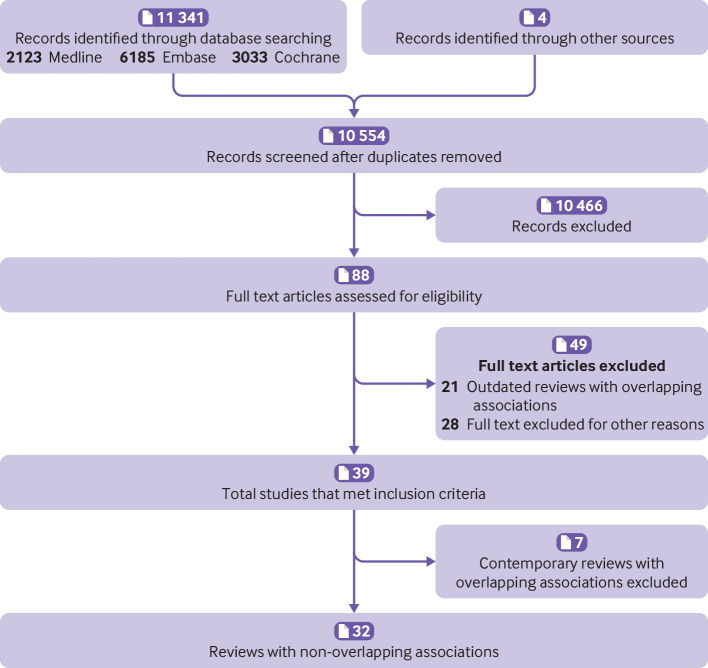
- Medline, Embase, and Cochrane databases were searched from inception until 31 August 2019; PRISMA guidelines were followed and the protocol was registered in PROSPERO (CRD42019120076).
- Two reviewers independently screened, extracted data, and appraised quality with AMSTAR 2; overlapping reviews were assessed with corrected covered area, outdated reviews were excluded, and findings were synthesised narratively with forest plots and tables.
Limitations
- The paper states that missing metadata, including participant and event numbers, hindered reporting; systematic reviews on endometriosis, pelvic inflammatory disease, first trimester bleeding without miscarriage, and anaemia in pregnancy could not be identified; some reviews were rated low quality and none high quality; and included evidence was observational, with possible residual confounding, imprecise results from few events, cross-sectional designs, heterogeneity, incomplete publication bias assessment, and self-reported data.
- The paper also states that presenting absolute numbers on the scale of the problem was not feasible, that causality is unclear, and that the exact magnitude of preventable cardiovascular disease attributable to reproductive risk factors is uncertain.
Model-written summary. Check it against the paper before relying on it.
Integrity signals
Registry
Cites
Statistics
Figures
Verification
Claims the paper makes
127 Not checked yet · 91 Own result · 21 Own method · 12 No basis given · 4 Own interpretation · 2 Partly supported · accuracy not yet measured
The cited sources support only part of this claim — read each source’s verdict below.
In the paper
“Parity of four or more is associated with an increased risk of cardiovascular disease through an accelerated atherosclerotic process in both younger and older women”
§ Association between the reproductive health of young women and cardiovascular disease in later life: umbrella review > Discussion > Biological plausibility
What the sources say
- Partly supportedcites [148] sourceExperimental — accuracy not yet measured
The Discussion reports that women with four or more children had greater carotid intima-media thickness and more than twice the odds of carotid plaque than nulliparous women. The Abstract reports an association between higher parity and carotid atherosclerosis in both younger and older women. The study measured subclinical atherosclerosis, however; it did not establish an increased rate of clinical cardiovascular disease or show that an accelerated atherosclerotic process caused it. Page numbers are unavailable in our copy. (LLM, conf=0.87)
plaincorrelational- Asserted: passes — The authors put it forward as true.
- Checkable: passes — It can be checked against evidence.
- Load-bearing: unclear — It is unclear whether the paper’s conclusions depend on it.
- Based: passes — The paper gives a reason why it holds.
- Partly supported
A result the paper reports from its own data — it cites no other source for it, so there is none to check. The quote shows it is in the paper.
In the paper
“Associations for composite cardiovascular disease were: twofold for pre-eclampsia, stillbirth, and preterm birth; 1.5-1.9-fold for gestational hypertension, placental abruption, gestational diabetes, and premature ovarian insufficiency; and less than 1.5-fold for early menarche, polycystic ovary syndrome, ever parity, and early menopause.”
§ Association between the reproductive health of young women and cardiovascular disease in later life: umbrella review > Abstract > Results
plaincorrelational- Asserted: passes — The authors put it forward as true.
- Checkable: passes — It can be checked against evidence.
- Load-bearing: passes — The paper’s conclusions depend on it.
- Based: passes — The paper gives a reason why it holds.
A result the paper reports from its own data — it cites no other source for it, so there is none to check. The quote shows it is in the paper.
In the paper
“The associations for ischaemic heart disease were twofold or greater for pre-eclampsia, recurrent pre-eclampsia, gestational diabetes, and preterm birth; 1.5-1.9-fold for current use of combined oral contraceptives (oestrogen and progesterone), recurrent miscarriage, premature ovarian insufficiency, and early menopause; and less than 1.5-fold for miscarriage, polycystic ovary syndrome, and menopau”
§ Association between the reproductive health of young women and cardiovascular disease in later life: umbrella review > Abstract > Results
plaincorrelational- Asserted: passes — The authors put it forward as true.
- Checkable: passes — It can be checked against evidence.
- Load-bearing: passes — The paper’s conclusions depend on it.
- Based: passes — The paper gives a reason why it holds.
In the paper
“No association between early age at menarche and mortality from cardiovascular disease was found.76”
§ Association between the reproductive health of young women and cardiovascular disease in later life: umbrella review > Results > Factors related to fertility
What the sources say
- Not checked yetcites [76] source
plain- Asserted: passes — The authors put it forward as true.
- Checkable: passes — It can be checked against evidence.
- Load-bearing: unclear — It is unclear whether the paper’s conclusions depend on it.
- Based: passes — The paper gives a reason why it holds.
A result the paper reports from its own data — it cites no other source for it, so there is none to check. The quote shows it is in the paper.
In the paper
“No association was found between cardiovascular disease outcomes and current use of progesterone only contraceptives, use of non-oral hormonal contraceptive agents, or fertility treatment.”
§ Association between the reproductive health of young women and cardiovascular disease in later life: umbrella review > Abstract > Results
plain- Asserted: passes — The authors put it forward as true.
- Checkable: passes — It can be checked against evidence.
- Load-bearing: passes — The paper’s conclusions depend on it.
- Based: passes — The paper gives a reason why it holds.
A result the paper reports from its own data — it cites no other source for it, so there is none to check. The quote shows it is in the paper.
In the paper
“The associations for ischaemic heart disease were twofold or greater for pre-eclampsia, recurrent pre-eclampsia, gestational diabetes, and preterm birth; 1.5-1.9-fold for current use of combined oral contraceptives (oestrogen and progesterone), recurrent miscarriage, premature ovarian insufficiency, and early menopause; and less than 1.5-fold for miscarriage, polycystic ovary syndrome, and menopau”
§ Association between the reproductive health of young women and cardiovascular disease in later life: umbrella review > Abstract > Results
plaincorrelational- Asserted: passes — The authors put it forward as true.
- Checkable: passes — It can be checked against evidence.
- Load-bearing: passes — The paper’s conclusions depend on it.
- Based: passes — The paper gives a reason why it holds.
A result the paper reports from its own data — it cites no other source for it, so there is none to check. The quote shows it is in the paper.
In the paper
“For stroke outcomes, the associations were twofold or more for current use of any oral contraceptive (combined oral contraceptives or progesterone only pill), pre-eclampsia, and recurrent pre-eclampsia; 1.5-1.9-fold for current use of combined oral contraceptives, gestational diabetes, and preterm birth; and less than 1.5-fold for polycystic ovary syndrome.”
§ Association between the reproductive health of young women and cardiovascular disease in later life: umbrella review > Abstract > Results
plaincorrelational- Asserted: passes — The authors put it forward as true.
- Checkable: passes — It can be checked against evidence.
- Load-bearing: passes — The paper’s conclusions depend on it.
- Based: passes — The paper gives a reason why it holds.
A result the paper reports from its own data — it cites no other source for it, so there is none to check. The quote shows it is in the paper.
In the paper
“The associations for ischaemic heart disease were twofold or greater for pre-eclampsia, recurrent pre-eclampsia, gestational diabetes, and preterm birth; 1.5-1.9-fold for current use of combined oral contraceptives (oestrogen and progesterone), recurrent miscarriage, premature ovarian insufficiency, and early menopause; and less than 1.5-fold for miscarriage, polycystic ovary syndrome, and menopau”
§ Association between the reproductive health of young women and cardiovascular disease in later life: umbrella review > Abstract > Results
plaincorrelational- Asserted: passes — The authors put it forward as true.
- Checkable: passes — It can be checked against evidence.
- Load-bearing: passes — The paper’s conclusions depend on it.
- Based: passes — The paper gives a reason why it holds.
In the paper
“Early age at menarche (<12), compared with menarche after the age of 12, was associated with a risk of morbidity from composite cardiovascular disease (table 1).78”
§ Association between the reproductive health of young women and cardiovascular disease in later life: umbrella review > Results > Factors related to fertility
What the sources say
- Not checked yetcites [78] source
plaincorrelational- Asserted: passes — The authors put it forward as true.
- Checkable: passes — It can be checked against evidence.
- Load-bearing: passes — The paper’s conclusions depend on it.
- Based: passes — The paper gives a reason why it holds.
A result the paper reports from its own data — it cites no other source for it, so there is none to check. The quote shows it is in the paper.
In the paper
“When examined by subtype of cardiovascular disease, an association between early age at menarche and risk of mortality from ischaemic heart disease was seen, but no association with mortality from stroke.”
§ Association between the reproductive health of young women and cardiovascular disease in later life: umbrella review > Results > Factors related to fertility
plaincorrelational- Asserted: passes — The authors put it forward as true.
- Checkable: passes — It can be checked against evidence.
- Load-bearing: passes — The paper’s conclusions depend on it.
- Based: passes — The paper gives a reason why it holds.
None of the sources cited for this claim have been checked yet.
In the paper
“Oral contraceptives and non-oral forms of combined hormonal contraceptives were associated with an increased risk of arteriothrombotic events (table 1).55 67 79”
§ Association between the reproductive health of young women and cardiovascular disease in later life: umbrella review > Results > Factors related to fertility
What the sources say
plaincorrelational- Asserted: passes — The authors put it forward as true.
- Checkable: passes — It can be checked against evidence.
- Load-bearing: passes — The paper’s conclusions depend on it.
- Based: passes — The paper gives a reason why it holds.
A result the paper reports from its own data — it cites no other source for it, so there is none to check. The quote shows it is in the paper.
In the paper
“Twenty three reviews reported overlapping associations.”
§ Association between the reproductive health of young women and cardiovascular disease in later life: umbrella review > Results > Overlapping and non-overlapping associations
plaincorrelational- Asserted: passes — The authors put it forward as true.
- Checkable: passes — It can be checked against evidence.
- Load-bearing: unclear — It is unclear whether the paper’s conclusions depend on it.
- Based: passes — The paper gives a reason why it holds.
A result the paper reports from its own data — it cites no other source for it, so there is none to check. The quote shows it is in the paper.
In the paper
“For stroke outcomes, the associations were twofold or more for current use of any oral contraceptive (combined oral contraceptives or progesterone only pill), pre-eclampsia, and recurrent pre-eclampsia; 1.5-1.9-fold for current use of combined oral contraceptives, gestational diabetes, and preterm birth; and less than 1.5-fold for polycystic ovary syndrome.”
§ Association between the reproductive health of young women and cardiovascular disease in later life: umbrella review > Abstract > Results
plaincorrelational- Asserted: passes — The authors put it forward as true.
- Checkable: passes — It can be checked against evidence.
- Load-bearing: passes — The paper’s conclusions depend on it.
- Based: passes — The paper gives a reason why it holds.
A result the paper reports from its own data — it cites no other source for it, so there is none to check. The quote shows it is in the paper.
In the paper
“The associations for ischaemic heart disease were twofold or greater for pre-eclampsia, recurrent pre-eclampsia, gestational diabetes, and preterm birth; 1.5-1.9-fold for current use of combined oral contraceptives (oestrogen and progesterone), recurrent miscarriage, premature ovarian insufficiency, and early menopause; and less than 1.5-fold for miscarriage, polycystic ovary syndrome, and menopau”
§ Association between the reproductive health of young women and cardiovascular disease in later life: umbrella review > Abstract > Results
plaincorrelational- Asserted: passes — The authors put it forward as true.
- Checkable: passes — It can be checked against evidence.
- Load-bearing: passes — The paper’s conclusions depend on it.
- Based: passes — The paper gives a reason why it holds.
A result the paper reports from its own data — it cites no other source for it, so there is none to check. The quote shows it is in the paper.
In the paper
“All seven low quality reviews did not meet three of the seven domains considered critical: they had not stated that the review methods were established before conducting the review; they had not used a comprehensive search strategy; and they had not provided a list of excluded studies and the justification for their exclusion.”
§ Association between the reproductive health of young women and cardiovascular disease in later life: umbrella review > Results > Methodological quality
plain- Asserted: passes — The authors put it forward as true.
- Checkable: passes — It can be checked against evidence.
- Load-bearing: unclear — It is unclear whether the paper’s conclusions depend on it.
- Based: passes — The paper gives a reason why it holds.
A result the paper reports from its own data — it cites no other source for it, so there is none to check. The quote shows it is in the paper.
In the paper
“When examined by subtype of cardiovascular disease, an association between early age at menarche and risk of mortality from ischaemic heart disease was seen, but no association with mortality from stroke.”
§ Association between the reproductive health of young women and cardiovascular disease in later life: umbrella review > Results > Factors related to fertility
plain- Asserted: passes — The authors put it forward as true.
- Checkable: passes — It can be checked against evidence.
- Load-bearing: unclear — It is unclear whether the paper’s conclusions depend on it.
- Based: passes — The paper gives a reason why it holds.
A result the paper reports from its own data — it cites no other source for it, so there is none to check. The quote shows it is in the paper.
In the paper
“The associations for ischaemic heart disease were twofold or greater for pre-eclampsia, recurrent pre-eclampsia, gestational diabetes, and preterm birth; 1.5-1.9-fold for current use of combined oral contraceptives (oestrogen and progesterone), recurrent miscarriage, premature ovarian insufficiency, and early menopause; and less than 1.5-fold for miscarriage, polycystic ovary syndrome, and menopau”
§ Association between the reproductive health of young women and cardiovascular disease in later life: umbrella review > Abstract > Results
plaincorrelational- Asserted: passes — The authors put it forward as true.
- Checkable: passes — It can be checked against evidence.
- Load-bearing: passes — The paper’s conclusions depend on it.
- Based: passes — The paper gives a reason why it holds.
A result the paper reports from its own data — it cites no other source for it, so there is none to check. The quote shows it is in the paper.
In the paper
“No association was found between cardiovascular disease outcomes and current use of progesterone only contraceptives, use of non-oral hormonal contraceptive agents, or fertility treatment.”
- Also stated in: § Summary of results by cardiovascular outcome · plain
“No association was found between cardiovascular disease outcomes and fertility treatment, current use of the progesterone only pill, or use of non-oral hormonal contraceptive agents”
- Also stated in: § Main findings · plain
“No association was found between current use of progesterone only contraceptives, use of non-oral combined hormonal contraceptive agents, or fertility treatment and the risk of cardiovascular disease outcomes”
§ Association between the reproductive health of young women and cardiovascular disease in later life: umbrella review > Abstract > Results
plain- Asserted: passes — The authors put it forward as true.
- Checkable: passes — It can be checked against evidence.
- Load-bearing: passes — The paper’s conclusions depend on it.
- Based: passes — The paper gives a reason why it holds.
- Also stated in: § Summary of results by cardiovascular outcome · plain
A result the paper reports from its own data — it cites no other source for it, so there is none to check. The quote shows it is in the paper.
In the paper
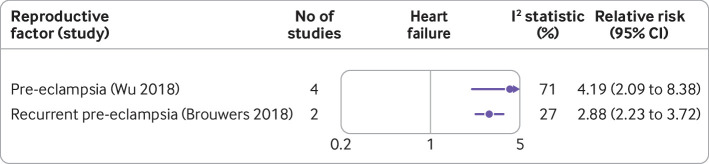
“The association for heart failure was fourfold for pre-eclampsia.”
§ Association between the reproductive health of young women and cardiovascular disease in later life: umbrella review > Abstract > Results
plaincorrelational- Asserted: passes — The authors put it forward as true.
- Checkable: passes — It can be checked against evidence.
- Load-bearing: passes — The paper’s conclusions depend on it.
- Based: passes — The paper gives a reason why it holds.
The paper states this without a source or data behind it here, so there is nothing to check it against. The quote shows it is in the paper.
In the paper
“A longer length of breastfeeding was associated with a reduced risk of cardiovascular disease.”
§ Association between the reproductive health of young women and cardiovascular disease in later life: umbrella review > Abstract > Results
plaincorrelational- Asserted: passes — The authors put it forward as true.
- Checkable: passes — It can be checked against evidence.
- Load-bearing: passes — The paper’s conclusions depend on it.
- Based: passes — The paper gives a reason why it holds.
A result the paper reports from its own data — it cites no other source for it, so there is none to check. The quote shows it is in the paper.
In the paper
“The associations for ischaemic heart disease were twofold or greater for pre-eclampsia, recurrent pre-eclampsia, gestational diabetes, and preterm birth; 1.5-1.9-fold for current use of combined oral contraceptives (oestrogen and progesterone), recurrent miscarriage, premature ovarian insufficiency, and early menopause; and less than 1.5-fold for miscarriage, polycystic ovary syndrome, and menopau”
§ Association between the reproductive health of young women and cardiovascular disease in later life: umbrella review > Abstract > Results
plaincorrelational- Asserted: passes — The authors put it forward as true.
- Checkable: passes — It can be checked against evidence.
- Load-bearing: passes — The paper’s conclusions depend on it.
- Based: passes — The paper gives a reason why it holds.
A result the paper reports from its own data — it cites no other source for it, so there is none to check. The quote shows it is in the paper.
In the paper
“All seven low quality reviews did not meet three of the seven domains considered critical: they had not stated that the review methods were established before conducting the review; they had not used a comprehensive search strategy; and they had not provided a list of excluded studies and the justification for their exclusion.”
§ Association between the reproductive health of young women and cardiovascular disease in later life: umbrella review > Results > Methodological quality
plain- Asserted: passes — The authors put it forward as true.
- Checkable: passes — It can be checked against evidence.
- Load-bearing: unclear — It is unclear whether the paper’s conclusions depend on it.
- Based: passes — The paper gives a reason why it holds.
A result the paper reports from its own data — it cites no other source for it, so there is none to check. The quote shows it is in the paper.
In the paper
“For stroke outcomes, the associations were twofold or more for current use of any oral contraceptive (combined oral contraceptives or progesterone only pill), pre-eclampsia, and recurrent pre-eclampsia; 1.5-1.9-fold for current use of combined oral contraceptives, gestational diabetes, and preterm birth; and less than 1.5-fold for polycystic ovary syndrome.”
§ Association between the reproductive health of young women and cardiovascular disease in later life: umbrella review > Abstract > Results
plaincorrelational- Asserted: passes — The authors put it forward as true.
- Checkable: passes — It can be checked against evidence.
- Load-bearing: passes — The paper’s conclusions depend on it.
- Based: passes — The paper gives a reason why it holds.
A result the paper reports from its own data — it cites no other source for it, so there is none to check. The quote shows it is in the paper.
In the paper
“The associations for ischaemic heart disease were twofold or greater for pre-eclampsia, recurrent pre-eclampsia, gestational diabetes, and preterm birth; 1.5-1.9-fold for current use of combined oral contraceptives (oestrogen and progesterone), recurrent miscarriage, premature ovarian insufficiency, and early menopause; and less than 1.5-fold for miscarriage, polycystic ovary syndrome, and menopau”
§ Association between the reproductive health of young women and cardiovascular disease in later life: umbrella review > Abstract > Results
plaincorrelational- Asserted: passes — The authors put it forward as true.
- Checkable: passes — It can be checked against evidence.
- Load-bearing: passes — The paper’s conclusions depend on it.
- Based: passes — The paper gives a reason why it holds.
A result the paper reports from its own data — it cites no other source for it, so there is none to check. The quote shows it is in the paper.
In the paper
“For stroke outcomes, the associations were twofold or more for current use of any oral contraceptive (combined oral contraceptives or progesterone only pill), pre-eclampsia, and recurrent pre-eclampsia; 1.5-1.9-fold for current use of combined oral contraceptives, gestational diabetes, and preterm birth; and less than 1.5-fold for polycystic ovary syndrome.”
§ Association between the reproductive health of young women and cardiovascular disease in later life: umbrella review > Abstract > Results
plaincorrelational- Asserted: passes — The authors put it forward as true.
- Checkable: passes — It can be checked against evidence.
- Load-bearing: passes — The paper’s conclusions depend on it.
- Based: passes — The paper gives a reason why it holds.
A result the paper reports from its own data — it cites no other source for it, so there is none to check. The quote shows it is in the paper.
In the paper
“The associations for ischaemic heart disease were twofold or greater for pre-eclampsia, recurrent pre-eclampsia, gestational diabetes, and preterm birth; 1.5-1.9-fold for current use of combined oral contraceptives (oestrogen and progesterone), recurrent miscarriage, premature ovarian insufficiency, and early menopause; and less than 1.5-fold for miscarriage, polycystic ovary syndrome, and menopau”
§ Association between the reproductive health of young women and cardiovascular disease in later life: umbrella review > Abstract > Results
plaincorrelational- Asserted: passes — The authors put it forward as true.
- Checkable: passes — It can be checked against evidence.
- Load-bearing: passes — The paper’s conclusions depend on it.
- Based: passes — The paper gives a reason why it holds.
A result the paper reports from its own data — it cites no other source for it, so there is none to check. The quote shows it is in the paper.
In the paper
“No association was found between cardiovascular disease outcomes and current use of progesterone only contraceptives, use of non-oral hormonal contraceptive agents, or fertility treatment.”
- Also stated in: § Summary of results by cardiovascular outcome · plain
“No association was found between cardiovascular disease outcomes and fertility treatment, current use of the progesterone only pill, or use of non-oral hormonal contraceptive agents”
- Also stated in: § Main findings · plain
“No association was found between current use of progesterone only contraceptives, use of non-oral combined hormonal contraceptive agents, or fertility treatment and the risk of cardiovascular disease outcomes”
§ Association between the reproductive health of young women and cardiovascular disease in later life: umbrella review > Abstract > Results
plain- Asserted: passes — The authors put it forward as true.
- Checkable: passes — It can be checked against evidence.
- Load-bearing: passes — The paper’s conclusions depend on it.
- Based: passes — The paper gives a reason why it holds.
- Also stated in: § Summary of results by cardiovascular outcome · plain
A result the paper reports from its own data — it cites no other source for it, so there is none to check. The quote shows it is in the paper.
In the paper
“The associations for ischaemic heart disease were twofold or greater for pre-eclampsia, recurrent pre-eclampsia, gestational diabetes, and preterm birth; 1.5-1.9-fold for current use of combined oral contraceptives (oestrogen and progesterone), recurrent miscarriage, premature ovarian insufficiency, and early menopause; and less than 1.5-fold for miscarriage, polycystic ovary syndrome, and menopau”
§ Association between the reproductive health of young women and cardiovascular disease in later life: umbrella review > Abstract > Results
plaincorrelational- Asserted: passes — The authors put it forward as true.
- Checkable: passes — It can be checked against evidence.
- Load-bearing: passes — The paper’s conclusions depend on it.
- Based: passes — The paper gives a reason why it holds.
None of the sources cited for this claim have been checked yet.
In the paper
“Current users of any oral contraceptive (combined oral contraceptives containing a combination of oestrogen and progesterone, or progesterone only pill) had an increased risk of stroke compared with non-current users.67 71”
§ Association between the reproductive health of young women and cardiovascular disease in later life: umbrella review > Results > Factors related to fertility
plaincorrelational- Asserted: passes — The authors put it forward as true.
- Checkable: passes — It can be checked against evidence.
- Load-bearing: passes — The paper’s conclusions depend on it.
- Based: passes — The paper gives a reason why it holds.
A result the paper reports from its own data — it cites no other source for it, so there is none to check. The quote shows it is in the paper.
In the paper
“All seven low quality reviews did not meet three of the seven domains considered critical: they had not stated that the review methods were established before conducting the review; they had not used a comprehensive search strategy; and they had not provided a list of excluded studies and the justification for their exclusion.”
§ Association between the reproductive health of young women and cardiovascular disease in later life: umbrella review > Results > Methodological quality
plain- Asserted: passes — The authors put it forward as true.
- Checkable: passes — It can be checked against evidence.
- Load-bearing: unclear — It is unclear whether the paper’s conclusions depend on it.
- Based: passes — The paper gives a reason why it holds.
In the paper
“Results from population based studies suggested that, compared with healthy controls, the risk of cardiovascular events was increased in young women in the reproductive age group with polycystic ovary syndrome (hazard ratio 1.43, 95% confidence interval 1.27 to 1.61); no association was seen in postmenopausal women with polycystic ovary syndrome (supplementary table 3)70 but this review was rated”
§ Association between the reproductive health of young women and cardiovascular disease in later life: umbrella review > Results > Factors related to fertility
What the sources say
- Not checked yetcites [70] Ramezani Tehrani, 2019, Cardiovascular events among reproductive and menopausal age women with polycystic ovary syndrome: a systematic review and meta-analysis, Gynecol Endocrinol
hedged- Asserted: passes — The authors put it forward as true.
- Checkable: passes — It can be checked against evidence.
- Load-bearing: unclear — It is unclear whether the paper’s conclusions depend on it.
- Based: passes — The paper gives a reason why it holds.
In the paper
“Use of combined oral contraceptives in women with hypertension women was associated with a much higher risk of myocardial infarction (odds ratio 6 to 68) and ischaemic stroke (odds ratio 3.1 to 14.5) than women with normal blood pressure taking non-combined oral contraceptives.84”
§ Association between the reproductive health of young women and cardiovascular disease in later life: umbrella review > Results > Factors related to fertility
What the sources say
- Not checked yetcites [84] source
plaincorrelational- Asserted: passes — The authors put it forward as true.
- Checkable: passes — It can be checked against evidence.
- Load-bearing: unclear — It is unclear whether the paper’s conclusions depend on it.
- Based: passes — The paper gives a reason why it holds.
None of the sources cited for this claim have been checked yet.
In the paper
“Based on the results of one cross sectional study,86 no association was found between polycystic ovary syndrome and the risk of heart failure (table 1 and supplementary table 4).87”
§ Association between the reproductive health of young women and cardiovascular disease in later life: umbrella review > Results > Factors related to fertility
plain- Asserted: passes — The authors put it forward as true.
- Checkable: passes — It can be checked against evidence.
- Load-bearing: unclear — It is unclear whether the paper’s conclusions depend on it.
- Based: passes — The paper gives a reason why it holds.
In the paper
“Results from population based studies suggested that, compared with healthy controls, the risk of cardiovascular events was increased in young women in the reproductive age group with polycystic ovary syndrome (hazard ratio 1.43, 95% confidence interval 1.27 to 1.61); no association was seen in postmenopausal women with polycystic ovary syndrome (supplementary table 3)70 but this review was rated”
§ Association between the reproductive health of young women and cardiovascular disease in later life: umbrella review > Results > Factors related to fertility
What the sources say
- Not checked yetcites [70] Ramezani Tehrani, 2019, Cardiovascular events among reproductive and menopausal age women with polycystic ovary syndrome: a systematic review and meta-analysis, Gynecol Endocrinol
hedgedcorrelational- Asserted: passes — The authors put it forward as true.
- Checkable: passes — It can be checked against evidence.
- Load-bearing: passes — The paper’s conclusions depend on it.
- Based: passes — The paper gives a reason why it holds.
In the paper
“This increased risk was maintained when examining ischaemic heart disease66 and stroke85 separately (supplementary table 3).”
§ Association between the reproductive health of young women and cardiovascular disease in later life: umbrella review > Results > Factors related to fertility
What the sources say
- Not checked yetcites [85] source
plaincorrelational- Asserted: passes — The authors put it forward as true.
- Checkable: passes — It can be checked against evidence.
- Load-bearing: passes — The paper’s conclusions depend on it.
- Based: passes — The paper gives a reason why it holds.
In the paper
“Women with polycystic ovary syndrome had a 1.3-fold greater risk of developing composite cardiovascular disease than women who did not have polycystic ovary syndrome (table 1).66”
§ Association between the reproductive health of young women and cardiovascular disease in later life: umbrella review > Results > Factors related to fertility
What the sources say
- Not checked yetcites [66] source
plaincorrelational- Asserted: passes — The authors put it forward as true.
- Checkable: passes — It can be checked against evidence.
- Load-bearing: passes — The paper’s conclusions depend on it.
- Based: passes — The paper gives a reason why it holds.
In the paper
“Women receiving fertility treatment (ovulation induction, in vitro fertilisation, and intrauterine insemination with drug treatment) had no greater risk of developing composite cardiovascular disease or stroke than infertile women not on fertility treatment.88”
§ Association between the reproductive health of young women and cardiovascular disease in later life: umbrella review > Results > Factors related to fertility
What the sources say
- Not checked yetcites [88] source
plain- Asserted: passes — The authors put it forward as true.
- Checkable: passes — It can be checked against evidence.
- Load-bearing: passes — The paper’s conclusions depend on it.
- Based: passes — The paper gives a reason why it holds.
None of the sources cited for this claim have been checked yet.
In the paper
“Similarly, in women with dyslipidaemia,80 results derived from one primary study reported in the systematic review showed that users of combined hormonal contraceptive agents were at an increased risk of myocardial infarction82 and cerebrovascular accident compared with non-users (table 1).83”
§ Association between the reproductive health of young women and cardiovascular disease in later life: umbrella review > Results > Factors related to fertility
plaincorrelational- Asserted: passes — The authors put it forward as true.
- Checkable: passes — It can be checked against evidence.
- Load-bearing: passes — The paper’s conclusions depend on it.
- Based: passes — The paper gives a reason why it holds.
In the paper
“The risk of stroke in women diagnosed with migraine was 2-16-fold greater for those taking combined hormonal contraceptive agents than those not taking combined hormonal contraceptives (table 1).74”
§ Association between the reproductive health of young women and cardiovascular disease in later life: umbrella review > Results > Factors related to fertility
What the sources say
- Not checked yetcites [74]
plaincorrelational- Asserted: passes — The authors put it forward as true.
- Checkable: passes — It can be checked against evidence.
- Load-bearing: passes — The paper’s conclusions depend on it.
- Based: passes — The paper gives a reason why it holds.
In the paper
“In contrast, no association was seen between current use of the progesterone only pill and risk of myocardial infarction or stroke.72”
§ Association between the reproductive health of young women and cardiovascular disease in later life: umbrella review > Results > Factors related to fertility
What the sources say
- Not checked yetcites [72] source
plain- Asserted: passes — The authors put it forward as true.
- Checkable: passes — It can be checked against evidence.
- Load-bearing: unclear — It is unclear whether the paper’s conclusions depend on it.
- Based: passes — The paper gives a reason why it holds.
In the paper
“Comparing users of non-oral combined hormonal contraceptive agents with users of combined oral contraceptives,79 no association with the development of myocardial infarction (the results were not meta-analysed, but odds ratios from individual primary studies ranged from 0.2 to 1.6) or stroke (odds ratio 0.8 to 1.2) was seen but the review was rated as low quality (table 1 and supplementary table 4”
§ Association between the reproductive health of young women and cardiovascular disease in later life: umbrella review > Results > Factors related to fertility
What the sources say
- Not checked yetcites [79] source
plain- Asserted: passes — The authors put it forward as true.
- Checkable: passes — It can be checked against evidence.
- Load-bearing: unclear — It is unclear whether the paper’s conclusions depend on it.
- Based: passes — The paper gives a reason why it holds.
In the paper
“Use of combined oral contraceptives in women with hypertension women was associated with a much higher risk of myocardial infarction (odds ratio 6 to 68) and ischaemic stroke (odds ratio 3.1 to 14.5) than women with normal blood pressure taking non-combined oral contraceptives.84”
§ Association between the reproductive health of young women and cardiovascular disease in later life: umbrella review > Results > Factors related to fertility
What the sources say
- Not checked yetcites [84] source
plaincorrelational- Asserted: passes — The authors put it forward as true.
- Checkable: passes — It can be checked against evidence.
- Load-bearing: passes — The paper’s conclusions depend on it.
- Based: passes — The paper gives a reason why it holds.
In the paper
“Comparing users of non-oral combined hormonal contraceptive agents with users of combined oral contraceptives,79 no association with the development of myocardial infarction (the results were not meta-analysed, but odds ratios from individual primary studies ranged from 0.2 to 1.6) or stroke (odds ratio 0.8 to 1.2) was seen but the review was rated as low quality (table 1 and supplementary table 4”
§ Association between the reproductive health of young women and cardiovascular disease in later life: umbrella review > Results > Factors related to fertility
What the sources say
- Not checked yetcites [79] source
plain- Asserted: passes — The authors put it forward as true.
- Checkable: passes — It can be checked against evidence.
- Load-bearing: unclear — It is unclear whether the paper’s conclusions depend on it.
- Based: passes — The paper gives a reason why it holds.
None of the sources cited for this claim have been checked yet.
In the paper
“Use of hormonal contraceptive agents was associated with an additional risk of cardiovascular disease in women who had coexisting medical conditions.74 80 81”
§ Association between the reproductive health of young women and cardiovascular disease in later life: umbrella review > Results > Factors related to fertility
What the sources say
plaincorrelational- Asserted: passes — The authors put it forward as true.
- Checkable: passes — It can be checked against evidence.
- Load-bearing: passes — The paper’s conclusions depend on it.
- Based: passes — The paper gives a reason why it holds.
In the paper
“Current users of combined oral contraceptives had a greater risk of developing myocardial infarction and stroke than non-current users of combined oral contraceptives.55”
§ Association between the reproductive health of young women and cardiovascular disease in later life: umbrella review > Results > Factors related to fertility
What the sources say
- Not checked yetcites [55] source
plaincorrelational- Asserted: passes — The authors put it forward as true.
- Checkable: passes — It can be checked against evidence.
- Load-bearing: passes — The paper’s conclusions depend on it.
- Based: passes — The paper gives a reason why it holds.
None of the sources cited for this claim have been checked yet.
In the paper
“The increase in risk was greater for ischaemic stroke67 than haemorrhagic stroke.71”
§ Association between the reproductive health of young women and cardiovascular disease in later life: umbrella review > Results > Factors related to fertility
plaindirect- Asserted: passes — The authors put it forward as true.
- Checkable: passes — It can be checked against evidence.
- Load-bearing: unclear — It is unclear whether the paper’s conclusions depend on it.
- Based: passes — The paper gives a reason why it holds.
In the paper
“But use of combined hormonal contraceptives in women with a high body mass index (>27.3 kg/m2) was not found to be a multiplicative or additive risk factor for the development of myocardial infarction or stroke (table 1).81”
§ Association between the reproductive health of young women and cardiovascular disease in later life: umbrella review > Results > Factors related to fertility
What the sources say
- Not checked yetcites [81] source
plain- Asserted: passes — The authors put it forward as true.
- Checkable: passes — It can be checked against evidence.
- Load-bearing: unclear — It is unclear whether the paper’s conclusions depend on it.
- Based: passes — The paper gives a reason why it holds.
In the paper
“This increased risk was maintained when examining ischaemic heart disease66 and stroke85 separately (supplementary table 3).”
§ Association between the reproductive health of young women and cardiovascular disease in later life: umbrella review > Results > Factors related to fertility
What the sources say
- Not checked yetcites [66] source
plaincorrelational- Asserted: passes — The authors put it forward as true.
- Checkable: passes — It can be checked against evidence.
- Load-bearing: passes — The paper’s conclusions depend on it.
- Based: passes — The paper gives a reason why it holds.
In the paper
“Specifically, an increased risk of developing ischaemic heart disease (fatal and non-fatal outcomes) but not stroke was seen.57”
§ Association between the reproductive health of young women and cardiovascular disease in later life: umbrella review > Results > Factors related to fertility
What the sources say
- Not checked yetcites [57] source
plain- Asserted: passes — The authors put it forward as true.
- Checkable: passes — It can be checked against evidence.
- Load-bearing: unclear — It is unclear whether the paper’s conclusions depend on it.
- Based: passes — The paper gives a reason why it holds.
In the paper
“In a cohort of Chinese women,94 mortality from ischaemic heart disease but not stroke was lower in women who ever breastfed than in those who never breastfed.”
§ Association between the reproductive health of young women and cardiovascular disease in later life: umbrella review > Results > Factors related to fertility
What the sources say
- Not checked yetcites [94] source
plain- Asserted: passes — The authors put it forward as true.
- Checkable: passes — It can be checked against evidence.
- Load-bearing: unclear — It is unclear whether the paper’s conclusions depend on it.
- Based: passes — The paper gives a reason why it holds.
In the paper
“Specifically, an increased risk of developing ischaemic heart disease (fatal and non-fatal outcomes) but not stroke was seen.57”
§ Association between the reproductive health of young women and cardiovascular disease in later life: umbrella review > Results > Factors related to fertility
What the sources say
- Not checked yetcites [57] source
plaincorrelational- Asserted: passes — The authors put it forward as true.
- Checkable: passes — It can be checked against evidence.
- Load-bearing: passes — The paper’s conclusions depend on it.
- Based: passes — The paper gives a reason why it holds.
In the paper
“For non-fatal events,90 however, the risk of composite cardiovascular disease was increased in ever parous women, with the risk increasing by 4% for each live birth.90”
§ Association between the reproductive health of young women and cardiovascular disease in later life: umbrella review > Results > Factors related to fertility
What the sources say
- Not checked yetcites [90] source
plaindirect- Asserted: passes — The authors put it forward as true.
- Checkable: passes — It can be checked against evidence.
- Load-bearing: passes — The paper’s conclusions depend on it.
- Based: passes — The paper gives a reason why it holds.
In the paper
“Compared with women who did not breastfeed, two US cohort studies found that morbidity from myocardial infarction92 and composite cardiovascular disease93 was lower in women with a lifetime length of lactation of more than 12 months.”
§ Association between the reproductive health of young women and cardiovascular disease in later life: umbrella review > Results > Factors related to fertility
What the sources say
- Not checked yetcites [93] source
plaincorrelational- Asserted: passes — The authors put it forward as true.
- Checkable: passes — It can be checked against evidence.
- Load-bearing: passes — The paper’s conclusions depend on it.
- Based: passes — The paper gives a reason why it holds.
In the paper
“Early (aged <45) natural menopause was not associated with a risk of mortality from composite cardiovascular disease or stroke, but was associated with a risk of mortality as a result of ischaemic heart disease.59”
§ Association between the reproductive health of young women and cardiovascular disease in later life: umbrella review > Results > Factors related to fertility
What the sources say
- Not checked yetcites [59] source
plain- Asserted: passes — The authors put it forward as true.
- Checkable: passes — It can be checked against evidence.
- Load-bearing: unclear — It is unclear whether the paper’s conclusions depend on it.
- Based: passes — The paper gives a reason why it holds.
In the paper
“These findings were also reflected in the association with mortality risk from ischaemic heart disease, but not mortality from stroke or composite cardiovascular disease.59”
§ Association between the reproductive health of young women and cardiovascular disease in later life: umbrella review > Results > Factors related to fertility
What the sources say
- Not checked yetcites [59] source
plaincorrelational- Asserted: passes — The authors put it forward as true.
- Checkable: passes — It can be checked against evidence.
- Load-bearing: passes — The paper’s conclusions depend on it.
- Based: passes — The paper gives a reason why it holds.
In the paper
“No association was seen between menopausal symptoms and risk of composite cardiovascular disease or stroke compared with women without menopausal symptoms97 but the risk was increased for ischaemic heart disease.”
§ Association between the reproductive health of young women and cardiovascular disease in later life: umbrella review > Results > Factors related to fertility
What the sources say
- Not checked yetcites [97] source
plain- Asserted: passes — The authors put it forward as true.
- Checkable: passes — It can be checked against evidence.
- Load-bearing: unclear — It is unclear whether the paper’s conclusions depend on it.
- Based: passes — The paper gives a reason why it holds.
In the paper
“These findings were also reflected in the association with mortality risk from ischaemic heart disease, but not mortality from stroke or composite cardiovascular disease.59”
§ Association between the reproductive health of young women and cardiovascular disease in later life: umbrella review > Results > Factors related to fertility
What the sources say
- Not checked yetcites [59] source
plain- Asserted: passes — The authors put it forward as true.
- Checkable: passes — It can be checked against evidence.
- Load-bearing: unclear — It is unclear whether the paper’s conclusions depend on it.
- Based: passes — The paper gives a reason why it holds.
In the paper
“Early (aged <45) natural menopause was not associated with a risk of mortality from composite cardiovascular disease or stroke, but was associated with a risk of mortality as a result of ischaemic heart disease.59”
§ Association between the reproductive health of young women and cardiovascular disease in later life: umbrella review > Results > Factors related to fertility
What the sources say
- Not checked yetcites [59] source
plain- Asserted: passes — The authors put it forward as true.
- Checkable: passes — It can be checked against evidence.
- Load-bearing: passes — The paper’s conclusions depend on it.
- Based: passes — The paper gives a reason why it holds.
In the paper
“In a cohort of Norwegian women,95 women aged 65 or younger and who never breastfed were at a higher risk of mortality from stroke than women who ever breastfed.”
§ Association between the reproductive health of young women and cardiovascular disease in later life: umbrella review > Results > Factors related to fertility
What the sources say
- Not checked yetcites [95] source
plaincorrelational- Asserted: passes — The authors put it forward as true.
- Checkable: passes — It can be checked against evidence.
- Load-bearing: unclear — It is unclear whether the paper’s conclusions depend on it.
- Based: passes — The paper gives a reason why it holds.
In the paper
“This association was related to the development of ischaemic heart disease96; no association was found with stroke.”
§ Association between the reproductive health of young women and cardiovascular disease in later life: umbrella review > Results > Factors related to fertility
What the sources say
- Not checked yetcites [96] source
plaincorrelational- Asserted: passes — The authors put it forward as true.
- Checkable: passes — It can be checked against evidence.
- Load-bearing: passes — The paper’s conclusions depend on it.
- Based: passes — The paper gives a reason why it holds.
In the paper
“This association was related to the development of ischaemic heart disease96; no association was found with stroke.”
§ Association between the reproductive health of young women and cardiovascular disease in later life: umbrella review > Results > Factors related to fertility
What the sources say
- Not checked yetcites [96] source
plain- Asserted: passes — The authors put it forward as true.
- Checkable: passes — It can be checked against evidence.
- Load-bearing: unclear — It is unclear whether the paper’s conclusions depend on it.
- Based: passes — The paper gives a reason why it holds.
In the paper
“A history of miscarriage was not associated with an increased risk of composite cardiovascular disease (table 1).60”
§ Association between the reproductive health of young women and cardiovascular disease in later life: umbrella review > Results > Adverse pregnancy outcomes
What the sources say
- Not checked yetcites [60] source
plain- Asserted: passes — The authors put it forward as true.
- Checkable: passes — It can be checked against evidence.
- Load-bearing: passes — The paper’s conclusions depend on it.
- Based: passes — The paper gives a reason why it holds.
A result the paper reports from its own data — it cites no other source for it, so there is none to check. The quote shows it is in the paper.
In the paper
“In a dose-response analysis, the association between ever parity and mortality from composite cardiovascular disease followed a J shaped curve with the risk lowest at a parity of four.”
§ Association between the reproductive health of young women and cardiovascular disease in later life: umbrella review > Results > Factors related to fertility
plaincorrelational- Asserted: passes — The authors put it forward as true.
- Checkable: passes — It can be checked against evidence.
- Load-bearing: unclear — It is unclear whether the paper’s conclusions depend on it.
- Based: passes — The paper gives a reason why it holds.
In the paper
“Compared with women who did not breastfeed, two US cohort studies found that morbidity from myocardial infarction92 and composite cardiovascular disease93 was lower in women with a lifetime length of lactation of more than 12 months.”
§ Association between the reproductive health of young women and cardiovascular disease in later life: umbrella review > Results > Factors related to fertility
What the sources say
- Not checked yetcites [92] source
plaincorrelational- Asserted: passes — The authors put it forward as true.
- Checkable: passes — It can be checked against evidence.
- Load-bearing: passes — The paper’s conclusions depend on it.
- Based: passes — The paper gives a reason why it holds.
In the paper
“For non-fatal events,90 however, the risk of composite cardiovascular disease was increased in ever parous women, with the risk increasing by 4% for each live birth.90”
§ Association between the reproductive health of young women and cardiovascular disease in later life: umbrella review > Results > Factors related to fertility
What the sources say
- Not checked yetcites [90] source
plaincorrelational- Asserted: passes — The authors put it forward as true.
- Checkable: passes — It can be checked against evidence.
- Load-bearing: passes — The paper’s conclusions depend on it.
- Based: passes — The paper gives a reason why it holds.
In the paper
“Evidence synthesised from four studies suggested that breastfeeding was associated with an overall reduction in maternal cardiovascular disease.91”
§ Association between the reproductive health of young women and cardiovascular disease in later life: umbrella review > Results > Factors related to fertility
What the sources say
- Not checked yetcites [91] source
hedgedcorrelational- Asserted: passes — The authors put it forward as true.
- Checkable: passes — It can be checked against evidence.
- Load-bearing: passes — The paper’s conclusions depend on it.
- Based: passes — The paper gives a reason why it holds.
In the paper
“Mortality from composite cardiovascular disease was lower in ever parous women than nulliparous women (table 1).89”
§ Association between the reproductive health of young women and cardiovascular disease in later life: umbrella review > Results > Factors related to fertility
What the sources say
- Not checked yetcites [89] source
plaincorrelational- Asserted: passes — The authors put it forward as true.
- Checkable: passes — It can be checked against evidence.
- Load-bearing: passes — The paper’s conclusions depend on it.
- Based: passes — The paper gives a reason why it holds.
In the paper
“These findings were also reflected in the association with mortality risk from ischaemic heart disease, but not mortality from stroke or composite cardiovascular disease.59”
§ Association between the reproductive health of young women and cardiovascular disease in later life: umbrella review > Results > Factors related to fertility
What the sources say
- Not checked yetcites [59] source
plain- Asserted: passes — The authors put it forward as true.
- Checkable: passes — It can be checked against evidence.
- Load-bearing: passes — The paper’s conclusions depend on it.
- Based: passes — The paper gives a reason why it holds.
In the paper
“In a cohort of Chinese women,94 mortality from ischaemic heart disease but not stroke was lower in women who ever breastfed than in those who never breastfed.”
§ Association between the reproductive health of young women and cardiovascular disease in later life: umbrella review > Results > Factors related to fertility
What the sources say
- Not checked yetcites [94] source
plaincorrelational- Asserted: passes — The authors put it forward as true.
- Checkable: passes — It can be checked against evidence.
- Load-bearing: unclear — It is unclear whether the paper’s conclusions depend on it.
- Based: passes — The paper gives a reason why it holds.
In the paper
“Overall, women who experienced menopause earlier than age 40 (premature ovarian insufficiency) had a 1.6-fold risk of developing composite cardiovascular disease compared with women without premature ovarian insufficiency.96”
§ Association between the reproductive health of young women and cardiovascular disease in later life: umbrella review > Results > Factors related to fertility
What the sources say
- Not checked yetcites [96] source
plaincorrelational- Asserted: passes — The authors put it forward as true.
- Checkable: passes — It can be checked against evidence.
- Load-bearing: passes — The paper’s conclusions depend on it.
- Based: passes — The paper gives a reason why it holds.
In the paper
“Early (aged <45) natural menopause was not associated with a risk of mortality from composite cardiovascular disease or stroke, but was associated with a risk of mortality as a result of ischaemic heart disease.59”
§ Association between the reproductive health of young women and cardiovascular disease in later life: umbrella review > Results > Factors related to fertility
What the sources say
- Not checked yetcites [59] source
plaincorrelational- Asserted: passes — The authors put it forward as true.
- Checkable: passes — It can be checked against evidence.
- Load-bearing: passes — The paper’s conclusions depend on it.
- Based: passes — The paper gives a reason why it holds.
In the paper
“Women who had experienced early (aged <45) menopause (natural and unnatural) had a 20% higher risk of mortality after cardiovascular disease than women who had experienced menopause at age 45 or older.57”
§ Association between the reproductive health of young women and cardiovascular disease in later life: umbrella review > Results > Factors related to fertility
What the sources say
- Not checked yetcites [57] source
plaincorrelational- Asserted: passes — The authors put it forward as true.
- Checkable: passes — It can be checked against evidence.
- Load-bearing: passes — The paper’s conclusions depend on it.
- Based: passes — The paper gives a reason why it holds.
In the paper
“No association was seen between menopausal symptoms and risk of composite cardiovascular disease or stroke compared with women without menopausal symptoms97 but the risk was increased for ischaemic heart disease.”
§ Association between the reproductive health of young women and cardiovascular disease in later life: umbrella review > Results > Factors related to fertility
What the sources say
- Not checked yetcites [97] source
plain- Asserted: passes — The authors put it forward as true.
- Checkable: passes — It can be checked against evidence.
- Load-bearing: unclear — It is unclear whether the paper’s conclusions depend on it.
- Based: passes — The paper gives a reason why it holds.
In the paper
“In comparison with an episode of pre-eclampsia followed by a healthy pregnancy, a history of recurrent pre-eclampsia was associated with an increased risk of composite cardiovascular disease, coronary heart disease, heart failure, and cerebrovascular accident.99”
§ Association between the reproductive health of young women and cardiovascular disease in later life: umbrella review > Results > Adverse pregnancy outcomes
What the sources say
- Not checked yetcites [99] source
plaincorrelational- Asserted: passes — The authors put it forward as true.
- Checkable: passes — It can be checked against evidence.
- Load-bearing: passes — The paper’s conclusions depend on it.
- Based: passes — The paper gives a reason why it holds.
In the paper
“Gestational hypertension was linked to a greater risk of morbidity from composite cardiovascular disease but not stroke.60”
§ Association between the reproductive health of young women and cardiovascular disease in later life: umbrella review > Results > Adverse pregnancy outcomes
What the sources say
- Not checked yetcites [60] source
plaincorrelational- Asserted: passes — The authors put it forward as true.
- Checkable: passes — It can be checked against evidence.
- Load-bearing: passes — The paper’s conclusions depend on it.
- Based: passes — The paper gives a reason why it holds.
None of the sources cited for this claim have been checked yet.
In the paper
“Preterm delivery was associated with an increased risk of fatal and non-fatal composite cardiovascular disease.102 60”
§ Association between the reproductive health of young women and cardiovascular disease in later life: umbrella review > Results > Adverse pregnancy outcomes
plaincorrelational- Asserted: passes — The authors put it forward as true.
- Checkable: passes — It can be checked against evidence.
- Load-bearing: passes — The paper’s conclusions depend on it.
- Based: passes — The paper gives a reason why it holds.
In the paper
“For subtypes of cardiovascular disease, a history of pre-eclampsia was associated with a higher odds of experiencing heart failure,61 fatal ischaemic heart disease,61 and non-fatal stroke,60 but not fatal stroke.61”
§ Association between the reproductive health of young women and cardiovascular disease in later life: umbrella review > Results > Adverse pregnancy outcomes
What the sources say
- Not checked yetcites [60] source
plaincorrelational- Asserted: passes — The authors put it forward as true.
- Checkable: passes — It can be checked against evidence.
- Load-bearing: passes — The paper’s conclusions depend on it.
- Based: passes — The paper gives a reason why it holds.
In the paper
“In comparison with an episode of pre-eclampsia followed by a healthy pregnancy, a history of recurrent pre-eclampsia was associated with an increased risk of composite cardiovascular disease, coronary heart disease, heart failure, and cerebrovascular accident.99”
§ Association between the reproductive health of young women and cardiovascular disease in later life: umbrella review > Results > Adverse pregnancy outcomes
What the sources say
- Not checked yetcites [99] source
plaincorrelational- Asserted: passes — The authors put it forward as true.
- Checkable: passes — It can be checked against evidence.
- Load-bearing: passes — The paper’s conclusions depend on it.
- Based: passes — The paper gives a reason why it holds.
In the paper
“The risk persisted when analysed by subtype of cardiovascular disease (coronary artery disease and stroke).63”
§ Association between the reproductive health of young women and cardiovascular disease in later life: umbrella review > Results > Adverse pregnancy outcomes
What the sources say
- Not checked yetcites [63] source
plaincorrelational- Asserted: passes — The authors put it forward as true.
- Checkable: passes — It can be checked against evidence.
- Load-bearing: passes — The paper’s conclusions depend on it.
- Based: passes — The paper gives a reason why it holds.
None of the sources cited for this claim have been checked yet.
In the paper
“Evidence of an association between gestational diabetes and heart failure87 was inconclusive however (supplementary table 4).100 101”
§ Association between the reproductive health of young women and cardiovascular disease in later life: umbrella review > Results > Adverse pregnancy outcomes
What the sources say
hedgedcorrelational- Asserted: passes — The authors put it forward as true.
- Checkable: passes — It can be checked against evidence.
- Load-bearing: unclear — It is unclear whether the paper’s conclusions depend on it.
- Based: passes — The paper gives a reason why it holds.
In the paper
“Overall, women with a history of pre-eclampsia (both moderate and severe pre-eclampsia) were at an increased risk of mortality and morbidity from composite cardiovascular disease compared with those without a history of pre-eclampsia (table 1).60”
§ Association between the reproductive health of young women and cardiovascular disease in later life: umbrella review > Results > Adverse pregnancy outcomes
What the sources say
- Not checked yetcites [60] source
plaincorrelational- Asserted: passes — The authors put it forward as true.
- Checkable: passes — It can be checked against evidence.
- Load-bearing: passes — The paper’s conclusions depend on it.
- Based: passes — The paper gives a reason why it holds.
In the paper
“In a review exploring individual cardiovascular diseases, miscarriage was linked to a higher risk of ischaemic heart disease but not of stroke.98”
§ Association between the reproductive health of young women and cardiovascular disease in later life: umbrella review > Results > Adverse pregnancy outcomes
What the sources say
- Not checked yetcites [98] source
plain- Asserted: passes — The authors put it forward as true.
- Checkable: passes — It can be checked against evidence.
- Load-bearing: unclear — It is unclear whether the paper’s conclusions depend on it.
- Based: passes — The paper gives a reason why it holds.
In the paper
“For subtypes of cardiovascular disease, a history of pre-eclampsia was associated with a higher odds of experiencing heart failure,61 fatal ischaemic heart disease,61 and non-fatal stroke,60 but not fatal stroke.61”
§ Association between the reproductive health of young women and cardiovascular disease in later life: umbrella review > Results > Adverse pregnancy outcomes
What the sources say
- Not checked yetcites [61] source
plaincorrelational- Asserted: passes — The authors put it forward as true.
- Checkable: passes — It can be checked against evidence.
- Load-bearing: passes — The paper’s conclusions depend on it.
- Based: passes — The paper gives a reason why it holds.
In the paper
“A history of placental abruption was associated with a higher odds of composite cardiovascular disease.60”
§ Association between the reproductive health of young women and cardiovascular disease in later life: umbrella review > Results > Adverse pregnancy outcomes
What the sources say
- Not checked yetcites [60] source
plaincorrelational- Asserted: passes — The authors put it forward as true.
- Checkable: passes — It can be checked against evidence.
- Load-bearing: passes — The paper’s conclusions depend on it.
- Based: passes — The paper gives a reason why it holds.
None of the sources cited for this claim have been checked yet.
In the paper
“The risk of non-fatal ischaemic heart disease in women with pre-eclampsia was 1.7-2-fold in the two reviews.60 61”
§ Association between the reproductive health of young women and cardiovascular disease in later life: umbrella review > Results > Adverse pregnancy outcomes
plaincorrelational- Asserted: passes — The authors put it forward as true.
- Checkable: passes — It can be checked against evidence.
- Load-bearing: unclear — It is unclear whether the paper’s conclusions depend on it.
- Based: passes — The paper gives a reason why it holds.
In the paper
“Gestational hypertension was linked to a greater risk of morbidity from composite cardiovascular disease but not stroke.60”
§ Association between the reproductive health of young women and cardiovascular disease in later life: umbrella review > Results > Adverse pregnancy outcomes
What the sources say
- Not checked yetcites [60] source
plain- Asserted: passes — The authors put it forward as true.
- Checkable: passes — It can be checked against evidence.
- Load-bearing: unclear — It is unclear whether the paper’s conclusions depend on it.
- Based: passes — The paper gives a reason why it holds.
In the paper
“Women with a history of gestational diabetes had a greater risk of composite cardiovascular disease than those without gestational diabetes (table 1).62”
§ Association between the reproductive health of young women and cardiovascular disease in later life: umbrella review > Results > Adverse pregnancy outcomes
What the sources say
- Not checked yetcites [62] source
plaincorrelational- Asserted: passes — The authors put it forward as true.
- Checkable: passes — It can be checked against evidence.
- Load-bearing: passes — The paper’s conclusions depend on it.
- Based: passes — The paper gives a reason why it holds.
In the paper
“In comparison with an episode of pre-eclampsia followed by a healthy pregnancy, a history of recurrent pre-eclampsia was associated with an increased risk of composite cardiovascular disease, coronary heart disease, heart failure, and cerebrovascular accident.99”
§ Association between the reproductive health of young women and cardiovascular disease in later life: umbrella review > Results > Adverse pregnancy outcomes
What the sources say
- Not checked yetcites [99] source
plaincorrelational- Asserted: passes — The authors put it forward as true.
- Checkable: passes — It can be checked against evidence.
- Load-bearing: passes — The paper’s conclusions depend on it.
- Based: passes — The paper gives a reason why it holds.
In the paper
“For subtypes of cardiovascular disease, a history of pre-eclampsia was associated with a higher odds of experiencing heart failure,61 fatal ischaemic heart disease,61 and non-fatal stroke,60 but not fatal stroke.61”
§ Association between the reproductive health of young women and cardiovascular disease in later life: umbrella review > Results > Adverse pregnancy outcomes
What the sources say
- Not checked yetcites [61] source
plain- Asserted: passes — The authors put it forward as true.
- Checkable: passes — It can be checked against evidence.
- Load-bearing: unclear — It is unclear whether the paper’s conclusions depend on it.
- Based: passes — The paper gives a reason why it holds.
In the paper
“In a review exploring individual cardiovascular diseases, miscarriage was linked to a higher risk of ischaemic heart disease but not of stroke.98”
§ Association between the reproductive health of young women and cardiovascular disease in later life: umbrella review > Results > Adverse pregnancy outcomes
What the sources say
- Not checked yetcites [98] source
plaincorrelational- Asserted: passes — The authors put it forward as true.
- Checkable: passes — It can be checked against evidence.
- Load-bearing: unclear — It is unclear whether the paper’s conclusions depend on it.
- Based: passes — The paper gives a reason why it holds.
In the paper
“The risk was highest in the first decade after pregnancy.62”
§ Association between the reproductive health of young women and cardiovascular disease in later life: umbrella review > Results > Adverse pregnancy outcomes
What the sources say
- Not checked yetcites [62] source
plaincorrelational- Asserted: passes — The authors put it forward as true.
- Checkable: passes — It can be checked against evidence.
- Load-bearing: unclear — It is unclear whether the paper’s conclusions depend on it.
- Based: passes — The paper gives a reason why it holds.
In the paper
“The risk persisted when analysed by subtype of cardiovascular disease (coronary artery disease and stroke).63”
§ Association between the reproductive health of young women and cardiovascular disease in later life: umbrella review > Results > Adverse pregnancy outcomes
What the sources say
- Not checked yetcites [63] source
plaincorrelational- Asserted: passes — The authors put it forward as true.
- Checkable: passes — It can be checked against evidence.
- Load-bearing: passes — The paper’s conclusions depend on it.
- Based: passes — The paper gives a reason why it holds.
In the paper
“For subtypes of cardiovascular disease, a history of pre-eclampsia was associated with a higher odds of experiencing heart failure,61 fatal ischaemic heart disease,61 and non-fatal stroke,60 but not fatal stroke.61”
§ Association between the reproductive health of young women and cardiovascular disease in later life: umbrella review > Results > Adverse pregnancy outcomes
What the sources say
- Not checked yetcites [61] source
plaincorrelational- Asserted: passes — The authors put it forward as true.
- Checkable: passes — It can be checked against evidence.
- Load-bearing: passes — The paper’s conclusions depend on it.
- Based: passes — The paper gives a reason why it holds.
In the paper
“Women with a history of stillbirth had a greater risk of morbidity and mortality from composite cardiovascular disease than women with no history of stillbirth.60”
§ Association between the reproductive health of young women and cardiovascular disease in later life: umbrella review > Results > Adverse pregnancy outcomes
What the sources say
- Not checked yetcites [60] source
plaincorrelational- Asserted: passes — The authors put it forward as true.
- Checkable: passes — It can be checked against evidence.
- Load-bearing: passes — The paper’s conclusions depend on it.
- Based: passes — The paper gives a reason why it holds.
In the paper
“For subtypes of cardiovascular disease, the risk was increased in non-fatal ischaemic heart disease, fatal ischaemic heart disease, and non-fatal stroke.64”
§ Association between the reproductive health of young women and cardiovascular disease in later life: umbrella review > Results > Adverse pregnancy outcomes
What the sources say
- Not checked yetcites [64] source
plaincorrelational- Asserted: passes — The authors put it forward as true.
- Checkable: passes — It can be checked against evidence.
- Load-bearing: passes — The paper’s conclusions depend on it.
- Based: passes — The paper gives a reason why it holds.
None of the sources cited for this claim have been checked yet.
In the paper
“Two cohort studies showed that a longer length of breastfeeding was associated with reduced morbidity from coronary heart disease compared with never breastfed.115 116”
§ Association between the reproductive health of young women and cardiovascular disease in later life: umbrella review > Results > Adverse pregnancy outcomes
plaincorrelational- Asserted: passes — The authors put it forward as true.
- Checkable: passes — It can be checked against evidence.
- Load-bearing: unclear — It is unclear whether the paper’s conclusions depend on it.
- Based: passes — The paper gives a reason why it holds.
In the paper
“The risk of composite cardiovascular disease tended to be higher in women with babies of low birth weight than in women who delivered babies with an average birth weight (table 1).60”
§ Association between the reproductive health of young women and cardiovascular disease in later life: umbrella review > Results > Adverse pregnancy outcomes
What the sources say
- Not checked yetcites [60] source
hedgedcorrelational- Asserted: passes — The authors put it forward as true.
- Checkable: passes — It can be checked against evidence.
- Load-bearing: passes — The paper’s conclusions depend on it.
- Based: passes — The paper gives a reason why it holds.
In the paper
“For subtypes of cardiovascular disease, the risk was increased in non-fatal ischaemic heart disease, fatal ischaemic heart disease, and non-fatal stroke.64”
§ Association between the reproductive health of young women and cardiovascular disease in later life: umbrella review > Results > Adverse pregnancy outcomes
What the sources say
- Not checked yetcites [64] source
plaincorrelational- Asserted: passes — The authors put it forward as true.
- Checkable: passes — It can be checked against evidence.
- Load-bearing: passes — The paper’s conclusions depend on it.
- Based: passes — The paper gives a reason why it holds.
None of the sources cited for this claim have been checked yet.
In the paper
“Mortality from composite cardiovascular disease tended to be lower in women who breastfed for longer than in those who never breastfed, as assessed by two cohort studies.111 116”
§ Association between the reproductive health of young women and cardiovascular disease in later life: umbrella review > Results > Adverse pregnancy outcomes
hedgedcorrelational- Asserted: passes — The authors put it forward as true.
- Checkable: passes — It can be checked against evidence.
- Load-bearing: passes — The paper’s conclusions depend on it.
- Based: passes — The paper gives a reason why it holds.
In the paper
“A large (1 031 279 participants) Danish cohort study103 noted that women who had a miscarriage were at a higher risk of stroke (incidence rate ratio 1.16, 95% confidence interval 1.07 to 1.25).”
§ Association between the reproductive health of young women and cardiovascular disease in later life: umbrella review > Results > Adverse pregnancy outcomes
What the sources say
- Not checked yetcites [103] source
plaincorrelational- Asserted: passes — The authors put it forward as true.
- Checkable: passes — It can be checked against evidence.
- Load-bearing: passes — The paper’s conclusions depend on it.
- Based: passes — The paper gives a reason why it holds.
In the paper
“Incorporating the results in the meta-analysis on the risk of stroke with those of the existing systematic review98 did not alter the significance of the association between miscarriage and stroke.”
§ Association between the reproductive health of young women and cardiovascular disease in later life: umbrella review > Results > Adverse pregnancy outcomes
What the sources say
- Not checked yetcites [98] source
plain- Asserted: passes — The authors put it forward as true.
- Checkable: passes — It can be checked against evidence.
- Load-bearing: passes — The paper’s conclusions depend on it.
- Based: passes — The paper gives a reason why it holds.
None of the sources cited for this claim have been checked yet.
In the paper
“Two recent studies107 108 found no association between gestational diabetes and the risk of stroke (hazard ratio 1.10, 95% confidence interval 0.75 to 1.61; incidence rate ratio 0.95, 95% confidence interval 0.51 to 1.77, respectively).”
§ Association between the reproductive health of young women and cardiovascular disease in later life: umbrella review > Results > Adverse pregnancy outcomes
plain- Asserted: passes — The authors put it forward as true.
- Checkable: passes — It can be checked against evidence.
- Load-bearing: unclear — It is unclear whether the paper’s conclusions depend on it.
- Based: passes — The paper gives a reason why it holds.
None of the sources cited for this claim have been checked yet.
In the paper
“A longer length of breastfeeding was associated with a reduced risk of non-fatal composite cardiovascular disease compared with never breastfed in all three cohort studies.111 114 116”
§ Association between the reproductive health of young women and cardiovascular disease in later life: umbrella review > Results > Adverse pregnancy outcomes
What the sources say
plaincorrelational- Asserted: passes — The authors put it forward as true.
- Checkable: passes — It can be checked against evidence.
- Load-bearing: passes — The paper’s conclusions depend on it.
- Based: passes — The paper gives a reason why it holds.
In the paper
“The risk of composite cardiovascular disease was greater in women with multiple preterm births than in women with one preterm birth (table 1 and supplementary table 4).65”
§ Association between the reproductive health of young women and cardiovascular disease in later life: umbrella review > Results > Adverse pregnancy outcomes
What the sources say
- Not checked yetcites [65] source
plaincorrelational- Asserted: passes — The authors put it forward as true.
- Checkable: passes — It can be checked against evidence.
- Load-bearing: passes — The paper’s conclusions depend on it.
- Based: passes — The paper gives a reason why it holds.
None of the sources cited for this claim have been checked yet.
In the paper
“Longer length of breastfeeding versus never breastfed was associated with reduced morbidity from stroke in two cohort studies.113 116”
§ Association between the reproductive health of young women and cardiovascular disease in later life: umbrella review > Results > Adverse pregnancy outcomes
plaincorrelational- Asserted: passes — The authors put it forward as true.
- Checkable: passes — It can be checked against evidence.
- Load-bearing: unclear — It is unclear whether the paper’s conclusions depend on it.
- Based: passes — The paper gives a reason why it holds.
In the paper
“For subtypes of cardiovascular disease, the risk was increased in non-fatal ischaemic heart disease, fatal ischaemic heart disease, and non-fatal stroke.64”
§ Association between the reproductive health of young women and cardiovascular disease in later life: umbrella review > Results > Adverse pregnancy outcomes
What the sources say
- Not checked yetcites [64] source
plaincorrelational- Asserted: passes — The authors put it forward as true.
- Checkable: passes — It can be checked against evidence.
- Load-bearing: passes — The paper’s conclusions depend on it.
- Based: passes — The paper gives a reason why it holds.
In the paper
“Small for gestational age was linked to an increased risk of morbidity and mortality from maternal cardiovascular disease (odds ratio 1.09 to 3.50) (supplementary table 4).60”
§ Association between the reproductive health of young women and cardiovascular disease in later life: umbrella review > Results > Adverse pregnancy outcomes
What the sources say
- Not checked yetcites [60] source
plaincorrelational- Asserted: passes — The authors put it forward as true.
- Checkable: passes — It can be checked against evidence.
- Load-bearing: passes — The paper’s conclusions depend on it.
- Based: passes — The paper gives a reason why it holds.
In the paper
“When the results were incorporated into the meta-analysis on gestational diabetes and risk of stroke,63 the association between gestational diabetes and risk of stroke was maintained (risk ratio 1.21, 95% confidence interval 1.05 to 1.40).”
§ Association between the reproductive health of young women and cardiovascular disease in later life: umbrella review > Results > Adverse pregnancy outcomes
What the sources say
- Not checked yetcites [63] source
plaincorrelational- Asserted: passes — The authors put it forward as true.
- Checkable: passes — It can be checked against evidence.
- Load-bearing: passes — The paper’s conclusions depend on it.
- Based: passes — The paper gives a reason why it holds.
In the paper
“In the case-control study, a U shaped association between length of breastfeeding and morbidity from coronary heart disease was seen, with the lowest risk in women who breastfed for 16-26 months over a total lifetime.112”
§ Association between the reproductive health of young women and cardiovascular disease in later life: umbrella review > Results > Adverse pregnancy outcomes
What the sources say
- Not checked yetcites [112] source
plaincorrelational- Asserted: passes — The authors put it forward as true.
- Checkable: passes — It can be checked against evidence.
- Load-bearing: unclear — It is unclear whether the paper’s conclusions depend on it.
- Based: passes — The paper gives a reason why it holds.
A result the paper reports from its own data — it cites no other source for it, so there is none to check. The quote shows it is in the paper.
In the paper
“polycystic ovary syndrome was associated with a less than 1.5-fold increase in risk”
§ Association between the reproductive health of young women and cardiovascular disease in later life: umbrella review > Results > Summary of results by cardiovascular outcome
plaincorrelational- Asserted: passes — The authors put it forward as true.
- Checkable: passes — It can be checked against evidence.
- Load-bearing: unclear — It is unclear whether the paper’s conclusions depend on it.
- Based: passes — The paper gives a reason why it holds.
A result the paper reports from its own data — it cites no other source for it, so there is none to check. The quote shows it is in the paper.
In the paper
“premature ovarian insufficiency, placental abruption, gestational hypertension, and gestational diabetes mellitus were associated with a 1.5-1.9-fold increase in the risk”
§ Association between the reproductive health of young women and cardiovascular disease in later life: umbrella review > Results > Summary of results by cardiovascular outcome
plaincorrelational- Asserted: passes — The authors put it forward as true.
- Checkable: passes — It can be checked against evidence.
- Load-bearing: passes — The paper’s conclusions depend on it.
- Based: passes — The paper gives a reason why it holds.
A result the paper reports from its own data — it cites no other source for it, so there is none to check. The quote shows it is in the paper.
In the paper
“Preterm birth, pre-eclampsia, and stillbirth were associated with a twofold increase in the risk of composite cardiovascular disease”
§ Association between the reproductive health of young women and cardiovascular disease in later life: umbrella review > Results > Summary of results by cardiovascular outcome
plaincorrelational- Asserted: passes — The authors put it forward as true.
- Checkable: passes — It can be checked against evidence.
- Load-bearing: passes — The paper’s conclusions depend on it.
- Based: passes — The paper gives a reason why it holds.
None of the sources cited for this claim have been checked yet.
In the paper
“polycystic ovary syndrome, menopausal symptoms, and miscarriage were associated with a less than 1.5-fold increased risk”
§ Association between the reproductive health of young women and cardiovascular disease in later life: umbrella review > Results > Summary of results by cardiovascular outcome
plaincorrelational- Asserted: passes — The authors put it forward as true.
- Checkable: passes — It can be checked against evidence.
- Load-bearing: passes — The paper’s conclusions depend on it.
- Based: passes — The paper gives a reason why it holds.
The paper states this without a source or data behind it here, so there is nothing to check it against. The quote shows it is in the paper.
In the paper
“The evidence was inconclusive on the association between use of combined hormonal contraceptive agents in women with a high body mass index (>27.3) and the risk of cardiovascular disease outcomes”
§ Association between the reproductive health of young women and cardiovascular disease in later life: umbrella review > Discussion > Main findings
plain- Asserted: passes — The authors put it forward as true.
- Checkable: passes — It can be checked against evidence.
- Load-bearing: passes — The paper’s conclusions depend on it.
- Based: passes — The paper gives a reason why it holds.
The paper states this without a source or data behind it here, so there is nothing to check it against. The quote shows it is in the paper.
In the paper
“No association was found between cardiovascular disease outcomes and fertility treatment, current use of the progesterone only pill, or use of non-oral hormonal contraceptive agents”
- Also stated in: § Main findings · plain
“No association was found between current use of progesterone only contraceptives, use of non-oral combined hormonal contraceptive agents, or fertility treatment and the risk of cardiovascular disease outcomes”
§ Association between the reproductive health of young women and cardiovascular disease in later life: umbrella review > Results > Summary of results by cardiovascular outcome
plain- Asserted: passes — The authors put it forward as true.
- Checkable: passes — It can be checked against evidence.
- Load-bearing: passes — The paper’s conclusions depend on it.
- Based: passes — The paper gives a reason why it holds.
- Also stated in: § Main findings · plain
None of the sources cited for this claim have been checked yet.
In the paper
“Pre-eclampsia was associated with a fourfold increase in the risk of heart failure”
§ Association between the reproductive health of young women and cardiovascular disease in later life: umbrella review > Results > Summary of results by cardiovascular outcome
plaincorrelational- Asserted: passes — The authors put it forward as true.
- Checkable: passes — It can be checked against evidence.
- Load-bearing: passes — The paper’s conclusions depend on it.
- Based: passes — The paper gives a reason why it holds.
A result the paper reports from its own data — it cites no other source for it, so there is none to check. The quote shows it is in the paper.
In the paper
“polycystic ovary syndrome, early menopause, early menarche, and ever parity were associated with a less than 1.5-fold increase in risk”
§ Association between the reproductive health of young women and cardiovascular disease in later life: umbrella review > Results > Summary of results by cardiovascular outcome
plaincorrelational- Asserted: passes — The authors put it forward as true.
- Checkable: passes — It can be checked against evidence.
- Load-bearing: passes — The paper’s conclusions depend on it.
- Based: passes — The paper gives a reason why it holds.
None of the sources cited for this claim have been checked yet.
In the paper
“Breastfeeding for longer was associated with a reduced risk of cardiovascular disease”
- Also stated in: § Main findings · hedged
“The review on length of lactation and the recently published studies suggest that breastfeeding for longer reduces the risk of cardiovascular disease”
§ Association between the reproductive health of young women and cardiovascular disease in later life: umbrella review > Results > Summary of results by cardiovascular outcome
plaincorrelational- Asserted: passes — The authors put it forward as true.
- Checkable: passes — It can be checked against evidence.
- Load-bearing: passes — The paper’s conclusions depend on it.
- Based: passes — The paper gives a reason why it holds.
- Also stated in: § Main findings · hedged
A result the paper reports from its own data — it cites no other source for it, so there is none to check. The quote shows it is in the paper.
In the paper
“no evidence of an increased risk of heart failure in women with polycystic ovary syndrome was found”
§ Association between the reproductive health of young women and cardiovascular disease in later life: umbrella review > Discussion > Relation to evidence based guidelines and other reviews
plain- Asserted: passes — The authors put it forward as true.
- Checkable: passes — It can be checked against evidence.
- Load-bearing: unclear — It is unclear whether the paper’s conclusions depend on it.
- Based: passes — The paper gives a reason why it holds.
What the paper did — it cites no source for this, so there is none to check. The quote shows it is in the paper.
In the paper
“Reviews assessing the association between the use of combined oral contraceptives in women with a high body mass index and the risk of myocardial infarction or stroke were rated as low quality (appendix 7).”
§ Association between the reproductive health of young women and cardiovascular disease in later life: umbrella review > Results > Factors related to fertility
plain- Asserted: passes — The authors put it forward as true.
- Checkable: passes — It can be checked against evidence.
- Load-bearing: unclear — It is unclear whether the paper’s conclusions depend on it.
- Based: passes — The paper gives a reason why it holds.
In the paper
“Comparing users of non-oral combined hormonal contraceptive agents with users of combined oral contraceptives,79 no association with the development of myocardial infarction (the results were not meta-analysed, but odds ratios from individual primary studies ranged from 0.2 to 1.6) or stroke (odds ratio 0.8 to 1.2) was seen but the review was rated as low quality (table 1 and supplementary table 4”
§ Association between the reproductive health of young women and cardiovascular disease in later life: umbrella review > Results > Factors related to fertility
What the sources say
- Not checked yetcites [79] source
plain- Asserted: passes — The authors put it forward as true.
- Checkable: passes — It can be checked against evidence.
- Load-bearing: unclear — It is unclear whether the paper’s conclusions depend on it.
- Based: passes — The paper gives a reason why it holds.
A result the paper reports from its own data — it cites no other source for it, so there is none to check. The quote shows it is in the paper.
In the paper
“Fatal composite cardiovascular disease | 24-36 months, HR 0.93 (0.85 to 1.02)”
§ Association between the reproductive health of young women and cardiovascular disease in later life: umbrella review > Results > Adverse pregnancy outcomes
plaincorrelational- Asserted: passes — The authors put it forward as true.
- Checkable: passes — It can be checked against evidence.
- Load-bearing: unclear — It is unclear whether the paper’s conclusions depend on it.
- Based: passes — The paper gives a reason why it holds.
A result the paper reports from its own data — it cites no other source for it, so there is none to check. The quote shows it is in the paper.
In the paper
“Non-fatal coronary heart disease | 24-36 months, HR 0.86 (0.83 to 0.89)”
§ Association between the reproductive health of young women and cardiovascular disease in later life: umbrella review > Results > Adverse pregnancy outcomes
plaincorrelational- Asserted: passes — The authors put it forward as true.
- Checkable: passes — It can be checked against evidence.
- Load-bearing: passes — The paper’s conclusions depend on it.
- Based: passes — The paper gives a reason why it holds.
A result the paper reports from its own data — it cites no other source for it, so there is none to check. The quote shows it is in the paper.
In the paper
“Non-fatal coronary heart disease | >48 months, HR 0.85 (0.82 to 0.89)”
§ Association between the reproductive health of young women and cardiovascular disease in later life: umbrella review > Results > Adverse pregnancy outcomes
plaincorrelational- Asserted: passes — The authors put it forward as true.
- Checkable: passes — It can be checked against evidence.
- Load-bearing: passes — The paper’s conclusions depend on it.
- Based: passes — The paper gives a reason why it holds.
A result the paper reports from its own data — it cites no other source for it, so there is none to check. The quote shows it is in the paper.
In the paper
“Non-fatal compositecardiovascular disease | >48 months, HR 0.91 (0.88 to 0.93)”
§ Association between the reproductive health of young women and cardiovascular disease in later life: umbrella review > Results > Adverse pregnancy outcomes
plaincorrelational- Asserted: passes — The authors put it forward as true.
- Checkable: passes — It can be checked against evidence.
- Load-bearing: passes — The paper’s conclusions depend on it.
- Based: passes — The paper gives a reason why it holds.
A result the paper reports from its own data — it cites no other source for it, so there is none to check. The quote shows it is in the paper.
In the paper
“Non-fatal stroke | 0-12 months, HR 0.93 (0.89 to 0.97)”
§ Association between the reproductive health of young women and cardiovascular disease in later life: umbrella review > Results > Adverse pregnancy outcomes
plaincorrelational- Asserted: passes — The authors put it forward as true.
- Checkable: passes — It can be checked against evidence.
- Load-bearing: unclear — It is unclear whether the paper’s conclusions depend on it.
- Based: passes — The paper gives a reason why it holds.
A result the paper reports from its own data — it cites no other source for it, so there is none to check. The quote shows it is in the paper.
In the paper
“Fatal composite cardiovascular disease | 12-24 months, HR 0.98 (0.87 to1.09)”
§ Association between the reproductive health of young women and cardiovascular disease in later life: umbrella review > Results > Adverse pregnancy outcomes
plaincorrelational- Asserted: passes — The authors put it forward as true.
- Checkable: passes — It can be checked against evidence.
- Load-bearing: unclear — It is unclear whether the paper’s conclusions depend on it.
- Based: passes — The paper gives a reason why it holds.
A result the paper reports from its own data — it cites no other source for it, so there is none to check. The quote shows it is in the paper.
In the paper
“Non-fatal coronary heart disease | Never breastfed, HR 1.00 (0.92 to 1.09)”
§ Association between the reproductive health of young women and cardiovascular disease in later life: umbrella review > Results > Adverse pregnancy outcomes
plaincorrelational- Asserted: passes — The authors put it forward as true.
- Checkable: passes — It can be checked against evidence.
- Load-bearing: unclear — It is unclear whether the paper’s conclusions depend on it.
- Based: passes — The paper gives a reason why it holds.
A result the paper reports from its own data — it cites no other source for it, so there is none to check. The quote shows it is in the paper.
In the paper
“Non-fatal stroke | 36-48 months, HR 0.86 (0.82 to 0.89)”
§ Association between the reproductive health of young women and cardiovascular disease in later life: umbrella review > Results > Adverse pregnancy outcomes
plaincorrelational- Asserted: passes — The authors put it forward as true.
- Checkable: passes — It can be checked against evidence.
- Load-bearing: passes — The paper’s conclusions depend on it.
- Based: passes — The paper gives a reason why it holds.
A result the paper reports from its own data — it cites no other source for it, so there is none to check. The quote shows it is in the paper.
In the paper
“Non-fatal stroke | >48 months, HR 0.85 (0.82 to 0.89)”
§ Association between the reproductive health of young women and cardiovascular disease in later life: umbrella review > Results > Adverse pregnancy outcomes
plaincorrelational- Asserted: passes — The authors put it forward as true.
- Checkable: passes — It can be checked against evidence.
- Load-bearing: passes — The paper’s conclusions depend on it.
- Based: passes — The paper gives a reason why it holds.
A result the paper reports from its own data — it cites no other source for it, so there is none to check. The quote shows it is in the paper.
In the paper
“Non-fatal stroke | Never breastfed, HR 1.00 (0.93 to 1.08)”
§ Association between the reproductive health of young women and cardiovascular disease in later life: umbrella review > Results > Adverse pregnancy outcomes
plaincorrelational- Asserted: passes — The authors put it forward as true.
- Checkable: passes — It can be checked against evidence.
- Load-bearing: unclear — It is unclear whether the paper’s conclusions depend on it.
- Based: passes — The paper gives a reason why it holds.
In the paper
“Non-fatal coronary heart disease | 0-3 months HR 0.73 (0.60 to 0.89)”
§ Association between the reproductive health of young women and cardiovascular disease in later life: umbrella review > Results > Adverse pregnancy outcomes
What the sources say
- Not checked yetcites Peters 2016
plaincorrelational- Asserted: passes — The authors put it forward as true.
- Checkable: passes — It can be checked against evidence.
- Load-bearing: passes — The paper’s conclusions depend on it.
- Based: passes — The paper gives a reason why it holds.
A conclusion the paper draws from its own results — it cites no other source for it, so there is none to check. The quote shows it is in the paper.
In the paper
“In summary, newly published observational studies support an inverse association between length of lactation and morbidity or mortality from cardiovascular disease.”
§ Association between the reproductive health of young women and cardiovascular disease in later life: umbrella review > Results > Adverse pregnancy outcomes
plaincorrelational- Asserted: passes — The authors put it forward as true.
- Checkable: passes — It can be checked against evidence.
- Load-bearing: passes — The paper’s conclusions depend on it.
- Based: passes — The paper gives a reason why it holds.
A result the paper reports from its own data — it cites no other source for it, so there is none to check. The quote shows it is in the paper.
In the paper
“Non-fatal coronary heart disease | 36-48 months, HR 0.86 (0.82 to 0.90)”
§ Association between the reproductive health of young women and cardiovascular disease in later life: umbrella review > Results > Adverse pregnancy outcomes
plaincorrelational- Asserted: passes — The authors put it forward as true.
- Checkable: passes — It can be checked against evidence.
- Load-bearing: passes — The paper’s conclusions depend on it.
- Based: passes — The paper gives a reason why it holds.
A result the paper reports from its own data — it cites no other source for it, so there is none to check. The quote shows it is in the paper.
In the paper
“Non-fatal coronary heart disease | 0-12 months, HR 0.93 (0.89 to 0.99)”
§ Association between the reproductive health of young women and cardiovascular disease in later life: umbrella review > Results > Adverse pregnancy outcomes
plaincorrelational- Asserted: passes — The authors put it forward as true.
- Checkable: passes — It can be checked against evidence.
- Load-bearing: passes — The paper’s conclusions depend on it.
- Based: passes — The paper gives a reason why it holds.
A result the paper reports from its own data — it cites no other source for it, so there is none to check. The quote shows it is in the paper.
In the paper
“Non-fatal coronary heart disease | 12-24 months, HR 0.92 (0.89 to 0.96)”
§ Association between the reproductive health of young women and cardiovascular disease in later life: umbrella review > Results > Adverse pregnancy outcomes
plaincorrelational- Asserted: passes — The authors put it forward as true.
- Checkable: passes — It can be checked against evidence.
- Load-bearing: passes — The paper’s conclusions depend on it.
- Based: passes — The paper gives a reason why it holds.
A result the paper reports from its own data — it cites no other source for it, so there is none to check. The quote shows it is in the paper.
In the paper
“Non-fatal stroke | 12-24 months, HR 0.93 (0.90 to 0.96)”
§ Association between the reproductive health of young women and cardiovascular disease in later life: umbrella review > Results > Adverse pregnancy outcomes
plaincorrelational- Asserted: passes — The authors put it forward as true.
- Checkable: passes — It can be checked against evidence.
- Load-bearing: unclear — It is unclear whether the paper’s conclusions depend on it.
- Based: passes — The paper gives a reason why it holds.
A result the paper reports from its own data — it cites no other source for it, so there is none to check. The quote shows it is in the paper.
In the paper
“Fatal composite cardiovascular disease | 0-12 months, HR 0.88 (0.74 to 1.04)”
§ Association between the reproductive health of young women and cardiovascular disease in later life: umbrella review > Results > Adverse pregnancy outcomes
plaincorrelational- Asserted: passes — The authors put it forward as true.
- Checkable: passes — It can be checked against evidence.
- Load-bearing: unclear — It is unclear whether the paper’s conclusions depend on it.
- Based: passes — The paper gives a reason why it holds.
A result the paper reports from its own data — it cites no other source for it, so there is none to check. The quote shows it is in the paper.
In the paper
“Fatal composite cardiovascular disease | 36-48 months, HR 0.81 (0.74 to 0.89)”
§ Association between the reproductive health of young women and cardiovascular disease in later life: umbrella review > Results > Adverse pregnancy outcomes
plaincorrelational- Asserted: passes — The authors put it forward as true.
- Checkable: passes — It can be checked against evidence.
- Load-bearing: passes — The paper’s conclusions depend on it.
- Based: passes — The paper gives a reason why it holds.
A result the paper reports from its own data — it cites no other source for it, so there is none to check. The quote shows it is in the paper.
In the paper
“Fatal composite cardiovascular disease | Never breastfed, HR 1.00 (0.77 to 1.29)”
§ Association between the reproductive health of young women and cardiovascular disease in later life: umbrella review > Results > Adverse pregnancy outcomes
plaincorrelational- Asserted: passes — The authors put it forward as true.
- Checkable: passes — It can be checked against evidence.
- Load-bearing: unclear — It is unclear whether the paper’s conclusions depend on it.
- Based: passes — The paper gives a reason why it holds.
A result the paper reports from its own data — it cites no other source for it, so there is none to check. The quote shows it is in the paper.
In the paper
“Non-fatal stroke | 24-36 months, HR 0.91 (0.88 to 0.94)”
§ Association between the reproductive health of young women and cardiovascular disease in later life: umbrella review > Results > Adverse pregnancy outcomes
plaincorrelational- Asserted: passes — The authors put it forward as true.
- Checkable: passes — It can be checked against evidence.
- Load-bearing: passes — The paper’s conclusions depend on it.
- Based: passes — The paper gives a reason why it holds.
In the paper
“Non-fatal coronary heart disease | Never breastfed, HR 1.00 (0.75 to 1.34)”
§ Association between the reproductive health of young women and cardiovascular disease in later life: umbrella review > Results > Adverse pregnancy outcomes
What the sources say
- Not checked yetcites Peters 2016
plaincorrelational- Asserted: passes — The authors put it forward as true.
- Checkable: passes — It can be checked against evidence.
- Load-bearing: unclear — It is unclear whether the paper’s conclusions depend on it.
- Based: passes — The paper gives a reason why it holds.
A result the paper reports from its own data — it cites no other source for it, so there is none to check. The quote shows it is in the paper.
In the paper
“Fatal composite cardiovascular disease | >48 months, HR 0.86 (0.79 to 0.92)”
§ Association between the reproductive health of young women and cardiovascular disease in later life: umbrella review > Results > Adverse pregnancy outcomes
plaincorrelational- Asserted: passes — The authors put it forward as true.
- Checkable: passes — It can be checked against evidence.
- Load-bearing: passes — The paper’s conclusions depend on it.
- Based: passes — The paper gives a reason why it holds.
None of the sources cited for this claim have been checked yet.
In the paper
“Certain reproductive factors, including endometriosis, pelvic inflammatory disease, first trimester bleeding without miscarriage, and anaemia in pregnancy, have been linked to an increased risk of future cardiovascular disease events”
§ Association between the reproductive health of young women and cardiovascular disease in later life: umbrella review > Discussion > Strengths and limitations
What the sources say
plaincorrelational- Asserted: passes — The authors put it forward as true.
- Checkable: passes — It can be checked against evidence.
- Load-bearing: unclear — It is unclear whether the paper’s conclusions depend on it.
- Based: passes — The paper gives a reason why it holds.
What the paper did — it cites no source for this, so there is none to check. The quote shows it is in the paper.
In the paper
“In some instances, evidence was derived from one study or pooled studies which recorded a small number of events, leading to imprecise results”
§ Association between the reproductive health of young women and cardiovascular disease in later life: umbrella review > Discussion > Methodological issues
plaindirect- Asserted: passes — The authors put it forward as true.
- Checkable: passes — It can be checked against evidence.
- Load-bearing: unclear — It is unclear whether the paper’s conclusions depend on it.
- Based: passes — The paper gives a reason why it holds.
In the paper
“Non-fatal coronary heart disease | 6-12 months HR 0.69 (0.55 to 0.87)”
§ Association between the reproductive health of young women and cardiovascular disease in later life: umbrella review > Results > Adverse pregnancy outcomes
What the sources say
- Not checked yetcites Peters 2016
plaincorrelational- Asserted: passes — The authors put it forward as true.
- Checkable: passes — It can be checked against evidence.
- Load-bearing: unclear — It is unclear whether the paper’s conclusions depend on it.
- Based: passes — The paper gives a reason why it holds.
In the paper
“Non-fatal coronary heart disease | 12-23 months HR 0.63 (0.51 to 0.76)”
§ Association between the reproductive health of young women and cardiovascular disease in later life: umbrella review > Results > Adverse pregnancy outcomes
What the sources say
- Not checked yetcites Peters 2016
plaincorrelational- Asserted: passes — The authors put it forward as true.
- Checkable: passes — It can be checked against evidence.
- Load-bearing: unclear — It is unclear whether the paper’s conclusions depend on it.
- Based: passes — The paper gives a reason why it holds.
In the paper
“Several reviews could not evaluate the presence of publication bias because of the small number of studies in the meta-analyses”
§ Association between the reproductive health of young women and cardiovascular disease in later life: umbrella review > Discussion > Methodological issues
What the sources say
- Not checked yetcites [123] source
hedged- Asserted: passes — The authors put it forward as true.
- Checkable: passes — It can be checked against evidence.
- Load-bearing: unclear — It is unclear whether the paper’s conclusions depend on it.
- Based: passes — The paper gives a reason why it holds.
What the paper did — it cites no source for this, so there is none to check. The quote shows it is in the paper.
In the paper
“Several associations between reproductive factors and cardiovascular disease had a high degree of between study heterogeneity”
§ Association between the reproductive health of young women and cardiovascular disease in later life: umbrella review > Discussion > Methodological issues
plaincorrelational- Asserted: passes — The authors put it forward as true.
- Checkable: passes — It can be checked against evidence.
- Load-bearing: unclear — It is unclear whether the paper’s conclusions depend on it.
- Based: passes — The paper gives a reason why it holds.
None of the sources cited for this claim have been checked yet.
In the paper
“never breastfed was associated with vascular characteristics (larger arterial lumen and adventitial diameters) linked to a higher risk of cardiovascular disease independent of sociodemographic characteristics, health related behaviour, family history, and body mass index”
§ Association between the reproductive health of young women and cardiovascular disease in later life: umbrella review > Discussion > Main findings
plaincorrelational- Asserted: passes — The authors put it forward as true.
- Checkable: passes — It can be checked against evidence.
- Load-bearing: passes — The paper’s conclusions depend on it.
- Based: passes — The paper gives a reason why it holds.
In the paper
“Non-fatal coronary heart disease | >23 months HR 0.62 (0.45 to 0.86)”
§ Association between the reproductive health of young women and cardiovascular disease in later life: umbrella review > Results > Adverse pregnancy outcomes
What the sources say
- Not checked yetcites Peters 2016
plaincorrelational- Asserted: passes — The authors put it forward as true.
- Checkable: passes — It can be checked against evidence.
- Load-bearing: passes — The paper’s conclusions depend on it.
- Based: passes — The paper gives a reason why it holds.
What the paper did — it cites no source for this, so there is none to check. The quote shows it is in the paper.
In the paper
“The evidence in the umbrella review was from observational study designs which are prone to residual confounding”
§ Association between the reproductive health of young women and cardiovascular disease in later life: umbrella review > Discussion > Methodological issues
plain- Asserted: passes — The authors put it forward as true.
- Checkable: passes — It can be checked against evidence.
- Load-bearing: passes — The paper’s conclusions depend on it.
- Based: passes — The paper gives a reason why it holds.
In the paper
“Non-fatal coronary heart disease | 3-6 months HR 0.68 (0.56 to 0.83)”
§ Association between the reproductive health of young women and cardiovascular disease in later life: umbrella review > Results > Adverse pregnancy outcomes
What the sources say
- Not checked yetcites Peters 2016
plaincorrelational- Asserted: passes — The authors put it forward as true.
- Checkable: passes — It can be checked against evidence.
- Load-bearing: passes — The paper’s conclusions depend on it.
- Based: passes — The paper gives a reason why it holds.
What the paper did — it cites no source for this, so there is none to check. The quote shows it is in the paper.
In the paper
“some of the evidence was derived from cross sectional studies which are poor in determining temporal associations”
§ Association between the reproductive health of young women and cardiovascular disease in later life: umbrella review > Discussion > Methodological issues
plain- Asserted: passes — The authors put it forward as true.
- Checkable: passes — It can be checked against evidence.
- Load-bearing: unclear — It is unclear whether the paper’s conclusions depend on it.
- Based: passes — The paper gives a reason why it holds.
In the paper
“Use of hormonal contraceptive agents might result in a homeostasis imbalance by favouring procoagulant factors and decreasing anticoagulant factors”
§ Association between the reproductive health of young women and cardiovascular disease in later life: umbrella review > Discussion > Biological plausibility
What the sources say
- Not checked yetcites [139] source
hedgedconditional- Asserted: passes — The authors put it forward as true.
- Checkable: passes — It can be checked against evidence.
- Load-bearing: unclear — It is unclear whether the paper’s conclusions depend on it.
- Based: passes — The paper gives a reason why it holds.
None of the sources cited for this claim have been checked yet.
In the paper
“Metabolic derangements linked to the risk of cardiovascular disease, including weight gain, decreased insulin sensitivity, dyslipidaemia, and hypertension, are prevalent in women with risk factors for cardiovascular disease specific to women”
§ Association between the reproductive health of young women and cardiovascular disease in later life: umbrella review > Discussion > Biological plausibility
What the sources say
plaincorrelational- Asserted: passes — The authors put it forward as true.
- Checkable: passes — It can be checked against evidence.
- Load-bearing: passes — The paper’s conclusions depend on it.
- Based: passes — The paper gives a reason why it holds.
In the paper
“An analysis reported in another review,60 which excluded studies with self-reported low birth weight and those that reported less severe forms of cardiovascular disease, revealed a statistically significant association (odds ratio 1.46, 95% confidence interval 1.11 to 1.91) between low birth weight and cardiovascular disease”
§ Association between the reproductive health of young women and cardiovascular disease in later life: umbrella review > Discussion > Relation to evidence based guidelines and other reviews
What the sources say
- Not checked yetcites [60] source
plaincorrelational- Asserted: passes — The authors put it forward as true.
- Checkable: passes — It can be checked against evidence.
- Load-bearing: unclear — It is unclear whether the paper’s conclusions depend on it.
- Based: passes — The paper gives a reason why it holds.
In the paper
“in young women aged 50 or younger, prolonged lactation was inversely linked to risk factors for cardiovascular disease, including total cholesterol, body mass index, waist circumference, and hypertension”
§ Association between the reproductive health of young women and cardiovascular disease in later life: umbrella review > Discussion > Biological plausibility
What the sources say
- Not checked yetcites [146] source
plaincorrelational- Asserted: passes — The authors put it forward as true.
- Checkable: passes — It can be checked against evidence.
- Load-bearing: unclear — It is unclear whether the paper’s conclusions depend on it.
- Based: passes — The paper gives a reason why it holds.
A conclusion the paper draws from its own results — it cites no other source for it, so there is none to check. The quote shows it is in the paper.
In the paper
“the evidence reported in this umbrella review suggests that, from menarche to menopause, the reproductive profile of women is associated with their future risk of cardiovascular disease”
§ Association between the reproductive health of young women and cardiovascular disease in later life: umbrella review > Discussion > Conclusion
hedgedcorrelational- Asserted: passes — The authors put it forward as true.
- Checkable: passes — It can be checked against evidence.
- Load-bearing: passes — The paper’s conclusions depend on it.
- Based: passes — The paper gives a reason why it holds.
In the paper
“In an umbrella review,136 an inverse association between birth weight and future maternal cardiovascular disease was reported (hazard ratio 0.75, 95% confidence interval 0.67 to 0.84, for every one standard deviation increase from the mean weight)”
§ Association between the reproductive health of young women and cardiovascular disease in later life: umbrella review > Discussion > Relation to evidence based guidelines and other reviews
What the sources say
- Not checked yetcites [136] source
plaincorrelational- Asserted: passes — The authors put it forward as true.
- Checkable: passes — It can be checked against evidence.
- Load-bearing: unclear — It is unclear whether the paper’s conclusions depend on it.
- Based: passes — The paper gives a reason why it holds.
None of the sources cited for this claim have been checked yet.
In the paper
“Findings from our review are consistent with European and American evidence based guidelines on prevention of cardiovascular disease that highlighted pre-eclampsia, gestational diabetes, and preterm birth as adverse pregnancy outcomes that potentially increase the risk of cardiovascular disease”
§ Association between the reproductive health of young women and cardiovascular disease in later life: umbrella review > Discussion > Relation to evidence based guidelines and other reviews
What the sources say
hedgedconditional- Asserted: passes — The authors put it forward as true.
- Checkable: passes — It can be checked against evidence.
- Load-bearing: unclear — It is unclear whether the paper’s conclusions depend on it.
- Based: passes — The paper gives a reason why it holds.
In the paper
“a large proportion of women (up to 18% in Europe and North America in 2019) in the reproductive age group use contraceptive pills”
§ Association between the reproductive health of young women and cardiovascular disease in later life: umbrella review > Discussion > Relation to evidence based guidelines and other reviews
What the sources say
- Not checked yetcites [126] United Nations, Department of Economic and Social Affairs, Population Division (2019). Contraceptive use by method 2019: Data Booklet (ST/ESA/SER.A/435). https://www.un.org/development/desa/pd/sites/www.un.org.development.desa.pd/files/files/documents/2020/Jan/un_2019_contraceptiveusebymethod_databooklet.pdf
plain- Asserted: passes — The authors put it forward as true.
- Checkable: passes — It can be checked against evidence.
- Load-bearing: unclear — It is unclear whether the paper’s conclusions depend on it.
- Based: passes — The paper gives a reason why it holds.
In the paper
“A study focusing only on coronary heart disease suggested that 15% of coronary heart disease in women younger than 65 cannot be explained by existing risk factors”
§ Association between the reproductive health of young women and cardiovascular disease in later life: umbrella review > Discussion > Implications for practice and public health
What the sources say
- Not checked yetcites [34] source
hedged- Asserted: passes — The authors put it forward as true.
- Checkable: passes — It can be checked against evidence.
- Load-bearing: passes — The paper’s conclusions depend on it.
- Based: passes — The paper gives a reason why it holds.
In the paper
“The evidence reported supports the results from an overview of reviews that investigated the association between polycystic ovary syndrome and system wide complications, including cardiovascular disease”
§ Association between the reproductive health of young women and cardiovascular disease in later life: umbrella review > Discussion > Relation to evidence based guidelines and other reviews
What the sources say
- Not checked yetcites [68] source
plaincorrelational- Asserted: passes — The authors put it forward as true.
- Checkable: passes — It can be checked against evidence.
- Load-bearing: unclear — It is unclear whether the paper’s conclusions depend on it.
- Based: passes — The paper gives a reason why it holds.
- It may state two separate claims as one. 30
- Probably not a substantial claim. 49
The cited sources support only part of this claim — read each source’s verdict below.
In the paper
“Endothelial dysfunction, which has been found in women with premature menopause and in those with adverse pregnancy outcomes, might trigger pregnancy complications and remain beyond these complications to predispose women to future cardiovascular disease”
§ Association between the reproductive health of young women and cardiovascular disease in later life: umbrella review > Discussion > Biological plausibility
What the sources say
hedgedconditional- Asserted: passes — The authors put it forward as true.
- Checkable: passes — It can be checked against evidence.
- Load-bearing: unclear — It is unclear whether the paper’s conclusions depend on it.
- Based: passes — The paper gives a reason why it holds.
It may state two separate claims as one.
A result the paper reports from its own data — it cites no other source for it, so there is none to check. The quote shows it is in the paper.
In the paper
“32 reviews were included, evaluating multiple risk factors over an average follow-up period of 7-10 years.”
§ Association between the reproductive health of young women and cardiovascular disease in later life: umbrella review > Abstract > Results
plain- Asserted: passes — The authors put it forward as true.
- Checkable: passes — It can be checked against evidence.
- Load-bearing: fails — The paper’s conclusions may not depend on it.
- Based: passes — The paper gives a reason why it holds.
Probably not a substantial claim. The paper’s conclusions may not depend on it.
The paper states this without a source or data behind it here, so there is nothing to check it against. The quote shows it is in the paper.
In the paper
“All except three reviews were of moderate quality.”
§ Association between the reproductive health of young women and cardiovascular disease in later life: umbrella review > Abstract > Results
plain- Asserted: passes — The authors put it forward as true.
- Checkable: passes — It can be checked against evidence.
- Load-bearing: fails — The paper’s conclusions may not depend on it.
- Based: passes — The paper gives a reason why it holds.
Probably not a substantial claim. The paper’s conclusions may not depend on it.
A result the paper reports from its own data — it cites no other source for it, so there is none to check. The quote shows it is in the paper.
In the paper
“32 reviews were included, evaluating multiple risk factors over an average follow-up period of 7-10 years.”
- Also stated in: § Study characteristics of reviews with non-overlapping associations · plain
“Of the 32 reviews included in the analyses, 24 conducted meta-analyses as the main form of evidence synthesis.”
§ Association between the reproductive health of young women and cardiovascular disease in later life: umbrella review > Abstract > Results
plain- Asserted: passes — The authors put it forward as true.
- Checkable: passes — It can be checked against evidence.
- Load-bearing: fails — The paper’s conclusions may not depend on it.
- Based: passes — The paper gives a reason why it holds.
Probably not a substantial claim. The paper’s conclusions may not depend on it.
- Also stated in: § Study characteristics of reviews with non-overlapping associations · plain
A result the paper reports from its own data — it cites no other source for it, so there is none to check. The quote shows it is in the paper.
In the paper
“Adverse pregnancy outcomes included miscarriage (n=1), pre-eclampsia (n=2), gestational diabetes (n=2), preterm births (n=3), and multiple adverse pregnancy outcomes (n=1).”
§ Association between the reproductive health of young women and cardiovascular disease in later life: umbrella review > Results > Study characteristics of reviews with non-overlapping associations
plainn = 3- Asserted: passes — The authors put it forward as true.
- Checkable: passes — It can be checked against evidence.
- Load-bearing: fails — The paper’s conclusions may not depend on it.
- Based: passes — The paper gives a reason why it holds.
Probably not a substantial claim. The paper’s conclusions may not depend on it.
A result the paper reports from its own data — it cites no other source for it, so there is none to check. The quote shows it is in the paper.
In the paper
“Factors related to fertility investigated in the included reviews were use of hormonal contraceptive agents (n=9), fertility treatment (n=1), early menarche (n=2), polycystic ovary syndrome (n=3), menopause (n=4), parity (n=2), and breastfeeding (n=1).”
§ Association between the reproductive health of young women and cardiovascular disease in later life: umbrella review > Results > Study characteristics of reviews with non-overlapping associations
plainSingle case- Asserted: passes — The authors put it forward as true.
- Checkable: passes — It can be checked against evidence.
- Load-bearing: fails — The paper’s conclusions may not depend on it.
- Based: passes — The paper gives a reason why it holds.
Probably not a substantial claim. The paper’s conclusions may not depend on it.
A result the paper reports from its own data — it cites no other source for it, so there is none to check. The quote shows it is in the paper.
In the paper
“Adverse pregnancy outcomes included miscarriage (n=1), pre-eclampsia (n=2), gestational diabetes (n=2), preterm births (n=3), and multiple adverse pregnancy outcomes (n=1).”
§ Association between the reproductive health of young women and cardiovascular disease in later life: umbrella review > Results > Study characteristics of reviews with non-overlapping associations
plainSingle case- Asserted: passes — The authors put it forward as true.
- Checkable: passes — It can be checked against evidence.
- Load-bearing: fails — The paper’s conclusions may not depend on it.
- Based: passes — The paper gives a reason why it holds.
Probably not a substantial claim. The paper’s conclusions may not depend on it.
A result the paper reports from its own data — it cites no other source for it, so there is none to check. The quote shows it is in the paper.
In the paper
“One study reviewed risk factors related to fertility and adverse pregnancy outcomes but was limited to heart failure as an outcome (n=1).”
§ Association between the reproductive health of young women and cardiovascular disease in later life: umbrella review > Results > Study characteristics of reviews with non-overlapping associations
plainSingle case- Asserted: passes — The authors put it forward as true.
- Checkable: passes — It can be checked against evidence.
- Load-bearing: fails — The paper’s conclusions may not depend on it.
- Based: passes — The paper gives a reason why it holds.
Probably not a substantial claim. The paper’s conclusions may not depend on it.
A result the paper reports from its own data — it cites no other source for it, so there is none to check. The quote shows it is in the paper.
In the paper
“The median length of follow-up was about 10 years for studies on risk factors related to fertility and 7.5 years for studies on adverse pregnancy outcomes.”
§ Association between the reproductive health of young women and cardiovascular disease in later life: umbrella review > Results > Study characteristics of reviews with non-overlapping associations
plain- Asserted: passes — The authors put it forward as true.
- Checkable: passes — It can be checked against evidence.
- Load-bearing: fails — The paper’s conclusions may not depend on it.
- Based: passes — The paper gives a reason why it holds.
Probably not a substantial claim. The paper’s conclusions may not depend on it.
A result the paper reports from its own data — it cites no other source for it, so there is none to check. The quote shows it is in the paper.
In the paper
“Factors related to fertility investigated in the included reviews were use of hormonal contraceptive agents (n=9), fertility treatment (n=1), early menarche (n=2), polycystic ovary syndrome (n=3), menopause (n=4), parity (n=2), and breastfeeding (n=1).”
§ Association between the reproductive health of young women and cardiovascular disease in later life: umbrella review > Results > Study characteristics of reviews with non-overlapping associations
plainn = 2- Asserted: passes — The authors put it forward as true.
- Checkable: passes — It can be checked against evidence.
- Load-bearing: fails — The paper’s conclusions may not depend on it.
- Based: passes — The paper gives a reason why it holds.
Probably not a substantial claim. The paper’s conclusions may not depend on it.
A result the paper reports from its own data — it cites no other source for it, so there is none to check. The quote shows it is in the paper.
In the paper
“Factors related to fertility investigated in the included reviews were use of hormonal contraceptive agents (n=9), fertility treatment (n=1), early menarche (n=2), polycystic ovary syndrome (n=3), menopause (n=4), parity (n=2), and breastfeeding (n=1).”
§ Association between the reproductive health of young women and cardiovascular disease in later life: umbrella review > Results > Study characteristics of reviews with non-overlapping associations
plainn = 4- Asserted: passes — The authors put it forward as true.
- Checkable: passes — It can be checked against evidence.
- Load-bearing: fails — The paper’s conclusions may not depend on it.
- Based: passes — The paper gives a reason why it holds.
Probably not a substantial claim. The paper’s conclusions may not depend on it.
A result the paper reports from its own data — it cites no other source for it, so there is none to check. The quote shows it is in the paper.
In the paper
“Factors related to fertility investigated in the included reviews were use of hormonal contraceptive agents (n=9), fertility treatment (n=1), early menarche (n=2), polycystic ovary syndrome (n=3), menopause (n=4), parity (n=2), and breastfeeding (n=1).”
§ Association between the reproductive health of young women and cardiovascular disease in later life: umbrella review > Results > Study characteristics of reviews with non-overlapping associations
plainn = 9- Asserted: passes — The authors put it forward as true.
- Checkable: passes — It can be checked against evidence.
- Load-bearing: fails — The paper’s conclusions may not depend on it.
- Based: passes — The paper gives a reason why it holds.
Probably not a substantial claim. The paper’s conclusions may not depend on it.
A result the paper reports from its own data — it cites no other source for it, so there is none to check. The quote shows it is in the paper.
In the paper
“Adverse pregnancy outcomes included miscarriage (n=1), pre-eclampsia (n=2), gestational diabetes (n=2), preterm births (n=3), and multiple adverse pregnancy outcomes (n=1).”
§ Association between the reproductive health of young women and cardiovascular disease in later life: umbrella review > Results > Study characteristics of reviews with non-overlapping associations
plainSingle case- Asserted: passes — The authors put it forward as true.
- Checkable: passes — It can be checked against evidence.
- Load-bearing: fails — The paper’s conclusions may not depend on it.
- Based: passes — The paper gives a reason why it holds.
Probably not a substantial claim. The paper’s conclusions may not depend on it.
A result the paper reports from its own data — it cites no other source for it, so there is none to check. The quote shows it is in the paper.
In the paper
“Adverse pregnancy outcomes included miscarriage (n=1), pre-eclampsia (n=2), gestational diabetes (n=2), preterm births (n=3), and multiple adverse pregnancy outcomes (n=1).”
§ Association between the reproductive health of young women and cardiovascular disease in later life: umbrella review > Results > Study characteristics of reviews with non-overlapping associations
plainn = 2- Asserted: passes — The authors put it forward as true.
- Checkable: passes — It can be checked against evidence.
- Load-bearing: fails — The paper’s conclusions may not depend on it.
- Based: passes — The paper gives a reason why it holds.
Probably not a substantial claim. The paper’s conclusions may not depend on it.
A result the paper reports from its own data — it cites no other source for it, so there is none to check. The quote shows it is in the paper.
In the paper
“Thirty two reviews were rated as moderate in quality and seven reviews were rated as low in quality (appendix 7).”
§ Association between the reproductive health of young women and cardiovascular disease in later life: umbrella review > Results > Methodological quality
plain- Asserted: passes — The authors put it forward as true.
- Checkable: passes — It can be checked against evidence.
- Load-bearing: unclear — It is unclear whether the paper’s conclusions depend on it.
- Based: passes — The paper gives a reason why it holds.
It may state two separate claims as one.
A result the paper reports from its own data — it cites no other source for it, so there is none to check. The quote shows it is in the paper.
In the paper
“Adverse pregnancy outcomes included miscarriage (n=1), pre-eclampsia (n=2), gestational diabetes (n=2), preterm births (n=3), and multiple adverse pregnancy outcomes (n=1).”
§ Association between the reproductive health of young women and cardiovascular disease in later life: umbrella review > Results > Study characteristics of reviews with non-overlapping associations
plainn = 2- Asserted: passes — The authors put it forward as true.
- Checkable: passes — It can be checked against evidence.
- Load-bearing: fails — The paper’s conclusions may not depend on it.
- Based: passes — The paper gives a reason why it holds.
Probably not a substantial claim. The paper’s conclusions may not depend on it.
A result the paper reports from its own data — it cites no other source for it, so there is none to check. The quote shows it is in the paper.
In the paper
“Factors related to fertility investigated in the included reviews were use of hormonal contraceptive agents (n=9), fertility treatment (n=1), early menarche (n=2), polycystic ovary syndrome (n=3), menopause (n=4), parity (n=2), and breastfeeding (n=1).”
§ Association between the reproductive health of young women and cardiovascular disease in later life: umbrella review > Results > Study characteristics of reviews with non-overlapping associations
plainn = 2- Asserted: passes — The authors put it forward as true.
- Checkable: passes — It can be checked against evidence.
- Load-bearing: fails — The paper’s conclusions may not depend on it.
- Based: passes — The paper gives a reason why it holds.
Probably not a substantial claim. The paper’s conclusions may not depend on it.
A result the paper reports from its own data — it cites no other source for it, so there is none to check. The quote shows it is in the paper.
In the paper
“The median length of follow-up was about 10 years for studies on risk factors related to fertility and 7.5 years for studies on adverse pregnancy outcomes.”
§ Association between the reproductive health of young women and cardiovascular disease in later life: umbrella review > Results > Study characteristics of reviews with non-overlapping associations
plain- Asserted: passes — The authors put it forward as true.
- Checkable: passes — It can be checked against evidence.
- Load-bearing: fails — The paper’s conclusions may not depend on it.
- Based: passes — The paper gives a reason why it holds.
Probably not a substantial claim. The paper’s conclusions may not depend on it.
A result the paper reports from its own data — it cites no other source for it, so there is none to check. The quote shows it is in the paper.
In the paper
“Factors related to fertility investigated in the included reviews were use of hormonal contraceptive agents (n=9), fertility treatment (n=1), early menarche (n=2), polycystic ovary syndrome (n=3), menopause (n=4), parity (n=2), and breastfeeding (n=1).”
§ Association between the reproductive health of young women and cardiovascular disease in later life: umbrella review > Results > Study characteristics of reviews with non-overlapping associations
plainSingle case- Asserted: passes — The authors put it forward as true.
- Checkable: passes — It can be checked against evidence.
- Load-bearing: fails — The paper’s conclusions may not depend on it.
- Based: passes — The paper gives a reason why it holds.
Probably not a substantial claim. The paper’s conclusions may not depend on it.
A result the paper reports from its own data — it cites no other source for it, so there is none to check. The quote shows it is in the paper.
In the paper
“Factors related to fertility investigated in the included reviews were use of hormonal contraceptive agents (n=9), fertility treatment (n=1), early menarche (n=2), polycystic ovary syndrome (n=3), menopause (n=4), parity (n=2), and breastfeeding (n=1).”
§ Association between the reproductive health of young women and cardiovascular disease in later life: umbrella review > Results > Study characteristics of reviews with non-overlapping associations
plainn = 3- Asserted: passes — The authors put it forward as true.
- Checkable: passes — It can be checked against evidence.
- Load-bearing: fails — The paper’s conclusions may not depend on it.
- Based: passes — The paper gives a reason why it holds.
Probably not a substantial claim. The paper’s conclusions may not depend on it.
A result the paper reports from its own data — it cites no other source for it, so there is none to check. The quote shows it is in the paper.
In the paper
“Of the 32 reviews included in the analyses, 24 conducted meta-analyses as the main form of evidence synthesis.”
§ Association between the reproductive health of young women and cardiovascular disease in later life: umbrella review > Results > Study characteristics of reviews with non-overlapping associations
plain- Asserted: passes — The authors put it forward as true.
- Checkable: passes — It can be checked against evidence.
- Load-bearing: fails — The paper’s conclusions may not depend on it.
- Based: passes — The paper gives a reason why it holds.
Probably not a substantial claim. The paper’s conclusions may not depend on it.
In the paper
“The same review55 showed that the risk was increased in women on higher doses of oestrogen but was not related to the dose, generation, or type of progesterone (supplementary table 3).”
§ Association between the reproductive health of young women and cardiovascular disease in later life: umbrella review > Results > Factors related to fertility
What the sources say
- Not checked yetcites [55] source
plaindirect- Asserted: passes — The authors put it forward as true.
- Checkable: passes — It can be checked against evidence.
- Load-bearing: passes — The paper’s conclusions depend on it.
- Based: passes — The paper gives a reason why it holds.
It may state two separate claims as one.
A result the paper reports from its own data — it cites no other source for it, so there is none to check. The quote shows it is in the paper.
In the paper
“The risk of both ischaemic and haemorrhagic stroke was greatest in women on higher doses of oestrogen, who had hypertension, were smokers, or were aged over 35 (supplementary table 3).”
§ Association between the reproductive health of young women and cardiovascular disease in later life: umbrella review > Results > Factors related to fertility
plaincorrelational- Asserted: passes — The authors put it forward as true.
- Checkable: passes — It can be checked against evidence.
- Load-bearing: passes — The paper’s conclusions depend on it.
- Based: passes — The paper gives a reason why it holds.
It may state two separate claims as one.
In the paper
“When the analysis was limited to women who did not go on to develop diabetes mellitus after gestational diabetes, the risk was slightly less but remained statistically significant (supplementary table 3).62”
§ Association between the reproductive health of young women and cardiovascular disease in later life: umbrella review > Results > Adverse pregnancy outcomes
What the sources say
- Not checked yetcites [62] source
plaincorrelational- Asserted: passes — The authors put it forward as true.
- Checkable: passes — It can be checked against evidence.
- Load-bearing: unclear — It is unclear whether the paper’s conclusions depend on it.
- Based: passes — The paper gives a reason why it holds.
It may state two separate claims as one.
None of the sources cited for this claim have been checked yet.
In the paper
“current use of combined oral contraceptives (oestrogen and progesterone), premature ovarian insufficiency, early menopause, and recurrent miscarriage were associated with a 1.5-1.9-fold increased risk”
§ Association between the reproductive health of young women and cardiovascular disease in later life: umbrella review > Results > Summary of results by cardiovascular outcome
plaincorrelational- Asserted: passes — The authors put it forward as true.
- Checkable: passes — It can be checked against evidence.
- Load-bearing: passes — The paper’s conclusions depend on it.
- Based: passes — The paper gives a reason why it holds.
It may state two separate claims as one.
A result the paper reports from its own data — it cites no other source for it, so there is none to check. The quote shows it is in the paper.
In the paper
“Current use of any oral contraceptives (combined oral contraceptives and progesterone only pill), recurrent pre-eclampsia, and pre-eclampsia were associated with a twofold or more increased risk of stroke”
§ Association between the reproductive health of young women and cardiovascular disease in later life: umbrella review > Results > Summary of results by cardiovascular outcome
plaincorrelational- Asserted: passes — The authors put it forward as true.
- Checkable: passes — It can be checked against evidence.
- Load-bearing: passes — The paper’s conclusions depend on it.
- Based: passes — The paper gives a reason why it holds.
It may state two separate claims as one.
A result the paper reports from its own data — it cites no other source for it, so there is none to check. The quote shows it is in the paper.
In the paper
“Systematic reviews on these exposures could not be identified, however, and therefore these factors were not incorporated in our analyses”
§ Association between the reproductive health of young women and cardiovascular disease in later life: umbrella review > Discussion > Strengths and limitations
plain- Asserted: passes — The authors put it forward as true.
- Checkable: passes — It can be checked against evidence.
- Load-bearing: passes — The paper’s conclusions depend on it.
- Based: passes — The paper gives a reason why it holds.
It may state two separate claims as one.
A result the paper reports from its own data — it cites no other source for it, so there is none to check. The quote shows it is in the paper.
In the paper
“Evidence from the umbrella review suggests that current use of combined oral contraceptives, use of combined hormonal contraceptive agents in women with dyslipidaemia, use of combined hormonal contraceptive agents in women with hypertension, use of oestrogen containing pills in women with migraine, polycystic ovary syndrome, premature ovarian insufficiency, early menarche, early menopause, menop”
§ Association between the reproductive health of young women and cardiovascular disease in later life: umbrella review > Discussion > Main findings
hedgedcorrelational- Asserted: passes — The authors put it forward as true.
- Checkable: passes — It can be checked against evidence.
- Load-bearing: passes — The paper’s conclusions depend on it.
- Based: passes — The paper gives a reason why it holds.
It may state two separate claims as one.
A result the paper reports from its own data — it cites no other source for it, so there is none to check. The quote shows it is in the paper.
In the paper
“maternal delivery of preterm infants, gestational diabetes, and current use of combined oral contraceptives were associated with a 1.5-1.9-fold increase in risk”
§ Association between the reproductive health of young women and cardiovascular disease in later life: umbrella review > Results > Summary of results by cardiovascular outcome
plaincorrelational- Asserted: passes — The authors put it forward as true.
- Checkable: passes — It can be checked against evidence.
- Load-bearing: passes — The paper’s conclusions depend on it.
- Based: passes — The paper gives a reason why it holds.
It may state two separate claims as one.
The paper states this without a source or data behind it here, so there is nothing to check it against. The quote shows it is in the paper.
In the paper
“Reviews on endometriosis, pelvic inflammatory disease, and anaemia during pregnancy were absent”
§ Association between the reproductive health of young women and cardiovascular disease in later life: umbrella review > Discussion > Main findings
plain- Asserted: passes — The authors put it forward as true.
- Checkable: passes — It can be checked against evidence.
- Load-bearing: unclear — It is unclear whether the paper’s conclusions depend on it.
- Based: passes — The paper gives a reason why it holds.
It may state two separate claims as one.
None of the sources cited for this claim have been checked yet.
In the paper
“A history of maternal delivery of preterm infants, gestational diabetes, pre-eclampsia, and recurrent pre-eclampsia were associated with a twofold or more increase in the risk of ischaemic heart disease”
§ Association between the reproductive health of young women and cardiovascular disease in later life: umbrella review > Results > Summary of results by cardiovascular outcome
plaincorrelational- Asserted: passes — The authors put it forward as true.
- Checkable: passes — It can be checked against evidence.
- Load-bearing: passes — The paper’s conclusions depend on it.
- Based: passes — The paper gives a reason why it holds.
It may state two separate claims as one.
The paper states this without a source or data behind it here, so there is nothing to check it against. The quote shows it is in the paper.
In the paper
“This study provides a comprehensive list of factors related to reproduction and adverse pregnancy outcomes and their association with cardiovascular disease”
§ Association between the reproductive health of young women and cardiovascular disease in later life: umbrella review > Discussion > Conclusion
plaincorrelational- Asserted: passes — The authors put it forward as true.
- Checkable: passes — It can be checked against evidence.
- Load-bearing: passes — The paper’s conclusions depend on it.
- Based: passes — The paper gives a reason why it holds.
Probably not a substantial claim.
A result the paper reports from its own data — it cites no other source for it, so there is none to check. The quote shows it is in the paper.
In the paper
“We reported that the increased risk of composite cardiovascular disease but not stroke was statistically significant (odds ratio 1.67, 95% confidence interval 1.28 to 2.19) in women with gestational hypertension”
§ Association between the reproductive health of young women and cardiovascular disease in later life: umbrella review > Discussion > Relation to evidence based guidelines and other reviews
plaincorrelational- Asserted: passes — The authors put it forward as true.
- Checkable: passes — It can be checked against evidence.
- Load-bearing: passes — The paper’s conclusions depend on it.
- Based: passes — The paper gives a reason why it holds.
It may state two separate claims as one.
A result the paper reports from its own data — it cites no other source for it, so there is none to check. The quote shows it is in the paper.
In the paper
“this review reports evidence of an increased risk of cardiovascular disease outcomes in women with stillbirths, small for gestational age offspring, and placental abruption”
§ Association between the reproductive health of young women and cardiovascular disease in later life: umbrella review > Discussion > Relation to evidence based guidelines and other reviews
plaincorrelational- Asserted: passes — The authors put it forward as true.
- Checkable: passes — It can be checked against evidence.
- Load-bearing: passes — The paper’s conclusions depend on it.
- Based: passes — The paper gives a reason why it holds.
It may state two separate claims as one.
A result the paper reports from its own data — it cites no other source for it, so there is none to check. The quote shows it is in the paper.
In the paper
“the evidence we evaluated reported an increased risk of ischaemic heart disease and cardiovascular disease associated with premature menopause”
§ Association between the reproductive health of young women and cardiovascular disease in later life: umbrella review > Discussion > Relation to evidence based guidelines and other reviews
plaincorrelational- Asserted: passes — The authors put it forward as true.
- Checkable: passes — It can be checked against evidence.
- Load-bearing: passes — The paper’s conclusions depend on it.
- Based: passes — The paper gives a reason why it holds.
It may state two separate claims as one.
The paper states this without a source or data behind it here, so there is nothing to check it against. The quote shows it is in the paper.
In the paper
“early menopause and menopausal symptoms were associated with an increased risk of ischaemic heart disease”
§ Association between the reproductive health of young women and cardiovascular disease in later life: umbrella review > Discussion > Relation to evidence based guidelines and other reviews
plaincorrelational- Asserted: passes — The authors put it forward as true.
- Checkable: passes — It can be checked against evidence.
- Load-bearing: passes — The paper’s conclusions depend on it.
- Based: passes — The paper gives a reason why it holds.
It may state two separate claims as one.
The paper states this without a source or data behind it here, so there is nothing to check it against. The quote shows it is in the paper.
In the paper
“The review provides clarity on the quality of the evidence, identifies gaps in evidence and practice, and provides recommendations that could be incorporated into guidelines”
§ Association between the reproductive health of young women and cardiovascular disease in later life: umbrella review > Discussion > Conclusion
hedged- Asserted: passes — The authors put it forward as true.
- Checkable: fails — It may be too vague to check against evidence.
- Load-bearing: passes — The paper’s conclusions depend on it.
- Based: passes — The paper gives a reason why it holds.
Probably not a substantial claim. It may be too vague to check against evidence. It may state two separate claims as one.
What the paper did — it cites no source for this, so there is none to check. The quote shows it is in the paper.
In the paper
“In the case of disagreements and failed consensus, a decision was reached by consulting a third reviewer (NJA).”
§ Association between the reproductive health of young women and cardiovascular disease in later life: umbrella review > Methods > Quality assessment
plain- Asserted: passes — The authors put it forward as true.
- Checkable: passes — It can be checked against evidence.
- Load-bearing: fails — The paper’s conclusions may not depend on it.
- Based: passes — The paper gives a reason why it holds.
Probably not a substantial claim. The paper’s conclusions may not depend on it.
What the paper did — it cites no source for this, so there is none to check. The quote shows it is in the paper.
In the paper
“Two reviewers (KO and JSC) independently carried out the study selection and data extraction from the eligible studies.”
§ Association between the reproductive health of young women and cardiovascular disease in later life: umbrella review > Methods > Study selection and data extraction
plain- Asserted: passes — The authors put it forward as true.
- Checkable: passes — It can be checked against evidence.
- Load-bearing: fails — The paper’s conclusions may not depend on it.
- Based: passes — The paper gives a reason why it holds.
Probably not a substantial claim. The paper’s conclusions may not depend on it.
In the paper
“The study used the data extraction form recommended by the Joanna Briggs Institute (appendix 2).42”
§ Association between the reproductive health of young women and cardiovascular disease in later life: umbrella review > Methods > Study selection and data extraction
What the sources say
- Not checked yetcites [42] Aromataris E Fernandez R Godfrey C Holly C Khalil H Tungpunkom P . Methodology for JBI umbrella reviews. Joanna Briggs Inst Rev Man, 2014:1-34.
plain- Asserted: passes — The authors put it forward as true.
- Checkable: passes — It can be checked against evidence.
- Load-bearing: fails — The paper’s conclusions may not depend on it.
- Based: passes — The paper gives a reason why it holds.
Probably not a substantial claim. The paper’s conclusions may not depend on it.
In the paper
“CCA is a validated method of quantifying the degree of overlap between two or more reviews, and helps the decision process on how to deal with overlap when it is present.”
§ Association between the reproductive health of young women and cardiovascular disease in later life: umbrella review > Methods > Overlapping and outdated reviews
What the sources say
- Not checked yetcites [45] source
plain- Asserted: passes — The authors put it forward as true.
- Checkable: passes — It can be checked against evidence.
- Load-bearing: passes — The paper’s conclusions depend on it.
- Based: passes — The paper gives a reason why it holds.
Probably not a substantial claim.
What the paper did — it cites no source for this, so there is none to check. The quote shows it is in the paper.
In the paper
“The umbrella review followed the guidelines for Preferred Reporting Items for Systematic Reviews and Meta-Analyses (PRISMA), and the protocol was registered in PROSPERO (registration No CRD42019120076).”
§ Association between the reproductive health of young women and cardiovascular disease in later life: umbrella review > Methods > Objective, population, exposures, and comparator
plain- Asserted: passes — The authors put it forward as true.
- Checkable: passes — It can be checked against evidence.
- Load-bearing: fails — The paper’s conclusions may not depend on it.
- Based: passes — The paper gives a reason why it holds.
Probably not a substantial claim. The paper’s conclusions may not depend on it.
What the paper did — it cites no source for this, so there is none to check. The quote shows it is in the paper.
In the paper
“Two reviewers (KO and JSC) rated the methodological quality of the reviews with the AMSTAR 2 quality appraisal instrument.”
§ Association between the reproductive health of young women and cardiovascular disease in later life: umbrella review > Methods > Quality assessment
plain- Asserted: passes — The authors put it forward as true.
- Checkable: passes — It can be checked against evidence.
- Load-bearing: fails — The paper’s conclusions may not depend on it.
- Based: passes — The paper gives a reason why it holds.
Probably not a substantial claim. The paper’s conclusions may not depend on it.
What the paper did — it cites no source for this, so there is none to check. The quote shows it is in the paper.
In the paper
“The umbrella review followed the guidelines for Preferred Reporting Items for Systematic Reviews and Meta-Analyses (PRISMA), and the protocol was registered in PROSPERO (registration No CRD42019120076).”
§ Association between the reproductive health of young women and cardiovascular disease in later life: umbrella review > Methods > Objective, population, exposures, and comparator
plain- Asserted: passes — The authors put it forward as true.
- Checkable: passes — It can be checked against evidence.
- Load-bearing: fails — The paper’s conclusions may not depend on it.
- Based: passes — The paper gives a reason why it holds.
Probably not a substantial claim. The paper’s conclusions may not depend on it.
In the paper
“Results from population based studies suggested that, compared with healthy controls, the risk of cardiovascular events was increased in young women in the reproductive age group with polycystic ovary syndrome (hazard ratio 1.43, 95% confidence interval 1.27 to 1.61); no association was seen in postmenopausal women with polycystic ovary syndrome (supplementary table 3)70 but this review was rated”
§ Association between the reproductive health of young women and cardiovascular disease in later life: umbrella review > Results > Factors related to fertility
What the sources say
- Not checked yetcites [70] Ramezani Tehrani, 2019, Cardiovascular events among reproductive and menopausal age women with polycystic ovary syndrome: a systematic review and meta-analysis, Gynecol Endocrinol
plain- Asserted: passes — The authors put it forward as true.
- Checkable: passes — It can be checked against evidence.
- Load-bearing: fails — The paper’s conclusions may not depend on it.
- Based: passes — The paper gives a reason why it holds.
Probably not a substantial claim. The paper’s conclusions may not depend on it.
None of the sources cited for this claim have been checked yet.
In the paper
“A small degree (CCA 5.6%) of overlap was noted between two reviews60 61 that investigated the association between pre-eclampsia and the risk of morbidity from ischaemic heart disease (appendix 3).”
§ Association between the reproductive health of young women and cardiovascular disease in later life: umbrella review > Results > Adverse pregnancy outcomes
plain- Asserted: passes — The authors put it forward as true.
- Checkable: passes — It can be checked against evidence.
- Load-bearing: fails — The paper’s conclusions may not depend on it.
- Based: passes — The paper gives a reason why it holds.
Probably not a substantial claim. The paper’s conclusions may not depend on it.
In the paper
“One review61 searched for primary studies from 2005 only.”
§ Association between the reproductive health of young women and cardiovascular disease in later life: umbrella review > Results > Adverse pregnancy outcomes
What the sources say
- Not checked yetcites [61] source
plain- Asserted: passes — The authors put it forward as true.
- Checkable: passes — It can be checked against evidence.
- Load-bearing: fails — The paper’s conclusions may not depend on it.
- Based: passes — The paper gives a reason why it holds.
Probably not a substantial claim. The paper’s conclusions may not depend on it.
What the paper did — it cites no source for this, so there is none to check. The quote shows it is in the paper.
In the paper
“The quality of the studies ranged from low to high (appendix 10).”
§ Association between the reproductive health of young women and cardiovascular disease in later life: umbrella review > Results > Adverse pregnancy outcomes
plain- Asserted: passes — The authors put it forward as true.
- Checkable: passes — It can be checked against evidence.
- Load-bearing: fails — The paper’s conclusions may not depend on it.
- Based: passes — The paper gives a reason why it holds.
Probably not a substantial claim. The paper’s conclusions may not depend on it.
What the paper did — it cites no source for this, so there is none to check. The quote shows it is in the paper.
In the paper
“Methodological rigour in the conduct of the review was achieved by following PRISMA guidelines”
§ Association between the reproductive health of young women and cardiovascular disease in later life: umbrella review > Discussion > Strengths and limitations
plaindirect- Asserted: passes — The authors put it forward as true.
- Checkable: passes — It can be checked against evidence.
- Load-bearing: fails — The paper’s conclusions may not depend on it.
- Based: passes — The paper gives a reason why it holds.
Probably not a substantial claim. The paper’s conclusions may not depend on it.
What the paper did — it cites no source for this, so there is none to check. The quote shows it is in the paper.
In the paper
“With the AMSTAR 2 quality appraisal instrument, some reviews were rated as low quality, and none of the reviews was rated as high in quality”
§ Association between the reproductive health of young women and cardiovascular disease in later life: umbrella review > Discussion > Strengths and limitations
plain- Asserted: passes — The authors put it forward as true.
- Checkable: passes — It can be checked against evidence.
- Load-bearing: unclear — It is unclear whether the paper’s conclusions depend on it.
- Based: passes — The paper gives a reason why it holds.
It may state two separate claims as one.
In the paper
“the reviews included were necessarily based on observational evidence; consequently, as noted by Grandi et al,60 the possibility of confounding remains because of unknown confounders or lack of adjustment for known confounders”
§ Association between the reproductive health of young women and cardiovascular disease in later life: umbrella review > Discussion > Strengths and limitations
What the sources say
- Not checked yetcites [60] source
hedged- Asserted: passes — The authors put it forward as true.
- Checkable: passes — It can be checked against evidence.
- Load-bearing: passes — The paper’s conclusions depend on it.
- Based: passes — The paper gives a reason why it holds.
It may state two separate claims as one.
What the paper did — it cites no source for this, so there is none to check. The quote shows it is in the paper.
In the paper
“The methodological quality of the studies included in the review was assessed with the AMSTAR 2 tool”
§ Association between the reproductive health of young women and cardiovascular disease in later life: umbrella review > Discussion > Strengths and limitations
plain- Asserted: passes — The authors put it forward as true.
- Checkable: passes — It can be checked against evidence.
- Load-bearing: fails — The paper’s conclusions may not depend on it.
- Based: passes — The paper gives a reason why it holds.
Probably not a substantial claim. The paper’s conclusions may not depend on it.
What the paper did — it cites no source for this, so there is none to check. The quote shows it is in the paper.
In the paper
“Misclassification of exposure or outcome status in the studies included in the review is also possible”
§ Association between the reproductive health of young women and cardiovascular disease in later life: umbrella review > Discussion > Strengths and limitations
hedged- Asserted: passes — The authors put it forward as true.
- Checkable: passes — It can be checked against evidence.
- Load-bearing: fails — The paper’s conclusions may not depend on it.
- Based: passes — The paper gives a reason why it holds.
Probably not a substantial claim. The paper’s conclusions may not depend on it.
None of the sources cited for this claim have been checked yet.
In the paper
“for some reproductive factors, including age at first birth,122 evidence from a systematic review was identified, but because of inherent methodological shortcomings,40 the review did not meet our inclusion criteria”
§ Association between the reproductive health of young women and cardiovascular disease in later life: umbrella review > Discussion > Strengths and limitations
plain- Asserted: passes — The authors put it forward as true.
- Checkable: passes — It can be checked against evidence.
- Load-bearing: unclear — It is unclear whether the paper’s conclusions depend on it.
- Based: passes — The paper gives a reason why it holds.
It may state two separate claims as one.
In the paper
“Evidence presented in this review on combined hormonal contraceptive agents and combined oral contraceptives are in keeping with findings on the adverse effects of the use of hormonal contraceptive agents reported in current evidence based guidelines”
§ Association between the reproductive health of young women and cardiovascular disease in later life: umbrella review > Discussion > Relation to evidence based guidelines and other reviews
What the sources say
- Not checked yetcites [124] FSRH Clinical Guideline. Combined hormonal contraception (January 2019, amended July 2019) - Faculty of Sexual and Reproductive Healthcare. 2019. https://www.fsrh.org/standards-and-guidance/documents/combined-hormonal-contraception/
plaincorrelational- Asserted: passes — The authors put it forward as true.
- Checkable: passes — It can be checked against evidence.
- Load-bearing: fails — The paper’s conclusions may not depend on it.
- Based: passes — The paper gives a reason why it holds.
Probably not a substantial claim. The paper’s conclusions may not depend on it.
In the paper
“the findings of this review agree with the consensus statement from the European Headache Federation, which reported that the risk of stroke was greater in women with migraine”
§ Association between the reproductive health of young women and cardiovascular disease in later life: umbrella review > Discussion > Relation to evidence based guidelines and other reviews
What the sources say
- Not checked yetcites [125]
plaincorrelational- Asserted: passes — The authors put it forward as true.
- Checkable: passes — It can be checked against evidence.
- Load-bearing: fails — The paper’s conclusions may not depend on it.
- Based: passes — The paper gives a reason why it holds.
Probably not a substantial claim. The paper’s conclusions may not depend on it.
What the paper did — it cites no source for this, so there is none to check. The quote shows it is in the paper.
In the paper
“Information from some of the primary studies was self-reported, which might lead to potential misclassification and recall bias”
§ Association between the reproductive health of young women and cardiovascular disease in later life: umbrella review > Discussion > Methodological issues
hedgedconditional- Asserted: passes — The authors put it forward as true.
- Checkable: passes — It can be checked against evidence.
- Load-bearing: unclear — It is unclear whether the paper’s conclusions depend on it.
- Based: passes — The paper gives a reason why it holds.
It may state two separate claims as one.
What the paper did — it cites no source for this, so there is none to check. The quote shows it is in the paper.
In the paper
“Lack of data, including missing metadata (number of participants and events), hindered the reporting of some elements of the umbrella review”
§ Association between the reproductive health of young women and cardiovascular disease in later life: umbrella review > Discussion > Strengths and limitations
plaindirect- Asserted: passes — The authors put it forward as true.
- Checkable: passes — It can be checked against evidence.
- Load-bearing: fails — The paper’s conclusions may not depend on it.
- Based: passes — The paper gives a reason why it holds.
Probably not a substantial claim. The paper’s conclusions may not depend on it.
A conclusion the paper draws from its own results — it cites no other source for it, so there is none to check. The quote shows it is in the paper.
In the paper
“Insufficient reporting by review authors rather than shortcomings of the review methods could have inadvertently led to a downgrading of the quality of the review”
§ Association between the reproductive health of young women and cardiovascular disease in later life: umbrella review > Discussion > Strengths and limitations
hedgeddirect- Asserted: passes — The authors put it forward as true.
- Checkable: passes — It can be checked against evidence.
- Load-bearing: fails — The paper’s conclusions may not depend on it.
- Based: passes — The paper gives a reason why it holds.
Probably not a substantial claim. The paper’s conclusions may not depend on it.
What the paper did — it cites no source for this, so there is none to check. The quote shows it is in the paper.
In the paper
“Where eligible, reviews were updated to ensure the evidence was current”
§ Association between the reproductive health of young women and cardiovascular disease in later life: umbrella review > Discussion > Strengths and limitations
plain- Asserted: passes — The authors put it forward as true.
- Checkable: passes — It can be checked against evidence.
- Load-bearing: fails — The paper’s conclusions may not depend on it.
- Based: passes — The paper gives a reason why it holds.
Probably not a substantial claim. The paper’s conclusions may not depend on it.
In the paper
“the absolute risk of cardiovascular disease associated with the use of combined oral contraceptives is low (about 10 per 100 000 person years for myocardial infarction and 21 per 100 000 person years for stroke)”
§ Association between the reproductive health of young women and cardiovascular disease in later life: umbrella review > Discussion > Relation to evidence based guidelines and other reviews
What the sources say
- Not checked yetcites [21] source
plaincorrelational- Asserted: passes — The authors put it forward as true.
- Checkable: passes — It can be checked against evidence.
- Load-bearing: unclear — It is unclear whether the paper’s conclusions depend on it.
- Based: passes — The paper gives a reason why it holds.
It may state two separate claims as one.
What the paper did — it cites no source for this, so there is none to check. The quote shows it is in the paper.
In the paper
“A comprehensive search strategy was used to identify relevant reviews”
§ Association between the reproductive health of young women and cardiovascular disease in later life: umbrella review > Discussion > Strengths and limitations
plain- Asserted: passes — The authors put it forward as true.
- Checkable: passes — It can be checked against evidence.
- Load-bearing: fails — The paper’s conclusions may not depend on it.
- Based: passes — The paper gives a reason why it holds.
Probably not a substantial claim. The paper’s conclusions may not depend on it.
What the paper did — it cites no source for this, so there is none to check. The quote shows it is in the paper.
In the paper
“Evaluation of CCA and reporting of the highest quality and most current review from reviews with overlapping associations were used to eliminate double counting”
§ Association between the reproductive health of young women and cardiovascular disease in later life: umbrella review > Discussion > Strengths and limitations
plain- Asserted: passes — The authors put it forward as true.
- Checkable: passes — It can be checked against evidence.
- Load-bearing: passes — The paper’s conclusions depend on it.
- Based: passes — The paper gives a reason why it holds.
Probably not a substantial claim. It may state two separate claims as one.
In the paper
“Our previous study found insufficient reporting of gestational diabetes and screening for cardiovascular risk factors in these women”
§ Association between the reproductive health of young women and cardiovascular disease in later life: umbrella review > Discussion > Implications for practice and public health
What the sources say
- Not checked yetcites [108] source
plain- Asserted: passes — The authors put it forward as true.
- Checkable: passes — It can be checked against evidence.
- Load-bearing: unclear — It is unclear whether the paper’s conclusions depend on it.
- Based: passes — The paper gives a reason why it holds.
It may state two separate claims as one.
In the paper
“a meta-analysis,135 published beyond the time line of this review, which reported that women with gestational hypertension had an increased risk of composite cardiovascular disease (relative risk 1.73, 95% confidence interval 1.43 to 2.09), stroke (1.66, 0.99 to 2.79), coronary heart disease (1.56, 1.35 to 1.81), and heart failure (1.70, 1.43 to 2.02)”
§ Association between the reproductive health of young women and cardiovascular disease in later life: umbrella review > Discussion > Relation to evidence based guidelines and other reviews
What the sources say
- Not checked yetcites [135] source
plaincorrelational- Asserted: passes — The authors put it forward as true.
- Checkable: passes — It can be checked against evidence.
- Load-bearing: fails — The paper’s conclusions may not depend on it.
- Based: passes — The paper gives a reason why it holds.
Probably not a substantial claim. The paper’s conclusions may not depend on it. It may state two separate claims as one.
In the paper
“Hospital episodes related to cardiovascular disease occurred in 381 458 women in the financial year 2017-18,151 indicating an incidence of about 113.4 cardiovascular disease episodes per 10 000 women annually”
§ Association between the reproductive health of young women and cardiovascular disease in later life: umbrella review > Discussion > Implications for practice and public health
What the sources say
- Not checked yetcites [151] 2019, Heart and circulatory disease statistics 2019, Stat Compend
hedgedn = 458- Asserted: passes — The authors put it forward as true.
- Checkable: passes — It can be checked against evidence.
- Load-bearing: fails — The paper’s conclusions may not depend on it.
- Based: passes — The paper gives a reason why it holds.
Probably not a substantial claim. The paper’s conclusions may not depend on it. It may state two separate claims as one.
What the paper did — it cites no source for this, so there is none to check. The quote shows it is in the paper.
In the paper
“Results on the risk of heart failure were based on one cross sectional study that reported imprecise results”
§ Association between the reproductive health of young women and cardiovascular disease in later life: umbrella review > Discussion > Relation to evidence based guidelines and other reviews
plain- Asserted: passes — The authors put it forward as true.
- Checkable: passes — It can be checked against evidence.
- Load-bearing: unclear — It is unclear whether the paper’s conclusions depend on it.
- Based: passes — The paper gives a reason why it holds.
It may state two separate claims as one.
The paper states this without a source or data behind it here, so there is nothing to check it against. The quote shows it is in the paper.
In the paper
“cross sectional studies cannot be used to infer causality”
§ Association between the reproductive health of young women and cardiovascular disease in later life: umbrella review > Discussion > Relation to evidence based guidelines and other reviews
plain- Asserted: passes — The authors put it forward as true.
- Checkable: passes — It can be checked against evidence.
- Load-bearing: fails — The paper’s conclusions may not depend on it.
- Based: fails — The paper may give no reason why it holds.
Probably not a substantial claim. The paper’s conclusions may not depend on it. The paper may give no reason why it holds.
The paper states this without a source or data behind it here, so there is nothing to check it against. The quote shows it is in the paper.
In the paper
“Clarity on the quality of the evidence is lacking and on how the findings can be translated into public health and clinical practice”
§ Association between the reproductive health of young women and cardiovascular disease in later life: umbrella review > Discussion > Conclusion
plain- Asserted: passes — The authors put it forward as true.
- Checkable: fails — It may be too vague to check against evidence.
- Load-bearing: passes — The paper’s conclusions depend on it.
- Based: fails — The paper may give no reason why it holds.
Probably not a substantial claim. It may be too vague to check against evidence. The paper may give no reason why it holds. It may state two separate claims as one.
A conclusion the paper draws from its own results — it cites no other source for it, so there is none to check. The quote shows it is in the paper.
In the paper
“A large proportion of unexplained risk of cardiovascular disease in women might be attributable to reproductive risk factors but the exact magnitude of the effect is unclear”
§ Association between the reproductive health of young women and cardiovascular disease in later life: umbrella review > Discussion > Conclusion
hedgedconditional- Asserted: passes — The authors put it forward as true.
- Checkable: passes — It can be checked against evidence.
- Load-bearing: passes — The paper’s conclusions depend on it.
- Based: passes — The paper gives a reason why it holds.
It may state two separate claims as one.
The paper states this without a source or data behind it here, so there is nothing to check it against. The quote shows it is in the paper.
In the paper
“Individual reviews assessing the implications of these risk factors for cardiovascular disease have been published”
§ Association between the reproductive health of young women and cardiovascular disease in later life: umbrella review > Discussion > Conclusion
plain- Asserted: passes — The authors put it forward as true.
- Checkable: passes — It can be checked against evidence.
- Load-bearing: fails — The paper’s conclusions may not depend on it.
- Based: fails — The paper may give no reason why it holds.
Probably not a substantial claim. The paper’s conclusions may not depend on it. The paper may give no reason why it holds.
None of the sources cited for this claim have been checked yet.
In the paper
“Guidelines on the prevention of cardiovascular disease recognise perimenopause and menopause as periods when women are vulnerable to cardiovascular disease”
§ Association between the reproductive health of young women and cardiovascular disease in later life: umbrella review > Discussion > Relation to evidence based guidelines and other reviews
plaincorrelational- Asserted: passes — The authors put it forward as true.
- Checkable: passes — It can be checked against evidence.
- Load-bearing: fails — The paper’s conclusions may not depend on it.
- Based: passes — The paper gives a reason why it holds.
Probably not a substantial claim. The paper’s conclusions may not depend on it.
The paper states this without a source or data behind it here, so there is nothing to check it against. The quote shows it is in the paper.
In the paper
“Risk factors specific to women are associated with cardiovascular disease”
§ Association between the reproductive health of young women and cardiovascular disease in later life: umbrella review > Discussion > Conclusion
plaincorrelational- Asserted: passes — The authors put it forward as true.
- Checkable: passes — It can be checked against evidence.
- Load-bearing: passes — The paper’s conclusions depend on it.
- Based: fails — The paper may give no reason why it holds.
Probably not a substantial claim. The paper may give no reason why it holds.
None of the sources cited for this claim have been checked yet.
In the paper
“Families of women with a history of reproductive complications were also at an increased risk of cardiovascular disease and so genetic predispositions could have a role”
§ Association between the reproductive health of young women and cardiovascular disease in later life: umbrella review > Discussion > Biological plausibility
hedgedcorrelational- Asserted: passes — The authors put it forward as true.
- Checkable: passes — It can be checked against evidence.
- Load-bearing: unclear — It is unclear whether the paper’s conclusions depend on it.
- Based: passes — The paper gives a reason why it holds.
It may state two separate claims as one.
The paper relies on this without support.
The associations between reproductive factors and cardiovascular disease observed in the included observational studies are not entirely due to residual confounding.
“the reviews included were necessarily based on observational evidence; consequently, as noted by Grandi et al,60 the possibility of confounding remains because of unknown confounders or lack of adjustment for known confounders”
The paper relies on this without support.
The included systematic reviews and meta-analyses provide valid estimates of the associations between reproductive factors and cardiovascular disease.
“This detailed umbrella review synthesised existing systematic reviews and meta-analyses into one user friendly document”
Claims other papers make about this one
Each is checked against this paper’s own text: does it say what the citing paper says it does?
In the citing paper
“These inflammatory changes are relevant as regards the cardiovascular morbidity related to COC use compared to progestin-only preparations, as shown in a recent review (Okoth et al., 2020).”
From Ethinylestradiol in combined hormonal contraceptive has a broader effect on serum proteome compared with estradiol valerate: a randomized controlled trial (2023) · cites this paper as Okoth et al., 2020
Self-check
Percentages, sums and reported differences re-computed from the paper’s own numbers.
Each contradiction between two passages listed here was confirmed by an independent check.
Rated major: it would touch a result — a value a result rests on, reported and recomputed p-values on opposite sides of the significance level, two passages that conflict with no sign which is right, or a cited work retracted before this paper was published.
In the paper
§ Association between the reproductive health of young women and cardiovascular disease in later life: umbrella review > Results > Factors related to fertility
“For non-fatal events,90 however, the risk of composite cardiovascular disease was increased in ever parous women, with the risk increasing by 4% for each live birth.90”
§ Association between the reproductive health of young women and cardiovascular disease in later life: umbrella review > Results > Summary findings
“| Non-fatal | RR 0.79 (0.60 to 1.06) | — | — | — |”
Rated major: it would touch a result — a value a result rests on, reported and recomputed p-values on opposite sides of the significance level, two passages that conflict with no sign which is right, or a cited work retracted before this paper was published.
In the paper
§ Association between the reproductive health of young women and cardiovascular disease in later life: umbrella review > Abstract > Results
“twofold or more for current use of any oral contraceptive (combined oral contraceptives or progesterone only pill), pre-eclampsia, and recurrent pre-eclampsia”
§ Association between the reproductive health of young women and cardiovascular disease in later life: umbrella review > Results > Summary findings
“| Non-fatal | — | RR 2.40 (2.15 to 2.68) | RR 1.69 (1.21 to 2.35) | RR 2.88 (2.23 to 3.72) |”
Rated minor: it would not touch a result — a value no result rests on, a p-value that stays on the same side of the significance level, or a conflict that is clerical, resolved elsewhere in the paper, or outside its own findings.
In the paper
§ Association between the reproductive health of young women and cardiovascular disease in later life: umbrella review > Results > Adverse pregnancy outcomes
“A longer length of breastfeeding was associated with a reduced risk of non-fatal composite cardiovascular disease compared with never breastfed in all three cohort studies.111 114 116”
§ Association between the reproductive health of young women and cardiovascular disease in later life: umbrella review > Results > Adverse pregnancy outcomes
“| To examine how any, partial, and full breastfeeding duration are associated with maternal risk of hypertension and cardiovascular disease and how pre-pregnancy body mass index and waist circumference influence the association | Cohort study of 63 260 women with liveborn singleton infants | Breastfeeding for less than 4 months v breastfeeding for >4 months (pre-pregnancy normal/underweight) | Non-fatal cardiovascular disease (18 months-15 years postpartum) | <4 months (reference) |”
Rated minor: it would not touch a result — a value no result rests on, a p-value that stays on the same side of the significance level, or a conflict that is clerical, resolved elsewhere in the paper, or outside its own findings.
In the paper
§ Association between the reproductive health of young women and cardiovascular disease in later life: umbrella review > Abstract > Results
“1.5-1.9-fold for current use of combined oral contraceptives, gestational diabetes, and preterm birth”
§ Association between the reproductive health of young women and cardiovascular disease in later life: umbrella review > Results > Summary findings
“| Non-fatal | — | RR 2.09 (1.56 to 2.80) | RR 1.25 (1.07 to 1.48) | — |”
Citations
Cites
Shea, B. J., Reeves, B. C., Wells, G., Thuku, M., Hamel, C., Moran, J., Moher, D., Tugwell, P., Welch, V., Kristjansson, E., et al. (2017) · BMJ · doi:10.1136/bmj.j4008 · Cited by 10,636
European Guidelines on cardiovascular disease prevention in clinical practice (version 2012)
Authors/Task Force Members:, Perk, J., De Backer, G., Gohlke, H., Graham, I., Reiner, Ž., Verschuren, M., Albus, C., Benlian, P., Boysen, G., et al. (2012) · European Heart Journal · doi:10.1093/eurheartj/ehs092 · Cited by 8,490
Sterne, J. A. C., Sutton, A. J., Ioannidis, J. P. A., Terrin, N., Jones, D. R., Lau, J., Carpenter, J., Rucker, G., Harbord, R. M., Schmid, C. H., et al. (2011) · BMJ · doi:10.1136/bmj.d4002 · Cited by 7,709
2016 European Guidelines on cardiovascular disease prevention in clinical practice
Piepoli, M. F., Hoes, A. W., Agewall, S., Albus, C., Brotons, C., Catapano, A. L., Cooney, M.-T., Corrà, U., Cosyns, B., Deaton, C., et al. (2016) · European Heart Journal · doi:10.1093/eurheartj/ehw106 · Cited by 6,457
(2019) · doi:10.1161/cir.0000000000000677 · Cited by 4,501
Bellamy, L., Casas, J.-P., Hingorani, A. D., & Williams, D. J. (2007) · BMJ · doi:10.1136/bmj.39335.385301.be · Cited by 2,552
Mascarenhas, M., Flaxman, S. R., Boerma, T., Vanderpoel, S., & Stevens, G. A. (2012) · PLoS Medicine · doi:10.1371/journal.pmed.1001356 · Cited by 2,357
Mosca, L., Benjamin, E. J., Berra, K., Bezanson, J. L., Dolor, R. J., Lloyd-Jones, D. M., Newby, L. K., Piña, I. L., Roger, V. L., Shaw, L. J., et al. (2011) · Circulation · doi:10.1161/cir.0b013e31820faaf8 · Cited by 2,143
2019 ACC/AHA Guideline on the Primary Prevention of Cardiovascular Disease
Arnett, D. K., Blumenthal, R. S., Albert, M. A., Buroker, A. B., Goldberger, Z. D., Hahn, E. J., Himmelfarb, C. D., Khera, A., Lloyd-Jones, D., McEvoy, J. W., et al. (2019) · Journal of the American College of Cardiology · doi:10.1016/j.jacc.2019.03.010 · Cited by 1,896
Huxley, R., Barzi, F., & Woodward, M. (2005) · BMJ · doi:10.1136/bmj.38678.389583.7c · Cited by 1,531
Research works printed but not linked: 1
- 2019, Heart and circulatory disease statistics 2019, Stat Compend, 2019, 94
Cited by
Sorted by citations
The Impact of Sex and Gender on Stroke
Rexrode, K. M., Madsen, T. E., Yu, A., Carcel, C., Lichtman, J. H., & Miller, E. C. (2022) · Circulation Research · doi:10.1161/circresaha.121.319915 · Cited by 641
Magee, L. A., Nicolaides, K. H., & von Dadelszen, P. (2022) · New England Journal of Medicine · doi:10.1056/nejmra2109523 · Cited by 613
Pregnancy and Reproductive Risk Factors for Cardiovascular Disease in Women
O’Kelly, A. C., Michos, E. D., SHUFELT, C. L., Vermunt, J. V., Minissian, M., Quesada, O., Smith, G. N., Rich-Edwards, J. W., Garovic, V. D., Khoudary, S. R. E., et al. (2022) · Circulation Research · doi:10.1161/circresaha.121.319895 · Cited by 358
Wong, N. D., Budoff, M. J., Ferdinand, K. C., Graham, I. M., Michos, E. D., Reddy, T. K., Shapiro, M. D., & Toth, P. P. (2022) · American Journal of Preventive Cardiology · doi:10.1016/j.ajpc.2022.100335 · Cited by 327
Menopause: a cardiometabolic transition
Nappi, R. E., Chedraui, P., Lambrinoudaki, I. V., & Simoncini, T. (2022) · The Lancet Diabetes & Endocrinology · doi:10.1016/s2213-8587(22)00076-6 · Cited by 283
Metadata
- Authors
- Okoth, K., Chandan, J. S., Marshall, T., Thangaratinam, S., Thomas, G. N., Nirantharakumar, K., & Adderley, N. J.
- Affiliations
- University of Birmingham (GB)
- Queen Mary University of London (GB)
- Corresponding author
- Nirantharakumar, Krishnarajah
- ORCID
- Venue
- BMJ
- Publisher
- BMJ
- Published
- 2020-10-07
- Volume
- 371
- Pages
- m3502
- ISSN
- 1756-1833 (ISSN-L)
- PMC
- PMC7537472
- OpenAlex
- W3091804242
- Cited by
- 416
- References
- 161
- Citations by year
- 2026: 38 · 2025: 76 · 2024: 81 · 2023: 90 · 2022: 74 · 2021: 55 · 2020: 2
- FWCI
- 6.51
- Type
- journal article
- Language
- en
- Update notices
- correction (2020-10-14)
- Open access
- hybrid
- doi.org
- Licence
- Locations
- BMJ (publishedVersion, cc-by-nc)
- PubMed Central (publishedVersion, cc-by-nc)
- PubMed (publishedVersion)
- HighWire Press Open Archive (submittedVersion)
- University of Birmingham Research Portal (University of Birmingham) (submittedVersion, cc-by-nc)
- Funders
- National Institute for Health and Care Research (ACF-2018-08-001)
- Topics
- Health Sciences › Medicine › Obstetrics and Gynecology › Pregnancy and preeclampsia studies
- Health Sciences › Medicine › Pediatrics, Perinatology and Child Health › Birth, Development, and Health
- Health Sciences › Medicine › Cardiology and Cardiovascular Medicine › Cardiovascular Health and Risk Factors
- Keywords
- polycystic ovary syndrome, preeclampsia, preterm birth, gestational diabetes mellitus, premature ovarian insufficiency, early menopause, breastfeeding, combined oral contraceptives, progestin-only contraception, heart failure, ischemic heart disease, stroke, peripheral arterial disease, adverse pregnancy outcomes, cardiovascular risk, women's reproductive health
- MeSH terms
- Systematic Reviews as Topic, Correlation of Data, Cardiovascular Diseases, Female, Fertility, Humans, Pregnancy, Pregnancy Complications, Risk Factors, Meta-Analysis as Topic, Risk Assessment, Reproductive Health
About these checks
Registry, retraction, Cites and statistics results are computed, not judged, with one exception: a printed reference that no index lists is read once by a model before it counts as a citation error. Claims are extracted by a model and kept only when their quote appears verbatim in the text; each cited source is then checked, with a model’s help, for whether it says what the claim relies on. Those verdicts can be wrong — read the claim’s quote and the cited source before relying on one.
A language model drew the claims from the paper on 2026-10-10, under version 3 of the claim definition (model deepseek-v4.1-flash, prompt extract-v3).
A second model labelled each claim on 2026-10-10 (model jev-1.13-20260917, definition revision gold-guideline-v0.2).
Cited sources are checked with a language model’s help (gpt-6-sol).
Statistics and arithmetic are recomputed, not judged.
Confidence bands are shown only for fields calibrated on our annotated test set. None is calibrated yet, so no band is shown.
What counts as a claim ›How we measure confidence ›How we check this ›
Are you an author, or do you see a problem with this page? Request a review
