

The DOI matches its Crossref record; 158 of the 158 references it cites were found in a registry or an index; none of the 173 sources its claims cite is checked for support yet.
Oral Microbiome and SARS-CoV-2: Beware of Lung Co-infection
Open accessAbstract
The new coronavirus SARS-CoV-2, the cause of COVID-19, has become a public health emergency of global concern. Like the SARS and influenza pandemics, there have been a large number of cases coinfected with other viruses, fungi, and bacteria, some of which originate from the oral cavity. Capnocytophaga, Veillonella, and other oral opportunistic pathogens were found in the BALF of the COVID-19 patients by mNGS. Risk factors such as poor oral hygiene, cough, increased inhalation under normal or abnormal conditions, and mechanical ventilation provide a pathway for oral microorganisms to enter the lower respiratory tract and thus cause respiratory disease. Lung hypoxia, typical symptoms of COVID-19, would favor the growth of anaerobes and facultative anaerobes originating from the oral microbiota. SARS-CoV-2 may aggravate lung disease by interacting with the lung or oral microbiota via mechanisms involving changes in cytokines, T cell responses, and the effects of host conditions such as aging and the oral microbiome changes due to systemic diseases. Because the oral microbiome is closely associated with SARS-CoV-2 co-infections in the lungs, effective oral health care measures are necessary to reduce these infections, especially in severe COVID-19 patients. We hope this review will draw attention from both the scientific and clinical communities on the role of the oral microbiome in the current global pandemic.
Overview
AI snapshot
Written from the paper’s full text.
TL;DR
This review argues that the oral microbiome can serve as a reservoir for lung co-infections in COVID-19, with aspiration, mechanical ventilation, poor oral hygiene, and lung hypoxia as key pathways. It recommends oral hygiene measures for COVID-19 patients and outlines research approaches including better diagnostics, lung organoids, and co-infection animal models.
Key findings
- Oral opportunistic pathogens such as *Capnocytophaga*, *Veillonella*, *Leptotrichia buccalis*, *Veillonella parvula*, *Capnocytophaga gingivalis*, and *Prevotella melaninogenica* were found in COVID-19 patient BALF by mNGS; in an Eastern China multicenter study, 11 of 20 co-infections were identified in laboratory-confirmed COVID-19 cases, with common pathogens including *Acinetobacter baumannii*, *Klebsiella pneumoniae*, *Aspergillus flavus*, *Candida glabrata*, and *Candida albicans*, and 5 cases coinfected with a virus.
- Risk factors including poor oral hygiene, cough, increased inhalation, and mechanical ventilation provide a route for oral microorganisms to enter the lower respiratory tract; lung hypoxia favors growth of anaerobes and facultative anaerobes from the oral microbiota, and ventilator-associated pneumonia incidence is reported as 5% to 67%.
- SARS-CoV-2 receptor ACE2 is expressed in 0.52% of oral cells, with 95.86% expressed in tongue epithelial cells; SARS-CoV-2 was detected in initial saliva of 91.7% (11/12) of patients, and viral load in throat swabs and sputum peaked at 5–6 days after onset at 10^4 to 10^7 copies/ml.
- Oral care agents including povidone iodine (0.23–1%), cetylpyridinium chloride (0.05–0.10%), and hydrogen peroxide (0.5–1.5%) reduce oral microbiota; 0.02% chlorhexidine is ineffective against coronaviruses while 0.05% is SARS-CoV-2 sensitive, and improved oral hygiene care can reduce aspiration pneumonia risk and mortality risk by as much as 60%.
Methods
- Narrative review; no primary experiments or systematic search strategy are reported. The authors synthesize published literature on SARS-CoV-2/COVID-19, SARS, influenza, oral microbiome, co-infections, host immunity, oral care, diagnostics, lung organoids, and animal models.
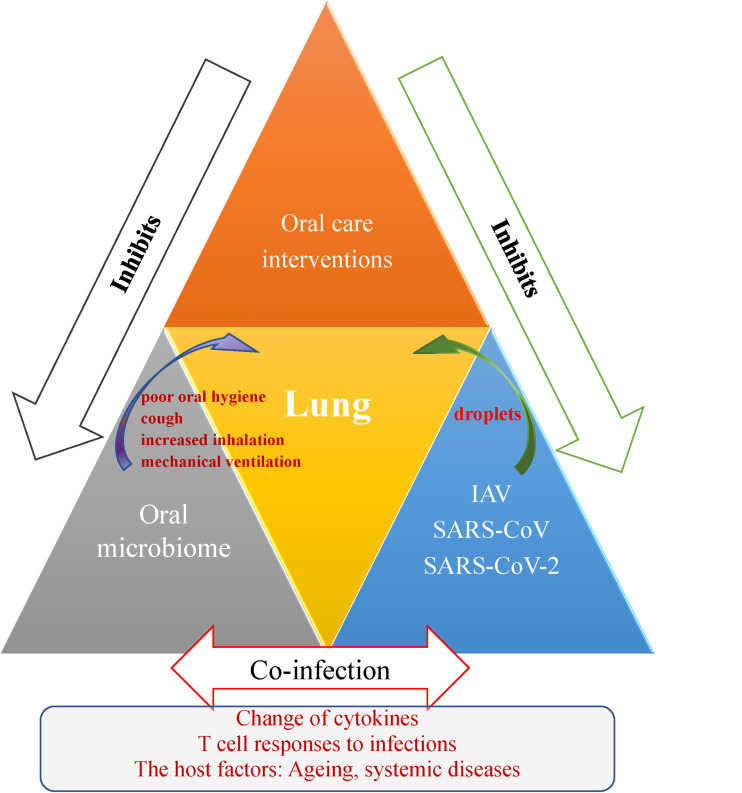
- Evidence cited includes clinical studies, mNGS/metagenomic sequencing, BALF and saliva sample studies, prior reviews, and preclinical models; the paper includes a table of mouth rinse components and a schematic figure of the oral-lung axis.
- Formal inclusion criteria, search terms, and risk-of-bias assessment are not stated in the paper.
Limitations
- The authors state that little work has been done on coronaviruses and oral microbiomes, that the mechanism of interaction between oral bacteria and respiratory viruses to promote lung infection has not been studied in depth, and that more mechanism studies are needed.
- The authors note limited data available to date, that one cited saliva study had a small sample size, and that the frequency of asymptomatic or RT-PCR-negative patients with CT pneumonia-like lesions is unknown.
- Evident from the text: this is a narrative review relying partly on preprints and indirect evidence from influenza and SARS; it does not directly test whether oral care improves COVID-19 outcomes or establish causality between oral microbiota and SARS-CoV-2 lung co-infection.
Model-written summary. Check it against the paper before relying on it.
Integrity signals
Registry
Cites
Statistics
Figures
Verification
Claims the paper makes
133 Not checked yet · 23 Own interpretation · 6 No basis given · 2 Sources not found
In the paper
“Microbiota that have migrated from the oral cavity, rather than those from the nasal flora, is likely to be an important source of microbiota in the lungs under normal conditions (Bassis et al., 2015).”
§ Oral Microbiome and SARS-CoV-2: Beware of Lung Co-infection > Introduction
What the sources say
- Not checked yetcites Bassis et al., 2015 source
hedgedconditional- Asserted: passes — The authors put it forward as true.
- Checkable: passes — It can be checked against evidence.
- Load-bearing: passes — The paper’s conclusions depend on it.
- Based: passes — The paper gives a reason why it holds.
In the paper
“The oral microbiome could be a driving force for bacteriome shifts by regulating mucosal immunity, which directly or indirectly affects pathogenicity (Li et al., 2019).”
§ Oral Microbiome and SARS-CoV-2: Beware of Lung Co-infection > Introduction
What the sources say
- Not checked yetcites Li et al., 2019
hedgedconditional- Asserted: passes — The authors put it forward as true.
- Checkable: passes — It can be checked against evidence.
- Load-bearing: unclear — It is unclear whether the paper’s conclusions depend on it.
- Based: passes — The paper gives a reason why it holds.
In the paper
“Metatranscriptome sequencing for the bronchoalveolar lavage fluid (BALF) of 8 COVID-19 patients revealed the presence of elevated levels of oral and upper respiratory commensal bacteria (Shen et al., 2020).”
§ Oral Microbiome and SARS-CoV-2: Beware of Lung Co-infection > Introduction
What the sources say
- Not checked yetcites Shen et al., 2020 source
plaincorrelationaln = 8- Asserted: passes — The authors put it forward as true.
- Checkable: passes — It can be checked against evidence.
- Load-bearing: passes — The paper’s conclusions depend on it.
- Based: passes — The paper gives a reason why it holds.
None of the sources cited for this claim have been checked yet.
In the paper
“Multiple studies have shown that lung microbiota are more similar to those in the oropharynx, than those in the air, nasopharynx or lower digestive tract (Segal et al., 2013; Venkataraman et al., 2015).”
§ Oral Microbiome and SARS-CoV-2: Beware of Lung Co-infection > Introduction
What the sources say
boostedcorrelational- Asserted: passes — The authors put it forward as true.
- Checkable: passes — It can be checked against evidence.
- Load-bearing: passes — The paper’s conclusions depend on it.
- Based: passes — The paper gives a reason why it holds.
In the paper
“It was demonstrated that acellular bronchoalveolar lavage samples from half of healthy individuals are enriched with oral taxa (Segal et al., 2016)”
§ Oral Microbiome and SARS-CoV-2: Beware of Lung Co-infection > Introduction
What the sources say
- Not checked yetcites Segal et al., 2016 source
boostedcorrelational- Asserted: passes — The authors put it forward as true.
- Checkable: passes — It can be checked against evidence.
- Load-bearing: unclear — It is unclear whether the paper’s conclusions depend on it.
- Based: passes — The paper gives a reason why it holds.
A conclusion the paper draws from its own results — it cites no other source for it, so there is none to check. The quote shows it is in the paper.
In the paper
“Considering the presented discussion, microbial co-infection increases the risk of disease severity in humans, while the mechanism is still unclear.”
§ Oral Microbiome and SARS-CoV-2: Beware of Lung Co-infection > Introduction
plaindirect- Asserted: passes — The authors put it forward as true.
- Checkable: passes — It can be checked against evidence.
- Load-bearing: passes — The paper’s conclusions depend on it.
- Based: passes — The paper gives a reason why it holds.
In the paper
“Compared with patients in mixed wards/intensive care unit (ICU) settings, ICU patients have a higher proportion of bacterial infections (Lansbury et al., 2020).”
§ Oral Microbiome and SARS-CoV-2: Beware of Lung Co-infection > Introduction
What the sources say
- Not checked yetcites Lansbury et al., 2020 source
plaincorrelational- Asserted: passes — The authors put it forward as true.
- Checkable: passes — It can be checked against evidence.
- Load-bearing: unclear — It is unclear whether the paper’s conclusions depend on it.
- Based: passes — The paper gives a reason why it holds.
A conclusion the paper draws from its own results — it cites no other source for it, so there is none to check. The quote shows it is in the paper.
In the paper
“indicating the oral cavity is likely to be a natural reservoir for pathogens inducing those found in COVID-19 patients with co-infections.”
§ Oral Microbiome and SARS-CoV-2: Beware of Lung Co-infection > Co-Infection of Oral Microbiome and Sars-CoV-2 in the Lungs
hedgedconditional- Asserted: passes — The authors put it forward as true.
- Checkable: passes — It can be checked against evidence.
- Load-bearing: passes — The paper’s conclusions depend on it.
- Based: passes — The paper gives a reason why it holds.
In the paper
“Metagenomic sequencing has found that the nasopharyngeal bacterial population of COVID-19 patients varied with the length of viral infection.”
§ Oral Microbiome and SARS-CoV-2: Beware of Lung Co-infection > Co-Infection of Oral Microbiome and Sars-CoV-2 in the Lungs
What the sources say
- Not checked yetcites Moore et al., 2020 source
plaincorrelational- Asserted: passes — The authors put it forward as true.
- Checkable: passes — It can be checked against evidence.
- Load-bearing: unclear — It is unclear whether the paper’s conclusions depend on it.
- Based: passes — The paper gives a reason why it holds.
In the paper
“Capnocytophaga, Veillonella, and other oral opportunists have been found in the BALF of the COVID-19 patients by mNGS (Wu et al., 2020)”
§ Oral Microbiome and SARS-CoV-2: Beware of Lung Co-infection > Co-Infection of Oral Microbiome and Sars-CoV-2 in the Lungs
What the sources say
- Not checked yetcites Wu et al., 2020
plaincorrelational- Asserted: passes — The authors put it forward as true.
- Checkable: passes — It can be checked against evidence.
- Load-bearing: passes — The paper’s conclusions depend on it.
- Based: passes — The paper gives a reason why it holds.
- Probably not a substantial claim. 35
- It may state two separate claims as one. 51
In the paper
“It is well-known that an oral-lung aspiration axis is a key factor leading to many infectious diseases (Mammen et al., 2020).”
§ Oral Microbiome and SARS-CoV-2: Beware of Lung Co-infection > Introduction
What the sources say
- Not checked yetcites Mammen et al., 2020 source
boosteddirect- Asserted: passes — The authors put it forward as true.
- Checkable: passes — It can be checked against evidence.
- Load-bearing: passes — The paper’s conclusions depend on it.
- Based: passes — The paper gives a reason why it holds.
Probably not a substantial claim.
None of the sources cited for this claim have been checked yet.
In the paper
“SARS-CoV-2 is a single-stranded RNA β-coronavirus and a member of the subgenus Sarbecovirus (beta-CoV lineage B).”
§ Oral Microbiome and SARS-CoV-2: Beware of Lung Co-infection > Introduction
What the sources say
plain- Asserted: passes — The authors put it forward as true.
- Checkable: passes — It can be checked against evidence.
- Load-bearing: fails — The paper’s conclusions may not depend on it.
- Based: passes — The paper gives a reason why it holds.
Probably not a substantial claim. The paper’s conclusions may not depend on it. It may state two separate claims as one.
In the paper
“Corona Virus Disease 2019 (COVID-19) caused by a novel coronavirus, severe acute respiratory syndrome coronavirus 2 (SARS-CoV-2), have spread worldwide (Zhu N. et al., 2020).”
§ Oral Microbiome and SARS-CoV-2: Beware of Lung Co-infection > Introduction
What the sources say
- Not checked yetcites Zhu N. et al., 2020
plaindirect- Asserted: passes — The authors put it forward as true.
- Checkable: passes — It can be checked against evidence.
- Load-bearing: fails — The paper’s conclusions may not depend on it.
- Based: passes — The paper gives a reason why it holds.
Probably not a substantial claim. The paper’s conclusions may not depend on it.
In the paper
“The oral cavity houses the second largest microbiota in the human body and can include bacteria, fungi, viruses, and archaea (Dewhirst et al., 2010).”
§ Oral Microbiome and SARS-CoV-2: Beware of Lung Co-infection > Introduction
What the sources say
- Not checked yetcites Dewhirst et al., 2010 source
plain- Asserted: passes — The authors put it forward as true.
- Checkable: passes — It can be checked against evidence.
- Load-bearing: fails — The paper’s conclusions may not depend on it.
- Based: passes — The paper gives a reason why it holds.
Probably not a substantial claim. The paper’s conclusions may not depend on it. It may state two separate claims as one.
None of the sources cited for this claim have been checked yet.
In the paper
“The dominant genera of healthy lungs include Streptococcus, Fusobacterium, Pseudomonas, Veillonella, Prevotella, and Capnocytophaga (Beck et al., 2015; Dickson and Huffnagle, 2015; Wypych et al., 2019; Shen et al., 2020), colonizing the oral cavity as well.”
§ Oral Microbiome and SARS-CoV-2: Beware of Lung Co-infection > Introduction
What the sources say
plain- Asserted: passes — The authors put it forward as true.
- Checkable: passes — It can be checked against evidence.
- Load-bearing: passes — The paper’s conclusions depend on it.
- Based: passes — The paper gives a reason why it holds.
It may state two separate claims as one.
In the paper
“The main bacterial genera, by abundance, present within the normal oral cavity include Neisseria, Corynebacterium, Leptotrichia, Streptococcus, Prevotella, Veillonella, Fusobacterium, and Capnocytophaga (Li et al., 2014).”
§ Oral Microbiome and SARS-CoV-2: Beware of Lung Co-infection > Introduction
What the sources say
- Not checked yetcites Li et al., 2014
plain- Asserted: passes — The authors put it forward as true.
- Checkable: passes — It can be checked against evidence.
- Load-bearing: fails — The paper’s conclusions may not depend on it.
- Based: passes — The paper gives a reason why it holds.
Probably not a substantial claim. The paper’s conclusions may not depend on it.
In the paper
“Additionally, many human bacterial pathogens can also colonize the respiratory tract of healthy individuals asymptomatically (Arora et al., 2015).”
§ Oral Microbiome and SARS-CoV-2: Beware of Lung Co-infection > Introduction
What the sources say
- Not checked yetcites Arora et al., 2015 source
plain- Asserted: passes — The authors put it forward as true.
- Checkable: passes — It can be checked against evidence.
- Load-bearing: fails — The paper’s conclusions may not depend on it.
- Based: passes — The paper gives a reason why it holds.
Probably not a substantial claim. The paper’s conclusions may not depend on it.
In the paper
“it is supposed that the oral cavity, an ecological reservoir for potential pathogens, is involved in local and systemic diseases (Warinner et al., 2014).”
§ Oral Microbiome and SARS-CoV-2: Beware of Lung Co-infection > Introduction
What the sources say
- Not checked yetcites Warinner et al., 2014 source
hedgedcorrelational- Asserted: passes — The authors put it forward as true.
- Checkable: passes — It can be checked against evidence.
- Load-bearing: passes — The paper’s conclusions depend on it.
- Based: passes — The paper gives a reason why it holds.
It may state two separate claims as one.
In the paper
“The frequency of influenza and bacterial co-infection ranged from 2% to 65%.”
§ Oral Microbiome and SARS-CoV-2: Beware of Lung Co-infection > Introduction
What the sources say
- Not checked yetcites Klein et al., 2016 source
plain- Asserted: passes — The authors put it forward as true.
- Checkable: passes — It can be checked against evidence.
- Load-bearing: fails — The paper’s conclusions may not depend on it.
- Based: passes — The paper gives a reason why it holds.
Probably not a substantial claim. The paper’s conclusions may not depend on it.
In the paper
“It’s reported that 1450/2010 (72%) of COVID-19 patients received antimicrobial therapy (Rawson et al., 2020).”
§ Oral Microbiome and SARS-CoV-2: Beware of Lung Co-infection > Co-Infection of Oral Microbiome and Sars-CoV-2 in the Lungs
What the sources say
- Not checked yetcites Rawson et al., 2020 source
plainn = 19- Asserted: passes — The authors put it forward as true.
- Checkable: passes — It can be checked against evidence.
- Load-bearing: fails — The paper’s conclusions may not depend on it.
- Based: passes — The paper gives a reason why it holds.
Probably not a substantial claim. The paper’s conclusions may not depend on it.
In the paper
“Other research has indicated a higher viral load in the nose than in the throat, viral nucleic acid change model in the patients infected with SARS-CoV-2 were similar to those in the patients with influenza viruses but different from that of SARS-CoV (Wang et al., 2020).”
§ Oral Microbiome and SARS-CoV-2: Beware of Lung Co-infection > Introduction
What the sources say
- Not checked yetcites Wang et al., 2020 source
hedgedcorrelational- Asserted: passes — The authors put it forward as true.
- Checkable: passes — It can be checked against evidence.
- Load-bearing: fails — The paper’s conclusions may not depend on it.
- Based: passes — The paper gives a reason why it holds.
Probably not a substantial claim. The paper’s conclusions may not depend on it. It may state two separate claims as one.
In the paper
“During the 2009 influenza pandemic, almost one in four patients presented bacterial complications (MacIntyre et al., 2018).”
§ Oral Microbiome and SARS-CoV-2: Beware of Lung Co-infection > Introduction
What the sources say
- Not checked yetcites MacIntyre et al., 2018 source
plain- Asserted: passes — The authors put it forward as true.
- Checkable: passes — It can be checked against evidence.
- Load-bearing: fails — The paper’s conclusions may not depend on it.
- Based: passes — The paper gives a reason why it holds.
Probably not a substantial claim. The paper’s conclusions may not depend on it.
In the paper
“Among them, Streptococcus pneumoniae and Staphylococcus aureus, which accounted for 35% and 28% of infections (Klein et al., 2016).”
§ Oral Microbiome and SARS-CoV-2: Beware of Lung Co-infection > Introduction
What the sources say
- Not checked yetcites Klein et al., 2016 source
plain- Asserted: passes — The authors put it forward as true.
- Checkable: passes — It can be checked against evidence.
- Load-bearing: fails — The paper’s conclusions may not depend on it.
- Based: passes — The paper gives a reason why it holds.
Probably not a substantial claim. The paper’s conclusions may not depend on it. It may state two separate claims as one.
In the paper
“Genome sequencing demonstrated that SARS-CoV-2 shares 79.5% sequence identity with SARS-CoV (Zhou et al., 2020)”
§ Oral Microbiome and SARS-CoV-2: Beware of Lung Co-infection > Introduction
What the sources say
- Not checked yetcites Zhou et al., 2020 source
boosted- Asserted: passes — The authors put it forward as true.
- Checkable: passes — It can be checked against evidence.
- Load-bearing: fails — The paper’s conclusions may not depend on it.
- Based: passes — The paper gives a reason why it holds.
Probably not a substantial claim. The paper’s conclusions may not depend on it.
None of the sources cited for this claim have been checked yet.
In the paper
“It is the seventh member of the Coronaviridae known to infect humans so far, two of which, SARS-CoV and MERS-CoV, caused global health threats previously (Guarner, 2020; Letko et al., 2020).”
§ Oral Microbiome and SARS-CoV-2: Beware of Lung Co-infection > Introduction
What the sources say
plain- Asserted: passes — The authors put it forward as true.
- Checkable: passes — It can be checked against evidence.
- Load-bearing: fails — The paper’s conclusions may not depend on it.
- Based: passes — The paper gives a reason why it holds.
Probably not a substantial claim. The paper’s conclusions may not depend on it. It may state two separate claims as one.
In the paper
“In addition, bacterial co-infection occurred in 7% of hospitalized COVID-19 patients.”
§ Oral Microbiome and SARS-CoV-2: Beware of Lung Co-infection > Introduction
What the sources say
- Not checked yetcites Lansbury et al., 2020 source
plain- Asserted: passes — The authors put it forward as true.
- Checkable: passes — It can be checked against evidence.
- Load-bearing: fails — The paper’s conclusions may not depend on it.
- Based: passes — The paper gives a reason why it holds.
Probably not a substantial claim. The paper’s conclusions may not depend on it.
None of the sources cited for this claim have been checked yet.
In the paper
“These studies suggested that keen vigilance should be maintained against infections derived from the oral microbiome during infection by respiratory viruses and have uncovered risk factors such as increased inhalation, poor oral hygiene, and viral infection are related to the occurrence of respiratory infection (Pace and McCullough, 2010; Krone et al., 2014; Iki et al., 2016).”
§ Oral Microbiome and SARS-CoV-2: Beware of Lung Co-infection > Introduction
What the sources say
hedgedcorrelational- Asserted: passes — The authors put it forward as true.
- Checkable: passes — It can be checked against evidence.
- Load-bearing: passes — The paper’s conclusions depend on it.
- Based: passes — The paper gives a reason why it holds.
It may state two separate claims as one.
In the paper
“The “Spanish flu” of 1918 was the most severe influenza pandemic on record, 95% of the mortality due to bacterial infection (Morens et al., 2008).”
§ Oral Microbiome and SARS-CoV-2: Beware of Lung Co-infection > Introduction
What the sources say
- Not checked yetcites Morens et al., 2008 source
plaindirect- Asserted: passes — The authors put it forward as true.
- Checkable: passes — It can be checked against evidence.
- Load-bearing: fails — The paper’s conclusions may not depend on it.
- Based: passes — The paper gives a reason why it holds.
Probably not a substantial claim. The paper’s conclusions may not depend on it.
None of the sources cited for this claim have been checked yet.
In the paper
“Epidemiological data indicated that bacterial complications further increased morbidity and mortality of influenza infection.”
§ Oral Microbiome and SARS-CoV-2: Beware of Lung Co-infection > Introduction
What the sources say
hedgeddirect- Asserted: passes — The authors put it forward as true.
- Checkable: passes — It can be checked against evidence.
- Load-bearing: fails — The paper’s conclusions may not depend on it.
- Based: passes — The paper gives a reason why it holds.
Probably not a substantial claim. The paper’s conclusions may not depend on it.
In the paper
“The mechanisms by which the oral microbiome can influence respiratory disease is complicated and multifactorial, simultaneously affected by environmental, host, and microbial factors (Xu et al., 2018).”
§ Oral Microbiome and SARS-CoV-2: Beware of Lung Co-infection > Introduction
What the sources say
- Not checked yetcites Xu et al., 2018
plaindirect- Asserted: passes — The authors put it forward as true.
- Checkable: passes — It can be checked against evidence.
- Load-bearing: fails — The paper’s conclusions may not depend on it.
- Based: passes — The paper gives a reason why it holds.
Probably not a substantial claim. The paper’s conclusions may not depend on it.
In the paper
“The majority of COVID-19 patients present a mild course, common symptoms including low fever, fatigue, and dry cough, while severe cases always present dyspnea within a week from the onset of symptoms, with rapid deterioration into serious complications, such as acute respiratory distress syndrome (ARDS), multiple organ failure, etc (Sharma et al., 2020).”
§ Oral Microbiome and SARS-CoV-2: Beware of Lung Co-infection > Co-Infection of Oral Microbiome and Sars-CoV-2 in the Lungs > The Mixed Infections in COVID-19
What the sources say
- Not checked yetcites Sharma et al., 2020 source
plain- Asserted: passes — The authors put it forward as true.
- Checkable: passes — It can be checked against evidence.
- Load-bearing: fails — The paper’s conclusions may not depend on it.
- Based: passes — The paper gives a reason why it holds.
Probably not a substantial claim. The paper’s conclusions may not depend on it. It may state two separate claims as one.
In the paper
“Although bacteria are typically secondary invaders during influenza infections, they express virulence factors that promote viral pathogenesis. As a result, viral load increases and clearance rates decline (McCullers, 2014).”
§ Oral Microbiome and SARS-CoV-2: Beware of Lung Co-infection > Co-Infection of Oral Microbiome and Sars-CoV-2 in the Lungs > The Bacterial Complications in Other Respiratory Viral Infections
What the sources say
- Not checked yetcites McCullers, 2014 source
plaindirect- Asserted: passes — The authors put it forward as true.
- Checkable: passes — It can be checked against evidence.
- Load-bearing: unclear — It is unclear whether the paper’s conclusions depend on it.
- Based: passes — The paper gives a reason why it holds.
It may state two separate claims as one.
In the paper
“In addition, 5 co-infection cases were found coinfected with a virus, including rhinovirus/enterovirus, H3N2, influenza B and respiratory syncytial virus, suggesting that virus co-infection were not uncommon in winter pneumonia patients.”
§ Oral Microbiome and SARS-CoV-2: Beware of Lung Co-infection > Co-Infection of Oral Microbiome and Sars-CoV-2 in the Lungs > The Mixed Infections in COVID-19
What the sources say
- Not checked yetcites Ai et al., 2020
hedgedn = 5- Asserted: passes — The authors put it forward as true.
- Checkable: passes — It can be checked against evidence.
- Load-bearing: unclear — It is unclear whether the paper’s conclusions depend on it.
- Based: passes — The paper gives a reason why it holds.
It may state two separate claims as one.
In the paper
“the receptor for SARS-CoV-2, human angiotensin-converting enzyme 2 (ACE2), is also expressed in 0.52% of oral cells, of which 95.86% is expressed in tongue epithelial cells (Xu H. et al., 2020).”
§ Oral Microbiome and SARS-CoV-2: Beware of Lung Co-infection > Co-Infection of Oral Microbiome and Sars-CoV-2 in the Lungs > The Mixed Infections in COVID-19
What the sources say
- Not checked yetcites Xu H. et al., 2020
plain- Asserted: passes — The authors put it forward as true.
- Checkable: passes — It can be checked against evidence.
- Load-bearing: passes — The paper’s conclusions depend on it.
- Based: passes — The paper gives a reason why it holds.
It may state two separate claims as one.
None of the sources cited for this claim have been checked yet.
In the paper
“It is also notable that in some patients with no symptoms or negative RT-PCR results that chest computed tomographic (CT) scans revealed viral pneumonia-like lesions in the lungs, such as bilateral patchy shadows or ground glass opacity, and even lung consolidation, but the frequency is unknown (Wang et al., 2020; Yan et al., 2020).”
§ Oral Microbiome and SARS-CoV-2: Beware of Lung Co-infection > Co-Infection of Oral Microbiome and Sars-CoV-2 in the Lungs > The Mixed Infections in COVID-19
What the sources say
- Not checked yetcites Wang et al., 2020 source
- Not checked yetcites Yan et al., 2020
plain- Asserted: passes — The authors put it forward as true.
- Checkable: passes — It can be checked against evidence.
- Load-bearing: unclear — It is unclear whether the paper’s conclusions depend on it.
- Based: passes — The paper gives a reason why it holds.
It may state two separate claims as one.
In the paper
“In fact, bacteria are known to participate in interactions between host cells and viruses.”
§ Oral Microbiome and SARS-CoV-2: Beware of Lung Co-infection > Co-Infection of Oral Microbiome and Sars-CoV-2 in the Lungs > The Bacterial Complications in Other Respiratory Viral Infections
What the sources say
- Not checked yetcites McCullers, 2014 source
boostedcorrelational- Asserted: passes — The authors put it forward as true.
- Checkable: passes — It can be checked against evidence.
- Load-bearing: fails — The paper’s conclusions may not depend on it.
- Based: passes — The paper gives a reason why it holds.
Probably not a substantial claim. The paper’s conclusions may not depend on it.
In the paper
“A recent study revealed coinfection with Moraxella catarrhalis in laboratory-proven cases of SARS-CoV-2, and quantified increased bacterial burden in some patients over others (Peddu et al., 2020).”
§ Oral Microbiome and SARS-CoV-2: Beware of Lung Co-infection > Co-Infection of Oral Microbiome and Sars-CoV-2 in the Lungs > The Mixed Infections in COVID-19
What the sources say
- Not checked yetcites Peddu et al., 2020 source
plaincorrelational- Asserted: passes — The authors put it forward as true.
- Checkable: passes — It can be checked against evidence.
- Load-bearing: passes — The paper’s conclusions depend on it.
- Based: passes — The paper gives a reason why it holds.
It may state two separate claims as one.
None of the sources cited for this claim have been checked yet.
In the paper
“The tongue dorsum is one habitat niche of oral microbes, there the dominant microflora are Prevotella and Veillonella, which are associated with an increased risk of death due to pneumonia in older, frail patients (Asakawa et al., 2018; Kageyama et al., 2018).”
§ Oral Microbiome and SARS-CoV-2: Beware of Lung Co-infection > Co-Infection of Oral Microbiome and Sars-CoV-2 in the Lungs > How the Oral Microbiome May Cause Lung Infection
What the sources say
plaincorrelational- Asserted: passes — The authors put it forward as true.
- Checkable: passes — It can be checked against evidence.
- Load-bearing: passes — The paper’s conclusions depend on it.
- Based: passes — The paper gives a reason why it holds.
It may state two separate claims as one.
In the paper
“P. gingivalis is the most important periodontitis pathogen, while Streptococcus sp., in general, constitute the main component of oral flora (Kuroda et al., 2010).”
§ Oral Microbiome and SARS-CoV-2: Beware of Lung Co-infection > Co-Infection of Oral Microbiome and Sars-CoV-2 in the Lungs > The Bacterial Complications in Other Respiratory Viral Infections
What the sources say
- Not checked yetcites Kuroda et al., 2010 source
plain- Asserted: passes — The authors put it forward as true.
- Checkable: passes — It can be checked against evidence.
- Load-bearing: fails — The paper’s conclusions may not depend on it.
- Based: passes — The paper gives a reason why it holds.
Probably not a substantial claim. The paper’s conclusions may not depend on it. It may state two separate claims as one.
None of the sources cited for this claim have been checked yet.
In the paper
“Dental plaques contain pathogens which could aggravate the state of pneumonia (Olsen, 2015), including P. gingivalis, which can synergistically enhance pathogenicity (Miller et al., 2018).”
§ Oral Microbiome and SARS-CoV-2: Beware of Lung Co-infection > Co-Infection of Oral Microbiome and Sars-CoV-2 in the Lungs > How the Oral Microbiome May Cause Lung Infection
What the sources say
hedgedconditional- Asserted: passes — The authors put it forward as true.
- Checkable: passes — It can be checked against evidence.
- Load-bearing: passes — The paper’s conclusions depend on it.
- Based: passes — The paper gives a reason why it holds.
It may state two separate claims as one.
A conclusion the paper draws from its own results — it cites no other source for it, so there is none to check. The quote shows it is in the paper.
In the paper
“Additionally, lung hypoxia would stimulate the growth of anaerobes and facultative anaerobes derived from oral microbiota.”
§ Oral Microbiome and SARS-CoV-2: Beware of Lung Co-infection > Co-Infection of Oral Microbiome and Sars-CoV-2 in the Lungs > How the Oral Microbiome May Cause Lung Infection
hedgeddirect- Asserted: passes — The authors put it forward as true.
- Checkable: passes — It can be checked against evidence.
- Load-bearing: passes — The paper’s conclusions depend on it.
- Based: fails — The paper may give no reason why it holds.
Probably not a substantial claim. The paper may give no reason why it holds.
- Rests on an assumption: Lung hypoxia favors the growth of anaerobes and facultative anaerobes originating from the oral microbiota.
In the paper
“Influenza is the most common type of acute respiratory infection (Hanada et al., 2018)”
§ Oral Microbiome and SARS-CoV-2: Beware of Lung Co-infection > Co-Infection of Oral Microbiome and Sars-CoV-2 in the Lungs > The Bacterial Complications in Other Respiratory Viral Infections
What the sources say
- Not checked yetcites Hanada et al., 2018 source
plain- Asserted: passes — The authors put it forward as true.
- Checkable: passes — It can be checked against evidence.
- Load-bearing: fails — The paper’s conclusions may not depend on it.
- Based: passes — The paper gives a reason why it holds.
Probably not a substantial claim. The paper’s conclusions may not depend on it.
A conclusion the paper draws from its own results — it cites no other source for it, so there is none to check. The quote shows it is in the paper.
In the paper
“Together, these factors result in respiratory dysbiosis, and thus cause respiratory disease.”
§ Oral Microbiome and SARS-CoV-2: Beware of Lung Co-infection > Co-Infection of Oral Microbiome and Sars-CoV-2 in the Lungs > How the Oral Microbiome May Cause Lung Infection
plaindirect- Asserted: passes — The authors put it forward as true.
- Checkable: passes — It can be checked against evidence.
- Load-bearing: passes — The paper’s conclusions depend on it.
- Based: unclear — It is unclear why the paper says it holds.
It may state two separate claims as one.
None of the sources cited for this claim have been checked yet.
In the paper
“Some conditional pathogens such as Enterococcus faecalis, Klebsiella pneumonia, Acinetobacter baumannii, Stenotrophomonas maltophilia, and Candida albicans could come from hospital environment, nosocomial infection, but the majority inhabit the oral cavity (Zheng et al., 2003; Li et al., 2005).”
§ Oral Microbiome and SARS-CoV-2: Beware of Lung Co-infection > Co-Infection of Oral Microbiome and Sars-CoV-2 in the Lungs > The Bacterial Complications in Other Respiratory Viral Infections
What the sources say
- Not checked yetcites Zheng et al., 2003
- Not checked yetcites Li et al., 2005
hedged- Asserted: passes — The authors put it forward as true.
- Checkable: passes — It can be checked against evidence.
- Load-bearing: passes — The paper’s conclusions depend on it.
- Based: passes — The paper gives a reason why it holds.
It may state two separate claims as one.
A conclusion the paper draws from its own results — it cites no other source for it, so there is none to check. The quote shows it is in the paper.
In the paper
“Risk factors such as poor oral hygiene, cough, increased inhalation under normal or abnormal condition, and mechanical ventilation are the main routes by oral microbiota enter the airways.”
§ Oral Microbiome and SARS-CoV-2: Beware of Lung Co-infection > Co-Infection of Oral Microbiome and Sars-CoV-2 in the Lungs > How the Oral Microbiome May Cause Lung Infection
plaindirect- Asserted: passes — The authors put it forward as true.
- Checkable: passes — It can be checked against evidence.
- Load-bearing: passes — The paper’s conclusions depend on it.
- Based: fails — The paper may give no reason why it holds.
Probably not a substantial claim. The paper may give no reason why it holds.
In the paper
“Long-term bed rest people cannot cough as easily or as well, which allows pooled mucus to stagnate and reduces the clearance of potentially pathogenic material and irritants (Knight et al., 2009).”
§ Oral Microbiome and SARS-CoV-2: Beware of Lung Co-infection > Co-Infection of Oral Microbiome and Sars-CoV-2 in the Lungs > The Bacterial Complications in Other Respiratory Viral Infections
What the sources say
- Not checked yetcites Knight et al., 2009
plaindirect- Asserted: passes — The authors put it forward as true.
- Checkable: passes — It can be checked against evidence.
- Load-bearing: unclear — It is unclear whether the paper’s conclusions depend on it.
- Based: passes — The paper gives a reason why it holds.
It may state two separate claims as one.
In the paper
“bacterial complications were an important complication of the 2009 influenza pandemic (MacIntyre et al., 2018).”
§ Oral Microbiome and SARS-CoV-2: Beware of Lung Co-infection > Co-Infection of Oral Microbiome and Sars-CoV-2 in the Lungs > The Bacterial Complications in Other Respiratory Viral Infections
What the sources say
- Not checked yetcites MacIntyre et al., 2018 source
plain- Asserted: passes — The authors put it forward as true.
- Checkable: passes — It can be checked against evidence.
- Load-bearing: fails — The paper’s conclusions may not depend on it.
- Based: passes — The paper gives a reason why it holds.
Probably not a substantial claim. The paper’s conclusions may not depend on it.
In the paper
“Long-term bed rest, mechanical ventilation, and glucocorticoid therapy are all risk factors for opportunistic infection.”
§ Oral Microbiome and SARS-CoV-2: Beware of Lung Co-infection > Co-Infection of Oral Microbiome and Sars-CoV-2 in the Lungs > The Bacterial Complications in Other Respiratory Viral Infections
What the sources say
- Not checked yetcites Knight et al., 2009
plaincorrelational- Asserted: passes — The authors put it forward as true.
- Checkable: passes — It can be checked against evidence.
- Load-bearing: unclear — It is unclear whether the paper’s conclusions depend on it.
- Based: passes — The paper gives a reason why it holds.
It may state two separate claims as one.
The paper states this without a source or data behind it here, so there is nothing to check it against. The quote shows it is in the paper.
In the paper
“Some pathogens, such as anaerobes, cannot be easily cultured, making accurate diagnosis and treatment of infections challenging.”
§ Oral Microbiome and SARS-CoV-2: Beware of Lung Co-infection > Co-Infection of Oral Microbiome and Sars-CoV-2 in the Lungs > The Bacterial Complications in Other Respiratory Viral Infections
plaindirect- Asserted: passes — The authors put it forward as true.
- Checkable: passes — It can be checked against evidence.
- Load-bearing: fails — The paper’s conclusions may not depend on it.
- Based: passes — The paper gives a reason why it holds.
Probably not a substantial claim. The paper’s conclusions may not depend on it.
None of the sources cited for this claim have been checked yet.
In the paper
“Ventilator-associated pneumonia (VAP) frequently occurs in patients requiring mechanical ventilation, leading to high mortality, with an incidence from 5% to 67% depending on the population studied and the diagnostic criteria used (Barbier et al., 2013; Torres et al., 2017).”
§ Oral Microbiome and SARS-CoV-2: Beware of Lung Co-infection > Co-Infection of Oral Microbiome and Sars-CoV-2 in the Lungs > How the Oral Microbiome May Cause Lung Infection
What the sources say
plaindirect- Asserted: passes — The authors put it forward as true.
- Checkable: passes — It can be checked against evidence.
- Load-bearing: fails — The paper’s conclusions may not depend on it.
- Based: passes — The paper gives a reason why it holds.
Probably not a substantial claim. The paper’s conclusions may not depend on it. It may state two separate claims as one.
In the paper
“It is speculated that aspiration pneumonia is also closely related to oral microorganisms due to the aspiration of oropharyngeal secretions (Hajishengallis, 2015).”
§ Oral Microbiome and SARS-CoV-2: Beware of Lung Co-infection > Co-Infection of Oral Microbiome and Sars-CoV-2 in the Lungs > How the Oral Microbiome May Cause Lung Infection
What the sources say
- Not checked yetcites Hajishengallis, 2015 source
hedgedcorrelational- Asserted: passes — The authors put it forward as true.
- Checkable: passes — It can be checked against evidence.
- Load-bearing: passes — The paper’s conclusions depend on it.
- Based: passes — The paper gives a reason why it holds.
Probably not a substantial claim.
In the paper
“Sputum appeared to be a good clinical sample with a high positive rate (74.4∼88.9%), followed by nasal swabs (53.6∼73.3%) and throat swabs (50∼ 61.3%).”
§ Oral Microbiome and SARS-CoV-2: Beware of Lung Co-infection > Interaction Between Oral Microbiome and Virus Infection
What the sources say
- Not checked yetcites Yang et al., 2020 source
hedgedcorrelationaln = 213- Asserted: passes — The authors put it forward as true.
- Checkable: passes — It can be checked against evidence.
- Load-bearing: unclear — It is unclear whether the paper’s conclusions depend on it.
- Based: passes — The paper gives a reason why it holds.
It may state two separate claims as one.
In the paper
“According to a study on 213 confirmed COVID-19 patients, viral RNA could be detected in all BALF samples of severe cases, but not from mild cases.”
§ Oral Microbiome and SARS-CoV-2: Beware of Lung Co-infection > Interaction Between Oral Microbiome and Virus Infection
What the sources say
- Not checked yetcites Yang et al., 2020 source
hedgedcorrelationaln = 213- Asserted: passes — The authors put it forward as true.
- Checkable: passes — It can be checked against evidence.
- Load-bearing: unclear — It is unclear whether the paper’s conclusions depend on it.
- Based: passes — The paper gives a reason why it holds.
It may state two separate claims as one.
In the paper
“SARS-CoV-2 can be detected from different body fluids and the rate of positive test results vary depending on the sample size, days after illness onset, and severity of illness.”
§ Oral Microbiome and SARS-CoV-2: Beware of Lung Co-infection > Interaction Between Oral Microbiome and Virus Infection
What the sources say
- Not checked yetcites Yang et al., 2020 source
plaincorrelationaln = 213- Asserted: passes — The authors put it forward as true.
- Checkable: passes — It can be checked against evidence.
- Load-bearing: unclear — It is unclear whether the paper’s conclusions depend on it.
- Based: passes — The paper gives a reason why it holds.
It may state two separate claims as one.
A conclusion the paper draws from its own results — it cites no other source for it, so there is none to check. The quote shows it is in the paper.
In the paper
“The frequency of microaspiration will rise in chronic inflammatory respiratory diseases, therefore it is necessary to pay attention to co-infections caused by oral microorganisms.”
§ Oral Microbiome and SARS-CoV-2: Beware of Lung Co-infection > Co-Infection of Oral Microbiome and Sars-CoV-2 in the Lungs > How the Oral Microbiome May Cause Lung Infection
plaindirect- Asserted: passes — The authors put it forward as true.
- Checkable: passes — It can be checked against evidence.
- Load-bearing: passes — The paper’s conclusions depend on it.
- Based: fails — The paper may give no reason why it holds.
Probably not a substantial claim. The paper may give no reason why it holds.
None of the sources cited for this claim have been checked yet.
In the paper
“Poor oral hygiene habits can lead to the accumulation of many periodontal microorganisms in the oral cavity, and oral dysbiosis can accelerate lung function decline (Takeuchi et al., 2018; Winning et al., 2019), which in turn can increase the incidence of pneumonia (Kumar, 2017).”
§ Oral Microbiome and SARS-CoV-2: Beware of Lung Co-infection > Co-Infection of Oral Microbiome and Sars-CoV-2 in the Lungs > How the Oral Microbiome May Cause Lung Infection
What the sources say
plaindirect- Asserted: passes — The authors put it forward as true.
- Checkable: passes — It can be checked against evidence.
- Load-bearing: passes — The paper’s conclusions depend on it.
- Based: passes — The paper gives a reason why it holds.
It may state two separate claims as one.
In the paper
“What’s more, saliva appeared to be a good clinical specimen in the early stage of the disease, with SARS-CoV-2 detected in the initial saliva of 91.7% (11/12) of patients (To et al., 2020b), however the sample size was small in that study.”
§ Oral Microbiome and SARS-CoV-2: Beware of Lung Co-infection > Interaction Between Oral Microbiome and Virus Infection
What the sources say
- Not checked yetcites To et al., 2020b
hedgedcorrelational- Asserted: passes — The authors put it forward as true.
- Checkable: passes — It can be checked against evidence.
- Load-bearing: unclear — It is unclear whether the paper’s conclusions depend on it.
- Based: passes — The paper gives a reason why it holds.
It may state two separate claims as one.
In the paper
“When the onset time was greater than 14 days, the positive rate of BALF, sputum, and nasal swabs showed similar results, and were still much higher than throat swabs (Yang et al., 2020).”
§ Oral Microbiome and SARS-CoV-2: Beware of Lung Co-infection > Interaction Between Oral Microbiome and Virus Infection
What the sources say
- Not checked yetcites Yang et al., 2020 source
plainn = 213- Asserted: passes — The authors put it forward as true.
- Checkable: passes — It can be checked against evidence.
- Load-bearing: unclear — It is unclear whether the paper’s conclusions depend on it.
- Based: passes — The paper gives a reason why it holds.
It may state two separate claims as one.
In the paper
“Leung et al. (2013) conducted an unbiased high-throughput sequencing method to analyze the oropharyngeal microorganisms of pneumonia patients with or without influenza virus infection, and found that the number of Pseudomonas and Bacillus in the oropharynx increased significantly after influenza virus infection, whereas the number of Prevotella, Veillonella, and Neisseria decreased significantly.”
§ Oral Microbiome and SARS-CoV-2: Beware of Lung Co-infection > Interaction Between Oral Microbiome and Virus Infection > Influenza Virus-Drive Oral Microecological Imbalance
What the sources say
- Not checked yetcites Leung et al., 2013 source
plaindirect- Asserted: passes — The authors put it forward as true.
- Checkable: passes — It can be checked against evidence.
- Load-bearing: unclear — It is unclear whether the paper’s conclusions depend on it.
- Based: passes — The paper gives a reason why it holds.
It may state two separate claims as one.
The paper states this without a source or data behind it here, so there is nothing to check it against. The quote shows it is in the paper.
In the paper
“Influenza viruses rely on neuraminidase (NA) activity to release progeny viruses from infected cells and spread the infection.”
§ Oral Microbiome and SARS-CoV-2: Beware of Lung Co-infection > Interaction Between Oral Microbiome and Virus Infection > Oral Microbes Affect Influenza Viral Neuraminidase Activity
plaindirect- Asserted: passes — The authors put it forward as true.
- Checkable: passes — It can be checked against evidence.
- Load-bearing: passes — The paper’s conclusions depend on it.
- Based: passes — The paper gives a reason why it holds.
Probably not a substantial claim.
None of the sources cited for this claim have been checked yet.
In the paper
“Cytotoxic products of P. gingivalis (e.g., lipopolysaccharide) can induce host cells release of inflammatory cytokines such as TNF-α, IL-1β, and IL-6 (Ke et al., 2016), which in turn increase NO production leading to lung epithelial cell damage (Alayan et al., 2006; Wu et al., 2016; Ahamed et al., 2017).”
§ Oral Microbiome and SARS-CoV-2: Beware of Lung Co-infection > Interaction Between Oral Microbiome and Virus Infection > Co-infection With P. gingivalis and Influenza Virus Increased Significant Apoptosis and Necrosis
What the sources say
- Not checked yetcites Ke et al., 2016
- Not checked yetcites Alayan et al., 2006 source
- Not checked yetcites Wu et al., 2016
plaindirect- Asserted: passes — The authors put it forward as true.
- Checkable: passes — It can be checked against evidence.
- Load-bearing: passes — The paper’s conclusions depend on it.
- Based: passes — The paper gives a reason why it holds.
It may state two separate claims as one.
In the paper
“Another study (To et al., 2020a) reported that the viral load of SARS-CoV-2 in posterior oropharyngeal saliva samples was highest during the first week of symptom onset.”
§ Oral Microbiome and SARS-CoV-2: Beware of Lung Co-infection > Interaction Between Oral Microbiome and Virus Infection
What the sources say
- Not checked yetcites To et al., 2020a
plaincorrelational- Asserted: passes — The authors put it forward as true.
- Checkable: passes — It can be checked against evidence.
- Load-bearing: fails — The paper’s conclusions may not depend on it.
- Based: passes — The paper gives a reason why it holds.
Probably not a substantial claim. The paper’s conclusions may not depend on it.
In the paper
“As per the results, Prevotella proteins, rather than viral proteins, are involved in increasing clinical severity of COVID-2019, i.e., Prevotella plays role in COVID- 2019 outbreak and attention should be paid to understanding disease mechanisms and improving treatment outcomes (Khan and Khan, 2020).”
§ Oral Microbiome and SARS-CoV-2: Beware of Lung Co-infection > Interaction Between Oral Microbiome and Virus Infection
What the sources say
- Not checked yetcites Khan and Khan, 2020
plaindirect- Asserted: passes — The authors put it forward as true.
- Checkable: passes — It can be checked against evidence.
- Load-bearing: passes — The paper’s conclusions depend on it.
- Based: passes — The paper gives a reason why it holds.
It may state two separate claims as one.
In the paper
“The viral load in throat swabs and sputum samples peaked at 5–6 days after onset and ranged from 104 to 107 copies/ml (Pan et al., 2020).”
§ Oral Microbiome and SARS-CoV-2: Beware of Lung Co-infection > Interaction Between Oral Microbiome and Virus Infection
What the sources say
- Not checked yetcites Pan et al., 2020 source
plaincorrelational- Asserted: passes — The authors put it forward as true.
- Checkable: passes — It can be checked against evidence.
- Load-bearing: unclear — It is unclear whether the paper’s conclusions depend on it.
- Based: passes — The paper gives a reason why it holds.
It may state two separate claims as one.
The paper states this without a source or data behind it here, so there is nothing to check it against. The quote shows it is in the paper.
In the paper
“NA is, therefore, an important target of anti-influenza drugs.”
§ Oral Microbiome and SARS-CoV-2: Beware of Lung Co-infection > Interaction Between Oral Microbiome and Virus Infection > Oral Microbes Affect Influenza Viral Neuraminidase Activity
plain- Asserted: passes — The authors put it forward as true.
- Checkable: passes — It can be checked against evidence.
- Load-bearing: fails — The paper’s conclusions may not depend on it.
- Based: passes — The paper gives a reason why it holds.
Probably not a substantial claim. The paper’s conclusions may not depend on it.
In the paper
“It was known that the culture supernatants of NA-producing oral bacteria, like Streptococcus oralis and Streptococcus mitis, can promote the release of influenza virus and cell-to-cell spread of the infection, and also help to increase viral M1 protein expression levels and activation of cellular ERK.”
§ Oral Microbiome and SARS-CoV-2: Beware of Lung Co-infection > Interaction Between Oral Microbiome and Virus Infection > Oral Microbes Affect Influenza Viral Neuraminidase Activity
What the sources say
- Not checked yetcites Kamio et al., 2015 source
boosteddirect- Asserted: passes — The authors put it forward as true.
- Checkable: passes — It can be checked against evidence.
- Load-bearing: unclear — It is unclear whether the paper’s conclusions depend on it.
- Based: passes — The paper gives a reason why it holds.
It may state two separate claims as one.
None of the sources cited for this claim have been checked yet.
In the paper
“What’s more, the imbalance of microbiota was also found in patients infected by SARS-CoV-2, Fusobacterium periodonticum significantly decreased in the nasopharynx (Moore et al., 2020),while in the gut, the proportion of probiotics (like Bifidobacterium, Lactobacillus, and Eubacterium) was significantly reduced, and the proportion of conditioned pathogenic bacteria was significantly increased, such”
§ Oral Microbiome and SARS-CoV-2: Beware of Lung Co-infection > Interaction Between Oral Microbiome and Virus Infection > Influenza Virus-Drive Oral Microecological Imbalance
What the sources say
- Not checked yetcites Moore et al., 2020 source
- Not checked yetcites Yu et al., 2020
plaindirect- Asserted: passes — The authors put it forward as true.
- Checkable: passes — It can be checked against evidence.
- Load-bearing: passes — The paper’s conclusions depend on it.
- Based: passes — The paper gives a reason why it holds.
It may state two separate claims as one.
In the paper
“The cell-wall-anchored protein Staphylococcal surface protein A (SspA), a key factor in regulating the host innate immunity, is an immunostimulatory component of S. gordonii that promotes bacterial adhesion, and purified SspA can induce IL-6 and monocyte chemotatic protein-1 production from human lung epithelial cells (Andrian et al., 2012).”
§ Oral Microbiome and SARS-CoV-2: Beware of Lung Co-infection > Effects of Virus and Oral Microbiome on Host Immunity > Change of Cytokines
What the sources say
- Not checked yetcites Andrian et al., 2012 source
plaindirect- Asserted: passes — The authors put it forward as true.
- Checkable: passes — It can be checked against evidence.
- Load-bearing: unclear — It is unclear whether the paper’s conclusions depend on it.
- Based: passes — The paper gives a reason why it holds.
It may state two separate claims as one.
In the paper
“Lung inflammation has been associated with enrichment of the lung microbiome with Prevotella, this organisms primarily activates toll-like receptor 2 and enhance the expression of inflammatory cytokines, including IL-23 and IL-1 (Segal et al., 2013, 2016).”
§ Oral Microbiome and SARS-CoV-2: Beware of Lung Co-infection > Effects of Virus and Oral Microbiome on Host Immunity > Change of Cytokines
What the sources say
- Not matchedcites Segal et al., 2013, 2016
Couldn’t be matched to a paper in Crossref, so it can’t be checked.
plaindirect- Asserted: passes — The authors put it forward as true.
- Checkable: passes — It can be checked against evidence.
- Load-bearing: passes — The paper’s conclusions depend on it.
- Based: passes — The paper gives a reason why it holds.
It may state two separate claims as one.
- Not matched
None of the sources cited for this claim have been checked yet.
In the paper
“Like SARS-CoV and MERS-CoV, SARS-CoV-2 can also induce excessive and aberrant non-effective host immune responses that are associated with severe lung pathology, and lead to death (Hui and Zumla, 2019; Huang et al., 2020).”
§ Oral Microbiome and SARS-CoV-2: Beware of Lung Co-infection > Effects of Virus and Oral Microbiome on Host Immunity > Change of Cytokines
What the sources say
- Not checked yetcites Hui and Zumla, 2019
- Not checked yetcites Huang et al., 2020 source
plaindirect- Asserted: passes — The authors put it forward as true.
- Checkable: passes — It can be checked against evidence.
- Load-bearing: unclear — It is unclear whether the paper’s conclusions depend on it.
- Based: passes — The paper gives a reason why it holds.
It may state two separate claims as one.
In the paper
“It has been confirmed that the cellular immunity and cytokines status are closely related to the state of illness, with high levels of IL-6 and IL-10 levels in severe patients (Wan et al., 2020).”
§ Oral Microbiome and SARS-CoV-2: Beware of Lung Co-infection > Effects of Virus and Oral Microbiome on Host Immunity > Change of Cytokines
What the sources say
- Not checked yetcites Wan et al., 2020 source
boostedcorrelational- Asserted: passes — The authors put it forward as true.
- Checkable: passes — It can be checked against evidence.
- Load-bearing: unclear — It is unclear whether the paper’s conclusions depend on it.
- Based: passes — The paper gives a reason why it holds.
It may state two separate claims as one.
None of the sources cited for this claim have been checked yet.
In the paper
“Under certain conditions, Streptococcus gordonii can attack host fibronectin, and subsequent cytokine production can induce inflammatory responses (Erb-Downward et al., 2011; Liu et al., 2018).”
§ Oral Microbiome and SARS-CoV-2: Beware of Lung Co-infection > Effects of Virus and Oral Microbiome on Host Immunity > Change of Cytokines
What the sources say
plainconditional- Asserted: passes — The authors put it forward as true.
- Checkable: passes — It can be checked against evidence.
- Load-bearing: unclear — It is unclear whether the paper’s conclusions depend on it.
- Based: passes — The paper gives a reason why it holds.
It may state two separate claims as one.
In the paper
“The levels of serum IL-6 and IL-8 were significantly increased in patients with lung dysfunction, and local inflammatory factors spread into systemic circulation (Yang et al., 2018).”
§ Oral Microbiome and SARS-CoV-2: Beware of Lung Co-infection > Effects of Virus and Oral Microbiome on Host Immunity > Change of Cytokines
What the sources say
- Not checked yetcites Yang et al., 2018 source
plaincorrelational- Asserted: passes — The authors put it forward as true.
- Checkable: passes — It can be checked against evidence.
- Load-bearing: unclear — It is unclear whether the paper’s conclusions depend on it.
- Based: passes — The paper gives a reason why it holds.
It may state two separate claims as one.
In the paper
“Animal experiments (Benedyk et al., 2016) suggested that P. gingivalis can produce Gingipain, which then affect the innate immune response and promote chronic inflammation.”
§ Oral Microbiome and SARS-CoV-2: Beware of Lung Co-infection > Effects of Virus and Oral Microbiome on Host Immunity > Change of Cytokines
What the sources say
- Not checked yetcites Benedyk et al., 2016 source
hedgeddirect- Asserted: passes — The authors put it forward as true.
- Checkable: passes — It can be checked against evidence.
- Load-bearing: passes — The paper’s conclusions depend on it.
- Based: passes — The paper gives a reason why it holds.
It may state two separate claims as one.
A conclusion the paper draws from its own results — it cites no other source for it, so there is none to check. The quote shows it is in the paper.
In the paper
“The presence of oral microbes such as Streptococcus, Prevotella and Porphyromonas can not only change the microbial composition of the respiratory system, but also promote a series of cytokine responses and affect the immune homeostasis of the lungs.”
§ Oral Microbiome and SARS-CoV-2: Beware of Lung Co-infection > Effects of Virus and Oral Microbiome on Host Immunity > Change of Cytokines
plaindirect- Asserted: passes — The authors put it forward as true.
- Checkable: passes — It can be checked against evidence.
- Load-bearing: passes — The paper’s conclusions depend on it.
- Based: passes — The paper gives a reason why it holds.
It may state two separate claims as one.
In the paper
“Apart from the increased risk of severe disease, recovery could also be slower and poor, thus increasing the possibility of recrudescence or aggravation as time passes (Boe et al., 2017).”
§ Oral Microbiome and SARS-CoV-2: Beware of Lung Co-infection > Effects of Virus and Oral Microbiome on Host Immunity > The Host Factors
What the sources say
- Not checked yetcites Boe et al., 2017 source
hedgedconditional- Asserted: passes — The authors put it forward as true.
- Checkable: passes — It can be checked against evidence.
- Load-bearing: unclear — It is unclear whether the paper’s conclusions depend on it.
- Based: passes — The paper gives a reason why it holds.
It may state two separate claims as one.
None of the sources cited for this claim have been checked yet.
In the paper
“About 1/4∼1/2 patients infected by SARS-CoV-2 had chronic comorbidities, and the prognosis was strongly associated with the presence and number of comorbidities (Chen N. et al., 2020; Guan et al., 2020a).”
§ Oral Microbiome and SARS-CoV-2: Beware of Lung Co-infection > Effects of Virus and Oral Microbiome on Host Immunity > The Host Factors
What the sources say
- Not checked yetcites Chen N. et al., 2020
- Not checked yetcites Guan et al., 2020a
plain- Asserted: passes — The authors put it forward as true.
- Checkable: passes — It can be checked against evidence.
- Load-bearing: fails — The paper’s conclusions may not depend on it.
- Based: passes — The paper gives a reason why it holds.
Probably not a substantial claim. The paper’s conclusions may not depend on it.
A conclusion the paper draws from its own results — it cites no other source for it, so there is none to check. The quote shows it is in the paper.
In the paper
“This not only suggest that these anaerobic commensals play an important role in the level of resilience against pathogen overgrowth and disease, but also emphasizes that the chronic inflammatory process contributes to the changes in microbiota composition, potentially making it harder to intervene.”
§ Oral Microbiome and SARS-CoV-2: Beware of Lung Co-infection > Effects of Virus and Oral Microbiome on Host Immunity > The Host Factors
hedgedconditional- Asserted: passes — The authors put it forward as true.
- Checkable: passes — It can be checked against evidence.
- Load-bearing: unclear — It is unclear whether the paper’s conclusions depend on it.
- Based: passes — The paper gives a reason why it holds.
It may state two separate claims as one.
In the paper
“Based on anatomic reports (Xu Z. et al., 2020), found that both the peripheral CD4+ T and CD8+ T counts of the COVID-19 patients were significantly reduced, but hyperactivated.”
§ Oral Microbiome and SARS-CoV-2: Beware of Lung Co-infection > Effects of Virus and Oral Microbiome on Host Immunity > T Cell Responses to Infections
What the sources say
- Not checked yetcites Xu Z. et al., 2020
plaincorrelational- Asserted: passes — The authors put it forward as true.
- Checkable: passes — It can be checked against evidence.
- Load-bearing: passes — The paper’s conclusions depend on it.
- Based: passes — The paper gives a reason why it holds.
It may state two separate claims as one.
In the paper
“Additionally, there was an increase in highly pro-inflammatory CCR6+ Th17 in CD4+ T cells and a high concentration of cytotoxic granules in CD8+ T cells.”
§ Oral Microbiome and SARS-CoV-2: Beware of Lung Co-infection > Effects of Virus and Oral Microbiome on Host Immunity > T Cell Responses to Infections
What the sources say
- Not checked yetcites Xu Z. et al., 2020
plaincorrelational- Asserted: passes — The authors put it forward as true.
- Checkable: passes — It can be checked against evidence.
- Load-bearing: passes — The paper’s conclusions depend on it.
- Based: passes — The paper gives a reason why it holds.
It may state two separate claims as one.
A conclusion the paper draws from its own results — it cites no other source for it, so there is none to check. The quote shows it is in the paper.
In the paper
“Drawing on the experiences of SARS in 2003 and influenza outbreaks, we recommend that oral hygiene in COVID 19 patients be a concern as co-infection is critical to prognosis.”
§ Oral Microbiome and SARS-CoV-2: Beware of Lung Co-infection > Conclusion
plaindirect- Asserted: passes — The authors put it forward as true.
- Checkable: passes — It can be checked against evidence.
- Load-bearing: passes — The paper’s conclusions depend on it.
- Based: fails — The paper may give no reason why it holds.
Probably not a substantial claim. The paper may give no reason why it holds.
A conclusion the paper draws from its own results — it cites no other source for it, so there is none to check. The quote shows it is in the paper.
In the paper
“During the SARS-CoV-2 global outbreak, numerous cases are coinfected with other pathogens, some of which originate from the oral cavity.”
§ Oral Microbiome and SARS-CoV-2: Beware of Lung Co-infection > Conclusion
plaincorrelational- Asserted: passes — The authors put it forward as true.
- Checkable: passes — It can be checked against evidence.
- Load-bearing: passes — The paper’s conclusions depend on it.
- Based: fails — The paper may give no reason why it holds.
Probably not a substantial claim. The paper may give no reason why it holds. It may state two separate claims as one.
A conclusion the paper draws from its own results — it cites no other source for it, so there is none to check. The quote shows it is in the paper.
In the paper
“As discussed above, poor oral hygiene can lead to a large accumulation of pathogens in the oral cavity and immune disorders caused by viral infection can promote additional bacterial/fungal infections, hence increase the risk of secondary pneumonia.”
§ Oral Microbiome and SARS-CoV-2: Beware of Lung Co-infection > Oral Care Interventions for Patients
plaindirect- Asserted: passes — The authors put it forward as true.
- Checkable: passes — It can be checked against evidence.
- Load-bearing: passes — The paper’s conclusions depend on it.
- Based: fails — The paper may give no reason why it holds.
Probably not a substantial claim. The paper may give no reason why it holds. It may state two separate claims as one.
None of the sources cited for this claim have been checked yet.
In the paper
“Povidone iodine (PV-I, 0.23∼1%), cetylpyridinium chloride (CPC, 0.05∼0.10%), and hydrogen peroxide (0.5∼1.5%) all effectively reduce the number of oral microbiota (Ardizzoni et al., 2018; Eggers et al., 2018; Li and Meng, 2020).”
§ Oral Microbiome and SARS-CoV-2: Beware of Lung Co-infection > Oral Care Interventions for Patients
What the sources say
plaindirect- Asserted: passes — The authors put it forward as true.
- Checkable: passes — It can be checked against evidence.
- Load-bearing: passes — The paper’s conclusions depend on it.
- Based: passes — The paper gives a reason why it holds.
It may state two separate claims as one.
A conclusion the paper draws from its own results — it cites no other source for it, so there is none to check. The quote shows it is in the paper.
In the paper
“Improving oral hygiene care by either mechanical or chemical control of dental plaque biofilm formation would reduce the number of potential respiratory pathogens and inhibit droplet-borne virus route through oral cavity, and hence consequently reduce the risk and mortality risk of aspiration pneumonia.”
§ Oral Microbiome and SARS-CoV-2: Beware of Lung Co-infection > Conclusion
hedgeddirect- Asserted: passes — The authors put it forward as true.
- Checkable: passes — It can be checked against evidence.
- Load-bearing: passes — The paper’s conclusions depend on it.
- Based: unclear — It is unclear why the paper says it holds.
It may state two separate claims as one.
In the paper
“Mouthwash containing chlorhexidine (CHX, 0.02%) or CPC have the ability to impair both the biofilm formation of viridans streptococci and the adhesion, proinflammatory effects, and immune escape abilities of Candida albicans (Ardizzoni et al., 2018).”
§ Oral Microbiome and SARS-CoV-2: Beware of Lung Co-infection > Oral Care Interventions for Patients
What the sources say
- Not checked yetcites Ardizzoni et al., 2018 source
plaindirect- Asserted: passes — The authors put it forward as true.
- Checkable: passes — It can be checked against evidence.
- Load-bearing: unclear — It is unclear whether the paper’s conclusions depend on it.
- Based: passes — The paper gives a reason why it holds.
It may state two separate claims as one.
The paper relies on this without support.
Lung hypoxia favors the growth of anaerobes and facultative anaerobes originating from the oral microbiota.
“Additionally, lung hypoxia would stimulate the growth of anaerobes and facultative anaerobes derived from oral microbiota.”
The paper relies on this without support.
Compared with healthy individuals, those with chronic diseases have a certain degree of microecological disorder.
“Compared with healthy individuals, those with chronic diseases have a certain degree of microecological disorder.”
The paper relies on this without support.
Oral microbiota is prone to entering the lower respiratory tract due to increased aspiration and the presence of mechanical ventilation.
“Given the fact that oral microbiota is prone to entering the lower respiratory tract due to increased aspiration and the presence of mechanical ventilation, the prevalence of fatal VAP may increase.”
The paper relies on this without support.
Current guidelines for the management of COVID-19 scarcely emphasize oral care.
“However, current guidelines for the management of COVID-19 scarcely emphasize oral care.”
The paper relies on this without support.
SARS-CoV-2 is vulnerable to oxidation.
“Since SARS-CoV-2 is vulnerable to oxidation, antiseptic mouthwash or gel containing broad spectrum oxidative agents, such as hydrogen peroxide or PV-I, is recommended to reduce the oral microbiota and potentially SARS-CoV-2 as well.”
The paper relies on this without support.
Little work has been done on the coronaviruses and oral microbiomes.
“Until now, little work had been done on the coronaviruses and oral microbiomes, and much remains for future study.”
Claims other papers make about this one
Each is checked against this paper’s own text: does it say what the citing paper says it does?
In the citing paper
“Such findings implicate a possible role for co‐infection by the oral microbiota and SARS‐CoV‐2 in the lungs of COVID‐19 patients”
From The oral microbiome: Role of key organisms and complex networks in oral health and disease (2021) · cites this paper as [311]
Citations
Cites
Clinical features of patients infected with 2019 novel coronavirus in Wuhan, China
Huang, C., Wang, Y., Li, X., Ren, L., Zhao, J., Hu, Y., Zhang, L., Fan, G., Xu, J., Gu, X., et al. (2020) · The Lancet · doi:10.1016/s0140-6736(20)30183-5 · Cited by 48,884
Clinical characteristics of coronavirus disease 2019 in China
Guan, W.-J., Ni, Z.-Y., Hu, Y., Liang, W.-H., Ou, C.-Q., He, J.-X., Liu, L., Shan, H., Lei, C.-L., Hui, D. S. C., et al. (2020) · New England Journal of Medicine · doi:10.1056/nejmoa2002032 · Cited by 30,246
A novel coronavirus from patients with pneumonia in China, 2019
Zhu, N., Zhang, D., Wang, W., Li, X., Yang, B., Song, J., Zhao, X., Huang, B., Shi, W., Lu, R., et al. (2020) · New England Journal of Medicine · doi:10.1056/nejmoa2001017 · Cited by 28,244
A pneumonia outbreak associated with a new coronavirus of probable bat origin
Zhou, P., Yang, X.-L., Wang, X.-G., Hu, B., Zhang, L., Zhang, W., Si, H.-R., Zhu, Y., Li, B., Huang, C.-L., et al. (2020) · Nature · doi:10.1038/s41586-020-2012-7 · Cited by 21,969
Chen, N., Zhou, M., Dong, X., Qu, J., Gong, F., Han, Y., Qiu, Y., Wang, J., Liu, Y., Wei, Y., et al. (2020) · The Lancet · doi:10.1016/s0140-6736(20)30211-7 · Cited by 21,415
Hoffmann, M., Kleine-Weber, H., Schroeder, S., Krüger, N., Herrler, T., Erichsen, S., Schiergens, T. S., Herrler, G., Wu, N.-H., Nitsche, A., et al. (2020) · Cell · doi:10.1016/j.cell.2020.02.052 · Cited by 20,286
Wang, D., Hu, B., Hu, C., Zhu, F., Liu, X., Zhang, J., Wang, B., Xiang, H., Cheng, Z., Xiong, Y., et al. (2020) · JAMA · doi:10.1001/jama.2020.1585 · Cited by 20,148
Self-citationLa certeza de lo impredecible: Cultura Educación y Sociedad en tiempos de COVID19
Martínez González, M. (2020) · DSPACE System - Metalibrary (University of the Coast) · Cited by 18,463
A new coronavirus associated with human respiratory disease in China
Wu, F., Zhao, S., Yu, B., Chen, Y.-M., Wang, W., Song, Z.-G., Hu, Y., Tao, Z.-W., Tian, J.-H., Pei, Y.-Y., et al. (2020) · Nature · doi:10.1038/s41586-020-2008-3 · Cited by 11,688
Pathological findings of COVID-19 associated with acute respiratory distress syndrome
Xu, Z., Shi, L., Wang, Y., Zhang, J., Huang, L., Zhang, C., Liu, S., Zhao, P., Liu, H., Zhu, L., et al. (2020) · The Lancet Respiratory Medicine · doi:10.1016/s2213-2600(20)30076-x · Cited by 8,545
Self-citationChan, J., Yuan, S.-F., Kok, K.-H., To, K., Chu, H., Yang, J., Xing, F., Liu, J.-L., Yip, C., Poon, R., et al. (2020) · The Lancet · doi:10.1016/s0140-6736(20)30154-9 · Cited by 8,450
Persistence of coronaviruses on inanimate surfaces and their inactivation with biocidal agents.
Kampf, G., Todt, D., Pfaender, S., & Steinmann, E. (2020) · Journal of Hospital Infection · doi:10.1016/j.jhin.2020.01.022 · Cited by 3,796
Comorbidity and its impact on 1590 patients with covid-19 in China: a nationwide analysis
Guan, W.-J., Liang, W.-H., Zhao, Y., Liang, H.-R., Chen, Z.-S., Li, Y.-M., Liu, X.-Q., Chen, R.-C., Tang, C.-L., Wang, T., et al. (2020) · European Respiratory Journal · doi:10.1183/13993003.00547-2020 · Cited by 3,680
Self-citationDewhirst, F. E., Chen, T., Izard, J., Paster, B. J., Tanner, A. C. R., Yu, W.-H., Lakshmanan, A., & Wade, W. G. (2010) · Journal of Bacteriology · doi:10.1128/jb.00542-10 · Cited by 3,352
Letko, M., Marzi, A., & Munster, V. (2020) · Nature Microbiology · doi:10.1038/s41564-020-0688-y · Cited by 3,109
Periodontitis: from microbial immune subversion to systemic inflammation
Hajishengallis, G. (2015) · Nature Reviews Immunology · doi:10.1038/nri3785 · Cited by 3,046 · cited 1×
“It is speculated that aspiration pneumonia is also closely related to oral microorganisms due to the aspiration of oropharyngeal secretions (Hajishengallis, 2015).”
BackgroundTo, K. K., Tsang, O. T.-Y., Leung, W.-S., Tam, A. R., Wu, T.-C., Lung, D. C., Yip, C. C., Cai, J., Chan, J. M., Chik, T. S., et al. (2020) · The Lancet Infectious Diseases · doi:10.1016/s1473-3099(20)30196-1 · Cited by 3,045
High expression of ACE2 receptor of 2019-nCoV on the epithelial cells of oral mucosa
Xu, H., Zhong, L., Deng, J., Peng, J., Dan, H., Zeng, X., Li, T., & Chen, Q. (2020) · International Journal of Oral Science · doi:10.1038/s41368-020-0074-x · Cited by 2,838
Patient-derived organoids model treatment response of metastatic gastrointestinal cancers
Vlachogiannis, G., Hedayat, S., Vatsiou, A., Jamin, Y., Fernández-Mateos, J., Khan, K., Lampis, A., Eason, K., Huntingford, I., Burke, R., et al. (2018) · Science · doi:10.1126/science.aao2774 · Cited by 2,096
Coronavirus infections and immune responses
Li, G., Fan, Y., Lai, Y., Han, T., Li, Z., Zhou, P., Pan, P., Wang, W., Hu, D., Liu, X., et al. (2020) · Journal of Medical Virology · doi:10.1002/jmv.25685 · Cited by 1,963
Stability of SARS-CoV-2 in different environmental conditions
Chin, A. W. H., Chu, J. T. S., Perera, M. R. A., Hui, K. P. Y., Yen, H., Chan, M. C. W., Peiris, M. J. S., & Poon, L. L. M. (2020) · The Lancet Microbe · doi:10.1016/s2666-5247(20)30003-3 · Cited by 1,956
Stability of SARS-CoV-2 in different environmental conditions
Chin, A. W. H., Chu, J. T. S., Perera, M. R. A., Hui, K. P. Y., Yen, H.-L., Chan, M. C. W., Peiris, M., & Poon, L. L. M. (2020) · doi:10.1101/2020.03.15.20036673 · Cited by 1,948
Consistent Detection of 2019 Novel Coronavirus in Saliva
To, K. K., Tsang, O. T.-Y., Yip, C. C., Chan, K., Wu, T.-C., Chan, J. M., Leung, W.-S., Chik, T. S., Choi, C. Y.-C., Kandamby, D. H., et al. (2020) · Clinical Infectious Diseases · doi:10.1093/cid/ciaa149 · Cited by 1,912
Rawson, T. M., Moore, L. S. P., Zhu, N., Ranganathan, N., Skolimowska, K., Gilchrist, M., Satta, G., Cooke, G., & Holmes, A. (2020) · Clinical Infectious Diseases · doi:10.1093/cid/ciaa530 · Cited by 1,662
Morens, D. M., Taubenberger, J. K., & Fauci, A. S. (2008) · The Journal of Infectious Diseases · doi:10.1086/591708 · Cited by 1,625
Co-infections in people with COVID-19: a systematic review and meta-analysis.
Lansbury, L., Lim, B., Baskaran, V., & Lim, W. S. (2020) · Journal of Infection · doi:10.1016/j.jinf.2020.05.046 · Cited by 1,619
SARS-CoV-2 productively infects human gut enterocytes
Lamers, M. M., Beumer, J., van der Vaart, J., Knoops, K., Puschhof, J., Breugem, T. I., Ravelli, R. B. G., Paul van Schayck, J., Mykytyn, A. Z., Duimel, H. Q., et al. (2020) · Science · doi:10.1126/science.abc1669 · Cited by 1,573
Viral load of SARS-CoV-2 in clinical samples.
Pan, Y., Zhang, D., Yang, P., Poon, L. L. M., & Wang, Q. (2020) · The Lancet Infectious Diseases · doi:10.1016/s1473-3099(20)30113-4 · Cited by 1,562
Alterations in Gut Microbiota of Patients With COVID-19 During Time of Hospitalization
Zuo, T., Zhang, F., Lui, G. C. Y., Yeoh, Y. K., Li, A. Y. L., Zhan, H., Wan, Y., Chung, A. C. K., Cheung, C. P., Chen, N., et al. (2020) · Gastroenterology · doi:10.1053/j.gastro.2020.05.048 · Cited by 1,537
Clinical characteristics of 2019 novel coronavirus infection in ChinaPreprint
Guan, W., Ni, Z., Hu, Y., et al. (2020) · medRxiv · doi:10.1101/2020.02.06.20020974 · Cited by 1,485
Torres, A., Niederman, M. S., Chastre, J., Ewig, S., Fernandez-Vandellos, P., Hanberger, H., Kollef, M., Li Bassi, G., Luna, C. M., Martin-Loeches, I., et al. (2017) · European Respiratory Journal · doi:10.1183/13993003.00582-2017 · Cited by 1,387
Identification of a novel coronavirus causing severe pneumonia in human: a descriptive study.
Ren, L.-L., Wang, Y.-M., Wu, Z.-Q., Xiang, Z.-C., Guo, L., Xu, T., Jiang, Y.-Z., Xiong, Y., Li, Y.-J., Li, X.-W., et al. (2020) · Chinese Medical Journal · doi:10.1097/cm9.0000000000000722 · Cited by 1,349
Self-citationThe immune response to Prevotella bacteria in chronic inflammatory disease
Larsen, J. M. (2017) · Immunology · doi:10.1111/imm.12760 · Cited by 1,343
Analysis of the lung microbiome in the “healthy” smoker and in COPD.
Erb-Downward, J. R., Thompson, D. L., Han, M. K., Freeman, C. M., McCloskey, L., Schmidt, L. A., Young, V. B., Toews, G. B., Curtis, J. L., Sundaram, B., et al. (2011) · PLoS ONE · doi:10.1371/journal.pone.0016384 · Cited by 973
Single-Cell RNA Expression Profiling of ACE2, the Receptor of SARS-CoV-2
Zhao, Y., Zhao, Z., Wang, Y., Zhou, Y., Ma, Y., & Zuo, W. (2020) · American Journal of Respiratory and Critical Care Medicine · doi:10.1164/rccm.202001-0179le · Cited by 916
Single-cell RNA expression profiling of ACE2, the receptor of SARS-CoV-2
Zhao, Y., Zhao, Z., Wang, Y., Zhou, Y., Ma, Y., & Zuo, W. (2020) · doi:10.1101/2020.01.26.919985 · Cited by 860
Bassis, C. M., Erb-Downward, J. R., Dickson, R. P., Freeman, C. M., Schmidt, T. M., Young, V. B., Beck, J. M., Curtis, J. L., & Huffnagle, G. B. (2015) · mBio · doi:10.1128/mbio.00037-15 · Cited by 839
Yang, Y., Yang, M., Shen, C., Wang, F., Yuan, J., Li, J., Zhang, M., Wang, Z., Xing, L., Wei, J., et al. (2020) · doi:10.1101/2020.02.11.20021493 · Cited by 836
The co-pathogenesis of influenza viruses with bacteria in the lung.
McCullers, J. A. (2014) · Nature Reviews Microbiology · doi:10.1038/nrmicro3231 · Cited by 722
Segal, L. N., Clemente, J. C., Tsay, J.-C. J., Koralov, S. B., Keller, B. C., Wu, B. G., Li, Y., Shen, N., Ghedin, E., Morris, A., et al. (2016) · Nature Microbiology · doi:10.1038/nmicrobiol.2016.31 · Cited by 685
Self-citationA mouse-adapted model of SARS-CoV-2 to test COVID-19 countermeasures
Dinnon, K. H., Leist, S. R., Schäfer, A., Edwards, C. E., Martinez, D. R., Montgomery, S. A., West, A., Yount, B. L., Hou, Y. J., Adams, L. E., et al. (2020) · Nature · doi:10.1038/s41586-020-2708-8 · Cited by 675
Comorbidity and its impact on 1,590 patients with COVID-19 in China: A Nationwide AnalysisPreprint
Guan, W., Liang, W., Zhao, Y., et al. (2020) · medRxiv · doi:10.1101/2020.02.25.20027664 · Cited by 650
The oral microbiota in colorectal cancer is distinctive and predictive
Flemer, B., Warren, R. D., Barrett, M. P., Cisek, K., Das, A., Jeffery, I. B., Hurley, E., O‘Riordain, M., Shanahan, F., & O‘Toole, P. W. (2018) · Gut · doi:10.1136/gutjnl-2017-314814 · Cited by 646
Co-infection with respiratory pathogens among COVID-2019 cases
Zhu, X., Ge, Y., Wu, T., Zhao, K., Chen, Y., Wu, B., Zhu, F., Zhu, B., & Cui, L. (2020) · Virus Research · doi:10.1016/j.virusres.2020.198005 · Cited by 619
Pathogens and host immunity in the ancient human oral cavity
Warinner, C., Rodrigues, J. F. M., Vyas, R., Trachsel, C., Shved, N., Grossmann, J., Radini, A., Hancock, Y., Tito, R. Y., Fiddyment, S., et al. (2014) · Nature Genetics · doi:10.1038/ng.2906 · Cited by 618
The influence of the microbiome on respiratory health
Wypych, T. P., Wickramasinghe, L. C., & Marsland, B. J. (2019) · Nature Immunology · doi:10.1038/s41590-019-0451-9 · Cited by 611
Iwata‐Yoshikawa, N., Okamura, T., Shimizu, Y., Hasegawa, H., Takeda, M., & Nagata, N. (2019) · Journal of Virology · doi:10.1128/jvi.01815-18 · Cited by 607
The Lung Microbiome: New Principles for Respiratory Bacteriology in Health and Disease
Dickson, R. P., & Huffnagle, G. B. (2015) · PLoS Pathogens · doi:10.1371/journal.ppat.1004923 · Cited by 582
The frequency of influenza and bacterial coinfection: a systematic review and meta-analysis.
Klein, E. Y., Monteforte, B., Gupta, A., Jiang, W., May, L., Hsieh, Y., & Dugas, A. (2016) · Influenza and Other Respiratory Viruses · doi:10.1111/irv.12398 · Cited by 574
Chen, L., Liu, W., Qi, Z., Xu, K., Ye, G., Wu, W.-C., Sun, Z., Liu, F., Wu, K., Zhong, B., et al. (2020) · Emerging Microbes & Infections · doi:10.1080/22221751.2020.1725399 · Cited by 570
Self-citationWan, S., Yi, Q., Fan, S., Lv, J., Zhang, X., Guo, L., Lang, C., Xiao, Q., Xiao, K., Yi, Z., et al. (2020) · doi:10.1101/2020.02.10.20021832 · Cited by 562
Recent advances in the detection of respiratory virus infection in humans
Zhang, N., Wang, L., Deng, X., Liang, R., Su, M., He, C., Hu, L., Su, Y., Ren, J. F., Yu, F., et al. (2020) · Journal of Medical Virology · doi:10.1002/jmv.25674 · Cited by 552
Pathogenesis of SARS-CoV-2 in Transgenic Mice Expressing Human Angiotensin-Converting Enzyme 2
Jiang, R.-D., Liu, M.-Q., Chen, Y., Shan, C., Zhou, Y.-W., Shen, X.-R., Li, Q., Zhang, L., Zhu, Y., Si, H.-R., et al. (2020) · Cell · doi:10.1016/j.cell.2020.05.027 · Cited by 548
The respiratory tract microbiome and lung inflammation: a two-way street.
Huffnagle, G. B., Dickson, R. P., & Lukacs, N. W. (2017) · Mucosal Immunology · doi:10.1038/mi.2016.108 · Cited by 535
Severe Acute Respiratory Syndrome
Hui, D. S. C., & Zumla, A. I. (2019) · Infectious Disease Clinics of North America · doi:10.1016/j.idc.2019.07.001 · Cited by 527
Shen, Z., Xiao, Y., Kang, L., Ma, W., Shi, L., Zhang, L., Zhou, Z., Yang, J., Zhong, J., Yang, D., et al. (2020) · Clinical Infectious Diseases · doi:10.1093/cid/ciaa203 · Cited by 513
Three Emerging Coronaviruses in Two Decades
Guarner, J. (2020) · American Journal of Clinical Pathology · doi:10.1093/ajcp/aqaa029 · Cited by 503
Respiratory viral infection-induced microbiome alterations and secondary bacterial pneumonia.
Hanada, S., Pirzadeh, M., Carver, K. Y., & Deng, J. C. (2018) · Frontiers in Immunology · doi:10.3389/fimmu.2018.02640 · Cited by 495
Segal, L. N., Alekseyenko, A. V., Clemente, J. C., Kulkarni, R., Wu, B., Chen, H., Berger, K. I., Goldring, R. M., Rom, W. N., Blaser, M. J., et al. (2013) · Microbiome · doi:10.1186/2049-2618-1-19 · Cited by 482
Kariwa, H., Fujii, N., & Takashima, I. (2006) · Dermatology · doi:10.1159/000089211 · Cited by 458
Lung organoids: current uses and future promise
Barkauskas, C. E., Chung, M.-I., Fioret, B. A., Gao, X., Katsura, H., & Hogan, B. L. M. (2017) · Development · doi:10.1242/dev.140103 · Cited by 447
Reducing mortality from 2019-nCoV: host-directed therapies should be an option.
Zumla, A., Hui, D. S., Azhar, E. I., Memish, Z. A., & Maeurer, M. (2020) · The Lancet · doi:10.1016/s0140-6736(20)30305-6 · Cited by 429
Application of a Neutral Community Model To Assess Structuring of the Human Lung Microbiome
Venkataraman, A., Bassis, C. M., Beck, J. M., Young, V. B., Curtis, J. L., Huffnagle, G. B., & Schmidt, T. M. (2015) · mBio · doi:10.1128/mbio.02284-14 · Cited by 428
The oral microbiota is modified by systemic diseases.
Graves, D. T., Corrêa, J. D., & Silva, T. A. (2019) · Journal of Dental Research · doi:10.1177/0022034518805739 · Cited by 423
Active tuberculosis, sequelae and COVID-19 co-infection: first cohort of 49 cases
Tadolini, M., Codecasa, L. R., García-García, J.-M., Blanc, F. –., Borisov, S. E., Alffenaar, J. C., Andréjak, C., Bachez, P., Bart, P., Belilovski, E., et al. (2020) · European Respiratory Journal · doi:10.1183/13993003.01398-2020 · Cited by 409
Oral hygiene care for critically ill patients to prevent ventilator-associated pneumonia
Shi, Z., Xie, H., Wang, P., Zhang, Q., Wu, X., Chen, E., Ng, L., Worthington, H. V., Needleman, I. G., & Furness, S. (2013) · Cochrane Database of Systematic Reviews · doi:10.1002/14651858.cd008367.pub2 · Cited by 390
Eggers, M., Koburger-Janssen, T., Eickmann, M., & Zorn, J. (2018) · Infectious Diseases and Therapy · doi:10.1007/s40121-018-0200-7 · Cited by 386
Co-infections: potentially lethal and unexplored in COVID-19
Cox, M. J., Loman, N. J., Bogaert, D., & O’Grady, J. (2020) · The Lancet Microbe · doi:10.1016/s2666-5247(20)30009-4 · Cited by 381
Oral biofilms, periodontitis, and pulmonary infections
Paju, S., & Scannapieco, F. A. (2007) · Oral Diseases · doi:10.1111/j.1601-0825.2007.01410a.x · Cited by 374
MacIntyre, C. R., Chughtai, A. A., Barnes, M., Ridda, I., Seale, H., Toms, R., & Heywood, A. (2018) · BMC Infectious Diseases · doi:10.1186/s12879-018-3548-0 · Cited by 323
High-throughput screening and identification of potent broad-spectrum inhibitors of coronaviruses.
Shen, L., Niu, J., Wang, C., Huang, B., Wang, W., Zhu, N., Deng, Y., Wang, H., Ye, F., Cen, S., et al. (2019) · Journal of Virology · doi:10.1128/jvi.00023-19 · Cited by 319
Oral hygiene care for critically ill patients to prevent ventilator-associated pneumonia
Hua, F., Xie, H., Worthington, H. V., Furness, S., Zhang, Q., & Li, C. (2016) · Cochrane Database of Systematic Reviews · doi:10.1002/14651858.cd008367.pub3 · Cited by 312
Barbier, F., Andremont, A., Wolff, M., & Bouadma, L. (2013) · Current Opinion in Pulmonary Medicine · doi:10.1097/mcp.0b013e32835f27be · Cited by 281
Williamson, I., Arnold, J. W., Samsa, L. A., Gaynor, L. T., DiSalvo, M., Cocchiaro, J. L., Carroll, I. M., Azcárate-Peril, M. A., Rawls, J. F., Allbritton, N. L., et al. (2018) · Cellular and Molecular Gastroenterology and Hepatology · doi:10.1016/j.jcmgh.2018.05.004 · Cited by 259
Li, Q., Liu, X., Wang, D., Wang, Y., Lu, H., Wen, S., Fang, J., Cheng, B., & Wang, Z. (2020) · International Journal of Oral Science · doi:10.1038/s41368-020-00092-3 · Cited by 254
Kumar, P. S. (2017) · The Journal of Physiology · doi:10.1113/jp272427 · Cited by 241
Dysbiosis of upper respiratory tract microbiota in elderly pneumonia patients
de Steenhuijsen Piters, W. A. A., Huijskens, E. G. W., Wyllie, A. L., Biesbroek, G., van den Bergh, M. R., Veenhoven, R. H., Wang, X., Trzciński, K., Bonten, M. J., Rossen, J. W. A., et al. (2016) · The ISME Journal · doi:10.1038/ismej.2015.99 · Cited by 235
Liu, H., Tao, L., Zhang, J., Zhu, Y., Zheng, Y., Liu, D., Zhou, M., Ke, H., Shi, M., & Qu, J. (2018) · International Journal of Cancer · doi:10.1002/ijc.31098 · Cited by 235
Eggers, M., Eickmann, M., & Zorn, J. (2015) · Infectious Diseases and Therapy · doi:10.1007/s40121-015-0091-9 · Cited by 229
Pace, C. C., & McCullough, G. H. (2010) · Dysphagia · doi:10.1007/s00455-010-9298-9 · Cited by 198
Digital LAMP in a sample self-digitization (SD) chip
Gansen, A., Herrick, A. M., Dimov, I. K., Lee, L. P., & Chiu, D. T. (2012) · Lab on a Chip · doi:10.1039/c2lc21247a · Cited by 187
Diagnosing COVID-19-associated pulmonary aspergillosis
Verweij, P. E., Gangneux, J.-P., Bassetti, M., Brüggemann, R. J. M., Cornely, O. A., Koehler, P., Lass-Flörl, C., van de Veerdonk, F. L., Chakrabarti, A., & Hoenigl, M. (2020) · The Lancet Microbe · doi:10.1016/s2666-5247(20)30027-6 · Cited by 181
Phylogenetic and functional gene structure shifts of the oral microbiomes in periodontitis patients
Li, Y., He, J., He, Z., Zhou, Y., Yuan, M., Xu, X., Sun, F., Liu, C., Li, J., Xie, W., et al. (2014) · The ISME Journal · doi:10.1038/ismej.2014.28 · Cited by 180
Self-citationOral-lung microbiome interactions in lung diseases.
Mammen, M. J., Scannapieco, F. A., & Sethi, S. (2020) · Periodontology 2000 · doi:10.1111/prd.12301 · Cited by 179
Bahrani-Mougeot, F. K., Paster, B. J., Coleman, S., Barbuto, S., Brennan, M. T., Noll, J., Kennedy, T., Fox, P. C., & Lockhart, P. B. (2007) · Journal of Clinical Microbiology · doi:10.1128/jcm.01963-06 · Cited by 176
CD44 Plays a Functional Role in Helicobacter pylori-induced Epithelial Cell Proliferation
Bertaux‐Skeirik, N., Feng, R., Schumacher, M. A., Li, J., Mahé, M. M., Engevik, A. C., Javier, J. E., Peek, R. M., Ottemann, K. M., Orian‐Rousseau, V., et al. (2015) · PLoS Pathogens · doi:10.1371/journal.ppat.1004663 · Cited by 161
Segal, L. N., Clemente, J. C., Li, Y., Ruan, C., Cao, J., Danckers, M., Morris, A., Tapyrik, S., Wu, B. G., Diaz, P., et al. (2017) · Cell Host & Microbe · doi:10.1016/j.chom.2017.03.003 · Cited by 160
Self-citationInnate immune responses in the ageing lung.
Boe, D. M., Boule, L. A., & Kovacs, E. J. (2016) · Clinical and Experimental Immunology · doi:10.1111/cei.12881 · Cited by 156
Multicenter comparison of lung and oral microbiomes of HIV-infected and HIV-uninfected individuals.
Beck, J. M., Schloss, P. D., Venkataraman, A., Twigg, H., Jablonski, K. A., Bushman, F. D., Campbell, T. B., Charlson, E. S., Collman, R. G., Crothers, K., et al. (2015) · American Journal of Respiratory and Critical Care Medicine · doi:10.1164/rccm.201501-0128oc · Cited by 150
The lung tissue microbiota of mild and moderate chronic obstructive pulmonary disease
Pragman, A. A., Lyu, T., Baller, J. A., Gould, T. J., Kelly, R. F., Reilly, C. S., Isaacson, R. E., & Wendt, C. H. (2018) · Microbiome · doi:10.1186/s40168-017-0381-4 · Cited by 150
Forty years with coronaviruses
Weiss, S. R. (2020) · The Journal of Experimental Medicine · doi:10.1084/jem.20200537 · Cited by 143
Immunosenescence and pneumococcal disease: an imbalance in host-pathogen interactions.
Krone, C. L., van de Groep, K., Trzciński, K., Sanders, E. A. M., & Bogaert, D. (2014) · The Lancet Respiratory Medicine · doi:10.1016/s2213-2600(13)70165-6 · Cited by 134
Meta-transcriptomics and the evolutionary biology of RNA viruses
Shī, M., Zhāng, Y.-Z., & Holmes, E. C. (2017) · Virus Research · doi:10.1016/j.virusres.2017.10.016 · Cited by 134
Incidence of anaerobes in ventilator-associated pneumonia with use of a protected specimen brush.
Doré, P., Robert, R., Grollier, G., Rouffineau, J., Lanquetot, H., Charrière, J. M., & Fauchère, J. L. (1996) · American Journal of Respiratory and Critical Care Medicine · doi:10.1164/ajrccm.153.4.8616556 · Cited by 129
Popkin, D. L., Zilka, S., Dimaano, M., Fujioka, H., Rackley, C., Salata, R., Griffith, A., Mukherjee, P. K., Ghannoum, M. A., & Esper, F. (2017) · Pathogens and Immunity · doi:10.20411/pai.v2i2.200 · Cited by 123
Quantius, J., Schmoldt, C., Vazquez‐Armendariz, A. I., Becker, C., Agha, E. E., Wilhelm, J., Morty, R. E., Vadász, I., Mayer, K., Gattenloehner, S., et al. (2016) · PLoS Pathogens · doi:10.1371/journal.ppat.1005544 · Cited by 121
Moore, S. C., Penrice-Randal, R., Alruwaili, M., Dong, X., Pullan, S. T., Carter, D. P., Bewley, K., Zhao, Q., Sun, Y., Hartley, C., et al. (2020) · doi:10.1101/2020.03.05.20032011 · Cited by 121
Inadequate salivary flow and poor oral mucosal status in intubated intensive care unit patients.
Dennesen, P., van der Ven, A., Vlasveld, M., Lokker, L., Ramsay, G., Kessels, A., van den Keijbus, P., van Nieuw Amerongen, A., & Veerman, E. (2003) · Critical Care Medicine · doi:10.1097/01.ccm.0000053646.04085.29 · Cited by 115
Tongue microbiota and oral health status in community-dwelling elderly adults.
Asakawa, M., Takeshita, T., Furuta, M., Kageyama, S., Takeuchi, K., Hata, J., Ninomiya, T., & Yamashita, Y. (2018) · mSphere · doi:10.1128/msphere.00332-18 · Cited by 113
Kuroda, M., Katano, H., Nakajima, N., Tobiume, M., Ainai, A., Sekizuka, T., Hasegawa, H., Tashiro, M., Sasaki, Y., Arakawa, Y., et al. (2010) · PLoS ONE · doi:10.1371/journal.pone.0010256 · Cited by 111
McArdle, A. J., Turkova, A., & Cunnington, A. J. (2018) · Current Opinion in Infectious Diseases · doi:10.1097/qco.0000000000000447 · Cited by 108
Saeb, A. T. M., Al-Rubeaan, K. A., Aldosary, K., Udaya Raja, G. K., Mani, B., Abouelhoda, M., & Tayeb, H. T. (2019) · Microbial Pathogenesis · doi:10.1016/j.micpath.2019.01.009 · Cited by 107
Zhang, W., Luo, J., Dong, X., Zhao, S., Hao, Y., Peng, C., Shi, H., Zhou, Y., Shan, L., Sun, Q., et al. (2019) · Journal of Cancer · doi:10.7150/jca.28077 · Cited by 104
Self-citationShirato, K., Semba, S., El-Kafrawy, S. A., Hassan, A. M., Tolah, A. M., Takayama, I., Kageyama, T., Notomi, T., Kamitani, W., Matsuyama, S., et al. (2018) · Journal of Virological Methods · doi:10.1016/j.jviromet.2018.05.006 · Cited by 100
Benedyk, M., Mydel, P. M., Delaleu, N., Płaza, K., Gawron, K., Milewska, A., Maresz, K., Koziel, J., Pyrc, K., & Potempa, J. (2016) · Journal of Innate Immunity · doi:10.1159/000441724 · Cited by 98
Sharma, R., Agarwal, M., Gupta, M., Somendra, S., & Saxena, S. K. (2020) · Medical Virology: From Pathogenesis to Disease Control · doi:10.1007/978-981-15-4814-7_6 · Cited by 97
Li, Y., Wang, K., Zhang, B., Tu, Q., Yao, Y., Cui, B., Ren, B., He, J., Shen, X., Nostrand, J. D. V., et al. (2019) · International Journal of Oral Science · doi:10.1038/s41368-019-0045-2 · Cited by 90
Self-citationA mouse-adapted SARS-CoV-2 model for the evaluation of COVID-19 medical countermeasuresPreprint
Dinnon, K. H., Leist, S. R., Schäfer, A., et al. (2020) · bioRxiv (Cold Spring Harbor Laboratory) · doi:10.1101/2020.05.06.081497 · Cited by 90
Man, W. H., Clerc, M., de Steenhuijsen Piters, W. A. A., van Houten, M. A., Chu, M. L. J. N., Kool, J., Keijser, B. J. F., Sanders, E. A. M., & Bogaert, D. (2019) · American Journal of Respiratory and Critical Care Medicine · doi:10.1164/rccm.201810-1993oc · Cited by 89
Noh, J. Y., Yoon, S., Kim, D., Lee, M., Kim, J. H., Na, W., Song, D., Jeong, D. G., & Kim, H. K. (2017) · Archives of Virology · doi:10.1007/s00705-017-3281-9 · Cited by 88
[Prevention and control of novel coronavirus infection in department of stomatology].
Li, Z. Y., & Meng, L. (2020) · PubMed · doi:10.3760/cma.j.cn112144-20200210-00044 · Cited by 86
Ai, J., Zhang, H.-C., Xu, T., Wu, J., Zhu, M., Yu, Y., Zhang, H., Li, Y., Zhou, X., Shen, Z., et al. (2020) · medRxiv · doi:10.1101/2020.02.13.20022673 · Cited by 76
Self-citationLu, H., Li, A., Zhang, T., Ren, Z., He, K., Zhang, H., Yang, J., Luo, Q., Zhou, K., Chen, C., et al. (2017) · Emerging Microbes & Infections · doi:10.1038/emi.2017.101 · Cited by 74
Kageyama, S., Takeshita, T., Furuta, M., Tomioka, M., Asakawa, M., Suma, S., Takeuchi, K., Shibata, Y., Iwasa, Y., & Yamashita, Y. (2018) · The Journals of Gerontology Series A · doi:10.1093/gerona/glx205 · Cited by 73
Peddu, V., Shean, R. C., Xie, H., Shrestha, L., Perchetti, G. A., Minot, S. S., Roychoudhury, P., Huang, M.-L., Nalla, A., Reddy, S. B., et al. (2020) · Clinical Chemistry · doi:10.1093/clinchem/hvaa106 · Cited by 73
Khan, A. A., & Khan, Z. (2020) · Bioinformatics · doi:10.1093/bioinformatics/btaa285 · Cited by 72
Changes in the swine gut microbiota in response to porcine epidemic diarrhea infection.
Koh, H.-W., Kim, M. S., Lee, J.-S., Kim, H., & Park, S.-J. (2015) · Microbes and Environments · doi:10.1264/jsme2.me15046 · Cited by 69
Modulation of potential respiratory pathogens by pH1N1 viral infection.
Leung, R. K.-K., Zhou, J.-W., Guan, W., Li, S.-K., Yang, Z.-F., & Tsui, S. K.-W. (2013) · Clinical Microbiology and Infection · doi:10.1111/1469-0691.12054 · Cited by 66
Tuon, F. F., Gavrilko, O., Almeida, S. D., Sumi, E. R., Alberto, T., Rocha, J. L., & Rosa, E. A. (2017) · Journal of Global Antimicrobial Resistance · doi:10.1016/j.jgar.2016.12.007 · Cited by 66
Organoids as a Powerful Model for Respiratory Diseases
Li, Y., Wu, Q., Sun, X., Shen, J., & Chen, H. (2020) · Stem Cells International · doi:10.1155/2020/5847876 · Cited by 66
Self-citationImmunodepletion with Hypoxemia: A Potential High Risk Subtype of Coronavirus Disease 2019Preprint
Yu, L., Tong, Y., Shen, G., Fu, A., Lai, Y., Zhou, X., Yuan, Y., Wang, Y., Pan, Y., Yu, Z., et al. (2020) · medRxiv · doi:10.1101/2020.03.03.20030650 · Cited by 64
Self-citationde Carvalho Baptista, I. M., Martinho, F. C., Nascimento, G. G., da Rocha Santos, C. E., Prado, R. F. D., & Valera, M. C. (2018) · Archives of Oral Biology · doi:10.1016/j.archoralbio.2017.09.029 · Cited by 58
Ardizzoni, A., Pericolini, E., Paulone, S., Orsi, C. F., Castagnoli, A., Oliva, I., Strozzi, E., & Blasi, E. (2018) · PLoS ONE · doi:10.1371/journal.pone.0207262 · Cited by 58
Effects of bedrest 1: cardiovascular, respiratory and haematological systems.
Knight, J., Nigam, Y., & Jones, A. R. (2009) · PubMed · Cited by 55
Manipulation of necroptosis by Porphyromonas gingivalis in periodontitis development
Ke, X., Lei, L., Li, H., Li, H., & Yan, F. (2016) · Molecular Immunology · doi:10.1016/j.molimm.2016.07.010 · Cited by 52
Tan, L., Tang, X., Pan, C., Wang, H., & Pan, Y. (2019) · Journal of Periodontology · doi:10.1002/jper.17-0705 · Cited by 52
Flow of DNA in micro/nanofluidics: From fundamentals to applications
Rems, L., Kawale, D., Lee, L. J., & Boukany, P. E. (2016) · Biomicrofluidics · doi:10.1063/1.4958719 · Cited by 46
Ventilator-associated pneumonia: the central role of transcolonization.
Soussan, R., Schimpf, C., Pilmis, B., Degroote, T., Tran, M., Bruel, C., & Philippart, F. (2019) · Journal of Critical Care · doi:10.1016/j.jcrc.2018.12.005 · Cited by 46
Olsen, I. (2015) · Acta Odontologica Scandinavica · doi:10.3109/00016357.2015.1007480 · Cited by 45
Chronic periodontitis and reduced respiratory function.
Winning, L., Patterson, C. C., Cullen, K. M., Kee, F., & Linden, G. J. (2019) · Journal Of Clinical Periodontology · doi:10.1111/jcpe.13076 · Cited by 42
Shen, Y., Chen, L., Wang, M., Lin, D., Liang, Z. T., Song, P., Yuan, Q., Tang, H., Li, W., Duan, K., et al. (2017) · Scientific Reports · doi:10.1038/s41598-017-01619-1 · Cited by 41
Muscedere, J., Ofner, M., Kumar, A., Long, J., Lamontagne, F., Cook, D., McGeer, A., Chant, C., Marshall, J., Jouvet, P., et al. (2013) · Chest · doi:10.1378/chest.12-1861 · Cited by 40
Hong, C., Aung, M., Kanagasabai, K., Lim, C., Liang, S., & Tan, K. S. (2017) · International Journal of Dental Hygiene · doi:10.1111/idh.12321 · Cited by 40
Deficiency of iNOS contributes to Porphyromonas gingivalis‐induced tissue damage
Alayan, J., Ivanovski, S., Gemmell, E., Ford, P., Hamlet, S., & Farah, C. S. (2006) · Oral Microbiology and Immunology · doi:10.1111/j.1399-302x.2006.00304.x · Cited by 39
Microbiome: paediatricians’ perspective
Arora, S., Dewan, P., & Gupta, P. (2015) · Indian Journal of Medical Research · doi:10.4103/0971-5916.171275 · Cited by 39
Chen, Y., Zhou, R., Yi, Z., Li, Y., Fu, Y., Zhang, Y., Li, P., Li, X., & Pan, Y. (2018) · Molecular Medicine Reports · doi:10.3892/mmr.2018.8983 · Cited by 39
Kamio, N., Imai, K., Shimizu, K., Cueno, M. E., Tamura, M., Saito, Y., & Ochiai, K. (2015) · Cellular and Molecular Life Sciences · doi:10.1007/s00018-014-1669-1 · Cited by 36
Ahamed, M., Akhtar, M. J., Khan, M. A. M., Alhadlaq, H. A., & Aldalbahi, A. K. (2017) · Colloids and Surfaces B Biointerfaces · doi:10.1016/j.colsurfb.2017.05.020 · Cited by 36
Connolly, E., Millhouse, E., Doyle, R., Culshaw, S., Ramage, G., & Moran, G. P. (2017) · Molecular Oral Microbiology · doi:10.1111/omi.12151 · Cited by 35
Long-term dexamethasone treatment diminishes store-operated Ca2+ entry in salivary acinar cells
Kusuda, Y., Kondo, Y., Miyagi, Y., Munemasa, T., Hori, Y., Aonuma, F., Tsuka, S., Mukaibo, T., Masaki, C., & Hosokawa, R. (2019) · International Journal of Oral Science · doi:10.1038/s41368-018-0031-0 · Cited by 32
Chukkapalli, S. S., Ambadapadi, S., Varkoly, K., Jiron, J., Aguirre, J. I., Bhattacharyya, I., Morel, L. M., Lucas, A. R., & Lakshmyya, K. (2018) · Pathogens and Disease · doi:10.1093/femspd/fty076 · Cited by 30
Rizzo, C., Caporali, M. G., & Rota, M. C. (2010) · Clinical Infectious Diseases · doi:10.1086/653444 · Cited by 29
Kim, M., Ko, Y. J., Seong, M., Kim, J., Shin, B.-M., & Sung, H. (2016) · Annals of Laboratory Medicine · doi:10.3343/alm.2016.36.5.450 · Cited by 29
Paolicelli, G., LUCA, A. D., Jose, S. S., Cencicchio, M. A., Teloni, I., Frič, J., & Zelante, T. (2019) · Frontiers in Immunology · doi:10.3389/fimmu.2019.00323 · Cited by 29
Miller, D. P., Wang, Q., Weinberg, A., & Lamont, R. J. (2018) · Molecular Oral Microbiology · doi:10.1111/omi.12238 · Cited by 28
Meeting report: a close look at oral biofilms and microbiomes
Xu, X., Chen, F., Huang, Z., Ma, L., Chen, L., Pan, Y., Xu, J., Kim, S., Kinane, D. F., Koo, H., et al. (2018) · International Journal of Oral Science · doi:10.1038/s41368-018-0030-1 · Cited by 25
Periodontal status and lung function decline in the community: the Hisayama study.
Takeuchi, K., Matsumoto, K., Furuta, M., Fukuyama, S., Takeshita, T., Ogata, H., Suma, S., Shibata, Y., Shimazaki, Y., Hata, J., et al. (2018) · Scientific Reports · doi:10.1038/s41598-018-31610-3 · Cited by 20
Hashemzadeh, M. S., Rasouli, R., Zahraei, B., Izadi, M., Tat, M., Saadat, S. H., Najarasl, M., nejad, B. K., & Dorostkar, R. (2016) · Iranian Red Crescent Medical Journal · doi:10.5812/ircmj.23874 · Cited by 19
Role of surface proteins SspA and SspB of Streptococcus gordonii in innate immunity.
Andrian, E., Qi, G., Wang, J., Halperin, S. A., & Lee, S. F. (2012) · Microbiology · doi:10.1099/mic.0.058073-0 · Cited by 16
Wu, C., Guo, S., Niu, Y., Yang, L., Liu, B., Jiang, N., Su, M., & Wang, L. (2016) · Biomedical Reports · doi:10.3892/br.2016.693 · Cited by 16
2019 novel coronavirus (2019-nCoV) and 2019-nCoV pneumonia
Yan, J., Li, M., Sun, A., & Peng, Y. (2020) · doi:10.3760/cma.j.issn.0254-5101.2020.01.001 · Cited by 11
Zhang, H., Wang, Y., Porter, E. P., Lu, N., Lǐ, Y., Yuan, F., Lohman, M., Noll, L. W., Zheng, W., Stoy, C., et al. (2019) · Diagnostic Microbiology and Infectious Disease · doi:10.1016/j.diagmicrobio.2019.04.011 · Cited by 9
Respiratory Viral and Atypical Pneumonias
Cruz, C. S. D., & Wunderink, R. G. (2017) · Clinics in Chest Medicine · doi:10.1016/j.ccm.2016.12.001 · Cited by 7
Yang (2018) · PubMed · doi:10.3760/cma.j.issn.1002-0098.2018.05.005 · Cited by 6 · cited 1×
“The levels of serum IL-6 and IL-8 were significantly increased in patients with lung dysfunction, and local inflammatory factors spread into systemic circulation (Yang et al., 2018).”
BackgroundEffect of exercise therapy on cytokine secretion in the saliva of bedridden patients.
Iki, H., Sawa, S., Teranishi, T., Tomita, M., Nishii, K., & Yamada, K. (2016) · Journal of Physical Therapy Science · doi:10.1589/jpts.28.2871 · Cited by 5
Liu, H. (2005) · Chinese Journal of Infection Control · Cited by 4
Wang, J. B., Xu, N., Shi, H. Z., Huang, X. Z., & Lin, L. (2003) · PubMed · Cited by 4
Research works printed but not linked: 3
- 2020, Guideline for the Diagnosis and Treatment of Novel Coronavirus Pneumonia
- 2020, Coronavirus Disease (COVID-2019) Situation Report – 151.
- Zheng, 2003, The clinical characteristics of secondary infections of lower respiratory tract in severe acute respiratory syndrome., Chin. J. Respir. Crit. Care Med., 2, 270
Cited by
Sorted by citations
The oral microbiome: Role of key organisms and complex networks in oral health and disease
Sedghi, L., DiMassa, V., Harrington, A., Lynch, S. V., & Kapila, Y. L. (2021) · Periodontology 2000 · doi:10.1111/prd.12393 · Cited by 755
Association between periodontitis and severity of COVID‐19 infection: A case–control study
Marouf, N., Cai, W., Said, K. N., Daas, H., Diab, H., Chinta, V. R., Hssain, A. A., Nicolau, B., Sanz, M., & Tamimi, F. (2021) · Journal Of Clinical Periodontology · doi:10.1111/jcpe.13435 · Cited by 380
The oral microbiota and its role in carcinogenesis
Stasiewicz, M., & Karpiński, T. M. M. (2021) · Seminars in Cancer Biology · doi:10.1016/j.semcancer.2021.11.002 · Cited by 294
Wu, Y., Cheng, X., Jiang, G., Tang, H., Ming, S., Tang, L., Lu, J., Guo, C., Shan, H., & Huang, X. (2021) · npj Biofilms and Microbiomes · doi:10.1038/s41522-021-00232-5 · Cited by 200
Haran, J. P., Bradley, E. S., Zeamer, A. L., Cincotta, L., Salive, M.-C., Dutta, P., Mutaawe, S., Anya, O., Meza-Segura, M., Moormann, A. M., et al. (2021) · JCI Insight · doi:10.1172/jci.insight.152346 · Cited by 159
Metadata
- Authors
- Bao, L., Zhang, C., Dong, J., Zhao, L., Li, Y., & Sun, J.
- Affiliations
- Sichuan University (CN)
- Corresponding author
- Li, Yan
- Sun, Jianxun
- Venue
- Frontiers in Microbiology
- Publisher
- Frontiers Media SA
- Published
- 2020-07-31
- Volume
- 11
- Pages
- 1840-1840
- ISSN
- 1664-302X (ISSN-L)
- PMC
- PMC7411080
- OpenAlex
- W3046848575
- Semantic Scholar
- f8ec3f6fc8eb2a92bc62f5f70482571f7a39a1b1
- Cited by
- 207
- References
- 158
- Citations by year
- 2026: 7 · 2025: 11 · 2024: 26 · 2023: 47 · 2022: 57 · 2021: 53 · 2020: 6
- FWCI
- 1.95
- Type
- journal article
- Language
- en
- Open access
- gold
- doi.org
- Licence
- Locations
- Frontiers in Microbiology (publishedVersion, cc-by)
- PubMed Central (publishedVersion, cc-by)
- PubMed (publishedVersion)
- DOAJ (DOAJ: Directory of Open Access Journals) (submittedVersion, cc-by-sa)
- Funders
- National Natural Science Foundation of China (81771085, 81700036, 81991502, 81970944)
- Topics
- Health Sciences › Dentistry › General Dentistry › Dental Research and COVID-19
- Health Sciences › Dentistry › Periodontics › Oral microbiology and periodontitis research
- Health Sciences › Medicine › Infectious Diseases › COVID-19 Clinical Research Studies
- Keywords
- SARS-CoV-2, COVID-19 pandemic, oral microbiota, Capnocytophaga, Veillonella, lower respiratory tract infection, mechanical ventilation, poor oral hygiene, anaerobic bacteria, cytokines, T cell response, aging, oral care
About these checks
Registry, retraction, Cites and statistics results are computed, not judged, with one exception: a printed reference that no index lists is read once by a model before it counts as a citation error. Claims are extracted by a model and kept only when their quote appears verbatim in the text; each cited source is then checked, with a model’s help, for whether it says what the claim relies on. Those verdicts can be wrong — read the claim’s quote and the cited source before relying on one.
A language model drew the claims from the paper on 2026-10-09, under version 3 of the claim definition (model deepseek-v4.1-flash, prompt extract-v3).
A second model labelled each claim on 2026-10-09 (model jev-1.13-20260917, definition revision gold-guideline-v0.2).
Statistics and arithmetic are recomputed, not judged.
Confidence bands are shown only for fields calibrated on our annotated test set. None is calibrated yet, so no band is shown.
What counts as a claim ›How we measure confidence ›How we check this ›
Are you an author, or do you see a problem with this page? Request a review
