

Human gut microbiome viewed across age and geography
Open accessThe DOI matches its Crossref record; 41 of the 41 references it cites were found in a registry or an index.
Abstract
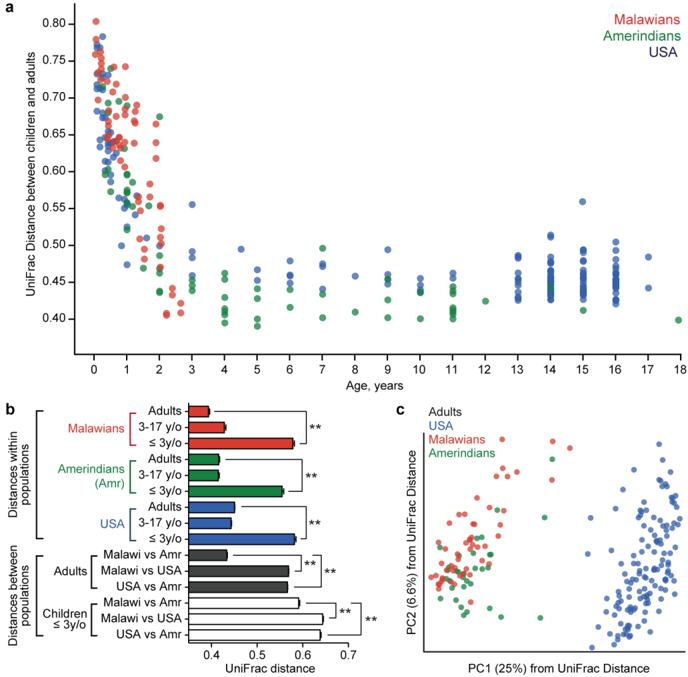
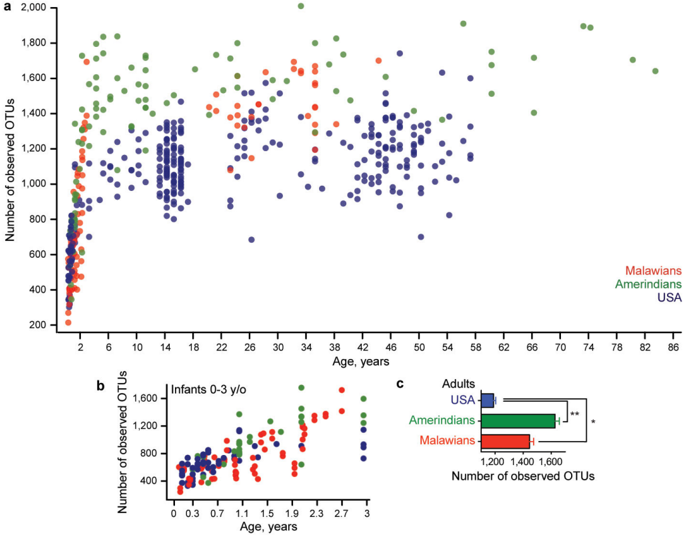
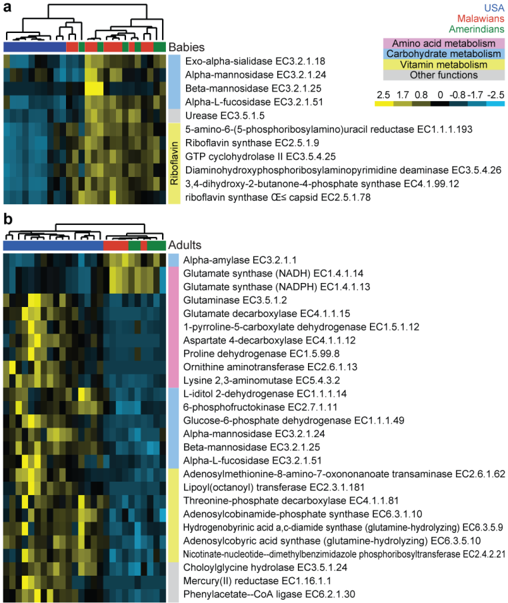
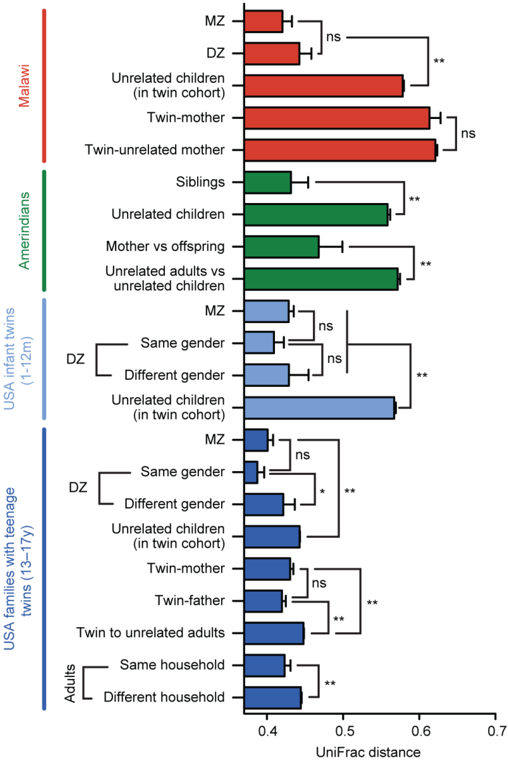
Gut microbial communities represent one source of human genetic and metabolic diversity. To examine how gut microbiomes differ among human populations, here we characterize bacterial species in fecal samples from 531 individuals, plus the gene content of 110 of them. The cohort encompassed healthy children and adults from the Amazonas of Venezuela, rural Malawi and US metropolitan areas and included mono- and dizygotic twins. Shared features of the functional maturation of the gut microbiome were identified during the first three years of life in all three populations, including age-associated changes in the genes involved in vitamin biosynthesis and metabolism. Pronounced differences in bacterial assemblages and functional gene repertoires were noted between US residents and those in the other two countries. These distinctive features are evident in early infancy as well as adulthood. Our findings underscore the need to consider the microbiome when evaluating human development, nutritional needs, physiological variations and the impact of westernization.
Overview
The claims and statistics of this paper haven’t been checked yet.
Free: it reads the open-access text and checks the first 5 claims that cite a source we can check. Create a free account to check every claim.
Integrity signals
Registry
Cites
Statistics
Figures
Verification
Claims the paper makes
The claims and statistics of this paper haven’t been checked yet.
Free: it reads the open-access text and checks the first 5 claims that cite a source we can check. Create a free account to check every claim.
Claims other papers make about this one
Each is checked against this paper’s own text: does it say what the citing paper says it does?
The cited source doesn’t support the claim as written.
In the citing paper
“Similar, albeit less marked, patterns were already observed for adults22,23,24,25 with different lifestyles but were never investigated in younger individuals.”
From Maternal and food microbial sources shape the infant microbiome of a rural Ethiopian population (2023) · cites this paper as [22]
Checked by a reasoning model — may be wrong.
Experimental — accuracy not yet measuredThe source backs part of the claim, not all of it — or backs it for a different population, condition or comparison.
In the citing paper
“The inverse relationship between Prevotella and Bacteroides has been reproduced in studies comparing the intestinal microbiota of residents of agrarian societies in South America and Bangladesh with residents of industrialized societies4, 37.”
From Diet and the Intestinal Microbiome: Associations, Functions, and Implications for Health and Disease (2014) · cites this paper as [4]
Experimental — accuracy not yet measuredThe source backs part of the claim, not all of it — or backs it for a different population, condition or comparison.
In the citing paper
“Moreover, geographic variations in the composition of intestinal microbiota have been described and implicated in the development of autoimmunity.28,29”
From Microbiota as Predictor of Mortality in Allogeneic Hematopoietic-Cell Transplantation (2020) · cites this paper as [28]
Experimental — accuracy not yet measuredThe source backs part of the claim, not all of it — or backs it for a different population, condition or comparison.
In the citing paper
“different human host cohorts may harbor remarkably different Gram-negative versus Gram-positive diversity3, 30, and a protocol appropriate for one type of community may work well in one study but not in another.”
From Assessment of variation in microbial community amplicon sequencing by the Microbiome Quality Control (MBQC) project consortium (2017) · cites this paper as [3]
Experimental — accuracy not yet measuredThe source backs part of the claim, not all of it — or backs it for a different population, condition or comparison.
In the citing paper
“Most critical events in education of host immunity may take place during the first years of life, in which microbiota composition displays the highest intra- and inter-individual variability before reaching a more stable adult-like configuration at the age of ~3 years.18–20”
From Interaction between microbiota and immunity in health and disease (2020) · cites this paper as [20]
Experimental — accuracy not yet measured
24 more claims about this paper
Create a free account to see every claim other papers make about this one.
Self-check
Percentages, sums and reported differences re-computed from the paper’s own numbers.
The self-check needs the paper’s full text.
Citations
Cites
QIIME allows analysis of high-throughput community sequencing data
Caporaso, J. G., Kuczynski, J., Stombaugh, J., Bittinger, K., Bushman, F. D., Costello, E. K., Fierer, N., Peña, A. G., Goodrich, J. K., Gordon, J. I., et al. (2010) · Nature Methods · doi:10.1038/nmeth.f.303 · Cited by 34,887
Self-citationSilhouettes: A graphical aid to the interpretation and validation of cluster analysis
Rousseeuw, P. J. (1987) · Journal of Computational and Applied Mathematics · doi:10.1016/0377-0427(87)90125-7 · Cited by 21,392
Classification and Regression by randomForest
Liaw, A. I., & Wiener, M. C. (2007) · Cited by 18,594
A human gut microbial gene catalogue established by metagenomic sequencing
MetaHIT Consortium, Qin, J., Li, R., Raes, J., Arumugam, M., Burgdorf, K. S., Manichanh, C., Nielsen, T., Pons, N., Levenez, F., et al. (2010) · Nature · doi:10.1038/nature08821 · Cited by 11,624 · cited 1×
“Shotgun reads were filtered using custom Perl scripts and publicly available software to remove (1) all reads ,60 nucleotides; (2) Titanium pyrosequencing reads with two continuous and/or three total degenerate bases (N); (3) all duplicates (a known artefact of pyrosequencing), defined as sequences in which the initia…”
MethodFinding groups in data: an introduction to cluster analysis
(1991) · Choice Reviews Online · doi:10.5860/choice.28-4558 · Cited by 10,474
UniFrac: a New Phylogenetic Method for Comparing Microbial Communities
Lozupone, C., & Knight, R. (2005) · Applied and Environmental Microbiology · doi:10.1128/aem.71.12.8228-8235.2005 · Cited by 8,227
Self-citationA core gut microbiome in obese and lean twins
Turnbaugh, P. J., Hamady, M., Yatsunenko, T., Cantarel, B. L., Duncan, A., Ley, R. E., Sogin, M. L., Jones, W. J., Roe, B. A., Affourtit, J. P., et al. (2009) · Nature · doi:10.1038/nature07540 · Cited by 7,823
Self-citationEnterotypes of the human gut microbiome
MetaHIT Consortium (additional members), Arumugam, M., Raes, J., Pelletier, E., Le Paslier, D., Yamada, T., Mende, D. R., Fernandes, G. R., Tap, J., Bruls, T., et al. (2011) · Nature · doi:10.1038/nature09944 · Cited by 7,548
Linking long-term dietary patterns with gut microbial enterotypes
Wu, G. D., Chen, J., Hoffmann, C., Bittinger, K., Chen, Y.-Y., Keilbaugh, S. A., Bewtra, M., Knights, D., Walters, W. A., Knight, R., et al. (2011) · Science · doi:10.1126/science.1208344 · Cited by 6,513
Self-citationDe Filippo, C., Cavalieri, D., Di Paola, M., Ramazzotti, M., Poullet, J. B., Massart, S., Collini, S., Pieraccini, G., & Lionetti, P. (2010) · Proceedings of the National Academy of Sciences · doi:10.1073/pnas.1005963107 · Cited by 5,579
Cited by
Items 201–300 of 1,221
Charbonneau, M. R., O’Donnell, D., Blanton, L. V., Totten, S. M., Davis, J. C. C., Barratt, M. J., Cheng, J., Guruge, J., Talcott, M., Bain, J. R., et al. (2016) · Cell · doi:10.1016/j.cell.2016.01.024 · Cited by 606
“frozen fecal sample collected from a severely stunted 6-month-old Malawian infant (patient ID h264A in Yatsunenko et al. [2012]).”
BackgroundSelf-citationFate, activity, and impact of ingested bacteria within the human gut microbiota
Derrien, M., & van Hylckama Vlieg, J. E. T. (2015) · Trends in Microbiology · doi:10.1016/j.tim.2015.03.002 · Cited by 605
Gut microbiota disturbance during antibiotic therapy: a multi-omic approach
Pérez-Cobas, A. E., Gosalbes, M. J., Friedrichs, A., Knecht, H., Artacho, A., Eismann, K., Otto, W., Rojo, D., Bargiela, R., von Bergen, M., et al. (2013) · Gut · doi:10.1136/gutjnl-2012-303184 · Cited by 605
Review article: dietary fibre-microbiota interactions
Simpson, H. L., & Campbell, B. J. (2015) · Alimentary Pharmacology & Therapeutics · doi:10.1111/apt.13248 · Cited by 602
“Escherichia and Shigella spp.) ↓ Total (P 0.001) ↓ Acetate (P 0.01) ↓ Valerate (P 0.01) ↓ Propionate (P 0.001) ↓ Butyrate (P < 0.001) Yatsunenko et al.52 Malawi 115 healthy (0–70 years) From breast milk to maize > cassava and other fruit/legume polysaccharides Prevotella spp.”
BackgroundInfluentialLooking for a Signal in the Noise: Revisiting Obesity and the Microbiome
Sze, M. A., & Schloss, P. D. (2016) · mBio · doi:10.1128/mbio.01018-16 · Cited by 600
The gut microbiota, obesity and insulin resistance
Shen, J., Obin, M. S., & Zhao, L. (2013) · Molecular Aspects of Medicine · doi:10.1016/j.mam.2012.11.001 · Cited by 599
“Importantly, although differences in enterotype were initially reported to be independent of geography, gender, age or body mass index (Arumugam et al., 2011), substantial differences in bacterial assemblages and functional genes were recently reported in a comparative study of US residents and those in either the Ven…”
BackgroundResultInfluentialRapid evolution of the human gut virome
Minot, S., Bryson, A., Chehoud, C., Wu, G. D., Lewis, J. D., & Bushman, F. D. (2013) · Proceedings of the National Academy of Sciences · doi:10.1073/pnas.1300833110 · Cited by 612
The Gut Microbiota in the Pathogenesis and Therapeutics of Inflammatory Bowel Disease
Zuo, T., & Ng, S. C. (2018) · Frontiers in Microbiology · doi:10.3389/fmicb.2018.02247 · Cited by 587
The Microbiome Quality Control Project Consortium, Sinha, R., Abu-Ali, G., Vogtmann, E., Fodor, A. A., Ren, B., Amir, A., Schwager, E., Crabtree, J., Ma, S., et al. (2017) · Nature Biotechnology · doi:10.1038/nbt.3981 · Cited by 587
Self-citationSubsistence strategies in traditional societies distinguish gut microbiomes
Obregon-Tito, A. J., Tito, R. Y., Metcalf, J., Sankaranarayanan, K., Clemente, J. C., Ursell, L. K., Zech Xu, Z., Van Treuren, W., Knight, R., Gaffney, P. M., et al. (2015) · Nature Communications · doi:10.1038/ncomms7505 · Cited by 587
“In addition to previously published data, we provide novel data from: (1) the Matses, a remote hunter-gatherer population from the Peruvian Amazon; (2) Tunapuco, a traditional agricultural community from the Andean highlands; and (3) residents of Norman, Oklahoma, a typical US university community that serves as a com…”
Self-citationVerdam, F. J., Fuentes, S., de Jonge, C., Zoetendal, E. G., Erbil, R., Greve, J. W., Buurman, W. A., de Vos, W. M., & Rensen, S. S. (2013) · Obesity · doi:10.1002/oby.20466 · Cited by 587
“This is further supported by studies showing that gut microbiota composition of adults between the age of 20 and 50 is relatively stable (15,21,38).”
ResultMicrobial Ecology along the Gastrointestinal Tract
Hillman, E. T., Lu, H., Yao, T., & Nakatsu, C. H. (2017) · Microbes and environments · doi:10.1264/jsme2.me17017 · Cited by 580
“A recent study (175) used humanized mice to test microbiome diversity after feeding with poorly accessible carbohydrates, and found a similar reduction in OTU numbers to a human study (219).”
BackgroundKasai, C., Sugimoto, K., Moritani, I., Tanaka, J., Oya, Y., Inoue, H., Tameda, M., Shiraki, K., Ito, M., Takei, Y., et al. (2015) · BMC Gastroenterology · doi:10.1186/s12876-015-0330-2 · Cited by 581
“Recent research has revealed that the composition of the gut microbiota varies with age, dietary habits, geographic environment, and other host-associated factors [5–8].”
BackgroundHamaker, B. R., & Tuncil, Y. E. (2014) · Journal of Molecular Biology · doi:10.1016/j.jmb.2014.07.028 · Cited by 580
Cullin, N., Azevedo Antunes, C., Straussman, R., Stein-Thoeringer, C. K., & Elinav, E. (2021) · Cancer Cell · doi:10.1016/j.ccell.2021.08.006 · Cited by 578
Martínez, I., Stegen, J. C., Maldonado-Gómez, M. X., Eren, A. M., Siba, P. M., Greenhill, A. R., & Walter, J. (2015) · Cell Reports · doi:10.1016/j.celrep.2015.03.049 · Cited by 576
“…consistently increased proportions of Faecalibacterium , Ruminococcus , Bifidobacte-rium , Bacteroides , Blautia , Bilophila , and Alistipes , whereas Pre-votella is generally increased in non-industrialized societies (De Filippo et al., 2010; Schnorr et al., 2014; Yatsunenko et al., 2012).”
InfluentialGarcia-Mantrana, I., Selma-Royo, M., Alcantara, C., & Collado, M. C. (2018) · Frontiers in Microbiology · doi:10.3389/fmicb.2018.00890 · Cited by 574
Evolution of gut microbiota composition from birth to 24 weeks in the INFANTMET Cohort
Hill, C. J., Lynch, D. B., Murphy, K., Ulaszewska, M., Jeffery, I. B., O’Shea, C. A., Watkins, C., Dempsey, E., Mattivi, F., Tuohy, K., et al. (2017) · Microbiome · doi:10.1186/s40168-016-0213-y · Cited by 573
“This dynamic microbial population develops rapidly from birth until 2 to 3 years of age, when adult-like composition and stability is established [1, 2].”
BackgroundAnxiety, depression, and the microbiome: A role for gut peptides
Lach, G., Schellekens, H., Dinan, T. G., & Cryan, J. F. (2018) · Neurotherapeutics · doi:10.1007/s13311-017-0585-0 · Cited by 573
“Mammalian microbial colonization likely begins at birth [57, 58] although a diverse range of microbes have been detected in umbilical cord blood, amniotic fluid, the placenta, and the fetal membranes [59–62].”
BackgroundAntibiotics-Driven Gut Microbiome Perturbation Alters Immunity to Vaccines in Humans
Hagan, T., Cortese, M., Rouphael, N., Boudreau, C., Linde, C., Maddur, M. S., Das, J., Wang, H., Guthmiller, J., Zheng, N.-Y., et al. (2019) · Cell · doi:10.1016/j.cell.2019.08.010 · Cited by 572
“known to vary significantly by geographical region (Collins and Belkaid, 2018; Levine, 2010; Littman, 2018), and microbiome composition is also strongly geographically dependent (Yatsunenko et al., 2012).”
BackgroundBiesbroek, G., Tsivtsivadze, E., Sanders, E. A. M., Montijn, R., Veenhoven, R. H., Keijser, B. J. F., & Bogaert, D. (2014) · American Journal of Respiratory and Critical Care Medicine · doi:10.1164/rccm.201407-1240oc · Cited by 572
Reporting guidelines for human microbiome research: the STORMS checklist
Mirzayi, C., Renson, A., Genomic Standards Consortium, Massive Analysis and Quality Control Society, Furlanello, C., Sansone, S.-A., Zohra, F., Elsafoury, S., Geistlinger, L., Kasselman, L. J., et al. (2021) · Nature Medicine · doi:10.1038/s41591-021-01552-x · Cited by 521
“Because participant characteristics such as environment 24 , lifestyle behaviors, diet, bio-medical interventions, demographics 25 and geography 26 (item 3.2) can correspond with substantial differences in the microbiome, it is essential to include this description.”
BackgroundInfluentialSelf-citationThe role of the gut microbiome in systemic inflammatory disease
Clemente, J. C., Manasson, J., & Scher, J. U. (2018) · BMJ · doi:10.1136/bmj.j5145 · Cited by 568
Self-citationPatterned progression of bacterial populations in the premature infant gut
La Rosa, P. S., Warner, B. B., Zhou, Y., Weinstock, G. M., Sodergren, E., Hall-Moore, C. M., Stevens, H. J., Bennett, W. E., Shaikh, N., Linneman, L. A., et al. (2014) · Proceedings of the National Academy of Sciences · doi:10.1073/pnas.1409497111 · Cited by 573
“Despite frequent abruptions in the relative ratios of these classes, Clostridia proportions begin to resemble those of older individuals (21, 22) by 33–36 wk postconceptional age, even if complete stability is not achieved until several years of age (1).”
BackgroundInfluentialSelf-citationLiu, R. T., Walsh, R. F. L., & Sheehan, A. E. (2019) · Neuroscience & Biobehavioral Reviews · doi:10.1016/j.neubiorev.2019.03.023 · Cited by 564
Cospeciation of gut microbiota with hominids
Moeller, A. H., Caro-Quintero, A., Mjungu, D., Georgiev, A. V., Lonsdorf, E. V., Muller, M. N., Pusey, A. E., Peeters, M., Hahn, B. H., & Ochman, H. (2016) · Science · doi:10.1126/science.aaf3951 · Cited by 568
Gut microbiota, obesity and diabetes
Patterson, E., Ryan, P. M., Cryan, J. F., Dinan, T. G., Ross, R. P., Fitzgerald, G. F., & Stanton, C. (2016) · Postgraduate Medical Journal · doi:10.1136/postgradmedj-2015-133285 · Cited by 552
The Gut Microbiome, Aging, and Longevity: A Systematic Review
Badal, V. D., Vaccariello, E. D., Murray, E. R., Yu, K. E., Knight, R., Jeste, D. V., & Nguyen, T. T. (2020) · Nutrients · doi:10.3390/nu12123759 · Cited by 551
Self-citationProbiotics, Prebiotics and Immunomodulation of Gut Mucosal Defences: Homeostasis and Immunopathology
Hardy, H., Harris, J., Lyon, E., Beal, J., & Foey, A. (2013) · Nutrients · doi:10.3390/nu5061869 · Cited by 546
“Yatsunenko et al. , [244], revealed that GIT microbial composition is most alike between cohabiting individuals compared to those from other families.”
Rideout, J. R., He, Y., Navas-Molina, J. A., Walters, W. A., Ursell, L. K., Gibbons, S. M., Chase, J., McDonald, D., Gonzalez, A., Robbins-Pianka, A., et al. (2014) · PeerJ · doi:10.7717/peerj.545 · Cited by 548
Self-citationSex-based differences in immune function and responses to vaccination
Klein, S. L., Marriott, I., & Fish, E. N. (2015) · Transactions of the Royal Society of Tropical Medicine and Hygiene · doi:10.1093/trstmh/tru167 · Cited by 542
Wang, H.-X., & Wang, Y.-P. (2016) · Chinese Medical Journal · doi:10.4103/0366-6999.190667 · Cited by 546
Parks, B. W., Nam, E., Org, E., Kostem, E., Norheim, F., Hui, S. T., Pan, C., Civelek, M., Rau, C. D., Bennett, B. J., et al. (2013) · Cell Metabolism · doi:10.1016/j.cmet.2012.12.007 · Cited by 544
“The gut microbiota is a transmissable trait and can undergo dynamic population shifts with varied dietary composition (Benson et al., 2010; Turnbaugh et al., 2009b; Yatsunenko et al., 2012).”
Self-citationMicrobiome and Human Health: Current Understanding, Engineering, and Enabling Technologies
Aggarwal, N., Kitano, S., Puah, G. R. Y., Kittelmann, S., Hwang, I. Y., & Chang, M. W. (2023) · Chemical Reviews · doi:10.1021/acs.chemrev.2c00431 · Cited by 508
Metabolic phenotyping in clinical and surgical environments
Nicholson, J. K., Holmes, E., Kinross, J. M., Darzi, A. W., Takats, Z., & Lindon, J. C. (2012) · Nature · doi:10.1038/nature11708 · Cited by 546
Antibiotics in early life and obesity
Cox, L. M., & Blaser, M. J. (2015) · Nature Reviews Endocrinology · doi:10.1038/nrendo.2014.210 · Cited by 541
Infant gut microbiome associated with cognitive development
Carlson, A. L., Xia, K., Azcarate-Peril, M. A., Goldman, B. D., Ahn, M., Styner, M. A., Thompson, A. L., Geng, X., Gilmore, J. H., & Knickmeyer, R. C. (2018) · Biological Psychiatry · doi:10.1016/j.biopsych.2017.06.021 · Cited by 541
“Previous work suggests that the human gut microbiome achieves an adult-like state between one to three years of age (48; 49), but to our knowledge this is the first study to test whether distinct groups of subjects, defined by their bacterial composition, are present at this age.”
BackgroundOptimizing methods and dodging pitfalls in microbiome research
Kim, D., Hofstaedter, C. E., Zhao, C., Mattei, L., Tanes, C., Clarke, E., Lauder, A., Sherrill-Mix, S., Chehoud, C., Kelsen, J., et al. (2017) · Microbiome · doi:10.1186/s40168-017-0267-5 · Cited by 541
Self-citationPhylogenetic Placement of Exact Amplicon Sequences Improves Associations with Clinical Information
Janssen, S., McDonald, D., Gonzalez, A., Navas-Molina, J. A., Jiang, L., Xu, Z. Z., Winker, K., Kado, D. M., Orwoll, E., Manary, M., et al. (2018) · mSystems · doi:10.1128/msystems.00021-18 · Cited by 536
“This finding is in line with multiple other observations of aging or developing gut microbiota (19).”
ResultSelf-citationBacteroides-Derived Sphingolipids Are Critical for Maintaining Intestinal Homeostasis and Symbiosis
Brown, E. M., Ke, X., Hitchcock, D., Jeanfavre, S., Avila-Pacheco, J., Nakata, T., Arthur, T. D., Fornelos, N., Heim, C., Franzosa, E. A., et al. (2019) · Cell Host & Microbe · doi:10.1016/j.chom.2019.04.002 · Cited by 529
“Bacteroidetes are the most abundant members of the mammalian intestinal microbiota, and the average adult human gut contains over one trillion cells from this phylum (Human Microbiome Project, 2012; Yatsunenko et al., 2012).”
BackgroundIntestinal microbiota in health and disease: Role of bifidobacteria in gut homeostasis
Tojo, R. (2014) · World Journal of Gastroenterology · doi:10.3748/wjg.v20.i41.15163 · Cited by 533
Hollister, E. B., Gao, C., & Versalovic, J. (2014) · Gastroenterology · doi:10.1053/j.gastro.2014.01.052 · Cited by 527
“By the time a child reaches approximately 3 years of age, his or her GI microbiome is 40%–60% similar to that of a healthy adult.(18) This is the same level of similarity as among adults,(18,48) supporting the concept that by the time a child reaches 3 years of age, his or her GI microbiome has reached an adult-like s…”
BackgroundInfluentialDevelopment of intestinal microbiota in infants and its impact on health
Matamoros, S., Gras-Leguen, C., Le Vacon, F., Potel, G., & de La Cochetiere, M.-F. (2013) · Trends in Microbiology · doi:10.1016/j.tim.2012.12.001 · Cited by 534
Bergström, A., Skov, T. H., Bahl, M. I., Roager, H. M., Christensen, L. B., Ejlerskov, K. T., Mølgaard, C., Michaelsen, K. F., & Licht, T. R. (2014) · Applied and Environmental Microbiology · doi:10.1128/aem.00342-14 · Cited by 532
“during the first 3 years of life (66) but contradicts older reports”
ResultHost and Environmental Factors Affecting the Intestinal Microbiota in Chickens
Kers, J. G., Velkers, F. C., Fischer, E. A. J., Hermes, G. D. A., Stegeman, J. A., & Smidt, H. (2018) · Frontiers in Microbiology · doi:10.3389/fmicb.2018.00235 · Cited by 516
“Housing Studies in humans have reported that individuals who live together show less variation of the intestinal microbiota compared to a group of random individuals (Yatsunenko et al., 2012; Schloss et al., 2014).”
BackgroundAntibiotics, Pediatric Dysbiosis, and Disease
Vangay, P., Ward, T., Gerber, J. S., & Knights, D. (2015) · Cell Host & Microbe · doi:10.1016/j.chom.2015.04.006 · Cited by 530
Self-citationBian, X., Wu, W., Yang, L., Lv, L., Wang, Q., Li, Y., Ye, J., Fang, D., Wu, J., Jiang, X., et al. (2019) · Frontiers in Microbiology · doi:10.3389/fmicb.2019.02259 · Cited by 530
Gut microbiome and liver diseases
Tilg, H., Cani, P. D., & Mayer, E. A. (2016) · Gut · doi:10.1136/gutjnl-2016-312729 · Cited by 525
Ghaisas, S., Maher, J., & Kanthasamy, A. (2016) · Pharmacology & Therapeutics · doi:10.1016/j.pharmthera.2015.11.012 · Cited by 521
Chemotherapy‐driven dysbiosis in the intestinal microbiome
Montassier, E., Gastinne, T., Vangay, P., Al‐Ghalith, G. A., Bruley des Varannes, S., Massart, S., Moreau, P., Potel, G., de La Cochetière, M. F., Batard, E., et al. (2015) · Alimentary Pharmacology & Therapeutics · doi:10.1111/apt.13302 · Cited by 515
Self-citationContribution of diet to the composition of the human gut microbiota
Graf, D., Di Cagno, R., Fåk, F., Flint, H. J., Nyman, M., Saarela, M., & Watzl, B. (2015) · Microbial Ecology in Health & Disease · doi:10.3402/mehd.v26.26164 · Cited by 519
“Furthermore, the genus Prevotella was underrepresented in Americans leading the authors to the conclusion that this might be a ‘discriminatory taxon’.”
BackgroundInfluentialWu, G. D., Compher, C., Chen, E. Z., Smith, S. A., Shah, R. D., Bittinger, K., Chehoud, C., Albenberg, L. G., Nessel, L., Gilroy, E., et al. (2016) · Gut · doi:10.1136/gutjnl-2014-308209 · Cited by 512
Mutation of NLRC4 causes a syndrome of enterocolitis and autoinflammation
Romberg, N., Al Moussawi, K., Nelson-Williams, C., Stiegler, A. L., Loring, E., Choi, M., Overton, J., Meffre, E., Khokha, M. K., Huttner, A. J., et al. (2014) · Nature Genetics · doi:10.1038/ng.3066 · Cited by 517
The links between the gut microbiome and non-alcoholic fatty liver disease (NAFLD)
Safari, Z., & Gérard, P. (2019) · Cellular and Molecular Life Sciences · doi:10.1007/s00018-019-03011-w · Cited by 502
Captivity humanizes the primate microbiome
Clayton, J. B., Vangay, P., Huang, H., Ward, T., Hillmann, B. M., Al-Ghalith, G. A., Travis, D. A., Long, H. T., Tuan, B. V., Minh, V. V., et al. (2016) · Proceedings of the National Academy of Sciences · doi:10.1073/pnas.1521835113 · Cited by 508
Self-citationSocial networks predict gut microbiome composition in wild baboons
Tung, J., Barreiro, L. B., Burns, M. B., Grenier, J.-C., Lynch, J., Grieneisen, L. E., Altmann, J., Alberts, S. C., Blekhman, R., & Archie, E. A. (2015) · eLife · doi:10.7554/elife.05224 · Cited by 522
“A handful of recent studies in humans and other primates provide circumstantial evidence for social effects on the gut microbiome (Degnan et al., 2012; Kinross and Nicholson, 2012; Yatsunenko et al., 2012; Song et al., 2013).”
BackgroundInfluentialDiet shapes the gut microbiome of pigs during nursing and weaning
Frese, S. A., Parker, K., Calvert, C. C., & Mills, D. A. (2015) · Microbiome · doi:10.1186/s40168-015-0091-8 · Cited by 514
“Large taxonomic shifts have been observed in humans through the first years of life [16–19], and here we report that microbial turnover in pigs early in life is also dramatic as the animals shift to an adult-like diet.”
BackgroundRole of the gut microbiota in human nutrition and metabolism
Ramakrishna, B. S. (2013) · Journal of Gastroenterology and Hepatology · doi:10.1111/jgh.12294 · Cited by 505
Identifying personal microbiomes using metagenomic codes
Franzosa, E. A., Huang, K., Meadow, J. F., Gevers, D., Lemon, K. P., Bohannan, B. J. M., & Huttenhower, C. (2015) · Proceedings of the National Academy of Sciences · doi:10.1073/pnas.1423854112 · Cited by 497
“Moreover, just as human SNPs can be used to characterize an individual, human microbiome features are increasingly being associated with a variety of subject traits, including diet (14), health status (15), age, and geography (16).”
BackgroundColston, T. J., & Jackson, C. R. (2016) · Molecular Ecology · doi:10.1111/mec.13730 · Cited by 505
“However the vast majority of work on gut microbial communities has focused on mammals, particularly humans (Ley et al. 2006, 2008, 2009; Arumugam et al. 2011b; Yatsunenko et al. 2012).”
BackgroundInfluentialInfant gut microbiota and food sensitization: associations in the first year of life
Azad, M. B., Konya, T., Guttman, D. S., Field, C. J., Sears, M. R., HayGlass, K. T., Mandhane, P. J., Turvey, S. E., Subbarao, P., Becker, A. B., et al. (2015) · Clinical & Experimental Allergy · doi:10.1111/cea.12487 · Cited by 476
The gut microbiome of healthy Japanese and its microbial and functional uniqueness
Nishijima, S., Suda, W., Oshima, K., Kim, S.-W., Hirose, Y., Morita, H., & Hattori, M. (2016) · DNA Research · doi:10.1093/dnares/dsw002 · Cited by 493
Chapter 12: Human Microbiome Analysis
Morgan, X. C., & Huttenhower, C. (2012) · PLoS Computational Biology · doi:10.1371/journal.pcbi.1002808 · Cited by 496
“It is a dynamic community changing over the course of days [126,127], over the longer time scales of infant development [112,128,129,130] and aging [131,132], in response to natural perturbations such as diet [59,133,134,135] and illness [114,136], and modified in as-yet-unknown ways by the modern prevalence of travel…”
BackgroundDiet and the development of the human intestinal microbiome
Voreades, N., Kozil, A., & Weir, T. L. (2014) · Frontiers in Microbiology · doi:10.3389/fmicb.2014.00494 · Cited by 498
The Human Microbiome Project: A Community Resource for the Healthy Human Microbiome
Gevers, D., Knight, R., Petrosino, J. F., Huang, K., McGuire, A. L., Birren, B. W., Nelson, K. E., White, O., Methé, B. A., & Huttenhower, C. (2012) · PLoS Biology · doi:10.1371/journal.pbio.1001377 · Cited by 493
“[63].”
Self-citationThe role of the gut microbiome in the healthy adult status
D’Argenio, V., & Salvatore, F. (2015) · Clinica Chimica Acta · doi:10.1016/j.cca.2015.01.003 · Cited by 492
“The most important difference between these two genomes is that, while the inherited genome remains almost stable during lifetime, the microbiome is extremely dynamic and can be influenced by a number of factors, among which, age [8], diet [9,10], hormonal cycles [11], travel [12], therapies [13], and illness [13].”
BackgroundUnraveling the processes shaping mammalian gut microbiomes over evolutionary time
Groussin, M., Mazel, F., Sanders, J. G., Smillie, C. S., Lavergne, S., Thuiller, W., & Alm, E. J. (2017) · Nature Communications · doi:10.1038/ncomms14319 · Cited by 508
Exploring host–microbiota interactions in animal models and humans
Kostic, A. D., Howitt, M. R., & Garrett, W. S. (2013) · Genes & Development · doi:10.1101/gad.212522.112 · Cited by 494
Gut microbiota composition and activity in relation to host metabolic phenotype and disease risk
Holmes, E., Li, J. V., Marchesi, J. R., & Nicholson, J. K. (2012) · Cell Metabolism · doi:10.1016/j.cmet.2012.10.007 · Cited by 490
“…of the microbiome alters across body sites, between people, and with age and is diet-dependent, resulting in a series of unique habitats within and between individuals that are subject to temporal variation and variation between populations (Costello et al., 2012, Yatsunenko et al., 2012).”
BackgroundThe ancestral and industrialized gut microbiota and implications for human health
Sonnenburg, E. D., & Sonnenburg, J. L. (2019) · Nature Reviews Microbiology · doi:10.1038/s41579-019-0191-8 · Cited by 489
Alterations in the Gut Microbiota Associated with HIV-1 Infection
Lozupone, C. A., Li, M., Campbell, T. B., Flores, S. C., Linderman, D., Gebert, M. J., Knight, R., Fontenot, A. P., & Palmer, B. E. (2013) · Cell Host & Microbe · doi:10.1016/j.chom.2013.08.006 · Cited by 496
“…diets poor in animal protein and saturated fats and rich in carbohydrates and simple sugars (Wu et al., 2011), and in healthy individuals in agrarian cultures with diets dominated by maize-, cassava-, and other plant-derived polysaccharides (De Filippo et al., 2010; Yatsunenko et al., 2012).”
BackgroundMethodResultInfluentialSelf-citationBugBase predicts organism-level microbiome phenotypes
Ward, T., Larson, J., Meulemans, J., Hillmann, B., Lynch, J., Sidiropoulos, D., Spear, J. R., Caporaso, G., Blekhman, R., Knight, R., et al. (2017) · bioRxiv (Cold Spring Harbor Laboratory) · doi:10.1101/133462 · Cited by 479
“Also, those from the USA were predicted to have significantly fewer pathogenic bacteria and significantly more Gram positive bacteria than those in non-western communities ( p 0.001, Supplemental Figure 3).”
BackgroundInfluentialSelf-citationThe function of our microbiota: who is out there and what do they do?
Ottman, N., Smidt, H., de Vos, W. M., & Belzer, C. (2012) · Frontiers in Cellular and Infection Microbiology · doi:10.3389/fcimb.2012.00104 · Cited by 488
Intestinal microbiota, diet and health
Power, S. E., O'Toole, P. W., Stanton, C., Ross, R. P., & Fitzgerald, G. F. (2014) · British Journal Of Nutrition · doi:10.1017/s0007114513002560 · Cited by 476
“The composition of the microbiota changes further with the introduction of solid foods, and a complex, more stable community similar to the adult microbiota becomes established after weaning (at 2–3 years of age)((33,34,37,38)).”
Tett, A., Huang, K. D., Asnicar, F., Fehlner-Peach, H., Pasolli, E., Karcher, N., Armanini, F., Manghi, P., Bonham, K., Zolfo, M., et al. (2019) · Cell Host & Microbe · doi:10.1016/j.chom.2019.08.018 · Cited by 476
“A common feature of non-Westernized datasets is a high Prevotella prevalence (De Filippo et al., 2010; Hansen et al., 2019; Obregon-Tito et al., 2015; Schnorr et al., 2014; Smits et al., 2017; Yatsunenko et al., 2012) and particularly P.”
BackgroundEdwards, J. A., Santos-Medellín, C. M., Liechty, Z. S., Nguyen, B., Lurie, E., Eason, S., Phillips, G., & Sundaresan, V. (2018) · PLOS Biology · doi:10.1371/journal.pbio.2003862 · Cited by 487
Gut microbiome lipid metabolism and its impact on host physiology
Brown, E. M., Clardy, J., & Xavier, R. J. (2023) · Cell Host & Microbe · doi:10.1016/j.chom.2023.01.009 · Cited by 447
The effects of probiotics on depressive symptoms in humans: a systematic review
Wallace, C. J. K., & Milev, R. (2017) · Annals of General Psychiatry · doi:10.1186/s12991-017-0138-2 · Cited by 471
“It is influenced by several factors, including genetics [10], age [11], sex [12], diet [13], and, of particular interest lately, stress [14].”
BackgroundTemporal Response of the Human Virome to Immunosuppression and Antiviral Therapy
De Vlaminck, I., Khush, K. K., Strehl, C., Kohli, B., Luikart, H., Neff, N. F., Okamoto, J., Snyder, T. M., Cornfield, D. N., Nicolls, M. R., et al. (2013) · Cell · doi:10.1016/j.cell.2013.10.034 · Cited by 471
“, 2011), geographical location (Yatsunenko et al., 2012), antibiotic treatment (Jakobsson et al.”
Intestinal microbiota, fecal microbiota transplantation, and inflammatory bowel disease
Weingarden, A. R., & Vaughn, B. P. (2017) · Gut Microbes · doi:10.1080/19490976.2017.1290757 · Cited by 463
Developmental trajectory of the healthy human gut microbiota during the first 5 years of life
Roswall, J., Olsson, L. M., Kovatcheva-Datchary, P., Nilsson, S., Tremaroli, V., Simon, M.-C., Kiilerich, P., Akrami, R., Krämer, M., Uhlén, M., et al. (2021) · Cell Host & Microbe · doi:10.1016/j.chom.2021.02.021 · Cited by 467
“, 2018) and evolve toward an adult-like composition 2–3 years after birth (Bergström et al., 2014; Koenig et al., 2011; Yatsunenko et al., 2012).”
BackgroundInfluentialLung microbiome: new insights into the pathogenesis of respiratory diseases
Li, R., Li, J., & Zhou, X. (2024) · Signal Transduction and Targeted Therapy · doi:10.1038/s41392-023-01722-y · Cited by 434
“159 The gut microbiome stabilizes through the fi rst 3 years of life, 160 but the precise time needed for the respiratory microbiome to fully mature remains to be determined.”
BackgroundHildebrand, F., Nguyen, T. L. A., Brinkman, B., Yunta, R. G., Cauwe, B., Vandenabeele, P., Liston, A., & Raes, J. (2013) · Genome Biology · doi:10.1186/gb-2013-14-1-r4 · Cited by 465
“In addition, the abundance of this genus has been shown to be sensitive to food intake in both humans [26,70,71] as well as in mice [72] - the uniform nutrition within our experimental setup might have hampered the observation of this third type.”
The Gut Microbiota and Autism Spectrum Disorders
Li, Q., Han, Y., Dy, A. B. C., & Hagerman, R. J. (2017) · Frontiers in Cellular Neuroscience · doi:10.3389/fncel.2017.00120 · Cited by 462
“As an individual’s diet diversifies with increasing age, the gut microbiota gradually stabilizes (Koenig et al., 2011; Yatsunenko et al., 2012; Tamburini et al., 2016).”
BackgroundSeasonal, spatial, and maternal effects on gut microbiome in wild red squirrels
Ren, T., Boutin, S., Humphries, M. M., Dantzer, B., Gorrell, J. C., Coltman, D. W., McAdam, A. G., & Wu, M. (2017) · Microbiome · doi:10.1186/s40168-017-0382-3 · Cited by 456
“Biogeographic patterns have been observed in human and wild mice populations [6, 15, 29, 30].”
BackgroundResultInfluentialMicrobiota-gut-brain axis: Modulator of host metabolism and appetite
van de Wouw, M., Schellekens, H., Dinan, T. G., & Cryan, J. F. (2017) · The Journal of Nutrition · doi:10.3945/jn.116.240481 · Cited by 461
“A mature gut microbiota configuration resembling that of an adult is reached after the first 2–3 y of age (76).”
BackgroundInterpreting prevotella and bacteroides as biomarkers of diet and lifestyle
Gorvitovskaia, A., Holmes, S. P., & Huse, S. M. (2016) · Microbiome · doi:10.1186/s40168-016-0160-7 · Cited by 461
“For the studies for which sequence counts were available, the Malawi, Venezuela, and American study [11] and the HMP study of healthy Americans [15], we ran both SparCC [32] and nbinomTest of DESeq2 package [18] on the count data.”
BackgroundMethodInfluentialZhang, J., Guo, Z., Xue, Z., Sun, Z., Zhang, M., Wang, L., Wang, G., Wang, F., Xu, J., Cao, H., et al. (2015) · The ISME Journal · doi:10.1038/ismej.2015.11 · Cited by 462
“Age is another very important factor in shaping the gut microbiota, as exemplified by the dominance of Bifidobacterium in infants (Yatsunenko et al., 2012) and a greater proportion of Bacteroides in the elderly (Claesson et al.”
BackgroundInfluentialDevelopmental dynamics of the preterm infant gut microbiota and antibiotic resistome
Gibson, M. K., Wang, B., Ahmadi, S., Burnham, C.-A. D., Tarr, P. I., Warner, B. B., & Dantas, G. (2016) · Nature Microbiology · doi:10.1038/nmicrobiol.2016.24 · Cited by 457
Self-citationDietary effects on human gut microbiome diversity
Xu, Z., & Knight, R. (2015) · British Journal Of Nutrition · doi:10.1017/s0007114514004127 · Cited by 456
“The studies highlighted in the previous section also suggest that differences between the gut microbial communities of rural populations and Westerners are largely linked to differences in diet((2,12,42)).”
BackgroundResultInfluentialSelf-citationStrain-Level Analysis of Mother-to-Child Bacterial Transmission during the First Few Months of Life
Yassour, M., Jason, E., Hogstrom, L. J., Arthur, T. D., Tripathi, S., Siljander, H., Selvenius, J., Oikarinen, S., Hyöty, H., Virtanen, S. M., et al. (2018) · Cell Host & Microbe · doi:10.1016/j.chom.2018.06.007 · Cited by 455
Application of multivariate statistical techniques in microbial ecology
Paliy, O., & Shankar, V. (2016) · Molecular Ecology · doi:10.1111/mec.13536 · Cited by 452
“RF has been used in several recent studies as described by Yatsunenko et al. (2012), Lozupone et al. (2013) and Shankar et al. (2013).”
MethodAlcock, J., Maley, C. C., & Aktipis, C. A. (2014) · BioEssays · doi:10.1002/bies.201400071 · Cited by 454
“Experimental increases in gut microbiota diversity are expected to change the satiety setpoint, favoring decreased food intake by the host [92].”
BackgroundImpact of delivery mode-associated gut microbiota dynamics on health in the first year of life
Reyman, M., van Houten, M. A., van Baarle, D., Bosch, A. A. T. M., Man, W. H., Chu, M. L. J. N., Arp, K., Watson, R. L., Sanders, E. A. M., Fuentes, S., et al. (2019) · Nature Communications · doi:10.1038/s41467-019-13014-7 · Cited by 450
Diet and the Microbiota–Gut–Brain Axis: Sowing the Seeds of Good Mental Health
Berding, K., Vlckova, K., Marx, W., Schellekens, H., Stanton, C., Clarke, G., Jacka, F., Dinan, T. G., & Cryan, J. F. (2021) · Advances in Nutrition · doi:10.1093/advances/nmaa181 · Cited by 451
The gut microbiota in human energy homeostasis and obesity
Rosenbaum, M., Knight, R., & Leibel, R. L. (2015) · Trends in Endocrinology & Metabolism · doi:10.1016/j.tem.2015.07.002 · Cited by 450
Self-citationAssessing the Human Gut Microbiota in Metabolic Diseases
Karlsson, F., Tremaroli, V., Nielsen, J., & Bäckhed, F. (2013) · Diabetes · doi:10.2337/db13-0844 · Cited by 452
“S. adult residents had higher levels of Prevotella , whereas the differences between the Malawi and Venezuela populations were more subtle, with differences in the abundance of several species in the Clostridials order.”
InfluentialThe person-to-person transmission landscape of the gut and oral microbiomes
Valles-Colomer, M., Blanco-Míguez, A., Manghi, P., Asnicar, F., Dubois, L., Golzato, D., Armanini, F., Cumbo, F., Huang, K. D., Manara, S., et al. (2023) · Nature · doi:10.1038/s41586-022-05620-1 · Cited by 449
“3e) in concordance with their divergent microbiome composition 30,45,50,51 .”
BackgroundInfluentialGut Microbiotas and Host Evolution: Scaling Up Symbiosis
Shapira, M. (2016) · Trends in Ecology & Evolution · doi:10.1016/j.tree.2016.03.006 · Cited by 448
The Effects of Captivity on the Mammalian Gut Microbiome
McKenzie, V. J., Song, S. J., Delsuc, F., Prest, T. L., Oliverio, A. M., Korpita, T. M., Alexiev, A., Amato, K. R., Metcalf, J. L., Kowalewski, M., et al. (2017) · Integrative and Comparative Biology · doi:10.1093/icb/icx090 · Cited by 446
“…extreme change in lifestyle for many animal species and given the differences found in human gut microbiomes associated with different lifestyles (Yatsunenko et al. 2012; Schnorr et al. 2014), we would expect to see changes in the microbiome of animals when comparing the wild to the captive…”
BackgroundSelf-citation
Metadata
- Authors
- Yatsunenko, T., Rey, F. E., Manary, M. J., Trehan, I., Dominguez-Bello, M. G., Contreras, M., Magris, M., Hidalgo, G., Baldassano, R. N., Anokhin, A. P., Heath, A. C., Warner, B., Reeder, J., Kuczynski, J., Caporaso, J. G., Lozupone, C. A., Lauber, C., Clemente, J. C., Knights, D., Knight, R., & Gordon, J. I.
- Affiliations
- Washington University in St. Louis (US)
- University of Malawi (MW)
- Children's Hospital of Philadelphia (US)
- University of Colorado Boulder (US)
- Northern Arizona University (US)
- Howard Hughes Medical Institute (US)
- Corresponding author
- Gordon, Jeffrey I.
- ORCID
- Venue
- Nature
- Published
- 2012-05-09
- Volume
- 486
- Issue
- 7402
- Pages
- 222-227
- ISSN
- 0028-0836 (ISSN-L)
- 1476-4687
- PMC
- PMC3376388
- OpenAlex
- W2162088497
- Semantic Scholar
- 54a6d777e3a84e46f1c74bc9a0482a7307bd79c7
- Cited by
- 7,815
- References
- 41
- Citations by year
- 2026: 373 · 2025: 472 · 2024: 576 · 2023: 580 · 2022: 730 · 2021: 786 · 2020: 769 · 2019: 674 · 2018: 597 · 2017: 559 · 2016: 534 · 2015: 433 · 2014: 356 · 2013: 287 · 2012: 82
- FWCI
- 148.99
- Type
- journal article
- Language
- en
- Open access
- green
- www.ncbi.nlm.nih.gov
- Licence
- www.springer.com/tdm (tdm)
- Locations
- Nature (publishedVersion)
- PubMed (publishedVersion)
- Europe PMC (PubMed Central) (acceptedVersion)
- PubMed Central (acceptedVersion)
- RePEc: Research Papers in Economics (submittedVersion)
- eScholarship (California Digital Library) (submittedVersion)
- Funders
- Howard Hughes Medical Institute
- Crohn's and Colitis Foundation
- National Institute on Alcohol Abuse and Alcoholism (K05AA017688)
- National Institute of Diabetes and Digestive and Kidney Diseases (DK078669, P01DK078669, K01DK090285)
- Eunice Kennedy Shriver National Institute of Child Health and Human Development (T32HD049338)
- Topics
- Life Sciences › Biochemistry, Genetics and Molecular Biology › Molecular Biology › Gut microbiota and health
- Health Sciences › Nursing › Nutrition and Dietetics › Infant Nutrition and Health
- Physical Sciences › Environmental Science › Ecology › Microbial Community Ecology and Physiology
- Keywords
- gut microbiota, fecal microbiota, age-related changes, regional variation, Westernization, monozygotic and dizygotic twins, human development, Amazonas, Malawi
- MeSH terms
- Adolescent, Adult, Age Factors, Aged, Bacteria, Child, Child, Preschool, Feces, Female, Geography, Humans, Infant, Intestines, Malawi, Male, Middle Aged, Phylogeny, RNA, Ribosomal, 16S, Twins, Dizygotic, Twins, Monozygotic, United States, Venezuela, Biodiversity, Metagenome, Young Adult
About these checks
Registry, retraction, Cites and statistics results are computed, not judged, with one exception: a printed reference that no index lists is read once by a model before it counts as a citation error. Claims are extracted by a model and kept only when their quote appears verbatim in the text; each cited source is then checked, with a model’s help, for whether it says what the claim relies on. Those verdicts can be wrong — read the claim’s quote and the cited source before relying on one.
Statistics and arithmetic are recomputed, not judged.
Confidence bands are shown only for fields calibrated on our annotated test set. None is calibrated yet, so no band is shown.
What counts as a claim ›How we measure confidence ›How we check this ›
Are you an author, or do you see a problem with this page? Request a review
Data sources
Bibliographic data: Semantic Scholar, OpenAlex, Crossref.
Contains information from the Semantic Scholar Academic Graph Datasets, made available under the ODC Attribution License (ODC-BY 1.0).
Semantic Scholar’s data is described in: Kinney, R., et al. (2023). The Semantic Scholar Open Data Platform. arXiv:2301.10140.
