

Human gut microbiome viewed across age and geography
Open accessThe DOI matches its Crossref record; 41 of the 41 references it cites were found in a registry or an index.
Abstract
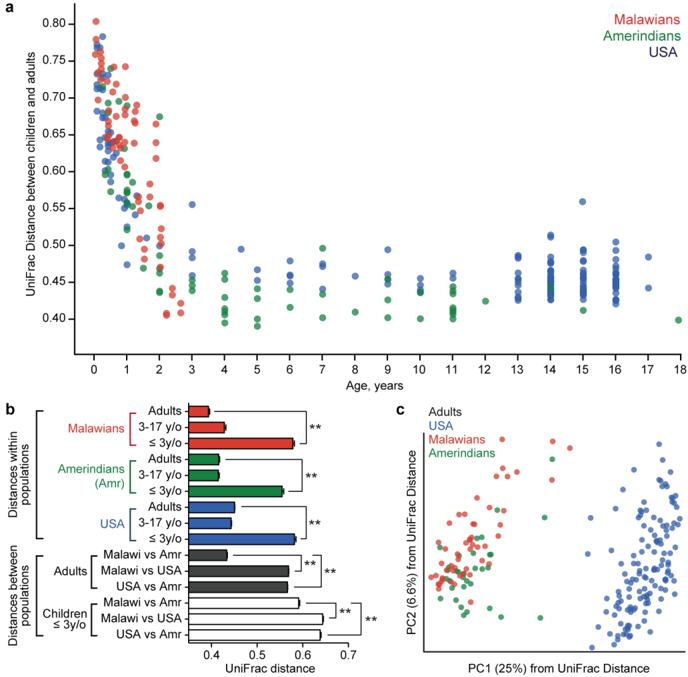
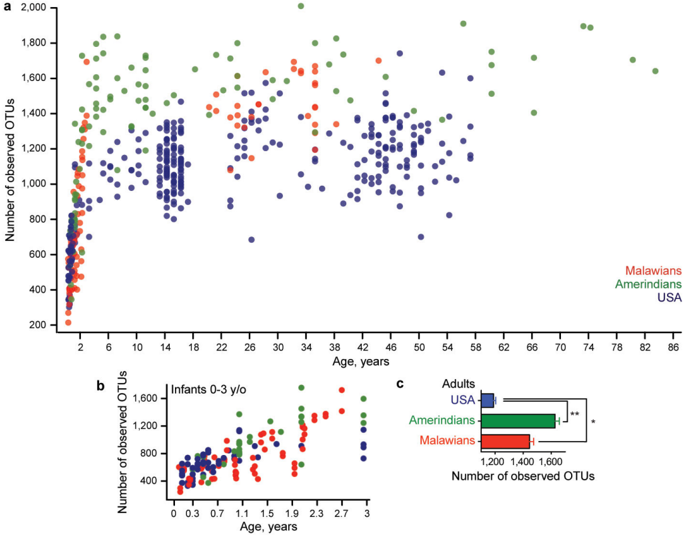
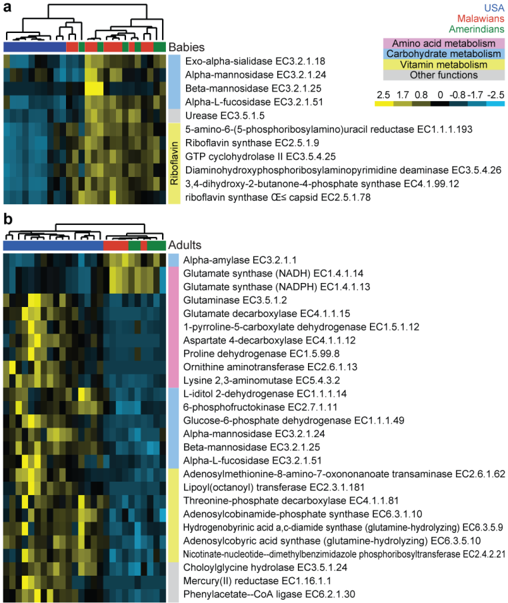
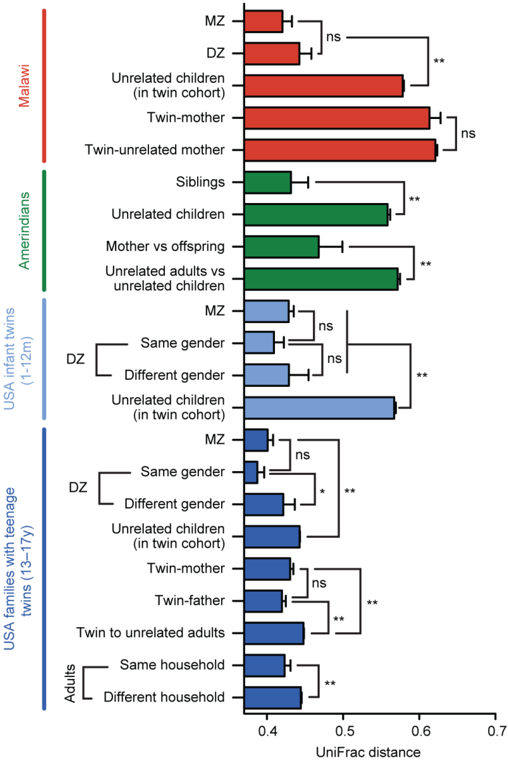
Gut microbial communities represent one source of human genetic and metabolic diversity. To examine how gut microbiomes differ among human populations, here we characterize bacterial species in fecal samples from 531 individuals, plus the gene content of 110 of them. The cohort encompassed healthy children and adults from the Amazonas of Venezuela, rural Malawi and US metropolitan areas and included mono- and dizygotic twins. Shared features of the functional maturation of the gut microbiome were identified during the first three years of life in all three populations, including age-associated changes in the genes involved in vitamin biosynthesis and metabolism. Pronounced differences in bacterial assemblages and functional gene repertoires were noted between US residents and those in the other two countries. These distinctive features are evident in early infancy as well as adulthood. Our findings underscore the need to consider the microbiome when evaluating human development, nutritional needs, physiological variations and the impact of westernization.
Overview
The claims and statistics of this paper haven’t been checked yet.
Free: it reads the open-access text and checks the first 5 claims that cite a source we can check. Create a free account to check every claim.
Integrity signals
Registry
Cites
Statistics
Figures
Verification
Claims the paper makes
The claims and statistics of this paper haven’t been checked yet.
Free: it reads the open-access text and checks the first 5 claims that cite a source we can check. Create a free account to check every claim.
Claims other papers make about this one
Each is checked against this paper’s own text: does it say what the citing paper says it does?
The cited source doesn’t support the claim as written.
In the citing paper
“Similar, albeit less marked, patterns were already observed for adults22,23,24,25 with different lifestyles but were never investigated in younger individuals.”
From Maternal and food microbial sources shape the infant microbiome of a rural Ethiopian population (2023) · cites this paper as [22]
Checked by a reasoning model — may be wrong.
Experimental — accuracy not yet measuredThe source backs part of the claim, not all of it — or backs it for a different population, condition or comparison.
In the citing paper
“The inverse relationship between Prevotella and Bacteroides has been reproduced in studies comparing the intestinal microbiota of residents of agrarian societies in South America and Bangladesh with residents of industrialized societies4, 37.”
From Diet and the Intestinal Microbiome: Associations, Functions, and Implications for Health and Disease (2014) · cites this paper as [4]
Experimental — accuracy not yet measuredThe source backs part of the claim, not all of it — or backs it for a different population, condition or comparison.
In the citing paper
“Moreover, geographic variations in the composition of intestinal microbiota have been described and implicated in the development of autoimmunity.28,29”
From Microbiota as Predictor of Mortality in Allogeneic Hematopoietic-Cell Transplantation (2020) · cites this paper as [28]
Experimental — accuracy not yet measuredThe source backs part of the claim, not all of it — or backs it for a different population, condition or comparison.
In the citing paper
“different human host cohorts may harbor remarkably different Gram-negative versus Gram-positive diversity3, 30, and a protocol appropriate for one type of community may work well in one study but not in another.”
From Assessment of variation in microbial community amplicon sequencing by the Microbiome Quality Control (MBQC) project consortium (2017) · cites this paper as [3]
Experimental — accuracy not yet measuredThe source backs part of the claim, not all of it — or backs it for a different population, condition or comparison.
In the citing paper
“Most critical events in education of host immunity may take place during the first years of life, in which microbiota composition displays the highest intra- and inter-individual variability before reaching a more stable adult-like configuration at the age of ~3 years.18–20”
From Interaction between microbiota and immunity in health and disease (2020) · cites this paper as [20]
Experimental — accuracy not yet measured
24 more claims about this paper
Create a free account to see every claim other papers make about this one.
Self-check
Percentages, sums and reported differences re-computed from the paper’s own numbers.
The self-check needs the paper’s full text.
Citations
Cites
QIIME allows analysis of high-throughput community sequencing data
Caporaso, J. G., Kuczynski, J., Stombaugh, J., Bittinger, K., Bushman, F. D., Costello, E. K., Fierer, N., Peña, A. G., Goodrich, J. K., Gordon, J. I., et al. (2010) · Nature Methods · doi:10.1038/nmeth.f.303 · Cited by 34,887
Self-citationSilhouettes: A graphical aid to the interpretation and validation of cluster analysis
Rousseeuw, P. J. (1987) · Journal of Computational and Applied Mathematics · doi:10.1016/0377-0427(87)90125-7 · Cited by 21,392
Classification and Regression by randomForest
Liaw, A. I., & Wiener, M. C. (2007) · Cited by 18,594
A human gut microbial gene catalogue established by metagenomic sequencing
MetaHIT Consortium, Qin, J., Li, R., Raes, J., Arumugam, M., Burgdorf, K. S., Manichanh, C., Nielsen, T., Pons, N., Levenez, F., et al. (2010) · Nature · doi:10.1038/nature08821 · Cited by 11,624 · cited 1×
“Shotgun reads were filtered using custom Perl scripts and publicly available software to remove (1) all reads ,60 nucleotides; (2) Titanium pyrosequencing reads with two continuous and/or three total degenerate bases (N); (3) all duplicates (a known artefact of pyrosequencing), defined as sequences in which the initia…”
MethodFinding groups in data: an introduction to cluster analysis
(1991) · Choice Reviews Online · doi:10.5860/choice.28-4558 · Cited by 10,474
UniFrac: a New Phylogenetic Method for Comparing Microbial Communities
Lozupone, C., & Knight, R. (2005) · Applied and Environmental Microbiology · doi:10.1128/aem.71.12.8228-8235.2005 · Cited by 8,227
Self-citationA core gut microbiome in obese and lean twins
Turnbaugh, P. J., Hamady, M., Yatsunenko, T., Cantarel, B. L., Duncan, A., Ley, R. E., Sogin, M. L., Jones, W. J., Roe, B. A., Affourtit, J. P., et al. (2009) · Nature · doi:10.1038/nature07540 · Cited by 7,823
Self-citationEnterotypes of the human gut microbiome
MetaHIT Consortium (additional members), Arumugam, M., Raes, J., Pelletier, E., Le Paslier, D., Yamada, T., Mende, D. R., Fernandes, G. R., Tap, J., Bruls, T., et al. (2011) · Nature · doi:10.1038/nature09944 · Cited by 7,548
Linking long-term dietary patterns with gut microbial enterotypes
Wu, G. D., Chen, J., Hoffmann, C., Bittinger, K., Chen, Y.-Y., Keilbaugh, S. A., Bewtra, M., Knights, D., Walters, W. A., Knight, R., et al. (2011) · Science · doi:10.1126/science.1208344 · Cited by 6,513
Self-citationDe Filippo, C., Cavalieri, D., Di Paola, M., Ramazzotti, M., Poullet, J. B., Massart, S., Collini, S., Pieraccini, G., & Lionetti, P. (2010) · Proceedings of the National Academy of Sciences · doi:10.1073/pnas.1005963107 · Cited by 5,579
Cited by
Items 101–200 of 1,197
Jakobsson, H. E., Abrahamsson, T. R., Jenmalm, M. C., Harris, K., Quince, C., Jernberg, C., Björkstén, B., Engstrand, L., & Andersson, A. F. (2014) · Gut · doi:10.1136/gutjnl-2012-303249 · Cited by 1,011
The microbiota-gut-brain axis: from motility to mood
Margolis, K. G., Cryan, J. F., & Mayer, E. A. (2021) · Gastroenterology · doi:10.1053/j.gastro.2020.10.066 · Cited by 999
Asnicar, F., Berry, S. E., Valdes, A. M., Nguyen, L. H., Piccinno, G., Drew, D. A., Leeming, E., Gibson, R., Le Roy, C., Khatib, H. A., et al. (2021) · Nature Medicine · doi:10.1038/s41591-020-01183-8 · Cited by 995
Analysis of the microbiome: Advantages of whole genome shotgun versus 16S amplicon sequencing
Ranjan, R., Rani, A., Metwally, A., McGee, H. S., & Perkins, D. L. (2016) · Biochemical and Biophysical Research Communications · doi:10.1016/j.bbrc.2015.12.083 · Cited by 981
Dietary fibre in gastrointestinal health and disease
Gill, S. K., Rossi, M., Bajka, B., & Whelan, K. (2021) · Nature Reviews Gastroenterology & Hepatology · doi:10.1038/s41575-020-00375-4 · Cited by 979
Stress and stability: applying the Anna Karenina principle to animal microbiomes
Zaneveld, J. R., McMinds, R., & Vega Thurber, R. (2017) · Nature Microbiology · doi:10.1038/nmicrobiol.2017.121 · Cited by 977
Reduced incidence of Prevotella and other fermenters in intestinal microflora of autistic children
Kang, D.-W., Park, J. G., Ilhan, Z. E., Wallstrom, G., LaBaer, J., Adams, J. B., & Krajmalnik-Brown, R. (2013) · PLoS ONE · doi:10.1371/journal.pone.0068322 · Cited by 976
“Further, the ratio gradient between Prevotella and Bacteroides was reported to be a good ecological metric for characterizing gut microbiota in adults [42].”
BackgroundInfluentialThe Gut Microbiota of Marine Fish
Egerton, S., Culloty, S., Whooley, J., Stanton, C., & Ross, R. P. (2018) · Frontiers in Microbiology · doi:10.3389/fmicb.2018.00873 · Cited by 963
Exploring the bovine rumen bacterial community from birth to adulthood
Jami, E., Israel, A., Kotser, A., & Mizrahi, I. (2013) · The ISME Journal · doi:10.1038/ismej.2013.2 · Cited by 963
“…diversity, (b) the increase in within-age-group similarity and (c) the convergence toward a mature bacterial arrangement with age, were also recently reported in a study of the gut microbiomes of human populations from different geographical locations (Yatsunenko et al., 2012) across ages.”
BackgroundResultInfluentialAnti-Inflammatory and Immunomodulatory Effects of Probiotics in Gut Inflammation: A Door to the Body
Cristofori, F., Dargenio, V. N., Dargenio, C., Miniello, V. L., Barone, M., & Francavilla, R. (2021) · Frontiers in Immunology · doi:10.3389/fimmu.2021.578386 · Cited by 912
“In addition to CS (34–36) antibiotics (31), breastfeeding (34, 36), and solid food introduction (29), guide the development of gut microbiota.”
BackgroundThe gut microbiome: Relationships with disease and opportunities for therapy
Durack, J., & Lynch, S. V. (2019) · Journal of Experimental Medicine · doi:10.1084/jem.20180448 · Cited by 943
“The rapid expansion of bacterial diversity observed in the first year of life slows considerably by 3 yr of age (Yatsunenko et al., 2012; Vatanen et al., 2016), and by 5 yr of age the composition of the gut microbiome becomes more stable, attributable, at least in part, to a large proportion of stably maintained Bacte…”
BackgroundInfluentialThe Microbiome and the Respiratory Tract
Dickson, R. P., Erb-Downward, J. R., Martinez, F. J., & Huffnagle, G. B. (2016) · Annual Review of Physiology · doi:10.1146/annurev-physiol-021115-105238 · Cited by 953
“The intestinal microbiota of young children are highly dynamic before stabilizing at approximately 3 years of age to resemble those of adults (67), a pattern of community maturation that is recapitulated in the microbiota of the upper respiratory tract (68, 69).”
BackgroundHost lifestyle affects human microbiota on daily timescales
David, L. A., Materna, A. C., Friedman, J., Campos-Baptista, M. I., Blackburn, M. C., Perrotta, A., Erdman, S. E., & Alm, E. J. (2014) · Genome biology · doi:10.1186/gb-2014-15-7-r89 · Cited by 950
“We found that bacteria sensitive to fiber intake could respond to diet shifts within a single day, which is consistent with the hypothesis that fiber plays a major role in shaping gut microbiota [14,26,27].”
ResultThe infant microbiome development: Mom matters
Mueller, N. T., Bakacs, E., Combellick, J., Grigoryan, Z., & Dominguez-Bello, M. G. (2015) · Trends in Molecular Medicine · doi:10.1016/j.molmed.2014.12.002 · Cited by 943
“At approximately the end of the first year of life, the infant microbiome achieves a more complex structure, and it becomes similar to that of adults by age 3 years [19,71,72].”
Burns, A. R., Stephens, W. Z., Stagaman, K., Wong, S., Rawls, J. F., Guillemin, K., & Bohannan, B. J. M. (2016) · The ISME Journal · doi:10.1038/ismej.2015.142 · Cited by 939
“In general, large-scale studies of human intestinal microbiota have revealed high variation in community composition, both across individuals and within individuals over time (Costello et al., 2009; The Human Microbiome Project Consortium, 2012; Yatsunenko et al., 2012).”
BackgroundDiet and feeding pattern affect the diurnal dynamics of the gut microbiome
Zarrinpar, A., Chaix, A., Yooseph, S., & Panda, S. (2014) · Cell Metabolism · doi:10.1016/j.cmet.2014.11.008 · Cited by 926
“Long-term ecological studies of the gut microbiome have revealed longitudinal stability (Faith et al., 2013; Lozupone et al., 2012; Yatsunenko et al., 2012).”
Langdon, A., Crook, N., & Dantas, G. (2016) · Genome Medicine · doi:10.1186/s13073-016-0294-z · Cited by 912
“In the first two or three years of life, a healthy child’s microbiome increases in diversity to resemble an adult microbiome [15].”
BackgroundInfluentialThorburn, A. N., McKenzie, C. I., Shen, S., Stanley, D., Macia, L., Mason, L. J., Roberts, L. K., Wong, C. H. Y., Shim, R., Robert, R., et al. (2015) · Nature Communications · doi:10.1038/ncomms8320 · Cited by 917
The human gut microbiome in early-onset type 1 diabetes from the TEDDY study
Vatanen, T., Franzosa, E. A., Schwager, R., Tripathi, S., Arthur, T. D., Vehik, K., Lernmark, Å., Hagopian, W. A., Rewers, M. J., She, J.-X., et al. (2018) · Nature · doi:10.1038/s41586-018-0620-2 · Cited by 886
Regional variation limits applications of healthy gut microbiome reference ranges and disease models
He, Y., Wu, W., Zheng, H.-M., Li, P., McDonald, D., Sheng, H.-F., Chen, M.-X., Chen, Z.-H., Ji, G.-Y., Zheng, Z.-D.-X., et al. (2018) · Nature Medicine · doi:10.1038/s41591-018-0164-x · Cited by 894
Self-citationTowards standards for human fecal sample processing in metagenomic studies
Costea, P. I., Zeller, G., Sunagawa, S., Pelletier, E., Alberti, A., Levenez, F., Tramontano, M., Driessen, M., Hercog, R., Jung, F.-E., et al. (2017) · Nature Biotechnology · doi:10.1038/nbt.3960 · Cited by 893
Seasonal cycling in the gut microbiome of the Hadza hunter-gatherers of Tanzania
Smits, S. A., Leach, J., Sonnenburg, E. D., Gonzalez, C. G., Lichtman, J. S., Reid, G., Knight, R., Manjurano, A., Changalucha, J., Elias, J. E., et al. (2017) · Science · doi:10.1126/science.aan4834 · Cited by 886
Self-citationCulturing the human microbiota and culturomics
Lagier, J.-C., Dubourg, G., Million, M., Cadoret, F., Bilen, M., Fenollar, F., Levasseur, A., Rolain, J.-M., Fournier, P.-E., & Raoult, D. (2018) · Nature Reviews Microbiology · doi:10.1038/s41579-018-0041-0 · Cited by 872
Diet-microbiota interactions and personalized nutrition
Kolodziejczyk, A. A., Zheng, D., & Elinav, E. (2019) · Nature Reviews Microbiology · doi:10.1038/s41579-019-0256-8 · Cited by 879
American Gut: an Open Platform for Citizen-Science Microbiome Research
McDonalda, D., Hyde, E., Debelius, J. W., Morton, J. T., Gonzalez, A., Ackermann, G., Aksenov, A. A., Behsaz, B., Brennan, C., Chen, Y., et al. (2018) · doi:10.1101/277970 · Cited by 878
“A meta-analysis compared fecal samples collected from healthy individuals who were 3 years of age or older and included in the AGP data set to a previously published 16S rRNA V4 region data set that included healthy people living an industrialized, remote agrarian, or huntergatherer lifestyle (6, 11, 12).”
Self-citationSonnenburg, E. D., & Sonnenburg, J. L. (2014) · Cell Metabolism · doi:10.1016/j.cmet.2014.07.003 · Cited by 861
The microbiome of uncontacted Amerindians
Clemente, J. C., Pehrsson, E. C., Blaser, M. J., Sandhu, K., Gao, Z., Wang, B., Magris, M., Hidalgo, G., Contreras, M., Noya-Alarcón, Ó., et al. (2015) · Science Advances · doi:10.1126/sciadv.1500183 · Cited by 851
Self-citationThe Human Gut Microbiome: From Association to Modulation
Schmidt, T. S. B., Raes, J., & Bork, P. (2018) · Cell · doi:10.1016/j.cell.2018.02.044 · Cited by 845
“Environmental Factors Environmental factors beyond the control of the human host have so far remained understudied, although geographical patterns in community composition have been reported, possibly connected to lifestyle (e.g., Suzuki and Worobey, 2014; Yatsunenko et al., 2012).”
Eslam, M., Sarin, S. K., Wong, V. W.-S., Fan, J.-G., Kawaguchi, T., Ahn, S. H., Zheng, M.-H., Shiha, G., Yilmaz, Y., Gani, R., et al. (2020) · Hepatology International · doi:10.1007/s12072-020-10094-2 · Cited by 833
Meta‐analyses of human gut microbes associated with obesity and IBD
Walters, W. A., Xu, Z., & Knight, R. (2014) · FEBS Letters · doi:10.1016/j.febslet.2014.09.039 · Cited by 836
“Yatsunenko [45] Illumina HiSeq Reported results did not discuss BMI, although diet-specific metabolism differences were detected across populations 4224 W.”
BackgroundSelf-citationBäckhed, F., Fraser, C. M., Ringel, Y., Sanders, M. E., Sartor, R. B., Sherman, P. M., Versalovic, J., Young, V., & Finlay, B. B. (2012) · Cell Host & Microbe · doi:10.1016/j.chom.2012.10.012 · Cited by 836
“Cell Host & Microbe 12, N but can shift with changes in age, diet, geographical location, intake of food supplements and drugs, and likely other causes as well (Yatsunenko et al., 2012).”
BackgroundAntibiotic use and its consequences for the normal microbiome
Blaser, M. J. (2016) · Science · doi:10.1126/science.aad9358 · Cited by 836
“Our relationship with these symbiotic bacteria is especially important during the early years of life, when the adult microbiome has not yet formed (1).”
BackgroundXenobiotics shape the physiology and gene expression of the active human gut microbiome
Maurice, C. F., Haiser, H. J., & Turnbaugh, P. J. (2013) · Cell · doi:10.1016/j.cell.2012.10.052 · Cited by 811
“Metagenomics has enabled the analysis of the aggregate genomes of this microbial community (the gut microbiome) (Human Microbiome Project Consortium, 2012; Qin et al., 2010; Turnbaugh et al., 2009a; Yatsunenko et al., 2012).”
Archaea and fungi of the human gut microbiome: correlations with diet and bacterial residents
Hoffmann, C., Dollive, S., Grunberg, S., Chen, J., Li, H., Wu, G. D., Lewis, J. D., & Bushman, F. D. (2013) · PLoS ONE · doi:10.1371/journal.pone.0066019 · Cited by 808
“Inspection of published work showed detection of Nitrosophaera in metagenomic sequences from one of two individuals studied by [25], and in both 16S and metagenomic sequences in another cohort [41].”
BackgroundInfluentialMicrobiota-Brain-Gut Axis and Neurodegenerative Diseases
Quigley, E. M. M. (2017) · Current Neurology and Neuroscience Reports · doi:10.1007/s11910-017-0802-6 · Cited by 804
A highly abundant bacteriophage discovered in the unknown sequences of human faecal metagenomes
Dutilh, B. E., Cassman, N., McNair, K., Sanchez, S. E., Silva, G. G. Z., Boling, L., Barr, J. J., Speth, D. R., Seguritan, V., Aziz, R. K., et al. (2014) · Nature Communications · doi:10.1038/ncomms5498 · Cited by 820
The human gut bacteria Christensenellaceae are widespread, heritable, and associated with health
Waters, J. L., & Ley, R. E. (2019) · BMC Biology · doi:10.1186/s12915-019-0699-4 · Cited by 798
Anahtar, M. N., Byrne, E. H., Doherty, K. E., Bowman, B. A., Yamamoto, H. S., Soumillon, M., Padavattan, N., Ismail, N., Moodley, A., Sabatini, M. E., et al. (2015) · Immunity · doi:10.1016/j.immuni.2015.04.019 · Cited by 795
“Studies of African cohorts have also demonstrated a higher intestinalPrevotella abundance than in American and European cohorts (De Filippo et al., 2010; Yatsunenko et al., 2012) suggesting that vaginal seeding from the bacteria-rich rectum (El Aila et al.”
BackgroundResultUS immigration westernizes the human gut microbiome
Vangay, P., Johnson, A. J., Ward, T. L., Al-Ghalith, G. A., Shields-Cutler, R. R., Hillmann, B. M., Lucas, S. K., Beura, L. K., Thompson, E. A., Till, L. M., et al. (2018) · Cell · doi:10.1016/j.cell.2018.10.029 · Cited by 794
“Rural indigenous populations have been found to harbor substantial biodiversity in their gut microbiomes, including novel microbial taxa not found in industrialized populations (Clemente et al., 2015; Gomez et al., 2016; Obregon-Tito et al., 2015; Schnorr et al., 2014; Smits et al., 2017; Yatsunenko et al., 2012).”
BackgroundSelf-citationRole of the microbiome in human development
Dominguez-Bello, M. G., Godoy-Vitorino, F., Knight, R., & Blaser, M. J. (2019) · Gut · doi:10.1136/gutjnl-2018-317503 · Cited by 783
“62 This increase in diversity may reflect the increased chemical diversity of a complex diet and the gut and immune maturation of the host.”
BackgroundInfluentialSelf-citationFassarella, M., Blaak, E. E., Penders, J., Nauta, A., Smidt, H., & Zoetendal, E. G. (2021) · Gut · doi:10.1136/gutjnl-2020-321747 · Cited by 772
“5 Among those, particular attention has been given to diet and its role in shaping gut microbiota composition.”
BackgroundMicrobiota and Host Nutrition across Plant and Animal Kingdoms
Hacquard, S., Garrido-Oter, R., González, A., Spaepen, S., Ackermann, G., Lebeis, S., McHardy, A. C., Dangl, J. L., Knight, R., Ley, R., et al. (2015) · Cell Host & Microbe · doi:10.1016/j.chom.2015.04.009 · Cited by 779
Self-citationNegative Effects of a High-Fat Diet on Intestinal Permeability: A Review
Rohr, M. W., Narasimhulu, C. A., Rudeski-Rohr, T. A., & Parthasarathy, S. (2020) · Advances in Nutrition · doi:10.1093/advances/nmz061 · Cited by 751
“This is one of the primary reasons why colonic bacterial composition is similar within a geographical region and drastically different between regions (140, 141).”
BackgroundMicrobiota as Predictor of Mortality in Allogeneic Hematopoietic-Cell Transplantation
Peled, J. U., Gomes, A. L. C., Devlin, S. M., Littmann, E. R., Taur, Y., Sung, A. D., Weber, D., Hashimoto, D., Slingerland, A. E., Slingerland, J. B., et al. (2020) · New England Journal of Medicine · doi:10.1056/nejmoa1900623 · Cited by 765
Factors affecting the composition of the gut microbiota, and its modulation
Hasan, N., & Yang, H. (2019) · PeerJ · doi:10.7717/peerj.7502 · Cited by 755
“At the age 3 years, they become similar to an adult’s gut microbiota (Yatsunenko et al., 2012).”
BackgroundBacteriophages of the Human Gut: The “Known Unknown” of the Microbiome
Shkoporov, A. N., & Hill, C. (2019) · Cell Host & Microbe · doi:10.1016/j.chom.2019.01.017 · Cited by 767
The Gastrointestinal Microbiome: A Review
Barko, P. C., McMichael, M. A., Swanson, K. S., & Williams, D. A. (2018) · Journal of Veterinary Internal Medicine · doi:10.1111/jvim.14875 · Cited by 750
“Once the intestinal microbiome is established, an orderly developmental program unfolds during which its composition and functional capacity converge toward a mature configuration.(10,13,18,23,24) This process is punctuated by dramatic shifts that correlate with events and circumstances in early childhood, especially…”
BackgroundResultInfluentialDialogue between skin microbiota and immunity
Belkaid, Y., & Segre, J. A. (2014) · Science · doi:10.1126/science.1260144 · Cited by 749
Prevotella Diversity, Niches and Interactions with the Human Host
Tett, A., Pasolli, E., Masetti, G., Ercolini, D., & Segata, N. (2021) · Nature Reviews Microbiology · doi:10.1038/s41579-021-00559-y · Cited by 748
Host genetic variation impacts microbiome composition across human body sites
Blekhman, R., Goodrich, J. K., Huang, K., Sun, Q., Bukowski, R., Bell, J. T., Spector, T. D., Keinan, A., Ley, R. E., Gevers, D., et al. (2015) · Genome Biology · doi:10.1186/s13059-015-0759-1 · Cited by 745
“For example, previous studies have found differences in the gut microbiome between human populations [36, 37], so geographic stratification could drive a biologically non-causal correlation between genetic ancestry and local diet, and thus with gut microbial composition.”
The fecal metabolome as a functional readout of the gut microbiome
Zierer, J., Jackson, M. A., Kastenmüller, G., Mangino, M., Long, T., Telenti, A., Mohney, R. P., Small, K. S., Bell, J. T., Steves, C. J., et al. (2018) · Nature Genetics · doi:10.1038/s41588-018-0135-7 · Cited by 733
Environmental factors shaping the gut microbiome in a Dutch population
Gacesa, R., Kurilshikov, A., Vich Vila, A., Sinha, T., Klaassen, M. A. Y., Bolte, L. A., Andreu-Sánchez, S., Chen, L., Collij, V., Hu, S., et al. (2022) · Nature · doi:10.1038/s41586-022-04567-7 · Cited by 735
Ormerod, K. L., Wood, D. L. A., Lachner, N., Gellatly, S. L., Daly, J. N., Parsons, J. D., Dal’Molin, C. G. O., Palfreyman, R. W., Nielsen, L. K., Cooper, M. A., et al. (2016) · Microbiome · doi:10.1186/s40168-016-0181-2 · Cited by 728
“The abundance of urease genes within the gut microbiota in humans differs with age and geography and is potentially reflective of diet [71].”
BackgroundThe microbial pharmacists within us: a metagenomic view of xenobiotic metabolism
Spanogiannopoulos, P., Bess, E. N., Carmody, R. N., & Turnbaugh, P. J. (2016) · Nature Reviews Microbiology · doi:10.1038/nrmicro.2016.17 · Cited by 717
Microbiome-wide association studies link dynamic microbial consortia to disease
Gilbert, J. A., Quinn, R. A., Debelius, J., Xu, Z. Z., Morton, J., Garg, N., Jansson, J. K., Dorrestein, P. C., & Knight, R. (2016) · Nature · doi:10.1038/nature18850 · Cited by 718
Self-citationSchroeder, B. O., Birchenough, G. M. H., Ståhlman, M., Arike, L., Johansson, M. E. V., Hansson, G. C., & Bäckhed, F. (2018) · Cell Host & Microbe · doi:10.1016/j.chom.2017.11.004 · Cited by 713
“High intake of WSD is not only associated with obesity and metabolic disease but also with an altered and less diverse gut microbiota composition (Cotillard et al., 2013; Filippo et al., 2010; Schnorr et al., 2014; Sonnenburg et al., 2016; Yatsunenko et al., 2012).”
BackgroundMeehan, C. J., & Beiko, R. G. (2014) · Genome Biology and Evolution · doi:10.1093/gbe/evu050 · Cited by 715
“Groups of interest were further analyzed using Interproscan version 4.8 (Zdobnov and Apweiler 2001) to determine what functions may define such groups.”
MethodInfluentialDeschasaux, M., Bouter, K. E., Prodan, A., Levin, E., Groen, A. K., Herrema, H., Tremaroli, V., Bakker, G. J., Attaye, I., Pinto-Sietsma, S.-J., et al. (2018) · Nature Medicine · doi:10.1038/s41591-018-0160-1 · Cited by 695
Gut microbiome pattern reflects healthy ageing and predicts survival in humans
Wilmanski, T., Diener, C., Rappaport, N., Patwardhan, S., Wiedrick, J., Lapidus, J., Earls, J. C., Zimmer, A., Glusman, G., Robinson, M., et al. (2021) · Nature Metabolism · doi:10.1038/s42255-021-00348-0 · Cited by 675
Functional Redundancy-Induced Stability of Gut Microbiota Subjected to Disturbance
Moya, A., & Ferrer, M. (2016) · Trends in Microbiology · doi:10.1016/j.tim.2016.02.002 · Cited by 690
Gut Bifidobacteria Populations in Human Health and Aging
Arboleya, S., Watkins, C., Stanton, C., & Ross, R. P. (2016) · Frontiers in Microbiology · doi:10.3389/fmicb.2016.01204 · Cited by 668
“The adult-like structure of the gut microbiota is thought to occur after the 3rd year of life (Koenig et al., 2011; Yatsunenko et al., 2012), and reaches a total number of 1014 microorganisms, comprising of bacteria, eukarya, viruses and archaeal members (Mihajlovski et al., 2010; HMP, 2012).”
BackgroundHigh-fat diet alters gut microbiota physiology in mice
Daniel, H., Gholami, A. M., Berry, D., Desmarchelier, C., Hahne, H., Loh, G., Mondot, S., Lepage, P., Rothballer, M., Walker, A., et al. (2014) · The ISME Journal · doi:10.1038/ismej.2013.155 · Cited by 678
“Also consistent with our results, Yatsunenko et al. (2012) recently proposed that a Westernized diet is associated with metagenomes enriched in amino acid- and simple sugar-degrading enzymes when compared with African populations on rural diets high in complex carbohydrates.”
ResultThe gut microbiota: a major player in the toxicity of environmental pollutants?
Claus, S. P., Guillou, H., & Ellero-Simatos, S. (2016) · npj Biofilms and Microbiomes · doi:10.1038/npjbiofilms.2016.3 · Cited by 678
“Hence, the combination of multiple factors including genotype, mode of delivery, early antibiotic therapy, diet composition, lifestyle, social interactions and environmental exposure to various xenobiotics shape the gut microbiota to make every individual microbially unique.(2,3) This is of importance because the gut…”
Food Components and Dietary Habits: Keys for a Healthy Gut Microbiota Composition
Rinninella, E., Cintoni, M., Raoul, P., Lopetuso, L. R., Scaldaferri, F., Pulcini, G., Miggiano, G. A. D., Gasbarrini, A., & Mele, M. C. (2019) · Nutrients · doi:10.3390/nu11102393 · Cited by 673
“Another study [162] determined the microbiota composition of volunteers from Venezuela, Malawi, and the United States, and reported that irrespective of age, Malawian and Venezuelan microbiota compositions were similar, compared with the US American microbiota characterized by the least microbial diversity.”
BackgroundIntestinal Microbiota Is Influenced by Gender and Body Mass Index
Haro, C., Rangel-Zúñiga, O. A., Alcalá-Díaz, J. F., Gómez-Delgado, F., Pérez-Martínez, P., Delgado-Lista, J., Quintana-Navarro, G. M., Landa, B. B., Navas-Cortés, J. A., Tena-Sempere, M., et al. (2016) · PLOS ONE · doi:10.1371/journal.pone.0154090 · Cited by 671
“In line with this, studies in humans have shown that gut microbiota seems to have coevolved with dietary habit [11, 12].”
ResultSelf-citationDietary fibre modulates the gut microbiota
Cronin, P., Joyce, S. A., O’Toole, P. W., & O’Connor, E. M. (2021) · Nutrients · doi:10.3390/nu13051655 · Cited by 658
“In this study the microbiota of Papa New Guineans who consumed a diet rich in fibre had a high abundance of Prevotella but a low abundance of Faecalibacterium, Ruminococcus, Bifidobacterium, Bacteroides, Blautia, Bilophila, and Alistipes [33].”
BackgroundResultInfluentialEffects of environmental pollutants on gut microbiota
Jin, Y., Wu, S., Zeng, Z., & Fu, Z. (2017) · Environmental Pollution · doi:10.1016/j.envpol.2016.11.045 · Cited by 660
An introduction to the analysis of shotgun metagenomic data
Sharpton, T. J. (2014) · Frontiers in Plant Science · doi:10.3389/fpls.2014.00209 · Cited by 653
“REVIEW ARTICLE published: 16 June 2014 doi: 10.3389/fpls.2014.00209”
BackgroundInfluentialLiang, S., Wang, T., Hu, X., Luo, J., Li, W., Wu, X., Duan, Y., & Jin, F. (2015) · Neuroscience · doi:10.1016/j.neuroscience.2015.09.033 · Cited by 651
The Gut Microbiota in the First Decade of Life
Derrien, M., Alvarez, A.-S., & de Vos, W. M. (2019) · Trends in Microbiology · doi:10.1016/j.tim.2019.08.001 · Cited by 635
“Many studies have highlighted a lower bacterial diversity, a lower functional complexity, and a higher degree of interpersonal variation in gut bacterial diversity between infants than between adults [7,31,39,40].”
InfluentialInflammatory bowel diseases (IBD) and the microbiome-searching the crime scene for clues
Lee, M., & Chang, E. B. (2021) · Gastroenterology · doi:10.1053/j.gastro.2020.09.056 · Cited by 645
Global burden of irritable bowel syndrome: trends, predictions and risk factors
Black, C. J., & Ford, A. C. (2020) · Nature Reviews Gastroenterology & Hepatology · doi:10.1038/s41575-020-0286-8 · Cited by 610
Early life dynamics of the human gut virome and bacterial microbiome in infants
Lim, E. S., Zhou, Y., Zhao, G., Bauer, I. K., Droit, L., Ndao, I. M., Warner, B. B., Tarr, P. I., Wang, D., & Holtz, L. R. (2015) · Nature Medicine · doi:10.1038/nm.3950 · Cited by 658
Self-citationAn, D., Oh, S. F., Olszak, T., Neves, J. F., Avci, F. Y., Erturk-Hasdemir, D., Lu, X., Zeissig, S., Blumberg, R. S., & Kasper, D. L. (2014) · Cell · doi:10.1016/j.cell.2013.11.042 · Cited by 643
“Our results highlight the importance of sphingolipid-producing symbionts as a vital component of the colonic microflora in early life, despite the fact that they are probably not the dominant members of intestinal community at this age (Koenig et al., 2011; Yatsunenko et al., 2012).”
Bedarf, J. R., Hildebrand, F., Coelho, L. P., Sunagawa, S., Bahram, M., Goeser, F., Bork, P., & Wüllner, U. (2017) · Genome Medicine · doi:10.1186/s13073-017-0428-y · Cited by 642
“The Prevotella enterotype is the least prevalent in human individuals [53] and is related to dietary/fiber intake [54, 55].”
BackgroundThe composition of the zebrafish intestinal microbial community varies across development
Stephens, W. Z., Burns, A. R., Stagaman, K., Wong, S., Rawls, J. F., Guillemin, K., & Bohannan, B. J. M. (2016) · The ISME Journal · doi:10.1038/ismej.2015.140 · Cited by 650
“Interindividual variation in humans is greatest during early stages of infant colonization and decreases with age, while bacterial diversity within individuals generally increases from initial colonization at birth, stabilizing around 2–3 years of age (Palmer et al., 2007; Yatsunenko et al., 2012; Avershina et al., 20…”
BackgroundDevelopment of the gut microbiota in infancy and its impact on health in later life
Tanaka, M., & Nakayama, J. (2017) · Allergology International · doi:10.1016/j.alit.2017.07.010 · Cited by 639
The Gut Virome Database Reveals Age-Dependent Patterns of Virome Diversity in the Human Gut
Gregory, A. C., Zablocki, O., Zayed, A. A., Howell, A., Bolduc, B., & Sullivan, M. B. (2020) · Cell Host & Microbe · doi:10.1016/j.chom.2020.08.003 · Cited by 658
Improved metagenome binning and assembly using deep variational autoencoders
Nissen, J. N., Johansen, J., Allesøe, R. L., Sønderby, C. K., Armenteros, J. J. A., Grønbech, C. H., Jensen, L. J., Nielsen, H. B., Petersen, T. N., Winther, O., et al. (2021) · Nature Biotechnology · doi:10.1038/s41587-020-00777-4 · Cited by 649
The microbiome of the urinary tract—a role beyond infection
Whiteside, S. A., Razvi, H., Dave, S., Reid, G., & Burton, J. P. (2015) · Nature Reviews Urology · doi:10.1038/nrurol.2014.361 · Cited by 633
Our gut microbiome: The evolving inner self
Kundu, P., Blacher, E., Elinav, E., & Pettersson, S. (2017) · Cell · doi:10.1016/j.cell.2017.11.024 · Cited by 633
“For instance, babies’ microbiomes were enriched in de novo folate biosynthesis genes, whereas adults featured an enrichment in genes involved in metabolism of dietary plant-derived folate (Yatsunenko et al., 2012).”
InfluentialBrooks, A. W., Kohl, K. D., Brucker, R. M., van Opstal, E. J., & Bordenstein, S. R. (2016) · PLOS Biology · doi:10.1371/journal.pbio.2000225 · Cited by 632
“Transmission of full microbial communities is unlikely in most systems, given that the communities of developing animals tend to exhibit markedly lower diversity and distinct community structure compared to adults [1,59,60].”
BackgroundSalonen, A., Lahti, L., Salojärvi, J., Holtrop, G., Korpela, K., Duncan, S. H., Date, P., Farquharson, F., Johnstone, A. M., Lobley, G. E., et al. (2014) · The ISME Journal · doi:10.1038/ismej.2014.63 · Cited by 626
“(De Filippo et al., 2010; Wu et al., 2011; Claesson et al., 2012; Yatsunenko et al., 2012)).”
BackgroundStrength of species interactions determines biodiversity and stability in microbial communities
Ratzke, C., Barrere, J., & Gore, J. (2020) · Nature Ecology & Evolution · doi:10.1038/s41559-020-1099-4 · Cited by 642
Wang, J., Thingholm, L. B., Skiecevičienė, J., Rausch, P., Kummen, M., Hov, J. R., Degenhardt, F., Heinsen, F.-A., Rühlemann, M. C., Szymczak, S., et al. (2016) · Nature Genetics · doi:10.1038/ng.3695 · Cited by 625
An insider's perspective: Bacteroides as a window into the microbiome
Wexler, A. G., & Goodman, A. L. (2017) · Nature Microbiology · doi:10.1038/nmicrobiol.2017.26 · Cited by 641
Jaeggi, T., Kortman, G. A. M., Moretti, D., Chassard, C., Holding, P., Dostal, A., Boekhorst, J., Timmerman, H. M., Swinkels, D. W., Tjalsma, H., et al. (2015) · Gut · doi:10.1136/gutjnl-2014-307720 · Cited by 622
Bacterial colonization factors control specificity and stability of the gut microbiota
Lee, S. M., Donaldson, G. P., Mikulski, Z., Boyajian, S., Ley, K., & Mazmanian, S. K. (2013) · Nature · doi:10.1038/nature12447 · Cited by 626
Adler, C. J., Dobney, K., Weyrich, L. S., Kaidonis, J., Walker, A. W., Haak, W., Bradshaw, C. J. A., Townsend, G., Sołtysiak, A., Alt, K. W., et al. (2013) · Nature Genetics · doi:10.1038/ng.2536 · Cited by 621
Oligotyping: differentiating between closely related microbial taxa using 16S rRNA gene data
Eren, A. M., Maignien, L., Sul, W. J., Murphy, L. G., Grim, S. L., Morrison, H. G., & Sogin, M. L. (2013) · Methods in Ecology and Evolution · doi:10.1111/2041-210x.12114 · Cited by 628
Intestinal Dysbiosis Associated with Systemic Lupus Erythematosus
Hevia, A., Milani, C., López, P., Cuervo, A., Arboleya, S., Duranti, S., Turroni, F., González, S., Suárez, A., Gueimonde, M., et al. (2014) · mBio · doi:10.1128/mbio.01548-14 · Cited by 622
“Currently, we know that the gut microbiota might affect food and drug metabolism (6), influences human behavior (7), shifts during the course of pregnancy (8), displays age-associated changes (9–12), and possesses distinctive features depending on geographical location (12, 13), among other features.”
BackgroundMaturation of the gut microbiome and risk of asthma in childhood
Stokholm, J., Blaser, M. J., Thorsen, J., Rasmussen, M. A., Waage, J., Vinding, R. K., Schoos, A.-M. M., Kunøe, A., Fink, N. R., Chawes, B. L., et al. (2018) · Nature Communications · doi:10.1038/s41467-017-02573-2 · Cited by 614
Gut Microbiota Diversity and Human Diseases: Should We Reintroduce Key Predators in Our Ecosystem?
Mosca, A., Leclerc, M., & Hugot, J. P. (2016) · Frontiers in Microbiology · doi:10.3389/fmicb.2016.00455 · Cited by 612
“Of note, ATB use during infancy and childhood is associated with increased incidences of asthma, atopic dermatitis, MS, IBD, juvenile idiopathic arthritis and obesity (Zeissig and Blumberg, 2014; Horton et al., 2015; Schwartz et al., 2015).”
BackgroundPhyloSift: phylogenetic analysis of genomes and metagenomes
Darling, A. E., Jospin, G., Lowe, E., Matsen, F. A., Bik, H. M., & Eisen, J. A. (2014) · PeerJ · doi:10.7717/peerj.243 · Cited by 631
“Figure 5 shows two such plots for samples from a 1 month old breastfeeding infant and a 45 year 492 old mother from the Yatsunenko et al data [67].”
BackgroundMethodAntibiotic resistance genes from livestock waste: occurrence, dissemination, and treatment
He, Y., Yuan, Q., Mathieu, J., Stadler, L., Senehi, N., Sun, R., & Alvarez, P. J. J. (2020) · npj Clean Water · doi:10.1038/s41545-020-0051-0 · Cited by 588
Fiber-utilizing capacity varies in Prevotella- versus Bacteroides-dominated gut microbiota
Chen, T., Long, W., Zhang, C., Liu, S., Zhao, L., & Hamaker, B. R. (2017) · Scientific Reports · doi:10.1038/s41598-017-02995-4 · Cited by 601
Effects of antibiotics on gut microbiota
Lange, K., Buerger, M., Stallmach, A., & Bruns, T. (2016) · Digestive Diseases · doi:10.1159/000443360 · Cited by 607
Interconnected microbiomes and resistomes in low-income human habitats
Pehrsson, E. C., Tsukayama, P., Patel, S., Mejía-Bautista, M., Sosa-Soto, G., Navarrete, K. M., Calderon, M., Cabrera, L., Hoyos-Arango, W., Bertoli, M. T., et al. (2016) · Nature · doi:10.1038/nature17672 · Cited by 607
“…compared the RES and PST human fecal microbiota to published microbiota datasets from the USA, Malawi, Venezuela, and Peru (Amazonian hunter-gatherers and Andean highlands agriculturalists) (see Methods) 14,19,25 , classifying PST as “peri-urban industrializing” and RES as “rural agriculturalist”.”
InfluentialDiet and the Intestinal Microbiome: Associations, Functions, and Implications for Health and Disease
Albenberg, L. G., & Wu, G. D. (2014) · Gastroenterology · doi:10.1053/j.gastro.2014.01.058 · Cited by 606
“The inverse relationship between Prevotella and Bacteroides has been reproduced in studies comparing the intestinal microbiota of residents of agrarian societies in South America and Bangladesh with that of residents of industrialized societies.(4,37) The MetaHIT Consortium has proposed that people can be classified a…”
Charbonneau, M. R., O’Donnell, D., Blanton, L. V., Totten, S. M., Davis, J. C. C., Barratt, M. J., Cheng, J., Guruge, J., Talcott, M., Bain, J. R., et al. (2016) · Cell · doi:10.1016/j.cell.2016.01.024 · Cited by 606
“frozen fecal sample collected from a severely stunted 6-month-old Malawian infant (patient ID h264A in Yatsunenko et al. [2012]).”
BackgroundSelf-citation
Metadata
- Authors
- Yatsunenko, T., Rey, F. E., Manary, M. J., Trehan, I., Dominguez-Bello, M. G., Contreras, M., Magris, M., Hidalgo, G., Baldassano, R. N., Anokhin, A. P., Heath, A. C., Warner, B., Reeder, J., Kuczynski, J., Caporaso, J. G., Lozupone, C. A., Lauber, C., Clemente, J. C., Knights, D., Knight, R., & Gordon, J. I.
- Affiliations
- Washington University in St. Louis (US)
- University of Malawi (MW)
- Children's Hospital of Philadelphia (US)
- University of Colorado Boulder (US)
- Northern Arizona University (US)
- Howard Hughes Medical Institute (US)
- Corresponding author
- Gordon, Jeffrey I.
- ORCID
- Venue
- Nature
- Published
- 2012-05-09
- Volume
- 486
- Issue
- 7402
- Pages
- 222-227
- ISSN
- 0028-0836 (ISSN-L)
- 1476-4687
- PMC
- PMC3376388
- OpenAlex
- W2162088497
- Cited by
- 7,815
- References
- 41
- Citations by year
- 2026: 373 · 2025: 472 · 2024: 576 · 2023: 580 · 2022: 730 · 2021: 786 · 2020: 769 · 2019: 674 · 2018: 597 · 2017: 559 · 2016: 534 · 2015: 433 · 2014: 356 · 2013: 287 · 2012: 82
- FWCI
- 148.99
- Type
- journal article
- Language
- en
- Open access
- green
- www.ncbi.nlm.nih.gov
- Licence
- www.springer.com/tdm (tdm)
- Locations
- Nature (publishedVersion)
- PubMed (publishedVersion)
- Europe PMC (PubMed Central) (acceptedVersion)
- PubMed Central (acceptedVersion)
- RePEc: Research Papers in Economics (submittedVersion)
- eScholarship (California Digital Library) (submittedVersion)
- Funders
- Howard Hughes Medical Institute
- Crohn's and Colitis Foundation
- National Institute on Alcohol Abuse and Alcoholism (K05AA017688)
- National Institute of Diabetes and Digestive and Kidney Diseases (DK078669, P01DK078669, K01DK090285)
- Eunice Kennedy Shriver National Institute of Child Health and Human Development (T32HD049338)
- Topics
- Life Sciences › Biochemistry, Genetics and Molecular Biology › Molecular Biology › Gut microbiota and health
- Health Sciences › Nursing › Nutrition and Dietetics › Infant Nutrition and Health
- Physical Sciences › Environmental Science › Ecology › Microbial Community Ecology and Physiology
- Keywords
- gut microbiota, fecal microbiota, age-related changes, regional variation, Westernization, monozygotic and dizygotic twins, human development, Amazonas, Malawi
- MeSH terms
- Adolescent, Adult, Age Factors, Aged, Bacteria, Child, Child, Preschool, Feces, Female, Geography, Humans, Infant, Intestines, Malawi, Male, Middle Aged, Phylogeny, RNA, Ribosomal, 16S, Twins, Dizygotic, Twins, Monozygotic, United States, Venezuela, Biodiversity, Metagenome, Young Adult
About these checks
Registry, retraction, Cites and statistics results are computed, not judged, with one exception: a printed reference that no index lists is read once by a model before it counts as a citation error. Claims are extracted by a model and kept only when their quote appears verbatim in the text; each cited source is then checked, with a model’s help, for whether it says what the claim relies on. Those verdicts can be wrong — read the claim’s quote and the cited source before relying on one.
Statistics and arithmetic are recomputed, not judged.
Confidence bands are shown only for fields calibrated on our annotated test set. None is calibrated yet, so no band is shown.
What counts as a claim ›How we measure confidence ›How we check this ›
Are you an author, or do you see a problem with this page? Request a review
Data sources
Bibliographic data: Semantic Scholar, OpenAlex, Crossref.
Contains information from the Semantic Scholar Academic Graph Datasets, made available under the ODC Attribution License (ODC-BY 1.0).
Semantic Scholar’s data is described in: Kinney, R., et al. (2023). The Semantic Scholar Open Data Platform. arXiv:2301.10140.
