

The DOI matches its Crossref record; 314 of the 320 references it cites were found in a registry or an index; 6 of the 433 sources its claims cite were checked for support.
Advanced glycation end products (AGEs) and other adducts in aging-related diseases and alcohol-mediated tissue injury
Open accessAbstract
Advanced glycation end products (AGEs) are potentially harmful and heterogeneous molecules derived from nonenzymatic glycation. The pathological implications of AGEs are ascribed to their ability to promote oxidative stress, inflammation, and apoptosis. Recent studies in basic and translational research have revealed the contributing roles of AGEs in the development and progression of various aging-related pathological conditions, such as diabetes, cardiovascular complications, gut microbiome-associated illnesses, liver or neurodegenerative diseases, and cancer. Excessive chronic and/or acute binge consumption of alcohol (ethanol), a widely consumed addictive substance, is known to cause more than 200 diseases, including alcohol use disorder (addiction), alcoholic liver disease, and brain damage. However, despite the considerable amount of research in this area, the underlying molecular mechanisms by which alcohol abuse causes cellular toxicity and organ damage remain to be further characterized. In this review, we first briefly describe the properties of AGEs: their formation, accumulation, and receptor interactions. We then focus on the causative functions of AGEs that impact various aging-related diseases. We also highlight the biological connection of AGE–alcohol–adduct formations to alcohol-mediated tissue injury. Finally, we describe the potential translational research opportunities for treatment of various AGE- and/or alcohol-related adduct-associated disorders according to the mechanistic insights presented.
Overview
AI snapshot
Written from the paper’s full text.
TL;DR
This review describes how advanced glycation end products (AGEs) form endogenously and exogenously, accumulate, interact with RAGE and other receptors, and contribute to aging-related diseases and alcohol-mediated multiorgan injury. It also proposes biological connections between AGEs, alcohol metabolites, and adduct formation, with translational strategies to reduce AGE burden.
Key findings
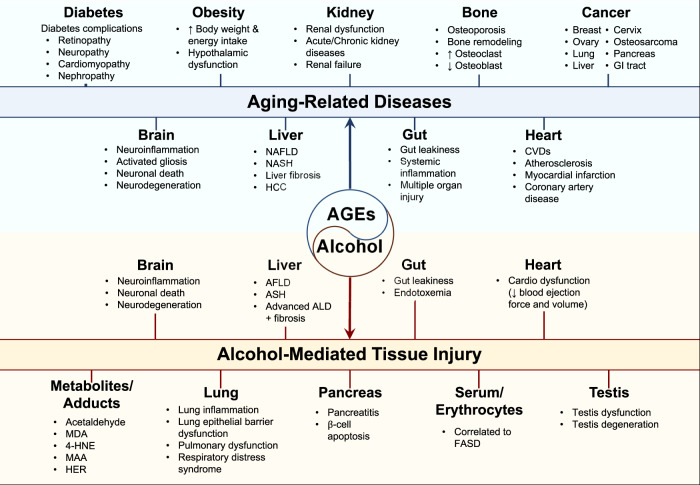
- AGEs are heterogeneous, irreversible products of nonenzymatic glycation that promote oxidative stress, inflammation, apoptosis, and tissue injury; AGE–RAGE signaling is implicated in diabetes, cardiovascular disease, kidney disease, obesity, osteoporosis, cancer, gut microbiome-associated disease, neurodegenerative disease, and liver disease.
- Alcohol consumption causes more than 200 diseases and injuries worldwide; in the United States alone, more than 250 billion dollars are lost annually due to alcoholism-related disorders and consequences.
- Less than 30% of dietary AGEs are absorbed in the intestine after ingestion, and less than 15% are excreted in urine and feces, suggesting the remaining unabsorbed AGEs are degraded by gut microorganisms.
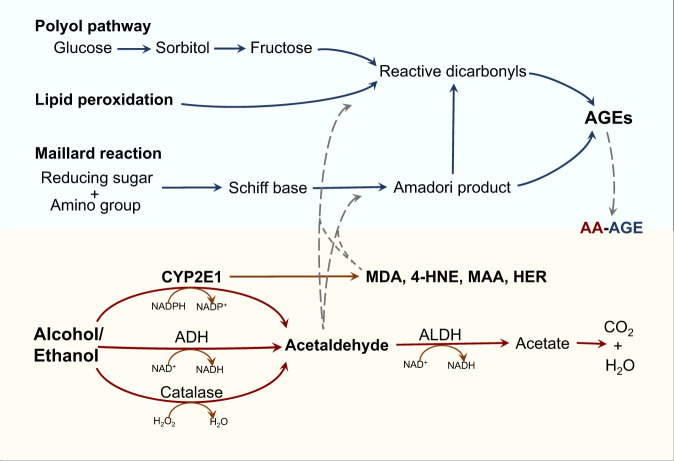
- Alcohol metabolism via CYP2E1 can generate reactive metabolites and adducts, including acetaldehyde (AA), malondialdehyde (MDA), 4-hydroxynonenal (4-HNE), MAA adducts, hydroxyethyl radicals, and AA-AGE adducts; AA-AGE formation is observed after chronic alcohol exposure and is linked to RAGE expression, oxidative stress, steatosis, apoptosis, and ALD/AFLD.
- In the brain under normal conditions, cerebral catalase accounts for more than 60% of ethanol oxidation; CYP2E1 has a higher Km (~10 mM for ethanol) than ADH (Km <1 mM for ethanol) and is inducible by ethanol.
- Cooking methods affect dietary AGEs: boiling or stewing meat can reduce AGE contents to one-half of that prepared by broiling, and marinating meat with acidic ingredients such as lemon juice or vinegar can decrease dietary AGEs produced during high-heat cooking by as much as 50%.
Methods
- Narrative review of basic and translational literature on AGE formation, accumulation, receptor interactions, aging-related diseases, alcohol metabolism, adduct formation, and translational applications.
- Synthesizes evidence from experimental animal models, cell culture models, human samples, autopsied tissues, and clinical/observational studies; includes summary tables (Table 1, Table 2) and figures (Fig. 1, Fig. 2).
- Main analysis is qualitative mechanistic synthesis; no systematic review protocol, meta-analysis, or primary data collection is reported.
Limitations
- The paper states that the underlying molecular mechanisms by which alcohol exerts cellular toxicity and organ damage remain to be further characterized.
- The paper notes that several roles of AGEs, alcohol, and adducts in specific organs need further study, including heart, gut, pancreas, serum, erythrocytes, and testis; it also states that plasma AGE differences in Alzheimer’s and Parkinson’s disease are sex-dependent and require careful interpretation.
- Evident from the text: this is a narrative review without systematic search or quantitative synthesis, and many proposed preventive compounds have not been specifically evaluated for AGE-associated adduct formation.
Model-written summary. Check it against the paper before relying on it.
Integrity signals
Registry
Cites
Statistics
Figures
Verification
Claims the paper makes
179 Not checked yet · 7 Own interpretation · 4 Partly supported · 1 Supported so far · 1 No basis given · accuracy not yet measured
The cited sources support only part of this claim — read each source’s verdict below.
In the paper
“In blood vessels, accumulated AGEs also interact with mononuclear, endothelial, and smooth muscle cells, resulting in cellular dysfunction, tissue damage, and atherosclerosis development55–57,59.”
§ Advanced glycation end products (AGEs) and other adducts in aging-related diseases and alcohol-mediated tissue injury > AGEs and aging-related diseases (see summary in Table 1) > AGEs and cardiovascular diseases
What the sources say
- Partly supportedcites [55] Uribarri, J. et al. Restriction of advanced glycation end products improves insulin resistance in human type 2 diabetes: potential role of AGER1 and SIRT1. Diabetes Care 34, 1610–1616 (2011). sourceExperimental — accuracy not yet measured
The Results section (page unavailable) shows that AGE exposure altered signaling in monocyte-like THP-1 cells. The paper also reports vascular disease associated with excess AGEs in mice, but it does not establish AGE interactions with endothelial or smooth muscle cells or the claimed pathway to atherosclerosis. (LLM, conf=0.86)
- Not checked yetcites [56] Xu, J. et al. Involvement of advanced glycation end products in the pathogenesis of diabetic retinopathy. Cell. Physiol. Biochem. 48, 705–717 (2018). source
- Not checked yetcites [57] Lim, M. et al. Induction of apoptosis of Beta cells of the pancreas by advanced glycation end-products, important mediators of chronic complications of diabetes mellitus. Ann. N. Y. Acad. Sci. 1150, 311–315 (2008). source
- Not checked yetcites [59] Goldin, A., Beckman, J. A., Schmidt, A. M. & Creager, M. A. Advanced glycation end products: sparking the development of diabetic vascular injury. Circulation 114, 597–605 (2006). source
plaindirect- Asserted: passes — The authors put it forward as true.
- Checkable: passes — It can be checked against evidence.
- Load-bearing: passes — The paper’s conclusions depend on it.
- Based: passes — The paper gives a reason why it holds.
- Partly supported
The cited sources support only part of this claim — read each source’s verdict below.
In the paper
“The formation of the AGE-albumin adduct is intensified by elevated oxidative stress and Aβ aggregation111.”
§ Advanced glycation end products (AGEs) and other adducts in aging-related diseases and alcohol-mediated tissue injury > AGEs and aging-related diseases (see summary in Table 1) > AGEs and neurodegenerative diseases
What the sources say
- Partly supportedcites [111] Byun, K. et al. Induction of neuronal death by microglial AGE-albumin: implications for Alzheimer’s disease. PloS One 7, 1–11 (2012). sourceExperimental — accuracy not yet measured
The Results section on oxidative stress reports increased AGE-albumin synthesis in HMO6 microglial cells after oxidant exposure, and the Discussion says Aβ treatment increases its synthesis. But the Results section on Aβ polymerization reports the opposite direction for aggregation: AGE-albumin increases Aβ aggregation. It does not show that Aβ aggregation intensifies AGE-albumin formation. Page numbers are unavailable in our copy. (LLM, conf=0.89)
plaindirect- Asserted: passes — The authors put it forward as true.
- Checkable: passes — It can be checked against evidence.
- Load-bearing: passes — The paper’s conclusions depend on it.
- Based: passes — The paper gives a reason why it holds.
- Partly supported
In the paper
“The pathological implications of AGEs are ascribed to their ability to promote oxidative stress, inflammation, and apoptosis.”
§ Advanced glycation end products (AGEs) and other adducts in aging-related diseases and alcohol-mediated tissue injury > Abstract
What the sources say
- Not checked yetcites [3] Uribarri, J. et al. Circulating glycotoxins and dietary advanced glycation endproducts: two links to inflammatory response, oxidative stress, and aging. J. Gerontol. A Biol. Sci. Med Sci. 62, 427–433 (2007). source
plaindirect- Asserted: passes — The authors put it forward as true.
- Checkable: passes — It can be checked against evidence.
- Load-bearing: passes — The paper’s conclusions depend on it.
- Based: passes — The paper gives a reason why it holds.
None of the sources cited for this claim have been checked yet.
In the paper
“Advanced glycation end products (AGEs) are potentially harmful and heterogeneous molecules derived from nonenzymatic glycation.”
§ Advanced glycation end products (AGEs) and other adducts in aging-related diseases and alcohol-mediated tissue injury > Abstract
What the sources say
- Not checked yetcites [1] Goldberg, T. et al. Advanced glycoxidation end products in commonly consumed foods. J. Am. Dietetic Assoc. 104, 1287–1291 (2004). source
- Not checked yetcites [2] Henning, C. & Glomb, M. A. Pathways of the Maillard reaction under physiological conditions. Glycoconj. J. 33, 499–512 (2016). source
plain- Asserted: passes — The authors put it forward as true.
- Checkable: passes — It can be checked against evidence.
- Load-bearing: passes — The paper’s conclusions depend on it.
- Based: passes — The paper gives a reason why it holds.
None of the sources cited for this claim have been checked yet.
In the paper
“AGEs can be formed endogenously or provided by exogenous sources under normal and pathological conditions1,2.”
§ Advanced glycation end products (AGEs) and other adducts in aging-related diseases and alcohol-mediated tissue injury > Introduction
What the sources say
- Not checked yetcites [1] Goldberg, T. et al. Advanced glycoxidation end products in commonly consumed foods. J. Am. Dietetic Assoc. 104, 1287–1291 (2004). source
- Not checked yetcites [2] Henning, C. & Glomb, M. A. Pathways of the Maillard reaction under physiological conditions. Glycoconj. J. 33, 499–512 (2016). source
plain- Asserted: passes — The authors put it forward as true.
- Checkable: passes — It can be checked against evidence.
- Load-bearing: unclear — It is unclear whether the paper’s conclusions depend on it.
- Based: passes — The paper gives a reason why it holds.
None of the sources cited for this claim have been checked yet.
In the paper
“Recent studies in basic and translational research have revealed the contributing roles of AGEs in the development and progression of various aging-related pathological conditions, such as diabetes, cardiovascular complications, gut microbiome-associated illnesses, liver or neurodegenerative diseases, and cancer.”
§ Advanced glycation end products (AGEs) and other adducts in aging-related diseases and alcohol-mediated tissue injury > Abstract
What the sources say
- Not checked yetcites [4] Byun, K. et al. Advanced glycation end-products produced systemically and by macrophages: a common contributor to inflammation and degenerative diseases. Pharmacol. Therapeutics 177, 44–55 (2017). source
- Not checked yetcites [5] Abate, G., Marziano, M., Rungratanawanich, W., Memo, M. & Uberti, D. Nutrition and AGE-ing: focusing on Alzheimer’s disease. Oxid. Med. Cell. Longev. 2017, 1–10 (2017). source
plaindirect- Asserted: passes — The authors put it forward as true.
- Checkable: passes — It can be checked against evidence.
- Load-bearing: passes — The paper’s conclusions depend on it.
- Based: passes — The paper gives a reason why it holds.
None of the sources cited for this claim have been checked yet.
In the paper
“This formation of dietary AGEs depends on various factors, such as (1) temperature. e.g., the food browning process; (2) water content. e.g., dry-heat cooking; (3) pH status, e.g., food processing at high pH; and (4) cooking time and method, e.g., long-term cooking or storage and frying or broiling.”
§ Advanced glycation end products (AGEs) and other adducts in aging-related diseases and alcohol-mediated tissue injury > AGE formation > Exogenous AGEs
What the sources say
- Not checked yetcites [5] Abate, G., Marziano, M., Rungratanawanich, W., Memo, M. & Uberti, D. Nutrition and AGE-ing: focusing on Alzheimer’s disease. Oxid. Med. Cell. Longev. 2017, 1–10 (2017). source
- Not checked yetcites [19] Luevano-Contreras, C. & Chapman-Novakofski, K. Dietary advanced glycation end products and aging. Nutrients 2, 1247–1265 (2010). source
plaindirect- Asserted: passes — The authors put it forward as true.
- Checkable: passes — It can be checked against evidence.
- Load-bearing: unclear — It is unclear whether the paper’s conclusions depend on it.
- Based: passes — The paper gives a reason why it holds.
None of the sources cited for this claim have been checked yet.
In the paper
“In addition to nonenzymatic glycation, AGEs can be formed through the polyol pathway and lipid peroxidation in the presence and absence of hyperglycemia, depending on the substrate type, reactant concentration, exposure time, and host cellular context14–17.”
§ Advanced glycation end products (AGEs) and other adducts in aging-related diseases and alcohol-mediated tissue injury > AGE formation > Endogenous AGEs
What the sources say
- Not checked yetcites [14] Aragno, M. & Mastrocola, R. Dietary sugars and endogenous formation of advanced glycation endproducts: emerging mechanisms of disease. Nutrients 9, E385 (2017). source
- Not checked yetcites [15] Kikuchi, S. et al. Glycation–a sweet tempter for neuronal death. Brain Res. Brain Res. Rev. 41, 306–323 (2003). source
- Not checked yetcites [16] Zhang, Q., Ames, J. M., Smith, R. D., Baynes, J. W. & Metz, T. O. A perspective on the Maillard reaction and the analysis of protein glycation by mass spectrometry: probing the pathogenesis of chronic disease. J. Proteome Res 8, 754–769 (2009). source
- Not checked yetcites [17] Thornalley, P. J. Pharmacology of methylglyoxal: formation, modification of proteins and nucleic acids, and enzymatic detoxification–a role in pathogenesis and antiproliferative chemotherapy. Gen. Pharmacol. 27, 565–573 (1996). source
plaindirect- Asserted: passes — The authors put it forward as true.
- Checkable: passes — It can be checked against evidence.
- Load-bearing: unclear — It is unclear whether the paper’s conclusions depend on it.
- Based: passes — The paper gives a reason why it holds.
None of the sources cited for this claim have been checked yet.
In the paper
“Cross-links formed by the interactions of AGEs with their cell surface receptors for advanced glycation end products (RAGEs) have been found during the development and progression of various aging-related diseases, such as diabetes, cardiovascular complications, kidney malfunctions, osteoporosis, cancer, neurodegenerative diseases, and liver disorders4,5”
§ Advanced glycation end products (AGEs) and other adducts in aging-related diseases and alcohol-mediated tissue injury > Introduction
What the sources say
- Not checked yetcites [4] Byun, K. et al. Advanced glycation end-products produced systemically and by macrophages: a common contributor to inflammation and degenerative diseases. Pharmacol. Therapeutics 177, 44–55 (2017). source
- Not checked yetcites [5] Abate, G., Marziano, M., Rungratanawanich, W., Memo, M. & Uberti, D. Nutrition and AGE-ing: focusing on Alzheimer’s disease. Oxid. Med. Cell. Longev. 2017, 1–10 (2017). source
plaincorrelational- Asserted: passes — The authors put it forward as true.
- Checkable: passes — It can be checked against evidence.
- Load-bearing: unclear — It is unclear whether the paper’s conclusions depend on it.
- Based: passes — The paper gives a reason why it holds.
In the paper
“Foods with high pH values (up to 10) have elevated AGEs due to free amino groups under alkaline conditions21.”
§ Advanced glycation end products (AGEs) and other adducts in aging-related diseases and alcohol-mediated tissue injury > AGE formation > Exogenous AGEs
What the sources say
- Not checked yetcites [21] Nowotny, K., Schroter, D., Schreiner, M. & Grune, T. Dietary advanced glycation end products and their relevance for human health. Ageing Res. Rev. 47, 55–66 (2018). source
plaindirect- Asserted: passes — The authors put it forward as true.
- Checkable: passes — It can be checked against evidence.
- Load-bearing: unclear — It is unclear whether the paper’s conclusions depend on it.
- Based: passes — The paper gives a reason why it holds.
- It may state two separate claims as one. 94
- Probably not a substantial claim. 9
- The quote only partly states this claim. 3
The sources with a verdict support this claim; the rest weren’t checked yet, have no full text we could read, or their verdicts aren’t rated yet.
In the paper
“However, under pathological conditions, RAGEs can be upregulated and participate in various aging-related pathophysiologies, such as adult-onset type 2 diabetes mellitus (DM), cardiovascular disorders, myocardial infarction, chronic kidney failure, pancreatitis, cancer, Alzheimer’s disease (AD), Parkinson’s disease (PD), hepatic fibrosis, and alcohol-mediated tissue injury37,38.”
§ Advanced glycation end products (AGEs) and other adducts in aging-related diseases and alcohol-mediated tissue injury > RAGEs and other AGE receptors
What the sources say
- Supportedcites [37] Chaudhuri, J. et al. The role of advanced glycation end products in aging and metabolic diseases: bridging association and causality. Cell Metab. 28, 337–352 (2018). source
In “Potential factors underlying AGE-mediated effects on neurodegeneration” (page unavailable), the paper reports that AGE-albumin triggers RAGE generation on cell membranes and that RAGE-mediated signaling is upregulated in a rat model of neurotoxicity. The RAGE pathway section (page unavailable) also links RAGE activity to inflammation, tissue injury, and diabetic complications, supporting the claim that RAGE can participate in age-related pathology. (LLM, conf=0.89)
- Not checked yetcites [38] Wautier, M.-P., Guillausseau, P.-J. & Wautier, J.-L. Activation of the receptor for advanced glycation end products and consequences on health. Diabetes Metab. Syndrome: Clin. Res. Rev. 11, 305–309 (2017). source
plainconditional- Asserted: passes — The authors put it forward as true.
- Checkable: passes — It can be checked against evidence.
- Load-bearing: unclear — It is unclear whether the paper’s conclusions depend on it.
- Based: passes — The paper gives a reason why it holds.
It may state two separate claims as one.
- Supported
The cited sources support only part of this claim — read each source’s verdict below.
In the paper
“Interactions between acetaldehyde or MDA and cellular proteins lead to the formation of MAA adducts, which are highly stable and resistant to rapid degradation178,179.”
- Also stated in: § AGE–alcohol–adduct formations (Fig. 1) · plain
“Increased levels of MAA adducts from alcohol exposure stimulate protein dysfunction and immune-induced tissue injury through interactions with Toll-like receptor-3 (TLR-3), TLR-6, calpain, collagen alpha-1 (XII) chain, procollagen type XIV alpha-1, protocadherin beta, or complement component proteins167,180.”
§ Advanced glycation end products (AGEs) and other adducts in aging-related diseases and alcohol-mediated tissue injury > AGEs and alcohol-mediated tissue injury > AGE–alcohol–adduct formations (Fig. 1)
What the sources say
- Not checked yetcites [178] Tuma, D. J., Thiele, G. M., Xu, D., Klassen, L. W. & Sorrell, M. F. Acetaldehyde and malondialdehyde react together to generate distinct protein adducts in the liver during long-term ethanol administration. Hepatology 23, 872–880 (1996). source
- Supportedcites [179] McCaskill, M. L. et al. Hybrid malondialdehyde and acetaldehyde protein adducts form in the lungs of mice exposed to alcohol and cigarette smoke. Alcohol. Clin. Exp. Res. 35, 1106–1113 (2011). source
Split into 2 atoms — 2 confirmed, 0 partially supported, 0 disputed, 0 misattributed, 0 unverifiable. Expand the claim to see per-atom verdicts.
- Not checked yetcites [167] Tuma, D. J. & Casey, C. A. Dangerous byproducts of alcohol breakdown–focus on adducts. Alcohol Res. Health. 27, 285–290 (2003).
- Partly supportedcites [180] Patel, V. B., Worrall, S., Emery, P. W. & Preedy, V. R. Protein adduct species in muscle and liver of rats following acute ethanol administration. Alcohol Alcohol. 40, 485–493 (2005). sourceExperimental — accuracy not yet measured
Split into 2 atoms — 0 confirmed, 2 partially supported, 0 disputed, 0 misattributed, 0 unverifiable. Expand the claim to see per-atom verdicts.
plaindirect- Asserted: passes — The authors put it forward as true.
- Checkable: passes — It can be checked against evidence.
- Load-bearing: passes — The paper’s conclusions depend on it.
- Based: passes — The paper gives a reason why it holds.
It may state two separate claims as one.
- Also stated in: § AGE–alcohol–adduct formations (Fig. 1) · plain
The cited sources support only part of this claim — read each source’s verdict below.
In the paper
“These foods are rich in polyphenols such as gallic acid, flavonoids, anthocyanin, and ferulic acid, which attenuate protein glycation and prevent the biosynthesis of AGEs265–270.”
§ Advanced glycation end products (AGEs) and other adducts in aging-related diseases and alcohol-mediated tissue injury > Translational applications
What the sources say
- Not checked yetcites [265] Premakumara, G. A. S., Abeysekera, W. K. S. M., Ratnasooriya, W. D., Chandrasekharan, N. V. & Bentota, A. P. Antioxidant, anti-amylase and anti-glycation potential of brans of some Sri Lankan traditional and improved rice (Oryza sativa L.) varieties. J. Cereal Sci. 58, 451–456 (2013). source
- Not checked yetcites [266] Dearlove, R. P., Greenspan, P., Hartle, D. K., Swanson, R. B. & Hargrove, J. L. Inhibition of protein glycation by extracts of culinary herbs and spices. J. Med. Food 11, 275–281 (2008). source
- Partly supportedcites [267] Yeh, W. J., Hsia, S. M., Lee, W. H. & Wu, C. H. Polyphenols with antiglycation activity and mechanisms of action: a review of recent findings. J. Food Drug Anal. 25, 84–92 (2017). sourceExperimental — accuracy not yet measured
Section 7.1 reports that gallic and ferulic acids reduced AGE production in experimental systems, while Section 7.4 describes antiglycation and AGE-inhibiting effects of several flavonoids. The Introduction also says polyphenols can inhibit AGE biosynthesis. Our copy does not specifically establish an antiglycation effect for anthocyanin, so the full list is not supported. (LLM, conf=0.85)
- Not checked yetcites [268] Chen, H., Virk, M. S. & Chen, F. Phenolic acids inhibit the formation of advanced glycation end products in food simulation systems depending on their reducing powers and structures. Int. J. Food Sci. Nutr. 67, 400–411 (2016). source
- Not checked yetcites [269] Ma, H. et al. Evaluation of polyphenol anthocyanin-enriched extracts of blackberry, black raspberry, blueberry, cranberry, red raspberry, and strawberry for free radical scavenging, reactive carbonyl species trapping, anti-glycation, anti-β-amyloid aggregation, and microglial neuroprotective effects. Int. J. Mol. Sci. 19, 1–19 (2018). source
- Not checked yetcites [270] Daiponmak, W., Senakun, C. & Siriamornpun, S. Antiglycation capacity and antioxidant activities of different pigmented Thai rice. Int. J. Food Sci. Technol. 49, 1805–1810 (2014). source
plaindirect- Asserted: passes — The authors put it forward as true.
- Checkable: passes — It can be checked against evidence.
- Load-bearing: unclear — It is unclear whether the paper’s conclusions depend on it.
- Based: passes — The paper gives a reason why it holds.
It may state two separate claims as one.
None of the sources cited for this claim have been checked yet.
In the paper
“Excessive chronic and/or acute binge consumption of alcohol (ethanol), a widely consumed addictive substance, is known to cause more than 200 diseases, including alcohol use disorder (addiction), alcoholic liver disease, and brain damage.”
§ Advanced glycation end products (AGEs) and other adducts in aging-related diseases and alcohol-mediated tissue injury > Abstract
What the sources say
- Not checked yetcites [6] Jamal, M. et al. in Neuroscience of Alcohol (ed Victor R. Preedy) 39–46 (Academic Press, 2019).
- Not checked yetcites [7] NIAAA. Alcohol Facts and Statistics. The National Institute on Alcohol Abuse and Alcoholism (NIAAA) https://www.niaaa.nih.gov/sites/default/files/AlcoholFactsAndStats.pdf (2020).
boosteddirect- Asserted: passes — The authors put it forward as true.
- Checkable: passes — It can be checked against evidence.
- Load-bearing: fails — The paper’s conclusions may not depend on it.
- Based: passes — The paper gives a reason why it holds.
Probably not a substantial claim. The paper’s conclusions may not depend on it.
None of the sources cited for this claim have been checked yet.
In the paper
“For example, persistently high blood glucose, often observed in people with type 2 diabetes, increases the reservoir of substrate for accelerating AGE formation and activates protein kinase C and NADPH oxidases, producing ROS13,18.”
§ Advanced glycation end products (AGEs) and other adducts in aging-related diseases and alcohol-mediated tissue injury > AGE formation > Endogenous AGEs
What the sources say
- Not checked yetcites [13] Peppa, M., Uribarri, J. & Vlassara, H. Glucose, advanced glycation end products, and diabetes complications: what is new and what works. Clin. Diabetes 21, 186 (2003). source
- Not checked yetcites [18] Yan, S. F., Ramasamy, R. & Schmidt, A. M. Mechanisms of disease: advanced glycation end-products and their receptor in inflammation and diabetes complications. Nat. Clin. Pract. Endocrinol. Metab. 4, 285–293 (2008). source
plaindirect- Asserted: passes — The authors put it forward as true.
- Checkable: passes — It can be checked against evidence.
- Load-bearing: unclear — It is unclear whether the paper’s conclusions depend on it.
- Based: passes — The paper gives a reason why it holds.
It may state two separate claims as one.
None of the sources cited for this claim have been checked yet.
In the paper
“Additionally, elevated oxidative stress can act as a catalyst to stimulate AGE accumulation, while activation of AGEs can increase oxidative stress, creating a synergistic feed-forward loop to accelerate pathophysiological conditions2–4.”
§ Advanced glycation end products (AGEs) and other adducts in aging-related diseases and alcohol-mediated tissue injury > AGE formation > Endogenous AGEs
What the sources say
- Not checked yetcites [2] Henning, C. & Glomb, M. A. Pathways of the Maillard reaction under physiological conditions. Glycoconj. J. 33, 499–512 (2016). source
- Not checked yetcites [3] Uribarri, J. et al. Circulating glycotoxins and dietary advanced glycation endproducts: two links to inflammatory response, oxidative stress, and aging. J. Gerontol. A Biol. Sci. Med Sci. 62, 427–433 (2007). source
- Not checked yetcites [4] Byun, K. et al. Advanced glycation end-products produced systemically and by macrophages: a common contributor to inflammation and degenerative diseases. Pharmacol. Therapeutics 177, 44–55 (2017). source
plaindirect- Asserted: passes — The authors put it forward as true.
- Checkable: passes — It can be checked against evidence.
- Load-bearing: unclear — It is unclear whether the paper’s conclusions depend on it.
- Based: passes — The paper gives a reason why it holds.
It may state two separate claims as one.
None of the sources cited for this claim have been checked yet.
In the paper
“Exogenous AGEs include dietary AGEs (e.g., foods and beverages such as soft drinks containing high fructose corn sirup and/or sugar) and cigarette smoke.”
§ Advanced glycation end products (AGEs) and other adducts in aging-related diseases and alcohol-mediated tissue injury > AGE formation > Exogenous AGEs
What the sources say
- Not checked yetcites [5] Abate, G., Marziano, M., Rungratanawanich, W., Memo, M. & Uberti, D. Nutrition and AGE-ing: focusing on Alzheimer’s disease. Oxid. Med. Cell. Longev. 2017, 1–10 (2017). source
- Not checked yetcites [19] Luevano-Contreras, C. & Chapman-Novakofski, K. Dietary advanced glycation end products and aging. Nutrients 2, 1247–1265 (2010). source
plain- Asserted: passes — The authors put it forward as true.
- Checkable: passes — It can be checked against evidence.
- Load-bearing: unclear — It is unclear whether the paper’s conclusions depend on it.
- Based: passes — The paper gives a reason why it holds.
It may state two separate claims as one.
None of the sources cited for this claim have been checked yet.
In the paper
“These factors include excessive and/or prolonged alcohol consumption, cigarette smoking, the intake of high fat/caloric diets and/or extensively processed food, renal status, homeostatic imbalance, inflammation, hyperglycemia, and oxidative stress2–4.”
§ Advanced glycation end products (AGEs) and other adducts in aging-related diseases and alcohol-mediated tissue injury > AGE formation > Endogenous AGEs
What the sources say
- Not checked yetcites [2] Henning, C. & Glomb, M. A. Pathways of the Maillard reaction under physiological conditions. Glycoconj. J. 33, 499–512 (2016). source
- Not checked yetcites [3] Uribarri, J. et al. Circulating glycotoxins and dietary advanced glycation endproducts: two links to inflammatory response, oxidative stress, and aging. J. Gerontol. A Biol. Sci. Med Sci. 62, 427–433 (2007). source
- Not checked yetcites [4] Byun, K. et al. Advanced glycation end-products produced systemically and by macrophages: a common contributor to inflammation and degenerative diseases. Pharmacol. Therapeutics 177, 44–55 (2017). source
plaindirect- Asserted: passes — The authors put it forward as true.
- Checkable: passes — It can be checked against evidence.
- Load-bearing: unclear — It is unclear whether the paper’s conclusions depend on it.
- Based: passes — The paper gives a reason why it holds.
It may state two separate claims as one.
In the paper
“In addition to dietary AGEs, cigarette smoke is found to contain reactive glycation products, which can increase AGE accumulation in the tissues and circulating blood of smokers23.”
§ Advanced glycation end products (AGEs) and other adducts in aging-related diseases and alcohol-mediated tissue injury > AGE formation > Exogenous AGEs
What the sources say
- Not checked yetcites [23] Cerami, C. et al. Tobacco smoke is a source of toxic reactive glycation products. Proc. Natl Acad. Sci. USA 94, 13915–13920 (1997). source
plaindirect- Asserted: passes — The authors put it forward as true.
- Checkable: passes — It can be checked against evidence.
- Load-bearing: unclear — It is unclear whether the paper’s conclusions depend on it.
- Based: passes — The paper gives a reason why it holds.
It may state two separate claims as one.
In the paper
“In addition to long-lived proteins, AGEs can bind to proteins with short half-lives such as serum albumin, thereby activating RAGEs and inducing inflammatory responses followed by protein dysfunction and cell damage34.”
§ Advanced glycation end products (AGEs) and other adducts in aging-related diseases and alcohol-mediated tissue injury > AGE accumulation > Extracellular AGEs
What the sources say
- Not checked yetcites [34] Rondeau, P. & Bourdon, E. The glycation of albumin: structural and functional impacts. Biochimie 93, 645–658 (2011). source
plaindirect- Asserted: passes — The authors put it forward as true.
- Checkable: passes — It can be checked against evidence.
- Load-bearing: unclear — It is unclear whether the paper’s conclusions depend on it.
- Based: passes — The paper gives a reason why it holds.
It may state two separate claims as one.
In the paper
“A RAGE is a multiligand cell surface receptor in the immunoglobulin superfamily35.”
§ Advanced glycation end products (AGEs) and other adducts in aging-related diseases and alcohol-mediated tissue injury > RAGEs and other AGE receptors
What the sources say
- Not checked yetcites [35] Sessa, L. et al. The receptor for advanced glycation end-products (RAGE) is only present in mammals, and belongs to a family of cell adhesion molecules (CAMs). PloS One 9, e86903 (2014). source
plain- Asserted: passes — The authors put it forward as true.
- Checkable: passes — It can be checked against evidence.
- Load-bearing: fails — The paper’s conclusions may not depend on it.
- Based: passes — The paper gives a reason why it holds.
Probably not a substantial claim. The paper’s conclusions may not depend on it.
None of the sources cited for this claim have been checked yet.
In the paper
“AGEs also stimulate mitochondrial ROS production and c-Jun N-terminal protein kinase (JNK) and NADPH oxidase activity to induce mitochondrial dysfunction and oxidative stress51–53.”
§ Advanced glycation end products (AGEs) and other adducts in aging-related diseases and alcohol-mediated tissue injury > AGEs and aging-related diseases (see summary in Table 1) > AGEs and diabetes
What the sources say
- Not checked yetcites [51] Sergi, D. et al. Mitochondrial (Dys)function and insulin resistance: from pathophysiological molecular mechanisms to the impact of diet. Front. Physiol. 10, 1–20 (2019). source
- Not checked yetcites [52] Lin, N., Zhang, H. & Su, Q. Advanced glycation end-products induce injury to pancreatic beta cells through oxidative stress. Diabetes Metab. 38, 250–257 (2012). source
- Not checked yetcites [53] Song, B. J. et al. Mitochondrial dysfunction and tissue injury by alcohol, high fat, nonalcoholic substances and pathological conditions through post-translational protein modifications. Redox Biol. 3, 109–123 (2014). source
plaindirect- Asserted: passes — The authors put it forward as true.
- Checkable: passes — It can be checked against evidence.
- Load-bearing: passes — The paper’s conclusions depend on it.
- Based: passes — The paper gives a reason why it holds.
It may state two separate claims as one.
None of the sources cited for this claim have been checked yet.
In the paper
“In addition to an AGE, a RAGE binds diverse ligands, such as members of the S100 protein family, amyloid-β peptides (Aβ), prions, and high-mobility group protein B1 (HMGB1), which alter cellular functions and contribute to various pathophysiologies42–44.”
§ Advanced glycation end products (AGEs) and other adducts in aging-related diseases and alcohol-mediated tissue injury > RAGEs and other AGE receptors
What the sources say
- Not checked yetcites [42] Dhumale, S. S., Waghela, B. N. & Pathak, C. Quercetin protects necrotic insult and promotes apoptosis by attenuating the expression of RAGE and its ligand HMGB1 in human breast adenocarcinoma cells. IUBMB Life 67, 361–373 (2015). source
- Not checked yetcites [43] Donato, R. RAGE: a single receptor for several ligands and different cellular responses: the case of certain S100 proteins. Curr. Mol. Med. 7, 711–724 (2007). source
- Not checked yetcites [44] Jeong, J. et al. Soluble RAGE attenuates AngII-induced endothelial hyperpermeability by disrupting HMGB1-mediated crosstalk between AT1R and RAGE. Exp. Mol. Med. 51, 1–15 (2019). source
plaindirect- Asserted: passes — The authors put it forward as true.
- Checkable: passes — It can be checked against evidence.
- Load-bearing: unclear — It is unclear whether the paper’s conclusions depend on it.
- Based: passes — The paper gives a reason why it holds.
It may state two separate claims as one.
None of the sources cited for this claim have been checked yet.
In the paper
“Chronic hyperglycemia, frequently observed in experimental models and human diabetes, exhibits elevated AGE formation, serum AGE levels, RAGE expression, and AGE-RAGE interactions. Consequently, these changes lead to increased oxidative stress, insulin resistance, inflammation, pancreatic β-cell dysfunction with apoptosis, and eventually diabetic complications, including retinopathy, neuropathy, c”
§ Advanced glycation end products (AGEs) and other adducts in aging-related diseases and alcohol-mediated tissue injury > AGEs and aging-related diseases (see summary in Table 1) > AGEs and diabetes
What the sources say
- Not checked yetcites [47] Roshandel, D. et al. DNA methylation age calculators reveal association with diabetic neuropathy in type 1 diabetes. Clin. Epigenetics 12, 1–16 (2020). source
- Not checked yetcites [48] Le Bagge, S., Fotheringham, A. K., Leung, S. S. & Forbes, J. M. Targeting the receptor for advanced glycation end products (RAGE) in type 1 diabetes. Med. Res. Rev. 1–20, https://doi.org/10.1002/med.21654 (2020). source
- Not checked yetcites [49] Egana-Gorrono, L. et al. Receptor for advanced glycation end products (RAGE) and mechanisms and therapeutic opportunities in diabetes and cardiovascular disease: insights from human subjects and animal models. Front. Cardiovasc. Med. 7, 1–15 (2020). source
- Not checked yetcites [50] Yang, P., Feng, J., Peng, Q., Liu, X. & Fan, Z. Advanced glycation end products: potential mechanism and therapeutic target in cardiovascular complications under diabetes. Oxid. Med. Cell. Longev. 2019, 1–12 (2019).
plaindirect- Asserted: passes — The authors put it forward as true.
- Checkable: passes — It can be checked against evidence.
- Load-bearing: passes — The paper’s conclusions depend on it.
- Based: passes — The paper gives a reason why it holds.
It may state two separate claims as one.
None of the sources cited for this claim have been checked yet.
In the paper
“Activation of these proteins usually increases oxidative stress and inflammation that, in turn, promotes RAGE expression in a positive feed-forward loop, contributing to chronic disease development39–41.”
§ Advanced glycation end products (AGEs) and other adducts in aging-related diseases and alcohol-mediated tissue injury > RAGEs and other AGE receptors
What the sources say
- Not checked yetcites [39] Senatus, L. M. & Schmidt, A. M. The AGE-RAGE axis: implications for age-associated arterial diseases. Front. Genet. 8, 1–10 (2017). source
- Not checked yetcites [40] Xue, J. et al. The receptor for advanced glycation end products (RAGE) specifically recognizes methylglyoxal-derived AGEs. Biochemistry 53, 3327–3335 (2014). source
- Not checked yetcites [41] Bongarzone, S., Savickas, V., Luzi, F. & Gee, A. D. Targeting the receptor for advanced glycation endproducts (RAGE): a medicinal chemistry perspective. J. Medicinal Chem. 60, 7213–7232 (2017). source
plaindirect- Asserted: passes — The authors put it forward as true.
- Checkable: passes — It can be checked against evidence.
- Load-bearing: unclear — It is unclear whether the paper’s conclusions depend on it.
- Based: passes — The paper gives a reason why it holds.
It may state two separate claims as one.
None of the sources cited for this claim have been checked yet.
In the paper
“In humans, serum contains AGE peptides and free AGE adducts. AGE peptides are generally filtered by renal glomeruli and further reabsorbed by proximal convoluted tubules and eliminated from the body in the form of free AGE adducts in the urine66,67.”
§ Advanced glycation end products (AGEs) and other adducts in aging-related diseases and alcohol-mediated tissue injury > AGEs and aging-related diseases (see summary in Table 1) > AGEs and kidney diseases
What the sources say
- Not checked yetcites [66] Rabbani, N. & Thornalley, P. J. Advanced glycation end products in the pathogenesis of chronic kidney disease. Kidney Int. 93, 803–813 (2018). source
- Not checked yetcites [67] Bettiga, A. et al. The Modern Western Diet Rich in Advanced Glycation End-Products (AGEs): an overview of its impact on obesity and early progression of renal pathology. Nutrients 11, E1748 (2019). source
hedgeddirect- Asserted: passes — The authors put it forward as true.
- Checkable: passes — It can be checked against evidence.
- Load-bearing: unclear — It is unclear whether the paper’s conclusions depend on it.
- Based: passes — The paper gives a reason why it holds.
It may state two separate claims as one.
None of the sources cited for this claim have been checked yet.
In the paper
“The accumulation and exposure to AGEs exacerbate oxidative stress and inflammation and initiate the oxidation of low-density lipoproteins (LDLs), which are harmful to cardiovascular function.”
§ Advanced glycation end products (AGEs) and other adducts in aging-related diseases and alcohol-mediated tissue injury > AGEs and aging-related diseases (see summary in Table 1) > AGEs and cardiovascular diseases
What the sources say
- Not checked yetcites [55] Uribarri, J. et al. Restriction of advanced glycation end products improves insulin resistance in human type 2 diabetes: potential role of AGER1 and SIRT1. Diabetes Care 34, 1610–1616 (2011). source
- Not checked yetcites [56] Xu, J. et al. Involvement of advanced glycation end products in the pathogenesis of diabetic retinopathy. Cell. Physiol. Biochem. 48, 705–717 (2018). source
- Not checked yetcites [57] Lim, M. et al. Induction of apoptosis of Beta cells of the pancreas by advanced glycation end-products, important mediators of chronic complications of diabetes mellitus. Ann. N. Y. Acad. Sci. 1150, 311–315 (2008). source
- Not checked yetcites [59] Goldin, A., Beckman, J. A., Schmidt, A. M. & Creager, M. A. Advanced glycation end products: sparking the development of diabetic vascular injury. Circulation 114, 597–605 (2006). source
plaindirect- Asserted: passes — The authors put it forward as true.
- Checkable: passes — It can be checked against evidence.
- Load-bearing: passes — The paper’s conclusions depend on it.
- Based: passes — The paper gives a reason why it holds.
It may state two separate claims as one.
In the paper
“Restriction of dietary AGEs can reduce and/or reverse these effects by enhancing insulin sensitivity and upregulating AGE-R1 and SIRT1 expression while suppressing NF-κB, tumor necrosis factor-alpha (TNF-α), leptin, and serum AGEs in type 2 DM55.”
§ Advanced glycation end products (AGEs) and other adducts in aging-related diseases and alcohol-mediated tissue injury > AGEs and aging-related diseases (see summary in Table 1) > AGEs and diabetes
What the sources say
- Not checked yetcites [55] Uribarri, J. et al. Restriction of advanced glycation end products improves insulin resistance in human type 2 diabetes: potential role of AGER1 and SIRT1. Diabetes Care 34, 1610–1616 (2011). source
plaindirect- Asserted: passes — The authors put it forward as true.
- Checkable: passes — It can be checked against evidence.
- Load-bearing: passes — The paper’s conclusions depend on it.
- Based: passes — The paper gives a reason why it holds.
It may state two separate claims as one.
In the paper
“In addition, the AGE-RAGE interaction further instigates pericyte apoptosis, vascular inflammation and permeability, and blood-tissue barrier breakdown56.”
§ Advanced glycation end products (AGEs) and other adducts in aging-related diseases and alcohol-mediated tissue injury > AGEs and aging-related diseases (see summary in Table 1) > AGEs and diabetes
What the sources say
- Not checked yetcites [56] Xu, J. et al. Involvement of advanced glycation end products in the pathogenesis of diabetic retinopathy. Cell. Physiol. Biochem. 48, 705–717 (2018). source
plaindirect- Asserted: passes — The authors put it forward as true.
- Checkable: passes — It can be checked against evidence.
- Load-bearing: passes — The paper’s conclusions depend on it.
- Based: passes — The paper gives a reason why it holds.
It may state two separate claims as one.
None of the sources cited for this claim have been checked yet.
In the paper
“In addition, AGEs can be produced in renal mesangial cells and induce the expression of monocyte chemoattractant protein-1 (MCP-1).”
§ Advanced glycation end products (AGEs) and other adducts in aging-related diseases and alcohol-mediated tissue injury > AGEs and aging-related diseases (see summary in Table 1) > AGEs and kidney diseases
What the sources say
- Not checked yetcites [70] Frimat, M. et al. Kidney, heart and brain: three organs targeted by ageing and glycation. Clin. Sci. 131, 1069–1092 (2017). source
- Not checked yetcites [71] Kumar Pasupulati, A., Chitra, P. S. & Reddy, G. B. Advanced glycation end products mediated cellular and molecular events in the pathology of diabetic nephropathy. Biomol. Concepts 7, 293–309 (2016). source
plaindirect- Asserted: passes — The authors put it forward as true.
- Checkable: passes — It can be checked against evidence.
- Load-bearing: unclear — It is unclear whether the paper’s conclusions depend on it.
- Based: passes — The paper gives a reason why it holds.
It may state two separate claims as one.
In the paper
“Increased circulating AGEs can accumulate in the renal glomeruli and enhance collagen and laminin production in the extracellular matrix together with proximal tubular senescence, oxidative stress, and inflammatory processes66.”
§ Advanced glycation end products (AGEs) and other adducts in aging-related diseases and alcohol-mediated tissue injury > AGEs and aging-related diseases (see summary in Table 1) > AGEs and kidney diseases
What the sources say
- Not checked yetcites [66] Rabbani, N. & Thornalley, P. J. Advanced glycation end products in the pathogenesis of chronic kidney disease. Kidney Int. 93, 803–813 (2018). source
plaindirect- Asserted: passes — The authors put it forward as true.
- Checkable: passes — It can be checked against evidence.
- Load-bearing: passes — The paper’s conclusions depend on it.
- Based: passes — The paper gives a reason why it holds.
It may state two separate claims as one.
None of the sources cited for this claim have been checked yet.
In the paper
“Adipose tissues also produce molecular RAGE ligands (such as HMGB-1) and RAGE-inducible molecules (e.g., MCP-1 and IL-6). Upon RAGE interaction, these bound molecules activate their own production in adipose tissues, suggesting a causal role of RAGE signaling in the inflammatory pathway49,67.”
§ Advanced glycation end products (AGEs) and other adducts in aging-related diseases and alcohol-mediated tissue injury > AGEs and aging-related diseases (see summary in Table 1) > AGEs and obesity
What the sources say
- Not checked yetcites [49] Egana-Gorrono, L. et al. Receptor for advanced glycation end products (RAGE) and mechanisms and therapeutic opportunities in diabetes and cardiovascular disease: insights from human subjects and animal models. Front. Cardiovasc. Med. 7, 1–15 (2020). source
- Not checked yetcites [67] Bettiga, A. et al. The Modern Western Diet Rich in Advanced Glycation End-Products (AGEs): an overview of its impact on obesity and early progression of renal pathology. Nutrients 11, E1748 (2019). source
hedgedconditional- Asserted: passes — The authors put it forward as true.
- Checkable: passes — It can be checked against evidence.
- Load-bearing: passes — The paper’s conclusions depend on it.
- Based: passes — The paper gives a reason why it holds.
It may state two separate claims as one.
In the paper
“In addition to dietary AGEs, endogenous AGEs can be trapped and accumulated in adipose tissues, and AGE accumulation can be prevented by RAGE inhibition77.”
§ Advanced glycation end products (AGEs) and other adducts in aging-related diseases and alcohol-mediated tissue injury > AGEs and aging-related diseases (see summary in Table 1) > AGEs and obesity
What the sources say
- Not checked yetcites [77] Gaens, K. H. et al. Nepsilon-(carboxymethyl)lysine-receptor for advanced glycation end product axis is a key modulator of obesity-induced dysregulation of adipokine expression and insulin resistance. Arteriosclerosis, Thrombosis, Vasc. Biol. 34, 1199–1208 (2014). source
plaindirect- Asserted: passes — The authors put it forward as true.
- Checkable: passes — It can be checked against evidence.
- Load-bearing: unclear — It is unclear whether the paper’s conclusions depend on it.
- Based: passes — The paper gives a reason why it holds.
It may state two separate claims as one.
In the paper
“Aggregated AGEs can activate the JNK, Iκ-B kinase (IKK), NF-κB, and TNF-α pathways to trigger hypothalamic insulin and leptin resistance, resulting in hypothalamic dysfunction, imbalanced energy control, and subsequently elevated food consumption and body weight with obesity and metabolic syndromes78.”
§ Advanced glycation end products (AGEs) and other adducts in aging-related diseases and alcohol-mediated tissue injury > AGEs and aging-related diseases (see summary in Table 1) > AGEs and obesity
What the sources say
- Not checked yetcites [78] Sergi, D., Boulestin, H., Campbell, F. M. & Williams, L. M. The role of dietary advanced glycation end products in metabolic dysfunction. Mol. Nutr. Food Res. e1900934, https://doi.org/10.1002/mnfr.201900934 (2020). source
plaindirect- Asserted: passes — The authors put it forward as true.
- Checkable: passes — It can be checked against evidence.
- Load-bearing: passes — The paper’s conclusions depend on it.
- Based: passes — The paper gives a reason why it holds.
It may state two separate claims as one.
In the paper
“The interaction of AGE-RAGE augments the production of proinflammatory cytokines and suppresses osteoblast differentiation via the Wnt, PI3K, and ERK1/2 signaling pathways83.”
§ Advanced glycation end products (AGEs) and other adducts in aging-related diseases and alcohol-mediated tissue injury > AGEs and aging-related diseases (see summary in Table 1) > AGEs and osteoporosis
What the sources say
- Not checked yetcites [83] Li, G., Xu, J. & Li, Z. Receptor for advanced glycation end products inhibits proliferation in osteoblast through suppression of Wnt, PI3K and ERK signaling. Biochem. Biophys. Res. Commun. 423, 684–689 (2012). source
plaindirect- Asserted: passes — The authors put it forward as true.
- Checkable: passes — It can be checked against evidence.
- Load-bearing: unclear — It is unclear whether the paper’s conclusions depend on it.
- Based: passes — The paper gives a reason why it holds.
It may state two separate claims as one.
None of the sources cited for this claim have been checked yet.
In the paper
“The binding of AGEs to RAGE triggers extracellular matrix glycation, NADPH oxidase activity, local hypoxia, VEGF expression, and NF-κB activation to produce oxidative stress and inflammation, supporting the cancer microenvironment and promoting tumoral angiogenesis and proliferation32,87.”
§ Advanced glycation end products (AGEs) and other adducts in aging-related diseases and alcohol-mediated tissue injury > AGEs and aging-related diseases (see summary in Table 1) > AGEs and cancer
What the sources say
- Not checked yetcites [32] Rojas, A., Anazco, C., Gonzalez, I. & Araya, P. Extracellular matrix glycation and receptor for advanced glycation end-products activation: a missing piece in the puzzle of the association between diabetes and cancer. Carcinogenesis 39, 515–521 (2018). source
- Not checked yetcites [87] Foster, D. et al. AGE metabolites: a biomarker linked to cancer disparity? Cancer Epidemiol. Biomark. Prev. 23, 2186–2191 (2014). source
plaindirect- Asserted: passes — The authors put it forward as true.
- Checkable: passes — It can be checked against evidence.
- Load-bearing: passes — The paper’s conclusions depend on it.
- Based: passes — The paper gives a reason why it holds.
It may state two separate claims as one.
None of the sources cited for this claim have been checked yet.
In the paper
“In bone, accumulated AGEs can increase osteoclast generation while decreasing osteoblast growth and differentiation.”
§ Advanced glycation end products (AGEs) and other adducts in aging-related diseases and alcohol-mediated tissue injury > AGEs and aging-related diseases (see summary in Table 1) > AGEs and osteoporosis
What the sources say
- Not checked yetcites [80] Okazaki, K. et al. Advanced glycation end products (AGEs), but not high glucose, inhibit the osteoblastic differentiation of mouse stromal ST2 cells through the suppression of osterix expression, and inhibit cell growth and increasing cell apoptosis. Calcif. Tissue Int. 91, 286–296 (2012). source
- Not checked yetcites [81] Liu, J. et al. AGEs induce apoptosis in rat osteoblast cells by activating the caspase-3 signaling pathway under a high-glucose environment in vitro. Appl. Biochem. Biotechnol. 178, 1015–1027 (2016). source
- Not checked yetcites [82] Zhu, S. Y. et al. Advanced oxidation protein products induce pre-osteoblast apoptosis through a nicotinamide adenine dinucleotide phosphate oxidase-dependent, mitogen-activated protein kinases-mediated intrinsic apoptosis pathway. Aging Cell 17, 1–15 (2018). source
plaindirect- Asserted: passes — The authors put it forward as true.
- Checkable: passes — It can be checked against evidence.
- Load-bearing: passes — The paper’s conclusions depend on it.
- Based: passes — The paper gives a reason why it holds.
It may state two separate claims as one.
In the paper
“The intestinal microbiota produces deglycating enzymes to digest AGEs, which are utilized for energy production.”
§ Advanced glycation end products (AGEs) and other adducts in aging-related diseases and alcohol-mediated tissue injury > AGEs and aging-related diseases (see summary in Table 1) > AGEs and gut microbiome-associated diseases
What the sources say
- Not checked yetcites [98] Qu, W. et al. Dietary advanced glycation end products modify gut microbial composition and partially increase colon permeability in rats. Mol. Nutr. Food Res. 61, 1–14 (2017). source
plaindirect- Asserted: passes — The authors put it forward as true.
- Checkable: passes — It can be checked against evidence.
- Load-bearing: unclear — It is unclear whether the paper’s conclusions depend on it.
- Based: passes — The paper gives a reason why it holds.
It may state two separate claims as one.
In the paper
“In the body, less than 30% of dietary AGEs are absorbed in the intestine after ingestion, and less than 15% are excreted in urine and feces, leading to a hypothesis that the remaining unabsorbed AGEs are degraded by gut microorganisms97.”
§ Advanced glycation end products (AGEs) and other adducts in aging-related diseases and alcohol-mediated tissue injury > AGEs and aging-related diseases (see summary in Table 1) > AGEs and gut microbiome-associated diseases
What the sources say
- Not checked yetcites [97] Tuohy, K. M. et al. Metabolism of Maillard reaction products by the human gut microbiota–implications for health. Mol. Nutr. Food Res. 50, 847–857 (2006). source
plain- Asserted: passes — The authors put it forward as true.
- Checkable: passes — It can be checked against evidence.
- Load-bearing: passes — The paper’s conclusions depend on it.
- Based: passes — The paper gives a reason why it holds.
It may state two separate claims as one.
In the paper
“Elevated accumulation of AGEs can enhance gut barrier dysfunction, intestinal permeability, and bacterial translocation by stimulating the production and release of proinflammatory cytokines, potentially toxic metabolites and bacterial products, as well as causing intestinal epithelial cell damage, contributing to systemic endotoxemia, inflammation, and multiorgan injury98.”
§ Advanced glycation end products (AGEs) and other adducts in aging-related diseases and alcohol-mediated tissue injury > AGEs and aging-related diseases (see summary in Table 1) > AGEs and gut microbiome-associated diseases
What the sources say
- Not checked yetcites [98] Qu, W. et al. Dietary advanced glycation end products modify gut microbial composition and partially increase colon permeability in rats. Mol. Nutr. Food Res. 61, 1–14 (2017). source
plaindirect- Asserted: passes — The authors put it forward as true.
- Checkable: passes — It can be checked against evidence.
- Load-bearing: passes — The paper’s conclusions depend on it.
- Based: passes — The paper gives a reason why it holds.
It may state two separate claims as one.
None of the sources cited for this claim have been checked yet.
In the paper
“The gut microbiota plays a critical role in regulating body function by producing diverse metabolites and influencing the gut-liver-brain axis and other pathways, such as immune system pathways.”
§ Advanced glycation end products (AGEs) and other adducts in aging-related diseases and alcohol-mediated tissue injury > AGEs and aging-related diseases (see summary in Table 1) > AGEs and gut microbiome-associated diseases
What the sources say
- Not checked yetcites [95] Gentile, C. L. & Weir, T. L. The gut microbiota at the intersection of diet and human health. Science 362, 776–780 (2018). source
- Not checked yetcites [96] Dinan, T. G. & Cryan, J. F. Gut-brain axis in 2016: brain-gut-microbiota axis - mood, metabolism and behaviour. Nat. Rev. Gastroenterol. Hepatol. 14, 69–70 (2017). source
plaindirect- Asserted: passes — The authors put it forward as true.
- Checkable: passes — It can be checked against evidence.
- Load-bearing: unclear — It is unclear whether the paper’s conclusions depend on it.
- Based: passes — The paper gives a reason why it holds.
It may state two separate claims as one.
None of the sources cited for this claim have been checked yet.
In the paper
“Oxidative stress can also be generated due to AGE formation in the brain. This feed-forward process creates a vicious cycle that exacerbates oxidative damage with the subsequent initiation and progression of neurodegenerative diseases4,103.”
§ Advanced glycation end products (AGEs) and other adducts in aging-related diseases and alcohol-mediated tissue injury > AGEs and aging-related diseases (see summary in Table 1) > AGEs and neurodegenerative diseases
What the sources say
- Not checked yetcites [4] Byun, K. et al. Advanced glycation end-products produced systemically and by macrophages: a common contributor to inflammation and degenerative diseases. Pharmacol. Therapeutics 177, 44–55 (2017). source
- Not checked yetcites [103] Srikanth, V. et al. Advanced glycation endproducts and their receptor RAGE in Alzheimer’s disease. Neurobiol. Aging 32, 763–777 (2011). source
plaindirect- Asserted: passes — The authors put it forward as true.
- Checkable: passes — It can be checked against evidence.
- Load-bearing: passes — The paper’s conclusions depend on it.
- Based: passes — The paper gives a reason why it holds.
It may state two separate claims as one.
In the paper
“After binding with S100, RAGE also contributes to the epithelial-mesenchymal cell transition and cell migration, which is associated with tumor invasion and metastasis in cervical cancer and osteosarcomas, suggesting a contributing role for RAGE in tumor malignancy92.”
§ Advanced glycation end products (AGEs) and other adducts in aging-related diseases and alcohol-mediated tissue injury > AGEs and aging-related diseases (see summary in Table 1) > AGEs and cancer
What the sources say
- Not checked yetcites [92] Kataoka, K. et al. S100A7 promotes the migration and invasion of osteosarcoma cells via the receptor for advanced glycation end products. Oncol. Lett. 3, 1149–1153 (2012). source
hedgeddirect- Asserted: passes — The authors put it forward as true.
- Checkable: passes — It can be checked against evidence.
- Load-bearing: unclear — It is unclear whether the paper’s conclusions depend on it.
- Based: passes — The paper gives a reason why it holds.
It may state two separate claims as one.
In the paper
“In addition to AGEs and AGE adducts, HMGB1 and Aβ can bind RAGEs to activate the NF-κB, ERK1/2, p38, JNK, PI3K, Janus kinase/signal transducers and activators of transcription (JAK/STAT) pathways, leading to neuronal cell death and neurodegeneration112.”
§ Advanced glycation end products (AGEs) and other adducts in aging-related diseases and alcohol-mediated tissue injury > AGEs and aging-related diseases (see summary in Table 1) > AGEs and neurodegenerative diseases
What the sources say
- Not checked yetcites [112] Bortolotto, V. & Grilli, M. Every cloud has a silver lining: proneurogenic effects of abeta oligomers and HMGB-1 via activation of the RAGE-NF-kappaB axis. CNS Neurol. Disord. Drug Targets 16, 1066–1079 (2017). source
plaindirect- Asserted: passes — The authors put it forward as true.
- Checkable: passes — It can be checked against evidence.
- Load-bearing: unclear — It is unclear whether the paper’s conclusions depend on it.
- Based: passes — The paper gives a reason why it holds.
It may state two separate claims as one.
In the paper
“Additionally, the accumulation of AGEs and the AGE-RAGE interaction greatly induce reactive gliosis and the NF-κB proinflammatory pathway, leading to cellular stress, activated gliosis, and eventually neuronal degeneration105.”
§ Advanced glycation end products (AGEs) and other adducts in aging-related diseases and alcohol-mediated tissue injury > AGEs and aging-related diseases (see summary in Table 1) > AGEs and neurodegenerative diseases
What the sources say
- Not checked yetcites [105] Wang, C.-Y. et al. Trientine reduces BACE1 activity and mitigates amyloidosis via the AGE/RAGE/NF-κB pathway in a transgenic mouse model of Alzheimer’s disease. Antioxid. Redox Signal 19, 2024–2039 (2013). source
boosteddirect- Asserted: passes — The authors put it forward as true.
- Checkable: passes — It can be checked against evidence.
- Load-bearing: unclear — It is unclear whether the paper’s conclusions depend on it.
- Based: passes — The paper gives a reason why it holds.
It may state two separate claims as one.
None of the sources cited for this claim have been checked yet.
In the paper
“Activated microglial cells produce and secrete AGE-albumin to induce RAGE expression in neurons and promote neuronal cell death, thereby contributing to neurodegenerative disorders4,108.”
§ Advanced glycation end products (AGEs) and other adducts in aging-related diseases and alcohol-mediated tissue injury > AGEs and aging-related diseases (see summary in Table 1) > AGEs and neurodegenerative diseases
What the sources say
- Not checked yetcites [4] Byun, K. et al. Advanced glycation end-products produced systemically and by macrophages: a common contributor to inflammation and degenerative diseases. Pharmacol. Therapeutics 177, 44–55 (2017). source
- Not checked yetcites [108] Byun, K. et al. Activated microglial cells synthesize and secrete AGE-albumin. Anat. Cell Biol. 45, 47–52 (2012). source
plaindirect- Asserted: passes — The authors put it forward as true.
- Checkable: passes — It can be checked against evidence.
- Load-bearing: unclear — It is unclear whether the paper’s conclusions depend on it.
- Based: passes — The paper gives a reason why it holds.
It may state two separate claims as one.
In the paper
“One of the most abundant AGE-protein adducts in the brain is the AGE-albumin adduct, which was confirmed by mass spectral analysis, and causes RAGE overexpression in primary neurons in human AD brains.”
§ Advanced glycation end products (AGEs) and other adducts in aging-related diseases and alcohol-mediated tissue injury > AGEs and aging-related diseases (see summary in Table 1) > AGEs and neurodegenerative diseases
What the sources say
- Not checked yetcites [111] Byun, K. et al. Induction of neuronal death by microglial AGE-albumin: implications for Alzheimer’s disease. PloS One 7, 1–11 (2012). source
plaindirect- Asserted: passes — The authors put it forward as true.
- Checkable: passes — It can be checked against evidence.
- Load-bearing: passes — The paper’s conclusions depend on it.
- Based: passes — The paper gives a reason why it holds.
It may state two separate claims as one.
In the paper
“AGEs also suppress SIRT1 expression and stimulate inducible nitric oxide synthase (iNOS) and caspase-3 to enhance neuronal apoptosis and/or degeneration with elevated gliosis110.”
§ Advanced glycation end products (AGEs) and other adducts in aging-related diseases and alcohol-mediated tissue injury > AGEs and aging-related diseases (see summary in Table 1) > AGEs and neurodegenerative diseases
What the sources say
- Not checked yetcites [110] Wong, A. et al. Advanced glycation endproducts co-localize with inducible nitric oxide synthase in Alzheimer’s disease. Brain Res. 920, 32–40 (2001). source
plaindirect- Asserted: passes — The authors put it forward as true.
- Checkable: passes — It can be checked against evidence.
- Load-bearing: passes — The paper’s conclusions depend on it.
- Based: passes — The paper gives a reason why it holds.
It may state two separate claims as one.
In the paper
“Aβ is also produced by the AGE-albumin-RAGE interaction, which in turn supports AGE-albumin adduct formation in a positive feed-forward cycle.”
§ Advanced glycation end products (AGEs) and other adducts in aging-related diseases and alcohol-mediated tissue injury > AGEs and aging-related diseases (see summary in Table 1) > AGEs and neurodegenerative diseases
What the sources say
- Not checked yetcites [111] Byun, K. et al. Induction of neuronal death by microglial AGE-albumin: implications for Alzheimer’s disease. PloS One 7, 1–11 (2012). source
plaindirect- Asserted: passes — The authors put it forward as true.
- Checkable: passes — It can be checked against evidence.
- Load-bearing: unclear — It is unclear whether the paper’s conclusions depend on it.
- Based: passes — The paper gives a reason why it holds.
It may state two separate claims as one.
In the paper
“Accumulated AGEs can accelerate the formation of Aβ, tau, and amyloid precursor protein (APP) and induce the hyperphosphorylation of tau and the cross-linking of AGE-Aβ, leading to an increase in these aggregates109.”
§ Advanced glycation end products (AGEs) and other adducts in aging-related diseases and alcohol-mediated tissue injury > AGEs and aging-related diseases (see summary in Table 1) > AGEs and neurodegenerative diseases
What the sources say
- Not checked yetcites [109] Chen, K., Maley, J. & Yu, P. H. Potential inplications of endogenous aldehydes in beta-amyloid misfolding, oligomerization and fibrillogenesis. J. Neurochem. 99, 1413–1424 (2006). source
plaindirect- Asserted: passes — The authors put it forward as true.
- Checkable: passes — It can be checked against evidence.
- Load-bearing: passes — The paper’s conclusions depend on it.
- Based: passes — The paper gives a reason why it holds.
It may state two separate claims as one.
None of the sources cited for this claim have been checked yet.
In the paper
“Endogenous and exogenous AGEs provoke the initiation and progression of NAFLD.”
- Also stated in: § AGEs and liver diseases · plain
“However, consumption of dietary AGEs from sources such as fructose- or sucrose-enriched diets and/or soft drinks can worsen liver fibrosis faster than consumption of endogenous AGEs.”
§ Advanced glycation end products (AGEs) and other adducts in aging-related diseases and alcohol-mediated tissue injury > AGEs and aging-related diseases (see summary in Table 1) > AGEs and liver diseases
What the sources say
- Not checked yetcites [55] Uribarri, J. et al. Restriction of advanced glycation end products improves insulin resistance in human type 2 diabetes: potential role of AGER1 and SIRT1. Diabetes Care 34, 1610–1616 (2011). source
- Not checked yetcites [56] Xu, J. et al. Involvement of advanced glycation end products in the pathogenesis of diabetic retinopathy. Cell. Physiol. Biochem. 48, 705–717 (2018). source
- Not checked yetcites [57] Lim, M. et al. Induction of apoptosis of Beta cells of the pancreas by advanced glycation end-products, important mediators of chronic complications of diabetes mellitus. Ann. N. Y. Acad. Sci. 1150, 311–315 (2008). source
- Not checked yetcites [124] Leung, C. et al. Dietary glycotoxins exacerbate progression of experimental fatty liver disease. J. Hepatol. 60, 832–838 (2014). source
- Not checked yetcites [125] Rolo, A. P., Teodoro, J. S. & Palmeira, C. M. Role of oxidative stress in the pathogenesis of nonalcoholic steatohepatitis. Free Radic. Biol. Med. 52, 59–69 (2012). source
- Not checked yetcites [126] Jiang, J. X. et al. Advanced glycation endproducts induce fibrogenic activity in nonalcoholic steatohepatitis by modulating TNF-alpha-converting enzyme activity in mice. Hepatology 58, 1339–1348 (2013). source
plaindirect- Asserted: passes — The authors put it forward as true.
- Checkable: passes — It can be checked against evidence.
- Load-bearing: passes — The paper’s conclusions depend on it.
- Based: passes — The paper gives a reason why it holds.
It may state two separate claims as one.
- Also stated in: § AGEs and liver diseases · plain
None of the sources cited for this claim have been checked yet.
In the paper
“AGEs cross-linked with α-synuclein are also present in PD brains, resulting in the aggregation of α-synuclein toxic oligomers115,116.”
§ Advanced glycation end products (AGEs) and other adducts in aging-related diseases and alcohol-mediated tissue injury > AGEs and aging-related diseases (see summary in Table 1) > AGEs and neurodegenerative diseases
What the sources say
- Not checked yetcites [115] Guerrero, E., Vasudevaraju, P., Hegde, M. L., Britton, G. B. & Rao, K. S. Recent advances in alpha-synuclein functions, advanced glycation, and toxicity: implications for Parkinson’s disease. Mol. Neurobiol. 47, 525–536 (2013). source
- Not checked yetcites [116] Munch, G. et al. Crosslinking of alpha-synuclein by advanced glycation endproducts–an early pathophysiological step in Lewy body formation? J. Chem. Neuroanat. 20, 253–257 (2000). source
plaindirect- Asserted: passes — The authors put it forward as true.
- Checkable: passes — It can be checked against evidence.
- Load-bearing: passes — The paper’s conclusions depend on it.
- Based: passes — The paper gives a reason why it holds.
It may state two separate claims as one.
None of the sources cited for this claim have been checked yet.
In the paper
“It is involved in the catabolism and elimination of circulating AGEs using liver sinusoidal endothelial cells and Kupffer cells.”
- Also stated in: § AGEs and liver diseases · plain
“This function of the liver declines during the aging process and in various liver diseases, resulting in the accumulation of AGEs or their aggregates120,121.”
§ Advanced glycation end products (AGEs) and other adducts in aging-related diseases and alcohol-mediated tissue injury > AGEs and aging-related diseases (see summary in Table 1) > AGEs and liver diseases
What the sources say
- Not checked yetcites [120] Sebekova, K., Kupcova, V., Schinzel, R. & Heidland, A. Markedly elevated levels of plasma advanced glycation end products in patients with liver cirrhosis - amelioration by liver transplantation. J. Hepatol. 36, 66–71 (2002). source
- Not checked yetcites [121] Fernando, D. H., Forbes, J. M., Angus, P. W. & Herath, C. B. Development and progression of non-alcoholic fatty liver disease: the role of advanced glycation end products. Int. J. Mol. Sci. 20, 1–19 (2019). source
plaindirect- Asserted: passes — The authors put it forward as true.
- Checkable: passes — It can be checked against evidence.
- Load-bearing: passes — The paper’s conclusions depend on it.
- Based: passes — The paper gives a reason why it holds.
It may state two separate claims as one.
- Also stated in: § AGEs and liver diseases · plain
None of the sources cited for this claim have been checked yet.
In the paper
“The aggregation of AGEs decreases the levels of the most important cellular antioxidant peptides, glutathione (GSH), SIRT1, and tissue inhibitor of metalloproteinase 3 (TIMP3), accompanied by increased oxidative stress and inflammation, promoting inflammatory liver injury and fibrosis in experimental animal models and NAFLD patients55–57,124–126.”
§ Advanced glycation end products (AGEs) and other adducts in aging-related diseases and alcohol-mediated tissue injury > AGEs and aging-related diseases (see summary in Table 1) > AGEs and liver diseases
What the sources say
- Not checked yetcites [55] Uribarri, J. et al. Restriction of advanced glycation end products improves insulin resistance in human type 2 diabetes: potential role of AGER1 and SIRT1. Diabetes Care 34, 1610–1616 (2011). source
- Not checked yetcites [56] Xu, J. et al. Involvement of advanced glycation end products in the pathogenesis of diabetic retinopathy. Cell. Physiol. Biochem. 48, 705–717 (2018). source
- Not checked yetcites [57] Lim, M. et al. Induction of apoptosis of Beta cells of the pancreas by advanced glycation end-products, important mediators of chronic complications of diabetes mellitus. Ann. N. Y. Acad. Sci. 1150, 311–315 (2008). source
- Not checked yetcites [124] Leung, C. et al. Dietary glycotoxins exacerbate progression of experimental fatty liver disease. J. Hepatol. 60, 832–838 (2014). source
- Not checked yetcites [125] Rolo, A. P., Teodoro, J. S. & Palmeira, C. M. Role of oxidative stress in the pathogenesis of nonalcoholic steatohepatitis. Free Radic. Biol. Med. 52, 59–69 (2012). source
- Not checked yetcites [126] Jiang, J. X. et al. Advanced glycation endproducts induce fibrogenic activity in nonalcoholic steatohepatitis by modulating TNF-alpha-converting enzyme activity in mice. Hepatology 58, 1339–1348 (2013). source
plaindirect- Asserted: passes — The authors put it forward as true.
- Checkable: passes — It can be checked against evidence.
- Load-bearing: passes — The paper’s conclusions depend on it.
- Based: passes — The paper gives a reason why it holds.
It may state two separate claims as one.
In the paper
“AGE-albumin, the most abundant AGE product in the human PD brain, is synthesized by activated microglial cells.”
§ Advanced glycation end products (AGEs) and other adducts in aging-related diseases and alcohol-mediated tissue injury > AGEs and aging-related diseases (see summary in Table 1) > AGEs and neurodegenerative diseases
What the sources say
- Not checked yetcites [119] Bayarsaikhan, E. et al. Microglial AGE-albumin is critical for neuronal death in Parkinson’s disease: a possible implication for theranostics. Int. J. Nanomed. 10(Spec Iss), 281–292 (2015).
plaindirect- Asserted: passes — The authors put it forward as true.
- Checkable: passes — It can be checked against evidence.
- Load-bearing: unclear — It is unclear whether the paper’s conclusions depend on it.
- Based: passes — The paper gives a reason why it holds.
It may state two separate claims as one.
None of the sources cited for this claim have been checked yet.
In the paper
“Moreover, RAGE can interact with S100 in PD brains, activating the NF-κB and TNF-α signaling pathways to promote dopaminergic neuronal death and subsequent neurodegeneration in PD117,118.”
§ Advanced glycation end products (AGEs) and other adducts in aging-related diseases and alcohol-mediated tissue injury > AGEs and aging-related diseases (see summary in Table 1) > AGEs and neurodegenerative diseases
What the sources say
- Not checked yetcites [117] Sathe, K. et al. S100B is increased in Parkinson’s disease and ablation protects against MPTP-induced toxicity through the RAGE and TNF-alpha pathway. Brain J. Neurol. 135, 3336–3347 (2012). source
- Not checked yetcites [118] Abdelsalam, R. M. & Safar, M. M. Neuroprotective effects of vildagliptin in rat rotenone Parkinson’s disease model: role of RAGE-NFkappaB and Nrf2-antioxidant signaling pathways. J. Neurochem. 133, 700–707 (2015). source
plaindirect- Asserted: passes — The authors put it forward as true.
- Checkable: passes — It can be checked against evidence.
- Load-bearing: passes — The paper’s conclusions depend on it.
- Based: passes — The paper gives a reason why it holds.
It may state two separate claims as one.
None of the sources cited for this claim have been checked yet.
In the paper
“Ethanol metabolism primarily occurs in the liver in three major steps: (1) ethanol oxidation to acetaldehyde, (2) acetaldehyde metabolism to acetate, and (3) acetate catabolism to H2O and CO2132–134.”
§ Advanced glycation end products (AGEs) and other adducts in aging-related diseases and alcohol-mediated tissue injury > AGEs and alcohol-mediated tissue injury > Alcohol metabolism (see summary in Fig. 1)
What the sources say
- Not checked yetcites [132] Purohit, V., Gao, B. & Song, B. J. Molecular mechanisms of alcoholic fatty liver. Alcohol. Clin. Exp. Res. 33, 191–205 (2009). source
- Not checked yetcites [133] Thiele, G. M., Klassen, L. W. & Tuma, D. J. Formation and immunological properties of aldehyde-derived protein adducts following alcohol consumption. Methods Mol. Biol. 447, 235–257 (2008). source
- Not checked yetcites [134] Zakhari, S. Overview: how is alcohol metabolized by the body? Alcohol Res. Health. 29, 245–254 (2006).
plaindirect- Asserted: passes — The authors put it forward as true.
- Checkable: passes — It can be checked against evidence.
- Load-bearing: fails — The paper’s conclusions may not depend on it.
- Based: passes — The paper gives a reason why it holds.
Probably not a substantial claim. The paper’s conclusions may not depend on it.
None of the sources cited for this claim have been checked yet.
In the paper
“Increased amounts of RAGE are also observed in the liver of hepatocellular carcinoma (HCC), and its level is significantly greater than it is liver affected by hepatitis and healthy liver specimens.”
- Also stated in: § AGEs and liver diseases · plain
“The amounts of serum AGEs are also higher in HCC than in NASH and healthy liver specimens.”
§ Advanced glycation end products (AGEs) and other adducts in aging-related diseases and alcohol-mediated tissue injury > AGEs and aging-related diseases (see summary in Table 1) > AGEs and liver diseases
What the sources say
- Not checked yetcites [129] Hiwatashi, K. et al. A novel function of the receptor for advanced glycation end-products (RAGE) in association with tumorigenesis and tumor differentiation of HCC. Ann. Surg. Oncol. 15, 923–933 (2008). source
- Not checked yetcites [130] Takino, J., Yamagishi, S. & Takeuchi, M. Glycer-AGEs-RAGE signaling enhances the angiogenic potential of hepatocellular carcinoma by upregulating VEGF expression. World J. Gastroenterol. 18, 1781–1788 (2012). source
- Not checked yetcites [131] Yang, Y. et al. Pioglitazone, a PPARgamma agonist, inhibits growth and invasion of human hepatocellular carcinoma via blockade of the rage signaling. Mol. Carcinog. 54, 1584–1595 (2015). source
plaincorrelational- Asserted: passes — The authors put it forward as true.
- Checkable: passes — It can be checked against evidence.
- Load-bearing: passes — The paper’s conclusions depend on it.
- Based: passes — The paper gives a reason why it holds.
It may state two separate claims as one.
- Also stated in: § AGEs and liver diseases · plain
None of the sources cited for this claim have been checked yet.
In the paper
“In HCC, the AGE-RAGE interaction is associated with angiogenesis and tumor proliferation and invasion, which are ameliorated by RAGE inhibition.”
§ Advanced glycation end products (AGEs) and other adducts in aging-related diseases and alcohol-mediated tissue injury > AGEs and aging-related diseases (see summary in Table 1) > AGEs and liver diseases
What the sources say
- Not checked yetcites [129] Hiwatashi, K. et al. A novel function of the receptor for advanced glycation end-products (RAGE) in association with tumorigenesis and tumor differentiation of HCC. Ann. Surg. Oncol. 15, 923–933 (2008). source
- Not checked yetcites [130] Takino, J., Yamagishi, S. & Takeuchi, M. Glycer-AGEs-RAGE signaling enhances the angiogenic potential of hepatocellular carcinoma by upregulating VEGF expression. World J. Gastroenterol. 18, 1781–1788 (2012). source
- Not checked yetcites [131] Yang, Y. et al. Pioglitazone, a PPARgamma agonist, inhibits growth and invasion of human hepatocellular carcinoma via blockade of the rage signaling. Mol. Carcinog. 54, 1584–1595 (2015). source
plaincorrelational- Asserted: passes — The authors put it forward as true.
- Checkable: passes — It can be checked against evidence.
- Load-bearing: passes — The paper’s conclusions depend on it.
- Based: passes — The paper gives a reason why it holds.
It may state two separate claims as one.
None of the sources cited for this claim have been checked yet.
In the paper
“Accumulated AGEs and AGE-RAGE interactions in these cells augment the generation of ROS and the activation of MAPK and NF-κB pathways, leading to inflammatory cell death in the parenchyma and tissue remodeling processes during fibrosis127,128.”
§ Advanced glycation end products (AGEs) and other adducts in aging-related diseases and alcohol-mediated tissue injury > AGEs and aging-related diseases (see summary in Table 1) > AGEs and liver diseases
What the sources say
- Not checked yetcites [127] Fehrenbach, H., Weiskirchen, R., Kasper, M. & Gressner, A. M. Up-regulated expression of the receptor for advanced glycation end products in cultured rat hepatic stellate cells during transdifferentiation to myofibroblasts. Hepatology 34, 943–952 (2001). source
- Not checked yetcites [128] Leung, C. et al. Dietary advanced glycation end-products aggravate non-alcoholic fatty liver disease. World J. Gastroenterol. 22, 8026–8040 (2016). source
plaindirect- Asserted: passes — The authors put it forward as true.
- Checkable: passes — It can be checked against evidence.
- Load-bearing: passes — The paper’s conclusions depend on it.
- Based: passes — The paper gives a reason why it holds.
It may state two separate claims as one.
In the paper
“Upon consumption, ethanol is absorbed via simple diffusion in the small intestine into the blood and rapidly circulates throughout the body6.”
§ Advanced glycation end products (AGEs) and other adducts in aging-related diseases and alcohol-mediated tissue injury > AGEs and alcohol-mediated tissue injury > Alcohol metabolism (see summary in Fig. 1)
What the sources say
- Not checked yetcites [6] Jamal, M. et al. in Neuroscience of Alcohol (ed Victor R. Preedy) 39–46 (Academic Press, 2019).
plaindirect- Asserted: passes — The authors put it forward as true.
- Checkable: passes — It can be checked against evidence.
- Load-bearing: fails — The paper’s conclusions may not depend on it.
- Based: passes — The paper gives a reason why it holds.
Probably not a substantial claim. The paper’s conclusions may not depend on it. It may state two separate claims as one.
In the paper
“However, treatment with an antioxidant can halt AA-AGE adduct formation, supporting the idea that AA-AGE adducts can be generated from a Schiff base product similar to AA adducts and AGEs.”
§ Advanced glycation end products (AGEs) and other adducts in aging-related diseases and alcohol-mediated tissue injury > AGEs and alcohol-mediated tissue injury > Alcohol metabolism (see summary in Fig. 1)
What the sources say
- Not checked yetcites [168] Freeman, T. L. et al. Recent advances in alcohol-induced adduct formation. Alcohol. Clin. Exp. Res. 29, 1310–1316 (2005). source
plaindirect- Asserted: passes — The authors put it forward as true.
- Checkable: passes — It can be checked against evidence.
- Load-bearing: unclear — It is unclear whether the paper’s conclusions depend on it.
- Based: passes — The paper gives a reason why it holds.
It may state two separate claims as one.
None of the sources cited for this claim have been checked yet.
In the paper
“Cytosolic ADH is a major enzyme that catalyzes the oxidative metabolism of ethanol to acetaldehyde by using the cofactor nicotinamide adenine dinucleotide (NAD+) converted to NADH132–134.”
§ Advanced glycation end products (AGEs) and other adducts in aging-related diseases and alcohol-mediated tissue injury > AGEs and alcohol-mediated tissue injury > Alcohol metabolism (see summary in Fig. 1)
What the sources say
- Not checked yetcites [132] Purohit, V., Gao, B. & Song, B. J. Molecular mechanisms of alcoholic fatty liver. Alcohol. Clin. Exp. Res. 33, 191–205 (2009). source
- Not checked yetcites [133] Thiele, G. M., Klassen, L. W. & Tuma, D. J. Formation and immunological properties of aldehyde-derived protein adducts following alcohol consumption. Methods Mol. Biol. 447, 235–257 (2008). source
- Not checked yetcites [134] Zakhari, S. Overview: how is alcohol metabolized by the body? Alcohol Res. Health. 29, 245–254 (2006).
plaindirect- Asserted: passes — The authors put it forward as true.
- Checkable: passes — It can be checked against evidence.
- Load-bearing: fails — The paper’s conclusions may not depend on it.
- Based: passes — The paper gives a reason why it holds.
Probably not a substantial claim. The paper’s conclusions may not depend on it.
None of the sources cited for this claim have been checked yet.
In the paper
“After chronic and/or large amounts of ethanol intake, CYP2E1, the major component of the microsomal ethanol oxidizing system (MEOS) with a higher km (~10 mM for ethanol) than that of ADH (km <1 mM for ethanol), is also involved in ethanol metabolism through an NADPH-dependent pathway.”
- Also stated in: § Alcohol metabolism (see summary in Fig. 1) · plain
“In contrast to those of ADH and catalase, CYP2E1 expression and activity are usually induced by ethanol and other substances, such as dietary fats.”
- Also stated in: § Alcohol metabolism (see summary in Fig. 1) · plain
“The induction and activation of CYP2E1, in turn, contribute to alcohol- and nonalcohol-induced pathophysiology136–144.”
§ Advanced glycation end products (AGEs) and other adducts in aging-related diseases and alcohol-mediated tissue injury > AGEs and alcohol-mediated tissue injury > Alcohol metabolism (see summary in Fig. 1)
What the sources say
- Not checked yetcites [136] Yun, J.-W. et al. Binge alcohol promotes hypoxic liver injury through a CYP2E1–HIF-1α-dependent apoptosis pathway in mice and humans. Free Radic. Biol. Med. 77, 183–194 (2014). source
- Not checked yetcites [137] Jeong, K.-S. et al. Cytochrome P450 2E1 (CYP2E1)-dependent production of a 37-kDa acetaldehyde–protein adduct in the rat liver. Arch. Biochem. Biophys. 384, 81–87 (2000). source
- Not checked yetcites [138] Cederbaum, A. I., Lu, Y. & Wu, D. Role of oxidative stress in alcohol-induced liver injury. Arch. Toxicol. 83, 519–548 (2009). source
- Not checked yetcites [139] Abdelmegeed, M. A. et al. Critical role of cytochrome P450 2E1 (CYP2E1) in the development of high fat-induced non-alcoholic steatohepatitis. J. Hepatol. 57, 860–866 (2012). source
- Not checked yetcites [140] Knockaert, L., Descatoire, V., Vadrot, N., Fromenty, B. & Robin, M. A. Mitochondrial CYP2E1 is sufficient to mediate oxidative stress and cytotoxicity induced by ethanol and acetaminophen. Toxicol. Vitro 25, 475–484 (2011). source
- Not checked yetcites [141] Leung, T. M. & Nieto, N. CYP2E1 and oxidant stress in alcoholic and non-alcoholic fatty liver disease. J. Hepatol. 58, 395–398 (2013). source
- Not checked yetcites [142] Song, B. J., Akbar, M., Jo, I., Hardwick, J. P. & Abdelmegeed, M. A. Translational implications of the alcohol-metabolizing enzymes, including cytochrome P450-2E1, in alcoholic and nonalcoholic liver disease. Adv. Pharmacol. 74, 303–372 (2015). source
- Not checked yetcites [143] Seitz, H. K. The role of cytochrome P4502E1 in the pathogenesis of alcoholic liver disease and carcinogenesis. Chem. Biol. Interact. 316, 108918 (2020). source
- Not checked yetcites [144] Song, B. J. et al. Contributing roles of CYP2E1 and other cytochrome P450 isoforms in alcohol-related tissue injury and carcinogenesis. Adv. Exp. Med. Biol. 1164, 73–87 (2019). source
plaindirect- Asserted: passes — The authors put it forward as true.
- Checkable: passes — It can be checked against evidence.
- Load-bearing: unclear — It is unclear whether the paper’s conclusions depend on it.
- Based: passes — The paper gives a reason why it holds.
It may state two separate claims as one.
- Also stated in: § Alcohol metabolism (see summary in Fig. 1) · plain
In the paper
“The formation of AA-AGE adducts can be observed after chronic alcohol exposure.”
- Also stated in: § Alcohol metabolism (see summary in Fig. 1) · plain
“These AA-AGE adducts exhibit similar properties (e.g., brown color and polymerization) as the AGE adducts cross-link with sugar molecules, and they are different from MAA adducts formed by AA and MDA interactions.”
§ Advanced glycation end products (AGEs) and other adducts in aging-related diseases and alcohol-mediated tissue injury > AGEs and alcohol-mediated tissue injury > Alcohol metabolism (see summary in Fig. 1)
What the sources say
- Not checked yetcites [168] Freeman, T. L. et al. Recent advances in alcohol-induced adduct formation. Alcohol. Clin. Exp. Res. 29, 1310–1316 (2005). source
plaincorrelational- Asserted: passes — The authors put it forward as true.
- Checkable: passes — It can be checked against evidence.
- Load-bearing: unclear — It is unclear whether the paper’s conclusions depend on it.
- Based: passes — The paper gives a reason why it holds.
It may state two separate claims as one.
- Also stated in: § Alcohol metabolism (see summary in Fig. 1) · plain
None of the sources cited for this claim have been checked yet.
In the paper
“Catalase present in peroxisomes may participate in ethanol oxidation in the presence of H2O2132–134, although this enzyme appears to play no major role in hepatic ethanol metabolism under physiological conditions due to the limited supply of H2O2135.”
§ Advanced glycation end products (AGEs) and other adducts in aging-related diseases and alcohol-mediated tissue injury > AGEs and alcohol-mediated tissue injury > Alcohol metabolism (see summary in Fig. 1)
What the sources say
- Not checked yetcites [132] Purohit, V., Gao, B. & Song, B. J. Molecular mechanisms of alcoholic fatty liver. Alcohol. Clin. Exp. Res. 33, 191–205 (2009). source
- Not checked yetcites [133] Thiele, G. M., Klassen, L. W. & Tuma, D. J. Formation and immunological properties of aldehyde-derived protein adducts following alcohol consumption. Methods Mol. Biol. 447, 235–257 (2008). source
- Not checked yetcites [134] Zakhari, S. Overview: how is alcohol metabolized by the body? Alcohol Res. Health. 29, 245–254 (2006).
- Not checked yetcites [135] Lieber, C. S. Microsomal ethanol-oxidizing system (MEOS): the first 30 years (1968-1998)–a review. Alcohol. Clin. Exp. Res. 23, 991–1007 (1999).
hedgedconditional- Asserted: passes — The authors put it forward as true.
- Checkable: passes — It can be checked against evidence.
- Load-bearing: unclear — It is unclear whether the paper’s conclusions depend on it.
- Based: passes — The paper gives a reason why it holds.
It may state two separate claims as one.
None of the sources cited for this claim have been checked yet.
In the paper
“In the second step, acetaldehyde is converted to acetate due to the low km (for acetaldehyde) mitochondrial aldehyde dehydrogenase 2 isozyme (ALDH2) in humans145.”
- Also stated in: § Alcohol metabolism (see summary in Fig. 1) · plain
“Notably, CYP2E1 also takes part in this step with NADPH acting as a cofactor to convert acetaldehyde to acetate146.”
§ Advanced glycation end products (AGEs) and other adducts in aging-related diseases and alcohol-mediated tissue injury > AGEs and alcohol-mediated tissue injury > Alcohol metabolism (see summary in Fig. 1)
What the sources say
- Not checked yetcites [145] Klyosov, A. A., Rashkovetsky, L. G., Tahir, M. K. & Keung, W. M. Possible role of liver cytosolic and mitochondrial aldehyde dehydrogenases in acetaldehyde metabolism. Biochemistry 35, 4445–4456 (1996). source
- Not checked yetcites [146] Kunitoh, S. et al. Acetaldehyde as well as ethanol is metabolized by human CYP2E1. J. Pharmacol. Exp. Therapeutics 280, 527–532 (1997).
plaindirect- Asserted: passes — The authors put it forward as true.
- Checkable: passes — It can be checked against evidence.
- Load-bearing: unclear — It is unclear whether the paper’s conclusions depend on it.
- Based: passes — The paper gives a reason why it holds.
It may state two separate claims as one.
- Also stated in: § Alcohol metabolism (see summary in Fig. 1) · plain
None of the sources cited for this claim have been checked yet.
In the paper
“In contrast, CYP2E1 is widely expressed throughout the brain, such as in the cerebral cortex, hippocampus, and cerebellum.”
- Also stated in: § Alcohol metabolism (see summary in Fig. 1) · hedged
“Similar to that in the liver, brain CYP2E1 is also inducible by ethanol and may therefore play a key role in cerebral ethanol metabolism, especially after chronic and/or binge alcohol intake151–155.”
§ Advanced glycation end products (AGEs) and other adducts in aging-related diseases and alcohol-mediated tissue injury > AGEs and alcohol-mediated tissue injury > Alcohol metabolism (see summary in Fig. 1)
What the sources say
- Not checked yetcites [151] Hansson, T., Tindberg, N., Ingelman-Sundberg, M. & Kohler, C. Regional distribution of ethanol-inducible cytochrome P450 IIE1 in the rat central nervous system. Neuroscience 34, 451–463 (1990). source
- Not checked yetcites [152] Yadav, S., Dhawan, A., Singh, R. L., Seth, P. K. & Parmar, D. Expression of constitutive and inducible cytochrome P450 2E1 in rat brain. Mol. Cell. Biochem. 286, 171–180 (2006). source
- Not checked yetcites [153] Upadhya, S. C., Tirumalai, P. S., Boyd, M. R., Mori, T. & Ravindranath, V. Cytochrome P4502E (CYP2E) in brain: constitutive expression, induction by ethanol and localization by fluorescence in situ hybridization. Arch. Biochem Biophys. 373, 23–34 (2000). source
- Not checked yetcites [154] Anandatheerthavarada, H. K. et al. Induction of brain cytochrome P-450IIE1 by chronic ethanol treatment. Brain Res. 601, 279–285 (1993). source
- Not checked yetcites [155] Montoliu, C., Valles, S., Renau-Piqueras, J. & Guerri, C. Ethanol-induced oxygen radical formation and lipid peroxidation in rat brain: effect of chronic alcohol consumption. J. Neurochem. 63, 1855–1862 (1994). source
plainconditional- Asserted: passes — The authors put it forward as true.
- Checkable: passes — It can be checked against evidence.
- Load-bearing: unclear — It is unclear whether the paper’s conclusions depend on it.
- Based: passes — The paper gives a reason why it holds.
It may state two separate claims as one.
- Also stated in: § Alcohol metabolism (see summary in Fig. 1) · hedged
None of the sources cited for this claim have been checked yet.
In the paper
“Finally, the acetate that is produced is further degraded to CO2 and H2O, ending the final step of ethanol oxidation in the liver132–134.”
§ Advanced glycation end products (AGEs) and other adducts in aging-related diseases and alcohol-mediated tissue injury > AGEs and alcohol-mediated tissue injury > Alcohol metabolism (see summary in Fig. 1)
What the sources say
- Not checked yetcites [132] Purohit, V., Gao, B. & Song, B. J. Molecular mechanisms of alcoholic fatty liver. Alcohol. Clin. Exp. Res. 33, 191–205 (2009). source
- Not checked yetcites [133] Thiele, G. M., Klassen, L. W. & Tuma, D. J. Formation and immunological properties of aldehyde-derived protein adducts following alcohol consumption. Methods Mol. Biol. 447, 235–257 (2008). source
- Not checked yetcites [134] Zakhari, S. Overview: how is alcohol metabolized by the body? Alcohol Res. Health. 29, 245–254 (2006).
plaindirect- Asserted: passes — The authors put it forward as true.
- Checkable: passes — It can be checked against evidence.
- Load-bearing: fails — The paper’s conclusions may not depend on it.
- Based: passes — The paper gives a reason why it holds.
Probably not a substantial claim. The paper’s conclusions may not depend on it.
None of the sources cited for this claim have been checked yet.
In the paper
“The role of CYP2E1 in brain ethanol metabolism and its association with alcohol-mediated oxidative neuronal injury155–160 and aging-related AD and PD161 have also been suggested.”
§ Advanced glycation end products (AGEs) and other adducts in aging-related diseases and alcohol-mediated tissue injury > AGEs and alcohol-mediated tissue injury > Alcohol metabolism (see summary in Fig. 1)
What the sources say
- Not checked yetcites [155] Montoliu, C., Valles, S., Renau-Piqueras, J. & Guerri, C. Ethanol-induced oxygen radical formation and lipid peroxidation in rat brain: effect of chronic alcohol consumption. J. Neurochem. 63, 1855–1862 (1994). source
- Not checked yetcites [156] Montoliu, C. et al. Ethanol increases cytochrome P4502E1 and induces oxidative stress in astrocytes. J. Neurochem. 65, 2561–2570 (1995). source
- Not checked yetcites [157] Brzezinski, M. R., Boutelet-Bochan, H., Person, R. E., Fantel, A. G. & Juchau, M. R. Catalytic activity and quantitation of cytochrome P-450 2E1 in prenatal human brain. J. Pharmacol. Exp. Therapeutics 289, 1648–1653 (1999).
- Not checked yetcites [158] Haorah, J., Knipe, B., Leibhart, J., Ghorpade, A. & Persidsky, Y. Alcohol-induced oxidative stress in brain endothelial cells causes blood-brain barrier dysfunction. J. Leukoc. Biol. 78, 1223–1232 (2005). source
- Not checked yetcites [159] Zhong, Y. et al. Induction of brain CYP2E1 by chronic ethanol treatment and related oxidative stress in hippocampus, cerebellum, and brainstem. Toxicology 302, 275–284 (2012). source
- Not checked yetcites [160] Valencia-Olvera, A. C., Moran, J., Camacho-Carranza, R., Prospero-Garcia, O. & Espinosa-Aguirre, J. J. CYP2E1 induction leads to oxidative stress and cytotoxicity in glutathione-depleted cerebellar granule neurons. Toxicol. Vitro 28, 1206–1214 (2014). source
- Not checked yetcites [161] Peng, B. et al. Role of alcohol drinking in Alzheimer’s disease, Parkinson’s disease, and amyotrophic lateral sclerosis. Int. J. Mol. Sci. 21, https://doi.org/10.3390/ijms21072316 (2020). source
hedgedcorrelational- Asserted: passes — The authors put it forward as true.
- Checkable: passes — It can be checked against evidence.
- Load-bearing: unclear — It is unclear whether the paper’s conclusions depend on it.
- Based: passes — The paper gives a reason why it holds.
It may state two separate claims as one.
In the paper
“Cerebral ADH plays very little or virtually no role in ethanol metabolism in the brain compared to its action by its hepatic isoform.”
- Also stated in: § Alcohol metabolism (see summary in Fig. 1) · plain
“However, cerebral catalase acts as the main oxidizing enzyme, accounting for more than 60% of ethanol oxidation in the brain under normal conditions147.”
§ Advanced glycation end products (AGEs) and other adducts in aging-related diseases and alcohol-mediated tissue injury > AGEs and alcohol-mediated tissue injury > Alcohol metabolism (see summary in Fig. 1)
What the sources say
- Not checked yetcites [147] Zimatkin, S. M., Pronko, S. P., Vasiliou, V., Gonzalez, F. J. & Deitrich, R. A. Enzymatic mechanisms of ethanol oxidation in the brain. Alcohol. Clin. Exp. Res. 30, 1500–1505 (2006). source
plaindirect- Asserted: passes — The authors put it forward as true.
- Checkable: passes — It can be checked against evidence.
- Load-bearing: unclear — It is unclear whether the paper’s conclusions depend on it.
- Based: passes — The paper gives a reason why it holds.
It may state two separate claims as one.
- Also stated in: § Alcohol metabolism (see summary in Fig. 1) · plain
A conclusion the paper draws from its own results — it cites no other source for it, so there is none to check. The quote shows it is in the paper.
In the paper
“Furthermore, the remaining unmetabolized ethanol, acetaldehyde, and acetate can be distributed to many other organs, including the heart, lung, kidney, pancreas, and brain, causing damage in various peripheral tissues and neurobehavioral effects caused by damage to the brain.”
§ Advanced glycation end products (AGEs) and other adducts in aging-related diseases and alcohol-mediated tissue injury > AGEs and alcohol-mediated tissue injury > Alcohol metabolism (see summary in Fig. 1)
plaindirect- Asserted: passes — The authors put it forward as true.
- Checkable: passes — It can be checked against evidence.
- Load-bearing: unclear — It is unclear whether the paper’s conclusions depend on it.
- Based: passes — The paper gives a reason why it holds.
It may state two separate claims as one.
In the paper
“Similar to the liver, ethanol oxidizing enzymes are also functional in the brain and include ADH, catalase, CYP2E1, and ALDH2, which make different contributions.”
§ Advanced glycation end products (AGEs) and other adducts in aging-related diseases and alcohol-mediated tissue injury > AGEs and alcohol-mediated tissue injury > Alcohol metabolism (see summary in Fig. 1)
What the sources say
- Not checked yetcites [147] Zimatkin, S. M., Pronko, S. P., Vasiliou, V., Gonzalez, F. J. & Deitrich, R. A. Enzymatic mechanisms of ethanol oxidation in the brain. Alcohol. Clin. Exp. Res. 30, 1500–1505 (2006). source
plain- Asserted: passes — The authors put it forward as true.
- Checkable: passes — It can be checked against evidence.
- Load-bearing: unclear — It is unclear whether the paper’s conclusions depend on it.
- Based: passes — The paper gives a reason why it holds.
It may state two separate claims as one.
None of the sources cited for this claim have been checked yet.
In the paper
“MDA and 4-HNE are reactive lipid peroxides with short half-lives that can form covalent adducts with various proteins and nucleic acids in the body.”
§ Advanced glycation end products (AGEs) and other adducts in aging-related diseases and alcohol-mediated tissue injury > AGEs and alcohol-mediated tissue injury > AGE–alcohol–adduct formations (Fig. 1)
What the sources say
- Not checked yetcites [172] Doorn, J. A., Hurley, T. D. & Petersen, D. R. Inhibition of human mitochondrial aldehyde dehydrogenase by 4-hydroxynon-2-enal and 4-oxonon-2-enal. Chem. Res. Toxicol. 19, 102–110 (2006). source
- Not checked yetcites [173] Galligan, J. J. et al. Oxidative stress-mediated aldehyde adduction of GRP78 in a mouse model of alcoholic liver disease: functional independence of ATPase activity and chaperone function. Free Radic. Biol. Med. 73, 411–420 (2014). source
- Not checked yetcites [174] Sampey, B. P., Stewart, B. J. & Petersen, D. R. Ethanol-induced modulation of hepatocellular extracellular signal-regulated kinase-1/2 activity via 4-hydroxynonenal. J. Biol. Chem. 282, 1925–1937 (2007). source
- Not checked yetcites [175] Shearn, C. T. et al. Increased carbonylation of the lipid phosphatase PTEN contributes to Akt2 activation in a murine model of early alcohol-induced steatosis. Free Radic. Biol. Med. 65, 680–692 (2013). source
- Not checked yetcites [176] Shearn, C. T., Backos, D. S., Orlicky, D. J., Smathers-McCullough, R. L. & Petersen, D. R. Identification of 5’ AMP-activated kinase as a target of reactive aldehydes during chronic ingestion of high concentrations of ethanol. J. Biol. Chem. 289, 15449–15462 (2014). source
- Not checked yetcites [177] Hartley, D. P. & Petersen, D. R. Co-metabolism of ethanol, ethanol-derived acetaldehyde, and 4-hydroxynonenal in isolated rat hepatocytes. Alcohol. Clin. Exp. Res. 21, 298–304 (1997). source
plaindirect- Asserted: passes — The authors put it forward as true.
- Checkable: passes — It can be checked against evidence.
- Load-bearing: passes — The paper’s conclusions depend on it.
- Based: passes — The paper gives a reason why it holds.
It may state two separate claims as one.
None of the sources cited for this claim have been checked yet.
In the paper
“Finally, mitochondrial ALDH2 is the final enzyme for converting acetaldehyde to acetate148, although acetaldehyde is locally produced in the brain due to its very limited ability to cross the BBB162.”
§ Advanced glycation end products (AGEs) and other adducts in aging-related diseases and alcohol-mediated tissue injury > AGEs and alcohol-mediated tissue injury > Alcohol metabolism (see summary in Fig. 1)
What the sources say
plaindirect- Asserted: passes — The authors put it forward as true.
- Checkable: passes — It can be checked against evidence.
- Load-bearing: unclear — It is unclear whether the paper’s conclusions depend on it.
- Based: passes — The paper gives a reason why it holds.
It may state two separate claims as one.
None of the sources cited for this claim have been checked yet.
In the paper
“The formation of adduct proteins can prolong protein half-lives and accumulate as aggregated proteins.”
- Also stated in: § AGE–alcohol–adduct formations (Fig. 1) · hedged
“Therefore, when lysine residues are already occupied by reactive acetaldehyde, lipid aldehydes, AGEs, or AA, adducts persist for extended periods of time and may end up as aggregated proteins due to the lack of free lysine needed for ubiquitin conjugation and subsequent proteolysis.”
§ Advanced glycation end products (AGEs) and other adducts in aging-related diseases and alcohol-mediated tissue injury > AGEs and alcohol-mediated tissue injury > AGE–alcohol–adduct formations (Fig. 1)
What the sources say
- Not checked yetcites [182] Song, B. J. Ethanol-inducible cytochrome P450 (CYP2E1): biochemistry, molecular biology and clinical relevance: 1996 update. Alcohol. Clin. Exp. Res. 20, 138a–146a (1996). source
- Not checked yetcites [183] Song, B. J., Veech, R. L., Park, S. S., Gelboin, H. V. & Gonzalez, F. J. Induction of rat hepatic N-nitrosodimethylamine demethylase by acetone is due to protein stabilization. J. Biol. Chem. 264, 3568–3572 (1989). source
- Not checked yetcites [184] Roberts, B. J., Shoaf, S. E., Jeong, K. S. & Song, B. J. Induction of CYP2E1 in liver, kidney, brain and intestine during chronic ethanol administration and withdrawal: Evidence that CYP2E1 possesses a rapid phase half-life of 6 hours or less. Biochem. Biophys. Res. Commun. 205, 1064–1071 (1994). source
- Not checked yetcites [185] Abdelmegeed, M. A., Moon, K.-H., Chen, C., Gonzalez, F. J. & Song, B.-J. Role of cytochrome P450 2E1 in protein nitration and ubiquitin-mediated degradation during acetaminophen toxicity. Biochem. Pharmacol. 79, 57–66 (2010). source
- Not checked yetcites [186] Roberts, B. J., Song, B. J., Soh, Y., Park, S. S. & Shoaf, S. E. Ethanol induces CYP2E1 by protein stabilization. Role of ubiquitin conjugation in the rapid degradation of CYP2E1. J. Biol. Chem. 270, 29632–29635 (1995). source
plainconditional- Asserted: passes — The authors put it forward as true.
- Checkable: passes — It can be checked against evidence.
- Load-bearing: passes — The paper’s conclusions depend on it.
- Based: passes — The paper gives a reason why it holds.
It may state two separate claims as one.
- Also stated in: § AGE–alcohol–adduct formations (Fig. 1) · hedged
None of the sources cited for this claim have been checked yet.
In the paper
“For instance, ethanol intake can induce 4-HNE to interact with cytochrome C oxidase (complex IV) and ALDH2 in the mitochondria, GRP78 and disulfide isomerase in the ER, and ERK1/2, phosphatase and tensin homolog (PTEN), AMP-activated protein kinase (AMPK), and gamma-glutamylcysteine synthetase (GCS) in the cytosol.”
- Also stated in: § AGE–alcohol–adduct formations (Fig. 1) · plain
“These adduct formations inactivate their target proteins and result in the accumulation of lipid aldehydes, ER stress, mitochondrial dysfunction, cell signaling alteration, and potentially multitissue injury172–177.”
§ Advanced glycation end products (AGEs) and other adducts in aging-related diseases and alcohol-mediated tissue injury > AGEs and alcohol-mediated tissue injury > AGE–alcohol–adduct formations (Fig. 1)
What the sources say
- Not checked yetcites [172] Doorn, J. A., Hurley, T. D. & Petersen, D. R. Inhibition of human mitochondrial aldehyde dehydrogenase by 4-hydroxynon-2-enal and 4-oxonon-2-enal. Chem. Res. Toxicol. 19, 102–110 (2006). source
- Not checked yetcites [173] Galligan, J. J. et al. Oxidative stress-mediated aldehyde adduction of GRP78 in a mouse model of alcoholic liver disease: functional independence of ATPase activity and chaperone function. Free Radic. Biol. Med. 73, 411–420 (2014). source
- Not checked yetcites [174] Sampey, B. P., Stewart, B. J. & Petersen, D. R. Ethanol-induced modulation of hepatocellular extracellular signal-regulated kinase-1/2 activity via 4-hydroxynonenal. J. Biol. Chem. 282, 1925–1937 (2007). source
- Not checked yetcites [175] Shearn, C. T. et al. Increased carbonylation of the lipid phosphatase PTEN contributes to Akt2 activation in a murine model of early alcohol-induced steatosis. Free Radic. Biol. Med. 65, 680–692 (2013). source
- Not checked yetcites [176] Shearn, C. T., Backos, D. S., Orlicky, D. J., Smathers-McCullough, R. L. & Petersen, D. R. Identification of 5’ AMP-activated kinase as a target of reactive aldehydes during chronic ingestion of high concentrations of ethanol. J. Biol. Chem. 289, 15449–15462 (2014). source
- Not checked yetcites [177] Hartley, D. P. & Petersen, D. R. Co-metabolism of ethanol, ethanol-derived acetaldehyde, and 4-hydroxynonenal in isolated rat hepatocytes. Alcohol. Clin. Exp. Res. 21, 298–304 (1997). source
plaindirect- Asserted: passes — The authors put it forward as true.
- Checkable: passes — It can be checked against evidence.
- Load-bearing: passes — The paper’s conclusions depend on it.
- Based: passes — The paper gives a reason why it holds.
It may state two separate claims as one.
- Also stated in: § AGE–alcohol–adduct formations (Fig. 1) · plain
None of the sources cited for this claim have been checked yet.
In the paper
“In contrast, ALDH1B and other isoforms may be involved in acetaldehyde metabolism in rodents145,147,163.”
§ Advanced glycation end products (AGEs) and other adducts in aging-related diseases and alcohol-mediated tissue injury > AGEs and alcohol-mediated tissue injury > Alcohol metabolism (see summary in Fig. 1)
What the sources say
- Not checked yetcites [145] Klyosov, A. A., Rashkovetsky, L. G., Tahir, M. K. & Keung, W. M. Possible role of liver cytosolic and mitochondrial aldehyde dehydrogenases in acetaldehyde metabolism. Biochemistry 35, 4445–4456 (1996). source
- Not checked yetcites [147] Zimatkin, S. M., Pronko, S. P., Vasiliou, V., Gonzalez, F. J. & Deitrich, R. A. Enzymatic mechanisms of ethanol oxidation in the brain. Alcohol. Clin. Exp. Res. 30, 1500–1505 (2006). source
- Not checked yetcites [163] Stagos, D. et al. Aldehyde dehydrogenase 1B1: molecular cloning and characterization of a novel mitochondrial acetaldehyde-metabolizing enzyme. Drug Metab. Dispos. 38, 1679–1687 (2010). source
hedgedconditional- Asserted: passes — The authors put it forward as true.
- Checkable: passes — It can be checked against evidence.
- Load-bearing: fails — The paper’s conclusions may not depend on it.
- Based: passes — The paper gives a reason why it holds.
Probably not a substantial claim. The paper’s conclusions may not depend on it.
None of the sources cited for this claim have been checked yet.
In the paper
“Acetaldehyde adducts (AA adducts) are formed by the interaction of acetaldehyde, a direct metabolite of ethanol oxidation and a human carcinogen, with certain amino acids, including lysine, cysteine, and aromatic amino acids.”
- Also stated in: § AGE–alcohol–adduct formations (Fig. 1) · plain
“The proteins commonly bound to acetaldehyde to produce AA adducts include membrane proteins of the red blood cells (erythrocytes), hemoglobin (oxygen transport), tubulin (cellular structure), lipoproteins (lipid transport), albumin (blood), and collagen (connective tissue)167,169,180.”
§ Advanced glycation end products (AGEs) and other adducts in aging-related diseases and alcohol-mediated tissue injury > AGEs and alcohol-mediated tissue injury > AGE–alcohol–adduct formations (Fig. 1)
What the sources say
- Not checked yetcites [167] Tuma, D. J. & Casey, C. A. Dangerous byproducts of alcohol breakdown–focus on adducts. Alcohol Res. Health. 27, 285–290 (2003).
- Not checked yetcites [169] Worrall, S., de Jersey, J. & Wilce, P. A. Comparison of the formation of proteins modified by direct and indirect ethanol metabolites in the liver and blood of rats fed the lieber–de carli liquid diet. Alcohol Alcohol. 35, 164–170 (2000). source
- Not checked yetcites [180] Patel, V. B., Worrall, S., Emery, P. W. & Preedy, V. R. Protein adduct species in muscle and liver of rats following acute ethanol administration. Alcohol Alcohol. 40, 485–493 (2005). source
plaindirect- Asserted: passes — The authors put it forward as true.
- Checkable: passes — It can be checked against evidence.
- Load-bearing: unclear — It is unclear whether the paper’s conclusions depend on it.
- Based: passes — The paper gives a reason why it holds.
It may state two separate claims as one.
- Also stated in: § AGE–alcohol–adduct formations (Fig. 1) · plain
In the paper
“AA adducts are produced in two separate pathways that yield two different types of adducts, depending on the existing conditions.”
- Also stated in: § AGE–alcohol–adduct formations (Fig. 1) · plain
“In the second pathway, the initial step is the formation of a Schiff base adduct followed by several rearrangements and reactions to yield diverse AA adducts168.”
§ Advanced glycation end products (AGEs) and other adducts in aging-related diseases and alcohol-mediated tissue injury > AGEs and alcohol-mediated tissue injury > AGE–alcohol–adduct formations (Fig. 1)
What the sources say
- Not checked yetcites [168] Freeman, T. L. et al. Recent advances in alcohol-induced adduct formation. Alcohol. Clin. Exp. Res. 29, 1310–1316 (2005). source
plaindirect- Asserted: passes — The authors put it forward as true.
- Checkable: passes — It can be checked against evidence.
- Load-bearing: unclear — It is unclear whether the paper’s conclusions depend on it.
- Based: passes — The paper gives a reason why it holds.
It may state two separate claims as one.
- Also stated in: § AGE–alcohol–adduct formations (Fig. 1) · plain
In the paper
“In neurons, direct exposure of AA-AGE adducts to cortical neurons triggers ROS generation, leading to oxidative stress and consequently neuronal apoptosis and degeneration in a dose-dependent manner.”
- Also stated in: § AGE–alcohol–adduct formations (Fig. 1) · hedged
“These effects can be prevented by treatment with the antioxidant N-acetylcysteine (NAC) or a neutralizing anti-AA-AGE antibody, suggesting a direct role for AA-AGE adducts in generating oxidative stress-induced neurotoxicity199.”
§ Advanced glycation end products (AGEs) and other adducts in aging-related diseases and alcohol-mediated tissue injury > AGEs and alcohol-mediated tissue injury > AGE–alcohol–adduct formations (Fig. 1)
What the sources say
- Not checked yetcites [199] Takeuchi, M. et al. Neurotoxicity of acetaldehyde-derived advanced glycation end products for cultured cortical neurons. J. Neuropathol. Exp. Neurol. 62, 486–496 (2003). source
plaindirect- Asserted: passes — The authors put it forward as true.
- Checkable: passes — It can be checked against evidence.
- Load-bearing: passes — The paper’s conclusions depend on it.
- Based: passes — The paper gives a reason why it holds.
It may state two separate claims as one.
- Also stated in: § AGE–alcohol–adduct formations (Fig. 1) · hedged
In the paper
“In addition to cerebral AA-protein adducts, ethanol intake or exposure can induce and accelerate AGE production in the brain.”
- Also stated in: § AGE–alcohol–adduct formations (Fig. 1) · plain
“Aggregation of cross-linked AGEs further upregulates RAGE expression and activation, contributing to diverse outcomes with neurobehavioral impairment, as observed in people with AUD190.”
§ Advanced glycation end products (AGEs) and other adducts in aging-related diseases and alcohol-mediated tissue injury > AGEs and alcohol-mediated tissue injury > AGE–alcohol–adduct formations (Fig. 1)
What the sources say
- Not checked yetcites [190] Nakamura, K. et al. Acetaldehyde adducts in the brain of alcoholics. Arch. Toxicol. 77, 591–593 (2003). source
plaindirect- Asserted: passes — The authors put it forward as true.
- Checkable: passes — It can be checked against evidence.
- Load-bearing: passes — The paper’s conclusions depend on it.
- Based: passes — The paper gives a reason why it holds.
It may state two separate claims as one.
- Also stated in: § AGE–alcohol–adduct formations (Fig. 1) · plain
None of the sources cited for this claim have been checked yet.
In the paper
“Furthermore, acetaldehyde can interact with dopamine (DA) to produce AA-DA adducts, including salsolinol, a neurotoxin and potent stimulant in alcohol, which is involved in the pathogenesis of AUD and PD194,195.”
§ Advanced glycation end products (AGEs) and other adducts in aging-related diseases and alcohol-mediated tissue injury > AGEs and alcohol-mediated tissue injury > AGE–alcohol–adduct formations (Fig. 1)
What the sources say
- Not checked yetcites [194] Smith, S. L., Jennett, R. B., Sorrell, M. F. & Tuma, D. J. Acetaldehyde substoichiometrically inhibits bovine neurotubulin polymerization. J. Clin. Investig. 84, 337–341 (1989). source
- Not checked yetcites [195] Deehan, G. A. Jr, Hauser, S. R., Wilden, J. A., Truitt, W. A. & Rodd, Z. A. Elucidating the biological basis for the reinforcing actions of alcohol in the mesolimbic dopamine system: the role of active metabolites of alcohol. Front. Behav. Neurosci. 7, 1–13 (2013). source
plaindirect- Asserted: passes — The authors put it forward as true.
- Checkable: passes — It can be checked against evidence.
- Load-bearing: unclear — It is unclear whether the paper’s conclusions depend on it.
- Based: passes — The paper gives a reason why it holds.
It may state two separate claims as one.
In the paper
“Daily alcohol exposure for ten consecutive days also instigated microglial activation to synthesize and secrete AGE-albumin adducts in the hippocampus and entorhinal cortex of the rat brain.”
- Also stated in: § AGE–alcohol–adduct formations (Fig. 1) · plain
“Accumulated AGE-albumin adducts increase the expression of RAGE and activate the MAPK (JNK and p38K)-dependent cell death pathway to promote inflammation, apoptosis, and neuronal damage, which are significantly attenuated by treatment with soluble RAGE and chemical AGE inhibitors200.”
§ Advanced glycation end products (AGEs) and other adducts in aging-related diseases and alcohol-mediated tissue injury > AGEs and alcohol-mediated tissue injury > AGE–alcohol–adduct formations (Fig. 1)
What the sources say
- Not checked yetcites [200] Byun, K. et al. Microglial AGE-albumin is critical in promoting alcohol-induced neurodegeneration in rats and humans. PloS one 9, e104699 (2014). source
plaindirect- Asserted: passes — The authors put it forward as true.
- Checkable: passes — It can be checked against evidence.
- Load-bearing: passes — The paper’s conclusions depend on it.
- Based: passes — The paper gives a reason why it holds.
It may state two separate claims as one.
- Also stated in: § AGE–alcohol–adduct formations (Fig. 1) · plain
None of the sources cited for this claim have been checked yet.
In the paper
“The presence of acetaldehyde in the brain also alters DNA integrity and neuronal viability.”
- Also stated in: § AGE–alcohol–adduct formations (Fig. 1) · hedged
“The dual mechanisms of simultaneously elevated AA-DNA adducts and suppressed DNA repair systems following alcohol intake may contribute to genetic instability and DNA mutations, promoting neurological pathologies192,197,198.”
§ Advanced glycation end products (AGEs) and other adducts in aging-related diseases and alcohol-mediated tissue injury > AGEs and alcohol-mediated tissue injury > AGE–alcohol–adduct formations (Fig. 1)
What the sources say
- Not checked yetcites [53] Song, B. J. et al. Mitochondrial dysfunction and tissue injury by alcohol, high fat, nonalcoholic substances and pathological conditions through post-translational protein modifications. Redox Biol. 3, 109–123 (2014). source
- Not checked yetcites [192] Heymann, H. M., Gardner, A. M. & Gross, E. R. Aldehyde-induced DNA and protein adducts as biomarker tools for alcohol use disorder. Trends Mol. Med 24, 144–155 (2018). source
- Not checked yetcites [197] Lamarche, F., Gonthier, B., Signorini, N., Eysseric, H. & Barret, L. Impact of ethanol and acetaldehyde on DNA and cell viability of cultured neurones. Cell Biol. Toxicol. 20, 361–374 (2004). source
- Not checked yetcites [198] Tong, M. et al. Acetaldehyde-mediated neurotoxicity: relevance to fetal alcohol spectrum disorders. Oxid. Med. Cell. Longev. 2011, e213286 (2011). source
plainconditional- Asserted: passes — The authors put it forward as true.
- Checkable: passes — It can be checked against evidence.
- Load-bearing: passes — The paper’s conclusions depend on it.
- Based: passes — The paper gives a reason why it holds.
It may state two separate claims as one. The quote only partly states this claim.
- Also stated in: § AGE–alcohol–adduct formations (Fig. 1) · hedged
None of the sources cited for this claim have been checked yet.
In the paper
“Excessive alcohol exposure increases oxidative stress and the levels of reactive acetaldehyde and lipid aldehydes with a simultaneous decrease in defensive molecules and detoxification enzymes, including GSH and ALDH253,172,177.”
- Also stated in: § AGE–alcohol–adduct formations (Fig. 1) · hedged
“These changes subsequently lead to the accumulation of acetaldehyde adducts and possibly AGEs in the brain, which has a much lower detoxification capacity than the liver, as previously mentioned102.”
§ Advanced glycation end products (AGEs) and other adducts in aging-related diseases and alcohol-mediated tissue injury > AGEs and alcohol-mediated tissue injury > AGE–alcohol–adduct formations (Fig. 1)
What the sources say
- Not checked yetcites [53] Song, B. J. et al. Mitochondrial dysfunction and tissue injury by alcohol, high fat, nonalcoholic substances and pathological conditions through post-translational protein modifications. Redox Biol. 3, 109–123 (2014). source
- Not checked yetcites [172] Doorn, J. A., Hurley, T. D. & Petersen, D. R. Inhibition of human mitochondrial aldehyde dehydrogenase by 4-hydroxynon-2-enal and 4-oxonon-2-enal. Chem. Res. Toxicol. 19, 102–110 (2006). source
- Not checked yetcites [177] Hartley, D. P. & Petersen, D. R. Co-metabolism of ethanol, ethanol-derived acetaldehyde, and 4-hydroxynonenal in isolated rat hepatocytes. Alcohol. Clin. Exp. Res. 21, 298–304 (1997). source
- Not checked yetcites [102] de la Monte, S. M. & Kril, J. J. Human alcohol-related neuropathology. Acta Neuropathol. 127, 71–90 (2014). source
plaindirect- Asserted: passes — The authors put it forward as true.
- Checkable: passes — It can be checked against evidence.
- Load-bearing: passes — The paper’s conclusions depend on it.
- Based: passes — The paper gives a reason why it holds.
It may state two separate claims as one.
- Also stated in: § AGE–alcohol–adduct formations (Fig. 1) · hedged
In the paper
“Moreover, ethanol ingestion also upregulates RAGE expression in the orbitofrontal cortex and increases the levels of oxidative stress, HMGB1, TLR-4, neuroimmune markers, and proinflammatory cytokines in the brain201.”
§ Advanced glycation end products (AGEs) and other adducts in aging-related diseases and alcohol-mediated tissue injury > AGEs and alcohol-mediated tissue injury > AGE–alcohol–adduct formations (Fig. 1)
What the sources say
- Not checked yetcites [201] Vetreno, R. P., Qin, L. & Crews, F. T. Increased receptor for advanced glycation end product expression in the human alcoholic prefrontal cortex is linked to adolescent drinking. Neurobiol. Dis. 59, 52–62 (2013). source
plaindirect- Asserted: passes — The authors put it forward as true.
- Checkable: passes — It can be checked against evidence.
- Load-bearing: passes — The paper’s conclusions depend on it.
- Based: passes — The paper gives a reason why it holds.
It may state two separate claims as one.
None of the sources cited for this claim have been checked yet.
In the paper
“Additionally, the aggregation of these AA-protein adducts can enhance neuronal damage and degeneration in different brain regions190,196.”
- Also stated in: § AGE–alcohol–adduct formations (Fig. 1) · hedged
“These findings suggest a critical role for AA-protein adducts in promoting brain damage and pathophysiology associated with chronic alcohol consumption.”
§ Advanced glycation end products (AGEs) and other adducts in aging-related diseases and alcohol-mediated tissue injury > AGEs and alcohol-mediated tissue injury > AGE–alcohol–adduct formations (Fig. 1)
What the sources say
- Not checked yetcites [190] Nakamura, K. et al. Acetaldehyde adducts in the brain of alcoholics. Arch. Toxicol. 77, 591–593 (2003). source
- Not checked yetcites [196] Iwahashi, K. et al. [Acetaldehyde adducts in the cerebral cortex of ethanol-fed mice]. Nihon Arukoru Yakubutsu Igakkai zasshi 32, 489–494 (1997)..
plaindirect- Asserted: passes — The authors put it forward as true.
- Checkable: passes — It can be checked against evidence.
- Load-bearing: passes — The paper’s conclusions depend on it.
- Based: passes — The paper gives a reason why it holds.
It may state two separate claims as one.
- Also stated in: § AGE–alcohol–adduct formations (Fig. 1) · hedged
In the paper
“Additionally, chronic exposure to alcohol enhances RAGE expression, ROS generation, nuclear factor erythroid 2–related factor 2 (Nrf2), TLR-4, glial fibrillary acidic protein (GFAP), ionized calcium-binding adapter molecule 1 (Iba1), and lipid peroxidation, resulting in neuroinflammation, neuronal apoptosis, and memory impairment202.”
§ Advanced glycation end products (AGEs) and other adducts in aging-related diseases and alcohol-mediated tissue injury > AGEs and alcohol-mediated tissue injury > AGE–alcohol–adduct formations (Fig. 1)
What the sources say
- Not checked yetcites [202] Ikram, M. et al. Natural dietary supplementation of curcumin protects mice brains against ethanol-induced oxidative stress-mediated neurodegeneration and memory impairment via Nrf2/TLR4/RAGE signaling. Nutrients 11, E1082 (2019). source
plaindirect- Asserted: passes — The authors put it forward as true.
- Checkable: passes — It can be checked against evidence.
- Load-bearing: passes — The paper’s conclusions depend on it.
- Based: passes — The paper gives a reason why it holds.
It may state two separate claims as one.
None of the sources cited for this claim have been checked yet.
In the paper
“AA-protein adducts are widely present in the brains of alcohol-exposed rodents or people with alcohol use disorder (AUD)189–192.”
- Also stated in: § AGE–alcohol–adduct formations (Fig. 1) · plain
“AA-protein adducts are also formed with cytosolic proteins, including tubulins, known as AA-tubulin adducts, resulting in microtubule malformation and the cytoskeletal dysfunction of nerve cells193,194.”
§ Advanced glycation end products (AGEs) and other adducts in aging-related diseases and alcohol-mediated tissue injury > AGEs and alcohol-mediated tissue injury > AGE–alcohol–adduct formations (Fig. 1)
What the sources say
- Not checked yetcites [189] Rintala, J. et al. Evidence of acetaldehyde-protein adduct formation in rat brain after lifelong consumption of ethanol. Alcohol Alcohol. 35, 458–463 (2000). source
- Not checked yetcites [190] Nakamura, K. et al. Acetaldehyde adducts in the brain of alcoholics. Arch. Toxicol. 77, 591–593 (2003). source
- Not checked yetcites [191] Upadhya, S. C. & Ravindranath, V. Detection and localization of protein-acetaldehyde adducts in rat brain after chronic ethanol treatment. Alcohol. Clin. Exp. Res. 26, 856–863 (2002). source
- Not checked yetcites [192] Heymann, H. M., Gardner, A. M. & Gross, E. R. Aldehyde-induced DNA and protein adducts as biomarker tools for alcohol use disorder. Trends Mol. Med 24, 144–155 (2018). source
- Not checked yetcites [193] Tuma, D. J., Smith, S. L. & Sorrell, M. F. Acetaldehyde and microtubules. Ann. N. Y. Acad. Sci. 625, 786–792 (1991). source
- Not checked yetcites [194] Smith, S. L., Jennett, R. B., Sorrell, M. F. & Tuma, D. J. Acetaldehyde substoichiometrically inhibits bovine neurotubulin polymerization. J. Clin. Investig. 84, 337–341 (1989). source
plaindirect- Asserted: passes — The authors put it forward as true.
- Checkable: passes — It can be checked against evidence.
- Load-bearing: passes — The paper’s conclusions depend on it.
- Based: passes — The paper gives a reason why it holds.
It may state two separate claims as one. The quote only partly states this claim.
- Also stated in: § AGE–alcohol–adduct formations (Fig. 1) · plain
A conclusion the paper draws from its own results — it cites no other source for it, so there is none to check. The quote shows it is in the paper.
In the paper
“Chronic and excessive alcohol consumption can alter brain structure and function, causing behavioral, emotional, and intellectual abnormalities.”
- Also stated in: § AGE–alcohol–adduct formations (Fig. 1) · plain
“These neurobehavioral changes include the development of alcohol tolerance and addiction, emotional dysregulation, and executive, neurocognitive, and motor dysfunctions with neuroinflammation and/or neurodegeneration.”
§ Advanced glycation end products (AGEs) and other adducts in aging-related diseases and alcohol-mediated tissue injury > AGEs and alcohol-mediated tissue injury > AGE–alcohol–adduct formations (Fig. 1)
plaindirect- Asserted: passes — The authors put it forward as true.
- Checkable: passes — It can be checked against evidence.
- Load-bearing: unclear — It is unclear whether the paper’s conclusions depend on it.
- Based: passes — The paper gives a reason why it holds.
It may state two separate claims as one.
- Also stated in: § AGE–alcohol–adduct formations (Fig. 1) · plain
None of the sources cited for this claim have been checked yet.
In the paper
“After ethanol intake, AA, MDA, and 4-HNE adducts are produced rapidly in the hepatic centrilobular zone (zone III), sinusoids, and HSCs as well as on the hepatocyte surface in the liver.”
- Also stated in: § AGE–alcohol–adduct formations (Fig. 1) · hedged
“The amounts of these adducts are also markedly elevated in the early phase of alcoholic liver disease (ALD) in the presence or absence of clinical or histological signs216–219, suggesting their role in the initial development and progression of ALD.”
§ Advanced glycation end products (AGEs) and other adducts in aging-related diseases and alcohol-mediated tissue injury > AGEs and alcohol-mediated tissue injury > AGE–alcohol–adduct formations (Fig. 1)
What the sources say
- Not checked yetcites [216] Niemela, O. et al. Early alcoholic liver injury: formation of protein adducts with acetaldehyde and lipid peroxidation products, and expression of CYP2E1 and CYP3A. Alcohol. Clin. Exp. Res. 22, 2118–2124 (1998). source
- Not checked yetcites [217] Ronis, M. J. et al. Increased 4-hydroxynonenal protein adducts in male GSTA4-4/PPAR-alpha double knockout mice enhance injury during early stages of alcoholic liver disease. Am. J. Physiol. Gastrointest. liver Physiol. 308, G403–G415 (2015). source
- Not checked yetcites [218] Fritz, K. S. & Petersen, D. R. Exploring the biology of lipid peroxidation-derived protein carbonylation. Chem. Res Toxicol. 24, 1411–1419 (2011). source
- Not checked yetcites [219] Shearn, C. T., Reigan, P. & Petersen, D. R. Inhibition of hydrogen peroxide signaling by 4-hydroxynonenal due to differential regulation of Akt1 and Akt2 contributes to decreases in cell survival and proliferation in hepatocellular carcinoma cells. Free Radic. Biol. Med. 53, 1–11 (2012). source
plaindirect- Asserted: passes — The authors put it forward as true.
- Checkable: passes — It can be checked against evidence.
- Load-bearing: passes — The paper’s conclusions depend on it.
- Based: passes — The paper gives a reason why it holds.
It may state two separate claims as one.
- Also stated in: § AGE–alcohol–adduct formations (Fig. 1) · hedged
None of the sources cited for this claim have been checked yet.
In the paper
“In addition to individual AA and MDA adducts, MAA adducts (AA-MDA-protein hybrid adducts) are found in HSCs, liver sinusoidal endothelial cells, and Kupffer cells in ALD models.”
§ Advanced glycation end products (AGEs) and other adducts in aging-related diseases and alcohol-mediated tissue injury > AGEs and alcohol-mediated tissue injury > AGE–alcohol–adduct formations (Fig. 1)
What the sources say
- Not checked yetcites [220] Mello, T., Ceni, E., Surrenti, C. & Galli, A. Alcohol induced hepatic fibrosis: role of acetaldehyde. Mol. Asp. Med. 29, 17–21 (2008). source
- Not checked yetcites [221] Wang, J.-H., Batey, R.-G. & George, J. Role of ethanol in the regulation of hepatic stellate cell function. World J. Gastroenterol. 12, 6926–6932 (2006). source
- Not checked yetcites [222] Ceni, E., Mello, T. & Galli, A. Pathogenesis of alcoholic liver disease: role of oxidative metabolism. World J. Gastroenterol. 20, 17756–17772 (2014). source
- Not checked yetcites [223] Willis, M. S., Klassen, L. W., Tuma, D. J., Sorrell, M. F. & Thiele, G. M. Adduction of soluble proteins with malondialdehyde-acetaldehyde (MAA) induces antibody production and enhances T-cell proliferation. Alcohol. Clin. Exp. Res. 26, 94–106 (2002). source
- Not checked yetcites [224] Willis, M. S., Klassen, L. W., Tuma, D. J. & Thiele, G. M. Malondialdehyde-acetaldehyde-haptenated protein induces cell death by induction of necrosis and apoptosis in immune cells. Int. Immunopharmacol. 2, 519–535 (2002). source
- Not checked yetcites [225] Willis, M. S., Thiele, G. M., Tuma, D. J. & Klassen, L. W. T cell proliferative responses to malondialdehyde-acetaldehyde haptenated protein are scavenger receptor mediated. Int. Immunopharmacol. 3, 1381–1399 (2003). source
plaindirect- Asserted: passes — The authors put it forward as true.
- Checkable: passes — It can be checked against evidence.
- Load-bearing: passes — The paper’s conclusions depend on it.
- Based: passes — The paper gives a reason why it holds.
It may state two separate claims as one. The quote only partly states this claim.
In the paper
“Ethanol consumption stimulates the formation of AA-AGE in the liver.”
- Also stated in: § AGE–alcohol–adduct formations (Fig. 1) · hedged
“Increased AA-AGE adduct formation and accumulation were positively correlated with the progression of ALD, as indicated by hepatic fat accumulation and steatohepatitis, which are reversibly ameliorated by alcohol abstinence215.”
§ Advanced glycation end products (AGEs) and other adducts in aging-related diseases and alcohol-mediated tissue injury > AGEs and alcohol-mediated tissue injury > AGE–alcohol–adduct formations (Fig. 1)
What the sources say
- Not checked yetcites [215] Hayashi, N. et al. Acetaldehyde-derived advanced glycation end-products promote alcoholic liver disease. PloS One 8, e70034 (2013). source
plaindirect- Asserted: passes — The authors put it forward as true.
- Checkable: passes — It can be checked against evidence.
- Load-bearing: passes — The paper’s conclusions depend on it.
- Based: passes — The paper gives a reason why it holds.
It may state two separate claims as one.
- Also stated in: § AGE–alcohol–adduct formations (Fig. 1) · hedged
None of the sources cited for this claim have been checked yet.
In the paper
“In hepatic Kupffer cells, 4-HNE adducts are also present and activate the infiltration of neutrophils into the liver, leading to the activation of HSCs and an inflammatory cytokine response226–228.”
- Also stated in: § AGE–alcohol–adduct formations (Fig. 1) · hedged
“These findings indicate a contributing role of MAA and 4-HNE adducts in promoting the hepatic immune response associated with ALD development.”
§ Advanced glycation end products (AGEs) and other adducts in aging-related diseases and alcohol-mediated tissue injury > AGEs and alcohol-mediated tissue injury > AGE–alcohol–adduct formations (Fig. 1)
What the sources say
- Not checked yetcites [226] Fritz, K. S. & Petersen, D. R. An overview of the chemistry and biology of reactive aldehydes. Free Radic. Biol. Med. 59, 85–91 (2013). source
- Not checked yetcites [227] Galligan, J. J. et al. Protein carbonylation in a murine model for early alcoholic liver disease. Chem. Res. Toxicol. 25, 1012–1021 (2012). source
- Not checked yetcites [228] Mottaran, E. et al. Lipid peroxidation contributes to immune reactions associated with alcoholic liver disease. Free Radic. Biol. Med. 32, 38–45 (2002). source
plaindirect- Asserted: passes — The authors put it forward as true.
- Checkable: passes — It can be checked against evidence.
- Load-bearing: passes — The paper’s conclusions depend on it.
- Based: passes — The paper gives a reason why it holds.
It may state two separate claims as one.
- Also stated in: § AGE–alcohol–adduct formations (Fig. 1) · hedged
None of the sources cited for this claim have been checked yet.
In the paper
“Chronic and/or excessive alcohol intake can cause acute respiratory distress syndrome (ARDS) and other types of pulmonary dysfunction characterized by reduced air exchange rates with increased lung epithelial barrier dysfunction, possibly through increased oxidative stress and MDA and 4-HNE adducts164,234.”
§ Advanced glycation end products (AGEs) and other adducts in aging-related diseases and alcohol-mediated tissue injury > AGEs and alcohol-mediated tissue injury > AGE–alcohol–adduct formations (Fig. 1)
What the sources say
- Not checked yetcites [164] Sapkota, M. & Wyatt, A. T. Alcohol, aldehydes, adducts and airways. Biomolecules 5, 2987–3008 (2015). source
- Not checked yetcites [234] Gauthier, T. W. et al. Fetal alcohol exposure impairs alveolar macrophage function via decreased glutathione availability. Pediatr. Res. 57, 76–81 (2005). source
hedgedconditional- Asserted: passes — The authors put it forward as true.
- Checkable: passes — It can be checked against evidence.
- Load-bearing: passes — The paper’s conclusions depend on it.
- Based: passes — The paper gives a reason why it holds.
It may state two separate claims as one.
None of the sources cited for this claim have been checked yet.
In the paper
“Finally, adducts derived from HER are also detected in the liver and localized in the microsomes and plasma membranes of hepatocytes and are inducible by alcohol exposure229,230.”
§ Advanced glycation end products (AGEs) and other adducts in aging-related diseases and alcohol-mediated tissue injury > AGEs and alcohol-mediated tissue injury > AGE–alcohol–adduct formations (Fig. 1)
What the sources say
- Not checked yetcites [229] Moncada, C., Torres, V., Varghese, G., Albano, E. & Israel, Y. Ethanol-derived immunoreactive species formed by free radical mechanisms. Mol. Pharmacol. 46, 786–791 (1994).
- Not checked yetcites [230] Clot, P. et al. Plasma membrane hydroxyethyl radical adducts cause antibody-dependent cytotoxicity in rat hepatocytes exposed to alcohol. Gastroenterology 113, 265–276 (1997). source
plaindirect- Asserted: passes — The authors put it forward as true.
- Checkable: passes — It can be checked against evidence.
- Load-bearing: unclear — It is unclear whether the paper’s conclusions depend on it.
- Based: passes — The paper gives a reason why it holds.
It may state two separate claims as one.
In the paper
“Alcohol ingestion also enhances AGE synthesis and plasma AGEs in the circulation, especially in the portal and hepatic veins of cirrhotic livers.”
- Also stated in: § AGE–alcohol–adduct formations (Fig. 1) · plain
“Elevated AGE levels support AGE-protein adduct formation accompanied by decreased albumin turnover in plasma232.”
§ Advanced glycation end products (AGEs) and other adducts in aging-related diseases and alcohol-mediated tissue injury > AGEs and alcohol-mediated tissue injury > AGE–alcohol–adduct formations (Fig. 1)
What the sources say
- Not checked yetcites [232] Ahmed, N. et al. Increased protein glycation in cirrhosis and therapeutic strategies to prevent it. Ann. N. Y. Acad. Sci. 1043, 718–724 (2005). source
plaindirect- Asserted: passes — The authors put it forward as true.
- Checkable: passes — It can be checked against evidence.
- Load-bearing: passes — The paper’s conclusions depend on it.
- Based: passes — The paper gives a reason why it holds.
It may state two separate claims as one.
- Also stated in: § AGE–alcohol–adduct formations (Fig. 1) · plain
In the paper
“HSCs directly exposed to AA-AGE adducts can enhance RAGE expression, ROS generation, and oxidative stress to promote hepatocyte ballooning, apoptosis, and steatosis231.”
- Also stated in: § AGE–alcohol–adduct formations (Fig. 1) · hedged
“These findings suggest a role for AA-AGE adducts in the pathogenesis of AFLD.”
§ Advanced glycation end products (AGEs) and other adducts in aging-related diseases and alcohol-mediated tissue injury > AGEs and alcohol-mediated tissue injury > AGE–alcohol–adduct formations (Fig. 1)
What the sources say
- Not checked yetcites [231] Takeuchi, M.et al. Toxic AGE (TAGE) theory for the pathophysiology of the onset/progression of NAFLD and ALD. Nutrients 9, 634 (2017).. source
plaindirect- Asserted: passes — The authors put it forward as true.
- Checkable: passes — It can be checked against evidence.
- Load-bearing: passes — The paper’s conclusions depend on it.
- Based: passes — The paper gives a reason why it holds.
It may state two separate claims as one.
- Also stated in: § AGE–alcohol–adduct formations (Fig. 1) · hedged
None of the sources cited for this claim have been checked yet.
In the paper
“In advanced ALD with cirrhosis, 4-HNE and MDA adducts are also found in greater amounts than in nonalcoholic liver cirrhosis and normal liver139,228, suggesting the involvement of 4-HNE and MDA adducts in promoting advanced ALD.”
§ Advanced glycation end products (AGEs) and other adducts in aging-related diseases and alcohol-mediated tissue injury > AGEs and alcohol-mediated tissue injury > AGE–alcohol–adduct formations (Fig. 1)
What the sources say
- Not checked yetcites [139] Abdelmegeed, M. A. et al. Critical role of cytochrome P450 2E1 (CYP2E1) in the development of high fat-induced non-alcoholic steatohepatitis. J. Hepatol. 57, 860–866 (2012). source
- Not checked yetcites [228] Mottaran, E. et al. Lipid peroxidation contributes to immune reactions associated with alcoholic liver disease. Free Radic. Biol. Med. 32, 38–45 (2002). source
hedgedconditional- Asserted: passes — The authors put it forward as true.
- Checkable: passes — It can be checked against evidence.
- Load-bearing: passes — The paper’s conclusions depend on it.
- Based: passes — The paper gives a reason why it holds.
It may state two separate claims as one.
In the paper
“Additionally, AGE-protein adducts can accumulate as aggregated proteins in the cells, leading to the activation of Kupffer and HSCs in the liver and microglial cells in the brain followed by parenchymal cell death (e.g., hepatocytes and neurons, respectively), suggesting the involvement of AGEs in the progression of ALD and alcohol-mediated multiorgan injury233.”
§ Advanced glycation end products (AGEs) and other adducts in aging-related diseases and alcohol-mediated tissue injury > AGEs and alcohol-mediated tissue injury > AGE–alcohol–adduct formations (Fig. 1)
What the sources say
- Not checked yetcites [233] Grune, T. Oxidized protein aggregates: formation and biological effects. Free Radic. Biol. Med. 150, 120–124 (2020). source
hedgeddirect- Asserted: passes — The authors put it forward as true.
- Checkable: passes — It can be checked against evidence.
- Load-bearing: passes — The paper’s conclusions depend on it.
- Based: passes — The paper gives a reason why it holds.
It may state two separate claims as one.
In the paper
“Excessive alcohol consumption is known to cause testis dysfunction and degeneration, possibly by increasing oxidative stress.”
- Also stated in: § AGE–alcohol–adduct formations (Fig. 1) · plain
“Prolonged ethanol exposure stimulates RAGE activation to produce oxidative stress and inflammatory mediators, leading to testicular dysfunction and degeneration259.”
§ Advanced glycation end products (AGEs) and other adducts in aging-related diseases and alcohol-mediated tissue injury > AGEs and alcohol-mediated tissue injury > AGE–alcohol–adduct formations (Fig. 1)
What the sources say
- Not checked yetcites [259] Giannessi, F. et al. Chronic alcohol administration causes expression of calprotectin and RAGE altering the distribution of zinc ions in mouse testis. Syst. Biol. Reprod. Med. 61, 18–25 (2015). source
plaindirect- Asserted: passes — The authors put it forward as true.
- Checkable: passes — It can be checked against evidence.
- Load-bearing: passes — The paper’s conclusions depend on it.
- Based: passes — The paper gives a reason why it holds.
It may state two separate claims as one.
- Also stated in: § AGE–alcohol–adduct formations (Fig. 1) · plain
None of the sources cited for this claim have been checked yet.
In the paper
“After alcohol consumption, AA adducts are produced in blood erythrocytes and are also correlated with the incidence of fetal alcohol spectrum disorders (FASDs)257,258.”
§ Advanced glycation end products (AGEs) and other adducts in aging-related diseases and alcohol-mediated tissue injury > AGEs and alcohol-mediated tissue injury > AGE–alcohol–adduct formations (Fig. 1)
What the sources say
- Not checked yetcites [257] Niemela, O. & Israel, Y. Hemoglobin-acetaldehyde adducts in human alcohol abusers. Lab. Investig. 67, 246–252 (1992).
- Not checked yetcites [258] Niemelä, O., Halmesmäki, E. & Ylikorkala, O. Hemoglobin-acetaldehyde adducts are elevated in women carrying alcohol-damaged fetuses. Alcohol. Clin. Exp. Res. 15, 1007–1010 (1991). source
plaincorrelational- Asserted: passes — The authors put it forward as true.
- Checkable: passes — It can be checked against evidence.
- Load-bearing: unclear — It is unclear whether the paper’s conclusions depend on it.
- Based: passes — The paper gives a reason why it holds.
It may state two separate claims as one.
None of the sources cited for this claim have been checked yet.
In the paper
“Excessive alcohol intake is known to cause leaky gut with increased intestinal cell permeability and endotoxemia, possibly via increased CYP2E1 and oxidative stress245–248.”
§ Advanced glycation end products (AGEs) and other adducts in aging-related diseases and alcohol-mediated tissue injury > AGEs and alcohol-mediated tissue injury > AGE–alcohol–adduct formations (Fig. 1)
What the sources say
- Not checked yetcites [245] Abdelmegeed, M. A. et al. CYP2E1 potentiates binge alcohol-induced gut leakiness, steatohepatitis, and apoptosis. Free Radic. Biol. Med. 65, 1238–1245 (2013). source
- Not checked yetcites [246] Forsyth, C. B., Voigt, R. M. & Keshavarzian, A. Intestinal CYP2E1: a mediator of alcohol-induced gut leakiness. Redox Biol. 3, 40–46 (2014). source
- Not checked yetcites [247] Cho, Y. E. & Song, B. J. Pomegranate prevents binge alcohol-induced gut leakiness and hepatic inflammation by suppressing oxidative and nitrative stress. Redox Biol. 18, 266–278 (2018). source
- Not checked yetcites [248] Cho, Y. E., Yu, L. R., Abdelmegeed, M. A., Yoo, S. H. & Song, B. J. Apoptosis of enterocytes and nitration of junctional complex proteins promote alcohol-induced gut leakiness and liver injury. J. Hepatol. 69, 142–153 (2018). source
hedgedconditional- Asserted: passes — The authors put it forward as true.
- Checkable: passes — It can be checked against evidence.
- Load-bearing: unclear — It is unclear whether the paper’s conclusions depend on it.
- Based: passes — The paper gives a reason why it holds.
It may state two separate claims as one.
None of the sources cited for this claim have been checked yet.
In the paper
“Excessive alcohol consumption is known to cause cardiac dysfunction with reduced blood ejection force and volume, possibly by augmenting oxidative stress, increasing the levels of MDA and 4-HNE adducts and suppressing ALDH2 activity241,242.”
§ Advanced glycation end products (AGEs) and other adducts in aging-related diseases and alcohol-mediated tissue injury > AGEs and alcohol-mediated tissue injury > AGE–alcohol–adduct formations (Fig. 1)
What the sources say
- Not checked yetcites [241] Chen, C. H. et al. Activation of aldehyde dehydrogenase-2 reduces ischemic damage to the heart. Science 321, 1493–1495 (2008). source
- Not checked yetcites [242] Zhang, Y. & Ren, J. ALDH2 in alcoholic heart diseases: molecular mechanism and clinical implications. Pharmacol. Therapeutics 132, 86–95 (2011). source
hedgedconditional- Asserted: passes — The authors put it forward as true.
- Checkable: passes — It can be checked against evidence.
- Load-bearing: unclear — It is unclear whether the paper’s conclusions depend on it.
- Based: passes — The paper gives a reason why it holds.
It may state two separate claims as one.
In the paper
“Ethanol intake is known to increase the amounts of MDA adducts and AGEs in the serum.”
- Also stated in: § AGE–alcohol–adduct formations (Fig. 1) · plain
“The amounts of MDA adducts are more positively correlated with AGE concentrations than with blood glucose levels256.”
§ Advanced glycation end products (AGEs) and other adducts in aging-related diseases and alcohol-mediated tissue injury > AGEs and alcohol-mediated tissue injury > AGE–alcohol–adduct formations (Fig. 1)
What the sources say
- Not checked yetcites [256] Gopal, V. R. & Indira, M. Investigations on the correlation of advanced glycated end products (AGE) associated fluorescence with blood glucose and oxidative stress in ethanol-administered diabetic rats. Exp. Toxicol. Pathol. 62, 157–162 (2010). source
boosteddirect- Asserted: passes — The authors put it forward as true.
- Checkable: passes — It can be checked against evidence.
- Load-bearing: unclear — It is unclear whether the paper’s conclusions depend on it.
- Based: passes — The paper gives a reason why it holds.
It may state two separate claims as one.
- Also stated in: § AGE–alcohol–adduct formations (Fig. 1) · plain
None of the sources cited for this claim have been checked yet.
In the paper
“Ethanol intake stimulates MAA adduct formation in the lung.”
- Also stated in: § AGE–alcohol–adduct formations (Fig. 1) · plain
“MAA adducts bind scavenger receptor A (SR-A) on lung macrophages to activate inflammatory processes in airway epithelial cells236.”
- Also stated in: § AGE–alcohol–adduct formations (Fig. 1) · plain
“The formation of MAA adducts also impedes the wound healing process of bronchial epithelial cells and activates PKC-mediated release of IL-8 in the lung.”
§ Advanced glycation end products (AGEs) and other adducts in aging-related diseases and alcohol-mediated tissue injury > AGEs and alcohol-mediated tissue injury > AGE–alcohol–adduct formations (Fig. 1)
What the sources say
- Not checked yetcites [179] McCaskill, M. L. et al. Hybrid malondialdehyde and acetaldehyde protein adducts form in the lungs of mice exposed to alcohol and cigarette smoke. Alcohol. Clin. Exp. Res. 35, 1106–1113 (2011). source
- Not checked yetcites [235] Sapkota, M. et al. Malondialdehyde–acetaldehyde (MAA) protein adducts are found exclusively in the lungs of smokers with alcohol use disorders and are associated with systemic anti-MAA antibodies. Alcohol. Clin. Exp. Res. 41, 2093–2099 (2017). source
- Not checked yetcites [236] Wyatt, T. A., Kharbanda, K. K., Tuma, D. J., Sisson, J. H. & Spurzem, J. R. Malondialdehyde–acetaldehyde adducts decrease bronchial epithelial wound repair. Alcohol 36, 31–40 (2005). source
- Not checked yetcites [237] Berger, J. P. et al. Malondialdehyde-acetaldehyde (MAA) adducted proteins bind to scavenger receptor A in airway epithelial cells. Alcohol 48, 493–500 (2014). source
- Not checked yetcites [238] Duryee, M. J. et al. Scavenger receptors on sinusoidal liver endothelial cells are involved in the uptake of aldehyde-modified proteins. Mol. Pharm. 68, 1423–1430 (2005). source
plaindirect- Asserted: passes — The authors put it forward as true.
- Checkable: passes — It can be checked against evidence.
- Load-bearing: passes — The paper’s conclusions depend on it.
- Based: passes — The paper gives a reason why it holds.
It may state two separate claims as one.
- Also stated in: § AGE–alcohol–adduct formations (Fig. 1) · plain
None of the sources cited for this claim have been checked yet.
In the paper
“such rice (Oryza sativa L.), and blueberry, exhibit antiglycation activities.”
§ Advanced glycation end products (AGEs) and other adducts in aging-related diseases and alcohol-mediated tissue injury > Translational applications
What the sources say
- Not checked yetcites [265] Premakumara, G. A. S., Abeysekera, W. K. S. M., Ratnasooriya, W. D., Chandrasekharan, N. V. & Bentota, A. P. Antioxidant, anti-amylase and anti-glycation potential of brans of some Sri Lankan traditional and improved rice (Oryza sativa L.) varieties. J. Cereal Sci. 58, 451–456 (2013). source
- Not checked yetcites [266] Dearlove, R. P., Greenspan, P., Hartle, D. K., Swanson, R. B. & Hargrove, J. L. Inhibition of protein glycation by extracts of culinary herbs and spices. J. Med. Food 11, 275–281 (2008). source
- Not checked yetcites [267] Yeh, W. J., Hsia, S. M., Lee, W. H. & Wu, C. H. Polyphenols with antiglycation activity and mechanisms of action: a review of recent findings. J. Food Drug Anal. 25, 84–92 (2017). source
- Not checked yetcites [268] Chen, H., Virk, M. S. & Chen, F. Phenolic acids inhibit the formation of advanced glycation end products in food simulation systems depending on their reducing powers and structures. Int. J. Food Sci. Nutr. 67, 400–411 (2016). source
- Not checked yetcites [269] Ma, H. et al. Evaluation of polyphenol anthocyanin-enriched extracts of blackberry, black raspberry, blueberry, cranberry, red raspberry, and strawberry for free radical scavenging, reactive carbonyl species trapping, anti-glycation, anti-β-amyloid aggregation, and microglial neuroprotective effects. Int. J. Mol. Sci. 19, 1–19 (2018). source
- Not checked yetcites [270] Daiponmak, W., Senakun, C. & Siriamornpun, S. Antiglycation capacity and antioxidant activities of different pigmented Thai rice. Int. J. Food Sci. Technol. 49, 1805–1810 (2014). source
plaindirect- Asserted: passes — The authors put it forward as true.
- Checkable: passes — It can be checked against evidence.
- Load-bearing: unclear — It is unclear whether the paper’s conclusions depend on it.
- Based: passes — The paper gives a reason why it holds.
It may state two separate claims as one.
The paper states this without a source or data behind it here, so there is nothing to check it against. The quote shows it is in the paper.
In the paper
“AGEs can be produced endogenously and exogenously.”
- Also stated in: § Concluding remarks (see overview in Fig. 2) · plain
“AGEs can be produced endogenously and exogenously.”
§ Advanced glycation end products (AGEs) and other adducts in aging-related diseases and alcohol-mediated tissue injury > Concluding remarks (see overview in Fig. 2)
plain- Asserted: passes — The authors put it forward as true.
- Checkable: passes — It can be checked against evidence.
- Load-bearing: passes — The paper’s conclusions depend on it.
- Based: fails — The paper may give no reason why it holds.
Probably not a substantial claim. The paper may give no reason why it holds.
- Also stated in: § Concluding remarks (see overview in Fig. 2) · plain
A conclusion the paper draws from its own results — it cites no other source for it, so there is none to check. The quote shows it is in the paper.
In the paper
“although the preventive effects of all these dietary compounds on AGE-associated adduct formation have not been specifically evaluated.”
§ Advanced glycation end products (AGEs) and other adducts in aging-related diseases and alcohol-mediated tissue injury > Translational applications
plain- Asserted: passes — The authors put it forward as true.
- Checkable: passes — It can be checked against evidence.
- Load-bearing: fails — The paper’s conclusions may not depend on it.
- Based: passes — The paper gives a reason why it holds.
Probably not a substantial claim. The paper’s conclusions may not depend on it.
None of the sources cited for this claim have been checked yet.
In the paper
“can prevent alcohol-induced oxidative stress and the formation of various adducts, including AA adducts137 and AA-MAA adducts53,285”
§ Advanced glycation end products (AGEs) and other adducts in aging-related diseases and alcohol-mediated tissue injury > Translational applications
What the sources say
- Not checked yetcites [137] Jeong, K.-S. et al. Cytochrome P450 2E1 (CYP2E1)-dependent production of a 37-kDa acetaldehyde–protein adduct in the rat liver. Arch. Biochem. Biophys. 384, 81–87 (2000). source
- Not checked yetcites [53] Song, B. J. et al. Mitochondrial dysfunction and tissue injury by alcohol, high fat, nonalcoholic substances and pathological conditions through post-translational protein modifications. Redox Biol. 3, 109–123 (2014). source
- Not checked yetcites [285] Zimmerman, M. C. et al. Direct antioxidant properties of methotrexate: inhibition of malondialdehyde-acetaldehyde-protein adduct formation and superoxide scavenging. Redox Biol. 13, 588–593 (2017). source
plaindirect- Asserted: passes — The authors put it forward as true.
- Checkable: passes — It can be checked against evidence.
- Load-bearing: passes — The paper’s conclusions depend on it.
- Based: passes — The paper gives a reason why it holds.
It may state two separate claims as one.
A conclusion the paper draws from its own results — it cites no other source for it, so there is none to check. The quote shows it is in the paper.
In the paper
“The accumulation of AGEs and the interaction of AGE-RAGE play causative roles in various aging-related diseases and alcohol-mediated tissue injuries by interfering with cell signaling pathways and forming adducts with cellular macromolecules, contributing to their inactivation and pathophysiology in many tissues/organs.”
- Also stated in: § Concluding remarks (see overview in Fig. 2) · plain
“The accumulation of AGEs and the interaction of AGE-RAGE play causative roles in various aging-related diseases and alcohol-mediated tissue injuries by interfering with cell signaling pathways and forming adducts with cellular macromolecules, contributing to their inactivation and pathophysiology in many tissues/organs.”
§ Advanced glycation end products (AGEs) and other adducts in aging-related diseases and alcohol-mediated tissue injury > Concluding remarks (see overview in Fig. 2)
plaindirect- Asserted: passes — The authors put it forward as true.
- Checkable: passes — It can be checked against evidence.
- Load-bearing: passes — The paper’s conclusions depend on it.
- Based: unclear — It is unclear why the paper says it holds.
It may state two separate claims as one.
- Also stated in: § Concluding remarks (see overview in Fig. 2) · plain
The paper relies on this without support.
The underlying molecular mechanisms by which alcohol abuse causes cellular toxicity and organ damage remain to be further characterized.
“However, despite the considerable amount of research in this area, the underlying molecular mechanisms by which alcohol abuse causes cellular toxicity and organ damage remain to be further characterized.”
The paper relies on this without support.
Water content, cooking method, temperature and time, and food pH determine the final amount of AGEs.
“In addition, the water content, cooking method, temperature and time, and food pH are crucial to the final amount of AGEs.”
The paper relies on this without support.
Findings from experimental rodent and cell culture models about CYP2E1 and adduct formation apply to human alcohol-mediated tissue injury.
“as demonstrated in experimental rodent and cell culture models137,180,216,273”
Claims other papers make about this one
Each is checked against this paper’s own text: does it say what the citing paper says it does?
In the citing paper
“As previously discussed in this review, AGEs through the binding to the receptor, can produce ROS and be involved in neurodegeneration [42].”
From Role of Oxidative Damage in Alzheimer’s Disease and Neurodegeneration: From Pathogenic Mechanisms to Biomarker Discovery (2021) · cites this paper as [42]
Self-check
Percentages, sums and reported differences re-computed from the paper’s own numbers.
Each contradiction between two passages listed here was confirmed by an independent check.
Rated minor: it would not touch a result — a value no result rests on, a p-value that stays on the same side of the significance level, or a conflict that is clerical, resolved elsewhere in the paper, or outside its own findings.
In the paper
§ Advanced glycation end products (AGEs) and other adducts in aging-related diseases and alcohol-mediated tissue injury > AGEs and aging-related diseases (see summary in Table 1) > AGEs and diabetes
“↓ osteoblast growth, differentiation, and apoptosis↑ osteoclast generation79–85”
§ Advanced glycation end products (AGEs) and other adducts in aging-related diseases and alcohol-mediated tissue injury > AGEs and aging-related diseases (see summary in Table 1) > AGEs and osteoporosis
“However, chronic AGE accumulation induces osteoblast apoptosis through activation of proapoptotic caspase-3, MAPK, and intracellular ROS generation80–82”
Citations
Cites
1 retracted
Ikram, M., Saeed, K., Khan, A., Muhammad, T., Khan, M., Jo, M., Rehman, S., & Kim, M. (2019) · Nutrients · doi:10.3390/nu11051082 · Cited by 97
RetractedRor2 signaling regulates Golgi structure and transport through IFT20 for tumor invasiveness
Nishita, M., Park, S.-Y., Nishio, T., Kamizaki, K., Wang, Z., Tamada, K., Takumi, T., Hashimoto, R., Otani, H., Pazour, G. J., et al. (2017) · Scientific Reports · doi:10.1038/s41598-016-0028-x · Cited by 15,947
Lichtenstein, A. H., Appel, L. J., Brands, M., Carnethon, M., Daniels, S., Franch, H. A., Franklin, B., Kris-Etherton, P., Harris, W. S., Howard, B., et al. (2006) · Circulation · doi:10.1161/circulationaha.106.176158 · Cited by 2,705
Advanced Glycation End Products: Sparking the Development of Diabetic Vascular Injury
Goldin, A., Beckman, J. A., Schmidt, A. M., & Creager, M. A. (2006) · Circulation · doi:10.1161/circulationaha.106.621854 · Cited by 2,261
Normal Bone Anatomy and Physiology
Clarke, B. (2008) · Clinical Journal of the American Society of Nephrology · doi:10.2215/cjn.04151206 · Cited by 2,192
Alcoholic Liver Disease: Pathogenesis and New Therapeutic Targets
Gao, B., & Bataller, R. (2011) · Gastroenterology · doi:10.1053/j.gastro.2011.09.002 · Cited by 1,963
Bantle (2008) · doi:10.2337/dc08-s061 · Cited by 1,795
Advanced Glycation End Products and Diabetic Complications
Singh, V. P., Bali, A., Singh, N., & Jaggi, A. S. (2014) · The Korean Journal of Physiology & Pharmacology · doi:10.4196/kjpp.2014.18.1.1 · Cited by 1,518
Advanced glycation end products in foods and a practical guide to their reduction in the diet
Uribarri, J., Woodruff, S., Goodman, S., Cai, W., Chen, X., Pyzik, R., Yong, A., Striker, G. E., & Vlassara, H. (2010) · Journal of the American Dietetic Association · doi:10.1016/j.jada.2010.03.018 · Cited by 1,289
Seitz, H. K., Bataller, R., Cortez-Pinto, H., Gao, B., Gual, A., Lackner, C., Mathurin, P., Mueller, S., Szabo, G., & Tsukamoto, H. (2018) · Nature Reviews Disease Primers · doi:10.1038/s41572-018-0014-7 · Cited by 1,271
Research works printed but not linked: 1
- Jamal, M. et al. in Neuroscience of Alcohol (ed Victor R. Preedy) 39–46 (Academic Press, 2019).
Cited by
Sorted by citations
Items 101–200 of 405
Haque, A., Khan, M. W. A., Alenezi, K. M., Soury, R., Khan, M. S., Ahamad, S., Mushtaque, M., & Gupta, D. K. (2023) · ACS Omega · doi:10.1021/acsomega.3c08463 · Cited by 20
Organelle Stress and Metabolic Derangement in Kidney Disease
Inagi, R. (2022) · International Journal of Molecular Sciences · doi:10.3390/ijms23031723 · Cited by 19
“It is one of the common reactions related to protein homeostasis (proteostasis) in both food and medical sciences [3,4].”
BackgroundJia, W., Ma, R., Zhang, R., Fan, Z., & Shi, L. S. (2022) · Trends in Food Science & Technology · doi:10.1016/j.tifs.2022.08.005 · Cited by 15
Li, Z., Fang, X., Hu, X., Li, C., Wan, Y., & Yu, D. (2023) · Frontiers in Nutrition · doi:10.3389/fnut.2023.1144589 · Cited by 16
Gu, M. J., Lee, H.-W., Yoo, G., Kim, D., Kim, Y., Choi, I., Cha, Y., & Ha, S. K. (2023) · Food & Function · doi:10.1039/d3fo01364b · Cited by 15
Ahmad, R., Warsi, M. S., Abidi, M., Habib, S., Siddiqui, S., Khan, H., Nabi, F., & Moinuddin, M. (2023) · Spectrochimica Acta Part A Molecular and Biomolecular Spectroscopy · doi:10.1016/j.saa.2023.123500 · Cited by 16
Association of chronic liver disease with bone diseases and muscle weakness
Saeki, C., Saito, M., & Tsubota, A. (2024) · Journal of Bone and Mineral Metabolism · doi:10.1007/s00774-023-01488-x · Cited by 18
“AGE accumulation is promoted by various factors, such as aging, hyperglycemia, inflammation, and oxidative stress [137].”
Kikuchi, C., Sakai, A., Okimura, R., Tanaka, H., Takata, T., Takeuchi, M., & Matsunaga, T. (2021) · Biological and Pharmaceutical Bulletin · doi:10.1248/bpb.b21-00520 · Cited by 15
Effect of crocin on glycated human low-density lipoprotein: A protective and mechanistic approach
Wani, M. J., Salman, K. A., Moin, S., & Arif, A. (2022) · Spectrochimica Acta Part A Molecular and Biomolecular Spectroscopy · doi:10.1016/j.saa.2022.121958 · Cited by 13
Borský, P., Holmannová, D., Andrýs, C., Kremláček, J., Fiala, Z., Kovaříková, H., Řeháček, V., Švadláková, T., Býma, S., Kučera, O., et al. (2023) · Biogerontology · doi:10.1007/s10522-023-10054-x · Cited by 17
“They can promote oxidative stress, inflammation, or cell death (Rungratanawanich et al. 2021) Their concentration in the organism slowly increases during physiological aging.”
BackgroundRay, B., Rungratanawanich, W., LeFort, K. R., Chidambaram, S. B., & Song, B. (2024) · Cells · doi:10.3390/cells13110927 · Cited by 16
“These results show for the first time that ALDH2 plays a protective role in binge alcohol-induced gut and brain injury partly through the gut–brain axis and suggest that ALDH2 could be a potential target for preventing or treating alcohol-induced gut and brain damage.”
ResultSelf-citationAGE-breaker ALT711 reverses glycation-mediated cancer cell migration
Rowe, M. M., Wang, W., Taufalele, P., & Reinhart‐King, C. A. (2022) · Soft Matter · doi:10.1039/d2sm00004k · Cited by 14
Tsuruhisa, S., Matsui, T., Koga, Y., Sotokawauchi, A., Yagi, M., & Yamagishi, S. (2021) · Oncology Letters · doi:10.3892/ol.2021.12890 · Cited by 14
Ávila, F., Cruz, N., González, M. A., Eduardo Fuentes, Q., Wehinger, S., & Mariane Lutz, R. (2025) · Biochimie · doi:10.1016/j.biochi.2025.06.001 · Cited by 15
Aloo, S. O., Barathikannan, K., & Oh, D. (2024) · Food Chemistry X · doi:10.1016/j.fochx.2024.101233 · Cited by 21
“Thus, most recent evidence reinforces the link between obesity, oxidative stress, and neurodegeneration (Melo et al., 2011; Pugazhenthi, Qin, & Reddy, 2017; Rungratanawanich, Qu, Wang, Essa, & Song, 2021).”
Improvement of Theaflavins on Glucose and Lipid Metabolism in Diabetes Mellitus
Xu, S., Chen, Y., & Gong, Y. (2024) · Foods · doi:10.3390/foods13111763 · Cited by 15
“Moreover, TFs have been shown to be more effective than metformin at the same oral dose (150 mg/kg) [55,82,83].”
BackgroundAhmad, S., Ahmad, M. F. A., Alouffi, S., et al. (2024) · International Journal of Biological Macromolecules · doi:10.1016/j.ijbiomac.2024.133816 · Cited by 13
Diabetes mellitus is linked to higher mortality in alcohol-related acute-on-chronic liver failure
Kumar, A., Arora, A., Sharma, P., Maiwall, R., Choudhury, A. K., Arora, V., Rela, M., Jothimani, D. K., Mahtab, M. A., Devarbhavi, H. C., et al. (2025) · Hepatology International · doi:10.1007/s12072-025-10914-3 · Cited by 15
“Chronic hyperglycemia also facilitates the formation of advanced glycation end-products (AGEs), which further amplify inflammation and accelerate hepatic fibrosis through activation of hepatic stellate cells [20, 21].”
Liu, D., Chen, J., Xie, Y., Mei, X., Xu, C., Liu, J., & Cao, X. (2022) · Environmental Toxicology · doi:10.1002/tox.23593 · Cited by 13
Haasbroek, K., Yagi, M., & Yonei, Y. (2022) · Antibiotics · doi:10.3390/antibiotics11101412 · Cited by 13
“Glycative stress and its downstream effects contribute to the aging process and the etiology of disorders such as diabetes mellitus (DM) [3] and neurodegenerative diseases [4].”
BackgroundUnveiling new secrets in Parkinson’s disease: The glycatome
Chegão, A., & Miranda, H. V. (2023) · Behavioural Brain Research · doi:10.1016/j.bbr.2023.114309 · Cited by 15
Reconstructing the ageing extracellular matrix
Schnellmann, R., & Gerecht, S. (2023) · Nature Reviews Bioengineering · doi:10.1038/s44222-023-00049-1 · Cited by 13
Cellular Antioxidant Effects and Bioavailability of Food Supplements Rich in Hydroxytyrosol
Bender, C., Straßmann, S., & Heidrich, P. (2021) · Applied Sciences · doi:10.3390/app11114763 · Cited by 11
“AGEs Glycation ability ↓ ↓ An increase in AGEs is associated with cellular aging processes, oxidative stress, inflammatory reactions, and chronic diseases such as diabetes, cardiovascular disease [32,33], and chronic kidney disease [45].”
BackgroundIhuoma, J., Milan, M., Negri, S., Troyano‐Rodriguez, E., Rudraboina, R., Kosmider, A., Awasthi, S., Csiszar, A., Ungvari, Z. I., Yabluchanskiy, A., et al. (2026) · Redox Biology · doi:10.1016/j.redox.2026.104118 · Cited by 13
Glycation-induced age-related illnesses, antiglycation and drug delivery strategies
Abdelkader, H., Mustafa, W. W., Alqahtani, A., Alsharani, S., Fatease, A. M. A., & Alany, R. G. (2022) · Journal of Pharmacy and Pharmacology · doi:10.1093/jpp/rgac051 · Cited by 12
E-Cigarette Liquids and Aldehyde Flavoring Agents Inhibit CYP2A6 Activity in Lung Epithelial Cells
Winters, B. R., Clapp, P. W., Simmons, S. O., Kochar, T. K., Jaspers, I., & Madden, M. C. (2023) · ACS Omega · doi:10.1021/acsomega.2c08258 · Cited by 12
Non-Genomic Hallmarks of Aging—The Review
Holmannová, D., Borský, P., Kovaříková, H., Štveráková, T., Vošmik, M., Hruška, L., Fiala, Z., & Borská, L. (2023) · International Journal of Molecular Sciences · doi:10.3390/ijms242015468 · Cited by 13
“This increases the production of pro-inflammatory cytokines [61–63].”
BackgroundNatural product-based treatment potential for type 2 diabetes mellitus and cardiovascular disease
Shrivastav, D., Kumbhakar, S. K., Srivastava, S., & Singh, D. D. (2024) · World Journal of Diabetes · doi:10.4239/wjd.v15.i7.1603 · Cited by 14
Shengbu, M., Ai, L. M., Shi, Q., et al. (2024) · Natural Product Communications · doi:10.1177/1934578x241290620 · Cited by 12
“4 5 – 7 In conclusion, it emphasises the importance of investigating how the Maillard reaction affects the composition of traditional Chinese medicinal materials during processing.”
Hydrogel tissue adhesive: Adhesion strategy and application
An, B., Cui, H., Wang, M., Li, Z., & Li, J. (2025) · Colloids and Surfaces B Biointerfaces · doi:10.1016/j.colsurfb.2025.114755 · Cited by 14
Celep, İ. K., Zengin, G., Celep, E., et al. (2022) · Food Bioscience · doi:10.1016/j.fbio.2022.102194 · Cited by 12
Liu, R., Zhang, M., Xu, L. Z., Liu, J., Yang, P., Li, M., & Qin, J. (2022) · Frontiers in Nutrition · doi:10.3389/fnut.2022.1083872 · Cited by 12
Is There a Diagnostic Miracle on the Horizon? Emerging Biomarkers in MASLD
Iwaszko-Sochal, K., Kasztelan‐Szczerbińska, B., & Cichoż‐Lach, H. (2025) · Journal of Clinical Medicine · doi:10.3390/jcm14176148 · Cited by 13
“The most important one incorporates binding to proteins such as collagen and elastin with alteration of their structure and function impairment, leading to reduced tissue elasticity, vessel wall stiffness, and tissue regeneration disorders [51,52].”
Zhao, J., Hu, Y., Liu, C., Yan, C., Liu, Z., Chen, Z., Nie, Z., Xu, X., Cui, M., Zhao, P., et al. (2026) · Advanced Materials · doi:10.1002/adma.72776 · Cited by 11
Kabach, I., Bouchmaa, N., Mrid, R. B., et al. (2022) · Journal of Food Measurement & Characterization · doi:10.1007/s11694-022-01655-0 · Cited by 11
“Hence, substantial evidence has illustrated the crucial roles of growth of AGEs and harmful heterogeneous reactive metabolites of irreversible products derived from glycation [4], as a major cause in inflammation-related diseases such as diabetes and related complications as well as cancer [5, 6].”
BackgroundSmoking and Alcohol Consumption and Risk of Incident Diverticulitis in Women
Gunby, S. A., Ma, W., Levy, M. J., et al. (2023) · Clinical Gastroenterology and Hepatology · doi:10.1016/j.cgh.2023.11.036 · Cited by 11
Identification of Yellow Advanced Glycation End Products in Human Skin
Fang, B., Li, L., Winget, J. M., et al. (2024) · International Journal of Molecular Sciences · doi:10.3390/ijms25115596 · Cited by 11
“The adverse effects of AGEs on proteins have been well demonstrated in diabetic patients and are associated with the development of various complications, including diabetic nephropathy, retinopathy, neuropathy, and vascular injury [11–14].”
BackgroundWu, Y., Yang, Y., Zhong, Y., Wu, Y., Zhang, Z., Yan, Z., Liu, B.-X., & Wang, W. (2024) · Food & Function · doi:10.1039/d4fo01545b · Cited by 13
Fatima, N., Khan, M., Jawed, H. A., Qureshi, U., Ul‐Haq, Z., Hafizur, R. M., Shah, T. A., Dauelbait, M., Jardan, Y. A. B., & Shazly, G. A. (2024) · BMC Pharmacology and Toxicology · doi:10.1186/s40360-024-00811-0 · Cited by 11
“Moreover, recent studies suggest that AGEs have been linked to various degenerative diseases [10–12] including diabetes [13], Alzheimer’s disease [14, 15], chronic kidney disease [16], atherosclerosis [17, 18], and cancer via receptor-mediated signaling cascade [19].”
Moulahoum, H., Ghorbanizamani, F., Khiari, Z., Toumi, M., Benazzoug, Y., Tok, K., Tımur, S., & Zihnioğlu, F. (2022) · Molecular and Cellular Biochemistry · doi:10.1007/s11010-022-04437-w · Cited by 11
“This reaction happens between a reducing sugar (carbonyl group) and proteins, lipids, or nucleic acids, signifying that AGE sources can be either endogenous (from inside the cell) or exogenous (from diet or pathological conditions) [7, 8].”
BackgroundInfluentialMendes, S., Leal, D. V., Baker, L. A., Ferreira, A., Smith, A. C., & Viana, J. L. (2023) · International Journal of Molecular Sciences · doi:10.3390/ijms24076017 · Cited by 12
Menezes, T. M., Neto, A. M. D. S., Gubert, P., & Neves, J. L. (2021) · Journal of Molecular Liquids · doi:10.1016/j.molliq.2021.116843 · Cited by 12
Gadhavi, J. D., Patel, M., Bhatia, D. D., & Gupta, S. K. (2021) · Biochimie · doi:10.1016/j.biochi.2021.09.012 · Cited by 11
Jahromi, M. K., Tehrani, A. N., Teymoori, F., Daftari, G., Ahmadirad, H., Saber, N., Salehi‐Sahlabadi, A., Farhadnejad, H., & Mirmiran, P. (2023) · BMC Endocrine Disorders · doi:10.1186/s12902-023-01365-8 · Cited by 12
“Furthermore, a review article revealed that AGEs are harmful to cardiovascular disease due to the oxidation of low-density lipoproteins, resulting in obesity and insulin resistance by increasing body weight and energy intake [25].”
BackgroundCalorie restriction mimetics against aging and inflammation
Chaudhary, S., Chaudhary, M. R., Jena, M. K., Rath, P. K., Mishra, B. P., Paital, B., Vyas, A., Sahoo, D. K., Singh, P., & Mehdi, M. M. (2025) · Biogerontology · doi:10.1007/s10522-025-10269-0 · Cited by 13
Luo, Y., Shu, L., Wang, Y., Zhao, X., Han, M., Liu, Y., Xu, Y. J., & Han, B. (2025) · International Journal of Obesity · doi:10.1038/s41366-025-01909-z · Cited by 14
“In our study, we found that when SO was de fi ned using a combination of muscle mass, muscle strength, and BMI, it was associated with a 9.22-fold increase in the risk of CCVD.”
InfluentialInterplay between aging and metabolic diseases: from molecular mechanisms to therapeutic horizons
Zhong, D., Sun, Y., Zhao, L., Hu, Z., Li, G., Li, H., & Xie, Z. (2025) · Medical Review · doi:10.1515/mr-2025-0047 · Cited by 16
“Recent work further reveals that metabolic stressors like excess free fatty acids or advanced glycation end-products (AGEs) directly induce senescence in pancreatic β -cells and hepatocytes, impairing insulin secretion and promoting hepatic steatosis [68].”
Arginine Reduces Glycation in γ2 Subunit of AMPK and Pathologies in Alzheimer’s Disease Model Mice
Zhu, R., Lei, Y., Shi, F.-X., Tian, Q., & Zhou, X. (2022) · Cells · doi:10.3390/cells11213520 · Cited by 11
Piccirillo, S., Preziuso, A., Cerqueni, G., Serfilippi, T., Terenzi, V., Vinciguerra, A., Amoroso, S., Lariccia, V., & Magi, S. (2023) · Biochemical Pharmacology · doi:10.1016/j.bcp.2023.115869 · Cited by 10
Raman Spectroscopy in Cellular and Tissue Aging Research
Kim, J. H., Yang, D., & Park, S. (2025) · Aging Cell · doi:10.1111/acel.14494 · Cited by 12
“AGEs arise from the non-enzymatic glycation of proteins and lipids within tissues and cells (Gkogkolou and Böhm 2012; Rungratanawanich et al. 2021).”
Alcohol, aging, and the gut microbiome: Intersections of immunity, barrier dysfunction, and disease
Melamed, E., Rungratanawanich, W., Liangpunsakul, S., Maki, K. A., McCullough, R. L., & Llorente, C. (2025) · Alcohol · doi:10.1016/j.alcohol.2025.07.001 · Cited by 13
“Interestingly, patients with AUD exhibit increased duodenal mucus thickness (Hartmann et al., 2013), and studies in Muc2-deficient mice reveal reduced ethanol-induced liver injury and bacterial overgrowth, highlighting the complex and context-dependent role of mucins in ALD (Hartmann et al., 2013).”
InfluentialSelf-citationNiemelä, O. J., Halkola, A. S., Bloigu, A. H., Bloigu, R., Nivukoski, U., Pohjasniemi, H., & Kultti, J. (2022) · International Journal of Molecular Sciences · doi:10.3390/ijms232112738 · Cited by 11
“Previous studies have shown that immune responses raised through intestinally induced B-cells from the ethanol-exposed epithelial tissues may also play a role in alcohol-induced liver or kidney damage [10,14,26,39,40].”
BackgroundWang, Z., Luo, C.-L., Zhou, E. W., Sandhu, A. F., Yuan, X.-J., Williams, G. E., Cheng, J., Sinha, B., Akbar, M., Bhattacharya, P., et al. (2023) · International Journal of Molecular Sciences · doi:10.3390/ijms24108805 · Cited by 11
Self-citationQuartey, N. K.-A., Haagsma, J. A., Jakobsen, L. S., et al. (2023) · Heliyon · doi:10.1016/j.heliyon.2023.e23075 · Cited by 10
“Some studies have reported that AA binds to hemoglobin and forms adducts in the blood [18,19] and long-term exposure can also result in nerve damage [20,21].”
BackgroundWu, Z., Liu, C., Yin, S., Ma, J., Sun, R. X., Cao, G., Lu, Y., Liu, J., Su, L., Song, R., et al. (2024) · Biochimica et Biophysica Acta (BBA) - Molecular Basis of Disease · doi:10.1016/j.bbadis.2023.167012 · Cited by 10
Coccini, T., Caloni, F., Russo, L. A., Villani, L., Lonati, D., & Simone, U. D. (2024) · Current Research in Toxicology · doi:10.1016/j.crtox.2024.100176 · Cited by 9
“AGEs are harmful heterogeneous molecules of irreversible products derived from nonenzymatic glycation (spontaneous process) occurring between the reactive carbonyl group of a reducing sugar and nucleic acids, lipids, or proteins (Allaman et al., 2015; Rungratanawanich et al., 2021).”
BackgroundZhang, Z., Yang, W., Chen, J., Chen, X., & Gu, Y. (2024) · Journal of Ethnopharmacology · doi:10.1016/j.jep.2024.118828 · Cited by 11
Mo, X., Shen, L., Wang, X., Sun, Y., Cheng, R., Chen, W., Chen, J., He, R., & Liu, L. (2024) · Food Research International · doi:10.1016/j.foodres.2024.115157 · Cited by 10
Self-citationCsiha, S., Hernyák, M., Molnár, Á., Lőrincz, H., Katkó, M., Paragh, G., Bodor, M., Harangi, M., Sztanek, F., & Berta, E. (2025) · Biomedicines · doi:10.3390/biomedicines13020438 · Cited by 11
“Reducing AGEs seems to be a promising therapeutical target in various diseases and is under extensive research [23].”
Zheng, X., Badar, I. H., Huang, F., et al. (2025) · Food Chemistry · doi:10.1016/j.foodchem.2025.145291 · Cited by 9
Moulahoum, H., Ghorbanizamani, F., Khiari, Z., Toumi, M., Benazzoug, Y., Tımur, S., & Zihnioğlu, F. (2022) · Phytochemical Analysis · doi:10.1002/pca.3159 · Cited by 9
Orally Bioavailable Prodrugs of ψ-GSH: A Potential Treatment for Alzheimer’s Disease
Xie, W., Cao, B., Zhu, H., Raza, A., Juckel, N., Xie, J., Jiang, R., Vince, R., Lee, M. K., & More, S. S. (2022) · Journal of Medicinal Chemistry · doi:10.1021/acs.jmedchem.2c00779 · Cited by 9
Litwinowicz, K., Waszczuk, E., Kuzan, A., Bronowicka-Szydełko, A., Gostomska‐Pampuch, K., Naporowski, P., & Gamian, A. (2022) · Nutrients · doi:10.3390/nu14245266 · Cited by 9
Selvakumar, G., Venu, D., Kuttalam, I., & Suguna, L. (2021) · Applied Biochemistry and Biotechnology · doi:10.1007/s12010-021-03762-y · Cited by 9
“The glycation process damages the living cells by directly impairing the functions of the target protein, increases the oxidative or carbonyl stress or indirectly by activating the deleterious signal transduction pathways [3].”
BackgroundNeuroprotective compounds from marine invertebrates
Rivai, B., & Umar, A. K. (2023) · Beni-Suef University Journal of Basic and Applied Sciences · doi:10.1186/s43088-023-00407-3 · Cited by 12
“These molecules can accumulate in tissues over time and are believed to play a role in the development of chronic illnesses, including neurodegenerative conditions such as Alzheimer’s disease and Parkinson’s disease (PD) [156].”
BackgroundBanik, S. P., Bagchi, D., Banerjee, P., Chakraborty, S., Bagchi, M., Bose, C., De, D., Saha, S., & Chakraborty, S. (2025) · Frontiers in Molecular Biosciences · doi:10.3389/fmolb.2025.1603364 · Cited by 8
Kostov, K. G., & Blazhev, A. B. (2022) · Pathophysiology · doi:10.3390/pathophysiology29030034 · Cited by 8
“The Amadori product then undergoes irreversible chemical modifications that generate AGEs [7].”
BackgroundRatnaningtyas, N. I., Husen, F., Sukmawati, D., et al. (2022) · Journal of Pure and Applied Microbiology · doi:10.22207/jpam.16.4.48 · Cited by 8
Li, J., Xu, S., Wang, L., & Wang, X. (2023) · Pharmaceuticals · doi:10.3390/ph16020305 · Cited by 8
“The excessive accumulation of AGEs downregulates PI3K/Akt/GSK-3β signaling pathway by inhibiting SIRT1 expression, promotes the astrocytic differentiation of cultured neurospheres by inhibiting neurogenesis through the Notch-Hes1 pathway, increases expression of inflammatory genes, and decreases learning and memory fu…”
Self-citationBanik, S. P. (2023) · Current Nutrition & Food Science · doi:10.2174/1573401319666230224094812 · Cited by 8
Nesterowicz, M., Lauko, K. K., Żendzian‐Piotrowska, M., Ładny, J. R., Zalewska, A., & Maciejczyk, M. (2023) · Frontiers in Psychiatry · doi:10.3389/fpsyt.2023.1164459 · Cited by 8
Wu, D., Qin, L., Feng, C., Cao, L., Ye, J., Wu, X., Tan, D., & He, Y. (2023) · Arabian Journal of Chemistry · doi:10.1016/j.arabjc.2023.105501 · Cited by 8
The dynamic roles of advanced glycation end products
Khalid, M., & Adem, A. (2024) · Vitamins and hormones · doi:10.1016/bs.vh.2024.02.008 · Cited by 11
Lima, M. T. N. S., Boulanger, É., Tessier, F. J., & Takahashi, J. A. (2022) · Foods · doi:10.3390/foods11121676 · Cited by 8
“, amyloid-beta peptides) [6], glycation [7], shifts in calcium homeostasis [8], dysfunction of the mitochondrial electron chain [9], and cellular signaling cascade disruptions [10].”
BackgroundLi, S., Li, H., Bennewitz, K., Poschet, G., Buettner, M., Haußer, I., Szendroedi, J., Nawroth, P. P., & Krøll, J. (2025) · Metabolism · doi:10.1016/j.metabol.2025.156149 · Cited by 13
Rella, A., Layman, D., Dang, R., Rafailovich, M. H., Maidhof, R., & Pernodet, N. (2025) · International Journal of Molecular Sciences · doi:10.3390/ijms26136162 · Cited by 7
“The pathological implications of AGEs are ascribed to their ability to promote oxidative stress, inflammation, and apoptosis (reviewed in [12]).”
Törős, G., & Prokisch, J. (2025) · Pharmaceutics · doi:10.3390/pharmaceutics17081050 · Cited by 7
“Some MRPs exhibit neurotoxic effects by disrupting mitochondrial function in neurons, leading to apoptosis marked by Tau protein phosphorylation, cytochrome C release [86], and caspase-3 activation [87].”
The Interplay of Aging and Cancer: Mechanisms, Implications, and Therapeutic Strategies
Wang, L., Luo, Y., Chen, X., Wang, Y., & Zhang, Y. (2025) · MedComm – Oncology · doi:10.1002/mog2.70041 · Cited by 8
Martati, E., Wang, H., Rietjens, I. M. C. M., & Zheng, L. (2026) · Phytomedicine · doi:10.1016/j.phymed.2026.157772 · Cited by 11
Shahu, R., Kumar, D., Ali, A., Tungare, K., Al‐Anazi, K. M., Farah, M. A., Jobby, R., & Jha, P. (2023) · Molecules · doi:10.3390/molecules28196797 · Cited by 8
“Glycation triggers the cross-linking and aggregation of proteins, a phenomenon implicated in a range of diseases, including diabetes [25].”
BackgroundZhang, X., Min, X.-R., Xie, H.-X., et al. (2024) · Frontiers in Pharmacology · doi:10.3389/fphar.2024.1394369 · Cited by 7
“Studies have shown that activation of the nuclear factor-κ B (NF-κ B) pathway is mediated by increased RAGE expression in the development of DN (Navarro-González et al., 2011; Rungratanawanich et al., 2021).”
BackgroundBayarsaikhan, D., Bayarsaikhan, G., Lee, J., & Lee, B. (2022) · International Journal of Molecular Sciences · doi:10.3390/ijms232415630 · Cited by 8
de Fonseca, F. R., Medina-Paz, F., Sapozhnikov, M., Hurtado-Guerrero, I., Rubio, L., Martín‐de‐las‐Heras, S., Requena-Ocaña, N., Flores-López, M., Fernández‐Arjona, M. D. M., Rivera, P., et al. (2024) · Toxics · doi:10.3390/toxics12030190 · Cited by 7
“RAGE overactivity contributes to pathological changes in aging and age-related degenerative diseases, such as AD, Parkinson’s disease, and alcohol brain damage [14,25].”
BackgroundSources of advanced glycation end products in the human body: a mini review
Gan, L., Du, X., Wei, Y., & Hu, Z. (2025) · International Journal of Food Science & Technology · doi:10.1093/ijfood/vvaf119 · Cited by 6
Advancements in the investigation of the mechanisms underlying cognitive aging
Zou, H., Zhang, S., Cui, X., Xu, H., Zhou, Z., Cheng, D., Han, Y., Tang, Y., Dong, A., & Dong, X. (2025) · Biogerontology · doi:10.1007/s10522-025-10300-4 · Cited by 8
“In the brain, AGEs engage receptors, activating inflammatory signaling pathways, thereby promoting neuroinflammation and oxidative stress, ultimately leading to neuronal damage and apoptosis (Rungratanawanich et al. 2021).”
Albumin as a natural and moldable biomaterial for biomimetic drug delivery applications
Rochani, A., Dave, V. S., Meadows, M. H., Bajaj, A., Lacerda, Q., Alzien, T., Woytowicz, S., Eisenbrey, J., Camenisch, T. D., & Kaushal, G. (2025) · International Journal of Pharmaceutics · doi:10.1016/j.ijpharm.2025.126056 · Cited by 6
Pollak, N., Janežič, E. G., Šink, Ž., & Ugwoke, C. K. (2025) · Metabolites · doi:10.3390/metabo15090581 · Cited by 10
“These changes plausibly reflect advanced glycation end-product (AGE) accumulation in long-lived fascial collagens and hyaluronan densification, both of which can alter tissue viscoelasticity and sliding between layers in diabetes and obesity [174,175].”
Zaman, W., & Amin, A. (2025) · Current Issues in Molecular Biology · doi:10.3390/cimb47100841 · Cited by 8
“This effect is particularly important in the context of diabetes, where excessive AGE formation contributes to tissue damage and organ dysfunction [120].”
Anti-aging effect of polyphenols: possibilities and challenges
Chaiwangyen, W., Chumphukam, O., Kangwan, N., Pintha, K., & Suttajit, M. (2022) · Elsevier eBooks · doi:10.1016/b978-0-323-90581-7.00022-0 · Cited by 7
Li, C., Zhai, T., Gu, W., Lv, H., Ji, X., Wang, M.-M., Liu, J., & Wang, S. (2024) · Separation and Purification Technology · doi:10.1016/j.seppur.2024.128660 · Cited by 6
mTORC2: A neglected player in aging regulation
Xu, W., Chen, H., & Xiao, H. (2024) · Journal of Cellular Physiology · doi:10.1002/jcp.31363 · Cited by 7
“Some studies have indicated that mTORC2 activity is inhibited in aging mouse astrocytes and testicular support cells (Rungratanawanich et al., 2021; Shin et al., 2020).”
The oDGal Mouse: A Novel, Physiologically Relevant Rodent Model of Sporadic Alzheimer’s Disease
Chadwick, W., Maudsley, S. R., Hull, W., Havolli, E., Boshoff, E. L., Hill, M. D. W., Goetghebeur, P., Harrison, D. C., Nizami, S., Bedford, D. C., et al. (2023) · International Journal of Molecular Sciences · doi:10.3390/ijms24086953 · Cited by 6
Chen, F., Sheng, X., Sun, H., et al. (2023) · Journal of Biochemical and Molecular Toxicology · doi:10.1002/jbt.23515 · Cited by 6
Akbari, V., & Ghobadi, S. (2023) · International Journal of Biological Macromolecules · doi:10.1016/j.ijbiomac.2023.128732 · Cited by 5
Bibliometric analysis of the impact of ultra‐processed foods on the gut microbiota
Baspakova, A. M., Bazargaliyev, Y., Kaliyev, A. A., Mussin, N. M., Karimsakova, B. K., Akhmetova, S. Z., & Tamadon, A. (2024) · International Journal of Food Science & Technology · doi:10.1111/ijfs.16894 · Cited by 6
Zhao, M., He, Z., Liu, L., Wang, Y., Gao, L., Shang, Y., & Zhu, M. (2024) · Lipids in Health and Disease · doi:10.1186/s12944-024-02328-1 · Cited by 7
Zemītis, A., Vanags, J., Klavins, K., & Laganovska, G. (2025) · Journal of Clinical Medicine · doi:10.3390/jcm14134529 · Cited by 5
“This could lead to direct damage of ocular structures through mechanisms including protein glycation—whereby 3-HK reacts with lens crystallins to form AGEs [36] and mitochondrial dysfunction via the generation of ROS, both of which contribute to lens opacification and retinal injury.”
Jiang, W., Ding, K., Gong, T., Hu, Z., Yue, R., & Yang, M. (2025) · European Journal of Pharmacology · doi:10.1016/j.ejphar.2025.177993 · Cited by 5
Alshehri, G. H., Al-Kuraishy, H. M., Albuhadily, A. K., Al-Gareeb, A. I., Aboutaleb, A. S., Alexiou, A. T., Papadakis, M., & Batiha, G. E. (2025) · Brain and Behavior · doi:10.1002/brb3.70721 · Cited by 5
“The expression of NADPH oxidase is significantly increased during aging and in age-related conditions, such as diabetes and hypertension (Rungratanawanich et al. 2021).”
Kaushik, M., Potdar, M. B., Guptha, P. M., Vanangamudi, M., Abubakar, M., Mishra, M. K., & Nand, S. (2026) · Current Neuropharmacology · doi:10.2174/011570159x415585260303184042 · Cited by 7
Metadata
- Authors
- Rungratanawanich, W., Qu, Y., Wang, X., Essa, M. M., & Song, B.-J.
- Affiliations
- National Institutes of Health (US)
- Brigham and Women's Hospital (US)
- Sultan Qaboos University (OM)
- Corresponding author
- Rungratanawanich, Wiramon
- Song, Byoung-Joon
- Venue
- Experimental & Molecular Medicine
- Published
- 2021-02
- Volume
- 53
- Issue
- 2
- Pages
- 168-188
- ISSN
- 1226-3613 (ISSN-L)
- 2092-6413
- PMC
- PMC8080618
- OpenAlex
- W3126459824
- Semantic Scholar
- 4364cdbe970626483a51513d5376cd8c84d30cb3
- Cited by
- 411
- References
- 320
- Citations by year
- 2026: 75 · 2025: 108 · 2024: 74 · 2023: 65 · 2022: 61 · 2021: 28
- FWCI
- 7.42
- Type
- journal article
- Language
- en
- Open access
- gold
- doi.org
- Locations
- Experimental & Molecular Medicine (publishedVersion, cc-by)
- PubMed Central (publishedVersion, cc-by)
- PubMed (publishedVersion)
- Funders
- Intramural fund of National Institute of Alcohol Abuse and Alcoholism.
- Department of Neurobiology, Harvard Medical School (Wang)
- Topics
- Life Sciences › Biochemistry, Genetics and Molecular Biology › Clinical Biochemistry › Advanced Glycation End Products research
- Life Sciences › Agricultural and Biological Sciences › Food Science › Potato Plant Research
- Life Sciences › Biochemistry, Genetics and Molecular Biology › Aging › Genetics, Aging, and Longevity in Model Organisms
- Keywords
- advanced glycation end products, glycation, AGE receptor, age-related diseases, binge drinking, oxidative stress, inflammation, apoptosis, diabetes mellitus, cardiovascular disease, gut microbiota, alcoholic liver disease, neurodegenerative diseases, cancer, cytotoxicity
- MeSH terms
- Receptor for Advanced Glycation End Products, Aging, Ethanol, Animals, Disease Susceptibility, Extracellular Space, Gene Expression Regulation, Humans, Organ Specificity, Protein Processing, Post-Translational, Lipid Peroxidation, Biomarkers, Glycation End Products, Advanced, Oxidative Stress, Intracellular Space
About these checks
Registry, retraction, Cites and statistics results are computed, not judged, with one exception: a printed reference that no index lists is read once by a model before it counts as a citation error. Claims are extracted by a model and kept only when their quote appears verbatim in the text; each cited source is then checked, with a model’s help, for whether it says what the claim relies on. Those verdicts can be wrong — read the claim’s quote and the cited source before relying on one.
A language model drew the claims from the paper on 2026-10-10, under version 3 of the claim definition (model deepseek-v4.1-flash, prompt extract-v3).
A second model labelled each claim on 2026-10-10 (model jev-1.13-20260917, definition revision gold-guideline-v0.2).
Cited sources are checked with a language model’s help (gpt-6-sol).
Statistics and arithmetic are recomputed, not judged.
Confidence bands are shown only for fields calibrated on our annotated test set. None is calibrated yet, so no band is shown.
What counts as a claim ›How we measure confidence ›How we check this ›
Are you an author, or do you see a problem with this page? Request a review
