

The DOI matches its Crossref record; 148 of the 148 references it cites were found in a registry or an index; 2 of the 183 sources its claims cite were checked for support.
Positive Psychological Interventions for Patients with Type 2 Diabetes: Rationale, Theoretical Model, and Intervention Development
Open accessAbstract
Most patients with type 2 diabetes (T2D) have suboptimal adherence to recommended diet, physical activity, and/or medication. Current approaches to improve health behaviors in T2D have been variably effective, and successful interventions are often complex and intensive. It is therefore vital to develop interventions that are simple, well-accepted, and applicable to a wide range of patients who suffer from T2D. One approach may be to boost positive psychological states, such as positive affect or optimism, as these constructs have been prospectively and independently linked to improvements in health behaviors. Positive psychology (PP) interventions, which utilize systematic exercises to increase optimism, well-being, and positive affect, consistently increase positive states and are easily delivered to patients with chronic illnesses. However, to our knowledge, PP interventions have not been formally tested in T2D. In this paper, we review a theoretical model for the use of PP interventions to target health behaviors in T2D, describe the structure and content of a PP intervention for T2D patients, and describe baseline data from a single-arm proof-of-concept (N=15) intervention study in T2D patients with or without depression. We also discuss how PP interventions could be combined with motivational interviewing (MI) interventions to provide a blended psychological-behavioral approach.
Overview
AI snapshot
Written from the paper’s full text.
TL;DR
This paper presents the rationale, theoretical model, and development of a 12-week phone-delivered positive psychology (PP) intervention for patients with type 2 diabetes (T2D), plus baseline data from a single-arm proof-of-concept trial (N = 15). It reports feasibility of recruitment and baseline characteristics but not yet efficacy outcomes, and proposes combining PP with motivational interviewing.
Key findings
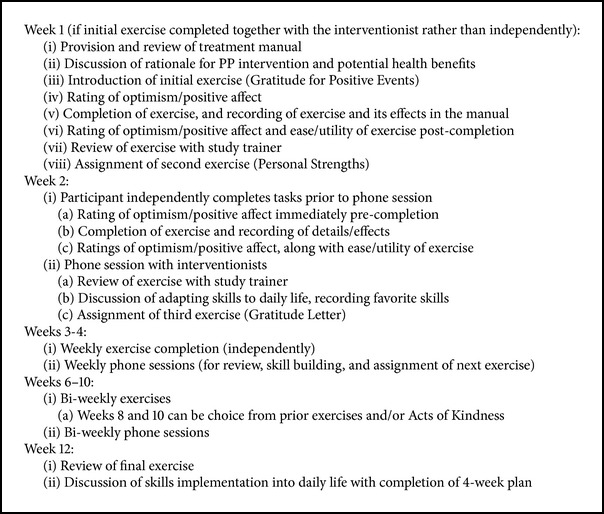
- The authors developed a 12-week PP intervention with 7 exercises—Gratitude for Positive Events, Using Personal Strengths, Gratitude Letter, Enjoyable and Meaningful Activities, Recalling Past Success, Participant’s Choice (repeat an exercise or Acts of Kindness), and Week 12 planning—delivered weekly for the first 4 weeks and biweekly thereafter, with 15–30 minute phone sessions.
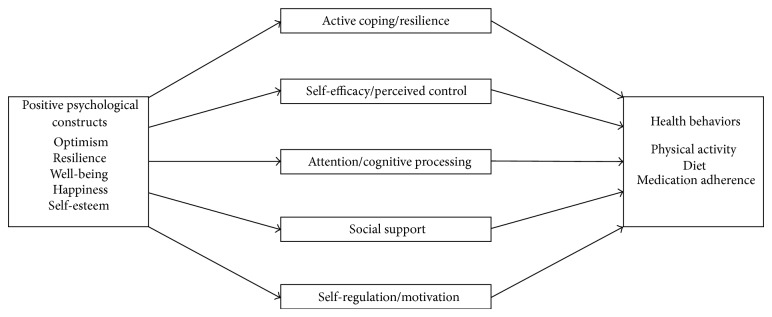
- The theoretical model proposes five mediators linking positive psychological states to health behaviors: attention/cognitive processing, self-regulation/motivation, active coping/resilience, self-efficacy/perceived control, and social interactions/perceived social support; energy/vitality is also noted as a possible additional factor.
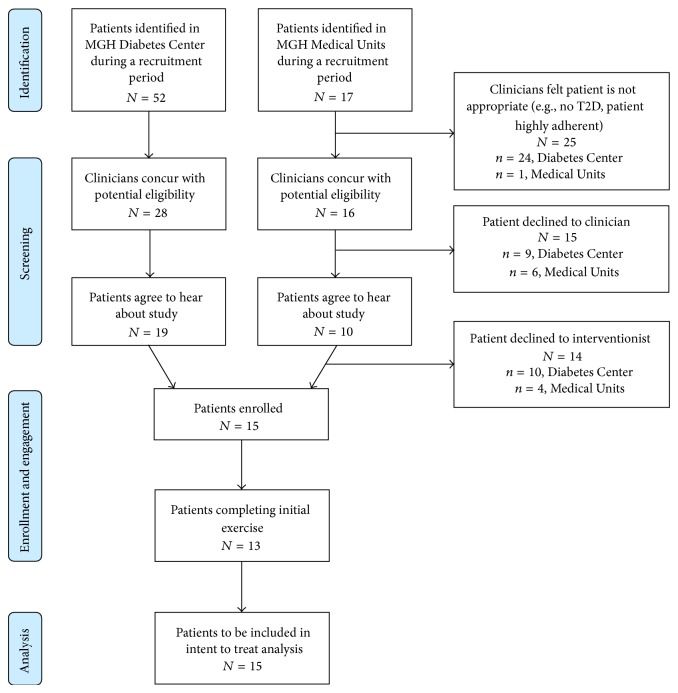
- In the proof-of-concept trial, 69 patients with T2D were identified, 44 were judged potentially eligible, 29 agreed to hear about the study, and 15 were enrolled. Baseline mean age was 60.1 ± 8.8 years, 9 (60%) were women, mean MOS SAS adherence score was 11.4/18, LOT-R optimism was 13.0 ± 6.8, GQ-6 gratitude was 35.7 ± 6.7, HADS-D was 7.0 ± 3.7, and HADS-A was 7.9 ± 4.2.
- At the time of report, 9 participants had completed the study and 6 were still undergoing procedures; of the 9 initial participants, 7 (78%) fully completed at least three PP exercises. There were no differences in age (t = 0.35; P = 0.71), race (χ² = 1.86; P = 0.17), or gender (χ² = 0.47; P = 0.49) between decliners and enrollees.
Methods
- Design: a rationale and theoretical-model paper plus intervention development, with baseline data from a 12-week single-arm proof-of-concept feasibility/acceptability trial.
- Sample: English-speaking adults with T2D by ADA criteria and suboptimal adherence (MOS SAS score <15/18) recruited from the outpatient diabetes center and inpatient medical units of an urban academic medical center; exclusions were cognitive impairment and lack of telephone access. N = 15 enrolled.
- Measures/analysis: baseline self-report measures included LOT-R, GQ-6, HADS, DDS, PROMIS-10, SDSCA, and MOS SAS. Planned feasibility analyses use descriptive statistics and paired t-tests for pre/post optimism and positive affect; planned clinical outcome analyses use random effects regression and Cohen’s d, with Stata 11.2. Reported results are recruitment and baseline data only.
Limitations
- Stated: not all patients may be interested in or willing/able to complete positive activities; there is less evidence regarding PP effects on physiologic outcomes; the field is in very early stages; the trial used only one inpatient and one outpatient site at an academic medical center, and most participants were white, limiting generalizability.
- Stated: the proof-of-concept study was not designed or powered to detect statistically significant differences in clinical outcomes, and interventionist-collected pre/post ratings may be influenced by social desirability.
- Evident: the trial is small (N = 15), single-arm, and without a control condition, and follow-up was incomplete at the time of report, so efficacy and durability cannot be assessed from these data.
Model-written summary. Check it against the paper before relying on it.
Integrity signals
Registry
Cites
Statistics
Figures
Verification
Claims the paper makes
75 Not checked yet · 21 Own interpretation · 8 Own result · 5 Own method · 4 Sources not found · 4 No basis given · 2 Partly supported · accuracy not yet measured
A result the paper reports from its own data — it cites no other source for it, so there is none to check. The quote shows it is in the paper.
In the paper
“Overall, the mean age of participants was 60.1 ± 8.8 years, 9 (60%) were women, and the majority had one or more additional cardiovascular risk factors (e.g., hypertension and hyperlipidemia).”
§ Positive Psychological Interventions for Patients with Type 2 Diabetes: Rationale, Theoretical Model, and Intervention Development > 3. Results
plain- Asserted: passes — The authors put it forward as true.
- Checkable: passes — It can be checked against evidence.
- Load-bearing: unclear — It is unclear whether the paper’s conclusions depend on it.
- Based: passes — The paper gives a reason why it holds.
In the paper
“Participants had relatively low baseline optimism (LOT-R = 13.0 ± 6.8, compared to general population mean of 15.2 ± 3.8 [34])”
§ Positive Psychological Interventions for Patients with Type 2 Diabetes: Rationale, Theoretical Model, and Intervention Development > 3. Results
What the sources say
- Not checked yetcites [34] Schueller S. M. Parks A. C. Disseminating self-help: positive psychology exercises in an online trial Journal of Medical Internet Research 2012 14 3, article e63 10.2196/jmir.1850 2-s2.0-84864196986 PMC3414858 22732765 source
plain- Asserted: passes — The authors put it forward as true.
- Checkable: passes — It can be checked against evidence.
- Load-bearing: unclear — It is unclear whether the paper’s conclusions depend on it.
- Based: passes — The paper gives a reason why it holds.
In the paper
“Participants' mean levels of depression (mean HADS-D = 7.0 ± 3.7) and anxiety (mean HADS-A = 7.9 ± 4.2) were just below the standard cutoff of 8 for clinically significant symptoms [100].”
§ Positive Psychological Interventions for Patients with Type 2 Diabetes: Rationale, Theoretical Model, and Intervention Development > 3. Results
What the sources say
- Not checked yetcites [100] Bjelland I. Dahl A. A. Haug T. T. Neckelmann D. The validity of the hospital anxiety and depression scale: an updated literature review Journal of Psychosomatic Research 2002 52 2 69 77 10.1016/s0022-3999(01)00296-3 2-s2.0-0036188619 11832252 source
plainn = 9- Asserted: passes — The authors put it forward as true.
- Checkable: passes — It can be checked against evidence.
- Load-bearing: unclear — It is unclear whether the paper’s conclusions depend on it.
- Based: passes — The paper gives a reason why it holds.
In the paper
“and gratitude (GQ-6 = 35.7 ± 6.7, general population mean 36.9 ± 4.9 [35]).”
§ Positive Psychological Interventions for Patients with Type 2 Diabetes: Rationale, Theoretical Model, and Intervention Development > 3. Results
What the sources say
- Not checked yetcites [35] McCullough M. E. Emmons R. A. Tsang J.-A. The grateful disposition: a conceptual and empirical topography Journal of Personality and Social Psychology 2002 82 1 112 127 10.1037//0022-3514.82.1.112 2-s2.0-0036364933 11811629 source
plain- Asserted: passes — The authors put it forward as true.
- Checkable: passes — It can be checked against evidence.
- Load-bearing: unclear — It is unclear whether the paper’s conclusions depend on it.
- Based: passes — The paper gives a reason why it holds.
In the paper
“Our qualitative interviews with medically ill patients have found that such patients consistently express a preference for phone over internet because of this personal connection [84].”
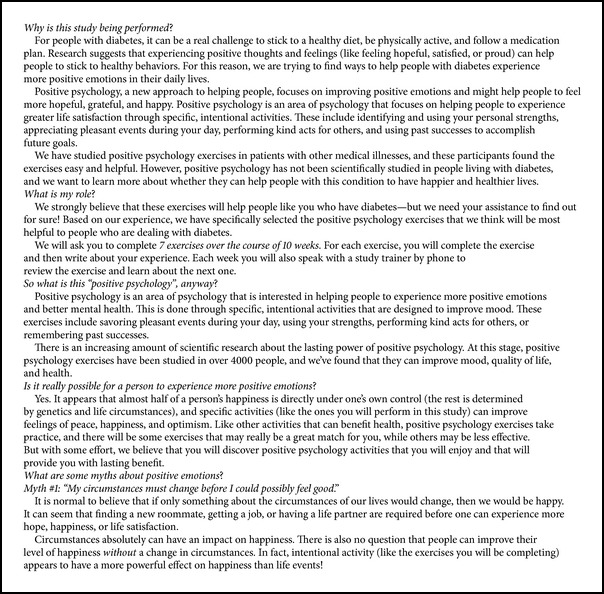
§ Positive Psychological Interventions for Patients with Type 2 Diabetes: Rationale, Theoretical Model, and Intervention Development > 2. Methods > 2.3. PP Intervention Design and Development
What the sources say
- Not matchedcites [84] Huffman J. C. Dubois C. M. Mastromauro C. A. Moore S. V. Park E. R. Positive psychological states and health behaviors in patients with an acute coronary syndrome: a qualitative study Proceedings of the American Psychosomatic Society Annual Meeting March 2014 San Francisco, Calif, USA
Couldn’t be matched to a paper in Crossref, so it can’t be checked.
plaindirect- Asserted: passes — The authors put it forward as true.
- Checkable: passes — It can be checked against evidence.
- Load-bearing: passes — The paper’s conclusions depend on it.
- Based: passes — The paper gives a reason why it holds.
- Not matched
A result the paper reports from its own data — it cites no other source for it, so there is none to check. The quote shows it is in the paper.
In the paper
“Thus far nine participants have completed the study, with six participants still undergoing study procedures; of the nine initial participants, seven (78%) fully completed at least three PP exercises.”
§ Positive Psychological Interventions for Patients with Type 2 Diabetes: Rationale, Theoretical Model, and Intervention Development > 3. Results
plainn = 9- Asserted: passes — The authors put it forward as true.
- Checkable: passes — It can be checked against evidence.
- Load-bearing: unclear — It is unclear whether the paper’s conclusions depend on it.
- Based: passes — The paper gives a reason why it holds.
None of the sources cited for this claim have been checked yet.
In the paper
“Most patients with type 2 diabetes (T2D) have suboptimal adherence to recommended diet, physical activity, and/or medication.”
- Also stated in: § 1. Introduction · plain
“most T2D patients struggle to adhere to one or more major cornerstones of self-management: physical activity, healthy eating, and medication use [7–9].”
§ Positive Psychological Interventions for Patients with Type 2 Diabetes: Rationale, Theoretical Model, and Intervention Development > Abstract
What the sources say
- Not checked yetcites [7] Ho P. M. Rumsfeld J. S. Masoudi F. A. Effect of medication nonadherence on hospitalization and mortality among patients with diabetes mellitus Archives of Internal Medicine 2006 166 17 1836 1841 10.1001/archinte.166.17.1836 2-s2.0-33749006625 17000939 source
- Not checked yetcites [8] Dunkler D. Dehghan M. Teo K. K. Diet and kidney disease in high-risk individuals with type 2 diabetes mellitus JAMA Internal Medicine 2013 173 18 1682 1692 10.1001/jamainternmed.2013.9051 2-s2.0-84885900768 23939297 source
- Not checked yetcites [9] Ford E. S. Herman W. H. Leisure-time physical activity patterns in the U.S. diabetic population. Findings from the 1990 National Health Interview Survey—Health Promotion and Disease Prevention Supplement Diabetes Care 1995 18 1 27 33 10.2337/diacare.18.1.27 2-s2.0-0028888320 7698044 source
plain- Asserted: passes — The authors put it forward as true.
- Checkable: passes — It can be checked against evidence.
- Load-bearing: passes — The paper’s conclusions depend on it.
- Based: passes — The paper gives a reason why it holds.
- Also stated in: § 1. Introduction · plain
None of the sources cited for this claim have been checked yet.
In the paper
“these constructs have been prospectively and independently linked to improvements in health behaviors.”
§ Positive Psychological Interventions for Patients with Type 2 Diabetes: Rationale, Theoretical Model, and Intervention Development > Abstract
What the sources say
- Not checked yetcites [25] Chida Y. Steptoe A. Positive psychological well-being and mortality: a quantitative review of prospective observational studies Psychosomatic Medicine 2008 70 7 741 756 10.1097/psy.0b013e31818105ba 2-s2.0-55649105005 18725425 source
- Not checked yetcites [28] van der Does F. E. E. de Neeling J. N. D. Snoek F. J. Symptoms and well-being in relation to glycemic control in type II diabetes Diabetes Care 1996 19 3 204 210 10.2337/diacare.19.3.204 2-s2.0-0030029843 8742562 source
- Not checked yetcites [29] Tsenkova V. K. Love G. D. Singer B. H. Ryff C. D. Socioeconomic status and psychological well-being predict cross-time change in glycosylated hemoglobin in older women without diabetes Psychosomatic Medicine 2007 69 8 777 784 10.1097/psy.0b013e318157466f 2-s2.0-37349099401 17942843 source
- Not checked yetcites [36] Davidson K. W. Mostofsky E. Whang W. Don't worry, be happy: positive affect and reduced 10-year incident coronary heart disease: the Canadian Nova Scotia Health Survey European Heart Journal 2010 31 9 1065 1070 10.1093/eurheartj/ehp603 2-s2.0-77952084482 20164244 PMC2862179 source
plaincorrelational- Asserted: passes — The authors put it forward as true.
- Checkable: passes — It can be checked against evidence.
- Load-bearing: passes — The paper’s conclusions depend on it.
- Based: passes — The paper gives a reason why it holds.
In the paper
“Psychological states may significantly impact health behavior and clinical outcomes in patients with T2D [17].”
§ Positive Psychological Interventions for Patients with Type 2 Diabetes: Rationale, Theoretical Model, and Intervention Development > 1. Introduction
What the sources say
- Not checked yetcites [17] Celano C. M. Beale E. E. Moore S. V. Wexler D. J. Huffman J. C. Positive psychological characteristics in diabetes: a review Current Diabetes Reports 2013 13 6 917 929 10.1007/s11892-013-0430-8 2-s2.0-84889083094 24048687 source
hedgedconditional- Asserted: passes — The authors put it forward as true.
- Checkable: passes — It can be checked against evidence.
- Load-bearing: passes — The paper’s conclusions depend on it.
- Based: passes — The paper gives a reason why it holds.
A conclusion the paper draws from its own results — it cites no other source for it, so there is none to check. The quote shows it is in the paper.
In the paper
“These beneficial effects of positive psychological states may be mediated through health behaviors.”
§ Positive Psychological Interventions for Patients with Type 2 Diabetes: Rationale, Theoretical Model, and Intervention Development > 1. Introduction
hedgedconditional- Asserted: passes — The authors put it forward as true.
- Checkable: passes — It can be checked against evidence.
- Load-bearing: passes — The paper’s conclusions depend on it.
- Based: passes — The paper gives a reason why it holds.
- Rests on an assumption: The proposed mediation pathways from positive psychological states to health behaviors are causal and applicable to type 2 diabetes.
In the paper
“Current approaches to improve health behaviors in T2D have been variably effective”
- Also stated in: § 1. Introduction · boosted
“Current approaches to improve health behaviors in T2D and other illnesses have demonstrated variable effectiveness [12]”
§ Positive Psychological Interventions for Patients with Type 2 Diabetes: Rationale, Theoretical Model, and Intervention Development > Abstract
What the sources say
- Not checked yetcites [12] Goldstein M. G. Whitlock E. P. DePue J. Multiple behavioral risk factor interventions in primary care: summary of research evidence American Journal of Preventive Medicine 2004 27 2, supplement 61 79 10.1016/j.amepre.2004.04.023 2-s2.0-3242703185 15275675 source
boosted- Asserted: passes — The authors put it forward as true.
- Checkable: passes — It can be checked against evidence.
- Load-bearing: passes — The paper’s conclusions depend on it.
- Based: passes — The paper gives a reason why it holds.
- Also stated in: § 1. Introduction · boosted
In the paper
“Tsenkova et al. [29] found that positive affect at baseline was prospectively associated with reduced HbA1c at 2-year follow-up in older women, independent of multiple covariates.”
§ Positive Psychological Interventions for Patients with Type 2 Diabetes: Rationale, Theoretical Model, and Intervention Development > 1. Introduction
What the sources say
- Not checked yetcites [29] Tsenkova V. K. Love G. D. Singer B. H. Ryff C. D. Socioeconomic status and psychological well-being predict cross-time change in glycosylated hemoglobin in older women without diabetes Psychosomatic Medicine 2007 69 8 777 784 10.1097/psy.0b013e318157466f 2-s2.0-37349099401 17942843 source
plaincorrelational- Asserted: passes — The authors put it forward as true.
- Checkable: passes — It can be checked against evidence.
- Load-bearing: passes — The paper’s conclusions depend on it.
- Based: passes — The paper gives a reason why it holds.
None of the sources cited for this claim have been checked yet.
In the paper
“Studies have consistently found links between increased positive psychological states and greater participation in health behaviors in medical populations.”
§ Positive Psychological Interventions for Patients with Type 2 Diabetes: Rationale, Theoretical Model, and Intervention Development > 1. Introduction
What the sources say
- Not matchedcites [30] Shepperd J. A. Maroto J. J. Pbert L. A. Dispositional optimism as a predictor of health changes among cardiac patients Journal of Research in Personality 1996 10 34 42
Couldn’t be matched to a paper in Crossref, so it can’t be checked.
- Not checked yetcites [31] Hingle M. D. Wertheim B. C. Tindle H. A. Optimism and diet quality in the women's health initiative Journal of the Academy of Nutrition and Dietetics 2014 114 7 1036 1045 10.1016/j.jand.2013.12.018 2-s2.0-84893864177 24556429 PMC4071123 source
- Not checked yetcites [32] Tinker L. F. Rosal M. C. Young A. F. Predictors of dietary change and maintenance in the Women's Health Initiative Dietary Modification Trial Journal of the American Dietetic Association 2007 107 7 1155 1165 10.1016/j.jada.2007.04.010 2-s2.0-34250852892 17604744 source
- Not matchedcites [33] Huffman J. C. Beale E. E. Moore S. V. The connection between positive psychological constructs, biology, and behavior: results from the GRACE study Proceedings of the 2015 American Psychosomatic Society Annual Meeting March 2015 Savannah, Ga, USA
Couldn’t be matched to a paper in Crossref, so it can’t be checked.
boostedcorrelational- Asserted: passes — The authors put it forward as true.
- Checkable: passes — It can be checked against evidence.
- Load-bearing: passes — The paper’s conclusions depend on it.
- Based: passes — The paper gives a reason why it holds.
- Not matched
In the paper
“A meta-analysis of 26 studies (N > 4000) found that psychological well-being was associated with lower rates of mortality in both initially healthy and medically ill populations, independent of traditional risk factors [25].”
§ Positive Psychological Interventions for Patients with Type 2 Diabetes: Rationale, Theoretical Model, and Intervention Development > 1. Introduction
What the sources say
- Not checked yetcites [25] Chida Y. Steptoe A. Positive psychological well-being and mortality: a quantitative review of prospective observational studies Psychosomatic Medicine 2008 70 7 741 756 10.1097/psy.0b013e31818105ba 2-s2.0-55649105005 18725425 source
plaincorrelational- Asserted: passes — The authors put it forward as true.
- Checkable: passes — It can be checked against evidence.
- Load-bearing: passes — The paper’s conclusions depend on it.
- Based: passes — The paper gives a reason why it holds.
In the paper
“In contrast to negative syndromes, positive psychological states may play a substantial and independent beneficial role in health outcomes.”
§ Positive Psychological Interventions for Patients with Type 2 Diabetes: Rationale, Theoretical Model, and Intervention Development > 1. Introduction
What the sources say
- Not checked yetcites [25] Chida Y. Steptoe A. Positive psychological well-being and mortality: a quantitative review of prospective observational studies Psychosomatic Medicine 2008 70 7 741 756 10.1097/psy.0b013e31818105ba 2-s2.0-55649105005 18725425 source
hedgedconditional- Asserted: passes — The authors put it forward as true.
- Checkable: passes — It can be checked against evidence.
- Load-bearing: passes — The paper’s conclusions depend on it.
- Based: passes — The paper gives a reason why it holds.
None of the sources cited for this claim have been checked yet.
In the paper
“Negative psychological syndromes such as depression and anxiety have been consistently associated with poor outcomes in patients with T2D [18–20].”
§ Positive Psychological Interventions for Patients with Type 2 Diabetes: Rationale, Theoretical Model, and Intervention Development > 1. Introduction
What the sources say
- Not checked yetcites [18] Anderson R. J. Freedland K. E. Clouse R. E. Lustman P. J. The prevalence of comorbid depression in adults with diabetes: a meta-analysis Diabetes Care 2001 24 6 1069 1078 10.2337/diacare.24.6.1069 2-s2.0-0035374580 11375373 source
- Not checked yetcites [19] Li C. Barker L. Ford E. S. Zhang X. Strine T. W. Mokdad A. H. Diabetes and anxiety in US adults: findings from the 2006 behavioral risk factor surveillance system Diabetic Medicine 2008 25 7 878 881 10.1111/j.1464-5491.2008.02477.x 2-s2.0-49649095019 18644077 source
- Not checked yetcites [20] Niemcryk S. J. Speers M. A. Travis L. B. Gary H. E. Psychosocial correlates of hemoglobin Alc in young adults with type I diabetes Journal of Psychosomatic Research 1990 34 6 617 627 10.1016/0022-3999(90)90105-d 2-s2.0-0025614597 2290134 source
boostedcorrelational- Asserted: passes — The authors put it forward as true.
- Checkable: passes — It can be checked against evidence.
- Load-bearing: passes — The paper’s conclusions depend on it.
- Based: passes — The paper gives a reason why it holds.
In the paper
“As opposed to standard, disorder-based psychological interventions, a PP intervention can be delivered to the vast majority of patients who have T2D, rather than applying only to the subset of T2D patients with depression, anxiety disorders, or other clinical psychiatric conditions [52].”
§ Positive Psychological Interventions for Patients with Type 2 Diabetes: Rationale, Theoretical Model, and Intervention Development > 2. Methods > 2.1. PP Interventions
What the sources say
- Not checked yetcites [52] Fredrickson B. L. The role of positive emotions in positive psychology: the broaden-and-build theory of positive emotions American Psychologist 2001 56 3 218 226 10.1037//0003-066x.56.3.218 2-s2.0-0035289375 11315248 PMC3122271 source
plain- Asserted: passes — The authors put it forward as true.
- Checkable: passes — It can be checked against evidence.
- Load-bearing: passes — The paper’s conclusions depend on it.
- Based: passes — The paper gives a reason why it holds.
A conclusion the paper draws from its own results — it cites no other source for it, so there is none to check. The quote shows it is in the paper.
In the paper
“cultivating these states may have a meaningful impact on completing vital self-care in T2D.”
§ Positive Psychological Interventions for Patients with Type 2 Diabetes: Rationale, Theoretical Model, and Intervention Development > 1. Introduction
hedgedconditional- Asserted: passes — The authors put it forward as true.
- Checkable: passes — It can be checked against evidence.
- Load-bearing: passes — The paper’s conclusions depend on it.
- Based: passes — The paper gives a reason why it holds.
- Rests on an assumption: The proposed mediation pathways from positive psychological states to health behaviors are causal and applicable to type 2 diabetes.
In the paper
“we also recently found that PP interventions led to improvements in self-reported health behavior (diet, exercise, and medication adherence) in a cohort of patients with cardiovascular disease [51].”
§ Positive Psychological Interventions for Patients with Type 2 Diabetes: Rationale, Theoretical Model, and Intervention Development > 2. Methods > 2.1. PP Interventions
What the sources say
- Not checked yetcites [51] Unützer J. Katon W. J. Fan M.-Y. Long-term cost effects of collaborative care for late-life depression The American Journal of Managed Care 2008 14 2 95 100 2-s2.0-39749171951 18269305 PMC3810022
plaindirect- Asserted: passes — The authors put it forward as true.
- Checkable: passes — It can be checked against evidence.
- Load-bearing: unclear — It is unclear whether the paper’s conclusions depend on it.
- Based: passes — The paper gives a reason why it holds.
None of the sources cited for this claim have been checked yet.
In the paper
“A pair of analyses found optimism to be associated with greater improvement in dietary quality, controlling for baseline diet, over one year in postmenopausal women [31, 32].”
§ Positive Psychological Interventions for Patients with Type 2 Diabetes: Rationale, Theoretical Model, and Intervention Development > 1. Introduction
What the sources say
- Not checked yetcites [31] Hingle M. D. Wertheim B. C. Tindle H. A. Optimism and diet quality in the women's health initiative Journal of the Academy of Nutrition and Dietetics 2014 114 7 1036 1045 10.1016/j.jand.2013.12.018 2-s2.0-84893864177 24556429 PMC4071123 source
- Not checked yetcites [32] Tinker L. F. Rosal M. C. Young A. F. Predictors of dietary change and maintenance in the Women's Health Initiative Dietary Modification Trial Journal of the American Dietetic Association 2007 107 7 1155 1165 10.1016/j.jada.2007.04.010 2-s2.0-34250852892 17604744 source
plaincorrelational- Asserted: passes — The authors put it forward as true.
- Checkable: passes — It can be checked against evidence.
- Load-bearing: passes — The paper’s conclusions depend on it.
- Based: passes — The paper gives a reason why it holds.
None of the sources cited for this claim have been checked yet.
In the paper
“Positive psychological constructs appear to affect attention and cognitive processing.”
§ Positive Psychological Interventions for Patients with Type 2 Diabetes: Rationale, Theoretical Model, and Intervention Development > 2. Methods > 2.2. Theoretical Model (Figure 1)
What the sources say
- Not checked yetcites [37] Reed M. B. Aspinwall L. G. Self-affirmation reduces biased processing of health-risk information Motivation and Emotion 1998 22 2 99 132 10.1023/a:1021463221281 2-s2.0-0032338605 source
- Not checked yetcites [56] Aspinwall L. G. Tedeschi R. G. The value of positive psychology for health psychology: progress and pitfalls in examining the relation of positive phenomena to health Annals of Behavioral Medicine 2010 39 1 4 15 10.1007/s12160-009-9153-0 2-s2.0-77957283295 20091429 source
hedgedconditional- Asserted: passes — The authors put it forward as true.
- Checkable: passes — It can be checked against evidence.
- Load-bearing: passes — The paper’s conclusions depend on it.
- Based: passes — The paper gives a reason why it holds.
None of the sources cited for this claim have been checked yet.
In the paper
“More recently, randomized controlled trials of PP-related interventions in heart and lung disease patients led to improvements from baseline health behaviors (medication adherence and physical activity) [46–48].”
§ Positive Psychological Interventions for Patients with Type 2 Diabetes: Rationale, Theoretical Model, and Intervention Development > 2. Methods > 2.1. PP Interventions
What the sources say
- Not checked yetcites [46] Mancuso C. A. Choi T. N. Westermann H. Increasing physical activity in patients with asthma through positive affect and self-affirmation: a randomized trial Archives of Internal Medicine 2012 172 4 337 343 10.1001/archinternmed.2011.1316 2-s2.0-84857807594 22269593 PMC3640830 source
- Not checked yetcites [47] Ogedegbe G. O. Boutin-Foster C. Wells M. T. A randomized controlled trial of positive-affect intervention and medication adherence in hypertensive African Americans Archives of Internal Medicine 2012 172 4 322 326 10.1001/archinternmed.2011.1307 2-s2.0-84857865198 22269592 PMC4669680 source
- Not checked yetcites [48] Peterson J. C. Charlson M. E. Hoffman Z. A randomized controlled trial of positive-affect induction to promote physical activity after percutaneous coronary intervention Archives of Internal Medicine 2012 172 4 329 336 10.1001/archinternmed.2011.1311 2-s2.0-84857862882 22269589 PMC3717982 source
plaindirect- Asserted: passes — The authors put it forward as true.
- Checkable: passes — It can be checked against evidence.
- Load-bearing: passes — The paper’s conclusions depend on it.
- Based: passes — The paper gives a reason why it holds.
In the paper
“Shepperd and colleagues [30] found that higher levels of optimism measured at the outset of cardiac rehabilitation predicted greater improvements in physical activity and saturated fat intake.”
§ Positive Psychological Interventions for Patients with Type 2 Diabetes: Rationale, Theoretical Model, and Intervention Development > 1. Introduction
What the sources say
- Not checked yetcites [30] Shepperd J. A. Maroto J. J. Pbert L. A. Dispositional optimism as a predictor of health changes among cardiac patients Journal of Research in Personality 1996 10 34 42
plaincorrelational- Asserted: passes — The authors put it forward as true.
- Checkable: passes — It can be checked against evidence.
- Load-bearing: unclear — It is unclear whether the paper’s conclusions depend on it.
- Based: passes — The paper gives a reason why it holds.
None of the sources cited for this claim have been checked yet.
In the paper
“Importantly, positive psychological states are not simply the flipside of depression.”
§ Positive Psychological Interventions for Patients with Type 2 Diabetes: Rationale, Theoretical Model, and Intervention Development > 1. Introduction
What the sources say
- Not checked yetcites [34] Schueller S. M. Parks A. C. Disseminating self-help: positive psychology exercises in an online trial Journal of Medical Internet Research 2012 14 3, article e63 10.2196/jmir.1850 2-s2.0-84864196986 PMC3414858 22732765 source
- Not checked yetcites [35] McCullough M. E. Emmons R. A. Tsang J.-A. The grateful disposition: a conceptual and empirical topography Journal of Personality and Social Psychology 2002 82 1 112 127 10.1037//0022-3514.82.1.112 2-s2.0-0036364933 11811629 source
plain- Asserted: passes — The authors put it forward as true.
- Checkable: passes — It can be checked against evidence.
- Load-bearing: passes — The paper’s conclusions depend on it.
- Based: passes — The paper gives a reason why it holds.
None of the sources cited for this claim have been checked yet.
In the paper
“Furthermore, the effects of positive states on health behaviors and outcomes in medical illnesses persist even after accounting for negative affect/depression [25, 28, 29, 36].”
§ Positive Psychological Interventions for Patients with Type 2 Diabetes: Rationale, Theoretical Model, and Intervention Development > 1. Introduction
What the sources say
- Not checked yetcites [25] Chida Y. Steptoe A. Positive psychological well-being and mortality: a quantitative review of prospective observational studies Psychosomatic Medicine 2008 70 7 741 756 10.1097/psy.0b013e31818105ba 2-s2.0-55649105005 18725425 source
- Not checked yetcites [28] van der Does F. E. E. de Neeling J. N. D. Snoek F. J. Symptoms and well-being in relation to glycemic control in type II diabetes Diabetes Care 1996 19 3 204 210 10.2337/diacare.19.3.204 2-s2.0-0030029843 8742562 source
- Not checked yetcites [29] Tsenkova V. K. Love G. D. Singer B. H. Ryff C. D. Socioeconomic status and psychological well-being predict cross-time change in glycosylated hemoglobin in older women without diabetes Psychosomatic Medicine 2007 69 8 777 784 10.1097/psy.0b013e318157466f 2-s2.0-37349099401 17942843 source
- Not checked yetcites [36] Davidson K. W. Mostofsky E. Whang W. Don't worry, be happy: positive affect and reduced 10-year incident coronary heart disease: the Canadian Nova Scotia Health Survey European Heart Journal 2010 31 9 1065 1070 10.1093/eurheartj/ehp603 2-s2.0-77952084482 20164244 PMC2862179 source
plaincorrelational- Asserted: passes — The authors put it forward as true.
- Checkable: passes — It can be checked against evidence.
- Load-bearing: passes — The paper’s conclusions depend on it.
- Based: passes — The paper gives a reason why it holds.
A conclusion the paper draws from its own results — it cites no other source for it, so there is none to check. The quote shows it is in the paper.
In the paper
“This in turn could improve glycemic control and prognosis in this common and disabling condition.”
§ Positive Psychological Interventions for Patients with Type 2 Diabetes: Rationale, Theoretical Model, and Intervention Development > 1. Introduction
hedgedconditional- Asserted: passes — The authors put it forward as true.
- Checkable: passes — It can be checked against evidence.
- Load-bearing: passes — The paper’s conclusions depend on it.
- Based: passes — The paper gives a reason why it holds.
- Rests on an assumption: The proposed mediation pathways from positive psychological states to health behaviors are causal and applicable to type 2 diabetes.
None of the sources cited for this claim have been checked yet.
In the paper
“Broadly, positive states are thought to improve people's social, psychological, and physical resources [55–57].”
§ Positive Psychological Interventions for Patients with Type 2 Diabetes: Rationale, Theoretical Model, and Intervention Development > 2. Methods > 2.2. Theoretical Model (Figure 1)
What the sources say
- Not checked yetcites [55] Fredrickson B. L. What good are positive emotions? Review of General Psychology 1998 2 3 300 319 10.1037/1089-2680.2.3.300 2-s2.0-0002323142 21850154 PMC3156001 source
- Not checked yetcites [56] Aspinwall L. G. Tedeschi R. G. The value of positive psychology for health psychology: progress and pitfalls in examining the relation of positive phenomena to health Annals of Behavioral Medicine 2010 39 1 4 15 10.1007/s12160-009-9153-0 2-s2.0-77957283295 20091429 source
- Not checked yetcites [57] Aspinwall L. G. Rethinking the role of positive affect in self-regulation Motivation and Emotion 1998 22 1 1 32 10.1023/A:1023080224401 2-s2.0-0032363704 source
hedgedconditional- Asserted: passes — The authors put it forward as true.
- Checkable: passes — It can be checked against evidence.
- Load-bearing: passes — The paper’s conclusions depend on it.
- Based: passes — The paper gives a reason why it holds.
In the paper
“In an observational study of patients with recent acute coronary syndrome, participants with greater optimism 2 weeks after event had greater physical activity at 6 months, controlling for baseline physical activity and overall baseline health status [33].”
§ Positive Psychological Interventions for Patients with Type 2 Diabetes: Rationale, Theoretical Model, and Intervention Development > 1. Introduction
What the sources say
- Not matchedcites [33] Huffman J. C. Beale E. E. Moore S. V. The connection between positive psychological constructs, biology, and behavior: results from the GRACE study Proceedings of the 2015 American Psychosomatic Society Annual Meeting March 2015 Savannah, Ga, USA
Couldn’t be matched to a paper in Crossref, so it can’t be checked.
plaincorrelational- Asserted: passes — The authors put it forward as true.
- Checkable: passes — It can be checked against evidence.
- Load-bearing: passes — The paper’s conclusions depend on it.
- Based: passes — The paper gives a reason why it holds.
- Not matched
A conclusion the paper draws from its own results — it cites no other source for it, so there is none to check. The quote shows it is in the paper.
In the paper
“suggesting that nondepressed persons with T2D may still have substantial deficits in positive states.”
§ Positive Psychological Interventions for Patients with Type 2 Diabetes: Rationale, Theoretical Model, and Intervention Development > 1. Introduction
hedged- Asserted: passes — The authors put it forward as true.
- Checkable: passes — It can be checked against evidence.
- Load-bearing: passes — The paper’s conclusions depend on it.
- Based: passes — The paper gives a reason why it holds.
None of the sources cited for this claim have been checked yet.
In the paper
“Positive affect is also linked to improved coping and problem-solving skills [56, 58].”
§ Positive Psychological Interventions for Patients with Type 2 Diabetes: Rationale, Theoretical Model, and Intervention Development > 2. Methods > 2.2. Theoretical Model (Figure 1)
What the sources say
- Not checked yetcites [56] Aspinwall L. G. Tedeschi R. G. The value of positive psychology for health psychology: progress and pitfalls in examining the relation of positive phenomena to health Annals of Behavioral Medicine 2010 39 1 4 15 10.1007/s12160-009-9153-0 2-s2.0-77957283295 20091429 source
- Not checked yetcites [58] Yi-Frazier J. P. Hilliard M. Cochrane K. Hood K. The impact of positive psychology on diabetes outcomes: a review Psychology 2012 3 12A 1116 1124 10.4236/psych.2012.312A165 source
plaincorrelational- Asserted: passes — The authors put it forward as true.
- Checkable: passes — It can be checked against evidence.
- Load-bearing: passes — The paper’s conclusions depend on it.
- Based: passes — The paper gives a reason why it holds.
In the paper
“A minimum of 60 exercises completed by 15 participants would lead to this study being powered at >96% to identify between-group differences with the moderate (Cohen's d = 0.5) immediate effect of PP exercise on optimism and positive affect seen in our prior PP intervention studies [50].”
§ Positive Psychological Interventions for Patients with Type 2 Diabetes: Rationale, Theoretical Model, and Intervention Development > 2. Methods > 2.5. Feasibility Study—Design and Baseline Data
What the sources say
- Not checked yetcites [50] Huffman J. C. DuBois C. M. Healy B. C. Feasibility and utility of positive psychology exercises for suicidal inpatients General Hospital Psychiatry 2014 36 1 88 94 10.1016/j.genhosppsych.2013.10.006 2-s2.0-84891276682 24230461
hedgeddirectn = 15- Asserted: passes — The authors put it forward as true.
- Checkable: passes — It can be checked against evidence.
- Load-bearing: passes — The paper’s conclusions depend on it.
- Based: passes — The paper gives a reason why it holds.
None of the sources cited for this claim have been checked yet.
In the paper
“a meaningful subset of T2D patients will not have ready internet access (especially those of lower SES and underrepresented minorities, two groups known to have lesser internet access [85, 86])”
§ Positive Psychological Interventions for Patients with Type 2 Diabetes: Rationale, Theoretical Model, and Intervention Development > 2. Methods > 2.3. PP Intervention Design and Development
What the sources say
- Not checked yetcites [85] Carroll A. E. Rivara F. P. Ebel B. Zimmerman F. J. Christakis D. A. Household computer and Internet access: the digital divide in a pediatric clinic population AMIA Annual Symposium Proceedings 2005 111 115 16779012 PMC1560660
- Not checked yetcites [86] Kind T. Huang Z. J. Farr D. Pomerantz K. L. Internet and computer access and use for health information in an underserved community Ambulatory Pediatrics 2005 5 2 117 121 10.1367/A04-107R.1 2-s2.0-16344366697 15780014 source
boostedcorrelational- Asserted: passes — The authors put it forward as true.
- Checkable: passes — It can be checked against evidence.
- Load-bearing: passes — The paper’s conclusions depend on it.
- Based: passes — The paper gives a reason why it holds.
A conclusion the paper draws from its own results — it cites no other source for it, so there is none to check. The quote shows it is in the paper.
In the paper
“thus, a phone-based solution can be accessed by a greater number of individuals.”
§ Positive Psychological Interventions for Patients with Type 2 Diabetes: Rationale, Theoretical Model, and Intervention Development > 2. Methods > 2.3. PP Intervention Design and Development
plaindirect- Asserted: passes — The authors put it forward as true.
- Checkable: passes — It can be checked against evidence.
- Load-bearing: passes — The paper’s conclusions depend on it.
- Based: passes — The paper gives a reason why it holds.
None of the sources cited for this claim have been checked yet.
In the paper
“active coping has been shown to improve diabetes self-management [58, 65, 66].”
§ Positive Psychological Interventions for Patients with Type 2 Diabetes: Rationale, Theoretical Model, and Intervention Development > 2. Methods > 2.2. Theoretical Model (Figure 1)
What the sources say
- Not checked yetcites [58] Yi-Frazier J. P. Hilliard M. Cochrane K. Hood K. The impact of positive psychology on diabetes outcomes: a review Psychology 2012 3 12A 1116 1124 10.4236/psych.2012.312A165 source
- Not checked yetcites [65] Fisher E. B. Thorpe C. T. Devellis B. M. Devellis R. F. Healthy coping, negative emotions, and diabetes management: a systematic review and appraisal The Diabetes Educator 2007 33 6 1080 1103 10.1177/0145721707309808 2-s2.0-36249026182 18057276 source
- Not checked yetcites [66] Rose M. Fliege H. Hildebrandt M. Schirop T. Klapp B. F. The network of psychological variables in patients with diabetes and their importance for quality of life and metabolic control Diabetes Care 2002 25 1 35 42 10.2337/diacare.25.1.35 2-s2.0-0036357876 11772898 source
plaindirect- Asserted: passes — The authors put it forward as true.
- Checkable: passes — It can be checked against evidence.
- Load-bearing: passes — The paper’s conclusions depend on it.
- Based: passes — The paper gives a reason why it holds.
None of the sources cited for this claim have been checked yet.
In the paper
“Social support, in turn, is linked with uptake and maintenance of health behaviors, including diabetes self-management [58, 77, 78].”
§ Positive Psychological Interventions for Patients with Type 2 Diabetes: Rationale, Theoretical Model, and Intervention Development > 2. Methods > 2.2. Theoretical Model (Figure 1)
What the sources say
- Not checked yetcites [58] Yi-Frazier J. P. Hilliard M. Cochrane K. Hood K. The impact of positive psychology on diabetes outcomes: a review Psychology 2012 3 12A 1116 1124 10.4236/psych.2012.312A165 source
- Not checked yetcites [77] Lewis B. A. Marcus B. H. Pate R. R. Dunn A. L. Psychosocial mediators of physical activity behavior among adults and children American Journal of Preventive Medicine 2002 23 2, supplement 1 26 35 10.1016/s0749-3797(02)00471-3 2-s2.0-0036326810 12133735 source
- Not checked yetcites [78] Wing R. R. Jeffery R. W. Benefits of recruiting participants with friends and increasing social support for weight loss and maintenance Journal of Consulting and Clinical Psychology 1999 67 1 132 138 10.1037/0022-006X.67.1.132 2-s2.0-0033016511 10028217 source
plaincorrelational- Asserted: passes — The authors put it forward as true.
- Checkable: passes — It can be checked against evidence.
- Load-bearing: passes — The paper’s conclusions depend on it.
- Based: passes — The paper gives a reason why it holds.
What the paper did — it cites no source for this, so there is none to check. The quote shows it is in the paper.
In the paper
“This proof-of-concept study with a target recruitment of 15 participants was not designed (and was not powered) to detect statistically significant differences between baseline and later follow-up points on these outcome measures.”
§ Positive Psychological Interventions for Patients with Type 2 Diabetes: Rationale, Theoretical Model, and Intervention Development > 2. Methods > 2.5. Feasibility Study—Design and Baseline Data
plainn = 15- Asserted: passes — The authors put it forward as true.
- Checkable: passes — It can be checked against evidence.
- Load-bearing: passes — The paper’s conclusions depend on it.
- Based: passes — The paper gives a reason why it holds.
In the paper
“positive affect may have stress-buffering effects that allow for a broader range of adaptive and creative coping skills [56]”
§ Positive Psychological Interventions for Patients with Type 2 Diabetes: Rationale, Theoretical Model, and Intervention Development > 2. Methods > 2.2. Theoretical Model (Figure 1)
What the sources say
- Not checked yetcites [56] Aspinwall L. G. Tedeschi R. G. The value of positive psychology for health psychology: progress and pitfalls in examining the relation of positive phenomena to health Annals of Behavioral Medicine 2010 39 1 4 15 10.1007/s12160-009-9153-0 2-s2.0-77957283295 20091429 source
hedgedconditional- Asserted: passes — The authors put it forward as true.
- Checkable: passes — It can be checked against evidence.
- Load-bearing: passes — The paper’s conclusions depend on it.
- Based: passes — The paper gives a reason why it holds.
In the paper
“Positive states are also associated with increased self-control and motivation toward specific goals [62].”
§ Positive Psychological Interventions for Patients with Type 2 Diabetes: Rationale, Theoretical Model, and Intervention Development > 2. Methods > 2.2. Theoretical Model (Figure 1)
What the sources say
- Not checked yetcites [62] Fishbach A. Labroo A. A. Be better or be merry: how mood affects self-control Journal of Personality and Social Psychology 2007 93 2 158 173 10.1037/0022-3514.93.2.158 2-s2.0-34548826766 17645393 source
plaincorrelational- Asserted: passes — The authors put it forward as true.
- Checkable: passes — It can be checked against evidence.
- Load-bearing: passes — The paper’s conclusions depend on it.
- Based: passes — The paper gives a reason why it holds.
None of the sources cited for this claim have been checked yet.
In the paper
“Improved self-control and motivation are key drivers in meeting T2D-relevant health behavior goals [39, 63].”
§ Positive Psychological Interventions for Patients with Type 2 Diabetes: Rationale, Theoretical Model, and Intervention Development > 2. Methods > 2.2. Theoretical Model (Figure 1)
What the sources say
- Not checked yetcites [39] Williams G. C. McGregor H. A. Zeldman A. Freedman Z. R. Deci E. L. Testing a self-determination theory process model for promoting glycemic control through diabetes self-management Health Psychology 2004 23 1 58 66 10.1037/0278-6133.23.1.58 2-s2.0-1642539091 14756604 source
- Not checked yetcites [63] Fortier M. S. Sweet S. N. O'Sullivan T. L. Williams G. C. A self-determination process model of physical activity adoption in the context of a randomized controlled trial Psychology of Sport and Exercise 2007 8 5 741 757 10.1016/j.psychsport.2006.10.006 2-s2.0-34547191094 source
plaindirect- Asserted: passes — The authors put it forward as true.
- Checkable: passes — It can be checked against evidence.
- Load-bearing: passes — The paper’s conclusions depend on it.
- Based: passes — The paper gives a reason why it holds.
In the paper
“Fortunately, MI and MET have been successfully combined with additional interventions in numerous populations, including interventions targeting weight control or health behaviors in those with medical illness.”
§ Positive Psychological Interventions for Patients with Type 2 Diabetes: Rationale, Theoretical Model, and Intervention Development > 4. Discussion > 4.3. MI and Related Health Behavior Interventions
What the sources say
- Not checked yetcites [121] Ismail K. Thomas S. M. Maissi E. Motivational enhancement therapy with and without cognitive behavior therapy to treat type 1 diabetes: a randomized trial Annals of Internal Medicine 2008 149 10 708 719 10.7326/0003-4819-149-10-200811180-00005 2-s2.0-56549130043 19017589 source
plaindirect- Asserted: passes — The authors put it forward as true.
- Checkable: passes — It can be checked against evidence.
- Load-bearing: passes — The paper’s conclusions depend on it.
- Based: passes — The paper gives a reason why it holds.
A conclusion the paper draws from its own results — it cites no other source for it, so there is none to check. The quote shows it is in the paper.
In the paper
“These data suggest that PP interventions may be able to modify positive psychological well-being, even in patients with medical illness.”
§ Positive Psychological Interventions for Patients with Type 2 Diabetes: Rationale, Theoretical Model, and Intervention Development > 4. Discussion > 4.1. Discussion of PP Interventions in T2D
hedgedconditional- Asserted: passes — The authors put it forward as true.
- Checkable: passes — It can be checked against evidence.
- Load-bearing: passes — The paper’s conclusions depend on it.
- Based: passes — The paper gives a reason why it holds.
A conclusion the paper draws from its own results — it cites no other source for it, so there is none to check. The quote shows it is in the paper.
In the paper
“All of these factors make MI attractive to T2D patients who are poorly adherent to key health behaviors.”
§ Positive Psychological Interventions for Patients with Type 2 Diabetes: Rationale, Theoretical Model, and Intervention Development > 4. Discussion > 4.3. MI and Related Health Behavior Interventions
plain- Asserted: passes — The authors put it forward as true.
- Checkable: passes — It can be checked against evidence.
- Load-bearing: passes — The paper’s conclusions depend on it.
- Based: passes — The paper gives a reason why it holds.
None of the sources cited for this claim have been checked yet.
In the paper
“Finally, as opposed to a focus on mindfulness, PP specifically targets behaviors (e.g., leveraging past success) and positive attributes (e.g., positive affect and optimism) that have been associated with increased participation in health behaviors and superior medical outcomes [26, 28, 29].”
§ Positive Psychological Interventions for Patients with Type 2 Diabetes: Rationale, Theoretical Model, and Intervention Development > 4. Discussion > 4.2. Comparison of PP Interventions with Related Interventions
What the sources say
- Not checked yetcites [26] Moskowitz J. T. Epel E. S. Acree M. Positive affect uniquely predicts lower risk of mortality in people with diabetes Health Psychology 2008 27 1, supplement S73 S82 10.1037/0278-6133.27.1.s73 2-s2.0-41949116245 18248108 source
- Not checked yetcites [28] van der Does F. E. E. de Neeling J. N. D. Snoek F. J. Symptoms and well-being in relation to glycemic control in type II diabetes Diabetes Care 1996 19 3 204 210 10.2337/diacare.19.3.204 2-s2.0-0030029843 8742562 source
- Not checked yetcites [29] Tsenkova V. K. Love G. D. Singer B. H. Ryff C. D. Socioeconomic status and psychological well-being predict cross-time change in glycosylated hemoglobin in older women without diabetes Psychosomatic Medicine 2007 69 8 777 784 10.1097/psy.0b013e318157466f 2-s2.0-37349099401 17942843 source
plaincorrelational- Asserted: passes — The authors put it forward as true.
- Checkable: passes — It can be checked against evidence.
- Load-bearing: passes — The paper’s conclusions depend on it.
- Based: passes — The paper gives a reason why it holds.
In the paper
“Furthermore, a small randomized trial (N = 43) of an online positive affect skills intervention led to improvements in depressive symptoms in T2D patients [54].”
§ Positive Psychological Interventions for Patients with Type 2 Diabetes: Rationale, Theoretical Model, and Intervention Development > 4. Discussion > 4.1. Discussion of PP Interventions in T2D
What the sources say
- Not checked yetcites [54] Cohn M. A. Pietrucha M. E. Saslow L. R. Hult J. R. Moskowitz J. T. An online positive affect skills intervention reduces depression in adults with type 2 diabetes The Journal of Positive Psychology 2014 9 6 523 534 10.1080/17439760.2014.920410 25214877 PMC4157680 source
plaindirectn = 43- Asserted: passes — The authors put it forward as true.
- Checkable: passes — It can be checked against evidence.
- Load-bearing: unclear — It is unclear whether the paper’s conclusions depend on it.
- Based: passes — The paper gives a reason why it holds.
In the paper
“Furthermore, it has been utilized for many years to successfully address an incredible variety of health behaviors, including physical activity, diet, and medication adherence [110].”
§ Positive Psychological Interventions for Patients with Type 2 Diabetes: Rationale, Theoretical Model, and Intervention Development > 4. Discussion > 4.3. MI and Related Health Behavior Interventions
What the sources say
- Not checked yetcites [110] Miller W. R. Rollnick S. Motivational Interviewing: Preparing People for Change 2012 3rd New York, NY, USA Guilford Press source
plaindirect- Asserted: passes — The authors put it forward as true.
- Checkable: passes — It can be checked against evidence.
- Load-bearing: unclear — It is unclear whether the paper’s conclusions depend on it.
- Based: passes — The paper gives a reason why it holds.
None of the sources cited for this claim have been checked yet.
In the paper
“Even more promising are the findings from randomized trials [47, 48] of PP-type interventions in patients with cardiovascular illness that found such interventions to be associated with significantly greater improvements in health behaviors (e.g., physical activity [48] and medication adherence [47]) than in the control conditions.”
§ Positive Psychological Interventions for Patients with Type 2 Diabetes: Rationale, Theoretical Model, and Intervention Development > 4. Discussion > 4.1. Discussion of PP Interventions in T2D
What the sources say
- Not checked yetcites [47] Ogedegbe G. O. Boutin-Foster C. Wells M. T. A randomized controlled trial of positive-affect intervention and medication adherence in hypertensive African Americans Archives of Internal Medicine 2012 172 4 322 326 10.1001/archinternmed.2011.1307 2-s2.0-84857865198 22269592 PMC4669680 source
- Not checked yetcites [48] Peterson J. C. Charlson M. E. Hoffman Z. A randomized controlled trial of positive-affect induction to promote physical activity after percutaneous coronary intervention Archives of Internal Medicine 2012 172 4 329 336 10.1001/archinternmed.2011.1311 2-s2.0-84857862882 22269589 PMC3717982 source
plaincorrelational- Asserted: passes — The authors put it forward as true.
- Checkable: passes — It can be checked against evidence.
- Load-bearing: passes — The paper’s conclusions depend on it.
- Based: passes — The paper gives a reason why it holds.
In the paper
“Controlled studies of PP interventions have led to increased positive psychological well-being in a wide variety of populations [41]”
§ Positive Psychological Interventions for Patients with Type 2 Diabetes: Rationale, Theoretical Model, and Intervention Development > 4. Discussion > 4.1. Discussion of PP Interventions in T2D
What the sources say
- Not checked yetcites [41] Bolier L. Haverman M. Westerhof G. J. Riper H. Smit F. Bohlmeijer E. Positive psychology interventions: a meta-analysis of randomized controlled studies BMC Public Health 2013 13, article 119 10.1186/1471-2458-13-119 2-s2.0-84873463456 PMC3599475 23390882 source
plaindirect- Asserted: passes — The authors put it forward as true.
- Checkable: passes — It can be checked against evidence.
- Load-bearing: passes — The paper’s conclusions depend on it.
- Based: passes — The paper gives a reason why it holds.
None of the sources cited for this claim have been checked yet.
In the paper
“However, PP interventions have a focus on validated exercises that target additional specific positive constructs beyond optimism or self-efficacy (e.g., positive affect) linked to beneficial outcomes [108, 109].”
§ Positive Psychological Interventions for Patients with Type 2 Diabetes: Rationale, Theoretical Model, and Intervention Development > 4. Discussion > 4.2. Comparison of PP Interventions with Related Interventions
What the sources say
- Not checked yetcites [108] Bandura A. Health promotion by social cognitive means Health Education and Behavior 2004 31 2 143 164 10.1177/1090198104263660 2-s2.0-2342650165 15090118 source
- Not checked yetcites [109] Dlugonski D. Motl R. W. Mohr D. C. Sandroff B. M. Internet-delivered behavioral intervention to increase physical activity in persons with multiple sclerosis: sustainability and secondary outcomes Psychology, Health & Medicine 2012 17 6 636 651 10.1080/13548506.2011.652640 2-s2.0-84867351123 22313192 source
plaincorrelational- Asserted: passes — The authors put it forward as true.
- Checkable: passes — It can be checked against evidence.
- Load-bearing: passes — The paper’s conclusions depend on it.
- Based: passes — The paper gives a reason why it holds.
A conclusion the paper draws from its own results — it cites no other source for it, so there is none to check. The quote shows it is in the paper.
In the paper
“These moderate effects may not be enough to result in changes in major downstream outcomes (e.g., reduced admissions or mortality).”
§ Positive Psychological Interventions for Patients with Type 2 Diabetes: Rationale, Theoretical Model, and Intervention Development > 4. Discussion > 4.3. MI and Related Health Behavior Interventions
hedgedconditional- Asserted: passes — The authors put it forward as true.
- Checkable: passes — It can be checked against evidence.
- Load-bearing: passes — The paper’s conclusions depend on it.
- Based: passes — The paper gives a reason why it holds.
The paper states this without a source or data behind it here, so there is nothing to check it against. The quote shows it is in the paper.
In the paper
“Finally, it can be delivered remotely.”
§ Positive Psychological Interventions for Patients with Type 2 Diabetes: Rationale, Theoretical Model, and Intervention Development > 4. Discussion > 4.3. MI and Related Health Behavior Interventions
plain- Asserted: passes — The authors put it forward as true.
- Checkable: passes — It can be checked against evidence.
- Load-bearing: passes — The paper’s conclusions depend on it.
- Based: unclear — It is unclear why the paper says it holds.
In the paper
“First, MI can be used with patients at any stage of change, from those who feel that they currently are not motivated to increase their activity to those who are highly motivated to increase activity but have failed on prior attempts [113].”
§ Positive Psychological Interventions for Patients with Type 2 Diabetes: Rationale, Theoretical Model, and Intervention Development > 4. Discussion > 4.3. MI and Related Health Behavior Interventions
What the sources say
- Not checked yetcites [113] Miller W. R. Rose G. S. Toward a theory of motivational interviewing American Psychologist 2009 64 6 527 537 10.1037/a0016830 2-s2.0-70349428558 19739882 PMC2759607 source
plain- Asserted: passes — The authors put it forward as true.
- Checkable: passes — It can be checked against evidence.
- Load-bearing: passes — The paper’s conclusions depend on it.
- Based: passes — The paper gives a reason why it holds.
A conclusion the paper draws from its own results — it cites no other source for it, so there is none to check. The quote shows it is in the paper.
In the paper
“Thus far it appears that recruitment and enrollment for a proof-of-concept study of a PP intervention in T2D is feasible in both inpatient and outpatient settings, and phone delivery of the intervention has been straightforward.”
§ Positive Psychological Interventions for Patients with Type 2 Diabetes: Rationale, Theoretical Model, and Intervention Development > 4. Discussion > 4.1. Discussion of PP Interventions in T2D
hedged- Asserted: passes — The authors put it forward as true.
- Checkable: passes — It can be checked against evidence.
- Load-bearing: passes — The paper’s conclusions depend on it.
- Based: passes — The paper gives a reason why it holds.
None of the sources cited for this claim have been checked yet.
In the paper
“we found substantial changes in positive affect over the course of 8 weeks in a pair of PP intervention studies completed in patients with cardiovascular disease [42, 101].”
§ Positive Psychological Interventions for Patients with Type 2 Diabetes: Rationale, Theoretical Model, and Intervention Development > 4. Discussion > 4.1. Discussion of PP Interventions in T2D
What the sources say
- Not checked yetcites [42] Huffman J. C. Mastromauro C. A. Boehm J. K. Development of a positive psychology intervention for patients with acute cardiovascular disease Heart International 2011 6 2, article e14 10.4081/hi.2011.e13 2-s2.0-80655148048 PMC3699107 23825741 source
- Not matchedcites [101] Huffman J. C. Moore S. V. Mastromauro C. A. Bedoya C. A. Celano C. M. Januzzi J. L. A positive psychological intervention for patients with an acute coronary syndrome: treatment development and proof-of-concept trial Proceedings of the 2015 American Psychosomatic Society Annual Meeting 2015 Savannah, Ga, USA
Couldn’t be matched to a paper in Crossref, so it can’t be checked.
plaindirect- Asserted: passes — The authors put it forward as true.
- Checkable: passes — It can be checked against evidence.
- Load-bearing: passes — The paper’s conclusions depend on it.
- Based: passes — The paper gives a reason why it holds.
None of the sources cited for this claim have been checked yet.
In the paper
“Social cognitive theory interventions that focus on self-efficacy, outcome expectations, barriers, and goal setting are also similar to PP [107, 108].”
§ Positive Psychological Interventions for Patients with Type 2 Diabetes: Rationale, Theoretical Model, and Intervention Development > 4. Discussion > 4.2. Comparison of PP Interventions with Related Interventions
What the sources say
- Not checked yetcites [107] Motl R. W. Dlugonski D. Wójcicki T. R. McAuley E. Mohr D. C. Internet intervention for increasing physical activity in persons with multiple sclerosis Multiple Sclerosis 2011 17 1 116 128 10.1177/1352458510383148 2-s2.0-78650986356 20921239 source
- Not checked yetcites [108] Bandura A. Health promotion by social cognitive means Health Education and Behavior 2004 31 2 143 164 10.1177/1090198104263660 2-s2.0-2342650165 15090118 source
plaincorrelational- Asserted: passes — The authors put it forward as true.
- Checkable: passes — It can be checked against evidence.
- Load-bearing: unclear — It is unclear whether the paper’s conclusions depend on it.
- Based: passes — The paper gives a reason why it holds.
None of the sources cited for this claim have been checked yet.
In the paper
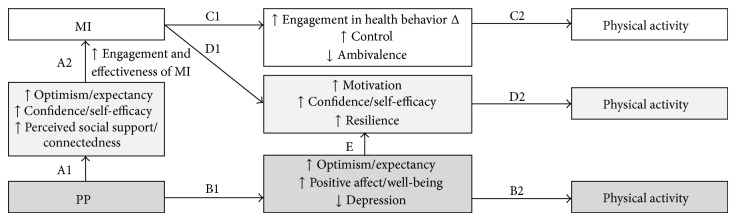
“These individual and social-level constructs, in turn, have been associated with greater efficacy and impact of MI and other health behavior interventions (pathway A2) [118–120, 129, 130].”
§ Positive Psychological Interventions for Patients with Type 2 Diabetes: Rationale, Theoretical Model, and Intervention Development > 4. Discussion > 4.4. Future Directions: Combining PP and MI Interventions for Behavior Change in T2D
What the sources say
- Not checked yetcites [118] Scheier M. F. Helgeson V. S. Schulz R. Moderators of interventions designed to enhance physical and psychological functioning among younger women with early-stage breast cancer Journal of Clinical Oncology 2007 25 36 5710 5714 10.1200/JCO.2007.11.7093 2-s2.0-37649011766 17998547 source
- Not checked yetcites [119] Goossens M. E. J. B. Vlaeyen J. W. S. Hidding A. Kole-Snijders A. Evers S. M. A. A. Treatment expectancy affects the outcome of cognitive-behavioral interventions in chronic pain Clinical Journal of Pain 2005 21 1 18 26 10.1097/00002508-200501000-00003 2-s2.0-10944236788 15599128 source
- Not checked yetcites [120] Joseph C. L. M. Havstad S. L. Johnson D. Factors associated with nonresponse to a computer-tailored asthma management program for urban adolescents with asthma Journal of Asthma 2010 47 6 667 673 10.3109/02770900903518827 2-s2.0-77955533866 20642376 PMC4017358 source
- Not checked yetcites [129] Li Y. P. Lombardini J. B. Guanidinoethanesulfonic acid—inhibitor of GABA uptake in rat cortical synaptosomes Brain Research 1990 510 1 147 149 10.1016/0006-8993(90)90742-t 2-s2.0-0025038072 2138927 source
- Not checked yetcites [130] Hoffman H. G. Patterson D. R. Seibel E. Soltani M. Jewett-Leahy L. Sharar S. R. Virtual reality pain control during burn wound debridement in the hydrotank Clinical Journal of Pain 2008 24 4 299 304 10.1097/ajp.0b013e318164d2cc 2-s2.0-42449105793 18427228 source
plaincorrelational- Asserted: passes — The authors put it forward as true.
- Checkable: passes — It can be checked against evidence.
- Load-bearing: passes — The paper’s conclusions depend on it.
- Based: passes — The paper gives a reason why it holds.
None of the sources cited for this claim have been checked yet.
In the paper
“Regarding direct effects of PP on activity, the established benefits of PP on mood, resilience, well-being, and optimism (pathway B1) [41, 54, 124, 125] are associated with increased physical activity (pathway B2) [48, 88, 123, 131, 132].”
§ Positive Psychological Interventions for Patients with Type 2 Diabetes: Rationale, Theoretical Model, and Intervention Development > 4. Discussion > 4.4. Future Directions: Combining PP and MI Interventions for Behavior Change in T2D
What the sources say
- Not checked yetcites [48] Peterson J. C. Charlson M. E. Hoffman Z. A randomized controlled trial of positive-affect induction to promote physical activity after percutaneous coronary intervention Archives of Internal Medicine 2012 172 4 329 336 10.1001/archinternmed.2011.1311 2-s2.0-84857862882 22269589 PMC3717982 source
- Not checked yetcites [88] Emmons R. A. McCullough M. E. Counting blessings versus burdens: an experimental investigation of gratitude and subjective well-being in daily life Journal of Personality and Social Psychology 2003 84 2 377 389 10.1037//0022-3514.84.2.377 2-s2.0-0038322122 12585811 source
- Not checked yetcites [123] Giltay E. J. Geleijnse J. M. Zitman F. G. Buijsse B. Kromhout D. Lifestyle and dietary correlates of dispositional optimism in men: The Zutphen Elderly Study Journal of Psychosomatic Research 2007 63 5 483 490 10.1016/j.jpsychores.2007.07.014 2-s2.0-35548953128 17980220 source
- Not checked yetcites [131] Boehm J. K. Kubzansky L. D. The heart's content: the association between positive psychological well-being and cardiovascular health Psychological Bulletin 2012 138 4 655 691 10.1037/a0027448 2-s2.0-84867315923 22506752 source
- Not checked yetcites [132] Steptoe A. Wright C. Kunz-Ebrecht S. R. Iliffe S. Dispositional optimism and health behaviour in community-dwelling older people: associations with healthy ageing British Journal of Health Psychology 2006 11 1 71 84 10.1348/135910705x42850 2-s2.0-33644669153 16480556 source
boostedcorrelational- Asserted: passes — The authors put it forward as true.
- Checkable: passes — It can be checked against evidence.
- Load-bearing: passes — The paper’s conclusions depend on it.
- Based: passes — The paper gives a reason why it holds.
- It may state two separate claims as one. 46
- Probably not a substantial claim. 26
The cited sources support only part of this claim — read each source’s verdict below.
In the paper
“In T2D, positive psychological states (e.g., positive affect, well-being) are prospectively associated with lower HbA1c, fewer diabetes complications, and lower rates of cardiac events/mortality [26–28]”
§ Positive Psychological Interventions for Patients with Type 2 Diabetes: Rationale, Theoretical Model, and Intervention Development > 1. Introduction
What the sources say
- Not checked yetcites [26] Moskowitz J. T. Epel E. S. Acree M. Positive affect uniquely predicts lower risk of mortality in people with diabetes Health Psychology 2008 27 1, supplement S73 S82 10.1037/0278-6133.27.1.s73 2-s2.0-41949116245 18248108 source
- Not checked yetcites [27] Papanas N. Tsapas A. Papatheodorou K. Glycaemic control is correlated with well-being index (WHO-5) in subjects with type 2 diabetes Experimental and Clinical Endocrinology & Diabetes 2010 118 6 364 367 10.1055/s-0029-1243623 2-s2.0-77953661689 20140846 source
- Partly supportedcites [28] van der Does F. E. E. de Neeling J. N. D. Snoek F. J. Symptoms and well-being in relation to glycemic control in type II diabetes Diabetes Care 1996 19 3 204 210 10.2337/diacare.19.3.204 2-s2.0-0030029843 8742562 sourceExperimental — accuracy not yet measured
The Results (p. 2) associate lower HbA1c with better mood and well-being in people with type II diabetes. But the study explicitly describes its design as cross-sectional (p. 2), not prospective. Its Conclusions (p. 6) do not establish an association between positive psychological states and later complications, cardiac events, or mortality. (LLM, conf=0.90)
plaincorrelational- Asserted: passes — The authors put it forward as true.
- Checkable: passes — It can be checked against evidence.
- Load-bearing: passes — The paper’s conclusions depend on it.
- Based: passes — The paper gives a reason why it holds.
It may state two separate claims as one.
The cited sources support only part of this claim — read each source’s verdict below.
In the paper
“Nonadherence in T2D is independently associated with poor glycemic control, increased rates of vascular, renal, and other complications, and mortality [7, 8, 11].”
§ Positive Psychological Interventions for Patients with Type 2 Diabetes: Rationale, Theoretical Model, and Intervention Development > 1. Introduction
What the sources say
- Not checked yetcites [7] Ho P. M. Rumsfeld J. S. Masoudi F. A. Effect of medication nonadherence on hospitalization and mortality among patients with diabetes mellitus Archives of Internal Medicine 2006 166 17 1836 1841 10.1001/archinte.166.17.1836 2-s2.0-33749006625 17000939 source
- Not checked yetcites [8] Dunkler D. Dehghan M. Teo K. K. Diet and kidney disease in high-risk individuals with type 2 diabetes mellitus JAMA Internal Medicine 2013 173 18 1682 1692 10.1001/jamainternmed.2013.9051 2-s2.0-84885900768 23939297 source
- Partly supportedcites [11] Sloan F. A. Bethel M. A. Lee P. P. Adherence to guidelines and its effects on hospitalizations with complications of type 2 diabetes The Review of Diabetic Studies 2004 1 1 29 38 17491662 PMC1783530 sourceExperimental — accuracy not yet measured
The Abstract reports that greater adherence to diabetes screening guidelines was associated with fewer hospitalizations for vascular, renal, and other complications among Medicare beneficiaries aged 65 and older. The Conclusion says the study lacked a patient-specific measure of glycemic control, and the paper does not report an association between nonadherence and mortality. The claim also broadens the measured outcome—hospitalization for complications—to complication rates generally. (LLM, conf=0.89)
plaincorrelational- Asserted: passes — The authors put it forward as true.
- Checkable: passes — It can be checked against evidence.
- Load-bearing: passes — The paper’s conclusions depend on it.
- Based: passes — The paper gives a reason why it holds.
It may state two separate claims as one.
A result the paper reports from its own data — it cites no other source for it, so there is none to check. The quote shows it is in the paper.
In the paper
“Overall, the mean age of participants was 60.1 ± 8.8 years, 9 (60%) were women, and the majority had one or more additional cardiovascular risk factors (e.g., hypertension and hyperlipidemia).”
§ Positive Psychological Interventions for Patients with Type 2 Diabetes: Rationale, Theoretical Model, and Intervention Development > 3. Results
plain- Asserted: passes — The authors put it forward as true.
- Checkable: passes — It can be checked against evidence.
- Load-bearing: fails — The paper’s conclusions may not depend on it.
- Based: passes — The paper gives a reason why it holds.
Probably not a substantial claim. The paper’s conclusions may not depend on it.
A result the paper reports from its own data — it cites no other source for it, so there is none to check. The quote shows it is in the paper.
In the paper
“Most participants were moderately nonadherent, with a mean MOS SAS score of 11.4 out of 18, consistent with a mean rating of 3.8 out of 6 for completion of each health behavior (diet, activity, and medication adherence).”
§ Positive Psychological Interventions for Patients with Type 2 Diabetes: Rationale, Theoretical Model, and Intervention Development > 3. Results
plain- Asserted: passes — The authors put it forward as true.
- Checkable: passes — It can be checked against evidence.
- Load-bearing: unclear — It is unclear whether the paper’s conclusions depend on it.
- Based: passes — The paper gives a reason why it holds.
It may state two separate claims as one.
A result the paper reports from its own data — it cites no other source for it, so there is none to check. The quote shows it is in the paper.
In the paper
“There were no differences in the age (t = 0.35; P = 0.71), race (χ 2 = 1.86; P = 0.17), or gender (χ 2 = 0.47; P = 0.49) of participants who declined participation compared to those who enrolled; additional data on decliners was not collected.”
§ Positive Psychological Interventions for Patients with Type 2 Diabetes: Rationale, Theoretical Model, and Intervention Development > 3. Results
plain- Asserted: passes — The authors put it forward as true.
- Checkable: passes — It can be checked against evidence.
- Load-bearing: unclear — It is unclear whether the paper’s conclusions depend on it.
- Based: passes — The paper gives a reason why it holds.
It may state two separate claims as one.
A result the paper reports from its own data — it cites no other source for it, so there is none to check. The quote shows it is in the paper.
In the paper
“In total, during time periods when study staff were available for recruitment for this unfunded feasibility trial, 69 patients with T2D were identified, 44 were judged by clinicians to be potentially eligible, 29 agreed to hear about the study, and 15 were eligible and enrolled.”
§ Positive Psychological Interventions for Patients with Type 2 Diabetes: Rationale, Theoretical Model, and Intervention Development > 3. Results
plainn = 69- Asserted: passes — The authors put it forward as true.
- Checkable: passes — It can be checked against evidence.
- Load-bearing: unclear — It is unclear whether the paper’s conclusions depend on it.
- Based: passes — The paper gives a reason why it holds.
It may state two separate claims as one.
A result the paper reports from its own data — it cites no other source for it, so there is none to check. The quote shows it is in the paper.
In the paper
“Overall, the mean age of participants was 60.1 ± 8.8 years, 9 (60%) were women, and the majority had one or more additional cardiovascular risk factors (e.g., hypertension and hyperlipidemia).”
§ Positive Psychological Interventions for Patients with Type 2 Diabetes: Rationale, Theoretical Model, and Intervention Development > 3. Results
plain- Asserted: passes — The authors put it forward as true.
- Checkable: passes — It can be checked against evidence.
- Load-bearing: fails — The paper’s conclusions may not depend on it.
- Based: passes — The paper gives a reason why it holds.
Probably not a substantial claim. The paper’s conclusions may not depend on it.
A result the paper reports from its own data — it cites no other source for it, so there is none to check. The quote shows it is in the paper.
In the paper
“Thus far nine participants have completed the study, with six participants still undergoing study procedures; of the nine initial participants, seven (78%) fully completed at least three PP exercises.”
§ Positive Psychological Interventions for Patients with Type 2 Diabetes: Rationale, Theoretical Model, and Intervention Development > 3. Results
plainn = 9- Asserted: passes — The authors put it forward as true.
- Checkable: passes — It can be checked against evidence.
- Load-bearing: fails — The paper’s conclusions may not depend on it.
- Based: passes — The paper gives a reason why it holds.
Probably not a substantial claim. The paper’s conclusions may not depend on it. It may state two separate claims as one.
None of the sources cited for this claim have been checked yet.
In the paper
“Positive psychology (PP) interventions, which utilize systematic exercises to increase optimism, well-being, and positive affect, consistently increase positive states and are easily delivered to patients with chronic illnesses.”
§ Positive Psychological Interventions for Patients with Type 2 Diabetes: Rationale, Theoretical Model, and Intervention Development > Abstract
What the sources say
- Not checked yetcites [41] Bolier L. Haverman M. Westerhof G. J. Riper H. Smit F. Bohlmeijer E. Positive psychology interventions: a meta-analysis of randomized controlled studies BMC Public Health 2013 13, article 119 10.1186/1471-2458-13-119 2-s2.0-84873463456 PMC3599475 23390882 source
- Not checked yetcites [43] Sin N. L. Lyubomirsky S. Enhancing well-being and alleviating depressive symptoms with positive psychology interventions: a practice-friendly meta-analysis Journal of Clinical Psychology 2009 65 5 467 487 10.1002/jclp.20593 2-s2.0-67449162049 19301241 source
boosteddirect- Asserted: passes — The authors put it forward as true.
- Checkable: passes — It can be checked against evidence.
- Load-bearing: passes — The paper’s conclusions depend on it.
- Based: passes — The paper gives a reason why it holds.
It may state two separate claims as one.
In the paper
“However, to our knowledge, PP interventions have not been formally tested in T2D.”
- Also stated in: § 2.1. PP Interventions · hedged
“To our knowledge, PP interventions have never been tested in a T2D population, outside of a single small positive affect skills intervention trial that led to improvements in depressive symptoms [54].”
§ Positive Psychological Interventions for Patients with Type 2 Diabetes: Rationale, Theoretical Model, and Intervention Development > Abstract
What the sources say
- Not checked yetcites [54] Cohn M. A. Pietrucha M. E. Saslow L. R. Hult J. R. Moskowitz J. T. An online positive affect skills intervention reduces depression in adults with type 2 diabetes The Journal of Positive Psychology 2014 9 6 523 534 10.1080/17439760.2014.920410 25214877 PMC4157680 source
hedged- Asserted: passes — The authors put it forward as true.
- Checkable: passes — It can be checked against evidence.
- Load-bearing: passes — The paper’s conclusions depend on it.
- Based: passes — The paper gives a reason why it holds.
It may state two separate claims as one.
- Also stated in: § 2.1. PP Interventions · hedged
None of the sources cited for this claim have been checked yet.
In the paper
“successful interventions are often complex and intensive”
- Also stated in: § 1. Introduction · plain
“successful interventions are often complex and intensive [13–15], making practical implementation a challenge [16].”
§ Positive Psychological Interventions for Patients with Type 2 Diabetes: Rationale, Theoretical Model, and Intervention Development > Abstract
What the sources say
- Not checked yetcites [13] Knowler W. C. Barrett-Connor E. Fowler S. E. Reduction in the incidence of type 2 diabetes with lifestyle intervention or metformin The New England Journal of Medicine 2002 346 6 393 403 10.1056/nejmoa012512 2-s2.0-0037034257 11832527 PMC1370926 source
- Not checked yetcites [14] Stevens V. J. Obarzanek E. Cook N. R. Long-term weight loss and changes in blood pressure: results of the trials of hypertension prevention, phase II Annals of Internal Medicine 2001 134 1 1 11 10.7326/0003-4819-134-1-200101020-00007 2-s2.0-0035793139 11187414 source
- Not checked yetcites [15] Svetkey L. P. Stevens V. J. Brantley P. J. Comparison of strategies for sustaining weight loss: the weight loss maintenance randomized controlled trial Journal of the American Medical Association 2008 299 10 1139 1148 10.1001/jama.299.10.1139 2-s2.0-40749141596 18334689 source
- Not checked yetcites [16] United States Centers for Disease Control Diabetes: Successes and Opportunities for Population-Based Prevention and Control 2011 http://www.cdc.gov/chronicdisease/resources/publications/aag/pdf/2011/Diabetes-AAG-2011-508.pdf
plaindirect- Asserted: passes — The authors put it forward as true.
- Checkable: passes — It can be checked against evidence.
- Load-bearing: passes — The paper’s conclusions depend on it.
- Based: passes — The paper gives a reason why it holds.
It may state two separate claims as one.
- Also stated in: § 1. Introduction · plain
None of the sources cited for this claim have been checked yet.
In the paper
“Positive experiences and cognitions can help people better attend to and process health information [37], including unbiased and open appraisal of negative health information [56].”
§ Positive Psychological Interventions for Patients with Type 2 Diabetes: Rationale, Theoretical Model, and Intervention Development > 2. Methods > 2.2. Theoretical Model (Figure 1)
What the sources say
- Not checked yetcites [37] Reed M. B. Aspinwall L. G. Self-affirmation reduces biased processing of health-risk information Motivation and Emotion 1998 22 2 99 132 10.1023/a:1021463221281 2-s2.0-0032338605 source
- Not checked yetcites [56] Aspinwall L. G. Tedeschi R. G. The value of positive psychology for health psychology: progress and pitfalls in examining the relation of positive phenomena to health Annals of Behavioral Medicine 2010 39 1 4 15 10.1007/s12160-009-9153-0 2-s2.0-77957283295 20091429 source
plaindirect- Asserted: passes — The authors put it forward as true.
- Checkable: passes — It can be checked against evidence.
- Load-bearing: passes — The paper’s conclusions depend on it.
- Based: passes — The paper gives a reason why it holds.
It may state two separate claims as one.
None of the sources cited for this claim have been checked yet.
In the paper
“Constructs like optimism (r = 0.3) and gratitude (r = 0.2–0.3) are only somewhat correlated with depression [34, 35]”
§ Positive Psychological Interventions for Patients with Type 2 Diabetes: Rationale, Theoretical Model, and Intervention Development > 1. Introduction
What the sources say
- Not checked yetcites [34] Schueller S. M. Parks A. C. Disseminating self-help: positive psychology exercises in an online trial Journal of Medical Internet Research 2012 14 3, article e63 10.2196/jmir.1850 2-s2.0-84864196986 PMC3414858 22732765 source
- Not checked yetcites [35] McCullough M. E. Emmons R. A. Tsang J.-A. The grateful disposition: a conceptual and empirical topography Journal of Personality and Social Psychology 2002 82 1 112 127 10.1037//0022-3514.82.1.112 2-s2.0-0036364933 11811629 source
plaincorrelational- Asserted: passes — The authors put it forward as true.
- Checkable: passes — It can be checked against evidence.
- Load-bearing: passes — The paper’s conclusions depend on it.
- Based: passes — The paper gives a reason why it holds.
It may state two separate claims as one.
None of the sources cited for this claim have been checked yet.
In the paper
“Positive affect can restore or improve self-regulation [38] and goal-directed behaviors [61].”
§ Positive Psychological Interventions for Patients with Type 2 Diabetes: Rationale, Theoretical Model, and Intervention Development > 2. Methods > 2.2. Theoretical Model (Figure 1)
What the sources say
- Not checked yetcites [38] Tice D. M. Baumeister R. F. Shmueli D. Muraven M. Restoring the self: positive affect helps improve self-regulation following ego depletion Journal of Experimental Social Psychology 2007 43 3 379 384 10.1016/j.jesp.2006.05.007 2-s2.0-33947726049 source
- Not checked yetcites [61] Aspinwall L. G. Rethinking the role of positive affect in self-regulation Motivation and Emotion 1998 22 1 1 32 10.1023/a:1023080224401 2-s2.0-0032363704 source
plaindirect- Asserted: passes — The authors put it forward as true.
- Checkable: passes — It can be checked against evidence.
- Load-bearing: passes — The paper’s conclusions depend on it.
- Based: passes — The paper gives a reason why it holds.
It may state two separate claims as one.
None of the sources cited for this claim have been checked yet.
In the paper
“Self-monitoring is a critical health management task that requires careful attention to health stimuli and leads to improved diet and physical activity [59] along with greater medication adherence [60].”
§ Positive Psychological Interventions for Patients with Type 2 Diabetes: Rationale, Theoretical Model, and Intervention Development > 2. Methods > 2.2. Theoretical Model (Figure 1)
What the sources say
- Not checked yetcites [59] Burke L. E. Wang J. Sevick M. A. Self-monitoring in weight loss: a systematic review of the literature Journal of the American Dietetic Association 2011 111 1 92 102 10.1016/j.jada.2010.10.008 2-s2.0-78650318876 21185970 PMC3268700 source
- Not checked yetcites [60] Karter A. J. Ackerson L. M. Darbinian J. A. Self-monitoring of blood glucose levels and glycemic control: the Northern California Kaiser Permanente Diabetes Registry The American Journal of Medicine 2001 111 1 1 9 10.1016/s0002-9343(01)00742-2 2-s2.0-0034939686 11448654 source
plaindirect- Asserted: passes — The authors put it forward as true.
- Checkable: passes — It can be checked against evidence.
- Load-bearing: passes — The paper’s conclusions depend on it.
- Based: passes — The paper gives a reason why it holds.
It may state two separate claims as one.
None of the sources cited for this claim have been checked yet.
In the paper
“In contrast to complex multicomponent health behavior or psychology interventions, PP exercises are simple, can be delivered remotely (e.g., by phone), and require minimal training of providers [34, 41, 42].”
§ Positive Psychological Interventions for Patients with Type 2 Diabetes: Rationale, Theoretical Model, and Intervention Development > 2. Methods > 2.1. PP Interventions
What the sources say
- Not checked yetcites [34] Schueller S. M. Parks A. C. Disseminating self-help: positive psychology exercises in an online trial Journal of Medical Internet Research 2012 14 3, article e63 10.2196/jmir.1850 2-s2.0-84864196986 PMC3414858 22732765 source
- Not checked yetcites [41] Bolier L. Haverman M. Westerhof G. J. Riper H. Smit F. Bohlmeijer E. Positive psychology interventions: a meta-analysis of randomized controlled studies BMC Public Health 2013 13, article 119 10.1186/1471-2458-13-119 2-s2.0-84873463456 PMC3599475 23390882 source
- Not checked yetcites [42] Huffman J. C. Mastromauro C. A. Boehm J. K. Development of a positive psychology intervention for patients with acute cardiovascular disease Heart International 2011 6 2, article e14 10.4081/hi.2011.e13 2-s2.0-80655148048 PMC3699107 23825741 source
plain- Asserted: passes — The authors put it forward as true.
- Checkable: passes — It can be checked against evidence.
- Load-bearing: passes — The paper’s conclusions depend on it.
- Based: passes — The paper gives a reason why it holds.
It may state two separate claims as one.
None of the sources cited for this claim have been checked yet.
In the paper
“PP-based exercises do not require high educational attainment or significant time commitment, and they have been enjoyable for patients (and completed at high rates) in diverse medical cohorts [42, 53].”
§ Positive Psychological Interventions for Patients with Type 2 Diabetes: Rationale, Theoretical Model, and Intervention Development > 2. Methods > 2.1. PP Interventions
What the sources say
- Not checked yetcites [42] Huffman J. C. Mastromauro C. A. Boehm J. K. Development of a positive psychology intervention for patients with acute cardiovascular disease Heart International 2011 6 2, article e14 10.4081/hi.2011.e13 2-s2.0-80655148048 PMC3699107 23825741 source
- Not checked yetcites [53] Moskowitz J. T. Hult J. R. Duncan L. G. A positive affect intervention for people experiencing health-related stress: development and non-randomized pilot test Journal of Health Psychology 2012 17 5 676 692 10.1177/1359105311425275 2-s2.0-84863188944 22021272 PMC3498769 source
plain- Asserted: passes — The authors put it forward as true.
- Checkable: passes — It can be checked against evidence.
- Load-bearing: passes — The paper’s conclusions depend on it.
- Based: passes — The paper gives a reason why it holds.
It may state two separate claims as one.
None of the sources cited for this claim have been checked yet.
In the paper
“PP interventions have been used in over 4000 mostly healthy subjects and have been found to increase well-being and decrease depression [41, 43], with effect sizes comparable to other psychological interventions [44, 45].”
§ Positive Psychological Interventions for Patients with Type 2 Diabetes: Rationale, Theoretical Model, and Intervention Development > 2. Methods > 2.1. PP Interventions
What the sources say
- Not checked yetcites [41] Bolier L. Haverman M. Westerhof G. J. Riper H. Smit F. Bohlmeijer E. Positive psychology interventions: a meta-analysis of randomized controlled studies BMC Public Health 2013 13, article 119 10.1186/1471-2458-13-119 2-s2.0-84873463456 PMC3599475 23390882 source
- Not checked yetcites [43] Sin N. L. Lyubomirsky S. Enhancing well-being and alleviating depressive symptoms with positive psychology interventions: a practice-friendly meta-analysis Journal of Clinical Psychology 2009 65 5 467 487 10.1002/jclp.20593 2-s2.0-67449162049 19301241 source
- Not checked yetcites [44] Cuijpers P. Geraedts A. S. van Oppen P. Andersson G. Markowitz J. C. van Straten A. Interpersonal psychotherapy for depression: a meta-analysis The American Journal of Psychiatry 2011 168 6 581 592 10.1176/appi.ajp.2010.10101411 2-s2.0-79960294601 21362740 PMC3646065 source
- Not checked yetcites [45] Cuijpers P. Smit F. Bohlmeijer E. Hollon S. D. Andersson G. Efficacy of cognitive-behavioural therapy and other psychological treatments for adult depression: meta-analytic study of publication bias British Journal of Psychiatry 2010 196 3 173 178 10.1192/bjp.bp.109.066001 2-s2.0-77749271346 20194536 source
plaindirectn = 4,000- Asserted: passes — The authors put it forward as true.
- Checkable: passes — It can be checked against evidence.
- Load-bearing: passes — The paper’s conclusions depend on it.
- Based: passes — The paper gives a reason why it holds.
It may state two separate claims as one.
None of the sources cited for this claim have been checked yet.
In the paper
“Positive coping shares roots with resilience, which has also been shown to impact health behaviors such as diet, physical activity, and overall T2D self-management [67–69].”
§ Positive Psychological Interventions for Patients with Type 2 Diabetes: Rationale, Theoretical Model, and Intervention Development > 2. Methods > 2.2. Theoretical Model (Figure 1)
What the sources say
- Not checked yetcites [67] Steinhardt M. A. Mamerow M. M. Brown S. A. Jolly C. A. A resilience intervention in African American adults with type 2 diabetes: a pilot study of efficacy The Diabetes Educator 2009 35 2 274 284 10.1177/0145721708329698 2-s2.0-63849110007 19204102 PMC3001398 source
- Not checked yetcites [68] Bradshaw B. G. Richardson G. E. Kumpfer K. Determining the efficacy of a resiliency training approach in adults with type 2 diabetes The Diabetes Educator 2007 33 4 650 659 10.1177/0145721707303809 2-s2.0-34548631593 17684166 source
- Not checked yetcites [69] Robertson S. M. Stanley M. A. Cully J. A. Naik A. D. Positive emotional health and diabetes care: concepts, measurement, and clinical implications Psychosomatics 2012 53 1 1 12 10.1016/j.psym.2011.09.008 2-s2.0-84859541641 22221716 source
plaincorrelational- Asserted: passes — The authors put it forward as true.
- Checkable: passes — It can be checked against evidence.
- Load-bearing: passes — The paper’s conclusions depend on it.
- Based: passes — The paper gives a reason why it holds.
It may state two separate claims as one.
In the paper
“Positive psychological states and attributes can also increase social interactions and perceived social support.”
§ Positive Psychological Interventions for Patients with Type 2 Diabetes: Rationale, Theoretical Model, and Intervention Development > 2. Methods > 2.2. Theoretical Model (Figure 1)
What the sources say
- Not checked yetcites [76] Lyubomirsky S. King L. Diener E. The benefits of frequent positive affect: does happiness lead to success? Psychological Bulletin 2005 131 6 803 855 10.1037/0033-2909.131.6.803 2-s2.0-29644438373 16351326 source
plaindirect- Asserted: passes — The authors put it forward as true.
- Checkable: passes — It can be checked against evidence.
- Load-bearing: passes — The paper’s conclusions depend on it.
- Based: passes — The paper gives a reason why it holds.
It may state two separate claims as one.
None of the sources cited for this claim have been checked yet.
In the paper
“positive states may improve energy and vitality [64, 79], which can increase health behaviors and lead to better health [80].”
§ Positive Psychological Interventions for Patients with Type 2 Diabetes: Rationale, Theoretical Model, and Intervention Development > 2. Methods > 2.2. Theoretical Model (Figure 1)
What the sources say
- Not checked yetcites [64] Pressman S. D. Cohen S. Does positive affect influence health? Psychological Bulletin 2005 131 6 925 971 10.1037/0033-2909.131.6.925 2-s2.0-29644434367 16351329 source
- Not checked yetcites [79] Ryan R. M. Frederick C. On energy, personality, and health: subjective vitality as a dynamic reflection of well-being Journal of Personality 1997 65 3 529 565 10.1111/j.1467-6494.1997.tb00326.x 2-s2.0-0031216460 9327588 source
- Not checked yetcites [80] Chandler-Laney P. C. Brock D. W. Gower B. A. Alvarez J. A. Bush N. C. Hunter G. R. Self-reported low vitality, poor mental health, and low dietary restraint are associated with overperception of physical exertion Journal of Obesity 2010 2010 7 207451 10.1155/2010/207451 2-s2.0-84865354165 PMC2948900 20936158 source
hedgedconditional- Asserted: passes — The authors put it forward as true.
- Checkable: passes — It can be checked against evidence.
- Load-bearing: passes — The paper’s conclusions depend on it.
- Based: passes — The paper gives a reason why it holds.
It may state two separate claims as one.
What the paper did — it cites no source for this, so there is none to check. The quote shows it is in the paper.
In the paper
“Institutional review board approval from our healthcare system was obtained prior to any study procedures.”
§ Positive Psychological Interventions for Patients with Type 2 Diabetes: Rationale, Theoretical Model, and Intervention Development > 2. Methods > 2.5. Feasibility Study—Design and Baseline Data
plain- Asserted: passes — The authors put it forward as true.
- Checkable: passes — It can be checked against evidence.
- Load-bearing: fails — The paper’s conclusions may not depend on it.
- Based: passes — The paper gives a reason why it holds.
Probably not a substantial claim. The paper’s conclusions may not depend on it.
What the paper did — it cites no source for this, so there is none to check. The quote shows it is in the paper.
In the paper
“The study interventionist for the subsequent proof-of-concept trial (CD) was trained in several stages by staff (JH, CC) experienced in delivering PP interventions.”
- Also stated in: § 2.3. PP Intervention Design and Development · plain
“For quality control, sessions were reviewed by a multidisciplinary study team at weekly meetings, and specific feedback about intervention delivery and fidelity was provided in an ongoing manner.”
§ Positive Psychological Interventions for Patients with Type 2 Diabetes: Rationale, Theoretical Model, and Intervention Development > 2. Methods > 2.3. PP Intervention Design and Development
plain- Asserted: passes — The authors put it forward as true.
- Checkable: passes — It can be checked against evidence.
- Load-bearing: fails — The paper’s conclusions may not depend on it.
- Based: passes — The paper gives a reason why it holds.
Probably not a substantial claim. The paper’s conclusions may not depend on it. It may state two separate claims as one.
- Also stated in: § 2.3. PP Intervention Design and Development · plain
None of the sources cited for this claim have been checked yet.
In the paper
“Optimism and positive affect appear to lead to greater social outreach and perception of social support [76], and people with higher ratings of positive psychological well-being report more social satisfaction [64, 76].”
§ Positive Psychological Interventions for Patients with Type 2 Diabetes: Rationale, Theoretical Model, and Intervention Development > 2. Methods > 2.2. Theoretical Model (Figure 1)
What the sources say
- Not checked yetcites [76] Lyubomirsky S. King L. Diener E. The benefits of frequent positive affect: does happiness lead to success? Psychological Bulletin 2005 131 6 803 855 10.1037/0033-2909.131.6.803 2-s2.0-29644438373 16351326 source
- Not checked yetcites [64] Pressman S. D. Cohen S. Does positive affect influence health? Psychological Bulletin 2005 131 6 925 971 10.1037/0033-2909.131.6.925 2-s2.0-29644434367 16351329 source
hedgeddirect- Asserted: passes — The authors put it forward as true.
- Checkable: passes — It can be checked against evidence.
- Load-bearing: passes — The paper’s conclusions depend on it.
- Based: passes — The paper gives a reason why it holds.
It may state two separate claims as one.
None of the sources cited for this claim have been checked yet.
In the paper
“patients with T2D may have significant functional limitations, transportation challenges, or insufficient time to attend in-person visits [81–83].”
§ Positive Psychological Interventions for Patients with Type 2 Diabetes: Rationale, Theoretical Model, and Intervention Development > 2. Methods > 2.3. PP Intervention Design and Development
What the sources say
- Not checked yetcites [81] Chiu C.-J. Wray L. A. Gender differences in functional limitations in adults living with type 2 diabetes: biobehavioral and psychosocial mediators Annals of Behavioral Medicine 2011 41 1 71 82 10.1007/s12160-010-9226-0 2-s2.0-79952282098 20827519 source
- Not checked yetcites [82] Lawton J. Parry O. Peel E. Douglas M. Diabetes service provision: a qualitative study of newly diagnosed Type 2 diabetes patients' experiences and views Diabetic Medicine 2005 22 9 1246 1251 10.1111/j.1464-5491.2005.01619.x 2-s2.0-24044517188 16108856 source
- Not checked yetcites [83] Khoza S. R. Kortenbout W. An investigation of compliance in type II diabetic patients attending clinic at Church of Scotland hospital Curationis 1995 18 4 10 14 2-s2.0-0029451860 8697530 source
hedged- Asserted: passes — The authors put it forward as true.
- Checkable: passes — It can be checked against evidence.
- Load-bearing: passes — The paper’s conclusions depend on it.
- Based: passes — The paper gives a reason why it holds.
It may state two separate claims as one.
None of the sources cited for this claim have been checked yet.
In the paper
“noninterventionist study staff obtained the following validated measures (Table 1):Life Orientation Test-Revised (LOT-R [95]) to assess optimism.Gratitude Questionnaire-6 (GQ-6 [35]) for gratitude.Hospital Anxiety and Depression Scale (HADS [96]) for anxiety/depression.Diabetes Distress Scale (DDS [97]) for diabetes-related distress.Patient-Reported Outcomes Measurement Information System 10-Item”
§ Positive Psychological Interventions for Patients with Type 2 Diabetes: Rationale, Theoretical Model, and Intervention Development > 2. Methods > 2.5. Feasibility Study—Design and Baseline Data
What the sources say
- Not checked yetcites [95] Scheier M. F. Carver C. S. Bridges M. W. Distinguishing optimism from neuroticism (and trait anxiety, self-mastery, and self-esteem): a reevaluation of the Life Orientation Test Journal of Personality and Social Psychology 1994 67 6 1063 1078 10.1037/0022-3514.67.6.1063 2-s2.0-0028725058 7815302 source
- Not checked yetcites [35] McCullough M. E. Emmons R. A. Tsang J.-A. The grateful disposition: a conceptual and empirical topography Journal of Personality and Social Psychology 2002 82 1 112 127 10.1037//0022-3514.82.1.112 2-s2.0-0036364933 11811629 source
- Not checked yetcites [96] Zigmond A. S. Snaith R. P. The hospital anxiety and depression scale Acta Psychiatrica Scandinavica 1983 67 6 361 370 10.1111/j.1600-0447.1983.tb09716.x 2-s2.0-0020527558 6880820 source
plain- Asserted: passes — The authors put it forward as true.
- Checkable: passes — It can be checked against evidence.
- Load-bearing: passes — The paper’s conclusions depend on it.
- Based: passes — The paper gives a reason why it holds.
It may state two separate claims as one.
What the paper did — it cites no source for this, so there is none to check. The quote shows it is in the paper.
In the paper
“Participants were enrolled from the outpatient diabetes center and inpatient medical units of an urban academic medical center; we included both populations to capture both stable outpatients and those with more significant comorbid medical illness.”
§ Positive Psychological Interventions for Patients with Type 2 Diabetes: Rationale, Theoretical Model, and Intervention Development > 2. Methods > 2.5. Feasibility Study—Design and Baseline Data
plain- Asserted: passes — The authors put it forward as true.
- Checkable: passes — It can be checked against evidence.
- Load-bearing: fails — The paper’s conclusions may not depend on it.
- Based: passes — The paper gives a reason why it holds.
Probably not a substantial claim. The paper’s conclusions may not depend on it. It may state two separate claims as one.
None of the sources cited for this claim have been checked yet.
In the paper
“Self-efficacy and perceived control are influenced by positive cognitions and emotions and are associated with improved health behaviors [17, 58].”
§ Positive Psychological Interventions for Patients with Type 2 Diabetes: Rationale, Theoretical Model, and Intervention Development > 2. Methods > 2.2. Theoretical Model (Figure 1)
What the sources say
- Not checked yetcites [17] Celano C. M. Beale E. E. Moore S. V. Wexler D. J. Huffman J. C. Positive psychological characteristics in diabetes: a review Current Diabetes Reports 2013 13 6 917 929 10.1007/s11892-013-0430-8 2-s2.0-84889083094 24048687 source
- Not checked yetcites [58] Yi-Frazier J. P. Hilliard M. Cochrane K. Hood K. The impact of positive psychology on diabetes outcomes: a review Psychology 2012 3 12A 1116 1124 10.4236/psych.2012.312A165 source
plaincorrelational- Asserted: passes — The authors put it forward as true.
- Checkable: passes — It can be checked against evidence.
- Load-bearing: passes — The paper’s conclusions depend on it.
- Based: passes — The paper gives a reason why it holds.
It may state two separate claims as one.
None of the sources cited for this claim have been checked yet.
In the paper
“One such intervention is mindfulness-based stress reduction (MBSR), which has been successful in improving symptoms in a variety of medical conditions [102–105].”
§ Positive Psychological Interventions for Patients with Type 2 Diabetes: Rationale, Theoretical Model, and Intervention Development > 4. Discussion > 4.2. Comparison of PP Interventions with Related Interventions
What the sources say
- Not checked yetcites [102] la Cour P. Petersen M. Effects of mindfulness meditation on chronic pain: a randomized controlled trial Pain Medicine 2015 16 4 641 652 10.1111/pme.12605 25376753 source
- Not checked yetcites [103] Grossman P. Niemann L. Schmidt S. Walach H. Mindfulness-based stress reduction and health benefits: a meta-analysis Journal of Psychosomatic Research 2004 57 1 35 43 10.1016/s0022-3999(03)00573-7 2-s2.0-3142646773 15256293 source
- Not checked yetcites [104] Labelle L. E. Campbell T. S. Faris P. Carlson L. E. Mediators of mindfulness-based stress reduction (MBSR): assessing the timing and sequence of change in cancer patients Journal of Clinical Psychology 2015 71 1 21 40 10.1002/jclp.22117 25099479 source
- Not checked yetcites [105] Lengacher C. A. Shelton M. M. Reich R. R. Mindfulness based stress reduction (MBSR(BC)) in breast cancer: evaluating fear of recurrence (FOR) as a mediator of psychological and physical symptoms in a randomized control trial (RCT) Journal of Behavioral Medicine 2014 37 2 185 195 10.1007/s10865-012-9473-6 2-s2.0-84896405909 23184061 PMC3627743 source
plaindirect- Asserted: passes — The authors put it forward as true.
- Checkable: passes — It can be checked against evidence.
- Load-bearing: fails — The paper’s conclusions may not depend on it.
- Based: passes — The paper gives a reason why it holds.
Probably not a substantial claim. The paper’s conclusions may not depend on it.
In the paper
“MBSR focuses on several mindfulness techniques and relaxation exercises in an intensive intervention format typically requiring eight weekly 1.5-hour sessions and a commitment to daily homework completion [106].”
§ Positive Psychological Interventions for Patients with Type 2 Diabetes: Rationale, Theoretical Model, and Intervention Development > 4. Discussion > 4.2. Comparison of PP Interventions with Related Interventions
What the sources say
- Not matchedcites [106] University of Massachusetts Medical School Mindfulness-Based Stress Reduction 8-Week Program 2014 Worcester, Mass, USA University of Massachusetts Medical School http://www.umassmed.edu/cfm/stress-reduction/mbsr-8-week
Couldn’t be matched to a paper in Crossref, so it can’t be checked.
plain- Asserted: passes — The authors put it forward as true.
- Checkable: passes — It can be checked against evidence.
- Load-bearing: fails — The paper’s conclusions may not depend on it.
- Based: passes — The paper gives a reason why it holds.
Probably not a substantial claim. The paper’s conclusions may not depend on it.
- Not matched
In the paper
“MI has been successfully used to target physical activity and other health behaviors in T2D patients in several studies [114], but MI alone may not always be sufficient to effect change.”
§ Positive Psychological Interventions for Patients with Type 2 Diabetes: Rationale, Theoretical Model, and Intervention Development > 4. Discussion > 4.3. MI and Related Health Behavior Interventions
What the sources say
- Not checked yetcites [114] Christie D. Channon S. The potential for motivational interviewing to improve outcomes in the management of diabetes and obesity in paediatric and adult populations: a clinical review Diabetes, Obesity and Metabolism 2014 16 5 381 387 10.1111/dom.12195 2-s2.0-84898776629 PMC4237607 23927612 source
hedgedconditional- Asserted: passes — The authors put it forward as true.
- Checkable: passes — It can be checked against evidence.
- Load-bearing: passes — The paper’s conclusions depend on it.
- Based: passes — The paper gives a reason why it holds.
It may state two separate claims as one.
In the paper
“While MI has been associated with improvements, the effect size of this technique has only been moderate (e.g., ES for physical activity = 0.19) [115].”
§ Positive Psychological Interventions for Patients with Type 2 Diabetes: Rationale, Theoretical Model, and Intervention Development > 4. Discussion > 4.3. MI and Related Health Behavior Interventions
What the sources say
- Not checked yetcites [115] Avery L. Flynn D. van Wersch A. Sniehotta F. F. Trenell M. I. Changing physical activity behavior in type 2 diabetes: a systematic review and meta-analysis of behavioral interventions Diabetes Care 2012 35 12 2681 2689 10.2337/dc11-2452 2-s2.0-84869778531 23173137 PMC3507564 source
plaincorrelational- Asserted: passes — The authors put it forward as true.
- Checkable: passes — It can be checked against evidence.
- Load-bearing: passes — The paper’s conclusions depend on it.
- Based: passes — The paper gives a reason why it holds.
It may state two separate claims as one.
In the paper
“MBSR also typically requires extensive provider training programs that include practicums and retreats [106].”
§ Positive Psychological Interventions for Patients with Type 2 Diabetes: Rationale, Theoretical Model, and Intervention Development > 4. Discussion > 4.2. Comparison of PP Interventions with Related Interventions
What the sources say
- Not matchedcites [106] University of Massachusetts Medical School Mindfulness-Based Stress Reduction 8-Week Program 2014 Worcester, Mass, USA University of Massachusetts Medical School http://www.umassmed.edu/cfm/stress-reduction/mbsr-8-week
Couldn’t be matched to a paper in Crossref, so it can’t be checked.
plain- Asserted: passes — The authors put it forward as true.
- Checkable: passes — It can be checked against evidence.
- Load-bearing: fails — The paper’s conclusions may not depend on it.
- Based: passes — The paper gives a reason why it holds.
Probably not a substantial claim. The paper’s conclusions may not depend on it.
- Not matched
None of the sources cited for this claim have been checked yet.
In the paper
“Furthermore, MI is not effective for all patients. MI studies have been mixed, with some studies finding no greater effect of MI compared to control conditions [116, 117].”
§ Positive Psychological Interventions for Patients with Type 2 Diabetes: Rationale, Theoretical Model, and Intervention Development > 4. Discussion > 4.3. MI and Related Health Behavior Interventions
What the sources say
- Not checked yetcites [116] Befort C. A. Nollen N. Ellerbeck E. F. Sullivan D. K. Thomas J. L. Ahluwalia J. S. Motivational interviewing fails to improve outcomes of a behavioral weight loss program for obese African American women: a pilot randomized trial Journal of Behavioral Medicine 2008 31 5 367 377 10.1007/s10865-008-9161-8 2-s2.0-51849107297 18587639 source
- Not checked yetcites [117] Rosenbek Minet L. K. Wagner L. Lønvig E. M. Hjelmborg J. Henriksen J. E. The effect of motivational interviewing on glycaemic control and perceived competence of diabetes self-management in patients with type 1 and type 2 diabetes mellitus after attending a group education programme: a randomised controlled trial Diabetologia 2011 54 7 1620 1629 10.1007/s00125-011-2120-x 2-s2.0-79959745830 21455729 source
plain- Asserted: passes — The authors put it forward as true.
- Checkable: passes — It can be checked against evidence.
- Load-bearing: passes — The paper’s conclusions depend on it.
- Based: passes — The paper gives a reason why it holds.
It may state two separate claims as one.
None of the sources cited for this claim have been checked yet.
In the paper
“This discrepancy between normative behavior and a client's current behavior is presented and discussed in a nonconfrontational manner with the goal of engaging clients in increasing intrinsic motivation towards change [111, 112].”
§ Positive Psychological Interventions for Patients with Type 2 Diabetes: Rationale, Theoretical Model, and Intervention Development > 4. Discussion > 4.3. MI and Related Health Behavior Interventions
What the sources say
- Not checked yetcites [111] Ball S. A. Martino S. Nich C. Site matters: multisite randomized trial of motivational enhancement therapy in community drug abuse clinics Journal of Consulting and Clinical Psychology 2007 75 4 556 567 10.1037/0022-006x.75.4.556 2-s2.0-34548824878 17663610 PMC2148493 source
- Not matchedcites [112] Miller W. R. Zweben A. DiClemente C. C. Motivational Enhancement Therapy Manual: A Clinical Research Guide for Therapists Treating Individuals with Alcohol Abuse and Dependence 1992 2 Rockville, Md, USA National Institute on Alcohol Abuse and Alcoholism Project MATCH Monograph Series
Couldn’t be matched to a paper in Crossref, so it can’t be checked.
plaindirect- Asserted: passes — The authors put it forward as true.
- Checkable: passes — It can be checked against evidence.
- Load-bearing: fails — The paper’s conclusions may not depend on it.
- Based: passes — The paper gives a reason why it holds.
Probably not a substantial claim. The paper’s conclusions may not depend on it.
A conclusion the paper draws from its own results — it cites no other source for it, so there is none to check. The quote shows it is in the paper.
In the paper
“Furthermore, as with PP, the ability to deliver MI remotely is very well suited to T2D patients, who may have functional, time, financial, or transportation barriers that preclude frequent inpatient visits.”
§ Positive Psychological Interventions for Patients with Type 2 Diabetes: Rationale, Theoretical Model, and Intervention Development > 4. Discussion > 4.3. MI and Related Health Behavior Interventions
boosted- Asserted: passes — The authors put it forward as true.
- Checkable: passes — It can be checked against evidence.
- Load-bearing: passes — The paper’s conclusions depend on it.
- Based: passes — The paper gives a reason why it holds.
Probably not a substantial claim.
None of the sources cited for this claim have been checked yet.
In the paper
“Motivational enhancement therapy (MET) is a brief (typically 4-session) adaptation of MI sometimes used in clinical trials that includes normative feedback to clients about their behavior.”
§ Positive Psychological Interventions for Patients with Type 2 Diabetes: Rationale, Theoretical Model, and Intervention Development > 4. Discussion > 4.3. MI and Related Health Behavior Interventions
What the sources say
- Not checked yetcites [111] Ball S. A. Martino S. Nich C. Site matters: multisite randomized trial of motivational enhancement therapy in community drug abuse clinics Journal of Consulting and Clinical Psychology 2007 75 4 556 567 10.1037/0022-006x.75.4.556 2-s2.0-34548824878 17663610 PMC2148493 source
- Not matchedcites [112] Miller W. R. Zweben A. DiClemente C. C. Motivational Enhancement Therapy Manual: A Clinical Research Guide for Therapists Treating Individuals with Alcohol Abuse and Dependence 1992 2 Rockville, Md, USA National Institute on Alcohol Abuse and Alcoholism Project MATCH Monograph Series
Couldn’t be matched to a paper in Crossref, so it can’t be checked.
plain- Asserted: passes — The authors put it forward as true.
- Checkable: passes — It can be checked against evidence.
- Load-bearing: fails — The paper’s conclusions may not depend on it.
- Based: passes — The paper gives a reason why it holds.
Probably not a substantial claim. The paper’s conclusions may not depend on it. It may state two separate claims as one.
In the paper
“First, it is a patient-centered approach, specifically focused on having patients generate reasons for change and assisting them in resolving ambivalence about changing their behavior.”
§ Positive Psychological Interventions for Patients with Type 2 Diabetes: Rationale, Theoretical Model, and Intervention Development > 4. Discussion > 4.3. MI and Related Health Behavior Interventions
What the sources say
- Not checked yetcites [110] Miller W. R. Rollnick S. Motivational Interviewing: Preparing People for Change 2012 3rd New York, NY, USA Guilford Press source
plain- Asserted: passes — The authors put it forward as true.
- Checkable: passes — It can be checked against evidence.
- Load-bearing: fails — The paper’s conclusions may not depend on it.
- Based: passes — The paper gives a reason why it holds.
Probably not a substantial claim. The paper’s conclusions may not depend on it. It may state two separate claims as one.
The paper states this without a source or data behind it here, so there is nothing to check it against. The quote shows it is in the paper.
In the paper
“Direct confrontation and persuasion are discouraged in the therapist, whose role is to help the client to thoughtfully examine his or her behavior and its consequences.”
§ Positive Psychological Interventions for Patients with Type 2 Diabetes: Rationale, Theoretical Model, and Intervention Development > 4. Discussion > 4.3. MI and Related Health Behavior Interventions
plain- Asserted: passes — The authors put it forward as true.
- Checkable: passes — It can be checked against evidence.
- Load-bearing: fails — The paper’s conclusions may not depend on it.
- Based: passes — The paper gives a reason why it holds.
Probably not a substantial claim. The paper’s conclusions may not depend on it. It may state two separate claims as one.
A conclusion the paper draws from its own results — it cites no other source for it, so there is none to check. The quote shows it is in the paper.
In the paper
“The provider training process (completed via a training manual, role play, and audiotaped practice sessions for PP) is much simpler than that required for MBSR, improving applicability to real-world settings.”
§ Positive Psychological Interventions for Patients with Type 2 Diabetes: Rationale, Theoretical Model, and Intervention Development > 4. Discussion > 4.2. Comparison of PP Interventions with Related Interventions
plaindirect- Asserted: passes — The authors put it forward as true.
- Checkable: passes — It can be checked against evidence.
- Load-bearing: unclear — It is unclear whether the paper’s conclusions depend on it.
- Based: passes — The paper gives a reason why it holds.
It may state two separate claims as one.
A conclusion the paper draws from its own results — it cites no other source for it, so there is none to check. The quote shows it is in the paper.
In the paper
“Thus far it appears that recruitment and enrollment for a proof-of-concept study of a PP intervention in T2D is feasible in both inpatient and outpatient settings, and phone delivery of the intervention has been straightforward.”
§ Positive Psychological Interventions for Patients with Type 2 Diabetes: Rationale, Theoretical Model, and Intervention Development > 4. Discussion > 4.1. Discussion of PP Interventions in T2D
hedged- Asserted: passes — The authors put it forward as true.
- Checkable: passes — It can be checked against evidence.
- Load-bearing: fails — The paper’s conclusions may not depend on it.
- Based: passes — The paper gives a reason why it holds.
Probably not a substantial claim. The paper’s conclusions may not depend on it.
A conclusion the paper draws from its own results — it cites no other source for it, so there is none to check. The quote shows it is in the paper.
In the paper
“In contrast to MBSR, PP exercises are briefer and can be completed independently, and in-person sessions are not required.”
§ Positive Psychological Interventions for Patients with Type 2 Diabetes: Rationale, Theoretical Model, and Intervention Development > 4. Discussion > 4.2. Comparison of PP Interventions with Related Interventions
plain- Asserted: passes — The authors put it forward as true.
- Checkable: passes — It can be checked against evidence.
- Load-bearing: passes — The paper’s conclusions depend on it.
- Based: passes — The paper gives a reason why it holds.
It may state two separate claims as one.
A conclusion the paper draws from its own results — it cites no other source for it, so there is none to check. The quote shows it is in the paper.
In the paper
“By being adaptable to patients at any stage of change, it can apply to a large number of patients.”
§ Positive Psychological Interventions for Patients with Type 2 Diabetes: Rationale, Theoretical Model, and Intervention Development > 4. Discussion > 4.3. MI and Related Health Behavior Interventions
plaindirect- Asserted: passes — The authors put it forward as true.
- Checkable: passes — It can be checked against evidence.
- Load-bearing: passes — The paper’s conclusions depend on it.
- Based: passes — The paper gives a reason why it holds.
It may state two separate claims as one.
In the paper
“MI is a patient-centered method for enhancing intrinsic motivation to change and facilitating behavior change [110].”
§ Positive Psychological Interventions for Patients with Type 2 Diabetes: Rationale, Theoretical Model, and Intervention Development > 4. Discussion > 4.3. MI and Related Health Behavior Interventions
What the sources say
- Not checked yetcites [110] Miller W. R. Rollnick S. Motivational Interviewing: Preparing People for Change 2012 3rd New York, NY, USA Guilford Press source
plaindirect- Asserted: passes — The authors put it forward as true.
- Checkable: passes — It can be checked against evidence.
- Load-bearing: fails — The paper’s conclusions may not depend on it.
- Based: passes — The paper gives a reason why it holds.
Probably not a substantial claim. The paper’s conclusions may not depend on it. It may state two separate claims as one.
None of the sources cited for this claim have been checked yet.
In the paper
“There appear to be specific characteristics of patients who may struggle to benefit from health behavior interventions like MI, such as those who have low expectation of improvement and low overall optimism and those who have low perceived social support [118–120].”
§ Positive Psychological Interventions for Patients with Type 2 Diabetes: Rationale, Theoretical Model, and Intervention Development > 4. Discussion > 4.3. MI and Related Health Behavior Interventions
What the sources say
- Not checked yetcites [118] Scheier M. F. Helgeson V. S. Schulz R. Moderators of interventions designed to enhance physical and psychological functioning among younger women with early-stage breast cancer Journal of Clinical Oncology 2007 25 36 5710 5714 10.1200/JCO.2007.11.7093 2-s2.0-37649011766 17998547 source
- Not checked yetcites [119] Goossens M. E. J. B. Vlaeyen J. W. S. Hidding A. Kole-Snijders A. Evers S. M. A. A. Treatment expectancy affects the outcome of cognitive-behavioral interventions in chronic pain Clinical Journal of Pain 2005 21 1 18 26 10.1097/00002508-200501000-00003 2-s2.0-10944236788 15599128 source
- Not checked yetcites [120] Joseph C. L. M. Havstad S. L. Johnson D. Factors associated with nonresponse to a computer-tailored asthma management program for urban adolescents with asthma Journal of Asthma 2010 47 6 667 673 10.3109/02770900903518827 2-s2.0-77955533866 20642376 PMC4017358 source
hedgedconditional- Asserted: passes — The authors put it forward as true.
- Checkable: passes — It can be checked against evidence.
- Load-bearing: passes — The paper’s conclusions depend on it.
- Based: passes — The paper gives a reason why it holds.
It may state two separate claims as one.
None of the sources cited for this claim have been checked yet.
In the paper
“Physical activity may be an ideal target for such an intervention, given that positive states may be most linked with physical activity among the health behaviors [122, 123] and given the substantial evidence base for MI on physical activity.”
§ Positive Psychological Interventions for Patients with Type 2 Diabetes: Rationale, Theoretical Model, and Intervention Development > 4. Discussion > 4.4. Future Directions: Combining PP and MI Interventions for Behavior Change in T2D
What the sources say
- Not checked yetcites [122] Scheier M. F. Matthews K. A. Owens J. F. Dispositional optimism and recovery from coronary artery bypass surgery: the beneficial effects on physical and psychological well-being Journal of Personality and Social Psychology 1989 57 6 1024 1040 10.1037//0022-3514.57.6.1024 2-s2.0-0024796213 2614656 source
- Not checked yetcites [123] Giltay E. J. Geleijnse J. M. Zitman F. G. Buijsse B. Kromhout D. Lifestyle and dietary correlates of dispositional optimism in men: The Zutphen Elderly Study Journal of Psychosomatic Research 2007 63 5 483 490 10.1016/j.jpsychores.2007.07.014 2-s2.0-35548953128 17980220 source
hedgedcorrelational- Asserted: passes — The authors put it forward as true.
- Checkable: passes — It can be checked against evidence.
- Load-bearing: passes — The paper’s conclusions depend on it.
- Based: passes — The paper gives a reason why it holds.
Probably not a substantial claim. It may state two separate claims as one.
A conclusion the paper draws from its own results — it cites no other source for it, so there is none to check. The quote shows it is in the paper.
In the paper
“This combined PP-MI intervention could be delivered by phone, maintaining broad accessibility.”
§ Positive Psychological Interventions for Patients with Type 2 Diabetes: Rationale, Theoretical Model, and Intervention Development > 4. Discussion > 4.4. Future Directions: Combining PP and MI Interventions for Behavior Change in T2D
hedged- Asserted: passes — The authors put it forward as true.
- Checkable: fails — It may be too vague to check against evidence.
- Load-bearing: fails — The paper’s conclusions may not depend on it.
- Based: fails — The paper may give no reason why it holds.
Probably not a substantial claim. It may be too vague to check against evidence. The paper’s conclusions may not depend on it. The paper may give no reason why it holds.
In the paper
“For example, in a comparative effectiveness trial, MET alone was not effective in improving outcomes in patients with type 1 diabetes, but when combined with a second intervention it did result in improved clinical outcomes [121].”
§ Positive Psychological Interventions for Patients with Type 2 Diabetes: Rationale, Theoretical Model, and Intervention Development > 4. Discussion > 4.3. MI and Related Health Behavior Interventions
What the sources say
- Not checked yetcites [121] Ismail K. Thomas S. M. Maissi E. Motivational enhancement therapy with and without cognitive behavior therapy to treat type 1 diabetes: a randomized trial Annals of Internal Medicine 2008 149 10 708 719 10.7326/0003-4819-149-10-200811180-00005 2-s2.0-56549130043 19017589 source
plaindirect- Asserted: passes — The authors put it forward as true.
- Checkable: passes — It can be checked against evidence.
- Load-bearing: unclear — It is unclear whether the paper’s conclusions depend on it.
- Based: passes — The paper gives a reason why it holds.
It may state two separate claims as one.
The paper states this without a source or data behind it here, so there is nothing to check it against. The quote shows it is in the paper.
In the paper
“In sum, there is evidence to suggest that higher levels of positive affect, optimism, and well-being can lead to improved health behavior adherence (and outcomes) in patients with chronic illnesses like T2D.”
§ Positive Psychological Interventions for Patients with Type 2 Diabetes: Rationale, Theoretical Model, and Intervention Development > 5. Conclusions and Next Steps
hedgeddirect- Asserted: passes — The authors put it forward as true.
- Checkable: passes — It can be checked against evidence.
- Load-bearing: passes — The paper’s conclusions depend on it.
- Based: fails — The paper may give no reason why it holds.
Probably not a substantial claim. The paper may give no reason why it holds.
None of the sources cited for this claim have been checked yet.
In the paper
“PP exercises have led to increased optimism and outcome expectancy [124, 125], confidence and self-efficacy [126], and greater perceived social support and interpersonal connectedness (pathway A1) [127, 128].”
§ Positive Psychological Interventions for Patients with Type 2 Diabetes: Rationale, Theoretical Model, and Intervention Development > 4. Discussion > 4.4. Future Directions: Combining PP and MI Interventions for Behavior Change in T2D
What the sources say
- Not checked yetcites [124] King L. A. The health benefits of writing about life goals Personality & Social Psychology Bulletin 2001 27 7 798 807 10.1177/0146167201277003 2-s2.0-0035536247 source
- Not checked yetcites [125] Meevissen Y. M. C. Peters M. L. Alberts H. J. E. M. Become more optimistic by imagining a best possible self: effects of a two week intervention Journal of Behavior Therapy and Experimental Psychiatry 2011 42 3 371 378 10.1016/j.jbtep.2011.02.012 2-s2.0-79953061840 21450262 source
- Not checked yetcites [126] Smeets E. Neff K. Alberts H. Peters M. Meeting suffering with kindness: effects of a brief self-compassion intervention for female college students Journal of Clinical Psychology 2014 70 9 794 807 10.1002/jclp.22076 2-s2.0-84897349100 24691680 source
- Not checked yetcites [127] Fredrickson B. L. Cohn M. A. Coffey K. A. Pek J. Finkel S. M. Open hearts build lives: positive emotions, induced through loving-kindness meditation, build consequential personal resources Journal of Personality and Social Psychology 2008 95 5 1045 1062 10.1037/a0013262 2-s2.0-56349159522 18954193 PMC3156028 source
- Not checked yetcites [128] Lyubomirsky S. Layous K. How do simple positive activities increase well-being? Current Directions in Psychological Science 2013 22 1 57 62 10.1177/0963721412469809 2-s2.0-84872788641 source
plaindirect- Asserted: passes — The authors put it forward as true.
- Checkable: passes — It can be checked against evidence.
- Load-bearing: passes — The paper’s conclusions depend on it.
- Based: passes — The paper gives a reason why it holds.
It may state two separate claims as one.
None of the sources cited for this claim have been checked yet.
In the paper
“Furthermore, MI itself leads to decreased ambivalence, greater intention to change, and increased feelings of control (pathway C1) [113, 133–137], all of which are consistently associated with greater physical activity (pathway C2) [138–140].”
§ Positive Psychological Interventions for Patients with Type 2 Diabetes: Rationale, Theoretical Model, and Intervention Development > 4. Discussion > 4.4. Future Directions: Combining PP and MI Interventions for Behavior Change in T2D
What the sources say
- Not checked yetcites [113] Miller W. R. Rose G. S. Toward a theory of motivational interviewing American Psychologist 2009 64 6 527 537 10.1037/a0016830 2-s2.0-70349428558 19739882 PMC2759607 source
- Not checked yetcites [133] Martins R. K. McNeil D. W. Review of motivational interviewing in promoting health behaviors Clinical Psychology Review 2009 29 4 283 293 10.1016/j.cpr.2009.02.001 2-s2.0-67349224650 19328605 source
- Not checked yetcites [134] Bean M. K. Powell P. Quinoy A. Ingersoll K. Wickham E. P. Mazzeo S. E. Motivational interviewing targeting diet and physical activity improves adherence to paediatric obesity treatment: results from the MI Values randomized controlled trial Pediatric Obesity 2015 10 2 118 125 10.1111/j.2047-6310.2014.226.x 24729537 PMC4197118 source
- Not checked yetcites [135] Wing R. R. Hamman R. F. Bray G. A. Achieving weight and activity goals among diabetes prevention program lifestyle participants Obesity Research 2004 12 9 1426 1434 10.1038/oby.2004.179 2-s2.0-16544383008 15483207 PMC2505058 source
- Not checked yetcites [136] Smith D. E. Heckemeyer C. M. Kratt P. P. Mason D. A. Motivational interviewing to improve adherence to a behavioral weight-control program for older obese women with NIDDM: a pilot study Diabetes Care 1997 20 1 52 54 10.2337/diacare.20.1.52 2-s2.0-0031026384 9028693 source
- Not checked yetcites [137] Miller W. R. Rollnick S. Ten things that motivational interviewing is not Behavioural and Cognitive Psychotherapy 2009 37 2 129 140 10.1017/S1352465809005128 2-s2.0-63749102282 19364414 source
- Not checked yetcites [138] Boudreau F. Godin G. Participation in regular leisure-time physical activity among individuals with type 2 diabetes not meeting Canadian guidelines: the influence of intention, perceived behavioral control, and moral norm International Journal of Behavioral Medicine 2014 21 6 918 926 10.1007/s12529-013-9380-4 2-s2.0-84892396570 24442932 source
- Not checked yetcites [139] Plotnikoff R. C. Trinh L. Courneya K. S. Karunamuni N. Sigal R. J. Predictors of physical activity in adults with type 2 diabetes American Journal of Health Behavior 2011 35 3 359 370 2-s2.0-79957970626 21683024 source
- Not checked yetcites [140] Moreau M. Gagnon M. P. Boudreau F. Development of a fully automated, web-based, tailored intervention promoting regular physical activity among insufficiently active adults with type 2 diabetes: integrating the I-change model, self-determination theory, and motivational interviewing components JMIR Research Protocols 2015 4 1, article e25 10.2196/resprot.4099 PMC4376153 25691346 source
plaindirect- Asserted: passes — The authors put it forward as true.
- Checkable: passes — It can be checked against evidence.
- Load-bearing: passes — The paper’s conclusions depend on it.
- Based: passes — The paper gives a reason why it holds.
It may state two separate claims as one.
None of the sources cited for this claim have been checked yet.
In the paper
“In addition, both MI (pathway D1) [113, 133, 141–145] and the previously described effects of PP on mood, well-being, and optimism (pathway E) [52, 95, 146] are associated with greater self-efficacy, confidence, and motivation, which are in turn linked to physical activity (pathway D2) [139, 147–151].”
§ Positive Psychological Interventions for Patients with Type 2 Diabetes: Rationale, Theoretical Model, and Intervention Development > 4. Discussion > 4.4. Future Directions: Combining PP and MI Interventions for Behavior Change in T2D
What the sources say
- Not checked yetcites [113] Miller W. R. Rose G. S. Toward a theory of motivational interviewing American Psychologist 2009 64 6 527 537 10.1037/a0016830 2-s2.0-70349428558 19739882 PMC2759607 source
- Not checked yetcites [133] Martins R. K. McNeil D. W. Review of motivational interviewing in promoting health behaviors Clinical Psychology Review 2009 29 4 283 293 10.1016/j.cpr.2009.02.001 2-s2.0-67349224650 19328605 source
- Not checked yetcites [141] Gourlan M. Sarrazin P. Trouilloud D. Motivational interviewing as a way to promote physical activity in obese adolescents: a randomised-controlled trial using self-determination theory as an explanatory framework Psychology & Health 2013 28 11 1265 1286 10.1080/08870446.2013.800518 2-s2.0-84887060011 23756082 source
- Not checked yetcites [142] Lilienthal K. R. Pignol A. E. Holm J. E. Telephone-based motivational interviewing to promote physical activity and stage of change progression in older adults Journal of Aging and Physical Activity 2014 22 4 527 535 24226309 source
- Not checked yetcites [143] Bennett J. A. Young H. M. Nail L. M. Winters-Stone K. Hanson G. A telephone-only motivational intervention to increase physical activity in rural adults: a randomized controlled trial Nursing Research 2008 57 1 24 32 10.1097/01.nnr.0000280661.34502.c1 2-s2.0-37349015233 18091289 source
- Not checked yetcites [144] Wagner C. C. Ingersoll K. S. Beyond cognition: broadening the emotional base of motivational interviewing Journal of Psychotherapy Integration 2008 18 2 191 206 10.1037/1053-0479.18.2.191 2-s2.0-45449102673 20631922 PMC2903073 source
- Not checked yetcites [145] Miller W. R. Rollnick S. Talking oneself into change: motivational interviewing, stages of change, and therapeutic process Journal of Cognitive Psychotherapy 2004 18 4 299 308 10.1891/jcop.18.4.299.64003 2-s2.0-17444406296 source
- Not checked yetcites [52] Fredrickson B. L. The role of positive emotions in positive psychology: the broaden-and-build theory of positive emotions American Psychologist 2001 56 3 218 226 10.1037//0003-066x.56.3.218 2-s2.0-0035289375 11315248 PMC3122271 source
- Not checked yetcites [95] Scheier M. F. Carver C. S. Bridges M. W. Distinguishing optimism from neuroticism (and trait anxiety, self-mastery, and self-esteem): a reevaluation of the Life Orientation Test Journal of Personality and Social Psychology 1994 67 6 1063 1078 10.1037/0022-3514.67.6.1063 2-s2.0-0028725058 7815302 source
- Not checked yetcites [146] He F. Cao R. Feng Z. Guan H. Peng J. The impacts of dispositional optimism and psychological resilience on the subjective well-being of burn patients: a structural equation modelling analysis PLoS ONE 2013 8 12 e82939 10.1371/journal.pone.0082939 2-s2.0-84892910753 PMC3866201 24358241 source
plaincorrelational- Asserted: passes — The authors put it forward as true.
- Checkable: passes — It can be checked against evidence.
- Load-bearing: passes — The paper’s conclusions depend on it.
- Based: passes — The paper gives a reason why it holds.
It may state two separate claims as one.
A conclusion the paper draws from its own results — it cites no other source for it, so there is none to check. The quote shows it is in the paper.
In the paper
“First, PP interventions could boost the efficacy of standard MI.”
§ Positive Psychological Interventions for Patients with Type 2 Diabetes: Rationale, Theoretical Model, and Intervention Development > 4. Discussion > 4.4. Future Directions: Combining PP and MI Interventions for Behavior Change in T2D
hedgedconditional- Asserted: passes — The authors put it forward as true.
- Checkable: passes — It can be checked against evidence.
- Load-bearing: passes — The paper’s conclusions depend on it.
- Based: passes — The paper gives a reason why it holds.
Probably not a substantial claim.
None of the sources cited for this claim have been checked yet.
In the paper
“Regarding direct effects of PP on activity, the established benefits of PP on mood, resilience, well-being, and optimism (pathway B1) [41, 54, 124, 125] are associated with increased physical activity (pathway B2) [48, 88, 123, 131, 132].”
§ Positive Psychological Interventions for Patients with Type 2 Diabetes: Rationale, Theoretical Model, and Intervention Development > 4. Discussion > 4.4. Future Directions: Combining PP and MI Interventions for Behavior Change in T2D
What the sources say
- Not checked yetcites [41] Bolier L. Haverman M. Westerhof G. J. Riper H. Smit F. Bohlmeijer E. Positive psychology interventions: a meta-analysis of randomized controlled studies BMC Public Health 2013 13, article 119 10.1186/1471-2458-13-119 2-s2.0-84873463456 PMC3599475 23390882 source
- Not checked yetcites [54] Cohn M. A. Pietrucha M. E. Saslow L. R. Hult J. R. Moskowitz J. T. An online positive affect skills intervention reduces depression in adults with type 2 diabetes The Journal of Positive Psychology 2014 9 6 523 534 10.1080/17439760.2014.920410 25214877 PMC4157680 source
- Not checked yetcites [124] King L. A. The health benefits of writing about life goals Personality & Social Psychology Bulletin 2001 27 7 798 807 10.1177/0146167201277003 2-s2.0-0035536247 source
- Not checked yetcites [125] Meevissen Y. M. C. Peters M. L. Alberts H. J. E. M. Become more optimistic by imagining a best possible self: effects of a two week intervention Journal of Behavior Therapy and Experimental Psychiatry 2011 42 3 371 378 10.1016/j.jbtep.2011.02.012 2-s2.0-79953061840 21450262 source
boosteddirect- Asserted: passes — The authors put it forward as true.
- Checkable: passes — It can be checked against evidence.
- Load-bearing: passes — The paper’s conclusions depend on it.
- Based: passes — The paper gives a reason why it holds.
It may state two separate claims as one.
A conclusion the paper draws from its own results — it cites no other source for it, so there is none to check. The quote shows it is in the paper.
In the paper
“A novel health behavior intervention that combines MI and PP in T2D may be very effective.”
§ Positive Psychological Interventions for Patients with Type 2 Diabetes: Rationale, Theoretical Model, and Intervention Development > 4. Discussion > 4.4. Future Directions: Combining PP and MI Interventions for Behavior Change in T2D
hedgedconditional- Asserted: passes — The authors put it forward as true.
- Checkable: passes — It can be checked against evidence.
- Load-bearing: passes — The paper’s conclusions depend on it.
- Based: passes — The paper gives a reason why it holds.
Probably not a substantial claim.
A conclusion the paper draws from its own results — it cites no other source for it, so there is none to check. The quote shows it is in the paper.
In the paper
“As described, another potential use is that PP could be combined with other behavioral interventions (e.g., MI) to boost engagement and adherence with little added burden.”
§ Positive Psychological Interventions for Patients with Type 2 Diabetes: Rationale, Theoretical Model, and Intervention Development > 5. Conclusions and Next Steps
hedgedconditional- Asserted: passes — The authors put it forward as true.
- Checkable: fails — It may be too vague to check against evidence.
- Load-bearing: fails — The paper’s conclusions may not depend on it.
- Based: fails — The paper may give no reason why it holds.
Probably not a substantial claim. It may be too vague to check against evidence. The paper’s conclusions may not depend on it. The paper may give no reason why it holds.
A conclusion the paper draws from its own results — it cites no other source for it, so there is none to check. The quote shows it is in the paper.
In the paper
“This combination of a psychological component (that can boost optimism, confidence, and positive experiences) alongside a more tightly focused, goal-oriented, and cognitive MI component may be much more powerful in this complex and vulnerable population than either approach alone.”
§ Positive Psychological Interventions for Patients with Type 2 Diabetes: Rationale, Theoretical Model, and Intervention Development > 4. Discussion > 4.4. Future Directions: Combining PP and MI Interventions for Behavior Change in T2D
hedgedconditional- Asserted: passes — The authors put it forward as true.
- Checkable: passes — It can be checked against evidence.
- Load-bearing: passes — The paper’s conclusions depend on it.
- Based: passes — The paper gives a reason why it holds.
Probably not a substantial claim.
A conclusion the paper draws from its own results — it cites no other source for it, so there is none to check. The quote shows it is in the paper.
In the paper
“However, we have just begun to test PP interventions in patients with T2D and suboptimal health behavior adherence, and it is likely that additional customization of the intervention more specifically to T2D will be useful.”
§ Positive Psychological Interventions for Patients with Type 2 Diabetes: Rationale, Theoretical Model, and Intervention Development > 5. Conclusions and Next Steps
hedgedconditional- Asserted: passes — The authors put it forward as true.
- Checkable: fails — It may be too vague to check against evidence.
- Load-bearing: passes — The paper’s conclusions depend on it.
- Based: passes — The paper gives a reason why it holds.
Probably not a substantial claim. It may be too vague to check against evidence.
In the paper
“Prior attempts to combine health behavior interventions with psychological interventions have been successful in T2D but thus far have been designed only for minority of patients with clinical depression [152].”
§ Positive Psychological Interventions for Patients with Type 2 Diabetes: Rationale, Theoretical Model, and Intervention Development > 4. Discussion > 4.4. Future Directions: Combining PP and MI Interventions for Behavior Change in T2D
What the sources say
- Not checked yetcites [152] Safren S. A. Gonzalez J. S. Wexler D. J. A randomized controlled trial of cognitive behavioral therapy for adherence and depression (cbtad) in patients with uncontrolled type 2 diabetes Diabetes Care 2014 37 3 625 633 10.2337/dc13-0816 2-s2.0-84896708270 24170758 PMC3931377
plain- Asserted: passes — The authors put it forward as true.
- Checkable: passes — It can be checked against evidence.
- Load-bearing: passes — The paper’s conclusions depend on it.
- Based: passes — The paper gives a reason why it holds.
It may state two separate claims as one.
What the paper did — it cites no source for this, so there is none to check. The quote shows it is in the paper.
In the paper
“Limitations of our specific proof-of-concept trial also include the use of only a single inpatient and a single outpatient site in an academic medical center and the fact that the majority of participants were white; these factors may limit generalizability of findings.”
§ Positive Psychological Interventions for Patients with Type 2 Diabetes: Rationale, Theoretical Model, and Intervention Development > 4. Discussion > 4.5. Limitations of PP Interventions
hedgedconditional- Asserted: passes — The authors put it forward as true.
- Checkable: passes — It can be checked against evidence.
- Load-bearing: unclear — It is unclear whether the paper’s conclusions depend on it.
- Based: passes — The paper gives a reason why it holds.
It may state two separate claims as one.
A conclusion the paper draws from its own results — it cites no other source for it, so there is none to check. The quote shows it is in the paper.
In the paper
“Overall, this line of work is still in very early stages and PP interventions (alone or combined) are far from established health-promoting interventions.”
§ Positive Psychological Interventions for Patients with Type 2 Diabetes: Rationale, Theoretical Model, and Intervention Development > 4. Discussion > 4.5. Limitations of PP Interventions
plain- Asserted: passes — The authors put it forward as true.
- Checkable: passes — It can be checked against evidence.
- Load-bearing: passes — The paper’s conclusions depend on it.
- Based: passes — The paper gives a reason why it holds.
Probably not a substantial claim. It may state two separate claims as one.
The paper states this without a source or data behind it here, so there is nothing to check it against. The quote shows it is in the paper.
In the paper
“In addition, PP interventions appear to reliably increase these positive states, have been well accepted in other populations, and are distinct from other behavioral interventions in their ease of administration, high acceptability, and specific focus on promoting positive psychological well-being.”
§ Positive Psychological Interventions for Patients with Type 2 Diabetes: Rationale, Theoretical Model, and Intervention Development > 5. Conclusions and Next Steps
hedgeddirect- Asserted: passes — The authors put it forward as true.
- Checkable: passes — It can be checked against evidence.
- Load-bearing: passes — The paper’s conclusions depend on it.
- Based: fails — The paper may give no reason why it holds.
Probably not a substantial claim. The paper may give no reason why it holds. It may state two separate claims as one.
The paper relies on this without support.
Type 2 diabetes patients share the preference for phone over internet observed in medically ill patients.
“Our qualitative interviews with medically ill patients have found that such patients consistently express a preference for phone over internet because of this personal connection [84].”
The paper relies on this without support.
The proposed mediation pathways from positive psychological states to health behaviors are causal and applicable to type 2 diabetes.
“We present a conceptual model of proposed mediation pathways from which additional empirical support is generated (Figure 1; also see Figure 3 for integration of PP and motivational interviewing interventions, discussed in Section 4.4).”
The paper relies on this without support.
PP and MI have never been combined and evaluated in a T2D population.
“PP and MI have never been combined and evaluated in a T2D population.”
The paper relies on this without support.
There have not been comparative effectiveness trials of the wide array of psychological interventions that aim to increase self-efficacy and well-being.
“Still, there have not been comparative effectiveness trials of the wide array of psychological interventions that aim to increase self-efficacy and well-being, and caution is warranted before clear distinctions can be made in terms of feasibility and efficacy.”
The paper relies on this without support.
There is less evidence regarding the impact of PP interventions on physiologic outcomes important to health.
“Furthermore, though there is ample data linking positive psychological states to health behaviors, there is less evidence regarding the impact of PP interventions on physiologic outcomes (e.g., inflammation) important to health.”
The paper relies on this without support.
Not all patients may be interested in activities to boost their affect and well-being, and not all patients may be willing or able to complete positive activities on a regular basis.
“Not all patients may be interested in activities to boost their affect and well-being, and, despite the exercises' straightforward nature, not all patients may be willing or able to complete positive activities on a regular basis.”
Claims other papers make about this one
Each is checked against this paper’s own text: does it say what the citing paper says it does?
The cited source says what the claim attributes to it.
In the citing paper
“Positive psychological states and traits may be associated with greater resilience, a stronger sense of health-related self-efficacy, increased social interactions and social support, and enhanced self-regulation and motivation toward health goals. 22,36”
From Feasibility and acceptability of a positive psychological intervention for patients with type 2 diabetes (2016) · cites this paper as [22]
In the citing paper
“Interventions that explicitly target positive emotion show promise for improving health outcomes in a number of chronic illnesses, including diabetes [16,17], heart disease [18,19], hypertension [20,21], depression [22,23], and HIV [24].”
Self-check
Percentages, sums and reported differences re-computed from the paper’s own numbers.
Each contradiction between two passages listed here was confirmed by an independent check.
Rated minor: it would not touch a result — a value no result rests on, a p-value that stays on the same side of the significance level, or a conflict that is clerical, resolved elsewhere in the paper, or outside its own findings.
In the paper
§ Positive Psychological Interventions for Patients with Type 2 Diabetes: Rationale, Theoretical Model, and Intervention Development > 2. Methods > 2.5. Feasibility Study—Design and Baseline Data
“A minimum of 60 exercises completed by 15 participants would lead to this study being powered at >96% to identify between-group differences with the moderate (Cohen's d = 0.5) immediate effect of PP exercise on optimism and positive affect seen in our prior PP intervention studies [50].”
§ Positive Psychological Interventions for Patients with Type 2 Diabetes: Rationale, Theoretical Model, and Intervention Development > 2. Methods > 2.5. Feasibility Study—Design and Baseline Data
“The intervention was then tested in a 12-week single-arm proof-of-concept study.”
Citations
Cites
The Hospital Anxiety and Depression Scale
Zigmond, A. S., & Snaith, R. P. (1983) · Acta Psychiatrica Scandinavica · doi:10.1111/j.1600-0447.1983.tb09716.x · Cited by 47,139
Reduction in the incidence of type 2 diabetes with lifestyle intervention or metformin
(2002) · New England Journal of Medicine · doi:10.1056/nejmoa012512 · Cited by 19,011
Fredrickson, B. L. (2001) · American Psychologist · doi:10.1037//0003-066x.56.3.218 · Cited by 18,025 · cited 2×
“As opposed to standard, disorder-based psychological interventions, a PP intervention can be delivered to the vast majority of patients who have T2D, rather than applying only to the subset of T2D patients with depression, anxiety disorders, or other clinical psychiatric conditions [52].”
BackgroundDepression and quality of life in older persons: A review
Sivertsen, H., Bjørkløf, G. H., Engedal, K., Selbæk, G., & Helvik, A.-S. (2015) · Dementia and Geriatric Cognitive Disorders · doi:10.1159/000437299 · Cited by 14,152
The validity of the Hospital Anxiety and Depression Scale
Bjelland, I., Dahl, A. A., Haug, T. T., & Neckelmann, D. (2002) · Journal of Psychosomatic Research · doi:10.1016/s0022-3999(01)00296-3 · Cited by 9,779 · cited 1×
“2) were just below the standard cutoff of 8 for clinically significant symptoms [100].”
BackgroundScheier, M. F., Carver, C. S., & Bridges, M. W. (1994) · Journal of Personality and Social Psychology · doi:10.1037//0022-3514.67.6.1063 · Cited by 7,456
Health Promotion by Social Cognitive Means
Bandura, A. (2004) · Health Education & Behavior · doi:10.1177/1090198104263660 · Cited by 7,238 · cited 2×
“, positive affect) linked to beneficial outcomes [108, 109].”
BackgroundThe benefits of frequent positive affect: Does happiness lead to success?
Lyubomirsky, S., King, L., & Diener, E. (2005) · Psychological Bulletin · doi:10.1037/0033-2909.131.6.803 · Cited by 7,143 · cited 1×
“Optimism and positive affect appear to lead to greater social outreach and perception of social support [76], and people with higher ratings of positive psychological wellbeing report more social satisfaction [64, 76].”
BackgroundWhat good are positive emotions?
Fredrickson, B. L. (1998) · Review of General Psychology · doi:10.1037/1089-2680.2.3.300 · Cited by 6,066 · cited 1×
“Health behavior adherencemay be particularly important for patients with type 2 diabetes (T2D), a condition that affects 12% of American adults and is the 7th leading cause of death in the US [6].”
BackgroundPositive Psychology Progress: Empirical Validation of Interventions.
Seligman, M. E. P., Steen, T. A., Park, N., & Peterson, C. (2005) · American Psychologist · doi:10.1037/0003-066x.60.5.410 · Cited by 5,947 · cited 5×
“For example, positive states may improve energy and Week 1 (if initial exercise completed together with the interventionist rather than independently): (i) Provision and review of treatment manual (ii) Discussion of rationale for PP intervention and potential health benefits (iii) Introduction of initial exercise (Gra…”
BackgroundMethodInfluential
Research works printed but not linked: 7
- 2012, The American Journal of Managed Care, 18, S49
- 1996, Journal of Research in Personality, 10, 34
- 2008, The American Journal of Managed Care, 14, 95
- 10.1023/a:1023080224401 · DOI · Paper page
- 1995, Curationis, 18, 10
- 2005, AMIA Annual Symposium Proceedings, 111
- 1992, Oncology, 6, 50
Cited by
Sorted by citations
Positive Psychological Well-Being and Cardiovascular Disease
Kubzansky, L. D., Huffman, J. C., Boehm, J. K., Hernandez, R., Kim, E. S., Koga, H. K., Feig, E. H., Lloyd-Jones, D. M., Seligman, M. E. P., & Labarthe, D. R. (2018) · Journal of the American College of Cardiology · doi:10.1016/j.jacc.2018.07.042 · Cited by 429
“programs that target health behavior change (113).”
BackgroundSelf-citationGreer, S., Ramo, D., Chang, Y.-J., Fu, M., Moskowitz, J., & Haritatos, J. (2019) · JMIR mHealth and uHealth · doi:10.2196/15018 · Cited by 265
“Interventions that explicitly target positive emotion show promise for improving health outcomes in a number of chronic illnesses, including diabetes [16,17], heart disease [18,19], hypertension [20,21], depression [22,23], and HIV [24].”
Randomized controlled trial of a positive affect intervention for people newly diagnosed with HIV.
Moskowitz, J. T., Carrico, A. W., Duncan, L. G., Cohn, M. A., Cheung, E. O., Batchelder, A., Martinez, L., Segawa, E., Acree, M., & Folkman, S. (2017) · Journal of Consulting and Clinical Psychology · doi:10.1037/ccp0000188 · Cited by 220
“Researchers have begun to demonstrate the efficacy of interventions that specifically target positive affect for people living with chronic physical and mental health conditions (BoutinFoster et al., 2016; Caponigro et al., 2013; Carrico et al., 2015; Cohn et al., 2014; Huffman et al., 2015; Huffman et al., 2011; Kren…”
BackgroundMoskowitz, J. T., Cheung, E. O., Snowberg, K. E., Verstaen, A., Merrilees, J. J., Salsman, J. M., & Dowling, G. A. (2019) · Health Psychology · doi:10.1037/hea0000680 · Cited by 167
Boehm, J. K., Soo, J., Zevon, E. S., Chen, Y., Kim, E. S., & Kubzansky, L. D. (2018) · Health Psychology · doi:10.1037/hea0000643 · Cited by 76
Metadata
- Authors
- Huffman, J. C., DuBois, C. M., Millstein, R. A., Celano, C. M., & Wexler, D.
- Affiliations
- Harvard University (US)
- Massachusetts General Hospital (US)
- Corresponding author
- Huffman, Jeff C.
- Venue
- Journal of Diabetes Research
- Publisher
- Wiley
- Published
- 2015
- Volume
- 2015
- Pages
- 1-18
- ISSN
- 2314-6745 (ISSN-L)
- 2314-6753
- PMC
- PMC4442018
- OpenAlex
- W2012476584
- Semantic Scholar
- 780654562c47294d734802cd8c419a99cc85e5e2
- Cited by
- 127
- References
- 148
- Citations by year
- 2026: 2 · 2025: 7 · 2024: 6 · 2023: 14 · 2022: 10 · 2021: 10 · 2020: 12 · 2019: 11 · 2018: 43 · 2017: 8 · 2016: 4
- FWCI
- 2.75
- Type
- journal article
- Language
- en
- Open access
- gold
- doi.org
- Locations
- Journal of Diabetes Research (publishedVersion, cc-by)
- Europe PMC (PubMed Central) (publishedVersion, cc-by)
- PubMed Central (publishedVersion, cc-by)
- PubMed (publishedVersion)
- Digital Access to Scholarship at Harvard (DASH) (Harvard University) (submittedVersion, cc-by)
- DOAJ (DOAJ: Directory of Open Access Journals) (submittedVersion, cc-by-sa)
- Funders
- National Institutes of Health (R01HL113272)
- Topics
- Health Sciences › Medicine › Endocrinology, Diabetes and Metabolism › Diabetes Management and Education
- Social Sciences › Psychology › Applied Psychology › Optimism, Hope, and Well-being
- Social Sciences › Psychology › Applied Psychology › Behavioral Health and Interventions
- Keywords
- type 2 diabetes, positive psychology interventions, optimism, positive affect, well-being, health behavior change, medication adherence, depression, motivational interviewing, theoretical model, intervention development
- MeSH terms
- Behavior Therapy, Depression, Diabetes Mellitus, Type 2, Diet, Humans, Models, Psychological, Patient Compliance, Health Behavior, Exercise
About these checks
Registry, retraction, Cites and statistics results are computed, not judged, with one exception: a printed reference that no index lists is read once by a model before it counts as a citation error. Claims are extracted by a model and kept only when their quote appears verbatim in the text; each cited source is then checked, with a model’s help, for whether it says what the claim relies on. Those verdicts can be wrong — read the claim’s quote and the cited source before relying on one.
A language model drew the claims from the paper on 2026-10-09, under version 3 of the claim definition (model deepseek-v4.1-flash, prompt extract-v3).
A second model labelled each claim on 2026-10-09 (model jev-1.13-20260917, definition revision gold-guideline-v0.2).
Cited sources are checked with a language model’s help (gpt-6-sol).
Statistics and arithmetic are recomputed, not judged.
Confidence bands are shown only for fields calibrated on our annotated test set. None is calibrated yet, so no band is shown.
What counts as a claim ›How we measure confidence ›How we check this ›
Are you an author, or do you see a problem with this page? Request a review
