

Hard criteria for empirical theories of consciousness
Open accessThe DOI matches its Crossref record; 155 of the 155 references it cites were found in a registry or an index; 19 of the 51 sources its claims cite were checked for support.
Abstract
Consciousness is now a well-established field of empirical research. A large body of experimental results has been accumulated and is steadily growing. In parallel, many Theories of Consciousness (ToCs) have been proposed. These theories are diverse in nature, ranging from computational to neurophysiological and quantum theoretical approaches. This contrasts with other fields of natural science, which host a smaller number of competing theories. We suggest that one reason for this abundance of extremely different theories may be the lack of stringent criteria specifying how empirical data constrains ToCs. First, we argue that consciousness is a well-defined topic from an empirical point of view and motivate a purely empirical stance on the quest for consciousness. Second, we present a checklist of criteria that, we propose, empirical ToCs need to cope with. Third, we review 13 of the most influential ToCs and subject them to the criteria. Our analysis helps to situate these different ToCs in the theoretical landscapeand sheds light on their strengths and weaknesses from a strictly empirical point of view.
Overview
CoChat Summary
TL;DR
The paper argues that consciousness can be studied empirically and proposes four hard criteria that empirical theories of consciousness (ToCs) must address: paradigm cases with an unconscious alternative, the unfolding argument, the small/large network arguments, and the other systems argument. Applying these criteria to 13 influential ToCs, it sorts them into four classes and argues that each class faces characteristic challenges rather than being discarded outright.
Key findings
- The paper proposes four criteria for empirical ToCs: (1) paradigm cases of consciousness with an unconscious alternative, (2) the unfolding argument, (3) the small and large network arguments, and (4) the other systems argument.
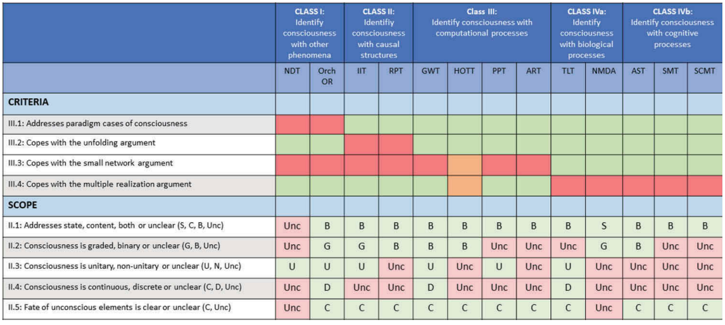
- It reviews 13 influential ToCs and classifies them into four classes: Class I does not address paradigm cases (e.g., NDT, Orch OR); Class II is subject to the unfolding argument (e.g., IIT, RPT); Class III is subject to the small network argument (e.g., GWT, HOTT, PPT, ART); Class IV is subject to the other systems argument (e.g., TLT, NMDA, AST, SMT, SCMT).
- The small network argument states that many ToCs imply small networks with fewer than ten neurons are conscious; the large network argument notes the human brain contains more than ten billion neurons, so such theories may imply billions of conscious subsystems.
- The unfolding argument holds that recurrent and feedforward networks can approximate any input-output function, so causal structure theories such as IIT and RPT imply functionally identical systems can differ in consciousness, making them difficult to address empirically.
Methods
- Conceptual and theoretical analysis; no new experiments, participants, or primary empirical data are reported.
- The authors review 13 influential ToCs, subject them to the proposed criteria, and summarize the results in Table 1, with additional theories described in an appendix.
- The analysis focuses on prototypical argumentation rather than exhaustive coverage or the latest version of each theory.
Limitations
- The authors state the review cannot be exhaustive, that it is impossible to perfectly portray complex, multi-faceted ToCs in a few lines, and that they are not interested in minute details of specific ToCs.
- The authors state the criteria are not exhaustive or unique, are a starting point/steppingstone, and that ToCs challenged by the criteria should not necessarily be discarded because fixes may exist.
- Evident from the text: the classification partly reflects the authors’ own interpretation, and some ToCs have vaguely defined mechanisms, making it difficult to determine exactly how the criteria apply.
Model-written summary. Check it against the paper before relying on it.
Integrity signals
Registry
Cites
Statistics
Figures



Verification
Claims the paper makes
12 Valid · 16 Not valid · 21 Not checked · 145 Own results and interpretations
At least one cited source doesn’t support this claim or points to a different paper, and none confirmed it — see the verdicts below.
In the paper
“GWT is not subject to the unfolding argument because broadcasting is a general concept, which can be implemented in many di ff erent ways (even though GWT is usually framed in recurrent terms, recurrence is not essential, Doerig, Schurger, et al., 2019; but see Kleiner, 2019; Kleiner & Hoel, 2020).”
What the sources say
- Could not verifycites Doerig, Schurger, et al., 2019 matched to “The unfolding argument: Why IIT and other causal structure theories cannot explain consciousness” (2019) sourceExperimental — accuracy not yet measured
The indexed copy returns no body-text passage addressing whether GWT is exempt from the unfolding argument or whether broadcasting can be implemented in different ways. Searches for those points returned only landing-page material and an abstract, so the claim cannot be verified from the available evidence. (LLM, conf=0.70)
- Not checked — no full text of the sourcecites Kleiner, 2019 matched to “Brain states matter. A reply to the unfolding argument.” (2019) source
- Disputedcites Kleiner & Hoel, 2020 matched to “Falsification and consciousness” (2020) sourceExperimental — accuracy not yet measured
The Introduction (page unavailable) calls the unfolding argument against IIT a subset of a broader problem affecting theories that predict experience from internal observables; the paper treats Global Neuronal Workspace as an example. It also says that interpretations of Global Workspace Theory based on report accessibility face a different problem, empirical unfalsifiability. It does not present flexible implementations of broadcasting as an exemption. (LLM, conf=0.86)
Checked by a reasoning model — may be wrong.
plain- Asserted: passes — The authors put it forward as true.
- Checkable: passes — It can be checked against evidence.
- Load-bearing: passes — The paper’s conclusions depend on it.
- Based: passes — The paper gives a reason why it holds.
- Could not verify
Some cited sources support this claim and some don’t — read each source’s verdict below.
In the paper
“The unfolding argument does not apply, because predictive processing can be unfolded (Doerig, Schurger, et al. (2019); but see Kleiner (2019) and Kleiner and Hoel (2020)).”
What the sources say
- Supportedcites Doerig, Schurger, et al. (2019) matched to “The unfolding argument: Why IIT and other causal structure theories cannot explain consciousness” (2019) source
The indexed Abstract (no page number available) distinguishes predictive coding, which it treats as a function realizable by different patterns of brain connectivity, from the causal-structure theories targeted by the unfolding argument. That supports the claim that predictive processing can be unfolded and is not a target of the argument. (LLM, conf=0.84)
- Not checked — no full text of the sourcecites Kleiner (2019) matched to “Brain states matter. A reply to the unfolding argument.” (2019) source
- Disputedcites Kleiner and Hoel (2020) matched to “Falsification and consciousness” (2020) sourceExperimental — accuracy not yet measured
In Formal Description of Testing Theories (page unavailable), the paper explicitly includes predictive processing among the theories it considers. In The Substitution Argument (page unavailable), it says the flaw illustrated by unfolding is not limited to IIT but affects almost all contemporary theories; it does not present predictive processing as exempt. The citing sentence’s “but see” therefore fits this paper as a counterpoint, not as support for the stated claim. (LLM, conf=0.79)
Checked by a reasoning model — may be wrong.
plainstates a cause- Asserted: passes — The authors put it forward as true.
- Checkable: passes — It can be checked against evidence.
- Load-bearing: passes — The paper’s conclusions depend on it.
- Based: passes — The paper gives a reason why it holds.
- Supported
Every source the paper cites for this claim was checked and supports it.
In the paper
“Relatedly, Sergent et al. (2013) showed that a cue presented after a target stimulus that would otherwise remain unconscious can retrospectively render the stimulus conscious.”
What the sources say
- Supportedcites Sergent et al. (2013) matched to “Cueing attention after the stimulus is gone can retrospectively trigger conscious perception” (2013) source
The Summary reports that directing attention to a near-threshold stimulus 100–400 ms after presentation increased subjective visibility. The Discussion explicitly concludes that postcueing can trigger conscious perception of a stimulus that would otherwise have remained unconscious. (LLM, conf=0.95)
plainstates a cause- Asserted: passes — The authors put it forward as true.
- Checkable: passes — It can be checked against evidence.
- Load-bearing: passes — The paper’s conclusions depend on it.
- Based: passes — The paper gives a reason why it holds.
- Supported
Every source the paper cites for this claim was checked and supports it.
In the paper
“For example, words can be semantically processed without being consciously perceived (Gaillard et al., 2006)”
What the sources say
- Supportedcites Gaillard et al., 2006 matched to “Nonconscious semantic processing of emotional words modulates conscious access” (2006) source
The abstract (p.1) states that the threshold for conscious access is lower for emotional than neutral words, 'even for words that have not been previously consciously perceived, thus implying that written words can receive nonconscious semantic processing.' The Discussion reinforces this: 'genuine nonconscious semantic access to the emotional content of words can occur even for words that were never seen before.' The citing sentence is a general paraphrase of exactly this conclusion; the paper's own demonstration is confined to a mask/visual-threshold paradigm contrasting emotional vs. neutral words, which the source itself generalizes to 'written words'. (LLM, conf=0.88)
plain- Asserted: passes — The authors put it forward as true.
- Checkable: passes — It can be checked against evidence.
- Load-bearing: unclear — It is unclear whether the paper’s conclusions depend on it.
- Based: passes — The paper gives a reason why it holds.
- Supported
The cited sources support only part of this claim — read each source’s verdict below.
In the paper
“However, for many de fi nitions of complexity, even very small networks with less than 10 neurons exhibit high complexity (Herzog et al., 2007; Oizumi et al., 2014).”
What the sources say
- Not checked — no full text of the sourcecites Herzog et al., 2007 matched to “Consciousness & the small network argument” (2007) source
- Partly supportedcites Oizumi et al., 2014 matched to “From the phenomenology to the mechanisms of consciousness: integrated information theory 3.0” (2014) sourceExperimental — accuracy not yet measured
In “Consciousness and connectivity: Modular, homogeneous, and specialized networks” (Figure 17C; page unavailable), the paper describes a five-gate network with high values of its complexity-related measures. The elements are logic gates, not neurons, and the passage does not establish that this holds for many definitions of complexity; Figure 17B also shows a five-gate network with low values. (LLM, conf=0.86)
plainstates an association- Asserted: passes — The authors put it forward as true.
- Checkable: passes — It can be checked against evidence.
- Load-bearing: passes — The paper’s conclusions depend on it.
- Based: passes — The paper gives a reason why it holds.
71 more claims · 5 with their cited sources checked
Create a free account to see all 194 claims and to verify the 4 references still open.
- Probably not a substantial claim. 92
- It may state two separate claims as one. 56
Claims other papers make about this one
Each is checked against this paper’s own text: does it say what the citing paper says it does?
The cited source says what the claim attributes to it.
In the citing paper
“The problem with very liberal formulations is that they can be satis fi ed by very simple arti fi cial systems that are not plausibly conscious; many computational functionalist theories allegedly fail by giving such liberal conditions [54 ,55].”
From Identifying indicators of consciousness in AI systems (2026) · cites this paper as [55]
The cited source says what the claim attributes to it.
In the citing paper
“Based on how F is calculated to ''quantify'' PC, artificial systems with purely feedforward architecture have F = 0, and hence lack consciousness (PC), even when their overt behaviors (input-output functions) are indistinguishable from that of conscious (F > 0) systems with feedback 94,95 (but see Doerig et al. 155 ).”
From An integrative, multiscale view on neural theories of consciousness (2024) · cites this paper as [155]
The cited source says what the claim attributes to it.
In the citing paper
“Indeed, there are now so many theories of consciousness that an increasing number of researchers are turning their attention to the meta-theoretical question of how they might be compared and evaluated (Chis-Ciure et al., 2024; Del Pin et al., 2021; Doerig et al., 2021; Kirkeby-Hinrup, 2024; Negro et al., 2024; Signorelli et al., 2021), with a view to advancing the field via the unification, integ”
From Integrated information and predictive processing theories of consciousness: An adversarial collaborative review (2026) · cites this paper as Doerig et al., 2021
The cited source says what the claim attributes to it.
In the citing paper
“The key idea here is to exploit the resources availed by a domain-general modelling framework such as Active Inference to construct computational models of paradigmatic phenomena in consciousness science (e.g., binocular rivalry; Doerig et al., 2021), and to compare the properties of these models such that salient commonalities and particularities may be identified (Vilas et al., 2022; Whyte et al”
From Integrated information and predictive processing theories of consciousness: An adversarial collaborative review (2026) · cites this paper as Doerig et al., 2021
The check wasn’t confident either way, so it gives no verdict — never disputed.
In the citing paper
“(1) L5 pyramidal neurons associate information arriving at separate dendritic compartments through a non-linear apical dendritic process leading to burst firing.120-122”
From An integrative, multiscale view on neural theories of consciousness (2024) · cites this paper as [120]
Experimental — accuracy not yet measured
1 more claim about this paper
Create a free account to see every claim other papers make about this one.
Citations
Cites
James, W. (1913) · Henry Holt and Company eBooks · doi:10.1037/11059-000 · Cited by 25,226
Multilayer feedforward networks are universal approximators
Hornik, K., Stinchcombe, M., & White, H. (1989) · Neural Networks · doi:10.1016/0893-6080(89)90020-8 · Cited by 21,728 · cited 1×
“It is a mathematical fact that both recurrent and feedforward networks (along with many other kinds of universal function approximators) can approximate any input-output function to any degree of accuracy (Hornik et al., 1989; Schäfer & Zimmermann, 2006).”
BackgroundMultilayer feedforward networks are universal approximators
HornikK., StinchcombeM., & WhiteH. (1989) · Neural Networks · doi:10.5555/70405.70408 · Cited by 9,081
The free-energy principle: a unified brain theory?
Friston, K. (2010) · Nature Reviews Neuroscience · doi:10.1038/nrn2787 · Cited by 8,120 · cited 1×
“The brain is often seen as a predictive processing machine (Clark, 2013; Friston, 2010; Rao & Ballard, 1999).”
BackgroundKripke, S. A. (1972) · Semantics of Natural Language · doi:10.1007/978-94-010-2557-7_9 · Cited by 7,028 · cited 3×
“More precisely, although the software and hardware used in that implementation are sufficient to instantiate Microsoft 2Multiple realization has been a fruitful topic in philosophy (Fodor, 1974; Kripke, 1972; Putnam, 1967, 1988).”
BackgroundMethodJournal of Consciousness Studies
(2022) · Journal of Consciousness Studies · doi:10.53765/20512201 · Cited by 6,832
Neuronal Oscillations in Cortical Networks
Buzsáki, G., & Draguhn, A. (2004) · Science · doi:10.1126/science.1099745 · Cited by 6,576 · cited 1×
“Examples include NMDA synapses (Flohr, 1992), processing in layer 5 of V1 (Crick & Koch, 2003), the claustrum (Crick & Koch, 2005), gamma-band oscillations (Buzsáki, 2004), thalamocortical loops (Llinas et al., 1998), or the microgenesis of consciousness in the thalamus (Bachmann, 2000).”
BackgroundWhatever next? Predictive brains, situated agents, and the future of cognitive science
Clark, A. (2013) · Behavioral and Brain Sciences · doi:10.1017/s0140525x12000477 · Cited by 5,924 · cited 1×
“The brain is often seen as a predictive processing machine (Clark, 2013; Friston, 2010; Rao & Ballard, 1999).”
BackgroundRao, R. P. N., & Ballard, D. H. (1999) · Nature Neuroscience · doi:10.1038/4580 · Cited by 5,483 · cited 2×
“The brain is often seen as a predictive processing machine (Clark, 2013; Friston, 2010; Rao & Ballard, 1999).”
BackgroundRubber hands ‘feel’ touch that eyes see
Botvinick, M., & Cohen, J. (1998) · Nature · doi:10.1038/35784 · Cited by 4,410 · cited 1×
“In the rubber hand illusion, participants can be tricked into attributing ownership of their real hand to a fake rubber hand (Botvinick & Cohen, 1998).”
BackgroundColman (2022) · doi:10.1073/pnas · Cited by 4,370
The conscious mind: in search of a fundamental theory
(1996) · Choice Reviews Online · doi:10.5860/choice.34-2091 · Cited by 4,147
(1988) · Cited by 3,656
Neural systems supporting interoceptive awareness
Critchley, H. D., Wiens, S., Rotshtein, P., Öhman, A., & Dolan, R. J. (2004) · Nature Neuroscience · doi:10.1038/nn1176 · Cited by 3,406 · cited 3×
“Critchley et al. (2004), Park and Tallon-Baudry (2014) and Faivre et al. (2015) have also argued that self representations in the brain are crucial for consciousness.”
BackgroundOn a confusion about a function of consciousness
Block, N. (1995) · Behavioral and Brain Sciences · doi:10.1017/s0140525x00038188 · Cited by 3,364 · cited 1×
“Another important theoretical dispute concerns the distinction between access vs. phenomenal consciousness (see Block, 1995; Cohen & Dennett, 2011; Naccache, 2018; Phillips, 2018; Ward, 2018).”
BackgroundA sensorimotor account of vision and visual consciousness
O'Regan, J. K., & Noë, A. (2001) · Behavioral and Brain Sciences · doi:10.1017/s0140525x01000115 · Cited by 3,126
Philosophical Transactions of the Royal Society B: biological sciences
(2026) · Philosophical Transactions of the Royal Society B Biological Sciences · doi:10.1098/rstb · Cited by 2,876
Towards a cognitive neuroscience of consciousness: basic evidence and a workspace framework
Dehaene, S. (2001) · Cognition · doi:10.1016/s0010-0277(00)00123-2 · Cited by 2,498 · cited 1×
“Dehaene and collegues subsequently proposed the global neuronal workspace theory (Dehaene & Naccache, 2001; Mashour et al., 2020).”
Background“Materialism and Qualia: The Explanatory Gap
Levine, J. (1983) · Pacific Philosophical Quarterly · doi:10.1111/j.1468-0114.1983.tb00207.x · Cited by 2,150 · cited 1×
“Levine (1983) introduced the term explanatory gap to highlight the difficulty of physicalist theories in explaining phenomenal properties; Chalmers (1996) called it the hard problem.”
Background(2010) · Cited by 2,069
An information integration theory of consciousness
Tononi, G. (2004) · BMC Neuroscience · doi:10.1186/1471-2202-5-42 · Cited by 1,958 · cited 3×
“IIT was first proposed by Tononi (2004).”
BackgroundInfluentialSpecial sciences (or: The disunity of science as a working hypothesis)
Fodor, J. A. (1974) · Synthese · doi:10.1007/bf00485230 · Cited by 1,815 · cited 2×
“More precisely, although the software and hardware used in that implementation are sufficient to instantiate Microsoft 2Multiple realization has been a fruitful topic in philosophy (Fodor, 1974; Kripke, 1972; Putnam, 1967, 1988).”
BackgroundMethod(1990) · CaltechAUTHORS (California Institute of Technology) · Cited by 1,661
Neural correlates of consciousness: progress and problems
Koch, C., Massimini, M., Boly, M., & Tononi, G. (2016) · Nature Reviews Neuroscience · doi:10.1038/nrn.2016.22 · Cited by 1,600 · cited 1×
“Many studies have investigated the neural correlates of consciousness (Koch et al., 2016; Rees et al., 2002).”
BackgroundCrick, F., & Koch, C. (2003) · Nature Neuroscience · doi:10.1038/nn0203-119 · Cited by 1,492 · cited 1×
“Examples include NMDA synapses (Flohr, 1992), processing in layer 5 of V1 (Crick & Koch, 2003), the claustrum (Crick & Koch, 2005), gamma-band oscillations (Buzsáki, 2004), thalamocortical loops (Llinas et al., 1998), or the microgenesis of consciousness in the thalamus (Bachmann, 2000).”
BackgroundCerebral mechanisms of word masking and unconscious repetition priming
Dehaene, S., Naccache, L., Cohen, L., Bihan, D. L., Mangin, J.-F., Poline, J.-B., & Rivière, D. (2001) · Nature Neuroscience · doi:10.1038/89551 · Cited by 1,305 · cited 2×
“, 2005), masking (Dehaene et al., 2001), and wakefulness vs.”
BackgroundCarhart-Harris, R. L., Leech, R., Hellyer, P. J., Shanahan, M., Feilding, A., Tagliazucchi, E., Chialvo, D. R., & Nutt, D. (2014) · Frontiers in Human Neuroscience · doi:10.3389/fnhum.2014.00020 · Cited by 1,252 · cited 1×
“…(and not unconscious) states and their changes, such as how consciousness changes under the influence of LSD, other psychotropic substances or meditation (Carhart-Harris et al., 2014; Lutz et al., 2007), or track changes in body ownership and map them to brain states (Faivre et al., 2015).”
BackgroundPutnam, H. (1988) · The MIT Press eBooks · doi:10.7551/mitpress/5891.001.0001 · Cited by 1,166 · cited 1×
“More precisely, although the software and hardware used in that implementation are sufficient to instantiate Microsoft 2Multiple realization has been a fruitful topic in philosophy (Fodor, 1974; Kripke, 1972; Putnam, 1967, 1988).”
MethodConscious Processing and the Global Neuronal Workspace Hypothesis
Mashour, G. A., Roelfsema, P., Changeux, J.-P., & Dehaene, S. (2020) · Neuron · doi:10.1016/j.neuron.2020.01.026 · Cited by 1,164 · cited 1×
“Dehaene and collegues subsequently proposed the global neuronal workspace theory (Dehaene & Naccache, 2001; Mashour et al., 2020).”
BackgroundTowards a true neural stance on consciousness
Lamme, V. A. F. (2006) · Trends in Cognitive Sciences · doi:10.1016/j.tics.2006.09.001 · Cited by 1,149
From the phenomenology to the mechanisms of consciousness: integrated information theory 3.0
Oizumi, M., Albantakis, L., & Tononi, G. (2014) · PLoS Computational Biology · doi:10.1371/journal.pcbi.1003588 · Cited by 1,128 · cited 2×
“Proponents of the theory accept that two recurrently connected neurons are indeed conscious and accept panpsychism (Oizumi et al., 2014; Tononi & Koch, 2015).”
BackgroundThe Emperor's New Mind: Concerning Computers, Minds, and the Laws of Physics
Penrose, R., & Landauer, R. (1990) · Physics Today · doi:10.1063/1.2810599 · Cited by 1,110
Simons, D. J., & Levin, D. T. (1997) · Trends in Cognitive Sciences · doi:10.1016/s1364-6613(97)01080-2 · Cited by 1,039
Rosenthal, D. M. (1986) · Philosophical Studies · doi:10.1007/bf00355521 · Cited by 1,019 · cited 1×
“While HOTT originated in philosophical circles (Rosenthal, 1986, 2002) and has mostly been couched in cognitive terms, it has more recently made its way into the arena of neuroscientific theories of consciousness (Lau & Rosenthal, 2011).”
BackgroundPhilosophy of Mind : Classical and Contemporary Readings
Chalmers, D. J. (2021) · Medical Entomology and Zoology · Cited by 994
Hameroff, S., & Penrose, R. (2014) · Physics of Life Reviews · doi:10.1016/j.plrev.2013.08.002 · Cited by 983
Continuous flash suppression reduces negative afterimages
Tsuchiya, N., & Koch, C. (2005) · Nature Neuroscience · doi:10.1038/nn1500 · Cited by 973 · cited 1×
“Other paradigms used to study the content of consciousness include continuous flash suppression (a version of binocular rivalry; Tsuchiya & Koch, 2005), change blindness (Simons & Levin, 1997) and crowding (Atas et al., 2014; Bouma, 1973; see Breitmeyer, 2015; S. Dehaene et al., 2017; Kim & Blake,…”
Method(1989) · Choice Reviews Online · doi:10.5860/choice.26-3225 · Cited by 915
Sun, M. (2012) · Nova Science Publishers eBooks · Cited by 913
Timing of the brain events underlying access to consciousness during the attentional blink
Sergent, C., Baillet, S., & Dehaene, S. (2005) · Nature Neuroscience · doi:10.1038/nn1549 · Cited by 888 · cited 1×
“GWT addresses paradigm cases including the attentional blink (Sergent et al., 2005), masking (Dehaene et al., 2001), and wakefulness vs. sleep (Dehaene et al., 2003).”
BackgroundEmpirical support for higher-order theories of conscious awareness
Lau, H., & Rosenthal, D. (2011) · Trends in Cognitive Sciences · doi:10.1016/j.tics.2011.05.009 · Cited by 869 · cited 4×
“While HOTT originated in philosophical circles (Rosenthal, 1986, 2002) and has mostly been couched in cognitive terms, it has more recently made its way into the arena of neuroscientific theories of consciousness (Lau & Rosenthal, 2011).”
BackgroundInfluentialBinocular Rivalry and Visual Awareness in Human Extrastriate Cortex
Tong, F., Nakayama, K., Vaughan, J. T., & Kanwisher, N. (1998) · Neuron · doi:10.1016/s0896-6273(00)80592-9 · Cited by 855 · cited 1×
“For example, brain areas correlating with the conscious percept in binocular rivalry were found (Tong et al., 1998).”
BackgroundWhat is consciousness, and could machines have it?
Dehaene, S., Lau, H., & Kouider, S. (2017) · Science · doi:10.1126/science.aan8871 · Cited by 855 · cited 1×
“…include continuous flash suppression (a version of binocular rivalry; Tsuchiya & Koch, 2005), change blindness (Simons & Levin, 1997) and crowding (Atas et al., 2014; Bouma, 1973; see Breitmeyer, 2015; S. Dehaene et al., 2017; Kim & Blake, 2005, for reviews of empirical methods for consciousness).”
BackgroundDehaene, S., Sergent, C., & Changeux, J.-P. (2003) · Proceedings of the National Academy of Sciences · doi:10.1073/pnas.1332574100 · Cited by 838 · cited 1×
“GWT addresses paradigm cases including the attentional blink (Sergent et al., 2005), masking (Dehaene et al., 2001), and wakefulness vs. sleep (Dehaene et al., 2003).”
BackgroundConsciousness: here, there and everywhere?
Tononi, G., & Koch, C. (2015) · Philosophical Transactions of the Royal Society B: Biological Sciences · doi:10.1098/rstb.2014.0167 · Cited by 811 · cited 1×
“Proponents of the theory accept that two recurrently connected neurons are indeed conscious and accept panpsychism (Oizumi et al., 2014; Tononi & Koch, 2015).”
BackgroundConsciousness and the brain: deciphering how the brain codes our thoughts
Rogers, T. (2014) · Neuropsychoanalysis · doi:10.1080/15294145.2014.956209 · Cited by 808
PUTNAM, H. (1967) · Art, Mind, and Religion · doi:10.2307/jj.6380610.6 · Cited by 778
Neural correlates of consciousness in humans
Rees, G., Kreiman, G., & Koch, C. (2002) · Nature Reviews Neuroscience · doi:10.1038/nrn783 · Cited by 742 · cited 1×
“Many studies have investigated the neural correlates of consciousness (Koch et al., 2016; Rees et al., 2002).”
BackgroundWhat is the function of the claustrum?
Crick, F. C., & Koch, C. (2005) · Philosophical Transactions of the Royal Society B: Biological Sciences · doi:10.1098/rstb.2005.1661 · Cited by 742 · cited 1×
“Examples include NMDA synapses (Flohr, 1992), processing in layer 5 of V1 (Crick & Koch, 2003), the claustrum (Crick & Koch, 2005), gamma-band oscillations (Buzsáki, 2004), thalamocortical loops (Llinas et al., 1998), or the microgenesis of consciousness in the thalamus (Bachmann, 2000).”
BackgroundThe neuronal basis for consciousness
The American Association for Research into Nervous and Mental Diseases, Llinás, R., Ribary, U., Contreras, D., & Pedroarena, C. (1998) · Philosophical Transactions of the Royal Society of London. Series B: Biological Sciences · doi:10.1098/rstb.1998.0336 · Cited by 709 · cited 4×
“For example, neural feature binding has been proposed as the key feature of consciousness, and this binding has been explained by neural synchrony or re-entrant processing (Edelman, 2003; Grossberg, 2017; Llinas et al., 1998; Singer, 2007).”
BackgroundInfluentialIs perception discrete or continuous?
VanRullen, R., & Koch, C. (2003) · Trends in Cognitive Sciences · doi:10.1016/s1364-6613(03)00095-0 · Cited by 662 · cited 1×
“These results raise the question of whether consciousness is a continuous stream of percepts or is discrete, i.e., consciousness occurs at only certain time points (Doerig, Scharnowski, et al., 2019; Fekete et al., 2018; Herzog et al., 2016; James, 2013; VanRullen & Koch, 2003; White, 2018).”
BackgroundConsciousness and Fundamental Reality
Goff, P. (2017) · Oxford Scholarship Online · doi:10.1093/oso/9780190677015.001.0001 · Cited by 657 · cited 1×
“See Seth (2018) and Frankish (2016b) for other methodological problems with panpsychism, and Goff (2017) for a defence of panpsychism.”
BackgroundFeedforward, horizontal, and feedback processing in the visual cortex
Lamme, V. A., Supèr, H., & Spekreijse, H. (1998) · Current Opinion in Neurobiology · doi:10.1016/s0959-4388(98)80042-1 · Cited by 621 · cited 1×
“…this identification of consciousness with recurrent processing is the following: it was shown that recurrent processing is required for perceptual organization and grouping (Lamme et al., 1998), which are functions that, it is argued, are explicitly linked to conscious experience (Lamme, 2015).”
BackgroundUsing direct and indirect measures to study perception without awareness
Reingold, E. M., & Merikle, P. M. (1988) · Perception & Psychophysics · doi:10.3758/bf03207490 · Cited by 596 · cited 1×
“…to ‘fix’ these ToCs by adding just the ‘right’ ingredients, it 1These latter two requirements echo the exclusiveness and exhaustiveness requirements of Reingold and Merikle (1988). may be that these additional ingredients are more important to explain consciousness than the proposed mechanism…”
BackgroundDistilling the neural correlates of consciousness
Aru, J., Bachmann, T., Singer, W., & Melloni, L. (2012) · Neuroscience & Biobehavioral Reviews · doi:10.1016/j.neubiorev.2011.12.003 · Cited by 589
Understanding the Higher-Order Approach to Consciousness
Brown, R., Lau, H., & LeDoux, J. E. (2019) · Trends in Cognitive Sciences · doi:10.1016/j.tics.2019.06.009 · Cited by 573 · cited 1×
“There are a few variants of higher-order theories of consciousness (Brown et al., 2019; Lau, 2019; Lau & Rosenthal, 2011; Rosenthal, 2004) but the gist of HOTT is this: A mental state X is conscious if, and only if, one has a higher-order representation to the effect that one is currently…”
BackgroundHuman oscillatory brain activity near 40 Hz coexists with cognitive temporal binding.
Joliot, M., Ribary, U., & Llinás, R. (1994) · Proceedings of the National Academy of Sciences · doi:10.1073/pnas.91.24.11748 · Cited by 543 · cited 1×
“Consciousness is temporally discrete because the gamma oscillations create conscious snapshots (Joliot et al., 1994).”
BackgroundConsciousness cannot be separated from function
Cohen, M. A., & Dennett, D. C. (2011) · Trends in Cognitive Sciences · doi:10.1016/j.tics.2011.06.008 · Cited by 542 · cited 1×
“Another important theoretical dispute concerns the distinction between access vs. phenomenal consciousness (see Block, 1995; Cohen & Dennett, 2011; Naccache, 2018; Phillips, 2018; Ward, 2018).”
BackgroundMeditation and the neuroscience of consciousness: an introduction
Lutz, A., Dunne, J. D., & Davidson, R. J. (2007) · The Cambridge Handbook of Consciousness · doi:10.1017/cbo9780511816789.020 · Cited by 485 · cited 1×
“…(and not unconscious) states and their changes, such as how consciousness changes under the influence of LSD, other psychotropic substances or meditation (Carhart-Harris et al., 2014; Lutz et al., 2007), or track changes in body ownership and map them to brain states (Faivre et al., 2015).”
BackgroundMultiple Realizability Revisited: Linking Cognitive and Neural States
Bechtel, W., & Mundale, J. (1999) · Philosophy of Science · doi:10.1086/392683 · Cited by 483 · cited 1×
“This question is particularly difficult given the strong multiple realizability of many phenomena.2 It is well known that any function can be implemented by different physical systems (Bechtel & Mundale, 1999; Fodor, 1974).”
BackgroundVisual interference in the parafoveal recognition of initial and final letters of words
Bouma, H. (1973) · Vision Research · doi:10.1016/0042-6989(73)90041-2 · Cited by 481 · cited 1×
“…include continuous flash suppression (a version of binocular rivalry; Tsuchiya & Koch, 2005), change blindness (Simons & Levin, 1997) and crowding (Atas et al., 2014; Bouma, 1973; see Breitmeyer, 2015; S. Dehaene et al., 2017; Kim & Blake, 2005, for reviews of empirical methods for consciousness).”
BackgroundPsychophysical magic: rendering the visible ‘invisible’
Kim, C.-Y., & Blake, R. (2005) · Trends in Cognitive Sciences · doi:10.1016/j.tics.2005.06.012 · Cited by 451 · cited 1×
“…include continuous flash suppression (a version of binocular rivalry; Tsuchiya & Koch, 2005), change blindness (Simons & Levin, 1997) and crowding (Atas et al., 2014; Bouma, 1973; see Breitmeyer, 2015; S. Dehaene et al., 2017; Kim & Blake, 2005, for reviews of empirical methods for consciousness).”
BackgroundDifferent time courses for visual perception and action priming
Vorberg, D., Mattler, U., Heinecke, A., Schmidt, T., & Schwarzbach, J. (2003) · Proceedings of the National Academy of Sciences · doi:10.1073/pnas.0931489100 · Cited by 450 · cited 1×
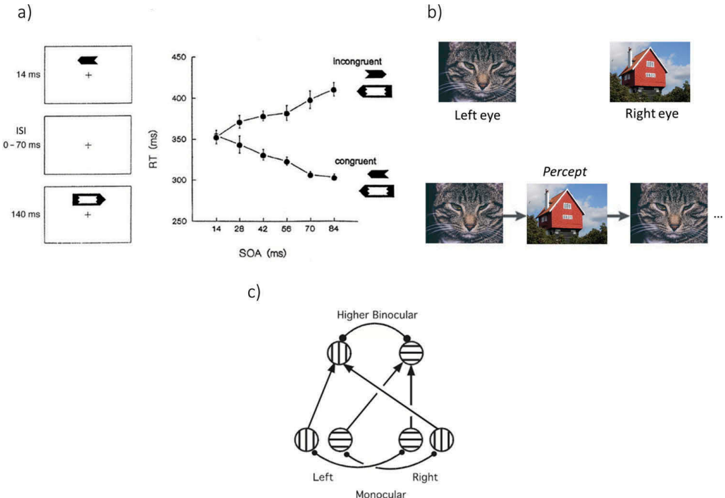
“Figure reproduced with permission from Vorberg et al. (2003) Copyright (2003) National Academy of Sciences, U.S.A. b-c) Binocular rivalry. b) Two different images are shown to the left and right eye at the same time.”
MethodSearle, J. R. (1990) · Cited by 449
What insects can tell us about the origins of consciousness.
Barron, A. B., & Klein, C. (2016) · Proceedings of the National Academy of Sciences · doi:10.1073/pnas.1520084113 · Cited by 446 · cited 2×
“…linked to consciousness including learning (Cleeremans, 2007; Cleeremans et al., 2019), body ownership (Faivre et al., 2015), language (Gazzaniga, 1970), integrated and egocentric encoding of the world (Barron & Klein, 2016) and homoeostatic bodily responses (Critchley et al., 2004), to name a few.”
BackgroundNaturalizing consciousness: a theoretical framework.
Edelman, G. M. (2003) · Proceedings of the National Academy of Sciences · doi:10.1073/pnas.0931349100 · Cited by 440 · cited 2×
“For example, neural feature binding has been proposed as the key feature of consciousness, and this binding has been explained by neural synchrony or re-entrant processing (Edelman, 2003; Grossberg, 2017; Llinas et al., 1998; Singer, 2007).”
BackgroundThe emperor's new mind concerning computers, minds, and the laws of physics
(1990) · Choice Reviews Online · doi:10.5860/choice.27-4496 · Cited by 440
Emergence or Reduction?: Essays on the Prospects of Nonreductive Physicalism
(1992) · De Gruyter eBooks · doi:10.1515/9783110870084 · Cited by 426
(2014) · Cited by 422
Computational evidence for a rivalry hierarchy in vision
Wilson, H. R. (2003) · Proceedings of the National Academy of Sciences · doi:10.1073/pnas.2333622100 · Cited by 411 · cited 1×
“Figure reproduced with permission from Wilson (2003) Copyright (2003) National Academy of Sciences, U.S.A. irretrievably suppressed the target representation, the second mask could not render it conscious again).”
MethodRubovits-Seitz, P. (1993) · The Journal of Nervous and Mental Disease · doi:10.1097/00005053-199310000-00017 · Cited by 411
Visual Masking: Time Slices through Conscious and Unconscious Vision
Breitmeyer, B. G., & Öğmen, H. (2006) · Medical Entomology and Zoology · Cited by 396
Being a Beast Machine: The Somatic Basis of Selfhood
Seth, A. K., & Tsakiris, M. (2018) · Trends in Cognitive Sciences · doi:10.1016/j.tics.2018.08.008 · Cited by 371 · cited 1×
“Predictive processing has often been associated with consciousness (Friston, 2013; Rudrauf et al., 2017; Seth & Tsakiris, 2018).”
BackgroundRewards evoke learning of unconsciously processed visual stimuli in adult humans
Seitz, A. R., Kim, D., & Watanabe, T. (2009) · Neuron · doi:10.1016/j.neuron.2009.01.016 · Cited by 337 · cited 1×
“For example, even if an image is fully suppressed for the entire duration of the experiment, humans can unconsciously learn about its features (Seitz et al., 2009).”
BackgroundMicrocultures of Dissociated Primary Central Nervous System Neurons
Azmitia, E. C. (1990) · Methods in Neurosciences · doi:10.1016/b978-0-12-185254-2.50021-8 · Cited by 331
Rosenblum, B., & Kuttner, F. (2006) · Quantum Enigma · doi:10.1093/oso/9780195175592.003.0016 · Cited by 327
Breitmeyer, B., & Ogmen, H. (2006) · doi:10.1093/acprof:oso/9780198530671.001.0001 · Cited by 313
Long-lasting modulation of feature integrationby transcranial magnetic stimulation
Scharnowski, F., Ruter, J., Jolij, J., Hermens, F., Kammer, T., & Herzog, M. H. (2009) · Journal of Vision · doi:10.1167/9.6.1 · Cited by 305 · cited 1×
“This unconscious integration period can last for 420 ms as experiments using TMS and feature fusion have shown (Scharnowski et al., 2009; Rüter et al., 2010; see also Pilz et al., 2013).”
MethodSelf-citationRecurrent Neural Networks Are Universal Approximators
Schäfer, A. M., & Zimmermann, H. G. (2006) · Lecture Notes in Computer Science · doi:10.1007/11840817_66 · Cited by 297 · cited 1×
“It is a mathematical fact that both recurrent and feedforward networks (along with many other kinds of universal function approximators) can approximate any input-output function to any degree of accuracy (Hornik et al., 1989; Schäfer & Zimmermann, 2006).”
BackgroundGlobal Workspace Dynamics: Cortical “Binding and Propagation” Enables Conscious Contents
Baars, B. J., Franklin, S., & Ramsoy, T. Z. (2013) · Frontiers in Psychology · doi:10.3389/fpsyg.2013.00200 · Cited by 294 · cited 1×
“GWT was first put forward by Bernard Baars (Baars, 1993; Baars et al., 2013).”
MethodWhy Red Doesn’t Sound Like a BellUnderstanding the feel of consciousness
O'Regan, J. K. (2011) · doi:10.1093/acprof:oso/9780199775224.001.0001 · Cited by 285
A direct demonstration of perceptual asynchrony in vision
Moutoussis, K., & Zeki, S. (1997) · Proceedings of the Royal Society of London. Series B: Biological Sciences · doi:10.1098/rspb.1997.0056 · Cited by 265 · cited 1×
“Although we feel that we have only a single consciousness at one moment in time, Moutoussis and Zeki (1997) argued that the brain may hold many simultaneous consciousnesses because motion and colour are perceived (consciously) at different moments in time, reflected by different neural activities…”
BackgroundThe neural subjective frame: from bodily signals to perceptual consciousness
Park, H.-D., & Tallon-Baudry, C. (2014) · Philosophical Transactions of the Royal Society B: Biological Sciences · doi:10.1098/rstb.2013.0208 · Cited by 246 · cited 1×
“Critchley et al. (2004), Park and Tallon-Baudry (2014) and Faivre et al. (2015) have also argued that self representations in the brain are crucial for consciousness.”
BackgroundThe Combination Problem for Panpsychism
Chalmers, D. J. (2016) · Panpsychism · doi:10.1093/acprof:oso/9780199359943.003.0008 · Cited by 231
Peters, M. A. K., & Lau, H. (2015) · eLife · doi:10.7554/elife.09651 · Cited by 197
RECURRENT NEURAL NETWORKS ARE UNIVERSAL APPROXIMATORS
SCHÄFER, A. M., & ZIMMERMANN, H.-G. (2007) · International Journal of Neural Systems · doi:10.1142/s0129065707001111 · Cited by 196
Cueing attention after the stimulus is gone can retrospectively trigger conscious perception
Sergent, C., Wyart, V., Babo-Rebelo, M., Cohen, L., Naccache, L., & Tallon-Baudry, C. (2013) · Current Biology · doi:10.1016/j.cub.2012.11.047 · Cited by 195 · cited 1×
“DrissiDaoudi et al. (2019) have also shown mandatory unconscious integration up to 450 ms. Relatedly, Sergent et al. (2013) showed that a cue presented after a target stimulus that would otherwise remain unconscious can retrospectively render the stimulus conscious.”
BackgroundWhy I stopped worrying about the definition of life... and why you should as well
Machery, E. (2012) · Synthese · doi:10.1007/s11229-011-9880-1 · Cited by 181 · cited 1×
“Nowadays biologists understand what life is, but there is no ‘theory of life’ (Machery, 2012).”
BackgroundPsychophysical “blinding” methods reveal a functional hierarchy of unconscious visual processing
Breitmeyer, B. G. (2015) · Consciousness and Cognition · doi:10.1016/j.concog.2015.01.012 · Cited by 178 · cited 1×
“…include continuous flash suppression (a version of binocular rivalry; Tsuchiya & Koch, 2005), change blindness (Simons & Levin, 1997) and crowding (Atas et al., 2014; Bouma, 1973; see Breitmeyer, 2015; S. Dehaene et al., 2017; Kim & Blake, 2005, for reviews of empirical methods for consciousness).”
BackgroundFeedback Contributions to Visual Awareness in Human Occipital Cortex
Ro, T., Breitmeyer, B., Burton, P., Singhal, N. S., & Lane, D. (2003) · Current Biology · doi:10.1016/s0960-9822(03)00337-3 · Cited by 175 · cited 1×
“A similar finding is that a masked stimulus can be rerendered conscious by a transcranial magnetic stimulation (TMS) pulse (Ro et al., 2003).”
BackgroundThe effects of visual object priming on brain activation before and after recognition
James, T. W., Humphrey, G. K., Gati, J. S., Menon, R. S., & Goodale, M. A. (2000) · Current Biology · doi:10.1016/s0960-9822(00)00655-2 · Cited by 164 · cited 1×
“For example, unconscious priming can occur at the object level (James et al., 2000), suggesting that parts can be bound into wholes unconsciously.”
BackgroundBrain of a white-collar worker
Feuillet, L., Dufour, H., & Pelletier, J. (2007) · The Lancet · doi:10.1016/s0140-6736(07)61127-1 · Cited by 157
Criteria for unconscious cognition: three types of dissociation
Schmidt, T., & Vorberg, D. (2006) · Perception & Psychophysics · doi:10.3758/bf03193692 · Cited by 151 · cited 2×
“For visual masking and other paradigms, specific procedures have been established to differentiate between conscious and unconscious perception (Morales et al., 2015; Overgaard et al., 2010; Schmidt & Vorberg, 2006).”
BackgroundMethodConsciousness, Free Action, and the Brain
(2001) · The MIT Press eBooks · doi:10.7551/mitpress/5759.003.0012 · Cited by 149
How can we construct a science of consciousness?
Chalmers, D. J. (2013) · Annals of the New York Academy of Sciences · doi:10.1111/nyas.12166 · Cited by 145 · cited 1×
“Realists propose that consciousness really exists as a distinct property, and the job of science is to understand how it is generated (e.g. Chalmers, 2004).”
BackgroundMeasuring integrated information: comparison of candidate measures in theory and simulation
Mediano, P., Seth, A., & Barrett, A. (2018) · Entropy · doi:10.3390/e21010017 · Cited by 145
Meditation and the neuroscience of consciousness
Lutz, A., Dunne, J. D., & Davidson, R. J. (2007) · Cited by 143
Cleeremans, A., Achoui, D., Beauny, A., Keuninckx, L., Martin, J.-R., Muñoz-Moldes, S., Vuillaume, L., & de Heering, A. (2020) · Trends in Cognitive Sciences · doi:10.1016/j.tics.2019.11.011 · Cited by 142
Why and how access consciousness can account for phenomenal consciousness
Naccache, L. (2018) · Philosophical Transactions of the Royal Society B: Biological Sciences · doi:10.1098/rstb.2017.0357 · Cited by 141 · cited 1×
“Another important theoretical dispute concerns the distinction between access vs. phenomenal consciousness (see Block, 1995; Cohen & Dennett, 2011; Naccache, 2018; Phillips, 2018; Ward, 2018).”
BackgroundThe unfolding argument: Why IIT and other causal structure theories cannot explain consciousness
Doerig, A., Schurger, A., Hess, K., & Herzog, M. H. (2019) · Consciousness and Cognition · doi:10.1016/j.concog.2019.04.002 · Cited by 140
Self-citationTime Slices: What Is the Duration of a Percept?
Herzog, M., Kammer, T., & Scharnowski, F. (2016) · PLoS Biology · doi:10.1371/journal.pbio.1002433 · Cited by 140 · cited 1×
“These results raise the question of whether consciousness is a continuous stream of percepts or is discrete, i.e., consciousness occurs at only certain time points (Doerig, Scharnowski, et al., 2019; Fekete et al., 2018; Herzog et al., 2016; James, 2013; VanRullen & Koch, 2003; White, 2018).”
BackgroundSelf-citationConsciousness: the radical plasticity thesis
Cleeremans, A. (2007) · Progress in brain research · doi:10.1016/s0079-6123(07)68003-0 · Cited by 137 · cited 2×
“cific processes thought to be constitutive for consciousness, such as neural binding (Edelman, 2003), learning (Cleeremans, 2007), or insight (Hameroff & Penrose,”
BackgroundMicrogenetic Approach to the Conscious Mind
Bachmann, T. (2000) · Advances in Consciousness Research · doi:10.1075/aicr.25 · Cited by 137 · cited 2×
“, 1998), or the microgenesis of consciousness in the thalamus (Bachmann, 2000).”
BackgroundRandomness as a resource for design
Leong, T. W., Vetere, F., & Howard, S. (2006) · Proceedings of the 6th conference on Designing Interactive systems · doi:10.1145/1142405.1142428 · Cited by 135
On the axiomatic foundations of the integrated information theory of consciousness
Bayne, T. (2018) · Neuroscience of Consciousness · doi:10.1093/nc/niy007 · Cited by 132 · cited 1×
“However, this criterion is at least partly arbitrary, since the axioms do not uniquely specify the complexity measure, i.e., other measures thanΦ fulfil the axioms as well (Bayne, 2018), but lead to very different empirical results (Mediano et al., 2019).”
ResultDecoding visual consciousness from human brain signals
Haynes, J. (2009) · Trends in Cognitive Sciences · doi:10.1016/j.tics.2009.02.004 · Cited by 130 · cited 2×
“The underlying commonalities between all paradigm cases need to be understood (Chalmers, 1996; Fingelkurts et al., 2012; Haynes, 2009; Seth, 2016).”
BackgroundThe methodological puzzle of phenomenal consciousness
Phillips, I. (2018) · Philosophical Transactions of the Royal Society B: Biological Sciences · doi:10.1098/rstb.2017.0347 · Cited by 128 · cited 1×
“Another important theoretical dispute concerns the distinction between access vs. phenomenal consciousness (see Block, 1995; Cohen & Dennett, 2011; Naccache, 2018; Phillips, 2018; Ward, 2018).”
BackgroundNonconscious semantic processing of emotional words modulates conscious access
Gaillard, R., Del Cul, A., Naccache, L., Vinckier, F., Cohen, L., & Dehaene, S. (2006) · Proceedings of the National Academy of Sciences · doi:10.1073/pnas.0600584103 · Cited by 124 · cited 1×
“For example, words can be semantically processed without being consciously perceived (Gaillard et al., 2006) and expert chess players can analyse chess situations without consciousness (Kiesel et al., 2009).”
BackgroundKiesel, A., Kunde, W., Pohl, C., Berner, M. P., & Hoffmann, J. (2009) · Journal of Experimental Psychology: Learning, Memory, and Cognition · doi:10.1037/a0014499 · Cited by 120 · cited 2×
“For example, words can be semantically processed without being consciously perceived (Gaillard et al., 2006) and expert chess players can analyse chess situations without consciousness (Kiesel et al., 2009).”
BackgroundGrossberg, S. (2017) · Neural Networks · doi:10.1016/j.neunet.2016.11.003 · Cited by 120 · cited 2×
“For example, neural feature binding has been proposed as the key feature of consciousness, and this binding has been explained by neural synchrony or re-entrant processing (Edelman, 2003; Grossberg, 2017; Llinas et al., 1998; Singer, 2007).”
BackgroundA mathematical model of embodied consciousness.
Rudrauf, D., Bennequin, D., Granic, I., Landini, G., Friston, K., & Williford, K. (2017) · Journal of Theoretical Biology · doi:10.1016/j.jtbi.2017.05.032 · Cited by 118 · cited 2×
“Predictive processing has often been associated with consciousness (Friston, 2013; Rudrauf et al., 2017; Seth & Tsakiris, 2018).”
BackgroundHallucination as mental imagery
Nánay, B. (2016) · PhilPapers (PhilPapers Foundation) · Cited by 118
Measuring integrated information: comparison of \ncandidate measures in theory and simulation
Mediano, P. A. M., Seth, A. K., & Barrett, A. B. (2018) · Figshare · Cited by 114
Human Visual System Integrates Color Signals along a Motion Trajectory
Nishida, S., Watanabe, J., Kuriki, I., & Tokimoto, T. (2007) · Current Biology · doi:10.1016/j.cub.2006.12.041 · Cited by 92
Are we studying consciousness yet?
Lau, H. C. (2008) · Frontiers of ConsciousnessChichele Lectures · doi:10.1093/acprof:oso/9780199233151.003.0008 · Cited by 88
The flight path of the phoenix—The visible trace of invisible elements in human vision
Otto, T. U., Ögmen, H., & Herzog, M. H. (2006) · Journal of Vision · doi:10.1167/6.10.7 · Cited by 80 · cited 2×
“Even more surprisingly, features of unconscious elements can be visible at other consciously perceived elements, presented at different times and locations (Nishida et al., 2007; Otto et al., 2006).”
BackgroundMethodSelf-citationOptimizing subjective measures of consciousness
Overgaard, M. S., Timmermans, B., Sandberg, K., & Cleeremans, A. (2010) · Consciousness and Cognition · doi:10.1016/j.concog.2009.12.018 · Cited by 79 · cited 1×
“For visual masking and other paradigms, specific procedures have been established to differentiate between conscious and unconscious perception (Morales et al., 2015; Overgaard et al., 2010; Schmidt & Vorberg, 2006).”
BackgroundSinger, W. (2007) · Scholarpedia · doi:10.4249/scholarpedia.1657 · Cited by 77 · cited 1×
“For example, neural feature binding has been proposed as the key feature of consciousness, and this binding has been explained by neural synchrony or re-entrant processing (Edelman, 2003; Grossberg, 2017; Llinas et al., 1998; Singer, 2007).”
BackgroundIllusionism as the Obvious Default Theory of Consciousness
Dennett, D. C. (2016) · Journal of Consciousness Studies · Cited by 76
Is conscious perception a series of discrete temporal frames?
White, P. A. (2018) · Consciousness and Cognition · doi:10.1016/j.concog.2018.02.012 · Cited by 75
Consciousness, Metacognition, & Perceptual Reality Monitoring
Lau, H. (2019) · doi:10.31234/osf.io/ckbyf · Cited by 74 · cited 2×
“HOTT faces different challenges depending on how it is interpreted, because different authors have different takes on what exactly constitutes a higher order thought (compare for instance Lau (2019) and Rosenthal (2002)).”
BackgroundConsciousness & the small network argument
Herzog, M. H., Esfeld, M., & Gerstner, W. (2007) · Neural Networks · doi:10.1016/j.neunet.2007.09.001 · Cited by 64 · cited 2×
“The small & large network arguments III.3.a. Conscious small networks Herzog et al. (2007) showed that many ToCs imply that small networks with fewer than ten neurons are conscious.”
BackgroundSelf-citationFeature integration within discrete time windows
Drissi-Daoudi, L., Doerig, A., & Herzog, M. H. (2019) · Nature Communications · doi:10.1038/s41467-019-12919-7 · Cited by 62
Self-citationCan science know when you're conscious? Epistemological foundations of consciousness research
Goldman, A. I. (2000) · Journal of Consciousness Studies · Cited by 60
Tsuchiya, N., Andrillon, T., & Haun, A. (2020) · Consciousness and Cognition · doi:10.1016/j.concog.2020.102877 · Cited by 58 · cited 2×
“In this respect, see Tsuchiya et al. (2020) and Kleiner (2019) who defend IIT from the unfolding argument.”
BackgroundNonconscious Learning From Crowded Sequences
Atas, A., Faivre, N., Timmermans, B., Cleeremans, A., & Kouider, S. (2014) · Psychological Science · doi:10.1177/0956797613499591 · Cited by 52
Visual consciousness and bodily self-consciousness
Faivre, N., Salomon, R., & Blanke, O. (2015) · Current Opinion in Neurology · doi:10.1097/wco.0000000000000160 · Cited by 50 · cited 4×
“Many cognitive processes have been linked to consciousness including learning (Cleeremans, 2007; Cleeremans et al., 2019), body ownership (Faivre et al., 2015), language (Gazzaniga, 1970), integrated and egocentric encoding of the world (Barron & Klein, 2016) and homoeostatic bodily responses…”
BackgroundMethodInfluential2. Varieties of higher-order theory
Rosenthal, D. M. (2004) · Advances in Consciousness Research · doi:10.1075/aicr.56.04ros · Cited by 48 · cited 1×
“There are a few variants of higher-order theories of consciousness (Brown et al., 2019; Lau, 2019; Lau & Rosenthal, 2011; Rosenthal, 2004) but the gist of HOTT is this: A mental state X is conscious if, and only if, one has a higher-order representation to the effect that one is currently…”
BackgroundIn the interest of saving time: a critique of discrete perception
Fekete, T., de Cruys, S. V., Ekroll, V., & van Leeuwen, C. (2018) · Neuroscience of Consciousness · doi:10.1093/nc/niy003 · Cited by 47 · cited 1×
“These results raise the question of whether consciousness is a continuous stream of percepts or is discrete, i.e., consciousness occurs at only certain time points (Doerig, Scharnowski, et al., 2019; Fekete et al., 2018; Herzog et al., 2016; James, 2013; VanRullen & Koch, 2003; White, 2018).”
BackgroundFalsification and consciousness
Kleiner, J., & Hoel, E. (2021) · Neuroscience of Consciousness · doi:10.1093/nc/niab001 · Cited by 46 · cited 4×
“The unfolding argument does not apply, because predictive processing can be unfolded (Doerig, Schurger, et al. (2019); but see Kleiner (2019) and Kleiner and Hoel (2020)).”
BackgroundInfluentialBlakeslee, B., & McCourt, M. E. (2012) · Vision Research · doi:10.1016/j.visres.2012.03.006 · Cited by 46 · cited 1×
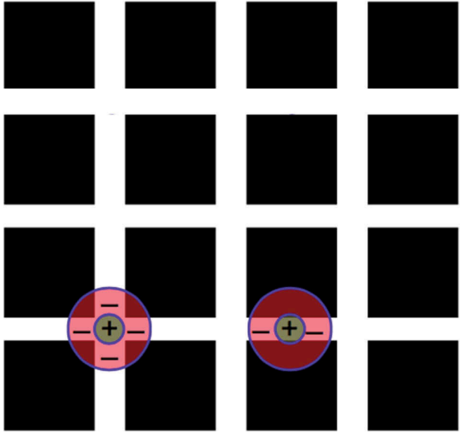
“Recent explanations of the ghost spots rely on basic cortical processing (Blakeslee & McCourt, 2012), but we present here the simpler retinal explanation to illustrate how subjective effects can in theory arise independently of consciousness.”
BackgroundFalsification and consciousness
Kleiner, J., & Hoel, E. (2020) · arXiv · doi:10.48550/arxiv.2004.03541 · Cited by 46 · cited 4×
“The unfolding argument does not apply, because predictive processing can be unfolded (Doerig, Schurger, et al. (2019); but see Kleiner (2019) and Kleiner and Hoel (2020)).”
BackgroundInfluentialLamme, V. (2015) · Theoretical Philosophy/MIND Group – JGU Mainz · doi:10.15502/9783958570092 · Cited by 45 · cited 1×
“…this identification of consciousness with recurrent processing is the following: it was shown that recurrent processing is required for perceptual organization and grouping (Lamme et al., 1998), which are functions that, it is argued, are explicitly linked to conscious experience (Lamme, 2015).”
BackgroundFingelkurts, A. A., Fingelkurts, A. A., & Neves, C. F. H. (2010) · Brain Research · doi:10.1016/j.brainres.2010.11.079 · Cited by 39
Consciousness and Hierarchical Inference
Friston, K. J. (2013) · Neuropsychoanalysis · doi:10.1080/15294145.2013.10773716 · Cited by 38 · cited 1×
“Predictive processing has often been associated with consciousness (Friston, 2013; Rudrauf et al., 2017; Seth & Tsakiris, 2018).”
BackgroundBrain states matter. A reply to the unfolding argument
Kleiner, J. (2020) · Consciousness and Cognition · doi:10.1016/j.concog.2020.102981 · Cited by 37 · cited 4×
“The unfolding argument does not apply, because predictive processing can be unfolded (Doerig, Schurger, et al. (2019); but see Kleiner (2019) and Kleiner and Hoel (2020)).”
BackgroundInfluentialBrain states matter. A reply to the unfolding argument.
Kleiner, J. (2019) · doi:10.31234/osf.io/jdcfh · Cited by 37 · cited 4×
“The unfolding argument does not apply, because predictive processing can be unfolded (Doerig, Schurger, et al. (2019); but see Kleiner (2019) and Kleiner and Hoel (2020)).”
BackgroundInfluentialHow Can We Construct a Science of Consciousness?
Chalmers, D. J. (2010) · Oxford University Press eBooks · doi:10.1093/acprof:oso/9780195311105.003.0002 · Cited by 31
Conscious Perception: Time for an Update?
Salti, M., Harel, A., & Marti, S. (2019) · Journal of Cognitive Neuroscience · doi:10.1162/jocn_a_01343 · Cited by 30 · cited 1×
“…al., 2012; Balsdon & Clifford, 2018; Kleiner & Hoel, 2020; Lau, 2008; Peters & Lau, 2015), all that is needed is the existence of conscious and unconscious states, and methods to contrast them (but see Salti et al., 2019, for an argument that the conscious vs. unconscious dichotomy is misguided).”
MethodErratum: Neural correlates of consciousness: progress and problems
Koch, C., Massimini, M., Boly, M., & Tononi, G. (2016) · Nature reviews. Neuroscience · doi:10.1038/nrn.2016.61 · Cited by 28
Modern Anesthetic Ethers Demonstrate Quantum Interactions with Entangled Photons
Burdick, R. K., Villabona-Monsalve, J. P., Mashour, G. A., & Goodson, T. (2019) · Scientific Reports · doi:10.1038/s41598-019-47651-1 · Cited by 25 · cited 1×
“There is evidence that terahertz quantum vibrations in microtubules are dampened during anaesthesia (Burdick et al., 2019).”
BackgroundDowngraded phenomenology: how conscious overflow lost its richness
Ward, E. J. (2018) · Philosophical Transactions of the Royal Society B Biological Sciences · doi:10.1098/rstb.2017.0355 · Cited by 20 · cited 1×
“Another important theoretical dispute concerns the distinction between access vs. phenomenal consciousness (see Block, 1995; Cohen & Dennett, 2011; Naccache, 2018; Phillips, 2018; Ward, 2018).”
BackgroundControlling for performance capacity confounds in neuroimaging studies of conscious awareness
Morales, J., Chiang, J., & Lau, H. (2015) · Neuroscience of Consciousness · doi:10.1093/nc/niv008 · Cited by 19 · cited 1×
“For visual masking and other paradigms, specific procedures have been established to differentiate between conscious and unconscious perception (Morales et al., 2015; Overgaard et al., 2010; Schmidt & Vorberg, 2006).”
BackgroundLong-lasting visual integration of form, motion, and color as revealed by visual masking
Pilz, K. S., Zimmermann, C., Scholz, J., & Herzog, M. H. (2013) · Journal of Vision · doi:10.1167/13.10.12 · Cited by 19 · cited 1×
“This unconscious integration period can last for 420 ms as experiments using TMS and feature fusion have shown (Scharnowski et al., 2009; Rüter et al., 2010; see also Pilz et al., 2013).”
MethodSelf-citationWhat is a Theory of Consciousness a Theory of?—The Search for Criterial Constraints on Theory
Baars, B. J. (1986) · Imagination, Cognition and Personality · doi:10.2190/wjer-xabv-qm4w-kd6v · Cited by 18 · cited 1×
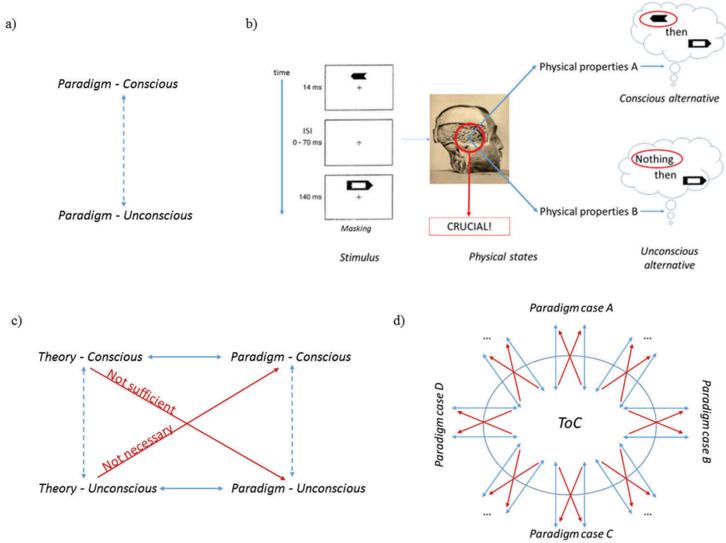
“They must have conscious and unconscious alternatives, allowing us to pit conscious vs. unconscious processing against each other – otherwise one cannot be certain that consciousness per se and not other co-occurring processes are addressed (this is reminiscent of Baars (1986) contrastive approach).”
BackgroundFLOHR, H. (1992) · Emergence or Reduction? · doi:10.1515/9783110870084.220 · Cited by 18 · cited 1×
“include NMDA synapses (Flohr, 1992), processing in layer 5 of V1 (Crick & Koch, 2003), the claustrum (Crick & Koch, 2005), gamma-band oscillations (Buzsáki, 2004), thalamo-”
BackgroundVisual processing: conscious until proven otherwise
Balsdon, T., & Clifford, C. W. G. (2018) · Royal Society Open Science · doi:10.1098/rsos.171783 · Cited by 16 · cited 1×
“Even though problems with this contrastive approach have been highlighted recently (Aru et al., 2012; Balsdon & Clifford, 2018; Kleiner & Hoel, 2020; Lau, 2008; Peters & Lau, 2015), all that is needed is the existence of conscious and unconscious states, and methods to contrast them (but see Salti…”
Pinker, S. A. (2007) · PubMed · Cited by 16
Building perception block by block: a response to Feketeet al.
Doerig, A., Scharnowski, F., & Herzog, M. H. (2019) · Neuroscience of Consciousness · doi:10.1093/nc/niy012 · Cited by 15
Self-citationA socio-historical take on the meta-problem of consciousnessPreprint
Lau, H. C., & Michel, M. (2019) · PsyArXiv (OSF Preprints) · doi:10.31234/osf.io/ut8zq · Cited by 14 · cited 1×
“3On top of a potential lack of criteria, Lau and Michel (2019) propose a socio-historical take on this question.”
BackgroundWhen transcranial magnetic stimulation (TMS) modulates feature integration
Rüter, J., Kammer, T., & Herzog, M. H. (2010) · European Journal of Neuroscience · doi:10.1111/j.1460-9568.2010.07456.x · Cited by 11 · cited 1×
“This unconscious integration period can last for 420 ms as experiments using TMS and feature fusion have shown (Scharnowski et al., 2009; Rüter et al., 2010; see also Pilz et al., 2013).”
MethodSelf-citationPeters, M. A. K., & Lau, H. C. (2016) · eLife · doi:10.7554/elife.16332 · Cited by 9
Integrated Information Theory and Isomorphic Feed-Forward Philosophical Zombies
Hanson, J. R., & Walker, S. I. (2019) · Entropy · doi:10.3390/e21111073 · Cited by 8 · cited 2×
“As a consequence, the unfolding argument challenges causal structure theories because, if one accepts that two functionally identical systems can have different consciousness, these ToCs cannot be addressed empirically, and are therefore outside the realm of science (see Doerig, Schurger, et al. (2019) for a detailed…”
BackgroundCommentary on the ‘small network’ argument
Taylor, J. G. (2007) · Neural Networks · doi:10.1016/j.neunet.2007.09.003 · Cited by 4 · cited 1×
“For example, it was claimed that full consciousness occurs only in networks with many neurons (Taylor, 2007).”
BackgroundBarbero (2014) · doi:10.1016/j · Cited by 1
Research works printed but not linked: 3
- Descartes, R. (1996). Discourse on the method: And, meditations on fi rst philosophy . Yale University Press.
- Gazzaniga, M. S. (1970). The bisected brain (Vol. 2). AppletonCentury-Crofts New York.
- Noë, A. (2004). Action in perception . MIT press.
Cited by
Predictive processing as a systematic basis for identifying the neural correlates of consciousness
Hohwy, J., & Seth, A. (2020) · Philosophy and the Mind Sciences · doi:10.33735/phimisci.2020.ii.64 · Cited by 170
The ConTraSt database for analysing and comparing empirical studies of consciousness theories
Yaron, I., Melloni, L., Pitts, M., & Mudrik, L. (2022) · Nature Human Behaviour · doi:10.1038/s41562-021-01284-5 · Cited by 147
“The parameters whose average importance was higher than 95% of the distribution of importance scores of a random parameter were (in order of importance): (1) studying state versus content consciousness, (2) using report versus no-report paradigms, (3) using connectivity measures and (4) using subjective measures of co…”
BackgroundMethodInfluentialFrancken, J. C., Beerendonk, L., Molenaar, D., Fahrenfort, J. J., Kiverstein, J. D., Seth, A. K., & van Gaal, S. (2022) · Neuroscience of Consciousness · doi:10.1093/nc/niac011 · Cited by 136
“how it should be operationalized), what would constitute an explanation, and how valid experiments should be designed (Block 1995; Chalmers 1995, 2000; Dehaene and Naccache 2001; Dennett 2001; Lamme 2006; Tononi 2008; Dehaene and Changeux 2011; Doerig et al. 2020; Hohwy and Seth 2020); see Seth and Bayne (2022) for a…”
BackgroundAn integrative, multiscale view on neural theories of consciousness
Storm, J. F., Klink, P. C., Aru, J., Senn, W., Goebel, R., Pigorini, A., Avanzini, P., Vanduffel, W., Roelfsema, P. R., Massimini, M., et al. (2024) · Neuron · doi:10.1016/j.neuron.2024.02.004 · Cited by 114
Guingrich, R. E., & Graziano, M. S. A. (2024) · Frontiers in Psychology · doi:10.3389/fpsyg.2024.1322781 · Cited by 87
“Many people study consciousness, and there are just as many competing theories about what it is and how it is generated in the human brain (e.g., Chalmers, 1996; Baars, 1997; Tononi, 2007; Graziano, 2013; Doerig et al., 2020).”
Background
Metadata
- Authors
- Doerig, A., Schurger, A., & Herzog, M. H.
- Affiliations
- École Polytechnique Fédérale de Lausanne (CH)
- Inserm (FR)
- Corresponding author
- Doerig, Adrien
- Venue
- Cognitive Neuroscience
- Publisher
- Informa UK Limited
- Published
- 2020-07-14
- Volume
- 12
- Issue
- 2
- Pages
- 41-62
- ISSN
- 1758-8928 (ISSN-L)
- 1758-8936
- OpenAlex
- W3043429318
- Semantic Scholar
- 6a2fd985d926673863670e7a43cb52d63de95773
- Cited by
- 194
- References
- 153
- Citations by year
- 2026: 41 · 2025: 33 · 2024: 30 · 2023: 33 · 2022: 32 · 2021: 18 · 2020: 7
- FWCI
- 21.77
- Type
- journal article
- Language
- en
- Open access
- hybrid
- doi.org
- Licence
- Locations
- Cognitive Neuroscience (publishedVersion, cc-by-nc-nd)
- PubMed (publishedVersion)
- Radboud Repository (Radboud University) (submittedVersion, other-oa)
- Chapman University Digital Commons (Chapman University) (submittedVersion, cc-by-nc-nd)
- Infoscience (Ecole Polytechnique Fédérale de Lausanne) (submittedVersion, cc-by-nc-nd)
- Radboud Repository (Radboud University) (submittedVersion)
- Funders
- Schweizerischer Nationalfonds zur Förderung der Wissenschaftlichen Forschung (176153)
- Topics
- Social Sciences › Arts and Humanities › Philosophy › Philosophy and Theoretical Science
- Social Sciences › Arts and Humanities › Philosophy › Free Will and Agency
- Social Sciences › Arts and Humanities › History and Philosophy of Science › Philosophy of Biology and Scientific Explanation
- Keywords
- theory of consciousness
- MeSH terms
- Consciousness, Humans, Empirical Research
About these checks
Registry, retraction, Cites and statistics results are computed, not judged, with one exception: a printed reference that no index lists is read once by a model before it counts as a citation error. Claims are extracted by a model and kept only when their quote appears verbatim in the text; each cited source is then checked, with a model’s help, for whether it says what the claim relies on. Those verdicts can be wrong — read the claim’s quote and the cited source before relying on one.
The claim verdicts this report counts are experimental: their accuracy is not yet measured.
A language model drew the claims from the paper on 2026-09-28, under version 3 of the claim definition (model deepseek-v4.1-flash, prompt extract-v3).
A second model labelled each claim on 2026-09-28 (model jev-1.13-20260917, definition revision gold-guideline-v0.2).
Cited sources are checked with a language model’s help (gpt-6-sol and qwen3.8-omni-flash).
Statistics and arithmetic are recomputed, not judged.
Confidence bands are shown only for fields calibrated on our annotated test set. None is calibrated yet, so no band is shown.
What counts as a claim ›How we measure confidence ›How we check this ›
Are you an author, or do you see a problem with this page? Request a review
Data sources
Bibliographic data: Semantic Scholar, OpenAlex, Crossref.
Contains information from the Semantic Scholar Academic Graph Datasets, made available under the ODC Attribution License (ODC-BY 1.0).
Semantic Scholar’s data is described in: Kinney, R., et al. (2023). The Semantic Scholar Open Data Platform. arXiv:2301.10140.
