

The DOI matches its Crossref record; 272 of the 274 references it cites were found in a registry or an index, and 1 are not checked yet; 6 of the 353 sources its claims cite were checked for support.
A Critical Review of the Evidence That Metformin Is a Putative Anti-Aging Drug That Enhances Healthspan and Extends Lifespan
Open accessAbstract
The numerous beneficial health outcomes associated with the use of metformin to treat patients with type 2 diabetes (T2DM), together with data from pre-clinical studies in animals including the nematode, C. elegans, and mice have prompted investigations into whether metformin has therapeutic utility as an anti-aging drug that may also extend lifespan. Indeed, clinical trials, including the MILES (Metformin In Longevity Study) and TAME (Targeting Aging with Metformin), have been designed to assess the potential benefits of metformin as an anti-aging drug. Preliminary analysis of results from MILES indicate that metformin may induce anti-aging transcriptional changes; however it remains controversial as to whether metformin is protective in those subjects free of disease. Furthermore, despite clinical use for over 60 years as an anti-diabetic drug, the cellular mechanisms by which metformin exerts either its actions remain unclear. In this review, we have critically evaluated the literature that has investigated the effects of metformin on aging, healthspan and lifespan in humans as well as other species. In preparing this review, particular attention has been placed on the strength and reproducibility of data and quality of the study protocols with respect to the pharmacokinetic and pharmacodynamic properties of metformin. We conclude that despite data in support of anti-aging benefits, the evidence that metformin increases lifespan remains controversial. However, via its ability to reduce early mortality associated with various diseases, including diabetes, cardiovascular disease, cognitive decline and cancer, metformin can improve healthspan thereby extending the period of life spent in good health. Based on the available evidence we conclude that the beneficial effects of metformin on aging and healthspan are primarily indirect via its effects on cellular metabolism and result from its anti-hyperglycemic action, enhancing insulin sensitivity, reduction of oxidative stress and protective effects on the endothelium and vascular function.
Verified 2026-10-10 · 1 reference not checked yet
Overview
AI snapshot
Written from the paper’s full text.
TL;DR
This critical review concludes that metformin improves healthspan primarily indirectly through anti-hyperglycemic, insulin-sensitizing, antioxidant, and vascular-protective effects, but evidence that it extends lifespan remains controversial. It cautions that many anti-aging claims rest on preclinical studies using suprapharmacologic metformin concentrations and that human lifespan data are inconclusive.
Key findings
- The authors conclude metformin can improve healthspan by reducing early mortality from diabetes, cardiovascular disease, cognitive decline, and cancer, but that evidence for lifespan extension is controversial; beneficial aging effects are primarily indirect via cellular metabolism, insulin sensitivity, oxidative stress reduction, and endothelial/vascular protection.
- In *C. elegans*, 50 mM metformin enhanced survival by 27% in one study, but studies used 10–150 mM (equivalent to approximately 5 kg/day in humans); in aged worms all tested concentrations (10, 25, and 50 mM) were toxic and reduced lifespan.
- Rodent lifespan results are dose- and age-dependent: 0.1% metformin increased male mouse lifespan by 4.15%, while 1% was toxic and reduced average lifespan by 14.4%; metformin extended lifespan by 14% when started at 1 month, by an insignificant 6% at 9 months, and was ineffective at 15 months; other studies found no lifespan extension in mice or Fischer-344 rats.
- Human data: a retrospective UK Clinical Practice Research Datalink analysis found non-diabetics had 15% lower median survival than metformin-treated diabetics and sulfonylurea-treated diabetics had 38% lower survival than metformin-treated diabetics, suggesting healthspan but not lifespan extension; MILES (14 elderly subjects, 1700 mg/day, 6 weeks) found 647 differentially expressed genes in muscle and 146 in adipose tissue, while TAME (planned 3000 non-diabetic adults aged 65–80, 1500 mg/day for 6 years) is pending.
Methods
- Design: critical narrative review of published literature on metformin and aging, healthspan, and lifespan across humans and other species.
- Data: preclinical studies in *C. elegans*, rodents, and cell culture; clinical/observational studies and trials including MILES and TAME; pharmacokinetic and pharmacodynamic properties of metformin.
- Analysis: qualitative synthesis and critical appraisal of study protocols, reproducibility, and dose/concentration relevance; no new primary data or formal meta-analysis reported.
Limitations
- Stated: healthspan is controversial and not readily quantified; evidence that metformin increases lifespan remains controversial; many preclinical studies use metformin concentrations far above therapeutic plasma levels (in vitro x25–x1000 higher; in vivo x2–x45 therapeutic doses); lack of appropriately designed placebo-driven RCTs; effects may be age-dependent and less effective or ineffective in older organisms; MILES findings remain to be validated; TAME results are not yet available.
- Evident from text: as a narrative review, it does not describe a systematic search strategy, inclusion criteria, or formal risk-of-bias assessment; conclusions rely on heterogeneous species, doses, and study designs, and several cited findings are preliminary or from ongoing trials.
Model-written summary. Check it against the paper before relying on it.
Integrity signals
Registry
Cites
Statistics
Figures
Verification
Claims the paper makes
237 Not checked yet · 30 Own interpretation · 12 No basis given · 2 Supported · 1 Partly supported · 1 Own method · 1 Own result · accuracy not yet measured
Every source the paper cites for this claim was checked and supports it.
In the paper
“In bovine retinal capillary endothelial cells (BRECs) and retinas from diabetic rats, hyperglycemia-induced elevated levels of NF-κB, and Bax, a pro-apoptotic gene, were sustained even after returning to normoglycemia (193).”
§ A Critical Review of the Evidence That Metformin Is a Putative Anti-Aging Drug That Enhances Healthspan and Extends Lifespan > Metformin and Hyperglycemic Memory
What the sources say
- Supportedcites [193] Zheng, 2012, Sirtuin 1-Mediated Cellular Metabolic Memory of High Glucose via the LKB1/AMPK/ROS Pathway and Therapeutic Effects of Metformin, Diabetes source
The Results section on BRECs reports that NF-κB and Bax remained increased after one week of high glucose followed by two weeks of normal glucose. The Results section on diabetic rat retinas likewise reports that these markers remained elevated for four weeks after glucose normalization. (LLM, conf=0.94)
plaindirect- Asserted: passes — The authors put it forward as true.
- Checkable: passes — It can be checked against evidence.
- Load-bearing: passes — The paper’s conclusions depend on it.
- Based: passes — The paper gives a reason why it holds.
- Supported
Every source the paper cites for this claim was checked and supports it.
In the paper
“Data from the MILES trial indicate that metformin modified multiple pathways associated with aging including metabolic pathways, collagen trimerization and extracellular matrix (ECM) remodeling, adipose tissue and fatty acid metabolism, mitochondria, and the MutS genes, MSH2 and MSH3, which play a role in DNA mismatch repair, a process that declines with age (79).”
§ A Critical Review of the Evidence That Metformin Is a Putative Anti-Aging Drug That Enhances Healthspan and Extends Lifespan > Clinical Trials to Assess Effects of Metformin on Aging, Healthspan, and Lifespan
What the sources say
- Supportedcites [79] Kulkarni, 2018, Metformin Regulates Metabolic and Nonmetabolic Pathways in Skeletal Muscle and Subcutaneous Adipose Tissues of Older Adults, Aging Cell source
The adipose-tissue passage (Introduction) reports effects on fatty acid metabolism, collagen trimerization, and ECM remodeling. The muscle passage (Introduction) reports metabolic and mitochondrial pathways and regulation of MSH2 and MSH3, which it identifies as mismatch-repair genes involved in a process that declines with age. (LLM, conf=0.94)
hedgeddirectn = 14- Asserted: passes — The authors put it forward as true.
- Checkable: passes — It can be checked against evidence.
- Load-bearing: unclear — It is unclear whether the paper’s conclusions depend on it.
- Based: passes — The paper gives a reason why it holds.
- Supported
The paper states this without a source or data behind it here, so there is nothing to check it against. The quote shows it is in the paper.
In the paper
“we do accept that the use of metformin in the treatment of patients with T2DM is associated with a positive benefit on healthspan.”
§ A Critical Review of the Evidence That Metformin Is a Putative Anti-Aging Drug That Enhances Healthspan and Extends Lifespan > Conclusions
plaincorrelational- Asserted: passes — The authors put it forward as true.
- Checkable: passes — It can be checked against evidence.
- Load-bearing: passes — The paper’s conclusions depend on it.
- Based: passes — The paper gives a reason why it holds.
The paper states this without a source or data behind it here, so there is nothing to check it against. The quote shows it is in the paper.
In the paper
“although the evidence for lifespan expansion in mammalian species is not conclusive”
§ A Critical Review of the Evidence That Metformin Is a Putative Anti-Aging Drug That Enhances Healthspan and Extends Lifespan > Conclusions
plain- Asserted: passes — The authors put it forward as true.
- Checkable: passes — It can be checked against evidence.
- Load-bearing: passes — The paper’s conclusions depend on it.
- Based: unclear — It is unclear why the paper says it holds.
None of the sources cited for this claim have been checked yet.
In the paper
“Based on evidence from both clinical and pre-clinical studies metformin, independent of its anti-hyperglycemic actions, directly protects the endothelium (33–35).”
§ A Critical Review of the Evidence That Metformin Is a Putative Anti-Aging Drug That Enhances Healthspan and Extends Lifespan > Introduction
What the sources say
- Not checked yetcites [33] Nafisa, 2018, Endothelial Function and Dysfunction: Impact of Metformin, Pharmacol Ther source
- Not checked yetcites [34] Triggle, 2020, Why the Endothelium? The Endothelium as a Target to Reduce Diabetes-Related Associated Vascular Disease, Can J Physiol Pharmacol source
- Not checked yetcites [35] Kalyani, 2021, Glucose-Lowering Drugs to Reduce Cardiovascular Risk in Type 2 Diabetes, N Engl J Med source
plaindirect- Asserted: passes — The authors put it forward as true.
- Checkable: passes — It can be checked against evidence.
- Load-bearing: unclear — It is unclear whether the paper’s conclusions depend on it.
- Based: passes — The paper gives a reason why it holds.
In the paper
“Similarly, Johnson et al. accessed the Saskatchewan Health Administrative databases for a retrospective study and also reported reduced cardiovascular morbidity and mortality benefits of metformin monotherapy versus sulfonylurea monotherapy (31).”
§ A Critical Review of the Evidence That Metformin Is a Putative Anti-Aging Drug That Enhances Healthspan and Extends Lifespan > Introduction
What the sources say
- Not checked yetcites [31] Johnson, 2005, Reduced Cardiovascular Morbidity and Mortality Associated With Metformin Use in Subjects With Type 2 Diabetes, Diabetes Med source
plaindirect- Asserted: passes — The authors put it forward as true.
- Checkable: passes — It can be checked against evidence.
- Load-bearing: passes — The paper’s conclusions depend on it.
- Based: passes — The paper gives a reason why it holds.
None of the sources cited for this claim have been checked yet.
In the paper
“In addition to its benefits as an anti-hyperglycemic agent, metformin also lowers the atherosclerotic burden in non-diabetic persons at risk of developing T2DM (1, 7).”
§ A Critical Review of the Evidence That Metformin Is a Putative Anti-Aging Drug That Enhances Healthspan and Extends Lifespan > Introduction
What the sources say
- Not checked yetcites [1] Rojas, 2013, Metformin: An Old But Still the Best Treatment for Type 2 Diabetes, Diabetol Metab Syndr source
- Not checked yetcites [7] 2012, Long-Term Safety, Tolerability, and Weight Loss Associated With Metformin in the Diabetes Prevention Program Outcomes Study, Diabetes Care source
plaindirect- Asserted: passes — The authors put it forward as true.
- Checkable: passes — It can be checked against evidence.
- Load-bearing: unclear — It is unclear whether the paper’s conclusions depend on it.
- Based: passes — The paper gives a reason why it holds.
In the paper
“The benefits of metformin in reducing microvascular disease have been supported by a 10-year follow up of the original UKPDS report (30).”
§ A Critical Review of the Evidence That Metformin Is a Putative Anti-Aging Drug That Enhances Healthspan and Extends Lifespan > Introduction
What the sources say
- Not checked yetcites [30] Holman, 2008, 10-Year Follow-Up of Intensive Glucose Control in Type 2 Diabetes, N Engl J Med source
plaindirect- Asserted: passes — The authors put it forward as true.
- Checkable: passes — It can be checked against evidence.
- Load-bearing: unclear — It is unclear whether the paper’s conclusions depend on it.
- Based: passes — The paper gives a reason why it holds.
In the paper
“The study, published in 1998, reported the cardiovascular (CV) benefits of the use of metformin for diabetes (24).”
§ A Critical Review of the Evidence That Metformin Is a Putative Anti-Aging Drug That Enhances Healthspan and Extends Lifespan > Introduction
What the sources say
- Not checked yetcites [24] 1998, Effect of Intensive Blood-Glucose Control With Metformin on Complications in Overweight Patients With Type 2 Diabetes (UKPDS 34, Lancet source
plaindirect- Asserted: passes — The authors put it forward as true.
- Checkable: passes — It can be checked against evidence.
- Load-bearing: unclear — It is unclear whether the paper’s conclusions depend on it.
- Based: passes — The paper gives a reason why it holds.
A result the paper reports from its own data — it cites no other source for it, so there is none to check. The quote shows it is in the paper.
In the paper
“Preliminary analysis of results from MILES indicate that metformin may induce anti-aging transcriptional changes; however it remains controversial as to whether metformin is protective in those subjects free of disease.”
§ A Critical Review of the Evidence That Metformin Is a Putative Anti-Aging Drug That Enhances Healthspan and Extends Lifespan > Abstract
hedgedconditional- Asserted: passes — The authors put it forward as true.
- Checkable: passes — It can be checked against evidence.
- Load-bearing: unclear — It is unclear whether the paper’s conclusions depend on it.
- Based: passes — The paper gives a reason why it holds.
- It may state two separate claims as one. 127
- Probably not a substantial claim. 61
- The quote only partly states this claim. 2
The cited sources support only part of this claim — read each source’s verdict below.
In the paper
“The metabolic changes that occur as a result of diabetes (hyperinsulinemia, hyperglycemia, and dyslipidemia) potentiate signaling pathways and may increase the oncogenic nature of breast tissue through accelerating cell growth and migration, angiogenesis, increasing metastasis, and decreasing the response to chemotherapy (158, 244–247).”
§ A Critical Review of the Evidence That Metformin Is a Putative Anti-Aging Drug That Enhances Healthspan and Extends Lifespan > Metformin and a Decreased Incidence of Cancer
What the sources say
- Partly supportedcites [158] Samuel, 2019, Metformin: The Answer to Cancer in a Flower? Current Knowledge and Future Prospects of Metformin as an Anti-Cancer Agent in Breast Cancer, Biomolecules sourceExperimental — accuracy not yet measured
Split into 2 atoms — 0 confirmed, 2 partially supported, 0 disputed, 0 misattributed, 0 unverifiable. Expand the claim to see per-atom verdicts.
- Partly supportedcites [244] Pelton, 2014, Hypercholesterolemia Induces Angiogenesis and Accelerates Growth of Breast Tumors In Vivo, Am J Pathol sourceExperimental — accuracy not yet measured
Split into 2 atoms — 0 confirmed, 2 partially supported, 0 disputed, 0 misattributed, 0 unverifiable. Expand the claim to see per-atom verdicts.
- Not checked yetcites [245] Samuel, 2018, Challenges and Perspectives in the Treatment of Diabetes Associated Breast Cancer, Cancer Treat Rev source
- Partly supportedcites [246] Ferroni, 2015, Type 2 Diabetes and Breast Cancer: The Interplay Between Impaired Glucose Metabolism and Oxidant Stress, Oxid Med Cell Longev sourceExperimental — accuracy not yet measured
Split into 2 atoms — 0 confirmed, 2 partially supported, 0 disputed, 0 misattributed, 0 unverifiable. Expand the claim to see per-atom verdicts.
- Partly supportedcites [247] Mathews Samuel, 2019, Treatment With a Combination of Metformin and 2-Deoxyglucose Upregulates Thrombospondin-1 in Microvascular Endothelial Cells: Implications in Anti-Angiogenic Cancer Therapy, Cancers sourceExperimental — accuracy not yet measured
Split into 2 atoms — 0 confirmed, 2 partially supported, 0 disputed, 0 misattributed, 0 unverifiable. Expand the claim to see per-atom verdicts.
hedgedconditional- Asserted: passes — The authors put it forward as true.
- Checkable: passes — It can be checked against evidence.
- Load-bearing: passes — The paper’s conclusions depend on it.
- Based: passes — The paper gives a reason why it holds.
It may state two separate claims as one.
- Partly supported
In the paper
“However, metformin has not been approved as a weight loss drug in part because its effects are highly variable and in women with PCOS despite weight loss visceral fat may not be reduced (21).”
§ A Critical Review of the Evidence That Metformin Is a Putative Anti-Aging Drug That Enhances Healthspan and Extends Lifespan > Introduction
What the sources say
- Not checked yetcites [21] Lord, 2006, The Effect of Metformin on Fat Distribution and the Metabolic Syndrome in Women With Polycystic Ovary Syndrome–A Randomised, Double-Blind, Placebo-Controlled Trial, BJOG source
hedgedconditional- Asserted: passes — The authors put it forward as true.
- Checkable: passes — It can be checked against evidence.
- Load-bearing: unclear — It is unclear whether the paper’s conclusions depend on it.
- Based: passes — The paper gives a reason why it holds.
It may state two separate claims as one.
None of the sources cited for this claim have been checked yet.
In the paper
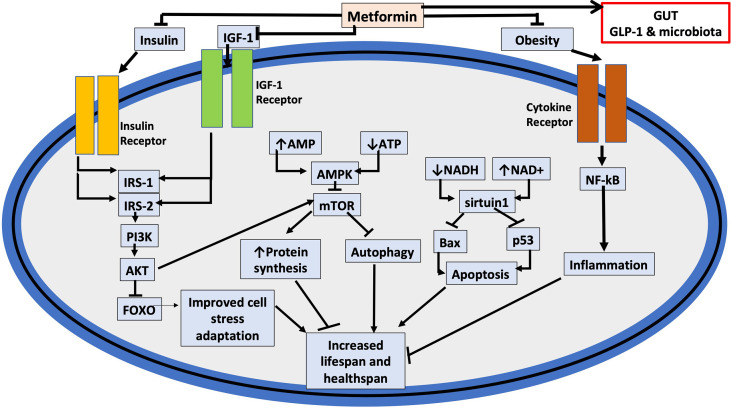
“Metformin via its insulin sensitizing actions reduces insulin and thereby should also normalize IGF-1 levels (55, 56).”
§ A Critical Review of the Evidence That Metformin Is a Putative Anti-Aging Drug That Enhances Healthspan and Extends Lifespan > The Putative Relationship Between Metformin and Aging
What the sources say
- Not checked yetcites [55] Dowling, 2015, Changes in Insulin Receptor Signaling Underlie Neoadjuvant Metformin Administration in Breast Cancer: A Prospective Window of Opportunity Neoadjuvant Study, Breast Cancer Res: BCR source
- Not checked yetcites [56] Yang, 2020, The Influence of Metformin on IGF-1 Levels in Humans: A Systematic Review and Meta-Analysis, Pharmacol Res source
hedgeddirect- Asserted: passes — The authors put it forward as true.
- Checkable: passes — It can be checked against evidence.
- Load-bearing: passes — The paper’s conclusions depend on it.
- Based: passes — The paper gives a reason why it holds.
It may state two separate claims as one.
None of the sources cited for this claim have been checked yet.
In the paper
“We now know there are extra-hepatic sites of action of metformin with the gut being a major contributor to its clinical benefits as an anti-hyperglycemic drug via modulating glucagon-like peptide 1 (GLP-1) levels by a duodenal AMPK-mediated pathway, as well as effects resulting from modulating the microbiota (25–29).”
§ A Critical Review of the Evidence That Metformin Is a Putative Anti-Aging Drug That Enhances Healthspan and Extends Lifespan > Introduction
What the sources say
- Not checked yetcites [25] Duca, 2015, Metformin Activates a Duodenal Ampk-Dependent Pathway to Lower Hepatic Glucose Production in Rats, Nat Med source
- Not checked yetcites [26] Buse, 2016, The Primary Glucose-Lowering Effect of Metformin Resides in the Gut, Not the Circulation: Results From Short-Term Pharmacokinetic and 12-Week Dose-Ranging Studies, Diabetes Care source
- Not checked yetcites [27] Romero, 2017, Metformin, the Aspirin of the 21st Century: Its Role in Gestational Diabetes Mellitus, Prevention of Preeclampsia and Cancer, and the Promotion of Longevity, Am J Obstet Gynecol source
- Not checked yetcites [28] Glossmann, 2019, Metformin and Aging: A Review, Gerontol nd source
- Not checked yetcites [29] Vallianou, 2019, Metformin and Gut Microbiota: Their Interactions and Their Impact on Diabetes, Hormones (Athens) source
boosteddirect- Asserted: passes — The authors put it forward as true.
- Checkable: passes — It can be checked against evidence.
- Load-bearing: unclear — It is unclear whether the paper’s conclusions depend on it.
- Based: passes — The paper gives a reason why it holds.
It may state two separate claims as one.
In the paper
“In addition, data from the Diabetes Prevention Program (DPP) indicates that metformin is effective in preventing the development of diabetes in patients with pre-diabetes and its use following a 10-year follow up associated with an average 2.1-kg weight loss (7).”
§ A Critical Review of the Evidence That Metformin Is a Putative Anti-Aging Drug That Enhances Healthspan and Extends Lifespan > Introduction
What the sources say
- Not checked yetcites [7] 2012, Long-Term Safety, Tolerability, and Weight Loss Associated With Metformin in the Diabetes Prevention Program Outcomes Study, Diabetes Care source
hedgedcorrelational- Asserted: passes — The authors put it forward as true.
- Checkable: passes — It can be checked against evidence.
- Load-bearing: unclear — It is unclear whether the paper’s conclusions depend on it.
- Based: passes — The paper gives a reason why it holds.
It may state two separate claims as one.
A conclusion the paper draws from its own results — it cites no other source for it, so there is none to check. The quote shows it is in the paper.
In the paper
“We conclude that despite data in support of anti-aging benefits, the evidence that metformin increases lifespan remains controversial.”
§ A Critical Review of the Evidence That Metformin Is a Putative Anti-Aging Drug That Enhances Healthspan and Extends Lifespan > Abstract
plaindirect- Asserted: passes — The authors put it forward as true.
- Checkable: passes — It can be checked against evidence.
- Load-bearing: passes — The paper’s conclusions depend on it.
- Based: passes — The paper gives a reason why it holds.
It may state two separate claims as one.
In the paper
“Based on a systematic review of 53 studies, Campbell et al. concluded that independent of its therapeutic efficacy as an anti-diabetic drug, the use of metformin results in a reduction of all-cause mortality associated with diseases that accelerate aging, including cancer and cardiovascular disease (37).”
§ A Critical Review of the Evidence That Metformin Is a Putative Anti-Aging Drug That Enhances Healthspan and Extends Lifespan > The Putative Relationship Between Metformin and Aging
What the sources say
- Not checked yetcites [37] Campbell, 2017, Metformin Reduces All-Cause Mortality and Diseases of Ageing Independent of Its Effect on Diabetes Control: A Systematic Review and Meta-Analysis, Ageing Res Rev source
plaindirect- Asserted: passes — The authors put it forward as true.
- Checkable: passes — It can be checked against evidence.
- Load-bearing: passes — The paper’s conclusions depend on it.
- Based: passes — The paper gives a reason why it holds.
Probably not a substantial claim.
A conclusion the paper draws from its own results — it cites no other source for it, so there is none to check. The quote shows it is in the paper.
In the paper
“Furthermore, despite clinical use for over 60 years as an anti-diabetic drug, the cellular mechanisms by which metformin exerts either its actions remain unclear.”
§ A Critical Review of the Evidence That Metformin Is a Putative Anti-Aging Drug That Enhances Healthspan and Extends Lifespan > Abstract
plain- Asserted: passes — The authors put it forward as true.
- Checkable: passes — It can be checked against evidence.
- Load-bearing: fails — The paper’s conclusions may not depend on it.
- Based: fails — The paper may give no reason why it holds.
Probably not a substantial claim. The paper’s conclusions may not depend on it. The paper may give no reason why it holds.
A conclusion the paper draws from its own results — it cites no other source for it, so there is none to check. The quote shows it is in the paper.
In the paper
“Collectively these data indicate that metformin can reduce both mortality and disease-accelerated aging of the cardiovascular system.”
§ A Critical Review of the Evidence That Metformin Is a Putative Anti-Aging Drug That Enhances Healthspan and Extends Lifespan > Introduction
hedgeddirect- Asserted: passes — The authors put it forward as true.
- Checkable: passes — It can be checked against evidence.
- Load-bearing: passes — The paper’s conclusions depend on it.
- Based: passes — The paper gives a reason why it holds.
It may state two separate claims as one.
A conclusion the paper draws from its own results — it cites no other source for it, so there is none to check. The quote shows it is in the paper.
In the paper
“Based on the available evidence we conclude that the beneficial effects of metformin on aging and healthspan are primarily indirect via its effects on cellular metabolism and result from its anti-hyperglycemic action, enhancing insulin sensitivity, reduction of oxidative stress and protective effects on the endothelium and vascular function.”
§ A Critical Review of the Evidence That Metformin Is a Putative Anti-Aging Drug That Enhances Healthspan and Extends Lifespan > Abstract
plaindirect- Asserted: passes — The authors put it forward as true.
- Checkable: passes — It can be checked against evidence.
- Load-bearing: passes — The paper’s conclusions depend on it.
- Based: passes — The paper gives a reason why it holds.
It may state two separate claims as one.
A conclusion the paper draws from its own results — it cites no other source for it, so there is none to check. The quote shows it is in the paper.
In the paper
“However, via its ability to reduce early mortality associated with various diseases, including diabetes, cardiovascular disease, cognitive decline and cancer, metformin can improve healthspan thereby extending the period of life spent in good health.”
§ A Critical Review of the Evidence That Metformin Is a Putative Anti-Aging Drug That Enhances Healthspan and Extends Lifespan > Abstract
plaindirect- Asserted: passes — The authors put it forward as true.
- Checkable: passes — It can be checked against evidence.
- Load-bearing: passes — The paper’s conclusions depend on it.
- Based: passes — The paper gives a reason why it holds.
It may state two separate claims as one.
In the paper
“Metformin is a synthetic biguanide, orally effective and insulin sensitizing anti-diabetic drug, which for most patients is the first line anti-hyperglycemic for the treatment of type 2 diabetes mellitus (T2DM) (1).”
§ A Critical Review of the Evidence That Metformin Is a Putative Anti-Aging Drug That Enhances Healthspan and Extends Lifespan > Introduction
What the sources say
- Not checked yetcites [1] Rojas, 2013, Metformin: An Old But Still the Best Treatment for Type 2 Diabetes, Diabetol Metab Syndr source
plain- Asserted: passes — The authors put it forward as true.
- Checkable: passes — It can be checked against evidence.
- Load-bearing: fails — The paper’s conclusions may not depend on it.
- Based: passes — The paper gives a reason why it holds.
Probably not a substantial claim. The paper’s conclusions may not depend on it. It may state two separate claims as one.
In the paper
“Signaling via mTOR is linked to accelerated aging and dysregulation of mTOR signaling is also linked to the progression of cancer, inflammatory and neurological diseases, as well as T2DM (59).”
§ A Critical Review of the Evidence That Metformin Is a Putative Anti-Aging Drug That Enhances Healthspan and Extends Lifespan > The Putative Relationship Between Metformin and Aging
What the sources say
- Not checked yetcites [59] Dazert, 2011, mTOR Signaling in Disease, Curr Opin Cell Biol source
plaincorrelational- Asserted: passes — The authors put it forward as true.
- Checkable: passes — It can be checked against evidence.
- Load-bearing: passes — The paper’s conclusions depend on it.
- Based: passes — The paper gives a reason why it holds.
It may state two separate claims as one.
None of the sources cited for this claim have been checked yet.
In the paper
“This action is an important determinant for the anti-hyperglycemic therapeutic effects, the gastrointestinal side effects and possibly the anti-aging effects of metformin (88, 89).”
§ A Critical Review of the Evidence That Metformin Is a Putative Anti-Aging Drug That Enhances Healthspan and Extends Lifespan > The Putative Relationship Between Metformin and Aging
What the sources say
- Not checked yetcites [88] Forslund, 2015, Disentangling Type 2 Diabetes and Metformin Treatment Signatures in the Human Gut Microbiota, Nature source
- Not checked yetcites [89] Bryrup, 2019, Metformin-Induced Changes of the Gut Microbiota in Healthy Young Men: Results of a Non-Blinded, One-Armed Intervention Study, Diabetologia source
hedgeddirect- Asserted: passes — The authors put it forward as true.
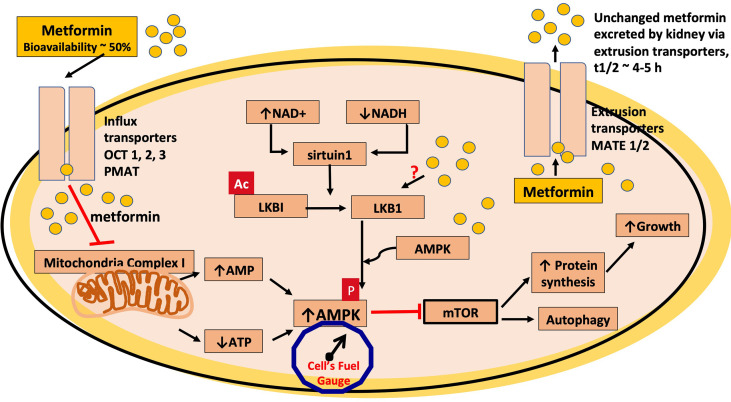
- Checkable: passes — It can be checked against evidence.
- Load-bearing: unclear — It is unclear whether the paper’s conclusions depend on it.
- Based: passes — The paper gives a reason why it holds.
It may state two separate claims as one.
None of the sources cited for this claim have been checked yet.
In the paper
“However, in these studies with C. elegans, very high concentrations of metformin, from 10 to 150 mM, were used (67, 86), and are the equivalent to a dose in humans of approximately 5 kg/day.”
§ A Critical Review of the Evidence That Metformin Is a Putative Anti-Aging Drug That Enhances Healthspan and Extends Lifespan > The Putative Relationship Between Metformin and Aging
What the sources say
plain- Asserted: passes — The authors put it forward as true.
- Checkable: passes — It can be checked against evidence.
- Load-bearing: passes — The paper’s conclusions depend on it.
- Based: passes — The paper gives a reason why it holds.
It may state two separate claims as one.
In the paper
“Indeed, in the absence of bacteria, metformin shortened lifespan implying that it is the anti-bacterial action of metformin that explains the enhancement of lifespan in C. elegans (67).”
§ A Critical Review of the Evidence That Metformin Is a Putative Anti-Aging Drug That Enhances Healthspan and Extends Lifespan > The Putative Relationship Between Metformin and Aging
What the sources say
- Not checked yetcites [67] Cabreiro, 2013, Metformin Retards Aging in C. Elegans by Altering Microbial Folate and Methionine Metabolism, Cell source
plaindirect- Asserted: passes — The authors put it forward as true.
- Checkable: passes — It can be checked against evidence.
- Load-bearing: passes — The paper’s conclusions depend on it.
- Based: passes — The paper gives a reason why it holds.
It may state two separate claims as one.
A conclusion the paper draws from its own results — it cites no other source for it, so there is none to check. The quote shows it is in the paper.
In the paper
“Such doses in humans would be fatal and one would expect the same in C. elegans where toxicity is offset by the effects of metformin on the microbiome and inhibition of bacterial folate metabolism.”
§ A Critical Review of the Evidence That Metformin Is a Putative Anti-Aging Drug That Enhances Healthspan and Extends Lifespan > The Putative Relationship Between Metformin and Aging
hedgeddirect- Asserted: passes — The authors put it forward as true.
- Checkable: passes — It can be checked against evidence.
- Load-bearing: passes — The paper’s conclusions depend on it.
- Based: passes — The paper gives a reason why it holds.
It may state two separate claims as one.
None of the sources cited for this claim have been checked yet.
In the paper
“The addition of metformin to the diet can delay aging and increase life span in both C. elegans and rodents (66–68) (see Table 1).”
§ A Critical Review of the Evidence That Metformin Is a Putative Anti-Aging Drug That Enhances Healthspan and Extends Lifespan > The Putative Relationship Between Metformin and Aging
What the sources say
- Not checked yetcites [66] Anisimov, 2008, Metformin Slows Down Aging and Extends Life Span of Female SHR Mice, Cell Cycle source
- Not checked yetcites [67] Cabreiro, 2013, Metformin Retards Aging in C. Elegans by Altering Microbial Folate and Methionine Metabolism, Cell source
- Not checked yetcites [68] De Haes, 2014, Metformin Promotes Lifespan Through Mitohormesis via the Peroxiredoxin PRDX-2, Proc Natl Acad Sci USA source
plaindirect- Asserted: passes — The authors put it forward as true.
- Checkable: passes — It can be checked against evidence.
- Load-bearing: passes — The paper’s conclusions depend on it.
- Based: passes — The paper gives a reason why it holds.
It may state two separate claims as one.
In the paper
“Worthy of note is that the sensitivity to AMPK declines with age thus promoting the argument that activators of AMPK, such as metformin, could delay aging (61).”
§ A Critical Review of the Evidence That Metformin Is a Putative Anti-Aging Drug That Enhances Healthspan and Extends Lifespan > The Putative Relationship Between Metformin and Aging
What the sources say
- Not checked yetcites [61] Salminen, 2012, AMP-Activated Protein Kinase (AMPK) Controls the Aging Process via an Integrated Signaling Network, Ageing Res Rev source
hedgeddirect- Asserted: passes — The authors put it forward as true.
- Checkable: passes — It can be checked against evidence.
- Load-bearing: unclear — It is unclear whether the paper’s conclusions depend on it.
- Based: passes — The paper gives a reason why it holds.
It may state two separate claims as one.
None of the sources cited for this claim have been checked yet.
In the paper
“The same pathways studied in C. elegans have also been investigated in mammals, where lifespan and healthspan were prolonged through modifying the ‘aging’ pathways or through drugs, including metformin (60, 87).”
§ A Critical Review of the Evidence That Metformin Is a Putative Anti-Aging Drug That Enhances Healthspan and Extends Lifespan > The Putative Relationship Between Metformin and Aging
What the sources say
plaindirect- Asserted: passes — The authors put it forward as true.
- Checkable: passes — It can be checked against evidence.
- Load-bearing: unclear — It is unclear whether the paper’s conclusions depend on it.
- Based: passes — The paper gives a reason why it holds.
It may state two separate claims as one.
None of the sources cited for this claim have been checked yet.
In the paper
“In C. elegans the beneficial effects of metformin on lifespan are, at least in part, argued to be mediated through changing the microbiome and modifying microbial folate and methionine metabolism and potentially due to an anti-oxidant action via transcription factors, SKN-1/Nrf2, a requirement for AMPK and the upstream serine-threonine kinase, liver kinase B1 (LKB1) (67, 71, 86).”
§ A Critical Review of the Evidence That Metformin Is a Putative Anti-Aging Drug That Enhances Healthspan and Extends Lifespan > The Putative Relationship Between Metformin and Aging
What the sources say
- Not checked yetcites [67] Cabreiro, 2013, Metformin Retards Aging in C. Elegans by Altering Microbial Folate and Methionine Metabolism, Cell source
- Not checked yetcites [71] Onken, 2010, Metformin Induces a Dietary Restriction-Like State and the Oxidative Stress Response to Extend C. elegans Healthspan via AMPK, LKB1 and SKN-1, PloS One source
- Not checked yetcites [86] Wu, 2016, An Ancient, Unified Mechanism for Metformin Growth Inhibition in C. Elegans and Cancer, Cell source
hedgedconditional- Asserted: passes — The authors put it forward as true.
- Checkable: passes — It can be checked against evidence.
- Load-bearing: unclear — It is unclear whether the paper’s conclusions depend on it.
- Based: passes — The paper gives a reason why it holds.
It may state two separate claims as one.
None of the sources cited for this claim have been checked yet.
In the paper
“The lifespan and healthspan of invertebrates are extended by mutations in pathways such as the DAF-2, a gene that encodes for the IGF-1 pathway in the nematode Caenorhabditis elegans (C. elegans), or the mTOR signaling pathways that are linked to accelerating the aging process (60, 62–65).”
§ A Critical Review of the Evidence That Metformin Is a Putative Anti-Aging Drug That Enhances Healthspan and Extends Lifespan > The Putative Relationship Between Metformin and Aging
What the sources say
- Not checked yetcites [60] Barzilai, 2016, Metformin as a Tool to Target Aging, Cell Metab source
- Not checked yetcites [62] Friedman, 1988, Three Mutants That Extend Both Mean and Maximum Life Span of the Nematode, Caenorhabditis Elegans, Define the Age-1 Gene, J Gerontol source
- Not checked yetcites [63] Bartke, 2001, Extending the Lifespan of Long-Lived Mice, Nature source
- Not checked yetcites [64] Blagosklonny, 2009, TOR-Driven Aging: Speeding Car Without Brakes, Cell Cycle source
- Not checked yetcites [65] Vitale, 2019, ROLE of IGF-1 System in the Modulation of Longevity: Controversies and New Insights From a Centenarians’ Perspective, Front Endocrinol source
plaindirect- Asserted: passes — The authors put it forward as true.
- Checkable: passes — It can be checked against evidence.
- Load-bearing: unclear — It is unclear whether the paper’s conclusions depend on it.
- Based: passes — The paper gives a reason why it holds.
It may state two separate claims as one.
In the paper
“Conclusion: Metformin effects on lifespan in mice are age-dependent.”
§ A Critical Review of the Evidence That Metformin Is a Putative Anti-Aging Drug That Enhances Healthspan and Extends Lifespan > The Putative Relationship Between Metformin and Aging
What the sources say
- Not checked yetcites Anisimov et al. (66) Anisimov, 2008, Metformin Slows Down Aging and Extends Life Span of Female SHR Mice, Cell Cycle source
plaindirect- Asserted: passes — The authors put it forward as true.
- Checkable: passes — It can be checked against evidence.
- Load-bearing: passes — The paper’s conclusions depend on it.
- Based: passes — The paper gives a reason why it holds.
Probably not a substantial claim.
In the paper
“Conclusion: Metformin via AMPK/LB1/SKN-1/NrF2 axis extends lifespan in C. elegans.”
§ A Critical Review of the Evidence That Metformin Is a Putative Anti-Aging Drug That Enhances Healthspan and Extends Lifespan > The Putative Relationship Between Metformin and Aging
What the sources say
- Not checked yetcites Onken and Driscoll (71) Onken, 2010, Metformin Induces a Dietary Restriction-Like State and the Oxidative Stress Response to Extend C. elegans Healthspan via AMPK, LKB1 and SKN-1, PloS One source
plaindirect- Asserted: passes — The authors put it forward as true.
- Checkable: passes — It can be checked against evidence.
- Load-bearing: fails — The paper’s conclusions may not depend on it.
- Based: passes — The paper gives a reason why it holds.
Probably not a substantial claim. The paper’s conclusions may not depend on it.
In the paper
“Conclusion: Metformin extends healthspan, but not lifespan in humans.”
§ A Critical Review of the Evidence That Metformin Is a Putative Anti-Aging Drug That Enhances Healthspan and Extends Lifespan > The Putative Relationship Between Metformin and Aging
What the sources say
- Not checked yetcites Bannister et al. (69) Bannister, 2014, Can People With Type 2 Diabetes Live Longer Than Those Without? A Comparison of Mortality in People Initiated With Metformin or Sulphonylurea Monotherapy and Matched, Non-Diabetic Controls, Diabetes Obes Metab source
plaindirect- Asserted: passes — The authors put it forward as true.
- Checkable: passes — It can be checked against evidence.
- Load-bearing: fails — The paper’s conclusions may not depend on it.
- Based: passes — The paper gives a reason why it holds.
Probably not a substantial claim. The paper’s conclusions may not depend on it. It may state two separate claims as one.
None of the sources cited for this claim have been checked yet.
In the paper
“Elevated levels of GDF15 have been linked to tumor growth and poor prognosis in cancer patients raising the question as to whether GDF15 serves as a tumor suppressor or promoter and a target for the treatment of cancer (84, 85, 99).”
§ A Critical Review of the Evidence That Metformin Is a Putative Anti-Aging Drug That Enhances Healthspan and Extends Lifespan > The Putative Relationship Between Metformin and Aging
What the sources say
- Not checked yetcites [84] Modi, 2019, Growth Differentiation Factor 15 and Its Role in Carcinogenesis: An Update, Growth Factors source
- Not checked yetcites [85] Wischhusen, 2020, Growth/Differentiation Factor-15 (GDF-15): From Biomarker to Novel Targetable Immune Checkpoint, Front Immunol source
- Not checked yetcites [99] Welsh, 2003, Large-Scale Delineation of Secreted Protein Biomarkers Overexpressed in Cancer Tissue and Serum, Proc Natl Acad Sci source
plaincorrelational- Asserted: passes — The authors put it forward as true.
- Checkable: passes — It can be checked against evidence.
- Load-bearing: fails — The paper’s conclusions may not depend on it.
- Based: passes — The paper gives a reason why it holds.
Probably not a substantial claim. The paper’s conclusions may not depend on it.
In the paper
“Conclusion: Metformin is not a calorie-restriction mimetic (CRM)”
§ A Critical Review of the Evidence That Metformin Is a Putative Anti-Aging Drug That Enhances Healthspan and Extends Lifespan > The Putative Relationship Between Metformin and Aging
What the sources say
- Not checked yetcites Smith et al. (78) Smith, 2010, Metformin Supplementation and Life Span in Fischer-344 Rats, J Gerontol A Biol Sci Med Sci source
plain- Asserted: passes — The authors put it forward as true.
- Checkable: passes — It can be checked against evidence.
- Load-bearing: fails — The paper’s conclusions may not depend on it.
- Based: passes — The paper gives a reason why it holds.
Probably not a substantial claim. The paper’s conclusions may not depend on it.
A conclusion the paper draws from its own results — it cites no other source for it, so there is none to check. The quote shows it is in the paper.
In the paper
“AMPK inhibits signaling via mTOR and through this action could contribute to the reduced incidence of some cancers that has been associated with the use of metformin: see Table 2.”
§ A Critical Review of the Evidence That Metformin Is a Putative Anti-Aging Drug That Enhances Healthspan and Extends Lifespan > AMP-Activated Protein Kinase
hedgedconditional- Asserted: passes — The authors put it forward as true.
- Checkable: passes — It can be checked against evidence.
- Load-bearing: unclear — It is unclear whether the paper’s conclusions depend on it.
- Based: passes — The paper gives a reason why it holds.
It may state two separate claims as one.
None of the sources cited for this claim have been checked yet.
In the paper
“As a result of an analysis of data from the ORIGIN trial (Outcome Reduction with Initial Glargine Intervention), GDF15 was identified as a biomarker linked to positive CV outcomes and also elevated in those patients receiving metformin (80, 81).”
§ A Critical Review of the Evidence That Metformin Is a Putative Anti-Aging Drug That Enhances Healthspan and Extends Lifespan > The Putative Relationship Between Metformin and Aging
What the sources say
plaincorrelational- Asserted: passes — The authors put it forward as true.
- Checkable: passes — It can be checked against evidence.
- Load-bearing: unclear — It is unclear whether the paper’s conclusions depend on it.
- Based: passes — The paper gives a reason why it holds.
It may state two separate claims as one.
None of the sources cited for this claim have been checked yet.
In the paper
“Hepatic gluconeogenesis is inhibited by AMPK activation, which also enhances insulin sensitivity, muscle glucose absorption, and fatty acid oxidation (103, 104).”
§ A Critical Review of the Evidence That Metformin Is a Putative Anti-Aging Drug That Enhances Healthspan and Extends Lifespan > AMP-Activated Protein Kinase
What the sources say
- Not checked yetcites [103] Myers, 2017, Systemic Pan-AMPK Activator MK-8722 Improves Glucose Homeostasis But Induces Cardiac Hypertrophy, Science source
- Not checked yetcites [104] Saisho, 2015, Metformin and Inflammation: Its Potential Beyond Glucose-Lowering Effect, Endocr Metab Immune Disord Drug Targets source
plaindirect- Asserted: passes — The authors put it forward as true.
- Checkable: passes — It can be checked against evidence.
- Load-bearing: passes — The paper’s conclusions depend on it.
- Based: passes — The paper gives a reason why it holds.
It may state two separate claims as one.
In the paper
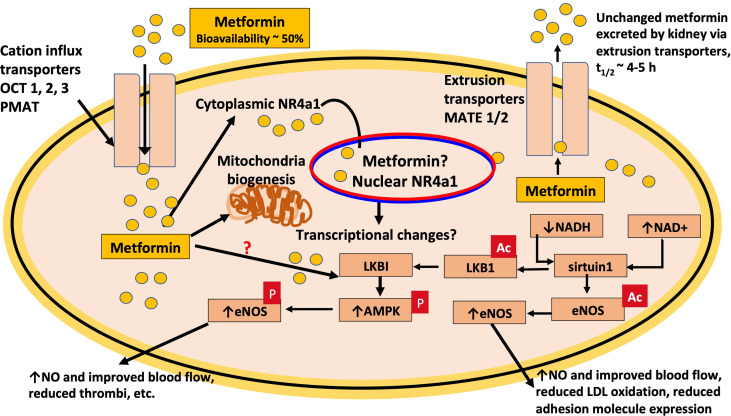
“An increase in the activity of AMPK would also explain the protective effects of metformin on endothelial function via the activation of endothelial nitric oxide synthase (eNOS) thereby countering the negative effects of a diabetic milieu on cardiovascular function (119).”
§ A Critical Review of the Evidence That Metformin Is a Putative Anti-Aging Drug That Enhances Healthspan and Extends Lifespan > AMP-Activated Protein Kinase
What the sources say
- Not checked yetcites [119] Fisslthaler, 2009, Activation and Signaling by the AMP-Activated Protein Kinase in Endothelial Cells, Circ Res source
hedgedconditional- Asserted: passes — The authors put it forward as true.
- Checkable: passes — It can be checked against evidence.
- Load-bearing: unclear — It is unclear whether the paper’s conclusions depend on it.
- Based: passes — The paper gives a reason why it holds.
It may state two separate claims as one.
In the paper
“Conclusion: Metformin does not extend lifespan in mice.”
§ A Critical Review of the Evidence That Metformin Is a Putative Anti-Aging Drug That Enhances Healthspan and Extends Lifespan > The Putative Relationship Between Metformin and Aging
What the sources say
- Not checked yetcites Strong et al. (77) Strong, 2016, Longer Lifespan in Male Mice Treated With a Weakly Estrogenic Agonist, an Antioxidant, an α-Glucosidase Inhibitor or a Nrf2-Inducer, Aging Cell source
plain- Asserted: passes — The authors put it forward as true.
- Checkable: passes — It can be checked against evidence.
- Load-bearing: passes — The paper’s conclusions depend on it.
- Based: passes — The paper gives a reason why it holds.
Probably not a substantial claim.
None of the sources cited for this claim have been checked yet.
In the paper
“AMPK is activated through metabolic stress and acts as a cellular regulator of lipid and glucose metabolism (102, 103).”
§ A Critical Review of the Evidence That Metformin Is a Putative Anti-Aging Drug That Enhances Healthspan and Extends Lifespan > AMP-Activated Protein Kinase
What the sources say
plaindirect- Asserted: passes — The authors put it forward as true.
- Checkable: passes — It can be checked against evidence.
- Load-bearing: passes — The paper’s conclusions depend on it.
- Based: passes — The paper gives a reason why it holds.
It may state two separate claims as one.
In the paper
“Conclusion: Metformin extends lifespan in mice, but dose-dependent..”
§ A Critical Review of the Evidence That Metformin Is a Putative Anti-Aging Drug That Enhances Healthspan and Extends Lifespan > The Putative Relationship Between Metformin and Aging
What the sources say
- Not checked yetcites Martin-Montalvo et al. (76) Martin-Montalvo, 2013, Metformin Improves Healthspan and Lifespan in Mice, Nat Commun source
plaindirect- Asserted: passes — The authors put it forward as true.
- Checkable: passes — It can be checked against evidence.
- Load-bearing: passes — The paper’s conclusions depend on it.
- Based: passes — The paper gives a reason why it holds.
Probably not a substantial claim. It may state two separate claims as one.
None of the sources cited for this claim have been checked yet.
In the paper
“Of additional interest and based on a proteomic analysis of the plasma from 240 healthy, disease-free, humans in the age range 22-93 years-old, GDF15 was identified as the protein most positively correlated with chronological age and also known to reduce appetite via an action in the hind-brain (82, 95).”
§ A Critical Review of the Evidence That Metformin Is a Putative Anti-Aging Drug That Enhances Healthspan and Extends Lifespan > The Putative Relationship Between Metformin and Aging
What the sources say
plaindirect- Asserted: passes — The authors put it forward as true.
- Checkable: passes — It can be checked against evidence.
- Load-bearing: unclear — It is unclear whether the paper’s conclusions depend on it.
- Based: passes — The paper gives a reason why it holds.
It may state two separate claims as one.
In the paper
“Metformin has anti-inflammatory effects but requires high concentrations.”
§ A Critical Review of the Evidence That Metformin Is a Putative Anti-Aging Drug That Enhances Healthspan and Extends Lifespan > AMP-Activated Protein Kinase
What the sources say
- Not checked yetcites Hattori et al. (105) Hattori, 2006, Metformin Inhibits Cytokine-Induced Nuclear Factor kappaB Activation via AMP-Activated Protein Kinase Activation in Vascular Endothelial Cells, Hypertension source
plaindirect- Asserted: passes — The authors put it forward as true.
- Checkable: passes — It can be checked against evidence.
- Load-bearing: unclear — It is unclear whether the paper’s conclusions depend on it.
- Based: passes — The paper gives a reason why it holds.
It may state two separate claims as one.
In the paper
“Metformin increased AMPK activity in rat and human hepatocytes and was associated with an increase cellular AMP:ATP ratio.”
§ A Critical Review of the Evidence That Metformin Is a Putative Anti-Aging Drug That Enhances Healthspan and Extends Lifespan > AMP-Activated Protein Kinase
What the sources say
- Not checked yetcites Stephenne et al. (112) Stephenne, 2011, Metformin Activates AMP-Activated Protein Kinase in Primary Human Hepatocytes by Decreasing Cellular Energy Status, Diabetologia source
plaindirect- Asserted: passes — The authors put it forward as true.
- Checkable: passes — It can be checked against evidence.
- Load-bearing: unclear — It is unclear whether the paper’s conclusions depend on it.
- Based: passes — The paper gives a reason why it holds.
It may state two separate claims as one.
In the paper
“Weight loss effect shown to be dependent on expression of the GDF15 receptor, GRAL, (glial cell-derived neurotrophic factor family receptor alpha-like) whereas the antihyperglycemic effect of metformin was independent of the GDF15-GRAL pathway.”
§ A Critical Review of the Evidence That Metformin Is a Putative Anti-Aging Drug That Enhances Healthspan and Extends Lifespan > The Putative Relationship Between Metformin and Aging
What the sources say
- Not checked yetcites Coll et al. (83) Coll, 2020, GDF15 Mediates the Effects of Metformin on Body Weight and Energy Balance, Nature source
plaindirect- Asserted: passes — The authors put it forward as true.
- Checkable: passes — It can be checked against evidence.
- Load-bearing: unclear — It is unclear whether the paper’s conclusions depend on it.
- Based: passes — The paper gives a reason why it holds.
It may state two separate claims as one.
In the paper
“Subjects taking metformin also had higher GDF15 (Growth Differentiation Factor 15) levels and lower CV outcomes.”
§ A Critical Review of the Evidence That Metformin Is a Putative Anti-Aging Drug That Enhances Healthspan and Extends Lifespan > The Putative Relationship Between Metformin and Aging
What the sources say
- Not checked yetcites Gerstein et al. (81) Gerstein, 2017, Growth Differentiation Factor 15 as a Novel Biomarker for Metformin, Diabetes Care source
plaincorrelationaln = 8,401- Asserted: passes — The authors put it forward as true.
- Checkable: passes — It can be checked against evidence.
- Load-bearing: unclear — It is unclear whether the paper’s conclusions depend on it.
- Based: passes — The paper gives a reason why it holds.
It may state two separate claims as one.
In the paper
“Metformin improved EDV but not EIDV.”
§ A Critical Review of the Evidence That Metformin Is a Putative Anti-Aging Drug That Enhances Healthspan and Extends Lifespan > AMP-Activated Protein Kinase
What the sources say
- Not checked yetcites Mather et al. (106) Mather, 2001, Improved Endothelial Function With Metformin in Type 2 Diabetes Mellitus, J Am Coll Cardiol source
plaindirect- Asserted: passes — The authors put it forward as true.
- Checkable: passes — It can be checked against evidence.
- Load-bearing: unclear — It is unclear whether the paper’s conclusions depend on it.
- Based: passes — The paper gives a reason why it holds.
It may state two separate claims as one.
In the paper
“Dose- and time-dependent activation of AMPK from 1 to 10 mM metformin and inhibition of proinflammatory and adhesion molecule genes induced by cytokines through suppression of NF-kB activity.”
§ A Critical Review of the Evidence That Metformin Is a Putative Anti-Aging Drug That Enhances Healthspan and Extends Lifespan > AMP-Activated Protein Kinase
What the sources say
- Not checked yetcites Hattori et al. (105) Hattori, 2006, Metformin Inhibits Cytokine-Induced Nuclear Factor kappaB Activation via AMP-Activated Protein Kinase Activation in Vascular Endothelial Cells, Hypertension source
plaindirect- Asserted: passes — The authors put it forward as true.
- Checkable: passes — It can be checked against evidence.
- Load-bearing: unclear — It is unclear whether the paper’s conclusions depend on it.
- Based: passes — The paper gives a reason why it holds.
It may state two separate claims as one.
In the paper
“Metformin inhibits activation of mTOR through down-regulation of the Sp1, Sp3 and Sp4 transcription factors transcription and IGF-1R.”
§ A Critical Review of the Evidence That Metformin Is a Putative Anti-Aging Drug That Enhances Healthspan and Extends Lifespan > AMP-Activated Protein Kinase
What the sources say
- Not checked yetcites Nair et al. (114) Nair, 2014, Mechanism of Metformin-Dependent Inhibition of Mammalian Target of Rapamycin (mTOR) and Ras Activity in Pancreatic Cancer: Role of Specificity Protein (Sp) Transcription Factors, J Biol Chem source
plaindirect- Asserted: passes — The authors put it forward as true.
- Checkable: passes — It can be checked against evidence.
- Load-bearing: fails — The paper’s conclusions may not depend on it.
- Based: passes — The paper gives a reason why it holds.
Probably not a substantial claim. The paper’s conclusions may not depend on it.
In the paper
“Analysis indicates a reduced risk of cancer and a suggestion of a dose-dependent effect.”
§ A Critical Review of the Evidence That Metformin Is a Putative Anti-Aging Drug That Enhances Healthspan and Extends Lifespan > AMP-Activated Protein Kinase
What the sources say
- Not checked yetcites Evans et al. (113) Evans, 2005, Metformin and Reduced Risk of Cancer in Diabetic Patients, BMJ source
hedgedcorrelational- Asserted: passes — The authors put it forward as true.
- Checkable: passes — It can be checked against evidence.
- Load-bearing: passes — The paper’s conclusions depend on it.
- Based: passes — The paper gives a reason why it holds.
It may state two separate claims as one.
In the paper
“Metformin improved EDV in vascular tissue from diabetic mice.”
§ A Critical Review of the Evidence That Metformin Is a Putative Anti-Aging Drug That Enhances Healthspan and Extends Lifespan > AMP-Activated Protein Kinase
What the sources say
- Not checked yetcites Ghosh et al. (111) Ghosh, 2015, Metformin Improves Endothelial Function in Aortic Tissue and Microvascular Endothelial Cells Subjected to Diabetic Hyperglycaemic Conditions, Biochem Pharmacol source
plaindirect- Asserted: passes — The authors put it forward as true.
- Checkable: passes — It can be checked against evidence.
- Load-bearing: unclear — It is unclear whether the paper’s conclusions depend on it.
- Based: passes — The paper gives a reason why it holds.
The quote only partly states this claim.
In the paper
“AMPKα1 was activated in human hepatocytes, whereas both AMPKα isoforms were activated in rat hepatocytes stressing the importance of species differences.”
§ A Critical Review of the Evidence That Metformin Is a Putative Anti-Aging Drug That Enhances Healthspan and Extends Lifespan > AMP-Activated Protein Kinase
What the sources say
- Not checked yetcites Stephenne et al. (112) Stephenne, 2011, Metformin Activates AMP-Activated Protein Kinase in Primary Human Hepatocytes by Decreasing Cellular Energy Status, Diabetologia source
plain- Asserted: passes — The authors put it forward as true.
- Checkable: passes — It can be checked against evidence.
- Load-bearing: unclear — It is unclear whether the paper’s conclusions depend on it.
- Based: passes — The paper gives a reason why it holds.
It may state two separate claims as one.
In the paper
“Conclusion: Preliminary evidence implying metformin effects on transcription and pathways affecting healthspan and lifespan.”
§ A Critical Review of the Evidence That Metformin Is a Putative Anti-Aging Drug That Enhances Healthspan and Extends Lifespan > The Putative Relationship Between Metformin and Aging
What the sources say
- Not checked yetcites Kulkarni et al. (79) Kulkarni, 2018, Metformin Regulates Metabolic and Nonmetabolic Pathways in Skeletal Muscle and Subcutaneous Adipose Tissues of Older Adults, Aging Cell source
hedgedconditionaln = 14- Asserted: passes — The authors put it forward as true.
- Checkable: passes — It can be checked against evidence.
- Load-bearing: fails — The paper’s conclusions may not depend on it.
- Based: passes — The paper gives a reason why it holds.
Probably not a substantial claim. The paper’s conclusions may not depend on it.
In the paper
“Hepatic AMPK activation by metformin resulted from lower cellular energy due to AMPK-independent inhibition of the mitochondrial respiratory-chain complex by metformin.”
§ A Critical Review of the Evidence That Metformin Is a Putative Anti-Aging Drug That Enhances Healthspan and Extends Lifespan > AMP-Activated Protein Kinase
What the sources say
- Not checked yetcites Stephenne et al. (112) Stephenne, 2011, Metformin Activates AMP-Activated Protein Kinase in Primary Human Hepatocytes by Decreasing Cellular Energy Status, Diabetologia source
plaindirect- Asserted: passes — The authors put it forward as true.
- Checkable: passes — It can be checked against evidence.
- Load-bearing: fails — The paper’s conclusions may not depend on it.
- Based: passes — The paper gives a reason why it holds.
Probably not a substantial claim. The paper’s conclusions may not depend on it.
In the paper
“Metformin use for more than 6 years was linked to a decreased risk of cognitive impairment.”
§ A Critical Review of the Evidence That Metformin Is a Putative Anti-Aging Drug That Enhances Healthspan and Extends Lifespan > AMP-Activated Protein Kinase
What the sources say
- Not checked yetcites Ng et al. (116) Ng, 2014, Long-Term Metformin Usage and Cognitive Function Among Older Adults With Diabetes, J Alzheimers Dis source
plaincorrelationaln = 365- Asserted: passes — The authors put it forward as true.
- Checkable: passes — It can be checked against evidence.
- Load-bearing: unclear — It is unclear whether the paper’s conclusions depend on it.
- Based: passes — The paper gives a reason why it holds.
The quote only partly states this claim.
None of the sources cited for this claim have been checked yet.
In the paper
“AMPK is regulated by two upstream serine threonine AMPK kinases: LKB1, and Ca2+/calmodulin-dependent protein kinase kinase β (CaMKKβ) and is also positively regulated by the nicotinamide adenine dinucleotide (NAD+) deacetylase, sirtuin-1.”
§ A Critical Review of the Evidence That Metformin Is a Putative Anti-Aging Drug That Enhances Healthspan and Extends Lifespan > AMP-Activated Protein Kinase
What the sources say
plaindirect- Asserted: passes — The authors put it forward as true.
- Checkable: passes — It can be checked against evidence.
- Load-bearing: passes — The paper’s conclusions depend on it.
- Based: passes — The paper gives a reason why it holds.
It may state two separate claims as one.
In the paper
“Senescence is a major contributor to aging and the development of cardiovascular disease (123)”
§ A Critical Review of the Evidence That Metformin Is a Putative Anti-Aging Drug That Enhances Healthspan and Extends Lifespan > AMP-Activated Protein Kinase
What the sources say
- Not checked yetcites [123] Katsuumi, 2018, Vascular Senescence in Cardiovascular and Metabolic Diseases, Front Cardiovasc Med source
plaindirect- Asserted: passes — The authors put it forward as true.
- Checkable: passes — It can be checked against evidence.
- Load-bearing: unclear — It is unclear whether the paper’s conclusions depend on it.
- Based: passes — The paper gives a reason why it holds.
It may state two separate claims as one.
In the paper
“Vascular effects mediate beneficial effects of metformin on breast cancer.”
§ A Critical Review of the Evidence That Metformin Is a Putative Anti-Aging Drug That Enhances Healthspan and Extends Lifespan > AMP-Activated Protein Kinase
What the sources say
- Not checked yetcites Wang et al. (115) Wang, 2019, Metformin Inhibits Metastatic Breast Cancer Progression and Improves Chemosensitivity by Inducing Vessel Normalization via PDGF-B Downregulation, J Exp Clin Cancer Res source
plaindirect- Asserted: passes — The authors put it forward as true.
- Checkable: passes — It can be checked against evidence.
- Load-bearing: fails — The paper’s conclusions may not depend on it.
- Based: passes — The paper gives a reason why it holds.
Probably not a substantial claim. The paper’s conclusions may not depend on it.
In the paper
“In endothelial cells, metformin has been shown to enhance phosphorylation and increase the activity of LKB1 (122).”
§ A Critical Review of the Evidence That Metformin Is a Putative Anti-Aging Drug That Enhances Healthspan and Extends Lifespan > AMP-Activated Protein Kinase
What the sources say
- Not checked yetcites [122] Xie, 2008, Phosphorylation of LKB1 at Serine 428 by Protein C-Zeta Is Required for Metformin-Enhanced Activation of the AMP-Activated Protein Kinase in Endothelial Cells, Circulation source
plaindirect- Asserted: passes — The authors put it forward as true.
- Checkable: passes — It can be checked against evidence.
- Load-bearing: unclear — It is unclear whether the paper’s conclusions depend on it.
- Based: passes — The paper gives a reason why it holds.
It may state two separate claims as one.
In the paper
“Metformin targets genes and signaling pathways important for tumor migration, invasion, proliferation and survival.”
§ A Critical Review of the Evidence That Metformin Is a Putative Anti-Aging Drug That Enhances Healthspan and Extends Lifespan > AMP-Activated Protein Kinase
What the sources say
- Not checked yetcites Nair et al. (114) Nair, 2014, Mechanism of Metformin-Dependent Inhibition of Mammalian Target of Rapamycin (mTOR) and Ras Activity in Pancreatic Cancer: Role of Specificity Protein (Sp) Transcription Factors, J Biol Chem source
plaindirect- Asserted: passes — The authors put it forward as true.
- Checkable: passes — It can be checked against evidence.
- Load-bearing: fails — The paper’s conclusions may not depend on it.
- Based: passes — The paper gives a reason why it holds.
Probably not a substantial claim. The paper’s conclusions may not depend on it.
None of the sources cited for this claim have been checked yet.
In the paper
“Sirtuin-1 is the protein product of the putative anti-aging gene SIRT1, which targets lysine residues in proteins, including histones and the tumor-suppressors, LKB1 and p53 (120, 121).”
§ A Critical Review of the Evidence That Metformin Is a Putative Anti-Aging Drug That Enhances Healthspan and Extends Lifespan > AMP-Activated Protein Kinase
What the sources say
plaindirect- Asserted: passes — The authors put it forward as true.
- Checkable: passes — It can be checked against evidence.
- Load-bearing: passes — The paper’s conclusions depend on it.
- Based: passes — The paper gives a reason why it holds.
It may state two separate claims as one.
In the paper
“Neuronal differentiation was dependent on AMPK/atypical PKC and cyclic AMP response element-binding protein (CREB or CBP).”
§ A Critical Review of the Evidence That Metformin Is a Putative Anti-Aging Drug That Enhances Healthspan and Extends Lifespan > AMP-Activated Protein Kinase
What the sources say
- Not checked yetcites Fatt et al. (117) Fatt, 2015, Metformin Acts on Two Different Molecular Pathways to Enhance Adult Neural Precursor Proliferation/Self-Renewal and Differentiation, Stem Cell Rep source
plaindirect- Asserted: passes — The authors put it forward as true.
- Checkable: passes — It can be checked against evidence.
- Load-bearing: fails — The paper’s conclusions may not depend on it.
- Based: passes — The paper gives a reason why it holds.
Probably not a substantial claim. The paper’s conclusions may not depend on it.
In the paper
“Metformin decreased microvessel density, leakage, and hypoxia while increasing vascular mural cell perfusion as compared to a control group.”
§ A Critical Review of the Evidence That Metformin Is a Putative Anti-Aging Drug That Enhances Healthspan and Extends Lifespan > AMP-Activated Protein Kinase
What the sources say
- Not checked yetcites Wang et al. (115) Wang, 2019, Metformin Inhibits Metastatic Breast Cancer Progression and Improves Chemosensitivity by Inducing Vessel Normalization via PDGF-B Downregulation, J Exp Clin Cancer Res source
plaindirect- Asserted: passes — The authors put it forward as true.
- Checkable: passes — It can be checked against evidence.
- Load-bearing: unclear — It is unclear whether the paper’s conclusions depend on it.
- Based: passes — The paper gives a reason why it holds.
It may state two separate claims as one.
In the paper
“Metformin enhances neurogenesis suggesting a role for metformin in neurodegenerative diseases.”
§ A Critical Review of the Evidence That Metformin Is a Putative Anti-Aging Drug That Enhances Healthspan and Extends Lifespan > AMP-Activated Protein Kinase
What the sources say
- Not checked yetcites Fatt et al. (117) Fatt, 2015, Metformin Acts on Two Different Molecular Pathways to Enhance Adult Neural Precursor Proliferation/Self-Renewal and Differentiation, Stem Cell Rep source
hedgeddirect- Asserted: passes — The authors put it forward as true.
- Checkable: passes — It can be checked against evidence.
- Load-bearing: unclear — It is unclear whether the paper’s conclusions depend on it.
- Based: passes — The paper gives a reason why it holds.
It may state two separate claims as one.
In the paper
“Expression of inflammatory cells was higher in fat-fed mice and decreased by metformin.”
§ A Critical Review of the Evidence That Metformin Is a Putative Anti-Aging Drug That Enhances Healthspan and Extends Lifespan > AMP-Activated Protein Kinase
What the sources say
- Not checked yetcites Ma et al. (118) Ma, 2021, Metformin Restores Hippocampal Neurogenesis and Learning and Memory via Regulating Gut Microbiota in the Obese Mouse Model, Brain Behav Immun source
plaindirect- Asserted: passes — The authors put it forward as true.
- Checkable: passes — It can be checked against evidence.
- Load-bearing: unclear — It is unclear whether the paper’s conclusions depend on it.
- Based: passes — The paper gives a reason why it holds.
It may state two separate claims as one.
In the paper
“1 μM metformin enhanced the self-renewal and differentiation of NPCs.”
§ A Critical Review of the Evidence That Metformin Is a Putative Anti-Aging Drug That Enhances Healthspan and Extends Lifespan > AMP-Activated Protein Kinase
What the sources say
- Not checked yetcites Fatt et al. (117) Fatt, 2015, Metformin Acts on Two Different Molecular Pathways to Enhance Adult Neural Precursor Proliferation/Self-Renewal and Differentiation, Stem Cell Rep source
plaindirect- Asserted: passes — The authors put it forward as true.
- Checkable: passes — It can be checked against evidence.
- Load-bearing: unclear — It is unclear whether the paper’s conclusions depend on it.
- Based: passes — The paper gives a reason why it holds.
It may state two separate claims as one.
None of the sources cited for this claim have been checked yet.
In the paper
“LKB1 is a tumor suppressor and that mutations in LKB1 are observed in numerous cancers that result in the reduction of the inhibitory effect of the LKB1/AMPK pathway on the pro-proliferative signaling via mTOR (125, 126).”
§ A Critical Review of the Evidence That Metformin Is a Putative Anti-Aging Drug That Enhances Healthspan and Extends Lifespan > AMP-Activated Protein Kinase
What the sources say
plaindirect- Asserted: passes — The authors put it forward as true.
- Checkable: passes — It can be checked against evidence.
- Load-bearing: passes — The paper’s conclusions depend on it.
- Based: passes — The paper gives a reason why it holds.
It may state two separate claims as one.
In the paper
“Mitochondria play a critical role in oxidative metabolism and a link has been made in patients between obesity, insulin resistance, and defective mitochondria oxidative processes that results in a buildup of toxic intermediate metabolites (144).”
§ A Critical Review of the Evidence That Metformin Is a Putative Anti-Aging Drug That Enhances Healthspan and Extends Lifespan > Metformin and Mitochondrial Function
What the sources say
- Not checked yetcites [144] Sergi, 2019, Mitochondrial (Dys)function and Insulin Resistance: From Pathophysiological Mechanisms to the Impact of Diet, Front Physiol source
plaincorrelational- Asserted: passes — The authors put it forward as true.
- Checkable: passes — It can be checked against evidence.
- Load-bearing: unclear — It is unclear whether the paper’s conclusions depend on it.
- Based: passes — The paper gives a reason why it holds.
It may state two separate claims as one.
In the paper
“even following exposure to 1000 μM, no inhibitory effects were seen on the activities of complex I-IV, and the subcellular distribution of metformin indicated that metformin remained primarily in the cytosol with levels in mitochondria less than 70 μM (139).”
§ A Critical Review of the Evidence That Metformin Is a Putative Anti-Aging Drug That Enhances Healthspan and Extends Lifespan > AMPK as a Target for Metformin
What the sources say
- Not checked yetcites [139] Wilcock, 1991, Subcellular Distribution of Metformin in Rat Liver, J Pharm Pharmacol source
plain- Asserted: passes — The authors put it forward as true.
- Checkable: passes — It can be checked against evidence.
- Load-bearing: passes — The paper’s conclusions depend on it.
- Based: passes — The paper gives a reason why it holds.
It may state two separate claims as one.
None of the sources cited for this claim have been checked yet.
In the paper
“Considerable attention has been placed on the liver and skeletal muscle as the primary sites of action of metformin resulting from the activation of AMPK secondary to an inhibitory action on mitochondrial complex 1.”
§ A Critical Review of the Evidence That Metformin Is a Putative Anti-Aging Drug That Enhances Healthspan and Extends Lifespan > AMPK as a Target for Metformin
plaindirect- Asserted: passes — The authors put it forward as true.
- Checkable: passes — It can be checked against evidence.
- Load-bearing: fails — The paper’s conclusions may not depend on it.
- Based: passes — The paper gives a reason why it holds.
Probably not a substantial claim. The paper’s conclusions may not depend on it.
In the paper
“Chien et al. argue that metformin can be trapped in intracellular organelles such as microsomes and mitochondria (137).”
§ A Critical Review of the Evidence That Metformin Is a Putative Anti-Aging Drug That Enhances Healthspan and Extends Lifespan > AMPK as a Target for Metformin
What the sources say
- Not checked yetcites [137] Chien, 2016, Rapid Method to Determine Intracellular Drug Concentrations in Cellular Uptake Assays: Application to Metformin in Organic Cation Transporter 1-Transfected Human Embryonic Kidney 293 Cells, Drug Metab Dispos source
plaindirect- Asserted: passes — The authors put it forward as true.
- Checkable: passes — It can be checked against evidence.
- Load-bearing: fails — The paper’s conclusions may not depend on it.
- Based: passes — The paper gives a reason why it holds.
Probably not a substantial claim. The paper’s conclusions may not depend on it.
In the paper
“based on thermodynamic considerations, Owen et al. (128) argue that with a mitochondrial membrane potential of – 180mV metformin could accumulate 1000 fold thus potentially providing a concentration within the mitochondria that would inhibit complex 1”
§ A Critical Review of the Evidence That Metformin Is a Putative Anti-Aging Drug That Enhances Healthspan and Extends Lifespan > AMPK as a Target for Metformin
What the sources say
- Not checked yetcites Owen et al. (128) Owen, 2000, Evidence That Metformin Exerts Its Anti-Diabetic Effects Through Inhibition of Complex 1 of the Mitochondrial Respiratory Chain, Biochem J source
hedgedconditional- Asserted: passes — The authors put it forward as true.
- Checkable: passes — It can be checked against evidence.
- Load-bearing: fails — The paper’s conclusions may not depend on it.
- Based: passes — The paper gives a reason why it holds.
Probably not a substantial claim. The paper’s conclusions may not depend on it. It may state two separate claims as one.
None of the sources cited for this claim have been checked yet.
In the paper
“This inhibition would in turn decrease the ATP/AMP ratio activating AMPK (127–129).”
§ A Critical Review of the Evidence That Metformin Is a Putative Anti-Aging Drug That Enhances Healthspan and Extends Lifespan > AMPK as a Target for Metformin
What the sources say
- Not checked yetcites [127] El-Mir, 2000, Dimethylbiguanide Inhibits Cell Respiration via an Indirect Effect Targeted on the Respiratory Chain Complex I, J Biol Chem source
- Not checked yetcites [128] Owen, 2000, Evidence That Metformin Exerts Its Anti-Diabetic Effects Through Inhibition of Complex 1 of the Mitochondrial Respiratory Chain, Biochem J source
- Not checked yetcites [129] Hardie, 2013, AMPK: A Target for Drugs and Natural With Effects on Both Diabetes and Cancer, Diabetes source
hedgeddirect- Asserted: passes — The authors put it forward as true.
- Checkable: passes — It can be checked against evidence.
- Load-bearing: passes — The paper’s conclusions depend on it.
- Based: passes — The paper gives a reason why it holds.
It may state two separate claims as one.
In the paper
“Furthermore, an increase in AMP also decreases adenylate cyclase activation and thereby lowers glucagon release (129).”
§ A Critical Review of the Evidence That Metformin Is a Putative Anti-Aging Drug That Enhances Healthspan and Extends Lifespan > AMPK as a Target for Metformin
What the sources say
- Not checked yetcites [129] Hardie, 2013, AMPK: A Target for Drugs and Natural With Effects on Both Diabetes and Cancer, Diabetes source
plaindirect- Asserted: passes — The authors put it forward as true.
- Checkable: passes — It can be checked against evidence.
- Load-bearing: unclear — It is unclear whether the paper’s conclusions depend on it.
- Based: passes — The paper gives a reason why it holds.
It may state two separate claims as one.
In the paper
“complex 1 activity, mitochondria density and mitochondrial DNA were all increased via an AMPK-dependent mechanism (138).”
§ A Critical Review of the Evidence That Metformin Is a Putative Anti-Aging Drug That Enhances Healthspan and Extends Lifespan > AMPK as a Target for Metformin
What the sources say
- Not checked yetcites [138] Wang, 2019, Metformin Improves Mitochondrial Respiratory Activity Through Activation of AMPK, Cell Rep source
plaindirect- Asserted: passes — The authors put it forward as true.
- Checkable: passes — It can be checked against evidence.
- Load-bearing: unclear — It is unclear whether the paper’s conclusions depend on it.
- Based: passes — The paper gives a reason why it holds.
It may state two separate claims as one.
A conclusion the paper draws from its own results — it cites no other source for it, so there is none to check. The quote shows it is in the paper.
In the paper
“Collectively these data provide a link between metformin, AMPK, LKB1, sirtuin-1, and cellular mechanisms that could enhance both healthspan and lifespan by reducing both cellular senescence and the activation of pro-proliferative pathways.”
§ A Critical Review of the Evidence That Metformin Is a Putative Anti-Aging Drug That Enhances Healthspan and Extends Lifespan > AMP-Activated Protein Kinase
hedgedconditional- Asserted: passes — The authors put it forward as true.
- Checkable: passes — It can be checked against evidence.
- Load-bearing: passes — The paper’s conclusions depend on it.
- Based: passes — The paper gives a reason why it holds.
It may state two separate claims as one.
The paper states this without a source or data behind it here, so there is nothing to check it against. The quote shows it is in the paper.
In the paper
“the concentrations of resveratrol present in the diet, e.g. in wines, are far below the amounts that might have any effect on aging.”
§ A Critical Review of the Evidence That Metformin Is a Putative Anti-Aging Drug That Enhances Healthspan and Extends Lifespan > Metformin and Mitochondrial Function
hedged- Asserted: passes — The authors put it forward as true.
- Checkable: passes — It can be checked against evidence.
- Load-bearing: fails — The paper’s conclusions may not depend on it.
- Based: fails — The paper may give no reason why it holds.
Probably not a substantial claim. The paper’s conclusions may not depend on it. The paper may give no reason why it holds.
In the paper
“A useful comparison of the doses of metformin used therapeutically versus pre-clinical studies was made by Badrick and Renehan, indicating that for pre-clinical studies done in vivo, the doses ranged from x2 to x45 therapeutic doses and that for studies done in vitro, concentrations ranged from x25 to x1000 higher than those observed in patients (161).”
§ A Critical Review of the Evidence That Metformin Is a Putative Anti-Aging Drug That Enhances Healthspan and Extends Lifespan > Pharmacokinetic Properties of Metformin
What the sources say
- Not checked yetcites [161] Badrick, 2014, Diabetes and Cancer: 5 Years Into the Recent Controversy, Eur J Cancer source
hedged- Asserted: passes — The authors put it forward as true.
- Checkable: passes — It can be checked against evidence.
- Load-bearing: passes — The paper’s conclusions depend on it.
- Based: passes — The paper gives a reason why it holds.
It may state two separate claims as one.
In the paper
“Numerous studies have also reported that resveratrol has anti-aging effects in several species with its effects, as also described for metformin, linked to the deacetylase, sirtuin-1 (153).”
§ A Critical Review of the Evidence That Metformin Is a Putative Anti-Aging Drug That Enhances Healthspan and Extends Lifespan > Metformin and Mitochondrial Function
What the sources say
- Not checked yetcites [153] Morselli, 2010, Caloric Restriction and Resveratrol Promote Longevity Through the Sirtuin-1-Dependent Induction of Autophagy, Cell Death Dis source
plaincorrelational- Asserted: passes — The authors put it forward as true.
- Checkable: passes — It can be checked against evidence.
- Load-bearing: fails — The paper’s conclusions may not depend on it.
- Based: passes — The paper gives a reason why it holds.
Probably not a substantial claim. The paper’s conclusions may not depend on it. It may state two separate claims as one.
None of the sources cited for this claim have been checked yet.
In the paper
“If metformin can offset the decline in mitochondrial function, as some studies suggest, then this effect could contribute to enhancing both healthspan and lifespan (138, 149, 150).”
§ A Critical Review of the Evidence That Metformin Is a Putative Anti-Aging Drug That Enhances Healthspan and Extends Lifespan > Metformin and Mitochondrial Function
What the sources say
- Not checked yetcites [138] Wang, 2019, Metformin Improves Mitochondrial Respiratory Activity Through Activation of AMPK, Cell Rep source
- Not checked yetcites [149] Kluge, 2013, Mitochondria and Endothelial Function, Circ Res source
- Not checked yetcites [150] Li, 2016, Endothelial AMPK Activation Induces Mitochondrial Biogenesis and Stress Adaptation via eNOS-Dependent Mtorc1 Signaling, Nitric Oxide source
hedgedconditional- Asserted: passes — The authors put it forward as true.
- Checkable: passes — It can be checked against evidence.
- Load-bearing: passes — The paper’s conclusions depend on it.
- Based: passes — The paper gives a reason why it holds.
It may state two separate claims as one.
In the paper
“A high expression levels of influx transporters in cells might allow a much higher accumulation of metformin resulting in selective toxicity and cell death as has been postulated to explain the anti-cancer effects of the drug (158).”
§ A Critical Review of the Evidence That Metformin Is a Putative Anti-Aging Drug That Enhances Healthspan and Extends Lifespan > Pharmacokinetic Properties of Metformin
What the sources say
- Not checked yetcites [158] Samuel, 2019, Metformin: The Answer to Cancer in a Flower? Current Knowledge and Future Prospects of Metformin as an Anti-Cancer Agent in Breast Cancer, Biomolecules source
hedgedconditional- Asserted: passes — The authors put it forward as true.
- Checkable: passes — It can be checked against evidence.
- Load-bearing: fails — The paper’s conclusions may not depend on it.
- Based: passes — The paper gives a reason why it holds.
Probably not a substantial claim. The paper’s conclusions may not depend on it.
In the paper
“There are three distinct classes of organic cation-selective transporters that can be utilized by metformin: Organic Cation Transporter (OCT) 1, 2 and 3 (SLC22A1, A2, A3); Plasma membrane Monoamine Transporter (PMAT; SLC29A4); and Multidrug And Toxin Extrusion protein (MATE) 1 and 2 (SLC47A1, A2), to enter and leave cells (Figure 1) (157).”
§ A Critical Review of the Evidence That Metformin Is a Putative Anti-Aging Drug That Enhances Healthspan and Extends Lifespan > Pharmacokinetic Properties of Metformin
What the sources say
- Not checked yetcites [157] Gong, 2012, Metformin Pathways: Pharmacokinetics and Pharmacodynamics, Pharmacogenet Genomics source
plain- Asserted: passes — The authors put it forward as true.
- Checkable: passes — It can be checked against evidence.
- Load-bearing: fails — The paper’s conclusions may not depend on it.
- Based: passes — The paper gives a reason why it holds.
Probably not a substantial claim. The paper’s conclusions may not depend on it.
None of the sources cited for this claim have been checked yet.
In the paper
“When prescribed in the usual oral dosage range of 250 to ~2550 mg/day for the treatment of T2DM and in the absence of reduced renal function, it is unlikely that peak plasma levels of metformin would exceed 15-20 μM, with trough levels of between 1-5 μM, and a plasma half-life of approximately 3 to 5 hours.”
§ A Critical Review of the Evidence That Metformin Is a Putative Anti-Aging Drug That Enhances Healthspan and Extends Lifespan > Pharmacokinetic Properties of Metformin
What the sources say
- Not checked yetcites [34] Triggle, 2020, Why the Endothelium? The Endothelium as a Target to Reduce Diabetes-Related Associated Vascular Disease, Can J Physiol Pharmacol source
- Not checked yetcites [133] Fontaine, 2018, Metformin-Induced Mitochondrial Complex I Inhibition: Facts, Uncertainties, and Consequences, Front Endocrinol (Lausanne) source
- Not checked yetcites [154] Pentikäinen, 1979, Pharmacokinetics of Metformin After Intravenous and Oral Administration to Man, Eur J Clin Pharmacol source
- Not checked yetcites [155] Graham, 2011, Clinical Pharmacokinetics of Metformin, Clin Pharmacokinet source
- Not checked yetcites [156] Kinaan, 2015, Metformin: An Old Drug for the Treatment of Diabetes But a New Drug for the Protection of the Endothelium, Med Princ Pract source
hedged- Asserted: passes — The authors put it forward as true.
- Checkable: passes — It can be checked against evidence.
- Load-bearing: passes — The paper’s conclusions depend on it.
- Based: passes — The paper gives a reason why it holds.
It may state two separate claims as one.
The paper states this without a source or data behind it here, so there is nothing to check it against. The quote shows it is in the paper.
In the paper
“Metformin is a strongly basic hydrophilic drug with a pKa of approximately 11 is not metabolized and is excreted principally by the kidney.”
§ A Critical Review of the Evidence That Metformin Is a Putative Anti-Aging Drug That Enhances Healthspan and Extends Lifespan > Pharmacokinetic Properties of Metformin
plain- Asserted: passes — The authors put it forward as true.
- Checkable: passes — It can be checked against evidence.
- Load-bearing: fails — The paper’s conclusions may not depend on it.
- Based: fails — The paper may give no reason why it holds.
Probably not a substantial claim. The paper’s conclusions may not depend on it. The paper may give no reason why it holds. It may state two separate claims as one.
In the paper
“Interestingly, both metformin and the anti-oxidant, resveratrol, inhibit ROS-associated mitochondria fission (152).”
§ A Critical Review of the Evidence That Metformin Is a Putative Anti-Aging Drug That Enhances Healthspan and Extends Lifespan > Metformin and Mitochondrial Function
What the sources say
- Not checked yetcites [152] Li, 2016, Metformin and Resveratrol Inhibit Drp1-Mediated Mitochondrial Fission and Prevent ER Stress-Associated NLRP3 Inflammasome Activation in the Adipose Tissue of Diabetic Mice, Molec Cell Endo source
plaindirect- Asserted: passes — The authors put it forward as true.
- Checkable: passes — It can be checked against evidence.
- Load-bearing: unclear — It is unclear whether the paper’s conclusions depend on it.
- Based: passes — The paper gives a reason why it holds.
It may state two separate claims as one.
The paper states this without a source or data behind it here, so there is nothing to check it against. The quote shows it is in the paper.
In the paper
“The expression levels of the saturable organic cation transporters will determine the rate of absorption of metformin from the gut and the subsequent cellular distribution and excretion of metformin.”
§ A Critical Review of the Evidence That Metformin Is a Putative Anti-Aging Drug That Enhances Healthspan and Extends Lifespan > Pharmacokinetic Properties of Metformin
plaindirect- Asserted: passes — The authors put it forward as true.
- Checkable: passes — It can be checked against evidence.
- Load-bearing: fails — The paper’s conclusions may not depend on it.
- Based: fails — The paper may give no reason why it holds.
Probably not a substantial claim. The paper’s conclusions may not depend on it. The paper may give no reason why it holds.
In the paper
“metformin may play an important role in the ‘quality-control’ regulation of mitochondria and shift the cellular dynamics to a healthy population via mitophagy and eliminate damaged mitochondria (138)”
§ A Critical Review of the Evidence That Metformin Is a Putative Anti-Aging Drug That Enhances Healthspan and Extends Lifespan > Metformin and Mitochondrial Function
What the sources say
- Not checked yetcites [138] Wang, 2019, Metformin Improves Mitochondrial Respiratory Activity Through Activation of AMPK, Cell Rep source
hedgedconditional- Asserted: passes — The authors put it forward as true.
- Checkable: passes — It can be checked against evidence.
- Load-bearing: unclear — It is unclear whether the paper’s conclusions depend on it.
- Based: passes — The paper gives a reason why it holds.
It may state two separate claims as one.
None of the sources cited for this claim have been checked yet.
In the paper
“Several studies have also provided evidence that mitochondrial function is impaired in diabetes and thus the additional insult of metformin-induced dysfunction would be detrimental to patients with T2DM (145, 146)”
§ A Critical Review of the Evidence That Metformin Is a Putative Anti-Aging Drug That Enhances Healthspan and Extends Lifespan > Metformin and Mitochondrial Function
What the sources say
- Not checked yetcites [145] Kelley, 2002, Dysfunction of Mitochondria in Human Skeletal Muscle in Type 2 Diabetes, Diabetes source
- Not checked yetcites [146] Sivitz, 2010, Mitochondrial Dysfunction in Diabetes: From Molecular Mechanisms to Functional Significance and Therapeutic Opportunities, Antioxid Redox Signaling source
hedgeddirect- Asserted: passes — The authors put it forward as true.
- Checkable: passes — It can be checked against evidence.
- Load-bearing: unclear — It is unclear whether the paper’s conclusions depend on it.
- Based: passes — The paper gives a reason why it holds.
It may state two separate claims as one.
In the paper
“Mitochondrial function declines with age due either to ROS and/or an accumulation of mutations in mitochondrial DNA (151).”
§ A Critical Review of the Evidence That Metformin Is a Putative Anti-Aging Drug That Enhances Healthspan and Extends Lifespan > Metformin and Mitochondrial Function
What the sources say
- Not checked yetcites [151] Bratic, 2013, The Role of Mitochondria in Aging, J Clin Invest source
plaindirect- Asserted: passes — The authors put it forward as true.
- Checkable: passes — It can be checked against evidence.
- Load-bearing: passes — The paper’s conclusions depend on it.
- Based: passes — The paper gives a reason why it holds.
It may state two separate claims as one.
None of the sources cited for this claim have been checked yet.
In the paper
“endothelial dysfunction, which can be defined as a reduced vasodilator response to acetylcholine, is an early prognostic indicator for the onset of cardiovascular disease (168–171).”
§ A Critical Review of the Evidence That Metformin Is a Putative Anti-Aging Drug That Enhances Healthspan and Extends Lifespan > Metformin and Endothelial Function and Cardiovascular Disease
What the sources say
- Not checked yetcites [168] Leung, 1993, Beneficial Effect of Cholesterol-Lowering on Coronary Endothelium-Dependent Relaxation in Hypercholsterolaemic Patients, Lancet source
- Not checked yetcites [169] Anderson, 1995, Close Relation of Endothelial Function in the Human Coronary and Peripheral Circulations, J Am Coll Cardiol source
- Not checked yetcites [170] Landmesser, 2004, Endothelial Function: A Critical Determinant in Atherosclerosis, Circulation source
- Not checked yetcites [171] Lerman, 2005, Endothelial Function: Cardiac Events, Circulation source
plaincorrelational- Asserted: passes — The authors put it forward as true.
- Checkable: passes — It can be checked against evidence.
- Load-bearing: fails — The paper’s conclusions may not depend on it.
- Based: passes — The paper gives a reason why it holds.
Probably not a substantial claim. The paper’s conclusions may not depend on it.
In the paper
“Data from a metabolomics analysis of T2DM patients treated with metformin has indicated that levels of the amino acid citrulline were lower than controls with comparable data from tissues from the db/db mouse model of T2DM and obesity.”
§ A Critical Review of the Evidence That Metformin Is a Putative Anti-Aging Drug That Enhances Healthspan and Extends Lifespan > Metformin and Endothelial Function and Cardiovascular Disease
What the sources say
- Not checked yetcites [175] Adam, 2016, Metformin Effect on Nontargeted Metabolite Profiles in Patients With Type 2 Diabetes and in Multiple Murine Tissues, Diabetes source
hedgedcorrelational- Asserted: passes — The authors put it forward as true.
- Checkable: passes — It can be checked against evidence.
- Load-bearing: unclear — It is unclear whether the paper’s conclusions depend on it.
- Based: passes — The paper gives a reason why it holds.
It may state two separate claims as one.
In the paper
“a recent systematic review concluded that metformin significantly lowered all-cause mortality and cardiovascular events in patients with T2DM and mild/moderate chronic kidney disease (163).”
§ A Critical Review of the Evidence That Metformin Is a Putative Anti-Aging Drug That Enhances Healthspan and Extends Lifespan > Metformin and Mortality in Diabetic Patients
What the sources say
- Not checked yetcites [163] Hu, 2020, Metformin Use and Risk of All-Cause Mortality and Cardiovascular Events in Patients With Chronic Kidney Disease—A Systematic Review and Meta-Analysis, Front Endocrinol source
plaindirect- Asserted: passes — The authors put it forward as true.
- Checkable: passes — It can be checked against evidence.
- Load-bearing: unclear — It is unclear whether the paper’s conclusions depend on it.
- Based: passes — The paper gives a reason why it holds.
It may state two separate claims as one.
In the paper
“Furchgott and Zawadski were the first to report that an intact and undamaged endothelium was essential in order for acetylcholine to mediate a vasodilator response (167).”
§ A Critical Review of the Evidence That Metformin Is a Putative Anti-Aging Drug That Enhances Healthspan and Extends Lifespan > Metformin and Endothelial Function and Cardiovascular Disease
What the sources say
- Not checked yetcites [167] Furchgott, 1980, The Obligatory Role of Endothelial Cells in the Relaxation of Arterial Smooth Muscle by Acetylcholine, Nature source
plaindirect- Asserted: passes — The authors put it forward as true.
- Checkable: passes — It can be checked against evidence.
- Load-bearing: fails — The paper’s conclusions may not depend on it.
- Based: passes — The paper gives a reason why it holds.
Probably not a substantial claim. The paper’s conclusions may not depend on it.
None of the sources cited for this claim have been checked yet.
In the paper
“The endothelium plays a critical role in the regulation of cardiovascular function and not least as a source of the important signaling molecule, nitric oxide (NO).”
§ A Critical Review of the Evidence That Metformin Is a Putative Anti-Aging Drug That Enhances Healthspan and Extends Lifespan > Metformin and Endothelial Function and Cardiovascular Disease
plaindirect- Asserted: passes — The authors put it forward as true.
- Checkable: passes — It can be checked against evidence.
- Load-bearing: fails — The paper’s conclusions may not depend on it.
- Based: passes — The paper gives a reason why it holds.
Probably not a substantial claim. The paper’s conclusions may not depend on it. It may state two separate claims as one.
None of the sources cited for this claim have been checked yet.
In the paper
“Based on critical reviews of the literature, the answer appears to be “yes”, although the clinical data could be interpreted as secondary to metformin’s actions to enhance insulin sensitivity and lower blood glucose levels (34, 106, 173).”
§ A Critical Review of the Evidence That Metformin Is a Putative Anti-Aging Drug That Enhances Healthspan and Extends Lifespan > Metformin and Endothelial Function and Cardiovascular Disease
What the sources say
- Not checked yetcites [34] Triggle, 2020, Why the Endothelium? The Endothelium as a Target to Reduce Diabetes-Related Associated Vascular Disease, Can J Physiol Pharmacol source
- Not checked yetcites [106] Mather, 2001, Improved Endothelial Function With Metformin in Type 2 Diabetes Mellitus, J Am Coll Cardiol source
- Not checked yetcites [173] Salvatore, 2020, Can Metformin Exert as an Active Drug on Endothelial Dysfunction in Diabetic Subjects, Biomedicines source
hedgedconditional- Asserted: passes — The authors put it forward as true.
- Checkable: passes — It can be checked against evidence.
- Load-bearing: passes — The paper’s conclusions depend on it.
- Based: passes — The paper gives a reason why it holds.
It may state two separate claims as one.
None of the sources cited for this claim have been checked yet.
In the paper
“Sirtuin-1 plays an essential role in the regulation of angiogenesis, a protective role against oxidative stress and cardiovascular disease and higher expression levels of sirtuin-1 are associated with reducing disease (176–178).”
§ A Critical Review of the Evidence That Metformin Is a Putative Anti-Aging Drug That Enhances Healthspan and Extends Lifespan > Metformin and Endothelial Function and Cardiovascular Disease
What the sources say
- Not checked yetcites [176] Alcendor, 2007, Sirt1 Regulates Aging and Resistance to Oxidative Stress in the Heart, Circ Res source
- Not checked yetcites [177] Potente, 2007, SIRT1 Controls Endothelial Angiogenic Functions During Vascular Growth, Genes Dev source
- Not checked yetcites [178] Elibol, 2018, High Levels of SIRT1 Expression as a Protective Mechanism Against Disease-Related Conditions, Front Endocrinol source
plaindirect- Asserted: passes — The authors put it forward as true.
- Checkable: passes — It can be checked against evidence.
- Load-bearing: unclear — It is unclear whether the paper’s conclusions depend on it.
- Based: passes — The paper gives a reason why it holds.
It may state two separate claims as one.
None of the sources cited for this claim have been checked yet.
In the paper
“metformin directly protects the endothelium from hyperglycemia-induced dysfunction and premature senescence and implicates a crucial role for the SIRT1-derived deacetylase, sirtuin-1 (110, 111).”
§ A Critical Review of the Evidence That Metformin Is a Putative Anti-Aging Drug That Enhances Healthspan and Extends Lifespan > Metformin and Endothelial Function and Cardiovascular Disease
What the sources say
- Not checked yetcites [110] Arunachalam, 2014, Metformin Modulates Hyperglycaemia-Induced Endothelial Senescence and Apoptosis Through SIRT1, Br J Pharmacol source
- Not checked yetcites [111] Ghosh, 2015, Metformin Improves Endothelial Function in Aortic Tissue and Microvascular Endothelial Cells Subjected to Diabetic Hyperglycaemic Conditions, Biochem Pharmacol source
plaindirect- Asserted: passes — The authors put it forward as true.
- Checkable: passes — It can be checked against evidence.
- Load-bearing: unclear — It is unclear whether the paper’s conclusions depend on it.
- Based: passes — The paper gives a reason why it holds.
It may state two separate claims as one.
In the paper
“The results complement the plethysmography data reported by Mather et al. (106) with reduced levels of biomarkers of endothelial dysfunction including von Willebrand factor, soluble vascular adhesion molecule-1, tissue type plasminogen activator (t-PA), plasminogen activator inhibitor-1 (PAI-1), but not soluble E-selectin (sE-selectin), or urinary albumin (174).”
§ A Critical Review of the Evidence That Metformin Is a Putative Anti-Aging Drug That Enhances Healthspan and Extends Lifespan > Metformin and Endothelial Function and Cardiovascular Disease
What the sources say
- Not checked yetcites [174] de Jager, 2014, Long-Term Effects of Metformin on Endothelial Function in Type 2 Diabetes: A Randomized Controlled Trial, J Internal Med source
plaindirectn = 390- Asserted: passes — The authors put it forward as true.
- Checkable: passes — It can be checked against evidence.
- Load-bearing: unclear — It is unclear whether the paper’s conclusions depend on it.
- Based: passes — The paper gives a reason why it holds.
It may state two separate claims as one.
In the paper
“Onken and Driscoll (71) reported that the anti-aging actions of metformin in C. elegans were only seen with 50 mM metformin and not lower concentrations”
§ A Critical Review of the Evidence That Metformin Is a Putative Anti-Aging Drug That Enhances Healthspan and Extends Lifespan > Pharmacokinetic Properties of Metformin
What the sources say
- Not checked yetcites Onken and Driscoll (71) Onken, 2010, Metformin Induces a Dietary Restriction-Like State and the Oxidative Stress Response to Extend C. elegans Healthspan via AMPK, LKB1 and SKN-1, PloS One source
plain- Asserted: passes — The authors put it forward as true.
- Checkable: passes — It can be checked against evidence.
- Load-bearing: passes — The paper’s conclusions depend on it.
- Based: passes — The paper gives a reason why it holds.
Probably not a substantial claim. It may state two separate claims as one.
None of the sources cited for this claim have been checked yet.
In the paper
“The data show that matched non-diabetics had 15% lower median survival times versus diabetics on metformin monotherapy and that those diabetics on sulfonylurea monotherapy had a 38% lower survival time compared to the metformin group (37, 69).”
§ A Critical Review of the Evidence That Metformin Is a Putative Anti-Aging Drug That Enhances Healthspan and Extends Lifespan > Metformin and Mortality in Diabetic Patients
What the sources say
- Not checked yetcites [37] Campbell, 2017, Metformin Reduces All-Cause Mortality and Diseases of Ageing Independent of Its Effect on Diabetes Control: A Systematic Review and Meta-Analysis, Ageing Res Rev source
- Not checked yetcites [69] Bannister, 2014, Can People With Type 2 Diabetes Live Longer Than Those Without? A Comparison of Mortality in People Initiated With Metformin or Sulphonylurea Monotherapy and Matched, Non-Diabetic Controls, Diabetes Obes Metab source
plaincorrelational- Asserted: passes — The authors put it forward as true.
- Checkable: passes — It can be checked against evidence.
- Load-bearing: passes — The paper’s conclusions depend on it.
- Based: passes — The paper gives a reason why it holds.
It may state two separate claims as one.
In the paper
“The metabolomics data can links the lowering of citrulline to the increase in NO generation from arginine and improved eNOS activity, thus providing support to the literature that metformin protects the cardiovascular system via promoting the generation of NO (175).”
§ A Critical Review of the Evidence That Metformin Is a Putative Anti-Aging Drug That Enhances Healthspan and Extends Lifespan > Metformin and Endothelial Function and Cardiovascular Disease
What the sources say
- Not checked yetcites [175] Adam, 2016, Metformin Effect on Nontargeted Metabolite Profiles in Patients With Type 2 Diabetes and in Multiple Murine Tissues, Diabetes source
plaincorrelational- Asserted: passes — The authors put it forward as true.
- Checkable: passes — It can be checked against evidence.
- Load-bearing: passes — The paper’s conclusions depend on it.
- Based: passes — The paper gives a reason why it holds.
It may state two separate claims as one.
In the paper
“OCT3 transporter expression in nuclear membrane facilitates metformin transport into the nucleus (183).”
§ A Critical Review of the Evidence That Metformin Is a Putative Anti-Aging Drug That Enhances Healthspan and Extends Lifespan > Metformin and Endothelial Function and Cardiovascular Disease
What the sources say
- Not checked yetcites [183] Gasser, 2017, Organic Cation Transporter 3 (OCT3) Is Localized to Intracellular and Surface Membranes in Select Glial and Neuronal Cells Within the Basolateral Amygdaloid Complex of Both Rats and Mice, Brain Struct Funct source
plaindirect- Asserted: passes — The authors put it forward as true.
- Checkable: passes — It can be checked against evidence.
- Load-bearing: fails — The paper’s conclusions may not depend on it.
- Based: passes — The paper gives a reason why it holds.
Probably not a substantial claim. The paper’s conclusions may not depend on it.
In the paper
“The results indicated that although both metformin and exercise improved skeletal muscle insulin sensitivity by 55 and 90% respectively the combination resulted in only a 30% enhancement.”
§ A Critical Review of the Evidence That Metformin Is a Putative Anti-Aging Drug That Enhances Healthspan and Extends Lifespan > Exercise, Metformin, and Healthspan
What the sources say
- Not checked yetcites [201] Malin, 2016, Impact of Metformin on Exercise-Induced Metabolic Adaptations to Lower Type 2 Diabetes Risk, Exercise Sport Sci Rev source
hedgeddirect- Asserted: passes — The authors put it forward as true.
- Checkable: passes — It can be checked against evidence.
- Load-bearing: fails — The paper’s conclusions may not depend on it.
- Based: passes — The paper gives a reason why it holds.
Probably not a substantial claim. The paper’s conclusions may not depend on it. It may state two separate claims as one.
In the paper
“BRECs where SIRT1 was knocked down with siRNA knockdown demonstrated an increased sensitivity to hyperglycemic stress, whereas SIRT1 overexpression, or exposure to metformin, inhibited the increase of mitochondrial ROS by upregulation of LKB1, and suppressed the expression of NF-B and the apoptosis regulator protein, Bax (193).”
§ A Critical Review of the Evidence That Metformin Is a Putative Anti-Aging Drug That Enhances Healthspan and Extends Lifespan > Metformin and Hyperglycemic Memory
What the sources say
- Not checked yetcites [193] Zheng, 2012, Sirtuin 1-Mediated Cellular Metabolic Memory of High Glucose via the LKB1/AMPK/ROS Pathway and Therapeutic Effects of Metformin, Diabetes source
boosteddirect- Asserted: passes — The authors put it forward as true.
- Checkable: passes — It can be checked against evidence.
- Load-bearing: passes — The paper’s conclusions depend on it.
- Based: passes — The paper gives a reason why it holds.
It may state two separate claims as one.
The paper states this without a source or data behind it here, so there is nothing to check it against. The quote shows it is in the paper.
In the paper
“Based on in vitro data, the effects of metformin are dependent on the expression of the NAD+ dependent deacetylase, sirtuin1, which targets lysine residues on eNOS as reflected in the figure by removal of ac, the activation of AMPK, and the nuclear orphan receptor, NR4A1.”
§ A Critical Review of the Evidence That Metformin Is a Putative Anti-Aging Drug That Enhances Healthspan and Extends Lifespan > Metformin and Endothelial Function and Cardiovascular Disease
plaindirect- Asserted: passes — The authors put it forward as true.
- Checkable: passes — It can be checked against evidence.
- Load-bearing: unclear — It is unclear whether the paper’s conclusions depend on it.
- Based: passes — The paper gives a reason why it holds.
It may state two separate claims as one.
In the paper
“Wang et al. have reported that metformin protects complex 1 activity in a cell culture protocol in hepatocytes but enhances mitochondria fission, thereby promoting healthy mitochondrial function via mitophagy (138).”
§ A Critical Review of the Evidence That Metformin Is a Putative Anti-Aging Drug That Enhances Healthspan and Extends Lifespan > Metformin and Endothelial Function and Cardiovascular Disease
What the sources say
- Not checked yetcites [138] Wang, 2019, Metformin Improves Mitochondrial Respiratory Activity Through Activation of AMPK, Cell Rep source
plaindirect- Asserted: passes — The authors put it forward as true.
- Checkable: passes — It can be checked against evidence.
- Load-bearing: unclear — It is unclear whether the paper’s conclusions depend on it.
- Based: passes — The paper gives a reason why it holds.
It may state two separate claims as one.
A conclusion the paper draws from its own results — it cites no other source for it, so there is none to check. The quote shows it is in the paper.
In the paper
“Thus, based on both pre-clinical and clinical data, we can conclude that metformin elicits important protective effects on vascular function that help offset the advance of vascular-related diseases and thereby improves healthspan.”
§ A Critical Review of the Evidence That Metformin Is a Putative Anti-Aging Drug That Enhances Healthspan and Extends Lifespan > Metformin and Endothelial Function and Cardiovascular Disease
boosteddirect- Asserted: passes — The authors put it forward as true.
- Checkable: passes — It can be checked against evidence.
- Load-bearing: passes — The paper’s conclusions depend on it.
- Based: passes — The paper gives a reason why it holds.
It may state two separate claims as one.
- Rests on an assumption: Improvements in endothelial and vascular function translate into improved healthspan.
In the paper
“data from the Diabetes Prevention Program study of 3234 pre-diabetic subjects over an average of 2.8 years who were randomized to receive placebo, metformin (850 mg bid), or lifestyle intervention, indicated that although both metformin and lifestyle changes were effective in reducing the risk of developing diabetes, lifestyle intervention was more effective (7).”
§ A Critical Review of the Evidence That Metformin Is a Putative Anti-Aging Drug That Enhances Healthspan and Extends Lifespan > Exercise, Metformin, and Healthspan
What the sources say
- Not checked yetcites [7] 2012, Long-Term Safety, Tolerability, and Weight Loss Associated With Metformin in the Diabetes Prevention Program Outcomes Study, Diabetes Care source
hedgeddirectn = 3,234- Asserted: passes — The authors put it forward as true.
- Checkable: passes — It can be checked against evidence.
- Load-bearing: unclear — It is unclear whether the paper’s conclusions depend on it.
- Based: passes — The paper gives a reason why it holds.
It may state two separate claims as one.
The paper states this without a source or data behind it here, so there is nothing to check it against. The quote shows it is in the paper.
In the paper
“Pre-clinical and clinical data indicates that metformin has direct effects to protect the endothelium from diabetes-induced dysfunction and treatment results in improved function of endothelial nitric oxide synthase (eNOS), the generation of nitric oxide (NO) and improved blood flow that facilitates glucose disposal.”
§ A Critical Review of the Evidence That Metformin Is a Putative Anti-Aging Drug That Enhances Healthspan and Extends Lifespan > Metformin and Endothelial Function and Cardiovascular Disease
hedgeddirect- Asserted: passes — The authors put it forward as true.
- Checkable: passes — It can be checked against evidence.
- Load-bearing: unclear — It is unclear whether the paper’s conclusions depend on it.
- Based: passes — The paper gives a reason why it holds.
It may state two separate claims as one.
None of the sources cited for this claim have been checked yet.
In the paper
“Metformin has also been reported to offset the effects of aging in the elderly and in cardiovascular disease (194, 198–200).”
§ A Critical Review of the Evidence That Metformin Is a Putative Anti-Aging Drug That Enhances Healthspan and Extends Lifespan > Exercise, Metformin, and Healthspan
What the sources say
- Not checked yetcites [194] Coppé, 2010, The Senescence-Associated Secretory Phenotype: The Dark Side of Tumor Suppression, Annu Rev Pathol source
- Not checked yetcites [198] Golbidi, 2013, Exercise and Aging Endothelium, J Diabetes Res source
- Not checked yetcites [199] Sallam, 2016, Exercise Modulates Oxidative Stress and Inflammation in Aging and Cardiovascular Diseases, Oxid Med Cell Longev source
- Not checked yetcites [200] Liu, 2018, Moderate Exercise Suppresses NF-κB Signaling and Activates the SIRT1-AMPK-PGC1α Axis to Attenuate Muscle Loss in Diabetic db/db Mice, Front Physiol source
hedgedconditional- Asserted: passes — The authors put it forward as true.
- Checkable: passes — It can be checked against evidence.
- Load-bearing: unclear — It is unclear whether the paper’s conclusions depend on it.
- Based: passes — The paper gives a reason why it holds.
It may state two separate claims as one.
In the paper
“The results were similar for effects on systolic BP and C-Reactive Protein (CRP) that were reduced by 7 to 8% versus 20-25% respectively (201).”
§ A Critical Review of the Evidence That Metformin Is a Putative Anti-Aging Drug That Enhances Healthspan and Extends Lifespan > Exercise, Metformin, and Healthspan
What the sources say
- Not checked yetcites [201] Malin, 2016, Impact of Metformin on Exercise-Induced Metabolic Adaptations to Lower Type 2 Diabetes Risk, Exercise Sport Sci Rev source
plaindirect- Asserted: passes — The authors put it forward as true.
- Checkable: passes — It can be checked against evidence.
- Load-bearing: passes — The paper’s conclusions depend on it.
- Based: passes — The paper gives a reason why it holds.
It may state two separate claims as one.
In the paper
“Exercise activates AMPK, which in turn enhances glucose uptake into muscle and improves insulin sensitivity thus helping to offset the negative effects of obesity, diabetes and cardiovascular disease and thereby reducing morbidity and improving healthspan (197).”
§ A Critical Review of the Evidence That Metformin Is a Putative Anti-Aging Drug That Enhances Healthspan and Extends Lifespan > Exercise, Metformin, and Healthspan
What the sources say
- Not checked yetcites [197] O’Neill, 2013, AMPK and Exercise: Glucose Uptake and Insulin Sensitivity, Diabetes Metab J source
plaindirect- Asserted: passes — The authors put it forward as true.
- Checkable: passes — It can be checked against evidence.
- Load-bearing: unclear — It is unclear whether the paper’s conclusions depend on it.
- Based: passes — The paper gives a reason why it holds.
It may state two separate claims as one.
In the paper
“The data suggest that exercise, and not metformin, is the “ideal drug” (201).”
§ A Critical Review of the Evidence That Metformin Is a Putative Anti-Aging Drug That Enhances Healthspan and Extends Lifespan > Exercise, Metformin, and Healthspan
What the sources say
- Not checked yetcites [201] Malin, 2016, Impact of Metformin on Exercise-Induced Metabolic Adaptations to Lower Type 2 Diabetes Risk, Exercise Sport Sci Rev source
hedgeddirect- Asserted: passes — The authors put it forward as true.
- Checkable: passes — It can be checked against evidence.
- Load-bearing: passes — The paper’s conclusions depend on it.
- Based: passes — The paper gives a reason why it holds.
It may state two separate claims as one.
In the paper
“Furthermore, at the low micromolar concentrations used in this study, neither mitochondrial complex-I nor complex-III oxygen consumption rates were inhibited, but were when 500-μM metformin was used.”
§ A Critical Review of the Evidence That Metformin Is a Putative Anti-Aging Drug That Enhances Healthspan and Extends Lifespan > Metformin and Endothelial Function and Cardiovascular Disease
What the sources say
- Not checked yetcites [182] Triggle, 2019, Prevention of Hyperglycaemia-Related Oxidative-Stress-Induced Endothelial Dysfunction by Metformin: Novel Involvement of Orphan Nuclear Receptor, NR4a1/Nur77, BritJPharmacol source
plaindirect- Asserted: passes — The authors put it forward as true.
- Checkable: passes — It can be checked against evidence.
- Load-bearing: passes — The paper’s conclusions depend on it.
- Based: passes — The paper gives a reason why it holds.
It may state two separate claims as one.
In the paper
“Wang et al., reported that treatment of streptozotocin (STZ)-induced diabetic mice with metformin (300 mg/kg/day) in their drinking water for 4 weeks suppressed mitochondrial fission through inhibition of dynamin-related protein (Drp1) via an AMPK-dependent process and enhanced mitochondrial fusion (186).”
§ A Critical Review of the Evidence That Metformin Is a Putative Anti-Aging Drug That Enhances Healthspan and Extends Lifespan > Metformin and Endothelial Function and Cardiovascular Disease
What the sources say
- Not checked yetcites [186] Wang, 2017, Metformin Suppresses Diabetes-Accelerated Atherosclerosis via the Inhibition of Drp1-Mediated Mitochondrial Fission, Diabetes source
plaindirect- Asserted: passes — The authors put it forward as true.
- Checkable: passes — It can be checked against evidence.
- Load-bearing: unclear — It is unclear whether the paper’s conclusions depend on it.
- Based: passes — The paper gives a reason why it holds.
It may state two separate claims as one.
None of the sources cited for this claim have been checked yet.
In the paper
“the orphan receptor, Nur77, regulates LKB1 localization and is also important for the regulation of glucose uptake into C212 mouse muscle cells (184, 185).”
§ A Critical Review of the Evidence That Metformin Is a Putative Anti-Aging Drug That Enhances Healthspan and Extends Lifespan > Metformin and Endothelial Function and Cardiovascular Disease
What the sources say
- Not checked yetcites [184] Zhan, 2012, The OrphanNuclear Receptor Nur77 Regulates LKB1 Localization and Activates AMPK, Nat Chem Biol source
- Not checked yetcites [185] Mohankumar, 2018, Bis-Indole–Derived NR4A1 Ligands and Metformin Exhibit NR4A1-Dependent Glucose Metabolism and Uptake in C2C12 Cells, Endocrinology source
plaindirect- Asserted: passes — The authors put it forward as true.
- Checkable: passes — It can be checked against evidence.
- Load-bearing: fails — The paper’s conclusions may not depend on it.
- Based: passes — The paper gives a reason why it holds.
Probably not a substantial claim. The paper’s conclusions may not depend on it. It may state two separate claims as one.
None of the sources cited for this claim have been checked yet.
In the paper
“Several other studies using a variety of different cell types have reported that metformin inhibits NF-κB activation, decreases the production of inflammatory cytokines and the genes that code for the inflammatory response thus supporting the healthspan benefits of metformin (105, 194–196).”
§ A Critical Review of the Evidence That Metformin Is a Putative Anti-Aging Drug That Enhances Healthspan and Extends Lifespan > Metformin and Hyperglycemic Memory
What the sources say
- Not checked yetcites [105] Hattori, 2006, Metformin Inhibits Cytokine-Induced Nuclear Factor kappaB Activation via AMP-Activated Protein Kinase Activation in Vascular Endothelial Cells, Hypertension source
- Not checked yetcites [194] Coppé, 2010, The Senescence-Associated Secretory Phenotype: The Dark Side of Tumor Suppression, Annu Rev Pathol source
- Not checked yetcites [195] Moiseeva, 2013, Metformin Inhibits the Senescence-Associated Secretory Phenotype by Interfering With IKK/NF-κB Activation, Aging Cell source
- Not checked yetcites [196] Hirsch, 2013, Metformin Inhibits the Inflammatory Response Associated With Cellular Transformation and Cancer Stem Cell Growth, Proc Natl Acad Sci source
plaindirect- Asserted: passes — The authors put it forward as true.
- Checkable: passes — It can be checked against evidence.
- Load-bearing: unclear — It is unclear whether the paper’s conclusions depend on it.
- Based: passes — The paper gives a reason why it holds.
It may state two separate claims as one.
A conclusion the paper draws from its own results — it cites no other source for it, so there is none to check. The quote shows it is in the paper.
In the paper
“however, although much of the evidence indicates that lower levels of IGF-1 benefit enhanced lifespan, IGF-1 does play important roles in homeostasis and not just during childhood thus raising the concern of potential negative effects of excessive lowering of the growth hormone.”
§ A Critical Review of the Evidence That Metformin Is a Putative Anti-Aging Drug That Enhances Healthspan and Extends Lifespan > Calorie Restriction and Nutrient Signaling Pathways
hedgedconditional- Asserted: passes — The authors put it forward as true.
- Checkable: passes — It can be checked against evidence.
- Load-bearing: unclear — It is unclear whether the paper’s conclusions depend on it.
- Based: passes — The paper gives a reason why it holds.
It may state two separate claims as one.
The paper states this without a source or data behind it here, so there is nothing to check it against. The quote shows it is in the paper.
In the paper
“Metformin also, inhibits the inflammatory pathway and increases AMPK activation, which inhibits mTOR, a primary target for cell aging modulation.”
§ A Critical Review of the Evidence That Metformin Is a Putative Anti-Aging Drug That Enhances Healthspan and Extends Lifespan > Calorie Restriction and Nutrient Signaling Pathways
plaindirect- Asserted: passes — The authors put it forward as true.
- Checkable: passes — It can be checked against evidence.
- Load-bearing: passes — The paper’s conclusions depend on it.
- Based: fails — The paper may give no reason why it holds.
Probably not a substantial claim. The paper may give no reason why it holds. It may state two separate claims as one.
None of the sources cited for this claim have been checked yet.
In the paper
“For instance, as discussed in the next section, despite activating AMPK, metformin has not reproducibly been shown to enhance lifespan in rodents and notably less, or not effective in older animals, including C. elegans (66, 72, 74, 75, 77, 78).”
§ A Critical Review of the Evidence That Metformin Is a Putative Anti-Aging Drug That Enhances Healthspan and Extends Lifespan > Calorie Restriction and Nutrient Signaling Pathways
What the sources say
- Not checked yetcites [66] Anisimov, 2008, Metformin Slows Down Aging and Extends Life Span of Female SHR Mice, Cell Cycle source
- Not checked yetcites [72] Espada, 2020, Loss of Metabolic Plasticity Underlies Metformin Toxicity in Aged Caenorhabditis Elegans, Nat Metab source
- Not checked yetcites [74] Anisimov, 2011, If Started Early in Life, Metformin Treatment Increases Life Span and Postpones Tumors in Female SHR Mice, Aging source
- Not checked yetcites [75] Alfaras, 2017, Health Benefits of Late-Onset Metformin Treatment Every Other Week in Mice, NPJ Aging Mech Dis source
- Not checked yetcites [77] Strong, 2016, Longer Lifespan in Male Mice Treated With a Weakly Estrogenic Agonist, an Antioxidant, an α-Glucosidase Inhibitor or a Nrf2-Inducer, Aging Cell source
- Not checked yetcites [78] Smith, 2010, Metformin Supplementation and Life Span in Fischer-344 Rats, J Gerontol A Biol Sci Med Sci source
plain- Asserted: passes — The authors put it forward as true.
- Checkable: passes — It can be checked against evidence.
- Load-bearing: passes — The paper’s conclusions depend on it.
- Based: passes — The paper gives a reason why it holds.
It may state two separate claims as one.
A conclusion the paper draws from its own results — it cites no other source for it, so there is none to check. The quote shows it is in the paper.
In the paper
“As a result of metformin moderating the cellular signaling pathways mediated by insulin, IGF-1, and cytokines, both, healthspan and lifespan are increased.”
§ A Critical Review of the Evidence That Metformin Is a Putative Anti-Aging Drug That Enhances Healthspan and Extends Lifespan > Calorie Restriction and Nutrient Signaling Pathways
plaindirect- Asserted: passes — The authors put it forward as true.
- Checkable: passes — It can be checked against evidence.
- Load-bearing: passes — The paper’s conclusions depend on it.
- Based: fails — The paper may give no reason why it holds.
Probably not a substantial claim. The paper may give no reason why it holds. It may state two separate claims as one.
In the paper
“Exercise is universally endorsed as the ‘Gold Standard’ for improving cardio-respiratory health and analysis of the benefits of exercise for 26 different chronic diseases reflects positively on “Exercise as Medicine” (205).”
§ A Critical Review of the Evidence That Metformin Is a Putative Anti-Aging Drug That Enhances Healthspan and Extends Lifespan > Exercise, Metformin, and Healthspan
What the sources say
- Not checked yetcites [205] Pedersen, 2015, Exercise as Medicine - Evidence for Prescribing Exercise as Therapy in 26 Different Chronic Diseases, Scand J Med Sci Sports source
boosteddirect- Asserted: passes — The authors put it forward as true.
- Checkable: passes — It can be checked against evidence.
- Load-bearing: fails — The paper’s conclusions may not depend on it.
- Based: passes — The paper gives a reason why it holds.
Probably not a substantial claim. The paper’s conclusions may not depend on it. It may state two separate claims as one.
None of the sources cited for this claim have been checked yet.
In the paper
“Those on the calorie-restricted diet demonstrated a number of metabolic improvements including body fat, lower blood pressure, and improved insulin sensitivity, and lipid profile (210–212).”
§ A Critical Review of the Evidence That Metformin Is a Putative Anti-Aging Drug That Enhances Healthspan and Extends Lifespan > Calorie Restriction and Nutrient Signaling Pathways
What the sources say
- Not checked yetcites [210] Fontana, 2006, Effect of Long-Term Calorie Restriction With Adequate Protein and Micronutrients on Thyroid Hormones, J Clin Endocrinol Metab source
- Not checked yetcites [211] Fontana, 2004, Long-Term Calorie Restriction Is Highly Effective in Reducing the Risk for Atherosclerosis in Humans, Proc Natl Acad Sci USA source
- Not checked yetcites [212] Meyer, 2006, Long-Term Caloric Restriction Ameliorates the Decline in Diastolic Function in Humans, J Am Coll Cardiol source
boosteddirect- Asserted: passes — The authors put it forward as true.
- Checkable: passes — It can be checked against evidence.
- Load-bearing: unclear — It is unclear whether the paper’s conclusions depend on it.
- Based: passes — The paper gives a reason why it holds.
It may state two separate claims as one.
In the paper
“The cellular processes that mediate the benefits of calorie restriction on lifespan in mammalian species remain controversial and although it is tempting to assume an important role for AMPK as a key nutrient sensor, there are a number of caveats that limit a positive correlation in mammalian species versus more convincing evidence in lower eukaryotic organisms, such as C. elegans (219).”
§ A Critical Review of the Evidence That Metformin Is a Putative Anti-Aging Drug That Enhances Healthspan and Extends Lifespan > Calorie Restriction and Nutrient Signaling Pathways
What the sources say
- Not checked yetcites [219] Cantó, 2011, Calorie Restriction: Is AMPK a Key Sensor and Effector, Physiology source
plaincorrelational- Asserted: passes — The authors put it forward as true.
- Checkable: passes — It can be checked against evidence.
- Load-bearing: unclear — It is unclear whether the paper’s conclusions depend on it.
- Based: passes — The paper gives a reason why it holds.
It may state two separate claims as one.
In the paper
“Caloric restriction of 10-15% without malnutrition has been suggested to have a role in increasing lifespan in humans (70) (see Table 1).”
§ A Critical Review of the Evidence That Metformin Is a Putative Anti-Aging Drug That Enhances Healthspan and Extends Lifespan > Calorie Restriction and Nutrient Signaling Pathways
What the sources say
- Not checked yetcites [70] Willcox, 2014, Caloric Restriction, Caloric Restriction Mimetics, and Healthy Aging in Okinawa: Controversies and Clinical Implications, Curr Opin Clin Nutr Metab Care source
hedgedconditional- Asserted: passes — The authors put it forward as true.
- Checkable: passes — It can be checked against evidence.
- Load-bearing: fails — The paper’s conclusions may not depend on it.
- Based: passes — The paper gives a reason why it holds.
Probably not a substantial claim. The paper’s conclusions may not depend on it.
A conclusion the paper draws from its own results — it cites no other source for it, so there is none to check. The quote shows it is in the paper.
In the paper
“In addition, applying data obtained from studies with C. elegans and rodents to intervention studies in a diverse human population raises obvious limitations.”
§ A Critical Review of the Evidence That Metformin Is a Putative Anti-Aging Drug That Enhances Healthspan and Extends Lifespan > Calorie Restriction and Nutrient Signaling Pathways
plain- Asserted: passes — The authors put it forward as true.
- Checkable: fails — It may be too vague to check against evidence.
- Load-bearing: fails — The paper’s conclusions may not depend on it.
- Based: passes — The paper gives a reason why it holds.
Probably not a substantial claim. It may be too vague to check against evidence. The paper’s conclusions may not depend on it.
None of the sources cited for this claim have been checked yet.
In the paper
“Collectively, these observations support the benefits of calorie restriction and heighten the interest in pharmacologic agents, such as metformin, as calorie restriction mimetics;”
§ A Critical Review of the Evidence That Metformin Is a Putative Anti-Aging Drug That Enhances Healthspan and Extends Lifespan > Calorie Restriction and Nutrient Signaling Pathways
What the sources say
plaincorrelational- Asserted: passes — The authors put it forward as true.
- Checkable: passes — It can be checked against evidence.
- Load-bearing: passes — The paper’s conclusions depend on it.
- Based: passes — The paper gives a reason why it holds.
It may state two separate claims as one.
The paper states this without a source or data behind it here, so there is nothing to check it against. The quote shows it is in the paper.
In the paper
“Inflammation, apoptosis, autophagy, cell survival, and protein synthesis are all affected by these mechanisms and are all linked to accelerated aging.”
§ A Critical Review of the Evidence That Metformin Is a Putative Anti-Aging Drug That Enhances Healthspan and Extends Lifespan > Calorie Restriction and Nutrient Signaling Pathways
plaincorrelational- Asserted: passes — The authors put it forward as true.
- Checkable: passes — It can be checked against evidence.
- Load-bearing: fails — The paper’s conclusions may not depend on it.
- Based: fails — The paper may give no reason why it holds.
Probably not a substantial claim. The paper’s conclusions may not depend on it. The paper may give no reason why it holds. It may state two separate claims as one.
In the paper
“Caloric restriction reduces the generation of growth hormone, insulin, IGF1, and other growth factors, all of which have been shown to hasten aging and increase mortality in a number of species (see Figure 3) (206).”
§ A Critical Review of the Evidence That Metformin Is a Putative Anti-Aging Drug That Enhances Healthspan and Extends Lifespan > Calorie Restriction and Nutrient Signaling Pathways
What the sources say
- Not checked yetcites [206] Fontana, 2010, Extending Healthy Life Span–From Yeast to Humans, Science source
plaindirect- Asserted: passes — The authors put it forward as true.
- Checkable: passes — It can be checked against evidence.
- Load-bearing: unclear — It is unclear whether the paper’s conclusions depend on it.
- Based: passes — The paper gives a reason why it holds.
It may state two separate claims as one.
In the paper
“Isolated hearts, from the diabetic mice showed a substantial reduction in AMPK function and cardiomyocyte autophagy as well as mitochondria aggregations dispersed between poorly organized myofibrils and increased apoptosis that was reversed following chronic treatment with metformin (231).”
§ A Critical Review of the Evidence That Metformin Is a Putative Anti-Aging Drug That Enhances Healthspan and Extends Lifespan > Metformin and Autophagy
What the sources say
- Not checked yetcites [231] Xie, 2011, Improvement of Cardiac Functions by Chronic Metformin Treatment Is Associated With Enhanced Cardiac Autophagy in Diabetic OVE26 Mice, Diabetes source
plaindirect- Asserted: passes — The authors put it forward as true.
- Checkable: passes — It can be checked against evidence.
- Load-bearing: unclear — It is unclear whether the paper’s conclusions depend on it.
- Based: passes — The paper gives a reason why it holds.
It may state two separate claims as one.
None of the sources cited for this claim have been checked yet.
In the paper
“Autophagy is a process necessary for the removal of damaged proteins and organelles and plays an important role in the regulation of cell aging, providing a supply of nutrients to maintain cellular function during starvation, and inhibition of autophagy mimics accelerated aging (52, 228, 229).”
§ A Critical Review of the Evidence That Metformin Is a Putative Anti-Aging Drug That Enhances Healthspan and Extends Lifespan > Metformin and Autophagy
What the sources say
plaindirect- Asserted: passes — The authors put it forward as true.
- Checkable: passes — It can be checked against evidence.
- Load-bearing: passes — The paper’s conclusions depend on it.
- Based: passes — The paper gives a reason why it holds.
It may state two separate claims as one.
In the paper
“Smith et al. have demonstrated that calorie restriction, but not metformin (in the diet 300 mg/kg/day), extended lifespan in male Fisher-344 rats, leading to the conclusion that metformin is not a calorie restriction mimetic (CRM) (78) (see Table 1 for a summary).”
§ A Critical Review of the Evidence That Metformin Is a Putative Anti-Aging Drug That Enhances Healthspan and Extends Lifespan > Calorie Restriction Mimetics
What the sources say
- Not checked yetcites [78] Smith, 2010, Metformin Supplementation and Life Span in Fischer-344 Rats, J Gerontol A Biol Sci Med Sci source
boosted- Asserted: passes — The authors put it forward as true.
- Checkable: passes — It can be checked against evidence.
- Load-bearing: passes — The paper’s conclusions depend on it.
- Based: passes — The paper gives a reason why it holds.
It may state two separate claims as one.
The paper states this without a source or data behind it here, so there is nothing to check it against. The quote shows it is in the paper.
In the paper
“No doubt, both the innate and adaptive immune responses to inflammation play a key role in the ageing process, and differences in these responses between rodents and humans merit attention.”
§ A Critical Review of the Evidence That Metformin Is a Putative Anti-Aging Drug That Enhances Healthspan and Extends Lifespan > Calorie Restriction Mimetics
boosteddirect- Asserted: passes — The authors put it forward as true.
- Checkable: passes — It can be checked against evidence.
- Load-bearing: fails — The paper’s conclusions may not depend on it.
- Based: passes — The paper gives a reason why it holds.
Probably not a substantial claim. The paper’s conclusions may not depend on it. It may state two separate claims as one.
None of the sources cited for this claim have been checked yet.
In the paper
“If we accept this argument and also accept that metformin, despite inhibiting mTOR, is not a CRM (77, 78) then metformin would not be expected to extend lifespan.”
§ A Critical Review of the Evidence That Metformin Is a Putative Anti-Aging Drug That Enhances Healthspan and Extends Lifespan > Calorie Restriction Mimetics
What the sources say
- Not checked yetcites [77] Strong, 2016, Longer Lifespan in Male Mice Treated With a Weakly Estrogenic Agonist, an Antioxidant, an α-Glucosidase Inhibitor or a Nrf2-Inducer, Aging Cell source
- Not checked yetcites [78] Smith, 2010, Metformin Supplementation and Life Span in Fischer-344 Rats, J Gerontol A Biol Sci Med Sci source
hedgedconditional- Asserted: passes — The authors put it forward as true.
- Checkable: passes — It can be checked against evidence.
- Load-bearing: passes — The paper’s conclusions depend on it.
- Based: passes — The paper gives a reason why it holds.
Probably not a substantial claim.
In the paper
“Additionally, embryonic fibroblasts cultured from Atg5 transgenic mice are less affected by oxidative stress-induced cell death, a tolerance reversible by an autophagy inhibitor (233).”
§ A Critical Review of the Evidence That Metformin Is a Putative Anti-Aging Drug That Enhances Healthspan and Extends Lifespan > Metformin and Autophagy
What the sources say
- Not checked yetcites [233] Pyo, 2013, Overexpression of Atg5 in Mice Activates Autophagy and Extends Lifespan, Nat Commun source
plaindirect- Asserted: passes — The authors put it forward as true.
- Checkable: passes — It can be checked against evidence.
- Load-bearing: unclear — It is unclear whether the paper’s conclusions depend on it.
- Based: passes — The paper gives a reason why it holds.
It may state two separate claims as one.
A conclusion the paper draws from its own results — it cites no other source for it, so there is none to check. The quote shows it is in the paper.
In the paper
“In this regard, metformin may play an important role, due to its potential impact on the innate immune response and the generation of ROS caused by inflammatory cytokines.”
§ A Critical Review of the Evidence That Metformin Is a Putative Anti-Aging Drug That Enhances Healthspan and Extends Lifespan > Calorie Restriction Mimetics
hedgedconditional- Asserted: passes — The authors put it forward as true.
- Checkable: passes — It can be checked against evidence.
- Load-bearing: fails — The paper’s conclusions may not depend on it.
- Based: fails — The paper may give no reason why it holds.
Probably not a substantial claim. The paper’s conclusions may not depend on it. The paper may give no reason why it holds.
In the paper
“Song et al. have reported a link between SIRT1, AMPK, and metformin-induced autophagy thereby supporting a synergistic relationship between the deacetylase, sirtuin-1, and metformin-mediated effects on aging (232).”
§ A Critical Review of the Evidence That Metformin Is a Putative Anti-Aging Drug That Enhances Healthspan and Extends Lifespan > Metformin and Autophagy
What the sources say
- Not checked yetcites [232] Song, 2015, Metformin Alleviates Hepatosteatosis by Restoring SIRT1-Mediated Autophagy Induction via an AMP-Activated Protein Kinase-Independent Pathway, Autophagy source
plaincorrelational- Asserted: passes — The authors put it forward as true.
- Checkable: passes — It can be checked against evidence.
- Load-bearing: unclear — It is unclear whether the paper’s conclusions depend on it.
- Based: passes — The paper gives a reason why it holds.
It may state two separate claims as one.
In the paper
“Blagosklonny argued that the metabolic side effects of rapamycin are a consequence of it acting as a CRM and are required to mediate its positive effects on lifespan (226).”
§ A Critical Review of the Evidence That Metformin Is a Putative Anti-Aging Drug That Enhances Healthspan and Extends Lifespan > Calorie Restriction Mimetics
What the sources say
- Not checked yetcites [226] Blagosklonny, 2011, Rapamycin-Induced Glucose Intolerance: Hunger or Starvation Diabetes, Cell Cycle source
plaindirect- Asserted: passes — The authors put it forward as true.
- Checkable: passes — It can be checked against evidence.
- Load-bearing: passes — The paper’s conclusions depend on it.
- Based: passes — The paper gives a reason why it holds.
Probably not a substantial claim.
In the paper
“In mice, overexpression of Atg5, the protein product of the essential gene for the autophagosome, boosts autophagy and, more importantly, induces anti-aging phenotypes including enhanced insulin sensitivity and motor control (233).”
§ A Critical Review of the Evidence That Metformin Is a Putative Anti-Aging Drug That Enhances Healthspan and Extends Lifespan > Metformin and Autophagy
What the sources say
- Not checked yetcites [233] Pyo, 2013, Overexpression of Atg5 in Mice Activates Autophagy and Extends Lifespan, Nat Commun source
plaindirect- Asserted: passes — The authors put it forward as true.
- Checkable: passes — It can be checked against evidence.
- Load-bearing: unclear — It is unclear whether the paper’s conclusions depend on it.
- Based: passes — The paper gives a reason why it holds.
It may state two separate claims as one.
In the paper
“Strong et al. provided the explanation that the insulin-sensitizing effect of metformin offsets the negative effects of rapamycin on glucose homeostasis (77).”
§ A Critical Review of the Evidence That Metformin Is a Putative Anti-Aging Drug That Enhances Healthspan and Extends Lifespan > Calorie Restriction Mimetics
What the sources say
- Not checked yetcites [77] Strong, 2016, Longer Lifespan in Male Mice Treated With a Weakly Estrogenic Agonist, an Antioxidant, an α-Glucosidase Inhibitor or a Nrf2-Inducer, Aging Cell source
plaindirect- Asserted: passes — The authors put it forward as true.
- Checkable: passes — It can be checked against evidence.
- Load-bearing: fails — The paper’s conclusions may not depend on it.
- Based: passes — The paper gives a reason why it holds.
Probably not a substantial claim. The paper’s conclusions may not depend on it.
In the paper
“The effects of metformin to inhibit autophagy were only seen following a 48-hour incubation with 2 mM metformin, and lower concentrations that are in the therapeutic range, including 50 μM, were ineffective (235).”
§ A Critical Review of the Evidence That Metformin Is a Putative Anti-Aging Drug That Enhances Healthspan and Extends Lifespan > Metformin and Autophagy
What the sources say
- Not checked yetcites [235] Samuel, 2017, Metformin Represses Glucose Starvation Induced Autophagic Response in Microvascular Endothelial Cells and Promotes Cell Death, Biochem Pharmacol source
plaindirect- Asserted: passes — The authors put it forward as true.
- Checkable: passes — It can be checked against evidence.
- Load-bearing: passes — The paper’s conclusions depend on it.
- Based: passes — The paper gives a reason why it holds.
It may state two separate claims as one.
In the paper
“Furthermore, calorie restriction is a strong inducer of autophagy and increases the lifespan in C. elegans (230).”
§ A Critical Review of the Evidence That Metformin Is a Putative Anti-Aging Drug That Enhances Healthspan and Extends Lifespan > Metformin and Autophagy
What the sources say
- Not checked yetcites [230] Jia, 2007, Autophagy Is Required for Dietary Restriction-Mediated Life Span Extension in C. elegans, Autophagy source
boosteddirect- Asserted: passes — The authors put it forward as true.
- Checkable: passes — It can be checked against evidence.
- Load-bearing: fails — The paper’s conclusions may not depend on it.
- Based: passes — The paper gives a reason why it holds.
Probably not a substantial claim. The paper’s conclusions may not depend on it. It may state two separate claims as one.
In the paper
“Collectively, these results demonstrated that the mTOR pathway has a role in lifespan extension in mammals, but raise the question as to why, with the exception of the study by Martin-Montalvo et al., metformin does not extend lifespan in mammals whereas rapamycin does (76).”
§ A Critical Review of the Evidence That Metformin Is a Putative Anti-Aging Drug That Enhances Healthspan and Extends Lifespan > Calorie Restriction Mimetics
What the sources say
- Not checked yetcites [76] Martin-Montalvo, 2013, Metformin Improves Healthspan and Lifespan in Mice, Nat Commun source
plain- Asserted: passes — The authors put it forward as true.
- Checkable: passes — It can be checked against evidence.
- Load-bearing: passes — The paper’s conclusions depend on it.
- Based: passes — The paper gives a reason why it holds.
Probably not a substantial claim. It may state two separate claims as one.
In the paper
“Smith et al. have demonstrated that calorie restriction, but not metformin (in the diet 300 mg/kg/day), extended lifespan in male Fisher-344 rats, leading to the conclusion that metformin is not a calorie restriction mimetic (CRM) (78) (see Table 1 for a summary).”
§ A Critical Review of the Evidence That Metformin Is a Putative Anti-Aging Drug That Enhances Healthspan and Extends Lifespan > Calorie Restriction Mimetics
What the sources say
- Not checked yetcites [78] Smith, 2010, Metformin Supplementation and Life Span in Fischer-344 Rats, J Gerontol A Biol Sci Med Sci source
boosted- Asserted: passes — The authors put it forward as true.
- Checkable: passes — It can be checked against evidence.
- Load-bearing: fails — The paper’s conclusions may not depend on it.
- Based: passes — The paper gives a reason why it holds.
Probably not a substantial claim. The paper’s conclusions may not depend on it.
In the paper
“A higher dose of 1% metformin w/w, on the other hand, was toxic and decreased the average lifespan of mice by 14.4% (76).”
§ A Critical Review of the Evidence That Metformin Is a Putative Anti-Aging Drug That Enhances Healthspan and Extends Lifespan > Calorie Restriction Mimetics
What the sources say
- Not checked yetcites [76] Martin-Montalvo, 2013, Metformin Improves Healthspan and Lifespan in Mice, Nat Commun source
plaindirect- Asserted: passes — The authors put it forward as true.
- Checkable: passes — It can be checked against evidence.
- Load-bearing: unclear — It is unclear whether the paper’s conclusions depend on it.
- Based: passes — The paper gives a reason why it holds.
It may state two separate claims as one.
In the paper
“Diabetes-associated hyperglycemia, hyperinsulinemia, elevated oxidative stress, vascular disease, and inflammation are all linked to cognitive decline and, as reflected by a meta-analysis, it was concluded that metformin reduces cognitive decline and dementia in T2DM subjects (255).”
§ A Critical Review of the Evidence That Metformin Is a Putative Anti-Aging Drug That Enhances Healthspan and Extends Lifespan > The Connection Between Metformin and Improved Neurological Function
What the sources say
- Not checked yetcites [255] Campbell, 2018, Metformin Use Associated With Reduced Risk of Dementia in Patients With Diabetes: A Systematic Review and Meta-Analysis, J Alzheimer’s Dis source
plaincorrelational- Asserted: passes — The authors put it forward as true.
- Checkable: passes — It can be checked against evidence.
- Load-bearing: passes — The paper’s conclusions depend on it.
- Based: passes — The paper gives a reason why it holds.
It may state two separate claims as one.
In the paper
“A retrospective study published in 2005 reported that patients with diabetes who had been treated with metformin for T2DM had a lower risk of cancer and highlighted the possible link between metformin and the serine-threonine tumor suppressor, LKB1, as a mechanism for the reduced risk (113) (see Table 2).”
§ A Critical Review of the Evidence That Metformin Is a Putative Anti-Aging Drug That Enhances Healthspan and Extends Lifespan > Metformin and a Decreased Incidence of Cancer
What the sources say
- Not checked yetcites [113] Evans, 2005, Metformin and Reduced Risk of Cancer in Diabetic Patients, BMJ source
hedgedcorrelational- Asserted: passes — The authors put it forward as true.
- Checkable: passes — It can be checked against evidence.
- Load-bearing: fails — The paper’s conclusions may not depend on it.
- Based: passes — The paper gives a reason why it holds.
Probably not a substantial claim. The paper’s conclusions may not depend on it.
In the paper
“[14C]-Metformin uptake was 13 times higher in OCT3-BT20 cells than in BT-20 cells, and associated with increased AMPK phosphorylation and decreased pS6K phosphorylation in OCT3-BT20 cells and these results were substantiated in mice with OCT3 overexpressing tumors (241).”
§ A Critical Review of the Evidence That Metformin Is a Putative Anti-Aging Drug That Enhances Healthspan and Extends Lifespan > Metformin and a Decreased Incidence of Cancer
What the sources say
- Not checked yetcites [241] Cai, 2016, Cation-Selective Transporters Are Critical to the AMPK-Mediated Antiproliferative Effects of Metformin in Human Breast Cancer Cells, Int J Cancer source
plaincorrelational- Asserted: passes — The authors put it forward as true.
- Checkable: passes — It can be checked against evidence.
- Load-bearing: unclear — It is unclear whether the paper’s conclusions depend on it.
- Based: passes — The paper gives a reason why it holds.
It may state two separate claims as one.
None of the sources cited for this claim have been checked yet.
In the paper
“These metabolic pathways, rather than a direct anti-proliferative action, may be the target as Metformin decreases hepatic gluconeogenesis, improves insulin sensitivity, reduces insulin and blood glucose levels, and these effects, which also will reduce tumor growth, rather than a direct anti-proliferative action may be the primary target of metformin (55, 248).”
§ A Critical Review of the Evidence That Metformin Is a Putative Anti-Aging Drug That Enhances Healthspan and Extends Lifespan > Metformin and a Decreased Incidence of Cancer
What the sources say
- Not checked yetcites [55] Dowling, 2015, Changes in Insulin Receptor Signaling Underlie Neoadjuvant Metformin Administration in Breast Cancer: A Prospective Window of Opportunity Neoadjuvant Study, Breast Cancer Res: BCR source
- Not checked yetcites [248] Lei, 2017, Metformin Targets Multiple Signaling Pathways in Cancer, Chin J Cancer source
hedgedconditional- Asserted: passes — The authors put it forward as true.
- Checkable: passes — It can be checked against evidence.
- Load-bearing: unclear — It is unclear whether the paper’s conclusions depend on it.
- Based: passes — The paper gives a reason why it holds.
It may state two separate claims as one.
In the paper
“Chandel et al. argue that higher concentrations of metformin are necessary in in vitro cell culture protocols because the abundance of growth factors and nutrients, such as glucose, reduces the sensitivity to the inhibitory effects of metformin thus reflecting the importance of glucose and the Warburg effect for cancer cell growth as well as the importance of glycemic control in diabetes (249).”
§ A Critical Review of the Evidence That Metformin Is a Putative Anti-Aging Drug That Enhances Healthspan and Extends Lifespan > Metformin and a Decreased Incidence of Cancer
What the sources say
- Not checked yetcites [249] Chandel, 2016, Are Metformin Doses Used in Murine Cancer Models Clinically Relevant, Cell Metab source
plaindirect- Asserted: passes — The authors put it forward as true.
- Checkable: passes — It can be checked against evidence.
- Load-bearing: fails — The paper’s conclusions may not depend on it.
- Based: passes — The paper gives a reason why it holds.
Probably not a substantial claim. The paper’s conclusions may not depend on it.
In the paper
“An argument to explain the selective action of metformin in some cancers but not all is that there is a differential expression of the influx and efflux transporters in tumor cells that allows for the intracellular accumulation of metformin in the cancer cell and resultant selective toxicity (158).”
§ A Critical Review of the Evidence That Metformin Is a Putative Anti-Aging Drug That Enhances Healthspan and Extends Lifespan > Metformin and a Decreased Incidence of Cancer
What the sources say
- Not checked yetcites [158] Samuel, 2019, Metformin: The Answer to Cancer in a Flower? Current Knowledge and Future Prospects of Metformin as an Anti-Cancer Agent in Breast Cancer, Biomolecules source
hedgeddirect- Asserted: passes — The authors put it forward as true.
- Checkable: passes — It can be checked against evidence.
- Load-bearing: fails — The paper’s conclusions may not depend on it.
- Based: passes — The paper gives a reason why it holds.
Probably not a substantial claim. The paper’s conclusions may not depend on it.
None of the sources cited for this claim have been checked yet.
In the paper
“For instance, no association has been shown between the use of metformin and a lower incidence of bladder cancer and concerns have also been expressed how data from observational studies are analyzed (239, 240).”
§ A Critical Review of the Evidence That Metformin Is a Putative Anti-Aging Drug That Enhances Healthspan and Extends Lifespan > Metformin and a Decreased Incidence of Cancer
What the sources say
plain- Asserted: passes — The authors put it forward as true.
- Checkable: passes — It can be checked against evidence.
- Load-bearing: fails — The paper’s conclusions may not depend on it.
- Based: passes — The paper gives a reason why it holds.
Probably not a substantial claim. The paper’s conclusions may not depend on it.
In the paper
“In contrast and although LnCaP, a prostate cancer line, proved to be particularly sensitive to metformin and in a concentration range that was within that expected clinically and correlated with a high expression of mRNA for OCT3 and low expression of MATE2 for the other cell lines, very high concentrations, up to 10mM, of metformin were required to see significant inhibition, and a strong”
§ A Critical Review of the Evidence That Metformin Is a Putative Anti-Aging Drug That Enhances Healthspan and Extends Lifespan > Metformin and a Decreased Incidence of Cancer
What the sources say
- Not checked yetcites [254] Chowdhury, 2016, MATE2 Expression Is Associated With Cancer Cell Response to Metformin, PloS One source
plain- Asserted: passes — The authors put it forward as true.
- Checkable: passes — It can be checked against evidence.
- Load-bearing: unclear — It is unclear whether the paper’s conclusions depend on it.
- Based: passes — The paper gives a reason why it holds.
It may state two separate claims as one.
In the paper
“Studies of the effects of glucose concentration on the anti-proliferative effects of metformin on breast cancer cell growth in different human cancer lines In vitro studies reveal that triple negative breast cancer cells (TNBC) are particularly sensitive to the pro-proliferative effects of glucose, and TNBC cells are more sensitive to metformin at lower levels of glucose (250).”
§ A Critical Review of the Evidence That Metformin Is a Putative Anti-Aging Drug That Enhances Healthspan and Extends Lifespan > Metformin and a Decreased Incidence of Cancer
What the sources say
- Not checked yetcites [250] Wahdan-Alaswad, 2013, Glucose Promotes Breast Cancer Aggression and Reduces Metformin Efficacy, Cell Cycle source
plaindirect- Asserted: passes — The authors put it forward as true.
- Checkable: passes — It can be checked against evidence.
- Load-bearing: unclear — It is unclear whether the paper’s conclusions depend on it.
- Based: passes — The paper gives a reason why it holds.
It may state two separate claims as one.
None of the sources cited for this claim have been checked yet.
In the paper
“Collectively, these data suggest that expression levels of the uptake and extrusion transporters are not necessarily the limiting factors determining the anti-proliferative effects of metformin and that genetically determined variations in signaling pathways are variably important as are nutrient levels in the tumor microenvironment (249, 254).”
§ A Critical Review of the Evidence That Metformin Is a Putative Anti-Aging Drug That Enhances Healthspan and Extends Lifespan > Metformin and a Decreased Incidence of Cancer
What the sources say
hedged- Asserted: passes — The authors put it forward as true.
- Checkable: passes — It can be checked against evidence.
- Load-bearing: unclear — It is unclear whether the paper’s conclusions depend on it.
- Based: passes — The paper gives a reason why it holds.
It may state two separate claims as one.
None of the sources cited for this claim have been checked yet.
In the paper
“It has also been argued that the inhibition of mitochondrial complex 1 is an important contributor to the cytotoxic effects of metformin and has been observed in cancer cells and supported by data showing reduced inhibition of tumor growth in cancer cells expressing a metformin-resistant yeast complex 1, NDI1 (136, 243).”
§ A Critical Review of the Evidence That Metformin Is a Putative Anti-Aging Drug That Enhances Healthspan and Extends Lifespan > Metformin and a Decreased Incidence of Cancer
What the sources say
hedgedconditional- Asserted: passes — The authors put it forward as true.
- Checkable: passes — It can be checked against evidence.
- Load-bearing: fails — The paper’s conclusions may not depend on it.
- Based: passes — The paper gives a reason why it holds.
Probably not a substantial claim. The paper’s conclusions may not depend on it. It may state two separate claims as one.
In the paper
“Similarly, the link between metformin and the activation of AMPK has been emphasized as the basis for the anti-proliferative effects of metformin (43).”
§ A Critical Review of the Evidence That Metformin Is a Putative Anti-Aging Drug That Enhances Healthspan and Extends Lifespan > Metformin and a Decreased Incidence of Cancer
What the sources say
- Not checked yetcites [43] Anwar, 2014, Colorectal and Prostate Cancer Risk in Diabetes: Metformin, an Actor Behind the Scene, J Cancer source
plaincorrelational- Asserted: passes — The authors put it forward as true.
- Checkable: passes — It can be checked against evidence.
- Load-bearing: fails — The paper’s conclusions may not depend on it.
- Based: passes — The paper gives a reason why it holds.
Probably not a substantial claim. The paper’s conclusions may not depend on it.
In the paper
“Zordoky et al. reported that metformin significantly inhibited growth in cells cultured in normoglycemic conditions, and only for the cells grown in normoglycemic conditions did metformin induce significant AMPK activation (251).”
§ A Critical Review of the Evidence That Metformin Is a Putative Anti-Aging Drug That Enhances Healthspan and Extends Lifespan > Metformin and a Decreased Incidence of Cancer
What the sources say
- Not checked yetcites [251] Zordoky, 2014, The Anti-Proliferative Effect of Metformin in Triple-Negative MDA-MB-231 Breast Cancer Cells Is Highly Dependent on Glucose Concentration: Implications for Cancer Therapy and Prevention, Biochim Biophys Acta source
plaindirect- Asserted: passes — The authors put it forward as true.
- Checkable: passes — It can be checked against evidence.
- Load-bearing: unclear — It is unclear whether the paper’s conclusions depend on it.
- Based: passes — The paper gives a reason why it holds.
It may state two separate claims as one.
None of the sources cited for this claim have been checked yet.
In the paper
“A logical target whereby metformin could mediate its putative antiproliferative effects in cancer is via inhibition of mTOR and the serine-threonine kinase, ribosomal S6K (pS6K), either via activation of AMPK or via an AMPK-independent pathway (241, 242).”
§ A Critical Review of the Evidence That Metformin Is a Putative Anti-Aging Drug That Enhances Healthspan and Extends Lifespan > Metformin and a Decreased Incidence of Cancer
What the sources say
- Not checked yetcites [241] Cai, 2016, Cation-Selective Transporters Are Critical to the AMPK-Mediated Antiproliferative Effects of Metformin in Human Breast Cancer Cells, Int J Cancer source
- Not checked yetcites [242] Kalender, 2010, Metformin, Independent of AMPK, Inhibits mTORC1 in a Rag GTPase-Dependent Manner, Cell Metab source
hedgedconditional- Asserted: passes — The authors put it forward as true.
- Checkable: passes — It can be checked against evidence.
- Load-bearing: fails — The paper’s conclusions may not depend on it.
- Based: passes — The paper gives a reason why it holds.
Probably not a substantial claim. The paper’s conclusions may not depend on it.
A conclusion the paper draws from its own results — it cites no other source for it, so there is none to check. The quote shows it is in the paper.
In the paper
“However, not all of the data is supportive and metformin, as shown in C. elegans and mice, may be less effective, or ineffective, in older humans.”
§ A Critical Review of the Evidence That Metformin Is a Putative Anti-Aging Drug That Enhances Healthspan and Extends Lifespan > Conclusions
hedgedconditional- Asserted: passes — The authors put it forward as true.
- Checkable: passes — It can be checked against evidence.
- Load-bearing: passes — The paper’s conclusions depend on it.
- Based: passes — The paper gives a reason why it holds.
It may state two separate claims as one.
None of the sources cited for this claim have been checked yet.
In the paper
“Dysregulation of adipose tissue metabolism has been previously linked to an age‐related process of ECM deposition and the effects of metformin on fatty acid metabolism have been previously shown to mimic those of other interventions that increase lifespan in model organisms (36, 259, 260).”
§ A Critical Review of the Evidence That Metformin Is a Putative Anti-Aging Drug That Enhances Healthspan and Extends Lifespan > Clinical Trials to Assess Effects of Metformin on Aging, Healthspan, and Lifespan
What the sources say
- Not checked yetcites [36] Barzilai, 2012, The Critical Role of Metabolic Pathways in Aging, Diabetes source
- Not checked yetcites [259] Sun, 2011, Adipose Tissue Remodeling and Obesity, J Clin Invest source
- Not checked yetcites [260] Luo, 2016, AMPK Activation by Metformin Suppresses Abnormal Extracellular Matrix Remodeling in Adipose Tissue and Ameliorates Insulin Resistance in Obesity, Diabetes source
plaincorrelational- Asserted: passes — The authors put it forward as true.
- Checkable: passes — It can be checked against evidence.
- Load-bearing: unclear — It is unclear whether the paper’s conclusions depend on it.
- Based: passes — The paper gives a reason why it holds.
It may state two separate claims as one.
None of the sources cited for this claim have been checked yet.
In the paper
“the use of metformin may negate some of the positive effects of exercise and lifestyle and less favorable effects in older subjects as was also emphasized by the Diabetes Prevention Program (265, 266).”
§ A Critical Review of the Evidence That Metformin Is a Putative Anti-Aging Drug That Enhances Healthspan and Extends Lifespan > Conclusions
What the sources say
- Not checked yetcites [265] 2006, ]. The Influence of Age on the Effects of Lifestyle Modification and Metformin in Prevention of Diabetes, J Gerontol Ser A: Biol Sci Med Sci source
- Not checked yetcites [266] 2002, Reduction in the Incidence of Type 2 Diabetes With Lifestyle Intervention or Metformin, N Engl J Med source
hedgedconditional- Asserted: passes — The authors put it forward as true.
- Checkable: passes — It can be checked against evidence.
- Load-bearing: passes — The paper’s conclusions depend on it.
- Based: passes — The paper gives a reason why it holds.
It may state two separate claims as one.
In the paper
“The potential to use metformin to treat Alzheimer’s is also provided by data indicating that metformin targets monoacylglycerol lipase, an enzyme responsible for generating pro-inflammatory eicosanoids from 2-arachidonoyl glycerol (258).”
§ A Critical Review of the Evidence That Metformin Is a Putative Anti-Aging Drug That Enhances Healthspan and Extends Lifespan > The Connection Between Metformin and Improved Neurological Function
What the sources say
- Not checked yetcites [258] Syal, 2020, Dysregulated Expression of Monoacylglycerol Lipase Is a Marker for Anti-Diabetic Drug Metformin-Targeted Therapy to Correct Impaired Neurogenesis and Spatial Memory in Alzheimer’s Disease, Theranostics source
hedgeddirect- Asserted: passes — The authors put it forward as true.
- Checkable: passes — It can be checked against evidence.
- Load-bearing: unclear — It is unclear whether the paper’s conclusions depend on it.
- Based: passes — The paper gives a reason why it holds.
It may state two separate claims as one.
In the paper
“Designed as a crossover study, the Metformin in Longevity Study (MILES) is a double-blinded study where the subjects act as their own placebo control group [(79) Table 1].”
§ A Critical Review of the Evidence That Metformin Is a Putative Anti-Aging Drug That Enhances Healthspan and Extends Lifespan > Clinical Trials to Assess Effects of Metformin on Aging, Healthspan, and Lifespan
What the sources say
- Not checked yetcites [79] Kulkarni, 2018, Metformin Regulates Metabolic and Nonmetabolic Pathways in Skeletal Muscle and Subcutaneous Adipose Tissues of Older Adults, Aging Cell source
plainn = 14- Asserted: passes — The authors put it forward as true.
- Checkable: passes — It can be checked against evidence.
- Load-bearing: fails — The paper’s conclusions may not depend on it.
- Based: passes — The paper gives a reason why it holds.
Probably not a substantial claim. The paper’s conclusions may not depend on it. It may state two separate claims as one.
A conclusion the paper draws from its own results — it cites no other source for it, so there is none to check. The quote shows it is in the paper.
In the paper
“Metformin, via its direct protective effects on vascular function, may slow the aging process via improved blood flow and provide protection against age-related cognitive decline.”
§ A Critical Review of the Evidence That Metformin Is a Putative Anti-Aging Drug That Enhances Healthspan and Extends Lifespan > Conclusions
hedgedconditional- Asserted: passes — The authors put it forward as true.
- Checkable: passes — It can be checked against evidence.
- Load-bearing: passes — The paper’s conclusions depend on it.
- Based: fails — The paper may give no reason why it holds.
Probably not a substantial claim. The paper may give no reason why it holds. It may state two separate claims as one.
In the paper
“However, it is important to note a concluding sentence from Kulkarni et al.: “These findings remain to be validated in other tissues and study designs and do not yet allow us to identify the primary site of action of metformin, which then may trigger the observed changes in gene expression” (79).”
§ A Critical Review of the Evidence That Metformin Is a Putative Anti-Aging Drug That Enhances Healthspan and Extends Lifespan > Clinical Trials to Assess Effects of Metformin on Aging, Healthspan, and Lifespan
What the sources say
- Not checked yetcites [79] Kulkarni, 2018, Metformin Regulates Metabolic and Nonmetabolic Pathways in Skeletal Muscle and Subcutaneous Adipose Tissues of Older Adults, Aging Cell source
plain- Asserted: passes — The authors put it forward as true.
- Checkable: passes — It can be checked against evidence.
- Load-bearing: fails — The paper’s conclusions may not depend on it.
- Based: passes — The paper gives a reason why it holds.
Probably not a substantial claim. The paper’s conclusions may not depend on it. It may state two separate claims as one.
A conclusion the paper draws from its own results — it cites no other source for it, so there is none to check. The quote shows it is in the paper.
In the paper
“Collectively, these attributes together with an extensive literature supportive of benefits in the settings of diabetes, obesity, cardiovascular disease and, arguably, cancer and dementia could justify its wider use as a prophylactic to offset the effects of aging and enhance healthspan and lifespan.”
§ A Critical Review of the Evidence That Metformin Is a Putative Anti-Aging Drug That Enhances Healthspan and Extends Lifespan > Conclusions
hedgedconditional- Asserted: passes — The authors put it forward as true.
- Checkable: fails — It may be too vague to check against evidence.
- Load-bearing: passes — The paper’s conclusions depend on it.
- Based: passes — The paper gives a reason why it holds.
Probably not a substantial claim. It may be too vague to check against evidence. It may state two separate claims as one.
- Rests on an assumption: Metformin is comparatively safe based on a 60-year history of use as an anti-diabetic drug for T2DM.
- Rests on an assumption: Metformin is no longer protected by patents and is comparatively inexpensive.
In the paper
““The proximity of the critical point revealed in this work indicates that the apparent human lifespan limit is not likely to be improved by therapies aimed against specific chronic diseases or frailty syndrome.” (263).”
§ A Critical Review of the Evidence That Metformin Is a Putative Anti-Aging Drug That Enhances Healthspan and Extends Lifespan > Clinical Trials to Assess Effects of Metformin on Aging, Healthspan, and Lifespan
What the sources say
- Not checked yetcites [263] Pyrkov, 2021, Longitudinal Analysis of Blood Markers Reveals Progressive Loss of Resilience and Predicts Human Lifespan Limit, Nat Commun source
hedgedn = 500,000- Asserted: passes — The authors put it forward as true.
- Checkable: passes — It can be checked against evidence.
- Load-bearing: fails — The paper’s conclusions may not depend on it.
- Based: passes — The paper gives a reason why it holds.
Probably not a substantial claim. The paper’s conclusions may not depend on it.
In the paper
“A molecular basis for the effects of metformin on cognitive function is suggested by data using adult murine neural stem cells in culture that shows metformin in the concentration range 500 nM to 1 μM enhanced proliferation and self renewal dependent on the transcription factor, Tap73, and enhanced neuronal differentiation via the AMPK-atypical protein kinase C (aPKC)-CREB-binding protein (CBP)”
§ A Critical Review of the Evidence That Metformin Is a Putative Anti-Aging Drug That Enhances Healthspan and Extends Lifespan > The Connection Between Metformin and Improved Neurological Function
What the sources say
- Not checked yetcites [117] Fatt, 2015, Metformin Acts on Two Different Molecular Pathways to Enhance Adult Neural Precursor Proliferation/Self-Renewal and Differentiation, Stem Cell Rep source
hedgeddirect- Asserted: passes — The authors put it forward as true.
- Checkable: passes — It can be checked against evidence.
- Load-bearing: unclear — It is unclear whether the paper’s conclusions depend on it.
- Based: passes — The paper gives a reason why it holds.
It may state two separate claims as one.
In the paper
“However, as expressed both in this review and by others there are concerns about the age –dependent effects of metformin and in older organisms, including C.elegans, rodents and humans, the effects of metformin are variable and may be detrimental [see (202)].”
§ A Critical Review of the Evidence That Metformin Is a Putative Anti-Aging Drug That Enhances Healthspan and Extends Lifespan > Clinical Trials to Assess Effects of Metformin on Aging, Healthspan, and Lifespan
What the sources say
- Not checked yetcites [202] Konopka, 2019, Metformin Inhibits Mitochondrial Adaptations to Aerobic Exercise Training in Older Adults, Aging Cell source
hedgedconditional- Asserted: passes — The authors put it forward as true.
- Checkable: passes — It can be checked against evidence.
- Load-bearing: passes — The paper’s conclusions depend on it.
- Based: passes — The paper gives a reason why it holds.
It may state two separate claims as one.
None of the sources cited for this claim have been checked yet.
In the paper
“It is argued that TAME trial outcomes will give more insight on whether metformin decreases the risk of developing age-dependent diseases, excluding diabetes, in non-diabetic individuals, and potentially provide a tool to target aging itself and not related diseases individually (60, 261).”
§ A Critical Review of the Evidence That Metformin Is a Putative Anti-Aging Drug That Enhances Healthspan and Extends Lifespan > Clinical Trials to Assess Effects of Metformin on Aging, Healthspan, and Lifespan
What the sources say
hedgedconditional- Asserted: fails — The authors may not put it forward as true.
- Checkable: passes — It can be checked against evidence.
- Load-bearing: fails — The paper’s conclusions may not depend on it.
- Based: passes — The paper gives a reason why it holds.
Probably not a substantial claim. The authors may not put it forward as true. The paper’s conclusions may not depend on it. It may state two separate claims as one.
A conclusion the paper draws from its own results — it cites no other source for it, so there is none to check. The quote shows it is in the paper.
In the paper
“a dependence on the use of metformin as a prophylactic to delay aging could serve to decrease the incentive to pursue the proven benefits of lifestyle changes such as improved diet and exercise.”
§ A Critical Review of the Evidence That Metformin Is a Putative Anti-Aging Drug That Enhances Healthspan and Extends Lifespan > Conclusions
hedgedconditional- Asserted: passes — The authors put it forward as true.
- Checkable: fails — It may be too vague to check against evidence.
- Load-bearing: passes — The paper’s conclusions depend on it.
- Based: fails — The paper may give no reason why it holds.
Probably not a substantial claim. It may be too vague to check against evidence. The paper may give no reason why it holds.
- Rests on an assumption: Lifestyle changes such as improved diet and exercise have proven benefits.
None of the sources cited for this claim have been checked yet.
In the paper
“Targeting Aging with Metformin (TAME) trial is a double-blinded, placebo-controlled, multicenter trial that is planned to involve 14 research centers in the USA, and subject to funding and approval, will enroll 3000 ethnically diverse, non-diabetic subjects aged 65–80 (60, 261).”
§ A Critical Review of the Evidence That Metformin Is a Putative Anti-Aging Drug That Enhances Healthspan and Extends Lifespan > Clinical Trials to Assess Effects of Metformin on Aging, Healthspan, and Lifespan
What the sources say
hedged- Asserted: passes — The authors put it forward as true.
- Checkable: passes — It can be checked against evidence.
- Load-bearing: fails — The paper’s conclusions may not depend on it.
- Based: passes — The paper gives a reason why it holds.
Probably not a substantial claim. The paper’s conclusions may not depend on it. It may state two separate claims as one.
The authors state this as an assumption.
The term healthspan simply reflects a reduction in the risk of disabling disease.
“We acknowledge that the use of the term ‘healthspan’ is considered by some to be controversial as it cannot readily be quantified and therefore is subjective; however, the term is extensively used. Therefore, to be consistent, we retain its use, accepting the limitations that the term simply reflects a reduction in the risk of disabling disease.”
The paper relies on this without support.
Metformin has a bioavailability of approximately 50%, with unabsorbed drug exiting in the stool, and following a dose of up to 2550 mg/day the concentration of metformin in the gut could reach mM levels.
“Metformin has a bioavailability of approximately 50% with the unabsorbed drug exiting in the stool and following a dose of up to 2550-mg/day; the concentration of metformin in the gut could reach mM levels.”
The paper relies on this without support.
Improvements in endothelial and vascular function translate into improved healthspan.
“thereby improves healthspan.”
The paper relies on this without support.
Observational associations between metformin use and mortality reflect a causal mortality benefit of metformin.
“Collectively, these data imply a clear mortality benefit associated with the use of metformin.”
The paper relies on this without support.
Metformin is comparatively safe based on a 60-year history of use as an anti-diabetic drug for T2DM.
“Based on a 60-year history of use as an anti-diabetic drug for the treatment of T2DM, metformin is accepted as a comparatively safe drug.”
The paper relies on this without support.
Metformin is no longer protected by patents and is comparatively inexpensive.
“Metformin is no longer protected by patents and thus is comparatively inexpensive.”
The paper relies on this without support.
Lifestyle changes such as improved diet and exercise have proven benefits.
“the proven benefits of lifestyle changes such as improved diet and exercise”
The paper relies on this without support.
Long-term chronic use of metformin may cause vitamin B12 deficiency.
“the long-term chronic use of metformin would require attention to the potential occurrence of vitamin B12 deficiency.”
The paper relies on this without support.
Clinical effectiveness of metformin is associated with plasma concentrations of 20 micromolar or lower.
“concentrations to clinical effectiveness with plasma concentrations in the range of 20 micromolar or lower.”
Claims other papers make about this one
Each is checked against this paper’s own text: does it say what the citing paper says it does?
The source backs part of the claim, not all of it — or backs it for a different population, condition or comparison.
In the citing paper
“the anti-aging benefit is recognized as the elongation of the period spent in good health, “healthspan”, like in the case of metformin [89].”
From Molecular Targets of 20-Hydroxyecdysone in Mammals, Mechanism of Action: Is It a Calorie Restriction Mimetic and Anti-Aging Compound? (2025) · cites this paper as [89]
Experimental — accuracy not yet measuredThe check wasn’t confident either way, so it gives no verdict — never disputed.
In the citing paper
“For example, many risk indices for age-related diseases were improved after thymic regeneration in humans (taking three commonly used drugs: growth hormone, dehydroepiandrosterone, and metformin),365 and biological age was reversed.366”
From Inflammation and aging: signaling pathways and intervention therapies (2023) · cites this paper as [365]
Experimental — accuracy not yet measured
Self-check
Percentages, sums and reported differences re-computed from the paper’s own numbers.
Each contradiction between two passages listed here was confirmed by an independent check.
Rated minor: it would not touch a result — a value no result rests on, a p-value that stays on the same side of the significance level, or a conflict that is clerical, resolved elsewhere in the paper, or outside its own findings.
In the paper
§ A Critical Review of the Evidence That Metformin Is a Putative Anti-Aging Drug That Enhances Healthspan and Extends Lifespan > The Putative Relationship Between Metformin and Aging
“• b. Proteomic analysis of plasma from 240 healthy, disease-free, subjects in the age range of 23-93 years.”
§ A Critical Review of the Evidence That Metformin Is a Putative Anti-Aging Drug That Enhances Healthspan and Extends Lifespan > The Putative Relationship Between Metformin and Aging
“a proteomic analysis of the plasma from 240 healthy, disease-free, humans in the age range 22-93 years-old”
Rated minor: it would not touch a result — a value no result rests on, a p-value that stays on the same side of the significance level, or a conflict that is clerical, resolved elsewhere in the paper, or outside its own findings.
In the paper
§ A Critical Review of the Evidence That Metformin Is a Putative Anti-Aging Drug That Enhances Healthspan and Extends Lifespan > The Putative Relationship Between Metformin and Aging
“• a) started at 3 months of age.”
§ A Critical Review of the Evidence That Metformin Is a Putative Anti-Aging Drug That Enhances Healthspan and Extends Lifespan > The Putative Relationship Between Metformin and Aging
“• Anisimov et al. (74): Metformin extended lifespan by 14% when started at 1 month”
Rated minor: it would not touch a result — a value no result rests on, a p-value that stays on the same side of the significance level, or a conflict that is clerical, resolved elsewhere in the paper, or outside its own findings.
In the paper
§ A Critical Review of the Evidence That Metformin Is a Putative Anti-Aging Drug That Enhances Healthspan and Extends Lifespan > AMP-Activated Protein Kinase
“• In the population-based Singapore Longitudinal Aging Study, 365 diabetic subjects were monitored for 4 years”
§ A Critical Review of the Evidence That Metformin Is a Putative Anti-Aging Drug That Enhances Healthspan and Extends Lifespan > The Connection Between Metformin and Improved Neurological Function
“In the Singapore Longitudinal Aging Study 2,365 subjects with diabetes (age ≥ 55) were monitored for 4 years”
Citations
Cites
Frailty in Older Adults: Evidence for a Phenotype
Fried, L. P., Tangen, C. M., Walston, J., Newman, A. B., Hirsch, C., Gottdiener, J., Seeman, T., Tracy, R., Kop, W. J., Burke, G., et al. (2001) · The Journals of Gerontology Series A: Biological Sciences and Medical Sciences · doi:10.1093/gerona/56.3.m146 · Cited by 24,907
Reduction in the incidence of type 2 diabetes with lifestyle intervention or metformin
(2002) · New England Journal of Medicine · doi:10.1056/nejmoa012512 · Cited by 19,011
Repertoires of Autophagy in the Pathogenesis of Ocular Diseases
Li, Y., Jiang, Q. L., Cao, G.-F., Yao, J., & Yan, B. (2015) · Cellular Physiology and Biochemistry · doi:10.1159/000373980 · Cited by 16,351
Furchgott, R. F., & Zawadzki, J. V. (1980) · Nature · doi:10.1038/288373a0 · Cited by 12,064
Child abuse: Adolescent records vs. adult recall
Femina, D. D., Yeager, C. A., & Lewis, D. O. (1990) · Child Abuse & Neglect · doi:10.1016/0145-2134(90)90033-p · Cited by 8,820
10-year follow-up of intensive glucose control in type 2 diabetes
Holman, R. R., Paul, S. K., Bethel, M. A., Matthews, D. R., & Neil, H. A. W. (2008) · New England Journal of Medicine · doi:10.1056/nejmoa0806470 · Cited by 7,751
mTOR Signaling in Growth, Metabolism, and Disease
Saxton, R. A., & Sabatini, D. M. (2017) · Cell · doi:10.1016/j.cell.2017.02.004 · Cited by 7,555
Autophagy in the Pathogenesis of Disease
Levine, B., & Kroemer, G. (2008) · Cell · doi:10.1016/j.cell.2007.12.018 · Cited by 7,069
Role of AMP-Activated Protein Kinase in Mechanism of Metformin Action
Zhou, G., Myers, R., Li, Y., Chen, Y., Shen, X., Fenyk-Melody, J., Wu, M., Ventre, J., Doebber, T., Fujii, N., et al. (2001) · Journal of Clinical Investigation · doi:10.1172/jci13505 · Cited by 5,652
Research works printed but not linked: 1
- Cardiovascular diseases
Cited by
Sorted by citations
Items 201–287 of 287
Pancreatic cancer and diabetes mellitus
Křivinka, J., Dítě, P., Duchoňová, B. M., Urban, O., & Kunovský, L. (2025) · Vnitřní lékařství · doi:10.36290/vnl.2025.089 · Cited by 1
Filipek, K., Nowowiejska, J., & Flisiak, I. (2026) · Psoriasis Targets and Therapy · doi:10.2147/ptt.s598115 · Cited by 1
Estimating Type 2 Diabetes Prevalence: A Model of Drug Consumption Data
Oliveira, R., Monteiro-Soares, M., Guerreiro, J., Pereira, R., & Teixeira-Rodrigues, A. (2024) · Pharmacy · doi:10.3390/pharmacy12010018 · Cited by 1
70 years of metformin use. Success and achievements
Teplova, A. S., Леонидовна, Б. Т., Timofeeva, A. E., & Стегачева, Д. С. (2024) · FOCUS Endocrinology · doi:10.62751/2713-0177-2024-5-2-19 · Cited by 1
Senolytika und Senomorphika im Kampf gegen neurodegenerative Erkrankungen
Gröber, U., & Friedrichsen, H.-P. (2024) · Zeitschrift für Komplementärmedizin · doi:10.1055/a-2360-5309 · Cited by 1
Senescence and the Microenvironment
Rai, M. K., Yadav, P., Katailiha, A. S., Singh, A. K., & Yadav, S. K. (2025) · Springer eBooks · doi:10.1007/978-981-96-1041-9_3 · Cited by 1
Effects of metformin on serum miRNA expression and target gene regulation in prediabetic patients
Wang, C., Li, L., Yang, Z., Wang, L., Liu, Y., Duan, P., Liu, J., Meng, N., & Zhou, T. (2025) · Experimental Gerontology · doi:10.1016/j.exger.2025.112792 · Cited by 1
Jiang, L., Jing, H., Lan, L., Liu, X., Wang, S., Xu, Y., & Meng, N. (2022) · Computational and Mathematical Methods in Medicine · doi:10.1155/2022/6833196 · Cited by 1
Retracted"Metabolic Syndrome and Longevity: A Framework of Situation"
Finelli, C. (2022) · Biomedical Journal of Scientific & Technical Research · doi:10.26717/bjstr.2022.44.007059 · Cited by 1
Carbon nanotube-based nanostructured multilayer films for electrochemical biosensing
Yu, A. (2013) · Swinburne figshare (Swinburne University of Technology)
Is metformin an anti-aging drug?
Outhoff, K. (2022) · South African General Practitioner · doi:10.36303/sagp.2022.3.2.0119
Autophagy in the Intestinal Stem Cells
Göncü, E. (2022) · Stem cell biology and regenerative medicine · doi:10.1007/978-3-031-17362-2_7
Metformin has a protective effect against oxidative stress in patients with diabetes mellitus type 2Preprint
Manica, D., Sandri, G., da Silva, G. B., Mânica, A., Bonadiman, B. D. S. R., Santos, D., Flores, É. M. M., Bolzan, R. C., Barcelos, R. C. S., Tomazoni, F., et al. (2023) · Research Square · doi:10.21203/rs.3.rs-2527114/v1
Novel Strategies for Metformin as an Anti-aging Drug in Skin Aging
Kanigur-Sultuybek, G., & Soydaş, T. (2023) · Springer eBooks · doi:10.1007/978-981-19-7443-4_6
Abdulrahman, Z. S., Al-Atrakji, M. Q. Y. M. A., Al-Maliky, A. A., Hussein, K. I., & Hussain, S. A. (2023) · Journal of Health Sciences · doi:10.17532/jhsci.2023.1845
Wang, K. (2023) · Theoretical and Natural Science · doi:10.54254/2753-8818/6/20230226
Frailty in Aging Adults : A Narrative Review
(2023) · International Journal of Psychological Research and Reviews · doi:10.28933/ijprr-2023-05-0803tf5
The T cell senescence in breast cancer
Denariyakoon, S. (2022) · doi:10.58837/chula.the.2022.26
Empagliflozin alone and in combination with metformin ameliorate diabetes type 2-oxidative stress
Madhag, Z. S., & Al-Isawi, Z. J. K. (2023) · Kufa Journal For Veterinary Medical Sciences · doi:10.36326/kjvs/2023/v14i213388
Silberman, J., Olagbiyan, M., & Moore, E. (2024) · Tissue Engineering Part A · doi:10.1089/ten.tea.2023.0327
Adam, J., Harada, M., Covic, M., Brandmaier, S., Muschet, C., Huang, J., Han, S., Ge, J., Rommel, M., Rotter, M., et al. (2024) · Research Square · doi:10.21203/rs.3.rs-3931333/v1
Hosoki, M., Hori, T., Kaneko, Y., Mori, K., Yasui, S., Tsuji, S., Yamagami, H., Kawata, S., Hara, T., Masuda, S., et al. (2024) · Journal of Clinical Medicine · doi:10.3390/jcm13051283
Senolytika und Senomorphika im Kampf gegen neurodegenerative Erkrankungen
Gröber, U., & Friedrichsen, H.-P. (2024) · Zeitschrift für Orthomolekulare Medizin · doi:10.1055/a-2268-0285
Metformin reverses the effect of high glucose on mesenteric artery relaxation in normal rats
Rojas-Martínez, R., Cruz, C. A. Z., & Hernández, M. E. O. (2024) · doi:10.52768/jjgastro/1191
Sokolova, A. M., PUSHKAREV, V. V., SOKOLOVA, L. K., Pushkarev, V. M., & Tronko, M. D. (2024) · INTERNATIONAL JOURNAL OF ENDOCRINOLOGY (Ukraine) · doi:10.22141/2224-0721.20.3.2024.1391
Lopez-Canovas, J. L., Naranjo-Martínez, B., & Díaz‐Ruiz, A. (2024) · Cellular Oncology · doi:10.1007/s13402-024-00966-2 · Cited by 1
Antoniu, S. A., & Rascu, S. (2024) · Expert Opinion on Investigational Drugs · doi:10.1080/13543784.2024.2416982
The efficacy of available supplements and medical drugs in longevity medicine - a review
Łata, M., Chyćko, M., Przyborowska, K., Kwiecień, J., Rukat, M., Strojny, A. A., & Siemiątkowski, R. (2025) · Journal of Education Health and Sport · doi:10.12775/jehs.2025.77.56774
ADVANTAGES AND DISADVANTAGES OF USING METFORMIN IN AGING RELATED DISEASES
Tola, S. M., Faradz, S. M., Utomo, A. R. H., & Mustofa, S. (2025) · Jurnal Kedokteran dan Kesehatan Publikasi Ilmiah Fakultas Kedokteran Universitas Sriwijaya · doi:10.32539/jkk.v12i1.461
Metabolism and Antiaging Medicine: Metabolic Control and Antiaging
Suwanai, H., & Suzuki, R. (2024) · Springer eBooks · doi:10.1007/978-981-97-8514-8_40
Antiaging Interventions: Global Clinical Trials on Antiaging Treatments
Katsuumi, G., & Minamino, T. (2024) · Springer eBooks · doi:10.1007/978-981-97-8514-8_153
Kang, G., Ahn, Y. M., Lee, S. M., Lee, S., Cha, D.-S., & Jung, J. (2024) · 동의생리병리학회지 · doi:10.15188/kjopp.2024.10.38.5.218
Pharmacologic Modulation of Aging: Metformin–Mitochondrial Interplay
Desoky, E. S. E. (2025) · American Journal of Therapeutics · doi:10.1097/mjt.0000000000001900
彭, 妩. (2025) · Advances in Clinical Medicine · doi:10.12677/acm.2025.152442
Decoupling AMPK from fatty acid synthesis allows maintenance of fitness late in life
Hadj‐Moussa, H., Ulusan, M., Horkai, D., Mirza, M. K. A., & Houseley, J. M. (2026) · eLife · doi:10.7554/elife.111611.3
Restricción calórica y miméticos en el envejecimiento
Núñez, K. P. D., & Teneda, A. C. C. (2025) · Anatomía Digital · doi:10.33262/anatomiadigital.v8i2.3395
Elmi, F., Soltanmohammadi, F., Keshavarz, P., & Alizadeh, E. (2025) · Food Bioscience · doi:10.1016/j.fbio.2025.107311 · Cited by 1
Bilder, G. E., & Brown-O’Hara, P. (2025) · Springer eBooks · doi:10.1007/978-3-031-84831-5_10
Anti-aging strategies for dogs
Lim, J. R., Yoon, J. H., & Han, H. J. (2025) · Journal of Veterinary Science · doi:10.4142/jvs.25202
Cardiovascular Toxicity in Diabetes Mellitus: Focus on Diabetogenic and Anti-diabetogenic Agents
Radisavljevic, N. M., Mutavdžin, S., & Djuric, D. M. (2025) · Advances in biochemistry in health and disease · doi:10.1007/978-3-031-90598-8_9
Sun, Y., Zheng, H., Huang, L., Ma, M., Gu, R., Wang, M., Fang, S., Sun, Y., Yang, Q., Bi, Y., et al. (2026) · BMC Medicine · doi:10.1186/s12916-026-04869-x
Jung, S., Hodar, J. A., Badam, T. V. S., & del Sol, A. (2025) · Aging · doi:10.18632/aging.206342
Exploring promising pharmaceutical candidates for antiaging
Nandi, N. K., Lodhi, A., Kumar, D., Lather, V., & Tripathi, P. N. (2025) · Elsevier eBooks · doi:10.1016/b978-0-443-36295-8.00014-6
Neto, S. C., Reis, A., Pinheiro, M., Ferreira, M., Neves, V., Castanho, T. C., Santos, N. C., Rodrigues, A. J., Sousa, N., Santos, M. A. S., et al. (2024) · Figshare · doi:10.6084/m9.figshare.26742320
Neto, S. C., Reis, A., Pinheiro, M., Ferreira, M., Neves, V., Castanho, T. C., Santos, N. C., Rodrigues, A. J., Sousa, N., Santos, M. A. S., et al. (2024) · Figshare · doi:10.6084/m9.figshare.26742332
Neto, S. C., Reis, A., Pinheiro, M., Ferreira, M., Neves, V., Castanho, T. C., Santos, N. C., Rodrigues, A. J., Sousa, N., Santos, M. A. S., et al. (2024) · Figshare · doi:10.6084/m9.figshare.26742341
Neto, S. C., Reis, A., Pinheiro, M., Ferreira, M., Neves, V., Castanho, T. C., Santos, N. C., Rodrigues, A. J., Sousa, N., Santos, M. A. S., et al. (2024) · Figshare · doi:10.6084/m9.figshare.26742338
Neto, S. C., Reis, A., Pinheiro, M., Ferreira, M., Neves, V., Castanho, T. C., Santos, N. C., Rodrigues, A. J., Sousa, N., Santos, M. A. S., et al. (2024) · Figshare · doi:10.6084/m9.figshare.26742329
Liu, P., Pan, Y., Song, Y., Zhou, Y., Zhang, W., Li, X., Li, J., Li, Y., & Ma, L. (2024) · Figshare · doi:10.6084/m9.figshare.26565935
Neto, S. C., Reis, A., Pinheiro, M., Ferreira, M., Neves, V., Castanho, T. C., Santos, N. C., Rodrigues, A. J., Sousa, N., Santos, M. A. S., et al. (2024) · Figshare · doi:10.6084/m9.figshare.26742335
Neto, S. C., Reis, A., Pinheiro, M., Ferreira, M., Neves, V., Castanho, T. C., Santos, N. C., Rodrigues, A. J., Sousa, N., Santos, M. A. S., et al. (2024) · Figshare · doi:10.6084/m9.figshare.26742347
Neto, S. C., Reis, A., Pinheiro, M., Ferreira, M., Neves, V., Castanho, T. C., Santos, N. C., Rodrigues, A. J., Sousa, N., Santos, M. A. S., et al. (2024) · Figshare · doi:10.6084/m9.figshare.26742344
Neto, S. C., Reis, A., Pinheiro, M., Ferreira, M., Neves, V., Castanho, T. C., Santos, N. C., Rodrigues, A. J., Sousa, N., Santos, M. A. S., et al. (2024) · Figshare · doi:10.6084/m9.figshare.26742323
Neto, S. C., Reis, A., Pinheiro, M., Ferreira, M., Neves, V., Castanho, T. C., Santos, N. C., Rodrigues, A. J., Sousa, N., Santos, M. A. S., et al. (2024) · Figshare · doi:10.6084/m9.figshare.26742326
Alzheimer’s disease: diabetes of the brain
Moreira, P. I., Cardoso, S., & Perry, G. (2026) · Elsevier eBooks · doi:10.1016/b978-0-443-33841-0.00030-0
Molecular drivers of ageing and emerging longevity therapies
Dhinakaran, M. L., Murugesu, S., & Srinivasan, D. K. (2026) · Exploration of Drug Science · doi:10.37349/eds.2026.1008152
Fulton, T. L., Macartney, E. L., & Senior, A. M. (2026) · Biology Letters · doi:10.1098/rsbl.2025.0651 · Cited by 1
Malchi, S., S, M. B., Kumar, K. N., Sreevani, N., & Devarajan, N. (2026) · Journal of Basic and Clinical Physiology and Pharmacology · doi:10.1515/jbcpp-2025-0092
Real‐world relationship between blood biomarker‐based PhenoAge, metformin, and Alzheimer's disease
Shi, Y., Sun, A., Xu, J., Yang, Y., Saykin, A. J., Cheng, F., & Zhang, P. (2026) · Alzheimer s & Dementia Translational Research & Clinical Interventions · doi:10.1002/trc2.70244
AMPK-p38 axis converts human pluripotent stem cells to naive state
Yang, Z., Liu, Y., Xu, H., Yamane, J., Hotta, A., Fujibuchi, W., & Yamashita, J. K. (2026) · iScience · doi:10.1016/j.isci.2026.115569
Vijay, A. (2025) · IEEE Integrated STEM Education Conference (ISEC) · doi:10.1109/isec64801.2025.11460339
Hafizova, A. Z., Олегович, Н. Д., Sadykova, R. G., Gavrilova, V. B., Nikitina, A. V., Moustafine, R. I., & Ивановна, С. И. (2026) · Drug development & registration · doi:10.33380/2305-2066-2026-15-2-2186
Vitamin B 12 deficiency in long-term metformin use and clinician awareness: a scoping review
Parsonage, I., Wainwright, D. W., & Barratt, J. (2026) · BMJ Open · doi:10.1136/bmjopen-2025-113829
Luo, J., Wei, C., Sun, L., Liu, H., Mi, Y., An, Q., Yang, C., Yu, X., Yu, Z., & Ge, H. (2026) · Experimental Gerontology · doi:10.1016/j.exger.2026.113157
ВЛИЯНИЕ ГЕРОПРОТЕКТОРОВ НА ПРОДОЛЖИТЕЛЬНОСТЬ ЖИЗНИ: МЕХАНИЗМЫ ДЕЙСТВИЯ И КЛИНИЧЕСКИЙ ПОТЕНЦИАЛ
Petintseva, A., & Эрдман, В. В. (2026) · Успехи геронтологии · doi:10.34922/ae.2026.39.1.002
Phang, H. J., Arciniega, A., Bergstrom, J., Avalon, N. E., Glukhov, E., Gerwick, W. H., & Molina, A. J. A. (2026) · Oxidative Medicine and Cellular Longevity · doi:10.1155/omcl/9524037
Decoupling AMPK from fatty acid synthesis allows maintenance of fitness late in lifePreprint
Hadj‐Moussa, H., Ulusan, M., Horkai, D., Mirza, M. K. A., & Houseley, J. M. (2026) · eLife · doi:10.7554/elife.111611.1
Decoupling AMPK from fatty acid synthesis allows maintenance of fitness late in lifePreprint
Hadj‐Moussa, H., Ulusan, M., Horkai, D., Mirza, M. K. A., & Houseley, J. M. (2026) · eLife · doi:10.7554/elife.111611 · Cited by 2
Lawrence, E., Fulton, D. J., Brown, P., Suresh, S., Morris, D. M., Goggolidou, P., Chaithanya, S., Abbawy, M., Wild, A., Nasa, P., et al. (2026) · Brain and Behavior · doi:10.1002/brb3.71542
Chan, A. H. Y., Beyene, K. A., Lai, B., Kim, S., Wu, I., Al-Jawadi, R., Wu, M., Foot, H., Cheung, G., Walker, X. J., et al. (2026) · Rejuvenation Research · doi:10.1177/15491684261462413
Repurposing metformin: is it the new holy grail for longevity?
Grammatikopoulou, M. G., & Lambrinoudaki, I. V. (2026) · Maturitas · doi:10.1016/j.maturitas.2026.109028
Decoupling AMPK from fatty acid synthesis allows maintenance of fitness late in lifePreprint
Hadj‐Moussa, H., Ulusan, M., Horkai, D., Mirza, M. K. A., & Houseley, J. M. (2026) · eLife · doi:10.7554/elife.111611.2
Towards integration of healthspan strategies into the Italian National Health Service
Marino, N., Fiore, M., Stingi, A., Cipriano, A., Chadha, A. S., Ricordi, C., Della-Morte, D., di Fagagna, F. D., Demaria, M., Quarta, M., et al. (2026) · Aging · doi:10.18632/aging.206402
Role of Calorie Restriction Mimetics in the Management of Obesity in Aging
Singh, I., Pai, V., & Singh, A. K. (2026) · Healthy ageing and longevity · doi:10.1007/978-3-032-24097-2_19
Metformin: Emerging trends as catalyst and ligand for multifarious applications beyond diabetes
Mev, N., Chholak, A., Abedeen, M. Z., Agarwal, M., & Gupta, R. (2026) · Journal of Molecular Structure · doi:10.1016/j.molstruc.2026.147199
Samuel, V. P., Srinivasamurthy, S. K., Naryana, N. K., Elamin, A. A. E., & Vijay, A. S. (2026) · Primary care diabetes · doi:10.1016/j.pcd.2026.07.012
Oral Agents Used to Treat Type 2 Diabetes and Obesity
Liddle, J., Ratkova, E. L., Bonito, C. A., Rhodes, C. J., & Will, S. (2026) · Wiley eBooks · doi:10.1002/9783527845408.ch5
Metformin at the convergence of aging and longevity
Manneh, J., Alasmar, M., & Hajj, N. E. (2026) · Aging · doi:10.18632/aging.206407 · Cited by 1
Han, C., Zhang, Z., & Song, Y. (2026) · Gerontology · doi:10.1159/000553430
Grycan, M., Zyśk, R., Grycan, G., Jakiel, G., Dudek, A., & Gromadzka, G. (2026) · International Journal of Molecular Sciences · doi:10.3390/ijms27177521
Physiological and Pathological Models for Pharmacological Study
Wang, D. (2026) · Springer eBooks · doi:10.1007/978-981-92-5166-7_4
The Effect of Chronic Inflammation on Cellular Aging Processes and Current Treatment Approaches
Başaran, A. (2026) · Uluslararası Sağlık Bilimlerinde Disiplinler Arası Etkileşim Dergisi · doi:10.65349/nxpt1964
Bartoszewicz, M., & Niemczyk, M. (2026) · Aging · doi:10.18632/aging.206426
Mohamed, K. E. S. K., Menaem, H. N. A., Tawfik, R. A., & Hanafy, M. A. (2026) · Journal of Parasitic Diseases · doi:10.1007/s12639-026-02000-8
Metadata
- Authors
- Mohammed, I., Hollenberg, M. D., Ding, H., & Triggle, C. R.
- Affiliations
- Weill Cornell Medical College in Qatar (QA)
- University of Calgary (CA)
- Corresponding author
- Mohammed, Ibrahim
- Triggle, Chris R.
- Venue
- Frontiers in Endocrinology
- Publisher
- Frontiers Media SA
- Published
- 2021-08-05
- Volume
- 12
- Pages
- 718942-718942
- ISSN
- 1664-2392 (ISSN-L)
- PMC
- PMC8374068
- OpenAlex
- W3187589847
- Semantic Scholar
- d988eb125eb36ee919f6775d5d8420fc218b15ed
- Cited by
- 278
- References
- 273
- Citations by year
- 2026: 36 · 2025: 64 · 2024: 71 · 2023: 63 · 2022: 40 · 2021: 3
- FWCI
- 4.90
- Type
- journal article
- Language
- en
- Open access
- gold
- doi.org
- Licence
- Locations
- Frontiers in Endocrinology (publishedVersion, cc-by)
- PubMed Central (publishedVersion, cc-by)
- PubMed (publishedVersion)
- DOAJ (DOAJ: Directory of Open Access Journals) (submittedVersion, cc-by-sa)
- Funders
- Weill Cornell Medical College
- Topics
- Life Sciences › Biochemistry, Genetics and Molecular Biology › Molecular Biology › Metabolism, Diabetes, and Cancer
- Life Sciences › Biochemistry, Genetics and Molecular Biology › Aging › Genetics, Aging, and Longevity in Model Organisms
- Health Sciences › Medicine › Endocrinology, Diabetes and Metabolism › Diabetes Treatment and Management
- Keywords
- metformin, anti-aging drugs, healthspan, lifespan extension, aging, type 2 diabetes, pharmacokinetics, pharmacodynamics, insulin sensitivity, oxidative stress, endothelial function, cellular metabolism, cardiovascular disease, cognitive decline, cancer
- MeSH terms
- Aging, Animals, Diabetes Mellitus, Type 2, Humans, Longevity, Metformin, Caenorhabditis elegans, Oxidative Stress, Mice
About these checks
Registry, retraction, Cites and statistics results are computed, not judged, with one exception: a printed reference that no index lists is read once by a model before it counts as a citation error. Claims are extracted by a model and kept only when their quote appears verbatim in the text; each cited source is then checked, with a model’s help, for whether it says what the claim relies on. Those verdicts can be wrong — read the claim’s quote and the cited source before relying on one.
A language model drew the claims from the paper on 2026-10-10, under version 3 of the claim definition (model deepseek-v4.1-flash, prompt extract-v3).
A second model labelled each claim on 2026-10-10 (model jev-1.13-20260917, definition revision gold-guideline-v0.2).
Cited sources are checked with a language model’s help (gpt-6-sol).
Statistics and arithmetic are recomputed, not judged.
Confidence bands are shown only for fields calibrated on our annotated test set. None is calibrated yet, so no band is shown.
What counts as a claim ›How we measure confidence ›How we check this ›
Are you an author, or do you see a problem with this page? Request a review
