

The DOI matches its Crossref record; 189 of the 189 references it cites were found in a registry or an index; 5 of the 202 sources its claims cite were checked for support.
Adaptive laboratory evolution—Principles and applications for biotechnology
Open accessAbstract
Adaptive laboratory evolution is a frequent method in biological studies to gain insights into the basic mechanisms of molecular evolution and adaptive changes that accumulate in microbial populations during long term selection under specified growth conditions. Although regularly performed for more than 25 years, the advent of transcript and cheap next-generation sequencing technologies has resulted in many recent studies, which successfully applied this technique in order to engineer microbial cells for biotechnological applications. Adaptive laboratory evolution has some major benefits as compared with classical genetic engineering but also some inherent limitations. However, recent studies show how some of the limitations may be overcome in order to successfully incorporate adaptive laboratory evolution in microbial cell factory design. Over the last two decades important insights into nutrient and stress metabolism of relevant model species were acquired, whereas some other aspects such as niche-specific differences of non-conventional cell factories are not completely understood. Altogether the current status and its future perspectives highlight the importance and potential of adaptive laboratory evolution as approach in biotechnological engineering.
Overview
AI snapshot
Written from the paper’s full text.
TL;DR
Adaptive laboratory evolution (ALE) is a long-term selection approach that can improve microbial growth, stress tolerance, and biotechnologically relevant phenotypes, often complementing classical genetic engineering. This review summarizes principles, selection methods, mutation types, trade-offs, and applications across bacteria and yeasts, while noting limitations such as unknown evolved genotypes, trade-offs, and limited data for non-conventional hosts.
Key findings
- Typical ALE experiments run for about 100–2000 generations over weeks to months; within 100–500 generations, fitness increases of up to 50–100% can be achieved, while an extreme case reached up to 1000% improvement in iron reduction rate for *Geobacter sulfurreducens* after 24 months.
- Across ALE studies, SNPs accounted for 61% of observed genetic changes, deletions approximately 29%, insertions 7%, and insertion-sequence movements 3%; the Lenski *E. coli* experiment exceeds 50,000 generations.
- ALE can improve nutrient utilization and stress resistance, but evolved phenotypes often show trade-offs or cross-protection depending on selection conditions; for example, ethanol tolerance in *E. coli* came at the cost of decreased acid resistance, while n-butanol tolerance was weakly compatible with oxidative stress.
- Large-scale transcriptional rearrangements, gene amplifications, and regulatory mutations are common; epistasis is a major factor, and different evolutionary paths can lead to phenotypic convergence.
Methods
- This is a review article, not a primary experimental study; it synthesizes principles and applications of ALE for biotechnology.
- It draws on published ALE experiments with bacteria and yeasts, summarized in Table 1 and Table 2, which list species/strain, selection environment, selection time, and references.
- The main analysis is a narrative synthesis covering laboratory selection methods, mutation types, nutrient and environmental stress adaptation, evolutionary trade-offs and cross-protection, non-conventional hosts, and future directions.
Limitations
- The paper states that ALE has inherent limitations: evolved strains have unknown genotypes, risking hitchhiking of unfavorable mutations; selection for one condition often causes trade-offs in others; efficient evolutionary engineering of industrial *S. cerevisiae* may be limited by polyploidy; and computational models cannot yet replace trial-and-error laboratory experiments.
- The paper states that non-conventional host organisms are understudied, with limited physiological data and niche-specific differences not completely understood.
- Evident from the text: as a review, it does not perform a systematic search or meta-analysis, and some entries in Tables 1 and 2 report “nd” for selection time, indicating incomplete data in the summarized literature.
Model-written summary. Check it against the paper before relying on it.
Integrity signals
Registry
Cites
Statistics
Figures
Verification
Claims the paper makes
134 Not checked yet · 13 Own interpretation · 7 No basis given · 2 Own result · 1 Couldn’t confirm · accuracy not yet measured
The cited sources that could be checked couldn’t confirm or dispute this claim.
In the paper
“Other biotechnological processes, such as recombinant protein production and metabolite co-production in microbial cells, are coupled to microbial growth [56].”
§ Adaptive laboratory evolution – principles and applications for biotechnology > Adaptive laboratory evolution > Laboratory selection methods
What the sources say
- Could not verifycites [56] sourceExperimental — accuracy not yet measured
The Methods and Results and Discussion passages address E. coli evolution, gene expression, and growth rate, not recombinant protein production or metabolite co-production. Searches for those products and their coupling to microbial growth found no passage addressing the claim; page numbers were not provided in our copy. (LLM, conf=0.74)
plaincorrelational- Asserted: passes — The authors put it forward as true.
- Checkable: passes — It can be checked against evidence.
- Load-bearing: unclear — It is unclear whether the paper’s conclusions depend on it.
- Based: passes — The paper gives a reason why it holds.
- Could not verify
None of the sources cited for this claim have been checked yet.
In the paper
“Based on previous studies, we can estimate that within 100 to 500 generations (corresponding to up to 2 months of selection for a typical E. coli or S. cerevisiae culture), a fitness increase of up to 50–100% can be achieved.”
§ Adaptive laboratory evolution – principles and applications for biotechnology > Adaptive laboratory evolution > Increased growth and fitness as desirable criteria
hedgeddirect- Asserted: passes — The authors put it forward as true.
- Checkable: passes — It can be checked against evidence.
- Load-bearing: unclear — It is unclear whether the paper’s conclusions depend on it.
- Based: unclear — It is unclear why the paper says it holds.
A result the paper reports from its own data — it cites no other source for it, so there is none to check. The quote shows it is in the paper.
In the paper
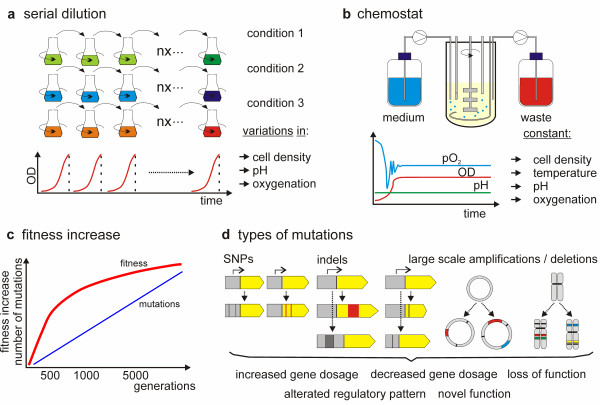
“Moreover, it is important to note that the fitness increase as a function of the total number of generations is not linear (Figure 1c).”
§ Adaptive laboratory evolution – principles and applications for biotechnology > Adaptive laboratory evolution > Increased growth and fitness as desirable criteria
plaincorrelational- Asserted: passes — The authors put it forward as true.
- Checkable: passes — It can be checked against evidence.
- Load-bearing: passes — The paper’s conclusions depend on it.
- Based: passes — The paper gives a reason why it holds.
The paper states this without a source or data behind it here, so there is nothing to check it against. The quote shows it is in the paper.
In the paper
“In recent ALE experiments various types of mutations were detected: Single-nucleotide polymorphisms (SNPs), small scale insertions and deletions (indels), transposable element (insertion sequence, IS) movements and amplifications as well as deletions of larger genomic regions (Figure 1d).”
§ Adaptive laboratory evolution – principles and applications for biotechnology > Adaptive laboratory evolution > Mutations and robustness
plain- Asserted: passes — The authors put it forward as true.
- Checkable: passes — It can be checked against evidence.
- Load-bearing: unclear — It is unclear whether the paper’s conclusions depend on it.
- Based: passes — The paper gives a reason why it holds.
The paper states this without a source or data behind it here, so there is nothing to check it against. The quote shows it is in the paper.
In the paper
“During direct competition of an ancestral microbial strain and an adapted strain, the increased fitness of the adapted variant will be obvious by its increased frequency in the total population.”
§ Adaptive laboratory evolution – principles and applications for biotechnology > Adaptive laboratory evolution > Increased growth and fitness as desirable criteria
plaindirect- Asserted: passes — The authors put it forward as true.
- Checkable: passes — It can be checked against evidence.
- Load-bearing: passes — The paper’s conclusions depend on it.
- Based: passes — The paper gives a reason why it holds.
A conclusion the paper draws from its own results — it cites no other source for it, so there is none to check. The quote shows it is in the paper.
In the paper
“Thus, it cannot be assumed that a homogenous population is present during any point of a laboratory evolution experiment.”
§ Adaptive laboratory evolution – principles and applications for biotechnology > Adaptive laboratory evolution > Increased growth and fitness as desirable criteria
plain- Asserted: passes — The authors put it forward as true.
- Checkable: passes — It can be checked against evidence.
- Load-bearing: passes — The paper’s conclusions depend on it.
- Based: passes — The paper gives a reason why it holds.
None of the sources cited for this claim have been checked yet.
In the paper
“Stable phenotypes will accumulate rapidly, although clonal interference [42], bet hedging [43,60], genetic hitchhiking [61] and fluctuating growth environments can lead to significant population heterogeneity [22,62,63].”
§ Adaptive laboratory evolution – principles and applications for biotechnology > Adaptive laboratory evolution > Increased growth and fitness as desirable criteria
What the sources say
plaindirect- Asserted: passes — The authors put it forward as true.
- Checkable: passes — It can be checked against evidence.
- Load-bearing: passes — The paper’s conclusions depend on it.
- Based: passes — The paper gives a reason why it holds.
None of the sources cited for this claim have been checked yet.
In the paper
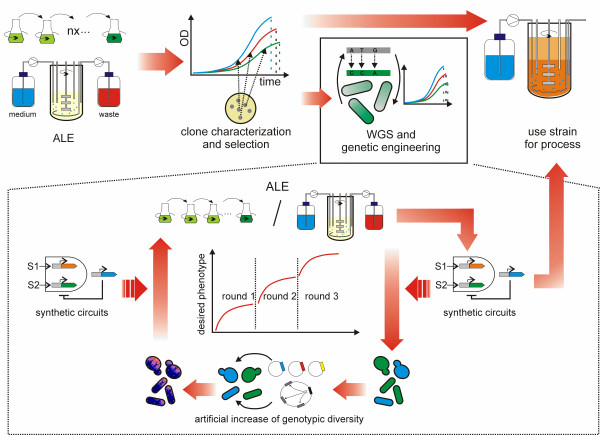
“Recently, classical genetic engineering was successfully complemented with artificial laboratory selection of microbial cells in order to generate potentially robust and optimized microbial production systems [15,16].”
§ Adaptive laboratory evolution – principles and applications for biotechnology > Abstract
plaindirect- Asserted: passes — The authors put it forward as true.
- Checkable: passes — It can be checked against evidence.
- Load-bearing: passes — The paper’s conclusions depend on it.
- Based: passes — The paper gives a reason why it holds.
None of the sources cited for this claim have been checked yet.
In the paper
“Many typical ALE experiments were performed in shake flasks and similar growth conditions with cell densities in the range of 107 to 109 cells per mL for typical microbial cultures [124,125]”
§ Adaptive laboratory evolution – principles and applications for biotechnology > Adaptive laboratory evolution > Increased growth and fitness as desirable criteria
plain- Asserted: passes — The authors put it forward as true.
- Checkable: passes — It can be checked against evidence.
- Load-bearing: unclear — It is unclear whether the paper’s conclusions depend on it.
- Based: passes — The paper gives a reason why it holds.
In the paper
“For standard ALE in biotechnology this is a critical factor, as prolonged selection that exceeds the first rapid evolutionary adaptation phase will not necessarily lead to significantly improved phenotypes [67];”
§ Adaptive laboratory evolution – principles and applications for biotechnology > Adaptive laboratory evolution > Increased growth and fitness as desirable criteria
What the sources say
- Not checked yetcites [67] source
plain- Asserted: passes — The authors put it forward as true.
- Checkable: passes — It can be checked against evidence.
- Load-bearing: passes — The paper’s conclusions depend on it.
- Based: passes — The paper gives a reason why it holds.
- It may state two separate claims as one. 67
- Probably not a substantial claim. 20
None of the sources cited for this claim have been checked yet.
In the paper
“As such, ALE studies highlight that duplications and large scale genomic variations, although they can lead to significant issues such as genomic instability [152], play a major role in e.g. yeast evolution; this is also indicated by data on wine yeasts, galactose utilization, comparative genomics and drug resistance [115,153-156].”
§ Adaptive laboratory evolution – principles and applications for biotechnology > Adaptation towards nutrient sources and environmental stresses > Environmental stress
What the sources say
- Not checked yetcites [152] source
- Could not verifycites [115] sourceExperimental — accuracy not yet measured
Citation [152] is attached to the claim that duplications and large-scale genomic variations can cause genomic instability. The paper discusses deleterious gene-dosage changes and the loss of duplicated copies through recombination (section “The Magnitude of the Problem,” page unavailable), but the passages found do not say that these changes cause genomic instability. The yeast-evolution claim is attached to other citations. (LLM, conf=0.72)
- Not checked yetcites [153] source
- Could not verifycites [154] sourceExperimental — accuracy not yet measured
Citation [152] is attached to the qualification about genomic instability, not the later statement about yeast evolution. The Introduction and Discussion discuss the evolution of ER-stress responses in Candida glabrata, but our copy does not address whether duplications or large-scale genomic variations cause genomic instability. Searches for genomic instability, duplication, and copy-number variation found no relevant passage. (LLM, conf=0.75)
- Could not verifycites [155] sourceExperimental — accuracy not yet measured
The Background and Results and Discussion discuss salt-responsive gene expression and adaptation in Hortaea werneckii, not duplications or large-scale genomic variation as drivers of yeast evolution. Searches for duplicated genes, genomic instability, and evolution found no passage addressing that claim in our copy; the genomic-instability clause also has a separate citation in the citing sentence. (LLM, conf=0.75)
- Could not verifycites [156] sourceExperimental — accuracy not yet measured
Citation [152] is attached to the claim that duplications and large-scale genomic variations can cause genomic instability. The Background discusses T-DNA insertions in Arabidopsis, and the Discussion concerns metabolite-data normalization; neither addresses that claim. Searches for duplications, genomic instability, and yeast evolution found no relevant passage in our copy. (LLM, conf=0.76)
plaindirect- Asserted: passes — The authors put it forward as true.
- Checkable: passes — It can be checked against evidence.
- Load-bearing: passes — The paper’s conclusions depend on it.
- Based: passes — The paper gives a reason why it holds.
It may state two separate claims as one.
A result the paper reports from its own data — it cites no other source for it, so there is none to check. The quote shows it is in the paper.
In the paper
“In summary Tables 1 and Table 2, it can be seen that a typical ALE experiment is performed for somewhat between 100 and 2000 generations and usually takes a few weeks up to a few months.”
§ Adaptive laboratory evolution – principles and applications for biotechnology > Adaptive laboratory evolution > Increased growth and fitness as desirable criteria
plain- Asserted: passes — The authors put it forward as true.
- Checkable: passes — It can be checked against evidence.
- Load-bearing: fails — The paper’s conclusions may not depend on it.
- Based: passes — The paper gives a reason why it holds.
Probably not a substantial claim. The paper’s conclusions may not depend on it. It may state two separate claims as one.
In the paper
“Moreover, biological catalysis offers several advantages over chemical synthesis, such as stereo-selective production of chemical compounds [9].”
§ Adaptive laboratory evolution – principles and applications for biotechnology > Abstract
What the sources say
- Not checked yetcites [9] source
plain- Asserted: passes — The authors put it forward as true.
- Checkable: passes — It can be checked against evidence.
- Load-bearing: fails — The paper’s conclusions may not depend on it.
- Based: passes — The paper gives a reason why it holds.
Probably not a substantial claim. The paper’s conclusions may not depend on it.
None of the sources cited for this claim have been checked yet.
In the paper
“Synthetic biology is a new emerging field [10,11] and systems metabolic engineering has proven very successful for the design and implementation of biotechnological production processes [12-14].”
§ Adaptive laboratory evolution – principles and applications for biotechnology > Abstract
What the sources say
boosteddirect- Asserted: passes — The authors put it forward as true.
- Checkable: passes — It can be checked against evidence.
- Load-bearing: fails — The paper’s conclusions may not depend on it.
- Based: passes — The paper gives a reason why it holds.
Probably not a substantial claim. The paper’s conclusions may not depend on it.
In the paper
“As indicated in Figure 1a, in serial batch cultures for ALE, the transfer often occurs before the stationary phase is reached. Clearly, this is a prerequisite to avoid stationary phase adaptation [52].”
§ Adaptive laboratory evolution – principles and applications for biotechnology > Adaptive laboratory evolution > Laboratory selection methods
What the sources say
- Not checked yetcites [52] source
boosteddirect- Asserted: passes — The authors put it forward as true.
- Checkable: passes — It can be checked against evidence.
- Load-bearing: unclear — It is unclear whether the paper’s conclusions depend on it.
- Based: passes — The paper gives a reason why it holds.
It may state two separate claims as one.
The paper states this without a source or data behind it here, so there is nothing to check it against. The quote shows it is in the paper.
In the paper
“Microbial cells offer important advantages for ALE studies: (a) most microbial cells have simple nutrient requirements, (b) they can be easily cultivated in the laboratory and (c) microbial cells generally grow very fast and can be cultivated for several hundred generations within several weeks or months”
§ Adaptive laboratory evolution – principles and applications for biotechnology > Adaptive laboratory evolution
plain- Asserted: passes — The authors put it forward as true.
- Checkable: passes — It can be checked against evidence.
- Load-bearing: fails — The paper’s conclusions may not depend on it.
- Based: passes — The paper gives a reason why it holds.
Probably not a substantial claim. The paper’s conclusions may not depend on it. It may state two separate claims as one.
None of the sources cited for this claim have been checked yet.
In the paper
“however, particularly in the last 25 years, there has been an ever increasing number of such experiments with Escherichia coli and Saccharomyces cerevisiae being the most prominent organisms under investigation [26-28].”
§ Adaptive laboratory evolution – principles and applications for biotechnology > Adaptive laboratory evolution
What the sources say
plaincorrelational- Asserted: passes — The authors put it forward as true.
- Checkable: passes — It can be checked against evidence.
- Load-bearing: fails — The paper’s conclusions may not depend on it.
- Based: passes — The paper gives a reason why it holds.
Probably not a substantial claim. The paper’s conclusions may not depend on it. It may state two separate claims as one.
None of the sources cited for this claim have been checked yet.
In the paper
“This single parallel E. coli adaptation experiment is already exceeding 50000 generations [33-35].”
§ Adaptive laboratory evolution – principles and applications for biotechnology > Adaptive laboratory evolution
What the sources say
plainSingle case- Asserted: passes — The authors put it forward as true.
- Checkable: passes — It can be checked against evidence.
- Load-bearing: fails — The paper’s conclusions may not depend on it.
- Based: passes — The paper gives a reason why it holds.
Probably not a substantial claim. The paper’s conclusions may not depend on it.
In the paper
“In this context, we cannot clearly predict the scale at which improved phenotypes emerge during laboratory evolution, although recent literature indicates that such predictions are possible in certain growth contexts such as carbon source adaptation [65].”
§ Adaptive laboratory evolution – principles and applications for biotechnology > Adaptive laboratory evolution > Increased growth and fitness as desirable criteria
What the sources say
- Not checked yetcites [65] source
hedged- Asserted: passes — The authors put it forward as true.
- Checkable: passes — It can be checked against evidence.
- Load-bearing: unclear — It is unclear whether the paper’s conclusions depend on it.
- Based: passes — The paper gives a reason why it holds.
It may state two separate claims as one.
None of the sources cited for this claim have been checked yet.
In the paper
“Whereas certain environments can lead to fast selection of improved phenotypes, others, including the long-term adaptation to environmental pH [59,63], represent complex environments where microbial cells show low adaptive potential in terms of absolute fitness gain.”
§ Adaptive laboratory evolution – principles and applications for biotechnology > Adaptive laboratory evolution > Increased growth and fitness as desirable criteria
plaindirect- Asserted: passes — The authors put it forward as true.
- Checkable: passes — It can be checked against evidence.
- Load-bearing: unclear — It is unclear whether the paper’s conclusions depend on it.
- Based: passes — The paper gives a reason why it holds.
It may state two separate claims as one.
In the paper
“Whereas the fitness increase is usually fast within the first 100 to 500 generations, it slows considerably down during the course of ALE [36].”
§ Adaptive laboratory evolution – principles and applications for biotechnology > Adaptive laboratory evolution > Increased growth and fitness as desirable criteria
What the sources say
- Not checked yetcites [36] source
plaindirect- Asserted: passes — The authors put it forward as true.
- Checkable: passes — It can be checked against evidence.
- Load-bearing: passes — The paper’s conclusions depend on it.
- Based: passes — The paper gives a reason why it holds.
It may state two separate claims as one.
In the paper
“In this context, cells selected under growth limiting conditions can show growth trade-offs in non-limiting conditions and vice versa[53].”
§ Adaptive laboratory evolution – principles and applications for biotechnology > Adaptive laboratory evolution > Laboratory selection methods
What the sources say
- Not checked yetcites [53] source
plaincorrelational- Asserted: passes — The authors put it forward as true.
- Checkable: passes — It can be checked against evidence.
- Load-bearing: unclear — It is unclear whether the paper’s conclusions depend on it.
- Based: passes — The paper gives a reason why it holds.
It may state two separate claims as one.
None of the sources cited for this claim have been checked yet.
In the paper
“Hence, adaptive laboratory evolution was already performed about a hundred years ago by William Dallinger [22] and during the middle of the last century [24,25];”
§ Adaptive laboratory evolution – principles and applications for biotechnology > Adaptive laboratory evolution
What the sources say
plain- Asserted: passes — The authors put it forward as true.
- Checkable: passes — It can be checked against evidence.
- Load-bearing: fails — The paper’s conclusions may not depend on it.
- Based: passes — The paper gives a reason why it holds.
Probably not a substantial claim. The paper’s conclusions may not depend on it. It may state two separate claims as one.
A conclusion the paper draws from its own results — it cites no other source for it, so there is none to check. The quote shows it is in the paper.
In the paper
“The initial choice of conditions, including media composition and limited versus non-limited growth rate, will greatly influence whether the artificially selected microbial host will be suitable for its dedicated application.”
§ Adaptive laboratory evolution – principles and applications for biotechnology > Adaptive laboratory evolution > Laboratory selection methods
plaindirect- Asserted: passes — The authors put it forward as true.
- Checkable: passes — It can be checked against evidence.
- Load-bearing: passes — The paper’s conclusions depend on it.
- Based: passes — The paper gives a reason why it holds.
Probably not a substantial claim.
In the paper
“During adaptive evolution, certain trait values change and are associated with increased (Darwinian) fitness [20]; as such, an improved phenotype or property is often equal to increased fitness.”
§ Adaptive laboratory evolution – principles and applications for biotechnology > Adaptive laboratory evolution > Increased growth and fitness as desirable criteria
What the sources say
- Not checked yetcites [20] source
plaincorrelational- Asserted: passes — The authors put it forward as true.
- Checkable: passes — It can be checked against evidence.
- Load-bearing: passes — The paper’s conclusions depend on it.
- Based: passes — The paper gives a reason why it holds.
It may state two separate claims as one.
In the paper
“In certain cases ALE can lead to an even higher increase of up to 1000% as recently shown for the iron reduction rate of Geobacter sulfurreducens[123], although this increase was only achieved after 24 months of selection”
§ Adaptive laboratory evolution – principles and applications for biotechnology > Adaptive laboratory evolution > Increased growth and fitness as desirable criteria
What the sources say
- Not checked yetcites [123] source
plaindirectSingle case- Asserted: passes — The authors put it forward as true.
- Checkable: passes — It can be checked against evidence.
- Load-bearing: unclear — It is unclear whether the paper’s conclusions depend on it.
- Based: passes — The paper gives a reason why it holds.
It may state two separate claims as one.
In the paper
“Deletions accounted for approximately 29% of the observed genomic changes, followed by insertions (7%) and IS movements (3%) [15].”
§ Adaptive laboratory evolution – principles and applications for biotechnology > Adaptive laboratory evolution > Mutations and robustness
What the sources say
- Not checked yetcites [15] source
plain- Asserted: passes — The authors put it forward as true.
- Checkable: passes — It can be checked against evidence.
- Load-bearing: unclear — It is unclear whether the paper’s conclusions depend on it.
- Based: passes — The paper gives a reason why it holds.
It may state two separate claims as one.
In the paper
“Nevertheless, the role of HGT in natural evolution remains a controversial topic [133].”
§ Adaptive laboratory evolution – principles and applications for biotechnology > Adaptive laboratory evolution > Mutations and robustness
What the sources say
- Not checked yetcites [133] source
plain- Asserted: passes — The authors put it forward as true.
- Checkable: passes — It can be checked against evidence.
- Load-bearing: fails — The paper’s conclusions may not depend on it.
- Based: passes — The paper gives a reason why it holds.
Probably not a substantial claim. The paper’s conclusions may not depend on it.
None of the sources cited for this claim have been checked yet.
In the paper
“Interestingly, it was shown that high mutation rates and mutator strains can emerge naturally during laboratory evolution and contribute to the formation of genetic novelty [33,73,139-141].”
§ Adaptive laboratory evolution – principles and applications for biotechnology > Adaptive laboratory evolution > Mutations and robustness
What the sources say
plaindirect- Asserted: passes — The authors put it forward as true.
- Checkable: passes — It can be checked against evidence.
- Load-bearing: unclear — It is unclear whether the paper’s conclusions depend on it.
- Based: passes — The paper gives a reason why it holds.
It may state two separate claims as one.
In the paper
“As summarized in a recent review, SNPs (61%, with G:C to T:A mutations being disproportionally frequent) account for the majority of observed genetic changes [15].”
§ Adaptive laboratory evolution – principles and applications for biotechnology > Adaptive laboratory evolution > Mutations and robustness
What the sources say
- Not checked yetcites [15] source
plaincorrelational- Asserted: passes — The authors put it forward as true.
- Checkable: passes — It can be checked against evidence.
- Load-bearing: unclear — It is unclear whether the paper’s conclusions depend on it.
- Based: passes — The paper gives a reason why it holds.
It may state two separate claims as one.
In the paper
“This so-called toolbox model suggests that prokaryotic metabolic pathways emerge through horizontal gene transfer (HGT) and are rapidly acquired and lost based on nutrient availability [132].”
§ Adaptive laboratory evolution – principles and applications for biotechnology > Adaptive laboratory evolution > Mutations and robustness
What the sources say
- Not checked yetcites [132] source
hedgeddirect- Asserted: passes — The authors put it forward as true.
- Checkable: passes — It can be checked against evidence.
- Load-bearing: fails — The paper’s conclusions may not depend on it.
- Based: passes — The paper gives a reason why it holds.
Probably not a substantial claim. The paper’s conclusions may not depend on it. It may state two separate claims as one.
None of the sources cited for this claim have been checked yet.
In the paper
“they are a prerequisite for the development of novel molecular functions [129-131].”
§ Adaptive laboratory evolution – principles and applications for biotechnology > Adaptive laboratory evolution > Mutations and robustness
What the sources say
plaindirect- Asserted: passes — The authors put it forward as true.
- Checkable: passes — It can be checked against evidence.
- Load-bearing: fails — The paper’s conclusions may not depend on it.
- Based: passes — The paper gives a reason why it holds.
Probably not a substantial claim. The paper’s conclusions may not depend on it.
In the paper
“During the first few thousand generations, glucose-evolved cultures developed larger cell size and a lower final cell density as compared with the ancestor [34].”
§ Adaptive laboratory evolution – principles and applications for biotechnology > Adaptation towards nutrient sources and environmental stresses > Nutrient stress
What the sources say
- Not checked yetcites [34] source
plaindirect- Asserted: passes — The authors put it forward as true.
- Checkable: passes — It can be checked against evidence.
- Load-bearing: unclear — It is unclear whether the paper’s conclusions depend on it.
- Based: passes — The paper gives a reason why it holds.
It may state two separate claims as one.
In the paper
“Furthermore, it was shown that mutational robustness tends to increase with mutation rate and decline with population size [40].”
§ Adaptive laboratory evolution – principles and applications for biotechnology > Adaptive laboratory evolution > Mutations and robustness
What the sources say
- Not checked yetcites [40] source
plaindirect- Asserted: passes — The authors put it forward as true.
- Checkable: passes — It can be checked against evidence.
- Load-bearing: unclear — It is unclear whether the paper’s conclusions depend on it.
- Based: passes — The paper gives a reason why it holds.
It may state two separate claims as one.
In the paper
“In this study, the biomass yield increased up to 40% and acetate overflow was reduced, whereas the metabolic rate increased and the evolved cells showed a lowered or total loss of motility.”
§ Adaptive laboratory evolution – principles and applications for biotechnology > Adaptation towards nutrient sources and environmental stresses > Nutrient stress
What the sources say
- Not checked yetcites [69] source
plaindirect- Asserted: passes — The authors put it forward as true.
- Checkable: passes — It can be checked against evidence.
- Load-bearing: unclear — It is unclear whether the paper’s conclusions depend on it.
- Based: passes — The paper gives a reason why it holds.
It may state two separate claims as one.
None of the sources cited for this claim have been checked yet.
In the paper
“Microbial metabolic networks often provide appropriate functions at a minimal size [134] and furthermore, their complexity seems to be correlated with environmental factors [135].”
§ Adaptive laboratory evolution – principles and applications for biotechnology > Adaptive laboratory evolution > Mutations and robustness
hedgedcorrelational- Asserted: passes — The authors put it forward as true.
- Checkable: passes — It can be checked against evidence.
- Load-bearing: fails — The paper’s conclusions may not depend on it.
- Based: passes — The paper gives a reason why it holds.
Probably not a substantial claim. The paper’s conclusions may not depend on it. It may state two separate claims as one.
A conclusion the paper draws from its own results — it cites no other source for it, so there is none to check. The quote shows it is in the paper.
In the paper
“however, such mutational adaptations might be counterproductive for some applications of microbial cells in biotechnology.”
§ Adaptive laboratory evolution – principles and applications for biotechnology > Adaptive laboratory evolution > Mutations and robustness
hedgedconditional- Asserted: passes — The authors put it forward as true.
- Checkable: passes — It can be checked against evidence.
- Load-bearing: fails — The paper’s conclusions may not depend on it.
- Based: fails — The paper may give no reason why it holds.
Probably not a substantial claim. The paper’s conclusions may not depend on it. The paper may give no reason why it holds.
The paper states this without a source or data behind it here, so there is nothing to check it against. The quote shows it is in the paper.
In the paper
“Many ALE studies analyzed the impact and molecular adaptation towards both stresses (Table 1 and Table 2), leading to major findings regarding the emergence of specialists, generalists, the underlying mutations and the applicability of evolved cells for industrial microbiology.”
§ Adaptive laboratory evolution – principles and applications for biotechnology > Adaptation towards nutrient sources and environmental stresses
plaindirect- Asserted: passes — The authors put it forward as true.
- Checkable: passes — It can be checked against evidence.
- Load-bearing: unclear — It is unclear whether the paper’s conclusions depend on it.
- Based: passes — The paper gives a reason why it holds.
It may state two separate claims as one.
None of the sources cited for this claim have been checked yet.
In the paper
“For example, an experimental E. coli culture could evolve the ability to aerobically utilize citrate [37], or the ability to use the non-natural carbon source 1,2-propanediol [71]; also, a strain deficient in glutathione biosynthesis was able to develop compensatory mutations to restore this function [147].”
§ Adaptive laboratory evolution – principles and applications for biotechnology > Adaptive laboratory evolution > Mutations and robustness
What the sources say
hedgeddirect- Asserted: passes — The authors put it forward as true.
- Checkable: passes — It can be checked against evidence.
- Load-bearing: unclear — It is unclear whether the paper’s conclusions depend on it.
- Based: passes — The paper gives a reason why it holds.
It may state two separate claims as one.
In the paper
“In a 1997 study, E. coli was evolved in chemostat cultures in order to select for improved growth on glycerol. The authors reported phenotypic changes in terms of colony morphology accompanied with increased growth rate and biomass yield and decreased acetate formation [50].”
§ Adaptive laboratory evolution – principles and applications for biotechnology > Adaptation towards nutrient sources and environmental stresses > Nutrient stress
What the sources say
- Not checked yetcites [50] source
plaincorrelational- Asserted: passes — The authors put it forward as true.
- Checkable: passes — It can be checked against evidence.
- Load-bearing: unclear — It is unclear whether the paper’s conclusions depend on it.
- Based: passes — The paper gives a reason why it holds.
It may state two separate claims as one.
In the paper
“It is clear that a higher mutation rate can only be beneficial to a certain extent as it also results in a genetic load [142].”
§ Adaptive laboratory evolution – principles and applications for biotechnology > Adaptive laboratory evolution > Mutations and robustness
What the sources say
- Not checked yetcites [142] source
boosteddirect- Asserted: passes — The authors put it forward as true.
- Checkable: passes — It can be checked against evidence.
- Load-bearing: unclear — It is unclear whether the paper’s conclusions depend on it.
- Based: passes — The paper gives a reason why it holds.
It may state two separate claims as one.
In the paper
“In nature as well as in biotechnological processes, microorganisms are challenged with changing environmental conditions, where they experience fluctuations in temperature, pH, oxygenation, atmospheric or hydrostatic pressure but also water and nutrient availability; thus, the selective pressures can be divided in two main categories: nutrient availability and environmental stress [17].”
§ Adaptive laboratory evolution – principles and applications for biotechnology > Adaptation towards nutrient sources and environmental stresses
What the sources say
- Not checked yetcites [17] source
plain- Asserted: passes — The authors put it forward as true.
- Checkable: passes — It can be checked against evidence.
- Load-bearing: fails — The paper’s conclusions may not depend on it.
- Based: passes — The paper gives a reason why it holds.
Probably not a substantial claim. The paper’s conclusions may not depend on it. It may state two separate claims as one.
In the paper
“Only recently, the cumulative number of cell divisions (CCD) was proposed as a more appropriate denominator to evaluate microbial evolution [126].”
§ Adaptive laboratory evolution – principles and applications for biotechnology > Adaptive laboratory evolution > Increased growth and fitness as desirable criteria
What the sources say
- Not checked yetcites [126] source
plain- Asserted: passes — The authors put it forward as true.
- Checkable: passes — It can be checked against evidence.
- Load-bearing: fails — The paper’s conclusions may not depend on it.
- Based: passes — The paper gives a reason why it holds.
Probably not a substantial claim. The paper’s conclusions may not depend on it.
In the paper
“Glucose import, sensing and regulation represent major targets during glucose-limited chemostat growth, as a further study also identified frequent mutations in HXT genes and glucose sensors and regulators such as RGT1 and MIG2[53].”
§ Adaptive laboratory evolution – principles and applications for biotechnology > Adaptation towards nutrient sources and environmental stresses > Nutrient stress
What the sources say
- Not checked yetcites [53] source
plaincorrelational- Asserted: passes — The authors put it forward as true.
- Checkable: passes — It can be checked against evidence.
- Load-bearing: unclear — It is unclear whether the paper’s conclusions depend on it.
- Based: passes — The paper gives a reason why it holds.
It may state two separate claims as one.
In the paper
“Adaptive changes towards ethanol tolerance were linked to the up-regulation of oxyR and nrdR, indicating major changes in the cellular respiratory system but also changes in amino acid metabolism [85].”
§ Adaptive laboratory evolution – principles and applications for biotechnology > Adaptation towards nutrient sources and environmental stresses > Environmental stress
What the sources say
- Not checked yetcites [85] source
hedgedcorrelational- Asserted: passes — The authors put it forward as true.
- Checkable: passes — It can be checked against evidence.
- Load-bearing: unclear — It is unclear whether the paper’s conclusions depend on it.
- Based: passes — The paper gives a reason why it holds.
It may state two separate claims as one.
In the paper
“Transcript analysis showed up-regulation of trehalose and glycogen metabolism, whereas no mutations were identified in galactose or storage carbohydrate related genes. Interestingly, the authors rather identified mutations in RAS/PKA signaling as a source for increased fitness on galactose medium [106].”
§ Adaptive laboratory evolution – principles and applications for biotechnology > Adaptation towards nutrient sources and environmental stresses > Nutrient stress
What the sources say
- Not checked yetcites [106] source
plaindirectSingle case- Asserted: passes — The authors put it forward as true.
- Checkable: passes — It can be checked against evidence.
- Load-bearing: unclear — It is unclear whether the paper’s conclusions depend on it.
- Based: passes — The paper gives a reason why it holds.
It may state two separate claims as one.
None of the sources cited for this claim have been checked yet.
In the paper
“The authors did not identify expression changes in HXT genes, although other studies on improved xylose and arabinose utilization indicated that HXT genes may also be involved in increased xylose uptake rates [99,104].”
§ Adaptive laboratory evolution – principles and applications for biotechnology > Adaptation towards nutrient sources and environmental stresses > Nutrient stress
hedgedconditional- Asserted: passes — The authors put it forward as true.
- Checkable: passes — It can be checked against evidence.
- Load-bearing: unclear — It is unclear whether the paper’s conclusions depend on it.
- Based: passes — The paper gives a reason why it holds.
It may state two separate claims as one.
In the paper
“Similarly, Zelle and co-workers established growth on glucose by genetic- and evolutionary engineering in a pyruvate carboxylase-negative S. cerevisiae strain. The authors identified a point mutation in the recombinant sfcA gene, which shifted the co-factor preference from NADH to NADPH [107].”
§ Adaptive laboratory evolution – principles and applications for biotechnology > Adaptation towards nutrient sources and environmental stresses > Nutrient stress
What the sources say
- Not checked yetcites [107] source
plaindirectSingle case- Asserted: passes — The authors put it forward as true.
- Checkable: passes — It can be checked against evidence.
- Load-bearing: unclear — It is unclear whether the paper’s conclusions depend on it.
- Based: passes — The paper gives a reason why it holds.
It may state two separate claims as one.
In the paper
“Mutations that lead to altered expression patterns accumulated predominantly in lacI and lacO1 regions of the lac operon [76]. Altogether, these mutations were responsible for a reduced (diauxic) lag phase and increased maximum growth rates in lactose growth medium.”
§ Adaptive laboratory evolution – principles and applications for biotechnology > Adaptation towards nutrient sources and environmental stresses > Nutrient stress
What the sources say
- Not checked yetcites [76] source
plaindirect- Asserted: passes — The authors put it forward as true.
- Checkable: passes — It can be checked against evidence.
- Load-bearing: unclear — It is unclear whether the paper’s conclusions depend on it.
- Based: passes — The paper gives a reason why it holds.
It may state two separate claims as one.
In the paper
“another study reported the emergence of aneuploidy during glucose-limited growth and amplification of the HXT6 gene with significant divergence between co-evolved populations [94].”
§ Adaptive laboratory evolution – principles and applications for biotechnology > Adaptation towards nutrient sources and environmental stresses > Nutrient stress
What the sources say
- Not checked yetcites [94] source
plaincorrelational- Asserted: passes — The authors put it forward as true.
- Checkable: passes — It can be checked against evidence.
- Load-bearing: unclear — It is unclear whether the paper’s conclusions depend on it.
- Based: passes — The paper gives a reason why it holds.
It may state two separate claims as one.
In the paper
“Growth rates and glucose uptake rates increased up to 3.6 and up to 2.6 fold in evolved ∆pgi strains as compared with the ancestor and were accompanied with different phenotypes regarding acetate and formate production.”
§ Adaptive laboratory evolution – principles and applications for biotechnology > Adaptation towards nutrient sources and environmental stresses > Nutrient stress
What the sources say
- Not checked yetcites [70] source
plaindirect- Asserted: passes — The authors put it forward as true.
- Checkable: passes — It can be checked against evidence.
- Load-bearing: unclear — It is unclear whether the paper’s conclusions depend on it.
- Based: passes — The paper gives a reason why it holds.
It may state two separate claims as one.
None of the sources cited for this claim have been checked yet.
In the paper
“Early studies in glucose-limited chemostats revealed that glucose-limited selection led to increased biomass yield and a decreased fermentative capacity [93,98].”
§ Adaptive laboratory evolution – principles and applications for biotechnology > Adaptation towards nutrient sources and environmental stresses > Nutrient stress
plaindirect- Asserted: passes — The authors put it forward as true.
- Checkable: passes — It can be checked against evidence.
- Load-bearing: unclear — It is unclear whether the paper’s conclusions depend on it.
- Based: passes — The paper gives a reason why it holds.
It may state two separate claims as one.
In the paper
“Decreased activity levels of enzymes related to glycolysis but also correlating changes in the expression levels of genes such as ENO1, ENO2, TDH1 and PYK1 and down-regulation of the stress response (MSN2/4) were observed.”
§ Adaptive laboratory evolution – principles and applications for biotechnology > Adaptation towards nutrient sources and environmental stresses > Nutrient stress
What the sources say
- Not checked yetcites [98] source
plaincorrelational- Asserted: passes — The authors put it forward as true.
- Checkable: passes — It can be checked against evidence.
- Load-bearing: unclear — It is unclear whether the paper’s conclusions depend on it.
- Based: passes — The paper gives a reason why it holds.
It may state two separate claims as one.
In the paper
“Strikingly, the authors also noticed that malT regulatory mutations, although common in aerobic conditions, were absent during oxygen-limited chemostat growth, where mutations in the glucose permease ptsG were common [48].”
§ Adaptive laboratory evolution – principles and applications for biotechnology > Adaptation towards nutrient sources and environmental stresses > Nutrient stress
What the sources say
- Not checked yetcites [48] source
plaincorrelational- Asserted: passes — The authors put it forward as true.
- Checkable: passes — It can be checked against evidence.
- Load-bearing: unclear — It is unclear whether the paper’s conclusions depend on it.
- Based: passes — The paper gives a reason why it holds.
It may state two separate claims as one.
In the paper
“but most importantly the rpoS mutation alone did not positively influence the growth rate in the ancestral ∆pgi strain; rpoS mutations were epistatically linked to additional mutations.”
§ Adaptive laboratory evolution – principles and applications for biotechnology > Adaptation towards nutrient sources and environmental stresses > Nutrient stress
What the sources say
- Not checked yetcites [63] source
plaincorrelational- Asserted: passes — The authors put it forward as true.
- Checkable: passes — It can be checked against evidence.
- Load-bearing: passes — The paper’s conclusions depend on it.
- Based: passes — The paper gives a reason why it holds.
It may state two separate claims as one.
In the paper
“Altered cell morphology was also observed, as well as higher affinity towards glucose, although no expression change in the major HXT low-affinity glucose transporters was observed [98]”
§ Adaptive laboratory evolution – principles and applications for biotechnology > Adaptation towards nutrient sources and environmental stresses > Nutrient stress
What the sources say
- Not checked yetcites [98] source
plain- Asserted: passes — The authors put it forward as true.
- Checkable: passes — It can be checked against evidence.
- Load-bearing: unclear — It is unclear whether the paper’s conclusions depend on it.
- Based: passes — The paper gives a reason why it holds.
It may state two separate claims as one.
None of the sources cited for this claim have been checked yet.
In the paper
“Mutations in acrAB and marC were found independently in these studies; further changes were linked to carbon and nitrogen metabolism via gatY and tnaA[86], enterobactin synthesis [63] or attenuated rpoS activity via hfq mutations [87].”
§ Adaptive laboratory evolution – principles and applications for biotechnology > Adaptation towards nutrient sources and environmental stresses > Environmental stress
What the sources say
plaincorrelational- Asserted: passes — The authors put it forward as true.
- Checkable: passes — It can be checked against evidence.
- Load-bearing: unclear — It is unclear whether the paper’s conclusions depend on it.
- Based: passes — The paper gives a reason why it holds.
It may state two separate claims as one.
In the paper
“In xylose adaptation studies, increased growth rates and higher ethanol yields were observed in recombinant yeast. In this case, trehalose and glycogen metabolic processes were significantly down-regulated, nutrient and stress signaling was affected by down-regulation of YAK1 and also accompanied by down-regulation of CWP1 and consequently major cell wall changes [108].”
§ Adaptive laboratory evolution – principles and applications for biotechnology > Adaptation towards nutrient sources and environmental stresses > Nutrient stress
What the sources say
- Not checked yetcites [108] source
plaindirect- Asserted: passes — The authors put it forward as true.
- Checkable: passes — It can be checked against evidence.
- Load-bearing: unclear — It is unclear whether the paper’s conclusions depend on it.
- Based: passes — The paper gives a reason why it holds.
It may state two separate claims as one.
In the paper
“The authors found frequent point mutations in rpoS, udhA (soluble transhydrogenase), pntAB and a prophage deletion. They did not observe these mutations in the glucose-adapted wildtype strain; other regulatory mutations (including rpoABC) occurred in both backgrounds”
§ Adaptive laboratory evolution – principles and applications for biotechnology > Adaptation towards nutrient sources and environmental stresses > Nutrient stress
What the sources say
- Not checked yetcites [70] source
plain- Asserted: passes — The authors put it forward as true.
- Checkable: passes — It can be checked against evidence.
- Load-bearing: passes — The paper’s conclusions depend on it.
- Based: passes — The paper gives a reason why it holds.
It may state two separate claims as one.
In the paper
“For other carbon sources, it was shown that selection for improved galactose utilization could be achieved by serial transfer with a 24% increase of μmax within 62 days. Galactose uptake rates and ethanol production were increased.”
§ Adaptive laboratory evolution – principles and applications for biotechnology > Adaptation towards nutrient sources and environmental stresses > Nutrient stress
What the sources say
- Not checked yetcites [106] source
plaindirect- Asserted: passes — The authors put it forward as true.
- Checkable: passes — It can be checked against evidence.
- Load-bearing: unclear — It is unclear whether the paper’s conclusions depend on it.
- Based: passes — The paper gives a reason why it holds.
It may state two separate claims as one.
None of the sources cited for this claim have been checked yet.
In the paper
“Furthermore, experiments on pentose utilization highlighted that increased gene copy numbers of the heterologous genes in recombinant S. cerevisiae can emerge during evolutionary engineering and contribute to increased growth in anaerobic conditions [104,109].”
§ Adaptive laboratory evolution – principles and applications for biotechnology > Adaptation towards nutrient sources and environmental stresses > Nutrient stress
plainconditional- Asserted: passes — The authors put it forward as true.
- Checkable: passes — It can be checked against evidence.
- Load-bearing: unclear — It is unclear whether the paper’s conclusions depend on it.
- Based: passes — The paper gives a reason why it holds.
It may state two separate claims as one.
In the paper
“In the model yeast S. cerevisiae, adaptation towards salt tolerance led to increased cell size and increased ploidy. Additionally, gene expression changes in CTT1 and MSN4 were observed, as well as a high-frequency SNP in the transcriptional regulator MOT2[116].”
§ Adaptive laboratory evolution – principles and applications for biotechnology > Adaptation towards nutrient sources and environmental stresses > Environmental stress
What the sources say
- Not checked yetcites [116] source
plaindirect- Asserted: passes — The authors put it forward as true.
- Checkable: passes — It can be checked against evidence.
- Load-bearing: unclear — It is unclear whether the paper’s conclusions depend on it.
- Based: passes — The paper gives a reason why it holds.
It may state two separate claims as one.
In the paper
“A recent study showed that cross-protection towards lignocellulosic hydrolysates can be evolved in S. cerevisiae. Interestingly, several mutants showed increased fitness in the presence of inhibitor combinations but reduced fitness when exposed to individual hydrolysate components [112].”
§ Adaptive laboratory evolution – principles and applications for biotechnology > Adaptation towards nutrient sources and environmental stresses > Evolutionary trade-offs and cross-protection
What the sources say
- Not checked yetcites [112] source
plaindirect- Asserted: passes — The authors put it forward as true.
- Checkable: passes — It can be checked against evidence.
- Load-bearing: unclear — It is unclear whether the paper’s conclusions depend on it.
- Based: passes — The paper gives a reason why it holds.
It may state two separate claims as one.
In the paper
“Similarly, aerobic chemostat-selected S. cerevisiae cells also showed increased fitness in anaerobic glucose-limited chemostats and in acetate-limited chemostats, but decreased fitness in nitrogen-limited batch cultivations [53].”
§ Adaptive laboratory evolution – principles and applications for biotechnology > Adaptation towards nutrient sources and environmental stresses > Evolutionary trade-offs and cross-protection
What the sources say
- Not checked yetcites [53] source
plaindirect- Asserted: passes — The authors put it forward as true.
- Checkable: passes — It can be checked against evidence.
- Load-bearing: unclear — It is unclear whether the paper’s conclusions depend on it.
- Based: passes — The paper gives a reason why it holds.
It may state two separate claims as one.
In the paper
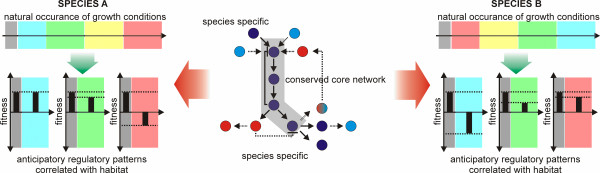
“In fact, a recent study in S. cerevisiae indicated that anticipatory gene regulatory patterns can evolve under cycling salt and oxidative stress conditions on a laboratory time scale within 300 generations and that cross-stress protection against salt and oxidative stress is strikingly asymmetrical, with oxidative stress protecting against salt stress but not vice versa[120].”
§ Adaptive laboratory evolution – principles and applications for biotechnology > Non-conventional hosts – implications of ecological niches and genetic network architecture
What the sources say
- Not checked yetcites [120] source
hedgeddirect- Asserted: passes — The authors put it forward as true.
- Checkable: passes — It can be checked against evidence.
- Load-bearing: unclear — It is unclear whether the paper’s conclusions depend on it.
- Based: passes — The paper gives a reason why it holds.
It may state two separate claims as one.
A conclusion the paper draws from its own results — it cites no other source for it, so there is none to check. The quote shows it is in the paper.
In the paper
“Thus, evolutionary trade-offs and cross-protection against process-relevant parameters are ubiquitous, but the mode of cultivation and the specificities of the selection pressure largely determine to which extent these phenomena arise.”
§ Adaptive laboratory evolution – principles and applications for biotechnology > Adaptation towards nutrient sources and environmental stresses > Evolutionary trade-offs and cross-protection
plainconditional- Asserted: passes — The authors put it forward as true.
- Checkable: passes — It can be checked against evidence.
- Load-bearing: passes — The paper’s conclusions depend on it.
- Based: passes — The paper gives a reason why it holds.
It may state two separate claims as one.
None of the sources cited for this claim have been checked yet.
In the paper
“Increased copper tolerance was reported to be mediated by a genomic amplification of CUP1, decreased basal levels of the copper transporters CTR2 and CCC2 and decreased activity of antioxidant enzymes [117,128].”
§ Adaptive laboratory evolution – principles and applications for biotechnology > Adaptation towards nutrient sources and environmental stresses > Environmental stress
plaindirect- Asserted: passes — The authors put it forward as true.
- Checkable: passes — It can be checked against evidence.
- Load-bearing: unclear — It is unclear whether the paper’s conclusions depend on it.
- Based: passes — The paper gives a reason why it holds.
It may state two separate claims as one.
A conclusion the paper draws from its own results — it cites no other source for it, so there is none to check. The quote shows it is in the paper.
In the paper
“Importantly, epistatic interactions can be hardly inferred from metabolic modeling studies although significant epistatic connections for strain engineering may be easily identified in ALE studies.”
§ Adaptive laboratory evolution – principles and applications for biotechnology > Adaptation towards nutrient sources and environmental stresses > Environmental stress
plain- Asserted: passes — The authors put it forward as true.
- Checkable: passes — It can be checked against evidence.
- Load-bearing: passes — The paper’s conclusions depend on it.
- Based: unclear — It is unclear why the paper says it holds.
It may state two separate claims as one.
In the paper
“In another study, increased ethanol tolerance was mediated by mutations in the translational regulator SSD1 and UTH1, a protein of unknown function, and indicated that cell wall stability is a major factor in ethanol tolerance of S. cerevisiae[119].”
§ Adaptive laboratory evolution – principles and applications for biotechnology > Adaptation towards nutrient sources and environmental stresses > Environmental stress
What the sources say
- Not checked yetcites [119] source
hedgeddirect- Asserted: passes — The authors put it forward as true.
- Checkable: passes — It can be checked against evidence.
- Load-bearing: unclear — It is unclear whether the paper’s conclusions depend on it.
- Based: passes — The paper gives a reason why it holds.
It may state two separate claims as one.
A conclusion the paper draws from its own results — it cites no other source for it, so there is none to check. The quote shows it is in the paper.
In the paper
“From these data it can be concluded that: (a) long-term adaptation leads to both large-scale transcriptional de-regulation and optimization of terminal nodes (fine-tuning of the expression levels of individual genes)”
§ Adaptive laboratory evolution – principles and applications for biotechnology > Adaptation towards nutrient sources and environmental stresses > Environmental stress
boosteddirect- Asserted: passes — The authors put it forward as true.
- Checkable: passes — It can be checked against evidence.
- Load-bearing: passes — The paper’s conclusions depend on it.
- Based: passes — The paper gives a reason why it holds.
It may state two separate claims as one.
In the paper
“Glycerol-limited growth led to stable mutants in a single E. coli population, where one mutant showed increased growth in glycerol-sufficient batch cultures and a second mutant did not. Furthermore, the mutant that showed increased growth in batch culture also showed increased fitness under general nutrient limitation, heat and osmotic stress [50].”
§ Adaptive laboratory evolution – principles and applications for biotechnology > Adaptation towards nutrient sources and environmental stresses > Evolutionary trade-offs and cross-protection
What the sources say
- Not checked yetcites [50] source
plaindirect- Asserted: passes — The authors put it forward as true.
- Checkable: passes — It can be checked against evidence.
- Load-bearing: passes — The paper’s conclusions depend on it.
- Based: passes — The paper gives a reason why it holds.
It may state two separate claims as one.
In the paper
“Another interesting study analyzed to which extent multi-stress resistant S. cerevisiae populations can be evolved. The authors tested various chemostat and batch stress regimes and found that batch selection for freeze-thaw tolerance also selected for increased thermal, oxidative and ethanol stress resistance [113].”
§ Adaptive laboratory evolution – principles and applications for biotechnology > Adaptation towards nutrient sources and environmental stresses > Evolutionary trade-offs and cross-protection
What the sources say
- Not checked yetcites [113] source
plaindirect- Asserted: passes — The authors put it forward as true.
- Checkable: passes — It can be checked against evidence.
- Load-bearing: passes — The paper’s conclusions depend on it.
- Based: passes — The paper gives a reason why it holds.
It may state two separate claims as one.
None of the sources cited for this claim have been checked yet.
In the paper
“Yeast cells that were evolved for efficient galactose utilization [106] subsequently showed trade-offs when grown on glucose as carbon source. This effect was due to antagonistic pleiotropy that was based on mutations of the regulatory protein RAS2[162].”
§ Adaptive laboratory evolution – principles and applications for biotechnology > Adaptation towards nutrient sources and environmental stresses > Evolutionary trade-offs and cross-protection
plaindirect- Asserted: passes — The authors put it forward as true.
- Checkable: passes — It can be checked against evidence.
- Load-bearing: unclear — It is unclear whether the paper’s conclusions depend on it.
- Based: passes — The paper gives a reason why it holds.
It may state two separate claims as one.
None of the sources cited for this claim have been checked yet.
In the paper
“Whereas core sub-networks and pathways tend to be well conserved, the up- and downstream connections to other cellular networks vary significantly among different species and lead to species-specific differences of stress resistance in adverse environments [169,170]”
§ Adaptive laboratory evolution – principles and applications for biotechnology > Non-conventional hosts – implications of ecological niches and genetic network architecture
What the sources say
- Not checked yetcites [169]
- Not checked yetcites [170]
boosteddirect- Asserted: passes — The authors put it forward as true.
- Checkable: passes — It can be checked against evidence.
- Load-bearing: unclear — It is unclear whether the paper’s conclusions depend on it.
- Based: passes — The paper gives a reason why it holds.
It may state two separate claims as one.
In the paper
“Examples for adaptive cross-protection are also available for S. cerevisiae where cobalt resistance also improved tolerance for other metal ions and pulsed cobalt stress exposure during laboratory evolution even resulted in evolutionary cross-protection to thermal and oxidative stress [114].”
§ Adaptive laboratory evolution – principles and applications for biotechnology > Adaptation towards nutrient sources and environmental stresses > Evolutionary trade-offs and cross-protection
What the sources say
- Not checked yetcites [114] source
plaindirect- Asserted: passes — The authors put it forward as true.
- Checkable: passes — It can be checked against evidence.
- Load-bearing: unclear — It is unclear whether the paper’s conclusions depend on it.
- Based: passes — The paper gives a reason why it holds.
It may state two separate claims as one.
None of the sources cited for this claim have been checked yet.
In the paper
“and n-butanol tolerance is weakly compatible with oxidative stress [63] and leads to trade-offs in hexane and chloramphenicol resistance [86].”
§ Adaptive laboratory evolution – principles and applications for biotechnology > Adaptation towards nutrient sources and environmental stresses > Evolutionary trade-offs and cross-protection
plaindirect- Asserted: passes — The authors put it forward as true.
- Checkable: passes — It can be checked against evidence.
- Load-bearing: unclear — It is unclear whether the paper’s conclusions depend on it.
- Based: passes — The paper gives a reason why it holds.
It may state two separate claims as one.
In the paper
“Moreover, for eukaryotic host organisms such as yeasts, alternating asexual and sexual propagation during selection can be applied in order to decouple beneficial and unsound mutations and thus reduce potential deficits of laboratory evolution experiments [118].”
§ Adaptive laboratory evolution – principles and applications for biotechnology > Future directions
What the sources say
- Not checked yetcites [118] source
plaindirect- Asserted: passes — The authors put it forward as true.
- Checkable: passes — It can be checked against evidence.
- Load-bearing: fails — The paper’s conclusions may not depend on it.
- Based: passes — The paper gives a reason why it holds.
Probably not a substantial claim. The paper’s conclusions may not depend on it.
A conclusion the paper draws from its own results — it cites no other source for it, so there is none to check. The quote shows it is in the paper.
In the paper
“In this context, computational approaches provide important benefits towards rational engineering of microbial cell factories but as it can be foreseen right now, they cannot replace or prevent ‘trial and error’ laboratory experiments for the foreseeable future.”
§ Adaptive laboratory evolution – principles and applications for biotechnology > Future directions
plain- Asserted: passes — The authors put it forward as true.
- Checkable: fails — It may be too vague to check against evidence.
- Load-bearing: passes — The paper’s conclusions depend on it.
- Based: passes — The paper gives a reason why it holds.
Probably not a substantial claim. It may be too vague to check against evidence. It may state two separate claims as one.
- Rests on an assumption: Enormous computational power is necessary to simulate living cells, even on a non-evolutionary scale.
- Rests on an assumption: Even for well-studied organisms such as E. coli and S. cerevisiae, approximately 30% of genes have unknown function.
- Rests on an assumption: The complex interactions of living organisms with their environment are not well understood.
- Rests on an assumption: Our understanding of the effect of many environmental stressors on cells, their precise action on certain cellular components, the mode of stress sensing, cellular signal transduction and cross-talk between signal transduction pathways is still limited.
None of the sources cited for this claim have been checked yet.
In the paper
“In contrast to classical approaches it is highly structured and biological networks are split into smaller functional modules [11,183], leading to complex optimization needs.”
§ Adaptive laboratory evolution – principles and applications for biotechnology > Future directions
What the sources say
- Not checked yetcites [11] source
- Not checked yetcites [183]
plaindirect- Asserted: passes — The authors put it forward as true.
- Checkable: passes — It can be checked against evidence.
- Load-bearing: fails — The paper’s conclusions may not depend on it.
- Based: passes — The paper gives a reason why it holds.
Probably not a substantial claim. The paper’s conclusions may not depend on it. It may state two separate claims as one.
None of the sources cited for this claim have been checked yet.
In the paper
“Full-scale models of microorganisms are available [185,186] and we can simulate microbial growth.”
§ Adaptive laboratory evolution – principles and applications for biotechnology > Future directions
What the sources say
- Not checked yetcites [185]
- Not checked yetcites [186]
plain- Asserted: passes — The authors put it forward as true.
- Checkable: passes — It can be checked against evidence.
- Load-bearing: unclear — It is unclear whether the paper’s conclusions depend on it.
- Based: passes — The paper gives a reason why it holds.
It may state two separate claims as one.
In the paper
“Towards this end, a recent study with S. cerevisiae and Saccharomyces paradoxus showed that the evolutionary rescue (ER) frequency was positively correlated with stress concentration during 100 generations of evolution in S. cerevisiae but negatively correlated in S. paradoxus[44].”
§ Adaptive laboratory evolution – principles and applications for biotechnology > Non-conventional hosts – implications of ecological niches and genetic network architecture
What the sources say
- Not checked yetcites [44] source
plaincorrelational- Asserted: passes — The authors put it forward as true.
- Checkable: passes — It can be checked against evidence.
- Load-bearing: passes — The paper’s conclusions depend on it.
- Based: passes — The paper gives a reason why it holds.
It may state two separate claims as one.
None of the sources cited for this claim have been checked yet.
In the paper
“Other studies used ethylmethanesulfonate (EMS) treated Bacillus boroniphilus to select for increased boron resistance [88] or EMS-treated S. cerevisiae in order to achieve increased nutrient utilization and stress resistance [95,113,114].”
§ Adaptive laboratory evolution – principles and applications for biotechnology > Future directions
What the sources say
plaindirect- Asserted: passes — The authors put it forward as true.
- Checkable: passes — It can be checked against evidence.
- Load-bearing: unclear — It is unclear whether the paper’s conclusions depend on it.
- Based: passes — The paper gives a reason why it holds.
It may state two separate claims as one.
None of the sources cited for this claim have been checked yet.
In the paper
“Similarly, in silico approaches are widely applied in order to address evolutionary questions [40,172].”
§ Adaptive laboratory evolution – principles and applications for biotechnology > Future directions
What the sources say
- Not checked yetcites [40] source
- Not checked yetcites [172]
plain- Asserted: passes — The authors put it forward as true.
- Checkable: passes — It can be checked against evidence.
- Load-bearing: fails — The paper’s conclusions may not depend on it.
- Based: passes — The paper gives a reason why it holds.
Probably not a substantial claim. The paper’s conclusions may not depend on it.
In the paper
“Microbial gene regulatory networks are generally very robust towards perturbations and large-scale re-wiring results in a significant number of viable clones with increased evolvability as compared with the wildtype [181].”
§ Adaptive laboratory evolution – principles and applications for biotechnology > Future directions
What the sources say
- Not checked yetcites [181]
plaindirect- Asserted: passes — The authors put it forward as true.
- Checkable: passes — It can be checked against evidence.
- Load-bearing: unclear — It is unclear whether the paper’s conclusions depend on it.
- Based: passes — The paper gives a reason why it holds.
It may state two separate claims as one.
In the paper
“Computational models are well-suited to study evolutionary change on the population level, whereas in silico evolution of artificial cells that include simulated regulatory networks are currently very limited [21].”
§ Adaptive laboratory evolution – principles and applications for biotechnology > Future directions
What the sources say
- Not checked yetcites [21] source
boosted- Asserted: passes — The authors put it forward as true.
- Checkable: passes — It can be checked against evidence.
- Load-bearing: unclear — It is unclear whether the paper’s conclusions depend on it.
- Based: passes — The paper gives a reason why it holds.
It may state two separate claims as one.
In the paper
“Certain functions such as overflow metabolism in S. cerevisiae may have evolved in order to provide an evolutionary advantage in specific environments and to protect carbon resources from other competing species [175].”
§ Adaptive laboratory evolution – principles and applications for biotechnology > Non-conventional hosts – implications of ecological niches and genetic network architecture
What the sources say
- Not checked yetcites [175]
hedgedconditional- Asserted: passes — The authors put it forward as true.
- Checkable: passes — It can be checked against evidence.
- Load-bearing: unclear — It is unclear whether the paper’s conclusions depend on it.
- Based: passes — The paper gives a reason why it holds.
It may state two separate claims as one.
In the paper
“For example, laboratory selection can lead to large-scale rewiring of gene regulatory networks, but an approach, that the authors called gTME, global transcription machinery engineering, can also yield similar results [2].”
§ Adaptive laboratory evolution – principles and applications for biotechnology > Future directions
What the sources say
- Not checked yetcites [2] source
plaindirect- Asserted: passes — The authors put it forward as true.
- Checkable: passes — It can be checked against evidence.
- Load-bearing: unclear — It is unclear whether the paper’s conclusions depend on it.
- Based: passes — The paper gives a reason why it holds.
It may state two separate claims as one.
In the paper
“Besides insights into co-evolutionary behavior, this approach can be exploited in order to increase antibiotic production such as in the case of co-cultivation of Streptomyces clavuligerus and Staphylococcus aureus[55].”
§ Adaptive laboratory evolution – principles and applications for biotechnology > Future directions
What the sources say
- Not checked yetcites [55] source
plaindirectSingle case- Asserted: passes — The authors put it forward as true.
- Checkable: passes — It can be checked against evidence.
- Load-bearing: fails — The paper’s conclusions may not depend on it.
- Based: passes — The paper gives a reason why it holds.
Probably not a substantial claim. The paper’s conclusions may not depend on it.
The paper relies on this without support.
Mutations are the basis underlying genetic change and the selection of improved phenotypes in nature as well as in the laboratory.
“Mutations are the basis underlying genetic change and the selection of improved phenotypes in nature as well as in the laboratory.”
The paper relies on this without support.
Microbial cells evolved mechanisms to successfully cope with stressful conditions in order to maintain cellular homeostasis.
“Microbial cells evolved mechanisms to successfully cope with such stressful conditions in order to maintain cellular homeostasis.”
The paper relies on this without support.
Efficiency of nutrient source utilization is an important aspect of microbial growth and for industrial purposes.
“Efficiency of nutrient source utilization is an important aspect of microbial growth and for industrial purposes it may be governed by factors such as substrate cost or increased bioconversion rates.”
The paper relies on this without support.
In industrial processes microbial cells may be challenged with non-natural stresses that may result in poor and non-competitive process performance.
“In contrast to natural environments, in industrial processes microbial cells may be challenged with non-natural stresses that may result in poor and non-competitive process performance.”
The paper relies on this without support.
The total number of generations is commonly used to estimate the emergence of adaptive mutations.
“the total number of generations is commonly used to estimate the emergence of adaptive mutations.”
The paper relies on this without support.
The evolution of novel functions and pathways can be hardly observed in a laboratory evolution experiment, even with microbial cells and their fast growth rates.
“The evolution of novel functions and pathways can be hardly observed in a laboratory evolution experiment, even with microbial cells and their fast growth rates.”
The paper relies on this without support.
rpoS plays a crucial role towards survival in high osmotic conditions.
“Furthermore, it is known that rpoS plays a crucial role towards survival in high osmotic conditions.”
The paper relies on this without support.
Mesophilic organisms such as E. coli and S. cerevisiae have inherent properties that limit their use in certain applications, e.g. high temperature processes.
“Mesophilic organisms such as E. coli and S. cerevisiae have inherent properties that limit their use in certain applications, e.g. high temperature processes.”
The paper relies on this without support.
Limited data on the physiology of non-conventional organisms still represent a significant obstacle towards rational host cell engineering.
“Currently, limited data on the physiology of such organisms still represent a significant obstacle towards rational host cell engineering.”
The paper relies on this without support.
Enormous computational power is necessary to simulate living cells, even on a non-evolutionary scale.
“Enormous computational power is necessary to simulate living cells, even on a non-evolutionary scale.”
The paper relies on this without support.
Even for well-studied organisms such as E. coli and S. cerevisiae, approximately 30% of genes have unknown function.
“Additionally, even for well-studied organisms such as E. coli and S. cerevisiae, there is still a significant number (approximately 30%) of genes with unknown function.”
The paper relies on this without support.
The complex interactions of living organisms with their environment are not well understood.
“Furthermore, the complex interactions of living organisms with their environment are not well understood.”
The paper relies on this without support.
Our understanding of the effect of many environmental stressors on cells, their precise action on certain cellular components, the mode of stress sensing, cellular signal transduction and cross-talk between signal transduction pathways is still limited.
“Specifically, our understanding of the effect of many environmental stressors on cells, their precise action on certain cellular components, the mode of stress sensing, cellular signal transduction and cross-talk between signal transduction pathways is still limited.”
The authors state this as an assumption.
Evolution is constrained to work on available blueprints.
“As François Jacob pointed out: “Evolution is a tinkerer”, and as such evolution is constrained to work on available blueprints.”
The paper relies on this without support.
Genetic engineers have the possibility to rapidly construct novel circuits.
“However, genetic engineers have the possibility to rapidly construct novel circuits.”
Claims other papers make about this one
Each is checked against this paper’s own text: does it say what the citing paper says it does?
In the citing paper
“Adaptive evolutionary engineering based on metabolic engineering can allow microorganisms to quickly obtain excellent phenotypes, but there are problems such as unclear gene targets and negative mutation interference [90,91].”
From Recent Developments in Lignocellulosic Biofuels, a Renewable Source of Bioenergy (2022) · cites this paper as [90]
Citations
Cites
Quantitative Monitoring of Gene Expression Patterns with a Complementary DNA Microarray
Schena, M., Shalon, D., Davis, R. W., & Brown, P. O. (1995) · Science · doi:10.1126/science.270.5235.467 · Cited by 9,609
Dujon, B., Sherman, D., Fischer, G., Durrens, P., Casaregola, S., Lafontaine, I., de Montigny, J., Marck, C., Neuvéglise, C., Talla, E., et al. (2004) · Nature · doi:10.1038/nature02579 · Cited by 1,623
Comparison of Next-Generation Sequencing Systems
Liu, L., Li, Y., Li, S., Hu, N., He, Y., Pong, R., Lin, D., Lü, L., & Law, M. (2012) · BioMed Research International · doi:10.1155/2012/251364 · Cited by 1,605
Programming cells by multiplex genome engineering and accelerated evolution
Wang, H. H., Isaacs, F. J., Carr, P. A., Sun, Z. Z., Xu, G., Forest, C. R., & Church, G. M. (2009) · Nature · doi:10.1038/nature08187 · Cited by 1,529 · cited 1×
“coli and accelerate evolution [180].”
The evolution of gene duplications: classifying and distinguishing between models
Innan, H., & Kondrashov, F. A. (2010) · Nature Reviews Genetics · doi:10.1038/nrg2689 · Cited by 1,338
A Whole-Cell Computational Model Predicts Phenotype from Genotype
Karr, J. R., Sanghvi, J. C., Macklin, D. N., Gutschow, M. V., Jacobs, J. M., Bolival, B., Assad-Garcia, N., Glass, J. I., & Covert, M. W. (2012) · Cell · doi:10.1016/j.cell.2012.05.044 · Cited by 1,300 · cited 1×
“Full-scale models of microorganisms are available [185,186] and we can simulate microbial growth.”
A constant rate of spontaneous mutation in DNA-based microbes.
Drake, J. W. (1991) · Proceedings of the National Academy of Sciences · doi:10.1073/pnas.88.16.7160 · Cited by 1,199
Genome evolution and adaptation in a long-term experiment with Escherichia coli
Barrick, J. E., Yu, D. S., Yoon, S. H., Jeong, H., Oh, T. K., Schneider, D., Lenski, R. E., & Kim, J. F. (2009) · Nature · doi:10.1038/nature08480 · Cited by 1,184
The second wave of synthetic biology: from modules to systems
Purnick, P. E. M., & Weiss, R. (2009) · Nature Reviews Molecular Cell Biology · doi:10.1038/nrm2698 · Cited by 1,181
Synthetic biology: new engineering rules for an emerging discipline
Andrianantoandro, E., Basu, S., Karig, D. K., & Weiss, R. (2006) · Molecular Systems Biology · doi:10.1038/msb4100073 · Cited by 1,081
Cited by
Sorted by citations
Items 201–300 of 823
Synthetically-primed adaptation of Pseudomonas putida to a non-native substrate D-xylose
Dvořák, P., Burýšková, B., Popelářová, B., Ebert, B. E., Botka, T., Bujdoš, D., Sánchez-Pascuala, A., Schöttler, H., Hayen, H., de Lorenzo, V., et al. (2024) · Nature Communications · doi:10.1038/s41467-024-46812-9 · Cited by 36
Influence of ylHog1 MAPK kinase on Yarrowia lipolytica stress response and erythritol production
Rzechonek, D. A., Day, A. M., Quinn, J., & Mirończuk, A. M. (2018) · Scientific Reports · doi:10.1038/s41598-018-33168-6 · Cited by 36
Pérez, R., Cantera, S., Bordel, S., García-Encina, P. A., & Muñoz, R. (2019) · International Biodeterioration & Biodegradation · doi:10.1016/j.ibiod.2019.04.004 · Cited by 36
Evaluating the efficacy of an algae-based treatment to mitigate elicitation of antibiotic resistance
Grimes, K. L., Dunphy, L. J., Loudermilk, E. M., Melara, A. J., Kolling, G. L., Papin, J. A., & Colosi, L. M. (2019) · Chemosphere · doi:10.1016/j.chemosphere.2019.124421 · Cited by 36
Unlocking nature’s biosynthetic potential by directed genome evolution
Cao, M., Tran, V. G., & Zhao, H. (2020) · Current Opinion in Biotechnology · doi:10.1016/j.copbio.2020.06.012 · Cited by 36
Isolating Escherichia coli strains for recombinant protein production
Schlegel, S., Genevaux, P., & Gier, J. D. (2016) · Cellular and Molecular Life Sciences · doi:10.1007/s00018-016-2371-2 · Cited by 36
Dar, R. A., Tsui, T., Zhang, L., Tong, Y. W., Sharon, S., Shoseyov, O., & Liu, R. (2024) · Renewable and Sustainable Energy Reviews · doi:10.1016/j.rser.2024.114328 · Cited by 36
Xie, Z., McAuliffe, O. E., Jin, Y., & Miller, M. J. (2024) · Journal of Dairy Science · doi:10.3168/jds.2024-24989 · Cited by 35
Hasunuma, T., Sakamoto, T., & Kondo, A. (2015) · Applied Microbiology and Biotechnology · doi:10.1007/s00253-015-7094-z · Cited by 35
Lennen, R. M., & Herrgård, M. J. (2014) · Applied and Environmental Microbiology · doi:10.1128/aem.01542-14 · Cited by 35
Horinouchi, T., Suzuki, S., Kotani, H., Tanabe, K., Sakata, N., Shimizu, H., & Furusawa, C. (2017) · Scientific Reports · doi:10.1038/s41598-017-14335-7 · Cited by 36
Strategies for directed and adapted evolution as part of microbial strain engineering
Zhou, S., & Alper, H. S. (2018) · Journal of Chemical Technology & Biotechnology · doi:10.1002/jctb.5746 · Cited by 35
Mladenović, D. D., Pejin, J. D., Kocić‐Tanackov, S., Djukić‐Vuković, A., & Mojović, L. V. (2018) · Applied Biochemistry and Biotechnology · doi:10.1007/s12010-018-2852-x · Cited by 35
Kick-starting evolution efficiency with an autonomous evolution mutation system
Wang, S., Hou, Y., Chen, X., & Liu, L. (2019) · Metabolic Engineering · doi:10.1016/j.ymben.2019.03.010 · Cited by 35
Wang, X., Li, Q., Sun, C., Cai, Z., Zheng, X., Guo, X., Ni, X., Zhou, W., Guo, Y., Zheng, P., et al. (2019) · Microbial Cell Factories · doi:10.1186/s12934-019-1153-6 · Cited by 35
Biosensor-Assisted Adaptive Laboratory Evolution for Violacein Production
Gwon, D., Seok, J. Y., Jung, G. Y., & Lee, J. W. (2021) · International Journal of Molecular Sciences · doi:10.3390/ijms22126594 · Cited by 35
Versatile selective evolutionary pressure using synthetic defect in universal metabolism
Vidal, L. S., Murray, J. W., & Heap, J. T. (2021) · Nature Communications · doi:10.1038/s41467-021-27266-9 · Cited by 35
Non-Canonical Amino Acids in Analyses of Protease Structure and Function
Goettig, P., Koch, N. G., & Budiša, N. (2023) · International Journal of Molecular Sciences · doi:10.3390/ijms241814035 · Cited by 37
Coupled metabolic‐hydrodynamic modeling enabling rational scale‐up of industrial bioprocesses
Wang, G., Haringa, C., Tang, W., Noorman, H. J., Chu, J., Zhuang, Y., & Zhang, S. (2019) · Biotechnology and Bioengineering · doi:10.1002/bit.27243 · Cited by 36
Adaptive laboratory evolution for improved tolerance of isobutyl acetate in Escherichia coli
Matson, M. M., Cepeda, M. M., Zhang, A., Case, A. E., Kavvas, E. S., Wang, X., Carroll, A. L., Tagkopoulos, I., & Atsumi, S. (2021) · Metabolic Engineering · doi:10.1016/j.ymben.2021.11.002 · Cited by 34
Elimination of ethyl carbamate in fermented foods
Chen, Y., Zeng, W., Fang, F., Yu, S., & Zhou, J. (2022) · Food Bioscience · doi:10.1016/j.fbio.2022.101725 · Cited by 34
Dudnik, A., Gaspar, P., Neves, A. R., & Förster, J. (2018) · Current Pharmaceutical Design · doi:10.2174/1381612824666180515152049 · Cited by 33
Alkane and wax ester production from lignin‐related aromatic compounds
Salmela, M., Lehtinen, T., Efimova, E., Santala, S., & Santala, V. P. (2019) · Biotechnology and Bioengineering · doi:10.1002/bit.27005 · Cited by 33
Rosener, B., Sayin, S., Oluoch, P. O., García-González, A. P., Mori, H., Walhout, A. J. M., & Mitchell, A. (2020) · eLife · doi:10.7554/elife.59831 · Cited by 33
Jiang, J., Sumby, K. M., Sundstrom, J. F., Grbin, P. R., & Jiranek, V. (2018) · Food Microbiology · doi:10.1016/j.fm.2018.01.005 · Cited by 33
Targeted genome editing in algae using CRISPR/Cas9
Tanwar, A., Sharma, S., & Kumar, S. B. (2018) · Indian Journal of Plant Physiology · doi:10.1007/s40502-018-0423-3 · Cited by 33
McCloskey, D., Xu, S., Sandberg, T. E., Brunk, E., Hefner, Y., Szubin, R., Feist, A. M., & Palsson, B. Ø. (2018) · Applied and Environmental Microbiology · doi:10.1128/aem.00823-18 · Cited by 34
Accelerated adaptive laboratory evolution: A tool for evolutionary biotechnology
Declerck, L., Bouchon, F., Demeester, W., Guidi, C., & Mey, M. D. (2025) · Biotechnology Advances · doi:10.1016/j.biotechadv.2025.108741 · Cited by 32
Zhang, W., Cheng, Y., Li, Y., Du, G., Xie, G., Zou, H., Zhou, J., & Chen, J. (2018) · Journal of Agricultural and Food Chemistry · doi:10.1021/acs.jafc.8b01313 · Cited by 32
Optimizing complex phenotypes through model-guided multiplex genome engineering
Kuznetsov, G., Goodman, D. B., Filsinger, G. T., Landon, M., Rohland, N., Aach, J., Lajoie, M. J., & Church, G. M. (2017) · Genome biology · doi:10.1186/s13059-017-1217-z · Cited by 34
Kang, M., Kim, K., Choe, D., Cho, S., Kim, S. C., Palsson, B. Ø., & Cho, B. (2019) · Frontiers in Microbiology · doi:10.3389/fmicb.2019.01845 · Cited by 32
In Vivo Rate of Formaldehyde Condensation with Tetrahydrofolate
He, H., Noor, Ε., Ramos‐Parra, P. A., García-Valencia, L. E., Patterson, J. A., de la Garza, R. I. D., Hanson, A. D., & Bar‐Even, A. (2020) · Metabolites · doi:10.3390/metabo10020065 · Cited by 32
Kawai, K., Kanesaki, Y., Yoshikawa, H., & Hirasawa, T. (2019) · Journal of Bioscience and Bioengineering · doi:10.1016/j.jbiosc.2019.02.001 · Cited by 31
Promdonkoy, P., Mhuantong, W., Champreda, V., Tanapongpipat, S., & Runguphan, W. (2020) · Journal of Industrial Microbiology & Biotechnology · doi:10.1007/s10295-020-02281-9 · Cited by 31
Prasad, J. V., Sahoo, T. K., Naveen, S., & Jayaraman, G. (2020) · Biotechnology for Biofuels · doi:10.1186/s13068-020-01812-x · Cited by 31
Gachelin, M., Boutoute, M., Carrier, G., Talec, A., Pruvost, É., Guihéneuf, F., Olivier Bernard, A., & Sciandra, A. (2020) · Applied Microbiology and Biotechnology · doi:10.1007/s00253-020-11000-4 · Cited by 31
Direct conversion of cellulose to l-lactic acid by a novel thermophilic Caldicellulosiruptor strain
Svetlitchnyi, V. A., Svetlichnaya, T. P., Falkenhan, D. A., Swinnen, S., Knopp, D. E., & Läufer, A. (2022) · Biotechnology for Biofuels and Bioproducts · doi:10.1186/s13068-022-02137-7 · Cited by 31
Sayin, S., Rosener, B., Li, C. G., Ho, B., Ponomarova, O., Ward, D. V., Walhout, A. J. M., & Mitchell, A. (2023) · eLife · doi:10.7554/elife.83140 · Cited by 32
Worthan, S. B., McCarthy, R. D. P., & Behringer, M. G. (2023) · Journal of Molecular Evolution · doi:10.1007/s00239-022-10087-9 · Cited by 28
Engineering Useful Microbial Species for Pharmaceutical Applications
САДАНОВ, А. К., Baimakhanova, B. B., Orasymbet, S., Ратникова, И. А., TURLYBAYEVA⃰, Z. Z., Baimakhanova, G. B., Amitova, A. A., Omirbekova, A. A., Aitkaliyeva, G., Kossalbayev, B. D., et al. (2025) · Microorganisms · doi:10.3390/microorganisms13030599 · Cited by 32
Seven critical challenges in synthetic one-carbon assimilation and their potential solutions
Puiggené, Ò., Favoino, G., Federici, F., Partipilo, M., Orsi, E., Alván-Vargas, M. V. G., Hernández-Sancho, J. M., Dekker, N. J., Ørsted, E. C., Bozkurt, E. U., et al. (2025) · FEMS Microbiology Reviews · doi:10.1093/femsre/fuaf011 · Cited by 31
Kuepper, J., Otto, M., Dickler, J., Behnken, S., Magnus, J. B., Jäger, G., Blank, L. M., & Wierckx, N. J. P. (2020) · Microbiology · doi:10.1099/mic.0.000982 · Cited by 30
Recent Advances in Systems Metabolic Engineering Strategies for the Production of Biopolymers
Sohn, Y. J., Kim, H. T., Jo, S. Y., Song, H. M., Baritugo, K., Pyo, J., Choi, J., Joo, J. C., & Park, S. J. (2020) · Biotechnology and Bioprocess Engineering · doi:10.1007/s12257-019-0508-5 · Cited by 30
Choice of Microbial System for In-Situ Resource Utilization on Mars
Averesch, N. J. H. (2021) · Frontiers in Astronomy and Space Sciences · doi:10.3389/fspas.2021.700370 · Cited by 30
Delvigne, F., Pêcheux, H., & Tarayre, C. (2015) · Frontiers in Bioengineering and Biotechnology · doi:10.3389/fbioe.2015.00147 · Cited by 30
Srivastava, V., Amanna, R., Rowden, S. J. L., Sengupta, S., Madhu, S., Howe, C. J., & Wangikar, P. P. (2021) · Journal of Bioscience and Bioengineering · doi:10.1016/j.jbiosc.2020.11.012 · Cited by 29
Antibiotic resistance—A global crisis
Elisabeth, Z. M. (2023) · Elsevier eBooks · doi:10.1016/b978-0-323-95388-7.00013-9 · Cited by 29
Molecular tools for pathway engineering in Saccharomyces cerevisiae
Besada‐Lombana, P. B., McTaggart, T. L., & Silva, N. A. D. (2017) · Current Opinion in Biotechnology · doi:10.1016/j.copbio.2017.12.002 · Cited by 34
McCloskey, D., Xu, S., Sandberg, T. E., Brunk, E., Hefner, Y., Szubin, R., Beeken, L., Feist, A. M., & Palsson, B. Ø. (2018) · Frontiers in Microbiology · doi:10.3389/fmicb.2018.01793 · Cited by 29
Dorau, R., Chen, J., Liu, J., Jensen, P. R., & Solem, C. (2021) · Applied and Environmental Microbiology · doi:10.1128/aem.01035-21 · Cited by 29
Development of a genome-targeting mutator for the adaptive evolution of microbial cells
Eom, G.-E., Lee, H., & Kim, S. (2021) · Nucleic Acids Research · doi:10.1093/nar/gkab1244 · Cited by 29
A fluorescent reporter system for anaerobic thermophiles
Hocq, R., Bottone, S., Gautier, A., & Pflügl, S. (2023) · Frontiers in Bioengineering and Biotechnology · doi:10.3389/fbioe.2023.1226889 · Cited by 29
Transient MutS-Based Hypermutation System for Adaptive Evolution of Lactobacillus casei to Low pH
Overbeck, T. J., Welker, D. L., Hughes, J. E., Steele, J. L., & Broadbent, J. R. (2017) · Applied and Environmental Microbiology · doi:10.1128/aem.01120-17 · Cited by 29
Distinct adaptive mechanisms drive recovery from aneuploidy caused by loss of the Ulp2 SUMO protease
Ryu, H., López‐Giráldez, F., Knight, J., Hwang, S. S., Renner, C., Kreft, S. G., & Hochstrasser, M. (2018) · Nature Communications · doi:10.1038/s41467-018-07836-0 · Cited by 29
Garijo, R., Hernández‐Alonso, P., Rivas, C., Diallo, J., & Sanjuán, R. (2014) · PLoS ONE · doi:10.1371/journal.pone.0102365 · Cited by 29
Engineering Escherichia coli for propionic acid production through the Wood–Werkman cycle
González-García, R. A., McCubbin, T., Turner, M. S., Nielsen, L. K., & Marcellin, E. (2019) · Biotechnology and Bioengineering · doi:10.1002/bit.27182 · Cited by 28
Shi, X., Tremblay, P., Wan, L., & Zhang, T. (2020) · The Science of The Total Environment · doi:10.1016/j.scitotenv.2020.142440 · Cited by 28
Donini, E., Firrincieli, A., & Cappelletti, M. (2021) · Folia Microbiologica · doi:10.1007/s12223-021-00892-y · Cited by 28
Çoşgun, A., Günay, M. E., & Yıldırım, R. (2021) · Fuel · doi:10.1016/j.fuel.2021.122817 · Cited by 28
Understanding and Engineering Distributed Biochemical Pathways in Microbial Communities
Cao, X., Hamilton, J. J., & Venturelli, O. S. (2018) · Biochemistry · doi:10.1021/acs.biochem.8b01006 · Cited by 31
Igeño, M. I., Macias, D., & Blasco, R. (2019) · Genes · doi:10.3390/genes10070499 · Cited by 28
Expanding the Horizons of Saccharomyces cerevisiae: Nutrition, Oenology, and Bioethanol Production
Elhalis, H. (2024) · Sustainability · doi:10.3390/su162411151 · Cited by 27
Graf, M., Haas, T., Müller, F., Buchmann, A., Harm-Bekbenbetova, J., Freund, A., Nieß, A., Persicke, M., Kalinowski, J., Blombach, B., et al. (2019) · Frontiers in Microbiology · doi:10.3389/fmicb.2019.01648 · Cited by 27
Evolutionary Engineering of Cyanobacteria to Enhance the Production of α-Farnesene from CO 2
Pattharaprachayakul, N., Lee, H. J., Incharoensakdi, A., & Woo, H. M. (2019) · Journal of Agricultural and Food Chemistry · doi:10.1021/acs.jafc.9b06254 · Cited by 27
Evolutionary engineering of E. coli MG1655 for tolerance against isoprenol
Babel, H., & Krömer, J. O. (2020) · Biotechnology for Biofuels · doi:10.1186/s13068-020-01825-6 · Cited by 27
Haupka, C., Delépine, B., Irla, M., Heux, S., & Wendisch, V. F. (2020) · Catalysts · doi:10.3390/catal10091065 · Cited by 27
Wang, J., Jian, X., Xing, X., Zhang, C., & Fei, Q. (2020) · Frontiers in Bioengineering and Biotechnology · doi:10.3389/fbioe.2020.00570 · Cited by 27
ALEdb 1.0: A Database of Mutations from Adaptive Laboratory Evolution ExperimentationPreprint
Phaneuf, P. V., Gosting, D., Palsson, B. O., & Feist, A. M. (2018) · bioRxiv (Cold Spring Harbor Laboratory) · doi:10.1101/320747 · Cited by 27
Yang, L., Wu, Y., Lv, X., Li, K., Xiong, J., Liu, X., Li, J., Liu, L., Du, G., Chen, J., et al. (2024) · Journal of Agricultural and Food Chemistry · doi:10.1021/acs.jafc.4c09632 · Cited by 27
Polyethylene biodegradation: A multifaceted approach
Purohit, A., Cochereau, B., Sarkar, O., Rova, U., Christakopoulos, P., Antonopoulou, I., Villas-Bôas, S. G., & Μάτσακας, Λ. (2025) · Biotechnology Advances · doi:10.1016/j.biotechadv.2025.108577 · Cited by 29
Adaptive laboratory evolution for growth coupled microbial production
Godara, A., & Kao, K. C. (2020) · World Journal of Microbiology and Biotechnology · doi:10.1007/s11274-020-02946-8 · Cited by 26
Bommasamudram, J., Kumar, P., Kapur, S., Sharma, D., & Devappa, S. (2022) · Probiotics and Antimicrobial Proteins · doi:10.1007/s12602-021-09892-3 · Cited by 26
Ethanol stress responses in Kluyveromyces marxianus: current knowledge and perspectives
Ferreira, M. A. D. M., da Silveira, F. A., & da Silveira, W. B. (2022) · Applied Microbiology and Biotechnology · doi:10.1007/s00253-022-11799-0 · Cited by 26
Mitra, S., Dhar, R., & Sen, R. (2022) · Biotechnology Advances · doi:10.1016/j.biotechadv.2022.108023 · Cited by 26
Improving control in microbial cell factories: from single cell to large-scale bioproduction
Delvigne, F., Zacchetti, B., Fickers, P., Fifani, B., Roulling, F., Lefebvre, C., Neubauer, P. B., & Junne, S. G. (2018) · FEMS Microbiology Letters · doi:10.1093/femsle/fny236 · Cited by 29
Yin, C.-F., Pan, P., Li, T., Song, X., Xu, Y., & Zhou, N. (2025) · Microbiome · doi:10.1186/s40168-025-02065-2 · Cited by 25
Escherichia coli adaptation and response to exposure to heavy atmospheric pollution
Zhang, T., Shi, X., Xia, Y., Mai, L., & Tremblay, P. (2019) · Scientific Reports · doi:10.1038/s41598-019-47427-7 · Cited by 26
Papathoti, N. K., Mendam, K., Thepbandit, W., Burgula, N., Sangpueak, R., Saengchan, C., Hoang, N. H., Keshav, P. K., Thanh, T. L., & Buensanteai, N. (2022) · Biomass Conversion and Biorefinery · doi:10.1007/s13399-022-02868-5 · Cited by 25
Engineering membrane architecture for biotechnological applications
Jin, Z., Vighi, A., Dong, Y., Bureau, J.-A., & Ignea, C. (2023) · Biotechnology Advances · doi:10.1016/j.biotechadv.2023.108118 · Cited by 25
Rández‐Gil, F., Prieto, J. A., Rodríguez, A., Casas, J., Sentandreu, V., & Estruch, F. (2020) · Microbial Biotechnology · doi:10.1111/1751-7915.13555 · Cited by 24
Nguyen, T., Ko, S., Ryu, H., Kim, J. R., Kim, D., & Park, S. (2020) · Scientific Reports · doi:10.1038/s41598-020-76120-3 · Cited by 24
Experimental evolution: its principles and applications in developing stress-tolerant yeasts
Swamy, K. B. S., & Zhou, N. (2019) · Applied Microbiology and Biotechnology · doi:10.1007/s00253-019-09616-2 · Cited by 25
Kubiak, M., Borkowska, M., Białas, W., Korpys-Woźniak, P., & Celińska, E. (2019) · Yeast · doi:10.1002/yea.3384 · Cited by 24
Jeon, S., Kim, H., Choi, Y., Cho, S., Seo, M., & Kim, H. (2021) · Frontiers in Microbiology · doi:10.3389/fmicb.2021.697351 · Cited by 23
Microfluidic Evolution‐On‐A‐Chip Reveals New Mutations that Cause Antibiotic Resistance
Zoheir, A. E., Späth, G., Niemeyer, C. M., & Rabe, K. S. (2021) · Small · doi:10.1002/smll.202007166 · Cited by 23
Wang, S., Wan, W., Wang, Z., Zhang, H., Liu, H., Arunakumara, K. K. I. U., Cui, Q., & Song, X. (2021) · Frontiers in Nutrition · doi:10.3389/fnut.2021.795491 · Cited by 23
Šťovíček, V., Dato, L., Almqvist, H., Schöpping, M., Chekina, K., Pedersen, L. E., Koza, A., Figueira, D., Tjosås, F., Ferreira, B. S., et al. (2022) · Biotechnology for Biofuels and Bioproducts · doi:10.1186/s13068-022-02121-1 · Cited by 24
Enhanced Metabolite Productivity of Escherichia coli Adapted to Glucose M9 Minimal Medium
Rugbjerg, P., Feist, A. M., & Sommer, M. O. A. (2018) · Frontiers in Bioengineering and Biotechnology · doi:10.3389/fbioe.2018.00166 · Cited by 23
Experimental Evolution and the Nature of Biodiversity
Kassen, R. (2024) · doi:10.1093/oso/9780192898661.001.0001 · Cited by 24
The metabolism and morphology mutation response of probiotic Bacillus coagulans for lead stress
Xing, S.-C., Mi, J., Chen, J., Xiao, L., Wu, Y., Liang, J. B., Zhang, L., & Liao, X. (2019) · The Science of The Total Environment · doi:10.1016/j.scitotenv.2019.07.296 · Cited by 22
Lactic acid bacteria: little helpers for many human tasks
Sauer, M., & Han, N. S. (2021) · Essays in Biochemistry · doi:10.1042/ebc20200133 · Cited by 22
Fernández‐Cabezón, L., Cros, A., & Nikel, P. I. (2021) · ACS Synthetic Biology · doi:10.1021/acssynbio.1c00031 · Cited by 22
Luo, J., McIntyre, E. A., Bedore, S. R., Santala, V. P., Neidle, E. L., & Santala, S. (2021) · Applied and Environmental Microbiology · doi:10.1128/aem.01780-21 · Cited by 22
Jung, H.-C., Lee, S. H., Lee, J.-H., An, Y. J., Lee, J.-H., Lee, H. S., & Kang, S. G. (2017) · Scientific Reports · doi:10.1038/s41598-017-05424-8 · Cited by 22
A polyhydroxyalkanoate‐based encapsulating strategy for ‘bioplasticizing’ microorganisms
González, E., Herencias, C., & Prieto, M. A. (2019) · Microbial Biotechnology · doi:10.1111/1751-7915.13492 · Cited by 22
Strain and process engineering toward continuous industrial fermentation
Dong, Y., Zhang, Y., Liu, D., & Chen, Z. (2023) · Frontiers of Chemical Science and Engineering · doi:10.1007/s11705-022-2284-6 · Cited by 21
Jeon, S., Sohn, Y. J., Lee, H., Park, J. Y., Kim, D., Lee, E. S., & Park, S. J. (2025) · The Journal of Microbiology · doi:10.71150/jm.2501021 · Cited by 21
Kim, J. Y., Hwang, J.-H., Lee, T., Kim, Y., Bae, S., Kim, D., Lee, J., Lee, J., Tsang, Y. F., & Kwon, E. E. (2025) · Chemical Engineering Journal · doi:10.1016/j.cej.2025.164149 · Cited by 23
Min, B., Yoo, D., Lee, Y. H., Seo, M., & Kim, H. (2020) · Frontiers in Bioengineering and Biotechnology · doi:10.3389/fbioe.2020.00828 · Cited by 21
Lambros, M., Pechuan-Jorge, X., Bíro, D., Ye, K. Q., & Bergman, A. (2021) · Frontiers in Microbiology · doi:10.3389/fmicb.2021.724982 · Cited by 21
Metadata
- Authors
- Dragosits, M., & Mattanovich, D.
- Affiliations
- BOKU University (AT)
- Corresponding author
- Dragosits, Martin
- Venue
- Microbial Cell Factories
- Published
- 2013
- Volume
- 12
- Issue
- 1
- Pages
- 64
- ISSN
- 1475-2859 (ISSN-L)
- PMC
- PMC3716822
- OpenAlex
- W2115941371
- Semantic Scholar
- 09e8fffffe29d6b53bee072e4f632e32239a43f8
- Cited by
- 827
- References
- 188
- Citations by year
- 2026: 80 · 2025: 85 · 2024: 99 · 2023: 69 · 2022: 63 · 2021: 80 · 2020: 84 · 2019: 67 · 2018: 66 · 2017: 52 · 2016: 36 · 2015: 23 · 2014: 21 · 2013: 2
- FWCI
- 2.57
- Type
- journal article
- Language
- en
- Open access
- gold
- doi.org
- Licence
- cc-by
- Locations
- Microbial Cell Factories (publishedVersion, cc-by)
- Europe PMC (PubMed Central) (publishedVersion, cc-by)
- PubMed Central (publishedVersion, cc-by)
- PubMed (publishedVersion)
- BOK:ePub (Universitätsbibliothek der Universität f Bodenkultur Wien) (submittedVersion)
- Topics
- Life Sciences › Biochemistry, Genetics and Molecular Biology › Molecular Biology › Microbial Metabolic Engineering and Bioproduction
- Life Sciences › Biochemistry, Genetics and Molecular Biology › Genetics › Evolution and Genetic Dynamics
- Life Sciences › Biochemistry, Genetics and Molecular Biology › Molecular Biology › Fungal and yeast genetics research
- Keywords
- adaptive laboratory evolution, microbial engineering, molecular evolution, nutrient metabolism, stress metabolism, comparative genomics, transcriptomics, next-generation sequencing
- MeSH terms
- Biotechnology, Evolution, Molecular, Gene Regulatory Networks
About these checks
Registry, retraction, Cites and statistics results are computed, not judged, with one exception: a printed reference that no index lists is read once by a model before it counts as a citation error. Claims are extracted by a model and kept only when their quote appears verbatim in the text; each cited source is then checked, with a model’s help, for whether it says what the claim relies on. Those verdicts can be wrong — read the claim’s quote and the cited source before relying on one.
A language model drew the claims from the paper on 2026-10-10, under version 3 of the claim definition (model deepseek-v4.1-flash, prompt extract-v3).
A second model labelled each claim on 2026-10-10 (model jev-1.13-20260917, definition revision gold-guideline-v0.2).
Cited sources are checked with a language model’s help (gpt-6-sol).
Statistics and arithmetic are recomputed, not judged.
Confidence bands are shown only for fields calibrated on our annotated test set. None is calibrated yet, so no band is shown.
What counts as a claim ›How we measure confidence ›How we check this ›
Are you an author, or do you see a problem with this page? Request a review
