

The DOI matches its Crossref record; 246 of the 247 references it cites were found in a registry or an index; 57 of the 175 sources its claims cite were checked for support.
Human Brain/Cloud Interface
Open accessAbstract
The internet comprises a decentralized global system that serves humanity’s collective effort to generate, process, and store information. A significant portion of this data is currently processed and stored in the cloud, and the last few years have witnessed the doubling of cloud storage and cloud computing. Given such tremendous growth there is an urgent need to create a stable, secure, and continuous real-time system for interfacing the human brain with the cloud. One promising strategy for the creation of human brain/cloud interface (B/CI) technologies may be referred to as “neuralnanorobotics.” Neuralnanorobotic technology might well emerge from efforts to comprehensively address cognitive disorders and is expected to facilitate the accurate diagnoses and eventual cures for the ~400 conditions that affect the human brain. Neuralnanorobotics is also anticipated to have numerous non-medical applications -- for example, serving as a platform to enable a robust, ultrahigh-resolution interface between the human brain and the cloud. Neuralnanorobotics may permit a safe, secure, and stable real-time whole-human brain interface with the cloud, allowing for controlled connectivity between neural activity and external data storage and data processing. This strategy may involve direct and comprehensive monitoring of the estimated ~86 x 109 neurons of the human brain, along with its estimated ~2 x 10¹⁴ synapses, through the use of nanometric medical nanorobotics. Subsequent to navigating the human vasculature, three species of neuralnanorobots (endoneurobots, gliabots, and synaptobots) would traverse the blood-brain barrier, enter the brain parenchyma, ingress into individual human brain cells, and autoposition themselves at the axon initial segments of neurons (endoneurobots), within glial cells (gliabots), and in intimate proximity to every synapse or group of synapses (synaptobots). A neuralnanorobotically assisted human B/CI is expected to give rise to an extensive panoply of applications, among which would be the application of serving as a personalized conduit for individuals to obtain direct, instantaneous access to any facet of cumulative human knowledge available in the cloud. Other anticipated applications include a myriad of opportunities for improving education, intelligence, entertainment, traveling, and other interactive experiences.
Overview
AI snapshot
Written from the paper’s full text.
TL;DR
The paper proposes a human brain/cloud interface (B/CI) enabled by neuralnanorobots that would monitor and transmit brain activity to cloud supercomputers. It argues this could provide real-time access to cumulative human knowledge and enable applications such as transparent shadowing, while acknowledging the technology is speculative and 20–30 years away.
Key findings
- Three neuralnanorobot classes are proposed: endoneurobots at axon initial segments, gliabots within glial cells, and synaptobots near synapses, to monitor the brain’s ∼86 × 10⁹ neurons, ∼2 × 10¹⁴ synapses, and ∼84 × 10⁹ glial cells.
- The brain is estimated to process ∼5.52 × 10¹⁶ bits/sec via ∼4.31 × 10¹⁵ spikes/sec; a proposed 30 cm³ nanorobotic fiber-optic system could handle up to 10¹⁸ bits/sec for cloud transfer.
- Neuralnanorobotics is claimed to potentially treat ∼400 brain disorders and enable B/CI applications including education, intelligence enhancement, VR/AR, and “transparent shadowing”; a three-human BrainNet BTBI achieved average accuracy of 0.813.
- Volume displacement estimates: endoneurobots plus gliabots would occupy ∼0.12% of brain volume, while synaptobots would occupy ∼0.9–9%, described as just within a 1–10% “safe” intrusiveness limit.
Methods
- Conceptual/review article, not an empirical study; no new experimental data, human subjects, or clinical sample are reported.
- Synthesizes prior literature and engineering estimates—neuron/synapse counts, data rates, volumes, latency, and biocompatibility—to argue feasibility of a neuralnanorobotic B/CI.
- Proposes an architecture and protocols for nanorobot ingress, blood–brain barrier traversal, synaptic/neuronal monitoring, data transmission, biocompatibility, and FDA/ethics review.
Limitations
- Stated: further study is required to quantify the population, dimensions, and distribution of naturally occurring BBB perijunctional gaps; a comprehensive ethical analysis is expected before implementation; some display modes are beyond the paper’s scope.
- Evident: no experimental validation of neuralnanorobots is presented; the proposal depends on future technologies such as diamondoid nanofactories, advanced 5G, and cloud supercomputers.
- Evident: safety, efficacy, and biocompatibility claims are projections rather than demonstrated outcomes, and the 20–30-year timeline is speculative.
Model-written summary. Check it against the paper before relying on it.
Integrity signals
Registry
Cites
Statistics
Figures
Verification
Claims the paper makes
94 Own interpretation · 39 No full text of the sources · 25 Partly supported · 21 Supported · 17 Sources not found · 10 Not checked yet · 8 No basis given · 1 Supported so far · 1 Couldn’t confirm · accuracy not yet measured
The cited sources support only part of this claim — read each source’s verdict below.
In the paper
“The application of nanorobots to the human brain is denoted here as “neuralnanorobotics.” This technology may allow for the monitoring, recording, and even manipulation of many types of brain-related information at cellular and organellar levels”
§ Human Brain/Cloud Interface > Introduction
What the sources say
- Not checked — no full text of the sourcecites Martins et al., 2012 source
- Not matchedcites Martins et al., 2015
Couldn’t be matched to a paper in Crossref, so it can’t be checked.
- Partly supportedcites Martins et al., 2016 sourceExperimental — accuracy not yet measured
The Abstract defines neuronanorobotics as applying medical nanorobots to the human brain and describes mapping, monitoring, and recording brain information. Section 1 extends the proposed monitoring to cellular and subcellular information, and Section 2 mentions monitoring neuronal organelles. Our copy does not say these nanorobots can manipulate brain-related information. (LLM, conf=0.87)
hedgedconditional- Asserted: passes — The authors put it forward as true.
- Checkable: passes — It can be checked against evidence.
- Load-bearing: passes — The paper’s conclusions depend on it.
- Based: passes — The paper gives a reason why it holds.
The cited sources support only part of this claim — read each source’s verdict below.
In the paper
“The pursuit of ever smaller tools to treat patients is approaching a pivotal juncture in medical history as advanced nanomedicine — specifically, medical nanorobotics — is expected to serve as a dynamic tool toward addressing most human brain disorders.”
§ Human Brain/Cloud Interface > Introduction
What the sources say
- Partly supportedcites Freitas, 1998 sourceExperimental — accuracy not yet measured
The FREITAS section says medical nanorobots have been proposed to repair brain damage, supporting a possible role in a brain-related condition. It does not say they are expected to address most human brain disorders; the paper instead develops a preliminary design for an artificial red blood cell. No page number is available in our copy. (LLM, conf=0.85)
- Not matchedcites Freitas, 1999b
Couldn’t be matched to a paper in Crossref, so it can’t be checked.
- Not checked — no full text of the sourcecites Freitas, 2003 source
plainconditional- Asserted: passes — The authors put it forward as true.
- Checkable: unclear — It is unclear whether it could be checked against evidence.
- Load-bearing: unclear — It is unclear whether the paper’s conclusions depend on it.
- Based: passes — The paper gives a reason why it holds.
- Partly supported
The cited sources support only part of this claim — read each source’s verdict below.
In the paper
“The most promising long-term future technology for non-destructive, real-time human–brain–computer interfaces and brain-to-brain communications may be neuralnanorobotics”
§ Human Brain/Cloud Interface > Introduction
What the sources say
- Partly supportedcites Martins et al., 2016 sourceExperimental — accuracy not yet measured
The Introduction proposes neuronanorobots for in-vivo, real-time whole-brain monitoring, and Section 4 says the approach appears uniquely able to provide non-destructive whole-brain scanning at nanometric resolution. The paper does not establish the further claim that neuronanorobotics is the most promising long-term technology for brain–computer interfaces or brain-to-brain communication. (LLM, conf=0.86)
hedgedconditional- Asserted: passes — The authors put it forward as true.
- Checkable: unclear — It is unclear whether it could be checked against evidence.
- Load-bearing: passes — The paper’s conclusions depend on it.
- Based: passes — The paper gives a reason why it holds.
- Partly supported
The sources with a verdict support this claim; the rest weren’t checked yet, have no full text we could read, or their verdicts aren’t rated yet.
In the paper
“However, fluorescing carbon nanodots might be problematic, since crossing the BBB is a challenging process for ∼98% of all small molecules”
§ Human Brain/Cloud Interface > Potential of Current Technologies Toward a Brain/Cloud Interface > Nanoparticles, Nanotubes, and Nanodots
What the sources say
- Supportedcites Pardridge, 2005 source
The Introduction states that transport of small molecules across the BBB is the exception and that 98% of all small molecules do not cross it. This supports the cited claim; the concern about carbon nanodots is the citing authors’ own framing. (LLM, conf=0.95)
- Not checked — no full text of the sourcecites Grabrucker et al., 2016 source
hedged- Asserted: passes — The authors put it forward as true.
- Checkable: passes — It can be checked against evidence.
- Load-bearing: passes — The paper’s conclusions depend on it.
- Based: passes — The paper gives a reason why it holds.
- Supported
Every source the paper cites for this claim was checked and supports it.
In the paper
“One promising near-term technology that may enable an interface with brain-based neural networks is magnetoelectric nanoparticles, which may be employed to enhance coupling between external magnetic fields and localized electric fields that emanate from neural networks”
§ Human Brain/Cloud Interface > Potential of Current Technologies Toward a Brain/Cloud Interface > Nanoparticles, Nanotubes, and Nanodots
What the sources say
- Supportedcites Yue et al., 2012 source
The Introduction (page not provided) describes ME nanoparticles as enabling coupling between externally controlled magnetic fields and local electric activity that interacts with neural networks. The Simulation section (page not provided) likewise describes the particles as local sources of electric fields controlled by external magnetic fields. The claim is a fair paraphrase of the proposed mechanism, not a claim of demonstrated clinical use. (LLM, conf=0.90)
- Supportedcites Guduru et al., 2015 source
The Discussion says that introducing magnetoelectric nanoparticles into the brain robustly couples intrinsic CNS electric signals to an external magnetic field at the subneuronal level. The Conclusion likewise says the nanoparticles can directly couple neural electric-field-driven processes with external magnetic fields. (LLM, conf=0.94)
hedgedconditional- Asserted: passes — The authors put it forward as true.
- Checkable: passes — It can be checked against evidence.
- Load-bearing: passes — The paper’s conclusions depend on it.
- Based: passes — The paper gives a reason why it holds.
- Supported
The cited sources support only part of this claim — read each source’s verdict below.
In the paper
“Magnetoelectric nanoparticles might also induce nanoparticles to traverse the blood–brain barrier (BBB) by applying a direct-current magnetic field gradient to the cranial vault.”
§ Human Brain/Cloud Interface > Potential of Current Technologies Toward a Brain/Cloud Interface > Nanoparticles, Nanotubes, and Nanodots
What the sources say
- Partly supportedcites Yue et al., 2012 sourceExperimental — accuracy not yet measured
The Introduction (page not specified) proposes that magnetoelectric nanoparticles smaller than approximately 20 nm can penetrate the blood–brain barrier. It does not say that a direct-current magnetic field gradient applied to the cranial vault drives that crossing; the magnetic fields discussed are used to control nanoparticles or stimulate brain activity. (LLM, conf=0.88)
- Supportedcites Guduru et al., 2015 source
The Abstract says intravenously administered magnetoelectric nanoparticles were forced across the blood–brain barrier using a d.c. field gradient. The Methods describe placing a permanent magnet over the top of the mouse’s head, and the Discussion likewise attributes the crossing to a magnetic-field gradient. (LLM, conf=0.93)
hedgedconditional- Asserted: passes — The authors put it forward as true.
- Checkable: passes — It can be checked against evidence.
- Load-bearing: unclear — It is unclear whether the paper’s conclusions depend on it.
- Based: passes — The paper gives a reason why it holds.
- Partly supported
The cited sources support only part of this claim — read each source’s verdict below.
In the paper
“This technology currently employs thousands of independent free-floating 10–100 μm scale sensor nodes referred to as “neural dust.””
§ Human Brain/Cloud Interface > Potential of Current Technologies Toward a Brain/Cloud Interface > Neural Dust
What the sources say
- Partly supportedcites Seo et al., 2013 sourceExperimental — accuracy not yet measured
The System Concept (p. 1) describes neural dust as thousands of independent, free-floating 10–100 μm sensor nodes. But it says the authors “propose” this system; it does not establish that the technology currently employs those nodes. (LLM, conf=0.91)
plain- Asserted: passes — The authors put it forward as true.
- Checkable: passes — It can be checked against evidence.
- Load-bearing: unclear — It is unclear whether the paper’s conclusions depend on it.
- Based: passes — The paper gives a reason why it holds.
- Partly supported
Every source the paper cites for this claim was checked and supports it.
In the paper
“Hence, each individual neuron within the human brain is at most 2–3 neurons away from a microcapillary (Pardridge, 2011).”
§ Human Brain/Cloud Interface > Neuralnanorobotic Brain/Cloud Interface > Endoneurobots and Gliabots
What the sources say
- Supportedcites Pardridge, 2011 source
The Introduction’s “Anatomical considerations” section states that the inter-capillary distance in the human brain is about 40 μm, enough space for two neurons, and concludes that every neuron is perfused by a blood vessel. This supports the citing sentence’s approximate 2–3-neuron proximity claim. No page number is provided in our copy. (LLM, conf=0.91)
plain- Asserted: passes — The authors put it forward as true.
- Checkable: passes — It can be checked against evidence.
- Load-bearing: passes — The paper’s conclusions depend on it.
- Based: passes — The paper gives a reason why it holds.
- Supported
Every source the paper cites for this claim was checked and supports it.
In the paper
“For example, one recent study has found that quantum dots can function as voltage-sensitive probes for real-time visualization of cellular membrane potential in neurons (Nag et al., 2017).”
§ Human Brain/Cloud Interface > Neuralnanorobotic Brain/Cloud Interface
What the sources say
- Supportedcites Nag et al., 2017 source
The Conclusions report that the quantum dot–peptide–fullerene probe imaged membrane-potential changes in primary cortical neurons. The Results and Discussion also describe time-resolved optical responses to electrical stimulation in mouse cortex, supporting its use for real-time visualization. (LLM, conf=0.93)
plaindirect- Asserted: passes — The authors put it forward as true.
- Checkable: passes — It can be checked against evidence.
- Load-bearing: unclear — It is unclear whether the paper’s conclusions depend on it.
- Based: passes — The paper gives a reason why it holds.
- Supported
Every source the paper cites for this claim was checked and supports it.
In the paper
“In another example of interspecies BTBI, a human brain guided the movements of a Madagascar hissing cockroach along an S-shape track, controlling the cockroach antennae via electrical stimulation (Li and Zhang, 2016).”
§ Human Brain/Cloud Interface > Potential of Current Technologies Toward a Brain/Cloud Interface > Brain-To-Brain Interface
What the sources say
- Supportedcites Li and Zhang, 2016 source
The Materials and Methods identify the insect as a Madagascar hissing cockroach and describe electrodes inserted into its antennae to deliver stimulation. The Abstract reports that human-brain commands navigated the cockroach along an S-shape track, with a success rate of about 20%. (LLM, conf=0.94)
plaindirectSingle case- Asserted: passes — The authors put it forward as true.
- Checkable: passes — It can be checked against evidence.
- Load-bearing: unclear — It is unclear whether the paper’s conclusions depend on it.
- Based: passes — The paper gives a reason why it holds.
- Supported
Every source the paper cites for this claim was checked and supports it.
In the paper
“Early “neural dust” proposals for providing BCI access to specific human–brain regions (e.g., neocortex) had several inherent limitations (Seo et al., 2013).”
§ Human Brain/Cloud Interface > Potential of Current Technologies Toward a Brain/Cloud Interface > Brain–Machine Interface (BMI)
What the sources say
- Supportedcites Seo et al., 2013 source
The paper proposes neural dust for clinically relevant brain–machine interfaces and discusses placing nodes in the cortex (p. 1; Discussion and Conclusions, p. 10). Its Discussion and Conclusions (p. 10) identifies several challenges, including power and signal-to-noise constraints, device integration, and transceiver design. This supports the citing sentence’s broad description of limitations in the early proposal. (LLM, conf=0.88)
plain- Asserted: passes — The authors put it forward as true.
- Checkable: passes — It can be checked against evidence.
- Load-bearing: passes — The paper’s conclusions depend on it.
- Based: passes — The paper gives a reason why it holds.
- Supported
The cited sources support only part of this claim — read each source’s verdict below.
In the paper
“Neuralnanorobotics is expected to provide a non-destructive, real-time, secure, long-term, and virtually autonomous in vivo system that can realize the first functional human B/CI (Martins et al., 2012, 2015, 2016).”
§ Human Brain/Cloud Interface > Neuralnanorobotic Brain/Cloud Interface
What the sources say
- Not checked — no full text of the sourcecites Martins et al., 2012 source
- Not matchedcites Martins et al., 2015
Couldn’t be matched to a paper in Crossref, so it can’t be checked.
- Partly supportedcites Martins et al., 2016 sourceExperimental — accuracy not yet measured
The Introduction and Conclusions propose non-destructive, real-time, in vivo monitoring of the human brain using neuronanorobots. The paper does not establish that the proposed system would be secure, long-term, virtually autonomous, or capable of realizing the first functional human brain–computer interface. (LLM, conf=0.88)
hedgeddirect- Asserted: passes — The authors put it forward as true.
- Checkable: passes — It can be checked against evidence.
- Load-bearing: passes — The paper’s conclusions depend on it.
- Based: passes — The paper gives a reason why it holds.
The cited sources support only part of this claim — read each source’s verdict below.
In the paper
“An array of nanowire transistors can detect, stimulate, or inhibit nerve impulses and their propagation along individual neurites (Freitas, 1999b; Zeck and Fromherz, 2001; Patolsky et al., 2006).”
§ Human Brain/Cloud Interface > Potential of Current Technologies Toward a Brain/Cloud Interface > Brain–Machine Interface (BMI)
What the sources say
- Not matchedcites Freitas, 1999b
Couldn’t be matched to a paper in Crossref, so it can’t be checked.
- Partly supportedcites Zeck and Fromherz, 2001 sourceExperimental — accuracy not yet measured
The Abstract and Results and Discussion describe capacitive stimulation of snail neurons and transistor recording of their action potentials. But the Abstract says the study does not pursue array recording; its contacts are beneath neuron cell bodies, not individual neurites. The cited passages do not establish nanowire transistors or inhibition of nerve impulses. (LLM, conf=0.89)
- Not checked — no full text of the sourcecites Patolsky et al., 2006 source
plaindirect- Asserted: passes — The authors put it forward as true.
- Checkable: passes — It can be checked against evidence.
- Load-bearing: unclear — It is unclear whether the paper’s conclusions depend on it.
- Based: passes — The paper gives a reason why it holds.
- Not matched
Every source the paper cites for this claim was checked and supports it.
In the paper
“Intercapillary distances in the brain are typically ∼40 μm.”
§ Human Brain/Cloud Interface > Neuralnanorobotic Brain/Cloud Interface > Endoneurobots and Gliabots
What the sources say
- Supportedcites Pardridge, 2011 source
The Introduction’s “Anatomical considerations” section states that the inter-capillary distance in brain is about 40 μm, matching the claim. (LLM, conf=0.95)
plain- Asserted: passes — The authors put it forward as true.
- Checkable: passes — It can be checked against evidence.
- Load-bearing: passes — The paper’s conclusions depend on it.
- Based: passes — The paper gives a reason why it holds.
- Supported
The cited sources support only part of this claim — read each source’s verdict below.
In the paper
“This group also showed that the activities of individual neurons and localized neural circuits could be monitored and stimulated over timelines of eight months or more, for applications such as recording of alterations in the activities of specific neurons as the brain ages (Dai et al., 2018).”
§ Human Brain/Cloud Interface > Potential of Current Technologies Toward a Brain/Cloud Interface > Injectable “Neural Lace”
What the sources say
- Partly supportedcites Dai et al., 2018 sourceExperimental — accuracy not yet measured
In “Mesh Nanoelectronics in Live Animals” (page unavailable), the paper reports tracking the same neurons and local circuits for eight months. Although it broadly describes recording and stimulation on a year time scale, its specific evidence for stable responses to chronic stimulation spans nearly three months, not eight or more. The Conclusions and Outlook identifies studying changes during brain aging as an application. (LLM, conf=0.86)
hedged- Asserted: passes — The authors put it forward as true.
- Checkable: passes — It can be checked against evidence.
- Load-bearing: passes — The paper’s conclusions depend on it.
- Based: passes — The paper gives a reason why it holds.
- Partly supported
Every source the paper cites for this claim was checked and supports it.
In the paper
“Monitoring the intracellular structural and functional connectome may be enabled by three classes of neuralnanorobots, introduced here as endoneurobots, synaptobots, and gliabots (Martins et al., 2016).”
§ Human Brain/Cloud Interface > Neuralnanorobotic Brain/Cloud Interface
What the sources say
- Supportedcites Martins et al., 2016 source
Section 5 states that the proposed mission design uses three types of neuronanorobots for intracellular structural and functional connectome monitoring, and names them endoneurobots, gliabots, and synaptobots. The paper presents this as a proposed capability, consistent with the claim’s “may be enabled” wording. (LLM, conf=0.94)
hedgedconditional- Asserted: passes — The authors put it forward as true.
- Checkable: passes — It can be checked against evidence.
- Load-bearing: passes — The paper’s conclusions depend on it.
- Based: passes — The paper gives a reason why it holds.
- Supported
Every source the paper cites for this claim was checked and supports it.
In the paper
“Dai et al. (2018) also demonstrated “stable integration of mesh nanoelectronics within brain tissue on at least 1 year scales without evidence of chronic immune response or the glial scarring characteristic of conventional implants.””
§ Human Brain/Cloud Interface > Potential of Current Technologies Toward a Brain/Cloud Interface > Injectable “Neural Lace”
What the sources say
- Supportedcites Dai et al., 2018 source
The Abstract states that time-dependent histology showed stable integration in rodent brain tissue for at least one year without evidence of chronic immune response or glial scarring. The “Mesh Nanoelectronics in Live Animals” section reports that immune-response markers returned to background levels by 4–6 weeks and remained there at the probe interface for at least one year, in contrast to conventional probes. Page numbers were not provided. (LLM, conf=0.95)
boosted- Asserted: passes — The authors put it forward as true.
- Checkable: passes — It can be checked against evidence.
- Load-bearing: passes — The paper’s conclusions depend on it.
- Based: passes — The paper gives a reason why it holds.
- Supported
Every source the paper cites for this claim was checked and supports it.
In the paper
“While not yet particularly sophisticated, recently demonstrated Brainet systems have already provided several interesting insights, including verification of potential direct communications between the brains of two rats located on different continents, after the rats had been permanently implanted with microelectrodes in the sensorimotor cortex (Pais-Vieira et al., 2013).”
§ Human Brain/Cloud Interface > Potential of Current Technologies Toward a Brain/Cloud Interface > Brainet Systems
What the sources say
- Supportedcites Pais-Vieira et al., 2013 source
Split into 2 atoms — 2 confirmed, 0 partially supported, 0 disputed, 0 misattributed, 0 unverifiable. Expand the claim to see per-atom verdicts.
boosteddirectn = 2- Asserted: passes — The authors put it forward as true.
- Checkable: passes — It can be checked against evidence.
- Load-bearing: unclear — It is unclear whether the paper’s conclusions depend on it.
- Based: passes — The paper gives a reason why it holds.
- Supported
Every source the paper cites for this claim was checked and supports it.
In the paper
“High-density arrays of nanowire FETs enabled mapping signals at the subcellular level – a functionality that is not possible with conventional microfabricated devices (Timko et al., 2010).”
§ Human Brain/Cloud Interface > Potential of Current Technologies Toward a Brain/Cloud Interface > Brain–Machine Interface (BMI)
What the sources say
- Supportedcites Timko et al., 2010 source
The Abstract states that high-density NWFET arrays enabled subcellular signal mapping, a functionality not enabled by conventional microfabricated devices. Section VI (Conclusion and Prospects) also describes subcellular recordings and multiplexed signal mapping. (LLM, conf=0.95)
plaindirect- Asserted: passes — The authors put it forward as true.
- Checkable: passes — It can be checked against evidence.
- Load-bearing: unclear — It is unclear whether the paper’s conclusions depend on it.
- Based: passes — The paper gives a reason why it holds.
- Supported
Every source the paper cites for this claim was checked and supports it.
In the paper
“Experiments have tested three different control systems using 2–3 implanted monkeys that shared BMI-mediated control of a virtual arm (Ramakrishnan et al., 2015).”
§ Human Brain/Cloud Interface > Potential of Current Technologies Toward a Brain/Cloud Interface > Brainet Systems
What the sources say
- Supportedcites Ramakrishnan et al., 2015 source
The Results describe three experiments: shared control, partitioned control, and triad control of a virtual avatar arm. The Results and Discussion state that implanted monkeys worked in pairs or triplets, using recorded brain activity to control the arm jointly. (LLM, conf=0.93)
plainn = 3- Asserted: passes — The authors put it forward as true.
- Checkable: passes — It can be checked against evidence.
- Load-bearing: passes — The paper’s conclusions depend on it.
- Based: passes — The paper gives a reason why it holds.
- Supported
Every source the paper cites for this claim was checked and supports it.
In the paper
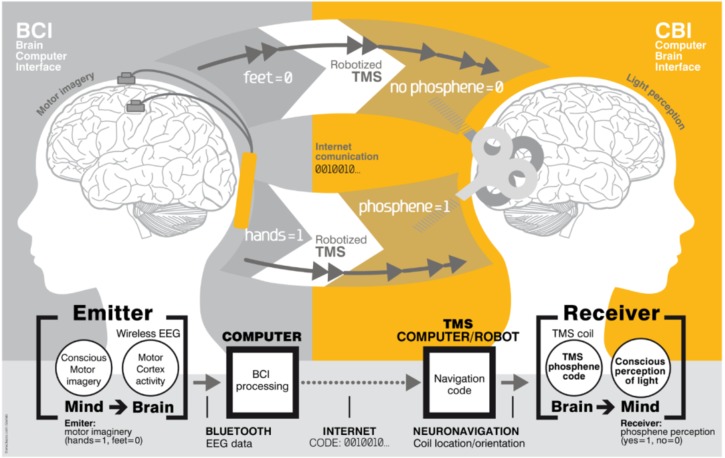
“BTBI systems were initially implemented in humans (Figure 2) using non-invasive recordings and brain stimulation.”
§ Human Brain/Cloud Interface > Potential of Current Technologies Toward a Brain/Cloud Interface > Brain-To-Brain Interface
What the sources say
- Supportedcites Grau et al., 2014 source
The Abstract describes this as the first human brain-to-brain interface and says it combined EEG-based recording with TMS-based stimulation. The Figure 2 description in Materials and Methods identifies both devices as non-invasive. (LLM, conf=0.93)
- Supportedcites Rao et al., 2014 source
The Introduction describes this as the first non-invasive brain-to-brain interface safely applied to humans, using EEG to record the sender’s brain activity and TMS to stimulate the receiver’s brain. The Discussion and Conclusion calls it the first working BBI in humans. Page numbers were not supplied. (LLM, conf=0.94)
plain- Asserted: passes — The authors put it forward as true.
- Checkable: passes — It can be checked against evidence.
- Load-bearing: unclear — It is unclear whether the paper’s conclusions depend on it.
- Based: passes — The paper gives a reason why it holds.
- Supported
Every source the paper cites for this claim was checked and supports it.
In the paper
“Information was transferred from the sensorimotor cortex of one participant (recorded via EEG) to the visual (Grau et al., 2014) or motor (Rao et al., 2014) cortex of the second participant (delivered via transcranial magnetic stimulation, or TMS).”
§ Human Brain/Cloud Interface > Potential of Current Technologies Toward a Brain/Cloud Interface > Brain-To-Brain Interface
What the sources say
- Supportedcites Grau et al., 2014 source
The Methods Summary describes an emitter whose motor-imagery states were recorded through EEG activity in the motor cortex, with information sent to receivers stimulated by TMS at an occipital site. The Computer-Brain Interface section identifies that site as the visual occipital cortex. The citing sentence attributes the visual-cortex route to Grau et al.; its motor-cortex receiver route is attributed to Rao et al., not this paper. (LLM, conf=0.92)
- Supportedcites Rao et al., 2014 source
The Abstract (page not available) says the interface detected motor imagery in the sender’s EEG and transmitted that information to the receiver’s motor cortex, where TMS elicited a motor response. In the citing sentence, Rao et al. is attached specifically to the receiver’s motor cortex, not the alternative visual-cortex pathway. (LLM, conf=0.91)
plaindirectn = 2- Asserted: passes — The authors put it forward as true.
- Checkable: passes — It can be checked against evidence.
- Load-bearing: passes — The paper’s conclusions depend on it.
- Based: passes — The paper gives a reason why it holds.
- Supported
The cited sources support only part of this claim — read each source’s verdict below.
In the paper
“The BBB may also be opened using intravenous mannitol (an old method) and ultrasound, externally delivered (Samiotaki et al., 2017; Wang et al., 2017).”
§ Human Brain/Cloud Interface > Neuralnanorobotic Brain/Cloud Interface > Endoneurobots and Gliabots
What the sources say
- Partly supportedcites Samiotaki et al., 2017 sourceExperimental — accuracy not yet measured
The Introduction says focused ultrasound can open the BBB, and Methods §2.2 describes transcranial ultrasound in rhesus macaques. The intravenously administered agent in that procedure was microbubbles, not mannitol; our copy does not support the mannitol part of the citing sentence. Page numbers were not available in the indexed passages. (LLM, conf=0.88)
- Not checked — no full text of the sourcecites Wang et al., 2017 source
hedgedconditional- Asserted: passes — The authors put it forward as true.
- Checkable: passes — It can be checked against evidence.
- Load-bearing: unclear — It is unclear whether the paper’s conclusions depend on it.
- Based: passes — The paper gives a reason why it holds.
- Partly supported
Every source the paper cites for this claim was checked and supports it.
In the paper
“Human brains have also been connected to cell cultures, experimentally demonstrating that brain activity can control gene expression, using an EEG-based BMI to trigger optogenetic stimulation of designer cells, thereby mediating their genetic expression (Folcher et al., 2014).”
§ Human Brain/Cloud Interface > Potential of Current Technologies Toward a Brain/Cloud Interface > Brain-To-Brain Interface
What the sources say
- Supportedcites Folcher et al., 2014 source
The Results section, “Mind-controlled transgene expression in mammalian cells” (page not provided), reports that human subjects used an EEG-based interface to control NIR illumination and transgene expression in cultured designer cells. This matches the claimed experimental connection between brain activity and gene expression. (LLM, conf=0.94)
boosteddirectSingle case- Asserted: passes — The authors put it forward as true.
- Checkable: passes — It can be checked against evidence.
- Load-bearing: unclear — It is unclear whether the paper’s conclusions depend on it.
- Based: passes — The paper gives a reason why it holds.
- Supported
The cited sources support only part of this claim — read each source’s verdict below.
In the paper
“For example, certain axonal and dendritic domains are less than 0.50 μm in diameter (Shepherd and Harris, 1998), and myelinated axons at three different sites of the corpus callosum in the human brain are estimated to have axon diameters of ≥0.50 μm, in 70–90% of cases (range 0.16–3.73 μm, mean 0.73 ± 0.55 μm) (Liewald et al., 2014).”
§ Human Brain/Cloud Interface > Neuralnanorobotic Brain/Cloud Interface > Biocompatibility of B/CI Neuralnanorobotic Systems
What the sources say
- Partly supportedcites Shepherd and Harris, 1998 sourceExperimental — accuracy not yet measured
The Axonal shafts section and Table 3 report shaft diameters averaging 0.17 μm, with a range of 0.11–0.30 μm, supporting the axonal part of the claim. The paper compares these narrow shafts to dendritic spine necks but does not give a dendritic diameter measurement below 0.50 μm. Page numbers are unavailable in our copy. (LLM, conf=0.85)
plain- Asserted: passes — The authors put it forward as true.
- Checkable: passes — It can be checked against evidence.
- Load-bearing: passes — The paper’s conclusions depend on it.
- Based: passes — The paper gives a reason why it holds.
- Partly supported
The cited sources support only part of this claim — read each source’s verdict below.
In the paper
“For example, certain axonal and dendritic domains are less than 0.50 μm in diameter (Shepherd and Harris, 1998), and myelinated axons at three different sites of the corpus callosum in the human brain are estimated to have axon diameters of ≥0.50 μm, in 70–90% of cases (range 0.16–3.73 μm, mean 0.73 ± 0.55 μm) (Liewald et al., 2014).”
§ Human Brain/Cloud Interface > Neuralnanorobotic Brain/Cloud Interface > Biocompatibility of B/CI Neuralnanorobotic Systems
What the sources say
- Partly supportedcites Liewald et al., 2014 sourceExperimental — accuracy not yet measured
The Discussion (page unavailable) confirms that the authors sampled three corpus-callosum locations in two human brains, but the Results give a diameter range of 0.17–5.13 μm and averages of 0.64–0.74 μm for those samples. Table 1 (page unavailable) assigns 0.73 ± 0.55 μm and a 3.73 μm maximum to the left superior longitudinal fascicle of brain 1, not the corpus callosum. The passages found do not substantiate the claimed 70–90% at or above 0.50 μm. (LLM, conf=0.91)
hedged- Asserted: passes — The authors put it forward as true.
- Checkable: passes — It can be checked against evidence.
- Load-bearing: passes — The paper’s conclusions depend on it.
- Based: passes — The paper gives a reason why it holds.
- Partly supported
In the paper
“The experiment was repeated with five groups with an average accuracy of 0.813.”
§ Human Brain/Cloud Interface > Potential of Current Technologies Toward a Brain/Cloud Interface > Brainet Systems
What the sources say
- Not matchedcites Jiang et al., 2018
Couldn’t be matched to a paper in Crossref, so it can’t be checked.
plain- Asserted: passes — The authors put it forward as true.
- Checkable: passes — It can be checked against evidence.
- Load-bearing: passes — The paper’s conclusions depend on it.
- Based: passes — The paper gives a reason why it holds.
- Not matched
None of the sources cited for this claim have been checked yet.
In the paper
“Brain–machine interface technology is currently being pursued via invasive neural interfaces composed of neural microchip sensor arrays that contain a plurality of electrodes that can detect multicellular signals. These are available for several brain areas (e.g., visual cortex, motor cortex neuroprosthetics, hippocampus, and others) (Berger et al., 2005; BrainGate, 2009).”
§ Human Brain/Cloud Interface > Potential of Current Technologies Toward a Brain/Cloud Interface > Brain–Machine Interface (BMI)
What the sources say
- Not checked — no full text of the sourcecites Berger et al., 2005 source
- Not matchedcites BrainGate, 2009
Couldn’t be matched to a paper in Crossref, so it can’t be checked.
plain- Asserted: passes — The authors put it forward as true.
- Checkable: passes — It can be checked against evidence.
- Load-bearing: unclear — It is unclear whether the paper’s conclusions depend on it.
- Based: passes — The paper gives a reason why it holds.
A claim is checked only against the cited paper’s full text, never its abstract, and none is available for its sources.
In the paper
“The loss of synapses, as occurs in Alzheimer’s patients, is intimately related to cognitive decline (Dekosky and Scheff, 1990; Terry et al., 1991; Scheff and Price, 2006).”
§ Human Brain/Cloud Interface > Neuralnanorobotic Brain/Cloud Interface > Synaptobots
What the sources say
plaincorrelational- Asserted: passes — The authors put it forward as true.
- Checkable: passes — It can be checked against evidence.
- Load-bearing: unclear — It is unclear whether the paper’s conclusions depend on it.
- Based: passes — The paper gives a reason why it holds.
In the paper
“Plug-and-play input/output neural interfacing has also been achieved using platinum electrodes and silicon nanowire field-effect transistors, which exhibited a low interface contact resistance of ∼3 Ω (Schuhmann et al., 2017).”
§ Human Brain/Cloud Interface > Potential of Current Technologies Toward a Brain/Cloud Interface > Injectable “Neural Lace”
What the sources say
- Not checked — no full text of the sourcecites Schuhmann et al., 2017 source
plaindirect- Asserted: passes — The authors put it forward as true.
- Checkable: passes — It can be checked against evidence.
- Load-bearing: unclear — It is unclear whether the paper’s conclusions depend on it.
- Based: passes — The paper gives a reason why it holds.
A claim is checked only against the cited paper’s full text, never its abstract, and none is available for its sources.
In the paper
“Neural electrodes can be implanted without producing any detectable damage beyond the initial trauma and brief phagocytosis, which are typically limited to the edges of the electrode insertion pathway (Babb and Kupfer, 1984) (Freitas, 2003).”
§ Human Brain/Cloud Interface > Potential of Current Technologies Toward a Brain/Cloud Interface > Brain–Machine Interface (BMI)
What the sources say
plain- Asserted: passes — The authors put it forward as true.
- Checkable: passes — It can be checked against evidence.
- Load-bearing: passes — The paper’s conclusions depend on it.
- Based: passes — The paper gives a reason why it holds.
In the paper
“A three-human BTBI system, called “BrainNet,” has been recently developed, which allowed three human subjects to collaboratively solve a task using non-invasive, direct brain-to-brain communication (Jiang et al., 2018).”
§ Human Brain/Cloud Interface > Potential of Current Technologies Toward a Brain/Cloud Interface > Brainet Systems
What the sources say
- Not matchedcites Jiang et al., 2018
Couldn’t be matched to a paper in Crossref, so it can’t be checked.
plaindirectn = 3- Asserted: passes — The authors put it forward as true.
- Checkable: passes — It can be checked against evidence.
- Load-bearing: passes — The paper’s conclusions depend on it.
- Based: passes — The paper gives a reason why it holds.
- Not matched
In the paper
“Currently, nanoelectronics devices utilizing carbon nanotubes and silicon nanowires can detect and identify neuronal biomolecular chemical secretions and their bioelectrical activities (Veliev, 2016).”
§ Human Brain/Cloud Interface > Potential of Current Technologies Toward a Brain/Cloud Interface > Brain–Machine Interface (BMI)
What the sources say
- Not matchedcites Veliev, 2016
Couldn’t be matched to a paper in Crossref, so it can’t be checked.
plaindirect- Asserted: passes — The authors put it forward as true.
- Checkable: passes — It can be checked against evidence.
- Load-bearing: unclear — It is unclear whether the paper’s conclusions depend on it.
- Based: passes — The paper gives a reason why it holds.
- Not matched
None of the sources cited for this claim have been checked yet.
In the paper
“Furthermore, autonomous nanomedical devices are expected to be biocompatible, primarily due to their structural materials, which would enable extended residency within the human body”
§ Human Brain/Cloud Interface > Introduction
What the sources say
- Not matchedcites Freitas, 1999a
Couldn’t be matched to a paper in Crossref, so it can’t be checked.
- Not matchedcites Freitas, 2002
Couldn’t be matched to a paper in Crossref, so it can’t be checked.
- Not checked — no full text of the sourcecites Freitas, 2003 source
hedgeddirect- Asserted: passes — The authors put it forward as true.
- Checkable: passes — It can be checked against evidence.
- Load-bearing: unclear — It is unclear whether the paper’s conclusions depend on it.
- Based: passes — The paper gives a reason why it holds.
- Not matched
In the paper
“Medical neuralnanorobots might also be fabricated in sufficient therapeutic quantities to treat individual patients, using diamondoid materials, as these materials may provide the greatest strength, resilience, and reliability in vivo”
§ Human Brain/Cloud Interface > Introduction
What the sources say
- Not checked — no full text of the sourcecites Freitas, 2010 source
hedgedconditional- Asserted: passes — The authors put it forward as true.
- Checkable: passes — It can be checked against evidence.
- Load-bearing: unclear — It is unclear whether the paper’s conclusions depend on it.
- Based: passes — The paper gives a reason why it holds.
None of the sources cited for this claim have been checked yet.
In the paper
“Non-destructive neuralnanorobotically mediated whole-brain monitoring coupled with single-cell repair capabilities (Freitas, 2007) is anticipated to provide a powerful medical capability to effectively treat most, or all of the ∼400 known brain disorders, including, most notably: Parkinson’s and Alzheimer’s (Freitas, 2016), addiction, dementia, epilepsy, and spinal cord disorders (NINDS, 2017).”
§ Human Brain/Cloud Interface > Introduction
What the sources say
- Not checked — no full text of the sourcecites Freitas, 2007
- Not matchedcites Freitas, 2016
Couldn’t be matched to a paper in Crossref, so it can’t be checked.
- Not matchedcites NINDS, 2017
Couldn’t be matched to a paper in Crossref, so it can’t be checked.
hedgedconditional- Asserted: passes — The authors put it forward as true.
- Checkable: passes — It can be checked against evidence.
- Load-bearing: passes — The paper’s conclusions depend on it.
- Based: passes — The paper gives a reason why it holds.
In the paper
“Experimental results have been reported using the injection and unfolding of sub-micrometer-thick, centimeter-scale macroporous mesh nanoelectronics through needles with diameters as small as 100 μm, which were injected into cavities with a >90% device yield”
§ Human Brain/Cloud Interface > Potential of Current Technologies Toward a Brain/Cloud Interface > Injectable “Neural Lace”
What the sources say
- Not checked — no full text of the sourcecites Liu et al., 2015 source
plain- Asserted: passes — The authors put it forward as true.
- Checkable: passes — It can be checked against evidence.
- Load-bearing: passes — The paper’s conclusions depend on it.
- Based: passes — The paper gives a reason why it holds.
A conclusion the paper draws from its own results — it cites no other source for it, so there is none to check. The quote shows it is in the paper.
In the paper
“The delivery of nanoparticles into the human brain will indeed pose a formidable challenge.”
§ Human Brain/Cloud Interface > Potential of Current Technologies Toward a Brain/Cloud Interface > Nanoparticles, Nanotubes, and Nanodots
boosted- Asserted: passes — The authors put it forward as true.
- Checkable: passes — It can be checked against evidence.
- Load-bearing: unclear — It is unclear whether the paper’s conclusions depend on it.
- Based: passes — The paper gives a reason why it holds.
In the paper
“Fluorescing carbon nanodots (synthesized using D-glucose and L-aspartic acid) with uniform diameters of 2.28 ± 0.42 nm have been employed to target and image C6 glioma cells in mouse brains.”
§ Human Brain/Cloud Interface > Potential of Current Technologies Toward a Brain/Cloud Interface > Nanoparticles, Nanotubes, and Nanodots
What the sources say
- Not checked — no full text of the sourcecites Zheng et al., 2015 source
plaindirect- Asserted: passes — The authors put it forward as true.
- Checkable: passes — It can be checked against evidence.
- Load-bearing: passes — The paper’s conclusions depend on it.
- Based: passes — The paper gives a reason why it holds.
A conclusion the paper draws from its own results — it cites no other source for it, so there is none to check. The quote shows it is in the paper.
In the paper
“This challenge includes, in particular, the bottleneck of the bandwidth required to transmit data worldwide.”
§ Human Brain/Cloud Interface > The Cloud
plaindirect- Asserted: passes — The authors put it forward as true.
- Checkable: passes — It can be checked against evidence.
- Load-bearing: passes — The paper’s conclusions depend on it.
- Based: passes — The paper gives a reason why it holds.
A conclusion the paper draws from its own results — it cites no other source for it, so there is none to check. The quote shows it is in the paper.
In the paper
“This would introduce minimally invasive three-dimensional mesh nanoelectronics, via syringe-injection, into living brain tissue to allow for continuous monitoring and stimulation of individual neurons and neuronal networks.”
§ Human Brain/Cloud Interface > Potential of Current Technologies Toward a Brain/Cloud Interface > Injectable “Neural Lace”
hedgeddirect- Asserted: passes — The authors put it forward as true.
- Checkable: passes — It can be checked against evidence.
- Load-bearing: passes — The paper’s conclusions depend on it.
- Based: passes — The paper gives a reason why it holds.
A conclusion the paper draws from its own results — it cites no other source for it, so there is none to check. The quote shows it is in the paper.
In the paper
“This finding may challenge the long-held belief that spikes in the soma (body of the neuron) are the primary means through which perception, learning, and memory formation occur.”
§ Human Brain/Cloud Interface > The Human Brain > Processing Units
hedgedconditional- Asserted: passes — The authors put it forward as true.
- Checkable: passes — It can be checked against evidence.
- Load-bearing: passes — The paper’s conclusions depend on it.
- Based: passes — The paper gives a reason why it holds.
A conclusion the paper draws from its own results — it cites no other source for it, so there is none to check. The quote shows it is in the paper.
In the paper
“Due to the immense volume of data involved, data transfer to and from living human brains and the cloud may likely require the use of supercomputers with artificial intelligence algorithms.”
§ Human Brain/Cloud Interface > The Cloud
hedgedconditional- Asserted: passes — The authors put it forward as true.
- Checkable: passes — It can be checked against evidence.
- Load-bearing: unclear — It is unclear whether the paper’s conclusions depend on it.
- Based: passes — The paper gives a reason why it holds.
A conclusion the paper draws from its own results — it cites no other source for it, so there is none to check. The quote shows it is in the paper.
In the paper
“This suggests that emulation of biological synapses is a prerequisite for the development of brain-like computational systems”
§ Human Brain/Cloud Interface > The Human Brain > Processing Units
hedgeddirect- Asserted: passes — The authors put it forward as true.
- Checkable: passes — It can be checked against evidence.
- Load-bearing: passes — The paper’s conclusions depend on it.
- Based: passes — The paper gives a reason why it holds.
In the paper
“Excellent biocompatibility, tunable full-color emission, and the capacity to freely penetrate the BBB might make fluorescing carbon nanodots viable candidates as tagging agents to facilitate the implementation of nanomedical B/CI technologies”
§ Human Brain/Cloud Interface > Potential of Current Technologies Toward a Brain/Cloud Interface > Nanoparticles, Nanotubes, and Nanodots
What the sources say
- Not checked — no full text of the sourcecites Zheng et al., 2015 source
hedgedconditional- Asserted: passes — The authors put it forward as true.
- Checkable: passes — It can be checked against evidence.
- Load-bearing: passes — The paper’s conclusions depend on it.
- Based: passes — The paper gives a reason why it holds.
None of the sources cited for this claim have been checked yet.
In the paper
“Estimates for whole-brain electrical data processing rates range from 1.48 × 1011 bits/sec. to a high of 3.2 × 1029 bits/sec”
§ Human Brain/Cloud Interface > The Human Brain > Processing Units
What the sources say
- Not matchedcites Sandberg and Bostrom, 2008
Couldn’t be matched to a paper in Crossref, so it can’t be checked.
- Not checked — no full text of the sourcecites Martins et al., 2012 source
hedged- Asserted: passes — The authors put it forward as true.
- Checkable: passes — It can be checked against evidence.
- Load-bearing: unclear — It is unclear whether the paper’s conclusions depend on it.
- Based: passes — The paper gives a reason why it holds.
- Not matched
In the paper
“However, once brain data is interfaced with supercomputers in near real-time, the connection to supercomputers in the cloud will be the ultimate bottleneck between the cloud and the human brain”
§ Human Brain/Cloud Interface > The Cloud
What the sources say
- Not matchedcites Knapp, 2013
Couldn’t be matched to a paper in Crossref, so it can’t be checked.
plaindirect- Asserted: passes — The authors put it forward as true.
- Checkable: passes — It can be checked against evidence.
- Load-bearing: passes — The paper’s conclusions depend on it.
- Based: passes — The paper gives a reason why it holds.
- Not matched
In the paper
“Steering nanoparticles to selected brain regions may also be achieved using external magnetic fields”
§ Human Brain/Cloud Interface > Potential of Current Technologies Toward a Brain/Cloud Interface > Nanoparticles, Nanotubes, and Nanodots
What the sources say
- Not matchedcites Li et al., 2018
Couldn’t be matched to a paper in Crossref, so it can’t be checked.
hedgedconditional- Asserted: passes — The authors put it forward as true.
- Checkable: passes — It can be checked against evidence.
- Load-bearing: unclear — It is unclear whether the paper’s conclusions depend on it.
- Based: passes — The paper gives a reason why it holds.
- Not matched
In the paper
“Several centralized and distributed supercomputers have processing speeds that are significantly higher than this estimate”
§ Human Brain/Cloud Interface > The Cloud
What the sources say
- Not checked — no full text of the sourcecites Martins et al., 2012 source
plain- Asserted: passes — The authors put it forward as true.
- Checkable: passes — It can be checked against evidence.
- Load-bearing: unclear — It is unclear whether the paper’s conclusions depend on it.
- Based: passes — The paper gives a reason why it holds.
A conclusion the paper draws from its own results — it cites no other source for it, so there is none to check. The quote shows it is in the paper.
In the paper
“As dendrites are ∼100 times larger by volume than neuronal bodies, the immense number of firing dendritic spikes would suggest that the brain may indeed possess significantly higher computational power than earlier estimated.”
§ Human Brain/Cloud Interface > The Human Brain > Processing Units
hedgedconditional- Asserted: passes — The authors put it forward as true.
- Checkable: passes — It can be checked against evidence.
- Load-bearing: passes — The paper’s conclusions depend on it.
- Based: passes — The paper gives a reason why it holds.
In the paper
“One estimate of maximum computational speed required to handle the electrical data in the human brain is 5.52 × 1016 bits/sec”
§ Human Brain/Cloud Interface > The Cloud
What the sources say
- Not checked — no full text of the sourcecites Martins et al., 2012 source
hedged- Asserted: passes — The authors put it forward as true.
- Checkable: passes — It can be checked against evidence.
- Load-bearing: passes — The paper’s conclusions depend on it.
- Based: passes — The paper gives a reason why it holds.
In the paper
“All three types of neuralnanorobots (endoneurobots, gliabots, and synaptobots) would monitor action potential-based electrical information using the same types of FET-based nanosensors embedded in their surfaces (Martins et al., 2015).”
§ Human Brain/Cloud Interface > Neuralnanorobotic Brain/Cloud Interface > Endoneurobots and Gliabots
What the sources say
- Not matchedcites Martins et al., 2015
Couldn’t be matched to a paper in Crossref, so it can’t be checked.
hedged- Asserted: passes — The authors put it forward as true.
- Checkable: passes — It can be checked against evidence.
- Load-bearing: unclear — It is unclear whether the paper’s conclusions depend on it.
- Based: passes — The paper gives a reason why it holds.
- Not matched
A conclusion the paper draws from its own results — it cites no other source for it, so there is none to check. The quote shows it is in the paper.
In the paper
“For the purposes of a B/CI, interfacing with neuronal and synaptically processed action-potential-based electrical brain activity alone (without monitoring chemically based information) may be sufficient to facilitate robust human B/CI systems.”
§ Human Brain/Cloud Interface > Neuralnanorobotic Brain/Cloud Interface
hedgedconditional- Asserted: passes — The authors put it forward as true.
- Checkable: passes — It can be checked against evidence.
- Load-bearing: passes — The paper’s conclusions depend on it.
- Based: unclear — It is unclear why the paper says it holds.
A conclusion the paper draws from its own results — it cites no other source for it, so there is none to check. The quote shows it is in the paper.
In the paper
“Two synaptobots placed at these sites would ensure proper waveform detection of all action potentials.”
§ Human Brain/Cloud Interface > Neuralnanorobotic Brain/Cloud Interface > Endoneurobots and Gliabots
hedgeddirect- Asserted: passes — The authors put it forward as true.
- Checkable: passes — It can be checked against evidence.
- Load-bearing: passes — The paper’s conclusions depend on it.
- Based: unclear — It is unclear why the paper says it holds.
A claim is checked only against the cited paper’s full text, never its abstract, and none is available for its sources.
In the paper
“To achieve a safe, reliable, high-performance B/CI system, a critical mission requirement is the initial establishment of intimate and stable connections to monitor the electrical firing patterns and waveforms of the ∼86 × 109 neurons and the ∼2 × 10¹⁴ synapses of the human brain at a suitable repetition rate (400–800 Hz is the reported average maximum range) (Wilson, 1999; Contreras, 2004).”
§ Human Brain/Cloud Interface > Neuralnanorobotic Brain/Cloud Interface
What the sources say
plaindirect- Asserted: passes — The authors put it forward as true.
- Checkable: passes — It can be checked against evidence.
- Load-bearing: passes — The paper’s conclusions depend on it.
- Based: passes — The paper gives a reason why it holds.
- Rests on an assumption: The human brain contains approximately 86 × 10^9 neurons and 2 × 10^14 synapses.
A conclusion the paper draws from its own results — it cites no other source for it, so there is none to check. The quote shows it is in the paper.
In the paper
“For their part, gliabots would utilize the same probing strategy.”
§ Human Brain/Cloud Interface > Neuralnanorobotic Brain/Cloud Interface > Endoneurobots and Gliabots
hedged- Asserted: passes — The authors put it forward as true.
- Checkable: passes — It can be checked against evidence.
- Load-bearing: unclear — It is unclear whether the paper’s conclusions depend on it.
- Based: passes — The paper gives a reason why it holds.
None of the sources cited for this claim have been checked yet.
In the paper
“However, in cases where there is a complete absence of large BBB junctional gaps, mission-designed strategies, including a combination of cytopenetration, cytolocomotion, and histonatation, would likely permit access to the neuropil (Freitas, 1999b, 2003, 2016).”
§ Human Brain/Cloud Interface > Neuralnanorobotic Brain/Cloud Interface > Endoneurobots and Gliabots
What the sources say
- Not matchedcites Freitas, 1999b
Couldn’t be matched to a paper in Crossref, so it can’t be checked.
- Not checked — no full text of the sourcecites Freitas, 2003 source
- Not matchedcites Freitas, 2016
Couldn’t be matched to a paper in Crossref, so it can’t be checked.
hedgedconditional- Asserted: passes — The authors put it forward as true.
- Checkable: passes — It can be checked against evidence.
- Load-bearing: passes — The paper’s conclusions depend on it.
- Based: passes — The paper gives a reason why it holds.
- Not matched
In the paper
“Optical interrogation of individual cells and organelles with a spatial resolution of ∼100 nm might be enabled through the use of carbon-nanotube-based endoscopes that project from B/CI nanorobots (Singhal et al., 2011).”
§ Human Brain/Cloud Interface > Neuralnanorobotic Brain/Cloud Interface
What the sources say
- Not checked — no full text of the sourcecites Singhal et al., 2011 source
hedgedconditional- Asserted: passes — The authors put it forward as true.
- Checkable: passes — It can be checked against evidence.
- Load-bearing: unclear — It is unclear whether the paper’s conclusions depend on it.
- Based: passes — The paper gives a reason why it holds.
A claim is checked only against the cited paper’s full text, never its abstract, and none is available for its sources.
In the paper
“The geometry of the spine neck determines the rate of calcium efflux into the dendrite shaft and hence the degree of elevation of calcium concentrations within the spine head, following n-methyl-D-aspartate receptor (NMDAR) activation (Bloodgood and Sabatini, 2005; Alvarez and Sabatini, 2007; Sheng and Hoogenraad, 2007).”
§ Human Brain/Cloud Interface > Neuralnanorobotic Brain/Cloud Interface > Synaptobots
What the sources say
plaindirect- Asserted: passes — The authors put it forward as true.
- Checkable: passes — It can be checked against evidence.
- Load-bearing: unclear — It is unclear whether the paper’s conclusions depend on it.
- Based: passes — The paper gives a reason why it holds.
In the paper
“Thus, total volume displaced by endoneurobots and gliabots would be ∼0.12% of a “typical” ∼14,000 μm3 neuron volume, which is orders of magnitude below the total 1–10% “safe” tissue and organ intrusiveness limit for nanorobots that has been recommended elsewhere (Freitas, 2003).”
§ Human Brain/Cloud Interface > Neuralnanorobotic Brain/Cloud Interface > Biocompatibility of B/CI Neuralnanorobotic Systems
What the sources say
- Not checked — no full text of the sourcecites Freitas, 2003 source
hedged- Asserted: passes — The authors put it forward as true.
- Checkable: passes — It can be checked against evidence.
- Load-bearing: passes — The paper’s conclusions depend on it.
- Based: passes — The paper gives a reason why it holds.
A conclusion the paper draws from its own results — it cites no other source for it, so there is none to check. The quote shows it is in the paper.
In the paper
“This provides some level of information redundancy and suggests that monitoring all dendritic spine organelles and molecular components is likely unnecessary.”
§ Human Brain/Cloud Interface > Neuralnanorobotic Brain/Cloud Interface > Synaptobots
hedged- Asserted: passes — The authors put it forward as true.
- Checkable: passes — It can be checked against evidence.
- Load-bearing: passes — The paper’s conclusions depend on it.
- Based: passes — The paper gives a reason why it holds.
In the paper
“LTD causes α-amino-3-hydroxy-5-methyl-4-isoxazole propionic acid (AMPA) receptor internalization with spine elongation and/or shrinkage of spine heads, due to actin depolymerization (Bourne and Harris, 2008).”
§ Human Brain/Cloud Interface > Neuralnanorobotic Brain/Cloud Interface > Synaptobots
What the sources say
- Not checked — no full text of the sourcecites Bourne and Harris, 2008 source
plaindirect- Asserted: passes — The authors put it forward as true.
- Checkable: passes — It can be checked against evidence.
- Load-bearing: unclear — It is unclear whether the paper’s conclusions depend on it.
- Based: passes — The paper gives a reason why it holds.
A conclusion the paper draws from its own results — it cites no other source for it, so there is none to check. The quote shows it is in the paper.
In the paper
“Synaptobots may deduce a great deal of useful information subsequent to scanning the gross volume and shape of the spine.”
§ Human Brain/Cloud Interface > Neuralnanorobotic Brain/Cloud Interface > Synaptobots
hedgedconditional- Asserted: passes — The authors put it forward as true.
- Checkable: passes — It can be checked against evidence.
- Load-bearing: passes — The paper’s conclusions depend on it.
- Based: passes — The paper gives a reason why it holds.
In the paper
“Events involving LTP and LTD structural changes to dendritic spines can alter spine number, size, shape, and subcellular composition in both immature and mature spines (Bourne and Harris, 2008).”
§ Human Brain/Cloud Interface > Neuralnanorobotic Brain/Cloud Interface > Synaptobots
What the sources say
- Not checked — no full text of the sourcecites Bourne and Harris, 2008 source
plaindirect- Asserted: passes — The authors put it forward as true.
- Checkable: passes — It can be checked against evidence.
- Load-bearing: unclear — It is unclear whether the paper’s conclusions depend on it.
- Based: passes — The paper gives a reason why it holds.
A conclusion the paper draws from its own results — it cites no other source for it, so there is none to check. The quote shows it is in the paper.
In the paper
“This information redundancy is expected to significantly reduce synaptobot monitoring tasks.”
§ Human Brain/Cloud Interface > Neuralnanorobotic Brain/Cloud Interface > Synaptobots
hedgedconditional- Asserted: passes — The authors put it forward as true.
- Checkable: passes — It can be checked against evidence.
- Load-bearing: passes — The paper’s conclusions depend on it.
- Based: passes — The paper gives a reason why it holds.
A conclusion the paper draws from its own results — it cites no other source for it, so there is none to check. The quote shows it is in the paper.
In the paper
“The synaptobot population represents a more significant neuralnanorobot intrusion on the volume of the human brain.”
§ Human Brain/Cloud Interface > Neuralnanorobotic Brain/Cloud Interface > Biocompatibility of B/CI Neuralnanorobotic Systems
plaincorrelational- Asserted: passes — The authors put it forward as true.
- Checkable: passes — It can be checked against evidence.
- Load-bearing: passes — The paper’s conclusions depend on it.
- Based: passes — The paper gives a reason why it holds.
A conclusion the paper draws from its own results — it cites no other source for it, so there is none to check. The quote shows it is in the paper.
In the paper
“Thus, a small percentage of the 0.5 μm3 synaptobots might encounter difficulty in accessing distal axonic and dendritic regions via strictly intracellular navigation.”
§ Human Brain/Cloud Interface > Neuralnanorobotic Brain/Cloud Interface > Biocompatibility of B/CI Neuralnanorobotic Systems
hedgedconditional- Asserted: passes — The authors put it forward as true.
- Checkable: passes — It can be checked against evidence.
- Load-bearing: passes — The paper’s conclusions depend on it.
- Based: passes — The paper gives a reason why it holds.
In the paper
“A similar volume will be displaced by gliabots, given one 10 μm3 gliabot within each of the 84.6 × 10⁹ brain-resident glial cells (Azevedo et al., 2009), displacing another ∼0.06% of brain volume.”
§ Human Brain/Cloud Interface > Neuralnanorobotic Brain/Cloud Interface > Biocompatibility of B/CI Neuralnanorobotic Systems
What the sources say
- Not checked — no full text of the sourcecites Azevedo et al., 2009 source
plaindirect- Asserted: passes — The authors put it forward as true.
- Checkable: passes — It can be checked against evidence.
- Load-bearing: passes — The paper’s conclusions depend on it.
- Based: passes — The paper gives a reason why it holds.
A claim is checked only against the cited paper’s full text, never its abstract, and none is available for its sources.
In the paper
“The PSD dynamically regulates its components through protein phosphorylation, palmitoylation, local protein translation, the ubiquitin-proteasome system for protein degradation, and redistribution of specific proteins (e.g., CaMKIIα, AMPARs) both entering and leaving the PSD (Kim and Ko, 2006; Sheng and Hoogenraad, 2007).”
§ Human Brain/Cloud Interface > Neuralnanorobotic Brain/Cloud Interface > Synaptobots
What the sources say
plaindirect- Asserted: passes — The authors put it forward as true.
- Checkable: passes — It can be checked against evidence.
- Load-bearing: unclear — It is unclear whether the paper’s conclusions depend on it.
- Based: passes — The paper gives a reason why it holds.
- Probably not a substantial claim. 117
- It may state two separate claims as one. 67
The cited sources support only part of this claim — read each source’s verdict below.
In the paper
“Such human B/CI systems may dramatically alter human/machine communications, carrying the promise of significant human cognitive enhancement”
§ Human Brain/Cloud Interface > Introduction
What the sources say
- Not matchedcites Kurzweil, 2014
Couldn’t be matched to a paper in Crossref, so it can’t be checked.
- Supportedcites Swan, 2016 source
Section 2, “Future applications of BCIs,” describes BCIs as a possible platform for cognitive enhancement and human-machine collaboration, with the potential to connect individual brains to communications networks. The paper explicitly calls these applications speculative, consistent with the claim’s hedged wording. (LLM, conf=0.91)
hedgedconditional- Asserted: passes — The authors put it forward as true.
- Checkable: fails — It may be too vague to check against evidence.
- Load-bearing: fails — The paper’s conclusions may not depend on it.
- Based: passes — The paper gives a reason why it holds.
Probably not a substantial claim. It may be too vague to check against evidence. The paper’s conclusions may not depend on it. It may state two separate claims as one.
- Not matched
The cited sources support only part of this claim — read each source’s verdict below.
In the paper
“Medical neuralnanorobots are expected to have the capacity for real-time, non-destructive monitoring of single-neuron and single-synapse neuroelectric activity, local neuropeptide traffic, and other relevant functional data, while also allowing the acquisition of fundamental structural information from neuron surfaces, to enhance the connectome map of a living human brain”
§ Human Brain/Cloud Interface > Introduction
What the sources say
- Partly supportedcites Sporns et al., 2005 sourceExperimental — accuracy not yet measured
Split into 2 atoms — 0 confirmed, 1 partially supported, 0 disputed, 0 misattributed, 1 unverifiable. Expand the claim to see per-atom verdicts.
- Not matchedcites Lu et al., 2009
Couldn’t be matched to a paper in Crossref, so it can’t be checked.
- Not matchedcites Anderson et al., 2011
Couldn’t be matched to a paper in Crossref, so it can’t be checked.
hedgeddirect- Asserted: passes — The authors put it forward as true.
- Checkable: passes — It can be checked against evidence.
- Load-bearing: passes — The paper’s conclusions depend on it.
- Based: passes — The paper gives a reason why it holds.
It may state two separate claims as one.
- Partly supported
The cited sources support only part of this claim — read each source’s verdict below.
In the paper
“Proper synapse formation during childhood provides a substrate for cognition, whereas improper formation or functionality leads to neuro-developmental disorders including mental retardation and autism”
§ Human Brain/Cloud Interface > The Human Brain > The Quantitative Human Brain
What the sources say
- Not checked — no full text of the sourcecites Rollenhagen and Lübke, 2006 source
- Not checked — no full text of the sourcecites Mcallister, 2007 source
- Partly supportedcites Rollenhagen et al., 2007 sourceExperimental — accuracy not yet measured
The Introduction (pp. 10434–10444) links hippocampal mossy fiber synapses to processing, storage, and recall of spatial information, supporting a general connection between synapses and cognition. It does not establish that synapse formation during childhood provides that substrate or that improper formation or function leads to mental retardation or autism; searches for those developmental and disorder terms found no supporting passage. (LLM, conf=0.79)
plaindirect- Asserted: passes — The authors put it forward as true.
- Checkable: passes — It can be checked against evidence.
- Load-bearing: fails — The paper’s conclusions may not depend on it.
- Based: passes — The paper gives a reason why it holds.
Probably not a substantial claim. The paper’s conclusions may not depend on it. It may state two separate claims as one.
The cited sources support only part of this claim — read each source’s verdict below.
In the paper
“The average number of glial cells in the human brain is estimated to be 84.61 ± 9.83 × 10⁹ (Herculano-Houzel, 2009), with the population of glial cells in the neocortex estimated at from 18.2 to 38.6 × 10⁹”
§ Human Brain/Cloud Interface > The Human Brain > The Quantitative Human Brain
What the sources say
- Partly supportedcites Herculano-Houzel, 2009 sourceExperimental — accuracy not yet measured
In “The cellular composition of the human brain” (page not provided), the paper reports about 85 billion non-neuronal cells in the adult male human brain, close to the cited estimate. It does not give the stated ±9.83 billion uncertainty there, and non-neuronal cells are not identified specifically as glial cells. The citation is attached to the whole-brain estimate, not the subsequent neocortex range. (LLM, conf=0.85)
- Partly supportedcites Karlsen and Pakkenberg, 2011 sourceExperimental — accuracy not yet measured
The Results (page unavailable) estimate 18.2 × 10^9 neocortical glial cells in the control group, supporting the lower figure. They do not give 38.6 × 10^9 or an 18.2–38.6 × 10^9 range; the reported range for controls is 15.0–21.8 × 10^9. The whole-brain estimate is explicitly attributed to Herculano-Houzel (2009) in the citing sentence, not to this paper. (LLM, conf=0.87)
hedged- Asserted: passes — The authors put it forward as true.
- Checkable: passes — It can be checked against evidence.
- Load-bearing: fails — The paper’s conclusions may not depend on it.
- Based: passes — The paper gives a reason why it holds.
Probably not a substantial claim. The paper’s conclusions may not depend on it. It may state two separate claims as one.
- Partly supported
The cited sources support only part of this claim — read each source’s verdict below.
In the paper
“Magnetoelectric nanoparticles have already been utilized to control intrinsic fields deep within the mouse brain and have permitted the coupling of external magnetic fields to neuronal electric fields.”
§ Human Brain/Cloud Interface > Potential of Current Technologies Toward a Brain/Cloud Interface > Nanoparticles, Nanotubes, and Nanodots
What the sources say
- Partly supportedcites Yue et al., 2012 sourceExperimental — accuracy not yet measured
The Introduction describes how ME nanoparticles could couple externally controlled magnetic fields to local electric activity deep in the brain. But the Abstract and Conclusions identify this as a computational study modeling brain stimulation in a patient with Parkinson’s disease, not an experimental use in mouse brains. The claim overstates the work as an accomplished application and assigns it a mouse setting the paper does not report. (LLM, conf=0.91)
- Supportedcites Guduru et al., 2015 source
The Abstract reports an in vivo mouse study in which magnetoelectric nanoparticles enabled an external magnetic field to modulate intrinsic electric waveforms. The Conclusion says the study opens a pathway to controlling intrinsic fields deep in the brain, and the executive summary describes coupling intrinsic electric-field processes with external magnetic fields. (LLM, conf=0.91)
boosteddirect- Asserted: passes — The authors put it forward as true.
- Checkable: passes — It can be checked against evidence.
- Load-bearing: unclear — It is unclear whether the paper’s conclusions depend on it.
- Based: passes — The paper gives a reason why it holds.
It may state two separate claims as one.
- Partly supported
The cited sources support only part of this claim — read each source’s verdict below.
In the paper
“This computational model may be questionable, however, as computers are based on von Neumann architecture, whereas brain circuits are not; and brains operate in a massively parallel manner, whereas computers do not”
§ Human Brain/Cloud Interface > The Cloud
What the sources say
- Supportedcites Nagarajan and Stevens, 2008 source
The Architecture section (page not provided) explicitly identifies both differences: computers use Von Neumann architecture while brain circuits do not, and brains are massively parallel while computers generally are not. This supports the stated reason for questioning a direct computational comparison. (LLM, conf=0.95)
- Not matchedcites Whitworth and Ryu, 2008
Couldn’t be matched to a paper in Crossref, so it can’t be checked.
hedged- Asserted: passes — The authors put it forward as true.
- Checkable: passes — It can be checked against evidence.
- Load-bearing: fails — The paper’s conclusions may not depend on it.
- Based: passes — The paper gives a reason why it holds.
Probably not a substantial claim. The paper’s conclusions may not depend on it. It may state two separate claims as one.
- Supported
The cited sources that could be checked couldn’t confirm or dispute this claim.
In the paper
“Van den Bosch et al. (2016) estimate that the storage capacity of the World Wide Web doubles every 3 years, with its computational capacity doubling every 1.5 years.”
§ Human Brain/Cloud Interface > The Cloud
What the sources say
- Could not verifycites Van den Bosch et al. (2016) sourceExperimental — accuracy not yet measured
The Introduction and the section on estimating search-engine size describe estimates of indexed Web pages, not storage or computational capacity. Searches for both capacities and the claimed three-year and 1.5-year doubling intervals found no passage addressing them in our copy. (LLM, conf=0.75)
hedgeddirect- Asserted: passes — The authors put it forward as true.
- Checkable: passes — It can be checked against evidence.
- Load-bearing: fails — The paper’s conclusions may not depend on it.
- Based: passes — The paper gives a reason why it holds.
Probably not a substantial claim. The paper’s conclusions may not depend on it. It may state two separate claims as one.
- Could not verify
Every source the paper cites for this claim was checked and supports it.
In the paper
“The first reported direct transmission of information between two human brains without intervention of motor or peripheral sensory systems occurred in 2014, using a brain-to-brain communication technique referred to as “hyperinteraction””
§ Human Brain/Cloud Interface > Introduction
What the sources say
- Supportedcites Grau et al., 2014 source
The Abstract calls this the first human brain-to-brain interface, describes transmission without motor or peripheral sensory systems, and uses “hyperinteraction” for the communication approach. The Introduction likewise calls it the first demonstration of non-invasive direct communication between human minds. The source paper is dated 2014; page numbers are not provided in our copy. (LLM, conf=0.93)
plaindirect- Asserted: passes — The authors put it forward as true.
- Checkable: passes — It can be checked against evidence.
- Load-bearing: fails — The paper’s conclusions may not depend on it.
- Based: passes — The paper gives a reason why it holds.
Probably not a substantial claim. The paper’s conclusions may not depend on it.
- Supported
Every source the paper cites for this claim was checked and supports it.
In the paper
“In 2016, much of the world’s Internet traffic was transmitted via undersea fiber-optic cables; the 6,600 km-long MAREA Facebook/Microsoft-owned cable was estimated to carry 160 Tb/sec of data across the Atlantic Ocean”
§ Human Brain/Cloud Interface > The Cloud
What the sources say
- Supportedcites Hecht, 2016 source
Split into 2 atoms — 2 confirmed, 0 partially supported, 0 disputed, 0 misattributed, 0 unverifiable. Expand the claim to see per-atom verdicts.
hedged- Asserted: passes — The authors put it forward as true.
- Checkable: passes — It can be checked against evidence.
- Load-bearing: fails — The paper’s conclusions may not depend on it.
- Based: passes — The paper gives a reason why it holds.
Probably not a substantial claim. The paper’s conclusions may not depend on it. It may state two separate claims as one.
- Supported
The cited sources support only part of this claim — read each source’s verdict below.
In the paper
“However, there is currently a consensus that neurons and synapses constitute the fundamental electrochemical processing units of the human brain”
§ Human Brain/Cloud Interface > The Human Brain > Processing Units
What the sources say
- Supportedcites Gkoupidenis et al., 2017 source
The paper’s Abstract describes brain information processing as taking place in networks of neurons connected by synapses, with neurons immersed in a common electrochemical environment. This supports the citing sentence’s broad characterization, although the paper does not use the phrase “fundamental electrochemical processing units.” No page number is available in our copy. (LLM, conf=0.86)
- Partly supportedcites Jackman and Regehr, 2017 sourceExperimental — accuracy not yet measured
The Abstract (page not provided) says brain information processing relies on connections between neurons, and the section “Information transfer at synapses” describes synapses transmitting information to postsynaptic neurons. This supports their central role in neural processing, but the paper does not specifically characterize neurons and synapses as the fundamental electrochemical processing units of the human brain. The Introduction’s reference to a growing consensus concerns the mechanisms of long-term potentiation, not that characterization. (LLM, conf=0.82)
boosted- Asserted: passes — The authors put it forward as true.
- Checkable: passes — It can be checked against evidence.
- Load-bearing: fails — The paper’s conclusions may not depend on it.
- Based: passes — The paper gives a reason why it holds.
Probably not a substantial claim. The paper’s conclusions may not depend on it.
- Supported
Every source the paper cites for this claim was checked and supports it.
In the paper
“For example, quantum dot fullerenes have been employed for in vitro and in vivo cellular membrane potential measurements”
§ Human Brain/Cloud Interface > Potential of Current Technologies Toward a Brain/Cloud Interface > Nanoparticles, Nanotubes, and Nanodots
What the sources say
- Supportedcites Nag et al., 2017 source
The Conclusions report imaging membrane-potential changes with QD–peptide–C60 probes in cultured cells and primary neurons, as well as in vivo imaging of cortical electrical stimulation. The in vivo Results describe fluorescence responses measured in anesthetized mice. Page numbers are unavailable in our copy. (LLM, conf=0.94)
plaindirect- Asserted: passes — The authors put it forward as true.
- Checkable: passes — It can be checked against evidence.
- Load-bearing: fails — The paper’s conclusions may not depend on it.
- Based: passes — The paper gives a reason why it holds.
Probably not a substantial claim. The paper’s conclusions may not depend on it.
- Supported
Every source the paper cites for this claim was checked and supports it.
In the paper
“A recently developed ultra-low-power artificial synapse for neural computing has demonstrated the capacity to provide 500 distinct states”
§ Human Brain/Cloud Interface > The Human Brain > Processing Units
What the sources say
- Supportedcites Van de Burgt et al., 2017 source
The paper describes ENODe as a low-energy artificial synapse for neuromorphic computing. Its neuromorphic-behavior passage reports that 500 applied pulses produced 500 distinct conductance states, also shown in Fig. 2a. (LLM, conf=0.94)
boosted- Asserted: passes — The authors put it forward as true.
- Checkable: passes — It can be checked against evidence.
- Load-bearing: fails — The paper’s conclusions may not depend on it.
- Based: passes — The paper gives a reason why it holds.
Probably not a substantial claim. The paper’s conclusions may not depend on it.
- Supported
The cited sources support only part of this claim — read each source’s verdict below.
In the paper
“The use of carbon-nanotube-based electrical stimulation of targets deep within the brain has been proposed as a novel treatment modality for patients with Parkinson’s disease and other CNS disorders”
§ Human Brain/Cloud Interface > Potential of Current Technologies Toward a Brain/Cloud Interface > Nanoparticles, Nanotubes, and Nanodots
What the sources say
- Partly supportedcites Srikanth and Kessler, 2012 sourceExperimental — accuracy not yet measured
The Parkinson disease section proposes carbon-nanotube-based deep brain stimulation as a possible treatment for Parkinson disease, based on neuronal stimulation findings. It does not propose that specific method for other CNS disorders; its broader discussion concerns nanotechnology generally. Page numbers are unavailable in our copy. (LLM, conf=0.88)
plain- Asserted: passes — The authors put it forward as true.
- Checkable: passes — It can be checked against evidence.
- Load-bearing: fails — The paper’s conclusions may not depend on it.
- Based: passes — The paper gives a reason why it holds.
Probably not a substantial claim. The paper’s conclusions may not depend on it.
- Partly supported
Every source the paper cites for this claim was checked and supports it.
In the paper
“This is primarily due to the BBB forming a dynamic, blood-and-brain-regulated, strict physical, transport, metabolic, and immunologic barrier while it is permeable to O2 and CO2 and other gaseous molecules, as well as water and other lipid soluble substances (Serlin et al., 2015), the barrier is very restrictive to large molecules.”
§ Human Brain/Cloud Interface > Potential of Current Technologies Toward a Brain/Cloud Interface > Nanoparticles, Nanotubes, and Nanodots
What the sources say
- Supportedcites Serlin et al., 2015 source
Split into 2 atoms — 2 confirmed, 0 partially supported, 0 disputed, 0 misattributed, 0 unverifiable. Expand the claim to see per-atom verdicts.
plaindirect- Asserted: passes — The authors put it forward as true.
- Checkable: passes — It can be checked against evidence.
- Load-bearing: passes — The paper’s conclusions depend on it.
- Based: passes — The paper gives a reason why it holds.
It may state two separate claims as one.
- Supported
The cited sources support only part of this claim — read each source’s verdict below.
In the paper
“The human brain might even have more than 100 times higher computational capacity than previously thought, based on the discovery that dendrites may generate nearly 10 times as many electrochemical spikes as do neuron soma, and are hybrids that process both analog and digital signals”
§ Human Brain/Cloud Interface > The Human Brain > Processing Units
What the sources say
- Partly supportedcites Moore et al., 2017 sourceExperimental — accuracy not yet measured
Split into 2 atoms — 0 confirmed, 2 partially supported, 0 disputed, 0 misattributed, 0 unverifiable. Expand the claim to see per-atom verdicts.
hedgedconditional- Asserted: passes — The authors put it forward as true.
- Checkable: passes — It can be checked against evidence.
- Load-bearing: unclear — It is unclear whether the paper’s conclusions depend on it.
- Based: passes — The paper gives a reason why it holds.
It may state two separate claims as one.
- Partly supported
Every source the paper cites for this claim was checked and supports it.
In the paper
“Non-invasive neural BMI interface strategies include the use of EEG, magnetoencephalography (MEG), fMRI (Miyawaki et al., 2008) and optical strategies, including fNIRS (Naseer and Hong, 2015).”
§ Human Brain/Cloud Interface > Potential of Current Technologies Toward a Brain/Cloud Interface > Brain–Machine Interface (BMI)
What the sources say
- Supportedcites Miyawaki et al., 2008 source
The Miyawaki et al. citation is attached to fMRI, not to the sentence’s EEG, MEG, or fNIRS examples. The Discussion reports reconstructing visual images from human fMRI signals, and a later passage discusses the approach’s potential for brain-machine interfaces. (LLM, conf=0.90)
- Supportedcites Naseer and Hong, 2015 source
The Introduction lists EEG, MEG, fMRI, and fNIRS as modalities used for brain-signal acquisition and explicitly calls fNIRS an optical imaging modality. The Future prospects section also describes fNIRS-based BCIs as non-invasive. Page numbers are not provided in our copy. (LLM, conf=0.94)
plain- Asserted: passes — The authors put it forward as true.
- Checkable: passes — It can be checked against evidence.
- Load-bearing: fails — The paper’s conclusions may not depend on it.
- Based: passes — The paper gives a reason why it holds.
Probably not a substantial claim. The paper’s conclusions may not depend on it.
- Supported
The cited sources support only part of this claim — read each source’s verdict below.
In the paper
“Once injected, the neuralnanorobots would have access to the dense microvasculature of human brain, which is composed of an estimated ∼100 billion capillaries, with a combined surface area of ∼20 m2 and a total length of ∼400 miles.”
§ Human Brain/Cloud Interface > Neuralnanorobotic Brain/Cloud Interface > Endoneurobots and Gliabots
What the sources say
- Partly supportedcites Pardridge, 2011 sourceExperimental — accuracy not yet measured
The Introduction’s “Anatomical considerations” section reports more than 100 billion capillaries in the human brain with a total length of approximately 400 miles. It says the capillary endothelium has a much larger surface area than the choroid plexus, but does not give the claimed figure of approximately 20 m². No page number is available in our copy. (LLM, conf=0.88)
hedged- Asserted: passes — The authors put it forward as true.
- Checkable: passes — It can be checked against evidence.
- Load-bearing: passes — The paper’s conclusions depend on it.
- Based: passes — The paper gives a reason why it holds.
It may state two separate claims as one.
- Partly supported
The cited sources support only part of this claim — read each source’s verdict below.
In the paper
“A four-brain Brainet system was dubbed an “organic computer” for mimicking simple computer-like operations, such as information-input retention, in a memory-like buffer composed of four serially connected rat brains (Pais-Vieira et al., 2015). This experimental Brainet system always outperformed single-brain computation performance, particularly for discrimination tasks, in which the four brains “”
§ Human Brain/Cloud Interface > Potential of Current Technologies Toward a Brain/Cloud Interface > Brainet Systems
What the sources say
- Partly supportedcites Pais-Vieira et al., 2015 sourceExperimental — accuracy not yet measured
The Results (Brainet for stimulus classification; page unavailable) report that a four-rat Brainet outperformed individual rats on stimulus discrimination and produced an overall classification vote. But the Methods (Adaptive decoding algorithm; page unavailable) describe votes calculated from individual neurons, not a vote cast by each brain. The Discussion says performance was “equal or superior” in all cases, so “always outperformed” overstates the finding. (LLM, conf=0.88)
plaindirect- Asserted: passes — The authors put it forward as true.
- Checkable: passes — It can be checked against evidence.
- Load-bearing: passes — The paper’s conclusions depend on it.
- Based: passes — The paper gives a reason why it holds.
It may state two separate claims as one.
- Partly supported
The cited sources support only part of this claim — read each source’s verdict below.
In the paper
“A 10 μm3 volume of endoneurobots (Figure 3) would subsequently egress the bloodstream, traverse the BBB by methods that have been extensively reviewed elsewhere (Freitas, 2016), enter the brain parenchyma, and begin to navigate within the neuropil. Subsequently, they would enter the neuron cell soma and position themselves intracellularly within the AIS (Martins et al., 2016).”
§ Human Brain/Cloud Interface > Neuralnanorobotic Brain/Cloud Interface > Endoneurobots and Gliabots
What the sources say
- Not matchedcites Freitas, 2016
Couldn’t be matched to a paper in Crossref, so it can’t be checked.
- Supportedcites Martins et al., 2016 source
Section 5.2 describes endoneurobots as 10 µm³ robots that leave the bloodstream, enter the brain parenchyma, navigate the neuropil, enter a neuron soma, and position themselves intracellularly in the axon initial segment. Section 5.3 also refers to the protocol endoneurobots use to cross the blood–brain barrier. The detailed BBB methods are attributed to Freitas (2016), not to this source. (LLM, conf=0.94)
hedgeddirect- Asserted: passes — The authors put it forward as true.
- Checkable: passes — It can be checked against evidence.
- Load-bearing: passes — The paper’s conclusions depend on it.
- Based: passes — The paper gives a reason why it holds.
It may state two separate claims as one.
- Not matched
The cited sources support only part of this claim — read each source’s verdict below.
In the paper
“Power transmission is accomplished ultrasonically to enable low-efficiency (7%, 11.6 dB) links, yielding ∼500 μW of received power (>107 higher than the ∼40 pW EM transmission available at a similar-size scale) with a 1 mm2 interrogator, which may eventually provide ∼10 μm sensing nodes.”
§ Human Brain/Cloud Interface > Potential of Current Technologies Toward a Brain/Cloud Interface > Neural Dust
What the sources say
- Partly supportedcites Seo et al., 2013 sourceExperimental — accuracy not yet measured
The Power Delivery section (p. 5) models an ultrasonic link for a 100 µm node embedded 2 mm into the brain and reports 7% efficiency and approximately 500 µW received with a 1 mm² interrogator. It gives the link efficiency as −11.6 dB, not the claim’s positive 11.6 dB; these are modeled results, not a demonstrated transmission. (LLM, conf=0.88)
plaindirect- Asserted: passes — The authors put it forward as true.
- Checkable: passes — It can be checked against evidence.
- Load-bearing: passes — The paper’s conclusions depend on it.
- Based: passes — The paper gives a reason why it holds.
It may state two separate claims as one.
- Partly supported
Every source the paper cites for this claim was checked and supports it.
In the paper
“There are currently two different types of BMI systems. One type samples the neural activity of a single brain and unidirectionally controls an external device (Lebedev, 2014), while the other type (sensory BMI) includes sensory feedback from the device to the brain (O’Doherty et al., 2011).”
§ Human Brain/Cloud Interface > Potential of Current Technologies Toward a Brain/Cloud Interface > Brain–Machine Interface (BMI)
What the sources say
- Supportedcites Lebedev, 2014 source
The Lebedev citation is attached to the first type of BMI, not to the sensory-feedback type cited to O’Doherty. In “BMIs that enable arm movements” (page unavailable), the paper describes cortical activity being decoded to control a robotic arm, supporting the attributed description of neural activity controlling an external device. (LLM, conf=0.87)
- Supportedcites O’Doherty et al., 2011 source
The paper’s Abstract (page not provided) describes a brain–machine–brain interface that sends motor commands to an external actuator and returns tactile feedback to the brain through somatosensory-cortex stimulation. That supports the sensory-feedback type of BMI for which this paper is cited; the separate claim about unidirectional systems cites a different source. (LLM, conf=0.93)
plain- Asserted: passes — The authors put it forward as true.
- Checkable: passes — It can be checked against evidence.
- Load-bearing: fails — The paper’s conclusions may not depend on it.
- Based: passes — The paper gives a reason why it holds.
Probably not a substantial claim. The paper’s conclusions may not depend on it. It may state two separate claims as one.
- Supported
The cited sources support only part of this claim — read each source’s verdict below.
In the paper
“The degradation of PSD proteins via the ubiquitin-proteasome system (Bingol and Schuman, 2006) also sculpts the PSD structure and plays a primary role in synaptic plasticity.”
§ Human Brain/Cloud Interface > Neuralnanorobotic Brain/Cloud Interface > Synaptobots
What the sources say
- Partly supportedcites Bingol and Schuman, 2006 sourceExperimental — accuracy not yet measured
The Supplementary Figure 3 caption reports faster degradation of a proteasome reporter in stimulated dendritic spines, supporting local proteasome activity. It does not show degradation of PSD proteins, remodeling of PSD structure, or a primary role in synaptic plasticity. (LLM, conf=0.85)
plaindirect- Asserted: passes — The authors put it forward as true.
- Checkable: passes — It can be checked against evidence.
- Load-bearing: fails — The paper’s conclusions may not depend on it.
- Based: passes — The paper gives a reason why it holds.
Probably not a substantial claim. The paper’s conclusions may not depend on it. It may state two separate claims as one.
- Partly supported
None of the sources cited for this claim have been checked yet.
In the paper
“They play a crucial role in brain information processing (IBM, 2008) and are involved in learning and memory (Black et al., 1990; Bliss and Collingridge, 1993; Holtmaat and Svoboda, 2009; Liu et al., 2012), long-term and short-term memory storage and deletion (Kandel, 2001; Lee et al., 2008), and temporal information processing (Fuhrmann et al., 2002).”
§ Human Brain/Cloud Interface > Neuralnanorobotic Brain/Cloud Interface > Synaptobots
What the sources say
plaincorrelational- Asserted: passes — The authors put it forward as true.
- Checkable: passes — It can be checked against evidence.
- Load-bearing: passes — The paper’s conclusions depend on it.
- Based: passes — The paper gives a reason why it holds.
It may state two separate claims as one.
None of the sources cited for this claim have been checked yet.
In the paper
“Neuron-silicon junctions were spontaneously formed using the nerve cells of a mammalian brain, which permitted direct stimulation of nerve cells (Fromherz and Stett, 1995; Offenhausser, 1996; Vassanelli and Fromherz, 1997; Schätzthauer and Fromherz, 1998).”
§ Human Brain/Cloud Interface > Potential of Current Technologies Toward a Brain/Cloud Interface > Brain–Machine Interface (BMI)
What the sources say
plaindirect- Asserted: passes — The authors put it forward as true.
- Checkable: passes — It can be checked against evidence.
- Load-bearing: unclear — It is unclear whether the paper’s conclusions depend on it.
- Based: passes — The paper gives a reason why it holds.
It may state two separate claims as one.
In the paper
“Synapses (either of the 5–25% electrical or 75–95% chemical variety (DeFelipe and Fariñas, 1992) are key components of the neural network that processes information.”
§ Human Brain/Cloud Interface > Neuralnanorobotic Brain/Cloud Interface > Synaptobots
What the sources say
- Not checked — no full text of the sourcecites DeFelipe and Fariñas, 1992 source
plain- Asserted: passes — The authors put it forward as true.
- Checkable: passes — It can be checked against evidence.
- Load-bearing: fails — The paper’s conclusions may not depend on it.
- Based: passes — The paper gives a reason why it holds.
Probably not a substantial claim. The paper’s conclusions may not depend on it.
A claim is checked only against the cited paper’s full text, never its abstract, and none is available for its sources.
In the paper
“The BBB is not a perfect barrier, and perijunctional gaps of 0.5 μm have been reported (Stewart et al., 1987; Fraser and Dallas, 1993).”
§ Human Brain/Cloud Interface > Neuralnanorobotic Brain/Cloud Interface > Endoneurobots and Gliabots
What the sources say
plain- Asserted: passes — The authors put it forward as true.
- Checkable: passes — It can be checked against evidence.
- Load-bearing: passes — The paper’s conclusions depend on it.
- Based: passes — The paper gives a reason why it holds.
It may state two separate claims as one.
A conclusion the paper draws from its own results — it cites no other source for it, so there is none to check. The quote shows it is in the paper.
In the paper
“It is conceivable that within the next 20–30 years, neuralnanorobotics may be developed to enable a safe, secure, instantaneous, real-time interface between the human brain and biological and non-biological computing systems, empowering brain-to-brain interfaces (BTBI), brain-computer interfaces (BCI), and, in particular, sophisticated brain/cloud interfaces (B/CI).”
§ Human Brain/Cloud Interface > Introduction
hedgedconditional- Asserted: passes — The authors put it forward as true.
- Checkable: fails — It may be too vague to check against evidence.
- Load-bearing: passes — The paper’s conclusions depend on it.
- Based: fails — The paper may give no reason why it holds.
Probably not a substantial claim. It may be too vague to check against evidence. The paper may give no reason why it holds.
A conclusion the paper draws from its own results — it cites no other source for it, so there is none to check. The quote shows it is in the paper.
In the paper
“Subsequent to navigating the human vasculature, three species of neuralnanorobots (endoneurobots, gliabots, and synaptobots) could traverse the blood–brain barrier (BBB), enter the brain parenchyma, ingress into individual human brain cells, and autoposition themselves at the axon initial segments of neurons (endoneurobots), within glial cells (gliabots), and in intimate proximity to synapses (syn”
§ Human Brain/Cloud Interface > Abstract
hedgeddirect- Asserted: passes — The authors put it forward as true.
- Checkable: passes — It can be checked against evidence.
- Load-bearing: passes — The paper’s conclusions depend on it.
- Based: fails — The paper may give no reason why it holds.
Probably not a substantial claim. The paper may give no reason why it holds. It may state two separate claims as one.
A conclusion the paper draws from its own results — it cites no other source for it, so there is none to check. The quote shows it is in the paper.
In the paper
“Neuralnanorobotics may also enable a B/CI with controlled connectivity between neural activity and external data storage and processing, via the direct monitoring of the brain’s ∼86 × 109 neurons and ∼2 × 10¹⁴ synapses.”
§ Human Brain/Cloud Interface > Abstract
hedgedconditional- Asserted: passes — The authors put it forward as true.
- Checkable: passes — It can be checked against evidence.
- Load-bearing: passes — The paper’s conclusions depend on it.
- Based: fails — The paper may give no reason why it holds.
Probably not a substantial claim. The paper may give no reason why it holds.
A conclusion the paper draws from its own results — it cites no other source for it, so there is none to check. The quote shows it is in the paper.
In the paper
“One promising strategy for enabling such a system, denoted here as a “human brain/cloud interface” (“B/CI”), would be based on technologies referred to here as “neuralnanorobotics.””
§ Human Brain/Cloud Interface > Abstract
hedgedconditional- Asserted: passes — The authors put it forward as true.
- Checkable: fails — It may be too vague to check against evidence.
- Load-bearing: passes — The paper’s conclusions depend on it.
- Based: fails — The paper may give no reason why it holds.
Probably not a substantial claim. It may be too vague to check against evidence. The paper may give no reason why it holds.
A conclusion the paper draws from its own results — it cites no other source for it, so there is none to check. The quote shows it is in the paper.
In the paper
“A stable, secure, real-time system may allow for interfacing the cloud with the human brain.”
§ Human Brain/Cloud Interface > Abstract
hedgedconditional- Asserted: passes — The authors put it forward as true.
- Checkable: fails — It may be too vague to check against evidence.
- Load-bearing: passes — The paper’s conclusions depend on it.
- Based: fails — The paper may give no reason why it holds.
Probably not a substantial claim. It may be too vague to check against evidence. The paper may give no reason why it holds.
A conclusion the paper draws from its own results — it cites no other source for it, so there is none to check. The quote shows it is in the paper.
In the paper
“Future neuralnanorobotics technologies are anticipated to facilitate accurate diagnoses and eventual cures for the ∼400 conditions that affect the human brain.”
§ Human Brain/Cloud Interface > Abstract
hedgedconditional- Asserted: passes — The authors put it forward as true.
- Checkable: fails — It may be too vague to check against evidence.
- Load-bearing: fails — The paper’s conclusions may not depend on it.
- Based: fails — The paper may give no reason why it holds.
Probably not a substantial claim. It may be too vague to check against evidence. The paper’s conclusions may not depend on it. The paper may give no reason why it holds.
A conclusion the paper draws from its own results — it cites no other source for it, so there is none to check. The quote shows it is in the paper.
In the paper
“A neuralnanorobotically enabled human B/CI might serve as a personalized conduit, allowing persons to obtain direct, instantaneous access to virtually any facet of cumulative human knowledge.”
§ Human Brain/Cloud Interface > Abstract
hedgedconditional- Asserted: passes — The authors put it forward as true.
- Checkable: fails — It may be too vague to check against evidence.
- Load-bearing: passes — The paper’s conclusions depend on it.
- Based: fails — The paper may give no reason why it holds.
Probably not a substantial claim. It may be too vague to check against evidence. The paper may give no reason why it holds.
A conclusion the paper draws from its own results — it cites no other source for it, so there is none to check. The quote shows it is in the paper.
In the paper
“Through TS, individuals might experience episodic segments of the lives of other willing participants (locally or remote) to, hopefully, encourage and inspire improved understanding and tolerance among all members of the human family.”
§ Human Brain/Cloud Interface > Abstract
hedgedconditional- Asserted: passes — The authors put it forward as true.
- Checkable: fails — It may be too vague to check against evidence.
- Load-bearing: fails — The paper’s conclusions may not depend on it.
- Based: fails — The paper may give no reason why it holds.
Probably not a substantial claim. It may be too vague to check against evidence. The paper’s conclusions may not depend on it. The paper may give no reason why it holds.
None of the sources cited for this claim have been checked yet.
In the paper
“An ongoing international “Nanofactory Collaboration” headed by Robert Freitas and Ralph Merkle has the primary objective of constructing the world’s first nanofactory, which will permit the mass manufacture of advanced autonomous diamondoid neuralnanorobots for both medical and non-medical applications”
§ Human Brain/Cloud Interface > Introduction
What the sources say
- Not checked — no full text of the sourcecites Freitas and Merkle, 2004
- Not matchedcites Freitas and Merkle, 2006
Couldn’t be matched to a paper in Crossref, so it can’t be checked.
- Not checked — no full text of the sourcecites Freitas, 2009 source
plaindirect- Asserted: passes — The authors put it forward as true.
- Checkable: passes — It can be checked against evidence.
- Load-bearing: fails — The paper’s conclusions may not depend on it.
- Based: passes — The paper gives a reason why it holds.
Probably not a substantial claim. The paper’s conclusions may not depend on it.
A conclusion the paper draws from its own results — it cites no other source for it, so there is none to check. The quote shows it is in the paper.
In the paper
“Neuralnanorobots are also expected to empower many non-medical paradigm-shifting applications, including significant human cognitive enhancement, by providing a platform for direct access to supercomputing storage and processing capabilities and interfacing with artificial intelligence systems.”
§ Human Brain/Cloud Interface > Introduction
hedgeddirect- Asserted: passes — The authors put it forward as true.
- Checkable: fails — It may be too vague to check against evidence.
- Load-bearing: passes — The paper’s conclusions depend on it.
- Based: fails — The paper may give no reason why it holds.
Probably not a substantial claim. It may be too vague to check against evidence. The paper may give no reason why it holds.
A conclusion the paper draws from its own results — it cites no other source for it, so there is none to check. The quote shows it is in the paper.
In the paper
“A specialized application might be the capacity to engage in fully immersive experiential/sensory experiences, including what is referred to here as “transparent shadowing” (TS).”
§ Human Brain/Cloud Interface > Abstract
hedgedconditional- Asserted: passes — The authors put it forward as true.
- Checkable: passes — It can be checked against evidence.
- Load-bearing: fails — The paper’s conclusions may not depend on it.
- Based: fails — The paper may give no reason why it holds.
Probably not a substantial claim. The paper’s conclusions may not depend on it. The paper may give no reason why it holds.
A conclusion the paper draws from its own results — it cites no other source for it, so there is none to check. The quote shows it is in the paper.
In the paper
“When intended for use as a component of a B/CI system, carbon-nanotube-based electrical stimulation would also require a two-way information pathway at single-neuron resolution for neuronal electrochemical information recording.”
§ Human Brain/Cloud Interface > Potential of Current Technologies Toward a Brain/Cloud Interface > Nanoparticles, Nanotubes, and Nanodots
hedgedconditional- Asserted: passes — The authors put it forward as true.
- Checkable: passes — It can be checked against evidence.
- Load-bearing: fails — The paper’s conclusions may not depend on it.
- Based: fails — The paper may give no reason why it holds.
Probably not a substantial claim. The paper’s conclusions may not depend on it. The paper may give no reason why it holds.
A claim is checked only against the cited paper’s full text, never its abstract, and none is available for its sources.
In the paper
“The role of synapses as processing units of the human brain is reinforced by the results of computational simulation, which indicate that the computational power of a network is increased using dynamic synapses.”
§ Human Brain/Cloud Interface > The Human Brain > Processing Units
What the sources say
hedgeddirect- Asserted: passes — The authors put it forward as true.
- Checkable: passes — It can be checked against evidence.
- Load-bearing: passes — The paper’s conclusions depend on it.
- Based: passes — The paper gives a reason why it holds.
It may state two separate claims as one.
The paper states this without a source or data behind it here, so there is nothing to check it against. The quote shows it is in the paper.
In the paper
“Current commercial 4G networks provide broadband speeds of up to 100 Mbits/sec.”
§ Human Brain/Cloud Interface > The Cloud
plain- Asserted: passes — The authors put it forward as true.
- Checkable: passes — It can be checked against evidence.
- Load-bearing: fails — The paper’s conclusions may not depend on it.
- Based: fails — The paper may give no reason why it holds.
Probably not a substantial claim. The paper’s conclusions may not depend on it. The paper may give no reason why it holds.
A conclusion the paper draws from its own results — it cites no other source for it, so there is none to check. The quote shows it is in the paper.
In the paper
“A neuralnanorobotics-mediated human B/CI, potentially available within 20–30 years, will require broadband Internet access with extremely high upload and download speeds, compared to today’s rates.”
§ Human Brain/Cloud Interface > Introduction
hedgeddirect- Asserted: passes — The authors put it forward as true.
- Checkable: passes — It can be checked against evidence.
- Load-bearing: fails — The paper’s conclusions may not depend on it.
- Based: fails — The paper may give no reason why it holds.
Probably not a substantial claim. The paper’s conclusions may not depend on it. The paper may give no reason why it holds.
A claim is checked only against the cited paper’s full text, never its abstract, and none is available for its sources.
In the paper
“Synapses are elements of the neural network that play a critical role in processing information in the brain, being involved in learning, long-term and short-term memory storage and deletion, and temporal information processing”
§ Human Brain/Cloud Interface > The Human Brain > The Quantitative Human Brain
What the sources say
plaindirect- Asserted: passes — The authors put it forward as true.
- Checkable: passes — It can be checked against evidence.
- Load-bearing: fails — The paper’s conclusions may not depend on it.
- Based: passes — The paper gives a reason why it holds.
Probably not a substantial claim. The paper’s conclusions may not depend on it. It may state two separate claims as one.
In the paper
“United States carriers have stated that they plan to deploy 5G technology in 2020 that will eventually “bring speeds of around 10 gigabits per second to your phone. That’s more than 600 times faster than typical 4G speeds of today’s mobile phones, and 10 times faster than Google Fiber’s standard home broadband service””
§ Human Brain/Cloud Interface > The Cloud
What the sources say
- Not matchedcites Finley, 2018
Couldn’t be matched to a paper in Crossref, so it can’t be checked.
plain- Asserted: passes — The authors put it forward as true.
- Checkable: passes — It can be checked against evidence.
- Load-bearing: fails — The paper’s conclusions may not depend on it.
- Based: passes — The paper gives a reason why it holds.
Probably not a substantial claim. The paper’s conclusions may not depend on it. It may state two separate claims as one.
- Not matched
In the paper
“For intravenous injection, at least 90% of nanoparticles have been observed to be sequestered within tissues and organs prior to reaching the brain (Calvo et al., 2001), so intra-arterial injections might be more reliable.”
§ Human Brain/Cloud Interface > Potential of Current Technologies Toward a Brain/Cloud Interface > Nanoparticles, Nanotubes, and Nanodots
What the sources say
- Not checked — no full text of the sourcecites Calvo et al., 2001 source
hedgedconditional- Asserted: passes — The authors put it forward as true.
- Checkable: passes — It can be checked against evidence.
- Load-bearing: unclear — It is unclear whether the paper’s conclusions depend on it.
- Based: passes — The paper gives a reason why it holds.
It may state two separate claims as one.
A claim is checked only against the cited paper’s full text, never its abstract, and none is available for its sources.
In the paper
“This strategy utilizes unidirectional electrical stimulation, which is more precise and avoids the surgical risks associated with deep macroelectrode insertion, used with current methods of deep brain stimulation”
§ Human Brain/Cloud Interface > Potential of Current Technologies Toward a Brain/Cloud Interface > Nanoparticles, Nanotubes, and Nanodots
What the sources say
plaindirect- Asserted: passes — The authors put it forward as true.
- Checkable: passes — It can be checked against evidence.
- Load-bearing: passes — The paper’s conclusions depend on it.
- Based: passes — The paper gives a reason why it holds.
It may state two separate claims as one.
The paper states this without a source or data behind it here, so there is nothing to check it against. The quote shows it is in the paper.
In the paper
“Currently, invasive1 and non-invasive brain–computer interfaces and non-invasive brain-to-brain communication systems have already been experimentally demonstrated and are the subject of serious research worldwide.”
§ Human Brain/Cloud Interface > Introduction
boosted- Asserted: passes — The authors put it forward as true.
- Checkable: passes — It can be checked against evidence.
- Load-bearing: fails — The paper’s conclusions may not depend on it.
- Based: passes — The paper gives a reason why it holds.
Probably not a substantial claim. The paper’s conclusions may not depend on it. It may state two separate claims as one.
In the paper
“The human cerebellum and cerebral cortex together hold the vast majority (99.2%) of brain neurons”
§ Human Brain/Cloud Interface > The Human Brain > The Quantitative Human Brain
What the sources say
- Not checked — no full text of the sourcecites Azevedo et al., 2009 source
plain- Asserted: passes — The authors put it forward as true.
- Checkable: passes — It can be checked against evidence.
- Load-bearing: fails — The paper’s conclusions may not depend on it.
- Based: passes — The paper gives a reason why it holds.
Probably not a substantial claim. The paper’s conclusions may not depend on it.
In the paper
“At the cellular level, the average human brain is estimated to contain (86.06 ± 8.2) × 109 neurons, with ∼80.2% (69.03 ± 6.65 × 10⁹ neurons) located in the cerebellum, ∼19% (16.34 ± 2.17 × 10⁹ neurons) located in the cerebral cortex, and only ∼0.8% (0.69 ± 0.12 × 10⁹ neurons) located throughout the rest of the brain”
§ Human Brain/Cloud Interface > The Human Brain > The Quantitative Human Brain
What the sources say
- Not checked — no full text of the sourcecites Azevedo et al., 2009 source
hedged- Asserted: passes — The authors put it forward as true.
- Checkable: passes — It can be checked against evidence.
- Load-bearing: fails — The paper’s conclusions may not depend on it.
- Based: passes — The paper gives a reason why it holds.
Probably not a substantial claim. The paper’s conclusions may not depend on it. It may state two separate claims as one.
In the paper
“According to one study, “Global Internet traffic in 2021 will be equivalent to 127 times the volume of the entire global Internet in 2005. Globally, Internet traffic will reach 30 GB per capita by 2021, up from 10 GB per capita in 2016””
§ Human Brain/Cloud Interface > The Cloud
What the sources say
- Not matchedcites Cisco, 2017
Couldn’t be matched to a paper in Crossref, so it can’t be checked.
plain- Asserted: passes — The authors put it forward as true.
- Checkable: passes — It can be checked against evidence.
- Load-bearing: fails — The paper’s conclusions may not depend on it.
- Based: passes — The paper gives a reason why it holds.
Probably not a substantial claim. The paper’s conclusions may not depend on it. It may state two separate claims as one.
- Not matched
In the paper
“In addition, synapses, numbering (2.42 ± 0.29) × 1014 in the average human brain, are collectively estimated to process information at spiking rates of (4.31 ± 0.86) × 1015 spikes/sec, empowering the human brain to process data at (5.52 ± 1.13) × 1016 bits/sec”
§ Human Brain/Cloud Interface > The Human Brain > The Quantitative Human Brain
What the sources say
- Not checked — no full text of the sourcecites Martins et al., 2012 source
hedgeddirect- Asserted: passes — The authors put it forward as true.
- Checkable: passes — It can be checked against evidence.
- Load-bearing: unclear — It is unclear whether the paper’s conclusions depend on it.
- Based: passes — The paper gives a reason why it holds.
It may state two separate claims as one.
The paper states this without a source or data behind it here, so there is nothing to check it against. The quote shows it is in the paper.
In the paper
“The human brain comprises a remarkable information storage and processing system that possesses an extraordinary computation-per-volume efficiency, with an average weight of 1400 g and a volume of ∼1350 cm3, contained within an “average” intracranial volume of ∼1,700 cm3.”
§ Human Brain/Cloud Interface > The Human Brain > The Quantitative Human Brain
plain- Asserted: passes — The authors put it forward as true.
- Checkable: passes — It can be checked against evidence.
- Load-bearing: fails — The paper’s conclusions may not depend on it.
- Based: passes — The paper gives a reason why it holds.
Probably not a substantial claim. The paper’s conclusions may not depend on it. It may state two separate claims as one.
In the paper
“As of October 2018, the average Internet peak connection speed was 189.33 Mbps in Singapore and 100.07 Mbps in the United States”
§ Human Brain/Cloud Interface > The Cloud
What the sources say
- Not matchedcites Kemp, 2018
Couldn’t be matched to a paper in Crossref, so it can’t be checked.
plain- Asserted: passes — The authors put it forward as true.
- Checkable: passes — It can be checked against evidence.
- Load-bearing: fails — The paper’s conclusions may not depend on it.
- Based: passes — The paper gives a reason why it holds.
Probably not a substantial claim. The paper’s conclusions may not depend on it. It may state two separate claims as one.
- Not matched
The paper states this without a source or data behind it here, so there is nothing to check it against. The quote shows it is in the paper.
In the paper
“However, the primary challenge for worldwide global cloud-based information processing technologies is the speed of access to the system, or latency.”
§ Human Brain/Cloud Interface > Introduction
plain- Asserted: passes — The authors put it forward as true.
- Checkable: passes — It can be checked against evidence.
- Load-bearing: fails — The paper’s conclusions may not depend on it.
- Based: fails — The paper may give no reason why it holds.
Probably not a substantial claim. The paper’s conclusions may not depend on it. The paper may give no reason why it holds.
None of the sources cited for this claim have been checked yet.
In the paper
“The human brain’s functional action potential based information is estimated as 5.52 × 1016 bits/sec (Martins et al., 2012), with a brain power output estimated at 15–25 W and a power density of 1.1–1.8 × 10⁴ W/m3 at an operating temperature of 37.3°C”
§ Human Brain/Cloud Interface > The Human Brain > The Quantitative Human Brain
What the sources say
- Not checked — no full text of the sourcecites Martins et al., 2012 source
- Not matchedcites Freitas, 1999b
Couldn’t be matched to a paper in Crossref, so it can’t be checked.
hedged- Asserted: passes — The authors put it forward as true.
- Checkable: passes — It can be checked against evidence.
- Load-bearing: unclear — It is unclear whether the paper’s conclusions depend on it.
- Based: passes — The paper gives a reason why it holds.
It may state two separate claims as one.
In the paper
“While the whole-brain glia/neuron ratio is ∼1:1, there are significant differences between brain domains. For example, the glia/neuron ratio of the cerebral cortex is 3.72:1 (60.84 billion glia; 16.34 billion neurons) but only 0.23:1 (16.04 billion glia; 69.03 billion neurons) in the cerebellum; the basal ganglia, diencephalon, and brainstem have a combined ratio of 11.35:1”
§ Human Brain/Cloud Interface > The Human Brain > The Quantitative Human Brain
What the sources say
- Not checked — no full text of the sourcecites Azevedo et al., 2009 source
plain- Asserted: passes — The authors put it forward as true.
- Checkable: passes — It can be checked against evidence.
- Load-bearing: fails — The paper’s conclusions may not depend on it.
- Based: passes — The paper gives a reason why it holds.
Probably not a substantial claim. The paper’s conclusions may not depend on it. It may state two separate claims as one.
In the paper
“Since it has been shown that certain customized nanoparticles may damage dopaminergic and serotoninergic systems, a further detailed analysis of the biodistribution and metabolism of nanoparticles will be required.”
§ Human Brain/Cloud Interface > Potential of Current Technologies Toward a Brain/Cloud Interface > Nanoparticles, Nanotubes, and Nanodots
What the sources say
- Not checked — no full text of the sourcecites Cupaioli et al., 2014 source
hedgedconditional- Asserted: fails — The authors may not put it forward as true.
- Checkable: fails — It may be too vague to check against evidence.
- Load-bearing: fails — The paper’s conclusions may not depend on it.
- Based: passes — The paper gives a reason why it holds.
Probably not a substantial claim. The authors may not put it forward as true. It may be too vague to check against evidence. The paper’s conclusions may not depend on it.
A conclusion the paper draws from its own results — it cites no other source for it, so there is none to check. The quote shows it is in the paper.
In the paper
“Real-time monitoring of the whole human brain (by placing neuralnanorobots within each neuron and nearby synaptic connections to record/transmit data from localized neuron and synapse spiking) may provide redundant data that might be employed in the development of validation protocols.”
§ Human Brain/Cloud Interface > The Human Brain > Processing Units
hedgedconditional- Asserted: passes — The authors put it forward as true.
- Checkable: fails — It may be too vague to check against evidence.
- Load-bearing: fails — The paper’s conclusions may not depend on it.
- Based: fails — The paper may give no reason why it holds.
Probably not a substantial claim. It may be too vague to check against evidence. The paper’s conclusions may not depend on it. The paper may give no reason why it holds.
In the paper
“Another approximation, based on combining estimates for the different brain regions, produced a similar value of 94.2 ± 11.3 × 10⁹ neurons for the whole human brain”
§ Human Brain/Cloud Interface > The Human Brain > The Quantitative Human Brain
What the sources say
- Not checked — no full text of the sourcecites Martins et al., 2012 source
plain- Asserted: passes — The authors put it forward as true.
- Checkable: passes — It can be checked against evidence.
- Load-bearing: fails — The paper’s conclusions may not depend on it.
- Based: passes — The paper gives a reason why it holds.
Probably not a substantial claim. The paper’s conclusions may not depend on it.
The paper states this without a source or data behind it here, so there is nothing to check it against. The quote shows it is in the paper.
In the paper
“However, small peptides may cross the BBB by either non-specific fluid-phase endocytosis or receptor-mediated transcytosis (RMT) mechanisms.”
§ Human Brain/Cloud Interface > Potential of Current Technologies Toward a Brain/Cloud Interface > Nanoparticles, Nanotubes, and Nanodots
hedgedconditional- Asserted: passes — The authors put it forward as true.
- Checkable: passes — It can be checked against evidence.
- Load-bearing: fails — The paper’s conclusions may not depend on it.
- Based: fails — The paper may give no reason why it holds.
Probably not a substantial claim. The paper’s conclusions may not depend on it. The paper may give no reason why it holds.
In the paper
“The ratio of glia to neurons likely has functional relevance (Nedergaard et al., 2003) and varies between different brain regions.”
§ Human Brain/Cloud Interface > The Human Brain > The Quantitative Human Brain
What the sources say
- Not checked — no full text of the sourcecites Nedergaard et al., 2003 source
hedgedcorrelational- Asserted: passes — The authors put it forward as true.
- Checkable: passes — It can be checked against evidence.
- Load-bearing: unclear — It is unclear whether the paper’s conclusions depend on it.
- Based: passes — The paper gives a reason why it holds.
It may state two separate claims as one.
In the paper
“However, several neuronal noise sources influence the reliability and precision of neuronal signaling, so stimulus-response functions are sometimes unreliable and are dissociated from what is being encoded via spike activity”
§ Human Brain/Cloud Interface > The Human Brain > Processing Units
What the sources say
- Not checked — no full text of the sourcecites Bialek and Rieke, 1992 source
hedgeddirect- Asserted: passes — The authors put it forward as true.
- Checkable: passes — It can be checked against evidence.
- Load-bearing: unclear — It is unclear whether the paper’s conclusions depend on it.
- Based: passes — The paper gives a reason why it holds.
It may state two separate claims as one.
A claim is checked only against the cited paper’s full text, never its abstract, and none is available for its sources.
In the paper
“Synapse loss, as occurs in Alzheimer’s patients, is intimately associated with cognitive decline”
§ Human Brain/Cloud Interface > The Human Brain > The Quantitative Human Brain
What the sources say
plaincorrelational- Asserted: passes — The authors put it forward as true.
- Checkable: passes — It can be checked against evidence.
- Load-bearing: fails — The paper’s conclusions may not depend on it.
- Based: passes — The paper gives a reason why it holds.
Probably not a substantial claim. The paper’s conclusions may not depend on it.
In the paper
“The global storage capacity of Internet data centers in 2018 was 1450 exabytes”
§ Human Brain/Cloud Interface > The Cloud
What the sources say
- Not matchedcites Statistica, 2018
Couldn’t be matched to a paper in Crossref, so it can’t be checked.
plain- Asserted: passes — The authors put it forward as true.
- Checkable: passes — It can be checked against evidence.
- Load-bearing: fails — The paper’s conclusions may not depend on it.
- Based: passes — The paper gives a reason why it holds.
Probably not a substantial claim. The paper’s conclusions may not depend on it.
- Not matched
In the paper
“The global economic impact of cloud-based information processing over the next few decades may be at least an order of magnitude higher once cloud services are combined in previously unimagined ways, disrupting entire industries”
§ Human Brain/Cloud Interface > Introduction
What the sources say
- Not matchedcites Miraz et al., 2015
Couldn’t be matched to a paper in Crossref, so it can’t be checked.
hedgedconditional- Asserted: passes — The authors put it forward as true.
- Checkable: fails — It may be too vague to check against evidence.
- Load-bearing: fails — The paper’s conclusions may not depend on it.
- Based: passes — The paper gives a reason why it holds.
Probably not a substantial claim. It may be too vague to check against evidence. The paper’s conclusions may not depend on it.
- Not matched
In the paper
“A brief quantification of the brain’s constituents and operational parameters includes ∼1,350 cm3 (∼75%) brain cells, ∼200 cm3 (15%) blood, and up to ∼150 cm3 (10%) of cerebrospinal fluid”
§ Human Brain/Cloud Interface > The Human Brain > The Quantitative Human Brain
What the sources say
- Not matchedcites Rengachary and Ellenbogen, 2005
Couldn’t be matched to a paper in Crossref, so it can’t be checked.
plain- Asserted: passes — The authors put it forward as true.
- Checkable: passes — It can be checked against evidence.
- Load-bearing: fails — The paper’s conclusions may not depend on it.
- Based: passes — The paper gives a reason why it holds.
Probably not a substantial claim. The paper’s conclusions may not depend on it. It may state two separate claims as one.
- Not matched
In the paper
“The raw computational power of the human brain has been estimated to range from 1013 to 1016 operations/sec”
§ Human Brain/Cloud Interface > The Human Brain > The Quantitative Human Brain
What the sources say
- Not matchedcites Merkle, 1989
Couldn’t be matched to a paper in Crossref, so it can’t be checked.
hedged- Asserted: passes — The authors put it forward as true.
- Checkable: passes — It can be checked against evidence.
- Load-bearing: fails — The paper’s conclusions may not depend on it.
- Based: passes — The paper gives a reason why it holds.
Probably not a substantial claim. The paper’s conclusions may not depend on it.
- Not matched
A conclusion the paper draws from its own results — it cites no other source for it, so there is none to check. The quote shows it is in the paper.
In the paper
“Dendrites comprise more than 90% of neural tissue, so knowing that they are much more active than the soma would fundamentally alter our understanding of how the brain processes information.”
§ Human Brain/Cloud Interface > The Human Brain > Processing Units
hedgeddirect- Asserted: passes — The authors put it forward as true.
- Checkable: passes — It can be checked against evidence.
- Load-bearing: passes — The paper’s conclusions depend on it.
- Based: unclear — It is unclear why the paper says it holds.
It may state two separate claims as one.
The paper states this without a source or data behind it here, so there is nothing to check it against. The quote shows it is in the paper.
In the paper
“Conventional fiber-optic cables transfer trillions of bits/sec between massive data centers.”
§ Human Brain/Cloud Interface > The Cloud
plain- Asserted: passes — The authors put it forward as true.
- Checkable: passes — It can be checked against evidence.
- Load-bearing: fails — The paper’s conclusions may not depend on it.
- Based: fails — The paper may give no reason why it holds.
Probably not a substantial claim. The paper’s conclusions may not depend on it. The paper may give no reason why it holds.
In the paper
“For example, the current round-trip latency rate for transatlantic loops between New York and London is ∼90 ms”
§ Human Brain/Cloud Interface > Introduction
What the sources say
- Not matchedcites Verizon, 2014
Couldn’t be matched to a paper in Crossref, so it can’t be checked.
plain- Asserted: passes — The authors put it forward as true.
- Checkable: passes — It can be checked against evidence.
- Load-bearing: fails — The paper’s conclusions may not depend on it.
- Based: passes — The paper gives a reason why it holds.
Probably not a substantial claim. The paper’s conclusions may not depend on it.
- Not matched
The paper states this without a source or data behind it here, so there is nothing to check it against. The quote shows it is in the paper.
In the paper
“As of November 2018, the fastest supercomputer worldwide was Summit, developed at the United States Oak Ridge National Laboratory (Tennessee), with 122.3 petaflops on the High Performance Linpack (HPL) benchmark.”
§ Human Brain/Cloud Interface > The Cloud
plain- Asserted: passes — The authors put it forward as true.
- Checkable: passes — It can be checked against evidence.
- Load-bearing: fails — The paper’s conclusions may not depend on it.
- Based: fails — The paper may give no reason why it holds.
Probably not a substantial claim. The paper’s conclusions may not depend on it. The paper may give no reason why it holds. It may state two separate claims as one.
A conclusion the paper draws from its own results — it cites no other source for it, so there is none to check. The quote shows it is in the paper.
In the paper
“Within the next few decades, neuralnanorobotics may enable a non-destructive, real-time, ultrahigh-resolution interface between the human brain and external computing platforms such as the “cloud.””
§ Human Brain/Cloud Interface > Introduction
hedgedconditional- Asserted: passes — The authors put it forward as true.
- Checkable: fails — It may be too vague to check against evidence.
- Load-bearing: passes — The paper’s conclusions depend on it.
- Based: fails — The paper may give no reason why it holds.
Probably not a substantial claim. It may be too vague to check against evidence. The paper may give no reason why it holds.
A conclusion the paper draws from its own results — it cites no other source for it, so there is none to check. The quote shows it is in the paper.
In the paper
“The monitoring of synapses is expected to be essential for a stable and robust fully functional real-time B/CI.”
§ Human Brain/Cloud Interface > Neuralnanorobotic Brain/Cloud Interface > Synaptobots
hedgedconditional- Asserted: passes — The authors put it forward as true.
- Checkable: fails — It may be too vague to check against evidence.
- Load-bearing: passes — The paper’s conclusions depend on it.
- Based: fails — The paper may give no reason why it holds.
Probably not a substantial claim. It may be too vague to check against evidence. The paper may give no reason why it holds.
A conclusion the paper draws from its own results — it cites no other source for it, so there is none to check. The quote shows it is in the paper.
In the paper
“These data would be transferred from the synaptobots to corresponding endoneurobots (in some cases, with communications and other support from nearby gliabots). Once the data is received by the endoneurobots, it would proceed to the previously installed in vivo high-speed nanofiber-optic network, for subsequent transfer to the central units that are responsible for transmitting data to an external”
§ Human Brain/Cloud Interface > Neuralnanorobotic Brain/Cloud Interface > Endoneurobots and Gliabots
hedgeddirect- Asserted: passes — The authors put it forward as true.
- Checkable: passes — It can be checked against evidence.
- Load-bearing: passes — The paper’s conclusions depend on it.
- Based: fails — The paper may give no reason why it holds.
Probably not a substantial claim. The paper may give no reason why it holds. It may state two separate claims as one.
A conclusion the paper draws from its own results — it cites no other source for it, so there is none to check. The quote shows it is in the paper.
In the paper
“Neuralnanorobotics may also be massively distributed, whereas surgically introduced neural implants must be positioned in one or several specific locations.”
§ Human Brain/Cloud Interface > Potential of Current Technologies Toward a Brain/Cloud Interface > Brain–Machine Interface (BMI)
hedged- Asserted: passes — The authors put it forward as true.
- Checkable: passes — It can be checked against evidence.
- Load-bearing: passes — The paper’s conclusions depend on it.
- Based: passes — The paper gives a reason why it holds.
It may state two separate claims as one.
A conclusion the paper draws from its own results — it cites no other source for it, so there is none to check. The quote shows it is in the paper.
In the paper
“Current technological trajectories appear to be converging toward the creation of systems that will have the capacity to empower a human B/CI.”
§ Human Brain/Cloud Interface > Potential of Current Technologies Toward a Brain/Cloud Interface > Limited Prospects for Current Techniques
hedgedcorrelational- Asserted: passes — The authors put it forward as true.
- Checkable: fails — It may be too vague to check against evidence.
- Load-bearing: fails — The paper’s conclusions may not depend on it.
- Based: fails — The paper may give no reason why it holds.
Probably not a substantial claim. It may be too vague to check against evidence. The paper’s conclusions may not depend on it. The paper may give no reason why it holds.
A conclusion the paper draws from its own results — it cites no other source for it, so there is none to check. The quote shows it is in the paper.
In the paper
“An optimal ingress strategy for all species of neuralnanorobots may employ the most rapid route to the human brain through the vasculature.”
§ Human Brain/Cloud Interface > Neuralnanorobotic Brain/Cloud Interface > Endoneurobots and Gliabots
hedgedconditional- Asserted: passes — The authors put it forward as true.
- Checkable: fails — It may be too vague to check against evidence.
- Load-bearing: fails — The paper’s conclusions may not depend on it.
- Based: fails — The paper may give no reason why it holds.
Probably not a substantial claim. It may be too vague to check against evidence. The paper’s conclusions may not depend on it. The paper may give no reason why it holds.
A conclusion the paper draws from its own results — it cites no other source for it, so there is none to check. The quote shows it is in the paper.
In the paper
“More specifically, endoneurobots are autonomous neuron-resident neuralnanorobots that interface with all ∼86 × 109 human–brain neurons at the AIS to directly monitor and interact with action-potential-based electrically processed information.”
§ Human Brain/Cloud Interface > Neuralnanorobotic Brain/Cloud Interface
plaindirect- Asserted: passes — The authors put it forward as true.
- Checkable: passes — It can be checked against evidence.
- Load-bearing: passes — The paper’s conclusions depend on it.
- Based: fails — The paper may give no reason why it holds.
Probably not a substantial claim. The paper may give no reason why it holds.
- Rests on an assumption: The human brain contains approximately 86 × 10^9 neurons and 2 × 10^14 synapses.
A conclusion the paper draws from its own results — it cites no other source for it, so there is none to check. The quote shows it is in the paper.
In the paper
“A process akin to “diapedesis” (the movement of leukocytes out of the circulatory system and toward the site of tissue damage or infection) might be employed by B/CI neuralnanorobots to traverse the BBB.”
§ Human Brain/Cloud Interface > Neuralnanorobotic Brain/Cloud Interface > Endoneurobots and Gliabots
hedgedconditional- Asserted: passes — The authors put it forward as true.
- Checkable: passes — It can be checked against evidence.
- Load-bearing: fails — The paper’s conclusions may not depend on it.
- Based: fails — The paper may give no reason why it holds.
Probably not a substantial claim. The paper’s conclusions may not depend on it. The paper may give no reason why it holds.
A conclusion the paper draws from its own results — it cites no other source for it, so there is none to check. The quote shows it is in the paper.
In the paper
“Conversely, neuralnanorobotics technologies may possess the appropriate scale for optimally enabling BCI, exhibiting suitable mobility, being minimally invasive, imparting negligible localized tissue damage, and possessing robust monitoring capabilities over distinct information channels without requiring conventional surgical implantation.”
§ Human Brain/Cloud Interface > Potential of Current Technologies Toward a Brain/Cloud Interface > Brain–Machine Interface (BMI)
hedgedconditional- Asserted: passes — The authors put it forward as true.
- Checkable: passes — It can be checked against evidence.
- Load-bearing: passes — The paper’s conclusions depend on it.
- Based: fails — The paper may give no reason why it holds.
Probably not a substantial claim. The paper may give no reason why it holds. It may state two separate claims as one.
A conclusion the paper draws from its own results — it cites no other source for it, so there is none to check. The quote shows it is in the paper.
In the paper
“All these data would be continually processed at sub-millisecond resolution, enabling a virtually real-time data stream between the human brain and the cloud.”
§ Human Brain/Cloud Interface > Neuralnanorobotic Brain/Cloud Interface
hedgeddirect- Asserted: passes — The authors put it forward as true.
- Checkable: passes — It can be checked against evidence.
- Load-bearing: passes — The paper’s conclusions depend on it.
- Based: fails — The paper may give no reason why it holds.
Probably not a substantial claim. The paper may give no reason why it holds. It may state two separate claims as one.
A conclusion the paper draws from its own results — it cites no other source for it, so there is none to check. The quote shows it is in the paper.
In the paper
“However, since the human brain possesses cellular (neuron) and sub-cellular (synapse) processing elements, any technology that is capable of establishing a long-term and non-destructive, real-time human interface with the cloud must embody the following capabilities: (1) ultrahigh-resolution mobility, (2) autonomous or semi-autonomous activity, (3) non-intrusive (ideally, physiologically impercept”
§ Human Brain/Cloud Interface > Potential of Current Technologies Toward a Brain/Cloud Interface > Limited Prospects for Current Techniques
plain- Asserted: passes — The authors put it forward as true.
- Checkable: passes — It can be checked against evidence.
- Load-bearing: passes — The paper’s conclusions depend on it.
- Based: passes — The paper gives a reason why it holds.
Probably not a substantial claim.
A conclusion the paper draws from its own results — it cites no other source for it, so there is none to check. The quote shows it is in the paper.
In the paper
“One of the other potential applications of syringe-injectable mesh nanoelectronics is in vivo multiplexed neural network recording.”
§ Human Brain/Cloud Interface > Potential of Current Technologies Toward a Brain/Cloud Interface > Injectable “Neural Lace”
hedged- Asserted: passes — The authors put it forward as true.
- Checkable: passes — It can be checked against evidence.
- Load-bearing: fails — The paper’s conclusions may not depend on it.
- Based: fails — The paper may give no reason why it holds.
Probably not a substantial claim. The paper’s conclusions may not depend on it. The paper may give no reason why it holds.
In the paper
“Neuralnanorobots could monitor relevant functional and structural connectome data, functional- action-potential-based electrical information processing that occurs within synapses and neurons, and synaptic and neuronal structural changes associated with processing such electrolytic-based functional data (Seung, 2011).”
§ Human Brain/Cloud Interface > Neuralnanorobotic Brain/Cloud Interface
What the sources say
- Not checked — no full text of the sourcecites Seung, 2011 source
hedgedcorrelational- Asserted: passes — The authors put it forward as true.
- Checkable: passes — It can be checked against evidence.
- Load-bearing: passes — The paper’s conclusions depend on it.
- Based: passes — The paper gives a reason why it holds.
It may state two separate claims as one.
A conclusion the paper draws from its own results — it cites no other source for it, so there is none to check. The quote shows it is in the paper.
In the paper
“The synaptobots would reside in the proper monitoring position within the neurons, in close proximity to presynaptic or postsynaptic structures. Once in place, these neuralnanorobots would monitor the action potentials and the structural changes initiated by the action-potential-based functional data.”
§ Human Brain/Cloud Interface > Neuralnanorobotic Brain/Cloud Interface > Endoneurobots and Gliabots
hedgeddirect- Asserted: passes — The authors put it forward as true.
- Checkable: passes — It can be checked against evidence.
- Load-bearing: passes — The paper’s conclusions depend on it.
- Based: fails — The paper may give no reason why it holds.
Probably not a substantial claim. The paper may give no reason why it holds. It may state two separate claims as one.
A conclusion the paper draws from its own results — it cites no other source for it, so there is none to check. The quote shows it is in the paper.
In the paper
“The synaptobots would also enter the human body via the bloodstream, cross the BBB (possibly assisted by auxiliary transport nanorobots), enter the brain parenchyma, commence navigation within the neuropil, enter the neuron cell soma, and then proceed intracellularly into the pre-synaptic or post-synaptic structure of a synapse.”
§ Human Brain/Cloud Interface > Neuralnanorobotic Brain/Cloud Interface > Endoneurobots and Gliabots
hedgeddirect- Asserted: passes — The authors put it forward as true.
- Checkable: passes — It can be checked against evidence.
- Load-bearing: fails — The paper’s conclusions may not depend on it.
- Based: fails — The paper may give no reason why it holds.
Probably not a substantial claim. The paper’s conclusions may not depend on it. The paper may give no reason why it holds. It may state two separate claims as one.
A conclusion the paper draws from its own results — it cites no other source for it, so there is none to check. The quote shows it is in the paper.
In the paper
“Synaptobots (Figure 5), the most diminutive (0.5 μm3) of the three types of neuralnanorobots, are responsible for monitoring synapses, which are relevant sub-cellular structures of the human brain.”
§ Human Brain/Cloud Interface > Neuralnanorobotic Brain/Cloud Interface > Synaptobots
plaindirect- Asserted: passes — The authors put it forward as true.
- Checkable: passes — It can be checked against evidence.
- Load-bearing: fails — The paper’s conclusions may not depend on it.
- Based: passes — The paper gives a reason why it holds.
Probably not a substantial claim. The paper’s conclusions may not depend on it.
A conclusion the paper draws from its own results — it cites no other source for it, so there is none to check. The quote shows it is in the paper.
In the paper
“Synaptobots are autonomous neuron-resident neuralnanorobots that might employ multiple flexible stalk-mounted nanosensors to interface with each of the ∼2 × 10¹⁴ synapses of the human brain to directly monitor and interact with synaptically processed and stored information.”
§ Human Brain/Cloud Interface > Neuralnanorobotic Brain/Cloud Interface
hedgedconditional- Asserted: passes — The authors put it forward as true.
- Checkable: passes — It can be checked against evidence.
- Load-bearing: passes — The paper’s conclusions depend on it.
- Based: fails — The paper may give no reason why it holds.
Probably not a substantial claim. The paper may give no reason why it holds.
- Rests on an assumption: The human brain contains approximately 86 × 10^9 neurons and 2 × 10^14 synapses.
A conclusion the paper draws from its own results — it cites no other source for it, so there is none to check. The quote shows it is in the paper.
In the paper
“Neuralnanorobots might be transdermally injected, after which they would navigate the vasculature and anchor to the endothelial cells of the BBB.”
§ Human Brain/Cloud Interface > Neuralnanorobotic Brain/Cloud Interface > Endoneurobots and Gliabots
hedgedconditional- Asserted: passes — The authors put it forward as true.
- Checkable: passes — It can be checked against evidence.
- Load-bearing: fails — The paper’s conclusions may not depend on it.
- Based: fails — The paper may give no reason why it holds.
Probably not a substantial claim. The paper’s conclusions may not depend on it. The paper may give no reason why it holds.
A conclusion the paper draws from its own results — it cites no other source for it, so there is none to check. The quote shows it is in the paper.
In the paper
“Current techniques, whether in present-day or extrapolated future forms, appear to be unscalable and incapable of fulfilling all of the temporal or spatial resolution requirements necessary for a properly comprehensive fully functional human B/CI.”
§ Human Brain/Cloud Interface > Potential of Current Technologies Toward a Brain/Cloud Interface > Limited Prospects for Current Techniques
hedged- Asserted: passes — The authors put it forward as true.
- Checkable: fails — It may be too vague to check against evidence.
- Load-bearing: passes — The paper’s conclusions depend on it.
- Based: fails — The paper may give no reason why it holds.
Probably not a substantial claim. It may be too vague to check against evidence. The paper may give no reason why it holds.
A conclusion the paper draws from its own results — it cites no other source for it, so there is none to check. The quote shows it is in the paper.
In the paper
“Once arrived at their designated neurons, the endoneurobots would autolocate and settle into their monitoring positions, intimately yet unobtrusively.”
§ Human Brain/Cloud Interface > Neuralnanorobotic Brain/Cloud Interface > Endoneurobots and Gliabots
hedgeddirect- Asserted: passes — The authors put it forward as true.
- Checkable: fails — It may be too vague to check against evidence.
- Load-bearing: fails — The paper’s conclusions may not depend on it.
- Based: fails — The paper may give no reason why it holds.
Probably not a substantial claim. It may be too vague to check against evidence. The paper’s conclusions may not depend on it. The paper may give no reason why it holds.
A conclusion the paper draws from its own results — it cites no other source for it, so there is none to check. The quote shows it is in the paper.
In the paper
“Synaptobots would detect virtually all of the synaptically processed action potentials and their waveforms and report synaptically processed spikes into the data handling system.”
§ Human Brain/Cloud Interface > Neuralnanorobotic Brain/Cloud Interface
hedgeddirect- Asserted: passes — The authors put it forward as true.
- Checkable: passes — It can be checked against evidence.
- Load-bearing: passes — The paper’s conclusions depend on it.
- Based: fails — The paper may give no reason why it holds.
Probably not a substantial claim. The paper may give no reason why it holds. It may state two separate claims as one.
A conclusion the paper draws from its own results — it cites no other source for it, so there is none to check. The quote shows it is in the paper.
In the paper
“These shortcomings suggest that neuralnanorobotics may be a preferred solution to the formidable challenges ahead in the development of B/CI technologies.”
§ Human Brain/Cloud Interface > Potential of Current Technologies Toward a Brain/Cloud Interface > Brain–Machine Interface (BMI)
hedgedconditional- Asserted: passes — The authors put it forward as true.
- Checkable: fails — It may be too vague to check against evidence.
- Load-bearing: passes — The paper’s conclusions depend on it.
- Based: passes — The paper gives a reason why it holds.
Probably not a substantial claim. It may be too vague to check against evidence.
A conclusion the paper draws from its own results — it cites no other source for it, so there is none to check. The quote shows it is in the paper.
In the paper
“Should large BBB junctional gaps be detected by the neuralnanorobots, they may be exploited to penetrate within the neuropil.”
§ Human Brain/Cloud Interface > Neuralnanorobotic Brain/Cloud Interface > Endoneurobots and Gliabots
hedgedconditional- Asserted: passes — The authors put it forward as true.
- Checkable: passes — It can be checked against evidence.
- Load-bearing: fails — The paper’s conclusions may not depend on it.
- Based: fails — The paper may give no reason why it holds.
Probably not a substantial claim. The paper’s conclusions may not depend on it. The paper may give no reason why it holds.
None of the sources cited for this claim have been checked yet.
In the paper
“The “typical” PSD consists of a disk-like structure with an average diameter of 300–400 nm (range 200–800 nm), a thickness of 30–60 nm (Baude et al., 1993; Rácz et al., 2004; Okabe, 2007; Sheng and Hoogenraad, 2007), volume of ∼7.5 × 10⁶ nm3, and mass of ∼1.1 GDa (Chen et al., 2005).”
§ Human Brain/Cloud Interface > Neuralnanorobotic Brain/Cloud Interface > Synaptobots
What the sources say
plain- Asserted: passes — The authors put it forward as true.
- Checkable: passes — It can be checked against evidence.
- Load-bearing: unclear — It is unclear whether the paper’s conclusions depend on it.
- Based: passes — The paper gives a reason why it holds.
It may state two separate claims as one.
A conclusion the paper draws from its own results — it cites no other source for it, so there is none to check. The quote shows it is in the paper.
In the paper
“Since action potentials might be initiated in different subcellular compartments, the endoneurobots would be anchored at the AIS (the most likely location for the initiation of action potentials), where they would monitor most action potentials.”
§ Human Brain/Cloud Interface > Neuralnanorobotic Brain/Cloud Interface > Endoneurobots and Gliabots
hedgeddirect- Asserted: passes — The authors put it forward as true.
- Checkable: passes — It can be checked against evidence.
- Load-bearing: passes — The paper’s conclusions depend on it.
- Based: passes — The paper gives a reason why it holds.
It may state two separate claims as one.
A conclusion the paper draws from its own results — it cites no other source for it, so there is none to check. The quote shows it is in the paper.
In the paper
“Each of these electrodes interface with very diminutive and specific brain regions, and are always confined to the surface areas of highly localized domains.”
§ Human Brain/Cloud Interface > Potential of Current Technologies Toward a Brain/Cloud Interface > Brain–Machine Interface (BMI)
plain- Asserted: passes — The authors put it forward as true.
- Checkable: passes — It can be checked against evidence.
- Load-bearing: unclear — It is unclear whether the paper’s conclusions depend on it.
- Based: unclear — It is unclear why the paper says it holds.
It may state two separate claims as one.
A conclusion the paper draws from its own results — it cites no other source for it, so there is none to check. The quote shows it is in the paper.
In the paper
“Gliabots are glia-resident autonomous neuralnanorobots that are endowed with the capacity to monitor human–brain glial cells and may further serve as supportive infrastructure elements of the system.”
§ Human Brain/Cloud Interface > Neuralnanorobotic Brain/Cloud Interface
hedgedconditional- Asserted: passes — The authors put it forward as true.
- Checkable: passes — It can be checked against evidence.
- Load-bearing: fails — The paper’s conclusions may not depend on it.
- Based: fails — The paper may give no reason why it holds.
Probably not a substantial claim. The paper’s conclusions may not depend on it. The paper may give no reason why it holds. It may state two separate claims as one.
In the paper
“For the monitoring of neuronal structural changes (some of these triggered by the processing of action potentials), once they are securely anchored to the internal neuron membrane surface (with “typical” neurons having a “volume of 14,000 μm3 or (∼24 μm)3), endoneurobots and synaptobots might employ a tactile scanning probe to image the surrounding membrane surface area of (1.4 μm)2 in ∼2 sec at ∼”
§ Human Brain/Cloud Interface > Neuralnanorobotic Brain/Cloud Interface > Endoneurobots and Gliabots
What the sources say
- Not matchedcites Freitas, 1999b
Couldn’t be matched to a paper in Crossref, so it can’t be checked.
hedgedconditional- Asserted: passes — The authors put it forward as true.
- Checkable: passes — It can be checked against evidence.
- Load-bearing: unclear — It is unclear whether the paper’s conclusions depend on it.
- Based: passes — The paper gives a reason why it holds.
It may state two separate claims as one.
- Not matched
A conclusion the paper draws from its own results — it cites no other source for it, so there is none to check. The quote shows it is in the paper.
In the paper
“Consequently, neuralnanorobots would assist with the prediction of neurotransmitter bursts that traverse each synaptic gap.”
§ Human Brain/Cloud Interface > Neuralnanorobotic Brain/Cloud Interface
hedgeddirect- Asserted: passes — The authors put it forward as true.
- Checkable: passes — It can be checked against evidence.
- Load-bearing: passes — The paper’s conclusions depend on it.
- Based: fails — The paper may give no reason why it holds.
Probably not a substantial claim. The paper may give no reason why it holds.
In the paper
“Such a capacity may be anticipated to elevate human collaboration, understanding, respect, and empathy to previously unimaginable levels (Domschke and Boehm, 2014).”
§ Human Brain/Cloud Interface > Human Brain/Cloud Interface Applications > Ultrahigh-Resolution Fully Immersive “Transparent Shadowing”
What the sources say
- Not matchedcites Domschke and Boehm, 2014
Couldn’t be matched to a paper in Crossref, so it can’t be checked.
hedgedconditional- Asserted: passes — The authors put it forward as true.
- Checkable: fails — It may be too vague to check against evidence.
- Load-bearing: passes — The paper’s conclusions depend on it.
- Based: passes — The paper gives a reason why it holds.
Probably not a substantial claim. It may be too vague to check against evidence.
- Not matched
A conclusion the paper draws from its own results — it cites no other source for it, so there is none to check. The quote shows it is in the paper.
In the paper
“perhaps eventually leading to the minimization or elimination of most armed conflict.”
§ Human Brain/Cloud Interface > Human Brain/Cloud Interface Applications > Ultrahigh-Resolution Fully Immersive “Transparent Shadowing”
hedgedconditional- Asserted: passes — The authors put it forward as true.
- Checkable: fails — It may be too vague to check against evidence.
- Load-bearing: fails — The paper’s conclusions may not depend on it.
- Based: fails — The paper may give no reason why it holds.
Probably not a substantial claim. It may be too vague to check against evidence. The paper’s conclusions may not depend on it. The paper may give no reason why it holds.
A conclusion the paper draws from its own results — it cites no other source for it, so there is none to check. The quote shows it is in the paper.
In the paper
“Under strict protocols, accredited spatial hosts would agree to allow single or multiple attendees (conceivably numbering in the millions) to literally experience portions of their life experiences over a predetermined timeline/schedule.”
§ Human Brain/Cloud Interface > Human Brain/Cloud Interface Applications > Ultrahigh-Resolution Fully Immersive “Transparent Shadowing”
hedgedconditional- Asserted: passes — The authors put it forward as true.
- Checkable: fails — It may be too vague to check against evidence.
- Load-bearing: fails — The paper’s conclusions may not depend on it.
- Based: fails — The paper may give no reason why it holds.
Probably not a substantial claim. It may be too vague to check against evidence. The paper’s conclusions may not depend on it. The paper may give no reason why it holds.
A conclusion the paper draws from its own results — it cites no other source for it, so there is none to check. The quote shows it is in the paper.
In the paper
“TS may hold potential to facilitate understanding of the experiences of other people and to significantly increase empathy.”
§ Human Brain/Cloud Interface > Human Brain/Cloud Interface Applications > Ultrahigh-Resolution Fully Immersive “Transparent Shadowing”
hedgedconditional- Asserted: passes — The authors put it forward as true.
- Checkable: fails — It may be too vague to check against evidence.
- Load-bearing: passes — The paper’s conclusions depend on it.
- Based: fails — The paper may give no reason why it holds.
Probably not a substantial claim. It may be too vague to check against evidence. The paper may give no reason why it holds. It may state two separate claims as one.
A conclusion the paper draws from its own results — it cites no other source for it, so there is none to check. The quote shows it is in the paper.
In the paper
“The full sensorial realm (e.g., physical presence, tactile sensations, olfactory, visual, tastes, and auditory) would be experienced by the attendees, as if they inhabited the body of the spatial host.”
§ Human Brain/Cloud Interface > Human Brain/Cloud Interface Applications > Ultrahigh-Resolution Fully Immersive “Transparent Shadowing”
hedgeddirect- Asserted: passes — The authors put it forward as true.
- Checkable: passes — It can be checked against evidence.
- Load-bearing: passes — The paper’s conclusions depend on it.
- Based: fails — The paper may give no reason why it holds.
Probably not a substantial claim. The paper may give no reason why it holds.
A conclusion the paper draws from its own results — it cites no other source for it, so there is none to check. The quote shows it is in the paper.
In the paper
“This may translate to the establishment of a very brief (∼millisecond) latency, from spatial host to attendee, to allow for this virtually instantaneous self-speak screening.”
§ Human Brain/Cloud Interface > Human Brain/Cloud Interface Applications > Ultrahigh-Resolution Fully Immersive “Transparent Shadowing”
hedgedconditional- Asserted: passes — The authors put it forward as true.
- Checkable: passes — It can be checked against evidence.
- Load-bearing: passes — The paper’s conclusions depend on it.
- Based: fails — The paper may give no reason why it holds.
Probably not a substantial claim. The paper may give no reason why it holds.
A conclusion the paper draws from its own results — it cites no other source for it, so there is none to check. The quote shows it is in the paper.
In the paper
“These enhancements may assist humanity to adapt emergent artificial intelligence systems as human-augmentation technologies, facilitating the mitigation of new challenges to the human species.”
§ Human Brain/Cloud Interface > Conclusion
hedgedconditional- Asserted: passes — The authors put it forward as true.
- Checkable: fails — It may be too vague to check against evidence.
- Load-bearing: passes — The paper’s conclusions depend on it.
- Based: fails — The paper may give no reason why it holds.
Probably not a substantial claim. It may be too vague to check against evidence. The paper may give no reason why it holds. It may state two separate claims as one.
A conclusion the paper draws from its own results — it cites no other source for it, so there is none to check. The quote shows it is in the paper.
In the paper
“The host will have no mental or physical perception that they are being “shadowed” by the attendees.”
§ Human Brain/Cloud Interface > Human Brain/Cloud Interface Applications > Ultrahigh-Resolution Fully Immersive “Transparent Shadowing”
plain- Asserted: passes — The authors put it forward as true.
- Checkable: passes — It can be checked against evidence.
- Load-bearing: passes — The paper’s conclusions depend on it.
- Based: fails — The paper may give no reason why it holds.
Probably not a substantial claim. The paper may give no reason why it holds.
A conclusion the paper draws from its own results — it cites no other source for it, so there is none to check. The quote shows it is in the paper.
In the paper
“Tagging all 2.42 × 10¹⁴ synapses in the human brain with one robot each would require 24–242 × 1012 synaptobots at 0.5 μm3 per robot, giving a total fleet volume of 1.2–12 × 1013 μm3 or 12–120 cm3 and representing ∼0.9–9% of total brain volume-just within the “safe” tissue and organ intrusiveness limits.”
§ Human Brain/Cloud Interface > Neuralnanorobotic Brain/Cloud Interface > Biocompatibility of B/CI Neuralnanorobotic Systems
hedgeddirect- Asserted: passes — The authors put it forward as true.
- Checkable: passes — It can be checked against evidence.
- Load-bearing: passes — The paper’s conclusions depend on it.
- Based: passes — The paper gives a reason why it holds.
It may state two separate claims as one.
In the paper
“Longer-term changes in the PSD structure and composition (from hours to days) involve altered protein synthesis, either within the neuronal cell body, or dendrites (Sheng and Hoogenraad, 2007).”
§ Human Brain/Cloud Interface > Neuralnanorobotic Brain/Cloud Interface > Synaptobots
What the sources say
- Not checked — no full text of the sourcecites Sheng and Hoogenraad, 2007 source
plaindirect- Asserted: passes — The authors put it forward as true.
- Checkable: passes — It can be checked against evidence.
- Load-bearing: fails — The paper’s conclusions may not depend on it.
- Based: passes — The paper gives a reason why it holds.
Probably not a substantial claim. The paper’s conclusions may not depend on it.
A conclusion the paper draws from its own results — it cites no other source for it, so there is none to check. The quote shows it is in the paper.
In the paper
“Although the attendees would retain their own identities and experience real-time live-feed full immersion into a portion of the host’s life experiences”
§ Human Brain/Cloud Interface > Human Brain/Cloud Interface Applications > Ultrahigh-Resolution Fully Immersive “Transparent Shadowing”
hedged- Asserted: passes — The authors put it forward as true.
- Checkable: passes — It can be checked against evidence.
- Load-bearing: passes — The paper’s conclusions depend on it.
- Based: fails — The paper may give no reason why it holds.
Probably not a substantial claim. The paper may give no reason why it holds. It may state two separate claims as one.
A conclusion the paper draws from its own results — it cites no other source for it, so there is none to check. The quote shows it is in the paper.
In the paper
“However, these TS sessions would offer exponentially higher resolution in every respect.”
§ Human Brain/Cloud Interface > Human Brain/Cloud Interface Applications > Ultrahigh-Resolution Fully Immersive “Transparent Shadowing”
hedgeddirect- Asserted: passes — The authors put it forward as true.
- Checkable: fails — It may be too vague to check against evidence.
- Load-bearing: fails — The paper’s conclusions may not depend on it.
- Based: fails — The paper may give no reason why it holds.
Probably not a substantial claim. It may be too vague to check against evidence. The paper’s conclusions may not depend on it. The paper may give no reason why it holds.
A conclusion the paper draws from its own results — it cites no other source for it, so there is none to check. The quote shows it is in the paper.
In the paper
“These may include optional text, imagery, and streaming video displays that are superimposed at customizable locations within the user’s field of vision.”
§ Human Brain/Cloud Interface > Human Brain/Cloud Interface Applications > Ultrahigh-Resolution Fully Immersive “Transparent Shadowing”
hedged- Asserted: passes — The authors put it forward as true.
- Checkable: passes — It can be checked against evidence.
- Load-bearing: fails — The paper’s conclusions may not depend on it.
- Based: fails — The paper may give no reason why it holds.
Probably not a substantial claim. The paper’s conclusions may not depend on it. The paper may give no reason why it holds.
A conclusion the paper draws from its own results — it cites no other source for it, so there is none to check. The quote shows it is in the paper.
In the paper
“It may be likely that via TS, all knowledge-based queries and responses, as well as fully immersive experiences within avatars and other users, could include an optional toggle mode.”
§ Human Brain/Cloud Interface > Human Brain/Cloud Interface Applications > Ultrahigh-Resolution Fully Immersive “Transparent Shadowing”
hedgedconditional- Asserted: passes — The authors put it forward as true.
- Checkable: fails — It may be too vague to check against evidence.
- Load-bearing: fails — The paper’s conclusions may not depend on it.
- Based: fails — The paper may give no reason why it holds.
Probably not a substantial claim. It may be too vague to check against evidence. The paper’s conclusions may not depend on it. The paper may give no reason why it holds.
A conclusion the paper draws from its own results — it cites no other source for it, so there is none to check. The quote shows it is in the paper.
In the paper
“Cross-gender experiences might impact real-life relationships between genders, due to increased empathy and understanding.”
§ Human Brain/Cloud Interface > Human Brain/Cloud Interface Applications > Ultrahigh-Resolution Fully Immersive “Transparent Shadowing”
hedgedconditional- Asserted: passes — The authors put it forward as true.
- Checkable: fails — It may be too vague to check against evidence.
- Load-bearing: passes — The paper’s conclusions depend on it.
- Based: fails — The paper may give no reason why it holds.
Probably not a substantial claim. It may be too vague to check against evidence. The paper may give no reason why it holds.
A conclusion the paper draws from its own results — it cites no other source for it, so there is none to check. The quote shows it is in the paper.
In the paper
“Although beyond the scope and space constraints of this paper, we acknowledge that there will likely be several “display modes” available to B/CI users once the technology matures.”
§ Human Brain/Cloud Interface > Human Brain/Cloud Interface Applications > Ultrahigh-Resolution Fully Immersive “Transparent Shadowing”
hedged- Asserted: passes — The authors put it forward as true.
- Checkable: fails — It may be too vague to check against evidence.
- Load-bearing: fails — The paper’s conclusions may not depend on it.
- Based: fails — The paper may give no reason why it holds.
Probably not a substantial claim. It may be too vague to check against evidence. The paper’s conclusions may not depend on it. The paper may give no reason why it holds.
In the paper
“Although they would perceive the vocal instructions of the host, to temporally experience exactly what the spatial host is experiencing, for the sake of personal privacy, attendees might, by default, be completely blocked from any access to the thoughts, emotions, or self-speak of their spatial hosts (Ford, 2010).”
§ Human Brain/Cloud Interface > Human Brain/Cloud Interface Applications > Ultrahigh-Resolution Fully Immersive “Transparent Shadowing”
What the sources say
- Not matchedcites Ford, 2010
Couldn’t be matched to a paper in Crossref, so it can’t be checked.
hedged- Asserted: passes — The authors put it forward as true.
- Checkable: passes — It can be checked against evidence.
- Load-bearing: fails — The paper’s conclusions may not depend on it.
- Based: passes — The paper gives a reason why it holds.
Probably not a substantial claim. The paper’s conclusions may not depend on it.
- Not matched
A conclusion the paper draws from its own results — it cites no other source for it, so there is none to check. The quote shows it is in the paper.
In the paper
“For example, perhaps those of majority ethnic groups might be more sensitized with the issue of racism against those of minority ethnic groups, once they “experience” it for themselves through TS sessions.”
§ Human Brain/Cloud Interface > Human Brain/Cloud Interface Applications > Ultrahigh-Resolution Fully Immersive “Transparent Shadowing”
hedgedconditional- Asserted: passes — The authors put it forward as true.
- Checkable: fails — It may be too vague to check against evidence.
- Load-bearing: fails — The paper’s conclusions may not depend on it.
- Based: fails — The paper may give no reason why it holds.
Probably not a substantial claim. It may be too vague to check against evidence. The paper’s conclusions may not depend on it. The paper may give no reason why it holds.
A conclusion the paper draws from its own results — it cites no other source for it, so there is none to check. The quote shows it is in the paper.
In the paper
“When this mode is engaged, internalized visualizations might be projected as on to a “float screen” that can be superimposed within the user’s field of vision, where the float screen can be made more prominent in the user’s experience via dynamic fading.”
§ Human Brain/Cloud Interface > Human Brain/Cloud Interface Applications > Ultrahigh-Resolution Fully Immersive “Transparent Shadowing”
hedgedconditional- Asserted: passes — The authors put it forward as true.
- Checkable: passes — It can be checked against evidence.
- Load-bearing: fails — The paper’s conclusions may not depend on it.
- Based: fails — The paper may give no reason why it holds.
Probably not a substantial claim. The paper’s conclusions may not depend on it. The paper may give no reason why it holds. It may state two separate claims as one.
A conclusion the paper draws from its own results — it cites no other source for it, so there is none to check. The quote shows it is in the paper.
In the paper
“For this assessment to take place via AI, the self-speak in question would have to somehow be processed in real time/on the fly, as any records of such in any form, would most likely be considered as highly unethical.”
§ Human Brain/Cloud Interface > Human Brain/Cloud Interface Applications > Ultrahigh-Resolution Fully Immersive “Transparent Shadowing”
hedgedconditional- Asserted: passes — The authors put it forward as true.
- Checkable: fails — It may be too vague to check against evidence.
- Load-bearing: passes — The paper’s conclusions depend on it.
- Based: fails — The paper may give no reason why it holds.
Probably not a substantial claim. It may be too vague to check against evidence. The paper may give no reason why it holds. It may state two separate claims as one.
A conclusion the paper draws from its own results — it cites no other source for it, so there is none to check. The quote shows it is in the paper.
In the paper
“Once established and potentially utilized by a growing demographic, this capability might have strong potential for conveying profound beneficial implications for human advancement across multiple domains”
§ Human Brain/Cloud Interface > Human Brain/Cloud Interface Applications > Ultrahigh-Resolution Fully Immersive “Transparent Shadowing”
hedgedconditional- Asserted: passes — The authors put it forward as true.
- Checkable: fails — It may be too vague to check against evidence.
- Load-bearing: fails — The paper’s conclusions may not depend on it.
- Based: fails — The paper may give no reason why it holds.
Probably not a substantial claim. It may be too vague to check against evidence. The paper’s conclusions may not depend on it. The paper may give no reason why it holds.
A conclusion the paper draws from its own results — it cites no other source for it, so there is none to check. The quote shows it is in the paper.
In the paper
“For example, in cases of unpleasant pain, the attendee might activate an instantaneous default auto-disengagement protocol once a particular physiological threshold is perceived by the B/CI system.”
§ Human Brain/Cloud Interface > Human Brain/Cloud Interface Applications > Ultrahigh-Resolution Fully Immersive “Transparent Shadowing”
hedgedconditional- Asserted: passes — The authors put it forward as true.
- Checkable: fails — It may be too vague to check against evidence.
- Load-bearing: fails — The paper’s conclusions may not depend on it.
- Based: fails — The paper may give no reason why it holds.
Probably not a substantial claim. It may be too vague to check against evidence. The paper’s conclusions may not depend on it. The paper may give no reason why it holds.
A conclusion the paper draws from its own results — it cites no other source for it, so there is none to check. The quote shows it is in the paper.
In the paper
“Human B/CI systems mediated by neuralnanorobots might also upgrade mutual human understanding and collaboration by making it possible to engage humans in TS experiences, which could enable considerably improved understanding and tolerance among all members of our diverse and amazing human family.”
§ Human Brain/Cloud Interface > Conclusion
hedgedconditional- Asserted: passes — The authors put it forward as true.
- Checkable: fails — It may be too vague to check against evidence.
- Load-bearing: passes — The paper’s conclusions depend on it.
- Based: fails — The paper may give no reason why it holds.
Probably not a substantial claim. It may be too vague to check against evidence. The paper may give no reason why it holds. It may state two separate claims as one.
A conclusion the paper draws from its own results — it cites no other source for it, so there is none to check. The quote shows it is in the paper.
In the paper
“However, it is likely that any self-speak of a spatial host will include their most private and intimate thoughts.”
§ Human Brain/Cloud Interface > Human Brain/Cloud Interface Applications > Ultrahigh-Resolution Fully Immersive “Transparent Shadowing”
hedgedcorrelational- Asserted: passes — The authors put it forward as true.
- Checkable: fails — It may be too vague to check against evidence.
- Load-bearing: passes — The paper’s conclusions depend on it.
- Based: fails — The paper may give no reason why it holds.
Probably not a substantial claim. It may be too vague to check against evidence. The paper may give no reason why it holds.
The paper states this without a source or data behind it here, so there is nothing to check it against. The quote shows it is in the paper.
In the paper
“Neuralnanorobotics strategies involve the direct, comprehensive monitoring of the ∼86 × 109 neurons of the human brain, as well as its ∼2 × 10¹⁴ synapses and ∼84 × 109 glial cells.”
§ Human Brain/Cloud Interface > Conclusion
plain- Asserted: passes — The authors put it forward as true.
- Checkable: passes — It can be checked against evidence.
- Load-bearing: passes — The paper’s conclusions depend on it.
- Based: fails — The paper may give no reason why it holds.
Probably not a substantial claim. The paper may give no reason why it holds. It may state two separate claims as one.
A conclusion the paper draws from its own results — it cites no other source for it, so there is none to check. The quote shows it is in the paper.
In the paper
“There exists a clear and strong association between synapse bouton size/shape and the organellar and macromolecular changes that occur within the bouton.”
§ Human Brain/Cloud Interface > Neuralnanorobotic Brain/Cloud Interface > Synaptobots
boostedcorrelational- Asserted: passes — The authors put it forward as true.
- Checkable: passes — It can be checked against evidence.
- Load-bearing: passes — The paper’s conclusions depend on it.
- Based: fails — The paper may give no reason why it holds.
Probably not a substantial claim. The paper may give no reason why it holds.
A claim is checked only against the cited paper’s full text, never its abstract, and none is available for its sources.
In the paper
“Experimental data has provided a wide range of measured human intracranial volumes (1152–1839 cm3) and total average cerebral spinal fluid (CSF) volume (82–125.3 cm3), with a total brain-cell parenchyma volume of 1319 cm3, including 489 cm3 of white matter and 786 cm3 of gray matter (Vaidyanathana et al., 1997; Nopoulos et al., 2000).”
§ Human Brain/Cloud Interface > Neuralnanorobotic Brain/Cloud Interface > Biocompatibility of B/CI Neuralnanorobotic Systems
What the sources say
plain- Asserted: passes — The authors put it forward as true.
- Checkable: passes — It can be checked against evidence.
- Load-bearing: passes — The paper’s conclusions depend on it.
- Based: passes — The paper gives a reason why it holds.
It may state two separate claims as one.
A conclusion the paper draws from its own results — it cites no other source for it, so there is none to check. The quote shows it is in the paper.
In the paper
“Neuralnanorobotically empowered B/CI technologies accompanied by supercomputing technologies might permit users to experience fully immersive, real-time episodes of the lives of any willing human participant on the planet, via non-intrusive “Transparent Shadowing (TS).””
§ Human Brain/Cloud Interface > Human Brain/Cloud Interface Applications > Ultrahigh-Resolution Fully Immersive “Transparent Shadowing”
hedgedconditional- Asserted: passes — The authors put it forward as true.
- Checkable: fails — It may be too vague to check against evidence.
- Load-bearing: passes — The paper’s conclusions depend on it.
- Based: fails — The paper may give no reason why it holds.
Probably not a substantial claim. It may be too vague to check against evidence. The paper may give no reason why it holds.
A conclusion the paper draws from its own results — it cites no other source for it, so there is none to check. The quote shows it is in the paper.
In the paper
“Hence, in essence, anyone on the planet (who is B/CI enabled) might be engaged as either a spatial host or an attendee.”
§ Human Brain/Cloud Interface > Human Brain/Cloud Interface Applications > Ultrahigh-Resolution Fully Immersive “Transparent Shadowing”
hedged- Asserted: passes — The authors put it forward as true.
- Checkable: passes — It can be checked against evidence.
- Load-bearing: passes — The paper’s conclusions depend on it.
- Based: fails — The paper may give no reason why it holds.
Probably not a substantial claim. The paper may give no reason why it holds.
A conclusion the paper draws from its own results — it cites no other source for it, so there is none to check. The quote shows it is in the paper.
In the paper
“possibly assisting with the further development of human collaboration and empathy”
§ Human Brain/Cloud Interface > Human Brain/Cloud Interface Applications > Ultrahigh-Resolution Fully Immersive “Transparent Shadowing”
hedgedconditional- Asserted: passes — The authors put it forward as true.
- Checkable: fails — It may be too vague to check against evidence.
- Load-bearing: passes — The paper’s conclusions depend on it.
- Based: fails — The paper may give no reason why it holds.
Probably not a substantial claim. It may be too vague to check against evidence. The paper may give no reason why it holds.
A conclusion the paper draws from its own results — it cites no other source for it, so there is none to check. The quote shows it is in the paper.
In the paper
“Experiencing episodes of the lives of those in other cultures and ethnic groups could promote cross-cultural understanding and tolerance, improving prospects for the reduction of hatred and racism.”
§ Human Brain/Cloud Interface > Human Brain/Cloud Interface Applications > Ultrahigh-Resolution Fully Immersive “Transparent Shadowing”
hedgedconditional- Asserted: passes — The authors put it forward as true.
- Checkable: fails — It may be too vague to check against evidence.
- Load-bearing: passes — The paper’s conclusions depend on it.
- Based: fails — The paper may give no reason why it holds.
Probably not a substantial claim. It may be too vague to check against evidence. The paper may give no reason why it holds. It may state two separate claims as one.
A conclusion the paper draws from its own results — it cites no other source for it, so there is none to check. The quote shows it is in the paper.
In the paper
“Neuralnanorobotic entities would transmit the nominal ∼5 × 1016 bits/sec of synaptically processed electronic information, encoded in ∼4 × 10¹⁵ spikes/sec flowing within the entire living human brain, wirelessly via a nanorobotic auxiliary 30 cm3 volume nanoscale fiber-optic system that is capable of handling ∼1018 bits/sec.”
§ Human Brain/Cloud Interface > Conclusion
hedgeddirect- Asserted: passes — The authors put it forward as true.
- Checkable: passes — It can be checked against evidence.
- Load-bearing: passes — The paper’s conclusions depend on it.
- Based: fails — The paper may give no reason why it holds.
Probably not a substantial claim. The paper may give no reason why it holds.
A conclusion the paper draws from its own results — it cites no other source for it, so there is none to check. The quote shows it is in the paper.
In the paper
“these guests would have no capacity to control any aspect of the host.”
§ Human Brain/Cloud Interface > Human Brain/Cloud Interface Applications > Ultrahigh-Resolution Fully Immersive “Transparent Shadowing”
hedged- Asserted: passes — The authors put it forward as true.
- Checkable: passes — It can be checked against evidence.
- Load-bearing: passes — The paper’s conclusions depend on it.
- Based: fails — The paper may give no reason why it holds.
Probably not a substantial claim. The paper may give no reason why it holds.
A conclusion the paper draws from its own results — it cites no other source for it, so there is none to check. The quote shows it is in the paper.
In the paper
“Potential physiological transference issues may arise when two or more individuals are engaged in shared TS activities.”
§ Human Brain/Cloud Interface > Human Brain/Cloud Interface Applications > Ultrahigh-Resolution Fully Immersive “Transparent Shadowing”
hedgedconditional- Asserted: passes — The authors put it forward as true.
- Checkable: fails — It may be too vague to check against evidence.
- Load-bearing: fails — The paper’s conclusions may not depend on it.
- Based: fails — The paper may give no reason why it holds.
Probably not a substantial claim. It may be too vague to check against evidence. The paper’s conclusions may not depend on it. The paper may give no reason why it holds.
In the paper
“For instance, the activity-dependent modification of PSD proteins occurring over timescales of seconds to hours is believed to underlie plasticity processes such as LTP and LTD (Sheng and Hoogenraad, 2007).”
§ Human Brain/Cloud Interface > Neuralnanorobotic Brain/Cloud Interface > Synaptobots
What the sources say
- Not checked — no full text of the sourcecites Sheng and Hoogenraad, 2007 source
hedgedconditional- Asserted: passes — The authors put it forward as true.
- Checkable: passes — It can be checked against evidence.
- Load-bearing: fails — The paper’s conclusions may not depend on it.
- Based: passes — The paper gives a reason why it holds.
Probably not a substantial claim. The paper’s conclusions may not depend on it.
A conclusion the paper draws from its own results — it cites no other source for it, so there is none to check. The quote shows it is in the paper.
In the paper
“Three proposed classes of neuralnanorobots (endoneurobots, gliabots, and synaptobots) may employ ∼3375 nm3 FET-based neuroelectric nanosensors to detect and monitor virtually all individual action potentials and their waveforms.”
§ Human Brain/Cloud Interface > Conclusion
hedgedconditional- Asserted: passes — The authors put it forward as true.
- Checkable: passes — It can be checked against evidence.
- Load-bearing: passes — The paper’s conclusions depend on it.
- Based: fails — The paper may give no reason why it holds.
Probably not a substantial claim. The paper may give no reason why it holds.
A claim is checked only against the cited paper’s full text, never its abstract, and none is available for its sources.
In the paper
“Systems have performed well during acute recordings, but failed to function reliably over clinically relevant timelines, the result of brain tissue reaction against implants, making biocompatibility of implanted BCI systems a primary concern in current device design (Polikov et al., 2005; Winslow and Tresco, 2010; Tresco and Winslow, 2011).”
§ Human Brain/Cloud Interface > Neuralnanorobotic Brain/Cloud Interface > Biocompatibility of B/CI Neuralnanorobotic Systems
What the sources say
plaindirect- Asserted: passes — The authors put it forward as true.
- Checkable: passes — It can be checked against evidence.
- Load-bearing: passes — The paper’s conclusions depend on it.
- Based: passes — The paper gives a reason why it holds.
It may state two separate claims as one.
A conclusion the paper draws from its own results — it cites no other source for it, so there is none to check. The quote shows it is in the paper.
In the paper
“In TS, an individual might literally experience another person’s life, through their own eyes, for a predetermined duration via an “extra life” session.”
§ Human Brain/Cloud Interface > Human Brain/Cloud Interface Applications > Ultrahigh-Resolution Fully Immersive “Transparent Shadowing”
hedgedconditional- Asserted: passes — The authors put it forward as true.
- Checkable: passes — It can be checked against evidence.
- Load-bearing: passes — The paper’s conclusions depend on it.
- Based: fails — The paper may give no reason why it holds.
Probably not a substantial claim. The paper may give no reason why it holds.
A conclusion the paper draws from its own results — it cites no other source for it, so there is none to check. The quote shows it is in the paper.
In the paper
“Further, it might transition totally immersive virtual and augmented realities to unprecedented levels, allowing for more meaningful experiences and fuller/richer expression for, and between, users.”
§ Human Brain/Cloud Interface > Conclusion
hedgedconditional- Asserted: passes — The authors put it forward as true.
- Checkable: fails — It may be too vague to check against evidence.
- Load-bearing: passes — The paper’s conclusions depend on it.
- Based: fails — The paper may give no reason why it holds.
Probably not a substantial claim. It may be too vague to check against evidence. The paper may give no reason why it holds. It may state two separate claims as one.
In the paper
“In experimental work, dendritic spines that received LTP induction increased in volume, from 50 to 200% (Alvarez and Sabatini, 2007), with this increase persisting for more than 1 h following stimulation (Alvarez and Sabatini, 2007).”
§ Human Brain/Cloud Interface > Neuralnanorobotic Brain/Cloud Interface > Synaptobots
What the sources say
- Not checked — no full text of the sourcecites Alvarez and Sabatini, 2007 source
plaindirect- Asserted: passes — The authors put it forward as true.
- Checkable: passes — It can be checked against evidence.
- Load-bearing: fails — The paper’s conclusions may not depend on it.
- Based: passes — The paper gives a reason why it holds.
Probably not a substantial claim. The paper’s conclusions may not depend on it. It may state two separate claims as one.
A conclusion the paper draws from its own results — it cites no other source for it, so there is none to check. The quote shows it is in the paper.
In the paper
“Given our biologically constrained cognitive abilities, the impossibility of the human mind to keep pace with the increasingly rapid generation of human knowledge is evident.”
§ Human Brain/Cloud Interface > Conclusion
boosteddirect- Asserted: passes — The authors put it forward as true.
- Checkable: fails — It may be too vague to check against evidence.
- Load-bearing: passes — The paper’s conclusions depend on it.
- Based: fails — The paper may give no reason why it holds.
Probably not a substantial claim. It may be too vague to check against evidence. The paper may give no reason why it holds.
- Rests on an assumption: Human knowledge is being digitized at an accelerated exponential pace for storage and processing in the cloud.
A conclusion the paper draws from its own results — it cites no other source for it, so there is none to check. The quote shows it is in the paper.
In the paper
“During B/CI operations, one ∼10 μm3 endoneurobot would reside within every brain resident neuron, giving a total endoneurobot volume of 0.86 cm3, or only ∼0.06% of total brain volume.”
§ Human Brain/Cloud Interface > Neuralnanorobotic Brain/Cloud Interface > Biocompatibility of B/CI Neuralnanorobotic Systems
hedged- Asserted: passes — The authors put it forward as true.
- Checkable: passes — It can be checked against evidence.
- Load-bearing: passes — The paper’s conclusions depend on it.
- Based: passes — The paper gives a reason why it holds.
It may state two separate claims as one.
A conclusion the paper draws from its own results — it cites no other source for it, so there is none to check. The quote shows it is in the paper.
In the paper
“With neuralnanorobotically enabled B/CI, individuals might engage in the TS of voluntary or remunerated “spatial hosts.””
§ Human Brain/Cloud Interface > Human Brain/Cloud Interface Applications > Ultrahigh-Resolution Fully Immersive “Transparent Shadowing”
hedgedconditional- Asserted: passes — The authors put it forward as true.
- Checkable: fails — It may be too vague to check against evidence.
- Load-bearing: passes — The paper’s conclusions depend on it.
- Based: fails — The paper may give no reason why it holds.
Probably not a substantial claim. It may be too vague to check against evidence. The paper may give no reason why it holds.
A conclusion the paper draws from its own results — it cites no other source for it, so there is none to check. The quote shows it is in the paper.
In the paper
“A human B/CI system mediated by neuralnanorobotics could empower individuals with instantaneous access to all cumulative human knowledge available in the cloud and significantly improve human learning capacities and intelligence.”
§ Human Brain/Cloud Interface > Conclusion
hedgedconditional- Asserted: passes — The authors put it forward as true.
- Checkable: fails — It may be too vague to check against evidence.
- Load-bearing: passes — The paper’s conclusions depend on it.
- Based: fails — The paper may give no reason why it holds.
Probably not a substantial claim. It may be too vague to check against evidence. The paper may give no reason why it holds. It may state two separate claims as one.
A conclusion the paper draws from its own results — it cites no other source for it, so there is none to check. The quote shows it is in the paper.
In the paper
“This may permit real-time brain-state monitoring and data extraction into an external supercomputer that communicates directly with the cloud.”
§ Human Brain/Cloud Interface > Conclusion
hedgedconditional- Asserted: passes — The authors put it forward as true.
- Checkable: passes — It can be checked against evidence.
- Load-bearing: passes — The paper’s conclusions depend on it.
- Based: passes — The paper gives a reason why it holds.
It may state two separate claims as one.
A conclusion the paper draws from its own results — it cites no other source for it, so there is none to check. The quote shows it is in the paper.
In the paper
“It might be possible that an eventual shift in gender attitudes could lead to decreased gender-related and domestic violence.”
§ Human Brain/Cloud Interface > Human Brain/Cloud Interface Applications > Ultrahigh-Resolution Fully Immersive “Transparent Shadowing”
hedgedconditional- Asserted: passes — The authors put it forward as true.
- Checkable: passes — It can be checked against evidence.
- Load-bearing: passes — The paper’s conclusions depend on it.
- Based: fails — The paper may give no reason why it holds.
Probably not a substantial claim. The paper may give no reason why it holds.
A conclusion the paper draws from its own results — it cites no other source for it, so there is none to check. The quote shows it is in the paper.
In the paper
“Similarly, minorities who experience a majority host might come to realize that many actions perceived by them as purposeful racism were entirely unintentional.”
§ Human Brain/Cloud Interface > Human Brain/Cloud Interface Applications > Ultrahigh-Resolution Fully Immersive “Transparent Shadowing”
hedgedconditional- Asserted: passes — The authors put it forward as true.
- Checkable: fails — It may be too vague to check against evidence.
- Load-bearing: passes — The paper’s conclusions depend on it.
- Based: fails — The paper may give no reason why it holds.
Probably not a substantial claim. It may be too vague to check against evidence. The paper may give no reason why it holds.
In the paper
“Remarkably, recent evidence points toward the rapid exchange of PSD proteins, such as AMPARS and PSD-95, even between neighboring synapses under steady-state conditions (Sheng and Hoogenraad, 2007).”
§ Human Brain/Cloud Interface > Neuralnanorobotic Brain/Cloud Interface > Synaptobots
What the sources say
- Not checked — no full text of the sourcecites Sheng and Hoogenraad, 2007 source
hedgedcorrelational- Asserted: passes — The authors put it forward as true.
- Checkable: passes — It can be checked against evidence.
- Load-bearing: fails — The paper’s conclusions may not depend on it.
- Based: passes — The paper gives a reason why it holds.
Probably not a substantial claim. The paper’s conclusions may not depend on it.
The paper relies on this without support.
The human brain contains approximately 86 × 10^9 neurons and 2 × 10^14 synapses.
“More specifically, endoneurobots are autonomous neuron-resident neuralnanorobots that interface with all ∼86 × 109 human–brain neurons at the AIS to directly monitor and interact with action-potential-based electrically processed information.”
The paper relies on this without support.
Future human B/CI technologies require long-term, self-implanting in vivo neural interface systems.
“Future human B/CI technologies may preferably require long-term, self-implanting in vivo neural interface systems, a characteristic that is absent from most current BMI technologies.”
The paper relies on this without support.
Human knowledge is being digitized at an accelerated exponential pace for storage and processing in the cloud.
“Human knowledge is being digitized at an accelerated exponential pace for storage and processing in the cloud.”
The paper relies on this without support.
Neuralnanorobotics may provide a technology at the appropriate scale, with a suitable level of complexity to robustly interface the human brain with the massive volume of data that is stored and processed in the cloud.
“Neuralnanorobotics may provide a technology at the appropriate scale, with a suitable level of complexity to robustly interface the human brain with the massive volume of data that is stored and processed in the cloud.”
Self-check
Percentages, sums and reported differences re-computed from the paper’s own numbers.
Rated minor: it would not touch a result — a value no result rests on, a p-value that stays on the same side of the significance level, or a conflict that is clerical, resolved elsewhere in the paper, or outside its own findings.
In the paper
“∼1,350 cm3 (∼75%) brain cells, ∼200 cm3 (15%) blood, and up to ∼150 cm3 (10%) of cerebrospinal fluid”
§ Human Brain/Cloud Interface > The Human Brain > The Quantitative Human Brain
Reported 75 · recomputed 79.411765
Rated minor: it would not touch a result — a value no result rests on, a p-value that stays on the same side of the significance level, or a conflict that is clerical, resolved elsewhere in the paper, or outside its own findings.
In the paper
“| Occipital | 69 | 22.0 | 3–4.65 | 4.36 | 3 |”
§ Human Brain/Cloud Interface > The Human Brain > The Quantitative Human Brain
Reported 4.65 · recomputed 5.045872
Citations
Cites
A synaptic model of memory: long-term potentiation in the hippocampus
Bliss, T. V. P., & Collingridge, G. L. (1993) · Nature · doi:10.1038/361031a0 · Cited by 11,566
Parallel organization of functionally segregated circuits linking basal ganglia and cortex
Alexander, G. E., DeLong, M. R., & Strick, P. L. (1986) · Annual Review of Neuroscience · doi:10.1146/annurev.ne.09.030186.002041 · Cited by 8,527
Terry, R. D., Masliah, E., Salmon, D. P., Butters, N., DeTeresa, R., Hill, R., Hansen, L. A., & Katzman, R. (1991) · Annals of Neurology · doi:10.1002/ana.410300410 · Cited by 4,397
Deep Brain Stimulation for Treatment-Resistant Depression
Mayberg, H. S., Lozano, A. M., Voon, V., McNeely, H. E., Seminowicz, D., Hamani, C., Schwalb, J. M., & Kennedy, S. H. (2005) · Neuron · doi:10.1016/j.neuron.2005.02.014 · Cited by 4,059
The molecular biology of memory storage: a dialogue between genes and synapses
Kandel, E. R. (2001) · Science · doi:10.1126/science.1067020 · Cited by 3,917
The Synaptic Organization of the Brain
(2004) · Oxford University Press eBooks · doi:10.1093/acprof:oso/9780195159561.001.1 · Cited by 3,574
Henry, M. A. (1995) · The Journal of the American Dental Association · doi:10.14219/jada.archive.1995.0108 · Cited by 3,454
The Singularity Is near: When Humans Transcend Biology
Mead, W. R., & Kurzweil, R. (2006) · Foreign Affairs · doi:10.2307/20031996 · Cited by 3,418
The Human Connectome: A Structural Description of the Human Brain
Sporns, O., Tononi, G., & Kötter, R. (2005) · PLoS Computational Biology · doi:10.1371/journal.pcbi.0010042 · Cited by 3,260
The blood-brain barrier: Bottleneck in brain drug development
Pardridge, W. M. (2005) · NeuroRX · doi:10.1602/neurorx.2.1.3 · Cited by 2,798
Research works printed but not linked: 34
- Anderson, 2011, Exploring the retinal connectome., Mol. Vis., 17, 355
- 2018, The Dawn Of The 5G World. White paper.
- 2009, Wired for Thought.
- 2017, Cisco Visual Networking Index: Forecast and Methodology, 2016–2021.
- Coles, 2006, The Toxic Terabyte: How Data-Dumping Threatens Business Efficiency. IBM Global Technology Services.
- Domschke, 2014, Quandary - Are Molecularly Manufactured Burgers Imbued with the Life Force? (Fqxi Essay Contest, in Response to the Question, How Should Humanity Steer the Future?)
- Finley, 2018, The Wired Guide to 5G.
- Ford, 2010, The Secrets of Intelligence Lie within a Single Cell: New Scientist, The Big Idea.21 April.
- Freitas, Is Diamond Biocompatible With Living Cells?
- Freitas, 2002, Is Sapphire Biocompatible With Living Cells?
- Freitas, Current status of nanomedicine and medical nanorobotics (Invited Survey)., J. Comput. Theor. Nanosci., 2, 1
- Freitas, 2016, The Alzheimer Protocols: A Nanorobotic Cure for Alzheimer’s Disease and Related Neurodegenerative Conditions.
- Freitas, 2006, Nanofactory Collaboration.
- Goertzel, 2006, The Hidden Pattern.
- Harris, 1999, Synapse Web.
- 2008, IBM Seeks to Build the Computer of the Future Based on Insights from the Brain IBM Awarded, D. A.RPA Funding for Cognitive Computing Collaboration.
- Kemp, 2018, The State of the Internet in Q4. We Are Social.
- Knapp, 2013, Chinese Supercomputer Is Now The World’s Fastest - By A Lot.
- Kurzweil, 2014, Get Ready for Hybrid Thinking. Ted Talk.
- Martins, 2015, Action potential monitoring using neuronanorobotics: neuroelectric nanosensors., Intl. J. Nanomaterials and Nanostructures, 1, 20
- Mavroides, 2011, Nanorobotics: Current Approaches and Techniques.
- Merkle, 1989, Energy Limits to the Computational Power of the Human Brain.
- Minsky, 1985, The Society of Mind.
- 2017, National Institute of Neurological Disorders and Stroke.
- 2019, Open Brain Computer Interface.
- Saha, 2008, Vertically Arranged Gold Nanowires: An Interface for Live Neuronal Recordings., 1
- Sandberg, 2008, Whole Brain Emulation: A Roadmap.
- Schneider, 2009, Science Fiction and Philosophy: From Time Travel to Superintelligence
- 2018, Data Center Storage Capacity Worldwide from 2016 to 2021 by Segment (in Exabytes).
- Tweedie, 2015, How Do You Move In Virtual Reality? With a Treadmill Like This One I Just Tried.
- 2016, Thirty-Second Session, Agenda Item 3: Promotion and Protection of All Human Rights, Civil, Political, Economic, Social and Cultural Rights, Including the Right to Development.
- 2014, IP Latency Statistics, Verizon.
- Whitby, 2000, How to avoid a robot takeover: political and ethical choices in the design and introduction of intelligent artifacts., Presented presented at the AISB-00 Symposium on Artificial Intelligence, Ethics an (Quasi-) Human Rights
- Zigmond, 2014, Neurobiology of Brain Disorders: Biological Basis of Neurological and Psychiatric Disorders.
Cited by
Sorted by citations
Interface, interaction, and intelligence in generalized brain–computer interfaces
Gao, X., Wang, Y., Chen, X., & Gao, S. (2021) · Trends in Cognitive Sciences · doi:10.1016/j.tics.2021.04.003 · Cited by 324
Summary of over Fifty Years with Brain-Computer Interfaces—A Review
Kawala‐Sterniuk, A., Browarska, N., Al‐Bakri, A. F., Pelc, M., Zygarlicki, J., Šidiková, M., Martínek, R., & Gorzelańczyk, E. J. (2021) · Brain Sciences · doi:10.3390/brainsci11010043 · Cited by 321
“Their application potential is vast and ranges from clinical to home-entertainment applications [10,303].”
BackgroundInfluentialMitusova, K. A., Peltek, O. O., Karpov, T. E., Muslimov, A. R., Zyuzin, M. V., & Timin, A. S. (2022) · Journal of Nanobiotechnology · doi:10.1186/s12951-022-01610-7 · Cited by 193
Age mosaicism across multiple scales in adult tissues
Arrojo e Drigo, R., Lev-Ram, V., Tyagi, S., Ramachandra, R., Deerinck, T., Bushong, E., Phan, S., Orphan, V., Lechene, C., Ellisman, M. H., et al. (2019) · Cell Metabolism · doi:10.1016/j.cmet.2019.05.010 · Cited by 137
A Brief Introduction to Magnetoencephalography (MEG) and Its Clinical Applications
Fred, A. L., Kumar, S. N., Haridhas, A. K., Ghosh, S., Bhuvana, H. P., Sim, W. K. J., Vijayaragavan, V., Givo, F. A. S., Jousmäki, V., Padmanabhan, P., et al. (2022) · Brain Sciences · doi:10.3390/brainsci12060788 · Cited by 92
“29) × 1014 synapses that assist in communication between the neurons [4].”
Background
Metadata
- Authors
- Martins, N. R. B., Angelica, A., Chakravarthy, K., Svidinenko, Y., Boehm, F. J., Opris, I., Lebedev, M. A., Swan, M., Garan, S. A., Rosenfeld, J. V., Hogg, T., & Freitas, R. A.
- Affiliations
- Lawrence Berkeley National Laboratory (US)
- UC San Diego Health System (US)
- National Research University Higher School of Economics (RU)
- Purdue University West Lafayette (US)
- Uniformed Services University of the Health Sciences (US)
- Institute for Molecular Manufacturing (US)
- Corresponding author
- Martins, Nuno R. B.
- ORCID
- Venue
- Frontiers in Neuroscience
- Publisher
- Frontiers Media SA
- Published
- 2019-03-29
- Volume
- 13
- Pages
- 112-112
- ISSN
- 1662-453X (ISSN-L)
- PMC
- PMC6450227
- OpenAlex
- W2927435888
- Cited by
- 91
- References
- 242
- Citations by year
- 2026: 4 · 2025: 9 · 2024: 13 · 2023: 9 · 2022: 16 · 2021: 28 · 2020: 8 · 2019: 4
- FWCI
- 5.85
- Type
- journal article
- Language
- en
- Open access
- gold
- doi.org
- Licence
- Locations
- Frontiers in Neuroscience (publishedVersion, cc-by)
- PubMed (publishedVersion)
- Europe PMC (PubMed Central) (submittedVersion, cc-by)
- PubMed Central (submittedVersion, cc-by)
- DOAJ (DOAJ: Directory of Open Access Journals) (submittedVersion, cc-by-sa)
- Funders
- National Research University Higher School of Economics (14.641.31.0003)
- Topics
- Life Sciences › Neuroscience › Cellular and Molecular Neuroscience › Neuroscience and Neural Engineering
- Physical Sciences › Engineering › Biomedical Engineering › Molecular Communication and Nanonetworks
- Life Sciences › Neuroscience › Cognitive Neuroscience › EEG and Brain-Computer Interfaces
- Keywords
- blood-brain barrier, axon initial segment, glial cells, synapses, cognitive disorders, neuromonitoring, cloud computing
About these checks
Registry, retraction, Cites and statistics results are computed, not judged, with one exception: a printed reference that no index lists is read once by a model before it counts as a citation error. Claims are extracted by a model and kept only when their quote appears verbatim in the text; each cited source is then checked, with a model’s help, for whether it says what the claim relies on. Those verdicts can be wrong — read the claim’s quote and the cited source before relying on one.
A language model drew the claims from the paper on 2026-10-27, under version 3 of the claim definition (model deepseek-v4.1-flash, prompt extract-v3).
A second model labelled each claim on 2026-10-27 (model jev-1.13-20260917, definition revision gold-guideline-v0.2).
Cited sources are checked with a language model’s help (gpt-6-sol).
Statistics and arithmetic are recomputed, not judged.
Confidence bands are shown only for fields calibrated on our annotated test set. None is calibrated yet, so no band is shown.
What counts as a claim ›How we measure confidence ›How we check this ›
Are you an author, or do you see a problem with this page? Request a review
