

The DOI matches its Crossref record; 214 of the 214 references it cites were found in a registry or an index; 14 of the 266 sources its claims cite were checked for support.
Immunosenescence: a key player in cancer development
Open accessAbstract
Immunosenescence is a process of immune dysfunction that occurs with age and includes remodeling of lymphoid organs, leading to changes in the immune function of the elderly, which is closely related to the development of infections, autoimmune diseases, and malignant tumors. T cell–output decline is an important feature of immunosenescence as well as the production of senescence-associated secretory phenotype, increased glycolysis, and reactive oxygen species. Senescent T cells exhibit abnormal phenotypes, including downregulation of CD27, CD28, and upregulation of CD57, killer cell lectin-like receptor subfamily G, Tim-3, Tight, and cytotoxic T-lymphocyte-associated protein 4, which are tightly related to malignant tumors. The role of immunosenescence in tumors is sophisticated: the many factors involved include cAMP, glucose competition, and oncogenic stress in the tumor microenvironment, which can induce the senescence of T cells, macrophages, natural killer cells, and dendritic cells. Accordingly, these senescent immune cells could also affect tumor progression. In addition, the effect of immunosenescence on the response to immune checkpoint blocking antibody therapy so far is ambiguous due to the low participation of elderly cancer patients in clinical trials. Furthermore, many other senescence-related interventions could be possible with genetic and pharmacological methods, including mTOR inhibition, interleukin-7 recombination, and NAD + activation. Overall, this review aims to highlight the characteristics of immunosenescence and its impact on malignant tumors and immunotherapy, especially the future directions of tumor treatment through senescence-focused strategies.
Overview
AI snapshot
Written from the paper’s full text.
TL;DR
This narrative review argues that immunosenescence—thymic involution, reduced T cell output, SASP, metabolic changes, and senescent immune-cell phenotypes—contributes to cancer development and complicates immunotherapy in older adults. It highlights conflicting age effects on tumor progression and immune checkpoint blockade, and discusses senescence-targeted interventions such as IL-7, mTOR inhibition, and NAD+ precursors.
Key findings
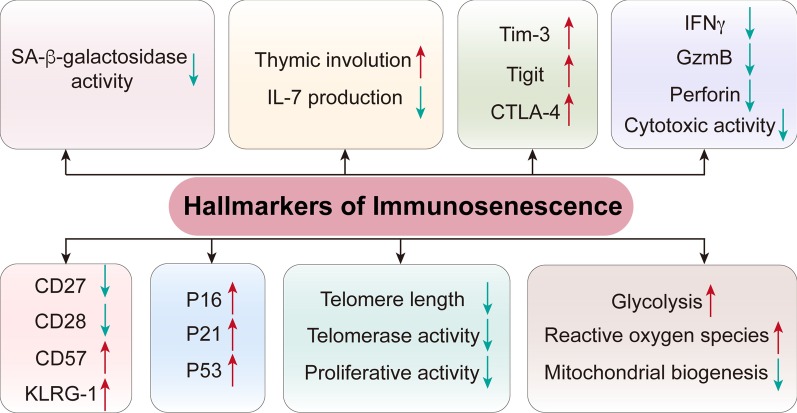
- Immunosenescence features thymic degeneration and decreased T cell output, SASP, increased glycolysis and ROS, and senescent T cell phenotypes such as CD27−CD28−CD57+KLRG-1+ with increased Tim-3, TIGIT, and CTLA-4.
- The tumor microenvironment can induce senescence of T cells, macrophages, NK cells, and dendritic cells via factors including cAMP, glucose competition, and oncogenic stress; senescent immune cells can in turn affect tumor progression.
- Age effects on cancer and immunotherapy are mixed: Kugel et al. analyzed 538 melanoma patients and found those over 60 responded better to anti-PD-1 than those under 60; a retrospective study of 226 colorectal cancer patients aged 80+ found better prognosis than younger patients; another retrospective analysis of 1869 women with breast cancer found invasive ductal carcinoma incidence increased in patients <39 years.
- ICB outcomes in the elderly remain ambiguous; patients over 75 represent less than 10% of patients with cancer in clinical studies, and interventions discussed include IL-7, mTOR inhibition, metformin, NAD+ precursors, and senolytic CAR-T cells.
Methods
- Narrative review; no new primary data are collected.
- Synthesizes cited preclinical and clinical literature, including mouse tumor models, retrospective patient analyses, meta-analyses, and clinical trials such as NCT00799799, NCT02186860, NCT01109095, and NCT01990157.
- Main analysis is thematic synthesis of immunosenescence hallmarks, senescence-related immune cell subsets in the TME, tumor immunotherapy, and candidate interventions.
Limitations
- The authors state that there are relatively few systematic studies on immunosenescence, that existing immunological techniques cannot thoroughly analyze the complexity of the immune system, and that the 6–8-week mouse model most frequently used in tumor studies may not be entirely applicable to humans.
- The authors state that the human–mouse age correspondence is still under discussion and that a more convincing in vivo aging model is needed.
- The authors state that elderly patients are underrepresented in clinical studies and that data on ICB safety and toxicity in the elderly are limited, so the effect of ICB antibody therapy in elderly patients has not been fully elucidated; evident from the text, this is a narrative review without a systematic search or meta-analytic synthesis.
Model-written summary. Check it against the paper before relying on it.
Integrity signals
Registry
Cites
Statistics
Figures
Verification
Claims the paper makes
144 Not checked yet · 17 Own interpretation · 4 Partly supported · 4 No basis given · 3 Supported · 1 Mixed support · accuracy not yet measured
The cited sources support only part of this claim — read each source’s verdict below.
In the paper
“T cell–output decline is an important feature of immunosenescence as well as the production of senescence-associated secretory phenotype, increased glycolysis, and reactive oxygen species.”
- Also stated in: § Concept, process, and hallmarks of immunosenescence · plain
“Additionally, inflammation related to advanced age will produce a senescence-associated secretory phenotype (SASP), which also leads to immune system senescence [15, 23, 25].”
§ Immunosenescence: a key player in cancer development > Abstract
What the sources say
- Partly supportedcites [15] Accardi G, Caruso C. Immune-inflammatory responses in the elderly: an update. Immun Ageing. 2018;15:11. sourceExperimental — accuracy not yet measured
The Background says senescent cells secrete inflammatory cytokines and chemokines, supporting the secretory aspect of the claim. But it describes this as contributing to inflamm-ageing; it does not identify SASP production as an important feature of immunosenescence. The Background lists other principal hallmarks of immunosenescence, including reduced T-cell generation and accumulation of senescent cells. (LLM, conf=0.84)
- Partly supportedcites [23] Pinti M, Appay V, Campisi J, Frasca D, Fülöp T, Sauce D, Larbi A, Weinberger B, Cossarizza A. Aging of the immune system: Focus on inflammation and vaccination. Eur J Immunol. 2016;46(10):2286–301. sourceExperimental — accuracy not yet measured
The Introduction (page not specified) describes SASP as a hallmark of senescent cells and says their secretions may activate the immune system. It does not identify SASP production as an important feature of immunosenescence itself; it presents senescent cells as a possible contributor to age-related inflammation. (LLM, conf=0.82)
- Partly supportedcites [25] Thomas R, Wang W, Su D-M. Contributions of Age-Related Thymic Involution to Immunosenescence and Inflammaging. Immun Ageing. 2020;17:2. sourceExperimental — accuracy not yet measured
The ‘Intersection of Immunosenescence and Inflammaging’ section says diminished immune clearance of senescent cells leads to increased SASP production. It identifies SASP as a contributor to inflammaging, however, rather than as an important feature or primary hallmark of immunosenescence. Page numbers were not provided. (LLM, conf=0.85)
plaincorrelational- Asserted: passes — The authors put it forward as true.
- Checkable: passes — It can be checked against evidence.
- Load-bearing: unclear — It is unclear whether the paper’s conclusions depend on it.
- Based: passes — The paper gives a reason why it holds.
- Also stated in: § Concept, process, and hallmarks of immunosenescence · plain
The cited sources support only part of this claim — read each source’s verdict below.
In the paper
“P53 can cause cellular senescence [42] by regulating the cell cycle via inhibition of cyclin-dependent kinase (CDK) 4 and CDK6 [5, 43] (Fig. 2).”
§ Immunosenescence: a key player in cancer development > Concept, process, and hallmarks of immunosenescence
What the sources say
- Supportedcites [5] Lopez-Otin C, Blasco MA, Partridge L, Serrano M, Kroemer G. The hallmarks of aging. Cell. 2013;153(6):1194–217. source
In “Cellular Senescence > The INK4a/ARF locus and p53,” the paper explicitly describes p53’s role in inducing cellular senescence. The citation to this source is attached to that part of the sentence; the CDK4/CDK6 mechanism is cited separately to other sources. (LLM, conf=0.93)
- Could not verifycites [43] Liu Y, Sanoff HK, Cho H, Burd CE, Torrice C, Ibrahim JG, Thomas NE, Sharpless NE. Expression of p16(INK4a) in peripheral blood T-cells is a biomarker of human aging. Aging Cell. 2009;8(4):439–48. sourceExperimental — accuracy not yet measured
The citation is attached to the CDK4/CDK6 inhibition clause. The Introduction discusses p16INK4a as a tumor suppressor and an age-associated marker, but our copy does not state that p53 inhibits CDK4 or CDK6. Searches for p53, CDK4, CDK6, and cyclin-dependent kinase inhibition did not locate the attributed mechanism. (LLM, conf=0.74)
plaindirect- Asserted: passes — The authors put it forward as true.
- Checkable: passes — It can be checked against evidence.
- Load-bearing: unclear — It is unclear whether the paper’s conclusions depend on it.
- Based: passes — The paper gives a reason why it holds.
- Supported
Every source the paper cites for this claim was checked and supports it.
In the paper
“Furthermore, the activation of Toll-like receptor 8 signaling in tumor cells can enhance antitumor immunity by blocking the induction of senescent T cells and tumor-specific T cells in vitro and in vivo and reversing their inhibitory effect [63].”
§ Immunosenescence: a key player in cancer development > Immunosenescence and cancer
What the sources say
- Supportedcites [63] Ye J, Ma C, Hsueh EC, Dou J, Mo W, Liu S, Han B, Huang Y, Zhang Y, Varvares MA, et al. TLR8 signaling enhances tumor immunity by preventing tumor-induced T-cell senescence. EMBO Mol Med. 2014;6(10):1294–311. source
The Discussion states that TLR8 signaling in tumor cells blocks senescence in naïve and tumor-specific effector T cells, reverses their suppressive effects in vitro and in vivo, and enhances antitumor immunity. The citing sentence is awkwardly worded, but its substantive claim matches this passage. (LLM, conf=0.92)
plaindirect- Asserted: passes — The authors put it forward as true.
- Checkable: passes — It can be checked against evidence.
- Load-bearing: unclear — It is unclear whether the paper’s conclusions depend on it.
- Based: passes — The paper gives a reason why it holds.
- Supported
Every source the paper cites for this claim was checked and supports it.
In the paper
“Furthermore, IFN signaling and antigen presentation were reduced in the TME of aged mice and patients with triple-negative breast cancer [68].”
§ Immunosenescence: a key player in cancer development > Immunosenescence and tumor immunotherapy
What the sources say
- Supportedcites [68] Sceneay J, Goreczny GJ, Wilson K, Morrow S, DeCristo MJ, Ubellacker JM, Qin Y, Laszewski T, Stover DG, Barrera V, et al. Interferon signaling is diminished with age and is associated with immune checkpoint blockade efficacy in triple-negative breast cancer. Cancer Discov. 2019;9(9):1208–27. source
The Discussion reports that tumors from aged mice and TNBC patients over 65 lack enrichment for genes associated with antigen presentation and IFN response pathways, compared with younger groups. It identifies these changes as features of the age-dependent tumor microenvironment. (LLM, conf=0.93)
plaindirect- Asserted: passes — The authors put it forward as true.
- Checkable: passes — It can be checked against evidence.
- Load-bearing: unclear — It is unclear whether the paper’s conclusions depend on it.
- Based: passes — The paper gives a reason why it holds.
- Supported
The cited sources support only part of this claim — read each source’s verdict below.
In the paper
“In subsequent recent studies, in the relatively long-lived C57BL/6 mice and genetic hybrid mice, a similar phenomenon was observed [179, 180].”
§ Immunosenescence: a key player in cancer development > Clinical implications, evaluations, and intervention
What the sources say
- Partly supportedcites [179] Strong R, Miller RA, Antebi A, Astle CM, Bogue M, Denzel MS, Fernandez E, Flurkey K, Hamilton KL, Lamming DW, et al. Longer lifespan in male mice treated with a weakly estrogenic agonist, an antioxidant, an α-glucosidase inhibitor or a Nrf2-inducer. Aging Cell. 2016;15(5):872–84. sourceExperimental — accuracy not yet measured
The Discussion (page unavailable) reports increased mean lifespan with metformin in male C57BL/6 mice and a smaller, suggestive increase in male B6C3F1 hybrid mice. It also says this paper’s own metformin result in genetically heterogeneous mice was not statistically significant. Thus the copy supports a similar observed trend in both mouse stocks, but not an established lifespan benefit in both. (LLM, conf=0.78)
- Supportedcites [180] Martin-Montalvo A, Mercken EM, Mitchell SJ, Palacios HH, Mote PL, Scheibye-Knudsen M, Gomes AP, Ward TM, Minor RK, Blouin M-J, et al. Metformin improves healthspan and lifespan in mice. Nat Commun. 2013;4:2192. source
The Results section (‘Metformin increases healthspan and longevity of mice’; page unavailable) reports increased mean lifespan with 0.1% metformin in both male C57BL/6 mice and B6C3F1 mice. The increase in B6C3F1 mice was observed but was not statistically significant (p=0.064). (LLM, conf=0.90)
plain- Asserted: passes — The authors put it forward as true.
- Checkable: passes — It can be checked against evidence.
- Load-bearing: unclear — It is unclear whether the paper’s conclusions depend on it.
- Based: passes — The paper gives a reason why it holds.
- Partly supported
None of the sources cited for this claim have been checked yet.
In the paper
“T cell–output decline is an important feature of immunosenescence as well as the production of senescence-associated secretory phenotype, increased glycolysis, and reactive oxygen species.”
- Also stated in: § Concept, process, and hallmarks of immunosenescence · plain
“Moreover, an important distinguishing feature is that the thymus gradually recedes and degenerates with age, resulting in a decrease in T cell output [24, 25].”
§ Immunosenescence: a key player in cancer development > Abstract
What the sources say
- Not checked yetcites [24] Palmer S, Albergante L, Blackburn CC, Newman TJ. Thymic involution and rising disease incidence with age. Proc Natl Acad Sci U S A. 2018;115(8):1883–8. source
- Not checked yetcites [25] Thomas R, Wang W, Su D-M. Contributions of Age-Related Thymic Involution to Immunosenescence and Inflammaging. Immun Ageing. 2020;17:2. source
plaincorrelational- Asserted: passes — The authors put it forward as true.
- Checkable: passes — It can be checked against evidence.
- Load-bearing: passes — The paper’s conclusions depend on it.
- Based: passes — The paper gives a reason why it holds.
- Also stated in: § Concept, process, and hallmarks of immunosenescence · plain
In the paper
“Therefore, the T cell phenotype of CD27−CD28−CD57+KLRG-1+ is also an indicator of immunosenescence.”
§ Immunosenescence: a key player in cancer development > Concept, process, and hallmarks of immunosenescence
What the sources say
- Not checked yetcites [41] Huff WX, Kwon JH, Henriquez M, Fetcko K, Dey M. The evolving role of CD8CD28 Immunosenescent T cells in cancer immunology. Int J Mol Sci. 2019;20(11):2810. source
plaincorrelational- Asserted: passes — The authors put it forward as true.
- Checkable: passes — It can be checked against evidence.
- Load-bearing: unclear — It is unclear whether the paper’s conclusions depend on it.
- Based: passes — The paper gives a reason why it holds.
None of the sources cited for this claim have been checked yet.
In the paper
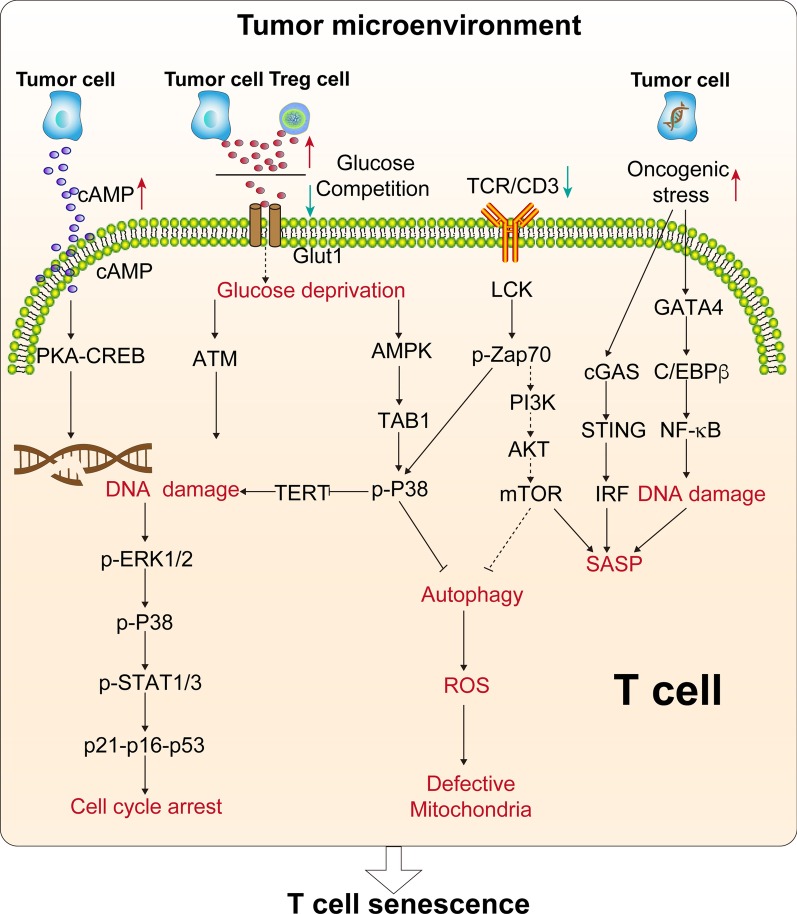
“The role of immunosenescence in tumors is sophisticated: the many factors involved include cAMP, glucose competition, and oncogenic stress in the tumor microenvironment, which can induce the senescence of T cells, macrophages, natural killer cells, and dendritic cells.”
- Also stated in: § Immunosenescence and cancer · plain
“Many factors in the TME can induce the senescence of immune cells and dramatically affect their function.”
§ Immunosenescence: a key player in cancer development > Abstract
What the sources say
- Not checked yetcites [51] Ye J, Huang X, Hsueh EC, Zhang Q, Ma C, Zhang Y, Varvares MA, Hoft DF, Peng G. Human regulatory T cells induce T-lymphocyte senescence. Blood. 2012;120(10):2021–31. source
- Not checked yetcites [52] Ye J, Ma C, Hsueh EC, Eickhoff CS, Zhang Y, Varvares MA, Hoft DF, Peng G. Tumor-derived γδ regulatory T cells suppress innate and adaptive immunity through the induction of immunosenescence. J Immunol. 2013;190(5):2403–14. source
- Not checked yetcites [53] Liu X, Mo W, Ye J, Li L, Zhang Y, Hsueh EC, Hoft DF, Peng G. Regulatory T cells trigger effector T cell DNA damage and senescence caused by metabolic competition. Nat Commun. 2018;9(1):249. source
- Not checked yetcites [54] Wang D, Yang L, Yue D, Cao L, Li L, Wang D, Ping Y, Shen Z, Zheng Y, Wang L, et al. Macrophage-derived CCL22 promotes an immunosuppressive tumor microenvironment via IL-8 in malignant pleural effusion. Cancer Lett. 2019;452:244–53. source
- Not checked yetcites [55] Yang L, Zhang Y. Tumor-associated macrophages: from basic research to clinical application. J Hematol Oncol. 2017;10(1):58. source
- Not checked yetcites [56] Sitkovsky MV, Kjaergaard J, Lukashev D, Ohta A. Hypoxia-adenosinergic immunosuppression: tumor protection by T regulatory cells and cancerous tissue hypoxia. Clin Cancer Res. 2008;14(19):5947–52. source
- Not checked yetcites [57] Vang T, Torgersen KM, Sundvold V, Saxena M, Levy FO, Skålhegg BS, Hansson V, Mustelin T, Taskén K. Activation of the COOH-terminal Src kinase (Csk) by cAMP-dependent protein kinase inhibits signaling through the T cell receptor. J Exp Med. 2001;193(4):497–507. source
- Not checked yetcites [58] Salminen A, Kauppinen A, Kaarniranta K. Myeloid-derived suppressor cells (MDSC): an important partner in cellular/tissue senescence. Biogerontology. 2018;19(5):325–39. source
- Not checked yetcites [59] Wang W, Chen JX, Liao R, Deng Q, Zhou JJ, Huang S, Sun P. Sequential activation of the MEK-extracellular signal-regulated kinase and MKK3/6-p38 mitogen-activated protein kinase pathways mediates oncogenic ras-induced premature senescence. Mol Cell Biol. 2002;22(10):3389–403. source
- Not checked yetcites [60] Freund A, Patil CK, Campisi J. p38MAPK is a novel DNA damage response-independent regulator of the senescence-associated secretory phenotype. EMBO J. 2011;30(8):1536–48. source
plaindirect- Asserted: passes — The authors put it forward as true.
- Checkable: passes — It can be checked against evidence.
- Load-bearing: passes — The paper’s conclusions depend on it.
- Based: passes — The paper gives a reason why it holds.
- Also stated in: § Immunosenescence and cancer · plain
In the paper
“Indeed, some potential targets were already investigated: a recent study has reported that interleukin (IL)-7 and its receptors play a key role in immunosenescence, affecting the balance of the immune system [30] (Fig. 2).”
§ Immunosenescence: a key player in cancer development > Concept, process, and hallmarks of immunosenescence
What the sources say
- Not checked yetcites [30] Nguyen V, Mendelsohn A, Larrick JW. Interleukin-7 and Immunosenescence. J Immunol Res. 2017;2017:4807853. source
plaindirect- Asserted: passes — The authors put it forward as true.
- Checkable: passes — It can be checked against evidence.
- Load-bearing: unclear — It is unclear whether the paper’s conclusions depend on it.
- Based: passes — The paper gives a reason why it holds.
None of the sources cited for this claim have been checked yet.
In the paper
“However, the main obstacle to achieving efficacious immunotherapy is the tumor microenvironment (TME), which may accelerate senescence of the immune system [18, 19]: potential targets for rejuvenating the immune system are still a hypothesis.”
§ Immunosenescence: a key player in cancer development > Background
What the sources say
hedgedconditional- Asserted: passes — The authors put it forward as true.
- Checkable: passes — It can be checked against evidence.
- Load-bearing: unclear — It is unclear whether the paper’s conclusions depend on it.
- Based: passes — The paper gives a reason why it holds.
In the paper
“These studies also documented that cellular senescence is a cellular state closely associated with various physiological processes and aging-related diseases [4, 5] and is a double-edged sword in cancer [6].”
§ Immunosenescence: a key player in cancer development > Background
What the sources say
- Not checked yetcites [6] Nacarelli T, Lau L, Fukumoto T, Zundell J, Fatkhutdinov N, Wu S, Aird KM, Iwasaki O, Kossenkov AV, Schultz D, et al. NAD metabolism governs the proinflammatory senescence-associated secretome. Nat Cell Biol. 2019;21(3):397–407. source
plaincorrelational- Asserted: passes — The authors put it forward as true.
- Checkable: passes — It can be checked against evidence.
- Load-bearing: unclear — It is unclear whether the paper’s conclusions depend on it.
- Based: passes — The paper gives a reason why it holds.
In the paper
“It should be noted that aging is generally defined as a decline of function in living organisms that occurs in a time-dependent manner and is associated with cancer progression [3].”
§ Immunosenescence: a key player in cancer development > Background
What the sources say
- Not checked yetcites [3] Munoz-Espin D, Serrano M. Cellular senescence: from physiology to pathology. Nat Rev Mol Cell Biol. 2014;15(7):482–96. source
plaincorrelational- Asserted: passes — The authors put it forward as true.
- Checkable: passes — It can be checked against evidence.
- Load-bearing: passes — The paper’s conclusions depend on it.
- Based: passes — The paper gives a reason why it holds.
In the paper
“Moreover, with the loss of CD27 and CD28, there is an increase in the expression of P16 and P21, which are involved in cell cycle regulation [42] (Fig. 2).”
§ Immunosenescence: a key player in cancer development > Concept, process, and hallmarks of immunosenescence
What the sources say
- Not checked yetcites [42] Mondal AM, Horikawa I, Pine SR, Fujita K, Morgan KM, Vera E, Mazur SJ, Appella E, Vojtesek B, Blasco MA, et al. p53 isoforms regulate aging- and tumor-associated replicative senescence in T lymphocytes. J Clin Invest. 2013;123(12):5247–57. source
plaindirect- Asserted: passes — The authors put it forward as true.
- Checkable: passes — It can be checked against evidence.
- Load-bearing: unclear — It is unclear whether the paper’s conclusions depend on it.
- Based: passes — The paper gives a reason why it holds.
The paper states this without a source or data behind it here, so there is nothing to check it against. The quote shows it is in the paper.
In the paper
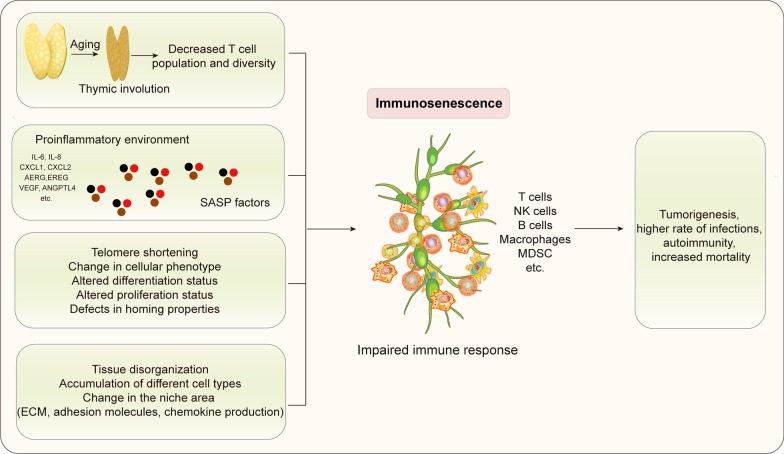
“In fact, the process of immunosenescence is regulated by many factors, including aging, chronic inflammation, and changes in the microenvironment (Fig. 1).”
§ Immunosenescence: a key player in cancer development > Concept, process, and hallmarks of immunosenescence
plaindirect- Asserted: passes — The authors put it forward as true.
- Checkable: passes — It can be checked against evidence.
- Load-bearing: unclear — It is unclear whether the paper’s conclusions depend on it.
- Based: passes — The paper gives a reason why it holds.
A conclusion the paper draws from its own results — it cites no other source for it, so there is none to check. The quote shows it is in the paper.
In the paper
“Accordingly, these senescent immune cells could also affect tumor progression.”
- Also stated in: § Immunosenescence and cancer · hedged
“Altogether, these findings indicate that immunosenescence is linked to the occurrence and progression of tumors.”
§ Immunosenescence: a key player in cancer development > Abstract
hedgedconditional- Asserted: passes — The authors put it forward as true.
- Checkable: passes — It can be checked against evidence.
- Load-bearing: passes — The paper’s conclusions depend on it.
- Based: passes — The paper gives a reason why it holds.
- Also stated in: § Immunosenescence and cancer · hedged
None of the sources cited for this claim have been checked yet.
In the paper
“Another hallmark of senescent T cells is telomere shortening [21, 44] (Fig. 2), which is caused by the continuous replication of T cells and the decrease in expression of the human telomerase RNA component.”
§ Immunosenescence: a key player in cancer development > Concept, process, and hallmarks of immunosenescence
What the sources say
- Not checked yetcites [21] Nikolich-Zugich J. The twilight of immunity: emerging concepts in aging of the immune system. Nat Immunol. 2018;19(1):10–9. source
- Not checked yetcites [44] Bernadotte A, Mikhelson VM, Spivak IM. Markers of cellular senescence. Telomere shortening as a marker of cellular senescence. Aging. 2016;8(1):3–11. source
plaincorrelational- Asserted: passes — The authors put it forward as true.
- Checkable: passes — It can be checked against evidence.
- Load-bearing: unclear — It is unclear whether the paper’s conclusions depend on it.
- Based: passes — The paper gives a reason why it holds.
A conclusion the paper draws from its own results — it cites no other source for it, so there is none to check. The quote shows it is in the paper.
In the paper
“Therefore, these lines of evidence indicate that the underlying mechanism of tumorigenesis is closely associated with immunosenescence.”
§ Immunosenescence: a key player in cancer development > Background
hedgedcorrelational- Asserted: passes — The authors put it forward as true.
- Checkable: passes — It can be checked against evidence.
- Load-bearing: passes — The paper’s conclusions depend on it.
- Based: passes — The paper gives a reason why it holds.
In the paper
“Generally, the risk of malignant tumors increases with age.”
- Also stated in: § Immunosenescence and cancer · plain
“DeSantis et al. [49] found a higher risk of tumorigenesis in the elderly group.”
§ Immunosenescence: a key player in cancer development > Immunosenescence and cancer
What the sources say
- Not checked yetcites [49] DeSantis CE, Miller KD, Dale W, Mohile SG, Cohen HJ, Leach CR, Goding Sauer A, Jemal A, Siegel RL. Cancer statistics for adults aged 85 years and older, 2019. CA: a cancer journal for clinicians. 2019;69(6):452–67. source
plaindirect- Asserted: passes — The authors put it forward as true.
- Checkable: passes — It can be checked against evidence.
- Load-bearing: passes — The paper’s conclusions depend on it.
- Based: passes — The paper gives a reason why it holds.
- Also stated in: § Immunosenescence and cancer · plain
In the paper
“Decreased expression of IFN signaling in CD8+ T cells in aged mice was identified in a mouse model of breast cancer [68].”
§ Immunosenescence: a key player in cancer development > Immunosenescence and cancer
What the sources say
- Not checked yetcites [68] Sceneay J, Goreczny GJ, Wilson K, Morrow S, DeCristo MJ, Ubellacker JM, Qin Y, Laszewski T, Stover DG, Barrera V, et al. Interferon signaling is diminished with age and is associated with immune checkpoint blockade efficacy in triple-negative breast cancer. Cancer Discov. 2019;9(9):1208–27. source
plain- Asserted: passes — The authors put it forward as true.
- Checkable: passes — It can be checked against evidence.
- Load-bearing: unclear — It is unclear whether the paper’s conclusions depend on it.
- Based: passes — The paper gives a reason why it holds.
In the paper
“P38 inhibits cell cycle progression by activating P53, P21, and P16 [64].”
§ Immunosenescence: a key player in cancer development > Immunosenescence and cancer
What the sources say
- Not checked yetcites [64] Lanna A, Gomes DCO, Muller-Durovic B, McDonnell T, Escors D, Gilroy DW, Lee JH, Karin M, Akbar AN. A sestrin-dependent Erk-Jnk-p38 MAPK activation complex inhibits immunity during aging. Nat Immunol. 2017;18(3):354–63. source
plaindirect- Asserted: passes — The authors put it forward as true.
- Checkable: passes — It can be checked against evidence.
- Load-bearing: unclear — It is unclear whether the paper’s conclusions depend on it.
- Based: passes — The paper gives a reason why it holds.
In the paper
“Chemotherapy can also induce CD8+ T cell senescence in patients with breast cancer [67].”
§ Immunosenescence: a key player in cancer development > Immunosenescence and cancer
What the sources say
- Not checked yetcites [67] Onyema OO, Decoster L, Njemini R, Forti LN, Bautmans I, De Waele M, Mets T. Chemotherapy-induced changes and immunosenescence of CD8+ T-cells in patients with breast cancer. Anticancer Res. 2015;35(3):1481–9.
plaindirect- Asserted: passes — The authors put it forward as true.
- Checkable: passes — It can be checked against evidence.
- Load-bearing: unclear — It is unclear whether the paper’s conclusions depend on it.
- Based: passes — The paper gives a reason why it holds.
None of the sources cited for this claim have been checked yet.
In the paper
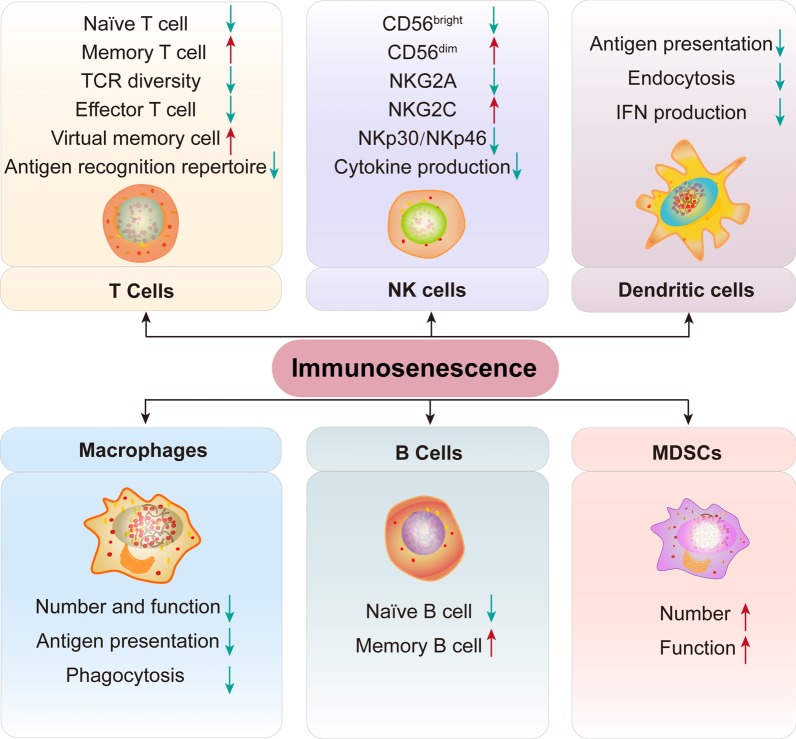
“Moreover, NKp30, NKp46, and DNAM-1 are NK activation receptors involved in the recognition and lysis of different tumors, such as hematological malignancies [82], melanoma [83], and ovarian cancer [84].”
§ Immunosenescence: a key player in cancer development > Changes in senescence-related immune cell subsets in the TME > NK cells
What the sources say
- Not checked yetcites [82] Fauriat C, Just-Landi S, Mallet F, Arnoulet C, Sainty D, Olive D, Costello RT. Deficient expression of NCR in NK cells from acute myeloid leukemia: Evolution during leukemia treatment and impact of leukemia cells in NCRdull phenotype induction. Blood. 2007;109(1):323–30. source
- Not checked yetcites [83] Lakshmikanth T, Burke S, Ali TH, Kimpfler S, Ursini F, Ruggeri L, Capanni M, Umansky V, Paschen A, Sucker A, et al. NCRs and DNAM-1 mediate NK cell recognition and lysis of human and mouse melanoma cell lines in vitro and in vivo. J Clin Invest. 2009;119(5):1251–63. source
- Not checked yetcites [84] Carlsten M, Björkström NK, Norell H, Bryceson Y, van Hall T, Baumann BC, Hanson M, Schedvins K, Kiessling R, Ljunggren H-G, et al. DNAX accessory molecule-1 mediated recognition of freshly isolated ovarian carcinoma by resting natural killer cells. Cancer Res. 2007;67(3):1317–25. source
plaindirect- Asserted: passes — The authors put it forward as true.
- Checkable: passes — It can be checked against evidence.
- Load-bearing: unclear — It is unclear whether the paper’s conclusions depend on it.
- Based: passes — The paper gives a reason why it holds.
In the paper
“The increased age-related sFRP2 secreted by fibroblasts also promoted angiogenesis and metastasis of melanoma cells [70].”
§ Immunosenescence: a key player in cancer development > Immunosenescence and cancer
What the sources say
- Not checked yetcites [70] Kaur A, Webster MR, Marchbank K, Behera R, Ndoye A, Kugel CH, Dang VM, Appleton J, O’Connell MP, Cheng P, et al. sFRP2 in the aged microenvironment drives melanoma metastasis and therapy resistance. Nature. 2016;532(7598):250–4. source
plaindirect- Asserted: passes — The authors put it forward as true.
- Checkable: passes — It can be checked against evidence.
- Load-bearing: unclear — It is unclear whether the paper’s conclusions depend on it.
- Based: passes — The paper gives a reason why it holds.
In the paper
“Compared with young patients with melanoma, ECM rearrangement resulting from Hyaluronan And Proteoglycan Link Protein 1 changes in elderly patients can cause melanoma cells to be more invasive and prone to distant metastasis [69].”
§ Immunosenescence: a key player in cancer development > Immunosenescence and cancer
What the sources say
- Not checked yetcites [69] Ecker BL, Kaur A, Douglass SM, Webster MR, Almeida FV, Marino GE, Sinnamon AJ, Neuwirth MG, Alicea GM, Ndoye A, et al. Age-related changes in HAPLN1 increase lymphatic permeability and affect routes of melanoma metastasis. Cancer Discov. 2019;9(1):82–95. source
plaindirect- Asserted: passes — The authors put it forward as true.
- Checkable: passes — It can be checked against evidence.
- Load-bearing: unclear — It is unclear whether the paper’s conclusions depend on it.
- Based: passes — The paper gives a reason why it holds.
In the paper
“By analyzing the age distributions of 100 different tumors, Palmer et al. [24] concluded that the immune system may play an important role in tumor development.”
§ Immunosenescence: a key player in cancer development > Immunosenescence and cancer
What the sources say
- Not checked yetcites [24] Palmer S, Albergante L, Blackburn CC, Newman TJ. Thymic involution and rising disease incidence with age. Proc Natl Acad Sci U S A. 2018;115(8):1883–8. source
hedgedconditional- Asserted: passes — The authors put it forward as true.
- Checkable: passes — It can be checked against evidence.
- Load-bearing: passes — The paper’s conclusions depend on it.
- Based: passes — The paper gives a reason why it holds.
In the paper
“The NFκB, C/EBPβ, and cGAS-STING pathways also play a key role in the induction of T cell senescence [66].”
§ Immunosenescence: a key player in cancer development > Immunosenescence and cancer
What the sources say
- Not checked yetcites [66] Goronzy JJ, Weyand CM. Mechanisms underlying T cell ageing. Nat Rev Immunol. 2019;19(9):573–83. source
plaindirect- Asserted: passes — The authors put it forward as true.
- Checkable: passes — It can be checked against evidence.
- Load-bearing: unclear — It is unclear whether the paper’s conclusions depend on it.
- Based: passes — The paper gives a reason why it holds.
None of the sources cited for this claim have been checked yet.
In the paper
“In addition, tumor cells activate the PKA-CREB and P38 pathways by producing cAMP, thereby causing DNA damage and senescence of T cells [51, 53, 58–63].”
§ Immunosenescence: a key player in cancer development > Immunosenescence and cancer
What the sources say
- Not checked yetcites [51] Ye J, Huang X, Hsueh EC, Zhang Q, Ma C, Zhang Y, Varvares MA, Hoft DF, Peng G. Human regulatory T cells induce T-lymphocyte senescence. Blood. 2012;120(10):2021–31. source
- Not checked yetcites [53] Liu X, Mo W, Ye J, Li L, Zhang Y, Hsueh EC, Hoft DF, Peng G. Regulatory T cells trigger effector T cell DNA damage and senescence caused by metabolic competition. Nat Commun. 2018;9(1):249. source
- Not checked yetcites [58] Salminen A, Kauppinen A, Kaarniranta K. Myeloid-derived suppressor cells (MDSC): an important partner in cellular/tissue senescence. Biogerontology. 2018;19(5):325–39. source
- Not checked yetcites [59] Wang W, Chen JX, Liao R, Deng Q, Zhou JJ, Huang S, Sun P. Sequential activation of the MEK-extracellular signal-regulated kinase and MKK3/6-p38 mitogen-activated protein kinase pathways mediates oncogenic ras-induced premature senescence. Mol Cell Biol. 2002;22(10):3389–403. source
- Not checked yetcites [60] Freund A, Patil CK, Campisi J. p38MAPK is a novel DNA damage response-independent regulator of the senescence-associated secretory phenotype. EMBO J. 2011;30(8):1536–48. source
- Not checked yetcites [61] Van Nguyen T, Puebla-Osorio N, Pang H, Dujka ME, Zhu C. DNA damage-induced cellular senescence is sufficient to suppress tumorigenesis: a mouse model. J Exp Med. 2007;204(6):1453–61. source
- Not checked yetcites [62] Rodier F, Coppé J-P, Patil CK, Hoeijmakers WAM, Muñoz DP, Raza SR, Freund A, Campeau E, Davalos AR, Campisi J. Persistent DNA damage signalling triggers senescence-associated inflammatory cytokine secretion. Nat Cell Biol. 2009;11(8):973–9. source
- Not checked yetcites [63] Ye J, Ma C, Hsueh EC, Dou J, Mo W, Liu S, Han B, Huang Y, Zhang Y, Varvares MA, et al. TLR8 signaling enhances tumor immunity by preventing tumor-induced T-cell senescence. EMBO Mol Med. 2014;6(10):1294–311. source
plaindirect- Asserted: passes — The authors put it forward as true.
- Checkable: passes — It can be checked against evidence.
- Load-bearing: unclear — It is unclear whether the paper’s conclusions depend on it.
- Based: passes — The paper gives a reason why it holds.
In the paper
“In various mouse models, tumor proliferation was found to be slower in elderly mice, such as MC38, B16, and 4T1 tumor models [71].”
§ Immunosenescence: a key player in cancer development > Immunosenescence and cancer
What the sources say
- Not checked yetcites [71] Oh J, Magnuson A, Benoist C, Pittet MJ, Weissleder R. Age-related tumor growth in mice is related to integrin α 4 in CD8+ T cells. JCI insight. 2018;3(21):e122961. source
plaincorrelational- Asserted: passes — The authors put it forward as true.
- Checkable: passes — It can be checked against evidence.
- Load-bearing: unclear — It is unclear whether the paper’s conclusions depend on it.
- Based: passes — The paper gives a reason why it holds.
In the paper
“Another study retrospectively analyzed the histological report of 1869 women with breast cancer and found that the incidence of invasive ductal carcinoma increased in patients < 39 years of age [76].”
§ Immunosenescence: a key player in cancer development > Immunosenescence and cancer
What the sources say
- Not checked yetcites [76] Fisher CJ, Egan MK, Smith P, Wicks K, Millis RR, Fentiman IS. Histopathology of breast cancer in relation to age. Br J Cancer. 1997;75(4):593–6. source
plaindirectn = 1,869- Asserted: passes — The authors put it forward as true.
- Checkable: passes — It can be checked against evidence.
- Load-bearing: unclear — It is unclear whether the paper’s conclusions depend on it.
- Based: passes — The paper gives a reason why it holds.
A conclusion the paper draws from its own results — it cites no other source for it, so there is none to check. The quote shows it is in the paper.
In the paper
“Overall, these different research results indicate that age is closely associated with tumorigenesis.”
§ Immunosenescence: a key player in cancer development > Immunosenescence and cancer
hedgedcorrelationaln = 1,869- Asserted: passes — The authors put it forward as true.
- Checkable: passes — It can be checked against evidence.
- Load-bearing: passes — The paper’s conclusions depend on it.
- Based: passes — The paper gives a reason why it holds.
In the paper
“Studies have shown that immunosenescence, especially that of CD8+ T cells, plays a pivotal role in the pathogenesis and treatment of patients with breast cancer [67].”
§ Immunosenescence: a key player in cancer development > Immunosenescence and cancer
What the sources say
- Not checked yetcites [67] Onyema OO, Decoster L, Njemini R, Forti LN, Bautmans I, De Waele M, Mets T. Chemotherapy-induced changes and immunosenescence of CD8+ T-cells in patients with breast cancer. Anticancer Res. 2015;35(3):1481–9.
boosteddirect- Asserted: passes — The authors put it forward as true.
- Checkable: passes — It can be checked against evidence.
- Load-bearing: passes — The paper’s conclusions depend on it.
- Based: passes — The paper gives a reason why it holds.
In the paper
“Vatter et al. [50] performed a phenotypic analysis of mammary epithelial cells from 57 women (16–91 years old) and showed that accumulation of lumen and progenitor cells with age may lead to an increased risk of carcinogenesis.”
§ Immunosenescence: a key player in cancer development > Immunosenescence and cancer
What the sources say
- Not checked yetcites [50] Pelissier Vatter FA, Schapiro D, Chang H, Borowsky AD, Lee JK, Parvin B, Stampfer MR, LaBarge MA, Bodenmiller B, Lorens JB. High-dimensional phenotyping identifies age-emergent cells in human mammary epithelia. Cell Rep. 2018;23(4):1205–19. source
hedgedconditionaln = 57- Asserted: passes — The authors put it forward as true.
- Checkable: passes — It can be checked against evidence.
- Load-bearing: unclear — It is unclear whether the paper’s conclusions depend on it.
- Based: passes — The paper gives a reason why it holds.
None of the sources cited for this claim have been checked yet.
In the paper
“Several studies have reported that tumor-derived endogenous cyclic adenosine monophosphate (cAMP) induces T cell senescence by inhibiting tumor-specific effector T cells in hypoxic microenvironment [56, 57].”
§ Immunosenescence: a key player in cancer development > Immunosenescence and cancer
What the sources say
- Not checked yetcites [56] Sitkovsky MV, Kjaergaard J, Lukashev D, Ohta A. Hypoxia-adenosinergic immunosuppression: tumor protection by T regulatory cells and cancerous tissue hypoxia. Clin Cancer Res. 2008;14(19):5947–52. source
- Not checked yetcites [57] Vang T, Torgersen KM, Sundvold V, Saxena M, Levy FO, Skålhegg BS, Hansson V, Mustelin T, Taskén K. Activation of the COOH-terminal Src kinase (Csk) by cAMP-dependent protein kinase inhibits signaling through the T cell receptor. J Exp Med. 2001;193(4):497–507. source
plaindirect- Asserted: passes — The authors put it forward as true.
- Checkable: passes — It can be checked against evidence.
- Load-bearing: unclear — It is unclear whether the paper’s conclusions depend on it.
- Based: passes — The paper gives a reason why it holds.
A conclusion the paper draws from its own results — it cites no other source for it, so there is none to check. The quote shows it is in the paper.
In the paper
“Altogether, these findings indicate that immunosenescence is linked to the occurrence and progression of tumors.”
§ Immunosenescence: a key player in cancer development > Immunosenescence and cancer
hedgedcorrelational- Asserted: passes — The authors put it forward as true.
- Checkable: passes — It can be checked against evidence.
- Load-bearing: passes — The paper’s conclusions depend on it.
- Based: passes — The paper gives a reason why it holds.
In the paper
“In 1973, a retrospective study of 226 patients with colorectal cancer aged 80 years and older found that the prognosis of elderly patients was better than that of young patients [72].”
§ Immunosenescence: a key player in cancer development > Immunosenescence and cancer
What the sources say
- Not checked yetcites [72] Calabrese CT, Adam YG, Volk H. Geriatric colon cancer. Am J Surg. 1973;125(2):181–4. source
plaincorrelationaln = 226- Asserted: passes — The authors put it forward as true.
- Checkable: passes — It can be checked against evidence.
- Load-bearing: unclear — It is unclear whether the paper’s conclusions depend on it.
- Based: passes — The paper gives a reason why it holds.
None of the sources cited for this claim have been checked yet.
In the paper
“The function of NK cells, such as immune surveillance, is also affected by age-related changes.”
§ Immunosenescence: a key player in cancer development > Changes in senescence-related immune cell subsets in the TME > NK cells
plaindirect- Asserted: passes — The authors put it forward as true.
- Checkable: passes — It can be checked against evidence.
- Load-bearing: passes — The paper’s conclusions depend on it.
- Based: passes — The paper gives a reason why it holds.
None of the sources cited for this claim have been checked yet.
In the paper
“It has been reported that CAR-T cell therapy shows high response rates to B-ALL patients in different age groups [117–119].”
§ Immunosenescence: a key player in cancer development > Changes in senescence-related immune cell subsets in the TME > T cells
What the sources say
- Not checked yetcites [117] Sidaway P. Immunotherapy: CAR T cell therapy efficacious against B-ALL across age groups. Nat Rev Clin Oncol. 2018;15(4):199. source
- Not checked yetcites [118] Maude SL, Laetsch TW, Buechner J, Rives S, Boyer M, Bittencourt H, Bader P, Verneris MR, Stefanski HE, Myers GD, et al. Tisagenlecleucel in children and young adults with B-cell lymphoblastic leukemia. N Engl J Med. 2018;378(5):439–48. source
- Not checked yetcites [119] Park JH, Rivière I, Gonen M, Wang X, Sénéchal B, Curran KJ, Sauter C, Wang Y, Santomasso B, Mead E, et al. Long-term follow-up of CD19 CAR therapy in acute lymphoblastic Leukemia. N Engl J Med. 2018;378(5):449–59. source
plaindirect- Asserted: passes — The authors put it forward as true.
- Checkable: passes — It can be checked against evidence.
- Load-bearing: unclear — It is unclear whether the paper’s conclusions depend on it.
- Based: passes — The paper gives a reason why it holds.
A conclusion the paper draws from its own results — it cites no other source for it, so there is none to check. The quote shows it is in the paper.
In the paper
“These findings do suggest therapeutic potential of CAR-T cells for senescence-related diseases.”
§ Immunosenescence: a key player in cancer development > Changes in senescence-related immune cell subsets in the TME > T cells
hedgedconditional- Asserted: passes — The authors put it forward as true.
- Checkable: passes — It can be checked against evidence.
- Load-bearing: passes — The paper’s conclusions depend on it.
- Based: passes — The paper gives a reason why it holds.
None of the sources cited for this claim have been checked yet.
In the paper
“Therefore, degeneration of the thymus is the cause of age-related failure of the adaptive immune system [95, 96].”
§ Immunosenescence: a key player in cancer development > Changes in senescence-related immune cell subsets in the TME > T cells
What the sources say
plaindirect- Asserted: passes — The authors put it forward as true.
- Checkable: passes — It can be checked against evidence.
- Load-bearing: passes — The paper’s conclusions depend on it.
- Based: passes — The paper gives a reason why it holds.
None of the sources cited for this claim have been checked yet.
In the paper
“Some studies also documented that memory T cells gradually accumulate with age [66, 97–99].”
§ Immunosenescence: a key player in cancer development > Changes in senescence-related immune cell subsets in the TME > T cells
What the sources say
- Not checked yetcites [66] Goronzy JJ, Weyand CM. Mechanisms underlying T cell ageing. Nat Rev Immunol. 2019;19(9):573–83. source
- Not checked yetcites [97] Fukushima Y, Minato N, Hattori M. The impact of senescence-associated T cells on immunosenescence and age-related disorders. Inflamm Regen. 2018;38:24. source
- Not checked yetcites [98] Pawelec G. Immunosenescence and cancer. Biogerontology. 2017;18(4):717–21. source
- Not checked yetcites [99] Goronzy JJ, Weyand CM. Successful and maladaptive T cell aging. Immunity. 2017;46(3):364–78. source
hedgedcorrelational- Asserted: passes — The authors put it forward as true.
- Checkable: passes — It can be checked against evidence.
- Load-bearing: unclear — It is unclear whether the paper’s conclusions depend on it.
- Based: passes — The paper gives a reason why it holds.
In the paper
“A study showed that there was no difference in the frequency of TSCM between the young and old groups [105].”
§ Immunosenescence: a key player in cancer development > Changes in senescence-related immune cell subsets in the TME > T cells
What the sources say
- Not checked yetcites [105] Van Epps P, Banks R, Aung H, Betts MR, Canaday DH. Age-related differences in polyfunctional T cell responses. Immun Ageing. 2014;11:14. source
plain- Asserted: passes — The authors put it forward as true.
- Checkable: passes — It can be checked against evidence.
- Load-bearing: unclear — It is unclear whether the paper’s conclusions depend on it.
- Based: passes — The paper gives a reason why it holds.
None of the sources cited for this claim have been checked yet.
In the paper
“Collectively, these studies have demonstrated that central memory CD8+ T cells represent the majority of memory CD8+ T cells in aged mice [101, 102].”
§ Immunosenescence: a key player in cancer development > Changes in senescence-related immune cell subsets in the TME > T cells
What the sources say
- Not checked yetcites [101] Chiu B-C, Martin BE, Stolberg VR, Chensue SW. Cutting edge: Central memory CD8 T cells in aged mice are virtual memory cells. J Immunol. 2013;191(12):5793–6. source
- Not checked yetcites [102] Quinn KM, Fox A, Harland KL, Russ BE, Li J, Nguyen THO, Loh L, Olshanksy M, Naeem H, Tsyganov K, et al. Age-related decline in primary CD8(+) T cell responses is associated with the development of senescence in virtual memory CD8(+) T cells. Cell Rep. 2018;23(12):3512–24. source
boosted- Asserted: passes — The authors put it forward as true.
- Checkable: passes — It can be checked against evidence.
- Load-bearing: unclear — It is unclear whether the paper’s conclusions depend on it.
- Based: passes — The paper gives a reason why it holds.
In the paper
“Gabriele et al. reported that CD57, a T cell senescence marker, can quickly and efficiently transfer from glioblastoma stem cells to CAR-T cells, leading to its senescence [124].”
§ Immunosenescence: a key player in cancer development > Changes in senescence-related immune cell subsets in the TME > T cells
What the sources say
- Not checked yetcites [124] Zhu X, Niedermann G. Rapid and efficient transfer of the T cell aging marker CD57 from glioblastoma stem cells to CAR T cells. Oncoscience. 2015;2(5):476–82. source
plaindirect- Asserted: passes — The authors put it forward as true.
- Checkable: passes — It can be checked against evidence.
- Load-bearing: passes — The paper’s conclusions depend on it.
- Based: passes — The paper gives a reason why it holds.
None of the sources cited for this claim have been checked yet.
In the paper
“The reconstructed and expanded CAR-T cells are exposed to the patient's tumor microenvironment, thereby inducing the senescent phenotype of CAR-T [122, 123].”
§ Immunosenescence: a key player in cancer development > Changes in senescence-related immune cell subsets in the TME > T cells
What the sources say
- Not checked yetcites [122] Ye B, Stary CM, Li X, Gao Q, Kang C, Xiong X. Engineering chimeric antigen receptor-T cells for cancer treatment. Mol Cancer. 2018;17(1):32. source
- Not checked yetcites [123] Yao D, Xu L, Tan J, Zhang Y, Lu S, Li M, Lu S, Yang L, Chen S, Chen J, et al. Re-balance of memory T cell subsets in peripheral blood from patients with CML after TKI treatment. Oncotarget. 2017;8(47):81852–9. source
plaindirect- Asserted: passes — The authors put it forward as true.
- Checkable: passes — It can be checked against evidence.
- Load-bearing: passes — The paper’s conclusions depend on it.
- Based: passes — The paper gives a reason why it holds.
A conclusion the paper draws from its own results — it cites no other source for it, so there is none to check. The quote shows it is in the paper.
In the paper
“In general, restoring the function of senescent CAR-T cells is the key to enhancing the antitumor effect of modified T cells.”
§ Immunosenescence: a key player in cancer development > Changes in senescence-related immune cell subsets in the TME > T cells
plaindirect- Asserted: passes — The authors put it forward as true.
- Checkable: passes — It can be checked against evidence.
- Load-bearing: passes — The paper’s conclusions depend on it.
- Based: passes — The paper gives a reason why it holds.
A conclusion the paper draws from its own results — it cites no other source for it, so there is none to check. The quote shows it is in the paper.
In the paper
“Overall, these results indicate that TSCM exists throughout the life process.”
§ Immunosenescence: a key player in cancer development > Changes in senescence-related immune cell subsets in the TME > T cells
hedged- Asserted: passes — The authors put it forward as true.
- Checkable: passes — It can be checked against evidence.
- Load-bearing: unclear — It is unclear whether the paper’s conclusions depend on it.
- Based: passes — The paper gives a reason why it holds.
In the paper
“The low survival rate of patients with glioblastoma is associated with immunosenescence of postoperative CD4+ T cells [128].”
§ Immunosenescence: a key player in cancer development > Changes in senescence-related immune cell subsets in the TME > T cells
What the sources say
- Not checked yetcites [128] Fornara O, Odeberg J, Wolmer Solberg N, Tammik C, Skarman P, Peredo I, Stragliotto G, Rahbar A, Soderberg-Naucler C. Poor survival in glioblastoma patients is associated with early signs of immunosenescence in the CD4 T-cell compartment after surgery. Oncoimmunology. 2015;4(9):e1036211. source
plaincorrelational- Asserted: passes — The authors put it forward as true.
- Checkable: passes — It can be checked against evidence.
- Load-bearing: unclear — It is unclear whether the paper’s conclusions depend on it.
- Based: passes — The paper gives a reason why it holds.
None of the sources cited for this claim have been checked yet.
In the paper
“Therefore, changes in the expression of these activated receptors in the elderly may affect the immune monitoring function of NK cells [85, 86].”
§ Immunosenescence: a key player in cancer development > Changes in senescence-related immune cell subsets in the TME > NK cells
What the sources say
- Not checked yetcites [85] Campos C, López N, Pera A, Gordillo JJ, Hassouneh F, Tarazona R, Solana R. Expression of NKp30, NKp46 and DNAM-1 activating receptors on resting and IL-2 activated NK cells from healthy donors according to CMV-serostatus and age. Biogerontology. 2015;16(5):671–83. source
- Not checked yetcites [86] Campos C, Pera A, Sanchez-Correa B, Alonso C, Lopez-Fernandez I, Morgado S, Tarazona R, Solana R. Effect of age and CMV on NK cell subpopulations. Exp Gerontol. 2014;54:130–7. source
hedgedconditional- Asserted: passes — The authors put it forward as true.
- Checkable: passes — It can be checked against evidence.
- Load-bearing: passes — The paper’s conclusions depend on it.
- Based: passes — The paper gives a reason why it holds.
None of the sources cited for this claim have been checked yet.
In the paper
“their inclusion in clinical studies is usually insufficient, as patients over 75 years of age represent less than 10% of patients with cancer [150, 151]”
§ Immunosenescence: a key player in cancer development > Immunosenescence and tumor immunotherapy
What the sources say
- Not checked yetcites [150] Scher KS, Hurria A. Under-representation of older adults in cancer registration trials: known problem, little progress. J Clin Oncol. 2012;30(17):2036–8. source
- Not checked yetcites [151] Mohile SG, Dale W, Somerfield MR, Hurria A. Practical assessment and management of vulnerabilities in older patients receiving chemotherapy: ASCO guideline for geriatric oncology summary. J Oncol Pract. 2018;14(7):442–6. source
plain- Asserted: passes — The authors put it forward as true.
- Checkable: passes — It can be checked against evidence.
- Load-bearing: passes — The paper’s conclusions depend on it.
- Based: passes — The paper gives a reason why it holds.
In the paper
“It has been reported that CD39 expression during aging reduces the number of CD4+ T cells [130].”
§ Immunosenescence: a key player in cancer development > Changes in senescence-related immune cell subsets in the TME > T cells
What the sources say
- Not checked yetcites [130] Fang F, Yu M, Cavanagh MM, Hutter Saunders J, Qi Q, Ye Z, Le Saux S, Sultan W, Turgano E, Dekker CL, et al. Expression of CD39 on activated T cells impairs their survival in older individuals. Cell Rep. 2016;14(5):1218–31. source
plaindirect- Asserted: passes — The authors put it forward as true.
- Checkable: passes — It can be checked against evidence.
- Load-bearing: unclear — It is unclear whether the paper’s conclusions depend on it.
- Based: passes — The paper gives a reason why it holds.
In the paper
“One study reported that age limits ICB antibody therapy efficacy in aged triple-negative breast cancer-bearing mice [68].”
§ Immunosenescence: a key player in cancer development > Immunosenescence and tumor immunotherapy
What the sources say
- Not checked yetcites [68] Sceneay J, Goreczny GJ, Wilson K, Morrow S, DeCristo MJ, Ubellacker JM, Qin Y, Laszewski T, Stover DG, Barrera V, et al. Interferon signaling is diminished with age and is associated with immune checkpoint blockade efficacy in triple-negative breast cancer. Cancer Discov. 2019;9(9):1208–27. source
plaindirect- Asserted: passes — The authors put it forward as true.
- Checkable: passes — It can be checked against evidence.
- Load-bearing: unclear — It is unclear whether the paper’s conclusions depend on it.
- Based: passes — The paper gives a reason why it holds.
None of the sources cited for this claim have been checked yet.
In the paper
“The age-related remodeling of the B cell compartment may be the result of unbalanced fate selection in the hematopoietic progenitor cell population, autonomous changes in B cells, and external signals [138, 139].”
§ Immunosenescence: a key player in cancer development > Changes in senescence-related immune cell subsets in the TME > B cells
What the sources say
hedgedconditional- Asserted: passes — The authors put it forward as true.
- Checkable: passes — It can be checked against evidence.
- Load-bearing: unclear — It is unclear whether the paper’s conclusions depend on it.
- Based: passes — The paper gives a reason why it holds.
None of the sources cited for this claim have been checked yet.
In the paper
“A meta-analysis of randomized trials showed that although anti-PD-1 drugs are effective for both young and elderly patients, the risk of death among elderly patients is comparable or improved compared to that of patients subjected to control interventions, with no increased toxicity [155–158].”
§ Immunosenescence: a key player in cancer development > Immunosenescence and tumor immunotherapy
What the sources say
- Not checked yetcites [155] Elias R, Giobbie-Hurder A, McCleary NJ, Ott P, Hodi FS, Rahma O. Efficacy of PD-1 & PD-L1 inhibitors in older adults: a meta-analysis. J Immunother Cancer. 2018;6(1):26. source
- Not checked yetcites [156] Li P, Yang X, Feng Y, Wu L, Ma W, Ding G, Wei Y, Sun L. The impact of immunosenescence on the efficacy of immune checkpoint inhibitors in melanoma patients: a meta-analysis. Onco Targets Ther. 2018;11:7521–7. source
- Not checked yetcites [157] Marur S, Singh H, Mishra-Kalyani P, Larkins E, Keegan P, Sridhara R, Blumenthal GM, Pazdur R. FDA analyses of survival in older adults with metastatic non-small cell lung cancer in controlled trials of PD-1/PD-L1 blocking antibodies. Semin Oncol. 2018;45(4):220–5. source
- Not checked yetcites [158] Nishijima TF, Muss HB, Shachar SS, Moschos SJ. Comparison of efficacy of immune checkpoint inhibitors (ICIs) between younger and older patients: a systematic review and meta-analysis. Cancer Treat Rev. 2016;45:30–7. source
plaindirect- Asserted: passes — The authors put it forward as true.
- Checkable: passes — It can be checked against evidence.
- Load-bearing: passes — The paper’s conclusions depend on it.
- Based: passes — The paper gives a reason why it holds.
In the paper
“The ability of neutrophils to phagocytose pathogens decreases with age [147].”
§ Immunosenescence: a key player in cancer development > Changes in senescence-related immune cell subsets in the TME > Other cells
What the sources say
- Not checked yetcites [147] Jackaman C, Tomay F, Duong L, Abdol Razak NB, Pixley FJ, Metharom P, Nelson DJ. Aging and cancer: the role of macrophages and neutrophils. Ageing Res Rev. 2017;36:105–16. source
plaindirect- Asserted: passes — The authors put it forward as true.
- Checkable: passes — It can be checked against evidence.
- Load-bearing: unclear — It is unclear whether the paper’s conclusions depend on it.
- Based: passes — The paper gives a reason why it holds.
None of the sources cited for this claim have been checked yet.
In the paper
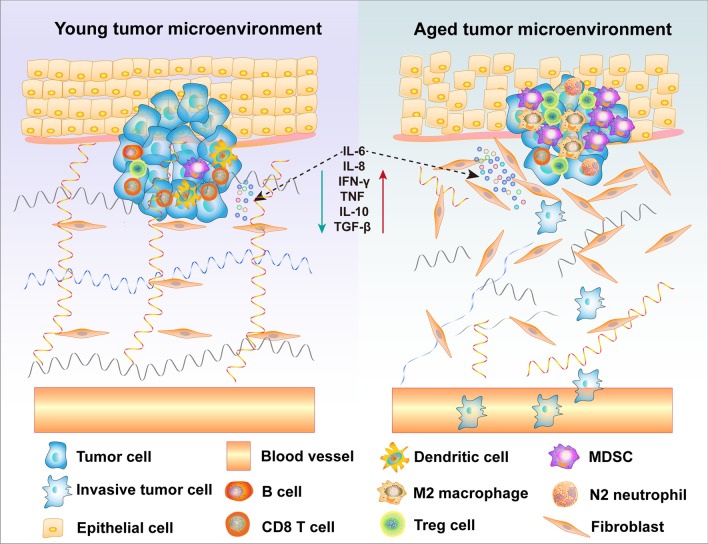
“As shown in Fig. 5, the loose arrangement of the ECM in the aging microenvironment may be one of the causes of metastasis in elderly patients with tumors [69, 70].”
§ Immunosenescence: a key player in cancer development > Changes in senescence-related immune cell subsets in the TME > Other cells
What the sources say
- Not checked yetcites [69] Ecker BL, Kaur A, Douglass SM, Webster MR, Almeida FV, Marino GE, Sinnamon AJ, Neuwirth MG, Alicea GM, Ndoye A, et al. Age-related changes in HAPLN1 increase lymphatic permeability and affect routes of melanoma metastasis. Cancer Discov. 2019;9(1):82–95. source
- Not checked yetcites [70] Kaur A, Webster MR, Marchbank K, Behera R, Ndoye A, Kugel CH, Dang VM, Appleton J, O’Connell MP, Cheng P, et al. sFRP2 in the aged microenvironment drives melanoma metastasis and therapy resistance. Nature. 2016;532(7598):250–4. source
hedgedconditional- Asserted: passes — The authors put it forward as true.
- Checkable: passes — It can be checked against evidence.
- Load-bearing: unclear — It is unclear whether the paper’s conclusions depend on it.
- Based: passes — The paper gives a reason why it holds.
In the paper
“a preclinical study highlights that the efficacy is poorer in older mouse models than in younger mouse models, indicating that age may have a significant effect on different tumor types and various physiological states [153].”
§ Immunosenescence: a key player in cancer development > Immunosenescence and tumor immunotherapy
What the sources say
- Not checked yetcites [153] Padron A, Hurez V, Gupta HB, Clark CA, Pandeswara SL, Yuan B, Svatek RS, Turk MJ, Drerup JM, Li R, et al. Age effects of distinct immune checkpoint blockade treatments in a mouse melanoma model. Exp Gerontol. 2018;105:146–54. source
hedgedcorrelational- Asserted: passes — The authors put it forward as true.
- Checkable: passes — It can be checked against evidence.
- Load-bearing: passes — The paper’s conclusions depend on it.
- Based: passes — The paper gives a reason why it holds.
In the paper
“Furthermore, in aging TME, changes in immune cell function and secretion of SASP molecules dramatically affect tumor progression [18].”
§ Immunosenescence: a key player in cancer development > Changes in senescence-related immune cell subsets in the TME > Other cells
What the sources say
- Not checked yetcites [18] Fane M, Weeraratna AT. How the ageing microenvironment influences tumour progression. Nat Rev Cancer. 2020;20(2):89–106. source
boosteddirect- Asserted: passes — The authors put it forward as true.
- Checkable: passes — It can be checked against evidence.
- Load-bearing: passes — The paper’s conclusions depend on it.
- Based: passes — The paper gives a reason why it holds.
None of the sources cited for this claim have been checked yet.
In the paper
“Similarly, in Lewis lung cancer mouse models and patients with lung cancer, Tregs infiltration and Foxp3 mRNA expression levels were higher in the elderly group than in the younger group [135, 136].”
§ Immunosenescence: a key player in cancer development > Changes in senescence-related immune cell subsets in the TME > T cells
What the sources say
- Not checked yetcites [135] Pan X-D, Mao Y-Q, Zhu L-J, Li J, Xie Y, Wang L, Zhang G-B. Changes of regulatory T cells and FoxP3 gene expression in the aging process and its relationship with lung tumors in humans and mice. Chin Med J (Engl). 2012;125(11):2004–11.
- Not checked yetcites [136] Gong Z, Jia Q, Chen J, Diao X, Gao J, Wang X, Zhu B. Impaired cytolytic activity and loss of clonal neoantigens in elderly patients with lung adenocarcinoma. J Thorac Oncol. 2019;14(5):857–66. source
plaincorrelational- Asserted: passes — The authors put it forward as true.
- Checkable: passes — It can be checked against evidence.
- Load-bearing: unclear — It is unclear whether the paper’s conclusions depend on it.
- Based: passes — The paper gives a reason why it holds.
None of the sources cited for this claim have been checked yet.
In the paper
“In mice, the turnover of mature spleen B cells also decreases with age [143, 144].”
§ Immunosenescence: a key player in cancer development > Changes in senescence-related immune cell subsets in the TME > B cells
What the sources say
- Not checked yetcites [143] Johnson KM, Owen K, Witte PL. Aging and developmental transitions in the B cell lineage. Int Immunol. 2002;14(11):1313–23. source
- Not checked yetcites [144] Kline GH, Hayden TA, Klinman NR. B cell maintenance in aged mice reflects both increased B cell longevity and decreased B cell generation. J Immunol. 1999;162(6):3342–9. source
plaindirect- Asserted: passes — The authors put it forward as true.
- Checkable: passes — It can be checked against evidence.
- Load-bearing: unclear — It is unclear whether the paper’s conclusions depend on it.
- Based: passes — The paper gives a reason why it holds.
In the paper
“Kugel et al. [154] analyzed the relationship between age and anti-PD-1 response in 538 patients with melanoma and found that those over 60 years of age exhibited a better response to anti-PD-1 than those aged < 60 years.”
§ Immunosenescence: a key player in cancer development > Immunosenescence and tumor immunotherapy
What the sources say
- Not checked yetcites [154] Kugel CH 3rd, Douglass SM, Webster MR, Kaur A, Liu Q, Yin X, Weiss SA, Darvishian F, Al-Rohil RN, Ndoye A, et al. Age Correlates with response to Anti-PD1, reflecting age-related differences in intratumoral effector and regulatory T-cell populations. Clin Cancer Res. 2018;24(21):5347–56. source
plaincorrelationaln = 538- Asserted: passes — The authors put it forward as true.
- Checkable: passes — It can be checked against evidence.
- Load-bearing: passes — The paper’s conclusions depend on it.
- Based: passes — The paper gives a reason why it holds.
In the paper
“Immunosenescence may affect the response to blocking antibody therapy in patients with non-small cell lung cancer [152].”
§ Immunosenescence: a key player in cancer development > Immunosenescence and tumor immunotherapy
What the sources say
- Not checked yetcites [152] Ferrara R, Mezquita L, Auclin E, Chaput N, Besse B. Immunosenescence and immunecheckpoint inhibitors in non-small cell lung cancer patients: does age really matter? Cancer Treat Rev. 2017;60:60–8. source
hedgedconditional- Asserted: passes — The authors put it forward as true.
- Checkable: passes — It can be checked against evidence.
- Load-bearing: passes — The paper’s conclusions depend on it.
- Based: passes — The paper gives a reason why it holds.
None of the sources cited for this claim have been checked yet.
In the paper
“Moreover, their functions such as antigen presentation, endocytosis, and IFN production, are also reduced in aged individuals [145, 146].”
§ Immunosenescence: a key player in cancer development > Changes in senescence-related immune cell subsets in the TME > Other cells
What the sources say
- Not checked yetcites [145] Agrawal A, Gupta S. Impact of aging on dendritic cell functions in humans. Ageing Res Rev. 2011;10(3):336–45. source
- Not checked yetcites [146] Gardner JK, Mamotte CDS, Jackaman C, Nelson DJ. Modulation of dendritic cell and T cell cross-talk during aging: the potential role of checkpoint inhibitory molecules. Ageing Res Rev. 2017;38:40–51. source
plaindirect- Asserted: passes — The authors put it forward as true.
- Checkable: passes — It can be checked against evidence.
- Load-bearing: passes — The paper’s conclusions depend on it.
- Based: passes — The paper gives a reason why it holds.
In the paper
“Padron et al. [153] found that in a melanoma mouse model, anti-CTLA-4, anti-PD-1, and anti-PD-L1 antibodies were very effective in treating young mice.”
§ Immunosenescence: a key player in cancer development > Immunosenescence and tumor immunotherapy
What the sources say
- Not checked yetcites [153] Padron A, Hurez V, Gupta HB, Clark CA, Pandeswara SL, Yuan B, Svatek RS, Turk MJ, Drerup JM, Li R, et al. Age effects of distinct immune checkpoint blockade treatments in a mouse melanoma model. Exp Gerontol. 2018;105:146–54. source
plaindirect- Asserted: passes — The authors put it forward as true.
- Checkable: passes — It can be checked against evidence.
- Load-bearing: passes — The paper’s conclusions depend on it.
- Based: passes — The paper gives a reason why it holds.
In the paper
“Recently, it has been proven that drug intervention can slow down the aging phenotype to alleviate age-related functional decline [176].”
§ Immunosenescence: a key player in cancer development > Clinical implications, evaluations, and intervention
What the sources say
- Not checked yetcites [176] Partridge L, Fuentealba M, Kennedy BK. The quest to slow ageing through drug discovery. Nat Rev Drug Discov. 2020;19(8):513–32. source
boosteddirect- Asserted: passes — The authors put it forward as true.
- Checkable: passes — It can be checked against evidence.
- Load-bearing: unclear — It is unclear whether the paper’s conclusions depend on it.
- Based: passes — The paper gives a reason why it holds.
In the paper
“patients who experienced lethal toxic effects appeared to be older than those not suffering from lethal toxic effects [159].”
§ Immunosenescence: a key player in cancer development > Immunosenescence and tumor immunotherapy
What the sources say
- Not checked yetcites [159] Wang DY, Salem JE, Cohen JV, Chandra S, Menzer C, Ye F, Zhao S, Das S, Beckermann KE, Ha L, et al. Fatal toxic effects associated with immune checkpoint inhibitors: a systematic review and meta-analysis. JAMA Oncol. 2018;4(12):1721–8. source
hedgedcorrelational- Asserted: passes — The authors put it forward as true.
- Checkable: passes — It can be checked against evidence.
- Load-bearing: unclear — It is unclear whether the paper’s conclusions depend on it.
- Based: passes — The paper gives a reason why it holds.
In the paper
“Similarly, a report has shown that the injection of a plasmid vector carrying FOXN1-cDNA into the thymus of elderly mice would cause a partial rescue in the size of the thymus and the number of thymocytes [172].”
§ Immunosenescence: a key player in cancer development > Clinical implications, evaluations, and intervention
What the sources say
- Not checked yetcites [172] Sun L, Guo J, Brown R, Amagai T, Zhao Y, Su D-M. Declining expression of a single epithelial cell-autonomous gene accelerates age-related thymic involution. Aging Cell. 2010;9(3):347–57. source
hedgeddirect- Asserted: passes — The authors put it forward as true.
- Checkable: passes — It can be checked against evidence.
- Load-bearing: passes — The paper’s conclusions depend on it.
- Based: passes — The paper gives a reason why it holds.
In the paper
“it was reported that the IL-7 fusion protein, that is, IL-7 binding to the N-terminal extracellular domain of CCR9, could restore the thymus structure in elderly individuals [173]”
§ Immunosenescence: a key player in cancer development > Clinical implications, evaluations, and intervention
What the sources say
- Not checked yetcites [173] Henson SM, Snelgrove R, Hussell T, Wells DJ, Aspinall R. An IL-7 fusion protein that shows increased thymopoietic ability. J Immunol. 2005;175(6):4112–8. source
hedgeddirect- Asserted: passes — The authors put it forward as true.
- Checkable: passes — It can be checked against evidence.
- Load-bearing: unclear — It is unclear whether the paper’s conclusions depend on it.
- Based: passes — The paper gives a reason why it holds.
In the paper
“Moreover, in an oral cancer tumor-bearing mouse model, the tumor regression of aged mice after anti-PD-L1 treatment was faster than that of young mice [161].”
§ Immunosenescence: a key player in cancer development > Immunosenescence and tumor immunotherapy
What the sources say
- Not checked yetcites [161] Sekido K, Tomihara K, Tachinami H, Heshiki W, Sakurai K, Moniruzzaman R, Imaue S, Fujiwara K, Noguchi M. Alterations in composition of immune cells and impairment of anti-tumor immune response in aged oral cancer-bearing mice. Oral Oncol. 2019;99:104462. source
plaincorrelational- Asserted: passes — The authors put it forward as true.
- Checkable: passes — It can be checked against evidence.
- Load-bearing: unclear — It is unclear whether the paper’s conclusions depend on it.
- Based: passes — The paper gives a reason why it holds.
None of the sources cited for this claim have been checked yet.
In the paper
“Much of the literature suggests that the genetic regulation of mTOR signal transduction can slow the aging of many organisms [183–185].”
§ Immunosenescence: a key player in cancer development > Clinical implications, evaluations, and intervention
What the sources say
- Not checked yetcites [183] Ha CW, Huh W-K. Rapamycin increases rDNA stability by enhancing association of Sir2 with rDNA in Saccharomyces cerevisiae. Nucleic Acids Res. 2011;39(4):1336–50. source
- Not checked yetcites [184] Harrison DE, Strong R, Sharp ZD, Nelson JF, Astle CM, Flurkey K, Nadon NL, Wilkinson JE, Frenkel K, Carter CS, et al. Rapamycin fed late in life extends lifespan in genetically heterogeneous mice. Nature. 2009;460(7253):392–5. source
- Not checked yetcites [185] Miller RA, Harrison DE, Astle CM, Baur JA, Boyd AR, de Cabo R, Fernandez E, Flurkey K, Javors MA, Nelson JF, et al. Rapamycin, but not resveratrol or simvastatin, extends life span of genetically heterogeneous mice. J Gerontol Ser A Biol Sci Med Sci. 2011;66(2):191–201. source
hedgeddirect- Asserted: passes — The authors put it forward as true.
- Checkable: passes — It can be checked against evidence.
- Load-bearing: passes — The paper’s conclusions depend on it.
- Based: passes — The paper gives a reason why it holds.
In the paper
“Metformin, a widely prescribed antidiabetic drug, has been shown to alleviate aging in preclinical studies [177].”
§ Immunosenescence: a key player in cancer development > Clinical implications, evaluations, and intervention
What the sources say
- Not checked yetcites [177] Barzilai N, Crandall JP, Kritchevsky SB, Espeland MA. Metformin as a Tool to Target Aging. Cell Metab. 2016;23(6):1060–5. source
plaindirect- Asserted: passes — The authors put it forward as true.
- Checkable: passes — It can be checked against evidence.
- Load-bearing: unclear — It is unclear whether the paper’s conclusions depend on it.
- Based: passes — The paper gives a reason why it holds.
None of the sources cited for this claim have been checked yet.
In the paper
“with no increased toxicity [155–158].”
§ Immunosenescence: a key player in cancer development > Immunosenescence and tumor immunotherapy
What the sources say
- Not checked yetcites [155] Elias R, Giobbie-Hurder A, McCleary NJ, Ott P, Hodi FS, Rahma O. Efficacy of PD-1 & PD-L1 inhibitors in older adults: a meta-analysis. J Immunother Cancer. 2018;6(1):26. source
- Not checked yetcites [156] Li P, Yang X, Feng Y, Wu L, Ma W, Ding G, Wei Y, Sun L. The impact of immunosenescence on the efficacy of immune checkpoint inhibitors in melanoma patients: a meta-analysis. Onco Targets Ther. 2018;11:7521–7. source
- Not checked yetcites [157] Marur S, Singh H, Mishra-Kalyani P, Larkins E, Keegan P, Sridhara R, Blumenthal GM, Pazdur R. FDA analyses of survival in older adults with metastatic non-small cell lung cancer in controlled trials of PD-1/PD-L1 blocking antibodies. Semin Oncol. 2018;45(4):220–5. source
- Not checked yetcites [158] Nishijima TF, Muss HB, Shachar SS, Moschos SJ. Comparison of efficacy of immune checkpoint inhibitors (ICIs) between younger and older patients: a systematic review and meta-analysis. Cancer Treat Rev. 2016;45:30–7. source
plain- Asserted: passes — The authors put it forward as true.
- Checkable: passes — It can be checked against evidence.
- Load-bearing: unclear — It is unclear whether the paper’s conclusions depend on it.
- Based: passes — The paper gives a reason why it holds.
In the paper
“which proved for the first time that the aging process is plastic [167].”
§ Immunosenescence: a key player in cancer development > Clinical implications, evaluations, and intervention
What the sources say
- Not checked yetcites [167] McCay CM, Maynard LA, Sperling G, Barnes LL. The Journal of Nutrition. Volume 18 July--December, 1939. Pages 1--13. Retarded growth, life span, ultimate body size and age changes in the albino rat after feeding diets restricted in calories. Nutrit Rev. 1975;33(8):241–43. source
boosted- Asserted: passes — The authors put it forward as true.
- Checkable: passes — It can be checked against evidence.
- Load-bearing: unclear — It is unclear whether the paper’s conclusions depend on it.
- Based: passes — The paper gives a reason why it holds.
None of the sources cited for this claim have been checked yet.
In the paper
“It has been reported that the reduction of senescent cells through genetic and pharmacological methods can prevent and alleviate various senescence-related diseases [165, 166].”
§ Immunosenescence: a key player in cancer development > Clinical implications, evaluations, and intervention
What the sources say
- Not checked yetcites [165] Pignolo RJ, Passos JF, Khosla S, Tchkonia T, Kirkland JL. Reducing senescent cell burden in aging and disease. Trends in molecular medicine. 2020;26(7):630–8. source
- Not checked yetcites [166] Campisi J, Kapahi P, Lithgow GJ, Melov S, Newman JC, Verdin E. From discoveries in ageing research to therapeutics for healthy ageing. Nature. 2019;571(7764):183–92. source
plaindirect- Asserted: passes — The authors put it forward as true.
- Checkable: passes — It can be checked against evidence.
- Load-bearing: passes — The paper’s conclusions depend on it.
- Based: passes — The paper gives a reason why it holds.
In the paper
“IL-7 targeting the thymus of the elderly may also restore the development of T cells in the elderly.”
§ Immunosenescence: a key player in cancer development > Clinical implications, evaluations, and intervention
What the sources say
- Not checked yetcites [173] Henson SM, Snelgrove R, Hussell T, Wells DJ, Aspinall R. An IL-7 fusion protein that shows increased thymopoietic ability. J Immunol. 2005;175(6):4112–8. source
hedgedconditional- Asserted: passes — The authors put it forward as true.
- Checkable: passes — It can be checked against evidence.
- Load-bearing: unclear — It is unclear whether the paper’s conclusions depend on it.
- Based: passes — The paper gives a reason why it holds.
In the paper
“a retrospective analysis showed that the life span of diabetic patients treated with metformin increased compared with individuals without diabetes [181]”
§ Immunosenescence: a key player in cancer development > Clinical implications, evaluations, and intervention
What the sources say
- Not checked yetcites [181] Bannister CA, Holden SE, Jenkins-Jones S, Morgan CL, Halcox JP, Schernthaner G, Mukherjee J, Currie CJ. Can people with type 2 diabetes live longer than those without? A comparison of mortality in people initiated with metformin or sulphonylurea monotherapy and matched, non-diabetic controls. Diabetes Obes Metab. 2014;16(11):1165–73. source
plaindirect- Asserted: passes — The authors put it forward as true.
- Checkable: passes — It can be checked against evidence.
- Load-bearing: unclear — It is unclear whether the paper’s conclusions depend on it.
- Based: passes — The paper gives a reason why it holds.
In the paper
“therefore, the effect of ICB antibody therapy on elderly patients has not been fully elucidated [162].”
§ Immunosenescence: a key player in cancer development > Immunosenescence and tumor immunotherapy
What the sources say
- Not checked yetcites [162] Belgioia L, Desideri I, Errico A, Franzese C, Daidone A, Marino L, Fiore M, Borghetti P, Greto D, Fiorentino A, et al. Safety and efficacy of combined radiotherapy, immunotherapy and targeted agents in elderly patients: a literature review. Crit Rev Oncol Hematol. 2019;133:163–70. source
plain- Asserted: passes — The authors put it forward as true.
- Checkable: passes — It can be checked against evidence.
- Load-bearing: passes — The paper’s conclusions depend on it.
- Based: passes — The paper gives a reason why it holds.
None of the sources cited for this claim have been checked yet.
In the paper
“The clearest evidence of age being the biggest risk factor for age-related diseases, and the accumulation of senescent cells is closely related to the occurrence of many chronic diseases [163, 164].”
§ Immunosenescence: a key player in cancer development > Clinical implications, evaluations, and intervention
What the sources say
- Not checked yetcites [163] Niccoli T, Partridge L. Ageing as a risk factor for disease. Curr Biol. 2012;22(17):R741–52. source
- Not checked yetcites [164] St Sauver JL, Boyd CM, Grossardt BR, Bobo WV, Finney Rutten LJ, Roger VL, Ebbert JO, Therneau TM, Yawn BP, Rocca WA. Risk of developing multimorbidity across all ages in an historical cohort study: differences by sex and ethnicity. BMJ Open. 2015;5(2):e006413. source
boostedcorrelational- Asserted: passes — The authors put it forward as true.
- Checkable: passes — It can be checked against evidence.
- Load-bearing: unclear — It is unclear whether the paper’s conclusions depend on it.
- Based: passes — The paper gives a reason why it holds.
None of the sources cited for this claim have been checked yet.
In the paper
“the risk of death among elderly patients is comparable or improved compared to that of patients subjected to control interventions, with no increased toxicity [155–158].”
§ Immunosenescence: a key player in cancer development > Immunosenescence and tumor immunotherapy
What the sources say
- Not checked yetcites [155] Elias R, Giobbie-Hurder A, McCleary NJ, Ott P, Hodi FS, Rahma O. Efficacy of PD-1 & PD-L1 inhibitors in older adults: a meta-analysis. J Immunother Cancer. 2018;6(1):26. source
- Not checked yetcites [156] Li P, Yang X, Feng Y, Wu L, Ma W, Ding G, Wei Y, Sun L. The impact of immunosenescence on the efficacy of immune checkpoint inhibitors in melanoma patients: a meta-analysis. Onco Targets Ther. 2018;11:7521–7. source
- Not checked yetcites [157] Marur S, Singh H, Mishra-Kalyani P, Larkins E, Keegan P, Sridhara R, Blumenthal GM, Pazdur R. FDA analyses of survival in older adults with metastatic non-small cell lung cancer in controlled trials of PD-1/PD-L1 blocking antibodies. Semin Oncol. 2018;45(4):220–5. source
- Not checked yetcites [158] Nishijima TF, Muss HB, Shachar SS, Moschos SJ. Comparison of efficacy of immune checkpoint inhibitors (ICIs) between younger and older patients: a systematic review and meta-analysis. Cancer Treat Rev. 2016;45:30–7. source
plain- Asserted: passes — The authors put it forward as true.
- Checkable: passes — It can be checked against evidence.
- Load-bearing: passes — The paper’s conclusions depend on it.
- Based: passes — The paper gives a reason why it holds.
None of the sources cited for this claim have been checked yet.
In the paper
“Much of the literature suggests that NAD+ declines in many tissues during the aging process, including adipose tissue, skeletal muscle, brain, liver, pancreas, heart, spleen, kidney, and lungs, leading to various age-related pathophysiology developments [195–197].”
§ Immunosenescence: a key player in cancer development > Clinical implications, evaluations, and intervention
What the sources say
- Not checked yetcites [195] Rajman L, Chwalek K, Sinclair DA. Therapeutic potential of NAD-boosting molecules: the in vivo evidence. Cell Metab. 2018;27(3):529–47. source
- Not checked yetcites [196] Verdin E. NAD+ in aging, metabolism, and neurodegeneration. Science (New York, NY). 2015;350(6265):1208–13. source
- Not checked yetcites [197] Yoshino J, Baur JA, Imai S-I. NAD intermediates: the biology and therapeutic potential of NMN and NR. Cell Metab. 2018;27(3):513–28. source
hedgeddirect- Asserted: passes — The authors put it forward as true.
- Checkable: passes — It can be checked against evidence.
- Load-bearing: unclear — It is unclear whether the paper’s conclusions depend on it.
- Based: passes — The paper gives a reason why it holds.
None of the sources cited for this claim have been checked yet.
In the paper
“According to reports, NR and NMN have a protective effect in a number of age-related disease models, by increasing the pool of precursors and thus NAD+ levels in the body, both of which have been tested in murine and invertebrate aging studies [195, 197, 199].”
§ Immunosenescence: a key player in cancer development > Clinical implications, evaluations, and intervention
What the sources say
- Not checked yetcites [195] Rajman L, Chwalek K, Sinclair DA. Therapeutic potential of NAD-boosting molecules: the in vivo evidence. Cell Metab. 2018;27(3):529–47. source
- Not checked yetcites [197] Yoshino J, Baur JA, Imai S-I. NAD intermediates: the biology and therapeutic potential of NMN and NR. Cell Metab. 2018;27(3):513–28. source
- Not checked yetcites [199] Hikosaka K, Yaku K, Okabe K, Nakagawa T. Implications of NAD metabolism in pathophysiology and therapeutics for neurodegenerative diseases. Nutr Neurosci. 2019;1–13. source
plaindirect- Asserted: passes — The authors put it forward as true.
- Checkable: passes — It can be checked against evidence.
- Load-bearing: unclear — It is unclear whether the paper’s conclusions depend on it.
- Based: passes — The paper gives a reason why it holds.
In the paper
“NMN treatment can also restore glucose-stimulated insulin secretion in elderly mice [207].”
§ Immunosenescence: a key player in cancer development > Clinical implications, evaluations, and intervention
What the sources say
- Not checked yetcites [207] Ramsey KM, Mills KF, Satoh A, Imai S-I. Age-associated loss of Sirt1-mediated enhancement of glucose-stimulated insulin secretion in beta cell-specific Sirt1-overexpressing (BESTO) mice. Aging Cell. 2008;7(1):78–88. source
plaindirect- Asserted: passes — The authors put it forward as true.
- Checkable: passes — It can be checked against evidence.
- Load-bearing: unclear — It is unclear whether the paper’s conclusions depend on it.
- Based: passes — The paper gives a reason why it holds.
In the paper
“First, the reduction of T cell output caused by thymic degeneration can be achieved through the intervention with immune regulatory factors, i.e., by supplementing IL-7 [30], thereby restoring T cell production and thymic function.”
§ Immunosenescence: a key player in cancer development > Conclusion and perspectives
What the sources say
- Not checked yetcites [30] Nguyen V, Mendelsohn A, Larrick JW. Interleukin-7 and Immunosenescence. J Immunol Res. 2017;2017:4807853. source
plaindirect- Asserted: passes — The authors put it forward as true.
- Checkable: passes — It can be checked against evidence.
- Load-bearing: passes — The paper’s conclusions depend on it.
- Based: passes — The paper gives a reason why it holds.
The paper states this without a source or data behind it here, so there is nothing to check it against. The quote shows it is in the paper.
In the paper
“Furthermore, the rejuvenation strategy for the thymic matrix microenvironment has been proven to successfully restore the thymus function of the elderly.”
§ Immunosenescence: a key player in cancer development > Conclusion and perspectives
boosteddirect- Asserted: passes — The authors put it forward as true.
- Checkable: passes — It can be checked against evidence.
- Load-bearing: unclear — It is unclear whether the paper’s conclusions depend on it.
- Based: unclear — It is unclear why the paper says it holds.
A conclusion the paper draws from its own results — it cites no other source for it, so there is none to check. The quote shows it is in the paper.
In the paper
“Second, genes that control aging are highly conserved in humans.”
§ Immunosenescence: a key player in cancer development > Clinical implications, evaluations, and intervention
plain- Asserted: passes — The authors put it forward as true.
- Checkable: passes — It can be checked against evidence.
- Load-bearing: unclear — It is unclear whether the paper’s conclusions depend on it.
- Based: unclear — It is unclear why the paper says it holds.
In the paper
“Previous studies have demonstrated that NMN can effectively alleviate age-related physiological decline in wild-type mice fed with conventional feed [205]”
§ Immunosenescence: a key player in cancer development > Clinical implications, evaluations, and intervention
What the sources say
- Not checked yetcites [205] Mills KF, Yoshida S, Stein LR, Grozio A, Kubota S, Sasaki Y, Redpath P, Migaud ME, Apte RS, Uchida K, et al. Long-term administration of nicotinamide mononucleotide mitigates age-associated physiological decline in mice. Cell Metab. 2016;24(6):795–806. source
boosteddirect- Asserted: passes — The authors put it forward as true.
- Checkable: passes — It can be checked against evidence.
- Load-bearing: unclear — It is unclear whether the paper’s conclusions depend on it.
- Based: passes — The paper gives a reason why it holds.
In the paper
“These signal modulations, including mRNA translation, transcription, autophagy, and mitochondrial function, have been shown to mediate extended lifespan [186].”
§ Immunosenescence: a key player in cancer development > Clinical implications, evaluations, and intervention
What the sources say
- Not checked yetcites [186] Kapahi P, Kaeberlein M, Hansen M. Dietary restriction and lifespan: Lessons from invertebrate models. Ageing Res Rev. 2017;39:3–14. source
plaindirect- Asserted: passes — The authors put it forward as true.
- Checkable: passes — It can be checked against evidence.
- Load-bearing: passes — The paper’s conclusions depend on it.
- Based: passes — The paper gives a reason why it holds.
- It may state two separate claims as one. 74
- Probably not a substantial claim. 22
Some cited sources support this claim and some don’t — read each source’s verdict below.
In the paper
“T cell senescence is irreversible, as opposed to their anergy and exhaustion, both of which are considered reversible [31, 38–40].”
§ Immunosenescence: a key player in cancer development > Concept, process, and hallmarks of immunosenescence
What the sources say
- Partly supportedcites [31] Crespo J, Sun H, Welling TH, Tian Z, Zou W. T cell anergy, exhaustion, senescence, and stemness in the tumor microenvironment. Curr Opin Immunol. 2013;25(2):214–21. sourceExperimental — accuracy not yet measured
The T cell anergy section says homeostatic proliferation reverses anergy, and the T cell exhaustion section says blocking inhibitory receptors can rescue exhausted T-cell functions. The T cell senescence section describes cell-cycle arrest but does not say senescence is irreversible. The Conclusions instead suggest that T-cell dysfunction may be functionally reversible, without drawing the claimed distinction for senescence; page numbers are unavailable in our copy. (LLM, conf=0.88)
- Not checked yetcites [38] Larbi A, Fulop T. From, “truly naïve” to “exhausted senescent” T cells: when markers predict functionality. Cytometry A. 2014;85(1):25–35. source
- Disputedcites [39] Zhao Y, Shao Q, Peng G. Exhaustion and senescence: two crucial dysfunctional states of T cells in the tumor microenvironment. Cell Mol Immunol. 2020;17(1):27–35. sourceExperimental — accuracy not yet measured
The paper does not treat T-cell senescence as categorically irreversible. In “Metabolic control of senescent T-cell development” (page unavailable), it says TLR8 signaling can reverse T-cell senescence induced by Treg and tumor cells; its Conclusions also propose studying reversal of senescence and exhaustion. The cited passages do not address whether anergy is reversible. (LLM, conf=0.82)
Checked by a reasoning model — may be wrong.
- Partly supportedcites [40] Zhang Z, Liu S, Zhang B, Qiao L, Zhang Y, Zhang Y. T Cell dysfunction and exhaustion in cancer. Front Cell Dev Biol. 2020;8:17. sourceExperimental — accuracy not yet measured
The section “Reversing T Cell Dysfunction by Combination Cancer Immunotherapy” describes treatment strategies intended to reverse T cell dysfunction, supporting reversibility in the context of exhaustion. The cited passages do not establish that anergy is reversible or that T cell senescence is irreversible; those parts of the comparison are unsupported by this paper’s text. (LLM, conf=0.84)
plain- Asserted: passes — The authors put it forward as true.
- Checkable: passes — It can be checked against evidence.
- Load-bearing: unclear — It is unclear whether the paper’s conclusions depend on it.
- Based: passes — The paper gives a reason why it holds.
It may state two separate claims as one.
- Partly supported
The cited sources support only part of this claim — read each source’s verdict below.
In the paper
“More recent studies have shown that, during aging, the cytotoxic activity of immune cells decreases, and the expression of functional molecules associated with cytotoxic activity, such as interferon gamma (IFN-γ), granzyme B, and perforin, is also reduced [31–34] (Table 1).”
§ Immunosenescence: a key player in cancer development > Concept, process, and hallmarks of immunosenescence
What the sources say
- Partly supportedcites [31] Crespo J, Sun H, Welling TH, Tian Z, Zou W. T cell anergy, exhaustion, senescence, and stemness in the tumor microenvironment. Curr Opin Immunol. 2013;25(2):214–21. sourceExperimental — accuracy not yet measured
The T cell senescence section (page not specified) says senescent T cells have defective killing abilities and associates senescence with physiological ageing. It does not establish a decline in cytotoxic activity across immune cells during ageing or report reduced IFN-γ, granzyme B, and perforin expression during ageing; its discussion of IFN-γ concerns a separate Tim-3/Bat3 mechanism. (LLM, conf=0.86)
- Not checked yetcites [32] Yang OO, Lin H, Dagarag M, Ng HL, Effros RB, Uittenbogaart CH. Decreased perforin and granzyme B expression in senescent HIV-1-specific cytotoxic T lymphocytes. Virology. 2005;332(1):16–9. source
- Not checked yetcites [33] Dimri GP, Lee X, Basile G, Acosta M, Scott G, Roskelley C, Medrano EE, Linskens M, Rubelj I, Pereira-Smith O. A biomarker that identifies senescent human cells in culture and in aging skin in vivo. Proc Natl Acad Sci USA. 1995;92(20):9363–7. source
- Not checked yetcites [34] Debacq-Chainiaux F, Erusalimsky JD, Campisi J, Toussaint O. Protocols to detect senescence-associated beta-galactosidase (SA-betagal) activity, a biomarker of senescent cells in culture and in vivo. Nat Protoc. 2009;4(12):1798–806. source
plaindirect- Asserted: passes — The authors put it forward as true.
- Checkable: passes — It can be checked against evidence.
- Load-bearing: passes — The paper’s conclusions depend on it.
- Based: passes — The paper gives a reason why it holds.
It may state two separate claims as one.
- Partly supported
Every source the paper cites for this claim was checked and supports it.
In the paper
“Moreover, recent studies have shown that uPAR-specific CAR-T cells can effectively eliminate senescent cells in vitro and in vivo and prolong the survival of lung adenocarcinoma mice [127].”
§ Immunosenescence: a key player in cancer development > Changes in senescence-related immune cell subsets in the TME > T cells
What the sources say
- Supportedcites [127] Amor C, Feucht J, Leibold J, Ho Y-J, Zhu C, Alonso-Curbelo D, Mansilla-Soto J, Boyer JA, Li X, Giavridis T, et al. Senolytic CAR T cells reverse senescence-associated pathologies. Nature. 2020;583(7814):127–32. source
The paper states that uPAR CAR T cells eliminate senescent cells in vitro and in vivo (Abstract, passage [2]). It also reports significantly prolonged survival in mice with orthotopic lung adenocarcinomas treated with MEK and CDK4/6 inhibitors followed by uPAR-targeted CAR T cells (passage [1]); the survival result is therefore for a combination regimen. (LLM, conf=0.93)
plaindirect- Asserted: passes — The authors put it forward as true.
- Checkable: passes — It can be checked against evidence.
- Load-bearing: passes — The paper’s conclusions depend on it.
- Based: passes — The paper gives a reason why it holds.
It may state two separate claims as one.
- Supported
In the paper
“Immunosenescence is a process of immune dysfunction that occurs with age and includes remodeling of lymphoid organs, leading to changes in the immune function of the elderly, which is closely related to the development of infections, autoimmune diseases, and malignant tumors.”
- Also stated in: § Concept, process, and hallmarks of immunosenescence · plain
“As a consequence, immunosenescence is a process of immune dysfunction that occurs with age and includes remodeling of lymphoid organs, leading to changes in the immune function of the elderly.”
§ Immunosenescence: a key player in cancer development > Abstract
What the sources say
- Not checked yetcites [9] Walford RL. The Immunologic Theory of Aging. Gerontologist. 1964;4:195–7. source
plaindirect- Asserted: passes — The authors put it forward as true.
- Checkable: passes — It can be checked against evidence.
- Load-bearing: passes — The paper’s conclusions depend on it.
- Based: passes — The paper gives a reason why it holds.
Probably not a substantial claim. It may state two separate claims as one.
- Also stated in: § Concept, process, and hallmarks of immunosenescence · plain
None of the sources cited for this claim have been checked yet.
In the paper
“Immunosenescence is a process of immune dysfunction that occurs with age and includes remodeling of lymphoid organs, leading to changes in the immune function of the elderly, which is closely related to the development of infections, autoimmune diseases, and malignant tumors.”
§ Immunosenescence: a key player in cancer development > Abstract
What the sources say
plaincorrelational- Asserted: passes — The authors put it forward as true.
- Checkable: passes — It can be checked against evidence.
- Load-bearing: passes — The paper’s conclusions depend on it.
- Based: passes — The paper gives a reason why it holds.
It may state two separate claims as one.
None of the sources cited for this claim have been checked yet.
In the paper
“Senescent T cells exhibit abnormal phenotypes, including downregulation of CD27, CD28, and upregulation of CD57, killer cell lectin-like receptor subfamily G, Tim-3, Tight, and cytotoxic T-lymphocyte-associated protein 4, which are tightly related to malignant tumors.”
- Also stated in: § Concept, process, and hallmarks of immunosenescence · plain
“Age-related immune biomarkers, such as the downregulation of the costimulatory molecule CD28 of senescent T cells, have also been employed in several senescence studies [41], which do not express costimulatory molecules such as CD27 and CD28 but express the killer cell lectin-like receptor subfamily G (KLRG-1) and CD57.”
§ Immunosenescence: a key player in cancer development > Abstract
What the sources say
- Not checked yetcites [41] Huff WX, Kwon JH, Henriquez M, Fetcko K, Dey M. The evolving role of CD8CD28 Immunosenescent T cells in cancer immunology. Int J Mol Sci. 2019;20(11):2810. source
- Not checked yetcites [42] Mondal AM, Horikawa I, Pine SR, Fujita K, Morgan KM, Vera E, Mazur SJ, Appella E, Vojtesek B, Blasco MA, et al. p53 isoforms regulate aging- and tumor-associated replicative senescence in T lymphocytes. J Clin Invest. 2013;123(12):5247–57. source
plaindirect- Asserted: passes — The authors put it forward as true.
- Checkable: passes — It can be checked against evidence.
- Load-bearing: passes — The paper’s conclusions depend on it.
- Based: passes — The paper gives a reason why it holds.
It may state two separate claims as one.
- Also stated in: § Concept, process, and hallmarks of immunosenescence · plain
None of the sources cited for this claim have been checked yet.
In the paper
“T cell–output decline is an important feature of immunosenescence as well as the production of senescence-associated secretory phenotype, increased glycolysis, and reactive oxygen species.”
- Also stated in: § Concept, process, and hallmarks of immunosenescence · plain
“Additionally, as the immune system ages, metabolism also changes, showing increased glycolysis and reactive oxygen species (ROS) production, as well as decreased mitochondrial synthesis [35, 36].”
§ Immunosenescence: a key player in cancer development > Abstract
What the sources say
- Not checked yetcites [35] Patsoukis N, Bardhan K, Chatterjee P, Sari D, Liu B, Bell LN, Karoly ED, Freeman GJ, Petkova V, Seth P, et al. PD-1 alters T-cell metabolic reprogramming by inhibiting glycolysis and promoting lipolysis and fatty acid oxidation. Nat Commun. 2015;6:6692. source
- Not checked yetcites [36] Henson SM, Lanna A, Riddell NE, Franzese O, Macaulay R, Griffiths SJ, Puleston DJ, Watson AS, Simon AK, Tooze SA, et al. p38 signaling inhibits mTORC1-independent autophagy in senescent human CD8+ T cells. J Clin Invest. 2014;124(9):4004–16. source
plaincorrelational- Asserted: passes — The authors put it forward as true.
- Checkable: passes — It can be checked against evidence.
- Load-bearing: unclear — It is unclear whether the paper’s conclusions depend on it.
- Based: passes — The paper gives a reason why it holds.
It may state two separate claims as one.
- Also stated in: § Concept, process, and hallmarks of immunosenescence · plain
None of the sources cited for this claim have been checked yet.
In the paper
“The concept of immunosenescence was first proposed by Walford in 1964 [9] and is characterized by decreased adaptive immunity, decreased infection resistance, and increased autoimmune risk [10, 11].”
§ Immunosenescence: a key player in cancer development > Background
What the sources say
plaindirect- Asserted: passes — The authors put it forward as true.
- Checkable: passes — It can be checked against evidence.
- Load-bearing: fails — The paper’s conclusions may not depend on it.
- Based: passes — The paper gives a reason why it holds.
Probably not a substantial claim. The paper’s conclusions may not depend on it. It may state two separate claims as one.
None of the sources cited for this claim have been checked yet.
In the paper
“Moreover, immune system aging, also known as immunosenescence, is a natural process that occurs with age and leads to a decline in immune function, thus affecting various aspects of immune functional networks and increasing cancer risk.”
§ Immunosenescence: a key player in cancer development > Background
What the sources say
- Not checked yetcites [9] Walford RL. The Immunologic Theory of Aging. Gerontologist. 1964;4:195–7. source
- Not checked yetcites [10] Pawelec G. Age and immunity: What is “immunosenescence”? Exp Gerontol. 2018;105:4–9. source
- Not checked yetcites [11] Pawelec G. Immunosenescence comes of age. Symposium on Aging Research in Immunology: The Impact of Genomics. EMBO Rep. 2007;8(3):220–3. source
plaindirect- Asserted: passes — The authors put it forward as true.
- Checkable: passes — It can be checked against evidence.
- Load-bearing: passes — The paper’s conclusions depend on it.
- Based: passes — The paper gives a reason why it holds.
It may state two separate claims as one.
In the paper
“With an increase in age, the expression of CD62L and TLR1/4 on monocytes and macrophages is decreased, and the expression of CD11b and TLR5 is increased [28].”
§ Immunosenescence: a key player in cancer development > Concept, process, and hallmarks of immunosenescence
What the sources say
- Not checked yetcites [28] Hazeldine J, Lord JM. Innate immunosenescence: underlying mechanisms and clinical relevance. Biogerontology. 2015;16(2):187–201. source
plaindirect- Asserted: passes — The authors put it forward as true.
- Checkable: passes — It can be checked against evidence.
- Load-bearing: unclear — It is unclear whether the paper’s conclusions depend on it.
- Based: passes — The paper gives a reason why it holds.
It may state two separate claims as one.
None of the sources cited for this claim have been checked yet.
In the paper
“Recent studies have identified new types of immunosenescence biomarkers, including circular RNAs (e.g.,, circular RNA100783) and microRNAs, e.g., MiR-181a, which is reported to be a T cell-specific senescence marker [47, 48].”
§ Immunosenescence: a key player in cancer development > Concept, process, and hallmarks of immunosenescence
What the sources say
- Not checked yetcites [47] Tahir S, Fukushima Y, Sakamoto K, Sato K, Fujita H, Inoue J, Uede T, Hamazaki Y, Hattori M, Minato N. A CD153+CD4+ T follicular cell population with cell-senescence features plays a crucial role in lupus pathogenesis via osteopontin production. J Immunol. 2015;194(12):5725–35. source
- Not checked yetcites [48] Wang Y-H, Yu X-H, Luo S-S, Han H. Comprehensive circular RNA profiling reveals that circular RNA100783 is involved in chronic CD28-associated CD8(+)T cell ageing. Immun Ageing. 2015;12:17. source
plain- Asserted: passes — The authors put it forward as true.
- Checkable: passes — It can be checked against evidence.
- Load-bearing: fails — The paper’s conclusions may not depend on it.
- Based: passes — The paper gives a reason why it holds.
Probably not a substantial claim. The paper’s conclusions may not depend on it. It may state two separate claims as one.
None of the sources cited for this claim have been checked yet.
In the paper
“Thymus degeneration leads to a decrease in the number and proportion of CD8+ naïve T cells, which is one of the main manifestations of immunosenescence [24, 25] (Fig. 2).”
§ Immunosenescence: a key player in cancer development > Concept, process, and hallmarks of immunosenescence
What the sources say
- Not checked yetcites [24] Palmer S, Albergante L, Blackburn CC, Newman TJ. Thymic involution and rising disease incidence with age. Proc Natl Acad Sci U S A. 2018;115(8):1883–8. source
- Not checked yetcites [25] Thomas R, Wang W, Su D-M. Contributions of Age-Related Thymic Involution to Immunosenescence and Inflammaging. Immun Ageing. 2020;17:2. source
plaindirect- Asserted: passes — The authors put it forward as true.
- Checkable: passes — It can be checked against evidence.
- Load-bearing: unclear — It is unclear whether the paper’s conclusions depend on it.
- Based: passes — The paper gives a reason why it holds.
It may state two separate claims as one.
None of the sources cited for this claim have been checked yet.
In the paper
“It should be noted that, in the process of immunosenescence, the activating receptor expression of natural killer (NK) cell markers NKP30, NKP46, etc., is reduced, while the inhibitory receptor expression of KIR, NKG2C, etc., is increased [45, 46].”
§ Immunosenescence: a key player in cancer development > Concept, process, and hallmarks of immunosenescence
What the sources say
- Not checked yetcites [45] Manser AR, Uhrberg M. Age-related changes in natural killer cell repertoires: impact on NK cell function and immune surveillance. Cancer Immunol Immunother. 2016;65(4):417–26. source
- Not checked yetcites [46] Sanchez-Correa B, Campos C, Pera A, Bergua JM, Arcos MJ, Banas H, Casado JG, Morgado S, Duran E, Solana R, et al. Natural killer cell immunosenescence in acute myeloid leukaemia patients: new targets for immunotherapeutic strategies? Cancer Immunol Immunother. 2016;65(4):453–63. source
plaindirect- Asserted: passes — The authors put it forward as true.
- Checkable: passes — It can be checked against evidence.
- Load-bearing: unclear — It is unclear whether the paper’s conclusions depend on it.
- Based: passes — The paper gives a reason why it holds.
It may state two separate claims as one.
In the paper
“Nevertheless, small-scale cellular senescence does not represent systematic senescence: only when the scale of cellular senescence gradually increases and affects the whole system, senescent phenotypes and age-related diseases, such as malignant tumors, may occur [7].”
§ Immunosenescence: a key player in cancer development > Background
What the sources say
- Not checked yetcites [7] Collado M, Blasco MA, Serrano M. Cellular senescence in cancer and aging. Cell. 2007;130(2):223–33. source
hedgedconditional- Asserted: passes — The authors put it forward as true.
- Checkable: passes — It can be checked against evidence.
- Load-bearing: unclear — It is unclear whether the paper’s conclusions depend on it.
- Based: passes — The paper gives a reason why it holds.
It may state two separate claims as one.
None of the sources cited for this claim have been checked yet.
In the paper
“In addition, a variety of factors can dramatically influence this status, such as genetics, exercise, nutrition, previous exposure to microorganisms, sex, and human cytomegalovirus infection [12–16].”
§ Immunosenescence: a key player in cancer development > Background
What the sources say
- Not checked yetcites [12] Pawelec G. Hallmarks of human “immunosenescence”: adaptation or dysregulation? Immun Ageing. 2012;9(1):15. source
- Not checked yetcites [13] Caruso C, Accardi G, Virruso C, Candore G. Sex, gender and immunosenescence: a key to understand the different lifespan between men and women? Immun Ageing. 2013;10(1):20. source
- Not checked yetcites [14] Turner JE. Is immunosenescence influenced by our lifetime “dose” of exercise? Biogerontology. 2016;17(3):581–602. source
- Not checked yetcites [15] Accardi G, Caruso C. Immune-inflammatory responses in the elderly: an update. Immun Ageing. 2018;15:11. source
- Not checked yetcites [16] Aiello A, Accardi G, Candore G, Caruso C, Colomba C, Di Bona D, Duro G, Gambino CM, Ligotti ME, Pandey JP. Role of Immunogenetics in the Outcome of HCMV Infection: Implications for Ageing. Int J Mol Sci. 2019;20(3):685. source
plainconditional- Asserted: passes — The authors put it forward as true.
- Checkable: passes — It can be checked against evidence.
- Load-bearing: fails — The paper’s conclusions may not depend on it.
- Based: passes — The paper gives a reason why it holds.
Probably not a substantial claim. The paper’s conclusions may not depend on it.
In the paper
“It has been proposed that SASP, a unique characteristic of aging cells, wherein these cells secrete a variety of soluble factors, including growth factors, cytokines, proteases, chemokines, and extracellular matrix (ECM) components, mediates the paracrine activity of senescent cells, thus inducing several senescence-related diseases, including various malignancies [37].”
§ Immunosenescence: a key player in cancer development > Concept, process, and hallmarks of immunosenescence
What the sources say
- Not checked yetcites [37] Sun Y, Coppé J-P, Lam EWF. Cellular senescence: the sought or the unwanted? Trend Mol Med. 2018;24(10):871–85. source
hedgeddirect- Asserted: passes — The authors put it forward as true.
- Checkable: passes — It can be checked against evidence.
- Load-bearing: unclear — It is unclear whether the paper’s conclusions depend on it.
- Based: passes — The paper gives a reason why it holds.
It may state two separate claims as one.
In the paper
“However, the expression of CD11a and CD11b in neutrophils did not change significantly [28] (Table 1).”
§ Immunosenescence: a key player in cancer development > Concept, process, and hallmarks of immunosenescence
What the sources say
- Not checked yetcites [28] Hazeldine J, Lord JM. Innate immunosenescence: underlying mechanisms and clinical relevance. Biogerontology. 2015;16(2):187–201. source
plain- Asserted: passes — The authors put it forward as true.
- Checkable: passes — It can be checked against evidence.
- Load-bearing: fails — The paper’s conclusions may not depend on it.
- Based: passes — The paper gives a reason why it holds.
Probably not a substantial claim. The paper’s conclusions may not depend on it.
In the paper
“For example, T cells are the main effectors of acquired immunity, and their compartment is heavily affected during aging, cumulating defects [20] that can increase immune system damage, disease susceptibility, and the occurrence of malignant tumors in the elderly.”
§ Immunosenescence: a key player in cancer development > Background
What the sources say
- Not checked yetcites [20] Nikolich-Žugich J. Aging of the T cell compartment in mice and humans: from no naive expectations to foggy memories. J Immunol. 2014;193(6):2622–9. source
plaindirect- Asserted: passes — The authors put it forward as true.
- Checkable: passes — It can be checked against evidence.
- Load-bearing: passes — The paper’s conclusions depend on it.
- Based: passes — The paper gives a reason why it holds.
It may state two separate claims as one.
In the paper
“The immune system has an ambiguous role in cancer, as it plays an important immune surveillance role in the antitumor response but is also closely associated with the initiation and progression of tumors [8].”
§ Immunosenescence: a key player in cancer development > Background
What the sources say
- Not checked yetcites [8] Yang L, Li A, Lei Q, Zhang Y. Tumor-intrinsic signaling pathways: key roles in the regulation of the immunosuppressive tumor microenvironment. J Hematol Oncol. 2019;12(1):125. source
plaincorrelational- Asserted: passes — The authors put it forward as true.
- Checkable: passes — It can be checked against evidence.
- Load-bearing: passes — The paper’s conclusions depend on it.
- Based: passes — The paper gives a reason why it holds.
It may state two separate claims as one.
None of the sources cited for this claim have been checked yet.
In the paper
“The morbidity and mortality rates of various tumors increase with age, and thus, malignant tumors are generally defined as aging diseases [1, 2].”
§ Immunosenescence: a key player in cancer development > Background
What the sources say
plaindirect- Asserted: passes — The authors put it forward as true.
- Checkable: passes — It can be checked against evidence.
- Load-bearing: fails — The paper’s conclusions may not depend on it.
- Based: passes — The paper gives a reason why it holds.
Probably not a substantial claim. The paper’s conclusions may not depend on it.
None of the sources cited for this claim have been checked yet.
In the paper
“Similarly, glucose competition triggers ATM-related DNA damage, activates the ERK1/2 and P38 pathways, and cooperates with STAT1/3, leading to T cell cycle arrest and aging.”
§ Immunosenescence: a key player in cancer development > Immunosenescence and cancer
What the sources say
- Not checked yetcites [64] Lanna A, Gomes DCO, Muller-Durovic B, McDonnell T, Escors D, Gilroy DW, Lee JH, Karin M, Akbar AN. A sestrin-dependent Erk-Jnk-p38 MAPK activation complex inhibits immunity during aging. Nat Immunol. 2017;18(3):354–63. source
- Not checked yetcites [65] Lanna A, Henson SM, Escors D, Akbar AN. The kinase p38 activated by the metabolic regulator AMPK and scaffold TAB1 drives the senescence of human T cells. Nat Immunol. 2014;15(10):965–72. source
plaindirect- Asserted: passes — The authors put it forward as true.
- Checkable: passes — It can be checked against evidence.
- Load-bearing: unclear — It is unclear whether the paper’s conclusions depend on it.
- Based: passes — The paper gives a reason why it holds.
It may state two separate claims as one.
In the paper
“In a preclinical mouse model of pancreatic ductal adenocarcinoma, T/P drugs induced senescence of pancreatic cancer cells and activated SASP-dependent vascular remodeling, which not only enhances the uptake and efficacy of chemotherapy drugs but also promotes the infiltration of T cells into tumor tissues [78].”
§ Immunosenescence: a key player in cancer development > Immunosenescence and cancer
What the sources say
- Not checked yetcites [78] Ruscetti M, Morris JP, Mezzadra R, Russell J, Leibold J, Romesser PB, Simon J, Kulick A, Ho Y-J, Fennell M, et al. Senescence-induced vascular remodeling creates therapeutic vulnerabilities in pancreas cancer. Cell. 2020;181(2):424-441.e21. source
plaindirect- Asserted: passes — The authors put it forward as true.
- Checkable: passes — It can be checked against evidence.
- Load-bearing: passes — The paper’s conclusions depend on it.
- Based: passes — The paper gives a reason why it holds.
It may state two separate claims as one.
None of the sources cited for this claim have been checked yet.
In the paper
“In the elderly group of Engelbreth-Holm-Swarm cancer and B16F10 melanoma mouse models, tumor growth and metastasis sizes were lower and the subjects had a higher survival rate [74, 75].”
§ Immunosenescence: a key player in cancer development > Immunosenescence and cancer
What the sources say
- Not checked yetcites [74] Ershler WB, Stewart JA, Hacker MP, Moore AL, Tindle BH. B16 murine melanoma and aging: slower growth and longer survival in old mice. J Natl Cancer Inst. 1984;72(1):161–4. source
- Not checked yetcites [75] Pili R, Guo Y, Chang J, Nakanishi H, Martin GR, Passaniti A. Altered angiogenesis underlying age-dependent changes in tumor growth. J Natl Cancer Inst. 1994;86(17):1303–14. source
plaincorrelational- Asserted: passes — The authors put it forward as true.
- Checkable: passes — It can be checked against evidence.
- Load-bearing: passes — The paper’s conclusions depend on it.
- Based: passes — The paper gives a reason why it holds.
It may state two separate claims as one.
In the paper
“The number of mature NK cells in all lymphoid organs and the expression of T-box protein, expressed in T cells (also called TBX21), and eomesodermin were both significantly reduced in aged mice [81].”
§ Immunosenescence: a key player in cancer development > Changes in senescence-related immune cell subsets in the TME > NK cells
What the sources say
- Not checked yetcites [81] Shehata HM, Hoebe K, Chougnet CA. The aged nonhematopoietic environment impairs natural killer cell maturation and function. Aging Cell. 2015;14(2):191–9. source
plaindirect- Asserted: passes — The authors put it forward as true.
- Checkable: passes — It can be checked against evidence.
- Load-bearing: passes — The paper’s conclusions depend on it.
- Based: passes — The paper gives a reason why it holds.
It may state two separate claims as one.
In the paper
“Moreover, aging T cells preferentially employ anaerobic glycolysis to generate energy, which results in mitochondrial dysfunction and increased reactive oxygen species (ROS) generation [36].”
§ Immunosenescence: a key player in cancer development > Immunosenescence and cancer
What the sources say
- Not checked yetcites [36] Henson SM, Lanna A, Riddell NE, Franzese O, Macaulay R, Griffiths SJ, Puleston DJ, Watson AS, Simon AK, Tooze SA, et al. p38 signaling inhibits mTORC1-independent autophagy in senescent human CD8+ T cells. J Clin Invest. 2014;124(9):4004–16. source
plaindirect- Asserted: passes — The authors put it forward as true.
- Checkable: passes — It can be checked against evidence.
- Load-bearing: unclear — It is unclear whether the paper’s conclusions depend on it.
- Based: passes — The paper gives a reason why it holds.
It may state two separate claims as one.
None of the sources cited for this claim have been checked yet.
In the paper
“The activation of ATM and AMPK pathways induced by glucose can also cause DNA damage and T cell senescence, in which AMPK activates P38 by binding to TAB1 protein and downregulating the telomerase reverse transcriptase gene [64, 65].”
§ Immunosenescence: a key player in cancer development > Immunosenescence and cancer
What the sources say
- Not checked yetcites [64] Lanna A, Gomes DCO, Muller-Durovic B, McDonnell T, Escors D, Gilroy DW, Lee JH, Karin M, Akbar AN. A sestrin-dependent Erk-Jnk-p38 MAPK activation complex inhibits immunity during aging. Nat Immunol. 2017;18(3):354–63. source
- Not checked yetcites [65] Lanna A, Henson SM, Escors D, Akbar AN. The kinase p38 activated by the metabolic regulator AMPK and scaffold TAB1 drives the senescence of human T cells. Nat Immunol. 2014;15(10):965–72. source
plaindirect- Asserted: passes — The authors put it forward as true.
- Checkable: passes — It can be checked against evidence.
- Load-bearing: unclear — It is unclear whether the paper’s conclusions depend on it.
- Based: passes — The paper gives a reason why it holds.
It may state two separate claims as one.
The paper states this without a source or data behind it here, so there is nothing to check it against. The quote shows it is in the paper.
In the paper
“Immunosenescence not only affects the innate immune system, which includes NK cells and macrophages, but also reduces the function of the acquired immune system, including T cells and B cells (Fig. 4).”
§ Immunosenescence: a key player in cancer development > Changes in senescence-related immune cell subsets in the TME
plaindirect- Asserted: passes — The authors put it forward as true.
- Checkable: passes — It can be checked against evidence.
- Load-bearing: passes — The paper’s conclusions depend on it.
- Based: passes — The paper gives a reason why it holds.
It may state two separate claims as one.
None of the sources cited for this claim have been checked yet.
In the paper
“Multiple studies have shown that an immune system disorder in the elderly may promote tumor growth and induce T cell senescence, such as an increase in the proportion of tumor-associated macrophages and regulatory T cells (Tregs) [51–55].”
§ Immunosenescence: a key player in cancer development > Immunosenescence and cancer
What the sources say
- Not checked yetcites [51] Ye J, Huang X, Hsueh EC, Zhang Q, Ma C, Zhang Y, Varvares MA, Hoft DF, Peng G. Human regulatory T cells induce T-lymphocyte senescence. Blood. 2012;120(10):2021–31. source
- Not checked yetcites [52] Ye J, Ma C, Hsueh EC, Eickhoff CS, Zhang Y, Varvares MA, Hoft DF, Peng G. Tumor-derived γδ regulatory T cells suppress innate and adaptive immunity through the induction of immunosenescence. J Immunol. 2013;190(5):2403–14. source
- Not checked yetcites [53] Liu X, Mo W, Ye J, Li L, Zhang Y, Hsueh EC, Hoft DF, Peng G. Regulatory T cells trigger effector T cell DNA damage and senescence caused by metabolic competition. Nat Commun. 2018;9(1):249. source
- Not checked yetcites [54] Wang D, Yang L, Yue D, Cao L, Li L, Wang D, Ping Y, Shen Z, Zheng Y, Wang L, et al. Macrophage-derived CCL22 promotes an immunosuppressive tumor microenvironment via IL-8 in malignant pleural effusion. Cancer Lett. 2019;452:244–53. source
- Not checked yetcites [55] Yang L, Zhang Y. Tumor-associated macrophages: from basic research to clinical application. J Hematol Oncol. 2017;10(1):58. source
hedgedconditional- Asserted: passes — The authors put it forward as true.
- Checkable: passes — It can be checked against evidence.
- Load-bearing: passes — The paper’s conclusions depend on it.
- Based: passes — The paper gives a reason why it holds.
It may state two separate claims as one.
None of the sources cited for this claim have been checked yet.
In the paper
“NK cells are a key component of innate immunity and, to a large extent, promote the antitumor immune response [79, 80].”
§ Immunosenescence: a key player in cancer development > Changes in senescence-related immune cell subsets in the TME > NK cells
What the sources say
- Not checked yetcites [79] Naumova E, Pawelec G, Mihaylova A. Natural killer cells, ageing and cancer. Cancer Immunol Immunother. 2016;65(4):367–70. source
- Not checked yetcites [80] Habif G, Crinier A, André P, Vivier E, Narni-Mancinelli E. Targeting natural killer cells in solid tumors. Cell Mol Immunol. 2019;16(5):415–22. source
plaindirect- Asserted: passes — The authors put it forward as true.
- Checkable: passes — It can be checked against evidence.
- Load-bearing: passes — The paper’s conclusions depend on it.
- Based: passes — The paper gives a reason why it holds.
It may state two separate claims as one.
In the paper
“Two subpopulations of NK cells, immature CD14+CD56dim and mature CD14+CD56bright, are associated with aging and remodeling of mature NK cell subsets, and the reduced expression of activated receptors may promote the escape of NK cells in the elderly [45].”
§ Immunosenescence: a key player in cancer development > Changes in senescence-related immune cell subsets in the TME > NK cells
What the sources say
- Not checked yetcites [45] Manser AR, Uhrberg M. Age-related changes in natural killer cell repertoires: impact on NK cell function and immune surveillance. Cancer Immunol Immunother. 2016;65(4):417–26. source
hedgedconditional- Asserted: passes — The authors put it forward as true.
- Checkable: passes — It can be checked against evidence.
- Load-bearing: passes — The paper’s conclusions depend on it.
- Based: passes — The paper gives a reason why it holds.
It may state two separate claims as one.
In the paper
“Recent research has highlighted that the upregulated methylmalonic acid in the serum of the elderly induces the expression of SOX4 and thus triggers the ability of transcriptional reprogramming, which can make cancer cells more aggressive [77].”
§ Immunosenescence: a key player in cancer development > Immunosenescence and cancer
What the sources say
- Not checked yetcites [77] Gomes AP, Ilter D, Low V, Endress JE, Fernández-García J, Rosenzweig A, Schild T, Broekaert D, Ahmed A, Planque M, et al. Age-induced accumulation of methylmalonic acid promotes tumour progression. Nature. 2020;585(7824):283–7. source
plaindirect- Asserted: passes — The authors put it forward as true.
- Checkable: passes — It can be checked against evidence.
- Load-bearing: unclear — It is unclear whether the paper’s conclusions depend on it.
- Based: passes — The paper gives a reason why it holds.
It may state two separate claims as one.
In the paper
“Moreover, they also found that patient-derived glioblastoma stem cells were killed by CD133-specific CAR-T cells, but at the same time induced the expression of CD57, thereby inducing CAR-T senescence [125].”
§ Immunosenescence: a key player in cancer development > Changes in senescence-related immune cell subsets in the TME > T cells
What the sources say
- Not checked yetcites [125] Zhu X, Prasad S, Gaedicke S, Hettich M, Firat E, Niedermann G. Patient-derived glioblastoma stem cells are killed by CD133-specific CAR T cells but induce the T cell aging marker CD57. Oncotarget. 2015;6(1):171–84. source
plaindirect- Asserted: passes — The authors put it forward as true.
- Checkable: passes — It can be checked against evidence.
- Load-bearing: passes — The paper’s conclusions depend on it.
- Based: passes — The paper gives a reason why it holds.
It may state two separate claims as one.
In the paper
“The accumulation of the programmed cell death protein 1 (PD-1)+ memory phenotype CD4+ T cell subsets gradually increases with age and is the predominant subset in the aging phase of normal mice; this process is strongly accelerated during leukemia [129].”
§ Immunosenescence: a key player in cancer development > Changes in senescence-related immune cell subsets in the TME > T cells
What the sources say
- Not checked yetcites [129] Shimatani K, Nakashima Y, Hattori M, Hamazaki Y, Minato N. PD-1+ memory phenotype CD4+ T cells expressing C/EBPalpha underlie T cell immunodepression in senescence and leukemia. Proc Natl Acad Sci USA. 2009;106(37):15807–12. source
plaindirect- Asserted: passes — The authors put it forward as true.
- Checkable: passes — It can be checked against evidence.
- Load-bearing: unclear — It is unclear whether the paper’s conclusions depend on it.
- Based: passes — The paper gives a reason why it holds.
It may state two separate claims as one.
None of the sources cited for this claim have been checked yet.
In the paper
“Naïve T cells are a very relevant factor in immunosenescence research [90]: their generation is completely dependent on the thymus function, so the degeneration of the thymus is of great significance to the study of human immunosenescence [91, 92].”
§ Immunosenescence: a key player in cancer development > Changes in senescence-related immune cell subsets in the TME > T cells
What the sources say
- Not checked yetcites [90] Goronzy JJ, Fang F, Cavanagh MM, Qi Q, Weyand CM. Naive T cell maintenance and function in human aging. J Immunol. 2015;194(9):4073–80. source
- Not checked yetcites [91] Qi Q, Zhang DW, Weyand CM, Goronzy JJ. Mechanisms shaping the naïve T cell repertoire in the elderly - thymic involution or peripheral homeostatic proliferation? Exp Gerontol. 2014;54:71–4. source
- Not checked yetcites [92] Drabkin MJ, Meyer JI, Kanth N, Lobel S, Fogel J, Grossman J, Krumenacker JH. Age-stratified patterns of thymic involution on multidetector CT. J Thorac Imaging. 2018;33(6):409–16. source
plaindirect- Asserted: passes — The authors put it forward as true.
- Checkable: passes — It can be checked against evidence.
- Load-bearing: unclear — It is unclear whether the paper’s conclusions depend on it.
- Based: passes — The paper gives a reason why it holds.
It may state two separate claims as one.
In the paper
“However, a study has shown that the frequency of CD4+ and CD8+ TSCM is relatively stable at different ages, and the absolute number of CD8+ TSCM decreases with age [108].”
§ Immunosenescence: a key player in cancer development > Changes in senescence-related immune cell subsets in the TME > T cells
What the sources say
- Not checked yetcites [108] Li M, Yao D, Zeng X, Kasakovski D, Zhang Y, Chen S, Zha X, Li Y, Xu L. Age related human T cell subset evolution and senescence. Immun Ageing. 2019;16:24. source
plaincorrelational- Asserted: passes — The authors put it forward as true.
- Checkable: passes — It can be checked against evidence.
- Load-bearing: unclear — It is unclear whether the paper’s conclusions depend on it.
- Based: passes — The paper gives a reason why it holds.
It may state two separate claims as one.
None of the sources cited for this claim have been checked yet.
In the paper
“The NK cell compartments in elderly patients with acute myeloid leukemia (AML) are also remodeled, as evidenced by the reduced output of immature CD56bright cells and the accumulation of highly differentiated CD56dim NK cells, which is associated with disease progression and survival [81, 87, 88].”
§ Immunosenescence: a key player in cancer development > Changes in senescence-related immune cell subsets in the TME > NK cells
What the sources say
- Not checked yetcites [81] Shehata HM, Hoebe K, Chougnet CA. The aged nonhematopoietic environment impairs natural killer cell maturation and function. Aging Cell. 2015;14(2):191–9. source
- Not checked yetcites [87] Sanchez-Correa B, Campos C, Pera A, Bergua JM, Arcos MJ, Bañas H, Casado JG, Morgado S, Duran E, Solana R, et al. Natural killer cell immunosenescence in acute myeloid leukaemia patients: new targets for immunotherapeutic strategies? Cancer Immunol Immunother. 2016;65(4):453–63. source
- Not checked yetcites [88] Tarazona R, Sanchez-Correa B, Casas-Avilés I, Campos C, Pera A, Morgado S, López-Sejas N, Hassouneh F, Bergua JM, Arcos MJ, et al. Immunosenescence: limitations of natural killer cell-based cancer immunotherapy. Cancer Immunol Immunother. 2017;66(2):233–45. source
plaincorrelational- Asserted: passes — The authors put it forward as true.
- Checkable: passes — It can be checked against evidence.
- Load-bearing: passes — The paper’s conclusions depend on it.
- Based: passes — The paper gives a reason why it holds.
It may state two separate claims as one.
None of the sources cited for this claim have been checked yet.
In the paper
“Chimeric antigen receptor T (CAR-T) cell therapy is being developed as a potential treatment for patients with advanced hematological malignancies [110–116].”
§ Immunosenescence: a key player in cancer development > Changes in senescence-related immune cell subsets in the TME > T cells
What the sources say
- Not checked yetcites [110] Im A, Pavletic SZ. Immunotherapy in hematologic malignancies: past, present, and future. J Hematol Oncol. 2017;10(1):94. source
- Not checked yetcites [111] Yu S, Li A, Liu Q, Li T, Yuan X, Han X, Wu K. Chimeric antigen receptor T cells: a novel therapy for solid tumors. J Hematol Oncol. 2017;10(1):78. source
- Not checked yetcites [112] Sun W. Recent advances in cancer immunotherapy. J Hematol Oncol. 2017;10(1):96. source
- Not checked yetcites [113] Lichtenegger FS, Krupka C, Haubner S, Köhnke T, Subklewe M. Recent developments in immunotherapy of acute myeloid leukemia. J Hematol Oncol. 2017;10(1):142. source
- Not checked yetcites [114] Wei G, Ding L, Wang J, Hu Y, Huang H. Advances of CD19-directed chimeric antigen receptor-modified T cells in refractory/relapsed acute lymphoblastic leukemia. Exp Hematol Oncol. 2017;6:10. source
- Not checked yetcites [115] Zhang C, Liu J, Zhong JF, Zhang X. Engineering CAR-T cells. Biomark Res. 2017;5:22. source
- Not checked yetcites [116] Qin L, Zhao R, Li P. Incorporation of functional elements enhances the antitumor capacity of CAR T cells. Exp Hematol Oncol. 2017;6:28. source
plain- Asserted: passes — The authors put it forward as true.
- Checkable: passes — It can be checked against evidence.
- Load-bearing: fails — The paper’s conclusions may not depend on it.
- Based: passes — The paper gives a reason why it holds.
Probably not a substantial claim. The paper’s conclusions may not depend on it.
None of the sources cited for this claim have been checked yet.
In the paper
“TSCM represent a small group of memory T cells with enhanced proliferation and differentiation characteristics, and they can produce more terminally differentiated daughter cells expressing effector molecules, which is of great significance for cancer immunotherapy [103, 104].”
§ Immunosenescence: a key player in cancer development > Changes in senescence-related immune cell subsets in the TME > T cells
What the sources say
- Not checked yetcites [103] Jansen CS, Prokhnevska N, Master VA, Sanda MG, Carlisle JW, Bilen MA, Cardenas M, Wilkinson S, Lake R, Sowalsky AG, et al. An intra-tumoral niche maintains and differentiates stem-like CD8 T cells. Nature. 2019;576(7787):465–70. source
- Not checked yetcites [104] Held W, Siddiqui I, Schaeuble K, Speiser DE. Intratumoral CD8 T cells with stem cell-like properties: implications for cancer immunotherapy. Sci Transl Med. 2019;11(515):eaay6863. source
plaindirect- Asserted: passes — The authors put it forward as true.
- Checkable: passes — It can be checked against evidence.
- Load-bearing: unclear — It is unclear whether the paper’s conclusions depend on it.
- Based: passes — The paper gives a reason why it holds.
It may state two separate claims as one.
In the paper
“Memory T cells with a naïve phenotype also accumulate with age [100], and the number and ratio of memory CD8+ T cells in the elderly are usually higher, affecting their immune function.”
§ Immunosenescence: a key player in cancer development > Changes in senescence-related immune cell subsets in the TME > T cells
What the sources say
- Not checked yetcites [100] Pulko V, Davies JS, Martinez C, Lanteri MC, Busch MP, Diamond MS, Knox K, Bush EC, Sims PA, Sinari S, et al. Human memory T cells with a naive phenotype accumulate with aging and respond to persistent viruses. Nat Immunol. 2016;17(8):966–75. source
plaindirect- Asserted: passes — The authors put it forward as true.
- Checkable: passes — It can be checked against evidence.
- Load-bearing: unclear — It is unclear whether the paper’s conclusions depend on it.
- Based: passes — The paper gives a reason why it holds.
It may state two separate claims as one.
In the paper
“Anis et al. found that aging is related to the loss of Wnt/β-catenin signaling in CD4+ TSCM and the increase of Dickkopf-related protein 1 (an inhibitor of the Wnt/β-catenin pathway).”
§ Immunosenescence: a key player in cancer development > Changes in senescence-related immune cell subsets in the TME > T cells
What the sources say
- Not checked yetcites [109] Kared H, Tan SW, Lau MC, Chevrier M, Tan C, How W, Wong G, Strickland M, Malleret B, Amoah A, et al. Immunological history governs human stem cell memory CD4 heterogeneity via the Wnt signaling pathway. Nat Commun. 2020;11(1):821. source
plaincorrelational- Asserted: passes — The authors put it forward as true.
- Checkable: passes — It can be checked against evidence.
- Load-bearing: passes — The paper’s conclusions depend on it.
- Based: passes — The paper gives a reason why it holds.
It may state two separate claims as one.
In the paper
“However, a global study on CAR-T cells showed that this therapy is very effective on young patients with recurrent B-ALL [120], but did not discuss the impact on elderly patients, maybe due to the negative effect of the aging microenvironment.”
§ Immunosenescence: a key player in cancer development > Changes in senescence-related immune cell subsets in the TME > T cells
What the sources say
- Not checked yetcites [120] Stirrups R. CAR T-cells for relapsed B-cell ALL in children and young adults. Lancet Oncol. 2018;19(3):e144. source
hedgedconditional- Asserted: passes — The authors put it forward as true.
- Checkable: passes — It can be checked against evidence.
- Load-bearing: fails — The paper’s conclusions may not depend on it.
- Based: passes — The paper gives a reason why it holds.
Probably not a substantial claim. The paper’s conclusions may not depend on it. It may state two separate claims as one.
In the paper
“Graham et al. also found that age significantly affected the distribution of other T cell subsets, but does not affect the frequency of TSCM [106].”
§ Immunosenescence: a key player in cancer development > Changes in senescence-related immune cell subsets in the TME > T cells
What the sources say
- Not checked yetcites [106] Di Benedetto S, Derhovanessian E, Steinhagen-Thiessen E, Goldeck D, Müller L, Pawelec G. Impact of age, sex and CMV-infection on peripheral T cell phenotypes: results from the Berlin BASE-II Study. Biogerontology. 2015;16(5):631–43. source
plain- Asserted: passes — The authors put it forward as true.
- Checkable: passes — It can be checked against evidence.
- Load-bearing: unclear — It is unclear whether the paper’s conclusions depend on it.
- Based: passes — The paper gives a reason why it holds.
It may state two separate claims as one.
In the paper
“Similarly, a study has shown that TSCM in young and elderly subjects is maintained through continuous proliferation and shows limited telomere length erosion and high expression of telomerase and Ki67 [107].”
§ Immunosenescence: a key player in cancer development > Changes in senescence-related immune cell subsets in the TME > T cells
What the sources say
- Not checked yetcites [107] Ahmed R, Roger L, Costa Del Amo P, Miners KL, Jones RE, Boelen L, Fali T, Elemans M, Zhang Y, Appay V, et al. Human stem cell-like memory T cells are maintained in a state of dynamic flux. Cell reports. 2016;17(11):2811–8. source
plaincorrelational- Asserted: passes — The authors put it forward as true.
- Checkable: passes — It can be checked against evidence.
- Load-bearing: unclear — It is unclear whether the paper’s conclusions depend on it.
- Based: passes — The paper gives a reason why it holds.
It may state two separate claims as one.
None of the sources cited for this claim have been checked yet.
In the paper
“Degeneration of the thymus leads to structural changes and declines in function, which ultimately leads to a significant reduction in the thymus output of naïve T cells [93–95], thereby reducing the T cell antigen receptor diversity pool and ultimately leading to the destruction of T cell homeostasis.”
§ Immunosenescence: a key player in cancer development > Changes in senescence-related immune cell subsets in the TME > T cells
What the sources say
- Not checked yetcites [93] Hale JS, Boursalian TE, Turk GL, Fink PJ. Thymic output in aged mice. Proc Natl Acad Sci USA. 2006;103(22):8447–52. source
- Not checked yetcites [94] Rezzani R, Nardo L, Favero G, Peroni M, Rodella LF. Thymus and aging: morphological, radiological, and functional overview. Age (Dordr). 2014;36(1):313–51. source
- Not checked yetcites [95] Palmer DB. The effect of age on thymic function. Frontiers in immunology. 2013;4:316. source
plaindirect- Asserted: passes — The authors put it forward as true.
- Checkable: passes — It can be checked against evidence.
- Load-bearing: passes — The paper’s conclusions depend on it.
- Based: passes — The paper gives a reason why it holds.
It may state two separate claims as one.
None of the sources cited for this claim have been checked yet.
In the paper
“The aging process leads to changes in the distribution of mature B cell subsets and impaired activation after stimulation [23, 140].”
§ Immunosenescence: a key player in cancer development > Changes in senescence-related immune cell subsets in the TME > B cells
What the sources say
- Not checked yetcites [23] Pinti M, Appay V, Campisi J, Frasca D, Fülöp T, Sauce D, Larbi A, Weinberger B, Cossarizza A. Aging of the immune system: Focus on inflammation and vaccination. Eur J Immunol. 2016;46(10):2286–301. source
- Not checked yetcites [140] Bulati M, Caruso C, Colonna-Romano G. From lymphopoiesis to plasma cells differentiation, the age-related modifications of B cell compartment are influenced by “inflamm-ageing.” Ageing Res Rev. 2017;36:125–36. source
plaindirect- Asserted: passes — The authors put it forward as true.
- Checkable: passes — It can be checked against evidence.
- Load-bearing: unclear — It is unclear whether the paper’s conclusions depend on it.
- Based: passes — The paper gives a reason why it holds.
It may state two separate claims as one.
In the paper
“indicating that age may have a significant effect on different tumor types and various physiological states [153].”
§ Immunosenescence: a key player in cancer development > Immunosenescence and tumor immunotherapy
What the sources say
- Not checked yetcites [153] Padron A, Hurez V, Gupta HB, Clark CA, Pandeswara SL, Yuan B, Svatek RS, Turk MJ, Drerup JM, Li R, et al. Age effects of distinct immune checkpoint blockade treatments in a mouse melanoma model. Exp Gerontol. 2018;105:146–54. source
hedgedconditional- Asserted: passes — The authors put it forward as true.
- Checkable: passes — It can be checked against evidence.
- Load-bearing: passes — The paper’s conclusions depend on it.
- Based: passes — The paper gives a reason why it holds.
It may state two separate claims as one.
In the paper
“SASP-expressing senescent cells secrete several kinds of chemokines and cytokines, which recruit MDSCs to local regions and result in immune escape and tumor cell metastasis [58].”
§ Immunosenescence: a key player in cancer development > Changes in senescence-related immune cell subsets in the TME > Other cells
What the sources say
- Not checked yetcites [58] Salminen A, Kauppinen A, Kaarniranta K. Myeloid-derived suppressor cells (MDSC): an important partner in cellular/tissue senescence. Biogerontology. 2018;19(5):325–39. source
plaindirect- Asserted: passes — The authors put it forward as true.
- Checkable: passes — It can be checked against evidence.
- Load-bearing: passes — The paper’s conclusions depend on it.
- Based: passes — The paper gives a reason why it holds.
It may state two separate claims as one.
In the paper
“The expansion of MDSCs may not only promote immunosenescence but may also induce harmful age-related bystander effects in host tissues by secreting TGF-β and IL-10 [149].”
§ Immunosenescence: a key player in cancer development > Changes in senescence-related immune cell subsets in the TME > Other cells
What the sources say
- Not checked yetcites [149] Salminen A, Kauppinen A, Kaarniranta K. AMPK activation inhibits the functions of myeloid-derived suppressor cells (MDSC): impact on cancer and aging. J Mol Med (Berl). 2019;97(8):1049–64. source
hedgedconditional- Asserted: passes — The authors put it forward as true.
- Checkable: passes — It can be checked against evidence.
- Load-bearing: unclear — It is unclear whether the paper’s conclusions depend on it.
- Based: passes — The paper gives a reason why it holds.
It may state two separate claims as one.
In the paper
“He et al. [148] found that in the first few weeks of mice and humans’ development, MDSCs can suppress T cells, and thus the accumulation of MDSCs is considered to result from a pathological process or pregnancy.”
§ Immunosenescence: a key player in cancer development > Changes in senescence-related immune cell subsets in the TME > Other cells
What the sources say
- Not checked yetcites [148] He Y-M, Li X, Perego M, Nefedova Y, Kossenkov AV, Jensen EA, Kagan V, Liu Y-F, Fu S-Y, Ye Q-J, et al. Transitory presence of myeloid-derived suppressor cells in neonates is critical for control of inflammation. Nat Med. 2018;24(2):224–31. source
plaindirect- Asserted: passes — The authors put it forward as true.
- Checkable: passes — It can be checked against evidence.
- Load-bearing: fails — The paper’s conclusions may not depend on it.
- Based: passes — The paper gives a reason why it holds.
Probably not a substantial claim. The paper’s conclusions may not depend on it. It may state two separate claims as one.
None of the sources cited for this claim have been checked yet.
In the paper
“Moreover, Tregs gradually accumulate with age [131–133] and the percentage of CD4+CD25+ Tregs in the peripheral blood of elderly mice significantly increased [134].”
§ Immunosenescence: a key player in cancer development > Changes in senescence-related immune cell subsets in the TME > T cells
What the sources say
- Not checked yetcites [131] Elyahu Y, Hekselman I, Eizenberg-Magar I, Berner O, Strominger I, Schiller M, Mittal K, Nemirovsky A, Eremenko E, Vital A, et al. Aging promotes reorganization of the CD4 T cell landscape toward extreme regulatory and effector phenotypes. Sci Adv. 2019;5(8):eaaw8330. source
- Not checked yetcites [132] Kozlowska E, Biernacka M, Ciechomska M, Drela N. Age-related changes in the occurrence and characteristics of thymic CD4(+) CD25(+) T cells in mice. Immunology. 2007;122(3):445–53. source
- Not checked yetcites [133] Thomas DC, Mellanby RJ, Phillips JM, Cooke A. An early age-related increase in the frequency of CD4+ Foxp3+ cells in BDC2.5NOD mice. Immunology. 2007;121(4):565–76. source
- Not checked yetcites [134] Zhao L, Sun L, Wang H, Ma H, Liu G, Zhao Y. Changes of CD4+CD25+Foxp3+ regulatory T cells in aged Balb/c mice. J Leukoc Biol. 2007;81(6):1386–94. source
plaindirect- Asserted: passes — The authors put it forward as true.
- Checkable: passes — It can be checked against evidence.
- Load-bearing: unclear — It is unclear whether the paper’s conclusions depend on it.
- Based: passes — The paper gives a reason why it holds.
It may state two separate claims as one.
In the paper
“After differentiation into plasma cells, B cells are the sole producer of antibodies and play a unique role in immunity [137].”
§ Immunosenescence: a key player in cancer development > Changes in senescence-related immune cell subsets in the TME > B cells
What the sources say
- Not checked yetcites [137] Wang S-S, Liu W, Ly D, Xu H, Qu L, Zhang L. Tumor-infiltrating B cells: their role and application in anti-tumor immunity in lung cancer. Cell Mol Immunol. 2019;16(1):6–18. source
plain- Asserted: passes — The authors put it forward as true.
- Checkable: passes — It can be checked against evidence.
- Load-bearing: fails — The paper’s conclusions may not depend on it.
- Based: passes — The paper gives a reason why it holds.
Probably not a substantial claim. The paper’s conclusions may not depend on it. It may state two separate claims as one.
None of the sources cited for this claim have been checked yet.
In the paper
“patients over 75 years of age represent less than 10% of patients with cancer [150, 151]”
§ Immunosenescence: a key player in cancer development > Immunosenescence and tumor immunotherapy
What the sources say
- Not checked yetcites [150] Scher KS, Hurria A. Under-representation of older adults in cancer registration trials: known problem, little progress. J Clin Oncol. 2012;30(17):2036–8. source
- Not checked yetcites [151] Mohile SG, Dale W, Somerfield MR, Hurria A. Practical assessment and management of vulnerabilities in older patients receiving chemotherapy: ASCO guideline for geriatric oncology summary. J Oncol Pract. 2018;14(7):442–6. source
plain- Asserted: passes — The authors put it forward as true.
- Checkable: passes — It can be checked against evidence.
- Load-bearing: fails — The paper’s conclusions may not depend on it.
- Based: passes — The paper gives a reason why it holds.
Probably not a substantial claim. The paper’s conclusions may not depend on it.
In the paper
“Age-modified tissue-specific macrophages and neutrophils may cause chronic low-grade inflammation, which is related to macrophage-mediated immunosuppressive disorders, together leading to the development of many diseases, including cancer [147].”
§ Immunosenescence: a key player in cancer development > Changes in senescence-related immune cell subsets in the TME > Other cells
What the sources say
- Not checked yetcites [147] Jackaman C, Tomay F, Duong L, Abdol Razak NB, Pixley FJ, Metharom P, Nelson DJ. Aging and cancer: the role of macrophages and neutrophils. Ageing Res Rev. 2017;36:105–16. source
hedgedconditional- Asserted: passes — The authors put it forward as true.
- Checkable: passes — It can be checked against evidence.
- Load-bearing: passes — The paper’s conclusions depend on it.
- Based: passes — The paper gives a reason why it holds.
It may state two separate claims as one.
None of the sources cited for this claim have been checked yet.
In the paper
“With increasing age, the proportion and number of CD19+ B cells in peripheral blood decrease and the function of B cells is impaired, which is reflected in the decreased expression of the autoimmune regulator AIRE and autoantigen genes in thymic B cells [141, 142].”
§ Immunosenescence: a key player in cancer development > Changes in senescence-related immune cell subsets in the TME > B cells
What the sources say
- Not checked yetcites [141] Kogut I, Scholz JL, Cancro MP, Cambier JC. B cell maintenance and function in aging. Semin Immunol. 2012;24(5):342–9. source
- Not checked yetcites [142] Cepeda S, Cantu C, Orozco S, Xiao Y, Brown Z, Semwal MK, Venables T, Anderson MS, Griffith AV. Age-associated decline in thymic B cell expression of aire and aire-dependent self-antigens. Cell Rep. 2018;22(5):1276–87. source
plaindirect- Asserted: passes — The authors put it forward as true.
- Checkable: passes — It can be checked against evidence.
- Load-bearing: unclear — It is unclear whether the paper’s conclusions depend on it.
- Based: passes — The paper gives a reason why it holds.
It may state two separate claims as one.
None of the sources cited for this claim have been checked yet.
In the paper
“Elderly patients have also been observed to safely tolerate anti-PD-1/programmed cell death 1 ligand 1 (PD-L1) antibody treatment, with efficacy and toxicity effects similar to those observed in younger patients.”
§ Immunosenescence: a key player in cancer development > Immunosenescence and tumor immunotherapy
What the sources say
- Not checked yetcites [155] Elias R, Giobbie-Hurder A, McCleary NJ, Ott P, Hodi FS, Rahma O. Efficacy of PD-1 & PD-L1 inhibitors in older adults: a meta-analysis. J Immunother Cancer. 2018;6(1):26. source
- Not checked yetcites [156] Li P, Yang X, Feng Y, Wu L, Ma W, Ding G, Wei Y, Sun L. The impact of immunosenescence on the efficacy of immune checkpoint inhibitors in melanoma patients: a meta-analysis. Onco Targets Ther. 2018;11:7521–7. source
- Not checked yetcites [157] Marur S, Singh H, Mishra-Kalyani P, Larkins E, Keegan P, Sridhara R, Blumenthal GM, Pazdur R. FDA analyses of survival in older adults with metastatic non-small cell lung cancer in controlled trials of PD-1/PD-L1 blocking antibodies. Semin Oncol. 2018;45(4):220–5. source
- Not checked yetcites [158] Nishijima TF, Muss HB, Shachar SS, Moschos SJ. Comparison of efficacy of immune checkpoint inhibitors (ICIs) between younger and older patients: a systematic review and meta-analysis. Cancer Treat Rev. 2016;45:30–7. source
plain- Asserted: passes — The authors put it forward as true.
- Checkable: passes — It can be checked against evidence.
- Load-bearing: unclear — It is unclear whether the paper’s conclusions depend on it.
- Based: passes — The paper gives a reason why it holds.
It may state two separate claims as one.
In the paper
“The phagocytosis and antigen presentation ability of macrophages change with age is not clear [147].”
§ Immunosenescence: a key player in cancer development > Changes in senescence-related immune cell subsets in the TME > Other cells
What the sources say
- Not checked yetcites [147] Jackaman C, Tomay F, Duong L, Abdol Razak NB, Pixley FJ, Metharom P, Nelson DJ. Aging and cancer: the role of macrophages and neutrophils. Ageing Res Rev. 2017;36:105–16. source
hedged- Asserted: passes — The authors put it forward as true.
- Checkable: passes — It can be checked against evidence.
- Load-bearing: fails — The paper’s conclusions may not depend on it.
- Based: passes — The paper gives a reason why it holds.
Probably not a substantial claim. The paper’s conclusions may not depend on it.
In the paper
“Furthermore, increased levels of myeloid-derived suppressor cells (MDSCs) are observed in the bone marrow, blood, and spleen of tumor-bearing aged mice; this accumulation plays a detrimental role because MDSC-induced immunosuppression impairs senescence and tumor cell clearance and interferes with energy metabolism and maintenance of tissue protein homeostasis [58].”
§ Immunosenescence: a key player in cancer development > Changes in senescence-related immune cell subsets in the TME > Other cells
What the sources say
- Not checked yetcites [58] Salminen A, Kauppinen A, Kaarniranta K. Myeloid-derived suppressor cells (MDSC): an important partner in cellular/tissue senescence. Biogerontology. 2018;19(5):325–39. source
plaindirect- Asserted: passes — The authors put it forward as true.
- Checkable: passes — It can be checked against evidence.
- Load-bearing: passes — The paper’s conclusions depend on it.
- Based: passes — The paper gives a reason why it holds.
It may state two separate claims as one.
In the paper
“However, in the aged group, anti-PD-L1 treatment had no effect, whereas anti-CTLA-4 and anti-PD-1 treatment showed a positive effect.”
§ Immunosenescence: a key player in cancer development > Immunosenescence and tumor immunotherapy
What the sources say
- Not checked yetcites [153] Padron A, Hurez V, Gupta HB, Clark CA, Pandeswara SL, Yuan B, Svatek RS, Turk MJ, Drerup JM, Li R, et al. Age effects of distinct immune checkpoint blockade treatments in a mouse melanoma model. Exp Gerontol. 2018;105:146–54. source
plain- Asserted: passes — The authors put it forward as true.
- Checkable: passes — It can be checked against evidence.
- Load-bearing: passes — The paper’s conclusions depend on it.
- Based: passes — The paper gives a reason why it holds.
It may state two separate claims as one.
In the paper
“Positive effects on aging were also observed in mice, but these studies were carried out in short-lived mouse models that were prone to develop cancer in some cases [178].”
§ Immunosenescence: a key player in cancer development > Clinical implications, evaluations, and intervention
What the sources say
- Not checked yetcites [178] Anisimov VN. Metformin: do we finally have an anti-aging drug? Cell Cycle. 2013;12(22):3483–9. source
plaindirect- Asserted: passes — The authors put it forward as true.
- Checkable: passes — It can be checked against evidence.
- Load-bearing: unclear — It is unclear whether the paper’s conclusions depend on it.
- Based: passes — The paper gives a reason why it holds.
It may state two separate claims as one.
In the paper
“Another retrospective study indicated that anti-PD1 antibodies appear more effective and well tolerated in elderly (≥ 75 years old) patients with advanced melanoma than in younger patients [160]”
§ Immunosenescence: a key player in cancer development > Immunosenescence and tumor immunotherapy
What the sources say
- Not checked yetcites [160] Ridolfi L, De Rosa F, Petracci E, Tanda ET, Marra E, Pigozzo J, Marconcini R, Guida M, Cappellini GCA, Gallizzi G, et al. Anti-PD1 antibodies in patients aged >/= 75 years with metastatic melanoma: a retrospective multicentre study. J Geriatr Oncol. 2020;11(3):515–22. source
hedgedcorrelational- Asserted: passes — The authors put it forward as true.
- Checkable: passes — It can be checked against evidence.
- Load-bearing: unclear — It is unclear whether the paper’s conclusions depend on it.
- Based: passes — The paper gives a reason why it holds.
It may state two separate claims as one.
In the paper
“By activating telomerase to avoid telomere shortening, mice were seen to have longer telomeres, less DNA damage and aging, and extended lifespan [175].”
§ Immunosenescence: a key player in cancer development > Clinical implications, evaluations, and intervention
What the sources say
- Not checked yetcites [175] Muñoz-Lorente MA, Cano-Martin AC, Blasco MA. Mice with hyper-long telomeres show less metabolic aging and longer lifespans. Nat Commun. 2019;10(1):4723. source
plaindirect- Asserted: passes — The authors put it forward as true.
- Checkable: passes — It can be checked against evidence.
- Load-bearing: unclear — It is unclear whether the paper’s conclusions depend on it.
- Based: passes — The paper gives a reason why it holds.
It may state two separate claims as one.
In the paper
“Typically, a study has found that replenishing young transplantable thymic epithelial cells to middle-aged or defective thymuses can lead to increased thymus growth and T cell production, which directly drives the growth of degenerated thymus [171].”
§ Immunosenescence: a key player in cancer development > Clinical implications, evaluations, and intervention
What the sources say
- Not checked yetcites [171] Kim M-J, Miller CM, Shadrach JL, Wagers AJ, Serwold T. Young, proliferative thymic epithelial cells engraft and function in aging thymuses. J Immunol. 2015;194(10):4784–95. source
plaindirect- Asserted: passes — The authors put it forward as true.
- Checkable: passes — It can be checked against evidence.
- Load-bearing: unclear — It is unclear whether the paper’s conclusions depend on it.
- Based: passes — The paper gives a reason why it holds.
It may state two separate claims as one.
In the paper
“In 1939, a study found that limiting the caloric intake of mice and rats could prolong lifespan, which proved for the first time that the aging process is plastic [167].”
§ Immunosenescence: a key player in cancer development > Clinical implications, evaluations, and intervention
What the sources say
- Not checked yetcites [167] McCay CM, Maynard LA, Sperling G, Barnes LL. The Journal of Nutrition. Volume 18 July--December, 1939. Pages 1--13. Retarded growth, life span, ultimate body size and age changes in the albino rat after feeding diets restricted in calories. Nutrit Rev. 1975;33(8):241–43. source
hedgeddirect- Asserted: passes — The authors put it forward as true.
- Checkable: passes — It can be checked against evidence.
- Load-bearing: fails — The paper’s conclusions may not depend on it.
- Based: passes — The paper gives a reason why it holds.
Probably not a substantial claim. The paper’s conclusions may not depend on it.
In the paper
“individuals who maintained physical exercise showed a slowdown in thymic output decline and changes in inflammatory markers, such as a decrease of IL-6 and an increase of IL-7 and IL-15 in serum, which may promote thymus function [174].”
§ Immunosenescence: a key player in cancer development > Clinical implications, evaluations, and intervention
What the sources say
- Not checked yetcites [174] Duggal NA, Pollock RD, Lazarus NR, Harridge S, Lord JM. Major features of immunosenescence, including reduced thymic output, are ameliorated by high levels of physical activity in adulthood. Aging Cell. 2018;17(2):e12750. source
plaindirect- Asserted: passes — The authors put it forward as true.
- Checkable: passes — It can be checked against evidence.
- Load-bearing: unclear — It is unclear whether the paper’s conclusions depend on it.
- Based: passes — The paper gives a reason why it holds.
It may state two separate claims as one.
None of the sources cited for this claim have been checked yet.
In the paper
“Some follow-up studies also found the same phenomenon in primates [168, 169].”
§ Immunosenescence: a key player in cancer development > Clinical implications, evaluations, and intervention
What the sources say
- Not checked yetcites [168] Mattison JA, Colman RJ, Beasley TM, Allison DB, Kemnitz JW, Roth GS, Ingram DK, Weindruch R, de Cabo R, Anderson RM. Caloric restriction improves health and survival of rhesus monkeys. Nat Commun. 2017;8:14063. source
- Not checked yetcites [169] Pifferi F, Terrien J, Marchal J, Dal-Pan A, Djelti F, Hardy I, Chahory S, Cordonnier N, Desquilbet L, Hurion M, et al. Caloric restriction increases lifespan but affects brain integrity in grey mouse lemur primates. Commun Biol. 2018;1:30. source
plaindirect- Asserted: passes — The authors put it forward as true.
- Checkable: passes — It can be checked against evidence.
- Load-bearing: fails — The paper’s conclusions may not depend on it.
- Based: passes — The paper gives a reason why it holds.
Probably not a substantial claim. The paper’s conclusions may not depend on it.
A conclusion the paper draws from its own results — it cites no other source for it, so there is none to check. The quote shows it is in the paper.
In the paper
“These findings further support the notion that life extension is related to aging and increased healthy lifespan.”
§ Immunosenescence: a key player in cancer development > Clinical implications, evaluations, and intervention
plaincorrelational- Asserted: passes — The authors put it forward as true.
- Checkable: passes — It can be checked against evidence.
- Load-bearing: fails — The paper’s conclusions may not depend on it.
- Based: passes — The paper gives a reason why it holds.
Probably not a substantial claim. The paper’s conclusions may not depend on it. It may state two separate claims as one.
In the paper
“It is worth noting that dietary restrictions not only increase lifespan but also inhibit the development of age-related diseases [170].”
§ Immunosenescence: a key player in cancer development > Clinical implications, evaluations, and intervention
What the sources say
- Not checked yetcites [170] Omodei D, Fontana L. Calorie restriction and prevention of age-associated chronic disease. FEBS Lett. 2011;585(11):1537–42. source
plaindirect- Asserted: passes — The authors put it forward as true.
- Checkable: passes — It can be checked against evidence.
- Load-bearing: unclear — It is unclear whether the paper’s conclusions depend on it.
- Based: passes — The paper gives a reason why it holds.
It may state two separate claims as one.
In the paper
“In most studies, the number of elderly patients in the ICB antibody therapy group is small and data on the safety and toxicity of ICB antibody treatment are limited; therefore, the effect of ICB antibody therapy on elderly patients has not been fully elucidated [162].”
§ Immunosenescence: a key player in cancer development > Immunosenescence and tumor immunotherapy
What the sources say
- Not checked yetcites [162] Belgioia L, Desideri I, Errico A, Franzese C, Daidone A, Marino L, Fiore M, Borghetti P, Greto D, Fiorentino A, et al. Safety and efficacy of combined radiotherapy, immunotherapy and targeted agents in elderly patients: a literature review. Crit Rev Oncol Hematol. 2019;133:163–70. source
plain- Asserted: passes — The authors put it forward as true.
- Checkable: passes — It can be checked against evidence.
- Load-bearing: passes — The paper’s conclusions depend on it.
- Based: passes — The paper gives a reason why it holds.
It may state two separate claims as one.
None of the sources cited for this claim have been checked yet.
In the paper
“Furthermore, the definition of the corresponding age between humans and mice is still under discussion [210, 211]”
§ Immunosenescence: a key player in cancer development > Conclusion and perspectives
What the sources say
- Not checked yetcites [210] Dutta S, Sengupta P. Men and mice: relating their ages. Life Sci. 2016;152:244–8. source
- Not checked yetcites [211] Alpert A, Pickman Y, Leipold M, Rosenberg-Hasson Y, Ji X, Gaujoux R, Rabani H, Starosvetsky E, Kveler K, Schaffert S, et al. A clinically meaningful metric of immune age derived from high-dimensional longitudinal monitoring. Nat Med. 2019;25(3):487–95. source
plain- Asserted: passes — The authors put it forward as true.
- Checkable: passes — It can be checked against evidence.
- Load-bearing: fails — The paper’s conclusions may not depend on it.
- Based: passes — The paper gives a reason why it holds.
Probably not a substantial claim. The paper’s conclusions may not depend on it.
The paper states this without a source or data behind it here, so there is nothing to check it against. The quote shows it is in the paper.
In the paper
“These pathways are conserved over a wide range of evolutionary distances, and targeting these pathways in model organisms prolongs lifespan.”
§ Immunosenescence: a key player in cancer development > Clinical implications, evaluations, and intervention
plaindirect- Asserted: passes — The authors put it forward as true.
- Checkable: passes — It can be checked against evidence.
- Load-bearing: fails — The paper’s conclusions may not depend on it.
- Based: fails — The paper may give no reason why it holds.
Probably not a substantial claim. The paper’s conclusions may not depend on it. The paper may give no reason why it holds. It may state two separate claims as one.
In the paper
“both NR and NMN increase the lifespan of worms [201]”
§ Immunosenescence: a key player in cancer development > Clinical implications, evaluations, and intervention
What the sources say
- Not checked yetcites [201] Mouchiroud L, Houtkooper RH, Moullan N, Katsyuba E, Ryu D, Cantó C, Mottis A, Jo Y-S, Viswanathan M, Schoonjans K, et al. The NAD(+)/sirtuin pathway modulates longevity through activation of mitochondrial UPR and FOXO signaling. Cell. 2013;154(2):430–41. source
plaindirect- Asserted: passes — The authors put it forward as true.
- Checkable: passes — It can be checked against evidence.
- Load-bearing: fails — The paper’s conclusions may not depend on it.
- Based: passes — The paper gives a reason why it holds.
Probably not a substantial claim. The paper’s conclusions may not depend on it. It may state two separate claims as one.
In the paper
“For example, the SASP induced by chemotherapy increases the sensitivity of PD-1 and chemotherapy, thereby reducing tumor progression and metastasis [78].”
§ Immunosenescence: a key player in cancer development > Conclusion and perspectives
What the sources say
- Not checked yetcites [78] Ruscetti M, Morris JP, Mezzadra R, Russell J, Leibold J, Romesser PB, Simon J, Kulick A, Ho Y-J, Fennell M, et al. Senescence-induced vascular remodeling creates therapeutic vulnerabilities in pancreas cancer. Cell. 2020;181(2):424-441.e21. source
plaindirect- Asserted: passes — The authors put it forward as true.
- Checkable: passes — It can be checked against evidence.
- Load-bearing: passes — The paper’s conclusions depend on it.
- Based: passes — The paper gives a reason why it holds.
It may state two separate claims as one.
None of the sources cited for this claim have been checked yet.
In the paper
“For example, the 6–8-week mouse model is the most frequent model employed in tumor studies; thus, the model may not be entirely applicable to humans [209, 210].”
§ Immunosenescence: a key player in cancer development > Conclusion and perspectives
What the sources say
hedgedconditional- Asserted: passes — The authors put it forward as true.
- Checkable: passes — It can be checked against evidence.
- Load-bearing: unclear — It is unclear whether the paper’s conclusions depend on it.
- Based: passes — The paper gives a reason why it holds.
It may state two separate claims as one.
A conclusion the paper draws from its own results — it cites no other source for it, so there is none to check. The quote shows it is in the paper.
In the paper
“As indicated above, immunosenescence is a complicated and inevitable process that seems to affect tumor progression and the efficiency of antitumor immune responses in the elderly individuals.”
§ Immunosenescence: a key player in cancer development > Conclusion and perspectives
hedgedconditional- Asserted: passes — The authors put it forward as true.
- Checkable: passes — It can be checked against evidence.
- Load-bearing: passes — The paper’s conclusions depend on it.
- Based: passes — The paper gives a reason why it holds.
It may state two separate claims as one.
In the paper
“In mice, NR causes a wide range of beneficial effects, including a moderate lifespan extension [202].”
§ Immunosenescence: a key player in cancer development > Clinical implications, evaluations, and intervention
What the sources say
- Not checked yetcites [202] Zhang H, Ryu D, Wu Y, Gariani K, Wang X, Luan P, D’Amico D, Ropelle ER, Lutolf MP, Aebersold R, et al. NAD+ repletion improves mitochondrial and stem cell function and enhances life span in mice. Science (New York, NY). 2016;352(6292):1436–43. source
plaindirect- Asserted: passes — The authors put it forward as true.
- Checkable: passes — It can be checked against evidence.
- Load-bearing: unclear — It is unclear whether the paper’s conclusions depend on it.
- Based: passes — The paper gives a reason why it holds.
It may state two separate claims as one.
A conclusion the paper draws from its own results — it cites no other source for it, so there is none to check. The quote shows it is in the paper.
In the paper
“Overall, immune parameters are different between the young and the elderly.”
§ Immunosenescence: a key player in cancer development > Conclusion and perspectives
plaincorrelational- Asserted: passes — The authors put it forward as true.
- Checkable: passes — It can be checked against evidence.
- Load-bearing: passes — The paper’s conclusions depend on it.
- Based: fails — The paper may give no reason why it holds.
Probably not a substantial claim. The paper may give no reason why it holds.
In the paper
“through a transporter called slc12a8, 26-month-old mice (equivalent to 70 human years) that took NMN increased their NAD+ levels to close to 3 months old (equivalent to 12 human months). The content level in young mice increased the cell energy in aged mice [208].”
§ Immunosenescence: a key player in cancer development > Clinical implications, evaluations, and intervention
What the sources say
- Not checked yetcites [208] Grozio A, Mills KF, Yoshino J, Bruzzone S, Sociali G, Tokizane K, Lei HC, Cunningham R, Sasaki Y, Migaud ME, et al. Slc12a8 is a nicotinamide mononucleotide transporter. Nat Metab. 2019;1(1):47–57. source
boosteddirect- Asserted: passes — The authors put it forward as true.
- Checkable: passes — It can be checked against evidence.
- Load-bearing: unclear — It is unclear whether the paper’s conclusions depend on it.
- Based: passes — The paper gives a reason why it holds.
It may state two separate claims as one.
In the paper
“Finally, emerging evidence suggests that the aging microenvironment largely contributes to age-related decline in immune function and may also provide potential targets for rejuvenating the immune system [18].”
§ Immunosenescence: a key player in cancer development > Conclusion and perspectives
What the sources say
- Not checked yetcites [18] Fane M, Weeraratna AT. How the ageing microenvironment influences tumour progression. Nat Rev Cancer. 2020;20(2):89–106. source
hedgedconditional- Asserted: passes — The authors put it forward as true.
- Checkable: passes — It can be checked against evidence.
- Load-bearing: passes — The paper’s conclusions depend on it.
- Based: passes — The paper gives a reason why it holds.
It may state two separate claims as one.
A conclusion the paper draws from its own results — it cites no other source for it, so there is none to check. The quote shows it is in the paper.
In the paper
“Together, these evidences indicate that the mechanisms that interfere with aging may have great implications.”
§ Immunosenescence: a key player in cancer development > Clinical implications, evaluations, and intervention
hedgedconditional- Asserted: passes — The authors put it forward as true.
- Checkable: fails — It may be too vague to check against evidence.
- Load-bearing: fails — The paper’s conclusions may not depend on it.
- Based: passes — The paper gives a reason why it holds.
Probably not a substantial claim. It may be too vague to check against evidence. The paper’s conclusions may not depend on it.
A conclusion the paper draws from its own results — it cites no other source for it, so there is none to check. The quote shows it is in the paper.
In the paper
“Indeed, the aging process particularly affects the immune response: this imbalance of the immune system may be involved in the development of tumors.”
§ Immunosenescence: a key player in cancer development > Conclusion and perspectives
hedgedconditional- Asserted: passes — The authors put it forward as true.
- Checkable: passes — It can be checked against evidence.
- Load-bearing: passes — The paper’s conclusions depend on it.
- Based: passes — The paper gives a reason why it holds.
It may state two separate claims as one.
None of the sources cited for this claim have been checked yet.
In the paper
“These studies also documented that NMN has a significant effect on improving disease conditions and reducing age-related physiological decline [203–206].”
§ Immunosenescence: a key player in cancer development > Clinical implications, evaluations, and intervention
What the sources say
- Not checked yetcites [203] de Picciotto NE, Gano LB, Johnson LC, Martens CR, Sindler AL, Mills KF, Imai S-I, Seals DR. Nicotinamide mononucleotide supplementation reverses vascular dysfunction and oxidative stress with aging in mice. Aging Cell. 2016;15(3):522–30. source
- Not checked yetcites [204] Gomes AP, Price NL, Ling AJY, Moslehi JJ, Montgomery MK, Rajman L, White JP, Teodoro JS, Wrann CD, Hubbard BP, et al. Declining NAD(+) induces a pseudohypoxic state disrupting nuclear-mitochondrial communication during aging. Cell. 2013;155(7):1624–38. source
- Not checked yetcites [205] Mills KF, Yoshida S, Stein LR, Grozio A, Kubota S, Sasaki Y, Redpath P, Migaud ME, Apte RS, Uchida K, et al. Long-term administration of nicotinamide mononucleotide mitigates age-associated physiological decline in mice. Cell Metab. 2016;24(6):795–806. source
- Not checked yetcites [206] Stein LR, Imai S-i. Specific ablation of Nampt in adult neural stem cells recapitulates their functional defects during aging. EMBO J. 2014;33(12):1321–40. source
plaindirect- Asserted: passes — The authors put it forward as true.
- Checkable: passes — It can be checked against evidence.
- Load-bearing: passes — The paper’s conclusions depend on it.
- Based: passes — The paper gives a reason why it holds.
It may state two separate claims as one.
A conclusion the paper draws from its own results — it cites no other source for it, so there is none to check. The quote shows it is in the paper.
In the paper
“In general, these findings strongly indicate that NMN and NR are key endogenous compounds in NAD+ biosynthesis and can be used as effective treatments to prevent many age-related diseases.”
§ Immunosenescence: a key player in cancer development > Clinical implications, evaluations, and intervention
boosteddirect- Asserted: passes — The authors put it forward as true.
- Checkable: passes — It can be checked against evidence.
- Load-bearing: passes — The paper’s conclusions depend on it.
- Based: passes — The paper gives a reason why it holds.
It may state two separate claims as one.
None of the sources cited for this claim have been checked yet.
In the paper
“Studies have provided evidence that rapamycin only prolongs lifespan through antitumor mechanisms, thereby inhibiting the main pathological changes in mice [190, 191].”
§ Immunosenescence: a key player in cancer development > Clinical implications, evaluations, and intervention
What the sources say
- Not checked yetcites [190] Neff F, Flores-Dominguez D, Ryan DP, Horsch M, Schröder S, Adler T, Afonso LC, Aguilar-Pimentel JA, Becker L, Garrett L, et al. Rapamycin extends murine lifespan but has limited effects on aging. J Clin Invest. 2013;123(8):3272–91. source
- Not checked yetcites [191] Wilkinson JE, Burmeister L, Brooks SV, Chan C-C, Friedline S, Harrison DE, Hejtmancik JF, Nadon N, Strong R, Wood LK, et al. Rapamycin slows aging in mice. Aging Cell. 2012;11(4):675–82. source
boosteddirect- Asserted: passes — The authors put it forward as true.
- Checkable: passes — It can be checked against evidence.
- Load-bearing: unclear — It is unclear whether the paper’s conclusions depend on it.
- Based: passes — The paper gives a reason why it holds.
It may state two separate claims as one.
A conclusion the paper draws from its own results — it cites no other source for it, so there is none to check. The quote shows it is in the paper.
In the paper
“First, the number of genes that can extend lifespan is much higher than expected, which indicates that the level of plasticity during aging is highly.”
§ Immunosenescence: a key player in cancer development > Clinical implications, evaluations, and intervention
hedgeddirect- Asserted: passes — The authors put it forward as true.
- Checkable: passes — It can be checked against evidence.
- Load-bearing: unclear — It is unclear whether the paper’s conclusions depend on it.
- Based: unclear — It is unclear why the paper says it holds.
It may state two separate claims as one.
In the paper
“NR also increases the lifespan of yeast replication [200]”
§ Immunosenescence: a key player in cancer development > Clinical implications, evaluations, and intervention
What the sources say
- Not checked yetcites [200] Belenky P, Racette FG, Bogan KL, McClure JM, Smith JS, Brenner C. Nicotinamide riboside promotes Sir2 silencing and extends lifespan via Nrk and Urh1/Pnp1/Meu1 pathways to NAD+. Cell. 2007;129(3):473–84. source
plaindirect- Asserted: passes — The authors put it forward as true.
- Checkable: passes — It can be checked against evidence.
- Load-bearing: fails — The paper’s conclusions may not depend on it.
- Based: passes — The paper gives a reason why it holds.
Probably not a substantial claim. The paper’s conclusions may not depend on it.
A conclusion the paper draws from its own results — it cites no other source for it, so there is none to check. The quote shows it is in the paper.
In the paper
“At present, research on the mTORC1 pathway has the strongest clinical evidence, proving that it can be used as a feasible strategy to prevent aging.”
§ Immunosenescence: a key player in cancer development > Clinical implications, evaluations, and intervention
boosteddirect- Asserted: passes — The authors put it forward as true.
- Checkable: passes — It can be checked against evidence.
- Load-bearing: passes — The paper’s conclusions depend on it.
- Based: passes — The paper gives a reason why it holds.
It may state two separate claims as one.
A conclusion the paper draws from its own results — it cites no other source for it, so there is none to check. The quote shows it is in the paper.
In the paper
“Moreover, although basic and clinical research on aging has made great progress, the existing immunological techniques cannot thoroughly analyze the complexity of the immune system.”
§ Immunosenescence: a key player in cancer development > Conclusion and perspectives
plain- Asserted: passes — The authors put it forward as true.
- Checkable: passes — It can be checked against evidence.
- Load-bearing: passes — The paper’s conclusions depend on it.
- Based: passes — The paper gives a reason why it holds.
Probably not a substantial claim.
The paper relies on this without support.
The interactions between senescence-related changes and different components of the immune system remain unclear.
“Although our understanding of immunosenescence has steadily progressed over the past few decades and many studies on age-related immune decline have laid the foundation for identifying intervention methods [10, 21–23], the interactions between senescence-related changes and different components of the immune system remain unclear.”
The paper relies on this without support.
The effect of immunosenescence on the response to immune checkpoint blocking antibody therapy is ambiguous due to the low participation of elderly cancer patients in clinical trials.
“In addition, the effect of immunosenescence on the response to immune checkpoint blocking antibody therapy so far is ambiguous due to the low participation of elderly cancer patients in clinical trials.”
The paper relies on this without support.
The tumor response of innate and adaptive immune systems differs between young and elderly individuals.
“Many studies have shown that the tumor response of innate and adaptive immune systems is different between young and elderly individuals, but its clinical impact and underlying mechanisms are still mostly not understood.”
The paper relies on this without support.
Aging is a paramount risk factor for most cancers.
“Aging is a paramount risk factor for most cancers.”
The paper relies on this without support.
The results of immunotherapy in elderly and young patients are inconsistent, likely due to different types, different stages of tumor development, and concomitant diseases.
“However, the results of immunotherapy in elderly and young patients are inconsistent, which is likely due to different types, different stages of tumor development, and concomitant diseases.”
The paper relies on this without support.
The association between immune-related adverse events and age is controversial.
“Moreover, the association between immune-related adverse events and age is controversial, and thus analyzing the latest data on the efficacy of immunotherapy in elderly patients with cancer is paramount.”
The paper relies on this without support.
Studies and clinical trials on the effects of host age on the outcome of ICB are limited and the influence of the microenvironment of the elderly on the response to immunotherapy is largely ignored.
“Although age is one of the greatest risk factors for tumorigenesis, studies and clinical trials on the effects of host age on the outcome of ICB are limited and the influence of the microenvironment of the elderly on the response to immunotherapy is largely ignored.”
The paper relies on this without support.
Little is known about ICB general tolerance and effect in the elderly.
“Little is known about ICB general tolerance and effect in the elderly.”
The paper relies on this without support.
One of the main characteristics of aging is the involution of the thymus, which leads to a decrease in the production of T cells, leading to immunosenescence.
“One of the main characteristics of aging is the involution of the thymus, which leads to a decrease in the production of T cells, leading to immunosenescence.”
The paper relies on this without support.
Short telomeres can trigger age-related diseases and shorten the lifespan of mice and humans.
“Short telomeres can also trigger age-related diseases and shorten the lifespan of mice and humans.”
The paper relies on this without support.
NAD+ is not absorbed by cells, making direct supplementation impossible.
“However, NAD+ is not absorbed by cells, making direct supplementation impossible.”
The paper relies on this without support.
NAD+ supplements have a protective effect during aging, and nicotinamide is the main precursor in NAD+ biosynthesis.
“Nonetheless, NAD+ supplements have a protective effect during aging, and nicotinamide is the main precursor in NAD+ biosynthesis.”
Claims other papers make about this one
Each is checked against this paper’s own text: does it say what the citing paper says it does?
In the citing paper
“Evidence suggests that telomere shortening can be triggered by age-independent immune senescence that is caused by tumor-associated inflammation [223].”
From Current and Future Trends of Colorectal Cancer Treatment: Exploring Advances in Immunotherapy (2024) · cites this paper as [223]
Self-check
Percentages, sums and reported differences re-computed from the paper’s own numbers.
Each contradiction between two passages listed here was confirmed by an independent check.
Rated minor: it would not touch a result — a value no result rests on, a p-value that stays on the same side of the significance level, or a conflict that is clerical, resolved elsewhere in the paper, or outside its own findings.
In the paper
§ Immunosenescence: a key player in cancer development > Concept, process, and hallmarks of immunosenescence
“| SA-b-gal activity | SA-β-gal | All | ↑ | [34] |”
§ Immunosenescence: a key player in cancer development > Concept, process, and hallmarks of immunosenescence
“Senescence T cells show reduced SA-β-galactosidase activity”
Rated minor: it would not touch a result — a value no result rests on, a p-value that stays on the same side of the significance level, or a conflict that is clerical, resolved elsewhere in the paper, or outside its own findings.
In the paper
§ Immunosenescence: a key player in cancer development > Concept, process, and hallmarks of immunosenescence
“| Proinflammatory cytokines | IL-6, IL-8, IFN-γ, TNF | T cells | ↑ | [31–34] |”
§ Immunosenescence: a key player in cancer development > Concept, process, and hallmarks of immunosenescence
“during aging, the cytotoxic activity of immune cells decreases, and the expression of functional molecules associated with cytotoxic activity, such as interferon gamma (IFN-γ), granzyme B, and perforin, is also reduced”
Rated minor: it would not touch a result — a value no result rests on, a p-value that stays on the same side of the significance level, or a conflict that is clerical, resolved elsewhere in the paper, or outside its own findings.
In the paper
§ Immunosenescence: a key player in cancer development > Concept, process, and hallmarks of immunosenescence
“| Cell cycle arrest | P16, P21, P53 | T cells | ↓ | [5, 42, 43] |”
§ Immunosenescence: a key player in cancer development > Concept, process, and hallmarks of immunosenescence
“Moreover, with the loss of CD27 and CD28, there is an increase in the expression of P16 and P21, which are involved in cell cycle regulation [42] (Fig. 2).”
Rated minor: it would not touch a result — a value no result rests on, a p-value that stays on the same side of the significance level, or a conflict that is clerical, resolved elsewhere in the paper, or outside its own findings.
In the paper
§ Immunosenescence: a key player in cancer development > Concept, process, and hallmarks of immunosenescence
“| Telomere length | Telomere | All | ↑ | [21, 44] |”
§ Immunosenescence: a key player in cancer development > Concept, process, and hallmarks of immunosenescence
“Another hallmark of senescent T cells is telomere shortening [21, 44] (Fig. 2)”
Citations
Cites
1 retracted
Kaur, A., Webster, M. R., Marchbank, K., Behera, R., Ndoye, A., Kugel, C. H., Dang, V. M., Appleton, J., O’Connell, M. P., Cheng, P., et al. (2016) · Nature · doi:10.1038/nature17392 · Cited by 398
RetractedSiegel, R. L., Miller, K. D., & Jemal, A. (2018) · CA A Cancer Journal for Clinicians · doi:10.3322/caac.21442 · Cited by 16,632
López-Otín, C., Blasco, M. A., Partridge, L., Serrano, M., & Kroemer, G. (2013) · Cell · doi:10.1016/j.cell.2013.05.039 · Cited by 14,982
A biomarker that identifies senescent human cells in culture and in aging skin in vivo.
Dimri, G. P., Lee, X., Basile, G., Acosta, M., Scott, G., Roskelley, C., Medrano, E. E., Linskens, M., Rubelj, I., & Pereira-Smith, O. (1995) · Proceedings of the National Academy of Sciences · doi:10.1073/pnas.92.20.9363 · Cited by 7,477
Tisagenlecleucel in children and young adults with B-cell lymphoblastic leukemia
Maude, S. L., Laetsch, T. W., Buechner, J., Rives, S., Boyer, M., Bittencourt, H., Bader, P., Verneris, M. R., Stefanski, H. E., Myers, G. D., et al. (2018) · New England Journal of Medicine · doi:10.1056/nejmoa1709866 · Cited by 5,735
Self-citationRapamycin fed late in life extends lifespan in genetically heterogeneous mice
Harrison, D. E., Strong, R., Sharp, Z. D., Nelson, J. F., Astle, C. M., Flurkey, K., Nadon, N. L., Wilkinson, J. E., Frenkel, K., Carter, C. S., et al. (2009) · Nature · doi:10.1038/nature08221 · Cited by 3,766
Cellular Senescence: Defining a Path Forward
Gorgoulis, V., Adams, P. D., Alimonti, A., Bennett, D. C., Bischof, O., Bishop, C., Campisi, J., Collado, M., Evangelou, K., Ferbeyre, G., et al. (2019) · Cell · doi:10.1016/j.cell.2019.10.005 · Cited by 3,225
Cellular senescence: from physiology to pathology
Muñoz-Espín, D., & Serrano, M. (2014) · Nature Reviews Molecular Cell Biology · doi:10.1038/nrm3823 · Cited by 2,818
Long-Term Follow-up of CD19 CAR Therapy in Acute Lymphoblastic Leukemia
Park, J. H., Rivière, I., Gonen, M., Wang, X., Sénéchal, B., Curran, K. J., Sauter, C., Wang, Y., Santomasso, B., Mead, E., et al. (2018) · New England Journal of Medicine · doi:10.1056/nejmoa1709919 · Cited by 2,688
Wang, D. Y., Salem, J.-E., Cohen, J. V., Chandra, S., Menzer, C., Ye, F., Zhao, S., Das, S., Beckermann, K. E., Ha, L., et al. (2018) · JAMA Oncology · doi:10.1001/jamaoncol.2018.3923 · Cited by 2,674
Research works printed but not linked: 1
- Sanchez-Correa B, Campos C, Pera A, Bergua JM, Arcos MJ, Bañas H, Casado JG, Morgado S, Duran E, Solana R, et al. Natural killer cell immunosenescence in acute myeloid leukaemia patients: new targets for immunotherapeutic strategies? Cancer Immunol Immunother. 2016;65(4):453–63. · DOI
Cited by
Sorted by citations
Inflammation and aging: signaling pathways and intervention therapies
Li, X., Li, C., Zhang, W., Wang, Y., Qian, P., & Huang, H. (2023) · Signal Transduction and Targeted Therapy · doi:10.1038/s41392-023-01502-8 · Cited by 1,443
Immunosenescence: molecular mechanisms and diseases
Liu, Z., Liang, Q., Ren, Y., Guo, C., Ge, X., Wang, L., Cheng, Q., Luo, P., Zhang, Y., & Han, X. (2023) · Signal Transduction and Targeted Therapy · doi:10.1038/s41392-023-01451-2 · Cited by 1,082
Self-citationExploiting senescence for the treatment of cancer
Wang, L., Lankhorst, L., & Bernards, R. (2022) · Nature Reviews Cancer · doi:10.1038/s41568-022-00450-9 · Cited by 867
Cai, Y., Song, W., Li, J., Jing, Y., Liang, C., Zhang, L., Zhang, X., Zhang, W., Liu, B., An, Y., et al. (2022) · Science China Life Sciences · doi:10.1007/s11427-022-2161-3 · Cited by 450
Mou, Y., Du, Y., Zhou, L., Yue, J., Hu, X., Liu, Y., Chen, S., Lin, X., Zhang, G., Xiao, H., et al. (2022) · Frontiers in Immunology · doi:10.3389/fimmu.2022.796288 · Cited by 432
Metadata
- Authors
- Lian, J., Yue, Y., Yu, W., & Zhang, Y.
- Affiliations
- First Affiliated Hospital of Zhengzhou University (CN)
- Corresponding author
- Zhang, Yi
- Venue
- Journal of Hematology & Oncology
- Published
- 2020-11-10
- Volume
- 13
- Issue
- 1
- Pages
- 151-151
- ISSN
- 1756-8722 (ISSN-L)
- PMC
- PMC7653700
- OpenAlex
- W3100093629
- Semantic Scholar
- 6e8959d73664f958967a50000448af2b3c44f8af
- Cited by
- 510
- References
- 214
- Citations by year
- 2026: 71 · 2025: 122 · 2024: 112 · 2023: 93 · 2022: 82 · 2021: 30
- FWCI
- 6.57
- Type
- journal article
- Language
- en
- Update notices
- correction (2025-03-05)
- Open access
- gold
- doi.org
- Locations
- Journal of Hematology & Oncology (publishedVersion, cc-by)
- PubMed Central (publishedVersion, cc-by)
- PubMed (publishedVersion)
- DOAJ (DOAJ: Directory of Open Access Journals) (submittedVersion, cc-by-sa)
- Funders
- the National Natural Science Foundation of China (9194230059, 81771781, 81602024)
- the State’s Key Project of Research and Development Plan (2016YFC1303500)
- Topics
- Life Sciences › Biochemistry, Genetics and Molecular Biology › Cell Biology › Telomeres, Telomerase, and Senescence
- Life Sciences › Immunology and Microbiology › Immunology › T-cell and B-cell Immunology
- Health Sciences › Medicine › Oncology › Cancer Immunotherapy and Biomarkers
- Keywords
- immunosenescence, carcinogenesis, T cell senescence, senescence-associated secretory phenotype, tumor microenvironment, immune checkpoint blockade, cancer immunotherapy, macrophage senescence, glycolysis, reactive oxygen species, CD57, TIM-3, mTOR inhibition, IL-7, aging
- MeSH terms
- Immunosenescence, Aging, Animals, Humans, Immunotherapy, Neoplasms, T-Lymphocytes, Disease Progression, Tumor Microenvironment
About these checks
Registry, retraction, Cites and statistics results are computed, not judged, with one exception: a printed reference that no index lists is read once by a model before it counts as a citation error. Claims are extracted by a model and kept only when their quote appears verbatim in the text; each cited source is then checked, with a model’s help, for whether it says what the claim relies on. Those verdicts can be wrong — read the claim’s quote and the cited source before relying on one.
A language model drew the claims from the paper on 2026-10-06, under version 3 of the claim definition (model deepseek-v4.1-flash, prompt extract-v3).
A second model labelled each claim on 2026-10-06 (model jev-1.13-20260917, definition revision gold-guideline-v0.2).
Cited sources are checked with a language model’s help (gpt-6-sol).
Statistics and arithmetic are recomputed, not judged.
Confidence bands are shown only for fields calibrated on our annotated test set. None is calibrated yet, so no band is shown.
What counts as a claim ›How we measure confidence ›How we check this ›
Are you an author, or do you see a problem with this page? Request a review
