

Cooperation without punishment
Open accessThe DOI matches its Crossref record; 83 of the 89 references it cites were found in a registry or an index; 47 of the 100 sources its claims cite were checked for support.
Abstract
A fundamental question in social and biological sciences is whether self-governance is possible when individual and collective interests are in conflict. Free riding poses a major challenge to self-governance, and a prominent solution to this challenge has been altruistic punishment. However, this solution is ineffective when counter-punishments are possible and when social interactions are noisy. We set out to address these shortcomings, motivated by the fact that most people behave like conditional cooperators-individuals willing to cooperate if a critical number of others do so. In our evolutionary model, the population contains heterogeneous conditional cooperators whose decisions depend on past cooperation levels. The population plays a repeated public goods game in a moderately noisy environment where individuals can occasionally commit mistakes in their cooperative decisions and in their imitation of the role models' strategies. We show that, under moderate levels of noise, injecting a few altruists into the population triggers positive reciprocity among conditional cooperators, thereby providing a novel mechanism to establish stable cooperation. More broadly, our findings indicate that self-governance is possible while avoiding the detrimental effects of punishment, and suggest that society should focus on creating a critical amount of trust to harness the conditional nature of its members.
Overview
CoChat Summary
TL;DR
The paper uses an evolutionary agent-based model to show that stable cooperation in a repeated public goods game can emerge without punishment when a few altruists trigger positive reciprocity among conditional cooperators, provided social interactions have moderate noise. It argues self-governance may be possible by creating trust rather than punishing free-riders.
Key findings
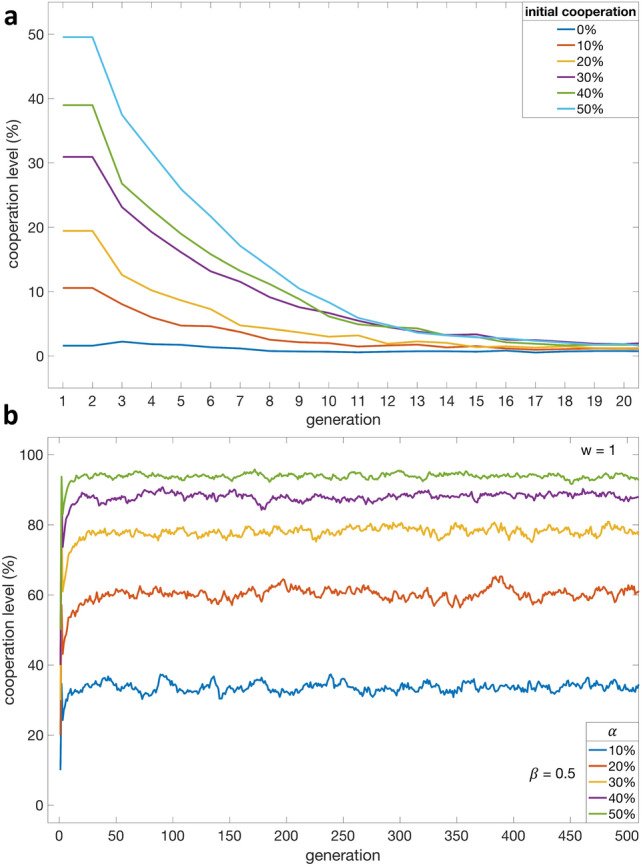
- Without altruists, cooperation declines over 20 generations regardless of the initial cooperation level, resembling behavioural regularities observed in repeated public goods games.
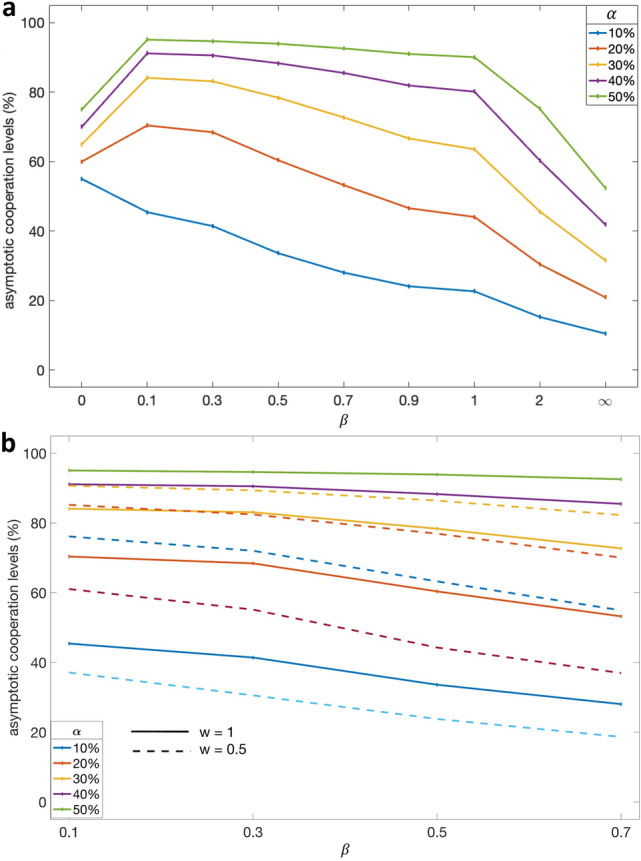
- With altruists and moderate noise, cooperation rises above the initial altruist share; for example, when altruists can imitate with 50% probability, cooperation levels drop from 86% to 77% under the compared conditions but remain high.
- Noise is essential: decreasing noise lowers asymptotic cooperation; with minimal noise, cooperation equals the percentage of altruists, while maximal noise makes cooperation driven by noise and altruists.
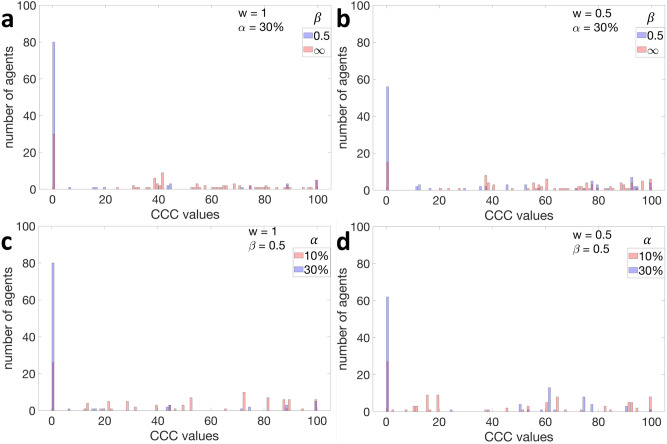
- In the high-cooperation condition, nearly 80% of agents adopt a conditional cooperative criterion (CCC) value of 0, whereas in the low-cooperation condition nearly 25% do so, with the majority adopting CCC values greater than 50; a critical amount of altruism is needed, and under certain noise levels this may require 20% or even 30% altruists.
Methods
- Evolutionary agent-based model with N agents (the provided text omits the numerical value of N), a small fraction of altruists, and the rest conditional cooperators whose CCC threshold determines cooperation based on the previous round’s cooperation level and a noise parameter.
- Agents play a repeated public goods game each generation; conditional cooperators update via pairwise comparison and payoff-biased imitation with noise and 5% mutation, while altruists may be stubborn or imitate with probability w.
- Simulations run for 20,000 generations and are repeated 30 times; outcomes are cooperation levels across generations, asymptotic cooperation over the last 5,000 generations, and the distribution of CCC values in the 20,000th generation.
Limitations
- Stated: the mechanism may not work in small groups, where individuals are more likely to have perfect information about role models’ payoffs and thus imitate free-riders.
- Stated: the model does not specify the conditions under which conditional cooperation evolves endogenously; future work includes spatial networks.
- Evident and stated: the mechanism requires a considerable number of altruists (20% or even 30% under certain noise levels) and relies on assumptions that most people are conditional cooperators, that moderate noise stabilizes cooperation, and that a few altruists can influence the majority.
Model-written summary. Check it against the paper before relying on it.
Integrity signals
Registry
Cites
Statistics
Figures
Verification
Claims the paper makes
21 Valid · 3 Not valid · 13 Not checked · 51 Own results and interpretations
At least one cited source doesn’t support this claim or points to a different paper, and none confirmed it — see the verdicts below.
In the paper
“Moreover, this mechanism does not distinguish between those who free ride due to selfish interests and those who free ride only because others are doing so44.”
§ Cooperation without punishment > Introduction
What the sources say
- Disputedcites [44] Battu B Evolution of altruistic punishments among heterogeneous conditional cooperators Sci. Rep. 2021 11 1 12 10.1038/s41598-021-89563-z 34006903 PMC8131352 sourceExperimental — accuracy not yet measured
The Method (‘Altruistic punishments’; page unavailable) says the model punishes free riders more frequently than occasional free riders. The Discussion likewise says effective punishment targets free riders more frequently and occasional free riders less frequently, and distinguishes selfish free riders from negative reciprocators. That is contrary to the claim that the mechanism does not distinguish between them. (LLM, conf=0.88)
Checked by a reasoning model — may be wrong.
plain- Asserted: passes — The authors put it forward as true.
- Checkable: passes — It can be checked against evidence.
- Load-bearing: passes — The paper’s conclusions depend on it.
- Based: passes — The paper gives a reason why it holds.
- Disputed
The cited sources support only part of this claim — read each source’s verdict below.
In the paper
“Specifically, pool punishment is ineffective when the cost of maintaining central authority outweighs the benefits of cooperation.”
§ Cooperation without punishment > Introduction
What the sources say
- Could not verifycites [34] Szolnoki A Perc M Effectiveness of conditional punishment for the evolution of public cooperation J. Theor. Biol. 2013 325 34 41 10.1016/j.jtbi.2013.02.008 23485452 sourceExperimental — accuracy not yet measured
The Results (p. 7) compare the cost and effectiveness of conditional and unconditional punishment, not pool punishment. The Introduction (p. 1) mentions institutionalized punishment but does not assess the cost of maintaining central authority against the benefits of cooperation. Searches for pool punishment and that cost–benefit condition found no passage addressing the claim. (LLM, conf=0.76)
- Could not verifycites [35] Ohdaira T Evolution of cooperation by the introduction of the probabilistic peer-punishment based on the difference of payoff Sci. Rep. 2016 6 1 9 10.1038/srep25413 27146347 PMC4857114 sourceExperimental — accuracy not yet measured
The Abstract says pool punishment can lower average payoff and discusses its efficiency in maintaining socially advantageous states. Neither the supplied passages nor searches for central-authority costs and the claimed cost–benefit condition say that pool punishment becomes ineffective when those costs outweigh the benefits of cooperation. (LLM, conf=0.72)
- Not checked — no full text of the sourcecites [36] Ohdaira T Characteristics of the evolution of cooperation by the probabilistic peer-punishment based on the difference of payoff Chaos, Solitons Fractals 2017 95 77 83 10.1016/j.chaos.2016.12.008 source
- Could not verifycites [37] Ohdaira T A remarkable effect of the combination of probabilistic peer-punishment and coevolutionary mechanism on the evolution of cooperation Sci. Rep. 2017 7 1 9 10.1038/s41598-017-12742-4 28963526 PMC5622126 sourceExperimental — accuracy not yet measured
The Introduction discusses probabilistic peer-punishment and the problem of costly punishment, while the Discussion reports effects on cooperation and payoff. Searches for pool punishment, central authority, and maintenance costs found no passage saying that pool punishment becomes ineffective when authority costs outweigh cooperation benefits. (LLM, conf=0.76)
- Partly supportedcites [38] Ohdaira T The probabilistic pool punishment proportional to the difference of payoff outperforms previous pool and peer punishment Sci. Rep. 2022 12 1 8 10.1038/s41598-022-10582-5 35459880 PMC9033862 sourceExperimental — accuracy not yet measured
The Model and Discussion (page unavailable) say conventional pool punishment incurs fixed costs and can lose out to cooperators who do not pay them. They do not establish the claimed threshold—that pool punishment becomes ineffective specifically when the cost of maintaining central authority outweighs the benefits of cooperation. (LLM, conf=0.82)
plain- Asserted: passes — The authors put it forward as true.
- Checkable: passes — It can be checked against evidence.
- Load-bearing: passes — The paper’s conclusions depend on it.
- Based: passes — The paper gives a reason why it holds.
- Could not verify
The cited sources support only part of this claim — read each source’s verdict below.
In the paper
“For example, in collective risk dilemmas and public goods games, individuals’ non-binding pledges in the population can trigger conditional cooperation in subsequent rounds17,65.”
§ Cooperation without punishment > Introduction
What the sources say
- Not checked — no full text of the sourcecites [17] Frey BS Stutzer A Economics and Psychology: A Promising New Cross-Disciplinary Field 2007 Cambridge and London MIT Press source
- Partly supportedcites [65] Tavoni A Dannenberg A Kallis G Löschel A Inequality, communication, and the avoidance of disastrous climate change in a public goods game Proc. Natl. Acad. Sci. 2011 108 11825 11829 10.1073/pnas.1102493108 21730154 PMC3141931 sourceExperimental — accuracy not yet measured
The Results (page unavailable) report that the nonbinding Pledge treatments increased group success and that players’ contributions in rounds 8–10 closely matched their pledges. The Discussion (page unavailable) says early signals of commitment appear decisive for coordination. The paper does not establish the more specific claim that pledges triggered conditional cooperation—contributions made in response to others’ pledges—in subsequent rounds. (LLM, conf=0.82)
plainstates a cause- Asserted: passes — The authors put it forward as true.
- Checkable: passes — It can be checked against evidence.
- Load-bearing: passes — The paper’s conclusions depend on it.
- Based: passes — The paper gives a reason why it holds.
The cited sources support only part of this claim — read each source’s verdict below.
In the paper
“Overall, punishment can override altruistic motives, leading individuals to free ride as soon as the opportunity arises to evade punishment45–47.”
§ Cooperation without punishment > Introduction
What the sources say
- Not checked — no full text of the sourcecites [45] Bowles S Policies designed for self-interested citizens may undermine“ the moral sentiments”: Evidence from economic experiments Science 2008 320 1605 1609 10.1126/science.1152110 18566278 source
- Partly supportedcites [46] Fehr E Falk A Psychological foundations of incentives Eur. Econ. Rev. 2002 46 687 724 10.1016/S0014-2921(01)00208-2 sourceExperimental — accuracy not yet measured
Section 3.2 (p. 30) reports that cooperation fell to very low levels without a punishment opportunity and was nearly complete when punishment was possible. That supports a link between punishment and cooperation, but it does not show that punishment overrides altruistic motives or that individuals free ride as soon as they can evade it. Section 2.4 (p. 27) instead describes some punishment opportunities as disciplining potential shirkers without offending voluntary cooperators. (LLM, conf=0.83)
- Not checked — no full text of the sourcecites [47] Fehr E Fischbacher U Why social preferences matter-the impact of non-selfish motives on competition, cooperation and incentives Econ. J. 2002 112 C1 C33 10.1111/1468-0297.00027 source
plainstates a cause- Asserted: passes — The authors put it forward as true.
- Checkable: passes — It can be checked against evidence.
- Load-bearing: passes — The paper’s conclusions depend on it.
- Based: passes — The paper gives a reason why it holds.
The cited sources support only part of this claim — read each source’s verdict below.
In the paper
“Our novel alternative to punishment builds on the reciprocal nature of the trust—the fact that people reciprocate voluntary trust68—as well as the conditional nature of human cooperation—the fact that negative reciprocity can be switched to positive reciprocity given sufficient cooperation levels44,69–71.”
§ Cooperation without punishment > Introduction
What the sources say
- Supportedcites [44] Battu B Evolution of altruistic punishments among heterogeneous conditional cooperators Sci. Rep. 2021 11 1 12 10.1038/s41598-021-89563-z 34006903 PMC8131352 source
The Discussion says that a critical amount of cooperation in initial rounds creates conditions in which reciprocators cooperate. The Method section makes the switch explicit in the model: a conditional cooperator’s probability of donating rises when prior donations exceed its cooperation threshold. This supports the claim in the context of the paper’s repeated public-goods-game model. (LLM, conf=0.88)
- Partly supportedcites [69] Battu B Pammi V Srinivasan N Evolution of cooperation with heterogeneous conditional cooperators Sci. Rep. 2018 8 1 7 10.1038/s41598-018-22593-2 29540725 PMC5852119 sourceExperimental — accuracy not yet measured
The Introduction (page unavailable) describes agents switching from not donating to donating when enough others have cooperated. But it explicitly distinguishes this conditional response from retaliation or reciprocation toward other agents, so the source supports the switch in behavior, not its characterization as a switch from negative to positive reciprocity. (LLM, conf=0.87)
- Partly supportedcites [70] Battu B Srinivasan N Evolution of conditional cooperation in public good games Royal Soc. Open Sci. 2020 7 191567 10.1098/rsos.191567 PMC7277267 32537191 sourceExperimental — accuracy not yet measured
The Model section says simulated agents donate when donations in the previous round exceed their individual threshold, and the Discussion says stable cooperation requires a critical amount of cooperation. This supports a threshold-dependent shift toward cooperation, but the paper does not establish that negative reciprocity in humans switches to positive reciprocity. (LLM, conf=0.84)
- Partly supportedcites [71] Schmelz K Bowles S Overcoming covid-19 vaccination resistance when alternative policies affect the dynamics of conformism, social norms, and crowding out Proc. Natl. Acad. Sci. 2021 118 e2104912118 10.1073/pnas.2104912118 34099578 PMC8237671 sourceExperimental — accuracy not yet measured
The Results section says that people in public-goods experiments may cooperate conditionally, contributing only if others do, and its vaccination model describes a tipping point after which more people prefer vaccination. These passages support cooperation or uptake increasing in response to others’ actions, but they do not establish that negative reciprocity switches to positive reciprocity at a sufficient level of cooperation. No page numbers are available in our copy. (LLM, conf=0.82)
plainstates a cause- Asserted: passes — The authors put it forward as true.
- Checkable: passes — It can be checked against evidence.
- Load-bearing: passes — The paper’s conclusions depend on it.
- Based: passes — The paper gives a reason why it holds.
- Supported
61 more claims · 11 with their cited sources checked
Create a free account to see all 88 claims and to verify the 6 references still open.
- Probably not a substantial claim. 8
- It may state two separate claims as one. 13
- The quote only partly states this claim. 1
Citations
Cites
Hardin, G. (1968) · Science · doi:10.1126/science.162.3859.1243 · Cited by 25,167
Governing the Commons: The Evolution of Institutions for Collective Action
Ostrom, E. (1990) · doi:10.1017/cbo9780511807763 · Cited by 20,653
Olson, M. (1965) · doi:10.4159/9780674041660 · Cited by 14,191
Five Rules for the Evolution of Cooperation
Nowak, M. A. (2006) · Science · doi:10.1126/science.1133755 · Cited by 5,894
Altruistic punishment in humans
Fehr, E., & Gächter, S. (2002) · Nature · doi:10.1038/415137a · Cited by 5,616
Cooperation and Punishment in Public Goods Experiments
Fehr, E., & Gächter, S. (2000) · American Economic Review · doi:10.1257/aer.90.4.980 · Cited by 4,547
The Struggle to Govern the Commons
Dietz, T., Ostrom, E., & Stern, P. C. (2003) · Science · doi:10.1126/science.1091015 · Cited by 4,209
Collective action and the evolution of social norms.
Ostrom, E. (2000) · Journal of Economic Perspectives · doi:10.1257/jep.14.3.137 · Cited by 4,195
The Handbook of experimental economics
(1995) · Choice Reviews Online · doi:10.5860/choice.33-1645 · Cited by 3,679
Fehr, E., & Fischbacher, U. (2003) · Nature · doi:10.1038/nature02043 · Cited by 3,475
Fairness and retaliation: the economics of reciprocity
Fehr, E., & Gächter, S. (2000) · Journal of Economic Perspectives · doi:10.1257/jep.14.3.159 · Cited by 3,239
Szabó, G., & Fáth, G. (2007) · Physics Reports · doi:10.1016/j.physrep.2007.04.004 · Cited by 2,974
Are people conditionally cooperative? Evidence from a public goods experiment
Fischbacher, U., Gächter, S., & Fehr, E. (2001) · Economics Letters · doi:10.1016/s0165-1765(01)00394-9 · Cited by 2,780
In Search of Homo Economicus: Behavioral Experiments in 15 Small-Scale Societies
Henrich, J., Boyd, R., Bowles, S., Camerer, C., Fehr, E., Gintis, H., & McElreath, R. (2001) · American Economic Review · doi:10.1257/aer.91.2.73 · Cited by 2,614
Antisocial Punishment Across Societies
Herrmann, B., Thöni, C., & Gächter, S. (2008) · Science · doi:10.1126/science.1153808 · Cited by 2,038
Dawes, R. M. (1980) · Annual Review of Psychology · doi:10.1146/annurev.ps.31.020180.001125 · Cited by 2,022
The Neural Basis of Altruistic Punishment
de Quervain, D. J.-F., Fischbacher, U., Treyer, V., Schellhammer, M., Schnyder, U., Buck, A., & Fehr, E. (2004) · Science · doi:10.1126/science.1100735 · Cited by 1,768
The evolution of altruistic punishment
Boyd, R., Gintis, H., Bowles, S., & Richerson, P. J. (2003) · Proceedings of the National Academy of Sciences · doi:10.1073/pnas.0630443100 · Cited by 1,748
Social norms and human cooperation
Fehr, E., & Fischbacher, U. (2004) · Trends in Cognitive Sciences · doi:10.1016/j.tics.2004.02.007 · Cited by 1,615
Statistical physics of human cooperation
Perc, M., Jordan, J. J., Rand, D. G., Wang, Z., Boccaletti, S., & Szolnoki, A. (2017) · Physics Reports · doi:10.1016/j.physrep.2017.05.004 · Cited by 1,590
Psychological foundations of incentives
Fehr, E., & Falk, A. (2002) · European Economic Review · doi:10.1016/s0014-2921(01)00208-2 · Cited by 1,240
Social Comparisons and Pro-social Behavior: Testing “Conditional Cooperation” in a Field Experiment
Frey, B. S., & Meier, S. (2004) · American Economic Review · doi:10.1257/0002828043052187 · Cited by 1,184
Evolutionary Dynamics of Biological Games
Nowak, M. A., & Sigmund, K. (2004) · Science · doi:10.1126/science.1093411 · Cited by 1,184
Volunteering as Red Queen Mechanism for Cooperation in Public Goods Games
Hauert, C., De Monte, S., Hofbauer, J., & Sigmund, K. (2002) · Science · doi:10.1126/science.1070582 · Cited by 1,114
Fehr, E., & Fischbacher, U. (2002) · The Economic Journal · doi:10.1111/1468-0297.00027 · Cited by 1,061
Explaining altruistic behavior in humans
Gintis, H., Bowles, S., Boyd, R., & Fehr, E. (2003) · Evolution and Human Behavior · doi:10.1016/s1090-5138(02)00157-5 · Cited by 1,037
2. Public Goods: A Survey of Experimental Research
Ledyard, J. O. (1995) · The Handbook of Experimental Economics · doi:10.1515/9780691213255-004 · Cited by 1,033
Indirect reciprocity can stabilize cooperation without the second-order free rider problem
Panchanathan, K., & Boyd, R. (2004) · Nature · doi:10.1038/nature02978 · Cited by 865
Bowles, S. (2008) · Science · doi:10.1126/science.1152110 · Cited by 833
Conditional Cooperation and Voluntary Contributions to Public Goods
Keser, C., & Van Winden, F. (2000) · The Scandinavian Journal of Economics · doi:10.1111/1467-9442.00182 · Cited by 800
Detrimental effects of sanctions on human altruism
Fehr, E., & Rockenbach, B. (2003) · Nature · doi:10.1038/nature01474 · Cited by 795 · cited 3×
“(1), receives its payoff following Eq.”
BackgroundInfluentialExperimental evidence for tipping points in social convention
Centola, D., Becker, J., Brackbill, D., & Baronchelli, A. (2018) · Science · doi:10.1126/science.aas8827 · Cited by 750
When Does "Economic Man" Dominate Social Behavior?
Camerer, C. F., & Fehr, E. (2006) · Science · doi:10.1126/science.1110600 · Cited by 732
On the Nature of Fair Behavior
Falk, A., Fehr, E., & Fischbacher, U. (2003) · Economic Inquiry · doi:10.1093/ei/41.1.20 · Cited by 728
Via Freedom to Coercion: The Emergence of Costly Punishment
Hauert, C., Traulsen, A., Brandt, H., Nowak, M. A., & Sigmund, K. (2007) · Science · doi:10.1126/science.1141588 · Cited by 725
Positive Interactions Promote Public Cooperation
Rand, D. G., Dreber, A., Ellingsen, T., Fudenberg, D., & Nowak, M. A. (2009) · Science · doi:10.1126/science.1177418 · Cited by 715
Punishment and counter-punishment in public good games: Can we really govern ourselves?
Nikiforakis, N. (2008) · Journal of Public Economics · doi:10.1016/j.jpubeco.2007.04.008 · Cited by 711 · cited 1×
“(3) with 5% mutations, implying that 5% of conditional cooperators miscopy their role model’s strategy.”
BackgroundReward and cooperation in the spatial public goods game
Szolnoki, A., & Perc, M. (2010) · EPL (Europhysics Letters) · doi:10.1209/0295-5075/92/38003 · Cited by 689
Tax morale and conditional cooperation
Frey, B. S., & Torgler, B. (2007) · Journal of Comparative Economics · doi:10.1016/j.jce.2006.10.006 · Cited by 671
Positive reciprocity and intentions in trust games
McCabe, K. A., Rigdon, M. L., & Smith, V. L. (2003) · Journal of Economic Behavior & Organization · doi:10.1016/s0167-2681(03)00003-9 · Cited by 659
Conditional Cooperation and Costly Monitoring Explain Success in Forest Commons Management
Rustagi, D., Engel, S., & Kosfeld, M. (2010) · Science · doi:10.1126/science.1193649 · Cited by 575
Sigmund, K. (2010) · doi:10.1515/9781400832255 · Cited by 570
Hauert, C., & Szabó, G. (2005) · American Journal of Physics · doi:10.1119/1.1848514 · Cited by 511
Inequality, communication, and the avoidance of disastrous climate change in a public goods game
Tavoni, A., Dannenberg, A., Kallis, G., & Löschel, A. (2011) · Proceedings of the National Academy of Sciences · doi:10.1073/pnas.1102493108 · Cited by 497
Altruistic punishment and the origin of cooperation
Fowler, J. H. (2005) · Proceedings of the National Academy of Sciences · doi:10.1073/pnas.0500938102 · Cited by 473
Conditional cooperation on three continents
Kocher, M. G., Cherry, T., Kroll, S., Netzer, R. J., & Sutter, M. (2008) · Economics Letters · doi:10.1016/j.econlet.2008.07.015 · Cited by 387
Replicator Dynamics for Optional Public Good Games
HAUERT, C., DE MONTE, S., HOFBAUER, J., & SIGMUND, K. (2002) · Journal of Theoretical Biology · doi:10.1006/jtbi.2002.3067 · Cited by 371
The evolution of antisocial punishment in optional public goods games
Rand, D. G., & Nowak, M. A. (2011) · Nature Communications · doi:10.1038/ncomms1442 · Cited by 350
Centralized sanctioning and legitimate authority promote cooperation in humans
Baldassarri, D., & Grossman, G. (2011) · Proceedings of the National Academy of Sciences · doi:10.1073/pnas.1105456108 · Cited by 330
A Cooperative Species: Human Reciprocity and Its Evolution
Bowles, S., & Gintis, H. (2011) · doi:10.23943/princeton/9780691151250.001.0001 · Cited by 313
Intuition, deliberation, and the evolution of cooperation
Bear, A., & Rand, D. G. (2016) · Proceedings of the National Academy of Sciences · doi:10.1073/pnas.1517780113 · Cited by 298
Collective action and the evolution of social norm internalization
Gavrilets, S., & Richerson, P. J. (2017) · Proceedings of the National Academy of Sciences · doi:10.1073/pnas.1703857114 · Cited by 275
Cooperation, Punishment, and the Evolution of Human Institutions
Henrich, J. (2006) · Science · doi:10.1126/science.1126398 · Cited by 233
Strong Reciprocity and the Roots of Human Morality
Gintis, H., Henrich, J., Bowles, S., Boyd, R., & Fehr, E. (2008) · Social Justice Research · doi:10.1007/s11211-008-0067-y · Cited by 233
Szolnoki, A., & Perc, M. (2013) · Physical Review X · doi:10.1103/physrevx.3.041021 · Cited by 202
Evolutionary advantages of adaptive rewarding
Szolnoki, A., & Perc, M. (2012) · New Journal of Physics · doi:10.1088/1367-2630/14/9/093016 · Cited by 200
Effectiveness of conditional punishment for the evolution of public cooperation
Szolnoki, A., & Perc, M. (2013) · Journal of Theoretical Biology · doi:10.1016/j.jtbi.2013.02.008 · Cited by 173
Trust, Trustworthiness, and the Behavioral Foundations of Corporate Law
Blair, M. M., & Stout, L. A. (2001) · University of Pennsylvania Law Review · doi:10.2307/3312898 · Cited by 172
Reciprocity and the tragedies of maintaining and providing the commons
Gächter, S., Kölle, F., & Quercia, S. (2017) · Nature Human Behaviour · doi:10.1038/s41562-017-0191-5 · Cited by 147
Evolution of emotions on networks leads to the evolution of cooperation in social dilemmas
Szolnoki, A., Xie, N.-G., Ye, Y., & Perc, M. (2013) · Physical Review E · doi:10.1103/physreve.87.042805 · Cited by 132
Liu, L., Chen, X., & Szolnoki, A. (2019) · Mathematical Models and Methods in Applied Sciences · doi:10.1142/s0218202519500428 · Cited by 128
Nakahashi, W., Wakano, J. Y., & Henrich, J. (2012) · Human Nature · doi:10.1007/s12110-012-9151-y · Cited by 123
Imitating emotions instead of strategies in spatial games elevates social welfare
Szolnoki, A., Xie, N.-G., Wang, C., & Perc, M. (2011) · EPL (Europhysics Letters) · doi:10.1209/0295-5075/96/38002 · Cited by 119
The promise and the peril of using social influence to reverse harmful traditions
Efferson, C., Vogt, S., & Fehr, E. (2019) · Nature Human Behaviour · doi:10.1038/s41562-019-0768-2 · Cited by 110
Schmelz, K., & Bowles, S. (2021) · Proceedings of the National Academy of Sciences · doi:10.1073/pnas.2104912118 · Cited by 98
Slow to Anger and Fast to Forgive: Cooperation in an Uncertain World
Fudenberg, D., Rand, D. G., & Dreber, A. (2012) · American Economic Review · doi:10.1257/aer.102.2.720 · Cited by 97
Hilbe, C., Traulsen, A., Röhl, T., & Milinski, M. (2014) · Proceedings of the National Academy of Sciences · doi:10.1073/pnas.1315273111 · Cited by 90
Group interactions modulate critical mass dynamics in social convention
Iacopini, I., Petri, G., Baronchelli, A., & Barrat, A. (2022) · Communications Physics · doi:10.1038/s42005-022-00845-y · Cited by 69
Network Engineering Using Autonomous Agents Increases Cooperation in Human Groups
Shirado, H., & Christakis, N. A. (2020) · iScience · doi:10.1016/j.isci.2020.101438 · Cited by 46
Evolution of altruistic punishment in heterogeneous populations
de Weerd, H., & Verbrugge, R. (2011) · Journal of Theoretical Biology · doi:10.1016/j.jtbi.2011.08.034 · Cited by 29
Social norms and the indirect evolution of conditional cooperation
Traxler, C., & Spichtig, M. (2010) · Journal of Economics · doi:10.1007/s00712-010-0173-9 · Cited by 26
Ohdaira, T. (2016) · Scientific Reports · doi:10.1038/srep25413 · Cited by 26
Ohdaira, T. (2022) · Scientific Reports · doi:10.1038/s41598-022-10582-5 · Cited by 25
Ohdaira, T. (2017) · Chaos, Solitons & Fractals · doi:10.1016/j.chaos.2016.12.008 · Cited by 21
Ohdaira, T. (2017) · Scientific Reports · doi:10.1038/s41598-017-12742-4 · Cited by 16
Population Structure Promotes the Evolution of Intuitive Cooperation and Inhibits Deliberation
Mosleh, M., & Rand, D. G. (2018) · Scientific Reports · doi:10.1038/s41598-018-24473-1 · Cited by 16
Evolution of conditional cooperation in public good games
Battu, B., & Srinivasan, N. (2020) · Royal Society Open Science · doi:10.1098/rsos.191567 · Cited by 15
Self-citationBehavioral Foundations of Corporate Culture
Fehr, E. (2018) · SSRN Electronic Journal · doi:10.2139/ssrn.3283728 · Cited by 13
Evolution of Cooperation with Heterogeneous Conditional Cooperators
Battu, B., Pammi, V. S. C., & Srinivasan, N. (2018) · Scientific Reports · doi:10.1038/s41598-018-22593-2 · Cited by 11
Self-citationOhdaira, T. (2019) · Scientific Reports · doi:10.1038/s41598-019-41073-9 · Cited by 10
Cooperation evolves by the payoff-difference-based probabilistic reward
Ohdaira, T. (2021) · The European Physical Journal B · doi:10.1140/epjb/s10051-021-00239-z · Cited by 10
Salahshour, M., Oberhauser, V., & Smerlak, M. (2022) · PLOS ONE · doi:10.1371/journal.pone.0263028 · Cited by 9
Evolution of altruistic punishments among heterogeneous conditional cooperators
Battu, B. (2021) · Scientific Reports · doi:10.1038/s41598-021-89563-z · Cited by 5
Self-citation
Research works printed but not linked: 1
- Sarkar R Decentralised forest governance in central himalayas: A re-evaluation of outcomes Econ. Pol. Wkly 2008 43 54 61
Cited by
Multifactorial effects on bounded rational decision-making
Han, D., & Li, X. (2024) · Europhysics Letters (EPL) · doi:10.1209/0295-5075/ad3574 · Cited by 12
Restoring spatial cooperation with myopic agents in a three-strategy social dilemma
Lee, H., Cleveland, C., & Szolnoki, A. (2023) · Applied Mathematics and Computation · doi:10.1016/j.amc.2023.128226 · Cited by 11
“is valid whether we apply punishment [30, 31, 32, 33], or reward [34, 24, 35], individually, or collectively via an institution [36, 37, 38, 39].”
BackgroundA social monitoring mechanism for third-party judges promotes cooperation in evolutionary games
Yang, Q., & Yang, Y. (2024) · Applied Mathematics and Computation · doi:10.1016/j.amc.2024.128991 · Cited by 10
Co-evolution of conditional cooperation and social norm
Battu, B. (2023) · Scientific Reports · doi:10.1038/s41598-023-43918-w · Cited by 10
Self-citationExploration of Altruistic Behavior in Early Adult Volunteers: A Phenomenological Study
Fadhilah, D. N., & Agustin, R. W. (2024) · Journal of Educational Health and Community Psychology · doi:10.12928/jehcp.v13i1.27713 · Cited by 2
Metadata
- Authors
- Battu, B., & Rahwan, T.
- Affiliations
- New York University Abu Dhabi (AE)
- Corresponding author
- Battu, Balaraju
- Rahwan, Talal
- Venue
- Scientific Reports
- Published
- 2023-01-21
- Volume
- 13
- Issue
- 1
- Pages
- 1213-1213
- ISSN
- 2045-2322 (ISSN-L)
- PMC
- PMC9867775
- OpenAlex
- W4317662182
- Semantic Scholar
- a3595bea663798becdbfca6d0b79179c35f174a4
- Cited by
- 12
- References
- 89
- Citations by year
- 2026: 4 · 2025: 3 · 2024: 3 · 2023: 2
- FWCI
- 5.15
- Type
- journal article
- Language
- en
- Open access
- gold
- doi.org
- Licence
- cc-by
- creativecommons.org/licenses/by/4.0 (tdm)
- creativecommons.org/licenses/by/4.0 (vor)
- Locations
- Scientific Reports (publishedVersion, cc-by)
- PubMed Central (publishedVersion, cc-by)
- PubMed (publishedVersion)
- DOAJ (DOAJ: Directory of Open Access Journals) (submittedVersion, cc-by-sa)
- Topics
- Social Sciences › Sociology and Political Science › Evolutionary Game Theory and Cooperation
- Social Sciences › Economics, Econometrics and Finance › Economics and Econometrics › Experimental Behavioral Economics Studies
- Social Sciences › Decision Sciences › Management Science and Operations Research › Game Theory and Applications
- Keywords
- cooperation, altruistic punishment, conditional cooperation, public goods game, noise, free-riding, positive reciprocity, evolutionary game theory, self-government, trust, role models, imitation, heterogeneous populations
- MeSH terms
- Social Interaction, Altruism, Cooperative Behavior, Game Theory, Humans, Punishment
About these checks
Registry, retraction, Cites and statistics results are computed, not judged, with one exception: a printed reference that no index lists is read once by a model before it counts as a citation error. Claims are extracted by a model and kept only when their quote appears verbatim in the text; each cited source is then checked, with a model’s help, for whether it says what the claim relies on. Those verdicts can be wrong — read the claim’s quote and the cited source before relying on one.
The claim verdicts this report counts are experimental: their accuracy is not yet measured.
A language model drew the claims from the paper on 2026-10-10, under version 3 of the claim definition (model deepseek-v4.1-flash, prompt extract-v3).
A second model labelled each claim on 2026-10-10 (model jev-1.13-20260917, definition revision gold-guideline-v0.2).
Cited sources are checked with a language model’s help (gpt-6-sol).
Statistics and arithmetic are recomputed, not judged.
Confidence bands are shown only for fields calibrated on our annotated test set. None is calibrated yet, so no band is shown.
What counts as a claim ›How we measure confidence ›How we check this ›
Are you an author, or do you see a problem with this page? Request a review
Data sources
Bibliographic data: Semantic Scholar, OpenAlex, Crossref.
Contains information from the Semantic Scholar Academic Graph Datasets, made available under the ODC Attribution License (ODC-BY 1.0).
Semantic Scholar’s data is described in: Kinney, R., et al. (2023). The Semantic Scholar Open Data Platform. arXiv:2301.10140.
