

The brain-body disconnect: A somatic sensory basis for trauma-related disorders
Open accessThe DOI matches its Crossref record; 460 of the 480 references it cites were found in a registry or an index, and 1 are not checked yet; 6 of the 290 sources its claims cite were checked for support.
Abstract
Although the manifestation of trauma in the body is a phenomenon well-endorsed by clinicians and traumatized individuals, the neurobiological underpinnings of this manifestation remain unclear. The notion of somatic sensory processing, which encompasses vestibular and somatosensory processing and relates to the sensory systems concerned with how the physical body exists in and relates to physical space, is introduced as a major contributor to overall regulatory, social-emotional, and self-referential functioning. From a phylogenetically and ontogenetically informed perspective, trauma-related symptomology is conceptualized to be grounded in brainstem-level somatic sensory processing dysfunction and its cascading influences on physiological arousal modulation, affect regulation, and higher-order capacities. Lastly, we introduce a novel hierarchical model bridging somatic sensory processes with limbic and neocortical mechanisms regulating an individual’s emotional experience and sense of a relational, agentive self. This model provides a working framework for the neurobiologically informed assessment and treatment of trauma-related conditions from a somatic sensory processing perspective.
Verified 2026-10-11 · 1 reference not checked yet
Overview
CoChat Summary
## TL;DR
This is a narrative review arguing that trauma-related disorders, especially PTSD and PTSD with dissociative subtype, can be understood through disrupted somatic sensory processing—especially vestibular and somatosensory pathways that shape arousal, defense, and embodiment. The authors propose that therapy should target these brain-body pathways with somatic and multisensory interventions alongside top-down approaches.
## Key findings
- PTSD + dissociative subtype (PTSD + DS) occurs in up to 44% of individuals with PTSD, and is characterized by derealization and depersonalization.
- The paper argues that PTSD is associated with sensory hyper-responsivity, while dissociative symptoms are associated with sensory hypo-sensitivity and altered thresholds for sensory registration.
- The authors cite findings that in PTSD + DS there is significantly decreased vestibular nuclei connectivity with the TPJ and cortical regions (Harricharan et al., 2017), and that PTSD + DS shows altered resting-state functional connectivity between the PPN and amygdala/vmPFC, with negative correlations between PPN-anterior thalamus connectivity and derealization/depersonalization symptoms (Thome et al., 2019).
- They also note that two randomized controlled trials of trauma-sensitive yoga in women with treatment-resistant PTSD showed reductions in PTSD symptoms and dissociation, with the 10-week study yielding decreases comparable to psychopharmaceutical and psychotherapeutic interventions, and the 20-week study producing even greater improvements.
## Methods
- This is a transdisciplinary narrative review; it synthesizes neuroscience, developmental, attachment, and trauma literature rather than presenting a new empirical sample.
- The review focuses on the vestibular system, somatosensory system, brainstem/midbrain circuitry (including the PAG and RAS), attachment development, and implications for PTSD/PTSD + DS.
- Main analysis is conceptual and integrative, building a neurobiological framework from cited studies, including reports of functional connectivity, symptom associations, and treatment findings.
## Limitations
- The authors explicitly note that the neural pathway for affective touch “remains speculative.”
- They state that discussion of pain-related trauma disorders is beyond the scope of the paper.
- Evident from the text: this is a review and hypothesis-building paper, so it does not provide new primary data or causal tests of the proposed brain-body model.
Model-written summary. Check it against the paper before relying on it.
Integrity signals
Registry
Cites
Statistics
Figures
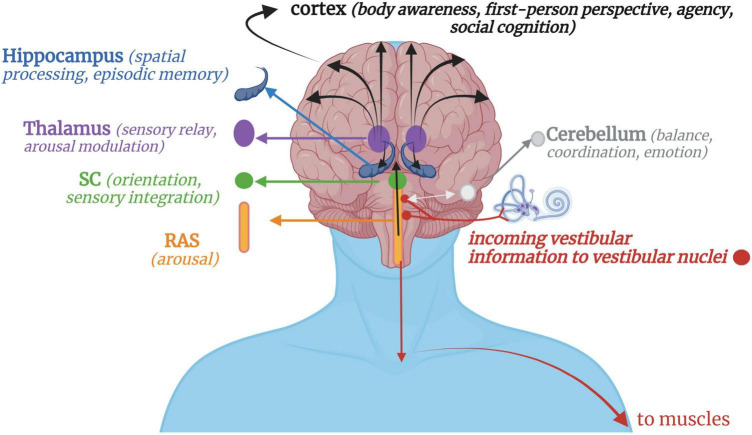
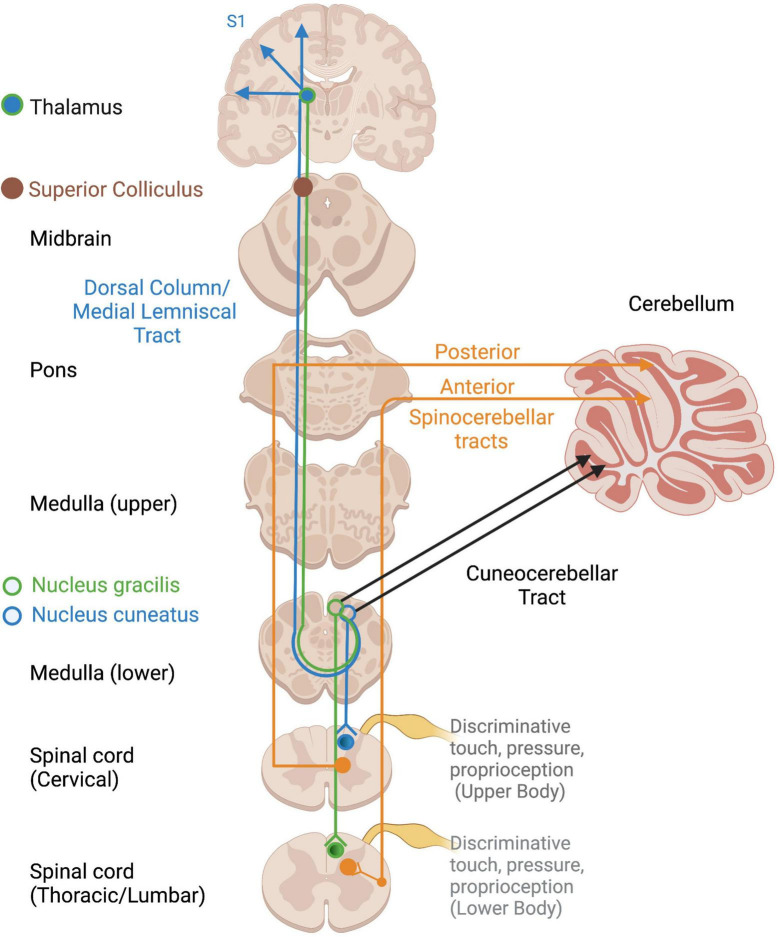
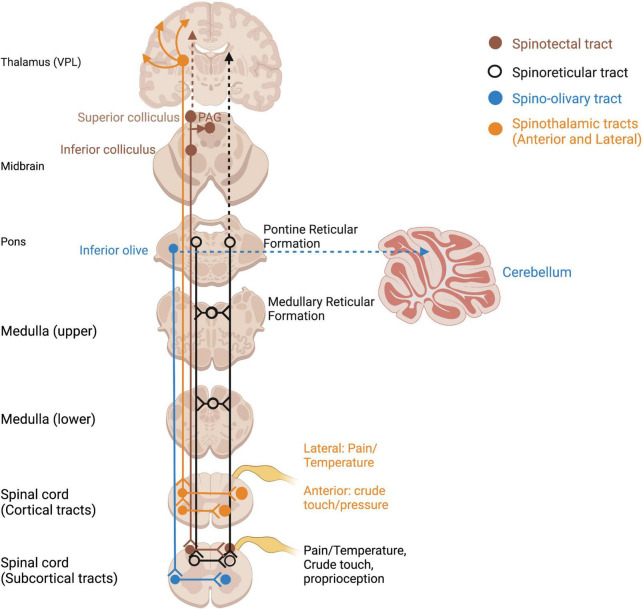
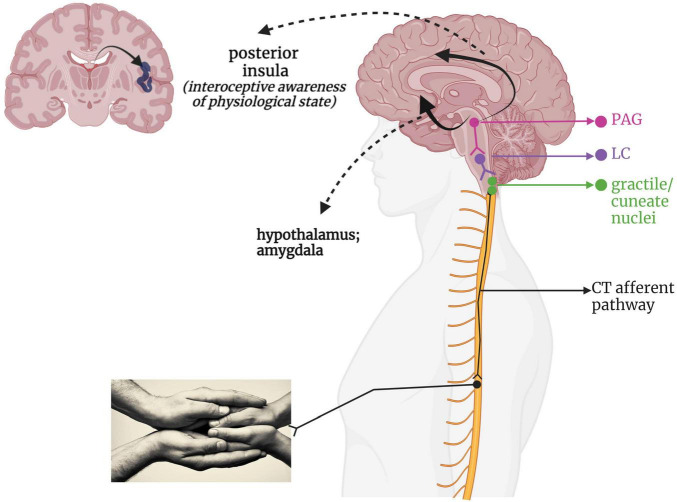
Verification
Claims the paper makes
6 Valid · 0 Not valid · 135 Not checked · 47 Own results and interpretations
The cited sources support only part of this claim — read each source’s verdict below.
In the paper
“Alternatively, hypo-arousal and decreased muscle tone occur during emotional shut-down or feign death as a passive defensive response to inescapable or prolonged threat ( Hofer, 1970 ; Depaulis et al., 1994 ; Bracha, 2004 ).”
What the sources say
- Not checked yetcites Hofer, 1970
- Not checked yetcites Depaulis et al., 1994 matched to “Quiescence and hyporeactivity evoked by activation of cell bodies in the ventrolateral midbrain periaqueductal gray of the rat.” (1994) source
- Partly supportedcites Bracha, 2004 matched to “Freeze, Flight, Fight, Fright, Faint: Adaptationist Perspectives on the Acute Stress Response Spectrum” (2004) sourceExperimental — accuracy not yet measured
The Abstract (p. 2) describes ‘playing dead’ as a defensive response when escape or fighting is not possible, and the faintness proposal (p. 4) describes a flaccid collapse. But ‘Atypical Form of Fright’ (p. 4) distinguishes the two: playing dead (tonic immobility) involves tachycardia and hyperalertness, not hypo-arousal. The paper also does not identify emotional shut-down as the response described here. (LLM, conf=0.86)
plainstates a cause- Asserted: passes — The authors put it forward as true.
- Checkable: passes — It can be checked against evidence.
- Load-bearing: passes — The paper’s conclusions depend on it.
- Based: passes — The paper gives a reason why it holds.
The cited sources support only part of this claim — read each source’s verdict below.
In the paper
“These individuals may seek to engage the SN and thus gain access to the DMN through intense or primally threatening somatic sensory experiences, such as car racing, extreme sports, and promiscuous sex ( van der Kolk, 1989 , 2015 ; Lanius et al., 2020 ).”
What the sources say
- Not checked yetcites van der Kolk, 1989, 2015
- Partly supportedcites Lanius et al., 2020 matched to “The sense of self in the aftermath of trauma: lessons from the default mode network in posttraumatic stress disorder” (2020) sourceExperimental — accuracy not yet measured
In “The DMN under threat: how might DMN-related alterations present clinically?” (page not provided), the authors suggest that some people with PTSD may seek threat or terror to engage the DMN, and link sensory seeking and reckless behaviour to that possibility. The passage does not describe engaging the SN as a route to the DMN or give car racing, extreme sports, and promiscuous sex as examples. (LLM, conf=0.85)
hedgedstates a possible cause- Asserted: passes — The authors put it forward as true.
- Checkable: passes — It can be checked against evidence.
- Load-bearing: unclear — It is unclear whether the paper’s conclusions depend on it.
- Based: passes — The paper gives a reason why it holds.
The cited sources support only part of this claim — read each source’s verdict below.
In the paper
“Severe early life neurodevelopmental disruptions may also give rise to the experience of multiple fragmented, discontinuous, and disembodied selves, such as those experienced in dissociative identity disorder (DID), a condition highly co-existent with early and severe traumatization ( Reinders et al., 2003 ; Dorahy et al., 2014 ; Schlumpf et al., 2014 ; Reinders and Veltman, 2021 ).”
What the sources say
- Not checked yetcites Reinders et al., 2003
- Partly supportedcites Dorahy et al., 2014 matched to “Dissociative identity disorder: An empirical overview” (2014) sourceExperimental — accuracy not yet measured
Split into 2 atoms — 1 confirmed, 1 partially supported, 0 disputed, 0 misattributed, 0 unverifiable. Expand the claim to see per-atom verdicts.
- Not checked yetcites Schlumpf et al., 2014
hedgedstates a possible cause- Asserted: passes — The authors put it forward as true.
- Checkable: passes — It can be checked against evidence.
- Load-bearing: passes — The paper’s conclusions depend on it.
- Based: passes — The paper gives a reason why it holds.
None of the sources cited for this claim have been checked yet.
In the paper
“Alterations to multisensory processing have been shown to mediate higher-order cognition ( Alais et al., 2010 ; Wallace et al., 2020 ), emotion ( Klasen et al., 2012 ), social capacities ( Baranek et al., 2018 ; Stevenson et al., 2018 ; Thye et al., 2018 ), and sense of self ( Panksepp and Northoff, 2009 ;”
What the sources say
- Not checked yetcites Alais et al., 2010
- Not checked yetcites Wallace et al., 2020
- Not checked yetcites Klasen et al., 2012
boostedstates a cause- Asserted: passes — The authors put it forward as true.
- Checkable: passes — It can be checked against evidence.
- Load-bearing: passes — The paper’s conclusions depend on it.
- Based: passes — The paper gives a reason why it holds.
None of the sources cited for this claim have been checked yet.
In the paper
“Additionally, PTSD + DS occurs in up to 44% of individuals with PTSD and is characterized by additional symptoms of derealization and depersonalization ( Lanius et al., 2010b ; Steuwe et al., 2012 ; Wolf et al., 2012b ; Stein et al., 2013 ; Armour et al., 2014 ; Blevins et al., 2014 ; for a review, see Hansen et al., 2017 ; White et al., 2022 ).”
What the sources say
- Not checked yetcites Lanius et al., 2010b
- Not checked yetcites Steuwe et al., 2012
- Not checked yetcites Wolf et al., 2012b
plainstates an association- Asserted: passes — The authors put it forward as true.
- Checkable: passes — It can be checked against evidence.
- Load-bearing: unclear — It is unclear whether the paper’s conclusions depend on it.
- Based: passes — The paper gives a reason why it holds.
87 more claims
Create a free account to see all 188 claims and to verify the 282 references still open.
- It may state two separate claims as one. 77
- Probably not a substantial claim. 30
Claims other papers make about this one
Each is checked against this paper’s own text: does it say what the citing paper says it does?
The source backs part of the claim, not all of it — or backs it for a different population, condition or comparison.
In the citing paper
“PVT introduced the notion of somatic sensory processing, which encompasses vestibular and somatosensory processing and relates to the sensory systems concerned with how the physical body exists in and relates to physical space, as a major contributor to overall regulatory, social–emotional, and self-referential functioning (Kearney and Lanius, 2022).”
From A theoretical exploration of polyvagal theory in creative arts and psychomotor therapies for emotion regulation in stress and trauma (2024) · cites this paper as Kearney and Lanius, 2022
Experimental — accuracy not yet measuredThe cited source says what the claim attributes to it.
In the citing paper
“The non-verbal rhythmicity inherent in music therapy may provide vibratory stimulation and an external source of rhythm when internal rhythms and sensorimotor synchrony is disrupted due to somatic sensory disintegration (Kearney and Lanius, 2022).”
From A theoretical exploration of polyvagal theory in creative arts and psychomotor therapies for emotion regulation in stress and trauma (2024) · cites this paper as Kearney and Lanius, 2022
The cited source says what the claim attributes to it.
In the citing paper
“Healing from trauma is indicated by one’s ability to be in an optimal state of arousal while experiencing affective sensations/emotions in the body (Kearney and Lanius, 2022).”
From A theoretical exploration of polyvagal theory in creative arts and psychomotor therapies for emotion regulation in stress and trauma (2024) · cites this paper as Kearney and Lanius, 2022
In the citing paper
“b) previous life experiences, including lower intensity adversities, shape PTSD presentations;”
From Evolving Psychotherapeutic Approaches for PTSD: Beyond the Fear-Based Model (2025) · doi:10.5152/pcp.2025.241019 · cites this paper as [7]
In the citing paper
“d) exposure may overwhelm information processing capacities in some people, especially those with severe early trauma or attachment disruption.”
From Evolving Psychotherapeutic Approaches for PTSD: Beyond the Fear-Based Model (2025) · doi:10.5152/pcp.2025.241019 · cites this paper as [7]
Citations
Cites
(1978) · Medical Entomology and Zoology · Cited by 12,570
The expression of the emotions in man and animals.
Darwin, C. (1872) · J. Murray eBooks · doi:10.1037/10001-000 · Cited by 11,657
The origins of intelligence in children.
Piaget, J. (1952) · doi:10.1037/11494-000 · Cited by 10,687
How do you feel? Interoception: The sense of the physiological condition of the body
Craig, A. D. (2002) · Nature Reviews Neuroscience · doi:10.1038/nrn894 · Cited by 6,006 · cited 4×
“, 2019), a cortical region involved in awareness of the body’s physiological status (Craig, 2002; Olausson et al., 2010).”
BackgroundInfluentialSaliency, switching, attention and control: a network model of insula function
Menon, V., & Uddin, L. Q. (2010) · Brain Structure and Function · doi:10.1007/s00429-010-0262-0 · Cited by 5,592 · cited 1×
“The SN also plays a role in adaptive switching between the central executive network (CEN), involved in focused attentional states, and the default mode network (DMN), active during introspective self-referential thought and social emotional processes (Amodio and Frith, 2006; Sridharan et al., 2008; Menon and Uddin, 2…”
BackgroundThe Organization of Behavior; A Neuropsychological Theory.
Attneave, F., B., M., & Hebb, D. O. (1950) · The American Journal of Psychology · doi:10.2307/1418888 · Cited by 5,146
Aston-Jones, G., & Cohen, J. D. (2005) · Annual Review of Neuroscience · doi:10.1146/annurev.neuro.28.061604.135709 · Cited by 4,472 · cited 3×
“The RAS, comprised of numerous nuclei, generates raw arousal and “alarm” mainly within the locus coeruleus (LC) and pedunculopontine nuclei (PPN) (Berridge and Waterhouse, 2003; Aston-Jones and Cohen, 2005; Horn and Adamzyk, 2012; Pfaff et al., 2012) and has reciprocal interactions with the brainstem vestibular nuclei…”
BackgroundAffective Neuroscience: The Foundations of Human and Animal Emotions
Panksepp, J. (1998) · doi:10.1093/oso/9780195096736.001.0001 · Cited by 4,428
Meeting of minds: the medial frontal cortex and social cognition
Amodio, D. M., & Frith, C. D. (2006) · Nature Reviews Neuroscience · doi:10.1038/nrn1884 · Cited by 3,782 · cited 1×
“The SN also plays a role in adaptive switching between the central executive network (CEN), involved in focused attentional states, and the default mode network (DMN), active during introspective self-referential thought and social emotional processes (Amodio and Frith, 2006; Sridharan et al., 2008; Menon and Uddin, 2…”
BackgroundNeural systems supporting interoceptive awareness
Critchley, H. D., Wiens, S., Rotshtein, P., Öhman, A., & Dolan, R. J. (2004) · Nature Neuroscience · doi:10.1038/nn1176 · Cited by 3,406 · cited 2×
“Top-down projections to the PAG serve to modulate arousal after contextual appraisal and maintain homeostasis (Critchley et al., 2004; Wiens, 2005; Barrett and Simmons, 2015).”
BackgroundShaping Functional Architecture by Oscillatory Alpha Activity: Gating by Inhibition
Jensen, O., & Mazaheri, A. (2010) · Frontiers in Human Neuroscience · doi:10.3389/fnhum.2010.00186 · Cited by 3,237
Sridharan, D., Levitin, D. J., & Menon, V. (2008) · Proceedings of the National Academy of Sciences · doi:10.1073/pnas.0800005105 · Cited by 2,892
Self-referential processing in our brain—A meta-analysis of imaging studies on the self
Northoff, G., Heinzel, A., de Greck, M., Bermpohl, F., Dobrowolny, H., & Panksepp, J. (2006) · NeuroImage · doi:10.1016/j.neuroimage.2005.12.002 · Cited by 2,792
Meaney, M. J. (2001) · Annual Review of Neuroscience · doi:10.1146/annurev.neuro.24.1.1161 · Cited by 2,708 · cited 3×
“Ubiquitously, tactile stimuli functions to relieve stress and enhance health in mammals and non-mammals alike (Caldji et al., 1998; Liu et al., 2000; Meaney, 2001; Raussi et al., 2003; Schmied et al., 2010; Soares et al., 2011) to the extent that evolution has provided specialized receptors and…”
BackgroundInteroception: the sense of the physiological condition of the body
(Bud) Craig, A. (2003) · Current Opinion in Neurobiology · doi:10.1016/s0959-4388(03)00090-4 · Cited by 2,556
Berridge, C. W., & Waterhouse, B. D. (2003) · Brain Research Reviews · doi:10.1016/s0165-0173(03)00143-7 · Cited by 2,529
The Body Keeps the Score: Brain, Mind, and Body in the Healing of Trauma: by Bessel van der Kolk, MD
Ray, A. (2015) · The Permanente Journal · doi:10.7812/tpp/14-211 · Cited by 2,207
A Multidimensional Meta-Analysis of Psychotherapy for PTSD
Bradley, R., Greene, J., Russ, E., Dutra, L., & Westen, D. (2005) · American Journal of Psychiatry · doi:10.1176/appi.ajp.162.2.214 · Cited by 1,938 · cited 1×
“, 2018), lower than 50% efficacy in PTSD patients has been reported (Marks et al., 1998; Bradley et al., 2005; Mendes et al., 2008; Kar, 2011), and they can be less beneficial during states of stress (van der Kolk and Fisler, 1995; Raio et al.”
BackgroundInteroceptive predictions in the brain
Barrett, L. F., & Simmons, W. K. (2015) · Nature Reviews Neuroscience · doi:10.1038/nrn3950 · Cited by 1,766 · cited 1×
“Top-down projections to the PAG serve to modulate arousal after contextual appraisal and maintain homeostasis (Critchley et al., 2004; Wiens, 2005; Barrett and Simmons, 2015).”
BackgroundThe Posttraumatic Cognitions Inventory (PTCI): development and validation
Foa, E. B., Ehlers, A., Clark, D. M., Tolin, D. F., & Orsillo, S. M. (1999) · Psychological Assessment · doi:10.1037/1040-3590.11.3.303 · Cited by 1,727 · cited 2×
“An ineffable disconnection from a sense of self is extensively reported in PTSD, such as “I am not myself,” and “I feel like an object, not a person” (Foa et al., 1999; Bluhm et al., 2009; Lanius et al., 2011, 2020).”
BackgroundAbraira, V. E., & Ginty, D. D. (2013) · Neuron · doi:10.1016/j.neuron.2013.07.051 · Cited by 1,648 · cited 1×
“The somatosensory system contributes toward both interoceptive and exteroceptive processing due to its perception of stimuli originating inside and outside of the body, impacting higher order awareness of the physiological state of the body and the immediate external environment, respectively (Abraira and Ginty, 2013).”
Backgroundvan der Kolk, B. A. (2005) · Psychiatric Annals · doi:10.3928/00485713-20050501-06 · Cited by 1,609 · cited 1×
“…dissociative symptomology manifests as severe distortions in how the bodily self is perceived and experienced in relation to the outside world and often corresponds with trauma during critical periods of sensorimotor development (van der Hart et al., 2005; van der Kolk, 2005; Schmahl et al., 2010).”
BackgroundBiological studies of post-traumatic stress disorder
Pitman, R. K., Rasmusson, A. M., Koenen, K. C., Shin, L. M., Orr, S. P., Gilbertson, M. W., Milad, M. R., & Liberzon, I. (2012) · Nature Reviews Neuroscience · doi:10.1038/nrn3339 · Cited by 1,529 · cited 1×
“Where traumatization is strongly characterized by incapacitated arousal modulation (Pitman et al., 1987; van der Kolk, 1987; Bryant et al., 2000; McMillen et al., 2000; Bryant, 2003; Risser et al., 2006; for a review, see Pole, 2007; Pitman et al., 2012), the sensory-motor contributions toward arousal are crucial to c…”
BackgroundCaldji, C., Tannenbaum, B., Sharma, S., Francis, D., Plotsky, P. M., & Meaney, M. J. (1998) · Proceedings of the National Academy of Sciences · doi:10.1073/pnas.95.9.5335 · Cited by 1,437
Sensory integration and learning disorders
Ayres, A. J. (1973) · Western Psychological Services eBooks · Cited by 1,392
Video ergo sum: manipulating bodily self-consciousness
Lenggenhager, B., Tadi, T., Metzinger, T., & Blanke, O. (2007) · Science · doi:10.1126/science.1143439 · Cited by 1,265
Dissociation and the fragmentary nature of traumatic memories: Overview and exploratory study
van Der Kolk, B. A., & Fisler, R. (1995) · Journal of Traumatic Stress · doi:10.1002/jts.2490080402 · Cited by 1,262 · cited 1×
“…been reported (Marks et al., 1998; Bradley et al., 2005; Mendes et al., 2008; Kar, 2011), and they can be less beneficial during states of stress (van der Kolk and Fisler, 1995; Raio et al., 2013) or dissociation (Michelson et al., 1998; Rufer et al., 2006; Spitzer et al., 2007; Kleindienst et…”
BackgroundAffective consciousness: core emotional feelings in animals and humans.
Panksepp, J. (2005) · Consciousness and Cognition · doi:10.1016/j.concog.2004.10.004 · Cited by 1,217 · cited 1×
“…removing the cortex of young mammals does not appear to compromise the sensorimotor coherence, basic autonomic processes, or raw affective responses required for a brainstem-level sense of self (Kolb and Tees, 1990; Panksepp et al., 1994; Shewmon et al., 1999; Panksepp, 2005; Merker, 2007).”
BackgroundMaternal care, hippocampal synaptogenesis and cognitive development in rats
Liu, D., Diorio, J., Day, J. C., Francis, D. D., & Meaney, M. J. (2000) · Nature Neuroscience · doi:10.1038/77702 · Cited by 1,195 · cited 2×
“In rat studies, maternal care is indexed by maternal grooming (licking) behavior toward pups, which has repeatedly been shown to attenuate stress and regulate the development of hormonal, emotional, and cognitive responses to stressors (Caldji et al., 1998; Liu et al., 2000; Meaney, 2001).”
BackgroundMultisensory brain mechanisms of bodily self-consciousness.
Blanke, O. (2012) · Nature Reviews Neuroscience · doi:10.1038/nrn3292 · Cited by 1,147 · cited 2×
“…2012; Lenggenhager and Lopez, 2015), embodiment (Schwabe and Blanke, 2008; Ferrè et al., 2014; Macauda et al., 2015; Lopez, 2016; Lopez et al., 2018), self-other distinction and first person perspective (Ferrè et al., 2014), and bodily self-awareness (Lenggenhager et al., 2006, 2012; Blanke, 2012).”
BackgroundEmotion Modulation in PTSD: Clinical and Neurobiological Evidence for a Dissociative Subtype
Lanius, R. A., Vermetten, E., Loewenstein, R. J., Brand, B., Schmahl, C., Bremner, J. D., & Spiegel, D. (2010) · American Journal of Psychiatry · doi:10.1176/appi.ajp.2009.09081168 · Cited by 1,123
Self-citationCoding of pleasant touch by unmyelinated afferents in humans
Löken, L. S., Wessberg, J., Morrison, I., McGlone, F., & Olausson, H. (2009) · Nature Neuroscience · doi:10.1038/nn.2312 · Cited by 1,120 · cited 2×
“Interestingly, while CT-optimized touch is perceived as highly pleasant in healthy individuals (Löken et al., 2009), individuals with PTSD and/or history of trauma can report it as feeling unpleasant and intense (Badura-Brack et al.”
BackgroundDiscriminative and affective touch: Sensing and feeling.
McGlone, F., Wessberg, J., & Olausson, H. (2014) · Neuron · doi:10.1016/j.neuron.2014.05.001 · Cited by 1,112 · cited 4×
“Figure 4 presents a hypothetical CTafferent pathway based on its innervation of the posterior insula in humans (Olausson et al., 2002, 2008; Björnsdotter et al., 2009; McGlone et al., 2014; Jönsson et al., 2018; Tuulari et al., 2019) and the periaqueductal gray (PAG) and hypothalamus in mice (Yu et al.”
BackgroundInfluentialNeural mechanisms underlying brain waves: from neural membranes to networks
Lopes da Silva, F. (1991) · Electroencephalography and Clinical Neurophysiology · doi:10.1016/0013-4694(91)90044-5 · Cited by 1,112
My body in the brain: A neurocognitive model of body-ownership.
Tsakiris, M. (2010) · Neuropsychologia · doi:10.1016/j.neuropsychologia.2009.09.034 · Cited by 1,069 · cited 1×
“These midline structures are involved in self-reflection, autobiographical memory processing and higher-order emotional processing and regulation (Northoff et al., 2006; Tsakiris, 2010).”
BackgroundFull-body illusions and minimal phenomenal selfhood
Blanke, O., & Metzinger, T. (2009) · Trends in Cognitive Sciences · doi:10.1016/j.tics.2008.10.003 · Cited by 1,060 · cited 1×
“giving rise to a first-person perspective (Lenggenhager et al., 2006, 2007; Blanke and Metzinger, 2009).”
BackgroundUnmyelinated tactile afferents signal touch and project to insular cortex
Olausson, H., Lamarre, Y., Backlund, H., Morin, C., Wallin, B. G., Starck, G., Ekholm, S., Strigo, I., Worsley, K., Vallbo, Å. B., et al. (2002) · Nature Neuroscience · doi:10.1038/nn896 · Cited by 994
Spreng, R. N., & Grady, C. L. (2010) · Journal of Cognitive Neuroscience · doi:10.1162/jocn.2009.21282 · Cited by 985 · cited 1×
“The SN also plays a role in adaptive switching between the central executive network (CEN), involved in focused attentional states, and the default mode network (DMN), active during introspective self-referential thought and social emotional processes (Amodio and Frith, 2006; Sridharan et al., 2008; Menon and Uddin, 2…”
BackgroundWhat is embodiment? A psychometric approach
Longo, M. R., Schüür, F., Kammers, M. P. M., Tsakiris, M., & Haggard, P. (2008) · Cognition · doi:10.1016/j.cognition.2007.12.004 · Cited by 956
Concept Evolution in Sensory Integration: A Proposed Nosology for Diagnosis
Miller, L. J., Anzalone, M. E., Lane, S. J., Cermak, S. A., & Osten, E. T. (2007) · American Journal of Occupational Therapy · doi:10.5014/ajot.61.2.135 · Cited by 953 · cited 1×
“from the internal or external milieu, where it is then integrated with sensory input from other modalities and utilized to guide a goal-oriented behavioral response (Gilbert and Sigman, 2007; Miller et al., 2007; Alais et al., 2010; Atick, 2011).”
MethodFunctional Neuroanatomy for Posture and Gait Control
Takakusaki, K. (2017) · Journal of Movement Disorders · doi:10.14802/jmd.16062 · Cited by 948 · cited 3×
“Functionally, vestibular input has been shown to be involved in motor control (Nandi and Luxon, 2008; Takakusaki, 2017), autonomic arousal regulation of respiration and blood pressure (Balaban and Porter, 1998; Biaggioni et al., 1998; Furman et al., 1998; Yates and Miller, 1998; Murakami et al.,…”
BackgroundBrain States: Top-Down Influences in Sensory Processing
Gilbert, C. D., & Sigman, M. (2007) · Neuron · doi:10.1016/j.neuron.2007.05.019 · Cited by 945 · cited 1×
“from the internal or external milieu, where it is then integrated with sensory input from other modalities and utilized to guide a goal-oriented behavioral response (Gilbert and Sigman, 2007; Miller et al., 2007; Alais et al., 2010; Atick, 2011).”
MethodCritchley, H. D., & Garfinkel, S. N. (2017) · Current Opinion in Psychology · doi:10.1016/j.copsyc.2017.04.020 · Cited by 899 · cited 1×
“, 2014; Marshall and McGlone, 2020); however, it should be noted that others regard any externally applied stimulus as exteroceptive, reserving the term interoception for internally generated feedback informing upon the state of the body (Craig, 2002; Critchley and Garfinkel, 2017; Allen, 2020).”
BackgroundEvent-related dynamics of cortical rhythms: frequency-specific features and functional correlates
Neuper, C., & Pfurtscheller, G. (2001) · International Journal of Psychophysiology · doi:10.1016/s0167-8760(01)00178-7 · Cited by 886 · cited 1×
“Electroencephalographic (EEG) neurofeedback (NFB) training is a non-invasive technique based on the premise that cognitive and motor function depend upon proper communication of neuronal assemblies organized into constellatory networks (Neuper and Pfurtscheller, 2001; Nicholson et al., 2020b).”
BackgroundThe science of interpersonal touch: An overview
Gallace, A., & Spence, C. (2010) · Neuroscience & Biobehavioral Reviews · doi:10.1016/j.neubiorev.2008.10.004 · Cited by 879 · cited 1×
“Therefore, affective touch is a medium through which we display social concern and attenuate stress, non-verbally communicating our presence in real time and space with another (Gallace and Spence, 2010; Cascio et al., 2019; Ciaunica et al., 2021a; Bohic and Abraira, 2022).”
BackgroundConsciousness without a cerebral cortex: A challenge for neuroscience and medicine
Merker, B. (2007) · Behavioral and Brain Sciences · doi:10.1017/s0140525x07000891 · Cited by 868 · cited 2×
“In corroboration, removing the cortex of young mammals does not appear to compromise the sensorimotor coherence, basic autonomic processes, or raw affective responses required for a brainstem-level sense of self (Kolb and Tees, 1990; Panksepp et al., 1994; Shewmon et al., 1999; Panksepp, 2005; Merker, 2007).”
BackgroundEye movement desensitization and reprocessing: Basic principles, protocols, and procedures
Lohr, J. (1996) · Behaviour Research and Therapy · doi:10.1016/s0005-7967(96)90013-3 · Cited by 760
Psychophysiologic assessment of posttraumatic stress disorder imagery in Vietnam combat veterans
Pitman, R. K. (1987) · Archives of General Psychiatry · doi:10.1001/archpsyc.1987.01800230050009 · Cited by 758 · cited 1×
“Where traumatization is strongly characterized by incapacitated arousal modulation (Pitman et al., 1987; van der Kolk, 1987; Bryant et al., 2000; McMillen et al., 2000; Bryant, 2003; Risser et al., 2006; for a review, see Pole, 2007; Pitman et al., 2012), the sensory-motor contributions toward arousal are crucial to c…”
BackgroundThe clinical phenomenology of multiple personality disorder: review of 100 recent cases.
Putnam, F. W., Guroff, J. J., Silberman, E. K., Barban, L., & Post, R. (1986) · PubMed · Cited by 747
Midbrain circuits for defensive behaviour
Tovote, P., Esposito, M. S., Botta, P., Chaudun, F., Fadok, J. P., Markovic, M., Wolff, S. B. E., Ramakrishnan, C., Fenno, L., Deisseroth, K., et al. (2016) · Nature · doi:10.1038/nature17996 · Cited by 732 · cited 1×
“While subcortical brain regions integrate somatic and exteroceptive sensory information to create a coherent body representation, they are implicated in evolutionarily conserved threat detection and response circuitry (Darwin, 1872; Adamo, 2012; Tovote et al., 2016; for a review, see Terpou et al., 2019b) as well as i…”
BackgroundChampagne, F., Diorio, J., Sharma, S., & Meaney, M. J. (2001) · Proceedings of the National Academy of Sciences · doi:10.1073/pnas.221224598 · Cited by 707 · cited 1×
“Increased receptor levels for oxytocin are reported with repeated provision of tactile-rich grooming stimuli in young rats (Francis et al., 2000; Champagne et al., 2001).”
BackgroundMolecular basis of mechanosensory transduction
Gillespie, P. G., & Walker, R. G. (2001) · Nature · doi:10.1038/35093011 · Cited by 706 · cited 1×
“Touch is detected through specialized cutaneous mechanoreceptors (Gillespie and Walker, 2001; del Valle et al., 2012) and can be further delineated into non-affective and affective touch (McGlone et al.”
BackgroundCould information theory provide an ecological theory of sensory processing?
Atick, J. J. (2011) · Network: Computation in Neural Systems · doi:10.3109/0954898x.2011.638888 · Cited by 679 · cited 1×
“…in Neuroscience 01 frontiersin.org from the internal or external milieu, where it is then integrated with sensory input from other modalities and utilized to guide a goal-oriented behavioral response (Gilbert and Sigman, 2007; Miller et al., 2007; Alais et al., 2010; Atick, 2011).”
MethodThe mammalian superior colliculus: laminar structure and connections
May, P. J. (2006) · Progress in Brain Research · doi:10.1016/s0079-6123(05)51011-2 · Cited by 676 · cited 3×
“The SC are best known for their involvement in subconscious orienting responses to salient visual stimuli (Dean et al., 1989; Grantyn et al., 2005; May, 2006; Horn and Adamzyk, 2012).”
BackgroundProprioceptive Illusions Induced by Muscle Vibration: Contribution by Muscle Spindles to Perception?
Goodwin, G. M., McCloskey, D. I., & Matthews, P. B. C. (1972) · Science · doi:10.1126/science.175.4028.1382 · Cited by 674
A direct brainstem–amygdala–cortical ‘alarm’system for subliminal signals of fear.
Liddell, B. J., Brown, K. J., Kemp, A. H., Barton, M. J., Das, P., Peduto, A., Gordon, E., & Williams, L. M. (2005) · NeuroImage · doi:10.1016/j.neuroimage.2004.08.016 · Cited by 670
Sources of subcortical projections to the superior colliculus in the cat
Edwards, S. B., Ginsburgh, C. L., Henkel, C. K., & Stein, B. E. (1979) · Journal of Comparative Neurology · doi:10.1002/cne.901840207 · Cited by 659 · cited 1×
“Non-affective tactile and proprioceptive input project along the dorsal columnmedial lemniscal pathway to the superior colliculus, thalamus, and S1, where a representation of the physical body is constructed (Edwards et al., 1979; Kosinski et al., 1988; Taylor, 2009).”
BackgroundOGAWA, J. R., SROUFE, L. A., WEINFIELD, N. S., CARLSON, E. A., & EGELAND, B. (1997) · Development and Psychopathology · doi:10.1017/s0954579497001478 · Cited by 649
Mikulincer, M., Florián, V., & Weller, A. (1993) · Journal of Personality and Social Psychology · doi:10.1037//0022-3514.64.5.817 · Cited by 641
Menon, V. (2015) · Brain Mapping · doi:10.1016/b978-0-12-397025-1.00052-x · Cited by 625
Mechanisms of human attention: event-related potentials and oscillations
Herrmann, C. S., & Knight, R. T. (2001) · Neuroscience & Biobehavioral Reviews · doi:10.1016/s0149-7634(01)00027-6 · Cited by 600
The neurophysiology of unmyelinated tactile afferents
Olausson, H., Wessberg, J., Morrison, I., McGlone, F., & Vallbo, Å. (2010) · Neuroscience & Biobehavioral Reviews · doi:10.1016/j.neubiorev.2008.09.011 · Cited by 587
Event or emergency? Two response systems in the mammalian superior colliculus
Dean, P., Redgrave, P., & Westby, G. W. M. (1989) · Trends in Neurosciences · doi:10.1016/0166-2236(89)90052-0 · Cited by 586 · cited 2×
“Pertinently, this orienting response is geared toward instinctually relevant sensory stimuli, including threatening and nurturing interpersonal contact (Dean et al., 1989), playing a major role in approach and defense/withdrawal responses in early attachment and traumatic interpersonal dynamics (Corrigan and Christie-…”
BackgroundThe psychophysiology of posttraumatic stress disorder: a meta-analysis
Pole, N. (2007) · Psychological Bulletin · doi:10.1037/0033-2909.133.5.725 · Cited by 582 · cited 1×
“…characterized by incapacitated arousal modulation (Pitman et al., 1987; van der Kolk, 1987; Bryant et al., 2000; McMillen et al., 2000; Bryant, 2003; Risser et al., 2006; for a review, see Pole, 2007; Pitman et al., 2012), the sensory-motor contributions toward arousal are crucial to consider.”
BackgroundThe thalamocortical vestibular system in animals and humans.
Lopez, C., & Blanke, O. (2011) · Brain Research Reviews · doi:10.1016/j.brainresrev.2010.12.002 · Cited by 565 · cited 3×
“The most consistent and robust findings of vestibular-cortical projections have involved the insula and the surrounding parietal operculum, temporoparietal junction (TPJ), superior temporal gyrus, somatosensory cortex, and mid-cingulate cortex (Guldin and Grüsser, 1998; Lopez and Blanke, 2011; Frank and Greenlee, 2018…”
BackgroundIn an Unspoken Voice: How the Body Releases Trauma and Restores Goodness
Levine, P. A. (2010) · Medical Entomology and Zoology · Cited by 547
The neurobiology of childhood trauma and abuse
van der Kolk, B. A. (2003) · Child and Adolescent Psychiatric Clinics of North America · doi:10.1016/s1056-4993(03)00003-8 · Cited by 541 · cited 1×
“…is chronic, or during childhood where the victim is ill-equipped for selfdefense and the perceived potential of escape is low (Nijenhuis et al., 1998b; van der Kolk, 2003; Schauer and Elbert, 2010; Krammer et al., 2016; Kratzer et al., 2018; for a review, see Foa and Hearst-Ikeda, 1996).”
BackgroundMorrison, I., Löken, L. S., & Olausson, H. (2010) · Experimental Brain Research · doi:10.1007/s00221-009-2007-y · Cited by 538 · cited 1×
“, 2020), and seeking of social contact as mediated by oxytocin release (Olausson et al., 2002; Morrison et al., 2010; Brzozowska et al., 2022).”
BackgroundDitzen, B., Neumann, I. D., Bodenmann, G., von Dawans, B., Turner, R. A., Ehlert, U., & Heinrichs, M. (2007) · Psychoneuroendocrinology · doi:10.1016/j.psyneuen.2007.03.011 · Cited by 525 · cited 1×
“, 2017, 2018), reduction of heart rate (Ditzen et al., 2007; Fairhurst et al., 2014; Manzotti et al., 2019), improvement of interoceptive awareness (Crucianelli et al.”
BackgroundLower CSF oxytocin concentrations in women with a history of childhood abuse
Heim, C., Young, L. J., Newport, D. J., Mletzko, T., Miller, A. H., & Nemeroff, C. B. (2009) · Molecular Psychiatry · doi:10.1038/mp.2008.112 · Cited by 518 · cited 2×
“of escape from childhood stress and show reduced oxytocin levels in adulthood (Heim et al., 2009; Opacka-Juffry and Mohiyeddini, 2012; Bertsch et al., 2013), diminishing protection from stress and reducing propensity to form close relationships.”
BackgroundThe impact of atypical sensory processing on social impairments in autism spectrum disorder
Thye, M. D., Bednarz, H. M., Herringshaw, A. J., Sartin, E. B., & Kana, R. K. (2018) · Developmental Cognitive Neuroscience · doi:10.1016/j.dcn.2017.04.010 · Cited by 513 · cited 1×
“, 2012), social capacities (Baranek et al., 2018; Stevenson et al., 2018; Thye et al., 2018), and sense of self (Panksepp and Northoff, 2009; Tsakiris, 2017), which are globally impacted in trauma-related disorders.”
BackgroundParallel circuits mediating distinct emotional coping reactions to different types of stress
Keay, K. A., & Bandler, R. (2001) · Neuroscience & Biobehavioral Reviews · doi:10.1016/s0149-7634(01)00049-5 · Cited by 512 · cited 1×
“shutdown/collapse (Keay and Bandler, 2001; Lovick and Bandler, 2005; Koutsikou et al., 2014) as well as affective touch-”
Guldin, W. O., & Grüsser, O.-J. (1998) · Trends in Neurosciences · doi:10.1016/s0166-2236(97)01211-3 · Cited by 504
Social touch and human development
Cascio, C. J., Moore, D., & McGlone, F. (2019) · Developmental Cognitive Neuroscience · doi:10.1016/j.dcn.2018.04.009 · Cited by 503 · cited 1×
“Therefore, affective touch is a medium through which we display social concern and attenuate stress, non-verbally communicating our presence in real time and space with another (Gallace and Spence, 2010; Cascio et al., 2019; Ciaunica et al., 2021a; Bohic and Abraira, 2022).”
BackgroundSome proprioceptive influences on the perceptual representation of body shape and orientation.
LACKNER, J. R. (1988) · Brain · doi:10.1093/brain/111.2.281 · Cited by 500 · cited 2×
“Vibration applied to tendons elicits illusory limb motion and dimensionality, impacting body schema and balance (Eklund, 1972; Goodwin et al., 1972; Lackner, 1988; McGlone et al., 2002; Romaiguère et al., 2003; McIntyre and Seizova-Cajic, 2007; Seizova-Cajic and Sachtler, 2007; Fasold et al., 2008;…”
BackgroundThe compulsion to repeat the trauma. Re-enactment, revictimization, and masochism.
van der Kolk, B. A. (1989) · PubMed · Cited by 500
Emotional moments across time: a possible neural basis for time perception in the anterior insula
Craig, A. D. (. (2009) · Philosophical Transactions of the Royal Society B: Biological Sciences · doi:10.1098/rstb.2009.0008 · Cited by 499 · cited 1×
“Importantly, the PAG relays information to the insula and anterior cingulate cortex, giving rise to the salience network (SN) (see section “PAG and the salience network”) and contributing toward interoceptive and emotional awareness (Craig, 2003, 2009; Critchley et al., 2004).”
BackgroundBracha, H. S. (2004) · CNS Spectrums · doi:10.1017/s1092852900001954 · Cited by 497 · cited 1×
“Alternatively, hypo-arousal and decreased muscle tone occur during emotional shut-down or feign death as a passive defensive response to inescapable or prolonged threat (Hofer, 1970; Depaulis et al., 1994; Bracha, 2004).”
BackgroundFrancis, D. D., Champagne, F. C., & Meaney, M. J. (2000) · Journal of Neuroendocrinology · doi:10.1046/j.1365-2826.2000.00599.x · Cited by 496 · cited 1×
“Increased receptor levels for oxytocin are reported with repeated provision of tactile-rich grooming stimuli in young rats (Francis et al., 2000; Champagne et al., 2001).”
BackgroundDamasio, A. R. (1998) · Brain Research Reviews · doi:10.1016/s0165-0173(97)00064-7 · Cited by 487 · cited 1×
“Affect laden sensory information then projects to cortical structures via the thalamus and hypothalamus (Damasio, 1998; Buck, 1999; Northoff et al., 2006; Hurley et al., 2010; Carrive and Morgan, 2012; Koelsch et al., 2015).”
BackgroundYehuda, R., McFarlane, A., & Shalev, A. (1998) · Biological Psychiatry · doi:10.1016/s0006-3223(98)00276-5 · Cited by 478 · cited 1×
“Taken together, sensitization may occur where a stimulus or constellation of stimuli experienced during a previous event re-invokes a somatic and emotional response, facilitating either defensive or palliative, pro-social behavior (Anagnostaras and Robinson, 1996; Yehuda et al., 1998; Milligan-Saville et al., 2017; fo…”
BackgroundHuman C-Tactile Afferents Are Tuned to the Temperature of a Skin-Stroking Caress
Ackerley, R., Backlund Wasling, H., Liljencrantz, J., Olausson, H., Johnson, R. D., & Wessberg, J. (2014) · The Journal of Neuroscience · doi:10.1523/jneurosci.2847-13.2014 · Cited by 474 · cited 1×
“Unmyelinated “CT-afferent” pathways (Ackerley et al., 2014; Björnsdotter et al., 2014) transmit affective touch and selectively activate the posterior insula (PI) (Olausson et al.”
BackgroundTuthill, J. C., & Azim, E. (2018) · Current Biology · doi:10.1016/j.cub.2018.01.064 · Cited by 471 · cited 5×
“Non-affective tactile and proprioceptive input project along the dorsal columnmedial lemniscal pathway to the superior colliculus, thalamus, and S1, where a representation of the physical body is constructed (Edwards et al., 1979; Kosinski et al., 1988; Taylor, 2009).”
BackgroundInfluentialKozlowska, K., Walker, P., McLean, L., & Carrive, P. (2015) · Harvard Review of Psychiatry · doi:10.1097/hrp.0000000000000065 · Cited by 468 · cited 1×
“This response is mediated by somatosensory and vestibular feedback (Klemm, 1971; Gallup, 1977; Fleischmann and Urca, 1988), and is hypothesized to deter predators who are wired to detect motion in their prey and enable the animal to monitor its environment and flee if necessary (Kozlowska et al., 2015).”
BackgroundDissociation Following Traumatic Stress: Etiology and Treatment
Schauer, M., & Elbert, T. (2010) · Zeitschrift für Psychologie / Journal of Psychology · doi:10.1027/0044-3409/a000018 · Cited by 462 · cited 1×
“These passive responses are likely when traumatization is chronic, or during childhood where the victim is ill-equipped for selfdefense and the perceived potential of escape is low (Nijenhuis et al., 1998b; van der Kolk, 2003; Schauer and Elbert, 2010; Krammer et al., 2016; Kratzer et al., 2018; for a review, see Foa…”
BackgroundThe Compulsion to Repeat the Trauma
van der Kolk, B. A. (1989) · Psychiatric Clinics of North America · doi:10.1016/s0193-953x(18)30439-8 · Cited by 453 · cited 1×
“These individuals may seek to engage the SN and thus gain access to the DMN through intense or primally threatening somatic sensory experiences, such as car racing, extreme sports, and promiscuous sex (van der Kolk, 1989, 2015; Lanius et al., 2020).”
BackgroundVestibular cortex lesions affect the perception of verticality
Brandt, T., Dieterich, M., & Danek, A. (1994) · Annals of Neurology · doi:10.1002/ana.410350406 · Cited by 450 · cited 1×
“As such, developing a reference to gravity is critical in orienting our bodies in space, navigating through the environment, maintaining an upright and vertical orientation as bipeds, and sensing the passage of time as a function of terrestrial motion (Brandt et al., 1994; Lacquaniti et al., 2015; Ferrè and Haggard, 2…”
BackgroundNeurological bases for balance–anxiety links
Balaban, C. D., & Thayer, J. F. (2001) · Journal of Anxiety Disorders · doi:10.1016/s0887-6185(00)00042-6 · Cited by 439 · cited 1×
“, 2002), emotion regulation (Balaban and Thayer, 2001), social cognition (Mast et al.”
BackgroundMeta-analytical definition and functional connectivity of the human vestibular cortex
zu Eulenburg, P., Caspers, S., Roski, C., & Eickhoff, S. B. (2012) · NeuroImage · doi:10.1016/j.neuroimage.2011.12.032 · Cited by 433
Mentalizing homeostasis: the social origins of interoceptive inference
Fotopoulou, A., & Tsakiris, M. (2017) · Neuropsychoanalysis · doi:10.1080/15294145.2017.1294031 · Cited by 428
Multisensory Cortical Signal Increases and Decreases During Vestibular Galvanic Stimulation (fMRI)
Bense, S., Stephan, T., Yousry, T. A., Brandt, T., & Dieterich, M. (2001) · Journal of Neurophysiology · doi:10.1152/jn.2001.85.2.886 · Cited by 427 · cited 1×
“Vestibular input purportedly modulates and manages sensory integrative processes by balancing sensory signals in response to internal and external environmental demands (Bense et al., 2001; Ferrè and Haggard, 2016).”
BackgroundBluhm, R. L., Williamson, P. C., Osuch, E. A., Frewen, P. A., Stevens, T. K., Boksman, K., Neufeld, R. W. J., Théberge, J., & Lanius, R. A. (2009) · Journal of Psychiatry and Neuroscience · doi:10.1139/jpn.0925 · Cited by 422 · cited 13×
“The SN also plays a role in adaptive switching between the central executive network (CEN), involved in focused attentional states, and the default mode network (DMN), active during introspective self-referential thought and social emotional processes (Amodio and Frith, 2006; Sridharan et al., 2008; Menon and Uddin, 2…”
BackgroundInfluentialSelf-citationThe multisensory basis of the self: From body to identity to others
Tsakiris, M. (2017) · Quarterly Journal of Experimental Psychology · doi:10.1080/17470218.2016.1181768 · Cited by 413 · cited 3×
“I am moving, I am being touched) (Fotopoulou and Tsakiris, 2017; Crucianelli and Filippetti, 2020; Ciaunica et al., 2021a).”
BackgroundSripada, R. K., King, A. P., Welsh, R. C., Garfinkel, S. N., Wang, X., Sripada, C. S., & Liberzon, I. (2012) · Psychosomatic Medicine · doi:10.1097/psy.0b013e318273bf33 · Cited by 412
van der Kolk, B. A., Spinazzola, J., Blaustein, M. E., Hopper, J. W., Hopper, E. K., Korn, D. L., & Simpson, W. B. (2007) · The Journal of Clinical Psychiatry · doi:10.4088/jcp.v68n0105 · Cited by 399
A specific role for the thalamus in mediating the interaction of attention and arousal in humans.
Portas, C. M., Rees, G., Howseman, A. M., Josephs, O., Turner, R., & Frith, C. D. (1998) · The Journal of Neuroscience · doi:10.1523/jneurosci.18-21-08979.1998 · Cited by 395 · cited 1×
“The appropriate level of attention and alertness required for higher order emotional and cognitive processes is then mediated by the thalamus (LaBerge et al., 1992; Coull, 1997; Portas et al., 1998).”
BackgroundVestibular pathways involved in cognition.
Hitier, M., Besnard, S., & Smith, P. F. (2014) · Frontiers in Integrative Neuroscience · doi:10.3389/fnint.2014.00059 · Cited by 394 · cited 1×
“Unlike other sensory systems which have a primary thalamic relay and cortical processing area, no focal processing region dedicated solely to the vestibular system has been defined (Hitier et al., 2014; Wijesinghe et al., 2015).”
BackgroundYoga as an Adjunctive Treatment for Posttraumatic Stress Disorder: A Randomized Controlled Trial
van der Kolk, B. A., Stone, L., West, J., Rhodes, A., Emerson, D., Suvak, M., & Spinazzola, J. (2014) · The Journal of Clinical Psychiatry · doi:10.4088/jcp.13m08561 · Cited by 389
Bottini, G., Sterzi, R., Paulesu, E., Vallar, G., Cappa, S., Erminio, F., Passingham, R., Frith, C., & Frackowiak, R. J. (1994) · Experimental Brain Research · doi:10.1007/bf00241421 · Cited by 377
Akiki, T. J., Averill, C. L., & Abdallah, C. G. (2017) · Current Psychiatry Reports · doi:10.1007/s11920-017-0840-4 · Cited by 365
Interoception in emotional experience
Wiens, S. (2005) · Current Opinion in Neurology · doi:10.1097/01.wco.0000168079.92106.99 · Cited by 356 · cited 1×
“Top-down projections to the PAG serve to modulate arousal after contextual appraisal and maintain homeostasis (Critchley et al., 2004; Wiens, 2005; Barrett and Simmons, 2015).”
BackgroundObjective assessment of peritraumatic dissociation: psychophysiological indicators
(1997) · American Journal of Psychiatry · doi:10.1176/ajp.154.8.1081 · Cited by 347 · cited 1×
“Stress or trauma recall-induced dissociation has been linked to blunted psychophysiological arousal responses in traumatized individuals with high dissociative symptoms (Griffin et al., 1997; Koopman et al., 2004; Sack et al., 2012; D’Andrea et al., 2013; for a review, see Boulet et al., 2022), as well as in individua…”
BackgroundThe biological affects: a typology.
Buck, R. (1999) · Psychological Review · doi:10.1037/0033-295x.106.2.301 · Cited by 346 · cited 1×
“Affect laden sensory information then projects to cortical structures via the thalamus and hypothalamus (Damasio, 1998; Buck, 1999; Northoff et al., 2006; Hurley et al., 2010; Carrive and Morgan, 2012; Koelsch et al., 2015).”
BackgroundSomatic experiencing: using interoception and proprioception as core elements of trauma therapy
Payne, P., Levine, P. A., & Crane-Godreau, M. A. (2015) · Frontiers in Psychology · doi:10.3389/fpsyg.2015.00093 · Cited by 344 · cited 1×
“, 2018) and SE (Payne et al., 2015) have shown promising results in arousal regulation and reductions in PTSD symptoms.”
BackgroundDissociative disorders in DSM-5
Spiegel, D., Loewenstein, R. J., Lewis-Fernández, R., Sar, V., Simeon, D., Vermetten, E., Cardeña, E., & Dell, P. F. (2011) · Depression and Anxiety · doi:10.1002/da.20874 · Cited by 330 · cited 1×
“PTSD + DS is highly associated with early life traumatization, where dissociation acts as an adaptive response to inescapable threat (Nijenhuis et al., 1998a; Chu et al., 1999; Spiegel et al., 2011; Wolf et al., 2012a; Stein et al., 2013; Lowenstein, 2018).”
BackgroundBryant, R. A., Harvey, A. G., Guthrie, R. M., & Moulds, M. L. (2000) · Journal of Abnormal Psychology · doi:10.1037/0021-843x.109.2.341 · Cited by 328 · cited 1×
“Where traumatization is strongly characterized by incapacitated arousal modulation (Pitman et al., 1987; van der Kolk, 1987; Bryant et al., 2000; McMillen et al., 2000; Bryant, 2003; Risser et al., 2006; for a review, see Pole, 2007; Pitman et al., 2012), the sensory-motor contributions toward arousal are crucial to c…”
BackgroundDissociation in posttraumatic stress disorder: Evidence from the world mental health surveys
Stein, D. J., Koenen, K. C., Friedman, M. J., Hill, E., McLaughlin, K. A., Petukhova, M., Ruscio, A. M., Shahly, V., Spiegel, D., Borges, G., et al. (2013) · Biological Psychiatry · doi:10.1016/j.biopsych.2012.08.022 · Cited by 328 · cited 2×
“Additionally, PTSD + DS occurs in up to 44% of individuals with PTSD and is characterized by additional symptoms of derealization and depersonalization (Lanius et al., 2010b; Steuwe et al., 2012; Wolf et al., 2012b; Stein et al., 2013; Armour et al., 2014; Blevins et al., 2014; for a review, see Hansen et al., 2017; W…”
BackgroundDiscriminative touch and emotional touch.
McGlone, F., Vallbo, A. B., Olausson, H., Loken, L., & Wessberg, J. (2007) · Canadian Journal of Experimental Psychology / Revue canadienne de psychologie expérimentale · doi:10.1037/cjep2007019 · Cited by 327 · cited 1×
“It perceives and localizes the shape and surface structure of objects, guides motor actions, and provides feedback from the body’s active engagement with its environment (McGlone et al., 2007).”
BackgroundMultisensory Processing in Review: from Physiology to Behaviour
Alais, D., Newell, F., & Mamassian, P. (2010) · Seeing and Perceiving · doi:10.1163/187847510x488603 · Cited by 324 · cited 2×
“from the internal or external milieu, where it is then integrated with sensory input from other modalities and utilized to guide a goal-oriented behavioral response (Gilbert and Sigman, 2007; Miller et al., 2007; Alais et al., 2010; Atick, 2011).”
BackgroundMethodTonic Immobility: the Role of Fear and Predation
Gallup, G. G. (1977) · The Psychological Record · doi:10.1007/bf03394432 · Cited by 320 · cited 2×
“This response is mediated by somatosensory and vestibular feedback (Klemm, 1971; Gallup, 1977; Fleischmann and Urca, 1988), and is hypothesized to deter predators who are wired to detect motion in their prey and enable the animal to monitor its environment and flee if necessary (Kozlowska et al.”
BackgroundROTHBAUM, B. O. (1997) · PubMed · Cited by 307
FREWEN, P. A., & LANIUS, R. A. (2006) · Annals of the New York Academy of Sciences · doi:10.1196/annals.1364.010 · Cited by 306 · cited 1×
“Alternatively, decreased arousal may contribute toward the dampened emotionality and hypo-responsivity to stimuli evident in the dissociative subtype (Frewen and Lanius, 2006; Ludäscher et al., 2007; Sack et al., 2012; D’Andrea et al., 2013; Thome et al., 2019).”
BackgroundCognitive emotion regulation fails the stress test
Raio, C. M., Orederu, T. A., Palazzolo, L., Shurick, A. A., & Phelps, E. A. (2013) · Proceedings of the National Academy of Sciences · doi:10.1073/pnas.1305706110 · Cited by 302 · cited 1×
“, 2008; Kar, 2011), and they can be less beneficial during states of stress (van der Kolk and Fisler, 1995; Raio et al., 2013) or dissociation (Michelson et al.”
BackgroundAnagnostaras, S. G., & Robinson, T. E. (1996) · Behavioral Neuroscience · doi:10.1037/0735-7044.110.6.1397 · Cited by 302 · cited 1×
“Taken together, sensitization may occur where a stimulus or constellation of stimuli experienced during a previous event re-invokes a somatic and emotional response, facilitating either defensive or palliative, pro-social behavior (Anagnostaras and Robinson, 1996; Yehuda et al., 1998; Milligan-Saville et al., 2017; fo…”
BackgroundMorrison, I., Bjornsdotter, M., & Olausson, H. (2011) · Journal of Neuroscience · doi:10.1523/jneurosci.0397-11.2011 · Cited by 290 · cited 1×
“Affective touch is experienced through the activation of lowthreshold tactile mechanoreceptors (C-LTMR) which respond preferentially to gentle, stroking, skin-temperature touch on the hairy regions of the skin (Löken et al., 2009; Morrison et al., 2011; McGlone et al., 2014).”
BackgroundBottini, G. (2001) · Brain · doi:10.1093/brain/124.6.1182 · Cited by 286
Shalev, A. Y., Peri, T., Brandes, D., Freedman, S., Orr, S. P., & Pitman, R. K. (2000) · American Journal of Psychiatry · doi:10.1176/appi.ajp.157.2.255 · Cited by 285 · cited 1×
“Post-traumatic stress disorder (PTSD) has been broadly associated with sensory modulation difficulties, manifested as either hyper- or hypo-responsivity to sensory input (Shalev et al., 2000; Engel-Yeger et al., 2013; Devine et al., 2020; Yochman and Pat-Horenczyk, 2020; Joseph et al., 2021).”
BackgroundThe structure and function of pacinian corpuscles: A review
Bell, J., Bolanowski, S., & Holmes, M. H. (1994) · Progress in Neurobiology · doi:10.1016/0301-0082(94)90022-1 · Cited by 280 · cited 1×
“Deep touch pressure and vibration stimulate Pacinian corpuscles, another type of mechanoreceptor deeper in the skin (Bell et al., 1994), which have effects on autonomic arousal; deep pressure for even brief time periods have resulted in decreased sympathetic arousal (Reynolds et al.”
BackgroundDe Oca, B. M., DeCola, J. P., Maren, S., & Fanselow, M. S. (1998) · The Journal of Neuroscience · doi:10.1523/jneurosci.18-09-03426.1998 · Cited by 278
Early predictors of posttraumatic stress disorder
Bryant, R. A. (2003) · Biological Psychiatry · doi:10.1016/s0006-3223(02)01895-4 · Cited by 275 · cited 2×
“…is strongly characterized by incapacitated arousal modulation (Pitman et al., 1987; van der Kolk, 1987; Bryant et al., 2000; McMillen et al., 2000; Bryant, 2003; Risser et al., 2006; for a review, see Pole, 2007; Pitman et al., 2012), the sensory-motor contributions toward arousal are crucial to…”
BackgroundMemories of Childhood Abuse: Dissociation, Amnesia, and Corroboration
Chu, J. A., Frey, L. M., Ganzel, B. L., & Matthews, J. A. (1999) · American Journal of Psychiatry · doi:10.1176/ajp.156.5.749 · Cited by 274 · cited 1×
“PTSD + DS is highly associated with early life traumatization, where dissociation acts as an adaptive response to inescapable threat (Nijenhuis et al., 1998a; Chu et al., 1999; Spiegel et al., 2011; Wolf et al., 2012a; Stein et al., 2013; Lowenstein, 2018).”
BackgroundLanius, R. A., Bluhm, R. L., Coupland, N. J., Hegadoren, K. M., Rowe, B., Théberge, J., Neufeld, R. W. J., Williamson, P. C., & Brimson, M. (2010) · Acta Psychiatrica Scandinavica · doi:10.1111/j.1600-0447.2009.01391.x · Cited by 273
Self-citationSomatotopic Organization of Gentle Touch Processing in the Posterior Insular Cortex
Björnsdotter, M., Löken, L., Olausson, H., Vallbo, Å., & Wessberg, J. (2009) · The Journal of Neuroscience · doi:10.1523/jneurosci.0400-09.2009 · Cited by 273 · cited 1×
“Figure 4 presents a hypothetical CTafferent pathway based on its innervation of the posterior insula in humans (Olausson et al., 2002, 2008; Björnsdotter et al., 2009; McGlone et al., 2014; Jönsson et al., 2018; Tuulari et al., 2019) and the periaqueductal gray (PAG) and hypothalamus in mice (Yu et al.”
BackgroundI move, therefore I am: A new theoretical framework to investigate agency and ownership
Synofzik, M., Vosgerau, G., & Newen, A. (2008) · Consciousness and Cognition · doi:10.1016/j.concog.2008.03.008 · Cited by 268 · cited 1×
“effects on higher self-related constructs such as agency (Synofzik et al., 2008; Lopez et al., 2012; Lenggenhager and Lopez, 2015), embodiment (Schwabe and Blanke, 2008; Ferrè et al.”
BackgroundCognitive behavioral therapy for the treatment of post-traumatic stress disorder: A review
Kar, N. (2011) · Neuropsychiatric Disease and Treatment · doi:10.2147/ndt.s10389 · Cited by 266 · cited 2×
“…2017; Yang et al., 2018), lower than 50% efficacy in PTSD patients has been reported (Marks et al., 1998; Bradley et al., 2005; Mendes et al., 2008; Kar, 2011), and they can be less beneficial during states of stress (van der Kolk and Fisler, 1995; Raio et al., 2013) or dissociation (Michelson et…”
BackgroundLanius, R. A., Williamson, P. C., Bluhm, R. L., Densmore, M., Boksman, K., Neufeld, R. W. J., Gati, J. S., & Menon, R. S. (2005) · Biological Psychiatry · doi:10.1016/j.biopsych.2005.01.011 · Cited by 260 · cited 1×
“, 2022) associated with depersonalization symptoms (Lanius et al., 2005; Harricharan et al., 2017).”
Self-citationThe dynamic role of bone morphogenetic proteins in neural stem cell fate and maturation
Bond, A. M., Bhalala, O. G., & Kessler, J. A. (2012) · Developmental Neurobiology · doi:10.1002/dneu.22022 · Cited by 259 · cited 1×
“Somatosensory system The source of both the skin and the nervous system is the embryonic ectoderm, which differentiates into the surface ectoderm and neuroectoderm, respectively (Montonen et al., 1998; Bond et al., 2012).”
BackgroundThe ‘when’ and ‘where’ of perceiving signals of threat versus non-threat
Williams, L. M., Palmer, D., Liddell, B. J., Song, L., & Gordon, E. (2006) · NeuroImage · doi:10.1016/j.neuroimage.2005.12.009 · Cited by 257
Keep Calm and Cuddle on: Social Touch as a Stress Buffer
Morrison, I. (2016) · Adaptive Human Behavior and Physiology · doi:10.1007/s40750-016-0052-x · Cited by 256 · cited 1×
“The experience of pleasantness from affective touch has been linked with improved autonomic regulation in newborn humans and animals (Morrison, 2016; van Puyvelde et al., 2019; Farroni et al., 2022), as young children need to be touched and swaddled to co-regulate their emotional worlds.”
BackgroundWolf, E. J., Miller, M. W., Reardon, A. F., Ryabchenko, K. A., Castillo, D., & Freund, R. (2012) · Archives of General Psychiatry · doi:10.1001/archgenpsychiatry.2011.1574 · Cited by 255 · cited 1×
“Additionally, PTSD + DS occurs in up to 44% of individuals with PTSD and is characterized by additional symptoms of derealization and depersonalization (Lanius et al., 2010b; Steuwe et al., 2012; Wolf et al., 2012b; Stein et al., 2013; Armour et al., 2014; Blevins et al., 2014; for a review, see Hansen et al., 2017; W…”
BackgroundCan Coloring Mandalas Reduce Anxiety?
Curry, N. A., & Kasser, T. (2005) · Art Therapy · doi:10.1080/07421656.2005.10129441 · Cited by 253
Lyons-Ruth, K., Dutra, L., Schuder, M. R., & Bianchi, I. (2006) · Psychiatric Clinics of North America · doi:10.1016/j.psc.2005.10.011 · Cited by 244
Physiological and Behavioral Responses Reveal 9-Month-Old Infants’ Sensitivity to Pleasant Touch
Fairhurst, M. T., Löken, L., & Grossmann, T. (2014) · Psychological Science · doi:10.1177/0956797614527114 · Cited by 242 · cited 1×
“, 2017, 2018), reduction of heart rate (Ditzen et al., 2007; Fairhurst et al., 2014; Manzotti et al., 2019), improvement of interoceptive awareness (Crucianelli et al.”
BackgroundMcMillen, J. C., North, C. S., & Smith, E. M. (2000) · Journal of Traumatic Stress · doi:10.1023/a:1007768830246 · Cited by 241 · cited 1×
“Where traumatization is strongly characterized by incapacitated arousal modulation (Pitman et al., 1987; van der Kolk, 1987; Bryant et al., 2000; McMillen et al., 2000; Bryant, 2003; Risser et al., 2006; for a review, see Pole, 2007; Pitman et al., 2012), the sensory-motor contributions toward arousal are crucial to c…”
BackgroundVon Hofsten, C. (2007) · Developmental Science · doi:10.1111/j.1467-7687.2007.00564.x · Cited by 237 · cited 1×
“The neurodevelopmentally healthy child has a strong instinctual drive to master bodily control against gravity (von Hofsten, 2007), from the repetitive battles for head control in infancy through the joyful tests of balance on the playground in early childhood.”
BackgroundGeneral Features of Vibration-Induced Effects on Balance
Eklund, G. (1972) · Upsala Journal of Medical Sciences · doi:10.1517/03009734000000016 · Cited by 236 · cited 2×
“Vibration applied to tendons elicits illusory limb motion and dimensionality, impacting body schema and balance (Eklund, 1972; Goodwin et al., 1972; Lackner, 1988; McGlone et al., 2002; Romaiguère et al., 2003; McIntyre and Seizova-Cajic, 2007; Seizova-Cajic and Sachtler, 2007; Fasold et al., 2008;…”
BackgroundDissociation: An insufficiently recognized major feature of complex posttraumatic stress disorder
van der Hart, O., Nijenhuis, E. R. S., & Steele, K. (2005) · Journal of Traumatic Stress · doi:10.1002/jts.20049 · Cited by 235
Tonic immobility as an evolved predator defense: implications for sexual assault survivors
Marx, B. P., Forsyth, J. P., Gallup, G. G., Fusé, T., & Lexington, J. M. (2008) · Clinical Psychology Science and Practice · doi:10.1111/j.1468-2850.2008.00112.x · Cited by 234 · cited 2×
“Likewise, tonic immobility in humans is more common under fearinducing conditions of somatosensory restraint, such as rape (Suarez and Gallup, 1979; Heidt et al., 2005; Marx et al., 2008).”
BackgroundGuldin, W. O., Akbarian, S., & Grüsser, O. ‐. (1992) · Journal of Comparative Neurology · doi:10.1002/cne.903260306 · Cited by 233 · cited 1×
“A “vestibular cortex” has been delineated in the primate and other mammals (Akbarian et al., 1992; Guldin et al., 1992; for a review, see Guldin and Grüsser, 1998) but remains to be definitively mapped in the human brain largely due to the confounds presented by its integration with other sensory stimuli (zu Eulenburg…”
BackgroundSpike-Timing-Dependent Hebbian Plasticity as Temporal Difference Learning
Rao, R. P. N., & Sejnowski, T. J. (2001) · Neural Computation · doi:10.1162/089976601750541787 · Cited by 226 · cited 1×
“Grounded in concepts of experience-dependent neuroplasticity and Hebbian learning (Hebb, 1949; Rao and Sejnowski, 2001), these approaches are posited to repeatedly evoke an organizing response conducive to environmental and self-mastery, or the consistent and satisfying ability to produce meaningful goal-directed acti…”
BackgroundDissociative identity disorder: An empirical overview
Dorahy, M. J., Brand, B. L., Şar, V., Krüger, C., Stavropoulos, P., Martínez-Taboas, A., Lewis-Fernández, R., & Middleton, W. (2014) · Australian & New Zealand Journal of Psychiatry · doi:10.1177/0004867414527523 · Cited by 225 · cited 1×
“Severe early life neurodevelopmental disruptions may also give rise to the experience of multiple fragmented, discontinuous, and disembodied selves, such as those experienced in dissociative identity disorder (DID), a condition highly co-existent with early and severe traumatization (Reinders et al., 2003; Dorahy et a…”
BackgroundUnraveling circuits of visual perception and cognition through the superior colliculus
Basso, M. A., Bickford, M. E., & Cang, J. (2021) · Neuron · doi:10.1016/j.neuron.2021.01.013 · Cited by 225 · cited 1×
“The superior colliculi (SC) of the midbrain tectum (mesencephalon) are powerful multisensory integrative centers containing layered topographical maps of the visual, auditory, and somatosensory systems (Meredith et al., 1992; Cuppini et al., 2018; Basso et al., 2021).”
BackgroundNijenhuis, E. R. S., Spinhoven, P., van Dyck, R., van der Hart, O., & Vanderlinden, J. (1998) · Journal of Traumatic Stress · doi:10.1023/a:1024493332751 · Cited by 224
C-tactile afferent stimulating touch carries a positive affective value
Pawling, R., Cannon, P. R., McGlone, F. P., & Walker, S. C. (2017) · PLOS ONE · doi:10.1371/journal.pone.0173457 · Cited by 222
Shewmon, D. A., Holmes, G. L., & Byrne, P. A. (1999) · Developmental Medicine & Child Neurology · doi:10.1017/s0012162299000821 · Cited by 215 · cited 1×
“In corroboration, removing the cortex of young mammals does not appear to compromise the sensorimotor coherence, basic autonomic processes, or raw affective responses required for a brainstem-level sense of self (Kolb and Tees, 1990; Panksepp et al., 1994; Shewmon et al., 1999; Panksepp, 2005; Merker, 2007).”
BackgroundBalaban, C. D., Jacob, R. G., & Furman, J. M. (2011) · Expert Review of Neurotherapeutics · doi:10.1586/ern.11.19 · Cited by 214 · cited 2×
“…system’s unusually widespread influences on the brain support the notion that it contributes toward cognitive and emotional processes in health and disease (Balaban et al., 2011; Hoffe and Balaban, 2011; Ferrè and Haggard, 2020), its consideration in trauma-related conditions is relatively novel.”
BackgroundALEXANDER, P. C. (1993) · Journal of Interpersonal Violence · doi:10.1177/088626093008003004 · Cited by 212 · cited 1×
“Further, traumatic experiences may exacerbate attachment-related insecurities and tendencies toward defensive (as opposed to connection-seeking) responding (Alexander, 1993; Muller and Rosenkranz, 2009; Mikulincer et al., 2015).”
BackgroundSerino, A., & Haggard, P. (2010) · Neuroscience & Biobehavioral Reviews · doi:10.1016/j.neubiorev.2009.04.004 · Cited by 212 · cited 1×
“This pathway is also important for postural schema, which relates to the perceptual representation of the size and shape of the body (Longo et al., 2009; Serino and Haggard, 2010).”
BackgroundSchouten, K. A., de Niet, G. J., Knipscheer, J. W., Kleber, R. J., & Hutschemaekers, G. J. M. (2015) · Trauma, Violence, & Abuse · doi:10.1177/1524838014555032 · Cited by 212
Shapiro, D. L., & Levendosky, A. A. (1999) · Child Abuse & Neglect · doi:10.1016/s0145-2134(99)00085-x · Cited by 211 · cited 1×
“, 2020), and attachment style has shown to be a mediating (Roche et al., 1999; Shapiro and Levendosky, 1999; Twaite and Rodriguez-Srednicki, 2004; Sandberg et al., 2010) and moderating (Sandberg, 2010; Scott and Babcock, 2010) variable between childhood exposure to trauma and psychiatric distress.”
BackgroundAdult Attachment: A Mediator Between Child Sexual Abuse and Later Psychological Adjustment
ROCHE, D. N., RUNTZ, M. G., & HUNTER, M. A. (1999) · Journal of Interpersonal Violence · doi:10.1177/088626099014002006 · Cited by 211 · cited 2×
“, 2020), and attachment style has shown to be a mediating (Roche et al., 1999; Shapiro and Levendosky, 1999; Twaite and Rodriguez-Srednicki, 2004; Sandberg et al., 2010) and moderating (Sandberg, 2010; Scott and Babcock, 2010) variable between childhood exposure to trauma and psychiatric distress.”
BackgroundEmotional Dissociation in Response to Trauma: An Information-Processing Approach
Foa, E. B., & Hearst-Ikeda, D. (1996) · Handbook of Dissociation · doi:10.1007/978-1-4899-0310-5_10 · Cited by 210
The relationship between adult attachment style and post-traumatic stress symptoms: A meta-analysis
Woodhouse, S., Ayers, S., & Field, A. P. (2015) · Journal of Anxiety Disorders · doi:10.1016/j.janxdis.2015.07.002 · Cited by 210 · cited 1×
“Though speculative, aberrant somatic sensory integration correlated with insecure attachment patterning may set the stage for later psychiatric dysfunction, providing insight into the high correspondence between early life traumatization with insecure attachment and the later development of psychopathology and/or PTSD…”
BackgroundA Sensorimotor Approach to the Treatment of Trauma and Dissociation
Ogden, P., Pain, C., & Fisher, J. (2006) · Psychiatric Clinics of North America · doi:10.1016/j.psc.2005.10.012 · Cited by 205
Effects of neonatal decortication on the social play of juvenile rats
Panksepp, J., Normansell, L., Cox, J. F., & Siviy, S. M. (1994) · Physiology & Behavior · doi:10.1016/0031-9384(94)90285-2 · Cited by 204
Animal-Assisted Intervention for trauma: a systematic literature review
O'Haire, M. E., Guérin, N. A., & Kirkham, A. C. (2015) · Frontiers in Psychology · doi:10.3389/fpsyg.2015.01121 · Cited by 202
The quartet theory of human emotions: An integrative and neurofunctional model
Koelsch, S., Jacobs, A. M., Menninghaus, W., Liebal, K., Klann-Delius, G., von Scheve, C., & Gebauer, G. (2015) · Physics of Life Reviews · doi:10.1016/j.plrev.2015.03.001 · Cited by 200 · cited 1×
“Affect laden sensory information then projects to cortical structures via the thalamus and hypothalamus (Damasio, 1998; Buck, 1999; Northoff et al., 2006; Hurley et al., 2010; Carrive and Morgan, 2012; Koelsch et al., 2015).”
BackgroundWolf, E. J., Lunney, C. A., Miller, M. W., Resick, P. A., Friedman, M. J., & Schnurr, P. P. (2012) · Depression and Anxiety · doi:10.1002/da.21946 · Cited by 198 · cited 1×
“PTSD + DS is highly associated with early life traumatization, where dissociation acts as an adaptive response to inescapable threat (Nijenhuis et al., 1998a; Chu et al., 1999; Spiegel et al., 2011; Wolf et al., 2012a; Stein et al., 2013; Lowenstein, 2018).”
BackgroundUnderstanding Ayres' Sensory Integration
Roley, S. S., Mailloux, Z., Miller-Kuhaneck, H., & Glennon, T. J. (2007) · OT Practice · Cited by 197
The neurosequential model of therapeutics.
Perry, B. D., & Dobson, C. (2008) · Reclaiming Children and Youth · Cited by 197
Reduced plasma oxytocin levels in female patients with borderline personality disorder
Bertsch, K., Schmidinger, I., Neumann, I. D., & Herpertz, S. C. (2013) · Hormones and Behavior · doi:10.1016/j.yhbeh.2012.11.013 · Cited by 189 · cited 1×
“of escape from childhood stress and show reduced oxytocin levels in adulthood (Heim et al., 2009; Opacka-Juffry and Mohiyeddini, 2012; Bertsch et al., 2013), diminishing protection from stress and reducing propensity to form close relationships.”
BackgroundMidbrain Periaqueductal Gray Control of Defensive Behavior in the Cat and the Rat
Bandler, R., & Depaulis, A. (1991) · The Midbrain Periaqueductal Gray Matter · doi:10.1007/978-1-4615-3302-3_11 · Cited by 188
Putative neural substrate of normal and abnormal general movements
HADDERSALGRA, M. (2007) · Neuroscience & Biobehavioral Reviews · doi:10.1016/j.neubiorev.2007.04.009 · Cited by 185 · cited 2×
“The fetus responds to touch as early as 8 weeks (Lecanuet and Schaal, 2002; Hadders-Algra, 2007) and elicits self-initiated movements by 12 weeks (Kurjak et al., 2008).”
BackgroundModerate Pressure Massage Elicits a Parasympathetic Nervous System Response
Diego, M. A., & Field, T. (2009) · International Journal of Neuroscience · doi:10.1080/00207450802329605 · Cited by 185 · cited 2×
“, 2020; for a review, see Sandler and Coren, 1981), deep touch pressure (Diego and Field, 2009; Reynolds et al., 2015), and light touch (López-Solà et al.”
BackgroundResponses of medial reticular neurons to stimulation of the vestibular nerve
Peterson, B., Filion, M., Felpel, L., & Abzug, C. (1975) · Experimental Brain Research · doi:10.1007/bf00234670 · Cited by 184 · cited 1×
“The vestibular system’s workings remain subconscious until we unexpectedly trip or accelerate, increasing autonomic arousal via the vestibular nuclei’s descending projections modulating vestibulo-sympathetic reflexive influences on breathing, heart rate, and blood flow (Hernandez and Das, 2020) and their connections w…”
BackgroundCarr, C., d’Ardenne, P., Sloboda, A., Scott, C., Wang, D., & Priebe, S. (2012) · Psychology and Psychotherapy: Theory, Research and Practice · doi:10.1111/j.2044-8341.2011.02026.x · Cited by 183 · cited 1×
“, 2015) and music therapy (Carr et al., 2012) interventions for PTSD.”
BackgroundSteuwe, C., Lanius, R. A., & Frewen, P. A. (2012) · Depression and Anxiety · doi:10.1002/da.21944 · Cited by 183 · cited 1×
“Additionally, PTSD + DS occurs in up to 44% of individuals with PTSD and is characterized by additional symptoms of derealization and depersonalization (Lanius et al., 2010b; Steuwe et al., 2012; Wolf et al., 2012b; Stein et al., 2013; Armour et al., 2014; Blevins et al., 2014; for a review, see Hansen et al., 2017; W…”
BackgroundSelf-citationPlastic modulation of PTSD resting‐state networks and subjective wellbeing by EEG neurofeedback
Kluetsch, R. C., Ros, T., Théberge, J., Frewen, P. A., Calhoun, V. D., Schmahl, C., Jetly, R., & Lanius, R. A. (2014) · Acta Psychiatrica Scandinavica · doi:10.1111/acps.12229 · Cited by 183
Self-citationNeuronal organization of the vestibulospinal system in the cat
Akaike, T. (1983) · Brain Research · doi:10.1016/0006-8993(83)91252-0 · Cited by 181 · cited 1×
“The vestibulospinal pathway originates at the vestibular nuclei, controlling posture and balance while regulating muscle tone (Akaike, 1983; Sengul and Watson, 2015).”
BackgroundEbner-Priemer, U. W., Badeck, S., Beckmann, C., Wagner, A., Feige, B., Weiss, I., Lieb, K., & Bohus, M. (2005) · Journal of Psychiatric Research · doi:10.1016/j.jpsychires.2004.05.001 · Cited by 181 · cited 2×
“Stress or trauma recall-induced dissociation has been linked to blunted psychophysiological arousal responses in traumatized individuals with high dissociative symptoms (Griffin et al., 1997; Koopman et al., 2004; Sack et al., 2012; D’Andrea et al., 2013; for a review, see Boulet et al., 2022), as well as in individua…”
BackgroundThe soothing function of touch: affective touch reduces feelings of social exclusion
von Mohr, M., Kirsch, L. P., & Fotopoulou, A. (2017) · Scientific Reports · doi:10.1038/s41598-017-13355-7 · Cited by 181
Self awareness and the body image
Longo, M. R., Schüür, F., Kammers, M. P. M., Tsakiris, M., & Haggard, P. (2009) · Acta Psychologica · doi:10.1016/j.actpsy.2009.02.003 · Cited by 179 · cited 1×
“This pathway is also important for postural schema, which relates to the perceptual representation of the size and shape of the body (Longo et al., 2009; Serino and Haggard, 2010).”
BackgroundReinders, A. (2003) · NeuroImage · doi:10.1016/j.neuroimage.2003.08.021 · Cited by 179
Neural Foundations of Ayres Sensory Integration®
Lane, S. J., Mailloux, Z., Schoen, S., Bundy, A., May-Benson, T. A., Parham, L. D., Smith Roley, S., & Schaaf, R. C. (2019) · Brain Sciences · doi:10.3390/brainsci9070153 · Cited by 178
Panksepp, J., & Northoff, G. (2008) · Consciousness and Cognition · doi:10.1016/j.concog.2008.03.002 · Cited by 177
Motor and parietal cortical areas both underlie kinaesthesia
Romaiguère, P., Anton, J., Roth, M., Casini, L. A., & Roll, J. (2003) · Cognitive Brain Research · doi:10.1016/s0926-6410(02)00221-5 · Cited by 175 · cited 1×
“Vibration applied to tendons elicits illusory limb motion and dimensionality, impacting body schema and balance (Eklund, 1972; Goodwin et al., 1972; Lackner, 1988; McGlone et al., 2002; Romaiguère et al., 2003; McIntyre and Seizova-Cajic, 2007; Seizova-Cajic and Sachtler, 2007; Fasold et al., 2008; Palluel et al., 201…”
BackgroundHansen, M., Ross, J., & Armour, C. (2017) · Journal of Affective Disorders · doi:10.1016/j.jad.2017.02.004 · Cited by 175
Convergence and interaction of neck and macular vestibular inputs on reticulospinal neurons
Pompeiano, O., Manzoni, D., Srivastava, U. C., & Stampacchia, G. (1984) · Neuroscience · doi:10.1016/0306-4522(84)90142-8 · Cited by 174 · cited 1×
“, 2012) and has reciprocal interactions with the brainstem vestibular nuclei (Yules et al., 1966; Pompeiano et al., 1984; Manzoni et al., 1989; de Cicco et al., 2018) and somatosensory dorsal column (gracile and cuneate) nuclei (Guzmán-Flores et al.”
BackgroundKleindienst, N., Limberger, M. F., Ebner-Priemer, U. W., Keibel-Mauchnik, J., Dyer, A., Berger, M., Schmahl, C., & Bohus, M. (2011) · Journal of Personality Disorders · doi:10.1521/pedi.2011.25.4.432 · Cited by 171
Symptom expression and trauma variables in children under 48 months of age
Scheeringa, M. S., & Zeanah, C. H. (1995) · Infant Mental Health Journal · doi:10.1002/1097-0355(199524)16:4<259::aid-imhj2280160403>3.0.co;2-t · Cited by 171
The Anatomy of the vestibular nuclei
Highstein, S. M., & Holstein, G. R. (2006) · Progress in Brain Research · doi:10.1016/s0079-6123(05)51006-9 · Cited by 170
A Randomized Controlled Study of Neurofeedback for Chronic PTSD
van der Kolk, B. A., Hodgdon, H., Gapen, M., Musicaro, R., Suvak, M. K., Hamlin, E., & Spinazzola, J. (2016) · PLOS ONE · doi:10.1371/journal.pone.0166752 · Cited by 168
Tactile stimulation lowers stress in fish
Soares, M. C., Oliveira, R. F., Ros, A. F. H., Grutter, A. S., & Bshary, R. (2011) · Nature Communications · doi:10.1038/ncomms1547 · Cited by 166 · cited 2×
“Fish that seek cleaning of ectoparasites and tactile stimulation from “cleaner fish” have lower cortisol levels as well as preserved motivation to visit a cleaner fish “replica” for tactile stimulation in and of itself, showing that tactile stimulation alone imparts physiological changes (Soares et al., 2011).”
BackgroundVestibular stimulation modifies the body schema
Lopez, C., Schreyer, H. M., Preuss, N., & Mast, F. W. (2012) · Neuropsychologia · doi:10.1016/j.neuropsychologia.2012.04.008 · Cited by 165 · cited 1×
“effects on higher self-related constructs such as agency (Synofzik et al., 2008; Lopez et al., 2012; Lenggenhager and Lopez, 2015), embodiment (Schwabe and Blanke, 2008; Ferrè et al.”
BackgroundThe vestibular system: balancing more than just the body
Lopez, C. (2016) · Current Opinion in Neurology · doi:10.1097/wco.0000000000000286 · Cited by 165 · cited 2×
“…et al., 2008; Lopez et al., 2012; Lenggenhager and Lopez, 2015), embodiment (Schwabe and Blanke, 2008; Ferrè et al., 2014; Macauda et al., 2015; Lopez, 2016; Lopez et al., 2018), self-other distinction and first person perspective (Ferrè et al., 2014), and bodily self-awareness (Lenggenhager…”
BackgroundHeidt, J. M., Marx, B. P., & Forsyth, J. P. (2005) · Behaviour Research and Therapy · doi:10.1016/j.brat.2004.08.005 · Cited by 164
Lanius, R. A., Terpou, B. A., & McKinnon, M. C. (2020) · European Journal of Psychotraumatology · doi:10.1080/20008198.2020.1807703 · Cited by 164 · cited 12×
“The SN also plays a role in adaptive switching between the central executive network (CEN), involved in focused attentional states, and the default mode network (DMN), active during introspective self-referential thought and social emotional processes (Amodio and Frith, 2006; Sridharan et al., 2008; Menon and Uddin, 2…”
BackgroundInfluentialSelf-citationWilson, S. A., Becker, L. A., & Tinker, R. H. (1997) · Journal of Consulting and Clinical Psychology · doi:10.1037//0022-006x.65.6.1047 · Cited by 163 · cited 2×
“Significant reductions in PTSD symptoms have been found in as few as three to eight sessions (Rothbaum, 1997; Wilson et al., 1997; Marcus et al., 2004) although longer durations are recommended for severe and chronic early life traumatization (van der Kolk et al., 2007).”
BackgroundLudäscher, P., Bohus, M., Lieb, K., Philipsen, A., Jochims, A., & Schmahl, C. (2007) · Psychiatry Research · doi:10.1016/j.psychres.2005.04.009 · Cited by 163 · cited 1×
“Alternatively, decreased arousal may contribute toward the dampened emotionality and hypo-responsivity to stimuli evident in the dissociative subtype (Frewen and Lanius, 2006; Ludäscher et al., 2007; Sack et al., 2012; D’Andrea et al., 2013; Thome et al., 2019).”
BackgroundMeredith, M. A., Wallace, M. T., & Stein, B. E. (1992) · Experimental Brain Research · doi:10.1007/bf02259139 · Cited by 163 · cited 1×
“The superior colliculi (SC) of the midbrain tectum (mesencephalon) are powerful multisensory integrative centers containing layered topographical maps of the visual, auditory, and somatosensory systems (Meredith et al., 1992; Cuppini et al., 2018; Basso et al., 2021).”
BackgroundCrucianelli, L., Krahé, C., Jenkinson, P. M., & Fotopoulou, A. (. (2018) · Cortex · doi:10.1016/j.cortex.2017.04.018 · Cited by 162 · cited 1×
“, 2019), improvement of interoceptive awareness (Crucianelli et al., 2018; Crucianelli and Ehrsson, 2022), attenuation of anxiety/defensive responses (Liu et al.”
BackgroundThe cascading influence of multisensory processing on speech perception in autism
Stevenson, R. A., Segers, M., Ncube, B. L., Black, K. R., Bebko, J. M., Ferber, S., & Barense, M. D. (2018) · Autism · doi:10.1177/1362361317704413 · Cited by 161 · cited 1×
“, 2012), social capacities (Baranek et al., 2018; Stevenson et al., 2018; Thye et al., 2018), and sense of self (Panksepp and Northoff, 2009; Tsakiris, 2017), which are globally impacted in trauma-related disorders.”
BackgroundAdamo, S. A. (2012) · Hormones and Behavior · doi:10.1016/j.yhbeh.2012.02.012 · Cited by 160 · cited 2×
“…to create a coherent body representation, they are implicated in evolutionarily conserved threat detection and response circuitry (Darwin, 1872; Adamo, 2012; Tovote et al., 2016; for a review, see Terpou et al., 2019b) as well as in instinctual social interactions for mammalian survival.”
BackgroundRisser, H. J., Hetzel‐Riggin, M. D., Thomsen, C. J., & McCanne, T. R. (2006) · Journal of Traumatic Stress · doi:10.1002/jts.20156 · Cited by 159 · cited 1×
“Where traumatization is strongly characterized by incapacitated arousal modulation (Pitman et al., 1987; van der Kolk, 1987; Bryant et al., 2000; McMillen et al., 2000; Bryant, 2003; Risser et al., 2006; for a review, see Pole, 2007; Pitman et al., 2012), the sensory-motor contributions toward arousal are crucial to c…”
BackgroundNicholson, A. A., Friston, K. J., Zeidman, P., Harricharan, S., McKinnon, M. C., Densmore, M., Neufeld, R. W. J., Théberge, J., Corrigan, F., Jetly, R., et al. (2017) · Human Brain Mapping · doi:10.1002/hbm.23748 · Cited by 159
Self-citationEmpirical study on the healing nature of mandalas.
Henderson, P., Rosen, D., & Mascaro, N. (2007) · Psychology of Aesthetics, Creativity, and the Arts · doi:10.1037/1931-3896.1.3.148 · Cited by 158 · cited 1×
“Moderately reduced traumarelated symptoms have been reported in individuals receiving art therapy (Chapman et al., 2001; Curry and Kasser, 2005; Henderson et al., 2007; for a review, see Schouten et al., 2015) and music therapy (Carr et al.”
BackgroundEFFECTS OF CHRONIC LESIONS IN CENTRAL CEPHALIC BRAIN STEM OF MONKEYS
FRENCH, J. D. (1952) · Archives of Neurology And Psychiatry · doi:10.1001/archneurpsyc.1952.02320230017002 · Cited by 158 · cited 1×
“Proprioceptive input travels to the cerebellum via the spinocerebellar and cuneocerebellar tracts for motor coordination, motoric adaptations to environmental demands, and arousal regulation via connections with the RAS (Ayres, 1972), a structure within the reticular formation which spans the brainstem from the medull…”
BackgroundOlausson, H. W., Cole, J., Vallbo, Å., McGlone, F., Elam, M., Krämer, H. H., Rylander, K., Wessberg, J., & Bushnell, M. C. (2008) · Neuroscience Letters · doi:10.1016/j.neulet.2008.03.015 · Cited by 158
Lanius, R. A., Bluhm, R. L., & Frewen, P. A. (2011) · Acta Psychiatrica Scandinavica · doi:10.1111/j.1600-0447.2011.01755.x · Cited by 158
Self-citationDescending Influences on Vestibulospinal and Vestibulosympathetic Reflexes
McCall, A. A., Miller, D. M., & Yates, B. J. (2017) · Frontiers in Neurology · doi:10.3389/fneur.2017.00112 · Cited by 157
Research works printed but not linked: 14
- 2013, Diagnostic and statistical manual of mental disorders
- Blayney, 1997, Vestibular disorders, Scott-Brown’s Otolaryngology: Paediatric otolaryngology, 1
- Bowlby, 1973, Attachment and loss: Volume II: Separation, anxiety and anger.
- Fischer, 1999, Lehrbuch der psychotraumatologie (Textbook of psychotraumatology).
- Gene-Cos, 2016, Sensorimotor psychotherapy group therapy in the treatment of complex PTSD., Ann. Psychiatry Ment. Health, 4, 156
- Herman, 1992, Trauma and recovery.
- Janet, 1889, L’automatisme psychologique: Essay de psychologie experimentale sur les formes inferieures de l’activite humaine
- Kolb, 1990, The cerebral cortex of the rat.
- Lenggenhager, 2015, Vestibular contributions to the sense of body, self, and others, Open MIND, 1, 10.5167/uzh-139675 · DOI
- Llinás, 1970, Neuronal operations in cerebellar transactions, The neurosciences: Second study program, 409
- Lowenstein, 2018, Shutting down the trauma to prison pipeline: Early, appropriate care for child-welfare involved youth.
- Malchiodi, 2020, Trauma and expressive arts therapy: Brain, body, and imagination in the healing process.
- Siegel, 2001, Toward an interpersonal neurobiology of the developing mind: Attachment relationships, “mindsight,” and neural integration., Infant Ment. Health J., 22, 67, 10.1002/1097-0355(200101/04)22:1 · doi:10.1002/1097-0355(200101/04)22:1
- van der Kolk, 1987, Psychological trauma.
Cited by
Brewin, C. R., Atwoli, L., Bisson, J. I., Galea, S., Koenen, K. C., & Lewis‐Fernández, R. (2025) · World Psychiatry · doi:10.1002/wps.21269 · Cited by 142
Hall, K. J., Ooteghem, K. V., & McIlroy, W. E. (2023) · Frontiers in Neurology · doi:10.3389/fneur.2023.1188799 · Cited by 72
“Examples include Parkinson’s diseases (134), Alzheimer’s disease (135), post-traumatic stress (136) and traumatic brain injury (137).”
BackgroundSensory alterations in post-traumatic stress disorder
Fleming, L. L., Harnett, N. G., & Ressler, K. J. (2023) · Current Opinion in Neurobiology · doi:10.1016/j.conb.2023.102821 · Cited by 59
van de Kamp, M. M., Scheffers, M., Emck, C., Fokker, T. J., Hatzmann, J., Cuijpers, P. J., & Beek, P. J. (2023) · Journal of Traumatic Stress · doi:10.1002/jts.22968 · Cited by 52
Crosswell, A. D., Mayer, S. E., Whitehurst, L. N., Picard, M. A., Zebarjadian, S., & Epel, E. S. (2024) · Psychological Review · doi:10.1037/rev0000453 · Cited by 59
“This movement may activate speci fi c sensory receptors that respond to gentle and slow stroking touch (Eckstein et al., 2020; Kearney & Lanius, 2022).”
Background
Metadata
- Authors
- Kearney, B. E., & Lanius, R. A.
- Affiliations
- Western University (CA)
- Corresponding author
- Kearney, Breanne E.
- Lanius, Ruth A.
- Venue
- Frontiers in Neuroscience
- Publisher
- Frontiers Media SA
- Published
- 2022-11-21
- Volume
- 16
- Pages
- 1015749-1015749
- ISSN
- 1662-453X (ISSN-L)
- PMC
- PMC9720153
- OpenAlex
- W4309788328
- Semantic Scholar
- 3d6cae50235bbdbe35c56004a0683edb2852d9bb
- Cited by
- 154
- References
- 480
- Citations by year
- 2026: 53 · 2025: 50 · 2024: 35 · 2023: 15
- FWCI
- 4.18
- Type
- journal article
- Language
- en
- Open access
- gold
- doi.org
- Licence
- Locations
- Frontiers in Neuroscience (publishedVersion, cc-by)
- PubMed Central (publishedVersion, cc-by)
- PubMed (publishedVersion)
- DOAJ (DOAJ: Directory of Open Access Journals) (submittedVersion, cc-by-sa)
- Funders
- Canadian Institutes of Health Research
- Topics
- Social Sciences › Psychology › Clinical Psychology › Posttraumatic Stress Disorder Research
- Health Sciences › Medicine › Psychiatry and Mental health › Psychosomatic Disorders and Their Treatments
- Social Sciences › Psychology › Clinical Psychology › Psychoanalysis and Psychopathology Research
- Keywords
- trauma-related disorders, vestibular processing, somatosensory processing, brainstem dysfunction, physiological arousal, emotion regulation, limbic system, neocortex, selfhood, body awareness
About these checks
Registry, retraction, Cites and statistics results are computed, not judged, with one exception: a printed reference that no index lists is read once by a model before it counts as a citation error. Claims are extracted by a model and kept only when their quote appears verbatim in the text; each cited source is then checked, with a model’s help, for whether it says what the claim relies on. Those verdicts can be wrong — read the claim’s quote and the cited source before relying on one.
The claim verdicts this report counts are experimental: their accuracy is not yet measured.
A language model drew the claims from the paper on 2026-10-11, under version 3 of the claim definition (model deepseek-v4.1-flash, prompt extract-v3).
A second model labelled each claim on 2026-10-11 (model jev-1.13-20260917, definition revision gold-guideline-v0.2).
Cited sources are checked with a language model’s help (gpt-6-sol).
Statistics and arithmetic are recomputed, not judged.
Confidence bands are shown only for fields calibrated on our annotated test set. None is calibrated yet, so no band is shown.
What counts as a claim ›How we measure confidence ›How we check this ›
Are you an author, or do you see a problem with this page? Request a review
Data sources
Bibliographic data: Semantic Scholar, OpenAlex, Crossref.
Contains information from the Semantic Scholar Academic Graph Datasets, made available under the ODC Attribution License (ODC-BY 1.0).
Semantic Scholar’s data is described in: Kinney, R., et al. (2023). The Semantic Scholar Open Data Platform. arXiv:2301.10140.
