

Inflammation and aging: signaling pathways and intervention therapies
Open accessThe DOI matches its Crossref record; 476 of the 479 references it cites were found in a registry or an index; 215 of the 287 sources its claims cite were checked for support.
Abstract
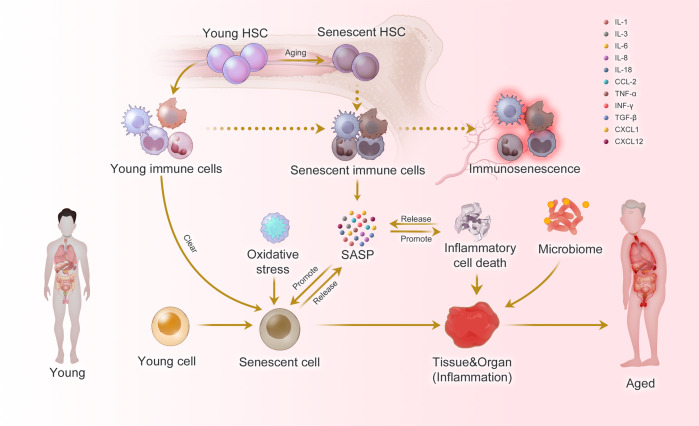
Aging is characterized by systemic chronic inflammation, which is accompanied by cellular senescence, immunosenescence, organ dysfunction, and age-related diseases. Given the multidimensional complexity of aging, there is an urgent need for a systematic organization of inflammaging through dimensionality reduction. Factors secreted by senescent cells, known as the senescence-associated secretory phenotype (SASP), promote chronic inflammation and can induce senescence in normal cells. At the same time, chronic inflammation accelerates the senescence of immune cells, resulting in weakened immune function and an inability to clear senescent cells and inflammatory factors, which creates a vicious cycle of inflammation and senescence. Persistently elevated inflammation levels in organs such as the bone marrow, liver, and lungs cannot be eliminated in time, leading to organ damage and aging-related diseases. Therefore, inflammation has been recognized as an endogenous factor in aging, and the elimination of inflammation could be a potential strategy for anti-aging. Here we discuss inflammaging at the molecular, cellular, organ, and disease levels, and review current aging models, the implications of cutting-edge single cell technologies, as well as anti-aging strategies. Since preventing and alleviating aging-related diseases and improving the overall quality of life are the ultimate goals of aging research, our review highlights the critical features and potential mechanisms of inflammation and aging, along with the latest developments and future directions in aging research, providing a theoretical foundation for novel and practical anti-aging strategies.
Overview
CoChat Summary
## TL;DR
This review argues that inflammaging—a chronic, systemic inflammatory state—is tightly intertwined with cellular senescence, immunosenescence, organ dysfunction, and age-related disease. It synthesizes signaling pathways, aging models, single-cell technologies, and intervention strategies, emphasizing anti-inflammatory approaches, senolytics, stem cell therapy, and organ transplantation.
## Key findings
- The paper describes a “vicious cycle” in which senescent cells secrete SASP factors that promote chronic inflammation, while chronic inflammation accelerates immune-cell senescence and weakens clearance of senescent cells and inflammatory factors.
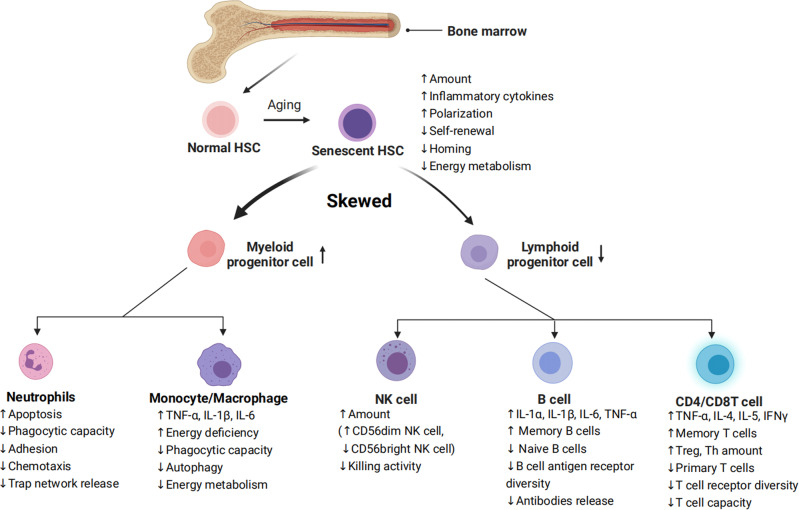
- It highlights reported age-related immune changes across cell types, including decreased circulating naive CD8 T cells as a consistent marker of immunosenescence in healthy older adults, reduced NK-cell cytotoxicity, and age-associated shifts in HSC differentiation toward myeloid lineages.
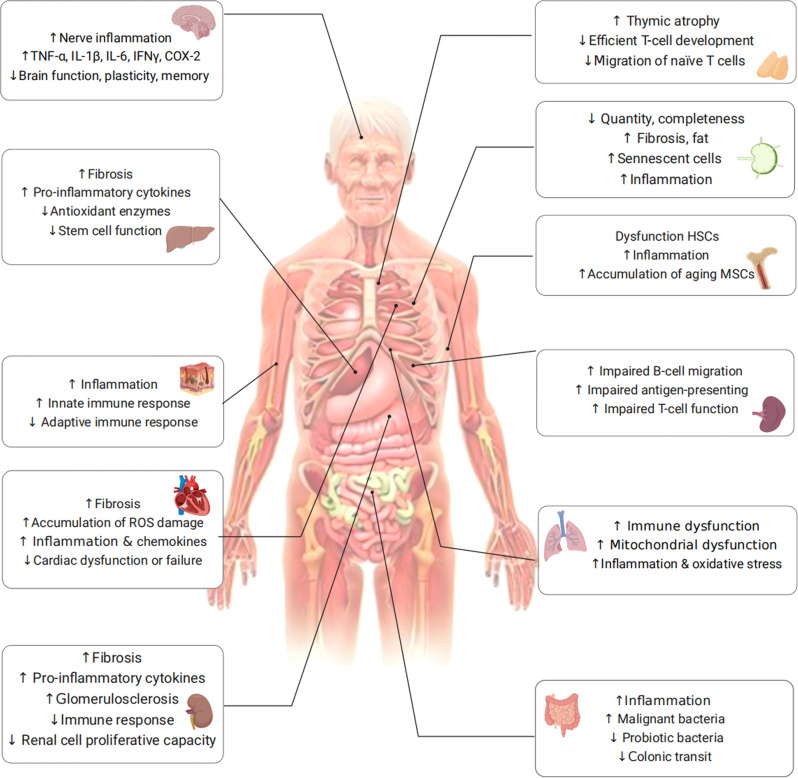
- The review links inflammaging to organ-level decline in the bone marrow, thymus, spleen, lymph nodes, brain, heart, kidney, liver, skin, lung, and gut, with examples such as age-related thymic degeneration reducing new T-cell output and aged bone marrow impairing HSC function.
- For intervention, it notes that the first senolytic combination, dasatinib plus quercetin, increased 6-minute walking distance by an average of 21.5 meters in the first human trial, but other outcomes did not change significantly and long-term efficacy remains insufficiently supported.
## Methods
- Narrative review of inflammaging across molecular, cellular, organ, and disease levels, with sections on signaling pathways, classical aging models, single-cell technology, and intervention strategies.
- No new experimental sample or cohort is reported in the paper itself; instead, it synthesizes findings from prior mouse, human, and cell-line studies cited throughout the text.
- The main approach is qualitative integration of published evidence, including examples from in vitro senescence models, in vivo mouse models, centenarian studies, and emerging single-cell/multi-omics work.
## Limitations
- The paper explicitly notes that the exact causality between inflammation and aging remains unresolved and “deserves further studies” for effective intervention.
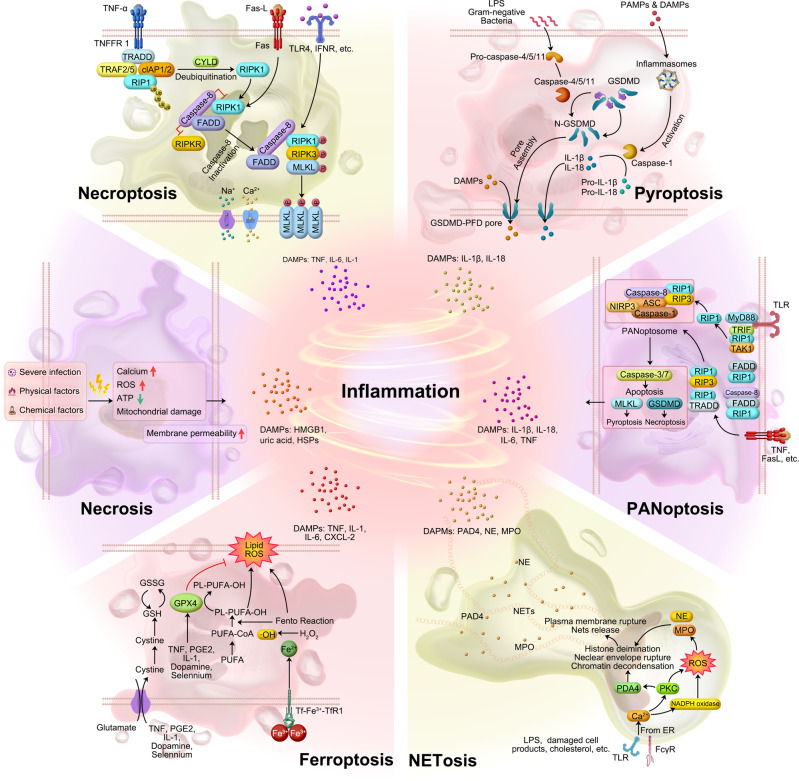
- It also states that PANoptosis has no direct evidence yet linking it to aging, so any connection is speculative.
- Evident from the text: this is a broad review rather than a primary study, so many conclusions are synthesized from heterogeneous prior studies rather than tested in one unified dataset.
Model-written summary. Check it against the paper before relying on it.
Integrity signals
Registry
Cites
Statistics
Figures
Verification
Claims the paper makes
140 Valid · 17 Not valid · 39 Not checked · 40 Own results and interpretations
Some cited sources support this claim and some don’t — read each source’s verdict below.
In the paper
“At the same time, inflammation promotes oxidation through inflammatory mediators.205,206”
§ Inflammation and aging: signaling pathways and intervention therapies > Mechanisms of inflammaging > Triggers of inflammaging
What the sources say
- Disputedcites [205] Furman D Expression of specific inflammasome gene modules stratifies older individuals into two extreme clinical and immunological states Nat. Med. 2017 23 174 184 10.1038/nm.4267 28092664 PMC5320935 sourceExperimental — accuracy not yet measured
The Discussion describes the opposite causal direction: oxidative stress triggers an inflammatory response, including production of inflammatory cytokines. The Results attribute chronic oxidative stress to possible mitochondrial metabolic reprogramming, not to inflammatory mediators. Page numbers are unavailable in our copy. (LLM, conf=0.82)
Checked by a reasoning model — may be wrong.
- Partly supportedcites [206] Furman D Chronic inflammation in the etiology of disease across the life span Nat. Med. 2019 25 1822 1832 10.1038/s41591-019-0675-0 31806905 PMC7147972 sourceExperimental — accuracy not yet measured
The ‘Systemic chronic inflammation and non-communicable disease risk’ section says systemic chronic inflammation can damage tissues by inducing oxidative stress. That supports the inflammation-to-oxidation link, but the passage does not say that inflammatory mediators are the mechanism. (LLM, conf=0.85)
plainstates a cause- Asserted: passes — The authors put it forward as true.
- Checkable: passes — It can be checked against evidence.
- Load-bearing: passes — The paper’s conclusions depend on it.
- Based: passes — The paper gives a reason why it holds.
- Disputed
At least one cited source doesn’t support this claim or points to a different paper, and none confirmed it — see the verdicts below.
In the paper
“Senescent neutrophils exhibit several distinct characteristics during NETosis, including a reduced capacity to release NETs, instability in the quality of formed NETs, and decreased activity of DNA degrading enzymes (DNases) within NETs.”
§ Inflammation and aging: signaling pathways and intervention therapies > Mechanisms of inflammaging > Inflammatory cell death
What the sources say
- Disputedcites [269] Sabbatini M Aging hampers neutrophil extracellular traps (NETs) efficacy Aging Clin. Exp. Res. 2022 34 2345 2353 10.1007/s40520-022-02201-0 35920993 PMC9637667 sourceExperimental — accuracy not yet measured
The Results and Discussion report that neutrophils from elderly subjects produced more NETs than those from adults after LPS stimulation, contrary to the unqualified claim of reduced release. The Introduction and Discussion note reduced NET production in other studies using different stimulation conditions, but distinguish those findings from this paper’s results. (LLM, conf=0.87)
Checked by a reasoning model — may be wrong.
plainstates a cause- Asserted: passes — The authors put it forward as true.
- Checkable: passes — It can be checked against evidence.
- Load-bearing: unclear — It is unclear whether the paper’s conclusions depend on it.
- Based: passes — The paper gives a reason why it holds.
- Disputed
The cited sources support only part of this claim — read each source’s verdict below.
In the paper
“However, in the aging heart, macrophages recruited to the site of infarction exhibit a pro-inflammatory M1 phenotype initially, but subsequently transition to an anti-inflammatory M2 phenotype after myocardial infarction (MI).”
§ Inflammation and aging: signaling pathways and intervention therapies > Inflammaging at the organ level > Sterile organs
What the sources say
- Partly supportedcites [143] Ma Y Mouton AJ Lindsey ML Cardiac macrophage biology in the steady-state heart, the aging heart, and following myocardial infarction Transl. Res. 2018 191 15 28 10.1016/j.trsl.2017.10.001 29106912 PMC5846093 sourceExperimental — accuracy not yet measured
The Abstract and “Macrophages in the MI Heart—Macrophage phenotypes” describe an early M1 and later M2 pattern after infarction. But the paper treats aging-heart macrophages separately and does not establish that this post-MI pattern occurs specifically in aging hearts. Its “Macrophage polarization mechanisms” section also says whether individual macrophages convert in vivo remains uncertain. Page numbers are unavailable in our copy. (LLM, conf=0.88)
plainstates a cause- Asserted: passes — The authors put it forward as true.
- Checkable: passes — It can be checked against evidence.
- Load-bearing: unclear — It is unclear whether the paper’s conclusions depend on it.
- Based: passes — The paper gives a reason why it holds.
- Partly supported
Every source the paper cites for this claim was checked and supports it.
In the paper
“This phenotypic switch promotes angiogenesis and scar formation, aiding in the recovery process.143”
§ Inflammation and aging: signaling pathways and intervention therapies > Inflammaging at the organ level > Sterile organs
What the sources say
- Supportedcites [143] Ma Y Mouton AJ Lindsey ML Cardiac macrophage biology in the steady-state heart, the aging heart, and following myocardial infarction Transl. Res. 2018 191 15 28 10.1016/j.trsl.2017.10.001 29106912 PMC5846093 source
The “Macrophage phenotypes” section says that M2 macrophages facilitate neoangiogenesis and scar repair, and that shifting the M1/M2 balance improves myocardial repair and function after MI. This supports the cited sentence’s account of angiogenesis, scar formation, and recovery. (LLM, conf=0.92)
plainstates a cause- Asserted: passes — The authors put it forward as true.
- Checkable: passes — It can be checked against evidence.
- Load-bearing: unclear — It is unclear whether the paper’s conclusions depend on it.
- Based: passes — The paper gives a reason why it holds.
- Supported
The cited sources that could be checked couldn’t confirm or dispute this claim.
In the paper
“Senescence of HSCs is the basis of immunosenescence. Senescent HSC differentiate into various types of dysfunctional immune cells, driving immunosenescence.16”
§ Inflammation and aging: signaling pathways and intervention therapies > Inflammaging at the cellular level > Hematopoietic stem cells (HSCs)
What the sources say
- Could not verifycites [16] Liggett LA Sankaran VG Unraveling Hematopoiesis through the Lens of Genomics Cell 2020 182 1384 1400 10.1016/j.cell.2020.08.030 32946781 PMC7508400 sourceExperimental — accuracy not yet measured
The Clonal hematopoiesis section describes age-related changes in HSC numbers and clonal expansion, but does not link HSC senescence to immunosenescence. A search for immunosenescence and dysfunctional immune cells found no passage establishing that proposed mechanism; the Outstanding Questions section also notes that some older people retain ostensibly normal hematopoiesis. (LLM, conf=0.72)
plainstates a cause- Asserted: passes — The authors put it forward as true.
- Checkable: passes — It can be checked against evidence.
- Load-bearing: unclear — It is unclear whether the paper’s conclusions depend on it.
- Based: passes — The paper gives a reason why it holds.
- Could not verify
95 more claims · 66 with their cited sources checked
Create a free account to see all 236 claims and every source verdict.
- It may state two separate claims as one. 111
- Probably not a substantial claim. 41
- Borderline: one of the tests for a substantial claim is unclear. 1
Claims other papers make about this one
Each is checked against this paper’s own text: does it say what the citing paper says it does?
The cited source says what the claim attributes to it.
In the citing paper
“Inflammation is implicated in various pathways and processes associated with ageing, including immunosenescence, oxidative stress, metabolic dysregulation, cellular senescence, and other critical events of the ageing process.37”
From Antiageing strategy for neurodegenerative diseases: from mechanisms to clinical advances (2025) · cites this paper as [37]
In the citing paper
“These frameworks suggest that the pathophysiology of AD is characterized by phosphorylated tau accumulation and propagation,31 heightened inflammatory responses, dysregulation of oxidative stress (related to mitochondrial dysfunction),37 alongside a gradual decline in cholinergic function.38”
From Antiageing strategy for neurodegenerative diseases: from mechanisms to clinical advances (2025) · cites this paper as [37]
In the citing paper
“exercise can reduce inflammation levels, which is a contributing factor to the ageing process.37”
From Antiageing strategy for neurodegenerative diseases: from mechanisms to clinical advances (2025) · cites this paper as [37]
Citations
Cites
Items 201–400 of 477
Cytokine-mediated regulation of CXCR4 expression in human neutrophils
Nagase, H., Miyamasu, M., Yamaguchi, M., Imanishi, M., Tsuno, N. H., Matsushima, K., Yamamoto, K., Morita, Y., & Hirai, K. (2002) · Journal of Leukocyte Biology · doi:10.1189/jlb.71.4.711 · Cited by 240
The role of T cells in age-related diseases
Carrasco, E., Gómez de las Heras, M. M., Gabandé-Rodríguez, E., Desdín-Micó, G., Aranda, J. F., & Mittelbrunn, M. (2022) · Nature Reviews Immunology · doi:10.1038/s41577-021-00557-4 · Cited by 239 · cited 1×
“Immunocytes, as key regulators of aging cells, have always been a focus of research due to their dysfunctional changes during aging.(10,11) As early as 1969, Walford proposed “the immunologic theory of aging”,(12) which further developed”
BackgroundSex differences in immune responses
Takahashi, T., & Iwasaki, A. (2021) · Science · doi:10.1126/science.abe7199 · Cited by 239 · cited 1×
“For example, studies have shown that women living longer than men,(4) in which older men showed higher activity of inflammation-related modules, with a more dramatic decrease in the ratio of naive T and B cells compared to older women.(4,5) In addition, centenarians have been found to possess stronger anti-inflammator…”
The impact of aging on cardiac extracellular matrix
Meschiari, C. A., Ero, O. K., Pan, H., Finkel, T., & Lindsey, M. L. (2017) · GeroScience · doi:10.1007/s11357-017-9959-9 · Cited by 237 · cited 2×
“These molecules stimulate an immune response and contribute to an increase in the number of macrophages within the left ventricle.(140) In addition, because mature cardiomyocytes have a low rate of proliferation, the injured area in the aging heart is replaced by fibrotic scar tissue, resulting in organ failure.”
BackgroundBanoth, B., Tuladhar, S., Karki, R., Sharma, B. R., Briard, B., Kesavardhana, S., Burton, A., & Kanneganti, T.-D. (2020) · Journal of Biological Chemistry · doi:10.1074/jbc.ra120.015924 · Cited by 237
Meta-analysis of preclinical studies of mesenchymal stromal cells for ischemic stroke
Vu, Q., Xie, K., Eckert, M., Zhao, W., & Cramer, S. C. (2014) · Neurology · doi:10.1212/wnl.0000000000000278 · Cited by 235
Molecular mechanisms of renal aging
Schmitt, R., & Melk, A. (2017) · Kidney International · doi:10.1016/j.kint.2017.02.036 · Cited by 235
Kiecolt-Glaser, J. K., Belury, M. A., Andridge, R., Malarkey, W. B., Hwang, B. S., & Glaser, R. (2012) · Brain, Behavior, and Immunity · doi:10.1016/j.bbi.2012.05.011 · Cited by 233
Reversible Senescence in Human CD4+CD45RA+CD27− Memory T Cells
Di Mitri, D., Azevedo, R. I., Henson, S. M., Libri, V., Riddell, N. E., Macaulay, R., Kipling, D., Soares, M. V. D., Battistini, L., & Akbar, A. N. (2011) · The Journal of Immunology · doi:10.4049/jimmunol.1100978 · Cited by 231
Liu, J., Liu, W., Lu, Y., Tian, H., Duan, C., Lu, L., Gao, G., Wu, X., Wang, X., & Yang, H. (2018) · Autophagy · doi:10.1080/15548627.2017.1390636 · Cited by 231
Duan, J., Duan, J., Zhang, Z., & Tong, T. (2005) · The International Journal of Biochemistry & Cell Biology · doi:10.1016/j.biocel.2005.01.010 · Cited by 229 · cited 1×
“These cellular senescence markers are accompanied by increased expression of p21, gadd45, and enhanced p53 binding activity.(281) In addition, DNA repair capability decreases, and telomere shortening accelerates.”
BackgroundAn exposome perspective: Early-life events and immune development in a changing world
Renz, H., Holt, P. G., Inouye, M., Logan, A. C., Prescott, S. L., & Sly, P. D. (2017) · Journal of Allergy and Clinical Immunology · doi:10.1016/j.jaci.2017.05.015 · Cited by 226
Relationships between diet-related changes in the gut microbiome and cognitive flexibility
Magnusson, K. R., Hauck, L., Jeffrey, B. M., Elias, V., Humphrey, A., Nath, R., Perrone, A., & Bermudez, L. E. (2015) · Neuroscience · doi:10.1016/j.neuroscience.2015.05.016 · Cited by 225
RIPK1 Distinctly Regulates Yersinia-Induced Inflammatory Cell Death, PANoptosis
Malireddi, R. K. S., Kesavardhana, S., Karki, R., Kancharana, B., Burton, A. R., & Kanneganti, T.-D. (2020) · ImmunoHorizons · doi:10.4049/immunohorizons.2000097 · Cited by 224
Treatment of a Mouse Model of ALS by In Vivo Base Editing
Lim, C. K. W., Gapinske, M., Brooks, A. K., Woods, W. S., Powell, J. E., Zeballos C., M. A., Winter, J., Perez-Pinera, P., & Gaj, T. (2020) · Molecular Therapy · doi:10.1016/j.ymthe.2020.01.005 · Cited by 222
Aging: A Temporal Dimension for Neutrophils
Adrover, J. M., Nicolás-Ávila, J. A., & Hidalgo, A. (2016) · Trends in Immunology · doi:10.1016/j.it.2016.03.005 · Cited by 221 · cited 1×
“Another phenotypic change observed in neutrophils during in vitro culture is the downregulation of CXCR2 (CXCL1 receptor), a potent neutrophil chelator that has been shown to promote the release of neutrophils into the circulation and migration to sites of inflammation.(46,47) In mice, senescence can disrupt the norma…”
BackgroundQin, L., Jing, X., Qiu, Z., Cao, W., Jiao, Y., Routy, J.-P., & Li, T. (2016) · Aging · doi:10.18632/aging.100894 · Cited by 218 · cited 2×
“In the peripheral blood lymphocyte subsets of healthy adults in different ages, it was found that the decreased naive CD4 and CD8 T cell number, increased memory CD4 or CD8 T cell number, and decreased CD28 expression on T cells.(70) Numerous studies have shown a close association between increased stimulation by vari…”
BackgroundPeptidylarginine deiminase 4 promotes age-related organ fibrosis
Martinod, K., Witsch, T., Erpenbeck, L., Savchenko, A., Hayashi, H., Cherpokova, D., Gallant, M., Mauler, M., Cifuni, S. M., & Wagner, D. D. (2017) · Journal of Experimental Medicine · doi:10.1084/jem.20160530 · Cited by 218 · cited 1×
“The excessive formation of NETs, in turn, was implicated in the development of age-related organ fibrosis.(270) In conclusion, the process of aging can adversely affect the ability of neutrophils to undergo NETosis.”
BackgroundMitchell, C. A., Verovskaya, E. V., Calero-Nieto, F. J., Olson, O. C., Swann, J. W., Wang, X., Hérault, A., Dellorusso, P. V., Zhang, S. Y., Svendsen, A. F., et al. (2023) · Nature Cell Biology · doi:10.1038/s41556-022-01053-0 · Cited by 216 · cited 1×
“According to recent studies, bone marrow cells in senescent mice secrete more IL-1α/β,(23) while damaged endosteum produces IL-1β to drive inflammation in the central bone marrow in trans to impede hematopoietic regeneration.(24) When faced with in vivo stimulation by lipopolysaccharide (mimicking external microbial s…”
BackgroundAging of the Immune System: Focus on Natural Killer Cells Phenotype and Functions
Brauning, A., Rae, M., Zhu, G., Fulton, E., Admasu, T. D., Stolzing, A., & Sharma, A. (2022) · Cells · doi:10.3390/cells11061017 · Cited by 215 · cited 1×
“Recent findings indicate that NK cells play a central role in the immune surveillance of aging cells, and that dysfunctional NK cell activity is associated with infections, malignant tumors, inflammatory diseases, and an increased burden of aging cells with advancing age.(56) While age does not seem to affect the numb…”
BackgroundNeuroinflammation and Cognitive Aging
Ownby, R. L. (2010) · Current Psychiatry Reports · doi:10.1007/s11920-009-0082-1 · Cited by 212
Zhao, P., Sui, B., Liu, N., Lv, Y., Zheng, C., Lu, Y., Huang, W., Zhou, C., Chen, J., Pang, D., et al. (2017) · Aging Cell · doi:10.1111/acel.12635 · Cited by 212
Iske, J., Seyda, M., Heinbokel, T., Maenosono, R., Minami, K., Nian, Y., Quante, M., Falk, C. S., Azuma, H., Martin, F., et al. (2020) · Nature Communications · doi:10.1038/s41467-020-18039-x · Cited by 211 · cited 1×
“For organs from old donors, Senolytics are used to rejuvenate aging organs.(367) Meanwhile, the world’s first “transplantation” of a porcine heart into a human was initially successful and has not caused hyperacute rejection in humans.”
BackgroundNeutrophils induce paracrine telomere dysfunction and senescence in ROS‐dependent manner
Lagnado, A., Leslie, J., Ruchaud‐Sparagano, M., Victorelli, S., Hirsova, P., Ogrodnik, M., Collins, A. L., Vizioli, M. G., Habiballa, L., Saretzki, G., et al. (2021) · The EMBO Journal · doi:10.15252/embj.2020106048 · Cited by 211 · cited 1×
“CXCL1 can also attract neutrophils to the liver of older mice, where they generate ROS and trigger tissue senescence and inflammation.(49) Therefore, the role of neutrophils in defending against inflammation and pathogens is greatly weakened during aging (Fig.”
BackgroundInterferon-γ impairs proliferation of hematopoietic stem cells in mice
de Bruin, A. M., Demirel, Ö., Hooibrink, B., Brandts, C. H., & Nolte, M. A. (2013) · Blood · doi:10.1182/blood-2012-05-432906 · Cited by 210
Barascu, A., Le Chalony, C., Pennarun, G., Genet, D., Imam, N., Lopez, B., & Bertrand, P. (2012) · The EMBO Journal · doi:10.1038/emboj.2011.492 · Cited by 206 · cited 1×
“Oxidative stress has been ensured as a crucial factor for cellular senescence through shortening telomere and causing DNA double-strand breaks.(209,210) Moreover, infections,(211) environmental pollution,(212,213) and adverse lifestyle habits(214) can increase oxidative stress.”
BackgroundEarly detection of cognitive deficits in the 3xTg-AD mouse model of Alzheimer's disease
Stover, K. R., Campbell, M. A., Van Winssen, C. M., & Brown, R. E. (2015) · Behavioural Brain Research · doi:10.1016/j.bbr.2015.04.012 · Cited by 205
Hale, C. M., Shrestha, A. L., Khatau, S. B., Stewart-Hutchinson, P. J., Hernandez, L., Stewart, C. L., Hodzic, D., & Wirtz, D. (2008) · Biophysical Journal · doi:10.1529/biophysj.108.139428 · Cited by 205
Hepatic fibrosis: It is time to go with hepatic stellate cell-specific therapeutic targets
Ezhilarasan, D., Sokal, E., & Najimi, M. (2018) · Hepatobiliary & Pancreatic Diseases International · doi:10.1016/j.hbpd.2018.04.003 · Cited by 204 · cited 1×
“Activated hepatic stellate cells are the major functional population during liver fibrogenesis.(154) During senescence, their replication, immunerecruiting signals, and clearance are important for the regulation of liver fibrogenesis.”
BackgroundNiwa, Y., Kasama, T., Miyachi, Y., & Kanoh, T. (1989) · Life Sciences · doi:10.1016/0024-3205(89)90482-7 · Cited by 203
The chromatin accessibility signature of human immune aging stems from CD8+ T cells
Ucar, D., Márquez, E. J., Chung, C.-H., Marches, R., Rossi, R. J., Uyar, A., Wu, T.-C., George, J., Stitzel, M. L., Palucka, A. K., et al. (2017) · Journal of Experimental Medicine · doi:10.1084/jem.20170416 · Cited by 200
Ageing and the neutrophil: no appetite for killing?
Butcher, S., Chahel, H., & Lord, J. M. (2000) · Immunology · doi:10.1046/j.1365-2567.2000.00079.x · Cited by 199
Reactive oxygen species and hematopoietic stem cell senescence
Shao, L., Li, H., Pazhanisamy, S. K., Meng, A., Wang, Y., & Zhou, D. (2011) · International Journal of Hematology · doi:10.1007/s12185-011-0872-1 · Cited by 198 · cited 1×
“Accumulated reactive oxygen species (ROS) stress may trigger excessive DNA damage and HSC senescence and/or apoptosis.(36) Binding to C-X-C motif chemokine ligand (CXCL) 12, C-X-C motif Fig.”
BackgroundSelf-citationImmune Clearance of Senescent Cells to Combat Ageing and Chronic Diseases
Song, P., An, J., & Zou, M.-H. (2020) · Cells · doi:10.3390/cells9030671 · Cited by 198 · cited 1×
“(CAR-)T/NK for eliminating senescent cells On the other hand, immune cell-mediated clearance of senescent cells is emerging as a promising strategy to fight multiple chronic diseases and aging.(349) It was found that anti-uPAR-CAR-T cells were effective in removing senescent cells in vitro and precancerous and maligna…”
BackgroundSAMP1/YitFc mouse strain: A spontaneous model of Crohnʼs disease-like ileitis
Pizarro, T. T., Pastorelli, L., Bamias, G., Garg, R. R., Reuter, B. K., Mercado, J. R., Chieppa, M., Arseneau, K. O., Ley, K., & Cominelli, F. (2011) · Inflammatory Bowel Diseases · doi:10.1002/ibd.21638 · Cited by 192
Necroptosis contributes to chronic inflammation and fibrosis in aging liver
Mohammed, S., Thadathil, N., Selvarani, R., Nicklas, E. H., Wang, D., Miller, B. F., Richardson, A., & Deepa, S. S. (2021) · Aging Cell · doi:10.1111/acel.13512 · Cited by 192 · cited 2×
“In the livers of old mice, short-term treatment with the necroptosis inhibitor necrostatin-1s (Nec-1s) reduced necroptosis, M1 macrophage markers, cellular senescence, fibrosis, and pro-inflammatory cytokines.(241) Importantly, nerve injuryinduced protein 1 (Ninjurin1/Ninj 1) plays a crucial role in facilitating the u…”
BackgroundFacchini, A., Mariani, E., Mariani, A. R., Papa, S., Vitale, M., & Manzoli, F. A. (1987) · PubMed Central · Cited by 187
B Cell Dysfunction Associated With Aging and Autoimmune Diseases
Ma, S., Wang, C., Mao, X., & Hao, Y. (2019) · Frontiers in Immunology · doi:10.3389/fimmu.2019.00318 · Cited by 184 · cited 1×
“However, the elderly tend to exhibit an increase in autoantibodies, which can elevate the risk of developing autoimmune diseases.(80) B cells not only produce antibodies, but also play regulatory effector functions in the development of memory T-cells (Fig.”
BackgroundIn senescence, age‐associated B cells secrete TNF α and inhibit survival of B‐cell precursors*
Ratliff, M., Alter, S., Frasca, D., Blomberg, B. B., & Riley, R. L. (2013) · Aging Cell · doi:10.1111/acel.12055 · Cited by 183
Activation of Glutathione Peroxidase 4 as a Novel Anti-inflammatory Strategy
Li, C., Deng, X., Xie, X., Liu, Y., Friedmann Angeli, J. P., & Lai, L. (2018) · Frontiers in Pharmacology · doi:10.3389/fphar.2018.01120 · Cited by 183 · cited 1×
“GPX4 has been shown to have a cytoprotective effect by lowering the levels of cellular lipid hydroperoxides.(250) Several pro-inflammatory cytokines, including TNF, PGE2, IL-1, and IL-6, have been demonstrated to exert a direct influence on the levels and function of GPX4 within cancer cells;(251) for example, TNF tre…”
BackgroundSelf-citationAstrocyte senescence promotes glutamate toxicity in cortical neurons
Limbad, C., Oron, T. R., Alimirah, F., Davalos, A. R., Tracy, T. E., Gan, L., Desprez, P.-Y., & Campisi, J. (2020) · PLOS ONE · doi:10.1371/journal.pone.0227887 · Cited by 183
Ding, H., Chen, S., Pan, X., Dai, X., Pan, G., Li, Z., Mai, X., Tian, Y., Zhang, S., Liu, B., et al. (2021) · Journal of Cachexia, Sarcopenia and Muscle · doi:10.1002/jcsm.12700 · Cited by 180 · cited 2×
“Recent studies have reported the involvement of ferroptosis as a mechanism that promotes skeletal muscle aging.(258) With skeletal muscle aging, there is a decreased expression of Tfr1 and an increased expression of Slc39a14, which is enriched on the cell membrane surface of aging mouse skeletal muscle cells.”
BackgroundFang, J., Yang, J., Wu, X., Zhang, G., Li, T., Wang, X., Zhang, H., Wang, C., Liu, G., & Wang, L. (2018) · Aging Cell · doi:10.1111/acel.12765 · Cited by 179
O'Hara, R., Schröder, C. M., Mahadevan, R., Schatzberg, A. F., Lindley, S., Fox, S., Weiner, M., Kraemer, H. C., Noda, A., Lin, X., et al. (2007) · Molecular Psychiatry · doi:10.1038/sj.mp.4001978 · Cited by 171 · cited 1×
“The continuous activation of this circuit leads to the continuous increase of glucocorticoid level, which will lead to hippocampal atrophy, a phenomenon closely related to aging.(323) In addition.”
BackgroundTompkins, B. A., DiFede, D. L., Khan, A., Landin, A. M., Schulman, I. H., Pujol, M. V., Heldman, A. W., Miki, R., Goldschmidt-Clermont, P. J., Goldstein, B. J., et al. (2017) · The Journals of Gerontology: Series A · doi:10.1093/gerona/glx137 · Cited by 169 · cited 1×
“Trials have found that after stem cell injections in aging debilitated patients, many symptoms improve, and inflammatory marker levels decrease.(359) MSC transplantation for acute stroke improves patient symptoms and promotes neurological recovery in ischemic stroke patients without adverse effects.”
BackgroundMitochondrial mass governs the extent of human T cell senescence
Callender, L. A., Carroll, E. C., Bober, E. A., Akbar, A. N., Solito, E., & Henson, S. M. (2020) · Aging Cell · doi:10.1111/acel.13067 · Cited by 169
Human Skin, Oral, and Gut Microbiomes Predict Chronological Age
Huang, S., Haiminen, N., Carrieri, A.-P., Hu, R., Jiang, L., Parida, L., Russell, B., Allaband, C., Zarrinpar, A., Vázquez-Baeza, Y., et al. (2020) · mSystems · doi:10.1128/msystems.00630-19 · Cited by 167
Barkaway, A., Rolas, L., Joulia, R., Bodkin, J., Lenn, T., Owen-Woods, C., Reglero-Real, N., Stein, M., Vázquez-Martínez, L., Girbl, T., et al. (2021) · Immunity · doi:10.1016/j.immuni.2021.04.025 · Cited by 167 · cited 1×
“In mice, senescence can disrupt the normal movement of neutrophils across epithelial layers in injured tissues through a CXCL1-mediated mechanism, resulting in abnormal neutrophil trafficking and consequential damage to distant organs.(48) CXCL1 can also attract neutrophils to the liver of older mice, where they gener…”
BackgroundB cell maintenance and function in aging
Kogut, I., Scholz, J. L., Cancro, M. P., & Cambier, J. C. (2012) · Seminars in Immunology · doi:10.1016/j.smim.2012.04.004 · Cited by 166 · cited 1×
“Different from mice, as individuals age, there is a decline in the proportion and absolute number of B cells in the peripheral blood.(75,76) Especially, the aging process is associated with a rise in the proportion of late-stage exhausted memory B cells,(77) while the percentage of memory B cells that exhibit a positi…”
BackgroundIL-1 mediates microbiome-induced inflammaging of hematopoietic stem cells in mice
Kovtonyuk, L. V., Caiado, F., Garcia-Martin, S., Manz, E.-M., Helbling, P., Takizawa, H., Boettcher, S., Al-Shahrour, F., Nombela-Arrieta, C., Slack, E., et al. (2022) · Blood · doi:10.1182/blood.2021011570 · Cited by 166 · cited 1×
“When faced with in vivo stimulation by lipopolysaccharide (mimicking external microbial stimuli), senescent mice exhibited increased and prolonged IL-1α/β reactions.(23) These illustrate IL1 as a key mediator of niche inflammatory damage to HSC.”
BackgroundShaping of NK cell subsets by aging
Solana, R., Campos, C., Pera, A., & Tarazona, R. (2014) · Current Opinion in Immunology · doi:10.1016/j.coi.2014.04.002 · Cited by 165 · cited 1×
“Specifically, there tends to be a decrease in the proportion of immature CD56 bright NK cells and an increase in the percentage of CD56 dim NK cells.(61,63) CD56 dim cells produce many cytokines and mainly play an immunomodulatory role.”
BackgroundCurcumin exerts a protective effect against premature ovarian failure in mice
Yan, Z., Dai, Y., Fu, H., Zheng, Y., Bao, D., Yin, Y., Chen, Q., Nie, X., Hao, Q., Hou, D., et al. (2018) · Journal of Molecular Endocrinology · doi:10.1530/jme-17-0214 · Cited by 164
Autophagy Controls Acquisition of Aging Features in Macrophages
Stranks, A. J., Hansen, A. L., Panse, I., Mortensen, M., Ferguson, D. J. P., Puleston, D. J., Shenderov, K., Watson, A. S., Veldhoen, M., Phadwal, K., et al. (2015) · Journal of Innate Immunity · doi:10.1159/000370112 · Cited by 163
DNA damage response (DDR) and senescence: shuttled inflamma-miRNAs on the stage of inflamm-aging
Olivieri, F., Albertini, M. C., Orciani, M., Ceka, A., Cricca, M., Procopio, A. D., & Bonafè, M. (2015) · Oncotarget · doi:10.18632/oncotarget.5899 · Cited by 163 · cited 1×
“It is the phenomenon of senescent cells secreting pro-inflammatory cytokines.(189) The SASP possesses the capacity to perpetuate senescence itself or influence the surrounding tissue microenvironment, consequently affecting the entire organism.”
BackgroundA single-cell transcriptomic landscape of primate arterial aging
Zhang, W., Zhang, S., Yan, P., Ren, J., Song, M., Li, J., Lei, J., Pan, H., Wang, S., Ma, X., et al. (2020) · Nature Communications · doi:10.1038/s41467-020-15997-0 · Cited by 163
Self-citationUnraveling Hematopoiesis through the Lens of Genomics
Liggett, L. A., & Sankaran, V. G. (2020) · Cell · doi:10.1016/j.cell.2020.08.030 · Cited by 163 · cited 1×
“Senescent HSC differentiate into various types of dysfunctional immune cells, driving immunosenescence.(16) Inflammation drives impaired selfrenewal activity and accelerates aging of HSCs.”
BackgroundZeng, X., Li, X., Li, X., Wei, C., Shi, C., Hu, K., Kong, D., Luo, Q., Xu, Y., Shan, W., et al. (2023) · Blood · doi:10.1182/blood.2022017514 · Cited by 157 · cited 1×
“Recent studies have revealed that the transplantation of fecal matter from young donors into the gastrointestinal tract of middle-aged fish can effectively prolong lifespan and delay the onset of behavioral decline,(220) and that fecal transplantation from young mice slows HSC senescence in the bone marrow.(225) Lachn…”
BackgroundSelf-citationLiu, B., Liu, J., & Shi, J.-S. (2020) · Journal of Alzheimer's Disease · doi:10.3233/jad-200063 · Cited by 156 · cited 1×
“These factors play crucial roles in the aging process.(301) Aging models with apparent inflammation phenotypes include Nfkb1 deficient mice (Nfkb1−/−).”
BackgroundFibrates as drugs with senolytic and autophagic activity for osteoarthritis therapy
Nogueira-Recalde, U., Lorenzo-Gómez, I., Blanco, F. J., Loza, M. I., Grassi, D., Shirinsky, V., Shirinsky, I., Lotz, M., Robbins, P. D., Domínguez, E., et al. (2019) · EBioMedicine · doi:10.1016/j.ebiom.2019.06.049 · Cited by 155 · cited 1×
“In addition, another Senolytic called Fenofibrate can induce selective elimination of senescence cells through upregulating PPARα expression.(347) Excessive clearance of senescent cells (especially for senescent liver sinusoidal endothelial cells or adipocytes) has also been reported to accompany the dilemma faced by…”
BackgroundYoshida, A., Lee, E. K., & Diehl, J. A. (2016) · Cancer Research · doi:10.1158/0008-5472.can-15-2931 · Cited by 153
Dorronsoro, A., Santiago, F. E., Grassi, D., Zhang, T., Lai, R. C., McGowan, S. J., Angelini, L., Lavasani, M., Corbo, L., Lu, A., et al. (2021) · Aging Cell · doi:10.1111/acel.13337 · Cited by 153
Allen, J. M., Mailing, L. J., Cohrs, J., Salmonson, C., Fryer, J. D., Nehra, V., Hale, V. L., Kashyap, P., White, B. A., & Woods, J. A. (2018) · Gut Microbes · doi:10.1080/19490976.2017.1372077 · Cited by 152
Mesenchymal Stromal Cell Therapies for Neurodegenerative Diseases
Staff, N. P., Jones, D. T., & Singer, W. (2019) · Mayo Clinic Proceedings · doi:10.1016/j.mayocp.2019.01.001 · Cited by 150 · cited 1×
“Meanwhile, mesenchymal stem cell transplantation for Parkinson’s disease can significantly improve the daily activities and motor functions of Parkinson’s disease patients without side effects, as well as being safe and reliable.(363,364) In addition, HSC transplantation is a very rapidly and effective clinical treatm…”
BackgroundMistry, J. J., Marlein, C. R., Moore, J. A., Hellmich, C., Wojtowicz, E. E., Smith, J. G. W., Macaulay, I., Sun, Y., Morfakis, A., Patterson, A., et al. (2019) · Proceedings of the National Academy of Sciences · doi:10.1073/pnas.1913278116 · Cited by 150 · cited 1×
“During inflammation, HSCs shift their energy metabolism from relying on anaerobic glycolysis to oxidative respiration.(34,35) Accumulated reactive oxygen species (ROS) stress may trigger excessive DNA damage and HSC senescence and/or apoptosis.”
BackgroundSingle-cell transcriptomic atlas of primate cardiopulmonary aging
Ma, S., Sun, S., Li, J., Fan, Y., Qu, J., Sun, L., Wang, S., Zhang, Y., Yang, S., Liu, Z., et al. (2021) · Cell Research · doi:10.1038/s41422-020-00412-6 · Cited by 150
Self-citationRudd, B. D., Venturi, V., Li, G., Samadder, P., Ertelt, J. M., Way, S. S., Davenport, M. P., & Nikolich-Žugich, J. (2011) · Proceedings of the National Academy of Sciences · doi:10.1073/pnas.1107594108 · Cited by 149
Heterogeneous fibroblasts underlie age-dependent tertiary lymphoid tissues in the kidney
Sato, Y., Mii, A., Hamazaki, Y., Fujita, H., Nakata, H., Masuda, K., Nishiyama, S., Shibuya, S., Haga, H., Ogawa, O., et al. (2016) · JCI Insight · doi:10.1172/jci.insight.87680 · Cited by 148 · cited 1×
“Moreover, older individuals become more susceptible to acute kidney injury (AKI) and chronic kidney disease (CKD).(123,147) Age-related alterations in multiple cell types, such as tubular epithelial cells, resident and circulating leukocytes, contribute to kidney injury.”
BackgroundObas, V., & Vasan, R. S. (2018) · Clinical Science · doi:10.1042/cs20171156 · Cited by 148
Vogt, M., Haggblom, C., Yeargin, J., Christiansen-Weber, T. A., & Haas, M. (1998) · PubMed · Cited by 147
Labrie, J. E., Sah, A. P., Allman, D. M., Cancro, M. P., & Gerstein, R. M. (2004) · The Journal of Experimental Medicine · doi:10.1084/jem.20040845 · Cited by 145 · cited 1×
“The output of B cells is severely affected by changes in the microecology of the bone marrow, such as decreased pro-B cell-survival cytokine IL-7 level.(72) The number of B-cell precursors and antibody-producing plasma cells in mouse and human bone marrow decreases with age.”
BackgroundRundberg Nilsson, A., Soneji, S., Adolfsson, S., Bryder, D., & Pronk, C. J. (2016) · PLOS ONE · doi:10.1371/journal.pone.0158369 · Cited by 145
B cells and immunosenescence: A focus on IgG+IgD−CD27− (DN) B cells in aged humans
Bulati, M., Buffa, S., Candore, G., Caruso, C., Dunn‐Walters, D. K., Pellicanò, M., Wu, Y.-C. B., & Romano, G. C. (2010) · Ageing Research Reviews · doi:10.1016/j.arr.2010.12.002 · Cited by 137
SILAC Analysis Reveals Increased Secretion of Hemostasis-Related Factors by Senescent Cells
Wiley, C. D., Liu, S., Limbad, C., Zawadzka, A. M., Beck, J., Demaria, M., Artwood, R., Alimirah, F., Lopez-Dominguez, J.-A., Kuehnemann, C., et al. (2019) · Cell Reports · doi:10.1016/j.celrep.2019.08.049 · Cited by 137
Haider, S., Liaquat, L., Ahmad, S., Batool, Z., Siddiqui, R. A., Tabassum, S., Shahzad, S., Rafiq, S., & Naz, N. (2020) · PLoS ONE · doi:10.1371/journal.pone.0227631 · Cited by 136
Yamamoto, T., Takabatake, Y., Kimura, T., Takahashi, A., Namba, T., Matsuda, J., Minami, S., Kaimori, J.-Y., Matsui, I., Kitamura, H., et al. (2016) · Autophagy · doi:10.1080/15548627.2016.1159376 · Cited by 135 · cited 1×
“Proximal tubular cells depend on autophagy to effectively eliminate defective mitochondria and other organelles under both normal and pathological conditions.(148,149) However, during aging, their diminished proliferative capacity leads to impaired clearance abilities.”
BackgroundSmith, A. L. M., Whitehall, J. C., Bradshaw, C., Gay, D., Robertson, F., Blain, A. P., Hudson, G., Pyle, A., Houghton, D., Hunt, M., et al. (2020) · Nature Cancer · doi:10.1038/s43018-020-00112-5 · Cited by 134
Chang, C.-Y., Ting, H.-C., Liu, C.-A., Su, H.-L., Chiou, T.-W., Lin, S.-Z., Harn, H.-J., & Ho, T.-J. (2020) · Molecules · doi:10.3390/molecules25082000 · Cited by 133
Del Bo', C., Bernardi, S., Cherubini, A., Porrini, M., Gargari, G., Hidalgo-Liberona, N., González-Domínguez, R., Zamora-Ros, R., Peron, G., Marino, M., et al. (2021) · Clinical Nutrition · doi:10.1016/j.clnu.2020.12.014 · Cited by 133
The Immunologic Theory of Aging
Walford, R. L. (1964) · The Gerontologist · doi:10.1093/geront/4.4.195 · Cited by 133
Architectural changes in the thymus of aging mice
Aw, D., Silva, A. B., Maddick, M., Von Zglinicki, T., & Palmer, D. B. (2008) · Aging Cell · doi:10.1111/j.1474-9726.2007.00365.x · Cited by 132
Poetsch, A. R., Boulton, S. J., & Luscombe, N. M. (2018) · Genome Biology · doi:10.1186/s13059-018-1582-2 · Cited by 132 · cited 1×
“This also laid the foundation for the prevention of tumors.(315) Turtles are a typical group of long-lived animals.”
BackgroundPlasma cells are obligate effectors of enhanced myelopoiesis in aging bone marrow
Pioli, P. D., Casero, D., Montecino-Rodriguez, E., Morrison, S. L., & Dorshkind, K. (2019) · Immunity · doi:10.1016/j.immuni.2019.06.006 · Cited by 131 · cited 1×
“For example, plasma cells that have accumulated in the bone marrow of aged mice can create a feedback loop of pro-inflammatory cytokines, such as IL-1 and TNF-α, which promote HSC myeloid differentiation bias.(22) According to recent studies, bone marrow cells in senescent mice secrete more IL-1α/β,(23) while damaged…”
BackgroundMistry, J. J., Hellmich, C., Moore, J. A., Jibril, A. S., Macaulay, I. C., Moreno‐Gonzalez, M., Palma, F. D., Beraza, N., Bowles, K. M., & Rushworth, S. A. (2021) · Nature Communications · doi:10.1038/s41467-021-27460-9 · Cited by 131
Midkine drives cardiac inflammation by promoting neutrophil trafficking and NETosis in myocarditis
Weckbach, L. T., Grabmaier, U., Uhl, A., Gess, S., Boehm, F., Zehrer, A., Pick, R., Salvermoser, M., Czermak, T., Pircher, J., et al. (2019) · Journal of Experimental Medicine · doi:10.1084/jem.20181102 · Cited by 130 · cited 1×
“In myocarditis, NETosis probably promotes PMN trafficking via MK and substantially contributes to cardiac inflammation.(263) In systemic lupus erythematosus, NETosis activates the plasmacytoid and induces the production of IFN-α and ROS, which contribute the following further inflammation.”
BackgroundEffects of anti-aging interventions on intestinal microbiota
Du, Y., Gao, Y., Zeng, B., Fan, X., Yang, D., & Yang, M. (2021) · Gut Microbes · doi:10.1080/19490976.2021.1994835 · Cited by 130 · cited 1×
“The detailed gut microbiota changes with aging have been collected and discussed by Du et al.(224) Recent studies have revealed that the transplantation of fecal matter from young donors into the gastrointestinal tract of middle-aged fish can effectively prolong lifespan and delay the onset of behavioral decline,(220)…”
BackgroundCarroll, J. E., Cole, S. W., Seeman, T. E., Breen, E. C., Witarama, T., Arevalo, J. M. G., Ma, J., & Irwin, M. R. (2016) · Brain, Behavior, and Immunity · doi:10.1016/j.bbi.2015.08.024 · Cited by 129
Justice, J. N., Gregory, H., Tchkonia, T., LeBrasseur, N. K., Kirkland, J. L., Kritchevsky, S. B., & Nicklas, B. J. (2018) · The Journals of Gerontology: Series A · doi:10.1093/gerona/glx134 · Cited by 129 · cited 1×
“Correspondingly, resistance training for five months in older overweight or obese women reduced the number of P16expressing cells in their thigh fat tissue.(334) These evidence suggest that exercise can effectively reduce the appearance of age-related markers, such as p16, so as to achieve the effect of delaying aging.”
BackgroundEffect of age and CMV on NK cell subpopulations
Campos, C., Pera, A., Sanchez-Correa, B., Alonso, C., Lopez-Fernandez, I., Morgado, S., Tarazona, R., & Solana, R. (2014) · Experimental Gerontology · doi:10.1016/j.exger.2014.01.008 · Cited by 128
Fecal microbiota variation across the lifespan of the healthy laboratory rat
Flemer, B., Gaci, N., Borrel, G., Sanderson, I. R., Chaudhary, P. P., Tottey, W., O'Toole, P. W., & Brugère, J.-F. (2017) · Gut Microbes · doi:10.1080/19490976.2017.1334033 · Cited by 128
Effect of Aging on NK Cell Population and Their Proliferation at Ex Vivo Culture Condition
Gounder, S. S., Abdullah, B. J. J., Radzuanb, N. E. I. B. M., Zain, F. D. B. M., Sait, N. B. M., Chua, C., & Subramani, B. (2018) · Analytical Cellular Pathology · doi:10.1155/2018/7871814 · Cited by 128 · cited 2×
“Specifically, there tends to be a decrease in the proportion of immature CD56 bright NK cells and an increase in the percentage of CD56 dim NK cells.(61,63) CD56 dim cells produce many cytokines and mainly play an immunomodulatory role.”
BackgroundTomita, K., Teratani, T., Suzuki, T., Oshikawa, T., Yokoyama, H., Shimamura, K., Nishiyama, K., Mataki, N., Irie, R., Minamino, T., et al. (2012) · Journal of Hepatology · doi:10.1016/j.jhep.2012.05.013 · Cited by 127 · cited 1×
“It was discovered that these mice displayed reduced levels of hepatocyte p21, as well as decreased activation of hepatic stellate cells and expression of fibrotic markers such as SMA and collagen.(156) This finding supports the involvement of senescent hepatocytes in the activation of hepatic stellate cells and the de…”
BackgroundZhang, B., Bailey, W. M., Braun, K. J., & Gensel, J. C. (2015) · Experimental Neurology · doi:10.1016/j.expneurol.2015.08.001 · Cited by 126
Effects of Aging on the Common Lymphoid Progenitor to Pro-B Cell Transition
Min, H., Montecino-Rodriguez, E., & Dorshkind, K. (2006) · The Journal of Immunology · doi:10.4049/jimmunol.176.2.1007 · Cited by 126 · cited 1×
“Further, the proliferative potency of lymphoid progenitor is also impaired by ageing, while that of myeloid progenitor does not changes.(74) Different from mice, as individuals age, there is a decline in the proportion and absolute number of B cells in the peripheral blood.”
BackgroundZhou, J.-M., Zhu, X.-F., Lu, Y.-J., Deng, R., Huang, Z.-S., Mei, Y.-P., Wang, Y., Huang, W.-L., Liu, Z.-C., Gu, L.-Q., et al. (2005) · Oncogene · doi:10.1038/sj.onc.1209067 · Cited by 126
Self-citationThe aged lymphoid tissue environment fails to support naïve T cell homeostasis
Becklund, B. R., Purton, J. F., Ramsey, C., Favre, S., Vogt, T. K., Martin, C. E., Spasova, D. S., Sarkisyan, G., LeRoy, E., Tan, J. T., et al. (2016) · Scientific Reports · doi:10.1038/srep30842 · Cited by 126 · cited 2×
“Specifically, the number of fibroblastic reticular cells in lymph nodes diminishes, resulting in a compressed and less reticular stromal network.(131) In addition, older individuals, aged 60 years and above, exhibit increased fat deposition and fibrosis in their lymph nodes.”
BackgroundImmunology of the ageing kidney
Sato, Y., & Yanagita, M. (2019) · Nature Reviews Nephrology · doi:10.1038/s41581-019-0185-9 · Cited by 126 · cited 3×
“Moreover, older individuals become more susceptible to acute kidney injury (AKI) and chronic kidney disease (CKD).(123,147) Age-related alterations in multiple cell types, such as tubular epithelial cells, resident and circulating leukocytes, contribute to kidney injury.”
BackgroundLu, R. J., Taylor, S., Contrepois, K., Kim, M., Bravo, J. I., Ellenberger, M., Sampathkumar, N. K., & Benayoun, B. A. (2021) · Nature Aging · doi:10.1038/s43587-021-00086-8 · Cited by 126 · cited 1×
“In addition, as the organism ages, the transcriptomic and epigenomic profiles of neutrophils undergo significant remodeling.(45) Past studies have focused on changes in neutrophils maintained in culture for a few hours in vitro, as they defined neutrophil senescence as its phenotypic change from release into the blood…”
BackgroundMouse models of ageing and their relevance to disease
Kõks, S., Dogan, S., Tuna, B. G., González-Navarro, H., Potter, P., & Vandenbroucke, R. E. (2016) · Mechanisms of Ageing and Development · doi:10.1016/j.mad.2016.10.001 · Cited by 125 · cited 1×
“The identification of specific mutations causing these syndromes has enabled the development of mouse models that simulate premature aging.(304) For instance, mouse models of HGPS have been created by modifying the Lmna gene or its processing enzyme.”
BackgroundTan, T. C. J., Rahman, R., Jaber-Hijazi, F., Felix, D. A., Chen, C., Louis, E. J., & Aboobaker, A. (2012) · Proceedings of the National Academy of Sciences · doi:10.1073/pnas.1118885109 · Cited by 124 · cited 1×
“The shortening of telomeres during cell division is a major obstacle to infinite cell division, and planarians overcome this problem by upregulating telomerase expression during regeneration.(312) On the other hand, planarians also achieve resistance to tumors through a variety of means, such as efficient DNA repair m…”
BackgroundHoffman, J. L., Faccidomo, S., Kim, M., Taylor, S. M., Agoglia, A. E., May, A. M., Smith, E. N., Wong, L. C., & Hodge, C. W. (2019) · International review of neurobiology · doi:10.1016/bs.irn.2019.10.017 · Cited by 124
Cyclin E Overexpression Sensitizes Triple-Negative Breast Cancer to Wee1 Kinase Inhibition
Chen, X., Low, K.-H., Alexander, A., Jiang, Y., Karakaş, C., Hess, K. R., Carey, J. P. W., Bui, T. N., Vijayaraghavan, S., Evans, K. W., et al. (2018) · Clinical Cancer Research · doi:10.1158/1078-0432.ccr-18-1446 · Cited by 123
Sharp, Z. D., & Bartke, A. (2005) · The Journals of Gerontology Series A: Biological Sciences and Medical Sciences · doi:10.1093/gerona/60.3.293 · Cited by 122
Valletta, S., Thomas, A., Meng, Y., Ren, X., Drissen, R., Sengül, H., Di Genua, C., & Nerlov, C. (2020) · Nature Communications · doi:10.1038/s41467-020-17942-7 · Cited by 122
Nitric oxide-mediated apoptosis of neutrophils through caspase-8 and caspase-3-dependent mechanism
Dubey, M., Nagarkoti, S., Awasthi, D., Singh, A. K., Chandra, T., Kumaravelu, J., Barthwal, M. K., & Dikshit, M. (2016) · Cell Death & Disease · doi:10.1038/cddis.2016.248 · Cited by 120
Mechanisms and rejuvenation strategies for aged hematopoietic stem cells
Li, X., Zeng, X., Xu, Y., Wang, B., Zhao, Y., Lai, X., Qian, P., & Huang, H. (2020) · Journal of Hematology & Oncology · doi:10.1186/s13045-020-00864-8 · Cited by 120 · cited 1×
“Studies in aged mouse HSCs have shown that older HSCs have overall reduced cell cycle activity.(26,27) Notably, IFN-γ, a crucial pro-inflammatory cytokine, appears to have a dual role in regulating HSC proliferation.”
BackgroundSelf-citationThe Role of Immune Cells in Oxi-Inflamm-Aging
Martínez de Toda, I., Ceprián, N., Díaz-Del Cerro, E., & De la Fuente, M. (2021) · Cells · doi:10.3390/cells10112974 · Cited by 120
Standing on the shoulders of mice
Medetgul-Ernar, K., & Davis, M. M. (2022) · Immunity · doi:10.1016/j.immuni.2022.07.008 · Cited by 119
Radiation-induced astrocyte senescence is rescued by Δ133p53
Turnquist, C., Beck, J. A., Horikawa, I., Obiorah, I. E., Von Muhlinen, N., Vojtesek, B., Lane, D. P., Grunseich, C., Chahine, J. J., Ames, H. M., et al. (2019) · Neuro-Oncology · doi:10.1093/neuonc/noz001 · Cited by 118
van Soest, A. P. M., Hermes, G. D. A., Berendsen, A. A. M., van de Rest, O., Zoetendal, E. G., Fuentes, S., Santoro, A., Franceschi, C., de Groot, L. C. P. G. M., & de Vos, W. M. (2020) · Nutrients · doi:10.3390/nu12113471 · Cited by 118
Aravinthan, A., Pietrosi, G., Hoare, M., Jupp, J., Marshall, A., Verrill, C., Davies, S., Bateman, A., Sheron, N., Allison, M., et al. (2013) · PLoS ONE · doi:10.1371/journal.pone.0072904 · Cited by 117
The characterization of varicella zoster virus-specific T cells in skin and blood during aging
Vukmanovic-Stejic, M., Sandhu, D., Seidel, J. A., Patel, N., Sobande, T. O., Agius, E., Jackson, S. E., Fuentes-Duculan, J., Suárez-Fariñas, M., Mabbott, N. A., et al. (2015) · Journal of Investigative Dermatology · doi:10.1038/jid.2015.63 · Cited by 117
Transplantation of mesenchymal stem cells from young donors delays aging in mice
Shen, J., Tsai, Y.-T., DiMarco, N. M., Long, M. A., Sun, X., & Tang, L. (2011) · Scientific Reports · doi:10.1038/srep00067 · Cited by 117
Hydrogel-based delivery of Il-10 improves treatment of bleomycin-induced lung fibrosis in mice
Shamskhou, E. A., Kratochvil, M. J., Orcholski, M. E., Nagy, N., Kaber, G., Steen, E. H., Balaji, S., Yuan, K., Keswani, S. G., Danielson, B. T., et al. (2019) · Biomaterials · doi:10.1016/j.biomaterials.2019.02.017 · Cited by 116 · cited 2×
“This may lead to a tissue environment more prone to fibrosis, as IL-10 has been found to possess anti-fibrotic properties by suppressing profibrotic molecules, including TGF-β.(53,54) Besides, senescent macrophages show significant upregulation of both cell-cycle checkpoint inhibitors p16INK4a and p21CIP1 in a mouse m…”
BackgroundOncogene-induced senescence: From biology to therapy
Zhu, H., Blake, S., Kusuma, F. K., Pearson, R. B., Kang, J., & Chan, K. T. (2020) · Mechanisms of Ageing and Development · doi:10.1016/j.mad.2020.111229 · Cited by 116 · cited 1×
“Oncogene-induced senescence (OIS) is observed following the activation of various oncogenes such as B-RAFV600E or H-RAS G12V, as well as the loss of tumor suppressor proteins like PTEN or NF-1, in different cell types.(284) OIS is often associated with DNA replication stress and hyper-replication.”
BackgroundReview on microbiota and effectiveness of probiotics use in older
Rondanelli, M. (2015) · World Journal of Clinical Cases · doi:10.12998/wjcc.v3.i2.156 · Cited by 115 · cited 2×
“Older adults (>65 years) exhibit reduced microbiota diversity compared to adults, along with greater inter-individual variation in microbiota composition.182 This is characterized by diminished populations of beneficial bacteria such as Bifidobacterium, Bacillus, E. coli, Clostridium XIV, Blautia coccoides-Eubacterium…”
BackgroundHyperoxia-induced bronchopulmonary dysplasia: better models for better therapies
Giusto, K., Wanczyk, H., Jensen, T., & Finck, C. M. (2021) · Disease Models & Mechanisms · doi:10.1242/dmm.047753 · Cited by 114
Renkema, K. R., Li, G., Wu, A., Smithey, M. J., & Nikolich-Žugich, J. (2014) · The Journal of Immunology · doi:10.4049/jimmunol.1301453 · Cited by 109
Paul, C., & Robaire, B. (2013) · Nature Reviews Urology · doi:10.1038/nrurol.2013.18 · Cited by 109
Influence of ageing on the microarchitecture of the spleen and lymph nodes
Turner, V. M., & Mabbott, N. A. (2017) · Biogerontology · doi:10.1007/s10522-017-9707-7 · Cited by 109 · cited 3×
“In addition, older individuals, aged 60 years and above, exhibit increased fat deposition and fibrosis in their lymph nodes.(124,125) Moreover, stromal cells within aged lymph nodes exhibit reduced replication potential when stimulated and are unable to maintain a balance of naive T cells.”
BackgroundNdufs4 knockout mouse models of Leigh syndrome: pathophysiology and intervention
van de Wal, M. A. E., Adjobo-Hermans, M. J. W., Keijer, J., Schirris, T. J. J., Homberg, J. R., Wieckowski, M. R., Grefte, S., van Schothorst, E. M., van Karnebeek, C., Quintana, A., et al. (2021) · Brain · doi:10.1093/brain/awab426 · Cited by 108
Peng, X., Gao, L., Huo, S., Liu, X., & Yan, M. (2015) · Phytotherapy Research · doi:10.1002/ptr.5358 · Cited by 107
Zhou, X., & McElhaney, J. E. (2011) · Vaccine · doi:10.1016/j.vaccine.2010.12.029 · Cited by 106 · cited 1×
“Furthermore, aging is associated with reduced CD4 and CD8 T cell responses, diminished TCR repertoire diversity, impaired Th cell differentiation, and reduced Th cell activity.(176) These age-related changes in T cell number and function can compromise influenza vaccination immunity and cytotoxicity against the virus.”
BackgroundZag Expression during Aging Suppresses Proliferation after Kidney Injury
Schmitt, R., Marlier, A., & Cantley, L. G. (2008) · Journal of the American Society of Nephrology · doi:10.1681/asn.2008010035 · Cited by 105 · cited 1×
“However, during aging, their diminished proliferative capacity leads to impaired clearance abilities.(150) Aging in the kidneys is associated with various physiological changes, including chronic low-grade inflammation.”
BackgroundMany ways to telomere dysfunction: in vivo studies using mouse models
Goytisolo, F. A., & Blasco, M. A. (2002) · Oncogene · doi:10.1038/sj.onc.1205085 · Cited by 105
The aged microenvironment contributes to the age-related functional defects of CD4 T cells in mice
Lefebvre, J. S., Maue, A. C., Eaton, S. M., Lanthier, P. A., Tighe, M., & Haynes, L. (2012) · Aging Cell · doi:10.1111/j.1474-9726.2012.00836.x · Cited by 103
Zhang, Y., Dépond, M., He, L., Foudi, A., Kwarteng, E. O., Lauret, E., Plo, I., Desterke, C., Dessen, P., Fujii, N., et al. (2016) · Scientific Reports · doi:10.1038/srep37827 · Cited by 103 · cited 2×
“The CXCR4/CXCL12 axis has been found to limit apoptosis, DNA damage, and ROS elevation in HSCs by reducing mitochondrial oxidative stress.(38) These findings suggest that inflammation could hasten the aging of HSCs and accelerate HSC functional decline (Fig.”
BackgroundVenturelli, S., Berger, A., Weiland, T., Essmann, F., Waibel, M., Nuebling, T., Häcker, S., Schenk, M., Schulze-Osthoff, K., Salih, H. R., et al. (2013) · Molecular Cancer Therapeutics · doi:10.1158/1535-7163.mct-13-0137 · Cited by 100
Overcoming immune dysfunction in the elderly: trained immunity as a novel approach
Bulut, O., Kilic, G., Domínguez-Andrés, J., & Netea, M. G. (2020) · International Immunology · doi:10.1093/intimm/dxaa052 · Cited by 99 · cited 1×
“DISCUSSION The global population has been experiencing an aging trend, and the elderly population is more susceptible to infections, increased mortality, and morbidity.(368,369) Chronic inflammation appears to be closely linked to aging, and this review focuses on inflammaging, providing an overview of the molecular,…”
BackgroundIFN-γ Negatively Modulates Self-Renewal of Repopulating Human Hemopoietic Stem Cells
Yang, L., Dybedal, I., Bryder, D., Nilsson, L., Sitnicka, E., Sasaki, Y., & Jacobsen, S. E. W. (2005) · The Journal of Immunology · doi:10.4049/jimmunol.174.2.752 · Cited by 98
Stewart, S., Cacucci, F., & Lever, C. (2011) · Journal of Alzheimer's Disease · doi:10.3233/jad-2011-101827 · Cited by 97
Loss of Nfkb1 leads to early onset aging
Bernal, G. M., Wahlstrom, J. S., Crawley, C. D., Cahill, K. E., Pytel, P., Liang, H., Kang, S., Weichselbaum, R. R., & Yamini, B. (2014) · Aging · doi:10.18632/aging.100702 · Cited by 97 · cited 1×
“Nfkb1−/− mice have shortened lifespan, kyphosis, osteoporosis, tissue inflammation, and gliosis of the central nervous system.(302) Interestingly, the accumulation of senescent cells with telomere-dysfunction in Nfkb1−/− tissues can be effectively hindered through the implementation of antiinflammatory or antioxidant…”
BackgroundTH1 and TH2 cell polarization increases with aging and is modulated by zinc supplementation
Uciechowski, P., Kahmann, L., Plümäkers, B., Malavolta, M., Mocchegiani, E., Dedoussis, G., Herbein, G., Jajte, J., Fulop, T., & Rink, L. (2008) · Experimental Gerontology · doi:10.1016/j.exger.2007.11.006 · Cited by 97 · cited 1×
“The supplementation of minerals, such as zinc, can increase the naive T cell subgroup(328) and improve the homeostasis of Th1 and Th2 cells.(329) Inflammation and aging: signaling pathways and intervention therapies Li et al.”
BackgroundOxidative Stress‐Related Mechanisms in SARS‐CoV‐2 Infections
Wieczfińska, J., Kleniewska, P., & Pawliczak, R. (2022) · Oxidative Medicine and Cellular Longevity · doi:10.1155/2022/5589089 · Cited by 97
Zoico, E., Nori, N., Darra, E., Tebon, M., Rizzatti, V., Policastro, G., De Caro, A., Rossi, A. P., Fantin, F., & Zamboni, M. (2021) · Scientific Reports · doi:10.1038/s41598-021-02544-0 · Cited by 94
Wang, W., Peng, W., & Ning, X.-W. (2017) · International Journal of Rheumatic Diseases · doi:10.1111/1756-185x.13226 · Cited by 93 · cited 1×
“In RA, the disease pathology is characterized by the accumulation of DNA-MPO complexes and the presence of antibodies targeting guanylated histones (NETosis markers).(261,262) In myocarditis, NETosis probably promotes PMN trafficking via MK and substantially contributes to cardiac inflammation.”
BackgroundAge-associated changes within CD4+ T cells
Kovaiou, R. D., & Grubeck-Loebenstein, B. (2006) · Immunology Letters · doi:10.1016/j.imlet.2006.07.006 · Cited by 90 · cited 2×
“Although Treg cells increase in number with age, their suppressing capability declines significantly, which may contribute to inflammation in the elderly.(87,88) At the molecular level, the damage to signal transduction, such as decreased CD28-mediated JNK kinase and Raf-1/MEK/ERK kinase activation, results in a hypor…”
BackgroundEnergy Metabolism and Ageing in the Mouse: A Mini-Review
Azzu, V., & Valencak, T. G. (2017) · Gerontology · doi:10.1159/000454924 · Cited by 90
McCay, C. M., Maynard, L. A., Sperling, G., & Barnes, L. L. (2009) · Nutrition Reviews · doi:10.1111/j.1753-4887.1975.tb05227.x · Cited by 89
Berk, M., Woods, R. L., Nelson, M. R., Shah, R. C., Reid, C. M., Storey, E., Fitzgerald, S., Lockery, J. E., Wolfe, R., Mohebbi, M., et al. (2020) · JAMA Psychiatry · doi:10.1001/jamapsychiatry.2020.1214 · Cited by 89
Glutathione systems and anoxia tolerance in turtles
Willmore, W. G., & Storey, K. B. (1997) · American Journal of Physiology-Regulatory, Integrative and Comparative Physiology · doi:10.1152/ajpregu.1997.273.1.r219 · Cited by 88 · cited 4×
“During diving, turtles are chronically deprived of oxygen, which allows them to upregulate glutathione-related enzymes to clear away ROS.316 Inhibition of ROS and unique telomerase and perhaps DNA repair mechanisms make turtles’ longevity possible.317 Centenarian human models Unlike artificial models, the centenarian…”
BackgroundInfluentialJeong, J.-J., Kim, K.-A., Jang, S.-E., Woo, J.-Y., Han, M. J., & Kim, D.-H. (2015) · PLOS ONE · doi:10.1371/journal.pone.0116533 · Cited by 86 · cited 1×
“plantarum C29, has been proved to significantly reduce the level of systemic inflammatory factors and the expression of aging markers p16 and p53.(325) Similarly, consumption of polyunsaturated fatty acids has been shown to significantly reduce levels of inflammatory cytokines throughout the body(326) The continuous i…”
BackgroundUnique biomarkers for B-cell function predict the serum response to pandemic H1N1 influenza vaccine
Frasca, D., Diaz, A., Romero, M., Phillips, M., Mendez, N. V., Landin, A. M., & Blomberg, B. B. (2012) · International Immunology · doi:10.1093/intimm/dxr123 · Cited by 86 · cited 1×
“Especially, the aging process is associated with a rise in the proportion of late-stage exhausted memory B cells,(77) while the percentage of memory B cells that exhibit a positive correlation with influenza vaccine responses significantly decreases with age.(70,78) Furthermore, the number of B cells mobilized after a…”
BackgroundTumor necrosis: A synergistic consequence of metabolic stress and inflammation
Yee, P. P., & Li, W. (2021) · BioEssays · doi:10.1002/bies.202100029 · Cited by 85 · cited 1×
“DAMPs, such as HMGB1, uric acid, nucleosomes, and members of the heat shock protein family (HSP 70, HSP 60, and GP96), can directly or indirectly activate and recruit immune cells, thereby triggering inflammation or immunosuppression.(236) It is important to note that these factors can be released during the entire pr…”
BackgroundFunctional and Homeostatic Impact of Age-Related Changes in Lymph Node Stroma
Thompson, H. L., Smithey, M. J., Surh, C. D., & Nikolich-Žugich, J. (2017) · Frontiers in Immunology · doi:10.3389/fimmu.2017.00706 · Cited by 83 · cited 1×
“Agerelated alterations in cellularity and the functionality of different cell types within the lymph nodes have been extensively documented.(130) Specifically, the number of fibroblastic reticular cells in lymph nodes diminishes, resulting in a compressed and less reticular stromal network.”
BackgroundWilms, E., Troost, F. J., Elizalde, M., Winkens, B., de Vos, P., Mujagic, Z., Jonkers, D. M. A. E., & Masclee, A. A. M. (2020) · Scientific Reports · doi:10.1038/s41598-019-57106-2 · Cited by 83
Transcriptome signature of cellular senescence
Casella, G., Munk, R., Kim, K. M., Piao, Y., De, S., Abdelmohsen, K., & Gorospe, M. (2019) · Nucleic Acids Research · doi:10.1093/nar/gkz879 · Cited by 83 · cited 1×
“These features and markers have been extensively employed to detect senescent cells in various tissues, both in the context of individual senescence and other pathological conditions.(199)”
BackgroundTelomeres, Age and Reproduction in a Long-Lived Reptile
Plot, V., Criscuolo, F., Zahn, S., & Georges, J.-Y. (2012) · PLoS ONE · doi:10.1371/journal.pone.0040855 · Cited by 80 · cited 1×
“Inhibition of ROS and unique telomerase and perhaps DNA repair mechanisms make turtles’ longevity possible.(317) Centenarian human models Unlike artificial models, the centenarian model, as a naturally occurring model, has become an indispensable tool for human beings to decipher longevity.”
BackgroundThe aging bone marrow and its impact on immune responses in old age
Pritz, T., Weinberger, B., & Grubeck‐Loebenstein, B. (2014) · Immunology Letters · doi:10.1016/j.imlet.2014.06.016 · Cited by 78
Li, Z., Jiao, Y., Fan, E. K., Scott, M. J., Li, Y., Li, S., Billiar, T. R., Wilson, M. A., Shi, X., & Fan, J. (2017) · The Journal of Immunology · doi:10.4049/jimmunol.1700140 · Cited by 78 · cited 1×
“The phagocytic capacity of pulmonary and alveolar macrophages diminishes with age, impairing the clearance of pathogens from the lungs.(51,174,175) Dendritic cells, neutrophils, and NK cells also experience age-related alterations in their numbers and functionality.”
BackgroundLi, G., Smithey, M. J., Rudd, B. D., & Nikolich‐Žugich, J. (2012) · Aging Cell · doi:10.1111/j.1474-9726.2012.00867.x · Cited by 77
Senolytic activity of piperlongumine analogues: Synthesis and biological evaluation
Liu, X., Wang, Y., Zhang, X., Gao, Z., Zhang, S., Shi, P., Zhang, X., Song, L., Hendrickson, H., Zhou, D., et al. (2018) · Bioorganic & Medicinal Chemistry · doi:10.1016/j.bmc.2018.06.013 · Cited by 77
Self-citationWnt4 and LAP2alpha as Pacemakers of Thymic Epithelial Senescence
Kvell, K., Varecza, Z., Bartis, D., Hesse, S., Parnell, S., Anderson, G., Jenkinson, E. J., & Pongracz, J. E. (2010) · PLoS ONE · doi:10.1371/journal.pone.0010701 · Cited by 75 · cited 1×
“In addition, the majority of functional cells are substituted with senescent fibroblasts and adipocytes, and stromal cells during thymus aging.(88,111,112) In the aged mouse thymus, elevated levels of phosphorylated histone H2AX and the Table 1.”
BackgroundAge-Associated Decline in Thymic B Cell Expression of Aire and Aire-Dependent Self-Antigens
Cepeda, S., Cantu, C., Orozco, S., Xiao, Y., Brown, Z., Semwal, M. K., Venables, T., Anderson, M. S., & Griffith, A. V. (2018) · Cell Reports · doi:10.1016/j.celrep.2018.01.015 · Cited by 74 · cited 1×
“Different from mice, as individuals age, there is a decline in the proportion and absolute number of B cells in the peripheral blood.(75,76) Especially, the aging process is associated with a rise in the proportion of late-stage exhausted memory B cells,(77) while the percentage of memory B cells that exhibit a positi…”
BackgroundSmall intestinal permeability in older adults
Valentini, L., Ramminger, S., Haas, V., Postrach, E., Werich, M., Fischer, A., Koller, M., Swidsinski, A., Bereswill, S., Lochs, H., et al. (2014) · Physiological Reports · doi:10.1002/phy2.281 · Cited by 73
Characterization of cellular senescence in doxorubicin-induced aging mice
Sun, T., Zhang, L., Feng, J., Bao, L., Wang, J., Song, Z., Mao, Z., Li, J., & Hu, Z. (2022) · Experimental Gerontology · doi:10.1016/j.exger.2022.111800 · Cited by 73 · cited 1×
“Drugs like doxorubicin can induce cells to enter a senescent state.(288) In this model, cells treated with doxorubicin display characteristic features of senescence.”
BackgroundA new murine oxidative stress model associated with senescence
Feng, R., He, W., & Ochi, H. (2001) · Mechanisms of Ageing and Development · doi:10.1016/s0047-6374(01)00232-9 · Cited by 72 · cited 1×
“This decline is characterized by an increase in IL-6 levels, reduced splenocyte proliferation, decreased production of IL-2, diminished natural killer (NK) cell activity, and a weakened antigen-specific response.(298) For chemical induction models, the D-galactose-induced aging model is widely preferred in chemical in…”
BackgroundInterleukin‐6 neutralization ameliorates symptoms in prematurely aged mice
Squarzoni, S., Schena, E., Sabatelli, P., Mattioli, E., Capanni, C., Cenni, V., D'Apice, M. R., Andrenacci, D., Sarli, G., Pellegrino, V., et al. (2021) · Aging Cell · doi:10.1111/acel.13285 · Cited by 72 · cited 1×
“This includes heightened inflammation markers like IL-6, caspase 1, and Nlrp3, increased oxidative stress, persistent DNA damage, and cell cycle arrest.(306,307) In addition, two independently generated mouse models deficient in the Zmpste24 gene (Zmpste24− /− mice) also exhibit elevated expression of caspase 1 and Nl…”
BackgroundInterferon Gamma Mediates Hematopoietic Stem Cell Activation and Niche Relocalization through BST2
Florez, M. A., Matatall, K. A., Jeong, Y., Ortinau, L. C., Shafer, P. W., Lynch, A. M., Jaksik, R., Kimmel, M., Park, D., & King, K. Y. (2020) · Cell Reports · doi:10.1016/j.celrep.2020.108530 · Cited by 71
A stress-induced cellular aging model with postnatal neural stem cells
Dong, C.-M., Wang, X.-L., Wang, G.-M., Zhang, W.-J., Zhu, L., Gao, S., Yang, D.-J., Qin, Y., Liang, Q.-J., Chen, Y.-L., et al. (2014) · Cell Death & Disease · doi:10.1038/cddis.2014.82 · Cited by 68
Pilkington, S. M., Barron, M. J., Watson, R. E. B., Griffiths, C. E. M., & Bulfone‐Paus, S. (2018) · British Journal of Dermatology · doi:10.1111/bjd.17268 · Cited by 68
Vitamin C and vitamin C plus E improve the immune function in the elderly
De la Fuente, M., Sánchez, C., Vallejo, C., Díaz-Del Cerro, E., Arnalich, F., & Hernanz, Á. (2020) · Experimental Gerontology · doi:10.1016/j.exger.2020.111118 · Cited by 68
Small intestinal permeability in older adults
Valentini, L., Ramminger, S., Haas, V., Postrach, E., Werich, M., Fischer, A., Koller, M., Swidsinski, A., Bereswill, S., Lochs, H., et al. (2014) · Physiological Reports · doi:10.14814/phy2.281 · Cited by 68
Role of the Gut Microbiota in Age-Related Chronic Inflammation
Rehman, T. (2012) · Endocrine, Metabolic & Immune Disorders-Drug Targets · doi:10.2174/187153012803832620 · Cited by 67
Paun, A., & Danska, J. S. (2016) · Pediatric Diabetes · doi:10.1111/pedi.12424 · Cited by 67 · cited 1×
“Age-related perturbations in the gut microbiome have emerged as crucial factors contributing to age-related pathological conditions, including chronic inflammation,(178) neurodegeneration,(179) cognitive decline,(180) and type 1 and type 2 diabetes.(181) The gut microbiota comprises probiotic, commensal, and pathogeni…”
BackgroundEnhanced formation of neutrophil extracellular traps in Kawasaki disease
Yoshida, Y., Takeshita, S., Kawamura, Y., Kanai, T., Tsujita, Y., & Nonoyama, S. (2020) · Pediatric Research · doi:10.1038/s41390-019-0710-3 · Cited by 67 · cited 1×
“Excessive NETosis, accompanied by increased circulating free DNA and Neutrophil Extracellular (NE)-DNA complexes, is also found in acute Kawasaki syndrome, a vasculitis occurring in children.(260) In RA, the disease pathology is characterized by the accumulation of DNA-MPO complexes and the presence of antibodies targ…”
BackgroundCellular senescence in lymphoid organs and immunosenescence
Budamagunta, V., Foster, T. C., & Zhou, D. (2021) · Aging · doi:10.18632/aging.203405 · Cited by 67 · cited 1×
“However, the number, integrity, and functionality of lymph nodes undergo significant declines with age, as evidenced by previous studies.(102,125) The exact cause of lymph node atrophy remains unknown; however, it can result in the deterioration of the microenvironment where immune cells reside, thereby negatively imp…”
BackgroundRuiz-Meana, M., Bou-Teen, D., Ferdinandy, P., Gyongyosi, M., Pesce, M., Perrino, C., Schulz, R., Sluijter, J. P. G., Tocchetti, C. G., Thum, T., et al. (2020) · Cardiovascular Research · doi:10.1093/cvr/cvaa132 · Cited by 67 · cited 1×
“In addition, because mature cardiomyocytes have a low rate of proliferation, the injured area in the aging heart is replaced by fibrotic scar tissue, resulting in organ failure.(141) The main effector cells in cardiac fibrosis are activated myofibroblasts.”
BackgroundCell deaths: Involvement in the pathogenesis and intervention therapy of COVID-19
Li, X., Zhang, Z., Wang, Z., Gutiérrez-Castrellón, P., & Shi, H. (2022) · Signal Transduction and Targeted Therapy · doi:10.1038/s41392-022-01043-6 · Cited by 67
Self-citationDay, R. B., Bhattacharya, D., Nagasawa, T., & Link, D. C. (2015) · Blood · doi:10.1182/blood-2015-02-629444 · Cited by 66
Disorganization of the splenic microanatomy in ageing mice
Aw, D., Hilliard, L., Nishikawa, Y., Cadman, E. T., Lawrence, R. A., & Palmer, D. B. (2016) · Immunology · doi:10.1111/imm.12590 · Cited by 66 · cited 2×
“In addition, older individuals, aged 60 years and above, exhibit increased fat deposition and fibrosis in their lymph nodes.(124,125) Moreover, stromal cells within aged lymph nodes exhibit reduced replication potential when stimulated and are unable to maintain a balance of naive T cells.”
BackgroundChoi, E.-J., Kil, I. S., & Cho, E.-G. (2020) · International Journal of Molecular Sciences · doi:10.3390/ijms21031022 · Cited by 66 · cited 5×
“In addition, it triggers the elevated production of the pro-inflammatory cytokine IL-6.(159) Furthermore, skin aging can occur due to age-related factors or exposure to environmental stressors like ultraviolet radiation.”
BackgroundInfluentialZhang, Y., Liu, S., Ma, J.-L., Chen, C., Huang, P., Ji, J.-H., Wu, D., & Ren, L.-Q. (2022) · Phytomedicine · doi:10.1016/j.phymed.2021.153815 · Cited by 65
Immune senescence and brain aging: can rejuvenation of immunity reverse memory loss?
Ron‐Harel, N., & Schwartz, M. (2009) · Trends in Neurosciences · doi:10.1016/j.tins.2009.03.003 · Cited by 64 · cited 1×
“3).(133) Aging of brain cells including neurons and glial cells (i.”
BackgroundExercise Counters the Age-Related Accumulation of Senescent Cells
Zhang, X., Englund, D. A., Aversa, Z., Jachim, S. K., White, T. A., & LeBrasseur, N. K. (2022) · Exercise and Sport Sciences Reviews · doi:10.1249/jes.0000000000000302 · Cited by 63
The Naked Mole-Rat as a Model for Healthy Aging
Oka, K., Yamakawa, M., Kawamura, Y., Kutsukake, N., & Miura, K. (2022) · Annual Review of Animal Biosciences · doi:10.1146/annurev-animal-050322-074744 · Cited by 63
Qian, F., Guo, X., Wang, X., Yuan, X., Chen, S., Malawista, S. E., Bockenstedt, L. K., Allore, H. G., & Montgomery, R. R. (2014) · Aging · doi:10.18632/aging.100642 · Cited by 62 · cited 1×
“Immunosenescence of neutrophils occurs in a low-grade inflammatory environment, with specific abnormalities in their metabolism and function, including decreased phagocytic capacity,(39) abnormalities in adhesion and chemotaxis,(40,41) increased apoptosis,(40,42) abnormal neutrophil trap network release,(43) and abnor…”
BackgroundLawless, C., Jurk, D., Gillespie, C. S., Shanley, D., Saretzki, G., von Zglinicki, T., & Passos, J. F. (2012) · PLoS ONE · doi:10.1371/journal.pone.0032117 · Cited by 62
Age-Related Changes in the Cellular Composition and Epithelial Organization of the Mouse Trachea
Wansleeben, C., Bowie, E., Hotten, D. F., Yu, Y.-R. A., & Hogan, B. L. M. (2014) · PLoS ONE · doi:10.1371/journal.pone.0093496 · Cited by 62
Transcription factor networks in aged naïve CD4 T cells bias lineage differentiation
Hu, B., Li, G., Ye, Z., Gustafson, C. E., Tian, L., Weyand, C. M., & Goronzy, J. J. (2019) · Aging Cell · doi:10.1111/acel.12957 · Cited by 61 · cited 1×
“1, BATF, and IRF4, ultimately resulting in a preference for Th9 differentiation.(85,86) The increased Th9 leads to the increased secretion of the signature cytokine IL-9, which mediates various inflammatory responses and is involved in the differentiation of autoimmune diseases and inflammatory diseases.”
BackgroundJahandideh, B., Derakhshani, M., Abbaszadeh, H., Akbar Movassaghpour, A., Mehdizadeh, A., Talebi, M., & Yousefi, M. (2020) · Human Immunology · doi:10.1016/j.humimm.2020.01.004 · Cited by 61
Li, N., Shu, J., Yang, X., Wei, W., & Yan, A. (2022) · Frontiers in Cellular Neuroscience · doi:10.3389/fncel.2022.874102 · Cited by 60
Debacq‐Chainiaux, F., Pascal, T. G., Boilan, E., Bastin, C., Bauwens, É., & Toussaint, O. (2008) · Free Radical Biology and Medicine · doi:10.1016/j.freeradbiomed.2008.02.001 · Cited by 59
Ageing adversely affects the migration and function of marginal zone B cells
Turner, V. M., & Mabbott, N. A. (2017) · Immunology · doi:10.1111/imm.12737 · Cited by 58
Aging, hematopoiesis, and the myelodysplastic syndromes
Chung, S. S., & Park, C. Y. (2017) · Blood Advances · doi:10.1182/bloodadvances.2017009852 · Cited by 58 · cited 1×
“3).(104) The aging of bone tissue inevitably affects HSCs.”
BackgroundInflammation and the Alteration of B-Cell Physiology in Aging
Hagen, M., & Derudder, E. (2020) · Gerontology · doi:10.1159/000501963 · Cited by 58
Immunosenescence: limitations of natural killer cell-based cancer immunotherapy
Tarazona, R., Sánchez-Correa, B., Casas-Avilés, I., Campos, C., Pera, A., Morgado, S., López-Sejas, N., Hassouneh, F., Bergua, J., Arcos, M. J., et al. (2016) · Cancer Immunology Immunotherapy · doi:10.1007/s00262-016-1882-x · Cited by 57 · cited 1×
“Numerous studies have shown a close association between increased stimulation by various antigens in vitro, especially cytomegalovirus (CMV) infection, and an increase in effector memory T cells,(98) resulting in the activation of naive lymphocytes into memory lymphocytes and their long-term presence in vivo.(13,99) T…”
BackgroundLi, J., Wang, J., Zhang, P., Wang, R., Mei, Y., Sun, Z., Fei, L., Jiang, M., Ma, L., E, W., et al. (2022) · Nature Genetics · doi:10.1038/s41588-022-01197-7 · Cited by 57
Germline expression of H‐RasG12V causes neurological deficits associated to Costello syndrome
Viosca, J., Schuhmacher, A. J., Guerra, C. E., & Barco, Á. (2009) · Genes Brain & Behavior · doi:10.1111/j.1601-183x.2008.00443.x · Cited by 56
Inflammation Regulates Haematopoietic Stem Cells and Their Niche
Ho, N. P. Y., & Takizawa, H. (2022) · International Journal of Molecular Sciences · doi:10.3390/ijms23031125 · Cited by 55
Campos, C., López, N., Pera, A., Gordillo, J. J., Hassouneh, F., Tarazona, R., & Solana, R. (2015) · Biogerontology · doi:10.1007/s10522-015-9581-0 · Cited by 54
Non‐canonical aging model systems and why we need them
Valenzano, D. R., Aboobaker, A., Seluanov, A., & Gorbunova, V. (2017) · The EMBO Journal · doi:10.15252/embj.201796837 · Cited by 54 · cited 1×
“This extraordinary creature holds the esteemed distinction of being the longest-living rodent, with a maximum lifespan that surpasses an astonishing 30 years.(309) With aging, naked mole rats will not lose their physiological functions, and their mortality will not increase significantly.”
BackgroundLin, J. B., Moolani, H. V., Sene, A., Sidhu, R., Kell, P., Lin, J. B., Dong, Z., Ban, N., Ory, D. S., & Apte, R. S. (2018) · JCI Insight · doi:10.1172/jci.insight.120157 · Cited by 54 · cited 1×
“Cytokines activate downstream signaling pathways of pattern recognition receptors,(203) causing systemic chronic inflammatory responses in the body.(204) Consequently, oxidative stress is recognized as a concurrent occurrence within the inflammatory process, amplifying the inflammatory response through oxidation.”
BackgroundA new model to investigate UVB-induced cellular senescence and pigmentation in melanocytes
Martic, I., Wedel, S., Jansen-Dürr, P., & Cavinato, M. (2020) · Mechanisms of Ageing and Development · doi:10.1016/j.mad.2020.111322 · Cited by 54
The roles of bone remodeling in normal hematopoiesis and age-related hematological malignancies
Zhang, H., Liesveld, J. L., Calvi, L. M., Lipe, B. C., Xing, L., Becker, M. W., Schwarz, E. M., & Yeh, S.-C. A. (2023) · Bone Research · doi:10.1038/s41413-023-00249-w · Cited by 54
Yuan, J., Liu, Y., Wang, J., Zhao, Y., Li, K., Jing, Y., Zhang, X., Liu, Q., Geng, X., Li, G., et al. (2018) · The Journals of Gerontology: Series A · doi:10.1093/gerona/gly002 · Cited by 53
Deciphering primate retinal aging at single-cell resolution
Wang, S., Zheng, Y., Li, Q., He, X., Ren, R., Zhang, W., Song, M., Hu, H., Liu, F., Sun, G., et al. (2021) · Protein & Cell · doi:10.1007/s13238-020-00791-x · Cited by 53
Self-citationChen, H., Zhou, X., EMURA, S., & Shoumura, S. (2009) · Experimental Gerontology · doi:10.1016/j.exger.2009.09.009 · Cited by 52
Distal lung epithelial progenitor cell function declines with age
Watson, J. K., Sanders, P., Dunmore, R., Rosignoli, G., Julé, Y., Rawlins, E. L., Mustelin, T., May, R., Clarke, D., & Finch, D. K. (2020) · Scientific Reports · doi:10.1038/s41598-020-66966-y · Cited by 51
Aging hampers neutrophil extracellular traps (NETs) efficacy
Sabbatini, M., Bona, E., Novello, G., Migliario, M., & Renò, F. (2022) · Aging Clinical and Experimental Research · doi:10.1007/s40520-022-02201-0 · Cited by 51 · cited 1×
“The ability of neutrophils to undergo NETosis may be affected by aging.(269) Senescent neutrophils exhibit several distinct characteristics during NETosis, including a reduced capacity to release NETs, instability in the quality of formed NETs, and decreased activity of DNA degrading enzymes (DNases) within NETs.”
BackgroundXu, M., Su, X., Xiao, X., Yu, H., Li, X., Keating, A., Wang, S., & Zhao, R. C. (2021) · Aging and disease · doi:10.14336/ad.2020.0624 · Cited by 50 · cited 2×
“Hydrogen peroxide-induced senescence also triggers inflammation, characterized by the upregulation of pro-inflammatory cytokines such as IL-6, TNF-α, and MCP-1.(282,283) Inflammation and aging: signaling pathways and intervention therapies Li et al.”
BackgroundSelf-citation
Cited by
Tumilaar, S. G., Hardianto, A., Dohi, H., & Kurnia, D. (2024) · Journal of Chemistry · doi:10.1155/2024/5594386 · Cited by 265
Progress in Understanding Oxidative Stress, Aging, and Aging-Related Diseases
Yang, J., Luo, J., Tian, X., Zhao, Y., Li, Y., & Wu, X. (2024) · Antioxidants · doi:10.3390/antiox13040394 · Cited by 259
“OS also accelerates organismal aging through the release of inflammatory cytokines [62], downregulation of immune function and regenerative capacity [63], induction of transcriptomic changes associated with the aging process [57], and inhibition of multiple oxidase activities [54].”
BackgroundInhibition of IL-11 signalling extends mammalian healthspan and lifespan
Widjaja, A. A., Lim, W.-W., Viswanathan, S., Chothani, S., Corden, B., Dasan, C. M., Goh, J. W. T., Lim, R., Singh, B. K., Tan, J., et al. (2024) · Nature · doi:10.1038/s41586-024-07701-9 · Cited by 238
“…is an important hallmark of ageing that is intimately linked with senescence and implicated in the pathogenesis of age-related frailty, metabolic dysfunction and multi-morbidity 7,16,17,39 notably Jak–Stat signalling in fly adipose tissue, can adversely affect metabolism and lifespan 47,48 .”
BackgroundMahmud, F., Sarker, D. B., Jocelyn, J. A., & Sang, Q.-X. A. (2024) · Cells · doi:10.3390/cells13211788 · Cited by 239
Metformin decelerates aging clock in male monkeys
Yang, Y., Lu, X., Liu, N., Ma, S., Zhang, H., Zhang, Z., Yang, K., Jiang, M., Zheng, Z., Qiao, Y., et al. (2024) · Cell · doi:10.1016/j.cell.2024.08.021 · Cited by 227
Self-citation
Metadata
- Authors
- Li, X., Li, C., Zhang, W., Wang, Y., Qian, P., & Huang, H.
- Affiliations
- First Affiliated Hospital Zhejiang University (CN)
- Zhejiang University-University of Edinburgh Institute (CN)
- Corresponding author
- Qian, Pengxu
- Huang, He
- Venue
- Signal Transduction and Targeted Therapy
- Published
- 2023-06-08
- Volume
- 8
- Issue
- 1
- Pages
- 239-239
- ISSN
- 2059-3635 (ISSN-L)
- PMC
- PMC10248351
- OpenAlex
- W4379966446
- Cited by
- 1,443
- References
- 479
- Citations by year
- 2026: 496 · 2025: 592 · 2024: 322 · 2023: 32
- FWCI
- 51.26
- Type
- journal article
- Language
- en
- Open access
- gold
- doi.org
- Licence
- cc-by
- creativecommons.org/licenses/by/4.0 (tdm)
- creativecommons.org/licenses/by/4.0 (vor)
- Locations
- Signal Transduction and Targeted Therapy (publishedVersion, cc-by)
- PubMed Central (publishedVersion, cc-by)
- PubMed (publishedVersion)
- DOAJ (DOAJ: Directory of Open Access Journals) (submittedVersion, cc-by-sa)
- Funders
- National Natural Science Foundation of China (81900176, 92268117, 82130003, 82222003, 82161138028, 82222003, 92268117)
- National Key Research and Development Program of China (2022YFA1103500)
- Topics
- Life Sciences › Biochemistry, Genetics and Molecular Biology › Cell Biology › Telomeres, Telomerase, and Senescence
- Life Sciences › Biochemistry, Genetics and Molecular Biology › Aging › Genetics, Aging, and Longevity in Model Organisms
- Life Sciences › Biochemistry, Genetics and Molecular Biology › Molecular Biology › Inflammasome and immune disorders
- Keywords
- inflammaging, aging, chronic inflammation, cellular senescence, immunosenescence, senescence-associated secretory phenotype, senolytics, anti-aging strategies, age-related diseases, organ dysfunction, single-cell technologies, aging models, signaling pathways
- MeSH terms
- Humans, Inflammation, Quality of Life, Signal Transduction, Cellular Senescence
About these checks
Registry, retraction, Cites and statistics results are computed, not judged, with one exception: a printed reference that no index lists is read once by a model before it counts as a citation error. Claims are extracted by a model and kept only when their quote appears verbatim in the text; each cited source is then checked, with a model’s help, for whether it says what the claim relies on. Those verdicts can be wrong — read the claim’s quote and the cited source before relying on one.
The claim verdicts this report counts are experimental: their accuracy is not yet measured.
A language model drew the claims from the paper on 2026-10-10, under version 3 of the claim definition (model deepseek-v4.1-flash, prompt extract-v3).
A second model labelled each claim on 2026-10-10 (model jev-1.13-20260917, definition revision gold-guideline-v0.2).
Cited sources are checked with a language model’s help (gpt-6-sol).
Statistics and arithmetic are recomputed, not judged.
Confidence bands are shown only for fields calibrated on our annotated test set. None is calibrated yet, so no band is shown.
What counts as a claim ›How we measure confidence ›How we check this ›
Are you an author, or do you see a problem with this page? Request a review
Data sources
Bibliographic data: Semantic Scholar, OpenAlex, Crossref.
Contains information from the Semantic Scholar Academic Graph Datasets, made available under the ODC Attribution License (ODC-BY 1.0).
Semantic Scholar’s data is described in: Kinney, R., et al. (2023). The Semantic Scholar Open Data Platform. arXiv:2301.10140.
