

The DOI matches its Crossref record; 149 of the 149 references it cites were found in a registry or an index; 4 of the 88 sources its claims cite were checked for support.
Diet, exercise or diet with exercise: comparing the effectiveness of treatment options for weight-loss and changes in fitness for adults (18–65 years old) who are overfat, or obese; systematic review and meta-analysis
Open accessAbstract
There are number of means of methods to alter body composition, and metabolic issues, available for the adult who is overfat. The following is a systematic review and meta-analysis focused on comparing changes from treatment program for adults who are overfat based on analysis of aggregated effect size (ES) of inducing changes. So as to determine the relative effectiveness of such protocols and intervention plans of choice. This tiered meta-analysis of 66-population based studies, and 162-studywise groups, a clear pattern of ES being established across and within treatments. First, hypocaloric balance is necessary for changing body composition, but the effectiveness for establishing imbalance does not equate with the effectiveness for body compositional changes, or any biomarkers associated with metabolic issues. With analysis showing that there is a necessity to include exercise in combination with diet effectively elicit changes in body composition and biomarkers of metabolic issues. More importantly, the combination, resistance training (RT) was more effective than endurance training (ET) or combination of RT and ET, particularly when progressive training volume of 2-to-3 sets for 6-to-10 reps at an intensity of ≥75% 1RM, utilizing whole body and free-weight exercises, at altering body compositional measures (ES of 0.47, 0.30, and 0.40 for loss of BM, FM, and retention of FFM respectively) and reducing total cholesterol (ES = 0.85), triglycerides (ES = 0.86) and low-density lipoproteins (ES = 0.60). Additionally RT was more effective at reducing fasting insulin levels (ES = 3.5) than ET or ET and RT. Even though generally lower ES than RT, the inclusion of ET was more effective when performed at high intensity (e.g. ≥70% VO 2max or HR max for 30-minutes 3-4x’s/wk), or in an interval training style than when utilizing the relatively common prescribed method of low-to-moderate (e.g., 50-70% VO 2max or HR max for at least equal time) steady state method, ES of 0.35, 0.39, and 0.13 for BM, FM, and FFM respectively. Thus indicating that focus of treatment should be on producing a large metabolic stress (as induced by RT or high levels of ET) rather than an energetic imbalance for adults who are overfat.
Overview
AI snapshot
Written from the paper’s full text.
TL;DR
This systematic review and meta-analysis of 66 population-based studies and 162 study groups found that exercise-containing treatments, especially resistance training combined with diet, generally produced larger effect sizes for body composition and some metabolic markers than diet alone. The paper argues treatment focus should be on producing metabolic stress rather than assumed acute energetic imbalance.
Key findings
- Resistance training (RT) was more effective than endurance training (ET) or combined RT+ET for altering body composition, particularly with progressive training of 2–3 sets for 6–10 reps at ≥75% 1RM using whole-body and free-weight exercises: ES 0.47 for body mass loss, 0.30 for fat mass loss, and 0.40 for fat-free mass retention.
- RT was also more effective for reducing total cholesterol (ES = 0.85), triglycerides (ES = 0.86), low-density lipoproteins (ES = 0.60), and fasting insulin (ES = 3.5) than ET or ET+RT.
- High-intensity or interval ET was more effective than low-to-moderate steady-state ET, with ES of 0.35 for body mass, 0.39 for fat mass, and 0.13 for fat-free mass.
- Hypocaloric balance was necessary for changing body composition, but the effectiveness for establishing energetic imbalance did not equate with effectiveness for body compositional changes or associated biomarkers.
Methods
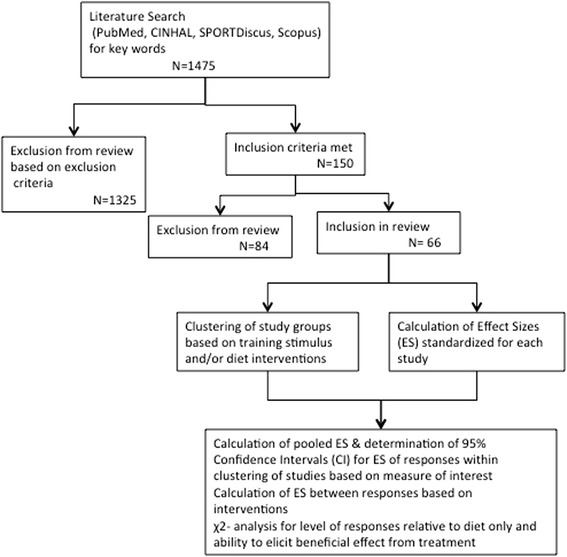
- Systematic review and meta-analysis of human population-based studies retrieved from PubMed, EBSCO Host (CINAHL, SPORTDiscus), and Scopus, with inclusion criteria requiring adults aged 18–65 years classified as overweight or obese, chronic interventions of at least 4 weeks, and randomized assignment to training/control or intervention order.
- A total of 66 studies and 162 study groups were included; 32 studies indicated a control group for pooled therapeutic effect size analysis.
- Standardized effect sizes and 95% confidence intervals were calculated and pooled across treatment categories (diet only, diet+ET, diet+RT, diet+ET+RT, ET only, RT only), with 2×2 χ² analyses used to compare response levels by treatment, exercise subtype, diet type, and intervention length.
Limitations
- Stated: too few studies examined anabolic hormones such as testosterone and growth hormone without pharmaceutical intervention, limiting speculation about the extent or timeframe of hormonal changes.
- Stated: energetic imbalance was generally assumed rather than directly measured; very few protocols directly measured the energetic shift from exercise sessions or recovery, and no reviewed study directly measured it.
- Evident from the text: studies were pooled regardless of intervention duration or unique characteristics, many cells had insufficient responses for pooled ES or CI, and several comparisons relied on trends or borderline significance (e.g., p = 0.055, p = 0.06–0.12).
Model-written summary. Check it against the paper before relying on it.
Integrity signals
Registry
Cites
Statistics
Figures
Verification
Claims the paper makes
97 Own result · 25 No basis given · 20 Own method · 15 Not checked yet · 15 Own interpretation · 1 Partly supported · accuracy not yet measured
The cited sources support only part of this claim — read each source’s verdict below.
In the paper
“The greatest impact of these changes appears to be related to alterations in sex hormone (i.e. testosterone and androgens), growth hormone, and a host of adipokines [29,34-46].”
§ Diet, exercise or diet with exercise: comparing the effectiveness of treatment options for weight-loss and changes in fitness for adults (18–65 years old) who are overfat, or obese; systematic review and meta-analysis > Introduction
What the sources say
- Not checked yetcites [29] Fantuzzi G. Adipose tissue, adipokines, and inflammation. J Allergy Clin Immunol. 2005;115:911–9. quiz 920. source
- Not checked yetcites [34] Bastard J-P, Maachi M, Lagathu C, Kim MJ, Caron M, Vidal H, et al. Recent advances in the relationship between obesity, inflammation, and insulin resistance. Eur Cytokine Netw. 2006;17:4–12.
- Not checked yetcites [35] Abate N, Haffner SM, Garg A, Peshock RM, Grundy SM. Sex steroid hormones, upper body obesity, and insulin resistance. J Clin Endocrinol Metab. 2002;87:4522–7. source
- Partly supportedcites [36] Brick DJ, Gerweck AV, Meenaghan E, Lawson EA, Misra M, Fazeli P, et al. Determinants of IGF1 and GH across the weight spectrum: from anorexia nervosa to obesity. Eur J Endocrinol. 2010;163:185–91. sourceExperimental — accuracy not yet measured
The Introduction and Discussion link testosterone and other androgens with growth hormone and IGF-1 regulation. They do not identify these as the changes with the greatest impact, and the paper does not substantiate the added claim about a host of adipokines. Page numbers are not available in our copy. (LLM, conf=0.84)
- Not checked yetcites [37] Dyck DJ. Adipokines as regulators of muscle metabolism and insulin sensitivity. Appl Physiol Nutr Metab. 2009;34:396–402. source
- Not checked yetcites [38] Gerrits MF, Ghosh S, Kavaslar N, Hill B, Tour A, Seifert EL, et al. Distinct skeletal muscle fiber characteristics and gene expression in diet-sensitive versus diet-resistant obesity. J Lipid Res. 2010;51:2394–404. source
- Not checked yetcites [39] Gualillo O, González-Juanatey JR, Lago F. The emerging role of adipokines as mediators of cardiovascular function: physiologic and clinical perspectives. Trends Cardiovasc Med. 2007;17:275–83. source
- Partly supportedcites [40] Guay AT. The emerging link between hypogonadism and metabolic syndrome. J Androl. 2009;30:370–6. sourceExperimental — accuracy not yet measured
The section “T Levels, Hypogonadism, and Components of MS” (page not available) links testosterone and androgen levels with metabolic syndrome and discusses a hypothesized role for leptin. It does not identify growth hormone or a host of adipokines as major contributors, nor compare their impact with other endocrinological changes. (LLM, conf=0.86)
- Partly supportedcites [41] Mammi C, Calanchini M, Antelmi A, Cinti F, Rosano GMC, Lenzi A, et al. Androgens and adipose tissue in males: a complex and reciprocal interplay. Int J Endocrinol. 2012;2012:789653. sourceExperimental — accuracy not yet measured
Section 6 (page not available in our copy) links sex hormones and adipokines to adipose-tissue changes in males. The paper does not substantiate the attributed role of growth hormone or the claim that these changes have the greatest impact. (LLM, conf=0.86)
- Partly supportedcites [42] Maya-Monteiro CM, Bozza PT. Leptin and mTOR: partners in metabolism and inflammation. Cell Cycle. 2008;7:1713–7. sourceExperimental — accuracy not yet measured
The “Leptin Modulation of Immune Responses” section (page not provided) describes leptin as an adipocyte-derived hormone that links nutritional status with neuroendocrine and immune functions. It does not address alterations in testosterone, androgens, or growth hormone, or establish that the listed hormonal changes have the greatest impact. (LLM, conf=0.83)
hedgedcorrelational- Asserted: passes — The authors put it forward as true.
- Checkable: passes — It can be checked against evidence.
- Load-bearing: unclear — It is unclear whether the paper’s conclusions depend on it.
- Based: passes — The paper gives a reason why it holds.
The paper states this without a source or data behind it here, so there is nothing to check it against. The quote shows it is in the paper.
In the paper
“First, hypocaloric balance is necessary for changing body composition, but the effectiveness for establishing imbalance does not equate with the effectiveness for body compositional changes, or any biomarkers associated with metabolic issues.”
§ Diet, exercise or diet with exercise: comparing the effectiveness of treatment options for weight-loss and changes in fitness for adults (18–65 years old) who are overfat, or obese; systematic review and meta-analysis > Abstract
plain- Asserted: passes — The authors put it forward as true.
- Checkable: passes — It can be checked against evidence.
- Load-bearing: passes — The paper’s conclusions depend on it.
- Based: passes — The paper gives a reason why it holds.
A result the paper reports from its own data — it cites no other source for it, so there is none to check. The quote shows it is in the paper.
In the paper
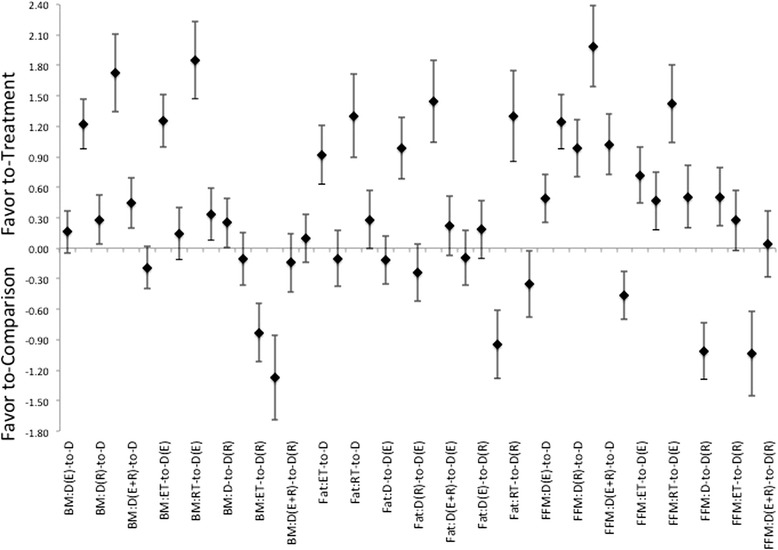
“Even though generally lower ES than RT, the inclusion of ET was more effective when performed at high intensity (e.g. ≥70% VO2max or HRmax for 30-minutes 3-4x’s/wk), or in an interval training style than when utilizing the relatively common prescribed method of low-to-moderate (e.g., 50-70% VO2max or HRmax for at least equal time) steady state method, ES of 0.35, 0.39, and 0.13 for BM, FM, and FFM”
§ Diet, exercise or diet with exercise: comparing the effectiveness of treatment options for weight-loss and changes in fitness for adults (18–65 years old) who are overfat, or obese; systematic review and meta-analysis > Abstract
plaindirect- Asserted: passes — The authors put it forward as true.
- Checkable: passes — It can be checked against evidence.
- Load-bearing: passes — The paper’s conclusions depend on it.
- Based: passes — The paper gives a reason why it holds.
The paper states this without a source or data behind it here, so there is nothing to check it against. The quote shows it is in the paper.
In the paper
“Additionally RT was more effective at reducing fasting insulin levels (ES = 3.5) than ET or ET and RT.”
§ Diet, exercise or diet with exercise: comparing the effectiveness of treatment options for weight-loss and changes in fitness for adults (18–65 years old) who are overfat, or obese; systematic review and meta-analysis > Abstract
plaindirect- Asserted: passes — The authors put it forward as true.
- Checkable: passes — It can be checked against evidence.
- Load-bearing: passes — The paper’s conclusions depend on it.
- Based: passes — The paper gives a reason why it holds.
A result the paper reports from its own data — it cites no other source for it, so there is none to check. The quote shows it is in the paper.
In the paper
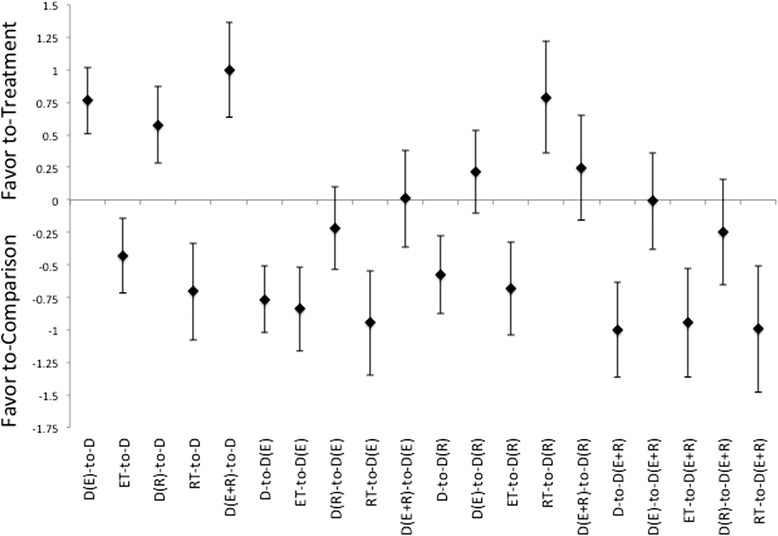
“Interestingly, there were differences noted between effects favoring the combination of diet with ET versus diet alone for alterations in body mass (χ2 = 3.09, p = 0.055).”
§ Diet, exercise or diet with exercise: comparing the effectiveness of treatment options for weight-loss and changes in fitness for adults (18–65 years old) who are overfat, or obese; systematic review and meta-analysis > Results > Pooled effects
plaindirect- Asserted: passes — The authors put it forward as true.
- Checkable: passes — It can be checked against evidence.
- Load-bearing: unclear — It is unclear whether the paper’s conclusions depend on it.
- Based: passes — The paper gives a reason why it holds.
A result the paper reports from its own data — it cites no other source for it, so there is none to check. The quote shows it is in the paper.
In the paper
“When examining the effect of ET, when separated from the aspect of additional diet intervention, ET alone appears to less effective to allow for the retention of FFM than dieting alone, or in a combination with use of diet (χ2 = 7.458, p < 0.01).”
§ Diet, exercise or diet with exercise: comparing the effectiveness of treatment options for weight-loss and changes in fitness for adults (18–65 years old) who are overfat, or obese; systematic review and meta-analysis > Results > Pooled effects
hedgeddirect- Asserted: passes — The authors put it forward as true.
- Checkable: passes — It can be checked against evidence.
- Load-bearing: passes — The paper’s conclusions depend on it.
- Based: passes — The paper gives a reason why it holds.
A result the paper reports from its own data — it cites no other source for it, so there is none to check. The quote shows it is in the paper.
In the paper
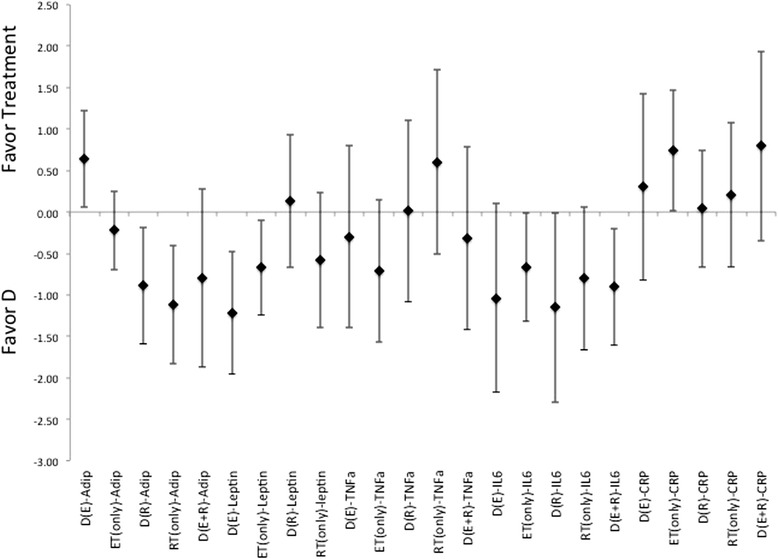
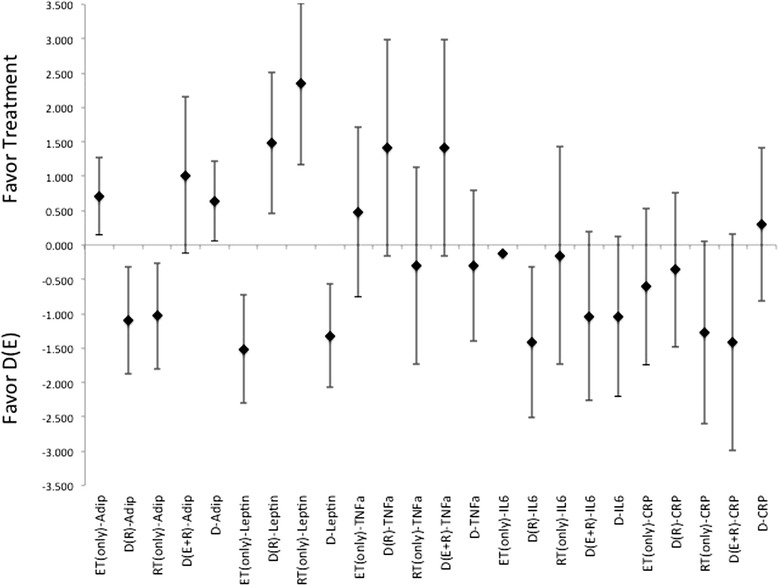
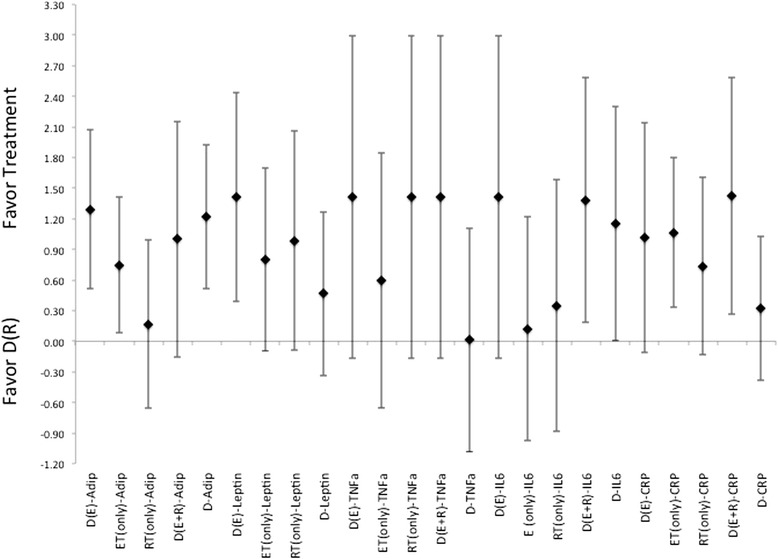
“Furthermore, there were very few differences in the pooled effect size versus the diet only intervention, with difference in ES for changes of adiponectin and leptin being elicited by the use of RT, either with or without diet, trending toward significant difference, χ2 = 3.085 (p = 0.07) and χ2 = 3.45 (p = 0.06), respectively.”
§ Diet, exercise or diet with exercise: comparing the effectiveness of treatment options for weight-loss and changes in fitness for adults (18–65 years old) who are overfat, or obese; systematic review and meta-analysis > Results > Pooled effects
plain- Asserted: passes — The authors put it forward as true.
- Checkable: passes — It can be checked against evidence.
- Load-bearing: unclear — It is unclear whether the paper’s conclusions depend on it.
- Based: passes — The paper gives a reason why it holds.
A result the paper reports from its own data — it cites no other source for it, so there is none to check. The quote shows it is in the paper.
In the paper
“Along with males indicated has having a greater level of effectiveness relative to females for loss of FM and retention of FFM following an intervention of diet with combination of both ET and RT (χ2 = 3.64, p < 0.05).”
§ Diet, exercise or diet with exercise: comparing the effectiveness of treatment options for weight-loss and changes in fitness for adults (18–65 years old) who are overfat, or obese; systematic review and meta-analysis > Results > Pooled effects
hedgeddirect- Asserted: passes — The authors put it forward as true.
- Checkable: passes — It can be checked against evidence.
- Load-bearing: passes — The paper’s conclusions depend on it.
- Based: passes — The paper gives a reason why it holds.
A result the paper reports from its own data — it cites no other source for it, so there is none to check. The quote shows it is in the paper.
In the paper
“And differences indicate an effectiveness favoring for the combination of diet with RT versus diet along for reduction in FM (χ2 = 3.8, p < 0.05) and retention of FFM (χ2 = 6.7, p < 0.0001).”
§ Diet, exercise or diet with exercise: comparing the effectiveness of treatment options for weight-loss and changes in fitness for adults (18–65 years old) who are overfat, or obese; systematic review and meta-analysis > Results > Pooled effects
hedgeddirect- Asserted: passes — The authors put it forward as true.
- Checkable: passes — It can be checked against evidence.
- Load-bearing: passes — The paper’s conclusions depend on it.
- Based: passes — The paper gives a reason why it holds.
A result the paper reports from its own data — it cites no other source for it, so there is none to check. The quote shows it is in the paper.
In the paper
“Lastly, as related to changes in caloric (energetic) balance there were no differences noted between any of the pooled ES for the assumed differences in energetic balance across the various treatment interventions.”
§ Diet, exercise or diet with exercise: comparing the effectiveness of treatment options for weight-loss and changes in fitness for adults (18–65 years old) who are overfat, or obese; systematic review and meta-analysis > Results > Pooled effects
plain- Asserted: passes — The authors put it forward as true.
- Checkable: passes — It can be checked against evidence.
- Load-bearing: unclear — It is unclear whether the paper’s conclusions depend on it.
- Based: passes — The paper gives a reason why it holds.
- The authors state this as an assumption: There are differences in energetic balance across the various treatment interventions.
- It may state two separate claims as one. 24
- The quote only partly states this claim. 7
- Probably not a substantial claim. 32
A result the paper reports from its own data — it cites no other source for it, so there is none to check. The quote shows it is in the paper.
In the paper
“More importantly, the combination, resistance training (RT) was more effective than endurance training (ET) or combination of RT and ET, particularly when progressive training volume of 2-to-3 sets for 6-to-10 reps at an intensity of ≥75% 1RM, utilizing whole body and free-weight exercises, at altering body compositional measures (ES of 0.47, 0.30, and 0.40 for loss of BM, FM, and retention of FFM”
§ Diet, exercise or diet with exercise: comparing the effectiveness of treatment options for weight-loss and changes in fitness for adults (18–65 years old) who are overfat, or obese; systematic review and meta-analysis > Abstract
plaindirect- Asserted: passes — The authors put it forward as true.
- Checkable: passes — It can be checked against evidence.
- Load-bearing: passes — The paper’s conclusions depend on it.
- Based: passes — The paper gives a reason why it holds.
It may state two separate claims as one.
A result the paper reports from its own data — it cites no other source for it, so there is none to check. The quote shows it is in the paper.
In the paper
“and reducing total cholesterol (ES = 0.85), triglycerides (ES = 0.86) and low-density lipoproteins (ES = 0.60).”
§ Diet, exercise or diet with exercise: comparing the effectiveness of treatment options for weight-loss and changes in fitness for adults (18–65 years old) who are overfat, or obese; systematic review and meta-analysis > Abstract
plaindirect- Asserted: passes — The authors put it forward as true.
- Checkable: passes — It can be checked against evidence.
- Load-bearing: passes — The paper’s conclusions depend on it.
- Based: passes — The paper gives a reason why it holds.
The quote only partly states this claim.
A result the paper reports from its own data — it cites no other source for it, so there is none to check. The quote shows it is in the paper.
In the paper
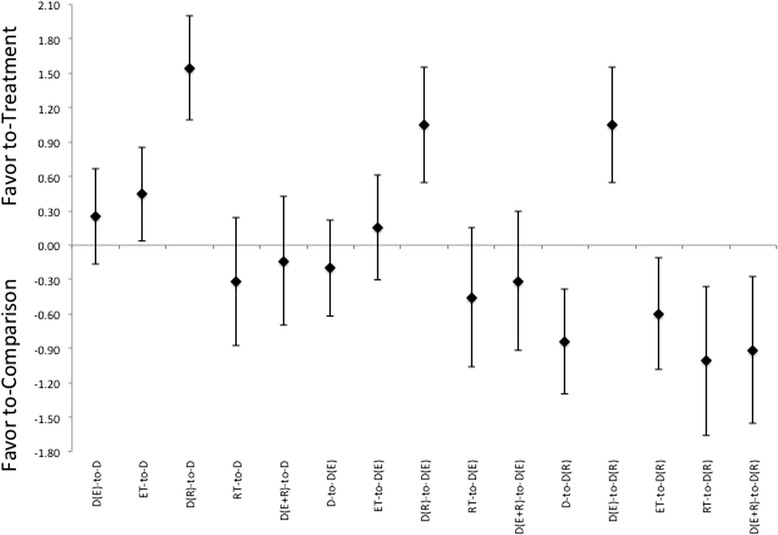
“Interestingly, while the combination of diet with ET and RT was more effective then either a diet alone or exercise alone it was less effective then either ET or RT in combination with diet at inducing an energetic imbalance.”
§ Diet, exercise or diet with exercise: comparing the effectiveness of treatment options for weight-loss and changes in fitness for adults (18–65 years old) who are overfat, or obese; systematic review and meta-analysis > Results > Comparison between treatment effects
plaindirect- Asserted: passes — The authors put it forward as true.
- Checkable: passes — It can be checked against evidence.
- Load-bearing: passes — The paper’s conclusions depend on it.
- Based: passes — The paper gives a reason why it holds.
It may state two separate claims as one.
A result the paper reports from its own data — it cites no other source for it, so there is none to check. The quote shows it is in the paper.
In the paper
“favor higher intensity ET at an ES for 0.35 for BM and 0.39 for FM but not for retention of FFM 0.13 relative to lower intensity ET.”
§ Diet, exercise or diet with exercise: comparing the effectiveness of treatment options for weight-loss and changes in fitness for adults (18–65 years old) who are overfat, or obese; systematic review and meta-analysis > Results > Comparison within treatment methods
plaindirect- Asserted: passes — The authors put it forward as true.
- Checkable: passes — It can be checked against evidence.
- Load-bearing: passes — The paper’s conclusions depend on it.
- Based: passes — The paper gives a reason why it holds.
It may state two separate claims as one.
A result the paper reports from its own data — it cites no other source for it, so there is none to check. The quote shows it is in the paper.
In the paper
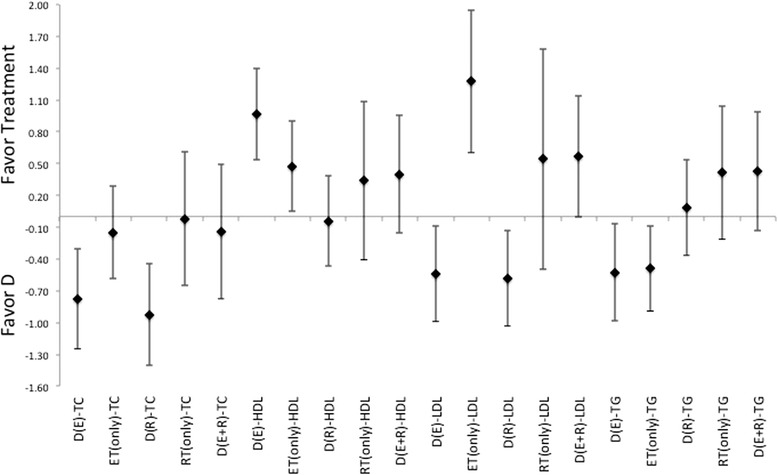
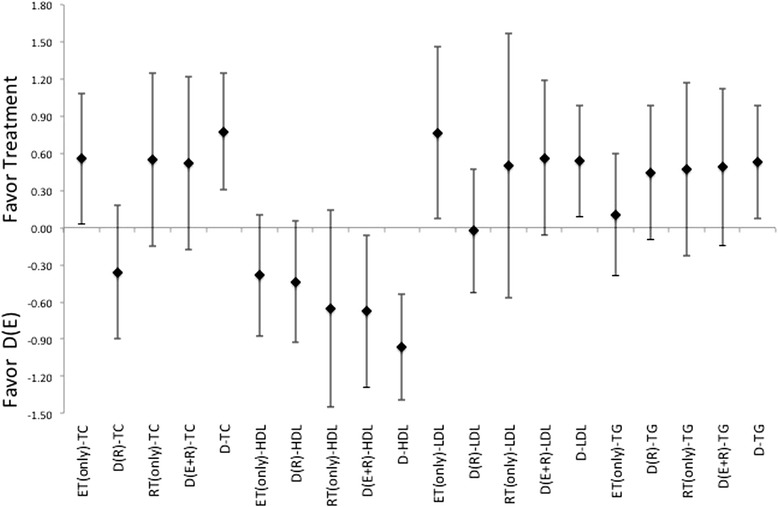
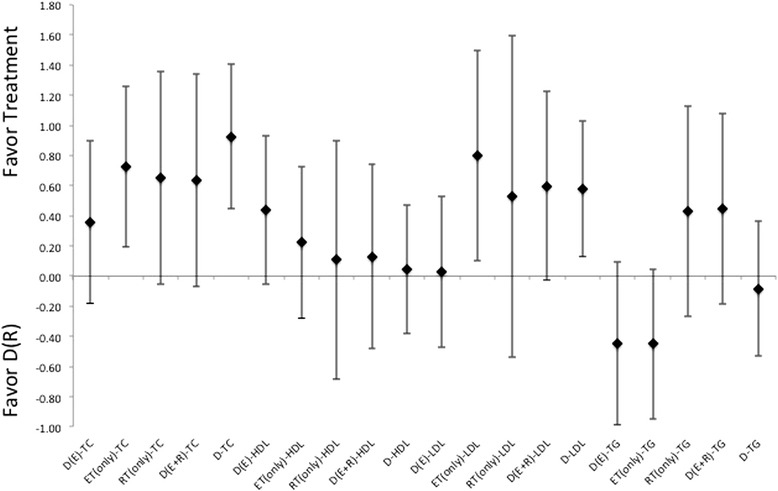
“comparisons between exercise intensities within the ET and the RT protocols, indicated favor toward ET (ES of 0.66, 1.13, 0.61, and 0.96 for TC, HDL, LDL, and TG respectively), and RT (ES of 0.85, 0.86, and 0.60 for TC, LDL, and TG respectively).”
§ Diet, exercise or diet with exercise: comparing the effectiveness of treatment options for weight-loss and changes in fitness for adults (18–65 years old) who are overfat, or obese; systematic review and meta-analysis > Results > Comparison within treatment methods
hedgedcorrelational- Asserted: passes — The authors put it forward as true.
- Checkable: passes — It can be checked against evidence.
- Load-bearing: passes — The paper’s conclusions depend on it.
- Based: passes — The paper gives a reason why it holds.
It may state two separate claims as one.
A result the paper reports from its own data — it cites no other source for it, so there is none to check. The quote shows it is in the paper.
In the paper
“RT protocols produced a greater ES for changes in adiponectin for higher intensities (ES of 0.74), but not for lower (ES of −1.14) with no differences noted for changes in leptin, relative to ET.”
§ Diet, exercise or diet with exercise: comparing the effectiveness of treatment options for weight-loss and changes in fitness for adults (18–65 years old) who are overfat, or obese; systematic review and meta-analysis > Results > Comparison within treatment methods
plaindirect- Asserted: passes — The authors put it forward as true.
- Checkable: passes — It can be checked against evidence.
- Load-bearing: unclear — It is unclear whether the paper’s conclusions depend on it.
- Based: passes — The paper gives a reason why it holds.
It may state two separate claims as one.
A result the paper reports from its own data — it cites no other source for it, so there is none to check. The quote shows it is in the paper.
In the paper
“lower fat diet was less effective when compared to either a glycemically controlled diet, or the high protein/low carbohydrate diet for the change of any body compositional measures, ES of −0.64. Especially in relation to the high protein/low carbohydrate diet, ES of −1.04.”
§ Diet, exercise or diet with exercise: comparing the effectiveness of treatment options for weight-loss and changes in fitness for adults (18–65 years old) who are overfat, or obese; systematic review and meta-analysis > Results > Comparison within treatment methods
plaindirect- Asserted: passes — The authors put it forward as true.
- Checkable: passes — It can be checked against evidence.
- Load-bearing: passes — The paper’s conclusions depend on it.
- Based: passes — The paper gives a reason why it holds.
It may state two separate claims as one.
A result the paper reports from its own data — it cites no other source for it, so there is none to check. The quote shows it is in the paper.
In the paper
“There were gender differences noted for effectiveness of treatment for HDL and TG but not for LDL or TC, both of which indicate a larger effectiveness for treatment in female grouping versus male counterparts.”
§ Diet, exercise or diet with exercise: comparing the effectiveness of treatment options for weight-loss and changes in fitness for adults (18–65 years old) who are overfat, or obese; systematic review and meta-analysis > Results > Comparison between treatment effects
hedgeddirect- Asserted: passes — The authors put it forward as true.
- Checkable: passes — It can be checked against evidence.
- Load-bearing: unclear — It is unclear whether the paper’s conclusions depend on it.
- Based: passes — The paper gives a reason why it holds.
It may state two separate claims as one.
A result the paper reports from its own data — it cites no other source for it, so there is none to check. The quote shows it is in the paper.
In the paper
“the use of RT either alone, or in combination with diet, was more effective than diet alone it was less effective than ET or the combination of diet with ET and RT”
§ Diet, exercise or diet with exercise: comparing the effectiveness of treatment options for weight-loss and changes in fitness for adults (18–65 years old) who are overfat, or obese; systematic review and meta-analysis > Results > Comparison between treatment effects
plaindirect- Asserted: passes — The authors put it forward as true.
- Checkable: passes — It can be checked against evidence.
- Load-bearing: passes — The paper’s conclusions depend on it.
- Based: passes — The paper gives a reason why it holds.
It may state two separate claims as one.
The paper states this without a source or data behind it here, so there is nothing to check it against. The quote shows it is in the paper.
In the paper
“very few protocols directly measure the imbalance and no study reviewed on the topic directly measured the energetic shift from either the exercise sessions, the recovery from said sessions.”
§ Diet, exercise or diet with exercise: comparing the effectiveness of treatment options for weight-loss and changes in fitness for adults (18–65 years old) who are overfat, or obese; systematic review and meta-analysis > Discussion
plain- Asserted: passes — The authors put it forward as true.
- Checkable: passes — It can be checked against evidence.
- Load-bearing: passes — The paper’s conclusions depend on it.
- Based: passes — The paper gives a reason why it holds.
It may state two separate claims as one.
A result the paper reports from its own data — it cites no other source for it, so there is none to check. The quote shows it is in the paper.
In the paper
“the use of a ET alone, or in combination with RT, and in combination with diet interventions were not more effect than the combination of RT with diet”
§ Diet, exercise or diet with exercise: comparing the effectiveness of treatment options for weight-loss and changes in fitness for adults (18–65 years old) who are overfat, or obese; systematic review and meta-analysis > Discussion
plain- Asserted: passes — The authors put it forward as true.
- Checkable: passes — It can be checked against evidence.
- Load-bearing: passes — The paper’s conclusions depend on it.
- Based: passes — The paper gives a reason why it holds.
It may state two separate claims as one.
The paper states this without a source or data behind it here, so there is nothing to check it against. The quote shows it is in the paper.
In the paper
“ET appeared to have its greatest effect when either in an interval style of ET, or at higher intensities of at ≥75% VO2max (or HRmax/peak), while not at the traditionally recommended moderate (e.g., 55-75% VO2max, or HRmax/peak) steady-state ET for response to changes in BM and FM, but not for changes in FFM.”
§ Diet, exercise or diet with exercise: comparing the effectiveness of treatment options for weight-loss and changes in fitness for adults (18–65 years old) who are overfat, or obese; systematic review and meta-analysis > Discussion
hedgeddirect- Asserted: passes — The authors put it forward as true.
- Checkable: passes — It can be checked against evidence.
- Load-bearing: passes — The paper’s conclusions depend on it.
- Based: passes — The paper gives a reason why it holds.
It may state two separate claims as one.
The paper states this without a source or data behind it here, so there is nothing to check it against. The quote shows it is in the paper.
In the paper
“all treatments offer a small degree of effectiveness for altering lipid profiles for the individual who is overfat.”
§ Diet, exercise or diet with exercise: comparing the effectiveness of treatment options for weight-loss and changes in fitness for adults (18–65 years old) who are overfat, or obese; systematic review and meta-analysis > Discussion
plaindirect- Asserted: passes — The authors put it forward as true.
- Checkable: passes — It can be checked against evidence.
- Load-bearing: unclear — It is unclear whether the paper’s conclusions depend on it.
- Based: passes — The paper gives a reason why it holds.
The quote only partly states this claim.
The paper states this without a source or data behind it here, so there is nothing to check it against. The quote shows it is in the paper.
In the paper
“there is limited analysis to speculate either to the extent, beyond expected changes toward normal levels, or time frame for changes within anabolic hormones for adults who are overfat.”
§ Diet, exercise or diet with exercise: comparing the effectiveness of treatment options for weight-loss and changes in fitness for adults (18–65 years old) who are overfat, or obese; systematic review and meta-analysis > Discussion
plain- Asserted: passes — The authors put it forward as true.
- Checkable: passes — It can be checked against evidence.
- Load-bearing: fails — The paper’s conclusions may not depend on it.
- Based: passes — The paper gives a reason why it holds.
Probably not a substantial claim. The paper’s conclusions may not depend on it.
A result the paper reports from its own data — it cites no other source for it, so there is none to check. The quote shows it is in the paper.
In the paper
“trends in the data towards the use of exercise (ET, RT or combination thereof) either alone or in combination with diet for effectiveness of treatment over the use of simple dietary interventions.”
§ Diet, exercise or diet with exercise: comparing the effectiveness of treatment options for weight-loss and changes in fitness for adults (18–65 years old) who are overfat, or obese; systematic review and meta-analysis > Discussion
hedgeddirect- Asserted: passes — The authors put it forward as true.
- Checkable: passes — It can be checked against evidence.
- Load-bearing: passes — The paper’s conclusions depend on it.
- Based: passes — The paper gives a reason why it holds.
The quote only partly states this claim.
The paper states this without a source or data behind it here, so there is nothing to check it against. The quote shows it is in the paper.
In the paper
“the combination of diet and exercise was more effective than diet alone or exercise alone.”
§ Diet, exercise or diet with exercise: comparing the effectiveness of treatment options for weight-loss and changes in fitness for adults (18–65 years old) who are overfat, or obese; systematic review and meta-analysis > Discussion
plaindirect- Asserted: passes — The authors put it forward as true.
- Checkable: passes — It can be checked against evidence.
- Load-bearing: passes — The paper’s conclusions depend on it.
- Based: passes — The paper gives a reason why it holds.
The quote only partly states this claim.
A result the paper reports from its own data — it cites no other source for it, so there is none to check. The quote shows it is in the paper.
In the paper
“these responses were highly variable and most of the indications for effectiveness, both as a therapeutic effect and treatment effect, near that point of zero difference in effect (i.e. ES = 0).”
§ Diet, exercise or diet with exercise: comparing the effectiveness of treatment options for weight-loss and changes in fitness for adults (18–65 years old) who are overfat, or obese; systematic review and meta-analysis > Discussion
plain- Asserted: passes — The authors put it forward as true.
- Checkable: passes — It can be checked against evidence.
- Load-bearing: unclear — It is unclear whether the paper’s conclusions depend on it.
- Based: passes — The paper gives a reason why it holds.
It may state two separate claims as one.
The paper states this without a source or data behind it here, so there is nothing to check it against. The quote shows it is in the paper.
In the paper
“diet combined with RT induced an almost equal level of effectiveness to that of diet alone. With both indicated as being less effective than the combination of diet with ET or the combination of diet with ET and RT.”
§ Diet, exercise or diet with exercise: comparing the effectiveness of treatment options for weight-loss and changes in fitness for adults (18–65 years old) who are overfat, or obese; systematic review and meta-analysis > Discussion
plaindirect- Asserted: passes — The authors put it forward as true.
- Checkable: passes — It can be checked against evidence.
- Load-bearing: passes — The paper’s conclusions depend on it.
- Based: passes — The paper gives a reason why it holds.
It may state two separate claims as one.
A result the paper reports from its own data — it cites no other source for it, so there is none to check. The quote shows it is in the paper.
In the paper
“For those who self-select toward ET, it appears that ET is more effective when performed at high intensity (e.g., ≥70% VO2max, or HRmax) steady-state method or as an interval training style (based on ES calculated gives an expectations of at least 40% of the population showing beneficial responses to intervention).”
§ Diet, exercise or diet with exercise: comparing the effectiveness of treatment options for weight-loss and changes in fitness for adults (18–65 years old) who are overfat, or obese; systematic review and meta-analysis > Conclusions
hedgeddirect- Asserted: passes — The authors put it forward as true.
- Checkable: passes — It can be checked against evidence.
- Load-bearing: passes — The paper’s conclusions depend on it.
- Based: passes — The paper gives a reason why it holds.
It may state two separate claims as one.
The paper states this without a source or data behind it here, so there is nothing to check it against. The quote shows it is in the paper.
In the paper
“when exercise is utilized at appropriate intensities (i.e. higher levels) both ET and RT provides an effective stimulus to alter TNF-α, CRP, leptin and adiponectin levels that all indicate a reduction in the risk for cardiovascular disease and improved metabolic flexibility for the adult who is overfat.”
§ Diet, exercise or diet with exercise: comparing the effectiveness of treatment options for weight-loss and changes in fitness for adults (18–65 years old) who are overfat, or obese; systematic review and meta-analysis > Conclusions
hedgeddirect- Asserted: passes — The authors put it forward as true.
- Checkable: passes — It can be checked against evidence.
- Load-bearing: passes — The paper’s conclusions depend on it.
- Based: passes — The paper gives a reason why it holds.
It may state two separate claims as one.
None of the sources cited for this claim have been checked yet.
In the paper
“While others [4,9-12] have indicated the responses are more related to an energetic imbalance (e.g., kcal/day, kJ/day) between dietary caloric load and expenditure from activity that results from the intervention of choice (e.g., diet, exercise, or combination therein) than the actual intervention for the adult who is overfat.”
§ Diet, exercise or diet with exercise: comparing the effectiveness of treatment options for weight-loss and changes in fitness for adults (18–65 years old) who are overfat, or obese; systematic review and meta-analysis > Introduction
What the sources say
- Not checked yetcites [4] Hansen D, Dendale P, Berger J, van Loon LJC, Meeusen R. The effects of exercise training on fat-mass loss in obese patients during energy intake restriction. Sports Med. 2007;37:31–46. source
- Not checked yetcites [9] Votruba SB, Horvitz MA, Schoeller DA. The role of exercise in the treatment of obesity. Nutrition. 2000;16:179–88. source
- Not checked yetcites [10] Larson-Meyer DE, Redman L, Heilbronn LK, Martin CK, Ravussin E. Caloric restriction with or without exercise: the fitness versus fatness debate. Med Sci Sports Exerc. 2010;42:152–9. source
- Not checked yetcites [11] Lee S, Kuk JL, Davidson LE, Hudson R, Kilpatrick K, Graham TE, et al. Exercise without weight loss is an effective strategy for obesity reduction in obese individuals with and without Type 2 diabetes. J Appl Physiol. 2005;99:1220–5. source
- Not checked yetcites [12] Williams PT. Health effects resulting from exercise versus those from body fat loss. Med Sci Sports Exerc. 2001;33:S611–21. discussion S640-611. source
hedgedcorrelational- Asserted: passes — The authors put it forward as true.
- Checkable: passes — It can be checked against evidence.
- Load-bearing: passes — The paper’s conclusions depend on it.
- Based: passes — The paper gives a reason why it holds.
Probably not a substantial claim.
None of the sources cited for this claim have been checked yet.
In the paper
“several authors [4-9] have previously noted that there are limited differences in results for absolute changes in body composition with comparison between the various methodologies employed for treatment of weight issues for an individual who is overfat.”
§ Diet, exercise or diet with exercise: comparing the effectiveness of treatment options for weight-loss and changes in fitness for adults (18–65 years old) who are overfat, or obese; systematic review and meta-analysis > Introduction
What the sources say
- Not checked yetcites [4] Hansen D, Dendale P, Berger J, van Loon LJC, Meeusen R. The effects of exercise training on fat-mass loss in obese patients during energy intake restriction. Sports Med. 2007;37:31–46. source
- Not checked yetcites [5] Hainer V, Toplak H, Mitrakou A. Treatment modalities of obesity: what fits whom? Diabetes Care. 2008;31 Suppl 2:S269–77. source
- Not checked yetcites [6] Lee DC, Sui X, Blair SN. Does physical activity ameliorate the health hazards of obesity? Br J Sports Med. 2009;43:49–51. source
- Not checked yetcites [7] Strasser B, Spreitzer A, Haber P. Fat loss depends on energy deficit only, independently of the method for weight loss. Ann Nutr Metab. 2007;51:428–32. source
- Not checked yetcites [8] Varady KA, Bhutani S, Klempel MC, Kroeger CM. Comparison of effects of diet versus exercise weight loss regimens on LDL and HDL particle size in obese adults. Lipids Health Dis. 2011;10:119. source
- Not checked yetcites [9] Votruba SB, Horvitz MA, Schoeller DA. The role of exercise in the treatment of obesity. Nutrition. 2000;16:179–88. source
plain- Asserted: passes — The authors put it forward as true.
- Checkable: passes — It can be checked against evidence.
- Load-bearing: passes — The paper’s conclusions depend on it.
- Based: passes — The paper gives a reason why it holds.
Probably not a substantial claim.
None of the sources cited for this claim have been checked yet.
In the paper
“Something that has become evident in the low attrition rates within many exercise programs and the high rate of repeated hypocaloric diet attempts [13-16].”
§ Diet, exercise or diet with exercise: comparing the effectiveness of treatment options for weight-loss and changes in fitness for adults (18–65 years old) who are overfat, or obese; systematic review and meta-analysis > Introduction
What the sources say
- Not checked yetcites [13] Brock DW, Irving BA, Gower B, Hunter GR. Differences emerge in visceral adipose tissue accumulation after selection for innate cardiovascular fitness. Int J Obesity (2005). 2011;35;2:309–12. source
- Not checked yetcites [14] Eriksson JG. Exercise and the treatment of type 2 diabetes mellitus. An update. Sports Med. 1999;27:381–91. source
- Not checked yetcites [15] Fogelholm M. How physical activity can work? Int J Pediatr Obes. 2008;3 Suppl 1:10–4. source
- Not checked yetcites [16] Hooper LE, Foster-Schubert KE, Weigle DS, Sorensen B, Ulrich CM, McTiernan A. Frequent intentional weight loss is associated with higher ghrelin and lower glucose and androgen levels in postmenopausal women. Nutri Res (New York, NY). 2010;30:163–70. source
plain- Asserted: passes — The authors put it forward as true.
- Checkable: passes — It can be checked against evidence.
- Load-bearing: unclear — It is unclear whether the paper’s conclusions depend on it.
- Based: passes — The paper gives a reason why it holds.
It may state two separate claims as one.
None of the sources cited for this claim have been checked yet.
In the paper
“Even if it is well understood that altering any health behaviors leads to a reduction in the risk factors for preventable non-communicable diseases [18,20,26-33].”
§ Diet, exercise or diet with exercise: comparing the effectiveness of treatment options for weight-loss and changes in fitness for adults (18–65 years old) who are overfat, or obese; systematic review and meta-analysis > Introduction
What the sources say
- Not checked yetcites [18] Bruunsgaard H. Physical activity and modulation of systemic low-level inflammation. J Leukoc Biol. 2005;78:819–35. source
- Not checked yetcites [20] Duncan GE. The “fit but fat” concept revisited: population-based estimates using NHANES. Int J Behav Nutr Phys Act. 2010;7:47. source
- Not checked yetcites [26] Booth FW, Gordon SE, Carlson CJ, Hamilton MT. Waging war on modern chronic diseases: primary prevention through exercise biology. J Appl Physiol (Bethesda, Md : 1985). 2000;88:774–87. source
- Not checked yetcites [27] Clark JE. Role of resistance training in obesity treatments. 1st International Conference on Obesity, OMICS. Philadelphia, PA, 2012.
- Not checked yetcites [28] Clark JE, Goon DT. The roles of resistance training for treatment of obesity related health issue and for changing health status of the individual who is overfat or obese: A review. J Sports Med Phys Fit. 2015;55(3):205–22.
- Not checked yetcites [29] Fantuzzi G. Adipose tissue, adipokines, and inflammation. J Allergy Clin Immunol. 2005;115:911–9. quiz 920. source
- Not checked yetcites [30] Hood DA, Irrcher I, Ljubicic V, Joseph A-M. Coordination of metabolic plasticity in skeletal muscle. J Exp Biol. 2006;209:2265–75. source
- Not checked yetcites [31] Matheson EM, King DE, Everett CJ. Healthy lifestyle habits and mortality in overweight and obese individuals. J Am Board Fam Med. 2012;25:9–15. source
- Not checked yetcites [32] Mathur N, Pedersen BK. Exercise as a mean to control low-grade systemic inflammation. Mediators Inflamm. 2008;2008:109502. source
- Not checked yetcites [33] Müssig K, Remer T, Maser-Gluth C. Brief review: Glucocorticoid excretion in obesity. J Steroid Biochem Mol Biol. 2010;121(3–5):589–93. source
boosteddirect- Asserted: passes — The authors put it forward as true.
- Checkable: passes — It can be checked against evidence.
- Load-bearing: fails — The paper’s conclusions may not depend on it.
- Based: passes — The paper gives a reason why it holds.
Probably not a substantial claim. The paper’s conclusions may not depend on it.
None of the sources cited for this claim have been checked yet.
In the paper
“And a methodological bias in the employment of exercise that leads to an over recommendation of a single type of exercise based on personal preference [27,55-57].”
§ Diet, exercise or diet with exercise: comparing the effectiveness of treatment options for weight-loss and changes in fitness for adults (18–65 years old) who are overfat, or obese; systematic review and meta-analysis > Introduction
What the sources say
- Not checked yetcites [27] Clark JE. Role of resistance training in obesity treatments. 1st International Conference on Obesity, OMICS. Philadelphia, PA, 2012.
- Not checked yetcites [55] American Heart Association Nutritional Committee, Lichtenstein AH, Appel LJ, Brands M, Carnethon M, Daniels S, et al. Diet and lifestyle recommendations revision 2006: a scientific statement from the American Heart Association Nutrition Committee. Circulation. 2006;114:82–96. source
- Not checked yetcites [56] Garland T, Schutz H, Chappell MA, Keeney BK, Meek TH, Copes LE, et al. The biological control of voluntary exercise, spontaneous physical activity and daily energy expenditure in relation to obesity: human and rodent perspectives. J Exp Biol. 2011;214:206–29. source
- Not checked yetcites [57] Booth FW, Laye MJ. Lack of adequate appreciation of physical exercise’s complexities can pre-empt appropriate design and interpretation in scientific discovery. J Physiol Lond. 2009;587:5527–39. source
plaindirect- Asserted: passes — The authors put it forward as true.
- Checkable: passes — It can be checked against evidence.
- Load-bearing: fails — The paper’s conclusions may not depend on it.
- Based: passes — The paper gives a reason why it holds.
Probably not a substantial claim. The paper’s conclusions may not depend on it.
None of the sources cited for this claim have been checked yet.
In the paper
“With low utilization of healthy behaviors eliciting changes indicated to increase the risk for the development of metabolic issues, which may culminate in Type 2 Diabetes Mellitus (T2DM), and are readily associated with reduced work capacity and anabolic hormone response for the individual who is overfat [18,26,27].”
§ Diet, exercise or diet with exercise: comparing the effectiveness of treatment options for weight-loss and changes in fitness for adults (18–65 years old) who are overfat, or obese; systematic review and meta-analysis > Introduction
What the sources say
- Not checked yetcites [18] Bruunsgaard H. Physical activity and modulation of systemic low-level inflammation. J Leukoc Biol. 2005;78:819–35. source
- Not checked yetcites [26] Booth FW, Gordon SE, Carlson CJ, Hamilton MT. Waging war on modern chronic diseases: primary prevention through exercise biology. J Appl Physiol (Bethesda, Md : 1985). 2000;88:774–87. source
- Not checked yetcites [27] Clark JE. Role of resistance training in obesity treatments. 1st International Conference on Obesity, OMICS. Philadelphia, PA, 2012.
hedgedconditional- Asserted: passes — The authors put it forward as true.
- Checkable: passes — It can be checked against evidence.
- Load-bearing: passes — The paper’s conclusions depend on it.
- Based: passes — The paper gives a reason why it holds.
It may state two separate claims as one.
What the paper did — it cites no source for this, so there is none to check. The quote shows it is in the paper.
In the paper
“were retrieved from electronic database search engines (PubMed, EBSCO Host (CINAHL, SPORTDiscus) and Scopus) using the following key words in combination with each other”
§ Diet, exercise or diet with exercise: comparing the effectiveness of treatment options for weight-loss and changes in fitness for adults (18–65 years old) who are overfat, or obese; systematic review and meta-analysis > Methods
plain- Asserted: passes — The authors put it forward as true.
- Checkable: passes — It can be checked against evidence.
- Load-bearing: fails — The paper’s conclusions may not depend on it.
- Based: passes — The paper gives a reason why it holds.
Probably not a substantial claim. The paper’s conclusions may not depend on it.
What the paper did — it cites no source for this, so there is none to check. The quote shows it is in the paper.
In the paper
“Study population was either identified as either “overweight” or “obese” by authors or was indicated within the study as meeting at least 1 of the classification metrics for being overweight or obese (i.e. BMI > 25 kg/m3 or WHO levels of %BF for classification based on age and gender)”
§ Diet, exercise or diet with exercise: comparing the effectiveness of treatment options for weight-loss and changes in fitness for adults (18–65 years old) who are overfat, or obese; systematic review and meta-analysis > Methods
plain- Asserted: passes — The authors put it forward as true.
- Checkable: passes — It can be checked against evidence.
- Load-bearing: passes — The paper’s conclusions depend on it.
- Based: passes — The paper gives a reason why it holds.
Probably not a substantial claim.
What the paper did — it cites no source for this, so there is none to check. The quote shows it is in the paper.
In the paper
“Published in English or translation of article available”
§ Diet, exercise or diet with exercise: comparing the effectiveness of treatment options for weight-loss and changes in fitness for adults (18–65 years old) who are overfat, or obese; systematic review and meta-analysis > Methods
plain- Asserted: passes — The authors put it forward as true.
- Checkable: passes — It can be checked against evidence.
- Load-bearing: fails — The paper’s conclusions may not depend on it.
- Based: passes — The paper gives a reason why it holds.
Probably not a substantial claim. The paper’s conclusions may not depend on it.
What the paper did — it cites no source for this, so there is none to check. The quote shows it is in the paper.
In the paper
“Indication of use of dietary supplement, or pharmacological dosing of anabolic or androgenic hormones.”
§ Diet, exercise or diet with exercise: comparing the effectiveness of treatment options for weight-loss and changes in fitness for adults (18–65 years old) who are overfat, or obese; systematic review and meta-analysis > Methods
plain- Asserted: passes — The authors put it forward as true.
- Checkable: passes — It can be checked against evidence.
- Load-bearing: fails — The paper’s conclusions may not depend on it.
- Based: passes — The paper gives a reason why it holds.
Probably not a substantial claim. The paper’s conclusions may not depend on it.
What the paper did — it cites no source for this, so there is none to check. The quote shows it is in the paper.
In the paper
“Publication was a review article”
§ Diet, exercise or diet with exercise: comparing the effectiveness of treatment options for weight-loss and changes in fitness for adults (18–65 years old) who are overfat, or obese; systematic review and meta-analysis > Methods
plain- Asserted: passes — The authors put it forward as true.
- Checkable: passes — It can be checked against evidence.
- Load-bearing: fails — The paper’s conclusions may not depend on it.
- Based: passes — The paper gives a reason why it holds.
Probably not a substantial claim. The paper’s conclusions may not depend on it.
What the paper did — it cites no source for this, so there is none to check. The quote shows it is in the paper.
In the paper
“Study design examined strictly acute responses (i.e., single exercise bout, or intervention lastly fewer than 4 weeks in duration)”
§ Diet, exercise or diet with exercise: comparing the effectiveness of treatment options for weight-loss and changes in fitness for adults (18–65 years old) who are overfat, or obese; systematic review and meta-analysis > Methods
plain- Asserted: passes — The authors put it forward as true.
- Checkable: passes — It can be checked against evidence.
- Load-bearing: fails — The paper’s conclusions may not depend on it.
- Based: passes — The paper gives a reason why it holds.
Probably not a substantial claim. The paper’s conclusions may not depend on it.
What the paper did — it cites no source for this, so there is none to check. The quote shows it is in the paper.
In the paper
“Study design did not randomly assign subjects to a training group or control, or order of intervention”
§ Diet, exercise or diet with exercise: comparing the effectiveness of treatment options for weight-loss and changes in fitness for adults (18–65 years old) who are overfat, or obese; systematic review and meta-analysis > Methods
plain- Asserted: passes — The authors put it forward as true.
- Checkable: passes — It can be checked against evidence.
- Load-bearing: passes — The paper’s conclusions depend on it.
- Based: passes — The paper gives a reason why it holds.
Probably not a substantial claim.
None of the sources cited for this claim have been checked yet.
In the paper
“Comparison of responses must not come from the absolute value for changes indicated by each study, but as performed here through the aggregation of responses based on the pooled effect for ES that over the sum of all studies. Thus reflecting a more reliable overall effectiveness and provide a greater insight into the treatment phenomenon being offered [22,23].”
§ Diet, exercise or diet with exercise: comparing the effectiveness of treatment options for weight-loss and changes in fitness for adults (18–65 years old) who are overfat, or obese; systematic review and meta-analysis > Introduction
What the sources say
plaindirect- Asserted: passes — The authors put it forward as true.
- Checkable: passes — It can be checked against evidence.
- Load-bearing: passes — The paper’s conclusions depend on it.
- Based: passes — The paper gives a reason why it holds.
It may state two separate claims as one.
What the paper did — it cites no source for this, so there is none to check. The quote shows it is in the paper.
In the paper
“Population age could be classified as adolescent, or juvenile, (average age < 18 years of age) and/or elderly (average age > 65 years of age)”
§ Diet, exercise or diet with exercise: comparing the effectiveness of treatment options for weight-loss and changes in fitness for adults (18–65 years old) who are overfat, or obese; systematic review and meta-analysis > Methods
hedged- Asserted: passes — The authors put it forward as true.
- Checkable: passes — It can be checked against evidence.
- Load-bearing: passes — The paper’s conclusions depend on it.
- Based: passes — The paper gives a reason why it holds.
Probably not a substantial claim.
What the paper did — it cites no source for this, so there is none to check. The quote shows it is in the paper.
In the paper
“pooled ES and confidence intervals (CI.95) of ES for each measure of interest was determined to examine the overall effect relative to a case of no change (i.e. CI.95 crossing zero within the 95% of all expected scores)”
§ Diet, exercise or diet with exercise: comparing the effectiveness of treatment options for weight-loss and changes in fitness for adults (18–65 years old) who are overfat, or obese; systematic review and meta-analysis > Methods
plain- Asserted: passes — The authors put it forward as true.
- Checkable: passes — It can be checked against evidence.
- Load-bearing: passes — The paper’s conclusions depend on it.
- Based: passes — The paper gives a reason why it holds.
Probably not a substantial claim.
What the paper did — it cites no source for this, so there is none to check. The quote shows it is in the paper.
In the paper
“Study population either failed to meet metrics for classification as “obese” or “overweight”, or was indicated to have secondary disease (e.g., cancer, osteoporosis, cardiovascular disease) or had populations indicated to have history of metabolic variables and concurrent treatments (e.g., smoking, pharmacologically controlled type-2 diabetes mellitus (T2DM), cardiovascular diseases) that might co”
§ Diet, exercise or diet with exercise: comparing the effectiveness of treatment options for weight-loss and changes in fitness for adults (18–65 years old) who are overfat, or obese; systematic review and meta-analysis > Methods
plain- Asserted: passes — The authors put it forward as true.
- Checkable: passes — It can be checked against evidence.
- Load-bearing: passes — The paper’s conclusions depend on it.
- Based: passes — The paper gives a reason why it holds.
Probably not a substantial claim. It may state two separate claims as one.
What the paper did — it cites no source for this, so there is none to check. The quote shows it is in the paper.
In the paper
“Results did not report absolute changes in hormones or body mass following intervention”
§ Diet, exercise or diet with exercise: comparing the effectiveness of treatment options for weight-loss and changes in fitness for adults (18–65 years old) who are overfat, or obese; systematic review and meta-analysis > Methods
plain- Asserted: passes — The authors put it forward as true.
- Checkable: passes — It can be checked against evidence.
- Load-bearing: fails — The paper’s conclusions may not depend on it.
- Based: passes — The paper gives a reason why it holds.
Probably not a substantial claim. The paper’s conclusions may not depend on it.
What the paper did — it cites no source for this, so there is none to check. The quote shows it is in the paper.
In the paper
“Published original research from January 1980-April 2013”
§ Diet, exercise or diet with exercise: comparing the effectiveness of treatment options for weight-loss and changes in fitness for adults (18–65 years old) who are overfat, or obese; systematic review and meta-analysis > Methods
plain- Asserted: passes — The authors put it forward as true.
- Checkable: passes — It can be checked against evidence.
- Load-bearing: fails — The paper’s conclusions may not depend on it.
- Based: passes — The paper gives a reason why it holds.
Probably not a substantial claim. The paper’s conclusions may not depend on it.
What the paper did — it cites no source for this, so there is none to check. The quote shows it is in the paper.
In the paper
“Utilized only human participants with reported average age for volunteers ranging from 18 and 65 years of age during the duration for the experiment”
§ Diet, exercise or diet with exercise: comparing the effectiveness of treatment options for weight-loss and changes in fitness for adults (18–65 years old) who are overfat, or obese; systematic review and meta-analysis > Methods
plain- Asserted: passes — The authors put it forward as true.
- Checkable: passes — It can be checked against evidence.
- Load-bearing: passes — The paper’s conclusions depend on it.
- Based: passes — The paper gives a reason why it holds.
Probably not a substantial claim. It may state two separate claims as one.
What the paper did — it cites no source for this, so there is none to check. The quote shows it is in the paper.
In the paper
“Study design utilized an animal model for the problem”
§ Diet, exercise or diet with exercise: comparing the effectiveness of treatment options for weight-loss and changes in fitness for adults (18–65 years old) who are overfat, or obese; systematic review and meta-analysis > Methods
plain- Asserted: passes — The authors put it forward as true.
- Checkable: passes — It can be checked against evidence.
- Load-bearing: fails — The paper’s conclusions may not depend on it.
- Based: passes — The paper gives a reason why it holds.
Probably not a substantial claim. The paper’s conclusions may not depend on it.
What the paper did — it cites no source for this, so there is none to check. The quote shows it is in the paper.
In the paper
“This tiered meta-analysis of 66-population based studies, and 162-studywise groups”
- Also stated in: § Methods · plain
“From the initial abstracts screened, a total of 66 studies were included in the meta-analysis, from which 162 study groups were included for comparison of responses within the review.”
§ Diet, exercise or diet with exercise: comparing the effectiveness of treatment options for weight-loss and changes in fitness for adults (18–65 years old) who are overfat, or obese; systematic review and meta-analysis > Abstract
plain- Asserted: passes — The authors put it forward as true.
- Checkable: passes — It can be checked against evidence.
- Load-bearing: fails — The paper’s conclusions may not depend on it.
- Based: passes — The paper gives a reason why it holds.
Probably not a substantial claim. The paper’s conclusions may not depend on it. It may state two separate claims as one.
- Also stated in: § Methods · plain
What the paper did — it cites no source for this, so there is none to check. The quote shows it is in the paper.
In the paper
“Each included study was then classified by parameter of measurement and method, along with categorization of the method, of therapeutic intervention”
§ Diet, exercise or diet with exercise: comparing the effectiveness of treatment options for weight-loss and changes in fitness for adults (18–65 years old) who are overfat, or obese; systematic review and meta-analysis > Methods
plain- Asserted: passes — The authors put it forward as true.
- Checkable: passes — It can be checked against evidence.
- Load-bearing: passes — The paper’s conclusions depend on it.
- Based: passes — The paper gives a reason why it holds.
Probably not a substantial claim.
What the paper did — it cites no source for this, so there is none to check. The quote shows it is in the paper.
In the paper
“study data (reported means and standard deviation/error for measures of interest, number of subjects in each study groups, duration of study) were entered into database for subsequent analysis”
§ Diet, exercise or diet with exercise: comparing the effectiveness of treatment options for weight-loss and changes in fitness for adults (18–65 years old) who are overfat, or obese; systematic review and meta-analysis > Methods
plain- Asserted: passes — The authors put it forward as true.
- Checkable: passes — It can be checked against evidence.
- Load-bearing: passes — The paper’s conclusions depend on it.
- Based: passes — The paper gives a reason why it holds.
Probably not a substantial claim.
What the paper did — it cites no source for this, so there is none to check. The quote shows it is in the paper.
In the paper
“Studies compared at least two conditions (either within subject cross-over design or comparison to a control or basal/baseline) and involved random assignment to training group(s) or control and to the order or method of training”
§ Diet, exercise or diet with exercise: comparing the effectiveness of treatment options for weight-loss and changes in fitness for adults (18–65 years old) who are overfat, or obese; systematic review and meta-analysis > Methods
plain- Asserted: passes — The authors put it forward as true.
- Checkable: passes — It can be checked against evidence.
- Load-bearing: passes — The paper’s conclusions depend on it.
- Based: passes — The paper gives a reason why it holds.
Probably not a substantial claim. It may state two separate claims as one.
What the paper did — it cites no source for this, so there is none to check. The quote shows it is in the paper.
In the paper
“Study designs examined chronic adaptations (i.e. multiple training sessions, or interventions lasting at least 4 weeks in duration)”
§ Diet, exercise or diet with exercise: comparing the effectiveness of treatment options for weight-loss and changes in fitness for adults (18–65 years old) who are overfat, or obese; systematic review and meta-analysis > Methods
plain- Asserted: passes — The authors put it forward as true.
- Checkable: passes — It can be checked against evidence.
- Load-bearing: passes — The paper’s conclusions depend on it.
- Based: passes — The paper gives a reason why it holds.
Probably not a substantial claim.
What the paper did — it cites no source for this, so there is none to check. The quote shows it is in the paper.
In the paper
“This standardized ES across all studies was undertaken in an effort to control for difference in methods of measurement and distinct (unique) qualified differences in the therapeutic interventions (see Table 1).”
§ Diet, exercise or diet with exercise: comparing the effectiveness of treatment options for weight-loss and changes in fitness for adults (18–65 years old) who are overfat, or obese; systematic review and meta-analysis > Methods
plain- Asserted: passes — The authors put it forward as true.
- Checkable: passes — It can be checked against evidence.
- Load-bearing: passes — The paper’s conclusions depend on it.
- Based: passes — The paper gives a reason why it holds.
Probably not a substantial claim.
None of the sources cited for this claim have been checked yet.
In the paper
“Based on the premise for comparing ES previously utilized [58-60], for each of the measures of interest based on the therapeutic intervention (Figure 1).”
§ Diet, exercise or diet with exercise: comparing the effectiveness of treatment options for weight-loss and changes in fitness for adults (18–65 years old) who are overfat, or obese; systematic review and meta-analysis > Methods
What the sources say
- Not checked yetcites [58] Becker B. Synthesizing stanardized mean-changing measures. Br J Math Stat Psychol. 1988;41:257–78. source
- Not checked yetcites [59] Krieger JW. Single vs. multiple sets of resistance exercise for muscle hypertrophy: a meta-analysis. J Strength Cond Res. 2010;24:1150–9. source
- Not checked yetcites [60] Morris S, DeShon RP. Combining effect size estimates in meta-analysis with repeated measures and independent-groups designs. Psychol Methods. 2002;7:105–25. source
plain- Asserted: passes — The authors put it forward as true.
- Checkable: passes — It can be checked against evidence.
- Load-bearing: fails — The paper’s conclusions may not depend on it.
- Based: passes — The paper gives a reason why it holds.
Probably not a substantial claim. The paper’s conclusions may not depend on it.
None of the sources cited for this claim have been checked yet.
In the paper
“The changes elicited in humoral factors (e.g., hormone/cytokines, blood lipids and biomarkers of inflammation) are necessary for improvement in health status that many have previously discussed in a number of reviews on this topic [18-21,26,31,32,34,42].”
§ Diet, exercise or diet with exercise: comparing the effectiveness of treatment options for weight-loss and changes in fitness for adults (18–65 years old) who are overfat, or obese; systematic review and meta-analysis > Discussion
What the sources say
- Not checked yetcites [18] Bruunsgaard H. Physical activity and modulation of systemic low-level inflammation. J Leukoc Biol. 2005;78:819–35. source
- Not checked yetcites [19] Clark JE. An overview of the contribution of fatness and fitness factors, and the role of exercise, in the formation of health status for individuals who are overweight. J Diab Metab Disord. 2012;11:19. source
- Not checked yetcites [20] Duncan GE. The “fit but fat” concept revisited: population-based estimates using NHANES. Int J Behav Nutr Phys Act. 2010;7:47. source
- Not checked yetcites [21] McAuley PA, Blair SN. Obesity paradoxes. J Sports Sci. 2011;29:773–82. source
- Not checked yetcites [26] Booth FW, Gordon SE, Carlson CJ, Hamilton MT. Waging war on modern chronic diseases: primary prevention through exercise biology. J Appl Physiol (Bethesda, Md : 1985). 2000;88:774–87. source
- Not checked yetcites [31] Matheson EM, King DE, Everett CJ. Healthy lifestyle habits and mortality in overweight and obese individuals. J Am Board Fam Med. 2012;25:9–15. source
- Not checked yetcites [32] Mathur N, Pedersen BK. Exercise as a mean to control low-grade systemic inflammation. Mediators Inflamm. 2008;2008:109502. source
- Not checked yetcites [34] Bastard J-P, Maachi M, Lagathu C, Kim MJ, Caron M, Vidal H, et al. Recent advances in the relationship between obesity, inflammation, and insulin resistance. Eur Cytokine Netw. 2006;17:4–12.
- Not checked yetcites [42] Maya-Monteiro CM, Bozza PT. Leptin and mTOR: partners in metabolism and inflammation. Cell Cycle. 2008;7:1713–7. source
plaindirect- Asserted: passes — The authors put it forward as true.
- Checkable: passes — It can be checked against evidence.
- Load-bearing: fails — The paper’s conclusions may not depend on it.
- Based: passes — The paper gives a reason why it holds.
Probably not a substantial claim. The paper’s conclusions may not depend on it.
A conclusion the paper draws from its own results — it cites no other source for it, so there is none to check. The quote shows it is in the paper.
In the paper
“Indicating a possible metabolic difference between exercise modalities that might induce the differential cardiovascular adaptations noted following these distinct intervention protocols.”
§ Diet, exercise or diet with exercise: comparing the effectiveness of treatment options for weight-loss and changes in fitness for adults (18–65 years old) who are overfat, or obese; systematic review and meta-analysis > Discussion
hedgedconditional- Asserted: passes — The authors put it forward as true.
- Checkable: passes — It can be checked against evidence.
- Load-bearing: fails — The paper’s conclusions may not depend on it.
- Based: passes — The paper gives a reason why it holds.
Probably not a substantial claim. The paper’s conclusions may not depend on it.
None of the sources cited for this claim have been checked yet.
In the paper
“any treatment is able to produce an effective change that leads toward a normal “healthy” range, thus leading to a reduced risk for development of cardiovascular disease and improvements in work capacity and overall health”
§ Diet, exercise or diet with exercise: comparing the effectiveness of treatment options for weight-loss and changes in fitness for adults (18–65 years old) who are overfat, or obese; systematic review and meta-analysis > Discussion
What the sources say
- Not checked yetcites [18] Bruunsgaard H. Physical activity and modulation of systemic low-level inflammation. J Leukoc Biol. 2005;78:819–35. source
- Not checked yetcites [26] Booth FW, Gordon SE, Carlson CJ, Hamilton MT. Waging war on modern chronic diseases: primary prevention through exercise biology. J Appl Physiol (Bethesda, Md : 1985). 2000;88:774–87. source
- Not checked yetcites [32] Mathur N, Pedersen BK. Exercise as a mean to control low-grade systemic inflammation. Mediators Inflamm. 2008;2008:109502. source
- Not checked yetcites [34] Bastard J-P, Maachi M, Lagathu C, Kim MJ, Caron M, Vidal H, et al. Recent advances in the relationship between obesity, inflammation, and insulin resistance. Eur Cytokine Netw. 2006;17:4–12.
- Not checked yetcites [42] Maya-Monteiro CM, Bozza PT. Leptin and mTOR: partners in metabolism and inflammation. Cell Cycle. 2008;7:1713–7. source
- Not checked yetcites [68] Buford TW, Cooke MB, Willoughby DS. Resistance exercise-induced changes of inflammatory gene expression within human skeletal muscle. Eur J Appl Physiol. 2009;107:463–71. source
plaindirect- Asserted: passes — The authors put it forward as true.
- Checkable: passes — It can be checked against evidence.
- Load-bearing: unclear — It is unclear whether the paper’s conclusions depend on it.
- Based: passes — The paper gives a reason why it holds.
It may state two separate claims as one. The quote only partly states this claim.
A conclusion the paper draws from its own results — it cites no other source for it, so there is none to check. The quote shows it is in the paper.
In the paper
“there is an indication for the role of the metabolic demand of treatment eliciting differential response to cytokine and adipokine signals that alter whole body metabolism.”
§ Diet, exercise or diet with exercise: comparing the effectiveness of treatment options for weight-loss and changes in fitness for adults (18–65 years old) who are overfat, or obese; systematic review and meta-analysis > Discussion
hedgeddirect- Asserted: passes — The authors put it forward as true.
- Checkable: passes — It can be checked against evidence.
- Load-bearing: fails — The paper’s conclusions may not depend on it.
- Based: fails — The paper may give no reason why it holds.
Probably not a substantial claim. The paper’s conclusions may not depend on it. The paper may give no reason why it holds.
A conclusion the paper draws from its own results — it cites no other source for it, so there is none to check. The quote shows it is in the paper.
In the paper
“reinforces the idea of a more complex network of factors that influence overall body composition and health issues for the adult who is overfat, and further stresses the idea to focus treatment on generating a metabolic stress to induce chronic endocrinological (and cytokine) changes as opposed to the focus on the kcal/d (kJ/d) ratios of intake to expenditure.”
§ Diet, exercise or diet with exercise: comparing the effectiveness of treatment options for weight-loss and changes in fitness for adults (18–65 years old) who are overfat, or obese; systematic review and meta-analysis > Conclusions
plaindirect- Asserted: passes — The authors put it forward as true.
- Checkable: fails — It may be too vague to check against evidence.
- Load-bearing: passes — The paper’s conclusions depend on it.
- Based: passes — The paper gives a reason why it holds.
Probably not a substantial claim. It may be too vague to check against evidence. It may state two separate claims as one.
A conclusion the paper draws from its own results — it cites no other source for it, so there is none to check. The quote shows it is in the paper.
In the paper
“the concept of self-selection of exercise patterns means that some adults who are overfat may select toward protocols of ET for exercise.”
§ Diet, exercise or diet with exercise: comparing the effectiveness of treatment options for weight-loss and changes in fitness for adults (18–65 years old) who are overfat, or obese; systematic review and meta-analysis > Conclusions
hedgedconditional- Asserted: passes — The authors put it forward as true.
- Checkable: passes — It can be checked against evidence.
- Load-bearing: passes — The paper’s conclusions depend on it.
- Based: fails — The paper may give no reason why it holds.
Probably not a substantial claim. The paper may give no reason why it holds.
A conclusion the paper draws from its own results — it cites no other source for it, so there is none to check. The quote shows it is in the paper.
In the paper
“the energetic imbalance is based on an assumption that might not be held in all cases”
§ Diet, exercise or diet with exercise: comparing the effectiveness of treatment options for weight-loss and changes in fitness for adults (18–65 years old) who are overfat, or obese; systematic review and meta-analysis > Conclusions
hedged- Asserted: passes — The authors put it forward as true.
- Checkable: passes — It can be checked against evidence.
- Load-bearing: fails — The paper’s conclusions may not depend on it.
- Based: fails — The paper may give no reason why it holds.
Probably not a substantial claim. The paper’s conclusions may not depend on it. The paper may give no reason why it holds.
- Rests on an assumption: Changes in body composition and health status in overfat adults arise from a highly elaborate network of interacting factors that confound each other's impact.
The authors state this as an assumption.
There are differences in energetic balance across the various treatment interventions.
“Lastly, as related to changes in caloric (energetic) balance there were no differences noted between any of the pooled ES for the assumed differences in energetic balance across the various treatment interventions.”
The authors state this as an assumption.
The energetic imbalances indicated in the reviewed studies are assumed differences in energetic balance, not directly measured.
“Principally that the indicated energetic imbalances are an assumed difference in energetic balance.”
The authors state this as an assumption.
The relationship between caloric imbalance and body composition changes is classically assumed to be one of equivalence.
“Where if the assumption is correct, there should be a relationship of equivalence in effectiveness for changing caloric balance with body compositional changes between treatment methods.”
The paper relies on this without support.
Changes in body composition and health status in overfat adults arise from a highly elaborate network of interacting factors that confound each other's impact.
“As changes to not only body composition but also health status comes from manipulation of highly elaborate network of factors that interact, compliment and confound the impact of each other for the adult who is overfat leading to not only body compositional changes, but reversal of the deleterious health outcome of being overfat.”
Claims other papers make about this one
Each is checked against this paper’s own text: does it say what the citing paper says it does?
The source backs part of the claim, not all of it — or backs it for a different population, condition or comparison.
In the citing paper
“whereas improvements in VO2max and in some cases decreased BMI and blood pressure are similarly reported by applying resistance training alone. 16 , 18 , 19 , 20 , 21 , 22 , 23”
From What exercise prescription is optimal to improve body composition and cardiorespiratory fitness in adults living with obesity? A network meta‐analysis (2021) · cites this paper as [18]
Experimental — accuracy not yet measuredIn the citing paper
“with both authors reporting, that for weight loss, exercise alone is not an effective therapy, a hypocaloric balance is necessary.”
From What exercise prescription is optimal to improve body composition and cardiorespiratory fitness in adults living with obesity? A network meta‐analysis (2021) · cites this paper as [18]
In the citing paper
“even the most recent meta‐analyses investigating the effectiveness of different exercise interventions for adults living with obesity continue to exclusively focus on anthropometric measures to establish efficacy or effectiveness 18 , 89 and do not include CRF in their analyses.”
From What exercise prescription is optimal to improve body composition and cardiorespiratory fitness in adults living with obesity? A network meta‐analysis (2021) · cites this paper as [18]
Self-check
Percentages, sums and reported differences re-computed from the paper’s own numbers.
Each contradiction between two passages listed here was confirmed by an independent check.
Rated major: it would touch a result — a value a result rests on, reported and recomputed p-values on opposite sides of the significance level, two passages that conflict with no sign which is right, or a cited work retracted before this paper was published.
In the paper
§ Diet, exercise or diet with exercise: comparing the effectiveness of treatment options for weight-loss and changes in fitness for adults (18–65 years old) who are overfat, or obese; systematic review and meta-analysis > Abstract
“reducing total cholesterol (ES = 0.85), triglycerides (ES = 0.86) and low-density lipoproteins (ES = 0.60).”
§ Diet, exercise or diet with exercise: comparing the effectiveness of treatment options for weight-loss and changes in fitness for adults (18–65 years old) who are overfat, or obese; systematic review and meta-analysis > Results > Comparison within treatment methods
“RT (ES of 0.85, 0.86, and 0.60 for TC, LDL, and TG respectively)”
Rated major: it would touch a result — a value a result rests on, reported and recomputed p-values on opposite sides of the significance level, two passages that conflict with no sign which is right, or a cited work retracted before this paper was published.
In the paper
§ Diet, exercise or diet with exercise: comparing the effectiveness of treatment options for weight-loss and changes in fitness for adults (18–65 years old) who are overfat, or obese; systematic review and meta-analysis > Results > Pooled effects
“there were no differences noted between any of the pooled ES for the assumed differences in energetic balance across the various treatment interventions.”
§ Diet, exercise or diet with exercise: comparing the effectiveness of treatment options for weight-loss and changes in fitness for adults (18–65 years old) who are overfat, or obese; systematic review and meta-analysis > Results > Pooled effects
“| Caloric difference | 0.48(−0.15, 1.11) | 0.49$ (−0.15, 1.13) | 1.16*$ (0.15, 2.18) | 0.19(−0.50, 0.79) | | 0.48(−0.15, 1.11) |”
Rated major: it would touch a result — a value a result rests on, reported and recomputed p-values on opposite sides of the significance level, two passages that conflict with no sign which is right, or a cited work retracted before this paper was published.
In the paper
§ Diet, exercise or diet with exercise: comparing the effectiveness of treatment options for weight-loss and changes in fitness for adults (18–65 years old) who are overfat, or obese; systematic review and meta-analysis > Results > Pooled effects
“ET alone appears to less effective to allow for the retention of FFM than dieting alone”
§ Diet, exercise or diet with exercise: comparing the effectiveness of treatment options for weight-loss and changes in fitness for adults (18–65 years old) who are overfat, or obese; systematic review and meta-analysis > Results > Pooled effects
“| Fat-free mass | 0.48(0.001, 0.95) | 0.02$ (−1.05, 1.08) | 0.80(0.61, 0.99) | 1.08*#¢ (0.61, 1.56) | 2.23*(−1.5, 5.95) | 0.20(−0.18, 0.57) |”
Rated minor: it would not touch a result — a value no result rests on, a p-value that stays on the same side of the significance level, or a conflict that is clerical, resolved elsewhere in the paper, or outside its own findings.
In the paper
§ Diet, exercise or diet with exercise: comparing the effectiveness of treatment options for weight-loss and changes in fitness for adults (18–65 years old) who are overfat, or obese; systematic review and meta-analysis > Results > Comparison between treatment effects
“diet with combination of RT was able to produce a much lager ES for these measures in comparison to those induced by diet with combination of ET, for each of these measures, see Figures 4, 5 and 6.”
§ Diet, exercise or diet with exercise: comparing the effectiveness of treatment options for weight-loss and changes in fitness for adults (18–65 years old) who are overfat, or obese; systematic review and meta-analysis > Results > Comparison between treatment effects
“As far as changes in TG, diet with combination of RT appears be the least effective for inducing changes relative to either the diet only or the diet with combination of ET, Figures 4, 5 and 6.”
Citations
Cites
Why Most Published Research Findings Are False
Ioannidis, J. P. A. (2005) · PLoS Medicine · doi:10.1371/journal.pmed.0020124 · Cited by 10,505
Leptin and the regulation of body weight in mammals
Friedman, J. M., & Halaas, J. L. (1998) · Nature · doi:10.1038/27376 · Cited by 5,405
Why Most Published Research Findings Are False
Ioannidis, J. P. A. (2005) · CHANCE · doi:10.1080/09332480.2005.10722754 · Cited by 4,702 · cited 2×
“Thus reflecting a more reliable overall effectiveness and provide a greater insight into the treatment phenomenon being offered [22,23].”
BackgroundMethodEuropean Guidelines for Obesity Management in Adults
Yumuk, V., Tsigos, C., Fried, M., Schindler, K., Busetto, L., Micic, D., & Toplak, H. (2015) · Obesity Facts · doi:10.1159/000442721 · Cited by 3,432
Muscles, exercise and obesity: skeletal muscle as a secretory organ
Pedersen, B. K., & Febbraio, M. A. (2012) · Nature Reviews Endocrinology · doi:10.1038/nrendo.2012.49 · Cited by 2,909
Lichtenstein, A. H., Appel, L. J., Brands, M., Carnethon, M., Daniels, S., Franch, H. A., Franklin, B., Kris-Etherton, P., Harris, W. S., Howard, B., et al. (2006) · Circulation · doi:10.1161/circulationaha.106.176158 · Cited by 2,705
Adipose tissue, adipokines, and inflammation
Fantuzzi, G. (2005) · Journal of Allergy and Clinical Immunology · doi:10.1016/j.jaci.2005.02.023 · Cited by 2,606
Morris, S. B., & DeShon, R. P. (2002) · Psychological Methods · doi:10.1037/1082-989x.7.1.105 · Cited by 2,502
Fuller, N. R., Colagiuri, S., SCHOFIELD, D. J., Olson, A. D., Shrestha, R. N., Holzapfel, C., Wolfenstetter, S. B., Holle, R., Ahern, A. L., Hauner, H., et al. (2012) · International Journal of Obesity · doi:10.1038/ijo.2012.139 · Cited by 2,127
Recent advances in the relationship between obesity, inflammation, and insulin resistance.
Bastard, J., Maachi, M., Lagathu, C., Kim, M. J., Caron, M., Vidal, H., Capeau, J., & Fève, B. (2006) · PubMed · Cited by 2,090
Fundamentals of Resistance Training: Progression and Exercise Prescription
KRAEMER, W. J., & RATAMESS, N. A. (2004) · Medicine & Science in Sports & Exercise · doi:10.1249/01.mss.0000121945.36635.61 · Cited by 1,992 · cited 1×
“Where most of the complexities that appear in some programs are at a level of elaboration for the sake of being elaborate, to function as a marketing ideal, and not based on the elaboration necessitated by principles of periodization and progressive training [24,25].”
BackgroundColberg, S. R., Sigal, R. J., Fernhall, B., Regensteiner, J. G., Blissmer, B. J., Rubin, R. R., Chasan-Taber, L., Albright, A. L., & Braun, B. (2010) · Diabetes Care · doi:10.2337/dc10-9990 · Cited by 1,955
A Randomized Trial of a Low-Carbohydrate Diet for Obesity
Foster, G. D., Wyatt, H. R., Hill, J. O., McGuckin, B. G., Brill, C., Mohammed, B. S., Szapary, P. O., Rader, D. J., Edman, J. S., & Klein, S. (2003) · New England Journal of Medicine · doi:10.1056/nejmoa022207 · Cited by 1,794
Tjønna, A. E., Lee, S. J., Rognmo, Ø., Stølen, T. O., Bye, A., Haram, P. M., Loennechen, J. P., Al-Share, Q. Y., Skogvoll, E., Slørdahl, S. A., et al. (2008) · Circulation · doi:10.1161/circulationaha.108.772822 · Cited by 1,145
Meier, U., & Gressner, A. M. (2004) · Clinical Chemistry · doi:10.1373/clinchem.2004.032482 · Cited by 1,048
Synthesizing standardized mean‐change measures
Becker, B. J. (1988) · British Journal of Mathematical and Statistical Psychology · doi:10.1111/j.2044-8317.1988.tb00901.x · Cited by 889
Diets with high or low protein content and glycemic index for weight-loss maintenance
Larsen, T. M., Dalskov, S.-M., van Baak, M., Jebb, S. A., Papadaki, A., Pfeiffer, A. F. H., Martinez, J. A., Handjieva-Darlenska, T., Kunešová, M., Pihlsgård, M., et al. (2010) · New England Journal of Medicine · doi:10.1056/nejmoa1007137 · Cited by 843
Weight Science: Evaluating the Evidence for a Paradigm Shift
Bacon, L., & Aphramor, L. (2011) · Nutrition Journal · doi:10.1186/1475-2891-10-9 · Cited by 833
Brehm, B. J., Seeley, R. J., Daniels, S. R., & D’Alessio, D. A. (2003) · The Journal of Clinical Endocrinology & Metabolism · doi:10.1210/jc.2002-021480 · Cited by 830
High-intensity resistance training improves glycemic control in older patients with type 2 diabetes
Dunstan, D. W., Daly, R. M., Owen, N., Jolley, D., de Courten, M., Shaw, J., & Zimmet, P. (2002) · Diabetes Care · doi:10.2337/diacare.25.10.1729 · Cited by 771
Exercise-induced reduction in obesity and insulin resistance in women: a randomized controlled trial
Ross, R., Janssen, I., Dawson, J., Kungl, A., Kuk, J. L., Wong, S. L., Nguyen‐Duy, T., Lee, S., Kilpatrick, K., & Hudson, R. (2004) · Obesity Research · doi:10.1038/oby.2004.95 · Cited by 696
Waging war on modern chronic diseases: primary prevention through exercise biology
Booth, F. W., Gordon, S. E., Carlson, C. J., & Hamilton, M. T. (2000) · Journal of Applied Physiology · doi:10.1152/jappl.2000.88.2.774 · Cited by 693
Testosterone: a metabolic hormone in health and disease
Kelly, D. M., & Jones, T. H. (2013) · Journal of Endocrinology · doi:10.1530/joe-12-0455 · Cited by 612
Designing Resistance Training Programmes to Enhance Muscular Fitness
Bird, S. P., Tarpenning, K. M., & Marino, F. E. (2005) · Sports Medicine · doi:10.2165/00007256-200535100-00002 · Cited by 579
(2010) · Medicine & Science in Sports & Exercise · doi:10.1249/mss.0b013e3181eeb61c · Cited by 567
Balducci, S., Zanuso, S., Nicolucci, A., Fernando, F., Cavallo, S., Cardelli, P., Fallucca, S., Alessi, E., Letizia, C., Jimenez, A., et al. (2010) · Nutrition, Metabolism and Cardiovascular Diseases · doi:10.1016/j.numecd.2009.04.015 · Cited by 566
Goodpaster, B. H., DeLany, J. P., Otto, A. D., Kuller, L., Vockley, J., South-Paul, J. E., Thomas, S. B., Brown, J., McTigue, K., Hames, K. C., et al. (2010) · JAMA · doi:10.1001/jama.2010.1505 · Cited by 558
Effective exercise modality to reduce insulin resistance in women with type 2 diabetes
Cuff, D. J., Meneilly, G. S., Martin, A., Ignaszewski, A., Tildesley, H. D., & Frohlich, J. J. (2003) · Diabetes Care · doi:10.2337/diacare.26.11.2977 · Cited by 545
Layman, D. K., Boileau, R. A., Erickson, D. J., Painter, J. E., Shiue, H., Sather, C., & Christou, D. D. (2003) · The Journal of Nutrition · doi:10.1093/jn/133.2.411 · Cited by 541
Trapp, E. G., Chisholm, D. J., Freund, J., & Boutcher, S. H. (2008) · International Journal of Obesity · doi:10.1038/sj.ijo.0803781 · Cited by 533
Hallsworth, K., Fattakhova, G., Hollingsworth, K. G., Thoma, C., Moore, S., Taylor, R., Day, C. P., & Trenell, M. I. (2011) · Gut · doi:10.1136/gut.2011.242073 · Cited by 529
Exercise as a Mean to Control Low‐Grade Systemic Inflammation
Mathur, N., & Pedersen, B. K. (2008) · Mediators of Inflammation · doi:10.1155/2008/109502 · Cited by 514
Garland, T., Schutz, H., Chappell, M. A., Keeney, B. K., Meek, T. H., Copes, L. E., Acosta, W., Drenowatz, C., Maciel, R. C., van Dijk, G., et al. (2011) · Journal of Experimental Biology · doi:10.1242/jeb.048397 · Cited by 444
Nicklas, B. J., Ambrosius, W., Messier, S. P., Miller, G. D., Penninx, B. W., Loeser, R. F., Palla, S., Bleecker, E., & Pahor, M. (2004) · The American Journal of Clinical Nutrition · doi:10.1093/ajcn/79.4.544 · Cited by 443
Physical activity and modulation of systemic low-level inflammation
Bruunsgaard, H. (2005) · Journal of Leukocyte Biology · doi:10.1189/jlb.0505247 · Cited by 429
School health guidelines to promote healthy eating and physical activity
Lee, S. M. (2011) · Cited by 376
Coordination of metabolic plasticity in skeletal muscle
Hood, D. A., Irrcher, I., Ljubicic, V., & Joseph, A.-M. (2006) · Journal of Experimental Biology · doi:10.1242/jeb.02182 · Cited by 370
Systematic review: the safety and efficacy of growth hormone in the healthy elderly
Liu, H., Bravata, D. M., Olkin, I., Nayak, S., Roberts, B., Garber, A. M., & Hoffman, A. R. (2007) · Annals of Internal Medicine · doi:10.7326/0003-4819-146-2-200701160-00005 · Cited by 370
Duncan, D. T., Wolin, K. Y., Scharoun-Lee, M., Ding, E. L., Warner, E. T., & Bennett, G. G. (2011) · International Journal of Behavioral Nutrition and Physical Activity · doi:10.1186/1479-5868-8-20 · Cited by 367
Adult participation in aerobic and muscle-strengthening physical activities--United States, 2011.
Harris, C. D., Watson, K. B., Carlson, S. A., Fulton, J. E., Dorn, J. M., & Elam–Evans, L. D. (2013) · PubMed Central · Cited by 366
Combined aerobic and resistance exercise improves glycemic control and fitness in type 2 diabetes
Maiorana, A., O’Driscoll, G., Goodman, C., Taylor, R. R., & GREEN, D. J. (2002) · Diabetes Research and Clinical Practice · doi:10.1016/s0168-8227(01)00368-0 · Cited by 353
Lee, S., Kuk, J. L., Davidson, L. E., Hudson, R., Kilpatrick, K., Graham, T. E., & Ross, R. (2005) · Journal of Applied Physiology · doi:10.1152/japplphysiol.00053.2005 · Cited by 348
Schjerve, I. E., Tyldum, G. A., Tjønna, A. E., Stølen, T., Loennechen, J. P., Hansen, H. E. M., Haram, P. M., Heinrich, G., Bye, A., Najjar, S. M., et al. (2008) · Clinical Science · doi:10.1042/cs20070332 · Cited by 344
Ho, S. S., Dhaliwal, S. S., Hills, A. P., & Pal, S. (2012) · BMC Public Health · doi:10.1186/1471-2458-12-704 · Cited by 341
Layman, D. K., Evans, E., Baum, J. I., Seyler, J., Erickson, D. J., & Boileau, R. A. (2005) · The Journal of Nutrition · doi:10.1093/jn/135.8.1903 · Cited by 330
Fortier, M. S., Duda, J. L., Guerin, E., & Teixeira, P. J. (2012) · International Journal of Behavioral Nutrition and Physical Activity · doi:10.1186/1479-5868-9-20 · Cited by 329
Lebrun, C. M. (2011) · Yearbook of Sports Medicine · doi:10.1016/j.yspm.2011.03.038 · Cited by 325
Scacchi, M., Pincelli, A. I., & Cavagnini, F. (1999) · International Journal of Obesity · doi:10.1038/sj.ijo.0800807 · Cited by 317
Role of the GH/IGF-1 axis in lifespan and healthspan: Lessons from animal models
Berryman, D. E., Christiansen, J. S., Johannsson, G., Thorner, M. O., & Kopchick, J. J. (2008) · Growth Hormone & IGF Research · doi:10.1016/j.ghir.2008.05.005 · Cited by 298
Increased Protein Intake Reduces Lean Body Mass Loss during Weight Loss in Athletes
METTLER, S., MITCHELL, N., & TIPTON, K. D. (2010) · Medicine & Science in Sports & Exercise · doi:10.1249/mss.0b013e3181b2ef8e · Cited by 288 · cited 1×
“the topic [61-64], a hypocaloric high-protein/low carbohydrate diet appears to generate the greatest ES for”
BackgroundSingle vs. multiple sets of resistance exercise for muscle hypertrophy: a meta-analysis.
Krieger, J. W. (2010) · Journal of Strength and Conditioning Research · doi:10.1519/jsc.0b013e3181d4d436 · Cited by 276
(2013) · PubMed · Cited by 272
Hagerman, F. C., Walsh, S., Staron, R. S., Hikida, R. S., Gilders, R. M., Murray, T. F., Toma, K., & Ragg, K. E. (2000) · The Journals of Gerontology Series A · doi:10.1093/gerona/55.7.b336 · Cited by 266
Empirical Evaluation of Very Large Treatment Effects of Medical Interventions
Pereira, T. V., Horwitz, R. I., & Ioannidis, J. P. A. (2012) · JAMA · doi:10.1001/jama.2012.13444 · Cited by 257
Christiansen, T., Paulsen, S. K., Bruun, J. M., Pedersen, S. B., & Richelsen, B. (2010) · American Journal of Physiology-Endocrinology and Metabolism · doi:10.1152/ajpendo.00574.2009 · Cited by 255 · cited 1×
“Christiansen [93] D (29-M/W) ET: 3x’s/wk for 12-wk D: Hypocaloric @ ≈ 600 kcal/d BM, I, OB, TC, HDL, Cal”
(2000) · The Journals of Gerontology Series A: Biological Sciences and Medical Sciences · doi:10.1093/gerona/55.2.b95 · Cited by 255
Olson, T. P., Dengel, D. R., Leon, A. S., & Schmitz, K. H. (2007) · International Journal of Obesity · doi:10.1038/sj.ijo.0803534 · Cited by 254
Wycherley, T. P., Noakes, M., Clifton, P. M., Cleanthous, X., Keogh, J. B., & Brinkworth, G. D. (2010) · Diabetes Care · doi:10.2337/dc09-1974 · Cited by 240 · cited 1×
“Wycherely [143] D (16-M/W) RT: 3x’s/wk for 16-wks D: Hypocaloric @ ≈ 1200–1250 kcal/day w/ 0.”
Slentz, C. A., Bateman, L. A., Willis, L. H., Shields, A. T., Tanner, C. J., Piner, L. W., Hawk, V. H., Muehlbauer, M. J., Samsa, G. P., Nelson, R. C., et al. (2011) · American Journal of Physiology-Endocrinology and Metabolism · doi:10.1152/ajpendo.00291.2011 · Cited by 235
Treatment Modalities of Obesity
Hainer, V., Toplak, H., & Mitrakou, A. (2008) · Diabetes Care · doi:10.2337/dc08-s265 · Cited by 231
Rice, B. L., Janssen, I., Hudson, R., & Ross, R. (1999) · Diabetes Care · doi:10.2337/diacare.22.5.684 · Cited by 227
Influence of exercise training on physiological and performance changes with weight loss in men
Kraemer, W. J., Volek, J. S., Clark, K. L., Gordon, S. E., Puhl, S. M., Koziris, L. P., McBride, J. M., Triplett-McBride, N. T., Putukian, M., Newton, R. U., et al. (1999) · Medicine & Science in Sports & Exercise · doi:10.1097/00005768-199909000-00014 · Cited by 226
Polak, J., Klimčáková, E., Moro, C., Viguerie, N., Berlan, M., Hejnová, J., Richterova, B., Kraus, I., Langin, D., & Štich, V. (2006) · Metabolism · doi:10.1016/j.metabol.2006.06.008 · Cited by 224
Resistance weight training during caloric restriction enhances lean body weight maintenance
Ballor, D. L., Katch, V., Becque, M. D., & Marks, C. (1988) · American Journal of Clinical Nutrition · doi:10.1093/ajcn/47.1.19 · Cited by 219
Oberbach, A., Tönjes, A., Klöting, N., Faßhauer, M., Kratzsch, J., Busse, M. W., Paschke, R., Stümvoll, M., & Blüher, M. (2006) · European Journal of Endocrinology · doi:10.1530/eje.1.02127 · Cited by 199
Li, C., Ford, E. S., Li, B., Giles, W. H., & Liu, S. (2010) · Diabetes Care · doi:10.2337/dc09-1788 · Cited by 197
Gualillo, O., González-Juanatey, J. R., & Lago, F. (2007) · Trends in Cardiovascular Medicine · doi:10.1016/j.tcm.2007.09.005 · Cited by 193
Effects of exercise and food restriction on body composition and metabolic rate in obese women
Hill, J. O., Sparling, P. B., Shields, T., & Heller, P. A. (1987) · American Journal of Clinical Nutrition · doi:10.1093/ajcn/46.4.622 · Cited by 192
School health guidelines to promote healthy eating and physical activity.
(2011) · PubMed · Cited by 191
Geliebter, A., Maher, M., Gerace, L., Gutin, B., Heymsfield, S. B., & Hashim, S. (1997) · American Journal of Clinical Nutrition · doi:10.1093/ajcn/66.3.557 · Cited by 190
Josse, A. R., Atkinson, S. A., Tarnopolsky, M. A., & Phillips, S. M. (2011) · The Journal of Nutrition · doi:10.3945/jn.111.141028 · Cited by 187
Sex Steroid Hormones, Upper Body Obesity, and Insulin Resistance
Abate, N., Haffner, S. M., Garg, A., Peshock, R. M., & Grundy, S. M. (2002) · The Journal of Clinical Endocrinology & Metabolism · doi:10.1210/jc.2002-020567 · Cited by 187
Ahima, R. S. (2011) · Journal of Clinical Investigation · doi:10.1172/jci58719 · Cited by 180
Ryan, A. S., Nicklas, B. J., Berman, D. M., & Elahi, D. (2003) · International Journal of Obesity · doi:10.1038/sj.ijo.0802387 · Cited by 174
McAuley, P. A., & Blair, S. N. (2011) · Journal of Sports Sciences · doi:10.1080/02640414.2011.553965 · Cited by 170
Mohr, B. A., Bhasin, S., Link, C. L., O’Donnell, A. B., & McKinlay, J. B. (2006) · European Journal of Endocrinology · doi:10.1530/eje.1.02241 · Cited by 163
Klimčáková, E., Polak, J., Moro, C., Hejnová, J., Majercik, M., Viguerie, N., Berlan, M., Langin, D., & Štich, V. (2006) · The Journal of Clinical Endocrinology & Metabolism · doi:10.1210/jc.2006-0382 · Cited by 163
Modification of Lipoproteins by Very Low-Carbohydrate Diets
Volek, J. S., Sharman, M. J., & Forsythe, C. E. (2005) · The Journal of Nutrition · doi:10.1093/jn/135.6.1339 · Cited by 159
Anderssen, S. A., Carroll, S., Urdal, P., & Holme, I. (2007) · Scandinavian Journal of Medicine and Science in Sports · doi:10.1111/j.1600-0838.2006.00631.x · Cited by 153
Vikan, T., Schirmer, H., Njølstad, I., & Svartberg, J. (2010) · European Journal of Endocrinology · doi:10.1530/eje-09-0943 · Cited by 151 · cited 1×
“Given the current opinions [36,70-72] regarding the role of such”
BackgroundHealthy lifestyle habits and mortality in overweight and obese individuals
Matheson, E. M., King, D. E., & Everett, C. J. (2012) · The Journal of the American Board of Family Medicine · doi:10.3122/jabfm.2012.01.110164 · Cited by 150
Saad, F., Aversa, A., M. Isidori, A., & J. Gooren, L. (2012) · Current Diabetes Reviews · doi:10.2174/157339912799424573 · Cited by 148
Effects of dieting and exercise on lean body mass, oxygen uptake, and strength
Pavlou, K. N., Steffee, W. P., Lerman, R. H., & Burrows, B. A. (1985) · Medicine & Science in Sports & Exercise · doi:10.1249/00005768-198508000-00011 · Cited by 145
Tokmakidis, S. P., Zois, C., Volaklis, K. A., Kotsa, K., & Touvra, A.-M. (2004) · European Journal of Applied Physiology · doi:10.1007/s00421-004-1174-6 · Cited by 145
Brochu, M., Malita, M. F., Messier, V., Doucet, E., Strychar, I., Lavoie, J.-M., Prud'homme, D., & Rabasa-Lhoret, R. (2009) · The Journal of Clinical Endocrinology & Metabolism · doi:10.1210/jc.2008-2706 · Cited by 142
Craig, B. W., Brown, R., & Everhart, J. (1989) · Mechanisms of Ageing and Development · doi:10.1016/0047-6374(89)90099-7 · Cited by 142
The role of exercise in the treatment of obesity
Votruba, S. B., Horvitz, M. A., & Schoeller, D. A. (2000) · Nutrition · doi:10.1016/s0899-9007(99)00264-6 · Cited by 140
Dyck, D. J. (2009) · Applied Physiology, Nutrition, and Metabolism · doi:10.1139/h09-037 · Cited by 136
Effects of Exercise and Weight Loss on Cardiac Risk Factors Associated With Syndrome X
Watkins, L. L., Sherwood, A., Feinglos, M. N., Hinderliter, A. L., Babyak, M. A., Gullette, E. C. D., WAUGH, R. A., & Blumenthal, J. A. (2003) · Archives of Internal Medicine · doi:10.1001/archinte.163.16.1889 · Cited by 134
Donnelly, J., Pronk, N., Jacobsen, D., Pronk, S., & Jakicic, J. (1991) · The American Journal of Clinical Nutrition · doi:10.1093/ajcn/54.1.56 · Cited by 133
Energy balance during an 8-wk energy-restricted diet with and without exercise in obese women
Kempen, K. P., Saris, W. H. M., & Westerterp, K. R. (1995) · American Journal of Clinical Nutrition · doi:10.1093/ajcn/62.4.722 · Cited by 129
Borg, P., Kukkonen-Harjula, K., Fogelholm, M., & Pasanen, M. (2002) · International Journal of Obesity · doi:10.1038/sj.ijo.0801962 · Cited by 128
Kerksick, C., Thomas, A., Campbell, B., Taylor, L., Wilborn, C., Marcello, B., Roberts, M., Pfau, E., Grimstvedt, M., Opusunju, J., et al. (2009) · Nutrition & Metabolism · doi:10.1186/1743-7075-6-23 · Cited by 126
Ketogenic diets and physical performance
Phinney, S. D. (2004) · Nutrition & Metabolism · doi:10.1186/1743-7075-1-2 · Cited by 122
Leptin and mTOR: Partners in metabolism and inflammation
Maya-Monteiro, C., & Bozza, P. (2008) · Cell Cycle · doi:10.4161/cc.7.12.6157 · Cited by 121 · cited 3×
“in work capacity and overall health [18,26,32,34,42,68].”
BackgroundBouchard, D. R., Soucy, L., Sénéchal, M., Dionne, I. J., & Brochu, M. (2009) · Menopause · doi:10.1097/gme.0b013e31817dacf7 · Cited by 117
Varady, K. A., Bhutani, S., Klempel, M. C., & Kroeger, C. M. (2011) · Lipids in Health and Disease · doi:10.1186/1476-511x-10-119 · Cited by 116
Resistance Training in the Treatment of Diabetes and Obesity: MECHANISMS AND OUTCOMES
Tresierras, M. A., & Balady, G. J. (2009) · Journal of Cardiopulmonary Rehabilitation and Prevention · doi:10.1097/hcr.0b013e318199ff69 · Cited by 115
Effects of resistance versus endurance training on serum adiponectin and insulin resistance index.
Ahmadizad, S., Haghighi, A. H., & Hamedinia, M. R. (2007) · European Journal of Endocrinology · doi:10.1530/eje-07-0223 · Cited by 115
Exercise and the Treatment of Type 2 Diabetes Mellitus: An Update
Eriksson, J. G. (1999) · Sports Medicine · doi:10.2165/00007256-199927060-00003 · Cited by 113
Calorie-restricted low-fat diet and exercise in obese women
Hammer, R. L., Barrier, C. A., Roundy, E. S., Bradford, J. M., & Fisher, A. (1989) · American Journal of Clinical Nutrition · doi:10.1093/ajcn/49.1.77 · Cited by 113
Effect of Weight Loss on Proinflammatory State of Mononuclear Cells in Obese Women
Sheu, W. H., Chang, T., Lee, W., Ou, H., Wu, C.-M., Tseng, L., Lang, H.-F., Wu, C., Wan, C., & Lee, I. (2008) · Obesity · doi:10.1038/oby.2008.37 · Cited by 112
Resistance exercise-induced changes of inflammatory gene expression within human skeletal muscle
Buford, T. W., Cooke, M. B., & Willoughby, D. S. (2009) · European Journal of Applied Physiology · doi:10.1007/s00421-009-1145-z · Cited by 111
The Effects of Exercise Training on Fat-Mass Loss in Obese Patients During Energy Intake Restriction
Hansen, D., Dendale, P., Berger, J., van Loon, L. J. C., & Meeusen, R. (2007) · Sports Medicine · doi:10.2165/00007256-200737010-00003 · Cited by 106
Fisher, G., Hyatt, T. C., Hunter, G. R., Oster, R. A., Desmond, R. A., & Gower, B. A. (2011) · Obesity · doi:10.1038/oby.2010.310 · Cited by 103
Booth, F. W., & Laye, M. J. (2009) · The Journal of Physiology · doi:10.1113/jphysiol.2009.179507 · Cited by 99
Does physical activity ameliorate the health hazards of obesity?: Figure 1
Lee, D. C., Sui, X., & Blair, S. N. (2009) · British Journal of Sports Medicine · doi:10.1136/bjsm.2008.054536 · Cited by 98
Effects of Recombinant Human Growth Hormone Therapy in Obesity in Adults: A Metaanalysis
Mekala, K. C., & Tritos, N. A. (2009) · The Journal of Clinical Endocrinology & Metabolism · doi:10.1210/jc.2008-1357 · Cited by 97
Pritchard, J., Nowson, C. A., & Wark, J. D. (1997) · Journal of the American Dietetic Association · doi:10.1016/s0002-8223(97)00015-1 · Cited by 96
Caloric Restriction with or without Exercise: The Fitness versus Fatness Debate
LARSON-MEYER, D. E., REDMAN, L., HEILBRONN, L. K., MARTIN, C. K., & RAVUSSIN, E. (2010) · Medicine & Science in Sports & Exercise · doi:10.1249/mss.0b013e3181ad7f17 · Cited by 96
Androgens and Adipose Tissue in Males: A Complex and Reciprocal Interplay
Mammi, C., Calanchini, M., Antelmi, A., Cinti, F., Rosano, G. M. C., Lenzi, A., Caprio, M., & Fabbri, A. (2012) · International Journal of Endocrinology · doi:10.1155/2012/789653 · Cited by 95
Phinney, S. D., LaGrange, B. M., O’Connell, M., & Danforth, E. (1988) · Metabolism · doi:10.1016/0026-0495(88)90011-x · Cited by 93
Evaluation of an alternating-calorie diet with and without exercise in the treatment of obesity
Hill, J. O., Schlundt, D. G., Sbrocco, T., Sharp, T., Pope-Cordle, J., Stetson, B., Kaler, M., & Heim, C. (1989) · The American Journal of Clinical Nutrition · doi:10.1093/ajcn/50.2.248 · Cited by 93
The "fit but fat" concept revisited: population-based estimates using NHANES
Duncan, G. E. (2010) · International Journal of Behavioral Nutrition and Physical Activity · doi:10.1186/1479-5868-7-47 · Cited by 91
Bryner, R. W., Ullrich, I. H., Sauers, J., Donley, D., Hornsby, G., Kolar, M., & Yeater, R. (1999) · Journal of the American College of Nutrition · doi:10.1080/07315724.1999.10718838 · Cited by 90
Saad, F., & Gooren, L. J. (2010) · Journal of Obesity · doi:10.1155/2011/471584 · Cited by 82
Ibáñez, J., Izquierdo, M., Martínez‐Labari, C., Ortega, F. J., Grijalba, A., Forga, L., Idoate, F., García‐Unciti, M., Fernández‐Real, J. M., & Gorostiaga, E. M. (2009) · Obesity · doi:10.1038/oby.2009.277 · Cited by 80
Fat-free mass is maintained in women following a moderate diet and exercise program
MARKS, B. L., WARD, A., MORRIS, D. H., CASTELLANI, J., & RIPPE, J. M. (1995) · Medicine & Science in Sports & Exercise · doi:10.1249/00005768-199509000-00003 · Cited by 78
Very-low-carbohydrate weight-loss diets revisited.
Volek, J. S., & Westman, E. C. (2002) · Cleveland Clinic Journal of Medicine · doi:10.3949/ccjm.69.11.849 · Cited by 77
Campbell, W. W., Haub, M. D., Wolfe, R. R., Ferrando, A. A., Sullivan, D. H., Apolzan, J. W., & Iglay, H. B. (2009) · Obesity · doi:10.1038/oby.2009.2 · Cited by 74
Gerrits, M. F., Ghosh, S., Kavaslar, N., Hill, B., Tour, A., Seifert, E. L., Beauchamp, B., Gorman, S., Stuart, J., Dent, R., et al. (2010) · Journal of Lipid Research · doi:10.1194/jlr.p005298 · Cited by 64
Bhattacharya, R. K., Khera, M., Blick, G., Kushner, H., Nguyen, D., & Miner, M. M. (2011) · BMC Endocrine Disorders · doi:10.1186/1472-6823-11-18 · Cited by 63
Ballor, D. L., Harvey-Berino, J. R., Ades, P. A., Cryan, J., & Calles-Escandon, J. (1996) · Metabolism · doi:10.1016/s0026-0495(96)90050-5 · Cited by 61
How physical activity can work?
Fogelholm, M. (2008) · International Journal of Pediatric Obesity · doi:10.1080/17477160801896481 · Cited by 59 · cited 5×
“lifespan as been previously suggested [15,69].”
BackgroundInfluentialIrving, B. A., Weltman, J. Y., Patrie, J. T., Davis, C. K., Brock, D. W., Swift, D. L., Barrett, E. J., Gaesser, G. A., & WELTMAN, A. L. (2009) · The Journal of Clinical Endocrinology & Metabolism · doi:10.1210/jc.2008-2256 · Cited by 55
Muscle hypertrophy with large-scale weight loss and resistance training
Donnelly, J., Sharp, T., Houmard, J., Carlson, M., Hill, J., Whatley, J., & Israel, R. (1993) · The American Journal of Clinical Nutrition · doi:10.1093/ajcn/58.4.561 · Cited by 54
Ara, I., Pérez‐Gómez, J., Vicente‐Rodríguez, G., Chavarren, J., Dorado, C., & Calbet, J. A. L. (2006) · British Journal Of Nutrition · doi:10.1017/bjn20061956 · Cited by 53
Exercise enhances dietary compliance during moderate energy restriction in obese women
Racette, S. B., Schoeller, D. A., Kushner, R., & Neil, K. (1995) · American Journal of Clinical Nutrition · doi:10.1093/ajcn/62.2.345 · Cited by 52
The Emerging Link Between Hypogonadism and Metabolic Syndrome
Guay, A. T. (2009) · Journal of Andrology · doi:10.2164/jandrol.108.006015 · Cited by 50 · cited 1×
“testosterone and androgens), growth hormone, and a host of adipokines [29,34-46].”
BackgroundNannipieri, M., Bonotti, A., Anselmino, M., Cecchetti, F., Madec, S., Mancini, E., Baldi, S., Santini, F., Pinchera, A., Rossi, M., et al. (2007) · International Journal of Obesity · doi:10.1038/sj.ijo.0803676 · Cited by 48
Sigal, R. J., Kenny, G. P., Boulé, N. G., Wells, G. A., Prud'homme, D., Fortier, M., Reid, R. D., Tulloch, H., Coyle, D., Phillips, P., et al. (2007) · Annals of Internal Medicine · doi:10.7326/0003-4819-147-6-200709180-00005 · Cited by 48
Health effects resulting from exercise versus those from body fat loss
WILLIAMS, P. T. (2001) · Medicine and Science in Sports and Exercise · doi:10.1097/00005768-200106001-00030 · Cited by 47
Wang, P., Holst, C., Andersen, M. R., Astrup, A. V., Bouwman, F. G., van Otterdijk, S. D., Wodzig, W. K. W. H., van Baak, M. A., Larsen, T. M., Jebb, S. A., et al. (2011) · PLoS ONE · doi:10.1371/journal.pone.0016773 · Cited by 46
Determinants of IGF1 and GH across the weight spectrum: from anorexia nervosa to obesity
Brick, D. J., Gerweck, A. V., Meenaghan, E., Lawson, E. A., Misra, M., Fazeli, P., Johnson, W., Klibanski, A., & Miller, K. K. (2010) · European Journal of Endocrinology · doi:10.1530/eje-10-0365 · Cited by 46
Effect of weight loss on adipokine levels in obese patients
Rolland, C., Hession, & Broom, J. I. (2011) · Diabetes Metabolic Syndrome and Obesity · doi:10.2147/dmso.s22788 · Cited by 44
Volpe, S. L., Kobusingye, H. K., Bailur, S., & Stanek, E. J. (2008) · Journal of the American College of Nutrition · doi:10.1080/07315724.2008.10719691 · Cited by 44
Fat Loss Depends on Energy Deficit Only, Independently of the Method for Weight Loss
Strasser, B., Spreitzer, A., & Haber, P. (2007) · Annals of Nutrition and Metabolism · doi:10.1159/000111162 · Cited by 43
Brief review: Glucocorticoid excretion in obesity
Müssig, K., Remer, T., & Maser-Gluth, C. (2010) · The Journal of Steroid Biochemistry and Molecular Biology · doi:10.1016/j.jsbmb.2010.01.008 · Cited by 36
Hooper, L. E., Foster-Schubert, K. E., Weigle, D. S., Sorensen, B., Ulrich, C. M., & McTiernan, A. (2010) · Nutrition Research · doi:10.1016/j.nutres.2010.02.002 · Cited by 36
Efeitos do exercício aeróbico e anaeróbico em variáveis de risco cardíaco em adultos com sobrepeso
Moreira, M. M., de Souza, H. P. C., Schwingel, P. A., de Sá, C. K. C., & Zoppi, C. C. (2008) · Arquivos Brasileiros de Cardiologia · doi:10.1590/s0066-782x2008001600003 · Cited by 35
Exercise and Insulin Resistance in Youth
Shaibi, G. Q., Roberts, C. K., & Goran, M. I. (2008) · Exercise and Sport Sciences Reviews · doi:10.1097/jes.0b013e31815e38c5 · Cited by 28
Clark, J. E. (2012) · Journal of Diabetes & Metabolic Disorders · doi:10.1186/2251-6581-11-19 · Cited by 19
Self-citationClark, J. E., & Goon, D. T. (2015) · PubMed · Cited by 18
Self-citationPrevalência de doença arterial coronariana e avaliação pré-operatória em portadores de valvopatia
Sampaio, R. O., Jonke, V. M., Falcão, J. L. D. A. A., Falcão, S. N. D. R. S., Spina, G. S., Tarasoutchi, F., & Grinberg, M. (2008) · Arquivos Brasileiros de Cardiologia · doi:10.1590/s0066-782x2008001500010 · Cited by 17
ACSM/AHA JOINT POSITION STATEMENT
Cardinal, B. J. (1999) · Medicine & Science in Sports & Exercise · doi:10.1097/00005768-199902000-00023 · Cited by 13
The effect of exercise type on immunofunctional and traditional growth hormone
Consitt, L. A., Bloomer, R. J., & Wideman, L. (2007) · European Journal of Applied Physiology · doi:10.1007/s00421-007-0431-x · Cited by 13
Brock, D. W., Irving, B. A., Gower, B., & Hunter, G. R. (2011) · International Journal of Obesity · doi:10.1038/ijo.2010.133 · Cited by 12
Tishova, Y. A., & Kalinchenko, S. Y. (2009) · Arquivos Brasileiros de Endocrinologia & Metabologia · doi:10.1590/s0004-27302009000800021 · Cited by 4
Donnelly, J. E., Hill, J. O., Jacobsen, D. J., Potteiger, J., Sullivan, D. K., Johnson, S. L., Heelan, K., Hise, M., Fennessey, P. V., Sonko, B., et al. (2003) · Archives of Internal Medicine · doi:10.1001/archinte.163.11.1343 · Cited by 3
Research works printed but not linked: 1
- Clark JE. Role of resistance training in obesity treatments. 1st International Conference on Obesity, OMICS. Philadelphia, PA, 2012.
Cited by
Sorted by citations
Leggio, M., Lombardi, M., Caldarone, E., Severi, P., D’Emidio, S., Armeni, M., Bravi, V., Bendini, M. G., & Mazza, A. (2017) · Hypertension Research · doi:10.1038/hr.2017.75 · Cited by 319
Hansen, D., Niebauer, J., Cornelissen, V., Barna, O., Neunhäuserer, D., Stettler, C., Tonoli, C., Greco, E., Fagard, R., Coninx, K., et al. (2018) · Sports Medicine · doi:10.1007/s40279-018-0930-4 · Cited by 191
O'Donoghue, G., Blake, C., Cunningham, C., Lennon, O., & Perrotta, C. (2021) · Obesity Reviews · doi:10.1111/obr.13137 · Cited by 190
Effect of exercise training on sleep apnea: A systematic review and meta-analysis
Aiello, K. D., Caughey, W. G., Nelluri, B. K., Sharma, A. K., Mookadam, F., & Mookadam, M. (2016) · Respiratory Medicine · doi:10.1016/j.rmed.2016.05.015 · Cited by 133
Steele, J., Fisher, J. P., Skivington, M., Dunn, C., Arnold, J. T., Tew, G. A., Batterham, A. M., Nunan, D., O’Driscoll, J. M., Mann, S., et al. (2017) · BMC Public Health · doi:10.1186/s12889-017-4209-8 · Cited by 133
Metadata
- Authors
- Clark, J. E.
- Affiliations
- Manchester Community College - Connecticut (US)
- Corresponding author
- Clark, James E
- ORCID
- Clark, James E
- Venue
- Journal of Diabetes & Metabolic Disorders
- Published
- 2015-04-17
- Volume
- 14
- Issue
- 1
- Pages
- 31-31
- ISSN
- 2251-6581 (ISSN-L)
- PMC
- PMC4429709
- OpenAlex
- W2122502708
- Semantic Scholar
- 663e01c27b8be346d635fff0b3b883cb74acd233
- Cited by
- 158
- References
- 149
- Citations by year
- 2026: 6 · 2025: 15 · 2024: 11 · 2023: 13 · 2022: 19 · 2021: 22 · 2020: 14 · 2019: 14 · 2018: 12 · 2017: 15 · 2016: 13 · 2015: 4
- FWCI
- 2.13
- Type
- journal article
- Language
- en
- Update notices
- erratum (2015-09-28)
- Open access
- hybrid
- doi.org
- Locations
- Journal of Diabetes & Metabolic Disorders (publishedVersion, cc-by)
- Europe PMC (PubMed Central) (publishedVersion, cc-by)
- PubMed Central (publishedVersion, cc-by)
- PubMed (publishedVersion)
- Topics
- Health Sciences › Medicine › Public Health, Environmental and Occupational Health › Obesity, Physical Activity, Diet
- Health Sciences › Medicine › Public Health, Environmental and Occupational Health › Physical Activity and Health
- Health Sciences › Medicine › Physiology (medical) › Cardiovascular and exercise physiology
- Keywords
- weight loss, obesity, diet, physical activity, resistance training, endurance training, interval training, body composition, fat-free mass, fat mass, metabolic stress, fasting insulin, cholesterol, triglycerides, low-density lipoprotein, high-intensity exercise, metabolic health, adults, treatment effectiveness comparison, free weight exercises, metabolic biomarkers
About these checks
Registry, retraction, Cites and statistics results are computed, not judged, with one exception: a printed reference that no index lists is read once by a model before it counts as a citation error. Claims are extracted by a model and kept only when their quote appears verbatim in the text; each cited source is then checked, with a model’s help, for whether it says what the claim relies on. Those verdicts can be wrong — read the claim’s quote and the cited source before relying on one.
A language model drew the claims from the paper on 2026-10-10, under version 3 of the claim definition (model deepseek-v4.1-flash, prompt extract-v3).
A second model labelled each claim on 2026-10-10 (model jev-1.13-20260917, definition revision gold-guideline-v0.2).
Cited sources are checked with a language model’s help (gpt-6-sol).
Statistics and arithmetic are recomputed, not judged.
Confidence bands are shown only for fields calibrated on our annotated test set. None is calibrated yet, so no band is shown.
What counts as a claim ›How we measure confidence ›How we check this ›
Are you an author, or do you see a problem with this page? Request a review
