

The DOI matches its Crossref record; 547 of the 547 references it cites were found in a registry or an index; 400 of the 501 sources its claims cite were checked for support.
Transcriptional enhancers and their communication with gene promoters
Open accessAbstract
Transcriptional enhancers play a key role in the initiation and maintenance of gene expression programmes, particularly in metazoa. How these elements control their target genes in the right place and time is one of the most pertinent questions in functional genomics, with wide implications for most areas of biology. Here, we synthesise classic and recent evidence on the regulatory logic of enhancers, including the principles of enhancer organisation, factors that facilitate and delimit enhancer–promoter communication, and the joint effects of multiple enhancers. We show how modern approaches building on classic insights have begun to unravel the complexity of enhancer–promoter relationships, paving the way towards a quantitative understanding of gene control.
Overview
AI snapshot
Written from the paper’s full text.
TL;DR
This review synthesizes classic and recent evidence on how transcriptional enhancers are organised and how they communicate with gene promoters. It argues that enhancer–promoter control is flexible, often looping-based but not exclusively so, and increasingly explained by multi-enhancer, chromatin-architecture, and phase-separation models.
Key findings
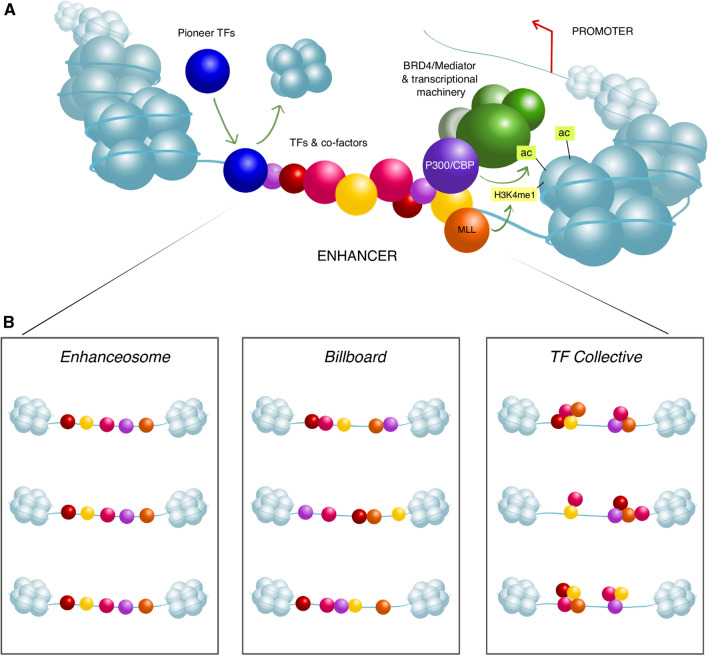
- Enhancers are clusters of sequence-specific TF binding sites; their organisation is generally flexible rather than rigid, with evidence supporting billboard and TF collective models over a strict enhanceosome model. Enhancer conservation is typically modular, and enhancer turnover exceeds that of proximal promoters.
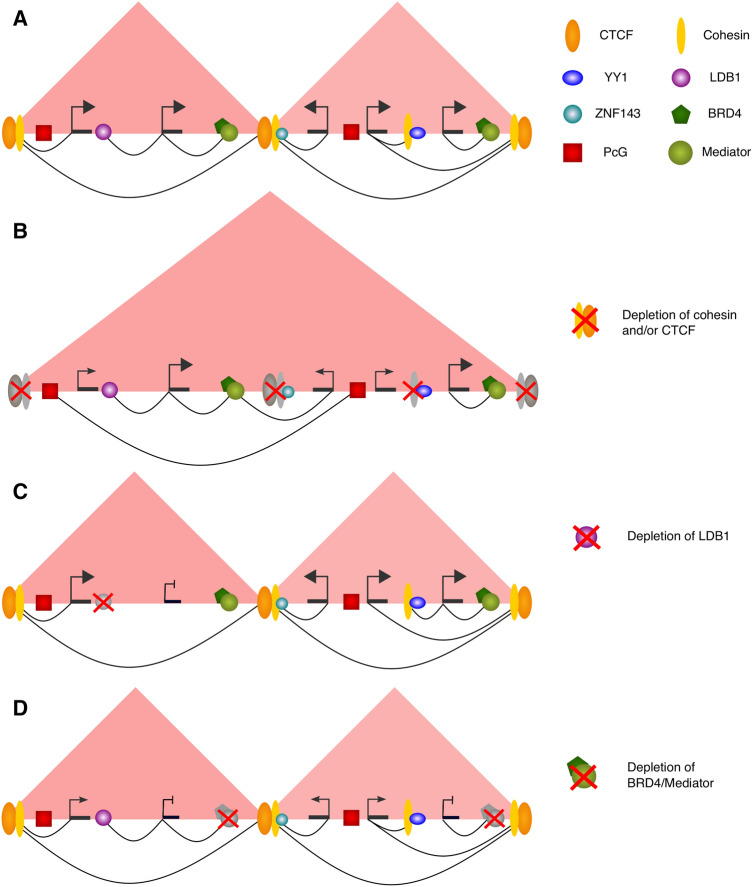
- Enhancer–promoter communication is widely supported by 3C-derived methods, but CTCF/cohesin depletion abolishes TADs with only relatively mild gene-expression effects; Mediator and BRD4 loss disrupts transcription without perturbing most enhancer–promoter contacts. Additional looping factors include YY1, ZNF143, and LDB1, while non-looping mechanisms such as liquid–liquid phase separation remain under investigation.
- Multiplicity is common: PCHi-C showed active promoters contacted a median of two active enhancers in human primary blood cells, and developing mouse limb genes were regulated by a median of three functional enhancers, with some limb-specific TF genes having more than ten. Enhancer chains/networks and promoter–promoter contacts are also observed.
- Transcriptional effects are often additive but can be synergistic or sub-additive; enhancers generally increase transcriptional burst frequency without significantly affecting burst amplitude or duration. The Activity-by-Contact model predicts CRISPRi enhancer-perturbation effects well, especially for proximal enhancers.
Methods
- Design: narrative review synthesising classic and recent literature on enhancer organisation, enhancer–promoter communication, and gene regulation.
- Data or sample: no primary experimental data; the paper cites and interprets published studies across model organisms, mammalian cells, and human genetics.
- Main analysis: conceptual synthesis of enhancer grammar, chromatin states, 3C/Hi-C/Micro-C and imaging evidence, looping factors, TADs/compartments, enhancer multiplicity, and transcriptional models.
Limitations
- Stated: much evidence for enhancer–promoter communication relies on 3C-derived methods that presume physical looping and a largely pairwise view; these methods cannot prove simultaneous multi-way contacts, and imaging and 3C-derived results may diverge.
- Stated: evidence for chromatin liquid–liquid phase separation and its functional significance in gene control is still incomplete, and whether LLPS is necessary for any genomic locus remains unresolved.
- Evident: as a review, the paper does not report new experimental data, formal meta-analysis, or primary statistical testing.
Model-written summary. Check it against the paper before relying on it.
Integrity signals
Registry
Cites
Statistics
Figures
Verification
Claims the paper makes
116 Partly supported · 79 Supported · 38 Own interpretation · 32 No full text of the sources · 21 Supported so far · 18 No basis given · 10 Not checked yet · 4 Mixed support · 1 Couldn’t confirm · 1 Own method · accuracy not yet measured
Some cited sources support this claim and some don’t — read each source’s verdict below.
In the paper
“The mechanisms of pioneer factor action are still being established [37], but at least some of them (such as FOXA, OCT4 and SOX2/SOX11) have been shown to initiate chromatin opening by direct displacement of histones [38–41], whilst many others recruit chromatin remodelers [42–50].”
§ Transcriptional enhancers and their communication with gene promoters > Organisation and function of enhancers in cis > Enhancers as transcription factor recruitment units
What the sources say
- Supportedcites [38] Iwafuchi-Doi M, Donahue G, Kakumanu A et al (2016) The pioneer transcription factor FoxA maintains an accessible nucleosome configuration at enhancers for tissue-specific gene activation. Mol Cell 62:79–91 source
The Results section (“FoxA binding displaces linker histone H1 from nucleosomes”; page unavailable) reports that FoxA binding displaces linker histone H1, making underlying nucleosomes more accessible. This supports the FOXA example for which this source is cited; the paper does not establish the corresponding mechanism for OCT4 or SOX2/SOX11. (LLM, conf=0.90)
- Disputedcites [39] Echigoya K, Koyama M, Negishi L et al (2020) Nucleosome binding by the pioneer transcription factor OCT4. Sci Rep 10:11832 sourceExperimental — accuracy not yet measured
The Introduction says OCT4 may help convert closed chromatin to open chromatin, but it does not attribute that opening to direct histone displacement. The Results section “Linker histone H1 competes with OCT4 for nucleosome binding” reports the opposite of the claimed mechanism for OCT4: adding OCT4 did not displace H1; adding H1 removed OCT4 from the nucleosome. The Discussion describes SOX2/SOX11 peeling DNA from histones, not displacing the histones. (LLM, conf=0.88)
Checked by a reasoning model — may be wrong.
- Not checked — no full text of the sourcecites [40] Dodonova SO, Zhu F, Dienemann C et al (2020) Nucleosome-bound SOX2 and SOX11 structures elucidate pioneer factor function. Nature 580:669–672 source
- Partly supportedcites [41] Jacobs J, Atkins M, Davie K et al (2018) The transcription factor Grainy head primes epithelial enhancers for spatiotemporal activation by displacing nucleosomes. Nat Genet 50:1011–1020 sourceExperimental — accuracy not yet measured
The introductory passage (labelled Abstract in our copy; page unavailable) describes pioneer factors as transcription factors that can displace nucleosomes and names FOXA1 and SOX2 as examples. The Results section, “Functional Grainyhead motifs are embedded in a specific DNA context” (page unavailable), also associates pioneer-factor binding with nucleosome displacement. But the paper does not establish direct histone displacement for each named factor: it mentions OCT4 as a possible additional factor needed for SOX2-dependent enhancer activation and does not mention SOX11. (LLM, conf=0.84)
boosteddirect- Asserted: passes — The authors put it forward as true.
- Checkable: passes — It can be checked against evidence.
- Load-bearing: unclear — It is unclear whether the paper’s conclusions depend on it.
- Based: passes — The paper gives a reason why it holds.
- Supported
Some cited sources support this claim and some don’t — read each source’s verdict below.
In the paper
“The majority of active enhancers are themselves transcribed, producing enhancer RNAs (eRNAs) in a bi-directional manner [73–77].”
§ Transcriptional enhancers and their communication with gene promoters > Organisation and function of enhancers in cis > Enhancers as transcription factor recruitment units
What the sources say
- Partly supportedcites [73] Core LJ, Martins AL, Danko CG et al (2014) Analysis of nascent RNA identifies a unified architecture of initiation regions at mammalian promoters and enhancers. Nat Genet 46:1311–1320 sourceExperimental — accuracy not yet measured
The Abstract says enhancer transcription is widespread and that eRNAs are produced bidirectionally. The Discussion also reports bidirectional initiation at thousands of enhancers. Neither passage establishes that a majority of active enhancers are transcribed; the nearly 80% figure in the Abstract concerns promoters, not enhancers. (LLM, conf=0.85)
- Supportedcites [74] Andersson R, Gebhard C, Miguel-Escalada I et al (2014) An atlas of active enhancers across human cell types and tissues. Nature 507:455–461 source
The Results section ('Bidirectional pairs of capped RNAs identify active enhancers'; page not provided) describes similar levels of capped RNA in both directions at enhancers and calls bidirectional transcription a signature feature of active enhancers. The Conclusions add that few untranscribed candidate enhancers showed activity, supporting the claim's broad characterization of active enhancers. (LLM, conf=0.87)
- Partly supportedcites [75] Lam MTY, Cho H, Lesch HP et al (2013) Rev-Erbs repress macrophage gene expression by inhibiting enhancer-directed transcription. Nature 498:511–515 sourceExperimental — accuracy not yet measured
The passage reporting GRO-Seq results (section labeled Abstract; page unavailable) found eRNA initiation at 76% of Rev-Erb binding sites in enhancer-like regions and bidirectional transcription at 56% of those sites. This supports the pattern in the studied macrophage-associated sites, but not the broader claim that a majority of active enhancers generally are transcribed bidirectionally. (LLM, conf=0.86)
- Disputedcites [76] De Santa F, Barozzi I, Mietton F et al (2010) A large fraction of extragenic RNA pol II transcription sites overlap enhancers. PLoS Biol 8:e1000384 sourceExperimental — accuracy not yet measured
The Discussion says that non-transcribed enhancers greatly outnumber transcribed ones, contrary to the claim that a majority are transcribed. The Introduction also gives an example of unidirectional enhancer-region transcription; this paper does not establish bidirectional production as the general pattern. No page numbers are available in our copy. (LLM, conf=0.90)
Checked by a reasoning model — may be wrong.
- Partly supportedcites [77] Kim T-K, Hemberg M, Gray JM et al (2010) Widespread transcription at neuronal activity-regulated enhancers. Nature 465:182–187 sourceExperimental — accuracy not yet measured
The Transcription at enhancers section reports that eRNAs are produced bi-directionally at neuronal activity-regulated enhancers. It does not support the claim that a majority of active enhancers are transcribed: the Methods Summary reports detectable eRNAs at 44% of extragenic enhancers, and the findings are limited to neuronal enhancers. Page numbers are not provided in our copy. (LLM, conf=0.89)
plaincorrelational- Asserted: passes — The authors put it forward as true.
- Checkable: passes — It can be checked against evidence.
- Load-bearing: unclear — It is unclear whether the paper’s conclusions depend on it.
- Based: passes — The paper gives a reason why it holds.
- Partly supported
Some cited sources support this claim and some don’t — read each source’s verdict below.
In the paper
“Nonetheless, a significant minority of enhancers in human ESCs also show pre-existing “permissive” promoter contacts prior to activation [141, 394].”
§ Transcriptional enhancers and their communication with gene promoters > Enhancer–promoter communication in three dimensions > Permissive and instructive enhancer–promoter contacts
What the sources say
- Supportedcites [141] Freire-Pritchett P, Schoenfelder S, Várnai C et al (2017) Global reorganisation of regulatory units upon lineage commitment of human embryonic stem cells. Elife 6:e21926 source
The Discussion (Reconfiguration of cis-regulatory units upon lineage commitment; page unavailable) defines permissive interactions as contacts present before gene activation and says the study found such preformed interactions during ESC differentiation. The Results (Rewiring and recolouring of promoter-interacting regions; page unavailable) report that 25% of promoter-interacting regions retained across ESCs and NECs changed chromatin state, supporting the claim’s qualitative description of a substantial minority. (LLM, conf=0.86)
- Disputedcites [394] Rubin AJ, Barajas BC, Furlan-Magaril M et al (2017) Lineage-specific dynamic and pre-established enhancer–promoter contacts cooperate in terminal differentiation. Nat Genet 49:1522–1528 sourceExperimental — accuracy not yet measured
The Abstract says the pre-established enhancer–promoter contacts studied were present in epidermal progenitor cells but not in embryonic stem cells. Its analysis of hESC promoter-contact data likewise reports reduced contact signal relative to keratinocytes. The paper places these pre-established contacts after pluripotency, not in hESCs. (LLM, conf=0.88)
Checked by a reasoning model — may be wrong.
plaincorrelational- Asserted: passes — The authors put it forward as true.
- Checkable: passes — It can be checked against evidence.
- Load-bearing: unclear — It is unclear whether the paper’s conclusions depend on it.
- Based: passes — The paper gives a reason why it holds.
- Supported
Some cited sources support this claim and some don’t — read each source’s verdict below.
In the paper
“In the classic scenario, this boundary is presented by CTCF binding to its sequence motifs located in a divergent orientation at either end of the loop [277, 438–440]”
§ Transcriptional enhancers and their communication with gene promoters > Determinants of enhancer–promoter selectivity > Large-scale chromosomal architecture
What the sources say
- Disputedcites [277] Rao SSP, Huntley MH, Durand NC et al (2014) A 3D map of the human genome at kilobase resolution reveals principles of chromatin looping. Cell 159:1665–1680 sourceExperimental — accuracy not yet measured
The Results section reports that 92% of CTCF motif pairs at the examined loop loci are convergent, not divergent, and that convergent pairs are overwhelmingly more frequent than divergent pairs. The Discussion likewise says that motifs at loop anchors are convergent in more than 90% of cases. Page numbers were not supplied in our copy. (LLM, conf=0.95)
Checked by a reasoning model — may be wrong.
- Not checked — no full text of the sourcecites [438] Guo Y, Monahan K, Wu H et al (2012) CTCF/cohesin-mediated DNA looping is required for protocadherin α promoter choice. Proc Natl Acad Sci USA 109:21081–21086 source
- Partly supportedcites [439] Guo Y, Xu Q, Canzio D et al (2015) CRISPR inversion of CTCF sites alters genome topology and enhancer/promoter function. Cell 162:900–910 sourceExperimental — accuracy not yet measured
In Results, under “Directional CTCF Binding in Genome-wide DNA Looping Specificity” (page unavailable), the paper reports reverse-forward CTCF-binding-site pairs at boundaries between neighboring domains, consistent with divergent sites at a boundary. But it reports that most CTCF-mediated interactions within loops involve forward-reverse, convergent site pairs. It therefore does not support describing the sites at either end of a loop as divergent. (LLM, conf=0.87)
- Partly supportedcites [440] Nanni L, Ceri S, Logie C (2020) Spatial patterns of CTCF sites define the anatomy of TADs and their boundaries. Genome Biol 21:197 sourceExperimental — accuracy not yet measured
The Results section reports that divergent CTCF-site patterns are enriched at TAD boundaries and suggests they confer boundary function (page not provided). But the paper distinguishes boundaries from loop ends: its Results section says loop bases involve pairs of convergent CTCF sites. It therefore does not support placing divergent motifs at either end of a loop. (LLM, conf=0.87)
plaindirect- Asserted: passes — The authors put it forward as true.
- Checkable: passes — It can be checked against evidence.
- Load-bearing: unclear — It is unclear whether the paper’s conclusions depend on it.
- Based: passes — The paper gives a reason why it holds.
- Disputed
The cited sources support only part of this claim — read each source’s verdict below.
In the paper
“In Drosophila, the Zinc Finger Early Drosophila Activator (Zelda) is critical for lowering the nucleosome barrier at enhancers for genes driving zygotic gene activation [33–35].”
§ Transcriptional enhancers and their communication with gene promoters > Organisation and function of enhancers in cis > Enhancers as transcription factor recruitment units
What the sources say
- Partly supportedcites [33] Liang H-L, Nien C-Y, Liu H-Y et al (2008) The zinc-finger protein Zelda is a key activator of the early zygotic genome in Drosophila. Nature 456:400–403 sourceExperimental — accuracy not yet measured
The paper’s Abstract reports that Zelda binds regulatory TAGteam sites and plays a key role in activating the early zygotic genome. It does not say that Zelda lowers a nucleosome barrier at enhancers; the passages retrieved for nucleosome occupancy and chromatin accessibility do not establish that mechanism. No page numbers are available in our copy. (LLM, conf=0.88)
- Partly supportedcites [34] Harrison MM, Li X-Y, Kaplan T et al (2011) Zelda binding in the early Drosophila melanogaster embryo marks regions subsequently activated at the maternal-to-zygotic transition. PLoS Genet 7:e1002266 sourceExperimental — accuracy not yet measured
The Discussion (page unavailable) says Zelda is important at promoters and enhancers and proposes that it promotes zygotic genome activation by controlling chromatin accessibility. But it does not establish that Zelda lowers a nucleosome barrier; it explicitly allows that Zelda may maintain chromatin that is already accessible rather than actively open it. (LLM, conf=0.88)
- Supportedcites [35] Schulz KN, Bondra ER, Moshe A et al (2015) Zelda is differentially required for chromatin accessibility, transcription factor binding, and gene expression in the early Drosophila embryo. Genome Res 25:1715–1726 source
The Discussion (page unavailable), including Figure 7’s caption, says Zelda determines chromatin accessibility at early embryonic enhancers, allowing other transcription factors to bind. It also proposes that Zelda is essential for creating open chromatin that drives expression of the earliest zygotic genes. The paper limits this role to a subset of regions, rather than all Zelda-bound enhancers. (LLM, conf=0.87)
plaindirect- Asserted: passes — The authors put it forward as true.
- Checkable: passes — It can be checked against evidence.
- Load-bearing: unclear — It is unclear whether the paper’s conclusions depend on it.
- Based: passes — The paper gives a reason why it holds.
- Partly supported
The cited sources support only part of this claim — read each source’s verdict below.
In the paper
“Mechanistically, a key function of sequence-specific TFs is the recruitment of “workhorse” cofactors that facilitate enzymatic chromatin remodelling, histone modification and act as scaffolds for recruitment of additional factors.”
§ Transcriptional enhancers and their communication with gene promoters > Organisation and function of enhancers in cis > Enhancers as transcription factor recruitment units
What the sources say
- Partly supportedcites [56] Zabidi MA, Stark A (2016) Regulatory enhancer-core-promoter communication via transcription factors and cofactors. Trends Genet 32:801–814 sourceExperimental — accuracy not yet measured
The section on differential activity of trans factors (page unavailable) says sequence-specific TFs recruit cofactors, including the SWI/SNF complex and p300, and identifies Mof as an acetyltransferase. The section on activating micro-environments describes cofactor activity leading to recruitment of BRD4, but does not establish the claimed scaffold role for recruiting additional factors. (LLM, conf=0.83)
- Partly supportedcites [57] Winkler DD, Luger K (2011) The histone chaperone FACT: structural insights and mechanisms for nucleosome reorganization. J Biol Chem 286:18369–18374 sourceExperimental — accuracy not yet measured
The introduction and “FACT Function and Architecture” section describe FACT as a histone chaperone that reorganizes nucleosomes during transcription. The “Modifying” FACT Function section says histone modifications can recruit chromatin-altering machinery. The copy does not establish the claim’s central mechanism—that sequence-specific transcription factors recruit cofactors—or describe those cofactors as scaffolds for additional factors. (LLM, conf=0.78)
plaindirect- Asserted: passes — The authors put it forward as true.
- Checkable: passes — It can be checked against evidence.
- Load-bearing: unclear — It is unclear whether the paper’s conclusions depend on it.
- Based: passes — The paper gives a reason why it holds.
- Partly supported
The cited sources support only part of this claim — read each source’s verdict below.
In the paper
“P300 and CBP also serve as scaffolds that connect RNA polymerase II (RNAP) and RNAP-associated “general transcription factors” to the chromatin [64, 65].”
§ Transcriptional enhancers and their communication with gene promoters > Organisation and function of enhancers in cis > Enhancers as transcription factor recruitment units
What the sources say
- Not checked — no full text of the sourcecites [64] Chan HM, La Thangue NB (2001) p300/CBP proteins: HATs for transcriptional bridges and scaffolds. J Cell Sci 114:2363–2373 source
- Partly supportedcites [65] Kim TK, Kim TH, Maniatis T (1998) Efficient recruitment of TFIIB and CBP-RNA polymerase II holoenzyme by an interferon-beta enhanceosome in vitro. Proc Natl Acad Sci USA 95:12191–12196 sourceExperimental — accuracy not yet measured
The Results and Discussion (page unavailable) show that interactions between CBP and the IFN-β enhanceosome help recruit an RNA polymerase II holoenzyme containing general transcription factors to a promoter. The paper does not establish the same role for p300 or show that either protein acts as a scaffold connecting those factors to chromatin; its experiments used an immobilized DNA template in vitro. (LLM, conf=0.85)
plaindirect- Asserted: passes — The authors put it forward as true.
- Checkable: passes — It can be checked against evidence.
- Load-bearing: unclear — It is unclear whether the paper’s conclusions depend on it.
- Based: passes — The paper gives a reason why it holds.
The cited sources support only part of this claim — read each source’s verdict below.
In the paper
“Recent experiments degrading Mediator and BRD4 have shown that these proteins are critical for gene expression [69].”
§ Transcriptional enhancers and their communication with gene promoters > Organisation and function of enhancers in cis > Enhancers as transcription factor recruitment units
What the sources say
- Partly supportedcites [69] Crump NT, Ballabio E, Godfrey L et al (2021) BET inhibition disrupts transcription but retains enhancer–promoter contact. Nat Commun 12:223 sourceExperimental — accuracy not yet measured
The Discussion (page unavailable) says BRD4 and Mediator play a key role in the transcription of many genes. The Introduction describes this paper’s use of a BRD4-degrading compound, but its experiments reduced Mediator binding rather than degrading Mediator; it mentions MED14 degradation only in a separate study of enhancer–promoter contact. Thus the gene-expression conclusion is supported, but the description of the experiments is not fully supported. (LLM, conf=0.86)
boosteddirect- Asserted: passes — The authors put it forward as true.
- Checkable: passes — It can be checked against evidence.
- Load-bearing: unclear — It is unclear whether the paper’s conclusions depend on it.
- Based: passes — The paper gives a reason why it holds.
- Partly supported
The cited sources support only part of this claim — read each source’s verdict below.
In the paper
“It soon became clear that enhancers also played vital roles in humans, with non-coding enhancer deletions starting to be linked to severe disease phenotypes such as beta thalassaemia and polydactyly [25–28].”
§ Transcriptional enhancers and their communication with gene promoters > Organisation and function of enhancers in cis > Classic definition of enhancers
What the sources say
- Not checked — no full text of the sourcecites [25] Kioussis D, Vanin E, deLange T et al (1983) Beta-globin gene inactivation by DNA translocation in gamma beta-thalassaemia. Nature 306:662–666 source
- Supportedcites [26] Driscoll MC, Dobkin CS, Alter BP (1989) Gamma delta beta-thalassemia due to a de novo mutation deleting the 5’ beta-globin gene activation-region hypersensitive sites. Proc Natl Acad Sci USA 86:7470–7474 source
The Discussion reports a patient with γδβ-thalassemia whose de novo deletion removed three upstream regulatory hypersensitive sites while leaving the structural globin genes intact. This supports the beta-thalassemia example attributed to this paper; the sentence’s other citations may address polydactyly. (LLM, conf=0.92)
- Partly supportedcites [27] Lettice LA, Heaney SJH, Purdie LA et al (2003) A long-range Shh enhancer regulates expression in the developing limb and fin and is associated with preaxial polydactyly. Hum Mol Genet 12:1725–1735 sourceExperimental — accuracy not yet measured
The “ZRS and polydactyly” section links mutations in a non-coding regulatory element to preaxial polydactyly. It specifies single-base-pair mutations, not enhancer deletions, and does not address beta thalassaemia. Page numbers are unavailable in our copy. (LLM, conf=0.88)
- Not checked — no full text of the sourcecites [28] Sharpe J, Lettice L, Hecksher-Sørensen J et al (1999) Identification of Sonic hedgehog as a candidate gene responsible for the polydactylous mouse mutant Sasquatch. Curr Biol 9:97-S1 source
plaincorrelational- Asserted: passes — The authors put it forward as true.
- Checkable: passes — It can be checked against evidence.
- Load-bearing: unclear — It is unclear whether the paper’s conclusions depend on it.
- Based: passes — The paper gives a reason why it holds.
The sources with a verdict support this claim; the rest weren’t checked yet, have no full text we could read, or their verdicts aren’t rated yet.
In the paper
“Often, pioneer factors must recruit additional non-pioneer sequence-specific TFs for efficient enhancer activation [30, 31].”
§ Transcriptional enhancers and their communication with gene promoters > Organisation and function of enhancers in cis > Enhancers as transcription factor recruitment units
What the sources say
- Not checked — no full text of the sourcecites [30] Spitz F, Furlong EEM (2012) Transcription factors: from enhancer binding to developmental control. Nat Rev Genet 13:613–626 source
- Supportedcites [31] Zaret KS, Carroll JS (2011) Pioneer transcription factors: establishing competence for gene expression. Genes Dev 25:2227–2241 source
In “Active and passive means by which pioneer factors are useful in development,” the paper says that the vast majority of promoters and enhancers require a combination of transcription factors for activity. It explains that pioneer factors can bind first, allowing other transcription factors to bind later and contribute to activation. This supports the claim’s substance, although “recruit” is a loose paraphrase of that process. (LLM, conf=0.88)
plainconditional- Asserted: passes — The authors put it forward as true.
- Checkable: passes — It can be checked against evidence.
- Load-bearing: unclear — It is unclear whether the paper’s conclusions depend on it.
- Based: passes — The paper gives a reason why it holds.
- Probably not a substantial claim. 24
- It may state two separate claims as one. 77
Every source the paper cites for this claim was checked and supports it.
In the paper
“The SWI/SNF complex is involved in regulating occupancy and spacing of nucleosomes at promoters and enhancers [58], while the most established role of FACT is in facilitating transcriptional elongation [57].”
§ Transcriptional enhancers and their communication with gene promoters > Organisation and function of enhancers in cis > Enhancers as transcription factor recruitment units
What the sources say
- Supportedcites [57] Winkler DD, Luger K (2011) The histone chaperone FACT: structural insights and mechanisms for nucleosome reorganization. J Biol Chem 286:18369–18374 source
The “FACT Function and Architecture” section says human FACT was first identified as essential for transcriptional elongation through chromatin and describes its role in actively transcribed genes. It also discusses roles in replication and repair, consistent with elongation being its most established role. (LLM, conf=0.88)
boosteddirect- Asserted: passes — The authors put it forward as true.
- Checkable: passes — It can be checked against evidence.
- Load-bearing: fails — The paper’s conclusions may not depend on it.
- Based: passes — The paper gives a reason why it holds.
Probably not a substantial claim. The paper’s conclusions may not depend on it.
- Supported
The cited sources support only part of this claim — read each source’s verdict below.
In the paper
“However, open chromatin regions are not limited to active enhancers, and also harbour other regions including active gene promoters, regulatory elements in a ‘poised’ chromatin configuration (discussed below), as well as some structural regions such as tissue-invariant binding sites for the architectural protein CCCTC-binding factor (CTCF) [129–132].”
§ Transcriptional enhancers and their communication with gene promoters > Organisation and function of enhancers in cis > The chromatin states of enhancers
What the sources say
- Partly supportedcites [129] Corces MR, Granja JM, Shams S et al (2018) The chromatin accessibility landscape of primary human cancers. Science 362:eaav1898 sourceExperimental — accuracy not yet measured
The Results section on DNA regulatory elements reports that accessible chromatin sites are strongly enriched in promoter and enhancer regions. The Discussion suggests that some sites of differential accessibility may reflect poised promoters or enhancers, but does not establish this directly. The Results mention accessibility at CTCF motif sites, but do not identify tissue-invariant CTCF binding sites as open structural regions. (LLM, conf=0.85)
- Partly supportedcites [130] Meuleman W, Muratov A, Rynes E et al (2020) Index and biological spectrum of human DNase I hypersensitive sites. Nature 584:244–251 sourceExperimental — accuracy not yet measured
The Introduction (page unavailable) identifies promoters and chromatin insulators among the active regulatory elements marked by accessible DNA, and says DHSs can appear before functional activation. This supports the claim that open chromatin is not limited to active enhancers, but our copy does not specifically identify poised chromatin configurations or tissue-invariant CTCF-binding sites as examples. (LLM, conf=0.84)
- Partly supportedcites [131] ENCODE Project Consortium, Moore JE, Purcaro MJ et al (2020) Expanded encyclopaedias of DNA elements in the human and mouse genomes. Nature 583:699–710 sourceExperimental — accuracy not yet measured
The ‘A registry of DNA elements’ and ‘Groups based on function-associated signatures’ sections link accessible chromatin to active or poised regulatory elements and describe DNase-accessible, CTCF-bound sites with potential insulator or looping functions. The paper also distinguishes active promoter-like elements from enhancer-like elements. The passages found do not establish that the CTCF binding sites are tissue-invariant; no page number is available for these passages. (LLM, conf=0.84)
- Not checked — no full text of the sourcecites [132] Parelho V, Hadjur S, Spivakov M et al (2008) Cohesins functionally associate with CTCF on mammalian chromosome arms. Cell 132:422–433 source
plain- Asserted: passes — The authors put it forward as true.
- Checkable: passes — It can be checked against evidence.
- Load-bearing: unclear — It is unclear whether the paper’s conclusions depend on it.
- Based: passes — The paper gives a reason why it holds.
It may state two separate claims as one.
- Partly supported
The cited sources support only part of this claim — read each source’s verdict below.
In the paper
“SMF showed high TF cooperativity at active enhancers and identified cases where TFs bind independently, sequentially or simultaneously [118].”
§ Transcriptional enhancers and their communication with gene promoters > Organisation and function of enhancers in cis > Flexibility of enhancer organisation
What the sources say
- Partly supportedcites [118] Rao S, Ahmad K, Ramachandran S (2021) Cooperative binding between distant transcription factors is a hallmark of active enhancers. Mol Cell 81:1651-1665.e4 sourceExperimental — accuracy not yet measured
The Discussion (page unavailable in our copy) reports substantial TF cooperativity at 64% of active fly enhancers and independent binding at some others. The Results section, “Cooperative binding is common at active enhancers” (page unavailable), identifies TFs co-bound on single molecules and potential initiating sites. These observations support co-occupancy and a possible binding hierarchy, but do not establish that TFs bind sequentially or simultaneously in time. (LLM, conf=0.86)
plaincorrelational- Asserted: passes — The authors put it forward as true.
- Checkable: passes — It can be checked against evidence.
- Load-bearing: passes — The paper’s conclusions depend on it.
- Based: passes — The paper gives a reason why it holds.
It may state two separate claims as one.
- Partly supported
The sources with a verdict support this claim; the rest weren’t checked yet, have no full text we could read, or their verdicts aren’t rated yet.
In the paper
“An intermediate model for enhancer grammar known as the “TF collective” proposes that a set of the same TFs binds to multiple enhancers but an individual enhancer does not necessarily have the full set of TF binding sites [30, 91].”
§ Transcriptional enhancers and their communication with gene promoters > Organisation and function of enhancers in cis > Flexibility of enhancer organisation
What the sources say
- Not checked — no full text of the sourcecites [30] Spitz F, Furlong EEM (2012) Transcription factors: from enhancer binding to developmental control. Nat Rev Genet 13:613–626 source
- Supportedcites [91] Junion G, Spivakov M, Girardot C et al (2012) A transcription factor collective defines cardiac cell fate and reflects lineage history. Cell 148:473–486 source
The Results report that multiple enhancers recruit all five cardiogenic TFs despite variation in their binding-site content. The Discussion describes the “TF collective” as cooperative binding with little or no motif grammar, in which motifs for some recruited factors need not be present. (LLM, conf=0.94)
plaincorrelational- Asserted: passes — The authors put it forward as true.
- Checkable: passes — It can be checked against evidence.
- Load-bearing: unclear — It is unclear whether the paper’s conclusions depend on it.
- Based: passes — The paper gives a reason why it holds.
It may state two separate claims as one.
The sources with a verdict support this claim; the rest weren’t checked yet, have no full text we could read, or their verdicts aren’t rated yet.
In the paper
“However, studies that knock down selected eRNA have found reduced expression of the corresponding gene targets, suggesting functionality [79–81].”
§ Transcriptional enhancers and their communication with gene promoters > Organisation and function of enhancers in cis > Enhancers as transcription factor recruitment units
What the sources say
- Supportedcites [79] Liang J, Zhou H, Gerdt C et al (2016) Epstein-Barr virus super-enhancer eRNAs are essential for MYC oncogene expression and lymphoblast proliferation. Proc Natl Acad Sci USA 113:14121–14126 source
In “shRNA Knockdown of MYC ESE eRNA Reduced MYC Expression,” the paper reports that knocking down the −428 and −525 enhancer RNAs significantly reduced expression of their target gene, MYC, by more than 70%. It also reports no effect on the control gene GAPDH or other enhancer targets, supporting the claim that these selected eRNAs have a functional role. Page numbers are not provided in our copy. (LLM, conf=0.94)
- Supportedcites [80] Banerjee AR, Kim YJ, Kim TH (2014) A novel virus-inducible enhancer of the interferon-β gene with tightly linked promoter and enhancer activities. Nucleic Acids Res 42:12537–12554 source
In the Results section, “L2-produced eRNAs are necessary for proper IFNB1 expression” (page not provided), the authors report that knockdown of either L2 eRNA reduced induction of its target gene, IFNB1. They conclude that the eRNAs are necessary for appropriate virus-induced IFNB1 expression. (LLM, conf=0.94)
- Not checked — no full text of the sourcecites [81] Hsieh C-L, Fei T, Chen Y et al (2014) Enhancer RNAs participate in androgen receptor-driven looping that selectively enhances gene activation. Proc Natl Acad Sci USA 111:7319–7324 source
hedgeddirect- Asserted: passes — The authors put it forward as true.
- Checkable: passes — It can be checked against evidence.
- Load-bearing: unclear — It is unclear whether the paper’s conclusions depend on it.
- Based: passes — The paper gives a reason why it holds.
It may state two separate claims as one.
- Supported
Every source the paper cites for this claim was checked and supports it.
In the paper
“For example, dissection of an enhancer controlling the specification of Drosophila leg precursor cells showed that it was robust against motif disruption, but relied on DNA–protein and protein–protein interactions between a particular set of TFs [94].”
§ Transcriptional enhancers and their communication with gene promoters > Organisation and function of enhancers in cis > Flexibility of enhancer organisation
What the sources say
- Supportedcites [94] Uhl JD, Zandvakili A, Gebelein B (2016) A Hox transcription factor collective binds a highly conserved distal-less cis-regulatory module to generate robust transcriptional outcomes. PLoS Genet 12:e1005981 source
Split into 2 atoms — 2 confirmed, 0 partially supported, 0 disputed, 0 misattributed, 0 unverifiable. Expand the claim to see per-atom verdicts.
plaindirectSingle case- Asserted: passes — The authors put it forward as true.
- Checkable: passes — It can be checked against evidence.
- Load-bearing: unclear — It is unclear whether the paper’s conclusions depend on it.
- Based: passes — The paper gives a reason why it holds.
It may state two separate claims as one.
- Supported
Every source the paper cites for this claim was checked and supports it.
In the paper
“In contrast, the trimethylation of histone H3 lysine 4 (H3K4me3) is typically considered a promoter-associated mark and, in regions proximal to a known TSS, has been used to distinguish the enhancer from a promoter [131].”
§ Transcriptional enhancers and their communication with gene promoters > Organisation and function of enhancers in cis > The chromatin states of enhancers
What the sources say
- Supportedcites [131] ENCODE Project Consortium, Moore JE, Purcaro MJ et al (2020) Expanded encyclopaedias of DNA elements in the human and mouse genomes. Nature 583:699–710 source
In “A registry of DNA elements” (page not provided), the paper calls H3K4me3 characteristic of transcribing promoters and contrasts it with the relative paucity of H3K4me3 associated with active enhancers. “Classifying cCREs” and “Groups based on function-associated signatures” (pages not provided) describe using histone signals and TSS proximity to distinguish promoter-proximal enhancer-like elements from promoter-like elements. (LLM, conf=0.93)
plaincorrelational- Asserted: passes — The authors put it forward as true.
- Checkable: passes — It can be checked against evidence.
- Load-bearing: fails — The paper’s conclusions may not depend on it.
- Based: passes — The paper gives a reason why it holds.
Probably not a substantial claim. The paper’s conclusions may not depend on it. It may state two separate claims as one.
- Supported
The sources with a verdict support this claim; the rest weren’t checked yet, have no full text we could read, or their verdicts aren’t rated yet.
In the paper
“Virtually every nucleotide of the interferon beta enhancer is evolutionarily conserved; this is likely because the eight TFs cooperate to form a composite surface that recognises the entire sequence of the enhancer as one effective binding site [88, 89].”
§ Transcriptional enhancers and their communication with gene promoters > Organisation and function of enhancers in cis > Flexibility of enhancer organisation
What the sources say
- Not checked — no full text of the sourcecites [88] Thanos D, Maniatis T (1995) Virus induction of human IFN beta gene expression requires the assembly of an enhanceosome. Cell 83:1091–1100 source
- Supportedcites [89] Panne D, Maniatis T, Harrison SC (2007) An atomic model of the interferon-beta enhanceosome. Cell 129:1111–1123 source
The Discussion says the IFN-β enhancer sequence is nearly invariant and explains this conservation through a composite transcription-factor surface that recognizes the entire sequence. The Figure 4 caption identifies eight polypeptides in that surface. The paper qualifies that cooperativity does not mainly arise from direct contacts between neighboring DNA-binding domains, but the claim does not require that mechanism. (LLM, conf=0.93)
hedgedconditional- Asserted: passes — The authors put it forward as true.
- Checkable: passes — It can be checked against evidence.
- Load-bearing: passes — The paper’s conclusions depend on it.
- Based: passes — The paper gives a reason why it holds.
It may state two separate claims as one.
The cited sources support only part of this claim — read each source’s verdict below.
In the paper
“Currently mono-methylation of histone H3 lysine 4 (H3K4me1), associated with the binding of Trithorax/MLL complexes, is taken to be the hallmark of both ‘primed’ and active enhancers, whilst active enhancers additionally tend to associate with the acetylation of histone H3 lysine 27 (H3K27ac) [133–137].”
§ Transcriptional enhancers and their communication with gene promoters > Organisation and function of enhancers in cis > The chromatin states of enhancers
What the sources say
- Partly supportedcites [133] Creyghton MP, Cheng AW, Welstead GG et al (2010) Histone H3K27ac separates active from poised enhancers and predicts developmental state. Proc Natl Acad Sci USA 107:21931–21936 sourceExperimental — accuracy not yet measured
The introduction (p. 2) says H3K4me1 can mark both active and poised enhancers, and the Results (p. 3) identify H3K27ac as a mark that distinguishes active from poised enhancers. Our copy does not support the additional claim that H3K4me1 is associated with binding of Trithorax/MLL complexes. (LLM, conf=0.86)
- Partly supportedcites [134] Ernst J, Kheradpour P, Mikkelsen TS et al (2011) Mapping and analysis of chromatin state dynamics in nine human cell types. Nature 473:43–49 sourceExperimental — accuracy not yet measured
The Results section, “Systematic mapping of chromatin marks in multiple cell types” (page unavailable), says H3K4me1 is preferentially associated with enhancers and H3K27ac with active regulatory regions. The copy does not establish the claimed association of H3K4me1 with Trithorax/MLL binding, or explicitly identify it as a hallmark of both primed and active enhancers. (LLM, conf=0.84)
- Partly supportedcites [135] Rada-Iglesias A, Bajpai R, Swigut T et al (2011) A unique chromatin signature uncovers early developmental enhancers in humans. Nature 470:279–283 sourceExperimental — accuracy not yet measured
The paper’s opening summary (page not provided) describes H3K4me1 at both active and poised enhancers, with H3K27ac distinguishing the active class. It does not establish the claimed association of H3K4me1 with Trithorax/MLL-complex binding. (LLM, conf=0.88)
- Partly supportedcites [136] Zentner GE, Tesar PJ, Scacheri PC (2011) Epigenetic signatures distinguish multiple classes of enhancers with distinct cellular functions. Genome Res 21:1273–1283 sourceExperimental — accuracy not yet measured
The section ‘Identification of three major enhancer classes in mESCs’ (page not available) classifies H3K4me1-positive, H3K27ac-positive enhancers as active and H3K4me1-positive, H3K27me3-positive enhancers as poised, supporting the histone-mark distinction. Our copy does not establish the claimed association with Trithorax/MLL complexes, and it uses ‘poised’ rather than ‘primed.’ (LLM, conf=0.86)
- Not checked — no full text of the sourcecites [137] Bonn S, Zinzen RP, Girardot C et al (2012) Tissue-specific analysis of chromatin state identifies temporal signatures of enhancer activity during embryonic development. Nat Genet 44:148–156 source
plaincorrelational- Asserted: passes — The authors put it forward as true.
- Checkable: passes — It can be checked against evidence.
- Load-bearing: unclear — It is unclear whether the paper’s conclusions depend on it.
- Based: passes — The paper gives a reason why it holds.
It may state two separate claims as one.
- Partly supported
The cited sources support only part of this claim — read each source’s verdict below.
In the paper
“Another means by which flexible enhancer grammar ensures robust gene expression control is through “suboptimal” TF binding motifs, which reinforce the requirement for TF cooperativity and create opportunities for fine-tuning enhancer activity levels [125–128].”
§ Transcriptional enhancers and their communication with gene promoters > Organisation and function of enhancers in cis > Flexibility of enhancer organisation
What the sources say
- Partly supportedcites [125] Farley EK, Olson KM, Zhang W et al (2015) Suboptimization of developmental enhancers. Science 350:325–328 sourceExperimental — accuracy not yet measured
Split into 2 atoms — 0 confirmed, 2 partially supported, 0 disputed, 0 misattributed, 0 unverifiable. Expand the claim to see per-atom verdicts.
- Partly supportedcites [126] Crocker J, Abe N, Rinaldi L et al (2015) Low affinity binding site clusters confer hox specificity and regulatory robustness. Cell 160:191–203 sourceExperimental — accuracy not yet measured
Split into 2 atoms — 1 confirmed, 1 partially supported, 0 disputed, 0 misattributed, 0 unverifiable. Expand the claim to see per-atom verdicts.
- Partly supportedcites [127] Datta RR, Ling J, Kurland J et al (2018) A feed-forward relay integrates the regulatory activities of Bicoid and Orthodenticle via sequential binding to suboptimal sites. Genes Dev 32:723–736 sourceExperimental — accuracy not yet measured
Split into 2 atoms — 0 confirmed, 2 partially supported, 0 disputed, 0 misattributed, 0 unverifiable. Expand the claim to see per-atom verdicts.
- Not checked — no full text of the sourcecites [128] Keller SH, Jena SG, Yamazaki Y, Lim B (2020) Regulation of spatiotemporal limits of developmental gene expression via enhancer grammar. Proc Natl Acad Sci USA 117:15096–15103 source
plaindirect- Asserted: passes — The authors put it forward as true.
- Checkable: passes — It can be checked against evidence.
- Load-bearing: passes — The paper’s conclusions depend on it.
- Based: passes — The paper gives a reason why it holds.
It may state two separate claims as one.
- Partly supported
The cited sources support only part of this claim — read each source’s verdict below.
In the paper
“While much of the evidence for enhancer function was obtained through perturbing these regions artificially, natural genetic variation at enhancers is commonly observed in human populations, consistent with the relatively low sequence constraint of these regions [191, 192].”
§ Transcriptional enhancers and their communication with gene promoters > Organisation and function of enhancers in cis > Natural variation at enhancers and its consequences
What the sources say
- Partly supportedcites [191] Spivakov M, Akhtar J, Kheradpour P et al (2012) Analysis of variation at transcription factor binding sites in Drosophila and humans. Genome Biol 13:R49 sourceExperimental — accuracy not yet measured
The Background says variation at DNA regulatory elements is relatively common, and the Results analyze variation at human transcription-factor binding sites. But the paper does not establish that enhancers generally have low sequence constraint: the Background distinguishes limited base-by-base conservation from lack of functional constraint, and the Conclusions say binding sites are functionally constrained despite tolerating some mutations. Our copy provides no page numbers for these passages. (LLM, conf=0.84)
- Partly supportedcites [192] Heinz S, Romanoski CE, Benner C et al (2013) Effect of natural genetic variation on enhancer selection and function. Nature 503:487–492 sourceExperimental — accuracy not yet measured
The section on LDTF motif mutations reports naturally occurring sequence differences in mouse enhancers and their effects on enhancer activity. The paper studies variation between mouse strains; it does not establish that enhancer variation is common in human populations or that enhancers have relatively low sequence constraint. The supplied passages and searches for human variation and sequence constraint did not substantiate those parts. (LLM, conf=0.83)
plaincorrelational- Asserted: passes — The authors put it forward as true.
- Checkable: passes — It can be checked against evidence.
- Load-bearing: unclear — It is unclear whether the paper’s conclusions depend on it.
- Based: passes — The paper gives a reason why it holds.
It may state two separate claims as one.
- Partly supported
The cited sources support only part of this claim — read each source’s verdict below.
In the paper
“The importance of enhancer variation in human pathology has been further highlighted by genome-wide association studies (GWAS), since GWAS-detected genetic variants associated with complex traits and diseases are typically non-coding, non-promoter associated and highly enriched in enhancers [184, 208, 209].”
§ Transcriptional enhancers and their communication with gene promoters > Organisation and function of enhancers in cis > Natural variation at enhancers and its consequences
What the sources say
- Partly supportedcites [184] Nasser J, Bergman DT, Fulco CP et al (2021) Genome-wide enhancer maps link risk variants to disease genes. Nature. https://doi.org/10.1038/s41586-021-03446-x sourceExperimental — accuracy not yet measured
The Abstract says most causal variants do not alter protein-coding sequences, and ‘Enrichment of GWAS variants in enhancers’ reports strong enhancer enrichment among fine-mapped variants for 72 traits. The copy does not establish that GWAS-detected variants are typically non-promoter-associated; the enrichment analysis also focuses on credible sets without coding or splice-site variants. (LLM, conf=0.85)
- Supportedcites [208] Corradin O, Scacheri PC (2014) Enhancer variants: evaluating functions in common disease. Genome Med 6:85 source
The Introduction says that genetic risk variants affecting enhancers are estimated to far outnumber those affecting protein-coding genes or promoter function. The section on cell-type-specific enhancer elements says genetic risk variants are highly enriched at enhancers relative to promoters, and Figure 2 describes their distribution across coding, promoter, and noncoding regions. (LLM, conf=0.91)
- Partly supportedcites [209] Maurano MT, Humbert R, Rynes E et al (2012) Systematic localization of common disease-associated variation in regulatory DNA. Science 337:1190–1195 sourceExperimental — accuracy not yet measured
The introductory passage reports that about 93% of disease- and trait-associated variants are noncoding. The section ‘Disease- and trait-associated variants are concentrated in regulatory DNA’ reports enrichment in DNase I hypersensitive sites (DHSs), and ‘DHSs harboring GWAS variants control distant phenotype-relevant genes’ identifies some of those sites as enhancers. The paper does not establish that GWAS variants are typically non-promoter-associated or specifically highly enriched in enhancers, rather than in regulatory DNA more broadly; page numbers were not supplied in our copy. (LLM, conf=0.87)
plaincorrelational- Asserted: passes — The authors put it forward as true.
- Checkable: passes — It can be checked against evidence.
- Load-bearing: passes — The paper’s conclusions depend on it.
- Based: passes — The paper gives a reason why it holds.
It may state two separate claims as one.
- Partly supported
The cited sources support only part of this claim — read each source’s verdict below.
In the paper
“The classic example of this is the Shh ZRS enhancer, which is located within the intron of the Lmbr1 gene approximately 1 megabase distant from Shh [27].”
§ Transcriptional enhancers and their communication with gene promoters > Enhancer–promoter communication in three dimensions
What the sources say
- Partly supportedcites [27] Lettice LA, Heaney SJH, Purdie LA et al (2003) A long-range Shh enhancer regulates expression in the developing limb and fin and is associated with preaxial polydactyly. Hum Mol Genet 12:1725–1735 sourceExperimental — accuracy not yet measured
The “Regulation at a distance” section places the ZRS in intron 5 of Lmbr1 and says it is a considerable distance from Shh. Our copy does not give an approximately 1-megabase physical distance for the ZRS–Shh separation; its reference to about 1 Mb concerns other genes. (LLM, conf=0.86)
plain- Asserted: passes — The authors put it forward as true.
- Checkable: passes — It can be checked against evidence.
- Load-bearing: fails — The paper’s conclusions may not depend on it.
- Based: passes — The paper gives a reason why it holds.
Probably not a substantial claim. The paper’s conclusions may not depend on it.
- Partly supported
Every source the paper cites for this claim was checked and supports it.
In the paper
“In addition, whilst genetic variants at epromoters may affect the expression of both the proximal and distal gene, a large proportion are associated with only the distal one [207].”
§ Transcriptional enhancers and their communication with gene promoters > Organisation and function of enhancers in cis > Similarities and differences between enhancers and promoters
What the sources say
- Supportedcites [207] Mitchelmore J, Grinberg NF, Wallace C, Spivakov M (2020) Functional effects of variation in transcription factor binding highlight long-range gene regulation by epromoters. Nucleic Acids Res 48:2866–2879 source
The Results section, “Many CRMs associated with distal gene expression show features of epromoters,” reports associations with both proximal and distal gene expression, but says that nearly two-thirds of epromoters with an expressed proximal gene showed a detectable association with the distal gene alone. This supports the citing sentence’s qualified claim. (LLM, conf=0.94)
hedgedcorrelational- Asserted: passes — The authors put it forward as true.
- Checkable: passes — It can be checked against evidence.
- Load-bearing: unclear — It is unclear whether the paper’s conclusions depend on it.
- Based: passes — The paper gives a reason why it holds.
It may state two separate claims as one.
- Supported
The cited sources support only part of this claim — read each source’s verdict below.
In the paper
“Finally, some enhancers are marked with H3K27me3 alone and are considered to be “Polycomb-repressed” [139–141].”
§ Transcriptional enhancers and their communication with gene promoters > Organisation and function of enhancers in cis > The chromatin states of enhancers
What the sources say
- Partly supportedcites [139] Ngan CY, Wong CH, Tjong H et al (2020) Chromatin interaction analyses elucidate the roles of PRC2-bound silencers in mouse development. Nat Genet 52:264–272 sourceExperimental — accuracy not yet measured
The Results section ('PRC2-associated silencers transition into active enhancers during differentiation'; page unavailable) describes PRC2-bound silencers that can become active enhancers, supporting the Polycomb-repression aspect. It reports H3K27me3 co-enriched with H3K4me1, however, not enhancers marked by H3K27me3 alone. (LLM, conf=0.85)
- Partly supportedcites [140] Gisselbrecht SS, Palagi A, Kurland JV et al (2020) Transcriptional silencers in drosophila serve a dual role as transcriptional enhancers in alternate cellular contexts. Mol Cell 77:324-337.e8 sourceExperimental — accuracy not yet measured
The Results section on element selection describes H3K27me3 as a repressive mark at candidate regulatory elements, including elements that may act as enhancers in another cell type. It does not establish that those enhancers carry H3K27me3 alone or classify them as Polycomb-repressed. In the Results section on validated silencers, only 4 of 29 overlapped Polycomb response elements. (LLM, conf=0.84)
- Supportedcites [141] Freire-Pritchett P, Schoenfelder S, Várnai C et al (2017) Global reorganisation of regulatory units upon lineage commitment of human embryonic stem cells. Elife 6:e21926 source
In Results, under “Identification of putative regulatory elements and their associated gene promoters” (page not supplied), the paper identifies promoter-interacting regions with H3K27me3 as Polycomb-associated and links that mark to Polycomb-mediated transcriptional repression. Materials and methods specifies that this state has H3K27me3 without H3K4 methylation; the paper also describes promoter-interacting regions as potential enhancers. (LLM, conf=0.88)
plaincorrelational- Asserted: passes — The authors put it forward as true.
- Checkable: passes — It can be checked against evidence.
- Load-bearing: fails — The paper’s conclusions may not depend on it.
- Based: passes — The paper gives a reason why it holds.
Probably not a substantial claim. The paper’s conclusions may not depend on it.
- Partly supported
The cited sources support only part of this claim — read each source’s verdict below.
In the paper
“While enhancer detection based on chromatin profiling has become standard, this approach may falsely detect regions without appreciable regulatory activity, as well as miss some functional elements [146, 162].”
§ Transcriptional enhancers and their communication with gene promoters > Organisation and function of enhancers in cis > Enhancer detection in high throughput
What the sources say
- Supportedcites [146] Visel A, Blow MJ, Li Z et al (2009) ChIP-seq accurately predicts tissue-specific activity of enhancers. Nature 457:854–858 source
In “p300 predicts enhancer activity patterns” (page unavailable), 13% of tested p300 ChIP-seq candidates lacked reproducible enhancer activity. The Discussion (page unavailable) reports that absence of p300 enrichment corresponded to absence of enhancer activity in 93% of tested tissue-specific cases, leaving some active cases without a detected peak. These findings support the qualified claim that chromatin-based detection may produce both false positives and missed activity. (LLM, conf=0.88)
- Partly supportedcites [162] Sethi A, Gu M, Gumusgoz E et al (2020) Supervised enhancer prediction with epigenetic pattern recognition and targeted validation. Nat Methods 17:807–814 sourceExperimental — accuracy not yet measured
The Online methods (Model assessment; page unavailable) describe non-STARR-seq regions with H3K27ac signal, supporting the possibility that a chromatin signal can occur without measured enhancer activity. The Introduction (page unavailable) says active enhancers are *usually* in open chromatin, but the copy does not directly establish that chromatin-based detection misses functional elements. (LLM, conf=0.79)
hedgedconditional- Asserted: passes — The authors put it forward as true.
- Checkable: passes — It can be checked against evidence.
- Load-bearing: unclear — It is unclear whether the paper’s conclusions depend on it.
- Based: passes — The paper gives a reason why it holds.
It may state two separate claims as one.
- Supported
Every source the paper cites for this claim was checked and supports it.
In the paper
“In a Drosophila assay, unidirectionally transcribing elements were more likely to drive strong promoter and limited enhancer activity, whilst bi-directionally transcribing elements had strong potential for enhancer activity and could also function as weak promoters [248].”
§ Transcriptional enhancers and their communication with gene promoters > Organisation and function of enhancers in cis > Similarities and differences between enhancers and promoters
What the sources say
- Supportedcites [248] Mikhaylichenko O, Bondarenko V, Harnett D et al (2018) The degree of enhancer or promoter activity is reflected by the levels and directionality of eRNA transcription. Genes Dev 32:42–57 source
Split into 2 atoms — 2 confirmed, 0 partially supported, 0 disputed, 0 misattributed, 0 unverifiable. Expand the claim to see per-atom verdicts.
hedgedcorrelational- Asserted: passes — The authors put it forward as true.
- Checkable: passes — It can be checked against evidence.
- Load-bearing: passes — The paper’s conclusions depend on it.
- Based: passes — The paper gives a reason why it holds.
It may state two separate claims as one.
- Supported
Every source the paper cites for this claim was checked and supports it.
In the paper
“Therefore, enhancers predisposed to convert into promoters may have a particular GC sequence composition and presence of 5′ splicing regulatory motif patterns [100].”
§ Transcriptional enhancers and their communication with gene promoters > Organisation and function of enhancers in cis > Similarities and differences between enhancers and promoters
What the sources say
- Supportedcites [100] Carelli FN, Liechti A, Halbert J et al (2018) Repurposing of promoters and enhancers during mammalian evolution. Nat Commun 9:4066 source
The Introduction states that distinct GC sequence compositions and stabilizing 5′ splicing (U1) regulatory motif patterns may have predisposed promoter/enhancer elements to repurposing. It also says that most detected events were conversions of putative ancestral enhancers into promoters, matching the citing sentence’s hedged paraphrase. (LLM, conf=0.94)
hedgedcorrelational- Asserted: passes — The authors put it forward as true.
- Checkable: passes — It can be checked against evidence.
- Load-bearing: unclear — It is unclear whether the paper’s conclusions depend on it.
- Based: passes — The paper gives a reason why it holds.
It may state two separate claims as one.
- Supported
The cited sources support only part of this claim — read each source’s verdict below.
In the paper
“In terms of their sequence properties, enhancers and promoters tend to differ in GC content, with many promoters and only a subset of enhancers containing CpG islands [74, 249].”
§ Transcriptional enhancers and their communication with gene promoters > Organisation and function of enhancers in cis > Similarities and differences between enhancers and promoters
What the sources say
- Supportedcites [74] Andersson R, Gebhard C, Miguel-Escalada I et al (2014) An atlas of active enhancers across human cell types and tissues. Nature 507:455–461 source
The Conclusions (page not provided) attribute apparent enhancer–promoter sequence differences to local GC content, noting that transcribed enhancers tend to have GC-poor motifs like non-CpG-island promoters. The Results report that enhancer candidates are depleted of CpG islands, while the Methods identify a substantial set of CpG-island-associated promoter clusters. Together these support the qualified comparison in the claim. (LLM, conf=0.88)
- Partly supportedcites [249] Pachano T, Sánchez-Gaya V, Ealo T et al (2021) Orphan CpG islands amplify poised enhancer regulatory activity and determine target gene responsiveness. Nat Genet. https://doi.org/10.1038/s41588-021-00888-x sourceExperimental — accuracy not yet measured
The Introduction (page unavailable) says CpG islands are prevalent at vertebrate promoters. The Results, under “Genetic properties of PE-associated oCGIs” (page unavailable), report that roughly 60–80% of the poised enhancers studied lie near a CpG island and that their associated islands can have lower GC content than classically defined islands. The paper does not establish the claimed GC-content difference or CpG-island frequency for enhancers generally. (LLM, conf=0.84)
plaincorrelational- Asserted: passes — The authors put it forward as true.
- Checkable: passes — It can be checked against evidence.
- Load-bearing: unclear — It is unclear whether the paper’s conclusions depend on it.
- Based: passes — The paper gives a reason why it holds.
It may state two separate claims as one.
- Supported
The cited sources support only part of this claim — read each source’s verdict below.
In the paper
“Both active enhancers and promoters occupy nucleosome-free chromatin, bind RNAP and can be divergently transcribed [73, 236, 237].”
§ Transcriptional enhancers and their communication with gene promoters > Organisation and function of enhancers in cis > Similarities and differences between enhancers and promoters
What the sources say
- Supportedcites [73] Core LJ, Martins AL, Danko CG et al (2014) Analysis of nascent RNA identifies a unified architecture of initiation regions at mammalian promoters and enhancers. Nat Genet 46:1311–1320 source
The Results section, “Architecture of Initiation at Promoters and Enhancers” (page not provided), describes divergent initiation and transcription complexes at both promoters and enhancers, with positioned nucleosomes flanking their initiation regions. The Discussion (page not provided) describes these as open DNA regions where Pol II is recruited, supporting the claim’s description of nucleosome-free chromatin, polymerase binding, and divergent transcription. (LLM, conf=0.90)
- Partly supportedcites [236] Andersson R, Refsing Andersen P, Valen E et al (2014) Nuclear stability and transcriptional directionality separate functionally distinct RNA species. Nat Commun 5:5336 sourceExperimental — accuracy not yet measured
The paper states that human protein-coding gene promoters and enhancers can be divergently transcribed (Abstract) and analyzes transcribed DNase-hypersensitive sites associated with promoters and enhancers (Directional bias and exosome sensitivity discern RNA biotypes; page unavailable). Our copy does not establish the more specific claims that both occupy nucleosome-free chromatin and bind RNAP. (LLM, conf=0.82)
- Partly supportedcites [237] Chen Y, Pai AA, Herudek J et al (2016) Principles for RNA metabolism and alternative transcription initiation within closely spaced promoters. Nat Genet 48:984–994 sourceExperimental — accuracy not yet measured
The Introduction describes divergent transcription at mammalian promoters and many enhancers. Results, under “Divergent TSSs have a common organization” (page unavailable), reports largely nucleosome-depleted regions between enhancer-RNA and promoter-transcript start sites. Our copy does not explicitly establish RNAP binding at both types of site, so that part of the claim is not supported. (LLM, conf=0.82)
plaincorrelational- Asserted: passes — The authors put it forward as true.
- Checkable: passes — It can be checked against evidence.
- Load-bearing: unclear — It is unclear whether the paper’s conclusions depend on it.
- Based: passes — The paper gives a reason why it holds.
It may state two separate claims as one.
- Supported
Every source the paper cites for this claim was checked and supports it.
In the paper
“Functional analysis of the ZRS enhancer revealed that these mutations either create gain-of-function binding sites for activating TFs (ETS1 and GABPα) [199], or abolish a repressive TF site [200], leading to ectopic SHH expression.”
§ Transcriptional enhancers and their communication with gene promoters > Organisation and function of enhancers in cis > Natural variation at enhancers and its consequences
What the sources say
- Supportedcites [199] Lettice LA, Williamson I, Wiltshire JH et al (2012) Opposing functions of the ETS factor family define Shh spatial expression in limb buds and underlie polydactyly. Dev Cell 22:459–467 source
Split into 2 atoms — 2 confirmed, 0 partially supported, 0 disputed, 0 misattributed, 0 unverifiable. Expand the claim to see per-atom verdicts.
- Supportedcites [200] Lettice LA, Devenney P, De Angelis C, Hill RE (2017) The conserved sonic hedgehog limb enhancer consists of discrete functional elements that regulate precise spatial expression. Cell Rep 20:1396–1408 source
Split into 2 atoms — 2 confirmed, 0 partially supported, 0 disputed, 0 misattributed, 0 unverifiable. Expand the claim to see per-atom verdicts.
plaindirect- Asserted: passes — The authors put it forward as true.
- Checkable: passes — It can be checked against evidence.
- Load-bearing: unclear — It is unclear whether the paper’s conclusions depend on it.
- Based: passes — The paper gives a reason why it holds.
It may state two separate claims as one.
- Supported
The cited sources support only part of this claim — read each source’s verdict below.
In the paper
“Notably, while many such elements control house-keeping genes in cis (as promoters), they may regulate lineage-specific or inducible genes distally (as enhancers) [240, 247].”
§ Transcriptional enhancers and their communication with gene promoters > Organisation and function of enhancers in cis > Similarities and differences between enhancers and promoters
What the sources say
- Not checked — no full text of the sourcecites [240] Dao LTM, Galindo-Albarrán AO, Castro-Mondragon JA et al (2017) Genome-wide characterization of mammalian promoters with distal enhancer functions. Nat Genet 49:1073–1081 source
- Partly supportedcites [247] Zabidi MA, Arnold CD, Schernhuber K et al (2015) Enhancer–core-promoter specificity separates developmental and housekeeping gene regulation. Nature 518:556–559 sourceExperimental — accuracy not yet measured
The Results passage on genomic distributions (labelled Abstract in our copy; no page supplied) reports that many housekeeping-core-promoter enhancers overlap or lie near transcription start sites and can act as enhancers from a distal position in reporter assays. Extended Data Figure 5 also discusses their promoter-like appearance. The paper does not show that those same elements distally regulate lineage-specific or inducible genes; it instead describes developmental and housekeeping enhancers as largely distinct classes. (LLM, conf=0.87)
hedgedconditional- Asserted: passes — The authors put it forward as true.
- Checkable: passes — It can be checked against evidence.
- Load-bearing: unclear — It is unclear whether the paper’s conclusions depend on it.
- Based: passes — The paper gives a reason why it holds.
It may state two separate claims as one.
The cited sources support only part of this claim — read each source’s verdict below.
In the paper
“Meanwhile, ZNF143 binds to promoters globally [367] and was found at the anchors of many lineage-specific enhancer–promoter loops in human and mouse cells [362–364, 368].”
§ Transcriptional enhancers and their communication with gene promoters > Enhancer–promoter communication in three dimensions > Factors mediating enhancer–promoter looping
What the sources say
- Supportedcites [367] Myslinski E, Gérard M-A, Krol A, Carbon P (2006) A genome scale location analysis of human Staf/ZNF143-binding sites suggests a widespread role for human Staf/ZNF143 in mammalian promoters. J Biol Chem 281:39953–39962 source
The citation to this paper [367] supports the promoter-binding clause, not the separate claim about enhancer–promoter loop anchors, which cites other papers. The Discussion reports 1,175 conserved ZNF143-binding sites across 938 mammalian promoters and ChIP validation of binding at 90% of 295 tested promoters. (LLM, conf=0.93)
- Partly supportedcites [362] Heidari N, Phanstiel DH, He C et al (2014) Genome-wide map of regulatory interactions in the human genome. Genome Res 24:1905–1917 sourceExperimental — accuracy not yet measured
The Results section reports that ZNF143 is enriched at interacting loci and that enhancer–promoter interactions differ between two human cell lines. It does not establish that ZNF143 anchors the cell-type-specific enhancer–promoter loops specifically, and its own interaction map is of human, not mouse, cells. The separate promoter-binding clause is cited to [367], not this paper. (LLM, conf=0.85)
- Partly supportedcites [363] Bailey SD, Zhang X, Desai K et al (2015) ZNF143 provides sequence specificity to secure chromatin interactions at gene promoters. Nat Commun 2:6186 sourceExperimental — accuracy not yet measured
The Results sections on promoter binding and chromatin-interaction anchors report genome-wide promoter-associated ZNF143 binding and enrichment at anchors of promoter–distal regulatory-element interactions in human cell lines. They also link ZNF143 binding to cell-type-specific interactions. The study does not show this finding in mouse cells, so the human-and-mouse scope of the claim is not fully supported by this source. (LLM, conf=0.87)
- Not checked — no full text of the sourcecites [364] Ye B-Y, Shen W-L, Wang D et al (2016) ZNF143 is involved in CTCF-mediated chromatin interactions by cooperation with cohesin and other partners. Mol Biol 50:496–503 source
- Partly supportedcites [368] Zhou Q, Yu M, Tirado-Magallanes R et al (2021) ZNF143 mediates CTCF-bound promoter–enhancer loops required for murine hematopoietic stem and progenitor cell function. Nat Commun 12:43 sourceExperimental — accuracy not yet measured
The Results (Fig. 2; page unavailable) show ZNF143 at promoter–enhancer loop anchors in murine hematopoietic stem and progenitor cells. This source does not establish the same finding in human cells or show that the loops are lineage-specific. The separate promoter-binding clause is cited to [367], not this source. (LLM, conf=0.85)
plaincorrelational- Asserted: passes — The authors put it forward as true.
- Checkable: passes — It can be checked against evidence.
- Load-bearing: unclear — It is unclear whether the paper’s conclusions depend on it.
- Based: passes — The paper gives a reason why it holds.
It may state two separate claims as one.
- Supported
Every source the paper cites for this claim was checked and supports it.
In the paper
“Artificial tethering of CTCF to the Vcan promoter using a dCas9-CTCF construct effectively rescues the loop and, partially, the expression of Vcan [301].”
§ Transcriptional enhancers and their communication with gene promoters > Enhancer–promoter communication in three dimensions > Factors mediating enhancer–promoter looping
What the sources say
- Supportedcites [301] Kubo N, Ishii H, Xiong X et al (2021) Promoter-proximal CTCF binding promotes distal enhancer-dependent gene activation. Nat Struct Mol Biol 28:152–161 source
The Results section reports that tethering dCas9-CTCF to the mutated Vcan promoter partially restored Vcan expression. It also reports restored promoter-anchored contacts and re-established long-range contact with the distal Xrcc4/Tmem167 promoter, matching the claimed loop rescue. (LLM, conf=0.94)
plaindirectSingle case- Asserted: passes — The authors put it forward as true.
- Checkable: passes — It can be checked against evidence.
- Load-bearing: passes — The paper’s conclusions depend on it.
- Based: passes — The paper gives a reason why it holds.
It may state two separate claims as one.
- Supported
Every source the paper cites for this claim was checked and supports it.
In the paper
“(although short-term YY1 depletion has only a modest effect on both [350]).”
§ Transcriptional enhancers and their communication with gene promoters > Enhancer–promoter communication in three dimensions > Factors mediating enhancer–promoter looping
What the sources say
- Supportedcites [350] Hsieh TS, Cattoglio C, Slobodyanyuk E, Hansen AS, Darzacq X, Tjian R (2021) Enhancer-promoter interactions and transcription are maintained upon acute loss of CTCF, cohesin, WAPL, and YY1. BioRxiv. https://doi.org/10.1101/2021.07.14.452365 source
The section “Acute YY1 depletion has little effect on global gene expression and E-P and P-P interactions” reports that, after three hours of YY1 depletion, most enhancer–promoter loops showed only a very minor change in intensity and relatively few genes showed altered expression. It also notes exceptions at specific loci, consistent with the claim’s qualified wording. (LLM, conf=0.94)
plain- Asserted: passes — The authors put it forward as true.
- Checkable: passes — It can be checked against evidence.
- Load-bearing: unclear — It is unclear whether the paper’s conclusions depend on it.
- Based: passes — The paper gives a reason why it holds.
It may state two separate claims as one.
- Supported
The cited sources support only part of this claim — read each source’s verdict below.
In the paper
“LIM domain-binding protein 1 (LDB1) is a dimeric cofactor that does not have direct DNA-binding capacity, but interacts with the LIM domain of other TFs to form multi-protein complexes [370].”
§ Transcriptional enhancers and their communication with gene promoters > Enhancer–promoter communication in three dimensions > Factors mediating enhancer–promoter looping
What the sources say
- Partly supportedcites [370] Jurata LW, Pfaff SL, Gill GN (1998) The nuclear LIM domain interactor NLI mediates homo- and heterodimerization of LIM domain transcription factors. J Biol Chem 273:3152–3157 sourceExperimental — accuracy not yet measured
The Abstract identifies NLI as Ldb1 and describes its homodimerization and LIM-interaction domains. The Results report that NLI dimers link LIM-domain transcription factors in tetrameric complexes. Our copy does not establish the separate claim that Ldb1 has no direct DNA-binding capacity. (LLM, conf=0.84)
plaincorrelational- Asserted: passes — The authors put it forward as true.
- Checkable: passes — It can be checked against evidence.
- Load-bearing: unclear — It is unclear whether the paper’s conclusions depend on it.
- Based: passes — The paper gives a reason why it holds.
It may state two separate claims as one.
- Partly supported
Every source the paper cites for this claim was checked and supports it.
In the paper
“Therefore, 3C-derived methods and FISH cannot be considered merely as “mutually validating” techniques, and they may produce genuinely divergent results, which need to be interpreted carefully [307].”
§ Transcriptional enhancers and their communication with gene promoters > Enhancer–promoter communication in three dimensions > Evidence for enhancer–promoter looping
What the sources say
- Supportedcites [307] Fudenberg G, Imakaev M (2017) FISH-ing for captured contacts: towards reconciling FISH and 3C. Nat Methods 14:673–678 source
The Discussion says 3C experiments cannot be simply validated or invalidated by FISH without careful attention to technical details. The Results explain that spatial distance and contact frequency can behave divergently, supporting the need to interpret apparent discrepancies carefully. (LLM, conf=0.94)
hedged- Asserted: passes — The authors put it forward as true.
- Checkable: passes — It can be checked against evidence.
- Load-bearing: passes — The paper’s conclusions depend on it.
- Based: passes — The paper gives a reason why it holds.
It may state two separate claims as one.
- Supported
The cited sources support only part of this claim — read each source’s verdict below.
In the paper
“Polycomb-mediated looping is likely to work largely independently of CTCF and cohesin and is potentially even counteracted by the looping activities of these factors in ESCs [357].”
§ Transcriptional enhancers and their communication with gene promoters > Enhancer–promoter communication in three dimensions > Factors mediating enhancer–promoter looping
What the sources say
- Partly supportedcites [357] Rhodes JDP, Feldmann A, Hernández-Rodríguez B et al (2020) Cohesin disrupts polycomb-dependent chromosome interactions in embryonic stem cells. Cell Rep 30:820-835.e10 sourceExperimental — accuracy not yet measured
The Introduction and Results report that Polycomb-domain interactions persist without cohesin and are strengthened when cohesin is removed, supporting independence from—and counteraction by—cohesin in ESCs. The Results section ‘Cohesin Counteracts Polycomb Chromatin Domain Interactions Independently of CTCF and Insulation’ says CTCF removal did not strengthen those interactions, so the paper does not support attributing a counteracting effect to CTCF. Page numbers were not provided in our copy. (LLM, conf=0.85)
hedgedconditional- Asserted: passes — The authors put it forward as true.
- Checkable: passes — It can be checked against evidence.
- Load-bearing: unclear — It is unclear whether the paper’s conclusions depend on it.
- Based: passes — The paper gives a reason why it holds.
It may state two separate claims as one.
- Partly supported
The cited sources support only part of this claim — read each source’s verdict below.
In the paper
“Forced looping between these loci could also be achieved in HEK293 cells, in which they are heterochromatic, but in this case β-globin derepression was not achieved [313].”
§ Transcriptional enhancers and their communication with gene promoters > Enhancer–promoter communication in three dimensions > Evidence for enhancer–promoter looping
What the sources say
- Partly supportedcites [313] Morgan SL, Chang EY, Mariano NC et al (2018) CRISPR-mediated reorganization of chromatin loop structure. J Vis Exp. https://doi.org/10.3791/57457 sourceExperimental — accuracy not yet measured
The Representative Results report induced β-globin–LCR contacts in heterochromatic HEK 293T cells, without an increase in β-globin expression. The cited experiments used HEK 293T cells specifically, whereas the claim identifies them as HEK293 cells. (LLM, conf=0.83)
hedged- Asserted: passes — The authors put it forward as true.
- Checkable: passes — It can be checked against evidence.
- Load-bearing: passes — The paper’s conclusions depend on it.
- Based: passes — The paper gives a reason why it holds.
It may state two separate claims as one.
- Partly supported
The cited sources support only part of this claim — read each source’s verdict below.
In the paper
“recent studies suggest that loops that require CTCF might be preferentially long-range (> 100 kb) and situated in loci where enhancers are generally sparse [301, 349].”
§ Transcriptional enhancers and their communication with gene promoters > Enhancer–promoter communication in three dimensions > Factors mediating enhancer–promoter looping
What the sources say
- Supportedcites [301] Kubo N, Ishii H, Xiong X et al (2021) Promoter-proximal CTCF binding promotes distal enhancer-dependent gene activation. Nat Struct Mol Biol 28:152–161 source
The Results section ('Promoter-proximal CTCF-regulated genes tend to reside in enhancer sparse regions'; page not provided) reports that CTCF-dependent genes generally have long-range enhancer–promoter and promoter–promoter contacts (≥100 kb), especially in NPCs. It also reports that genes down-regulated after CTCF depletion tend to lie in enhancer-sparse regions. This supports the citing sentence’s hedged characterization. (LLM, conf=0.89)
- Partly supportedcites [349] Thiecke MJ, Wutz G, Muhar M et al (2020) Cohesin-dependent and -independent mechanisms mediate chromosomal contacts between promoters and enhancers. Cell Rep 32:107929 sourceExperimental — accuracy not yet measured
The Results section (“Cohesin-Dependent and -Independent Promoter Interactions Have Distinct Properties”; page unavailable) associates longer interaction distances with cohesin-dependent contacts and reports CTCF binding at contacts lost upon cohesin depletion. The Discussion (page unavailable) reports relatively fewer active enhancer-containing interacting regions among those contacts. These findings do not establish a >100 kb threshold, show that the loops require CTCF specifically, or demonstrate that their surrounding loci are generally enhancer-sparse. (LLM, conf=0.84)
hedgedcorrelational- Asserted: passes — The authors put it forward as true.
- Checkable: passes — It can be checked against evidence.
- Load-bearing: unclear — It is unclear whether the paper’s conclusions depend on it.
- Based: passes — The paper gives a reason why it holds.
It may state two separate claims as one.
- Supported
The cited sources support only part of this claim — read each source’s verdict below.
In the paper
“Unlike CTCF and cohesin, long-term depletion of YY1 or ZNF143 in mammalian cells causes a significant reduction of enhancer–promoter loops, coupled with substantial changes in gene expression [295, 368, 369]”
§ Transcriptional enhancers and their communication with gene promoters > Enhancer–promoter communication in three dimensions > Factors mediating enhancer–promoter looping
What the sources say
- Partly supportedcites [295] Weintraub AS, Li CH, Zamudio AV et al (2017) YY1 Is a structural regulator of enhancer-promoter loops. Cell 171:1573-1588.e28 sourceExperimental — accuracy not yet measured
The Results section reports that YY1 depletion in mouse embryonic stem cells significantly reduced interactions between YY1-occupied enhancers and promoters, while 60% of genes connected by those loops showed significant expression changes. The Methods specify 24 hours of YY1 depletion. Our copy does not establish the claimed effect for ZNF143 or characterize this experiment as long-term depletion. (LLM, conf=0.88)
- Partly supportedcites [368] Zhou Q, Yu M, Tirado-Magallanes R et al (2021) ZNF143 mediates CTCF-bound promoter–enhancer loops required for murine hematopoietic stem and progenitor cell function. Nat Commun 12:43 sourceExperimental — accuracy not yet measured
The Results section on ZNF143 depletion reports significantly fewer promoter–enhancer loops in Znf143-deleted murine hematopoietic stem and progenitor cells; the Results section on regulated pathways reports significant gene-expression changes. This supports the ZNF143 portion of the multiply cited sentence, but this paper does not establish the stated long-term timescale or extend the finding beyond the murine cells studied. The YY1 portion is not attributed specifically to this source. (LLM, conf=0.83)
- Not checked — no full text of the sourcecites [369] Wen Z, Huang Z-T, Zhang R, Peng C (2018) ZNF143 is a regulator of chromatin loop. Cell Biol Toxicol 34:471–478 source
plaindirect- Asserted: passes — The authors put it forward as true.
- Checkable: passes — It can be checked against evidence.
- Load-bearing: passes — The paper’s conclusions depend on it.
- Based: passes — The paper gives a reason why it holds.
It may state two separate claims as one.
- Partly supported
The cited sources support only part of this claim — read each source’s verdict below.
In the paper
“Consistent with this, significant numbers of enhancer–promoter contacts remain unaffected upon rapid degradation of these proteins, and some contacts even appear de novo [349, 350].”
§ Transcriptional enhancers and their communication with gene promoters > Enhancer–promoter communication in three dimensions > Factors mediating enhancer–promoter looping
What the sources say
- Supportedcites [349] Thiecke MJ, Wutz G, Muhar M et al (2020) Cohesin-dependent and -independent mechanisms mediate chromosomal contacts between promoters and enhancers. Cell Rep 32:107929 source
The Results report thousands of promoter interactions maintained or gained after rapid cohesin or CTCF depletion. The Discussion states that many promoter–active-enhancer interactions are retained and a smaller number of promoter–enhancer contacts are gained; it also describes some promoter interactions as emerging de novo. (LLM, conf=0.93)
- Partly supportedcites [350] Hsieh TS, Cattoglio C, Slobodyanyuk E, Hansen AS, Darzacq X, Tjian R (2021) Enhancer-promoter interactions and transcription are maintained upon acute loss of CTCF, cohesin, WAPL, and YY1. BioRxiv. https://doi.org/10.1101/2021.07.14.452365 sourceExperimental — accuracy not yet measured
The section on loop-extrusion factors reports that approximately 80% of enhancer–promoter contacts remained unaltered after acute CTCF or cohesin depletion. It does not establish that enhancer–promoter contacts appeared de novo after either depletion; the emerging long-range loops it describes followed WAPL depletion and are not identified there as enhancer–promoter contacts. (LLM, conf=0.87)
plain- Asserted: passes — The authors put it forward as true.
- Checkable: passes — It can be checked against evidence.
- Load-bearing: unclear — It is unclear whether the paper’s conclusions depend on it.
- Based: passes — The paper gives a reason why it holds.
It may state two separate claims as one.
- Supported
The cited sources support only part of this claim — read each source’s verdict below.
In the paper
“In addition, using high-resolution live imaging, it was observed that genes regulated by a single enhancer can localise surprisingly large distances away from each other in 3D (at least 100–200 nm), and yet show coordinated bursts in transcription, which is inconsistent with their direct looping to the shared enhancer [409].”
§ Transcriptional enhancers and their communication with gene promoters > Enhancer–promoter communication in three dimensions > Enhancer–promoter communication beyond direct looping
What the sources say
- Partly supportedcites [409] Heist T, Fukaya T, Levine M (2019) Large distances separate coregulated genes in living embryos. Proc Natl Acad Sci USA 116:15062–15067 sourceExperimental — accuracy not yet measured
Split into 2 atoms — 0 confirmed, 2 partially supported, 0 disputed, 0 misattributed, 0 unverifiable. Expand the claim to see per-atom verdicts.
plaincorrelational- Asserted: passes — The authors put it forward as true.
- Checkable: passes — It can be checked against evidence.
- Load-bearing: passes — The paper’s conclusions depend on it.
- Based: passes — The paper gives a reason why it holds.
It may state two separate claims as one.
- Partly supported
Every source the paper cites for this claim was checked and supports it.
In the paper
“Moreover, there was no correlation between Sox2 transcriptional level and enhancer–promoter distance, or any obvious reduction in distance prior to transcription initiation, suggesting that this enhancer may activate Sox2 transcription via a looping-independent mechanism [402].”
§ Transcriptional enhancers and their communication with gene promoters > Enhancer–promoter communication in three dimensions > Enhancer–promoter communication beyond direct looping
What the sources say
- Supportedcites [402] Alexander JM, Guan J, Li B et al (2019) Live-cell imaging reveals enhancer-dependent Sox2 transcription in the absence of enhancer proximity. eLife 8:e41769 source
Split into 2 atoms — 2 confirmed, 0 partially supported, 0 disputed, 0 misattributed, 0 unverifiable. Expand the claim to see per-atom verdicts.
hedged- Asserted: passes — The authors put it forward as true.
- Checkable: passes — It can be checked against evidence.
- Load-bearing: passes — The paper’s conclusions depend on it.
- Based: passes — The paper gives a reason why it holds.
It may state two separate claims as one.
- Supported
The cited sources support only part of this claim — read each source’s verdict below.
In the paper
“For instance, whilst TFs were shown to form high-concentration stochastic hubs with chromatin in living human cells, overexpression of their low complexity domains beyond endogenous levels was required for LLPS to occur [412].”
§ Transcriptional enhancers and their communication with gene promoters > Enhancer–promoter communication in three dimensions > Enhancer–promoter communication beyond direct looping
What the sources say
- Partly supportedcites [412] Chong S, Dugast-Darzacq C, Liu Z et al (2018) Imaging dynamic and selective low-complexity domain interactions that control gene transcription. Science 361:eaar2555 sourceExperimental — accuracy not yet measured
The Results and Discussion report dynamic, high-concentration TF LCD hubs at endogenous genomic loci in live cells. The Discussion says apparent liquid–liquid phase separation was detected with gross LCD overexpression, but not detected in hubs at endogenous expression levels. That observation does not establish that overexpression is required for phase separation to occur. (LLM, conf=0.87)
plaindirect- Asserted: passes — The authors put it forward as true.
- Checkable: passes — It can be checked against evidence.
- Load-bearing: unclear — It is unclear whether the paper’s conclusions depend on it.
- Based: passes — The paper gives a reason why it holds.
It may state two separate claims as one.
- Partly supported
Every source the paper cites for this claim was checked and supports it.
In the paper
“Recruiting activators such as VP64, Mediator and SIX3 to this enhancer also increased the enhancer–promoter distance whilst upregulating Shh expression [407].”
§ Transcriptional enhancers and their communication with gene promoters > Enhancer–promoter communication in three dimensions > Enhancer–promoter communication beyond direct looping
What the sources say
- Supportedcites [407] Benabdallah NS, Williamson I, Illingworth RS et al (2019) Decreased enhancer-promoter proximity accompanying enhancer activation. Mol Cell 76:473-484.e7 source
The Results sections report that targeting VP64 to Shh enhancers induced Shh expression and increased enhancer–promoter separation. They also report increased separation after recruitment of Mediator or SIX3, although the associated Shh expression was low-level for Mediator and very low and variable for SIX3. (LLM, conf=0.90)
plaindirect- Asserted: passes — The authors put it forward as true.
- Checkable: passes — It can be checked against evidence.
- Load-bearing: passes — The paper’s conclusions depend on it.
- Based: passes — The paper gives a reason why it holds.
It may state two separate claims as one.
- Supported
The cited sources support only part of this claim — read each source’s verdict below.
In the paper
“Ectopic tethering of LDB1 to chromatin is sufficient for loop formation, increased deposition of the enhancer mark H3K4me1 and transcriptional activation [372, 374].”
§ Transcriptional enhancers and their communication with gene promoters > Enhancer–promoter communication in three dimensions > Factors mediating enhancer–promoter looping
What the sources say
- Supportedcites [372] Magli A, Baik J, Pota P et al (2019) Pax3 cooperates with Ldb1 to direct local chromosome architecture during myogenic lineage specification. Nat Commun 10:2316 source
The Results section (‘Forced Ldb1 targeting to Pax3 sites induces myogenesis’) reports that a PAX3–LDB1 fusion induced looping and upregulated Pax3 target genes. The Discussion reports increased H3K4me1 at a subset of PAX3-bound sites following expression of the fusion. Thus, the claim is supported in the paper’s tested context of tethering LDB1 to PAX3-bound sites. (LLM, conf=0.90)
- Partly supportedcites [374] Deng W, Rupon JW, Krivega I et al (2014) Reactivation of developmentally silenced globin genes by forced chromatin looping. Cell 158:849–860 sourceExperimental — accuracy not yet measured
The Discussion reports that tethering the Ldb1 self-association domain increased γ-globin promoter–LCR contacts and activated transcription. Neither the cited passages nor searches for H3K4me1 and histone H3 lysine 4 monomethylation support the claimed increase in deposition of that enhancer mark. (LLM, conf=0.88)
plaindirect- Asserted: passes — The authors put it forward as true.
- Checkable: passes — It can be checked against evidence.
- Load-bearing: passes — The paper’s conclusions depend on it.
- Based: passes — The paper gives a reason why it holds.
It may state two separate claims as one.
- Supported
The cited sources support only part of this claim — read each source’s verdict below.
In the paper
“Loop extrusion was initially proposed theoretically based on molecular dynamics simulations [342, 435] and then validated in single-molecule assays [436, 437].”
§ Transcriptional enhancers and their communication with gene promoters > Determinants of enhancer–promoter selectivity > Large-scale chromosomal architecture
What the sources say
- Not checked — no full text of the sourcecites [342] Sanborn AL, Rao SSP, Huang S-C et al (2015) Chromatin extrusion explains key features of loop and domain formation in wild-type and engineered genomes. Proc Natl Acad Sci USA 112:E6456–E6465 source
- Partly supportedcites [435] Fudenberg G, Imakaev M, Lu C et al (2016) Formation of chromosomal domains by loop extrusion. Cell Rep 15:2038–2049 sourceExperimental — accuracy not yet measured
The Introduction and Results describe a theoretical model of TAD formation by loop extrusion tested with polymer simulations. But the Introduction says loop extrusion had been proposed earlier, so this paper does not support the implication that it was initially proposed through these simulations. The single-molecule-assay clause is attached to different citations and is not assessed here. (LLM, conf=0.82)
- Not checked — no full text of the sourcecites [436] Davidson IF, Bauer B, Goetz D et al (2019) DNA loop extrusion by human cohesin. Science 366:1338–1345 source
- Supportedcites [437] Kim Y, Shi Z, Zhang H et al (2019) Human cohesin compacts DNA by loop extrusion. Science 366:1345–1349 source
This source supports the single-molecule-assay portion of the sentence, not the earlier theoretical-proposal portion, which is assigned to different citations. Its Abstract reports direct visualization of cohesin extruding DNA loops using single-molecule imaging. (LLM, conf=0.92)
plaindirect- Asserted: passes — The authors put it forward as true.
- Checkable: passes — It can be checked against evidence.
- Load-bearing: fails — The paper’s conclusions may not depend on it.
- Based: passes — The paper gives a reason why it holds.
Probably not a substantial claim. The paper’s conclusions may not depend on it. It may state two separate claims as one.
The cited sources support only part of this claim — read each source’s verdict below.
In the paper
“The Sox2 gene has an essential enhancer, the Sox2 Control Region (SCR), which was found by 3C-derived techniques to loop to the Sox2 promoter (for example, [379, 401]).”
§ Transcriptional enhancers and their communication with gene promoters > Enhancer–promoter communication in three dimensions > Enhancer–promoter communication beyond direct looping
What the sources say
- Partly supportedcites [379] Phillips-Cremins JE, Sauria MEG, Sanyal A et al (2013) Architectural protein subclasses shape 3D organization of genomes during lineage commitment. Cell 153:1281–1295 sourceExperimental — accuracy not yet measured
In Results, “Constitutive and cell type-specific features of 3-D chromatin organization” (page unavailable), the paper reports that 5C data show looping interactions between Sox2 and a putative downstream enhancer in ES cells. It does not identify that enhancer as the Sox2 Control Region (SCR) or establish that it is essential. (LLM, conf=0.87)
- Partly supportedcites [401] Bonev B, Mendelson Cohen N, Szabo Q et al (2017) Multiscale 3D genome rewiring during mouse neural development. Cell 171:557-572.e24 sourceExperimental — accuracy not yet measured
The Results section (Figure 7G; page not provided) reports Hi-C contacts between the Sox2 promoter and an embryonic-stem-cell-specific enhancer. It does not identify that enhancer as the Sox2 Control Region (SCR) or establish in this paper that it is essential. (LLM, conf=0.84)
plaincorrelational- Asserted: passes — The authors put it forward as true.
- Checkable: passes — It can be checked against evidence.
- Load-bearing: passes — The paper’s conclusions depend on it.
- Based: passes — The paper gives a reason why it holds.
It may state two separate claims as one.
- Partly supported
The cited sources support only part of this claim — read each source’s verdict below.
In the paper
“Stripe domains tend to anchor at a single CTCF binding site (as opposed to two divergent CTCF sites in the classic case for TADs), which points towards a nearby site for the cohesin-loading factor NIPBL [456, 457].”
§ Transcriptional enhancers and their communication with gene promoters > Determinants of enhancer–promoter selectivity > Large-scale chromosomal architecture
What the sources say
- Not checked — no full text of the sourcecites [456] Vian L, Pękowska A, Rao SSP et al (2018) The energetics and physiological impact of cohesin extrusion. Cell 173:1165-1178.e20 source
- Partly supportedcites [457] Barrington C, Georgopoulou D, Pezic D et al (2019) Enhancer accessibility and CTCF occupancy underlie asymmetric TAD architecture and cell type specific genome topology. Nat Commun 10:2908 sourceExperimental — accuracy not yet measured
The Results sections on CTCF occupancy and enhancer accessibility (page unavailable) report a prominent CTCF site and maximal NIPBL signal at the anchored border of stripe domains. They do not say that the CTCF site points toward a nearby NIPBL site; they also report multiple CTCF-binding sites within stripe domains, so the 'single site' description is too strong. (LLM, conf=0.86)
hedgedcorrelational- Asserted: passes — The authors put it forward as true.
- Checkable: passes — It can be checked against evidence.
- Load-bearing: unclear — It is unclear whether the paper’s conclusions depend on it.
- Based: passes — The paper gives a reason why it holds.
It may state two separate claims as one.
The cited sources support only part of this claim — read each source’s verdict below.
In the paper
“in the developing Drosophila embryo, enhancer–promoter loops are formed before TADs, and likely also precede the onset of zygotic transcription [453, 454].”
§ Transcriptional enhancers and their communication with gene promoters > Determinants of enhancer–promoter selectivity > Large-scale chromosomal architecture
What the sources say
- Partly supportedcites [453] Espinola SM, Götz M, Bellec M et al (2021) Cis-regulatory chromatin loops arise before TADs and gene activation, and are independent of cell fate during early Drosophila development. Nat Genet 53:477–486 sourceExperimental — accuracy not yet measured
In “Cis-regulatory networks emerge before TADs and gene expression” (page unavailable), the paper reports promoter–CRM loops at nc11, before TAD formation and expression of the studied doc genes. It places TAD emergence at nc14 during the major wave of zygotic gene activation, but does not establish that the loops precede the onset of zygotic transcription generally. (LLM, conf=0.85)
- Partly supportedcites [454] Hug CB, Grimaldi AG, Kruse K, Vaquerizas JM (2017) Chromatin architecture emerges during zygotic genome activation independent of transcription. Cell 169:216-228.e19 sourceExperimental — accuracy not yet measured
The Results report detecting enhancer–promoter loops in 3–4 and 6–8 hpf Drosophila embryos. The Introduction and Results place widespread TAD formation around zygotic genome activation, but do not establish that enhancer–promoter loops formed before TADs or before zygotic transcription began. No page numbers are available in our copy. (LLM, conf=0.84)
hedgedcorrelational- Asserted: passes — The authors put it forward as true.
- Checkable: passes — It can be checked against evidence.
- Load-bearing: unclear — It is unclear whether the paper’s conclusions depend on it.
- Based: passes — The paper gives a reason why it holds.
It may state two separate claims as one.
- Partly supported
Every source the paper cites for this claim was checked and supports it.
In the paper
“LADs represent ~ 500 kb-long chromatin regions localised at the nuclear periphery.”
§ Transcriptional enhancers and their communication with gene promoters > Determinants of enhancer–promoter selectivity > Large-scale chromosomal architecture
What the sources say
- Supportedcites [462] van Steensel B, Belmont AS (2017) Lamina-associated domains: links with chromosome architecture, heterochromatin, and gene repression. Cell 169:780–791 source
The “Definition and characteristics of LADs” section defines LADs as genomic regions that contact the nuclear lamina and gives their median size in mouse and human cells as approximately 0.5 Mb. The “Multivalent interactions” section also describes a typical LAD as 500 kb long. The length is typical, not a fixed size for every LAD. (LLM, conf=0.94)
plain- Asserted: passes — The authors put it forward as true.
- Checkable: passes — It can be checked against evidence.
- Load-bearing: fails — The paper’s conclusions may not depend on it.
- Based: passes — The paper gives a reason why it holds.
Probably not a substantial claim. The paper’s conclusions may not depend on it.
- Supported
The cited sources support only part of this claim — read each source’s verdict below.
In the paper
“The A/B compartment structure does not disappear (and is in fact even strengthened) upon cohesin/CTCF depletion [344, 346–348], but, like TADs, dissolves in mitosis [459].”
§ Transcriptional enhancers and their communication with gene promoters > Determinants of enhancer–promoter selectivity > Large-scale chromosomal architecture
What the sources say
- Partly supportedcites [344] Seitan VC, Faure AJ, Zhan Y et al (2013) Cohesin-based chromatin interactions enable regulated gene expression within preexisting architectural compartments. Genome Res 23:2066–2077 sourceExperimental — accuracy not yet measured
The Results report that A/B compartment assignments remained highly correlated after cohesin depletion in noncycling thymocytes. The paper does not show that compartment structure was strengthened or test CTCF depletion. The mitosis clause has a separate citation and is not attributed to this paper. (LLM, conf=0.88)
- Partly supportedcites [346] Nora EP, Goloborodko A, Valton A-L et al (2017) Targeted degradation of CTCF decouples local insulation of chromosome domains from genomic compartmentalization. Cell 169:930–944.e22 sourceExperimental — accuracy not yet measured
The Results section, “Disruption of Local Insulation Does Not Affect Higher-Order Chromosome Folding,” reports that A/B compartmentalization is maintained after CTCF depletion. It also reports a minor (~10%) reduction in compartmentalization strength, not strengthening. This paper does not directly test cohesin depletion; the mitosis clause has a separate citation. (LLM, conf=0.88)
- Supportedcites [347] Rao SSP, Huang S-C, Glenn St Hilaire B et al (2017) Cohesin loss eliminates all loop domains. Cell 171:305-320.e24 source
The Results section, “Loss of cohesin is associated with stronger genome compartmentalization,” reports that compartmentalization is preserved after cohesin loss and that its plaid pattern becomes stronger. It also reports that prior CTCF-depletion findings are consistent with preserved compartmentalization. The separate mitosis claim is attached to citation [459], not to this source. (LLM, conf=0.90)
- Partly supportedcites [348] Schwarzer W, Abdennur N, Goloborodko A et al (2017) Two independent modes of chromatin organization revealed by cohesin removal. Nature 551:51–56 sourceExperimental — accuracy not yet measured
In “Enhanced and finer compartmentalization” (page unavailable), the paper reports that A/B compartmentalization persists and is enhanced about 1.8-fold after Nipbl deletion, supporting the cohesin-depletion part of the cited clause. It does not report strengthened A/B compartments after CTCF depletion. The mitosis clause carries a separate citation and is not assessed here. (LLM, conf=0.86)
- Supportedcites [459] Naumova N, Imakaev M, Fudenberg G et al (2013) Organization of the mitotic chromosome. Science 342:948–953 source
The Results section (‘Loss of chromosome compartments and TADs in metaphase’) reports that compartmentalization disappears in mitotic cells and that the TAD signal is strongly reduced. This supports the mitosis clause attributed to this source; the cohesin/CTCF-depletion clause is attributed to other citations. (LLM, conf=0.94)
plaindirect- Asserted: passes — The authors put it forward as true.
- Checkable: passes — It can be checked against evidence.
- Load-bearing: unclear — It is unclear whether the paper’s conclusions depend on it.
- Based: passes — The paper gives a reason why it holds.
It may state two separate claims as one.
- Partly supported
Every source the paper cites for this claim was checked and supports it.
In the paper
“These 10–50 kb pair stripes are enriched in promoter–promoter and enhancer–promoter interactions and are largely unassociated with CTCF/cohesin binding [276].”
§ Transcriptional enhancers and their communication with gene promoters > Determinants of enhancer–promoter selectivity > Large-scale chromosomal architecture
What the sources say
- Supportedcites [276] Hsieh T-HS, Cattoglio C, Slobodyanyuk E et al (2020) Resolving the 3D landscape of transcription-linked mammalian chromatin folding. Mol Cell 78:539-553.e8 source
The Results section, “Identification of E-P stripes, dots, and domains” (page not provided), describes ~10–50 kb stripes that predominantly link promoter–promoter or promoter–enhancer sites and do not predominantly correspond to CTCF or cohesin binding. (LLM, conf=0.95)
plaincorrelational- Asserted: passes — The authors put it forward as true.
- Checkable: passes — It can be checked against evidence.
- Load-bearing: unclear — It is unclear whether the paper’s conclusions depend on it.
- Based: passes — The paper gives a reason why it holds.
It may state two separate claims as one.
- Supported
Every source the paper cites for this claim was checked and supports it.
In the paper
“A subset of B compartments corresponds to lamina-associated domains (LADs) [462].”
§ Transcriptional enhancers and their communication with gene promoters > Determinants of enhancer–promoter selectivity > Large-scale chromosomal architecture
What the sources say
- Supportedcites [462] van Steensel B, Belmont AS (2017) Lamina-associated domains: links with chromosome architecture, heterochromatin, and gene repression. Cell 169:780–791 source
The section “LADs, TADs and Compartment B” says that LADs correspond to B-type domains. It also notes that compartment B may include other heterochromatin compartments, consistent with the claim referring to a subset rather than all B domains. (LLM, conf=0.93)
plaincorrelational- Asserted: passes — The authors put it forward as true.
- Checkable: passes — It can be checked against evidence.
- Load-bearing: fails — The paper’s conclusions may not depend on it.
- Based: passes — The paper gives a reason why it holds.
Probably not a substantial claim. The paper’s conclusions may not depend on it.
- Supported
The cited sources support only part of this claim — read each source’s verdict below.
In the paper
“single-cell studies show both a substantial cell-to-cell heterogeneity of TADs and large numbers of inter-TAD chromosomal contacts [448, 452].”
§ Transcriptional enhancers and their communication with gene promoters > Determinants of enhancer–promoter selectivity > Large-scale chromosomal architecture
What the sources say
- Partly supportedcites [448] Bintu B, Mateo LJ, Su J-H et al (2018) Super-resolution chromatin tracing reveals domains and cooperative interactions in single cells. Science 362:eaau1783 sourceExperimental — accuracy not yet measured
The section ‘Super-resolution chromatin tracing reveals TAD-like structures in single cells’ reports substantial cell-to-cell variation in TAD-like domain boundaries. It also describes extensive overlap between regions from different ensemble sub-TADs in one example cell, but does not establish large numbers of inter-TAD chromosomal contacts. (LLM, conf=0.85)
- Supportedcites [452] Finn EH, Pegoraro G, Brandão HB et al (2019) Extensive heterogeneity and intrinsic variation in spatial genome organization. Cell 176:1502-1515.e10 source
The Discussion reports that individual cells exhibit widely distinct TAD structures and that interactions between neighboring TADs are common. The Results section on intra- and inter-TAD interactions finds only modest enrichment of within-TAD contacts over distance-matched between-TAD contacts, supporting both parts of the claim. (LLM, conf=0.92)
plain- Asserted: passes — The authors put it forward as true.
- Checkable: passes — It can be checked against evidence.
- Load-bearing: passes — The paper’s conclusions depend on it.
- Based: passes — The paper gives a reason why it holds.
It may state two separate claims as one.
- Partly supported
Every source the paper cites for this claim was checked and supports it.
In the paper
“the probabilities of enhancer–promoter contacts showed a strong dependence on linear distance within the TAD and fell sharply near and across the TAD boundaries [405].”
§ Transcriptional enhancers and their communication with gene promoters > Determinants of enhancer–promoter selectivity > Genomic distance
What the sources say
- Supportedcites [405] Zuin J, Roth G, Zhan Y et al (2021) Nonlinear control of transcription through enhancer–promoter interactions. BioRxiv. https://doi.org/10.1101/2021.04.22.440891 source
The Main text states that contact probabilities steeply decayed with increasing genomic distance from the promoter, fell drastically approaching the TAD boundaries, and dropped further across them. This directly supports the attributed pattern. (LLM, conf=0.94)
boostedcorrelational- Asserted: passes — The authors put it forward as true.
- Checkable: passes — It can be checked against evidence.
- Load-bearing: passes — The paper’s conclusions depend on it.
- Based: passes — The paper gives a reason why it holds.
It may state two separate claims as one.
- Supported
The cited sources support only part of this claim — read each source’s verdict below.
In the paper
“rapid depletion of cohesin or CTCF quickly abolishes TADs but, as mentioned above, has only relatively mild effects on gene expression [301, 345–347, 448].”
§ Transcriptional enhancers and their communication with gene promoters > Determinants of enhancer–promoter selectivity > Large-scale chromosomal architecture
What the sources say
- Partly supportedcites [301] Kubo N, Ishii H, Xiong X et al (2021) Promoter-proximal CTCF binding promotes distal enhancer-dependent gene activation. Nat Struct Mol Biol 28:152–161 sourceExperimental — accuracy not yet measured
The Results report that acute CTCF depletion significantly weakened TAD boundaries and left expression of most genes unaffected, supporting much of the claim. But the same Results section says some TAD boundaries remained relatively well preserved—not that TADs were abolished—and reports significant expression decreases in hundreds of genes. The paper discusses cohesin's limited expression effects but does not report a comparable rapid cohesin-depletion experiment. (LLM, conf=0.88)
- Not checked — no full text of the sourcecites [345] Zuin J, Dixon JR, van der Reijden MIJA et al (2014) Cohesin and CTCF differentially affect chromatin architecture and gene expression in human cells. Proc Natl Acad Sci USA 111:996–1001 source
- Partly supportedcites [346] Nora EP, Goloborodko A, Valton A-L et al (2017) Targeted degradation of CTCF decouples local insulation of chromosome domains from genomic compartmentalization. Cell 169:930–944.e22 sourceExperimental — accuracy not yet measured
The Results section reports that CTCF depletion caused loss of insulation at more than 80% of TAD boundaries, and the Discussion describes rather limited immediate transcriptional effects. But 18% of boundaries persisted, so saying TADs were abolished overstates the finding. This paper directly tests CTCF depletion; it mentions cohesin depletion in a parallel study rather than testing it here. (LLM, conf=0.84)
- Partly supportedcites [347] Rao SSP, Huang S-C, Glenn St Hilaire B et al (2017) Cohesin loss eliminates all loop domains. Cell 171:305-320.e24 sourceExperimental — accuracy not yet measured
The Discussion section, “The interplay between cohesin and gene regulation” (page unavailable), reports that most genes are not strongly affected after rapid cohesin loss. The STAR METHODS section, “Quantification and Statistical Analysis” (page unavailable), says cohesin loss eliminates loop domains but leaves compartment-derived contact domains. The paper does not show that rapid CTCF depletion abolishes all TADs or has similarly mild effects on gene expression; its Discussion reports disappearance of only a subset of contact domains after CTCF depletion. (LLM, conf=0.90)
- Partly supportedcites [448] Bintu B, Mateo LJ, Su J-H et al (2018) Super-resolution chromatin tracing reveals domains and cooperative interactions in single cells. Science 362:eaau1783 sourceExperimental — accuracy not yet measured
The section “TAD-like structures remain in single cells after cohesin depletion” reports that six hours of induced cohesin degradation largely eliminated population-averaged TADs in the imaged regions. It does not report CTCF depletion or show that either depletion has only mild effects on gene expression. The paper also distinguishes the loss of population-averaged TADs from the persistence of TAD-like domains in single cells. (LLM, conf=0.88)
plaindirect- Asserted: passes — The authors put it forward as true.
- Checkable: passes — It can be checked against evidence.
- Load-bearing: passes — The paper’s conclusions depend on it.
- Based: passes — The paper gives a reason why it holds.
It may state two separate claims as one.
- Partly supported
The sources with a verdict support this claim; the rest weren’t checked yet, have no full text we could read, or their verdicts aren’t rated yet.
In the paper
“Chromosomal contacts follow the law of constrained Brownian motion (reviewed in [465]), with the contact probabilities showing a strong power–law dependence on the “linear” genomic distance [272, 466].”
§ Transcriptional enhancers and their communication with gene promoters > Determinants of enhancer–promoter selectivity > Genomic distance
What the sources say
- Supportedcites [465] Woodcock CL, Ghosh RP (2010) Chromatin higher-order structure and dynamics. Cold Spring Harb Perspect Biol 2:a000596 source
The citation to this source is attached to the constrained-Brownian-motion clause, not the later power-law claim, which cites [272, 466]. The Abstract states that chromatin loci generally show constrained Brownian motion. (LLM, conf=0.88)
- Supportedcites [272] Lieberman-Aiden E, van Berkum NL, Williams L et al (2009) Comprehensive mapping of long-range interactions reveals folding principles of the human genome. Science 326:289–293 source
The citation to this paper is attached to the power-law claim, not the preceding constrained-Brownian-motion claim. In the supplied passage labelled Abstract, the authors report that contact probability scales approximately as s⁻¹ with linear genomic distance between about 500 kb and 7 Mb. (LLM, conf=0.92)
- Not checked — no full text of the sourcecites [466] Barbieri M, Chotalia M, Fraser J et al (2012) Complexity of chromatin folding is captured by the strings and binders switch model. Proc Natl Acad Sci USA 109:16173–16178 source
boostedcorrelational- Asserted: passes — The authors put it forward as true.
- Checkable: passes — It can be checked against evidence.
- Load-bearing: unclear — It is unclear whether the paper’s conclusions depend on it.
- Based: passes — The paper gives a reason why it holds.
It may state two separate claims as one.
- Supported
The cited sources support only part of this claim — read each source’s verdict below.
In the paper
“Whilst many LADs remain generally invariant across cell types and conditions, others can move away from the nuclear periphery, for example, upon T cell differentiation [463].”
§ Transcriptional enhancers and their communication with gene promoters > Determinants of enhancer–promoter selectivity > Large-scale chromosomal architecture
What the sources say
- Partly supportedcites [463] Robson MI, de Las Heras JI, Czapiewski R et al (2017) Constrained release of lamina-associated enhancers and genes from the nuclear envelope during T-cell activation facilitates their association in chromosome compartments. Genome Res 27:1126–1138 sourceExperimental — accuracy not yet measured
The introductory passage describes constitutive LADs as unchanging and facultative LADs as moving to or from the periphery during differentiation. The Results section, “Important T-cell genes are released from the periphery,” reports that 2.5% of the genome shifted from peripheral to interior association in Jurkat T cells, but this was during T-cell activation, not T-cell differentiation. The paper explicitly distinguishes activation from differentiation. (LLM, conf=0.88)
plaincorrelational- Asserted: passes — The authors put it forward as true.
- Checkable: passes — It can be checked against evidence.
- Load-bearing: unclear — It is unclear whether the paper’s conclusions depend on it.
- Based: passes — The paper gives a reason why it holds.
It may state two separate claims as one.
- Partly supported
The cited sources support only part of this claim — read each source’s verdict below.
In the paper
“recent dissection of an enhancer chain in the INK4a/ARF locus revealed that perturbing any promoter-interacting enhancer within the chain abolished the functionality of the entire network, but deleting the enhancers further down the chain had more moderate effects [491].”
§ Transcriptional enhancers and their communication with gene promoters > Beyond pairwise enhancer–promoter relationships > Evidence for multiplicity of enhancer–promoter connections
What the sources say
- Partly supportedcites [491] Farooq U, Saravanan B, Islam Z et al (2021) An interdependent network of functional enhancers regulates transcription and EZH2 loading at the INK4a/ARF locus. Cell Rep 34:108898 sourceExperimental — accuracy not yet measured
The Results (‘An interdependent enhancer network operates within the enhancer cluster’; page unavailable) report that blocking any of the three tested promoter-interacting enhancers reduced activity of the others. The Results (‘Each promoter-interacting enhancer fully regulates INK4a/ARF genes’; page unavailable) report that deleting E21 had only marginal effects on ARF and INK4b and no effect on INK4a. But E21 is described as a non-promoter-interacting enhancer, not as one of multiple enhancers ‘further down the chain’; the paper describes the interacting network as equal-weighted rather than a directional chain. (LLM, conf=0.87)
plaindirect- Asserted: passes — The authors put it forward as true.
- Checkable: passes — It can be checked against evidence.
- Load-bearing: passes — The paper’s conclusions depend on it.
- Based: passes — The paper gives a reason why it holds.
It may state two separate claims as one.
- Partly supported
The cited sources support only part of this claim — read each source’s verdict below.
In the paper
“Analysis of enhancer chains suggests that the promoter-connected enhancer is often more distal than downstream enhancers in the same chain, yet binds more tissue-appropriate TFs, suggesting that enhancer chains might involve pioneer enhancers [490].”
§ Transcriptional enhancers and their communication with gene promoters > Beyond pairwise enhancer–promoter relationships > Pioneer and maintenance enhancers
What the sources say
- Partly supportedcites [490] Song W, Sharan R, Ovcharenko I (2019) The first enhancer in an enhancer chain safeguards subsequent enhancer–promoter contacts from a distance. Genome Biol 20:197 sourceExperimental — accuracy not yet measured
Split into 2 atoms — 1 confirmed, 1 partially supported, 0 disputed, 0 misattributed, 0 unverifiable. Expand the claim to see per-atom verdicts.
hedgedcorrelational- Asserted: passes — The authors put it forward as true.
- Checkable: passes — It can be checked against evidence.
- Load-bearing: passes — The paper’s conclusions depend on it.
- Based: passes — The paper gives a reason why it holds.
It may state two separate claims as one.
- Partly supported
The cited sources support only part of this claim — read each source’s verdict below.
In the paper
“Evidence from Hi-C data analysis has suggested that the “first” enhancer in the chain, i.e. the enhancer with direct looping to the gene promoter, is often more distal than the “second” enhancer, attracts more tissue-specific factors and is more enriched for eQTLs than other enhancers within the chain [490].”
§ Transcriptional enhancers and their communication with gene promoters > Beyond pairwise enhancer–promoter relationships > Evidence for multiplicity of enhancer–promoter connections
What the sources say
- Partly supportedcites [490] Song W, Sharan R, Ovcharenko I (2019) The first enhancer in an enhancer chain safeguards subsequent enhancer–promoter contacts from a distance. Genome Biol 20:197 sourceExperimental — accuracy not yet measured
The Abstract (Results) reports that the first enhancer directly contacts the promoter and is commonly farther from it than the second; the Results section on baseline gene regulation reports higher tissue-specific eQTL density in first enhancers. The factor claim is less well supported: the Results report enrichment of loop factors in first enhancers, but do not establish that they attract more tissue-specific factors than other chain enhancers. A separate Results comparison says overall bound-transcription-factor enrichment is similar across chain enhancers. (LLM, conf=0.87)
hedgedcorrelational- Asserted: passes — The authors put it forward as true.
- Checkable: passes — It can be checked against evidence.
- Load-bearing: unclear — It is unclear whether the paper’s conclusions depend on it.
- Based: passes — The paper gives a reason why it holds.
It may state two separate claims as one.
- Partly supported
The cited sources support only part of this claim — read each source’s verdict below.
In the paper
“In developing mouse limb tissue, for instance, genes were regulated by a median of three functional enhancers and some genes, which coded for limb-specific TFs, had more than ten associated enhancers [480].”
§ Transcriptional enhancers and their communication with gene promoters > Beyond pairwise enhancer–promoter relationships > Evidence for multiplicity of enhancer–promoter connections
What the sources say
- Partly supportedcites [480] Osterwalder M, Barozzi I, Tissières V et al (2018) Enhancer redundancy provides phenotypic robustness in mammalian development. Nature 554:239–243 sourceExperimental — accuracy not yet measured
The Text reports a median of three associated distal enhancers for limb-biased genes and says some limb-biased transcription-factor genes had more than a dozen. But these counts come from a correlation-based estimate of enhancer–gene associations; the paper does not establish that every counted enhancer functionally regulates its assigned gene. (LLM, conf=0.87)
plaincorrelational- Asserted: passes — The authors put it forward as true.
- Checkable: passes — It can be checked against evidence.
- Load-bearing: unclear — It is unclear whether the paper’s conclusions depend on it.
- Based: passes — The paper gives a reason why it holds.
It may state two separate claims as one.
- Partly supported
The cited sources support only part of this claim — read each source’s verdict below.
In the paper
“While both methods could successfully reveal multi-way contacts across TADs and chromosomes, their resolution currently limits robust detection of individual CRUs.”
§ Transcriptional enhancers and their communication with gene promoters > Beyond pairwise enhancer–promoter relationships > Transient contacts or enhancer hubs?
What the sources say
- Partly supportedcites [497] Beagrie RA, Scialdone A, Schueler M et al (2017) Complex multi-enhancer contacts captured by genome architecture mapping. Nature 543:519–524 sourceExperimental — accuracy not yet measured
In ‘Detecting interacting triplets’ (page unavailable), the paper reports that GAM detects simultaneous multi-way contacts between TADs, but that the current dataset resolves triplets only at hundreds-of-kilobases scale; the Discussion says larger datasets could enable higher resolution. The paper does not assess SPRITE or detection of individual CRUs, and its TAD-triplet analysis is restricted to TADs on the same chromosome, so it does not establish the full claim about both methods and contacts across chromosomes. (LLM, conf=0.87)
- Partly supportedcites [403] Quinodoz SA, Ollikainen N, Tabak B et al (2018) Higher-order inter-chromosomal hubs shape 3D genome organization in the nucleus. Cell 174:744-757.e24 sourceExperimental — accuracy not yet measured
The Results section reports that SPRITE measures simultaneous contacts among multiple DNA molecules and that larger clusters show interactions between distinct TADs; the Key Resources Table also identifies TAD triplets detected by GAM. But our copy does not say that the resolution of either method limits robust detection of individual CRUs. No page numbers are available in the indexed passages. (LLM, conf=0.85)
hedged- Asserted: passes — The authors put it forward as true.
- Checkable: passes — It can be checked against evidence.
- Load-bearing: unclear — It is unclear whether the paper’s conclusions depend on it.
- Based: passes — The paper gives a reason why it holds.
It may state two separate claims as one.
- Partly supported
The cited sources support only part of this claim — read each source’s verdict below.
In the paper
“it was recently shown that deletion of a relatively weak distal enhancer in the mouse Sox9 sex determination locus leads to sex reversal, while the phenotypic effects of deleting stronger and more proximal Sox9 enhancers are much less pronounced [510].”
§ Transcriptional enhancers and their communication with gene promoters > Beyond pairwise enhancer–promoter relationships > Pioneer and maintenance enhancers
What the sources say
- Partly supportedcites [510] Gonen N, Futtner CR, Wood S et al (2018) Sex reversal following deletion of a single distal enhancer of. Science 360:1469–1473 sourceExperimental — accuracy not yet measured
The paper reports that deleting distal Enh13 causes complete XY sex reversal, while deleting the more proximal Enh14 did not alter the measured gonadal gene expression, and deleting TES had relatively little effect at E11.5 (indexed under Abstract; no page available). It describes robust reporter activity for Enh14, but does not establish the broader comparison that Enh13 is relatively weak and the more proximal enhancers are stronger as a group. (LLM, conf=0.84)
plaindirect- Asserted: passes — The authors put it forward as true.
- Checkable: passes — It can be checked against evidence.
- Load-bearing: passes — The paper’s conclusions depend on it.
- Based: passes — The paper gives a reason why it holds.
It may state two separate claims as one.
- Partly supported
The cited sources support only part of this claim — read each source’s verdict below.
In the paper
“Enhancers vastly outnumber promoters in human and mouse genomes [131], and consistently promoters often contact more than one enhancer in the same cell type [141, 243, 278, 279].”
§ Transcriptional enhancers and their communication with gene promoters > Beyond pairwise enhancer–promoter relationships > Evidence for multiplicity of enhancer–promoter connections
What the sources say
- Partly supportedcites [131] ENCODE Project Consortium, Moore JE, Purcaro MJ et al (2020) Expanded encyclopaedias of DNA elements in the human and mouse genomes. Nature 583:699–710 sourceExperimental — accuracy not yet measured
The paper’s cCRE classification reports that enhancer-like elements make up 87.4% of human cCREs, versus 3.7% classified as promoter-like (Interactive use of cCREs via SCREEN; page unavailable). It applies the classification to mouse as well, but the retrieved text does not give a comparable mouse breakdown. Citation [131] is attached only to the first clause; the statement about promoters contacting multiple enhancers has separate citations and is not assessed here. (LLM, conf=0.83)
- Supportedcites [141] Freire-Pritchett P, Schoenfelder S, Várnai C et al (2017) Global reorganisation of regulatory units upon lineage commitment of human embryonic stem cells. Elife 6:e21926 source
The citation is attached to the second clause, not the claim that enhancers outnumber promoters. In Results, “The cis-regulatory unit: an integrated view of promoter interactions” (page unavailable), the paper reports a median of four promoter-interacting regions per interacting promoter in each of two human cell types. It identifies these regions as containing known and putative enhancers, supporting the claim that promoters often contact more than one enhancer within a cell type. (LLM, conf=0.88)
- Supportedcites [243] Javierre BM, Burren OS, Wilder SP et al (2016) Lineage-specific genome architecture links enhancers and non-coding disease variants to target gene promoters. Cell 167:1369-1384.e19 source
The citation to Javierre et al. is attached to the second clause, not the claim that enhancers outnumber promoters. In Results, “Promoter Capture Hi-C” (page unavailable), the paper reports a median of four interactions per promoter fragment per cell type; Results, “Enhancer Activity Associates with Lineage-Specific Gene Expression” describes the additive effects of promoter contacts with active enhancers. Together these support the paraphrase that promoters often contact more than one enhancer within a cell type. (LLM, conf=0.86)
- Not checked — no full text of the sourcecites [278] Mifsud B, Tavares-Cadete F, Young AN et al (2015) Mapping long-range promoter contacts in human cells with high-resolution capture Hi-C. Nat Genet 47:598–606 source
- Supportedcites [279] Schoenfelder S, Furlan-Magaril M, Mifsud B et al (2015) The pluripotent regulatory circuitry connecting promoters to their long-range interacting elements. Genome Res 25:582–597 source
This source is cited for the second clause, about promoters contacting multiple enhancers; the first clause has a separate citation. In Results > Enhancer–promoter contacts, the paper reports that 39.5% of analyzed promoters interact with 2–10 enhancers and 12.1% with more than 10 in ESCs, supporting frequent multiple contacts within a cell type. (LLM, conf=0.93)
plaincorrelational- Asserted: passes — The authors put it forward as true.
- Checkable: passes — It can be checked against evidence.
- Load-bearing: passes — The paper’s conclusions depend on it.
- Based: passes — The paper gives a reason why it holds.
It may state two separate claims as one.
- Partly supported
The cited sources support only part of this claim — read each source’s verdict below.
In the paper
“Upon early neural differentiation, about a third of single-state CRUs in human ESCs became dual-state, while around half of all dual-state CRUs became single-state [141].”
§ Transcriptional enhancers and their communication with gene promoters > Beyond pairwise enhancer–promoter relationships > Evidence for multiplicity of enhancer–promoter connections
What the sources say
- Partly supportedcites [141] Freire-Pritchett P, Schoenfelder S, Várnai C et al (2017) Global reorganisation of regulatory units upon lineage commitment of human embryonic stem cells. Elife 6:e21926 sourceExperimental — accuracy not yet measured
The Results section (‘ESC differentiation is associated with the dynamic reorganisation of CRUs’; page unavailable) confirms that CRUs gained and lost dual-state configurations during ESC-to-NEC differentiation. But its figures use different denominators: 65% of initially single-state CRUs remained single-state, while 13% and 11% of CRUs acquired and lost dual-state configurations, respectively. It does not establish that a third of initially single-state CRUs became dual-state or that half of initially dual-state CRUs became single-state. (LLM, conf=0.86)
plaincorrelational- Asserted: passes — The authors put it forward as true.
- Checkable: passes — It can be checked against evidence.
- Load-bearing: passes — The paper’s conclusions depend on it.
- Based: passes — The paper gives a reason why it holds.
It may state two separate claims as one.
- Partly supported
Every source the paper cites for this claim was checked and supports it.
In the paper
“Changes in CRU state were predominantly driven by coordinated alterations in the chromatin state of enhancers and their promoter contacts, and were associated with significant changes in gene expression [141].”
§ Transcriptional enhancers and their communication with gene promoters > Beyond pairwise enhancer–promoter relationships > Evidence for multiplicity of enhancer–promoter connections
What the sources say
- Supportedcites [141] Freire-Pritchett P, Schoenfelder S, Várnai C et al (2017) Global reorganisation of regulatory units upon lineage commitment of human embryonic stem cells. Elife 6:e21926 source
The Discussion section on CRU reconfiguration says that changes involve both chromatin-state changes at promoter-interacting regions and rewiring of promoter contacts, and that these processes tend to occur together. The Results section on ESC differentiation reports that CRU state transitions are significantly associated with changes in target-gene expression (p<0.005). (LLM, conf=0.87)
plaindirect- Asserted: passes — The authors put it forward as true.
- Checkable: passes — It can be checked against evidence.
- Load-bearing: passes — The paper’s conclusions depend on it.
- Based: passes — The paper gives a reason why it holds.
It may state two separate claims as one.
- Supported
Every source the paper cites for this claim was checked and supports it.
In the paper
“synergistic effects were observed in mammalian cell fate determination systems, for example, at Fgf5 enhancers during the differentiation of mouse embryonic stem cells to epiblast-like cells (EpiLCs) [523] and at up to 20% enhancers upon transdifferentiation of human leukemia B-cells into macrophages [524].”
§ Transcriptional enhancers and their communication with gene promoters > Transcriptional effects of enhancer action
What the sources say
- Supportedcites [523] Thomas HF, Kotova E, Jayaram S et al (2021) Temporal dissection of an enhancer cluster reveals distinct temporal and functional contributions of individual elements. Mol Cell 81:969-982.e13 source
Split into 2 atoms — 2 confirmed, 0 partially supported, 0 disputed, 0 misattributed, 0 unverifiable. Expand the claim to see per-atom verdicts.
- Supportedcites [524] Choi J, Lysakovskaia K, Stik G et al (2021) Evidence for additive and synergistic action of mammalian enhancers during cell fate determination. Elife 10:e65381 source
Split into 2 atoms — 2 confirmed, 0 partially supported, 0 disputed, 0 misattributed, 0 unverifiable. Expand the claim to see per-atom verdicts.
plaincorrelational- Asserted: passes — The authors put it forward as true.
- Checkable: passes — It can be checked against evidence.
- Load-bearing: unclear — It is unclear whether the paper’s conclusions depend on it.
- Based: passes — The paper gives a reason why it holds.
It may state two separate claims as one.
- Supported
Every source the paper cites for this claim was checked and supports it.
In the paper
“they propose that an enhancer’s contact with a promoter may facilitate the transition of the promoter from a low-activity state to a highly active state [405, 406], which in turn may generate bursts at a higher frequency.”
§ Transcriptional enhancers and their communication with gene promoters > Transcriptional effects of enhancer action
What the sources say
- Supportedcites [405] Zuin J, Roth G, Zhan Y et al (2021) Nonlinear control of transcription through enhancer–promoter interactions. BioRxiv. https://doi.org/10.1101/2021.04.22.440891 source
The Main text describes a model in which enhancer–promoter interactions trigger steps that shift the promoter from a low-activity to a higher-activity regime. It also predicts that, within the studied range of contact probabilities, increased contact mainly affects burst frequency. The claim appropriately presents this as a proposed mechanism. (LLM, conf=0.91)
- Supportedcites [406] Xiao J, Hafner A, Boettiger AN (2020) How subtle changes in 3D structure can create large changes in transcription. BioRxiv. https://doi.org/10.1101/2020.10.22.351395 source
The citation is attached to the proposed transition from low to high promoter activity. In Results, “Promoter futile cycles and hypersensitive response” (page unavailable), the model predicts that increased enhancer–promoter contact can shift promoters from an unbound state to a mature condensate state with substantially higher transcription. The subsequent suggestion about burst frequency follows the citation and is not needed to support that attributed proposition. (LLM, conf=0.88)
hedgedconditional- Asserted: passes — The authors put it forward as true.
- Checkable: passes — It can be checked against evidence.
- Load-bearing: passes — The paper’s conclusions depend on it.
- Based: passes — The paper gives a reason why it holds.
It may state two separate claims as one.
- Supported
The cited sources support only part of this claim — read each source’s verdict below.
In the paper
“Some deviations from enhancer additivity could potentially be explained by steric constraints arising from enhancer competition [519] or involvement of “pioneer enhancers” [525], but these considerations may not readily explain other reported cases [523, 526].”
§ Transcriptional enhancers and their communication with gene promoters > Transcriptional effects of enhancer action
What the sources say
- Supportedcites [519] Bothma JP, Garcia HG, Ng S et al (2015) Enhancer additivity and non-additivity are determined by enhancer strength in the Drosophila embryo. eLife 4:e07956 source
The citation is attached to the 'other reported cases' clause, not the proposed steric or pioneer-enhancer explanations. The Results report super-additive activity of the kni enhancers, and the Discussion says the simple enhancer-competition model requires an additional state to explain it. Our copy provides section labels but no page numbers. (LLM, conf=0.88)
- Supportedcites [525] Shin HY, Willi M, HyunYoo K et al (2016) Hierarchy within the mammary STAT5-driven Wap super-enhancer. Nat Genet 48:904–911 source
The Results section, “A seed enhancer in mammary-specific Wap super enhancer” (page unavailable), reports that disrupting the E1 seed enhancer prevented the other two enhancers from being established. The Discussion says E1 is required to launch those accessory enhancers. This supports the possibility attributed to [525] that a pioneer or seed enhancer can affect how constituent enhancers act together; the other explanations in the sentence have separate citations. (LLM, conf=0.87)
- Partly supportedcites [523] Thomas HF, Kotova E, Jayaram S et al (2021) Temporal dissection of an enhancer cluster reveals distinct temporal and functional contributions of individual elements. Mol Cell 81:969-982.e13 sourceExperimental — accuracy not yet measured
The Discussion (pp. 14, 16) reports super-additive enhancer action and proposes that PE amplifies the other elements’ contributions, supporting an enhancer-based explanation for a deviation from additivity. But the paper calls PE a “poised enhancer” (p. 4), not a “pioneer enhancer,” and does not identify pioneer enhancers as the explanation. The steric-competition and other-cases clauses are attached to different citations. (LLM, conf=0.82)
- Supportedcites [526] Scholes C, Biette KM, Harden TT, DePace AH (2019) Signal integration by shadow enhancers and enhancer duplications varies across the drosophila embryo. Cell Rep 26:2407-2418.e5 source
The Discussion (“Explaining Differences in Signal Integration across the Krüppel Expression Pattern”; page unavailable) explicitly says the competition model cannot account for the combined enhancer output across the whole Krüppel expression domain. It reports differences at the anterior and posterior borders and over time, supporting the cited point that competition does not readily explain all reported deviations. The separate reference to pioneer enhancers is attached to another citation, not this paper. (LLM, conf=0.90)
hedgedconditional- Asserted: passes — The authors put it forward as true.
- Checkable: passes — It can be checked against evidence.
- Load-bearing: unclear — It is unclear whether the paper’s conclusions depend on it.
- Based: passes — The paper gives a reason why it holds.
It may state two separate claims as one.
- Supported
A conclusion the paper draws from its own results — it cites no other source for it, so there is none to check. The quote shows it is in the paper.
In the paper
“As the quest for a mechanistic understanding of enhancers continues, the function of these elements emerges as a complex phenomenon that integrates multiple levels of nuclear organisation, from primary DNA sequence and sequence-specific transcription factors to higher-order chromatin architecture through chromatin remodelling complexes, chromosomal loops and potentially phase-separated condensates”
§ Transcriptional enhancers and their communication with gene promoters > Introduction
plaincorrelational- Asserted: passes — The authors put it forward as true.
- Checkable: passes — It can be checked against evidence.
- Load-bearing: passes — The paper’s conclusions depend on it.
- Based: fails — The paper may give no reason why it holds.
Probably not a substantial claim. The paper may give no reason why it holds.
A conclusion the paper draws from its own results — it cites no other source for it, so there is none to check. The quote shows it is in the paper.
In the paper
“Transcriptional enhancers play a key role in the initiation and maintenance of gene expression programmes, particularly in metazoa.”
§ Transcriptional enhancers and their communication with gene promoters > Abstract
plaindirect- Asserted: passes — The authors put it forward as true.
- Checkable: passes — It can be checked against evidence.
- Load-bearing: passes — The paper’s conclusions depend on it.
- Based: fails — The paper may give no reason why it holds.
Probably not a substantial claim. The paper may give no reason why it holds.
In the paper
“In mice and humans, the pioneer factors OCT4 and SOX2 form a core part of the regulatory network controlling stem cell pluripotency [36].”
§ Transcriptional enhancers and their communication with gene promoters > Organisation and function of enhancers in cis > Enhancers as transcription factor recruitment units
What the sources say
- Not checked — no full text of the sourcecites [36] Boyer LA, Lee TI, Cole MF et al (2005) Core transcriptional regulatory circuitry in human embryonic stem cells. Cell 122:947–956 source
plaincorrelational- Asserted: passes — The authors put it forward as true.
- Checkable: passes — It can be checked against evidence.
- Load-bearing: fails — The paper’s conclusions may not depend on it.
- Based: passes — The paper gives a reason why it holds.
Probably not a substantial claim. The paper’s conclusions may not depend on it.
The paper states this without a source or data behind it here, so there is nothing to check it against. The quote shows it is in the paper.
In the paper
“Meanwhile, population genetics studies have revealed the enrichment of these elements for genetic variants associated with common diseases.”
§ Transcriptional enhancers and their communication with gene promoters > Introduction
plaincorrelational- Asserted: passes — The authors put it forward as true.
- Checkable: passes — It can be checked against evidence.
- Load-bearing: fails — The paper’s conclusions may not depend on it.
- Based: passes — The paper gives a reason why it holds.
Probably not a substantial claim. The paper’s conclusions may not depend on it.
A conclusion the paper draws from its own results — it cites no other source for it, so there is none to check. The quote shows it is in the paper.
In the paper
“We now know that the ability to function remotely and independently of orientation are classic features of enhancers.”
§ Transcriptional enhancers and their communication with gene promoters > Organisation and function of enhancers in cis > Classic definition of enhancers
boostedcorrelational- Asserted: passes — The authors put it forward as true.
- Checkable: passes — It can be checked against evidence.
- Load-bearing: fails — The paper’s conclusions may not depend on it.
- Based: passes — The paper gives a reason why it holds.
Probably not a substantial claim. The paper’s conclusions may not depend on it. It may state two separate claims as one.
The paper states this without a source or data behind it here, so there is nothing to check it against. The quote shows it is in the paper.
In the paper
“Active enhancers reside in open chromatin and occupy regions away from gene TSSs.”
§ Transcriptional enhancers and their communication with gene promoters > Organisation and function of enhancers in cis > The chromatin states of enhancers
plaincorrelational- Asserted: passes — The authors put it forward as true.
- Checkable: passes — It can be checked against evidence.
- Load-bearing: unclear — It is unclear whether the paper’s conclusions depend on it.
- Based: passes — The paper gives a reason why it holds.
It may state two separate claims as one.
In the paper
“At the rigid end, the “enhanceosome” model suggests that the TF binding sites must remain in the same order and orientation for the enhancer to work.”
§ Transcriptional enhancers and their communication with gene promoters > Organisation and function of enhancers in cis > Flexibility of enhancer organisation
What the sources say
- Not checked — no full text of the sourcecites [88] Thanos D, Maniatis T (1995) Virus induction of human IFN beta gene expression requires the assembly of an enhanceosome. Cell 83:1091–1100 source
hedgeddirect- Asserted: passes — The authors put it forward as true.
- Checkable: passes — It can be checked against evidence.
- Load-bearing: fails — The paper’s conclusions may not depend on it.
- Based: passes — The paper gives a reason why it holds.
Probably not a substantial claim. The paper’s conclusions may not depend on it.
A conclusion the paper draws from its own results — it cites no other source for it, so there is none to check. The quote shows it is in the paper.
In the paper
“Finally, gene control is maintained by the multiplicity of enhancer inputs to the same gene and its regulation by the broader chromatin context, as will be reviewed below.”
§ Transcriptional enhancers and their communication with gene promoters > Organisation and function of enhancers in cis > Flexibility of enhancer organisation
plaindirect- Asserted: passes — The authors put it forward as true.
- Checkable: passes — It can be checked against evidence.
- Load-bearing: fails — The paper’s conclusions may not depend on it.
- Based: fails — The paper may give no reason why it holds.
Probably not a substantial claim. The paper’s conclusions may not depend on it. The paper may give no reason why it holds. It may state two separate claims as one.
The paper states this without a source or data behind it here, so there is nothing to check it against. The quote shows it is in the paper.
In the paper
“This enhancer contains clusters of TF binding sites, with the sites for transcriptional repressors overlapping those for the activators.”
§ Transcriptional enhancers and their communication with gene promoters > Organisation and function of enhancers in cis > Flexibility of enhancer organisation
plaincorrelational- Asserted: passes — The authors put it forward as true.
- Checkable: passes — It can be checked against evidence.
- Load-bearing: passes — The paper’s conclusions depend on it.
- Based: passes — The paper gives a reason why it holds.
It may state two separate claims as one.
A claim is checked only against the cited paper’s full text, never its abstract, and none is available for its sources.
In the paper
“Activating TFs Bicoid and Hunchback are expressed only in the anterior section of the embryo, while the repressors Giant and Kruppel are expressed in anterior and posterior regions on either side of stripe 2, such that the stripe 2 enhancer is only activated within a 2–3 cell-wide section of the embryo [108, 121, 124].”
§ Transcriptional enhancers and their communication with gene promoters > Organisation and function of enhancers in cis > Flexibility of enhancer organisation
What the sources say
- Not checked — no full text of the sourcecites [108] Borok MJ, Tran DA, Ho MCW, Drewell RA (2010) Dissecting the regulatory switches of development: lessons from enhancer evolution in Drosophila. Development 137:5–13 source
- Not checked — no full text of the sourcecites [121] Stanojevic D, Small S, Levine M (1991) Regulation of a segmentation stripe by overlapping activators and repressors in the Drosophila embryo. Science 254:1385–1387 source
- Not checked — no full text of the sourcecites [124] Arnosti DN, Barolo S, Levine M, Small S (1996) The eve stripe 2 enhancer employs multiple modes of transcriptional synergy. Development 122:205–214 source
plaindirect- Asserted: passes — The authors put it forward as true.
- Checkable: passes — It can be checked against evidence.
- Load-bearing: passes — The paper’s conclusions depend on it.
- Based: passes — The paper gives a reason why it holds.
It may state two separate claims as one.
A conclusion the paper draws from its own results — it cites no other source for it, so there is none to check. The quote shows it is in the paper.
In the paper
“These findings supported a dynamic looping model rather than a linking or scanning model; neither of which predicted physical proximity between the LCR and the distal gene promoters.”
§ Transcriptional enhancers and their communication with gene promoters > Enhancer–promoter communication in three dimensions > Evidence for enhancer–promoter looping
plaindirect- Asserted: passes — The authors put it forward as true.
- Checkable: passes — It can be checked against evidence.
- Load-bearing: passes — The paper’s conclusions depend on it.
- Based: passes — The paper gives a reason why it holds.
It may state two separate claims as one.
In the paper
“Enhancer–promoter looping occurred in erythroid cells, in which the β-globin genes are expressed, but not in brain cells, in which they are not [266].”
§ Transcriptional enhancers and their communication with gene promoters > Enhancer–promoter communication in three dimensions > Evidence for enhancer–promoter looping
What the sources say
- Not checked — no full text of the sourcecites [266] Tolhuis B, Palstra R-J, Splinter E et al (2002) Looping and Interaction between hypersensitive sites in the active β-globin locus. Mol Cell 10:1453–1465 source
plaincorrelational- Asserted: passes — The authors put it forward as true.
- Checkable: passes — It can be checked against evidence.
- Load-bearing: passes — The paper’s conclusions depend on it.
- Based: passes — The paper gives a reason why it holds.
It may state two separate claims as one.
In the paper
“3C confirmed that the LCR comes into close contact with active β-globin genes, whilst the intervening inactive genes are looped out [266].”
§ Transcriptional enhancers and their communication with gene promoters > Enhancer–promoter communication in three dimensions > Evidence for enhancer–promoter looping
What the sources say
- Not checked — no full text of the sourcecites [266] Tolhuis B, Palstra R-J, Splinter E et al (2002) Looping and Interaction between hypersensitive sites in the active β-globin locus. Mol Cell 10:1453–1465 source
plaincorrelational- Asserted: passes — The authors put it forward as true.
- Checkable: passes — It can be checked against evidence.
- Load-bearing: passes — The paper’s conclusions depend on it.
- Based: passes — The paper gives a reason why it holds.
It may state two separate claims as one.
In the paper
“In 4C experiments, the LCR was found to interact with multiple highly transcribed genes in the corresponding active cell type (foetal liver) but with different, transcriptionally silent genes in an inactive cell type (brain tissue) [269].”
§ Transcriptional enhancers and their communication with gene promoters > Enhancer–promoter communication in three dimensions > Evidence for enhancer–promoter looping
What the sources say
- Not checked — no full text of the sourcecites [269] Simonis M, Klous P, Splinter E et al (2006) Nuclear organization of active and inactive chromatin domains uncovered by chromosome conformation capture–on-chip (4C). Nat Genet 38:1348–1354 source
plaincorrelational- Asserted: passes — The authors put it forward as true.
- Checkable: passes — It can be checked against evidence.
- Load-bearing: unclear — It is unclear whether the paper’s conclusions depend on it.
- Based: passes — The paper gives a reason why it holds.
It may state two separate claims as one.
In the paper
“Polycomb group (PcG) complexes have long been known to orchestrate the epigenetic silencing of chromatin throughout development.”
§ Transcriptional enhancers and their communication with gene promoters > Enhancer–promoter communication in three dimensions > Factors mediating enhancer–promoter looping
What the sources say
- Not checked — no full text of the sourcecites [351] Croce LD, Di Croce L, Helin K (2013) Transcriptional regulation by Polycomb group proteins. Nat Struct Mol Biol 20:1147–1155 source
boosteddirect- Asserted: passes — The authors put it forward as true.
- Checkable: passes — It can be checked against evidence.
- Load-bearing: fails — The paper’s conclusions may not depend on it.
- Based: passes — The paper gives a reason why it holds.
Probably not a substantial claim. The paper’s conclusions may not depend on it.
In the paper
“Polycomb Repressive Complex 1 (PRC1), which has E3 ligase activity causing the monoubiquitination of histone H2A lysine 118 (Drosophila) or 119 (vertebrates)”
§ Transcriptional enhancers and their communication with gene promoters > Enhancer–promoter communication in three dimensions > Factors mediating enhancer–promoter looping
What the sources say
- Not checked — no full text of the sourcecites [351] Croce LD, Di Croce L, Helin K (2013) Transcriptional regulation by Polycomb group proteins. Nat Struct Mol Biol 20:1147–1155 source
plaindirect- Asserted: passes — The authors put it forward as true.
- Checkable: passes — It can be checked against evidence.
- Load-bearing: fails — The paper’s conclusions may not depend on it.
- Based: passes — The paper gives a reason why it holds.
Probably not a substantial claim. The paper’s conclusions may not depend on it.
In the paper
“Polycomb Repressive Complex 2 (PRC2), which catalyses the di- or tri- methylation of histone H3 lysine 27 [351].”
§ Transcriptional enhancers and their communication with gene promoters > Enhancer–promoter communication in three dimensions > Factors mediating enhancer–promoter looping
What the sources say
- Not checked — no full text of the sourcecites [351] Croce LD, Di Croce L, Helin K (2013) Transcriptional regulation by Polycomb group proteins. Nat Struct Mol Biol 20:1147–1155 source
plaindirect- Asserted: passes — The authors put it forward as true.
- Checkable: passes — It can be checked against evidence.
- Load-bearing: fails — The paper’s conclusions may not depend on it.
- Based: passes — The paper gives a reason why it holds.
Probably not a substantial claim. The paper’s conclusions may not depend on it.
The paper states this without a source or data behind it here, so there is nothing to check it against. The quote shows it is in the paper.
In the paper
“At present, standard DNA FISH cannot reliably detect contacts between loci that are located short genomic distances away (dozens of kilobases) from each other, and have a limited throughput that may miss rare but functionally significant genomic contacts.”
§ Transcriptional enhancers and their communication with gene promoters > Enhancer–promoter communication in three dimensions > Evidence for enhancer–promoter looping
plain- Asserted: passes — The authors put it forward as true.
- Checkable: passes — It can be checked against evidence.
- Load-bearing: unclear — It is unclear whether the paper’s conclusions depend on it.
- Based: passes — The paper gives a reason why it holds.
It may state two separate claims as one.
A conclusion the paper draws from its own results — it cites no other source for it, so there is none to check. The quote shows it is in the paper.
In the paper
“Thus, despite their importance for transcription, Mediator and BRD4 are likely not essential for looping between regulatory elements.”
§ Transcriptional enhancers and their communication with gene promoters > Enhancer–promoter communication in three dimensions > Factors mediating enhancer–promoter looping
hedged- Asserted: passes — The authors put it forward as true.
- Checkable: passes — It can be checked against evidence.
- Load-bearing: passes — The paper’s conclusions depend on it.
- Based: passes — The paper gives a reason why it holds.
It may state two separate claims as one.
A conclusion the paper draws from its own results — it cites no other source for it, so there is none to check. The quote shows it is in the paper.
In the paper
“In conclusion, while cohesin and CTCF remain the established key organisers of chromosomal loops, there is evidence for loops independent of these proteins and of additional looping factors, including potentially RNAP and/or transcription itself.”
§ Transcriptional enhancers and their communication with gene promoters > Enhancer–promoter communication in three dimensions > Factors mediating enhancer–promoter looping
hedgedcorrelational- Asserted: passes — The authors put it forward as true.
- Checkable: passes — It can be checked against evidence.
- Load-bearing: passes — The paper’s conclusions depend on it.
- Based: passes — The paper gives a reason why it holds.
It may state two separate claims as one.
In the paper
“an important feature of LLPS is that it has been modelled quantitatively, at least in simpler systems, building on the foundations of soft matter physics [429].”
§ Transcriptional enhancers and their communication with gene promoters > Enhancer–promoter communication in three dimensions > Enhancer–promoter communication beyond direct looping
What the sources say
- Not checked — no full text of the sourcecites [429] Hyman AA, Weber CA, Jülicher F (2014) Liquid-liquid phase separation in biology. Annu Rev Cell Dev Biol 30:39–58 source
plain- Asserted: passes — The authors put it forward as true.
- Checkable: passes — It can be checked against evidence.
- Load-bearing: fails — The paper’s conclusions may not depend on it.
- Based: passes — The paper gives a reason why it holds.
Probably not a substantial claim. The paper’s conclusions may not depend on it.
A conclusion the paper draws from its own results — it cites no other source for it, so there is none to check. The quote shows it is in the paper.
In the paper
“However, it still does not explain all observed effects, suggesting the involvement of other phenomena, such as the mutual compatibility of specific promoters and enhancers that is discussed later in this chapter.”
§ Transcriptional enhancers and their communication with gene promoters > Determinants of enhancer–promoter selectivity
hedgedconditional- Asserted: passes — The authors put it forward as true.
- Checkable: passes — It can be checked against evidence.
- Load-bearing: passes — The paper’s conclusions depend on it.
- Based: passes — The paper gives a reason why it holds.
It may state two separate claims as one.
In the paper
“Promoter-interacting regions identified using these approaches typically show enrichment for enhancer-associated chromatin marks and disease-associated variants, and in a number of cases their target genes have been validated directly (reviewed in [431]).”
§ Transcriptional enhancers and their communication with gene promoters > Determinants of enhancer–promoter selectivity > Genomic distance
What the sources say
- Not checked — no full text of the sourcecites [431] Schoenfelder S, Fraser P (2019) Long-range enhancer–promoter contacts in gene expression control. Nat Rev Genet 20:437–455 source
plaincorrelational- Asserted: passes — The authors put it forward as true.
- Checkable: passes — It can be checked against evidence.
- Load-bearing: unclear — It is unclear whether the paper’s conclusions depend on it.
- Based: passes — The paper gives a reason why it holds.
It may state two separate claims as one.
A conclusion the paper draws from its own results — it cites no other source for it, so there is none to check. The quote shows it is in the paper.
In the paper
“TADs and related loop domains can be seen as flexible hierarchical features of genomic organisation that loosely contain, but also can potentially be generated by, enhancer–promoter contacts.”
§ Transcriptional enhancers and their communication with gene promoters > Determinants of enhancer–promoter selectivity > Large-scale chromosomal architecture
hedgedconditional- Asserted: passes — The authors put it forward as true.
- Checkable: passes — It can be checked against evidence.
- Load-bearing: passes — The paper’s conclusions depend on it.
- Based: passes — The paper gives a reason why it holds.
It may state two separate claims as one.
A conclusion the paper draws from its own results — it cites no other source for it, so there is none to check. The quote shows it is in the paper.
In the paper
“whilst there is clear evidence for a role of some TADs in gene control, the emerging view is more nuanced than originally envisaged.”
§ Transcriptional enhancers and their communication with gene promoters > Determinants of enhancer–promoter selectivity > Large-scale chromosomal architecture
boostedcorrelational- Asserted: passes — The authors put it forward as true.
- Checkable: passes — It can be checked against evidence.
- Load-bearing: passes — The paper’s conclusions depend on it.
- Based: passes — The paper gives a reason why it holds.
It may state two separate claims as one.
A conclusion the paper draws from its own results — it cites no other source for it, so there is none to check. The quote shows it is in the paper.
In the paper
“whilst these findings might represent multi-way “hubs”, they might equally represent a superposition of multiple independent contacts between enhancers and promoters.”
§ Transcriptional enhancers and their communication with gene promoters > Beyond pairwise enhancer–promoter relationships > Transient contacts or enhancer hubs?
hedged- Asserted: passes — The authors put it forward as true.
- Checkable: passes — It can be checked against evidence.
- Load-bearing: passes — The paper’s conclusions depend on it.
- Based: passes — The paper gives a reason why it holds.
Probably not a substantial claim. It may state two separate claims as one.
What the paper did — it cites no source for this, so there is none to check. The quote shows it is in the paper.
In the paper
“these data alone cannot prove the simultaneous association of multiple loci. This is because in their standard form, 3C-derived methods detect pairwise ligation events.”
§ Transcriptional enhancers and their communication with gene promoters > Beyond pairwise enhancer–promoter relationships > Transient contacts or enhancer hubs?
plain- Asserted: passes — The authors put it forward as true.
- Checkable: passes — It can be checked against evidence.
- Load-bearing: passes — The paper’s conclusions depend on it.
- Based: passes — The paper gives a reason why it holds.
It may state two separate claims as one.
A conclusion the paper draws from its own results — it cites no other source for it, so there is none to check. The quote shows it is in the paper.
In the paper
“these data suggest that the “first” enhancer is responsible for connecting with the promoter and initiating gene transcription, but also relies on signals from further down the enhancer chain.”
§ Transcriptional enhancers and their communication with gene promoters > Beyond pairwise enhancer–promoter relationships > Evidence for multiplicity of enhancer–promoter connections
hedgeddirect- Asserted: passes — The authors put it forward as true.
- Checkable: passes — It can be checked against evidence.
- Load-bearing: passes — The paper’s conclusions depend on it.
- Based: passes — The paper gives a reason why it holds.
It may state two separate claims as one.
A conclusion the paper draws from its own results — it cites no other source for it, so there is none to check. The quote shows it is in the paper.
In the paper
“The findings discussed in this chapter show a diversity of the aspects of nuclear organisation that regulate enhancer–promoter communication.”
§ Transcriptional enhancers and their communication with gene promoters > Determinants of enhancer–promoter selectivity > Enhancer–promoter compatibility
plaindirect- Asserted: passes — The authors put it forward as true.
- Checkable: fails — It may be too vague to check against evidence.
- Load-bearing: passes — The paper’s conclusions depend on it.
- Based: passes — The paper gives a reason why it holds.
Probably not a substantial claim. It may be too vague to check against evidence.
The paper states this without a source or data behind it here, so there is nothing to check it against. The quote shows it is in the paper.
In the paper
“We are also beginning to expand our conceptual understanding of enhancer types and states beyond a simple “on” and “off”, with emerging notions such as poised and pioneer enhancers.”
§ Transcriptional enhancers and their communication with gene promoters > Concluding remarks
plain- Asserted: passes — The authors put it forward as true.
- Checkable: passes — It can be checked against evidence.
- Load-bearing: fails — The paper’s conclusions may not depend on it.
- Based: passes — The paper gives a reason why it holds.
Probably not a substantial claim. The paper’s conclusions may not depend on it.
The paper states this without a source or data behind it here, so there is nothing to check it against. The quote shows it is in the paper.
In the paper
“with emerging notions such as poised and pioneer enhancers”
§ Transcriptional enhancers and their communication with gene promoters > Concluding remarks
plain- Asserted: passes — The authors put it forward as true.
- Checkable: passes — It can be checked against evidence.
- Load-bearing: fails — The paper’s conclusions may not depend on it.
- Based: passes — The paper gives a reason why it holds.
Probably not a substantial claim. The paper’s conclusions may not depend on it.
The paper states this without a source or data behind it here, so there is nothing to check it against. The quote shows it is in the paper.
In the paper
“We now also have efficient tools for detection of enhancers and their target genes genome-wide in cell populations and, increasingly, in single cells.”
§ Transcriptional enhancers and their communication with gene promoters > Concluding remarks
plain- Asserted: passes — The authors put it forward as true.
- Checkable: passes — It can be checked against evidence.
- Load-bearing: passes — The paper’s conclusions depend on it.
- Based: fails — The paper may give no reason why it holds.
Probably not a substantial claim. The paper may give no reason why it holds.
A conclusion the paper draws from its own results — it cites no other source for it, so there is none to check. The quote shows it is in the paper.
In the paper
“Modern technologies gradually make it possible to transcend these limitations, enabling more direct investigations of non-looping mechanisms and multi-enhancer regulatory logic.”
§ Transcriptional enhancers and their communication with gene promoters > Concluding remarks
hedgedconditional- Asserted: passes — The authors put it forward as true.
- Checkable: passes — It can be checked against evidence.
- Load-bearing: passes — The paper’s conclusions depend on it.
- Based: passes — The paper gives a reason why it holds.
Probably not a substantial claim.
None of the sources cited for this claim have been checked yet.
In the paper
“it has long been known that additivity in enhancer action is not absolute, and some enhancers work together either synergistically or sub-additively.”
§ Transcriptional enhancers and their communication with gene promoters > Transcriptional effects of enhancer action
boosted- Asserted: passes — The authors put it forward as true.
- Checkable: passes — It can be checked against evidence.
- Load-bearing: unclear — It is unclear whether the paper’s conclusions depend on it.
- Based: passes — The paper gives a reason why it holds.
It may state two separate claims as one.
The paper relies on this without support.
In complex organisms, the vast majority of genes are not controlled by promoters alone but additionally receive input from one or more non-coding DNA cis-regulatory elements, the best-characterised of which are enhancers.
“In complex organisms, the vast majority of genes are not controlled by promoters alone, but additionally receive input from one or more non-coding DNA cis-regulatory elements, the best-characterised of which are enhancers.”
The authors state this as an assumption.
Enhancer–promoter proximity can be achieved by either direct looping or otherwise, and may be potentially facilitated by a pioneer enhancer.
“(In view of the evidence reviewed in the previous sections, we can assume that this proximity can be achieved by either direct looping or otherwise, and may be potentially facilitated by a pioneer enhancer).”
The authors state this as an assumption.
Enhancer–promoter pairing is a largely stepwise process in which enhancers are selected for activation in cis by TFs, their contacts with target promoters are facilitated by chromosomal topology, and then further specified by enhancer–promoter compatibility.
“One way to conceptualise this complexity at the current level of understanding is to assume enhancer–promoter pairing to be a largely stepwise process, as proposed recently by Schoenfelder and Fraser [431].”
Citations
Cites
An integrated encyclopedia of DNA elements in the human genome
The ENCODE Project Consortium (2012) · Nature · doi:10.1038/nature11247 · Cited by 18,072
A 3D Map of the Human Genome at Kilobase Resolution Reveals Principles of Chromatin Looping
Rao, S. S. P., Huntley, M. H., Durand, N. C., Stamenova, E. K., Bochkov, I. D., Robinson, J. T., Sanborn, A. L., Machol, I., Omer, A. D., Lander, E. S., et al. (2014) · Cell · doi:10.1016/j.cell.2014.11.021 · Cited by 9,212
Comprehensive Mapping of Long-Range Interactions Reveals Folding Principles of the Human Genome
Lieberman-Aiden, E., van Berkum, N. L., Williams, L., Imakaev, M., Ragoczy, T., Telling, A., Amit, I., Lajoie, B. R., Sabo, P. J., Dorschner, M. O., et al. (2009) · Science · doi:10.1126/science.1181369 · Cited by 8,898
High-Resolution Profiling of Histone Methylations in the Human Genome
Barski, A., Cuddapah, S., Cui, K., Roh, T.-Y., Schones, D. E., Wang, Z., Wei, G., Chepelev, I., & Zhao, K. (2007) · Cell · doi:10.1016/j.cell.2007.05.009 · Cited by 6,845
Topological domains in mammalian genomes identified by analysis of chromatin interactions
Dixon, J. R., Selvaraj, S., Yue, F., Kim, A., Li, Y., Shen, Y., Hu, M., Liu, J. S., & Ren, B. (2012) · Nature · doi:10.1038/nature11082 · Cited by 6,829
Genetic regulatory mechanisms in the synthesis of proteins.
Jacob, F., & Monod, J. (1961) · Journal of Molecular Biology · doi:10.1016/s0022-2836(61)80072-7 · Cited by 5,300
Repurposing CRISPR as an RNA-Guided Platform for Sequence-Specific Control of Gene Expression
Qi, L. S., Larson, M. H., Gilbert, L. A., Doudna, J. A., Weissman, J. S., Arkin, A. P., & Lim, W. A. (2013) · Cell · doi:10.1016/j.cell.2013.02.022 · Cited by 5,016
Core Transcriptional Regulatory Circuitry in Human Embryonic Stem Cells
Boyer, L. A., Lee, T. I., Cole, M. F., Johnstone, S. E., Levine, S. S., Zucker, J. P., Guenther, M. G., Kumar, R. M., Murray, H. L., Jenner, R. G., et al. (2005) · Cell · doi:10.1016/j.cell.2005.08.020 · Cited by 4,505
Histone H3K27ac separates active from poised enhancers and predicts developmental state
Creyghton, M. P., Cheng, A. W., Welstead, G. G., Kooistra, T., Carey, B. W., Steine, E. J., Hanna, J., Lodato, M. A., Frampton, G. M., Sharp, P. A., et al. (2010) · Proceedings of the National Academy of Sciences · doi:10.1073/pnas.1016071107 · Cited by 4,302
Master Transcription Factors and Mediator Establish Super-Enhancers at Key Cell Identity Genes
Whyte, W. A., Orlando, D. A., Hnisz, D., Abraham, B. J., Lin, C. Y., Kagey, M. H., Rahl, P. B., Lee, T. I., & Young, R. A. (2013) · Cell · doi:10.1016/j.cell.2013.03.035 · Cited by 4,143
Systematic Localization of Common Disease-Associated Variation in Regulatory DNA
Maurano, M. T., Humbert, R., Rynes, E., Thurman, R. E., Haugen, E., Wang, H., Reynolds, A. P., Sandstrom, R., Qu, H., Brody, J., et al. (2012) · Science · doi:10.1126/science.1222794 · Cited by 3,716
CRISPR-Mediated Modular RNA-Guided Regulation of Transcription in Eukaryotes
Gilbert, L. A., Larson, M. H., Morsut, L., Liu, Z., Brar, G. A., Torres, S. E., Stern-Ginossar, N., Brandman, O., Whitehead, E. H., Doudna, J. A., et al. (2013) · Cell · doi:10.1016/j.cell.2013.06.044 · Cited by 3,696
Capturing Chromosome Conformation
Dekker, J., Rippe, K., Dekker, M., & Kleckner, N. (2002) · Science · doi:10.1126/science.1067799 · Cited by 3,652
Liquid-Liquid Phase Separation in Biology
Hyman, A. A., Weber, C. A., & Jülicher, F. (2014) · Annual Review of Cell and Developmental Biology · doi:10.1146/annurev-cellbio-100913-013325 · Cited by 3,155
Mapping and analysis of chromatin state dynamics in nine human cell types
Ernst, J., Kheradpour, P., Mikkelsen, T. S., Shoresh, N., Ward, L. D., Epstein, C. B., Zhang, X., Wang, L., Issner, R., Coyne, M., et al. (2011) · Nature · doi:10.1038/nature09906 · Cited by 2,898
Spatial partitioning of the regulatory landscape of the X-inactivation centre
Nora, E. P., Lajoie, B. R., Schulz, E. G., Giorgetti, L., Okamoto, I., Servant, N., Piolot, T., van Berkum, N. L., Meisig, J., Sedat, J., et al. (2012) · Nature · doi:10.1038/nature11049 · Cited by 2,895
BET Bromodomain Inhibition as a Therapeutic Strategy to Target c-Myc
Delmore, J. E., Issa, G. C., Lemieux, M. E., Rahl, P. B., Shi, J., Jacobs, H. M., Kastritis, E., Gilpatrick, T., Paranal, R. M., Qi, J., et al. (2011) · Cell · doi:10.1016/j.cell.2011.08.017 · Cited by 2,888
Alberti, S., Gladfelter, A., & Mittag, T. (2019) · Cell · doi:10.1016/j.cell.2018.12.035 · Cited by 2,856
Coactivator condensation at super-enhancers links phase separation and gene control
Sabari, B. R., Dall’Agnese, A., Boija, A., Klein, I. A., Coffey, E. L., Shrinivas, K., Abraham, B. J., Hannett, N. M., Zamudio, A. V., Manteiga, J. C., et al. (2018) · Science · doi:10.1126/science.aar3958 · Cited by 2,595
An atlas of active enhancers across human cell types and tissues
The FANTOM Consortium, Andersson, R., Gebhard, C., Miguel-Escalada, I., Hoof, I., Bornholdt, J., Boyd, M., Chen, Y., Zhao, X., Schmidl, C., et al. (2014) · Nature · doi:10.1038/nature12787 · Cited by 2,550
ChromHMM: automating chromatin-state discovery and characterization
Ernst, J., & Kellis, M. (2012) · Nature Methods · doi:10.1038/nmeth.1906 · Cited by 2,482
Widespread transcription at neuronal activity-regulated enhancers
Kim, T.-K., Hemberg, M., Gray, J. M., Costa, A. M., Bear, D. M., Wu, J., Harmin, D. A., Laptewicz, M., Barbara-Haley, K., Kuersten, S., et al. (2010) · Nature · doi:10.1038/nature09033 · Cited by 2,450
Expanded encyclopaedias of DNA elements in the human and mouse genomes
The ENCODE Project Consortium, Abascal, F., Acosta, R., Addleman, N. J., Adrian, J., Afzal, V., Ai, R., Aken, B., Akiyama, J. A., Jammal, O. A., et al. (2020) · Nature · doi:10.1038/s41586-020-2493-4 · Cited by 2,378
A unique chromatin signature uncovers early developmental enhancers in humans
Rada-Iglesias, A., Bajpai, R., Swigut, T., Brugmann, S. A., Flynn, R. A., & Wysocka, J. (2011) · Nature · doi:10.1038/nature09692 · Cited by 2,233
Transcription factors: from enhancer binding to developmental control
Spitz, F., & Furlong, E. E. M. (2012) · Nature Reviews Genetics · doi:10.1038/nrg3207 · Cited by 2,227
CUT&Tag for efficient epigenomic profiling of small samples and single cells
Kaya-Okur, H. S., Wu, S. J., Codomo, C. A., Pledger, E. S., Bryson, T. D., Henikoff, J. G., Ahmad, K., & Henikoff, S. (2019) · Nature Communications · doi:10.1038/s41467-019-09982-5 · Cited by 2,187
Disruptions of Topological Chromatin Domains Cause Pathogenic Rewiring of Gene-Enhancer Interactions
Lupiáñez, D. G., Kraft, K., Heinrich, V., Krawitz, P., Brancati, F., Klopocki, E., Horn, D., Kayserili, H., Opitz, J. M., Laxova, R., et al. (2015) · Cell · doi:10.1016/j.cell.2015.04.004 · Cited by 2,132
Formation of chromosomal domains by loop extrusion
Fudenberg, G., Imakaev, M., Lu, C., Goloborodko, A., Abdennur, N., & Mirny, L. A. (2016) · Cell Reports · doi:10.1016/j.celrep.2016.04.085 · Cited by 2,003
Mediator and cohesin connect gene expression and chromatin architecture
Kagey, M. H., Newman, J. J., Bilodeau, S., Zhan, Y., Orlando, D. A., van Berkum, N. L., Ebmeier, C. C., Goossens, J., Rahl, P. B., Levine, S. S., et al. (2010) · Nature · doi:10.1038/nature09380 · Cited by 1,939
Hilton, I. B., D’Ippolito, A. M., Vockley, C. M., Thakore, P. I., Crawford, G. E., Reddy, T. E., & Gersbach, C. A. (2015) · Nature Biotechnology · doi:10.1038/nbt.3199 · Cited by 1,931
The NIH Roadmap Epigenomics Mapping Consortium
Bernstein, B. E., Stamatoyannopoulos, J. A., Costello, J. F., Ren, B., Milosavljevic, A., Meissner, A., Kellis, M., Marra, M. A., Beaudet, A. L., Ecker, J. R., et al. (2010) · Nature Biotechnology · doi:10.1038/nbt1010-1045 · Cited by 1,892
Cohesin Loss Eliminates All Loop Domains
Rao, S. S. P., Huang, S.-C., Glenn St Hilaire, B., Engreitz, J. M., Perez, E. M., Kieffer-Kwon, K.-R., Sanborn, A. L., Johnstone, S. E., Bascom, G. D., Bochkov, I. D., et al. (2017) · Cell · doi:10.1016/j.cell.2017.09.026 · Cited by 1,883
Dixit, A., Parnas, O., Li, B., Chen, J., Fulco, C. P., Jerby-Arnon, L., Marjanovic, N. D., Dionne, D., Burks, T., Raychowdhury, R., et al. (2016) · Cell · doi:10.1016/j.cell.2016.11.038 · Cited by 1,863
Boija, A., Klein, I. A., Sabari, B. R., Dall’Agnese, A., Coffey, E. L., Zamudio, A. V., Li, C. H., Shrinivas, K., Manteiga, J. C., Hannett, N. M., et al. (2018) · Cell · doi:10.1016/j.cell.2018.10.042 · Cited by 1,815
Nott, T. J., Petsalaki, E., Farber, P., Jervis, D., Fussner, E., Plochowietz, A., Craggs, T. D., Bazett-Jones, D. P., Pawson, T., Forman-Kay, J. D., et al. (2015) · Molecular Cell · doi:10.1016/j.molcel.2015.01.013 · Cited by 1,803
A Phase Separation Model for Transcriptional Control
Hnisz, D., Shrinivas, K., Young, R. A., Chakraborty, A. K., & Sharp, P. A. (2017) · Cell · doi:10.1016/j.cell.2017.02.007 · Cited by 1,753
An oestrogen-receptor-α-bound human chromatin interactome
Fullwood, M. J., Liu, M. H., Pan, Y. F., Liu, J., Han, X., Mohamed, Y. B., Orlov, Y. L., Velkov, S., Ho, A., Poh, H. M., et al. (2009) · Nature · doi:10.1038/nature08497 · Cited by 1,752
An efficient targeted nuclease strategy for high-resolution mapping of DNA binding sites
Skene, P. J., & Henikoff, S. (2017) · eLife · doi:10.7554/elife.21856 · Cited by 1,737
Sanborn, A. L., Rao, S. S. P., Huang, S.-C., Durand, N. C., Huntley, M. H., Jewett, A. I., Bochkov, I. D., Chinnappan, D., Cutkosky, A., Li, J., et al. (2015) · Proceedings of the National Academy of Sciences · doi:10.1073/pnas.1518552112 · Cited by 1,730
Expression of a β-globin gene is enhanced by remote SV40 DNA sequences
Banerji, J., Rusconi, S., & Schaffner, W. (1981) · Cell · doi:10.1016/0092-8674(81)90413-x · Cited by 1,724
Nora, E. P., Goloborodko, A., Valton, A.-L., Gibcus, J. H., Uebersohn, A., Abdennur, N., Dekker, J., Mirny, L. A., & Bruneau, B. G. (2017) · Cell · doi:10.1016/j.cell.2017.05.004 · Cited by 1,709
Chromatin architecture reorganization during stem cell differentiation
Dixon, J. R., Jung, I., Selvaraj, S., Shen, Y., Antosiewicz-Bourget, J. E., Lee, A. Y., Ye, Z., Kim, A., Rajagopal, N., Xie, W., et al. (2015) · Nature · doi:10.1038/nature14222 · Cited by 1,646
ChIP-seq accurately predicts tissue-specific activity of enhancers
Visel, A., Blow, M. J., Li, Z., Zhang, T., Akiyama, J. A., Holt, A., Plajzer-Frick, I., Shoukry, M., Wright, C., Chen, F., et al. (2009) · Nature · doi:10.1038/nature07730 · Cited by 1,639
Pioneer transcription factors: establishing competence for gene expression
Zaret, K. S., & Carroll, J. S. (2011) · Genes & Development · doi:10.1101/gad.176826.111 · Cited by 1,589
CTCF mediates methylation-sensitive enhancer-blocking activity at the H19/Igf2 locus
Hark, A. T., Schoenherr, C. J., Katz, D. J., Ingram, R. S., Levorse, J. M., & Tilghman, S. M. (2000) · Nature · doi:10.1038/35013106 · Cited by 1,547
Cohesins: Chromosomal Proteins that Prevent Premature Separation of Sister Chromatids
Michaelis, C., Ciosk, R., & Nasmyth, K. (1997) · Cell · doi:10.1016/s0092-8674(01)80007-6 · Cited by 1,503
The long-range interaction landscape of gene promoters
Sanyal, A., Lajoie, B. R., Jain, G., & Dekker, J. (2012) · Nature · doi:10.1038/nature11279 · Cited by 1,489
Métivier, R., Penot, G., Hübner, M. R., Reid, G., Brand, H., Koš, M., & Gannon, F. (2003) · Cell · doi:10.1016/s0092-8674(03)00934-6 · Cited by 1,431
Iterative correction of Hi-C data reveals hallmarks of chromosome organization
Imakaev, M., Fudenberg, G., McCord, R. P., Naumova, N., Goloborodko, A., Lajoie, B. R., Dekker, J., & Mirny, L. A. (2012) · Nature Methods · doi:10.1038/nmeth.2148 · Cited by 1,423
Mediator and RNA polymerase II clusters associate in transcription-dependent condensates
Cho, W.-K., Spille, J.-H., Hecht, M., Lee, C., Li, C., Grube, V., & Cisse, I. I. (2018) · Science · doi:10.1126/science.aar4199 · Cited by 1,403
Simonis, M., Klous, P., Splinter, E., Moshkin, Y., Willemsen, R., de Wit, E., van Steensel, B., & de Laat, W. (2006) · Nature Genetics · doi:10.1038/ng1896 · Cited by 1,386
Banerji, J., Olson, L., & Schaffner, W. (1983) · Cell · doi:10.1016/0092-8674(83)90015-6 · Cited by 1,381
Gillies, S. D., Morrison, S. L., Oi, V. T., & Tonegawa, S. (1983) · Cell · doi:10.1016/0092-8674(83)90014-4 · Cited by 1,361
A map of the cis-regulatory sequences in the mouse genome
Shen, Y., Yue, F., McCleary, D. F., Ye, Z., Edsall, L., Kuan, S., Wagner, U., Dixon, J., Lee, L., Lobanenkov, V. V., et al. (2012) · Nature · doi:10.1038/nature11243 · Cited by 1,361
Transcriptional enhancers: from properties to genome-wide predictions
Shlyueva, D., Stampfel, G., & Stark, A. (2014) · Nature Reviews Genetics · doi:10.1038/nrg3682 · Cited by 1,356
Looping and Interaction between Hypersensitive Sites in the Active β-globin Locus
Tolhuis, B., Palstra, R.-J., Splinter, E., Grosveld, F., & de Laat, W. (2002) · Molecular Cell · doi:10.1016/s1097-2765(02)00781-5 · Cited by 1,344
Multiscale 3D Genome Rewiring during Mouse Neural Development
Bonev, B., Mendelson Cohen, N., Szabo, Q., Fritsch, L., Papadopoulos, G. L., Lubling, Y., Xu, X., Lv, X., Hugnot, J.-P., Tanay, A., et al. (2017) · Cell · doi:10.1016/j.cell.2017.09.043 · Cited by 1,338 · cited 3×
“Another layer of complexity in the relationship between chromosomal domains and specific enhancer–promoter contacts arises from the fact that active promoters and enhancers can likely give rise to TAD boundaries even in the absence of convergent CTCF sites [401].”
BackgroundEffective gene expression prediction from sequence by integrating long-range interactions
Avsec, Ž., Agarwal, V., Visentin, D., Ledsam, J. R., Grabska-Barwinska, A., Taylor, K. R., Assael, Y., Jumper, J., Kohli, P., & Kelley, D. R. (2021) · Nature Methods · doi:10.1038/s41592-021-01252-x · Cited by 1,326
Elbaum-Garfinkle, S., Kim, Y., Szczepaniak, K., Chen, C. C.-H., Eckmann, C. R., Myong, S., & Brangwynne, C. P. (2015) · Proceedings of the National Academy of Sciences · doi:10.1073/pnas.1504822112 · Cited by 1,278
Local regulation of gene expression by lncRNA promoters, transcription and splicing
Engreitz, J. M., Haines, J. E., Perez, E. M., Munson, G., Chen, J., Kane, M., McDonel, P. E., Guttman, M., & Lander, E. S. (2016) · Nature · doi:10.1038/nature20149 · Cited by 1,253
Identification of Functional Elements and Regulatory Circuits by Drosophila modENCODE
Roy, S., Ernst, J., Kharchenko, P. V., Kheradpour, P., Nègre, N., Eaton, M. L., Landolin, J. M., Bristow, C. A., Ma, L., Lin, M. F., et al. (2010) · Science · doi:10.1126/science.1198374 · Cited by 1,242
Dostie, J., Richmond, T., Arnaout, R., Selzer, R. R., Lee, W. L., Honan, T., Rubio, E. D., Krumm, A., Lamb, J., Nusbaum, C., et al. (2006) · Genome Research · doi:10.1101/gr.5571506 · Cited by 1,237
Li, G., Ruan, X., Auerbach, R. K., Sandhu, K. S., Zheng, M., Wang, P., Poh, H. M., Goh, Y., Lim, J., Zhang, J., et al. (2012) · Cell · doi:10.1016/j.cell.2011.12.014 · Cited by 1,232
The chromatin accessibility landscape of primary human cancers
Corces, M. R., Granja, J. M., Shams, S., Louie, B. H., Seoane, J. A., Zhou, W., Silva, T. C., Groeneveld, C., Wong, C. K., Cho, S. W., et al. (2018) · Science · doi:10.1126/science.aav1898 · Cited by 1,230
Obesity-associated variants within FTO form long-range functional connections with IRX3
Smemo, S., Tena, J. J., Kim, K.-H., Gamazon, E. R., Sakabe, N. J., Gómez-Marín, C., Aneas, I., Credidio, F. L., Sobreira, D. R., Wasserman, N. F., et al. (2014) · Nature · doi:10.1038/nature13138 · Cited by 1,219
A high-resolution map of the three-dimensional chromatin interactome in human cells
Jin, F., Li, Y., Dixon, J. R., Selvaraj, S., Ye, Z., Lee, A. Y., Yen, C.-A., Schmitt, A. D., Espinoza, C. A., & Ren, B. (2013) · Nature · doi:10.1038/nature12644 · Cited by 1,208
Two independent modes of chromatin organization revealed by cohesin removal
Schwarzer, W., Abdennur, N., Goloborodko, A., Pekowska, A., Fudenberg, G., Loe-Mie, Y., Fonseca, N. A., Huber, W., Haering, C. H., Mirny, L., et al. (2017) · Nature · doi:10.1038/nature24281 · Cited by 1,196
Adamson, B., Norman, T. M., Jost, M., Cho, M. Y., Nuñez, J. K., Chen, Y., Villalta, J. E., Gilbert, L. A., Horlbeck, M. A., Hein, M. Y., et al. (2016) · Cell · doi:10.1016/j.cell.2016.11.048 · Cited by 1,193
Cohesin mediates transcriptional insulation by CCCTC-binding factor
Wendt, K. S., Yoshida, K., Itoh, T., Bando, M., Koch, B., Schirghuber, E., Tsutsumi, S., Nagae, G., Ishihara, K., Mishiro, T., et al. (2008) · Nature · doi:10.1038/nature06634 · Cited by 1,193
Architectural protein subclasses shape 3D organization of genomes during lineage commitment
Phillips-Cremins, J. E., Sauria, M. E. G., Sanyal, A., Gerasimova, T. I., Lajoie, B. R., Bell, J. S. K., Ong, C.-T., Hookway, T. A., Guo, C., Sun, Y., et al. (2013) · Cell · doi:10.1016/j.cell.2013.04.053 · Cited by 1,187
Lettice, L. A. (2003) · Human Molecular Genetics · doi:10.1093/hmg/ddg180 · Cited by 1,164
A very strong enhancer is located upstream of an immediate early gene of human cytomegalovirus
Boshart, M., Weber, F., Jahn, G., DORSCHHLER, K., Fleckenstein, B. W., & Schaffner, W. (1985) · Cell · doi:10.1016/s0092-8674(85)80025-8 · Cited by 1,140
Lamina-Associated Domains: Links with Chromosome Architecture, Heterochromatin, and Gene Repression
van Steensel, B., & Belmont, A. S. (2017) · Cell · doi:10.1016/j.cell.2017.04.022 · Cited by 1,140
HiChIP: efficient and sensitive analysis of protein-directed genome architecture
Mumbach, M. R., Rubin, A. J., Flynn, R. A., Dai, C., Khavari, P. A., Greenleaf, W. J., & Chang, H. Y. (2016) · Nature Methods · doi:10.1038/nmeth.3999 · Cited by 1,139
Genome-Wide Quantitative Enhancer Activity Maps Identified by STARR-seq
Arnold, C. D., Gerlach, D., Stelzer, C., Boryń, Ł. M., Rath, M., & Stark, A. (2013) · Science · doi:10.1126/science.1232542 · Cited by 1,125
Activity-by-contact model of enhancer–promoter regulation from thousands of CRISPR perturbations
Fulco, C. P., Nasser, J., Jones, T. R., Munson, G., Bergman, D. T., Subramanian, V., Grossman, S. R., Anyoha, R., Doughty, B. R., Patwardhan, T. A., et al. (2019) · Nature Genetics · doi:10.1038/s41588-019-0538-0 · Cited by 1,111
Long-range enhancer–promoter contacts in gene expression control
Schoenfelder, S., & Fraser, P. (2019) · Nature Reviews Genetics · doi:10.1038/s41576-019-0128-0 · Cited by 1,102 · cited 5×
“1 3 “selected” for activation in cis by TFs, following which their contacts with target promoters are then “facilitated” by the underlying chromosomal topology and then further “specified” by parameters of enhancer–promoter compatibility [431].”
BackgroundMethodInfluentialMultiplexed droplet single-cell RNA-sequencing using natural genetic variation
Kang, H. M., Subramaniam, M., Targ, S., Nguyen, M., Maliskova, L., McCarthy, E., Wan, E., Wong, S., Byrnes, L., Lanata, C. M., et al. (2018) · Nature Biotechnology · doi:10.1038/nbt.4042 · Cited by 1,101
The protein CTCF is required for the enhancer blocking activity of vertebrate insulators
Bell, A. C., West, A. G., & Felsenfeld, G. (1999) · Cell · doi:10.1016/s0092-8674(00)81967-4 · Cited by 1,101
Pooled CRISPR screening with single-cell transcriptome readout.
Datlinger, P., Rendeiro, A. F., Schmidl, C., Krausgruber, T., Traxler, P., Klughammer, J., Schuster, L. C., Kuchler, A., Alpar, D., & Bock, C. (2017) · Nature Methods · doi:10.1038/nmeth.4177 · Cited by 1,096
p300/CBP proteins: HATs for transcriptional bridges and scaffolds
Chan, H. M., & La Thangue, N. B. (2001) · Journal of Cell Science · doi:10.1242/jcs.114.13.2363 · Cited by 1,092
Organization of Chromatin by Intrinsic and Regulated Phase Separation
Gibson, B. A., Doolittle, L. K., Schneider, M. W. G., Jensen, L. E., Gamarra, N. I., Henry, L., Gerlich, D. W., Redding, S., & Rosen, M. K. (2019) · Cell · doi:10.1016/j.cell.2019.08.037 · Cited by 1,080
In vivo sequence requirements of the SV40 early promoter region
Benoist, C., & Chambon, P. (1981) · Nature · doi:10.1038/290304a0 · Cited by 1,074
Functional roles of enhancer RNAs for oestrogen-dependent transcriptional activation
Li, W., Notani, D., Ma, Q., Tanasa, B., Nunez, E., Chen, A. Y., Merkurjev, D., Zhang, J., Ohgi, K., Song, X., et al. (2013) · Nature · doi:10.1038/nature12210 · Cited by 1,049
Javierre, B. M., Burren, O. S., Wilder, S. P., Kreuzhuber, R., Hill, S. M., Sewitz, S., Cairns, J., Wingett, S. W., Várnai, C., Thiecke, M. J., et al. (2016) · Cell · doi:10.1016/j.cell.2016.09.037 · Cited by 1,046
Self-citationAnalysis of the Vertebrate Insulator Protein CTCF-Binding Sites in the Human Genome
Kim, T. H., Abdullaev, Z., Smith, A. D., Ching, K. A., Loukinov, D. I., Green, R. D., Zhang, M. Q., Lobanenkov, V. V., & Ren, B. (2007) · Cell · doi:10.1016/j.cell.2006.12.048 · Cited by 1,022
Virus induction of human IFNβ gene expression requires the assembly of an enhanceosome
Thanos, D., & Maniatis, T. (1995) · Cell · doi:10.1016/0092-8674(95)90136-1 · Cited by 1,014
High efficiency transformation by direct microinjection of DNA into cultured mammalian cells
Capecchi, M. R. (1980) · Cell · doi:10.1016/0092-8674(80)90358-x · Cited by 1,000
YY1 Is a Structural Regulator of Enhancer-Promoter Loops
Weintraub, A. S., Li, C. H., Zamudio, A. V., Sigova, A. A., Hannett, N. M., Day, D. S., Abraham, B. J., Cohen, M. A., Nabet, B., Buckley, D. L., et al. (2017) · Cell · doi:10.1016/j.cell.2017.11.008 · Cited by 992
Mapping long-range promoter contacts in human cells with high-resolution capture Hi-C
Mifsud, B., Tavares-Cadete, F., Young, A. N., Sugar, R., Schoenfelder, S., Ferreira, L., Wingett, S. W., Andrews, S., Grey, W., Ewels, P. A., et al. (2015) · Nature Genetics · doi:10.1038/ng.3286 · Cited by 990
Super-resolution chromatin tracing reveals domains and cooperative interactions in single cells
Bintu, B., Mateo, L. J., Su, J.-H., Sinnott-Armstrong, N. A., Parker, M., Kinrot, S., Yamaya, K., Boettiger, A. N., & Zhuang, X. (2018) · Science · doi:10.1126/science.aau1783 · Cited by 976
Organization of the mitotic chromosome
Naumova, N., Imakaev, M., Fudenberg, G., Zhan, Y., Lajoie, B. R., Mirny, L. A., & Dekker, J. (2013) · Science · doi:10.1126/science.1236083 · Cited by 976 · cited 2×
“partment structure does not disappear (and is in fact even strengthened) upon cohesin/CTCF depletion [344, 346–348], but, like TADs, dissolves in mitosis [459].”
BackgroundIntegrative Analysis of the Caenorhabditis elegans Genome by the modENCODE Project
Gerstein, M., Lu, Z. J., Nostrand, E. L. V., Cheng, C., Arshinoff, B. I., Liu, T., Yip, K. Y.-L., Robilotto, R., Rechtsteiner, A., Ikegami, K., et al. (2010) · Science · doi:10.1126/science.1196914 · Cited by 973
Imaging dynamic and selective low-complexity domain interactions that control gene transcription
Chong, S., Dugast-Darzacq, C., Liu, Z., Dong, P., Dailey, G. M., Cattoglio, C., Heckert, A., Banala, S., Lavis, L., Darzacq, X., et al. (2018) · Science · doi:10.1126/science.aar2555 · Cited by 966
CRISPR Inversion of CTCF Sites Alters Genome Topology and Enhancer/Promoter Function
Guo, Y., Xu, Q., Canzio, D., Shou, J., Li, J., Gorkin, D. U., Jung, I., Wu, H., Zhai, Y., Tang, Y., et al. (2015) · Cell · doi:10.1016/j.cell.2015.07.038 · Cited by 958
Zhao, Z., Tavoosidana, G., Sjölinder, M., Göndör, A., Mariano, P., Wang, S., Kanduri, C., Lezcano, M., Sandhu, K. S., Singh, U., et al. (2006) · Nature Genetics · doi:10.1038/ng1891 · Cited by 957
Ever-Changing Landscapes: Transcriptional Enhancers in Development and Evolution
Long, H. K., Prescott, S. L., & Wysocka, J. (2016) · Cell · doi:10.1016/j.cell.2016.09.018 · Cited by 945
A Large Fraction of Extragenic RNA Pol II Transcription Sites Overlap Enhancers
De Santa, F., Barozzi, I., Mietton, F., Ghisletti, S., Polletti, S., Tusi, B. K., Muller, H., Ragoussis, J., Wei, C.-L., & Natoli, G. (2010) · PLoS Biology · doi:10.1371/journal.pbio.1000384 · Cited by 934
The Mediator complex: a central integrator of transcription
Allen, B. L., & Taatjes, D. J. (2015) · Nature Reviews Molecular Cell Biology · doi:10.1038/nrm3951 · Cited by 922
Cohesins Functionally Associate with CTCF on Mammalian Chromosome Arms
Parelho, V., Hadjur, S., Spivakov, M., Leleu, M., Sauer, S., Gregson, H. C., Jarmuz, A., Canzonetta, C., Webster, Z., Nesterova, T., et al. (2008) · Cell · doi:10.1016/j.cell.2008.01.011 · Cited by 900
Self-citationHigher-Order Inter-chromosomal Hubs Shape 3D Genome Organization in the Nucleus
Quinodoz, S. A., Ollikainen, N., Tabak, B., Palla, A., Schmidt, J. M., Detmar, E., Lai, M. M., Shishkin, A. A., Bhat, P., Takei, Y., et al. (2018) · Cell · doi:10.1016/j.cell.2018.05.024 · Cited by 892
Control of cell identity genes occurs in insulated neighborhoods in mammalian chromosomes
Dowen, J. M., Fan, Z. P., Hnisz, D., Ren, G., Abraham, B. J., Zhang, L. N., Weintraub, A. S., Schuijers, J., Lee, T. I., Zhao, K., et al. (2014) · Cell · doi:10.1016/j.cell.2014.09.030 · Cited by 884
Jin, Q., Yu, L., Wang, L., Zhang, Z., Kasper, L. H., Lee, J., Wang, C., Brindle, P. K., Dent, S. Y. R., & Ge, K. (2011) · The EMBO Journal · doi:10.1038/emboj.2010.318 · Cited by 877
Transcriptional regulation by Polycomb group proteins
Di Croce, L., & Helin, K. (2013) · Nature Structural & Molecular Biology · doi:10.1038/nsmb.2669 · Cited by 864
DNA loop extrusion by human cohesin
Davidson, I. F., Bauer, B., Goetz, D., Tang, W., Wutz, G., & Peters, J.-M. (2019) · Science · doi:10.1126/science.aaz3418 · Cited by 863 · cited 1×
“Loop extrusion was initially proposed theoretically based on molecular dynamics simulations [342, 435] and then validated in single-molecule assays [436, 437].”
MethodGene regulation by proteins acting nearby and at a distance
Ptashne, M. (1986) · Nature · doi:10.1038/322697a0 · Cited by 860
Activating RNAs associate with Mediator to enhance chromatin architecture and transcription
Lai, F., Ørom, U. A., Cesaroni, M., Beringer, M., Taatjes, D. J., Blobel, G. A., & Shiekhattar, R. (2013) · Nature · doi:10.1038/nature11884 · Cited by 857
Guacci, V., Koshland, D. E., & Strunnikov, A. V. (1997) · Cell · doi:10.1016/s0092-8674(01)80008-8 · Cited by 828
Enhancer Evolution across 20 Mammalian Species
Villar, D., Berthelot, C., Aldridge, S., Rayner, T. F., Lukk, M., Pignatelli, M., Park, T. J., Deaville, R., Erichsen, J. T., Jasinska, A. J., et al. (2015) · Cell · doi:10.1016/j.cell.2015.01.006 · Cited by 825
Chromatin Domains: The Unit of Chromosome Organization
Dixon, J. R., Gorkin, D. U., & Ren, B. (2016) · Molecular Cell · doi:10.1016/j.molcel.2016.05.018 · Cited by 811
Mapping Nucleosome Resolution Chromosome Folding in Yeast by Micro-C
Hsieh, T.-H. S., Weiner, A., Lajoie, B., Dekker, J., Friedman, N., & Rando, O. J. (2015) · Cell · doi:10.1016/j.cell.2015.05.048 · Cited by 788 · cited 1×
“The newest modification, Micro-C, replaces restriction enzyme digestion with micrococcal nuclease (MNase) treatment, resulting in smaller fragments and thereby increased resolution of the assay [273, 274].”
MethodCohesin and CTCF differentially affect chromatin architecture and gene expression in human cells
Zuin, J., Dixon, J. R., van der Reijden, M. I. J. A., Ye, Z., Kolovos, P., Brouwer, R. W. W., van de Corput, M. P. C., van de Werken, H. J. G., Knoch, T. A., van IJcken, W. F. J., et al. (2014) · Proceedings of the National Academy of Sciences · doi:10.1073/pnas.1317788111 · Cited by 779
Dissecting Immune Circuits by Linking CRISPR-Pooled Screens with Single-Cell RNA-Seq
Jaitin, D. A., Weiner, A., Yofe, I., Lara-Astiaso, D., Keren-Shaul, H., David, E., Salame, T. M., Tanay, A., van Oudenaarden, A., & Amit, I. (2016) · Cell · doi:10.1016/j.cell.2016.11.039 · Cited by 777
Shiraki, T., Kondo, S., Katayama, S., Waki, K., Kasukawa, T., Kawaji, H., Kodzius, R., Watahiki, A., Nakamura, M., Arakawa, T., et al. (2003) · Proceedings of the National Academy of Sciences · doi:10.1073/pnas.2136655100 · Cited by 772
RNA polymerase stalling at developmental control genes in the Drosophila melanogaster embryo
Zeitlinger, J., Stark, A., Kellis, M., Hong, J., Nechaev, S., Adelman, K., Levine, M., & Young, R. A. (2007) · Nature Genetics · doi:10.1038/ng.2007.26 · Cited by 766
Innate Immune Activity Conditions the Effect of Regulatory Variants upon Monocyte Gene Expression
Fairfax, B. P., Humburg, P., Makino, S., Naranbhai, V., Wong, D., Lau, E., Jostins, L., Plant, K., Andrews, R., McGee, C., et al. (2014) · Science · doi:10.1126/science.1246949 · Cited by 764
Moreau, P., Hen, R., Wasylyk, B., Everett, R., Gaub, M. P., & Chambon, P. (1981) · Nucleic Acids Research · doi:10.1093/nar/9.22.6047 · Cited by 761
CTCF mediates long-range chromatin looping and local histone modification in the beta-globin locus.
Splinter, E., Heath, H., Kooren, J., Palstra, R.-J., Klous, P., Grosveld, F., Galjart, N., & de Laat, W. (2007) · Genes & Development · doi:10.1016/j.bcmd.2006.10.131 · Cited by 742
Chapuy, B., McKeown, M. R., Lin, C. Y., Monti, S., Roemer, M. G. M., Qi, J., Rahl, P. B., Sun, H. H., Yeda, K. T., Doench, J. G., et al. (2013) · Cancer Cell · doi:10.1016/j.ccr.2013.11.003 · Cited by 735
Schoenfelder, S., Sexton, T., Chakalova, L., Cope, N. F., Horton, A., Andrews, S., Kurukuti, S., Mitchell, J. A., Umlauf, D., Dimitrova, D. S., et al. (2009) · Nature Genetics · doi:10.1038/ng.496 · Cited by 735
Deng, W., Lee, J., Wang, H., Miller, J., Reik, A., Gregory, P. D., Dean, A., & Blobel, G. A. (2012) · Cell · doi:10.1016/j.cell.2012.03.051 · Cited by 734 · cited 2×
“In contrast to YY1 and ZNF143, LDB1 has been shown to form loops independently of both cohesin and CTCF [371, 375].”
BackgroundResultEnhancer Control of Transcriptional Bursting
Fukaya, T., Lim, B., & Levine, M. (2016) · Cell · doi:10.1016/j.cell.2016.05.025 · Cited by 721
Complex multi-enhancer contacts captured by genome architecture mapping
Beagrie, R. A., Scialdone, A., Schueler, M., Kraemer, D. C. A., Chotalia, M., Xie, S. Q., Barbieri, M., de Santiago, I., Lavitas, L.-M., Branco, M. R., et al. (2017) · Nature · doi:10.1038/nature21411 · Cited by 715
Determinants of enhancer and promoter activities of regulatory elements
Andersson, R., & Sandelin, A. (2020) · Nature Reviews Genetics · doi:10.1038/s41576-019-0173-8 · Cited by 713
Human cohesin compacts DNA by loop extrusion
Kim, Y., Shi, Z., Zhang, H., Finkelstein, I. J., & Yu, H. (2019) · Science · doi:10.1126/science.aaz4475 · Cited by 701
Five-Vertebrate ChIP-seq Reveals the Evolutionary Dynamics of Transcription Factor Binding
Schmidt, D., Wilson, M. D., Ballester, B., Schwalie, P. C., Brown, G. D., Marshall, A., Kutter, C., Watt, S., Martinez-Jimenez, C. P., Mackay, S., et al. (2010) · Science · doi:10.1126/science.1186176 · Cited by 700
Brain cell type–specific enhancer–promoter interactome maps and disease - risk association
Nott, A., Holtman, I. R., Coufal, N. G., Schlachetzki, J. C. M., Yu, M., Hu, R., Han, C. Z., Pena, M., Xiao, J., Wu, Y., et al. (2019) · Science · doi:10.1126/science.aay0793 · Cited by 699
Core, L. J., Martins, A. L., Danko, C. G., Waters, C. T., Siepel, A., & Lis, J. T. (2014) · Nature Genetics · doi:10.1038/ng.3142 · Cited by 693
Genetic Drivers of Epigenetic and Transcriptional Variation in Human Immune Cells
Chen, L., Ge, B., Casale, F. P., Vasquez, L., Kwan, T., Garrido-Martín, D., Watt, S., Yan, Y., Kundu, K., Ecker, S., et al. (2016) · Cell · doi:10.1016/j.cell.2016.10.026 · Cited by 679
CTCF mediates long-range chromatin looping and local histone modification in the β-globin locus
Splinter, E., Heath, H., Kooren, J., Palstra, R.-J., Klous, P., Grosveld, F., Galjart, N., & de Laat, W. (2006) · Genes & Development · doi:10.1101/gad.399506 · Cited by 677
Pol II phosphorylation regulates a switch between transcriptional and splicing condensates
Guo, Y. E., Manteiga, J. C., Henninger, J. E., Sabari, B. R., Dall’Agnese, A., Hannett, N. M., Spille, J.-H., Afeyan, L. K., Zamudio, A. V., Shrinivas, K., et al. (2019) · Nature · doi:10.1038/s41586-019-1464-0 · Cited by 674
Genome-wide enhancer maps link risk variants to disease genes
Nasser, J., Bergman, D. T., Fulco, C. P., Guckelberger, P., Doughty, B. R., Patwardhan, T. A., Jones, T. R., Nguyen, T. H., Ulirsch, J. C., Lekschas, F., et al. (2021) · Nature · doi:10.1038/s41586-021-03446-x · Cited by 669
Long-range chromatin regulatory interactions in vivo
Carter, D., Chakalova, L., Osborne, C. S., Dai, Y.-F., & Fraser, P. (2002) · Nature Genetics · doi:10.1038/ng1051 · Cited by 663
Resolving the 3D Landscape of Transcription-Linked Mammalian Chromatin Folding
Hsieh, T.-H. S., Cattoglio, C., Slobodyanyuk, E., Hansen, A. S., Rando, O. J., Tjian, R., & Darzacq, X. (2020) · Molecular Cell · doi:10.1016/j.molcel.2020.03.002 · Cited by 661
Heterochromatin drives compartmentalization of inverted and conventional nuclei
Falk, M., Feodorova, Y., Naumova, N., Imakaev, M., Lajoie, B. R., Leonhardt, H., Joffe, B., Dekker, J., Fudenberg, G., Solovei, I., et al. (2019) · Nature · doi:10.1038/s41586-019-1275-3 · Cited by 646 · cited 1×
“It has been suggested that A/B compartments may be facilitated by affinity of heterochromatin regions to each other [460, 461].”
BackgroundSystematic mapping of functional enhancer–promoter connections with CRISPR interference
Fulco, C. P., Munschauer, M., Anyoha, R., Munson, G., Grossman, S. R., Perez, E. M., Kane, M., Cleary, B., Lander, E. S., & Engreitz, J. M. (2016) · Science · doi:10.1126/science.aag2445 · Cited by 643
Transcriptional noise and the fidelity of initiation by RNA polymerase II
Struhl, K. (2007) · Nature Structural & Molecular Biology · doi:10.1038/nsmb0207-103 · Cited by 643
Enhancer redundancy provides phenotypic robustness in mammalian development
Osterwalder, M., Barozzi, I., Tissières, V., Fukuda-Yuzawa, Y., Mannion, B. J., Afzal, S. Y., Lee, E. A., Zhu, Y., Plajzer-Frick, I., Pickle, C. S., et al. (2018) · Nature · doi:10.1038/nature25461 · Cited by 642
Developmental enhancers and chromosome topology
Furlong, E. E. M., & Levine, M. (2018) · Science · doi:10.1126/science.aau0320 · Cited by 641
CTCF Binding Polarity Determines Chromatin Looping
de Wit, E., Vos, E. S. M., Holwerda, S. J. B., Valdes-Quezada, C., Verstegen, M. J. A. M., Teunissen, H., Splinter, E., Wijchers, P. J., Krijger, P. H. L., & de Laat, W. (2015) · Molecular Cell · doi:10.1016/j.molcel.2015.09.023 · Cited by 641 · cited 1×
“Instead, it stabilises cohesin loops by blocking the movement of the cohesin ring [341, 342].”
BackgroundChromatin organization by an interplay of loop extrusion and compartmental segregation
Nuebler, J., Fudenberg, G., Imakaev, M., Abdennur, N. A., & Mirny, L. A. (2018) · Proceedings of the National Academy of Sciences · doi:10.1073/pnas.1717730115 · Cited by 638
DNase I sensitivity QTLs are a major determinant of human expression variation
Degner, J. F., Pai, A. A., Piqué-Regi, R., Veyrieras, J., Gaffney, D. J., Pickrell, J. K., Leon, S. D., Michelini, K., Lewellen, N., Crawford, G. E., et al. (2012) · Nature · doi:10.1038/nature10808 · Cited by 635
Transcription regulation by the Mediator complex
Soutourina, J. (2017) · Nature Reviews Molecular Cell Biology · doi:10.1038/nrm.2017.115 · Cited by 635
An Atomic Model of the Interferon-β Enhanceosome
Panne, D., Maniatis, T., & Harrison, S. C. (2007) · Cell · doi:10.1016/j.cell.2007.05.019 · Cited by 625
Insulators: many functions, many mechanismsPreprint
West, A. G., Gaszner, M., & Felsenfeld, G. (2002) · Genes & Development · doi:10.1101/gad.954702 · Cited by 624
Ultrastructural Details of Mammalian Chromosome Architecture
Krietenstein, N., Abraham, S., Venev, S. V., Abdennur, N., Gibcus, J., Hsieh, T.-H. S., Parsi, K. M., Yang, L., Maehr, R., Mirny, L. A., et al. (2020) · Molecular Cell · doi:10.1016/j.molcel.2020.03.003 · Cited by 622
Base-resolution models of transcription-factor binding reveal soft motif syntax
Avsec, Ž., Weilert, M., Shrikumar, A., Krueger, S., Alexandari, A., Dalal, K., Fropf, R., McAnany, C., Gagneur, J., Kundaje, A., et al. (2021) · Nature Genetics · doi:10.1038/s41588-021-00782-6 · Cited by 610 · cited 1×
“Additionally, a deep learning algorithm applied to binding of pluripotency TFs at base resolution in mouse embryonic stem cells (ESCs) suggested a “soft motif syntax” whereby TFs help each other to bind directly to the enhancer with a lenient distance-dependency between binding sites [98].”
BackgroundSingle-Molecule Dynamics of Enhanceosome Assembly in Embryonic Stem Cells
Chen, J., Zhang, Z., Li, L., Chen, B.-C., Revyakin, A., Hajj, B., Legant, W., Dahan, M., Lionnet, T., Betzig, E., et al. (2014) · Cell · doi:10.1016/j.cell.2014.01.062 · Cited by 602
The "beta-like-globin" gene domain in human erythroid cells.
Tuan, D., Solomon, W., Li, Q., & London, I. M. (1985) · Proceedings of the National Academy of Sciences · doi:10.1073/pnas.82.19.6384 · Cited by 601
Identification of Xenopus SMC protein complexes required for sister chromatid cohesionPreprint
Losada, A., Hirano, M., & Hirano, T. (1998) · Genes & Development · doi:10.1101/gad.12.13.1986 · Cited by 601
Evaluating phase separation in live cells: diagnosis, caveats, and functional consequencesPreprint
McSwiggen, D. T., Mir, M., Darzacq, X., & Tjian, R. (2019) · Genes & Development · doi:10.1101/gad.331520.119 · Cited by 600
CTCF is a uniquely versatile transcription regulator linked to epigenetics and disease
Ohlsson, R., Renkawitz, R., & Lobanenkov, V. (2001) · Trends in Genetics · doi:10.1016/s0168-9525(01)02366-6 · Cited by 591
The Energetics and Physiological Impact of Cohesin Extrusion
Vian, L., Pękowska, A., Rao, S. S. P., Kieffer-Kwon, K.-R., Jung, S., Baranello, L., Huang, S.-C., El Khattabi, L., Dose, M., Pruett, N., et al. (2018) · Cell · doi:10.1016/j.cell.2018.03.072 · Cited by 581
Complexity of chromatin folding is captured by the strings and binders switch model
Barbieri, M., Chotalia, M., Fraser, J., Lavitas, L.-M., Dostie, J., Pombo, A., & Nicodemi, M. (2012) · Proceedings of the National Academy of Sciences · doi:10.1073/pnas.1204799109 · Cited by 570
Unsupervised pattern discovery in human chromatin structure through genomic segmentation
Hoffman, M. M., Buske, O. J., Wang, J., Weng, Z., Bilmes, J., & Noble, W. S. (2012) · Nature Methods · doi:10.1038/nmeth.1937 · Cited by 566
Epigenetic signatures distinguish multiple classes of enhancers with distinct cellular functions
Zentner, G. E., Tesar, P. J., & Scacheri, P. C. (2011) · Genome Research · doi:10.1101/gr.122382.111 · Cited by 564
The β-globin nuclear compartment in development and erythroid differentiation
Palstra, R.-J., Tolhuis, B., Splinter, E., Nijmeijer, R., Grosveld, F., & de Laat, W. (2003) · Nature Genetics · doi:10.1038/ng1244 · Cited by 559
Rev-Erbs repress macrophage gene expression by inhibiting enhancer-directed transcription
Lam, M. T. Y., Cho, H., Lesch, H. P., Gosselin, D., Heinz, S., Tanaka-Oishi, Y., Benner, C., Kaikkonen, M. U., Kim, A. S., Kosaka, M., et al. (2013) · Nature · doi:10.1038/nature12209 · Cited by 548
Filippova, G. N., Fagerlie, S. R., Klenova, E. M., Myers, C. D., Dehner, Y., Goodwin, G. H., Neiman, P. E., Collins, S. J., & Lobanenkov, V. V. (1996) · Molecular and Cellular Biology · doi:10.1128/mcb.16.6.2802 · Cited by 543
An Oct4-Centered Protein Interaction Network in Embryonic Stem Cells
van den Berg, D. L. C., Snoek, T., Mullin, N. P., Yates, A., Bezstarosti, K., Demmers, J., Chambers, I., & Poot, R. A. (2010) · Cell Stem Cell · doi:10.1016/j.stem.2010.02.014 · Cited by 542
Enhancer loops appear stable during development and are associated with paused polymerase
Ghavi-Helm, Y., Klein, F. A., Pakozdi, T., Ciglar, L., Noordermeer, D., Huber, W., & Furlong, E. E. M. (2014) · Nature · doi:10.1038/nature13417 · Cited by 536
Massively parallel functional dissection of mammalian enhancers in vivo
Patwardhan, R. P., Hiatt, J. B., Witten, D. M., Kim, M. J., Smith, R. P., May, D., Lee, C., Andrie, J. M., Lee, S.-I., Cooper, G. M., et al. (2012) · Nature Biotechnology · doi:10.1038/nbt.2136 · Cited by 536
Genomic encoding of transcriptional burst kinetics
Larsson, A. J. M., Johnsson, P., Hagemann-Jensen, M., Hartmanis, L., Faridani, O. R., Reinius, B., Segerstolpe, Å., Rivera, C. M., Ren, B., & Sandberg, R. (2019) · Nature · doi:10.1038/s41586-018-0836-1 · Cited by 534
eRNAs Promote Transcription by Establishing Chromatin Accessibility at Defined Genomic Loci
Mousavi, K., Zare, H., Dell’Orso, S., Grøntved, L., Gutierrez-Cruz, G., Derfoul, A., Hager, G. L., & Sartorelli, V. (2013) · Molecular Cell · doi:10.1016/j.molcel.2013.07.022 · Cited by 528
Topology of mammalian developmental enhancers and their regulatory landscapes
de Laat, W., & Duboule, D. (2013) · Nature · doi:10.1038/nature12753 · Cited by 521
CTCF physically links cohesin to chromatin
Rubio, E. D., Reiss, D. J., Welcsh, P. L., Disteche, C. M., Filippova, G. N., Baliga, N. S., Aebersold, R., Ranish, J. A., & Krumm, A. (2008) · Proceedings of the National Academy of Sciences · doi:10.1073/pnas.0801273105 · Cited by 511
Dynamic regulation of transcriptional states by chromatin and transcription factors
Voss, T. C., & Hager, G. L. (2014) · Nature Reviews Genetics · doi:10.1038/nrg3623 · Cited by 504
Bonn, S., Zinzen, R. P., Girardot, C., Gustafson, E. H., Perez-Gonzalez, A., Delhomme, N., Ghavi-Helm, Y., Wilczyński, B., Riddell, A., & Furlong, E. E. M. (2012) · Nature Genetics · doi:10.1038/ng.1064 · Cited by 502
Cryptic genetic variation: evolution's hidden substrate
Paaby, A. B., & Rockman, M. V. (2014) · Nature Reviews Genetics · doi:10.1038/nrg3688 · Cited by 500
Mumbach, M. R., Satpathy, A. T., Boyle, E. A., Dai, C., Gowen, B. G., Cho, S. W., Nguyen, M. L., Rubin, A. J., Granja, J. M., Kazane, K. R., et al. (2017) · Nature Genetics · doi:10.1038/ng.3963 · Cited by 490 · cited 1×
“Finally, evidence from multiple sources including reporter assays [169, 175, 239, 240], CRISPR [240–242], chromatin mapping [243, 244] and population genetics analysis [207, 245] suggests that certain promoters, termed ‘epromoters’, can also function as enhancers (reviewed in [246]).”
BackgroundProximity among Distant Regulatory Elements at the β-Globin Locus Requires GATA-1 and FOG-1
Vakoc, C. R., Letting, D. L., Gheldof, N., Sawado, T., Bender, M. A., Groudine, M., Weiss, M. J., Dekker, J., & Blobel, G. A. (2005) · Molecular Cell · doi:10.1016/j.molcel.2004.12.028 · Cited by 490
Looping versus linking: toward a model for long-distance gene activationPreprint
Bulger, M., & Groudine, M. T. (1999) · Genes & Development · doi:10.1101/gad.13.19.2465 · Cited by 483
Single-cell CUT&Tag profiles histone modifications and transcription factors in complex tissues
Bartosovic, M., Kabbe, M., & Castelo-Branco, G. (2021) · Nature Biotechnology · doi:10.1038/s41587-021-00869-9 · Cited by 483
Dynamic interplay between enhancer–promoter topology and gene activity
Chen, H., Levo, M., Barinov, L., Fujioka, M., Jaynes, J. B., & Gregor, T. (2018) · Nature Genetics · doi:10.1038/s41588-018-0175-z · Cited by 483
Tewhey, R., Kotliar, D., Park, D. S., Liu, B., Winnicki, S., Reilly, S. K., Andersen, K. G., Mikkelsen, T. S., Lander, E. S., Schaffner, S. F., et al. (2016) · Cell · doi:10.1016/j.cell.2016.04.027 · Cited by 480
CTCF Tethers an Insulator to Subnuclear Sites, Suggesting Shared Insulator Mechanisms across Species
Yusufzai, T. M., Tagami, H., Nakatani, Y., & Felsenfeld, G. (2004) · Molecular Cell · doi:10.1016/s1097-2765(04)00029-2 · Cited by 479
The zinc-finger protein Zelda is a key activator of the early zygotic genome in Drosophila
Liang, H.-L., Nien, C.-Y., Liu, H.-Y., Metzstein, M. M., Kirov, N., & Rushlow, C. (2008) · Nature · doi:10.1038/nature07388 · Cited by 478
A Regulatory Archipelago Controls Hox Genes Transcription in Digits
Montavon, T., Soshnikova, N., Mascrez, B., Joye, E., Thevenet, L., Splinter, E., de Laat, W., Spitz, F., & Duboule, D. (2011) · Cell · doi:10.1016/j.cell.2011.10.023 · Cited by 477
Shadow enhancers as a source of evolutionary novelty
Hong, J.-W., Hendrix, D. A., & Levine, M. S. (2008) · Science · doi:10.1126/science.1160631 · Cited by 474
Biomolecular Condensates in the Nucleus
Sabari, B. R., Dall’Agnese, A., & Young, R. A. (2020) · Trends in Biochemical Sciences · doi:10.1016/j.tibs.2020.06.007 · Cited by 473
Enhancer–core-promoter specificity separates developmental and housekeeping gene regulation
Zabidi, M. A., Arnold, C. D., Schernhuber, K., Pagani, M., Rath, M., Frank, O., & Stark, A. (2015) · Nature · doi:10.1038/nature13994 · Cited by 471
Transcription complex stability and chromatin dynamics in vivo
Wijgerde, M., Grosveld, F. G., & Fraser, P. (1995) · Nature · doi:10.1038/377209a0 · Cited by 471
Chromatin Architecture Emerges during Zygotic Genome Activation Independent of Transcription
Hug, C. B., Grimaldi, A. G., Kruse, K., & Vaquerizas, J. M. (2017) · Cell · doi:10.1016/j.cell.2017.03.024 · Cited by 466
Baniahmad, A., Steiner, C., Köhne, A. C., & Renkawitz, R. (1990) · Cell · doi:10.1016/0092-8674(90)90532-j · Cited by 461
Hughes, J. R., Roberts, N., McGowan, S., Hay, D., Giannoulatou, E., Lynch, M., De Gobbi, M., Taylor, S., Gibbons, R., & Higgs, D. R. (2014) · Nature Genetics · doi:10.1038/ng.2871 · Cited by 461
The pluripotent regulatory circuitry connecting promoters to their long-range interacting elements
Schoenfelder, S., Furlan-Magaril, M., Mifsud, B., Tavares-Cadete, F., Sugar, R., Javierre, B.-M., Nagano, T., Katsman, Y., Sakthidevi, M., Wingett, S. W., et al. (2015) · Genome Research · doi:10.1101/gr.185272.114 · Cited by 460
Extensive Heterogeneity and Intrinsic Variation in Spatial Genome Organization
Finn, E. H., Pegoraro, G., Brandão, H. B., Valton, A.-L., Oomen, M. E., Dekker, J., Mirny, L., & Misteli, T. (2019) · Cell · doi:10.1016/j.cell.2019.01.020 · Cited by 459
AP-1 Transcription Factors and the BAF Complex Mediate Signal-Dependent Enhancer Selection
Vierbuchen, T., Ling, E., Cowley, C. J., Couch, C. H., Wang, X., Harmin, D. A., Roberts, C. W. M., & Greenberg, M. E. (2017) · Molecular Cell · doi:10.1016/j.molcel.2017.11.026 · Cited by 455
Transcription Elongation Can Affect Genome 3D Structure
Heinz, S., Texari, L., Hayes, M. G. B., Urbanowski, M., Chang, M. W., Givarkes, N., Rialdi, A., White, K. M., Albrecht, R. A., Pache, L., et al. (2018) · Cell · doi:10.1016/j.cell.2018.07.047 · Cited by 453
A novel mediator between activator proteins and the RNA polymerase II transcription apparatus
Kelleher, R. J., Flanagan, P. M., & Kornberg, R. D. (1990) · Cell · doi:10.1016/0092-8674(90)90685-8 · Cited by 450
Visualizing DNA folding and RNA in embryos at single-cell resolution
Mateo, L. J., Murphy, S. E., Hafner, A., Cinquini, I. S., Walker, C. A., & Boettiger, A. N. (2019) · Nature · doi:10.1038/s41586-019-1035-4 · Cited by 446
Kanduri, C., Pant, V., Loukinov, D., Pugacheva, E., Qi, C.-F., Wolffe, A., Ohlsson, R., & Lobanenkov, V. V. (2000) · Current Biology · doi:10.1016/s0960-9822(00)00597-2 · Cited by 444
Reactivation of developmentally silenced globin genes by forced chromatin looping
Deng, W., Rupon, J. W., Krivega, I., Breda, L., Motta, I., Jahn, K. S., Reik, A., Gregory, P. D., Rivella, S., Dean, A., et al. (2014) · Cell · doi:10.1016/j.cell.2014.05.050 · Cited by 443
Transcription of glnA in E. coli is stimulated by activator bound to sites far from the promoter
Reitzer, L. J., & Magasanik, B. (1986) · Cell · doi:10.1016/0092-8674(86)90553-2 · Cited by 441
Breaking TADs: How Alterations of Chromatin Domains Result in Disease
Lupiáñez, D. G., Spielmann, M., & Mundlos, S. (2016) · Trends in Genetics · doi:10.1016/j.tig.2016.01.003 · Cited by 439
Identification of Genetic Variants That Affect Histone Modifications in Human Cells
McVicker, G., van de Geijn, B., Degner, J. F., Cain, C. E., Banovich, N. E., Raj, A., Lewellen, N., Myrthil, M., Gilad, Y., & Pritchard, J. K. (2013) · Science · doi:10.1126/science.1242429 · Cited by 436
Simian virus 40 tandem repeated sequences as an element of the early promoter.
Gruss, P., Dhar, R., & Khoury, G. (1981) · Proceedings of the National Academy of Sciences · doi:10.1073/pnas.78.2.943 · Cited by 432
Polycomb-dependent regulatory contacts between distant Hox loci in Drosophila
Bantignies, F., Roure, V., Comet, I., Leblanc, B., Schuettengruber, B., Bonnet, J., Tixier, V., Mas, A., & Cavalli, G. (2011) · Cell · doi:10.1016/j.cell.2010.12.026 · Cited by 429
The SWI/SNF chromatin remodelling complex is required for maintenance of lineage specific enhancers
Alver, B. H., Kim, K. H., Lu, P., Wang, X., Manchester, H. E., Wang, W., Haswell, J. R., Park, P. J., & Roberts, C. W. M. (2017) · Nature Communications · doi:10.1038/ncomms14648 · Cited by 427
The Role of Chromosome Domains in Shaping the Functional Genome
Sexton, T., & Cavalli, G. (2015) · Cell · doi:10.1016/j.cell.2015.02.040 · Cited by 427
Cited by
Sorted by citations
3D chromatin architecture and transcription regulation in cancer
Deng, S., Feng, Y., & Pauklin, S. (2022) · Journal of Hematology & Oncology · doi:10.1186/s13045-022-01271-x · Cited by 79
Regulatory Dynamics of Plant Hormones and Transcription Factors under Salt Stress
Aizaz, M., Lubna, Jan, R., Asaf, S., Bilal, S., Kim, K., & Al‐Harrasi, A. (2024) · Biology · doi:10.3390/biology13090673 · Cited by 79
Repression and 3D-restructuring resolves regulatory conflicts in evolutionarily rearranged genomes
Ringel, A. R., Szabo, Q., Chiariello, A. M., Chudzik, K., Schöpflin, R., Rothe, P., Mattei, A. L., Zehnder, T., Harnett, D., Laupert, V., et al. (2022) · Cell · doi:10.1016/j.cell.2022.09.006 · Cited by 50
Loers, J. U., & Vermeirssen, V. (2024) · Briefings in Bioinformatics · doi:10.1093/bib/bbae382 · Cited by 39
Pal, A., Noble, M. A., Morales, M., Pal, R., Baumgartner, M., Yang, J. W., Yim, K., Uebbing, S., & Noonan, J. P. (2025) · Cell · doi:10.1016/j.cell.2025.01.007 · Cited by 38
Metadata
- Authors
- Ray-Jones, H., & Spivakov, M.
- Affiliations
- MRC London Institute of Medical Sciences (GB)
- Corresponding author
- Spivakov, Mikhail
- Venue
- Cellular and Molecular Life Sciences
- Published
- 2021-08-19
- Volume
- 78
- Issue
- 19-20
- Pages
- 6453-6485
- ISSN
- 1420-682X (ISSN-L)
- 1420-9071
- PMC
- PMC8558291
- OpenAlex
- W3195367710
- Semantic Scholar
- ced94fc25d9f41d9d6cd5d2d7e9ed6bfc0fb732f
- Cited by
- 81
- References
- 542
- Citations by year
- 2026: 13 · 2025: 22 · 2024: 21 · 2023: 11 · 2022: 12 · 2021: 2
- FWCI
- 1.44
- Type
- journal article
- Language
- en
- Open access
- hybrid
- doi.org
- Locations
- Cellular and Molecular Life Sciences (publishedVersion, cc-by)
- PubMed Central (publishedVersion, cc-by)
- PubMed (publishedVersion)
- Funders
- Medical Research Council
- Topics
- Life Sciences › Biochemistry, Genetics and Molecular Biology › Molecular Biology › Genomics and Chromatin Dynamics
- Life Sciences › Biochemistry, Genetics and Molecular Biology › Molecular Biology › Chromatin Remodeling and Cancer
- Life Sciences › Biochemistry, Genetics and Molecular Biology › Molecular Biology › Gene Regulatory Network Analysis
- Keywords
- enhancers, enhancer-promoter interactions, gene expression regulation
- MeSH terms
- Animals, Communication, Enhancer Elements, Genetic, Gene Expression Regulation, Humans, Promoter Regions, Genetic, Transcription, Genetic
About these checks
Registry, retraction, Cites and statistics results are computed, not judged, with one exception: a printed reference that no index lists is read once by a model before it counts as a citation error. Claims are extracted by a model and kept only when their quote appears verbatim in the text; each cited source is then checked, with a model’s help, for whether it says what the claim relies on. Those verdicts can be wrong — read the claim’s quote and the cited source before relying on one.
A language model drew the claims from the paper on 2026-10-27, under version 3 of the claim definition (model deepseek-v4.1-flash, prompt extract-v3).
A second model labelled each claim on 2026-10-27 (model jev-1.13-20260917, definition revision gold-guideline-v0.2).
Cited sources are checked with a language model’s help (gpt-6-sol).
Statistics and arithmetic are recomputed, not judged.
Confidence bands are shown only for fields calibrated on our annotated test set. None is calibrated yet, so no band is shown.
What counts as a claim ›How we measure confidence ›How we check this ›
Are you an author, or do you see a problem with this page? Request a review
