

The DOI matches its Crossref record; 547 of the 547 references it cites were found in a registry or an index; 400 of the 501 sources its claims cite were checked for support.
Transcriptional enhancers and their communication with gene promoters
Open accessAbstract
Transcriptional enhancers play a key role in the initiation and maintenance of gene expression programmes, particularly in metazoa. How these elements control their target genes in the right place and time is one of the most pertinent questions in functional genomics, with wide implications for most areas of biology. Here, we synthesise classic and recent evidence on the regulatory logic of enhancers, including the principles of enhancer organisation, factors that facilitate and delimit enhancer–promoter communication, and the joint effects of multiple enhancers. We show how modern approaches building on classic insights have begun to unravel the complexity of enhancer–promoter relationships, paving the way towards a quantitative understanding of gene control.
Overview
AI snapshot
Written from the paper’s full text.
TL;DR
This review synthesizes classic and recent evidence on how transcriptional enhancers are organised and how they communicate with gene promoters. It argues that enhancer–promoter control is flexible, often looping-based but not exclusively so, and increasingly explained by multi-enhancer, chromatin-architecture, and phase-separation models.
Key findings
- Enhancers are clusters of sequence-specific TF binding sites; their organisation is generally flexible rather than rigid, with evidence supporting billboard and TF collective models over a strict enhanceosome model. Enhancer conservation is typically modular, and enhancer turnover exceeds that of proximal promoters.
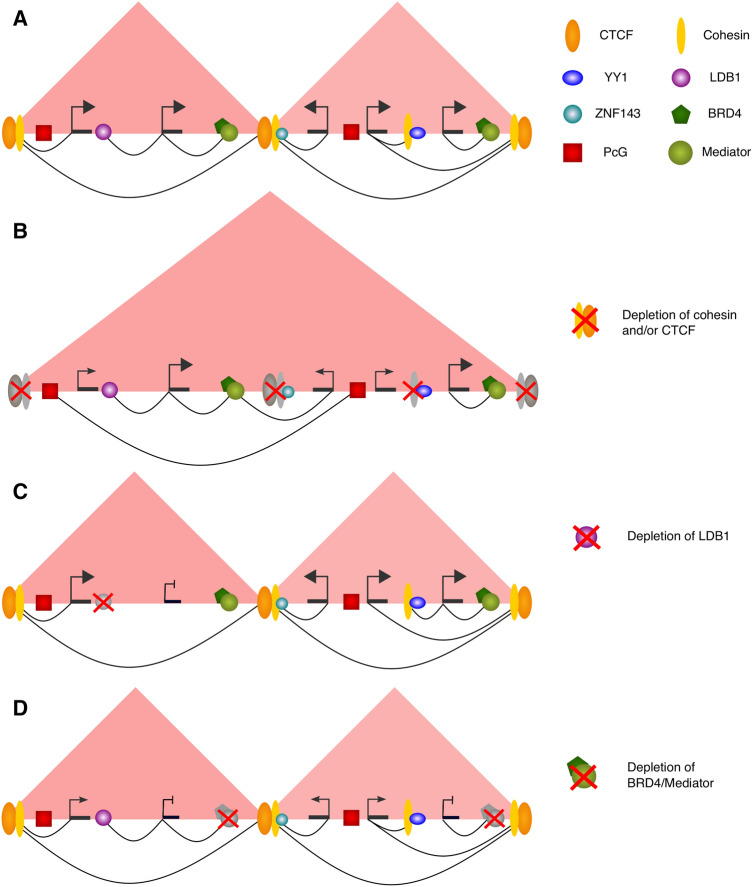
- Enhancer–promoter communication is widely supported by 3C-derived methods, but CTCF/cohesin depletion abolishes TADs with only relatively mild gene-expression effects; Mediator and BRD4 loss disrupts transcription without perturbing most enhancer–promoter contacts. Additional looping factors include YY1, ZNF143, and LDB1, while non-looping mechanisms such as liquid–liquid phase separation remain under investigation.
- Multiplicity is common: PCHi-C showed active promoters contacted a median of two active enhancers in human primary blood cells, and developing mouse limb genes were regulated by a median of three functional enhancers, with some limb-specific TF genes having more than ten. Enhancer chains/networks and promoter–promoter contacts are also observed.
- Transcriptional effects are often additive but can be synergistic or sub-additive; enhancers generally increase transcriptional burst frequency without significantly affecting burst amplitude or duration. The Activity-by-Contact model predicts CRISPRi enhancer-perturbation effects well, especially for proximal enhancers.
Methods
- Design: narrative review synthesising classic and recent literature on enhancer organisation, enhancer–promoter communication, and gene regulation.
- Data or sample: no primary experimental data; the paper cites and interprets published studies across model organisms, mammalian cells, and human genetics.
- Main analysis: conceptual synthesis of enhancer grammar, chromatin states, 3C/Hi-C/Micro-C and imaging evidence, looping factors, TADs/compartments, enhancer multiplicity, and transcriptional models.
Limitations
- Stated: much evidence for enhancer–promoter communication relies on 3C-derived methods that presume physical looping and a largely pairwise view; these methods cannot prove simultaneous multi-way contacts, and imaging and 3C-derived results may diverge.
- Stated: evidence for chromatin liquid–liquid phase separation and its functional significance in gene control is still incomplete, and whether LLPS is necessary for any genomic locus remains unresolved.
- Evident: as a review, the paper does not report new experimental data, formal meta-analysis, or primary statistical testing.
Model-written summary. Check it against the paper before relying on it.
Integrity signals
Registry
Cites
Statistics
Figures
Verification
Claims the paper makes
116 Partly supported · 79 Supported · 38 Own interpretation · 32 No full text of the sources · 21 Supported so far · 18 No basis given · 10 Not checked yet · 4 Mixed support · 1 Couldn’t confirm · 1 Own method · accuracy not yet measured
Some cited sources support this claim and some don’t — read each source’s verdict below.
In the paper
“The mechanisms of pioneer factor action are still being established [37], but at least some of them (such as FOXA, OCT4 and SOX2/SOX11) have been shown to initiate chromatin opening by direct displacement of histones [38–41], whilst many others recruit chromatin remodelers [42–50].”
§ Transcriptional enhancers and their communication with gene promoters > Organisation and function of enhancers in cis > Enhancers as transcription factor recruitment units
What the sources say
- Supportedcites [38] Iwafuchi-Doi M, Donahue G, Kakumanu A et al (2016) The pioneer transcription factor FoxA maintains an accessible nucleosome configuration at enhancers for tissue-specific gene activation. Mol Cell 62:79–91 source
The Results section (“FoxA binding displaces linker histone H1 from nucleosomes”; page unavailable) reports that FoxA binding displaces linker histone H1, making underlying nucleosomes more accessible. This supports the FOXA example for which this source is cited; the paper does not establish the corresponding mechanism for OCT4 or SOX2/SOX11. (LLM, conf=0.90)
- Disputedcites [39] Echigoya K, Koyama M, Negishi L et al (2020) Nucleosome binding by the pioneer transcription factor OCT4. Sci Rep 10:11832 sourceExperimental — accuracy not yet measured
The Introduction says OCT4 may help convert closed chromatin to open chromatin, but it does not attribute that opening to direct histone displacement. The Results section “Linker histone H1 competes with OCT4 for nucleosome binding” reports the opposite of the claimed mechanism for OCT4: adding OCT4 did not displace H1; adding H1 removed OCT4 from the nucleosome. The Discussion describes SOX2/SOX11 peeling DNA from histones, not displacing the histones. (LLM, conf=0.88)
Checked by a reasoning model — may be wrong.
- Not checked — no full text of the sourcecites [40] Dodonova SO, Zhu F, Dienemann C et al (2020) Nucleosome-bound SOX2 and SOX11 structures elucidate pioneer factor function. Nature 580:669–672 source
- Partly supportedcites [41] Jacobs J, Atkins M, Davie K et al (2018) The transcription factor Grainy head primes epithelial enhancers for spatiotemporal activation by displacing nucleosomes. Nat Genet 50:1011–1020 sourceExperimental — accuracy not yet measured
The introductory passage (labelled Abstract in our copy; page unavailable) describes pioneer factors as transcription factors that can displace nucleosomes and names FOXA1 and SOX2 as examples. The Results section, “Functional Grainyhead motifs are embedded in a specific DNA context” (page unavailable), also associates pioneer-factor binding with nucleosome displacement. But the paper does not establish direct histone displacement for each named factor: it mentions OCT4 as a possible additional factor needed for SOX2-dependent enhancer activation and does not mention SOX11. (LLM, conf=0.84)
boosteddirect- Asserted: passes — The authors put it forward as true.
- Checkable: passes — It can be checked against evidence.
- Load-bearing: unclear — It is unclear whether the paper’s conclusions depend on it.
- Based: passes — The paper gives a reason why it holds.
- Supported
Some cited sources support this claim and some don’t — read each source’s verdict below.
In the paper
“The majority of active enhancers are themselves transcribed, producing enhancer RNAs (eRNAs) in a bi-directional manner [73–77].”
§ Transcriptional enhancers and their communication with gene promoters > Organisation and function of enhancers in cis > Enhancers as transcription factor recruitment units
What the sources say
- Partly supportedcites [73] Core LJ, Martins AL, Danko CG et al (2014) Analysis of nascent RNA identifies a unified architecture of initiation regions at mammalian promoters and enhancers. Nat Genet 46:1311–1320 sourceExperimental — accuracy not yet measured
The Abstract says enhancer transcription is widespread and that eRNAs are produced bidirectionally. The Discussion also reports bidirectional initiation at thousands of enhancers. Neither passage establishes that a majority of active enhancers are transcribed; the nearly 80% figure in the Abstract concerns promoters, not enhancers. (LLM, conf=0.85)
- Supportedcites [74] Andersson R, Gebhard C, Miguel-Escalada I et al (2014) An atlas of active enhancers across human cell types and tissues. Nature 507:455–461 source
The Results section ('Bidirectional pairs of capped RNAs identify active enhancers'; page not provided) describes similar levels of capped RNA in both directions at enhancers and calls bidirectional transcription a signature feature of active enhancers. The Conclusions add that few untranscribed candidate enhancers showed activity, supporting the claim's broad characterization of active enhancers. (LLM, conf=0.87)
- Partly supportedcites [75] Lam MTY, Cho H, Lesch HP et al (2013) Rev-Erbs repress macrophage gene expression by inhibiting enhancer-directed transcription. Nature 498:511–515 sourceExperimental — accuracy not yet measured
The passage reporting GRO-Seq results (section labeled Abstract; page unavailable) found eRNA initiation at 76% of Rev-Erb binding sites in enhancer-like regions and bidirectional transcription at 56% of those sites. This supports the pattern in the studied macrophage-associated sites, but not the broader claim that a majority of active enhancers generally are transcribed bidirectionally. (LLM, conf=0.86)
- Disputedcites [76] De Santa F, Barozzi I, Mietton F et al (2010) A large fraction of extragenic RNA pol II transcription sites overlap enhancers. PLoS Biol 8:e1000384 sourceExperimental — accuracy not yet measured
The Discussion says that non-transcribed enhancers greatly outnumber transcribed ones, contrary to the claim that a majority are transcribed. The Introduction also gives an example of unidirectional enhancer-region transcription; this paper does not establish bidirectional production as the general pattern. No page numbers are available in our copy. (LLM, conf=0.90)
Checked by a reasoning model — may be wrong.
- Partly supportedcites [77] Kim T-K, Hemberg M, Gray JM et al (2010) Widespread transcription at neuronal activity-regulated enhancers. Nature 465:182–187 sourceExperimental — accuracy not yet measured
The Transcription at enhancers section reports that eRNAs are produced bi-directionally at neuronal activity-regulated enhancers. It does not support the claim that a majority of active enhancers are transcribed: the Methods Summary reports detectable eRNAs at 44% of extragenic enhancers, and the findings are limited to neuronal enhancers. Page numbers are not provided in our copy. (LLM, conf=0.89)
plaincorrelational- Asserted: passes — The authors put it forward as true.
- Checkable: passes — It can be checked against evidence.
- Load-bearing: unclear — It is unclear whether the paper’s conclusions depend on it.
- Based: passes — The paper gives a reason why it holds.
- Partly supported
Some cited sources support this claim and some don’t — read each source’s verdict below.
In the paper
“Nonetheless, a significant minority of enhancers in human ESCs also show pre-existing “permissive” promoter contacts prior to activation [141, 394].”
§ Transcriptional enhancers and their communication with gene promoters > Enhancer–promoter communication in three dimensions > Permissive and instructive enhancer–promoter contacts
What the sources say
- Supportedcites [141] Freire-Pritchett P, Schoenfelder S, Várnai C et al (2017) Global reorganisation of regulatory units upon lineage commitment of human embryonic stem cells. Elife 6:e21926 source
The Discussion (Reconfiguration of cis-regulatory units upon lineage commitment; page unavailable) defines permissive interactions as contacts present before gene activation and says the study found such preformed interactions during ESC differentiation. The Results (Rewiring and recolouring of promoter-interacting regions; page unavailable) report that 25% of promoter-interacting regions retained across ESCs and NECs changed chromatin state, supporting the claim’s qualitative description of a substantial minority. (LLM, conf=0.86)
- Disputedcites [394] Rubin AJ, Barajas BC, Furlan-Magaril M et al (2017) Lineage-specific dynamic and pre-established enhancer–promoter contacts cooperate in terminal differentiation. Nat Genet 49:1522–1528 sourceExperimental — accuracy not yet measured
The Abstract says the pre-established enhancer–promoter contacts studied were present in epidermal progenitor cells but not in embryonic stem cells. Its analysis of hESC promoter-contact data likewise reports reduced contact signal relative to keratinocytes. The paper places these pre-established contacts after pluripotency, not in hESCs. (LLM, conf=0.88)
Checked by a reasoning model — may be wrong.
plaincorrelational- Asserted: passes — The authors put it forward as true.
- Checkable: passes — It can be checked against evidence.
- Load-bearing: unclear — It is unclear whether the paper’s conclusions depend on it.
- Based: passes — The paper gives a reason why it holds.
- Supported
Some cited sources support this claim and some don’t — read each source’s verdict below.
In the paper
“In the classic scenario, this boundary is presented by CTCF binding to its sequence motifs located in a divergent orientation at either end of the loop [277, 438–440]”
§ Transcriptional enhancers and their communication with gene promoters > Determinants of enhancer–promoter selectivity > Large-scale chromosomal architecture
What the sources say
- Disputedcites [277] Rao SSP, Huntley MH, Durand NC et al (2014) A 3D map of the human genome at kilobase resolution reveals principles of chromatin looping. Cell 159:1665–1680 sourceExperimental — accuracy not yet measured
The Results section reports that 92% of CTCF motif pairs at the examined loop loci are convergent, not divergent, and that convergent pairs are overwhelmingly more frequent than divergent pairs. The Discussion likewise says that motifs at loop anchors are convergent in more than 90% of cases. Page numbers were not supplied in our copy. (LLM, conf=0.95)
Checked by a reasoning model — may be wrong.
- Not checked — no full text of the sourcecites [438] Guo Y, Monahan K, Wu H et al (2012) CTCF/cohesin-mediated DNA looping is required for protocadherin α promoter choice. Proc Natl Acad Sci USA 109:21081–21086 source
- Partly supportedcites [439] Guo Y, Xu Q, Canzio D et al (2015) CRISPR inversion of CTCF sites alters genome topology and enhancer/promoter function. Cell 162:900–910 sourceExperimental — accuracy not yet measured
In Results, under “Directional CTCF Binding in Genome-wide DNA Looping Specificity” (page unavailable), the paper reports reverse-forward CTCF-binding-site pairs at boundaries between neighboring domains, consistent with divergent sites at a boundary. But it reports that most CTCF-mediated interactions within loops involve forward-reverse, convergent site pairs. It therefore does not support describing the sites at either end of a loop as divergent. (LLM, conf=0.87)
- Partly supportedcites [440] Nanni L, Ceri S, Logie C (2020) Spatial patterns of CTCF sites define the anatomy of TADs and their boundaries. Genome Biol 21:197 sourceExperimental — accuracy not yet measured
The Results section reports that divergent CTCF-site patterns are enriched at TAD boundaries and suggests they confer boundary function (page not provided). But the paper distinguishes boundaries from loop ends: its Results section says loop bases involve pairs of convergent CTCF sites. It therefore does not support placing divergent motifs at either end of a loop. (LLM, conf=0.87)
plaindirect- Asserted: passes — The authors put it forward as true.
- Checkable: passes — It can be checked against evidence.
- Load-bearing: unclear — It is unclear whether the paper’s conclusions depend on it.
- Based: passes — The paper gives a reason why it holds.
- Disputed
The cited sources support only part of this claim — read each source’s verdict below.
In the paper
“In Drosophila, the Zinc Finger Early Drosophila Activator (Zelda) is critical for lowering the nucleosome barrier at enhancers for genes driving zygotic gene activation [33–35].”
§ Transcriptional enhancers and their communication with gene promoters > Organisation and function of enhancers in cis > Enhancers as transcription factor recruitment units
What the sources say
- Partly supportedcites [33] Liang H-L, Nien C-Y, Liu H-Y et al (2008) The zinc-finger protein Zelda is a key activator of the early zygotic genome in Drosophila. Nature 456:400–403 sourceExperimental — accuracy not yet measured
The paper’s Abstract reports that Zelda binds regulatory TAGteam sites and plays a key role in activating the early zygotic genome. It does not say that Zelda lowers a nucleosome barrier at enhancers; the passages retrieved for nucleosome occupancy and chromatin accessibility do not establish that mechanism. No page numbers are available in our copy. (LLM, conf=0.88)
- Partly supportedcites [34] Harrison MM, Li X-Y, Kaplan T et al (2011) Zelda binding in the early Drosophila melanogaster embryo marks regions subsequently activated at the maternal-to-zygotic transition. PLoS Genet 7:e1002266 sourceExperimental — accuracy not yet measured
The Discussion (page unavailable) says Zelda is important at promoters and enhancers and proposes that it promotes zygotic genome activation by controlling chromatin accessibility. But it does not establish that Zelda lowers a nucleosome barrier; it explicitly allows that Zelda may maintain chromatin that is already accessible rather than actively open it. (LLM, conf=0.88)
- Supportedcites [35] Schulz KN, Bondra ER, Moshe A et al (2015) Zelda is differentially required for chromatin accessibility, transcription factor binding, and gene expression in the early Drosophila embryo. Genome Res 25:1715–1726 source
The Discussion (page unavailable), including Figure 7’s caption, says Zelda determines chromatin accessibility at early embryonic enhancers, allowing other transcription factors to bind. It also proposes that Zelda is essential for creating open chromatin that drives expression of the earliest zygotic genes. The paper limits this role to a subset of regions, rather than all Zelda-bound enhancers. (LLM, conf=0.87)
plaindirect- Asserted: passes — The authors put it forward as true.
- Checkable: passes — It can be checked against evidence.
- Load-bearing: unclear — It is unclear whether the paper’s conclusions depend on it.
- Based: passes — The paper gives a reason why it holds.
- Partly supported
The cited sources support only part of this claim — read each source’s verdict below.
In the paper
“Mechanistically, a key function of sequence-specific TFs is the recruitment of “workhorse” cofactors that facilitate enzymatic chromatin remodelling, histone modification and act as scaffolds for recruitment of additional factors.”
§ Transcriptional enhancers and their communication with gene promoters > Organisation and function of enhancers in cis > Enhancers as transcription factor recruitment units
What the sources say
- Partly supportedcites [56] Zabidi MA, Stark A (2016) Regulatory enhancer-core-promoter communication via transcription factors and cofactors. Trends Genet 32:801–814 sourceExperimental — accuracy not yet measured
The section on differential activity of trans factors (page unavailable) says sequence-specific TFs recruit cofactors, including the SWI/SNF complex and p300, and identifies Mof as an acetyltransferase. The section on activating micro-environments describes cofactor activity leading to recruitment of BRD4, but does not establish the claimed scaffold role for recruiting additional factors. (LLM, conf=0.83)
- Partly supportedcites [57] Winkler DD, Luger K (2011) The histone chaperone FACT: structural insights and mechanisms for nucleosome reorganization. J Biol Chem 286:18369–18374 sourceExperimental — accuracy not yet measured
The introduction and “FACT Function and Architecture” section describe FACT as a histone chaperone that reorganizes nucleosomes during transcription. The “Modifying” FACT Function section says histone modifications can recruit chromatin-altering machinery. The copy does not establish the claim’s central mechanism—that sequence-specific transcription factors recruit cofactors—or describe those cofactors as scaffolds for additional factors. (LLM, conf=0.78)
plaindirect- Asserted: passes — The authors put it forward as true.
- Checkable: passes — It can be checked against evidence.
- Load-bearing: unclear — It is unclear whether the paper’s conclusions depend on it.
- Based: passes — The paper gives a reason why it holds.
- Partly supported
The cited sources support only part of this claim — read each source’s verdict below.
In the paper
“P300 and CBP also serve as scaffolds that connect RNA polymerase II (RNAP) and RNAP-associated “general transcription factors” to the chromatin [64, 65].”
§ Transcriptional enhancers and their communication with gene promoters > Organisation and function of enhancers in cis > Enhancers as transcription factor recruitment units
What the sources say
- Not checked — no full text of the sourcecites [64] Chan HM, La Thangue NB (2001) p300/CBP proteins: HATs for transcriptional bridges and scaffolds. J Cell Sci 114:2363–2373 source
- Partly supportedcites [65] Kim TK, Kim TH, Maniatis T (1998) Efficient recruitment of TFIIB and CBP-RNA polymerase II holoenzyme by an interferon-beta enhanceosome in vitro. Proc Natl Acad Sci USA 95:12191–12196 sourceExperimental — accuracy not yet measured
The Results and Discussion (page unavailable) show that interactions between CBP and the IFN-β enhanceosome help recruit an RNA polymerase II holoenzyme containing general transcription factors to a promoter. The paper does not establish the same role for p300 or show that either protein acts as a scaffold connecting those factors to chromatin; its experiments used an immobilized DNA template in vitro. (LLM, conf=0.85)
plaindirect- Asserted: passes — The authors put it forward as true.
- Checkable: passes — It can be checked against evidence.
- Load-bearing: unclear — It is unclear whether the paper’s conclusions depend on it.
- Based: passes — The paper gives a reason why it holds.
The cited sources support only part of this claim — read each source’s verdict below.
In the paper
“Recent experiments degrading Mediator and BRD4 have shown that these proteins are critical for gene expression [69].”
§ Transcriptional enhancers and their communication with gene promoters > Organisation and function of enhancers in cis > Enhancers as transcription factor recruitment units
What the sources say
- Partly supportedcites [69] Crump NT, Ballabio E, Godfrey L et al (2021) BET inhibition disrupts transcription but retains enhancer–promoter contact. Nat Commun 12:223 sourceExperimental — accuracy not yet measured
The Discussion (page unavailable) says BRD4 and Mediator play a key role in the transcription of many genes. The Introduction describes this paper’s use of a BRD4-degrading compound, but its experiments reduced Mediator binding rather than degrading Mediator; it mentions MED14 degradation only in a separate study of enhancer–promoter contact. Thus the gene-expression conclusion is supported, but the description of the experiments is not fully supported. (LLM, conf=0.86)
boosteddirect- Asserted: passes — The authors put it forward as true.
- Checkable: passes — It can be checked against evidence.
- Load-bearing: unclear — It is unclear whether the paper’s conclusions depend on it.
- Based: passes — The paper gives a reason why it holds.
- Partly supported
The cited sources support only part of this claim — read each source’s verdict below.
In the paper
“It soon became clear that enhancers also played vital roles in humans, with non-coding enhancer deletions starting to be linked to severe disease phenotypes such as beta thalassaemia and polydactyly [25–28].”
§ Transcriptional enhancers and their communication with gene promoters > Organisation and function of enhancers in cis > Classic definition of enhancers
What the sources say
- Not checked — no full text of the sourcecites [25] Kioussis D, Vanin E, deLange T et al (1983) Beta-globin gene inactivation by DNA translocation in gamma beta-thalassaemia. Nature 306:662–666 source
- Supportedcites [26] Driscoll MC, Dobkin CS, Alter BP (1989) Gamma delta beta-thalassemia due to a de novo mutation deleting the 5’ beta-globin gene activation-region hypersensitive sites. Proc Natl Acad Sci USA 86:7470–7474 source
The Discussion reports a patient with γδβ-thalassemia whose de novo deletion removed three upstream regulatory hypersensitive sites while leaving the structural globin genes intact. This supports the beta-thalassemia example attributed to this paper; the sentence’s other citations may address polydactyly. (LLM, conf=0.92)
- Partly supportedcites [27] Lettice LA, Heaney SJH, Purdie LA et al (2003) A long-range Shh enhancer regulates expression in the developing limb and fin and is associated with preaxial polydactyly. Hum Mol Genet 12:1725–1735 sourceExperimental — accuracy not yet measured
The “ZRS and polydactyly” section links mutations in a non-coding regulatory element to preaxial polydactyly. It specifies single-base-pair mutations, not enhancer deletions, and does not address beta thalassaemia. Page numbers are unavailable in our copy. (LLM, conf=0.88)
- Not checked — no full text of the sourcecites [28] Sharpe J, Lettice L, Hecksher-Sørensen J et al (1999) Identification of Sonic hedgehog as a candidate gene responsible for the polydactylous mouse mutant Sasquatch. Curr Biol 9:97-S1 source
plaincorrelational- Asserted: passes — The authors put it forward as true.
- Checkable: passes — It can be checked against evidence.
- Load-bearing: unclear — It is unclear whether the paper’s conclusions depend on it.
- Based: passes — The paper gives a reason why it holds.
The sources with a verdict support this claim; the rest weren’t checked yet, have no full text we could read, or their verdicts aren’t rated yet.
In the paper
“Often, pioneer factors must recruit additional non-pioneer sequence-specific TFs for efficient enhancer activation [30, 31].”
§ Transcriptional enhancers and their communication with gene promoters > Organisation and function of enhancers in cis > Enhancers as transcription factor recruitment units
What the sources say
- Not checked — no full text of the sourcecites [30] Spitz F, Furlong EEM (2012) Transcription factors: from enhancer binding to developmental control. Nat Rev Genet 13:613–626 source
- Supportedcites [31] Zaret KS, Carroll JS (2011) Pioneer transcription factors: establishing competence for gene expression. Genes Dev 25:2227–2241 source
In “Active and passive means by which pioneer factors are useful in development,” the paper says that the vast majority of promoters and enhancers require a combination of transcription factors for activity. It explains that pioneer factors can bind first, allowing other transcription factors to bind later and contribute to activation. This supports the claim’s substance, although “recruit” is a loose paraphrase of that process. (LLM, conf=0.88)
plainconditional- Asserted: passes — The authors put it forward as true.
- Checkable: passes — It can be checked against evidence.
- Load-bearing: unclear — It is unclear whether the paper’s conclusions depend on it.
- Based: passes — The paper gives a reason why it holds.
The sources with a verdict support this claim; the rest weren’t checked yet, have no full text we could read, or their verdicts aren’t rated yet.
In the paper
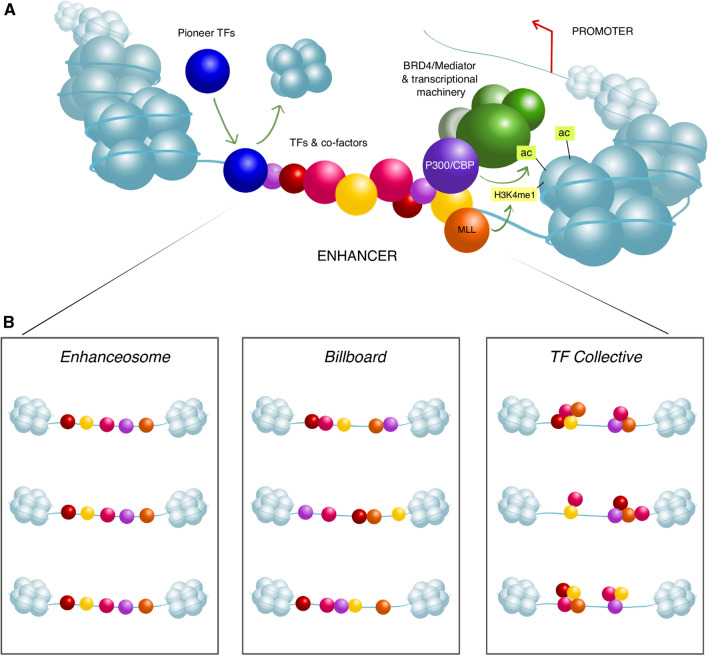
“At the DNA level, enhancers represent clusters of binding sites for sequence-specific transcription factors (TFs) (Fig. 1A) (reviewed in [29, 30]).”
§ Transcriptional enhancers and their communication with gene promoters > Organisation and function of enhancers in cis > Enhancers as transcription factor recruitment units
What the sources say
- Supportedcites [29] Long HK, Prescott SL, Wysocka J (2016) Ever-changing landscapes: transcriptional enhancers in development and evolution. Cell 167:1170–1187 source
The Introduction section “Enhancers as clusters of TF binding sites” states that functional enhancers are composed of concentrated clusters of transcription-factor recognition motifs. This directly supports the citing sentence’s description of enhancers at the DNA level. (LLM, conf=0.95)
- Not checked — no full text of the sourcecites [30] Spitz F, Furlong EEM (2012) Transcription factors: from enhancer binding to developmental control. Nat Rev Genet 13:613–626 source
plain- Asserted: passes — The authors put it forward as true.
- Checkable: passes — It can be checked against evidence.
- Load-bearing: unclear — It is unclear whether the paper’s conclusions depend on it.
- Based: passes — The paper gives a reason why it holds.
- Supported
The cited sources support only part of this claim — read each source’s verdict below.
In the paper
“For instance, Zelda promotes the formation of local TF hubs involving important transcription factors required for developmental patterning, such as Bicoid and Dorsal [51–54].”
§ Transcriptional enhancers and their communication with gene promoters > Organisation and function of enhancers in cis > Enhancers as transcription factor recruitment units
What the sources say
- Supportedcites [51] Mir M, Reimer A, Haines JE et al (2017) Dense Bicoid hubs accentuate binding along the morphogen gradient. Genes Dev 31:1784–1794 source
The Results section, “Formation of BCD hubs in the posterior embryo is dependent on ZLD” (page unavailable), reports that Bicoid hubs were abolished in Zelda-null embryos. This supports the Bicoid example for which this paper is offered among the grouped citations. (LLM, conf=0.89)
- Partly supportedcites [52] Mir M, Stadler MR, Ortiz SA et al (2018) Dynamic multifactor hubs interact transiently with sites of active transcription in embryos. Elife 7:e40497 sourceExperimental — accuracy not yet measured
The Results section ('Bicoid binding events are enriched in Zelda hubs'; page unavailable) reports Bicoid binding enriched within Zelda hubs, supporting that example. The cited paper does not establish Dorsal’s involvement in those hubs, so the Dorsal example is unsupported by this source. (LLM, conf=0.88)
- Partly supportedcites [53] Dufourt J, Trullo A, Hunter J et al (2018) Temporal control of gene expression by the pioneer factor Zelda through transient interactions in hubs. Nat Commun 9:5194 sourceExperimental — accuracy not yet measured
The Results and Discussion section (‘Zelda accumulates into subnuclear hubs’; page unavailable) reports local, dynamic Zelda hubs and suggests they could promote cooperation with Bicoid. The Introduction and ‘Zelda fosters temporal transcriptional coordination’ section say Zelda potentiates Bicoid and Dorsal activity, but the paper does not establish that either factor participates in the observed Zelda hubs or that Zelda promotes formation of hubs containing them. (LLM, conf=0.87)
- Supportedcites [54] Yamada S, Whitney PH, Huang S-K et al (2019) The drosophila pioneer factor zelda modulates the nuclear microenvironment of a dorsal target enhancer to potentiate transcriptional output. Curr Biol 29:1387-1393.e5 source
The Abstract reports increased Dorsal accumulation at the transcription site and describes transcription-factor hubs induced by Zelda. The Discussion reports Bicoid enrichment in Zelda hubs and suggests that Zelda raises transcription factors’ local concentration. Page numbers are not provided in our copy. (LLM, conf=0.90)
plaindirect- Asserted: passes — The authors put it forward as true.
- Checkable: passes — It can be checked against evidence.
- Load-bearing: unclear — It is unclear whether the paper’s conclusions depend on it.
- Based: passes — The paper gives a reason why it holds.
- Supported
The sources with a verdict support this claim; the rest weren’t checked yet, have no full text we could read, or their verdicts aren’t rated yet.
In the paper
“Subsequent landmark experiments by the groups of Walter Schaffner [4] and Pierre Chambon [5] confirmed that a 72-bp repeat sequence element in SV40 [8, 9] was an “enhancing” sequence, capable of vastly upregulating gene expression from a plasmid upon transfection into mammalian cells.”
§ Transcriptional enhancers and their communication with gene promoters > Organisation and function of enhancers in cis > Classic definition of enhancers
What the sources say
- Not checked — no full text of the sourcecites [4] Banerji J, Rusconi S, Schaffner W (1981) Expression of a beta-globin gene is enhanced by remote SV40 DNA sequences. Cell 27:299–308 source
- Not checked — no full text of the sourcecites [5] Moreau P, Hen R, Wasylyk B et al (1981) The SV40 72 base repair repeat has a striking effect on gene expression both in SV40 and other chimeric recombinants. Nucleic Acids Res 9:6047–6068. https://doi.org/10.1093/nar/9.22.6047 source
- Not checked — no full text of the sourcecites [8] Benoist C, Chambon P (1981) In vivo sequence requirements of the SV40 early promoter region. Nature 290:304–310 source
- Supportedcites [9] Gruss P, Dhar R, Khoury G (1981) Simian virus 40 tandem repeated sequences as an element of the early promoter. Proc Natl Acad Sci USA 78:943–947 source
The citation to this paper is attached to the identification of the 72-bp repeat element in SV40; the sentence attributes the plasmid-enhancement experiments to other citations. The paper’s abstract identifies the 72-base-pair tandem repeats and reports that they form an essential element of the early viral transcriptional promoter. (LLM, conf=0.91)
boosteddirect- Asserted: passes — The authors put it forward as true.
- Checkable: passes — It can be checked against evidence.
- Load-bearing: unclear — It is unclear whether the paper’s conclusions depend on it.
- Based: passes — The paper gives a reason why it holds.
Every source the paper cites for this claim was checked and supports it.
In the paper
“A subset of TFs known as pioneer factors are capable of overcoming this constraint through chromatin remodelling (reviewed in [31, 32]).”
§ Transcriptional enhancers and their communication with gene promoters > Organisation and function of enhancers in cis > Enhancers as transcription factor recruitment units
What the sources say
- Supportedcites [31] Zaret KS, Carroll JS (2011) Pioneer transcription factors: establishing competence for gene expression. Genes Dev 25:2227–2241 source
The section “Active and passive means by which pioneer factors are useful in development” says pioneer factors can bind highly compacted chromatin and open or organize it locally, allowing other transcription factors to bind. The summary clarifies that this access applies to certain forms of compacted chromatin, not all forms. (LLM, conf=0.92)
- Supportedcites [32] Larson ED, Marsh AJ, Harrison MM (2021) Pioneering the developmental frontier. Mol Cell 81:1640–1650 source
The Abstract describes pioneer factors as a specialized class of transcription factors that bind histone-wrapped DNA and establish accessible chromatin domains. It also lists mechanisms by which they increase accessibility, including histone eviction and recruitment of chromatin-modifying enzymes. The Conclusions likewise describe interactions with chromatin-remodeling enzymes. Page numbers are not provided in our copy. (LLM, conf=0.93)
plaindirect- Asserted: passes — The authors put it forward as true.
- Checkable: passes — It can be checked against evidence.
- Load-bearing: unclear — It is unclear whether the paper’s conclusions depend on it.
- Based: passes — The paper gives a reason why it holds.
- Supported
The cited sources support only part of this claim — read each source’s verdict below.
In the paper
“At active enhancers, the BRD4 protein co-localises with the Mediator complex, which in turn assembles the pre-initiation complex (PIC) and RNAP to initiate transcription [66–68].”
§ Transcriptional enhancers and their communication with gene promoters > Organisation and function of enhancers in cis > Enhancers as transcription factor recruitment units
What the sources say
- Partly supportedcites [66] Allen BL, Taatjes DJ (2015) The mediator complex: a central integrator of transcription. Nat Rev Mol Cell Biol 16:155–166 sourceExperimental — accuracy not yet measured
The “Mediator roles in pol II transcription” and “PIC assembly” sections say that Mediator is generally required for PIC assembly and enables RNA polymerase II recruitment. The “DNA looping” section links Mediator to enhancer activity, but the passages retrieved for BRD4 do not establish that BRD4 co-localises with Mediator at active enhancers. Page numbers are not available in our copy. (LLM, conf=0.88)
- Not checked — no full text of the sourcecites [67] Flanagan PM, Kelleher RJ, Sayre MH et al (1991) A mediator required for activation of RNA polymerase II transcription in vitro. Nature 350:436–438 source
- Not checked — no full text of the sourcecites [68] Kelleher RJ, Flanagan PM, Kornberg RD (1990) A novel mediator between activator proteins and the RNA polymerase II transcription apparatus. Cell 61:1209–1215 source
plaindirect- Asserted: passes — The authors put it forward as true.
- Checkable: passes — It can be checked against evidence.
- Load-bearing: unclear — It is unclear whether the paper’s conclusions depend on it.
- Based: passes — The paper gives a reason why it holds.
- Partly supported
The cited sources support only part of this claim — read each source’s verdict below.
In the paper
“SWI/SNF recruits the chromatin activators P300 and CBP, which mediate the acetylation of histone H3 lysine 27 through their intrinsic histone acetyltransferase (HAT) activity [59–62].”
§ Transcriptional enhancers and their communication with gene promoters > Organisation and function of enhancers in cis > Enhancers as transcription factor recruitment units
What the sources say
- Not checked — no full text of the sourcecites [59] Chan HM, Shikama N, La Thangue NB (2001) Control of gene expression and the cell cycle. Essays Biochem 37:87–96 source
- Partly supportedcites [60] Jin Q, Yu L-R, Wang L et al (2011) Distinct roles of GCN5/PCAF-mediated H3K9ac and CBP/p300-mediated H3K18/27ac in nuclear receptor transactivation. EMBO J 30:249–262 sourceExperimental — accuracy not yet measured
The Introduction identifies CBP and p300 as histone acetyltransferase co-activators, and “Substrate and site specificities of CBP/p300” reports that they are required for over 90% of H3K27 acetylation in mouse embryonic fibroblasts. The cited paper does not establish the sentence’s additional claim that SWI/SNF recruits CBP and p300. (LLM, conf=0.88)
- Not checked — no full text of the sourcecites [61] Raisner R, Kharbanda S, Jin L et al (2018) Enhancer activity requires CBP/P300 bromodomain-dependent histone H3K27 acetylation. Cell Rep 24:1722–1729 source
- Partly supportedcites [62] Alver BH, Kim KH, Lu P et al (2017) The SWI/SNF chromatin remodelling complex is required for maintenance of lineage specific enhancers. Nat Commun 8:14648 sourceExperimental — accuracy not yet measured
The Results section ('SWI/SNF is required for p300 activity at enhancers'; page not provided) says SWI/SNF recruits p300 to enhancer loci and regulates H3K27 acetylation through interaction with this histone acetyltransferase. It does not establish that SWI/SNF also recruits CBP, so the claim's inclusion of CBP is unsupported by the cited Results passages. (LLM, conf=0.85)
plaindirect- Asserted: passes — The authors put it forward as true.
- Checkable: passes — It can be checked against evidence.
- Load-bearing: unclear — It is unclear whether the paper’s conclusions depend on it.
- Based: passes — The paper gives a reason why it holds.
Every source the paper cites for this claim was checked and supports it.
In the paper
“Synthetic enhancers recruiting multiple heterotypic TFs showed stronger transcriptional effects compared with those recruiting high amounts of a single TF, providing a functional rationale for combinatorial TF recruitment to natural enhancers [55].”
§ Transcriptional enhancers and their communication with gene promoters > Organisation and function of enhancers in cis > Enhancers as transcription factor recruitment units
What the sources say
- Supportedcites [55] Smith RP, Taher L, Patwardhan RP et al (2013) Massively parallel decoding of mammalian regulatory sequences supports a flexible organizational model. Nat Genet 45:1021–1028 source
The Results section, “Increased binding site complexity leads to stronger expression,” reports that heterotypic synthetic regulatory elements generally drove stronger expression than homotypic elements, even when the number of binding sites was controlled. The paper tested binding-site arrangements rather than directly measuring TF recruitment, but the claim accurately paraphrases the reported comparison. (LLM, conf=0.93)
plaindirect- Asserted: passes — The authors put it forward as true.
- Checkable: passes — It can be checked against evidence.
- Load-bearing: passes — The paper’s conclusions depend on it.
- Based: passes — The paper gives a reason why it holds.
- Supported
The cited sources support only part of this claim — read each source’s verdict below.
In the paper
“The mechanisms of pioneer factor action are still being established [37], but at least some of them (such as FOXA, OCT4 and SOX2/SOX11) have been shown to initiate chromatin opening by direct displacement of histones [38–41], whilst many others recruit chromatin remodelers [42–50].”
§ Transcriptional enhancers and their communication with gene promoters > Organisation and function of enhancers in cis > Enhancers as transcription factor recruitment units
What the sources say
- Partly supportedcites [42] Ding J, Xu H, Faiola F et al (2012) Oct4 links multiple epigenetic pathways to the pluripotency network. Cell Res 22:155–167 sourceExperimental — accuracy not yet measured
The Results and Discussion section (page not available) reports that Oct4 physically interacts with components of several chromatin-remodeling and other epigenetic complexes. It does not establish that many pioneer factors recruit remodelers, or that Oct4’s interactions constitute recruitment to open chromatin. (LLM, conf=0.84)
- Partly supportedcites [43] Pardo M, Lang B, Yu L et al (2010) An expanded Oct4 interaction network: implications for stem cell biology, development, and disease. Cell Stem Cell 6:382–395 sourceExperimental — accuracy not yet measured
The Discussion (page unavailable) reports that Oct4 copurifies with subunits of the SWI/SNF nucleosome-remodeling complex, supporting an Oct4–remodeler association. It does not show that Oct4 recruits the complex, or establish that many pioneer factors recruit chromatin remodelers. (LLM, conf=0.84)
- Partly supportedcites [44] van den Berg DLC, Snoek T, Mullin NP et al (2010) An Oct4-centered protein interaction network in embryonic stem cells. Cell Stem Cell 6:369–381 sourceExperimental — accuracy not yet measured
The Results (An Oct4-Centered Interaction Network; page not provided) report that several embryonic-stem-cell transcription factors associate with chromatin-modifying complexes, including SWI/SNF. The Discussion (Multiple Network Connections with Chromatin- and Protein-Modifying Factors; page not provided) proposes that recruitment may occur through initial local targeting, but does not establish that many pioneer factors recruit remodelers. The claim presents that proposed mechanism as a demonstrated, broader finding. (LLM, conf=0.86)
- Partly supportedcites [45] King HW, Klose RJ (2017) The pioneer factor OCT4 requires the chromatin remodeller BRG1 to support gene regulatory element function in mouse embryonic stem cells. Elife 6:e22631 sourceExperimental — accuracy not yet measured
The Discussion (page unavailable) reports that OCT4 recruits BRG1 to its binding sites and suggests that many pioneer factors may rely on chromatin remodelling. It does not establish that many other pioneer factors recruit remodelers; it presents that broader mechanism as a possibility requiring further study. (LLM, conf=0.83)
- Partly supportedcites [46] Bao X, Rubin AJ, Qu K et al (2015) A novel ATAC-seq approach reveals lineage-specific reinforcement of the open chromatin landscape via cooperation between BAF and p63. Genome Biol 16:284 sourceExperimental — accuracy not yet measured
The Results section (“BAF and p63 binding reinforce open chromatin”; page not provided) reports that p63 enhances the chromatin targeting of the BAF remodeling complex. This supports an example of a transcription factor recruiting a remodeler, but the paper does not establish that many pioneer factors do so. (LLM, conf=0.82)
- Not checked — no full text of the sourcecites [47] Engelen E, Akinci U, Bryne JC et al (2011) Sox2 cooperates with Chd7 to regulate genes that are mutated in human syndromes. Nat Genet 43:607–611 source
- Partly supportedcites [48] Hu G, Schones DE, Cui K et al (2011) Regulation of nucleosome landscape and transcription factor targeting at tissue-specific enhancers by BRG1. Genome Res 21:1650–1658 sourceExperimental — accuracy not yet measured
In “BRG1 becomes associated with the GATA1 enhancers during differentiation of HSCs” (page unavailable), the authors say their results are consistent with GATA1 helping recruit BRG1, a chromatin remodeler. The paper does not establish that many pioneer factors recruit remodelers; its recruitment finding concerns GATA1 and is framed as an inference. (LLM, conf=0.86)
- Supportedcites [49] Takaku M, Grimm SA, Shimbo T et al (2016) GATA3-dependent cellular reprogramming requires activation-domain dependent recruitment of a chromatin remodeler. Genome Biol 17:36 source
The Discussion states that GATA3’s pioneering activity correlates with recruitment of the SWI/SNF chromatin-remodeling complex. This paper supports the cited sentence as an example of a pioneer factor that recruits a remodeler; the sentence’s broader claim draws on multiple citations. (LLM, conf=0.90)
- Partly supportedcites [50] Vierbuchen T, Ling E, Cowley CJ et al (2017) AP-1 transcription factors and the BAF complex mediate signal-dependent enhancer selection. Mol Cell 68:1067-1082.e12 sourceExperimental — accuracy not yet measured
The Results section ('AP-1 TFs recruit the BAF complex to enhancers'; page unavailable) supports recruitment of a chromatin remodeler by AP-1. The Discussion describes AP-1 nucleosome binding as a possible pioneer-factor property, but the paper does not establish that many other pioneer factors recruit remodelers. (LLM, conf=0.85)
plaindirect- Asserted: passes — The authors put it forward as true.
- Checkable: passes — It can be checked against evidence.
- Load-bearing: unclear — It is unclear whether the paper’s conclusions depend on it.
- Based: passes — The paper gives a reason why it holds.
- Partly supported
The sources with a verdict support this claim; the rest weren’t checked yet, have no full text we could read, or their verdicts aren’t rated yet.
In the paper
“In contrast, later studies of Drosophila developmental enhancers found evidence for much less rigid motif organisation [90, 91].”
§ Transcriptional enhancers and their communication with gene promoters > Organisation and function of enhancers in cis > Flexibility of enhancer organisation
What the sources say
- Not checked — no full text of the sourcecites [90] Kulkarni MM, Arnosti DN (2003) Information display by transcriptional enhancers. Development 130:6569–6575 source
- Supportedcites [91] Junion G, Spivakov M, Girardot C et al (2012) A transcription factor collective defines cardiac cell fate and reflects lineage history. Cell 148:473–486 source
The Results report no consistent spacing or orientation of transcription-factor motifs in the Drosophila cardiac enhancers studied, despite their shared function. The Introduction likewise describes their regulation as occurring without consistent motif grammar. (LLM, conf=0.94)
plain- Asserted: passes — The authors put it forward as true.
- Checkable: passes — It can be checked against evidence.
- Load-bearing: unclear — It is unclear whether the paper’s conclusions depend on it.
- Based: passes — The paper gives a reason why it holds.
The sources with a verdict support this claim; the rest weren’t checked yet, have no full text we could read, or their verdicts aren’t rated yet.
In the paper
“Consistent with this, homologous enhancers in a pair of distantly related species can retain their function in the non-host organism despite differences in DNA sequence [101, 110, 111].”
§ Transcriptional enhancers and their communication with gene promoters > Organisation and function of enhancers in cis > Flexibility of enhancer organisation
What the sources say
- Not checked — no full text of the sourcecites [101] Wong ES, Zheng D, Tan SZ et al (2020) Deep conservation of the enhancer regulatory code in animals. Science 370:eaax8137 source
- Supportedcites [110] Yang S, Oksenberg N, Takayama S et al (2015) Functionally conserved enhancers with divergent sequences in distant vertebrates. BMC Genomics 16:882 source
The Results (Experimental validation of computationally predicted enhancers; page unavailable) report that mouse and zebrafish enhancer sequences were tested in zebrafish embryos, where some drove consistent expression patterns. The paper identifies these as functionally homologous enhancers with divergent sequences, supporting the claim that enhancer function can persist in a non-host organism despite sequence differences. (LLM, conf=0.92)
- Supportedcites [111] Hörnblad A, Bastide S, Langenfeld K et al (2021) Dissection of the Fgf8 regulatory landscape by in vivo CRISPR-editing reveals extensive intra- and inter-enhancer redundancy. Nat Commun 12:439 source
In Results, under “Evolutionary conservation of CE64 sequence versus functional organisation” (page unavailable), the spotted gar CE64 sequence drove expression in transgenic mouse embryos despite lacking a region present in mouse CE64. The activity did not fully reproduce that of the mouse enhancer, but it supports the claim that homologous enhancers can retain function across species despite sequence differences. (LLM, conf=0.90)
plain- Asserted: passes — The authors put it forward as true.
- Checkable: passes — It can be checked against evidence.
- Load-bearing: unclear — It is unclear whether the paper’s conclusions depend on it.
- Based: passes — The paper gives a reason why it holds.
Every source the paper cites for this claim was checked and supports it.
In the paper
“Interestingly, at non-dimeric sites, physical interactions between co-bound TFs were not necessary [119], consistent with evidence from Drosophila where co-occupied DNA-bound TFs were often spaced quite widely apart (> 50 bp) [118].”
§ Transcriptional enhancers and their communication with gene promoters > Organisation and function of enhancers in cis > Flexibility of enhancer organisation
What the sources say
- Supportedcites [119] Sönmezer C, Kleinendorst R, Imanci D et al (2021) Molecular co-occupancy identifies transcription factor binding cooperativity in vivo. Mol Cell 81:255-267.e6 source
The Discussion reports high co-occupancy among TFs unlikely to physically interact and explicitly says TF–TF interactions are not mandatory for it. It contrasts this with dimeric motifs, where such interactions stabilize binding. (LLM, conf=0.93)
plain- Asserted: passes — The authors put it forward as true.
- Checkable: passes — It can be checked against evidence.
- Load-bearing: passes — The paper’s conclusions depend on it.
- Based: passes — The paper gives a reason why it holds.
- Supported
The cited sources support only part of this claim — read each source’s verdict below.
In the paper
“SMF has also recently been adapted to mammalian cells, detecting widespread co-occupancy of cooperative TFs at enhancers [119].”
§ Transcriptional enhancers and their communication with gene promoters > Organisation and function of enhancers in cis > Flexibility of enhancer organisation
What the sources say
- Partly supportedcites [119] Sönmezer C, Kleinendorst R, Imanci D et al (2021) Molecular co-occupancy identifies transcription factor binding cooperativity in vivo. Mol Cell 81:255-267.e6 sourceExperimental — accuracy not yet measured
The Introduction says the authors adapted SMF for mammalian genomes and found DNA co-occupancy widespread at sites of TF cooperativity. The Results describe measurements at mouse cis-regulatory elements, but the passages do not establish that the widespread finding applies specifically to enhancers rather than cis-regulatory elements more broadly. (LLM, conf=0.82)
plaincorrelational- Asserted: passes — The authors put it forward as true.
- Checkable: passes — It can be checked against evidence.
- Load-bearing: passes — The paper’s conclusions depend on it.
- Based: passes — The paper gives a reason why it holds.
- Partly supported
The cited sources support only part of this claim — read each source’s verdict below.
In the paper
“The prevalence of flexible enhancer organisation is also supported by rapid evolutionary turnover of enhancers, which exceeds that of proximal promoter regions [29, 99, 100].”
§ Transcriptional enhancers and their communication with gene promoters > Organisation and function of enhancers in cis > Flexibility of enhancer organisation
What the sources say
- Partly supportedcites [29] Long HK, Prescott SL, Wysocka J (2016) Ever-changing landscapes: transcriptional enhancers in development and evolution. Cell 167:1170–1187 sourceExperimental — accuracy not yet measured
Section I, “General principles of enhancer function” (page unavailable), describes high rates of enhancer turnover and links compensatory motif turnover to flexible enhancer organisation. The passages do not compare enhancer turnover with turnover in proximal promoter regions, so the claimed difference in rates is not supported by this source. (LLM, conf=0.84)
- Supportedcites [99] Villar D, Berthelot C, Aldridge S et al (2015) Enhancer evolution across 20 mammalian species. Cell 160:554–566 source
The Results section, “Enhancer Evolution Is Appreciably More Rapid Than Proximal Promoter Evolution” (page not provided), reports rapid, widespread enhancer evolution and comparatively stable promoter activity in mammalian liver. The Discussion states that active enhancers have a mean lifetime three times shorter than active promoters. The link to flexible enhancer organisation is the citing authors’ interpretation, not a separate finding attributed to this source. (LLM, conf=0.93)
- Supportedcites [100] Carelli FN, Liechti A, Halbert J et al (2018) Repurposing of promoters and enhancers during mammalian evolution. Nat Commun 9:4066 source
The Results section, “Enhancers are the main source of regulatory repurposing” (page not provided), reports that ancestral liver enhancers were lost at about 1.92 times the rate of ancestral promoters. This supports the attributed comparison in evolutionary turnover; the statement about flexible enhancer organisation is the citing authors’ framing. (LLM, conf=0.93)
plaincorrelational- Asserted: passes — The authors put it forward as true.
- Checkable: passes — It can be checked against evidence.
- Load-bearing: unclear — It is unclear whether the paper’s conclusions depend on it.
- Based: passes — The paper gives a reason why it holds.
- Partly supported
The cited sources support only part of this claim — read each source’s verdict below.
In the paper
“First developed in Drosophila, SMF can detect the binding of multiple TFs on a single DNA molecule [116].”
§ Transcriptional enhancers and their communication with gene promoters > Organisation and function of enhancers in cis > Flexibility of enhancer organisation
What the sources say
- Partly supportedcites [116] Krebs AR, Imanci D, Hoerner L et al (2017) Genome-wide single-molecule footprinting reveals high RNA polymerase II turnover at paused promoters. Mol Cell 67:411–422.e4 sourceExperimental — accuracy not yet measured
In Results, “Simultaneous Quantification of Multiple Transcription Initiation Intermediates” (page unavailable), the paper reports measuring multiple promoter-occupancy events on single molecules. It identifies footprints associated with the pre-initiation complex and RNA polymerase II, but does not show detection of multiple individual transcription factors on one molecule. The “Principles of Dual-Enzyme Single-Molecule Footprinting” section says the method was applied in Drosophila, not that SMF was first developed there. (LLM, conf=0.85)
plaindirect- Asserted: passes — The authors put it forward as true.
- Checkable: passes — It can be checked against evidence.
- Load-bearing: passes — The paper’s conclusions depend on it.
- Based: passes — The paper gives a reason why it holds.
- Partly supported
The cited sources support only part of this claim — read each source’s verdict below.
In the paper
“Instead, enhancer conservation is typically “modular”, commonly preserving the sets of binding sites for the required TFs, but often not their exact sequence and orientation [101–109].”
§ Transcriptional enhancers and their communication with gene promoters > Organisation and function of enhancers in cis > Flexibility of enhancer organisation
What the sources say
- Not checked — no full text of the sourcecites [101] Wong ES, Zheng D, Tan SZ et al (2020) Deep conservation of the enhancer regulatory code in animals. Science 370:eaax8137 source
- Partly supportedcites [102] Hare EE, Peterson BK, Iyer VN et al (2008) Sepsid even-skipped enhancers are functionally conserved in Drosophila despite lack of sequence conservation. PLoS Genet 4:e1000106 sourceExperimental — accuracy not yet measured
The Results sections “Identification of Sepsid Enhancers” and “Binding Site Composition and Organization in Sepsid Enhancers” describe similar collections of predicted binding sites for relevant transcription factors, while finding that few individual sites remain in the same location across families. The Discussion (“Binding Site Turnover and the Regulatory Machinery”) likewise reports extensive rearrangement with conserved enhancer function. These findings support the claim for the eve enhancers studied, but do not establish that this pattern is typical of enhancers generally; the passages also do not specifically assess binding-site orientation. Page numbers are unavailable in our copy. (LLM, conf=0.78)
- Partly supportedcites [103] Schmidt D, Wilson MD, Ballester B et al (2010) Five-vertebrate ChIP-seq reveals the evolutionary dynamics of transcription factor binding. Science 328:1036–1040 sourceExperimental — accuracy not yet measured
The paper’s discussion (page not provided in our copy) says that tissue-specific regulation can persist through regulatory architectures independent of sequence constraint, and describes nearby compensatory TF-binding events. This supports flexibility in binding-site sequence and location, but the study examines two liver TFs and does not establish that enhancers typically preserve the full set of required TF sites or that site orientation often changes. (LLM, conf=0.85)
- Not checked — no full text of the sourcecites [104] Dowell RD (2010) Transcription factor binding variation in the evolution of gene regulation. Trends Genet 26:468–475 source
- Could not verifycites [105] Habib N, Wapinski I, Margalit H et al (2012) A functional selection model explains evolutionary robustness despite plasticity in regulatory networks. Mol Syst Biol 8:619 sourceExperimental — accuracy not yet measured
The Results section on functional conservation of regulatory DNA motifs describes conserved motif–function associations, while the Discussion describes turnover of target genes within functional modules. Neither passage addresses whether individual enhancers preserve sets of transcription-factor binding sites while their exact sequences and orientations change; searches for enhancer conservation, binding-site sequence, and orientation did not establish that claim. (LLM, conf=0.73)
- Partly supportedcites [106] Arnold CD, Gerlach D, Spies D et al (2014) Quantitative genome-wide enhancer activity maps for five Drosophila species show functional enhancer conservation and turnover during cis-regulatory evolution. Nat Genet 46:685–692 sourceExperimental — accuracy not yet measured
The Results sections “Specific selection of transcription factor sequence motifs” and “Compensatory changes stabilize regulatory output” link conserved enhancer activity to transcription-factor motifs rather than overall sequence identity, and show that lost motifs can be replaced at different positions. The paper does not establish that binding-site orientation is often unconserved, and its findings concern the assayed Drosophila enhancers rather than enhancers generally. Page numbers are unavailable in our copy. (LLM, conf=0.85)
- Partly supportedcites [107] Spivakov M (2014) Spurious transcription factor binding: non-functional or genetically redundant? BioEssays 36:798–806 sourceExperimental — accuracy not yet measured
In ‘Dose of activation’ as an evolutionary trait (page unavailable), the paper says regulatory regions can retain function despite low base-by-base conservation and turnover of transcription-factor binding sites. In ‘Do “doses” add up at multi-TF enhancers?’ (page unavailable), it describes flexible enhancer organisation, but it does not establish that conserved enhancers commonly preserve the same sets of required transcription factors or address binding-site orientation. (LLM, conf=0.84)
- Not checked — no full text of the sourcecites [108] Borok MJ, Tran DA, Ho MCW, Drewell RA (2010) Dissecting the regulatory switches of development: lessons from enhancer evolution in Drosophila. Development 137:5–13 source
- Partly supportedcites [109] Khoueiry P, Girardot C, Ciglar L et al (2017) Uncoupling evolutionary changes in DNA sequence, transcription factor occupancy and enhancer activity. Elife 6:e28440 sourceExperimental — accuracy not yet measured
The Results section, “Conserved enhancer occupancy is associated with enhancer function” (page unavailable), says evolutionary constraints likely select for overall enhancer composition rather than the positions of individual binding sites. The Results section, “TF binding site divergence is tolerated in the context of collective TF binding” (page unavailable), also reports conserved Tin occupancy despite motif divergence in enhancers bound by many factors. These findings support flexibility in some enhancers, but do not establish that enhancer conservation is typically modular or that exact binding-site orientation is often not preserved. (LLM, conf=0.83)
plaincorrelational- Asserted: passes — The authors put it forward as true.
- Checkable: passes — It can be checked against evidence.
- Load-bearing: unclear — It is unclear whether the paper’s conclusions depend on it.
- Based: passes — The paper gives a reason why it holds.
The cited sources support only part of this claim — read each source’s verdict below.
In the paper
“Flexibility of enhancer organisation with respect to binding site order and orientation was also observed in a massively parallel synthetic enhancer experiment [55].”
§ Transcriptional enhancers and their communication with gene promoters > Organisation and function of enhancers in cis > Flexibility of enhancer organisation
What the sources say
- Partly supportedcites [55] Smith RP, Taher L, Patwardhan RP et al (2013) Massively parallel decoding of mammalian regulatory sequences supports a flexible organizational model. Nat Genet 45:1021–1028 sourceExperimental — accuracy not yet measured
The Results and Discussion (page numbers unavailable) report that multiple binding-site orders drove strong expression in the massively parallel synthetic regulatory-element experiment, supporting flexibility with respect to order. The passages do not report a test or finding about binding-site orientation, so that part of the claim is unsupported. (LLM, conf=0.86)
plain- Asserted: passes — The authors put it forward as true.
- Checkable: passes — It can be checked against evidence.
- Load-bearing: unclear — It is unclear whether the paper’s conclusions depend on it.
- Based: passes — The paper gives a reason why it holds.
- Partly supported
The cited sources support only part of this claim — read each source’s verdict below.
In the paper
“While it is clear that enhancers typically favour the more flexible models of sequence organisation, the degree of necessary cooperation between TFs is less obvious, particularly since TF binding to DNA appears to be very transient [113–117].”
§ Transcriptional enhancers and their communication with gene promoters > Organisation and function of enhancers in cis > Flexibility of enhancer organisation
What the sources say
- Partly supportedcites [113] Wilczyński B, Furlong EEM (2010) Dynamic CRM occupancy reflects a temporal map of developmental progression. Mol Syst Biol 6:383 sourceExperimental — accuracy not yet measured
The Results and discussion report that each of four transcription factors occupies about 50% of its targeted regulatory modules transiently during Drosophila development. This supports changing DNA occupancy over developmental stages, but not the broader implication that transcription-factor binding to DNA is generally short-lived at the molecular level. (LLM, conf=0.86)
- Supportedcites [114] Voss TC, Hager GL (2014) Dynamic regulation of transcriptional states by chromatin and transcription factors. Nat Rev Genet 15:69–81 source
The ‘In vivo dynamics of transcription factors’ section says residence times on genomic elements can be short and that rapid exchange is a property of many transcription factors. It notes an exception for some site-specific DNA-binding proteins with longer residence times, which is consistent with the citing sentence’s qualified wording, ‘appears to be.’ (LLM, conf=0.92)
- Not checked — no full text of the sourcecites [115] Chen J, Zhang Z, Li L et al (2014) Single-molecule dynamics of enhanceosome assembly in embryonic stem cells. Cell 156:1274–1285 source
- Partly supportedcites [116] Krebs AR, Imanci D, Hoerner L et al (2017) Genome-wide single-molecule footprinting reveals high RNA polymerase II turnover at paused promoters. Mol Cell 67:411–422.e4 sourceExperimental — accuracy not yet measured
In Results, ‘The TATA Box Stabilizes Binding of the PIC’ (page unavailable), the paper says PIC formation at TATA-less promoters may be transient. It does not establish that transcription-factor binding to DNA is generally very transient; it instead reports more frequent PIC binding at TATA-containing promoters and notes that some general transcription factors may form a stable scaffold. (LLM, conf=0.87)
- Not checked — no full text of the sourcecites [117] Stergachis AB, Debo BM, Haugen E et al (2020) Single-molecule regulatory architectures captured by chromatin fiber sequencing. Science 368:1449–1454 source
hedged- Asserted: passes — The authors put it forward as true.
- Checkable: passes — It can be checked against evidence.
- Load-bearing: passes — The paper’s conclusions depend on it.
- Based: passes — The paper gives a reason why it holds.
- Partly supported
Every source the paper cites for this claim was checked and supports it.
In the paper
“Additionally, a deep learning algorithm applied to binding of pluripotency TFs at base resolution in mouse embryonic stem cells (ESCs) suggested a “soft motif syntax” whereby TFs help each other to bind directly to the enhancer with a lenient distance-dependency between binding sites [98].”
§ Transcriptional enhancers and their communication with gene promoters > Organisation and function of enhancers in cis > Flexibility of enhancer organisation
What the sources say
- Supportedcites [98] Avsec Ž, Weilert M, Shrikumar A et al (2021) Base-resolution models of transcription-factor binding reveal soft motif syntax. Nat Genet 53:354–366 source
Split into 2 atoms — 2 confirmed, 0 partially supported, 0 disputed, 0 misattributed, 0 unverifiable. Expand the claim to see per-atom verdicts.
hedgeddirect- Asserted: passes — The authors put it forward as true.
- Checkable: passes — It can be checked against evidence.
- Load-bearing: unclear — It is unclear whether the paper’s conclusions depend on it.
- Based: passes — The paper gives a reason why it holds.
- Supported
Every source the paper cites for this claim was checked and supports it.
In the paper
“Similarly, TFs governing serotonergic neuron differentiation showed synergy despite flexible sequence organisation of their cognate enhancers [95].”
§ Transcriptional enhancers and their communication with gene promoters > Organisation and function of enhancers in cis > Flexibility of enhancer organisation
What the sources say
- Supportedcites [95] Lloret-Fernández C, Maicas M, Mora-Martínez C et al (2018) A transcription factor collective defines the HSN serotonergic neuron regulatory landscape. Elife 7:e32785 source
The Results section, “HSN TF collective shows enhancer-context dependent synergistic relationships” (page not specified), reports synergy among factors regulating serotonergic HSN neuron genes. It also links reporter-specific synergy to the different arrangements of functional binding sites in each enhancer. The paper notes that the interactions depend on the enhancer and TF pair, rather than occurring universally. (LLM, conf=0.91)
plaincorrelational- Asserted: passes — The authors put it forward as true.
- Checkable: passes — It can be checked against evidence.
- Load-bearing: unclear — It is unclear whether the paper’s conclusions depend on it.
- Based: passes — The paper gives a reason why it holds.
- Supported
The cited sources support only part of this claim — read each source’s verdict below.
In the paper
“In addition to the ‘primed’ and active states, enhancers can also reside in a ‘poised’ state exhibiting both H3K4me1 and H3 lysine 27 trimethylation (H3K27me3) that is associated with Polycomb repressive complexes [131, 135, 136, 138].”
§ Transcriptional enhancers and their communication with gene promoters > Organisation and function of enhancers in cis > The chromatin states of enhancers
What the sources say
- Partly supportedcites [131] ENCODE Project Consortium, Moore JE, Purcaro MJ et al (2020) Expanded encyclopaedias of DNA elements in the human and mouse genomes. Nature 583:699–710 sourceExperimental — accuracy not yet measured
The paper’s Extended Data Fig. 3 caption describes a cCRE that may be a poised enhancer in embryonic stem cells, iPSCs and neural progenitor cells. It associates that example with high DNase and H3K4me3 signals, not the claimed combination of H3K4me1 and H3K27me3; the passages found also do not link poised enhancers to Polycomb repressive complexes. (LLM, conf=0.86)
- Supportedcites [135] Rada-Iglesias A, Bajpai R, Swigut T et al (2011) A unique chromatin signature uncovers early developmental enhancers in humans. Nature 470:279–283 source
The paper describes poised enhancers in human embryonic stem cells as marked by H3K4me1 and enriched for H3K27me3 (Abstract; passage 8). It also reports simultaneous presence of the two marks and enrichment of SUZ12, a PRC2 component, at those elements (passage 2). (LLM, conf=0.94)
- Supportedcites [136] Zentner GE, Tesar PJ, Scacheri PC (2011) Epigenetic signatures distinguish multiple classes of enhancers with distinct cellular functions. Genome Res 21:1273–1283 source
In “Identification of three major enhancer classes in mESCs” (page not provided), the paper classifies H3K4me1+, H3K27me3+ enhancers as poised. The same section reports substantial binding of Polycomb group proteins at poised enhancers. The paper also identifies poised enhancers without H3K27me3, but that does not conflict with the claim that enhancers can occupy the described state. (LLM, conf=0.93)
- Could not verifycites [138] Koenecke N, Johnston J, Gaertner B et al (2016) Genome-wide identification of Drosophila dorso-ventral enhancers by differential histone acetylation analysis. Genome Biol 17:196 sourceExperimental — accuracy not yet measured
The Background discusses H3K27ac as a marker of active enhancers, not the claimed combination of H3K4me1 and H3K27me3 at poised enhancers. Searches for those marks, poised enhancers, and Polycomb found only related reference titles, not a passage in this paper stating the claim. The indexed passages have no page numbers. (LLM, conf=0.73)
plaincorrelational- Asserted: passes — The authors put it forward as true.
- Checkable: passes — It can be checked against evidence.
- Load-bearing: unclear — It is unclear whether the paper’s conclusions depend on it.
- Based: passes — The paper gives a reason why it holds.
- Partly supported
Every source the paper cites for this claim was checked and supports it.
In the paper
“Furthermore, even enhancers with extremely high evolutionary conservation may not require the exact preservation of their sequence for their correct function, as was recently shown using CRISPR-mediated mutagenesis [112].”
§ Transcriptional enhancers and their communication with gene promoters > Organisation and function of enhancers in cis > Flexibility of enhancer organisation
What the sources say
- Supportedcites [112] Snetkova V, Ypsilanti AR, Akiyama JA et al (2021) Ultraconserved enhancer function does not require perfect sequence conservation. Nat Genet 53:521–528 source
The Discussion reports that most tested ultraconserved enhancers retained activity after mutation, supporting the claim that their known enhancer functions do not require perfect sequence preservation. The Methods (Generation of Enhancer Knock-in Mice) also describe using CRISPR/Cas9 to replace endogenous enhancers with mutated alleles. The paper cautions that effects at untested developmental stages or on other functions remain possible. (LLM, conf=0.92)
hedged- Asserted: passes — The authors put it forward as true.
- Checkable: passes — It can be checked against evidence.
- Load-bearing: unclear — It is unclear whether the paper’s conclusions depend on it.
- Based: passes — The paper gives a reason why it holds.
- Supported
The cited sources support only part of this claim — read each source’s verdict below.
In the paper
“This study detected multiple “waves” of a progressive recruitment of at least 46 sequence-specific TFs and cofactors, including chromatin remodelling complexes and histone acetyl-transferases, eventually resulting in a derepression of an oestrogen-response gene pS2 [87].”
§ Transcriptional enhancers and their communication with gene promoters > Organisation and function of enhancers in cis > Enhancers as transcription factor recruitment units
What the sources say
- Partly supportedcites [87] Métivier R, Penot G, Hübner MR et al (2003) Estrogen receptor-α directs ordered, cyclical, and combinatorial recruitment of cofactors on a natural target promoter. Cell 115:751–763 sourceExperimental — accuracy not yet measured
Split into 2 atoms — 0 confirmed, 2 partially supported, 0 disputed, 0 misattributed, 0 unverifiable. Expand the claim to see per-atom verdicts.
plaindirectSingle case- Asserted: passes — The authors put it forward as true.
- Checkable: passes — It can be checked against evidence.
- Load-bearing: unclear — It is unclear whether the paper’s conclusions depend on it.
- Based: passes — The paper gives a reason why it holds.
- Partly supported
Every source the paper cites for this claim was checked and supports it.
In the paper
“Notably, at dimeric motif sites, TFs tended to bind initially as monomers with subsequent dimerisation presumably stabilising the DNA–protein complex [119].”
§ Transcriptional enhancers and their communication with gene promoters > Organisation and function of enhancers in cis > Flexibility of enhancer organisation
What the sources say
- Supportedcites [119] Sönmezer C, Kleinendorst R, Imanci D et al (2021) Molecular co-occupancy identifies transcription factor binding cooperativity in vivo. Mol Cell 81:255-267.e6 source
The Discussion says that dimerization is not obligatory for most tested TF dimers and suggests sequential monomer binding as their binding mode. It also says TF–TF interactions stabilize binding at dimeric motifs. The citing sentence preserves the paper’s tentative framing. (LLM, conf=0.90)
hedgedconditional- Asserted: passes — The authors put it forward as true.
- Checkable: passes — It can be checked against evidence.
- Load-bearing: unclear — It is unclear whether the paper’s conclusions depend on it.
- Based: passes — The paper gives a reason why it holds.
- Supported
The cited sources support only part of this claim — read each source’s verdict below.
In the paper
“In particular, Mediator and BRD4 co-localise at very high levels at “super-enhancers” (SEs): long stretches of sequences with gene regulatory activity that generally drive greater levels of gene expression than regular enhancers [69–72].”
§ Transcriptional enhancers and their communication with gene promoters > Organisation and function of enhancers in cis > Enhancers as transcription factor recruitment units
What the sources say
- Supportedcites [69] Crump NT, Ballabio E, Godfrey L et al (2021) BET inhibition disrupts transcription but retains enhancer–promoter contact. Nat Commun 12:223 source
The Introduction describes super-enhancers as enriched for BRD4 and Mediator and associated with high transcriptional activity. The Results section defines them as extended regions with high levels of both proteins, supporting the cited sentence’s description; the paper does not give a direct expression-level comparison with regular enhancers. (LLM, conf=0.86)
- Partly supportedcites [70] Chapuy B, McKeown MR, Lin CY et al (2013) Discovery and characterization of super-enhancer-associated dependencies in diffuse large B cell lymphoma. Cancer Cell 24:777–790 sourceExperimental — accuracy not yet measured
The Results section (“Disproportionate binding of BRD4 to overloaded enhancers”; page unavailable) reports exceptionally high BRD4 loading at enhancers larger than typical enhancers. The Discussion (page unavailable) describes them as approximately 12-fold larger. Our copy does not establish co-localization with Mediator or show that these enhancers generally drive higher gene expression than regular enhancers; it reports greater sensitivity to BET inhibition instead. (LLM, conf=0.87)
- Partly supportedcites [71] Di Micco R, Fontanals-Cirera B, Low V et al (2014) Control of embryonic stem cell identity by BRD4-dependent transcriptional elongation of super-enhancer-associated pluripotency genes. Cell Rep 9:234–247 sourceExperimental — accuracy not yet measured
The Results sections (page unavailable) report that BRD4 and Mediator subunits localize at super-enhancers of stem-cell genes in human embryonic stem cells, and describe super-enhancers as large enhancer domains. The copy does not establish that super-enhancers generally drive higher gene expression than regular enhancers. It also reports that BRD4 peak signal intensity was similar at super-enhancers and typical enhancers in these cells, although BRD4-binding peaks were more frequent at super-enhancers. (LLM, conf=0.85)
- Partly supportedcites [72] Whyte WA, Orlando DA, Hnisz D et al (2013) Master transcription factors and mediator establish super-enhancers at key cell identity genes. Cell 153:307–319 sourceExperimental — accuracy not yet measured
The Results sections on large genomic domains and functional attributes describe super-enhancers as unusually long, highly occupied by Mediator, and associated with higher gene expression than typical enhancers. The passages have no page numbers in our copy. They do not establish that BRD4 co-localises with Mediator at super-enhancers. (LLM, conf=0.88)
plaincorrelational- Asserted: passes — The authors put it forward as true.
- Checkable: passes — It can be checked against evidence.
- Load-bearing: unclear — It is unclear whether the paper’s conclusions depend on it.
- Based: passes — The paper gives a reason why it holds.
- Supported
The cited sources support only part of this claim — read each source’s verdict below.
In the paper
“The TF collective model was originally formulated in Drosophila, where a set of five TFs bound multitudes of enhancers required for heart development that showed no detectable similarity in their sequence organisation, beyond the presence of binding motifs for some of these TFs [91].”
§ Transcriptional enhancers and their communication with gene promoters > Organisation and function of enhancers in cis > Flexibility of enhancer organisation
What the sources say
- Partly supportedcites [91] Junion G, Spivakov M, Girardot C et al (2012) A transcription factor collective defines cardiac cell fate and reflects lineage history. Cell 148:473–486 sourceExperimental — accuracy not yet measured
Split into 2 atoms — 1 confirmed, 1 partially supported, 0 disputed, 0 misattributed, 0 unverifiable. Expand the claim to see per-atom verdicts.
plain- Asserted: passes — The authors put it forward as true.
- Checkable: passes — It can be checked against evidence.
- Load-bearing: unclear — It is unclear whether the paper’s conclusions depend on it.
- Based: passes — The paper gives a reason why it holds.
- Partly supported
The cited sources support only part of this claim — read each source’s verdict below.
In the paper
“The stripe 2 enhancer controls eve expression in early embryogenesis via binding of tissue-specific TFs [121–123].”
§ Transcriptional enhancers and their communication with gene promoters > Organisation and function of enhancers in cis > Flexibility of enhancer organisation
What the sources say
- Not checked — no full text of the sourcecites [121] Stanojevic D, Small S, Levine M (1991) Regulation of a segmentation stripe by overlapping activators and repressors in the Drosophila embryo. Science 254:1385–1387 source
- Not checked — no full text of the sourcecites [122] Goto T, Macdonald P, Maniatis T (1989) Early and late periodic patterns of even skipped expression are controlled by distinct regulatory elements that respond to different spatial cues. Cell 57:413–422 source
- Partly supportedcites [123] Small S, Kraut R, Hoey T et al (1991) Transcriptional regulation of a pair-rule stripe in Drosophila. Genes Dev 5:827–839 sourceExperimental — accuracy not yet measured
The Abstract and Discussion describe the stripe 2 regulatory element as binding factors that activate or repress eve expression in early embryos. They identify these factors as a maternal morphogen and gap proteins with spatially patterned expression, but do not establish that they are tissue-specific transcription factors. (LLM, conf=0.82)
plaindirect- Asserted: passes — The authors put it forward as true.
- Checkable: passes — It can be checked against evidence.
- Load-bearing: unclear — It is unclear whether the paper’s conclusions depend on it.
- Based: passes — The paper gives a reason why it holds.
Every source the paper cites for this claim was checked and supports it.
In the paper
“Consistent with this, “strengthening” TF binding sites at developmental enhancers results in aberrant gene expression patterns [125].”
§ Transcriptional enhancers and their communication with gene promoters > Organisation and function of enhancers in cis > Flexibility of enhancer organisation
What the sources say
- Supportedcites [125] Farley EK, Olson KM, Zhang W et al (2015) Suboptimization of developmental enhancers. Science 350:325–328 source
The supplied passages (labelled Abstract; no page number provided) report that making all five GATA and ETS binding motifs in the Otx-a developmental enhancer optimal produced expression in ectopic tissues. The paper also states that excess optimal binding sites can lead to loss of specificity and ectopic gene expression. (LLM, conf=0.93)
plaindirect- Asserted: passes — The authors put it forward as true.
- Checkable: passes — It can be checked against evidence.
- Load-bearing: unclear — It is unclear whether the paper’s conclusions depend on it.
- Based: passes — The paper gives a reason why it holds.
- Supported
The cited sources support only part of this claim — read each source’s verdict below.
In the paper
“Enhancers consistent with the billboard model are likely also widespread in vertebrate genomes [55, 93].”
§ Transcriptional enhancers and their communication with gene promoters > Organisation and function of enhancers in cis > Flexibility of enhancer organisation
What the sources say
- Partly supportedcites [55] Smith RP, Taher L, Patwardhan RP et al (2013) Massively parallel decoding of mammalian regulatory sequences supports a flexible organizational model. Nat Genet 45:1021–1028 sourceExperimental — accuracy not yet measured
The Results section (“Reporter expression is influenced by binding site order”; page unavailable) says the tested configurations are largely consistent with the billboard model. The Results section (“Synthetic elements mimic putative liver enhancers”; page unavailable) also finds similar binding-site configurations in 78% of the putative mouse liver enhancers examined. This supports the model’s relevance to native mammalian enhancers, but does not establish that billboard-consistent enhancers are widespread across vertebrate genomes. (LLM, conf=0.84)
- Partly supportedcites [93] Rastegar S, Hess I, Dickmeis T et al (2008) The words of the regulatory code are arranged in a variable manner in highly conserved enhancers. Dev Biol 318:366–377 sourceExperimental — accuracy not yet measured
In “Highly conserved non-coding sequences and transcriptional regulation” (page unavailable), the paper calls many enhancers loose, variable assemblies of binding sites and identifies that structure as the billboard model. It also finds billboard-like organization in five zebrafish notochord enhancers. Those examples support the possibility, but the paper does not establish how widespread billboard-like enhancers are across vertebrate genomes. (LLM, conf=0.83)
hedged- Asserted: passes — The authors put it forward as true.
- Checkable: passes — It can be checked against evidence.
- Load-bearing: unclear — It is unclear whether the paper’s conclusions depend on it.
- Based: passes — The paper gives a reason why it holds.
- Partly supported
The cited sources support only part of this claim — read each source’s verdict below.
In the paper
“The various proposed models for enhancer grammar range from very rigid to flexible, largely dependent on the species, cell types and loci in which they were formulated (reviewed in [29]).”
§ Transcriptional enhancers and their communication with gene promoters > Organisation and function of enhancers in cis > Flexibility of enhancer organisation
What the sources say
- Partly supportedcites [29] Long HK, Prescott SL, Wysocka J (2016) Ever-changing landscapes: transcriptional enhancers in development and evolution. Cell 167:1170–1187 sourceExperimental — accuracy not yet measured
In the Introduction, under “Motif organization, enhancer grammar and models of enhancer architecture” (page unavailable), the review contrasts the rigid enhanceosome model with the more flexible billboard model and describes a spectrum between them. It gives examples from particular species and loci, but does not establish that the differences among proposed models are largely dependent on the species, cell types, and loci in which they were formulated. (LLM, conf=0.82)
plaincorrelational- Asserted: passes — The authors put it forward as true.
- Checkable: passes — It can be checked against evidence.
- Load-bearing: unclear — It is unclear whether the paper’s conclusions depend on it.
- Based: passes — The paper gives a reason why it holds.
- Partly supported
The cited sources support only part of this claim — read each source’s verdict below.
In the paper
“Interestingly, at non-dimeric sites, physical interactions between co-bound TFs were not necessary [119], consistent with evidence from Drosophila where co-occupied DNA-bound TFs were often spaced quite widely apart (> 50 bp) [118].”
§ Transcriptional enhancers and their communication with gene promoters > Organisation and function of enhancers in cis > Flexibility of enhancer organisation
What the sources say
- Partly supportedcites [118] Rao S, Ahmad K, Ramachandran S (2021) Cooperative binding between distant transcription factors is a hallmark of active enhancers. Mol Cell 81:1651-1665.e4 sourceExperimental — accuracy not yet measured
The Results section, “Cooperative binding is common at active enhancers,” reports co-binding across spacings of 50–90 bp and significant cooperativity at distances up to 140 bp, supporting the point that Drosophila TFs can co-occupy widely separated sites. But “Many active enhancers contain multiple bound TFs” says ~50 bp was the most observed spacing; the copy does not establish that co-occupied factors were often more than 50 bp apart. (LLM, conf=0.83)
plain- Asserted: passes — The authors put it forward as true.
- Checkable: passes — It can be checked against evidence.
- Load-bearing: unclear — It is unclear whether the paper’s conclusions depend on it.
- Based: passes — The paper gives a reason why it holds.
- Partly supported
Every source the paper cites for this claim was checked and supports it.
In the paper
“For example, enhancers devoid of the classic H3K27ac mark have recently been described [163]; consistent with this, it was shown that this mark is not required for enhancer function, at least in mouse ESCs [164].”
§ Transcriptional enhancers and their communication with gene promoters > Organisation and function of enhancers in cis > Enhancer detection in high throughput
What the sources say
- Supportedcites [163] Pradeepa MM, Grimes GR, Kumar Y et al (2016) Histone H3 globular domain acetylation identifies a new class of enhancers. Nat Genet 48:681–686 source
The Abstract states that the paper identifies active functional enhancers marked by H3K122ac that lack H3K27ac. It also describes an H3K27ac-negative enhancer group in mouse embryonic stem cells, directly supporting the cited claim. The separate assertion about whether H3K27ac is required for enhancer function is attached to citation [164], not this source. (LLM, conf=0.94)
plain- Asserted: passes — The authors put it forward as true.
- Checkable: passes — It can be checked against evidence.
- Load-bearing: unclear — It is unclear whether the paper’s conclusions depend on it.
- Based: passes — The paper gives a reason why it holds.
- Supported
The cited sources support only part of this claim — read each source’s verdict below.
In the paper
“Using these techniques with antibodies to enhancer- and promoter-associated histone modifications or those to RNA polymerase has also revealed large numbers of 3D enhancer–promoter contacts [244, 295–301].”
§ Transcriptional enhancers and their communication with gene promoters > Enhancer–promoter communication in three dimensions > Evidence for enhancer–promoter looping
What the sources say
- Supportedcites [244] Mumbach MR, Satpathy AT, Boyle EA et al (2017) Enhancer connectome in primary human cells identifies target genes of disease-associated DNA elements. Nat Genet 49:1602–1612 source
The Results section (‘H3K27ac HiChIP identifies functional enhancer interactions’; page unavailable) reports 4,191 chromatin loops detected using the enhancer- and promoter-associated histone mark H3K27ac to interrogate enhancer–promoter interactions. The Online Methods (‘HiChIP’; page unavailable) specify that the assay used an antibody to H3K27ac. This supports the histone-antibody route described in the sentence; the cited paper need not also demonstrate the RNA-polymerase alternative. (LLM, conf=0.91)
- Partly supportedcites [295] Weintraub AS, Li CH, Zamudio AV et al (2017) YY1 Is a structural regulator of enhancer-promoter loops. Cell 171:1573-1588.e28 sourceExperimental — accuracy not yet measured
The Results section (“Enhancer-Promoter Interactions Depend on YY1 in Living Cells”; page unavailable) reports that H3K27ac HiChIP detected enhancer–promoter interactions; H3K27ac is a modification present at both enhancers and promoters. The paper therefore supports the histone-modification part of the claim, but the passages found do not show contacts detected using antibodies to RNA polymerase. (LLM, conf=0.86)
- Partly supportedcites [296] Pelikan RC, Kelly JA, Fu Y et al (2018) Enhancer histone-QTLs are enriched on autoimmune risk haplotypes and influence gene expression within chromatin networks. Nat Commun 9:2905 sourceExperimental — accuracy not yet measured
The Methods (HiChIP sequencing and analysis; page unavailable) describe using an antibody to the enhancer-associated H3K27ac mark to identify long-range DNA loops. The Results (HLA-DR3 and -DR15 hQTLs differentially regulate HLA genes; page unavailable) report looping between an enhancer and the HLA-DRB1 promoter. Our copy does not show that promoter-associated histone or RNA-polymerase antibodies revealed contacts, or establish the claimed large number of enhancer–promoter contacts. (LLM, conf=0.85)
- Supportedcites [297] Nott A, Holtman IR, Coufal NG et al (2019) Brain cell type-specific enhancer–promoter interactome maps and diseaserisk association. Science 366:1134–1139 source
The passage labeled Abstract describes PLAC-seq using H3K4me3 ChIP-seq to enrich for active promoters, then reports 219,509 significant chromatin interactions across brain cell types. This supports the cited paper as an example of a histone-modification-antibody technique revealing many 3D promoter–enhancer contacts; it does not need to have used the alternative RNA-polymerase antibody approach. (LLM, conf=0.91)
- Partly supportedcites [298] O’Mara TA, Spurdle AB, Glubb DM, Endometrial Cancer Association Consortium (2019) Analysis of promoter-associated chromatin interactions reveals biologically relevant candidate target genes at endometrial cancer risk loci. Cancers 11:1440 sourceExperimental — accuracy not yet measured
The Methods (§4.3) describe using an H3K27Ac antibody, and the Results (§2.1) report 66,092–449,157 chromatin loops per cell line, with 35%–40% contacting a promoter. This supports the histone-modification example and the large number of contacts, but the paper does not report using antibodies to RNA polymerase. (LLM, conf=0.84)
- Supportedcites [299] Shi C, Ray-Jones H, Ding J et al (2021) Chromatin looping links target genes with genetic risk loci for dermatological traits. J Invest Dermatol. https://doi.org/10.1016/j.jid.2021.01.015 source
The Materials and Methods (HiChIP experiments) state that the authors used chromatin immunoprecipitation against the enhancer- and promoter-associated mark H3K27ac. The Results (A compendium of activity and chromatin interactions in KCs) report more than 50,000 significant interactions per HiChIP dataset, including interactions involving active enhancers and promoters. This paper supports the histone-modification example in the citing sentence; it does not need to establish the alternative RNA-polymerase approach. (LLM, conf=0.92)
- Supportedcites [300] Chen L, Cao W, Aita R et al (2021) Three-dimensional interactions between enhancers and promoters during intestinal differentiation depend upon HNF4. Cell Rep 34:108679 source
In Results, under “A survey of enhancer-promoter 3D looping in the intestinal epithelium” (page unavailable), the paper reports using HiChIP with antibodies to H3K4me3, a promoter-associated histone modification, to detect 3D chromatin interactions. It identifies enhancer-promoter interactions as one of the predominant interaction types observed. This paper supports the promoter-antibody example in the sentence’s group of citations. (LLM, conf=0.87)
- Partly supportedcites [301] Kubo N, Ishii H, Xiong X et al (2021) Promoter-proximal CTCF binding promotes distal enhancer-dependent gene activation. Nat Struct Mol Biol 28:152–161 sourceExperimental — accuracy not yet measured
The Results section (page unavailable) says the authors used H3K4me3 antibodies with PLAC-seq to detect promoter-centered chromatin contacts and found thousands of contacts involving distal enhancers or promoters. This supports the histone-modification portion, but the paper does not report using RNA-polymerase antibodies or enhancer-associated histone antibodies to detect those contacts. (LLM, conf=0.86)
plaincorrelational- Asserted: passes — The authors put it forward as true.
- Checkable: passes — It can be checked against evidence.
- Load-bearing: unclear — It is unclear whether the paper’s conclusions depend on it.
- Based: passes — The paper gives a reason why it holds.
- Supported
The sources with a verdict support this claim; the rest weren’t checked yet, have no full text we could read, or their verdicts aren’t rated yet.
In the paper
“Many developmental enhancers are found in the poised or Polycomb-repressed state in early development [139, 142, 143], and the functional role of these states remains an area of active research.”
§ Transcriptional enhancers and their communication with gene promoters > Organisation and function of enhancers in cis > The chromatin states of enhancers
What the sources say
- Supportedcites [139] Ngan CY, Wong CH, Tjong H et al (2020) Chromatin interaction analyses elucidate the roles of PRC2-bound silencers in mouse development. Nat Genet 52:264–272 source
The Results section (page unavailable) reports that PRC2-bound regions in mouse embryonic stem cells carry a chromatin signature previously identified for poised enhancers. It also finds that many of these regions acquire enhancer-associated activity during differentiation, supporting the claim that developmental enhancers can be poised or Polycomb-repressed early in development. (LLM, conf=0.88)
- Supportedcites [142] Crispatzu G, Rehimi R, Pachano T et al (2021) The chromatin, topological and regulatory properties of pluripotency-associated poised enhancers are conserved in vivo. Nat Commun 12(1):4344 source
The Introduction describes poised enhancers linked to developmental genes as bound by Polycomb complexes before activation. The Results report 3,057 poised enhancers in the early mouse E6.5 epiblast, where they carry the Polycomb-associated H3K27me3 mark and remain inactive. (LLM, conf=0.90)
- Not checked — no full text of the sourcecites [143] Cruz-Molina S, Respuela P, Tebartz C et al (2017) PRC2 facilitates the regulatory topology required for poised enhancer function during pluripotent stem cell differentiation. Cell Stem Cell 20:689-705.e9 source
plaincorrelational- Asserted: passes — The authors put it forward as true.
- Checkable: passes — It can be checked against evidence.
- Load-bearing: unclear — It is unclear whether the paper’s conclusions depend on it.
- Based: passes — The paper gives a reason why it holds.
- Supported
Every source the paper cites for this claim was checked and supports it.
In the paper
“For example, enhancers devoid of the classic H3K27ac mark have recently been described [163]; consistent with this, it was shown that this mark is not required for enhancer function, at least in mouse ESCs [164].”
§ Transcriptional enhancers and their communication with gene promoters > Organisation and function of enhancers in cis > Enhancer detection in high throughput
What the sources say
- Supportedcites [164] Zhang T, Zhang Z, Dong Q et al (2020) Histone H3K27 acetylation is dispensable for enhancer activity in mouse embryonic stem cells. Genome Biol 21:45 source
The Conclusions state that depletion of H3K27ac does not affect enhancer activity in mouse ESCs. This supports the citing sentence’s claim, including its restriction to mouse ESCs. (LLM, conf=0.94)
plain- Asserted: passes — The authors put it forward as true.
- Checkable: passes — It can be checked against evidence.
- Load-bearing: unclear — It is unclear whether the paper’s conclusions depend on it.
- Based: passes — The paper gives a reason why it holds.
- Supported
The cited sources support only part of this claim — read each source’s verdict below.
In the paper
“Notably, some enhancer variants that appear functionally neutral when tested under normal steady-state conditions may show “cryptic” effects under stress or upon stimulus response [107, 226, 227].”
§ Transcriptional enhancers and their communication with gene promoters > Organisation and function of enhancers in cis > Natural variation at enhancers and its consequences
What the sources say
- Supportedcites [107] Spivakov M (2014) Spurious transcription factor binding: non-functional or genetically redundant? BioEssays 36:798–806 source
In “The cryptic consequences of TFBS redundancy” (page not provided), the paper reports that removing two enhancer regions has no phenotype under normal conditions but causes defects at temperature extremes. The same section describes an otherwise neutral TFBS polymorphism whose effect is revealed when gonadal signalling is ablated, supporting the stimulus-response part of the claim. (LLM, conf=0.92)
- Partly supportedcites [226] Gibson G, Reed LK (2008) Cryptic genetic variation. Curr Biol 18:R989–R990 sourceExperimental — accuracy not yet measured
In “How is cryptic genetic variation related to canalization?” (page unavailable), the paper says genetic effects can be suppressed under normal conditions and become visible when the environment changes. It does not specifically discuss enhancer variants, steady-state enhancer tests, or stimulus responses, so those details are not established by this source. (LLM, conf=0.84)
- Supportedcites [227] Paaby AB, Rockman MV (2014) Cryptic genetic variation: evolution’s hidden substrate. Nat Rev Genet 15:247–258 source
In “How does CGV accumulate?” (page unavailable), the paper describes a cis-regulatory region that is largely superfluous under ideal conditions but necessary to preserve gene expression under thermal stress. This supports the claim that an apparently neutral enhancer can have a cryptic effect when conditions change. (LLM, conf=0.90)
hedgedconditional- Asserted: passes — The authors put it forward as true.
- Checkable: passes — It can be checked against evidence.
- Load-bearing: unclear — It is unclear whether the paper’s conclusions depend on it.
- Based: passes — The paper gives a reason why it holds.
- Supported
Every source the paper cites for this claim was checked and supports it.
In the paper
“Much of this variation has apparently little phenotypic effect due to redundancy both within enhancers (such as through multiple homotypic TF binding sites [191, 193]) and across them (such as through multiple enhancers regulating the same gene, as will be discussed below).”
§ Transcriptional enhancers and their communication with gene promoters > Organisation and function of enhancers in cis > Natural variation at enhancers and its consequences
What the sources say
- Supportedcites [191] Spivakov M, Akhtar J, Kheradpour P et al (2012) Analysis of variation at transcription factor binding sites in Drosophila and humans. Genome Biol 13:R49 source
The Discussion says much variation may be buffered within cis-regulatory modules by neighboring homotypic binding motifs, and the Background notes that many regulatory variants cause no apparent functional aberration. In the citing sentence, this citation is attached to redundancy within enhancers; redundancy across enhancers is a separate, uncited part of the sentence. (LLM, conf=0.92)
- Supportedcites [193] Gotea V, Visel A, Westlund JM et al (2010) Homotypic clusters of transcription factor binding sites are a key component of human promoters and enhancers. Genome Res 20:565–577 source
The paper’s introductory section identifies functional redundancy as a mechanistic advantage of homotypic clusters of transcription-factor binding sites. The citation is attached to that within-enhancer example, not to the separate claim about redundancy across enhancers. (LLM, conf=0.90)
hedgeddirect- Asserted: passes — The authors put it forward as true.
- Checkable: passes — It can be checked against evidence.
- Load-bearing: unclear — It is unclear whether the paper’s conclusions depend on it.
- Based: passes — The paper gives a reason why it holds.
- Supported
The cited sources support only part of this claim — read each source’s verdict below.
In the paper
“These enrichment methods have detected multitudes of enhancer–promoter loops in many human and mouse cell types [243, 286–291].”
§ Transcriptional enhancers and their communication with gene promoters > Enhancer–promoter communication in three dimensions > Evidence for enhancer–promoter looping
What the sources say
- Supportedcites [243] Javierre BM, Burren OS, Wilder SP et al (2016) Lineage-specific genome architecture links enhancers and non-coding disease variants to target gene promoters. Cell 167:1369-1384.e19 source
The Results section (“Promoter Capture Hi-C”; page not specified) reports that promoter capture Hi-C detected about 175,000 high-confidence interactions per cell type across 17 human primary blood cell types. The Results also identify enhancer–promoter interactions among those detected. This paper supports the human-cell-type portion of the multiply cited sentence; it does not need to establish the mouse-cell-type portion on its own. (LLM, conf=0.90)
- Partly supportedcites [286] Montefiori LE, Sobreira DR, Sakabe NJ et al (2018) A promoter interaction map for cardiovascular disease genetics. Elife 7:e35788 sourceExperimental — accuracy not yet measured
The Introduction says promoter-capture Hi-C has identified thousands of enhancer–promoter contacts in different cell types. The Results report hundreds of thousands of promoter interactions in two human cell types, iPSCs and cardiomyocytes. These passages support the claim for human cells, but do not establish its mouse-cell component. (LLM, conf=0.84)
- Partly supportedcites [287] Schoenfelder S, Mifsud B, Senner CE et al (2018) Divergent wiring of repressive and active chromatin interactions between mouse embryonic and trophoblast lineages. Nat Commun 9:4189 sourceExperimental — accuracy not yet measured
The Results sections report promoter capture Hi-C detection of hundreds of thousands of promoter contacts in mouse embryonic stem and trophoblast stem cells, including contacts with enhancers. The Introduction mentions studies in human cells, but this paper does not establish the claim's broader scope of multitudes of enhancer–promoter loops across many human and mouse cell types. The supplied copy gives no page numbers. (LLM, conf=0.82)
- Partly supportedcites [288] Novo CL, Javierre B-M, Cairns J et al (2018) Long-range enhancer interactions are prevalent in mouse embryonic stem cells and are reorganized upon pluripotent state transition. Cell Rep 22:2615–2627 sourceExperimental — accuracy not yet measured
The Results section ('SEs Are Highly Interactive Hubs in ESCs'; page unavailable) reports that the authors used a 3C-based method to detect numerous enhancer–promoter interactions in mouse embryonic stem cells. This supports the mouse-cell example, but this paper does not establish the claim across many human and mouse cell types. (LLM, conf=0.85)
- Partly supportedcites [289] Martin P, McGovern A, Orozco G et al (2015) Capture Hi-C reveals novel candidate genes and complex long-range interactions with related autoimmune risk loci. Nat Commun 6:10069 sourceExperimental — accuracy not yet measured
The Results (Summary of identified interactions; page unavailable) report thousands of Capture Hi-C interactions in two human cell lines, including some involving promoters. The paper does not establish that these are all enhancer–promoter loops, or report detection across many human and mouse cell types; its experiments used two human cell lines. (LLM, conf=0.88)
- Partly supportedcites [290] Chesi A, Wagley Y, Johnson ME et al (2019) Genome-scale Capture C promoter interactions implicate effector genes at GWAS loci for bone mineral density. Nat Commun 10:1260 sourceExperimental — accuracy not yet measured
The Results section (page unavailable in our copy) reports 295,422 promoter interactions detected by Capture C in human osteoblasts and also describes a comparison with a human HepG2 cell line. It does not establish detection in many human and mouse cell types; the cited paper’s experiments described here involve human cells, not mouse cells. (LLM, conf=0.88)
- Partly supportedcites [291] Ray-Jones H, Duffus K, McGovern A et al (2020) Mapping DNA interaction landscapes in psoriasis susceptibility loci highlights KLF4 as a target gene in 9q31. BMC Biol 18:47 sourceExperimental — accuracy not yet measured
The Results section (“Capture Hi-C identified novel gene targets in psoriasis susceptibility loci”; page unavailable) reports an average of 6,593 interactions across three capture experiments in human cell lines, with about 30% involving a transcription start site. The paper also identifies enhancer–promoter interactions using HiChIP in HaCaT cells. It does not establish the claim for many human and mouse cell types; the mouse-cell portion is unsupported by this source. (LLM, conf=0.86)
plaincorrelational- Asserted: passes — The authors put it forward as true.
- Checkable: passes — It can be checked against evidence.
- Load-bearing: unclear — It is unclear whether the paper’s conclusions depend on it.
- Based: passes — The paper gives a reason why it holds.
- Supported
The cited sources support only part of this claim — read each source’s verdict below.
In the paper
“A classic example is in obesity susceptibility, where trait-associated SNPs are located within the intron of the FTO gene, but lead to the dis-regulation of the distal IRX3 gene [210].”
§ Transcriptional enhancers and their communication with gene promoters > Organisation and function of enhancers in cis > Natural variation at enhancers and its consequences
What the sources say
- Partly supportedcites [210] Smemo S, Tena JJ, Kim K-H et al (2014) Obesity-associated variants within FTO form long-range functional connections with IRX3. Nature 507:371–375 sourceExperimental — accuracy not yet measured
The paper’s Abstract places obesity-associated SNPs in FTO introns and reports that they are associated with IRX3 expression in human brain. It also describes a long-range functional connection to IRX3, but treats the possibility that the variants disrupt enhancer activity and alter expression as a possibility; it does not establish the claim’s causal wording that the SNPs lead to IRX3 dysregulation. No page number is supplied in our copy. (LLM, conf=0.86)
plaindirect- Asserted: passes — The authors put it forward as true.
- Checkable: passes — It can be checked against evidence.
- Load-bearing: unclear — It is unclear whether the paper’s conclusions depend on it.
- Based: passes — The paper gives a reason why it holds.
- Partly supported
The cited sources support only part of this claim — read each source’s verdict below.
In the paper
“For example, genetic variants associated with differential binding of PU.1 were found to underpin GWAS variants associated with blood cell count and autoimmune diseases [213–215].”
§ Transcriptional enhancers and their communication with gene promoters > Organisation and function of enhancers in cis > Natural variation at enhancers and its consequences
What the sources say
- Not checked — no full text of the sourcecites [213] Waszak SM, Delaneau O, Gschwind AR et al (2015) Population variation and genetic control of modular chromatin architecture in humans. Cell 162:1039–1050 source
- Partly supportedcites [214] Tehranchi AK, Myrthil M, Martin T et al (2016) Pooled ChIP-Seq links variation in transcription factor binding to complex disease risk. Cell 165:730–741 sourceExperimental — accuracy not yet measured
In Results, under “bQTLs provide candidate molecular mechanisms for thousands of GWAS-implicated variants” (page unavailable), the paper identifies PU.1 binding QTLs linked to Crohn’s disease, inflammatory bowel disease, atopic dermatitis, and asthma GWAS loci. Our copy does not identify a PU.1 binding variant linked to blood cell count, and presents the disease mechanisms as candidates rather than established causes. (LLM, conf=0.85)
- Supportedcites [215] Watt S, Vasquez L, Walter K et al (2021) Genetic perturbation of PU.1 binding and chromatin looping at neutrophil enhancers associates with autoimmune disease. Nat Commun 12:2298 source
The Introduction states that variants associated with differential PU.1 binding are enriched for genetic associations with cell count and susceptibility to autoimmune and inflammatory diseases. The Results section, “PU.1 differential binding underpins disease-associated variants,” reports PU.1-binding QTLs sharing genetic signals with blood-cell-trait and autoimmune-disease GWAS loci. (LLM, conf=0.94)
plaincorrelational- Asserted: passes — The authors put it forward as true.
- Checkable: passes — It can be checked against evidence.
- Load-bearing: unclear — It is unclear whether the paper’s conclusions depend on it.
- Based: passes — The paper gives a reason why it holds.
The sources with a verdict support this claim; the rest weren’t checked yet, have no full text we could read, or their verdicts aren’t rated yet.
In the paper
“Finally, evidence from multiple sources including reporter assays [169, 175, 239, 240], CRISPR [240–242], chromatin mapping [243, 244] and population genetics analysis [207, 245] suggests that certain promoters, termed ‘epromoters’, can also function as enhancers (reviewed in [246]).”
§ Transcriptional enhancers and their communication with gene promoters > Organisation and function of enhancers in cis > Similarities and differences between enhancers and promoters
What the sources say
- Not checked — no full text of the sourcecites [169] Arnold CD, Gerlach D, Stelzer C et al (2013) Genome-wide quantitative enhancer activity maps identified by STARR-seq. Science 339:1074–1077 source
- Supportedcites [175] Nguyen TA, Jones RD, Snavely AR et al (2016) High-throughput functional comparison of promoter and enhancer activities. Genome Res 26:1023–1033 source
The Abstract reports that the same DNA sequences typically encode both enhancer and promoter activities, and that gene promoters generated enhancer activity in the reporter assays. This supports the attributed point that some promoters can function as enhancers, even though the passages do not use the term ‘epromoters’. (LLM, conf=0.93)
- Supportedcites [239] Li G, Ruan X, Auerbach RK et al (2012) Extensive promoter-centered chromatin interactions provide a topological basis for transcription regulation. Cell 148:84–98 source
In Results, under “Interacting Promoters Possess Combinatorial Regulatory Functions” (page not provided), the paper reports reporter-assay evidence that an INTS1 promoter fragment enhanced activity from the MAFK promoter. It explicitly concludes that a promoter can act as an enhancer, supporting the claim despite not using the term ‘epromoters.’ (LLM, conf=0.93)
- Not checked — no full text of the sourcecites [240] Dao LTM, Galindo-Albarrán AO, Castro-Mondragon JA et al (2017) Genome-wide characterization of mammalian promoters with distal enhancer functions. Nat Genet 49:1073–1081 source
- Supportedcites [241] Engreitz JM, Haines JE, Perez EM et al (2016) Local regulation of gene expression by lncRNA promoters, transcription and splicing. Nature 539:452–455 source
The paper states that promoter-proximal sequences activated neighboring genes at five of six examined loci and suggests that these promoters act through enhancer-like mechanisms (main text, presented under Abstract in our copy). Extended Data Fig. 7 explicitly describes promoters of lncRNAs and mRNAs as having enhancer-like functions. This supports the claim that certain promoters can function as enhancers. (LLM, conf=0.91)
- Supportedcites [242] Diao Y, Fang R, Li B et al (2017) A tiling-deletion-based genetic screen for cis-regulatory element identification in mammalian cells. Nat Methods 14:629–635 source
The Results section (‘Promoters acting as distal enhancers’) reports that core promoter fragments showed significant enhancer activity in a reporter assay. The Discussion also states that promoters of other genes can act as distal enhancers of POU5F1. (LLM, conf=0.93)
- Supportedcites [246] Dao LTM, Spicuglia S (2018) Transcriptional regulation by promoters with enhancer function. Transcription 9:307–314 source
Section 2, “Genome-wide identification of promoters with enhancer activity,” reports that 2–3% of tested human promoters displayed enhancer activity and says the authors termed these elements “Epromoters.” The Introduction also describes promoters that function as enhancers. (LLM, conf=0.94)
hedgeddirect- Asserted: passes — The authors put it forward as true.
- Checkable: passes — It can be checked against evidence.
- Load-bearing: unclear — It is unclear whether the paper’s conclusions depend on it.
- Based: passes — The paper gives a reason why it holds.
The cited sources that could be checked couldn’t confirm or dispute this claim.
In the paper
“Contrary to the initial assumption that enhancers and promoters were biologically distinguishable elements, it is becoming clear that they share many properties (reviewed in [233]).”
§ Transcriptional enhancers and their communication with gene promoters > Organisation and function of enhancers in cis > Similarities and differences between enhancers and promoters
What the sources say
- Could not verifycites [233] Andersson R, Sandelin A (2020) Determinants of enhancer and promoter activities of regulatory elements. Nat Rev Genet 21:71–87 sourceExperimental — accuracy not yet measured
The available passages identify a review about enhancer and promoter activities, but contain no discussion of whether the two share properties. Searches for shared properties, functional similarities, and a blurred distinction returned only bibliographic text, so the claim cannot be verified from our copy. (LLM, conf=0.70)
boostedcorrelational- Asserted: passes — The authors put it forward as true.
- Checkable: passes — It can be checked against evidence.
- Load-bearing: unclear — It is unclear whether the paper’s conclusions depend on it.
- Based: passes — The paper gives a reason why it holds.
- Could not verify
The sources with a verdict support this claim; the rest weren’t checked yet, have no full text we could read, or their verdicts aren’t rated yet.
In the paper
“These models were initially applied to the mammalian β-globin locus, in which the developmental β-globin genes are regulated by a powerful tissue-specific enhancer known as a locus control region (LCR) [254–257].”
§ Transcriptional enhancers and their communication with gene promoters > Enhancer–promoter communication in three dimensions > Evidence for enhancer–promoter looping
What the sources say
- Not checked — no full text of the sourcecites [254] Tuan D, Solomon W, Li Q, London IM (1985) The “beta-like-globin” gene domain in human erythroid cells. Proc Natl Acad Sci USA 82:6384–6388 source
- Supportedcites [255] Reik A, Telling A, Zitnik G et al (1998) The locus control region is necessary for gene expression in the human beta-globin locus but not the maintenance of an open chromatin structure in erythroid cells. Mol Cell Biol 18:5992–6000 source
The paper describes the human β-globin genes as developmentally regulated and erythroid-specific (introductory passage, page not provided). Its Discussion identifies an erythroid-specific enhancer activity in the LCR and says that activity is crucial for transcription of the β-globin genes. (LLM, conf=0.93)
- Supportedcites [256] Bender MA, Bulger M, Close J, Groudine M (2000) Beta-globin gene switching and DNase I sensitivity of the endogenous beta-globin locus in mice do not require the locus control region. Mol Cell 5:387–393 source
The Abstract reports that deleting the LCR severely reduces expression of all mouse β-like globin genes, supporting its role in regulating their expression. The Results clarify that deletion does not alter developmental timing or tissue specificity: the LCR promotes high-level expression but is not required to establish those patterns. (LLM, conf=0.88)
- Supportedcites [257] Bungert J, Davé U, Lim KC et al (1995) Synergistic regulation of human beta-globin gene switching by locus control region elements HS3 and HS4. Genes Dev 9:3083–3096 source
The introductory passage states that the human β-type globin genes are regulated by the locus control region (LCR), whose components include tissue-specific sites. The same section reports that individual LCR elements confer high-level, tissue-specific transcription and help control developmental gene expression. No page number is provided in our copy. (LLM, conf=0.92)
plaindirect- Asserted: passes — The authors put it forward as true.
- Checkable: passes — It can be checked against evidence.
- Load-bearing: unclear — It is unclear whether the paper’s conclusions depend on it.
- Based: passes — The paper gives a reason why it holds.
The sources with a verdict support this claim; the rest weren’t checked yet, have no full text we could read, or their verdicts aren’t rated yet.
In the paper
“DNA FISH has been used to characterise enhancer–promoter loops for several developmental genes such as Shh and HoxD [303, 304].”
§ Transcriptional enhancers and their communication with gene promoters > Enhancer–promoter communication in three dimensions > Evidence for enhancer–promoter looping
What the sources say
- Not checked — no full text of the sourcecites [303] Amano T, Sagai T, Tanabe H et al (2009) Chromosomal dynamics at the Shh locus: limb bud-specific differential regulation of competence and active transcription. Dev Cell 16:47–57 source
- Supportedcites [304] Williamson I, Eskeland R, Lettice LA et al (2012) Anterior-posterior differences in HoxD chromatin topology in limb development. Development 139:3157–3167 source
The FISH methods section describes the DNA FISH approach. In “Enhancer-promoter looping restricted to the posterior distal region of the limb bud,” the authors report FISH-based proximity and colocalisation of the GCR enhancer region with Hoxd13, consistent with a chromatin loop. This supports the HoxD example attributed to this paper. (LLM, conf=0.93)
plaincorrelational- Asserted: passes — The authors put it forward as true.
- Checkable: passes — It can be checked against evidence.
- Load-bearing: unclear — It is unclear whether the paper’s conclusions depend on it.
- Based: passes — The paper gives a reason why it holds.
Every source the paper cites for this claim was checked and supports it.
In the paper
“The ENCODE project, for instance, found that an element might be classified as a promoter in the cell type-agnostic setting, but as a proximal enhancer-like element in a specific cell type [131].”
§ Transcriptional enhancers and their communication with gene promoters > Organisation and function of enhancers in cis > Similarities and differences between enhancers and promoters
What the sources say
- Supportedcites [131] ENCODE Project Consortium, Moore JE, Purcaro MJ et al (2020) Expanded encyclopaedias of DNA elements in the human and mouse genomes. Nature 583:699–710 source
The Extended Data Fig. 3 caption explicitly describes a switch from cell-type-agnostic promoter-like (PLS) classification to cell-type-specific proximal enhancer-like (pELS) classification. The Methods section, ‘Identifying and classifying cCREs,’ also explains that the paper assigns both cell-type-agnostic and biosample-specific classifications. (LLM, conf=0.94)
hedgedcorrelational- Asserted: passes — The authors put it forward as true.
- Checkable: passes — It can be checked against evidence.
- Load-bearing: unclear — It is unclear whether the paper’s conclusions depend on it.
- Based: passes — The paper gives a reason why it holds.
- Supported
The cited sources support only part of this claim — read each source’s verdict below.
In the paper
“In another example, a systemic lupus erythematosus-associated variant (termed TT > A) situated within an enhancer downstream of TNFAIP3 has been shown to abrogate NF-kB binding, affecting TNFAIP3 expression [211, 212].”
§ Transcriptional enhancers and their communication with gene promoters > Organisation and function of enhancers in cis > Natural variation at enhancers and its consequences
What the sources say
- Partly supportedcites [211] Adrianto I, Wen F, Templeton A et al (2011) Association of a functional variant downstream of TNFAIP3 with systemic lupus erythematosus. Nat Genet 43:253–258 sourceExperimental — accuracy not yet measured
The Abstract identifies the SLE-associated TT>A variant downstream of TNFAIP3 and reports reduced binding by a complex containing NF-κB subunits, along with reduced TNFAIP3 expression on the variant-carrying haplotype. It does not show that NF-κB binding was abrogated: the binding-assay passage reports a difference in binding intensity, while the discussion says the precise mechanism linking the variant to expression remains uncertain. (LLM, conf=0.88)
- Partly supportedcites [212] Wang S, Wen F, Wiley GB et al (2013) An enhancer element harboring variants associated with systemic lupus erythematosus engages the TNFAIP3 promoter to influence A20 expression. PLoS Genet 9:e1003750 sourceExperimental — accuracy not yet measured
The Abstract identifies TT>A as an SLE-associated variant in a downstream enhancer and reports reduced A20 expression, the protein encoded by TNFAIP3. The Results section, “The TT>A risk alleles bind NF-κB subunits with reduced affinity” (page unavailable), finds impaired NF-κB binding—not that binding is abrogated. The claim overstates that effect. (LLM, conf=0.90)
plaindirect- Asserted: passes — The authors put it forward as true.
- Checkable: passes — It can be checked against evidence.
- Load-bearing: unclear — It is unclear whether the paper’s conclusions depend on it.
- Based: passes — The paper gives a reason why it holds.
- Partly supported
The cited sources support only part of this claim — read each source’s verdict below.
In the paper
“Recently, it has been proposed that cis-regulatory elements exist on a spectrum of enhancer/promoter ability [233, 248].”
§ Transcriptional enhancers and their communication with gene promoters > Organisation and function of enhancers in cis > Similarities and differences between enhancers and promoters
What the sources say
- Could not verifycites [233] Andersson R, Sandelin A (2020) Determinants of enhancer and promoter activities of regulatory elements. Nat Rev Genet 21:71–87 sourceExperimental — accuracy not yet measured
The supplied passages and indexed matches contain bibliographic information, not the paper’s discussion of regulatory elements. Searches for an enhancer–promoter spectrum, a continuum of activity, and elements functioning as both enhancers and promoters found no substantive passage, so this copy cannot verify the claim. (LLM, conf=0.74)
- Supportedcites [248] Mikhaylichenko O, Bondarenko V, Harnett D et al (2018) The degree of enhancer or promoter activity is reflected by the levels and directionality of eRNA transcription. Genes Dev 32:42–57 source
The Discussion describes a continuum of cis-regulatory functions, from elements acting mainly as promoters through elements with both promoter and enhancer activity to elements acting mainly as enhancers. The abstract also explicitly calls this a spectrum of activities. (LLM, conf=0.95)
hedgedcorrelational- Asserted: passes — The authors put it forward as true.
- Checkable: passes — It can be checked against evidence.
- Load-bearing: unclear — It is unclear whether the paper’s conclusions depend on it.
- Based: passes — The paper gives a reason why it holds.
- Could not verify
The cited sources support only part of this claim — read each source’s verdict below.
In the paper
“Promoters are also sometimes repurposed into enhancers, but at a 13-fold lower rate than enhancer-to-promoter [100].”
§ Transcriptional enhancers and their communication with gene promoters > Organisation and function of enhancers in cis > Similarities and differences between enhancers and promoters
What the sources say
- Partly supportedcites [100] Carelli FN, Liechti A, Halbert J et al (2018) Repurposing of promoters and enhancers during mammalian evolution. Nat Commun 9:4066 sourceExperimental — accuracy not yet measured
The Results section, ‘Enhancers are the main source of regulatory repurposing’ (page not specified), reports promoter-to-enhancer repurposing and an approximately 13-fold enrichment in the opposite direction after accounting for enhancer loss. It does not report a 13-fold difference in the raw repurposing rates: that difference was approximately 26-fold in the primate liver analysis. The comparable enrichment in glires was approximately sixfold and not statistically significant. (LLM, conf=0.91)
plaincorrelational- Asserted: passes — The authors put it forward as true.
- Checkable: passes — It can be checked against evidence.
- Load-bearing: unclear — It is unclear whether the paper’s conclusions depend on it.
- Based: passes — The paper gives a reason why it holds.
- Partly supported
The cited sources support only part of this claim — read each source’s verdict below.
In the paper
“For instance, eQTL analysis in monocytes stimulated with interferon-γ or lipopolysaccharide has revealed thousands of new variants affecting gene expression, which overlapped nearly 250 variants associated with response to infection and susceptibility to renal and immunological disorders [228].”
§ Transcriptional enhancers and their communication with gene promoters > Organisation and function of enhancers in cis > Natural variation at enhancers and its consequences
What the sources say
- Partly supportedcites [228] Fairfax BP, Humburg P, Makino S et al (2014) Innate immune activity conditions the effect of regulatory variants upon monocyte gene expression. Science 343:1246949 sourceExperimental — accuracy not yet measured
Split into 2 atoms — 1 confirmed, 1 partially supported, 0 disputed, 0 misattributed, 0 unverifiable. Expand the claim to see per-atom verdicts.
plaincorrelational- Asserted: passes — The authors put it forward as true.
- Checkable: passes — It can be checked against evidence.
- Load-bearing: unclear — It is unclear whether the paper’s conclusions depend on it.
- Based: passes — The paper gives a reason why it holds.
- Partly supported
Every source the paper cites for this claim was checked and supports it.
In the paper
“The “grey area” between enhancers and promoters is supported by evolutionary evidence that some enhancers have undergone genetic mutations allowing them to be repurposed into gene promoters in mammals [100].”
§ Transcriptional enhancers and their communication with gene promoters > Organisation and function of enhancers in cis > Similarities and differences between enhancers and promoters
What the sources say
- Supportedcites [100] Carelli FN, Liechti A, Halbert J et al (2018) Repurposing of promoters and enhancers during mammalian evolution. Nat Commun 9:4066 source
The Introduction reports that putative ancestral enhancers were converted to promoters during mammalian evolution and proposes that inheritable sequence mutations could facilitate this change. The Discussion says the authors traced sequence changes accompanying regulatory repurposing and identifies changes in U1-site distribution as a possible mechanism. (LLM, conf=0.90)
plaindirect- Asserted: passes — The authors put it forward as true.
- Checkable: passes — It can be checked against evidence.
- Load-bearing: unclear — It is unclear whether the paper’s conclusions depend on it.
- Based: passes — The paper gives a reason why it holds.
- Supported
The cited sources support only part of this claim — read each source’s verdict below.
In the paper
“Likewise, variants associated with type 1 diabetes were strongly enriched at promoter-connected active enhancers in activated, compared with resting, CD4+ T cells [229].”
§ Transcriptional enhancers and their communication with gene promoters > Organisation and function of enhancers in cis > Natural variation at enhancers and its consequences
What the sources say
- Partly supportedcites [229] Burren OS, Rubio García A, Javierre B-M et al (2017) Chromosome contacts in activated T cells identify autoimmune disease candidate genes. Genome Biol 18:165 sourceExperimental — accuracy not yet measured
The Results section (‘PCHi-C-facilitated mapping of candidate disease-causal genes’; page unavailable) reports overlap between fine-mapped autoimmune-disease variants and expressed enhancer RNAs at promoter-interacting regions. The paper also compares activated and non-activated CD4+ T cells, but the passages available do not establish that type 1 diabetes variants were strongly enriched at those enhancers in activated cells relative to resting cells. (LLM, conf=0.74)
boostedcorrelational- Asserted: passes — The authors put it forward as true.
- Checkable: passes — It can be checked against evidence.
- Load-bearing: unclear — It is unclear whether the paper’s conclusions depend on it.
- Based: passes — The paper gives a reason why it holds.
- Partly supported
Every source the paper cites for this claim was checked and supports it.
In the paper
“One key feature determining the position of a regulatory element on this spectrum is likely to be the directionality of its transcriptional output.”
§ Transcriptional enhancers and their communication with gene promoters > Organisation and function of enhancers in cis > Similarities and differences between enhancers and promoters
What the sources say
- Supportedcites [248] Mikhaylichenko O, Bondarenko V, Harnett D et al (2018) The degree of enhancer or promoter activity is reflected by the levels and directionality of eRNA transcription. Genes Dev 32:42–57 source
The Abstract says the spectrum of enhancer and promoter activities is highly correlated with transcriptional directionality. The Discussion section 'A subset of promoters can function as developmental enhancers' likewise describes a continuum of regulatory functions that mirrors a continuum of eRNA directionality. The claim's 'likely' is consistent with this evidence. (LLM, conf=0.90)
hedgedconditional- Asserted: passes — The authors put it forward as true.
- Checkable: passes — It can be checked against evidence.
- Load-bearing: passes — The paper’s conclusions depend on it.
- Based: passes — The paper gives a reason why it holds.
- Supported
The cited sources support only part of this claim — read each source’s verdict below.
In the paper
“However, knockouts of both PRC1 and PRC2 components affect chromosomal contacts between Polycomb-bound loci [280, 360].”
§ Transcriptional enhancers and their communication with gene promoters > Enhancer–promoter communication in three dimensions > Factors mediating enhancer–promoter looping
What the sources say
- Supportedcites [280] Schoenfelder S, Sugar R, Dimond A et al (2015) Polycomb repressive complex PRC1 spatially constrains the mouse embryonic stem cell genome. Nat Genet 47:1179–1186 source
The paper reports that RING1A/B knockout disrupts the Hox spatial network and reduces contacts within Hox clusters (Abstract; page unavailable). It also reports that selected Hox-cluster interactions remain detectable after knockout of EED, a PRC2 component, but occur at reduced frequencies in some cases (Abstract; page unavailable). Thus both knockouts affect contacts, though the reported PRC2 effect is more limited. (LLM, conf=0.90)
- Partly supportedcites [360] Denholtz M, Bonora G, Chronis C et al (2013) Long-range chromatin contacts in embryonic stem cells reveal a role for pluripotency factors and polycomb proteins in genome organization. Cell Stem Cell 13:602–616 sourceExperimental — accuracy not yet measured
The Results section, “The preferential co-localization of Polycomb-enriched genomic regions is Eed-dependent” (page unavailable), reports that loss of Eed, a PRC2 component, reduces contacts between Polycomb-occupied regions in embryonic stem cells. The passages do not report a knockout of a PRC1 component, so this source supports only the PRC2 part of the claim. (LLM, conf=0.87)
plaindirect- Asserted: passes — The authors put it forward as true.
- Checkable: passes — It can be checked against evidence.
- Load-bearing: unclear — It is unclear whether the paper’s conclusions depend on it.
- Based: passes — The paper gives a reason why it holds.
- Supported
The cited sources support only part of this claim — read each source’s verdict below.
In the paper
“Surprisingly however, deletion or degradation of cohesin or CTCF in differentiated cells has only mild effects on gene expression [344–349].”
§ Transcriptional enhancers and their communication with gene promoters > Enhancer–promoter communication in three dimensions > Factors mediating enhancer–promoter looping
What the sources say
- Partly supportedcites [344] Seitan VC, Faure AJ, Zhan Y et al (2013) Cohesin-based chromatin interactions enable regulated gene expression within preexisting architectural compartments. Genome Res 23:2066–2077 sourceExperimental — accuracy not yet measured
The Results (page unavailable) report that RAD21 deletion depleted cohesin in noncycling thymocytes and that 1,153 of 17,849 assayed genes were differentially expressed. This supports a limited effect by the proportion of genes affected, but the paper also reports expression changes across the full expression spectrum. It does not test CTCF deletion or degradation, so it cannot support that part of the claim. (LLM, conf=0.84)
- Not checked — no full text of the sourcecites [345] Zuin J, Dixon JR, van der Reijden MIJA et al (2014) Cohesin and CTCF differentially affect chromatin architecture and gene expression in human cells. Proc Natl Acad Sci USA 111:996–1001 source
- Partly supportedcites [346] Nora EP, Goloborodko A, Valton A-L et al (2017) Targeted degradation of CTCF decouples local insulation of chromosome domains from genomic compartmentalization. Cell 169:930–944.e22 sourceExperimental — accuracy not yet measured
The Discussion (‘TAD Insulation and Transcriptional Regulation’; page unavailable) describes the immediate transcriptional effects of CTCF depletion as ‘rather limited’ and ‘initially mild.’ But the experiments were in mouse embryonic stem cells, not differentiated cells; the Results also report substantially more differentially expressed genes after four days. This paper does not establish the claimed mild gene-expression effects of cohesin loss in differentiated cells. (LLM, conf=0.90)
- Partly supportedcites [347] Rao SSP, Huang S-C, Glenn St Hilaire B et al (2017) Cohesin loss eliminates all loop domains. Cell 171:305-320.e24 sourceExperimental — accuracy not yet measured
The Results report that 87% of expressed genes changed in transcription by less than 30% after cohesin degradation, supporting the claim of generally mild effects. The study used HCT-116 colorectal carcinoma cells and did not test CTCF deletion or degradation for its effects on gene expression; it therefore does not establish the full claim about cohesin or CTCF in differentiated cells. Page numbers are not available in our copy. (LLM, conf=0.88)
- Partly supportedcites [348] Schwarzer W, Abdennur N, Goloborodko A et al (2017) Two independent modes of chromatin organization revealed by cohesin removal. Nature 551:51–56 sourceExperimental — accuracy not yet measured
In “Transcriptional changes upon TAD loss” (page unavailable), the paper reports that Nipbl deletion in differentiated hepatocytes significantly altered expression of about a thousand genes, while the cells’ regulatory potential was mostly unperturbed. This supports a limited overall effect, but the paper does not establish that the expression changes were uniformly mild or report gene-expression effects from CTCF deletion or degradation. (LLM, conf=0.83)
- Partly supportedcites [349] Thiecke MJ, Wutz G, Muhar M et al (2020) Cohesin-dependent and -independent mechanisms mediate chromosomal contacts between promoters and enhancers. Cell Rep 32:107929 sourceExperimental — accuracy not yet measured
The Introduction says steady-state gene expression is less affected by architectural-protein depletion, and the Results report that most genes were relatively unperturbed after cohesin depletion. But the Introduction also says cohesin depletion impairs activation of inducible genes, so the unqualified claim about gene expression is broader than the paper supports. The paper’s experiments used HeLa Kyoto cells and protein degradation, not deletion. (LLM, conf=0.83)
plain- Asserted: passes — The authors put it forward as true.
- Checkable: passes — It can be checked against evidence.
- Load-bearing: unclear — It is unclear whether the paper’s conclusions depend on it.
- Based: passes — The paper gives a reason why it holds.
- Partly supported
The cited sources support only part of this claim — read each source’s verdict below.
In the paper
“Recent studies have confirmed its global role in connecting cell type-specific active enhancers and promoters in a range of mammalian cell types including mESCs [295] and neural progenitor cells [365].”
§ Transcriptional enhancers and their communication with gene promoters > Enhancer–promoter communication in three dimensions > Factors mediating enhancer–promoter looping
What the sources say
- Supportedcites [295] Weintraub AS, Li CH, Zamudio AV et al (2017) YY1 Is a structural regulator of enhancer-promoter loops. Cell 171:1573-1588.e28 source
The Results section reports that most YY1-associated interactions in mESCs connect active regulatory elements, including enhancers and promoters. The Discussion describes YY1 as a general regulator of enhancer–promoter interactions across mammalian cell types. The sentence cites a separate source for neural progenitor cells; this paper also mentions that finding as a report from Beagan et al. (2017). (LLM, conf=0.92)
- Partly supportedcites [365] Beagan JA, Duong MT, Titus KR et al (2017) YY1 and CTCF orchestrate a 3D chromatin looping switch during early neural lineage commitment. Genome Res 27:1139–1152 sourceExperimental — accuracy not yet measured
The Results section reports YY1 enrichment at looping NPC-specific enhancers and genes, and loss of several such loops after Yy1 knockdown. But the paper describes YY1 as a candidate architectural protein and does not establish the claimed global role; it also says it cannot conclusively define YY1’s looping role in ES cells. In the citing sentence, the ES-cell example is attached to a different citation. (LLM, conf=0.86)
boosteddirect- Asserted: passes — The authors put it forward as true.
- Checkable: passes — It can be checked against evidence.
- Load-bearing: unclear — It is unclear whether the paper’s conclusions depend on it.
- Based: passes — The paper gives a reason why it holds.
- Supported
Every source the paper cites for this claim was checked and supports it.
In the paper
“Moreover, PRC1 was recently found to mediate chromatin interactions between a subset of active developmental enhancers and promoters in Drosophila [361].”
§ Transcriptional enhancers and their communication with gene promoters > Enhancer–promoter communication in three dimensions > Factors mediating enhancer–promoter looping
What the sources say
- Supportedcites [361] Loubiere V, Papadopoulos GL, Szabo Q et al (2020) Widespread activation of developmental gene expression characterized by PRC1-dependent chromatin looping. Sci Adv 6:eaax4001 source
The Results section on enhancer-promoter 3D contacts reports stronger contacts between PRC1-bound active enhancers and promoters in Drosophila eye discs than between matched elements without PRC1 peaks. The Discussion describes these as PRC1-dependent enhancer-promoter contacts, consistent with the citing sentence. (LLM, conf=0.92)
plaindirect- Asserted: passes — The authors put it forward as true.
- Checkable: passes — It can be checked against evidence.
- Load-bearing: unclear — It is unclear whether the paper’s conclusions depend on it.
- Based: passes — The paper gives a reason why it holds.
- Supported
Every source the paper cites for this claim was checked and supports it.
In the paper
“In contrast, DNA FISH gives access to the full distribution of inter-locus distances across all analysed cells [307].”
§ Transcriptional enhancers and their communication with gene promoters > Enhancer–promoter communication in three dimensions > Evidence for enhancer–promoter looping
What the sources say
- Supportedcites [307] Fudenberg G, Imakaev M (2017) FISH-ing for captured contacts: towards reconciling FISH and 3C. Nat Methods 14:673–678 source
The Results section (‘3C and FISH probe different aspects of spatial organization’) says that imaging a labeled pair of loci in a population of cells allows measurement of the probability density function of their spatial distances. This supports access to a distance distribution across the cells analyzed; it does not imply distributions for every possible pair of loci. (LLM, conf=0.92)
plaindirect- Asserted: passes — The authors put it forward as true.
- Checkable: passes — It can be checked against evidence.
- Load-bearing: passes — The paper’s conclusions depend on it.
- Based: passes — The paper gives a reason why it holds.
- Supported
Every source the paper cites for this claim was checked and supports it.
In the paper
“and it was found that divergent gene pairs separated by CTCF sites had lower than expected correlation of gene expression genome-wide, confirming the insulatory role of CTCF on the global scale [327].”
§ Transcriptional enhancers and their communication with gene promoters > Enhancer–promoter communication in three dimensions > Factors mediating enhancer–promoter looping
What the sources say
- Supportedcites [327] Xie X, Mikkelsen TS, Gnirke A et al (2007) Systematic discovery of regulatory motifs in conserved regions of the human genome, including thousands of CTCF insulator sites. Proc Natl Acad Sci USA 104:7145–7150 source
The Results (page not provided) report that divergent gene pairs separated by predicted CTCF sites had expression correlations close to those of random gene pairs, unlike pairs without intervening CTCF sites. The authors describe this genome-wide analysis as strong evidence that most predicted CTCF sites function as insulators. (LLM, conf=0.93)
boosteddirect- Asserted: passes — The authors put it forward as true.
- Checkable: passes — It can be checked against evidence.
- Load-bearing: unclear — It is unclear whether the paper’s conclusions depend on it.
- Based: passes — The paper gives a reason why it holds.
- Supported
The cited sources support only part of this claim — read each source’s verdict below.
In the paper
“YY1 and ZNF143 are both zinc finger TFs with DNA binding domains that have recently been implicated as looping factors mediating interactions between active regulatory elements [295, 362–365].”
§ Transcriptional enhancers and their communication with gene promoters > Enhancer–promoter communication in three dimensions > Factors mediating enhancer–promoter looping
What the sources say
- Partly supportedcites [295] Weintraub AS, Li CH, Zamudio AV et al (2017) YY1 Is a structural regulator of enhancer-promoter loops. Cell 171:1573-1588.e28 sourceExperimental — accuracy not yet measured
The Introduction and Discussion (page numbers unavailable) identify YY1 as a DNA-binding zinc-finger factor that facilitates enhancer–promoter loops. Our copy does not establish the corresponding claim about ZNF143; a search for ZNF143 returned no relevant passage. (LLM, conf=0.88)
- Partly supportedcites [362] Heidari N, Phanstiel DH, He C et al (2014) Genome-wide map of regulatory interactions in the human genome. Genome Res 24:1905–1917 sourceExperimental — accuracy not yet measured
The Results section identifies ZNF143 as a zinc finger protein enriched at interacting loci, and the Discussion says the findings implicate it in long-range chromatin interactions. The passages do not establish the same claim for YY1, and the Discussion says ZNF143’s specific role in establishing or maintaining chromatin structure remains to be determined. No page numbers were available in our copy. (LLM, conf=0.87)
- Partly supportedcites [363] Bailey SD, Zhang X, Desai K et al (2015) ZNF143 provides sequence specificity to secure chromatin interactions at gene promoters. Nat Commun 2:6186 sourceExperimental — accuracy not yet measured
The Introduction and Discussion identify ZNF143 as a zinc-finger protein that binds a DNA recognition sequence and helps secure interactions between promoters and distal regulatory elements. The cited paper does not establish the corresponding claim about YY1; a search for YY1 found no relevant passage in our copy. Page numbers were not available. (LLM, conf=0.87)
- Not checked — no full text of the sourcecites [364] Ye B-Y, Shen W-L, Wang D et al (2016) ZNF143 is involved in CTCF-mediated chromatin interactions by cooperation with cohesin and other partners. Mol Biol 50:496–503 source
- Partly supportedcites [365] Beagan JA, Duong MT, Titus KR et al (2017) YY1 and CTCF orchestrate a 3D chromatin looping switch during early neural lineage commitment. Genome Res 27:1139–1152 sourceExperimental — accuracy not yet measured
The Results section identifies YY1 as a zinc-finger protein enriched at enhancer–gene looping interactions, and the Discussion describes it as a candidate architectural protein. Our copy does not address ZNF143, so it supports the YY1 part of the claim but not the assertion about both factors. (LLM, conf=0.88)
plaincorrelational- Asserted: passes — The authors put it forward as true.
- Checkable: passes — It can be checked against evidence.
- Load-bearing: unclear — It is unclear whether the paper’s conclusions depend on it.
- Based: passes — The paper gives a reason why it holds.
- Partly supported
The cited sources support only part of this claim — read each source’s verdict below.
In the paper
“LDB1 was first identified as a looping factor in the mouse β-globin locus [317, 371].”
§ Transcriptional enhancers and their communication with gene promoters > Enhancer–promoter communication in three dimensions > Factors mediating enhancer–promoter looping
What the sources say
- Not checked — no full text of the sourcecites [317] Song S-H, Hou C, Dean A (2007) A positive role for NLI/Ldb1 in long-range beta-globin locus control region function. Mol Cell 28:810–822 source
- Partly supportedcites [371] Deng W, Lee J, Wang H et al (2012) Controlling long-range genomic interactions at a native locus by targeted tethering of a looping factor. Cell 149:1233–1244 sourceExperimental — accuracy not yet measured
The Introduction identifies Ldb1 as a factor involved in LCR–β-globin interactions, and the Results show that tethering Ldb1 can produce an LCR–β-globin loop. Our copy does not establish that the mouse β-globin locus was where Ldb1 was first identified as a looping factor; the Introduction cites earlier work on its role there. (LLM, conf=0.83)
plain- Asserted: passes — The authors put it forward as true.
- Checkable: passes — It can be checked against evidence.
- Load-bearing: unclear — It is unclear whether the paper’s conclusions depend on it.
- Based: passes — The paper gives a reason why it holds.
The cited sources support only part of this claim — read each source’s verdict below.
In the paper
“Notably, some contacts between PcG-associated regions, including poised promoters and enhancers in ESCs, are retained after these regions are activated during cell differentiation [141, 143].”
§ Transcriptional enhancers and their communication with gene promoters > Enhancer–promoter communication in three dimensions > Factors mediating enhancer–promoter looping
What the sources say
- Partly supportedcites [141] Freire-Pritchett P, Schoenfelder S, Várnai C et al (2017) Global reorganisation of regulatory units upon lineage commitment of human embryonic stem cells. Elife 6:e21926 sourceExperimental — accuracy not yet measured
The Results section on rewiring and recolouring (Figure 6E–F; page not available) reports that some promoter interactions persist during ESC-to-NEC differentiation, including an IRX3 interaction whose promoter-interacting region changes from repressed to active. The Results section on regulatory elements also reports contacts between poised or Polycomb-associated promoters and similarly marked regions. The copy does not establish that the retained contacts specifically join poised promoters and enhancers that both become activated. (LLM, conf=0.82)
- Not checked — no full text of the sourcecites [143] Cruz-Molina S, Respuela P, Tebartz C et al (2017) PRC2 facilitates the regulatory topology required for poised enhancer function during pluripotent stem cell differentiation. Cell Stem Cell 20:689-705.e9 source
plaincorrelational- Asserted: passes — The authors put it forward as true.
- Checkable: passes — It can be checked against evidence.
- Load-bearing: passes — The paper’s conclusions depend on it.
- Based: passes — The paper gives a reason why it holds.
- Partly supported
Every source the paper cites for this claim was checked and supports it.
In the paper
“Transgene assays of the human β-globin locus then showed that two insulator sites binding CTCF could form a chromatin loop [332].”
§ Transcriptional enhancers and their communication with gene promoters > Enhancer–promoter communication in three dimensions > Factors mediating enhancer–promoter looping
What the sources say
- Supportedcites [332] Hou C, Zhao H, Tanimoto K, Dean A (2008) CTCF-dependent enhancer-blocking by alternative chromatin loop formation. Proc Natl Acad Sci U S A 105:20398–20403 source
The Abstract reports that an extra HS5 copy on a human β-globin transgene formed a new loop with endogenous HS5, and that loop formation depended on an intact CTCF site. The Results and Discussion section confirms CTCF binding at both HS5 sites in the transgene assays. Page numbers are not provided in our copy. (LLM, conf=0.94)
plaindirect- Asserted: passes — The authors put it forward as true.
- Checkable: passes — It can be checked against evidence.
- Load-bearing: unclear — It is unclear whether the paper’s conclusions depend on it.
- Based: passes — The paper gives a reason why it holds.
- Supported
The cited sources support only part of this claim — read each source’s verdict below.
In the paper
“In mammals, PcG-associated promoters and enhancers also engage in multitudes of looping contacts, particularly in early development [139, 141, 276, 357].”
§ Transcriptional enhancers and their communication with gene promoters > Enhancer–promoter communication in three dimensions > Factors mediating enhancer–promoter looping
What the sources say
- Partly supportedcites [139] Ngan CY, Wong CH, Tjong H et al (2020) Chromatin interaction analyses elucidate the roles of PRC2-bound silencers in mouse development. Nat Genet 52:264–272 sourceExperimental — accuracy not yet measured
The Results section on PRC2-mediated chromatin interactions reports numerous loops involving promoters and distal regions at developmentally regulated genes in mouse embryonic stem cells (page unavailable). The section on PRC2-associated silencers identifies some distal anchors as having poised-enhancer signatures, but says their enhancer activity can emerge during differentiation. It does not establish that active PcG-associated enhancers generally engage in many loops throughout early mammalian development. (LLM, conf=0.84)
- Supportedcites [141] Freire-Pritchett P, Schoenfelder S, Várnai C et al (2017) Global reorganisation of regulatory units upon lineage commitment of human embryonic stem cells. Elife 6:e21926 source
The Results section, “Identification of putative regulatory elements and their associated gene promoters” (page unavailable), reports that Polycomb-associated promoters preferentially contact poised or Polycomb-associated regions. The Discussion section, “A comprehensive atlas of promoter interactions” (page unavailable), describes extensive promoter connectivity to those regions in human pluripotent and early lineage-committed cells, supporting the claim’s early-development context. (LLM, conf=0.86)
- Partly supportedcites [276] Hsieh T-HS, Cattoglio C, Slobodyanyuk E et al (2020) Resolving the 3D landscape of transcription-linked mammalian chromatin folding. Mol Cell 78:539-553.e8 sourceExperimental — accuracy not yet measured
The Results section ('Transcription factors mediate chromatin architecture within TADs'; page unavailable) reports that Polycomb-associated, H3K27me3-rich regions form nested sets of chromatin contacts, supporting the claim’s general point about multiple contacts. It does not establish that the interacting regions are specifically PcG-associated promoters and enhancers, or that these contacts occur particularly in early development. (LLM, conf=0.84)
- Partly supportedcites [357] Rhodes JDP, Feldmann A, Hernández-Rodríguez B et al (2020) Cohesin disrupts polycomb-dependent chromosome interactions in embryonic stem cells. Cell Rep 30:820-835.e10 sourceExperimental — accuracy not yet measured
The Results (‘Cohesin-Independent Chromosomal Interactions Exist in ESCs’; page unavailable) report numerous Polycomb-associated interactions in embryonic stem cells, but say the interacting domains were mostly associated with promoters. They note that Polycomb domains can also be associated with enhancers without establishing that PcG-associated enhancers engage in multitudes of looping contacts. The cell-type-specific Results further find much weaker or no obvious interactions in the other mammalian cell types examined, so the broad mammalian wording exceeds this evidence. (LLM, conf=0.85)
plaincorrelational- Asserted: passes — The authors put it forward as true.
- Checkable: passes — It can be checked against evidence.
- Load-bearing: unclear — It is unclear whether the paper’s conclusions depend on it.
- Based: passes — The paper gives a reason why it holds.
- Partly supported
The sources with a verdict support this claim; the rest weren’t checked yet, have no full text we could read, or their verdicts aren’t rated yet.
In the paper
“More unusually, it emerged that CTCF binding has an insulating capacity, effectively blocking signals between enhancers and their target genes in the β-globin and H19/Igf2 loci [323–326].”
§ Transcriptional enhancers and their communication with gene promoters > Enhancer–promoter communication in three dimensions > Factors mediating enhancer–promoter looping
What the sources say
- Not checked — no full text of the sourcecites [323] Bell AC, West AG, Felsenfeld G (1999) The protein CTCF is required for the enhancer blocking activity of vertebrate insulators. Cell 98:387–396 source
- Supportedcites [324] Saitoh N, Bell AC, Recillas-Targa F et al (2000) Structural and functional conservation at the boundaries of the chicken beta-globin domain. EMBO J 19:2315–2322 source
The Discussion reports that CTCF-binding elements at both chicken β-globin boundaries block enhancer action. Figure 6 states that the 3′ CTCF-binding site is necessary and sufficient for enhancer-blocking activity. This supports the β-globin portion of the sentence; the paper is not offered as evidence for the H19/Igf2 portion. (LLM, conf=0.90)
- Not checked — no full text of the sourcecites [325] Hark AT, Schoenherr CJ, Katz DJ et al (2000) CTCF mediates methylation-sensitive enhancer-blocking activity at the H19/Igf2 locus. Nature 405:486–489 source
- Not checked — no full text of the sourcecites [326] Kanduri C, Pant V, Loukinov D et al (2000) Functional association of CTCF with the insulator upstream of the H19 gene is parent of origin-specific and methylation-sensitive. Curr Biol 10:853–856 source
plaindirect- Asserted: passes — The authors put it forward as true.
- Checkable: passes — It can be checked against evidence.
- Load-bearing: passes — The paper’s conclusions depend on it.
- Based: passes — The paper gives a reason why it holds.
The sources with a verdict support this claim; the rest weren’t checked yet, have no full text we could read, or their verdicts aren’t rated yet.
In the paper
“A key insight into how CTCF mediates chromosomal looping was the discovery of its association with the cohesin complex [132, 334, 335].”
§ Transcriptional enhancers and their communication with gene promoters > Enhancer–promoter communication in three dimensions > Factors mediating enhancer–promoter looping
What the sources say
- Not checked — no full text of the sourcecites [132] Parelho V, Hadjur S, Spivakov M et al (2008) Cohesins functionally associate with CTCF on mammalian chromosome arms. Cell 132:422–433 source
- Supportedcites [334] Rubio ED, Reiss DJ, Welcsh PL et al (2008) CTCF physically links cohesin to chromatin. Proc Natl Acad Sci USA 105:8309–8314 source
The paper states that the cohesin subunit Scc3/SA1 is an interacting partner of CTCF, and the Discussion explicitly describes the finding as CTCF interacting with cohesin. Page numbers are not supplied in our copy. (LLM, conf=0.94)
- Not checked — no full text of the sourcecites [335] Wendt KS, Yoshida K, Itoh T et al (2008) Cohesin mediates transcriptional insulation by CCCTC-binding factor. Nature 451:796–801 source
plaincorrelational- Asserted: passes — The authors put it forward as true.
- Checkable: passes — It can be checked against evidence.
- Load-bearing: passes — The paper’s conclusions depend on it.
- Based: passes — The paper gives a reason why it holds.
The sources with a verdict support this claim; the rest weren’t checked yet, have no full text we could read, or their verdicts aren’t rated yet.
In the paper
“Following the discovery of chromatin looping in the β-globin locus, it was ascertained that several TFs were required for looping between the LCR and the distal genes, including GATA-1, FOG-1, EKLF and NLI/Ldb1 [315–317].”
§ Transcriptional enhancers and their communication with gene promoters > Enhancer–promoter communication in three dimensions > Factors mediating enhancer–promoter looping
What the sources say
- Supportedcites [315] Vakoc CR, Letting DL, Gheldof N et al (2005) Proximity among distant regulatory elements at the beta-globin locus requires GATA-1 and FOG-1. Mol Cell 17:453–462 source
The Abstract states that GATA-1 and FOG-1 are required for physical interaction between the LCR and the β-major globin promoter. That supports this paper’s contribution to the sentence’s multi-citation list. (LLM, conf=0.92)
- Supportedcites [316] Drissen R, Palstra R-J, Gillemans N et al (2004) The active spatial organization of the beta-globin locus requires the transcription factor EKLF. Genes Dev 18:2485–2490 source
This paper supports the EKLF part of the claim. In Results and Discussion (page unavailable), EKLF knockout strongly reduces interactions between an LCR element and the βmaj promoter, and the authors conclude that EKLF is necessary for their participation in the active chromatin hub. The other named factors are not the part of this multi-citation sentence supported by this paper. (LLM, conf=0.90)
- Not checked — no full text of the sourcecites [317] Song S-H, Hou C, Dean A (2007) A positive role for NLI/Ldb1 in long-range beta-globin locus control region function. Mol Cell 28:810–822 source
plaindirect- Asserted: passes — The authors put it forward as true.
- Checkable: passes — It can be checked against evidence.
- Load-bearing: unclear — It is unclear whether the paper’s conclusions depend on it.
- Based: passes — The paper gives a reason why it holds.
- Supported
Every source the paper cites for this claim was checked and supports it.
In the paper
“Forced looping between β-globin and its LCR was shown to rescue β-globin expression in K562 erythroid cells (which instead aberrantly express γ-globin) in a reversible manner [313].”
§ Transcriptional enhancers and their communication with gene promoters > Enhancer–promoter communication in three dimensions > Evidence for enhancer–promoter looping
What the sources say
- Supportedcites [313] Morgan SL, Chang EY, Mariano NC et al (2018) CRISPR-mediated reorganization of chromatin loop structure. J Vis Exp. https://doi.org/10.3791/57457 source
The Representative Results report that K562 cells express high levels of γ-globin rather than β-globin, and that forced β-globin promoter–LCR looping increased β-globin expression. The Figure 2 caption and accompanying results describe this induction as reversible after short-term treatment. The same section notes that expression remained elevated after longer-term treatment and washout, so reversibility is demonstrated for the short-term condition. (LLM, conf=0.91)
plaindirect- Asserted: passes — The authors put it forward as true.
- Checkable: passes — It can be checked against evidence.
- Load-bearing: passes — The paper’s conclusions depend on it.
- Based: passes — The paper gives a reason why it holds.
- Supported
The cited sources support only part of this claim — read each source’s verdict below.
In the paper
“However, Promoter Capture Hi-C-based studies did not observe a significant change in enhancer–promoter contacts upon RNAP inhibition, including in cells rapidly depleted of cohesin or CTCF [349, 380].”
§ Transcriptional enhancers and their communication with gene promoters > Enhancer–promoter communication in three dimensions > Factors mediating enhancer–promoter looping
What the sources say
- Partly supportedcites [349] Thiecke MJ, Wutz G, Muhar M et al (2020) Cohesin-dependent and -independent mechanisms mediate chromosomal contacts between promoters and enhancers. Cell Rep 32:107929 sourceExperimental — accuracy not yet measured
The Results section on cohesin-dependent and -independent promoter interactions reports that the RNA polymerase II inhibitor triptolide had only a mild effect on promoter interaction profiles. It does not say the effect was statistically insignificant or report that inhibition was tested in cells simultaneously depleted of cohesin or CTCF. A separate Results section reports substantial rewiring of contacts after architectural-protein depletion alone. Page numbers are unavailable in our copy. (LLM, conf=0.86)
- Partly supportedcites [380] El Khattabi L, Zhao H, Kalchschmidt J et al (2019) A pliable mediator acts as a functional rather than an architectural bridge between promoters and enhancers. Cell 178:1145-1158.e20 sourceExperimental — accuracy not yet measured
In Results, ‘The role of Mediator in promoter-enhancer interactions’ (page unavailable), promoter capture Hi-C showed little or no change in enhancer–promoter contacts after PolII and Mediator depletion, and no further change when they were depleted alongside cohesin. The paper reports rapid cohesin depletion, but not rapid CTCF depletion; loss of CTCF-dependent loops after cohesin depletion is not the same experiment. (LLM, conf=0.87)
plain- Asserted: passes — The authors put it forward as true.
- Checkable: passes — It can be checked against evidence.
- Load-bearing: unclear — It is unclear whether the paper’s conclusions depend on it.
- Based: passes — The paper gives a reason why it holds.
- Partly supported
The cited sources support only part of this claim — read each source’s verdict below.
In the paper
“For example, transcription at stimulus–response genes was shown to disrupt chromatin loops [387, 388], potentially through destabilising cohesin association with the chromatin fibre by RNAP machinery [388].”
§ Transcriptional enhancers and their communication with gene promoters > Enhancer–promoter communication in three dimensions > Factors mediating enhancer–promoter looping
What the sources say
- Partly supportedcites [387] Jubb AW, Boyle S, Hume DA, Bickmore WA (2017) Glucocorticoid receptor binding induces rapid and prolonged large-scale chromatin decompaction at multiple target loci. Cell Rep 21:3022–3031 sourceExperimental — accuracy not yet measured
The Results report chromatin decompaction at glucocorticoid-responsive loci, but the Discussion says dissolution of preformed loops cannot be excluded—not that transcription was shown to disrupt loops. The Results and Discussion also say decompaction can occur without transcription. Our copy does not identify destabilisation of cohesin by RNAP machinery as a mechanism (searched: cohesin). (LLM, conf=0.88)
- Supportedcites [388] Heinz S, Texari L, Hayes MGB et al (2018) Transcription elongation can affect genome 3D structure. Cell 174:1522-1536.e22 source
The Results section, “Genic transcription affects 3D genome structure by eliminating cohesin-mediated loops,” reports that stimulus-induced transcription weakened CTCF-anchored loops at target genes. The Discussion section, “Elongating RNAPII disrupts 3D structure by displacing cohesin and CTCF,” attributes loop dissociation to elongating RNAPII displacing cohesin, supporting the proposed mechanism. (LLM, conf=0.94)
hedgedconditional- Asserted: passes — The authors put it forward as true.
- Checkable: passes — It can be checked against evidence.
- Load-bearing: unclear — It is unclear whether the paper’s conclusions depend on it.
- Based: passes — The paper gives a reason why it holds.
- Partly supported
Every source the paper cites for this claim was checked and supports it.
In the paper
“For example, neither Hi-C nor Micro-C detected a widespread enrichment for enhancer–promoter interactions in early Drosophila embryos irrespective of the activity of these elements [393].”
§ Transcriptional enhancers and their communication with gene promoters > Enhancer–promoter communication in three dimensions > Enhancer–promoter communication beyond direct looping
What the sources say
- Supportedcites [393] Ing-Simmons E, Vaid R, Bing XY et al (2021) Independence of chromatin conformation and gene regulation during Drosophila dorsoventral patterning. Nat Genet 53:487–499 source
The Discussion reports no evidence for widespread enrichment of enhancer–promoter interactions, including in tissues where the enhancers are active. The Results report no significant increase in Hi-C or Micro-C interaction frequency when the enhancers are active in the studied Drosophila embryos. (LLM, conf=0.94)
plain- Asserted: passes — The authors put it forward as true.
- Checkable: passes — It can be checked against evidence.
- Load-bearing: passes — The paper’s conclusions depend on it.
- Based: passes — The paper gives a reason why it holds.
- Supported
Every source the paper cites for this claim was checked and supports it.
In the paper
“Whilst it is established that transcription helps shape up higher-level genome conformation (reviewed in [386]), there is also evidence that it can either disrupt or stabilise specific enhancer–promoter loops.”
§ Transcriptional enhancers and their communication with gene promoters > Enhancer–promoter communication in three dimensions > Factors mediating enhancer–promoter looping
What the sources say
- Supportedcites [386] van Steensel B, Furlong EEM (2019) The role of transcription in shaping the spatial organization of the genome. Nat Rev Mol Cell Biol 20:327–337 source
The citation is attached to the statement that transcription helps shape higher-level genome conformation, not to the subsequent claim about specific enhancer–promoter loops. The review’s section on transcription perturbation studies reports that active transcription helps maintain TAD organisation in Drosophila; its section on chromatin compartments also describes transcription-dependent relocation of a locus. (LLM, conf=0.91)
plaindirect- Asserted: passes — The authors put it forward as true.
- Checkable: passes — It can be checked against evidence.
- Load-bearing: unclear — It is unclear whether the paper’s conclusions depend on it.
- Based: passes — The paper gives a reason why it holds.
- Supported
The cited sources support only part of this claim — read each source’s verdict below.
In the paper
“Nonetheless, removing BRD4 (and, consequently, Mediator) from chromatin using chemical inhibitors did not perturb the majority of enhancer–promoter contacts, despite major changes in transcription [69].”
§ Transcriptional enhancers and their communication with gene promoters > Enhancer–promoter communication in three dimensions > Factors mediating enhancer–promoter looping
What the sources say
- Partly supportedcites [69] Crump NT, Ballabio E, Godfrey L et al (2021) BET inhibition disrupts transcription but retains enhancer–promoter contact. Nat Commun 12:223 sourceExperimental — accuracy not yet measured
The Introduction and Results report major transcriptional changes while enhancer–promoter contacts remained largely intact after BET inhibitor treatment. However, the Discussion says the drugs reduced BRD4 and Mediator binding but left detectable binding, so describing both proteins as removed from chromatin overstates the treatment’s effect. (LLM, conf=0.86)
plain- Asserted: passes — The authors put it forward as true.
- Checkable: passes — It can be checked against evidence.
- Load-bearing: passes — The paper’s conclusions depend on it.
- Based: passes — The paper gives a reason why it holds.
- Partly supported
Every source the paper cites for this claim was checked and supports it.
In the paper
“Whilst LLPS in general has been demonstrated both in vitro and in vivo [421, 422], evidence for chromatin LLPS and its functional significance in gene control is still incomplete.”
§ Transcriptional enhancers and their communication with gene promoters > Enhancer–promoter communication in three dimensions > Enhancer–promoter communication beyond direct looping
What the sources say
- Supportedcites [421] Nott TJ, Petsalaki E, Farber P et al (2015) Phase transition of a disordered nuage protein generates environmentally responsive membraneless organelles. Mol Cell 57:936–947 source
The citation is attached to the first clause, which says LLPS has been demonstrated in vitro and in vivo; the statement about incomplete evidence for chromatin LLPS is not attributed to this source. The Results section reports Ddx4 phase separation in live cells and comparable droplets formed in vitro. (LLM, conf=0.94)
- Supportedcites [422] Elbaum-Garfinkle S, Kim Y, Szczepaniak K et al (2015) The disordered P granule protein LAF-1 drives phase separation into droplets with tunable viscosity and dynamics. Proc Natl Acad Sci USA 112:7189–7194 source
The citation is attached to the statement that LLPS has been demonstrated in vitro and in vivo, not to the citing authors’ assessment of chromatin LLPS. The Results report LAF-1 droplet formation in vitro and P-granule dissolution after LAF-1 depletion in embryos, which the paper interprets as evidence that LAF-1 promotes LLPS in vivo. The paper does not address chromatin LLPS or gene control. (LLM, conf=0.87)
plain- Asserted: passes — The authors put it forward as true.
- Checkable: passes — It can be checked against evidence.
- Load-bearing: unclear — It is unclear whether the paper’s conclusions depend on it.
- Based: passes — The paper gives a reason why it holds.
- Supported
Every source the paper cites for this claim was checked and supports it.
In the paper
“However, it was shown recently that rapid removal of chromatin-bound Mediator and RNAP does not significantly affect chromosomal architecture, including enhancer–promoter interactions, in spite of triggering widespread transcriptional changes and cell cycle arrest [380].”
§ Transcriptional enhancers and their communication with gene promoters > Enhancer–promoter communication in three dimensions > Factors mediating enhancer–promoter looping
What the sources say
- Supportedcites [380] El Khattabi L, Zhao H, Kalchschmidt J et al (2019) A pliable mediator acts as a functional rather than an architectural bridge between promoters and enhancers. Cell 178:1145-1158.e20 source
In Results, “The role of Mediator in promoter-enhancer interactions” (page unavailable), the paper reports rapid depletion of chromatin-bound PolII and Mediator with cell-cycle arrest, while promoter–enhancer contacts showed little or no change. Results, “Functional analysis of mMED core subunits” (page unavailable), reports a global, approximately sevenfold transcriptome downregulation after MED14 depletion. The transcription measurement used a slower depletion protocol than the rapid-depletion contact experiment. (LLM, conf=0.88)
plain- Asserted: passes — The authors put it forward as true.
- Checkable: passes — It can be checked against evidence.
- Load-bearing: unclear — It is unclear whether the paper’s conclusions depend on it.
- Based: passes — The paper gives a reason why it holds.
- Supported
The sources with a verdict support this claim; the rest weren’t checked yet, have no full text we could read, or their verdicts aren’t rated yet.
In the paper
“an explanation has eventually been provided by the model of chromosomal loop extrusion [342, 435].”
§ Transcriptional enhancers and their communication with gene promoters > Determinants of enhancer–promoter selectivity > Large-scale chromosomal architecture
What the sources say
- Not checked — no full text of the sourcecites [342] Sanborn AL, Rao SSP, Huang S-C et al (2015) Chromatin extrusion explains key features of loop and domain formation in wild-type and engineered genomes. Proc Natl Acad Sci USA 112:E6456–E6465 source
- Supportedcites [435] Fudenberg G, Imakaev M, Lu C et al (2016) Formation of chromosomal domains by loop extrusion. Cell Rep 15:2038–2049 source
The Introduction says the authors propose loop extrusion as a mechanism for TAD formation and that their simulations produce TADs consistent with Hi-C data. The Discussion likewise describes the model as forming TADs and explaining observed features. This supports the citing sentence’s attribution of an explanation to the model. (LLM, conf=0.93)
plaindirect- Asserted: passes — The authors put it forward as true.
- Checkable: passes — It can be checked against evidence.
- Load-bearing: unclear — It is unclear whether the paper’s conclusions depend on it.
- Based: passes — The paper gives a reason why it holds.
Every source the paper cites for this claim was checked and supports it.
In the paper
“In contrast, a proximal enhancer of the Shh gene moves further away from the Shh promoter upon activation, according to both 3C-derived methods and imaging [407].”
§ Transcriptional enhancers and their communication with gene promoters > Enhancer–promoter communication in three dimensions > Enhancer–promoter communication beyond direct looping
What the sources say
- Supportedcites [407] Benabdallah NS, Williamson I, Illingworth RS et al (2019) Decreased enhancer-promoter proximity accompanying enhancer activation. Mol Cell 76:473-484.e7 source
The Results report that Shh activation increased the measured distance between Shh and SBE6, an enhancer 100 kb upstream, in 3D-FISH imaging. The Discussion states that analyses using both FISH and 5C found decreased enhancer–promoter proximity in Shh-expressing cells. (LLM, conf=0.93)
plaindirect- Asserted: passes — The authors put it forward as true.
- Checkable: passes — It can be checked against evidence.
- Load-bearing: passes — The paper’s conclusions depend on it.
- Based: passes — The paper gives a reason why it holds.
- Supported
The cited sources support only part of this claim — read each source’s verdict below.
In the paper
“Furthermore, since high-concentration hubs were capable of transactivation and recruitment of RNAP even without LLPS, the question remains if LLPS is necessary for any genomic locus [412].”
§ Transcriptional enhancers and their communication with gene promoters > Enhancer–promoter communication in three dimensions > Enhancer–promoter communication beyond direct looping
What the sources say
- Partly supportedcites [412] Chong S, Dugast-Darzacq C, Liu Z et al (2018) Imaging dynamic and selective low-complexity domain interactions that control gene transcription. Science 361:eaar2555 sourceExperimental — accuracy not yet measured
The ‘LCD hubs interact with RNA Pol II’ section reports polymerase enrichment in LCD hubs, and the Discussion reports transactivation at native chromosomal loci without detectable phase separation. The paper says phase separation was not detected at endogenous expression levels; it does not establish that LLPS was absent, as the claim’s unqualified wording implies. (LLM, conf=0.84)
plaindirect- Asserted: passes — The authors put it forward as true.
- Checkable: passes — It can be checked against evidence.
- Load-bearing: passes — The paper’s conclusions depend on it.
- Based: passes — The paper gives a reason why it holds.
- Partly supported
Every source the paper cites for this claim was checked and supports it.
In the paper
“Moreover, enhancer–promoter loops dissociated tenfold faster in the absence of transcription than when the reporter gene was being transcribed, suggesting that transcription can stabilise contact between these elements [311].”
§ Transcriptional enhancers and their communication with gene promoters > Enhancer–promoter communication in three dimensions > Factors mediating enhancer–promoter looping
What the sources say
- Supportedcites [311] Chen H, Levo M, Barinov L et al (2018) Dynamic interplay between enhancer–promoter topology and gene activity. Nat Genet 50:1296–1303 source
In “Transcription enhances stability of the paired conformation,” the paper reports that modeled dissociation of the homie–homie pairing complex without transcription is over ten times faster than escape from the transcriptionally active state. It interprets this difference as a stabilizing effect of transcription on locus topology. (LLM, conf=0.92)
hedgedconditionalSingle case- Asserted: passes — The authors put it forward as true.
- Checkable: passes — It can be checked against evidence.
- Load-bearing: passes — The paper’s conclusions depend on it.
- Based: passes — The paper gives a reason why it holds.
- Supported
The cited sources support only part of this claim — read each source’s verdict below.
In the paper
“In mammalian differentiation models, in contrast, extensive remodelling of enhancer–promoter contacts is typically observed consistently with enhancer activation [141, 394–397].”
§ Transcriptional enhancers and their communication with gene promoters > Enhancer–promoter communication in three dimensions > Permissive and instructive enhancer–promoter contacts
What the sources say
- Supportedcites [141] Freire-Pritchett P, Schoenfelder S, Várnai C et al (2017) Global reorganisation of regulatory units upon lineage commitment of human embryonic stem cells. Elife 6:e21926 source
The Results section on rewiring and recolouring reports that new promoter interactions gained during human embryonic stem-cell differentiation preferentially acquired an active chromatin state, while lost interactions were enriched for regions leaving the active state. It concludes that promoter-interaction and chromatin-state dynamics preferentially co-occur upon lineage commitment, supporting this paper as an example of the pattern described. (LLM, conf=0.90)
- Partly supportedcites [394] Rubin AJ, Barajas BC, Furlan-Magaril M et al (2017) Lineage-specific dynamic and pre-established enhancer–promoter contacts cooperate in terminal differentiation. Nat Genet 49:1522–1528 sourceExperimental — accuracy not yet measured
The indexed passages (section labeled Abstract; no page given) report that enhancer–promoter contacts gained strength alongside enhancer H3K27ac activation during epidermal differentiation. But the paper studies this differentiation model, not what is typically observed across mammalian models, and it also reports that 65% of differentiation-induced genes had exclusively stable, pre-established contacts. The broader claim of typical extensive remodelling therefore overstates this source. (LLM, conf=0.86)
- Partly supportedcites [395] Siersbæk R, Madsen JGS, Javierre BM et al (2017) Dynamic rewiring of promoter-anchored chromatin loops during adipocyte differentiation. Mol Cell 66:420-435.e5 sourceExperimental — accuracy not yet measured
The Results and Discussion report extensive promoter–enhancer loop rewiring coupled to enhancer activation during 3T3-L1 adipocyte differentiation. But the paper studies one differentiation model and says previous studies had not reached a clear consensus on loop plasticity; it does not establish that this is typically observed across mammalian differentiation models. Page numbers are unavailable in our copy. (LLM, conf=0.86)
- Supportedcites [396] Oudelaar AM, Beagrie RA, Gosden M et al (2020) Dynamics of the 4D genome during in vivo lineage specification and differentiation. Nat Commun 11:2722 source
The Introduction reports extensive restructuring of interactions within TADs during differentiation, including the formation of enhancer–promoter contacts. The Discussion says that although initial regulatory-element accessibility precedes specific contacts, further increases in accessibility occur alongside their formation and strengthening. This supports the broad association claimed, without implying that enhancer activation and contact formation begin simultaneously. (LLM, conf=0.85)
- Partly supportedcites [397] Dixon JR, Jung I, Selvaraj S et al (2015) Chromatin architecture reorganization during stem cell differentiation. Nature 518:331–336 sourceExperimental — accuracy not yet measured
The Results section, ‘Chromatin state and dynamic interactions’ (page unavailable), reports changing long-range interactions during lineage specification associated with H3K4me1 and enhancer density. It does not establish that the extensively remodelled contacts are specifically enhancer–promoter contacts or that their remodelling consistently accompanies enhancer activation. The separate ‘Allelic imbalances in gene expression’ results link enhancer activity to promoter contacts, but examine allelic differences rather than contact remodelling during differentiation. (LLM, conf=0.84)
plaincorrelational- Asserted: passes — The authors put it forward as true.
- Checkable: passes — It can be checked against evidence.
- Load-bearing: unclear — It is unclear whether the paper’s conclusions depend on it.
- Based: passes — The paper gives a reason why it holds.
- Supported
The cited sources support only part of this claim — read each source’s verdict below.
In the paper
“However, live cell imaging over a ~ 25 min interval could not detect close proximity between the SLC and the Sox2 promoter, even during the bursts of Sox2 transcription [402].”
§ Transcriptional enhancers and their communication with gene promoters > Enhancer–promoter communication in three dimensions > Enhancer–promoter communication beyond direct looping
What the sources say
- Partly supportedcites [402] Alexander JM, Guan J, Li B et al (2019) Live-cell imaging reveals enhancer-dependent Sox2 transcription in the absence of enhancer proximity. eLife 8:e41769 sourceExperimental — accuracy not yet measured
The Results section (“Sox2 transcription is not associated with SCR proximity”; page unavailable) reports bursts without close Sox2–SCR proximity and no significant change in distance across a 25-minute window centered on burst initiation. But it also reports prolonged proximity in some transcriptionally active cells, so the categorical claim that imaging could not detect close proximity even during bursts overstates the finding. (LLM, conf=0.88)
plain- Asserted: passes — The authors put it forward as true.
- Checkable: passes — It can be checked against evidence.
- Load-bearing: passes — The paper’s conclusions depend on it.
- Based: passes — The paper gives a reason why it holds.
- Partly supported
Every source the paper cites for this claim was checked and supports it.
In the paper
“Notably, synthetic activation of the Shh promoter, bypassing the need for enhancer activation and causing increased transcription, did not lead to increased distance [407].”
§ Transcriptional enhancers and their communication with gene promoters > Enhancer–promoter communication in three dimensions > Enhancer–promoter communication beyond direct looping
What the sources say
- Supportedcites [407] Benabdallah NS, Williamson I, Illingworth RS et al (2019) Decreased enhancer-promoter proximity accompanying enhancer activation. Mol Cell 76:473-484.e7 source
The Results section, “SBE Activation Increases Enhancer-Promoter Separation,” states that promoter-targeted VP16 activated Shh without altering Shh–SBE6 distance (Figures 3B–3C). It contrasts this with enhancer-targeted activation, which increased separation. (LLM, conf=0.94)
plain- Asserted: passes — The authors put it forward as true.
- Checkable: passes — It can be checked against evidence.
- Load-bearing: passes — The paper’s conclusions depend on it.
- Based: passes — The paper gives a reason why it holds.
- Supported
The sources with a verdict support this claim; the rest weren’t checked yet, have no full text we could read, or their verdicts aren’t rated yet.
In the paper
“Knockdown of eRNAs resulted in decreased enhancer–promoter proximity in human cells [81, 390].”
§ Transcriptional enhancers and their communication with gene promoters > Enhancer–promoter communication in three dimensions > Factors mediating enhancer–promoter looping
What the sources say
- Not checked — no full text of the sourcecites [81] Hsieh C-L, Fei T, Chen Y et al (2014) Enhancer RNAs participate in androgen receptor-driven looping that selectively enhances gene activation. Proc Natl Acad Sci USA 111:7319–7324 source
- Supportedcites [390] Li W, Notani D, Ma Q et al (2013) Functional roles of enhancer RNAs for oestrogen-dependent transcriptional activation. Nature 498:516–520 source
The Functional Importance section reports that LNA knockdown of NRIP1 eRNA markedly inhibited enhancer–promoter interactions, while siRNA knockdown of GREB1 eRNA inhibited two such interactions (Fig. 3h–j). The paper identifies MCF7 human cells as the experimental setting. (LLM, conf=0.93)
plaindirect- Asserted: passes — The authors put it forward as true.
- Checkable: passes — It can be checked against evidence.
- Load-bearing: unclear — It is unclear whether the paper’s conclusions depend on it.
- Based: passes — The paper gives a reason why it holds.
The sources with a verdict support this claim; the rest weren’t checked yet, have no full text we could read, or their verdicts aren’t rated yet.
In the paper
“In Drosophila, pronounced changes in enhancer activity during embryonic development seem to occur without prominent changes in their 3D conformation [392, 393].”
§ Transcriptional enhancers and their communication with gene promoters > Enhancer–promoter communication in three dimensions > Permissive and instructive enhancer–promoter contacts
What the sources say
- Not checked — no full text of the sourcecites [392] Ghavi-Helm Y, Klein FA, Pakozdi T et al (2014) Enhancer loops appear stable during development and are associated with paused polymerase. Nature 512:96–100 source
- Supportedcites [393] Ing-Simmons E, Vaid R, Bing XY et al (2021) Independence of chromatin conformation and gene regulation during Drosophila dorsoventral patterning. Nat Genet 53:487–499 source
The Results section reports that enhancer–promoter interaction frequency did not significantly increase in the embryonic tissue where an enhancer was active. The Discussion likewise says chromatin conformation remained largely unchanged across tissues despite substantial differences in chromatin state and gene expression during Drosophila dorsoventral patterning. The evidence concerns differences between tissues at an early embryonic stage, rather than a time course. (LLM, conf=0.88)
hedged- Asserted: passes — The authors put it forward as true.
- Checkable: passes — It can be checked against evidence.
- Load-bearing: unclear — It is unclear whether the paper’s conclusions depend on it.
- Based: passes — The paper gives a reason why it holds.
Every source the paper cites for this claim was checked and supports it.
In the paper
“commonly used in vivo approaches like fast fluorescence recovery after photobleaching (FRAP) and sensitivity to treatment with 1,6-hexanediol are not always indicative of LLPS [423].”
§ Transcriptional enhancers and their communication with gene promoters > Enhancer–promoter communication in three dimensions > Enhancer–promoter communication beyond direct looping
What the sources say
- Supportedcites [423] Alberti S, Gladfelter A, Mittag T (2019) Considerations and challenges in studying liquid-liquid phase separation and biomolecular condensates. Cell 176:419–434 source
In “Demonstrating LLPS in vivo,” the paper says fast FRAP recovery can have causes other than LLPS and that sensitivity to 1,6-hexanediol has caveats. It explicitly concludes that neither observation is sufficient to unequivocally demonstrate LLPS. (LLM, conf=0.95)
plain- Asserted: passes — The authors put it forward as true.
- Checkable: passes — It can be checked against evidence.
- Load-bearing: unclear — It is unclear whether the paper’s conclusions depend on it.
- Based: passes — The paper gives a reason why it holds.
- Supported
The sources with a verdict support this claim; the rest weren’t checked yet, have no full text we could read, or their verdicts aren’t rated yet.
In the paper
“Under this model, cohesin in interphase nuclei continuously extrudes chromosomal loops until it encounters a boundary, which prevents further extrusion.”
§ Transcriptional enhancers and their communication with gene promoters > Determinants of enhancer–promoter selectivity > Large-scale chromosomal architecture
What the sources say
- Not checked — no full text of the sourcecites [342] Sanborn AL, Rao SSP, Huang S-C et al (2015) Chromatin extrusion explains key features of loop and domain formation in wild-type and engineered genomes. Proc Natl Acad Sci USA 112:E6456–E6465 source
- Supportedcites [435] Fudenberg G, Imakaev M, Lu C et al (2016) Formation of chromosomal domains by loop extrusion. Cell Rep 15:2038–2049 source
The Introduction describes an interphase loop-extrusion model in which loop-extruding factors, likely cohesins, form progressively larger loops and stall at boundary elements. The Results likewise state that boundary elements halt their translocation. (LLM, conf=0.92)
plaindirect- Asserted: passes — The authors put it forward as true.
- Checkable: passes — It can be checked against evidence.
- Load-bearing: unclear — It is unclear whether the paper’s conclusions depend on it.
- Based: passes — The paper gives a reason why it holds.
The cited sources support only part of this claim — read each source’s verdict below.
In the paper
“In contrast to YY1 and ZNF143, LDB1 has been shown to form loops independently of both cohesin and CTCF [371, 375].”
§ Transcriptional enhancers and their communication with gene promoters > Enhancer–promoter communication in three dimensions > Factors mediating enhancer–promoter looping
What the sources say
- Partly supportedcites [371] Deng W, Lee J, Wang H et al (2012) Controlling long-range genomic interactions at a native locus by targeted tethering of a looping factor. Cell 149:1233–1244 sourceExperimental — accuracy not yet measured
The Results section reports that tethering Ldb1’s self-association domain produces an LCR–β-globin promoter loop, and the Discussion identifies Ldb1 self-association as a force behind long-range interactions. Neither passage establishes that these loops form independently of cohesin or CTCF; searches for both terms found no such test or conclusion in our copy. Page numbers were not available. (LLM, conf=0.86)
- Partly supportedcites [375] Krivega I, Dale RK, Dean A (2014) Role of LDB1 in the transition from chromatin looping to transcription activation. Genes Dev 28:1278–1290 sourceExperimental — accuracy not yet measured
The Abstract and Results (Figure 3; page not specified) show that LDB1 and its dimerization domain support β-globin LCR–promoter looping. They do not establish that this looping is independent of cohesin or CTCF; the paper discusses those proteins as factors in other looping mechanisms. (LLM, conf=0.85)
boosteddirect- Asserted: passes — The authors put it forward as true.
- Checkable: passes — It can be checked against evidence.
- Load-bearing: unclear — It is unclear whether the paper’s conclusions depend on it.
- Based: passes — The paper gives a reason why it holds.
- Partly supported
Every source the paper cites for this claim was checked and supports it.
In the paper
“metazoan genomes are organised into megabase-scale segregated domains that are often invariant between cell types, termed topologically associating domains (TADs) [432–434].”
§ Transcriptional enhancers and their communication with gene promoters > Determinants of enhancer–promoter selectivity > Large-scale chromosomal architecture
What the sources say
- Supportedcites [432] Dixon JR, Selvaraj S, Yue F et al (2012) Topological domains in mammalian genomes identified by analysis of chromatin interactions. Nature 485:376–380 source
The paper describes megabase-sized domains with more interactions within than between domains (Abstract, passages 3 and 5). It reports that their boundaries are largely invariant between the human and mouse cell types studied (passage 6), and suggests that similar domains observed in Drosophila may be a fundamental feature of metazoan genomes (passage 1). (LLM, conf=0.91)
- Supportedcites [433] Nora EP, Lajoie BR, Schulz EG et al (2012) Spatial partitioning of the regulatory landscape of the X-inactivation centre. Nature 485:381–385 source
The paper describes sub-megabase chromosomal regions as topologically associating domains (TADs) and reports similar TAD positioning in mouse embryonic stem cells, neuronal progenitors, and fibroblasts. Its conclusion says TADs remain stable through differentiation and notes spatial partitioning in mouse, human, and Drosophila, supporting the citing sentence’s broad characterization. (LLM, conf=0.88)
- Supportedcites [434] Ji X, Dadon DB, Powell BE et al (2016) 3D chromosome regulatory landscape of human pluripotent cells. Cell Stem Cell 18:262–275 source
The Introduction describes chromosomes as partitioned into megabase-size topologically associating domains (TADs) and says their boundaries tend to be similar among cell types. This supports the cited background statement. (LLM, conf=0.92)
plain- Asserted: passes — The authors put it forward as true.
- Checkable: passes — It can be checked against evidence.
- Load-bearing: unclear — It is unclear whether the paper’s conclusions depend on it.
- Based: passes — The paper gives a reason why it holds.
- Supported
Every source the paper cites for this claim was checked and supports it.
In the paper
“In addition, permissive contacts were also observed in mammalian cells upon TNF-induced enhancer activation [398].”
§ Transcriptional enhancers and their communication with gene promoters > Enhancer–promoter communication in three dimensions > Permissive and instructive enhancer–promoter contacts
What the sources say
- Supportedcites [398] Jin F, Li Y, Dixon JR et al (2013) A high-resolution map of the three-dimensional chromatin interactome in human cells. Nature 503:290–294 source
The paper reports in its discussion of TNF-α-responsive enhancers that enhancer–promoter contacts were already present before treatment and changed little after activation. This supports “permissive contacts” in the setting of TNF-induced enhancer activation; it does not suggest that TNF created the contacts. (LLM, conf=0.90)
plaincorrelational- Asserted: passes — The authors put it forward as true.
- Checkable: passes — It can be checked against evidence.
- Load-bearing: unclear — It is unclear whether the paper’s conclusions depend on it.
- Based: passes — The paper gives a reason why it holds.
- Supported
Every source the paper cites for this claim was checked and supports it.
In the paper
“Mechanisms by which LADs promote transcriptional repression are not fully understood, but may include sequestration of genes and their regulatory elements in heterochromatin foci [462].”
§ Transcriptional enhancers and their communication with gene promoters > Determinants of enhancer–promoter selectivity > Large-scale chromosomal architecture
What the sources say
- Supportedcites [462] van Steensel B, Belmont AS (2017) Lamina-associated domains: links with chromosome architecture, heterochromatin, and gene repression. Cell 169:780–791 source
In “Role of NL contacts in gene repression” (page not available), the review proposes that anchoring a locus to the nuclear lamina may sequester it in peripheral heterochromatin, away from transcriptionally active compartments. It presents this as a possible mechanism, matching the citing sentence’s uncertainty. (LLM, conf=0.88)
hedgedconditional- Asserted: passes — The authors put it forward as true.
- Checkable: passes — It can be checked against evidence.
- Load-bearing: unclear — It is unclear whether the paper’s conclusions depend on it.
- Based: passes — The paper gives a reason why it holds.
- Supported
The cited sources support only part of this claim — read each source’s verdict below.
In the paper
“Recent mechanistic experiments suggest that the insulating effect of TAD boundaries may be inversely dependent on enhancer strength [405].”
§ Transcriptional enhancers and their communication with gene promoters > Determinants of enhancer–promoter selectivity > Large-scale chromosomal architecture
What the sources say
- Partly supportedcites [405] Zuin J, Roth G, Zhan Y et al (2021) Nonlinear control of transcription through enhancer–promoter interactions. BioRxiv. https://doi.org/10.1101/2021.04.22.440891 sourceExperimental — accuracy not yet measured
The Main text reports that a weaker enhancer was completely insulated by a CTCF site, whereas the stronger full-length enhancer was not. It also says insulation is context-dependent, but does not establish an inverse relationship specifically for TAD boundaries; it reports complete TAD-boundary insulation even for the strong enhancer. (LLM, conf=0.83)
hedgedconditional- Asserted: passes — The authors put it forward as true.
- Checkable: passes — It can be checked against evidence.
- Load-bearing: unclear — It is unclear whether the paper’s conclusions depend on it.
- Based: passes — The paper gives a reason why it holds.
- Partly supported
The cited sources support only part of this claim — read each source’s verdict below.
In the paper
“The majority of specific enhancer–promoter loops follow this pattern and are highly enriched within, compared with across, TAD boundaries [277, 401, 405].”
§ Transcriptional enhancers and their communication with gene promoters > Determinants of enhancer–promoter selectivity > Large-scale chromosomal architecture
What the sources say
- Partly supportedcites [277] Rao SSP, Huntley MH, Durand NC et al (2014) A 3D map of the human genome at kilobase resolution reveals principles of chromatin looping. Cell 159:1665–1680 sourceExperimental — accuracy not yet measured
The Results section on promoter-anchored loops reports many enhancer–promoter loops, and the Results section on domain boundaries reports that loops often demarcate domains (page numbers unavailable in our copy). Neither passage establishes that a majority of enhancer–promoter loops lie within TAD boundaries or that they are enriched within versus across those boundaries. (LLM, conf=0.82)
- Supportedcites [401] Bonev B, Mendelson Cohen N, Szabo Q et al (2017) Multiscale 3D genome rewiring during mouse neural development. Cell 171:557-572.e24 source
In Results, under “Enhancer-Promoter Contacts Are Mostly Cell-Type Specific,” the paper reports that pairwise enhancer–promoter interactions were constrained primarily inside TADs. It also reports enrichment between enhancers and active promoters, supporting the claimed preference for within-TAD contacts. No page number is available in our copy. (LLM, conf=0.88)
- Supportedcites [405] Zuin J, Roth G, Zhan Y et al (2021) Nonlinear control of transcription through enhancer–promoter interactions. BioRxiv. https://doi.org/10.1101/2021.04.22.440891 source
The Main text (page unavailable) says enhancer–promoter interactions predominantly occur within TADs and describes TAD boundaries as favoring communication within regions while disfavoring it across them. This supports the cited sentence’s within-versus-across comparison, although the paper does not quantify the enrichment there. (LLM, conf=0.86)
plaincorrelational- Asserted: passes — The authors put it forward as true.
- Checkable: passes — It can be checked against evidence.
- Load-bearing: passes — The paper’s conclusions depend on it.
- Based: passes — The paper gives a reason why it holds.
- Partly supported
Every source the paper cites for this claim was checked and supports it.
In the paper
“Cis-regulatory contacts were also shown to emerge prior to the formation of TADs in murine cells exiting mitosis [455].”
§ Transcriptional enhancers and their communication with gene promoters > Determinants of enhancer–promoter selectivity > Large-scale chromosomal architecture
What the sources say
- Supportedcites [455] Zhang H, Emerson DJ, Gilgenast TG et al (2019) Chromatin structure dynamics during the mitosis-to-G1 phase transition. Nature 576:158–162 source
The paper describes experiments in a murine erythroblast cell line and reports that many cis-regulatory enhancer–promoter contacts emerge in ana/telophase. Its domain analysis says smaller subTADs form first and converge into larger TAD structures later, supporting the cited temporal sequence. The finding concerns early-emerging contacts, not every cis-regulatory contact. (LLM, conf=0.88)
plaincorrelational- Asserted: passes — The authors put it forward as true.
- Checkable: passes — It can be checked against evidence.
- Load-bearing: unclear — It is unclear whether the paper’s conclusions depend on it.
- Based: passes — The paper gives a reason why it holds.
- Supported
The cited sources support only part of this claim — read each source’s verdict below.
In the paper
“many computational algorithms for the analysis of data from Hi-C and related techniques explicitly correct for distance decay, identifying “significant interactions” based on how unusual their contact frequency is at a given distance [277, 468–471].”
§ Transcriptional enhancers and their communication with gene promoters > Determinants of enhancer–promoter selectivity > Genomic distance
What the sources say
- Partly supportedcites [277] Rao SSP, Huntley MH, Durand NC et al (2014) A 3D map of the human genome at kilobase resolution reveals principles of chromatin looping. Cell 159:1665–1680 sourceExperimental — accuracy not yet measured
The Experimental Procedures section (“Annotation of Peaks”; page unavailable) describes an algorithm that identifies statistically significant contact frequencies by comparing each Hi-C pixel with its surrounding neighborhoods. That supports the unusual-contact-frequency part of the claim. The paper does not establish that many algorithms explicitly correct for distance decay or test contacts against an expectation at a given genomic distance; its stated comparison is with local background. (LLM, conf=0.83)
- Supportedcites [468] Kaul A, Bhattacharyya S, Ay F (2020) Identifying statistically significant chromatin contacts from Hi-C data with FitHiC2. Nat Protoc 15:991–1012 source
The Overview and development of the method section describes FitHiC2 estimating expected contact probability at a given genomic distance and testing observed counts against it. The Related methods section says HOMER also accounts for distance scaling when testing contact counts, supporting the claim that this approach is used by multiple Hi-C analysis algorithms. (LLM, conf=0.87)
- Supportedcites [469] Bhattacharyya S, Chandra V, Vijayanand P, Ay F (2019) Identification of significant chromatin contacts from HiChIP data by FitHiChIP. Nat Commun 10:4221 source
The Introduction describes FitHiC, a Hi-C analysis method, as identifying enrichment relative to the expected contact frequency at a given genomic distance. The Methods describe FitHiChIP modeling distance decay and using the resulting expected contact probability to assess statistical significance. No page numbers are available in our copy. (LLM, conf=0.87)
- Not checked — no full text of the sourcecites [470] Holgersen EM, Gillespie A, Leavy OC et al (2021) Identifying high-confidence capture Hi-C interactions using CHiCANE. Nat Protoc 16:2257–2285 source
- Supportedcites [471] Cairns J, Freire-Pritchett P, Wingett SW et al (2016) CHiCAGO: robust detection of DNA looping interactions in capture Hi-C data. Genome Biol 17:127 source
The Methods section (Hi-C analyses; page unavailable) says HOMER computes a distance-related background and uses it to call significantly interacting bin pairs. The Results section (Methodological foundations of CHiCAGO; page unavailable) likewise describes finding fragment pairs whose counts greatly exceed a distance-dependent background. The Discussion notes that existing tools use a range of models for Hi-C background, supporting the broader characterization. (LLM, conf=0.88)
plain- Asserted: passes — The authors put it forward as true.
- Checkable: passes — It can be checked against evidence.
- Load-bearing: unclear — It is unclear whether the paper’s conclusions depend on it.
- Based: passes — The paper gives a reason why it holds.
- Partly supported
Every source the paper cites for this claim was checked and supports it.
In the paper
“a massively parallel reporter assay in Drosophila cells revealed distinct groups of enhancers that preferred one of two types of core promoter, derived from either a housekeeping or a developmental gene and enriched for different TF binding motifs [247].”
§ Transcriptional enhancers and their communication with gene promoters > Determinants of enhancer–promoter selectivity > Enhancer–promoter compatibility
What the sources say
- Supportedcites [247] Zabidi MA, Arnold CD, Schernhuber K et al (2015) Enhancer–core-promoter specificity separates developmental and housekeeping gene regulation. Nature 518:556–559 source
Split into 2 atoms — 2 confirmed, 0 partially supported, 0 disputed, 0 misattributed, 0 unverifiable. Expand the claim to see per-atom verdicts.
plaincorrelational- Asserted: passes — The authors put it forward as true.
- Checkable: passes — It can be checked against evidence.
- Load-bearing: passes — The paper’s conclusions depend on it.
- Based: passes — The paper gives a reason why it holds.
- Supported
Every source the paper cites for this claim was checked and supports it.
In the paper
“enhancer trap experiments in Drosophila that used randomly integrated reporter genes driven by a TATA- and a DPE-containing promoter, respectively, showed that some endogenous enhancers had a preference for either of the two promoters [475].”
§ Transcriptional enhancers and their communication with gene promoters > Determinants of enhancer–promoter selectivity > Enhancer–promoter compatibility
What the sources say
- Supportedcites [475] Butler JE, Kadonaga JT (2001) Enhancer–promoter specificity mediated by DPE or TATA core promoter motifs. Genes Dev 15:2515–2519 source
The Results and Discussion describe enhancer-trap experiments in transgenic Drosophila using TATA-GFP and DPE-GFP reporters at matched genomic positions. They report three DPE-specific enhancers and one TATA-specific enhancer among 18 pairs of sister lines. Page numbers are not provided in our copy. (LLM, conf=0.94)
plaincorrelational- Asserted: passes — The authors put it forward as true.
- Checkable: passes — It can be checked against evidence.
- Load-bearing: unclear — It is unclear whether the paper’s conclusions depend on it.
- Based: passes — The paper gives a reason why it holds.
- Supported
The cited sources support only part of this claim — read each source’s verdict below.
In the paper
“active promoters and enhancers can likely give rise to TAD boundaries even in the absence of convergent CTCF sites [401].”
§ Transcriptional enhancers and their communication with gene promoters > Determinants of enhancer–promoter selectivity > Large-scale chromosomal architecture
What the sources say
- Partly supportedcites [401] Bonev B, Mendelson Cohen N, Szabo Q et al (2017) Multiscale 3D genome rewiring during mouse neural development. Cell 171:557-572.e24 sourceExperimental — accuracy not yet measured
In Results, “Transcription Is Correlated with but Not Sufficient to Induce Insulation at TAD Boundaries De Novo” (page not provided), the paper identifies CTCF-negative TAD boundaries near active promoters. It does not establish that active enhancers give rise to boundaries, and its gene-activation experiment found that transcriptional activation alone was insufficient to create one. (LLM, conf=0.88)
hedgedconditional- Asserted: passes — The authors put it forward as true.
- Checkable: passes — It can be checked against evidence.
- Load-bearing: unclear — It is unclear whether the paper’s conclusions depend on it.
- Based: passes — The paper gives a reason why it holds.
- Partly supported
Every source the paper cites for this claim was checked and supports it.
In the paper
“around 1/6th of the genome undergoes compartment changes during the 24 h circadian cycle in mouse adult liver [458].”
§ Transcriptional enhancers and their communication with gene promoters > Determinants of enhancer–promoter selectivity > Large-scale chromosomal architecture
What the sources say
- Supportedcites [458] Furlan-Magaril M, Ando-Kuri M, Arzate-Mejía RG et al (2021) The global and promoter-centric 3D genome organization temporally resolved during a circadian cycle. Genome Biol 22:162 source
The Discussion reports that 17% of the genome fluctuates between A and B compartments during a 24-hour cycle. The Results identify the samples as mouse adult liver, so “around one-sixth” accurately paraphrases the finding. (LLM, conf=0.95)
plain- Asserted: passes — The authors put it forward as true.
- Checkable: passes — It can be checked against evidence.
- Load-bearing: unclear — It is unclear whether the paper’s conclusions depend on it.
- Based: passes — The paper gives a reason why it holds.
- Supported
The cited sources support only part of this claim — read each source’s verdict below.
In the paper
“Capture Hi-C analyses in multiple cell types consistently detect enhancer–promoter contacts that cross TAD boundaries [141, 243].”
§ Transcriptional enhancers and their communication with gene promoters > Determinants of enhancer–promoter selectivity > Large-scale chromosomal architecture
What the sources say
- Supportedcites [141] Freire-Pritchett P, Schoenfelder S, Várnai C et al (2017) Global reorganisation of regulatory units upon lineage commitment of human embryonic stem cells. Elife 6:e21926 source
In Results, ‘The cis-regulatory unit,’ the paper reports that promoter interactions crossed TAD boundaries in both embryonic stem cells and neuroectodermal cells: about 25% of cis-regulatory units had interacting regions outside the promoter’s TAD. The Results section on promoter-interacting regions also identifies some of those regions as developmental enhancers. (LLM, conf=0.88)
- Partly supportedcites [243] Javierre BM, Burren OS, Wilder SP et al (2016) Lineage-specific genome architecture links enhancers and non-coding disease variants to target gene promoters. Cell 167:1369-1384.e19 sourceExperimental — accuracy not yet measured
The Results (Promoter Capture Hi-C; page not provided) report that about a third of PCHi-C interactions crossed TAD boundaries in all eight cell types examined. But that analysis covers promoter interactions generally; it does not establish that the boundary-crossing contacts specifically joined enhancers to promoters. (LLM, conf=0.85)
plaincorrelational- Asserted: passes — The authors put it forward as true.
- Checkable: passes — It can be checked against evidence.
- Load-bearing: passes — The paper’s conclusions depend on it.
- Based: passes — The paper gives a reason why it holds.
- Supported
The cited sources support only part of this claim — read each source’s verdict below.
In the paper
“TADs correspond to only one level of a hierarchy of such “loop domains”, with super-/sub-TADs and insulated neighbourhoods potentially corresponding to other levels [434, 441, 442].”
§ Transcriptional enhancers and their communication with gene promoters > Determinants of enhancer–promoter selectivity > Large-scale chromosomal architecture
What the sources say
- Partly supportedcites [434] Ji X, Dadon DB, Powell BE et al (2016) 3D chromosome regulatory landscape of human pluripotent cells. Cell Stem Cell 18:262–275 sourceExperimental — accuracy not yet measured
The Discussion describes TADs as nested sets of CTCF–CTCF loops, and Results (“Schematics of TAD structures”) identifies insulated neighborhoods within TADs. These passages support multiple levels of loop organization, but do not establish the proposed place of super-TADs in that hierarchy. (LLM, conf=0.82)
- Partly supportedcites [441] Dowen JM, Fan ZP, Hnisz D et al (2014) Control of cell identity genes occurs in insulated neighborhoods in mammalian chromosomes. Cell 159:374–387 sourceExperimental — accuracy not yet measured
The Introduction describes a hierarchy that includes TADs and gene loops, and the Discussion places CTCF-associated loop substructures within TADs. This supports insulated neighborhoods and sub-TAD structures as possible levels below TADs, but the paper does not address super-TADs as another level. (LLM, conf=0.84)
- Partly supportedcites [442] Dixon JR, Gorkin DU, Ren B (2016) Chromatin domains: the unit of chromosome organization. Mol Cell 62:668–680 sourceExperimental — accuracy not yet measured
The Nature of TADs section (page unavailable) describes hierarchical TAD organization, with sub-TADs and insulation neighborhoods at smaller scales. It does not mention super-TADs, and it leaves open whether TADs reflect looping events or “loop domains,” so it does not fully support the proposed hierarchy of loop domains. (LLM, conf=0.84)
hedgedcorrelational- Asserted: passes — The authors put it forward as true.
- Checkable: passes — It can be checked against evidence.
- Load-bearing: unclear — It is unclear whether the paper’s conclusions depend on it.
- Based: passes — The paper gives a reason why it holds.
- Partly supported
The cited sources support only part of this claim — read each source’s verdict below.
In the paper
“disruption of TADs can cause promiscuous enhancer–promoter contacts and ectopic gene expression leading to developmental aberrations and disease (reviewed in [445])”
§ Transcriptional enhancers and their communication with gene promoters > Determinants of enhancer–promoter selectivity > Large-scale chromosomal architecture
What the sources say
- Partly supportedcites [445] Lupiáñez DG, Spielmann M, Mundlos S (2016) Breaking TADs: how alterations of chromatin domains result in disease. Trends Genet 32:225–237 sourceExperimental — accuracy not yet measured
In “TADs and Disease,” the review reports that disrupted TAD boundaries permit ectopic enhancer–promoter interactions and gene misexpression that cause malformations. But “Additional information” cautions that enhancers are not simply promiscuous or nonselective: only a subset of accessible genes responds. The claim is supported except for that characterization of the contacts. (LLM, conf=0.87)
plaindirect- Asserted: passes — The authors put it forward as true.
- Checkable: passes — It can be checked against evidence.
- Load-bearing: unclear — It is unclear whether the paper’s conclusions depend on it.
- Based: passes — The paper gives a reason why it holds.
- Partly supported
Every source the paper cites for this claim was checked and supports it.
In the paper
“targeted deletions of TAD boundary-forming CTCF sites in the Shh locus did not entirely disrupt the developmental regulation of Shh expression [450, 451].”
§ Transcriptional enhancers and their communication with gene promoters > Determinants of enhancer–promoter selectivity > Large-scale chromosomal architecture
What the sources say
- Supportedcites [450] Williamson I, Kane L, Devenney PS et al (2019) Developmentally regulated expression is robust to TAD perturbations. Development 146:dev179523 source
The Results section, “Shh expression patterns and development are unaffected in CTCF site deletion mice,” reports normal Shh expression patterns in embryos with the targeted CTCF deletions. The Discussion also says the deletions caused little or no disruption to gene regulation during embryonic development. (LLM, conf=0.94)
- Supportedcites [451] Paliou C, Guckelberger P, Schöpflin R et al (2019) Preformed chromatin topology assists transcriptional robustness of during limb development. Proc Natl Acad Sci USA 116:12390–12399 source
In “CTCF Binding Sites Enable a Strong Shh-ZRS Interaction and Ensure Normal Shh Transcription” (page not provided), targeted CTCF-site deletions reduced Shh expression by about half in developing limb buds, leaving residual transcription. The paper also reports no significant reduction in the midbrain, supporting the claim that developmental regulation was not entirely disrupted. (LLM, conf=0.92)
plain- Asserted: passes — The authors put it forward as true.
- Checkable: passes — It can be checked against evidence.
- Load-bearing: unclear — It is unclear whether the paper’s conclusions depend on it.
- Based: passes — The paper gives a reason why it holds.
- Supported
Every source the paper cites for this claim was checked and supports it.
In the paper
“in the ectopic context this enhancer–promoter pair did not show prominent specific interactions, despite the clearly detectable transcriptional effects of SCR [405].”
§ Transcriptional enhancers and their communication with gene promoters > Determinants of enhancer–promoter selectivity > Genomic distance
What the sources say
- Supportedcites [405] Zuin J, Roth G, Zhan Y et al (2021) Nonlinear control of transcription through enhancer–promoter interactions. BioRxiv. https://doi.org/10.1101/2021.04.22.440891 source
The Main text (page unavailable) reports that capture Hi-C contact patterns did not change markedly when SCR was reinserted, suggesting that the ectopic Sox2 enhancer and promoter do not create prominent specific interactions. It also reports SCR-dependent transcription from the ectopic promoter within the TAD. The paper cautions that reads from the non-targeted allele might understate structural changes. (LLM, conf=0.90)
boostedSingle case- Asserted: passes — The authors put it forward as true.
- Checkable: passes — It can be checked against evidence.
- Load-bearing: passes — The paper’s conclusions depend on it.
- Based: passes — The paper gives a reason why it holds.
- Supported
Every source the paper cites for this claim was checked and supports it.
In the paper
“experiments using finer-scale mapping with Micro-C have revealed even smaller, nested stripes that may occur independently of loop extrusion [276].”
§ Transcriptional enhancers and their communication with gene promoters > Determinants of enhancer–promoter selectivity > Large-scale chromosomal architecture
What the sources say
- Supportedcites [276] Hsieh T-HS, Cattoglio C, Slobodyanyuk E et al (2020) Resolving the 3D landscape of transcription-linked mammalian chromatin folding. Mol Cell 78:539-553.e8 source
In the Results section, “Identification of E-P stripes, dots, and domains” (page not specified in our copy), the authors report much smaller, nested stripes revealed by Micro-C. They say these stripes do not appear to be simply features of loop extrusion and could involve other mechanisms, matching the claim’s cautious wording. (LLM, conf=0.94)
hedged- Asserted: passes — The authors put it forward as true.
- Checkable: passes — It can be checked against evidence.
- Load-bearing: unclear — It is unclear whether the paper’s conclusions depend on it.
- Based: passes — The paper gives a reason why it holds.
- Supported
Every source the paper cites for this claim was checked and supports it.
In the paper
“analysis in the Shh locus suggests that within-TAD chromosomal contacts there do not show a pronounced distance dependence [467].”
§ Transcriptional enhancers and their communication with gene promoters > Determinants of enhancer–promoter selectivity > Genomic distance
What the sources say
- Supportedcites [467] Symmons O, Pan L, Remeseiro S et al (2016) The Shh topological domain facilitates the action of remote enhancers by reducing the effects of genomic distances. Dev Cell 39:529–543 source
The Results section, “Regulatory and Topological Domains Coincide at the Shh Locus,” reports that contacts from viewpoints within the Shh TAD extend across the domain. It specifically says Shh and ZRS contact frequencies remained high throughout the TAD, with limited effect of genomic distance, supporting the citing sentence. (LLM, conf=0.93)
hedgedSingle case- Asserted: passes — The authors put it forward as true.
- Checkable: passes — It can be checked against evidence.
- Load-bearing: unclear — It is unclear whether the paper’s conclusions depend on it.
- Based: passes — The paper gives a reason why it holds.
- Supported
The cited sources support only part of this claim — read each source’s verdict below.
In the paper
“even in interphase nuclei, genomic distance continues to be a reasonable predictor of functional enhancer–promoter contacts, particularly in the short to medium range (< 100 kb), as evidenced by high-throughput enhancer perturbation data [183, 184].”
§ Transcriptional enhancers and their communication with gene promoters > Determinants of enhancer–promoter selectivity > Genomic distance
What the sources say
- Partly supportedcites [183] Fulco CP, Nasser J, Jones TR et al (2019) Activity-by-contact model of enhancer–promoter regulation from thousands of CRISPR perturbations. Nat Genet 51:1664–1669 sourceExperimental — accuracy not yet measured
The paper’s results (indexed under Abstract; page unavailable) report that 84% of regulatory distal elements were within 100 kb of their target promoter, supporting the distance-range part of the claim. But the same passage says distance-threshold predictions performed poorly: only 13% of distal elements within 100 kb of an expressed promoter had a regulatory effect. It does not establish the claim specifically for interphase nuclei. (LLM, conf=0.86)
- Supportedcites [184] Nasser J, Bergman DT, Fulco CP et al (2021) Genome-wide enhancer maps link risk variants to disease genes. Nature. https://doi.org/10.1038/s41586-021-03446-x source
Extended Data reports that CRISPR-tested element–gene pairs were much more likely to be functional at shorter genomic distances: 24% were positive below 50 kb, versus 2% at 50–200 kb and 0.4% beyond 200 kb. Extended Data Fig. 4 also evaluates distance-based predictions against CRISPR perturbation results. The paper does not use 100 kb as the cutoff in the quoted comparison, but the evidence supports the claim’s emphasis on short-range distance. (LLM, conf=0.86)
plaincorrelational- Asserted: passes — The authors put it forward as true.
- Checkable: passes — It can be checked against evidence.
- Load-bearing: unclear — It is unclear whether the paper’s conclusions depend on it.
- Based: passes — The paper gives a reason why it holds.
- Partly supported
Every source the paper cites for this claim was checked and supports it.
In the paper
“In mitosis, where TADs and compartments dissolve, genomic distance becomes the predominant factor governing the frequency of chromosomal contacts across the genome [459].”
§ Transcriptional enhancers and their communication with gene promoters > Determinants of enhancer–promoter selectivity > Genomic distance
What the sources say
- Supportedcites [459] Naumova N, Imakaev M, Fudenberg G et al (2013) Organization of the mitotic chromosome. Science 342:948–953 source
The Results (‘Two levels of organization of mitotic chromosomes’) report that mitotic contact probability depends on genomic distance, with a consistent pattern across chromosomes. The Results (‘Loss of chromosome compartments and TADs in metaphase’) report that compartments and TADs are mostly lost in metaphase, supporting the contrast in the citing sentence. (LLM, conf=0.91)
plaindirect- Asserted: passes — The authors put it forward as true.
- Checkable: passes — It can be checked against evidence.
- Load-bearing: unclear — It is unclear whether the paper’s conclusions depend on it.
- Based: passes — The paper gives a reason why it holds.
- Supported
The cited sources support only part of this claim — read each source’s verdict below.
In the paper
“the considerable TAD re-arrangements observed in Drosophila balancer chromosomes compared with their wild-type counterparts result in changes in the expression of only ~ 10% of genes [449].”
§ Transcriptional enhancers and their communication with gene promoters > Determinants of enhancer–promoter selectivity > Large-scale chromosomal architecture
What the sources say
- Partly supportedcites [449] Ghavi-Helm Y, Jankowski A, Meiers S et al (2019) Highly rearranged chromosomes reveal uncoupling between genome topology and gene expression. Nat Genet 51:1272–1282 sourceExperimental — accuracy not yet measured
The Results section reports that 512 of 5,357 testable genes (9.6%) differed in expression between balancer and wild-type haplotypes. But that figure covers the chromosomes’ extensive genomic rearrangements overall, not changes caused specifically by TAD rearrangements. The TAD analysis reports differential expression for 23 of 161 expressed genes in resized TADs and 29 of 237 testable genes near perturbed boundaries. (LLM, conf=0.88)
plaindirect- Asserted: passes — The authors put it forward as true.
- Checkable: passes — It can be checked against evidence.
- Load-bearing: passes — The paper’s conclusions depend on it.
- Based: passes — The paper gives a reason why it holds.
- Partly supported
Every source the paper cites for this claim was checked and supports it.
In the paper
“contacts from active chromatin and heterochromatin regions appear largely segregated into separate compartments (referred to as A and B, respectively) [272].”
§ Transcriptional enhancers and their communication with gene promoters > Determinants of enhancer–promoter selectivity > Large-scale chromosomal architecture
What the sources say
- Supportedcites [272] Lieberman-Aiden E, van Berkum NL, Williams L et al (2009) Comprehensive mapping of long-range interactions reveals folding principles of the human genome. Science 326:289–293 source
The supplied Abstract passages say contacts within compartments A and B are enriched, while contacts between them are depleted. They associate A with open, actively transcribed chromatin and describe the two compartments as corresponding to open and closed chromatin domains, supporting the claim's broad active-versus-heterochromatin distinction. (LLM, conf=0.93)
hedgedcorrelational- Asserted: passes — The authors put it forward as true.
- Checkable: passes — It can be checked against evidence.
- Load-bearing: unclear — It is unclear whether the paper’s conclusions depend on it.
- Based: passes — The paper gives a reason why it holds.
- Supported
The cited sources support only part of this claim — read each source’s verdict below.
In the paper
“Even within the same TAD, enhancers are not always fully promiscuous and can sometimes “skip” nearby genes, in favour of more distal targets [472, 473].”
§ Transcriptional enhancers and their communication with gene promoters > Determinants of enhancer–promoter selectivity > Enhancer–promoter compatibility
What the sources say
- Partly supportedcites [472] Sanyal A, Lajoie BR, Jain G, Dekker J (2012) The long-range interaction landscape of gene promoters. Nature 489:109–113 sourceExperimental — accuracy not yet measured
The passage on genomic order (section labeled Abstract; page unavailable) reports that only about 7% of looping interactions involve the nearest TSS, and the concluding passage says interactions can skip genes. This supports the point that nearby genes can be bypassed, but the paper does not establish that the observed cases occur within the same TAD. (LLM, conf=0.85)
- Supportedcites [473] Furlong EEM, Levine M (2018) Developmental enhancers and chromosome topology. Science 361:1341–1345 source
In “Promoter specificity, distance, and competition influence enhancer interactions” (page not supplied), the paper says enhancers can interact throughout a TAD yet productively engage only a subset of promoters. In “Enhancers work within the context of chromatin domains” (page not supplied), it describes distal enhancers that skip intervening genes. (LLM, conf=0.92)
plain- Asserted: passes — The authors put it forward as true.
- Checkable: passes — It can be checked against evidence.
- Load-bearing: unclear — It is unclear whether the paper’s conclusions depend on it.
- Based: passes — The paper gives a reason why it holds.
- Partly supported
Every source the paper cites for this claim was checked and supports it.
In the paper
“This relocation is associated with the activation of the respective regulatory elements and their increased proximity [463].”
§ Transcriptional enhancers and their communication with gene promoters > Determinants of enhancer–promoter selectivity > Large-scale chromosomal architecture
What the sources say
- Supportedcites [463] Robson MI, de Las Heras JI, Czapiewski R et al (2017) Constrained release of lamina-associated enhancers and genes from the nuclear envelope during T-cell activation facilitates their association in chromosome compartments. Genome Res 27:1126–1138 source
The Results section on peripherally sequestered enhancers reports that enhancers were released from the nuclear periphery alongside their activation. The Results section on enhancer–gene association reports that released, activated loci showed increased spatial proximity after T-cell activation, in both Jurkat cells and primary T cells. No page numbers are available in our copy. (LLM, conf=0.93)
plaincorrelational- Asserted: passes — The authors put it forward as true.
- Checkable: passes — It can be checked against evidence.
- Load-bearing: unclear — It is unclear whether the paper’s conclusions depend on it.
- Based: passes — The paper gives a reason why it holds.
- Supported
Every source the paper cites for this claim was checked and supports it.
In the paper
“some A compartment regions consisting of H3K9me2-marked chromatin were also found to localise at the nuclear periphery [464].”
§ Transcriptional enhancers and their communication with gene promoters > Determinants of enhancer–promoter selectivity > Large-scale chromosomal architecture
What the sources say
- Supportedcites [464] Smith CL, Poleshko A, Epstein JA (2021) The nuclear periphery is a scaffold for tissue-specific enhancers. Nucleic Acids Res 49:6181–6195 source
The Abstract describes H3K9me2-marked domains at the nuclear periphery and states that these domains occur in Hi-C-defined A compartments in mouse embryonic stem cells. This directly supports the citing sentence. (LLM, conf=0.94)
plaincorrelational- Asserted: passes — The authors put it forward as true.
- Checkable: passes — It can be checked against evidence.
- Load-bearing: unclear — It is unclear whether the paper’s conclusions depend on it.
- Based: passes — The paper gives a reason why it holds.
- Supported
The cited sources support only part of this claim — read each source’s verdict below.
In the paper
“loss of TAD insulation between limb-specific enhancers associated with EPHA4 expression and a set of adjacent genes, including WNT6 and PAX3, results in their misexpression and abnormal limb development in both mice and humans [446].”
§ Transcriptional enhancers and their communication with gene promoters > Determinants of enhancer–promoter selectivity > Large-scale chromosomal architecture
What the sources say
- Partly supportedcites [446] Lupiáñez DG, Kraft K, Heinrich V et al (2015) Disruptions of topological chromatin domains cause pathogenic rewiring of gene-enhancer interactions. Cell 161:1012–1025 sourceExperimental — accuracy not yet measured
The Results sections on structural changes and enhancer interactions report Pax3 and Wnt6 misexpression in mutant mouse limbs and new contacts with enhancers in the Epha4 TAD. The Discussion section on conservation reports corresponding abnormal chromatin interactions in patient fibroblasts, but does not demonstrate WNT6 or PAX3 misexpression in developing human limbs; it presents the link to human limb phenotypes as a plausible explanation, not an established result. Page numbers were not provided in our copy. (LLM, conf=0.86)
plaindirect- Asserted: passes — The authors put it forward as true.
- Checkable: passes — It can be checked against evidence.
- Load-bearing: unclear — It is unclear whether the paper’s conclusions depend on it.
- Based: passes — The paper gives a reason why it holds.
- Partly supported
Every source the paper cites for this claim was checked and supports it.
In the paper
“Notably, this preference was consistent with the tissue-invariant or tissue-specific activity of the enhancers themselves [247].”
§ Transcriptional enhancers and their communication with gene promoters > Determinants of enhancer–promoter selectivity > Enhancer–promoter compatibility
What the sources say
- Supportedcites [247] Zabidi MA, Arnold CD, Schernhuber K et al (2015) Enhancer–core-promoter specificity separates developmental and housekeeping gene regulation. Nature 518:556–559 source
The paper reports that enhancers preferring housekeeping core promoters had similar activity in S2 cells and ovarian somatic cells, whereas enhancers preferring developmental core promoters were cell-type specific (Abstract, Fig. 4 discussion; page not provided). This supports the stated consistency between promoter preference and the enhancers’ activity patterns across the two cell types tested. (LLM, conf=0.94)
plaincorrelational- Asserted: passes — The authors put it forward as true.
- Checkable: passes — It can be checked against evidence.
- Load-bearing: unclear — It is unclear whether the paper’s conclusions depend on it.
- Based: passes — The paper gives a reason why it holds.
- Supported
The cited sources support only part of this claim — read each source’s verdict below.
In the paper
“PCHi-C showed that active promoters contacted a median of two active enhancers in human primary blood cells [243].”
§ Transcriptional enhancers and their communication with gene promoters > Beyond pairwise enhancer–promoter relationships > Evidence for multiplicity of enhancer–promoter connections
What the sources say
- Partly supportedcites [243] Javierre BM, Burren OS, Wilder SP et al (2016) Lineage-specific genome architecture links enhancers and non-coding disease variants to target gene promoters. Cell 167:1369-1384.e19 sourceExperimental — accuracy not yet measured
The Results section, “Promoter Capture Hi-C” (page unavailable), reports PCHi-C experiments in 17 human primary blood cell types, but gives a median of four interactions per promoter fragment per cell type. The paper also discusses contacts between active promoters and active enhancers, but the passages found do not establish a median of two active enhancers per active promoter. (LLM, conf=0.85)
plaincorrelational- Asserted: passes — The authors put it forward as true.
- Checkable: passes — It can be checked against evidence.
- Load-bearing: unclear — It is unclear whether the paper’s conclusions depend on it.
- Based: passes — The paper gives a reason why it holds.
- Partly supported
Every source the paper cites for this claim was checked and supports it.
In the paper
“Genome Architecture Mapping (GAM) is one technique that enables probing multi-way chromosomal contacts [497].”
§ Transcriptional enhancers and their communication with gene promoters > Beyond pairwise enhancer–promoter relationships > Transient contacts or enhancer hubs?
What the sources say
- Supportedcites [497] Beagrie RA, Scialdone A, Schueler M et al (2017) Complex multi-enhancer contacts captured by genome architecture mapping. Nature 543:519–524 source
The Abstract describes GAM as a method for capturing 3D proximities between any number of genomic loci and reports that it reveals three-way contacts genome-wide. The Discussion also reports higher-order contacts involving multiple regulatory elements. These passages support describing GAM as a technique for probing multi-way chromosomal contacts. (LLM, conf=0.94)
plaindirect- Asserted: passes — The authors put it forward as true.
- Checkable: passes — It can be checked against evidence.
- Load-bearing: unclear — It is unclear whether the paper’s conclusions depend on it.
- Based: passes — The paper gives a reason why it holds.
- Supported
The cited sources support only part of this claim — read each source’s verdict below.
In the paper
“Cohesin-dependent enhancers also tend to be longer-range than their cohesin-independent counterparts [301, 349, 514].”
§ Transcriptional enhancers and their communication with gene promoters > Beyond pairwise enhancer–promoter relationships > Pioneer and maintenance enhancers
What the sources say
- Partly supportedcites [301] Kubo N, Ishii H, Xiong X et al (2021) Promoter-proximal CTCF binding promotes distal enhancer-dependent gene activation. Nat Struct Mol Biol 28:152–161 sourceExperimental — accuracy not yet measured
The Results section (page not provided) reports that CTCF-dependent genes generally have long-range enhancer–promoter contacts (≥100 kb), whereas CTCF-independent genes appear to rely on short-range contacts (≤50 kb), especially in neural precursor cells. This supports the distance comparison, but the paper tests dependence on CTCF loss, not cohesin loss, so it does not establish the claim specifically for cohesin-dependent versus cohesin-independent enhancers. (LLM, conf=0.84)
- Supportedcites [349] Thiecke MJ, Wutz G, Muhar M et al (2020) Cohesin-dependent and -independent mechanisms mediate chromosomal contacts between promoters and enhancers. Cell Rep 32:107929 source
The Results section, “Cohesin-Dependent and -Independent Promoter Interactions Have Distinct Properties” (page unavailable), reports that cohesin-dependent interactions are typically longer range, while cohesin-independent interactions are shorter range. This supports the claim’s comparison of how far enhancers interact with promoters. (LLM, conf=0.91)
- Supportedcites [514] Kane L, Williamson I, Flyamer IM et al (2021) Cohesin is required for long-range enhancer action. Biorxiv. https://doi.org/10.1101/2021.06.24.449812 source
In “Cohesin is not required for activation from a close enhancer,” the paper reports that cohesin is essential for activation from enhancers more than 400 kb from Shh but dispensable for an enhancer 100 kb away. This supports the cited distance-dependent comparison, as demonstrated in the Shh system. (LLM, conf=0.88)
plaincorrelational- Asserted: passes — The authors put it forward as true.
- Checkable: passes — It can be checked against evidence.
- Load-bearing: passes — The paper’s conclusions depend on it.
- Based: passes — The paper gives a reason why it holds.
- Partly supported
The cited sources support only part of this claim — read each source’s verdict below.
In the paper
“advances in super-resolution imaging (reviewed in [500]) now enable the visualisation of multiple interacting loci to the resolution of a few kilobases in single cells [448, 501–503].”
§ Transcriptional enhancers and their communication with gene promoters > Beyond pairwise enhancer–promoter relationships > Transient contacts or enhancer hubs?
What the sources say
- Partly supportedcites [448] Bintu B, Mateo LJ, Su J-H et al (2018) Super-resolution chromatin tracing reveals domains and cooperative interactions in single cells. Science 362:eaau1783 sourceExperimental — accuracy not yet measured
The section “Multiplexed super-resolution FISH imaging for chromatin tracing” reports 3D super-resolution images of multiple chromatin segments in individual cells. Each segment spans 30 kb, however, so this paper does not support the claimed resolution of a few kilobases. (LLM, conf=0.90)
- Supportedcites [501] Cardozo Gizzi AM, Cattoni DI, Fiche J-B et al (2019) Microscopy-based chromosome conformation capture enables simultaneous visualization of genome organization and transcription in intact organisms. Mol Cell 74:212-222.e5 source
The Design section describes Hi-M as sequentially imaging multiple DNA loci in single cells at kilobase genomic resolution. The Limitations section specifies that its probes were approximately 4 kb, supporting the claim's 'few kilobases' resolution. The separate statement about super-resolution imaging is attributed to citation [500], not to this paper. (LLM, conf=0.90)
- Supportedcites [502] Nir G, Farabella I, Pérez Estrada C et al (2018) Walking along chromosomes with super-resolution imaging, contact maps, and integrative modeling. PLoS Genet 14:e1007872 source
The Results and discussion (page unavailable) describe super-resolution imaging of multiple chromosomal segments in individual diploid nuclei, including a loop and a region as small as 2.9 kb. The paper also compares spatial relationships among the imaged segments, supporting the claim that the method can visualize multiple interacting loci at few-kilobase scale in single cells. (LLM, conf=0.89)
- Supportedcites [503] Mateo LJ, Murphy SE, Hafner A et al (2019) Visualizing DNA folding and RNA in embryos at single-cell resolution. Nature 568:49–54 source
The Abstract describes ORCA as tracing DNA in single cells with genomic resolution reaching 2 kilobases. The Principle of the method explains that it images multiple barcoded sections of a genomic region, and the Boundary elements section reports resolving enhancer–promoter contacts on the kilobase scale. (LLM, conf=0.93)
plaindirect- Asserted: passes — The authors put it forward as true.
- Checkable: passes — It can be checked against evidence.
- Load-bearing: unclear — It is unclear whether the paper’s conclusions depend on it.
- Based: passes — The paper gives a reason why it holds.
- Partly supported
The cited sources support only part of this claim — read each source’s verdict below.
In the paper
“In this mechanism, not all of the enhancers need to contact the gene promoter directly; rather, the signal could be passed along the chain.”
§ Transcriptional enhancers and their communication with gene promoters > Beyond pairwise enhancer–promoter relationships > Evidence for multiplicity of enhancer–promoter connections
What the sources say
- Partly supportedcites [486] Patrinos GP, de Krom M, de Boer E et al (2004) Multiple interactions between regulatory regions are required to stabilize an active chromatin hub. Genes Dev 18:1495–1509 sourceExperimental — accuracy not yet measured
In 'Deletion of the β-globin promoter combined with LCR HS2 and HS3 deletion' (page unavailable), the paper suggests that HS3 interacts with sequences other than the β-globin promoter and that this interaction matters for transcription. This supports the possibility that a regulatory element need not contact the promoter directly, but the paper does not describe a signal being passed along an enhancer chain. (LLM, conf=0.83)
- Partly supportedcites [487] Gavrilov AA, Razin SV (2008) Spatial configuration of the chicken alpha-globin gene domain: immature and active chromatin hubs. Nucleic Acids Res 36:4629–4640 sourceExperimental — accuracy not yet measured
The Discussion (page not provided) reports that the active αA promoter showed little association with upstream regulatory elements, supporting the possibility of promoter activity without direct contact with each element. It does not propose an enhancer chain or say that a signal passes along one. (LLM, conf=0.83)
- Partly supportedcites [488] Markenscoff-Papadimitriou E, Allen WE, Colquitt BM et al (2014) Enhancer interaction networks as a means for singular olfactory receptor expression. Cell 159:543–557 sourceExperimental — accuracy not yet measured
The Results section, “Extensive cis and trans interactions between potential OR enhancers in OSNs” (page unavailable), reports frequent enhancer–enhancer contacts, and the Discussion proposes that multiple enhancers contribute to OR transcription. The paper does not establish or explicitly propose that a signal passes along an enhancer chain so that some enhancers need not contact the promoter directly. (LLM, conf=0.78)
- Supportedcites [489] Ing-Simmons E, Seitan VC, Faure AJ et al (2015) Spatial enhancer clustering and regulation of enhancer-proximal genes by cohesin. Genome Res 25:504–513 source
The Results (Fig. 5C; page unavailable) propose a model in which a promoter is connected to a super-enhancer through enhancer–enhancer contacts. The Discussion likewise says spatial clustering can connect promoters to enhancers. This supports the citing sentence’s hedged description of an indirect route, rather than establishing signal passage experimentally. (LLM, conf=0.86)
hedgedconditional- Asserted: passes — The authors put it forward as true.
- Checkable: passes — It can be checked against evidence.
- Load-bearing: passes — The paper’s conclusions depend on it.
- Based: passes — The paper gives a reason why it holds.
- Partly supported
Every source the paper cites for this claim was checked and supports it.
In the paper
“in addition to multiple enhancers, hubs detected by these techniques sometimes contain multiple promoters, corroborating the evidence for promoter-promoter contacts from the conventional 3C-derived methods [453, 498].”
§ Transcriptional enhancers and their communication with gene promoters > Beyond pairwise enhancer–promoter relationships > Transient contacts or enhancer hubs?
What the sources say
- Supportedcites [453] Espinola SM, Götz M, Bellec M et al (2021) Cis-regulatory chromatin loops arise before TADs and gene activation, and are independent of cell fate during early Drosophila development. Nat Genet 53:477–486 source
In “Shared enhancers, promoter competition and CRM hubs” (page unavailable), the paper reports that CRM hubs can contain multiple promoters, although they do not tend to. It also reports that three-way interactions involving multiple promoters were infrequent, matching the citing sentence’s qualifier “sometimes.” (LLM, conf=0.91)
- Supportedcites [498] Oudelaar AM, Davies JOJ, Hanssen LLP et al (2018) Single-allele chromatin interactions identify regulatory hubs in dynamic compartmentalized domains. Nat Genet 50:1744–1751 source
The Discussion (page not provided) identifies single-allele regulatory hubs in which multiple enhancers and promoters interact simultaneously. The Results compare these multi-way interactions with pair-wise contacts measured by conventional Capture-C, supporting the sentence’s connection to 3C-derived contact evidence. (LLM, conf=0.90)
hedgedcorrelational- Asserted: passes — The authors put it forward as true.
- Checkable: passes — It can be checked against evidence.
- Load-bearing: unclear — It is unclear whether the paper’s conclusions depend on it.
- Based: passes — The paper gives a reason why it holds.
- Supported
The cited sources support only part of this claim — read each source’s verdict below.
In the paper
“recent evidence that promoter-promoter contacts within nested stripe domains preferentially involve transcriptionally active, rather than inactive, promoters [276], as well as the existence of epromoters (discussed above), suggest that some promoter-promoter contacts likely have a direct cis-regulatory role similarly to enhancer–promoter contacts.”
§ Transcriptional enhancers and their communication with gene promoters > Beyond pairwise enhancer–promoter relationships > Promoter–promoter contacts
What the sources say
- Supportedcites [276] Hsieh T-HS, Cattoglio C, Slobodyanyuk E et al (2020) Resolving the 3D landscape of transcription-linked mammalian chromatin folding. Mol Cell 78:539-553.e8 source
The Results sections on E-P stripes and Pol II-dependent transcription report nested stripes linking promoter-promoter sites and show that highly transcribed promoters tend to contact other highly transcribed promoters, whereas weakly transcribed promoters have fewer such contacts. The sentence presents a direct cis-regulatory role as the citing authors’ inference, not as a finding established by this source. (LLM, conf=0.92)
- Partly supportedcites [493] Zhu I, Song W, Ovcharenko I, Landsman D (2021) A model of active transcription hubs that unifies the roles of active promoters and enhancers. Nucleic Acids Res 49:4493–4505 sourceExperimental — accuracy not yet measured
The paper’s ‘Validation of the model with Hi-C data’ section reports promoter–promoter interactions in active gene clusters and proposes that nearby active promoters might act as enhancers for one another. That supports the suggested cis-regulatory role, but our copy does not establish the cited sentence’s more specific claim about contacts within nested stripe domains preferentially involving active rather than inactive promoters. (LLM, conf=0.86)
hedgedconditional- Asserted: passes — The authors put it forward as true.
- Checkable: passes — It can be checked against evidence.
- Load-bearing: unclear — It is unclear whether the paper’s conclusions depend on it.
- Based: passes — The paper gives a reason why it holds.
- Supported
The cited sources support only part of this claim — read each source’s verdict below.
In the paper
“in the well-characterised mammalian Hox gene cluster, activation of genes with crucial roles in development is tightly controlled at each developmental stage by complex enhancer networks [481, 482].”
§ Transcriptional enhancers and their communication with gene promoters > Beyond pairwise enhancer–promoter relationships > Evidence for multiplicity of enhancer–promoter connections
What the sources say
- Partly supportedcites [481] Montavon T, Soshnikova N, Mascrez B et al (2011) A regulatory archipelago controls Hox genes transcription in digits. Cell 147:1132–1145 sourceExperimental — accuracy not yet measured
The Introduction describes the developmental importance and sequential expression of mammalian Hox genes. The Discussion reports that several regulatory elements collectively control Hoxd transcription in digits. The paper does not establish that complex enhancer networks control activation across all mammalian Hox clusters at each developmental stage. (LLM, conf=0.86)
- Not checked — no full text of the sourcecites [482] Lonfat N, Montavon T, Darbellay F et al (2014) Convergent evolution of complex regulatory landscapes and pleiotropy at Hox loci. Science 346:1004–1006 source
plaindirect- Asserted: passes — The authors put it forward as true.
- Checkable: passes — It can be checked against evidence.
- Load-bearing: unclear — It is unclear whether the paper’s conclusions depend on it.
- Based: passes — The paper gives a reason why it holds.
- Partly supported
Every source the paper cites for this claim was checked and supports it.
In the paper
“deletion or inhibition of any one of the promoter-interacting enhancers caused disruption of H3K27ac and eRNA levels on the other enhancers in the network [491].”
§ Transcriptional enhancers and their communication with gene promoters > Beyond pairwise enhancer–promoter relationships > Evidence for multiplicity of enhancer–promoter connections
What the sources say
- Supportedcites [491] Farooq U, Saravanan B, Islam Z et al (2021) An interdependent network of functional enhancers regulates transcription and EZH2 loading at the INK4a/ARF locus. Cell Rep 34:108898 source
The Results section reports that blocking any of the promoter-interacting enhancers E8, E12, or E17 reduced H3K27ac and eRNA on the other intact interacting enhancers. It also reports similar losses after individual deletions. The authors note that they did not measure every intact enhancer in the cluster, so the evidence is strongest for those tested. (LLM, conf=0.92)
plaindirect- Asserted: passes — The authors put it forward as true.
- Checkable: passes — It can be checked against evidence.
- Load-bearing: passes — The paper’s conclusions depend on it.
- Based: passes — The paper gives a reason why it holds.
- Supported
The cited sources support only part of this claim — read each source’s verdict below.
In the paper
“there is also evidence for enhancer–enhancer interactions that create an enhancer “chain” or network [486–489].”
§ Transcriptional enhancers and their communication with gene promoters > Beyond pairwise enhancer–promoter relationships > Evidence for multiplicity of enhancer–promoter connections
What the sources say
- Partly supportedcites [486] Patrinos GP, de Krom M, de Boer E et al (2004) Multiple interactions between regulatory regions are required to stabilize an active chromatin hub. Genes Dev 18:1495–1509 sourceExperimental — accuracy not yet measured
The Discussion describes a chromatin hub formed by interactions among regulatory hypersensitive sites, supporting the network aspect of the claim. But the paper says it remains unclear whether individual sites in the locus control region interact with one another or instead interact simultaneously with a gene; it does not establish an enhancer–enhancer chain. Our copy provides section labels but no page numbers. (LLM, conf=0.82)
- Partly supportedcites [487] Gavrilov AA, Razin SV (2008) Spatial configuration of the chicken alpha-globin gene domain: immature and active chromatin hubs. Nucleic Acids Res 36:4629–4640 sourceExperimental — accuracy not yet measured
The Results (page not available in our copy) report a clear interaction between the LCR-like MRE and a downstream enhancer. The Discussion describes a chromatin hub involving multiple regulatory elements, but does not establish an enhancer-only chain or network; that part of the claim goes beyond the paper's evidence. (LLM, conf=0.82)
- Supportedcites [488] Markenscoff-Papadimitriou E, Allen WE, Colquitt BM et al (2014) Enhancer interaction networks as a means for singular olfactory receptor expression. Cell 159:543–557 source
The Results section, “Extensive cis and trans interactions between potential OR enhancers in OSNs,” reports that 32 of 35 candidate enhancers frequently associate with other enhancers, with some contacting many elements. DNA FISH independently corroborated enhancer–enhancer co-localization. This supports the cited sentence’s claim of evidence for an enhancer interaction network, though the paper does not use the term “chain” in these passages. (LLM, conf=0.93)
- Supportedcites [489] Ing-Simmons E, Seitan VC, Faure AJ et al (2015) Spatial enhancer clustering and regulation of enhancer-proximal genes by cohesin. Genome Res 25:504–513 source
The Results section, under “Cohesin mediates the spatial clustering of enhancer elements,” reports that enhancers interact with one another and that super-enhancer elements cluster in three-dimensional space. This supports the cited sentence’s description of an enhancer interaction network, even though the paper does not use the word “chain.” (LLM, conf=0.90)
plaindirect- Asserted: passes — The authors put it forward as true.
- Checkable: passes — It can be checked against evidence.
- Load-bearing: passes — The paper’s conclusions depend on it.
- Based: passes — The paper gives a reason why it holds.
- Partly supported
Every source the paper cites for this claim was checked and supports it.
In the paper
“Hi-M was recently employed in the developing Drosophila embryo to show that cis-regulatory elements cooperate to form hubs early in development prior to transcription, facilitated by the pioneer factor Zelda [453].”
§ Transcriptional enhancers and their communication with gene promoters > Beyond pairwise enhancer–promoter relationships > Transient contacts or enhancer hubs?
What the sources say
- Supportedcites [453] Espinola SM, Götz M, Bellec M et al (2021) Cis-regulatory chromatin loops arise before TADs and gene activation, and are independent of cell fate during early Drosophila development. Nat Genet 53:477–486 source
The Hi-M methods section describes imaging chromatin architecture and transcription in intact Drosophila embryos. The CRM-hubs results report that multiple enhancers physically interact to form hubs; the Discussion places hub formation early in development, and the Zelda section reports early CRM interactions that decrease upon Zelda depletion but not transcriptional inhibition. Page numbers are unavailable in our copy. (LLM, conf=0.93)
plaindirect- Asserted: passes — The authors put it forward as true.
- Checkable: passes — It can be checked against evidence.
- Load-bearing: passes — The paper’s conclusions depend on it.
- Based: passes — The paper gives a reason why it holds.
- Supported
Every source the paper cites for this claim was checked and supports it.
In the paper
“in the β-globin locus, interactions between the LCR and the γ-globin or the β-globin genes can switch very rapidly on the same DNA strand [505].”
§ Transcriptional enhancers and their communication with gene promoters > Beyond pairwise enhancer–promoter relationships > Transient contacts or enhancer hubs?
What the sources say
- Supportedcites [505] Bartman CR, Hsu SC, Hsiung CC-S et al (2016) Enhancer regulation of transcriptional bursting parameters revealed by forced chromatin looping. Mol Cell 62:237–247 source
The Introduction describes evidence for rapidly alternating interactions of the LCR with γ- and β-globin on the same chromosome. The Discussion says the paper’s results support alternating LCR contacts with the two genes in cis. The switching is an inferred model rather than a directly imaged event, consistent with the claim’s wording that the interactions ‘can’ switch. (LLM, conf=0.90)
plaincorrelational- Asserted: passes — The authors put it forward as true.
- Checkable: passes — It can be checked against evidence.
- Load-bearing: unclear — It is unclear whether the paper’s conclusions depend on it.
- Based: passes — The paper gives a reason why it holds.
- Supported
Every source the paper cites for this claim was checked and supports it.
In the paper
“evidence from live imaging shows that an enhancer located in-between two reporter genes can initiate simultaneous transcriptional bursting from both gene promoters [310].”
§ Transcriptional enhancers and their communication with gene promoters > Beyond pairwise enhancer–promoter relationships > Evidence for multiplicity of enhancer–promoter connections
What the sources say
- Supportedcites [310] Fukaya T, Lim B, Levine M (2016) Enhancer control of transcriptional bursting. Cell 166:358–368 source
The Results section (“Promoter competition and co-activation”) describes enhancers positioned between two reporter genes and reports coordinated transcriptional bursts in most nuclei. The same section states that the reporters’ transcriptional activity was visualized in living embryos using two-color live imaging. The Discussion interprets the coordination as evidence that one enhancer can simultaneously activate the linked promoters. (LLM, conf=0.94)
plaindirectSingle case- Asserted: passes — The authors put it forward as true.
- Checkable: passes — It can be checked against evidence.
- Load-bearing: passes — The paper’s conclusions depend on it.
- Based: passes — The paper gives a reason why it holds.
- Supported
The cited sources support only part of this claim — read each source’s verdict below.
In the paper
“A similar network of contacts is also detectable between the active promoters of multiple histone genes in many mammalian cell types [243, 279, 471, 492].”
§ Transcriptional enhancers and their communication with gene promoters > Beyond pairwise enhancer–promoter relationships > Promoter–promoter contacts
What the sources say
- Partly supportedcites [243] Javierre BM, Burren OS, Wilder SP et al (2016) Lineage-specific genome architecture links enhancers and non-coding disease variants to target gene promoters. Cell 167:1369-1384.e19 sourceExperimental — accuracy not yet measured
The Results section, “Promoter Capture Hi-C” (page unavailable), reports promoter-to-promoter contacts across 17 human primary blood cell types. It does not identify a network among active histone-gene promoters or establish its presence in many mammalian cell types. (LLM, conf=0.82)
- Partly supportedcites [279] Schoenfelder S, Furlan-Magaril M, Mifsud B et al (2015) The pluripotent regulatory circuitry connecting promoters to their long-range interacting elements. Genome Res 25:582–597 sourceExperimental — accuracy not yet measured
In Results > Promoter capture Hi-C (page unavailable), the paper reports contact enrichment between the Hist1h4h and Hist1h2ai loci in mouse embryonic stem cells and fetal liver cells. Results > Promoter–promoter 3D interaction networks reports preferential contacts among promoters more broadly. These passages do not establish a network specifically among active histone-gene promoters in many mammalian cell types. (LLM, conf=0.84)
- Partly supportedcites [471] Cairns J, Freire-Pritchett P, Wingett SW et al (2016) CHiCAGO: robust detection of DNA looping interactions in capture Hi-C data. Genome Biol 17:127 sourceExperimental — accuracy not yet measured
In Results, under “Promoter interactions detected by CHiCAGO: validation and key properties” (page unavailable), the paper reports frequent contacts between histone-gene promoters on chromosome 6 in GM12878 cells. It does not establish that those promoters are active or that the same network is detectable in many mammalian cell types; its findings about active histone marks concern promoter-interacting fragments generally, not this histone-gene network. (LLM, conf=0.87)
- Partly supportedcites [492] Wang Q, Sawyer IA, Sung M-H et al (2016) Cajal bodies are linked to genome conformation. Nat Commun 7:10966 sourceExperimental — accuracy not yet measured
The Results section, “Many inter-chromosomal interactions of HIST1 are CB proximal” (page not available), reports contacts involving histone gene clusters on chromosomes 1 and 6 in HeLa cells. It does not establish a network specifically between active histone-gene promoters or show that such contacts occur in many mammalian cell types. (LLM, conf=0.86)
plaincorrelational- Asserted: passes — The authors put it forward as true.
- Checkable: passes — It can be checked against evidence.
- Load-bearing: unclear — It is unclear whether the paper’s conclusions depend on it.
- Based: passes — The paper gives a reason why it holds.
- Partly supported
Every source the paper cites for this claim was checked and supports it.
In the paper
“Analyses in human ESCs and early ES-derived neural progenitors found that, as expected, enhancers within a CRU tended to have the same activity state in a given cell type [141].”
§ Transcriptional enhancers and their communication with gene promoters > Beyond pairwise enhancer–promoter relationships > Evidence for multiplicity of enhancer–promoter connections
What the sources say
- Supportedcites [141] Freire-Pritchett P, Schoenfelder S, Várnai C et al (2017) Global reorganisation of regulatory units upon lineage commitment of human embryonic stem cells. Elife 6:e21926 source
The Results section on CRU reorganisation (Figure 4) reports that prevalent CRU clusters in both ESCs and neural progenitor cells had one predominant non-background chromatin state. It also reports mixed-state CRUs, consistent with the claim's qualified wording, 'tended to.' (LLM, conf=0.90)
plaincorrelational- Asserted: passes — The authors put it forward as true.
- Checkable: passes — It can be checked against evidence.
- Load-bearing: passes — The paper’s conclusions depend on it.
- Based: passes — The paper gives a reason why it holds.
- Supported
The cited sources support only part of this claim — read each source’s verdict below.
In the paper
“An example of the former is found in the Drosophila Hox locus, where one enhancer regulates either pb or zen2 depending on the developmental stage via distinct chromatin loops [484].”
§ Transcriptional enhancers and their communication with gene promoters > Beyond pairwise enhancer–promoter relationships > Evidence for multiplicity of enhancer–promoter connections
What the sources say
- Partly supportedcites [484] Miller SW, Posakony JW (2020) Disparate expression specificities coded by a shared Hox-C enhancer. Elife 9:e39876 sourceExperimental — accuracy not yet measured
The Results and Figure 7 model in the Discussion show that EO053 contributes to zen2 expression earlier and pb expression later. The Discussion (‘Serving separate promoters’; page unavailable) proposes separate looping interactions with the two promoters, but presents those loops as a hypothesis, not an established mechanism as the citing sentence implies. (LLM, conf=0.88)
plaindirect- Asserted: passes — The authors put it forward as true.
- Checkable: passes — It can be checked against evidence.
- Load-bearing: unclear — It is unclear whether the paper’s conclusions depend on it.
- Based: passes — The paper gives a reason why it holds.
- Partly supported
The cited sources support only part of this claim — read each source’s verdict below.
In the paper
“CRISPR-based approaches have confirmed that promoters often receive signals from multiple functional enhancers [479, 480].”
§ Transcriptional enhancers and their communication with gene promoters > Beyond pairwise enhancer–promoter relationships > Evidence for multiplicity of enhancer–promoter connections
What the sources say
- Partly supportedcites [479] Fulco CP, Munschauer M, Anyoha R et al (2016) Systematic mapping of functional enhancer–promoter connections with CRISPR interference. Science 354:769–773 sourceExperimental — accuracy not yet measured
The paper’s concluding summary (page not specified in our copy) says CRISPRi revealed coordinated activity of multiple enhancers controlling a single gene at the MYC and GATA1 loci. That supports the existence of such connections, but the study of these loci does not establish that promoters often receive signals from multiple functional enhancers generally. (LLM, conf=0.85)
- Supportedcites [480] Osterwalder M, Barozzi I, Tissières V et al (2018) Enhancer redundancy provides phenotypic robustness in mammalian development. Nature 554:239–243 source
The Text section reports that genes expressed during development are commonly associated with multiple enhancers and that paired enhancer deletions reveal contributions to target-gene expression. The Methods section confirms that the deletion experiments used CRISPR/Cas9. The genome-wide estimate comes from a correlation-based analysis, while CRISPR tested selected loci. (LLM, conf=0.86)
boosteddirect- Asserted: passes — The authors put it forward as true.
- Checkable: passes — It can be checked against evidence.
- Load-bearing: unclear — It is unclear whether the paper’s conclusions depend on it.
- Based: passes — The paper gives a reason why it holds.
- Partly supported
Every source the paper cites for this claim was checked and supports it.
In the paper
“Both technologies, applied in the α- and β- globin loci respectively, provided evidence for higher-order hubs, containing three and more regulatory elements [499, 485].”
§ Transcriptional enhancers and their communication with gene promoters > Beyond pairwise enhancer–promoter relationships > Transient contacts or enhancer hubs?
What the sources say
- Supportedcites [499] Oudelaar AM, Harrold CL, Hanssen LLP et al (2019) A revised model for promoter competition based on multi-way chromatin interactions at the α-globin locus. Nat Commun 10:5412 source
The Results section (‘The regulatory elements in the α-globin domain form a hub’; page not provided) reports Tri-C evidence of simultaneous contacts among the R2 enhancer, other α-globin enhancers, and promoters. In the citing sentence, the two technologies and loci are paired respectively; this source supports the Tri-C finding at the α-globin locus, not the separately cited MC-4C finding at the β-globin locus. (LLM, conf=0.92)
- Supportedcites [485] Allahyar A, Vermeulen C, Bouwman BAM et al (2018) Enhancer hubs and loop collisions identified from single-allele topologies. Nat Genet 50:1151–1160 source
Section 3 reports MC-4C evidence that multiple regulatory elements of the active mouse β-globin super-enhancer co-occur in a higher-order hub. Section 6 likewise describes cooperative interactions among its elements. The citing sentence assigns MC-4C and the β-globin locus to this source; Tri-C and the α-globin locus are assigned to the other citation. (LLM, conf=0.92)
plaincorrelational- Asserted: passes — The authors put it forward as true.
- Checkable: passes — It can be checked against evidence.
- Load-bearing: unclear — It is unclear whether the paper’s conclusions depend on it.
- Based: passes — The paper gives a reason why it holds.
- Supported
Every source the paper cites for this claim was checked and supports it.
In the paper
“contacts between the promoters of Hox genes in ESCs (in which they are inactive) that were shown to depend on Polycomb Repressive complex 1 [280].”
§ Transcriptional enhancers and their communication with gene promoters > Beyond pairwise enhancer–promoter relationships > Promoter–promoter contacts
What the sources say
- Supportedcites [280] Schoenfelder S, Sugar R, Dimond A et al (2015) Polycomb repressive complex PRC1 spatially constrains the mouse embryonic stem cell genome. Nat Genet 47:1179–1186 source
The Abstract describes a silenced network in mouse ESCs that includes the four Hox clusters and reports that removing Polycomb repression disrupts its promoter–promoter contacts. Another passage states that these contacts dissociate upon PRC1 knockout, supporting their dependence on PRC1. (LLM, conf=0.94)
plaindirect- Asserted: passes — The authors put it forward as true.
- Checkable: passes — It can be checked against evidence.
- Load-bearing: unclear — It is unclear whether the paper’s conclusions depend on it.
- Based: passes — The paper gives a reason why it holds.
- Supported
The cited sources support only part of this claim — read each source’s verdict below.
In the paper
“Evidence from live-imaging studies at candidate loci suggests that physical contacts between enhancers and promoters are often highly dynamic [310, 311, 448].”
§ Transcriptional enhancers and their communication with gene promoters > Beyond pairwise enhancer–promoter relationships > Transient contacts or enhancer hubs?
What the sources say
- Supportedcites [310] Fukaya T, Lim B, Levine M (2016) Enhancer control of transcriptional bursting. Cell 166:358–368 source
The Discussion (‘Enhancer-promoter communication’) says enhancer–promoter interactions within TADs appear to be highly dynamic. It links that interpretation to live-imaging observations of reporter-gene bursting, consistent with the citing sentence’s qualified wording, ‘suggests.’ (LLM, conf=0.90)
- Partly supportedcites [311] Chen H, Levo M, Barinov L et al (2018) Dynamic interplay between enhancer–promoter topology and gene activity. Nat Genet 50:1296–1303 sourceExperimental — accuracy not yet measured
The live-imaging results describe changes in enhancer–promoter distance and transitions between topological states at a Drosophila reporter locus (Necessity of sustained physical proximity for transcription; Transcription enhances stability of the paired conformation; pages unavailable). They do not establish that direct physical contacts are often highly dynamic across loci. The Discussion instead emphasizes persistent proximity during sustained transcription and treats direct contact as a possibility, not an observed event. (LLM, conf=0.85)
- Could not verifycites [448] Bintu B, Mateo LJ, Su J-H et al (2018) Super-resolution chromatin tracing reveals domains and cooperative interactions in single cells. Science 362:eaau1783 sourceExperimental — accuracy not yet measured
The chromatin-interactions section reports cell-to-cell variation in contacts between chromatin loci, but not changes over time at enhancer–promoter pairs. The Methods Summary describes imaging hybridized cells rather than live imaging. Our copy therefore does not establish that enhancer–promoter contacts are often highly dynamic. (LLM, conf=0.73)
hedged- Asserted: passes — The authors put it forward as true.
- Checkable: passes — It can be checked against evidence.
- Load-bearing: unclear — It is unclear whether the paper’s conclusions depend on it.
- Based: passes — The paper gives a reason why it holds.
- Supported
Every source the paper cites for this claim was checked and supports it.
In the paper
“biophysical modelling suggests that the same enhancer may have vastly unequal effects on different promoters depending on their intrinsic sensitivity to enhancer–promoter contacts (irrespectively of the properties of a given enhancer) [406].”
§ Transcriptional enhancers and their communication with gene promoters > Determinants of enhancer–promoter selectivity > Enhancer–promoter compatibility
What the sources say
- Supportedcites [406] Xiao J, Hafner A, Boettiger AN (2020) How subtle changes in 3D structure can create large changes in transcription. BioRxiv. https://doi.org/10.1101/2020.10.22.351395 source
In Results (‘Promoter-specific properties can create an illusion of E-P specificity’), the simulations give two otherwise identical promoters different promoter-specific rate constants and the same increase in enhancer–promoter contact, producing different transcriptional responses. The Discussion states that promoter-specific differences can leave one promoter unresponsive to an enhancer that activates another, even at similar contact frequencies. This supports the claim that promoter sensitivity alone can account for unequal effects without invoking differences in the enhancer. (LLM, conf=0.92)
hedgedconditional- Asserted: passes — The authors put it forward as true.
- Checkable: passes — It can be checked against evidence.
- Load-bearing: unclear — It is unclear whether the paper’s conclusions depend on it.
- Based: passes — The paper gives a reason why it holds.
- Supported
Every source the paper cites for this claim was checked and supports it.
In the paper
“the LCR in the β-globin locus can simultaneously engage two adult globin genes, Hbb-b1 and Hbb-b2, while skipping over embryonic globin genes, in mouse fetal liver cells [485].”
§ Transcriptional enhancers and their communication with gene promoters > Beyond pairwise enhancer–promoter relationships > Evidence for multiplicity of enhancer–promoter connections
What the sources say
- Supportedcites [485] Allahyar A, Vermeulen C, Bouwman BAM et al (2018) Enhancer hubs and loop collisions identified from single-allele topologies. Nat Genet 50:1151–1160 source
Section 3 identifies Hbb-b1 and Hbb-b2 as the adult genes and describes the experiments in mouse fetal liver. Section 6 reports that the active β-globin LCR enhancer hub can accommodate two genes at once: Hbb-b2 is tolerated or slightly favored when the hub engages Hbb-b1, whereas the intervening embryonic genes are hindered from contacting it. (LLM, conf=0.93)
plaindirect- Asserted: passes — The authors put it forward as true.
- Checkable: passes — It can be checked against evidence.
- Load-bearing: unclear — It is unclear whether the paper’s conclusions depend on it.
- Based: passes — The paper gives a reason why it holds.
- Supported
The cited sources support only part of this claim — read each source’s verdict below.
In the paper
“the chromatin state of the promoter at dual-state CRUs typically corresponded to the majority state of its enhancers, consistent with a competition of opposing regulatory effects at the promoters.”
§ Transcriptional enhancers and their communication with gene promoters > Beyond pairwise enhancer–promoter relationships > Evidence for multiplicity of enhancer–promoter connections
What the sources say
- Partly supportedcites [141] Freire-Pritchett P, Schoenfelder S, Várnai C et al (2017) Global reorganisation of regulatory units upon lineage commitment of human embryonic stem cells. Elife 6:e21926 sourceExperimental — accuracy not yet measured
The Results section on CRU reorganisation reports that a promoter’s chromatin state generally matched the most prevalent state among its interacting regions. The Discussion section on regulation by multiple enhancers interprets this as possible ‘majority vote’ signal integration, but does not establish competition between opposing regulatory effects; it also offers independent enhancer action and promoter-state turnover as possible explanations. Page numbers are unavailable in our copy. (LLM, conf=0.83)
plaincorrelational- Asserted: passes — The authors put it forward as true.
- Checkable: passes — It can be checked against evidence.
- Load-bearing: passes — The paper’s conclusions depend on it.
- Based: passes — The paper gives a reason why it holds.
- Partly supported
Every source the paper cites for this claim was checked and supports it.
In the paper
“Theoretically, cohesin/CTCF-associated enhancers are good candidates for pioneer enhancers for a number of reasons, most important of which is the selective requirement of cohesin for inducible gene control [513].”
§ Transcriptional enhancers and their communication with gene promoters > Beyond pairwise enhancer–promoter relationships > Pioneer and maintenance enhancers
What the sources say
- Supportedcites [513] Cuartero S, Weiss FD, Dharmalingam G et al (2018) Control of inducible gene expression links cohesin to hematopoietic progenitor self-renewal and differentiation. Nat Immunol 19:932–941 source
The Discussion states that cohesin is critically required for inducible gene expression and enhancer dynamics, while previous studies found limited effects on maintenance of gene expression. The Results section ‘Restricted enhancer dynamics in cohesin-deficient macrophages’ likewise reports that cohesin loss affected inducible enhancers much more than constitutively active enhancers. No page numbers are supplied in our copy; the pioneer-enhancer proposal is framed as the citing authors’ theoretical inference. (LLM, conf=0.91)
hedgedcorrelational- Asserted: passes — The authors put it forward as true.
- Checkable: passes — It can be checked against evidence.
- Load-bearing: passes — The paper’s conclusions depend on it.
- Based: passes — The paper gives a reason why it holds.
- Supported
Every source the paper cites for this claim was checked and supports it.
In the paper
“with 20% of CRUs detected in these cells being “dual-state”, i.e. containing a mixture of active and poised or Polycomb-repressed enhancers [141].”
§ Transcriptional enhancers and their communication with gene promoters > Beyond pairwise enhancer–promoter relationships > Evidence for multiplicity of enhancer–promoter connections
What the sources say
- Supportedcites [141] Freire-Pritchett P, Schoenfelder S, Várnai C et al (2017) Global reorganisation of regulatory units upon lineage commitment of human embryonic stem cells. Elife 6:e21926 source
In Results, under “ESC differentiation is associated with the dynamic reorganisation of CRUs” (page not provided), the paper reports mixed-chromatin-state CRUs in 18% of ESCs and 24% of neural progenitor cells, consistent with the citing sentence’s approximate 20%. The same section defines dual-state CRUs as containing both active and poised or Polycomb-associated regions. (LLM, conf=0.91)
plain- Asserted: passes — The authors put it forward as true.
- Checkable: passes — It can be checked against evidence.
- Load-bearing: passes — The paper’s conclusions depend on it.
- Based: passes — The paper gives a reason why it holds.
- Supported
The cited sources support only part of this claim — read each source’s verdict below.
In the paper
“when an enhancer comes into proximity with a compatible promoter, it transmits to it a “dose of activation” that results in a certain level of transcriptional output [107].”
§ Transcriptional enhancers and their communication with gene promoters > Transcriptional effects of enhancer action
What the sources say
- Partly supportedcites [107] Spivakov M (2014) Spurious transcription factor binding: non-functional or genetically redundant? BioEssays 36:798–806 sourceExperimental — accuracy not yet measured
In “The output of TF binding as a ‘dose of activation’” (page unavailable), the paper proposes that TF binding sites can contribute activating doses to promoters through DNA looping and that promoters respond to the total dose received. The citing sentence captures that model but states it categorically for an enhancer, whereas the paper presents it as a possibility and describes transcriptional output as a response to inputs from multiple binding sites. (LLM, conf=0.82)
plaindirect- Asserted: passes — The authors put it forward as true.
- Checkable: passes — It can be checked against evidence.
- Load-bearing: unclear — It is unclear whether the paper’s conclusions depend on it.
- Based: passes — The paper gives a reason why it holds.
- Partly supported
The sources with a verdict support this claim; the rest weren’t checked yet, have no full text we could read, or their verdicts aren’t rated yet.
In the paper
“Hi-M is one such technique that combines visualisation of chromatin interactions and transcription in single cells [501, 504].”
§ Transcriptional enhancers and their communication with gene promoters > Beyond pairwise enhancer–promoter relationships > Transient contacts or enhancer hubs?
What the sources say
- Supportedcites [501] Cardozo Gizzi AM, Cattoni DI, Fiche J-B et al (2019) Microscopy-based chromosome conformation capture enables simultaneous visualization of genome organization and transcription in intact organisms. Mol Cell 74:212-222.e5 source
The Discussion states that Hi-M was developed to visualize chromosome organization and transcriptional activity simultaneously in single cells. The Summary likewise describes simultaneous detection of chromosome organization and transcription in single nuclei. (LLM, conf=0.95)
- Not checked — no full text of the sourcecites [504] Cardozo Gizzi AM, Espinola SM, Gurgo J et al (2020) Direct and simultaneous observation of transcription and chromosome architecture in single cells with Hi-M. Nat Protoc 15:840–876 source
plaincorrelational- Asserted: passes — The authors put it forward as true.
- Checkable: passes — It can be checked against evidence.
- Load-bearing: unclear — It is unclear whether the paper’s conclusions depend on it.
- Based: passes — The paper gives a reason why it holds.
- Supported
The cited sources support only part of this claim — read each source’s verdict below.
In the paper
“the number of enhancers correlates with the expression level of a gene across cell types [243, 278, 279, 349].”
§ Transcriptional enhancers and their communication with gene promoters > Transcriptional effects of enhancer action
What the sources say
- Partly supportedcites [243] Javierre BM, Burren OS, Wilder SP et al (2016) Lineage-specific genome architecture links enhancers and non-coding disease variants to target gene promoters. Cell 167:1369-1384.e19 sourceExperimental — accuracy not yet measured
The Results section (“Enhancer Activity Associates with Lineage-Specific Gene Expression”; page not provided) reports that promoter interactions with active enhancers have an additive association with gene expression across cell types. The STAR Methods section specifies that the analysis counted interacting active enhancers, not enhancers generally, and was restricted to genes with active promoters in all samples. The claim omits those qualifications. (LLM, conf=0.83)
- Not checked — no full text of the sourcecites [278] Mifsud B, Tavares-Cadete F, Young AN et al (2015) Mapping long-range promoter contacts in human cells with high-resolution capture Hi-C. Nat Genet 47:598–606 source
- Supportedcites [279] Schoenfelder S, Furlan-Magaril M, Mifsud B et al (2015) The pluripotent regulatory circuitry connecting promoters to their long-range interacting elements. Genome Res 25:582–597 source
The Results section (‘Enhancer–promoter contacts,’ Fig. 3H) reports a positive correlation between gene expression level and the number of interacting enhancers in both ESCs and FLCs. The Discussion (‘Regulatory 3D enhancer–promoter circuitry’) reiterates the finding. (LLM, conf=0.94)
- Partly supportedcites [349] Thiecke MJ, Wutz G, Muhar M et al (2020) Cohesin-dependent and -independent mechanisms mediate chromosomal contacts between promoters and enhancers. Cell Rep 32:107929 sourceExperimental — accuracy not yet measured
The Results section (page unavailable) reports that changes in the number of promoter-connected active enhancers were associated with the direction of transcriptional change after cohesin depletion. It does not establish that the number of enhancers correlates with a gene’s expression level across cell types; the reported association concerns changes within the studied cells. (LLM, conf=0.84)
plaincorrelational- Asserted: passes — The authors put it forward as true.
- Checkable: passes — It can be checked against evidence.
- Load-bearing: passes — The paper’s conclusions depend on it.
- Based: passes — The paper gives a reason why it holds.
- Partly supported
The cited sources support only part of this claim — read each source’s verdict below.
In the paper
“Evidence from live imaging and single-cell transcriptomics indicates that enhancers increase the frequency of transcriptional bursts without significantly affecting their amplitude and duration [310, 505, 516].”
§ Transcriptional enhancers and their communication with gene promoters > Transcriptional effects of enhancer action
What the sources say
- Partly supportedcites [310] Fukaya T, Lim B, Levine M (2016) Enhancer control of transcriptional bursting. Cell 166:358–368 sourceExperimental — accuracy not yet measured
The Abstract and Results (Differential bursting frequencies) report that stronger enhancers generally produce more bursts with similar amplitudes and durations. However, the Results identify a significant reduction in burst amplitude for the Kr CD2 enhancer, so the claim that amplitude is not significantly affected needs that exception. (LLM, conf=0.86)
- Partly supportedcites [505] Bartman CR, Hsu SC, Hsiung CC-S et al (2016) Enhancer regulation of transcriptional bursting parameters revealed by forced chromatin looping. Mol Cell 62:237–247 sourceExperimental — accuracy not yet measured
The Results section reports that forced LCR–promoter contacts increased β-globin burst fraction without changing burst size, supporting the frequency and amplitude portions for that intervention. But enhancer deletion had a lesser yet significant effect on burst size, and the Discussion says burst duration could not be determined definitively. The paper therefore does not support the unqualified claim that enhancers leave amplitude and duration unaffected. (LLM, conf=0.88)
- Partly supportedcites [516] Larsson AJM, Johnsson P, Hagemann-Jensen M et al (2019) Genomic encoding of transcriptional burst kinetics. Nature 565:251–254 sourceExperimental — accuracy not yet measured
In the passage on Sox2 enhancer deletion (indexed as Abstract; page unavailable), deletion significantly reduced burst frequency without a significant change in burst size. The paper infers burst size from parameters it says cannot be individually identified across much of the parameter space, so its result does not establish that burst amplitude and duration were each unaffected. (LLM, conf=0.88)
hedgeddirect- Asserted: passes — The authors put it forward as true.
- Checkable: passes — It can be checked against evidence.
- Load-bearing: passes — The paper’s conclusions depend on it.
- Based: passes — The paper gives a reason why it holds.
- Partly supported
The cited sources support only part of this claim — read each source’s verdict below.
In the paper
“The ABC model showed a good performance in predicting the transcriptional effects of CRISPRi-mediated enhancer perturbations (one-by-one) in dozens of loci in human cell lines, particularly for the more proximal enhancers [183, 184].”
§ Transcriptional enhancers and their communication with gene promoters > Transcriptional effects of enhancer action
What the sources say
- Partly supportedcites [183] Fulco CP, Nasser J, Jones TR et al (2019) Activity-by-contact model of enhancer–promoter regulation from thousands of CRISPR perturbations. Nat Genet 51:1664–1669 sourceExperimental — accuracy not yet measured
The paper’s main-text passage labeled Abstract (page unavailable) reports that ABC scores correlated with measured effects of CRISPR perturbations on gene expression and outperformed alternative predictors. The Methods report CRISPRi-FlowFISH screens for 30 genes in K562 cells. Although the paper says most regulatory enhancers were within 100 kb of their target promoters, the passages do not establish that ABC performed better for proximal than for more distant enhancers. (LLM, conf=0.84)
- Partly supportedcites [184] Nasser J, Bergman DT, Fulco CP et al (2021) Genome-wide enhancer maps link risk variants to disease genes. Nature. https://doi.org/10.1038/s41586-021-03446-x sourceExperimental — accuracy not yet measured
In “ABC enhancer-gene maps in 131 biosamples” (page unavailable), the paper reports that ABC performed well at classifying regulatory connections against 5,755 CRISPR-tested element–gene pairs across 11 cell types and states. It does not establish that performance was particularly good for proximal enhancers: Extended Data Fig. 4 reports different positive rates by distance and cautions against comparing precision–recall curves across distance groups. The reported evaluation classifies regulatory effects rather than predicting their magnitude. (LLM, conf=0.84)
plaincorrelational- Asserted: passes — The authors put it forward as true.
- Checkable: passes — It can be checked against evidence.
- Load-bearing: passes — The paper’s conclusions depend on it.
- Based: passes — The paper gives a reason why it holds.
- Partly supported
Every source the paper cites for this claim was checked and supports it.
In the paper
“This way, promoters may have a “memory” (hysteresis) of enhancer action [405, 406], reviving some early debates on this topic [527].”
§ Transcriptional enhancers and their communication with gene promoters > Transcriptional effects of enhancer action
What the sources say
- Supportedcites [405] Zuin J, Roth G, Zhan Y et al (2021) Nonlinear control of transcription through enhancer–promoter interactions. BioRxiv. https://doi.org/10.1101/2021.04.22.440891 source
The Main text says the promoter can remain in a high-activity state after an enhancer interaction ends, thereby ‘memorizing’ the interaction. The paper presents this as a model-based mechanism, consistent with the claim’s ‘may’ qualifier; it does not use the term ‘hysteresis’ in the cited passage. (LLM, conf=0.90)
- Supportedcites [406] Xiao J, Hafner A, Boettiger AN (2020) How subtle changes in 3D structure can create large changes in transcription. BioRxiv. https://doi.org/10.1101/2020.10.22.351395 source
The Results section, “Hysteresis in promoter activation leads to a unique response at different time scales,” explicitly says both model versions exhibit hysteresis: promoter behavior depends on preceding states as well as current enhancer–promoter contact frequency. The Discussion conclusion likewise says a promoter can integrate its history of interaction with regulatory elements and exhibit memory. These are model findings, consistent with the claim’s cautious “may.” (LLM, conf=0.94)
hedgedconditional- Asserted: passes — The authors put it forward as true.
- Checkable: passes — It can be checked against evidence.
- Load-bearing: passes — The paper’s conclusions depend on it.
- Based: passes — The paper gives a reason why it holds.
- Supported
The cited sources support only part of this claim — read each source’s verdict below.
In the paper
“the transcriptional effects of enhancer deletions within extended super-enhancer loci are also consistent with the generally additive effects of individual enhancers [517, 518].”
§ Transcriptional enhancers and their communication with gene promoters > Transcriptional effects of enhancer action
What the sources say
- Supportedcites [517] Hay D, Hughes JR, Babbs C et al (2016) Genetic dissection of the α-globin super-enhancer in vivo. Nat Genet 48:895–903 source
The Abstract reports that deleting α-globin super-enhancer elements singly and in combinations revealed apparently independent, additive effects on gene expression. The Discussion also describes similar independent and additive behavior at the β-globin locus. The authors caution that these findings cannot be extrapolated to all super-enhancers, but they support the citing sentence’s qualified wording, “consistent with.” (LLM, conf=0.90)
- Partly supportedcites [518] Dukler N, Gulko B, Huang Y-F, Siepel A (2016) Is a super-enhancer greater than the sum of its parts? Nat Genet 49:2–3 sourceExperimental — accuracy not yet measured
In “To the Editor” (page unavailable), the authors find that enhancer-knockout data from the α-globin and Wap loci are consistent with a model without explicit interactions between enhancers. But their preferred linear-logistic model is not a model in which individual enhancers contribute additively to transcriptional output; it fits both data sets better than the directly additive model. The claim captures the lack of clear evidence for interactions but blurs that distinction. (LLM, conf=0.86)
plaincorrelational- Asserted: passes — The authors put it forward as true.
- Checkable: passes — It can be checked against evidence.
- Load-bearing: unclear — It is unclear whether the paper’s conclusions depend on it.
- Based: passes — The paper gives a reason why it holds.
- Supported
The cited sources support only part of this claim — read each source’s verdict below.
In the paper
“Sub-additivity may also underlie some cases of functional enhancer redundancy, such as for Drosophila “shadow enhancers” that can “back up” important developmental enhancers and enable them to accumulate deleterious mutations [520–522].”
§ Transcriptional enhancers and their communication with gene promoters > Transcriptional effects of enhancer action
What the sources say
- Partly supportedcites [520] Hong J-W, Hendrix DA, Levine MS (2008) Shadow enhancers as a source of evolutionary novelty. Science 321:1314 sourceExperimental — accuracy not yet measured
In “Shadow Enhancers as a Source of Evolutionary Novelty” (page unavailable), the paper describes Drosophila shadow enhancers with activity overlapping primary enhancers and suggests they can explain why deleting a well-defined enhancer sometimes has no apparent phenotype. It also proposes that shadow enhancers can evolve new regulatory activities without disrupting core developmental functions. Our copy does not address sub-additivity or say that shadow enhancers enable primary enhancers to accumulate deleterious mutations. (LLM, conf=0.85)
- Partly supportedcites [521] Barolo S (2012) Shadow enhancers: frequently asked questions about distributed cis-regulatory information and enhancer redundancy. BioEssays 34:135–141 sourceExperimental — accuracy not yet measured
The Main Text describes Drosophila shadow enhancers that can compensate for the loss of another enhancer under normal laboratory conditions, supporting the backup example. The Evolvability section discusses the possibility that redundancy permits regulatory change, but does not say that sub-additivity enables important enhancers to accumulate deleterious mutations; it also cautions that enhancers needed for robustness may not be free to change. Page numbers are unavailable in our copy. (LLM, conf=0.85)
- Partly supportedcites [522] Cannavò E, Khoueiry P, Garfield DA et al (2016) Shadow enhancers are pervasive features of developmental regulatory networks. Curr Biol 26:38–51 sourceExperimental — accuracy not yet measured
The Results section (“Shadow Enhancers Can Buffer the Effects of Natural Sequence Variation”; page unavailable) says redundant enhancers can compensate for mutations that disable a partner, supporting the backup role. Our copy does not link that role to sub-additivity or establish that backup enables important developmental enhancers to accumulate deleterious mutations; the Discussion (“How Are Redundant Enhancers Maintained during Evolution?”; page unavailable) instead reports no support for a related hypothesis that shadow enhancers accumulate mutations under relaxed constraint. (LLM, conf=0.84)
hedgedconditional- Asserted: passes — The authors put it forward as true.
- Checkable: passes — It can be checked against evidence.
- Load-bearing: unclear — It is unclear whether the paper’s conclusions depend on it.
- Based: passes — The paper gives a reason why it holds.
- Partly supported
Every source the paper cites for this claim was checked and supports it.
In the paper
“In ABC, each enhancer is considered separately and the “dose” of activation it contributes to a promoter depends on its individual activity in cis and the frequency of the respective enhancer–promoter contact [183, 184].”
§ Transcriptional enhancers and their communication with gene promoters > Transcriptional effects of enhancer action
What the sources say
- Supportedcites [183] Fulco CP, Nasser J, Jones TR et al (2019) Activity-by-contact model of enhancer–promoter regulation from thousands of CRISPR perturbations. Nat Genet 51:1664–1669 source
The ABC-model description states that each element’s contribution depends on its enhancer activity weighted by its contact frequency with the gene’s promoter. The Methods section adds that the model treats elements as contributing independently and additively. Page numbers are not provided in our copy. (LLM, conf=0.93)
- Supportedcites [184] Nasser J, Bergman DT, Fulco CP et al (2021) Genome-wide enhancer maps link risk variants to disease genes. Nature. https://doi.org/10.1038/s41586-021-03446-x source
The Methods section (“Activity-by-Contact model predictions”; page not provided) says ABC computes a score for each element–gene pair from the product of that element’s activity and its contact with the promoter, normalized against other nearby elements. This supports the description of how the model evaluates each enhancer’s contribution. (LLM, conf=0.92)
plaindirect- Asserted: passes — The authors put it forward as true.
- Checkable: passes — It can be checked against evidence.
- Load-bearing: passes — The paper’s conclusions depend on it.
- Based: passes — The paper gives a reason why it holds.
- Supported
The cited sources support only part of this claim — read each source’s verdict below.
In the paper
“It also follows from these models that the frequency of enhancer–promoter contacts may have non-linear effects on transcriptional output, consistent with experimental observations [405, 503].”
§ Transcriptional enhancers and their communication with gene promoters > Transcriptional effects of enhancer action
What the sources say
- Supportedcites [405] Zuin J, Roth G, Zhan Y et al (2021) Nonlinear control of transcription through enhancer–promoter interactions. BioRxiv. https://doi.org/10.1101/2021.04.22.440891 source
The Main text reports that plotting mean eGFP mRNA numbers against enhancer–promoter contact probabilities revealed a highly nonlinear relationship. Its conclusion also states that, within a TAD, enhancer-driven transcription levels are determined by a nonlinear relationship with contact probabilities. (LLM, conf=0.94)
- Partly supportedcites [503] Mateo LJ, Murphy SE, Hafner A et al (2019) Visualizing DNA folding and RNA in embryos at single-cell resolution. Nature 568:49–54 sourceExperimental — accuracy not yet measured
In “Cis contacts predict transcription” (page unavailable), the paper reports that enhancer–promoter proximity weakly predicts whether nascent transcription is present. It does not establish how contact frequency affects the amount of transcription or show a non-linear relationship, so that part of the attributed claim is unsupported. (LLM, conf=0.83)
hedgedconditional- Asserted: passes — The authors put it forward as true.
- Checkable: passes — It can be checked against evidence.
- Load-bearing: passes — The paper’s conclusions depend on it.
- Based: passes — The paper gives a reason why it holds.
- Supported
Every source the paper cites for this claim was checked and supports it.
In the paper
“transcription itself is discontinuous, occurring in “bursts” during which RNAP complexes transcribe one by one from the TSS producing one or more transcripts, followed by a period of transcriptional silence (reviewed in [515]).”
§ Transcriptional enhancers and their communication with gene promoters > Transcriptional effects of enhancer action
What the sources say
- Supportedcites [515] Tunnacliffe E, Chubb JR (2020) What is a transcriptional burst? Trends Genet 36:288–297 source
The Introduction (lines 27–34) describes discontinuous transcription and groups of nascent transcripts separated by gaps in initiation events. It also describes short spurts of mRNA production interspersed with periods of no activity (lines 79–80), supporting the cited description of bursts followed by silence. (LLM, conf=0.88)
plain- Asserted: passes — The authors put it forward as true.
- Checkable: passes — It can be checked against evidence.
- Load-bearing: unclear — It is unclear whether the paper’s conclusions depend on it.
- Based: passes — The paper gives a reason why it holds.
- Supported
Every source the paper cites for this claim was checked and supports it.
In the paper
“a mixture of additive, synergistic and sub-additive effects was demonstrated in a live imaging analysis of candidate developmental enhancers in Drosophila embryos [519].”
§ Transcriptional enhancers and their communication with gene promoters > Transcriptional effects of enhancer action
What the sources say
- Supportedcites [519] Bothma JP, Garcia HG, Ng S et al (2015) Enhancer additivity and non-additivity are determined by enhancer strength in the Drosophila embryo. eLife 4:e07956 source
The Results (Figure 2 and accompanying text; no page number in our copy) report super-additive activity for knirps enhancers early in nuclear cycle 14 and additive activity later, alongside sub-additive hunchback activity in the anterior embryo. The Results also report sub-additive activity for snail, and the study used live imaging of Drosophila embryos. “Synergistic” is a reasonable paraphrase of the reported super-additive effect. (LLM, conf=0.93)
boostedcorrelational- Asserted: passes — The authors put it forward as true.
- Checkable: passes — It can be checked against evidence.
- Load-bearing: unclear — It is unclear whether the paper’s conclusions depend on it.
- Based: passes — The paper gives a reason why it holds.
- Supported
In the paper
“This P300/CBP-induced acetylation has recently been implicated in the release of “paused” RNAP at both enhancers and promoters to promote active transcription [63].”
§ Transcriptional enhancers and their communication with gene promoters > Organisation and function of enhancers in cis > Enhancers as transcription factor recruitment units
What the sources say
- Not checked — no full text of the sourcecites [63] Narita T, Ito S, Higashijima Y et al (2021) Enhancers are activated by p300/CBP activity-dependent PIC assembly, RNAPII recruitment, and pause release. Mol Cell 81:2166-2182.e6 source
hedgedconditional- Asserted: passes — The authors put it forward as true.
- Checkable: passes — It can be checked against evidence.
- Load-bearing: unclear — It is unclear whether the paper’s conclusions depend on it.
- Based: passes — The paper gives a reason why it holds.
In the paper
“The SWI/SNF complex is involved in regulating occupancy and spacing of nucleosomes at promoters and enhancers [58], while the most established role of FACT is in facilitating transcriptional elongation [57].”
§ Transcriptional enhancers and their communication with gene promoters > Organisation and function of enhancers in cis > Enhancers as transcription factor recruitment units
What the sources say
- Not checked — no full text of the sourcecites [58] Tolstorukov MY, Sansam CG, Lu P et al (2013) Swi/Snf chromatin remodeling/tumor suppressor complex establishes nucleosome occupancy at target promoters. Proc Natl Acad Sci USA 110:10165–10170 source
plaindirect- Asserted: passes — The authors put it forward as true.
- Checkable: passes — It can be checked against evidence.
- Load-bearing: unclear — It is unclear whether the paper’s conclusions depend on it.
- Based: passes — The paper gives a reason why it holds.
A claim is checked only against the cited paper’s full text, never its abstract, and none is available for its sources.
In the paper
“Moreover, this enhancer could activate rabbit or human β-globin genes from varying distances from their promoters, regardless of its orientation [4, 5].”
§ Transcriptional enhancers and their communication with gene promoters > Organisation and function of enhancers in cis > Classic definition of enhancers
What the sources say
- Not checked — no full text of the sourcecites [4] Banerji J, Rusconi S, Schaffner W (1981) Expression of a beta-globin gene is enhanced by remote SV40 DNA sequences. Cell 27:299–308 source
- Not checked — no full text of the sourcecites [5] Moreau P, Hen R, Wasylyk B et al (1981) The SV40 72 base repair repeat has a striking effect on gene expression both in SV40 and other chimeric recombinants. Nucleic Acids Res 9:6047–6068. https://doi.org/10.1093/nar/9.22.6047 source
hedgeddirect- Asserted: passes — The authors put it forward as true.
- Checkable: passes — It can be checked against evidence.
- Load-bearing: unclear — It is unclear whether the paper’s conclusions depend on it.
- Based: passes — The paper gives a reason why it holds.
A conclusion the paper draws from its own results — it cites no other source for it, so there is none to check. The quote shows it is in the paper.
In the paper
“Jointly, these results point to synergistic mechanisms between different TFs that do not require direct protein–protein interaction.”
§ Transcriptional enhancers and their communication with gene promoters > Organisation and function of enhancers in cis > Flexibility of enhancer organisation
plaindirect- Asserted: passes — The authors put it forward as true.
- Checkable: passes — It can be checked against evidence.
- Load-bearing: passes — The paper’s conclusions depend on it.
- Based: passes — The paper gives a reason why it holds.
In the paper
“For example, modelling the effects of targeting engineered transcription activators and repressors to enhancers suggested that TFs can contribute additively to enhancer function, regardless of their identity [96].”
§ Transcriptional enhancers and their communication with gene promoters > Organisation and function of enhancers in cis > Flexibility of enhancer organisation
What the sources say
- Not checked — no full text of the sourcecites [96] Crocker J, Ilsley GR, Stern DL (2016) Quantitatively predictable control of Drosophila transcriptional enhancers in vivo with engineered transcription factors. Nat Genet 48:292–298 source
hedgeddirect- Asserted: passes — The authors put it forward as true.
- Checkable: passes — It can be checked against evidence.
- Load-bearing: unclear — It is unclear whether the paper’s conclusions depend on it.
- Based: passes — The paper gives a reason why it holds.
A conclusion the paper draws from its own results — it cites no other source for it, so there is none to check. The quote shows it is in the paper.
In the paper
“How does the flexibility in enhancer organisation result in the robust control of gene expression? In part, this is achieved through tight regulation of the expression of the TFs themselves.”
§ Transcriptional enhancers and their communication with gene promoters > Organisation and function of enhancers in cis > Flexibility of enhancer organisation
plaindirect- Asserted: passes — The authors put it forward as true.
- Checkable: passes — It can be checked against evidence.
- Load-bearing: passes — The paper’s conclusions depend on it.
- Based: passes — The paper gives a reason why it holds.
In the paper
“In terms of their sequence, there are no known enhancers that are completely conserved at the base level across the animal kingdom [101].”
§ Transcriptional enhancers and their communication with gene promoters > Organisation and function of enhancers in cis > Flexibility of enhancer organisation
What the sources say
- Not checked — no full text of the sourcecites [101] Wong ES, Zheng D, Tan SZ et al (2020) Deep conservation of the enhancer regulatory code in animals. Science 370:eaax8137 source
plain- Asserted: passes — The authors put it forward as true.
- Checkable: passes — It can be checked against evidence.
- Load-bearing: unclear — It is unclear whether the paper’s conclusions depend on it.
- Based: passes — The paper gives a reason why it holds.
In the paper
“One of the best-characterised examples of this is the development of gene expression “stripes” in Drosophila embryonic development, which is driven by the expression of pair-rule genes such as even-skipped (eve) [120].”
§ Transcriptional enhancers and their communication with gene promoters > Organisation and function of enhancers in cis > Flexibility of enhancer organisation
What the sources say
- Not checked — no full text of the sourcecites [120] Macdonald PM, Ingham P, Struhl G (1986) Isolation, structure, and expression of even-skipped: a second pair-rule gene of Drosophila containing a homeo box. Cell 47:721–734 source
boosteddirect- Asserted: passes — The authors put it forward as true.
- Checkable: passes — It can be checked against evidence.
- Load-bearing: unclear — It is unclear whether the paper’s conclusions depend on it.
- Based: passes — The paper gives a reason why it holds.
A conclusion the paper draws from its own results — it cites no other source for it, so there is none to check. The quote shows it is in the paper.
In the paper
“Therefore, the mechanisms by which epromoters control their target genes in cis and in trans may not be fully equivalent.”
§ Transcriptional enhancers and their communication with gene promoters > Organisation and function of enhancers in cis > Similarities and differences between enhancers and promoters
hedged- Asserted: passes — The authors put it forward as true.
- Checkable: passes — It can be checked against evidence.
- Load-bearing: passes — The paper’s conclusions depend on it.
- Based: passes — The paper gives a reason why it holds.
In the paper
“In Drosophila, for example, point mutations in the binding site for the Kruppel TF within an enhancer controlling the abdominal fate specifier abd-A results in its misexpression in a thoracic segment, leading to its conversion to an abdominal one [194].”
§ Transcriptional enhancers and their communication with gene promoters > Organisation and function of enhancers in cis > Natural variation at enhancers and its consequences
What the sources say
- Not checked — no full text of the sourcecites [194] Shimell M, Simon J, Bender W, O’Connor M (1994) Enhancer point mutation results in a homeotic transformation in Drosophila. Science 264:968–971 source
plaindirect- Asserted: passes — The authors put it forward as true.
- Checkable: passes — It can be checked against evidence.
- Load-bearing: unclear — It is unclear whether the paper’s conclusions depend on it.
- Based: passes — The paper gives a reason why it holds.
A conclusion the paper draws from its own results — it cites no other source for it, so there is none to check. The quote shows it is in the paper.
In the paper
“The development of novel techniques provided evidence that looping mechanisms are in fact widespread, even though the picture that is currently emerging is more complex, as will be discussed later.”
§ Transcriptional enhancers and their communication with gene promoters > Enhancer–promoter communication in three dimensions > Evidence for enhancer–promoter looping
plaindirect- Asserted: passes — The authors put it forward as true.
- Checkable: passes — It can be checked against evidence.
- Load-bearing: passes — The paper’s conclusions depend on it.
- Based: passes — The paper gives a reason why it holds.
In the paper
“This mutation was found to prevent PAX6 itself from binding to the enhancer [196].”
§ Transcriptional enhancers and their communication with gene promoters > Organisation and function of enhancers in cis > Natural variation at enhancers and its consequences
What the sources say
- Not checked — no full text of the sourcecites [196] Bhatia S, Bengani H, Fish M et al (2013) Disruption of autoregulatory feedback by a mutation in a remote, ultraconserved PAX6 enhancer causes aniridia. Am J Hum Genet 93:1126–1134 source
plaindirectSingle case- Asserted: passes — The authors put it forward as true.
- Checkable: passes — It can be checked against evidence.
- Load-bearing: unclear — It is unclear whether the paper’s conclusions depend on it.
- Based: passes — The paper gives a reason why it holds.
In the paper
“In humans, a point mutation within a downstream enhancer controlling PAX6 expression causes the congenital eye malformation aniridia [196].”
§ Transcriptional enhancers and their communication with gene promoters > Organisation and function of enhancers in cis > Natural variation at enhancers and its consequences
What the sources say
- Not checked — no full text of the sourcecites [196] Bhatia S, Bengani H, Fish M et al (2013) Disruption of autoregulatory feedback by a mutation in a remote, ultraconserved PAX6 enhancer causes aniridia. Am J Hum Genet 93:1126–1134 source
plaindirect- Asserted: passes — The authors put it forward as true.
- Checkable: passes — It can be checked against evidence.
- Load-bearing: unclear — It is unclear whether the paper’s conclusions depend on it.
- Based: passes — The paper gives a reason why it holds.
In the paper
“Further 3C experiments over a developmental time course revealed that the LCR interacts with different β-globin genes depending on the stage of erythroid cell development [268].”
§ Transcriptional enhancers and their communication with gene promoters > Enhancer–promoter communication in three dimensions > Evidence for enhancer–promoter looping
What the sources say
- Not checked — no full text of the sourcecites [268] Palstra R-J, Tolhuis B, Splinter E et al (2003) The beta-globin nuclear compartment in development and erythroid differentiation. Nat Genet 35:190–194 source
plaincorrelational- Asserted: passes — The authors put it forward as true.
- Checkable: passes — It can be checked against evidence.
- Load-bearing: passes — The paper’s conclusions depend on it.
- Based: passes — The paper gives a reason why it holds.
A conclusion the paper draws from its own results — it cites no other source for it, so there is none to check. The quote shows it is in the paper.
In the paper
“Whilst enhancers were classically tested by cloning them upstream of a core promoter, it quickly became clear that in their native context they are often located large distances away from the genes they control.”
§ Transcriptional enhancers and their communication with gene promoters > Enhancer–promoter communication in three dimensions
plaincorrelational- Asserted: passes — The authors put it forward as true.
- Checkable: passes — It can be checked against evidence.
- Load-bearing: passes — The paper’s conclusions depend on it.
- Based: passes — The paper gives a reason why it holds.
A claim is checked only against the cited paper’s full text, never its abstract, and none is available for its sources.
In the paper
“Two papers published in 2002 used different novel biochemical techniques to demonstrate that the β-globin LCR forms chromosomal loops with the active β-globin genes in vivo.”
§ Transcriptional enhancers and their communication with gene promoters > Enhancer–promoter communication in three dimensions > Evidence for enhancer–promoter looping
What the sources say
- Not checked — no full text of the sourcecites [265] Carter D, Chakalova L, Osborne CS et al (2002) Long-range chromatin regulatory interactions in vivo. Nat Genet 32:623–626 source
- Not checked — no full text of the sourcecites [266] Tolhuis B, Palstra R-J, Splinter E et al (2002) Looping and Interaction between hypersensitive sites in the active β-globin locus. Mol Cell 10:1453–1465 source
boostedcorrelational- Asserted: passes — The authors put it forward as true.
- Checkable: passes — It can be checked against evidence.
- Load-bearing: passes — The paper’s conclusions depend on it.
- Based: passes — The paper gives a reason why it holds.
None of the sources cited for this claim have been checked yet.
In the paper
“Nonetheless, enhancer variation is also known to underlie significant pathologies in both model organisms and humans.”
§ Transcriptional enhancers and their communication with gene promoters > Organisation and function of enhancers in cis > Natural variation at enhancers and its consequences
boosteddirect- Asserted: passes — The authors put it forward as true.
- Checkable: passes — It can be checked against evidence.
- Load-bearing: unclear — It is unclear whether the paper’s conclusions depend on it.
- Based: passes — The paper gives a reason why it holds.
In the paper
“This was partially reconciled by the finding that CTCF itself can mediate chromatin loop formation at the nucleolar surface [331].”
§ Transcriptional enhancers and their communication with gene promoters > Enhancer–promoter communication in three dimensions > Factors mediating enhancer–promoter looping
What the sources say
- Not checked — no full text of the sourcecites [331] Yusufzai TM, Tagami H, Nakatani Y, Felsenfeld G (2004) CTCF tethers an insulator to subnuclear sites, suggesting shared insulator mechanisms across species. Mol Cell 13:291–298 source
plaindirect- Asserted: passes — The authors put it forward as true.
- Checkable: passes — It can be checked against evidence.
- Load-bearing: unclear — It is unclear whether the paper’s conclusions depend on it.
- Based: passes — The paper gives a reason why it holds.
The paper states this without a source or data behind it here, so there is nothing to check it against. The quote shows it is in the paper.
In the paper
“Unlike standard 3C-derived methods, imaging techniques obtain a direct distance measurement between the loci of interest at a single-cell level.”
§ Transcriptional enhancers and their communication with gene promoters > Enhancer–promoter communication in three dimensions > Evidence for enhancer–promoter looping
plain- Asserted: passes — The authors put it forward as true.
- Checkable: passes — It can be checked against evidence.
- Load-bearing: passes — The paper’s conclusions depend on it.
- Based: passes — The paper gives a reason why it holds.
A claim is checked only against the cited paper’s full text, never its abstract, and none is available for its sources.
In the paper
“Instead, it stabilises cohesin loops by blocking the movement of the cohesin ring [341, 342].”
§ Transcriptional enhancers and their communication with gene promoters > Enhancer–promoter communication in three dimensions > Factors mediating enhancer–promoter looping
What the sources say
- Not checked — no full text of the sourcecites [341] de Wit E, Vos ESM, Holwerda SJB et al (2015) CTCF Binding Polarity Determines Chromatin Looping. Mol Cell 60:676–684 source
- Not checked — no full text of the sourcecites [342] Sanborn AL, Rao SSP, Huang S-C et al (2015) Chromatin extrusion explains key features of loop and domain formation in wild-type and engineered genomes. Proc Natl Acad Sci USA 112:E6456–E6465 source
plaindirect- Asserted: passes — The authors put it forward as true.
- Checkable: passes — It can be checked against evidence.
- Load-bearing: passes — The paper’s conclusions depend on it.
- Based: passes — The paper gives a reason why it holds.
In the paper
“Within Polycomb bodies, PcG complexes were discovered to mediate chromatin loops between distal loci.”
§ Transcriptional enhancers and their communication with gene promoters > Enhancer–promoter communication in three dimensions > Factors mediating enhancer–promoter looping
What the sources say
- Not checked — no full text of the sourcecites [354] Bantignies F, Roure V, Comet I et al (2011) Polycomb-dependent regulatory contacts between distant Hox loci in Drosophila. Cell 144:214–226 source
plaindirect- Asserted: passes — The authors put it forward as true.
- Checkable: passes — It can be checked against evidence.
- Load-bearing: unclear — It is unclear whether the paper’s conclusions depend on it.
- Based: passes — The paper gives a reason why it holds.
A conclusion the paper draws from its own results — it cites no other source for it, so there is none to check. The quote shows it is in the paper.
In the paper
“Hence, as expected, looping alone is insufficient for gene activation by enhancers.”
§ Transcriptional enhancers and their communication with gene promoters > Enhancer–promoter communication in three dimensions > Evidence for enhancer–promoter looping
plaindirect- Asserted: passes — The authors put it forward as true.
- Checkable: passes — It can be checked against evidence.
- Load-bearing: passes — The paper’s conclusions depend on it.
- Based: passes — The paper gives a reason why it holds.
The paper states this without a source or data behind it here, so there is nothing to check it against. The quote shows it is in the paper.
In the paper
“However, along with other 3C-derived methods, it can only detect contacts between loci in those cells in which they localise at a close enough proximity to be ligated together (the exact such distance is not fully established).”
§ Transcriptional enhancers and their communication with gene promoters > Enhancer–promoter communication in three dimensions > Evidence for enhancer–promoter looping
plain- Asserted: passes — The authors put it forward as true.
- Checkable: passes — It can be checked against evidence.
- Load-bearing: passes — The paper’s conclusions depend on it.
- Based: passes — The paper gives a reason why it holds.
In the paper
“CTCF is a remarkably versatile protein that contains eleven highly conserved zinc fingers with both DNA-binding and protein-binding capacity [318].”
§ Transcriptional enhancers and their communication with gene promoters > Enhancer–promoter communication in three dimensions > Factors mediating enhancer–promoter looping
What the sources say
- Not checked — no full text of the sourcecites [318] Ohlsson R, Renkawitz R, Lobanenkov V (2001) CTCF is a uniquely versatile transcription regulator linked to epigenetics and disease. Trends Genet 17:520–527 source
plain- Asserted: passes — The authors put it forward as true.
- Checkable: passes — It can be checked against evidence.
- Load-bearing: unclear — It is unclear whether the paper’s conclusions depend on it.
- Based: passes — The paper gives a reason why it holds.
A conclusion the paper draws from its own results — it cites no other source for it, so there is none to check. The quote shows it is in the paper.
In the paper
“These models facilitate formal testing of the involvement of LLPS in chromatin organisation and prediction of its implications in gene control.”
§ Transcriptional enhancers and their communication with gene promoters > Enhancer–promoter communication in three dimensions > Enhancer–promoter communication beyond direct looping
plaindirect- Asserted: passes — The authors put it forward as true.
- Checkable: passes — It can be checked against evidence.
- Load-bearing: unclear — It is unclear whether the paper’s conclusions depend on it.
- Based: passes — The paper gives a reason why it holds.
A conclusion the paper draws from its own results — it cites no other source for it, so there is none to check. The quote shows it is in the paper.
In the paper
“Combined, these results would argue against the classical looping model for this enhancer.”
§ Transcriptional enhancers and their communication with gene promoters > Enhancer–promoter communication in three dimensions > Enhancer–promoter communication beyond direct looping
hedged- Asserted: passes — The authors put it forward as true.
- Checkable: passes — It can be checked against evidence.
- Load-bearing: passes — The paper’s conclusions depend on it.
- Based: passes — The paper gives a reason why it holds.
A conclusion the paper draws from its own results — it cites no other source for it, so there is none to check. The quote shows it is in the paper.
In the paper
“The presence of both instructive and permissive contacts reflects the likely diversity of mechanisms facilitating enhancer–promoter connectivity.”
§ Transcriptional enhancers and their communication with gene promoters > Enhancer–promoter communication in three dimensions > Permissive and instructive enhancer–promoter contacts
hedgedcorrelational- Asserted: passes — The authors put it forward as true.
- Checkable: passes — It can be checked against evidence.
- Load-bearing: unclear — It is unclear whether the paper’s conclusions depend on it.
- Based: passes — The paper gives a reason why it holds.
In the paper
“There are currently ample examples in support of both phenomena.”
§ Transcriptional enhancers and their communication with gene promoters > Enhancer–promoter communication in three dimensions > Permissive and instructive enhancer–promoter contacts
What the sources say
- Not checked — no full text of the sourcecites [391] de Laat W, Duboule D (2013) Topology of mammalian developmental enhancers and their regulatory landscapes. Nature 502:499–506 source
boosted- Asserted: passes — The authors put it forward as true.
- Checkable: passes — It can be checked against evidence.
- Load-bearing: unclear — It is unclear whether the paper’s conclusions depend on it.
- Based: passes — The paper gives a reason why it holds.
A conclusion the paper draws from its own results — it cites no other source for it, so there is none to check. The quote shows it is in the paper.
In the paper
“The underpinning global genomic context, discussed immediately below, has emerged as a key factor determining enhancer–promoter selectivity, providing a means to mitigate and modify the effects of linear genomic distance.”
§ Transcriptional enhancers and their communication with gene promoters > Determinants of enhancer–promoter selectivity
plaindirect- Asserted: passes — The authors put it forward as true.
- Checkable: passes — It can be checked against evidence.
- Load-bearing: passes — The paper’s conclusions depend on it.
- Based: passes — The paper gives a reason why it holds.
A claim is checked only against the cited paper’s full text, never its abstract, and none is available for its sources.
In the paper
“It is clear from both genome-wide profiling and perturbation studies that, of the multitudes of enhancers in a locus, not all of them provide input to every promoter [430, 431].”
§ Transcriptional enhancers and their communication with gene promoters > Determinants of enhancer–promoter selectivity
What the sources say
- Not checked — no full text of the sourcecites [430] Shlyueva D, Stampfel G, Stark A (2014) Transcriptional enhancers: from properties to genome-wide predictions. Nat Rev Genet 15:272–286 source
- Not checked — no full text of the sourcecites [431] Schoenfelder S, Fraser P (2019) Long-range enhancer–promoter contacts in gene expression control. Nat Rev Genet 20:437–455 source
boosted- Asserted: passes — The authors put it forward as true.
- Checkable: passes — It can be checked against evidence.
- Load-bearing: passes — The paper’s conclusions depend on it.
- Based: passes — The paper gives a reason why it holds.
In the paper
“Finally, multiple lines of recent evidence suggest that many functional enhancers likely do not come into direct contact with their target promoters upon Drosophila development (although some “permissive” enhancer–promoter loops are detectable as discussed above) [392].”
§ Transcriptional enhancers and their communication with gene promoters > Enhancer–promoter communication in three dimensions > Enhancer–promoter communication beyond direct looping
What the sources say
- Not checked — no full text of the sourcecites [392] Ghavi-Helm Y, Klein FA, Pakozdi T et al (2014) Enhancer loops appear stable during development and are associated with paused polymerase. Nature 512:96–100 source
hedged- Asserted: passes — The authors put it forward as true.
- Checkable: passes — It can be checked against evidence.
- Load-bearing: passes — The paper’s conclusions depend on it.
- Based: passes — The paper gives a reason why it holds.
A conclusion the paper draws from its own results — it cites no other source for it, so there is none to check. The quote shows it is in the paper.
In the paper
“Jointly, these results implicate LDB1 in connecting lineage-specific enhancers with their distal target genes by chromosomal looping.”
§ Transcriptional enhancers and their communication with gene promoters > Enhancer–promoter communication in three dimensions > Factors mediating enhancer–promoter looping
hedgeddirect- Asserted: passes — The authors put it forward as true.
- Checkable: passes — It can be checked against evidence.
- Load-bearing: passes — The paper’s conclusions depend on it.
- Based: passes — The paper gives a reason why it holds.
A conclusion the paper draws from its own results — it cites no other source for it, so there is none to check. The quote shows it is in the paper.
In the paper
“Given that the looping between the distal ZRS enhancer and Shh promoter is well-established, this suggests that multiple enhancers may control the expression of their shared target gene through a combination of looping and non-looping mechanisms.”
§ Transcriptional enhancers and their communication with gene promoters > Enhancer–promoter communication in three dimensions > Enhancer–promoter communication beyond direct looping
hedgedconditional- Asserted: passes — The authors put it forward as true.
- Checkable: passes — It can be checked against evidence.
- Load-bearing: passes — The paper’s conclusions depend on it.
- Based: passes — The paper gives a reason why it holds.
A conclusion the paper draws from its own results — it cites no other source for it, so there is none to check. The quote shows it is in the paper.
In the paper
“Whilst there is now a definitive bulk of evidence in support of physical looping between enhancers and promoters, several recently described phenomena suggest that looping is not the only mechanism of how these regions can communicate, as will be discussed in this section.”
§ Transcriptional enhancers and their communication with gene promoters > Enhancer–promoter communication in three dimensions > Enhancer–promoter communication beyond direct looping
boostedcorrelational- Asserted: passes — The authors put it forward as true.
- Checkable: passes — It can be checked against evidence.
- Load-bearing: passes — The paper’s conclusions depend on it.
- Based: passes — The paper gives a reason why it holds.
A conclusion the paper draws from its own results — it cites no other source for it, so there is none to check. The quote shows it is in the paper.
In the paper
“several recently described phenomena suggest that looping is not the only mechanism of how these regions can communicate, as will be discussed in this section.”
§ Transcriptional enhancers and their communication with gene promoters > Enhancer–promoter communication in three dimensions > Enhancer–promoter communication beyond direct looping
hedged- Asserted: passes — The authors put it forward as true.
- Checkable: passes — It can be checked against evidence.
- Load-bearing: passes — The paper’s conclusions depend on it.
- Based: unclear — It is unclear why the paper says it holds.
A conclusion the paper draws from its own results — it cites no other source for it, so there is none to check. The quote shows it is in the paper.
In the paper
“Therefore, the extent of distance dependence of enhancer–promoter contacts likely depends on the underlying genomic context and potentially also on the properties of specific enhancers and promoters.”
§ Transcriptional enhancers and their communication with gene promoters > Determinants of enhancer–promoter selectivity > Genomic distance
hedgedconditional- Asserted: passes — The authors put it forward as true.
- Checkable: passes — It can be checked against evidence.
- Load-bearing: passes — The paper’s conclusions depend on it.
- Based: passes — The paper gives a reason why it holds.
None of the sources cited for this claim have been checked yet.
In the paper
“These “A/B” compartments are dynamic across cell types and conditions.”
§ Transcriptional enhancers and their communication with gene promoters > Determinants of enhancer–promoter selectivity > Large-scale chromosomal architecture
plain- Asserted: passes — The authors put it forward as true.
- Checkable: passes — It can be checked against evidence.
- Load-bearing: unclear — It is unclear whether the paper’s conclusions depend on it.
- Based: passes — The paper gives a reason why it holds.
None of the sources cited for this claim have been checked yet.
In the paper
“These regions are generally gene-poor regions with low transcriptional activity.”
§ Transcriptional enhancers and their communication with gene promoters > Determinants of enhancer–promoter selectivity > Large-scale chromosomal architecture
plain- Asserted: passes — The authors put it forward as true.
- Checkable: passes — It can be checked against evidence.
- Load-bearing: unclear — It is unclear whether the paper’s conclusions depend on it.
- Based: passes — The paper gives a reason why it holds.
A conclusion the paper draws from its own results — it cites no other source for it, so there is none to check. The quote shows it is in the paper.
In the paper
“The less pronounced than expected role of TADs in gene control can be partially explained by the ability of some enhancer–promoter contacts to form and/or be maintained independently of TAD constraints.”
§ Transcriptional enhancers and their communication with gene promoters > Determinants of enhancer–promoter selectivity > Large-scale chromosomal architecture
plainconditional- Asserted: passes — The authors put it forward as true.
- Checkable: passes — It can be checked against evidence.
- Load-bearing: passes — The paper’s conclusions depend on it.
- Based: passes — The paper gives a reason why it holds.
A conclusion the paper draws from its own results — it cites no other source for it, so there is none to check. The quote shows it is in the paper.
In the paper
“The effects of distance, however, are likely not absolute, even within the same TAD.”
§ Transcriptional enhancers and their communication with gene promoters > Determinants of enhancer–promoter selectivity > Genomic distance
hedged- Asserted: passes — The authors put it forward as true.
- Checkable: passes — It can be checked against evidence.
- Load-bearing: passes — The paper’s conclusions depend on it.
- Based: passes — The paper gives a reason why it holds.
A conclusion the paper draws from its own results — it cites no other source for it, so there is none to check. The quote shows it is in the paper.
In the paper
“However, TAD structure in general may play less definitive a role in gene regulation than originally thought.”
§ Transcriptional enhancers and their communication with gene promoters > Determinants of enhancer–promoter selectivity > Large-scale chromosomal architecture
hedgedconditional- Asserted: passes — The authors put it forward as true.
- Checkable: passes — It can be checked against evidence.
- Load-bearing: unclear — It is unclear whether the paper’s conclusions depend on it.
- Based: passes — The paper gives a reason why it holds.
The paper states this without a source or data behind it here, so there is nothing to check it against. The quote shows it is in the paper.
In the paper
“Loops stalled by CTCF or other boundaries constrain chromosomal contacts, giving rise to “loop domains” detectable in Hi-C data.”
§ Transcriptional enhancers and their communication with gene promoters > Determinants of enhancer–promoter selectivity > Large-scale chromosomal architecture
plaindirect- Asserted: passes — The authors put it forward as true.
- Checkable: passes — It can be checked against evidence.
- Load-bearing: unclear — It is unclear whether the paper’s conclusions depend on it.
- Based: passes — The paper gives a reason why it holds.
The paper states this without a source or data behind it here, so there is nothing to check it against. The quote shows it is in the paper.
In the paper
“It is also currently clear that the same enhancer can control multiple genes.”
§ Transcriptional enhancers and their communication with gene promoters > Beyond pairwise enhancer–promoter relationships
boosteddirect- Asserted: passes — The authors put it forward as true.
- Checkable: passes — It can be checked against evidence.
- Load-bearing: passes — The paper’s conclusions depend on it.
- Based: passes — The paper gives a reason why it holds.
A conclusion the paper draws from its own results — it cites no other source for it, so there is none to check. The quote shows it is in the paper.
In the paper
“at least some of the perceived selectivity of enhancer–promoter contacts could be due to other factors, such as enhancer competition for promoters.”
§ Transcriptional enhancers and their communication with gene promoters > Determinants of enhancer–promoter selectivity > Enhancer–promoter compatibility
hedgedconditional- Asserted: passes — The authors put it forward as true.
- Checkable: passes — It can be checked against evidence.
- Load-bearing: unclear — It is unclear whether the paper’s conclusions depend on it.
- Based: passes — The paper gives a reason why it holds.
A conclusion the paper draws from its own results — it cites no other source for it, so there is none to check. The quote shows it is in the paper.
In the paper
“recent evidence suggests that this may indeed be the case.”
§ Transcriptional enhancers and their communication with gene promoters > Beyond pairwise enhancer–promoter relationships > Evidence for multiplicity of enhancer–promoter connections
hedgedcorrelational- Asserted: passes — The authors put it forward as true.
- Checkable: passes — It can be checked against evidence.
- Load-bearing: passes — The paper’s conclusions depend on it.
- Based: passes — The paper gives a reason why it holds.
The paper states this without a source or data behind it here, so there is nothing to check it against. The quote shows it is in the paper.
In the paper
“3C-derived methods commonly detect multitudes of promoter-promoter contacts, typically in addition to promoter-enhancer contacts of the same genes.”
§ Transcriptional enhancers and their communication with gene promoters > Beyond pairwise enhancer–promoter relationships > Promoter–promoter contacts
plaincorrelational- Asserted: passes — The authors put it forward as true.
- Checkable: passes — It can be checked against evidence.
- Load-bearing: unclear — It is unclear whether the paper’s conclusions depend on it.
- Based: passes — The paper gives a reason why it holds.
None of the sources cited for this claim have been checked yet.
In the paper
“The same enhancer can also regulate more than one target gene—either in different spatiotemporal settings or in the same one.”
§ Transcriptional enhancers and their communication with gene promoters > Beyond pairwise enhancer–promoter relationships > Evidence for multiplicity of enhancer–promoter connections
plaindirect- Asserted: passes — The authors put it forward as true.
- Checkable: passes — It can be checked against evidence.
- Load-bearing: passes — The paper’s conclusions depend on it.
- Based: passes — The paper gives a reason why it holds.
None of the sources cited for this claim have been checked yet.
In the paper
“Examples of enhancers contacting multiple genes in the same cell type are also abundant in data from Hi-C and related technologies.”
§ Transcriptional enhancers and their communication with gene promoters > Beyond pairwise enhancer–promoter relationships > Evidence for multiplicity of enhancer–promoter connections
plaincorrelational- Asserted: passes — The authors put it forward as true.
- Checkable: passes — It can be checked against evidence.
- Load-bearing: unclear — It is unclear whether the paper’s conclusions depend on it.
- Based: passes — The paper gives a reason why it holds.
None of the sources cited for this claim have been checked yet.
In the paper
“Multi-way relationships can also be inferred using 3C-derived methods, provided that multiple pairwise ligation events are detectable in the same sequencing read.”
§ Transcriptional enhancers and their communication with gene promoters > Beyond pairwise enhancer–promoter relationships > Transient contacts or enhancer hubs?
plainconditional- Asserted: passes — The authors put it forward as true.
- Checkable: passes — It can be checked against evidence.
- Load-bearing: unclear — It is unclear whether the paper’s conclusions depend on it.
- Based: passes — The paper gives a reason why it holds.
In the paper
“it was shown that deleting or inactivating the target promoter of a particular enhancer releases the enhancer to activate other local promoters [478].”
§ Transcriptional enhancers and their communication with gene promoters > Determinants of enhancer–promoter selectivity > Enhancer–promoter compatibility
What the sources say
- Not checked — no full text of the sourcecites [478] Oh S, Shao J, Mitra J et al (2021) Enhancer release and retargeting activates disease-susceptibility genes. Nature. https://doi.org/10.1038/s41586-021-03577-1 source
plaindirect- Asserted: passes — The authors put it forward as true.
- Checkable: passes — It can be checked against evidence.
- Load-bearing: unclear — It is unclear whether the paper’s conclusions depend on it.
- Based: passes — The paper gives a reason why it holds.
In the paper
“These two examples may reflect co-regulatory relationships between the interacting promoters, consistent with the classic “transcription factory” model [425].”
§ Transcriptional enhancers and their communication with gene promoters > Beyond pairwise enhancer–promoter relationships > Promoter–promoter contacts
What the sources say
- Not checked — no full text of the sourcecites [425] Cook PR (2010) A model for all genomes: the role of transcription factories. J Mol Biol 395:1–10 source
hedgedcorrelational- Asserted: passes — The authors put it forward as true.
- Checkable: passes — It can be checked against evidence.
- Load-bearing: unclear — It is unclear whether the paper’s conclusions depend on it.
- Based: passes — The paper gives a reason why it holds.
In the paper
“In Drosophila, eve expression is controlled by five separate enhancers to produce stripe patterning in the embryo [483].”
§ Transcriptional enhancers and their communication with gene promoters > Beyond pairwise enhancer–promoter relationships > Evidence for multiplicity of enhancer–promoter connections
What the sources say
- Not checked — no full text of the sourcecites [483] Perry MW, Boettiger AN, Levine M (2011) Multiple enhancers ensure precision of gap gene-expression patterns in the Drosophila embryo. Proc Natl Acad Sci USA 108:13570–13575 source
plaindirect- Asserted: passes — The authors put it forward as true.
- Checkable: passes — It can be checked against evidence.
- Load-bearing: unclear — It is unclear whether the paper’s conclusions depend on it.
- Based: passes — The paper gives a reason why it holds.
A conclusion the paper draws from its own results — it cites no other source for it, so there is none to check. The quote shows it is in the paper.
In the paper
“It follows from the rather flexible requirements for enhancer–promoter selectivity (discussed above) and the very large number of enhancers active in a given cell at a time that genes often receive output from multiple enhancers.”
§ Transcriptional enhancers and their communication with gene promoters > Beyond pairwise enhancer–promoter relationships
plaindirect- Asserted: passes — The authors put it forward as true.
- Checkable: passes — It can be checked against evidence.
- Load-bearing: passes — The paper’s conclusions depend on it.
- Based: passes — The paper gives a reason why it holds.
None of the sources cited for this claim have been checked yet.
In the paper
“In some well-characterised cases, multiple promoters engage in combinations of pairwise interactions with each other, suggestive of promoter-promoter “networks”.”
§ Transcriptional enhancers and their communication with gene promoters > Beyond pairwise enhancer–promoter relationships > Promoter–promoter contacts
hedgedcorrelational- Asserted: passes — The authors put it forward as true.
- Checkable: passes — It can be checked against evidence.
- Load-bearing: unclear — It is unclear whether the paper’s conclusions depend on it.
- Based: passes — The paper gives a reason why it holds.
None of the sources cited for this claim have been checked yet.
In the paper
“Promoters can also engage multiple enhancers in different cell types or at different developmental stages.”
§ Transcriptional enhancers and their communication with gene promoters > Beyond pairwise enhancer–promoter relationships > Evidence for multiplicity of enhancer–promoter connections
plaincorrelational- Asserted: passes — The authors put it forward as true.
- Checkable: passes — It can be checked against evidence.
- Load-bearing: passes — The paper’s conclusions depend on it.
- Based: passes — The paper gives a reason why it holds.
The paper states this without a source or data behind it here, so there is nothing to check it against. The quote shows it is in the paper.
In the paper
“Beyond the Drosophila model system, there is currently little evidence for inherent enhancer–promoter compatibility.”
§ Transcriptional enhancers and their communication with gene promoters > Determinants of enhancer–promoter selectivity > Enhancer–promoter compatibility
plain- Asserted: passes — The authors put it forward as true.
- Checkable: passes — It can be checked against evidence.
- Load-bearing: unclear — It is unclear whether the paper’s conclusions depend on it.
- Based: unclear — It is unclear why the paper says it holds.
The paper states this without a source or data behind it here, so there is nothing to check it against. The quote shows it is in the paper.
In the paper
“Research over the last few decades has provided ample evidence for the key role of enhancers in metazoan gene regulation and the importance of their aberrations in disease.”
§ Transcriptional enhancers and their communication with gene promoters > Concluding remarks
boosteddirect- Asserted: passes — The authors put it forward as true.
- Checkable: passes — It can be checked against evidence.
- Load-bearing: passes — The paper’s conclusions depend on it.
- Based: passes — The paper gives a reason why it holds.
The paper states this without a source or data behind it here, so there is nothing to check it against. The quote shows it is in the paper.
In the paper
“However, the bulk of evidence of enhancer–promoter communication to date is based on 3C-derived methods that presume physical looping between these elements and necessitate a largely pairwise view on their relationships.”
§ Transcriptional enhancers and their communication with gene promoters > Concluding remarks
plaindirect- Asserted: passes — The authors put it forward as true.
- Checkable: passes — It can be checked against evidence.
- Load-bearing: passes — The paper’s conclusions depend on it.
- Based: passes — The paper gives a reason why it holds.
The paper states this without a source or data behind it here, so there is nothing to check it against. The quote shows it is in the paper.
In the paper
“Research over the last few decades has provided ample evidence for the key role of enhancers in metazoan gene regulation and the importance of their aberrations in disease.”
§ Transcriptional enhancers and their communication with gene promoters > Concluding remarks
boostedcorrelational- Asserted: passes — The authors put it forward as true.
- Checkable: passes — It can be checked against evidence.
- Load-bearing: unclear — It is unclear whether the paper’s conclusions depend on it.
- Based: passes — The paper gives a reason why it holds.
A conclusion the paper draws from its own results — it cites no other source for it, so there is none to check. The quote shows it is in the paper.
In the paper
“Jointly, these advances have improved our understanding of the regulatory logic and molecular mechanisms underpinning enhancer activity in cis and in trans.”
§ Transcriptional enhancers and their communication with gene promoters > Concluding remarks
plaindirect- Asserted: passes — The authors put it forward as true.
- Checkable: passes — It can be checked against evidence.
- Load-bearing: passes — The paper’s conclusions depend on it.
- Based: passes — The paper gives a reason why it holds.
The paper states this without a source or data behind it here, so there is nothing to check it against. The quote shows it is in the paper.
In the paper
“However, the bulk of evidence of enhancer–promoter communication to date is based on 3C-derived methods that presume physical looping between these elements and necessitate a largely pairwise view on their relationships.”
§ Transcriptional enhancers and their communication with gene promoters > Concluding remarks
plaincorrelational- Asserted: passes — The authors put it forward as true.
- Checkable: passes — It can be checked against evidence.
- Load-bearing: passes — The paper’s conclusions depend on it.
- Based: passes — The paper gives a reason why it holds.
The paper states this without a source or data behind it here, so there is nothing to check it against. The quote shows it is in the paper.
In the paper
“However, the bulk of evidence of enhancer–promoter communication to date is based on 3C-derived methods that presume physical looping between these elements and necessitate a largely pairwise view on their relationships.”
§ Transcriptional enhancers and their communication with gene promoters > Concluding remarks
plain- Asserted: passes — The authors put it forward as true.
- Checkable: passes — It can be checked against evidence.
- Load-bearing: passes — The paper’s conclusions depend on it.
- Based: passes — The paper gives a reason why it holds.
A conclusion the paper draws from its own results — it cites no other source for it, so there is none to check. The quote shows it is in the paper.
In the paper
“The “dose of activation” model, although necessarily crude, fits well with the current understanding of the generally transient contacts between regulatory elements, TFs and cofactors, as well as with the flexibility of enhancer organisation discussed above.”
§ Transcriptional enhancers and their communication with gene promoters > Transcriptional effects of enhancer action
boostedcorrelational- Asserted: passes — The authors put it forward as true.
- Checkable: passes — It can be checked against evidence.
- Load-bearing: unclear — It is unclear whether the paper’s conclusions depend on it.
- Based: passes — The paper gives a reason why it holds.
None of the sources cited for this claim have been checked yet.
In the paper
“dynamic modelling studies have challenged the direct relationship between enhancer–promoter contacts and transcriptional bursting.”
§ Transcriptional enhancers and their communication with gene promoters > Transcriptional effects of enhancer action
plain- Asserted: passes — The authors put it forward as true.
- Checkable: passes — It can be checked against evidence.
- Load-bearing: unclear — It is unclear whether the paper’s conclusions depend on it.
- Based: passes — The paper gives a reason why it holds.
A conclusion the paper draws from its own results — it cites no other source for it, so there is none to check. The quote shows it is in the paper.
In the paper
“One implication of the “dose of activation” model is that multiple enhancers controlling the same gene are expected to provide largely additive inputs to the promoter.”
§ Transcriptional enhancers and their communication with gene promoters > Transcriptional effects of enhancer action
plaindirect- Asserted: passes — The authors put it forward as true.
- Checkable: passes — It can be checked against evidence.
- Load-bearing: passes — The paper’s conclusions depend on it.
- Based: passes — The paper gives a reason why it holds.
- Probably not a substantial claim. 24
- It may state two separate claims as one. 77
Every source the paper cites for this claim was checked and supports it.
In the paper
“The SWI/SNF complex is involved in regulating occupancy and spacing of nucleosomes at promoters and enhancers [58], while the most established role of FACT is in facilitating transcriptional elongation [57].”
§ Transcriptional enhancers and their communication with gene promoters > Organisation and function of enhancers in cis > Enhancers as transcription factor recruitment units
What the sources say
- Supportedcites [57] Winkler DD, Luger K (2011) The histone chaperone FACT: structural insights and mechanisms for nucleosome reorganization. J Biol Chem 286:18369–18374 source
The “FACT Function and Architecture” section says human FACT was first identified as essential for transcriptional elongation through chromatin and describes its role in actively transcribed genes. It also discusses roles in replication and repair, consistent with elongation being its most established role. (LLM, conf=0.88)
boosteddirect- Asserted: passes — The authors put it forward as true.
- Checkable: passes — It can be checked against evidence.
- Load-bearing: fails — The paper’s conclusions may not depend on it.
- Based: passes — The paper gives a reason why it holds.
Probably not a substantial claim. The paper’s conclusions may not depend on it.
- Supported
The cited sources support only part of this claim — read each source’s verdict below.
In the paper
“However, open chromatin regions are not limited to active enhancers, and also harbour other regions including active gene promoters, regulatory elements in a ‘poised’ chromatin configuration (discussed below), as well as some structural regions such as tissue-invariant binding sites for the architectural protein CCCTC-binding factor (CTCF) [129–132].”
§ Transcriptional enhancers and their communication with gene promoters > Organisation and function of enhancers in cis > The chromatin states of enhancers
What the sources say
- Partly supportedcites [129] Corces MR, Granja JM, Shams S et al (2018) The chromatin accessibility landscape of primary human cancers. Science 362:eaav1898 sourceExperimental — accuracy not yet measured
The Results section on DNA regulatory elements reports that accessible chromatin sites are strongly enriched in promoter and enhancer regions. The Discussion suggests that some sites of differential accessibility may reflect poised promoters or enhancers, but does not establish this directly. The Results mention accessibility at CTCF motif sites, but do not identify tissue-invariant CTCF binding sites as open structural regions. (LLM, conf=0.85)
- Partly supportedcites [130] Meuleman W, Muratov A, Rynes E et al (2020) Index and biological spectrum of human DNase I hypersensitive sites. Nature 584:244–251 sourceExperimental — accuracy not yet measured
The Introduction (page unavailable) identifies promoters and chromatin insulators among the active regulatory elements marked by accessible DNA, and says DHSs can appear before functional activation. This supports the claim that open chromatin is not limited to active enhancers, but our copy does not specifically identify poised chromatin configurations or tissue-invariant CTCF-binding sites as examples. (LLM, conf=0.84)
- Partly supportedcites [131] ENCODE Project Consortium, Moore JE, Purcaro MJ et al (2020) Expanded encyclopaedias of DNA elements in the human and mouse genomes. Nature 583:699–710 sourceExperimental — accuracy not yet measured
The ‘A registry of DNA elements’ and ‘Groups based on function-associated signatures’ sections link accessible chromatin to active or poised regulatory elements and describe DNase-accessible, CTCF-bound sites with potential insulator or looping functions. The paper also distinguishes active promoter-like elements from enhancer-like elements. The passages found do not establish that the CTCF binding sites are tissue-invariant; no page number is available for these passages. (LLM, conf=0.84)
- Not checked — no full text of the sourcecites [132] Parelho V, Hadjur S, Spivakov M et al (2008) Cohesins functionally associate with CTCF on mammalian chromosome arms. Cell 132:422–433 source
plain- Asserted: passes — The authors put it forward as true.
- Checkable: passes — It can be checked against evidence.
- Load-bearing: unclear — It is unclear whether the paper’s conclusions depend on it.
- Based: passes — The paper gives a reason why it holds.
It may state two separate claims as one.
- Partly supported
The cited sources support only part of this claim — read each source’s verdict below.
In the paper
“SMF showed high TF cooperativity at active enhancers and identified cases where TFs bind independently, sequentially or simultaneously [118].”
§ Transcriptional enhancers and their communication with gene promoters > Organisation and function of enhancers in cis > Flexibility of enhancer organisation
What the sources say
- Partly supportedcites [118] Rao S, Ahmad K, Ramachandran S (2021) Cooperative binding between distant transcription factors is a hallmark of active enhancers. Mol Cell 81:1651-1665.e4 sourceExperimental — accuracy not yet measured
The Discussion (page unavailable in our copy) reports substantial TF cooperativity at 64% of active fly enhancers and independent binding at some others. The Results section, “Cooperative binding is common at active enhancers” (page unavailable), identifies TFs co-bound on single molecules and potential initiating sites. These observations support co-occupancy and a possible binding hierarchy, but do not establish that TFs bind sequentially or simultaneously in time. (LLM, conf=0.86)
plaincorrelational- Asserted: passes — The authors put it forward as true.
- Checkable: passes — It can be checked against evidence.
- Load-bearing: passes — The paper’s conclusions depend on it.
- Based: passes — The paper gives a reason why it holds.
It may state two separate claims as one.
- Partly supported
The sources with a verdict support this claim; the rest weren’t checked yet, have no full text we could read, or their verdicts aren’t rated yet.
In the paper
“An intermediate model for enhancer grammar known as the “TF collective” proposes that a set of the same TFs binds to multiple enhancers but an individual enhancer does not necessarily have the full set of TF binding sites [30, 91].”
§ Transcriptional enhancers and their communication with gene promoters > Organisation and function of enhancers in cis > Flexibility of enhancer organisation
What the sources say
- Not checked — no full text of the sourcecites [30] Spitz F, Furlong EEM (2012) Transcription factors: from enhancer binding to developmental control. Nat Rev Genet 13:613–626 source
- Supportedcites [91] Junion G, Spivakov M, Girardot C et al (2012) A transcription factor collective defines cardiac cell fate and reflects lineage history. Cell 148:473–486 source
The Results report that multiple enhancers recruit all five cardiogenic TFs despite variation in their binding-site content. The Discussion describes the “TF collective” as cooperative binding with little or no motif grammar, in which motifs for some recruited factors need not be present. (LLM, conf=0.94)
plaincorrelational- Asserted: passes — The authors put it forward as true.
- Checkable: passes — It can be checked against evidence.
- Load-bearing: unclear — It is unclear whether the paper’s conclusions depend on it.
- Based: passes — The paper gives a reason why it holds.
It may state two separate claims as one.
The sources with a verdict support this claim; the rest weren’t checked yet, have no full text we could read, or their verdicts aren’t rated yet.
In the paper
“However, studies that knock down selected eRNA have found reduced expression of the corresponding gene targets, suggesting functionality [79–81].”
§ Transcriptional enhancers and their communication with gene promoters > Organisation and function of enhancers in cis > Enhancers as transcription factor recruitment units
What the sources say
- Supportedcites [79] Liang J, Zhou H, Gerdt C et al (2016) Epstein-Barr virus super-enhancer eRNAs are essential for MYC oncogene expression and lymphoblast proliferation. Proc Natl Acad Sci USA 113:14121–14126 source
In “shRNA Knockdown of MYC ESE eRNA Reduced MYC Expression,” the paper reports that knocking down the −428 and −525 enhancer RNAs significantly reduced expression of their target gene, MYC, by more than 70%. It also reports no effect on the control gene GAPDH or other enhancer targets, supporting the claim that these selected eRNAs have a functional role. Page numbers are not provided in our copy. (LLM, conf=0.94)
- Supportedcites [80] Banerjee AR, Kim YJ, Kim TH (2014) A novel virus-inducible enhancer of the interferon-β gene with tightly linked promoter and enhancer activities. Nucleic Acids Res 42:12537–12554 source
In the Results section, “L2-produced eRNAs are necessary for proper IFNB1 expression” (page not provided), the authors report that knockdown of either L2 eRNA reduced induction of its target gene, IFNB1. They conclude that the eRNAs are necessary for appropriate virus-induced IFNB1 expression. (LLM, conf=0.94)
- Not checked — no full text of the sourcecites [81] Hsieh C-L, Fei T, Chen Y et al (2014) Enhancer RNAs participate in androgen receptor-driven looping that selectively enhances gene activation. Proc Natl Acad Sci USA 111:7319–7324 source
hedgeddirect- Asserted: passes — The authors put it forward as true.
- Checkable: passes — It can be checked against evidence.
- Load-bearing: unclear — It is unclear whether the paper’s conclusions depend on it.
- Based: passes — The paper gives a reason why it holds.
It may state two separate claims as one.
- Supported
Every source the paper cites for this claim was checked and supports it.
In the paper
“For example, dissection of an enhancer controlling the specification of Drosophila leg precursor cells showed that it was robust against motif disruption, but relied on DNA–protein and protein–protein interactions between a particular set of TFs [94].”
§ Transcriptional enhancers and their communication with gene promoters > Organisation and function of enhancers in cis > Flexibility of enhancer organisation
What the sources say
- Supportedcites [94] Uhl JD, Zandvakili A, Gebelein B (2016) A Hox transcription factor collective binds a highly conserved distal-less cis-regulatory module to generate robust transcriptional outcomes. PLoS Genet 12:e1005981 source
Split into 2 atoms — 2 confirmed, 0 partially supported, 0 disputed, 0 misattributed, 0 unverifiable. Expand the claim to see per-atom verdicts.
plaindirectSingle case- Asserted: passes — The authors put it forward as true.
- Checkable: passes — It can be checked against evidence.
- Load-bearing: unclear — It is unclear whether the paper’s conclusions depend on it.
- Based: passes — The paper gives a reason why it holds.
It may state two separate claims as one.
- Supported
Every source the paper cites for this claim was checked and supports it.
In the paper
“In contrast, the trimethylation of histone H3 lysine 4 (H3K4me3) is typically considered a promoter-associated mark and, in regions proximal to a known TSS, has been used to distinguish the enhancer from a promoter [131].”
§ Transcriptional enhancers and their communication with gene promoters > Organisation and function of enhancers in cis > The chromatin states of enhancers
What the sources say
- Supportedcites [131] ENCODE Project Consortium, Moore JE, Purcaro MJ et al (2020) Expanded encyclopaedias of DNA elements in the human and mouse genomes. Nature 583:699–710 source
In “A registry of DNA elements” (page not provided), the paper calls H3K4me3 characteristic of transcribing promoters and contrasts it with the relative paucity of H3K4me3 associated with active enhancers. “Classifying cCREs” and “Groups based on function-associated signatures” (pages not provided) describe using histone signals and TSS proximity to distinguish promoter-proximal enhancer-like elements from promoter-like elements. (LLM, conf=0.93)
plaincorrelational- Asserted: passes — The authors put it forward as true.
- Checkable: passes — It can be checked against evidence.
- Load-bearing: fails — The paper’s conclusions may not depend on it.
- Based: passes — The paper gives a reason why it holds.
Probably not a substantial claim. The paper’s conclusions may not depend on it. It may state two separate claims as one.
- Supported
The sources with a verdict support this claim; the rest weren’t checked yet, have no full text we could read, or their verdicts aren’t rated yet.
In the paper
“Virtually every nucleotide of the interferon beta enhancer is evolutionarily conserved; this is likely because the eight TFs cooperate to form a composite surface that recognises the entire sequence of the enhancer as one effective binding site [88, 89].”
§ Transcriptional enhancers and their communication with gene promoters > Organisation and function of enhancers in cis > Flexibility of enhancer organisation
What the sources say
- Not checked — no full text of the sourcecites [88] Thanos D, Maniatis T (1995) Virus induction of human IFN beta gene expression requires the assembly of an enhanceosome. Cell 83:1091–1100 source
- Supportedcites [89] Panne D, Maniatis T, Harrison SC (2007) An atomic model of the interferon-beta enhanceosome. Cell 129:1111–1123 source
The Discussion says the IFN-β enhancer sequence is nearly invariant and explains this conservation through a composite transcription-factor surface that recognizes the entire sequence. The Figure 4 caption identifies eight polypeptides in that surface. The paper qualifies that cooperativity does not mainly arise from direct contacts between neighboring DNA-binding domains, but the claim does not require that mechanism. (LLM, conf=0.93)
hedgedconditional- Asserted: passes — The authors put it forward as true.
- Checkable: passes — It can be checked against evidence.
- Load-bearing: passes — The paper’s conclusions depend on it.
- Based: passes — The paper gives a reason why it holds.
It may state two separate claims as one.
The cited sources support only part of this claim — read each source’s verdict below.
In the paper
“Currently mono-methylation of histone H3 lysine 4 (H3K4me1), associated with the binding of Trithorax/MLL complexes, is taken to be the hallmark of both ‘primed’ and active enhancers, whilst active enhancers additionally tend to associate with the acetylation of histone H3 lysine 27 (H3K27ac) [133–137].”
§ Transcriptional enhancers and their communication with gene promoters > Organisation and function of enhancers in cis > The chromatin states of enhancers
What the sources say
- Partly supportedcites [133] Creyghton MP, Cheng AW, Welstead GG et al (2010) Histone H3K27ac separates active from poised enhancers and predicts developmental state. Proc Natl Acad Sci USA 107:21931–21936 sourceExperimental — accuracy not yet measured
The introduction (p. 2) says H3K4me1 can mark both active and poised enhancers, and the Results (p. 3) identify H3K27ac as a mark that distinguishes active from poised enhancers. Our copy does not support the additional claim that H3K4me1 is associated with binding of Trithorax/MLL complexes. (LLM, conf=0.86)
- Partly supportedcites [134] Ernst J, Kheradpour P, Mikkelsen TS et al (2011) Mapping and analysis of chromatin state dynamics in nine human cell types. Nature 473:43–49 sourceExperimental — accuracy not yet measured
The Results section, “Systematic mapping of chromatin marks in multiple cell types” (page unavailable), says H3K4me1 is preferentially associated with enhancers and H3K27ac with active regulatory regions. The copy does not establish the claimed association of H3K4me1 with Trithorax/MLL binding, or explicitly identify it as a hallmark of both primed and active enhancers. (LLM, conf=0.84)
- Partly supportedcites [135] Rada-Iglesias A, Bajpai R, Swigut T et al (2011) A unique chromatin signature uncovers early developmental enhancers in humans. Nature 470:279–283 sourceExperimental — accuracy not yet measured
The paper’s opening summary (page not provided) describes H3K4me1 at both active and poised enhancers, with H3K27ac distinguishing the active class. It does not establish the claimed association of H3K4me1 with Trithorax/MLL-complex binding. (LLM, conf=0.88)
- Partly supportedcites [136] Zentner GE, Tesar PJ, Scacheri PC (2011) Epigenetic signatures distinguish multiple classes of enhancers with distinct cellular functions. Genome Res 21:1273–1283 sourceExperimental — accuracy not yet measured
The section ‘Identification of three major enhancer classes in mESCs’ (page not available) classifies H3K4me1-positive, H3K27ac-positive enhancers as active and H3K4me1-positive, H3K27me3-positive enhancers as poised, supporting the histone-mark distinction. Our copy does not establish the claimed association with Trithorax/MLL complexes, and it uses ‘poised’ rather than ‘primed.’ (LLM, conf=0.86)
- Not checked — no full text of the sourcecites [137] Bonn S, Zinzen RP, Girardot C et al (2012) Tissue-specific analysis of chromatin state identifies temporal signatures of enhancer activity during embryonic development. Nat Genet 44:148–156 source
plaincorrelational- Asserted: passes — The authors put it forward as true.
- Checkable: passes — It can be checked against evidence.
- Load-bearing: unclear — It is unclear whether the paper’s conclusions depend on it.
- Based: passes — The paper gives a reason why it holds.
It may state two separate claims as one.
- Partly supported
The cited sources support only part of this claim — read each source’s verdict below.
In the paper
“Another means by which flexible enhancer grammar ensures robust gene expression control is through “suboptimal” TF binding motifs, which reinforce the requirement for TF cooperativity and create opportunities for fine-tuning enhancer activity levels [125–128].”
§ Transcriptional enhancers and their communication with gene promoters > Organisation and function of enhancers in cis > Flexibility of enhancer organisation
What the sources say
- Partly supportedcites [125] Farley EK, Olson KM, Zhang W et al (2015) Suboptimization of developmental enhancers. Science 350:325–328 sourceExperimental — accuracy not yet measured
Split into 2 atoms — 0 confirmed, 2 partially supported, 0 disputed, 0 misattributed, 0 unverifiable. Expand the claim to see per-atom verdicts.
- Partly supportedcites [126] Crocker J, Abe N, Rinaldi L et al (2015) Low affinity binding site clusters confer hox specificity and regulatory robustness. Cell 160:191–203 sourceExperimental — accuracy not yet measured
Split into 2 atoms — 1 confirmed, 1 partially supported, 0 disputed, 0 misattributed, 0 unverifiable. Expand the claim to see per-atom verdicts.
- Partly supportedcites [127] Datta RR, Ling J, Kurland J et al (2018) A feed-forward relay integrates the regulatory activities of Bicoid and Orthodenticle via sequential binding to suboptimal sites. Genes Dev 32:723–736 sourceExperimental — accuracy not yet measured
Split into 2 atoms — 0 confirmed, 2 partially supported, 0 disputed, 0 misattributed, 0 unverifiable. Expand the claim to see per-atom verdicts.
- Not checked — no full text of the sourcecites [128] Keller SH, Jena SG, Yamazaki Y, Lim B (2020) Regulation of spatiotemporal limits of developmental gene expression via enhancer grammar. Proc Natl Acad Sci USA 117:15096–15103 source
plaindirect- Asserted: passes — The authors put it forward as true.
- Checkable: passes — It can be checked against evidence.
- Load-bearing: passes — The paper’s conclusions depend on it.
- Based: passes — The paper gives a reason why it holds.
It may state two separate claims as one.
- Partly supported
The cited sources support only part of this claim — read each source’s verdict below.
In the paper
“While much of the evidence for enhancer function was obtained through perturbing these regions artificially, natural genetic variation at enhancers is commonly observed in human populations, consistent with the relatively low sequence constraint of these regions [191, 192].”
§ Transcriptional enhancers and their communication with gene promoters > Organisation and function of enhancers in cis > Natural variation at enhancers and its consequences
What the sources say
- Partly supportedcites [191] Spivakov M, Akhtar J, Kheradpour P et al (2012) Analysis of variation at transcription factor binding sites in Drosophila and humans. Genome Biol 13:R49 sourceExperimental — accuracy not yet measured
The Background says variation at DNA regulatory elements is relatively common, and the Results analyze variation at human transcription-factor binding sites. But the paper does not establish that enhancers generally have low sequence constraint: the Background distinguishes limited base-by-base conservation from lack of functional constraint, and the Conclusions say binding sites are functionally constrained despite tolerating some mutations. Our copy provides no page numbers for these passages. (LLM, conf=0.84)
- Partly supportedcites [192] Heinz S, Romanoski CE, Benner C et al (2013) Effect of natural genetic variation on enhancer selection and function. Nature 503:487–492 sourceExperimental — accuracy not yet measured
The section on LDTF motif mutations reports naturally occurring sequence differences in mouse enhancers and their effects on enhancer activity. The paper studies variation between mouse strains; it does not establish that enhancer variation is common in human populations or that enhancers have relatively low sequence constraint. The supplied passages and searches for human variation and sequence constraint did not substantiate those parts. (LLM, conf=0.83)
plaincorrelational- Asserted: passes — The authors put it forward as true.
- Checkable: passes — It can be checked against evidence.
- Load-bearing: unclear — It is unclear whether the paper’s conclusions depend on it.
- Based: passes — The paper gives a reason why it holds.
It may state two separate claims as one.
- Partly supported
The cited sources support only part of this claim — read each source’s verdict below.
In the paper
“The importance of enhancer variation in human pathology has been further highlighted by genome-wide association studies (GWAS), since GWAS-detected genetic variants associated with complex traits and diseases are typically non-coding, non-promoter associated and highly enriched in enhancers [184, 208, 209].”
§ Transcriptional enhancers and their communication with gene promoters > Organisation and function of enhancers in cis > Natural variation at enhancers and its consequences
What the sources say
- Partly supportedcites [184] Nasser J, Bergman DT, Fulco CP et al (2021) Genome-wide enhancer maps link risk variants to disease genes. Nature. https://doi.org/10.1038/s41586-021-03446-x sourceExperimental — accuracy not yet measured
The Abstract says most causal variants do not alter protein-coding sequences, and ‘Enrichment of GWAS variants in enhancers’ reports strong enhancer enrichment among fine-mapped variants for 72 traits. The copy does not establish that GWAS-detected variants are typically non-promoter-associated; the enrichment analysis also focuses on credible sets without coding or splice-site variants. (LLM, conf=0.85)
- Supportedcites [208] Corradin O, Scacheri PC (2014) Enhancer variants: evaluating functions in common disease. Genome Med 6:85 source
The Introduction says that genetic risk variants affecting enhancers are estimated to far outnumber those affecting protein-coding genes or promoter function. The section on cell-type-specific enhancer elements says genetic risk variants are highly enriched at enhancers relative to promoters, and Figure 2 describes their distribution across coding, promoter, and noncoding regions. (LLM, conf=0.91)
- Partly supportedcites [209] Maurano MT, Humbert R, Rynes E et al (2012) Systematic localization of common disease-associated variation in regulatory DNA. Science 337:1190–1195 sourceExperimental — accuracy not yet measured
The introductory passage reports that about 93% of disease- and trait-associated variants are noncoding. The section ‘Disease- and trait-associated variants are concentrated in regulatory DNA’ reports enrichment in DNase I hypersensitive sites (DHSs), and ‘DHSs harboring GWAS variants control distant phenotype-relevant genes’ identifies some of those sites as enhancers. The paper does not establish that GWAS variants are typically non-promoter-associated or specifically highly enriched in enhancers, rather than in regulatory DNA more broadly; page numbers were not supplied in our copy. (LLM, conf=0.87)
plaincorrelational- Asserted: passes — The authors put it forward as true.
- Checkable: passes — It can be checked against evidence.
- Load-bearing: passes — The paper’s conclusions depend on it.
- Based: passes — The paper gives a reason why it holds.
It may state two separate claims as one.
- Partly supported
The cited sources support only part of this claim — read each source’s verdict below.
In the paper
“The classic example of this is the Shh ZRS enhancer, which is located within the intron of the Lmbr1 gene approximately 1 megabase distant from Shh [27].”
§ Transcriptional enhancers and their communication with gene promoters > Enhancer–promoter communication in three dimensions
What the sources say
- Partly supportedcites [27] Lettice LA, Heaney SJH, Purdie LA et al (2003) A long-range Shh enhancer regulates expression in the developing limb and fin and is associated with preaxial polydactyly. Hum Mol Genet 12:1725–1735 sourceExperimental — accuracy not yet measured
The “Regulation at a distance” section places the ZRS in intron 5 of Lmbr1 and says it is a considerable distance from Shh. Our copy does not give an approximately 1-megabase physical distance for the ZRS–Shh separation; its reference to about 1 Mb concerns other genes. (LLM, conf=0.86)
plain- Asserted: passes — The authors put it forward as true.
- Checkable: passes — It can be checked against evidence.
- Load-bearing: fails — The paper’s conclusions may not depend on it.
- Based: passes — The paper gives a reason why it holds.
Probably not a substantial claim. The paper’s conclusions may not depend on it.
- Partly supported
Every source the paper cites for this claim was checked and supports it.
In the paper
“In addition, whilst genetic variants at epromoters may affect the expression of both the proximal and distal gene, a large proportion are associated with only the distal one [207].”
§ Transcriptional enhancers and their communication with gene promoters > Organisation and function of enhancers in cis > Similarities and differences between enhancers and promoters
What the sources say
- Supportedcites [207] Mitchelmore J, Grinberg NF, Wallace C, Spivakov M (2020) Functional effects of variation in transcription factor binding highlight long-range gene regulation by epromoters. Nucleic Acids Res 48:2866–2879 source
The Results section, “Many CRMs associated with distal gene expression show features of epromoters,” reports associations with both proximal and distal gene expression, but says that nearly two-thirds of epromoters with an expressed proximal gene showed a detectable association with the distal gene alone. This supports the citing sentence’s qualified claim. (LLM, conf=0.94)
hedgedcorrelational- Asserted: passes — The authors put it forward as true.
- Checkable: passes — It can be checked against evidence.
- Load-bearing: unclear — It is unclear whether the paper’s conclusions depend on it.
- Based: passes — The paper gives a reason why it holds.
It may state two separate claims as one.
- Supported
The cited sources support only part of this claim — read each source’s verdict below.
In the paper
“Finally, some enhancers are marked with H3K27me3 alone and are considered to be “Polycomb-repressed” [139–141].”
§ Transcriptional enhancers and their communication with gene promoters > Organisation and function of enhancers in cis > The chromatin states of enhancers
What the sources say
- Partly supportedcites [139] Ngan CY, Wong CH, Tjong H et al (2020) Chromatin interaction analyses elucidate the roles of PRC2-bound silencers in mouse development. Nat Genet 52:264–272 sourceExperimental — accuracy not yet measured
The Results section ('PRC2-associated silencers transition into active enhancers during differentiation'; page unavailable) describes PRC2-bound silencers that can become active enhancers, supporting the Polycomb-repression aspect. It reports H3K27me3 co-enriched with H3K4me1, however, not enhancers marked by H3K27me3 alone. (LLM, conf=0.85)
- Partly supportedcites [140] Gisselbrecht SS, Palagi A, Kurland JV et al (2020) Transcriptional silencers in drosophila serve a dual role as transcriptional enhancers in alternate cellular contexts. Mol Cell 77:324-337.e8 sourceExperimental — accuracy not yet measured
The Results section on element selection describes H3K27me3 as a repressive mark at candidate regulatory elements, including elements that may act as enhancers in another cell type. It does not establish that those enhancers carry H3K27me3 alone or classify them as Polycomb-repressed. In the Results section on validated silencers, only 4 of 29 overlapped Polycomb response elements. (LLM, conf=0.84)
- Supportedcites [141] Freire-Pritchett P, Schoenfelder S, Várnai C et al (2017) Global reorganisation of regulatory units upon lineage commitment of human embryonic stem cells. Elife 6:e21926 source
In Results, under “Identification of putative regulatory elements and their associated gene promoters” (page not supplied), the paper identifies promoter-interacting regions with H3K27me3 as Polycomb-associated and links that mark to Polycomb-mediated transcriptional repression. Materials and methods specifies that this state has H3K27me3 without H3K4 methylation; the paper also describes promoter-interacting regions as potential enhancers. (LLM, conf=0.88)
plaincorrelational- Asserted: passes — The authors put it forward as true.
- Checkable: passes — It can be checked against evidence.
- Load-bearing: fails — The paper’s conclusions may not depend on it.
- Based: passes — The paper gives a reason why it holds.
Probably not a substantial claim. The paper’s conclusions may not depend on it.
- Partly supported
The cited sources support only part of this claim — read each source’s verdict below.
In the paper
“While enhancer detection based on chromatin profiling has become standard, this approach may falsely detect regions without appreciable regulatory activity, as well as miss some functional elements [146, 162].”
§ Transcriptional enhancers and their communication with gene promoters > Organisation and function of enhancers in cis > Enhancer detection in high throughput
What the sources say
- Supportedcites [146] Visel A, Blow MJ, Li Z et al (2009) ChIP-seq accurately predicts tissue-specific activity of enhancers. Nature 457:854–858 source
In “p300 predicts enhancer activity patterns” (page unavailable), 13% of tested p300 ChIP-seq candidates lacked reproducible enhancer activity. The Discussion (page unavailable) reports that absence of p300 enrichment corresponded to absence of enhancer activity in 93% of tested tissue-specific cases, leaving some active cases without a detected peak. These findings support the qualified claim that chromatin-based detection may produce both false positives and missed activity. (LLM, conf=0.88)
- Partly supportedcites [162] Sethi A, Gu M, Gumusgoz E et al (2020) Supervised enhancer prediction with epigenetic pattern recognition and targeted validation. Nat Methods 17:807–814 sourceExperimental — accuracy not yet measured
The Online methods (Model assessment; page unavailable) describe non-STARR-seq regions with H3K27ac signal, supporting the possibility that a chromatin signal can occur without measured enhancer activity. The Introduction (page unavailable) says active enhancers are *usually* in open chromatin, but the copy does not directly establish that chromatin-based detection misses functional elements. (LLM, conf=0.79)
hedgedconditional- Asserted: passes — The authors put it forward as true.
- Checkable: passes — It can be checked against evidence.
- Load-bearing: unclear — It is unclear whether the paper’s conclusions depend on it.
- Based: passes — The paper gives a reason why it holds.
It may state two separate claims as one.
- Supported
Every source the paper cites for this claim was checked and supports it.
In the paper
“In a Drosophila assay, unidirectionally transcribing elements were more likely to drive strong promoter and limited enhancer activity, whilst bi-directionally transcribing elements had strong potential for enhancer activity and could also function as weak promoters [248].”
§ Transcriptional enhancers and their communication with gene promoters > Organisation and function of enhancers in cis > Similarities and differences between enhancers and promoters
What the sources say
- Supportedcites [248] Mikhaylichenko O, Bondarenko V, Harnett D et al (2018) The degree of enhancer or promoter activity is reflected by the levels and directionality of eRNA transcription. Genes Dev 32:42–57 source
Split into 2 atoms — 2 confirmed, 0 partially supported, 0 disputed, 0 misattributed, 0 unverifiable. Expand the claim to see per-atom verdicts.
hedgedcorrelational- Asserted: passes — The authors put it forward as true.
- Checkable: passes — It can be checked against evidence.
- Load-bearing: passes — The paper’s conclusions depend on it.
- Based: passes — The paper gives a reason why it holds.
It may state two separate claims as one.
- Supported
Every source the paper cites for this claim was checked and supports it.
In the paper
“Therefore, enhancers predisposed to convert into promoters may have a particular GC sequence composition and presence of 5′ splicing regulatory motif patterns [100].”
§ Transcriptional enhancers and their communication with gene promoters > Organisation and function of enhancers in cis > Similarities and differences between enhancers and promoters
What the sources say
- Supportedcites [100] Carelli FN, Liechti A, Halbert J et al (2018) Repurposing of promoters and enhancers during mammalian evolution. Nat Commun 9:4066 source
The Introduction states that distinct GC sequence compositions and stabilizing 5′ splicing (U1) regulatory motif patterns may have predisposed promoter/enhancer elements to repurposing. It also says that most detected events were conversions of putative ancestral enhancers into promoters, matching the citing sentence’s hedged paraphrase. (LLM, conf=0.94)
hedgedcorrelational- Asserted: passes — The authors put it forward as true.
- Checkable: passes — It can be checked against evidence.
- Load-bearing: unclear — It is unclear whether the paper’s conclusions depend on it.
- Based: passes — The paper gives a reason why it holds.
It may state two separate claims as one.
- Supported
The cited sources support only part of this claim — read each source’s verdict below.
In the paper
“In terms of their sequence properties, enhancers and promoters tend to differ in GC content, with many promoters and only a subset of enhancers containing CpG islands [74, 249].”
§ Transcriptional enhancers and their communication with gene promoters > Organisation and function of enhancers in cis > Similarities and differences between enhancers and promoters
What the sources say
- Supportedcites [74] Andersson R, Gebhard C, Miguel-Escalada I et al (2014) An atlas of active enhancers across human cell types and tissues. Nature 507:455–461 source
The Conclusions (page not provided) attribute apparent enhancer–promoter sequence differences to local GC content, noting that transcribed enhancers tend to have GC-poor motifs like non-CpG-island promoters. The Results report that enhancer candidates are depleted of CpG islands, while the Methods identify a substantial set of CpG-island-associated promoter clusters. Together these support the qualified comparison in the claim. (LLM, conf=0.88)
- Partly supportedcites [249] Pachano T, Sánchez-Gaya V, Ealo T et al (2021) Orphan CpG islands amplify poised enhancer regulatory activity and determine target gene responsiveness. Nat Genet. https://doi.org/10.1038/s41588-021-00888-x sourceExperimental — accuracy not yet measured
The Introduction (page unavailable) says CpG islands are prevalent at vertebrate promoters. The Results, under “Genetic properties of PE-associated oCGIs” (page unavailable), report that roughly 60–80% of the poised enhancers studied lie near a CpG island and that their associated islands can have lower GC content than classically defined islands. The paper does not establish the claimed GC-content difference or CpG-island frequency for enhancers generally. (LLM, conf=0.84)
plaincorrelational- Asserted: passes — The authors put it forward as true.
- Checkable: passes — It can be checked against evidence.
- Load-bearing: unclear — It is unclear whether the paper’s conclusions depend on it.
- Based: passes — The paper gives a reason why it holds.
It may state two separate claims as one.
- Supported
The cited sources support only part of this claim — read each source’s verdict below.
In the paper
“Both active enhancers and promoters occupy nucleosome-free chromatin, bind RNAP and can be divergently transcribed [73, 236, 237].”
§ Transcriptional enhancers and their communication with gene promoters > Organisation and function of enhancers in cis > Similarities and differences between enhancers and promoters
What the sources say
- Supportedcites [73] Core LJ, Martins AL, Danko CG et al (2014) Analysis of nascent RNA identifies a unified architecture of initiation regions at mammalian promoters and enhancers. Nat Genet 46:1311–1320 source
The Results section, “Architecture of Initiation at Promoters and Enhancers” (page not provided), describes divergent initiation and transcription complexes at both promoters and enhancers, with positioned nucleosomes flanking their initiation regions. The Discussion (page not provided) describes these as open DNA regions where Pol II is recruited, supporting the claim’s description of nucleosome-free chromatin, polymerase binding, and divergent transcription. (LLM, conf=0.90)
- Partly supportedcites [236] Andersson R, Refsing Andersen P, Valen E et al (2014) Nuclear stability and transcriptional directionality separate functionally distinct RNA species. Nat Commun 5:5336 sourceExperimental — accuracy not yet measured
The paper states that human protein-coding gene promoters and enhancers can be divergently transcribed (Abstract) and analyzes transcribed DNase-hypersensitive sites associated with promoters and enhancers (Directional bias and exosome sensitivity discern RNA biotypes; page unavailable). Our copy does not establish the more specific claims that both occupy nucleosome-free chromatin and bind RNAP. (LLM, conf=0.82)
- Partly supportedcites [237] Chen Y, Pai AA, Herudek J et al (2016) Principles for RNA metabolism and alternative transcription initiation within closely spaced promoters. Nat Genet 48:984–994 sourceExperimental — accuracy not yet measured
The Introduction describes divergent transcription at mammalian promoters and many enhancers. Results, under “Divergent TSSs have a common organization” (page unavailable), reports largely nucleosome-depleted regions between enhancer-RNA and promoter-transcript start sites. Our copy does not explicitly establish RNAP binding at both types of site, so that part of the claim is not supported. (LLM, conf=0.82)
plaincorrelational- Asserted: passes — The authors put it forward as true.
- Checkable: passes — It can be checked against evidence.
- Load-bearing: unclear — It is unclear whether the paper’s conclusions depend on it.
- Based: passes — The paper gives a reason why it holds.
It may state two separate claims as one.
- Supported
Every source the paper cites for this claim was checked and supports it.
In the paper
“Functional analysis of the ZRS enhancer revealed that these mutations either create gain-of-function binding sites for activating TFs (ETS1 and GABPα) [199], or abolish a repressive TF site [200], leading to ectopic SHH expression.”
§ Transcriptional enhancers and their communication with gene promoters > Organisation and function of enhancers in cis > Natural variation at enhancers and its consequences
What the sources say
- Supportedcites [199] Lettice LA, Williamson I, Wiltshire JH et al (2012) Opposing functions of the ETS factor family define Shh spatial expression in limb buds and underlie polydactyly. Dev Cell 22:459–467 source
Split into 2 atoms — 2 confirmed, 0 partially supported, 0 disputed, 0 misattributed, 0 unverifiable. Expand the claim to see per-atom verdicts.
- Supportedcites [200] Lettice LA, Devenney P, De Angelis C, Hill RE (2017) The conserved sonic hedgehog limb enhancer consists of discrete functional elements that regulate precise spatial expression. Cell Rep 20:1396–1408 source
Split into 2 atoms — 2 confirmed, 0 partially supported, 0 disputed, 0 misattributed, 0 unverifiable. Expand the claim to see per-atom verdicts.
plaindirect- Asserted: passes — The authors put it forward as true.
- Checkable: passes — It can be checked against evidence.
- Load-bearing: unclear — It is unclear whether the paper’s conclusions depend on it.
- Based: passes — The paper gives a reason why it holds.
It may state two separate claims as one.
- Supported
The cited sources support only part of this claim — read each source’s verdict below.
In the paper
“Notably, while many such elements control house-keeping genes in cis (as promoters), they may regulate lineage-specific or inducible genes distally (as enhancers) [240, 247].”
§ Transcriptional enhancers and their communication with gene promoters > Organisation and function of enhancers in cis > Similarities and differences between enhancers and promoters
What the sources say
- Not checked — no full text of the sourcecites [240] Dao LTM, Galindo-Albarrán AO, Castro-Mondragon JA et al (2017) Genome-wide characterization of mammalian promoters with distal enhancer functions. Nat Genet 49:1073–1081 source
- Partly supportedcites [247] Zabidi MA, Arnold CD, Schernhuber K et al (2015) Enhancer–core-promoter specificity separates developmental and housekeeping gene regulation. Nature 518:556–559 sourceExperimental — accuracy not yet measured
The Results passage on genomic distributions (labelled Abstract in our copy; no page supplied) reports that many housekeeping-core-promoter enhancers overlap or lie near transcription start sites and can act as enhancers from a distal position in reporter assays. Extended Data Figure 5 also discusses their promoter-like appearance. The paper does not show that those same elements distally regulate lineage-specific or inducible genes; it instead describes developmental and housekeeping enhancers as largely distinct classes. (LLM, conf=0.87)
hedgedconditional- Asserted: passes — The authors put it forward as true.
- Checkable: passes — It can be checked against evidence.
- Load-bearing: unclear — It is unclear whether the paper’s conclusions depend on it.
- Based: passes — The paper gives a reason why it holds.
It may state two separate claims as one.
The cited sources support only part of this claim — read each source’s verdict below.
In the paper
“Meanwhile, ZNF143 binds to promoters globally [367] and was found at the anchors of many lineage-specific enhancer–promoter loops in human and mouse cells [362–364, 368].”
§ Transcriptional enhancers and their communication with gene promoters > Enhancer–promoter communication in three dimensions > Factors mediating enhancer–promoter looping
What the sources say
- Supportedcites [367] Myslinski E, Gérard M-A, Krol A, Carbon P (2006) A genome scale location analysis of human Staf/ZNF143-binding sites suggests a widespread role for human Staf/ZNF143 in mammalian promoters. J Biol Chem 281:39953–39962 source
The citation to this paper [367] supports the promoter-binding clause, not the separate claim about enhancer–promoter loop anchors, which cites other papers. The Discussion reports 1,175 conserved ZNF143-binding sites across 938 mammalian promoters and ChIP validation of binding at 90% of 295 tested promoters. (LLM, conf=0.93)
- Partly supportedcites [362] Heidari N, Phanstiel DH, He C et al (2014) Genome-wide map of regulatory interactions in the human genome. Genome Res 24:1905–1917 sourceExperimental — accuracy not yet measured
The Results section reports that ZNF143 is enriched at interacting loci and that enhancer–promoter interactions differ between two human cell lines. It does not establish that ZNF143 anchors the cell-type-specific enhancer–promoter loops specifically, and its own interaction map is of human, not mouse, cells. The separate promoter-binding clause is cited to [367], not this paper. (LLM, conf=0.85)
- Partly supportedcites [363] Bailey SD, Zhang X, Desai K et al (2015) ZNF143 provides sequence specificity to secure chromatin interactions at gene promoters. Nat Commun 2:6186 sourceExperimental — accuracy not yet measured
The Results sections on promoter binding and chromatin-interaction anchors report genome-wide promoter-associated ZNF143 binding and enrichment at anchors of promoter–distal regulatory-element interactions in human cell lines. They also link ZNF143 binding to cell-type-specific interactions. The study does not show this finding in mouse cells, so the human-and-mouse scope of the claim is not fully supported by this source. (LLM, conf=0.87)
- Not checked — no full text of the sourcecites [364] Ye B-Y, Shen W-L, Wang D et al (2016) ZNF143 is involved in CTCF-mediated chromatin interactions by cooperation with cohesin and other partners. Mol Biol 50:496–503 source
- Partly supportedcites [368] Zhou Q, Yu M, Tirado-Magallanes R et al (2021) ZNF143 mediates CTCF-bound promoter–enhancer loops required for murine hematopoietic stem and progenitor cell function. Nat Commun 12:43 sourceExperimental — accuracy not yet measured
The Results (Fig. 2; page unavailable) show ZNF143 at promoter–enhancer loop anchors in murine hematopoietic stem and progenitor cells. This source does not establish the same finding in human cells or show that the loops are lineage-specific. The separate promoter-binding clause is cited to [367], not this source. (LLM, conf=0.85)
plaincorrelational- Asserted: passes — The authors put it forward as true.
- Checkable: passes — It can be checked against evidence.
- Load-bearing: unclear — It is unclear whether the paper’s conclusions depend on it.
- Based: passes — The paper gives a reason why it holds.
It may state two separate claims as one.
- Supported
Every source the paper cites for this claim was checked and supports it.
In the paper
“Artificial tethering of CTCF to the Vcan promoter using a dCas9-CTCF construct effectively rescues the loop and, partially, the expression of Vcan [301].”
§ Transcriptional enhancers and their communication with gene promoters > Enhancer–promoter communication in three dimensions > Factors mediating enhancer–promoter looping
What the sources say
- Supportedcites [301] Kubo N, Ishii H, Xiong X et al (2021) Promoter-proximal CTCF binding promotes distal enhancer-dependent gene activation. Nat Struct Mol Biol 28:152–161 source
The Results section reports that tethering dCas9-CTCF to the mutated Vcan promoter partially restored Vcan expression. It also reports restored promoter-anchored contacts and re-established long-range contact with the distal Xrcc4/Tmem167 promoter, matching the claimed loop rescue. (LLM, conf=0.94)
plaindirectSingle case- Asserted: passes — The authors put it forward as true.
- Checkable: passes — It can be checked against evidence.
- Load-bearing: passes — The paper’s conclusions depend on it.
- Based: passes — The paper gives a reason why it holds.
It may state two separate claims as one.
- Supported
Every source the paper cites for this claim was checked and supports it.
In the paper
“(although short-term YY1 depletion has only a modest effect on both [350]).”
§ Transcriptional enhancers and their communication with gene promoters > Enhancer–promoter communication in three dimensions > Factors mediating enhancer–promoter looping
What the sources say
- Supportedcites [350] Hsieh TS, Cattoglio C, Slobodyanyuk E, Hansen AS, Darzacq X, Tjian R (2021) Enhancer-promoter interactions and transcription are maintained upon acute loss of CTCF, cohesin, WAPL, and YY1. BioRxiv. https://doi.org/10.1101/2021.07.14.452365 source
The section “Acute YY1 depletion has little effect on global gene expression and E-P and P-P interactions” reports that, after three hours of YY1 depletion, most enhancer–promoter loops showed only a very minor change in intensity and relatively few genes showed altered expression. It also notes exceptions at specific loci, consistent with the claim’s qualified wording. (LLM, conf=0.94)
plain- Asserted: passes — The authors put it forward as true.
- Checkable: passes — It can be checked against evidence.
- Load-bearing: unclear — It is unclear whether the paper’s conclusions depend on it.
- Based: passes — The paper gives a reason why it holds.
It may state two separate claims as one.
- Supported
The cited sources support only part of this claim — read each source’s verdict below.
In the paper
“LIM domain-binding protein 1 (LDB1) is a dimeric cofactor that does not have direct DNA-binding capacity, but interacts with the LIM domain of other TFs to form multi-protein complexes [370].”
§ Transcriptional enhancers and their communication with gene promoters > Enhancer–promoter communication in three dimensions > Factors mediating enhancer–promoter looping
What the sources say
- Partly supportedcites [370] Jurata LW, Pfaff SL, Gill GN (1998) The nuclear LIM domain interactor NLI mediates homo- and heterodimerization of LIM domain transcription factors. J Biol Chem 273:3152–3157 sourceExperimental — accuracy not yet measured
The Abstract identifies NLI as Ldb1 and describes its homodimerization and LIM-interaction domains. The Results report that NLI dimers link LIM-domain transcription factors in tetrameric complexes. Our copy does not establish the separate claim that Ldb1 has no direct DNA-binding capacity. (LLM, conf=0.84)
plaincorrelational- Asserted: passes — The authors put it forward as true.
- Checkable: passes — It can be checked against evidence.
- Load-bearing: unclear — It is unclear whether the paper’s conclusions depend on it.
- Based: passes — The paper gives a reason why it holds.
It may state two separate claims as one.
- Partly supported
Every source the paper cites for this claim was checked and supports it.
In the paper
“Therefore, 3C-derived methods and FISH cannot be considered merely as “mutually validating” techniques, and they may produce genuinely divergent results, which need to be interpreted carefully [307].”
§ Transcriptional enhancers and their communication with gene promoters > Enhancer–promoter communication in three dimensions > Evidence for enhancer–promoter looping
What the sources say
- Supportedcites [307] Fudenberg G, Imakaev M (2017) FISH-ing for captured contacts: towards reconciling FISH and 3C. Nat Methods 14:673–678 source
The Discussion says 3C experiments cannot be simply validated or invalidated by FISH without careful attention to technical details. The Results explain that spatial distance and contact frequency can behave divergently, supporting the need to interpret apparent discrepancies carefully. (LLM, conf=0.94)
hedged- Asserted: passes — The authors put it forward as true.
- Checkable: passes — It can be checked against evidence.
- Load-bearing: passes — The paper’s conclusions depend on it.
- Based: passes — The paper gives a reason why it holds.
It may state two separate claims as one.
- Supported
The cited sources support only part of this claim — read each source’s verdict below.
In the paper
“Polycomb-mediated looping is likely to work largely independently of CTCF and cohesin and is potentially even counteracted by the looping activities of these factors in ESCs [357].”
§ Transcriptional enhancers and their communication with gene promoters > Enhancer–promoter communication in three dimensions > Factors mediating enhancer–promoter looping
What the sources say
- Partly supportedcites [357] Rhodes JDP, Feldmann A, Hernández-Rodríguez B et al (2020) Cohesin disrupts polycomb-dependent chromosome interactions in embryonic stem cells. Cell Rep 30:820-835.e10 sourceExperimental — accuracy not yet measured
The Introduction and Results report that Polycomb-domain interactions persist without cohesin and are strengthened when cohesin is removed, supporting independence from—and counteraction by—cohesin in ESCs. The Results section ‘Cohesin Counteracts Polycomb Chromatin Domain Interactions Independently of CTCF and Insulation’ says CTCF removal did not strengthen those interactions, so the paper does not support attributing a counteracting effect to CTCF. Page numbers were not provided in our copy. (LLM, conf=0.85)
hedgedconditional- Asserted: passes — The authors put it forward as true.
- Checkable: passes — It can be checked against evidence.
- Load-bearing: unclear — It is unclear whether the paper’s conclusions depend on it.
- Based: passes — The paper gives a reason why it holds.
It may state two separate claims as one.
- Partly supported
The cited sources support only part of this claim — read each source’s verdict below.
In the paper
“Forced looping between these loci could also be achieved in HEK293 cells, in which they are heterochromatic, but in this case β-globin derepression was not achieved [313].”
§ Transcriptional enhancers and their communication with gene promoters > Enhancer–promoter communication in three dimensions > Evidence for enhancer–promoter looping
What the sources say
- Partly supportedcites [313] Morgan SL, Chang EY, Mariano NC et al (2018) CRISPR-mediated reorganization of chromatin loop structure. J Vis Exp. https://doi.org/10.3791/57457 sourceExperimental — accuracy not yet measured
The Representative Results report induced β-globin–LCR contacts in heterochromatic HEK 293T cells, without an increase in β-globin expression. The cited experiments used HEK 293T cells specifically, whereas the claim identifies them as HEK293 cells. (LLM, conf=0.83)
hedged- Asserted: passes — The authors put it forward as true.
- Checkable: passes — It can be checked against evidence.
- Load-bearing: passes — The paper’s conclusions depend on it.
- Based: passes — The paper gives a reason why it holds.
It may state two separate claims as one.
- Partly supported
The cited sources support only part of this claim — read each source’s verdict below.
In the paper
“recent studies suggest that loops that require CTCF might be preferentially long-range (> 100 kb) and situated in loci where enhancers are generally sparse [301, 349].”
§ Transcriptional enhancers and their communication with gene promoters > Enhancer–promoter communication in three dimensions > Factors mediating enhancer–promoter looping
What the sources say
- Supportedcites [301] Kubo N, Ishii H, Xiong X et al (2021) Promoter-proximal CTCF binding promotes distal enhancer-dependent gene activation. Nat Struct Mol Biol 28:152–161 source
The Results section ('Promoter-proximal CTCF-regulated genes tend to reside in enhancer sparse regions'; page not provided) reports that CTCF-dependent genes generally have long-range enhancer–promoter and promoter–promoter contacts (≥100 kb), especially in NPCs. It also reports that genes down-regulated after CTCF depletion tend to lie in enhancer-sparse regions. This supports the citing sentence’s hedged characterization. (LLM, conf=0.89)
- Partly supportedcites [349] Thiecke MJ, Wutz G, Muhar M et al (2020) Cohesin-dependent and -independent mechanisms mediate chromosomal contacts between promoters and enhancers. Cell Rep 32:107929 sourceExperimental — accuracy not yet measured
The Results section (“Cohesin-Dependent and -Independent Promoter Interactions Have Distinct Properties”; page unavailable) associates longer interaction distances with cohesin-dependent contacts and reports CTCF binding at contacts lost upon cohesin depletion. The Discussion (page unavailable) reports relatively fewer active enhancer-containing interacting regions among those contacts. These findings do not establish a >100 kb threshold, show that the loops require CTCF specifically, or demonstrate that their surrounding loci are generally enhancer-sparse. (LLM, conf=0.84)
hedgedcorrelational- Asserted: passes — The authors put it forward as true.
- Checkable: passes — It can be checked against evidence.
- Load-bearing: unclear — It is unclear whether the paper’s conclusions depend on it.
- Based: passes — The paper gives a reason why it holds.
It may state two separate claims as one.
- Supported
The cited sources support only part of this claim — read each source’s verdict below.
In the paper
“Unlike CTCF and cohesin, long-term depletion of YY1 or ZNF143 in mammalian cells causes a significant reduction of enhancer–promoter loops, coupled with substantial changes in gene expression [295, 368, 369]”
§ Transcriptional enhancers and their communication with gene promoters > Enhancer–promoter communication in three dimensions > Factors mediating enhancer–promoter looping
What the sources say
- Partly supportedcites [295] Weintraub AS, Li CH, Zamudio AV et al (2017) YY1 Is a structural regulator of enhancer-promoter loops. Cell 171:1573-1588.e28 sourceExperimental — accuracy not yet measured
The Results section reports that YY1 depletion in mouse embryonic stem cells significantly reduced interactions between YY1-occupied enhancers and promoters, while 60% of genes connected by those loops showed significant expression changes. The Methods specify 24 hours of YY1 depletion. Our copy does not establish the claimed effect for ZNF143 or characterize this experiment as long-term depletion. (LLM, conf=0.88)
- Partly supportedcites [368] Zhou Q, Yu M, Tirado-Magallanes R et al (2021) ZNF143 mediates CTCF-bound promoter–enhancer loops required for murine hematopoietic stem and progenitor cell function. Nat Commun 12:43 sourceExperimental — accuracy not yet measured
The Results section on ZNF143 depletion reports significantly fewer promoter–enhancer loops in Znf143-deleted murine hematopoietic stem and progenitor cells; the Results section on regulated pathways reports significant gene-expression changes. This supports the ZNF143 portion of the multiply cited sentence, but this paper does not establish the stated long-term timescale or extend the finding beyond the murine cells studied. The YY1 portion is not attributed specifically to this source. (LLM, conf=0.83)
- Not checked — no full text of the sourcecites [369] Wen Z, Huang Z-T, Zhang R, Peng C (2018) ZNF143 is a regulator of chromatin loop. Cell Biol Toxicol 34:471–478 source
plaindirect- Asserted: passes — The authors put it forward as true.
- Checkable: passes — It can be checked against evidence.
- Load-bearing: passes — The paper’s conclusions depend on it.
- Based: passes — The paper gives a reason why it holds.
It may state two separate claims as one.
- Partly supported
The cited sources support only part of this claim — read each source’s verdict below.
In the paper
“Consistent with this, significant numbers of enhancer–promoter contacts remain unaffected upon rapid degradation of these proteins, and some contacts even appear de novo [349, 350].”
§ Transcriptional enhancers and their communication with gene promoters > Enhancer–promoter communication in three dimensions > Factors mediating enhancer–promoter looping
What the sources say
- Supportedcites [349] Thiecke MJ, Wutz G, Muhar M et al (2020) Cohesin-dependent and -independent mechanisms mediate chromosomal contacts between promoters and enhancers. Cell Rep 32:107929 source
The Results report thousands of promoter interactions maintained or gained after rapid cohesin or CTCF depletion. The Discussion states that many promoter–active-enhancer interactions are retained and a smaller number of promoter–enhancer contacts are gained; it also describes some promoter interactions as emerging de novo. (LLM, conf=0.93)
- Partly supportedcites [350] Hsieh TS, Cattoglio C, Slobodyanyuk E, Hansen AS, Darzacq X, Tjian R (2021) Enhancer-promoter interactions and transcription are maintained upon acute loss of CTCF, cohesin, WAPL, and YY1. BioRxiv. https://doi.org/10.1101/2021.07.14.452365 sourceExperimental — accuracy not yet measured
The section on loop-extrusion factors reports that approximately 80% of enhancer–promoter contacts remained unaltered after acute CTCF or cohesin depletion. It does not establish that enhancer–promoter contacts appeared de novo after either depletion; the emerging long-range loops it describes followed WAPL depletion and are not identified there as enhancer–promoter contacts. (LLM, conf=0.87)
plain- Asserted: passes — The authors put it forward as true.
- Checkable: passes — It can be checked against evidence.
- Load-bearing: unclear — It is unclear whether the paper’s conclusions depend on it.
- Based: passes — The paper gives a reason why it holds.
It may state two separate claims as one.
- Supported
The cited sources support only part of this claim — read each source’s verdict below.
In the paper
“In addition, using high-resolution live imaging, it was observed that genes regulated by a single enhancer can localise surprisingly large distances away from each other in 3D (at least 100–200 nm), and yet show coordinated bursts in transcription, which is inconsistent with their direct looping to the shared enhancer [409].”
§ Transcriptional enhancers and their communication with gene promoters > Enhancer–promoter communication in three dimensions > Enhancer–promoter communication beyond direct looping
What the sources say
- Partly supportedcites [409] Heist T, Fukaya T, Levine M (2019) Large distances separate coregulated genes in living embryos. Proc Natl Acad Sci USA 116:15062–15067 sourceExperimental — accuracy not yet measured
Split into 2 atoms — 0 confirmed, 2 partially supported, 0 disputed, 0 misattributed, 0 unverifiable. Expand the claim to see per-atom verdicts.
plaincorrelational- Asserted: passes — The authors put it forward as true.
- Checkable: passes — It can be checked against evidence.
- Load-bearing: passes — The paper’s conclusions depend on it.
- Based: passes — The paper gives a reason why it holds.
It may state two separate claims as one.
- Partly supported
Every source the paper cites for this claim was checked and supports it.
In the paper
“Moreover, there was no correlation between Sox2 transcriptional level and enhancer–promoter distance, or any obvious reduction in distance prior to transcription initiation, suggesting that this enhancer may activate Sox2 transcription via a looping-independent mechanism [402].”
§ Transcriptional enhancers and their communication with gene promoters > Enhancer–promoter communication in three dimensions > Enhancer–promoter communication beyond direct looping
What the sources say
- Supportedcites [402] Alexander JM, Guan J, Li B et al (2019) Live-cell imaging reveals enhancer-dependent Sox2 transcription in the absence of enhancer proximity. eLife 8:e41769 source
Split into 2 atoms — 2 confirmed, 0 partially supported, 0 disputed, 0 misattributed, 0 unverifiable. Expand the claim to see per-atom verdicts.
hedged- Asserted: passes — The authors put it forward as true.
- Checkable: passes — It can be checked against evidence.
- Load-bearing: passes — The paper’s conclusions depend on it.
- Based: passes — The paper gives a reason why it holds.
It may state two separate claims as one.
- Supported
The cited sources support only part of this claim — read each source’s verdict below.
In the paper
“For instance, whilst TFs were shown to form high-concentration stochastic hubs with chromatin in living human cells, overexpression of their low complexity domains beyond endogenous levels was required for LLPS to occur [412].”
§ Transcriptional enhancers and their communication with gene promoters > Enhancer–promoter communication in three dimensions > Enhancer–promoter communication beyond direct looping
What the sources say
- Partly supportedcites [412] Chong S, Dugast-Darzacq C, Liu Z et al (2018) Imaging dynamic and selective low-complexity domain interactions that control gene transcription. Science 361:eaar2555 sourceExperimental — accuracy not yet measured
The Results and Discussion report dynamic, high-concentration TF LCD hubs at endogenous genomic loci in live cells. The Discussion says apparent liquid–liquid phase separation was detected with gross LCD overexpression, but not detected in hubs at endogenous expression levels. That observation does not establish that overexpression is required for phase separation to occur. (LLM, conf=0.87)
plaindirect- Asserted: passes — The authors put it forward as true.
- Checkable: passes — It can be checked against evidence.
- Load-bearing: unclear — It is unclear whether the paper’s conclusions depend on it.
- Based: passes — The paper gives a reason why it holds.
It may state two separate claims as one.
- Partly supported
Every source the paper cites for this claim was checked and supports it.
In the paper
“Recruiting activators such as VP64, Mediator and SIX3 to this enhancer also increased the enhancer–promoter distance whilst upregulating Shh expression [407].”
§ Transcriptional enhancers and their communication with gene promoters > Enhancer–promoter communication in three dimensions > Enhancer–promoter communication beyond direct looping
What the sources say
- Supportedcites [407] Benabdallah NS, Williamson I, Illingworth RS et al (2019) Decreased enhancer-promoter proximity accompanying enhancer activation. Mol Cell 76:473-484.e7 source
The Results sections report that targeting VP64 to Shh enhancers induced Shh expression and increased enhancer–promoter separation. They also report increased separation after recruitment of Mediator or SIX3, although the associated Shh expression was low-level for Mediator and very low and variable for SIX3. (LLM, conf=0.90)
plaindirect- Asserted: passes — The authors put it forward as true.
- Checkable: passes — It can be checked against evidence.
- Load-bearing: passes — The paper’s conclusions depend on it.
- Based: passes — The paper gives a reason why it holds.
It may state two separate claims as one.
- Supported
The cited sources support only part of this claim — read each source’s verdict below.
In the paper
“Ectopic tethering of LDB1 to chromatin is sufficient for loop formation, increased deposition of the enhancer mark H3K4me1 and transcriptional activation [372, 374].”
§ Transcriptional enhancers and their communication with gene promoters > Enhancer–promoter communication in three dimensions > Factors mediating enhancer–promoter looping
What the sources say
- Supportedcites [372] Magli A, Baik J, Pota P et al (2019) Pax3 cooperates with Ldb1 to direct local chromosome architecture during myogenic lineage specification. Nat Commun 10:2316 source
The Results section (‘Forced Ldb1 targeting to Pax3 sites induces myogenesis’) reports that a PAX3–LDB1 fusion induced looping and upregulated Pax3 target genes. The Discussion reports increased H3K4me1 at a subset of PAX3-bound sites following expression of the fusion. Thus, the claim is supported in the paper’s tested context of tethering LDB1 to PAX3-bound sites. (LLM, conf=0.90)
- Partly supportedcites [374] Deng W, Rupon JW, Krivega I et al (2014) Reactivation of developmentally silenced globin genes by forced chromatin looping. Cell 158:849–860 sourceExperimental — accuracy not yet measured
The Discussion reports that tethering the Ldb1 self-association domain increased γ-globin promoter–LCR contacts and activated transcription. Neither the cited passages nor searches for H3K4me1 and histone H3 lysine 4 monomethylation support the claimed increase in deposition of that enhancer mark. (LLM, conf=0.88)
plaindirect- Asserted: passes — The authors put it forward as true.
- Checkable: passes — It can be checked against evidence.
- Load-bearing: passes — The paper’s conclusions depend on it.
- Based: passes — The paper gives a reason why it holds.
It may state two separate claims as one.
- Supported
The cited sources support only part of this claim — read each source’s verdict below.
In the paper
“Loop extrusion was initially proposed theoretically based on molecular dynamics simulations [342, 435] and then validated in single-molecule assays [436, 437].”
§ Transcriptional enhancers and their communication with gene promoters > Determinants of enhancer–promoter selectivity > Large-scale chromosomal architecture
What the sources say
- Not checked — no full text of the sourcecites [342] Sanborn AL, Rao SSP, Huang S-C et al (2015) Chromatin extrusion explains key features of loop and domain formation in wild-type and engineered genomes. Proc Natl Acad Sci USA 112:E6456–E6465 source
- Partly supportedcites [435] Fudenberg G, Imakaev M, Lu C et al (2016) Formation of chromosomal domains by loop extrusion. Cell Rep 15:2038–2049 sourceExperimental — accuracy not yet measured
The Introduction and Results describe a theoretical model of TAD formation by loop extrusion tested with polymer simulations. But the Introduction says loop extrusion had been proposed earlier, so this paper does not support the implication that it was initially proposed through these simulations. The single-molecule-assay clause is attached to different citations and is not assessed here. (LLM, conf=0.82)
- Not checked — no full text of the sourcecites [436] Davidson IF, Bauer B, Goetz D et al (2019) DNA loop extrusion by human cohesin. Science 366:1338–1345 source
- Supportedcites [437] Kim Y, Shi Z, Zhang H et al (2019) Human cohesin compacts DNA by loop extrusion. Science 366:1345–1349 source
This source supports the single-molecule-assay portion of the sentence, not the earlier theoretical-proposal portion, which is assigned to different citations. Its Abstract reports direct visualization of cohesin extruding DNA loops using single-molecule imaging. (LLM, conf=0.92)
plaindirect- Asserted: passes — The authors put it forward as true.
- Checkable: passes — It can be checked against evidence.
- Load-bearing: fails — The paper’s conclusions may not depend on it.
- Based: passes — The paper gives a reason why it holds.
Probably not a substantial claim. The paper’s conclusions may not depend on it. It may state two separate claims as one.
The cited sources support only part of this claim — read each source’s verdict below.
In the paper
“The Sox2 gene has an essential enhancer, the Sox2 Control Region (SCR), which was found by 3C-derived techniques to loop to the Sox2 promoter (for example, [379, 401]).”
§ Transcriptional enhancers and their communication with gene promoters > Enhancer–promoter communication in three dimensions > Enhancer–promoter communication beyond direct looping
What the sources say
- Partly supportedcites [379] Phillips-Cremins JE, Sauria MEG, Sanyal A et al (2013) Architectural protein subclasses shape 3D organization of genomes during lineage commitment. Cell 153:1281–1295 sourceExperimental — accuracy not yet measured
In Results, “Constitutive and cell type-specific features of 3-D chromatin organization” (page unavailable), the paper reports that 5C data show looping interactions between Sox2 and a putative downstream enhancer in ES cells. It does not identify that enhancer as the Sox2 Control Region (SCR) or establish that it is essential. (LLM, conf=0.87)
- Partly supportedcites [401] Bonev B, Mendelson Cohen N, Szabo Q et al (2017) Multiscale 3D genome rewiring during mouse neural development. Cell 171:557-572.e24 sourceExperimental — accuracy not yet measured
The Results section (Figure 7G; page not provided) reports Hi-C contacts between the Sox2 promoter and an embryonic-stem-cell-specific enhancer. It does not identify that enhancer as the Sox2 Control Region (SCR) or establish in this paper that it is essential. (LLM, conf=0.84)
plaincorrelational- Asserted: passes — The authors put it forward as true.
- Checkable: passes — It can be checked against evidence.
- Load-bearing: passes — The paper’s conclusions depend on it.
- Based: passes — The paper gives a reason why it holds.
It may state two separate claims as one.
- Partly supported
The cited sources support only part of this claim — read each source’s verdict below.
In the paper
“Stripe domains tend to anchor at a single CTCF binding site (as opposed to two divergent CTCF sites in the classic case for TADs), which points towards a nearby site for the cohesin-loading factor NIPBL [456, 457].”
§ Transcriptional enhancers and their communication with gene promoters > Determinants of enhancer–promoter selectivity > Large-scale chromosomal architecture
What the sources say
- Not checked — no full text of the sourcecites [456] Vian L, Pękowska A, Rao SSP et al (2018) The energetics and physiological impact of cohesin extrusion. Cell 173:1165-1178.e20 source
- Partly supportedcites [457] Barrington C, Georgopoulou D, Pezic D et al (2019) Enhancer accessibility and CTCF occupancy underlie asymmetric TAD architecture and cell type specific genome topology. Nat Commun 10:2908 sourceExperimental — accuracy not yet measured
The Results sections on CTCF occupancy and enhancer accessibility (page unavailable) report a prominent CTCF site and maximal NIPBL signal at the anchored border of stripe domains. They do not say that the CTCF site points toward a nearby NIPBL site; they also report multiple CTCF-binding sites within stripe domains, so the 'single site' description is too strong. (LLM, conf=0.86)
hedgedcorrelational- Asserted: passes — The authors put it forward as true.
- Checkable: passes — It can be checked against evidence.
- Load-bearing: unclear — It is unclear whether the paper’s conclusions depend on it.
- Based: passes — The paper gives a reason why it holds.
It may state two separate claims as one.
The cited sources support only part of this claim — read each source’s verdict below.
In the paper
“in the developing Drosophila embryo, enhancer–promoter loops are formed before TADs, and likely also precede the onset of zygotic transcription [453, 454].”
§ Transcriptional enhancers and their communication with gene promoters > Determinants of enhancer–promoter selectivity > Large-scale chromosomal architecture
What the sources say
- Partly supportedcites [453] Espinola SM, Götz M, Bellec M et al (2021) Cis-regulatory chromatin loops arise before TADs and gene activation, and are independent of cell fate during early Drosophila development. Nat Genet 53:477–486 sourceExperimental — accuracy not yet measured
In “Cis-regulatory networks emerge before TADs and gene expression” (page unavailable), the paper reports promoter–CRM loops at nc11, before TAD formation and expression of the studied doc genes. It places TAD emergence at nc14 during the major wave of zygotic gene activation, but does not establish that the loops precede the onset of zygotic transcription generally. (LLM, conf=0.85)
- Partly supportedcites [454] Hug CB, Grimaldi AG, Kruse K, Vaquerizas JM (2017) Chromatin architecture emerges during zygotic genome activation independent of transcription. Cell 169:216-228.e19 sourceExperimental — accuracy not yet measured
The Results report detecting enhancer–promoter loops in 3–4 and 6–8 hpf Drosophila embryos. The Introduction and Results place widespread TAD formation around zygotic genome activation, but do not establish that enhancer–promoter loops formed before TADs or before zygotic transcription began. No page numbers are available in our copy. (LLM, conf=0.84)
hedgedcorrelational- Asserted: passes — The authors put it forward as true.
- Checkable: passes — It can be checked against evidence.
- Load-bearing: unclear — It is unclear whether the paper’s conclusions depend on it.
- Based: passes — The paper gives a reason why it holds.
It may state two separate claims as one.
- Partly supported
Every source the paper cites for this claim was checked and supports it.
In the paper
“LADs represent ~ 500 kb-long chromatin regions localised at the nuclear periphery.”
§ Transcriptional enhancers and their communication with gene promoters > Determinants of enhancer–promoter selectivity > Large-scale chromosomal architecture
What the sources say
- Supportedcites [462] van Steensel B, Belmont AS (2017) Lamina-associated domains: links with chromosome architecture, heterochromatin, and gene repression. Cell 169:780–791 source
The “Definition and characteristics of LADs” section defines LADs as genomic regions that contact the nuclear lamina and gives their median size in mouse and human cells as approximately 0.5 Mb. The “Multivalent interactions” section also describes a typical LAD as 500 kb long. The length is typical, not a fixed size for every LAD. (LLM, conf=0.94)
plain- Asserted: passes — The authors put it forward as true.
- Checkable: passes — It can be checked against evidence.
- Load-bearing: fails — The paper’s conclusions may not depend on it.
- Based: passes — The paper gives a reason why it holds.
Probably not a substantial claim. The paper’s conclusions may not depend on it.
- Supported
The cited sources support only part of this claim — read each source’s verdict below.
In the paper
“The A/B compartment structure does not disappear (and is in fact even strengthened) upon cohesin/CTCF depletion [344, 346–348], but, like TADs, dissolves in mitosis [459].”
§ Transcriptional enhancers and their communication with gene promoters > Determinants of enhancer–promoter selectivity > Large-scale chromosomal architecture
What the sources say
- Partly supportedcites [344] Seitan VC, Faure AJ, Zhan Y et al (2013) Cohesin-based chromatin interactions enable regulated gene expression within preexisting architectural compartments. Genome Res 23:2066–2077 sourceExperimental — accuracy not yet measured
The Results report that A/B compartment assignments remained highly correlated after cohesin depletion in noncycling thymocytes. The paper does not show that compartment structure was strengthened or test CTCF depletion. The mitosis clause has a separate citation and is not attributed to this paper. (LLM, conf=0.88)
- Partly supportedcites [346] Nora EP, Goloborodko A, Valton A-L et al (2017) Targeted degradation of CTCF decouples local insulation of chromosome domains from genomic compartmentalization. Cell 169:930–944.e22 sourceExperimental — accuracy not yet measured
The Results section, “Disruption of Local Insulation Does Not Affect Higher-Order Chromosome Folding,” reports that A/B compartmentalization is maintained after CTCF depletion. It also reports a minor (~10%) reduction in compartmentalization strength, not strengthening. This paper does not directly test cohesin depletion; the mitosis clause has a separate citation. (LLM, conf=0.88)
- Supportedcites [347] Rao SSP, Huang S-C, Glenn St Hilaire B et al (2017) Cohesin loss eliminates all loop domains. Cell 171:305-320.e24 source
The Results section, “Loss of cohesin is associated with stronger genome compartmentalization,” reports that compartmentalization is preserved after cohesin loss and that its plaid pattern becomes stronger. It also reports that prior CTCF-depletion findings are consistent with preserved compartmentalization. The separate mitosis claim is attached to citation [459], not to this source. (LLM, conf=0.90)
- Partly supportedcites [348] Schwarzer W, Abdennur N, Goloborodko A et al (2017) Two independent modes of chromatin organization revealed by cohesin removal. Nature 551:51–56 sourceExperimental — accuracy not yet measured
In “Enhanced and finer compartmentalization” (page unavailable), the paper reports that A/B compartmentalization persists and is enhanced about 1.8-fold after Nipbl deletion, supporting the cohesin-depletion part of the cited clause. It does not report strengthened A/B compartments after CTCF depletion. The mitosis clause carries a separate citation and is not assessed here. (LLM, conf=0.86)
- Supportedcites [459] Naumova N, Imakaev M, Fudenberg G et al (2013) Organization of the mitotic chromosome. Science 342:948–953 source
The Results section (‘Loss of chromosome compartments and TADs in metaphase’) reports that compartmentalization disappears in mitotic cells and that the TAD signal is strongly reduced. This supports the mitosis clause attributed to this source; the cohesin/CTCF-depletion clause is attributed to other citations. (LLM, conf=0.94)
plaindirect- Asserted: passes — The authors put it forward as true.
- Checkable: passes — It can be checked against evidence.
- Load-bearing: unclear — It is unclear whether the paper’s conclusions depend on it.
- Based: passes — The paper gives a reason why it holds.
It may state two separate claims as one.
- Partly supported
Every source the paper cites for this claim was checked and supports it.
In the paper
“These 10–50 kb pair stripes are enriched in promoter–promoter and enhancer–promoter interactions and are largely unassociated with CTCF/cohesin binding [276].”
§ Transcriptional enhancers and their communication with gene promoters > Determinants of enhancer–promoter selectivity > Large-scale chromosomal architecture
What the sources say
- Supportedcites [276] Hsieh T-HS, Cattoglio C, Slobodyanyuk E et al (2020) Resolving the 3D landscape of transcription-linked mammalian chromatin folding. Mol Cell 78:539-553.e8 source
The Results section, “Identification of E-P stripes, dots, and domains” (page not provided), describes ~10–50 kb stripes that predominantly link promoter–promoter or promoter–enhancer sites and do not predominantly correspond to CTCF or cohesin binding. (LLM, conf=0.95)
plaincorrelational- Asserted: passes — The authors put it forward as true.
- Checkable: passes — It can be checked against evidence.
- Load-bearing: unclear — It is unclear whether the paper’s conclusions depend on it.
- Based: passes — The paper gives a reason why it holds.
It may state two separate claims as one.
- Supported
Every source the paper cites for this claim was checked and supports it.
In the paper
“A subset of B compartments corresponds to lamina-associated domains (LADs) [462].”
§ Transcriptional enhancers and their communication with gene promoters > Determinants of enhancer–promoter selectivity > Large-scale chromosomal architecture
What the sources say
- Supportedcites [462] van Steensel B, Belmont AS (2017) Lamina-associated domains: links with chromosome architecture, heterochromatin, and gene repression. Cell 169:780–791 source
The section “LADs, TADs and Compartment B” says that LADs correspond to B-type domains. It also notes that compartment B may include other heterochromatin compartments, consistent with the claim referring to a subset rather than all B domains. (LLM, conf=0.93)
plaincorrelational- Asserted: passes — The authors put it forward as true.
- Checkable: passes — It can be checked against evidence.
- Load-bearing: fails — The paper’s conclusions may not depend on it.
- Based: passes — The paper gives a reason why it holds.
Probably not a substantial claim. The paper’s conclusions may not depend on it.
- Supported
The cited sources support only part of this claim — read each source’s verdict below.
In the paper
“single-cell studies show both a substantial cell-to-cell heterogeneity of TADs and large numbers of inter-TAD chromosomal contacts [448, 452].”
§ Transcriptional enhancers and their communication with gene promoters > Determinants of enhancer–promoter selectivity > Large-scale chromosomal architecture
What the sources say
- Partly supportedcites [448] Bintu B, Mateo LJ, Su J-H et al (2018) Super-resolution chromatin tracing reveals domains and cooperative interactions in single cells. Science 362:eaau1783 sourceExperimental — accuracy not yet measured
The section ‘Super-resolution chromatin tracing reveals TAD-like structures in single cells’ reports substantial cell-to-cell variation in TAD-like domain boundaries. It also describes extensive overlap between regions from different ensemble sub-TADs in one example cell, but does not establish large numbers of inter-TAD chromosomal contacts. (LLM, conf=0.85)
- Supportedcites [452] Finn EH, Pegoraro G, Brandão HB et al (2019) Extensive heterogeneity and intrinsic variation in spatial genome organization. Cell 176:1502-1515.e10 source
The Discussion reports that individual cells exhibit widely distinct TAD structures and that interactions between neighboring TADs are common. The Results section on intra- and inter-TAD interactions finds only modest enrichment of within-TAD contacts over distance-matched between-TAD contacts, supporting both parts of the claim. (LLM, conf=0.92)
plain- Asserted: passes — The authors put it forward as true.
- Checkable: passes — It can be checked against evidence.
- Load-bearing: passes — The paper’s conclusions depend on it.
- Based: passes — The paper gives a reason why it holds.
It may state two separate claims as one.
- Partly supported
Every source the paper cites for this claim was checked and supports it.
In the paper
“the probabilities of enhancer–promoter contacts showed a strong dependence on linear distance within the TAD and fell sharply near and across the TAD boundaries [405].”
§ Transcriptional enhancers and their communication with gene promoters > Determinants of enhancer–promoter selectivity > Genomic distance
What the sources say
- Supportedcites [405] Zuin J, Roth G, Zhan Y et al (2021) Nonlinear control of transcription through enhancer–promoter interactions. BioRxiv. https://doi.org/10.1101/2021.04.22.440891 source
The Main text states that contact probabilities steeply decayed with increasing genomic distance from the promoter, fell drastically approaching the TAD boundaries, and dropped further across them. This directly supports the attributed pattern. (LLM, conf=0.94)
boostedcorrelational- Asserted: passes — The authors put it forward as true.
- Checkable: passes — It can be checked against evidence.
- Load-bearing: passes — The paper’s conclusions depend on it.
- Based: passes — The paper gives a reason why it holds.
It may state two separate claims as one.
- Supported
The cited sources support only part of this claim — read each source’s verdict below.
In the paper
“rapid depletion of cohesin or CTCF quickly abolishes TADs but, as mentioned above, has only relatively mild effects on gene expression [301, 345–347, 448].”
§ Transcriptional enhancers and their communication with gene promoters > Determinants of enhancer–promoter selectivity > Large-scale chromosomal architecture
What the sources say
- Partly supportedcites [301] Kubo N, Ishii H, Xiong X et al (2021) Promoter-proximal CTCF binding promotes distal enhancer-dependent gene activation. Nat Struct Mol Biol 28:152–161 sourceExperimental — accuracy not yet measured
The Results report that acute CTCF depletion significantly weakened TAD boundaries and left expression of most genes unaffected, supporting much of the claim. But the same Results section says some TAD boundaries remained relatively well preserved—not that TADs were abolished—and reports significant expression decreases in hundreds of genes. The paper discusses cohesin's limited expression effects but does not report a comparable rapid cohesin-depletion experiment. (LLM, conf=0.88)
- Not checked — no full text of the sourcecites [345] Zuin J, Dixon JR, van der Reijden MIJA et al (2014) Cohesin and CTCF differentially affect chromatin architecture and gene expression in human cells. Proc Natl Acad Sci USA 111:996–1001 source
- Partly supportedcites [346] Nora EP, Goloborodko A, Valton A-L et al (2017) Targeted degradation of CTCF decouples local insulation of chromosome domains from genomic compartmentalization. Cell 169:930–944.e22 sourceExperimental — accuracy not yet measured
The Results section reports that CTCF depletion caused loss of insulation at more than 80% of TAD boundaries, and the Discussion describes rather limited immediate transcriptional effects. But 18% of boundaries persisted, so saying TADs were abolished overstates the finding. This paper directly tests CTCF depletion; it mentions cohesin depletion in a parallel study rather than testing it here. (LLM, conf=0.84)
- Partly supportedcites [347] Rao SSP, Huang S-C, Glenn St Hilaire B et al (2017) Cohesin loss eliminates all loop domains. Cell 171:305-320.e24 sourceExperimental — accuracy not yet measured
The Discussion section, “The interplay between cohesin and gene regulation” (page unavailable), reports that most genes are not strongly affected after rapid cohesin loss. The STAR METHODS section, “Quantification and Statistical Analysis” (page unavailable), says cohesin loss eliminates loop domains but leaves compartment-derived contact domains. The paper does not show that rapid CTCF depletion abolishes all TADs or has similarly mild effects on gene expression; its Discussion reports disappearance of only a subset of contact domains after CTCF depletion. (LLM, conf=0.90)
- Partly supportedcites [448] Bintu B, Mateo LJ, Su J-H et al (2018) Super-resolution chromatin tracing reveals domains and cooperative interactions in single cells. Science 362:eaau1783 sourceExperimental — accuracy not yet measured
The section “TAD-like structures remain in single cells after cohesin depletion” reports that six hours of induced cohesin degradation largely eliminated population-averaged TADs in the imaged regions. It does not report CTCF depletion or show that either depletion has only mild effects on gene expression. The paper also distinguishes the loss of population-averaged TADs from the persistence of TAD-like domains in single cells. (LLM, conf=0.88)
plaindirect- Asserted: passes — The authors put it forward as true.
- Checkable: passes — It can be checked against evidence.
- Load-bearing: passes — The paper’s conclusions depend on it.
- Based: passes — The paper gives a reason why it holds.
It may state two separate claims as one.
- Partly supported
The sources with a verdict support this claim; the rest weren’t checked yet, have no full text we could read, or their verdicts aren’t rated yet.
In the paper
“Chromosomal contacts follow the law of constrained Brownian motion (reviewed in [465]), with the contact probabilities showing a strong power–law dependence on the “linear” genomic distance [272, 466].”
§ Transcriptional enhancers and their communication with gene promoters > Determinants of enhancer–promoter selectivity > Genomic distance
What the sources say
- Supportedcites [465] Woodcock CL, Ghosh RP (2010) Chromatin higher-order structure and dynamics. Cold Spring Harb Perspect Biol 2:a000596 source
The citation to this source is attached to the constrained-Brownian-motion clause, not the later power-law claim, which cites [272, 466]. The Abstract states that chromatin loci generally show constrained Brownian motion. (LLM, conf=0.88)
- Supportedcites [272] Lieberman-Aiden E, van Berkum NL, Williams L et al (2009) Comprehensive mapping of long-range interactions reveals folding principles of the human genome. Science 326:289–293 source
The citation to this paper is attached to the power-law claim, not the preceding constrained-Brownian-motion claim. In the supplied passage labelled Abstract, the authors report that contact probability scales approximately as s⁻¹ with linear genomic distance between about 500 kb and 7 Mb. (LLM, conf=0.92)
- Not checked — no full text of the sourcecites [466] Barbieri M, Chotalia M, Fraser J et al (2012) Complexity of chromatin folding is captured by the strings and binders switch model. Proc Natl Acad Sci USA 109:16173–16178 source
boostedcorrelational- Asserted: passes — The authors put it forward as true.
- Checkable: passes — It can be checked against evidence.
- Load-bearing: unclear — It is unclear whether the paper’s conclusions depend on it.
- Based: passes — The paper gives a reason why it holds.
It may state two separate claims as one.
- Supported
The cited sources support only part of this claim — read each source’s verdict below.
In the paper
“Whilst many LADs remain generally invariant across cell types and conditions, others can move away from the nuclear periphery, for example, upon T cell differentiation [463].”
§ Transcriptional enhancers and their communication with gene promoters > Determinants of enhancer–promoter selectivity > Large-scale chromosomal architecture
What the sources say
- Partly supportedcites [463] Robson MI, de Las Heras JI, Czapiewski R et al (2017) Constrained release of lamina-associated enhancers and genes from the nuclear envelope during T-cell activation facilitates their association in chromosome compartments. Genome Res 27:1126–1138 sourceExperimental — accuracy not yet measured
The introductory passage describes constitutive LADs as unchanging and facultative LADs as moving to or from the periphery during differentiation. The Results section, “Important T-cell genes are released from the periphery,” reports that 2.5% of the genome shifted from peripheral to interior association in Jurkat T cells, but this was during T-cell activation, not T-cell differentiation. The paper explicitly distinguishes activation from differentiation. (LLM, conf=0.88)
plaincorrelational- Asserted: passes — The authors put it forward as true.
- Checkable: passes — It can be checked against evidence.
- Load-bearing: unclear — It is unclear whether the paper’s conclusions depend on it.
- Based: passes — The paper gives a reason why it holds.
It may state two separate claims as one.
- Partly supported
The cited sources support only part of this claim — read each source’s verdict below.
In the paper
“recent dissection of an enhancer chain in the INK4a/ARF locus revealed that perturbing any promoter-interacting enhancer within the chain abolished the functionality of the entire network, but deleting the enhancers further down the chain had more moderate effects [491].”
§ Transcriptional enhancers and their communication with gene promoters > Beyond pairwise enhancer–promoter relationships > Evidence for multiplicity of enhancer–promoter connections
What the sources say
- Partly supportedcites [491] Farooq U, Saravanan B, Islam Z et al (2021) An interdependent network of functional enhancers regulates transcription and EZH2 loading at the INK4a/ARF locus. Cell Rep 34:108898 sourceExperimental — accuracy not yet measured
The Results (‘An interdependent enhancer network operates within the enhancer cluster’; page unavailable) report that blocking any of the three tested promoter-interacting enhancers reduced activity of the others. The Results (‘Each promoter-interacting enhancer fully regulates INK4a/ARF genes’; page unavailable) report that deleting E21 had only marginal effects on ARF and INK4b and no effect on INK4a. But E21 is described as a non-promoter-interacting enhancer, not as one of multiple enhancers ‘further down the chain’; the paper describes the interacting network as equal-weighted rather than a directional chain. (LLM, conf=0.87)
plaindirect- Asserted: passes — The authors put it forward as true.
- Checkable: passes — It can be checked against evidence.
- Load-bearing: passes — The paper’s conclusions depend on it.
- Based: passes — The paper gives a reason why it holds.
It may state two separate claims as one.
- Partly supported
The cited sources support only part of this claim — read each source’s verdict below.
In the paper
“Analysis of enhancer chains suggests that the promoter-connected enhancer is often more distal than downstream enhancers in the same chain, yet binds more tissue-appropriate TFs, suggesting that enhancer chains might involve pioneer enhancers [490].”
§ Transcriptional enhancers and their communication with gene promoters > Beyond pairwise enhancer–promoter relationships > Pioneer and maintenance enhancers
What the sources say
- Partly supportedcites [490] Song W, Sharan R, Ovcharenko I (2019) The first enhancer in an enhancer chain safeguards subsequent enhancer–promoter contacts from a distance. Genome Biol 20:197 sourceExperimental — accuracy not yet measured
Split into 2 atoms — 1 confirmed, 1 partially supported, 0 disputed, 0 misattributed, 0 unverifiable. Expand the claim to see per-atom verdicts.
hedgedcorrelational- Asserted: passes — The authors put it forward as true.
- Checkable: passes — It can be checked against evidence.
- Load-bearing: passes — The paper’s conclusions depend on it.
- Based: passes — The paper gives a reason why it holds.
It may state two separate claims as one.
- Partly supported
The cited sources support only part of this claim — read each source’s verdict below.
In the paper
“Evidence from Hi-C data analysis has suggested that the “first” enhancer in the chain, i.e. the enhancer with direct looping to the gene promoter, is often more distal than the “second” enhancer, attracts more tissue-specific factors and is more enriched for eQTLs than other enhancers within the chain [490].”
§ Transcriptional enhancers and their communication with gene promoters > Beyond pairwise enhancer–promoter relationships > Evidence for multiplicity of enhancer–promoter connections
What the sources say
- Partly supportedcites [490] Song W, Sharan R, Ovcharenko I (2019) The first enhancer in an enhancer chain safeguards subsequent enhancer–promoter contacts from a distance. Genome Biol 20:197 sourceExperimental — accuracy not yet measured
The Abstract (Results) reports that the first enhancer directly contacts the promoter and is commonly farther from it than the second; the Results section on baseline gene regulation reports higher tissue-specific eQTL density in first enhancers. The factor claim is less well supported: the Results report enrichment of loop factors in first enhancers, but do not establish that they attract more tissue-specific factors than other chain enhancers. A separate Results comparison says overall bound-transcription-factor enrichment is similar across chain enhancers. (LLM, conf=0.87)
hedgedcorrelational- Asserted: passes — The authors put it forward as true.
- Checkable: passes — It can be checked against evidence.
- Load-bearing: unclear — It is unclear whether the paper’s conclusions depend on it.
- Based: passes — The paper gives a reason why it holds.
It may state two separate claims as one.
- Partly supported
The cited sources support only part of this claim — read each source’s verdict below.
In the paper
“In developing mouse limb tissue, for instance, genes were regulated by a median of three functional enhancers and some genes, which coded for limb-specific TFs, had more than ten associated enhancers [480].”
§ Transcriptional enhancers and their communication with gene promoters > Beyond pairwise enhancer–promoter relationships > Evidence for multiplicity of enhancer–promoter connections
What the sources say
- Partly supportedcites [480] Osterwalder M, Barozzi I, Tissières V et al (2018) Enhancer redundancy provides phenotypic robustness in mammalian development. Nature 554:239–243 sourceExperimental — accuracy not yet measured
The Text reports a median of three associated distal enhancers for limb-biased genes and says some limb-biased transcription-factor genes had more than a dozen. But these counts come from a correlation-based estimate of enhancer–gene associations; the paper does not establish that every counted enhancer functionally regulates its assigned gene. (LLM, conf=0.87)
plaincorrelational- Asserted: passes — The authors put it forward as true.
- Checkable: passes — It can be checked against evidence.
- Load-bearing: unclear — It is unclear whether the paper’s conclusions depend on it.
- Based: passes — The paper gives a reason why it holds.
It may state two separate claims as one.
- Partly supported
The cited sources support only part of this claim — read each source’s verdict below.
In the paper
“While both methods could successfully reveal multi-way contacts across TADs and chromosomes, their resolution currently limits robust detection of individual CRUs.”
§ Transcriptional enhancers and their communication with gene promoters > Beyond pairwise enhancer–promoter relationships > Transient contacts or enhancer hubs?
What the sources say
- Partly supportedcites [497] Beagrie RA, Scialdone A, Schueler M et al (2017) Complex multi-enhancer contacts captured by genome architecture mapping. Nature 543:519–524 sourceExperimental — accuracy not yet measured
In ‘Detecting interacting triplets’ (page unavailable), the paper reports that GAM detects simultaneous multi-way contacts between TADs, but that the current dataset resolves triplets only at hundreds-of-kilobases scale; the Discussion says larger datasets could enable higher resolution. The paper does not assess SPRITE or detection of individual CRUs, and its TAD-triplet analysis is restricted to TADs on the same chromosome, so it does not establish the full claim about both methods and contacts across chromosomes. (LLM, conf=0.87)
- Partly supportedcites [403] Quinodoz SA, Ollikainen N, Tabak B et al (2018) Higher-order inter-chromosomal hubs shape 3D genome organization in the nucleus. Cell 174:744-757.e24 sourceExperimental — accuracy not yet measured
The Results section reports that SPRITE measures simultaneous contacts among multiple DNA molecules and that larger clusters show interactions between distinct TADs; the Key Resources Table also identifies TAD triplets detected by GAM. But our copy does not say that the resolution of either method limits robust detection of individual CRUs. No page numbers are available in the indexed passages. (LLM, conf=0.85)
hedged- Asserted: passes — The authors put it forward as true.
- Checkable: passes — It can be checked against evidence.
- Load-bearing: unclear — It is unclear whether the paper’s conclusions depend on it.
- Based: passes — The paper gives a reason why it holds.
It may state two separate claims as one.
- Partly supported
The cited sources support only part of this claim — read each source’s verdict below.
In the paper
“it was recently shown that deletion of a relatively weak distal enhancer in the mouse Sox9 sex determination locus leads to sex reversal, while the phenotypic effects of deleting stronger and more proximal Sox9 enhancers are much less pronounced [510].”
§ Transcriptional enhancers and their communication with gene promoters > Beyond pairwise enhancer–promoter relationships > Pioneer and maintenance enhancers
What the sources say
- Partly supportedcites [510] Gonen N, Futtner CR, Wood S et al (2018) Sex reversal following deletion of a single distal enhancer of. Science 360:1469–1473 sourceExperimental — accuracy not yet measured
The paper reports that deleting distal Enh13 causes complete XY sex reversal, while deleting the more proximal Enh14 did not alter the measured gonadal gene expression, and deleting TES had relatively little effect at E11.5 (indexed under Abstract; no page available). It describes robust reporter activity for Enh14, but does not establish the broader comparison that Enh13 is relatively weak and the more proximal enhancers are stronger as a group. (LLM, conf=0.84)
plaindirect- Asserted: passes — The authors put it forward as true.
- Checkable: passes — It can be checked against evidence.
- Load-bearing: passes — The paper’s conclusions depend on it.
- Based: passes — The paper gives a reason why it holds.
It may state two separate claims as one.
- Partly supported
The cited sources support only part of this claim — read each source’s verdict below.
In the paper
“Enhancers vastly outnumber promoters in human and mouse genomes [131], and consistently promoters often contact more than one enhancer in the same cell type [141, 243, 278, 279].”
§ Transcriptional enhancers and their communication with gene promoters > Beyond pairwise enhancer–promoter relationships > Evidence for multiplicity of enhancer–promoter connections
What the sources say
- Partly supportedcites [131] ENCODE Project Consortium, Moore JE, Purcaro MJ et al (2020) Expanded encyclopaedias of DNA elements in the human and mouse genomes. Nature 583:699–710 sourceExperimental — accuracy not yet measured
The paper’s cCRE classification reports that enhancer-like elements make up 87.4% of human cCREs, versus 3.7% classified as promoter-like (Interactive use of cCREs via SCREEN; page unavailable). It applies the classification to mouse as well, but the retrieved text does not give a comparable mouse breakdown. Citation [131] is attached only to the first clause; the statement about promoters contacting multiple enhancers has separate citations and is not assessed here. (LLM, conf=0.83)
- Supportedcites [141] Freire-Pritchett P, Schoenfelder S, Várnai C et al (2017) Global reorganisation of regulatory units upon lineage commitment of human embryonic stem cells. Elife 6:e21926 source
The citation is attached to the second clause, not the claim that enhancers outnumber promoters. In Results, “The cis-regulatory unit: an integrated view of promoter interactions” (page unavailable), the paper reports a median of four promoter-interacting regions per interacting promoter in each of two human cell types. It identifies these regions as containing known and putative enhancers, supporting the claim that promoters often contact more than one enhancer within a cell type. (LLM, conf=0.88)
- Supportedcites [243] Javierre BM, Burren OS, Wilder SP et al (2016) Lineage-specific genome architecture links enhancers and non-coding disease variants to target gene promoters. Cell 167:1369-1384.e19 source
The citation to Javierre et al. is attached to the second clause, not the claim that enhancers outnumber promoters. In Results, “Promoter Capture Hi-C” (page unavailable), the paper reports a median of four interactions per promoter fragment per cell type; Results, “Enhancer Activity Associates with Lineage-Specific Gene Expression” describes the additive effects of promoter contacts with active enhancers. Together these support the paraphrase that promoters often contact more than one enhancer within a cell type. (LLM, conf=0.86)
- Not checked — no full text of the sourcecites [278] Mifsud B, Tavares-Cadete F, Young AN et al (2015) Mapping long-range promoter contacts in human cells with high-resolution capture Hi-C. Nat Genet 47:598–606 source
- Supportedcites [279] Schoenfelder S, Furlan-Magaril M, Mifsud B et al (2015) The pluripotent regulatory circuitry connecting promoters to their long-range interacting elements. Genome Res 25:582–597 source
This source is cited for the second clause, about promoters contacting multiple enhancers; the first clause has a separate citation. In Results > Enhancer–promoter contacts, the paper reports that 39.5% of analyzed promoters interact with 2–10 enhancers and 12.1% with more than 10 in ESCs, supporting frequent multiple contacts within a cell type. (LLM, conf=0.93)
plaincorrelational- Asserted: passes — The authors put it forward as true.
- Checkable: passes — It can be checked against evidence.
- Load-bearing: passes — The paper’s conclusions depend on it.
- Based: passes — The paper gives a reason why it holds.
It may state two separate claims as one.
- Partly supported
The cited sources support only part of this claim — read each source’s verdict below.
In the paper
“Upon early neural differentiation, about a third of single-state CRUs in human ESCs became dual-state, while around half of all dual-state CRUs became single-state [141].”
§ Transcriptional enhancers and their communication with gene promoters > Beyond pairwise enhancer–promoter relationships > Evidence for multiplicity of enhancer–promoter connections
What the sources say
- Partly supportedcites [141] Freire-Pritchett P, Schoenfelder S, Várnai C et al (2017) Global reorganisation of regulatory units upon lineage commitment of human embryonic stem cells. Elife 6:e21926 sourceExperimental — accuracy not yet measured
The Results section (‘ESC differentiation is associated with the dynamic reorganisation of CRUs’; page unavailable) confirms that CRUs gained and lost dual-state configurations during ESC-to-NEC differentiation. But its figures use different denominators: 65% of initially single-state CRUs remained single-state, while 13% and 11% of CRUs acquired and lost dual-state configurations, respectively. It does not establish that a third of initially single-state CRUs became dual-state or that half of initially dual-state CRUs became single-state. (LLM, conf=0.86)
plaincorrelational- Asserted: passes — The authors put it forward as true.
- Checkable: passes — It can be checked against evidence.
- Load-bearing: passes — The paper’s conclusions depend on it.
- Based: passes — The paper gives a reason why it holds.
It may state two separate claims as one.
- Partly supported
Every source the paper cites for this claim was checked and supports it.
In the paper
“Changes in CRU state were predominantly driven by coordinated alterations in the chromatin state of enhancers and their promoter contacts, and were associated with significant changes in gene expression [141].”
§ Transcriptional enhancers and their communication with gene promoters > Beyond pairwise enhancer–promoter relationships > Evidence for multiplicity of enhancer–promoter connections
What the sources say
- Supportedcites [141] Freire-Pritchett P, Schoenfelder S, Várnai C et al (2017) Global reorganisation of regulatory units upon lineage commitment of human embryonic stem cells. Elife 6:e21926 source
The Discussion section on CRU reconfiguration says that changes involve both chromatin-state changes at promoter-interacting regions and rewiring of promoter contacts, and that these processes tend to occur together. The Results section on ESC differentiation reports that CRU state transitions are significantly associated with changes in target-gene expression (p<0.005). (LLM, conf=0.87)
plaindirect- Asserted: passes — The authors put it forward as true.
- Checkable: passes — It can be checked against evidence.
- Load-bearing: passes — The paper’s conclusions depend on it.
- Based: passes — The paper gives a reason why it holds.
It may state two separate claims as one.
- Supported
Every source the paper cites for this claim was checked and supports it.
In the paper
“synergistic effects were observed in mammalian cell fate determination systems, for example, at Fgf5 enhancers during the differentiation of mouse embryonic stem cells to epiblast-like cells (EpiLCs) [523] and at up to 20% enhancers upon transdifferentiation of human leukemia B-cells into macrophages [524].”
§ Transcriptional enhancers and their communication with gene promoters > Transcriptional effects of enhancer action
What the sources say
- Supportedcites [523] Thomas HF, Kotova E, Jayaram S et al (2021) Temporal dissection of an enhancer cluster reveals distinct temporal and functional contributions of individual elements. Mol Cell 81:969-982.e13 source
Split into 2 atoms — 2 confirmed, 0 partially supported, 0 disputed, 0 misattributed, 0 unverifiable. Expand the claim to see per-atom verdicts.
- Supportedcites [524] Choi J, Lysakovskaia K, Stik G et al (2021) Evidence for additive and synergistic action of mammalian enhancers during cell fate determination. Elife 10:e65381 source
Split into 2 atoms — 2 confirmed, 0 partially supported, 0 disputed, 0 misattributed, 0 unverifiable. Expand the claim to see per-atom verdicts.
plaincorrelational- Asserted: passes — The authors put it forward as true.
- Checkable: passes — It can be checked against evidence.
- Load-bearing: unclear — It is unclear whether the paper’s conclusions depend on it.
- Based: passes — The paper gives a reason why it holds.
It may state two separate claims as one.
- Supported
Every source the paper cites for this claim was checked and supports it.
In the paper
“they propose that an enhancer’s contact with a promoter may facilitate the transition of the promoter from a low-activity state to a highly active state [405, 406], which in turn may generate bursts at a higher frequency.”
§ Transcriptional enhancers and their communication with gene promoters > Transcriptional effects of enhancer action
What the sources say
- Supportedcites [405] Zuin J, Roth G, Zhan Y et al (2021) Nonlinear control of transcription through enhancer–promoter interactions. BioRxiv. https://doi.org/10.1101/2021.04.22.440891 source
The Main text describes a model in which enhancer–promoter interactions trigger steps that shift the promoter from a low-activity to a higher-activity regime. It also predicts that, within the studied range of contact probabilities, increased contact mainly affects burst frequency. The claim appropriately presents this as a proposed mechanism. (LLM, conf=0.91)
- Supportedcites [406] Xiao J, Hafner A, Boettiger AN (2020) How subtle changes in 3D structure can create large changes in transcription. BioRxiv. https://doi.org/10.1101/2020.10.22.351395 source
The citation is attached to the proposed transition from low to high promoter activity. In Results, “Promoter futile cycles and hypersensitive response” (page unavailable), the model predicts that increased enhancer–promoter contact can shift promoters from an unbound state to a mature condensate state with substantially higher transcription. The subsequent suggestion about burst frequency follows the citation and is not needed to support that attributed proposition. (LLM, conf=0.88)
hedgedconditional- Asserted: passes — The authors put it forward as true.
- Checkable: passes — It can be checked against evidence.
- Load-bearing: passes — The paper’s conclusions depend on it.
- Based: passes — The paper gives a reason why it holds.
It may state two separate claims as one.
- Supported
The cited sources support only part of this claim — read each source’s verdict below.
In the paper
“Some deviations from enhancer additivity could potentially be explained by steric constraints arising from enhancer competition [519] or involvement of “pioneer enhancers” [525], but these considerations may not readily explain other reported cases [523, 526].”
§ Transcriptional enhancers and their communication with gene promoters > Transcriptional effects of enhancer action
What the sources say
- Supportedcites [519] Bothma JP, Garcia HG, Ng S et al (2015) Enhancer additivity and non-additivity are determined by enhancer strength in the Drosophila embryo. eLife 4:e07956 source
The citation is attached to the 'other reported cases' clause, not the proposed steric or pioneer-enhancer explanations. The Results report super-additive activity of the kni enhancers, and the Discussion says the simple enhancer-competition model requires an additional state to explain it. Our copy provides section labels but no page numbers. (LLM, conf=0.88)
- Supportedcites [525] Shin HY, Willi M, HyunYoo K et al (2016) Hierarchy within the mammary STAT5-driven Wap super-enhancer. Nat Genet 48:904–911 source
The Results section, “A seed enhancer in mammary-specific Wap super enhancer” (page unavailable), reports that disrupting the E1 seed enhancer prevented the other two enhancers from being established. The Discussion says E1 is required to launch those accessory enhancers. This supports the possibility attributed to [525] that a pioneer or seed enhancer can affect how constituent enhancers act together; the other explanations in the sentence have separate citations. (LLM, conf=0.87)
- Partly supportedcites [523] Thomas HF, Kotova E, Jayaram S et al (2021) Temporal dissection of an enhancer cluster reveals distinct temporal and functional contributions of individual elements. Mol Cell 81:969-982.e13 sourceExperimental — accuracy not yet measured
The Discussion (pp. 14, 16) reports super-additive enhancer action and proposes that PE amplifies the other elements’ contributions, supporting an enhancer-based explanation for a deviation from additivity. But the paper calls PE a “poised enhancer” (p. 4), not a “pioneer enhancer,” and does not identify pioneer enhancers as the explanation. The steric-competition and other-cases clauses are attached to different citations. (LLM, conf=0.82)
- Supportedcites [526] Scholes C, Biette KM, Harden TT, DePace AH (2019) Signal integration by shadow enhancers and enhancer duplications varies across the drosophila embryo. Cell Rep 26:2407-2418.e5 source
The Discussion (“Explaining Differences in Signal Integration across the Krüppel Expression Pattern”; page unavailable) explicitly says the competition model cannot account for the combined enhancer output across the whole Krüppel expression domain. It reports differences at the anterior and posterior borders and over time, supporting the cited point that competition does not readily explain all reported deviations. The separate reference to pioneer enhancers is attached to another citation, not this paper. (LLM, conf=0.90)
hedgedconditional- Asserted: passes — The authors put it forward as true.
- Checkable: passes — It can be checked against evidence.
- Load-bearing: unclear — It is unclear whether the paper’s conclusions depend on it.
- Based: passes — The paper gives a reason why it holds.
It may state two separate claims as one.
- Supported
A conclusion the paper draws from its own results — it cites no other source for it, so there is none to check. The quote shows it is in the paper.
In the paper
“As the quest for a mechanistic understanding of enhancers continues, the function of these elements emerges as a complex phenomenon that integrates multiple levels of nuclear organisation, from primary DNA sequence and sequence-specific transcription factors to higher-order chromatin architecture through chromatin remodelling complexes, chromosomal loops and potentially phase-separated condensates”
§ Transcriptional enhancers and their communication with gene promoters > Introduction
plaincorrelational- Asserted: passes — The authors put it forward as true.
- Checkable: passes — It can be checked against evidence.
- Load-bearing: passes — The paper’s conclusions depend on it.
- Based: fails — The paper may give no reason why it holds.
Probably not a substantial claim. The paper may give no reason why it holds.
A conclusion the paper draws from its own results — it cites no other source for it, so there is none to check. The quote shows it is in the paper.
In the paper
“Transcriptional enhancers play a key role in the initiation and maintenance of gene expression programmes, particularly in metazoa.”
§ Transcriptional enhancers and their communication with gene promoters > Abstract
plaindirect- Asserted: passes — The authors put it forward as true.
- Checkable: passes — It can be checked against evidence.
- Load-bearing: passes — The paper’s conclusions depend on it.
- Based: fails — The paper may give no reason why it holds.
Probably not a substantial claim. The paper may give no reason why it holds.
In the paper
“In mice and humans, the pioneer factors OCT4 and SOX2 form a core part of the regulatory network controlling stem cell pluripotency [36].”
§ Transcriptional enhancers and their communication with gene promoters > Organisation and function of enhancers in cis > Enhancers as transcription factor recruitment units
What the sources say
- Not checked — no full text of the sourcecites [36] Boyer LA, Lee TI, Cole MF et al (2005) Core transcriptional regulatory circuitry in human embryonic stem cells. Cell 122:947–956 source
plaincorrelational- Asserted: passes — The authors put it forward as true.
- Checkable: passes — It can be checked against evidence.
- Load-bearing: fails — The paper’s conclusions may not depend on it.
- Based: passes — The paper gives a reason why it holds.
Probably not a substantial claim. The paper’s conclusions may not depend on it.
The paper states this without a source or data behind it here, so there is nothing to check it against. The quote shows it is in the paper.
In the paper
“Meanwhile, population genetics studies have revealed the enrichment of these elements for genetic variants associated with common diseases.”
§ Transcriptional enhancers and their communication with gene promoters > Introduction
plaincorrelational- Asserted: passes — The authors put it forward as true.
- Checkable: passes — It can be checked against evidence.
- Load-bearing: fails — The paper’s conclusions may not depend on it.
- Based: passes — The paper gives a reason why it holds.
Probably not a substantial claim. The paper’s conclusions may not depend on it.
A conclusion the paper draws from its own results — it cites no other source for it, so there is none to check. The quote shows it is in the paper.
In the paper
“We now know that the ability to function remotely and independently of orientation are classic features of enhancers.”
§ Transcriptional enhancers and their communication with gene promoters > Organisation and function of enhancers in cis > Classic definition of enhancers
boostedcorrelational- Asserted: passes — The authors put it forward as true.
- Checkable: passes — It can be checked against evidence.
- Load-bearing: fails — The paper’s conclusions may not depend on it.
- Based: passes — The paper gives a reason why it holds.
Probably not a substantial claim. The paper’s conclusions may not depend on it. It may state two separate claims as one.
The paper states this without a source or data behind it here, so there is nothing to check it against. The quote shows it is in the paper.
In the paper
“Active enhancers reside in open chromatin and occupy regions away from gene TSSs.”
§ Transcriptional enhancers and their communication with gene promoters > Organisation and function of enhancers in cis > The chromatin states of enhancers
plaincorrelational- Asserted: passes — The authors put it forward as true.
- Checkable: passes — It can be checked against evidence.
- Load-bearing: unclear — It is unclear whether the paper’s conclusions depend on it.
- Based: passes — The paper gives a reason why it holds.
It may state two separate claims as one.
In the paper
“At the rigid end, the “enhanceosome” model suggests that the TF binding sites must remain in the same order and orientation for the enhancer to work.”
§ Transcriptional enhancers and their communication with gene promoters > Organisation and function of enhancers in cis > Flexibility of enhancer organisation
What the sources say
- Not checked — no full text of the sourcecites [88] Thanos D, Maniatis T (1995) Virus induction of human IFN beta gene expression requires the assembly of an enhanceosome. Cell 83:1091–1100 source
hedgeddirect- Asserted: passes — The authors put it forward as true.
- Checkable: passes — It can be checked against evidence.
- Load-bearing: fails — The paper’s conclusions may not depend on it.
- Based: passes — The paper gives a reason why it holds.
Probably not a substantial claim. The paper’s conclusions may not depend on it.
A conclusion the paper draws from its own results — it cites no other source for it, so there is none to check. The quote shows it is in the paper.
In the paper
“Finally, gene control is maintained by the multiplicity of enhancer inputs to the same gene and its regulation by the broader chromatin context, as will be reviewed below.”
§ Transcriptional enhancers and their communication with gene promoters > Organisation and function of enhancers in cis > Flexibility of enhancer organisation
plaindirect- Asserted: passes — The authors put it forward as true.
- Checkable: passes — It can be checked against evidence.
- Load-bearing: fails — The paper’s conclusions may not depend on it.
- Based: fails — The paper may give no reason why it holds.
Probably not a substantial claim. The paper’s conclusions may not depend on it. The paper may give no reason why it holds. It may state two separate claims as one.
The paper states this without a source or data behind it here, so there is nothing to check it against. The quote shows it is in the paper.
In the paper
“This enhancer contains clusters of TF binding sites, with the sites for transcriptional repressors overlapping those for the activators.”
§ Transcriptional enhancers and their communication with gene promoters > Organisation and function of enhancers in cis > Flexibility of enhancer organisation
plaincorrelational- Asserted: passes — The authors put it forward as true.
- Checkable: passes — It can be checked against evidence.
- Load-bearing: passes — The paper’s conclusions depend on it.
- Based: passes — The paper gives a reason why it holds.
It may state two separate claims as one.
A claim is checked only against the cited paper’s full text, never its abstract, and none is available for its sources.
In the paper
“Activating TFs Bicoid and Hunchback are expressed only in the anterior section of the embryo, while the repressors Giant and Kruppel are expressed in anterior and posterior regions on either side of stripe 2, such that the stripe 2 enhancer is only activated within a 2–3 cell-wide section of the embryo [108, 121, 124].”
§ Transcriptional enhancers and their communication with gene promoters > Organisation and function of enhancers in cis > Flexibility of enhancer organisation
What the sources say
- Not checked — no full text of the sourcecites [108] Borok MJ, Tran DA, Ho MCW, Drewell RA (2010) Dissecting the regulatory switches of development: lessons from enhancer evolution in Drosophila. Development 137:5–13 source
- Not checked — no full text of the sourcecites [121] Stanojevic D, Small S, Levine M (1991) Regulation of a segmentation stripe by overlapping activators and repressors in the Drosophila embryo. Science 254:1385–1387 source
- Not checked — no full text of the sourcecites [124] Arnosti DN, Barolo S, Levine M, Small S (1996) The eve stripe 2 enhancer employs multiple modes of transcriptional synergy. Development 122:205–214 source
plaindirect- Asserted: passes — The authors put it forward as true.
- Checkable: passes — It can be checked against evidence.
- Load-bearing: passes — The paper’s conclusions depend on it.
- Based: passes — The paper gives a reason why it holds.
It may state two separate claims as one.
A conclusion the paper draws from its own results — it cites no other source for it, so there is none to check. The quote shows it is in the paper.
In the paper
“These findings supported a dynamic looping model rather than a linking or scanning model; neither of which predicted physical proximity between the LCR and the distal gene promoters.”
§ Transcriptional enhancers and their communication with gene promoters > Enhancer–promoter communication in three dimensions > Evidence for enhancer–promoter looping
plaindirect- Asserted: passes — The authors put it forward as true.
- Checkable: passes — It can be checked against evidence.
- Load-bearing: passes — The paper’s conclusions depend on it.
- Based: passes — The paper gives a reason why it holds.
It may state two separate claims as one.
In the paper
“Enhancer–promoter looping occurred in erythroid cells, in which the β-globin genes are expressed, but not in brain cells, in which they are not [266].”
§ Transcriptional enhancers and their communication with gene promoters > Enhancer–promoter communication in three dimensions > Evidence for enhancer–promoter looping
What the sources say
- Not checked — no full text of the sourcecites [266] Tolhuis B, Palstra R-J, Splinter E et al (2002) Looping and Interaction between hypersensitive sites in the active β-globin locus. Mol Cell 10:1453–1465 source
plaincorrelational- Asserted: passes — The authors put it forward as true.
- Checkable: passes — It can be checked against evidence.
- Load-bearing: passes — The paper’s conclusions depend on it.
- Based: passes — The paper gives a reason why it holds.
It may state two separate claims as one.
In the paper
“3C confirmed that the LCR comes into close contact with active β-globin genes, whilst the intervening inactive genes are looped out [266].”
§ Transcriptional enhancers and their communication with gene promoters > Enhancer–promoter communication in three dimensions > Evidence for enhancer–promoter looping
What the sources say
- Not checked — no full text of the sourcecites [266] Tolhuis B, Palstra R-J, Splinter E et al (2002) Looping and Interaction between hypersensitive sites in the active β-globin locus. Mol Cell 10:1453–1465 source
plaincorrelational- Asserted: passes — The authors put it forward as true.
- Checkable: passes — It can be checked against evidence.
- Load-bearing: passes — The paper’s conclusions depend on it.
- Based: passes — The paper gives a reason why it holds.
It may state two separate claims as one.
In the paper
“In 4C experiments, the LCR was found to interact with multiple highly transcribed genes in the corresponding active cell type (foetal liver) but with different, transcriptionally silent genes in an inactive cell type (brain tissue) [269].”
§ Transcriptional enhancers and their communication with gene promoters > Enhancer–promoter communication in three dimensions > Evidence for enhancer–promoter looping
What the sources say
- Not checked — no full text of the sourcecites [269] Simonis M, Klous P, Splinter E et al (2006) Nuclear organization of active and inactive chromatin domains uncovered by chromosome conformation capture–on-chip (4C). Nat Genet 38:1348–1354 source
plaincorrelational- Asserted: passes — The authors put it forward as true.
- Checkable: passes — It can be checked against evidence.
- Load-bearing: unclear — It is unclear whether the paper’s conclusions depend on it.
- Based: passes — The paper gives a reason why it holds.
It may state two separate claims as one.
In the paper
“Polycomb group (PcG) complexes have long been known to orchestrate the epigenetic silencing of chromatin throughout development.”
§ Transcriptional enhancers and their communication with gene promoters > Enhancer–promoter communication in three dimensions > Factors mediating enhancer–promoter looping
What the sources say
- Not checked — no full text of the sourcecites [351] Croce LD, Di Croce L, Helin K (2013) Transcriptional regulation by Polycomb group proteins. Nat Struct Mol Biol 20:1147–1155 source
boosteddirect- Asserted: passes — The authors put it forward as true.
- Checkable: passes — It can be checked against evidence.
- Load-bearing: fails — The paper’s conclusions may not depend on it.
- Based: passes — The paper gives a reason why it holds.
Probably not a substantial claim. The paper’s conclusions may not depend on it.
In the paper
“Polycomb Repressive Complex 1 (PRC1), which has E3 ligase activity causing the monoubiquitination of histone H2A lysine 118 (Drosophila) or 119 (vertebrates)”
§ Transcriptional enhancers and their communication with gene promoters > Enhancer–promoter communication in three dimensions > Factors mediating enhancer–promoter looping
What the sources say
- Not checked — no full text of the sourcecites [351] Croce LD, Di Croce L, Helin K (2013) Transcriptional regulation by Polycomb group proteins. Nat Struct Mol Biol 20:1147–1155 source
plaindirect- Asserted: passes — The authors put it forward as true.
- Checkable: passes — It can be checked against evidence.
- Load-bearing: fails — The paper’s conclusions may not depend on it.
- Based: passes — The paper gives a reason why it holds.
Probably not a substantial claim. The paper’s conclusions may not depend on it.
In the paper
“Polycomb Repressive Complex 2 (PRC2), which catalyses the di- or tri- methylation of histone H3 lysine 27 [351].”
§ Transcriptional enhancers and their communication with gene promoters > Enhancer–promoter communication in three dimensions > Factors mediating enhancer–promoter looping
What the sources say
- Not checked — no full text of the sourcecites [351] Croce LD, Di Croce L, Helin K (2013) Transcriptional regulation by Polycomb group proteins. Nat Struct Mol Biol 20:1147–1155 source
plaindirect- Asserted: passes — The authors put it forward as true.
- Checkable: passes — It can be checked against evidence.
- Load-bearing: fails — The paper’s conclusions may not depend on it.
- Based: passes — The paper gives a reason why it holds.
Probably not a substantial claim. The paper’s conclusions may not depend on it.
The paper states this without a source or data behind it here, so there is nothing to check it against. The quote shows it is in the paper.
In the paper
“At present, standard DNA FISH cannot reliably detect contacts between loci that are located short genomic distances away (dozens of kilobases) from each other, and have a limited throughput that may miss rare but functionally significant genomic contacts.”
§ Transcriptional enhancers and their communication with gene promoters > Enhancer–promoter communication in three dimensions > Evidence for enhancer–promoter looping
plain- Asserted: passes — The authors put it forward as true.
- Checkable: passes — It can be checked against evidence.
- Load-bearing: unclear — It is unclear whether the paper’s conclusions depend on it.
- Based: passes — The paper gives a reason why it holds.
It may state two separate claims as one.
A conclusion the paper draws from its own results — it cites no other source for it, so there is none to check. The quote shows it is in the paper.
In the paper
“Thus, despite their importance for transcription, Mediator and BRD4 are likely not essential for looping between regulatory elements.”
§ Transcriptional enhancers and their communication with gene promoters > Enhancer–promoter communication in three dimensions > Factors mediating enhancer–promoter looping
hedged- Asserted: passes — The authors put it forward as true.
- Checkable: passes — It can be checked against evidence.
- Load-bearing: passes — The paper’s conclusions depend on it.
- Based: passes — The paper gives a reason why it holds.
It may state two separate claims as one.
A conclusion the paper draws from its own results — it cites no other source for it, so there is none to check. The quote shows it is in the paper.
In the paper
“In conclusion, while cohesin and CTCF remain the established key organisers of chromosomal loops, there is evidence for loops independent of these proteins and of additional looping factors, including potentially RNAP and/or transcription itself.”
§ Transcriptional enhancers and their communication with gene promoters > Enhancer–promoter communication in three dimensions > Factors mediating enhancer–promoter looping
hedgedcorrelational- Asserted: passes — The authors put it forward as true.
- Checkable: passes — It can be checked against evidence.
- Load-bearing: passes — The paper’s conclusions depend on it.
- Based: passes — The paper gives a reason why it holds.
It may state two separate claims as one.
In the paper
“an important feature of LLPS is that it has been modelled quantitatively, at least in simpler systems, building on the foundations of soft matter physics [429].”
§ Transcriptional enhancers and their communication with gene promoters > Enhancer–promoter communication in three dimensions > Enhancer–promoter communication beyond direct looping
What the sources say
- Not checked — no full text of the sourcecites [429] Hyman AA, Weber CA, Jülicher F (2014) Liquid-liquid phase separation in biology. Annu Rev Cell Dev Biol 30:39–58 source
plain- Asserted: passes — The authors put it forward as true.
- Checkable: passes — It can be checked against evidence.
- Load-bearing: fails — The paper’s conclusions may not depend on it.
- Based: passes — The paper gives a reason why it holds.
Probably not a substantial claim. The paper’s conclusions may not depend on it.
A conclusion the paper draws from its own results — it cites no other source for it, so there is none to check. The quote shows it is in the paper.
In the paper
“However, it still does not explain all observed effects, suggesting the involvement of other phenomena, such as the mutual compatibility of specific promoters and enhancers that is discussed later in this chapter.”
§ Transcriptional enhancers and their communication with gene promoters > Determinants of enhancer–promoter selectivity
hedgedconditional- Asserted: passes — The authors put it forward as true.
- Checkable: passes — It can be checked against evidence.
- Load-bearing: passes — The paper’s conclusions depend on it.
- Based: passes — The paper gives a reason why it holds.
It may state two separate claims as one.
In the paper
“Promoter-interacting regions identified using these approaches typically show enrichment for enhancer-associated chromatin marks and disease-associated variants, and in a number of cases their target genes have been validated directly (reviewed in [431]).”
§ Transcriptional enhancers and their communication with gene promoters > Determinants of enhancer–promoter selectivity > Genomic distance
What the sources say
- Not checked — no full text of the sourcecites [431] Schoenfelder S, Fraser P (2019) Long-range enhancer–promoter contacts in gene expression control. Nat Rev Genet 20:437–455 source
plaincorrelational- Asserted: passes — The authors put it forward as true.
- Checkable: passes — It can be checked against evidence.
- Load-bearing: unclear — It is unclear whether the paper’s conclusions depend on it.
- Based: passes — The paper gives a reason why it holds.
It may state two separate claims as one.
A conclusion the paper draws from its own results — it cites no other source for it, so there is none to check. The quote shows it is in the paper.
In the paper
“TADs and related loop domains can be seen as flexible hierarchical features of genomic organisation that loosely contain, but also can potentially be generated by, enhancer–promoter contacts.”
§ Transcriptional enhancers and their communication with gene promoters > Determinants of enhancer–promoter selectivity > Large-scale chromosomal architecture
hedgedconditional- Asserted: passes — The authors put it forward as true.
- Checkable: passes — It can be checked against evidence.
- Load-bearing: passes — The paper’s conclusions depend on it.
- Based: passes — The paper gives a reason why it holds.
It may state two separate claims as one.
A conclusion the paper draws from its own results — it cites no other source for it, so there is none to check. The quote shows it is in the paper.
In the paper
“whilst there is clear evidence for a role of some TADs in gene control, the emerging view is more nuanced than originally envisaged.”
§ Transcriptional enhancers and their communication with gene promoters > Determinants of enhancer–promoter selectivity > Large-scale chromosomal architecture
boostedcorrelational- Asserted: passes — The authors put it forward as true.
- Checkable: passes — It can be checked against evidence.
- Load-bearing: passes — The paper’s conclusions depend on it.
- Based: passes — The paper gives a reason why it holds.
It may state two separate claims as one.
A conclusion the paper draws from its own results — it cites no other source for it, so there is none to check. The quote shows it is in the paper.
In the paper
“whilst these findings might represent multi-way “hubs”, they might equally represent a superposition of multiple independent contacts between enhancers and promoters.”
§ Transcriptional enhancers and their communication with gene promoters > Beyond pairwise enhancer–promoter relationships > Transient contacts or enhancer hubs?
hedged- Asserted: passes — The authors put it forward as true.
- Checkable: passes — It can be checked against evidence.
- Load-bearing: passes — The paper’s conclusions depend on it.
- Based: passes — The paper gives a reason why it holds.
Probably not a substantial claim. It may state two separate claims as one.
What the paper did — it cites no source for this, so there is none to check. The quote shows it is in the paper.
In the paper
“these data alone cannot prove the simultaneous association of multiple loci. This is because in their standard form, 3C-derived methods detect pairwise ligation events.”
§ Transcriptional enhancers and their communication with gene promoters > Beyond pairwise enhancer–promoter relationships > Transient contacts or enhancer hubs?
plain- Asserted: passes — The authors put it forward as true.
- Checkable: passes — It can be checked against evidence.
- Load-bearing: passes — The paper’s conclusions depend on it.
- Based: passes — The paper gives a reason why it holds.
It may state two separate claims as one.
A conclusion the paper draws from its own results — it cites no other source for it, so there is none to check. The quote shows it is in the paper.
In the paper
“these data suggest that the “first” enhancer is responsible for connecting with the promoter and initiating gene transcription, but also relies on signals from further down the enhancer chain.”
§ Transcriptional enhancers and their communication with gene promoters > Beyond pairwise enhancer–promoter relationships > Evidence for multiplicity of enhancer–promoter connections
hedgeddirect- Asserted: passes — The authors put it forward as true.
- Checkable: passes — It can be checked against evidence.
- Load-bearing: passes — The paper’s conclusions depend on it.
- Based: passes — The paper gives a reason why it holds.
It may state two separate claims as one.
A conclusion the paper draws from its own results — it cites no other source for it, so there is none to check. The quote shows it is in the paper.
In the paper
“The findings discussed in this chapter show a diversity of the aspects of nuclear organisation that regulate enhancer–promoter communication.”
§ Transcriptional enhancers and their communication with gene promoters > Determinants of enhancer–promoter selectivity > Enhancer–promoter compatibility
plaindirect- Asserted: passes — The authors put it forward as true.
- Checkable: fails — It may be too vague to check against evidence.
- Load-bearing: passes — The paper’s conclusions depend on it.
- Based: passes — The paper gives a reason why it holds.
Probably not a substantial claim. It may be too vague to check against evidence.
The paper states this without a source or data behind it here, so there is nothing to check it against. The quote shows it is in the paper.
In the paper
“We are also beginning to expand our conceptual understanding of enhancer types and states beyond a simple “on” and “off”, with emerging notions such as poised and pioneer enhancers.”
§ Transcriptional enhancers and their communication with gene promoters > Concluding remarks
plain- Asserted: passes — The authors put it forward as true.
- Checkable: passes — It can be checked against evidence.
- Load-bearing: fails — The paper’s conclusions may not depend on it.
- Based: passes — The paper gives a reason why it holds.
Probably not a substantial claim. The paper’s conclusions may not depend on it.
The paper states this without a source or data behind it here, so there is nothing to check it against. The quote shows it is in the paper.
In the paper
“with emerging notions such as poised and pioneer enhancers”
§ Transcriptional enhancers and their communication with gene promoters > Concluding remarks
plain- Asserted: passes — The authors put it forward as true.
- Checkable: passes — It can be checked against evidence.
- Load-bearing: fails — The paper’s conclusions may not depend on it.
- Based: passes — The paper gives a reason why it holds.
Probably not a substantial claim. The paper’s conclusions may not depend on it.
The paper states this without a source or data behind it here, so there is nothing to check it against. The quote shows it is in the paper.
In the paper
“We now also have efficient tools for detection of enhancers and their target genes genome-wide in cell populations and, increasingly, in single cells.”
§ Transcriptional enhancers and their communication with gene promoters > Concluding remarks
plain- Asserted: passes — The authors put it forward as true.
- Checkable: passes — It can be checked against evidence.
- Load-bearing: passes — The paper’s conclusions depend on it.
- Based: fails — The paper may give no reason why it holds.
Probably not a substantial claim. The paper may give no reason why it holds.
A conclusion the paper draws from its own results — it cites no other source for it, so there is none to check. The quote shows it is in the paper.
In the paper
“Modern technologies gradually make it possible to transcend these limitations, enabling more direct investigations of non-looping mechanisms and multi-enhancer regulatory logic.”
§ Transcriptional enhancers and their communication with gene promoters > Concluding remarks
hedgedconditional- Asserted: passes — The authors put it forward as true.
- Checkable: passes — It can be checked against evidence.
- Load-bearing: passes — The paper’s conclusions depend on it.
- Based: passes — The paper gives a reason why it holds.
Probably not a substantial claim.
None of the sources cited for this claim have been checked yet.
In the paper
“it has long been known that additivity in enhancer action is not absolute, and some enhancers work together either synergistically or sub-additively.”
§ Transcriptional enhancers and their communication with gene promoters > Transcriptional effects of enhancer action
boosted- Asserted: passes — The authors put it forward as true.
- Checkable: passes — It can be checked against evidence.
- Load-bearing: unclear — It is unclear whether the paper’s conclusions depend on it.
- Based: passes — The paper gives a reason why it holds.
It may state two separate claims as one.
The paper relies on this without support.
In complex organisms, the vast majority of genes are not controlled by promoters alone but additionally receive input from one or more non-coding DNA cis-regulatory elements, the best-characterised of which are enhancers.
“In complex organisms, the vast majority of genes are not controlled by promoters alone, but additionally receive input from one or more non-coding DNA cis-regulatory elements, the best-characterised of which are enhancers.”
The authors state this as an assumption.
Enhancer–promoter proximity can be achieved by either direct looping or otherwise, and may be potentially facilitated by a pioneer enhancer.
“(In view of the evidence reviewed in the previous sections, we can assume that this proximity can be achieved by either direct looping or otherwise, and may be potentially facilitated by a pioneer enhancer).”
The authors state this as an assumption.
Enhancer–promoter pairing is a largely stepwise process in which enhancers are selected for activation in cis by TFs, their contacts with target promoters are facilitated by chromosomal topology, and then further specified by enhancer–promoter compatibility.
“One way to conceptualise this complexity at the current level of understanding is to assume enhancer–promoter pairing to be a largely stepwise process, as proposed recently by Schoenfelder and Fraser [431].”
Citations
Cites
An integrated encyclopedia of DNA elements in the human genome
The ENCODE Project Consortium (2012) · Nature · doi:10.1038/nature11247 · Cited by 18,072
A 3D Map of the Human Genome at Kilobase Resolution Reveals Principles of Chromatin Looping
Rao, S. S. P., Huntley, M. H., Durand, N. C., Stamenova, E. K., Bochkov, I. D., Robinson, J. T., Sanborn, A. L., Machol, I., Omer, A. D., Lander, E. S., et al. (2014) · Cell · doi:10.1016/j.cell.2014.11.021 · Cited by 9,212
Comprehensive Mapping of Long-Range Interactions Reveals Folding Principles of the Human Genome
Lieberman-Aiden, E., van Berkum, N. L., Williams, L., Imakaev, M., Ragoczy, T., Telling, A., Amit, I., Lajoie, B. R., Sabo, P. J., Dorschner, M. O., et al. (2009) · Science · doi:10.1126/science.1181369 · Cited by 8,898
High-Resolution Profiling of Histone Methylations in the Human Genome
Barski, A., Cuddapah, S., Cui, K., Roh, T.-Y., Schones, D. E., Wang, Z., Wei, G., Chepelev, I., & Zhao, K. (2007) · Cell · doi:10.1016/j.cell.2007.05.009 · Cited by 6,845
Topological domains in mammalian genomes identified by analysis of chromatin interactions
Dixon, J. R., Selvaraj, S., Yue, F., Kim, A., Li, Y., Shen, Y., Hu, M., Liu, J. S., & Ren, B. (2012) · Nature · doi:10.1038/nature11082 · Cited by 6,829
Genetic regulatory mechanisms in the synthesis of proteins.
Jacob, F., & Monod, J. (1961) · Journal of Molecular Biology · doi:10.1016/s0022-2836(61)80072-7 · Cited by 5,300
Repurposing CRISPR as an RNA-Guided Platform for Sequence-Specific Control of Gene Expression
Qi, L. S., Larson, M. H., Gilbert, L. A., Doudna, J. A., Weissman, J. S., Arkin, A. P., & Lim, W. A. (2013) · Cell · doi:10.1016/j.cell.2013.02.022 · Cited by 5,016
Core Transcriptional Regulatory Circuitry in Human Embryonic Stem Cells
Boyer, L. A., Lee, T. I., Cole, M. F., Johnstone, S. E., Levine, S. S., Zucker, J. P., Guenther, M. G., Kumar, R. M., Murray, H. L., Jenner, R. G., et al. (2005) · Cell · doi:10.1016/j.cell.2005.08.020 · Cited by 4,505
Histone H3K27ac separates active from poised enhancers and predicts developmental state
Creyghton, M. P., Cheng, A. W., Welstead, G. G., Kooistra, T., Carey, B. W., Steine, E. J., Hanna, J., Lodato, M. A., Frampton, G. M., Sharp, P. A., et al. (2010) · Proceedings of the National Academy of Sciences · doi:10.1073/pnas.1016071107 · Cited by 4,302
Master Transcription Factors and Mediator Establish Super-Enhancers at Key Cell Identity Genes
Whyte, W. A., Orlando, D. A., Hnisz, D., Abraham, B. J., Lin, C. Y., Kagey, M. H., Rahl, P. B., Lee, T. I., & Young, R. A. (2013) · Cell · doi:10.1016/j.cell.2013.03.035 · Cited by 4,143
Cited by
Sorted by citations
3D chromatin architecture and transcription regulation in cancer
Deng, S., Feng, Y., & Pauklin, S. (2022) · Journal of Hematology & Oncology · doi:10.1186/s13045-022-01271-x · Cited by 79
Regulatory Dynamics of Plant Hormones and Transcription Factors under Salt Stress
Aizaz, M., Lubna, Jan, R., Asaf, S., Bilal, S., Kim, K., & Al‐Harrasi, A. (2024) · Biology · doi:10.3390/biology13090673 · Cited by 79
Repression and 3D-restructuring resolves regulatory conflicts in evolutionarily rearranged genomes
Ringel, A. R., Szabo, Q., Chiariello, A. M., Chudzik, K., Schöpflin, R., Rothe, P., Mattei, A. L., Zehnder, T., Harnett, D., Laupert, V., et al. (2022) · Cell · doi:10.1016/j.cell.2022.09.006 · Cited by 50
Loers, J. U., & Vermeirssen, V. (2024) · Briefings in Bioinformatics · doi:10.1093/bib/bbae382 · Cited by 39
Pal, A., Noble, M. A., Morales, M., Pal, R., Baumgartner, M., Yang, J. W., Yim, K., Uebbing, S., & Noonan, J. P. (2025) · Cell · doi:10.1016/j.cell.2025.01.007 · Cited by 38
Metadata
- Authors
- Ray-Jones, H., & Spivakov, M.
- Affiliations
- MRC London Institute of Medical Sciences (GB)
- Corresponding author
- Spivakov, Mikhail
- Venue
- Cellular and Molecular Life Sciences
- Published
- 2021-08-19
- Volume
- 78
- Issue
- 19-20
- Pages
- 6453-6485
- ISSN
- 1420-682X (ISSN-L)
- 1420-9071
- PMC
- PMC8558291
- OpenAlex
- W3195367710
- Semantic Scholar
- ced94fc25d9f41d9d6cd5d2d7e9ed6bfc0fb732f
- Cited by
- 81
- References
- 542
- Citations by year
- 2026: 13 · 2025: 22 · 2024: 21 · 2023: 11 · 2022: 12 · 2021: 2
- FWCI
- 1.44
- Type
- journal article
- Language
- en
- Open access
- hybrid
- doi.org
- Locations
- Cellular and Molecular Life Sciences (publishedVersion, cc-by)
- PubMed Central (publishedVersion, cc-by)
- PubMed (publishedVersion)
- Funders
- Medical Research Council
- Topics
- Life Sciences › Biochemistry, Genetics and Molecular Biology › Molecular Biology › Genomics and Chromatin Dynamics
- Life Sciences › Biochemistry, Genetics and Molecular Biology › Molecular Biology › Chromatin Remodeling and Cancer
- Life Sciences › Biochemistry, Genetics and Molecular Biology › Molecular Biology › Gene Regulatory Network Analysis
- Keywords
- enhancers, enhancer-promoter interactions, gene expression regulation
- MeSH terms
- Animals, Communication, Enhancer Elements, Genetic, Gene Expression Regulation, Humans, Promoter Regions, Genetic, Transcription, Genetic
About these checks
Registry, retraction, Cites and statistics results are computed, not judged, with one exception: a printed reference that no index lists is read once by a model before it counts as a citation error. Claims are extracted by a model and kept only when their quote appears verbatim in the text; each cited source is then checked, with a model’s help, for whether it says what the claim relies on. Those verdicts can be wrong — read the claim’s quote and the cited source before relying on one.
A language model drew the claims from the paper on 2026-10-27, under version 3 of the claim definition (model deepseek-v4.1-flash, prompt extract-v3).
A second model labelled each claim on 2026-10-27 (model jev-1.13-20260917, definition revision gold-guideline-v0.2).
Cited sources are checked with a language model’s help (gpt-6-sol).
Statistics and arithmetic are recomputed, not judged.
Confidence bands are shown only for fields calibrated on our annotated test set. None is calibrated yet, so no band is shown.
What counts as a claim ›How we measure confidence ›How we check this ›
Are you an author, or do you see a problem with this page? Request a review
