

The DOI matches its Crossref record; 303 of the 328 references it cites were found in a registry or an index; none of the 360 sources its claims cite is checked for support yet.
The Biosynthesis of Artemisinin (Qinghaosu) and the Phytochemistry of Artemisia annua L. (Qinghao)
Open accessAbstract
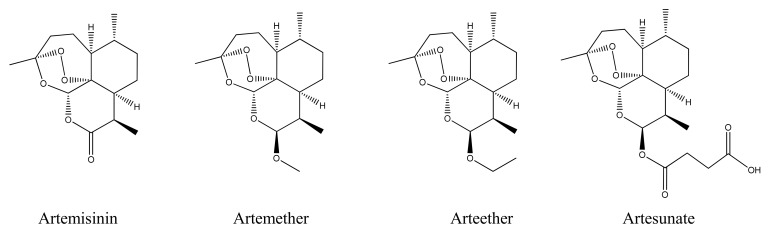
The Chinese medicinal plant Artemisia annua L. (Qinghao) is the only known source of the sesquiterpene artemisinin (Qinghaosu), which is used in the treatment of malaria. Artemisinin is a highly oxygenated sesquiterpene, containing a unique 1,2,4-trioxane ring structure, which is responsible for the antimalarial activity of this natural product. The phytochemistry of A. annua is dominated by both sesquiterpenoids and flavonoids, as is the case for many other plants in the Asteraceae family. However, A. annua is distinguished from the other members of the family both by the very large number of natural products which have been characterised to date (almost six hundred in total, including around fifty amorphane and cadinane sesquiterpenes), and by the highly oxygenated nature of many of the terpenoidal secondary metabolites. In addition, this species also contains an unusually large number of terpene allylic hydroperoxides and endoperoxides. This observation forms the basis of a proposal that the biogenesis of many of the highly oxygenated terpene metabolites from A. annua – including artemisinin itself – may proceed by spontaneous oxidation reactions of terpene precursors, which involve these highly reactive allyllic hydroperoxides as intermediates. Although several studies of the biosynthesis of artemisinin have been reported in the literature from the 1980s and early 1990s, the collective results from these studies were rather confusing because they implied that an unfeasibly large number of different sesquiterpenes could all function as direct precursors to artemisinin (and some of the experiments also appeared to contradict one another). As a result, the complete biosynthetic pathway to artemisinin could not be stated conclusively at the time. Fortunately, studies which have been published in the last decade are now providing a clearer picture of the biosynthetic pathways in A. annua. By synthesising some of the sesquiterpene natural products which have been proposed as biogenetic precursors to artemisinin in such a way that they incorporate a stable isotopic label, and then feeding these precursors to intact A. annua plants, it has now been possible to demonstrate that dihydroartemisinic acid is a late-stage precursor to artemisinin and that the closely related secondary metabolite, artemisinic acid, is not (this approach differs from all the previous studies, which used radio-isotopically labelled precursors that were fed to a plant homogenate or a cell-free preparation). Quite remarkably, feeding experiments with labeled dihydroartemisinic acid and artemisinic acid have resulted in incorporation of label into roughly half of all the amorphane and cadinane sesquiterpenes which were already known from phytochemical studies of A. annua. These findings strongly support the hypothesis that many of the highly oxygenated sesquiterpenoids from this species arise by oxidation reactions involving allylic hydroperoxides, which seem to be such a defining feature of the chemistry of A. annua. In the particular case of artemisinin, these in vivo results are also supported by in vitro studies, demonstrating explicitly that the biosynthesis of artemisinin proceeds via the tertiary allylic hydroperoxide, which is derived from oxidation of dihydroartemisinic acid. There is some evidence that the autoxidation of dihydroartemisinic acid to this tertiary allylic hydroperoxide is a non-enzymatic process within the plant, requiring only the presence of light; and, furthermore, that the series of spontaneous rearrangement reactions which then convert this allylic hydroperoxide to the 1,2,4-trioxane ring of artemisinin are also non-enzymatic in nature.
Overview
AI snapshot
Written from the paper’s full text.
TL;DR
This review compiles the phytochemistry of *Artemisia annua* and argues that many highly oxygenated terpenes, including artemisinin, arise via spontaneous autoxidation of terpene precursors through allylic hydroperoxides. It concludes that dihydroartemisinic acid, not artemisinic acid, is the late-stage precursor to artemisinin, with the final steps likely non-enzymatic.
Key findings
- Nearly 600 secondary metabolites have been characterized from *A. annua*, including around 50 amorphane and cadinane sesquiterpenes; artemisinin content varies from 0.01% to 1%, and can reach 1.4% in some cultivated strains.
- Stable-isotope feeding to intact plants showed dihydroartemisinic acid is a late-stage precursor to artemisinin, whereas artemisinic acid is not; labeled dihydroartemisinic acid yielded sixteen labeled amorphane/cadinane sesquiterpenes, while labeled artemisinic acid yielded seven metabolites.
- Artemisinin biosynthesis is proposed to proceed via the tertiary allylic hydroperoxide derived from dihydroartemisinic acid; in vitro evidence supports a four-step spontaneous autoxidation mechanism, and autoxidation to the hydroperoxide may require only light and be non-enzymatic.
- Many highly oxygenated terpenes from *A. annua* are proposed to arise by oxidation reactions involving allylic hydroperoxides and endoperoxides, which the review treats as a defining feature of this species’ chemistry.
Methods
- Comprehensive review of original phytochemical literature on *A. annua* up to 2009, organizing almost 600 secondary metabolites into eight sections and more than forty tables using a largely biogenetic classification.
- Synthesizes biosynthetic studies including older radiolabeled cell-free/homogenate experiments and more recent stable-isotope feeding to intact plants, alongside in vitro autoxidation experiments.
- Evaluates three phases of artemisinin biosynthesis and production strategies: plant breeding, plant tissue culture, endophytic fungi, and genetic engineering.
Limitations
- The paper states that the proposed biosynthetic route is still not universally accepted and that older literature contains results that may appear to contradict it; many phase 3 intermediates have been proposed, and not all can be correct.
- No enzymes have yet been described for phase 3 reactions, and there is no direct in vivo evidence for steps ii–iv of the proposed autoxidation mechanism; evidence for those steps comes solely from in vitro studies.
- The text notes that understanding of spontaneous autoxidation without a photosensitizer remains incomplete; as a review, conclusions depend on synthesis of prior literature rather than a single new experimental dataset (evident from the text).
Model-written summary. Check it against the paper before relying on it.
Integrity signals
Registry
Cites
Statistics
Figures
Verification
Claims the paper makes
169 Not checked yet · 51 No basis given · 42 Own interpretation · 11 Own result
A result the paper reports from its own data — it cites no other source for it, so there is none to check. The quote shows it is in the paper.
In the paper
“The largest group of such monocyclic monoterpenes in A. annua is the p-menthane series (Table 25), which incorporate a single six-membered ring.”
§ The Biosynthesis of Artemisinin (Qinghaosu) and the Phytochemistry of Artemisia annua L. (Qinghao) > 2. The Phytochemistry of Artemisia annua L. (Qinghao) > 2.5. Monoterpenoids
plain- Asserted: passes — The authors put it forward as true.
- Checkable: passes — It can be checked against evidence.
- Load-bearing: unclear — It is unclear whether the paper’s conclusions depend on it.
- Based: passes — The paper gives a reason why it holds.
In the paper
“Studies with 14C-labeled LPP have shown that in A. annua this precursor is converted to cyclised monoterpenes such as 1,8-cineole (326) and α-pinene (347) with greater efficiency than the alternative precusors, NPP and GPP [109].”
§ The Biosynthesis of Artemisinin (Qinghaosu) and the Phytochemistry of Artemisia annua L. (Qinghao) > 2. The Phytochemistry of Artemisia annua L. (Qinghao) > 2.5. Monoterpenoids
What the sources say
- Not checked yetcites [109] Banthorpe, 1983, Metabolism of linaloyl, neryl and geranyl pyrophosphates in Artemisia annua, Phytochemistry source
plaindirect- Asserted: passes — The authors put it forward as true.
- Checkable: passes — It can be checked against evidence.
- Load-bearing: unclear — It is unclear whether the paper’s conclusions depend on it.
- Based: passes — The paper gives a reason why it holds.
None of the sources cited for this claim have been checked yet.
In the paper
“Myrcene (254) is the most abundant regular acyclic monoterpene from A. annua, and can account for up to 5% of the essential oil [22,33,43].”
§ The Biosynthesis of Artemisinin (Qinghaosu) and the Phytochemistry of Artemisia annua L. (Qinghao) > 2. The Phytochemistry of Artemisia annua L. (Qinghao) > 2.5. Monoterpenoids
What the sources say
- Not checked yetcites [22] Liu, 1988, Preliminary analysis on chemical constituents of essential oil from inflorescence of of Artemisia annua L., Acta Botanica Sinica (Zhiwu Xuebao)
- Not checked yetcites [33] Libbey, 1989, Unusual essential oils grown on Oregon II, Artemisia annua L. J. Essent. Oil Res. source
- Not checked yetcites [43] Goel, 2007, Volatile metabolite composition of the essential oil from aerial parts of ornamanetal and artemisinin-rich cultivars of Artemisia annua, J. Essent. Oil Res. source
plain- Asserted: passes — The authors put it forward as true.
- Checkable: passes — It can be checked against evidence.
- Load-bearing: unclear — It is unclear whether the paper’s conclusions depend on it.
- Based: passes — The paper gives a reason why it holds.
None of the sources cited for this claim have been checked yet.
In the paper
“which is the major constituent of the essential oil in some varieties of A. annua [29,37,42,73], and can account for up to 50% of the total [22,25,33,43,45,53].”
§ The Biosynthesis of Artemisinin (Qinghaosu) and the Phytochemistry of Artemisia annua L. (Qinghao) > 2. The Phytochemistry of Artemisia annua L. (Qinghao) > 2.5. Monoterpenoids
What the sources say
- Not checked yetcites [22] Liu, 1988, Preliminary analysis on chemical constituents of essential oil from inflorescence of of Artemisia annua L., Acta Botanica Sinica (Zhiwu Xuebao)
- Not checked yetcites [25] Chalchat, 1991, A contribution to chemotaxonomy of Artemisia annua L., Asteraceae, Acta Pharm. Jugosl.
- Not checked yetcites [33] Libbey, 1989, Unusual essential oils grown on Oregon II, Artemisia annua L. J. Essent. Oil Res. source
- Not checked yetcites [43] Goel, 2007, Volatile metabolite composition of the essential oil from aerial parts of ornamanetal and artemisinin-rich cultivars of Artemisia annua, J. Essent. Oil Res. source
- Not checked yetcites [45] Jain, 2002, Essential oil composition of Artemisia annua L. "Asha" from the plains of Northern India, J. Essent. Oil Res. source
- Not checked yetcites [53] Charles, 1991, Characterization of the essential oil of Artemisia annua L., J. Essent. Oil Res. source
plain- Asserted: passes — The authors put it forward as true.
- Checkable: passes — It can be checked against evidence.
- Load-bearing: unclear — It is unclear whether the paper’s conclusions depend on it.
- Based: passes — The paper gives a reason why it holds.
The paper states this without a source or data behind it here, so there is nothing to check it against. The quote shows it is in the paper.
In the paper
“The vast majority of monocyclic monoterpenes from A. annua, however, are p-menthanes (Table 25), incorporating a six-membered ring, which is formed directly by cyclization of an LPP/NPP precursor.”
§ The Biosynthesis of Artemisinin (Qinghaosu) and the Phytochemistry of Artemisia annua L. (Qinghao) > 2. The Phytochemistry of Artemisia annua L. (Qinghao) > 2.5. Monoterpenoids
plaindirect- Asserted: passes — The authors put it forward as true.
- Checkable: passes — It can be checked against evidence.
- Load-bearing: unclear — It is unclear whether the paper’s conclusions depend on it.
- Based: passes — The paper gives a reason why it holds.
A result the paper reports from its own data — it cites no other source for it, so there is none to check. The quote shows it is in the paper.
In the paper
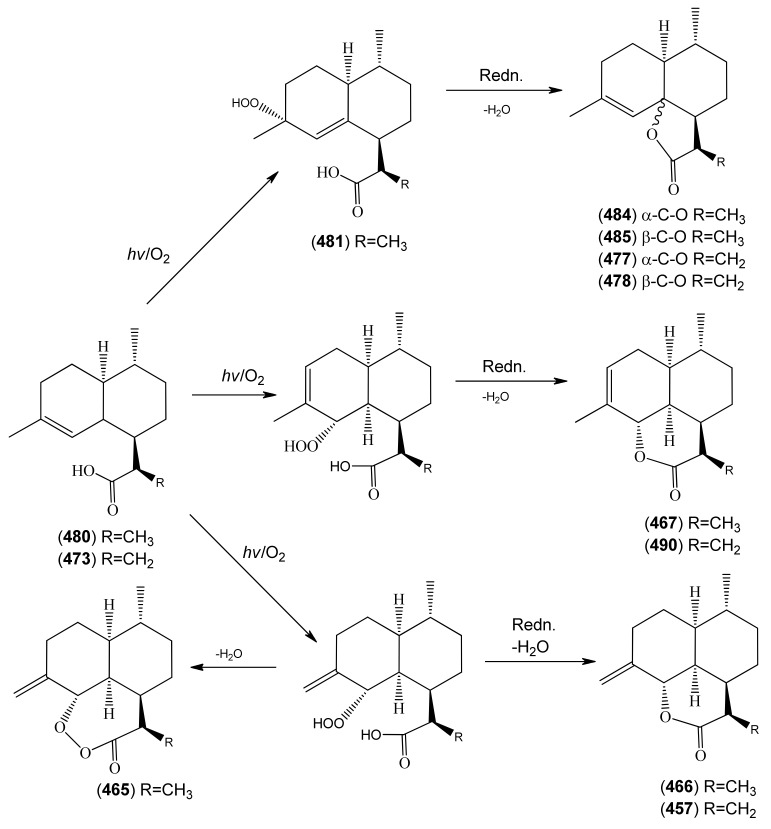
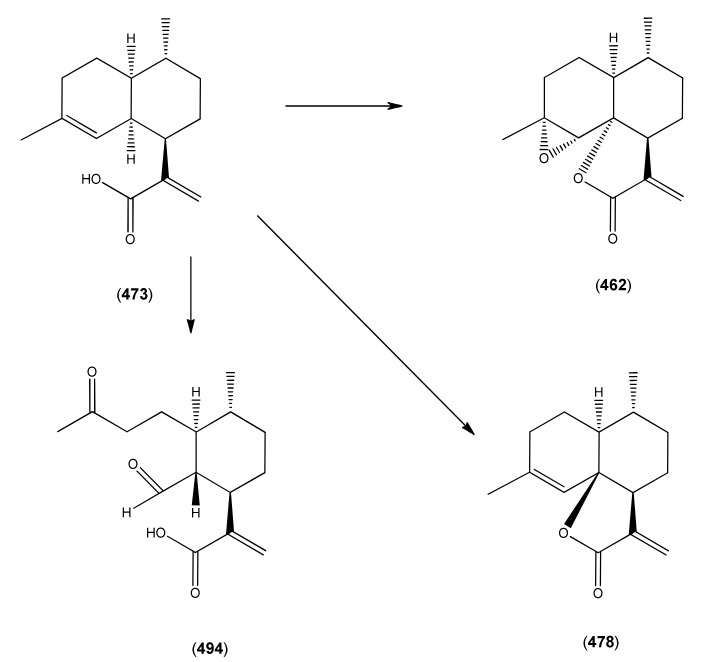
“It is intriguing to note that there are exact structural homologies between six of the seven highly oxygenated 11,13-dehydro sesquiterpenes which have been isolated as metabolites of artemisinic acid (473) and a subset of the sixteen 11,13-dihydro metabolites which were obtained in the preceding study with dihydroartemisinic acid (480) (see Table 37).”
§ The Biosynthesis of Artemisinin (Qinghaosu) and the Phytochemistry of Artemisia annua L. (Qinghao) > 2. The Phytochemistry of Artemisia annua L. (Qinghao) > 2.6. Sesquiterpenoids
plaincorrelational- Asserted: passes — The authors put it forward as true.
- Checkable: passes — It can be checked against evidence.
- Load-bearing: passes — The paper’s conclusions depend on it.
- Based: passes — The paper gives a reason why it holds.
The paper states this without a source or data behind it here, so there is nothing to check it against. The quote shows it is in the paper.
In the paper
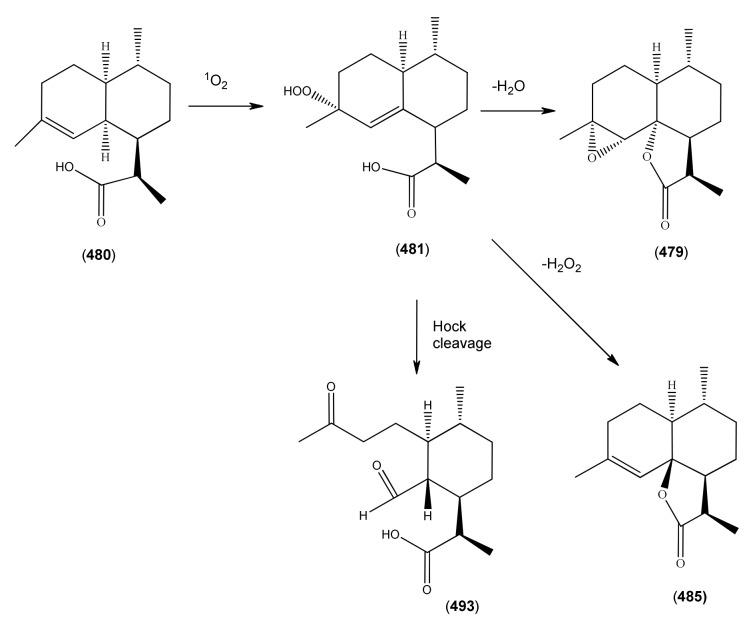
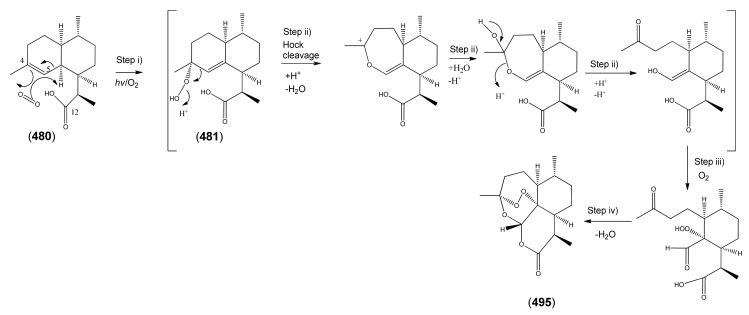
“There is – as yet – no direct evidence from in vivo studies to suggest how further transformation of 481 to the 1,2,4-trioxane ring in artemisinin might occur in A. annua.”
§ The Biosynthesis of Artemisinin (Qinghaosu) and the Phytochemistry of Artemisia annua L. (Qinghao) > 3. The Biosynthesis of Artemisinin (Qinghaosu) > 3.3. Phase 3 (Dihydroartemisinic acid to Artemisinin)
hedged- Asserted: passes — The authors put it forward as true.
- Checkable: passes — It can be checked against evidence.
- Load-bearing: unclear — It is unclear whether the paper’s conclusions depend on it.
- Based: passes — The paper gives a reason why it holds.
None of the sources cited for this claim have been checked yet.
In the paper
“Finally, it is worth reiterating that both in vivo and in vitro studies have shown that the tertiary allylic hydroperoxide 481 can be transformed into a wide variety of other compounds, in addition to artemisinin (495).”
§ The Biosynthesis of Artemisinin (Qinghaosu) and the Phytochemistry of Artemisia annua L. (Qinghao) > 3. The Biosynthesis of Artemisinin (Qinghaosu) > 3.3. Phase 3 (Dihydroartemisinic acid to Artemisinin)
plaindirect- Asserted: passes — The authors put it forward as true.
- Checkable: passes — It can be checked against evidence.
- Load-bearing: unclear — It is unclear whether the paper’s conclusions depend on it.
- Based: passes — The paper gives a reason why it holds.
None of the sources cited for this claim have been checked yet.
In the paper
“These in vitro experiments have shown that 481 can indeed undergo sponataneous conversion to a transient enol as proposed in step ii) of Scheme 11 [204,238,243,302,303]”
§ The Biosynthesis of Artemisinin (Qinghaosu) and the Phytochemistry of Artemisia annua L. (Qinghao) > 3. The Biosynthesis of Artemisinin (Qinghaosu) > 3.3. Phase 3 (Dihydroartemisinic acid to Artemisinin)
What the sources say
- Not checked yetcites [204] Haynes, 1997, From Qinghao, marvelous herb of antiquity, to the antimalarial trioxane qinghaosu - and some remarkable new chemistry, Acc. Chem. Res. source
- Not checked yetcites [238] Acton, 1992, On the conversion of dihydroartemisininic acid into artemisinin, J. Org. Chem. source
- Not checked yetcites [243] Haynes, R.K., and Vonwiller, S.C. (1990). Catalyzed oxygenation of allylic hydroperoxides derived from qinghao (artemisinic) acid. Conversion of qinghao acid into dehydroqinghaosu (artemisitene) and qinghaosu (artemisinin). J. Chem. Soc., Chem. Commun., 451–453. source
- Not checked yetcites [302] Vonwiller, 1997, The formation of a peracetal and trioxane from an enol ether with Copper(II) triflate and oxygen: unexpected oxygenation of aldol intermediates, Tetrahedron Lett. source
- Not checked yetcites [303] Adam, W., Kliem, U., and Lucchini, V. (1988). Preparative UV-VIS laser photochemistry: Photocycloadditions of methylenelactones with benzophenone and p-benzoquinone: Oxygen trapping of Paterno-Buchi triplet 1,4-diradicals as model reactions for Qinghaosu-type 1,2,4-trioxanes. Liebigs Ann. Chem., 869–875. source
boosteddirect- Asserted: passes — The authors put it forward as true.
- Checkable: passes — It can be checked against evidence.
- Load-bearing: passes — The paper’s conclusions depend on it.
- Based: passes — The paper gives a reason why it holds.
None of the sources cited for this claim have been checked yet.
In the paper
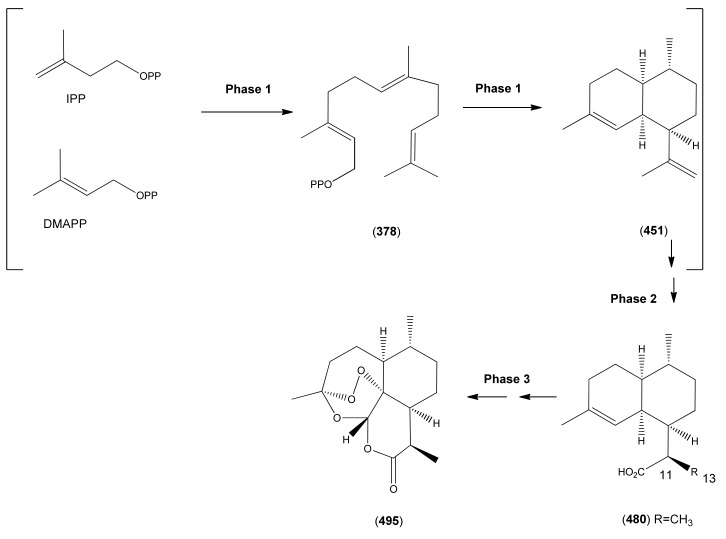
“The evidence for steps ii)-iv) which are proposed in Scheme 12 comes solely from in vitro studies, conducted with the tertiary allylic hydroperoxide 481 [171,236,237,239,254], which can be obtained in good yield from photosensitized oxygenation of 480 [193,218].”
§ The Biosynthesis of Artemisinin (Qinghaosu) and the Phytochemistry of Artemisia annua L. (Qinghao) > 3. The Biosynthesis of Artemisinin (Qinghaosu) > 3.3. Phase 3 (Dihydroartemisinic acid to Artemisinin)
What the sources say
- Not checked yetcites [171] Zhou, 1986, Total synthesis of arteannuin (Quinghaosu) and related compounds, Pure Appl. Chem. source
- Not checked yetcites [236] Ye, B., and Wu, Y.-L. (1990). An efficient synthesis of qinghaosu and deoxoqinghaosu from arteannuin acid. J. Chem. Soc., Chem. Commun., 726–727. source
- Not checked yetcites [237] Roth, 1991, A facile semisynthesis of the antimalarial drug qinghaosu, J. Chem. Educ. source
- Not checked yetcites [239] Nowak, 1998, Synthesis of (+)-artemisinin and (+)-deoxyartemisinin from arteannuin B and arteannuic aid, Tetrahedron source
- Not checked yetcites [254] Jung, 1986, Practical conversion of artemisinic acid into desoxyartemisinin, J. Org. Chem. source
- Not checked yetcites [193] Sy, 2002, The mechanism of the spontaneous autoxidation of dihydroartemisinic acid, Tetrahedron source
- Not checked yetcites [218] Sy, 2002, The role of the 12-carboxylic acid group in the spontaneous autoxidation of dihydroartemisinc acid, Tetrahedron source
plain- Asserted: passes — The authors put it forward as true.
- Checkable: passes — It can be checked against evidence.
- Load-bearing: passes — The paper’s conclusions depend on it.
- Based: passes — The paper gives a reason why it holds.
- Probably not a substantial claim. 104
- It may state two separate claims as one. 55
The paper states this without a source or data behind it here, so there is nothing to check it against. The quote shows it is in the paper.
In the paper
“The simple aromatic compounds described in Table 12, Table 13 and Table 14 form a relatively small group of natural products from A. annua.”
§ The Biosynthesis of Artemisinin (Qinghaosu) and the Phytochemistry of Artemisia annua L. (Qinghao) > 2. The Phytochemistry of Artemisia annua L. (Qinghao) > 2.2. Aromatic Alcohols, Ketones and Acids
plain- Asserted: passes — The authors put it forward as true.
- Checkable: passes — It can be checked against evidence.
- Load-bearing: fails — The paper’s conclusions may not depend on it.
- Based: passes — The paper gives a reason why it holds.
Probably not a substantial claim. The paper’s conclusions may not depend on it.
None of the sources cited for this claim have been checked yet.
In the paper
“Myrcene (254) is the most abundant regular acyclic monoterpene from A. annua, and can account for up to 5% of the essential oil [22,33,43].”
§ The Biosynthesis of Artemisinin (Qinghaosu) and the Phytochemistry of Artemisia annua L. (Qinghao) > 2. The Phytochemistry of Artemisia annua L. (Qinghao) > 2.5. Monoterpenoids
What the sources say
- Not checked yetcites [22] Liu, 1988, Preliminary analysis on chemical constituents of essential oil from inflorescence of of Artemisia annua L., Acta Botanica Sinica (Zhiwu Xuebao)
- Not checked yetcites [33] Libbey, 1989, Unusual essential oils grown on Oregon II, Artemisia annua L. J. Essent. Oil Res. source
- Not checked yetcites [43] Goel, 2007, Volatile metabolite composition of the essential oil from aerial parts of ornamanetal and artemisinin-rich cultivars of Artemisia annua, J. Essent. Oil Res. source
plain- Asserted: passes — The authors put it forward as true.
- Checkable: passes — It can be checked against evidence.
- Load-bearing: fails — The paper’s conclusions may not depend on it.
- Based: passes — The paper gives a reason why it holds.
Probably not a substantial claim. The paper’s conclusions may not depend on it.
The paper states this without a source or data behind it here, so there is nothing to check it against. The quote shows it is in the paper.
In the paper
“Most of the simple phenylpropanoids reported in Table 15 were described from GC-MS studies.”
§ The Biosynthesis of Artemisinin (Qinghaosu) and the Phytochemistry of Artemisia annua L. (Qinghao) > 2. The Phytochemistry of Artemisia annua L. (Qinghao) > 2.3. Phenylpropanoids
plain- Asserted: passes — The authors put it forward as true.
- Checkable: passes — It can be checked against evidence.
- Load-bearing: fails — The paper’s conclusions may not depend on it.
- Based: passes — The paper gives a reason why it holds.
Probably not a substantial claim. The paper’s conclusions may not depend on it.
In the paper
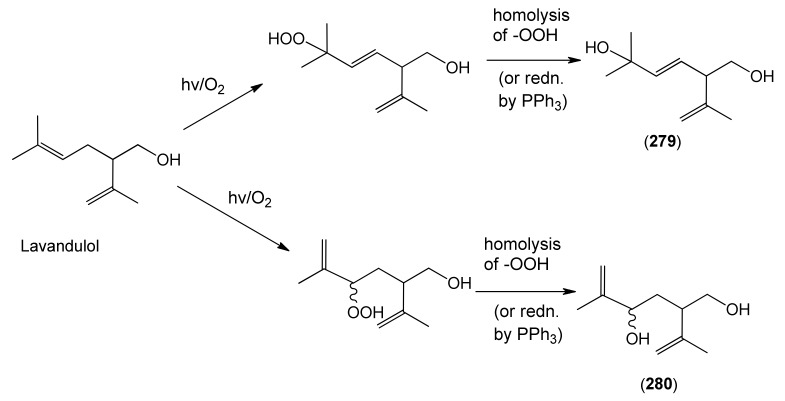
“This suggestion was supported by a biomimetic synthesis, in which photooxygenation of racemic lavandulol yielded both of the hydroperoxide intermediates expected from the reaction of singlet oxygen with the tri-substituted double bond in this precursor.”
§ The Biosynthesis of Artemisinin (Qinghaosu) and the Phytochemistry of Artemisia annua L. (Qinghao) > 2. The Phytochemistry of Artemisia annua L. (Qinghao) > 2.5. Monoterpenoids
What the sources say
- Not checked yetcites [129] Sy, 2001, Deoxyarteannuin B, dihydro-deoxyarteannuin B and trans-5-hydroxy-2-isopropenyl-5-methylhex-3-en-1-ol from Artemisia annua, Phytochemistry source
plaindirect- Asserted: passes — The authors put it forward as true.
- Checkable: passes — It can be checked against evidence.
- Load-bearing: unclear — It is unclear whether the paper’s conclusions depend on it.
- Based: passes — The paper gives a reason why it holds.
It may state two separate claims as one.
None of the sources cited for this claim have been checked yet.
In the paper
“which is the major constituent of the essential oil in some varieties of A. annua [29,37,42,73], and can account for up to 50% of the total [22,25,33,43,45,53].”
§ The Biosynthesis of Artemisinin (Qinghaosu) and the Phytochemistry of Artemisia annua L. (Qinghao) > 2. The Phytochemistry of Artemisia annua L. (Qinghao) > 2.5. Monoterpenoids
What the sources say
- Not checked yetcites [29] Genov, 1983, Gas-Chromatographic study of the essential oil of Artemisia annua L., Naunchi Trudove - Vissh Institut po Khranitelna i Vkusova Promishlenost, Plodiv
- Not checked yetcites [37] Holm, 1997, Variation in the essential oil composition of Artemisia annua L. of different origin cutivated in Finland, Flavour Frag. J. source
- Not checked yetcites [42] Lari, 2002, The composition of essential oil from Artemisia annua L. growing wild in Iran, Falsnamah-i-Giyahan-i Daruyi
- Not checked yetcites [73] Georgiev, 1978, On the distillation of annual wormwood (Artemisia annua Linnaeus), Rivista Italiana Essenze, Profumi, Piante Officinali, Arromatizanti, Syndets, Saponi, Cosmaetici, Aerosols
plain- Asserted: passes — The authors put it forward as true.
- Checkable: passes — It can be checked against evidence.
- Load-bearing: fails — The paper’s conclusions may not depend on it.
- Based: passes — The paper gives a reason why it holds.
Probably not a substantial claim. The paper’s conclusions may not depend on it.
A result the paper reports from its own data — it cites no other source for it, so there is none to check. The quote shows it is in the paper.
In the paper
“It is interesting to note that nine of the structures reported in Table 36 and Table 38 occur in both their 11,13-dihydro and 11,13-dehydro forms. These nine pairs are listed in Table 37.”
§ The Biosynthesis of Artemisinin (Qinghaosu) and the Phytochemistry of Artemisia annua L. (Qinghao) > 2. The Phytochemistry of Artemisia annua L. (Qinghao) > 2.6. Sesquiterpenoids
plain- Asserted: passes — The authors put it forward as true.
- Checkable: passes — It can be checked against evidence.
- Load-bearing: fails — The paper’s conclusions may not depend on it.
- Based: passes — The paper gives a reason why it holds.
Probably not a substantial claim. The paper’s conclusions may not depend on it. It may state two separate claims as one.
In the paper
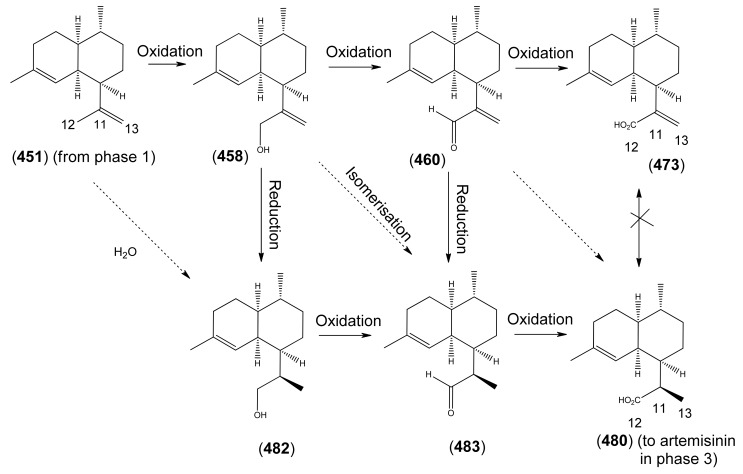
“Although the most recent experiments with artemisinic acid (473) failed to observe any detectable incorporation into artemisinin, a very significant conversion was observed into arteannuin B (462), as well as six other highly oxygenated sesquiterpene natural products, all of which retained the 11,13- double bond, as shown in Scheme 7 in Section 2.6.3 [155]”
§ The Biosynthesis of Artemisinin (Qinghaosu) and the Phytochemistry of Artemisia annua L. (Qinghao) > 3. The Biosynthesis of Artemisinin (Qinghaosu) > 3.3. Phase 3 (Dihydroartemisinic acid to Artemisinin)
What the sources say
- Not checked yetcites [155] Brown, 2007, In vivo transformations of artemisinic acid in Artemisia annua plants, Tetrahedron source
plaindirect- Asserted: passes — The authors put it forward as true.
- Checkable: passes — It can be checked against evidence.
- Load-bearing: passes — The paper’s conclusions depend on it.
- Based: passes — The paper gives a reason why it holds.
It may state two separate claims as one.
In the paper
“By contrast, the stable isotope-labeled metabolites which have been detected by NMR [155] represented at least 1% (very often between 5-30%) of the label that had been supplied and therefore provide a picture only of the most significant and direct transformations which have been undergone by the precursor.”
§ The Biosynthesis of Artemisinin (Qinghaosu) and the Phytochemistry of Artemisia annua L. (Qinghao) > 3. The Biosynthesis of Artemisinin (Qinghaosu) > 3.3. Phase 3 (Dihydroartemisinic acid to Artemisinin)
What the sources say
- Not checked yetcites [155] Brown, 2007, In vivo transformations of artemisinic acid in Artemisia annua plants, Tetrahedron source
plain- Asserted: passes — The authors put it forward as true.
- Checkable: passes — It can be checked against evidence.
- Load-bearing: passes — The paper’s conclusions depend on it.
- Based: passes — The paper gives a reason why it holds.
It may state two separate claims as one.
None of the sources cited for this claim have been checked yet.
In the paper
“Although artemisinin can be obtained in reasonable quantities from differentiated shoot cultures [343,344,345], it is produced in only small or undetectable amounts [346,347,348] by callus or suspension cell cultures of A. annua.”
§ The Biosynthesis of Artemisinin (Qinghaosu) and the Phytochemistry of Artemisia annua L. (Qinghao) > 4. Strategies for the Production of Artemisinin from A. annua and Derived Systems > 4.2. Plant Tissue Culture
What the sources say
- Not checked yetcites [343] Chen, 1993, Enhanced synthesis of the natural phytotoxin artemisinin in tissue culture, PGRSA Q.
- Not checked yetcites [344] Zhang, 2004, Related factors of artemisinin biosynthesis in clone strain of Artemisia annua L., Yingyong Yu Huanjung Shengwu Xuebao
- Not checked yetcites [345] Nair, 1986, Production of artemisinin in tissue cultures of Artemisia annua, J. Nat. Prod. source
- Not checked yetcites [346] Elhag, 1992, Selection and micropropagation of high artemisinin producing clones of Artemisia annua L., Phytother. Res. source
- Not checked yetcites [347] Li, 1999, Artificial regulation of artemisinin biosynthesis metabolite in cultured cells of Artemisia annua, Zhongguo Shengwu Huaxue Yu Fenzi Shengwu Xuebao
- Not checked yetcites [348] Xie, 2001, Isolation and production of artemisinin and stigmasterol in hairy root cultures of Artemisia annua, Plant Cell Tissue Org. Cult. source
plain- Asserted: passes — The authors put it forward as true.
- Checkable: passes — It can be checked against evidence.
- Load-bearing: passes — The paper’s conclusions depend on it.
- Based: passes — The paper gives a reason why it holds.
It may state two separate claims as one.
In the paper
“As noted above, in the most recent study of the metabolism of artemisinic acid, arteannuin B (462) was obtained as the major metabolite of artemisinic acid (473), without any evidence for the accompanying formation of artemisinin (495) [155].”
§ The Biosynthesis of Artemisinin (Qinghaosu) and the Phytochemistry of Artemisia annua L. (Qinghao) > 3. The Biosynthesis of Artemisinin (Qinghaosu) > 3.3. Phase 3 (Dihydroartemisinic acid to Artemisinin)
What the sources say
- Not checked yetcites [155] Brown, 2007, In vivo transformations of artemisinic acid in Artemisia annua plants, Tetrahedron source
plaindirect- Asserted: passes — The authors put it forward as true.
- Checkable: passes — It can be checked against evidence.
- Load-bearing: passes — The paper’s conclusions depend on it.
- Based: passes — The paper gives a reason why it holds.
It may state two separate claims as one.
None of the sources cited for this claim have been checked yet.
In the paper
“Several authors have reported that the artemisinin content is highest just before flowering [326,327,328]”
§ The Biosynthesis of Artemisinin (Qinghaosu) and the Phytochemistry of Artemisia annua L. (Qinghao) > 4. Strategies for the Production of Artemisinin from A. annua and Derived Systems > 4.1. Plant Breeding Programmes
What the sources say
- Not checked yetcites [326] Singh, 1988, Evaluation of Artemisia annua strains for higher artemisinin production, Planta Med. source
- Not checked yetcites [327] Wang, 2004, Studies on the effects of fpf1 gene on Artemisia annua flowering time and on the linkage between flowering and artemisinin biosynthesis, Planta Med. source
- Not checked yetcites [328] Ferreira, 1995, Developmental studies of Artemisia annua: Flowering and artemisinin production under greenhouse and field conditions, Planta Med. source
plaincorrelational- Asserted: passes — The authors put it forward as true.
- Checkable: passes — It can be checked against evidence.
- Load-bearing: fails — The paper’s conclusions may not depend on it.
- Based: passes — The paper gives a reason why it holds.
Probably not a substantial claim. The paper’s conclusions may not depend on it.
None of the sources cited for this claim have been checked yet.
In the paper
“However, once again, more recent experiments using dihydro-epi-deoxyarteannuin B (485) which had been labelled with a stable isotope [169] and fed to an intact plant system have shown no detectable incorporation into artemisinin (495); although three novel hydroxylated metabolites were obtained in significant quantities from this feeding experiment [190].”
§ The Biosynthesis of Artemisinin (Qinghaosu) and the Phytochemistry of Artemisia annua L. (Qinghao) > 3. The Biosynthesis of Artemisinin (Qinghaosu) > 3.3. Phase 3 (Dihydroartemisinic acid to Artemisinin)
What the sources say
- Not checked yetcites [169] Sy, 2001, Synthesis of dihydroartemisinic acid and dihydro-epi-deoxyarteannuin B incorporating a stable isotope label at the 15-position for studies into the biosynthesis of artemisinin, Tetrahedron source
- Not checked yetcites [190] Brown, 2007, In vivo transformations of dihydro-epi-deoxyarteannuin B in Artemisia annua plants, Tetrahedron source
plain- Asserted: passes — The authors put it forward as true.
- Checkable: passes — It can be checked against evidence.
- Load-bearing: passes — The paper’s conclusions depend on it.
- Based: passes — The paper gives a reason why it holds.
It may state two separate claims as one.
In the paper
“The most successful strategy to date has been plant breeding, resulting in the cultivar “Artemis”, which was registered in Switzerland in 1999, and contains up to 1.4% artemisinin (by comparison, the extremely variable yields obtained from wild varieties of A. annua typically range between 0.01-0.5% artemisinin [321]).”
§ The Biosynthesis of Artemisinin (Qinghaosu) and the Phytochemistry of Artemisia annua L. (Qinghao) > 4. Strategies for the Production of Artemisinin from A. annua and Derived Systems
What the sources say
- Not checked yetcites [321] Pereira, 1999, New hybrid lines of the antimalarial species Artemisia annua L., Acta Hortic.
plaindirect- Asserted: passes — The authors put it forward as true.
- Checkable: passes — It can be checked against evidence.
- Load-bearing: unclear — It is unclear whether the paper’s conclusions depend on it.
- Based: passes — The paper gives a reason why it holds.
It may state two separate claims as one.
In the paper
“One particularly interesting study has concluded that correlated variations in all three natural products prove the existence of chemotypes of A. annua. Thus, plants with a high artemisinin (495) level were found also to have a high dihydroartemisinic acid (480) level, but a relatively low concentration of artemisinic acid (473); while chemotypes with low levels of artemisinin (495) and dihydroart”
§ The Biosynthesis of Artemisinin (Qinghaosu) and the Phytochemistry of Artemisia annua L. (Qinghao) > 4. Strategies for the Production of Artemisinin from A. annua and Derived Systems > 4.1. Plant Breeding Programmes
What the sources say
- Not checked yetcites [338] Yang, 2008, Quantitative transcript profiling reveals down-regulation of a sterol pathway relevant gene and overexpression of artemisinin biogenetic genes in transgenic Artemisia annua plants, Planta Med. source
boostedcorrelational- Asserted: passes — The authors put it forward as true.
- Checkable: passes — It can be checked against evidence.
- Load-bearing: passes — The paper’s conclusions depend on it.
- Based: passes — The paper gives a reason why it holds.
Probably not a substantial claim. It may state two separate claims as one.
In the paper
“Several endophytes have now been described from A. annua [357].”
§ The Biosynthesis of Artemisinin (Qinghaosu) and the Phytochemistry of Artemisia annua L. (Qinghao) > 4. Strategies for the Production of Artemisinin from A. annua and Derived Systems > 4.3. Endophytic fungi
What the sources say
- Not checked yetcites [357] Simanjuntak, 2004, Studies on endophytic microbes of Artemisia spp (3). Isolation and identification of artemisinin from product of endophyte microbe cultivation from Artemisia annua, Majalah Farmasi Indonesia
plain- Asserted: passes — The authors put it forward as true.
- Checkable: passes — It can be checked against evidence.
- Load-bearing: fails — The paper’s conclusions may not depend on it.
- Based: passes — The paper gives a reason why it holds.
Probably not a substantial claim. The paper’s conclusions may not depend on it.
None of the sources cited for this claim have been checked yet.
In the paper
“It should be noted that our understanding of how the spontaneous autoxidation of natural products such as 480 occurs in the absence of a photosensitizer [388] (or, indeed, any other additional chemical reagents [218]), leading to highly oxidized products such as 495, is still incomplete.”
§ The Biosynthesis of Artemisinin (Qinghaosu) and the Phytochemistry of Artemisia annua L. (Qinghao) > 4. Strategies for the Production of Artemisinin from A. annua and Derived Systems > 4.4. Genetic Engineering
What the sources say
- Not checked yetcites [388]
- Not checked yetcites [218] Sy, 2002, The role of the 12-carboxylic acid group in the spontaneous autoxidation of dihydroartemisinc acid, Tetrahedron source
plaindirect- Asserted: passes — The authors put it forward as true.
- Checkable: passes — It can be checked against evidence.
- Load-bearing: fails — The paper’s conclusions may not depend on it.
- Based: passes — The paper gives a reason why it holds.
Probably not a substantial claim. The paper’s conclusions may not depend on it.
None of the sources cited for this claim have been checked yet.
In the paper
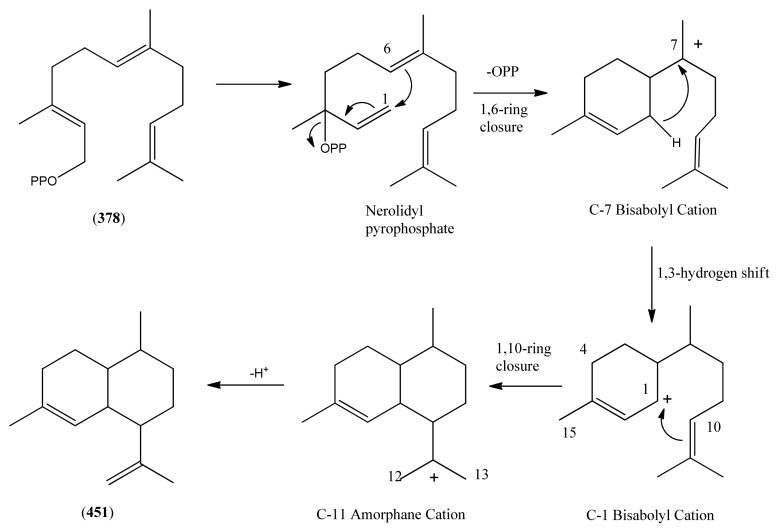
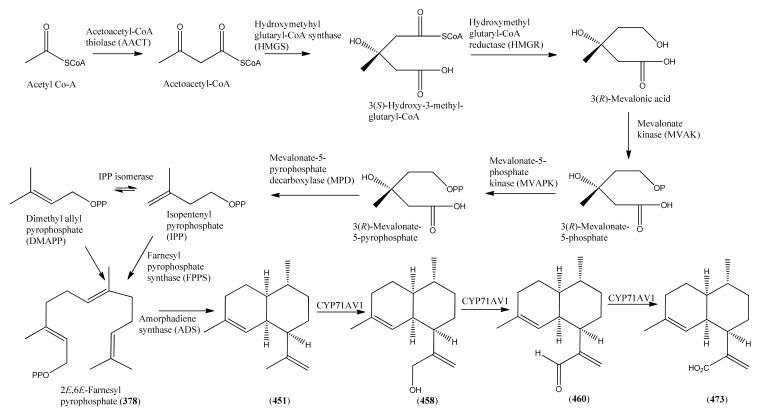
“The approach outlined in Scheme 13 has succeded in producing high levels of amorpha-4,11-diene (451) from E. coli [384] and artemisinic acid (473) from S. cerevisiae in quantities which exceed those from A. annua itself (100 mg–1·g·L-1) [385,386].”
§ The Biosynthesis of Artemisinin (Qinghaosu) and the Phytochemistry of Artemisia annua L. (Qinghao) > 4. Strategies for the Production of Artemisinin from A. annua and Derived Systems > 4.4. Genetic Engineering
What the sources say
- Not checked yetcites [384] Ro, 2006, Production of the antimalarial drug precursor artemisinic acid in engineered yeast, Nature source
- Not checked yetcites [385] Ro, D.-K., Ouellet, M., Paradise, E.M., Burd, H., Eng, D., Paddon, C.J., Newman, J.D., and Keasling, J.D. (2008). Induction of multiple pleiotropic drug resistance genes in yeast engineered to produce an increased level of anti-malarial drug precursor, artemisinic acid. BMC Biotechnol. source
- Not checked yetcites [386] Dietrich, 2009, A novel semi-biosynthetic route for artemisinin production using engineered substrate-promiscuous P450BM3, ACS Chem. Biol. source
plaindirect- Asserted: passes — The authors put it forward as true.
- Checkable: passes — It can be checked against evidence.
- Load-bearing: passes — The paper’s conclusions depend on it.
- Based: passes — The paper gives a reason why it holds.
It may state two separate claims as one.
The paper states this without a source or data behind it here, so there is nothing to check it against. The quote shows it is in the paper.
In the paper
“Artemisinin is a highly oxygenated sesquiterpene, containing a unique 1,2,4-trioxane ring structure, which is responsible for the antimalarial activity of this natural product.”
§ The Biosynthesis of Artemisinin (Qinghaosu) and the Phytochemistry of Artemisia annua L. (Qinghao) > Abstract
plaindirect- Asserted: passes — The authors put it forward as true.
- Checkable: passes — It can be checked against evidence.
- Load-bearing: passes — The paper’s conclusions depend on it.
- Based: fails — The paper may give no reason why it holds.
Probably not a substantial claim. The paper may give no reason why it holds.
In the paper
“Compounds 166-182 (Table 16), which are esters formed by various combinations of ferulic and cinnamic acid with the four hydroxyl groups of quinic acid, were isolated from a single HPLC-MS study [71].”
§ The Biosynthesis of Artemisinin (Qinghaosu) and the Phytochemistry of Artemisia annua L. (Qinghao) > 2. The Phytochemistry of Artemisia annua L. (Qinghao) > 2.3. Phenylpropanoids
What the sources say
- Not checked yetcites [71] Han, 2008, Characterization of phenolic compounds in the Chinese herbal drug Artemisia annua by liquid chromatography coupled to electrospray ionization mass spectrometry, J. Pharm. Biomed. Anal. source
plain- Asserted: passes — The authors put it forward as true.
- Checkable: passes — It can be checked against evidence.
- Load-bearing: fails — The paper’s conclusions may not depend on it.
- Based: passes — The paper gives a reason why it holds.
Probably not a substantial claim. The paper’s conclusions may not depend on it. It may state two separate claims as one.
The paper states this without a source or data behind it here, so there is nothing to check it against. The quote shows it is in the paper.
In the paper
“The regular acyclic monoterpenes which are described in Section 2.5.1 consist of an eight-carbon chain, which is often functionalized at the 1-position, with methyl substituents at the 3- and 7-positions (Table 23).”
§ The Biosynthesis of Artemisinin (Qinghaosu) and the Phytochemistry of Artemisia annua L. (Qinghao) > 2. The Phytochemistry of Artemisia annua L. (Qinghao) > 2.5. Monoterpenoids
plain- Asserted: passes — The authors put it forward as true.
- Checkable: passes — It can be checked against evidence.
- Load-bearing: fails — The paper’s conclusions may not depend on it.
- Based: passes — The paper gives a reason why it holds.
Probably not a substantial claim. The paper’s conclusions may not depend on it.
In the paper
“A detailed study of the essential oils from Chinese and Vietnamese varieties of A. annua demonstrated that the Chinese variety contained predominantly artemisia ketone, while the Vietnamese oil was dominated by camphor and germacrene D [21]”
§ The Biosynthesis of Artemisinin (Qinghaosu) and the Phytochemistry of Artemisia annua L. (Qinghao) > 2. The Phytochemistry of Artemisia annua L. (Qinghao)
What the sources say
- Not checked yetcites [21] Woerdenbag, 1993, Volatile constituents of Artemisia annua L. (Asteraceae), Flavour Frag. J. source
boosted- Asserted: passes — The authors put it forward as true.
- Checkable: passes — It can be checked against evidence.
- Load-bearing: unclear — It is unclear whether the paper’s conclusions depend on it.
- Based: passes — The paper gives a reason why it holds.
It may state two separate claims as one.
A conclusion the paper draws from its own results — it cites no other source for it, so there is none to check. The quote shows it is in the paper.
In the paper
“The structures of both of the 2,2-dihydroxychromene natural products 190 and 191, which appear in Table 17, are questionable on thermodynamic grounds - one might expect both to lose a molecule of water thereby forming a more highly conjugated coumarin.”
§ The Biosynthesis of Artemisinin (Qinghaosu) and the Phytochemistry of Artemisia annua L. (Qinghao) > 2. The Phytochemistry of Artemisia annua L. (Qinghao) > 2.3. Phenylpropanoids
hedgedconditional- Asserted: passes — The authors put it forward as true.
- Checkable: passes — It can be checked against evidence.
- Load-bearing: fails — The paper’s conclusions may not depend on it.
- Based: passes — The paper gives a reason why it holds.
Probably not a substantial claim. The paper’s conclusions may not depend on it.
The paper states this without a source or data behind it here, so there is nothing to check it against. The quote shows it is in the paper.
In the paper
“The flavonoids are produced from the cyclization of a C15 chalcone precursor, which is in turn derived from malonyl coenzyme A and p-coumaryl coenzyme A (see Section 2.3).”
§ The Biosynthesis of Artemisinin (Qinghaosu) and the Phytochemistry of Artemisia annua L. (Qinghao) > 2. The Phytochemistry of Artemisia annua L. (Qinghao) > 2.4. Flavonoids
plaindirect- Asserted: passes — The authors put it forward as true.
- Checkable: passes — It can be checked against evidence.
- Load-bearing: fails — The paper’s conclusions may not depend on it.
- Based: passes — The paper gives a reason why it holds.
Probably not a substantial claim. The paper’s conclusions may not depend on it. It may state two separate claims as one.
The paper states this without a source or data behind it here, so there is nothing to check it against. The quote shows it is in the paper.
In the paper
“However, A. annua is distinguished from the other members of the family both by the very large number of natural products which have been characterised to date (almost six hundred in total, including around fifty amorphane and cadinane sesquiterpenes), and by the highly oxygenated nature of many of the terpenoidal secondary metabolites.”
§ The Biosynthesis of Artemisinin (Qinghaosu) and the Phytochemistry of Artemisia annua L. (Qinghao) > Abstract
plain- Asserted: passes — The authors put it forward as true.
- Checkable: passes — It can be checked against evidence.
- Load-bearing: fails — The paper’s conclusions may not depend on it.
- Based: passes — The paper gives a reason why it holds.
Probably not a substantial claim. The paper’s conclusions may not depend on it.
In the paper
“Others have reported a similar variation in essential oil content between varieties of A. annua [53,54] and have concurred that differences in the essential oil composition should be ascribed to the existence of chemotypes (or chemical races) in this species [43]”
§ The Biosynthesis of Artemisinin (Qinghaosu) and the Phytochemistry of Artemisia annua L. (Qinghao) > 2. The Phytochemistry of Artemisia annua L. (Qinghao)
What the sources say
- Not checked yetcites [43] Goel, 2007, Volatile metabolite composition of the essential oil from aerial parts of ornamanetal and artemisinin-rich cultivars of Artemisia annua, J. Essent. Oil Res. source
plaindirect- Asserted: passes — The authors put it forward as true.
- Checkable: passes — It can be checked against evidence.
- Load-bearing: fails — The paper’s conclusions may not depend on it.
- Based: passes — The paper gives a reason why it holds.
Probably not a substantial claim. The paper’s conclusions may not depend on it.
The paper states this without a source or data behind it here, so there is nothing to check it against. The quote shows it is in the paper.
In the paper
“Interestingly, this difference was also reflected in the artemisinin content of Chinese and Vietnamese plants at 0.17% and 1.0% dry weight, respectively.”
§ The Biosynthesis of Artemisinin (Qinghaosu) and the Phytochemistry of Artemisia annua L. (Qinghao) > 2. The Phytochemistry of Artemisia annua L. (Qinghao)
plain- Asserted: passes — The authors put it forward as true.
- Checkable: passes — It can be checked against evidence.
- Load-bearing: unclear — It is unclear whether the paper’s conclusions depend on it.
- Based: passes — The paper gives a reason why it holds.
It may state two separate claims as one.
The paper states this without a source or data behind it here, so there is nothing to check it against. The quote shows it is in the paper.
In the paper
“Monoterpenoids generally contain ten carbons (C10) and are the principal components of the essential oil of A. annua obtained by steam distillation (or other techniques that are selective for more volatile natural products).”
§ The Biosynthesis of Artemisinin (Qinghaosu) and the Phytochemistry of Artemisia annua L. (Qinghao) > 2. The Phytochemistry of Artemisia annua L. (Qinghao) > 2.5. Monoterpenoids
plain- Asserted: passes — The authors put it forward as true.
- Checkable: passes — It can be checked against evidence.
- Load-bearing: fails — The paper’s conclusions may not depend on it.
- Based: passes — The paper gives a reason why it holds.
Probably not a substantial claim. The paper’s conclusions may not depend on it. It may state two separate claims as one.
The paper states this without a source or data behind it here, so there is nothing to check it against. The quote shows it is in the paper.
In the paper
“The only two such compounds to be reported to date are ponticaepoxide (121) and annuadiepoxide (122)”
§ The Biosynthesis of Artemisinin (Qinghaosu) and the Phytochemistry of Artemisia annua L. (Qinghao) > 2. The Phytochemistry of Artemisia annua L. (Qinghao) > 2.1. Aliphatic Hydrocarbons, Alcohols, Aldehydes and Acids
plain- Asserted: passes — The authors put it forward as true.
- Checkable: passes — It can be checked against evidence.
- Load-bearing: fails — The paper’s conclusions may not depend on it.
- Based: passes — The paper gives a reason why it holds.
Probably not a substantial claim. The paper’s conclusions may not depend on it.
The paper states this without a source or data behind it here, so there is nothing to check it against. The quote shows it is in the paper.
In the paper
“Artemisinin is a highly oxygenated sesquiterpene, containing a unique 1,2,4-trioxane ring structure, which is responsible for the antimalarial activity of this natural product.”
§ The Biosynthesis of Artemisinin (Qinghaosu) and the Phytochemistry of Artemisia annua L. (Qinghao) > Abstract
plain- Asserted: passes — The authors put it forward as true.
- Checkable: passes — It can be checked against evidence.
- Load-bearing: passes — The paper’s conclusions depend on it.
- Based: passes — The paper gives a reason why it holds.
It may state two separate claims as one.
The paper states this without a source or data behind it here, so there is nothing to check it against. The quote shows it is in the paper.
In the paper
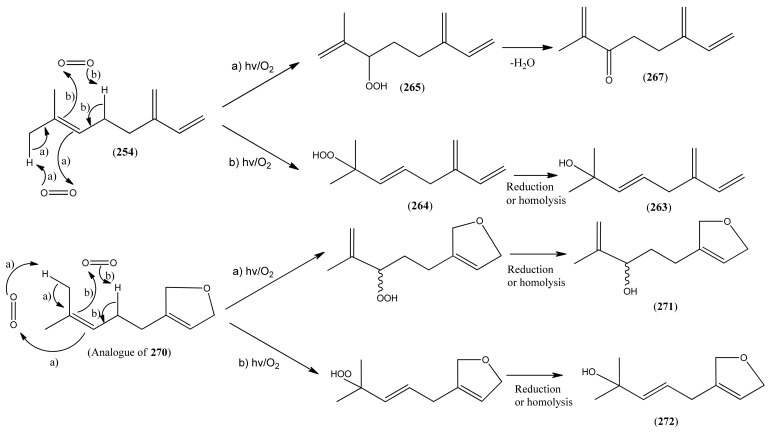
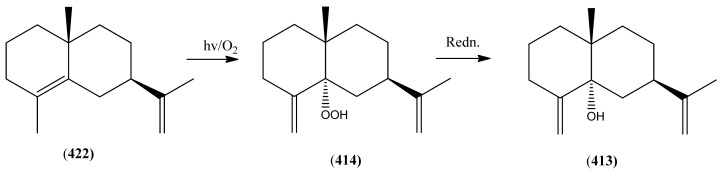
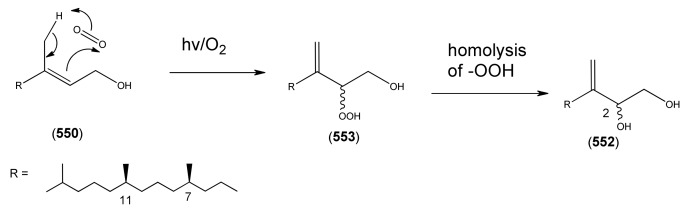
“Thus, allylic hydroperoxides are found for monoterpenes (264 and 265; Section 2.5.1), sesquiterpenes (414 and 481; Section 2.6.3) and diterpenes (553; Section 2.7.1), all of which might be derived from abundant hydrocarbon precursors”
§ The Biosynthesis of Artemisinin (Qinghaosu) and the Phytochemistry of Artemisia annua L. (Qinghao) > 2. The Phytochemistry of Artemisia annua L. (Qinghao)
hedgedconditional- Asserted: passes — The authors put it forward as true.
- Checkable: passes — It can be checked against evidence.
- Load-bearing: unclear — It is unclear whether the paper’s conclusions depend on it.
- Based: passes — The paper gives a reason why it holds.
It may state two separate claims as one.
The paper states this without a source or data behind it here, so there is nothing to check it against. The quote shows it is in the paper.
In the paper
“Some of the coumarins reported in Table 17 have also been obtained from undifferentiated tissue cultures (callus and suspension) of A. annua (see Section 4.2).”
§ The Biosynthesis of Artemisinin (Qinghaosu) and the Phytochemistry of Artemisia annua L. (Qinghao) > 2. The Phytochemistry of Artemisia annua L. (Qinghao) > 2.3. Phenylpropanoids
plain- Asserted: passes — The authors put it forward as true.
- Checkable: passes — It can be checked against evidence.
- Load-bearing: fails — The paper’s conclusions may not depend on it.
- Based: passes — The paper gives a reason why it holds.
Probably not a substantial claim. The paper’s conclusions may not depend on it.
The paper states this without a source or data behind it here, so there is nothing to check it against. The quote shows it is in the paper.
In the paper
“The artemisinin content from A. annua is highly variable, ranging anywhere between 0.01% and 1%, depending on variety, and can even be as high as 1.4% in some cultivated strains.”
§ The Biosynthesis of Artemisinin (Qinghaosu) and the Phytochemistry of Artemisia annua L. (Qinghao) > 2. The Phytochemistry of Artemisia annua L. (Qinghao)
plaincorrelational- Asserted: passes — The authors put it forward as true.
- Checkable: passes — It can be checked against evidence.
- Load-bearing: fails — The paper’s conclusions may not depend on it.
- Based: passes — The paper gives a reason why it holds.
Probably not a substantial claim. The paper’s conclusions may not depend on it. It may state two separate claims as one.
The paper states this without a source or data behind it here, so there is nothing to check it against. The quote shows it is in the paper.
In the paper
“A. annua L. is a rich source of flavonoids, as are many other members of the Asteraceae family.”
§ The Biosynthesis of Artemisinin (Qinghaosu) and the Phytochemistry of Artemisia annua L. (Qinghao) > 2. The Phytochemistry of Artemisia annua L. (Qinghao) > 2.4. Flavonoids
plain- Asserted: passes — The authors put it forward as true.
- Checkable: passes — It can be checked against evidence.
- Load-bearing: fails — The paper’s conclusions may not depend on it.
- Based: fails — The paper may give no reason why it holds.
Probably not a substantial claim. The paper’s conclusions may not depend on it. The paper may give no reason why it holds. It may state two separate claims as one.
The paper states this without a source or data behind it here, so there is nothing to check it against. The quote shows it is in the paper.
In the paper
“in addition to one monoterpene endoperoxide (329; Section 2.5.3) and three sesquiterpene endoperoxides (465, 495 and 497; Section 2.6.3).”
§ The Biosynthesis of Artemisinin (Qinghaosu) and the Phytochemistry of Artemisia annua L. (Qinghao) > 2. The Phytochemistry of Artemisia annua L. (Qinghao)
plain- Asserted: passes — The authors put it forward as true.
- Checkable: passes — It can be checked against evidence.
- Load-bearing: unclear — It is unclear whether the paper’s conclusions depend on it.
- Based: passes — The paper gives a reason why it holds.
It may state two separate claims as one.
The paper states this without a source or data behind it here, so there is nothing to check it against. The quote shows it is in the paper.
In the paper
“A. annua is also a rich source of irregular acyclic monoterpenoids (Section 2.5.2), which are derived from the “head-to-middle” condensation of two C5 precursors.”
§ The Biosynthesis of Artemisinin (Qinghaosu) and the Phytochemistry of Artemisia annua L. (Qinghao) > 2. The Phytochemistry of Artemisia annua L. (Qinghao) > 2.5. Monoterpenoids
plaindirect- Asserted: passes — The authors put it forward as true.
- Checkable: passes — It can be checked against evidence.
- Load-bearing: fails — The paper’s conclusions may not depend on it.
- Based: passes — The paper gives a reason why it holds.
Probably not a substantial claim. The paper’s conclusions may not depend on it. It may state two separate claims as one.
The paper states this without a source or data behind it here, so there is nothing to check it against. The quote shows it is in the paper.
In the paper
“Artemisia annua contains relatively few polyacetylenes by comparison with other members of the genus Artemisia (and also as compared to other members of the Asteraceae family).”
§ The Biosynthesis of Artemisinin (Qinghaosu) and the Phytochemistry of Artemisia annua L. (Qinghao) > 2. The Phytochemistry of Artemisia annua L. (Qinghao) > 2.1. Aliphatic Hydrocarbons, Alcohols, Aldehydes and Acids
plain- Asserted: passes — The authors put it forward as true.
- Checkable: passes — It can be checked against evidence.
- Load-bearing: fails — The paper’s conclusions may not depend on it.
- Based: passes — The paper gives a reason why it holds.
Probably not a substantial claim. The paper’s conclusions may not depend on it.
The paper states this without a source or data behind it here, so there is nothing to check it against. The quote shows it is in the paper.
In the paper
“The Chinese medicinal plant Artemisia annua L. (Qinghao) is the only known source of the sesquiterpene artemisinin (Qinghaosu), which is used in the treatment of malaria.”
§ The Biosynthesis of Artemisinin (Qinghaosu) and the Phytochemistry of Artemisia annua L. (Qinghao) > Abstract
plaindirect- Asserted: passes — The authors put it forward as true.
- Checkable: passes — It can be checked against evidence.
- Load-bearing: fails — The paper’s conclusions may not depend on it.
- Based: passes — The paper gives a reason why it holds.
Probably not a substantial claim. The paper’s conclusions may not depend on it.
The paper states this without a source or data behind it here, so there is nothing to check it against. The quote shows it is in the paper.
In the paper
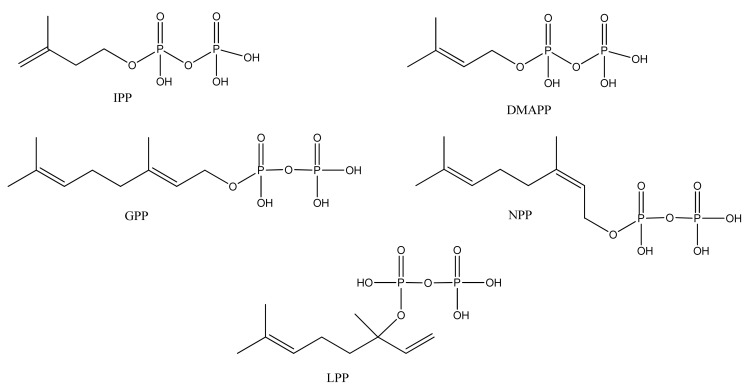
“They are formed by ionization of the pyrophosphate group in one of the C10 precursors: geranyl pyrophosphate (GPP), neryl pyrophosphate (NPP) or linalyl pyrophosphate (LPP) (Figure 2)”
§ The Biosynthesis of Artemisinin (Qinghaosu) and the Phytochemistry of Artemisia annua L. (Qinghao) > 2. The Phytochemistry of Artemisia annua L. (Qinghao) > 2.5. Monoterpenoids
plaindirect- Asserted: passes — The authors put it forward as true.
- Checkable: passes — It can be checked against evidence.
- Load-bearing: fails — The paper’s conclusions may not depend on it.
- Based: passes — The paper gives a reason why it holds.
Probably not a substantial claim. The paper’s conclusions may not depend on it.
In the paper
“Perhaps for this reason, phytochemical studies have sometimes sought to determine the distribution of bioactive flavonoids (such as chrysoplenetin (226), casticin (227), eupatin (232) and artemetin (228)) in conjunction with that of artemisinin [93].”
§ The Biosynthesis of Artemisinin (Qinghaosu) and the Phytochemistry of Artemisia annua L. (Qinghao) > 2. The Phytochemistry of Artemisia annua L. (Qinghao) > 2.4. Flavonoids
What the sources say
- Not checked yetcites [93] Baraldi, 2008, Distribution of artemisinin and bioactive flavonoids from Artemisia annua L. during plant growth, Biochemical Syst. Ecol. source
hedged- Asserted: passes — The authors put it forward as true.
- Checkable: passes — It can be checked against evidence.
- Load-bearing: fails — The paper’s conclusions may not depend on it.
- Based: passes — The paper gives a reason why it holds.
Probably not a substantial claim. The paper’s conclusions may not depend on it.
A conclusion the paper draws from its own results — it cites no other source for it, so there is none to check. The quote shows it is in the paper.
In the paper
“Metabolites in this section are probably biosynthesised by both the polyketide and shikimate pathways (some simple aromatics which are derived from the terpenoid pathway are discussed separately in Section 2.5.3).”
§ The Biosynthesis of Artemisinin (Qinghaosu) and the Phytochemistry of Artemisia annua L. (Qinghao) > 2. The Phytochemistry of Artemisia annua L. (Qinghao) > 2.2. Aromatic Alcohols, Ketones and Acids
hedgedconditional- Asserted: passes — The authors put it forward as true.
- Checkable: passes — It can be checked against evidence.
- Load-bearing: fails — The paper’s conclusions may not depend on it.
- Based: fails — The paper may give no reason why it holds.
Probably not a substantial claim. The paper’s conclusions may not depend on it. The paper may give no reason why it holds.
The paper states this without a source or data behind it here, so there is nothing to check it against. The quote shows it is in the paper.
In the paper
“The phytochemistry of A. annua is dominated by both sesquiterpenoids and flavonoids, as is the case for many other plants in the Asteraceae family.”
§ The Biosynthesis of Artemisinin (Qinghaosu) and the Phytochemistry of Artemisia annua L. (Qinghao) > Abstract
plain- Asserted: passes — The authors put it forward as true.
- Checkable: passes — It can be checked against evidence.
- Load-bearing: fails — The paper’s conclusions may not depend on it.
- Based: passes — The paper gives a reason why it holds.
Probably not a substantial claim. The paper’s conclusions may not depend on it.
None of the sources cited for this claim have been checked yet.
In the paper
“which have been isolated from both leaves [67] and seeds [9] of A. annua.”
§ The Biosynthesis of Artemisinin (Qinghaosu) and the Phytochemistry of Artemisia annua L. (Qinghao) > 2. The Phytochemistry of Artemisia annua L. (Qinghao) > 2.1. Aliphatic Hydrocarbons, Alcohols, Aldehydes and Acids
What the sources say
plain- Asserted: passes — The authors put it forward as true.
- Checkable: passes — It can be checked against evidence.
- Load-bearing: fails — The paper’s conclusions may not depend on it.
- Based: passes — The paper gives a reason why it holds.
Probably not a substantial claim. The paper’s conclusions may not depend on it.
In the paper
“The miscellaneous polycyclic aromatic natural product acenaphthylene, 1,2,4,5-tetrahydro- ([54271-92-0]) (241) is also reported from A. annua [34].”
§ The Biosynthesis of Artemisinin (Qinghaosu) and the Phytochemistry of Artemisia annua L. (Qinghao) > 2. The Phytochemistry of Artemisia annua L. (Qinghao) > 2.4. Flavonoids
What the sources say
- Not checked yetcites [34] Ali, 2000, Volatile oil constituents of Artemisia annua leaves, J. Med. Aromat. Plant Sci.
plain- Asserted: passes — The authors put it forward as true.
- Checkable: passes — It can be checked against evidence.
- Load-bearing: fails — The paper’s conclusions may not depend on it.
- Based: passes — The paper gives a reason why it holds.
Probably not a substantial claim. The paper’s conclusions may not depend on it.
None of the sources cited for this claim have been checked yet.
In the paper
“accounting for as much as 10-30% of the essential oil [25,28,33,34,41,53]”
§ The Biosynthesis of Artemisinin (Qinghaosu) and the Phytochemistry of Artemisia annua L. (Qinghao) > 2. The Phytochemistry of Artemisia annua L. (Qinghao) > 2.5. Monoterpenoids
What the sources say
- Not checked yetcites [25] Chalchat, 1991, A contribution to chemotaxonomy of Artemisia annua L., Asteraceae, Acta Pharm. Jugosl.
- Not checked yetcites [28] Mukhtar, 2007, GC-MS analysis of volatile oil of aerial parts of Artemisia annua L., J. Essent. Oil-Bearing Plants source
- Not checked yetcites [33] Libbey, 1989, Unusual essential oils grown on Oregon II, Artemisia annua L. J. Essent. Oil Res. source
- Not checked yetcites [34] Ali, 2000, Volatile oil constituents of Artemisia annua leaves, J. Med. Aromat. Plant Sci.
- Not checked yetcites [41] Hadjakhoondi, 2008, Chemical composition and antimicrobial activity of Artemisia annua L. essential oil from Iran, Fasinmah-i Giyahan-i-Daruyi
- Not checked yetcites [53] Charles, 1991, Characterization of the essential oil of Artemisia annua L., J. Essent. Oil Res. source
plain- Asserted: passes — The authors put it forward as true.
- Checkable: passes — It can be checked against evidence.
- Load-bearing: fails — The paper’s conclusions may not depend on it.
- Based: passes — The paper gives a reason why it holds.
Probably not a substantial claim. The paper’s conclusions may not depend on it.
None of the sources cited for this claim have been checked yet.
In the paper
“Two unusual cyclopentane monoterpeneoids, α-campholenal ([4501-58-0]) (284) [19] and cyclopentene, 4-ethenyl-1,5,5-trimethyl- ([1727-69-1]) (285) [23] are reported from A. annua.”
§ The Biosynthesis of Artemisinin (Qinghaosu) and the Phytochemistry of Artemisia annua L. (Qinghao) > 2. The Phytochemistry of Artemisia annua L. (Qinghao) > 2.5. Monoterpenoids
What the sources say
- Not checked yetcites [19] Billa, 2008, GC-MS analysis of the volatile constituents of essential oil and aromatic waters of Artemisia annua L. at different developmental stages, Nat. Prod. Comm.
- Not checked yetcites [23] Tian, 2007, Study on volatile constituents of herba Artemisia annua and its preparation by GC-MS, Shizen Guoyi Guoyao
plain- Asserted: passes — The authors put it forward as true.
- Checkable: passes — It can be checked against evidence.
- Load-bearing: fails — The paper’s conclusions may not depend on it.
- Based: passes — The paper gives a reason why it holds.
Probably not a substantial claim. The paper’s conclusions may not depend on it. It may state two separate claims as one.
The paper states this without a source or data behind it here, so there is nothing to check it against. The quote shows it is in the paper.
In the paper
“Two other classes of irregular cyclic monoterpenoids, the lavandulanes 279)–281 and the santolinanes 282 and 283, are also known from A. annua.”
§ The Biosynthesis of Artemisinin (Qinghaosu) and the Phytochemistry of Artemisia annua L. (Qinghao) > 2. The Phytochemistry of Artemisia annua L. (Qinghao) > 2.5. Monoterpenoids
plain- Asserted: passes — The authors put it forward as true.
- Checkable: passes — It can be checked against evidence.
- Load-bearing: fails — The paper’s conclusions may not depend on it.
- Based: passes — The paper gives a reason why it holds.
Probably not a substantial claim. The paper’s conclusions may not depend on it.
None of the sources cited for this claim have been checked yet.
In the paper
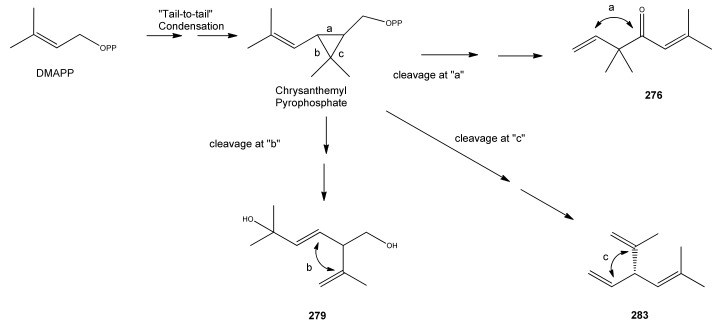
“Phytochemists were interested in A. annua before the discovery of artemisinin because it is a rich source of unusual irregular acyclic monoterpenoids, such as artemisia ketone (276) [115,116,117,118,119,120]”
§ The Biosynthesis of Artemisinin (Qinghaosu) and the Phytochemistry of Artemisia annua L. (Qinghao) > 2. The Phytochemistry of Artemisia annua L. (Qinghao) > 2.5. Monoterpenoids
What the sources say
- Not checked yetcites [115] Asahina, Y., and Takagi, S. (1920). Report on the essential oil of Artemisia annua L. II. Constitution of artemisia ketone. Yakugaku Zasshi, 837–864.
- Not checked yetcites [116] Ruzicka, 1936, Synthesis of tetrahydroartemisia ketone, Helv. Chim. Acta source
- Not checked yetcites [117] Takemoto, 1957, Essential oil of Artemisia annua. I. Isolation of a new ester compound, Yakugaku Zasshi source
- Not checked yetcites [118] Takemoto, 1957, Essential oil of Artemisia annua. II. Structure of 1-β-artemisia alcohol, Yakugaku Zasshi source
- Not checked yetcites [119] Takemoto, 1957, Essential oil of Artemisia annua. III. Structure of artemisia ketone, Yakugaku Zasshi source
- Not checked yetcites [120] Takemoto, 1957, Essential oil of Artemisia annua. IV. Dihydroartemisia ketone, Yakugaku Zasshi source
plaincorrelational- Asserted: passes — The authors put it forward as true.
- Checkable: passes — It can be checked against evidence.
- Load-bearing: fails — The paper’s conclusions may not depend on it.
- Based: passes — The paper gives a reason why it holds.
Probably not a substantial claim. The paper’s conclusions may not depend on it.
A conclusion the paper draws from its own results — it cites no other source for it, so there is none to check. The quote shows it is in the paper.
In the paper
“and are possibly formed by an “ene”-type reaction of molecular oxygen with the tri-substituted double bond in myrcene (254), occurring in the presence of light and a photosensitizer (i.e. singlet oxygen, 1O2), as is shown in Scheme 1.”
§ The Biosynthesis of Artemisinin (Qinghaosu) and the Phytochemistry of Artemisia annua L. (Qinghao) > 2. The Phytochemistry of Artemisia annua L. (Qinghao) > 2.5. Monoterpenoids
hedgedconditional- Asserted: passes — The authors put it forward as true.
- Checkable: passes — It can be checked against evidence.
- Load-bearing: passes — The paper’s conclusions depend on it.
- Based: passes — The paper gives a reason why it holds.
Probably not a substantial claim.
In the paper
“Both the lavandulane tertiary allylic alcohol 279 and its secondary allylic alcohol analogue 280 have been proposed to be derived from the precursor, lavandulol, by spontaneous autoxidation reactions which yield allylic hydroperoxide intermediates as shown in Scheme 3 [129].”
§ The Biosynthesis of Artemisinin (Qinghaosu) and the Phytochemistry of Artemisia annua L. (Qinghao) > 2. The Phytochemistry of Artemisia annua L. (Qinghao) > 2.5. Monoterpenoids
What the sources say
- Not checked yetcites [129] Sy, 2001, Deoxyarteannuin B, dihydro-deoxyarteannuin B and trans-5-hydroxy-2-isopropenyl-5-methylhex-3-en-1-ol from Artemisia annua, Phytochemistry source
hedgeddirect- Asserted: passes — The authors put it forward as true.
- Checkable: passes — It can be checked against evidence.
- Load-bearing: fails — The paper’s conclusions may not depend on it.
- Based: passes — The paper gives a reason why it holds.
Probably not a substantial claim. The paper’s conclusions may not depend on it.
None of the sources cited for this claim have been checked yet.
In the paper
“Artemisia ketone (276) is formed by a non-standard “head-to-middle” condensation of DMAPP [104,122,123,124,125,126], which is thought to proceed as shown in Scheme 2 via chrysanthemyl pyrophosphate, an intermediate containing a three-membered ring.”
§ The Biosynthesis of Artemisinin (Qinghaosu) and the Phytochemistry of Artemisia annua L. (Qinghao) > 2. The Phytochemistry of Artemisia annua L. (Qinghao) > 2.5. Monoterpenoids
What the sources say
- Not checked yetcites [104] Olsson, 2009, Localization of enzymes of artemisinin biosynthesis to the apical cells of glandular secretory trichomes of Artemisia annua L., Phytochemistry source
- Not checked yetcites [122] Suga, 1972, Biosynthesis of a non-head-to-tail monoterpene, artemisia ketone, Chem. Lett. source
- Not checked yetcites [123] Simpson, J.B. (1979). On the Biosynthesis of Artemisia Ketone in Artemisia annua, Louisiana State Univ.
- Not checked yetcites [124] Banthorpe, 1977, Terpene biosynthesis. Part 20. Role of geraniol and nerol in the biosynthesis of artemisia ketone, Phytochemistry source
- Not checked yetcites [125] Risinger, 1978, On the biosynthesis of artemisia ketone and bakuchiol, Experientia source
- Not checked yetcites [126] Allen, 1977, Terpene biosynthesis. Part 17. Biosynthesis of irregular monoterpenes in extracts from higher plants, Phytochemistry source
hedgedconditional- Asserted: passes — The authors put it forward as true.
- Checkable: passes — It can be checked against evidence.
- Load-bearing: unclear — It is unclear whether the paper’s conclusions depend on it.
- Based: passes — The paper gives a reason why it holds.
It may state two separate claims as one.
A conclusion the paper draws from its own results — it cites no other source for it, so there is none to check. The quote shows it is in the paper.
In the paper
“which could be derived from opening of the ether linkage in 1,8-cineole (326).”
§ The Biosynthesis of Artemisinin (Qinghaosu) and the Phytochemistry of Artemisia annua L. (Qinghao) > 2. The Phytochemistry of Artemisia annua L. (Qinghao) > 2.5. Monoterpenoids
hedgedconditional- Asserted: passes — The authors put it forward as true.
- Checkable: passes — It can be checked against evidence.
- Load-bearing: fails — The paper’s conclusions may not depend on it.
- Based: fails — The paper may give no reason why it holds.
Probably not a substantial claim. The paper’s conclusions may not depend on it. The paper may give no reason why it holds.
None of the sources cited for this claim have been checked yet.
In the paper
“1,8-Cineole is sometimes accompanied by significant quantities of p-cymene (295) [28,34] and α-terpineol (322) [28]”
§ The Biosynthesis of Artemisinin (Qinghaosu) and the Phytochemistry of Artemisia annua L. (Qinghao) > 2. The Phytochemistry of Artemisia annua L. (Qinghao) > 2.5. Monoterpenoids
What the sources say
- Not checked yetcites [28] Mukhtar, 2007, GC-MS analysis of volatile oil of aerial parts of Artemisia annua L., J. Essent. Oil-Bearing Plants source
- Not checked yetcites [34] Ali, 2000, Volatile oil constituents of Artemisia annua leaves, J. Med. Aromat. Plant Sci.
plaincorrelational- Asserted: passes — The authors put it forward as true.
- Checkable: passes — It can be checked against evidence.
- Load-bearing: fails — The paper’s conclusions may not depend on it.
- Based: passes — The paper gives a reason why it holds.
Probably not a substantial claim. The paper’s conclusions may not depend on it.
None of the sources cited for this claim have been checked yet.
In the paper
“Only two o-menthanes: o-cymene (1-isopropyl-2-methylbenzene [527-84-4] [25155-15-1]) (331) [41] and o-mentha-1(7),8-dien-3-ol ([15358-81-3]) (332) [23]; and one m-menthane: m-cymene (β-cymene; 1-methyl-3-(1-methylethyl)benzene [535-77-3]) (333) [31] are reported from A. annua.”
§ The Biosynthesis of Artemisinin (Qinghaosu) and the Phytochemistry of Artemisia annua L. (Qinghao) > 2. The Phytochemistry of Artemisia annua L. (Qinghao) > 2.5. Monoterpenoids
What the sources say
- Not checked yetcites [41] Hadjakhoondi, 2008, Chemical composition and antimicrobial activity of Artemisia annua L. essential oil from Iran, Fasinmah-i Giyahan-i-Daruyi
- Not checked yetcites [23] Tian, 2007, Study on volatile constituents of herba Artemisia annua and its preparation by GC-MS, Shizen Guoyi Guoyao
- Not checked yetcites [31] Ma, 2007, Analysis of Artemisia annua L. volatile oil by comprehensive two-dimensional gas chromatography time-of-flight mass spectrometry, J. Chromatogr. A. source
plain- Asserted: passes — The authors put it forward as true.
- Checkable: passes — It can be checked against evidence.
- Load-bearing: fails — The paper’s conclusions may not depend on it.
- Based: passes — The paper gives a reason why it holds.
Probably not a substantial claim. The paper’s conclusions may not depend on it.
None of the sources cited for this claim have been checked yet.
In the paper
“and sometimes co-occurrs with significant amounts of either β-pinene (356) [101] or pinocarvone (360) [42].”
§ The Biosynthesis of Artemisinin (Qinghaosu) and the Phytochemistry of Artemisia annua L. (Qinghao) > 2. The Phytochemistry of Artemisia annua L. (Qinghao) > 2.5. Monoterpenoids
What the sources say
- Not checked yetcites [101] Bhardwaj, 1985, Constituents of Artemisia annua, Proc. Indian Nat. Sci. Acad.
- Not checked yetcites [42] Lari, 2002, The composition of essential oil from Artemisia annua L. growing wild in Iran, Falsnamah-i-Giyahan-i Daruyi
hedgedcorrelational- Asserted: passes — The authors put it forward as true.
- Checkable: passes — It can be checked against evidence.
- Load-bearing: fails — The paper’s conclusions may not depend on it.
- Based: passes — The paper gives a reason why it holds.
Probably not a substantial claim. The paper’s conclusions may not depend on it.
None of the sources cited for this claim have been checked yet.
In the paper
“Borneol (334) [46,73] and bornyl acetate (335) [29] are sometimes reported together with camphor (351) as significant constituents of the essential oil.”
§ The Biosynthesis of Artemisinin (Qinghaosu) and the Phytochemistry of Artemisia annua L. (Qinghao) > 2. The Phytochemistry of Artemisia annua L. (Qinghao) > 2.5. Monoterpenoids
What the sources say
- Not checked yetcites [46] Yang, 2008, Investigation of essential oil from leaves of Artemisia annua L. in Guizhou, Shizen Guoyi Guoyao
- Not checked yetcites [73] Georgiev, 1978, On the distillation of annual wormwood (Artemisia annua Linnaeus), Rivista Italiana Essenze, Profumi, Piante Officinali, Arromatizanti, Syndets, Saponi, Cosmaetici, Aerosols
- Not checked yetcites [29] Genov, 1983, Gas-Chromatographic study of the essential oil of Artemisia annua L., Naunchi Trudove - Vissh Institut po Khranitelna i Vkusova Promishlenost, Plodiv
hedgedcorrelational- Asserted: passes — The authors put it forward as true.
- Checkable: passes — It can be checked against evidence.
- Load-bearing: fails — The paper’s conclusions may not depend on it.
- Based: passes — The paper gives a reason why it holds.
Probably not a substantial claim. The paper’s conclusions may not depend on it.
None of the sources cited for this claim have been checked yet.
In the paper
“Two of the most abundant thujanes are sabinene hydrate (373) [34] and sabinol (371) [43], both of which can be present at around levels of 7% of the total essential oil.”
§ The Biosynthesis of Artemisinin (Qinghaosu) and the Phytochemistry of Artemisia annua L. (Qinghao) > 2. The Phytochemistry of Artemisia annua L. (Qinghao) > 2.5. Monoterpenoids
What the sources say
- Not checked yetcites [34] Ali, 2000, Volatile oil constituents of Artemisia annua leaves, J. Med. Aromat. Plant Sci.
- Not checked yetcites [43] Goel, 2007, Volatile metabolite composition of the essential oil from aerial parts of ornamanetal and artemisinin-rich cultivars of Artemisia annua, J. Essent. Oil Res. source
plain- Asserted: passes — The authors put it forward as true.
- Checkable: passes — It can be checked against evidence.
- Load-bearing: fails — The paper’s conclusions may not depend on it.
- Based: passes — The paper gives a reason why it holds.
Probably not a substantial claim. The paper’s conclusions may not depend on it. It may state two separate claims as one.
The paper states this without a source or data behind it here, so there is nothing to check it against. The quote shows it is in the paper.
In the paper
“the majority of monoterpenes which incorporate an additional three-membered ring belong to the thujane class (Table 28).”
§ The Biosynthesis of Artemisinin (Qinghaosu) and the Phytochemistry of Artemisia annua L. (Qinghao) > 2. The Phytochemistry of Artemisia annua L. (Qinghao) > 2.5. Monoterpenoids
plain- Asserted: passes — The authors put it forward as true.
- Checkable: passes — It can be checked against evidence.
- Load-bearing: fails — The paper’s conclusions may not depend on it.
- Based: passes — The paper gives a reason why it holds.
Probably not a substantial claim. The paper’s conclusions may not depend on it.
In the paper
“Camphene (343) has been obtained as both its (+)- and (-)-enantiomeric forms [37].”
§ The Biosynthesis of Artemisinin (Qinghaosu) and the Phytochemistry of Artemisia annua L. (Qinghao) > 2. The Phytochemistry of Artemisia annua L. (Qinghao) > 2.5. Monoterpenoids
What the sources say
- Not checked yetcites [37] Holm, 1997, Variation in the essential oil composition of Artemisia annua L. of different origin cutivated in Finland, Flavour Frag. J. source
plain- Asserted: passes — The authors put it forward as true.
- Checkable: passes — It can be checked against evidence.
- Load-bearing: fails — The paper’s conclusions may not depend on it.
- Based: passes — The paper gives a reason why it holds.
Probably not a substantial claim. The paper’s conclusions may not depend on it.
A conclusion the paper draws from its own results — it cites no other source for it, so there is none to check. The quote shows it is in the paper.
In the paper
“This acyclic group of natural products is produced by ionization of the pyrophosphate group in the 15-carbon precursor, FPP (378), followed either by quenching with water or loss of a proton”
§ The Biosynthesis of Artemisinin (Qinghaosu) and the Phytochemistry of Artemisia annua L. (Qinghao) > 2. The Phytochemistry of Artemisia annua L. (Qinghao) > 2.6. Sesquiterpenoids
plaindirect- Asserted: passes — The authors put it forward as true.
- Checkable: passes — It can be checked against evidence.
- Load-bearing: fails — The paper’s conclusions may not depend on it.
- Based: passes — The paper gives a reason why it holds.
Probably not a substantial claim. The paper’s conclusions may not depend on it.
None of the sources cited for this claim have been checked yet.
In the paper
“Tricyclene ([508-32-7] [160339-05-9]) (375) [25,32,41,43,45] is the only tricyclic monoterpenoid known from A. annua.”
§ The Biosynthesis of Artemisinin (Qinghaosu) and the Phytochemistry of Artemisia annua L. (Qinghao) > 2. The Phytochemistry of Artemisia annua L. (Qinghao) > 2.5. Monoterpenoids
What the sources say
- Not checked yetcites [25] Chalchat, 1991, A contribution to chemotaxonomy of Artemisia annua L., Asteraceae, Acta Pharm. Jugosl.
- Not checked yetcites [32] Goel, 2007, Essential oils of petal, leaf and stem of the antimalarial plant Artemisia annua, J. Nat. Med. source
- Not checked yetcites [41] Hadjakhoondi, 2008, Chemical composition and antimicrobial activity of Artemisia annua L. essential oil from Iran, Fasinmah-i Giyahan-i-Daruyi
- Not checked yetcites [43] Goel, 2007, Volatile metabolite composition of the essential oil from aerial parts of ornamanetal and artemisinin-rich cultivars of Artemisia annua, J. Essent. Oil Res. source
- Not checked yetcites [45] Jain, 2002, Essential oil composition of Artemisia annua L. "Asha" from the plains of Northern India, J. Essent. Oil Res. source
plain- Asserted: passes — The authors put it forward as true.
- Checkable: passes — It can be checked against evidence.
- Load-bearing: fails — The paper’s conclusions may not depend on it.
- Based: passes — The paper gives a reason why it holds.
Probably not a substantial claim. The paper’s conclusions may not depend on it.
None of the sources cited for this claim have been checked yet.
In the paper
“α-Pinene (347) [40,42,43] is the most abundant pinane monoterpene from A. annua (up to 10%) [33]”
§ The Biosynthesis of Artemisinin (Qinghaosu) and the Phytochemistry of Artemisia annua L. (Qinghao) > 2. The Phytochemistry of Artemisia annua L. (Qinghao) > 2.5. Monoterpenoids
What the sources say
- Not checked yetcites [40] Dembitskii, A.D., Krotova, G.I., Kuchukhidze, N.M., and Yakobashvili, N.Z. (1983). Essential Oil of Artemisia annua L.. Maslozhirovaya Promyshlennost, 31–34.
- Not checked yetcites [42] Lari, 2002, The composition of essential oil from Artemisia annua L. growing wild in Iran, Falsnamah-i-Giyahan-i Daruyi
- Not checked yetcites [43] Goel, 2007, Volatile metabolite composition of the essential oil from aerial parts of ornamanetal and artemisinin-rich cultivars of Artemisia annua, J. Essent. Oil Res. source
- Not checked yetcites [33] Libbey, 1989, Unusual essential oils grown on Oregon II, Artemisia annua L. J. Essent. Oil Res. source
plain- Asserted: passes — The authors put it forward as true.
- Checkable: passes — It can be checked against evidence.
- Load-bearing: fails — The paper’s conclusions may not depend on it.
- Based: passes — The paper gives a reason why it holds.
Probably not a substantial claim. The paper’s conclusions may not depend on it. It may state two separate claims as one.
None of the sources cited for this claim have been checked yet.
In the paper
“which can account for up to 10-30% of the essential oil [19,22,41,42]”
§ The Biosynthesis of Artemisinin (Qinghaosu) and the Phytochemistry of Artemisia annua L. (Qinghao) > 2. The Phytochemistry of Artemisia annua L. (Qinghao) > 2.5. Monoterpenoids
What the sources say
- Not checked yetcites [19] Billa, 2008, GC-MS analysis of the volatile constituents of essential oil and aromatic waters of Artemisia annua L. at different developmental stages, Nat. Prod. Comm.
- Not checked yetcites [22] Liu, 1988, Preliminary analysis on chemical constituents of essential oil from inflorescence of of Artemisia annua L., Acta Botanica Sinica (Zhiwu Xuebao)
- Not checked yetcites [41] Hadjakhoondi, 2008, Chemical composition and antimicrobial activity of Artemisia annua L. essential oil from Iran, Fasinmah-i Giyahan-i-Daruyi
- Not checked yetcites [42] Lari, 2002, The composition of essential oil from Artemisia annua L. growing wild in Iran, Falsnamah-i-Giyahan-i Daruyi
plain- Asserted: passes — The authors put it forward as true.
- Checkable: passes — It can be checked against evidence.
- Load-bearing: fails — The paper’s conclusions may not depend on it.
- Based: passes — The paper gives a reason why it holds.
Probably not a substantial claim. The paper’s conclusions may not depend on it.
None of the sources cited for this claim have been checked yet.
In the paper
“Only two caranes (3,7,7-trimethylbicyclo[4.1.0]heptane, 9CI): α-carene ([13466-78-9]) (364) [32,41] and 2-acetyl-3-carene ([40824-36-0]) (365) [23] are known from A. annua”
§ The Biosynthesis of Artemisinin (Qinghaosu) and the Phytochemistry of Artemisia annua L. (Qinghao) > 2. The Phytochemistry of Artemisia annua L. (Qinghao) > 2.5. Monoterpenoids
What the sources say
- Not checked yetcites [32] Goel, 2007, Essential oils of petal, leaf and stem of the antimalarial plant Artemisia annua, J. Nat. Med. source
- Not checked yetcites [41] Hadjakhoondi, 2008, Chemical composition and antimicrobial activity of Artemisia annua L. essential oil from Iran, Fasinmah-i Giyahan-i-Daruyi
- Not checked yetcites [23] Tian, 2007, Study on volatile constituents of herba Artemisia annua and its preparation by GC-MS, Shizen Guoyi Guoyao
plain- Asserted: passes — The authors put it forward as true.
- Checkable: passes — It can be checked against evidence.
- Load-bearing: fails — The paper’s conclusions may not depend on it.
- Based: passes — The paper gives a reason why it holds.
Probably not a substantial claim. The paper’s conclusions may not depend on it.
In the paper
“α-Pinene (347) is known in both its (+)- and (-)-enantiomeric forms from this species [37].”
§ The Biosynthesis of Artemisinin (Qinghaosu) and the Phytochemistry of Artemisia annua L. (Qinghao) > 2. The Phytochemistry of Artemisia annua L. (Qinghao) > 2.5. Monoterpenoids
What the sources say
- Not checked yetcites [37] Holm, 1997, Variation in the essential oil composition of Artemisia annua L. of different origin cutivated in Finland, Flavour Frag. J. source
plain- Asserted: passes — The authors put it forward as true.
- Checkable: passes — It can be checked against evidence.
- Load-bearing: fails — The paper’s conclusions may not depend on it.
- Based: passes — The paper gives a reason why it holds.
Probably not a substantial claim. The paper’s conclusions may not depend on it.
The paper states this without a source or data behind it here, so there is nothing to check it against. The quote shows it is in the paper.
In the paper
“which is the product of a “head-to-tail” condensation of three C5 units (IPP and DMAPP; see Figure 2).”
§ The Biosynthesis of Artemisinin (Qinghaosu) and the Phytochemistry of Artemisia annua L. (Qinghao) > 2. The Phytochemistry of Artemisia annua L. (Qinghao) > 2.6. Sesquiterpenoids
plaindirect- Asserted: passes — The authors put it forward as true.
- Checkable: passes — It can be checked against evidence.
- Load-bearing: fails — The paper’s conclusions may not depend on it.
- Based: passes — The paper gives a reason why it holds.
Probably not a substantial claim. The paper’s conclusions may not depend on it.
A conclusion the paper draws from its own results — it cites no other source for it, so there is none to check. The quote shows it is in the paper.
In the paper
“Alternatively, FPP can undergo further cyclization to mono-cyclic sesquiterpenes (Section 2.6.2), bicyclic sesquiterpenes (Section 2.6.3) or tricyclic sesquiterpenes (Section 2.6.4), according to enzymatically-catalysed mechanisms which bear close analogies with the biosynthesis of the cyclized monoterpenoids”
§ The Biosynthesis of Artemisinin (Qinghaosu) and the Phytochemistry of Artemisia annua L. (Qinghao) > 2. The Phytochemistry of Artemisia annua L. (Qinghao) > 2.6. Sesquiterpenoids
plaindirect- Asserted: passes — The authors put it forward as true.
- Checkable: passes — It can be checked against evidence.
- Load-bearing: fails — The paper’s conclusions may not depend on it.
- Based: passes — The paper gives a reason why it holds.
Probably not a substantial claim. The paper’s conclusions may not depend on it.
A conclusion the paper draws from its own results — it cites no other source for it, so there is none to check. The quote shows it is in the paper.
In the paper
“Further cyclization of the carbocation which produces the p-menthane skeleton results in bicyclic monoterpenes.”
§ The Biosynthesis of Artemisinin (Qinghaosu) and the Phytochemistry of Artemisia annua L. (Qinghao) > 2. The Phytochemistry of Artemisia annua L. (Qinghao) > 2.5. Monoterpenoids
plaindirect- Asserted: passes — The authors put it forward as true.
- Checkable: passes — It can be checked against evidence.
- Load-bearing: fails — The paper’s conclusions may not depend on it.
- Based: fails — The paper may give no reason why it holds.
Probably not a substantial claim. The paper’s conclusions may not depend on it. The paper may give no reason why it holds.
None of the sources cited for this claim have been checked yet.
In the paper
“constituting up to 10% of the essential oil [19,27]”
§ The Biosynthesis of Artemisinin (Qinghaosu) and the Phytochemistry of Artemisia annua L. (Qinghao) > 2. The Phytochemistry of Artemisia annua L. (Qinghao) > 2.6. Sesquiterpenoids
What the sources say
- Not checked yetcites [19] Billa, 2008, GC-MS analysis of the volatile constituents of essential oil and aromatic waters of Artemisia annua L. at different developmental stages, Nat. Prod. Comm.
- Not checked yetcites [27] Goel, 2007, Composition of the essential oil from the root of Artemisia annua, J. Nat. Med. source
plain- Asserted: passes — The authors put it forward as true.
- Checkable: passes — It can be checked against evidence.
- Load-bearing: fails — The paper’s conclusions may not depend on it.
- Based: passes — The paper gives a reason why it holds.
Probably not a substantial claim. The paper’s conclusions may not depend on it.
A conclusion the paper draws from its own results — it cites no other source for it, so there is none to check. The quote shows it is in the paper.
In the paper
“These unusual skeletons presumably arise by migration of a methyl group in the corresponding p-menthane precursor”
§ The Biosynthesis of Artemisinin (Qinghaosu) and the Phytochemistry of Artemisia annua L. (Qinghao) > 2. The Phytochemistry of Artemisia annua L. (Qinghao) > 2.5. Monoterpenoids
hedgedconditional- Asserted: passes — The authors put it forward as true.
- Checkable: passes — It can be checked against evidence.
- Load-bearing: fails — The paper’s conclusions may not depend on it.
- Based: fails — The paper may give no reason why it holds.
Probably not a substantial claim. The paper’s conclusions may not depend on it. The paper may give no reason why it holds.
In the paper
“A β-pinene synthase, which converts GPP to both (-)-α-pinene (347) and (-)-β-pinene (356), has recently been described from A. annua [131].”
§ The Biosynthesis of Artemisinin (Qinghaosu) and the Phytochemistry of Artemisia annua L. (Qinghao) > 2. The Phytochemistry of Artemisia annua L. (Qinghao) > 2.5. Monoterpenoids
What the sources say
- Not checked yetcites [131] Lu, 2002, Cloning and functional characterization of a β-pinene synthase from Artemisia annua that shows a circadian pattern of expression, Plant Physiol. source
plaindirect- Asserted: passes — The authors put it forward as true.
- Checkable: passes — It can be checked against evidence.
- Load-bearing: fails — The paper’s conclusions may not depend on it.
- Based: passes — The paper gives a reason why it holds.
Probably not a substantial claim. The paper’s conclusions may not depend on it.
The paper states this without a source or data behind it here, so there is nothing to check it against. The quote shows it is in the paper.
In the paper
“Sesquiterpenoids (C15) constitute the most abundant and most diverse group of natural products from A. annua.”
§ The Biosynthesis of Artemisinin (Qinghaosu) and the Phytochemistry of Artemisia annua L. (Qinghao) > 2. The Phytochemistry of Artemisia annua L. (Qinghao) > 2.6. Sesquiterpenoids
plain- Asserted: passes — The authors put it forward as true.
- Checkable: passes — It can be checked against evidence.
- Load-bearing: fails — The paper’s conclusions may not depend on it.
- Based: fails — The paper may give no reason why it holds.
Probably not a substantial claim. The paper’s conclusions may not depend on it. The paper may give no reason why it holds. It may state two separate claims as one.
None of the sources cited for this claim have been checked yet.
In the paper
“β-Farnesene (382) is the most abundant member of this class of sesquiterpenes [22,43]”
§ The Biosynthesis of Artemisinin (Qinghaosu) and the Phytochemistry of Artemisia annua L. (Qinghao) > 2. The Phytochemistry of Artemisia annua L. (Qinghao) > 2.6. Sesquiterpenoids
What the sources say
- Not checked yetcites [22] Liu, 1988, Preliminary analysis on chemical constituents of essential oil from inflorescence of of Artemisia annua L., Acta Botanica Sinica (Zhiwu Xuebao)
- Not checked yetcites [43] Goel, 2007, Volatile metabolite composition of the essential oil from aerial parts of ornamanetal and artemisinin-rich cultivars of Artemisia annua, J. Essent. Oil Res. source
plain- Asserted: passes — The authors put it forward as true.
- Checkable: passes — It can be checked against evidence.
- Load-bearing: fails — The paper’s conclusions may not depend on it.
- Based: passes — The paper gives a reason why it holds.
Probably not a substantial claim. The paper’s conclusions may not depend on it.
In the paper
“It has been suggested that reduction of the hydroperoxide in 414 would then result in the allylic alcohol group observed in the natural product 5α-hydroxy-eudesma-4(15),11-diene (413), as shown in Scheme 4 [9].”
§ The Biosynthesis of Artemisinin (Qinghaosu) and the Phytochemistry of Artemisia annua L. (Qinghao) > 2. The Phytochemistry of Artemisia annua L. (Qinghao) > 2.6. Sesquiterpenoids
What the sources say
- Not checked yetcites [9] Brown, 2003, Terpenoids from the seeds of Artemisia annua, Phytochemistry source
hedgeddirect- Asserted: passes — The authors put it forward as true.
- Checkable: passes — It can be checked against evidence.
- Load-bearing: fails — The paper’s conclusions may not depend on it.
- Based: passes — The paper gives a reason why it holds.
Probably not a substantial claim. The paper’s conclusions may not depend on it.
None of the sources cited for this claim have been checked yet.
In the paper
“Compound (395) ([24703-35-3]) is the only example of a bicyclogermacrane sesquiterpene so far described from A. annua [19,32,43,45,74].”
§ The Biosynthesis of Artemisinin (Qinghaosu) and the Phytochemistry of Artemisia annua L. (Qinghao) > 2. The Phytochemistry of Artemisia annua L. (Qinghao) > 2.6. Sesquiterpenoids
What the sources say
- Not checked yetcites [19] Billa, 2008, GC-MS analysis of the volatile constituents of essential oil and aromatic waters of Artemisia annua L. at different developmental stages, Nat. Prod. Comm.
- Not checked yetcites [32] Goel, 2007, Essential oils of petal, leaf and stem of the antimalarial plant Artemisia annua, J. Nat. Med. source
- Not checked yetcites [43] Goel, 2007, Volatile metabolite composition of the essential oil from aerial parts of ornamanetal and artemisinin-rich cultivars of Artemisia annua, J. Essent. Oil Res. source
- Not checked yetcites [45] Jain, 2002, Essential oil composition of Artemisia annua L. "Asha" from the plains of Northern India, J. Essent. Oil Res. source
- Not checked yetcites [74] Perazzo, 2003, Central properties of the essential oil and the crude ethanol extract from aerial parts of Artemisia annua L., Pharmacol. Res. source
plain- Asserted: passes — The authors put it forward as true.
- Checkable: passes — It can be checked against evidence.
- Load-bearing: fails — The paper’s conclusions may not depend on it.
- Based: passes — The paper gives a reason why it holds.
Probably not a substantial claim. The paper’s conclusions may not depend on it.
None of the sources cited for this claim have been checked yet.
In the paper
“and can constitute between 5-20% of the essential oil [19,42,43]”
§ The Biosynthesis of Artemisinin (Qinghaosu) and the Phytochemistry of Artemisia annua L. (Qinghao) > 2. The Phytochemistry of Artemisia annua L. (Qinghao) > 2.6. Sesquiterpenoids
What the sources say
- Not checked yetcites [19] Billa, 2008, GC-MS analysis of the volatile constituents of essential oil and aromatic waters of Artemisia annua L. at different developmental stages, Nat. Prod. Comm.
- Not checked yetcites [42] Lari, 2002, The composition of essential oil from Artemisia annua L. growing wild in Iran, Falsnamah-i-Giyahan-i Daruyi
- Not checked yetcites [43] Goel, 2007, Volatile metabolite composition of the essential oil from aerial parts of ornamanetal and artemisinin-rich cultivars of Artemisia annua, J. Essent. Oil Res. source
plain- Asserted: passes — The authors put it forward as true.
- Checkable: passes — It can be checked against evidence.
- Load-bearing: fails — The paper’s conclusions may not depend on it.
- Based: passes — The paper gives a reason why it holds.
Probably not a substantial claim. The paper’s conclusions may not depend on it.
In the paper
“The enzyme amorpha-4,11-diene synthase from A. annua has been observed to produce small amounts of γ-humulene (isomeric with α-humulene (401) in Table 33 – see also Figure 3, Section 3.1), as well as the expected bicyclic product [134].”
§ The Biosynthesis of Artemisinin (Qinghaosu) and the Phytochemistry of Artemisia annua L. (Qinghao) > 2. The Phytochemistry of Artemisia annua L. (Qinghao) > 2.6. Sesquiterpenoids
What the sources say
- Not checked yetcites [134] Picaud, 2005, Expression, purification and characterization of recombinant amorpha-4,11-diene synthase from Artemisia annua L., Arch. Biochem. Biophys. source
plaindirect- Asserted: passes — The authors put it forward as true.
- Checkable: passes — It can be checked against evidence.
- Load-bearing: fails — The paper’s conclusions may not depend on it.
- Based: passes — The paper gives a reason why it holds.
Probably not a substantial claim. The paper’s conclusions may not depend on it.
None of the sources cited for this claim have been checked yet.
In the paper
“β-Caryophyllene (405) is the most abundant member of this group of sesquiterpenes [26,37,40,43,46]”
§ The Biosynthesis of Artemisinin (Qinghaosu) and the Phytochemistry of Artemisia annua L. (Qinghao) > 2. The Phytochemistry of Artemisia annua L. (Qinghao) > 2.6. Sesquiterpenoids
What the sources say
- Not checked yetcites [26] Zhong, 1983, Studies of volatile constituents from Artemisia annua, Zhongyao Tongbao
- Not checked yetcites [37] Holm, 1997, Variation in the essential oil composition of Artemisia annua L. of different origin cutivated in Finland, Flavour Frag. J. source
- Not checked yetcites [40] Dembitskii, A.D., Krotova, G.I., Kuchukhidze, N.M., and Yakobashvili, N.Z. (1983). Essential Oil of Artemisia annua L.. Maslozhirovaya Promyshlennost, 31–34.
- Not checked yetcites [43] Goel, 2007, Volatile metabolite composition of the essential oil from aerial parts of ornamanetal and artemisinin-rich cultivars of Artemisia annua, J. Essent. Oil Res. source
- Not checked yetcites [46] Yang, 2008, Investigation of essential oil from leaves of Artemisia annua L. in Guizhou, Shizen Guoyi Guoyao
plain- Asserted: passes — The authors put it forward as true.
- Checkable: passes — It can be checked against evidence.
- Load-bearing: fails — The paper’s conclusions may not depend on it.
- Based: passes — The paper gives a reason why it holds.
Probably not a substantial claim. The paper’s conclusions may not depend on it.
A conclusion the paper draws from its own results — it cites no other source for it, so there is none to check. The quote shows it is in the paper.
In the paper
“Alternative cyclizations of FPP can lead to the ten-membered germacrane sesquiterpenes, which are described in Table 31, and the eleven-membered humulane sesquiterpenes in Table 33.”
§ The Biosynthesis of Artemisinin (Qinghaosu) and the Phytochemistry of Artemisia annua L. (Qinghao) > 2. The Phytochemistry of Artemisia annua L. (Qinghao) > 2.6. Sesquiterpenoids
plaindirect- Asserted: passes — The authors put it forward as true.
- Checkable: passes — It can be checked against evidence.
- Load-bearing: fails — The paper’s conclusions may not depend on it.
- Based: passes — The paper gives a reason why it holds.
Probably not a substantial claim. The paper’s conclusions may not depend on it.
In the paper
“This was interpreted as evidence that β-caryophyllene (405) might play a role in plant defense [139].”
§ The Biosynthesis of Artemisinin (Qinghaosu) and the Phytochemistry of Artemisia annua L. (Qinghao) > 2. The Phytochemistry of Artemisia annua L. (Qinghao) > 2.6. Sesquiterpenoids
What the sources say
- Not checked yetcites [139] Cai, 2002, A cDNA clone for β-caryophyllene synthase from Artermisia annua, Phytochemistry source
hedgedconditional- Asserted: passes — The authors put it forward as true.
- Checkable: passes — It can be checked against evidence.
- Load-bearing: fails — The paper’s conclusions may not depend on it.
- Based: passes — The paper gives a reason why it holds.
Probably not a substantial claim. The paper’s conclusions may not depend on it.
In the paper
“The bisabolane sesquiterpene, α-bisabolol (385), has been found as a minor product from the enzyme amorpha-4,11-diene synthase from A. annua (Section 2.6.3) [136].”
§ The Biosynthesis of Artemisinin (Qinghaosu) and the Phytochemistry of Artemisia annua L. (Qinghao) > 2. The Phytochemistry of Artemisia annua L. (Qinghao) > 2.6. Sesquiterpenoids
What the sources say
- Not checked yetcites [136] Picaud, 2006, Amorpha-4,11-diene synthase: mechanism and stereochemistry of the enzymatic cycization of farnesyl diphosphate, Arch. Biochem. Biophys. source
plaindirect- Asserted: passes — The authors put it forward as true.
- Checkable: passes — It can be checked against evidence.
- Load-bearing: fails — The paper’s conclusions may not depend on it.
- Based: passes — The paper gives a reason why it holds.
Probably not a substantial claim. The paper’s conclusions may not depend on it.
None of the sources cited for this claim have been checked yet.
In the paper
“and can be found at levels of up to 5-10% of the total essential oil [19,22,42]”
§ The Biosynthesis of Artemisinin (Qinghaosu) and the Phytochemistry of Artemisia annua L. (Qinghao) > 2. The Phytochemistry of Artemisia annua L. (Qinghao) > 2.6. Sesquiterpenoids
What the sources say
- Not checked yetcites [19] Billa, 2008, GC-MS analysis of the volatile constituents of essential oil and aromatic waters of Artemisia annua L. at different developmental stages, Nat. Prod. Comm.
- Not checked yetcites [22] Liu, 1988, Preliminary analysis on chemical constituents of essential oil from inflorescence of of Artemisia annua L., Acta Botanica Sinica (Zhiwu Xuebao)
- Not checked yetcites [42] Lari, 2002, The composition of essential oil from Artemisia annua L. growing wild in Iran, Falsnamah-i-Giyahan-i Daruyi
plain- Asserted: passes — The authors put it forward as true.
- Checkable: passes — It can be checked against evidence.
- Load-bearing: fails — The paper’s conclusions may not depend on it.
- Based: passes — The paper gives a reason why it holds.
Probably not a substantial claim. The paper’s conclusions may not depend on it.
A conclusion the paper draws from its own results — it cites no other source for it, so there is none to check. The quote shows it is in the paper.
In the paper
“The six-membered ring in the elemane sesquiterpenes (Table 32) is thought to be formed by Cope rearrangement of such 1(10),4-germacradienes.”
§ The Biosynthesis of Artemisinin (Qinghaosu) and the Phytochemistry of Artemisia annua L. (Qinghao) > 2. The Phytochemistry of Artemisia annua L. (Qinghao) > 2.6. Sesquiterpenoids
hedgedconditional- Asserted: passes — The authors put it forward as true.
- Checkable: passes — It can be checked against evidence.
- Load-bearing: fails — The paper’s conclusions may not depend on it.
- Based: passes — The paper gives a reason why it holds.
Probably not a substantial claim. The paper’s conclusions may not depend on it.
In the paper
“both of which are reported as natural products from A. annua [134] (Table 29).”
§ The Biosynthesis of Artemisinin (Qinghaosu) and the Phytochemistry of Artemisia annua L. (Qinghao) > 2. The Phytochemistry of Artemisia annua L. (Qinghao) > 2.6. Sesquiterpenoids
What the sources say
- Not checked yetcites [134] Picaud, 2005, Expression, purification and characterization of recombinant amorpha-4,11-diene synthase from Artemisia annua L., Arch. Biochem. Biophys. source
plain- Asserted: passes — The authors put it forward as true.
- Checkable: passes — It can be checked against evidence.
- Load-bearing: fails — The paper’s conclusions may not depend on it.
- Based: passes — The paper gives a reason why it holds.
Probably not a substantial claim. The paper’s conclusions may not depend on it. It may state two separate claims as one.
None of the sources cited for this claim have been checked yet.
In the paper
“constituting up to 5% of the essential oil [28,46]”
§ The Biosynthesis of Artemisinin (Qinghaosu) and the Phytochemistry of Artemisia annua L. (Qinghao) > 2. The Phytochemistry of Artemisia annua L. (Qinghao) > 2.6. Sesquiterpenoids
What the sources say
- Not checked yetcites [28] Mukhtar, 2007, GC-MS analysis of volatile oil of aerial parts of Artemisia annua L., J. Essent. Oil-Bearing Plants source
- Not checked yetcites [46] Yang, 2008, Investigation of essential oil from leaves of Artemisia annua L. in Guizhou, Shizen Guoyi Guoyao
plain- Asserted: passes — The authors put it forward as true.
- Checkable: passes — It can be checked against evidence.
- Load-bearing: fails — The paper’s conclusions may not depend on it.
- Based: passes — The paper gives a reason why it holds.
Probably not a substantial claim. The paper’s conclusions may not depend on it.
In the paper
“The eremophilane skeleton (decahydro-1,8a-dimethyl-7-(1-methylethyl)naphthalene, 9CI) is thought to be derived from the eudesmane skeleton by migration of the C-10 methyl group to C-5 [16].”
§ The Biosynthesis of Artemisinin (Qinghaosu) and the Phytochemistry of Artemisia annua L. (Qinghao) > 2. The Phytochemistry of Artemisia annua L. (Qinghao) > 2.6. Sesquiterpenoids
What the sources say
- Not checked yetcites [16] Buckingham, 2004, Introduction to the Type of Compound Index, Dictionary of Natural Products
hedgedconditional- Asserted: passes — The authors put it forward as true.
- Checkable: passes — It can be checked against evidence.
- Load-bearing: fails — The paper’s conclusions may not depend on it.
- Based: passes — The paper gives a reason why it holds.
Probably not a substantial claim. The paper’s conclusions may not depend on it.
A conclusion the paper draws from its own results — it cites no other source for it, so there is none to check. The quote shows it is in the paper.
In the paper
“The bicyclic eudesmane sesquiterpenes (Table 34) are thought to be derived from further cyclization of the monocyclic germacranes (Table 31, Section 2.6.2).”
§ The Biosynthesis of Artemisinin (Qinghaosu) and the Phytochemistry of Artemisia annua L. (Qinghao) > 2. The Phytochemistry of Artemisia annua L. (Qinghao) > 2.6. Sesquiterpenoids
hedgedconditional- Asserted: passes — The authors put it forward as true.
- Checkable: passes — It can be checked against evidence.
- Load-bearing: fails — The paper’s conclusions may not depend on it.
- Based: passes — The paper gives a reason why it holds.
Probably not a substantial claim. The paper’s conclusions may not depend on it.
A conclusion the paper draws from its own results — it cites no other source for it, so there is none to check. The quote shows it is in the paper.
In the paper
“The bicyclic caryophyllanes, which are formed by a further cyclization of a humulane precursor, have also been included in Table 33.”
§ The Biosynthesis of Artemisinin (Qinghaosu) and the Phytochemistry of Artemisia annua L. (Qinghao) > 2. The Phytochemistry of Artemisia annua L. (Qinghao) > 2.6. Sesquiterpenoids
plaindirect- Asserted: passes — The authors put it forward as true.
- Checkable: passes — It can be checked against evidence.
- Load-bearing: fails — The paper’s conclusions may not depend on it.
- Based: passes — The paper gives a reason why it holds.
Probably not a substantial claim. The paper’s conclusions may not depend on it.
In the paper
“However, all seven metabolites from this experiment are also known as natural products from A. annua and six of the seven feature in the pairs of metabolites discussed in Table 37.”
§ The Biosynthesis of Artemisinin (Qinghaosu) and the Phytochemistry of Artemisia annua L. (Qinghao) > 2. The Phytochemistry of Artemisia annua L. (Qinghao) > 2.6. Sesquiterpenoids
What the sources say
- Not checked yetcites [155] Brown, 2007, In vivo transformations of artemisinic acid in Artemisia annua plants, Tetrahedron source
plain- Asserted: passes — The authors put it forward as true.
- Checkable: passes — It can be checked against evidence.
- Load-bearing: unclear — It is unclear whether the paper’s conclusions depend on it.
- Based: passes — The paper gives a reason why it holds.
It may state two separate claims as one.
In the paper
“Artemisinin (495) is believed to be localized primarily within the glandular trichomes of A. annua, which are loosely attached to the leaf surface [244].”
§ The Biosynthesis of Artemisinin (Qinghaosu) and the Phytochemistry of Artemisia annua L. (Qinghao) > 2. The Phytochemistry of Artemisia annua L. (Qinghao) > 2.6. Sesquiterpenoids
What the sources say
- Not checked yetcites [244] Duke, 1994, Localization of artemisinin and artemisitene in foliar tissues of glanded and glandless biotypes of Artemisia annua L., Int. J. Plant Sci. source
hedgedcorrelational- Asserted: passes — The authors put it forward as true.
- Checkable: passes — It can be checked against evidence.
- Load-bearing: unclear — It is unclear whether the paper’s conclusions depend on it.
- Based: passes — The paper gives a reason why it holds.
It may state two separate claims as one.
None of the sources cited for this claim have been checked yet.
In the paper
“and were amongst the first sesquiterpenes to be reported from A. annua.”
§ The Biosynthesis of Artemisinin (Qinghaosu) and the Phytochemistry of Artemisia annua L. (Qinghao) > 2. The Phytochemistry of Artemisia annua L. (Qinghao) > 2.6. Sesquiterpenoids
What the sources say
- Not checked yetcites [105] Zheng, 1994, Cytotoxic terpenoids and flavonoids from Artemisia annua, Planta Med. source
- Not checked yetcites [147] Tu, 1982, Studies on the constituents of Artemisia annua: 2, Planta Med. source
- Not checked yetcites [148] Misra, 1993, Crystal structure of artemisinic acid: A possible biogenetic precursor of antimalarial artemisinin from Artemisia annua, J. Nat. Prod. source
- Not checked yetcites [149] Jeremic, D., Jokic, A., Behbud, A., and Stefanovic, M. (1973). New type of sesquiterpene lactone isolated from Artemisia annua. Arteannuin B. Tetrahedron Lett., 3039–42. source
- Not checked yetcites [150] Liu, 1979, Structure and reaction of arteannuin, Huaxue Xuebao
plain- Asserted: passes — The authors put it forward as true.
- Checkable: passes — It can be checked against evidence.
- Load-bearing: fails — The paper’s conclusions may not depend on it.
- Based: passes — The paper gives a reason why it holds.
Probably not a substantial claim. The paper’s conclusions may not depend on it.
In the paper
“Artemisitene (497), the 11,13-dehydro analogue of artemisinin, is present in A. annua at much lower levels than artemisinin (typically concentrations in the order of 0.01%, as compared with 1%) [240]”
§ The Biosynthesis of Artemisinin (Qinghaosu) and the Phytochemistry of Artemisia annua L. (Qinghao) > 2. The Phytochemistry of Artemisia annua L. (Qinghao) > 2.6. Sesquiterpenoids
What the sources say
- Not checked yetcites [240] Woerdenbag, 1994, Artemisinin related sesquiterpenes, and essential oil in Artemisia annua during a vegetation period in Vietnam, Planta Med. source
plain- Asserted: passes — The authors put it forward as true.
- Checkable: passes — It can be checked against evidence.
- Load-bearing: fails — The paper’s conclusions may not depend on it.
- Based: passes — The paper gives a reason why it holds.
Probably not a substantial claim. The paper’s conclusions may not depend on it.
The paper states this without a source or data behind it here, so there is nothing to check it against. The quote shows it is in the paper.
In the paper
“(No representative of the bulgarane sesquiterpenes (1α,6β,7α), the fourth possible skeleton allowed by this classification scheme, is known from A. annua).”
§ The Biosynthesis of Artemisinin (Qinghaosu) and the Phytochemistry of Artemisia annua L. (Qinghao) > 2. The Phytochemistry of Artemisia annua L. (Qinghao) > 2.6. Sesquiterpenoids
plain- Asserted: passes — The authors put it forward as true.
- Checkable: passes — It can be checked against evidence.
- Load-bearing: fails — The paper’s conclusions may not depend on it.
- Based: passes — The paper gives a reason why it holds.
Probably not a substantial claim. The paper’s conclusions may not depend on it.
None of the sources cited for this claim have been checked yet.
In the paper
“although artemisitene can be obtained readily by chemical transformations of artemisinin [165,213,241,242]; and a partial synthesis of artemisitene from artemisinic acid (473) has also been reported [243].”
§ The Biosynthesis of Artemisinin (Qinghaosu) and the Phytochemistry of Artemisia annua L. (Qinghao) > 2. The Phytochemistry of Artemisia annua L. (Qinghao) > 2.6. Sesquiterpenoids
What the sources say
- Not checked yetcites [165] Sy, L.-K., and Brown, G.D. (2002). Synthesis of 6,7-dehydroartemisinic acid. J. Chem. Soc. Perkin Trans. 1, 2421–2429. source
- Not checked yetcites [213] Ayalp, 1990, Conversion of artemisinin to artemisitene, J. Nat. Prod. source
- Not checked yetcites [241] Ekthawatchai, 2003, An environmentally friendly, low cost, one-pot synthesis of artemisitene, Synth. Commun. source
- Not checked yetcites [242] Zhang, 1988, Structure and synthesis of arteannuin and related compounds. XXIV. Conversion of arteannuin into artemisitene, Youji Huaxue
- Not checked yetcites [243] Haynes, R.K., and Vonwiller, S.C. (1990). Catalyzed oxygenation of allylic hydroperoxides derived from qinghao (artemisinic) acid. Conversion of qinghao acid into dehydroqinghaosu (artemisitene) and qinghaosu (artemisinin). J. Chem. Soc., Chem. Commun., 451–453. source
plaindirect- Asserted: passes — The authors put it forward as true.
- Checkable: passes — It can be checked against evidence.
- Load-bearing: fails — The paper’s conclusions may not depend on it.
- Based: passes — The paper gives a reason why it holds.
Probably not a substantial claim. The paper’s conclusions may not depend on it. It may state two separate claims as one.
The paper states this without a source or data behind it here, so there is nothing to check it against. The quote shows it is in the paper.
In the paper
“Artemisinin (495) is a seco-cadinane sesquiterpene, which was first isolated from A. annua in 1972.”
§ The Biosynthesis of Artemisinin (Qinghaosu) and the Phytochemistry of Artemisia annua L. (Qinghao) > 2. The Phytochemistry of Artemisia annua L. (Qinghao) > 2.6. Sesquiterpenoids
plain- Asserted: passes — The authors put it forward as true.
- Checkable: passes — It can be checked against evidence.
- Load-bearing: fails — The paper’s conclusions may not depend on it.
- Based: passes — The paper gives a reason why it holds.
Probably not a substantial claim. The paper’s conclusions may not depend on it.
None of the sources cited for this claim have been checked yet.
In the paper
“The unusual endoperoxide group in artemisinin has been confirmed by a variety of means [219,220,221,222,223,224,225,226] and the absolute stereochemistry of artemisinin has been established by X-ray crystallography [227].”
§ The Biosynthesis of Artemisinin (Qinghaosu) and the Phytochemistry of Artemisia annua L. (Qinghao) > 2. The Phytochemistry of Artemisia annua L. (Qinghao) > 2.6. Sesquiterpenoids
What the sources say
- Not checked yetcites [219] Anonymous (1977). Co-ordinating group of research on the structure of Qing Hao Su. A new type of lactone - Qing Hau Sau. K’O Hsueh Tung Pao, 22, 142. (CA 1977, 87, 98788).
- Not checked yetcites [220] Blasko, 1988, Definitive 1H and 13C NMR assignments of artemisinin (qinghaosu), J. Nat. Prod. source
- Not checked yetcites [221] Huang, 1988, Two-dimensional NMR studies of arteannuin, Huaxue Xuebao
- Not checked yetcites [222] Leban, 1988, Crystal and molecular structure of Qinghaosu: A redetermination, Acta Pharmaceutica Jugoslavica
- Not checked yetcites [223] Madhusudanan, 1989, Mass spectral studies on artemisinin, dihydroartemisinin and artether, Indian J. Chem. Sect. B, Organic Chemistry including Medicinal Chemistry
- Not checked yetcites [224] Mi, 1987, Circular dichroism of some synthetic intermeidates of qinghaosu, Yaowu Fenxi Zazhi
- Not checked yetcites [225] Wang, 1985, Qinghaosu: proton and carbon-13 nuclear magnetic resonance spectral assignments and luminescence, Can. J. Chem. source
- Not checked yetcites [226] Wang, 1986, The 13C NMR spectroscopy of arteannuin analogues, Huaxue Xuebao
- Not checked yetcites [227] Lisgarten, 1998, Structure, absolute configuration and conformation of the antimalarial compound, artemisinin, J. Chem. Crystallogr. source
boosted- Asserted: passes — The authors put it forward as true.
- Checkable: passes — It can be checked against evidence.
- Load-bearing: fails — The paper’s conclusions may not depend on it.
- Based: passes — The paper gives a reason why it holds.
Probably not a substantial claim. The paper’s conclusions may not depend on it. It may state two separate claims as one.
In the paper
“The most abundant metabolite from feeding artemisinic acid (473) was arteannuin B (462), followed by epi-deoxyarteannuin B (478) and the seco-cadinane (494) as shown in Scheme 7”
§ The Biosynthesis of Artemisinin (Qinghaosu) and the Phytochemistry of Artemisia annua L. (Qinghao) > 2. The Phytochemistry of Artemisia annua L. (Qinghao) > 2.6. Sesquiterpenoids
What the sources say
- Not checked yetcites [155] Brown, 2007, In vivo transformations of artemisinic acid in Artemisia annua plants, Tetrahedron source
plaindirect- Asserted: passes — The authors put it forward as true.
- Checkable: passes — It can be checked against evidence.
- Load-bearing: unclear — It is unclear whether the paper’s conclusions depend on it.
- Based: passes — The paper gives a reason why it holds.
It may state two separate claims as one.
In the paper
“Feeding labelled dihydroartemisinic acid (480) to A. annua resulted in sixteen labelled amorphane and cadinane sesquiterpenes [185], which included all nine of the 11,13-dihydro forms in the “pairs” in Table 37”
§ The Biosynthesis of Artemisinin (Qinghaosu) and the Phytochemistry of Artemisia annua L. (Qinghao) > 2. The Phytochemistry of Artemisia annua L. (Qinghao) > 2.6. Sesquiterpenoids
What the sources say
- Not checked yetcites [185] Brown, 2004, In vivo transformations of dihydroartemisinic acid in Artemisia annua plants, Tetrahedron source
plaindirect- Asserted: passes — The authors put it forward as true.
- Checkable: passes — It can be checked against evidence.
- Load-bearing: passes — The paper’s conclusions depend on it.
- Based: passes — The paper gives a reason why it holds.
It may state two separate claims as one.
None of the sources cited for this claim have been checked yet.
In the paper
“Two eremophilanes: nootkatone (1(10),11-eremophiladiene-2-one [4674-50-4]) (430) [22,43] and valencene (1(10),11-eremophiladiene (4α,5α,7β) [4630-07-3]) (431) [28] are currently reported from A. annua.”
§ The Biosynthesis of Artemisinin (Qinghaosu) and the Phytochemistry of Artemisia annua L. (Qinghao) > 2. The Phytochemistry of Artemisia annua L. (Qinghao) > 2.6. Sesquiterpenoids
What the sources say
- Not checked yetcites [22] Liu, 1988, Preliminary analysis on chemical constituents of essential oil from inflorescence of of Artemisia annua L., Acta Botanica Sinica (Zhiwu Xuebao)
- Not checked yetcites [43] Goel, 2007, Volatile metabolite composition of the essential oil from aerial parts of ornamanetal and artemisinin-rich cultivars of Artemisia annua, J. Essent. Oil Res. source
- Not checked yetcites [28] Mukhtar, 2007, GC-MS analysis of volatile oil of aerial parts of Artemisia annua L., J. Essent. Oil-Bearing Plants source
plain- Asserted: passes — The authors put it forward as true.
- Checkable: passes — It can be checked against evidence.
- Load-bearing: fails — The paper’s conclusions may not depend on it.
- Based: passes — The paper gives a reason why it holds.
Probably not a substantial claim. The paper’s conclusions may not depend on it.
None of the sources cited for this claim have been checked yet.
In the paper
“These biological transformations have been proposed to involve spontaneous autoxidation of the Δ4,5 double bond in (473)/(480) and subsequent rearrangements of the resultant allylic hydroperoxides [155,185].”
§ The Biosynthesis of Artemisinin (Qinghaosu) and the Phytochemistry of Artemisia annua L. (Qinghao) > 2. The Phytochemistry of Artemisia annua L. (Qinghao) > 2.6. Sesquiterpenoids
What the sources say
hedgedconditional- Asserted: passes — The authors put it forward as true.
- Checkable: passes — It can be checked against evidence.
- Load-bearing: fails — The paper’s conclusions may not depend on it.
- Based: passes — The paper gives a reason why it holds.
Probably not a substantial claim. The paper’s conclusions may not depend on it.
A conclusion the paper draws from its own results — it cites no other source for it, so there is none to check. The quote shows it is in the paper.
In the paper
“The formyl ester in nor-amorphane 502 is thought to have been derived from the carbon at the 12-position of an amorphane precursor by oxidative rearrangements.”
§ The Biosynthesis of Artemisinin (Qinghaosu) and the Phytochemistry of Artemisia annua L. (Qinghao) > 2. The Phytochemistry of Artemisia annua L. (Qinghao) > 2.6. Sesquiterpenoids
hedgedconditional- Asserted: passes — The authors put it forward as true.
- Checkable: passes — It can be checked against evidence.
- Load-bearing: fails — The paper’s conclusions may not depend on it.
- Based: fails — The paper may give no reason why it holds.
Probably not a substantial claim. The paper’s conclusions may not depend on it. The paper may give no reason why it holds.
In the paper
“Both phytol (550) itself and an authentic sample of phytene-1,2-diol (552) were subsequently obtained as natural products from the seeds of A. annua [9].”
§ The Biosynthesis of Artemisinin (Qinghaosu) and the Phytochemistry of Artemisia annua L. (Qinghao) > 2. The Phytochemistry of Artemisia annua L. (Qinghao) > 2.7. Higher Terpenoids
What the sources say
- Not checked yetcites [9] Brown, 2003, Terpenoids from the seeds of Artemisia annua, Phytochemistry source
plain- Asserted: passes — The authors put it forward as true.
- Checkable: passes — It can be checked against evidence.
- Load-bearing: unclear — It is unclear whether the paper’s conclusions depend on it.
- Based: passes — The paper gives a reason why it holds.
It may state two separate claims as one.
In the paper
“(the related seco-cadinane natural product 504 has also been reported from the in vitro autoxidation of dihydroartemisinic acid in organic solution) [193].”
§ The Biosynthesis of Artemisinin (Qinghaosu) and the Phytochemistry of Artemisia annua L. (Qinghao) > 2. The Phytochemistry of Artemisia annua L. (Qinghao) > 2.6. Sesquiterpenoids
What the sources say
- Not checked yetcites [193] Sy, 2002, The mechanism of the spontaneous autoxidation of dihydroartemisinic acid, Tetrahedron source
plaindirect- Asserted: passes — The authors put it forward as true.
- Checkable: passes — It can be checked against evidence.
- Load-bearing: fails — The paper’s conclusions may not depend on it.
- Based: passes — The paper gives a reason why it holds.
Probably not a substantial claim. The paper’s conclusions may not depend on it.
In the paper
“The structure of 3α,15-dihydroxycedrane (534) from A. annua has been rigorously determined both by 2D-NMR and by synthesis from (+)-β-cedrene [9].”
§ The Biosynthesis of Artemisinin (Qinghaosu) and the Phytochemistry of Artemisia annua L. (Qinghao) > 2. The Phytochemistry of Artemisia annua L. (Qinghao) > 2.6. Sesquiterpenoids
What the sources say
- Not checked yetcites [9] Brown, 2003, Terpenoids from the seeds of Artemisia annua, Phytochemistry source
boosted- Asserted: passes — The authors put it forward as true.
- Checkable: passes — It can be checked against evidence.
- Load-bearing: unclear — It is unclear whether the paper’s conclusions depend on it.
- Based: passes — The paper gives a reason why it holds.
It may state two separate claims as one.
None of the sources cited for this claim have been checked yet.
In the paper
“Terpene biosynthesis [271,272,273,274,275,276] and its regulation [277,278] in A. annua have been well reviewed, including the central role of amorpha-4,11-diene (451) in the biosynthesis of artemisinin (495) [279] and the likelihood that glandular trichomes are the location wherein artemisinin biosynthesis actually occurs [244,280]”
§ The Biosynthesis of Artemisinin (Qinghaosu) and the Phytochemistry of Artemisia annua L. (Qinghao) > 3. The Biosynthesis of Artemisinin (Qinghaosu)
What the sources say
- Not checked yetcites [271] Haynes, 2006, From artemisinin to new antimalarials: biosynthesis, extraction, old and new derivatives and medicinal chemistry requirements, Curr. Top. Med. Chem. source
- Not checked yetcites [272] Ryden, 2007, Chemistry, biosynthesis and biological activity of artemisinin and related natural peroxides, Top. Heterocycl. Chem. source
- Not checked yetcites [273] Bharel, 1996, Structure, biosynthesis and functions of artemisinin, Fitoterapia
- Not checked yetcites [274] Liu, 2000, Advance in artemisinin biosynthesis research, Tianran Chanwu Yanjiu Yu Kaifa
- Not checked yetcites [275] Chen, 2000, Advances in molecular biology of plant isoprenoid metabolic pathway, Zhiwu Xuebao
- Not checked yetcites [276] Wang, 2003, Advances in molecular regulation of artemisinin biosynthesis, Shengwu Gongcheng Xuebao
- Not checked yetcites [277] Weathers, 2006, Artemisinin: the biosynthetic pathway and its regulation in Artemisia annua, a terpenoid-rich species, In Vitro Cell. Dev. Biol.: Plant source
- Not checked yetcites [278] Covello, P., Teoh, K., Polichuk, D.R., Reed, D.W., and Nowak, G. (2007, January August). How the antimalarial artemisinin is made in plants. Abstracts of Papers; In Prceedings of 234th ACS national Meeting, Boston, MA, USA.
- Not checked yetcites [279] Covello, 2007, Functional genomics and the biosynthesis of artemisinin, Phytochemistry source
hedgedcorrelational- Asserted: passes — The authors put it forward as true.
- Checkable: passes — It can be checked against evidence.
- Load-bearing: fails — The paper’s conclusions may not depend on it.
- Based: passes — The paper gives a reason why it holds.
Probably not a substantial claim. The paper’s conclusions may not depend on it. It may state two separate claims as one.
The paper states this without a source or data behind it here, so there is nothing to check it against. The quote shows it is in the paper.
In the paper
“Squalene synthase (SQS) is the enzyme which catalyses the first committed step in the pathway leading from FPP (378) to triterpenes and phytosterols, such as these (Table 43).”
§ The Biosynthesis of Artemisinin (Qinghaosu) and the Phytochemistry of Artemisia annua L. (Qinghao) > 2. The Phytochemistry of Artemisia annua L. (Qinghao) > 2.7. Higher Terpenoids
plaindirect- Asserted: passes — The authors put it forward as true.
- Checkable: passes — It can be checked against evidence.
- Load-bearing: fails — The paper’s conclusions may not depend on it.
- Based: passes — The paper gives a reason why it holds.
Probably not a substantial claim. The paper’s conclusions may not depend on it.
None of the sources cited for this claim have been checked yet.
In the paper
“α-Guaiane (506) is the most abundant guaiane sesquiterpene in A. annua [22], whilst spathulenol (515) is the most common aromadendrane [41] (both can reach levels up to 5% of the essential oil).”
§ The Biosynthesis of Artemisinin (Qinghaosu) and the Phytochemistry of Artemisia annua L. (Qinghao) > 2. The Phytochemistry of Artemisia annua L. (Qinghao) > 2.6. Sesquiterpenoids
What the sources say
- Not checked yetcites [22] Liu, 1988, Preliminary analysis on chemical constituents of essential oil from inflorescence of of Artemisia annua L., Acta Botanica Sinica (Zhiwu Xuebao)
- Not checked yetcites [41] Hadjakhoondi, 2008, Chemical composition and antimicrobial activity of Artemisia annua L. essential oil from Iran, Fasinmah-i Giyahan-i-Daruyi
plain- Asserted: passes — The authors put it forward as true.
- Checkable: passes — It can be checked against evidence.
- Load-bearing: fails — The paper’s conclusions may not depend on it.
- Based: passes — The paper gives a reason why it holds.
Probably not a substantial claim. The paper’s conclusions may not depend on it. It may state two separate claims as one.
A conclusion the paper draws from its own results — it cites no other source for it, so there is none to check. The quote shows it is in the paper.
In the paper
“It seems likely that the ethyl substituent in artemisinin G (496) might be derived from the 4- and 15-positions of a conventional amorphane precursor.”
§ The Biosynthesis of Artemisinin (Qinghaosu) and the Phytochemistry of Artemisia annua L. (Qinghao) > 2. The Phytochemistry of Artemisia annua L. (Qinghao) > 2.6. Sesquiterpenoids
hedgedconditional- Asserted: passes — The authors put it forward as true.
- Checkable: passes — It can be checked against evidence.
- Load-bearing: fails — The paper’s conclusions may not depend on it.
- Based: fails — The paper may give no reason why it holds.
Probably not a substantial claim. The paper’s conclusions may not depend on it. The paper may give no reason why it holds.
In the paper
“The most abundant sterols from A. annua are stigmasterol (570) and sitosterol (568) [96], which are ubiquitous components of plant cell membranes.”
§ The Biosynthesis of Artemisinin (Qinghaosu) and the Phytochemistry of Artemisia annua L. (Qinghao) > 2. The Phytochemistry of Artemisia annua L. (Qinghao) > 2.7. Higher Terpenoids
What the sources say
- Not checked yetcites [96] Tang, 2000, Terpenoids and flavonoids from Artemisia species, Planta Med. source
plain- Asserted: passes — The authors put it forward as true.
- Checkable: passes — It can be checked against evidence.
- Load-bearing: fails — The paper’s conclusions may not depend on it.
- Based: passes — The paper gives a reason why it holds.
Probably not a substantial claim. The paper’s conclusions may not depend on it. It may state two separate claims as one.
None of the sources cited for this claim have been checked yet.
In the paper
“It is proposed that FPP is first isomerized to nerolidyl diphosphate; ionization of nerolidyl pyrophosphate is followed by C-1,C-6-ring closure to generate a bisabolyl cation; next, this cation undergoes a 1,3-hydride shift [295] permitting a second ring closure between the 1- and 10-positions to generate the amorphane skeleton; and, finally, deprotonation at either C-12 or C-13 affords amorpha-4,”
§ The Biosynthesis of Artemisinin (Qinghaosu) and the Phytochemistry of Artemisia annua L. (Qinghao) > 3. The Biosynthesis of Artemisinin (Qinghaosu) > 3.1. Phase 1 (Isopentenyl Pyrophosphte to Amorpha-4,11-diene)
What the sources say
- Not checked yetcites [295] Mercke, 2000, Molecular cloning, expression, and characterization of amorpha-4,11-diene synthase, a key enzyme of artemisinin biosynthesis in Artemisia annua L., Arch. Biochem. Biophys. source
- Not checked yetcites [136] Picaud, 2006, Amorpha-4,11-diene synthase: mechanism and stereochemistry of the enzymatic cycization of farnesyl diphosphate, Arch. Biochem. Biophys. source
hedgeddirect- Asserted: passes — The authors put it forward as true.
- Checkable: passes — It can be checked against evidence.
- Load-bearing: passes — The paper’s conclusions depend on it.
- Based: passes — The paper gives a reason why it holds.
It may state two separate claims as one.
In the paper
“A recombinant DBR2 enzyme has been purified to approximately 90% from E. coli and found to be capable of reducing the Δ11(13) double bond in artemisinic aldehyde (460) [but not in artemisinic alcohol (458), artemisinic acid (473), arteannuin B (462) or artemisitene (497)] [298].”
§ The Biosynthesis of Artemisinin (Qinghaosu) and the Phytochemistry of Artemisia annua L. (Qinghao) > 3. The Biosynthesis of Artemisinin (Qinghaosu) > 3.2. Phase 2 (Amorpha-4,11-diene to Dihydroartemisinic Acid)
What the sources say
- Not checked yetcites [298] Zhang, 2004, Molecular cloning of a classical plant peroxidase from Artemisia annua and its effect on the biosynthesis of artemisinin in vitro, Acta Bot. Sin.
plaindirect- Asserted: passes — The authors put it forward as true.
- Checkable: passes — It can be checked against evidence.
- Load-bearing: passes — The paper’s conclusions depend on it.
- Based: passes — The paper gives a reason why it holds.
It may state two separate claims as one.
The paper states this without a source or data behind it here, so there is nothing to check it against. The quote shows it is in the paper.
In the paper
“FPP sits at a branch point in terpenoid metabolism.”
§ The Biosynthesis of Artemisinin (Qinghaosu) and the Phytochemistry of Artemisia annua L. (Qinghao) > 3. The Biosynthesis of Artemisinin (Qinghaosu) > 3.1. Phase 1 (Isopentenyl Pyrophosphte to Amorpha-4,11-diene)
plain- Asserted: passes — The authors put it forward as true.
- Checkable: passes — It can be checked against evidence.
- Load-bearing: fails — The paper’s conclusions may not depend on it.
- Based: passes — The paper gives a reason why it holds.
Probably not a substantial claim. The paper’s conclusions may not depend on it.
In the paper
“This enzyme appears to be a member of the enoate reductase family of enzymes, with similarities to 12-oxophytodienoate reductases [298]”
§ The Biosynthesis of Artemisinin (Qinghaosu) and the Phytochemistry of Artemisia annua L. (Qinghao) > 3. The Biosynthesis of Artemisinin (Qinghaosu) > 3.2. Phase 2 (Amorpha-4,11-diene to Dihydroartemisinic Acid)
What the sources say
- Not checked yetcites [298] Zhang, 2004, Molecular cloning of a classical plant peroxidase from Artemisia annua and its effect on the biosynthesis of artemisinin in vitro, Acta Bot. Sin.
hedgedcorrelational- Asserted: passes — The authors put it forward as true.
- Checkable: passes — It can be checked against evidence.
- Load-bearing: unclear — It is unclear whether the paper’s conclusions depend on it.
- Based: passes — The paper gives a reason why it holds.
It may state two separate claims as one.
The paper states this without a source or data behind it here, so there is nothing to check it against. The quote shows it is in the paper.
In the paper
“Further elaboration to triterpenes and plant sterols (Table 43) requires the “head-to-head” coupling of two molecules of FPP, which is catalysed by the enzyme squalene synthase (SQS), as discussed in Section 2.7.2.”
§ The Biosynthesis of Artemisinin (Qinghaosu) and the Phytochemistry of Artemisia annua L. (Qinghao) > 3. The Biosynthesis of Artemisinin (Qinghaosu) > 3.1. Phase 1 (Isopentenyl Pyrophosphte to Amorpha-4,11-diene)
plaindirect- Asserted: passes — The authors put it forward as true.
- Checkable: passes — It can be checked against evidence.
- Load-bearing: fails — The paper’s conclusions may not depend on it.
- Based: passes — The paper gives a reason why it holds.
Probably not a substantial claim. The paper’s conclusions may not depend on it.
The paper states this without a source or data behind it here, so there is nothing to check it against. The quote shows it is in the paper.
In the paper
“This first phase in the biosynthesis of artemisinin is the least controversial, and most of the enzymes involved in the conversion of isopentenyl pyrophosphate (IPP) and its isomer dimethylallyl pyrophosphate (DMAPP) to amorpha-4,11-diene (451) have now been isolated and characterized from A. annua.”
§ The Biosynthesis of Artemisinin (Qinghaosu) and the Phytochemistry of Artemisia annua L. (Qinghao) > 3. The Biosynthesis of Artemisinin (Qinghaosu) > 3.1. Phase 1 (Isopentenyl Pyrophosphte to Amorpha-4,11-diene)
plain- Asserted: passes — The authors put it forward as true.
- Checkable: passes — It can be checked against evidence.
- Load-bearing: unclear — It is unclear whether the paper’s conclusions depend on it.
- Based: passes — The paper gives a reason why it holds.
It may state two separate claims as one.
A conclusion the paper draws from its own results — it cites no other source for it, so there is none to check. The quote shows it is in the paper.
In the paper
“In fact, none of 462, 478, 479, 485, 494 or 497 feature in the most likely biogenetic route to artemisinin (495) which is discussed first in Section 3.3, although many of these compounds have been implicated as side-products, in reactions which diverge away from this main biosynthetic route to (495)”
§ The Biosynthesis of Artemisinin (Qinghaosu) and the Phytochemistry of Artemisia annua L. (Qinghao) > 3. The Biosynthesis of Artemisinin (Qinghaosu)
plain- Asserted: passes — The authors put it forward as true.
- Checkable: passes — It can be checked against evidence.
- Load-bearing: passes — The paper’s conclusions depend on it.
- Based: passes — The paper gives a reason why it holds.
It may state two separate claims as one.
A conclusion the paper draws from its own results — it cites no other source for it, so there is none to check. The quote shows it is in the paper.
In the paper
“Thus, isomerization of the Δ11,13 bond to the Δ11,12 position in (458) would produce an enol, which would spontaneously tautomerize to the carbonyl group in (483), without any necessity for either reduction at C-11/13 or oxidation at C-12.”
§ The Biosynthesis of Artemisinin (Qinghaosu) and the Phytochemistry of Artemisia annua L. (Qinghao) > 3. The Biosynthesis of Artemisinin (Qinghaosu) > 3.2. Phase 2 (Amorpha-4,11-diene to Dihydroartemisinic Acid)
hedgeddirect- Asserted: passes — The authors put it forward as true.
- Checkable: passes — It can be checked against evidence.
- Load-bearing: fails — The paper’s conclusions may not depend on it.
- Based: passes — The paper gives a reason why it holds.
Probably not a substantial claim. The paper’s conclusions may not depend on it.
In the paper
“These three sequential oxidations of amorpha-4,11-diene (451) produce artemisinic acid (473) via artemisinic alcohol (458) and artemisinic aldehyde (460) [196] (note that the exocyclic 11,13-double bond remains intact in this route).”
§ The Biosynthesis of Artemisinin (Qinghaosu) and the Phytochemistry of Artemisia annua L. (Qinghao) > 3. The Biosynthesis of Artemisinin (Qinghaosu) > 3.2. Phase 2 (Amorpha-4,11-diene to Dihydroartemisinic Acid)
What the sources say
- Not checked yetcites [196] Teoh, 2006, Artemisia annua L. (Asteraceae) trichome-specific cDNAs reveal CYP71AV1, a cytochrome P450 with a key role in the biosynthesis of the antimalarial sesquiterpene lactone artemisinin, FEBS Lett. source
plaindirect- Asserted: passes — The authors put it forward as true.
- Checkable: passes — It can be checked against evidence.
- Load-bearing: passes — The paper’s conclusions depend on it.
- Based: passes — The paper gives a reason why it holds.
It may state two separate claims as one.
In the paper
“and 13C labeling studies have also been used to characterize the photosynthetic mechanism of A. annua as C3 [289].”
§ The Biosynthesis of Artemisinin (Qinghaosu) and the Phytochemistry of Artemisia annua L. (Qinghao) > 3. The Biosynthesis of Artemisinin (Qinghaosu) > 3.1. Phase 1 (Isopentenyl Pyrophosphte to Amorpha-4,11-diene)
What the sources say
- Not checked yetcites [289] Matsushita, 1996, Cloning and anaysis of a cDNA encoding farnesyl diphosphate synthase from Artemisia annua, Gene source
plaindirect- Asserted: passes — The authors put it forward as true.
- Checkable: passes — It can be checked against evidence.
- Load-bearing: fails — The paper’s conclusions may not depend on it.
- Based: passes — The paper gives a reason why it holds.
Probably not a substantial claim. The paper’s conclusions may not depend on it.
The paper states this without a source or data behind it here, so there is nothing to check it against. The quote shows it is in the paper.
In the paper
“Phase 2 of the biosynthesis has only recently been the subject of experimental investigation and is therefore less well understood than phase 1.”
§ The Biosynthesis of Artemisinin (Qinghaosu) and the Phytochemistry of Artemisia annua L. (Qinghao) > 3. The Biosynthesis of Artemisinin (Qinghaosu) > 3.2. Phase 2 (Amorpha-4,11-diene to Dihydroartemisinic Acid)
plaindirect- Asserted: passes — The authors put it forward as true.
- Checkable: passes — It can be checked against evidence.
- Load-bearing: fails — The paper’s conclusions may not depend on it.
- Based: passes — The paper gives a reason why it holds.
Probably not a substantial claim. The paper’s conclusions may not depend on it. It may state two separate claims as one.
In the paper
“In this regard, it is interesting to note that artemisinin biosynthesis has recently been correlated with increased levels of singlet oxygen -although this has been explained in terms of the upregulation of genes involved in artemisinin biosynthesis, rather than the operation of non-enzymatic processes [256].”
§ The Biosynthesis of Artemisinin (Qinghaosu) and the Phytochemistry of Artemisia annua L. (Qinghao) > 3. The Biosynthesis of Artemisinin (Qinghaosu) > 3.3. Phase 3 (Dihydroartemisinic acid to Artemisinin)
What the sources say
- Not checked yetcites [256] Yang, 2010, Senescent leaves of Artemisia annua are one of the most active organs for overexpression of artemisinin biosynthesis responsible genes upon burst of singlet oxygen, Planta Med. source
plaincorrelational- Asserted: passes — The authors put it forward as true.
- Checkable: passes — It can be checked against evidence.
- Load-bearing: fails — The paper’s conclusions may not depend on it.
- Based: passes — The paper gives a reason why it holds.
Probably not a substantial claim. The paper’s conclusions may not depend on it. It may state two separate claims as one.
None of the sources cited for this claim have been checked yet.
In the paper
“The comitted intermediate in the biosynthesis of artemisinin (495) is the bicyclic sesquiterpene-amorpha-4,11-diene (451) [291], which is formed from FPP (378) by the action of the sesquiterpene cyclase, amorpha-4,11-diene synthase (ADS) [138,292].”
§ The Biosynthesis of Artemisinin (Qinghaosu) and the Phytochemistry of Artemisia annua L. (Qinghao) > 3. The Biosynthesis of Artemisinin (Qinghaosu) > 3.1. Phase 1 (Isopentenyl Pyrophosphte to Amorpha-4,11-diene)
What the sources say
- Not checked yetcites [291] Shen, 2007, Advances in sesquiterpene synthase cyclases of Artemisia annua, Shengwu Gongcheng Xuebao
- Not checked yetcites [138] Kong, 2009, Recent advances in the study of amorpha-4,11-diene synthase and its metabolic engineering, Yaoxue Xuebao
- Not checked yetcites [292] Jang, Y.-J., Kim, S.-U., Park, S.-H., and Song, S.-H. (2001). Amorpha-4,11-diene synthase of Artemisia annua, its coding gene, expression vector containing the gene and E. coli and plant transformants transformed with the vector. Repub. Korean Kongkae Taeho Kongbo.
plaindirect- Asserted: passes — The authors put it forward as true.
- Checkable: passes — It can be checked against evidence.
- Load-bearing: passes — The paper’s conclusions depend on it.
- Based: passes — The paper gives a reason why it holds.
It may state two separate claims as one.
None of the sources cited for this claim have been checked yet.
In the paper
“cDNAs encoding ADS from A. annua have been isolated, sequenced, and expressed [293,294].”
§ The Biosynthesis of Artemisinin (Qinghaosu) and the Phytochemistry of Artemisia annua L. (Qinghao) > 3. The Biosynthesis of Artemisinin (Qinghaosu) > 3.1. Phase 1 (Isopentenyl Pyrophosphte to Amorpha-4,11-diene)
What the sources say
- Not checked yetcites [293] Wallaart, 2001, Amorpha-4,11-diene synthase: cloning and functional expression of a key enzyme in the biosynthetic pathway of the novel antimalarial drug artemisinin, Planta source
- Not checked yetcites [294] Kim, 2006, Cyclization mechanism of amorpha-4,11-diene synthase, a key enzyme in artemisinin biosynthesis, J. Nat. Prod. source
plain- Asserted: passes — The authors put it forward as true.
- Checkable: passes — It can be checked against evidence.
- Load-bearing: unclear — It is unclear whether the paper’s conclusions depend on it.
- Based: passes — The paper gives a reason why it holds.
It may state two separate claims as one.
A conclusion the paper draws from its own results — it cites no other source for it, so there is none to check. The quote shows it is in the paper.
In the paper
“Artemisinin is a seco-cadinane (Table 38), and carbon-carbon cleavage at C-4/C-5 in (495) therefore accompanies formation of the 1,2,4-trioxane ring in this final phase of the biosynthesis.”
§ The Biosynthesis of Artemisinin (Qinghaosu) and the Phytochemistry of Artemisia annua L. (Qinghao) > 3. The Biosynthesis of Artemisinin (Qinghaosu) > 3.3. Phase 3 (Dihydroartemisinic acid to Artemisinin)
plaindirect- Asserted: passes — The authors put it forward as true.
- Checkable: passes — It can be checked against evidence.
- Load-bearing: unclear — It is unclear whether the paper’s conclusions depend on it.
- Based: passes — The paper gives a reason why it holds.
It may state two separate claims as one.
In the paper
“(in addition, α-epoxyartemisinic acid (487) has been stated not to be a biosynthetic intermediate to artemisinin [194]).”
§ The Biosynthesis of Artemisinin (Qinghaosu) and the Phytochemistry of Artemisia annua L. (Qinghao) > 3. The Biosynthesis of Artemisinin (Qinghaosu)
What the sources say
- Not checked yetcites [194] Wu, 1984, Structure and synthesis of arteannuin and related compounds. XI, Identification of epoxyarteannuic acid, Huaxue Xuebao
hedged- Asserted: passes — The authors put it forward as true.
- Checkable: passes — It can be checked against evidence.
- Load-bearing: fails — The paper’s conclusions may not depend on it.
- Based: passes — The paper gives a reason why it holds.
Probably not a substantial claim. The paper’s conclusions may not depend on it.
In the paper
“It has been proposed that the IPP used in the biosynthesis of artemisinin comes from both the mevalonate and the mevalonate-independent pathways [287]”
§ The Biosynthesis of Artemisinin (Qinghaosu) and the Phytochemistry of Artemisia annua L. (Qinghao) > 3. The Biosynthesis of Artemisinin (Qinghaosu) > 3.1. Phase 1 (Isopentenyl Pyrophosphte to Amorpha-4,11-diene)
What the sources say
- Not checked yetcites [287] Kudaksseril, 1987, Effect of sterol inhibitors on the incorporation of carbon-14 isopentenyl pyrophosphate into artemisinin by a cell-free system from Artemisia annua tissue cultures and plants, Planta Med. source
hedgeddirect- Asserted: passes — The authors put it forward as true.
- Checkable: passes — It can be checked against evidence.
- Load-bearing: fails — The paper’s conclusions may not depend on it.
- Based: passes — The paper gives a reason why it holds.
Probably not a substantial claim. The paper’s conclusions may not depend on it.
A conclusion the paper draws from its own results — it cites no other source for it, so there is none to check. The quote shows it is in the paper.
In the paper
“However, as the length of the foregoing list shows, there have been so many different proposals for phase 3 of the biosynthesis, that not all of them can be correct.”
§ The Biosynthesis of Artemisinin (Qinghaosu) and the Phytochemistry of Artemisia annua L. (Qinghao) > 3. The Biosynthesis of Artemisinin (Qinghaosu)
plain- Asserted: passes — The authors put it forward as true.
- Checkable: passes — It can be checked against evidence.
- Load-bearing: fails — The paper’s conclusions may not depend on it.
- Based: passes — The paper gives a reason why it holds.
Probably not a substantial claim. The paper’s conclusions may not depend on it.
None of the sources cited for this claim have been checked yet.
In the paper
“This reaction most probably proceeds via an “ene-type” mechanism similar to that for the conversion of 480 to 481, although apparently without the requirement for light (i.e. 3O2 rather than 1O2 is perhaps the active species) [193,236,304,305].”
§ The Biosynthesis of Artemisinin (Qinghaosu) and the Phytochemistry of Artemisia annua L. (Qinghao) > 3. The Biosynthesis of Artemisinin (Qinghaosu) > 3.3. Phase 3 (Dihydroartemisinic acid to Artemisinin)
What the sources say
- Not checked yetcites [193] Sy, 2002, The mechanism of the spontaneous autoxidation of dihydroartemisinic acid, Tetrahedron source
- Not checked yetcites [236] Ye, B., and Wu, Y.-L. (1990). An efficient synthesis of qinghaosu and deoxoqinghaosu from arteannuin acid. J. Chem. Soc., Chem. Commun., 726–727. source
- Not checked yetcites [304] Adam, 1988, Preparative visible-laser photochemistry: Qinghaosu-type 1,2,4-trioxanes by molecular oxygen trapping of Paterno-Buchi triplet 1,4-diradicals derived from 3,4-dihydro-4,4-dimethyl-2H-pyran-2-one and quinones, J. Org. Chem. source
- Not checked yetcites [305] Cumming, 1998, Design, synthesis, derivatization, and structure-activity relationships of simplified, tricyclic, 1,2,4-trioxane alcohol analogues of the antimalarial artemisinin, J. Med. Chem. source
hedgedconditional- Asserted: passes — The authors put it forward as true.
- Checkable: passes — It can be checked against evidence.
- Load-bearing: passes — The paper’s conclusions depend on it.
- Based: passes — The paper gives a reason why it holds.
It may state two separate claims as one.
A conclusion the paper draws from its own results — it cites no other source for it, so there is none to check. The quote shows it is in the paper.
In the paper
“A non-enzymatic mechanism involving molecular oxygen is particularly attractive in view of the variety of spontaneous autoxidation reactions which have already been suggested for the biogenesis of many other highly oxygenated terpenes from A. annua.”
§ The Biosynthesis of Artemisinin (Qinghaosu) and the Phytochemistry of Artemisia annua L. (Qinghao) > 3. The Biosynthesis of Artemisinin (Qinghaosu) > 3.3. Phase 3 (Dihydroartemisinic acid to Artemisinin)
hedged- Asserted: passes — The authors put it forward as true.
- Checkable: passes — It can be checked against evidence.
- Load-bearing: fails — The paper’s conclusions may not depend on it.
- Based: passes — The paper gives a reason why it holds.
Probably not a substantial claim. The paper’s conclusions may not depend on it.
The paper states this without a source or data behind it here, so there is nothing to check it against. The quote shows it is in the paper.
In the paper
“For example, the formation of regular acyclic monoterpenes 263-265, 267, 271 and 272 in Scheme 1 (Section 2.5.1); irregular acyclic monoterpenes 279 and 280 in Scheme 3 (Section 2.5.2); eudesmane sesquiterpenes 413 and 414 in Scheme 4 (Section 2.6.3); amorphane sesquiterpenes 457, 465-467, 477, 478, 481, 484, 485 and 490 in Scheme 5; 479, 481, 485 and 493 in Scheme 6; 462, 478 and 494 in Scheme 7”
§ The Biosynthesis of Artemisinin (Qinghaosu) and the Phytochemistry of Artemisia annua L. (Qinghao) > 3. The Biosynthesis of Artemisinin (Qinghaosu) > 3.3. Phase 3 (Dihydroartemisinic acid to Artemisinin)
hedgeddirect- Asserted: passes — The authors put it forward as true.
- Checkable: passes — It can be checked against evidence.
- Load-bearing: fails — The paper’s conclusions may not depend on it.
- Based: passes — The paper gives a reason why it holds.
Probably not a substantial claim. The paper’s conclusions may not depend on it. It may state two separate claims as one.
None of the sources cited for this claim have been checked yet.
In the paper
“A microbial system which is capable of converting arteannuin B (462) to artemisinin (495) has recently been described [309] and an enzyme with the appropriate activity has also been purified [310,311].”
§ The Biosynthesis of Artemisinin (Qinghaosu) and the Phytochemistry of Artemisia annua L. (Qinghao) > 3. The Biosynthesis of Artemisinin (Qinghaosu) > 3.3. Phase 3 (Dihydroartemisinic acid to Artemisinin)
What the sources say
- Not checked yetcites [309] Dhingra, 2001, Purification and Characterization of an enzyme involved in biochemical transformation of arteannuin B to artemisinin from Artemisia annua, Biochem. Biophys. Res. Commun. source
- Not checked yetcites [310] Dhingra, 2000, Partial purification of proteins involved in the bioconversion of arteannuin B to artemisinin, Bioresource Technol. source
- Not checked yetcites [311] Abdin, 2004, Molecular approaches to enhance artemisinin content in Artemisia annua L., Recent Prog. Med. Plants
plaindirect- Asserted: passes — The authors put it forward as true.
- Checkable: passes — It can be checked against evidence.
- Load-bearing: unclear — It is unclear whether the paper’s conclusions depend on it.
- Based: passes — The paper gives a reason why it holds.
It may state two separate claims as one.
None of the sources cited for this claim have been checked yet.
In the paper
“It has also been claimed that the 11,13-dihydro analogue of arteannuin B (462), dihydroarteannuin B (479), can be converted into artemisinin by cell free extracts of A. annua [249,312].”
§ The Biosynthesis of Artemisinin (Qinghaosu) and the Phytochemistry of Artemisia annua L. (Qinghao) > 3. The Biosynthesis of Artemisinin (Qinghaosu) > 3.3. Phase 3 (Dihydroartemisinic acid to Artemisinin)
What the sources say
- Not checked yetcites [249] Bharel, 1998, Enzymic synthesis of artemisinin from natural and synthetic precursors, J. Nat. Prod. source
- Not checked yetcites [312] Brown, 1993, Production of anti-malarial and anti-migraine drugs in tissue culture of Artemisia annua and Tanacetum parthenium, Acta Hortic. source
hedgeddirect- Asserted: passes — The authors put it forward as true.
- Checkable: passes — It can be checked against evidence.
- Load-bearing: fails — The paper’s conclusions may not depend on it.
- Based: passes — The paper gives a reason why it holds.
Probably not a substantial claim. The paper’s conclusions may not depend on it.
In the paper
“a study which found that epoxyartemisinic acid (487) could be converted to arteannuin B (462) also stated that epoxyartemisinic acid (487) could not be transformed into artemisinin (495) and therefore – by implication – arteannuin B cannot be a precursor to artemisinin [284].”
§ The Biosynthesis of Artemisinin (Qinghaosu) and the Phytochemistry of Artemisia annua L. (Qinghao) > 3. The Biosynthesis of Artemisinin (Qinghaosu) > 3.3. Phase 3 (Dihydroartemisinic acid to Artemisinin)
What the sources say
- Not checked yetcites [284] Nair, 1992, Use of cell-free systems in the production of the potent antimalarial, artemisinin, Indian J. Chem., Sect. B
plaindirect- Asserted: passes — The authors put it forward as true.
- Checkable: passes — It can be checked against evidence.
- Load-bearing: fails — The paper’s conclusions may not depend on it.
- Based: passes — The paper gives a reason why it holds.
Probably not a substantial claim. The paper’s conclusions may not depend on it. It may state two separate claims as one.
In the paper
“Both artemisnin from A. annua and taxol from Taxus brevifolium are attractive targets for this emerging science of synthetic biology since both drugs are available in only limited quantities from the natural source and are also difficult to synthesize chemically [364].”
§ The Biosynthesis of Artemisinin (Qinghaosu) and the Phytochemistry of Artemisia annua L. (Qinghao) > 4. Strategies for the Production of Artemisinin from A. annua and Derived Systems > 4.4. Genetic Engineering
What the sources say
- Not checked yetcites [364] Huang, 2006, Genetic manipulation on biosynthesis of terpenoids, Zhongguo Shengwu
plain- Asserted: passes — The authors put it forward as true.
- Checkable: passes — It can be checked against evidence.
- Load-bearing: passes — The paper’s conclusions depend on it.
- Based: passes — The paper gives a reason why it holds.
It may state two separate claims as one.
In the paper
“Keasling has observed that “the production of drugs via heterologous pathways in microbial hosts is frequently hindered by insufficient knowledge of the native metabolic pathway and its cognate enzymes; often the pathway is unresolved, and the enzymes lack detailed characterization” [387].”
§ The Biosynthesis of Artemisinin (Qinghaosu) and the Phytochemistry of Artemisia annua L. (Qinghao) > 4. Strategies for the Production of Artemisinin from A. annua and Derived Systems > 4.4. Genetic Engineering
What the sources say
- Not checked yetcites [387] Sy, 1999, Novel seco-cycloartanes from Kadsura coccinea and the assisted autoxidation of a tri-substituted alkene, Tetrahedron source
plaindirect- Asserted: passes — The authors put it forward as true.
- Checkable: passes — It can be checked against evidence.
- Load-bearing: passes — The paper’s conclusions depend on it.
- Based: passes — The paper gives a reason why it holds.
Probably not a substantial claim.
None of the sources cited for this claim have been checked yet.
In the paper
“Previously, dodecane has been incorporated into the culture medium, in order to provide a separate hydrophobic layer in which volatile amorpha-4,11-diene (451) produced by microbial fermentation can be trapped [382, 385].”
§ The Biosynthesis of Artemisinin (Qinghaosu) and the Phytochemistry of Artemisia annua L. (Qinghao) > 4. Strategies for the Production of Artemisinin from A. annua and Derived Systems > 4.4. Genetic Engineering
What the sources say
- Not checked yetcites [382] Picaud, 2007, Improved conditions for production of recombinant plant sesquiterpene synthases in Escherichia coli, Prot. Expr. Purif. source
- Not checked yetcites [385] Ro, D.-K., Ouellet, M., Paradise, E.M., Burd, H., Eng, D., Paddon, C.J., Newman, J.D., and Keasling, J.D. (2008). Induction of multiple pleiotropic drug resistance genes in yeast engineered to produce an increased level of anti-malarial drug precursor, artemisinic acid. BMC Biotechnol. source
plaindirect- Asserted: passes — The authors put it forward as true.
- Checkable: passes — It can be checked against evidence.
- Load-bearing: fails — The paper’s conclusions may not depend on it.
- Based: passes — The paper gives a reason why it holds.
Probably not a substantial claim. The paper’s conclusions may not depend on it.
In the paper
“Interest in endophytic fungi as a novel source of plant-derived drugs was first sparked by the observation of the lateral transfer of genes which are involved in the biosynthesis of taxol (paclitaxel) from Taxus brevifolium L. [356] - the plant which produces this important anti-cancer compound - to an endophytic symbiont.”
§ The Biosynthesis of Artemisinin (Qinghaosu) and the Phytochemistry of Artemisia annua L. (Qinghao) > 4. Strategies for the Production of Artemisinin from A. annua and Derived Systems > 4.3. Endophytic fungi
What the sources say
- Not checked yetcites [356] Liu, 2001, Antifungal activity of Artemisia annua endophyte cultures against phytopathenogenic fungi, J. Biotechnol. source
plaindirect- Asserted: passes — The authors put it forward as true.
- Checkable: passes — It can be checked against evidence.
- Load-bearing: fails — The paper’s conclusions may not depend on it.
- Based: passes — The paper gives a reason why it holds.
Probably not a substantial claim. The paper’s conclusions may not depend on it.
A conclusion the paper draws from its own results — it cites no other source for it, so there is none to check. The quote shows it is in the paper.
In the paper
“The author would argue that the prerequisite for the reconstruction of the complete biosynthetic pathway to artemisinin (495) in a transgenic yeast or bacterium is the elucidation of the full details of phase 2 of the biosynthesis in A. annua, in which amorpha-4,11-diene (451) is converted to dihydroartemisinic acid (480); as well as a better understanding of phase 3, in which 480 is then”
§ The Biosynthesis of Artemisinin (Qinghaosu) and the Phytochemistry of Artemisia annua L. (Qinghao) > 4. Strategies for the Production of Artemisinin from A. annua and Derived Systems > 4.4. Genetic Engineering
hedgeddirect- Asserted: passes — The authors put it forward as true.
- Checkable: passes — It can be checked against evidence.
- Load-bearing: passes — The paper’s conclusions depend on it.
- Based: passes — The paper gives a reason why it holds.
It may state two separate claims as one.
The authors state this as an assumption.
The final steps in the biosynthetic pathway to artemisinin proceed from dihydroartemisinic acid (480), rather than artemisinic acid (473) or other proposed late-stage intermediates.
“In this review, it is assumed that the final steps in the biosynthetic pathway to artemisinin (495) proceed from dihydroartemisinic acid (480), rather than artemisinic acid (473) (or, indeed, any of the other late stage intermediates: 462, 478, 479, 485, 494 or 497 which have been proposed in the past).”
The authors state this as an assumption.
The configuration at the 7- and 11-positions of phytene-1,2-diol (552) remained fixed, as in phytol.
“on the assumption that the configuration at the 7- and 11- positions of (552) remained fixed, as in phytol.”
The authors state this as an assumption.
Artemisinic acid (473) is a “dead end” metabolite, leading away from artemisinin (495) in phase 2 of the biosynthetic route.
“the existence of these two chemotypes might instead be explained on the assumption that artemisinic acid (473) is a “dead end” metabolite, leading “away” from artemisinin (495) in phase 2 of the biosynthetic route, as is implied in Scheme 11.”
Claims other papers make about this one
Each is checked against this paper’s own text: does it say what the citing paper says it does?
The source backs part of the claim, not all of it — or backs it for a different population, condition or comparison.
In the citing paper
“The glandular secretory trichomes of A. annua produce almost six hundred secondary or specialised metabolites many of which are terpenoids (21).”
From Artemisia annua mutant impaired in artemisinin synthesis demonstrates importance of nonenzymatic conversion in terpenoid metabolism (2016) · cites this paper as [21]
Experimental — accuracy not yet measuredThe cited source says what the claim attributes to it.
In the citing paper
“These include a significant number of terpene allylic hydroperoxides and endoperoxides (21).”
From Artemisia annua mutant impaired in artemisinin synthesis demonstrates importance of nonenzymatic conversion in terpenoid metabolism (2016) · cites this paper as [21]
In the citing paper
“However, it is likely that additional sesquiterpene synthases are expressed in A. annua since other classes of sesquiterpenes such as eudesmanes (e.g. β-selinene), guaianes (e.g. α-guaiene), longipinanes (e.g. β-longipinene) and santalanes (e.g. α-santalol) have been isolated from the plant [10].”
From Relative expression of genes of terpene metabolism in different tissues of Artemisia annuaL (2011) · cites this paper as [10]
Self-check
Percentages, sums and reported differences re-computed from the paper’s own numbers.
Each contradiction between two passages listed here was confirmed by an independent check.
Rated minor: it would not touch a result — a value no result rests on, a p-value that stays on the same side of the significance level, or a conflict that is clerical, resolved elsewhere in the paper, or outside its own findings.
In the paper
§ The Biosynthesis of Artemisinin (Qinghaosu) and the Phytochemistry of Artemisia annua L. (Qinghao) > 2. The Phytochemistry of Artemisia annua L. (Qinghao) > 2.6. Sesquiterpenoids
“Feeding labelled dihydroartemisinic acid (480) to A. annua resulted in sixteen labelled amorphane and cadinane sesquiterpenes [185]”
§ The Biosynthesis of Artemisinin (Qinghaosu) and the Phytochemistry of Artemisia annua L. (Qinghao) > 2. The Phytochemistry of Artemisia annua L. (Qinghao) > 2.6. Sesquiterpenoids
“The complete list of metabolites of (480) is: artemisinin (495), dihydroarteannuin B (479), dihydro-epi-deoxyarteannuin B (485), arteannuin M (470), the seco-cadinane (493), the tertiary hydroperoxide of dihydroartemisinic acid (481), dihydro-deoxyarteannuin B (484), deoxyartemisinin (499), arteannuin K (468), arteannuin L (469), arteannuin H (465), arteannuin I (466), arteannuin J (467) and α-epoxy-dihydroartemisinic acid (488).”
Rated minor: it would not touch a result — a value no result rests on, a p-value that stays on the same side of the significance level, or a conflict that is clerical, resolved elsewhere in the paper, or outside its own findings.
In the paper
§ The Biosynthesis of Artemisinin (Qinghaosu) and the Phytochemistry of Artemisia annua L. (Qinghao) > 3. The Biosynthesis of Artemisinin (Qinghaosu) > 3.3. Phase 3 (Dihydroartemisinic acid to Artemisinin)
“This known reaction of allylic hydroperoxides is referred to as a Hock cleavage (or a Criegee rearrangement) and it is in this step that carbon-carbon bond cleavage occurs between C-4 and C-5”
§ The Biosynthesis of Artemisinin (Qinghaosu) and the Phytochemistry of Artemisia annua L. (Qinghao) > 3. The Biosynthesis of Artemisinin (Qinghaosu) > 3.3. Phase 3 (Dihydroartemisinic acid to Artemisinin)
“These in vitro experiments have shown that 481 can indeed undergo sponataneous conversion to a transient enol as proposed in step ii) of Scheme 11 [204,238,243,302,303]”
Rated minor: it would not touch a result — a value no result rests on, a p-value that stays on the same side of the significance level, or a conflict that is clerical, resolved elsewhere in the paper, or outside its own findings.
In the paper
§ The Biosynthesis of Artemisinin (Qinghaosu) and the Phytochemistry of Artemisia annua L. (Qinghao) > 3. The Biosynthesis of Artemisinin (Qinghaosu) > 3.2. Phase 2 (Amorpha-4,11-diene to Dihydroartemisinic Acid)
“there is no interconversion in either direction between dihydroartemisinic acid (473) and artemisinic acid (480)”
§ The Biosynthesis of Artemisinin (Qinghaosu) and the Phytochemistry of Artemisia annua L. (Qinghao) > 2. The Phytochemistry of Artemisia annua L. (Qinghao) > 2.6. Sesquiterpenoids
“| Artemisinic acid (473) | Arteannuic acid4,11(13)-Amorphadien-12-oic acidQing Hau acid | [80286-58-4] | [15, 20, 31, 55, 56, 5961, 65, 69, 105, 143, 147, 148, 153, 160,163, 164, 184, 198200, 204, 207, 208, 209, 210, 211] |”
Rated minor: it would not touch a result — a value no result rests on, a p-value that stays on the same side of the significance level, or a conflict that is clerical, resolved elsewhere in the paper, or outside its own findings.
In the paper
§ The Biosynthesis of Artemisinin (Qinghaosu) and the Phytochemistry of Artemisia annua L. (Qinghao) > 2. The Phytochemistry of Artemisia annua L. (Qinghao) > 2.1. Aliphatic Hydrocarbons, Alcohols, Aldehydes and Acids
“All possible saturated unbranched hydrocarbons between C16 [hexadecane; (5)] and C26 [hexacosane; (14)] have now been reported from GC-MS studies of A. annua (Table 1).”
§ The Biosynthesis of Artemisinin (Qinghaosu) and the Phytochemistry of Artemisia annua L. (Qinghao) > 2. The Phytochemistry of Artemisia annua L. (Qinghao) > 2.1. Aliphatic Hydrocarbons, Alcohols, Aldehydes and Acids
“| CH3(CH2)19CH3 | Heneicosane (10) | [629-94-7] | [32,34] | | CH3(CH2)21CH3 | Tricosane (11) | [638-67-5] | [32] |”
Rated minor: it would not touch a result — a value no result rests on, a p-value that stays on the same side of the significance level, or a conflict that is clerical, resolved elsewhere in the paper, or outside its own findings.
In the paper
§ The Biosynthesis of Artemisinin (Qinghaosu) and the Phytochemistry of Artemisia annua L. (Qinghao) > 2. The Phytochemistry of Artemisia annua L. (Qinghao) > 2.5. Monoterpenoids
“Borneol (334) [46,73] and bornyl acetate (335) [29] are sometimes reported together with camphor (351) as significant constituents of the essential oil.”
§ The Biosynthesis of Artemisinin (Qinghaosu) and the Phytochemistry of Artemisia annua L. (Qinghao) > 2. The Phytochemistry of Artemisia annua L. (Qinghao) > 2.5. Monoterpenoids
“| Camphor (341) | 1,7,7-Trimethylbicyclo[2.2.1]heptan-2-one | [76-22-2][464-48-2] | [19, 23, 25, 26, 29, 32, 34, 36, 37, 38, 40, 41, 42, 43, 44, 45, 48, 49, 51, 53, 66, 72, 73, 74, 112, 113] |”
Citations
Cites
Artemisinin Resistance in Plasmodium falciparum Malaria
Dondorp, A. M., Nosten, F., Yi, P., Das, D., Phyo, A. P., Tarning, J., Lwin, K. M., Ariey, F., Hanpithakpong, W., Lee, S. J., et al. (2009) · New England Journal of Medicine · doi:10.1056/nejmoa0808859 · Cited by 3,424
Production of the antimalarial drug precursor artemisinic acid in engineered yeast
Ro, D.-K., Paradise, E. M., Ouellet, M., Fisher, K. J., Newman, K. L., Ndungu, J. M., Ho, K. A., Eachus, R. A., Ham, T. S., Kirby, J., et al. (2006) · Nature · doi:10.1038/nature04640 · Cited by 2,805
Qinghaosu (Artemisinin): an Antimalarial Drug from China
Klayman, D. L. (1985) · Science · doi:10.1126/science.3887571 · Cited by 2,207
Taxol and Taxane Production by Taxomyces andreanae , an Endophytic Fungus of Pacific Yew
Stierle, A. A., Strobel, G. A., & Stierle, D. B. (1993) · Science · doi:10.1126/science.8097061 · Cited by 1,705
Lawrence, B. M. (2009) · Perfumer and flavorist · Cited by 806
Teoh, K. H., Polichuk, D. R., Reed, D. W., Nowak, G., & Covello, P. S. (2006) · FEBS Letters · doi:10.1016/j.febslet.2006.01.065 · Cited by 409
Synthetic Biology for Synthetic Chemistry
Keasling, J. D. (2008) · ACS Chemical Biology · doi:10.1021/cb7002434 · Cited by 409
Engineering Escherichia coli for production of functionalized terpenoids using plant P450s
Chang, M. C. Y., Eachus, R. A., Trieu, W., Ro, D.-K., & Keasling, J. D. (2007) · Nature Chemical Biology · doi:10.1038/nchembio875 · Cited by 364
Graham, I. A., Besser, K., Blumer, S., Branigan, C. A., Czechowski, T., Elias, L., Guterman, I., Harvey, D., Isaac, P. G., Khan, A. M., et al. (2010) · Science · doi:10.1126/science.1182612 · Cited by 348
New bioactive metabolites produced by Colletotrichum sp., an endophytic fungus in Artemisia annua
Lü, H., Zou, W., Meng, J. C., Hu, J., & Tan, R. X. (2000) · Plant Science · doi:10.1016/s0168-9452(99)00199-5 · Cited by 332
Research works printed but not linked: 81
- (1992). Pharmacopoeia of the People’s Republic of China, English edition ed., Guangdong Science and Technology Press.
- Balachandran, 1987, Chemical investigation of some Artemisia species: Search for artemisinin or other related sesquiterpene lactones with a peroxide bridge, Indian J. Pharm. Sci., 49, 152
- Bhakuni, 2001, Secondary metabolites of Artemisia annua and their biological activity, Curr. Sci., 80, 35
- Buckingham, 2004, Introduction to the Type of Compound Index, Dictionary of Natural Products, Volume 1, xi
- Tian, 2007, Study on volatile constituents of herba Artemisia annua and its preparation by GC-MS, Shizen Guoyi Guoyao, 18, 1840
- Zou, 1999, Analysis of volatile components from Artemisia annua Linn, Fenxi Ceshi Xuebao, 18, 55
- Zhong, 1983, Studies of volatile constituents from Artemisia annua, Zhongyao Tongbao, 8, 31
- Genov, 1983, Gas-Chromatographic study of the essential oil of Artemisia annua L., Naunchi Trudove - Vissh Institut po Khranitelna i Vkusova Promishlenost, Plodiv, 30, 141
- Tsankova, 1976, On the composition of the essential oil from Artemisia annua Linnaeus, Italiana Essenze, Profumi, Piante Officinale, Aromi, Saponi, Cosmetici, Aerosol, 58, 502
- Biougne, 1993, Essential oil of Artemisia annua: Seasonal variations in chemical composition, Rivista Italiania EPPOS, 4, 622
- Popescu, 1980, Artemisia annua: An indigenous source of volatile oil, Clujul Med., 53, 331
- He, 2008, Analysis of chemical composition of voatile oil in Youyang Artemisia annua by GC-MS, Huaxi Yaoxue Zazhi, 23, 30
- Zhang, 2004, Studies on the chemical composition of the essential oil of Artemisia annua L. from Xinjiang, Xibei Shifan Daxue Xuebao, Ziran Kexueban, 40, 67
- Tian, 1982, Studies on the chemical constituents of Qinghao (Artemisia annua), a traditional chinese herb, Zhongcaoyao, 13, 9
- Zhang, 2004, Studies on the composition of the fatty acids of five species of Artemisia in Xinjiang, Xibei Shifan Daxue Xuebao, Ziran Kexueban, 40, 64
- Deng, 2008, Alleochemicals isolation and structure identification of Artemisia annua, Huanan Nongye Daxue Xuebao, 29, 42
- Chen, 2001, Isolation and identification of arteannuin and its precursor, Zhongcaoyao, 32, 302
- Georgiev, 1983, Changes in the essential oil of Artemisia annua L. during storage, Nauchni Trudove - Vissh Institut po Khranitelna i Vkusova Promishlenost, 30, 149
- Georgiev, 1978, On the distillation of annual wormwood (Artemisia annua Linnaeus), Rivista Italiana Essenze, Profumi, Piante Officinali, Arromatizanti, Syndets, Saponi, Cosmaetici, Aerosols, 60, 302
- Tu, 1985, Chemical constituents of sweet wormwood (Artemisia annua) (III), Zhongcaoyao, 16, 200
- Liu, 1980, Studies on the constituents of Artemisia annua, Yaoxue Tongbao, 15, 39
- Djermanovic, 1997, Some new constituents from domestic plant species of Artemisia monogyna W and K and Artemisia annua L., J. Serb. Chem. Soc., 62, 113
- Yang, 2006, Determination of scopoletin in Artemisia annua by HPLC, Zhongguo Shiyan Fangjixue Zazhi, 12, 10
- Nguyen, 1998, Research on the extraction of a coumarin derivative from the leaves of Artemisia annua L. growing in Vietnam, Tap Chi Duoc Hoc, 36, 58
- Yang, 1989, Methoxylated flavones and coumarins from Artemisia annua, Phytochemistry, 28, 1509, 10.1016/s0031-9422(00)97776-8 · DOI
- Jeremic, 1979, Flavonols from Artemisia annua, Glas. Khem. Drush. Beograd., 44, 615
- Bhardwaj, 1985, Constituents of Artemisia annua, Proc. Indian Nat. Sci. Acad., 51A, 741
- Liu, 1981, Studies on the chemical constituents of Artemisia annua L., Yaoxue Xuebao (Acta Pharmaceutica Sinica), 16, 65
- Georgiev, 1981, Changes in yield and quality of essential oil in annual wormwood (Artemisia annua L.) during growth, Rastenievundi Nauki, 18, 95
- Hethelyl, 1994, Capillary gas chromatographic investigation of Artemisia annua essential oils, Olaj, Szappan, Kozmetika, 43, 103
- Youann, 1955, Essential oil of Artemisia annua, Perfumery and Essential Oil Rec., 46, 75
- Tu, 1981, Studies on the constituents of Artemisia annua, Yaoxue Xuebao (Acta Pharmaceutica Sinica), 16, 366
- Liu, 2007, Determination of camphor and caryophyllene in Artemisia annua L. and Herba artemisiae annuae oil by capillary GC, Huaxue Yaoxue Zashi, 22, 218
- Zhu, 1982, Study on antibacterial constituents of Qing Hao (Artemisia annua L.), Zhongcaoyao, 13, 6
- Zhou, 1987, Synthesis of arteannuin and related compounds, Yiyao Gongye, 18, 470
- Agrawal, 1996, NMR spectral investigations. Part 41. Sesquiterpenoids from Artemisia annua: 13C NMR shielding behavior, J. Sci. Ind. Res., 55, 17
- Tu, 1981, Chemical constituents in Artemisia annua L. and the derivatives of artemisinin, Chung Yao Tong Pao, 6, 31
- Pang, 1997, Study on the absolute configuration of artemisinic acid isolated from chinese antimalaria herb Artemisia annua L., Shenyang Yaoke Daxue Xuebao, 14, 189
- Zhou, 1989, Studies on the structure and synthesis of arteannuin and related compounds, Huaxue Xuebao, 47, 710
- Xu, 1982, Stereoselective synthesis of arteannuin B, Kexue Tongbao, 27, 1022
- Zhou, 1986, Studies on the structure and syntheses of arteannuin and related compounds XVIII. Synthesis of arteannuin A, Huaxue Xuebao, 44, 968
- Stefanovic, 1977, Chemical transformations of arteannuin B - cadinane sesquiterpenic lactone - isolated from Artemisia annua L., Glas. Khem. Drus., Beograd, 42, 227
- Pajarin, 1987, The total synthesis of (+/-)-arteannuin B, Diss. Abstr. Int., 48, 444
- Barriault, L., and Deon, D.H. (2001, January April). Recent progress towards the total synthesis of arteannuin M. Abstracts of Papers; In Proceedings of 221st ACS national Meeting, San Diego, CA, USA.
- Engel, D.A., Lam, H.T.C., Singletary, J.A., Poon, K.W.C., and Dudley, G.B. (2006, January March). Synthetic approaches to artemisinin-related natural products, dihydroartemisinic acid and arteannuin M. Abstracts of Papers; In Proceedings of 231st ACS national Meeting, Atlanta, GA, USA.
- Engel, D.A., Lam, H.T.C., Singletary, J.A., Poon, K.-W.C., and Dudley, G.B. (2008, January April). Synthetic approaches to artemisinin-related natural products, didesmethylartemisinin and dihydro-epi-deoxyarteannuin B. Abstracts of Papers; In Proceedings of 235th ACS national Meeting, New Orleans, LA, USA.
- Wu, 1984, Structure and synthesis of arteannuin and related compounds. XI, Identification of epoxyarteannuic acid, Huaxue Xuebao, 42, 596
- Kasymov, 1986, Lactones of Artemisia annua, Khim. Prir. Soedin., 5, 636
- Deng, 1981, Studies on the structure of the artemisic acid, Kexue Tongbao, 26, 1209
- Zhu, 1982, Studies on the antibacterial artemisinin, Zhongcaoyao (Chinese Traditional and Herbal Drugs), 13, 6
- Huang, 1987, Constituents of Artemisia annua L. I. Isolation and identification of 11R-(-)-dihydroarteannuic acid, Huaxue Xuebao, 45, 609
- Anonymous (1977). Co-ordinating group of research on the structure of Qing Hao Su. A new type of lactone - Qing Hau Sau. K’O Hsueh Tung Pao, 22, 142. (CA 1977, 87, 98788).
- Huang, 1988, Two-dimensional NMR studies of arteannuin, Huaxue Xuebao, 45, 305
- Leban, 1988, Crystal and molecular structure of Qinghaosu: A redetermination, Acta Pharmaceutica Jugoslavica, 38, 71
- Madhusudanan, 1989, Mass spectral studies on artemisinin, dihydroartemisinin and artether, Indian J. Chem. Sect. B, Organic Chemistry including Medicinal Chemistry, 28, 751
- Mi, 1987, Circular dichroism of some synthetic intermeidates of qinghaosu, Yaowu Fenxi Zazhi, 7, 262
- Wang, 1986, The 13C NMR spectroscopy of arteannuin analogues, Huaxue Xuebao, 44, 834
- Zhang, 1988, Structure and synthesis of arteannuin and related compounds. XXIV. Conversion of arteannuin into artemisitene, Youji Huaxue, 8, 329
- Gu, 1987, Pharmacological studies on artemisinin and its derivatives as antimalarial, Int. Congr. Ser. - Excerpta Med., 750, 657
- Shukla, 1991, Growth inhibitors from Artemisia annua, Indian Drugs, 28, 376
- Feng, 2004, Cloning and sequencing of Artemisia annua squalene synthase gene and its cDNA, Guangzhou Zhongyiyao Daxue Xuebao, 21, 387
- Liu, 2003, Molecuar cloning, Escherichia coli expression and genomic organization of squalene synthase gene from Artemisia annua, Acta Bot. Sin., 45, 608
- Lu, 2005, Terpenoid metabolism in cotton (Gossypium spp.) and qinghao, Adv. Plant Physiol., 8, 265
- Bharel, 1996, Structure, biosynthesis and functions of artemisinin, Fitoterapia, 67, 387
- Li, 1994, Synthesis of [15-14C] labeled artemisinin, Yaoxue Xuebao (Acta Pharmaceutica Sinica), 29, 713
- Nair, 1992, Use of cell-free systems in the production of the potent antimalarial, artemisinin, Indian J. Chem., Sect. B, 31B, 880
- Zhang, 2003, Effect of horseradish peroxidase on the biosynthesis of artemisinin in Artemisia annua in vitro, Yingyong Yu Huanjung Shengwu Xuebao, 9, 616
- Huang, 1990, Biosynthesis of arteannuin. I. In vivo biosynthesis of arteannuic acid of Artemisia annua, Huaxue Xuebao, 48, 275
- Abdin, 2004, Molecular approaches to enhance artemisinin content in Artemisia annua L., Recent Prog. Med. Plants, 4, 145
- Liu, 1999, Advances in artemisinin research, Huaxue Jinzhan, 11, 41
- Gulati, 1996, Experimental studies on Artemisia, a herbal remedy to malaria, Fitoterapia, 67, 403
- Chen, 1986, Factors affecting the content of artemisinin in Artemisia annua, Zhongyao Tongbao, 11, 393
- Chen, 1987, Studies of several physiological factors on artemisinin synthesis in Artemisia annua, Zhiwu Shenglixue Tongxun, 5, 26
- Chen, 1993, Enhanced synthesis of the natural phytotoxin artemisinin in tissue culture, PGRSA Q., 21, 151
- Zhang, 2004, Related factors of artemisinin biosynthesis in clone strain of Artemisia annua L., Yingyong Yu Huanjung Shengwu Xuebao, 10, 277
- Li, 1999, Artificial regulation of artemisinin biosynthesis metabolite in cultured cells of Artemisia annua, Zhongguo Shengwu Huaxue Yu Fenzi Shengwu Xuebao, 15, 479
- Wang, 2006, Preparation of an elicitor from a fungal endophyte to enhance artemisinin production in hairy root culture of Artemisia annua L., Shengwu Gongcheng Xuebao, 22, 829
- Liu, 2002, Leptosphaerone, a metabolite with a novel skeleton from Leptosphaeria sp. IV403, an endophytic fungus in Artemisia annua, Helv. Chim. Acta, 85, 2664, 10.1002/1522-2675(200209)85:9<2664::aid-hlca2664>3.0.co;2-r · DOI
- Huang, 2006, Genetic manipulation on biosynthesis of terpenoids, Zhongguo Shengwu, 26, 60
- Huang, 2008, Cloning and expression of Artemisia annua L. amorpha-4,11-diene synthase gene, Guangzhou Zhongyiyao Daxue Xuebao, 25, 68
- Keasling, J.D. (2005, January March). Engineering microbes for anti-malarial production. Abstracts of Papers; In Proceedings of 229th ACS National Meeting, San Diego, CA, USA.
Cited by
Sorted by citations
Jan, R., Asaf, S., Numan, M., Lubna, & Kim, K. (2021) · Agronomy · doi:10.3390/agronomy11050968 · Cited by 893
Pan, S.-Y., Zhou, S.-F., Gao, S.-H., Yu, Z., Zhang, S.-F., Tang, M.-K., Sun, J.-N., Ma, D., Han, Y., Fong, W. F., et al. (2013) · Evidence-based Complementary and Alternative Medicine · doi:10.1155/2013/627375 · Cited by 750
Semi-synthetic artemisinin: a model for the use of synthetic biology in pharmaceutical development
Paddon, C. J., & Keasling, J. D. (2014) · Nature Reviews Microbiology · doi:10.1038/nrmicro3240 · Cited by 675
Environmental Factors Regulate Plant Secondary Metabolites
Qaderi, M. M., Martel, A. B., & Strugnell, C. A. (2023) · Plants · doi:10.3390/plants12030447 · Cited by 449
Exogenous influences on plant secondary metabolite levels
Pavarini, D. P., Pavarini, S. P., Niehues, M., & Lopes, N. P. (2012) · Animal Feed Science and Technology · doi:10.1016/j.anifeedsci.2012.07.002 · Cited by 291
Metadata
- Authors
- Brown, G. D.
- Affiliations
- University of Reading (GB)
- Corresponding author
- Brown, Geoffrey D.
- ORCID
- Brown, Geoffrey D.
- Venue
- Molecules
- Publisher
- MDPI AG
- Published
- 2010-10-28
- Volume
- 15
- Issue
- 11
- Pages
- 7603-7698
- ISSN
- 1420-3049 (ISSN-L)
- PMC
- PMC6259225
- OpenAlex
- W1981404580
- Semantic Scholar
- bab630601f2f4ad0568f26b578ad5ff6c4077517
- Cited by
- 363
- References
- 328
- Citations by year
- 2026: 16 · 2025: 25 · 2024: 25 · 2023: 29 · 2022: 21 · 2021: 23 · 2020: 27 · 2019: 22 · 2018: 24 · 2017: 18 · 2016: 26 · 2015: 27 · 2014: 28 · 2013: 23 · 2012: 22
- FWCI
- 1.46
- Type
- journal article
- Language
- en
- Open access
- gold
- doi.org
- Licence
- Locations
- Molecules (publishedVersion, cc-by)
- Europe PMC (PubMed Central) (publishedVersion, cc-by)
- PubMed Central (publishedVersion, cc-by)
- PubMed (publishedVersion)
- CentAUR (University of Reading) (submittedVersion, other-oa)
- DOAJ (DOAJ: Directory of Open Access Journals) (submittedVersion)
- Funders
- Biotechnology and Biological Sciences Research Council (BB/G008744/1)
- Topics
- Life Sciences › Biochemistry, Genetics and Molecular Biology › Molecular Biology › Plant biochemistry and biosynthesis
- Physical Sciences › Chemistry › Organic Chemistry › Sesquiterpenes and Asteraceae Studies
- Life Sciences › Pharmacology, Toxicology and Pharmaceutics › Drug Discovery › Phytochemical compounds biological activities
- Keywords
- Artemisia annua, sesquiterpenes, dihydroartemisinic acid, allylic hydroperoxides, endoperoxides, terpene oxidation, cadinane sesquiterpenes, flavonoids, stable isotope labeling, feeding experiments, antimalarial natural products, phytochemistry
- MeSH terms
- Antimalarials, Plants, Medicinal, Sesquiterpenes, Artemisia annua, Artemisinins
About these checks
Registry, retraction, Cites and statistics results are computed, not judged, with one exception: a printed reference that no index lists is read once by a model before it counts as a citation error. Claims are extracted by a model and kept only when their quote appears verbatim in the text; each cited source is then checked, with a model’s help, for whether it says what the claim relies on. Those verdicts can be wrong — read the claim’s quote and the cited source before relying on one.
A language model drew the claims from the paper on 2026-10-09, under version 3 of the claim definition (model deepseek-v4.1-flash, prompt extract-v3).
A second model labelled each claim on 2026-10-09 (model jev-1.13-20260917, definition revision gold-guideline-v0.2).
Statistics and arithmetic are recomputed, not judged.
Confidence bands are shown only for fields calibrated on our annotated test set. None is calibrated yet, so no band is shown.
What counts as a claim ›How we measure confidence ›How we check this ›
Are you an author, or do you see a problem with this page? Request a review
