

The DOI matches its Crossref record; 138 of the 139 references it cites were found in a registry or an index; 5 of the 167 sources its claims cite were checked for support.
Chronotype: Implications for Epidemiologic Studies on Chrono-Nutrition and Cardiometabolic Health
Open accessAbstract
Chrono-nutrition is an emerging research field in nutritional epidemiology that encompasses 3 dimensions of eating behavior: timing, frequency, and regularity. To date, few studies have investigated how an individual's circadian typology, i.e., one's chronotype, affects the association between chrono-nutrition and cardiometabolic health. This review sets the directions for future research by providing a narrative overview of recent epidemiologic research on chronotype, its determinants, and its association with dietary intake and cardiometabolic health. Limited research was found on the association between chronotype and dietary intake in infants, children, and older adults. Moreover, most of the evidence in adolescents and adults was restricted to cross-sectional surveys with few longitudinal cohorts simultaneously collecting data on chronotype and dietary intake. There was a gap in the research concerning the association between chronotype and the 3 dimensions of chrono-nutrition. Whether chronotype modifies the association between diet and cardiometabolic health outcomes remains to be elucidated. In conclusion, further research is required to understand the interplay between chronotype, chrono-nutrition, and cardiometabolic health outcomes.
Overview
AI snapshot
Written from the paper’s full text.
TL;DR
This narrative review summarizes epidemiologic evidence on chronotype measurement, determinants, and associations with dietary intake, eating behavior, and cardiometabolic health. It concludes that evening chronotype is generally linked to less healthy dietary patterns and higher cardiometabolic risk, but causality and the role of chrono-nutrition remain unresolved.
Key findings
- Evening chronotype was associated with lower fruit and vegetable intake and higher intake of energy drinks, alcoholic, sugary, and caffeinated beverages, and higher energy from fat. In UK Biobank, adults with a morning chronotype consumed a mean of 0.25 more servings of fruit and 0.13 more servings of vegetables/d than evening chronotypes.
- In FINRISK 2007, evening types had 1.3-fold greater odds of arterial hypertension and 2.5-fold greater odds of type 2 diabetes than morning types. In the Korean Genome and Epidemiology Study, evening chronotype was associated with higher prevalence of diabetes and metabolic syndrome after adjustment, with diabetes in men and metabolic syndrome in women.
- Chronotype shifts across the life course: >90% of 2-y-old children had a morning chronotype, declining to 58% by age 6 y. In 6631 Italian adolescents aged 14–18 y, eveningness was associated with later bedtime and wake-up time, shorter time in bed during the week, longer time in bed at the weekend, irregular sleep-wake schedule, and more frequent napping during school days.
- Among 194 non–shift-working type 2 diabetes patients, 22 (11.3%) reported skipping breakfast; breakfast skippers had higher HbA1c, higher BMI, and later midpoint of sleep, and the relation between breakfast skipping and HbA1c was reported to be mediated by chronotype.
Methods
- Narrative review/overview of recent epidemiologic research on chronotype, its measurement, nonmodifiable and modifiable determinants, and its association with dietary intake, eating behavior, and cardiometabolic health.
- Evidence base: observational studies summarized in Tables 1 and 2, mostly cross-sectional surveys in adolescents and adults, with few longitudinal cohorts simultaneously collecting chronotype and dietary intake; populations included infants/children, adolescents, adults, older adults, and clinical groups such as type 2 diabetes.
- Main analysis: narrative synthesis; no systematic search, meta-analysis, or formal risk-of-bias assessment is reported.
Limitations
- The paper states that most evidence is cross-sectional, so cause and effect or temporality cannot be determined; studies were also limited by unrepresentative samples, small sample sizes, selection bias, and other observational-study biases.
- The paper states that evidence is limited in infants, older adults, and those at risk of cardiovascular disease or type 2 diabetes; dietary assessment methods varied, with most using FFQs or 24-h recalls that either do not capture timing of consumption or do not permit assessment of day-to-day variability.
- The paper states that no study assessed the context within which foods are consumed at different time points, and no study examined whether chronotype affects the association between diet and cardiometabolic health across life stages. It also states that the applicability of different chronotype assessment methods remains to be established, with inconsistent correlations between MCTQ or MEQ and DLMO. Evident from the text: as a narrative review, no systematic search or quality appraisal is described.
Model-written summary. Check it against the paper before relying on it.
Integrity signals
Registry
Cites
Statistics
Figures
Verification
Claims the paper makes
107 Not checked yet · 10 No basis given · 7 Own interpretation · 6 Own method · 2 Supported so far · 2 Partly supported · accuracy not yet measured
The paper states this without a source or data behind it here, so there is nothing to check it against. The quote shows it is in the paper.
In the paper
“In epidemiology, such research is currently hindered by the fact that few cross-sectional surveys or longitudinal cohorts assess chronotype or use dietary assessment methods that permit assessment of the timing of dietary intake.”
§ Chronotype: Implications for Epidemiologic Studies on Chrono-Nutrition and Cardiometabolic Health > Introduction
plaindirect- Asserted: passes — The authors put it forward as true.
- Checkable: passes — It can be checked against evidence.
- Load-bearing: passes — The paper’s conclusions depend on it.
- Based: passes — The paper gives a reason why it holds.
The paper states this without a source or data behind it here, so there is nothing to check it against. The quote shows it is in the paper.
In the paper
“There was a gap in the research concerning the association between chronotype and the 3 dimensions of chrono-nutrition.”
§ Chronotype: Implications for Epidemiologic Studies on Chrono-Nutrition and Cardiometabolic Health > Abstract
plain- Asserted: passes — The authors put it forward as true.
- Checkable: passes — It can be checked against evidence.
- Load-bearing: passes — The paper’s conclusions depend on it.
- Based: passes — The paper gives a reason why it holds.
The paper states this without a source or data behind it here, so there is nothing to check it against. The quote shows it is in the paper.
In the paper
“Limited research was found on the association between chronotype and dietary intake in infants, children, and older adults.”
§ Chronotype: Implications for Epidemiologic Studies on Chrono-Nutrition and Cardiometabolic Health > Abstract
plaincorrelational- Asserted: passes — The authors put it forward as true.
- Checkable: passes — It can be checked against evidence.
- Load-bearing: passes — The paper’s conclusions depend on it.
- Based: passes — The paper gives a reason why it holds.
The paper states this without a source or data behind it here, so there is nothing to check it against. The quote shows it is in the paper.
In the paper
“To date, few studies have investigated how an individual's circadian typology, i.e., one's chronotype, affects the association between chrono-nutrition and cardiometabolic health.”
§ Chronotype: Implications for Epidemiologic Studies on Chrono-Nutrition and Cardiometabolic Health > Abstract
plain- Asserted: passes — The authors put it forward as true.
- Checkable: passes — It can be checked against evidence.
- Load-bearing: passes — The paper’s conclusions depend on it.
- Based: passes — The paper gives a reason why it holds.
In the paper
“To our knowledge, such correlations have as yet not been investigated in larger samples of the population (26).”
§ Chronotype: Implications for Epidemiologic Studies on Chrono-Nutrition and Cardiometabolic Health > Current Status of Knowledge
What the sources say
- Not checked yetcites [26] Kantermann, 2015, Comparing the Morningness-Eveningness Questionnaire and Munich ChronoType Questionnaire to the Dim Light Melatonin Onset, J Biol Rhythms source
hedged- Asserted: passes — The authors put it forward as true.
- Checkable: passes — It can be checked against evidence.
- Load-bearing: unclear — It is unclear whether the paper’s conclusions depend on it.
- Based: passes — The paper gives a reason why it holds.
In the paper
“Other variations of the MEQ have been proposed but remain to be validated in large-scale studies (35).”
§ Chronotype: Implications for Epidemiologic Studies on Chrono-Nutrition and Cardiometabolic Health > Current Status of Knowledge
What the sources say
- Not checked yetcites [35] Turco, 2015, The self-morningness/eveningness (Self-ME): an extremely concise and totally subjective assessment of diurnal preference, Chronobiol Int source
plain- Asserted: passes — The authors put it forward as true.
- Checkable: passes — It can be checked against evidence.
- Load-bearing: unclear — It is unclear whether the paper’s conclusions depend on it.
- Based: passes — The paper gives a reason why it holds.
None of the sources cited for this claim have been checked yet.
In the paper
“Accordingly, country-specific differences in chronotype have been reported by several studies (46, 56–58).”
§ Chronotype: Implications for Epidemiologic Studies on Chrono-Nutrition and Cardiometabolic Health > Current Status of Knowledge > Determinants of chronotype
What the sources say
- Not checked yetcites [46] Malone, 2016, Ethnic differences in sleep duration and morning-evening type in a population sample, Chronobiol Int source
- Not checked yetcites [56] Randler, 2008, Morningness-eveningness comparison in adolescents from different countries around the world, Chronobiol Int source
- Not checked yetcites [57] Randler, 2015, Cross-cultural comparison of seven morningness and sleep-wake measures from Germany, India and Slovakia, Int J Psychol source
- Not checked yetcites [58] Horzum, 2015, Morningness–eveningness and the environment hypothesis – a cross-cultural comparison of Turkish and German adolescents, Chronobiol Int source
plaincorrelational- Asserted: passes — The authors put it forward as true.
- Checkable: passes — It can be checked against evidence.
- Load-bearing: unclear — It is unclear whether the paper’s conclusions depend on it.
- Based: passes — The paper gives a reason why it holds.
None of the sources cited for this claim have been checked yet.
In the paper
“These findings have been replicated in other populations and countries (68, 69).”
§ Chronotype: Implications for Epidemiologic Studies on Chrono-Nutrition and Cardiometabolic Health > Current Status of Knowledge > Determinants of chronotype
What the sources say
- Not checked yetcites [68] Yadav, 2014, Relationship of chronotype to sleep pattern in a cohort of college students during work days and vacation days, Indian J Exp Biol
- Not checked yetcites [69] Kabrita, 2014, Predictors of poor sleep quality among Lebanese university students: association between evening typology, lifestyle behaviors, and sleep habits, Nat Sci Sleep source
plain- Asserted: passes — The authors put it forward as true.
- Checkable: passes — It can be checked against evidence.
- Load-bearing: unclear — It is unclear whether the paper’s conclusions depend on it.
- Based: passes — The paper gives a reason why it holds.
The paper states this without a source or data behind it here, so there is nothing to check it against. The quote shows it is in the paper.
In the paper
“To date, there are limited studies that have investigated the association between chronotype and diet in infants and young children.”
§ Chronotype: Implications for Epidemiologic Studies on Chrono-Nutrition and Cardiometabolic Health > Current Status of Knowledge > Chronotype: associations with food and nutrient intake across the life course
plaincorrelational- Asserted: passes — The authors put it forward as true.
- Checkable: passes — It can be checked against evidence.
- Load-bearing: passes — The paper’s conclusions depend on it.
- Based: passes — The paper gives a reason why it holds.
None of the sources cited for this claim have been checked yet.
In the paper
“The few studies that have investigated chronotype in young children, through the use of the Children's Chronotype Questionnaire or DLMO, all have repeatedly observed a greater prevalence of morning chronotype in young children (5, 94, 95).”
§ Chronotype: Implications for Epidemiologic Studies on Chrono-Nutrition and Cardiometabolic Health > Current Status of Knowledge > Chronotype: associations with food and nutrient intake across the life course
What the sources say
- Not checked yetcites [5] Roenneberg, 2004, A marker for the end of adolescence, Curr Biol source
- Not checked yetcites [94] Simpkin, 2014, Chronotype is associated with the timing of the circadian clock and sleep in toddlers, J Sleep Res source
- Not checked yetcites [95] Werner, 2009, Assessment of chronotype in four- to eleven-year-old children: reliability and validity of the Children's Chronotype Questionnaire (CCTQ), Chronobiol Int source
boostedcorrelational- Asserted: passes — The authors put it forward as true.
- Checkable: passes — It can be checked against evidence.
- Load-bearing: unclear — It is unclear whether the paper’s conclusions depend on it.
- Based: passes — The paper gives a reason why it holds.
The paper states this without a source or data behind it here, so there is nothing to check it against. The quote shows it is in the paper.
In the paper
“It is not clear based on the currently available literature whether or not chronotype is a determinant (causal factor) of eating patterns or food intake or merely a reflection of a complex set of behaviors that also affect diet (associated to diet owing to confounding factors).”
§ Chronotype: Implications for Epidemiologic Studies on Chrono-Nutrition and Cardiometabolic Health > Current Status of Knowledge > Chronotype: associations with food and nutrient intake across the life course
hedged- Asserted: passes — The authors put it forward as true.
- Checkable: passes — It can be checked against evidence.
- Load-bearing: passes — The paper’s conclusions depend on it.
- Based: passes — The paper gives a reason why it holds.
None of the sources cited for this claim have been checked yet.
In the paper
“The resulting misalignment between the sleep-awake, fasting-feeding cycles, and the light-dark cycle subsequently disrupts the natural oscillations of physiologic processes such as glucose, lipid metabolism, and blood pressure, eventually manifesting itself as heightened risk of developing type 2 diabetes and cardiovascular disease (1–4).”
§ Chronotype: Implications for Epidemiologic Studies on Chrono-Nutrition and Cardiometabolic Health > Introduction
What the sources say
- Not checked yetcites [1] Almoosawi, 2016, Chrono-nutrition: a review of current evidence from observational studies on global trends in time-of-day of energy intake and its association with obesity, Proc Nutr Soc source
- Not checked yetcites [2] Johnston, 2016, Circadian rhythms, metabolism, and chrononutrition in rodents and humans, Adv Nutr source
- Not checked yetcites [3] Bedrosian, 2016, Endocrine effects of circadian disruption, Annu Rev Physiol source
- Not checked yetcites [4] St-Onge, 2017, Meal timing and frequency: implications for cardiovascular disease prevention: a scientific statement from the American Heart Association, Circulation source
plaindirect- Asserted: passes — The authors put it forward as true.
- Checkable: passes — It can be checked against evidence.
- Load-bearing: passes — The paper’s conclusions depend on it.
- Based: passes — The paper gives a reason why it holds.
In the paper
“Such sampling procedures may be burdensome in the context of large-scale studies, because they require a large set of resources and participant supervision (26).”
§ Chronotype: Implications for Epidemiologic Studies on Chrono-Nutrition and Cardiometabolic Health > Current Status of Knowledge
What the sources say
- Not checked yetcites [26] Kantermann, 2015, Comparing the Morningness-Eveningness Questionnaire and Munich ChronoType Questionnaire to the Dim Light Melatonin Onset, J Biol Rhythms source
hedgeddirect- Asserted: passes — The authors put it forward as true.
- Checkable: passes — It can be checked against evidence.
- Load-bearing: unclear — It is unclear whether the paper’s conclusions depend on it.
- Based: passes — The paper gives a reason why it holds.
In the paper
“there is evidence to suggest that the underlying distribution of chronotypes follows a normal bell shape, with tail ends reflecting extreme morning and evening chronotypes (6).”
§ Chronotype: Implications for Epidemiologic Studies on Chrono-Nutrition and Cardiometabolic Health > Current Status of Knowledge
What the sources say
- Not checked yetcites [6] Allebrandt, 2008, The search for circadian clock components in humans: new perspectives for association studies, Braz J Med Biol Res source
hedged- Asserted: passes — The authors put it forward as true.
- Checkable: passes — It can be checked against evidence.
- Load-bearing: unclear — It is unclear whether the paper’s conclusions depend on it.
- Based: passes — The paper gives a reason why it holds.
In the paper
“Currently, the most reliable measure of circadian phase in the human master clock is DLMO (26).”
§ Chronotype: Implications for Epidemiologic Studies on Chrono-Nutrition and Cardiometabolic Health > Current Status of Knowledge
What the sources say
- Not checked yetcites [26] Kantermann, 2015, Comparing the Morningness-Eveningness Questionnaire and Munich ChronoType Questionnaire to the Dim Light Melatonin Onset, J Biol Rhythms source
plain- Asserted: passes — The authors put it forward as true.
- Checkable: passes — It can be checked against evidence.
- Load-bearing: unclear — It is unclear whether the paper’s conclusions depend on it.
- Based: passes — The paper gives a reason why it holds.
A conclusion the paper draws from its own results — it cites no other source for it, so there is none to check. The quote shows it is in the paper.
In the paper
“This, in turn, may result in a redistribution of energy and macronutrient intake towards later in the day.”
§ Chronotype: Implications for Epidemiologic Studies on Chrono-Nutrition and Cardiometabolic Health > Introduction
hedgedconditional- Asserted: passes — The authors put it forward as true.
- Checkable: passes — It can be checked against evidence.
- Load-bearing: passes — The paper’s conclusions depend on it.
- Based: passes — The paper gives a reason why it holds.
In the paper
“To this end, factors such as cost, participant burden, and misreporting continue to affect the scalability of the few epidemiologic studies that deploy traditional paper-based 24-h recalls or food records to capture the 3 time dimensions of eating (23).”
§ Chronotype: Implications for Epidemiologic Studies on Chrono-Nutrition and Cardiometabolic Health > Introduction
What the sources say
- Not checked yetcites [23] Amoutzopoulos, 2018, J Nutr Sci source
plaindirect- Asserted: passes — The authors put it forward as true.
- Checkable: passes — It can be checked against evidence.
- Load-bearing: passes — The paper’s conclusions depend on it.
- Based: passes — The paper gives a reason why it holds.
None of the sources cited for this claim have been checked yet.
In the paper
“Food intake and eating patterns likewise exhibit diurnal rhythms (14, 17)”
§ Chronotype: Implications for Epidemiologic Studies on Chrono-Nutrition and Cardiometabolic Health > Introduction
What the sources say
plain- Asserted: passes — The authors put it forward as true.
- Checkable: passes — It can be checked against evidence.
- Load-bearing: passes — The paper’s conclusions depend on it.
- Based: passes — The paper gives a reason why it holds.
None of the sources cited for this claim have been checked yet.
In the paper
“there is emerging evidence suggesting that the timing of dietary intake, so-called chrono-nutrition, may be influenced by an individual's chronotype (18–21).”
§ Chronotype: Implications for Epidemiologic Studies on Chrono-Nutrition and Cardiometabolic Health > Introduction
What the sources say
- Not checked yetcites [18] Bravo, 2013, Tryptophan-enriched cereal intake improves nocturnal sleep, melatonin, serotonin, and total antioxidant capacity levels and mood in elderly humans, Age source
- Not checked yetcites [19] Meule, 2012, Skipping breakfast: morningness-eveningness preference is differentially related to state and trait food cravings, Eat Weight Disord
- Not checked yetcites [20] Randler, 2010, Morningness-eveningness, habitual sleep-wake variables and cortisol level, Biol Psychol source
- Not checked yetcites [21] Reutrakul, 2014, The relationship between breakfast skipping, chronotype, and glycemic control in type 2 diabetes, Chronobiol Int source
hedgedconditional- Asserted: passes — The authors put it forward as true.
- Checkable: passes — It can be checked against evidence.
- Load-bearing: passes — The paper’s conclusions depend on it.
- Based: passes — The paper gives a reason why it holds.
None of the sources cited for this claim have been checked yet.
In the paper
“Indeed, the role of social factors as key modifiable determinants of an individual's chronotype is increasingly recognized (64, 65).”
§ Chronotype: Implications for Epidemiologic Studies on Chrono-Nutrition and Cardiometabolic Health > Current Status of Knowledge > Determinants of chronotype
What the sources say
- Not checked yetcites [64] Levandovski, 2011, Depression scores associate with chronotype and social jetlag in a rural population, Chronobiol Int source
- Not checked yetcites [65] Carvalho, 2014, Differences in circadian patterns between rural and urban populations: an epidemiological study in countryside, Chronobiol Int source
plaindirect- Asserted: passes — The authors put it forward as true.
- Checkable: passes — It can be checked against evidence.
- Load-bearing: unclear — It is unclear whether the paper’s conclusions depend on it.
- Based: passes — The paper gives a reason why it holds.
None of the sources cited for this claim have been checked yet.
In the paper
“More recently, genome-wide association studies that used questionnaire-based evaluations of individual chronotypes have characterized important polymorphisms in regions containing known clock genes as well as other loci (40–43).”
§ Chronotype: Implications for Epidemiologic Studies on Chrono-Nutrition and Cardiometabolic Health > Current Status of Knowledge > Determinants of chronotype
What the sources say
- Not checked yetcites [40] Hu, 2016, GWAS of 89,283 individuals identifies genetic variants associated with self-reporting of being a morning person, Nat Commun source
- Not checked yetcites [41] Allebrandt, 2010, CLOCK gene variants associate with sleep duration in two independent populations, Biol Psychiatry source
- Not checked yetcites [42] Jones, 2016, Genome-wide association analyses in 128,266 individuals identifies new morningness and sleep duration loci, PLoS Genet source
- Not checked yetcites [43] Lane, 2016, Genome-wide association analysis identifies novel loci for chronotype in 100,420 individuals from the UK Biobank, Nat Commun source
plaincorrelational- Asserted: passes — The authors put it forward as true.
- Checkable: passes — It can be checked against evidence.
- Load-bearing: unclear — It is unclear whether the paper’s conclusions depend on it.
- Based: passes — The paper gives a reason why it holds.
In the paper
“For instance, boys whose parents did not enforce a bedtime routine during childhood were more likely to have an evening chronotype during adolescence (53).”
§ Chronotype: Implications for Epidemiologic Studies on Chrono-Nutrition and Cardiometabolic Health > Current Status of Knowledge > Determinants of chronotype
What the sources say
- Not checked yetcites [53] Takeuchi, 2001, Parental enforcement of bedtime during childhood modulates preference of Japanese junior high school students for eveningness chronotype, Chronobiol Int source
plaincorrelational- Asserted: passes — The authors put it forward as true.
- Checkable: passes — It can be checked against evidence.
- Load-bearing: unclear — It is unclear whether the paper’s conclusions depend on it.
- Based: passes — The paper gives a reason why it holds.
In the paper
“For instance, in women, but not in men, having children was found to be the strongest determinant of morningness.”
§ Chronotype: Implications for Epidemiologic Studies on Chrono-Nutrition and Cardiometabolic Health > Current Status of Knowledge > Determinants of chronotype
What the sources say
- Not checked yetcites [49] Leonhard, 2009, In sync with the family: children and partners influence the sleep-wake circadian rhythm and social habits of women, Chronobiol Int source
plaincorrelational- Asserted: passes — The authors put it forward as true.
- Checkable: passes — It can be checked against evidence.
- Load-bearing: unclear — It is unclear whether the paper’s conclusions depend on it.
- Based: passes — The paper gives a reason why it holds.
In the paper
“In relation to ethnicity, data from the UK Biobank Study have demonstrated that individuals with a British black ethnicity are 1.4 times more likely to have a morning chronotype compared with white British (46).”
§ Chronotype: Implications for Epidemiologic Studies on Chrono-Nutrition and Cardiometabolic Health > Current Status of Knowledge > Determinants of chronotype
What the sources say
- Not checked yetcites [46] Malone, 2016, Ethnic differences in sleep duration and morning-evening type in a population sample, Chronobiol Int source
boostedcorrelational- Asserted: passes — The authors put it forward as true.
- Checkable: passes — It can be checked against evidence.
- Load-bearing: unclear — It is unclear whether the paper’s conclusions depend on it.
- Based: passes — The paper gives a reason why it holds.
In the paper
“One particular study found that the distribution of chronotype in urban Sao Pãulo in Brazil was similar to that in London, despite differences in latitude (61).”
§ Chronotype: Implications for Epidemiologic Studies on Chrono-Nutrition and Cardiometabolic Health > Current Status of Knowledge > Determinants of chronotype
What the sources say
- Not checked yetcites [61] von Schantz, 2015, Distribution and heritability of diurnal preference (chronotype) in a rural Brazilian family-based cohort, the Baependi study, Sci Rep source
plain- Asserted: passes — The authors put it forward as true.
- Checkable: passes — It can be checked against evidence.
- Load-bearing: passes — The paper’s conclusions depend on it.
- Based: passes — The paper gives a reason why it holds.
In the paper
“In a cross-country comparison, Germans were found to have a greater prevalence of evening chronotype than were Indians and Slovakians (57).”
§ Chronotype: Implications for Epidemiologic Studies on Chrono-Nutrition and Cardiometabolic Health > Current Status of Knowledge > Determinants of chronotype
What the sources say
- Not checked yetcites [57] Randler, 2015, Cross-cultural comparison of seven morningness and sleep-wake measures from Germany, India and Slovakia, Int J Psychol source
plaincorrelational- Asserted: passes — The authors put it forward as true.
- Checkable: passes — It can be checked against evidence.
- Load-bearing: unclear — It is unclear whether the paper’s conclusions depend on it.
- Based: passes — The paper gives a reason why it holds.
None of the sources cited for this claim have been checked yet.
In the paper
“individuals with a black ethnicity are more likely to undertake shift work according to some studies (46, 47).”
§ Chronotype: Implications for Epidemiologic Studies on Chrono-Nutrition and Cardiometabolic Health > Current Status of Knowledge > Determinants of chronotype
What the sources say
- Not checked yetcites [46] Malone, 2016, Ethnic differences in sleep duration and morning-evening type in a population sample, Chronobiol Int source
- Not checked yetcites [47] Jackson, 2014, Racial/ethnic disparities in short sleep duration by occupation: the contribution of immigrant status, Soc Sci Med source
hedgedcorrelational- Asserted: passes — The authors put it forward as true.
- Checkable: passes — It can be checked against evidence.
- Load-bearing: unclear — It is unclear whether the paper’s conclusions depend on it.
- Based: passes — The paper gives a reason why it holds.
In the paper
“In relation to older adults, disruptions in circadian biology arising from the aging process are believed to underlie the change in chronotype (54)”
§ Chronotype: Implications for Epidemiologic Studies on Chrono-Nutrition and Cardiometabolic Health > Current Status of Knowledge > Determinants of chronotype
What the sources say
- Not checked yetcites [54] Chen, 2016, Effects of aging on circadian patterns of gene expression in the human prefrontal cortex, Proc Natl Acad Sci USA source
hedgedconditional- Asserted: passes — The authors put it forward as true.
- Checkable: passes — It can be checked against evidence.
- Load-bearing: unclear — It is unclear whether the paper’s conclusions depend on it.
- Based: passes — The paper gives a reason why it holds.
In the paper
“In a comparable study, Turkish adolescents were more likely to have a morning chronotype than were German adolescents (58).”
§ Chronotype: Implications for Epidemiologic Studies on Chrono-Nutrition and Cardiometabolic Health > Current Status of Knowledge > Determinants of chronotype
What the sources say
- Not checked yetcites [58] Horzum, 2015, Morningness–eveningness and the environment hypothesis – a cross-cultural comparison of Turkish and German adolescents, Chronobiol Int source
hedgedcorrelational- Asserted: passes — The authors put it forward as true.
- Checkable: passes — It can be checked against evidence.
- Load-bearing: unclear — It is unclear whether the paper’s conclusions depend on it.
- Based: passes — The paper gives a reason why it holds.
In the paper
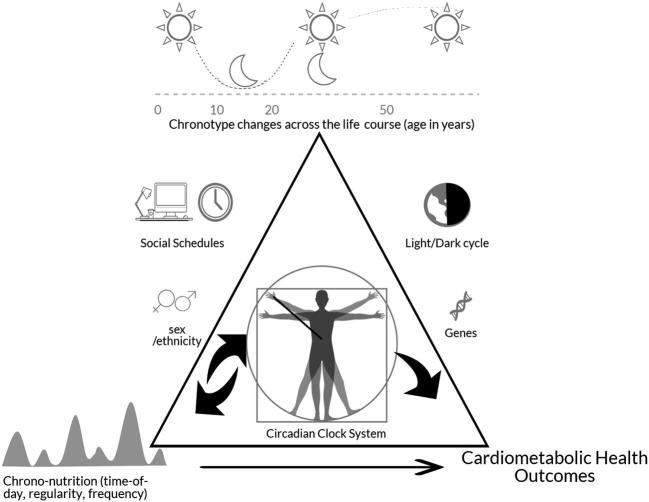
“Both genetic variations and environmental factors influence the distribution of chronotypes in a given population (24) (Figure 1).”
§ Chronotype: Implications for Epidemiologic Studies on Chrono-Nutrition and Cardiometabolic Health > Current Status of Knowledge > Determinants of chronotype
What the sources say
- Not checked yetcites [24] Wittmann, 2006, Social jetlag: misalignment of biological and social time, Chronobiol Int source
plaindirect- Asserted: passes — The authors put it forward as true.
- Checkable: passes — It can be checked against evidence.
- Load-bearing: passes — The paper’s conclusions depend on it.
- Based: passes — The paper gives a reason why it holds.
None of the sources cited for this claim have been checked yet.
In the paper
“Such genetic variants may underlie some of the interindividual (44) and interethnic differences (45) in the period (or τ) of the endogenous circadian cycle that manifest themselves as differences in chronotype.”
§ Chronotype: Implications for Epidemiologic Studies on Chrono-Nutrition and Cardiometabolic Health > Current Status of Knowledge > Determinants of chronotype
What the sources say
hedgedconditional- Asserted: passes — The authors put it forward as true.
- Checkable: passes — It can be checked against evidence.
- Load-bearing: unclear — It is unclear whether the paper’s conclusions depend on it.
- Based: passes — The paper gives a reason why it holds.
None of the sources cited for this claim have been checked yet.
In the paper
“Overall, the MCTQ provides the advantage of collecting detailed information on sleep-wake behavior that allows for the assessment of phenomena such as social jet lag (difference in mid-sleep timing between school and work days and school- and work-free days) (24, 33).”
§ Chronotype: Implications for Epidemiologic Studies on Chrono-Nutrition and Cardiometabolic Health > Current Status of Knowledge
What the sources say
plaindirect- Asserted: passes — The authors put it forward as true.
- Checkable: passes — It can be checked against evidence.
- Load-bearing: unclear — It is unclear whether the paper’s conclusions depend on it.
- Based: passes — The paper gives a reason why it holds.
In the paper
“Children who drank milk at breakfast more than once a week and who ate breakfast 4 times/wk were more likely to shift from an evening to a morning chronotype (99).”
§ Chronotype: Implications for Epidemiologic Studies on Chrono-Nutrition and Cardiometabolic Health > Current Status of Knowledge > Chronotype: associations with food and nutrient intake across the life course
What the sources say
- Not checked yetcites [99] Kawada, 2016, Questionnaire and intervention study on effects of drinking cows' milk at breakfast on the circadian typology and mental health of Japanese infants aged 1 - 6 years, Nat Sci
hedgedcorrelational- Asserted: passes — The authors put it forward as true.
- Checkable: passes — It can be checked against evidence.
- Load-bearing: unclear — It is unclear whether the paper’s conclusions depend on it.
- Based: passes — The paper gives a reason why it holds.
In the paper
“In another study, individuals with an evening chronotype likewise had inadequate intakes of several minerals and vitamins including calcium, magnesium, zinc, and vitamin D, riboflavin, and vitamin B-6 (82).”
§ Chronotype: Implications for Epidemiologic Studies on Chrono-Nutrition and Cardiometabolic Health > Current Status of Knowledge > Chronotype: associations with food and nutrient intake across the life course
What the sources say
- Not checked yetcites [82] Sato-Mito, 2011, Dietary intake is associated with human chronotype as assessed by both morningness-eveningness score and preferred midpoint of sleep in young Japanese women, Int J Food Sci Nutr source
plaincorrelational- Asserted: passes — The authors put it forward as true.
- Checkable: passes — It can be checked against evidence.
- Load-bearing: unclear — It is unclear whether the paper’s conclusions depend on it.
- Based: passes — The paper gives a reason why it holds.
In the paper
“Accordingly, in a sample of the general population in Switzerland and Germany, it was observed that individuals with an evening chronotype accumulate sleep debt during the work week, which they compensate for by sleeping longer on weekends (66).”
§ Chronotype: Implications for Epidemiologic Studies on Chrono-Nutrition and Cardiometabolic Health > Current Status of Knowledge > Determinants of chronotype
What the sources say
- Not checked yetcites [66] Roenneberg, 2003, Life between clocks: daily temporal patterns of human chronotypes, J Biol Rhythms source
plaindirect- Asserted: passes — The authors put it forward as true.
- Checkable: passes — It can be checked against evidence.
- Load-bearing: unclear — It is unclear whether the paper’s conclusions depend on it.
- Based: passes — The paper gives a reason why it holds.
None of the sources cited for this claim have been checked yet.
In the paper
“This irregularity in timing of eating based on an individual's chronotype has also been reported in relation to timing of lunch (76, 81).”
§ Chronotype: Implications for Epidemiologic Studies on Chrono-Nutrition and Cardiometabolic Health > Current Status of Knowledge > Chronotype: associations with food and nutrient intake across the life course
What the sources say
- Not checked yetcites [76] Silva, 2016, Chronotype, social jetlag and sleep debt are associated with dietary intake among Brazilian undergraduate students, Chronobiol Int source
- Not checked yetcites [81] Sato-Mito, 2011, The midpoint of sleep is associated with dietary intake and dietary behavior among young Japanese women, Sleep Med source
plaincorrelational- Asserted: passes — The authors put it forward as true.
- Checkable: passes — It can be checked against evidence.
- Load-bearing: unclear — It is unclear whether the paper’s conclusions depend on it.
- Based: passes — The paper gives a reason why it holds.
None of the sources cited for this claim have been checked yet.
In the paper
“Several other studies have reported cross-sectional associations between an evening chronotype and higher consumption of stimulants such as caffeine, energy drinks, sugar-sweetened beverages, and alcohol in adolescents (24) and in college or university students (49, 78, 79, 84).”
§ Chronotype: Implications for Epidemiologic Studies on Chrono-Nutrition and Cardiometabolic Health > Current Status of Knowledge > Chronotype: associations with food and nutrient intake across the life course
What the sources say
- Not checked yetcites [24] Wittmann, 2006, Social jetlag: misalignment of biological and social time, Chronobiol Int source
- Not checked yetcites [49] Leonhard, 2009, In sync with the family: children and partners influence the sleep-wake circadian rhythm and social habits of women, Chronobiol Int source
- Not checked yetcites [78] Tran, 2014, Daytime sleepiness, circadian preference, caffeine consumption and use of other stimulants among Thai college students, J Public Health Epidemiol source
plaincorrelational- Asserted: passes — The authors put it forward as true.
- Checkable: passes — It can be checked against evidence.
- Load-bearing: unclear — It is unclear whether the paper’s conclusions depend on it.
- Based: passes — The paper gives a reason why it holds.
None of the sources cited for this claim have been checked yet.
In the paper
“Besides dietary intake, studies suggest that individuals with a morning chronotype exhibit more regular eating behavior than individuals with an evening chronotype (83, 85).”
§ Chronotype: Implications for Epidemiologic Studies on Chrono-Nutrition and Cardiometabolic Health > Current Status of Knowledge > Chronotype: associations with food and nutrient intake across the life course
What the sources say
hedgedcorrelational- Asserted: passes — The authors put it forward as true.
- Checkable: passes — It can be checked against evidence.
- Load-bearing: unclear — It is unclear whether the paper’s conclusions depend on it.
- Based: passes — The paper gives a reason why it holds.
In the paper
“Considering that dietary habits persist from adolescence into adulthood (101), and that cardiometabolic disease risk factors are often formed in childhood and adolescence (102), understanding how chronotype influences diet quality and eating patterns in childhood and adolescence is essential in guiding the development of dietary strategies to prevent chronic disease development.”
§ Chronotype: Implications for Epidemiologic Studies on Chrono-Nutrition and Cardiometabolic Health > Current Status of Knowledge > Chronotype: associations with food and nutrient intake across the life course
What the sources say
- Not checked yetcites [102] Matthews, 2016, Sleep characteristics and cardiovascular risk in children and adolescents: an enumerative review, Sleep Med source
plain- Asserted: passes — The authors put it forward as true.
- Checkable: passes — It can be checked against evidence.
- Load-bearing: passes — The paper’s conclusions depend on it.
- Based: passes — The paper gives a reason why it holds.
In the paper
“Considering that dietary habits persist from adolescence into adulthood (101), and that cardiometabolic disease risk factors are often formed in childhood and adolescence (102), understanding how chronotype influences diet quality and eating patterns in childhood and adolescence is essential in guiding the development of dietary strategies to prevent chronic disease development.”
§ Chronotype: Implications for Epidemiologic Studies on Chrono-Nutrition and Cardiometabolic Health > Current Status of Knowledge > Chronotype: associations with food and nutrient intake across the life course
What the sources say
- Not checked yetcites [101] Leech, 2014, The clustering of diet, physical activity and sedentary behavior in children and adolescents: a review, Int J Behav Nutr Phys Act source
plaincorrelational- Asserted: passes — The authors put it forward as true.
- Checkable: passes — It can be checked against evidence.
- Load-bearing: passes — The paper’s conclusions depend on it.
- Based: passes — The paper gives a reason why it holds.
In the paper
“However, in the latter study, the circadian typology was only assessed via a subjective questionnaire with no objective biological measures such as DLMO.”
§ Chronotype: Implications for Epidemiologic Studies on Chrono-Nutrition and Cardiometabolic Health > Current Status of Knowledge > Chronotype: associations with food and nutrient intake across the life course
What the sources say
- Not checked yetcites [99] Kawada, 2016, Questionnaire and intervention study on effects of drinking cows' milk at breakfast on the circadian typology and mental health of Japanese infants aged 1 - 6 years, Nat Sci
plainn = 111- Asserted: passes — The authors put it forward as true.
- Checkable: passes — It can be checked against evidence.
- Load-bearing: passes — The paper’s conclusions depend on it.
- Based: passes — The paper gives a reason why it holds.
In the paper
“More recently, Diederichs et al. (100) defined the term “eveningness in energy intake” and found that it was associated with greater total energy intake over the day in the Dortmund Nutritional and Anthropometric Longitudinally Designed (DONALD) study and may be potentially linked to the shift in chronotype between childhood and adolescence.”
§ Chronotype: Implications for Epidemiologic Studies on Chrono-Nutrition and Cardiometabolic Health > Current Status of Knowledge > Chronotype: associations with food and nutrient intake across the life course
What the sources say
- Not checked yetcites [100] Diederichs, 2018, In adolescence a higher ‘eveningness in ene rgy intake' is associated with higher total daily energy intake, Appetite source
plaincorrelational- Asserted: passes — The authors put it forward as true.
- Checkable: passes — It can be checked against evidence.
- Load-bearing: unclear — It is unclear whether the paper’s conclusions depend on it.
- Based: passes — The paper gives a reason why it holds.
In the paper
“Strokes, for instance, follow a circadian rhythm with a major morning peak and a secondary early evening peak.”
§ Chronotype: Implications for Epidemiologic Studies on Chrono-Nutrition and Cardiometabolic Health > Current Status of Knowledge > Chronotype and cardiovascular diseases
What the sources say
- Not checked yetcites [116] Manfredini, 2005, Circadian variation in stroke onset: identical temporal pattern in ischemic and hemorrhagic events, Chronobiol Int source
plaincorrelational- Asserted: passes — The authors put it forward as true.
- Checkable: passes — It can be checked against evidence.
- Load-bearing: unclear — It is unclear whether the paper’s conclusions depend on it.
- Based: passes — The paper gives a reason why it holds.
In the paper
“An adverse impact of time transitions on sleep has also been reported in adolescents with an evening chronotype (115).”
§ Chronotype: Implications for Epidemiologic Studies on Chrono-Nutrition and Cardiometabolic Health > Current Status of Knowledge > Chronotype and cardiovascular diseases
What the sources say
- Not checked yetcites [115] Schneider, 2009, Daytime sleepiness during transition into daylight saving time in adolescents: are owls higher at risk?, Sleep Med source
plaindirect- Asserted: passes — The authors put it forward as true.
- Checkable: passes — It can be checked against evidence.
- Load-bearing: unclear — It is unclear whether the paper’s conclusions depend on it.
- Based: passes — The paper gives a reason why it holds.
In the paper
“It is known that cerebrovascular and cardiovascular events exhibit a bimodal pattern (116).”
§ Chronotype: Implications for Epidemiologic Studies on Chrono-Nutrition and Cardiometabolic Health > Current Status of Knowledge > Chronotype and cardiovascular diseases
What the sources say
- Not checked yetcites [116] Manfredini, 2005, Circadian variation in stroke onset: identical temporal pattern in ischemic and hemorrhagic events, Chronobiol Int source
boosted- Asserted: passes — The authors put it forward as true.
- Checkable: passes — It can be checked against evidence.
- Load-bearing: passes — The paper’s conclusions depend on it.
- Based: passes — The paper gives a reason why it holds.
In the paper
“This is particularly true considering that irregularity of meal patterns has been identified as a novel risk factor for cardiometabolic disorders (103).”
§ Chronotype: Implications for Epidemiologic Studies on Chrono-Nutrition and Cardiometabolic Health > Current Status of Knowledge > Chronotype: associations with food and nutrient intake across the life course
What the sources say
- Not checked yetcites [103] Pot, 2016, Meal irregularity and cardiometabolic consequences: results from observational and intervention studies, Proc Nutr Soc source
plaincorrelational- Asserted: passes — The authors put it forward as true.
- Checkable: passes — It can be checked against evidence.
- Load-bearing: passes — The paper’s conclusions depend on it.
- Based: passes — The paper gives a reason why it holds.
In the paper
“For instance, data from the German MONICA/KORA Myocardial Infarction Registry indicated that specific high-risk subgroups of the population, particularly men, experience a higher risk of acute myocardial infarction during transitions to and from daylight saving time (114).”
§ Chronotype: Implications for Epidemiologic Studies on Chrono-Nutrition and Cardiometabolic Health > Current Status of Knowledge > Chronotype and cardiovascular diseases
What the sources say
- Not checked yetcites [114] Kirchberger, 2015, Are daylight saving time transitions associated with changes in myocardial infarction incidence? Results from the German MONICA/KORA Myocardial Infarction Registry, BMC Public Health source
hedgedcorrelational- Asserted: passes — The authors put it forward as true.
- Checkable: passes — It can be checked against evidence.
- Load-bearing: unclear — It is unclear whether the paper’s conclusions depend on it.
- Based: passes — The paper gives a reason why it holds.
In the paper
“Comparable with findings in adolescents and young adults, data from the UK Biobank project demonstrate that adults with a morning chronotype consume a mean of 0.25 more servings of fruit and 0.13 more servings of vegetables/d, as assessed through the use of 24-h recalls, than do adults with an evening chronotype (75).”
§ Chronotype: Implications for Epidemiologic Studies on Chrono-Nutrition and Cardiometabolic Health > Current Status of Knowledge > Chronotype: associations with food and nutrient intake across the life course
What the sources say
- Not checked yetcites [75] Patterson, 2016, Smoking, screen-based sedentary behavior, and diet associated with habitual sleep duration and chronotype: data from the UK Biobank, Ann Behav Med source
boostedcorrelational- Asserted: passes — The authors put it forward as true.
- Checkable: passes — It can be checked against evidence.
- Load-bearing: unclear — It is unclear whether the paper’s conclusions depend on it.
- Based: passes — The paper gives a reason why it holds.
In the paper
“This circadian rhythmicity of glucose metabolism arises as a consequence of changes in glucose utilization, insulin sensitivity, and insulin secretion based on the time of day (119).”
§ Chronotype: Implications for Epidemiologic Studies on Chrono-Nutrition and Cardiometabolic Health > Current Status of Knowledge > Chronotype, glucose metabolism, and type 2 diabetes
What the sources say
- Not checked yetcites [119] Van Cauter, 1997, Roles of circadian rhythmicity and sleep in human glucose regulation 1, Endocr Rev
plaindirect- Asserted: passes — The authors put it forward as true.
- Checkable: passes — It can be checked against evidence.
- Load-bearing: passes — The paper’s conclusions depend on it.
- Based: passes — The paper gives a reason why it holds.
In the paper
“Severe circadian misalignment has long been recognized to be a risk factor for the development of cardiovascular diseases (108).”
§ Chronotype: Implications for Epidemiologic Studies on Chrono-Nutrition and Cardiometabolic Health > Current Status of Knowledge > Chronotype and cardiovascular diseases
What the sources say
- Not checked yetcites [108] Baron, 2014, Circadian misalignment and health, Int Rev Psychiatry source
boosteddirect- Asserted: passes — The authors put it forward as true.
- Checkable: passes — It can be checked against evidence.
- Load-bearing: unclear — It is unclear whether the paper’s conclusions depend on it.
- Based: passes — The paper gives a reason why it holds.
In the paper
“In humans, glucose tolerance generally declines over the course of the day, reaching a nadir in the evening.”
§ Chronotype: Implications for Epidemiologic Studies on Chrono-Nutrition and Cardiometabolic Health > Current Status of Knowledge > Chronotype, glucose metabolism, and type 2 diabetes
What the sources say
- Not checked yetcites [119] Van Cauter, 1997, Roles of circadian rhythmicity and sleep in human glucose regulation 1, Endocr Rev
plaindirect- Asserted: passes — The authors put it forward as true.
- Checkable: passes — It can be checked against evidence.
- Load-bearing: passes — The paper’s conclusions depend on it.
- Based: passes — The paper gives a reason why it holds.
None of the sources cited for this claim have been checked yet.
In the paper
“More recent research findings suggest that mild circadian misalignment, experienced as minor shifts between the sleep-awake cycle in non–shift workers, is also detrimental to health (50, 113).”
§ Chronotype: Implications for Epidemiologic Studies on Chrono-Nutrition and Cardiometabolic Health > Current Status of Knowledge > Chronotype and cardiovascular diseases
What the sources say
- Not checked yetcites [50] Roenneberg, 2012, Social jetlag and obesity, Curr Biol source
- Not checked yetcites [113] Roenneberg, 2013, Light and the human circadian clock
hedgeddirect- Asserted: passes — The authors put it forward as true.
- Checkable: passes — It can be checked against evidence.
- Load-bearing: passes — The paper’s conclusions depend on it.
- Based: passes — The paper gives a reason why it holds.
In the paper
“These associations occurred independently of sleep duration and sufficiency (13).”
§ Chronotype: Implications for Epidemiologic Studies on Chrono-Nutrition and Cardiometabolic Health > Current Status of Knowledge > Chronotype and cardiovascular diseases
What the sources say
- Not checked yetcites [13] Merikanto, 2013, Associations of chronotype and sleep with cardiovascular diseases and type 2 diabetes, Chronobiol Int source
plaincorrelationaln = 6,258- Asserted: passes — The authors put it forward as true.
- Checkable: passes — It can be checked against evidence.
- Load-bearing: passes — The paper’s conclusions depend on it.
- Based: passes — The paper gives a reason why it holds.
In the paper
“Most of this evidence is derived from studies on different models of shift work, which found that shift workers working during their circadian night are more likely to develop metabolic disturbances (109).”
§ Chronotype: Implications for Epidemiologic Studies on Chrono-Nutrition and Cardiometabolic Health > Current Status of Knowledge > Chronotype and cardiovascular diseases
What the sources say
- Not checked yetcites [109] Canuto, 2013, Metabolic syndrome and shift work: a systematic review, Sleep Med Rev source
hedgedcorrelational- Asserted: passes — The authors put it forward as true.
- Checkable: passes — It can be checked against evidence.
- Load-bearing: passes — The paper’s conclusions depend on it.
- Based: passes — The paper gives a reason why it holds.
In the paper
“By contrast, in the evening, evening types reported higher intakes of energy, sucrose, fat, and saturated fatty acids than did morning types.”
§ Chronotype: Implications for Epidemiologic Studies on Chrono-Nutrition and Cardiometabolic Health > Current Status of Knowledge > Chronotype: associations with food and nutrient intake across the life course
What the sources say
- Not checked yetcites [72] Mirkka, 2017, Chronotype differences in timing of energy and macronutrient intakes: a population‐based study in adults, Obesity source
plaincorrelational- Asserted: passes — The authors put it forward as true.
- Checkable: passes — It can be checked against evidence.
- Load-bearing: unclear — It is unclear whether the paper’s conclusions depend on it.
- Based: passes — The paper gives a reason why it holds.
In the paper
“A recent meta-analysis of 12 observational studies found that among different types of shift work, rotating shift work is associated with increased risk of type 2 diabetes (123).”
§ Chronotype: Implications for Epidemiologic Studies on Chrono-Nutrition and Cardiometabolic Health > Current Status of Knowledge > Chronotype, glucose metabolism, and type 2 diabetes
What the sources say
- Not checked yetcites [123] Gan, 2015, Shift work and diabetes mellitus: a meta-analysis of observational studies, Occup Environ Med source
plaincorrelational- Asserted: passes — The authors put it forward as true.
- Checkable: passes — It can be checked against evidence.
- Load-bearing: unclear — It is unclear whether the paper’s conclusions depend on it.
- Based: passes — The paper gives a reason why it holds.
In the paper
“Evening chronotype has also been related to lower HDL-cholesterol concentrations (118).”
§ Chronotype: Implications for Epidemiologic Studies on Chrono-Nutrition and Cardiometabolic Health > Current Status of Knowledge > Chronotype and cardiovascular diseases
What the sources say
- Not checked yetcites [118] Wong, 2015, Social jetlag, chronotype, and cardiometabolic risk, J Clin Endocrinol Metab source
plaincorrelational- Asserted: passes — The authors put it forward as true.
- Checkable: passes — It can be checked against evidence.
- Load-bearing: unclear — It is unclear whether the paper’s conclusions depend on it.
- Based: passes — The paper gives a reason why it holds.
In the paper
“a recent study in Finland investigating the relation between chronotype and chrono-nutrition found that evening types reported lower energy and macronutrient intakes in the morning compared with morning types according to data collected through the use of 48-h food recalls (72).”
§ Chronotype: Implications for Epidemiologic Studies on Chrono-Nutrition and Cardiometabolic Health > Current Status of Knowledge > Chronotype: associations with food and nutrient intake across the life course
What the sources say
- Not checked yetcites [72] Mirkka, 2017, Chronotype differences in timing of energy and macronutrient intakes: a population‐based study in adults, Obesity source
plaincorrelational- Asserted: passes — The authors put it forward as true.
- Checkable: passes — It can be checked against evidence.
- Load-bearing: unclear — It is unclear whether the paper’s conclusions depend on it.
- Based: passes — The paper gives a reason why it holds.
A conclusion the paper draws from its own results — it cites no other source for it, so there is none to check. The quote shows it is in the paper.
In the paper
“Taken together, this evidence implies that chronotype may modulate physiologic processes linked to cardiovascular health, including heart rate, blood pressure, and blood lipid concentrations.”
§ Chronotype: Implications for Epidemiologic Studies on Chrono-Nutrition and Cardiometabolic Health > Current Status of Knowledge > Chronotype and cardiovascular diseases
hedgedconditional- Asserted: passes — The authors put it forward as true.
- Checkable: passes — It can be checked against evidence.
- Load-bearing: passes — The paper’s conclusions depend on it.
- Based: passes — The paper gives a reason why it holds.
None of the sources cited for this claim have been checked yet.
In the paper
“Inverse associations between later bedtime, wake time, or midpoint of sleep and time spent in moderate-to-vigorous physical activity or sedentary behavior have been noted in other studies (73, 105).”
§ Chronotype: Implications for Epidemiologic Studies on Chrono-Nutrition and Cardiometabolic Health > Current Status of Knowledge > Chronotype: associations with food and nutrient intake across the life course
What the sources say
plaincorrelational- Asserted: passes — The authors put it forward as true.
- Checkable: passes — It can be checked against evidence.
- Load-bearing: unclear — It is unclear whether the paper’s conclusions depend on it.
- Based: passes — The paper gives a reason why it holds.
What the paper did — it cites no source for this, so there is none to check. The quote shows it is in the paper.
In the paper
“Studies were also limited by the unrepresentativeness of the samples, mainly due to the small sample size, by selection bias, and by other inherent biases of observational studies.”
§ Chronotype: Implications for Epidemiologic Studies on Chrono-Nutrition and Cardiometabolic Health > Recommendations
plain- Asserted: passes — The authors put it forward as true.
- Checkable: passes — It can be checked against evidence.
- Load-bearing: passes — The paper’s conclusions depend on it.
- Based: passes — The paper gives a reason why it holds.
A conclusion the paper draws from its own results — it cites no other source for it, so there is none to check. The quote shows it is in the paper.
In the paper
“A limited number of observational studies also demonstrate that evening chronotype is potentially related to changes in timing of food intake, irregular eating, and meal skipping, particularly breakfast skipping.”
§ Chronotype: Implications for Epidemiologic Studies on Chrono-Nutrition and Cardiometabolic Health > Conclusions
hedgedcorrelational- Asserted: passes — The authors put it forward as true.
- Checkable: passes — It can be checked against evidence.
- Load-bearing: passes — The paper’s conclusions depend on it.
- Based: passes — The paper gives a reason why it holds.
What the paper did — it cites no source for this, so there is none to check. The quote shows it is in the paper.
In the paper
“A similar point emerges in epidemiologic evidence, wherein most of the evidence of the association between chronotype and diet, or chronotype and cardiometabolic health, is based on cross-sectional studies that do not permit identification of cause and effect or temporality of associations.”
§ Chronotype: Implications for Epidemiologic Studies on Chrono-Nutrition and Cardiometabolic Health > Recommendations
plaincorrelational- Asserted: passes — The authors put it forward as true.
- Checkable: passes — It can be checked against evidence.
- Load-bearing: passes — The paper’s conclusions depend on it.
- Based: passes — The paper gives a reason why it holds.
What the paper did — it cites no source for this, so there is none to check. The quote shows it is in the paper.
In the paper
“This is not to mention the limited evidence in specific population subgroups such as infants, older adults, and those at risk of developing cardiovascular diseases or type 2 diabetes.”
§ Chronotype: Implications for Epidemiologic Studies on Chrono-Nutrition and Cardiometabolic Health > Recommendations
plain- Asserted: passes — The authors put it forward as true.
- Checkable: passes — It can be checked against evidence.
- Load-bearing: passes — The paper’s conclusions depend on it.
- Based: passes — The paper gives a reason why it holds.
In the paper
“In one particular study, circadian misalignment led some subjects to exhibit postprandial glucose responses akin to the range observed in prediabetes (111).”
§ Chronotype: Implications for Epidemiologic Studies on Chrono-Nutrition and Cardiometabolic Health > Current Status of Knowledge > Chronotype, glucose metabolism, and type 2 diabetes
What the sources say
- Not checked yetcites [111] Scheer, 2009, Adverse metabolic and cardiovascular consequences of circadian misalignment, Proc Natl Acad Sci USA source
plaindirect- Asserted: passes — The authors put it forward as true.
- Checkable: passes — It can be checked against evidence.
- Load-bearing: unclear — It is unclear whether the paper’s conclusions depend on it.
- Based: passes — The paper gives a reason why it holds.
In the paper
“More recently, variants of circadian clock genes associated with chronotype and sleep homeostasis have been linked to glucose metabolism (132), potentially pointing towards the existence of an underlying network between circadian clocks, chronotype, and glucose homeostasis.”
§ Chronotype: Implications for Epidemiologic Studies on Chrono-Nutrition and Cardiometabolic Health > Current Status of Knowledge > Chronotype, glucose metabolism, and type 2 diabetes
What the sources say
- Not checked yetcites [132] Kalsbeek, 2014, Circadian control of glucose metabolism, Mol Metab source
plaincorrelational- Asserted: passes — The authors put it forward as true.
- Checkable: passes — It can be checked against evidence.
- Load-bearing: unclear — It is unclear whether the paper’s conclusions depend on it.
- Based: passes — The paper gives a reason why it holds.
In the paper
“Breakfast skipping was related to higher HbA1c values, even after adjusting for age, sex, race, BMI, number of diabetes complications, insulin use, depressive symptoms, perceived sleep debt, and percentage of daily caloric intake at dinner.”
§ Chronotype: Implications for Epidemiologic Studies on Chrono-Nutrition and Cardiometabolic Health > Current Status of Knowledge > Chronotype, glucose metabolism, and type 2 diabetes
What the sources say
- Not checked yetcites [21] Reutrakul, 2014, The relationship between breakfast skipping, chronotype, and glycemic control in type 2 diabetes, Chronobiol Int source
plaincorrelational- Asserted: passes — The authors put it forward as true.
- Checkable: passes — It can be checked against evidence.
- Load-bearing: passes — The paper’s conclusions depend on it.
- Based: passes — The paper gives a reason why it holds.
A conclusion the paper draws from its own results — it cites no other source for it, so there is none to check. The quote shows it is in the paper.
In the paper
“Together, such findings imply that circadian misalignment may predispose individuals to the development of type 2 diabetes.”
§ Chronotype: Implications for Epidemiologic Studies on Chrono-Nutrition and Cardiometabolic Health > Current Status of Knowledge > Chronotype, glucose metabolism, and type 2 diabetes
hedgedconditional- Asserted: passes — The authors put it forward as true.
- Checkable: passes — It can be checked against evidence.
- Load-bearing: passes — The paper’s conclusions depend on it.
- Based: passes — The paper gives a reason why it holds.
What the paper did — it cites no source for this, so there is none to check. The quote shows it is in the paper.
In the paper
“A further limitation is that none of the studies cited herein assessed the context within which foods are consumed at different time points, to identify if there are associations between the socioenvironmental factors and consumption of specific nutrients at a given eating occasion.”
§ Chronotype: Implications for Epidemiologic Studies on Chrono-Nutrition and Cardiometabolic Health > Recommendations
plain- Asserted: passes — The authors put it forward as true.
- Checkable: passes — It can be checked against evidence.
- Load-bearing: passes — The paper’s conclusions depend on it.
- Based: passes — The paper gives a reason why it holds.
In the paper
“Indeed, in the FINRISK 2007 study, individuals with an evening chronotype had 2.5-fold greater odds of type 2 diabetes than individuals with a morning chronotype (13).”
§ Chronotype: Implications for Epidemiologic Studies on Chrono-Nutrition and Cardiometabolic Health > Current Status of Knowledge > Chronotype, glucose metabolism, and type 2 diabetes
What the sources say
- Not checked yetcites [13] Merikanto, 2013, Associations of chronotype and sleep with cardiovascular diseases and type 2 diabetes, Chronobiol Int source
plaincorrelational- Asserted: passes — The authors put it forward as true.
- Checkable: passes — It can be checked against evidence.
- Load-bearing: unclear — It is unclear whether the paper’s conclusions depend on it.
- Based: passes — The paper gives a reason why it holds.
- It may state two separate claims as one. 55
- Probably not a substantial claim. 15
The cited sources support only part of this claim — read each source’s verdict below.
In the paper
“In particular, research indicates that individuals presenting with an evening chronotype have a tendency towards consuming fewer and larger meals and delaying food intake due to later awakening time (19, 22).”
§ Chronotype: Implications for Epidemiologic Studies on Chrono-Nutrition and Cardiometabolic Health > Introduction
What the sources say
- Not checked yetcites [19] Meule, 2012, Skipping breakfast: morningness-eveningness preference is differentially related to state and trait food cravings, Eat Weight Disord
- Partly supportedcites [22] Dashti, 2015, Short sleep duration and dietary intake: epidemiological evidence, mechanisms, and health implications, Adv Nutr sourceExperimental — accuracy not yet measured
The “Altered time of intake” section reports that late-night eating is common among short sleepers because they are awake at altered times. It does not establish this pattern for people with an evening chronotype, or say that they eat fewer, larger meals or delay eating because they wake later. (LLM, conf=0.85)
hedgeddirect- Asserted: passes — The authors put it forward as true.
- Checkable: passes — It can be checked against evidence.
- Load-bearing: passes — The paper’s conclusions depend on it.
- Based: passes — The paper gives a reason why it holds.
It may state two separate claims as one.
The sources with a verdict support this claim; the rest weren’t checked yet, have no full text we could read, or their verdicts aren’t rated yet.
In the paper
“Food is often referred to as a zeitgeber (14) because of its ability to regulate various peripheral body clocks and metabolic rhythms (2, 15, 16).”
§ Chronotype: Implications for Epidemiologic Studies on Chrono-Nutrition and Cardiometabolic Health > Introduction
What the sources say
- Not checked yetcites [14] Stephan, 2002, The “other” circadian system: food as a Zeitgeber, J Biol Rhythms source
- Supportedcites [2] Johnston, 2016, Circadian rhythms, metabolism, and chrononutrition in rodents and humans, Adv Nutr source
The citation to this source is attached to the description of food as a zeitgeber. In the Introduction to the Mammalian Circadian System (pp. 1–3), the paper defines zeitgebers as factors that synchronize clocks and describes feed–fast behavior as a key synchronizer of peripheral clocks. Its Effects of Meal Timing section also reports that timed feeding regulates clock-gene rhythms in most peripheral tissues. (LLM, conf=0.91)
- Supportedcites [15] Wehrens, 2017, Meal timing regulates the human circadian system, Curr Biol source
The citation to this paper is attached to food’s ability to regulate peripheral clocks and metabolic rhythms, not to the term “zeitgeber.” The Discussion reports that later meals delayed a peripheral clock-gene rhythm in white adipose tissue and a plasma glucose rhythm; it also notes that the effects varied across rhythms. (LLM, conf=0.87)
- Not checked yetcites [16] Oike, 2017, Modulation of circadian clocks by nutrients and food factors, Biosci Biotechnol Biochem source
plaindirect- Asserted: passes — The authors put it forward as true.
- Checkable: passes — It can be checked against evidence.
- Load-bearing: fails — The paper’s conclusions may not depend on it.
- Based: passes — The paper gives a reason why it holds.
Probably not a substantial claim. The paper’s conclusions may not depend on it. It may state two separate claims as one.
The cited sources support only part of this claim — read each source’s verdict below.
In the paper
“For instance, in a representative sample in Italy of 6631 adolescents aged 14–18 y, eveningness was associated with later bedtime and wake-up time (especially on weekends), shorter time in bed during the week, longer time in bed at the weekend, irregular sleep-wake schedule, and more frequent napping during school days (70).”
§ Chronotype: Implications for Epidemiologic Studies on Chrono-Nutrition and Cardiometabolic Health > Current Status of Knowledge > Determinants of chronotype
What the sources say
- Partly supportedcites [70] Giannotti, 2002, Circadian preference, sleep and daytime behaviour in adolescence, J Sleep Res sourceExperimental — accuracy not yet measured
The Subjects section describes a representative sample of Italian public high-school students, and Sleep habits and Discussion report later bedtimes and rising times, less sleep on school nights, extended weekend sleep, irregular schedules, and more weekday napping among evening types. The Discussion gives the sample size only as “over 6600,” not the claimed exact figure of 6631; Data analysis gives an age range of 14.1–18.6 years. (LLM, conf=0.85)
plaincorrelational- Asserted: passes — The authors put it forward as true.
- Checkable: passes — It can be checked against evidence.
- Load-bearing: unclear — It is unclear whether the paper’s conclusions depend on it.
- Based: passes — The paper gives a reason why it holds.
It may state two separate claims as one.
- Partly supported
The sources with a verdict support this claim; the rest weren’t checked yet, have no full text we could read, or their verdicts aren’t rated yet.
In the paper
“Different forms of shift work are reported to induce multiple forms of circadian misalignment, which are believed to underlie the observed raised postprandial glucose (120) and insulin concentrations in shift workers (121), as well as the increased risk of impaired glucose tolerance (122) and type 2 diabetes observed in epidemiologic studies (81).”
§ Chronotype: Implications for Epidemiologic Studies on Chrono-Nutrition and Cardiometabolic Health > Current Status of Knowledge > Chronotype, glucose metabolism, and type 2 diabetes
What the sources say
- Not checked yetcites [120] Hampton, 1996, Postprandial hormone and metabolic responses in simulated shift work, J Endocrinol source
- Supportedcites [121] Lund, 2001, Postprandial hormone and metabolic responses amongst shift workers in Antarctica, J Endocrinol source
Split into 2 atoms — 2 confirmed, 0 partially supported, 0 disputed, 0 misattributed, 0 unverifiable. Expand the claim to see per-atom verdicts.
- Not checked yetcites [122] Suwazono, 2009, Shiftwork and impaired glucose metabolism: a 14-year cohort study on 7104 male workers, Chronobiol Int source
hedgedconditional- Asserted: passes — The authors put it forward as true.
- Checkable: passes — It can be checked against evidence.
- Load-bearing: passes — The paper’s conclusions depend on it.
- Based: passes — The paper gives a reason why it holds.
It may state two separate claims as one.
The paper states this without a source or data behind it here, so there is nothing to check it against. The quote shows it is in the paper.
In the paper
“Whether chronotype modifies the association between diet and cardiometabolic health outcomes remains to be elucidated.”
§ Chronotype: Implications for Epidemiologic Studies on Chrono-Nutrition and Cardiometabolic Health > Abstract
hedged- Asserted: passes — The authors put it forward as true.
- Checkable: passes — It can be checked against evidence.
- Load-bearing: passes — The paper’s conclusions depend on it.
- Based: passes — The paper gives a reason why it holds.
Probably not a substantial claim.
The paper states this without a source or data behind it here, so there is nothing to check it against. The quote shows it is in the paper.
In the paper
“Moreover, most of the evidence in adolescents and adults was restricted to cross-sectional surveys with few longitudinal cohorts simultaneously collecting data on chronotype and dietary intake.”
§ Chronotype: Implications for Epidemiologic Studies on Chrono-Nutrition and Cardiometabolic Health > Abstract
plain- Asserted: passes — The authors put it forward as true.
- Checkable: passes — It can be checked against evidence.
- Load-bearing: passes — The paper’s conclusions depend on it.
- Based: passes — The paper gives a reason why it holds.
It may state two separate claims as one.
None of the sources cited for this claim have been checked yet.
In the paper
“In addition to country-specific differences, variations in chronotype between urban and rural areas within the same country have been observed in Japanese adolescents (53, 59, 60) and in adults in Brazil, India, and elsewhere (61–63).”
§ Chronotype: Implications for Epidemiologic Studies on Chrono-Nutrition and Cardiometabolic Health > Current Status of Knowledge > Determinants of chronotype
What the sources say
- Not checked yetcites [53] Takeuchi, 2001, Parental enforcement of bedtime during childhood modulates preference of Japanese junior high school students for eveningness chronotype, Chronobiol Int source
- Not checked yetcites [59] Louzada, 2003, Predissociated dimers and molten globule monomers in the equilibrium unfolding of yeast glutathione reductase, Biophys J source
- Not checked yetcites [60] Louzada, 2004, Exposure to light versus way of life: effects on sleep patterns of a teenager—case report, Chronobiol Int source
- Not checked yetcites [61] von Schantz, 2015, Distribution and heritability of diurnal preference (chronotype) in a rural Brazilian family-based cohort, the Baependi study, Sci Rep source
- Not checked yetcites [62] Nag, 2012, Impact of lifestyle on circadian orientation and sleep behaviour, Sleep Biol Rhythms source
- Not checked yetcites [63] Evans, 2011, Habitual sleep/wake patterns in the Old Order Amish: heritability and association with non-genetic factors, Sleep source
plaincorrelational- Asserted: passes — The authors put it forward as true.
- Checkable: passes — It can be checked against evidence.
- Load-bearing: unclear — It is unclear whether the paper’s conclusions depend on it.
- Based: passes — The paper gives a reason why it holds.
It may state two separate claims as one.
None of the sources cited for this claim have been checked yet.
In the paper
“Some studies (48, 49) but not others (9, 24) found a greater prevalence of eveningness in men compared with women, who exhibit greater morningness.”
§ Chronotype: Implications for Epidemiologic Studies on Chrono-Nutrition and Cardiometabolic Health > Current Status of Knowledge > Determinants of chronotype
What the sources say
- Not checked yetcites [48] Lehnkering, 2007, Influence of chronotype, season, and sex of subject on sleep behavior of young adults, Chronobiol Int source
- Not checked yetcites [49] Leonhard, 2009, In sync with the family: children and partners influence the sleep-wake circadian rhythm and social habits of women, Chronobiol Int source
- Not checked yetcites [9] Levandovski, 2013, Chronotype: a review of the advances, limits and applicability of the main instruments used in the literature to assess human phenotype, Trends Psychiatry Psychother source
- Not checked yetcites [24] Wittmann, 2006, Social jetlag: misalignment of biological and social time, Chronobiol Int source
plaincorrelational- Asserted: passes — The authors put it forward as true.
- Checkable: passes — It can be checked against evidence.
- Load-bearing: unclear — It is unclear whether the paper’s conclusions depend on it.
- Based: passes — The paper gives a reason why it holds.
It may state two separate claims as one.
In the paper
“Most of the evidence on the impact of chronodisruption on gestational development is currently based on animal models, and few studies have investigated how variations in chronotype among mothers influence long-term offspring health in humans (87).”
§ Chronotype: Implications for Epidemiologic Studies on Chrono-Nutrition and Cardiometabolic Health > Current Status of Knowledge > Chronotype: associations with food and nutrient intake across the life course
What the sources say
- Not checked yetcites [87] Serón-Ferré, 2016, Circadian rhythms in the fetus and newborn: significance of interactions with maternal physiology and the environment
plain- Asserted: passes — The authors put it forward as true.
- Checkable: passes — It can be checked against evidence.
- Load-bearing: passes — The paper’s conclusions depend on it.
- Based: passes — The paper gives a reason why it holds.
It may state two separate claims as one.
The paper states this without a source or data behind it here, so there is nothing to check it against. The quote shows it is in the paper.
In the paper
“The literature on this topic is currently emerging and we are far from understanding the link between chronotype and diet.”
§ Chronotype: Implications for Epidemiologic Studies on Chrono-Nutrition and Cardiometabolic Health > Current Status of Knowledge > Chronotype: associations with food and nutrient intake across the life course
plaincorrelational- Asserted: passes — The authors put it forward as true.
- Checkable: passes — It can be checked against evidence.
- Load-bearing: passes — The paper’s conclusions depend on it.
- Based: passes — The paper gives a reason why it holds.
Probably not a substantial claim. It may state two separate claims as one.
None of the sources cited for this claim have been checked yet.
In the paper
“Accordingly, mounting evidence suggests a potential association between an evening chronotype and increased risk of cardiovascular disease (12, 13) and metabolic disorders including type 2 diabetes (11, 13).”
§ Chronotype: Implications for Epidemiologic Studies on Chrono-Nutrition and Cardiometabolic Health > Introduction
What the sources say
- Not checked yetcites [12] Kantermann, 2014, Changes in chronotype after stroke: a pilot study, Front Neurol
- Not checked yetcites [13] Merikanto, 2013, Associations of chronotype and sleep with cardiovascular diseases and type 2 diabetes, Chronobiol Int source
- Not checked yetcites [11] Yu, 2015, Evening chronotype is associated with metabolic disorders and body composition in middle-aged adults, J Clin Endocrinol Metab source
hedgedcorrelational- Asserted: passes — The authors put it forward as true.
- Checkable: passes — It can be checked against evidence.
- Load-bearing: passes — The paper’s conclusions depend on it.
- Based: passes — The paper gives a reason why it holds.
It may state two separate claims as one.
None of the sources cited for this claim have been checked yet.
In the paper
“The MEQ specifically measures the psychological preference for behavior but has been shown to correlate less with DLMO than measures of sleep timing obtained with the MCTQ in one study (34) but not in another (26).”
§ Chronotype: Implications for Epidemiologic Studies on Chrono-Nutrition and Cardiometabolic Health > Current Status of Knowledge
What the sources say
- Not checked yetcites [34] Kitamura, 2014, Validity of the Japanese version of the Munich ChronoType Questionnaire, Chronobiol Int source
- Not checked yetcites [26] Kantermann, 2015, Comparing the Morningness-Eveningness Questionnaire and Munich ChronoType Questionnaire to the Dim Light Melatonin Onset, J Biol Rhythms source
plaincorrelational- Asserted: passes — The authors put it forward as true.
- Checkable: passes — It can be checked against evidence.
- Load-bearing: unclear — It is unclear whether the paper’s conclusions depend on it.
- Based: passes — The paper gives a reason why it holds.
It may state two separate claims as one.
None of the sources cited for this claim have been checked yet.
In the paper
“In contrast, the use of urine samples to measure melatonin metabolites is widely reported in epidemiologic studies (27) but is limited because of the poorer urine sample resolution which affects the accuracy of measurement (28).”
§ Chronotype: Implications for Epidemiologic Studies on Chrono-Nutrition and Cardiometabolic Health > Current Status of Knowledge
What the sources say
plaindirect- Asserted: passes — The authors put it forward as true.
- Checkable: passes — It can be checked against evidence.
- Load-bearing: unclear — It is unclear whether the paper’s conclusions depend on it.
- Based: passes — The paper gives a reason why it holds.
It may state two separate claims as one.
The paper states this without a source or data behind it here, so there is nothing to check it against. The quote shows it is in the paper.
In the paper
“Environmental cues such as light, social interactions, and study/work schedules are each thought to entrain the circadian system (Figure 1).”
§ Chronotype: Implications for Epidemiologic Studies on Chrono-Nutrition and Cardiometabolic Health > Current Status of Knowledge > Determinants of chronotype
hedgedconditional- Asserted: passes — The authors put it forward as true.
- Checkable: passes — It can be checked against evidence.
- Load-bearing: fails — The paper’s conclusions may not depend on it.
- Based: passes — The paper gives a reason why it holds.
Probably not a substantial claim. The paper’s conclusions may not depend on it. It may state two separate claims as one.
None of the sources cited for this claim have been checked yet.
In the paper
“By contrast, a shift towards morningness is seen at ∼50 y of age (52), indicating that aging influences chronotype (51).”
§ Chronotype: Implications for Epidemiologic Studies on Chrono-Nutrition and Cardiometabolic Health > Current Status of Knowledge > Determinants of chronotype
What the sources say
- Not checked yetcites [52] Carrier, 1997, Sleep and morningness-eveningness in the ‘middle' years of life (20-59 y), J Sleep Res source
- Not checked yetcites [51] Jankowski, 2015, Composite Scale of Morningness: psychometric properties, validity with Munich ChronoType Questionnaire and age/sex differences in Poland, Eur Psychiatry source
hedgeddirect- Asserted: passes — The authors put it forward as true.
- Checkable: passes — It can be checked against evidence.
- Load-bearing: unclear — It is unclear whether the paper’s conclusions depend on it.
- Based: passes — The paper gives a reason why it holds.
It may state two separate claims as one.
A conclusion the paper draws from its own results — it cites no other source for it, so there is none to check. The quote shows it is in the paper.
In the paper
“For instance, it could be argued that social conditions may influence timing and duration of exposure to artificial or dim light compared with outdoor daylight, which would then entrain the circadian clock system.”
§ Chronotype: Implications for Epidemiologic Studies on Chrono-Nutrition and Cardiometabolic Health > Current Status of Knowledge > Determinants of chronotype
hedgedconditional- Asserted: passes — The authors put it forward as true.
- Checkable: passes — It can be checked against evidence.
- Load-bearing: fails — The paper’s conclusions may not depend on it.
- Based: passes — The paper gives a reason why it holds.
Probably not a substantial claim. The paper’s conclusions may not depend on it. It may state two separate claims as one.
In the paper
“This was argued to be due to the shorter τ reported previously in individuals with black ethnicity (45)”
§ Chronotype: Implications for Epidemiologic Studies on Chrono-Nutrition and Cardiometabolic Health > Current Status of Knowledge > Determinants of chronotype
What the sources say
- Not checked yetcites [45] Smith, 2009, Racial differences in the human endogenous circadian period, PLoS One source
plaindirect- Asserted: passes — The authors put it forward as true.
- Checkable: passes — It can be checked against evidence.
- Load-bearing: fails — The paper’s conclusions may not depend on it.
- Based: passes — The paper gives a reason why it holds.
Probably not a substantial claim. The paper’s conclusions may not depend on it.
In the paper
“In children, the morning chronotype is more prevalent, with a shift towards eveningness being observed during puberty (51).”
§ Chronotype: Implications for Epidemiologic Studies on Chrono-Nutrition and Cardiometabolic Health > Current Status of Knowledge > Determinants of chronotype
What the sources say
- Not checked yetcites [51] Jankowski, 2015, Composite Scale of Morningness: psychometric properties, validity with Munich ChronoType Questionnaire and age/sex differences in Poland, Eur Psychiatry source
plaincorrelational- Asserted: passes — The authors put it forward as true.
- Checkable: passes — It can be checked against evidence.
- Load-bearing: unclear — It is unclear whether the paper’s conclusions depend on it.
- Based: passes — The paper gives a reason why it holds.
It may state two separate claims as one.
In the paper
“Light is believed to be the strongest synchronizer of the master clock, and variations in the light-dark cycle across different latitudes and time zones are thought to influence the circadian system, leading to differences in chronotype across the globe (55).”
§ Chronotype: Implications for Epidemiologic Studies on Chrono-Nutrition and Cardiometabolic Health > Current Status of Knowledge > Determinants of chronotype
What the sources say
- Not checked yetcites [55] Miguel, 2014, Detecting chronotype differences associated to latitude: a comparison between Horne–Östberg and Munich Chronotype questionnaires, Ann Hum Biol source
hedgeddirect- Asserted: passes — The authors put it forward as true.
- Checkable: passes — It can be checked against evidence.
- Load-bearing: unclear — It is unclear whether the paper’s conclusions depend on it.
- Based: passes — The paper gives a reason why it holds.
It may state two separate claims as one.
None of the sources cited for this claim have been checked yet.
In the paper
“Concerning the influence of nonmodifiable determinants, rare cases of familial extreme chronotype disorders, such as advanced sleep-phase syndrome, have been described (36, 37).”
§ Chronotype: Implications for Epidemiologic Studies on Chrono-Nutrition and Cardiometabolic Health > Current Status of Knowledge > Determinants of chronotype
What the sources say
- Not checked yetcites [36] von Schantz, 2008, Phenotypic effects of genetic variability in human clock genes on circadian and sleep parameters, J Genet source
- Not checked yetcites [37] Jones, 1999, Familial advanced sleep-phase syndrome: a short-period circadian rhythm variant in humans, Nat Med source
plain- Asserted: passes — The authors put it forward as true.
- Checkable: passes — It can be checked against evidence.
- Load-bearing: fails — The paper’s conclusions may not depend on it.
- Based: passes — The paper gives a reason why it holds.
Probably not a substantial claim. The paper’s conclusions may not depend on it.
In the paper
“This may imply that having children is a more important social factor influencing a woman's chronotype compared with their partner (49), and potentially an effect modifier that needs to be considered in the analysis of nutritional surveys or cohorts.”
§ Chronotype: Implications for Epidemiologic Studies on Chrono-Nutrition and Cardiometabolic Health > Current Status of Knowledge > Determinants of chronotype
What the sources say
- Not checked yetcites [49] Leonhard, 2009, In sync with the family: children and partners influence the sleep-wake circadian rhythm and social habits of women, Chronobiol Int source
hedgedconditional- Asserted: passes — The authors put it forward as true.
- Checkable: passes — It can be checked against evidence.
- Load-bearing: passes — The paper’s conclusions depend on it.
- Based: passes — The paper gives a reason why it holds.
It may state two separate claims as one.
In the paper
“This led the authors to conclude that the photoperiod might not be the major driver behind determining the distribution of chronotype within a population, but rather social conditions imposed by different cultures or lifestyles (rural or urban) may more likely determine the prevalence of one chronotype over another within a specific population (61).”
§ Chronotype: Implications for Epidemiologic Studies on Chrono-Nutrition and Cardiometabolic Health > Current Status of Knowledge > Determinants of chronotype
What the sources say
- Not checked yetcites [61] von Schantz, 2015, Distribution and heritability of diurnal preference (chronotype) in a rural Brazilian family-based cohort, the Baependi study, Sci Rep source
hedgedconditional- Asserted: passes — The authors put it forward as true.
- Checkable: passes — It can be checked against evidence.
- Load-bearing: fails — The paper’s conclusions may not depend on it.
- Based: passes — The paper gives a reason why it holds.
Probably not a substantial claim. The paper’s conclusions may not depend on it. It may state two separate claims as one.
None of the sources cited for this claim have been checked yet.
In the paper
“Herein, specific mutations in circadian clock regulators that affect human circadian behavior and the period of the underlying clock have been identified (38, 39).”
§ Chronotype: Implications for Epidemiologic Studies on Chrono-Nutrition and Cardiometabolic Health > Current Status of Knowledge > Determinants of chronotype
What the sources say
plaindirect- Asserted: passes — The authors put it forward as true.
- Checkable: passes — It can be checked against evidence.
- Load-bearing: unclear — It is unclear whether the paper’s conclusions depend on it.
- Based: passes — The paper gives a reason why it holds.
It may state two separate claims as one.
In the paper
“An observational study in Japan found that consumption of a breakfast high in tryptophan is associated with greater morningness, as assessed through the use of a morningness-eveningness questionnaire, in infants and elementary school children (0–8 y old) but not in adolescents (>8 y old) (98).”
§ Chronotype: Implications for Epidemiologic Studies on Chrono-Nutrition and Cardiometabolic Health > Current Status of Knowledge > Chronotype: associations with food and nutrient intake across the life course
What the sources say
- Not checked yetcites [98] Harada, 2007, Correlation between breakfast tryptophan content and morningness-eveningness in Japanese infants and students aged 0–15 yrs, J Physiol Anthropol source
plaincorrelational- Asserted: passes — The authors put it forward as true.
- Checkable: passes — It can be checked against evidence.
- Load-bearing: unclear — It is unclear whether the paper’s conclusions depend on it.
- Based: passes — The paper gives a reason why it holds.
It may state two separate claims as one.
In the paper
“After controlling for ethnicity, sex, and socioeconomic status, work schedules were found to predict chronotype, with night workers being more likely to be “definitely evening-type” and the unemployed less likely to be “moderately morning-type” compared with other workers (71).”
§ Chronotype: Implications for Epidemiologic Studies on Chrono-Nutrition and Cardiometabolic Health > Current Status of Knowledge > Determinants of chronotype
What the sources say
- Not checked yetcites [71] Paine, 2006, The epidemiology of morningness/eveningness: influence of age, gender, ethnicity, and socioeconomic factors in adults (30-49 years), J Biol Rhythms source
plaindirectn = 5,000- Asserted: passes — The authors put it forward as true.
- Checkable: passes — It can be checked against evidence.
- Load-bearing: unclear — It is unclear whether the paper’s conclusions depend on it.
- Based: passes — The paper gives a reason why it holds.
It may state two separate claims as one.
In the paper
“A recent review concluded that, as early as during fetal development, disruption of circadian rhythms in the mother may adversely affect fetal development and growth (87).”
§ Chronotype: Implications for Epidemiologic Studies on Chrono-Nutrition and Cardiometabolic Health > Current Status of Knowledge > Chronotype: associations with food and nutrient intake across the life course
What the sources say
- Not checked yetcites [87] Serón-Ferré, 2016, Circadian rhythms in the fetus and newborn: significance of interactions with maternal physiology and the environment
hedgedconditional- Asserted: passes — The authors put it forward as true.
- Checkable: passes — It can be checked against evidence.
- Load-bearing: fails — The paper’s conclusions may not depend on it.
- Based: passes — The paper gives a reason why it holds.
Probably not a substantial claim. The paper’s conclusions may not depend on it.
In the paper
“A late midpoint of sleep was associated with a lower percentage of energy from protein and carbohydrates and a lower intake of rice, vegetables, pulses, eggs, and milk products (81).”
§ Chronotype: Implications for Epidemiologic Studies on Chrono-Nutrition and Cardiometabolic Health > Current Status of Knowledge > Chronotype: associations with food and nutrient intake across the life course
What the sources say
- Not checked yetcites [81] Sato-Mito, 2011, The midpoint of sleep is associated with dietary intake and dietary behavior among young Japanese women, Sleep Med source
plaincorrelational- Asserted: passes — The authors put it forward as true.
- Checkable: passes — It can be checked against evidence.
- Load-bearing: unclear — It is unclear whether the paper’s conclusions depend on it.
- Based: passes — The paper gives a reason why it holds.
It may state two separate claims as one.
In the paper
“One feature of circadian misalignment is the altered timing of nutrient supply to the fetus, which may potentially play a role that is yet to be fully elucidated (87).”
§ Chronotype: Implications for Epidemiologic Studies on Chrono-Nutrition and Cardiometabolic Health > Current Status of Knowledge > Chronotype: associations with food and nutrient intake across the life course
What the sources say
- Not checked yetcites [87] Serón-Ferré, 2016, Circadian rhythms in the fetus and newborn: significance of interactions with maternal physiology and the environment
hedgedconditional- Asserted: passes — The authors put it forward as true.
- Checkable: passes — It can be checked against evidence.
- Load-bearing: fails — The paper’s conclusions may not depend on it.
- Based: passes — The paper gives a reason why it holds.
Probably not a substantial claim. The paper’s conclusions may not depend on it. It may state two separate claims as one.
In the paper
“Wickersham (96), in particular, found that >90% of 2-y-old children exhibit a morning chronotype, a proportion that declines to 58% by the time children reach 6 y of age.”
§ Chronotype: Implications for Epidemiologic Studies on Chrono-Nutrition and Cardiometabolic Health > Current Status of Knowledge > Chronotype: associations with food and nutrient intake across the life course
What the sources say
- Not checked yetcites [96] Wickersham, 2006, Time-of-day preference for preschool-aged children, Chrestomathy
plaincorrelational- Asserted: passes — The authors put it forward as true.
- Checkable: passes — It can be checked against evidence.
- Load-bearing: unclear — It is unclear whether the paper’s conclusions depend on it.
- Based: passes — The paper gives a reason why it holds.
It may state two separate claims as one.
None of the sources cited for this claim have been checked yet.
In the paper
“After birth, the development of the 24-h circadian rest-activity rhythm is observed in infants as young as 3 wk old and is potentially influenced by a mother's rest-activity cycle (88) and maternal melatonin rhythm (89).”
§ Chronotype: Implications for Epidemiologic Studies on Chrono-Nutrition and Cardiometabolic Health > Current Status of Knowledge > Chronotype: associations with food and nutrient intake across the life course
What the sources say
hedgedconditional- Asserted: passes — The authors put it forward as true.
- Checkable: passes — It can be checked against evidence.
- Load-bearing: unclear — It is unclear whether the paper’s conclusions depend on it.
- Based: passes — The paper gives a reason why it holds.
It may state two separate claims as one.
In the paper
“Adolescents with an evening chronotype experience greater shifts in timing of breakfast consumption between weekdays and weekends, with later awakening times during weekends corresponding to later breakfast consumption (20).”
§ Chronotype: Implications for Epidemiologic Studies on Chrono-Nutrition and Cardiometabolic Health > Current Status of Knowledge > Chronotype: associations with food and nutrient intake across the life course
What the sources say
- Not checked yetcites [20] Randler, 2010, Morningness-eveningness, habitual sleep-wake variables and cortisol level, Biol Psychol source
plaincorrelational- Asserted: passes — The authors put it forward as true.
- Checkable: passes — It can be checked against evidence.
- Load-bearing: unclear — It is unclear whether the paper’s conclusions depend on it.
- Based: passes — The paper gives a reason why it holds.
It may state two separate claims as one.
In the paper
“In another study involving students and professionals, individuals with an evening chronotype were found to consume more alcohol, coffee, and cola, whereas morning types consumed more tea (86).”
§ Chronotype: Implications for Epidemiologic Studies on Chrono-Nutrition and Cardiometabolic Health > Current Status of Knowledge > Chronotype: associations with food and nutrient intake across the life course
What the sources say
- Not checked yetcites [86] Adan, 1994, Chronotype and personality factors in the daily consumption of alcohol and psychostimulants, Addiction source
plaincorrelational- Asserted: passes — The authors put it forward as true.
- Checkable: passes — It can be checked against evidence.
- Load-bearing: unclear — It is unclear whether the paper’s conclusions depend on it.
- Based: passes — The paper gives a reason why it holds.
It may state two separate claims as one.
In the paper
“Hale and Do (67) similarly reported that factors such as noise, ambient light, and crowding within an urban environment may underlie some of the ethnic differences in sleep duration.”
§ Chronotype: Implications for Epidemiologic Studies on Chrono-Nutrition and Cardiometabolic Health > Current Status of Knowledge > Determinants of chronotype
What the sources say
- Not checked yetcites [67] Hale, 2007, Racial differences in self-reports of sleep duration in a population-based study, Sleep source
hedgedconditional- Asserted: passes — The authors put it forward as true.
- Checkable: passes — It can be checked against evidence.
- Load-bearing: fails — The paper’s conclusions may not depend on it.
- Based: passes — The paper gives a reason why it holds.
Probably not a substantial claim. The paper’s conclusions may not depend on it.
In the paper
“It was, however, associated with a higher percentage of energy from alcohol and fat and higher intake of noodles, confectionery, fats and oils, and meat.”
§ Chronotype: Implications for Epidemiologic Studies on Chrono-Nutrition and Cardiometabolic Health > Current Status of Knowledge > Chronotype: associations with food and nutrient intake across the life course
What the sources say
- Not checked yetcites [81] Sato-Mito, 2011, The midpoint of sleep is associated with dietary intake and dietary behavior among young Japanese women, Sleep Med source
plaincorrelational- Asserted: passes — The authors put it forward as true.
- Checkable: passes — It can be checked against evidence.
- Load-bearing: unclear — It is unclear whether the paper’s conclusions depend on it.
- Based: passes — The paper gives a reason why it holds.
It may state two separate claims as one.
In the paper
“By contrast, extreme morning types show a smaller shift in sleep times between work and free days, although they do accumulate sleep debt during weekends in an attempt to keep up with social norms (66).”
§ Chronotype: Implications for Epidemiologic Studies on Chrono-Nutrition and Cardiometabolic Health > Current Status of Knowledge > Determinants of chronotype
What the sources say
- Not checked yetcites [66] Roenneberg, 2003, Life between clocks: daily temporal patterns of human chronotypes, J Biol Rhythms source
plaincorrelational- Asserted: passes — The authors put it forward as true.
- Checkable: passes — It can be checked against evidence.
- Load-bearing: unclear — It is unclear whether the paper’s conclusions depend on it.
- Based: passes — The paper gives a reason why it holds.
It may state two separate claims as one.
In the paper
“Social schedules may also directly interfere with individual sleep preferences, subsequently affecting health (24).”
§ Chronotype: Implications for Epidemiologic Studies on Chrono-Nutrition and Cardiometabolic Health > Current Status of Knowledge > Determinants of chronotype
What the sources say
- Not checked yetcites [24] Wittmann, 2006, Social jetlag: misalignment of biological and social time, Chronobiol Int source
hedgedconditional- Asserted: passes — The authors put it forward as true.
- Checkable: passes — It can be checked against evidence.
- Load-bearing: unclear — It is unclear whether the paper’s conclusions depend on it.
- Based: passes — The paper gives a reason why it holds.
It may state two separate claims as one.
None of the sources cited for this claim have been checked yet.
In the paper
“Furthermore, it may be that chronotype is a consequence of (caused by) the entraining effect of food constituents (16) or eating patterns on the peripheral clocks (15) (Figure 1).”
§ Chronotype: Implications for Epidemiologic Studies on Chrono-Nutrition and Cardiometabolic Health > Current Status of Knowledge > Chronotype: associations with food and nutrient intake across the life course
What the sources say
hedgedconditional- Asserted: passes — The authors put it forward as true.
- Checkable: passes — It can be checked against evidence.
- Load-bearing: fails — The paper’s conclusions may not depend on it.
- Based: passes — The paper gives a reason why it holds.
Probably not a substantial claim. The paper’s conclusions may not depend on it.
None of the sources cited for this claim have been checked yet.
In the paper
“Breast milk is also believed to play an important role in determining the circadian phase in infants, which is evident by the circadian variation in nutrient composition of breast milk (90–93) and cytokine concentrations (93).”
§ Chronotype: Implications for Epidemiologic Studies on Chrono-Nutrition and Cardiometabolic Health > Current Status of Knowledge > Chronotype: associations with food and nutrient intake across the life course
What the sources say
- Not checked yetcites [90] Sánchez, 2013, Evolution of the circadian profile of human milk amino acids during breastfeeding, J Appl Biomed source
- Not checked yetcites [91] Lubetzky, 2006, Circadian variations in fat content of expressed breast milk from mothers of preterm infants, J Am Coll Nutr source
- Not checked yetcites [92] Schneider, 2018, Diet and nutrients in the modulation of infant sleep: a review of the literature, Nutr Neurosci source
- Not checked yetcites [93] Morais, 2015, Temporal fluctuations of cytokine concentrations in human milk, Biol Rhythm Res source
hedgedconditional- Asserted: passes — The authors put it forward as true.
- Checkable: passes — It can be checked against evidence.
- Load-bearing: fails — The paper’s conclusions may not depend on it.
- Based: passes — The paper gives a reason why it holds.
Probably not a substantial claim. The paper’s conclusions may not depend on it.
In the paper
“Consistent with the latter, Roenneberg et al. (66) observed that the timing of exposure to strong outdoor daylight determines the phase of sleep and that every additional hour spent outdoors is associated with 30 min of advance sleep.”
§ Chronotype: Implications for Epidemiologic Studies on Chrono-Nutrition and Cardiometabolic Health > Current Status of Knowledge > Determinants of chronotype
What the sources say
- Not checked yetcites [66] Roenneberg, 2003, Life between clocks: daily temporal patterns of human chronotypes, J Biol Rhythms source
plaincorrelational- Asserted: passes — The authors put it forward as true.
- Checkable: passes — It can be checked against evidence.
- Load-bearing: unclear — It is unclear whether the paper’s conclusions depend on it.
- Based: passes — The paper gives a reason why it holds.
It may state two separate claims as one.
In the paper
“Later bed- and rise times have been found to be associated with increased likelihood of caffeinated drink and fast-food consumption and a lower likelihood of dairy product consumption in a small-scale cross-sectional survey of adolescents (83).”
§ Chronotype: Implications for Epidemiologic Studies on Chrono-Nutrition and Cardiometabolic Health > Current Status of Knowledge > Chronotype: associations with food and nutrient intake across the life course
What the sources say
- Not checked yetcites [83] Fleig, 2009, Association between chronotype and diet in adolescents based on food logs, Eat Behav source
plaincorrelational- Asserted: passes — The authors put it forward as true.
- Checkable: passes — It can be checked against evidence.
- Load-bearing: unclear — It is unclear whether the paper’s conclusions depend on it.
- Based: passes — The paper gives a reason why it holds.
It may state two separate claims as one.
In the paper
“These differences were more pronounced in the weekends and evening types reported eating more frequently and irregularly than morning types (72).”
§ Chronotype: Implications for Epidemiologic Studies on Chrono-Nutrition and Cardiometabolic Health > Current Status of Knowledge > Chronotype: associations with food and nutrient intake across the life course
What the sources say
- Not checked yetcites [72] Mirkka, 2017, Chronotype differences in timing of energy and macronutrient intakes: a population‐based study in adults, Obesity source
plaincorrelational- Asserted: passes — The authors put it forward as true.
- Checkable: passes — It can be checked against evidence.
- Load-bearing: unclear — It is unclear whether the paper’s conclusions depend on it.
- Based: passes — The paper gives a reason why it holds.
It may state two separate claims as one.
In the paper
“A further study involving 72 physicians reported that greater morningness was associated with lower consumption of sweets and vegetables as assessed via a 3-d food record and greater leisure-time physical activity (74).”
§ Chronotype: Implications for Epidemiologic Studies on Chrono-Nutrition and Cardiometabolic Health > Current Status of Knowledge > Chronotype: associations with food and nutrient intake across the life course
What the sources say
- Not checked yetcites [74] Mota, 2016, Association between chronotype, food intake and physical activity in medical residents, Chronobiol Int source
plaincorrelational- Asserted: passes — The authors put it forward as true.
- Checkable: passes — It can be checked against evidence.
- Load-bearing: unclear — It is unclear whether the paper’s conclusions depend on it.
- Based: passes — The paper gives a reason why it holds.
It may state two separate claims as one.
In the paper
“Consistent with the findings in adolescents, young adults, and adults, older adults with an evening chronotype have been found to consume more caffeinated beverages at night, eat heavier meals before bedtime, have irregular sleep-wake schedules, and nap more frequently (77).”
§ Chronotype: Implications for Epidemiologic Studies on Chrono-Nutrition and Cardiometabolic Health > Current Status of Knowledge > Chronotype: associations with food and nutrient intake across the life course
What the sources say
- Not checked yetcites [77] Suh, 2016, Chronotype differences in health behaviors and health-related quality of life: a population-based study among aged and older adults, Behav Sleep Med
plaincorrelational- Asserted: passes — The authors put it forward as true.
- Checkable: passes — It can be checked against evidence.
- Load-bearing: unclear — It is unclear whether the paper’s conclusions depend on it.
- Based: passes — The paper gives a reason why it holds.
It may state two separate claims as one.
In the paper
“Intakes of alcohol (as a percentage of total energy intake) and sucrose were also higher, whereas intakes of carbohydrates, protein, fiber, folic acid, and sodium were lower with lower morning-to-evening scores (80).”
§ Chronotype: Implications for Epidemiologic Studies on Chrono-Nutrition and Cardiometabolic Health > Current Status of Knowledge > Chronotype: associations with food and nutrient intake across the life course
What the sources say
- Not checked yetcites [80] Kanerva, 2012, Tendency toward eveningness is associated with unhealthy dietary habits, Chronobiol Int source
plaincorrelational- Asserted: passes — The authors put it forward as true.
- Checkable: passes — It can be checked against evidence.
- Load-bearing: unclear — It is unclear whether the paper’s conclusions depend on it.
- Based: passes — The paper gives a reason why it holds.
It may state two separate claims as one.
In the paper
“Evening types were found to have a lower adherence to the Baltic Sea dietary pattern and were more likely to be smokers, physically inactive, and have lower perceived health than other chronotypes (73).”
§ Chronotype: Implications for Epidemiologic Studies on Chrono-Nutrition and Cardiometabolic Health > Current Status of Knowledge > Chronotype: associations with food and nutrient intake across the life course
What the sources say
- Not checked yetcites [73] Maukonen, 2016, The associations between chronotype, a healthy diet and obesity, Chronobiol Int source
plaincorrelational- Asserted: passes — The authors put it forward as true.
- Checkable: passes — It can be checked against evidence.
- Load-bearing: unclear — It is unclear whether the paper’s conclusions depend on it.
- Based: passes — The paper gives a reason why it holds.
It may state two separate claims as one.
In the paper
“In a larger cross-sectional analysis of the national FINRISK 2007 study, which included a representative sample of the Finnish population aged 25–74 y (n = 6258), individuals with an evening type had 1.3-fold greater odds of arterial hypertension, a faster resting heart rate, and a lower systolic blood pressure, serum total cholesterol, and LDL cholesterol than morning types (13).”
§ Chronotype: Implications for Epidemiologic Studies on Chrono-Nutrition and Cardiometabolic Health > Current Status of Knowledge > Chronotype and cardiovascular diseases
What the sources say
- Not checked yetcites [13] Merikanto, 2013, Associations of chronotype and sleep with cardiovascular diseases and type 2 diabetes, Chronobiol Int source
plaincorrelationaln = 6,258- Asserted: passes — The authors put it forward as true.
- Checkable: passes — It can be checked against evidence.
- Load-bearing: passes — The paper’s conclusions depend on it.
- Based: passes — The paper gives a reason why it holds.
It may state two separate claims as one.
In the paper
“In relation to cerebrovascular events, only 1 small-scale study (n = 56) has been conducted so far on stroke, wherein no association between chronotype and stroke incidence was observed, although alterations in chronotype were reported after stroke (12).”
§ Chronotype: Implications for Epidemiologic Studies on Chrono-Nutrition and Cardiometabolic Health > Current Status of Knowledge > Chronotype and cardiovascular diseases
What the sources say
- Not checked yetcites [12] Kantermann, 2014, Changes in chronotype after stroke: a pilot study, Front Neurol
plainn = 56- Asserted: passes — The authors put it forward as true.
- Checkable: passes — It can be checked against evidence.
- Load-bearing: unclear — It is unclear whether the paper’s conclusions depend on it.
- Based: passes — The paper gives a reason why it holds.
It may state two separate claims as one.
In the paper
“Greater eveningness, as demonstrated by lower morning-to-evening score, was associated with a lower intake of whole grains, rye, potatoes, and vegetables and roots, whereas intake of wine and chocolate was higher.”
§ Chronotype: Implications for Epidemiologic Studies on Chrono-Nutrition and Cardiometabolic Health > Current Status of Knowledge > Chronotype: associations with food and nutrient intake across the life course
What the sources say
- Not checked yetcites [80] Kanerva, 2012, Tendency toward eveningness is associated with unhealthy dietary habits, Chronobiol Int source
plaincorrelational- Asserted: passes — The authors put it forward as true.
- Checkable: passes — It can be checked against evidence.
- Load-bearing: unclear — It is unclear whether the paper’s conclusions depend on it.
- Based: passes — The paper gives a reason why it holds.
It may state two separate claims as one.
In the paper
“These findings are partially consistent with findings from another small-scale German study (n = 55), wherein individuals with an evening chronotype had lower heart rate variability but higher systolic blood pressure than did morning types (117).”
§ Chronotype: Implications for Epidemiologic Studies on Chrono-Nutrition and Cardiometabolic Health > Current Status of Knowledge > Chronotype and cardiovascular diseases
What the sources say
- Not checked yetcites [117] Roeser, 2012, Of larks and hearts—morningness/eveningness, heart rate variability and cardiovascular stress response at different times of day, Physiol Behav source
plaincorrelationaln = 55- Asserted: passes — The authors put it forward as true.
- Checkable: passes — It can be checked against evidence.
- Load-bearing: unclear — It is unclear whether the paper’s conclusions depend on it.
- Based: passes — The paper gives a reason why it holds.
It may state two separate claims as one.
In the paper
“During the intervention involving healthy sleep, adolescents with a morning chronotype were found to reduce their evening energy intake, whereas no changes in evening energy intake were seen in adolescents with an evening chronotype.”
§ Chronotype: Implications for Epidemiologic Studies on Chrono-Nutrition and Cardiometabolic Health > Current Status of Knowledge > Chronotype: associations with food and nutrient intake across the life course
What the sources say
- Not checked yetcites [104] Beebe, 2015, The impact of early bedtimes on adolescent caloric intake varies by chronotype, J Adolesc Health source
plaindirect- Asserted: passes — The authors put it forward as true.
- Checkable: passes — It can be checked against evidence.
- Load-bearing: passes — The paper’s conclusions depend on it.
- Based: passes — The paper gives a reason why it holds.
It may state two separate claims as one.
None of the sources cited for this claim have been checked yet.
In the paper
“In experimental studies, a combination of circadian misalignment and sleep restriction has been shown to reduce insulin sensitivity (124), increase inflammation (112), and impair glucose tolerance (125).”
§ Chronotype: Implications for Epidemiologic Studies on Chrono-Nutrition and Cardiometabolic Health > Current Status of Knowledge > Chronotype, glucose metabolism, and type 2 diabetes
What the sources say
- Not checked yetcites [124] Morris, 2015, Endogenous circadian system and circadian misalignment impact glucose tolerance via separate mechanisms in humans, Proc Natl Acad Sci USA source
- Not checked yetcites [112] Leproult, 2014, Circadian misalignment augments markers of insulin resistance and inflammation, independently of sleep loss, Diabetes source
- Not checked yetcites [125] Nedeltcheva, 2014, Metabolic effects of sleep disruption, links to obesity and diabetes, Curr Opin Endocrinol Diabetes Obes source
plaindirect- Asserted: passes — The authors put it forward as true.
- Checkable: passes — It can be checked against evidence.
- Load-bearing: passes — The paper’s conclusions depend on it.
- Based: passes — The paper gives a reason why it holds.
It may state two separate claims as one.
In the paper
“In particular, elderly individuals with an evening chronotype were more likely to be current smokers, have more sleep disturbances, engage in more sleep-interfering behaviors (i.e., evening caffeine or alcohol consumption, heavy meals before bedtime), and to have lower physical activity (77), emphasizing once more the need to understand the clustering of different lifestyle behaviors.”
§ Chronotype: Implications for Epidemiologic Studies on Chrono-Nutrition and Cardiometabolic Health > Current Status of Knowledge > Chronotype: associations with food and nutrient intake across the life course
What the sources say
- Not checked yetcites [77] Suh, 2016, Chronotype differences in health behaviors and health-related quality of life: a population-based study among aged and older adults, Behav Sleep Med
hedgedcorrelational- Asserted: passes — The authors put it forward as true.
- Checkable: passes — It can be checked against evidence.
- Load-bearing: unclear — It is unclear whether the paper’s conclusions depend on it.
- Based: passes — The paper gives a reason why it holds.
It may state two separate claims as one.
In the paper
“Consistent with the Finnish study, one study in Japan found that adults with an evening chronotype are more likely to skip meals more frequently and to have a higher probability of watching television at breakfast, lunch, and dinner (81).”
§ Chronotype: Implications for Epidemiologic Studies on Chrono-Nutrition and Cardiometabolic Health > Current Status of Knowledge > Chronotype: associations with food and nutrient intake across the life course
What the sources say
- Not checked yetcites [81] Sato-Mito, 2011, The midpoint of sleep is associated with dietary intake and dietary behavior among young Japanese women, Sleep Med source
hedgedcorrelational- Asserted: passes — The authors put it forward as true.
- Checkable: passes — It can be checked against evidence.
- Load-bearing: unclear — It is unclear whether the paper’s conclusions depend on it.
- Based: passes — The paper gives a reason why it holds.
It may state two separate claims as one.
A conclusion the paper draws from its own results — it cites no other source for it, so there is none to check. The quote shows it is in the paper.
In the paper
“It was evident that the use of subjective questionnaires is a common practice in epidemiologic studies.”
§ Chronotype: Implications for Epidemiologic Studies on Chrono-Nutrition and Cardiometabolic Health > Recommendations
plain- Asserted: passes — The authors put it forward as true.
- Checkable: passes — It can be checked against evidence.
- Load-bearing: fails — The paper’s conclusions may not depend on it.
- Based: fails — The paper may give no reason why it holds.
Probably not a substantial claim. The paper’s conclusions may not depend on it. The paper may give no reason why it holds.
In the paper
“Interestingly, in the latter study, sex differences in the association were evident, wherein evening chronotype was related to diabetes in men and to metabolic syndrome in women (11).”
§ Chronotype: Implications for Epidemiologic Studies on Chrono-Nutrition and Cardiometabolic Health > Current Status of Knowledge > Chronotype, glucose metabolism, and type 2 diabetes
What the sources say
- Not checked yetcites [11] Yu, 2015, Evening chronotype is associated with metabolic disorders and body composition in middle-aged adults, J Clin Endocrinol Metab source
plaincorrelational- Asserted: passes — The authors put it forward as true.
- Checkable: passes — It can be checked against evidence.
- Load-bearing: unclear — It is unclear whether the paper’s conclusions depend on it.
- Based: passes — The paper gives a reason why it holds.
It may state two separate claims as one.
A conclusion the paper draws from its own results — it cites no other source for it, so there is none to check. The quote shows it is in the paper.
In the paper
“Overall, cross-sectional studies suggest that evening chronotype is associated with lower intake of fruits and vegetables and higher intake of energy drinks, alcoholic, sugary, and caffeinated beverages, as well as higher energy intake from fat.”
§ Chronotype: Implications for Epidemiologic Studies on Chrono-Nutrition and Cardiometabolic Health > Conclusions
hedgedcorrelational- Asserted: passes — The authors put it forward as true.
- Checkable: passes — It can be checked against evidence.
- Load-bearing: passes — The paper’s conclusions depend on it.
- Based: passes — The paper gives a reason why it holds.
It may state two separate claims as one.
In the paper
“Overall, 22 (11.3%) type 2 diabetes patients reported skipping breakfast. Those individuals were found to have significantly higher HbA1c concentrations, higher BMI, and later midpoint of sleep than breakfast eaters.”
§ Chronotype: Implications for Epidemiologic Studies on Chrono-Nutrition and Cardiometabolic Health > Current Status of Knowledge > Chronotype, glucose metabolism, and type 2 diabetes
What the sources say
- Not checked yetcites [21] Reutrakul, 2014, The relationship between breakfast skipping, chronotype, and glycemic control in type 2 diabetes, Chronobiol Int source
plaincorrelationaln = 2- Asserted: passes — The authors put it forward as true.
- Checkable: passes — It can be checked against evidence.
- Load-bearing: passes — The paper’s conclusions depend on it.
- Based: passes — The paper gives a reason why it holds.
It may state two separate claims as one.
In the paper
“For instance, experimental sleep loss, such as induced by circadian misalignment and social jet lag, reduces insulin sensitivity and induces inflammation (127), which may, in turn, modulate insulin sensitivity (128) and is a risk factor for cardiometabolic disturbance (129).”
§ Chronotype: Implications for Epidemiologic Studies on Chrono-Nutrition and Cardiometabolic Health > Current Status of Knowledge > Chronotype, glucose metabolism, and type 2 diabetes
What the sources say
- Not checked yetcites [127] Rangaraj, 2016, Association between sleep deficiency and cardiometabolic disease: implications for health disparities, Sleep Med source
plaindirect- Asserted: passes — The authors put it forward as true.
- Checkable: passes — It can be checked against evidence.
- Load-bearing: unclear — It is unclear whether the paper’s conclusions depend on it.
- Based: passes — The paper gives a reason why it holds.
It may state two separate claims as one.
In the paper
“In an earlier study, later chronotype and having a large dinner were associated with poorer glycemic control independently of sleep disturbances (133).”
§ Chronotype: Implications for Epidemiologic Studies on Chrono-Nutrition and Cardiometabolic Health > Current Status of Knowledge > Chronotype, glucose metabolism, and type 2 diabetes
What the sources say
- Not checked yetcites [133] Reutrakul, 2013, Chronotype is independently associated with glycemic control in type 2 diabetes, Diabetes Care source
plaincorrelational- Asserted: passes — The authors put it forward as true.
- Checkable: passes — It can be checked against evidence.
- Load-bearing: unclear — It is unclear whether the paper’s conclusions depend on it.
- Based: passes — The paper gives a reason why it holds.
It may state two separate claims as one.
In the paper
“Later bedtime on weekends was related to both shorter sleep duration and poorer glycemic control (126).”
§ Chronotype: Implications for Epidemiologic Studies on Chrono-Nutrition and Cardiometabolic Health > Current Status of Knowledge > Chronotype, glucose metabolism, and type 2 diabetes
What the sources say
- Not checked yetcites [126] Reutrakul, 2015, Relationships among sleep timing, sleep duration and glycemic control in type 2 diabetes in Thailand, Chronobiol Int source
plaincorrelationaln = 210- Asserted: passes — The authors put it forward as true.
- Checkable: passes — It can be checked against evidence.
- Load-bearing: unclear — It is unclear whether the paper’s conclusions depend on it.
- Based: passes — The paper gives a reason why it holds.
It may state two separate claims as one.
What the paper did — it cites no source for this, so there is none to check. The quote shows it is in the paper.
In the paper
“This is particularly true considering that no study has examined whether chronotype could affect the association between diet and cardiometabolic health across various stages of the life course.”
§ Chronotype: Implications for Epidemiologic Studies on Chrono-Nutrition and Cardiometabolic Health > Recommendations
hedged- Asserted: passes — The authors put it forward as true.
- Checkable: passes — It can be checked against evidence.
- Load-bearing: passes — The paper’s conclusions depend on it.
- Based: fails — The paper may give no reason why it holds.
Probably not a substantial claim. The paper may give no reason why it holds.
None of the sources cited for this claim have been checked yet.
In the paper
“To this end, the MCTQ is known to provide data on social jet lag and has been reported to correlate better than the MEQ with biological measures such as DLMO in one study (34) but not in another (26).”
§ Chronotype: Implications for Epidemiologic Studies on Chrono-Nutrition and Cardiometabolic Health > Recommendations
What the sources say
- Not checked yetcites [34] Kitamura, 2014, Validity of the Japanese version of the Munich ChronoType Questionnaire, Chronobiol Int source
- Not checked yetcites [26] Kantermann, 2015, Comparing the Morningness-Eveningness Questionnaire and Munich ChronoType Questionnaire to the Dim Light Melatonin Onset, J Biol Rhythms source
plaincorrelational- Asserted: passes — The authors put it forward as true.
- Checkable: passes — It can be checked against evidence.
- Load-bearing: unclear — It is unclear whether the paper’s conclusions depend on it.
- Based: passes — The paper gives a reason why it holds.
It may state two separate claims as one.
What the paper did — it cites no source for this, so there is none to check. The quote shows it is in the paper.
In the paper
“Dietary assessment methods varied, with most studies using either FFQs or 24-h food recalls, which either do not capture the timing of consumption or do not permit assessment of the variability in intake between different days.”
§ Chronotype: Implications for Epidemiologic Studies on Chrono-Nutrition and Cardiometabolic Health > Recommendations
plain- Asserted: passes — The authors put it forward as true.
- Checkable: passes — It can be checked against evidence.
- Load-bearing: passes — The paper’s conclusions depend on it.
- Based: passes — The paper gives a reason why it holds.
It may state two separate claims as one.
None of the sources cited for this claim have been checked yet.
In the paper
“The latter are key issues considering that timing of macronutrient intake has been shown to affect the circadian clock in rodent models, with little data from human studies (16, 134).”
§ Chronotype: Implications for Epidemiologic Studies on Chrono-Nutrition and Cardiometabolic Health > Recommendations
What the sources say
plaindirect- Asserted: passes — The authors put it forward as true.
- Checkable: passes — It can be checked against evidence.
- Load-bearing: passes — The paper’s conclusions depend on it.
- Based: passes — The paper gives a reason why it holds.
It may state two separate claims as one.
The paper relies on this without support.
Chronotype is a determinant of the bimodality of sleep-awake and fasting-feeding cycles.
“Because chronotype is a determinant of the bimodality of sleep-awake and fasting-feeding cycles, researchers hypothesized that chronotype may correlate with cerebrovascular and cardiovascular disease risk (12, 13).”
Claims other papers make about this one
Each is checked against this paper’s own text: does it say what the citing paper says it does?
In the citing paper
“Almoosawi and her colleagues suggest these situations result in misalignment between the sleep–awake, fasting–feeding cycles, and the light–dark cycle 97.”
From The Circadian Syndrome: is the Metabolic Syndrome and much more! (2019) · cites this paper as [97]
Self-check
Percentages, sums and reported differences re-computed from the paper’s own numbers.
Each contradiction between two passages listed here was confirmed by an independent check.
Rated minor: it would not touch a result — a value no result rests on, a p-value that stays on the same side of the significance level, or a conflict that is clerical, resolved elsewhere in the paper, or outside its own findings.
In the paper
§ Chronotype: Implications for Epidemiologic Studies on Chrono-Nutrition and Cardiometabolic Health > Current Status of Knowledge > Determinants of chronotype
“variations in chronotype between urban and rural areas within the same country have been observed in Japanese adolescents (53, 59, 60)”
§ Chronotype: Implications for Epidemiologic Studies on Chrono-Nutrition and Cardiometabolic Health > References
“59. Louzada PR, Sebollela A, Scaramello ME, Ferreira ST Predissociated dimers and molten globule monomers in the equilibrium unfolding of yeast glutathione reductase.”
Rated minor: it would not touch a result — a value no result rests on, a p-value that stays on the same side of the significance level, or a conflict that is clerical, resolved elsewhere in the paper, or outside its own findings.
In the paper
§ Chronotype: Implications for Epidemiologic Studies on Chrono-Nutrition and Cardiometabolic Health > Current Status of Knowledge > Chronotype: associations with food and nutrient intake across the life course
“↑ Eveningness ↓ sweet and vegetable intakes”
§ Chronotype: Implications for Epidemiologic Studies on Chrono-Nutrition and Cardiometabolic Health > Current Status of Knowledge > Chronotype: associations with food and nutrient intake across the life course
“greater morningness was associated with lower consumption of sweets and vegetables”
Citations
Cites
Life between Clocks: Daily Temporal Patterns of Human Chronotypes
Roenneberg, T., Wirz-Justice, A., & Merrow, M. (2003) · Journal of Biological Rhythms · doi:10.1177/0748730402239679 · Cited by 2,662
Social Jetlag: Misalignment of Biological and Social Time
Wittmann, M., Dinich, J., Merrow, M., & Roenneberg, T. (2006) · Chronobiology International · doi:10.1080/07420520500545979 · Cited by 2,625
Adverse metabolic and cardiovascular consequences of circadian misalignment
Scheer, F. A. J. L., Hilton, M. F., Mantzoros, C. S., & Shea, S. A. (2009) · Proceedings of the National Academy of Sciences · doi:10.1073/pnas.0808180106 · Cited by 2,351
Central and Peripheral Circadian Clocks in Mammals
Mohawk, J. A., Green, C. B., & Takahashi, J. S. (2012) · Annual Review of Neuroscience · doi:10.1146/annurev-neuro-060909-153128 · Cited by 2,265
A marker for the end of adolescence
Roenneberg, T., Kuehnle, T., Pramstaller, P. P., Ricken, J., Havel, M., Guth, A., & Merrow, M. (2004) · Current Biology · doi:10.1016/j.cub.2004.11.039 · Cited by 1,585
An h Per2 Phosphorylation Site Mutation in Familial Advanced Sleep Phase Syndrome
Toh, K. L., Jones, C. R., He, Y., Eide, E. J., Hinz, W. A., Virshup, D. M., Ptáček, L. J., & Fu, Y.-H. (2001) · Science · doi:10.1126/science.1057499 · Cited by 1,460
Roenneberg, T., Allebrandt, K. V., Merrow, M., & Vetter, C. (2012) · Current Biology · doi:10.1016/j.cub.2012.03.038 · Cited by 1,407
Functional consequences of a CKIδ mutation causing familial advanced sleep phase syndrome
Xu, Y., Padiath, Q. S., Shapiro, R. E., Jones, C. R., Wu, S. C., Saigoh, N., Saigoh, K., Ptáček, L. J., & Fu, Y.-H. (2005) · Nature · doi:10.1038/nature03453 · Cited by 861
St-Onge, M.-P., Ard, J., Baskin, M. L., Chiuve, S. E., Johnson, H. M., Kris-Etherton, P., & Varady, K. (2017) · Circulation · doi:10.1161/cir.0000000000000476 · Cited by 728
Circadian preference, sleep and daytime behaviour in adolescence
Giannotti, F., Cortesi, F., Sebastiani, T., & Ottaviano, S. (2002) · Journal of Sleep Research · doi:10.1046/j.1365-2869.2002.00302.x · Cited by 703
Cited by
Sorted by citations
The Circadian Syndrome: is the Metabolic Syndrome and much more!
Zimmet, P., Alberti, K. G. M. M., Stern, N., Bilu, C., El‐Osta, A., Einat, H., & Kronfeld‐Schor, N. (2019) · Journal of Internal Medicine · doi:10.1111/joim.12924 · Cited by 387
The Association between Chronotype and Dietary Pattern among Adults: A Scoping Review
Mazri, F. H., Manaf, Z. A., Shahar, S., & Mat Ludin, A. F. (2019) · International Journal of Environmental Research and Public Health · doi:10.3390/ijerph17010068 · Cited by 198
Chrononutrition in the management of diabetes
Henry, C. J., Kaur, B., & Quek, R. Y. C. (2020) · Nutrition & Diabetes · doi:10.1038/s41387-020-0109-6 · Cited by 174
Chrono-Nutrition: Circadian Rhythm and Personalized Nutrition
Franzago, M., Alessandrelli, E., Notarangelo, S., Stuppia, L., & Vitacolonna, E. (2023) · International Journal of Molecular Sciences · doi:10.3390/ijms24032571 · Cited by 183
van der Merwe, C., Münch, M. Y., & Kruger, R. (2022) · Advances in Nutrition · doi:10.1093/advances/nmac093 · Cited by 158
Metadata
- Authors
- Almoosawi, S., Vingeliene, S., Gachon, F., Voortman, T., Palla, L., Johnston, J. D., Van Dam, R. M., Darimont, C., & Karagounis, L. G.
- Affiliations
- Northumbria University (GB)
- Örebro University (SE)
- Erasmus MC (NL)
- London School of Hygiene & Tropical Medicine (GB)
- University of Surrey (GB)
- Nestlé (Switzerland) (CH)
- Corresponding author
- Karagounis, Leonidas G
- ORCID
- Venue
- Advances in Nutrition
- Publisher
- Elsevier BV
- Published
- 2019-01
- Volume
- 10
- Issue
- 1
- Pages
- 30-42
- ISSN
- 2156-5376 (ISSN-L)
- 2161-8313
- PMC
- PMC6370261
- OpenAlex
- W2898419548
- Cited by
- 247
- References
- 139
- Citations by year
- 2026: 33 · 2025: 42 · 2024: 40 · 2023: 42 · 2022: 31 · 2021: 31 · 2020: 17 · 2019: 10
- FWCI
- 2.06
- Type
- journal article
- Language
- en
- Open access
- hybrid
- doi.org
- Licence
- Locations
- Advances in Nutrition (publishedVersion, cc-by-nc)
- Europe PMC (PubMed Central) (publishedVersion, cc-by-nc)
- PubMed Central (publishedVersion, cc-by-nc)
- PubMed (publishedVersion)
- EUR Research Repository (Erasmus University Rotterdam) (publishedVersion, other-oa)
- Northumbria Research Link (Northumbria University) (acceptedVersion)
- LSHTM Research Online (London School of Hygiene and Tropical Medicine) (acceptedVersion)
- Surrey Research Insight Open Access (The University of Surrey) (submittedVersion)
- IRIS Research product catalog (Sapienza University of Rome) (submittedVersion, cc-by-nc)
- EUR Research Repository (Erasmus University Rotterdam) (submittedVersion, other-oa)
- RePub (Erasmus University Rotterdam) (submittedVersion, other-oa)
- Infoscience (Ecole Polytechnique Fédérale de Lausanne) (submittedVersion, cc-by-nc-nd)
- RePub (Erasmus University Rotterdam) (submittedVersion)
- Funders
- Biotechnology and Biological Sciences Research Council (1267831, BB/I008470/1, 1309667)
- Topics
- Life Sciences › Neuroscience › Endocrine and Autonomic Systems › Circadian rhythm and melatonin
- Health Sciences › Medicine › Physiology (medical) › Dietary Effects on Health
- Social Sciences › Psychology › Experimental and Cognitive Psychology › Sleep and related disorders
- Keywords
- chronotype, chrononutrition, circadian rhythm, dietary habits, meal timing, meal frequency, meal regularity, dietary intake, cardiometabolic health, infants and children, older adults, adolescents
- MeSH terms
- Adolescent, Adult, Aged, Cardiovascular Diseases, Child, Child, Preschool, Circadian Rhythm, Diet, Feeding Behavior, Female, Humans, Infant, Male, Metabolic Diseases, Middle Aged, Epidemiologic Studies, Young Adult
About these checks
Registry, retraction, Cites and statistics results are computed, not judged, with one exception: a printed reference that no index lists is read once by a model before it counts as a citation error. Claims are extracted by a model and kept only when their quote appears verbatim in the text; each cited source is then checked, with a model’s help, for whether it says what the claim relies on. Those verdicts can be wrong — read the claim’s quote and the cited source before relying on one.
A language model drew the claims from the paper on 2026-10-10, under version 3 of the claim definition (model deepseek-v4.1-flash, prompt extract-v3).
A second model labelled each claim on 2026-10-10 (model jev-1.13-20260917, definition revision gold-guideline-v0.2).
Cited sources are checked with a language model’s help (gpt-6-sol).
Statistics and arithmetic are recomputed, not judged.
Confidence bands are shown only for fields calibrated on our annotated test set. None is calibrated yet, so no band is shown.
What counts as a claim ›How we measure confidence ›How we check this ›
Are you an author, or do you see a problem with this page? Request a review
