

The DOI matches its Crossref record; 609 of the 623 references it cites were found in a registry or an index; 200 of the 405 sources its claims cite were checked for support.
Targeting Janus Kinases and Signal Transducer and Activator of Transcription 3 To Treat Inflammation, Fibrosis, and Cancer: Rationale, Progress, and Caution
Open accessAbstract
Before it was molecularly cloned in 1994, acute-phase response factor or signal transducer and activator of transcription (STAT)3 was the focus of intense research into understanding the mammalian response to injury, particularly the acute-phase response. Although known to be essential for liver production of acute-phase reactant proteins, many of which augment innate immune responses, molecular cloning of acute-phase response factor or STAT3 and the research this enabled helped establish the central function of Janus kinase (JAK) family members in cytokine signaling and identified a multitude of cytokines and peptide hormones, beyond interleukin-6 and its family members, that activate JAKs and STAT3, as well as numerous new programs that their activation drives. Many, like the acute-phase response, are adaptive, whereas several are maladaptive and lead to chronic inflammation and adverse consequences, such as cachexia, fibrosis, organ dysfunction, and cancer. Molecular cloning of STAT3 also enabled the identification of other noncanonical roles for STAT3 in normal physiology, including its contribution to the function of the electron transport chain and oxidative phosphorylation, its basal and stress-related adaptive functions in mitochondria, its function as a scaffold in inflammation-enhanced platelet activation, and its contributions to endothelial permeability and calcium efflux from endoplasmic reticulum. In this review, we will summarize the molecular and cellular biology of JAK/STAT3 signaling and its functions under basal and stress conditions, which are adaptive, and then review maladaptive JAK/STAT3 signaling in animals and humans that lead to disease, as well as recent attempts to modulate them to treat these diseases. In addition, we will discuss how consideration of the noncanonical and stress-related functions of STAT3 cannot be ignored in efforts to target the canonical functions of STAT3, if the goal is to develop drugs that are not only effective but safe. SIGNIFICANCE STATEMENT: Key biological functions of Janus kinase (JAK)/signal transducer and activator of transcription (STAT)3 signaling can be delineated into two broad categories: those essential for normal cell and organ development and those activated in response to stress that are adaptive. Persistent or dysregulated JAK/STAT3 signaling, however, is maladaptive and contributes to many diseases, including diseases characterized by chronic inflammation and fibrosis, and cancer. A comprehensive understanding of JAK/STAT3 signaling in normal development, and in adaptive and maladaptive responses to stress, is essential for the continued development of safe and effective therapies that target this signaling pathway.
Overview
AI snapshot
Written from the paper’s full text.
TL;DR
This review summarizes canonical and noncanonical JAK/STAT3 biology and argues that persistent or dysregulated JAK/STAT3 signaling drives inflammation, fibrosis, metabolic disease, cachexia, and cancer. It also cautions that STAT3-targeting therapies must avoid noncanonical/mitochondrial STAT3 functions to reduce toxicity.
Key findings
- JAK/STAT3 signaling is essential in development and stress responses: global STAT3 deletion is embryonic lethal at day 6.5, and JAK1/JAK2 deficiency is embryonically lethal due to neurologic defects and deficient erythropoiesis, respectively.
- Persistent JAK/STAT3 activation is maladaptive in many diseases; JAK2 V617F is present in ∼95% of polycythemia vera, 50%–60% of essential thrombocythemia, and ∼50% of primary myelofibrosis patients.
- STAT3 inhibitors in clinical testing show mixed results: in a Phase IB danvatirsen trial, 30 patients were enrolled, with 2 of 27 diffuse large B cell lymphoma patients achieving complete responses and 2 partial responses; in a Phase I OPB-111077 trial of 145 patients, objective responses occurred in only two patients with diffuse large B-cell lymphoma.
- TTI-101 (C188-9) inhibited STAT3 with Ki = 12.4 nM; in a Phase I study, 5 of 10 patients had clinical benefit, with one partial response (40% tumor reduction) lasting 12 months, and TTI-101 did not affect mitochondrial ATP generation or oxygen consumption in tested cells.
Methods
- Design: narrative review of molecular, cellular, preclinical, and clinical literature on JAK/STAT3 signaling and its therapeutic targeting.
- Data/sample: published studies, animal models, patient syndromes such as autosomal-dominant hyper-IgE syndrome (AD-HIES/Job’s syndrome), and clinical trials of Jakinibs and STAT3 inhibitors.
- Main analysis: synthesis of canonical and noncanonical STAT3 functions, disease associations, and drug-development progress, with a cautionary framework for targeting STAT3 safely.
Limitations
- The paper states that STAT3 inhibitors must achieve sufficient target engagement, especially in cancer, while avoiding toxicity in noncancer indications; it specifically warns that targeting mitochondrial STAT3 caused toxicities in OPB-31121/OPB-51602 trials.
- The paper advises monitoring patients for AD-HIES-like symptoms (e.g., eczema, bacterial pneumonia, skin abscesses, mucocutaneous candidiasis) and avoiding STAT3 inhibitors around surgery or traumatic injury until wound healing is complete.
- Evident from the text: this is a narrative review without a described systematic search or meta-analysis, and many cited therapeutic findings are preclinical or from early-phase, small, and sometimes unselected clinical trials.
Model-written summary. Check it against the paper before relying on it.
Integrity signals
Registry
Cites
Statistics
Figures

Verification
Claims the paper makes
99 Partly supported · 65 No full text of the sources · 45 Supported · 29 Sources not found · 25 Own interpretation · 12 Supported so far · 8 Couldn’t confirm · 8 No basis given · 6 Not checked yet · 3 Own result · 2 Mixed support · 1 Not supported · accuracy not yet measured
At least one cited source doesn’t support this claim or points to a different paper, and none confirmed it — see the verdicts below.
In the paper
“The orexigenic hormone ghrelin acts in opposition to leptin to downregulate feeding behavior via the vagal afferent pathways by inducing exchange protein activated by cAMP–mediated increase in SOCS3 expression, which negatively affects leptin-induced pY-STAT3 and blocks neuronal firing in nodose ganglia neurons”
§ Targeting Janus Kinases and Signal Transducer and Activator of Transcription 3 To Treat Inflammation, Fibrosis, and Cancer: Rationale, Progress, and Caution > II. Biologic Functions of Janus Kinase/Signal Transducer and Activator of Transcription 3 in Basal Conditions > B. Janus Kinase/Signal Transducer and Activator of Transcription 3 and Metabolism
What the sources say
- Disputedcites Heldsinger et al., 2014 sourceExperimental — accuracy not yet measured
Split into 2 atoms — 1 confirmed, 0 partially supported, 1 disputed, 0 misattributed, 0 unverifiable. Expand the claim to see per-atom verdicts.
Checked by a reasoning model — may be wrong.
plaindirect- Asserted: passes — The authors put it forward as true.
- Checkable: passes — It can be checked against evidence.
- Load-bearing: unclear — It is unclear whether the paper’s conclusions depend on it.
- Based: passes — The paper gives a reason why it holds.
- Disputed
Some cited sources support this claim and some don’t — read each source’s verdict below.
In the paper
“For example, hydrogen–deuterium exchange experiments and other studies show that STAT3 inhibitors—SF-1-066, BP-1-102, and MM206—may, in addition to binding to the SH2 domain, affect the function of the SH2 domain by binding to and perturbing the structure of domains of STAT3 at a distance from the SH2 domain, suggesting an allosteric destabilizing effect on the SH2 domain (Resetca et al., 2014;”
§ Targeting Janus Kinases and Signal Transducer and Activator of Transcription 3 To Treat Inflammation, Fibrosis, and Cancer: Rationale, Progress, and Caution > IV. Targeting Aberrant Janus Kinase/Signal Transducer and Activator of Transcription 3 Activity in Inflammatory, Fibrotic, Metabolic, and Oncological Diseases > B. Strategies to Target Signal Transducer and Activator of Transcription 3
What the sources say
- Disputedcites Resetca et al., 2014 sourceExperimental — accuracy not yet measured
Split into 2 atoms — 0 confirmed, 1 partially supported, 1 disputed, 0 misattributed, 0 unverifiable. Expand the claim to see per-atom verdicts.
Checked by a reasoning model — may be wrong.
- Partly supportedcites Minus et al., 2015 sourceExperimental — accuracy not yet measured
Split into 2 atoms — 0 confirmed, 2 partially supported, 0 disputed, 0 misattributed, 0 unverifiable. Expand the claim to see per-atom verdicts.
hedgedconditional- Asserted: passes — The authors put it forward as true.
- Checkable: passes — It can be checked against evidence.
- Load-bearing: passes — The paper’s conclusions depend on it.
- Based: passes — The paper gives a reason why it holds.
- Disputed
The cited sources support only part of this claim — read each source’s verdict below.
In the paper
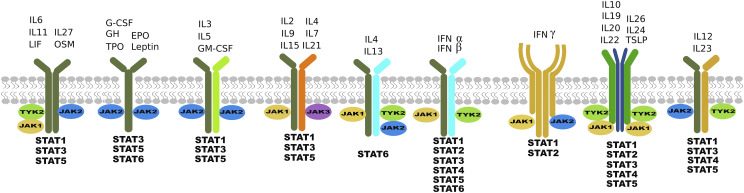
“The human genome encodes four JAKs—JAK1, JAK2, JAK3, and tyrosine kinase 2 (TYK2)—that associate selectively (Fig. 1) with different receptors (Wilks, 1989; Firmbach-Kraft et al., 1990; Wilks et al., 1991; Harpur et al., 1992).”
§ Targeting Janus Kinases and Signal Transducer and Activator of Transcription 3 To Treat Inflammation, Fibrosis, and Cancer: Rationale, Progress, and Caution > I. Molecular and Cellular Biology of Janus Kinase/Signal Transducer and Activator of Transcription 3 Signaling > A. Canonical Janus Kinase/Signal Transducer and Activator of Transcription 3 Signaling
What the sources say
- Not checked — no full text of the sourcecites Wilks, 1989 source
- Not checked — no full text of the sourcecites Firmbach-Kraft et al., 1990
- Partly supportedcites Wilks et al., 1991 sourceExperimental — accuracy not yet measured
The abstract (p. 2057) identifies JAK1 and says JAK2 is a second member of the family. The indexed passages do not identify JAK3 or TYK2 or state that the human genome encodes exactly four JAKs, so this paper supports only part of the attributed list. (LLM, conf=0.87)
plain- Asserted: passes — The authors put it forward as true.
- Checkable: passes — It can be checked against evidence.
- Load-bearing: unclear — It is unclear whether the paper’s conclusions depend on it.
- Based: passes — The paper gives a reason why it holds.
Every source the paper cites for this claim was checked and supports it.
In the paper
“Impaired injury tolerance”
§ Targeting Janus Kinases and Signal Transducer and Activator of Transcription 3 To Treat Inflammation, Fibrosis, and Cancer: Rationale, Progress, and Caution > II. Biologic Functions of Janus Kinase/Signal Transducer and Activator of Transcription 3 in Basal Conditions
What the sources say
- Supportedcites Hokuto et al., 2004 source
The Results report that mice with respiratory epithelium-specific Stat-3 deletion were more susceptible to oxygen-induced lung injury and had significantly reduced survival during hyperoxia. The claim is supported for the hyperoxic injury tested in this study. (LLM, conf=0.92)
plaindirect- Asserted: passes — The authors put it forward as true.
- Checkable: passes — It can be checked against evidence.
- Load-bearing: unclear — It is unclear whether the paper’s conclusions depend on it.
- Based: passes — The paper gives a reason why it holds.
- Supported
Every source the paper cites for this claim was checked and supports it.
In the paper
“Impaired epithelial wound healing”
§ Targeting Janus Kinases and Signal Transducer and Activator of Transcription 3 To Treat Inflammation, Fibrosis, and Cancer: Rationale, Progress, and Caution > II. Biologic Functions of Janus Kinase/Signal Transducer and Activator of Transcription 3 in Basal Conditions
What the sources say
- Supportedcites Pickert et al., 2009 source
In Results and Discussion (page not supplied), the paper identifies STAT3IEC-KO mice as having an intestinal epithelial cell-specific STAT3 deletion. Its in vivo wound-healing experiment found that their colonic wounds healed significantly more slowly than those of controls and remained open at day 6. (LLM, conf=0.95)
plaindirect- Asserted: passes — The authors put it forward as true.
- Checkable: passes — It can be checked against evidence.
- Load-bearing: unclear — It is unclear whether the paper’s conclusions depend on it.
- Based: passes — The paper gives a reason why it holds.
- Supported
The sources with a verdict support this claim; the rest weren’t checked yet, have no full text we could read, or their verdicts aren’t rated yet.
In the paper
“Generally, pS is suggested to work with pY to activate STAT3-mediated transcription (Wen et al., 1995; Abe et al., 2001; Shen et al., 2004) most likely through recruiting coactivator proteins (Schuringa et al., 2001; Lufei et al., 2007; Lee et al., 2009a), e.g., JNK1/2-mediated pS-STAT3 following UVA irradiation, enhanced STAT3–DNA binding in epidermal JB6 cells (Zhang et al., 2001; Liu et al., 2”
§ Targeting Janus Kinases and Signal Transducer and Activator of Transcription 3 To Treat Inflammation, Fibrosis, and Cancer: Rationale, Progress, and Caution > I. Molecular and Cellular Biology of Janus Kinase/Signal Transducer and Activator of Transcription 3 Signaling > A. Canonical Janus Kinase/Signal Transducer and Activator of Transcription 3 Signaling
What the sources say
- Not checked — no full text of the sourcecites Wen et al., 1995 source
- Not checked — no full text of the sourcecites Abe et al., 2001 source
- Supportedcites Shen et al., 2004 source
The Abstract states that tyrosine phosphorylation activates STAT3 and that serine 727 phosphorylation provides supplemental activation. It also says serine phosphorylation is required for full transcriptional activation. The coactivator mechanism is attached to other citations in the citing sentence, not to Shen et al. (LLM, conf=0.93)
hedgedconditional- Asserted: passes — The authors put it forward as true.
- Checkable: passes — It can be checked against evidence.
- Load-bearing: unclear — It is unclear whether the paper’s conclusions depend on it.
- Based: passes — The paper gives a reason why it holds.
The cited sources support only part of this claim — read each source’s verdict below.
In the paper
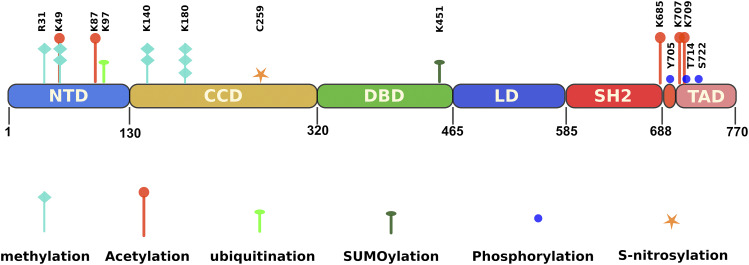
“In addition to tyrosine phosphorylation, STAT3 also undergoes a variety of other post-translational modifications, including methylation, acetylation, ubiquitination, IFN-stimulated gene (ISG)-ylation, and small ubiquitin-related modifiers (SUMOs)-conjugation (SUMOylation) (Kojima et al., 2013; You et al., 2015; Zouein et al., 2015; Avalle and Poli, 2018; Hu et al., 2018) with various effects on”
§ Targeting Janus Kinases and Signal Transducer and Activator of Transcription 3 To Treat Inflammation, Fibrosis, and Cancer: Rationale, Progress, and Caution > I. Molecular and Cellular Biology of Janus Kinase/Signal Transducer and Activator of Transcription 3 Signaling > A. Canonical Janus Kinase/Signal Transducer and Activator of Transcription 3 Signaling
What the sources say
- Partly supportedcites Kojima et al., 2013 sourceExperimental — accuracy not yet measured
The IL-6 Receptor System and Its Signaling Pathways section (page not supplied) describes STAT3 methylation at Lys140, and its Figure 2 caption states that STAT3 is acetylated at multiple lysines. Our copy does not substantiate the other listed modifications—ubiquitination, ISGylation, or SUMOylation—of STAT3. (LLM, conf=0.88)
- Could not verifycites You et al., 2015 sourceExperimental — accuracy not yet measured
The sections on tyrosine and serine phosphorylation of STAT3 discuss those modifications, but do not address any of the five modifications named in the claim. Searches for methylation, acetylation, ubiquitination, ISGylation, and SUMOylation found no supporting passage in our copy. (LLM, conf=0.76)
- Partly supportedcites Zouein et al., 2015 sourceExperimental — accuracy not yet measured
The Introduction’s “Posttranslational Modifications of STAT3” section (page unavailable) identifies methylation, acetylation, and mono-ubiquitination of STAT3. It does not identify ISGylation or SUMOylation, so this source supports only part of the attributed list. (LLM, conf=0.88)
plain- Asserted: passes — The authors put it forward as true.
- Checkable: passes — It can be checked against evidence.
- Load-bearing: unclear — It is unclear whether the paper’s conclusions depend on it.
- Based: passes — The paper gives a reason why it holds.
- Partly supported
The cited sources support only part of this claim — read each source’s verdict below.
In the paper
“Canonical STAT3 signaling is regulated by several feedback-inhibitory loops (Schmitz et al., 2000).”
§ Targeting Janus Kinases and Signal Transducer and Activator of Transcription 3 To Treat Inflammation, Fibrosis, and Cancer: Rationale, Progress, and Caution > I. Molecular and Cellular Biology of Janus Kinase/Signal Transducer and Activator of Transcription 3 Signaling > A. Canonical Janus Kinase/Signal Transducer and Activator of Transcription 3 Signaling
What the sources say
- Partly supportedcites Schmitz et al., 2000 sourceExperimental — accuracy not yet measured
The Discussion (page unavailable) says that SHP2 binds gp130 Tyr 759 and negatively regulates STAT activation; it also reports that MAPK activation reduces STAT phosphorylation. This supports inhibitory regulation in the IL-6/gp130 pathway, but the paper does not establish several feedback-inhibitory loops governing canonical STAT3 signaling generally. (LLM, conf=0.82)
plaindirect- Asserted: passes — The authors put it forward as true.
- Checkable: passes — It can be checked against evidence.
- Load-bearing: unclear — It is unclear whether the paper’s conclusions depend on it.
- Based: passes — The paper gives a reason why it holds.
- Partly supported
The sources with a verdict support this claim; the rest weren’t checked yet, have no full text we could read, or their verdicts aren’t rated yet.
In the paper
“In addition to phosphorylation on Y705, STAT3 can be phosphorylated on Ser727 within its TAD (Wen et al., 1995) by various serine/threonine kinases, e.g., mitogen-activated protein kinase (MAPK) like MAPK kinase/ERK (Chung et al., 1997; Stephens et al., 1998; Ng et al., 2011), c-Jun N-terminal kinase (JNK) (Zhang et al., 2001; Liu et al., 2012), p38 (Gollob et al., 1999; Lim and Cao, 1999; Turkson”
§ Targeting Janus Kinases and Signal Transducer and Activator of Transcription 3 To Treat Inflammation, Fibrosis, and Cancer: Rationale, Progress, and Caution > I. Molecular and Cellular Biology of Janus Kinase/Signal Transducer and Activator of Transcription 3 Signaling > A. Canonical Janus Kinase/Signal Transducer and Activator of Transcription 3 Signaling
What the sources say
- Not checked — no full text of the sourcecites Wen et al., 1995 source
- Supportedcites Chung et al., 1997 source
The cited paper reports that ERK-family MAP kinases phosphorylate STAT3 at Ser727 in response to growth factors (Abstract). That supports the ERK/MAPK example to which the Chung et al. citation is attached; this citation is not offered for the sentence’s separate JNK or p38 examples. (LLM, conf=0.93)
- Supportedcites Zhang et al., 2001 source
The citation to Zhang et al. is attached to JNK as an example of a kinase involved in STAT3 Ser727 phosphorylation. In “Induction of Ser 727,” the paper reports that JNK1 and JNK2 phosphorylated Ser727 in its kinase experiments; the Discussion identifies JNKs as mediators in the UVA response in JB6 cells. The citation does not need to establish the other kinases listed with separate citations. (LLM, conf=0.93)
plaindirect- Asserted: passes — The authors put it forward as true.
- Checkable: passes — It can be checked against evidence.
- Load-bearing: unclear — It is unclear whether the paper’s conclusions depend on it.
- Based: passes — The paper gives a reason why it holds.
Every source the paper cites for this claim was checked and supports it.
In the paper
“The SH2 domain is also required for docking to tyrosine-phosphorylated receptors (Vogt et al., 2011).”
§ Targeting Janus Kinases and Signal Transducer and Activator of Transcription 3 To Treat Inflammation, Fibrosis, and Cancer: Rationale, Progress, and Caution > I. Molecular and Cellular Biology of Janus Kinase/Signal Transducer and Activator of Transcription 3 Signaling > A. Canonical Janus Kinase/Signal Transducer and Activator of Transcription 3 Signaling
What the sources say
- Supportedcites Vogt et al., 2011 source
The Introduction states that phosphorylated tyrosine residues on cytokine receptors serve as docking sites for SH2-domain proteins such as STAT transcription factors, which are then recruited to the receptor. This supports the claim about STAT3 docking; the supplied passage has no page number. (LLM, conf=0.91)
plaindirect- Asserted: passes — The authors put it forward as true.
- Checkable: passes — It can be checked against evidence.
- Load-bearing: unclear — It is unclear whether the paper’s conclusions depend on it.
- Based: passes — The paper gives a reason why it holds.
- Supported
The cited sources support only part of this claim — read each source’s verdict below.
In the paper
“The effect of S727 phosphorylation (pS) on STAT3 gene transcription is varied and depends on the phosphorylating kinase, as well as the cell type, which likely dictates the availability of other transcription factors and proteins that help STAT3 bind to kinase (Avalle and Poli, 2018).”
§ Targeting Janus Kinases and Signal Transducer and Activator of Transcription 3 To Treat Inflammation, Fibrosis, and Cancer: Rationale, Progress, and Caution > I. Molecular and Cellular Biology of Janus Kinase/Signal Transducer and Activator of Transcription 3 Signaling > A. Canonical Janus Kinase/Signal Transducer and Activator of Transcription 3 Signaling
What the sources say
- Partly supportedcites Avalle and Poli, 2018 sourceExperimental — accuracy not yet measured
Section 3.3 says S727 phosphorylation can be carried out by several kinases and can affect transcriptional induction or STAT3 activation dynamics. Section 3 also says STAT3 activates different genes across cell types, partly through differences in binding-site accessibility and interactions with transcription factors and cofactors. The paper does not establish that the transcriptional effect of S727 phosphorylation depends on which kinase phosphorylates it, or that those proteins help STAT3 bind to a kinase. (LLM, conf=0.83)
plaincorrelational- Asserted: passes — The authors put it forward as true.
- Checkable: passes — It can be checked against evidence.
- Load-bearing: unclear — It is unclear whether the paper’s conclusions depend on it.
- Based: passes — The paper gives a reason why it holds.
- Partly supported
Every source the paper cites for this claim was checked and supports it.
In the paper
“Impaired hair cycle and skin wound healing”
§ Targeting Janus Kinases and Signal Transducer and Activator of Transcription 3 To Treat Inflammation, Fibrosis, and Cancer: Rationale, Progress, and Caution > II. Biologic Functions of Janus Kinase/Signal Transducer and Activator of Transcription 3 in Basal Conditions
What the sources say
- Supportedcites Sano et al., 1999 source
The Results section reports that Stat3-disrupted mice did not enter the second anagen hair-cycle stage, unlike controls, and that wound healing was retarded in keratinocyte-specific Stat3-disrupted mice. The Discussion likewise describes retarded wound healing in vivo and in vitro. Page numbers were not provided in the supplied passages. (LLM, conf=0.94)
plaindirect- Asserted: passes — The authors put it forward as true.
- Checkable: passes — It can be checked against evidence.
- Load-bearing: unclear — It is unclear whether the paper’s conclusions depend on it.
- Based: passes — The paper gives a reason why it holds.
- Supported
The cited sources support only part of this claim — read each source’s verdict below.
In the paper
“granulocyte cell-stimulating factor–mediated activation of STAT3 induces granulocytic progenitor proliferation through transcriptional upregulation of CCAAT/enhancer-binding protein (C/EBP)β and c-Myc”
§ Targeting Janus Kinases and Signal Transducer and Activator of Transcription 3 To Treat Inflammation, Fibrosis, and Cancer: Rationale, Progress, and Caution > II. Biologic Functions of Janus Kinase/Signal Transducer and Activator of Transcription 3 in Basal Conditions > A. Janus Kinase/Signal Transducer and Activator of Transcription 3 in Hematopoiesis and Immune Cell Function
What the sources say
- Partly supportedcites Johansen et al., 2001 sourceExperimental — accuracy not yet measured
The Discussion (page unavailable) says that maintaining c-Myc expression keeps myeloblasts proliferative, supporting c-Myc’s role in proliferation. It does not establish that G-CSF activates STAT3 to transcriptionally upregulate C/EBPβ and c-Myc; the mechanism it examines is C/EBPα-mediated downregulation of c-Myc. (LLM, conf=0.82)
- Not checked — no full text of the sourcecites Hirai et al., 2006 source
- Supportedcites Zhang et al., 2010 source
The Introduction reports that STAT3 promotes G-CSF-responsive proliferation of immature granulocytes, directly induces C/EBPβ expression, and regulates G-CSF-dependent c-myc transcription. The Discussion describes STAT3-driven Cebpb transcription and sustained c-myc expression as mechanisms supporting progenitor growth. (LLM, conf=0.94)
plaindirect- Asserted: passes — The authors put it forward as true.
- Checkable: passes — It can be checked against evidence.
- Load-bearing: unclear — It is unclear whether the paper’s conclusions depend on it.
- Based: passes — The paper gives a reason why it holds.
- Partly supported
Every source the paper cites for this claim was checked and supports it.
In the paper
“Obesity, diabetes, infertility, and thermal dysregulation”
§ Targeting Janus Kinases and Signal Transducer and Activator of Transcription 3 To Treat Inflammation, Fibrosis, and Cancer: Rationale, Progress, and Caution > II. Biologic Functions of Janus Kinase/Signal Transducer and Activator of Transcription 3 in Basal Conditions
What the sources say
- Supportedcites Gao et al., 2004 source
The Results describe a neural-specific STAT3 deletion in mice. The Abstract reports that surviving mutants were obese, diabetic, and infertile, and became hypothermic after fasting or cold stress; the Results also document impaired temperature maintenance during a cold challenge. (LLM, conf=0.95)
plaindirect- Asserted: passes — The authors put it forward as true.
- Checkable: passes — It can be checked against evidence.
- Load-bearing: unclear — It is unclear whether the paper’s conclusions depend on it.
- Based: passes — The paper gives a reason why it holds.
- Supported
Every source the paper cites for this claim was checked and supports it.
In the paper
“patient’s cells have diminished STAT3 activity due to an autosomal-dominant, loss-of-function STAT3 mutation”
§ Targeting Janus Kinases and Signal Transducer and Activator of Transcription 3 To Treat Inflammation, Fibrosis, and Cancer: Rationale, Progress, and Caution > II. Biologic Functions of Janus Kinase/Signal Transducer and Activator of Transcription 3 in Basal Conditions
What the sources say
- Supportedcites Bocchini et al., 2016 source
The Introduction states that AD-HIES is caused by dominant-negative STAT3 mutations and explains that these mutations produce dysfunctional dimers that dilute functional ones. The Discussion likewise describes impaired STAT3 activity in patient cells, supporting the claim’s description of diminished activity from an autosomal-dominant mutation. (LLM, conf=0.91)
plaindirect- Asserted: passes — The authors put it forward as true.
- Checkable: passes — It can be checked against evidence.
- Load-bearing: unclear — It is unclear whether the paper’s conclusions depend on it.
- Based: passes — The paper gives a reason why it holds.
- Supported
Every source the paper cites for this claim was checked and supports it.
In the paper
“Increased body weight and adiposity”
§ Targeting Janus Kinases and Signal Transducer and Activator of Transcription 3 To Treat Inflammation, Fibrosis, and Cancer: Rationale, Progress, and Caution > II. Biologic Functions of Janus Kinase/Signal Transducer and Activator of Transcription 3 in Basal Conditions
What the sources say
- Supportedcites Cernkovich et al., 2008 source
The Abstract reports that mice with adipocyte-specific STAT3 disruption weighed more than littermate controls and had increased adipose tissue mass. The Discussion likewise states that loss of STAT3 in mature adipocytes in male mice caused higher body weight and increased adiposity. (LLM, conf=0.95)
plaindirect- Asserted: passes — The authors put it forward as true.
- Checkable: passes — It can be checked against evidence.
- Load-bearing: unclear — It is unclear whether the paper’s conclusions depend on it.
- Based: passes — The paper gives a reason why it holds.
- Supported
Every source the paper cites for this claim was checked and supports it.
In the paper
“STAT3 was shown to regulate critical steps in emergency granulopoiesis”
§ Targeting Janus Kinases and Signal Transducer and Activator of Transcription 3 To Treat Inflammation, Fibrosis, and Cancer: Rationale, Progress, and Caution > II. Biologic Functions of Janus Kinase/Signal Transducer and Activator of Transcription 3 in Basal Conditions > A. Janus Kinase/Signal Transducer and Activator of Transcription 3 in Hematopoiesis and Immune Cell Function
What the sources say
- Supportedcites Hillmer et al., 2016 source
The ‘Emergency and steady state granulopoiesis’ section states directly that STAT3 regulates critical steps during emergency granulopoiesis. It identifies neutrophil release, chemotaxis, and granulocytic progenitor proliferation as examples. (LLM, conf=0.95)
plaindirect- Asserted: passes — The authors put it forward as true.
- Checkable: passes — It can be checked against evidence.
- Load-bearing: unclear — It is unclear whether the paper’s conclusions depend on it.
- Based: passes — The paper gives a reason why it holds.
- Supported
Every source the paper cites for this claim was checked and supports it.
In the paper
“STAT3 was found not to be required for basal granulopoiesis”
§ Targeting Janus Kinases and Signal Transducer and Activator of Transcription 3 To Treat Inflammation, Fibrosis, and Cancer: Rationale, Progress, and Caution > II. Biologic Functions of Janus Kinase/Signal Transducer and Activator of Transcription 3 in Basal Conditions > A. Janus Kinase/Signal Transducer and Activator of Transcription 3 in Hematopoiesis and Immune Cell Function
What the sources say
- Supportedcites Lee et al., 2002 source
The Abstract (page unavailable) reports that granulocytes developed from STAT3-null bone marrow progenitors and that mice lacking STAT3 in hematopoietic progenitors developed neutrophilia rather than a deficit in granulopoiesis. This supports the claim in the paper’s mouse model. (LLM, conf=0.91)
plain- Asserted: passes — The authors put it forward as true.
- Checkable: passes — It can be checked against evidence.
- Load-bearing: unclear — It is unclear whether the paper’s conclusions depend on it.
- Based: passes — The paper gives a reason why it holds.
- Supported
The cited sources that could be checked couldn’t confirm or dispute this claim.
In the paper
“AD-HIES patients do not demonstrate quantitative defects in basal or stress hematopoiesis, including the production of neutrophils, total lymphocyte numbers, red blood cells, or platelets”
§ Targeting Janus Kinases and Signal Transducer and Activator of Transcription 3 To Treat Inflammation, Fibrosis, and Cancer: Rationale, Progress, and Caution > II. Biologic Functions of Janus Kinase/Signal Transducer and Activator of Transcription 3 in Basal Conditions
What the sources say
- Could not verifycites Zhang et al., 2010 sourceExperimental — accuracy not yet measured
The Discussion (page not provided) mentions patients with hyper-IgE syndrome but says their emergency granulopoiesis and neutrophil function have not been investigated extensively. The reported blood-cell and progenitor findings concern mice, not AD-HIES patients. Searches for AD-HIES blood-cell counts and hematopoiesis found no passage establishing the claimed absence of quantitative defects in patients. (LLM, conf=0.78)
plain- Asserted: passes — The authors put it forward as true.
- Checkable: passes — It can be checked against evidence.
- Load-bearing: unclear — It is unclear whether the paper’s conclusions depend on it.
- Based: passes — The paper gives a reason why it holds.
- Could not verify
The cited sources support only part of this claim — read each source’s verdict below.
In the paper
“U-STAT3 and not pY-STAT3 (or pS-STAT3) recently was found to transcriptionally activate Fanconi C, a DNA repair protein that is expressed during early phases of granulopoiesis”
§ Targeting Janus Kinases and Signal Transducer and Activator of Transcription 3 To Treat Inflammation, Fibrosis, and Cancer: Rationale, Progress, and Caution > II. Biologic Functions of Janus Kinase/Signal Transducer and Activator of Transcription 3 in Basal Conditions > A. Janus Kinase/Signal Transducer and Activator of Transcription 3 in Hematopoiesis and Immune Cell Function
What the sources say
- Partly supportedcites Shah et al., 2018 sourceExperimental — accuracy not yet measured
The Introduction says Stat3 increases FANCC transcription during initiation of emergency granulopoiesis. But the Results report equivalent FANCC promoter activation by wild-type Stat3 and mutants lacking either the tyrosine or serine phosphorylation site; the Discussion concludes that phosphorylation does not enhance activation. These passages support phosphorylation being unnecessary, not the claim that phosphorylated Stat3 does not activate FANCC. (LLM, conf=0.88)
plaindirect- Asserted: passes — The authors put it forward as true.
- Checkable: passes — It can be checked against evidence.
- Load-bearing: unclear — It is unclear whether the paper’s conclusions depend on it.
- Based: passes — The paper gives a reason why it holds.
- Partly supported
The cited sources support only part of this claim — read each source’s verdict below.
In the paper
“intrinsic impairments in neutrophil chemotaxis”
§ Targeting Janus Kinases and Signal Transducer and Activator of Transcription 3 To Treat Inflammation, Fibrosis, and Cancer: Rationale, Progress, and Caution > II. Biologic Functions of Janus Kinase/Signal Transducer and Activator of Transcription 3 in Basal Conditions
What the sources say
- Not matchedcites Hill and Quie, 1974
Couldn’t be matched to a paper in Crossref, so it can’t be checked.
- Not matchedcites Hill et al., 1974
Couldn’t be matched to a paper in Crossref, so it can’t be checked.
- Partly supportedcites Panopoulos et al., 2006 sourceExperimental — accuracy not yet measured
The Results (page not provided) show a cell-autonomous chemotaxis defect in STAT3-deficient mouse neutrophils, specifically in responses to the CXCR2 ligands MIP-2 and KC; migration toward fMLP was similar to controls. The paper does not establish that impaired neutrophil chemotaxis is a primary immune defect in people with AD-HIES. (LLM, conf=0.86)
plaindirect- Asserted: passes — The authors put it forward as true.
- Checkable: passes — It can be checked against evidence.
- Load-bearing: unclear — It is unclear whether the paper’s conclusions depend on it.
- Based: passes — The paper gives a reason why it holds.
- Not matched
The cited sources support only part of this claim — read each source’s verdict below.
In the paper
“Reduced B cell compartments and plasma cells”
§ Targeting Janus Kinases and Signal Transducer and Activator of Transcription 3 To Treat Inflammation, Fibrosis, and Cancer: Rationale, Progress, and Caution > II. Biologic Functions of Janus Kinase/Signal Transducer and Activator of Transcription 3 in Basal Conditions
What the sources say
- Not checked — no full text of the sourcecites Chou et al., 2006 source
- Partly supportedcites Fornek et al., 2006 sourceExperimental — accuracy not yet measured
The discussion reports a profound decrease in T-dependent IgG antibody-secreting cells after B-cell-specific Stat3 deletion, supporting a reduction in that plasma-cell subset. It also states that B-cell numbers in the bone marrow, spleen, and lymph nodes were equivalent to controls and that B-cell development was intact, contrary to the claimed reduction in B-cell compartments. (LLM, conf=0.90)
plaindirect- Asserted: passes — The authors put it forward as true.
- Checkable: passes — It can be checked against evidence.
- Load-bearing: unclear — It is unclear whether the paper’s conclusions depend on it.
- Based: passes — The paper gives a reason why it holds.
The cited sources support only part of this claim — read each source’s verdict below.
In the paper
“Fms-related tyrosine kinase 3 ligand, the major DC growth factor, activates STAT3 to stimulate DC progenitor proliferation”
§ Targeting Janus Kinases and Signal Transducer and Activator of Transcription 3 To Treat Inflammation, Fibrosis, and Cancer: Rationale, Progress, and Caution > II. Biologic Functions of Janus Kinase/Signal Transducer and Activator of Transcription 3 in Basal Conditions > A. Janus Kinase/Signal Transducer and Activator of Transcription 3 in Hematopoiesis and Immune Cell Function
What the sources say
- Supportedcites Esashi et al., 2008 source
The section “STAT3 Controls Flt3L-Dependent Proliferation” reports that STAT3 was crucial for Flt3L-dependent proliferation and had an important role in DC progenitor proliferation. The Discussion likewise states that STAT3 was necessary for bone-marrow progenitors to proliferate in response to Flt3L. Page numbers are not provided in our copy. (LLM, conf=0.91)
- Not matchedcites Li et al., 2012
Couldn’t be matched to a paper in Crossref, so it can’t be checked.
plaindirect- Asserted: passes — The authors put it forward as true.
- Checkable: passes — It can be checked against evidence.
- Load-bearing: unclear — It is unclear whether the paper’s conclusions depend on it.
- Based: passes — The paper gives a reason why it holds.
- Supported
Every source the paper cites for this claim was checked and supports it.
In the paper
“the IL-21/JAK3/STAT3 signaling pathway promotes generation of megakaryocytes from CD34+ cells”
§ Targeting Janus Kinases and Signal Transducer and Activator of Transcription 3 To Treat Inflammation, Fibrosis, and Cancer: Rationale, Progress, and Caution > II. Biologic Functions of Janus Kinase/Signal Transducer and Activator of Transcription 3 in Basal Conditions > A. Janus Kinase/Signal Transducer and Activator of Transcription 3 in Hematopoiesis and Immune Cell Function
What the sources say
- Supportedcites Benbarche et al., 2017 source
The Results section reports that IL-21 increased megakaryocyte generation from cultured CD34+ progenitors. In the same section, JAK3 and STAT3 inhibitors abolished the IL-21-associated increase, supporting the pathway attribution. The supplied passages do not specify page numbers. (LLM, conf=0.94)
plaindirect- Asserted: passes — The authors put it forward as true.
- Checkable: passes — It can be checked against evidence.
- Load-bearing: unclear — It is unclear whether the paper’s conclusions depend on it.
- Based: passes — The paper gives a reason why it holds.
- Supported
The cited sources support only part of this claim — read each source’s verdict below.
In the paper
“STAT3-deficient macrophages, neutrophils, and DCs”
§ Targeting Janus Kinases and Signal Transducer and Activator of Transcription 3 To Treat Inflammation, Fibrosis, and Cancer: Rationale, Progress, and Caution > II. Biologic Functions of Janus Kinase/Signal Transducer and Activator of Transcription 3 in Basal Conditions > A. Janus Kinase/Signal Transducer and Activator of Transcription 3 in Hematopoiesis and Immune Cell Function
What the sources say
- Not checked — no full text of the sourcecites Takeda et al., 1999 source
- Partly supportedcites Melillo et al., 2010 sourceExperimental — accuracy not yet measured
The Results (Functional characterization of Stat3 CKO DCs; page unavailable) report significantly increased IL-12 and IL-23 secretion by stimulated Stat3-deficient dendritic cells. The Discussion describes macrophage-predominant IL-12 secretion in a myeloid-specific deletion model, but does not establish increased cytokine production by STAT3-deficient neutrophils. It describes inflammation after broader hematopoietic deletion without establishing the claimed cytokine increase for those mice. (LLM, conf=0.85)
- Not checked — no full text of the sourcecites Welte et al., 2003 source
plaindirect- Asserted: passes — The authors put it forward as true.
- Checkable: passes — It can be checked against evidence.
- Load-bearing: passes — The paper’s conclusions depend on it.
- Based: passes — The paper gives a reason why it holds.
The cited sources support only part of this claim — read each source’s verdict below.
In the paper
“STAT3 suppresses TLR signaling in mature phagocytes”
§ Targeting Janus Kinases and Signal Transducer and Activator of Transcription 3 To Treat Inflammation, Fibrosis, and Cancer: Rationale, Progress, and Caution > II. Biologic Functions of Janus Kinase/Signal Transducer and Activator of Transcription 3 in Basal Conditions > A. Janus Kinase/Signal Transducer and Activator of Transcription 3 in Hematopoiesis and Immune Cell Function
What the sources say
- Not checked — no full text of the sourcecites Takeda et al., 1999 source
- Partly supportedcites Melillo et al., 2010 sourceExperimental — accuracy not yet measured
The Discussion reports increased TLR-dependent IL-12 and IL-23 secretion in Stat3-deficient dendritic cells, supporting a negative regulatory role for STAT3 in those cells. It does not establish the claim across mature phagocytes generally, or the proposed mechanism involving NF-κB, MAPK, and direct repression of an E2 ubiquitin-conjugating enzyme. (LLM, conf=0.85)
- Not checked — no full text of the sourcecites El Kasmi et al., 2007 source
plaindirect- Asserted: passes — The authors put it forward as true.
- Checkable: passes — It can be checked against evidence.
- Load-bearing: unclear — It is unclear whether the paper’s conclusions depend on it.
- Based: passes — The paper gives a reason why it holds.
The cited sources support only part of this claim — read each source’s verdict below.
In the paper
“T cell–secreted IL-21 activates STAT3, which facilitates differentiation of later-stage B-lineage–committed CD19+ precursors to IgG-secreting plasma cells”
§ Targeting Janus Kinases and Signal Transducer and Activator of Transcription 3 To Treat Inflammation, Fibrosis, and Cancer: Rationale, Progress, and Caution > II. Biologic Functions of Janus Kinase/Signal Transducer and Activator of Transcription 3 in Basal Conditions > A. Janus Kinase/Signal Transducer and Activator of Transcription 3 in Hematopoiesis and Immune Cell Function
What the sources say
- Partly supportedcites Fornek et al., 2006 sourceExperimental — accuracy not yet measured
The Introduction (page not supplied) says IL-21 activates STAT3, and the Discussion proposes that STAT3 activation helps drive T-dependent IgG plasma-cell formation. But the Discussion names IL-21 as one of several possible cytokines, rather than establishing that T-cell-secreted IL-21 drives this process. The paper studies CD19-lineage B cells, not specifically later-stage CD19+ precursors. (LLM, conf=0.87)
plaindirect- Asserted: passes — The authors put it forward as true.
- Checkable: passes — It can be checked against evidence.
- Load-bearing: unclear — It is unclear whether the paper’s conclusions depend on it.
- Based: passes — The paper gives a reason why it holds.
- Partly supported
The cited sources that could be checked couldn’t confirm or dispute this claim.
In the paper
“Leptin activates the JAK2/STAT3 signaling pathway in human B cells to induce IL-6 and TNF-α”
§ Targeting Janus Kinases and Signal Transducer and Activator of Transcription 3 To Treat Inflammation, Fibrosis, and Cancer: Rationale, Progress, and Caution > II. Biologic Functions of Janus Kinase/Signal Transducer and Activator of Transcription 3 in Basal Conditions > A. Janus Kinase/Signal Transducer and Activator of Transcription 3 in Hematopoiesis and Immune Cell Function
What the sources say
- Could not verifycites Esashi et al., 2008 sourceExperimental — accuracy not yet measured
The signaling-results passage (Immunity section; page not specified) reports STAT3 activation by Flt3L and GM-CSF in dendritic-cell progenitors, not by leptin in human B cells. Searches for leptin, JAK2/STAT3 in human B cells, and IL-6 and TNF-α induction found no passage addressing the claim. (LLM, conf=0.77)
plaindirect- Asserted: passes — The authors put it forward as true.
- Checkable: passes — It can be checked against evidence.
- Load-bearing: unclear — It is unclear whether the paper’s conclusions depend on it.
- Based: passes — The paper gives a reason why it holds.
- Could not verify
The cited sources support only part of this claim — read each source’s verdict below.
In the paper
“STAT3 forms a complex with Syk and PLCγ2 to mediate platelet activation and aggregation”
§ Targeting Janus Kinases and Signal Transducer and Activator of Transcription 3 To Treat Inflammation, Fibrosis, and Cancer: Rationale, Progress, and Caution > II. Biologic Functions of Janus Kinase/Signal Transducer and Activator of Transcription 3 in Basal Conditions > A. Janus Kinase/Signal Transducer and Activator of Transcription 3 in Hematopoiesis and Immune Cell Function
What the sources say
- Partly supportedcites Zhou et al., 2013 sourceExperimental — accuracy not yet measured
The Discussion reports that STAT3 interacts with Syk and PLCγ2, likely forming a three-molecule complex that enhances collagen-induced platelet activation and aggregation. The claim omits the collagen-specific condition and states complex formation more definitively than the Discussion does; the Abstract’s Methods and Results also reports no inhibition of ADP- or TRAP-induced aggregation. (LLM, conf=0.82)
plaindirect- Asserted: passes — The authors put it forward as true.
- Checkable: passes — It can be checked against evidence.
- Load-bearing: unclear — It is unclear whether the paper’s conclusions depend on it.
- Based: passes — The paper gives a reason why it holds.
- Partly supported
The cited sources support only part of this claim — read each source’s verdict below.
In the paper
“STAT3 also plays major roles in immature DC development and function”
§ Targeting Janus Kinases and Signal Transducer and Activator of Transcription 3 To Treat Inflammation, Fibrosis, and Cancer: Rationale, Progress, and Caution > II. Biologic Functions of Janus Kinase/Signal Transducer and Activator of Transcription 3 in Basal Conditions > A. Janus Kinase/Signal Transducer and Activator of Transcription 3 in Hematopoiesis and Immune Cell Function
What the sources say
- Not checked — no full text of the sourcecites Laouar et al., 2003 source
- Partly supportedcites Merad and Manz, 2009 sourceExperimental — accuracy not yet measured
The ‘Transcription factors in DC development’ section reports that STAT3 affects Flt3L-mediated development of both plasmacytoid DCs and other DCs. It does not establish a role in immature DC function, and it specifies that STAT3 deficiency does not block GM-CSF-mediated DC development. (LLM, conf=0.85)
- Partly supportedcites Merad et al., 2013 sourceExperimental — accuracy not yet measured
The STATs section reports that STAT3 has a nonredundant role in DC development and that mice lacking it have profound reductions in DCs and pDCs. It does not establish a role for STAT3 in immature DC function or specifically identify immature DCs as the affected population; no page number is available in our copy. (LLM, conf=0.87)
plaindirect- Asserted: passes — The authors put it forward as true.
- Checkable: passes — It can be checked against evidence.
- Load-bearing: unclear — It is unclear whether the paper’s conclusions depend on it.
- Based: passes — The paper gives a reason why it holds.
The sources with a verdict support this claim; the rest weren’t checked yet, have no full text we could read, or their verdicts aren’t rated yet.
In the paper
“T lymphocyte lineage-specific STAT3-KO mice studies revealed the crucial role of IL-6/STAT3-mediated T cell survival, independent of Bcl-2”
§ Targeting Janus Kinases and Signal Transducer and Activator of Transcription 3 To Treat Inflammation, Fibrosis, and Cancer: Rationale, Progress, and Caution > II. Biologic Functions of Janus Kinase/Signal Transducer and Activator of Transcription 3 in Basal Conditions > A. Janus Kinase/Signal Transducer and Activator of Transcription 3 in Hematopoiesis and Immune Cell Function
What the sources say
- Not checked — no full text of the sourcecites Schindler et al., 1992 source
- Supportedcites Takeda et al., 1998 source
The paper describes generating T-cell-specific Stat3-deficient mice and reports that IL-6 failed to prevent apoptosis in their T cells (passage 5). The ‘IL-6 induced Bcl-2 expression in Stat3-deficient T cells’ section reports that Bcl-2 was still up-regulated and concludes that the IL-6/Stat3 antiapoptotic signal acts independently of Bcl-2 (passages 1 and 4). (LLM, conf=0.94)
plaindirect- Asserted: passes — The authors put it forward as true.
- Checkable: passes — It can be checked against evidence.
- Load-bearing: unclear — It is unclear whether the paper’s conclusions depend on it.
- Based: passes — The paper gives a reason why it holds.
The cited sources support only part of this claim — read each source’s verdict below.
In the paper
“IL-6–activated pY-STAT3 transcriptionally induces early production of IL-4 and IL-21 in CD4+ T cells”
§ Targeting Janus Kinases and Signal Transducer and Activator of Transcription 3 To Treat Inflammation, Fibrosis, and Cancer: Rationale, Progress, and Caution > II. Biologic Functions of Janus Kinase/Signal Transducer and Activator of Transcription 3 in Basal Conditions > A. Janus Kinase/Signal Transducer and Activator of Transcription 3 in Hematopoiesis and Immune Cell Function
What the sources say
- Partly supportedcites Yang and Rincon, 2016 sourceExperimental — accuracy not yet measured
Section 3.3 (page not provided) says that IL-6 promotes IL-4 and IL-21 production in CD4 cells, but attributes transcription-factor STAT3 induction of early expression specifically to IL-21. It does not say that pY-STAT3 transcriptionally induces early IL-4 production; instead, it describes STAT3 sustaining later IL-4 production independently of transcriptional activity. (LLM, conf=0.88)
plaindirect- Asserted: passes — The authors put it forward as true.
- Checkable: passes — It can be checked against evidence.
- Load-bearing: unclear — It is unclear whether the paper’s conclusions depend on it.
- Based: passes — The paper gives a reason why it holds.
- Partly supported
The cited sources support only part of this claim — read each source’s verdict below.
In the paper
“Leptin/LepRb/JAK2/STAT3 signaling plays major roles in energy homeostasis and neuroendocrine function”
§ Targeting Janus Kinases and Signal Transducer and Activator of Transcription 3 To Treat Inflammation, Fibrosis, and Cancer: Rationale, Progress, and Caution > II. Biologic Functions of Janus Kinase/Signal Transducer and Activator of Transcription 3 in Basal Conditions > B. Janus Kinase/Signal Transducer and Activator of Transcription 3 and Metabolism
What the sources say
- Partly supportedcites Millington, 2007 sourceExperimental — accuracy not yet measured
The Background section (“Leptin and hypothalamic regulation”; page unavailable) describes leptin acting through LEPRB on feeding-related neurons and activating POMC neurons. The AgRP section also reports higher agrp and lower pomc expression in leptin-deficient mice, supporting the proposed directions of regulation. Our copy does not establish the full LepRb/JAK2/STAT3 pathway or attribute a major role in neuroendocrine function to that pathway. (LLM, conf=0.85)
plaindirect- Asserted: passes — The authors put it forward as true.
- Checkable: passes — It can be checked against evidence.
- Load-bearing: unclear — It is unclear whether the paper’s conclusions depend on it.
- Based: passes — The paper gives a reason why it holds.
- Partly supported
The cited sources support only part of this claim — read each source’s verdict below.
In the paper
“use of a HDAC inhibitor enabled effective T cell priming and antitumor response”
§ Targeting Janus Kinases and Signal Transducer and Activator of Transcription 3 To Treat Inflammation, Fibrosis, and Cancer: Rationale, Progress, and Caution > II. Biologic Functions of Janus Kinase/Signal Transducer and Activator of Transcription 3 in Basal Conditions > A. Janus Kinase/Signal Transducer and Activator of Transcription 3 in Hematopoiesis and Immune Cell Function
What the sources say
- Not matchedcites Wang et al., 2011a
Couldn’t be matched to a paper in Crossref, so it can’t be checked.
- Partly supportedcites Cheng et al., 2014 sourceExperimental — accuracy not yet measured
The Results section reports that the HDAC6 inhibitor Tubastatin A enhanced antigen-specific CD4+ T-cell activation and priming, including in vaccinated mice. It also restored responsiveness of T cells isolated from tumor-bearing mice, but does not report an antitumor response such as reduced tumor growth or rejection (page numbers unavailable). (LLM, conf=0.88)
plaindirect- Asserted: passes — The authors put it forward as true.
- Checkable: passes — It can be checked against evidence.
- Load-bearing: unclear — It is unclear whether the paper’s conclusions depend on it.
- Based: passes — The paper gives a reason why it holds.
- Not matched
Every source the paper cites for this claim was checked and supports it.
In the paper
“human mast cell function in Job’s syndrome patients was affected somewhat by the reduced STAT3 signaling”
§ Targeting Janus Kinases and Signal Transducer and Activator of Transcription 3 To Treat Inflammation, Fibrosis, and Cancer: Rationale, Progress, and Caution > II. Biologic Functions of Janus Kinase/Signal Transducer and Activator of Transcription 3 in Basal Conditions > A. Janus Kinase/Signal Transducer and Activator of Transcription 3 in Hematopoiesis and Immune Cell Function
What the sources say
- Supportedcites Siegel et al., 2013 source
The Results report reduced morphine-induced skin wheals in patients with AD-HIES, a test the paper uses to probe mast cell degranulation. They also report that silencing STAT3 reduced degranulation in primary human mast cells. Together, these findings support the claim, though the cultured mast-cell experiments did not use cells from the patients. (LLM, conf=0.87)
plainconditional- Asserted: passes — The authors put it forward as true.
- Checkable: passes — It can be checked against evidence.
- Load-bearing: unclear — It is unclear whether the paper’s conclusions depend on it.
- Based: passes — The paper gives a reason why it holds.
- Supported
The cited sources support only part of this claim — read each source’s verdict below.
In the paper
“STAT3 inhibits generation of CD4+ Tregs from naive CD4+ precursors by suppressing the Treg-specifying transcription factor Foxp3 in mature Tregs”
§ Targeting Janus Kinases and Signal Transducer and Activator of Transcription 3 To Treat Inflammation, Fibrosis, and Cancer: Rationale, Progress, and Caution > II. Biologic Functions of Janus Kinase/Signal Transducer and Activator of Transcription 3 in Basal Conditions > A. Janus Kinase/Signal Transducer and Activator of Transcription 3 in Hematopoiesis and Immune Cell Function
What the sources say
- Not matchedcites Yang et al., 2008a
Couldn’t be matched to a paper in Crossref, so it can’t be checked.
- Partly supportedcites Laurence et al., 2012 sourceExperimental — accuracy not yet measured
The Results section on iTreg generation reports that STAT3 inhibits FoxP3 induction in naïve T cells during allogeneic transplantation. The Discussion separately describes STAT3-dependent loss of FoxP3 in existing natural Tregs. The claim conflates these findings: the paper does not show that suppressing FoxP3 in mature Tregs is how STAT3 inhibits Treg generation from naïve precursors. No page numbers were provided in our copy. (LLM, conf=0.86)
plaindirect- Asserted: passes — The authors put it forward as true.
- Checkable: passes — It can be checked against evidence.
- Load-bearing: passes — The paper’s conclusions depend on it.
- Based: passes — The paper gives a reason why it holds.
- Not matched
Every source the paper cites for this claim was checked and supports it.
In the paper
“clinical food allergy and anaphylaxis are decreased in patients with Job’s or AD-HIES, despite a significant burden of eczematous skin disease and increased levels of IgE”
§ Targeting Janus Kinases and Signal Transducer and Activator of Transcription 3 To Treat Inflammation, Fibrosis, and Cancer: Rationale, Progress, and Caution > II. Biologic Functions of Janus Kinase/Signal Transducer and Activator of Transcription 3 in Basal Conditions > A. Janus Kinase/Signal Transducer and Activator of Transcription 3 in Hematopoiesis and Immune Cell Function
What the sources say
- Supportedcites Siegel et al., 2013 source
The paper states that patients with AD-HIES almost all have an eczematous rash and markedly elevated serum IgE. Its Results report lower rates of food hypersensitivity and food anaphylaxis in patients with AD-HIES than in atopic controls with comparably elevated IgE. (LLM, conf=0.94)
plaincorrelational- Asserted: passes — The authors put it forward as true.
- Checkable: passes — It can be checked against evidence.
- Load-bearing: unclear — It is unclear whether the paper’s conclusions depend on it.
- Based: passes — The paper gives a reason why it holds.
- Supported
The cited sources support only part of this claim — read each source’s verdict below.
In the paper
“STAT3 activated by several proinflammatory cytokines, e.g., IL-6, IL-21, and IL-23, upregulates RORγt, RORα, IL-21, IL-23R, and IL-17, thereby helping in the development and stabilization of Th17 cells”
§ Targeting Janus Kinases and Signal Transducer and Activator of Transcription 3 To Treat Inflammation, Fibrosis, and Cancer: Rationale, Progress, and Caution > II. Biologic Functions of Janus Kinase/Signal Transducer and Activator of Transcription 3 in Basal Conditions > A. Janus Kinase/Signal Transducer and Activator of Transcription 3 in Hematopoiesis and Immune Cell Function
What the sources say
- Not checked — no full text of the sourcecites Laurence et al., 2007 source
- Partly supportedcites Nishihara et al., 2007 sourceExperimental — accuracy not yet measured
The Introduction and the section on gp130 STAT3-binding residues report that IL-6–gp130–STAT3 signaling promotes RORγt expression and Th17 development. The latter section only suggests that STAT3 might induce IL-17 mRNA; our copy does not establish the claimed STAT3-mediated upregulation of RORα, IL-21, or IL-23R, activation by IL-21 or IL-23, or stabilization of Th17 cells. Page numbers were not provided. (LLM, conf=0.88)
- Not matchedcites Yang et al., 2007b
Couldn’t be matched to a paper in Crossref, so it can’t be checked.
plaindirect- Asserted: passes — The authors put it forward as true.
- Checkable: passes — It can be checked against evidence.
- Load-bearing: passes — The paper’s conclusions depend on it.
- Based: passes — The paper gives a reason why it holds.
The cited sources support only part of this claim — read each source’s verdict below.
In the paper
“STAT3–HDAC6 transcriptionally upregulates IL-10, preventing effective Ag-specific CD4+ T cell activation in tumor-bearing mice”
§ Targeting Janus Kinases and Signal Transducer and Activator of Transcription 3 To Treat Inflammation, Fibrosis, and Cancer: Rationale, Progress, and Caution > II. Biologic Functions of Janus Kinase/Signal Transducer and Activator of Transcription 3 in Basal Conditions > A. Janus Kinase/Signal Transducer and Activator of Transcription 3 in Hematopoiesis and Immune Cell Function
What the sources say
- Partly supportedcites Cheng et al., 2014 sourceExperimental — accuracy not yet measured
The Discussion describes HDAC6 and STAT3 as regulators of Il10 transcription in APCs, and the Results show that disrupting HDAC6 improves antigen-specific CD4+ T-cell activation. In the tumor-bearing-mouse model, however, the paper tested re-isolated tolerant T cells with HDAC6-deficient APCs in vitro; it does not show that the STAT3–HDAC6–IL-10 pathway prevented their activation within tumor-bearing mice. Page numbers are unavailable in our copy. (LLM, conf=0.84)
plaindirect- Asserted: passes — The authors put it forward as true.
- Checkable: passes — It can be checked against evidence.
- Load-bearing: unclear — It is unclear whether the paper’s conclusions depend on it.
- Based: passes — The paper gives a reason why it holds.
- Partly supported
The cited sources support only part of this claim — read each source’s verdict below.
In the paper
“IL-10– and IL-21–mediated STAT3 activation”
§ Targeting Janus Kinases and Signal Transducer and Activator of Transcription 3 To Treat Inflammation, Fibrosis, and Cancer: Rationale, Progress, and Caution > II. Biologic Functions of Janus Kinase/Signal Transducer and Activator of Transcription 3 in Basal Conditions > A. Janus Kinase/Signal Transducer and Activator of Transcription 3 in Hematopoiesis and Immune Cell Function
What the sources say
- Supportedcites Cui et al., 2011 source
The Introduction (page not provided) says IL-10 and IL-21 act together to promote mature, self-renewing memory CD8+ T cells, and that the pathway sustains BCL-6, Eomes, and Blimp-1 during the effector-to-memory transition. The Results section (page not provided) also reports reduced levels of all three factors in memory CD8+ T cells lacking STAT3. (LLM, conf=0.94)
- Partly supportedcites Kaech and Cui, 2012 sourceExperimental — accuracy not yet measured
The ‘effector to memory T cell transition’ section links IL-10 and IL-21 to STAT3-dependent maturation of memory CD8+ T cells, and the ‘STAT3, STAT4 and STAT5’ section says STAT3 sustains EOMES and BCL-6 expression. The ‘BLIMP1 and BCL-6’ section says BLIMP1 declines as memory cells mature, but does not establish that STAT3 promotes long-lived memory cells by regulating BLIMP1; it also describes the proposed cytokine effect on BCL-6 as likely rather than established. Page numbers are unavailable in our copy. (LLM, conf=0.86)
plaindirect- Asserted: passes — The authors put it forward as true.
- Checkable: passes — It can be checked against evidence.
- Load-bearing: unclear — It is unclear whether the paper’s conclusions depend on it.
- Based: passes — The paper gives a reason why it holds.
- Supported
The cited sources support only part of this claim — read each source’s verdict below.
In the paper
“the STAT3-dependent transcriptional activity within endothelial cells that regulates critical components involved in the architecture and functional dynamics of endothelial junctions, i.e., microRNA17-92, PTEN, Src, E2F, and β-catenin, is a more important contributor to reduced endothelial cell permeability and anaphylaxis protection in these patients”
§ Targeting Janus Kinases and Signal Transducer and Activator of Transcription 3 To Treat Inflammation, Fibrosis, and Cancer: Rationale, Progress, and Caution > II. Biologic Functions of Janus Kinase/Signal Transducer and Activator of Transcription 3 in Basal Conditions > A. Janus Kinase/Signal Transducer and Activator of Transcription 3 in Hematopoiesis and Immune Cell Function
What the sources say
- Partly supportedcites Hox et al., 2016 sourceExperimental — accuracy not yet measured
Split into 2 atoms — 1 confirmed, 1 partially supported, 0 disputed, 0 misattributed, 0 unverifiable. Expand the claim to see per-atom verdicts.
plaindirect- Asserted: passes — The authors put it forward as true.
- Checkable: passes — It can be checked against evidence.
- Load-bearing: unclear — It is unclear whether the paper’s conclusions depend on it.
- Based: passes — The paper gives a reason why it holds.
- Partly supported
The cited sources support only part of this claim — read each source’s verdict below.
In the paper
“mtSTAT3 contributes to maintaining their late expression through increases in mitochondrial calcium levels and ATP”
§ Targeting Janus Kinases and Signal Transducer and Activator of Transcription 3 To Treat Inflammation, Fibrosis, and Cancer: Rationale, Progress, and Caution > II. Biologic Functions of Janus Kinase/Signal Transducer and Activator of Transcription 3 in Basal Conditions > A. Janus Kinase/Signal Transducer and Activator of Transcription 3 in Hematopoiesis and Immune Cell Function
What the sources say
- Partly supportedcites Yang et al., 2015 sourceExperimental — accuracy not yet measured
The Results section on mitochondrial Ca2+ and late cytokine production links Stat3 and mitochondrial Ca2+ to sustained IL-21 and IL-4 production in activated CD4 cells. But the Results section on mitochondrial hyperpolarization reports that IL-6 did not increase intracellular or extracellular ATP, contrary to the claimed ATP increase. Page numbers are unavailable in our copy. (LLM, conf=0.90)
plaindirect- Asserted: passes — The authors put it forward as true.
- Checkable: passes — It can be checked against evidence.
- Load-bearing: unclear — It is unclear whether the paper’s conclusions depend on it.
- Based: passes — The paper gives a reason why it holds.
- Partly supported
The cited sources support only part of this claim — read each source’s verdict below.
In the paper
“STAT3 itself can be subject to direct modification by oxidative stress, as 9 of the 14 cysteine residues within STAT3 have been reported to be redox sensitive.”
§ Targeting Janus Kinases and Signal Transducer and Activator of Transcription 3 To Treat Inflammation, Fibrosis, and Cancer: Rationale, Progress, and Caution > III. Functions of Janus Kinase/Signal Transducer and Activator of Transcription 3 in Stress Conditions > B. Oxidative Stress
What the sources say
- Not checked — no full text of the sourcecites Li and Shaw, 2004 source
- Partly supportedcites Xie et al., 2009 sourceExperimental — accuracy not yet measured
The section ‘STAT3 protein contains cysteine residues that are targets for S-glutathionylation’ reports that STAT3 has reactive thiols and that its cysteines can undergo oxidative modification. The Discussion says it remains unclear which cysteines are particularly reactive; our copy does not report that 9 of STAT3’s 14 cysteine residues are redox sensitive. (LLM, conf=0.88)
- Not matchedcites Li et al., 2010a
Couldn’t be matched to a paper in Crossref, so it can’t be checked.
plaindirect- Asserted: passes — The authors put it forward as true.
- Checkable: passes — It can be checked against evidence.
- Load-bearing: unclear — It is unclear whether the paper’s conclusions depend on it.
- Based: passes — The paper gives a reason why it holds.
Every source the paper cites for this claim was checked and supports it.
In the paper
“STAT3 also plays a key role in amino acid–mediated dampening of insulin signaling in hepatic cells, primarily through a mTOR-mediated pS-STAT3 pathway that is independent of pY-STAT3 (Kim et al., 2009).”
§ Targeting Janus Kinases and Signal Transducer and Activator of Transcription 3 To Treat Inflammation, Fibrosis, and Cancer: Rationale, Progress, and Caution > II. Biologic Functions of Janus Kinase/Signal Transducer and Activator of Transcription 3 in Basal Conditions > B. Janus Kinase/Signal Transducer and Activator of Transcription 3 and Metabolism
What the sources say
- Supportedcites Kim et al., 2009 source
The Discussion describes STAT3-mediated suppression of insulin signaling by amino acids as dependent on Ser 727 phosphorylation and independent of tyrosine phosphorylation. The section on mTOR-dependent Ser 727 phosphorylation reports that rapamycin abolished amino acid–stimulated phosphorylation in mouse primary hepatocytes. Page numbers are unavailable in our copy. (LLM, conf=0.93)
plaindirect- Asserted: passes — The authors put it forward as true.
- Checkable: passes — It can be checked against evidence.
- Load-bearing: unclear — It is unclear whether the paper’s conclusions depend on it.
- Based: passes — The paper gives a reason why it holds.
- Supported
Every source the paper cites for this claim was checked and supports it.
In the paper
“Recently, the importance of pS-STAT3 in radioresistance in glioblastoma multiforme also has been suggested (Ouédraogo et al., 2016).”
§ Targeting Janus Kinases and Signal Transducer and Activator of Transcription 3 To Treat Inflammation, Fibrosis, and Cancer: Rationale, Progress, and Caution > III. Functions of Janus Kinase/Signal Transducer and Activator of Transcription 3 in Stress Conditions > A. Radiation
What the sources say
- Supportedcites Ouédraogo et al., 2016 source
The Results report that pSTAT3-S727 levels positively correlated with intrinsic radioresistance in 15 human glioma cell lines. The Abstract also reports radiosensitization accompanied by reduced pSTAT3-S727 in certain GBM cell lines, supporting the citing sentence’s hedged claim. (LLM, conf=0.93)
hedgeddirect- Asserted: passes — The authors put it forward as true.
- Checkable: passes — It can be checked against evidence.
- Load-bearing: unclear — It is unclear whether the paper’s conclusions depend on it.
- Based: passes — The paper gives a reason why it holds.
- Supported
Every source the paper cites for this claim was checked and supports it.
In the paper
“CLL cells modify their metabolism to oxidize free fatty acids with the help of constitutively activated STAT3 (mostly pS-STAT3) through transcriptional upregulation of lipoprotein lipase, which catalyzes the hydrolysis of triglycerides into free fatty acids (Rozovski et al., 2015).”
§ Targeting Janus Kinases and Signal Transducer and Activator of Transcription 3 To Treat Inflammation, Fibrosis, and Cancer: Rationale, Progress, and Caution > II. Biologic Functions of Janus Kinase/Signal Transducer and Activator of Transcription 3 in Basal Conditions > B. Janus Kinase/Signal Transducer and Activator of Transcription 3 and Metabolism
What the sources say
- Supportedcites Rozovski et al., 2015 source
The Discussion states that STAT3 activates LPL transcription and that CLL cells use stored lipids for energy in an LPL-dependent process driven by STAT3. The Introduction identifies constitutive serine phosphorylation of STAT3 in CLL and says LPL hydrolyzes triglycerides into free fatty acids. (LLM, conf=0.94)
plaindirect- Asserted: passes — The authors put it forward as true.
- Checkable: passes — It can be checked against evidence.
- Load-bearing: unclear — It is unclear whether the paper’s conclusions depend on it.
- Based: passes — The paper gives a reason why it holds.
- Supported
The cited sources support only part of this claim — read each source’s verdict below.
In the paper
“persistently elevated pY-STAT3 levels mediated by chronic UV exposure are a key step in UV-induced skin cancer (Chan et al., 2004a,b; Aziz et al., 2007a,b; Barry et al., 2010).”
§ Targeting Janus Kinases and Signal Transducer and Activator of Transcription 3 To Treat Inflammation, Fibrosis, and Cancer: Rationale, Progress, and Caution > III. Functions of Janus Kinase/Signal Transducer and Activator of Transcription 3 in Stress Conditions > A. Radiation
What the sources say
- Not matchedcites Chan et al., 2004a,b
Couldn’t be matched to a paper in Crossref, so it can’t be checked.
- Not matchedcites Aziz et al., 2007a,b
Couldn’t be matched to a paper in Crossref, so it can’t be checked.
- Partly supportedcites Barry et al., 2010 sourceExperimental — accuracy not yet measured
The Results report that STAT3 levels correlate with repair of UV-damaged DNA in mouse embryonic fibroblasts, and the Discussion considers a possible role for elevated STAT3 in cancer-cell DNA repair (page numbers unavailable). The paper does not establish that chronic UV exposure persistently elevates pY-STAT3 or that this is a key step in UV-induced skin cancer. (LLM, conf=0.78)
plaindirect- Asserted: passes — The authors put it forward as true.
- Checkable: passes — It can be checked against evidence.
- Load-bearing: passes — The paper’s conclusions depend on it.
- Based: passes — The paper gives a reason why it holds.
- Not matched
The sources with a verdict support this claim; the rest weren’t checked yet, have no full text we could read, or their verdicts aren’t rated yet.
In the paper
“STAT3 activation seems to be protective (Shen et al., 2001; Chan et al., 2004b; Sano et al., 2005; Aziz et al., 2007a; Barry et al., 2010; Bito et al., 2010a,b).”
§ Targeting Janus Kinases and Signal Transducer and Activator of Transcription 3 To Treat Inflammation, Fibrosis, and Cancer: Rationale, Progress, and Caution > III. Functions of Janus Kinase/Signal Transducer and Activator of Transcription 3 in Stress Conditions > A. Radiation
What the sources say
- Supportedcites Shen et al., 2001 source
The Discussion reports that constitutively activated Stat3 protected fibroblasts from apoptosis induced by UV irradiation. This supports the hedged claim, specifically as protection from UV-induced apoptosis in the cells studied. (LLM, conf=0.92)
- Not matchedcites Chan et al., 2004b
Couldn’t be matched to a paper in Crossref, so it can’t be checked.
- Not checked — no full text of the sourcecites Sano et al., 2005 source
hedgedconditional- Asserted: passes — The authors put it forward as true.
- Checkable: passes — It can be checked against evidence.
- Load-bearing: unclear — It is unclear whether the paper’s conclusions depend on it.
- Based: passes — The paper gives a reason why it holds.
- Supported
Every source the paper cites for this claim was checked and supports it.
In the paper
“The leptin/JAK2/STAT3 pathway inhibits insulin synthesis, whereas SOCS3 blocks the STAT3-dependent regulation of the preproinsulin 1 gene promoter (Laubner et al., 2005).”
§ Targeting Janus Kinases and Signal Transducer and Activator of Transcription 3 To Treat Inflammation, Fibrosis, and Cancer: Rationale, Progress, and Caution > II. Biologic Functions of Janus Kinase/Signal Transducer and Activator of Transcription 3 in Basal Conditions > B. Janus Kinase/Signal Transducer and Activator of Transcription 3 and Metabolism
What the sources say
- Supportedcites Laubner et al., 2005 source
The Abstract reports that leptin induces SOCS3 through JAK–STAT3/5b signaling and that SOCS3 inhibits STAT3/5b-dependent preproinsulin 1 promoter activity. The Discussion clarifies that STAT3 itself activates the promoter; the inhibitory effect attributed to the leptin pathway is mediated downstream, rather than by STAT3 acting alone. (LLM, conf=0.90)
plaindirect- Asserted: passes — The authors put it forward as true.
- Checkable: passes — It can be checked against evidence.
- Load-bearing: unclear — It is unclear whether the paper’s conclusions depend on it.
- Based: passes — The paper gives a reason why it holds.
- Supported
Every source the paper cites for this claim was checked and supports it.
In the paper
“whereas SOCS3 blocks the STAT3-dependent regulation of the preproinsulin 1 gene promoter (Laubner et al., 2005).”
§ Targeting Janus Kinases and Signal Transducer and Activator of Transcription 3 To Treat Inflammation, Fibrosis, and Cancer: Rationale, Progress, and Caution > II. Biologic Functions of Janus Kinase/Signal Transducer and Activator of Transcription 3 in Basal Conditions > B. Janus Kinase/Signal Transducer and Activator of Transcription 3 and Metabolism
What the sources say
- Supportedcites Laubner et al., 2005 source
The section on SOCS3 inhibition of the rINS-1 promoter reports that SOCS3 overexpression inhibits STAT3-dependent transactivation of the rat preproinsulin 1 promoter in INS-1 cells. The Discussion reiterates that SOCS3 inhibits promoter activity stimulated by STAT3. (LLM, conf=0.94)
plaindirect- Asserted: passes — The authors put it forward as true.
- Checkable: passes — It can be checked against evidence.
- Load-bearing: unclear — It is unclear whether the paper’s conclusions depend on it.
- Based: passes — The paper gives a reason why it holds.
- Supported
The cited sources support only part of this claim — read each source’s verdict below.
In the paper
“thiol-targeting agents also inhibited IL-6–induced STAT3 activation by S-glutathionylation in HepG2 cells (Xie et al., 2009), human endothelial cells, neonatal rat cardiomyocytes, and adult mouse cardiac myocytes (Zgheib et al., 2012)”
§ Targeting Janus Kinases and Signal Transducer and Activator of Transcription 3 To Treat Inflammation, Fibrosis, and Cancer: Rationale, Progress, and Caution > III. Functions of Janus Kinase/Signal Transducer and Activator of Transcription 3 in Stress Conditions > B. Oxidative Stress
What the sources say
- Supportedcites Xie et al., 2009 source
The citation to Xie et al. is attached to the HepG2-cell finding, not the findings in endothelial or cardiac cells. The Discussion reports that diamide, oxidized glutathione, and PDTC increased STAT3 S-glutathionylation while reducing IL-6-induced STAT3 phosphorylation; the STAT3 S-glutathionylation section identifies the treated cells as HepG2 cells. No page numbers are available in our copy. (LLM, conf=0.94)
- Partly supportedcites Zgheib et al., 2012 sourceExperimental — accuracy not yet measured
The Results and Figures 2–3 report that thiol-reactive compounds inhibited LIF-induced, not IL-6-induced, STAT3 activation in human endothelial cells and neonatal rat and adult-phenotype mouse cardiac myocytes. The Results section “NCP Enhances STAT3 Glutathionylation and Dimerization” reports glutathionylation in HL-1 cells only when NCP and diamide were combined; it does not establish S-glutathionylation as the cause of the inhibition across the cited cell types. The HepG2 finding is separately attributed to Xie et al. in the citing sentence. (LLM, conf=0.90)
plaindirect- Asserted: passes — The authors put it forward as true.
- Checkable: passes — It can be checked against evidence.
- Load-bearing: unclear — It is unclear whether the paper’s conclusions depend on it.
- Based: passes — The paper gives a reason why it holds.
- Supported
The sources with a verdict support this claim; the rest weren’t checked yet, have no full text we could read, or their verdicts aren’t rated yet.
In the paper
“which in turn regulates glucose homeostasis by transcriptionally suppressing (Ramadoss et al., 2009) expression of gluconeogenic genes, e.g., glucose-6-phosphatase and phosphoenolpyruvate carboxykinase (Inoue et al., 2004).”
§ Targeting Janus Kinases and Signal Transducer and Activator of Transcription 3 To Treat Inflammation, Fibrosis, and Cancer: Rationale, Progress, and Caution > II. Biologic Functions of Janus Kinase/Signal Transducer and Activator of Transcription 3 in Basal Conditions > B. Janus Kinase/Signal Transducer and Activator of Transcription 3 and Metabolism
What the sources say
- Supportedcites Ramadoss et al., 2009 source
The Discussion states that STAT3 directly targets the regulatory regions of G6Pase and PEPCK to regulate their expression and describes negative regulation of both genes. The paper also links controlled expression of these gluconeogenic genes to glucose homeostasis. Page numbers are not provided in the supplied passages. (LLM, conf=0.93)
- Not checked — no full text of the sourcecites Inoue et al., 2004 source
plaindirect- Asserted: passes — The authors put it forward as true.
- Checkable: passes — It can be checked against evidence.
- Load-bearing: unclear — It is unclear whether the paper’s conclusions depend on it.
- Based: passes — The paper gives a reason why it holds.
- Supported
The cited sources support only part of this claim — read each source’s verdict below.
In the paper
“STAT3 also is activated by UV through DNA damage and reactive oxygen species (Shen et al., 2001; Aziz et al., 2007a; Barry et al., 2010; Bito et al., 2010b).”
§ Targeting Janus Kinases and Signal Transducer and Activator of Transcription 3 To Treat Inflammation, Fibrosis, and Cancer: Rationale, Progress, and Caution > III. Functions of Janus Kinase/Signal Transducer and Activator of Transcription 3 in Stress Conditions > A. Radiation
What the sources say
- Could not verifycites Shen et al., 2001 sourceExperimental — accuracy not yet measured
The Results section on fibroblasts transformed by Stat3-C reports that cells expressing constitutively activated Stat3 were relatively resistant to UV-induced apoptosis. It does not report that UV activates Stat3, or that DNA damage or reactive oxygen species mediate such activation; searches for those mechanisms found no supporting passage in our copy. (LLM, conf=0.76)
- Not matchedcites Aziz et al., 2007a
Couldn’t be matched to a paper in Crossref, so it can’t be checked.
- Partly supportedcites Barry et al., 2010 sourceExperimental — accuracy not yet measured
The Abstract (page unavailable) reports STAT3 activation in rat myocardium after ischemia–reperfusion injury, which generates reactive oxygen species. The Results and Abstract link STAT3 to repair of UV-damaged DNA, but do not show that UV activates STAT3 through DNA damage or reactive oxygen species. (LLM, conf=0.81)
plaindirect- Asserted: passes — The authors put it forward as true.
- Checkable: passes — It can be checked against evidence.
- Load-bearing: unclear — It is unclear whether the paper’s conclusions depend on it.
- Based: passes — The paper gives a reason why it holds.
- Could not verify
The cited sources support only part of this claim — read each source’s verdict below.
In the paper
“Levels of pY-STAT3 also are increased in in vitro models, as well as in patients with ionizing radiation (IR)–resistant tumors, by IR at doses used for radiotherapy (≥2 Gy), contributing to selection of IR-resistant cells in many different cancers (Ho et al., 2010; Liu et al., 2013; Pan et al., 2013; Yan et al., 2013; Gao et al., 2014; Klein et al., 2014; Lau et al., 2015; Zang et al., 2017; Lu et”
§ Targeting Janus Kinases and Signal Transducer and Activator of Transcription 3 To Treat Inflammation, Fibrosis, and Cancer: Rationale, Progress, and Caution > III. Functions of Janus Kinase/Signal Transducer and Activator of Transcription 3 in Stress Conditions > A. Radiation
What the sources say
- Not matchedcites Ho et al., 2010
Couldn’t be matched to a paper in Crossref, so it can’t be checked.
- Partly supportedcites Liu et al., 2013 sourceExperimental — accuracy not yet measured
The Figure 4 results (p. 7) show that LIF activates STAT3 Tyr705 in nasopharyngeal carcinoma cells, and the Figure 5 results (p. 9) show that LIF-treated cells survive irradiation doses including 2 and 4 Gy better than controls. The discussion (Figure 8, p. 13) links IR-induced cytokines and STAT3 signaling to acquired radioresistance. The paper does not show that irradiation itself raises pY-STAT3 in patients with resistant tumors, or establish that this mechanism selects resistant cells across many cancers. (LLM, conf=0.87)
- Partly supportedcites Pan et al., 2013 sourceExperimental — accuracy not yet measured
The Results section, “Stattic Sensitize NPC Cells to Radiotherapy” (page unavailable), reports that inhibiting STAT3 increased the sensitivity of nasopharyngeal carcinoma cells to 10 Gy irradiation. The paper does not show that irradiation increases pY-STAT3, or establish that such an increase selects resistant cells in patients or across many cancers; its reported increase in STAT3 phosphorylation followed IL-6 treatment, not irradiation. (LLM, conf=0.84)
plaindirect- Asserted: passes — The authors put it forward as true.
- Checkable: passes — It can be checked against evidence.
- Load-bearing: passes — The paper’s conclusions depend on it.
- Based: passes — The paper gives a reason why it holds.
- Not matched
Every source the paper cites for this claim was checked and supports it.
In the paper
“Sorafenib, a small-molecule kinase insert domain receptor inhibitor, activates autophagy in multiple liver cancer cell lines through targeting STAT3 and reducing MCL1 expression (Tai et al., 2013).”
§ Targeting Janus Kinases and Signal Transducer and Activator of Transcription 3 To Treat Inflammation, Fibrosis, and Cancer: Rationale, Progress, and Caution > III. Functions of Janus Kinase/Signal Transducer and Activator of Transcription 3 in Stress Conditions > E. Autophagy
What the sources say
- Supportedcites Tai et al., 2013 source
The Results section, “Sorafenib induces autophagy in HCC cell lines” (page not specified), reports increased autophagosome formation in four tested liver cancer cell lines. The Results sections on p-STAT3 signaling and SHP-1-dependent inhibition of STAT3 (pages not specified) report that sorafenib inhibits STAT3 signaling, reduces Mcl-1 expression, and induces autophagy through that pathway. (LLM, conf=0.93)
plaindirect- Asserted: passes — The authors put it forward as true.
- Checkable: passes — It can be checked against evidence.
- Load-bearing: unclear — It is unclear whether the paper’s conclusions depend on it.
- Based: passes — The paper gives a reason why it holds.
- Supported
The cited sources support only part of this claim — read each source’s verdict below.
In the paper
“IL-6 and pY-STAT3 induced by chemotherapy promoted premature senescence in lymphoma cells in a paracrine manner, which maintained a minimal residual number of chemoresistant cells that could lead to relapse.”
§ Targeting Janus Kinases and Signal Transducer and Activator of Transcription 3 To Treat Inflammation, Fibrosis, and Cancer: Rationale, Progress, and Caution > III. Functions of Janus Kinase/Signal Transducer and Activator of Transcription 3 in Stress Conditions > D. Cell Senescence
What the sources say
- Partly supportedcites Gilbert and Hemann, 2010 sourceExperimental — accuracy not yet measured
The Abstract and Results support chemotherapy-induced, paracrine IL-6 protection of residual lymphoma cells that can fuel relapse. They do not support the claim that IL-6 and pY-STAT3 induce premature senescence in lymphoma cells: the Abstract and the Results section on senescence place senescence in thymic stromal cells, while the Discussion says acute IL-6 release precedes it. The Results discuss Jak/Stat3 signaling but do not establish the claimed pY-STAT3–senescence mechanism. (LLM, conf=0.90)
hedgeddirect- Asserted: passes — The authors put it forward as true.
- Checkable: passes — It can be checked against evidence.
- Load-bearing: passes — The paper’s conclusions depend on it.
- Based: passes — The paper gives a reason why it holds.
- Partly supported
Every source the paper cites for this claim was checked and supports it.
In the paper
“S-nitrosylation is another redox-related post-translational modification that inhibits STAT3 activation.”
§ Targeting Janus Kinases and Signal Transducer and Activator of Transcription 3 To Treat Inflammation, Fibrosis, and Cancer: Rationale, Progress, and Caution > III. Functions of Janus Kinase/Signal Transducer and Activator of Transcription 3 in Stress Conditions > B. Oxidative Stress
What the sources say
- Supportedcites Kim et al., 2014 source
The Abstract identifies S-nitrosylation as a redox-based modification of protein thiols and reports that it inhibits STAT3 activation by inhibiting Tyr 705 phosphorylation. The Discussion likewise states that S-nitrosylation inhibits STAT3 activation. (LLM, conf=0.94)
plaindirect- Asserted: passes — The authors put it forward as true.
- Checkable: passes — It can be checked against evidence.
- Load-bearing: unclear — It is unclear whether the paper’s conclusions depend on it.
- Based: passes — The paper gives a reason why it holds.
- Supported
The cited sources support only part of this claim — read each source’s verdict below.
In the paper
“STAT3 also promotes autophagy, e.g., leukemia inhibitory factor/STAT3 and oncostatin M/STAT3 signaling promote autophagy in mammary gland cells by upregulating both the p55 and p50 isoforms of PI3K regulatory subunit 1, PIK3R1 (Pensa et al., 2014).”
§ Targeting Janus Kinases and Signal Transducer and Activator of Transcription 3 To Treat Inflammation, Fibrosis, and Cancer: Rationale, Progress, and Caution > III. Functions of Janus Kinase/Signal Transducer and Activator of Transcription 3 in Stress Conditions > E. Autophagy
What the sources say
- Partly supportedcites Pensa et al., 2014 sourceExperimental — accuracy not yet measured
The Results section reports that OSM activates Stat3, increases p55α and p50α expression in mammary epithelial cells, and appears to induce autophagy. It identifies LIF as an inducer of these isoforms in the mammary gland, but does not show that LIF promotes autophagy. The authors also say they could not isolate the isoforms’ direct contribution to the OSM response, so the claimed mechanism is stronger than their evidence. (LLM, conf=0.85)
plaindirect- Asserted: passes — The authors put it forward as true.
- Checkable: passes — It can be checked against evidence.
- Load-bearing: unclear — It is unclear whether the paper’s conclusions depend on it.
- Based: passes — The paper gives a reason why it holds.
- Partly supported
Every source the paper cites for this claim was checked and supports it.
In the paper
“In microglial cells, endogenous nitric oxide (NO) produced by inducible NO synthase (iNOS) or by treatment with s-nitrosoglutathione led to s-nitrosylation of STAT3 on C259, which inhibited JAK2-STAT3–induced gene expression and cell proliferation (Kim et al., 2014).”
§ Targeting Janus Kinases and Signal Transducer and Activator of Transcription 3 To Treat Inflammation, Fibrosis, and Cancer: Rationale, Progress, and Caution > III. Functions of Janus Kinase/Signal Transducer and Activator of Transcription 3 in Stress Conditions > B. Oxidative Stress
What the sources say
- Supportedcites Kim et al., 2014 source
The Discussion reports that iNOS-produced NO and GSNO inhibit STAT3-dependent gene expression and microglial proliferation. The Innovation section links this inhibition to STAT3 S-nitrosylation and identifies Cys 259 as the site modified by GSNO. (LLM, conf=0.93)
plaindirect- Asserted: passes — The authors put it forward as true.
- Checkable: passes — It can be checked against evidence.
- Load-bearing: unclear — It is unclear whether the paper’s conclusions depend on it.
- Based: passes — The paper gives a reason why it holds.
- Supported
The sources with a verdict support this claim; the rest weren’t checked yet, have no full text we could read, or their verdicts aren’t rated yet.
In the paper
“Importantly, resuscitation from hemorrhagic shock also resulted in apoptosis of lung type I alveolar endothelial cells (Moran et al., 2009), liver hepatocytes (Moran et al., 2008), and cardiomyocytes (Thacker et al., 2013)”
§ Targeting Janus Kinases and Signal Transducer and Activator of Transcription 3 To Treat Inflammation, Fibrosis, and Cancer: Rationale, Progress, and Caution > III. Functions of Janus Kinase/Signal Transducer and Activator of Transcription 3 in Stress Conditions > F. Ischemia and Reperfusion Stress
What the sources say
- Not checked — no full text of the sourcecites Moran et al., 2009 source
- Not checked — no full text of the sourcecites Moran et al., 2008
- Supportedcites Thacker et al., 2013 source
Thacker et al. is cited for cardiomyocyte apoptosis, not the lung or liver findings assigned to the other citations. The Abstract states that trauma with hemorrhagic shock results in heart failure marked by cardiomyocyte apoptosis and describes resuscitation as part of the experimental context. (LLM, conf=0.92)
plaindirect- Asserted: passes — The authors put it forward as true.
- Checkable: passes — It can be checked against evidence.
- Load-bearing: unclear — It is unclear whether the paper’s conclusions depend on it.
- Based: passes — The paper gives a reason why it holds.
The cited sources that could be checked couldn’t confirm or dispute this claim.
In the paper
“IL-6 treatment also reduced endothelial disruption and neutrophil sequestration in lung and alveolar spaces, resulting in improved oxygenation after I/R (Zhang et al., 2016).”
§ Targeting Janus Kinases and Signal Transducer and Activator of Transcription 3 To Treat Inflammation, Fibrosis, and Cancer: Rationale, Progress, and Caution > III. Functions of Janus Kinase/Signal Transducer and Activator of Transcription 3 in Stress Conditions > F. Ischemia and Reperfusion Stress
What the sources say
- Could not verifycites Zhang et al., 2016 sourceExperimental — accuracy not yet measured
The Results section on β-adrenergic STAT3 activation mentions an IL-6-family cytokine only as a laboratory positive control. The Results on chronic β-adrenergic stimulation concern cardiac injury, not lung injury. Searches for neutrophil sequestration, endothelial disruption, oxygenation, and lung ischemia/reperfusion found no passage addressing the attributed claim. (LLM, conf=0.76)
plaindirect- Asserted: passes — The authors put it forward as true.
- Checkable: passes — It can be checked against evidence.
- Load-bearing: unclear — It is unclear whether the paper’s conclusions depend on it.
- Based: passes — The paper gives a reason why it holds.
- Could not verify
Every source the paper cites for this claim was checked and supports it.
In the paper
“cells lacking STAT3 are less efficient in repairing damaged DNA due to reduced activity of ataxia-telangiectasia mutated (ATM)-Chk2 and ATM and RAD3‐related (ATR)-Chk1, two major pathways involved in sensing DNA damage (Barry et al., 2010).”
§ Targeting Janus Kinases and Signal Transducer and Activator of Transcription 3 To Treat Inflammation, Fibrosis, and Cancer: Rationale, Progress, and Caution > III. Functions of Janus Kinase/Signal Transducer and Activator of Transcription 3 in Stress Conditions > C. Genotoxic Stress
What the sources say
- Supportedcites Barry et al., 2010 source
The Abstract states that STAT3-deficient cells repair damaged DNA less efficiently and show reduced ATM–Chk2 and ATR–Chk1 activity. It concludes that STAT3 supports efficient repair partly by modulating those pathways. The experiments described in the Results and Discussion used mouse embryonic fibroblasts. (LLM, conf=0.93)
plaindirect- Asserted: passes — The authors put it forward as true.
- Checkable: passes — It can be checked against evidence.
- Load-bearing: unclear — It is unclear whether the paper’s conclusions depend on it.
- Based: passes — The paper gives a reason why it holds.
- Supported
The sources with a verdict support this claim; the rest weren’t checked yet, have no full text we could read, or their verdicts aren’t rated yet.
In the paper
“STAT3 also negatively regulates both PIK3C3 (Yamada et al., 2012) and BECN1 (Miao et al., 2014) through recruitment of HDAC3 on its promoter (Miao et al., 2014).”
§ Targeting Janus Kinases and Signal Transducer and Activator of Transcription 3 To Treat Inflammation, Fibrosis, and Cancer: Rationale, Progress, and Caution > III. Functions of Janus Kinase/Signal Transducer and Activator of Transcription 3 in Stress Conditions > E. Autophagy
What the sources say
- Supportedcites Yamada et al., 2012 source
Yamada et al. are cited for the PIK3C3 part of the sentence, not for BECN1 or HDAC3 recruitment, which are separately attributed to Miao et al. In the Results (‘Blockade of STAT3 signaling reverses FynT inhibition of macroautophagy’), inhibiting STAT3 increased Vps34—the PIK3C3 protein—and the Discussion reports that it reversed the Fyn-dependent decrease in Vps34. (LLM, conf=0.91)
- Not checked — no full text of the sourcecites Miao et al., 2014 source
plaindirect- Asserted: passes — The authors put it forward as true.
- Checkable: passes — It can be checked against evidence.
- Load-bearing: unclear — It is unclear whether the paper’s conclusions depend on it.
- Based: passes — The paper gives a reason why it holds.
- Supported
Every source the paper cites for this claim was checked and supports it.
In the paper
“There is a close relationship between elevated proinflammatory factors e.g., IL-1α, IL-6, TNF, and NF-κB, which tend to increase in tissues with senescence and age (McHugh and Gil, 2018).”
§ Targeting Janus Kinases and Signal Transducer and Activator of Transcription 3 To Treat Inflammation, Fibrosis, and Cancer: Rationale, Progress, and Caution > III. Functions of Janus Kinase/Signal Transducer and Activator of Transcription 3 in Stress Conditions > D. Cell Senescence
What the sources say
- Supportedcites McHugh and Gil, 2018 source
The section “Senescence, the SASP, and age-related inflammation” explicitly reports that IL-1α, IL-6, TNF, and NF-κB activity increase in tissues with age. It also discusses senescence as a possible contributor to this age-related inflammation. The paper specifies NF-κB activity, rather than NF-κB levels; no page number is provided in our copy. (LLM, conf=0.90)
plaincorrelational- Asserted: passes — The authors put it forward as true.
- Checkable: passes — It can be checked against evidence.
- Load-bearing: unclear — It is unclear whether the paper’s conclusions depend on it.
- Based: passes — The paper gives a reason why it holds.
- Supported
The cited sources support only part of this claim — read each source’s verdict below.
In the paper
“STAT3 transcriptionally regulates mediator of DNA damage checkpoint 1, the master regulator of the ATM-chk2 pathway (Barry et al., 2010).”
§ Targeting Janus Kinases and Signal Transducer and Activator of Transcription 3 To Treat Inflammation, Fibrosis, and Cancer: Rationale, Progress, and Caution > III. Functions of Janus Kinase/Signal Transducer and Activator of Transcription 3 in Stress Conditions > C. Genotoxic Stress
What the sources say
- Partly supportedcites Barry et al., 2010 sourceExperimental — accuracy not yet measured
The Abstract and Discussion (page not specified) state that STAT3 modulates MDC1 expression at the transcriptional level and that MDC1 is a regulator of the ATM–Chk2 pathway. They call MDC1 a key mediator, not the singular “master regulator”; the Results instead identify ATM as the pathway’s apical kinase. (LLM, conf=0.88)
plaindirect- Asserted: passes — The authors put it forward as true.
- Checkable: passes — It can be checked against evidence.
- Load-bearing: unclear — It is unclear whether the paper’s conclusions depend on it.
- Based: passes — The paper gives a reason why it holds.
- Partly supported
The cited sources support only part of this claim — read each source’s verdict below.
In the paper
“Studies investigating the impact of disease-causing mutations on STAT3 suggest that there are long-range communications between domains of STAT3, implying that STAT3 activity may be subject to allosteric modulation (Zhang et al., 2000; Mertens et al., 2015; Namanja et al., 2016).”
§ Targeting Janus Kinases and Signal Transducer and Activator of Transcription 3 To Treat Inflammation, Fibrosis, and Cancer: Rationale, Progress, and Caution > IV. Targeting Aberrant Janus Kinase/Signal Transducer and Activator of Transcription 3 Activity in Inflammatory, Fibrotic, Metabolic, and Oncological Diseases > B. Strategies to Target Signal Transducer and Activator of Transcription 3
What the sources say
- Partly supportedcites Zhang et al., 2000 sourceExperimental — accuracy not yet measured
The Results and Discussion (page not available in our copy) show that mutations in STAT3’s coiled-coil domain affect SH2-mediated receptor binding, and propose an intramolecular interaction between the domains. This supports the suggested long-range communication and possible modulation of activity. The mutations studied were experimentally introduced; the paper does not identify them as disease-causing. (LLM, conf=0.88)
- Partly supportedcites Mertens et al., 2015 sourceExperimental — accuracy not yet measured
The paper’s opening summary and Discussion report functional interactions between STAT3 domains and propose that altering those interactions could inhibit STAT3 activity. However, the mutations tested in this study were introduced experimentally; the paper does not establish that they are disease-causing mutations. (LLM, conf=0.84)
- Supportedcites Namanja et al., 2016 source
The Introduction reports allosteric communication between STAT3 domains and says the disease-associated I568F mutation affects distant domains and SH2 activity. The Discussion concludes that inter-domain allosteric communication controls STAT3 function and changes caused by disease-inducing mutations. (LLM, conf=0.94)
hedgedconditional- Asserted: passes — The authors put it forward as true.
- Checkable: passes — It can be checked against evidence.
- Load-bearing: passes — The paper’s conclusions depend on it.
- Based: passes — The paper gives a reason why it holds.
- Partly supported
The cited sources support only part of this claim — read each source’s verdict below.
In the paper
“Similar to findings in mut-Stat3 mice, Hox et al. (2016) found that hematocrit levels and local plasma transudate in response to the IgE/antigen anaphylaxis model and to histamine alone were significantly lower in TTI-101–treated mice compared with untreated mice.”
§ Targeting Janus Kinases and Signal Transducer and Activator of Transcription 3 To Treat Inflammation, Fibrosis, and Cancer: Rationale, Progress, and Caution > IV. Targeting Aberrant Janus Kinase/Signal Transducer and Activator of Transcription 3 Activity in Inflammatory, Fibrotic, Metabolic, and Oncological Diseases > D. Janus Kinase/Signal Transducer and Activator of Transcription Signaling and Its Targeting in Anaphylaxis
What the sources say
- Partly supportedcites Hox et al., 2016 sourceExperimental — accuracy not yet measured
The Discussion reports significantly lower hematocrit levels and local plasma transudate after IgE/antigen or histamine exposure, but identifies the treated mice as receiving C188–9, not TTI-101. The Methods section on STAT3 inhibition likewise identifies C188–9 as the injected drug. Page numbers are unavailable in our copy. (LLM, conf=0.90)
plaindirect- Asserted: passes — The authors put it forward as true.
- Checkable: passes — It can be checked against evidence.
- Load-bearing: passes — The paper’s conclusions depend on it.
- Based: passes — The paper gives a reason why it holds.
- Partly supported
The cited sources support only part of this claim — read each source’s verdict below.
In the paper
“For instance, it has been reported that STAT3 forms proteotoxic aggregates in mitochondria when tumor cells are treated with OPB-51602, STA21, or WP1066 (Genini et al., 2017).”
§ Targeting Janus Kinases and Signal Transducer and Activator of Transcription 3 To Treat Inflammation, Fibrosis, and Cancer: Rationale, Progress, and Caution > IV. Targeting Aberrant Janus Kinase/Signal Transducer and Activator of Transcription 3 Activity in Inflammatory, Fibrotic, Metabolic, and Oncological Diseases > B. Strategies to Target Signal Transducer and Activator of Transcription 3
What the sources say
- Partly supportedcites Genini et al., 2017 sourceExperimental — accuracy not yet measured
The sections “STAT3 Forms Proteotoxic Aggregates in the Presence of OPB-51602” and “Mitochondrial Dysfunction and Proteotoxic Aggregate Formation” report STAT3 aggregates after treatment with OPB-51602 and other inhibitors, including STA21 and WP1066. But the claimed location is wrong: fractionation found STAT3 depleted from mitochondria after OPB-51602 treatment and shifted into an insoluble protein fraction, not aggregated in mitochondria. No page numbers are available in our copy. (LLM, conf=0.90)
plaindirect- Asserted: passes — The authors put it forward as true.
- Checkable: passes — It can be checked against evidence.
- Load-bearing: unclear — It is unclear whether the paper’s conclusions depend on it.
- Based: passes — The paper gives a reason why it holds.
- Partly supported
Every source the paper cites for this claim was checked and supports it.
In the paper
“Each of these small-molecule inhibitors has been shown to bind in the ATP-binding cleft located between the β-sheet–rich N-lobe and α-helix–rich C-lobe of the JH1 domain (Alicea-Velázquez and Boggon, 2011).”
§ Targeting Janus Kinases and Signal Transducer and Activator of Transcription 3 To Treat Inflammation, Fibrosis, and Cancer: Rationale, Progress, and Caution > IV. Targeting Aberrant Janus Kinase/Signal Transducer and Activator of Transcription 3 Activity in Inflammatory, Fibrotic, Metabolic, and Oncological Diseases > A. Strategies to Target Janus Kinases
What the sources say
- Supportedcites Alicea-Velázquez and Boggon, 2011 source
The ‘Targeted inhibition of Jak activity’ section states that, in all the Jak kinase-domain structures discussed, a small-molecule inhibitor binds in the ATP cleft between a β-sheet-rich N-lobe and an α-helix-rich C-lobe. The ‘Overview of cytokine signaling through Jak kinases’ section identifies JH1 as the kinase domain. (LLM, conf=0.94)
boosted- Asserted: passes — The authors put it forward as true.
- Checkable: passes — It can be checked against evidence.
- Load-bearing: unclear — It is unclear whether the paper’s conclusions depend on it.
- Based: passes — The paper gives a reason why it holds.
- Supported
The cited sources support only part of this claim — read each source’s verdict below.
In the paper
“Some, such as Stattic and some members of the S3I-201 family of compounds, inhibit STAT3 by covalently reacting with residues (largely cysteines) at key locations within STAT3, as well as other off-target proteins (Heidelberger et al., 2013; Ball et al., 2016).”
§ Targeting Janus Kinases and Signal Transducer and Activator of Transcription 3 To Treat Inflammation, Fibrosis, and Cancer: Rationale, Progress, and Caution > IV. Targeting Aberrant Janus Kinase/Signal Transducer and Activator of Transcription 3 Activity in Inflammatory, Fibrotic, Metabolic, and Oncological Diseases > B. Strategies to Target Signal Transducer and Activator of Transcription 3
What the sources say
- Not checked — no full text of the sourcecites Heidelberger et al., 2013 source
- Partly supportedcites Ball et al., 2016 sourceExperimental — accuracy not yet measured
The Results show that S3I-201 covalently modifies five STAT3 cysteines, and the Discussion reports cysteine modification by Stattic. The paper also reports widespread alkylation of other cellular proteins by S3I-201. It does not establish that covalent modification is the mechanism by which these compounds inhibit STAT3, or show STAT3 protein modification by other S3I-201-family members. (LLM, conf=0.84)
plaindirect- Asserted: passes — The authors put it forward as true.
- Checkable: passes — It can be checked against evidence.
- Load-bearing: unclear — It is unclear whether the paper’s conclusions depend on it.
- Based: passes — The paper gives a reason why it holds.
The cited sources support only part of this claim — read each source’s verdict below.
In the paper
“Other approaches currently underway involve modulation of autoregulators of STAT3 activity, such as strategies to activate protein phosphatases, members of the protein inhibitors of activated STAT family, or suppressor of cytokine signaling (SOCS) protein members (Heppler and Frank, 2017; Durham et al., 2019).”
§ Targeting Janus Kinases and Signal Transducer and Activator of Transcription 3 To Treat Inflammation, Fibrosis, and Cancer: Rationale, Progress, and Caution > IV. Targeting Aberrant Janus Kinase/Signal Transducer and Activator of Transcription 3 Activity in Inflammatory, Fibrotic, Metabolic, and Oncological Diseases > B. Strategies to Target Signal Transducer and Activator of Transcription 3
What the sources say
- Partly supportedcites Heppler and Frank, 2017 sourceExperimental — accuracy not yet measured
The Therapeutic Implications of Endogenous STAT Inhibitors section (page unavailable) describes efforts to restore SOCS and PIAS expression and mimic SOCS1 activity. The Concluding Remarks (page unavailable) instead treat investigation of STAT phosphatases as a potential route to future therapies; they do not describe strategies to activate phosphatases as currently underway. (LLM, conf=0.88)
- Partly supportedcites Durham et al., 2019 sourceExperimental — accuracy not yet measured
The section “Exploiting SOCS interactions as new therapeutic targets” (pp. 11, 13) discusses strategies to enhance SOCS3 function and use SOCS3 mimetics to reduce STAT3 activation. The cited paper supports the SOCS approach, but the passages do not support the sentence’s separate approaches involving activation of protein phosphatases or protein inhibitors of activated STAT. (LLM, conf=0.87)
plain- Asserted: passes — The authors put it forward as true.
- Checkable: passes — It can be checked against evidence.
- Load-bearing: unclear — It is unclear whether the paper’s conclusions depend on it.
- Based: passes — The paper gives a reason why it holds.
- Partly supported
The cited sources support only part of this claim — read each source’s verdict below.
In the paper
“A Phase II trial of the JAK1/2 inhibitor, ruxolitinib, has been shown to increase body weight, in patients with primary myelofibrosis (PMF) and metastatic pancreatic adenocarcinoma”
§ Targeting Janus Kinases and Signal Transducer and Activator of Transcription 3 To Treat Inflammation, Fibrosis, and Cancer: Rationale, Progress, and Caution > IV. Targeting Aberrant Janus Kinase/Signal Transducer and Activator of Transcription 3 Activity in Inflammatory, Fibrotic, Metabolic, and Oncological Diseases > F. Janus Kinase/Signal Transducer and Activator of Transcription 3 Signaling and Its Targeting in Cachexia
What the sources say
- Not checked — no full text of the sourcecites Jatoi, 2013 source
- Partly supportedcites Cerchione et al., 2017 sourceExperimental — accuracy not yet measured
In the case description (page not available), a patient with primary myelofibrosis gained weight to 55 kg after ruxolitinib was restarted in combination with hydroxyurea. The paper is a single-patient case report, not a Phase II trial, and our copy reports no patients with metastatic pancreatic adenocarcinoma. (LLM, conf=0.90)
boosteddirect- Asserted: passes — The authors put it forward as true.
- Checkable: passes — It can be checked against evidence.
- Load-bearing: passes — The paper’s conclusions depend on it.
- Based: passes — The paper gives a reason why it holds.
Every source the paper cites for this claim was checked and supports it.
In the paper
“Studies undertaken to tease out the role played by CD4+ cells in IBD determined that activation of STAT3 in pathogenic T cells contributes to colitis by increasing their survival (Kasembeli et al., 2018).”
§ Targeting Janus Kinases and Signal Transducer and Activator of Transcription 3 To Treat Inflammation, Fibrosis, and Cancer: Rationale, Progress, and Caution > IV. Targeting Aberrant Janus Kinase/Signal Transducer and Activator of Transcription 3 Activity in Inflammatory, Fibrotic, Metabolic, and Oncological Diseases > E. Janus Kinase/Signal Transducer and Activator of Transcription 3 Signaling and Its Targeting in Inflammatory Bowel Disease
What the sources say
- Supportedcites Kasembeli et al., 2018 source
Section 3.2 states that STAT3 activation by IL-6 prolongs the survival of pathogenic T cells in the lamina propria and that STAT3 activation in T cells contributes to colitis. This directly supports the attributed mechanism. (LLM, conf=0.93)
plaindirect- Asserted: passes — The authors put it forward as true.
- Checkable: passes — It can be checked against evidence.
- Load-bearing: passes — The paper’s conclusions depend on it.
- Based: passes — The paper gives a reason why it holds.
- Supported
The cited sources that could be checked couldn’t confirm or dispute this claim.
In the paper
“In contrast, genetic deletion of STAT3 in innate immune cells, such as myeloid cells (neutrophils and macrophages), and enterocytes resulted in chronic colitis (Takeda et al., 1999; Atreya et al., 2000; Yamamoto et al., 2000; Suzuki et al., 2001; Pickert et al., 2009).”
§ Targeting Janus Kinases and Signal Transducer and Activator of Transcription 3 To Treat Inflammation, Fibrosis, and Cancer: Rationale, Progress, and Caution > IV. Targeting Aberrant Janus Kinase/Signal Transducer and Activator of Transcription 3 Activity in Inflammatory, Fibrotic, Metabolic, and Oncological Diseases > E. Janus Kinase/Signal Transducer and Activator of Transcription 3 Signaling and Its Targeting in Inflammatory Bowel Disease
What the sources say
- Not checked — no full text of the sourcecites Takeda et al., 1999 source
- Not checked — no full text of the sourcecites Atreya et al., 2000 source
- Could not verifycites Yamamoto et al., 2000 sourceExperimental — accuracy not yet measured
The ‘Anti-IL-6R mAb treatment prevents the development of colitis’ section reports antibody treatment in mice given CD4+ T cells, not genetic deletion of STAT3. Searches for STAT3 deletion in myeloid cells and enterocytes found no passage addressing whether those deletions cause chronic colitis; the paper’s different intervention is not a contradiction. (LLM, conf=0.76)
plaindirect- Asserted: passes — The authors put it forward as true.
- Checkable: passes — It can be checked against evidence.
- Load-bearing: passes — The paper’s conclusions depend on it.
- Based: passes — The paper gives a reason why it holds.
Every source the paper cites for this claim was checked and supports it.
In the paper
“there is a word of caution regarding the use of Jakinibs in PMF as they may increase the risk of secondary malignancy, e.g., lymphoma”
§ Targeting Janus Kinases and Signal Transducer and Activator of Transcription 3 To Treat Inflammation, Fibrosis, and Cancer: Rationale, Progress, and Caution > IV. Targeting Aberrant Janus Kinase/Signal Transducer and Activator of Transcription 3 Activity in Inflammatory, Fibrotic, Metabolic, and Oncological Diseases > G. Janus Kinase/Signal Transducer and Activator of Transcription 3 Signaling and Its Targeting in Fibrosis
What the sources say
- Supportedcites Porpaczy et al., 2018 source
The Discussion states that JAK1/2 inhibition is associated with a risk of aggressive B-cell lymphoma, which it describes as a second malignancy. The Results report three lymphomas among 31 inhibitor-treated patients with primary myelofibrosis, versus one among 185 conventionally treated patients. (LLM, conf=0.94)
hedgedconditional- Asserted: passes — The authors put it forward as true.
- Checkable: passes — It can be checked against evidence.
- Load-bearing: passes — The paper’s conclusions depend on it.
- Based: passes — The paper gives a reason why it holds.
- Supported
The cited sources support only part of this claim — read each source’s verdict below.
In the paper
“IL-6 signaling through STAT3 has been shown to control this process, as evidenced by inhibition of white adipose tissue lipolysis in mice treated with anti–IL-6R antibody”
§ Targeting Janus Kinases and Signal Transducer and Activator of Transcription 3 To Treat Inflammation, Fibrosis, and Cancer: Rationale, Progress, and Caution > IV. Targeting Aberrant Janus Kinase/Signal Transducer and Activator of Transcription 3 Activity in Inflammatory, Fibrotic, Metabolic, and Oncological Diseases > F. Janus Kinase/Signal Transducer and Activator of Transcription 3 Signaling and Its Targeting in Cachexia
What the sources say
- Partly supportedcites Babaei et al., 2018 sourceExperimental — accuracy not yet measured
The section on transient IL-6 family activation reports that lipolytic stimulation raises IL-6 and IL-11, activating Jak/Stat3 in adipocyte progenitors. The Discussion says Stat3 activation depended on lipolysis in this model, rather than showing that IL-6–STAT3 signaling controlled white adipose tissue loss. Our copy does not report inhibition of lipolysis in mice treated with anti–IL-6R antibody. (LLM, conf=0.84)
- Not matchedcites Wang et al., 2018a
Couldn’t be matched to a paper in Crossref, so it can’t be checked.
boosteddirect- Asserted: passes — The authors put it forward as true.
- Checkable: passes — It can be checked against evidence.
- Load-bearing: passes — The paper’s conclusions depend on it.
- Based: passes — The paper gives a reason why it holds.
- Partly supported
The sources with a verdict support this claim; the rest weren’t checked yet, have no full text we could read, or their verdicts aren’t rated yet.
In the paper
“Among these genes are included some related to intestinal mucosal immune responses, including STAT3 (Lees et al., 2011; Kasembeli et al., 2018).”
§ Targeting Janus Kinases and Signal Transducer and Activator of Transcription 3 To Treat Inflammation, Fibrosis, and Cancer: Rationale, Progress, and Caution > IV. Targeting Aberrant Janus Kinase/Signal Transducer and Activator of Transcription 3 Activity in Inflammatory, Fibrotic, Metabolic, and Oncological Diseases > E. Janus Kinase/Signal Transducer and Activator of Transcription 3 Signaling and Its Targeting in Inflammatory Bowel Disease
What the sources say
- Not checked — no full text of the sourcecites Lees et al., 2011 source
- Supportedcites Kasembeli et al., 2018 source
Section 3.2, “Contribution of STAT3 to IBD,” states that genome-wide association studies identified loci linked to IBD susceptibility, including genes related to intestinal mucosal immune responses such as STAT3. This directly supports the attributed paraphrase. (LLM, conf=0.95)
plaincorrelational- Asserted: passes — The authors put it forward as true.
- Checkable: passes — It can be checked against evidence.
- Load-bearing: passes — The paper’s conclusions depend on it.
- Based: passes — The paper gives a reason why it holds.
Every source the paper cites for this claim was checked and supports it.
In the paper
“TGF-β1 signaling can induce STAT3-dependent fibrotic responses by phosphorylation and activation of JAK2”
§ Targeting Janus Kinases and Signal Transducer and Activator of Transcription 3 To Treat Inflammation, Fibrosis, and Cancer: Rationale, Progress, and Caution > IV. Targeting Aberrant Janus Kinase/Signal Transducer and Activator of Transcription 3 Activity in Inflammatory, Fibrotic, Metabolic, and Oncological Diseases > G. Janus Kinase/Signal Transducer and Activator of Transcription 3 Signaling and Its Targeting in Fibrosis
What the sources say
- Supportedcites Zhang et al., 2015 source
The section “Inhibition of CK2 suppresses TGFβ-induced JAK2-STAT3 activation” (page not specified) reports that TGFβ induced JAK2 phosphorylation and increased phosphorylated, activated STAT3 in fibroblasts. It also identifies JAK2 and STAT3 as mediators of TGFβ’s pro-fibrotic effects. (LLM, conf=0.88)
plaindirect- Asserted: passes — The authors put it forward as true.
- Checkable: passes — It can be checked against evidence.
- Load-bearing: unclear — It is unclear whether the paper’s conclusions depend on it.
- Based: passes — The paper gives a reason why it holds.
- Supported
The cited sources support only part of this claim — read each source’s verdict below.
In the paper
“Inhibition of STAT3 with TTI-101 reversed muscle loss in both cachexia models by suppressing the expression of MAFbx/Atrogin-1 and MuRF1 and reducing caspase-3 activity”
§ Targeting Janus Kinases and Signal Transducer and Activator of Transcription 3 To Treat Inflammation, Fibrosis, and Cancer: Rationale, Progress, and Caution > IV. Targeting Aberrant Janus Kinase/Signal Transducer and Activator of Transcription 3 Activity in Inflammatory, Fibrotic, Metabolic, and Oncological Diseases > F. Janus Kinase/Signal Transducer and Activator of Transcription 3 Signaling and Its Targeting in Cachexia
What the sources say
- Partly supportedcites Silva et al., 2015 sourceExperimental — accuracy not yet measured
The Experimental Procedures and Discussion identify the inhibitor used as C188-9, not TTI-101; our copy does not establish that the names refer to the same compound. The paper reports that C188-9 preserved muscle mass in C26 tumor-bearing mice, reduced MAFbx/Atrogin-1 and MuRF-1 expression, and blocked a marker of caspase-3 proteolytic activity. The LLC model used muscle-specific Stat3 knockout rather than inhibitor treatment, so the claim that the named drug reversed muscle loss in both models is not supported. (LLM, conf=0.90)
plaindirect- Asserted: passes — The authors put it forward as true.
- Checkable: passes — It can be checked against evidence.
- Load-bearing: passes — The paper’s conclusions depend on it.
- Based: passes — The paper gives a reason why it holds.
- Partly supported
Every source the paper cites for this claim was checked and supports it.
In the paper
“STAT3 plays a major role in many of the cellular processes that drive the development and progression of fibrosis, including fibroblast and myofibroblast cell proliferation, cell survival, induction of angiogenesis, and cell plasticity”
§ Targeting Janus Kinases and Signal Transducer and Activator of Transcription 3 To Treat Inflammation, Fibrosis, and Cancer: Rationale, Progress, and Caution > IV. Targeting Aberrant Janus Kinase/Signal Transducer and Activator of Transcription 3 Activity in Inflammatory, Fibrotic, Metabolic, and Oncological Diseases > G. Janus Kinase/Signal Transducer and Activator of Transcription 3 Signaling and Its Targeting in Fibrosis
What the sources say
- Supportedcites Kasembeli et al., 2018 source
Section 5.2 identifies STAT3’s roles in proliferation, prevention of apoptosis, angiogenesis, and cell plasticity as processes involved in fibrosis. Sections 5.4 and 5.5 specifically discuss myofibroblast proliferation and fibroblast plasticity. The provided passages do not give page numbers. (LLM, conf=0.93)
plaindirect- Asserted: passes — The authors put it forward as true.
- Checkable: passes — It can be checked against evidence.
- Load-bearing: passes — The paper’s conclusions depend on it.
- Based: passes — The paper gives a reason why it holds.
- Supported
The sources with a verdict support this claim; the rest weren’t checked yet, have no full text we could read, or their verdicts aren’t rated yet.
In the paper
“Mutations in JAK2 have been found in a large proportion of patients with chronic MPNs, with estimates ranging from 50% to 95% of patients with PV, ET, and PMF having activating V617F mutation in JAK2.”
§ Targeting Janus Kinases and Signal Transducer and Activator of Transcription 3 To Treat Inflammation, Fibrosis, and Cancer: Rationale, Progress, and Caution > IV. Targeting Aberrant Janus Kinase/Signal Transducer and Activator of Transcription 3 Activity in Inflammatory, Fibrotic, Metabolic, and Oncological Diseases > I. Cancer
What the sources say
- Supportedcites Chen et al., 2012 source
The “JAK2 Mutations in Chronic Myeloid Malignancies” section reports JAK2-V617F in approximately 95% of patients with PV and 50%–60% of those with ET or PMF. The “Cell of Origin and Mutation Timing” section describes mutant JAK2 activity and JAK2 activation, supporting the characterization of V617F as activating. (LLM, conf=0.94)
- Not checked — no full text of the sourcecites Vainchenker and Constantinescu, 2013 source
hedgedcorrelational- Asserted: passes — The authors put it forward as true.
- Checkable: passes — It can be checked against evidence.
- Load-bearing: unclear — It is unclear whether the paper’s conclusions depend on it.
- Based: passes — The paper gives a reason why it holds.
- Supported
The cited sources support only part of this claim — read each source’s verdict below.
In the paper
“Proinflammatory cytokines, such as TNF-α, IL-6, and IFN-γ, drive catabolic signaling associated with cachexia”
§ Targeting Janus Kinases and Signal Transducer and Activator of Transcription 3 To Treat Inflammation, Fibrosis, and Cancer: Rationale, Progress, and Caution > IV. Targeting Aberrant Janus Kinase/Signal Transducer and Activator of Transcription 3 Activity in Inflammatory, Fibrotic, Metabolic, and Oncological Diseases > F. Janus Kinase/Signal Transducer and Activator of Transcription 3 Signaling and Its Targeting in Cachexia
What the sources say
- Not checked — no full text of the sourcecites Mantovani et al., 2000 source
- Partly supportedcites Miyamoto et al., 2016 sourceExperimental — accuracy not yet measured
The Background sections on cachexia pathways and cytokine-driven protein degradation link TNF-α and IL-6 to muscle-wasting signaling. They name IL-1, rather than IFN-γ, alongside those cytokines; a search for IFN-γ found no passage supporting that part of the claim. The indexed passages provide no page numbers. (LLM, conf=0.87)
- Supportedcites Porporato, 2016 source
The Introduction’s “Immune system” section identifies TNFα, IL-6, and interferon gamma as pro-inflammatory cytokines that promote cachexia. The “Skeletal muscle wasting” section also lists all three among factors promoting catabolism in cachectic mouse models and patients. (LLM, conf=0.94)
plaindirect- Asserted: passes — The authors put it forward as true.
- Checkable: passes — It can be checked against evidence.
- Load-bearing: passes — The paper’s conclusions depend on it.
- Based: passes — The paper gives a reason why it holds.
The cited sources support only part of this claim — read each source’s verdict below.
In the paper
“We demonstrated that TTI-101 administration to hepatocyte-specific Pten KO (HepPten-) mice, a model of nonalcoholic steatohepatitis (NASH) progressing to cirrhosis, reduced liver injury and fibrosis”
§ Targeting Janus Kinases and Signal Transducer and Activator of Transcription 3 To Treat Inflammation, Fibrosis, and Cancer: Rationale, Progress, and Caution > IV. Targeting Aberrant Janus Kinase/Signal Transducer and Activator of Transcription 3 Activity in Inflammatory, Fibrotic, Metabolic, and Oncological Diseases > G. Janus Kinase/Signal Transducer and Activator of Transcription 3 Signaling and Its Targeting in Fibrosis
What the sources say
- Partly supportedcites Jung et al., 2017 sourceExperimental — accuracy not yet measured
The Results section, “C188-9 Treatment Improves NASH and Liver Function” (page unavailable), reports reduced fibrosis and lower ALT and AST levels in hepatocyte-specific Pten knockout mice. The paper calls the administered compound C188-9, not TTI-101, and describes the mice as developing NASH before HCC; our copy does not establish that this model progresses to cirrhosis or identify the two drug names as equivalent. (LLM, conf=0.86)
boosteddirect- Asserted: passes — The authors put it forward as true.
- Checkable: passes — It can be checked against evidence.
- Load-bearing: passes — The paper’s conclusions depend on it.
- Based: passes — The paper gives a reason why it holds.
- Partly supported
The cited sources support only part of this claim — read each source’s verdict below.
In the paper
“Levels of pY-STAT3 are increased in skeletal muscle in mouse models of cachexia, including models of chronic kidney disease (Zhang et al., 2013a) and cancer (Silva et al., 2015).”
§ Targeting Janus Kinases and Signal Transducer and Activator of Transcription 3 To Treat Inflammation, Fibrosis, and Cancer: Rationale, Progress, and Caution > IV. Targeting Aberrant Janus Kinase/Signal Transducer and Activator of Transcription 3 Activity in Inflammatory, Fibrotic, Metabolic, and Oncological Diseases > F. Janus Kinase/Signal Transducer and Activator of Transcription 3 Signaling and Its Targeting in Cachexia
What the sources say
- Not matchedcites Zhang et al., 2013a
Couldn’t be matched to a paper in Crossref, so it can’t be checked.
- Supportedcites Silva et al., 2015 source
Silva et al. supports the cancer-model portion of the sentence: the results report increased p-Stat3 in muscles of mice bearing Lewis lung carcinoma tumors, and the Discussion concludes that cancer activates Stat3 in muscle. The chronic kidney disease portion is attributed to Zhang et al., not to this source. Page numbers are unavailable in our copy. (LLM, conf=0.92)
plaincorrelational- Asserted: passes — The authors put it forward as true.
- Checkable: passes — It can be checked against evidence.
- Load-bearing: passes — The paper’s conclusions depend on it.
- Based: passes — The paper gives a reason why it holds.
- Not matched
The sources with a verdict support this claim; the rest weren’t checked yet, have no full text we could read, or their verdicts aren’t rated yet.
In the paper
“In clinical trials, CDDO-Me showed therapeutic activities against several types of cancers.”
§ Targeting Janus Kinases and Signal Transducer and Activator of Transcription 3 To Treat Inflammation, Fibrosis, and Cancer: Rationale, Progress, and Caution > IV. Targeting Aberrant Janus Kinase/Signal Transducer and Activator of Transcription 3 Activity in Inflammatory, Fibrotic, Metabolic, and Oncological Diseases > I. Cancer
What the sources say
- Not checked — no full text of the sourcecites Wang et al., 2014
- Supportedcites Hong et al., 2012 source
The Discussion states that clinical activity was observed in a variety of tumor types. The Abstract Results report a complete response in mantle cell lymphoma and a partial response in anaplastic thyroid carcinoma, supporting the claim of activity against multiple cancers. (LLM, conf=0.90)
plaindirect- Asserted: passes — The authors put it forward as true.
- Checkable: passes — It can be checked against evidence.
- Load-bearing: unclear — It is unclear whether the paper’s conclusions depend on it.
- Based: passes — The paper gives a reason why it holds.
Every source the paper cites for this claim was checked and supports it.
In the paper
“Pharmacokinetic parameters suggest that CDDO-Me has a slow and saturable oral absorption, long terminal-phase half-life (39 hours at 900 mg/day), nonlinear dose-dependent exposures at high doses (600–1300 mg/day), and high interpatient variability.”
§ Targeting Janus Kinases and Signal Transducer and Activator of Transcription 3 To Treat Inflammation, Fibrosis, and Cancer: Rationale, Progress, and Caution > IV. Targeting Aberrant Janus Kinase/Signal Transducer and Activator of Transcription 3 Activity in Inflammatory, Fibrotic, Metabolic, and Oncological Diseases > I. Cancer
What the sources say
- Supportedcites Hong et al., 2012 source
The Introduction identifies CDDO-Me as bardoxolone methyl. The Discussion describes slow oral absorption, and the Results > Pharmacokinetics section says the dose–exposure pattern is suggestive of saturable absorption. Page numbers are not available in our copy. (LLM, conf=0.95)
hedged- Asserted: passes — The authors put it forward as true.
- Checkable: passes — It can be checked against evidence.
- Load-bearing: unclear — It is unclear whether the paper’s conclusions depend on it.
- Based: passes — The paper gives a reason why it holds.
- Supported
Every source the paper cites for this claim was checked and supports it.
In the paper
“Pharmacokinetic parameters suggest that CDDO-Me has a slow and saturable oral absorption, long terminal-phase half-life (39 hours at 900 mg/day), nonlinear dose-dependent exposures at high doses (600–1300 mg/day), and high interpatient variability.”
§ Targeting Janus Kinases and Signal Transducer and Activator of Transcription 3 To Treat Inflammation, Fibrosis, and Cancer: Rationale, Progress, and Caution > IV. Targeting Aberrant Janus Kinase/Signal Transducer and Activator of Transcription 3 Activity in Inflammatory, Fibrotic, Metabolic, and Oncological Diseases > I. Cancer
What the sources say
- Supportedcites Hong et al., 2012 source
The Discussion (page unavailable) explicitly describes nonlinearity at high doses. The Results > Pharmacokinetics section reports less-than-proportionate increases in plasma exposure as dose increased, and Results > Safety documents the 600, 900, and 1,300 mg/day dose levels. (LLM, conf=0.90)
hedgedcorrelational- Asserted: passes — The authors put it forward as true.
- Checkable: passes — It can be checked against evidence.
- Load-bearing: unclear — It is unclear whether the paper’s conclusions depend on it.
- Based: passes — The paper gives a reason why it holds.
- Supported
Every source the paper cites for this claim was checked and supports it.
In the paper
“Dose-limiting toxicities were grade 3 liver transaminase elevations that were reversible.”
§ Targeting Janus Kinases and Signal Transducer and Activator of Transcription 3 To Treat Inflammation, Fibrosis, and Cancer: Rationale, Progress, and Caution > IV. Targeting Aberrant Janus Kinase/Signal Transducer and Activator of Transcription 3 Activity in Inflammatory, Fibrotic, Metabolic, and Oncological Diseases > I. Cancer
What the sources say
- Supportedcites Hong et al., 2012 source
The Abstract (Results) explicitly identifies the dose-limiting toxicities as grade 3 reversible liver transaminase elevations. The Results (Safety) and Discussion specify that these were ALT elevations at 1,300 mg/d and describe their resolution. (LLM, conf=0.95)
plain- Asserted: passes — The authors put it forward as true.
- Checkable: passes — It can be checked against evidence.
- Load-bearing: unclear — It is unclear whether the paper’s conclusions depend on it.
- Based: passes — The paper gives a reason why it holds.
- Supported
Every source the paper cites for this claim was checked and supports it.
In the paper
“Pharmacokinetic parameters suggest that CDDO-Me has a slow and saturable oral absorption, long terminal-phase half-life (39 hours at 900 mg/day), nonlinear dose-dependent exposures at high doses (600–1300 mg/day), and high interpatient variability.”
§ Targeting Janus Kinases and Signal Transducer and Activator of Transcription 3 To Treat Inflammation, Fibrosis, and Cancer: Rationale, Progress, and Caution > IV. Targeting Aberrant Janus Kinase/Signal Transducer and Activator of Transcription 3 Activity in Inflammatory, Fibrotic, Metabolic, and Oncological Diseases > I. Cancer
What the sources say
- Supportedcites Hong et al., 2012 source
The Discussion explicitly characterizes bardoxolone methyl’s pharmacokinetics as having high interpatient variability. The Results (Pharmacokinetics) also report variability of 64%–77% after the first dose and 39%–54% after the last dose among patients at the 900 mg dose level. (LLM, conf=0.95)
hedged- Asserted: passes — The authors put it forward as true.
- Checkable: passes — It can be checked against evidence.
- Load-bearing: unclear — It is unclear whether the paper’s conclusions depend on it.
- Based: passes — The paper gives a reason why it holds.
- Supported
The cited sources support only part of this claim — read each source’s verdict below.
In the paper
“OPB-OPB‐111077 demonstrated only modest responses against unselected tumors with objective responses observed in only two patients with diffuse large B‐cell lymphoma.”
§ Targeting Janus Kinases and Signal Transducer and Activator of Transcription 3 To Treat Inflammation, Fibrosis, and Cancer: Rationale, Progress, and Caution > IV. Targeting Aberrant Janus Kinase/Signal Transducer and Activator of Transcription 3 Activity in Inflammatory, Fibrotic, Metabolic, and Oncological Diseases > I. Cancer
What the sources say
- Partly supportedcites Tolcher et al., 2018 sourceExperimental — accuracy not yet measured
The Discussion says OPB-111077 had minimal clinical activity against unselected tumors overall, supporting the claim of modest responses. But it reports a partial response in one subject with diffuse large B-cell lymphoma, not objective responses in two. (LLM, conf=0.90)
boostedn = 2- Asserted: passes — The authors put it forward as true.
- Checkable: passes — It can be checked against evidence.
- Load-bearing: unclear — It is unclear whether the paper’s conclusions depend on it.
- Based: passes — The paper gives a reason why it holds.
- Partly supported
Every source the paper cites for this claim was checked and supports it.
In the paper
“Overall, the data appeared encouraging enough to support continued development of other synthetic triterpenoids as anticancer agents (Hong et al., 2012).”
§ Targeting Janus Kinases and Signal Transducer and Activator of Transcription 3 To Treat Inflammation, Fibrosis, and Cancer: Rationale, Progress, and Caution > IV. Targeting Aberrant Janus Kinase/Signal Transducer and Activator of Transcription 3 Activity in Inflammatory, Fibrotic, Metabolic, and Oncological Diseases > I. Cancer
What the sources say
- Supportedcites Hong et al., 2012 source
The Abstract Conclusions state that objective tumor responses and pharmacodynamic effects supported continued development of other synthetic triterpenoids in cancer. That directly supports the citing sentence’s assessment. (LLM, conf=0.94)
hedged- Asserted: passes — The authors put it forward as true.
- Checkable: passes — It can be checked against evidence.
- Load-bearing: passes — The paper’s conclusions depend on it.
- Based: passes — The paper gives a reason why it holds.
- Supported
The cited sources support only part of this claim — read each source’s verdict below.
In the paper
“Because targeting of Keap1 with CDDO-Me can induce nuclear factor erythroid 2–related factor 2, which plays a prominent role in kidney function (Tanaka et al., 2008), it has been evaluated in Phase I/II trials for clinical activity in patients with moderate to severe chronic kidney disease.”
§ Targeting Janus Kinases and Signal Transducer and Activator of Transcription 3 To Treat Inflammation, Fibrosis, and Cancer: Rationale, Progress, and Caution > IV. Targeting Aberrant Janus Kinase/Signal Transducer and Activator of Transcription 3 Activity in Inflammatory, Fibrotic, Metabolic, and Oncological Diseases > I. Cancer
What the sources say
- Partly supportedcites Tanaka et al., 2008 sourceExperimental — accuracy not yet measured
The Discussion (page not provided) concludes that Nrf2 target-gene induction protects kidneys from FeNTA-induced oxidative damage. That supports an important role in renal protection, but the paper does not establish the broader claim that Nrf2 plays a prominent role in kidney function generally. (LLM, conf=0.84)
plain- Asserted: passes — The authors put it forward as true.
- Checkable: passes — It can be checked against evidence.
- Load-bearing: passes — The paper’s conclusions depend on it.
- Based: passes — The paper gives a reason why it holds.
- Partly supported
Every source the paper cites for this claim was checked and supports it.
In the paper
“Pharmacokinetic parameters suggest that CDDO-Me has a slow and saturable oral absorption, long terminal-phase half-life (39 hours at 900 mg/day), nonlinear dose-dependent exposures at high doses (600–1300 mg/day), and high interpatient variability.”
§ Targeting Janus Kinases and Signal Transducer and Activator of Transcription 3 To Treat Inflammation, Fibrosis, and Cancer: Rationale, Progress, and Caution > IV. Targeting Aberrant Janus Kinase/Signal Transducer and Activator of Transcription 3 Activity in Inflammatory, Fibrotic, Metabolic, and Oncological Diseases > I. Cancer
What the sources say
- Supportedcites Hong et al., 2012 source
The Results > Pharmacokinetics passage reports an apparent terminal-phase half-life of 39 ± 20 hours in patients receiving 900 mg/day. The authors caution that monitoring after the final dose may have been too short to estimate it accurately. (LLM, conf=0.94)
hedged- Asserted: passes — The authors put it forward as true.
- Checkable: passes — It can be checked against evidence.
- Load-bearing: unclear — It is unclear whether the paper’s conclusions depend on it.
- Based: passes — The paper gives a reason why it holds.
- Supported
The cited sources support only part of this claim — read each source’s verdict below.
In the paper
“Subsequent studies published recently by Khan et al. (2018) showed that GLG-801 has direct antitumor activity in two breast cancer mouse models.”
§ Targeting Janus Kinases and Signal Transducer and Activator of Transcription 3 To Treat Inflammation, Fibrosis, and Cancer: Rationale, Progress, and Caution > IV. Targeting Aberrant Janus Kinase/Signal Transducer and Activator of Transcription 3 Activity in Inflammatory, Fibrotic, Metabolic, and Oncological Diseases > I. Cancer
What the sources say
- Partly supportedcites Khan et al., 2018 sourceExperimental — accuracy not yet measured
The Discussion (page unavailable) reports that pyrimethamine (PYR) inhibited tumor growth in mouse models of transplanted and spontaneous breast cancer, including a direct effect on cancer cells. The paper does not identify PYR as GLG-801, so our copy cannot verify the claim under that drug name. (LLM, conf=0.84)
plaindirect- Asserted: passes — The authors put it forward as true.
- Checkable: passes — It can be checked against evidence.
- Load-bearing: unclear — It is unclear whether the paper’s conclusions depend on it.
- Based: passes — The paper gives a reason why it holds.
- Partly supported
Every source the paper cites for this claim was checked and supports it.
In the paper
“Our studies showed that TTI-101 did not affect mitochondrial ATP generation or oxygen consumption, whereas studies performed in parallel with other STAT3 inhibitors previously shown to target mtSTAT3 (Genini et al., 2017) were confirmatory (data not shown).”
§ Targeting Janus Kinases and Signal Transducer and Activator of Transcription 3 To Treat Inflammation, Fibrosis, and Cancer: Rationale, Progress, and Caution > V. Considerations for Future Development of Janus Kinase/Signal Transducer and Activator of Transcription 3 Inhibitors
What the sources say
- Supportedcites Genini et al., 2017 source
In the section on OPB-51602 and mitochondrial function, the paper identifies mitochondrial STAT3 (mSTAT3) as a key target of OPB-51602 and reports suppression of mitochondrial oxygen consumption and ATP production. Its section on other STAT3 inhibitors reports that those compounds also impaired mitochondrial membrane potential and ATP production. The parallel confirmatory experiments described as “data not shown” are the citing authors’ own work, not a result attributed to Genini et al. (LLM, conf=0.88)
plaincorrelational- Asserted: passes — The authors put it forward as true.
- Checkable: passes — It can be checked against evidence.
- Load-bearing: unclear — It is unclear whether the paper’s conclusions depend on it.
- Based: passes — The paper gives a reason why it holds.
- Supported
The cited sources support only part of this claim — read each source’s verdict below.
In the paper
“TTI-101 demonstrated potent antitumor activity in several preclinical cancer models, including NSCLC (Lewis et al., 2015), head and neck squamous cell carcinoma (Bharadwaj et al., 2016a), hepatocellular carcinoma (Jung et al., 2017), and ER-positive breast cancer resistant to inhibitors of cyclin-dependent kinases (Kettner et al., 2019).”
§ Targeting Janus Kinases and Signal Transducer and Activator of Transcription 3 To Treat Inflammation, Fibrosis, and Cancer: Rationale, Progress, and Caution > IV. Targeting Aberrant Janus Kinase/Signal Transducer and Activator of Transcription 3 Activity in Inflammatory, Fibrotic, Metabolic, and Oncological Diseases > I. Cancer
What the sources say
- Partly supportedcites Lewis et al., 2015 sourceExperimental — accuracy not yet measured
The Abstract Results and Discussion (page numbers unavailable) report that C188-9 inhibited NSCLC cell growth and reduced tumor growth in A549 mouse xenografts. Lewis et al. do not identify C188-9 as TTI-101, so our copy does not establish the compound-name link. The other cancer models have separate citations in the citing sentence and are not attributed to Lewis et al. (LLM, conf=0.82)
- Not matchedcites Bharadwaj et al., 2016a
Couldn’t be matched to a paper in Crossref, so it can’t be checked.
- Partly supportedcites Jung et al., 2017 sourceExperimental — accuracy not yet measured
The Results section ('C188-9 Treatment Resulted in Tumor Growth Arrest'; page unavailable) reports significantly slower tumor growth in the HCC mouse model. This supports the HCC portion of the citing sentence, but our copy calls the compound C188-9 and does not establish that it is TTI-101. The other cancer models have separate citations in the citing sentence and are not attributed to this paper. (LLM, conf=0.78)
boosteddirect- Asserted: passes — The authors put it forward as true.
- Checkable: passes — It can be checked against evidence.
- Load-bearing: unclear — It is unclear whether the paper’s conclusions depend on it.
- Based: passes — The paper gives a reason why it holds.
- Partly supported
The cited sources support only part of this claim — read each source’s verdict below.
In the paper
“The toxicities observed in Phase I/II studies of OPB-31121 that halted its further development resulted from its targeting of mtSTAT3 (Genini et al., 2017).”
§ Targeting Janus Kinases and Signal Transducer and Activator of Transcription 3 To Treat Inflammation, Fibrosis, and Cancer: Rationale, Progress, and Caution > V. Considerations for Future Development of Janus Kinase/Signal Transducer and Activator of Transcription 3 Inhibitors
What the sources say
- Partly supportedcites Genini et al., 2017 sourceExperimental — accuracy not yet measured
In the section “OPB-51602 Inhibits STAT3 by Binding to the SH2D” (page not supplied), the paper includes OPB-31121 in a cell-based mitochondrial membrane-potential assay, but establishes mSTAT3-dependent cytotoxicity specifically for OPB-51602. The References list Phase I studies of OPB-31121; our copy does not establish that mtSTAT3 targeting caused toxicities in those patients or that toxicities halted the drug’s development. (LLM, conf=0.83)
plaindirect- Asserted: passes — The authors put it forward as true.
- Checkable: passes — It can be checked against evidence.
- Load-bearing: passes — The paper’s conclusions depend on it.
- Based: passes — The paper gives a reason why it holds.
- Partly supported
The cited sources support only part of this claim — read each source’s verdict below.
In the paper
“Specifically, daily administration of TTI-101 for 14 days skewed T cell development away from Th17 cells toward Th1 cells, thereby phenocopying mice that transgenically express a dominant-negative STAT3 mutation (Steward-Tharp et al., 2014).”
§ Targeting Janus Kinases and Signal Transducer and Activator of Transcription 3 To Treat Inflammation, Fibrosis, and Cancer: Rationale, Progress, and Caution > IV. Targeting Aberrant Janus Kinase/Signal Transducer and Activator of Transcription 3 Activity in Inflammatory, Fibrotic, Metabolic, and Oncological Diseases > I. Cancer
What the sources say
- Partly supportedcites Steward-Tharp et al., 2014 sourceExperimental — accuracy not yet measured
The section ‘Mut-Stat3 mice recapitulate biochemical and functional features of human HIES’ (page not provided) reports impaired IL-17 expression in the mutant mice, supporting the Th17 part of the comparison. It says Th1 polarization was unchanged and IFN-γ-positive Th-cell numbers were similar to controls, so it does not support a shift toward Th1. The TTI-101 treatment result is the citing authors’ finding, not a result attributed to this source. (LLM, conf=0.90)
plaindirect- Asserted: passes — The authors put it forward as true.
- Checkable: passes — It can be checked against evidence.
- Load-bearing: unclear — It is unclear whether the paper’s conclusions depend on it.
- Based: passes — The paper gives a reason why it holds.
- Partly supported
Every source the paper cites for this claim was checked and supports it.
In the paper
“It was identified as a STAT3 inhibitor using a cell-based functional screen of a Preswick library of compounds.”
§ Targeting Janus Kinases and Signal Transducer and Activator of Transcription 3 To Treat Inflammation, Fibrosis, and Cancer: Rationale, Progress, and Caution > IV. Targeting Aberrant Janus Kinase/Signal Transducer and Activator of Transcription 3 Activity in Inflammatory, Fibrotic, Metabolic, and Oncological Diseases > I. Cancer
What the sources say
- Supportedcites Takakura et al., 2011 source
The section “Identification of pyrimethamine as a STAT3 inhibitor through a mechanistic-based screen” states that a cell-based functional assay screened the Prestwick collection for STAT3 inhibitors and identified pyrimethamine. The Methods section also names the Prestwick Chemical Library; the claim’s “Preswick” appears to be a spelling error. (LLM, conf=0.95)
plaindirect- Asserted: passes — The authors put it forward as true.
- Checkable: passes — It can be checked against evidence.
- Load-bearing: unclear — It is unclear whether the paper’s conclusions depend on it.
- Based: passes — The paper gives a reason why it holds.
- Supported
The cited sources support only part of this claim — read each source’s verdict below.
In the paper
“Early studies demonstrated that GLG-801 inhibited STAT3 activation and renal cyst formation in a mouse model of polycystic kidney (Takakura et al., 2011).”
§ Targeting Janus Kinases and Signal Transducer and Activator of Transcription 3 To Treat Inflammation, Fibrosis, and Cancer: Rationale, Progress, and Caution > IV. Targeting Aberrant Janus Kinase/Signal Transducer and Activator of Transcription 3 Activity in Inflammatory, Fibrotic, Metabolic, and Oncological Diseases > I. Cancer
What the sources say
- Partly supportedcites Takakura et al., 2011 sourceExperimental — accuracy not yet measured
The Introduction reports that pyrimethamine and S3I-201 inhibited cyst formation and growth in adult-onset and neonatal PKD mouse models, respectively. The S3I-201 results also report reduced pSTAT3-positive kidney cells. The paper does not identify either compound as GLG-801 or report these effects for GLG-801, so the named-drug attribution is unsupported. (LLM, conf=0.88)
boosteddirect- Asserted: passes — The authors put it forward as true.
- Checkable: passes — It can be checked against evidence.
- Load-bearing: unclear — It is unclear whether the paper’s conclusions depend on it.
- Based: passes — The paper gives a reason why it holds.
- Partly supported
The cited sources support only part of this claim — read each source’s verdict below.
In the paper
“In addition, modestly increased numbers of peripheral blood mononuclear cells with myeloid markers were seen in treated animals, which phenocopied mice with myeloid-lineage–specific deletion of STAT3 (Lee et al., 2002).”
§ Targeting Janus Kinases and Signal Transducer and Activator of Transcription 3 To Treat Inflammation, Fibrosis, and Cancer: Rationale, Progress, and Caution > IV. Targeting Aberrant Janus Kinase/Signal Transducer and Activator of Transcription 3 Activity in Inflammatory, Fibrotic, Metabolic, and Oncological Diseases > I. Cancer
What the sources say
- Partly supportedcites Lee et al., 2002 sourceExperimental — accuracy not yet measured
In “Granulopoiesis in the Absence of STAT3” (page unavailable), Lee et al. report an increased percentage of peripheral-blood neutrophils in STAT3-deficient mice, supporting the claimed resemblance in myeloid-cell phenotype. However, they studied Mx-Cre-mediated STAT3 deletion in hematopoietic progenitors, not myeloid-lineage-specific deletion, and did not report increased numbers of peripheral blood mononuclear cells bearing myeloid markers. The treated animals’ result belongs to the citing study, not Lee et al. (LLM, conf=0.86)
plaincorrelational- Asserted: passes — The authors put it forward as true.
- Checkable: passes — It can be checked against evidence.
- Load-bearing: unclear — It is unclear whether the paper’s conclusions depend on it.
- Based: passes — The paper gives a reason why it holds.
- Partly supported
The cited sources that could be checked couldn’t confirm or dispute this claim.
In the paper
“Exposure of mice to TTI-101 has modest and expected effects on T cell subsets and myeloid cells.”
§ Targeting Janus Kinases and Signal Transducer and Activator of Transcription 3 To Treat Inflammation, Fibrosis, and Cancer: Rationale, Progress, and Caution > IV. Targeting Aberrant Janus Kinase/Signal Transducer and Activator of Transcription 3 Activity in Inflammatory, Fibrotic, Metabolic, and Oncological Diseases > I. Cancer
What the sources say
- Could not verifycites Steward-Tharp et al., 2014 sourceExperimental — accuracy not yet measured
The C. rodentium infection and Discussion passages examine T cells and myeloid cells in mice with mutant STAT3, not mice exposed to TTI-101. Searches for TTI-101 and drug-treatment effects found no passage in our copy assessing whether its effects on those cells are modest or expected. (LLM, conf=0.76)
- Could not verifycites Lee et al., 2002 sourceExperimental — accuracy not yet measured
The Granulopoiesis in the Absence of STAT3 section (Table 1; page unavailable) reports neutrophil and lymphocyte counts after induced STAT3 deletion in mice, not after TTI-101 exposure. Searches for TTI-101 and T-cell subsets found no passage addressing the claimed treatment effects. (LLM, conf=0.77)
plaindirect- Asserted: passes — The authors put it forward as true.
- Checkable: passes — It can be checked against evidence.
- Load-bearing: unclear — It is unclear whether the paper’s conclusions depend on it.
- Based: passes — The paper gives a reason why it holds.
- Could not verify
A result the paper reports from its own data — it cites no other source for it, so there is none to check. The quote shows it is in the paper.
In the paper
“No serious active pharmaceutical ingredient–attributable AEs have been observed to date.”
§ Targeting Janus Kinases and Signal Transducer and Activator of Transcription 3 To Treat Inflammation, Fibrosis, and Cancer: Rationale, Progress, and Caution > IV. Targeting Aberrant Janus Kinase/Signal Transducer and Activator of Transcription 3 Activity in Inflammatory, Fibrotic, Metabolic, and Oncological Diseases > I. Cancer
plainn = 10- Asserted: passes — The authors put it forward as true.
- Checkable: passes — It can be checked against evidence.
- Load-bearing: unclear — It is unclear whether the paper’s conclusions depend on it.
- Based: passes — The paper gives a reason why it holds.
A result the paper reports from its own data — it cites no other source for it, so there is none to check. The quote shows it is in the paper.
In the paper
“Our studies showed that TTI-101 did not affect mitochondrial ATP generation or oxygen consumption, whereas studies performed in parallel with other STAT3 inhibitors previously shown to target mtSTAT3 (Genini et al., 2017) were confirmatory (data not shown).”
§ Targeting Janus Kinases and Signal Transducer and Activator of Transcription 3 To Treat Inflammation, Fibrosis, and Cancer: Rationale, Progress, and Caution > V. Considerations for Future Development of Janus Kinase/Signal Transducer and Activator of Transcription 3 Inhibitors
plain- Asserted: passes — The authors put it forward as true.
- Checkable: passes — It can be checked against evidence.
- Load-bearing: passes — The paper’s conclusions depend on it.
- Based: passes — The paper gives a reason why it holds.
A conclusion the paper draws from its own results — it cites no other source for it, so there is none to check. The quote shows it is in the paper.
In the paper
“Persistent or dysregulated JAK/STAT3 signaling, however, is maladaptive and contributes to many diseases, including diseases characterized by chronic inflammation and fibrosis, and cancer.”
§ Targeting Janus Kinases and Signal Transducer and Activator of Transcription 3 To Treat Inflammation, Fibrosis, and Cancer: Rationale, Progress, and Caution > Abstract > Significance Statement
plaindirect- Asserted: passes — The authors put it forward as true.
- Checkable: passes — It can be checked against evidence.
- Load-bearing: passes — The paper’s conclusions depend on it.
- Based: unclear — It is unclear why the paper says it holds.
In the paper
“Embryonic lethal at 7 days”
§ Targeting Janus Kinases and Signal Transducer and Activator of Transcription 3 To Treat Inflammation, Fibrosis, and Cancer: Rationale, Progress, and Caution > II. Biologic Functions of Janus Kinase/Signal Transducer and Activator of Transcription 3 in Basal Conditions
What the sources say
- Not checked — no full text of the sourcecites Takeda et al., 1997 source
plaindirect- Asserted: passes — The authors put it forward as true.
- Checkable: passes — It can be checked against evidence.
- Load-bearing: passes — The paper’s conclusions depend on it.
- Based: passes — The paper gives a reason why it holds.
In the paper
“Similarly, multiple growth factors also signal via activation of STAT3 (Bharadwaj et al., 2016b).”
§ Targeting Janus Kinases and Signal Transducer and Activator of Transcription 3 To Treat Inflammation, Fibrosis, and Cancer: Rationale, Progress, and Caution > I. Molecular and Cellular Biology of Janus Kinase/Signal Transducer and Activator of Transcription 3 Signaling > A. Canonical Janus Kinase/Signal Transducer and Activator of Transcription 3 Signaling
What the sources say
- Not matchedcites Bharadwaj et al., 2016b
Couldn’t be matched to a paper in Crossref, so it can’t be checked.
plaindirect- Asserted: passes — The authors put it forward as true.
- Checkable: passes — It can be checked against evidence.
- Load-bearing: unclear — It is unclear whether the paper’s conclusions depend on it.
- Based: passes — The paper gives a reason why it holds.
- Not matched
In the paper
“Impaired DC function: defective transition of CMP/CLP to common DC precursors”
§ Targeting Janus Kinases and Signal Transducer and Activator of Transcription 3 To Treat Inflammation, Fibrosis, and Cancer: Rationale, Progress, and Caution > II. Biologic Functions of Janus Kinase/Signal Transducer and Activator of Transcription 3 in Basal Conditions
What the sources say
- Not checked — no full text of the sourcecites Laouar et al., 2003 source
plaindirect- Asserted: passes — The authors put it forward as true.
- Checkable: passes — It can be checked against evidence.
- Load-bearing: unclear — It is unclear whether the paper’s conclusions depend on it.
- Based: passes — The paper gives a reason why it holds.
In the paper
“impaired barrier functions, especially of the skin and respiratory tract, due to delayed wound healing”
§ Targeting Janus Kinases and Signal Transducer and Activator of Transcription 3 To Treat Inflammation, Fibrosis, and Cancer: Rationale, Progress, and Caution > II. Biologic Functions of Janus Kinase/Signal Transducer and Activator of Transcription 3 in Basal Conditions
What the sources say
- Not matchedcites Table 1
Couldn’t be matched to a paper in Crossref, so it can’t be checked.
plaindirect- Asserted: passes — The authors put it forward as true.
- Checkable: passes — It can be checked against evidence.
- Load-bearing: unclear — It is unclear whether the paper’s conclusions depend on it.
- Based: passes — The paper gives a reason why it holds.
- Not matched
A claim is checked only against the cited paper’s full text, never its abstract, and none is available for its sources.
In the paper
“JAK3, which is constitutively active in human platelets”
§ Targeting Janus Kinases and Signal Transducer and Activator of Transcription 3 To Treat Inflammation, Fibrosis, and Cancer: Rationale, Progress, and Caution > II. Biologic Functions of Janus Kinase/Signal Transducer and Activator of Transcription 3 in Basal Conditions > A. Janus Kinase/Signal Transducer and Activator of Transcription 3 in Hematopoiesis and Immune Cell Function
What the sources say
plain- Asserted: passes — The authors put it forward as true.
- Checkable: passes — It can be checked against evidence.
- Load-bearing: unclear — It is unclear whether the paper’s conclusions depend on it.
- Based: passes — The paper gives a reason why it holds.
In the paper
“Thrombin treatment activates STAT1 and STAT3”
§ Targeting Janus Kinases and Signal Transducer and Activator of Transcription 3 To Treat Inflammation, Fibrosis, and Cancer: Rationale, Progress, and Caution > II. Biologic Functions of Janus Kinase/Signal Transducer and Activator of Transcription 3 in Basal Conditions > A. Janus Kinase/Signal Transducer and Activator of Transcription 3 in Hematopoiesis and Immune Cell Function
What the sources say
- Not checked — no full text of the sourcecites Tibbles et al., 2001 source
plaindirect- Asserted: passes — The authors put it forward as true.
- Checkable: passes — It can be checked against evidence.
- Load-bearing: unclear — It is unclear whether the paper’s conclusions depend on it.
- Based: passes — The paper gives a reason why it holds.
In the paper
“Impaired myeloid cells resulting in Crohn’s disease-like pathology”
§ Targeting Janus Kinases and Signal Transducer and Activator of Transcription 3 To Treat Inflammation, Fibrosis, and Cancer: Rationale, Progress, and Caution > II. Biologic Functions of Janus Kinase/Signal Transducer and Activator of Transcription 3 in Basal Conditions
What the sources say
- Not checked — no full text of the sourcecites Welte et al., 2003 source
plaindirect- Asserted: passes — The authors put it forward as true.
- Checkable: passes — It can be checked against evidence.
- Load-bearing: unclear — It is unclear whether the paper’s conclusions depend on it.
- Based: passes — The paper gives a reason why it holds.
In the paper
“attenuating STAT3 and NF-κB signaling in immature DCs leads to systemic DC dysfunction in non-small cell lung cancer (NSCLC)”
§ Targeting Janus Kinases and Signal Transducer and Activator of Transcription 3 To Treat Inflammation, Fibrosis, and Cancer: Rationale, Progress, and Caution > II. Biologic Functions of Janus Kinase/Signal Transducer and Activator of Transcription 3 in Basal Conditions > A. Janus Kinase/Signal Transducer and Activator of Transcription 3 in Hematopoiesis and Immune Cell Function
What the sources say
- Not matchedcites Li et al., 2017
Couldn’t be matched to a paper in Crossref, so it can’t be checked.
plaindirect- Asserted: passes — The authors put it forward as true.
- Checkable: passes — It can be checked against evidence.
- Load-bearing: unclear — It is unclear whether the paper’s conclusions depend on it.
- Based: passes — The paper gives a reason why it holds.
- Not matched
In the paper
“platelets from JAK3-deficient mice displayed reduced thrombin-induced increases in pY-STAT1 and pY-STAT3”
§ Targeting Janus Kinases and Signal Transducer and Activator of Transcription 3 To Treat Inflammation, Fibrosis, and Cancer: Rationale, Progress, and Caution > II. Biologic Functions of Janus Kinase/Signal Transducer and Activator of Transcription 3 in Basal Conditions > A. Janus Kinase/Signal Transducer and Activator of Transcription 3 in Hematopoiesis and Immune Cell Function
What the sources say
- Not checked — no full text of the sourcecites Tibbles et al., 2001 source
plaindirect- Asserted: passes — The authors put it forward as true.
- Checkable: passes — It can be checked against evidence.
- Load-bearing: unclear — It is unclear whether the paper’s conclusions depend on it.
- Based: passes — The paper gives a reason why it holds.
None of the sources cited for this claim have been checked yet.
In the paper
“SOCS3 also regulates leptin/pY-Jak2/pY-STAT3 signaling in the hypothalamus, causing leptin resistance”
§ Targeting Janus Kinases and Signal Transducer and Activator of Transcription 3 To Treat Inflammation, Fibrosis, and Cancer: Rationale, Progress, and Caution > II. Biologic Functions of Janus Kinase/Signal Transducer and Activator of Transcription 3 in Basal Conditions > B. Janus Kinase/Signal Transducer and Activator of Transcription 3 and Metabolism
What the sources say
plaindirect- Asserted: passes — The authors put it forward as true.
- Checkable: passes — It can be checked against evidence.
- Load-bearing: unclear — It is unclear whether the paper’s conclusions depend on it.
- Based: passes — The paper gives a reason why it holds.
In the paper
“and reduced levels of fatty acid synthase, acetyl-CoA carboxylase, and acyl-CoA ocxidase (Xu et al., 2013).”
§ Targeting Janus Kinases and Signal Transducer and Activator of Transcription 3 To Treat Inflammation, Fibrosis, and Cancer: Rationale, Progress, and Caution > II. Biologic Functions of Janus Kinase/Signal Transducer and Activator of Transcription 3 in Basal Conditions > B. Janus Kinase/Signal Transducer and Activator of Transcription 3 and Metabolism
What the sources say
- Not matchedcites Xu et al., 2013
Couldn’t be matched to a paper in Crossref, so it can’t be checked.
plaindirect- Asserted: passes — The authors put it forward as true.
- Checkable: passes — It can be checked against evidence.
- Load-bearing: unclear — It is unclear whether the paper’s conclusions depend on it.
- Based: passes — The paper gives a reason why it holds.
- Not matched
A conclusion the paper draws from its own results — it cites no other source for it, so there is none to check. The quote shows it is in the paper.
In the paper
“suggesting a role of STAT3 in lipolysis”
§ Targeting Janus Kinases and Signal Transducer and Activator of Transcription 3 To Treat Inflammation, Fibrosis, and Cancer: Rationale, Progress, and Caution > II. Biologic Functions of Janus Kinase/Signal Transducer and Activator of Transcription 3 in Basal Conditions > B. Janus Kinase/Signal Transducer and Activator of Transcription 3 and Metabolism
hedgedcorrelational- Asserted: passes — The authors put it forward as true.
- Checkable: passes — It can be checked against evidence.
- Load-bearing: unclear — It is unclear whether the paper’s conclusions depend on it.
- Based: passes — The paper gives a reason why it holds.
In the paper
“Th17 cells were shown to be perturbed by the orexigenic adipocyte-derived hormone, Ghrelin”
§ Targeting Janus Kinases and Signal Transducer and Activator of Transcription 3 To Treat Inflammation, Fibrosis, and Cancer: Rationale, Progress, and Caution > II. Biologic Functions of Janus Kinase/Signal Transducer and Activator of Transcription 3 in Basal Conditions > B. Janus Kinase/Signal Transducer and Activator of Transcription 3 and Metabolism
What the sources say
- Not matchedcites Xu et al., 2015
Couldn’t be matched to a paper in Crossref, so it can’t be checked.
plaindirect- Asserted: passes — The authors put it forward as true.
- Checkable: passes — It can be checked against evidence.
- Load-bearing: unclear — It is unclear whether the paper’s conclusions depend on it.
- Based: passes — The paper gives a reason why it holds.
- Not matched
In the paper
“JAK2, STAT1, and STAT3 are activated by oxidized low-density lipoprotein (Maziere et al., 2001)”
§ Targeting Janus Kinases and Signal Transducer and Activator of Transcription 3 To Treat Inflammation, Fibrosis, and Cancer: Rationale, Progress, and Caution > III. Functions of Janus Kinase/Signal Transducer and Activator of Transcription 3 in Stress Conditions > B. Oxidative Stress
What the sources say
- Not checked — no full text of the sourcecites Maziere et al., 2001 source
plaindirect- Asserted: passes — The authors put it forward as true.
- Checkable: passes — It can be checked against evidence.
- Load-bearing: unclear — It is unclear whether the paper’s conclusions depend on it.
- Based: passes — The paper gives a reason why it holds.
In the paper
“Jak2/STAT3-mediated lipolysis is mediated through its ability to upregulate adipose triglyceride lipase expression (Li et al., 2010b)”
§ Targeting Janus Kinases and Signal Transducer and Activator of Transcription 3 To Treat Inflammation, Fibrosis, and Cancer: Rationale, Progress, and Caution > II. Biologic Functions of Janus Kinase/Signal Transducer and Activator of Transcription 3 in Basal Conditions > B. Janus Kinase/Signal Transducer and Activator of Transcription 3 and Metabolism
What the sources say
- Not matchedcites Li et al., 2010b
Couldn’t be matched to a paper in Crossref, so it can’t be checked.
plaindirect- Asserted: passes — The authors put it forward as true.
- Checkable: passes — It can be checked against evidence.
- Load-bearing: unclear — It is unclear whether the paper’s conclusions depend on it.
- Based: passes — The paper gives a reason why it holds.
- Not matched
None of the sources cited for this claim have been checked yet.
In the paper
“STAT3 is involved in liver maintenance of glucose homeostasis by adjusting glucose production to achieve energy balance.”
§ Targeting Janus Kinases and Signal Transducer and Activator of Transcription 3 To Treat Inflammation, Fibrosis, and Cancer: Rationale, Progress, and Caution > II. Biologic Functions of Janus Kinase/Signal Transducer and Activator of Transcription 3 in Basal Conditions > B. Janus Kinase/Signal Transducer and Activator of Transcription 3 and Metabolism
plaindirect- Asserted: passes — The authors put it forward as true.
- Checkable: passes — It can be checked against evidence.
- Load-bearing: unclear — It is unclear whether the paper’s conclusions depend on it.
- Based: passes — The paper gives a reason why it holds.
A conclusion the paper draws from its own results — it cites no other source for it, so there is none to check. The quote shows it is in the paper.
In the paper
“The STAT3 pathway, thus, is essential for glucose homeostasis and may provide a novel therapeutic target for obesity.”
§ Targeting Janus Kinases and Signal Transducer and Activator of Transcription 3 To Treat Inflammation, Fibrosis, and Cancer: Rationale, Progress, and Caution > II. Biologic Functions of Janus Kinase/Signal Transducer and Activator of Transcription 3 in Basal Conditions > B. Janus Kinase/Signal Transducer and Activator of Transcription 3 and Metabolism
plaindirect- Asserted: passes — The authors put it forward as true.
- Checkable: passes — It can be checked against evidence.
- Load-bearing: passes — The paper’s conclusions depend on it.
- Based: passes — The paper gives a reason why it holds.
A claim is checked only against the cited paper’s full text, never its abstract, and none is available for its sources.
In the paper
“STAT3 transcriptionally activates genes of several anti-autophagy–related proteins e.g., BCL2, BCL2L1, and MCL1 (Fukada et al., 1996; Bromberg et al., 1999; Bowman et al., 2000).”
§ Targeting Janus Kinases and Signal Transducer and Activator of Transcription 3 To Treat Inflammation, Fibrosis, and Cancer: Rationale, Progress, and Caution > III. Functions of Janus Kinase/Signal Transducer and Activator of Transcription 3 in Stress Conditions > E. Autophagy
What the sources say
plaindirect- Asserted: passes — The authors put it forward as true.
- Checkable: passes — It can be checked against evidence.
- Load-bearing: unclear — It is unclear whether the paper’s conclusions depend on it.
- Based: passes — The paper gives a reason why it holds.
In the paper
“Peroxide treatment induced homodimerization of STAT3 formation through a disulfide bonding of cysteines within the amino terminus of STAT3 (Li and Shaw, 2004).”
§ Targeting Janus Kinases and Signal Transducer and Activator of Transcription 3 To Treat Inflammation, Fibrosis, and Cancer: Rationale, Progress, and Caution > III. Functions of Janus Kinase/Signal Transducer and Activator of Transcription 3 in Stress Conditions > B. Oxidative Stress
What the sources say
- Not checked — no full text of the sourcecites Li and Shaw, 2004 source
plaindirect- Asserted: passes — The authors put it forward as true.
- Checkable: passes — It can be checked against evidence.
- Load-bearing: unclear — It is unclear whether the paper’s conclusions depend on it.
- Based: passes — The paper gives a reason why it holds.
In the paper
“Examination of hemorrhagic shock in induced iNOS-KO mice or following administration of an iNOS inhibitor demonstrated that both NF-κB and STAT3 were activated in the lungs and livers in an iNOS-dependent manner (Hierholzer et al., 1998a)”
§ Targeting Janus Kinases and Signal Transducer and Activator of Transcription 3 To Treat Inflammation, Fibrosis, and Cancer: Rationale, Progress, and Caution > III. Functions of Janus Kinase/Signal Transducer and Activator of Transcription 3 in Stress Conditions > F. Ischemia and Reperfusion Stress
What the sources say
- Not matchedcites Hierholzer et al., 1998a
Couldn’t be matched to a paper in Crossref, so it can’t be checked.
boosteddirect- Asserted: passes — The authors put it forward as true.
- Checkable: passes — It can be checked against evidence.
- Load-bearing: unclear — It is unclear whether the paper’s conclusions depend on it.
- Based: passes — The paper gives a reason why it holds.
- Not matched
In the paper
“JAK2-mediated Y705 phosphorylation also was blocked (Butturini et al., 2014) by S-glutathionylation of C328 and C542 within the DNA binding domain and Linker domain of STAT3, respectively.”
§ Targeting Janus Kinases and Signal Transducer and Activator of Transcription 3 To Treat Inflammation, Fibrosis, and Cancer: Rationale, Progress, and Caution > III. Functions of Janus Kinase/Signal Transducer and Activator of Transcription 3 in Stress Conditions > B. Oxidative Stress
What the sources say
- Not checked — no full text of the sourcecites Butturini et al., 2014 source
plaindirect- Asserted: passes — The authors put it forward as true.
- Checkable: passes — It can be checked against evidence.
- Load-bearing: unclear — It is unclear whether the paper’s conclusions depend on it.
- Based: passes — The paper gives a reason why it holds.
A conclusion the paper draws from its own results — it cites no other source for it, so there is none to check. The quote shows it is in the paper.
In the paper
“indicating that targeting IL-6/STAT3 signaling may be a viable strategy for bypassing senescence-induced chemoresistance.”
§ Targeting Janus Kinases and Signal Transducer and Activator of Transcription 3 To Treat Inflammation, Fibrosis, and Cancer: Rationale, Progress, and Caution > III. Functions of Janus Kinase/Signal Transducer and Activator of Transcription 3 in Stress Conditions > D. Cell Senescence
hedgedconditional- Asserted: passes — The authors put it forward as true.
- Checkable: passes — It can be checked against evidence.
- Load-bearing: passes — The paper’s conclusions depend on it.
- Based: passes — The paper gives a reason why it holds.
In the paper
“Ischemia followed by 15 minutes of reperfusion in the lung induces STAT3 and NF-κB nuclear translocation (Farivar et al., 2006).”
§ Targeting Janus Kinases and Signal Transducer and Activator of Transcription 3 To Treat Inflammation, Fibrosis, and Cancer: Rationale, Progress, and Caution > III. Functions of Janus Kinase/Signal Transducer and Activator of Transcription 3 in Stress Conditions > F. Ischemia and Reperfusion Stress
What the sources say
- Not checked — no full text of the sourcecites Farivar et al., 2006 source
plaindirect- Asserted: passes — The authors put it forward as true.
- Checkable: passes — It can be checked against evidence.
- Load-bearing: unclear — It is unclear whether the paper’s conclusions depend on it.
- Based: passes — The paper gives a reason why it holds.
A claim is checked only against the cited paper’s full text, never its abstract, and none is available for its sources.
In the paper
“STAT3 was similarly described to be essential for both the early ROS increase, as well as the later senescence-associated-β-galactosidase activity, through STAT3-regulated soluble factor insulin-like growth factor binding protein 5 in both human fibroblasts (Udono et al., 2012) and vascular endothelial cells (Kim et al., 2007).”
§ Targeting Janus Kinases and Signal Transducer and Activator of Transcription 3 To Treat Inflammation, Fibrosis, and Cancer: Rationale, Progress, and Caution > III. Functions of Janus Kinase/Signal Transducer and Activator of Transcription 3 in Stress Conditions > D. Cell Senescence
What the sources say
plaindirect- Asserted: passes — The authors put it forward as true.
- Checkable: passes — It can be checked against evidence.
- Load-bearing: unclear — It is unclear whether the paper’s conclusions depend on it.
- Based: passes — The paper gives a reason why it holds.
In the paper
“In contrast to nuclear STAT3, cytoplasmic STAT3 inhibits autophagy by inhibiting eukaryotic translation initiation factor 2-α kinase 2 activity, by binding to its catalytic domain, thereby inhibiting its enzymatic activity, thereby preventing formation of phosphorylated eukaryotic translation initiation factor 2-α, a known autophagy activator (Shen et al., 2012).”
§ Targeting Janus Kinases and Signal Transducer and Activator of Transcription 3 To Treat Inflammation, Fibrosis, and Cancer: Rationale, Progress, and Caution > III. Functions of Janus Kinase/Signal Transducer and Activator of Transcription 3 in Stress Conditions > E. Autophagy
What the sources say
- Not checked — no full text of the sourcecites Shen et al., 2012 source
plaindirect- Asserted: passes — The authors put it forward as true.
- Checkable: passes — It can be checked against evidence.
- Load-bearing: unclear — It is unclear whether the paper’s conclusions depend on it.
- Based: passes — The paper gives a reason why it holds.
In the paper
“and that iNOS inhibition resulted in a marked reduction of lung and liver injury.”
§ Targeting Janus Kinases and Signal Transducer and Activator of Transcription 3 To Treat Inflammation, Fibrosis, and Cancer: Rationale, Progress, and Caution > III. Functions of Janus Kinase/Signal Transducer and Activator of Transcription 3 in Stress Conditions > F. Ischemia and Reperfusion Stress
What the sources say
- Not matchedcites Hierholzer et al., 1998a
Couldn’t be matched to a paper in Crossref, so it can’t be checked.
plaindirect- Asserted: passes — The authors put it forward as true.
- Checkable: passes — It can be checked against evidence.
- Load-bearing: unclear — It is unclear whether the paper’s conclusions depend on it.
- Based: passes — The paper gives a reason why it holds.
- Not matched
In the paper
“STAT3 also is essential for the protective effects of heme oxygenase-1 in oxidant-induced lung injury (Zhang et al., 2006).”
§ Targeting Janus Kinases and Signal Transducer and Activator of Transcription 3 To Treat Inflammation, Fibrosis, and Cancer: Rationale, Progress, and Caution > III. Functions of Janus Kinase/Signal Transducer and Activator of Transcription 3 in Stress Conditions > B. Oxidative Stress
What the sources say
- Not checked — no full text of the sourcecites Zhang et al., 2006 source
plaindirect- Asserted: passes — The authors put it forward as true.
- Checkable: passes — It can be checked against evidence.
- Load-bearing: unclear — It is unclear whether the paper’s conclusions depend on it.
- Based: passes — The paper gives a reason why it holds.
A claim is checked only against the cited paper’s full text, never its abstract, and none is available for its sources.
In the paper
“In studies of lung models of in vitro anoxia–reoxygenation and in vivo I/R, carbon monoxide attenuated endothelial cell apoptosis presumably through enhanced STAT3 activation via PI3K/Akt and p38 MAPK pathways (Zhang et al., 2003, 2005).”
§ Targeting Janus Kinases and Signal Transducer and Activator of Transcription 3 To Treat Inflammation, Fibrosis, and Cancer: Rationale, Progress, and Caution > III. Functions of Janus Kinase/Signal Transducer and Activator of Transcription 3 in Stress Conditions > F. Ischemia and Reperfusion Stress
What the sources say
hedgeddirect- Asserted: passes — The authors put it forward as true.
- Checkable: passes — It can be checked against evidence.
- Load-bearing: unclear — It is unclear whether the paper’s conclusions depend on it.
- Based: passes — The paper gives a reason why it holds.
In the paper
“Each demonstrates the ability to inhibit the growth of one or more cancer cell lines owing in some instances to their inhibition of STAT3 binding to its pY-peptide ligands and blocking IL-6–induced STAT3 activation, nuclear translocation, and transcriptional gene activation (Zhang et al., 2013c).”
§ Targeting Janus Kinases and Signal Transducer and Activator of Transcription 3 To Treat Inflammation, Fibrosis, and Cancer: Rationale, Progress, and Caution > IV. Targeting Aberrant Janus Kinase/Signal Transducer and Activator of Transcription 3 Activity in Inflammatory, Fibrotic, Metabolic, and Oncological Diseases > B. Strategies to Target Signal Transducer and Activator of Transcription 3
What the sources say
- Not matchedcites Zhang et al., 2013c
Couldn’t be matched to a paper in Crossref, so it can’t be checked.
boosteddirect- Asserted: passes — The authors put it forward as true.
- Checkable: passes — It can be checked against evidence.
- Load-bearing: passes — The paper’s conclusions depend on it.
- Based: passes — The paper gives a reason why it holds.
- Not matched
In the paper
“Administration of STAT1/3 decoy oligonucleotides or the Jakinib, Tyr1A, was shown to mitigate airway inflammation and airway hyper-responsiveness in lungs of mice challenged with HDM (Simeone-Penney, 2008).”
§ Targeting Janus Kinases and Signal Transducer and Activator of Transcription 3 To Treat Inflammation, Fibrosis, and Cancer: Rationale, Progress, and Caution > IV. Targeting Aberrant Janus Kinase/Signal Transducer and Activator of Transcription 3 Activity in Inflammatory, Fibrotic, Metabolic, and Oncological Diseases > C. Janus Kinase/Signal Transducer and Activator of Transcription 3 Signaling and Its Targeting in Asthma
What the sources say
- Not matchedcites Simeone-Penney, 2008
Couldn’t be matched to a paper in Crossref, so it can’t be checked.
plaindirect- Asserted: passes — The authors put it forward as true.
- Checkable: passes — It can be checked against evidence.
- Load-bearing: passes — The paper’s conclusions depend on it.
- Based: passes — The paper gives a reason why it holds.
- Not matched
The paper states this without a source or data behind it here, so there is nothing to check it against. The quote shows it is in the paper.
In the paper
“All Jakinibs in use or undergoing clinical trials to this point in time are ATP analogs that target the kinase (JH1) domain (Fig. 1).”
§ Targeting Janus Kinases and Signal Transducer and Activator of Transcription 3 To Treat Inflammation, Fibrosis, and Cancer: Rationale, Progress, and Caution > IV. Targeting Aberrant Janus Kinase/Signal Transducer and Activator of Transcription 3 Activity in Inflammatory, Fibrotic, Metabolic, and Oncological Diseases > A. Strategies to Target Janus Kinases
plain- Asserted: passes — The authors put it forward as true.
- Checkable: passes — It can be checked against evidence.
- Load-bearing: unclear — It is unclear whether the paper’s conclusions depend on it.
- Based: passes — The paper gives a reason why it holds.
A conclusion the paper draws from its own results — it cites no other source for it, so there is none to check. The quote shows it is in the paper.
In the paper
“Targeting JAK/STAT3 signaling may be of benefit in the treatment of neutrophilic, steroid-resistant asthma.”
§ Targeting Janus Kinases and Signal Transducer and Activator of Transcription 3 To Treat Inflammation, Fibrosis, and Cancer: Rationale, Progress, and Caution > IV. Targeting Aberrant Janus Kinase/Signal Transducer and Activator of Transcription 3 Activity in Inflammatory, Fibrotic, Metabolic, and Oncological Diseases > C. Janus Kinase/Signal Transducer and Activator of Transcription 3 Signaling and Its Targeting in Asthma
hedgedconditional- Asserted: passes — The authors put it forward as true.
- Checkable: passes — It can be checked against evidence.
- Load-bearing: passes — The paper’s conclusions depend on it.
- Based: passes — The paper gives a reason why it holds.
In the paper
“The Jakinib, ruxolitinib, was shown to reduce food allergy manifestations in mice through prevention of mast cell hyperplasia and inhibition of mast cell activation (Yamaki and Yoshino, 2014).”
§ Targeting Janus Kinases and Signal Transducer and Activator of Transcription 3 To Treat Inflammation, Fibrosis, and Cancer: Rationale, Progress, and Caution > IV. Targeting Aberrant Janus Kinase/Signal Transducer and Activator of Transcription 3 Activity in Inflammatory, Fibrotic, Metabolic, and Oncological Diseases > D. Janus Kinase/Signal Transducer and Activator of Transcription Signaling and Its Targeting in Anaphylaxis
What the sources say
- Not checked — no full text of the sourcecites Yamaki and Yoshino, 2014 source
plaindirect- Asserted: passes — The authors put it forward as true.
- Checkable: passes — It can be checked against evidence.
- Load-bearing: passes — The paper’s conclusions depend on it.
- Based: passes — The paper gives a reason why it holds.
A conclusion the paper draws from its own results — it cites no other source for it, so there is none to check. The quote shows it is in the paper.
In the paper
“As is evident from the above discussions and Table 2, diseases may result from both diminished and aberrantly augmented STAT3 activity in various cells, tissues, and organs.”
§ Targeting Janus Kinases and Signal Transducer and Activator of Transcription 3 To Treat Inflammation, Fibrosis, and Cancer: Rationale, Progress, and Caution > IV. Targeting Aberrant Janus Kinase/Signal Transducer and Activator of Transcription 3 Activity in Inflammatory, Fibrotic, Metabolic, and Oncological Diseases
hedgedconditional- Asserted: passes — The authors put it forward as true.
- Checkable: passes — It can be checked against evidence.
- Load-bearing: passes — The paper’s conclusions depend on it.
- Based: passes — The paper gives a reason why it holds.
A conclusion the paper draws from its own results — it cites no other source for it, so there is none to check. The quote shows it is in the paper.
In the paper
“raises the possibility of using JAK/STAT3 inhibition to prevent anaphylaxis in those suffering from severe allergies to peanuts or other allergens that are low-level contaminates of many foods.”
§ Targeting Janus Kinases and Signal Transducer and Activator of Transcription 3 To Treat Inflammation, Fibrosis, and Cancer: Rationale, Progress, and Caution > IV. Targeting Aberrant Janus Kinase/Signal Transducer and Activator of Transcription 3 Activity in Inflammatory, Fibrotic, Metabolic, and Oncological Diseases > D. Janus Kinase/Signal Transducer and Activator of Transcription Signaling and Its Targeting in Anaphylaxis
hedgedconditional- Asserted: passes — The authors put it forward as true.
- Checkable: passes — It can be checked against evidence.
- Load-bearing: passes — The paper’s conclusions depend on it.
- Based: passes — The paper gives a reason why it holds.
A conclusion the paper draws from its own results — it cites no other source for it, so there is none to check. The quote shows it is in the paper.
In the paper
“Together with the findings in the mut-Stat3 mice described above, these results suggest that STAT3 inhibition interferes with a common pathway regulating vascular permeability”
§ Targeting Janus Kinases and Signal Transducer and Activator of Transcription 3 To Treat Inflammation, Fibrosis, and Cancer: Rationale, Progress, and Caution > IV. Targeting Aberrant Janus Kinase/Signal Transducer and Activator of Transcription 3 Activity in Inflammatory, Fibrotic, Metabolic, and Oncological Diseases > D. Janus Kinase/Signal Transducer and Activator of Transcription Signaling and Its Targeting in Anaphylaxis
hedgeddirect- Asserted: passes — The authors put it forward as true.
- Checkable: passes — It can be checked against evidence.
- Load-bearing: passes — The paper’s conclusions depend on it.
- Based: passes — The paper gives a reason why it holds.
In the paper
“Pharmacological blockade of STAT3 in HDM-challenged mice with TTI-101 (C188-9) inhibited allergen-induced STAT3 phosphorylation, resulting in concomitant reduction in airway inflammation and remodeling.”
§ Targeting Janus Kinases and Signal Transducer and Activator of Transcription 3 To Treat Inflammation, Fibrosis, and Cancer: Rationale, Progress, and Caution > IV. Targeting Aberrant Janus Kinase/Signal Transducer and Activator of Transcription 3 Activity in Inflammatory, Fibrotic, Metabolic, and Oncological Diseases > C. Janus Kinase/Signal Transducer and Activator of Transcription 3 Signaling and Its Targeting in Asthma
What the sources say
- Not checked — no full text of the sourcecites Gavino et al., 2016 source
plaindirect- Asserted: passes — The authors put it forward as true.
- Checkable: passes — It can be checked against evidence.
- Load-bearing: passes — The paper’s conclusions depend on it.
- Based: passes — The paper gives a reason why it holds.
The paper states this without a source or data behind it here, so there is nothing to check it against. The quote shows it is in the paper.
In the paper
“Approaches based on siRNA and short hairpin RNA targeting of STAT3 activity have resulted in the development of a naked antisense oligonucleotide–based drug, AZD9150 (IONIS-STAT3-2.5Rx or danvatirsen), which has entered Phase II clinical trials in cancer patients (see below).”
§ Targeting Janus Kinases and Signal Transducer and Activator of Transcription 3 To Treat Inflammation, Fibrosis, and Cancer: Rationale, Progress, and Caution > IV. Targeting Aberrant Janus Kinase/Signal Transducer and Activator of Transcription 3 Activity in Inflammatory, Fibrotic, Metabolic, and Oncological Diseases > B. Strategies to Target Signal Transducer and Activator of Transcription 3
plaindirect- Asserted: passes — The authors put it forward as true.
- Checkable: passes — It can be checked against evidence.
- Load-bearing: unclear — It is unclear whether the paper’s conclusions depend on it.
- Based: passes — The paper gives a reason why it holds.
In the paper
“However, persistently activated STAT3 within cardiomyocytes resulted in a worse outcome following MI due, in part, to increased inflammation (Hilfiker-Kleiner et al., 2010).”
§ Targeting Janus Kinases and Signal Transducer and Activator of Transcription 3 To Treat Inflammation, Fibrosis, and Cancer: Rationale, Progress, and Caution > III. Functions of Janus Kinase/Signal Transducer and Activator of Transcription 3 in Stress Conditions > F. Ischemia and Reperfusion Stress
What the sources say
- Not checked — no full text of the sourcecites Hilfiker-Kleiner et al., 2010 source
plaindirect- Asserted: passes — The authors put it forward as true.
- Checkable: passes — It can be checked against evidence.
- Load-bearing: unclear — It is unclear whether the paper’s conclusions depend on it.
- Based: passes — The paper gives a reason why it holds.
In the paper
“The data summarized above suggest that targeting JAK and STAT3 with small-molecule inhibitors may provide a superior anti-asthma treatment approach compared with standard therapies as, they would target both Th2- and Th17-associated asthmas (Choy et al., 2015).”
§ Targeting Janus Kinases and Signal Transducer and Activator of Transcription 3 To Treat Inflammation, Fibrosis, and Cancer: Rationale, Progress, and Caution > IV. Targeting Aberrant Janus Kinase/Signal Transducer and Activator of Transcription 3 Activity in Inflammatory, Fibrotic, Metabolic, and Oncological Diseases > C. Janus Kinase/Signal Transducer and Activator of Transcription 3 Signaling and Its Targeting in Asthma
What the sources say
- Not checked — no full text of the sourcecites Choy et al., 2015 source
hedgedconditional- Asserted: passes — The authors put it forward as true.
- Checkable: passes — It can be checked against evidence.
- Load-bearing: passes — The paper’s conclusions depend on it.
- Based: passes — The paper gives a reason why it holds.
None of the sources cited for this claim have been checked yet.
In the paper
“STAT3 inhibitors identified by structure-based high-throughput virtual screening include STA-21, Stattic (Stat three-inhibitory compound), S3I-201/NSC74859, BP-1-102, OPB-31121, TTI-101 (C188-9), and their analogs.”
§ Targeting Janus Kinases and Signal Transducer and Activator of Transcription 3 To Treat Inflammation, Fibrosis, and Cancer: Rationale, Progress, and Caution > IV. Targeting Aberrant Janus Kinase/Signal Transducer and Activator of Transcription 3 Activity in Inflammatory, Fibrotic, Metabolic, and Oncological Diseases > B. Strategies to Target Signal Transducer and Activator of Transcription 3
plain- Asserted: passes — The authors put it forward as true.
- Checkable: passes — It can be checked against evidence.
- Load-bearing: unclear — It is unclear whether the paper’s conclusions depend on it.
- Based: passes — The paper gives a reason why it holds.
None of the sources cited for this claim could be matched to a paper in Crossref, so there is nothing to check it against.
In the paper
“Treatment of mice in a murine model of chronic-binge ethanol feeding with STAT3-inducing cytokines, e.g., IL-6/IL-22, ameliorates fat accumulation in hepatocytes”
§ Targeting Janus Kinases and Signal Transducer and Activator of Transcription 3 To Treat Inflammation, Fibrosis, and Cancer: Rationale, Progress, and Caution > IV. Targeting Aberrant Janus Kinase/Signal Transducer and Activator of Transcription 3 Activity in Inflammatory, Fibrotic, Metabolic, and Oncological Diseases > H. Janus Kinase/Signal Transducer and Activator of Transcription 3 Signaling and Its Targeting in Metabolic Disorders
What the sources say
- Not matchedcites Wang et al., 2004a
Couldn’t be matched to a paper in Crossref, so it can’t be checked.
- Not matchedcites Ki et al., 2010
Couldn’t be matched to a paper in Crossref, so it can’t be checked.
plaindirect- Asserted: passes — The authors put it forward as true.
- Checkable: passes — It can be checked against evidence.
- Load-bearing: passes — The paper’s conclusions depend on it.
- Based: passes — The paper gives a reason why it holds.
- Not matched
In the paper
“hepatocyte-specific gp130- or STAT3-KO mice exhibit exacerbated steatosis induced by a choline-deficient, methionine-supplemented diet; alcohol-containing diet; or a high-fat diet”
§ Targeting Janus Kinases and Signal Transducer and Activator of Transcription 3 To Treat Inflammation, Fibrosis, and Cancer: Rationale, Progress, and Caution > IV. Targeting Aberrant Janus Kinase/Signal Transducer and Activator of Transcription 3 Activity in Inflammatory, Fibrotic, Metabolic, and Oncological Diseases > H. Janus Kinase/Signal Transducer and Activator of Transcription 3 Signaling and Its Targeting in Metabolic Disorders
What the sources say
- Not checked — no full text of the sourcecites Kroy et al., 2010 source
plaindirect- Asserted: passes — The authors put it forward as true.
- Checkable: passes — It can be checked against evidence.
- Load-bearing: passes — The paper’s conclusions depend on it.
- Based: passes — The paper gives a reason why it holds.
A conclusion the paper draws from its own results — it cites no other source for it, so there is none to check. The quote shows it is in the paper.
In the paper
“Thus, the IL-6/JAK2/STAT3 signaling pathway is a valid target to treat NASH, non-alcoholic fatty liver disease, and insulin resistance, especially in the setting of obesity and type 2 diabetes.”
§ Targeting Janus Kinases and Signal Transducer and Activator of Transcription 3 To Treat Inflammation, Fibrosis, and Cancer: Rationale, Progress, and Caution > IV. Targeting Aberrant Janus Kinase/Signal Transducer and Activator of Transcription 3 Activity in Inflammatory, Fibrotic, Metabolic, and Oncological Diseases > H. Janus Kinase/Signal Transducer and Activator of Transcription 3 Signaling and Its Targeting in Metabolic Disorders
plaindirect- Asserted: passes — The authors put it forward as true.
- Checkable: passes — It can be checked against evidence.
- Load-bearing: passes — The paper’s conclusions depend on it.
- Based: passes — The paper gives a reason why it holds.
In the paper
“Activated IL-6/STAT3 in non-alcoholic fatty liver disease is associated with increased insulin resistance”
§ Targeting Janus Kinases and Signal Transducer and Activator of Transcription 3 To Treat Inflammation, Fibrosis, and Cancer: Rationale, Progress, and Caution > IV. Targeting Aberrant Janus Kinase/Signal Transducer and Activator of Transcription 3 Activity in Inflammatory, Fibrotic, Metabolic, and Oncological Diseases > H. Janus Kinase/Signal Transducer and Activator of Transcription 3 Signaling and Its Targeting in Metabolic Disorders
What the sources say
- Not checked — no full text of the sourcecites Min et al., 2015 source
plaincorrelational- Asserted: passes — The authors put it forward as true.
- Checkable: passes — It can be checked against evidence.
- Load-bearing: unclear — It is unclear whether the paper’s conclusions depend on it.
- Based: passes — The paper gives a reason why it holds.
A conclusion the paper draws from its own results — it cites no other source for it, so there is none to check. The quote shows it is in the paper.
In the paper
“There are several ways in which JAK activity contributes to cellular transformation and tumorigenesis. These include the following: 1) increased constitutive activation of upstream receptors due to overproduction of stimulating ligands; 2) increased receptor expression, or genetic alterations in cytokine receptors that constitutively induce JAK activation; 3) disruption of negative regulators of J”
§ Targeting Janus Kinases and Signal Transducer and Activator of Transcription 3 To Treat Inflammation, Fibrosis, and Cancer: Rationale, Progress, and Caution > IV. Targeting Aberrant Janus Kinase/Signal Transducer and Activator of Transcription 3 Activity in Inflammatory, Fibrotic, Metabolic, and Oncological Diseases > I. Cancer
plaindirect- Asserted: passes — The authors put it forward as true.
- Checkable: passes — It can be checked against evidence.
- Load-bearing: passes — The paper’s conclusions depend on it.
- Based: passes — The paper gives a reason why it holds.
In the paper
“Fibrotic tissue samples from patients often show elevated levels of pY-STAT3”
§ Targeting Janus Kinases and Signal Transducer and Activator of Transcription 3 To Treat Inflammation, Fibrosis, and Cancer: Rationale, Progress, and Caution > IV. Targeting Aberrant Janus Kinase/Signal Transducer and Activator of Transcription 3 Activity in Inflammatory, Fibrotic, Metabolic, and Oncological Diseases > G. Janus Kinase/Signal Transducer and Activator of Transcription 3 Signaling and Its Targeting in Fibrosis
What the sources say
- Not checked — no full text of the sourcecites Ogata et al., 2006 source
plaincorrelational- Asserted: passes — The authors put it forward as true.
- Checkable: passes — It can be checked against evidence.
- Load-bearing: passes — The paper’s conclusions depend on it.
- Based: passes — The paper gives a reason why it holds.
A conclusion the paper draws from its own results — it cites no other source for it, so there is none to check. The quote shows it is in the paper.
In the paper
“Data from these studies demonstrated a significant increase from baseline in estimated glomerular filtration rate, a measure of improved kidney function, which suggested that CDDO-Me may be beneficial in these patients.”
§ Targeting Janus Kinases and Signal Transducer and Activator of Transcription 3 To Treat Inflammation, Fibrosis, and Cancer: Rationale, Progress, and Caution > IV. Targeting Aberrant Janus Kinase/Signal Transducer and Activator of Transcription 3 Activity in Inflammatory, Fibrotic, Metabolic, and Oncological Diseases > I. Cancer
hedgedconditional- Asserted: passes — The authors put it forward as true.
- Checkable: passes — It can be checked against evidence.
- Load-bearing: passes — The paper’s conclusions depend on it.
- Based: passes — The paper gives a reason why it holds.
- Rests on an assumption: In Phase I/II trials of CDDO-Me in patients with moderate to severe chronic kidney disease, data demonstrated a significant increase from baseline in estimated glomerular filtration rate.
In the paper
“Screening experiments show that CDDO-Me inhibits a wide range of targets in addition to STAT3, including PPARγ, kelch-like ECH-associated protein 1 (Keap1), and inhibitory NF-κB kinase.”
§ Targeting Janus Kinases and Signal Transducer and Activator of Transcription 3 To Treat Inflammation, Fibrosis, and Cancer: Rationale, Progress, and Caution > IV. Targeting Aberrant Janus Kinase/Signal Transducer and Activator of Transcription 3 Activity in Inflammatory, Fibrotic, Metabolic, and Oncological Diseases > I. Cancer
What the sources say
- Not checked — no full text of the sourcecites Wang et al., 2014
plaindirect- Asserted: passes — The authors put it forward as true.
- Checkable: passes — It can be checked against evidence.
- Load-bearing: unclear — It is unclear whether the paper’s conclusions depend on it.
- Based: passes — The paper gives a reason why it holds.
In the paper
“However, a subsequent Phase III trial was terminated in chronic kidney disease patients due to a high rate of cardiovascular events when compared with placebo (Nezu et al., 2017).”
§ Targeting Janus Kinases and Signal Transducer and Activator of Transcription 3 To Treat Inflammation, Fibrosis, and Cancer: Rationale, Progress, and Caution > IV. Targeting Aberrant Janus Kinase/Signal Transducer and Activator of Transcription 3 Activity in Inflammatory, Fibrotic, Metabolic, and Oncological Diseases > I. Cancer
What the sources say
- Not checked — no full text of the sourcecites Nezu et al., 2017 source
plaindirect- Asserted: passes — The authors put it forward as true.
- Checkable: passes — It can be checked against evidence.
- Load-bearing: passes — The paper’s conclusions depend on it.
- Based: passes — The paper gives a reason why it holds.
A conclusion the paper draws from its own results — it cites no other source for it, so there is none to check. The quote shows it is in the paper.
In the paper
“The limited effectiveness and toxicities of Jakinibs have provided an impetus to develop inhibitors of molecular targets downstream of JAK, such as STAT3.”
§ Targeting Janus Kinases and Signal Transducer and Activator of Transcription 3 To Treat Inflammation, Fibrosis, and Cancer: Rationale, Progress, and Caution > IV. Targeting Aberrant Janus Kinase/Signal Transducer and Activator of Transcription 3 Activity in Inflammatory, Fibrotic, Metabolic, and Oncological Diseases > I. Cancer
plaindirect- Asserted: passes — The authors put it forward as true.
- Checkable: passes — It can be checked against evidence.
- Load-bearing: passes — The paper’s conclusions depend on it.
- Based: passes — The paper gives a reason why it holds.
In the paper
“Napabucasin treatment also appeared to inhibit multiple self-renewal pathways, suggesting that it may have activity toward targets other than STAT3 (Li et al., 2015).”
§ Targeting Janus Kinases and Signal Transducer and Activator of Transcription 3 To Treat Inflammation, Fibrosis, and Cancer: Rationale, Progress, and Caution > IV. Targeting Aberrant Janus Kinase/Signal Transducer and Activator of Transcription 3 Activity in Inflammatory, Fibrotic, Metabolic, and Oncological Diseases > I. Cancer
What the sources say
- Not matchedcites Li et al., 2015
Couldn’t be matched to a paper in Crossref, so it can’t be checked.
hedgedconditional- Asserted: passes — The authors put it forward as true.
- Checkable: passes — It can be checked against evidence.
- Load-bearing: unclear — It is unclear whether the paper’s conclusions depend on it.
- Based: passes — The paper gives a reason why it holds.
- Not matched
In the paper
“Inhibition of Keap1 leads to activation of the nuclear factor erythroid 2–related factor 2, an oxidative stress response transcription factor known to activate a variety of cytoprotective genes (Wang et al., 2014).”
§ Targeting Janus Kinases and Signal Transducer and Activator of Transcription 3 To Treat Inflammation, Fibrosis, and Cancer: Rationale, Progress, and Caution > IV. Targeting Aberrant Janus Kinase/Signal Transducer and Activator of Transcription 3 Activity in Inflammatory, Fibrotic, Metabolic, and Oncological Diseases > I. Cancer
What the sources say
- Not checked — no full text of the sourcecites Wang et al., 2014
plaindirect- Asserted: passes — The authors put it forward as true.
- Checkable: passes — It can be checked against evidence.
- Load-bearing: unclear — It is unclear whether the paper’s conclusions depend on it.
- Based: passes — The paper gives a reason why it holds.
In the paper
“Napabucasin treatment also appeared to inhibit multiple self-renewal pathways, suggesting that it may have activity toward targets other than STAT3 (Li et al., 2015).”
§ Targeting Janus Kinases and Signal Transducer and Activator of Transcription 3 To Treat Inflammation, Fibrosis, and Cancer: Rationale, Progress, and Caution > IV. Targeting Aberrant Janus Kinase/Signal Transducer and Activator of Transcription 3 Activity in Inflammatory, Fibrotic, Metabolic, and Oncological Diseases > I. Cancer
What the sources say
- Not matchedcites Li et al., 2015
Couldn’t be matched to a paper in Crossref, so it can’t be checked.
hedgeddirect- Asserted: passes — The authors put it forward as true.
- Checkable: passes — It can be checked against evidence.
- Load-bearing: unclear — It is unclear whether the paper’s conclusions depend on it.
- Based: passes — The paper gives a reason why it holds.
- Not matched
In the paper
“Of note, no toxicity attributed to CDDO-Me administration was observed in a Phase I clinical trial RTA 402-C-0702 for pancreatic adenocarcinomas in which gemcitabine was combined with oral administration of CDDO-Me at different doses ranging from 150 to 300 mg/day (Wang et al., 2014).”
§ Targeting Janus Kinases and Signal Transducer and Activator of Transcription 3 To Treat Inflammation, Fibrosis, and Cancer: Rationale, Progress, and Caution > IV. Targeting Aberrant Janus Kinase/Signal Transducer and Activator of Transcription 3 Activity in Inflammatory, Fibrotic, Metabolic, and Oncological Diseases > I. Cancer
What the sources say
- Not checked — no full text of the sourcecites Wang et al., 2014
plain- Asserted: passes — The authors put it forward as true.
- Checkable: passes — It can be checked against evidence.
- Load-bearing: unclear — It is unclear whether the paper’s conclusions depend on it.
- Based: passes — The paper gives a reason why it holds.
None of the sources cited for this claim have been checked yet.
In the paper
“Hyperactivation of STAT3 is a salient attribute of many cancers”
§ Targeting Janus Kinases and Signal Transducer and Activator of Transcription 3 To Treat Inflammation, Fibrosis, and Cancer: Rationale, Progress, and Caution > IV. Targeting Aberrant Janus Kinase/Signal Transducer and Activator of Transcription 3 Activity in Inflammatory, Fibrotic, Metabolic, and Oncological Diseases > I. Cancer
What the sources say
- Not checked — no full text of the sourcecites Bromberg et al., 1999 source
- Not checked — no full text of the sourcecites Sriuranpong et al., 2003
- Not matchedcites Bharadwaj et al., 2016b
Couldn’t be matched to a paper in Crossref, so it can’t be checked.
plaincorrelational- Asserted: passes — The authors put it forward as true.
- Checkable: passes — It can be checked against evidence.
- Load-bearing: passes — The paper’s conclusions depend on it.
- Based: passes — The paper gives a reason why it holds.
A conclusion the paper draws from its own results — it cites no other source for it, so there is none to check. The quote shows it is in the paper.
In the paper
“Taken all together, it is clear that JAK/STAT signaling pathway contributes to the development and progression of a wide range of both hematologic and solid cancers.”
§ Targeting Janus Kinases and Signal Transducer and Activator of Transcription 3 To Treat Inflammation, Fibrosis, and Cancer: Rationale, Progress, and Caution > IV. Targeting Aberrant Janus Kinase/Signal Transducer and Activator of Transcription 3 Activity in Inflammatory, Fibrotic, Metabolic, and Oncological Diseases > I. Cancer
boosteddirect- Asserted: passes — The authors put it forward as true.
- Checkable: passes — It can be checked against evidence.
- Load-bearing: passes — The paper’s conclusions depend on it.
- Based: passes — The paper gives a reason why it holds.
In the paper
“It was first identified by its ability to inhibit properties of cancer stemness and STAT3 activity in gel-shift assays (US patent 8,877,803).”
§ Targeting Janus Kinases and Signal Transducer and Activator of Transcription 3 To Treat Inflammation, Fibrosis, and Cancer: Rationale, Progress, and Caution > IV. Targeting Aberrant Janus Kinase/Signal Transducer and Activator of Transcription 3 Activity in Inflammatory, Fibrotic, Metabolic, and Oncological Diseases > I. Cancer
What the sources say
- Not matchedcites US patent 8,877,803
Couldn’t be matched to a paper in Crossref, so it can’t be checked.
plaindirect- Asserted: passes — The authors put it forward as true.
- Checkable: passes — It can be checked against evidence.
- Load-bearing: unclear — It is unclear whether the paper’s conclusions depend on it.
- Based: passes — The paper gives a reason why it holds.
- Not matched
A claim is checked only against the cited paper’s full text, never its abstract, and none is available for its sources.
In the paper
“Phase I and II trials showed that TEAE related to the administration of the napabucasin were generally mild and included predominantly grades 1 and 2 GI TEAE.”
§ Targeting Janus Kinases and Signal Transducer and Activator of Transcription 3 To Treat Inflammation, Fibrosis, and Cancer: Rationale, Progress, and Caution > IV. Targeting Aberrant Janus Kinase/Signal Transducer and Activator of Transcription 3 Activity in Inflammatory, Fibrotic, Metabolic, and Oncological Diseases > I. Cancer
What the sources say
plaindirect- Asserted: passes — The authors put it forward as true.
- Checkable: passes — It can be checked against evidence.
- Load-bearing: unclear — It is unclear whether the paper’s conclusions depend on it.
- Based: passes — The paper gives a reason why it holds.
In the paper
“However, patients with pY-STAT3–positive disease demonstrated significantly improved overall survival when treated with napabucasin (median oxidative stress = 5.1 months) compared with placebo-treated patients (median oxidative stress = 3.0 months), even though patients with pY-STAT3–positive tumors had a poorer prognosis.”
§ Targeting Janus Kinases and Signal Transducer and Activator of Transcription 3 To Treat Inflammation, Fibrosis, and Cancer: Rationale, Progress, and Caution > IV. Targeting Aberrant Janus Kinase/Signal Transducer and Activator of Transcription 3 Activity in Inflammatory, Fibrotic, Metabolic, and Oncological Diseases > I. Cancer
What the sources say
- Not checked — no full text of the sourcecites Hubbard and Grothey, 2017 source
plaindirect- Asserted: passes — The authors put it forward as true.
- Checkable: passes — It can be checked against evidence.
- Load-bearing: passes — The paper’s conclusions depend on it.
- Based: passes — The paper gives a reason why it holds.
A conclusion the paper draws from its own results — it cites no other source for it, so there is none to check. The quote shows it is in the paper.
In the paper
“Importantly, however, these inhibitors would not be expected to reduce platelet activity early in hemostasis involving traumatically damaged vessels.”
§ Targeting Janus Kinases and Signal Transducer and Activator of Transcription 3 To Treat Inflammation, Fibrosis, and Cancer: Rationale, Progress, and Caution > V. Considerations for Future Development of Janus Kinase/Signal Transducer and Activator of Transcription 3 Inhibitors
hedged- Asserted: passes — The authors put it forward as true.
- Checkable: passes — It can be checked against evidence.
- Load-bearing: unclear — It is unclear whether the paper’s conclusions depend on it.
- Based: unclear — It is unclear why the paper says it holds.
- Rests on an assumption: The scaffold function of STAT3 in platelet activation is mediated by homodimers of pY-STAT3.
In the paper
“TTI-101 potently inhibits STAT3 binding to its pY-peptide ligand [Ki = 12.4 nM (Bharadwaj et al., 2016a)].”
§ Targeting Janus Kinases and Signal Transducer and Activator of Transcription 3 To Treat Inflammation, Fibrosis, and Cancer: Rationale, Progress, and Caution > IV. Targeting Aberrant Janus Kinase/Signal Transducer and Activator of Transcription 3 Activity in Inflammatory, Fibrotic, Metabolic, and Oncological Diseases > I. Cancer
What the sources say
- Not matchedcites Bharadwaj et al., 2016a
Couldn’t be matched to a paper in Crossref, so it can’t be checked.
plaindirect- Asserted: passes — The authors put it forward as true.
- Checkable: passes — It can be checked against evidence.
- Load-bearing: passes — The paper’s conclusions depend on it.
- Based: passes — The paper gives a reason why it holds.
- Not matched
In the paper
“TTI-101 (C188-9) emerged from a structure-based, drug-design program that began with computer-based docking of 920,000 compounds into the SH2 domain of STAT3 and identified three hits (C3, C30, and C188) (Xu et al., 2009); each hit inhibited STAT3 binding to its pY-peptide ligand, thereby blocking two steps in STAT3 activation—recruitment to activated receptor complexes and homodimerization.”
§ Targeting Janus Kinases and Signal Transducer and Activator of Transcription 3 To Treat Inflammation, Fibrosis, and Cancer: Rationale, Progress, and Caution > IV. Targeting Aberrant Janus Kinase/Signal Transducer and Activator of Transcription 3 Activity in Inflammatory, Fibrotic, Metabolic, and Oncological Diseases > I. Cancer
What the sources say
- Not matchedcites Xu et al., 2009
Couldn’t be matched to a paper in Crossref, so it can’t be checked.
plaindirect- Asserted: passes — The authors put it forward as true.
- Checkable: passes — It can be checked against evidence.
- Load-bearing: unclear — It is unclear whether the paper’s conclusions depend on it.
- Based: passes — The paper gives a reason why it holds.
- Not matched
A conclusion the paper draws from its own results — it cites no other source for it, so there is none to check. The quote shows it is in the paper.
In the paper
“Consequently, STAT3 inhibitors that reduce levels of pY-STAT3 would be expected to have similar effects on the levels and activities of these other post-translationally modified forms of STAT3.”
§ Targeting Janus Kinases and Signal Transducer and Activator of Transcription 3 To Treat Inflammation, Fibrosis, and Cancer: Rationale, Progress, and Caution > V. Considerations for Future Development of Janus Kinase/Signal Transducer and Activator of Transcription 3 Inhibitors
hedgedconditional- Asserted: passes — The authors put it forward as true.
- Checkable: passes — It can be checked against evidence.
- Load-bearing: passes — The paper’s conclusions depend on it.
- Based: passes — The paper gives a reason why it holds.
- Rests on an assumption: Most forms of post-translationally modified STAT3 proteins are modified after their phosphorylation at key tyrosine sites.
In the paper
“It is of interest to note that targeting of mtSTAT3 to modify aberrant oxidative phosphorylation in cancer cells may have contributed to the anticancer effects of OPB-31121, similar to other agents undergoing clinical study that target this cancer cell vulnerability (Zhang et al., 2019).”
§ Targeting Janus Kinases and Signal Transducer and Activator of Transcription 3 To Treat Inflammation, Fibrosis, and Cancer: Rationale, Progress, and Caution > V. Considerations for Future Development of Janus Kinase/Signal Transducer and Activator of Transcription 3 Inhibitors
What the sources say
- Not checked — no full text of the sourcecites Zhang et al., 2019 source
hedgedconditional- Asserted: passes — The authors put it forward as true.
- Checkable: passes — It can be checked against evidence.
- Load-bearing: unclear — It is unclear whether the paper’s conclusions depend on it.
- Based: passes — The paper gives a reason why it holds.
None of the sources cited for this claim could be matched to a paper in Crossref, so there is nothing to check it against.
In the paper
“Hit-to-lead strategies performed in collaboration with Tvardi Therapeutics (formerly StemMed), a clinical-stage drug-development company, focused on the most potent initial hit, C188 (Xu et al., 2009), and led to TTI-101 (Bharadwaj et al., 2016a).”
§ Targeting Janus Kinases and Signal Transducer and Activator of Transcription 3 To Treat Inflammation, Fibrosis, and Cancer: Rationale, Progress, and Caution > IV. Targeting Aberrant Janus Kinase/Signal Transducer and Activator of Transcription 3 Activity in Inflammatory, Fibrotic, Metabolic, and Oncological Diseases > I. Cancer
What the sources say
- Not matchedcites Xu et al., 2009
Couldn’t be matched to a paper in Crossref, so it can’t be checked.
- Not matchedcites Bharadwaj et al., 2016a
Couldn’t be matched to a paper in Crossref, so it can’t be checked.
plaindirect- Asserted: passes — The authors put it forward as true.
- Checkable: passes — It can be checked against evidence.
- Load-bearing: unclear — It is unclear whether the paper’s conclusions depend on it.
- Based: passes — The paper gives a reason why it holds.
- Not matched
A conclusion the paper draws from its own results — it cites no other source for it, so there is none to check. The quote shows it is in the paper.
In the paper
“However, this may not be the case based on the more limited clinical manifestations observed in patients with Job’s syndrome or AD-HIES, as discussed above.”
§ Targeting Janus Kinases and Signal Transducer and Activator of Transcription 3 To Treat Inflammation, Fibrosis, and Cancer: Rationale, Progress, and Caution > V. Considerations for Future Development of Janus Kinase/Signal Transducer and Activator of Transcription 3 Inhibitors
hedged- Asserted: passes — The authors put it forward as true.
- Checkable: passes — It can be checked against evidence.
- Load-bearing: passes — The paper’s conclusions depend on it.
- Based: passes — The paper gives a reason why it holds.
In the paper
“Pharmacokinetic studies in mice demonstrated tumor levels 2.6 times simultaneously measured plasma levels (Bharadwaj et al., 2016a).”
§ Targeting Janus Kinases and Signal Transducer and Activator of Transcription 3 To Treat Inflammation, Fibrosis, and Cancer: Rationale, Progress, and Caution > IV. Targeting Aberrant Janus Kinase/Signal Transducer and Activator of Transcription 3 Activity in Inflammatory, Fibrotic, Metabolic, and Oncological Diseases > I. Cancer
What the sources say
- Not matchedcites Bharadwaj et al., 2016a
Couldn’t be matched to a paper in Crossref, so it can’t be checked.
boosted- Asserted: passes — The authors put it forward as true.
- Checkable: passes — It can be checked against evidence.
- Load-bearing: unclear — It is unclear whether the paper’s conclusions depend on it.
- Based: passes — The paper gives a reason why it holds.
- Not matched
In the paper
“A Phase III clinical trial of napabucasin versus placebo in patients with advanced CRC showed no significant difference in unselected patients, with regard to overall survival, progression-free survival, or disease control rate.”
§ Targeting Janus Kinases and Signal Transducer and Activator of Transcription 3 To Treat Inflammation, Fibrosis, and Cancer: Rationale, Progress, and Caution > IV. Targeting Aberrant Janus Kinase/Signal Transducer and Activator of Transcription 3 Activity in Inflammatory, Fibrotic, Metabolic, and Oncological Diseases > I. Cancer
What the sources say
- Not checked — no full text of the sourcecites Hubbard and Grothey, 2017 source
plain- Asserted: passes — The authors put it forward as true.
- Checkable: passes — It can be checked against evidence.
- Load-bearing: passes — The paper’s conclusions depend on it.
- Based: passes — The paper gives a reason why it holds.
A conclusion the paper draws from its own results — it cites no other source for it, so there is none to check. The quote shows it is in the paper.
In the paper
“Similarly, because the scaffold function of STAT3 in platelet activation is mediated by homodimers of pY-STAT3, STAT3 inhibitors that reduce pY-STAT3 could potentially reduce platelet function in inflamed tissue, such as a ruptured atherosclerotic plaque.”
§ Targeting Janus Kinases and Signal Transducer and Activator of Transcription 3 To Treat Inflammation, Fibrosis, and Cancer: Rationale, Progress, and Caution > V. Considerations for Future Development of Janus Kinase/Signal Transducer and Activator of Transcription 3 Inhibitors
hedgedconditional- Asserted: passes — The authors put it forward as true.
- Checkable: passes — It can be checked against evidence.
- Load-bearing: unclear — It is unclear whether the paper’s conclusions depend on it.
- Based: passes — The paper gives a reason why it holds.
- Rests on an assumption: The scaffold function of STAT3 in platelet activation is mediated by homodimers of pY-STAT3.
In the paper
“There currently are three ongoing Phase III clinical trials involving napabucasin in combination with other standard chemotherapy agents in metastatic CRC, metastatic pancreatic ductal adenocarcinoma, and other advanced malignancies (Hubbard and Grothey, 2017).”
§ Targeting Janus Kinases and Signal Transducer and Activator of Transcription 3 To Treat Inflammation, Fibrosis, and Cancer: Rationale, Progress, and Caution > IV. Targeting Aberrant Janus Kinase/Signal Transducer and Activator of Transcription 3 Activity in Inflammatory, Fibrotic, Metabolic, and Oncological Diseases > I. Cancer
What the sources say
- Not checked — no full text of the sourcecites Hubbard and Grothey, 2017 source
plain- Asserted: passes — The authors put it forward as true.
- Checkable: passes — It can be checked against evidence.
- Load-bearing: unclear — It is unclear whether the paper’s conclusions depend on it.
- Based: passes — The paper gives a reason why it holds.
A conclusion the paper draws from its own results — it cites no other source for it, so there is none to check. The quote shows it is in the paper.
In the paper
“Similarly, because the activity of STAT3 in the ER does not require STAT3 to be phosphorylated at Y705, the impact of reduced pY-STAT3 on the ER function of STAT3 is expected to be minimal.”
§ Targeting Janus Kinases and Signal Transducer and Activator of Transcription 3 To Treat Inflammation, Fibrosis, and Cancer: Rationale, Progress, and Caution > V. Considerations for Future Development of Janus Kinase/Signal Transducer and Activator of Transcription 3 Inhibitors
hedged- Asserted: passes — The authors put it forward as true.
- Checkable: passes — It can be checked against evidence.
- Load-bearing: passes — The paper’s conclusions depend on it.
- Based: passes — The paper gives a reason why it holds.
- Rests on an assumption: The activity of STAT3 in the ER does not require STAT3 to be phosphorylated at Y705.
In the paper
“However, patients with pY-STAT3–positive disease demonstrated significantly improved overall survival when treated with napabucasin (median oxidative stress = 5.1 months) compared with placebo-treated patients (median oxidative stress = 3.0 months), even though patients with pY-STAT3–positive tumors had a poorer prognosis.”
§ Targeting Janus Kinases and Signal Transducer and Activator of Transcription 3 To Treat Inflammation, Fibrosis, and Cancer: Rationale, Progress, and Caution > IV. Targeting Aberrant Janus Kinase/Signal Transducer and Activator of Transcription 3 Activity in Inflammatory, Fibrotic, Metabolic, and Oncological Diseases > I. Cancer
What the sources say
- Not checked — no full text of the sourcecites Hubbard and Grothey, 2017 source
plaincorrelational- Asserted: passes — The authors put it forward as true.
- Checkable: passes — It can be checked against evidence.
- Load-bearing: unclear — It is unclear whether the paper’s conclusions depend on it.
- Based: passes — The paper gives a reason why it holds.
A claim is checked only against the cited paper’s full text, never its abstract, and none is available for its sources.
In the paper
“At daily dose of 400 mg, plasma levels of napabucasin were over its half-maximal inhibitory concentration (1.5 µM) for 8 hours (Jonker et al., 2014; Laurie et al., 2014).”
§ Targeting Janus Kinases and Signal Transducer and Activator of Transcription 3 To Treat Inflammation, Fibrosis, and Cancer: Rationale, Progress, and Caution > IV. Targeting Aberrant Janus Kinase/Signal Transducer and Activator of Transcription 3 Activity in Inflammatory, Fibrotic, Metabolic, and Oncological Diseases > I. Cancer
What the sources say
plaindirect- Asserted: passes — The authors put it forward as true.
- Checkable: passes — It can be checked against evidence.
- Load-bearing: unclear — It is unclear whether the paper’s conclusions depend on it.
- Based: passes — The paper gives a reason why it holds.
The paper states this without a source or data behind it here, so there is nothing to check it against. The quote shows it is in the paper.
In the paper
“While demonstrating efficacy and the ability to block STAT3 activation in preclinical models, the mechanism by which GLG-801 inhibits STAT3 activation is not clear.”
§ Targeting Janus Kinases and Signal Transducer and Activator of Transcription 3 To Treat Inflammation, Fibrosis, and Cancer: Rationale, Progress, and Caution > IV. Targeting Aberrant Janus Kinase/Signal Transducer and Activator of Transcription 3 Activity in Inflammatory, Fibrotic, Metabolic, and Oncological Diseases > I. Cancer
plain- Asserted: passes — The authors put it forward as true.
- Checkable: passes — It can be checked against evidence.
- Load-bearing: unclear — It is unclear whether the paper’s conclusions depend on it.
- Based: passes — The paper gives a reason why it holds.
In the paper
“Phase I and II clinical studies demonstrated promising antitumor efficacy when napabucasin was combined with standard chemotherapy agents (Garcia et al., 2016).”
§ Targeting Janus Kinases and Signal Transducer and Activator of Transcription 3 To Treat Inflammation, Fibrosis, and Cancer: Rationale, Progress, and Caution > IV. Targeting Aberrant Janus Kinase/Signal Transducer and Activator of Transcription 3 Activity in Inflammatory, Fibrotic, Metabolic, and Oncological Diseases > I. Cancer
What the sources say
- Not checked — no full text of the sourcecites Garcia et al., 2016 source
boosteddirect- Asserted: passes — The authors put it forward as true.
- Checkable: passes — It can be checked against evidence.
- Load-bearing: passes — The paper’s conclusions depend on it.
- Based: passes — The paper gives a reason why it holds.
In the paper
“A Phase I/II clinical study is underway in patients with metastatic triple-negative breast cancer (EU Clinical Trials Register, 2017).”
§ Targeting Janus Kinases and Signal Transducer and Activator of Transcription 3 To Treat Inflammation, Fibrosis, and Cancer: Rationale, Progress, and Caution > IV. Targeting Aberrant Janus Kinase/Signal Transducer and Activator of Transcription 3 Activity in Inflammatory, Fibrotic, Metabolic, and Oncological Diseases > I. Cancer
What the sources say
- Not matchedcites EU Clinical Trials Register, 2017
Couldn’t be matched to a paper in Crossref, so it can’t be checked.
plain- Asserted: passes — The authors put it forward as true.
- Checkable: passes — It can be checked against evidence.
- Load-bearing: unclear — It is unclear whether the paper’s conclusions depend on it.
- Based: passes — The paper gives a reason why it holds.
- Not matched
A conclusion the paper draws from its own results — it cites no other source for it, so there is none to check. The quote shows it is in the paper.
In the paper
“The above review of the important contributions of canonical STAT3 signaling in basal and stress conditions suggests that targeting STAT3 in adults might result in unacceptable toxicity, including hematopoietic and immune deficiencies, bleeding disorders, metabolic disorders, and a variety of impairments in stress responses.”
§ Targeting Janus Kinases and Signal Transducer and Activator of Transcription 3 To Treat Inflammation, Fibrosis, and Cancer: Rationale, Progress, and Caution > V. Considerations for Future Development of Janus Kinase/Signal Transducer and Activator of Transcription 3 Inhibitors
hedgedconditional- Asserted: passes — The authors put it forward as true.
- Checkable: passes — It can be checked against evidence.
- Load-bearing: passes — The paper’s conclusions depend on it.
- Based: passes — The paper gives a reason why it holds.
In the paper
“A Phase I trial of WP-1066 in patients with glioblastoma multiforme and melanoma that has metastasized to the brain is currently underway at MD Anderson Cancer Center (Bharadwaj et al., 2016b).”
§ Targeting Janus Kinases and Signal Transducer and Activator of Transcription 3 To Treat Inflammation, Fibrosis, and Cancer: Rationale, Progress, and Caution > IV. Targeting Aberrant Janus Kinase/Signal Transducer and Activator of Transcription 3 Activity in Inflammatory, Fibrotic, Metabolic, and Oncological Diseases > I. Cancer
What the sources say
- Not matchedcites Bharadwaj et al., 2016b
Couldn’t be matched to a paper in Crossref, so it can’t be checked.
plain- Asserted: passes — The authors put it forward as true.
- Checkable: passes — It can be checked against evidence.
- Load-bearing: unclear — It is unclear whether the paper’s conclusions depend on it.
- Based: passes — The paper gives a reason why it holds.
- Not matched
- It may state two separate claims as one. 106
- Probably not a substantial claim. 19
- The quote only partly states this claim. 2
Some cited sources support this claim and some don’t — read each source’s verdict below.
In the paper
“Studies in the mut-Stat3 bearing two copies of the V463del STAT3 mutation frequently found in Job’s syndrome patients demonstrated both defective mast cell degranulation and reduced endothelial cell permeability”
§ Targeting Janus Kinases and Signal Transducer and Activator of Transcription 3 To Treat Inflammation, Fibrosis, and Cancer: Rationale, Progress, and Caution > II. Biologic Functions of Janus Kinase/Signal Transducer and Activator of Transcription 3 in Basal Conditions > A. Janus Kinase/Signal Transducer and Activator of Transcription 3 in Hematopoiesis and Immune Cell Function
What the sources say
- Partly supportedcites Siegel et al., 2013 sourceExperimental — accuracy not yet measured
The Methods (mut-Stat3 mice; page unavailable) describe mice carrying two copies of a transgene encoding the V463 deletion. The Results (page unavailable) report a reduced anaphylactic response and infer impaired in vivo mast cell degranulation. The paper does not report reduced endothelial cell permeability; its mouse anaphylaxis assay measured body temperature, not permeability. (LLM, conf=0.88)
- Disputedcites Hox et al., 2016 sourceExperimental — accuracy not yet measured
The Results section reports reduced anaphylaxis in Stat3-mutant mice, and the Conclusions attribute reduced vascular permeability to impaired STAT3 signaling. But the Results explicitly say the mutant mice showed no significant difference in histamine release after challenge, contrary to the claim that their mast cell degranulation was defective. The cited passages do not specify the V463del genotype (page numbers unavailable). (LLM, conf=0.90)
Checked by a reasoning model — may be wrong.
boosteddirect- Asserted: passes — The authors put it forward as true.
- Checkable: passes — It can be checked against evidence.
- Load-bearing: unclear — It is unclear whether the paper’s conclusions depend on it.
- Based: passes — The paper gives a reason why it holds.
It may state two separate claims as one.
- Partly supported
The cited sources support only part of this claim — read each source’s verdict below.
In the paper
“This pathway is activated in response to many protein ligands, including cytokines, growth factors, interferons (IFNs), and peptide hormones, where it regulates a wide range of cellular processes, including cell growth, proliferation, differentiation, and apoptosis (Rawlings et al., 2004; O’Shea et al., 2013).”
§ Targeting Janus Kinases and Signal Transducer and Activator of Transcription 3 To Treat Inflammation, Fibrosis, and Cancer: Rationale, Progress, and Caution > I. Molecular and Cellular Biology of Janus Kinase/Signal Transducer and Activator of Transcription 3 Signaling > A. Canonical Janus Kinase/Signal Transducer and Activator of Transcription 3 Signaling
What the sources say
- Not checked — no full text of the sourcecites Rawlings et al., 2004 source
- Partly supportedcites O’Shea et al., 2013 sourceExperimental — accuracy not yet measured
The CYTOKINES AND JAK–STAT SIGNALING section identifies interferons, colony-stimulating factors, growth hormone, and other peptide hormones as ligands whose receptors use JAK–STAT signaling, and links these signals to growth and differentiation. The CANCER section links STAT activation to proliferation and cell survival. The source does not support the implication that growth factors generally activate this pathway, and it does not explicitly describe apoptosis as a process the pathway regulates. (LLM, conf=0.86)
plaindirect- Asserted: passes — The authors put it forward as true.
- Checkable: passes — It can be checked against evidence.
- Load-bearing: passes — The paper’s conclusions depend on it.
- Based: passes — The paper gives a reason why it holds.
It may state two separate claims as one.
The cited sources support only part of this claim — read each source’s verdict below.
In the paper
“Their essential role in developmental biology is underscored by the fact that deficiency in JAK1 and JAK2 is embryonically lethal due to neurologic defects and deficiencies in erythropoiesis, respectively, whereas deficiencies in JAK3 and TYK2 are associated with a variety of severe immunodeficiency syndromes in animal models and humans (Ghoreschi et al., 2009).”
§ Targeting Janus Kinases and Signal Transducer and Activator of Transcription 3 To Treat Inflammation, Fibrosis, and Cancer: Rationale, Progress, and Caution > I. Molecular and Cellular Biology of Janus Kinase/Signal Transducer and Activator of Transcription 3 Signaling > A. Canonical Janus Kinase/Signal Transducer and Activator of Transcription 3 Signaling
What the sources say
- Partly supportedcites Ghoreschi et al., 2009 sourceExperimental — accuracy not yet measured
The Jak1 deficiency section describes Jak1-knockout mice as perinatally lethal, probably due to neurological deficits—not embryonically lethal. The Jak2 deficiency section reports embryonic lethality from defective erythropoiesis, while the sections on Jak3 and Tyk2 describe immunodeficiency in humans and mouse models. (LLM, conf=0.90)
plaindirect- Asserted: passes — The authors put it forward as true.
- Checkable: passes — It can be checked against evidence.
- Load-bearing: unclear — It is unclear whether the paper’s conclusions depend on it.
- Based: passes — The paper gives a reason why it holds.
It may state two separate claims as one.
- Partly supported
The cited sources support only part of this claim — read each source’s verdict below.
In the paper
“Recent X-ray crystal structural studies have provided a clearer delineation of JAK structural architecture, with four distinct domains: 1) N-terminal band 4.1, ezrin, radixin, moesin (FERM) domain; 2) SH2 domain; 3) the catalytically active JH1 kinase domain located at the C-terminal end; and 4) the pseudo-kinase domain (JH2), located adjacent to it, which is enzymatically inactive but has a cruc”
§ Targeting Janus Kinases and Signal Transducer and Activator of Transcription 3 To Treat Inflammation, Fibrosis, and Cancer: Rationale, Progress, and Caution > I. Molecular and Cellular Biology of Janus Kinase/Signal Transducer and Activator of Transcription 3 Signaling > A. Canonical Janus Kinase/Signal Transducer and Activator of Transcription 3 Signaling
What the sources say
- Partly supportedcites Lupardus et al., 2014 sourceExperimental — accuracy not yet measured
The introductory passage describes four JAK domains in the stated order, and the Results show that the TYK2 pseudokinase inhibits kinase activity. But the introduction also reports weak catalytic activity in the JAK2 pseudokinase, so the categorical claim that JH2 is enzymatically inactive is not supported. Our copy provides no page number for these passages. (LLM, conf=0.90)
plaindirect- Asserted: passes — The authors put it forward as true.
- Checkable: passes — It can be checked against evidence.
- Load-bearing: passes — The paper’s conclusions depend on it.
- Based: passes — The paper gives a reason why it holds.
It may state two separate claims as one.
- Partly supported
The cited sources support only part of this claim — read each source’s verdict below.
In the paper
“Many cytokines bind to receptors composed of heterologous polypeptide chains, and several of the polypeptide chains are common or shared. In addition, a single or combination of two to three JAKs selectively associates with each receptor (Lin et al., 1995; Baker et al., 2007; Kiu and Nicholson, 2012) (Fig. 2). The consequence is that a combination of different STATs can be activated by a single cy”
§ Targeting Janus Kinases and Signal Transducer and Activator of Transcription 3 To Treat Inflammation, Fibrosis, and Cancer: Rationale, Progress, and Caution > I. Molecular and Cellular Biology of Janus Kinase/Signal Transducer and Activator of Transcription 3 Signaling > A. Canonical Janus Kinase/Signal Transducer and Activator of Transcription 3 Signaling
What the sources say
- Not checked — no full text of the sourcecites Lin et al., 1995 source
- Not checked — no full text of the sourcecites Baker et al., 2007 source
- Partly supportedcites Kiu and Nicholson, 2012 sourceExperimental — accuracy not yet measured
Split into 2 atoms — 1 confirmed, 1 partially supported, 0 disputed, 0 misattributed, 0 unverifiable. Expand the claim to see per-atom verdicts.
plaincorrelational- Asserted: passes — The authors put it forward as true.
- Checkable: passes — It can be checked against evidence.
- Load-bearing: passes — The paper’s conclusions depend on it.
- Based: passes — The paper gives a reason why it holds.
It may state two separate claims as one.
The cited sources support only part of this claim — read each source’s verdict below.
In the paper
“The phosphatase tyrosine–protein phosphatase nonreceptor type 11, also known as protein–tyrosine phosphatase 1D or Src homology protein tyrosine phosphatase (SHP)-2, is recruited to the pYSTV motif of gp130 and phosphorylated on tyrosine residues by JAKs, which increases its tyrosine phosphatase activity for STAT3, which reduces pY-STAT3 levels (Schmitz et al., 2000).”
§ Targeting Janus Kinases and Signal Transducer and Activator of Transcription 3 To Treat Inflammation, Fibrosis, and Cancer: Rationale, Progress, and Caution > I. Molecular and Cellular Biology of Janus Kinase/Signal Transducer and Activator of Transcription 3 Signaling > A. Canonical Janus Kinase/Signal Transducer and Activator of Transcription 3 Signaling
What the sources say
- Partly supportedcites Schmitz et al., 2000 sourceExperimental — accuracy not yet measured
The Discussion (page unavailable) says SHP2 binds gp130 Tyr759, is phosphorylated after IL-6 stimulation, and negatively regulates STAT activation. It does not establish that JAKs directly phosphorylate SHP2 or that phosphorylation increases SHP2’s phosphatase activity toward STAT3. Instead, it discusses MAPK pathway activation as a possible route to reduced STAT phosphorylation. (LLM, conf=0.87)
plaindirect- Asserted: passes — The authors put it forward as true.
- Checkable: passes — It can be checked against evidence.
- Load-bearing: unclear — It is unclear whether the paper’s conclusions depend on it.
- Based: passes — The paper gives a reason why it holds.
It may state two separate claims as one.
- Partly supported
The cited sources support only part of this claim — read each source’s verdict below.
In the paper
“Another inhibitory loop is mediated by suppressor of cytokine signaling (SOCS)3 (Yoshimura et al., 2007). SOCS3 mRNA is rapidly induced by activated STAT3 and STAT1, and SOCS3 protein interacts with pYSTV motif of gp130 through its SH2 domain and inhibits JAK activity through its kinase-inhibitory region, thereby restricting further STAT3 activation (Babon et al., 2012; Kershaw et al., 2013).”
§ Targeting Janus Kinases and Signal Transducer and Activator of Transcription 3 To Treat Inflammation, Fibrosis, and Cancer: Rationale, Progress, and Caution > I. Molecular and Cellular Biology of Janus Kinase/Signal Transducer and Activator of Transcription 3 Signaling > A. Canonical Janus Kinase/Signal Transducer and Activator of Transcription 3 Signaling
What the sources say
- Not checked — no full text of the sourcecites Yoshimura et al., 2007 source
- Partly supportedcites Babon et al., 2012 sourceExperimental — accuracy not yet measured
The Results describe an SH2-domain ligand containing the gp130 pYSTV sequence, show that the kinase-inhibitory region is required for JAK inhibition, and demonstrate that SOCS3 inhibits JAK2 substrate phosphorylation (page not available in our copy). The Introduction describes SOCS expression as induced by JAK–STAT activation, but does not establish rapid SOCS3 mRNA induction specifically by activated STAT3 and STAT1. (LLM, conf=0.87)
- Partly supportedcites Kershaw et al., 2013 sourceExperimental — accuracy not yet measured
The Results section identifies the gp130 pYSTV-containing binding site and shows the gp130 fragment in SOCS3’s SH2-domain binding groove. The Introduction describes direct JAK inhibition by SOCS3’s kinase-inhibitory region, supporting the proposed restraint on JAK/STAT signaling. Our copy does not establish that activated STAT3 and STAT1 rapidly induce SOCS3 mRNA, or specifically demonstrate reduced further STAT3 activation. (LLM, conf=0.88)
plaindirect- Asserted: passes — The authors put it forward as true.
- Checkable: passes — It can be checked against evidence.
- Load-bearing: unclear — It is unclear whether the paper’s conclusions depend on it.
- Based: passes — The paper gives a reason why it holds.
It may state two separate claims as one.
The cited sources support only part of this claim — read each source’s verdict below.
In the paper
“Other phosphatases have been implicated in the modulation of STAT3 signaling, for example, phosphatase and tensin homologue deleted on chromosome 10 (PTEN), which has both lipid and protein phosphatase activity, has been shown to act as a negative regulator of STAT3 (Sun and Steinberg, 2002; Mukhopadhyay et al., 2010), where its protein phosphatase activity negatively affects phosphorylation of”
§ Targeting Janus Kinases and Signal Transducer and Activator of Transcription 3 To Treat Inflammation, Fibrosis, and Cancer: Rationale, Progress, and Caution > I. Molecular and Cellular Biology of Janus Kinase/Signal Transducer and Activator of Transcription 3 Signaling > A. Canonical Janus Kinase/Signal Transducer and Activator of Transcription 3 Signaling
What the sources say
- Not checked — no full text of the sourcecites Sun and Steinberg, 2002 source
- Not checked — no full text of the sourcecites Mukhopadhyay et al., 2010 source
- Partly supportedcites de la Iglesia et al., 2008 sourceExperimental — accuracy not yet measured
The Discussion (page unavailable) supports positive regulation in this context: PTEN loss reduces LIFRβ expression and STAT3 Tyr705 phosphorylation in astrocytes, and correlates with STAT3 inactivation in human glioblastomas. It does not support the attributed negative regulation through PTEN’s protein phosphatase activity; the mechanism it describes runs through Akt–FOXO and LIFRβ. (LLM, conf=0.88)
plaindirect- Asserted: passes — The authors put it forward as true.
- Checkable: passes — It can be checked against evidence.
- Load-bearing: unclear — It is unclear whether the paper’s conclusions depend on it.
- Based: passes — The paper gives a reason why it holds.
It may state two separate claims as one.
The cited sources support only part of this claim — read each source’s verdict below.
In the paper
“Mechanistically, pS727 in the nucleus is required for the recruitment of histone lysine methyltransferase SET9, which dimethylates STAT3 at Lys140, leading to pY705 inhibition (Yang et al., 2010).”
§ Targeting Janus Kinases and Signal Transducer and Activator of Transcription 3 To Treat Inflammation, Fibrosis, and Cancer: Rationale, Progress, and Caution > I. Molecular and Cellular Biology of Janus Kinase/Signal Transducer and Activator of Transcription 3 Signaling > A. Canonical Janus Kinase/Signal Transducer and Activator of Transcription 3 Signaling
What the sources say
- Partly supportedcites Yang et al., 2010 sourceExperimental — accuracy not yet measured
The Results show that nuclear, DNA-bound STAT3 requires S727 phosphorylation for K140 dimethylation, and that SET9 is required for that modification. They also report greater and more sustained Y705 phosphorylation when K140 cannot be methylated. But the Discussion presents recruitment of SET9 by phosphorylated S727 only as a possibility, and the Results say the mechanistic link between K140 methylation and Y705 phosphorylation is unclear. (LLM, conf=0.90)
plaindirect- Asserted: passes — The authors put it forward as true.
- Checkable: passes — It can be checked against evidence.
- Load-bearing: unclear — It is unclear whether the paper’s conclusions depend on it.
- Based: passes — The paper gives a reason why it holds.
It may state two separate claims as one.
- Partly supported
The cited sources support only part of this claim — read each source’s verdict below.
In the paper
“However, there are instances when pS727 appears to counteract pY705 function. e.g., cdk5-mediated pS727 repressed FoxP3 upregulation, thereby limiting T regulatory cell (Treg) development (Lam et al., 2015), and reduction in pS727 by CK2–protein phosphatase 2A enhanced pY-STAT3–induced tumorigenic potential of glioma cells (Mandal et al., 2014).”
§ Targeting Janus Kinases and Signal Transducer and Activator of Transcription 3 To Treat Inflammation, Fibrosis, and Cancer: Rationale, Progress, and Caution > I. Molecular and Cellular Biology of Janus Kinase/Signal Transducer and Activator of Transcription 3 Signaling > A. Canonical Janus Kinase/Signal Transducer and Activator of Transcription 3 Signaling
What the sources say
- Partly supportedcites Lam et al., 2015 sourceExperimental — accuracy not yet measured
Split into 2 atoms — 1 confirmed, 1 partially supported, 0 disputed, 0 misattributed, 0 unverifiable. Expand the claim to see per-atom verdicts.
- Not checked — no full text of the sourcecites Mandal et al., 2014 source
hedgeddirect- Asserted: passes — The authors put it forward as true.
- Checkable: passes — It can be checked against evidence.
- Load-bearing: unclear — It is unclear whether the paper’s conclusions depend on it.
- Based: passes — The paper gives a reason why it holds.
It may state two separate claims as one.
- Partly supported
The cited sources support only part of this claim — read each source’s verdict below.
In the paper
“STAT3 can also be activated independent of pY705 phosphorylation by simultaneous phosphorylation of Thr-714 and Ser727 (Waitkus et al., 2014) and upon engagement of CD44 through Lys-685 acetylation (Lee et al., 2009b).”
§ Targeting Janus Kinases and Signal Transducer and Activator of Transcription 3 To Treat Inflammation, Fibrosis, and Cancer: Rationale, Progress, and Caution > I. Molecular and Cellular Biology of Janus Kinase/Signal Transducer and Activator of Transcription 3 Signaling > A. Canonical Janus Kinase/Signal Transducer and Activator of Transcription 3 Signaling
What the sources say
- Supportedcites Waitkus et al., 2014 source
The Discussion reports that STAT3 modified at both Thr-714 and Ser-727 drives gene induction, likely without Tyr-705 phosphorylation, during simultaneous EGFR/PAR-1 signaling. The CD44/Lys-685 clause is attributed to Lee et al., not to Waitkus et al., and is not part of this verdict. (LLM, conf=0.93)
- Not matchedcites Lee et al., 2009b
Couldn’t be matched to a paper in Crossref, so it can’t be checked.
plaindirect- Asserted: passes — The authors put it forward as true.
- Checkable: passes — It can be checked against evidence.
- Load-bearing: unclear — It is unclear whether the paper’s conclusions depend on it.
- Based: passes — The paper gives a reason why it holds.
It may state two separate claims as one.
- Supported
The cited sources support only part of this claim — read each source’s verdict below.
In the paper
“STAT3 activation mediates neutrophil mobilization in the bone marrow”
§ Targeting Janus Kinases and Signal Transducer and Activator of Transcription 3 To Treat Inflammation, Fibrosis, and Cancer: Rationale, Progress, and Caution > II. Biologic Functions of Janus Kinase/Signal Transducer and Activator of Transcription 3 in Basal Conditions > A. Janus Kinase/Signal Transducer and Activator of Transcription 3 in Hematopoiesis and Immune Cell Function
What the sources say
- Partly supportedcites Panopoulos et al., 2006 sourceExperimental — accuracy not yet measured
The Results and Discussion support a role for STAT3 in acute G-CSF–induced neutrophil mobilization from bone marrow into circulation and in chemotaxis toward MIP-2. They do not support the quoted mechanism of upregulating CXCR2/Il8rb and MIP-2/Cxcl2: the Results explicitly state that CXCR2 expression is independent of STAT3 and describe MIP-2 as a chemoattractant used to test the response. The Discussion also cautions that STAT3 is not necessary for all neutrophil mobilization. (LLM, conf=0.88)
- Not checked — no full text of the sourcecites Nguyen-Jackson et al., 2010 source
- Not matchedcites Nguyen-Jackson et al., 2010, 2012
Couldn’t be matched to a paper in Crossref, so it can’t be checked.
plaindirect- Asserted: passes — The authors put it forward as true.
- Checkable: passes — It can be checked against evidence.
- Load-bearing: unclear — It is unclear whether the paper’s conclusions depend on it.
- Based: passes — The paper gives a reason why it holds.
It may state two separate claims as one.
- Partly supported
The cited sources support only part of this claim — read each source’s verdict below.
In the paper
“Insulin resistance; impaired liver regeneration”
§ Targeting Janus Kinases and Signal Transducer and Activator of Transcription 3 To Treat Inflammation, Fibrosis, and Cancer: Rationale, Progress, and Caution > II. Biologic Functions of Janus Kinase/Signal Transducer and Activator of Transcription 3 in Basal Conditions
What the sources say
- Not checked — no full text of the sourcecites Inoue et al., 2004 source
- Partly supportedcites Moh et al., 2007 sourceExperimental — accuracy not yet measured
The Abstract and the section on liver-mass restoration report higher early mortality and a slight, temporary decrease in hepatocyte DNA synthesis after liver-specific STAT3 deletion. They also report complete liver-mass recovery, so they do not support a general claim of impaired regeneration. Our copy does not report insulin resistance (searched: “insulin resistance”). Page numbers were unavailable. (LLM, conf=0.87)
plaindirect- Asserted: passes — The authors put it forward as true.
- Checkable: passes — It can be checked against evidence.
- Load-bearing: passes — The paper’s conclusions depend on it.
- Based: passes — The paper gives a reason why it holds.
It may state two separate claims as one.
The cited sources support only part of this claim — read each source’s verdict below.
In the paper
“Unaltered basal hematopoiesis; impaired stem cell regeneration after 5-FU”
§ Targeting Janus Kinases and Signal Transducer and Activator of Transcription 3 To Treat Inflammation, Fibrosis, and Cancer: Rationale, Progress, and Caution > II. Biologic Functions of Janus Kinase/Signal Transducer and Activator of Transcription 3 in Basal Conditions
What the sources say
- Partly supportedcites Lee et al., 2002 sourceExperimental — accuracy not yet measured
The Introduction describes STAT3 deletion in hematopoietic progenitors, and the granulopoiesis results report similar total white-cell counts and numbers of general precursors in controls and knockout mice. But basal hematopoiesis was not wholly unaltered: the mutants had increased neutrophils. The paper describes treating mice with 5-fluorouracil, but the located passage does not report impaired stem-cell regeneration afterward (page unavailable in our copy). (LLM, conf=0.85)
- Not checked — no full text of the sourcecites Chung et al., 2006 source
plaindirect- Asserted: passes — The authors put it forward as true.
- Checkable: passes — It can be checked against evidence.
- Load-bearing: unclear — It is unclear whether the paper’s conclusions depend on it.
- Based: passes — The paper gives a reason why it holds.
It may state two separate claims as one.
- Partly supported
The cited sources support only part of this claim — read each source’s verdict below.
In the paper
“leads to STAT3 protein instability and reduced half-life”
§ Targeting Janus Kinases and Signal Transducer and Activator of Transcription 3 To Treat Inflammation, Fibrosis, and Cancer: Rationale, Progress, and Caution > II. Biologic Functions of Janus Kinase/Signal Transducer and Activator of Transcription 3 in Basal Conditions
What the sources say
- Partly supportedcites Bocchini et al., 2016 sourceExperimental — accuracy not yet measured
The Results report that most AD-HIES STAT3 mutations are predicted to destabilize the protein, and the STAT3 protein half-life section reports a 79% reduction in patient cells with structural or structural-functional mutations. The claim is unqualified: that same section reports a normal half-life for cells with the functional mutation R382W. (LLM, conf=0.87)
plaindirect- Asserted: passes — The authors put it forward as true.
- Checkable: passes — It can be checked against evidence.
- Load-bearing: fails — The paper’s conclusions may not depend on it.
- Based: passes — The paper gives a reason why it holds.
Probably not a substantial claim. The paper’s conclusions may not depend on it. It may state two separate claims as one.
- Partly supported
The cited sources support only part of this claim — read each source’s verdict below.
In the paper
“Increased apoptosis and impaired Th17 development”
§ Targeting Janus Kinases and Signal Transducer and Activator of Transcription 3 To Treat Inflammation, Fibrosis, and Cancer: Rationale, Progress, and Caution > II. Biologic Functions of Janus Kinase/Signal Transducer and Activator of Transcription 3 in Basal Conditions
What the sources say
- Partly supportedcites Takeda et al., 1998b sourceExperimental — accuracy not yet measured
The section ‘IL-6 does not prevent apoptosis of Stat3-deficient T cells’ (page not specified) reports that IL-6 failed to reduce apoptosis in T cell-specific Stat3-deficient cells, supporting the apoptosis portion under that condition. Our copy does not report impaired Th17 development; the Discussion instead reports no apparent abnormality in general T cell development, which does not settle the Th17-specific claim. (LLM, conf=0.89)
- Not matchedcites Yang et al., 2007b
Couldn’t be matched to a paper in Crossref, so it can’t be checked.
plaindirect- Asserted: passes — The authors put it forward as true.
- Checkable: passes — It can be checked against evidence.
- Load-bearing: unclear — It is unclear whether the paper’s conclusions depend on it.
- Based: passes — The paper gives a reason why it holds.
It may state two separate claims as one.
- Partly supported
The cited sources support only part of this claim — read each source’s verdict below.
In the paper
“decreased generation of Th17 cells and production of IL-17 and IL-22, which reduces epithelial production of chemokines and defensins”
§ Targeting Janus Kinases and Signal Transducer and Activator of Transcription 3 To Treat Inflammation, Fibrosis, and Cancer: Rationale, Progress, and Caution > II. Biologic Functions of Janus Kinase/Signal Transducer and Activator of Transcription 3 in Basal Conditions
What the sources say
- Supportedcites Yong et al., 2012 source
The Pathogenesis section states that STAT3 mutations in AD-HIES cause failure of Th17 differentiation and subsequent IL-17 secretion. Its Figure 2 explanation says Th17 cells secrete IL-17 and IL-22, which stimulate epithelial production of chemokines and defensins, respectively; the same section reports reduced antimicrobial-peptide production from epithelial cells in AD-HIES. (LLM, conf=0.92)
- Partly supportedcites Zhang et al., 2018 sourceExperimental — accuracy not yet measured
The Job’s syndrome section (page unavailable) reports low Th17-cell levels and defective Th17 differentiation in patients with AD STAT3 deficiency, and links IL-17 activity to neutrophil recruitment. It does not state that these patients produce less IL-22 or that reduced IL-17 and IL-22 decrease epithelial chemokine and defensin production. (LLM, conf=0.86)
plaindirect- Asserted: passes — The authors put it forward as true.
- Checkable: passes — It can be checked against evidence.
- Load-bearing: unclear — It is unclear whether the paper’s conclusions depend on it.
- Based: passes — The paper gives a reason why it holds.
It may state two separate claims as one.
- Supported
The cited sources support only part of this claim — read each source’s verdict below.
In the paper
“AD-HIES is a rare multisystem disorder classified as a primary immunodeficiency disease, usually of children”
§ Targeting Janus Kinases and Signal Transducer and Activator of Transcription 3 To Treat Inflammation, Fibrosis, and Cancer: Rationale, Progress, and Caution > II. Biologic Functions of Janus Kinase/Signal Transducer and Activator of Transcription 3 in Basal Conditions
What the sources say
- Partly supportedcites Yong et al., 2012 sourceExperimental — accuracy not yet measured
The Introduction classifies HIES, including its autosomal dominant form, as a primary immunodeficiency and describes the condition as rare. The AD-HIES Clinical features section calls it a multisystem disease and says its rash usually appears within weeks of birth, but it does not establish that AD-HIES is usually a disease of children rather than adults. (LLM, conf=0.86)
- Partly supportedcites Zhang et al., 2018 sourceExperimental — accuracy not yet measured
The Abstract identifies HIES as a primary immunodeficiency, and the Job’s syndrome section describes its immune, skeletal, dental, joint, and vascular manifestations and reports more than 200 patients worldwide. That section describes neonatal and other early signs, but it does not characterize AD-HIES as usually a disorder of children; it also reports that around 80% of patients live to at least age 50. (LLM, conf=0.83)
plain- Asserted: passes — The authors put it forward as true.
- Checkable: passes — It can be checked against evidence.
- Load-bearing: fails — The paper’s conclusions may not depend on it.
- Based: passes — The paper gives a reason why it holds.
Probably not a substantial claim. The paper’s conclusions may not depend on it. It may state two separate claims as one.
- Partly supported
The cited sources support only part of this claim — read each source’s verdict below.
In the paper
“Increased presbycardia and MI susceptibility”
§ Targeting Janus Kinases and Signal Transducer and Activator of Transcription 3 To Treat Inflammation, Fibrosis, and Cancer: Rationale, Progress, and Caution > II. Biologic Functions of Janus Kinase/Signal Transducer and Activator of Transcription 3 in Basal Conditions
What the sources say
- Partly supportedcites Jacoby et al., 2003 sourceExperimental — accuracy not yet measured
The Results (page not provided) show greater age-related cardiac fibrosis and declining systolic function in mice with cardiomyocyte-specific STAT3 knockout, supporting the presbycardia portion. The paper reports greater susceptibility to doxorubicin-induced injury, not myocardial infarction. Its introductory mention of STAT3 activation during acute myocardial infarction does not establish increased infarction susceptibility after knockout. (LLM, conf=0.89)
- Not checked — no full text of the sourcecites Hilfiker-Kleiner et al., 2004 source
plaindirect- Asserted: passes — The authors put it forward as true.
- Checkable: passes — It can be checked against evidence.
- Load-bearing: unclear — It is unclear whether the paper’s conclusions depend on it.
- Based: passes — The paper gives a reason why it holds.
It may state two separate claims as one.
- Partly supported
The cited sources support only part of this claim — read each source’s verdict below.
In the paper
“Thrombopoietin activates the JAK/STAT3 pathway in megakaryocytes”
§ Targeting Janus Kinases and Signal Transducer and Activator of Transcription 3 To Treat Inflammation, Fibrosis, and Cancer: Rationale, Progress, and Caution > II. Biologic Functions of Janus Kinase/Signal Transducer and Activator of Transcription 3 in Basal Conditions > A. Janus Kinase/Signal Transducer and Activator of Transcription 3 in Hematopoiesis and Immune Cell Function
What the sources say
- Not checked — no full text of the sourcecites Broudy and Kaushansky, 1995 source
- Partly supportedcites Kaushansky, 1995 sourceExperimental — accuracy not yet measured
The In Vitro Activities of ML section says thrombopoietin supports megakaryocyte maturation and fragmentation into platelets, and The Successful Search Begins describes signaling through its receptor. Neither passage establishes activation of JAK/STAT3 in megakaryocytes; searches for “JAK” and “STAT3” found no such passage. The supplied claim’s additional assertion about upregulated platelet-production genes is also not established by these passages. (LLM, conf=0.82)
- Not checked — no full text of the sourcecites Drachman and Kaushansky, 1997 source
plaindirect- Asserted: passes — The authors put it forward as true.
- Checkable: passes — It can be checked against evidence.
- Load-bearing: unclear — It is unclear whether the paper’s conclusions depend on it.
- Based: passes — The paper gives a reason why it holds.
It may state two separate claims as one.
The cited sources support only part of this claim — read each source’s verdict below.
In the paper
“IL-6– and IL-10–stimulated STAT3 is also known to suppress DC maturation and activation and promote immune tolerance”
§ Targeting Janus Kinases and Signal Transducer and Activator of Transcription 3 To Treat Inflammation, Fibrosis, and Cancer: Rationale, Progress, and Caution > II. Biologic Functions of Janus Kinase/Signal Transducer and Activator of Transcription 3 in Basal Conditions > A. Janus Kinase/Signal Transducer and Activator of Transcription 3 in Hematopoiesis and Immune Cell Function
What the sources say
- Not checked — no full text of the sourcecites Cheng et al., 2003 source
- Partly supportedcites Nefedova et al., 2004 sourceExperimental — accuracy not yet measured
The sections on STAT3 activity in DCs and decreased DC differentiation report that tumor-derived factors maintain STAT3 activity, impair DC maturation and reduce their ability to stimulate T cells. The paper identifies IL-10 as a STAT3 activator and finds that blocking it has a modest effect on tumor-conditioned STAT3 activity, but it does not establish the claimed IL-6– and IL-10–stimulated mechanism or show that it promotes immune tolerance. Page numbers are unavailable in our copy. (LLM, conf=0.86)
- Not matchedcites Wang et al., 2004b
Couldn’t be matched to a paper in Crossref, so it can’t be checked.
boosteddirect- Asserted: passes — The authors put it forward as true.
- Checkable: passes — It can be checked against evidence.
- Load-bearing: passes — The paper’s conclusions depend on it.
- Based: passes — The paper gives a reason why it holds.
It may state two separate claims as one.
The cited sources support only part of this claim — read each source’s verdict below.
In the paper
“inhibition of JAK/STAT3 signaling improves mature DC function and augments antitumor immunity”
§ Targeting Janus Kinases and Signal Transducer and Activator of Transcription 3 To Treat Inflammation, Fibrosis, and Cancer: Rationale, Progress, and Caution > II. Biologic Functions of Janus Kinase/Signal Transducer and Activator of Transcription 3 in Basal Conditions > A. Janus Kinase/Signal Transducer and Activator of Transcription 3 in Hematopoiesis and Immune Cell Function
What the sources say
- Partly supportedcites Nefedova et al., 2004 sourceExperimental — accuracy not yet measured
In “Increased STAT3 activity is directly involved in accumulation of ImCs and decreased DC differentiation,” blocking STAT3 in progenitor cells restored their differentiation into mature DCs. The “Discussion” proposes that STAT3 inhibition may improve immune responses in cancer, but does not demonstrate augmented antitumor immunity. It also reports that reducing STAT3 activity in activated DCs did not improve their function, so the claim about improved mature DC function is not supported. (LLM, conf=0.90)
- Not matchedcites Nefedova et al., 2005a
Couldn’t be matched to a paper in Crossref, so it can’t be checked.
- Not matchedcites Nefedova et al., 2005b
Couldn’t be matched to a paper in Crossref, so it can’t be checked.
plaindirect- Asserted: passes — The authors put it forward as true.
- Checkable: passes — It can be checked against evidence.
- Load-bearing: passes — The paper’s conclusions depend on it.
- Based: passes — The paper gives a reason why it holds.
It may state two separate claims as one.
- Partly supported
Every source the paper cites for this claim was checked and supports it.
In the paper
“Thrombopoietin synthesis in the liver is regulated by Jak2/STAT3”
§ Targeting Janus Kinases and Signal Transducer and Activator of Transcription 3 To Treat Inflammation, Fibrosis, and Cancer: Rationale, Progress, and Caution > II. Biologic Functions of Janus Kinase/Signal Transducer and Activator of Transcription 3 in Basal Conditions > A. Janus Kinase/Signal Transducer and Activator of Transcription 3 in Hematopoiesis and Immune Cell Function
What the sources say
- Supportedcites Grozovsky et al., 2015 source
The section ‘The aging (senescence) induced platelet clearance’ states that removal of aged, desialylated platelets drives hepatic thrombopoietin mRNA expression via JAK2 and STAT3. This supports the claim that the pathway regulates liver thrombopoietin synthesis; the paper describes it as a response to platelet clearance, not the only regulatory pathway. (LLM, conf=0.91)
- Supportedcites Hoffmeister and Falet, 2016 source
The “AMR-IL-6R connection” section states that the hepatic AMR pathway involves JAK2 and STAT3 and leads to STAT3-mediated hepatic thrombopoietin (TPO) mRNA expression. It also reports that inhibiting this pathway reduces hepatic TPO expression and secretion. Page numbers are not available in our copy. (LLM, conf=0.92)
plaindirect- Asserted: passes — The authors put it forward as true.
- Checkable: passes — It can be checked against evidence.
- Load-bearing: fails — The paper’s conclusions may not depend on it.
- Based: passes — The paper gives a reason why it holds.
Probably not a substantial claim. The paper’s conclusions may not depend on it.
- Supported
The cited sources that could be checked couldn’t confirm or dispute this claim.
In the paper
“Tcf4/E2-2, another transcriptional regulator of plasmacytoid DC development, is also transcriptionally upregulated by STAT3”
§ Targeting Janus Kinases and Signal Transducer and Activator of Transcription 3 To Treat Inflammation, Fibrosis, and Cancer: Rationale, Progress, and Caution > II. Biologic Functions of Janus Kinase/Signal Transducer and Activator of Transcription 3 in Basal Conditions > A. Janus Kinase/Signal Transducer and Activator of Transcription 3 in Hematopoiesis and Immune Cell Function
What the sources say
- Could not verifycites Panopoulos et al., 2002 sourceExperimental — accuracy not yet measured
The Discussion describes STAT3-dependent induction of PU.1 and the myeloid integrin αMβ2, not Tcf4/E2-2. Searches for Tcf4/E2-2 and plasmacytoid dendritic cells found no passage addressing whether STAT3 transcriptionally upregulates Tcf4/E2-2. Page numbers were unavailable in our copy. (LLM, conf=0.76)
- Could not verifycites D’Amico and Wu, 2003 sourceExperimental — accuracy not yet measured
The Results and Discussion passages (page unavailable) examine Flt3 expression in bone-marrow progenitors and their capacity to produce dendritic cells. A search for Tcf4/E2-2 and STAT3 found no passage addressing whether STAT3 transcriptionally upregulates Tcf4/E2-2. (LLM, conf=0.76)
- Could not verifycites Onai et al., 2006 sourceExperimental — accuracy not yet measured
The Results section reports that enforced STAT3 expression increased Flt3 mRNA in MEPs, not Tcf4/E2-2. Searches for Tcf4 and E2-2 found no passage in our copy addressing whether STAT3 upregulates that gene. Page numbers were not available in the indexed passages. (LLM, conf=0.78)
plaindirect- Asserted: passes — The authors put it forward as true.
- Checkable: passes — It can be checked against evidence.
- Load-bearing: fails — The paper’s conclusions may not depend on it.
- Based: passes — The paper gives a reason why it holds.
Probably not a substantial claim. The paper’s conclusions may not depend on it.
- Could not verify
Every source the paper cites for this claim was checked and supports it.
In the paper
“IL-9 through a JAK2/STAT3 signaling pathway facilitated platelet function and promoted development of deep venous thrombosis”
§ Targeting Janus Kinases and Signal Transducer and Activator of Transcription 3 To Treat Inflammation, Fibrosis, and Cancer: Rationale, Progress, and Caution > II. Biologic Functions of Janus Kinase/Signal Transducer and Activator of Transcription 3 in Basal Conditions > A. Janus Kinase/Signal Transducer and Activator of Transcription 3 in Hematopoiesis and Immune Cell Function
What the sources say
- Supportedcites Feng et al., 2018 source
The Discussion (p. 1891) concludes that IL-9 facilitated platelet aggregation and activation through the JAK2/STAT3 pathway, promoting DVT development. It also reports increased thrombus size in an IL-9-treated mouse model; the mechanistic conclusion is based on platelet and mouse-model findings. (LLM, conf=0.94)
plaindirect- Asserted: passes — The authors put it forward as true.
- Checkable: passes — It can be checked against evidence.
- Load-bearing: unclear — It is unclear whether the paper’s conclusions depend on it.
- Based: passes — The paper gives a reason why it holds.
It may state two separate claims as one.
- Supported
The cited sources support only part of this claim — read each source’s verdict below.
In the paper
“STAT3 also controls development of CXC chemokine receptor 5–expressing T follicular helper cells, their localization to the B cell follicle within germinal centers of secondary lymphoid organs, and their IL-21 secretion, which mediates B cell help in germinal centers by stimulating proliferation and antibody affinity maturation”
§ Targeting Janus Kinases and Signal Transducer and Activator of Transcription 3 To Treat Inflammation, Fibrosis, and Cancer: Rationale, Progress, and Caution > II. Biologic Functions of Janus Kinase/Signal Transducer and Activator of Transcription 3 in Basal Conditions > A. Janus Kinase/Signal Transducer and Activator of Transcription 3 in Hematopoiesis and Immune Cell Function
What the sources say
- Not checked — no full text of the sourcecites Leonard et al., 2008 source
- Partly supportedcites Ding et al., 2013 sourceExperimental — accuracy not yet measured
Split into 2 atoms — 0 confirmed, 2 partially supported, 0 disputed, 0 misattributed, 0 unverifiable. Expand the claim to see per-atom verdicts.
plaindirect- Asserted: passes — The authors put it forward as true.
- Checkable: passes — It can be checked against evidence.
- Load-bearing: unclear — It is unclear whether the paper’s conclusions depend on it.
- Based: passes — The paper gives a reason why it holds.
It may state two separate claims as one.
The cited sources support only part of this claim — read each source’s verdict below.
In the paper
“Overall, STAT3 is indispensable for physiologic leptin actions, and STAT3 dysfunction in any direction could cause pathophysiological alterations in mice and humans”
§ Targeting Janus Kinases and Signal Transducer and Activator of Transcription 3 To Treat Inflammation, Fibrosis, and Cancer: Rationale, Progress, and Caution > II. Biologic Functions of Janus Kinase/Signal Transducer and Activator of Transcription 3 in Basal Conditions > B. Janus Kinase/Signal Transducer and Activator of Transcription 3 and Metabolism
What the sources say
- Not checked — no full text of the sourcecites Akira et al., 1994 source
- Not checked — no full text of the sourcecites Wang et al., 2012 source
- Partly supportedcites You et al., 2015 sourceExperimental — accuracy not yet measured
The Introduction reports that constitutive STAT3 activation is associated with malignant tumors and that disruption of the mouse Stat3 gene causes embryonic lethality. These examples support a narrower claim that altered STAT3 function can have pathological consequences, but the paper does not address whether STAT3 is indispensable for physiological leptin actions or establish the claimed effects of dysfunction in any direction across mice and humans (searched: leptin actions, leptin receptor, pathophysiological alterations). (LLM, conf=0.78)
plaindirect- Asserted: passes — The authors put it forward as true.
- Checkable: passes — It can be checked against evidence.
- Load-bearing: unclear — It is unclear whether the paper’s conclusions depend on it.
- Based: passes — The paper gives a reason why it holds.
It may state two separate claims as one.
- Rests on an assumption: Findings from mouse models of STAT3 deletion or mutation can be extrapolated to human STAT3 biology and disease.
Every source the paper cites for this claim was checked and supports it.
In the paper
“In the setting of graft-versus-host disease (GVHD), STAT3 deficiency promotes inducible Treg generation, restrains GVHD, and improves mouse survival”
§ Targeting Janus Kinases and Signal Transducer and Activator of Transcription 3 To Treat Inflammation, Fibrosis, and Cancer: Rationale, Progress, and Caution > II. Biologic Functions of Janus Kinase/Signal Transducer and Activator of Transcription 3 in Basal Conditions > A. Janus Kinase/Signal Transducer and Activator of Transcription 3 in Hematopoiesis and Immune Cell Function
What the sources say
- Supportedcites Laurence et al., 2012 source
The Results section (‘STAT3 in T cells is required for the development of acute GvHD’) reports reduced GVHD and survival of mice receiving STAT3-deficient donor T cells. The Results section on iTreg generation and the Discussion link increased iTreg development from STAT3-deficient naïve T cells to protection against lethal GVHD. The finding concerns STAT3 deficiency in transferred T cells, not STAT3 deficiency throughout the mouse. (LLM, conf=0.93)
plaindirect- Asserted: passes — The authors put it forward as true.
- Checkable: passes — It can be checked against evidence.
- Load-bearing: passes — The paper’s conclusions depend on it.
- Based: passes — The paper gives a reason why it holds.
It may state two separate claims as one.
- Supported
Every source the paper cites for this claim was checked and supports it.
In the paper
“STAT3 deletion in neurons decreases POMC and increases AgRP and neuropeptide Y levels, leading to hyperphagia, obesity, infertility, and thermal dysregulation”
§ Targeting Janus Kinases and Signal Transducer and Activator of Transcription 3 To Treat Inflammation, Fibrosis, and Cancer: Rationale, Progress, and Caution > II. Biologic Functions of Janus Kinase/Signal Transducer and Activator of Transcription 3 in Basal Conditions > B. Janus Kinase/Signal Transducer and Activator of Transcription 3 and Metabolism
What the sources say
- Supportedcites Gao et al., 2004 source
The Abstract (page not provided) reports that mice with neural-specific STAT3 disruption were hyperphagic, obese, infertile, and hypothermic after fasting or cold stress. It also reports reduced POMC and increased NPY and AgRP; the Results link the neuropeptide imbalance to hyperphagia. (LLM, conf=0.90)
plaindirect- Asserted: passes — The authors put it forward as true.
- Checkable: passes — It can be checked against evidence.
- Load-bearing: unclear — It is unclear whether the paper’s conclusions depend on it.
- Based: passes — The paper gives a reason why it holds.
It may state two separate claims as one.
- Supported
The cited sources support only part of this claim — read each source’s verdict below.
In the paper
“STAT3 and Foxp3 appear to coregulate IL10 in T-regs”
§ Targeting Janus Kinases and Signal Transducer and Activator of Transcription 3 To Treat Inflammation, Fibrosis, and Cancer: Rationale, Progress, and Caution > II. Biologic Functions of Janus Kinase/Signal Transducer and Activator of Transcription 3 in Basal Conditions > A. Janus Kinase/Signal Transducer and Activator of Transcription 3 in Hematopoiesis and Immune Cell Function
What the sources say
- Partly supportedcites Chaudhry et al., 2009 sourceExperimental — accuracy not yet measured
The supplied passage labeled Abstract reports that Foxp3 associates with active Stat3 in Tregs and that Il10 is among the genes dependent on both, supporting the hedged coregulation statement in the verbatim citing sentence. The copy does not establish histone acetyltransferase-1–mediated modification of the Il10 promoter or show that this particular mechanism maintains Th17 suppression; its promoter-binding experiments concern Il6 and Tgfb1 instead. (LLM, conf=0.88)
- Partly supportedcites Chaudhry et al., 2011 sourceExperimental — accuracy not yet measured
The Results section (“IL-10R signaling facilitates IL-10 production by Treg cells”; page unavailable) shows that STAT3 binds the Il10 locus and links IL-10R signaling to IL-10 expression in Tregs. The Introduction says STAT3 and Foxp3 cooperatively regulate a subset of genes, but our copy does not establish that IL10 is one of those jointly regulated genes. (LLM, conf=0.84)
- Partly supportedcites Chaudhry and Rudensky, 2013 sourceExperimental — accuracy not yet measured
In “Treg-mediated control of inflammatory responses” (page unavailable), the paper says STAT3 binds Foxp3 and modulates gene expression, and that STAT3 is needed to control Th17 responses. It does not identify IL-10 as a gene they coregulate. The “Overriding inhibitions” section instead describes IL-10-mediated STAT3 activation in Tregs; neither passage supports the claimed acetyltransferase-mediated modification of the IL-10 promoter. (LLM, conf=0.87)
hedgeddirect- Asserted: passes — The authors put it forward as true.
- Checkable: passes — It can be checked against evidence.
- Load-bearing: unclear — It is unclear whether the paper’s conclusions depend on it.
- Based: passes — The paper gives a reason why it holds.
It may state two separate claims as one.
- Partly supported
The cited sources that could be checked couldn’t confirm or dispute this claim.
In the paper
“AD-HIES patients demonstrate reduced numbers of memory CD8+ T cells, as well as fewer memory CD4+ T cells, relative to healthy controls”
§ Targeting Janus Kinases and Signal Transducer and Activator of Transcription 3 To Treat Inflammation, Fibrosis, and Cancer: Rationale, Progress, and Caution > II. Biologic Functions of Janus Kinase/Signal Transducer and Activator of Transcription 3 in Basal Conditions > A. Janus Kinase/Signal Transducer and Activator of Transcription 3 in Hematopoiesis and Immune Cell Function
What the sources say
- Could not verifycites Siegel et al., 2013 sourceExperimental — accuracy not yet measured
The Results discuss reduced memory B-cell frequency and impaired T follicular helper-cell generation in AD-HIES, but do not report numbers of memory CD8+ or memory CD4+ T cells. Searches for those subsets and for reduced T-cell memory populations yielded no supporting passage in our copy. (LLM, conf=0.75)
boostedcorrelational- Asserted: passes — The authors put it forward as true.
- Checkable: passes — It can be checked against evidence.
- Load-bearing: unclear — It is unclear whether the paper’s conclusions depend on it.
- Based: passes — The paper gives a reason why it holds.
It may state two separate claims as one.
- Could not verify
The cited sources support only part of this claim — read each source’s verdict below.
In the paper
“STAT3 also transcriptionally upregulates anti-inflammatory transforming growth factor (TGF)-β1 and IL-10 in CD4+ T cells”
§ Targeting Janus Kinases and Signal Transducer and Activator of Transcription 3 To Treat Inflammation, Fibrosis, and Cancer: Rationale, Progress, and Caution > II. Biologic Functions of Janus Kinase/Signal Transducer and Activator of Transcription 3 in Basal Conditions > A. Janus Kinase/Signal Transducer and Activator of Transcription 3 in Hematopoiesis and Immune Cell Function
What the sources say
- Partly supportedcites Kinjyo et al., 2006 sourceExperimental — accuracy not yet measured
The Results section reports that active STAT3 increased both TGF-β1 and IL-10 production in CD4+ T cells, and shows STAT3 binding to the TGF-β1 promoter. The Discussion says STAT3 may promote Th3 induction and that IL-10 is usually necessary for Th3 induction in vitro. The copy does not establish direct transcriptional upregulation of IL-10 by STAT3 in these cells or demonstrate that STAT3's effect on Th3 induction depends on IL-10. Page numbers were not available in the supplied copy. (LLM, conf=0.83)
plaindirect- Asserted: passes — The authors put it forward as true.
- Checkable: passes — It can be checked against evidence.
- Load-bearing: unclear — It is unclear whether the paper’s conclusions depend on it.
- Based: passes — The paper gives a reason why it holds.
It may state two separate claims as one.
- Partly supported
The cited sources support only part of this claim — read each source’s verdict below.
In the paper
“Leptin binds to its specific receptor, LepRb, on cells in the central nervous system (CNS) and peripheral tissues, including skeletal muscle, placenta, ovary, pituitary gland, and lymphoid tissue”
§ Targeting Janus Kinases and Signal Transducer and Activator of Transcription 3 To Treat Inflammation, Fibrosis, and Cancer: Rationale, Progress, and Caution > II. Biologic Functions of Janus Kinase/Signal Transducer and Activator of Transcription 3 in Basal Conditions > B. Janus Kinase/Signal Transducer and Activator of Transcription 3 and Metabolism
What the sources say
- Partly supportedcites Park and Ahima, 2014 sourceExperimental — accuracy not yet measured
The Physiology of leptin section says leptin binds to LepRs in the brain and peripheral tissues, and that LepRb is the isoform primarily responsible for signaling. It lists skeletal muscle, placenta, ovary, pituitary gland, and lymphoid tissue as sites of leptin expression—not specifically as sites of LepRb expression. No page number is provided in our copy. (LLM, conf=0.90)
plaindirect- Asserted: passes — The authors put it forward as true.
- Checkable: passes — It can be checked against evidence.
- Load-bearing: fails — The paper’s conclusions may not depend on it.
- Based: passes — The paper gives a reason why it holds.
Probably not a substantial claim. The paper’s conclusions may not depend on it.
- Partly supported
The cited sources support only part of this claim — read each source’s verdict below.
In the paper
“STAT3 facilitates adipogenesis from preadipocytes”
§ Targeting Janus Kinases and Signal Transducer and Activator of Transcription 3 To Treat Inflammation, Fibrosis, and Cancer: Rationale, Progress, and Caution > II. Biologic Functions of Janus Kinase/Signal Transducer and Activator of Transcription 3 in Basal Conditions > B. Janus Kinase/Signal Transducer and Activator of Transcription 3 and Metabolism
What the sources say
- Not checked — no full text of the sourcecites Wang et al., 2009 source
- Partly supportedcites Kang et al., 2013 sourceExperimental — accuracy not yet measured
The Introduction (page not available) says that STAT3 regulates adipogenesis in 3T3-L1 preadipocytes through PPARγ and C/EBPβ, and reports regulation of C/EBPβ transcription. It does not describe epigenetic activation of PPARγ, so that mechanism in the quoted claim is unsupported; the shorter citing sentence is supported. (LLM, conf=0.86)
- Partly supportedcites Cristancho and Lazar, 2011 sourceExperimental — accuracy not yet measured
The ‘C/EBP activation by adipogenic stimuli’ section says that a JAK2–STAT3 cascade directly promotes C/EBPβ expression in committed preadipocytes, supporting the printed sentence. The ‘Epigenomics provides insights into early PPARγ activation’ section discusses epigenetic regulation of PPARγ but does not attribute that regulation to STAT3, so the fuller quoted mechanism is not fully supported. No page numbers are available in our copy. (LLM, conf=0.86)
plaindirect- Asserted: passes — The authors put it forward as true.
- Checkable: passes — It can be checked against evidence.
- Load-bearing: unclear — It is unclear whether the paper’s conclusions depend on it.
- Based: passes — The paper gives a reason why it holds.
It may state two separate claims as one.
The cited sources support only part of this claim — read each source’s verdict below.
In the paper
“IL-10 protects against high-fat diet–induced inflammation and improves glucose tolerance through the activation of STAT3 (Grant et al., 2014).”
§ Targeting Janus Kinases and Signal Transducer and Activator of Transcription 3 To Treat Inflammation, Fibrosis, and Cancer: Rationale, Progress, and Caution > II. Biologic Functions of Janus Kinase/Signal Transducer and Activator of Transcription 3 in Basal Conditions > B. Janus Kinase/Signal Transducer and Activator of Transcription 3 and Metabolism
What the sources say
- Partly supportedcites Grant et al., 2014 sourceExperimental — accuracy not yet measured
The glucose-homeostasis Results report improved glucose tolerance and reduced adipose inflammation in high-fat-fed mice lacking myeloid PTP1B. The Discussion proposes a STAT3-dependent expansion of IL-10-secreting cells as the mechanism, but presents that mechanism as postulated; it does not establish that IL-10 itself caused the improved glucose tolerance through STAT3 activation. Page numbers are unavailable in our copy. (LLM, conf=0.86)
plaindirect- Asserted: passes — The authors put it forward as true.
- Checkable: passes — It can be checked against evidence.
- Load-bearing: unclear — It is unclear whether the paper’s conclusions depend on it.
- Based: passes — The paper gives a reason why it holds.
It may state two separate claims as one.
- Partly supported
Every source the paper cites for this claim was checked and supports it.
In the paper
“The importance of the leptin/STAT3 pathway in immune aging, tumor progression, and T cell dysfunction in cancer is suggested by recent findings that obese cancer patients respond better than nonobese patients to checkpoint therapy, especially therapy directed against the programmed cell death protein 1 (PD1)/programmed death-ligand 1 (PD-L1) axis perhaps due to increased leptin signaling”
§ Targeting Janus Kinases and Signal Transducer and Activator of Transcription 3 To Treat Inflammation, Fibrosis, and Cancer: Rationale, Progress, and Caution > II. Biologic Functions of Janus Kinase/Signal Transducer and Activator of Transcription 3 in Basal Conditions > B. Janus Kinase/Signal Transducer and Activator of Transcription 3 and Metabolism
What the sources say
- Supportedcites Wang et al., 2019 source
Split into 2 atoms — 2 confirmed, 0 partially supported, 0 disputed, 0 misattributed, 0 unverifiable. Expand the claim to see per-atom verdicts.
hedgedconditional- Asserted: passes — The authors put it forward as true.
- Checkable: passes — It can be checked against evidence.
- Load-bearing: unclear — It is unclear whether the paper’s conclusions depend on it.
- Based: passes — The paper gives a reason why it holds.
It may state two separate claims as one.
- Rests on an assumption: Findings from mouse models of STAT3 deletion or mutation can be extrapolated to human STAT3 biology and disease.
- Supported
The cited sources support only part of this claim — read each source’s verdict below.
In the paper
“Insulin increases IL-6 expression in Kupffer cells and activates STAT3 in hepatocytes (Inoue, 2016)”
§ Targeting Janus Kinases and Signal Transducer and Activator of Transcription 3 To Treat Inflammation, Fibrosis, and Cancer: Rationale, Progress, and Caution > II. Biologic Functions of Janus Kinase/Signal Transducer and Activator of Transcription 3 in Basal Conditions > B. Janus Kinase/Signal Transducer and Activator of Transcription 3 and Metabolism
What the sources say
- Partly supportedcites Inoue, 2016 sourceExperimental — accuracy not yet measured
The section “Central insulin action regulates HGP” (page not provided) says central insulin action increases IL-6 secretion by Kupffer cells, which activates STAT3 in hepatocytes. It supports the pathway, but the body passage does not establish the claim’s more specific point that IL-6 expression increases. (LLM, conf=0.82)
plaindirect- Asserted: passes — The authors put it forward as true.
- Checkable: passes — It can be checked against evidence.
- Load-bearing: unclear — It is unclear whether the paper’s conclusions depend on it.
- Based: passes — The paper gives a reason why it holds.
It may state two separate claims as one.
- Partly supported
The cited sources support only part of this claim — read each source’s verdict below.
In the paper
“Adipocyte-specific Stat3-KO mice have increased body weight and more adipose tissue mass due to adipocyte hypertrophy, but do not show evidence of adipocyte hyperplasia, hyperphagia, or reduced energy expenditure (Cernkovich et al., 2008), suggesting a role of STAT3 in lipolysis.”
§ Targeting Janus Kinases and Signal Transducer and Activator of Transcription 3 To Treat Inflammation, Fibrosis, and Cancer: Rationale, Progress, and Caution > II. Biologic Functions of Janus Kinase/Signal Transducer and Activator of Transcription 3 in Basal Conditions > B. Janus Kinase/Signal Transducer and Activator of Transcription 3 and Metabolism
What the sources say
- Partly supportedcites Cernkovich et al., 2008 sourceExperimental — accuracy not yet measured
The Discussion reports increased body weight and adiposity associated with adipocyte hypertrophy, not hyperplasia, hyperphagia, or reduced energy expenditure, in male ASKO mice fed standard chow. The claim omits that restriction: the Results report normal growth curves in female ASKO mice. (LLM, conf=0.88)
plaindirect- Asserted: passes — The authors put it forward as true.
- Checkable: passes — It can be checked against evidence.
- Load-bearing: unclear — It is unclear whether the paper’s conclusions depend on it.
- Based: passes — The paper gives a reason why it holds.
It may state two separate claims as one.
- Partly supported
The cited sources support only part of this claim — read each source’s verdict below.
In the paper
“These modifications affect the transcriptional activity of STAT3 through inhibiting Y705 phosphorylation and/or DNA binding, as well as inducing formation of higher order complexes and interfering with the function of the TAD (Li and Shaw, 2004; Xie et al., 2009; Li et al., 2010a; Kurdi et al., 2012; Butturini et al., 2014; Sobotta et al., 2015).”
§ Targeting Janus Kinases and Signal Transducer and Activator of Transcription 3 To Treat Inflammation, Fibrosis, and Cancer: Rationale, Progress, and Caution > III. Functions of Janus Kinase/Signal Transducer and Activator of Transcription 3 in Stress Conditions > B. Oxidative Stress
What the sources say
- Not checked — no full text of the sourcecites Li and Shaw, 2004 source
- Partly supportedcites Xie et al., 2009 sourceExperimental — accuracy not yet measured
The Discussion reports that STAT3 S-glutathionylation reduces IL-6-induced tyrosine phosphorylation and transcriptional activation, and that S-thiolation reduces DNA binding. Our copy does not support attributing higher-order complex formation or interference with the transactivation domain (TAD) to this paper. (LLM, conf=0.87)
- Not matchedcites Li et al., 2010a
Couldn’t be matched to a paper in Crossref, so it can’t be checked.
plaindirect- Asserted: passes — The authors put it forward as true.
- Checkable: passes — It can be checked against evidence.
- Load-bearing: unclear — It is unclear whether the paper’s conclusions depend on it.
- Based: passes — The paper gives a reason why it holds.
It may state two separate claims as one.
Every source the paper cites for this claim was checked and supports it.
In the paper
“Peroxide treatment leads to phosphorylation of STAT3 (pY-STAT3) and its nuclear translocation in human lymphocytes (Carballo et al., 1999)”
§ Targeting Janus Kinases and Signal Transducer and Activator of Transcription 3 To Treat Inflammation, Fibrosis, and Cancer: Rationale, Progress, and Caution > III. Functions of Janus Kinase/Signal Transducer and Activator of Transcription 3 in Stress Conditions > B. Oxidative Stress
What the sources say
- Supportedcites Carballo et al., 1999 source
The Results section reports increased STAT3 tyrosine phosphorylation in H₂O₂-treated peripheral blood lymphocytes and detects STAT3 in the nucleus after treatment. The Discussion likewise states that H₂O₂ promotes STAT3 tyrosine phosphorylation in human lymphocytes, followed by nuclear translocation. (LLM, conf=0.95)
plaindirect- Asserted: passes — The authors put it forward as true.
- Checkable: passes — It can be checked against evidence.
- Load-bearing: unclear — It is unclear whether the paper’s conclusions depend on it.
- Based: passes — The paper gives a reason why it holds.
It may state two separate claims as one.
- Supported
The cited sources support only part of this claim — read each source’s verdict below.
In the paper
“Antibody against IL-6, gp130 siRNA, or dominant-negative STAT3 enhanced chemo-induced death in lymphoma (Gilbert and Hemann, 2010), as well as colon cancer (Yun et al., 2012)”
§ Targeting Janus Kinases and Signal Transducer and Activator of Transcription 3 To Treat Inflammation, Fibrosis, and Cancer: Rationale, Progress, and Caution > III. Functions of Janus Kinase/Signal Transducer and Activator of Transcription 3 in Stress Conditions > D. Cell Senescence
What the sources say
- Partly supportedcites Gilbert and Hemann, 2010 sourceExperimental — accuracy not yet measured
The Results section on Jak2 signaling (page unavailable) reports that Jak2/Jak3 inhibition removed protection against doxorubicin in lymphoma cells and improved outcomes in lymphoma-bearing mice. The cited paper does not report testing an anti-IL-6 antibody, gp130 siRNA, or dominant-negative STAT3 for this effect. The colon-cancer portion is attached to a different citation and is not attributed to Gilbert and Hemann. (LLM, conf=0.88)
- Not checked — no full text of the sourcecites Yun et al., 2012 source
plaindirect- Asserted: passes — The authors put it forward as true.
- Checkable: passes — It can be checked against evidence.
- Load-bearing: passes — The paper’s conclusions depend on it.
- Based: passes — The paper gives a reason why it holds.
It may state two separate claims as one.
- Partly supported
The sources with a verdict support this claim; the rest weren’t checked yet, have no full text we could read, or their verdicts aren’t rated yet.
In the paper
“Both normal and tumor cells undergo senescence in response to various insults that cause persistent DNA damage (Kuilman et al., 2010; Rodier and Campisi, 2011; Sikora et al., 2011; Ohtani and Hara, 2013)”
§ Targeting Janus Kinases and Signal Transducer and Activator of Transcription 3 To Treat Inflammation, Fibrosis, and Cancer: Rationale, Progress, and Caution > III. Functions of Janus Kinase/Signal Transducer and Activator of Transcription 3 in Stress Conditions > D. Cell Senescence
What the sources say
- Supportedcites Kuilman et al., 2010 source
The DNA damage-induced senescence section (page unavailable) reports senescence-like arrest in normal human fibroblasts after ionizing radiation and senescence of tumor cells after DNA-damaging drugs. The Replicative cellular senescence section adds that the duration of DNA-damage signaling can affect whether cells undergo senescence. (LLM, conf=0.88)
- Supportedcites Rodier and Campisi, 2011 source
In “What causes cellular senescence?” (page not provided), the paper describes several senescence-inducing insults, including telomere erosion, DNA double-strand breaks, and oncogenic signals that can produce a persistent DNA damage response. In “Cellular senescence and tumor suppression” (page not provided), it says that some tumor cells also senesce, including in response to chemotherapy. The claim is consistent with those passages, provided “tumor cells” is read as some tumor cells, not all. (LLM, conf=0.88)
- Not checked — no full text of the sourcecites Sikora et al., 2011 source
plaindirect- Asserted: passes — The authors put it forward as true.
- Checkable: passes — It can be checked against evidence.
- Load-bearing: fails — The paper’s conclusions may not depend on it.
- Based: passes — The paper gives a reason why it holds.
Probably not a substantial claim. The paper’s conclusions may not depend on it.
- Supported
Every source the paper cites for this claim was checked and supports it.
In the paper
“Respiratory epithelial cell–specific STAT3-KO mice progressed more rapidly than STAT3 wild-type mice to lung injury after exposure to 95% oxygen (Hokuto et al., 2004), indicating a hyperoxia-protective role for STAT3.”
§ Targeting Janus Kinases and Signal Transducer and Activator of Transcription 3 To Treat Inflammation, Fibrosis, and Cancer: Rationale, Progress, and Caution > III. Functions of Janus Kinase/Signal Transducer and Activator of Transcription 3 in Stress Conditions > B. Oxidative Stress
What the sources say
- Supportedcites Hokuto et al., 2004 source
The Results report that respiratory epithelial Stat-3–deleted mice exposed to 95% oxygen developed symptoms sooner and had more severe lung injury than nondeleted controls. The Discussion states that STAT-3 is required to maintain lung function during hyperoxia, supporting the protective-role interpretation. (LLM, conf=0.94)
hedgeddirect- Asserted: passes — The authors put it forward as true.
- Checkable: passes — It can be checked against evidence.
- Load-bearing: unclear — It is unclear whether the paper’s conclusions depend on it.
- Based: passes — The paper gives a reason why it holds.
It may state two separate claims as one.
- Supported
Every source the paper cites for this claim was checked and supports it.
In the paper
“Population-based, genome-wide–association studies followed by subsequent meta-analysis of population-based, genome-wide–association studies and immunochip data have identified more than 160 loci linked to IBD susceptibility (Jostins et al., 2012).”
§ Targeting Janus Kinases and Signal Transducer and Activator of Transcription 3 To Treat Inflammation, Fibrosis, and Cancer: Rationale, Progress, and Caution > IV. Targeting Aberrant Janus Kinase/Signal Transducer and Activator of Transcription 3 Activity in Inflammatory, Fibrotic, Metabolic, and Oncological Diseases > E. Janus Kinase/Signal Transducer and Activator of Transcription 3 Signaling and Its Targeting in Inflammatory Bowel Disease
What the sources say
- Supportedcites Jostins et al., 2012 source
The Abstract reports 163 IBD loci meeting genome-wide significance thresholds. It also describes a meta-analysis of GWAS data with Immunochip validation genotypes from cases and controls; the Methods Summary confirms this approach. (LLM, conf=0.94)
plaincorrelational- Asserted: passes — The authors put it forward as true.
- Checkable: passes — It can be checked against evidence.
- Load-bearing: fails — The paper’s conclusions may not depend on it.
- Based: passes — The paper gives a reason why it holds.
Probably not a substantial claim. The paper’s conclusions may not depend on it.
- Supported
The cited sources support only part of this claim — read each source’s verdict below.
In the paper
“In mammalian cells, sorbitol-induced hyperosmolarity resulted in phosphorylation of JAK1, JAK2, and TYK2 and led to activation of STAT1 and STAT3, independent of gp130, leading to formation of STAT1/STAT3 heterodimer complexes and increased DNA binding (Gatsios et al., 1998).”
§ Targeting Janus Kinases and Signal Transducer and Activator of Transcription 3 To Treat Inflammation, Fibrosis, and Cancer: Rationale, Progress, and Caution > III. Functions of Janus Kinase/Signal Transducer and Activator of Transcription 3 in Stress Conditions > G. Hyperosmotic Stress
What the sources say
- Partly supportedcites Gatsios et al., 1998 sourceExperimental — accuracy not yet measured
Split into 2 atoms — 1 confirmed, 1 partially supported, 0 disputed, 0 misattributed, 0 unverifiable. Expand the claim to see per-atom verdicts.
plaindirect- Asserted: passes — The authors put it forward as true.
- Checkable: passes — It can be checked against evidence.
- Load-bearing: unclear — It is unclear whether the paper’s conclusions depend on it.
- Based: passes — The paper gives a reason why it holds.
It may state two separate claims as one.
- Partly supported
The cited sources support only part of this claim — read each source’s verdict below.
In the paper
“Other small-molecule inhibitors besides platinum-based compounds also have been identified, including InS3-54 and HO-3867, which specifically target the DNA-binding domain of STAT3, inhibit its binding to DNA, and block STAT3-mediated gene activation (Rath et al., 2014).”
§ Targeting Janus Kinases and Signal Transducer and Activator of Transcription 3 To Treat Inflammation, Fibrosis, and Cancer: Rationale, Progress, and Caution > IV. Targeting Aberrant Janus Kinase/Signal Transducer and Activator of Transcription 3 Activity in Inflammatory, Fibrotic, Metabolic, and Oncological Diseases > B. Strategies to Target Signal Transducer and Activator of Transcription 3
What the sources say
- Partly supportedcites Rath et al., 2014 sourceExperimental — accuracy not yet measured
In Results (‘DAPs target STAT3’; page not provided), the paper reports that HO-3867 is predicted to interact with STAT3’s DNA-binding domain, inhibits STAT3 DNA binding, and reduces a transcriptional reporter signal. The cited paper does not establish these claims for InS3-54; its experiments here concern HO-3867 and H-4073. (LLM, conf=0.90)
plaindirect- Asserted: passes — The authors put it forward as true.
- Checkable: passes — It can be checked against evidence.
- Load-bearing: unclear — It is unclear whether the paper’s conclusions depend on it.
- Based: passes — The paper gives a reason why it holds.
It may state two separate claims as one.
- Partly supported
The cited sources support only part of this claim — read each source’s verdict below.
In the paper
“Both are idiopathic chronic inflammatory diseases of the gastrointestinal (GI) tract that cause substantial morbidity, occasional mortality, and a 20- to 30-fold increased risk of developing colorectal cancer (CRC) (Kasembeli et al., 2018).”
§ Targeting Janus Kinases and Signal Transducer and Activator of Transcription 3 To Treat Inflammation, Fibrosis, and Cancer: Rationale, Progress, and Caution > IV. Targeting Aberrant Janus Kinase/Signal Transducer and Activator of Transcription 3 Activity in Inflammatory, Fibrotic, Metabolic, and Oncological Diseases > E. Janus Kinase/Signal Transducer and Activator of Transcription 3 Signaling and Its Targeting in Inflammatory Bowel Disease
What the sources say
- Partly supportedcites Kasembeli et al., 2018 sourceExperimental — accuracy not yet measured
Section 3.1 (Overview; page unavailable) identifies UC and CD as forms of idiopathic gastrointestinal inflammatory bowel disease, lists symptoms consistent with substantial morbidity, and reports a 20- to 30-fold higher colorectal-cancer risk than in the general population. It does not state that UC and CD cause occasional mortality in patients; the mortality discussed in section 3.2 concerns mice with experimentally induced colitis. (LLM, conf=0.87)
plaindirect- Asserted: passes — The authors put it forward as true.
- Checkable: passes — It can be checked against evidence.
- Load-bearing: fails — The paper’s conclusions may not depend on it.
- Based: passes — The paper gives a reason why it holds.
Probably not a substantial claim. The paper’s conclusions may not depend on it. It may state two separate claims as one.
- Partly supported
The cited sources support only part of this claim — read each source’s verdict below.
In the paper
“Platinum IV compounds—CPA-1, CPA-7, IS3 295, and platinum (IV) tetrachloride—also can inhibit STAT3 DNA-binding activity and inhibit cancer cell line growth (Turkson et al., 2004).”
§ Targeting Janus Kinases and Signal Transducer and Activator of Transcription 3 To Treat Inflammation, Fibrosis, and Cancer: Rationale, Progress, and Caution > IV. Targeting Aberrant Janus Kinase/Signal Transducer and Activator of Transcription 3 Activity in Inflammatory, Fibrotic, Metabolic, and Oncological Diseases > B. Strategies to Target Signal Transducer and Activator of Transcription 3
What the sources say
- Partly supportedcites Turkson et al., 2004 sourceExperimental — accuracy not yet measured
The Introduction and the section on inhibition of in vitro Stat3 DNA-binding activity report that CPA-1, CPA-7, and platinum(IV) tetrachloride inhibit Stat3 DNA binding; the Introduction also reports growth inhibition in malignant cell lines. Our copy does not identify IS3 295 among the compounds tested (searched: “IS3 295” and “IS3-295”), so the claim is unsupported for that compound. Page numbers were not provided. (LLM, conf=0.88)
plaindirect- Asserted: passes — The authors put it forward as true.
- Checkable: passes — It can be checked against evidence.
- Load-bearing: unclear — It is unclear whether the paper’s conclusions depend on it.
- Based: passes — The paper gives a reason why it holds.
It may state two separate claims as one.
- Partly supported
The cited sources support only part of this claim — read each source’s verdict below.
In the paper
“Nucleic acid–based drugs, including decoy oligonucleotides and, perhaps, G-quartet oligonucleotides, have been identified that inhibit STAT3-mediated gene expression and inhibit growth of different cancer cell lines (Leong et al., 2003; Lewis et al., 2008; Sun et al., 2008; Shen et al., 2009; Zhang et al., 2013b; Liu et al., 2014; Sen et al., 2014).”
§ Targeting Janus Kinases and Signal Transducer and Activator of Transcription 3 To Treat Inflammation, Fibrosis, and Cancer: Rationale, Progress, and Caution > IV. Targeting Aberrant Janus Kinase/Signal Transducer and Activator of Transcription 3 Activity in Inflammatory, Fibrotic, Metabolic, and Oncological Diseases > B. Strategies to Target Signal Transducer and Activator of Transcription 3
What the sources say
- Not checked — no full text of the sourcecites Leong et al., 2003 source
- Partly supportedcites Lewis et al., 2008 sourceExperimental — accuracy not yet measured
The Abstract reports that STAT3-binding-sequence oligonucleotides induced apoptosis in prostate and pancreatic cancer cell lines. The section ‘Anti-STAT3 Oligonucleotides Inhibited Expression of a STAT3-Regulated Gene, CD46’ reports reduced CD46 expression, supporting the gene-expression part of the claim. This paper does not establish the claim about G-quartet oligonucleotides. (LLM, conf=0.86)
- Not checked — no full text of the sourcecites Sun et al., 2008 source
hedgeddirect- Asserted: passes — The authors put it forward as true.
- Checkable: passes — It can be checked against evidence.
- Load-bearing: unclear — It is unclear whether the paper’s conclusions depend on it.
- Based: passes — The paper gives a reason why it holds.
It may state two separate claims as one.
The cited sources support only part of this claim — read each source’s verdict below.
In the paper
“Of note, pS-STAT3 optimizes mitochondrial respiration and limits ROS formation from complex I following cardiac ischemia (Szczepanek et al., 2012).”
§ Targeting Janus Kinases and Signal Transducer and Activator of Transcription 3 To Treat Inflammation, Fibrosis, and Cancer: Rationale, Progress, and Caution > III. Functions of Janus Kinase/Signal Transducer and Activator of Transcription 3 in Stress Conditions > F. Ischemia and Reperfusion Stress
What the sources say
- Partly supportedcites Szczepanek et al., 2012 sourceExperimental — accuracy not yet measured
Section 3.4 reports that mitochondria-targeted STAT3 modulates respiration and prevents the ischemia-induced rise in complex I–associated ROS; section 4 describes reduced ROS during ischemia. The passages do not establish that the STAT3 responsible is specifically serine-phosphorylated (pS-STAT3), and the reported ROS effect is during ischemia rather than specifically following it. (LLM, conf=0.84)
plaindirect- Asserted: passes — The authors put it forward as true.
- Checkable: passes — It can be checked against evidence.
- Load-bearing: unclear — It is unclear whether the paper’s conclusions depend on it.
- Based: passes — The paper gives a reason why it holds.
It may state two separate claims as one.
- Partly supported
The cited sources support only part of this claim — read each source’s verdict below.
In the paper
“STAT3 is known to regulate both Th2 cell recruitment during allergic inflammation and the production of Th17 cells and the expansion and recruitment of neutrophils (Chen et al., 2007; Ma et al., 2008; Milner et al., 2008).”
§ Targeting Janus Kinases and Signal Transducer and Activator of Transcription 3 To Treat Inflammation, Fibrosis, and Cancer: Rationale, Progress, and Caution > IV. Targeting Aberrant Janus Kinase/Signal Transducer and Activator of Transcription 3 Activity in Inflammatory, Fibrotic, Metabolic, and Oncological Diseases > C. Janus Kinase/Signal Transducer and Activator of Transcription 3 Signaling and Its Targeting in Asthma
What the sources say
- Partly supportedcites Chen et al., 2007 sourceExperimental — accuracy not yet measured
The Introduction identifies STAT3 as a critical regulator of Th17 differentiation. It also links enhanced STAT3 activity after SOCS3 deletion to inflammatory disease with neutrophil infiltration, but does not establish that STAT3 regulates neutrophil expansion or recruitment. Its discussion of Th2 cells does not address STAT3-dependent recruitment during allergic inflammation. (LLM, conf=0.88)
- Not matchedcites Ma et al., 2008
Couldn’t be matched to a paper in Crossref, so it can’t be checked.
- Partly supportedcites Milner et al., 2008 sourceExperimental — accuracy not yet measured
The Abstract supports a crucial role for STAT3 signalling in TH17-cell generation and links loss of TH17 cells to impaired neutrophil recruitment, mobilization and influx. It does not establish that STAT3 regulates Th2-cell recruitment during allergic inflammation or neutrophil expansion. (LLM, conf=0.87)
boosteddirect- Asserted: passes — The authors put it forward as true.
- Checkable: passes — It can be checked against evidence.
- Load-bearing: passes — The paper’s conclusions depend on it.
- Based: passes — The paper gives a reason why it holds.
It may state two separate claims as one.
- Partly supported
The cited sources support only part of this claim — read each source’s verdict below.
In the paper
“Genetic and pharmacological inhibition of STAT3 signaling has been shown to suppress fibrosis in many animal models, including models of lung fibrosis, in which haploinsufficiency of STAT3 eliminated the increase in lung collagen (hydroxproline) content in bleomycin-treated mice”
§ Targeting Janus Kinases and Signal Transducer and Activator of Transcription 3 To Treat Inflammation, Fibrosis, and Cancer: Rationale, Progress, and Caution > IV. Targeting Aberrant Janus Kinase/Signal Transducer and Activator of Transcription 3 Activity in Inflammatory, Fibrotic, Metabolic, and Oncological Diseases > G. Janus Kinase/Signal Transducer and Activator of Transcription 3 Signaling and Its Targeting in Fibrosis
What the sources say
- Partly supportedcites O’Donoghue et al., 2012 sourceExperimental — accuracy not yet measured
The Results section, ‘Genetic restriction of Stat3 signalling ameliorates the fibrotic response in bleomycin-challenged mice’ (page unavailable), reports that Stat3+/− mice were completely protected from bleomycin-induced lung collagen deposition; Figure 6 identifies the collagen measure as lung hydroxyproline content. The paper supports this genetic lung-fibrosis example, but the cited passages do not establish that pharmacological STAT3 inhibition suppresses fibrosis across many animal models. (LLM, conf=0.86)
boosteddirect- Asserted: passes — The authors put it forward as true.
- Checkable: passes — It can be checked against evidence.
- Load-bearing: passes — The paper’s conclusions depend on it.
- Based: passes — The paper gives a reason why it holds.
It may state two separate claims as one.
- Partly supported
The cited sources support only part of this claim — read each source’s verdict below.
In the paper
“Ruxolitinib, a JAK1/JAK2 inhibitor, has demonstrated promising activity in PMF patients, showing increased benefit across several end points, e.g., reduction in splenomegaly, improvement in disease-related symptoms, and increased overall survival, when compared with placebo or best available therapy”
§ Targeting Janus Kinases and Signal Transducer and Activator of Transcription 3 To Treat Inflammation, Fibrosis, and Cancer: Rationale, Progress, and Caution > IV. Targeting Aberrant Janus Kinase/Signal Transducer and Activator of Transcription 3 Activity in Inflammatory, Fibrotic, Metabolic, and Oncological Diseases > G. Janus Kinase/Signal Transducer and Activator of Transcription 3 Signaling and Its Targeting in Fibrosis
What the sources say
- Partly supportedcites Harrison et al., 2012 sourceExperimental — accuracy not yet measured
The Conclusions report reduced splenomegaly and disease-related symptoms versus best available therapy, but state that an effect on overall survival had not been shown. The Discussion likewise says no overall-survival benefit was observed. This study included patients with primary and other forms of myelofibrosis; it did not compare ruxolitinib with placebo. (LLM, conf=0.90)
- Partly supportedcites Verstovsek et al., 2012 sourceExperimental — accuracy not yet measured
The Results (Efficacy, page unavailable) report reduced spleen volume and improved symptoms in the PMF subgroup versus placebo. The Abstract (Results, page unavailable) reports better overall survival for the combined myelofibrosis population, not specifically for PMF. This trial compared ruxolitinib with placebo, not best available therapy. (LLM, conf=0.88)
- Partly supportedcites Vannucchi et al., 2015 sourceExperimental — accuracy not yet measured
The Abstract (p. 1) reports reduced splenomegaly, improved disease-related symptoms, and prolonged survival with ruxolitinib compared with placebo or best available therapy. The Methods (p. 2) show that the trials included patients with primary myelofibrosis, but also patients with secondary myelofibrosis; the cited results are not reported specifically for the PMF subgroup. (LLM, conf=0.82)
boosteddirect- Asserted: passes — The authors put it forward as true.
- Checkable: passes — It can be checked against evidence.
- Load-bearing: passes — The paper’s conclusions depend on it.
- Based: passes — The paper gives a reason why it holds.
It may state two separate claims as one.
- Partly supported
The sources with a verdict support this claim; the rest weren’t checked yet, have no full text we could read, or their verdicts aren’t rated yet.
In the paper
“the JAK2 gain-of-function mutation (V617F) has been suggested to play a prominent role in MPNs (Baxter et al., 2005; Levine et al., 2005), being present in in ∼95% of PV, 50% to 60% of ET, and ∼50% of all PMF patients and associated with increased risk of mortality and splenomegaly”
§ Targeting Janus Kinases and Signal Transducer and Activator of Transcription 3 To Treat Inflammation, Fibrosis, and Cancer: Rationale, Progress, and Caution > IV. Targeting Aberrant Janus Kinase/Signal Transducer and Activator of Transcription 3 Activity in Inflammatory, Fibrotic, Metabolic, and Oncological Diseases > G. Janus Kinase/Signal Transducer and Activator of Transcription 3 Signaling and Its Targeting in Fibrosis
What the sources say
- Not checked — no full text of the sourcecites Baxter et al., 2005 source
- Not checked — no full text of the sourcecites Levine et al., 2005 source
- Supportedcites Verstovsek, 2010 source
The “Clinical Relevance of JAK2V617F in Myelofibrosis” section reports the mutation in approximately 95% of PV patients and 50% of ET and MF patients; another passage says more than 50% of ET patients. It also reports significantly increased all-cause mortality and splenomegaly among patients with JAK2V617F compared with JAK2-wild-type patients in a PMF analysis. (LLM, conf=0.91)
hedgedcorrelational- Asserted: passes — The authors put it forward as true.
- Checkable: passes — It can be checked against evidence.
- Load-bearing: unclear — It is unclear whether the paper’s conclusions depend on it.
- Based: passes — The paper gives a reason why it holds.
It may state two separate claims as one.
The cited sources support only part of this claim — read each source’s verdict below.
In the paper
“Both TTI-101 and S3I-201 have been tested in several mouse models of fibrosis, including bleomycin-induced lung and skin fibrosis (scleroderma) and genetically-engineered models of scleroderma, as well as a model mouse of interstitial kidney fibrosis induced by unilateral ureteral obstruction, in which inhibition of STAT3 phosphorylation by these compounds blocks the development of organ fibrosis”
§ Targeting Janus Kinases and Signal Transducer and Activator of Transcription 3 To Treat Inflammation, Fibrosis, and Cancer: Rationale, Progress, and Caution > IV. Targeting Aberrant Janus Kinase/Signal Transducer and Activator of Transcription 3 Activity in Inflammatory, Fibrotic, Metabolic, and Oncological Diseases > G. Janus Kinase/Signal Transducer and Activator of Transcription 3 Signaling and Its Targeting in Fibrosis
What the sources say
- Not checked — no full text of the sourcecites Pang et al., 2010 source
- Not checked — no full text of the sourcecites Pedroza et al., 2016 source
- Partly supportedcites Chakraborty et al., 2017 sourceExperimental — accuracy not yet measured
The Results section (page unavailable) reports that S3I-201 reduces skin fibrosis in two mouse models, along with myofibroblast differentiation and mRNA levels of fibrosis-related genes. The paper does not report testing TTI-101 or either compound in mouse models of lung or kidney fibrosis, so those parts of the attribution are unsupported. (LLM, conf=0.89)
plaindirect- Asserted: passes — The authors put it forward as true.
- Checkable: passes — It can be checked against evidence.
- Load-bearing: passes — The paper’s conclusions depend on it.
- Based: passes — The paper gives a reason why it holds.
It may state two separate claims as one. The quote only partly states this claim.
The cited sources support only part of this claim — read each source’s verdict below.
In the paper
“The link between IL-6/STAT3 signaling and muscle and adipose tissue wasting is well established in mouse models of cachexia (White et al., 2011; Silva et al., 2015) and has been reinforced preliminarily in clinical studies.”
§ Targeting Janus Kinases and Signal Transducer and Activator of Transcription 3 To Treat Inflammation, Fibrosis, and Cancer: Rationale, Progress, and Caution > IV. Targeting Aberrant Janus Kinase/Signal Transducer and Activator of Transcription 3 Activity in Inflammatory, Fibrotic, Metabolic, and Oncological Diseases > F. Janus Kinase/Signal Transducer and Activator of Transcription 3 Signaling and Its Targeting in Cachexia
What the sources say
- Partly supportedcites White et al., 2011 sourceExperimental — accuracy not yet measured
The Results section reports increased muscle STAT3 activation in cachectic ApcMin/+ mice and reduced activation after IL-6 receptor blockade; the Introduction also links IL-6 to muscle wasting. The paper does not establish a link to adipose tissue wasting. Its human evidence concerns reduced muscle protein synthesis after IL-6 administration, not clinical confirmation of the combined muscle-and-adipose claim. (LLM, conf=0.85)
- Partly supportedcites Silva et al., 2015 sourceExperimental — accuracy not yet measured
The mouse experiments and Discussion support a link between STAT3 signaling and muscle wasting in cancer cachexia; the Discussion proposes IL-6 as one possible activator. The introductory passage reports mouse studies of IL-6-associated muscle and fat loss, but also calls those results controversial. It does not establish STAT3-mediated adipose wasting, and the cited paper provides no clinical evidence for the separate clause about clinical studies. (LLM, conf=0.85)
boostedcorrelational- Asserted: passes — The authors put it forward as true.
- Checkable: passes — It can be checked against evidence.
- Load-bearing: passes — The paper’s conclusions depend on it.
- Based: passes — The paper gives a reason why it holds.
It may state two separate claims as one.
- Partly supported
The cited sources support only part of this claim — read each source’s verdict below.
In the paper
“whereas transient IL-6/STAT3 seems to be helping maintain glucose homeostasis, chronic IL-6/STAT3 signaling impairs insulin action, leading to insulin resistance and inflammation-associated glucose intolerance, probably through an increase in basal SOCS3 levels”
§ Targeting Janus Kinases and Signal Transducer and Activator of Transcription 3 To Treat Inflammation, Fibrosis, and Cancer: Rationale, Progress, and Caution > IV. Targeting Aberrant Janus Kinase/Signal Transducer and Activator of Transcription 3 Activity in Inflammatory, Fibrotic, Metabolic, and Oncological Diseases > H. Janus Kinase/Signal Transducer and Activator of Transcription 3 Signaling and Its Targeting in Metabolic Disorders
What the sources say
- Partly supportedcites Yang et al., 2012 sourceExperimental — accuracy not yet measured
Split into 2 atoms — 0 confirmed, 1 partially supported, 0 disputed, 0 misattributed, 1 unverifiable. Expand the claim to see per-atom verdicts.
- Supportedcites Wunderlich et al., 2013 source
Split into 2 atoms — 2 confirmed, 0 partially supported, 0 disputed, 0 misattributed, 0 unverifiable. Expand the claim to see per-atom verdicts.
hedgeddirect- Asserted: passes — The authors put it forward as true.
- Checkable: passes — It can be checked against evidence.
- Load-bearing: passes — The paper’s conclusions depend on it.
- Based: passes — The paper gives a reason why it holds.
It may state two separate claims as one.
- Partly supported
Every source the paper cites for this claim was checked and supports it.
In the paper
“The IL-6/JAK/STAT3 signaling pathway has also been implicated in many solid tumors, where it has been shown to promote tumor growth and progression while hindering antitumor immunity.”
§ Targeting Janus Kinases and Signal Transducer and Activator of Transcription 3 To Treat Inflammation, Fibrosis, and Cancer: Rationale, Progress, and Caution > IV. Targeting Aberrant Janus Kinase/Signal Transducer and Activator of Transcription 3 Activity in Inflammatory, Fibrotic, Metabolic, and Oncological Diseases > I. Cancer
What the sources say
- Supportedcites Johnson et al., 2018 source
The Abstract says the IL-6/JAK/STAT3 pathway has a key role in many human cancers and notes elevated IL-6 in patients with solid tumours. The STAT3 subsection describes its effects on tumour proliferation, invasion and metastasis, as well as its suppression of antitumour immunity. (LLM, conf=0.94)
plaindirect- Asserted: passes — The authors put it forward as true.
- Checkable: passes — It can be checked against evidence.
- Load-bearing: passes — The paper’s conclusions depend on it.
- Based: passes — The paper gives a reason why it holds.
It may state two separate claims as one.
- Supported
The cited sources support only part of this claim — read each source’s verdict below.
In the paper
“In another Phase I trial of CDDO-Me in patients with advanced solid tumors and lymphomas, a complete tumor response occurred in one mantle cell lymphoma patient and a partial response was observed in an anaplastic thyroid carcinoma patient at a dose of 900 mg/day.”
§ Targeting Janus Kinases and Signal Transducer and Activator of Transcription 3 To Treat Inflammation, Fibrosis, and Cancer: Rationale, Progress, and Caution > IV. Targeting Aberrant Janus Kinase/Signal Transducer and Activator of Transcription 3 Activity in Inflammatory, Fibrotic, Metabolic, and Oncological Diseases > I. Cancer
What the sources say
- Partly supportedcites Hong et al., 2012 sourceExperimental — accuracy not yet measured
Split into 2 atoms — 1 confirmed, 1 partially supported, 0 disputed, 0 misattributed, 0 unverifiable. Expand the claim to see per-atom verdicts.
plain- Asserted: passes — The authors put it forward as true.
- Checkable: passes — It can be checked against evidence.
- Load-bearing: unclear — It is unclear whether the paper’s conclusions depend on it.
- Based: passes — The paper gives a reason why it holds.
It may state two separate claims as one.
- Partly supported
The cited sources support only part of this claim — read each source’s verdict below.
In the paper
“Elevated levels of STAT3 have been observed in a large number of both solid and hematologic tumors, where its signaling underpins a majority of all known cardinal features of cancer (Yuan et al., 2015b), including growth and proliferation (Banerjee and Resat, 2016), antiapoptosis (Gritsko et al., 2006), cell transformation (Bromberg et al., 1999), angiogenesis (Doucette et al., 2012), metastasis (”
§ Targeting Janus Kinases and Signal Transducer and Activator of Transcription 3 To Treat Inflammation, Fibrosis, and Cancer: Rationale, Progress, and Caution > IV. Targeting Aberrant Janus Kinase/Signal Transducer and Activator of Transcription 3 Activity in Inflammatory, Fibrotic, Metabolic, and Oncological Diseases > I. Cancer
What the sources say
- Not matchedcites Yuan et al., 2015b
Couldn’t be matched to a paper in Crossref, so it can’t be checked.
- Supportedcites Banerjee and Resat, 2016 source
Split into 2 atoms — 2 confirmed, 0 partially supported, 0 disputed, 0 misattributed, 0 unverifiable. Expand the claim to see per-atom verdicts.
- Supportedcites Gritsko et al., 2006 source
Split into 2 atoms — 2 confirmed, 0 partially supported, 0 disputed, 0 misattributed, 0 unverifiable. Expand the claim to see per-atom verdicts.
plaindirect- Asserted: passes — The authors put it forward as true.
- Checkable: passes — It can be checked against evidence.
- Load-bearing: passes — The paper’s conclusions depend on it.
- Based: passes — The paper gives a reason why it holds.
It may state two separate claims as one.
- Not matched
The cited sources support only part of this claim — read each source’s verdict below.
In the paper
“Jakinibs are associated with immunosuppression, and common early adverse effects include diarrhea, nasopharyngitis, headache, and urinary tract infection, whereas prolonged treatment has been associated with upper respiratory tract infections, nasopharyngitis, and bronchitis.”
§ Targeting Janus Kinases and Signal Transducer and Activator of Transcription 3 To Treat Inflammation, Fibrosis, and Cancer: Rationale, Progress, and Caution > IV. Targeting Aberrant Janus Kinase/Signal Transducer and Activator of Transcription 3 Activity in Inflammatory, Fibrotic, Metabolic, and Oncological Diseases > I. Cancer
What the sources say
plaincorrelational- Asserted: passes — The authors put it forward as true.
- Checkable: passes — It can be checked against evidence.
- Load-bearing: unclear — It is unclear whether the paper’s conclusions depend on it.
- Based: passes — The paper gives a reason why it holds.
It may state two separate claims as one.
Every source the paper cites for this claim was checked and supports it.
In the paper
“The naked, antisense, modified oligonucleotide, AZD9150 (danvatirsen), targets STAT3 and demonstrated antitumor activity in a Phase 1 dose-escalation study in patients with highly treatment-refractory lymphoma and NSCLC”
§ Targeting Janus Kinases and Signal Transducer and Activator of Transcription 3 To Treat Inflammation, Fibrosis, and Cancer: Rationale, Progress, and Caution > IV. Targeting Aberrant Janus Kinase/Signal Transducer and Activator of Transcription 3 Activity in Inflammatory, Fibrotic, Metabolic, and Oncological Diseases > I. Cancer
What the sources say
- Supportedcites Hong et al., 2015 source
The Discussion states that AZD9150 is an antisense oligonucleotide that decreased STAT3 expression and demonstrated antitumor activity in patients with highly treatment-refractory lymphoma and non-small cell lung cancer in a phase I dose-escalation study. The Results describe responses in both patient groups. (LLM, conf=0.95)
boosteddirect- Asserted: passes — The authors put it forward as true.
- Checkable: passes — It can be checked against evidence.
- Load-bearing: passes — The paper’s conclusions depend on it.
- Based: passes — The paper gives a reason why it holds.
It may state two separate claims as one.
- Supported
The cited sources support only part of this claim — read each source’s verdict below.
In the paper
“CDDO-Me inhibits constitutive and IL-6–induced JAK1 activity by directly binding to Cys1077 in the JAK1 kinase domain, thereby blocking its ability to phosphorylate STAT3 at Y705.”
§ Targeting Janus Kinases and Signal Transducer and Activator of Transcription 3 To Treat Inflammation, Fibrosis, and Cancer: Rationale, Progress, and Caution > IV. Targeting Aberrant Janus Kinase/Signal Transducer and Activator of Transcription 3 Activity in Inflammatory, Fibrotic, Metabolic, and Oncological Diseases > I. Cancer
What the sources say
- Partly supportedcites Ahmad et al., 2008 sourceExperimental — accuracy not yet measured
The Discussion (page unavailable) says CDDO-Me inhibits IL-6-induced and constitutive JAK1 activity and supports a model in which binding at Cys1077 blocks JAK1 as an upstream effector of STAT3 phosphorylation. The ‘CDDO-Me interacts directly with JAK1’ section reports reduced binding after Cys1077 mutation and blocked JAK1-mediated STAT3 phosphorylation. Our copy does not specify Y705 as the phosphorylation site, so that detail is unsupported. (LLM, conf=0.86)
plaindirect- Asserted: passes — The authors put it forward as true.
- Checkable: passes — It can be checked against evidence.
- Load-bearing: passes — The paper’s conclusions depend on it.
- Based: passes — The paper gives a reason why it holds.
It may state two separate claims as one.
- Partly supported
The cited sources support only part of this claim — read each source’s verdict below.
In the paper
“STAT3 has been implicated in chemotherapy resistance; there is a strong correlation between STAT3 activation and chemoresistance, and STAT3 inhibition has been shown to restore sensitivity of tumors to chemotherapeutic drugs”
§ Targeting Janus Kinases and Signal Transducer and Activator of Transcription 3 To Treat Inflammation, Fibrosis, and Cancer: Rationale, Progress, and Caution > IV. Targeting Aberrant Janus Kinase/Signal Transducer and Activator of Transcription 3 Activity in Inflammatory, Fibrotic, Metabolic, and Oncological Diseases > I. Cancer
What the sources say
- Not checked — no full text of the sourcecites Real et al., 2002 source
- Not checked — no full text of the sourcecites Huang et al., 2012 source
- Partly supportedcites Sims et al., 2013 sourceExperimental — accuracy not yet measured
The Results section (‘Imatinib potentiates doxorubicin-induced apoptosis by inhibiting STAT3-dependent survival pathways’; page unavailable) says STAT3 is implicated in chemoresistance and reports that silencing STAT3 enhanced doxorubicin-induced apoptosis in cancer cells. It does not establish a strong correlation between STAT3 activation and chemoresistance, and its cell-based doxorubicin findings do not demonstrate restored sensitivity of tumors to chemotherapeutic drugs generally. (LLM, conf=0.85)
boosteddirect- Asserted: passes — The authors put it forward as true.
- Checkable: passes — It can be checked against evidence.
- Load-bearing: passes — The paper’s conclusions depend on it.
- Based: passes — The paper gives a reason why it holds.
It may state two separate claims as one.
The cited sources that could be checked couldn’t confirm or dispute this claim.
In the paper
“This molecule developed by Otsuka Pharmaceutical (Tokyo, Japan) showed a good pharmacokinetic profile (Hayakawa et al., 2013; Kim et al., 2013b; Bendell et al., 2014; Brambilla et al., 2015), but demonstrated limited antitumor activity in patients with HCC (Bendell et al., 2014). Furthermore, long-term dosing resulted in a high incidence of peripheral neuropathy”
§ Targeting Janus Kinases and Signal Transducer and Activator of Transcription 3 To Treat Inflammation, Fibrosis, and Cancer: Rationale, Progress, and Caution > IV. Targeting Aberrant Janus Kinase/Signal Transducer and Activator of Transcription 3 Activity in Inflammatory, Fibrotic, Metabolic, and Oncological Diseases > I. Cancer
What the sources say
- Could not verifycites Hayakawa et al., 2013 sourceExperimental — accuracy not yet measured
Hayakawa et al. is cited for the good pharmacokinetic profile; the HCC activity claim is cited to Bendell et al., and the neuropathy statement has no citation attached in the supplied sentence. The Results discuss oral dosing and common toxicities, while the Discussion says the HCC study was ongoing, but neither section reports pharmacokinetic measurements or assesses the drug's pharmacokinetic profile (searched: pharmacokinetics, exposure, bioavailability and half-life). (LLM, conf=0.75)
- Not checked — no full text of the sourcecites Bendell et al., 2014 source
boosteddirect- Asserted: passes — The authors put it forward as true.
- Checkable: passes — It can be checked against evidence.
- Load-bearing: unclear — It is unclear whether the paper’s conclusions depend on it.
- Based: passes — The paper gives a reason why it holds.
It may state two separate claims as one.
- Could not verify
A result the paper reports from its own data — it cites no other source for it, so there is none to check. The quote shows it is in the paper.
In the paper
“Importantly, 5 of 10 patients demonstrated clinical benefit, with one patient experiencing a partial clinical response (40% reduction in tumor sizes according to response evaluation criteria in solid tumors) for 12 months.”
§ Targeting Janus Kinases and Signal Transducer and Activator of Transcription 3 To Treat Inflammation, Fibrosis, and Cancer: Rationale, Progress, and Caution > IV. Targeting Aberrant Janus Kinase/Signal Transducer and Activator of Transcription 3 Activity in Inflammatory, Fibrotic, Metabolic, and Oncological Diseases > I. Cancer
plainn = 10- Asserted: passes — The authors put it forward as true.
- Checkable: passes — It can be checked against evidence.
- Load-bearing: passes — The paper’s conclusions depend on it.
- Based: passes — The paper gives a reason why it holds.
It may state two separate claims as one.
A conclusion the paper draws from its own results — it cites no other source for it, so there is none to check. The quote shows it is in the paper.
In the paper
“Key biological functions of Janus kinase (JAK)/signal transducer and activator of transcription (STAT)3 signaling can be delineated into two broad categories: those essential for normal cell and organ development and those activated in response to stress that are adaptive.”
§ Targeting Janus Kinases and Signal Transducer and Activator of Transcription 3 To Treat Inflammation, Fibrosis, and Cancer: Rationale, Progress, and Caution > Abstract > Significance Statement
plain- Asserted: passes — The authors put it forward as true.
- Checkable: passes — It can be checked against evidence.
- Load-bearing: passes — The paper’s conclusions depend on it.
- Based: fails — The paper may give no reason why it holds.
Probably not a substantial claim. The paper may give no reason why it holds.
In the paper
“The Janus kinase (JAK)/signal transducer and activator of transcription (STAT) signal transduction pathway is an evolutionarily conserved pathway present in Drosophila melanogaster through Homo sapiens (Hou et al., 2002).”
§ Targeting Janus Kinases and Signal Transducer and Activator of Transcription 3 To Treat Inflammation, Fibrosis, and Cancer: Rationale, Progress, and Caution > I. Molecular and Cellular Biology of Janus Kinase/Signal Transducer and Activator of Transcription 3 Signaling > A. Canonical Janus Kinase/Signal Transducer and Activator of Transcription 3 Signaling
What the sources say
- Not checked — no full text of the sourcecites Hou et al., 2002 source
plaincorrelational- Asserted: passes — The authors put it forward as true.
- Checkable: passes — It can be checked against evidence.
- Load-bearing: fails — The paper’s conclusions may not depend on it.
- Based: passes — The paper gives a reason why it holds.
Probably not a substantial claim. The paper’s conclusions may not depend on it.
The paper states this without a source or data behind it here, so there is nothing to check it against. The quote shows it is in the paper.
In the paper
“Not surprisingly, the majority of disease-causing mutations in JAKs are located in the JH2 domain.”
§ Targeting Janus Kinases and Signal Transducer and Activator of Transcription 3 To Treat Inflammation, Fibrosis, and Cancer: Rationale, Progress, and Caution > I. Molecular and Cellular Biology of Janus Kinase/Signal Transducer and Activator of Transcription 3 Signaling > A. Canonical Janus Kinase/Signal Transducer and Activator of Transcription 3 Signaling
plain- Asserted: passes — The authors put it forward as true.
- Checkable: passes — It can be checked against evidence.
- Load-bearing: fails — The paper’s conclusions may not depend on it.
- Based: fails — The paper may give no reason why it holds.
Probably not a substantial claim. The paper’s conclusions may not depend on it. The paper may give no reason why it holds.
The paper states this without a source or data behind it here, so there is nothing to check it against. The quote shows it is in the paper.
In the paper
“Latent STAT3 is predominantly localized in the cytoplasm as homotypic N-terminal domain (NTD)-to-NTD dimers.”
§ Targeting Janus Kinases and Signal Transducer and Activator of Transcription 3 To Treat Inflammation, Fibrosis, and Cancer: Rationale, Progress, and Caution > I. Molecular and Cellular Biology of Janus Kinase/Signal Transducer and Activator of Transcription 3 Signaling > A. Canonical Janus Kinase/Signal Transducer and Activator of Transcription 3 Signaling
plain- Asserted: passes — The authors put it forward as true.
- Checkable: passes — It can be checked against evidence.
- Load-bearing: fails — The paper’s conclusions may not depend on it.
- Based: fails — The paper may give no reason why it holds.
Probably not a substantial claim. The paper’s conclusions may not depend on it. The paper may give no reason why it holds.
The paper states this without a source or data behind it here, so there is nothing to check it against. The quote shows it is in the paper.
In the paper
“The N-terminal and SH2 domains are essential for the dimerization that, respectively, stabilizes the inactive and active conformations of STAT3.”
§ Targeting Janus Kinases and Signal Transducer and Activator of Transcription 3 To Treat Inflammation, Fibrosis, and Cancer: Rationale, Progress, and Caution > I. Molecular and Cellular Biology of Janus Kinase/Signal Transducer and Activator of Transcription 3 Signaling > A. Canonical Janus Kinase/Signal Transducer and Activator of Transcription 3 Signaling
plaindirect- Asserted: passes — The authors put it forward as true.
- Checkable: passes — It can be checked against evidence.
- Load-bearing: unclear — It is unclear whether the paper’s conclusions depend on it.
- Based: passes — The paper gives a reason why it holds.
It may state two separate claims as one.
The paper states this without a source or data behind it here, so there is nothing to check it against. The quote shows it is in the paper.
In the paper
“STAT3 activation is achieved when cytokines or peptide hormones bind to cell surface receptors, orchestrating a series of events, including phosphorylation at key sites, primarily tyrosine (Y) 705,which leads to activation or rearrangement of the dimer from NTD-to-NTD to SH2-to-SH2, nuclear localization, and transcriptional activation of specific genes by binding to respective DNA elements at the”
§ Targeting Janus Kinases and Signal Transducer and Activator of Transcription 3 To Treat Inflammation, Fibrosis, and Cancer: Rationale, Progress, and Caution > I. Molecular and Cellular Biology of Janus Kinase/Signal Transducer and Activator of Transcription 3 Signaling > A. Canonical Janus Kinase/Signal Transducer and Activator of Transcription 3 Signaling
plaindirect- Asserted: passes — The authors put it forward as true.
- Checkable: passes — It can be checked against evidence.
- Load-bearing: passes — The paper’s conclusions depend on it.
- Based: passes — The paper gives a reason why it holds.
It may state two separate claims as one.
In the paper
“This domain is missing in the major alternative isoform of STAT3, STAT3β, due to alternative mRNA splicing that shifts the reading frame and replaces the 55-amino-acid residue TAD with seven distinct residues that confer prolonged nuclear retention to STAT3β compared with STAT3βΔ (Shao et al., 2001).”
§ Targeting Janus Kinases and Signal Transducer and Activator of Transcription 3 To Treat Inflammation, Fibrosis, and Cancer: Rationale, Progress, and Caution > I. Molecular and Cellular Biology of Janus Kinase/Signal Transducer and Activator of Transcription 3 Signaling > A. Canonical Janus Kinase/Signal Transducer and Activator of Transcription 3 Signaling
What the sources say
- Not checked — no full text of the sourcecites Shao et al., 2001 source
plaindirect- Asserted: passes — The authors put it forward as true.
- Checkable: passes — It can be checked against evidence.
- Load-bearing: unclear — It is unclear whether the paper’s conclusions depend on it.
- Based: passes — The paper gives a reason why it holds.
It may state two separate claims as one.
In the paper
“More than 30 different cytokines in various tissue and cell systems have been implicated in the canonical signaling pathways of STAT3, involving nuclear translocation and activation of transcription of its target genes (Bharadwaj et al., 2016b).”
§ Targeting Janus Kinases and Signal Transducer and Activator of Transcription 3 To Treat Inflammation, Fibrosis, and Cancer: Rationale, Progress, and Caution > I. Molecular and Cellular Biology of Janus Kinase/Signal Transducer and Activator of Transcription 3 Signaling > A. Canonical Janus Kinase/Signal Transducer and Activator of Transcription 3 Signaling
What the sources say
- Not matchedcites Bharadwaj et al., 2016b
Couldn’t be matched to a paper in Crossref, so it can’t be checked.
plaincorrelational- Asserted: passes — The authors put it forward as true.
- Checkable: passes — It can be checked against evidence.
- Load-bearing: fails — The paper’s conclusions may not depend on it.
- Based: passes — The paper gives a reason why it holds.
Probably not a substantial claim. The paper’s conclusions may not depend on it.
- Not matched
In the paper
“Furthermore, pS727 increases STAT3 binding to nuclear tyrosine phosphatase TC45 (Wakahara et al., 2012), leading to rapid dephosphorylation of pY705, thereby shortening the duration of STAT3 activity.”
§ Targeting Janus Kinases and Signal Transducer and Activator of Transcription 3 To Treat Inflammation, Fibrosis, and Cancer: Rationale, Progress, and Caution > I. Molecular and Cellular Biology of Janus Kinase/Signal Transducer and Activator of Transcription 3 Signaling > A. Canonical Janus Kinase/Signal Transducer and Activator of Transcription 3 Signaling
What the sources say
- Not checked — no full text of the sourcecites Wakahara et al., 2012 source
plaindirect- Asserted: passes — The authors put it forward as true.
- Checkable: passes — It can be checked against evidence.
- Load-bearing: unclear — It is unclear whether the paper’s conclusions depend on it.
- Based: passes — The paper gives a reason why it holds.
It may state two separate claims as one.
In the paper
“STAT3 is a member of a family of seven proteins known to play critical roles in cytokine and growth factor signaling (Darnell, 2002).”
§ Targeting Janus Kinases and Signal Transducer and Activator of Transcription 3 To Treat Inflammation, Fibrosis, and Cancer: Rationale, Progress, and Caution > I. Molecular and Cellular Biology of Janus Kinase/Signal Transducer and Activator of Transcription 3 Signaling > A. Canonical Janus Kinase/Signal Transducer and Activator of Transcription 3 Signaling
What the sources say
- Not checked — no full text of the sourcecites Darnell, 2002 source
plain- Asserted: passes — The authors put it forward as true.
- Checkable: passes — It can be checked against evidence.
- Load-bearing: fails — The paper’s conclusions may not depend on it.
- Based: passes — The paper gives a reason why it holds.
Probably not a substantial claim. The paper’s conclusions may not depend on it.
In the paper
“STAT3 is structured into seven functional domains (Fig. 3): 1) the globular N-terminal domain, 2) coil-coiled domain, 3) DNA-binding domain, 4) linker domain, 5) SH2 domain, 6) loop domain, and 7) transactivation domain, all of which play a role in STAT3 function (Shao et al., 2004).”
§ Targeting Janus Kinases and Signal Transducer and Activator of Transcription 3 To Treat Inflammation, Fibrosis, and Cancer: Rationale, Progress, and Caution > I. Molecular and Cellular Biology of Janus Kinase/Signal Transducer and Activator of Transcription 3 Signaling > A. Canonical Janus Kinase/Signal Transducer and Activator of Transcription 3 Signaling
What the sources say
- Not checked — no full text of the sourcecites Shao et al., 2004 source
plain- Asserted: passes — The authors put it forward as true.
- Checkable: passes — It can be checked against evidence.
- Load-bearing: fails — The paper’s conclusions may not depend on it.
- Based: passes — The paper gives a reason why it holds.
Probably not a substantial claim. The paper’s conclusions may not depend on it.
In the paper
“High susceptibility to endotoxin shock, ↑ TNF-α, IL-1, and IFN-γ”
§ Targeting Janus Kinases and Signal Transducer and Activator of Transcription 3 To Treat Inflammation, Fibrosis, and Cancer: Rationale, Progress, and Caution > II. Biologic Functions of Janus Kinase/Signal Transducer and Activator of Transcription 3 in Basal Conditions
What the sources say
- Not checked — no full text of the sourcecites Takeda et al., 1999 source
plaindirect- Asserted: passes — The authors put it forward as true.
- Checkable: passes — It can be checked against evidence.
- Load-bearing: passes — The paper’s conclusions depend on it.
- Based: passes — The paper gives a reason why it holds.
It may state two separate claims as one.
In the paper
“SOCS3 blocks IL-6 signaling by binding to gp130, thus limiting the IL-6/pY-STAT3 activation, but it does not inhibit IL-10/pY-STAT3 axis, inducing prolonged STAT3 activation”
§ Targeting Janus Kinases and Signal Transducer and Activator of Transcription 3 To Treat Inflammation, Fibrosis, and Cancer: Rationale, Progress, and Caution > II. Biologic Functions of Janus Kinase/Signal Transducer and Activator of Transcription 3 in Basal Conditions > A. Janus Kinase/Signal Transducer and Activator of Transcription 3 in Hematopoiesis and Immune Cell Function
What the sources say
- Not checked — no full text of the sourcecites Nakata et al., 2016 source
plaindirect- Asserted: passes — The authors put it forward as true.
- Checkable: passes — It can be checked against evidence.
- Load-bearing: unclear — It is unclear whether the paper’s conclusions depend on it.
- Based: passes — The paper gives a reason why it holds.
It may state two separate claims as one.
In the paper
“STAT3 is required for developmental transition of pre-pro-B cell progenitors to subsequent precursor populations and their survival”
§ Targeting Janus Kinases and Signal Transducer and Activator of Transcription 3 To Treat Inflammation, Fibrosis, and Cancer: Rationale, Progress, and Caution > II. Biologic Functions of Janus Kinase/Signal Transducer and Activator of Transcription 3 in Basal Conditions > A. Janus Kinase/Signal Transducer and Activator of Transcription 3 in Hematopoiesis and Immune Cell Function
What the sources say
- Not checked — no full text of the sourcecites Chou et al., 2006 source
plaindirect- Asserted: passes — The authors put it forward as true.
- Checkable: passes — It can be checked against evidence.
- Load-bearing: unclear — It is unclear whether the paper’s conclusions depend on it.
- Based: passes — The paper gives a reason why it holds.
It may state two separate claims as one.
In the paper
“Although both IL-6 and IL-10 activate STAT3, they confer opposite effects because of differential effects of SOCS3, induced by each”
§ Targeting Janus Kinases and Signal Transducer and Activator of Transcription 3 To Treat Inflammation, Fibrosis, and Cancer: Rationale, Progress, and Caution > II. Biologic Functions of Janus Kinase/Signal Transducer and Activator of Transcription 3 in Basal Conditions > A. Janus Kinase/Signal Transducer and Activator of Transcription 3 in Hematopoiesis and Immune Cell Function
What the sources say
- Not checked — no full text of the sourcecites Yasukawa et al., 2003 source
plaindirect- Asserted: passes — The authors put it forward as true.
- Checkable: passes — It can be checked against evidence.
- Load-bearing: unclear — It is unclear whether the paper’s conclusions depend on it.
- Based: passes — The paper gives a reason why it holds.
It may state two separate claims as one.
In the paper
“Pretreatment of human platelets with the JAK3 inhibitor, WHI-P131, markedly diminished pY-STAT1 and pY-STAT3 levels and diminished all markers of platelet activation, including shape change, pseudopod formation, degranulation, serotonin release, as well as platelet aggregation”
§ Targeting Janus Kinases and Signal Transducer and Activator of Transcription 3 To Treat Inflammation, Fibrosis, and Cancer: Rationale, Progress, and Caution > II. Biologic Functions of Janus Kinase/Signal Transducer and Activator of Transcription 3 in Basal Conditions > A. Janus Kinase/Signal Transducer and Activator of Transcription 3 in Hematopoiesis and Immune Cell Function
What the sources say
- Not checked — no full text of the sourcecites Tibbles et al., 2001 source
plaindirect- Asserted: passes — The authors put it forward as true.
- Checkable: passes — It can be checked against evidence.
- Load-bearing: unclear — It is unclear whether the paper’s conclusions depend on it.
- Based: passes — The paper gives a reason why it holds.
It may state two separate claims as one.
In the paper
“treatment of mice with WHI-P131 prolonged bleeding time and improved event-free survival”
§ Targeting Janus Kinases and Signal Transducer and Activator of Transcription 3 To Treat Inflammation, Fibrosis, and Cancer: Rationale, Progress, and Caution > II. Biologic Functions of Janus Kinase/Signal Transducer and Activator of Transcription 3 in Basal Conditions > A. Janus Kinase/Signal Transducer and Activator of Transcription 3 in Hematopoiesis and Immune Cell Function
What the sources say
- Not checked — no full text of the sourcecites Tibbles et al., 2001 source
plaindirect- Asserted: passes — The authors put it forward as true.
- Checkable: passes — It can be checked against evidence.
- Load-bearing: unclear — It is unclear whether the paper’s conclusions depend on it.
- Based: passes — The paper gives a reason why it holds.
It may state two separate claims as one.
In the paper
“Activation of STAT3 also promotes transcription of IL-2 and perforin genes, thereby promoting natural killer cell activation”
§ Targeting Janus Kinases and Signal Transducer and Activator of Transcription 3 To Treat Inflammation, Fibrosis, and Cancer: Rationale, Progress, and Caution > II. Biologic Functions of Janus Kinase/Signal Transducer and Activator of Transcription 3 in Basal Conditions > A. Janus Kinase/Signal Transducer and Activator of Transcription 3 in Hematopoiesis and Immune Cell Function
What the sources say
- Not checked — no full text of the sourcecites Zhao et al., 2003 source
plaindirect- Asserted: passes — The authors put it forward as true.
- Checkable: passes — It can be checked against evidence.
- Load-bearing: unclear — It is unclear whether the paper’s conclusions depend on it.
- Based: passes — The paper gives a reason why it holds.
It may state two separate claims as one.
None of the sources cited for this claim have been checked yet.
In the paper
“STAT3 is also essential for Th17 differentiation mediated by IL-6/transforming growth factor (TGF)-β/IL-21”
§ Targeting Janus Kinases and Signal Transducer and Activator of Transcription 3 To Treat Inflammation, Fibrosis, and Cancer: Rationale, Progress, and Caution > II. Biologic Functions of Janus Kinase/Signal Transducer and Activator of Transcription 3 in Basal Conditions > A. Janus Kinase/Signal Transducer and Activator of Transcription 3 in Hematopoiesis and Immune Cell Function
What the sources say
plaindirect- Asserted: passes — The authors put it forward as true.
- Checkable: passes — It can be checked against evidence.
- Load-bearing: passes — The paper’s conclusions depend on it.
- Based: passes — The paper gives a reason why it holds.
It may state two separate claims as one.
In the paper
“IL-6/TGF-β combination, in contrast, helps Th17 differentiation through upregulating the ectonucleotidases, CD39 and CD73 (IL-6/STAT3 action), which cleave extracellular ATP to produce immunosuppressive adenosine production and TGF-β–mediated downregulation of the transcriptional repressor growth factor independent-1”
§ Targeting Janus Kinases and Signal Transducer and Activator of Transcription 3 To Treat Inflammation, Fibrosis, and Cancer: Rationale, Progress, and Caution > II. Biologic Functions of Janus Kinase/Signal Transducer and Activator of Transcription 3 in Basal Conditions > A. Janus Kinase/Signal Transducer and Activator of Transcription 3 in Hematopoiesis and Immune Cell Function
What the sources say
- Not matchedcites Rébé et al., 2013
Couldn’t be matched to a paper in Crossref, so it can’t be checked.
plaindirect- Asserted: passes — The authors put it forward as true.
- Checkable: passes — It can be checked against evidence.
- Load-bearing: unclear — It is unclear whether the paper’s conclusions depend on it.
- Based: passes — The paper gives a reason why it holds.
It may state two separate claims as one.
- Not matched
A claim is checked only against the cited paper’s full text, never its abstract, and none is available for its sources.
In the paper
“Mice with homozygous knock-in substitution of LepRb tyrosine residue Tyr1138”
§ Targeting Janus Kinases and Signal Transducer and Activator of Transcription 3 To Treat Inflammation, Fibrosis, and Cancer: Rationale, Progress, and Caution > II. Biologic Functions of Janus Kinase/Signal Transducer and Activator of Transcription 3 in Basal Conditions > B. Janus Kinase/Signal Transducer and Activator of Transcription 3 and Metabolism
What the sources say
plaindirect- Asserted: passes — The authors put it forward as true.
- Checkable: passes — It can be checked against evidence.
- Load-bearing: unclear — It is unclear whether the paper’s conclusions depend on it.
- Based: passes — The paper gives a reason why it holds.
It may state two separate claims as one.
In the paper
“CD39-pos Th17 cells promotes tumor growth, suggesting their immunosuppressive role in cancer”
§ Targeting Janus Kinases and Signal Transducer and Activator of Transcription 3 To Treat Inflammation, Fibrosis, and Cancer: Rationale, Progress, and Caution > II. Biologic Functions of Janus Kinase/Signal Transducer and Activator of Transcription 3 in Basal Conditions > A. Janus Kinase/Signal Transducer and Activator of Transcription 3 in Hematopoiesis and Immune Cell Function
What the sources say
- Not checked — no full text of the sourcecites Chalmin et al., 2012 source
hedgeddirect- Asserted: passes — The authors put it forward as true.
- Checkable: passes — It can be checked against evidence.
- Load-bearing: unclear — It is unclear whether the paper’s conclusions depend on it.
- Based: passes — The paper gives a reason why it holds.
It may state two separate claims as one.
In the paper
“leptin, secreted by adipose tissue, regulates energy homeostasis, glucose and lipid metabolism, immune function, and other systems”
§ Targeting Janus Kinases and Signal Transducer and Activator of Transcription 3 To Treat Inflammation, Fibrosis, and Cancer: Rationale, Progress, and Caution > II. Biologic Functions of Janus Kinase/Signal Transducer and Activator of Transcription 3 in Basal Conditions > B. Janus Kinase/Signal Transducer and Activator of Transcription 3 and Metabolism
What the sources say
- Not matchedcites Hu et al., 2018
Couldn’t be matched to a paper in Crossref, so it can’t be checked.
plaindirect- Asserted: passes — The authors put it forward as true.
- Checkable: passes — It can be checked against evidence.
- Load-bearing: fails — The paper’s conclusions may not depend on it.
- Based: passes — The paper gives a reason why it holds.
Probably not a substantial claim. The paper’s conclusions may not depend on it. It may state two separate claims as one.
- Not matched
In the paper
“adipocyte-specific JAK2-KO mice have impaired lipolysis and increased body weight through decreased STAT3 activation, which results in insulin resistance with ageing (Shi et al., 2014).”
§ Targeting Janus Kinases and Signal Transducer and Activator of Transcription 3 To Treat Inflammation, Fibrosis, and Cancer: Rationale, Progress, and Caution > II. Biologic Functions of Janus Kinase/Signal Transducer and Activator of Transcription 3 in Basal Conditions > B. Janus Kinase/Signal Transducer and Activator of Transcription 3 and Metabolism
What the sources say
- Not checked — no full text of the sourcecites Shi et al., 2014 source
plaindirect- Asserted: passes — The authors put it forward as true.
- Checkable: passes — It can be checked against evidence.
- Load-bearing: unclear — It is unclear whether the paper’s conclusions depend on it.
- Based: passes — The paper gives a reason why it holds.
It may state two separate claims as one.
In the paper
“following induction of differentiation, relative levels of pS-mtSTAT3 are markedly reduced in contrast to elevated levels of total cellular pS-STAT3”
§ Targeting Janus Kinases and Signal Transducer and Activator of Transcription 3 To Treat Inflammation, Fibrosis, and Cancer: Rationale, Progress, and Caution > II. Biologic Functions of Janus Kinase/Signal Transducer and Activator of Transcription 3 in Basal Conditions > B. Janus Kinase/Signal Transducer and Activator of Transcription 3 and Metabolism
What the sources say
- Not checked — no full text of the sourcecites Kramer et al., 2015 source
plaindirect- Asserted: passes — The authors put it forward as true.
- Checkable: passes — It can be checked against evidence.
- Load-bearing: unclear — It is unclear whether the paper’s conclusions depend on it.
- Based: passes — The paper gives a reason why it holds.
It may state two separate claims as one. The quote only partly states this claim.
In the paper
“Cigarette smoke extract (CSE) induced IL-6 expression and increased levels of pY-STAT3 and STAT3-DNA binding in human bronchial epithelial cells (HBECs) (Liu, 2007), which protected these cells from apoptosis.”
§ Targeting Janus Kinases and Signal Transducer and Activator of Transcription 3 To Treat Inflammation, Fibrosis, and Cancer: Rationale, Progress, and Caution > III. Functions of Janus Kinase/Signal Transducer and Activator of Transcription 3 in Stress Conditions > B. Oxidative Stress
What the sources say
- Not checked — no full text of the sourcecites Liu, 2007 source
plaindirect- Asserted: passes — The authors put it forward as true.
- Checkable: passes — It can be checked against evidence.
- Load-bearing: unclear — It is unclear whether the paper’s conclusions depend on it.
- Based: passes — The paper gives a reason why it holds.
It may state two separate claims as one.
A conclusion the paper draws from its own results — it cites no other source for it, so there is none to check. The quote shows it is in the paper.
In the paper
“Thus, STAT3 augmentation may be a viable strategy to prevent hemorrhagic shock–mediated pathologies, resulting in decrease in mortality”
§ Targeting Janus Kinases and Signal Transducer and Activator of Transcription 3 To Treat Inflammation, Fibrosis, and Cancer: Rationale, Progress, and Caution > III. Functions of Janus Kinase/Signal Transducer and Activator of Transcription 3 in Stress Conditions > F. Ischemia and Reperfusion Stress
hedgedconditional- Asserted: passes — The authors put it forward as true.
- Checkable: passes — It can be checked against evidence.
- Load-bearing: passes — The paper’s conclusions depend on it.
- Based: passes — The paper gives a reason why it holds.
It may state two separate claims as one.
In the paper
“Leukemia inhibitory factor binding to its receptor and gp130 activates Akt, STAT3, and ERK1/2 and protects cardiomyocytes from oxidative and ischemic stress by acting on mitochondria and inducing gene transcription (Zouein et al., 2013b).”
§ Targeting Janus Kinases and Signal Transducer and Activator of Transcription 3 To Treat Inflammation, Fibrosis, and Cancer: Rationale, Progress, and Caution > III. Functions of Janus Kinase/Signal Transducer and Activator of Transcription 3 in Stress Conditions > F. Ischemia and Reperfusion Stress
What the sources say
- Not matchedcites Zouein et al., 2013b
Couldn’t be matched to a paper in Crossref, so it can’t be checked.
plaindirect- Asserted: passes — The authors put it forward as true.
- Checkable: passes — It can be checked against evidence.
- Load-bearing: unclear — It is unclear whether the paper’s conclusions depend on it.
- Based: passes — The paper gives a reason why it holds.
It may state two separate claims as one.
- Not matched
In the paper
“Anti–IL-6 neutralizing antibody, as well as STAT3 small interfering RNA (siRNA), rendered HBECs sensitive to CSE-induced DNA damage, suggesting that STAT3 mediates HBEC survival in response to CSE-induced DNA damage (Liu, 2007).”
§ Targeting Janus Kinases and Signal Transducer and Activator of Transcription 3 To Treat Inflammation, Fibrosis, and Cancer: Rationale, Progress, and Caution > III. Functions of Janus Kinase/Signal Transducer and Activator of Transcription 3 in Stress Conditions > B. Oxidative Stress
What the sources say
- Not checked — no full text of the sourcecites Liu, 2007 source
hedgeddirect- Asserted: passes — The authors put it forward as true.
- Checkable: passes — It can be checked against evidence.
- Load-bearing: passes — The paper’s conclusions depend on it.
- Based: passes — The paper gives a reason why it holds.
It may state two separate claims as one.
In the paper
“overexpressing of STAT3C (a constitutively active form of STAT3) in respiratory epithelial cells (Lian et al., 2005) improved animal survival following hyperoxia and protected the lung from inflammation and injury through reducing mRNA levels of matrix metalloproteases, e.g., matrix metalloproteinases (MMP)9 and MMP12, and levels of adhesion molecules”
§ Targeting Janus Kinases and Signal Transducer and Activator of Transcription 3 To Treat Inflammation, Fibrosis, and Cancer: Rationale, Progress, and Caution > III. Functions of Janus Kinase/Signal Transducer and Activator of Transcription 3 in Stress Conditions > B. Oxidative Stress
What the sources say
- Not checked — no full text of the sourcecites Lian et al., 2005 source
plaindirect- Asserted: passes — The authors put it forward as true.
- Checkable: passes — It can be checked against evidence.
- Load-bearing: unclear — It is unclear whether the paper’s conclusions depend on it.
- Based: passes — The paper gives a reason why it holds.
It may state two separate claims as one.
None of the sources cited for this claim have been checked yet.
In the paper
“Increased production of IL-6 and granulocyte cell–stimulating factor and activation of STAT3 was found to occur early in rat lungs following resuscitation from hemorrhagic shock, a whole-body ischemia–reperfusion injury (Hierholzer et al., 1998b,c; Meng et al., 2000, 2001).”
§ Targeting Janus Kinases and Signal Transducer and Activator of Transcription 3 To Treat Inflammation, Fibrosis, and Cancer: Rationale, Progress, and Caution > III. Functions of Janus Kinase/Signal Transducer and Activator of Transcription 3 in Stress Conditions > F. Ischemia and Reperfusion Stress
What the sources say
plaincorrelational- Asserted: passes — The authors put it forward as true.
- Checkable: passes — It can be checked against evidence.
- Load-bearing: unclear — It is unclear whether the paper’s conclusions depend on it.
- Based: passes — The paper gives a reason why it holds.
It may state two separate claims as one.
In the paper
“Following DNA damage induced by topoisomerase I inhibition, STAT3 is phosphorylated by cdk5 at S727, but not Y705; pS-STAT3 transcriptionally upregulates Eme1, the endonuclease involved in DNA repair, which reduces DNA damage (Courapied et al., 2010).”
§ Targeting Janus Kinases and Signal Transducer and Activator of Transcription 3 To Treat Inflammation, Fibrosis, and Cancer: Rationale, Progress, and Caution > III. Functions of Janus Kinase/Signal Transducer and Activator of Transcription 3 in Stress Conditions > C. Genotoxic Stress
What the sources say
- Not checked — no full text of the sourcecites Courapied et al., 2010 source
plaindirect- Asserted: passes — The authors put it forward as true.
- Checkable: passes — It can be checked against evidence.
- Load-bearing: unclear — It is unclear whether the paper’s conclusions depend on it.
- Based: passes — The paper gives a reason why it holds.
It may state two separate claims as one.
The paper states this without a source or data behind it here, so there is nothing to check it against. The quote shows it is in the paper.
In the paper
“Excessive JAK activity has been linked to numerous disorders, including inflammatory diseases such as psoriasis and inflammatory bowel disease; myeloproliferative diseases, e.g., polycythemia vera (PV); and hematologic malignancies, including myeloid leukemia and multiple myeloma.”
§ Targeting Janus Kinases and Signal Transducer and Activator of Transcription 3 To Treat Inflammation, Fibrosis, and Cancer: Rationale, Progress, and Caution > IV. Targeting Aberrant Janus Kinase/Signal Transducer and Activator of Transcription 3 Activity in Inflammatory, Fibrotic, Metabolic, and Oncological Diseases > A. Strategies to Target Janus Kinases
plaincorrelational- Asserted: passes — The authors put it forward as true.
- Checkable: passes — It can be checked against evidence.
- Load-bearing: passes — The paper’s conclusions depend on it.
- Based: unclear — It is unclear why the paper says it holds.
It may state two separate claims as one.
In the paper
“Following I/R injury (Hilfiker-Kleiner et al., 2004), cardiomyocyte-specific STAT3-KO mice had greater infarct size and cardiomyocyte apoptosis”
§ Targeting Janus Kinases and Signal Transducer and Activator of Transcription 3 To Treat Inflammation, Fibrosis, and Cancer: Rationale, Progress, and Caution > III. Functions of Janus Kinase/Signal Transducer and Activator of Transcription 3 in Stress Conditions > F. Ischemia and Reperfusion Stress
What the sources say
- Not checked — no full text of the sourcecites Hilfiker-Kleiner et al., 2004 source
plaindirect- Asserted: passes — The authors put it forward as true.
- Checkable: passes — It can be checked against evidence.
- Load-bearing: passes — The paper’s conclusions depend on it.
- Based: passes — The paper gives a reason why it holds.
It may state two separate claims as one.
In the paper
“Studies with cardiomyocyte-targeted STAT3-KO mice reveal that although cardiac STAT3 depletion did not affect infarct size, STAT3 is crucial for cardiac preconditioning (Smith et al., 2004).”
§ Targeting Janus Kinases and Signal Transducer and Activator of Transcription 3 To Treat Inflammation, Fibrosis, and Cancer: Rationale, Progress, and Caution > III. Functions of Janus Kinase/Signal Transducer and Activator of Transcription 3 in Stress Conditions > F. Ischemia and Reperfusion Stress
What the sources say
- Not checked — no full text of the sourcecites Smith et al., 2004 source
plaindirect- Asserted: passes — The authors put it forward as true.
- Checkable: passes — It can be checked against evidence.
- Load-bearing: unclear — It is unclear whether the paper’s conclusions depend on it.
- Based: passes — The paper gives a reason why it holds.
It may state two separate claims as one.
In the paper
“Several approaches to reduce STAT3 activity have been proposed and include targeting of specific receptors or receptor-associated kinases, especially JAKs, upstream of STAT3, in addition to strategies to directly interfere with STAT3 activity by preventing its recruitment to receptors, dimerization, nuclear localization, and DNA binding [see Bharadwaj et al. (2016b)].”
§ Targeting Janus Kinases and Signal Transducer and Activator of Transcription 3 To Treat Inflammation, Fibrosis, and Cancer: Rationale, Progress, and Caution > IV. Targeting Aberrant Janus Kinase/Signal Transducer and Activator of Transcription 3 Activity in Inflammatory, Fibrotic, Metabolic, and Oncological Diseases > B. Strategies to Target Signal Transducer and Activator of Transcription 3
What the sources say
- Not matchedcites Bharadwaj et al. (2016b)
Couldn’t be matched to a paper in Crossref, so it can’t be checked.
plaindirect- Asserted: passes — The authors put it forward as true.
- Checkable: passes — It can be checked against evidence.
- Load-bearing: passes — The paper’s conclusions depend on it.
- Based: passes — The paper gives a reason why it holds.
It may state two separate claims as one.
- Not matched
A claim is checked only against the cited paper’s full text, never its abstract, and none is available for its sources.
In the paper
“Prolonged elevated glucose could also signal as a cell stressor through multiple pathways, including hyperosmolarity (McGinn et al., 2003), protein kinase C (PKC) activation (Mandarino, 1992), and oxidative damage (Nishikawa et al., 2000), likely involving pS-STAT3, as well as pY-STAT3.”
§ Targeting Janus Kinases and Signal Transducer and Activator of Transcription 3 To Treat Inflammation, Fibrosis, and Cancer: Rationale, Progress, and Caution > III. Functions of Janus Kinase/Signal Transducer and Activator of Transcription 3 in Stress Conditions > G. Hyperosmotic Stress
What the sources say
hedgedconditional- Asserted: passes — The authors put it forward as true.
- Checkable: passes — It can be checked against evidence.
- Load-bearing: unclear — It is unclear whether the paper’s conclusions depend on it.
- Based: passes — The paper gives a reason why it holds.
It may state two separate claims as one.
A claim is checked only against the cited paper’s full text, never its abstract, and none is available for its sources.
In the paper
“Manifestations of dextran sulfate sodium–induced colitis were more severe in STAT3Δβ/Δβ transgenic mice, which express only STAT3α (Maritano et al., 2004; Marino et al., 2014), indicating that a STAT3 activity globally contributes to dextran sulfate sodium–induced colitis.”
§ Targeting Janus Kinases and Signal Transducer and Activator of Transcription 3 To Treat Inflammation, Fibrosis, and Cancer: Rationale, Progress, and Caution > IV. Targeting Aberrant Janus Kinase/Signal Transducer and Activator of Transcription 3 Activity in Inflammatory, Fibrotic, Metabolic, and Oncological Diseases > E. Janus Kinase/Signal Transducer and Activator of Transcription 3 Signaling and Its Targeting in Inflammatory Bowel Disease
What the sources say
- Not checked — no full text of the sourcecites Maritano et al., 2004 source
- Not checked — no full text of the sourcecites Marino et al., 2014
hedgeddirect- Asserted: passes — The authors put it forward as true.
- Checkable: passes — It can be checked against evidence.
- Load-bearing: passes — The paper’s conclusions depend on it.
- Based: passes — The paper gives a reason why it holds.
It may state two separate claims as one.
In the paper
“whereas JAK-STAT inhibitor treatment leads to improvement in constitutional symptoms and reduced splenomegaly, they show only modest benefit in reduction of clonal burden (Deininger et al., 2015), suggesting that the bulk of the observed clinical benefit of these inhibitors may arise from modulation of JAK-STAT signaling not associated with the expanded mutant clone(s).”
§ Targeting Janus Kinases and Signal Transducer and Activator of Transcription 3 To Treat Inflammation, Fibrosis, and Cancer: Rationale, Progress, and Caution > IV. Targeting Aberrant Janus Kinase/Signal Transducer and Activator of Transcription 3 Activity in Inflammatory, Fibrotic, Metabolic, and Oncological Diseases > G. Janus Kinase/Signal Transducer and Activator of Transcription 3 Signaling and Its Targeting in Fibrosis
What the sources say
- Not checked — no full text of the sourcecites Deininger et al., 2015 source
hedgeddirect- Asserted: passes — The authors put it forward as true.
- Checkable: passes — It can be checked against evidence.
- Load-bearing: passes — The paper’s conclusions depend on it.
- Based: passes — The paper gives a reason why it holds.
It may state two separate claims as one.
In the paper
“bardoxolone has been found to be toxic to mitochondria, as it inhibits mitochondrial electron transport via perturbations in inner mitochondrial membrane integrity (Samudio et al., 2006), which, as with the Otsuka compounds described above, has implications for toxicity of this agent in patients.”
§ Targeting Janus Kinases and Signal Transducer and Activator of Transcription 3 To Treat Inflammation, Fibrosis, and Cancer: Rationale, Progress, and Caution > IV. Targeting Aberrant Janus Kinase/Signal Transducer and Activator of Transcription 3 Activity in Inflammatory, Fibrotic, Metabolic, and Oncological Diseases > I. Cancer
What the sources say
- Not checked — no full text of the sourcecites Samudio et al., 2006 source
plaindirect- Asserted: passes — The authors put it forward as true.
- Checkable: passes — It can be checked against evidence.
- Load-bearing: passes — The paper’s conclusions depend on it.
- Based: passes — The paper gives a reason why it holds.
It may state two separate claims as one.
A claim is checked only against the cited paper’s full text, never its abstract, and none is available for its sources.
In the paper
“Grade 3 TEAE were GI-related (7.3%) and fatigue (2.4%).”
§ Targeting Janus Kinases and Signal Transducer and Activator of Transcription 3 To Treat Inflammation, Fibrosis, and Cancer: Rationale, Progress, and Caution > IV. Targeting Aberrant Janus Kinase/Signal Transducer and Activator of Transcription 3 Activity in Inflammatory, Fibrotic, Metabolic, and Oncological Diseases > I. Cancer
What the sources say
plain- Asserted: passes — The authors put it forward as true.
- Checkable: passes — It can be checked against evidence.
- Load-bearing: unclear — It is unclear whether the paper’s conclusions depend on it.
- Based: passes — The paper gives a reason why it holds.
It may state two separate claims as one.
In the paper
“It has been shown to downregulate expression of genes associated with cancer cell stemness and to kill cells exhibiting properties of cancer cell stemness in various types of cancers.”
§ Targeting Janus Kinases and Signal Transducer and Activator of Transcription 3 To Treat Inflammation, Fibrosis, and Cancer: Rationale, Progress, and Caution > IV. Targeting Aberrant Janus Kinase/Signal Transducer and Activator of Transcription 3 Activity in Inflammatory, Fibrotic, Metabolic, and Oncological Diseases > I. Cancer
What the sources say
- Not matchedcites Li et al., 2015
Couldn’t be matched to a paper in Crossref, so it can’t be checked.
plaindirect- Asserted: passes — The authors put it forward as true.
- Checkable: passes — It can be checked against evidence.
- Load-bearing: passes — The paper’s conclusions depend on it.
- Based: passes — The paper gives a reason why it holds.
It may state two separate claims as one.
- Not matched
In the paper
“Inhibition of Keap1 leads to activation of the nuclear factor erythroid 2–related factor 2, an oxidative stress response transcription factor known to activate a variety of cytoprotective genes (Wang et al., 2014).”
§ Targeting Janus Kinases and Signal Transducer and Activator of Transcription 3 To Treat Inflammation, Fibrosis, and Cancer: Rationale, Progress, and Caution > IV. Targeting Aberrant Janus Kinase/Signal Transducer and Activator of Transcription 3 Activity in Inflammatory, Fibrotic, Metabolic, and Oncological Diseases > I. Cancer
What the sources say
- Not checked — no full text of the sourcecites Wang et al., 2014
boosteddirect- Asserted: passes — The authors put it forward as true.
- Checkable: passes — It can be checked against evidence.
- Load-bearing: fails — The paper’s conclusions may not depend on it.
- Based: passes — The paper gives a reason why it holds.
Probably not a substantial claim. The paper’s conclusions may not depend on it. It may state two separate claims as one.
A claim is checked only against the cited paper’s full text, never its abstract, and none is available for its sources.
In the paper
“Dose escalation was stopped because of pill burden, and no maximum tolerated dose was established.”
§ Targeting Janus Kinases and Signal Transducer and Activator of Transcription 3 To Treat Inflammation, Fibrosis, and Cancer: Rationale, Progress, and Caution > IV. Targeting Aberrant Janus Kinase/Signal Transducer and Activator of Transcription 3 Activity in Inflammatory, Fibrotic, Metabolic, and Oncological Diseases > I. Cancer
What the sources say
plaindirect- Asserted: passes — The authors put it forward as true.
- Checkable: passes — It can be checked against evidence.
- Load-bearing: unclear — It is unclear whether the paper’s conclusions depend on it.
- Based: passes — The paper gives a reason why it holds.
It may state two separate claims as one.
In the paper
“Preclinical studies in mouse models of several cancers show that napabucasin was effective both as monotherapy and in combination with other agents, particularly paclitaxel where synergy was observed.”
§ Targeting Janus Kinases and Signal Transducer and Activator of Transcription 3 To Treat Inflammation, Fibrosis, and Cancer: Rationale, Progress, and Caution > IV. Targeting Aberrant Janus Kinase/Signal Transducer and Activator of Transcription 3 Activity in Inflammatory, Fibrotic, Metabolic, and Oncological Diseases > I. Cancer
What the sources say
- Not checked — no full text of the sourcecites Garcia et al., 2016 source
plaindirect- Asserted: passes — The authors put it forward as true.
- Checkable: passes — It can be checked against evidence.
- Load-bearing: unclear — It is unclear whether the paper’s conclusions depend on it.
- Based: passes — The paper gives a reason why it holds.
It may state two separate claims as one.
In the paper
“Notably, no new AE or pharmacokinetic interactions were observed when napabucasin was combined with paclitaxel.”
§ Targeting Janus Kinases and Signal Transducer and Activator of Transcription 3 To Treat Inflammation, Fibrosis, and Cancer: Rationale, Progress, and Caution > IV. Targeting Aberrant Janus Kinase/Signal Transducer and Activator of Transcription 3 Activity in Inflammatory, Fibrotic, Metabolic, and Oncological Diseases > I. Cancer
What the sources say
- Not checked — no full text of the sourcecites Garcia et al., 2016 source
plain- Asserted: passes — The authors put it forward as true.
- Checkable: passes — It can be checked against evidence.
- Load-bearing: unclear — It is unclear whether the paper’s conclusions depend on it.
- Based: passes — The paper gives a reason why it holds.
It may state two separate claims as one.
A conclusion the paper draws from its own results — it cites no other source for it, so there is none to check. The quote shows it is in the paper.
In the paper
“In contrast, STAT3 inhibitors that reduced levels of pY-STAT3 would be expected to increase U-STAT3 levels, if only slightly, and would be expected to have minimal impact on the activity of U-STAT3.”
§ Targeting Janus Kinases and Signal Transducer and Activator of Transcription 3 To Treat Inflammation, Fibrosis, and Cancer: Rationale, Progress, and Caution > V. Considerations for Future Development of Janus Kinase/Signal Transducer and Activator of Transcription 3 Inhibitors
hedgedconditional- Asserted: passes — The authors put it forward as true.
- Checkable: passes — It can be checked against evidence.
- Load-bearing: unclear — It is unclear whether the paper’s conclusions depend on it.
- Based: passes — The paper gives a reason why it holds.
It may state two separate claims as one.
In the paper
“TTI-101 (C188-9) emerged from a structure-based, drug-design program that began with computer-based docking of 920,000 compounds into the SH2 domain of STAT3 and identified three hits (C3, C30, and C188) (Xu et al., 2009); each hit inhibited STAT3 binding to its pY-peptide ligand, thereby blocking two steps in STAT3 activation—recruitment to activated receptor complexes and homodimerization.”
§ Targeting Janus Kinases and Signal Transducer and Activator of Transcription 3 To Treat Inflammation, Fibrosis, and Cancer: Rationale, Progress, and Caution > IV. Targeting Aberrant Janus Kinase/Signal Transducer and Activator of Transcription 3 Activity in Inflammatory, Fibrotic, Metabolic, and Oncological Diseases > I. Cancer
What the sources say
- Not matchedcites Xu et al., 2009
Couldn’t be matched to a paper in Crossref, so it can’t be checked.
plaindirect- Asserted: passes — The authors put it forward as true.
- Checkable: passes — It can be checked against evidence.
- Load-bearing: passes — The paper’s conclusions depend on it.
- Based: passes — The paper gives a reason why it holds.
It may state two separate claims as one.
- Not matched
In the paper
“Pyrimethamine currently is marketed for the treatment of parasitic diseases and is under evaluation in Phase I/II clinical trials in Europe for a number of cancer indications, including CLL and triple-negative breast cancer.”
§ Targeting Janus Kinases and Signal Transducer and Activator of Transcription 3 To Treat Inflammation, Fibrosis, and Cancer: Rationale, Progress, and Caution > IV. Targeting Aberrant Janus Kinase/Signal Transducer and Activator of Transcription 3 Activity in Inflammatory, Fibrotic, Metabolic, and Oncological Diseases > I. Cancer
What the sources say
- Not matchedcites EU Clinical Trials Register, 2017
Couldn’t be matched to a paper in Crossref, so it can’t be checked.
plain- Asserted: passes — The authors put it forward as true.
- Checkable: passes — It can be checked against evidence.
- Load-bearing: unclear — It is unclear whether the paper’s conclusions depend on it.
- Based: passes — The paper gives a reason why it holds.
It may state two separate claims as one.
- Not matched
A conclusion the paper draws from its own results — it cites no other source for it, so there is none to check. The quote shows it is in the paper.
In the paper
“Jakinibs have been successfully introduced into the clinic, as described above, and, for the foreseeable future, they will continue to be useful in the treatment of several inflammatory and neoplastic conditions.”
§ Targeting Janus Kinases and Signal Transducer and Activator of Transcription 3 To Treat Inflammation, Fibrosis, and Cancer: Rationale, Progress, and Caution > V. Considerations for Future Development of Janus Kinase/Signal Transducer and Activator of Transcription 3 Inhibitors
plaindirect- Asserted: passes — The authors put it forward as true.
- Checkable: passes — It can be checked against evidence.
- Load-bearing: passes — The paper’s conclusions depend on it.
- Based: passes — The paper gives a reason why it holds.
It may state two separate claims as one.
In the paper
“WP-1066 is a potent inhibitor of JAK2 and downstream STAT3 signaling.”
§ Targeting Janus Kinases and Signal Transducer and Activator of Transcription 3 To Treat Inflammation, Fibrosis, and Cancer: Rationale, Progress, and Caution > IV. Targeting Aberrant Janus Kinase/Signal Transducer and Activator of Transcription 3 Activity in Inflammatory, Fibrotic, Metabolic, and Oncological Diseases > I. Cancer
What the sources say
- Not matchedcites Bharadwaj et al., 2016b
Couldn’t be matched to a paper in Crossref, so it can’t be checked.
plaindirect- Asserted: passes — The authors put it forward as true.
- Checkable: passes — It can be checked against evidence.
- Load-bearing: unclear — It is unclear whether the paper’s conclusions depend on it.
- Based: passes — The paper gives a reason why it holds.
It may state two separate claims as one.
- Not matched
A conclusion the paper draws from its own results — it cites no other source for it, so there is none to check. The quote shows it is in the paper.
In the paper
“Their toxicities, although for the most part manageable, are the major impediment to their broader use, however.”
§ Targeting Janus Kinases and Signal Transducer and Activator of Transcription 3 To Treat Inflammation, Fibrosis, and Cancer: Rationale, Progress, and Caution > V. Considerations for Future Development of Janus Kinase/Signal Transducer and Activator of Transcription 3 Inhibitors
plaindirect- Asserted: passes — The authors put it forward as true.
- Checkable: passes — It can be checked against evidence.
- Load-bearing: passes — The paper’s conclusions depend on it.
- Based: passes — The paper gives a reason why it holds.
Probably not a substantial claim.
A conclusion the paper draws from its own results — it cites no other source for it, so there is none to check. The quote shows it is in the paper.
In the paper
“The future of STAT3 inhibitors as therapies for inflammatory and fibrotic disorders and for cancer is promising, but caution is urged especially with regard to achieving sufficient target engagement, especially in the setting of cancer, and the avoidance of toxicity, especially in noncancer indications.”
§ Targeting Janus Kinases and Signal Transducer and Activator of Transcription 3 To Treat Inflammation, Fibrosis, and Cancer: Rationale, Progress, and Caution > V. Considerations for Future Development of Janus Kinase/Signal Transducer and Activator of Transcription 3 Inhibitors
plain- Asserted: passes — The authors put it forward as true.
- Checkable: passes — It can be checked against evidence.
- Load-bearing: passes — The paper’s conclusions depend on it.
- Based: passes — The paper gives a reason why it holds.
Probably not a substantial claim. It may state two separate claims as one.
The paper relies on this without support.
The adaptive versus maladaptive categorization of JAK/STAT3 signaling is sufficient to guide safe therapeutic targeting.
“Key biological functions of Janus kinase (JAK)/signal transducer and activator of transcription (STAT)3 signaling can be delineated into two broad categories: those essential for normal cell and organ development and those activated in response to stress that are adaptive.”
The paper relies on this without support.
The cited animal and human studies are predictive of human disease mechanisms and therapeutic outcomes.
“In this review, we will summarize the molecular and cellular biology of JAK/STAT3 signaling and its functions under basal and stress conditions, which are adaptive, and then review maladaptive JAK/STAT3 signaling in animals and humans that lead to disease, as well as recent attempts to modulate them to treat these diseases.”
The paper relies on this without support.
Findings from mouse models of STAT3 deletion or mutation can be extrapolated to human STAT3 biology and disease.
“STAT3 dysfunction in any direction could cause pathophysiological alterations in mice and humans”
The paper relies on this without support.
Findings from mouse models and cell lines about JAK/STAT3 function translate to human disease.
“The data summarized above suggest that targeting JAK and STAT3 with small-molecule inhibitors may provide a superior anti-asthma treatment approach compared with standard therapies as, they would target both Th2- and Th17-associated asthmas (Choy et al., 2015).”
The paper relies on this without support.
The therapeutic effects of STAT3 inhibitors are primarily due to on-target inhibition of STAT3 rather than off-target effects.
“It should, however, be noted that not all the molecules identified as STAT3 inhibitors are competitive inhibitors. Some, such as Stattic and some members of the S3I-201 family of compounds, inhibit STAT3 by covalently reacting with residues (largely cysteines) at key locations within STAT3, as well as other off-target proteins (Heidelberger et al., 2013; Ball et al., 2016).”
The paper relies on this without support.
Mouse models of cachexia predict human cachexia.
“The link between IL-6/STAT3 signaling and muscle and adipose tissue wasting is well established in mouse models of cachexia (White et al., 2011; Silva et al., 2015) and has been reinforced preliminarily in clinical studies.”
The paper relies on this without support.
Mouse models of fibrosis predict human fibrosis.
“Genetic and pharmacological inhibition of STAT3 signaling has been shown to suppress fibrosis in many animal models, including models of lung fibrosis, in which haploinsufficiency of STAT3 eliminated the increase in lung collagen (hydroxproline) content in bleomycin-treated mice”
The paper relies on this without support.
Findings in preclinical cancer models translate to human cancer.
“Inhibition of STAT3 activation in many preclinical cancer models results in increased apoptosis and decreased proliferation.”
The paper relies on this without support.
The only curative treatment for PMF is allogenic hematopoietic cell transplantation, and long-term survival is hampered by relapse and/or graft-versus-host disease, leaving an unmet need for targeted therapies.
“Currently, the only curative treatment option for PMF is allogenic hematopoietic cell transplantation, but long-term survival is usually hampered by disease relapse and/or graft-versus-host disease, leaving the unmet need to develop targeted therapies for PMF, e.g., JAK/STAT pathway inhibition.”
The paper relies on this without support.
Lactic acidosis is a clinical laboratory marker of mitochondrial dysfunction.
“Of note, lactic acidosis is a clinical laboratory marker of mitochondrial dysfunction.”
The paper relies on this without support.
In Phase I/II trials of CDDO-Me in patients with moderate to severe chronic kidney disease, data demonstrated a significant increase from baseline in estimated glomerular filtration rate.
“Data from these studies demonstrated a significant increase from baseline in estimated glomerular filtration rate, a measure of improved kidney function, which suggested that CDDO-Me may be beneficial in these patients.”
The paper relies on this without support.
No new adverse events or pharmacokinetic interactions occur when napabucasin is combined with paclitaxel.
“Notably, no new AE or pharmacokinetic interactions were observed when napabucasin was combined with paclitaxel.”
The paper relies on this without support.
Most forms of post-translationally modified STAT3 proteins are modified after their phosphorylation at key tyrosine sites.
“Most forms of post-translational modified STAT3 proteins, including those that that are phosphorylated on serine, methylated, acetylated, ubiquitinated, ISGylated, and SUMOylated, are modified after their phosphorylation at key tyrosine sites.”
The paper relies on this without support.
The scaffold function of STAT3 in platelet activation is mediated by homodimers of pY-STAT3.
“Similarly, because the scaffold function of STAT3 in platelet activation is mediated by homodimers of pY-STAT3, STAT3 inhibitors that reduce pY-STAT3 could potentially reduce platelet function in inflamed tissue, such as a ruptured atherosclerotic plaque.”
The paper relies on this without support.
The activity of STAT3 in the ER does not require STAT3 to be phosphorylated at Y705.
“Similarly, because the activity of STAT3 in the ER does not require STAT3 to be phosphorylated at Y705, the impact of reduced pY-STAT3 on the ER function of STAT3 is expected to be minimal.”
The paper relies on this without support.
STAT3 has a critical role in wound healing.
“In addition, based on the critical role of STAT3 in wound healing, it would be advisable to avoid the use of STAT3 inhibitors in the period immediately prior to surgery or following traumatic injury until wound healing is complete.”
Self-check
Percentages, sums and reported differences re-computed from the paper’s own numbers.
Each contradiction between two passages listed here was confirmed by an independent check.
Rated minor: it would not touch a result — a value no result rests on, a p-value that stays on the same side of the significance level, or a conflict that is clerical, resolved elsewhere in the paper, or outside its own findings.
In the paper
§ Targeting Janus Kinases and Signal Transducer and Activator of Transcription 3 To Treat Inflammation, Fibrosis, and Cancer: Rationale, Progress, and Caution > II. Biologic Functions of Janus Kinase/Signal Transducer and Activator of Transcription 3 in Basal Conditions > B. Janus Kinase/Signal Transducer and Activator of Transcription 3 and Metabolism
“The orexigenic hormone ghrelin acts in opposition to leptin to downregulate feeding behavior via the vagal afferent pathways”
§ Targeting Janus Kinases and Signal Transducer and Activator of Transcription 3 To Treat Inflammation, Fibrosis, and Cancer: Rationale, Progress, and Caution > II. Biologic Functions of Janus Kinase/Signal Transducer and Activator of Transcription 3 in Basal Conditions > B. Janus Kinase/Signal Transducer and Activator of Transcription 3 and Metabolism
“As highlighted above, leptin/STAT3 activation in the CNS ultimately leads to decreases in food intake and body weight and an increase in energy expenditure.”
Rated minor: it would not touch a result — a value no result rests on, a p-value that stays on the same side of the significance level, or a conflict that is clerical, resolved elsewhere in the paper, or outside its own findings.
In the paper
§ Targeting Janus Kinases and Signal Transducer and Activator of Transcription 3 To Treat Inflammation, Fibrosis, and Cancer: Rationale, Progress, and Caution > II. Biologic Functions of Janus Kinase/Signal Transducer and Activator of Transcription 3 in Basal Conditions
“IL-6/STAT3 activated by chemotherapy promoted drug-induced premature senescence in autocrine manner to help maintain a minimal residual tumor burden that could lead to relapse (Gilbert and Hemann, 2010)”
§ Targeting Janus Kinases and Signal Transducer and Activator of Transcription 3 To Treat Inflammation, Fibrosis, and Cancer: Rationale, Progress, and Caution > III. Functions of Janus Kinase/Signal Transducer and Activator of Transcription 3 in Stress Conditions > D. Cell Senescence
“IL-6 and pY-STAT3 induced by chemotherapy promoted premature senescence in lymphoma cells in a paracrine manner, which maintained a minimal residual number of chemoresistant cells that could lead to relapse.”
Citations
Cites
Molecular mechanisms of epithelial–mesenchymal transition
Lamouille, S., Xu, J., & Derynck, R. (2014) · Nature Reviews Molecular Cell Biology · doi:10.1038/nrm3758 · Cited by 8,091 · cited 1×
“…(Kuhn and McDonald, 1991; Katzenstein and Myers, 1998; Habiel and Hogaboam, 2014; Xu et al., 2014a; Milara et al., 2018); and 4) contribution to fibroblast plasticity— a defining hallmark of fibrosis (Lamouille et al., 2014; Chakraborty et al., 2017; Liu et al., 2017; Pedroza et al., 2017).”
BackgroundIvanov, I. I., McKenzie, B. S., Zhou, L., Tadokoro, C. E., Lepelley, A., Lafaille, J. J., Cua, D. J., & Littman, D. R. (2006) · Cell · doi:10.1016/j.cell.2006.07.035 · Cited by 5,145
Host–microbe interactions have shaped the genetic architecture of inflammatory bowel disease
The International IBD Genetics Consortium (IIBDGC), Jostins, L., Ripke, S., Weersma, R. K., Duerr, R. H., McGovern, D. P., Hui, K. Y., Lee, J. C., Philip Schumm, L., Sharma, Y., et al. (2012) · Nature · doi:10.1038/nature11582 · Cited by 4,722 · cited 1×
“Population-based, genome-wide–association studies followed by subsequent meta-analysis of populationbased, genome-wide–association studies and immunochip data have identified more than 160 loci linked to IBD susceptibility (Jostins et al., 2012).”
BackgroundC-Reactive Protein, Interleukin 6, and Risk of Developing Type 2 Diabetes Mellitus
Pradhan, A. D. (2001) · JAMA · doi:10.1001/jama.286.3.327 · Cited by 4,433 · cited 1×
“Obesity-induced inflammation also drives an influx of immune cells, including B cells and CD4(1) and CD8(1) T cells, leading to further release of proinflammatory cytokines, such as IL-6, from recruited inflammatory cells, such as macrophages (Pradhan et al., 2001; Hu et al., 2004; Wunderlich et al., 2013), which exac…”
BackgroundNormalizing mitochondrial superoxide production blocks three pathways of hyperglycaemic damage
Nishikawa, T., Edelstein, D., Du, X. L., Yamagishi, S.-I., Matsumura, T., Kaneda, Y., Yorek, M. A., Beebe, D., Oates, P. J., Hammes, H.-P., et al. (2000) · Nature · doi:10.1038/35008121 · Cited by 4,277 · cited 2×
“, 2003), protein kinase C (PKC) activation (Mandarino, 1992), and oxidative damage (Nishikawa et al., 2000), likely involving pS-STAT3, as well as pY-STAT3.”
BackgroundInterleukin-10-deficient mice develop chronic enterocolitis
Kühn, R., Löhler, J., Rennick, D. M., Rajewsky, K., & Müller, W. (1993) · Cell · doi:10.1016/0092-8674(93)80068-p · Cited by 4,248
Maintenance infliximab for Crohn's disease: the ACCENT I randomised trial
Hanauer, S. B., Feagan, B. G., Lichtenstein, G. R., Mayer, L., Schreiber, S., Colombel, J., Rachmilewitz, D., Wolf, D. C., Olson, A. D., Bao, W., et al. (2002) · The Lancet · doi:10.1016/s0140-6736(02)08512-4 · Cited by 4,164
Acquired mutation of the tyrosine kinase JAK2 in human myeloproliferative disorders
Baxter, E. J., Scott, L. M., Campbell, P. J., East, C., Fourouclas, N., Swanton, S., Vassiliou, G. S., Bench, A. J., Boyd, E. M., Curtin, N., et al. (2005) · The Lancet · doi:10.1016/s0140-6736(05)71142-9 · Cited by 3,548 · cited 7×
“Bone marrow fibrosis is a shared feature of all MPNs, but is the defining histopathological feature of PMF, a major diagnostic criterion (Zahr et al., 2016), and has been associated with poor outcomes (Kuter et al., 2007; Byrne et al., 2018).”
BackgroundInfluentialAutophagy and the Integrated Stress Response
Kroemer, G., Mariño, G., & Levine, B. (2010) · Molecular Cell · doi:10.1016/j.molcel.2010.09.023 · Cited by 3,506 · cited 3×
“Autophagy is a process used by cells to disassemble unnecessary or dysfunctional organelles that are critical for cell survival and regulated by a network of signaling pathways, including STAT3 (Kroemer et al., 2010; Pietrocola et al., 2013).”
BackgroundTargeting the KEAP1-NRF2 system to prevent kidney disease progression
Nezu, M., Suzuki, N., & Yamamoto, M. (2017) · American Journal of Nephrology · doi:10.1159/000475890 · Cited by 3,447 · cited 1×
“However, a subsequent Phase III trial was terminated in chronic kidney disease patients due to a high rate of cardiovascular events when compared with placebo (Nezu et al., 2017).”
Background
Research works printed but not linked: 1
- Simeone-Penney, 2008, STAT3: A Novel Regulator of Airway Inflammation and Remodeling in Asthma in Sackler School of Graduate Biomedical Sciences, Tuft University (MA), ProQuest Dissertations Publishing, 2008
Cited by
Sorted by citations
The JAK/STAT signaling pathway: from bench to clinic
Hu, X., li, J., Fu, M., Zhao, X., & Wang, W. (2021) · Signal Transduction and Targeted Therapy · doi:10.1038/s41392-021-00791-1 · Cited by 2,633
An aberrant STAT pathway is central to COVID-19
Matsuyama, T., Kubli, S. P., Yoshinaga, S. K., Pfeffer, K., & Mak, T. W. (2020) · Cell Death and Differentiation · doi:10.1038/s41418-020-00633-7 · Cited by 295
Advances in the role of STAT3 in macrophage polarization
Xia, T., Zhang, M., Lei, W., Yang, R., Fu, S.-P., Fan, Z., Yang, Y., & Zhang, T. (2023) · Frontiers in Immunology · doi:10.3389/fimmu.2023.1160719 · Cited by 306
“At the microscopic level, it regulates cell proliferation, migration, apoptosis, and other fundamental processes; at the macroscopic level, it is linked to the development of mammalian individuals (16).”
BackgroundRole of JAK/STAT in Interstitial Lung Diseases; Molecular and Cellular Mechanisms
Montero, P., Milara, J., Roger, I., & Cortijo, J. (2021) · International Journal of Molecular Sciences · doi:10.3390/ijms22126211 · Cited by 263
“In cancer, STAT3 activates genes of anti-autophagy proteins like BCL2, BCL2L1, and MCL1 [118], which disrupt the formation of the complex BECN1/PIK3C3, essential for autophagy [98].”
BackgroundChemokines in chronic pain: cellular and molecular mechanisms and therapeutic potential
Jiang, B., Liu, T., & Gao, Y. (2020) · Pharmacology & Therapeutics · doi:10.1016/j.pharmthera.2020.107581 · Cited by 242
Metadata
- Authors
- Bharadwaj, U., Kasembeli, M. M., Robinson, P., & Tweardy, D. J.
- Affiliations
- The University of Texas MD Anderson Cancer Center (US)
- Venue
- Pharmacological Reviews
- Publisher
- Elsevier BV
- Published
- 2020-04
- Volume
- 72
- Issue
- 2
- Pages
- 486-526
- ISSN
- 0031-6997 (ISSN-L)
- PMC
- PMC7300325
- OpenAlex
- W3011547660
- Semantic Scholar
- 49a8fcb574c81dbc1c81a114d617dea715361788
- Cited by
- 314
- References
- 623
- Citations by year
- 2026: 38 · 2025: 56 · 2024: 56 · 2023: 55 · 2022: 50 · 2021: 46 · 2020: 13
- FWCI
- 13.16
- Type
- journal article
- Language
- en
- Update notices
- erratum (2020-07-01)
- Open access
- hybrid
- doi.org
- Licence
- Locations
- Pharmacological Reviews (publishedVersion, cc-by-nc)
- PubMed (publishedVersion)
- PubMed Central (submittedVersion, cc-by-nc)
- Funders
- National Institutes of Health (1p50ca221707-01a1)
- National Cancer Institute (P50CA221707)
- Topics
- Life Sciences › Immunology and Microbiology › Immunology › Cytokine Signaling Pathways and Interactions
- Life Sciences › Biochemistry, Genetics and Molecular Biology › Cancer Research › NF-κB Signaling Pathways
- Life Sciences › Biochemistry, Genetics and Molecular Biology › Molecular Biology › Protein Tyrosine Phosphatases
- Keywords
- Janus kinase, STAT3, JAK/STAT signaling, cytokine signaling, acute phase response, chronic inflammation, fibrosis, cancer, mitochondrial function, platelet activation, endothelial permeability, drug safety, therapeutic targeting, cachexia, oxidative phosphorylation, innate immunity
- MeSH terms
- Animals, Anti-Inflammatory Agents, Antineoplastic Agents, Fibrosis, Humans, Inflammation, Neoplasms, Phosphorylation, Clinical Trials, Phase II as Topic, Protein Kinase Inhibitors, STAT3 Transcription Factor, Janus Kinases, Molecular Targeted Therapy
About these checks
Registry, retraction, Cites and statistics results are computed, not judged, with one exception: a printed reference that no index lists is read once by a model before it counts as a citation error. Claims are extracted by a model and kept only when their quote appears verbatim in the text; each cited source is then checked, with a model’s help, for whether it says what the claim relies on. Those verdicts can be wrong — read the claim’s quote and the cited source before relying on one.
A language model drew the claims from the paper on 2026-10-23, under version 3 of the claim definition (model deepseek-v4.1-flash, prompt extract-v3).
A second model labelled each claim on 2026-10-23 (model jev-1.13-20260917, definition revision gold-guideline-v0.2).
Cited sources are checked with a language model’s help (gpt-6-sol).
Statistics and arithmetic are recomputed, not judged.
Confidence bands are shown only for fields calibrated on our annotated test set. None is calibrated yet, so no band is shown.
What counts as a claim ›How we measure confidence ›How we check this ›
Are you an author, or do you see a problem with this page? Request a review
