

The DOI matches its Crossref record; 331 of the 331 references it cites were found in a registry or an index; 9 of the 300 sources its claims cite were checked for support.
Technologies and perspectives for achieving carbon neutrality
Open accessAbstract
from the atmosphere. Herein, we review innovative technologies that offer solutions achieving carbon (C) neutrality and sustainable development, including those for renewable energy production, food system transformation, waste valorization, C sink conservation, and C-negative manufacturing. The wealth of knowledge disseminated in this review could inspire the global community and drive the further development of innovative technologies to mitigate climate change and sustainably support human activities.
Overview
AI snapshot
Written from the paper’s full text.
TL;DR
This review surveys technologies and perspectives for achieving carbon neutrality by 2050, covering renewable energy, food system transformation, waste valorization, carbon sink conservation, CCUS, and satellite/Digital Earth monitoring. It argues that no single technology is sufficient and that integrated technological, policy, and behavioral changes are needed to reduce GHG emissions and enhance carbon sequestration.
Key findings
- Renewable energy technologies include solar, wind, ocean, bioenergy, H2, nuclear, geothermal, and energy storage. The share of renewables in global electricity production grew from 27% in 2019 to 29% in 2020; nuclear accounts for 40% of low-C electricity generation worldwide and avoids about 1.7 Gt CO2 emissions per year; geothermal energy provided 62% of Iceland’s energy production in 2020 and achieved about 300 million tons of annual CO2 emission reduction globally in 2020.
- Food systems account for more than one-third of global anthropogenic GHG emissions, with 71% from agricultural crop-livestock production systems and land-use change. Forests absorb 45% of anthropogenic GHG emissions, the ocean sequesters 22.7% of annual human CO2 emissions, and the global forest net C sink is estimated at 10.7 Gt CO2-eq year−1; grasslands store about 343 Gt C and act as a sink for about 1.83 Gt CO2-eq year−1.
- Biochar can reduce soil CH4 emissions by 39.5% and soil N2O emissions by 30.92%, and biochar in cement composites can improve flexural strength by 66%, toughness by 103%, and compressive strength by 40%–50%. For CCUS, the IEA forecasts that 19% of CO2 emissions must be captured and stored to keep global temperature rise below 2°C by 2050, and without CCUS the total cost of CO2 reduction will rise by 70% by 2050.
- Satellite observation for carbon neutrality includes GOSAT launched by Japan in 2009, OCO-2 by the United States in 2014, and TANSAT by China in 2016; Europe’s Sentinel-5P has achieved inversions for CH4, NO2, CO, O3, and other gases, and a new ESA satellite combining CO2 and NO2 observations is expected in 2025.
Methods
- Design: This is a narrative review, not primary research; it synthesizes published literature and technologies for carbon neutrality across energy, food, ecosystems, waste, CCUS, and satellite/Digital Earth domains.
- Data or sample: Not stated in the paper; no primary dataset, sample, or systematic search protocol is described.
- Main analysis: Qualitative synthesis of technologies, current status, challenges, and future perspectives, with selected quantitative estimates drawn from cited literature.
Limitations
- Paper-stated: Many technologies remain at early R&D or demonstration stages, with high cost and energy consumption, scalability constraints, intermittency and storage challenges, uncertain long-term safety for CO2 storage, and unresolved scientific principles for ocean negative emissions.
- Paper-stated: Biochar effectiveness depends on feedstock, production conditions, and post-production processes, and unsuitable biochar may negatively impact plants and beneficial soil microorganisms.
- Evident from the text: As a narrative review, it lacks a systematic review protocol, inclusion criteria, quantitative meta-analysis, and primary data collection, so the strength of evidence varies across the technologies discussed.
Model-written summary. Check it against the paper before relying on it.
Integrity signals
Registry
Cites
Statistics
Figures
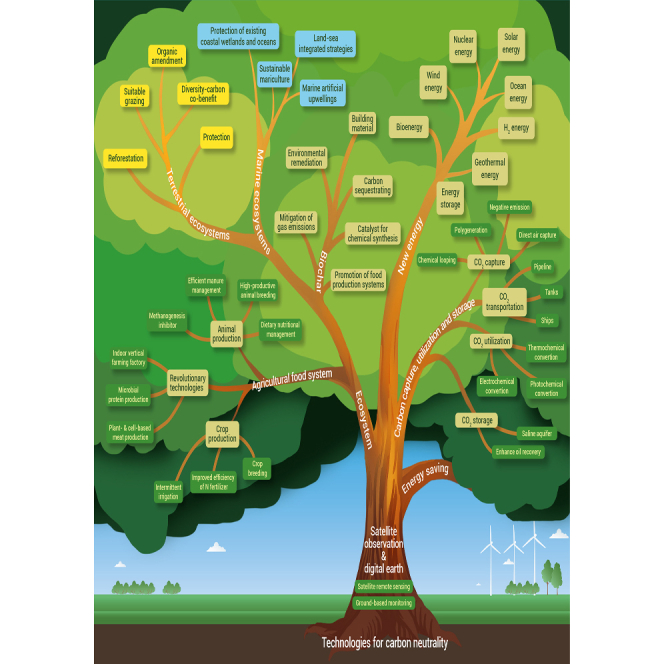
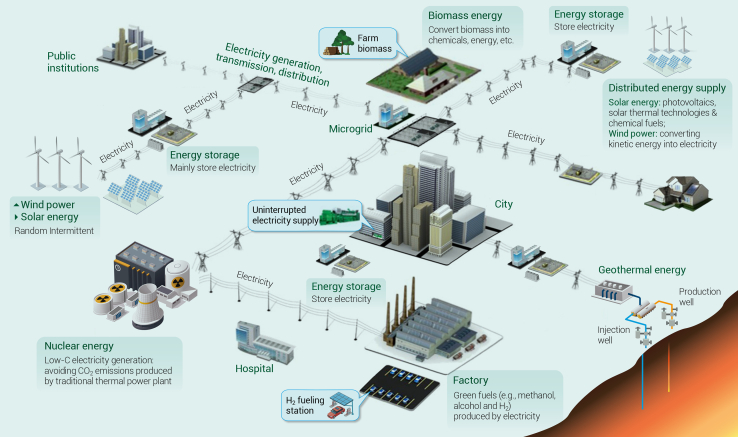
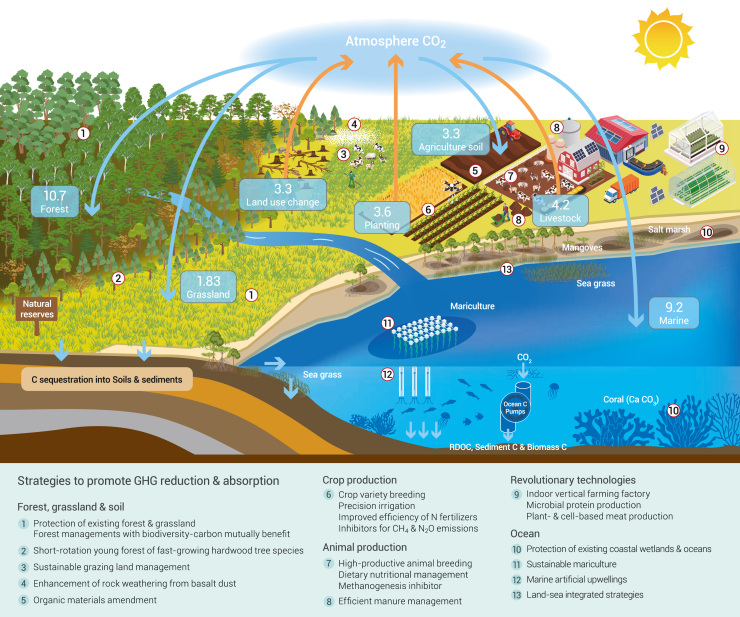
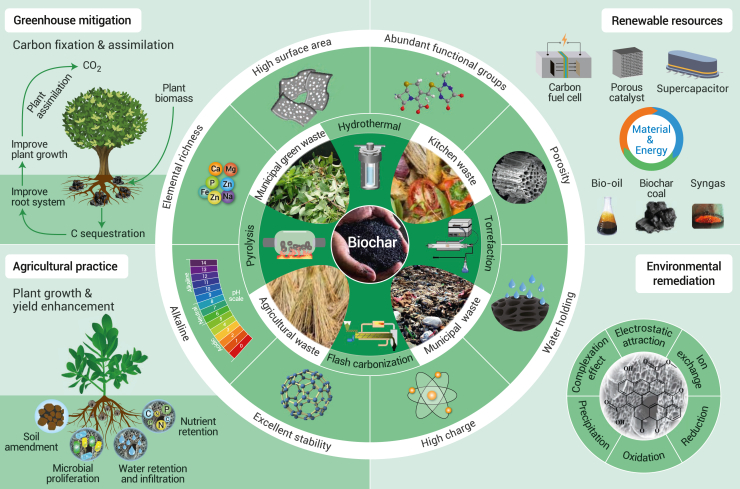
Verification
Claims the paper makes
186 Not checked yet · 55 Own interpretation · 45 No basis given · 2 Partly supported · 1 Supported so far · accuracy not yet measured
The cited sources support only part of this claim — read each source’s verdict below.
In the paper
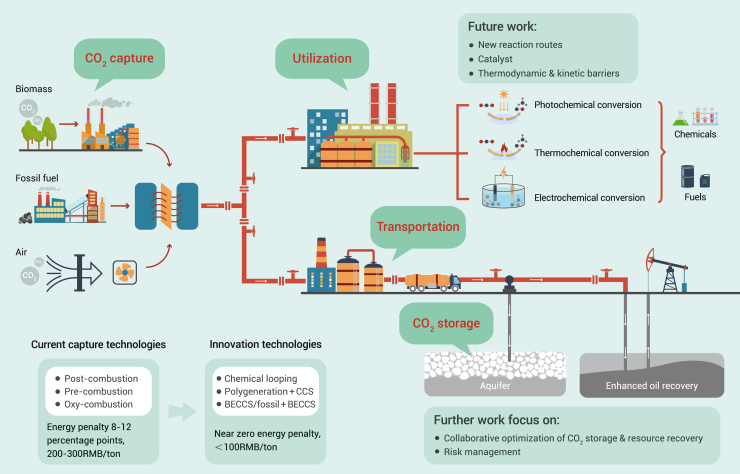
“Many valuable fuels, such as CO, CH4, CH3OH, HCOOH, and C2+ products have been generated through proton-assisted multiple electron-transfer processes.306, 307, 308, 309, 310”
§ Technologies and perspectives for achieving carbon neutrality > Technologies for CO2 capture, utilization, and storage > CO2 utilization
What the sources say
- Partly supportedcites [306] Wang, 2021, Rapid electron transfer via dynamic coordinative interaction boosts quantum efficiency for photocatalytic CO2 reduction, Nat. Commun. sourceExperimental — accuracy not yet measured
The Results section (‘Photocatalytic CO2 reduction with CoPc’; page unavailable) reports CO production and says proton sources improve CO yields through facilitated proton-coupled electron transfer. Our copy does not establish the claimed production of CH4, CH3OH, HCOOH, or C2+ products through that process; mentioning compounds in methods or reference titles does not establish their production in this study. (LLM, conf=0.86)
- Not checked yetcites [307] Long, 2017, Isolation of Cu atoms in Pd lattice: forming highly selective sites for photocatalytic conversion of CO2 to CH4, J. Am. Chem. Soc. source
- Not checked yetcites [308] Zeng, 2015, CO2 reduction to methanol on TiO2-passivated GaP photocatalysts, ACS Catal. source
- Not checked yetcites [309] Lu, 2017, Efficient photoelectrochemical reduction of carbon dioxide to formic acid: a functionalized ionic liquid as an absorbent and elecrolyte, Angew. Chem. Int. Ed. source
- Not checked yetcites [310] Albero, 2020, Photocatalytic CO2 reduction to C2+ products, ACS Catal. source
plaindirect- Asserted: passes — The authors put it forward as true.
- Checkable: passes — It can be checked against evidence.
- Load-bearing: unclear — It is unclear whether the paper’s conclusions depend on it.
- Based: passes — The paper gives a reason why it holds.
- Partly supported
In the paper
“In 2016, energy and food systems accounted for more than 90% of all global emissions of GHGs (mainly in the form of CO2).7”
§ Technologies and perspectives for achieving carbon neutrality > Introduction
What the sources say
- Not checked yetcites [7] Ritchie
plain- Asserted: passes — The authors put it forward as true.
- Checkable: passes — It can be checked against evidence.
- Load-bearing: unclear — It is unclear whether the paper’s conclusions depend on it.
- Based: passes — The paper gives a reason why it holds.
In the paper
“The global average temperature in 2020 was 1.2°C warmer than the pre-industrial temperature, and the effects of this warming are felt globally.14”
§ Technologies and perspectives for achieving carbon neutrality > Introduction
What the sources say
- Not checked yetcites [14]
plain- Asserted: passes — The authors put it forward as true.
- Checkable: passes — It can be checked against evidence.
- Load-bearing: unclear — It is unclear whether the paper’s conclusions depend on it.
- Based: passes — The paper gives a reason why it holds.
In the paper
“Molten salt reactors (MSRs) are in the framework of the Generation IV International Forum because of their nuclear safety and sustainability.79”
§ Technologies and perspectives for achieving carbon neutrality > Technologies for renewable energy > Nuclear energy
What the sources say
- Not checked yetcites [79] Dai, 2017, 17. Thorium molten salt reactor nuclear energy system (TMSR)
plaindirect- Asserted: passes — The authors put it forward as true.
- Checkable: passes — It can be checked against evidence.
- Load-bearing: unclear — It is unclear whether the paper’s conclusions depend on it.
- Based: passes — The paper gives a reason why it holds.
None of the sources cited for this claim have been checked yet.
In the paper
“When solar thermal technologies, such as concentrated solar power systems, are employed in commercial and residential sectors to replace natural gas as a source of energy, an obvious reduction in both energy consumption of fossil fuels and CO2 emissions has been observed.51,52”
§ Technologies and perspectives for achieving carbon neutrality > Technologies for renewable energy > Solar energy
What the sources say
- Not checked yetcites [51] Zhou, 2021, Estimation of the losses in potential concentrated solar thermal power electricity production due to air pollution in China, Sci. Total Environ. source
- Not checked yetcites [52] Di Leo, 2021, Contribution of the Basilicata region to decarbonisation of the energy system: results of a scenario analysis, Renew. Sust. Energ. Rev. source
boosteddirect- Asserted: passes — The authors put it forward as true.
- Checkable: passes — It can be checked against evidence.
- Load-bearing: unclear — It is unclear whether the paper’s conclusions depend on it.
- Based: passes — The paper gives a reason why it holds.
In the paper
“Therefore, Gen IV reactor nuclear fission systems have been proposed77 based on the following considerations: safety, reliability, physical protection, cost-effectiveness, sustainability, and proliferation resistance.”
§ Technologies and perspectives for achieving carbon neutrality > Technologies for renewable energy > Nuclear energy
What the sources say
- Not checked yetcites [77] Renault, 2009
plaindirect- Asserted: passes — The authors put it forward as true.
- Checkable: passes — It can be checked against evidence.
- Load-bearing: unclear — It is unclear whether the paper’s conclusions depend on it.
- Based: passes — The paper gives a reason why it holds.
In the paper
“Recently, hydrogen energy has drawn a great deal of interest because it can be used to establish a fully renewable energy system similar to an electricity grid, providing the sector integration needed for energy system transition and decarbonize energy end uses.70”
§ Technologies and perspectives for achieving carbon neutrality > Technologies for renewable energy > H2 energy
What the sources say
- Not checked yetcites [70] Council
plaindirect- Asserted: passes — The authors put it forward as true.
- Checkable: passes — It can be checked against evidence.
- Load-bearing: unclear — It is unclear whether the paper’s conclusions depend on it.
- Based: passes — The paper gives a reason why it holds.
None of the sources cited for this claim have been checked yet.
In the paper
“For instance, great efforts have been made on solar hydrogen production, demonstrating an extremely attractive route to produce hydrogen fuel by adopting renewable solar energy or solar-derived power to electrolyze water.53,54”
§ Technologies and perspectives for achieving carbon neutrality > Technologies for renewable energy > Solar energy
What the sources say
boosteddirect- Asserted: passes — The authors put it forward as true.
- Checkable: passes — It can be checked against evidence.
- Load-bearing: unclear — It is unclear whether the paper’s conclusions depend on it.
- Based: passes — The paper gives a reason why it holds.
In the paper
“An MSR with an outlet temperature above 700°C can also be applied to high-temperature electrolysis hydrogen production.80”
§ Technologies and perspectives for achieving carbon neutrality > Technologies for renewable energy > Nuclear energy
What the sources say
- Not checked yetcites [80] Wang, 2019, Current status and prospects of research on comprehensive utilization of nuclear energy, Bull. Chin. Acad. Sci.
plaindirect- Asserted: passes — The authors put it forward as true.
- Checkable: passes — It can be checked against evidence.
- Load-bearing: unclear — It is unclear whether the paper’s conclusions depend on it.
- Based: passes — The paper gives a reason why it holds.
In the paper
“Besides traditional large devices using electromagnetic generators, new technologies based on triboelectric nanogenerator networks are also being developed toward effective harvesting of wave energy economically.60”
§ Technologies and perspectives for achieving carbon neutrality > Technologies for renewable energy > Ocean energy
What the sources say
- Not checked yetcites [60] Wang, 2017, Catch wave power in floating nets, Nature source
plain- Asserted: passes — The authors put it forward as true.
- Checkable: passes — It can be checked against evidence.
- Load-bearing: unclear — It is unclear whether the paper’s conclusions depend on it.
- Based: passes — The paper gives a reason why it holds.
In the paper
“The decreasing costs of renewable energy and the increase in variable renewable power supplies' market share have put significant roadblocks in the way of cheap water electrolysis.71”
§ Technologies and perspectives for achieving carbon neutrality > Technologies for renewable energy > H2 energy
What the sources say
- Not checked yetcites [71] Nikolaidis, 2017, A comparative overview of hydrogen production processes, Renew. Sust. Energ. Rev. source
plaindirect- Asserted: passes — The authors put it forward as true.
- Checkable: passes — It can be checked against evidence.
- Load-bearing: unclear — It is unclear whether the paper’s conclusions depend on it.
- Based: passes — The paper gives a reason why it holds.
In the paper
“Because of its clean, renewable, and ubiquitous nature, solar energy can play an important role in the global renewable energy supply.44”
§ Technologies and perspectives for achieving carbon neutrality > Technologies for renewable energy > Solar energy
What the sources say
- Not checked yetcites [44] Dutta, 2017, Assessing the potential of CO2 utilization with an integrated framework for producing power and chemicals, J. CO2 Util. source
plaindirect- Asserted: passes — The authors put it forward as true.
- Checkable: passes — It can be checked against evidence.
- Load-bearing: unclear — It is unclear whether the paper’s conclusions depend on it.
- Based: passes — The paper gives a reason why it holds.
None of the sources cited for this claim have been checked yet.
In the paper
“Some newly emerging solar cells, such as organic solar cells, perovskite solar cells, quantum dot solar cells, and other integrated devices, have been developed as promising photovoltaic technologies in recent years.45, 46, 47, 48, 49”
§ Technologies and perspectives for achieving carbon neutrality > Technologies for renewable energy > Solar energy
What the sources say
- Not checked yetcites [45] Kilkis, 2020, Advances in integration of energy, water and environment systems towards climate neutrality for sustainable development, Energ. Convers. Manag. source
- Not checked yetcites [46] Li, 2021, Subtle side chain triggers unexpected two-channel charge transport property enabling 80% fill factors and efficient thick-film organic photovoltaics, Innovation
- Not checked yetcites [47] Yoo, 2021, Efficient perovskite solar cells via improved carrier management, Nature source
plain- Asserted: passes — The authors put it forward as true.
- Checkable: passes — It can be checked against evidence.
- Load-bearing: unclear — It is unclear whether the paper’s conclusions depend on it.
- Based: passes — The paper gives a reason why it holds.
In the paper
“The goal of ITER is to demonstrate sustainable deuterium-tritium plasma formation to create a 500 MW fusion power (Q = 10) for a duration of 300–500 s.81”
§ Technologies and perspectives for achieving carbon neutrality > Technologies for renewable energy > Nuclear energy
What the sources say
- Not checked yetcites [81] Bernard, 2017, ITER: a unique international collaboration to harness the power of the stars, Cr. Phys. source
plaindirect- Asserted: passes — The authors put it forward as true.
- Checkable: passes — It can be checked against evidence.
- Load-bearing: unclear — It is unclear whether the paper’s conclusions depend on it.
- Based: passes — The paper gives a reason why it holds.
None of the sources cited for this claim have been checked yet.
In the paper
“Better cropping systems, fertilization, and irrigation practices, and the use of advanced digital agriculture technologies, such as multi-sensor drone technology to allow farmers to manage crops, soil, fertilization, and irrigation more effectively and precisely, can reduce N fertilizer input and N2O emissions.117,118”
§ Technologies and perspectives for achieving carbon neutrality > Technologies for enhanced carbon sink in global ecosystems > Carbon emission reduction in agricultural food production systems
What the sources say
- Not checked yetcites [117] Maresma, 2018, Use of multispectral airborne images to improve in-season nitrogen management, predict grain yield and estimate economic return of maize in irrigated high yielding environments, Remote Sens. source
- Not checked yetcites [118] Sa, 2018, WeedMap: a large-scale semantic weed mapping framework using aerial multispectral imaging and deep neural network for precision farming, Remote Sens. source
plaindirect- Asserted: passes — The authors put it forward as true.
- Checkable: passes — It can be checked against evidence.
- Load-bearing: passes — The paper’s conclusions depend on it.
- Based: passes — The paper gives a reason why it holds.
In the paper
“flow batteries are well suited for large-scale energy storage applications because they have high safety, high efficiency, and flexibility.102”
§ Technologies and perspectives for achieving carbon neutrality > Technologies for renewable energy > Energy storage
What the sources say
- Not checked yetcites [102] Feng, 2021, Reversible ketone hydrogenation and dehydrogenation for aqueous organic redox flow batteries, Science source
boosteddirect- Asserted: passes — The authors put it forward as true.
- Checkable: passes — It can be checked against evidence.
- Load-bearing: unclear — It is unclear whether the paper’s conclusions depend on it.
- Based: passes — The paper gives a reason why it holds.
In the paper
“Using transgenic and gene-editing technology, the introduction of proliferating cell factor domain proteins, such as OsTCP19-H, into modern rice varieties has been shown to enhance NUE.66”
§ Technologies and perspectives for achieving carbon neutrality > Technologies for enhanced carbon sink in global ecosystems > Carbon emission reduction in agricultural food production systems
What the sources say
- Not checked yetcites [66] Liu, 2021, Genomic basis of geographical adaptation to soil nitrogen in rice, Nature source
plaindirect- Asserted: passes — The authors put it forward as true.
- Checkable: passes — It can be checked against evidence.
- Load-bearing: unclear — It is unclear whether the paper’s conclusions depend on it.
- Based: passes — The paper gives a reason why it holds.
In the paper
“The GHG emissions from agricultural food production systems have increased by around one-third during the past 20 years.”
§ Technologies and perspectives for achieving carbon neutrality > Technologies for enhanced carbon sink in global ecosystems > Carbon emission reduction in agricultural food production systems
What the sources say
- Not checked yetcites [113] Frank, 2019, Agricultural non-CO2 emission reduction potential in the context of the 1.5 degrees C target, Nat. Clim. Change source
plaindirect- Asserted: passes — The authors put it forward as true.
- Checkable: passes — It can be checked against evidence.
- Load-bearing: unclear — It is unclear whether the paper’s conclusions depend on it.
- Based: passes — The paper gives a reason why it holds.
In the paper
“Therefore, developing energy storage technology is pivotal to improving electricity output reliability and stability from renewables.91”
§ Technologies and perspectives for achieving carbon neutrality > Technologies for renewable energy > Energy storage
What the sources say
- Not checked yetcites [91] Yuan, 2019, Advanced materials for zinc-based flow battery: development and challenge, Adv. Mater. source
boosteddirect- Asserted: passes — The authors put it forward as true.
- Checkable: passes — It can be checked against evidence.
- Load-bearing: passes — The paper’s conclusions depend on it.
- Based: passes — The paper gives a reason why it holds.
In the paper
“Over the last 50 years, the removal of about one-third of anthropogenic GHG emissions has been attributed to terrestrial ecosystems.109”
§ Technologies and perspectives for achieving carbon neutrality > Technologies for enhanced carbon sink in global ecosystems
What the sources say
- Not checked yetcites [109] Ballantyne, 2012, Increase in observed net carbon dioxide uptake by land and oceans during the past 50 years, Nature source
plaindirect- Asserted: passes — The authors put it forward as true.
- Checkable: passes — It can be checked against evidence.
- Load-bearing: unclear — It is unclear whether the paper’s conclusions depend on it.
- Based: passes — The paper gives a reason why it holds.
None of the sources cited for this claim have been checked yet.
In the paper
“the development of inhibitors for methanogenesis or the addition of biochar in rice paddies has a large technical potential to reduce CH4 emissions.121,122”
§ Technologies and perspectives for achieving carbon neutrality > Technologies for enhanced carbon sink in global ecosystems > Carbon emission reduction in agricultural food production systems
What the sources say
- Not checked yetcites [121] Pratiwi, E., Akhdiya, A., Purwani, J., et al. (2021). Impact of methane-utilizing bacteria on rice yield, inorganic fertilizers efficiency and methane emissions. IOP Conference Series. 2021;648;1:12137 source
- Not checked yetcites [122] Rani, 2021, Inoculation of plant growth promoting-methane utilizing bacteria in different N-fertilizer regime influences methane emission and crop growth of flooded paddy, Sci. Total Environ. source
plaindirect- Asserted: passes — The authors put it forward as true.
- Checkable: passes — It can be checked against evidence.
- Load-bearing: unclear — It is unclear whether the paper’s conclusions depend on it.
- Based: passes — The paper gives a reason why it holds.
None of the sources cited for this claim have been checked yet.
In the paper
“Mechanical energy storage technologies, such as pumped hydro92, 93, 94 and compressed air energy storage,95, 96, 97 are currently the mainstream technologies for electric energy storage.”
§ Technologies and perspectives for achieving carbon neutrality > Technologies for renewable energy > Energy storage
What the sources say
- Not checked yetcites [92] Bueno, 2006, Wind powered pumped hydro storage systems, a means of increasing the penetration of renewable energy in the Canary Islands, Renew. Sust. Energ. Rev. source
- Not checked yetcites [93] Deane, 2010, Techno-economic review of existing and new pumped hydro energy storage plant, Renew. Sust. Energ. Rev. source
- Not checked yetcites [94] Rehman, 2015, Pumped hydro energy storage system: a technological review, Renew. Sust. Energ. Rev. source
plain- Asserted: passes — The authors put it forward as true.
- Checkable: passes — It can be checked against evidence.
- Load-bearing: unclear — It is unclear whether the paper’s conclusions depend on it.
- Based: passes — The paper gives a reason why it holds.
In the paper
“Optimization of fertilizer and water use in croplands can greatly reduce GHG emissions in crop production systems.115”
§ Technologies and perspectives for achieving carbon neutrality > Technologies for enhanced carbon sink in global ecosystems > Carbon emission reduction in agricultural food production systems
What the sources say
- Not checked yetcites [115] Shang, 2021, Can cropland management practices lower net greenhouse emissions without compromising yield?, Glob. Chang. Biol. source
plaindirect- Asserted: passes — The authors put it forward as true.
- Checkable: passes — It can be checked against evidence.
- Load-bearing: passes — The paper’s conclusions depend on it.
- Based: passes — The paper gives a reason why it holds.
In the paper
“ruminants fed with forage diets account for 70% of global ruminant methane emissions,131”
§ Technologies and perspectives for achieving carbon neutrality > Technologies for enhanced carbon sink in global ecosystems > Carbon emission reduction in agricultural food production systems
What the sources say
- Not checked yetcites [131] Herrero, 2016, Greenhouse gas mitigation potentials in the livestock sector, Nat. Clim. Change source
plaincorrelational- Asserted: passes — The authors put it forward as true.
- Checkable: passes — It can be checked against evidence.
- Load-bearing: passes — The paper’s conclusions depend on it.
- Based: passes — The paper gives a reason why it holds.
None of the sources cited for this claim have been checked yet.
In the paper
“Terrestrial ecosystems could increase C sequestration readily by restoring vegetation and incorporating organic soil amendments.150, 151, 152”
§ Technologies and perspectives for achieving carbon neutrality > Technologies for enhanced carbon sink in global ecosystems > Carbon sink in terrestrial ecosystems
What the sources say
- Not checked yetcites [150] Fang, 2018, Climate change, human impacts, and carbon sequestration in China, Proc. Natl. Acad. Sci. U S A source
- Not checked yetcites [151] Wijesekara, 2021, Carbon sequestration value of biosolids applied to soil: a global meta-analysis, J. Environ. Manage.
- Not checked yetcites [152] Siedt, 2021, Comparing straw, compost, and biochar regarding their suitability as agricultural soil amendments to affect soil structure, nutrient leaching, microbial communities, and the fate of pesticides, Sci. Total Environ. source
hedgedconditional- Asserted: passes — The authors put it forward as true.
- Checkable: passes — It can be checked against evidence.
- Load-bearing: unclear — It is unclear whether the paper’s conclusions depend on it.
- Based: passes — The paper gives a reason why it holds.
In the paper
“Manure management practices could substantially mitigate indirect GHG emissions by optimizing grazing-land management, generating on-farm energy, and producing organic fertilizers that have a low emission factor.132”
§ Technologies and perspectives for achieving carbon neutrality > Technologies for enhanced carbon sink in global ecosystems > Carbon emission reduction in agricultural food production systems
What the sources say
- Not checked yetcites [132] Harindintwali, 2021, Integrated eco-strategies towards sustainable carbon and nitrogen cycling in agriculture, J. Environ. Manage.
hedgedconditional- Asserted: passes — The authors put it forward as true.
- Checkable: passes — It can be checked against evidence.
- Load-bearing: unclear — It is unclear whether the paper’s conclusions depend on it.
- Based: passes — The paper gives a reason why it holds.
In the paper
“Current advances in biotechnology provide a powerful platform for the production of protein-rich feed or food additives in the form of fungal, algae, yeast, and bacterial cell biomass.141”
§ Technologies and perspectives for achieving carbon neutrality > Technologies for enhanced carbon sink in global ecosystems > Carbon emission reduction in agricultural food production systems
What the sources say
- Not checked yetcites [141] Matassa, 2016, Microbial protein: future sustainable food supply route with low environmental footprint, Microb. Biotechnol. source
boosteddirect- Asserted: passes — The authors put it forward as true.
- Checkable: passes — It can be checked against evidence.
- Load-bearing: unclear — It is unclear whether the paper’s conclusions depend on it.
- Based: passes — The paper gives a reason why it holds.
In the paper
“Temperature, precipitation, and solar radiation are the three key climatic factors that influence plant photosynthesis and thus the C sink size of terrestrial ecosystems.155”
§ Technologies and perspectives for achieving carbon neutrality > Technologies for enhanced carbon sink in global ecosystems > Carbon sink in terrestrial ecosystems
What the sources say
- Not checked yetcites [155] Zhao, 2019, Evaluating impacts of climate change on net ecosystem productivity (NEP) of global different forest types based on an individual tree-based model FORCCHN and remote sensing, Glob. Planet. Change source
plaindirect- Asserted: passes — The authors put it forward as true.
- Checkable: passes — It can be checked against evidence.
- Load-bearing: unclear — It is unclear whether the paper’s conclusions depend on it.
- Based: passes — The paper gives a reason why it holds.
In the paper
“ecosystem C storage depends on the balance between production and decomposition.166”
§ Technologies and perspectives for achieving carbon neutrality > Technologies for enhanced carbon sink in global ecosystems > Carbon sink in terrestrial ecosystems
What the sources say
- Not checked yetcites [166] Marschner, 2008, How relevant is recalcitrance for the stabilization of organic matter in soils?, J. Plant Nutr. Soil Sc. source
plaindirect- Asserted: passes — The authors put it forward as true.
- Checkable: passes — It can be checked against evidence.
- Load-bearing: passes — The paper’s conclusions depend on it.
- Based: passes — The paper gives a reason why it holds.
None of the sources cited for this claim have been checked yet.
In the paper
“Other novel biotechnology strategies include metabolic engineering to enable microbial utilization of using CO2, CH4, and other C1 feedstocks for the production of microbial proteins rich in essential amino acids.139,140”
§ Technologies and perspectives for achieving carbon neutrality > Technologies for enhanced carbon sink in global ecosystems > Carbon emission reduction in agricultural food production systems
What the sources say
plaindirect- Asserted: passes — The authors put it forward as true.
- Checkable: passes — It can be checked against evidence.
- Load-bearing: unclear — It is unclear whether the paper’s conclusions depend on it.
- Based: passes — The paper gives a reason why it holds.
None of the sources cited for this claim have been checked yet.
In the paper
“Anthropogenic disturbances (e.g., N deposition, P fertilization, pesticides,162 road density, grazing, fire) have substantially altered ecosystem functions and services across different biomes, thus affecting C sink strength in terrestrial ecosystems.163”
§ Technologies and perspectives for achieving carbon neutrality > Technologies for enhanced carbon sink in global ecosystems > Carbon sink in terrestrial ecosystems
What the sources say
- Not checked yetcites [162] Schäffer, 2018
- Not checked yetcites [163] Penuelas, 2020, Anthropogenic global shifts in biospheric N and P concentrations and ratios and their impacts on biodiversity, ecosystem productivity, food security, and human health, Glob. Change Biol. source
plaindirect- Asserted: passes — The authors put it forward as true.
- Checkable: passes — It can be checked against evidence.
- Load-bearing: unclear — It is unclear whether the paper’s conclusions depend on it.
- Based: passes — The paper gives a reason why it holds.
In the paper
“Several pilot plants demonstrate the feasibility of large-scale production requiring agricultural land.142”
§ Technologies and perspectives for achieving carbon neutrality > Technologies for enhanced carbon sink in global ecosystems > Carbon emission reduction in agricultural food production systems
What the sources say
- Not checked yetcites [142] Bai, 2020, A food system revolution for China in the post-pandemic world, Res. Environ. Sustain.
boosted- Asserted: passes — The authors put it forward as true.
- Checkable: passes — It can be checked against evidence.
- Load-bearing: unclear — It is unclear whether the paper’s conclusions depend on it.
- Based: passes — The paper gives a reason why it holds.
In the paper
“If the stimulation of decomposition is more than production caused by fertilization, there would ultimately be a net C loss from the ecosystem.167”
§ Technologies and perspectives for achieving carbon neutrality > Technologies for enhanced carbon sink in global ecosystems > Carbon sink in terrestrial ecosystems
What the sources say
- Not checked yetcites [167] Mack, 2004, Ecosystem carbon storage in arctic tundra reduced by long-term nutrient fertilization, Nature source
hedgeddirect- Asserted: passes — The authors put it forward as true.
- Checkable: passes — It can be checked against evidence.
- Load-bearing: unclear — It is unclear whether the paper’s conclusions depend on it.
- Based: passes — The paper gives a reason why it holds.
In the paper
“Agricultural soils can be an important C pool and contribute about 3.30 Gt CO2-eq year−1 to C sequestration,148 although agricultural food production is related to GHG emissions.149”
§ Technologies and perspectives for achieving carbon neutrality > Technologies for enhanced carbon sink in global ecosystems > Carbon sink in terrestrial ecosystems
What the sources say
- Not checked yetcites [148] Han, 2021, Organic and inorganic model soil fractions instigate the formation of distinct microbial biofilms for enhanced biodegradation of benzo a pyrene, J. Hazard. Mater. source
plaindirect- Asserted: passes — The authors put it forward as true.
- Checkable: passes — It can be checked against evidence.
- Load-bearing: unclear — It is unclear whether the paper’s conclusions depend on it.
- Based: passes — The paper gives a reason why it holds.
None of the sources cited for this claim have been checked yet.
In the paper
“Regulating stands into a more complex vertical structure will lead to faster growth and greater C sequestration in forests because multilayered canopies will occupy a range of light environments, resulting in high light acquisition and light-use efficiency.180,181”
§ Technologies and perspectives for achieving carbon neutrality > Technologies for enhanced carbon sink in global ecosystems > Carbon sink in terrestrial ecosystems
What the sources say
plaindirect- Asserted: passes — The authors put it forward as true.
- Checkable: passes — It can be checked against evidence.
- Load-bearing: passes — The paper’s conclusions depend on it.
- Based: passes — The paper gives a reason why it holds.
None of the sources cited for this claim have been checked yet.
In the paper
“Since the late 1970s, China has implemented six major ecological restoration projects, covering 44.8% of China's forests and 23.2% of its grasslands.175,176”
§ Technologies and perspectives for achieving carbon neutrality > Technologies for enhanced carbon sink in global ecosystems > Carbon sink in terrestrial ecosystems
What the sources say
- Not checked yetcites [175] Liu, 2019, Greenhouse gas emissions and net carbon sequestration of the Beijing-Tianjin sand source control project in China, J. Clean. Prod. source
- Not checked yetcites [176] Lu, 2018, Effects of national ecological restoration projects on carbon sequestration in China from 2001 to 2010, Proc. Natl. Acad. Sci. U S A source
plain- Asserted: passes — The authors put it forward as true.
- Checkable: passes — It can be checked against evidence.
- Load-bearing: unclear — It is unclear whether the paper’s conclusions depend on it.
- Based: passes — The paper gives a reason why it holds.
A conclusion the paper draws from its own results — it cites no other source for it, so there is none to check. The quote shows it is in the paper.
In the paper
“Therefore, maintaining forest area is the basis of enhancing the C sink of terrestrial ecosystems.”
§ Technologies and perspectives for achieving carbon neutrality > Technologies for enhanced carbon sink in global ecosystems > Carbon sink in terrestrial ecosystems
plaindirect- Asserted: passes — The authors put it forward as true.
- Checkable: passes — It can be checked against evidence.
- Load-bearing: passes — The paper’s conclusions depend on it.
- Based: passes — The paper gives a reason why it holds.
None of the sources cited for this claim have been checked yet.
In the paper
“practical research and development of blue C have predominantly involved coastal wetlands, such as mangrove, seagrass, and salt marsh.201,202”
§ Technologies and perspectives for achieving carbon neutrality > Technologies for enhanced carbon sink in global ecosystems > Carbon sink in marine ecosystems
What the sources say
plain- Asserted: passes — The authors put it forward as true.
- Checkable: passes — It can be checked against evidence.
- Load-bearing: unclear — It is unclear whether the paper’s conclusions depend on it.
- Based: passes — The paper gives a reason why it holds.
None of the sources cited for this claim have been checked yet.
In the paper
“Biochar amendments can also be an effective approach to increase SOC stocks due to the stable (on a millennium timescale) nature of the C contained in the biochar.187,188”
§ Technologies and perspectives for achieving carbon neutrality > Technologies for enhanced carbon sink in global ecosystems > Carbon sink in terrestrial ecosystems
What the sources say
- Not checked yetcites [187] Yin, 2021, Research progress and prospects for using biochar to mitigate greenhouse gas emissions during composting: a review, Sci. Total Environ. source
- Not checked yetcites [188] Wang, 2018, Differentiated mechanisms of biochar mitigating straw-induced greenhouse gas emissions in two contrasting paddy soils, Front. Microbiol. source
plainconditional- Asserted: passes — The authors put it forward as true.
- Checkable: passes — It can be checked against evidence.
- Load-bearing: passes — The paper’s conclusions depend on it.
- Based: passes — The paper gives a reason why it holds.
In the paper
“However, the fate of most of this exported material is remineralization to CO2.197”
§ Technologies and perspectives for achieving carbon neutrality > Technologies for enhanced carbon sink in global ecosystems > Carbon sink in marine ecosystems
What the sources say
- Not checked yetcites [197] Jiao, 2010, Microbial production of recalcitrant dissolved organic matter: long-term carbon storage in the global ocean, Nat. Rev. Microbiol. source
plaindirect- Asserted: passes — The authors put it forward as true.
- Checkable: passes — It can be checked against evidence.
- Load-bearing: unclear — It is unclear whether the paper’s conclusions depend on it.
- Based: passes — The paper gives a reason why it holds.
None of the sources cited for this claim have been checked yet.
In the paper
“Nature-based NETs on land rely on biomass C sequestration through interventions, such as reforestation and afforestation, sustainable forest management, soil C sequestration from increased inputs to soils, and biochar additions.22,172,173”
§ Technologies and perspectives for achieving carbon neutrality > Technologies for enhanced carbon sink in global ecosystems > Carbon sink in terrestrial ecosystems
What the sources say
- Not checked yetcites [22] Beerling, 2017, Enhanced rock weathering: biological climate change mitigation with co-benefits for food security?, Biol. Lett. source
- Not checked yetcites [172] Goll, 2021, Potential CO2 removal from enhanced weathering by ecosystem responses to powdered rock, Nat. Geosci. source
- Not checked yetcites [173] Bolan, 2012, Stabilization of carbon in composts and biochars in relation to carbon sequestration and soil fertility, Sci. Total Environ. source
plaindirect- Asserted: passes — The authors put it forward as true.
- Checkable: passes — It can be checked against evidence.
- Load-bearing: unclear — It is unclear whether the paper’s conclusions depend on it.
- Based: passes — The paper gives a reason why it holds.
In the paper
“Application of crushed calcium- and magnesium-rich silicate rocks to soils is proposed for large-scale CO2 removal.191 This technology was called enhanced rock weathering, which increases soil alkalinity, and thus atmospheric CO2 can be converted into dissolved inorganic C to be finally transported to the ocean, where the stored C has a long lifespan via land surface runoff.”
§ Technologies and perspectives for achieving carbon neutrality > Technologies for enhanced carbon sink in global ecosystems > Carbon sink in terrestrial ecosystems
What the sources say
- Not checked yetcites [191] Beerling, 2020, Potential for large-scale CO2 removal via enhanced rock weathering with croplands, Nature source
plaindirect- Asserted: passes — The authors put it forward as true.
- Checkable: passes — It can be checked against evidence.
- Load-bearing: passes — The paper’s conclusions depend on it.
- Based: passes — The paper gives a reason why it holds.
None of the sources cited for this claim have been checked yet.
In the paper
“for C sequestration in forest ecosystems, optimizing forest management strategies such as selection of suitable tree species, rotation length, and fertilization regimes are effective ways to increase the amount of forest C sequestration.177, 178, 179”
§ Technologies and perspectives for achieving carbon neutrality > Technologies for enhanced carbon sink in global ecosystems > Carbon sink in terrestrial ecosystems
What the sources say
- Not checked yetcites [177] Diochon, 2009, Looking deeper: an investigation of soil carbon losses following harvesting from a managed northeastern red spruce (Picea rubens Sarg.) forest chronosequence, For. Ecol. Manag. source
- Not checked yetcites [178] Gong, 2021, Forest thinning increases soil carbon stocks in China, For. Ecol. Manag. source
- Not checked yetcites [179] Trumbore, 2015, Forest health and global change, Science source
plaindirect- Asserted: passes — The authors put it forward as true.
- Checkable: passes — It can be checked against evidence.
- Load-bearing: passes — The paper’s conclusions depend on it.
- Based: passes — The paper gives a reason why it holds.
In the paper
“Recent simulations suggested that the protection and restoration of global coastal wetlands can provide half of forest soil C migration potential by 2030.211”
§ Technologies and perspectives for achieving carbon neutrality > Technologies for enhanced carbon sink in global ecosystems > Carbon sink in marine ecosystems
What the sources say
- Not checked yetcites [211] Bossio, 2020, The role of soil carbon in natural climate solutions, Nat. Sustain. source
hedgeddirect- Asserted: passes — The authors put it forward as true.
- Checkable: passes — It can be checked against evidence.
- Load-bearing: unclear — It is unclear whether the paper’s conclusions depend on it.
- Based: passes — The paper gives a reason why it holds.
A conclusion the paper draws from its own results — it cites no other source for it, so there is none to check. The quote shows it is in the paper.
In the paper
“Improving these marine ecosystems' C sequestration or negative C emission capacity is a fundamental opportunity for achieving C neutrality.”
§ Technologies and perspectives for achieving carbon neutrality > Technologies for enhanced carbon sink in global ecosystems > Carbon sink in marine ecosystems
plaindirect- Asserted: passes — The authors put it forward as true.
- Checkable: passes — It can be checked against evidence.
- Load-bearing: passes — The paper’s conclusions depend on it.
- Based: passes — The paper gives a reason why it holds.
In the paper
“It was estimated that seagrass ecosystems accumulate 176–411 Tg CO2-eq year−1.203”
§ Technologies and perspectives for achieving carbon neutrality > Technologies for enhanced carbon sink in global ecosystems > Carbon sink in marine ecosystems
What the sources say
- Not checked yetcites [203] Duarte, 2013, The role of coastal plant communities for climate change mitigation and adaptation, Nat. Clim. Change source
hedged- Asserted: passes — The authors put it forward as true.
- Checkable: passes — It can be checked against evidence.
- Load-bearing: unclear — It is unclear whether the paper’s conclusions depend on it.
- Based: passes — The paper gives a reason why it holds.
A conclusion the paper draws from its own results — it cites no other source for it, so there is none to check. The quote shows it is in the paper.
In the paper
“the thermochemical conversion of solid waste into biochar can bring multifunctional benefits to the circular economy in addition to climate change mitigation and C sequestration.”
§ Technologies and perspectives for achieving carbon neutrality > Technologies for enhanced carbon sink in global ecosystems > Tackling the carbon footprint of global waste
plaindirect- Asserted: passes — The authors put it forward as true.
- Checkable: passes — It can be checked against evidence.
- Load-bearing: passes — The paper’s conclusions depend on it.
- Based: passes — The paper gives a reason why it holds.
- Rests on an assumption: Addressing problems associated with waste landfills and open waste burning is far more expensive than creating and running safe waste management systems.
In the paper
“One possible way to increase blue C is to promote microbial C sequestration in marine ecosystems by reducing the application of chemical fertilizers on land (Figure 2), as initially proposed by Jiao et al.208”
§ Technologies and perspectives for achieving carbon neutrality > Technologies for enhanced carbon sink in global ecosystems > Carbon sink in marine ecosystems
What the sources say
- Not checked yetcites [208] Jiao, 2011, Increasing the microbial carbon sink in the sea by reducing chemical fertilization on the land, Nat. Rev. Microbiol. source
hedgedconditional- Asserted: passes — The authors put it forward as true.
- Checkable: passes — It can be checked against evidence.
- Load-bearing: unclear — It is unclear whether the paper’s conclusions depend on it.
- Based: passes — The paper gives a reason why it holds.
A conclusion the paper draws from its own results — it cites no other source for it, so there is none to check. The quote shows it is in the paper.
In the paper
“bio(char) production from widely distributed waste has socio-economic and environmental significance in the race to achieve C neutrality.”
§ Technologies and perspectives for achieving carbon neutrality > Technologies for enhanced carbon sink in global ecosystems > Tackling the carbon footprint of global waste
plaincorrelational- Asserted: passes — The authors put it forward as true.
- Checkable: unclear — It is unclear whether it could be checked against evidence.
- Load-bearing: passes — The paper’s conclusions depend on it.
- Based: passes — The paper gives a reason why it holds.
A conclusion the paper draws from its own results — it cites no other source for it, so there is none to check. The quote shows it is in the paper.
In the paper
“Protection and restoration of marine ecosystems is the first step and the quickest way to enhance C sequestration.”
§ Technologies and perspectives for achieving carbon neutrality > Technologies for enhanced carbon sink in global ecosystems > Carbon sink in marine ecosystems
plaindirect- Asserted: passes — The authors put it forward as true.
- Checkable: passes — It can be checked against evidence.
- Load-bearing: passes — The paper’s conclusions depend on it.
- Based: unclear — It is unclear why the paper says it holds.
In the paper
“The sustainable management, conservation, and restoration of these marine ecosystems are vital to support the provision of C sequestration and other ecosystem services that humans depend on.207”
§ Technologies and perspectives for achieving carbon neutrality > Technologies for enhanced carbon sink in global ecosystems > Carbon sink in marine ecosystems
What the sources say
- Not checked yetcites [207] Wei, 2021, Towards post-2020 global biodiversity conservation: footprint and direction in China, Innovation
plaindirect- Asserted: passes — The authors put it forward as true.
- Checkable: passes — It can be checked against evidence.
- Load-bearing: passes — The paper’s conclusions depend on it.
- Based: passes — The paper gives a reason why it holds.
None of the sources cited for this claim have been checked yet.
In the paper
“A plethora of organic resources, such as crop residues,222 forest residues, livestock manure, food wastes, industrial biowastes, municipal biowastes, and animal carcasses, are feedstocks that can be used to produce biochar for different purposes.223,224”
§ Technologies and perspectives for achieving carbon neutrality > Technologies for enhanced carbon sink in global ecosystems > Tackling the carbon footprint of global waste
What the sources say
- Not checked yetcites [222] Liu, 2019, Adsorption kinetics of 2,2',4,4'-tetrabromodiphenyl ether (BDE-47) on maize straw-derived biochars, Pedosphere source
- Not checked yetcites [223] Bolan, 2021, Multifunctional applications of biochar beyond carbon storage, Int. Mater. Rev.
- Not checked yetcites [224] Jia, 2016, Metal ion-oxytetracycline interactions on maize straw biochar pyrolyzed at different temperatures, Chem. Eng. J. source
plaindirect- Asserted: passes — The authors put it forward as true.
- Checkable: passes — It can be checked against evidence.
- Load-bearing: unclear — It is unclear whether the paper’s conclusions depend on it.
- Based: passes — The paper gives a reason why it holds.
In the paper
“It is estimated that, by 2050, the amount of waste generated annually in the world will jump from 2.01 billion tons in 2016 to 3.4 billion tons.215”
§ Technologies and perspectives for achieving carbon neutrality > Technologies for enhanced carbon sink in global ecosystems > Tackling the carbon footprint of global waste
What the sources say
- Not checked yetcites [215] Kaza, 2018
hedgeddirect- Asserted: passes — The authors put it forward as true.
- Checkable: passes — It can be checked against evidence.
- Load-bearing: unclear — It is unclear whether the paper’s conclusions depend on it.
- Based: passes — The paper gives a reason why it holds.
In the paper
“not all forms of biochar are environmentally friendly or beneficial.249”
§ Technologies and perspectives for achieving carbon neutrality > Technologies for enhanced carbon sink in global ecosystems > Tackling the carbon footprint of global waste
What the sources say
- Not checked yetcites [249] Joseph, 2021, How biochar works, and when it doesn't: a review of mechanisms controlling soil and plant responses to biochar, GCB. Bioenergy. source
plain- Asserted: passes — The authors put it forward as true.
- Checkable: passes — It can be checked against evidence.
- Load-bearing: unclear — It is unclear whether the paper’s conclusions depend on it.
- Based: passes — The paper gives a reason why it holds.
In the paper
“the conversion of agricultural waste into biochar to improve soil health is regarded as a promising strategy for storing soil nutrients and reducing GHG emissions.249”
§ Technologies and perspectives for achieving carbon neutrality > Technologies for enhanced carbon sink in global ecosystems > Tackling the carbon footprint of global waste
What the sources say
- Not checked yetcites [249] Joseph, 2021, How biochar works, and when it doesn't: a review of mechanisms controlling soil and plant responses to biochar, GCB. Bioenergy. source
plain- Asserted: passes — The authors put it forward as true.
- Checkable: passes — It can be checked against evidence.
- Load-bearing: passes — The paper’s conclusions depend on it.
- Based: passes — The paper gives a reason why it holds.
A conclusion the paper draws from its own results — it cites no other source for it, so there is none to check. The quote shows it is in the paper.
In the paper
“Potentially, all fossil fuel products can be produced from biomass.”
§ Technologies and perspectives for achieving carbon neutrality > Technologies for enhanced carbon sink in global ecosystems > Tackling the carbon footprint of global waste
hedgedconditional- Asserted: passes — The authors put it forward as true.
- Checkable: passes — It can be checked against evidence.
- Load-bearing: unclear — It is unclear whether the paper’s conclusions depend on it.
- Based: passes — The paper gives a reason why it holds.
In the paper
“microorganisms, especially bacteria, can use most biological resources, such as starch, fatty acids, cellulose, sugars, proteins, and other organic materials, as sources of nutrients and convert them into various monomers appropriate for the production of biopolymers.269”
§ Technologies and perspectives for achieving carbon neutrality > Technologies for enhanced carbon sink in global ecosystems > Tackling the carbon footprint of global waste
What the sources say
- Not checked yetcites [269] Chen, 2012, Plastics derived from biological sources: present and future: a technical and environmental review, Chem. Rev. source
plaindirect- Asserted: passes — The authors put it forward as true.
- Checkable: passes — It can be checked against evidence.
- Load-bearing: unclear — It is unclear whether the paper’s conclusions depend on it.
- Based: passes — The paper gives a reason why it holds.
In the paper
“modification and functionalization of wood materials using nanotechnology processes can provide large-scale bio-templates with improved properties.”
§ Technologies and perspectives for achieving carbon neutrality > Technologies for enhanced carbon sink in global ecosystems > Tackling the carbon footprint of global waste
What the sources say
- Not checked yetcites [276] Berglund, 2018, Bioinspired wood nanotechnology for functional materials, Adv. Mater. source
plaindirect- Asserted: passes — The authors put it forward as true.
- Checkable: passes — It can be checked against evidence.
- Load-bearing: unclear — It is unclear whether the paper’s conclusions depend on it.
- Based: passes — The paper gives a reason why it holds.
In the paper
“Biochar can replace cement in ultra-high-performance concrete260”
§ Technologies and perspectives for achieving carbon neutrality > Technologies for enhanced carbon sink in global ecosystems > Tackling the carbon footprint of global waste
What the sources say
- Not checked yetcites [260] Dixit, 2020, Cement replacement and improved hydration in ultra-high performance concrete using biochar
plaindirect- Asserted: passes — The authors put it forward as true.
- Checkable: passes — It can be checked against evidence.
- Load-bearing: unclear — It is unclear whether the paper’s conclusions depend on it.
- Based: passes — The paper gives a reason why it holds.
None of the sources cited for this claim have been checked yet.
In the paper
“The application of wood nanotechnology for producing bioinspired functional materials, with a particular emphasis on novel nanotechnological approaches for developing new wood-based materials, has been developed for sustainable use in various production systems.276,278,279”
§ Technologies and perspectives for achieving carbon neutrality > Technologies for enhanced carbon sink in global ecosystems > Tackling the carbon footprint of global waste
What the sources say
- Not checked yetcites [276] Berglund, 2018, Bioinspired wood nanotechnology for functional materials, Adv. Mater. source
- Not checked yetcites [278] Song, 2018, Processing bulk natural wood into a high-performance structural material, Nature source
- Not checked yetcites [279] Jiang, 2018, Wood-based nanotechnologies toward sustainability, Adv. Mater. source
plain- Asserted: passes — The authors put it forward as true.
- Checkable: passes — It can be checked against evidence.
- Load-bearing: unclear — It is unclear whether the paper’s conclusions depend on it.
- Based: passes — The paper gives a reason why it holds.
None of the sources cited for this claim have been checked yet.
In the paper
“the effectiveness of biochar depends on its physical and chemical properties, which are affected by various production factors and operating settings, such as the type of raw material and the thermochemical conversion process used to produce the biochar, temperature, time, and heating rate, etc., in addition to the post-production processes.265,266”
§ Technologies and perspectives for achieving carbon neutrality > Technologies for enhanced carbon sink in global ecosystems > Tackling the carbon footprint of global waste
What the sources say
- Not checked yetcites [265] Xu, 2021, Impacts of different activation processes on the carbon stability of biochar for oxidation resistance, Bioresour. Technol. source
- Not checked yetcites [266] He, 2021, Critical impacts of pyrolysis conditions and activation methods on application-oriented production of wood waste-derived biochar, Bioresour. Technol. source
plaindirect- Asserted: passes — The authors put it forward as true.
- Checkable: passes — It can be checked against evidence.
- Load-bearing: passes — The paper’s conclusions depend on it.
- Based: passes — The paper gives a reason why it holds.
In the paper
“Starch-based polymers are the most widely used and cost-effective biomaterials due to their biodegradability, biocompatibility, tensile strength, and thermal efficiency”
§ Technologies and perspectives for achieving carbon neutrality > Technologies for enhanced carbon sink in global ecosystems > Tackling the carbon footprint of global waste
What the sources say
- Not checked yetcites [270] Jiang, 2020, Starch-based biodegradable materials: challenges and opportunities, Adv. Ind. Eng. Polym. Res.
plaindirect- Asserted: passes — The authors put it forward as true.
- Checkable: passes — It can be checked against evidence.
- Load-bearing: unclear — It is unclear whether the paper’s conclusions depend on it.
- Based: passes — The paper gives a reason why it holds.
In the paper
“The CCUS is a necessary technology to realize the CO2 emission reduction target.280”
§ Technologies and perspectives for achieving carbon neutrality > Technologies for CO2 capture, utilization, and storage
What the sources say
- Not checked yetcites [280] Zhang, 2021, Direct conversion of CO2 to a jet fuel over CoFe alloy catalysts, Innovation
plaindirect- Asserted: passes — The authors put it forward as true.
- Checkable: passes — It can be checked against evidence.
- Load-bearing: passes — The paper’s conclusions depend on it.
- Based: passes — The paper gives a reason why it holds.
A conclusion the paper draws from its own results — it cites no other source for it, so there is none to check. The quote shows it is in the paper.
In the paper
“With the help of the C-negative manufacturing process, biochar occupies a special position in the production of green cement and concrete.”
§ Technologies and perspectives for achieving carbon neutrality > Technologies for enhanced carbon sink in global ecosystems > Tackling the carbon footprint of global waste
plaindirect- Asserted: passes — The authors put it forward as true.
- Checkable: passes — It can be checked against evidence.
- Load-bearing: unclear — It is unclear whether the paper’s conclusions depend on it.
- Based: passes — The paper gives a reason why it holds.
In the paper
“when used as a soil amendment, biochar with an excessively high pH, too much ash, or high concentrations of residual organic and inorganic toxicants may negatively impact plants and beneficial microorganisms in the soil.267”
§ Technologies and perspectives for achieving carbon neutrality > Technologies for enhanced carbon sink in global ecosystems > Tackling the carbon footprint of global waste
What the sources say
- Not checked yetcites [267] Belcher, 2017
hedgedconditional- Asserted: passes — The authors put it forward as true.
- Checkable: passes — It can be checked against evidence.
- Load-bearing: passes — The paper’s conclusions depend on it.
- Based: passes — The paper gives a reason why it holds.
In the paper
“These wood-based materials can be used to implement the concept of hierarchically structured nanomaterials for large-scale applications in various advanced technologies, including energy storage, solar-steam-assisted desalination, water treatment, and production of lightweight structural materials, plastic, electronics, glass, and ionic devices.276”
§ Technologies and perspectives for achieving carbon neutrality > Technologies for enhanced carbon sink in global ecosystems > Tackling the carbon footprint of global waste
What the sources say
- Not checked yetcites [276] Berglund, 2018, Bioinspired wood nanotechnology for functional materials, Adv. Mater. source
plaindirect- Asserted: passes — The authors put it forward as true.
- Checkable: passes — It can be checked against evidence.
- Load-bearing: unclear — It is unclear whether the paper’s conclusions depend on it.
- Based: passes — The paper gives a reason why it holds.
In the paper
“and strengthen the interface bond between cement matrix and polypropylene fiber.261”
§ Technologies and perspectives for achieving carbon neutrality > Technologies for enhanced carbon sink in global ecosystems > Tackling the carbon footprint of global waste
What the sources say
- Not checked yetcites [261] Gupta, 2017, Use of biochar-coated polypropylene fibers for carbon sequestration and physical improvement of mortar, Cement Concrete Comp. source
plaindirect- Asserted: passes — The authors put it forward as true.
- Checkable: passes — It can be checked against evidence.
- Load-bearing: unclear — It is unclear whether the paper’s conclusions depend on it.
- Based: passes — The paper gives a reason why it holds.
In the paper
“fibrillated cellulose obtained from renewable sources, due to its mechanical, thermal, optical, and fluid properties, is a multifunctional nanomaterial that may be utilized to produce materials spanning from composites, nanofillers, and macrofibers to thin films, gels, and porous membranes.277”
§ Technologies and perspectives for achieving carbon neutrality > Technologies for enhanced carbon sink in global ecosystems > Tackling the carbon footprint of global waste
What the sources say
- Not checked yetcites [277] Li, 2021, Developing fibrillated cellulose as a sustainable technological material, Nature source
hedged- Asserted: passes — The authors put it forward as true.
- Checkable: passes — It can be checked against evidence.
- Load-bearing: unclear — It is unclear whether the paper’s conclusions depend on it.
- Based: passes — The paper gives a reason why it holds.
In the paper
“adding biochar to animal feed reduces ruminant methane generation”
§ Technologies and perspectives for achieving carbon neutrality > Technologies for enhanced carbon sink in global ecosystems > Tackling the carbon footprint of global waste
What the sources say
- Not checked yetcites [264] Man, 2021, Use of biochar as feed supplements for animal farming, Crit. Rev. Env. Sci. Technol. source
plaindirect- Asserted: passes — The authors put it forward as true.
- Checkable: passes — It can be checked against evidence.
- Load-bearing: unclear — It is unclear whether the paper’s conclusions depend on it.
- Based: passes — The paper gives a reason why it holds.
In the paper
“inedible biomass can replace non-renewable fossil fuel resources in the industrial production of plastics, lubricants, medical devices, paint, and other valuable commodities.268”
§ Technologies and perspectives for achieving carbon neutrality > Technologies for enhanced carbon sink in global ecosystems > Tackling the carbon footprint of global waste
What the sources say
- Not checked yetcites [268] Finnegan, 2015
plaindirect- Asserted: passes — The authors put it forward as true.
- Checkable: passes — It can be checked against evidence.
- Load-bearing: unclear — It is unclear whether the paper’s conclusions depend on it.
- Based: passes — The paper gives a reason why it holds.
A conclusion the paper draws from its own results — it cites no other source for it, so there is none to check. The quote shows it is in the paper.
In the paper
“These advances in the development of a circular bioeconomy are a promising path toward C neutrality as C will be stored in these bio-based products.”
§ Technologies and perspectives for achieving carbon neutrality > Technologies for enhanced carbon sink in global ecosystems > Tackling the carbon footprint of global waste
plaindirect- Asserted: passes — The authors put it forward as true.
- Checkable: passes — It can be checked against evidence.
- Load-bearing: passes — The paper’s conclusions depend on it.
- Based: passes — The paper gives a reason why it holds.
The paper states this without a source or data behind it here, so there is nothing to check it against. The quote shows it is in the paper.
In the paper
“recent scientific and technological advances in various fields, including biotechnology, nanotechnology, and nanobiotechnology, have paved the way for the utilization of biomass for the truly sustainable development of global production systems.”
§ Technologies and perspectives for achieving carbon neutrality > Technologies for enhanced carbon sink in global ecosystems > Tackling the carbon footprint of global waste
plaindirect- Asserted: passes — The authors put it forward as true.
- Checkable: passes — It can be checked against evidence.
- Load-bearing: unclear — It is unclear whether the paper’s conclusions depend on it.
- Based: passes — The paper gives a reason why it holds.
None of the sources cited for this claim have been checked yet.
In the paper
“Owing to its controllable and tailorable electrical conductivity and inherent functional groups, biochar could be easily designed to have photonic, electronic, acoustic, and bio/redox interactions with other reactive substances, making it a viable alternative to replace unsustainable solid C-based catalysts.250, 251, 252, 253, 254”
§ Technologies and perspectives for achieving carbon neutrality > Technologies for enhanced carbon sink in global ecosystems > Tackling the carbon footprint of global waste
What the sources say
- Not checked yetcites [250] Minh, 2020, Biochar based catalysts for the abatement of emerging pollutants: a review, Chem. Eng. J. source
- Not checked yetcites [251] Xiong, 2017, A review of biochar-based catalysts for chemical synthesis, biofuel production, and pollution control, Bioresour. Technol. source
- Not checked yetcites [252] Lu, 2017, Efficient photoelectrochemical reduction of carbon dioxide to formic acid: a functionalized ionic liquid as an absorbent and electrolyte, Angew. Chem. Int. Edit. source
- Not checked yetcites [253] Wan, 2020, Sustainable remediation with an electroactive biochar system: mechanisms and perspectives, Green Chem. source
- Not checked yetcites [254] Wan, 2021, Critical impact of nitrogen vacancies in nonradical carbocatalysis on nitrogen-doped graphitic biochar, Environ. Sci. Technol. source
hedgeddirect- Asserted: passes — The authors put it forward as true.
- Checkable: passes — It can be checked against evidence.
- Load-bearing: unclear — It is unclear whether the paper’s conclusions depend on it.
- Based: passes — The paper gives a reason why it holds.
A conclusion the paper draws from its own results — it cites no other source for it, so there is none to check. The quote shows it is in the paper.
In the paper
“biopolymers are in line with our principles of C neutrality and sustainable development, as they are directly or indirectly derived from photosynthetic plants that capture CO2 from the atmosphere.”
§ Technologies and perspectives for achieving carbon neutrality > Technologies for enhanced carbon sink in global ecosystems > Tackling the carbon footprint of global waste
plaindirect- Asserted: passes — The authors put it forward as true.
- Checkable: passes — It can be checked against evidence.
- Load-bearing: passes — The paper’s conclusions depend on it.
- Based: passes — The paper gives a reason why it holds.
None of the sources cited for this claim have been checked yet.
In the paper
“The generation of C–H bonds originates from the hydrogenation of CO2 to produce syngas, CH4, HCOOH, and alcohols.291, 292, 293”
§ Technologies and perspectives for achieving carbon neutrality > Technologies for CO2 capture, utilization, and storage > CO2 utilization
What the sources say
- Not checked yetcites [291] Klankermayer, 2016, Selective catalytic synthesis using the combination of carbon dioxide and hydrogen: catalytic chess at the interface of energy and chemistry, Angew. Chem. Int. Ed. source
- Not checked yetcites [292] Gao, 2017, Direct conversion of CO2 into liquid fuels with high selectivity over a bifunctional catalyst, Nat. Chem. source
- Not checked yetcites [293] He, 2016, Water-enhanced synthesis of higher alcohols from CO2 hydrogenation over a Pt/Co3O4 catalyst under milder conditions, Angew. Chem. Int. Ed. source
plaindirect- Asserted: passes — The authors put it forward as true.
- Checkable: passes — It can be checked against evidence.
- Load-bearing: unclear — It is unclear whether the paper’s conclusions depend on it.
- Based: passes — The paper gives a reason why it holds.
The paper states this without a source or data behind it here, so there is nothing to check it against. The quote shows it is in the paper.
In the paper
“Long-term risk and safety issues also face the challenges of current understandings and technology levels.”
§ Technologies and perspectives for achieving carbon neutrality > Technologies for CO2 capture, utilization, and storage > CO2 capture and storage
plain- Asserted: passes — The authors put it forward as true.
- Checkable: passes — It can be checked against evidence.
- Load-bearing: passes — The paper’s conclusions depend on it.
- Based: passes — The paper gives a reason why it holds.
A conclusion the paper draws from its own results — it cites no other source for it, so there is none to check. The quote shows it is in the paper.
In the paper
“The bottleneck of improving the efficiency of the oxygen combustion system is the development of efficient air separation technology.”
§ Technologies and perspectives for achieving carbon neutrality > Technologies for CO2 capture, utilization, and storage > CO2 capture and storage
plaindirect- Asserted: passes — The authors put it forward as true.
- Checkable: passes — It can be checked against evidence.
- Load-bearing: passes — The paper’s conclusions depend on it.
- Based: passes — The paper gives a reason why it holds.
In the paper
“19% of CO2 emissions must be captured and stored to keep global temperature rise below 2°C by 2050.281”
§ Technologies and perspectives for achieving carbon neutrality > Technologies for CO2 capture, utilization, and storage
What the sources say
- Not checked yetcites [281] 2013
plaindirect- Asserted: passes — The authors put it forward as true.
- Checkable: passes — It can be checked against evidence.
- Load-bearing: passes — The paper’s conclusions depend on it.
- Based: passes — The paper gives a reason why it holds.
A conclusion the paper draws from its own results — it cites no other source for it, so there is none to check. The quote shows it is in the paper.
In the paper
“The use of a “flameless chemical-looping combustion” has opened a new way to control GHGs.”
§ Technologies and perspectives for achieving carbon neutrality > Technologies for CO2 capture, utilization, and storage > CO2 capture and storage
plaindirect- Asserted: passes — The authors put it forward as true.
- Checkable: passes — It can be checked against evidence.
- Load-bearing: passes — The paper’s conclusions depend on it.
- Based: passes — The paper gives a reason why it holds.
In the paper
“an efficient photocatalytic CO2 conversion can be promoted via optimization of the light harvesting, fast charge transfer, together with abundant active centers that can adsorb and/or activate CO2.303”
§ Technologies and perspectives for achieving carbon neutrality > Technologies for CO2 capture, utilization, and storage > CO2 utilization
What the sources say
- Not checked yetcites [303] Li, 2016, Recent advances in heterogeneous photocatalytic CO2 conversion to solar fuels, ACS Catal. source
plaindirect- Asserted: passes — The authors put it forward as true.
- Checkable: passes — It can be checked against evidence.
- Load-bearing: unclear — It is unclear whether the paper’s conclusions depend on it.
- Based: passes — The paper gives a reason why it holds.
A conclusion the paper draws from its own results — it cites no other source for it, so there is none to check. The quote shows it is in the paper.
In the paper
“Therefore, technical innovations are keys to the large-scale deployment of CO2 geological storage.”
§ Technologies and perspectives for achieving carbon neutrality > Technologies for CO2 capture, utilization, and storage > CO2 capture and storage
plaindirect- Asserted: passes — The authors put it forward as true.
- Checkable: passes — It can be checked against evidence.
- Load-bearing: passes — The paper’s conclusions depend on it.
- Based: passes — The paper gives a reason why it holds.
A conclusion the paper draws from its own results — it cites no other source for it, so there is none to check. The quote shows it is in the paper.
In the paper
“Therefore, photochemical and electrochemical catalysis have been prompted as attractive alternative techniques for a sustainable and environment-friendly pathway.”
§ Technologies and perspectives for achieving carbon neutrality > Technologies for CO2 capture, utilization, and storage > CO2 utilization
plain- Asserted: passes — The authors put it forward as true.
- Checkable: passes — It can be checked against evidence.
- Load-bearing: passes — The paper’s conclusions depend on it.
- Based: passes — The paper gives a reason why it holds.
A conclusion the paper draws from its own results — it cites no other source for it, so there is none to check. The quote shows it is in the paper.
In the paper
“this type of technology can also form a new chemical synthesis route to replace the utilization of fossil fuels or raw materials.”
§ Technologies and perspectives for achieving carbon neutrality > Technologies for CO2 capture, utilization, and storage > CO2 utilization
plaindirect- Asserted: passes — The authors put it forward as true.
- Checkable: passes — It can be checked against evidence.
- Load-bearing: passes — The paper’s conclusions depend on it.
- Based: passes — The paper gives a reason why it holds.
The paper states this without a source or data behind it here, so there is nothing to check it against. The quote shows it is in the paper.
In the paper
“In thermochemical catalysis, the integration of CO2 into certain organic substrates to form new C–X bonds in catalytic sequences would broaden the reaction pathway to produce valuable chemicals.”
§ Technologies and perspectives for achieving carbon neutrality > Technologies for CO2 capture, utilization, and storage > CO2 utilization
hedgeddirect- Asserted: passes — The authors put it forward as true.
- Checkable: passes — It can be checked against evidence.
- Load-bearing: unclear — It is unclear whether the paper’s conclusions depend on it.
- Based: passes — The paper gives a reason why it holds.
The paper states this without a source or data behind it here, so there is nothing to check it against. The quote shows it is in the paper.
In the paper
“The concentration of CO2 in the flue gas can be more than 95%.”
§ Technologies and perspectives for achieving carbon neutrality > Technologies for CO2 capture, utilization, and storage > CO2 capture and storage
plain- Asserted: passes — The authors put it forward as true.
- Checkable: passes — It can be checked against evidence.
- Load-bearing: passes — The paper’s conclusions depend on it.
- Based: passes — The paper gives a reason why it holds.
None of the sources cited for this claim have been checked yet.
In the paper
“Catalytic formation of C–N bonds resulting from the reactions of CO2 with various amines to the synthesis of N-containing compounds. Various N-containing compounds, including oxazolidinones, quinazolines, ureas, imidazolinones, and benzimidazoles, can be produced via these routes.297, 298, 299, 300”
§ Technologies and perspectives for achieving carbon neutrality > Technologies for CO2 capture, utilization, and storage > CO2 utilization
What the sources say
- Not checked yetcites [297] Yu, 2015, CO2-involved synthesis of chemicals by the construction of C-N and C-C bonds (in Chinese), Chinese Sci. Bull. source
- Not checked yetcites [298] Yang, 2012, Carbon dioxide utilization with C–N bond formation: carbon dioxide capture and subsequent conversion, Energ. Environ. Sci. source
- Not checked yetcites [299] Hu, 2015, Transformation of atmospheric CO2 catalyzed by protic ionic liquids: efficient synthesis of 2-oxazolidinones, Angew. Chem. Int. Ed. source
- Not checked yetcites [300] Zhao, 2014, A protic ionic liquid catalyzes CO2 conversion at atmospheric pressure and room temperature: synthesis of quinazoline-2,4(1H,3H)-diones, Angew. Chem. Int. Ed. source
plaindirect- Asserted: passes — The authors put it forward as true.
- Checkable: passes — It can be checked against evidence.
- Load-bearing: unclear — It is unclear whether the paper’s conclusions depend on it.
- Based: passes — The paper gives a reason why it holds.
A conclusion the paper draws from its own results — it cites no other source for it, so there is none to check. The quote shows it is in the paper.
In the paper
“It could be used for the areas that have to be emitted to achieve C neutrality.”
§ Technologies and perspectives for achieving carbon neutrality > Technologies for CO2 capture, utilization, and storage > CO2 capture and storage
hedgedconditional- Asserted: passes — The authors put it forward as true.
- Checkable: passes — It can be checked against evidence.
- Load-bearing: passes — The paper’s conclusions depend on it.
- Based: passes — The paper gives a reason why it holds.
A conclusion the paper draws from its own results — it cites no other source for it, so there is none to check. The quote shows it is in the paper.
In the paper
“the CCS technology coupled with fossil energy and biomass/solar energy could achieve negative emissions.”
§ Technologies and perspectives for achieving carbon neutrality > Technologies for CO2 capture, utilization, and storage > CO2 capture and storage
hedgedconditional- Asserted: passes — The authors put it forward as true.
- Checkable: passes — It can be checked against evidence.
- Load-bearing: passes — The paper’s conclusions depend on it.
- Based: unclear — It is unclear why the paper says it holds.
In the paper
“If 90% CO2 is captured, the net power efficiency will decrease by 10.0–12.0 percentage points for oxygen combustion.284”
§ Technologies and perspectives for achieving carbon neutrality > Technologies for CO2 capture, utilization, and storage > CO2 capture and storage
What the sources say
- Not checked yetcites [284] Metz, 2005
plaindirect- Asserted: passes — The authors put it forward as true.
- Checkable: passes — It can be checked against evidence.
- Load-bearing: unclear — It is unclear whether the paper’s conclusions depend on it.
- Based: passes — The paper gives a reason why it holds.
The paper states this without a source or data behind it here, so there is nothing to check it against. The quote shows it is in the paper.
In the paper
“the CO2 concentration in the syngas is over 30%.”
§ Technologies and perspectives for achieving carbon neutrality > Technologies for CO2 capture, utilization, and storage > CO2 capture and storage
plain- Asserted: passes — The authors put it forward as true.
- Checkable: passes — It can be checked against evidence.
- Load-bearing: passes — The paper’s conclusions depend on it.
- Based: passes — The paper gives a reason why it holds.
None of the sources cited for this claim have been checked yet.
In the paper
“The formation of C–C bonds is through a direct carboxylation reaction (i.e., carboxylation of CO2 with alkenes, alkynes, or aromatic heterocycles), affording carboxylic acid derivatives as the target products.301,302”
§ Technologies and perspectives for achieving carbon neutrality > Technologies for CO2 capture, utilization, and storage > CO2 utilization
What the sources say
- Not checked yetcites [301] Liu, 2015, Catalytic conversion of carbon dioxide to carboxylic acid derivatives, Greenh. Gases source
- Not checked yetcites [302] Ostapowicz, 2013, Carbon dioxide as a C1 building block for the formation of carboxylic acids by formal catalytic hydrocarboxylation, Angew. Chem. Int. Ed. source
plaindirect- Asserted: passes — The authors put it forward as true.
- Checkable: passes — It can be checked against evidence.
- Load-bearing: unclear — It is unclear whether the paper’s conclusions depend on it.
- Based: passes — The paper gives a reason why it holds.
A conclusion the paper draws from its own results — it cites no other source for it, so there is none to check. The quote shows it is in the paper.
In the paper
“Due to a large amount of post-combustion flue gas treatment and low CO2 concentration, the chemical absorption method is the most suitable separation technology for post-combustion CO2 capture.”
§ Technologies and perspectives for achieving carbon neutrality > Technologies for CO2 capture, utilization, and storage > CO2 capture and storage
plaindirect- Asserted: passes — The authors put it forward as true.
- Checkable: passes — It can be checked against evidence.
- Load-bearing: passes — The paper’s conclusions depend on it.
- Based: passes — The paper gives a reason why it holds.
The paper states this without a source or data behind it here, so there is nothing to check it against. The quote shows it is in the paper.
In the paper
“the energy consumption is about 0.37–0.51 MWh/t CO2”
§ Technologies and perspectives for achieving carbon neutrality > Technologies for CO2 capture, utilization, and storage > CO2 capture and storage
plaindirect- Asserted: passes — The authors put it forward as true.
- Checkable: passes — It can be checked against evidence.
- Load-bearing: unclear — It is unclear whether the paper’s conclusions depend on it.
- Based: passes — The paper gives a reason why it holds.
A conclusion the paper draws from its own results — it cites no other source for it, so there is none to check. The quote shows it is in the paper.
In the paper
“in the long run, since the nature of this type of technology is to use more energy in exchange for CO2 emission reduction, using it as the main technology for long-term CO2 emission reduction will cause countries to pay unbearable energy and economic costs.”
§ Technologies and perspectives for achieving carbon neutrality > Technologies for CO2 capture, utilization, and storage > CO2 capture and storage
plaindirect- Asserted: passes — The authors put it forward as true.
- Checkable: passes — It can be checked against evidence.
- Load-bearing: passes — The paper’s conclusions depend on it.
- Based: passes — The paper gives a reason why it holds.
In the paper
“Without CCUS, the total cost of CO2 reduction will rise by 70% by 2050.281”
§ Technologies and perspectives for achieving carbon neutrality > Technologies for CO2 capture, utilization, and storage
What the sources say
- Not checked yetcites [281] 2013
plaindirect- Asserted: passes — The authors put it forward as true.
- Checkable: passes — It can be checked against evidence.
- Load-bearing: passes — The paper’s conclusions depend on it.
- Based: passes — The paper gives a reason why it holds.
In the paper
“new covalent bonds between CO2 and substrate molecules can be formed by constructing C–X bonds, including C–H, C–O, C–N, and C–C bonds.290”
§ Technologies and perspectives for achieving carbon neutrality > Technologies for CO2 capture, utilization, and storage > CO2 utilization
What the sources say
- Not checked yetcites [290] Hou, 2019, Formation of C-X bonds in CO2 chemical fixation catalyzed by metal-organic frameworks, Adv. Mater. source
plaindirect- Asserted: passes — The authors put it forward as true.
- Checkable: passes — It can be checked against evidence.
- Load-bearing: unclear — It is unclear whether the paper’s conclusions depend on it.
- Based: passes — The paper gives a reason why it holds.
A conclusion the paper draws from its own results — it cites no other source for it, so there is none to check. The quote shows it is in the paper.
In the paper
“The role of CCUS in carbon emission reduction depends on its competition with renewable energy with energy storage.”
§ Technologies and perspectives for achieving carbon neutrality > Technologies for CO2 capture, utilization, and storage > CO2 utilization
plaindirect- Asserted: passes — The authors put it forward as true.
- Checkable: passes — It can be checked against evidence.
- Load-bearing: passes — The paper’s conclusions depend on it.
- Based: passes — The paper gives a reason why it holds.
The paper states this without a source or data behind it here, so there is nothing to check it against. The quote shows it is in the paper.
In the paper
“A significant difference between electrocatalysis and classical catalysis is that both the reaction thermodynamics (reaction free energy) and kinetics (activation barrier) can be effectively modulated by the applied electrode potential.”
§ Technologies and perspectives for achieving carbon neutrality > Technologies for CO2 capture, utilization, and storage > CO2 utilization
plaindirect- Asserted: passes — The authors put it forward as true.
- Checkable: passes — It can be checked against evidence.
- Load-bearing: unclear — It is unclear whether the paper’s conclusions depend on it.
- Based: passes — The paper gives a reason why it holds.
In the paper
“Microkinetic models are needed to use the DFT-calculated activation energy barriers to determine the reaction rates, the catalytic activity, the product distribution, and the current density under real experimental conditions.312”
§ Technologies and perspectives for achieving carbon neutrality > Technologies for CO2 capture, utilization, and storage > CO2 utilization
What the sources say
- Not checked yetcites [312] Kibria, 2019, Electrochemical CO2 reduction into chemical feedstocks: from mechanistic electrocatalysis models to system design, Adv. Mater. source
plaindirect- Asserted: passes — The authors put it forward as true.
- Checkable: passes — It can be checked against evidence.
- Load-bearing: passes — The paper’s conclusions depend on it.
- Based: passes — The paper gives a reason why it holds.
A conclusion the paper draws from its own results — it cites no other source for it, so there is none to check. The quote shows it is in the paper.
In the paper
“In addition to improving energy efficiency and adjusting the energy structure through renewable energies, CCUS is a necessary solution for achieving C neutrality.”
§ Technologies and perspectives for achieving carbon neutrality > Technologies for CO2 capture, utilization, and storage > CO2 utilization
plaindirect- Asserted: passes — The authors put it forward as true.
- Checkable: passes — It can be checked against evidence.
- Load-bearing: passes — The paper’s conclusions depend on it.
- Based: passes — The paper gives a reason why it holds.
The paper states this without a source or data behind it here, so there is nothing to check it against. The quote shows it is in the paper.
In the paper
“The combination of the proton-coupled electron-transfer model with the computational hydrogen electrode model was applied to explain the unique ability of copper to convert CO2 into hydrocarbons.”
§ Technologies and perspectives for achieving carbon neutrality > Technologies for CO2 capture, utilization, and storage > CO2 utilization
plaindirect- Asserted: passes — The authors put it forward as true.
- Checkable: passes — It can be checked against evidence.
- Load-bearing: unclear — It is unclear whether the paper’s conclusions depend on it.
- Based: passes — The paper gives a reason why it holds.
None of the sources cited for this claim have been checked yet.
In the paper
“The onset potential and potential-determining steps ascertained from thermodynamic computations are useful in determining the catalytic activity toward a certain reduction product based on linear scaling relations and the volcano model (Sabatier's principle).328,329”
§ Technologies and perspectives for achieving carbon neutrality > Technologies for CO2 capture, utilization, and storage > CO2 utilization
What the sources say
plaincorrelational- Asserted: passes — The authors put it forward as true.
- Checkable: passes — It can be checked against evidence.
- Load-bearing: unclear — It is unclear whether the paper’s conclusions depend on it.
- Based: passes — The paper gives a reason why it holds.
A conclusion the paper draws from its own results — it cites no other source for it, so there is none to check. The quote shows it is in the paper.
In the paper
“Thus, in consideration of the stability and safety of energy supply, environmental impacts, and total cost, CCUS may play a big role in realizing C neutrality in the future.”
§ Technologies and perspectives for achieving carbon neutrality > Technologies for CO2 capture, utilization, and storage > CO2 utilization
hedgedconditional- Asserted: passes — The authors put it forward as true.
- Checkable: unclear — It is unclear whether it could be checked against evidence.
- Load-bearing: passes — The paper’s conclusions depend on it.
- Based: passes — The paper gives a reason why it holds.
- Rests on an assumption: Renewable power is not stable and cannot meet the requirement of energy safety.
- Rests on an assumption: Although large-scale energy storage can enforce the stability of renewable powers, its total cost and environmental impacts need to be reconsidered.
- Rests on an assumption: The transition to renewable energies may mean a complete reconstruction or retrofit of current fossil fuel-based energy production, transmission, and supply systems, and this cost is huge.
- Rests on an assumption: Innovative CCUS technologies can be cost-competitive to renewable powers.
A conclusion the paper draws from its own results — it cites no other source for it, so there is none to check. The quote shows it is in the paper.
In the paper
“Thus, intensively kinetic studies based on first-principles calculations and simulations are crucial whether interpreting the electrocatalytic performance of reported catalysts or promoting catalytic properties by designing new catalysts.”
§ Technologies and perspectives for achieving carbon neutrality > Technologies for CO2 capture, utilization, and storage > CO2 utilization
plaindirect- Asserted: passes — The authors put it forward as true.
- Checkable: unclear — It is unclear whether it could be checked against evidence.
- Load-bearing: passes — The paper’s conclusions depend on it.
- Based: passes — The paper gives a reason why it holds.
The paper states this without a source or data behind it here, so there is nothing to check it against. The quote shows it is in the paper.
In the paper
“All of the above three important performance indexes are intrinsically related to the kinetic properties of catalytic processes.”
§ Technologies and perspectives for achieving carbon neutrality > Technologies for CO2 capture, utilization, and storage > CO2 utilization
plaincorrelational- Asserted: passes — The authors put it forward as true.
- Checkable: passes — It can be checked against evidence.
- Load-bearing: passes — The paper’s conclusions depend on it.
- Based: passes — The paper gives a reason why it holds.
The paper states this without a source or data behind it here, so there is nothing to check it against. The quote shows it is in the paper.
In the paper
“Enzymatic and organometallic conversions of CO2 have also emerged as attractive alternatives in certain applications.”
§ Technologies and perspectives for achieving carbon neutrality > Technologies for CO2 capture, utilization, and storage > CO2 utilization
plain- Asserted: passes — The authors put it forward as true.
- Checkable: passes — It can be checked against evidence.
- Load-bearing: unclear — It is unclear whether the paper’s conclusions depend on it.
- Based: passes — The paper gives a reason why it holds.
The paper states this without a source or data behind it here, so there is nothing to check it against. The quote shows it is in the paper.
In the paper
“the conversion of CO2 into fuels and chemicals is still challenging in overcoming both thermodynamic and kinetic barriers.”
§ Technologies and perspectives for achieving carbon neutrality > Technologies for CO2 capture, utilization, and storage > CO2 utilization
plain- Asserted: passes — The authors put it forward as true.
- Checkable: passes — It can be checked against evidence.
- Load-bearing: passes — The paper’s conclusions depend on it.
- Based: passes — The paper gives a reason why it holds.
None of the sources cited for this claim have been checked yet.
In the paper
“several semiconductors, including metal oxide/sulfide (e.g., TiO2, ZnO, ZnS, SrTiO3, and CdS) and their modified materials, are most widely investigated for the photocatalytic reduction of CO2 to fuels.304,305”
§ Technologies and perspectives for achieving carbon neutrality > Technologies for CO2 capture, utilization, and storage > CO2 utilization
What the sources say
- Not checked yetcites [304] Li, 2019, Photoelectrochemical CO2 reduction to adjustable syngas on grain-boundary-mediated α-Si/TiO2/Au photocathodes with low onset potentials, Energy Environ. Sci. source
- Not checked yetcites [305] Vu, 2019, Critical aspects and recent advances in structural engineering of photocatalysts for sunlight-driven photocatalytic reduction of CO2 into fuels, Adv. Funct. Mater. source
plaincorrelational- Asserted: passes — The authors put it forward as true.
- Checkable: passes — It can be checked against evidence.
- Load-bearing: unclear — It is unclear whether the paper’s conclusions depend on it.
- Based: passes — The paper gives a reason why it holds.
None of the sources cited for this claim have been checked yet.
In the paper
“Various useful reduction products such as CO, HCOOH, carboxylic acids, and cyclic carbonates have been successfully obtained.330, 331, 332, 333”
§ Technologies and perspectives for achieving carbon neutrality > Technologies for CO2 capture, utilization, and storage > CO2 utilization
What the sources say
- Not checked yetcites [330] Beller, 2014, CO2 fixation through hydrogenation by chemical or enzymatic methods, Angew. Chem. Int. Ed. source
- Not checked yetcites [331] Aleku, 2021, Synthetic enzyme-catalyzed CO2 fixation reactions, ChemSusChem source
- Not checked yetcites [332] Shi, 2015, Enzymatic conversion of carbon dioxide, Chem. Soc. Rev. source
- Not checked yetcites [333] Alves, 2017, Organocatalyzed coupling of carbon dioxide with epoxides for the synthesis of cyclic carbonates: catalyst design and mechanistic studies, Catal. Sci. Technol. source
plaindirect- Asserted: passes — The authors put it forward as true.
- Checkable: passes — It can be checked against evidence.
- Load-bearing: unclear — It is unclear whether the paper’s conclusions depend on it.
- Based: passes — The paper gives a reason why it holds.
In the paper
“A simple way to treat the electrode potential effect was developed by Nørskov et al.327”
§ Technologies and perspectives for achieving carbon neutrality > Technologies for CO2 capture, utilization, and storage > CO2 utilization
What the sources say
- Not checked yetcites [327] Nørskov, 2004, Origin of the overpotential for oxygen reduction at a fuel-cell cathode, J. Phys. Chem. B source
plain- Asserted: passes — The authors put it forward as true.
- Checkable: passes — It can be checked against evidence.
- Load-bearing: unclear — It is unclear whether the paper’s conclusions depend on it.
- Based: passes — The paper gives a reason why it holds.
The paper states this without a source or data behind it here, so there is nothing to check it against. The quote shows it is in the paper.
In the paper
“For photochemical and electrochemical catalysis, large-scale application of CO2 transformation has not been realized.”
§ Technologies and perspectives for achieving carbon neutrality > Technologies for CO2 capture, utilization, and storage > CO2 utilization
plain- Asserted: passes — The authors put it forward as true.
- Checkable: passes — It can be checked against evidence.
- Load-bearing: unclear — It is unclear whether the paper’s conclusions depend on it.
- Based: passes — The paper gives a reason why it holds.
The paper states this without a source or data behind it here, so there is nothing to check it against. The quote shows it is in the paper.
In the paper
“the products for photocatalysis and electrocatalysis are still limited due to the relatively poor efficiency or unfavorable operating conditions.”
§ Technologies and perspectives for achieving carbon neutrality > Technologies for CO2 capture, utilization, and storage > CO2 utilization
plaindirect- Asserted: passes — The authors put it forward as true.
- Checkable: passes — It can be checked against evidence.
- Load-bearing: passes — The paper’s conclusions depend on it.
- Based: passes — The paper gives a reason why it holds.
A conclusion the paper draws from its own results — it cites no other source for it, so there is none to check. The quote shows it is in the paper.
In the paper
“The high investment and energy consumption of the two demonstrations indicate that CCS needs technological innovations to reduce its cost further.”
§ Technologies and perspectives for achieving carbon neutrality > Technologies for CO2 capture, utilization, and storage > CO2 utilization
hedgeddirect- Asserted: passes — The authors put it forward as true.
- Checkable: passes — It can be checked against evidence.
- Load-bearing: passes — The paper’s conclusions depend on it.
- Based: passes — The paper gives a reason why it holds.
In the paper
“the C cycle is influenced by many natural and human factors.345”
§ Technologies and perspectives for achieving carbon neutrality > Carbon neutrality based on satellite observation and Digital Earth > Digital Earth for carbon neutrality
What the sources say
- Not checked yetcites [345] Peng, 2017, Country-level net primary production distribution and response to drought and land cover change, Sci. Total Environ. source
plaindirect- Asserted: passes — The authors put it forward as true.
- Checkable: passes — It can be checked against evidence.
- Load-bearing: passes — The paper’s conclusions depend on it.
- Based: passes — The paper gives a reason why it holds.
In the paper
“A global network of greenhouse gas observation stations was established in the early stage to provide accurate greenhouse gas concentration data.337”
§ Technologies and perspectives for achieving carbon neutrality > Carbon neutrality based on satellite observation and Digital Earth > Satellite observations of CO2 emissions
What the sources say
- Not checked yetcites [337] Tans, 1990, Observational constraints on the global atmospheric CO2 budget, Science source
plaindirect- Asserted: passes — The authors put it forward as true.
- Checkable: passes — It can be checked against evidence.
- Load-bearing: unclear — It is unclear whether the paper’s conclusions depend on it.
- Based: passes — The paper gives a reason why it holds.
The paper states this without a source or data behind it here, so there is nothing to check it against. The quote shows it is in the paper.
In the paper
“due to the limitation of the number of sites, the spatial resolution is often not sufficient to meet global C flux calculation needs.”
§ Technologies and perspectives for achieving carbon neutrality > Carbon neutrality based on satellite observation and Digital Earth > Satellite observations of CO2 emissions
plaindirect- Asserted: passes — The authors put it forward as true.
- Checkable: passes — It can be checked against evidence.
- Load-bearing: passes — The paper’s conclusions depend on it.
- Based: passes — The paper gives a reason why it holds.
In the paper
“Many current models cannot effectively simulate these factors and estimate the C sink.”
§ Technologies and perspectives for achieving carbon neutrality > Carbon neutrality based on satellite observation and Digital Earth > Digital Earth for carbon neutrality
What the sources say
- Not checked yetcites [346] Chen, 2019, Vegetation structural change since 1981 significantly enhanced the terrestrial carbon sink, Nat. Commun. source
plain- Asserted: passes — The authors put it forward as true.
- Checkable: passes — It can be checked against evidence.
- Load-bearing: passes — The paper’s conclusions depend on it.
- Based: passes — The paper gives a reason why it holds.
A conclusion the paper draws from its own results — it cites no other source for it, so there is none to check. The quote shows it is in the paper.
In the paper
“However, Digital Earth, which combines these models and comprehensive data, can provide a platform to run these models and compare or validate their results to get a more realistic global C sink.”
§ Technologies and perspectives for achieving carbon neutrality > Carbon neutrality based on satellite observation and Digital Earth > Digital Earth for carbon neutrality
plaindirect- Asserted: passes — The authors put it forward as true.
- Checkable: passes — It can be checked against evidence.
- Load-bearing: passes — The paper’s conclusions depend on it.
- Based: passes — The paper gives a reason why it holds.
A conclusion the paper draws from its own results — it cites no other source for it, so there is none to check. The quote shows it is in the paper.
In the paper
“efforts to minimize energy consumption in end-use sectors will contribute to sustainable development as well as carbon neutrality targets.”
§ Technologies and perspectives for achieving carbon neutrality > Conclusions and future perspectives
plaindirect- Asserted: passes — The authors put it forward as true.
- Checkable: passes — It can be checked against evidence.
- Load-bearing: passes — The paper’s conclusions depend on it.
- Based: passes — The paper gives a reason why it holds.
In the paper
“Different countries or regions differ in C emissions and sequestration and, consequently, different levels of responsibilities for C neutrality.347”
§ Technologies and perspectives for achieving carbon neutrality > Carbon neutrality based on satellite observation and Digital Earth > Digital Earth for carbon neutrality
What the sources say
- Not checked yetcites [347]
plaindirect- Asserted: passes — The authors put it forward as true.
- Checkable: passes — It can be checked against evidence.
- Load-bearing: unclear — It is unclear whether the paper’s conclusions depend on it.
- Based: passes — The paper gives a reason why it holds.
- Rests on an assumption: The Principle of Common and Separate Responsibilities was clearly stated in the United Nations Framework Convention on Climate Change in 1992 and adopted in the Kyoto Protocol in 1997.
- It may state two separate claims as one. 113
- Probably not a substantial claim. 83
- The quote only partly states this claim. 1
None of the sources cited for this claim have been checked yet.
In the paper
“It is expected that GHG emissions will increase by 50% by 2050, mainly due to the expected 70% increase in energy-related CO2 emissions.4,8”
§ Technologies and perspectives for achieving carbon neutrality > Introduction
What the sources say
- Not checked yetcites [4] Rabaey, 2014, Editorial overview: energy biotechnology, Curr. Opin. Biotech. source
- Could not verifycites [8] Tilman, 2011, Global food demand and the sustainable intensification of agriculture, Proc. Natl. Acad. Sci. U S A sourceExperimental — accuracy not yet measured
The Results and Discussion projects agricultural GHG emissions under alternative 2050 farming scenarios, not a 50% increase in overall GHG emissions. Searches for the claimed 70% increase in energy-related CO2 emissions found no passage addressing it; the paper's 70% figure concerns crop production instead. No page numbers are available in our copy. (LLM, conf=0.76)
hedgeddirect- Asserted: passes — The authors put it forward as true.
- Checkable: passes — It can be checked against evidence.
- Load-bearing: unclear — It is unclear whether the paper’s conclusions depend on it.
- Based: passes — The paper gives a reason why it holds.
It may state two separate claims as one.
None of the sources cited for this claim have been checked yet.
In the paper
“The total amount of C stored in the ocean is about 44 times greater than that in the atmosphere, and the stored C has a mean residence time of several hundred years.112,193,194”
§ Technologies and perspectives for achieving carbon neutrality > Technologies for enhanced carbon sink in global ecosystems > Carbon sink in marine ecosystems
What the sources say
- Could not verifycites [112] Friedlingstein, 2020, Global carbon budget 2020, Earth Syst. Sci. Data sourceExperimental — accuracy not yet measured
Section 3.2.2 reports annual atmospheric growth and ocean carbon uptake, not the total carbon stored in either reservoir. Searches for a 44-fold ocean-to-atmosphere stock ratio and a mean residence time of several hundred years found neither claim in our copy. (LLM, conf=0.72)
- Not checked yetcites [193] Farquhar, 2001, The carbon cycle and atmospheric carbon dioxide
- Not checked yetcites [194] 2001
plain- Asserted: passes — The authors put it forward as true.
- Checkable: passes — It can be checked against evidence.
- Load-bearing: unclear — It is unclear whether the paper’s conclusions depend on it.
- Based: passes — The paper gives a reason why it holds.
It may state two separate claims as one.
- Could not verify
The sources with a verdict support this claim; the rest weren’t checked yet, have no full text we could read, or their verdicts aren’t rated yet.
In the paper
“Biochar addition to agricultural soils has improved soil water availability, water holding capacity, and nutrient availability,235, 236, 237 increased soil microbial biomass and activity,238 reduced risk of crust formation and soil erosion,239 enhanced antibacterial activity,240 and reduced mobility and toxicity of environmental pollutants in the soil.241,242”
§ Technologies and perspectives for achieving carbon neutrality > Technologies for enhanced carbon sink in global ecosystems > Tackling the carbon footprint of global waste
What the sources say
- Not checked yetcites [235] Bruun, 2014, Biochar amendment to coarse sandy subsoil improves root growth and increases water retention, Soil Use Manage. source
- Supportedcites [236] Hossain, 2020, Biochar and its importance on nutrient dynamics in soil and plant, Biochar source
The source supports the water-retention and nutrient-availability clause, where the first group of citations appears. Section 3.1 reports increased soil water retention after biochar addition, and section 5.1 reports increased availability of nutrients including calcium and magnesium. The later claims in the sentence have separate citations and are not assessed as claims attributed to this source. (LLM, conf=0.88)
- Supportedcites [237] Pandit, 2018, Biochar improves maize growth by alleviation of nutrient stress in a moderately acidic low-input Nepalese soil, Sci. Total Environ. source
The citation is attached to the water- and nutrient-availability portion of the sentence, not the later claims about microbes, erosion, antibacterial activity, or pollutants. The Introduction reports improved water-holding capacity and plant-available water, and §3.1 reports increases in water retention, plant-available water, and plant-available phosphorus after biochar addition. (LLM, conf=0.94)
- Not checked yetcites [238] Yang, 2019, Effect of gasification biochar application on soil quality: trace metal behavior, microbial community, and soil dissolved organic matter, J. Hazard. Mater. source
- Supportedcites [239] Hseu, 2014, Impacts of biochar on physical properties and erosion potential of a mudstone slopeland soil, Sci. World J. source
Citation 239 is attached to the claim about crust formation and soil erosion, not the other effects listed in the sentence. The Discussion (§4.3) says biochar incorporation might reduce crusting, while the Results (§3.3) report significantly less soil loss in the biochar-amended soil. (LLM, conf=0.92)
plaindirect- Asserted: passes — The authors put it forward as true.
- Checkable: passes — It can be checked against evidence.
- Load-bearing: unclear — It is unclear whether the paper’s conclusions depend on it.
- Based: passes — The paper gives a reason why it holds.
It may state two separate claims as one.
The cited sources support only part of this claim — read each source’s verdict below.
In the paper
“There has been increasing mechanistic understanding as well as many encouraging signs of experimental progress on this complicated multi-electron and multi-proton transfer reaction system.192,315,322, 323, 324, 325, 326”
§ Technologies and perspectives for achieving carbon neutrality > Technologies for CO2 capture, utilization, and storage > CO2 utilization
What the sources say
- Not checked yetcites [192] Zhong, 2020, Effects of water level alteration on carbon cycling in peatlands, Ecosyst. Health Sust. source
- Supportedcites [315] Huang, 2021, CO2 electrolysis to multicarbon products in strong acid, Science source
The section labeled “90” describes a mechanistic picture in which local proton depletion and potassium cations enable CO2 activation. The Abstract reports substantial experimental progress in acidic CO2 electroreduction, including multicarbon products at 1.2 A/cm². No page numbers are provided in our copy. (LLM, conf=0.90)
- Partly supportedcites [322] De Arquer, 2020, CO2 electrolysis to multicarbon products at activities greater than 1 A cm−2, Science sourceExperimental — accuracy not yet measured
The paper's Abstract (page unavailable in our copy) describes CO2 reduction through adsorption, coupling, hydrogenation, and proton-coupled electron transfer, and reports a substantial experimental gain in multicarbon-product production. It therefore supports the reaction's complexity and experimental progress, but does not establish the claimed increase in mechanistic understanding over time. (LLM, conf=0.82)
- Not checked yetcites [323] Haas, 2018, Technical photosynthesis involving CO2 electrolysis and fermentation, Nat. Catal. source
- Not checked yetcites [324] Peterson, 2010, How copper catalyzes the electroreduction of carbon dioxide into hydrocarbon fuels, Energ. Environ. Sci. source
- Supportedcites [325] Xia, 2019, Continuous production of pure liquid fuel solutions via electrocatalytic CO2 reduction using solid-electrolyte devices, Nat. Energy source
The Abstract (page unavailable) says that the past decade has brought progress in both developing and understanding CO2-reduction catalysts for fuels ranging from C1 to C3 products. It also reports experimental production of several liquid fuels, supporting the citing sentence’s broad account of progress. (LLM, conf=0.89)
- Not checked yetcites [326] Ma, 2020, Electrocatalytic reduction of CO2 to ethylene and ethanol through hydrogen-assisted C-C coupling over fluorine-modified copper, Nat. Catal. source
plain- Asserted: passes — The authors put it forward as true.
- Checkable: passes — It can be checked against evidence.
- Load-bearing: unclear — It is unclear whether the paper’s conclusions depend on it.
- Based: passes — The paper gives a reason why it holds.
It may state two separate claims as one.
In the paper
“According to the International Energy Agency,18 if the world is to become C neutral by 2050, the extraction and development of new crude oil, natural gas, and coal must stop in 2021.”
§ Technologies and perspectives for achieving carbon neutrality > Introduction
What the sources say
- Not checked yetcites [18] 2021
plaindirect- Asserted: passes — The authors put it forward as true.
- Checkable: passes — It can be checked against evidence.
- Load-bearing: fails — The paper’s conclusions may not depend on it.
- Based: passes — The paper gives a reason why it holds.
Probably not a substantial claim. The paper’s conclusions may not depend on it.
None of the sources cited for this claim have been checked yet.
In the paper
“Under the 2015 Paris agreement, all countries agreed to keep warming below 2.0°C and make an effort to curb global warming to less than 1.5°C by achieving C neutrality by 2050.12,13”
§ Technologies and perspectives for achieving carbon neutrality > Introduction
What the sources say
- Not checked yetcites [12] 2015
- Not checked yetcites [13] Chen, 2021, Carbon neutrality: toward a sustainable future, Innovation
plaindirect- Asserted: passes — The authors put it forward as true.
- Checkable: passes — It can be checked against evidence.
- Load-bearing: fails — The paper’s conclusions may not depend on it.
- Based: passes — The paper gives a reason why it holds.
Probably not a substantial claim. The paper’s conclusions may not depend on it. It may state two separate claims as one.
In the paper
“with the share of renewables in global electricity production growing from 27% in 2019 to 29% in 2020.20”
§ Technologies and perspectives for achieving carbon neutrality > Introduction
What the sources say
- Not checked yetcites [20] 2021
plain- Asserted: passes — The authors put it forward as true.
- Checkable: passes — It can be checked against evidence.
- Load-bearing: fails — The paper’s conclusions may not depend on it.
- Based: passes — The paper gives a reason why it holds.
Probably not a substantial claim. The paper’s conclusions may not depend on it.
A conclusion the paper draws from its own results — it cites no other source for it, so there is none to check. The quote shows it is in the paper.
In the paper
“If these emissions keep rising at their current rate, it will push the carbon (C) cycle out of its dynamic equilibrium, leading to irreversible changes in the climate system.”
§ Technologies and perspectives for achieving carbon neutrality > Introduction
plaindirect- Asserted: passes — The authors put it forward as true.
- Checkable: passes — It can be checked against evidence.
- Load-bearing: passes — The paper’s conclusions depend on it.
- Based: passes — The paper gives a reason why it holds.
It may state two separate claims as one.
In the paper
“Renewable resources can provide more than 3,000 times the current global energy demand.19”
§ Technologies and perspectives for achieving carbon neutrality > Introduction
What the sources say
- Not checked yetcites [19] Ellabban, 2014, Renewable energy resources: current status, future prospects and their enabling technology, Renew. Sust. Energ. Rev. source
plain- Asserted: passes — The authors put it forward as true.
- Checkable: passes — It can be checked against evidence.
- Load-bearing: fails — The paper’s conclusions may not depend on it.
- Based: passes — The paper gives a reason why it holds.
Probably not a substantial claim. The paper’s conclusions may not depend on it.
None of the sources cited for this claim have been checked yet.
In the paper
“These eco-unfriendly practices are the root causes of the increased emissions of anthropogenic sources of global greenhouse gases (GHGs), the primary drivers of climate change.”
§ Technologies and perspectives for achieving carbon neutrality > Introduction
What the sources say
plaindirect- Asserted: passes — The authors put it forward as true.
- Checkable: passes — It can be checked against evidence.
- Load-bearing: passes — The paper’s conclusions depend on it.
- Based: passes — The paper gives a reason why it holds.
It may state two separate claims as one.
In the paper
“This means that wind power could be regarded as indirect solar energy.56”
§ Technologies and perspectives for achieving carbon neutrality > Technologies for renewable energy > Wind energy
What the sources say
- Not checked yetcites [56] Olabi, 2021, Selection guidelines for wind energy technologies, Energies source
hedged- Asserted: passes — The authors put it forward as true.
- Checkable: passes — It can be checked against evidence.
- Load-bearing: fails — The paper’s conclusions may not depend on it.
- Based: passes — The paper gives a reason why it holds.
Probably not a substantial claim. The paper’s conclusions may not depend on it.
None of the sources cited for this claim have been checked yet.
In the paper
“This new generation of solar cells can complement traditional solar cells and will act as alternative low-cost photovoltaic technologies in many specific areas to provide power generation and thus effectively reduce CO2 emissions.”
§ Technologies and perspectives for achieving carbon neutrality > Technologies for renewable energy > Solar energy
What the sources say
- Not checked yetcites [45] Kilkis, 2020, Advances in integration of energy, water and environment systems towards climate neutrality for sustainable development, Energ. Convers. Manag. source
- Not checked yetcites [46] Li, 2021, Subtle side chain triggers unexpected two-channel charge transport property enabling 80% fill factors and efficient thick-film organic photovoltaics, Innovation
- Not checked yetcites [47] Yoo, 2021, Efficient perovskite solar cells via improved carrier management, Nature source
plaindirect- Asserted: passes — The authors put it forward as true.
- Checkable: passes — It can be checked against evidence.
- Load-bearing: passes — The paper’s conclusions depend on it.
- Based: passes — The paper gives a reason why it holds.
It may state two separate claims as one.
None of the sources cited for this claim have been checked yet.
In the paper
“Gasification converts carbonaceous materials into combustible or synthetic gas by reacting the air, oxygen, or vapor at a temperature of over 500°C, preferably over 700°C, yielding gases such as H2, CO, and CH4.64,65”
§ Technologies and perspectives for achieving carbon neutrality > Technologies for renewable energy > Bioenergy
What the sources say
- Not checked yetcites [64] Alper, 2020, Sustainable energy and fuels from biomass: a review focusing on hydrothermal biomass processing, Sustain. Energ. Fuels source
- Not checked yetcites [65] Sivabalan, 2021, A review on the characteristic of biomass and classification of bioenergy through direct combustion and gasification as an alternative power supply, J. Phys.
plaindirect- Asserted: passes — The authors put it forward as true.
- Checkable: passes — It can be checked against evidence.
- Load-bearing: fails — The paper’s conclusions may not depend on it.
- Based: passes — The paper gives a reason why it holds.
Probably not a substantial claim. The paper’s conclusions may not depend on it.
In the paper
“The potential of wave energy globally is 29,500 TWh per year.59”
§ Technologies and perspectives for achieving carbon neutrality > Technologies for renewable energy > Ocean energy
What the sources say
- Not checked yetcites [59] 2020
plain- Asserted: passes — The authors put it forward as true.
- Checkable: passes — It can be checked against evidence.
- Load-bearing: fails — The paper’s conclusions may not depend on it.
- Based: passes — The paper gives a reason why it holds.
Probably not a substantial claim. The paper’s conclusions may not depend on it.
None of the sources cited for this claim have been checked yet.
In the paper
“Hydrogen can be stored in gas, liquid, and solid states.72,73”
§ Technologies and perspectives for achieving carbon neutrality > Technologies for renewable energy > H2 energy
What the sources say
- Not checked yetcites [72] He, 2016, Water-enhanced synthesis of higher alcohols from CO2 hydrogenation over a Pt/Co3O4 catalyst under milder conditions, Angew. Chem. Int. Edit. source
- Not checked yetcites [73] He, 2019, Complex hydrides for energy storage, conversion, and utilization, Adv. Mater. source
plain- Asserted: passes — The authors put it forward as true.
- Checkable: passes — It can be checked against evidence.
- Load-bearing: fails — The paper’s conclusions may not depend on it.
- Based: passes — The paper gives a reason why it holds.
Probably not a substantial claim. The paper’s conclusions may not depend on it.
In the paper
“The potential for this energy is estimated to be 44,000 TWh per year.61”
§ Technologies and perspectives for achieving carbon neutrality > Technologies for renewable energy > Ocean energy
What the sources say
- Not checked yetcites [61] Nihous, 2007, A preliminary assessment of ocean thermal energy conversion resources, J. Energ. Resour.-Asme source
hedged- Asserted: passes — The authors put it forward as true.
- Checkable: passes — It can be checked against evidence.
- Load-bearing: fails — The paper’s conclusions may not depend on it.
- Based: passes — The paper gives a reason why it holds.
Probably not a substantial claim. The paper’s conclusions may not depend on it.
In the paper
“Tidal energy is estimated to be about 1,200 TWh per year, which is relatively low among all ocean energy forms58 due to limited locations from where tidal energy can be harvested.”
§ Technologies and perspectives for achieving carbon neutrality > Technologies for renewable energy > Ocean energy
What the sources say
- Not checked yetcites [58] 2017
hedgeddirect- Asserted: passes — The authors put it forward as true.
- Checkable: passes — It can be checked against evidence.
- Load-bearing: fails — The paper’s conclusions may not depend on it.
- Based: passes — The paper gives a reason why it holds.
Probably not a substantial claim. The paper’s conclusions may not depend on it. It may state two separate claims as one.
In the paper
“Recent research showed that installing solar panels on rooftops may decrease GHG emissions by 57% in the near term (approximately 10 years) and achieve C neutrality in the long term (about 30 years).50”
§ Technologies and perspectives for achieving carbon neutrality > Technologies for renewable energy > Solar energy
What the sources say
- Not checked yetcites [50] Marchi, 2018, Environmental policies for GHG emissions reduction and energy transition in the medieval historic centre of Siena (Italy): the role of solar energy, J. Clean. Prod. source
hedgedconditional- Asserted: passes — The authors put it forward as true.
- Checkable: passes — It can be checked against evidence.
- Load-bearing: unclear — It is unclear whether the paper’s conclusions depend on it.
- Based: passes — The paper gives a reason why it holds.
It may state two separate claims as one.
In the paper
“Biomass provides 13%–14% of the annual global energy consumption.62”
§ Technologies and perspectives for achieving carbon neutrality > Technologies for renewable energy > Bioenergy
What the sources say
- Not checked yetcites [62] Statistics
plain- Asserted: passes — The authors put it forward as true.
- Checkable: passes — It can be checked against evidence.
- Load-bearing: fails — The paper’s conclusions may not depend on it.
- Based: passes — The paper gives a reason why it holds.
Probably not a substantial claim. The paper’s conclusions may not depend on it.
In the paper
“Combustion produces approximately 90% of the total renewable energy obtained from biomass.63”
§ Technologies and perspectives for achieving carbon neutrality > Technologies for renewable energy > Bioenergy
What the sources say
- Not checked yetcites [63] Tursi, 2019, A review on biomass: importance, chemistry, classification, and conversion, BRJ source
plain- Asserted: passes — The authors put it forward as true.
- Checkable: passes — It can be checked against evidence.
- Load-bearing: fails — The paper’s conclusions may not depend on it.
- Based: passes — The paper gives a reason why it holds.
Probably not a substantial claim. The paper’s conclusions may not depend on it.
In the paper
“Rapeseed oil (accounting for 80%–85%) and sunflower oil (accounting for 10%–15%) are major vegetable oils used for biodiesel production.63”
§ Technologies and perspectives for achieving carbon neutrality > Technologies for renewable energy > Bioenergy
What the sources say
- Not checked yetcites [63] Tursi, 2019, A review on biomass: importance, chemistry, classification, and conversion, BRJ source
plain- Asserted: passes — The authors put it forward as true.
- Checkable: passes — It can be checked against evidence.
- Load-bearing: fails — The paper’s conclusions may not depend on it.
- Based: passes — The paper gives a reason why it holds.
Probably not a substantial claim. The paper’s conclusions may not depend on it.
In the paper
“Up to now, H2 is almost entirely produced from fossil fuels, consuming around 6% of global natural gas and 2% of global coal, resulting in emissions of around 830 Mt of CO2 per year.69”
§ Technologies and perspectives for achieving carbon neutrality > Technologies for renewable energy > H2 energy
What the sources say
- Not checked yetcites [69]
plaindirect- Asserted: passes — The authors put it forward as true.
- Checkable: passes — It can be checked against evidence.
- Load-bearing: unclear — It is unclear whether the paper’s conclusions depend on it.
- Based: passes — The paper gives a reason why it holds.
It may state two separate claims as one.
In the paper
“The Earth has abundant wind resources, which are mainly distributed in grasslands, deserts, coastal areas, and islands.57”
§ Technologies and perspectives for achieving carbon neutrality > Technologies for renewable energy > Wind energy
What the sources say
- Not checked yetcites [57] Ren, 2021, Bridging energy and metal sustainability: insights from China's wind power development up to 2050, Energy source
plain- Asserted: passes — The authors put it forward as true.
- Checkable: passes — It can be checked against evidence.
- Load-bearing: fails — The paper’s conclusions may not depend on it.
- Based: passes — The paper gives a reason why it holds.
Probably not a substantial claim. The paper’s conclusions may not depend on it. It may state two separate claims as one.
In the paper
“Pyrolysis can convert biomass into solid, liquid, or gaseous products by thermal decomposition at temperatures around 400°C–1,000°C in the absence of oxygen, producing components such as acids, esters, and alcohols.64”
§ Technologies and perspectives for achieving carbon neutrality > Technologies for renewable energy > Bioenergy
What the sources say
- Not checked yetcites [64] Alper, 2020, Sustainable energy and fuels from biomass: a review focusing on hydrothermal biomass processing, Sustain. Energ. Fuels source
plaindirect- Asserted: passes — The authors put it forward as true.
- Checkable: passes — It can be checked against evidence.
- Load-bearing: fails — The paper’s conclusions may not depend on it.
- Based: passes — The paper gives a reason why it holds.
Probably not a substantial claim. The paper’s conclusions may not depend on it.
A conclusion the paper draws from its own results — it cites no other source for it, so there is none to check. The quote shows it is in the paper.
In the paper
“Despite this progress in renewable energy use, the pace of transition from conventional to renewable energy is not fast enough, and the world is not on track to achieve C neutrality and sustainable development by 2050.”
§ Technologies and perspectives for achieving carbon neutrality > Introduction
plain- Asserted: passes — The authors put it forward as true.
- Checkable: passes — It can be checked against evidence.
- Load-bearing: passes — The paper’s conclusions depend on it.
- Based: unclear — It is unclear why the paper says it holds.
It may state two separate claims as one.
In the paper
“Hydrogen fuel cell technologies have developed rapidly and are ready for commercialization, to the point that we now see commercial sales of hydrogen-powered passenger cars, such as Mirai, Clarity, and Nexo, and heavy-duty vehicles, trains, and ships.”
§ Technologies and perspectives for achieving carbon neutrality > Technologies for renewable energy > H2 energy
What the sources say
- Not checked yetcites [76] Shao, 2019, Developing trend and present status of hydrogen energy and fuel cell development, Bull. Chin. Acad. Sci.
plain- Asserted: passes — The authors put it forward as true.
- Checkable: passes — It can be checked against evidence.
- Load-bearing: unclear — It is unclear whether the paper’s conclusions depend on it.
- Based: passes — The paper gives a reason why it holds.
It may state two separate claims as one.
In the paper
“Recently, a new concept of liquid sunshine has been proposed for combining solar energy with captured CO2 and water to generate green liquid fuels, such as methanol and alcohol, which may deliver an ecologically balanced cycle between generation and utilization of CO2 in global production systems.55”
§ Technologies and perspectives for achieving carbon neutrality > Technologies for renewable energy > Solar energy
What the sources say
- Not checked yetcites [55] Shih, 2018, Powering the future with liquid sunshine, Joule source
hedgedconditional- Asserted: passes — The authors put it forward as true.
- Checkable: passes — It can be checked against evidence.
- Load-bearing: fails — The paper’s conclusions may not depend on it.
- Based: passes — The paper gives a reason why it holds.
Probably not a substantial claim. The paper’s conclusions may not depend on it. It may state two separate claims as one.
In the paper
“Another method for producing butanol is through fermentation, specifically through an acetone/butanol/ethanol process that is predominantly carried out by Clostridia strains.67”
§ Technologies and perspectives for achieving carbon neutrality > Technologies for renewable energy > Bioenergy
What the sources say
- Not checked yetcites [67] Jouzani, 2015, Advances in consolidated bioprocessing systems for bioethanol and butanol production from biomass: a comprehensive review, Biofuel Res. J. source
plaindirect- Asserted: passes — The authors put it forward as true.
- Checkable: passes — It can be checked against evidence.
- Load-bearing: fails — The paper’s conclusions may not depend on it.
- Based: passes — The paper gives a reason why it holds.
Probably not a substantial claim. The paper’s conclusions may not depend on it.
In the paper
“Furthermore, Gen IV reactor systems are key pillars of a sustainable and low-C energy mix, which can support environmental stewardship in both the electric and non-electric energy sectors.78”
§ Technologies and perspectives for achieving carbon neutrality > Technologies for renewable energy > Nuclear energy
What the sources say
- Not checked yetcites [78] Serp, 2014, The molten salt reactor (MSR) in generation IV: overview and perspectives, Prog. Nucl. Energ. source
plaindirect- Asserted: passes — The authors put it forward as true.
- Checkable: passes — It can be checked against evidence.
- Load-bearing: passes — The paper’s conclusions depend on it.
- Based: passes — The paper gives a reason why it holds.
It may state two separate claims as one.
None of the sources cited for this claim have been checked yet.
In the paper
“Underground H2 storage in large salt caverns and hydrogen transport via existing and refurbished gas pipelines are available at low cost to support long-term energy storage and sector coupling.”
§ Technologies and perspectives for achieving carbon neutrality > Technologies for renewable energy > H2 energy
What the sources say
plaindirect- Asserted: passes — The authors put it forward as true.
- Checkable: passes — It can be checked against evidence.
- Load-bearing: unclear — It is unclear whether the paper’s conclusions depend on it.
- Based: passes — The paper gives a reason why it holds.
It may state two separate claims as one.
In the paper
“Biochemical conversion converts biomass into liquid fuels (e.g., alcohols and alkanes), natural gas (e.g., hydrogen and methane), different types of bio-products (e.g., carotenoids, omega-3 and omega-6 fatty acids), as well as other chemical building blocks (e.g., acetic acid and lactic acid) using microbes and enzymes as the catalyst.66”
§ Technologies and perspectives for achieving carbon neutrality > Technologies for renewable energy > Bioenergy
What the sources say
- Not checked yetcites [66] Liu, 2021, Genomic basis of geographical adaptation to soil nitrogen in rice, Nature source
plaindirect- Asserted: passes — The authors put it forward as true.
- Checkable: passes — It can be checked against evidence.
- Load-bearing: fails — The paper’s conclusions may not depend on it.
- Based: passes — The paper gives a reason why it holds.
Probably not a substantial claim. The paper’s conclusions may not depend on it.
In the paper
“In 2021, the US Department of Energy's (DOE) Frontier Observatory for Research in Geothermal Energy selected 17 projects for up to $46 million in funding for cutting-edge, domestic, and carbon-free enhanced geothermal projects.89”
§ Technologies and perspectives for achieving carbon neutrality > Technologies for renewable energy > Geothermal energy
What the sources say
- Not checked yetcites [89] 2021
plain- Asserted: passes — The authors put it forward as true.
- Checkable: passes — It can be checked against evidence.
- Load-bearing: fails — The paper’s conclusions may not depend on it.
- Based: passes — The paper gives a reason why it holds.
Probably not a substantial claim. The paper’s conclusions may not depend on it.
A conclusion the paper draws from its own results — it cites no other source for it, so there is none to check. The quote shows it is in the paper.
In the paper
“Coupled with renewables, the development of energy storage technologies will contribute to reducing CO2 emissions and achieving C neutrality.”
§ Technologies and perspectives for achieving carbon neutrality > Technologies for renewable energy > Energy storage
hedgeddirect- Asserted: passes — The authors put it forward as true.
- Checkable: passes — It can be checked against evidence.
- Load-bearing: passes — The paper’s conclusions depend on it.
- Based: fails — The paper may give no reason why it holds.
Probably not a substantial claim. The paper may give no reason why it holds.
In the paper
“global food systems are important GHG sources and account for more than one-third of the global anthropogenic GHG emissions, of which 71% came from agricultural crop-livestock production systems and land-use change activities.110”
§ Technologies and perspectives for achieving carbon neutrality > Technologies for enhanced carbon sink in global ecosystems
What the sources say
- Not checked yetcites [110] Crippa, 2021, Food systems are responsible for a third of global anthropogenic GHG emissions, Nat. Food source
plain- Asserted: passes — The authors put it forward as true.
- Checkable: passes — It can be checked against evidence.
- Load-bearing: unclear — It is unclear whether the paper’s conclusions depend on it.
- Based: passes — The paper gives a reason why it holds.
It may state two separate claims as one.
In the paper
“Turkey is one of the fastest-growing countries in geothermal energy, with a geothermal power generation capacity of 1,549 MW as of 2020.88”
§ Technologies and perspectives for achieving carbon neutrality > Technologies for renewable energy > Geothermal energy
What the sources say
- Not checked yetcites [88] Goldbrunner, 2020, Austria—country update
plain- Asserted: passes — The authors put it forward as true.
- Checkable: passes — It can be checked against evidence.
- Load-bearing: fails — The paper’s conclusions may not depend on it.
- Based: passes — The paper gives a reason why it holds.
Probably not a substantial claim. The paper’s conclusions may not depend on it. It may state two separate claims as one.
In the paper
“At present, direct geothermal utilization technologies mainly include ground source heat pumps, geothermal heating, geothermal refrigeration, geothermal greenhouse, and geothermal drying.87”
§ Technologies and perspectives for achieving carbon neutrality > Technologies for renewable energy > Geothermal energy
What the sources say
- Not checked yetcites [87] Lund, 2021, Direct utilization of geothermal energy 2020 worldwide review, Geothermics source
plain- Asserted: passes — The authors put it forward as true.
- Checkable: passes — It can be checked against evidence.
- Load-bearing: fails — The paper’s conclusions may not depend on it.
- Based: passes — The paper gives a reason why it holds.
Probably not a substantial claim. The paper’s conclusions may not depend on it.
None of the sources cited for this claim have been checked yet.
In the paper
“Lithium-ion batteries have already dominated our daily life because of their desirable electrochemical performance in both energy density and power density, as well as the advances in their system design and manufacturing.98,99”
§ Technologies and perspectives for achieving carbon neutrality > Technologies for renewable energy > Energy storage
What the sources say
plaindirect- Asserted: passes — The authors put it forward as true.
- Checkable: passes — It can be checked against evidence.
- Load-bearing: fails — The paper’s conclusions may not depend on it.
- Based: passes — The paper gives a reason why it holds.
Probably not a substantial claim. The paper’s conclusions may not depend on it.
In the paper
“Forest ecosystems are one of the most important global C sinks and absorb 45% of anthropogenic GHG emissions,111 with 85%–90% of terrestrial biomass produced in forest ecosystems.”
§ Technologies and perspectives for achieving carbon neutrality > Technologies for enhanced carbon sink in global ecosystems
What the sources say
- Not checked yetcites [111] Wang, 2020, Unveiling of active diazotrophs in a flooded rice soil by combination of NanoSIMS and 15N2-DNA-stable isotope probing, Biol. Fert. Soils source
plaindirect- Asserted: passes — The authors put it forward as true.
- Checkable: passes — It can be checked against evidence.
- Load-bearing: unclear — It is unclear whether the paper’s conclusions depend on it.
- Based: passes — The paper gives a reason why it holds.
It may state two separate claims as one.
None of the sources cited for this claim have been checked yet.
In the paper
“Currently, the world's largest vanadium flow battery project (200 MW/800 MWh) is being built in Dalian, Liaoning.104,105”
§ Technologies and perspectives for achieving carbon neutrality > Technologies for renewable energy > Energy storage
What the sources say
- Not checked yetcites [104] Zubrinich
- Not checked yetcites [105] Weaver
plain- Asserted: passes — The authors put it forward as true.
- Checkable: passes — It can be checked against evidence.
- Load-bearing: fails — The paper’s conclusions may not depend on it.
- Based: passes — The paper gives a reason why it holds.
Probably not a substantial claim. The paper’s conclusions may not depend on it.
In the paper
“Geothermal energy is non-carbon-based heat energy contained in the interior of the Earth, with the advantages of stability, continuity, and high capacity.85”
§ Technologies and perspectives for achieving carbon neutrality > Technologies for renewable energy > Geothermal energy
What the sources say
- Not checked yetcites [85] Wu, 2020, The potential of coupled carbon storage and geothermal extraction in a CO2-enhanced geothermal system: a review, Geotherm. Energy source
plain- Asserted: passes — The authors put it forward as true.
- Checkable: passes — It can be checked against evidence.
- Load-bearing: fails — The paper’s conclusions may not depend on it.
- Based: passes — The paper gives a reason why it holds.
Probably not a substantial claim. The paper’s conclusions may not depend on it. It may state two separate claims as one.
In the paper
“The electricity produced from most renewables is random and intermittent, which hinders the widespread application of renewables.90”
§ Technologies and perspectives for achieving carbon neutrality > Technologies for renewable energy > Energy storage
What the sources say
- Not checked yetcites [90] Lu, 2017, Porous membranes in secondary battery technologies, Chem. Soc. Rev. source
plaindirect- Asserted: passes — The authors put it forward as true.
- Checkable: passes — It can be checked against evidence.
- Load-bearing: passes — The paper’s conclusions depend on it.
- Based: passes — The paper gives a reason why it holds.
It may state two separate claims as one.
None of the sources cited for this claim have been checked yet.
In the paper
“intermittent irrigation can substantially reduce the production of CH4 and increase CH4 oxidation, and thus can be an important choice to mitigate CH4 emissions from rice fields.119,120”
§ Technologies and perspectives for achieving carbon neutrality > Technologies for enhanced carbon sink in global ecosystems > Carbon emission reduction in agricultural food production systems
What the sources say
- Not checked yetcites [119] Ali, 2020, Effect of water saving irrigation management practices on rice productivity and methane emission during rice cultivation, J. Geosci. Environ. Prot.
- Not checked yetcites [120] Hiya, 2020, Effect of water saving irrigation management practices on rice productivity and methane emission from paddy field, J. Geosci. Environ. Prot.
plaindirect- Asserted: passes — The authors put it forward as true.
- Checkable: passes — It can be checked against evidence.
- Load-bearing: passes — The paper’s conclusions depend on it.
- Based: passes — The paper gives a reason why it holds.
It may state two separate claims as one.
In the paper
“The ocean covers more than 70% of the Earth's surface and plays an important role in capturing CO2 from the atmosphere. Currently, 22.7% of the annual CO2 emitted from human activities is sequestered into the ocean ecosystem.112”
§ Technologies and perspectives for achieving carbon neutrality > Technologies for enhanced carbon sink in global ecosystems
What the sources say
- Not checked yetcites [112] Friedlingstein, 2020, Global carbon budget 2020, Earth Syst. Sci. Data source
plain- Asserted: passes — The authors put it forward as true.
- Checkable: passes — It can be checked against evidence.
- Load-bearing: fails — The paper’s conclusions may not depend on it.
- Based: passes — The paper gives a reason why it holds.
Probably not a substantial claim. The paper’s conclusions may not depend on it. It may state two separate claims as one.
In the paper
“As a country with a high geothermal utilization rate, geothermal energy in Iceland provided 62% of the country's energy production in 2020, helping it achieve the goal of a zero-carbon country in the future.88”
§ Technologies and perspectives for achieving carbon neutrality > Technologies for renewable energy > Geothermal energy
What the sources say
- Not checked yetcites [88] Goldbrunner, 2020, Austria—country update
plaindirect- Asserted: passes — The authors put it forward as true.
- Checkable: passes — It can be checked against evidence.
- Load-bearing: unclear — It is unclear whether the paper’s conclusions depend on it.
- Based: passes — The paper gives a reason why it holds.
It may state two separate claims as one.
In the paper
“The vanadium flow battery, led by the Dalian Institute of Chemical Physics, Chinese Academy of Sciences, has been developed as one of the most mature technologies and is currently at the commercial demonstration stage.103”
§ Technologies and perspectives for achieving carbon neutrality > Technologies for renewable energy > Energy storage
What the sources say
- Not checked yetcites [103] Yuan, 2018, Ion conducting membranes for aqueous flow battery systems, Chem. Commun. source
plain- Asserted: passes — The authors put it forward as true.
- Checkable: passes — It can be checked against evidence.
- Load-bearing: unclear — It is unclear whether the paper’s conclusions depend on it.
- Based: passes — The paper gives a reason why it holds.
It may state two separate claims as one.
None of the sources cited for this claim have been checked yet.
In the paper
“China,82 the EU,83 and Japan84 have carried out their studies on DEMO, and the engineering design of the Chinese Fusion Engineering Testing Reactor was completed in 2021.”
§ Technologies and perspectives for achieving carbon neutrality > Technologies for renewable energy > Nuclear energy
What the sources say
- Not checked yetcites [82] Song, 2014, Concept design of CFETR tokamak machine, IEEE Trans. Plasma Sci. source
- Not checked yetcites [83] Minucci, 2020, Electrical loads and power systems for the DEMO nuclear fusion project, Energies source
- Not checked yetcites [84] Okano, 2018, An action plan of Japan toward development of demo reactor, Fusion Eng. Des. source
plain- Asserted: passes — The authors put it forward as true.
- Checkable: passes — It can be checked against evidence.
- Load-bearing: fails — The paper’s conclusions may not depend on it.
- Based: passes — The paper gives a reason why it holds.
Probably not a substantial claim. The paper’s conclusions may not depend on it. It may state two separate claims as one.
None of the sources cited for this claim have been checked yet.
In the paper
“with 4.2 Gt CO2-eq year−1 from enteric fermentation, manure and pasture management, and fuel use in livestock production, 3.6 Gt CO2-eq year−1 from synthetic N fertilizer application and crop production for human and animal food, and 3.3 Gt CO2-eq year−1 from changes in land use for crop-livestock production systems.114”
§ Technologies and perspectives for achieving carbon neutrality > Technologies for enhanced carbon sink in global ecosystems > Carbon emission reduction in agricultural food production systems
What the sources say
plain- Asserted: passes — The authors put it forward as true.
- Checkable: passes — It can be checked against evidence.
- Load-bearing: unclear — It is unclear whether the paper’s conclusions depend on it.
- Based: passes — The paper gives a reason why it holds.
It may state two separate claims as one.
In the paper
“Given the uncertainties surrounding the large-scale implementation of C capture and storage technologies in food production systems,113 alternative technologies or approaches are needed to mitigate a substantial portion of GHG emissions from agricultural production systems.”
§ Technologies and perspectives for achieving carbon neutrality > Technologies for enhanced carbon sink in global ecosystems > Carbon emission reduction in agricultural food production systems
What the sources say
- Not checked yetcites [113] Frank, 2019, Agricultural non-CO2 emission reduction potential in the context of the 1.5 degrees C target, Nat. Clim. Change source
plainconditional- Asserted: passes — The authors put it forward as true.
- Checkable: passes — It can be checked against evidence.
- Load-bearing: passes — The paper’s conclusions depend on it.
- Based: passes — The paper gives a reason why it holds.
Probably not a substantial claim.
In the paper
“At present, geothermal power generation technologies mainly include dry steam power, flash power, and binary power systems.86”
§ Technologies and perspectives for achieving carbon neutrality > Technologies for renewable energy > Geothermal energy
What the sources say
- Not checked yetcites [86] Ahmadi, 2020, Applications of geothermal organic rankine cycle for electricity production, J. Clean. Prod. source
plain- Asserted: passes — The authors put it forward as true.
- Checkable: passes — It can be checked against evidence.
- Load-bearing: fails — The paper’s conclusions may not depend on it.
- Based: passes — The paper gives a reason why it holds.
Probably not a substantial claim. The paper’s conclusions may not depend on it.
None of the sources cited for this claim have been checked yet.
In the paper
“3-nitrooxypropanol is the latest developed and promising inhibitor for methanogenesis,127 which has been shown to reduce methane emissions in ruminant animals by up to 40%.128,129”
§ Technologies and perspectives for achieving carbon neutrality > Technologies for enhanced carbon sink in global ecosystems > Carbon emission reduction in agricultural food production systems
What the sources say
- Not checked yetcites [127] Zhang, 2021, Combined effects of 3-nitrooxypropanol and canola oil supplementation on methane emissions, rumen fermentation and biohydrogenation, and total tract digestibility in beef cattle, J. Anim. Sci. source
- Not checked yetcites [128] Hristov, 2015, An inhibitor persistently decreased enteric methane emission from dairy cows with no negative effect on milk production, Proc. Natl. Acad. Sci. U S A source
- Not checked yetcites [129] Melgar, 2020, Dose-response effect of 3-nitrooxypropanol on enteric methane emissions in dairy cows, J. Dairy Sci. source
plaindirect- Asserted: passes — The authors put it forward as true.
- Checkable: passes — It can be checked against evidence.
- Load-bearing: unclear — It is unclear whether the paper’s conclusions depend on it.
- Based: passes — The paper gives a reason why it holds.
It may state two separate claims as one.
In the paper
“Significant progress has been made in recent years, and signals point to commercialization soon.39”
§ Technologies and perspectives for achieving carbon neutrality > Technologies for enhanced carbon sink in global ecosystems > Carbon emission reduction in agricultural food production systems
What the sources say
- Not checked yetcites [39] Rubio, 2020, Plant-based and cell-based approaches to meat production, Nat. Commun. source
hedged- Asserted: passes — The authors put it forward as true.
- Checkable: passes — It can be checked against evidence.
- Load-bearing: unclear — It is unclear whether the paper’s conclusions depend on it.
- Based: passes — The paper gives a reason why it holds.
It may state two separate claims as one.
None of the sources cited for this claim have been checked yet.
In the paper
“A favorable climate (especially high precipitation) was directly associated with high biomass production and species diversity, which could promote soil organic carbon (SOC) stock, thus offsetting the negative impact of favorable climate on SOC.158,159”
§ Technologies and perspectives for achieving carbon neutrality > Technologies for enhanced carbon sink in global ecosystems > Carbon sink in terrestrial ecosystems
What the sources say
hedgedcorrelational- Asserted: passes — The authors put it forward as true.
- Checkable: passes — It can be checked against evidence.
- Load-bearing: unclear — It is unclear whether the paper’s conclusions depend on it.
- Based: passes — The paper gives a reason why it holds.
It may state two separate claims as one.
None of the sources cited for this claim have been checked yet.
In the paper
“The growth of terrestrial plants is widely limited by soil N and P availabilities. Therefore, adding these nutrients to the soil could enhance plant production and ecosystem C sequestration.164,165”
§ Technologies and perspectives for achieving carbon neutrality > Technologies for enhanced carbon sink in global ecosystems > Carbon sink in terrestrial ecosystems
What the sources say
- Not checked yetcites [164] Chowdhury, 2021, Role of cultural and nutrient management practices in carbon sequestration in agricultural soil
- Not checked yetcites [165] Čapek, 2018, A plant–microbe interaction framework explaining nutrient effects on primary production, Nat. Ecol. Evol. source
hedgedconditional- Asserted: passes — The authors put it forward as true.
- Checkable: passes — It can be checked against evidence.
- Load-bearing: passes — The paper’s conclusions depend on it.
- Based: passes — The paper gives a reason why it holds.
It may state two separate claims as one.
None of the sources cited for this claim have been checked yet.
In the paper
“Such systems can achieve extremely high productivity and low GHG emissions without altering land-use change compared with the traditional systems.143,144”
§ Technologies and perspectives for achieving carbon neutrality > Technologies for enhanced carbon sink in global ecosystems > Carbon emission reduction in agricultural food production systems
What the sources say
plaindirect- Asserted: passes — The authors put it forward as true.
- Checkable: passes — It can be checked against evidence.
- Load-bearing: unclear — It is unclear whether the paper’s conclusions depend on it.
- Based: passes — The paper gives a reason why it holds.
It may state two separate claims as one.
None of the sources cited for this claim have been checked yet.
In the paper
“Shotgun metagenomics provides a platform to identify rumen microbial communities and genetic markers associated with CH4 emissions, allowing the selection of cattle with less CH4 emissions.135, 136, 137”
§ Technologies and perspectives for achieving carbon neutrality > Technologies for enhanced carbon sink in global ecosystems > Carbon emission reduction in agricultural food production systems
What the sources say
- Not checked yetcites [135] Auffret, 2018, Identification, comparison, and validation of robust rumen microbial biomarkers for methane emissions using diverse Bos taurus breeds and basal diets, Front. Microbiol. source
- Not checked yetcites [136] Wallace, 2019, A heritable subset of the core rumen microbiome dictates dairy cow productivity and emissions, Sci. Adv. source
- Not checked yetcites [137] Zhang, 2020, Evaluating biochar and its modifications for the removal of ammonium, nitrate, and phosphate in water, Water Res. source
plaindirect- Asserted: passes — The authors put it forward as true.
- Checkable: passes — It can be checked against evidence.
- Load-bearing: unclear — It is unclear whether the paper’s conclusions depend on it.
- Based: passes — The paper gives a reason why it holds.
It may state two separate claims as one.
None of the sources cited for this claim have been checked yet.
In the paper
“The global forest net C sink is estimated at 10.7 Gt CO2-eq year−1,112 which is mainly distributed in temperate regions.145”
§ Technologies and perspectives for achieving carbon neutrality > Technologies for enhanced carbon sink in global ecosystems > Carbon sink in terrestrial ecosystems
What the sources say
hedged- Asserted: passes — The authors put it forward as true.
- Checkable: passes — It can be checked against evidence.
- Load-bearing: unclear — It is unclear whether the paper’s conclusions depend on it.
- Based: passes — The paper gives a reason why it holds.
It may state two separate claims as one.
In the paper
“Using manure to produce insect or fungal proteins is another value-added technology that may replace soy and fish proteins in animal feed and reduce GHG emissions associated with feed production.133”
§ Technologies and perspectives for achieving carbon neutrality > Technologies for enhanced carbon sink in global ecosystems > Carbon emission reduction in agricultural food production systems
What the sources say
- Not checked yetcites [133] Bai, 2021, China requires region-specific manure treatment and recycling technologies, Circular Agr. Syst. source
hedgedconditional- Asserted: passes — The authors put it forward as true.
- Checkable: passes — It can be checked against evidence.
- Load-bearing: unclear — It is unclear whether the paper’s conclusions depend on it.
- Based: passes — The paper gives a reason why it holds.
It may state two separate claims as one.
In the paper
“Animal breeding techniques are to genetically select highly productive animals with less GHG emission intensity,134 thereby reducing the number of animals required to produce the same amount of food.”
§ Technologies and perspectives for achieving carbon neutrality > Technologies for enhanced carbon sink in global ecosystems > Carbon emission reduction in agricultural food production systems
What the sources say
- Not checked yetcites [134] Knapp, 2014, Invited review: enteric methane in dairy cattle production: quantifying the opportunities and impact of reducing emissions, J. Dairy Sci. source
plaindirect- Asserted: passes — The authors put it forward as true.
- Checkable: passes — It can be checked against evidence.
- Load-bearing: unclear — It is unclear whether the paper’s conclusions depend on it.
- Based: passes — The paper gives a reason why it holds.
It may state two separate claims as one.
In the paper
“Cell-based meat is produced through the development of stem cell and large-scale cell culture technologies and thus has a taste and texture similar to real meat.138”
§ Technologies and perspectives for achieving carbon neutrality > Technologies for enhanced carbon sink in global ecosystems > Carbon emission reduction in agricultural food production systems
What the sources say
- Not checked yetcites [138] Lee, 2020, Status of meat alternatives and their potential role in the future meat market - a review, Asian Austral. J. Anim. source
plaindirect- Asserted: passes — The authors put it forward as true.
- Checkable: passes — It can be checked against evidence.
- Load-bearing: unclear — It is unclear whether the paper’s conclusions depend on it.
- Based: passes — The paper gives a reason why it holds.
It may state two separate claims as one.
In the paper
“the SOC storage and favorable climates (e.g., high temperature and precipitation) are consistently negatively related in shrub lands and forests, but not in grasslands.160”
§ Technologies and perspectives for achieving carbon neutrality > Technologies for enhanced carbon sink in global ecosystems > Carbon sink in terrestrial ecosystems
What the sources say
- Not checked yetcites [160] Chen, 2018, Plant diversity enhances productivity and soil carbon storage, Proc. Natl. Acad. Sci. U S A source
plaincorrelational- Asserted: passes — The authors put it forward as true.
- Checkable: passes — It can be checked against evidence.
- Load-bearing: unclear — It is unclear whether the paper’s conclusions depend on it.
- Based: passes — The paper gives a reason why it holds.
It may state two separate claims as one.
In the paper
“Vaccination, by inducing the host immune system to create antibodies capable of suppressing methanogens, has the potential to reduce CH4 emissions and is particularly beneficial for pasture-based systems.130”
§ Technologies and perspectives for achieving carbon neutrality > Technologies for enhanced carbon sink in global ecosystems > Carbon emission reduction in agricultural food production systems
What the sources say
- Not checked yetcites [130] Subharat, 2016, Vaccination of sheep with a methanogen protein provides insight into levels of antibody in saliva needed to target ruminal methanogens, PLoS ONE source
hedgedconditional- Asserted: passes — The authors put it forward as true.
- Checkable: passes — It can be checked against evidence.
- Load-bearing: unclear — It is unclear whether the paper’s conclusions depend on it.
- Based: passes — The paper gives a reason why it holds.
It may state two separate claims as one.
In the paper
“Grasslands cover around 26% of the ice-free land on Earth and store around 34% of the global terrestrial C.146”
§ Technologies and perspectives for achieving carbon neutrality > Technologies for enhanced carbon sink in global ecosystems > Carbon sink in terrestrial ecosystems
What the sources say
- Not checked yetcites [146] 2010
plain- Asserted: passes — The authors put it forward as true.
- Checkable: passes — It can be checked against evidence.
- Load-bearing: unclear — It is unclear whether the paper’s conclusions depend on it.
- Based: passes — The paper gives a reason why it holds.
It may state two separate claims as one.
In the paper
“The global inland water CO2 evasion rate was estimated to exceed 7.70 Gt CO2-eq year−1.153”
§ Technologies and perspectives for achieving carbon neutrality > Technologies for enhanced carbon sink in global ecosystems > Carbon sink in terrestrial ecosystems
What the sources say
- Not checked yetcites [153] Raymond, 2013, Global carbon dioxide emissions from inland waters, Nature source
hedged- Asserted: passes — The authors put it forward as true.
- Checkable: passes — It can be checked against evidence.
- Load-bearing: fails — The paper’s conclusions may not depend on it.
- Based: passes — The paper gives a reason why it holds.
Probably not a substantial claim. The paper’s conclusions may not depend on it.
In the paper
“Grasslands are one of the largest terrestrial ecosystems, and grazing is the primary land use of grasslands globally.169”
§ Technologies and perspectives for achieving carbon neutrality > Technologies for enhanced carbon sink in global ecosystems > Carbon sink in terrestrial ecosystems
What the sources say
- Not checked yetcites [169] Li, 2019, Soil microbial community composition closely associates with specific enzyme activities and soil carbon chemistry in a long-term nitrogen fertilized grassland, Sci. Total Environ. source
plain- Asserted: passes — The authors put it forward as true.
- Checkable: passes — It can be checked against evidence.
- Load-bearing: fails — The paper’s conclusions may not depend on it.
- Based: passes — The paper gives a reason why it holds.
Probably not a substantial claim. The paper’s conclusions may not depend on it. It may state two separate claims as one.
In the paper
“overgrazing has become one of the dominant causes of grassland degradation. A high percentage of rangelands worldwide suffers from overuse of the land, such grasslands support a declining livestock number and, consequently, economic and social problems are created in the communities supported by those grasslands.171”
§ Technologies and perspectives for achieving carbon neutrality > Technologies for enhanced carbon sink in global ecosystems > Carbon sink in terrestrial ecosystems
What the sources say
- Not checked yetcites [171] Deng, 2014, Grassland responses to grazing disturbance: plant diversity changes with grazing intensity in a desert steppe, Grass Forage Sci. source
plaindirect- Asserted: passes — The authors put it forward as true.
- Checkable: passes — It can be checked against evidence.
- Load-bearing: unclear — It is unclear whether the paper’s conclusions depend on it.
- Based: passes — The paper gives a reason why it holds.
It may state two separate claims as one.
None of the sources cited for this claim have been checked yet.
In the paper
“The microbial C pump sequesters C by producing recalcitrant dissolved organic C with a lifespan of >100 years198 and was regarded as the invisible hand behind a vast C reservoir.199”
§ Technologies and perspectives for achieving carbon neutrality > Technologies for enhanced carbon sink in global ecosystems > Carbon sink in marine ecosystems
What the sources say
plaindirect- Asserted: passes — The authors put it forward as true.
- Checkable: passes — It can be checked against evidence.
- Load-bearing: unclear — It is unclear whether the paper’s conclusions depend on it.
- Based: passes — The paper gives a reason why it holds.
It may state two separate claims as one.
In the paper
“Peatlands make up 60% of the wetlands in the world and play a crucial role in the C cycle. Raising water tables and avoiding draining peatlands should be executed to conserve the vital C stored in peatlands.192”
§ Technologies and perspectives for achieving carbon neutrality > Technologies for enhanced carbon sink in global ecosystems > Carbon sink in terrestrial ecosystems
What the sources say
- Not checked yetcites [192] Zhong, 2020, Effects of water level alteration on carbon cycling in peatlands, Ecosyst. Health Sust. source
plaindirect- Asserted: passes — The authors put it forward as true.
- Checkable: passes — It can be checked against evidence.
- Load-bearing: unclear — It is unclear whether the paper’s conclusions depend on it.
- Based: passes — The paper gives a reason why it holds.
It may state two separate claims as one.
In the paper
“Since the SOC storage of broad-leaved forests is significantly higher than that of coniferous forests, afforestation should use mixed species planting and trees should be arranged according to the tree species' shade tolerance and successional characteristics.182”
§ Technologies and perspectives for achieving carbon neutrality > Technologies for enhanced carbon sink in global ecosystems > Carbon sink in terrestrial ecosystems
What the sources say
- Not checked yetcites [182] Schulp, 2008, Effect of tree species on carbon stocks in forest floor and mineral soil and implications for soil carbon inventories, For. Ecol. Manag. source
plaindirect- Asserted: passes — The authors put it forward as true.
- Checkable: passes — It can be checked against evidence.
- Load-bearing: passes — The paper’s conclusions depend on it.
- Based: passes — The paper gives a reason why it holds.
Probably not a substantial claim. It may state two separate claims as one.
In the paper
“The total annual C sink of the project area was 132 Tg C year−1 in 2001–2010, over half of which was attributed to the implementation of these projects.176”
§ Technologies and perspectives for achieving carbon neutrality > Technologies for enhanced carbon sink in global ecosystems > Carbon sink in terrestrial ecosystems
What the sources say
- Not checked yetcites [176] Lu, 2018, Effects of national ecological restoration projects on carbon sequestration in China from 2001 to 2010, Proc. Natl. Acad. Sci. U S A source
plaindirect- Asserted: passes — The authors put it forward as true.
- Checkable: passes — It can be checked against evidence.
- Load-bearing: unclear — It is unclear whether the paper’s conclusions depend on it.
- Based: passes — The paper gives a reason why it holds.
It may state two separate claims as one.
In the paper
“Jiao et al.197 proposed that microorganisms play a vital role in this process and described it as a microbial C pump.”
§ Technologies and perspectives for achieving carbon neutrality > Technologies for enhanced carbon sink in global ecosystems > Carbon sink in marine ecosystems
What the sources say
- Not checked yetcites [197] Jiao, 2010, Microbial production of recalcitrant dissolved organic matter: long-term carbon storage in the global ocean, Nat. Rev. Microbiol. source
plaindirect- Asserted: passes — The authors put it forward as true.
- Checkable: passes — It can be checked against evidence.
- Load-bearing: fails — The paper’s conclusions may not depend on it.
- Based: passes — The paper gives a reason why it holds.
Probably not a substantial claim. The paper’s conclusions may not depend on it.
In the paper
“Globally, tidal marshes and mangroves capture 196.72 Tg CO2 per year, which is 30% of the organic C deposited on the ocean floor.205”
§ Technologies and perspectives for achieving carbon neutrality > Technologies for enhanced carbon sink in global ecosystems > Carbon sink in marine ecosystems
What the sources say
- Not checked yetcites [205] Wang, 2021, Global blue carbon accumulation in tidal wetlands increases with climate change, Natl. Sci. Rev. source
plain- Asserted: passes — The authors put it forward as true.
- Checkable: passes — It can be checked against evidence.
- Load-bearing: unclear — It is unclear whether the paper’s conclusions depend on it.
- Based: passes — The paper gives a reason why it holds.
It may state two separate claims as one.
In the paper
“Promoting sustainable grazing management practices, including appropriate stocking rates, introducing beneficial forage species, and allowing sufficient rest time for plant recovery between grazing, livestock rotation, and adopting silvopasture in livestock production systems, can help reduce GHG emissions and increase C sinks in grazing lands/pastures.147”
§ Technologies and perspectives for achieving carbon neutrality > Technologies for enhanced carbon sink in global ecosystems > Carbon sink in terrestrial ecosystems
What the sources say
- Not checked yetcites [147] Mahanta, 2020, Forage based feeding systems of dairy animals: issues, limitations and strategies, Range Manag. Agrofor.
plainconditional- Asserted: passes — The authors put it forward as true.
- Checkable: passes — It can be checked against evidence.
- Load-bearing: passes — The paper’s conclusions depend on it.
- Based: passes — The paper gives a reason why it holds.
It may state two separate claims as one.
In the paper
“Fertilization, usually with N or P, could relieve plants from nutrient limitation and allow them to sequester more C in stems and soils. For example, excess N deposition can significantly increase soil C in N-rich tropical forests.183”
§ Technologies and perspectives for achieving carbon neutrality > Technologies for enhanced carbon sink in global ecosystems > Carbon sink in terrestrial ecosystems
What the sources say
- Not checked yetcites [183] Lu, 2021, Nitrogen deposition accelerates soil carbon sequestration in tropical forests, Proc. Natl. Acad. Sci. U S A source
hedgeddirect- Asserted: passes — The authors put it forward as true.
- Checkable: passes — It can be checked against evidence.
- Load-bearing: unclear — It is unclear whether the paper’s conclusions depend on it.
- Based: passes — The paper gives a reason why it holds.
It may state two separate claims as one.
A conclusion the paper draws from its own results — it cites no other source for it, so there is none to check. The quote shows it is in the paper.
In the paper
“The scientific understanding of ocean solubility C pump, biological C pump, and microbial C pump provides a practical and consistent foundation for the research and potential sustainable management of C cycling between land and ocean.”
§ Technologies and perspectives for achieving carbon neutrality > Technologies for enhanced carbon sink in global ecosystems > Carbon sink in marine ecosystems
plain- Asserted: passes — The authors put it forward as true.
- Checkable: passes — It can be checked against evidence.
- Load-bearing: fails — The paper’s conclusions may not depend on it.
- Based: passes — The paper gives a reason why it holds.
Probably not a substantial claim. The paper’s conclusions may not depend on it.
None of the sources cited for this claim have been checked yet.
In the paper
“Soil acidification due to atmospheric nitrogen deposition in forest and grassland and excessive nitrogen fertilizer application in croplands should also be avoided to reduce the loss of soil inorganic C.189,190”
§ Technologies and perspectives for achieving carbon neutrality > Technologies for enhanced carbon sink in global ecosystems > Carbon sink in terrestrial ecosystems
What the sources say
- Not checked yetcites [189] Song, 2021, Significant loss of soil inorganic carbon at the continental scale, Natl. Sci. Rev.
- Not checked yetcites [190] Guo, 2010, Significant acidification in major Chinese croplands, Science source
plaindirect- Asserted: passes — The authors put it forward as true.
- Checkable: passes — It can be checked against evidence.
- Load-bearing: passes — The paper’s conclusions depend on it.
- Based: passes — The paper gives a reason why it holds.
Probably not a substantial claim.
In the paper
“The estimated magnitude of the microbial C pump in the world ocean is 0.2 Tg C year−1, and some models suggest that climate change would enhance C sequestration by the microbial C pump.198”
§ Technologies and perspectives for achieving carbon neutrality > Technologies for enhanced carbon sink in global ecosystems > Carbon sink in marine ecosystems
What the sources say
- Not checked yetcites [198] Legendre, 2015, The microbial carbon pump concept: potential biogeochemical significance in the globally changing ocean, Prog. Oceanogr. source
hedgedconditional- Asserted: passes — The authors put it forward as true.
- Checkable: passes — It can be checked against evidence.
- Load-bearing: unclear — It is unclear whether the paper’s conclusions depend on it.
- Based: passes — The paper gives a reason why it holds.
It may state two separate claims as one.
None of the sources cited for this claim have been checked yet.
In the paper
“The use of organic fertilizers and crop residues in agricultural soils enhances C sequestration, and new technologies need to be developed to improve the C sequestration efficiency, e.g., by repeated changes of redox conditions similar to rice paddies185 and by promoting microbial diversity152 and abundance in SOC with powering the “microbial C pump” and improved storage of microbial necromass in”
§ Technologies and perspectives for achieving carbon neutrality > Technologies for enhanced carbon sink in global ecosystems > Carbon sink in terrestrial ecosystems
What the sources say
- Not checked yetcites [185] Liang, 2017, The importance of anabolism in microbial control over soil carbon storage, Nat. Microbiol. source
- Not checked yetcites [152] Siedt, 2021, Comparing straw, compost, and biochar regarding their suitability as agricultural soil amendments to affect soil structure, nutrient leaching, microbial communities, and the fate of pesticides, Sci. Total Environ. source
- Not checked yetcites [186] Kästner, 2018, SOM and microbes—what is left from microbial life
plaindirect- Asserted: passes — The authors put it forward as true.
- Checkable: passes — It can be checked against evidence.
- Load-bearing: passes — The paper’s conclusions depend on it.
- Based: passes — The paper gives a reason why it holds.
It may state two separate claims as one.
None of the sources cited for this claim have been checked yet.
In the paper
“These coastal ecosystems are highly productive in photosynthetically sequestering atmospheric CO2,203 and a varying fraction of C is buried in tidally inundated suboxic and anoxic sediments and thereby largely prevented from returning to the atmosphere.204”
§ Technologies and perspectives for achieving carbon neutrality > Technologies for enhanced carbon sink in global ecosystems > Carbon sink in marine ecosystems
What the sources say
- Not checked yetcites [203] Duarte, 2013, The role of coastal plant communities for climate change mitigation and adaptation, Nat. Clim. Change source
- Not checked yetcites [204] Breithaupt, 2012, Organic carbon burial rates in mangrove sediments: strengthening the global budget, Glob. Biogeochem. Cy. source
plaindirect- Asserted: passes — The authors put it forward as true.
- Checkable: passes — It can be checked against evidence.
- Load-bearing: passes — The paper’s conclusions depend on it.
- Based: passes — The paper gives a reason why it holds.
It may state two separate claims as one.
In the paper
“when agroforestry systems, such as silvopasture, are applied in suitable locations, C is sequestered in soil as well as in tree biomass, which could promote C uptake by expanding the niches from which water and soil nutrients are drawn, lengthening the growing season, and enhancing soil fertility when N-fixing species are included as part of the system.184”
§ Technologies and perspectives for achieving carbon neutrality > Technologies for enhanced carbon sink in global ecosystems > Carbon sink in terrestrial ecosystems
What the sources say
- Not checked yetcites [184] Ramachandran Nair, 2009, Agroforestry as a strategy for carbon sequestration, J. Plant Nutr. Soil Sci. source
hedgeddirect- Asserted: passes — The authors put it forward as true.
- Checkable: passes — It can be checked against evidence.
- Load-bearing: unclear — It is unclear whether the paper’s conclusions depend on it.
- Based: passes — The paper gives a reason why it holds.
It may state two separate claims as one.
In the paper
“The most common way to treat the waste is open waste burning, which promotes the emission of GHGs, carcinogenic compounds, and other toxic substances, thereby posing long-term threats to the environment and human health.217”
§ Technologies and perspectives for achieving carbon neutrality > Technologies for enhanced carbon sink in global ecosystems > Tackling the carbon footprint of global waste
What the sources say
- Not checked yetcites [217] Yadav, 2019
plaindirect- Asserted: passes — The authors put it forward as true.
- Checkable: passes — It can be checked against evidence.
- Load-bearing: passes — The paper’s conclusions depend on it.
- Based: passes — The paper gives a reason why it holds.
It may state two separate claims as one.
In the paper
“Although coral calcification is accompanied by the release of CO2 into the atmosphere, the importance of coral reefs as a C sink in the ocean cannot be ignored213 because they rapidly convert inorganic C into carbonate minerals, principally as calcium carbonate (CaCO3) accretion.”
§ Technologies and perspectives for achieving carbon neutrality > Technologies for enhanced carbon sink in global ecosystems > Carbon sink in marine ecosystems
What the sources say
- Not checked yetcites [213] Shi, 2021, Coral reefs: potential blue carbon sinks for climate change mitigation, Bull. Chin. Acade. Sci.
plaindirect- Asserted: passes — The authors put it forward as true.
- Checkable: passes — It can be checked against evidence.
- Load-bearing: unclear — It is unclear whether the paper’s conclusions depend on it.
- Based: passes — The paper gives a reason why it holds.
It may state two separate claims as one.
In the paper
“the reduction of chemical fertilization in agriculture may minimize anthropogenic nutrient flux to marine ecosystems, thereby reducing the mobilization of dissolved organic C for degradation and respiration.209”
§ Technologies and perspectives for achieving carbon neutrality > Technologies for enhanced carbon sink in global ecosystems > Carbon sink in marine ecosystems
What the sources say
- Not checked yetcites [209] Chen, 2009, Reconciling opposing views on carbon cycling in the coastal ocean: continental shelves as sinks and near-shore ecosystems as sources of atmospheric CO2, Deep-sea Res. Pt.
hedgedconditional- Asserted: passes — The authors put it forward as true.
- Checkable: passes — It can be checked against evidence.
- Load-bearing: passes — The paper’s conclusions depend on it.
- Based: passes — The paper gives a reason why it holds.
It may state two separate claims as one.
None of the sources cited for this claim have been checked yet.
In the paper
“biochar is emerging as an effective and safe natural adsorbent that can capture CO2229 and remove diverse organic contaminants152 (e.g., antibiotics, aromatic dyes, agrochemicals, polychlorinated biphenyls, and polycyclic aromatic hydrocarbons) and inorganic contaminants (e.g., phosphate, ammonia, sulfide, and heavy metals) from solid, aqueous, and/or gaseous media.137,230, 231, 232”
§ Technologies and perspectives for achieving carbon neutrality > Technologies for enhanced carbon sink in global ecosystems > Tackling the carbon footprint of global waste
What the sources say
- Not checked yetcites [229] Dissanayake, 2020, Biochar-based adsorbents for carbon dioxide capture: a critical review, Renew. Sust. Energ. Rev. source
- Not checked yetcites [152] Siedt, 2021, Comparing straw, compost, and biochar regarding their suitability as agricultural soil amendments to affect soil structure, nutrient leaching, microbial communities, and the fate of pesticides, Sci. Total Environ. source
- Not checked yetcites [137] Zhang, 2020, Evaluating biochar and its modifications for the removal of ammonium, nitrate, and phosphate in water, Water Res. source
- Not checked yetcites [230] Shaheen, 2019, Wood-based biochar for the removal of potentially toxic elements in water and wastewater: a critical review, Int. Mater. Rev. source
- Not checked yetcites [231] Liu, 2019, Extracellular polymeric substances (EPS) modulate adsorption isotherms between biochar and 2,2',4,4'-tetrabromodiphenyl ether, Chemosphere source
- Not checked yetcites [232] Jia, 2018, Sorption of sulfamethazine to biochars as affected by dissolved organic matters of different origin, Bioresour. Technol. source
plaindirect- Asserted: passes — The authors put it forward as true.
- Checkable: passes — It can be checked against evidence.
- Load-bearing: passes — The paper’s conclusions depend on it.
- Based: passes — The paper gives a reason why it holds.
It may state two separate claims as one.
In the paper
“The possibility of producing biochar with multiple functions in a sustainable way positions the biochar industry as a viable hub to create a more sustainable and prosperous future for all people and the environment.218”
§ Technologies and perspectives for achieving carbon neutrality > Technologies for enhanced carbon sink in global ecosystems > Tackling the carbon footprint of global waste
What the sources say
- Not checked yetcites [218] Chen, 2019, Past, present, and future of biochar, Biochar source
plaindirect- Asserted: passes — The authors put it forward as true.
- Checkable: fails — It may be too vague to check against evidence.
- Load-bearing: fails — The paper’s conclusions may not depend on it.
- Based: passes — The paper gives a reason why it holds.
Probably not a substantial claim. It may be too vague to check against evidence. The paper’s conclusions may not depend on it.
In the paper
“the C sequestration process of bivalves and seaweed farming is complicated, and the scientific principles and processes are gradually being recognized and are yet to be resolved.214”
§ Technologies and perspectives for achieving carbon neutrality > Technologies for enhanced carbon sink in global ecosystems > Carbon sink in marine ecosystems
What the sources say
- Not checked yetcites [214] Zhang, 2021, Strategic approach for mariculture to practice ocean negative carbon emission, Bull. Chin. Acade. Sci.
plain- Asserted: passes — The authors put it forward as true.
- Checkable: passes — It can be checked against evidence.
- Load-bearing: unclear — It is unclear whether the paper’s conclusions depend on it.
- Based: passes — The paper gives a reason why it holds.
It may state two separate claims as one.
In the paper
“According to the US Environmental Protection Agency, solid waste landfills are the third-largest source of CH4 emissions in the United States, emitting the same amount of CH4 as almost 21.6 million passenger vehicles driven for an entire year or annual CO2 emissions from energy use of nearly 12 million households in 2019.216”
§ Technologies and perspectives for achieving carbon neutrality > Technologies for enhanced carbon sink in global ecosystems > Tackling the carbon footprint of global waste
What the sources say
- Not checked yetcites [216] 2021
plain- Asserted: passes — The authors put it forward as true.
- Checkable: passes — It can be checked against evidence.
- Load-bearing: unclear — It is unclear whether the paper’s conclusions depend on it.
- Based: passes — The paper gives a reason why it holds.
It may state two separate claims as one.
None of the sources cited for this claim have been checked yet.
In the paper
“Preventing the conversion of these ecosystems to other land uses and restoring degraded coastal wetlands can increase C sequestration.211,212”
§ Technologies and perspectives for achieving carbon neutrality > Technologies for enhanced carbon sink in global ecosystems > Carbon sink in marine ecosystems
What the sources say
plaindirect- Asserted: passes — The authors put it forward as true.
- Checkable: passes — It can be checked against evidence.
- Load-bearing: passes — The paper’s conclusions depend on it.
- Based: passes — The paper gives a reason why it holds.
It may state two separate claims as one.
A conclusion the paper draws from its own results — it cites no other source for it, so there is none to check. The quote shows it is in the paper.
In the paper
“This process may reduce the eutrophication and red tides in rivers and oceans and increase the deep ocean C sequestration through the microbial C pump.”
§ Technologies and perspectives for achieving carbon neutrality > Technologies for enhanced carbon sink in global ecosystems > Carbon sink in marine ecosystems
hedgedconditional- Asserted: passes — The authors put it forward as true.
- Checkable: passes — It can be checked against evidence.
- Load-bearing: passes — The paper’s conclusions depend on it.
- Based: passes — The paper gives a reason why it holds.
It may state two separate claims as one.
A conclusion the paper draws from its own results — it cites no other source for it, so there is none to check. The quote shows it is in the paper.
In the paper
“Eco-engineering practices and approaches, such as land-sea integrated strategies for C sequestration, sustainable mariculture, and marine artificial upwellings, are also needed to increase C sequestration in marine ecosystems.”
§ Technologies and perspectives for achieving carbon neutrality > Technologies for enhanced carbon sink in global ecosystems > Carbon sink in marine ecosystems
plaindirect- Asserted: passes — The authors put it forward as true.
- Checkable: fails — It may be too vague to check against evidence.
- Load-bearing: passes — The paper’s conclusions depend on it.
- Based: passes — The paper gives a reason why it holds.
Probably not a substantial claim. It may be too vague to check against evidence.
- Rests on an assumption: Mariculture has a huge potential for development of negative C emissions in the ocean.
In the paper
“Among these methods, pyrolysis is widely employed to produce biochar since it preserves one-third of the feedstocks as persistent biochar products while also generating bio-oils and non-condensable gases.221”
§ Technologies and perspectives for achieving carbon neutrality > Technologies for enhanced carbon sink in global ecosystems > Tackling the carbon footprint of global waste
What the sources say
- Not checked yetcites [221] Soni, 2020, Towards a continuous pilot scale pyrolysis based biorefinery for production of biooil and biochar from sawdust, Fuel source
plaindirect- Asserted: passes — The authors put it forward as true.
- Checkable: passes — It can be checked against evidence.
- Load-bearing: unclear — It is unclear whether the paper’s conclusions depend on it.
- Based: passes — The paper gives a reason why it holds.
It may state two separate claims as one.
None of the sources cited for this claim have been checked yet.
In the paper
“The C stored in these coastal ecosystems as blue C can be preserved over millennia, together with the continuous accretion of soil and sediment organic C driven by sea-level rise, the C sequestration efficiency in marine ecosystems is much higher than that of terrestrial ecosystems.205,206”
§ Technologies and perspectives for achieving carbon neutrality > Technologies for enhanced carbon sink in global ecosystems > Carbon sink in marine ecosystems
What the sources say
plaindirect- Asserted: passes — The authors put it forward as true.
- Checkable: passes — It can be checked against evidence.
- Load-bearing: passes — The paper’s conclusions depend on it.
- Based: passes — The paper gives a reason why it holds.
It may state two separate claims as one.
In the paper
“biochar can be produced on many different scales, from large industrial to small household scale, and can also be produced on farmland.228”
§ Technologies and perspectives for achieving carbon neutrality > Technologies for enhanced carbon sink in global ecosystems > Tackling the carbon footprint of global waste
What the sources say
- Not checked yetcites [228] Ghodake, 2021, Review on biomass feedstocks, pyrolysis mechanism and physicochemical properties of biochar: state-of-the-art framework to speed up vision of circular bioeconomy, J. Clean. Prod. source
plain- Asserted: passes — The authors put it forward as true.
- Checkable: passes — It can be checked against evidence.
- Load-bearing: fails — The paper’s conclusions may not depend on it.
- Based: passes — The paper gives a reason why it holds.
Probably not a substantial claim. The paper’s conclusions may not depend on it. It may state two separate claims as one.
None of the sources cited for this claim have been checked yet.
In the paper
“As a soil amendment, it can improve plant productivity and photosynthesis rate by enhancing the physical, chemical, and biological properties of the soil,233 thereby contributing to C sequestration in terrestrial ecosystems and mitigating climate change.234”
§ Technologies and perspectives for achieving carbon neutrality > Technologies for enhanced carbon sink in global ecosystems > Tackling the carbon footprint of global waste
What the sources say
plaindirect- Asserted: passes — The authors put it forward as true.
- Checkable: passes — It can be checked against evidence.
- Load-bearing: passes — The paper’s conclusions depend on it.
- Based: passes — The paper gives a reason why it holds.
It may state two separate claims as one.
None of the sources cited for this claim have been checked yet.
In the paper
“biochar used as a soil amendment can reduce soil CH4 emissions by 39.5%,246 and soil N2O emissions by 30.92%.247”
§ Technologies and perspectives for achieving carbon neutrality > Technologies for enhanced carbon sink in global ecosystems > Tackling the carbon footprint of global waste
What the sources say
- Not checked yetcites [246] Han, 2016, Mitigating methane emission from paddy soil with rice-straw biochar amendment under projected climate change, Sci. Rep. source
- Not checked yetcites [247] He, 2017, Effects of biochar application on soil greenhouse gas fluxes: a meta-analysis, GCB. Bioenergy source
plaindirect- Asserted: passes — The authors put it forward as true.
- Checkable: passes — It can be checked against evidence.
- Load-bearing: passes — The paper’s conclusions depend on it.
- Based: passes — The paper gives a reason why it holds.
It may state two separate claims as one.
A conclusion the paper draws from its own results — it cites no other source for it, so there is none to check. The quote shows it is in the paper.
In the paper
“Using biomass to transform, reuse, and recycle CO2 is a sustainable way to mitigate climate change and promote a circular bioeconomy.”
§ Technologies and perspectives for achieving carbon neutrality > Technologies for enhanced carbon sink in global ecosystems > Tackling the carbon footprint of global waste
plaindirect- Asserted: passes — The authors put it forward as true.
- Checkable: passes — It can be checked against evidence.
- Load-bearing: fails — The paper’s conclusions may not depend on it.
- Based: passes — The paper gives a reason why it holds.
Probably not a substantial claim. The paper’s conclusions may not depend on it. It may state two separate claims as one.
In the paper
“account for 50%–80% of the global bioplastics and biopolymers market.270”
§ Technologies and perspectives for achieving carbon neutrality > Technologies for enhanced carbon sink in global ecosystems > Tackling the carbon footprint of global waste
What the sources say
- Not checked yetcites [270] Jiang, 2020, Starch-based biodegradable materials: challenges and opportunities, Adv. Ind. Eng. Polym. Res.
plain- Asserted: passes — The authors put it forward as true.
- Checkable: passes — It can be checked against evidence.
- Load-bearing: fails — The paper’s conclusions may not depend on it.
- Based: passes — The paper gives a reason why it holds.
Probably not a substantial claim. The paper’s conclusions may not depend on it.
None of the sources cited for this claim have been checked yet.
In the paper
“biochar has been shown to mitigate the emission of GHGs (CH4, N2O, and CO2) during composting, and its application is highly recommended for optimizing the composting process and conservation of C, N, and other compost minerals.187,248”
§ Technologies and perspectives for achieving carbon neutrality > Technologies for enhanced carbon sink in global ecosystems > Tackling the carbon footprint of global waste
What the sources say
- Not checked yetcites [187] Yin, 2021, Research progress and prospects for using biochar to mitigate greenhouse gas emissions during composting: a review, Sci. Total Environ. source
- Not checked yetcites [248] Gao, 2017, Direct conversion of CO2 into liquid fuels with high selectivity over a bifunctional catalyst, Nat. Chem. source
boosteddirect- Asserted: passes — The authors put it forward as true.
- Checkable: passes — It can be checked against evidence.
- Load-bearing: passes — The paper’s conclusions depend on it.
- Based: passes — The paper gives a reason why it holds.
It may state two separate claims as one.
In the paper
“they focused only on biochar generated from biomass wastes, leaving out char made from plastic wastes, which can be effective in environmental remediation.225”
§ Technologies and perspectives for achieving carbon neutrality > Technologies for enhanced carbon sink in global ecosystems > Tackling the carbon footprint of global waste
What the sources say
- Not checked yetcites [225] Martin-Lara, 2021, Characterization and use of char produced from pyrolysis of post-consumer mixed plastic waste, Water source
plain- Asserted: passes — The authors put it forward as true.
- Checkable: passes — It can be checked against evidence.
- Load-bearing: passes — The paper’s conclusions depend on it.
- Based: passes — The paper gives a reason why it holds.
It may state two separate claims as one.
A conclusion the paper draws from its own results — it cites no other source for it, so there is none to check. The quote shows it is in the paper.
In the paper
“harnessing the power of biomaterials can reduce the C footprint and environmental impact of petroleum-based polymers, offering a wider range of applications than conventional polymers.”
§ Technologies and perspectives for achieving carbon neutrality > Technologies for enhanced carbon sink in global ecosystems > Tackling the carbon footprint of global waste
plaindirect- Asserted: passes — The authors put it forward as true.
- Checkable: passes — It can be checked against evidence.
- Load-bearing: passes — The paper’s conclusions depend on it.
- Based: passes — The paper gives a reason why it holds.
It may state two separate claims as one.
In the paper
“improves animal growth and health, egg production, and suppresses disease occurrence, thus boosting animal productivity.264”
§ Technologies and perspectives for achieving carbon neutrality > Technologies for enhanced carbon sink in global ecosystems > Tackling the carbon footprint of global waste
What the sources say
- Not checked yetcites [264] Man, 2021, Use of biochar as feed supplements for animal farming, Crit. Rev. Env. Sci. Technol. source
plaindirect- Asserted: passes — The authors put it forward as true.
- Checkable: passes — It can be checked against evidence.
- Load-bearing: unclear — It is unclear whether the paper’s conclusions depend on it.
- Based: passes — The paper gives a reason why it holds.
It may state two separate claims as one.
In the paper
“Das et al.257 obtained wood polypropylene composites with enhanced physical and mechanical properties after mixing wood and malleated anhydride polypropylene with biochar, suggesting that biochar with a high surface area may act as a reinforcing filler in the production of biocomposite materials.”
§ Technologies and perspectives for achieving carbon neutrality > Technologies for enhanced carbon sink in global ecosystems > Tackling the carbon footprint of global waste
What the sources say
- Not checked yetcites [257] Das, 2015, A novel approach in organic waste utilization through biochar addition in wood/polypropylene composites, Waste Manag. source
hedgedconditional- Asserted: passes — The authors put it forward as true.
- Checkable: passes — It can be checked against evidence.
- Load-bearing: passes — The paper’s conclusions depend on it.
- Based: passes — The paper gives a reason why it holds.
It may state two separate claims as one.
In the paper
“improving cement composite flexural strength by 66%, toughness by 103%, and compressive strength by 40%–50%,262”
§ Technologies and perspectives for achieving carbon neutrality > Technologies for enhanced carbon sink in global ecosystems > Tackling the carbon footprint of global waste
What the sources say
- Not checked yetcites [262] Ahmad, 2015, High performance self-consolidating cementitious composites by using micro carbonized bamboo particles, Mater. Des. source
plaindirect- Asserted: passes — The authors put it forward as true.
- Checkable: passes — It can be checked against evidence.
- Load-bearing: unclear — It is unclear whether the paper’s conclusions depend on it.
- Based: passes — The paper gives a reason why it holds.
It may state two separate claims as one.
In the paper
“reducing the water permeability and adsorption of the mortar, thereby enhancing the impermeability of the biochar-enriched mortar.263”
§ Technologies and perspectives for achieving carbon neutrality > Technologies for enhanced carbon sink in global ecosystems > Tackling the carbon footprint of global waste
What the sources say
- Not checked yetcites [263] Gupta, 2019, Use of biochar as carbon sequestering additive in cement mortar (vol. 87, p. 110, 2018), Cement Concrete Comp. source
plaindirect- Asserted: passes — The authors put it forward as true.
- Checkable: passes — It can be checked against evidence.
- Load-bearing: unclear — It is unclear whether the paper’s conclusions depend on it.
- Based: passes — The paper gives a reason why it holds.
It may state two separate claims as one.
None of the sources cited for this claim have been checked yet.
In the paper
“Chemical-power poly-generation technology can achieve not only substantial energy savings in the chemical and power industries but also produce coal-based alternative fuels to reduce our dependence on fossil fuels and reduce CO2 emissions on a large scale at the cost of low energy consumption.285, 286, 287”
§ Technologies and perspectives for achieving carbon neutrality > Technologies for CO2 capture, utilization, and storage > CO2 capture and storage
What the sources say
- Not checked yetcites [285] Gao, 2004, Exergy analysis of coal-based polygeneration system for power and chemical production, Energy source
- Not checked yetcites [286] Li, 2013, Cogeneration of substitute natural gas and power from coal by moderate recycle of the chemical unconverted gas, Energy source
- Not checked yetcites [287] Li, 2017, Realizing low life cycle energy use and GHG emissions in coal based polygeneration with CO2 capture, Appl. Energ. source
plaindirect- Asserted: passes — The authors put it forward as true.
- Checkable: passes — It can be checked against evidence.
- Load-bearing: unclear — It is unclear whether the paper’s conclusions depend on it.
- Based: passes — The paper gives a reason why it holds.
It may state two separate claims as one.
The paper states this without a source or data behind it here, so there is nothing to check it against. The quote shows it is in the paper.
In the paper
“diverse routes, such as thermochemical catalysis, photochemical catalysis, electrochemical catalysis, and others (enzymatic catalysis and organometallic catalysis) have been developed, and substantial advances have been made in recent years.”
§ Technologies and perspectives for achieving carbon neutrality > Technologies for CO2 capture, utilization, and storage > CO2 utilization
plain- Asserted: passes — The authors put it forward as true.
- Checkable: passes — It can be checked against evidence.
- Load-bearing: fails — The paper’s conclusions may not depend on it.
- Based: passes — The paper gives a reason why it holds.
Probably not a substantial claim. The paper’s conclusions may not depend on it. It may state two separate claims as one.
The paper states this without a source or data behind it here, so there is nothing to check it against. The quote shows it is in the paper.
In the paper
“The advantage of oxygen combustion is that the flue gas mainly consists of CO2 and vapor, and thus the energy consumption of CO2 separation is close to zero.”
§ Technologies and perspectives for achieving carbon neutrality > Technologies for CO2 capture, utilization, and storage > CO2 capture and storage
plaindirect- Asserted: passes — The authors put it forward as true.
- Checkable: passes — It can be checked against evidence.
- Load-bearing: passes — The paper’s conclusions depend on it.
- Based: passes — The paper gives a reason why it holds.
It may state two separate claims as one.
In the paper
“90% CO2 capture before IGCC combustion can reduce the net power efficiency by 8.0–10.0 percentage points,284 which is smaller than that of post-combustion capture.”
§ Technologies and perspectives for achieving carbon neutrality > Technologies for CO2 capture, utilization, and storage > CO2 capture and storage
What the sources say
- Not checked yetcites [284] Metz, 2005
plaindirect- Asserted: passes — The authors put it forward as true.
- Checkable: passes — It can be checked against evidence.
- Load-bearing: unclear — It is unclear whether the paper’s conclusions depend on it.
- Based: passes — The paper gives a reason why it holds.
It may state two separate claims as one.
The paper states this without a source or data behind it here, so there is nothing to check it against. The quote shows it is in the paper.
In the paper
“At present, long-term safety and reliability are the main obstacles to CO2 geological storage technology development.”
§ Technologies and perspectives for achieving carbon neutrality > Technologies for CO2 capture, utilization, and storage > CO2 capture and storage
plaindirect- Asserted: passes — The authors put it forward as true.
- Checkable: passes — It can be checked against evidence.
- Load-bearing: fails — The paper’s conclusions may not depend on it.
- Based: fails — The paper may give no reason why it holds.
Probably not a substantial claim. The paper’s conclusions may not depend on it. The paper may give no reason why it holds.
The paper states this without a source or data behind it here, so there is nothing to check it against. The quote shows it is in the paper.
In the paper
“The IEA and the US DOE have identified the chemical chain as the primary new direction for zero emissions of fossil energy in the future.”
§ Technologies and perspectives for achieving carbon neutrality > Technologies for CO2 capture, utilization, and storage > CO2 capture and storage
plain- Asserted: passes — The authors put it forward as true.
- Checkable: passes — It can be checked against evidence.
- Load-bearing: fails — The paper’s conclusions may not depend on it.
- Based: fails — The paper may give no reason why it holds.
Probably not a substantial claim. The paper’s conclusions may not depend on it. The paper may give no reason why it holds.
None of the sources cited for this claim have been checked yet.
In the paper
“The construction of C–O bonds is established via the cycloaddition of epoxides with CO2, the condensation of 1,2-based polyols with CO2, oxidative cyclization of olefins with CO2, and carboxylative cyclization of propargyl alcohols with CO2 to afford organic carbonates.294, 295, 296”
§ Technologies and perspectives for achieving carbon neutrality > Technologies for CO2 capture, utilization, and storage > CO2 utilization
What the sources say
- Not checked yetcites [294] Lang, 2016, Green catalytic process for cyclic carbonate synthesis from carbon dioxide under mild conditions, Chem. Rec. source
- Not checked yetcites [295] Wu, 2017, Tetrabutylphosphonium-based ionic liquid catalyzed CO2 transformation at ambient conditions: a case of synthesis of α-alkylidene cyclic carbonates, ACS Catal. source
- Not checked yetcites [296] Kindermann, 2017, Synthesis of carbonates from alcohols and CO2
boosteddirect- Asserted: passes — The authors put it forward as true.
- Checkable: passes — It can be checked against evidence.
- Load-bearing: unclear — It is unclear whether the paper’s conclusions depend on it.
- Based: passes — The paper gives a reason why it holds.
It may state two separate claims as one.
A conclusion the paper draws from its own results — it cites no other source for it, so there is none to check. The quote shows it is in the paper.
In the paper
“The C flow from the lithosphere to the atmosphere will be transformed into a new model that circulates in the atmosphere, which has a huge indirect emission mitigation effect and has important application prospects in future C-neutral scenarios.”
§ Technologies and perspectives for achieving carbon neutrality > Technologies for CO2 capture, utilization, and storage > CO2 utilization
plaindirect- Asserted: passes — The authors put it forward as true.
- Checkable: fails — It may be too vague to check against evidence.
- Load-bearing: passes — The paper’s conclusions depend on it.
- Based: passes — The paper gives a reason why it holds.
Probably not a substantial claim. It may be too vague to check against evidence. It may state two separate claims as one.
The paper states this without a source or data behind it here, so there is nothing to check it against. The quote shows it is in the paper.
In the paper
“In the area of low-pressure CO2 transportation, we can learn from the experience of mature oil and gas pipeline transportation; meanwhile, the research on high-pressure, low-temperature, and supercritical CO2 transportation has just started.”
§ Technologies and perspectives for achieving carbon neutrality > Technologies for CO2 capture, utilization, and storage > CO2 capture and storage
plain- Asserted: passes — The authors put it forward as true.
- Checkable: passes — It can be checked against evidence.
- Load-bearing: fails — The paper’s conclusions may not depend on it.
- Based: passes — The paper gives a reason why it holds.
Probably not a substantial claim. The paper’s conclusions may not depend on it. It may state two separate claims as one.
The paper states this without a source or data behind it here, so there is nothing to check it against. The quote shows it is in the paper.
In the paper
“which includes pipelines, ships, railways, roads, and so on, among which pipeline transportation technology has the most potential for application.”
§ Technologies and perspectives for achieving carbon neutrality > Technologies for CO2 capture, utilization, and storage > CO2 capture and storage
plain- Asserted: passes — The authors put it forward as true.
- Checkable: passes — It can be checked against evidence.
- Load-bearing: fails — The paper’s conclusions may not depend on it.
- Based: fails — The paper may give no reason why it holds.
Probably not a substantial claim. The paper’s conclusions may not depend on it. The paper may give no reason why it holds. It may state two separate claims as one.
The paper states this without a source or data behind it here, so there is nothing to check it against. The quote shows it is in the paper.
In the paper
“The CO2 capture technologies currently being demonstrated and commercialized around the world are mainly post-combustion separation technologies.”
§ Technologies and perspectives for achieving carbon neutrality > Technologies for CO2 capture, utilization, and storage > CO2 capture and storage
plain- Asserted: passes — The authors put it forward as true.
- Checkable: passes — It can be checked against evidence.
- Load-bearing: passes — The paper’s conclusions depend on it.
- Based: fails — The paper may give no reason why it holds.
Probably not a substantial claim. The paper may give no reason why it holds.
The paper states this without a source or data behind it here, so there is nothing to check it against. The quote shows it is in the paper.
In the paper
“90% CO2 separation will reduce the efficiency of the energy system by 11.0–15.0 percentage points, and the unit investment of a power plant increases by 50%–80%.”
§ Technologies and perspectives for achieving carbon neutrality > Technologies for CO2 capture, utilization, and storage > CO2 capture and storage
plaindirect- Asserted: passes — The authors put it forward as true.
- Checkable: passes — It can be checked against evidence.
- Load-bearing: unclear — It is unclear whether the paper’s conclusions depend on it.
- Based: passes — The paper gives a reason why it holds.
It may state two separate claims as one.
The paper states this without a source or data behind it here, so there is nothing to check it against. The quote shows it is in the paper.
In the paper
“Post-combustion separates CO2 from the exhaust gas and is one of the simplest ways of CO2 recovery in energy systems.”
§ Technologies and perspectives for achieving carbon neutrality > Technologies for CO2 capture, utilization, and storage > CO2 capture and storage
plaindirect- Asserted: passes — The authors put it forward as true.
- Checkable: passes — It can be checked against evidence.
- Load-bearing: fails — The paper’s conclusions may not depend on it.
- Based: passes — The paper gives a reason why it holds.
Probably not a substantial claim. The paper’s conclusions may not depend on it. It may state two separate claims as one.
The paper states this without a source or data behind it here, so there is nothing to check it against. The quote shows it is in the paper.
In the paper
“At present, CO2 transportation in China is mainly based on low-temperature storage tanks by road transportation.”
§ Technologies and perspectives for achieving carbon neutrality > Technologies for CO2 capture, utilization, and storage > CO2 capture and storage
plain- Asserted: passes — The authors put it forward as true.
- Checkable: passes — It can be checked against evidence.
- Load-bearing: fails — The paper’s conclusions may not depend on it.
- Based: fails — The paper may give no reason why it holds.
Probably not a substantial claim. The paper’s conclusions may not depend on it. The paper may give no reason why it holds.
The paper states this without a source or data behind it here, so there is nothing to check it against. The quote shows it is in the paper.
In the paper
“due to the need for oxygen production, the power consumption of the air separation unit is large, and the power output of the system is still reduced greatly (around 10%–25%).”
§ Technologies and perspectives for achieving carbon neutrality > Technologies for CO2 capture, utilization, and storage > CO2 capture and storage
plaindirect- Asserted: passes — The authors put it forward as true.
- Checkable: passes — It can be checked against evidence.
- Load-bearing: passes — The paper’s conclusions depend on it.
- Based: passes — The paper gives a reason why it holds.
It may state two separate claims as one.
The paper states this without a source or data behind it here, so there is nothing to check it against. The quote shows it is in the paper.
In the paper
“The advantage of post-combustion capture is that it can be operated easily, and there is no need to modify the power generation system too much.”
§ Technologies and perspectives for achieving carbon neutrality > Technologies for CO2 capture, utilization, and storage > CO2 capture and storage
plain- Asserted: passes — The authors put it forward as true.
- Checkable: passes — It can be checked against evidence.
- Load-bearing: unclear — It is unclear whether the paper’s conclusions depend on it.
- Based: passes — The paper gives a reason why it holds.
It may state two separate claims as one.
The paper states this without a source or data behind it here, so there is nothing to check it against. The quote shows it is in the paper.
In the paper
“the concentration of CO2 in the tail gas of coal-fired power plants is 10%–15%, and that of natural gas power plants is even lower, about 3%–5%”
§ Technologies and perspectives for achieving carbon neutrality > Technologies for CO2 capture, utilization, and storage > CO2 capture and storage
plain- Asserted: passes — The authors put it forward as true.
- Checkable: passes — It can be checked against evidence.
- Load-bearing: unclear — It is unclear whether the paper’s conclusions depend on it.
- Based: passes — The paper gives a reason why it holds.
It may state two separate claims as one.
A conclusion the paper draws from its own results — it cites no other source for it, so there is none to check. The quote shows it is in the paper.
In the paper
“the fundamental reason for the high energy consumption of post-combustion separation is the low CO2 concentration in the tail gas. It is difficult to significantly reduce the energy consumption of separation only by improving the absorbers and optimizing the process.”
§ Technologies and perspectives for achieving carbon neutrality > Technologies for CO2 capture, utilization, and storage > CO2 capture and storage
plaindirect- Asserted: passes — The authors put it forward as true.
- Checkable: passes — It can be checked against evidence.
- Load-bearing: passes — The paper’s conclusions depend on it.
- Based: passes — The paper gives a reason why it holds.
It may state two separate claims as one.
The paper states this without a source or data behind it here, so there is nothing to check it against. The quote shows it is in the paper.
In the paper
“In the early stage of CCS technology promotion, post-combustion technology is relatively simplistic and has low technical difficulty. This type of technology is often used in CCS demonstration projects. It could achieve CO2 emission reduction effects in the short term.”
§ Technologies and perspectives for achieving carbon neutrality > Technologies for CO2 capture, utilization, and storage > CO2 capture and storage
hedgeddirect- Asserted: passes — The authors put it forward as true.
- Checkable: passes — It can be checked against evidence.
- Load-bearing: passes — The paper’s conclusions depend on it.
- Based: passes — The paper gives a reason why it holds.
It may state two separate claims as one.
The paper states this without a source or data behind it here, so there is nothing to check it against. The quote shows it is in the paper.
In the paper
“many catalytic reactions are thermodynamically unfavorable and/or need harsh reaction conditions (i.e., high pressure and high temperature) because CO2 is thermodynamically stable and kinetically inert.”
§ Technologies and perspectives for achieving carbon neutrality > Technologies for CO2 capture, utilization, and storage > CO2 utilization
plaindirect- Asserted: passes — The authors put it forward as true.
- Checkable: passes — It can be checked against evidence.
- Load-bearing: passes — The paper’s conclusions depend on it.
- Based: passes — The paper gives a reason why it holds.
It may state two separate claims as one.
In the paper
“In the 1990s, Chinese scholars took the lead in discovering the new phenomenon of high-concentration CO2 enrichment in chemical-looping combustion.288”
§ Technologies and perspectives for achieving carbon neutrality > Technologies for CO2 capture, utilization, and storage > CO2 capture and storage
What the sources say
- Not checked yetcites [288] Hongguang, 1998, Development of a novel chemical-looping combustion: synthesis of a looping material with a double metal oxide of CoO−NiO, Energ. Fuel. source
plain- Asserted: passes — The authors put it forward as true.
- Checkable: passes — It can be checked against evidence.
- Load-bearing: fails — The paper’s conclusions may not depend on it.
- Based: passes — The paper gives a reason why it holds.
Probably not a substantial claim. The paper’s conclusions may not depend on it.
The paper states this without a source or data behind it here, so there is nothing to check it against. The quote shows it is in the paper.
In the paper
“Among various approaches for CO2 conversion, the thermochemical processes have been intensively investigated, and some have been commercialized.”
§ Technologies and perspectives for achieving carbon neutrality > Technologies for CO2 capture, utilization, and storage > CO2 utilization
plain- Asserted: passes — The authors put it forward as true.
- Checkable: passes — It can be checked against evidence.
- Load-bearing: fails — The paper’s conclusions may not depend on it.
- Based: passes — The paper gives a reason why it holds.
Probably not a substantial claim. The paper’s conclusions may not depend on it. It may state two separate claims as one.
The paper states this without a source or data behind it here, so there is nothing to check it against. The quote shows it is in the paper.
In the paper
“However, such technologies have high energy consumption and cost and have limited potential for reduction.”
§ Technologies and perspectives for achieving carbon neutrality > Technologies for CO2 capture, utilization, and storage > CO2 capture and storage
plain- Asserted: passes — The authors put it forward as true.
- Checkable: passes — It can be checked against evidence.
- Load-bearing: passes — The paper’s conclusions depend on it.
- Based: passes — The paper gives a reason why it holds.
It may state two separate claims as one.
The paper states this without a source or data behind it here, so there is nothing to check it against. The quote shows it is in the paper.
In the paper
“the United States has built a trunk pipeline network of more than 5,000 km.”
§ Technologies and perspectives for achieving carbon neutrality > Technologies for CO2 capture, utilization, and storage > CO2 capture and storage
plain- Asserted: passes — The authors put it forward as true.
- Checkable: passes — It can be checked against evidence.
- Load-bearing: fails — The paper’s conclusions may not depend on it.
- Based: fails — The paper may give no reason why it holds.
Probably not a substantial claim. The paper’s conclusions may not depend on it. The paper may give no reason why it holds.
The paper states this without a source or data behind it here, so there is nothing to check it against. The quote shows it is in the paper.
In the paper
“The spatial distributions of aquifer layers and oil fields suitable for CO2 storage lack sufficient technologies to obtain detailed geological data because of the limitations of technologies and interpretations; and then, the assessments of the CO2 storage capacities face extreme difficulties.”
§ Technologies and perspectives for achieving carbon neutrality > Technologies for CO2 capture, utilization, and storage > CO2 capture and storage
plaindirect- Asserted: passes — The authors put it forward as true.
- Checkable: passes — It can be checked against evidence.
- Load-bearing: passes — The paper’s conclusions depend on it.
- Based: passes — The paper gives a reason why it holds.
It may state two separate claims as one.
The paper states this without a source or data behind it here, so there is nothing to check it against. The quote shows it is in the paper.
In the paper
“Photoelectrochemical reduction of CO2 has gained increasing interest as it can enhance CO2 efficiency under mild conditions.”
§ Technologies and perspectives for achieving carbon neutrality > Technologies for CO2 capture, utilization, and storage > CO2 utilization
plaindirect- Asserted: passes — The authors put it forward as true.
- Checkable: passes — It can be checked against evidence.
- Load-bearing: fails — The paper’s conclusions may not depend on it.
- Based: passes — The paper gives a reason why it holds.
Probably not a substantial claim. The paper’s conclusions may not depend on it. It may state two separate claims as one.
In the paper
“The CO2 chemical utilization can directly realize the conversion and utilization of CO2 and has a certain direct emission reduction effect.289”
§ Technologies and perspectives for achieving carbon neutrality > Technologies for CO2 capture, utilization, and storage > CO2 utilization
What the sources say
- Not checked yetcites [289] López-Pacheco, 2021, Phycocapture of CO2 as an option to reduce greenhouse gases in cities: carbon sinks in urban spaces, J. CO2 Util.
plaindirect- Asserted: passes — The authors put it forward as true.
- Checkable: passes — It can be checked against evidence.
- Load-bearing: unclear — It is unclear whether the paper’s conclusions depend on it.
- Based: passes — The paper gives a reason why it holds.
It may state two separate claims as one.
The paper states this without a source or data behind it here, so there is nothing to check it against. The quote shows it is in the paper.
In the paper
“through two gas-solid reactions, no contact between fuel and air is realized. Thus, the gas product is high concentration of CO2 and H2O, and the CO2 can be recovered without the separation process. CO2 can be separated with zero energy consumption.”
§ Technologies and perspectives for achieving carbon neutrality > Technologies for CO2 capture, utilization, and storage > CO2 capture and storage
plaindirect- Asserted: passes — The authors put it forward as true.
- Checkable: passes — It can be checked against evidence.
- Load-bearing: passes — The paper’s conclusions depend on it.
- Based: passes — The paper gives a reason why it holds.
It may state two separate claims as one.
None of the sources cited for this claim have been checked yet.
In the paper
“Since the pioneering works by Hori et al.,313,314 massive efforts have been devoted to boost the catalytic performance of electrochemical CO2RR, especially within the past decade.315, 316, 317, 318, 319, 320, 321”
§ Technologies and perspectives for achieving carbon neutrality > Technologies for CO2 capture, utilization, and storage > CO2 utilization
What the sources say
- Not checked yetcites [313] Hori, 1994, Electrocatalytic process of CO selectivity in electrochemical reduction of CO2 at metal electrodes in aqueous media, Electrochim. Acta source
- Not checked yetcites [314] Hori, 1985, Production of CO and CH4 in electrochemical reduction of CO2 at metal electrodes in aqueous hydrogencarbonate solution, Chem. Lett. source
- Not checked yetcites [315] Huang, 2021, CO2 electrolysis to multicarbon products in strong acid, Science source
- Not checked yetcites [316] Nitopi, 2019, Progress and perspectives of electrochemical CO2 reduction on copper in aqueous electrolyte, Chem. Rev. source
- Not checked yetcites [317] Ross, 2019, Designing materials for electrochemical carbon dioxide recycling, Nat. Catal. source
- Not checked yetcites [318] Wang, 2021, Electrocatalysis for CO2 conversion: from fundamentals to value-added products, Chem. Soc. Rev. source
- Not checked yetcites [319] Wu, 2019, Domino electroreduction of CO2 to methanol on a molecular catalyst, Nature source
- Not checked yetcites [320] Zhi, 2021, Role of oxygen-bound reaction intermediates in selective electrochemical CO2 reduction, Energ. Environ. Sci. source
- Not checked yetcites [321] Yang, 2020, Electroreduction of CO2 in ionic liquid-based electrolytes, Innovation
plaindirect- Asserted: passes — The authors put it forward as true.
- Checkable: passes — It can be checked against evidence.
- Load-bearing: fails — The paper’s conclusions may not depend on it.
- Based: passes — The paper gives a reason why it holds.
Probably not a substantial claim. The paper’s conclusions may not depend on it.
The paper states this without a source or data behind it here, so there is nothing to check it against. The quote shows it is in the paper.
In the paper
“Theoretical simulations using density functional theory (DFT) have become a powerful tool for providing mechanistic insights into microscopic processes at electrode/electrolyte interface and obtaining critical thermodynamic and kinetic data.”
§ Technologies and perspectives for achieving carbon neutrality > Technologies for CO2 capture, utilization, and storage > CO2 utilization
plaindirect- Asserted: passes — The authors put it forward as true.
- Checkable: passes — It can be checked against evidence.
- Load-bearing: fails — The paper’s conclusions may not depend on it.
- Based: passes — The paper gives a reason why it holds.
Probably not a substantial claim. The paper’s conclusions may not depend on it.
None of the sources cited for this claim have been checked yet.
In the paper
“this field still faces challenges of (1) slow electron-transfer kinetics, (2) large overpotential, and (3) unsatisfactory selectivity, restricting its practical application and technological commercialization.335,336”
§ Technologies and perspectives for achieving carbon neutrality > Technologies for CO2 capture, utilization, and storage > CO2 utilization
What the sources say
- Not checked yetcites [335] Sun, 2017, Fundamentals and challenges of electrochemical CO2 reduction using two-dimensional materials, Chem. source
- Not checked yetcites [336] Freitas, 2021, Electrocatalytic CO2 reduction on nanostructured metal-based materials: Challenges and constraints for a sustainable pathway to decarbonization, J. CO2 Util.
plaindirect- Asserted: passes — The authors put it forward as true.
- Checkable: passes — It can be checked against evidence.
- Load-bearing: passes — The paper’s conclusions depend on it.
- Based: passes — The paper gives a reason why it holds.
It may state two separate claims as one.
The paper states this without a source or data behind it here, so there is nothing to check it against. The quote shows it is in the paper.
In the paper
“For thermal catalysis, the number of valuable and spontaneous reactions of CO2 with other chemicals is very limited.”
§ Technologies and perspectives for achieving carbon neutrality > Technologies for CO2 capture, utilization, and storage > CO2 utilization
plain- Asserted: passes — The authors put it forward as true.
- Checkable: passes — It can be checked against evidence.
- Load-bearing: passes — The paper’s conclusions depend on it.
- Based: fails — The paper may give no reason why it holds.
Probably not a substantial claim. The paper may give no reason why it holds.
None of the sources cited for this claim have been checked yet.
In the paper
“The electrochemical CO2 reduction reaction (CO2RR), enabling the conversion of intermittent renewable electricity from sunlight and wind into storable fuels and useful chemical products, is an important approach for CO2 conversion and utilization to meet the requirement of C neutrality.13,311,312”
§ Technologies and perspectives for achieving carbon neutrality > Technologies for CO2 capture, utilization, and storage > CO2 utilization
What the sources say
- Not checked yetcites [13] Chen, 2021, Carbon neutrality: toward a sustainable future, Innovation
- Not checked yetcites [311] Birdja, 2019, Advances and challenges in understanding the electrocatalytic conversion of carbon dioxide to fuels, Nat. Energy source
- Not checked yetcites [312] Kibria, 2019, Electrochemical CO2 reduction into chemical feedstocks: from mechanistic electrocatalysis models to system design, Adv. Mater. source
plaindirect- Asserted: passes — The authors put it forward as true.
- Checkable: passes — It can be checked against evidence.
- Load-bearing: unclear — It is unclear whether the paper’s conclusions depend on it.
- Based: passes — The paper gives a reason why it holds.
It may state two separate claims as one.
The paper states this without a source or data behind it here, so there is nothing to check it against. The quote shows it is in the paper.
In the paper
“many efforts have been made via morphological control, structure architecture, heterojunction construction, surface defect engineering, and doping with heteroatoms.”
§ Technologies and perspectives for achieving carbon neutrality > Technologies for CO2 capture, utilization, and storage > CO2 utilization
plain- Asserted: passes — The authors put it forward as true.
- Checkable: passes — It can be checked against evidence.
- Load-bearing: fails — The paper’s conclusions may not depend on it.
- Based: passes — The paper gives a reason why it holds.
Probably not a substantial claim. The paper’s conclusions may not depend on it.
A conclusion the paper draws from its own results — it cites no other source for it, so there is none to check. The quote shows it is in the paper.
In the paper
“CCUS can be combined with clean fuel productions, such as hydrogen production from fossil fuels, and will a play role in the future.”
§ Technologies and perspectives for achieving carbon neutrality > Technologies for CO2 capture, utilization, and storage > CO2 utilization
plaincorrelational- Asserted: passes — The authors put it forward as true.
- Checkable: passes — It can be checked against evidence.
- Load-bearing: fails — The paper’s conclusions may not depend on it.
- Based: fails — The paper may give no reason why it holds.
Probably not a substantial claim. The paper’s conclusions may not depend on it. The paper may give no reason why it holds. It may state two separate claims as one.
The paper states this without a source or data behind it here, so there is nothing to check it against. The quote shows it is in the paper.
In the paper
“The current density and overpotential reflect the polarization relation of electrochemical rate, while the faradic efficiency stands for the distribution relation of parallel reaction rate.”
§ Technologies and perspectives for achieving carbon neutrality > Technologies for CO2 capture, utilization, and storage > CO2 utilization
plaincorrelational- Asserted: passes — The authors put it forward as true.
- Checkable: passes — It can be checked against evidence.
- Load-bearing: fails — The paper’s conclusions may not depend on it.
- Based: passes — The paper gives a reason why it holds.
Probably not a substantial claim. The paper’s conclusions may not depend on it. It may state two separate claims as one.
The paper states this without a source or data behind it here, so there is nothing to check it against. The quote shows it is in the paper.
In the paper
“One of the main obstacles in developing rational strategies for catalysis is that the complexity of catalysts hinders the efforts of the active sites.”
§ Technologies and perspectives for achieving carbon neutrality > Technologies for CO2 capture, utilization, and storage > CO2 utilization
plaindirect- Asserted: passes — The authors put it forward as true.
- Checkable: passes — It can be checked against evidence.
- Load-bearing: passes — The paper’s conclusions depend on it.
- Based: fails — The paper may give no reason why it holds.
Probably not a substantial claim. The paper may give no reason why it holds.
The paper states this without a source or data behind it here, so there is nothing to check it against. The quote shows it is in the paper.
In the paper
“Opportunities with low-cost CO2 capture exist in the chemical industry and may contribute to around 0.4–1.0 billion tons of CO2 emission yearly in China.”
§ Technologies and perspectives for achieving carbon neutrality > Technologies for CO2 capture, utilization, and storage > CO2 utilization
hedgedconditional- Asserted: passes — The authors put it forward as true.
- Checkable: passes — It can be checked against evidence.
- Load-bearing: fails — The paper’s conclusions may not depend on it.
- Based: fails — The paper may give no reason why it holds.
Probably not a substantial claim. The paper’s conclusions may not depend on it. The paper may give no reason why it holds. It may state two separate claims as one.
The paper states this without a source or data behind it here, so there is nothing to check it against. The quote shows it is in the paper.
In the paper
“High cost and high energy consumption are still the main challenges for CCUS in the power, steel, and cement industries.”
§ Technologies and perspectives for achieving carbon neutrality > Technologies for CO2 capture, utilization, and storage > CO2 utilization
plain- Asserted: passes — The authors put it forward as true.
- Checkable: passes — It can be checked against evidence.
- Load-bearing: passes — The paper’s conclusions depend on it.
- Based: fails — The paper may give no reason why it holds.
Probably not a substantial claim. The paper may give no reason why it holds.
In the paper
“However, development in these fields is still in its infancy; considerable effort needs to be dedicated to understanding structural features controlling the catalytic activity and achieving practical catalysts suitable for the conversion of CO2 to useful chemicals.334”
§ Technologies and perspectives for achieving carbon neutrality > Technologies for CO2 capture, utilization, and storage > CO2 utilization
What the sources say
- Not checked yetcites [334] Appel, 2013, Frontiers, opportunities, and challenges in biochemical and chemical catalysis of CO2 fixation, Chem. Rev. source
plain- Asserted: passes — The authors put it forward as true.
- Checkable: passes — It can be checked against evidence.
- Load-bearing: unclear — It is unclear whether the paper’s conclusions depend on it.
- Based: passes — The paper gives a reason why it holds.
It may state two separate claims as one.
In the paper
“It is often used as a barometer of economic stagnation or recovery in various countries during the COVID-19 pandemic.343”
§ Technologies and perspectives for achieving carbon neutrality > Carbon neutrality based on satellite observation and Digital Earth > Satellite observations of CO2 emissions
What the sources say
- Not checked yetcites [343] Goldberg, 2020, Disentangling the impact of the COVID-19 lockdowns on urban NO2 from natural variability, Geophys. Res. Lett. source
plaincorrelational- Asserted: passes — The authors put it forward as true.
- Checkable: passes — It can be checked against evidence.
- Load-bearing: fails — The paper’s conclusions may not depend on it.
- Based: passes — The paper gives a reason why it holds.
Probably not a substantial claim. The paper’s conclusions may not depend on it.
A conclusion the paper draws from its own results — it cites no other source for it, so there is none to check. The quote shows it is in the paper.
In the paper
“Improving energy efficiency (including residential heating/cooling) has a major impact on reducing GHG”
§ Technologies and perspectives for achieving carbon neutrality > Conclusions and future perspectives
plaindirect- Asserted: passes — The authors put it forward as true.
- Checkable: passes — It can be checked against evidence.
- Load-bearing: passes — The paper’s conclusions depend on it.
- Based: fails — The paper may give no reason why it holds.
Probably not a substantial claim. The paper may give no reason why it holds. The quote only partly states this claim.
A conclusion the paper draws from its own results — it cites no other source for it, so there is none to check. The quote shows it is in the paper.
In the paper
“Moreover, these digital replicas of the global C estimation and their driving mechanisms are helpful to provide essential information for climate and C neutrality policymaking.”
§ Technologies and perspectives for achieving carbon neutrality > Carbon neutrality based on satellite observation and Digital Earth > Digital Earth for carbon neutrality
plaindirect- Asserted: passes — The authors put it forward as true.
- Checkable: fails — It may be too vague to check against evidence.
- Load-bearing: passes — The paper’s conclusions depend on it.
- Based: passes — The paper gives a reason why it holds.
Probably not a substantial claim. It may be too vague to check against evidence.
A conclusion the paper draws from its own results — it cites no other source for it, so there is none to check. The quote shows it is in the paper.
In the paper
“However, the scalability and cost-effectiveness of energy storage are subject to many constraints and limitations.”
§ Technologies and perspectives for achieving carbon neutrality > Conclusions and future perspectives
plain- Asserted: passes — The authors put it forward as true.
- Checkable: passes — It can be checked against evidence.
- Load-bearing: passes — The paper’s conclusions depend on it.
- Based: fails — The paper may give no reason why it holds.
Probably not a substantial claim. The paper may give no reason why it holds.
A conclusion the paper draws from its own results — it cites no other source for it, so there is none to check. The quote shows it is in the paper.
In the paper
“The intermittency of wind, solar and other renewable energy sources is one of the major challenges limiting the replacement of fossil fuels with renewable energy.”
§ Technologies and perspectives for achieving carbon neutrality > Conclusions and future perspectives
plaindirect- Asserted: passes — The authors put it forward as true.
- Checkable: passes — It can be checked against evidence.
- Load-bearing: passes — The paper’s conclusions depend on it.
- Based: fails — The paper may give no reason why it holds.
Probably not a substantial claim. The paper may give no reason why it holds.
A conclusion the paper draws from its own results — it cites no other source for it, so there is none to check. The quote shows it is in the paper.
In the paper
“strengthening policies that promote afforestation and reforestation and use of C-negative materials to conserve terrestrial ecosystems and sustainable management of aquatic ecosystems could contribute to increasing C sequestration, thereby mitigating climate change.”
§ Technologies and perspectives for achieving carbon neutrality > Conclusions and future perspectives
hedgedconditional- Asserted: passes — The authors put it forward as true.
- Checkable: fails — It may be too vague to check against evidence.
- Load-bearing: passes — The paper’s conclusions depend on it.
- Based: passes — The paper gives a reason why it holds.
Probably not a substantial claim. It may be too vague to check against evidence. It may state two separate claims as one.
- Rests on an assumption: Terrestrial and marine ecosystems are the largest carbon reservoirs on Earth.
The paper states this without a source or data behind it here, so there is nothing to check it against. The quote shows it is in the paper.
In the paper
“There are only two examples of large-scale CCUS technology in power sector currently, and they both adopt post-combustion technologies.”
§ Technologies and perspectives for achieving carbon neutrality > Technologies for CO2 capture, utilization, and storage > CO2 utilization
plain- Asserted: passes — The authors put it forward as true.
- Checkable: passes — It can be checked against evidence.
- Load-bearing: fails — The paper’s conclusions may not depend on it.
- Based: fails — The paper may give no reason why it holds.
Probably not a substantial claim. The paper’s conclusions may not depend on it. The paper may give no reason why it holds. It may state two separate claims as one.
A conclusion the paper draws from its own results — it cites no other source for it, so there is none to check. The quote shows it is in the paper.
In the paper
“Carrying out accurate carbon budget calculation based on land-sea-air joint observation is an important basis for carbon peak and carbon neutralization decision-making.”
§ Technologies and perspectives for achieving carbon neutrality > Conclusions and future perspectives
plaincorrelational- Asserted: passes — The authors put it forward as true.
- Checkable: fails — It may be too vague to check against evidence.
- Load-bearing: passes — The paper’s conclusions depend on it.
- Based: fails — The paper may give no reason why it holds.
Probably not a substantial claim. It may be too vague to check against evidence. The paper may give no reason why it holds.
- Rests on an assumption: Monitoring GHG emissions from space is of utmost relevance to ensure the world is on track to meet its climate change mitigation goals.
A conclusion the paper draws from its own results — it cites no other source for it, so there is none to check. The quote shows it is in the paper.
In the paper
“research has not overcome the major challenges to efficiently use renewable resources in production systems and prevent us from depending on fossil fuels.”
§ Technologies and perspectives for achieving carbon neutrality > Conclusions and future perspectives
plain- Asserted: passes — The authors put it forward as true.
- Checkable: passes — It can be checked against evidence.
- Load-bearing: passes — The paper’s conclusions depend on it.
- Based: unclear — It is unclear why the paper says it holds.
It may state two separate claims as one.
A conclusion the paper draws from its own results — it cites no other source for it, so there is none to check. The quote shows it is in the paper.
In the paper
“However, the above innovative technologies are at the early stage of R&D and may play an important role after ten years (more than one billion tons of CO2 emission reduction per year in China).”
§ Technologies and perspectives for achieving carbon neutrality > Technologies for CO2 capture, utilization, and storage > CO2 utilization
hedgedconditional- Asserted: passes — The authors put it forward as true.
- Checkable: passes — It can be checked against evidence.
- Load-bearing: fails — The paper’s conclusions may not depend on it.
- Based: fails — The paper may give no reason why it holds.
Probably not a substantial claim. The paper’s conclusions may not depend on it. The paper may give no reason why it holds. It may state two separate claims as one.
A conclusion the paper draws from its own results — it cites no other source for it, so there is none to check. The quote shows it is in the paper.
In the paper
“Energy storage is the apparent answer to the intermittency of some of the renewable energy sources.”
§ Technologies and perspectives for achieving carbon neutrality > Conclusions and future perspectives
hedgeddirect- Asserted: passes — The authors put it forward as true.
- Checkable: passes — It can be checked against evidence.
- Load-bearing: passes — The paper’s conclusions depend on it.
- Based: passes — The paper gives a reason why it holds.
Probably not a substantial claim.
None of the sources cited for this claim have been checked yet.
In the paper
“NO2, as the gas produced by fossil energy combustion, the photochemical lifetime of which is only a few hours, can effectively track the emission source.341,342”
§ Technologies and perspectives for achieving carbon neutrality > Carbon neutrality based on satellite observation and Digital Earth > Satellite observations of CO2 emissions
What the sources say
- Not checked yetcites [341] Liu, 2020, Abrupt decline in tropospheric nitrogen dioxide over China after the outbreak of COVID-19, Sci. Adv. source
- Not checked yetcites [342] Reuter, 2019, Towards monitoring localized CO2 emissions from space: co-located regional CO2 and NO2 enhancements observed by the OCO-2 and S5P satellites, Atmos. Chem. Phys. source
plaindirect- Asserted: passes — The authors put it forward as true.
- Checkable: passes — It can be checked against evidence.
- Load-bearing: unclear — It is unclear whether the paper’s conclusions depend on it.
- Based: passes — The paper gives a reason why it holds.
It may state two separate claims as one.
A conclusion the paper draws from its own results — it cites no other source for it, so there is none to check. The quote shows it is in the paper.
In the paper
“Furthermore, the conversion of CO2 into valuable chemicals and fuels can also reduce several million tons of CO2 emissions per year in China.”
§ Technologies and perspectives for achieving carbon neutrality > Technologies for CO2 capture, utilization, and storage > CO2 utilization
plaindirect- Asserted: passes — The authors put it forward as true.
- Checkable: passes — It can be checked against evidence.
- Load-bearing: fails — The paper’s conclusions may not depend on it.
- Based: fails — The paper may give no reason why it holds.
Probably not a substantial claim. The paper’s conclusions may not depend on it. The paper may give no reason why it holds.
A conclusion the paper draws from its own results — it cites no other source for it, so there is none to check. The quote shows it is in the paper.
In the paper
“It is apparent that to find the spatial distribution and differences among countries or regions which will bring great convenience to quantify the responsibility for C neutrality taken by governments and the C trading among countries or regions.”
§ Technologies and perspectives for achieving carbon neutrality > Carbon neutrality based on satellite observation and Digital Earth > Digital Earth for carbon neutrality
boosteddirect- Asserted: passes — The authors put it forward as true.
- Checkable: fails — It may be too vague to check against evidence.
- Load-bearing: passes — The paper’s conclusions depend on it.
- Based: fails — The paper may give no reason why it holds.
Probably not a substantial claim. It may be too vague to check against evidence. The paper may give no reason why it holds.
The paper states this without a source or data behind it here, so there is nothing to check it against. The quote shows it is in the paper.
In the paper
“the Sentinel-5P satellite launched by Europe has achieved good results in CH4, NO2, CO, O3, and other gas inversions.”
§ Technologies and perspectives for achieving carbon neutrality > Carbon neutrality based on satellite observation and Digital Earth > Satellite observations of CO2 emissions
plain- Asserted: passes — The authors put it forward as true.
- Checkable: passes — It can be checked against evidence.
- Load-bearing: fails — The paper’s conclusions may not depend on it.
- Based: passes — The paper gives a reason why it holds.
Probably not a substantial claim. The paper’s conclusions may not depend on it.
A conclusion the paper draws from its own results — it cites no other source for it, so there is none to check. The quote shows it is in the paper.
In the paper
“the adoption of current CCUS technologies is hampered by their high energy consumption and costs.”
§ Technologies and perspectives for achieving carbon neutrality > Conclusions and future perspectives
plaindirect- Asserted: passes — The authors put it forward as true.
- Checkable: passes — It can be checked against evidence.
- Load-bearing: passes — The paper’s conclusions depend on it.
- Based: fails — The paper may give no reason why it holds.
Probably not a substantial claim. The paper may give no reason why it holds.
- Rests on an assumption: The CCUS approach has a pivotal role to play in our pursuit of carbon neutrality.
A conclusion the paper draws from its own results — it cites no other source for it, so there is none to check. The quote shows it is in the paper.
In the paper
“Polygeneration, chemical looping combustion, and technologies that combine fossil fuels and renewable energy sources for capturing CO2 could open a new era for CCUS.”
§ Technologies and perspectives for achieving carbon neutrality > Conclusions and future perspectives
hedgedconditional- Asserted: passes — The authors put it forward as true.
- Checkable: fails — It may be too vague to check against evidence.
- Load-bearing: passes — The paper’s conclusions depend on it.
- Based: fails — The paper may give no reason why it holds.
Probably not a substantial claim. It may be too vague to check against evidence. The paper may give no reason why it holds.
A conclusion the paper draws from its own results — it cites no other source for it, so there is none to check. The quote shows it is in the paper.
In the paper
“As presented in this review, harnessing the power of renewable resources in energy, food, and industrial production systems and promoting C sequestration in terrestrial and marine ecosystems are seen as possible routes towards C neutrality and achieving sustainable development goals.”
§ Technologies and perspectives for achieving carbon neutrality > Conclusions and future perspectives
hedgedconditional- Asserted: passes — The authors put it forward as true.
- Checkable: fails — It may be too vague to check against evidence.
- Load-bearing: passes — The paper’s conclusions depend on it.
- Based: fails — The paper may give no reason why it holds.
Probably not a substantial claim. It may be too vague to check against evidence. The paper may give no reason why it holds. It may state two separate claims as one.
- Rests on an assumption: The potential of global renewable energy resources surpasses global energy demand.
A conclusion the paper draws from its own results — it cites no other source for it, so there is none to check. The quote shows it is in the paper.
In the paper
“Global C estimation or prediction and even their driving mechanisms are conducted and shown on Digital Earth at the pixel level.”
§ Technologies and perspectives for achieving carbon neutrality > Carbon neutrality based on satellite observation and Digital Earth > Digital Earth for carbon neutrality
plain- Asserted: passes — The authors put it forward as true.
- Checkable: passes — It can be checked against evidence.
- Load-bearing: passes — The paper’s conclusions depend on it.
- Based: fails — The paper may give no reason why it holds.
Probably not a substantial claim. The paper may give no reason why it holds.
A conclusion the paper draws from its own results — it cites no other source for it, so there is none to check. The quote shows it is in the paper.
In the paper
“the support for C neutralization includes the rapid monitoring of global GHG concentration, ground land cover change, and the spatial analysis of global natural C sink, which plays an important supporting role in the assessment of when to achieve the peak of C emissions and the potential of a natural C sink.”
§ Technologies and perspectives for achieving carbon neutrality > Carbon neutrality based on satellite observation and Digital Earth
plaindirect- Asserted: passes — The authors put it forward as true.
- Checkable: passes — It can be checked against evidence.
- Load-bearing: passes — The paper’s conclusions depend on it.
- Based: fails — The paper may give no reason why it holds.
Probably not a substantial claim. The paper may give no reason why it holds. It may state two separate claims as one.
In the paper
“Its estimation is complex, and results from many models differ considerably.346”
§ Technologies and perspectives for achieving carbon neutrality > Carbon neutrality based on satellite observation and Digital Earth > Digital Earth for carbon neutrality
What the sources say
- Not checked yetcites [346] Chen, 2019, Vegetation structural change since 1981 significantly enhanced the terrestrial carbon sink, Nat. Commun. source
plain- Asserted: passes — The authors put it forward as true.
- Checkable: passes — It can be checked against evidence.
- Load-bearing: passes — The paper’s conclusions depend on it.
- Based: passes — The paper gives a reason why it holds.
It may state two separate claims as one.
A conclusion the paper draws from its own results — it cites no other source for it, so there is none to check. The quote shows it is in the paper.
In the paper
“As there is a clear link between energy conservation and climate change mitigation”
§ Technologies and perspectives for achieving carbon neutrality > Conclusions and future perspectives
boostedcorrelational- Asserted: passes — The authors put it forward as true.
- Checkable: passes — It can be checked against evidence.
- Load-bearing: passes — The paper’s conclusions depend on it.
- Based: fails — The paper may give no reason why it holds.
Probably not a substantial claim. The paper may give no reason why it holds.
A conclusion the paper draws from its own results — it cites no other source for it, so there is none to check. The quote shows it is in the paper.
In the paper
“developing new methods for further optimization of waste recycling and nature-based processes in agroecosystems, along with the technological development of food factories, has the potential to reduce the need for chemical fertilizers and sustainably support human activities.”
§ Technologies and perspectives for achieving carbon neutrality > Conclusions and future perspectives
hedgedconditional- Asserted: passes — The authors put it forward as true.
- Checkable: fails — It may be too vague to check against evidence.
- Load-bearing: passes — The paper’s conclusions depend on it.
- Based: passes — The paper gives a reason why it holds.
Probably not a substantial claim. It may be too vague to check against evidence.
- Rests on an assumption: Unsustainable management practices in food systems account for a significant portion of GHG emissions.
A conclusion the paper draws from its own results — it cites no other source for it, so there is none to check. The quote shows it is in the paper.
In the paper
“Low-cost chemical-looping combustion, renewable energy poly-generation, and hybrid renewable fossil fuel energy systems are promising technologies that can help build a C-neutral world.”
§ Technologies and perspectives for achieving carbon neutrality > Technologies for CO2 capture, utilization, and storage > CO2 utilization
plainconditional- Asserted: passes — The authors put it forward as true.
- Checkable: passes — It can be checked against evidence.
- Load-bearing: passes — The paper’s conclusions depend on it.
- Based: passes — The paper gives a reason why it holds.
It may state two separate claims as one.
The paper states this without a source or data behind it here, so there is nothing to check it against. The quote shows it is in the paper.
In the paper
“Given that biochar has multifunctional values in addition to carbon sequestration, as discussed in this review”
§ Technologies and perspectives for achieving carbon neutrality > Conclusions and future perspectives
plain- Asserted: passes — The authors put it forward as true.
- Checkable: passes — It can be checked against evidence.
- Load-bearing: passes — The paper’s conclusions depend on it.
- Based: fails — The paper may give no reason why it holds.
Probably not a substantial claim. The paper may give no reason why it holds.
None of the sources cited for this claim have been checked yet.
In the paper
“Three CO2 satellites were launched successively, including GOSAT launched by Japan in 2009,338 OCO-2 launched by the United States in 2014,339 and TANSAT launched by China in 2016,340 which significantly improved the ability of C flux observation.”
§ Technologies and perspectives for achieving carbon neutrality > Carbon neutrality based on satellite observation and Digital Earth > Satellite observations of CO2 emissions
What the sources say
- Not checked yetcites [338] Butz, 2011, Toward accurate CO2 and CH4 observations from GOSAT, Geophys. Res. Lett. source
- Not checked yetcites [339] Hakkarainen, 2016, Direct space-based observations of anthropogenic CO2 emission areas from OCO-2, Geophys. Res. Lett. source
- Not checked yetcites [340] Yang, 2018, First global carbon dioxide maps produced from tansat measurements, Adv. Atmos. Sci. source
plaindirect- Asserted: passes — The authors put it forward as true.
- Checkable: passes — It can be checked against evidence.
- Load-bearing: unclear — It is unclear whether the paper’s conclusions depend on it.
- Based: passes — The paper gives a reason why it holds.
It may state two separate claims as one.
The paper relies on this without support.
No prior review has compared the strengths and challenges of all available new technologies toward carbon neutrality or highlighted uncertainties associated with those new technologies in climate change mitigation.
“However, to the best of our knowledge, no review has compared the strengths and challenges of all available new technologies toward C neutrality or highlighted uncertainties associated with those new technologies in climate change mitigation.”
The paper relies on this without support.
Zinc-based flow batteries have low cost and high energy density.
“zinc-based flow batteries have attracted great attention in distributed energy storage due to their advantages of low cost and high energy density.”
The paper relies on this without support.
Some zinc-based flow batteries are currently at the demonstration stage.
“Some zinc-based flow batteries are currently at the demonstration stage.”
The paper relies on this without support.
Zinc-based flow batteries face issues of zinc dendrite/accumulation, limited areal capacity, and reliability that must be overcome for commercialization.
“However, the issues of zinc dendrite/accumulation, limited areal capacity, and reliability need to be overcome to realize their commercialization and industrialization.”
The paper relies on this without support.
Breeding crop varieties with high NUE can reduce N fertilizer application rate and nitrogen oxide emissions.
“Breeding crop varieties with a high N use efficiency (NUE) can reduce the N fertilizer application rate and reduce the emission of nitrogen oxides.”
The paper relies on this without support.
Manipulation of enteric fermentation is a key strategy to mitigate CH4 emissions in ruminant livestock production systems.
“Manipulation of enteric fermentation is one of the key strategies to mitigate CH4 emissions in ruminant livestock production systems.”
The paper relies on this without support.
Methane is a natural by-product disposal of hydrogen during enteric fermentation and is released by methanogenic archaea.
“Methane is natural by-product disposal of hydrogen during enteric fermentation and released by methanogenic archaea.”
The paper relies on this without support.
Plant-based meat and cell-based meat can be produced artificially from non-animal sources.
“Plant-based meat and cell-based meat can be produced artificially from non-animal sources.”
The paper relies on this without support.
Obstacles to commercializing cell-based meat include scaling up, regulatory approval, and high production cost.
“However, obstacles to commercializing cell-based meat still exist, such as how to scale up, regulatory approval, and the high production cost.”
The paper relies on this without support.
Soils of grasslands store about 343 Gt C, about 50% more than forest soils, and act as a sink for about 1.83 Gt CO2-eq year−1.
“Soils of these grasslands store about 343 Gt C, which is about 50% more than the amount stored in forest soils and acts as a sink for about 1.83 Gt CO2-eq year−1.”
The paper relies on this without support.
Mariculture has a huge potential for development of negative C emissions in the ocean.
“mariculture has a huge potential for the development of negative C emissions in the ocean.”
The paper relies on this without support.
Marine ecosystems, including coastal wetlands and open waters, are considered the largest C sink on Earth.
“marine ecosystems, including coastal wetlands and open waters, are considered the largest C sink on Earth.”
The paper relies on this without support.
Coastal ecosystems producing blue C are some of the most efficient natural ecosystems to bury C into sediments.
“Coastal ecosystems producing blue C are also some of the most efficient natural ecosystems to bury C into sediments.”
The paper relies on this without support.
Billions of tons of solid waste are generated globally every year.
“Driven by the extensive expansion of food, urban, and industrial systems, billions of tons of solid waste are generated globally every year.”
The paper relies on this without support.
High-income countries produce 34% of the world's waste despite having only 16% of the world's population.
“Despite having only 16% of the world's population, high-income countries produce 34% of the world's waste.”
The paper relies on this without support.
Addressing problems associated with waste landfills and open waste burning is far more expensive than creating and running safe waste management systems.
“Addressing these problems associated with waste landfills and open waste burning is far more expensive than creating and running safe waste management systems.”
The paper relies on this without support.
Renewable power is not stable and cannot meet the requirement of energy safety.
“this hope seems to be impracticable as renewable power is not stable and cannot meet the requirement of energy safety.”
The paper relies on this without support.
Although large-scale energy storage can enforce the stability of renewable powers, its total cost and environmental impacts need to be reconsidered.
“Although large-scale energy storage can enforce the stability of renewable powers, its total cost and environmental impacts need to be reconsidered.”
The paper relies on this without support.
The transition to renewable energies may mean a complete reconstruction or retrofit of current fossil fuel-based energy production, transmission, and supply systems, and this cost is huge.
“the transition to renewable energies may mean that there needs to be a complete reconstruction or retrofit of current fossil fuel-based energy production, transmission, and supply systems, and this cost is huge.”
The paper relies on this without support.
Innovative CCUS technologies can be cost-competitive to renewable powers.
“Also, innovative CCUS technologies can be cost-competitive to renewable powers.”
The paper relies on this without support.
The Principle of Common and Separate Responsibilities was clearly stated in the United Nations Framework Convention on Climate Change in 1992 and adopted in the Kyoto Protocol in 1997.
“The Principle of Common and Separate Responsibilities was clearly stated in United Nations Framework Convention on Climate Change in 1992. It was adopted in the Kyoto Protocol in 1997”
The paper relies on this without support.
The potential of global renewable energy resources surpasses global energy demand.
“Given that the potential of global renewable energy resources surpasses global energy demand”
The paper relies on this without support.
Terrestrial and marine ecosystems are the largest carbon reservoirs on Earth.
“Since terrestrial and marine ecosystems are the largest C reservoirs on Earth”
The paper relies on this without support.
The CCUS approach has a pivotal role to play in our pursuit of carbon neutrality.
“Even though the CCUS approach has a pivotal role to play in our pursuit of carbon neutrality”
The paper relies on this without support.
Monitoring GHG emissions from space is of utmost relevance to ensure the world is on track to meet its climate change mitigation goals.
“Given the utmost relevance of monitoring GHG emissions from space to ensure the world is on track to meet its climate change mitigation goals”
The paper relies on this without support.
Unsustainable management practices in food systems account for a significant portion of GHG emissions.
“unsustainable management practices in food systems, spanning from the production and application of chemical fertilizers to waste landfilling and burning, continue to account for a significant portion of GHG emissions”
Claims other papers make about this one
Each is checked against this paper’s own text: does it say what the citing paper says it does?
In the citing paper
“Different regions, countries, and cities have developed strategies to improve carbon removal or sequestration and achieve carbon neutrality (Hepburn et al. 2021; Pedersen et al. 2020; Huang and Zhai 2021), yet achieving net-zero carbon emissions is challenging (Wang et al. 2021).”
From Strategies to achieve a carbon neutral society: a review (2022) · cites this paper as Wang et al. 2021
Citations
Cites
1 retracted
Dawar, K. M., Khan, A., Kamil-Sardar, M., Fahad, S., Saud, S., Datta, R., & Danish, S. (2020) · The Science of The Total Environment · doi:10.1016/j.scitotenv.2020.143739 · Cited by 37
RetractedClimate change 2001 : the scientific basis
Houghton, J., Ding, Y., Griggs, D., Noguer, M., van der Linden, P. V. D., Dai, X., Maskell, K., & Johnson, C. (2001) · Foreign Affairs · doi:10.2307/20033020 · Cited by 14,162
Origin of the Overpotential for Oxygen Reduction at a Fuel-Cell Cathode
Nørskov, J. K., Rossmeisl, J., Logadottir, A., Lindqvist, L., Kitchin, J. R., Bligaard, T., & Jónsson, H. (2004) · The Journal of Physical Chemistry B · doi:10.1021/jp047349j · Cited by 13,153
A large and persistent carbon sink in the world’s forests
Pan, Y., Birdsey, R. A., Fang, J., Houghton, R., Kauppi, P. E., Kurz, W. A., Phillips, O. L., Shvidenko, A., Lewis, S. L., Canadell, J. G., et al. (2011) · Science · doi:10.1126/science.1201609 · Cited by 8,458
Global food demand and the sustainable intensification of agriculture
Tilman, D., Balzer, C., Hill, J., & Befort, B. L. (2011) · Proceedings of the National Academy of Sciences · doi:10.1073/pnas.1116437108 · Cited by 7,692
Reviving the lithium metal anode for high-energy batteries
Lin, D., Liu, Y., & Cui, Y. (2017) · Nature Nanotechnology · doi:10.1038/nnano.2017.16 · Cited by 6,763
What a Waste 2.0: A Global Snapshot of Solid Waste Management to 2050
Kaza, S., Yao, L. C., Bhada-Tata, P., Van Woerden, F., & Levine, D. (2018) · doi:10.1596/978-1-4648-1329-0 · Cited by 6,126
Reducing food's environmental impacts through producers and consumers
Poore, J., & Nemecek, T. (2018) · Science · doi:10.1126/science.aaq0216 · Cited by 6,085
Progress and perspectives of electrochemical CO2 reduction on copper in aqueous electrolyte
Nitopi, S., Bertheussen, E., Scott, S. B., Liu, X., Engstfeld, A. K., Horch, S., Seger, B., Stephens, I. E. L., Chan, K., Hahn, C., et al. (2019) · Chemical Reviews · doi:10.1021/acs.chemrev.8b00705 · Cited by 5,223
Self-citationIPCC special report on carbon dioxide capture and storage
Metz, B., Davidson, O. R., de Coninck, H., Loos, M., & Meyer, L. (2021) · Cited by 4,875
Research works printed but not linked: 9
- Wang, 2019, Current status and prospects of research on comprehensive utilization of nuclear energy, Bull. Chin. Acad. Sci., 34, 460
- Ali, 2020, Effect of water saving irrigation management practices on rice productivity and methane emission during rice cultivation, J. Geosci. Environ. Prot., 8, 182
- Fang, 2018, Climate change, human impacts, and carbon sequestration in China, Proc. Natl. Acad. Sci. U S A, 115, 4015, 10.1073/pnas.1700304115 · DOI · Paper page
- Chen, 2018, Plant diversity enhances productivity and soil carbon storage, Proc. Natl. Acad. Sci. U S A, 115, 4027, 10.1073/pnas.1700298114 · DOI · Paper page
- Shi, 2021, Coral reefs: potential blue carbon sinks for climate change mitigation, Bull. Chin. Acade. Sci., 36, 270
- Zhang, 2021, Strategic approach for mariculture to practice ocean negative carbon emission, Bull. Chin. Acade. Sci., 36, 252
- Gao, 2017, Direct conversion of CO2 into liquid fuels with high selectivity over a bifunctional catalyst, Nat. Chem., 9, 1019, 10.1038/nchem.2794 · DOI · Paper page
- He, 2016, Water-enhanced synthesis of higher alcohols from CO2 hydrogenation over a Pt/Co3O4 catalyst under milder conditions, Angew. Chem. Int. Ed., 55, 737, 10.1002/anie.201507585 · DOI · Paper page
- Lu, 2017, Efficient photoelectrochemical reduction of carbon dioxide to formic acid: a functionalized ionic liquid as an absorbent and elecrolyte, Angew. Chem. Int. Ed., 56, 11851, 10.1002/anie.201703977 · DOI · Paper page
Cited by
Sorted by citations
Strategies to achieve a carbon neutral society: a review
Chen, L., Msigwa, G., Yang, M., Osman, A. I., Fawzy, S., Rooney, D. W., & Yap, P.-S. (2022) · Environmental Chemistry Letters · doi:10.1007/s10311-022-01435-8 · Cited by 1,326
Sustainable remediation and redevelopment of brownfield sites
Hou, D., Al-Tabbaa, A., O’Connor, D., Hu, Q., Zhu, Y.-G., Wang, L., Kirkwood, N., Ok, Y. S., Tsang, D. C. W., Bolan, N. S., et al. (2023) · Nature Reviews Earth & Environment · doi:10.1038/s43017-023-00404-1 · Cited by 338
Self-citationSun, J., Wang, Y., Lee, T. M., Nie, X., Wang, T., Liang, E., Wang, Y., Zhang, L., Wang, J., Piao, S., et al. (2024) · Communications Earth & Environment · doi:10.1038/s43247-024-01330-w · Cited by 104
Self-citationArias, A., Nika, C.-E., Vasilaki, V., Feijoo, G., Moreira, M. T., & Katsou, E. (2024) · Renewable and Sustainable Energy Reviews · doi:10.1016/j.rser.2024.114427 · Cited by 62
Sustainable thermal energy harvest for generating electricity
Zhang, S., Liu, Z., Zhang, X., Wu, Z., & Hu, Z. (2024) · The Innovation · doi:10.1016/j.xinn.2024.100591 · Cited by 51
Metadata
- Authors
- Wang, F., Harindintwali, J. D., Yuan, Z., Wang, M., Wang, F., Li, S., Yin, Z., Huang, L., Fu, Y., Li, L., Chang, S. X., Zhang, L., Rinklebe, J., Yuan, Z., Zhu, Q., Xiang, L., Tsang, D. C. W., Xu, L., Jiang, X., Liu, J., Wei, N., Kästner, M., Zou, Y., Ok, Y. S., Shen, J., Peng, D., Zhang, W., Barceló, D., Zhou, Y., Bai, Z., Li, B., Zhang, B., Wei, K., Cao, H., Tan, Z., Zhao, L.-B., He, X., Zheng, J., Bolan, N., Liu, X., Huang, C., Dietmann, S., Luo, M., Sun, N., Gong, J., Gong, Y., Brahushi, F., Zhang, T., Xiao, C., Li, X., Chen, W., Jiao, N., Lehmann, J., Zhu, Y.-G., Jin, H., Schäffer, A., Tiedje, J. M., & Chen, J. M.
- Affiliations
- Chinese Academy of Sciences (CN)
- Dalian Institute of Chemical Physics (CN)
- University of Alberta (CA)
- University of Wuppertal (DE)
- Hong Kong Polytechnic University (HK)
- Dalhousie University (CA)
- Helmholtz Centre for Environmental Research (DE)
- Korea University (KR)
- Catalan Institute for Water Research (ES)
- Southwest University (CN)
- The University of Western Australia (AU)
- Washington University in St. Louis (US)
- Beijing Normal University (CN)
- Agricultural University of Tirana (AL)
- Shenyang Agricultural University (CN)
- Cornell University (US)
- RWTH Aachen University (DE)
- Michigan State University (US)
- University of Toronto (CA)
- Corresponding author
- Wang, Fang
- Li, Xianfeng
- Jiao, Nianzhi
- Zhu, Yong-Guan
- Jin, Hongguang
- Tiedje, James M.
- Chen, Jing M.
- ORCID
- Wang, Fang
- Harindintwali, Jean Damascene
- Yuan, Zhizhang
- Wang, Min
- Wang, Faming
- Li, Sheng
- Yin, Zhigang
- Huang, Lei
- Fu, Yuhao
- Li, Lei
- Chang, Scott X.
- Zhang, Linjuan
- Rinklebe, Jörg
- Yuan, Zuoqiang
- Zhu, Qinggong
- Xiang, Leilei
- Tsang, Daniel C.W.
- Xu, Liang
- Jiang, Xin
- Liu, Jihua
- Wei, Ning
- Kästner, Matthias
- Zou, Yang
- Ok, Yong Sik
- Shen, Jianlin
- Peng, Dailiang
- Zhang, Wei
- Barceló, Damià
- Zhou, Yongjin
- Bai, Zhaohai
- Li, Boqiang
- Zhang, Bin
- Wei, Ke
- Cao, Hujun
- Tan, Zhiliang
- Zhao, Liu-bin
- He, Xiao
- Zheng, Jinxing
- Bolan, Nanthi
- Liu, Xiaohong
- Huang, Changping
- Dietmann, Sabine
- Sun, Nannan
- Gong, Jirui
- Brahushi, Ferdi
- Zhang, Tangtang
- Xiao, Cunde
- Li, Xianfeng
- Chen, Wenfu
- Jiao, Nianzhi
- Lehmann, Johannes
- Zhu, Yong-Guan
- Tiedje, James M.
- Chen, Jing M.
- Venue
- The Innovation
- Publisher
- Elsevier BV
- Published
- 2021-11
- Volume
- 2
- Issue
- 4
- Pages
- 100180
- ISSN
- 2666-6758 (ISSN-L)
- PMC
- PMC8633420
- OpenAlex
- W3208259726
- Cited by
- 1,330
- References
- 331
- Citations by year
- 2026: 125 · 2025: 314 · 2024: 401 · 2023: 312 · 2022: 175 · 2021: 3
- FWCI
- 18.85
- Type
- journal article
- Language
- en
- Open access
- gold
- doi.org
- Licence
- Locations
- The Innovation (publishedVersion, cc-by-nc-nd)
- PubMed Central (publishedVersion, cc-by-nc-nd)
- UWA Profiles and Research Repository (UWA) (publishedVersion, cc-by-nc-nd)
- PubMed (publishedVersion)
- Rare & Special e-Zone (The Hong Kong University of Science and Technology) (submittedVersion)
- DOAJ (DOAJ: Directory of Open Access Journals) (submittedVersion, cc-by-sa)
- RWTH Publications (RWTH Aachen) (submittedVersion, cc-by-nc-nd)
- RWTH Publications (RWTH Aachen)
- Funders
- Chinese Academy of Sciences (QYZDJ-SSW-DQC035)
- Alexander von Humboldt-Stiftung (WG-46)
- Michigan State University
- Deutsche Forschungsgemeinschaft (160523647, 214367779, 272843, 40956283, 5245626, 5422173, 5471428)
- National Natural Science Foundation of China (21677149, 21773267, 21776294, 21872160, 31922080, 32171581, 41977137, 41991333, 51776197, 52173241)
- Natural Science Foundation for Distinguished Young Scholars of Hunan Province (2019J06023)
- Natural Science Foundation of Jiangxi Province (BK20150050)
- Youth Innovation Promotion Association of the Chinese Academy of Sciences (2011225, 2016275, 2017241, 2019170, 2019182, 2019189, 2021347, Y202042, Y202078)
- National Key Research and Development Program of China (2020YFC1807000)
- Dalian National Laboratory for Clean Energy (2021005)
- Yulin University
- Topics
- Physical Sciences › Chemical Engineering › Filtration and Separation › Carbon Dioxide Capture Technologies
- Social Sciences › Economics, Econometrics and Finance › Economics and Econometrics › Climate Change Policy and Economics
- Physical Sciences › Energy › Renewable Energy, Sustainability and the Environment › Renewable energy and sustainable power systems
- Keywords
- carbon neutrality, climate change mitigation, renewable energy generation, food system transformation, waste valorization, sustainable development, CO2 capture
About these checks
Registry, retraction, Cites and statistics results are computed, not judged, with one exception: a printed reference that no index lists is read once by a model before it counts as a citation error. Claims are extracted by a model and kept only when their quote appears verbatim in the text; each cited source is then checked, with a model’s help, for whether it says what the claim relies on. Those verdicts can be wrong — read the claim’s quote and the cited source before relying on one.
A language model drew the claims from the paper on 2026-10-10, under version 3 of the claim definition (model deepseek-v4.1-flash, prompt extract-v3).
A second model labelled each claim on 2026-10-10 (model jev-1.13-20260917, definition revision gold-guideline-v0.2).
Cited sources are checked with a language model’s help (gpt-6-sol).
Statistics and arithmetic are recomputed, not judged.
Confidence bands are shown only for fields calibrated on our annotated test set. None is calibrated yet, so no band is shown.
What counts as a claim ›How we measure confidence ›How we check this ›
Are you an author, or do you see a problem with this page? Request a review
