

The DOI matches its Crossref record; 218 of the 222 references it cites were found in a registry or an index; 129 of the 328 sources its claims cite were checked for support.
Molecular Characterisation of the Mechanism of Action of Stimulant Drugs Lisdexamfetamine and Methylphenidate on ADHD Neurobiology: A Review
Open accessAbstract
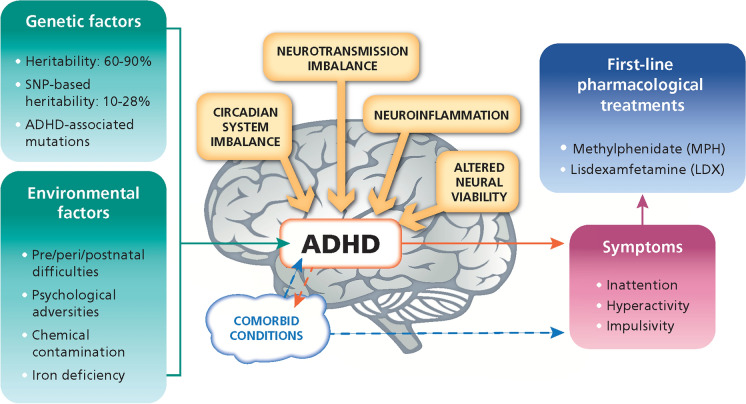
Attention-deficit/hyperactivity disorder (ADHD) is a common childhood-onset neurodevelopmental disorder characterised by persistent inattention, hyperactivity and impulsivity. Moreover, ADHD is commonly associated with other comorbid diseases (depression, anxiety, bipolar disorder, etc.). The ADHD symptomatology interferes with subject function and development. The treatment of ADHD requires a multidisciplinary approach based on a combination of non-pharmacological and pharmacological treatments with the aim of ameliorating the symptomatology; among first-line pharmacological treatments are stimulants [such as methylphenidate (MPH) and lisdexamfetamine dimesylate (LDX)]. In this review we explored recent ADHD- and stimulants-related literature, with the aim of compiling available descriptions of molecular pathways altered in ADHD, and molecular mechanisms of current first-line stimulants MPH and LDX. While conducting the narrative review, we applied structured search strategies covering PubMed/MEDLINE database and performed handsearching of reference lists on the results of those searches. The aetiology and pathophysiology of ADHD are incompletely understood; both genetic and environmental factors have been associated with the disorder and its grade of burden, and also the relationship between the molecular mechanisms of pharmacological treatments and their clinical implications. The lack of comprehensive understanding of the underlying molecular pathology makes both the diagnosis and treatment difficult. Few published studies evaluating molecular data on the mechanism of action (MoA) of MPH and LDX on ADHD are available and most of them are based on animal models. Further studies are necessary to improve the knowledge of ADHD pathophysiology and how the MoAs of MPH and LDX differentially modulate ADHD pathophysiology and control ADHD symptomatology.
Overview
AI snapshot
Written from the paper’s full text.
TL;DR
This narrative review compiles molecular pathways implicated in ADHD and the mechanisms of methylphenidate (MPH) and lisdexamfetamine dimesylate (LDX), finding that both increase dopamine/norepinephrine signalling via DAT/NET inhibition but LDX has more reported targets. Evidence is limited and largely from animal models, so how their mechanisms differentially modulate ADHD pathophysiology remains uncertain.
Key findings
- ADHD is associated with neurotransmitter imbalance, neuroinflammation/defective immunoregulation, circadian system dysfunction, and altered neural viability/neurodegeneration; reported prevalence is around 4–12% in children and 2.5–5% in adults, with heritability estimates of 60–90% in twin studies versus 10–28% from SNP analysis and environmental factors estimated at 20–30%.
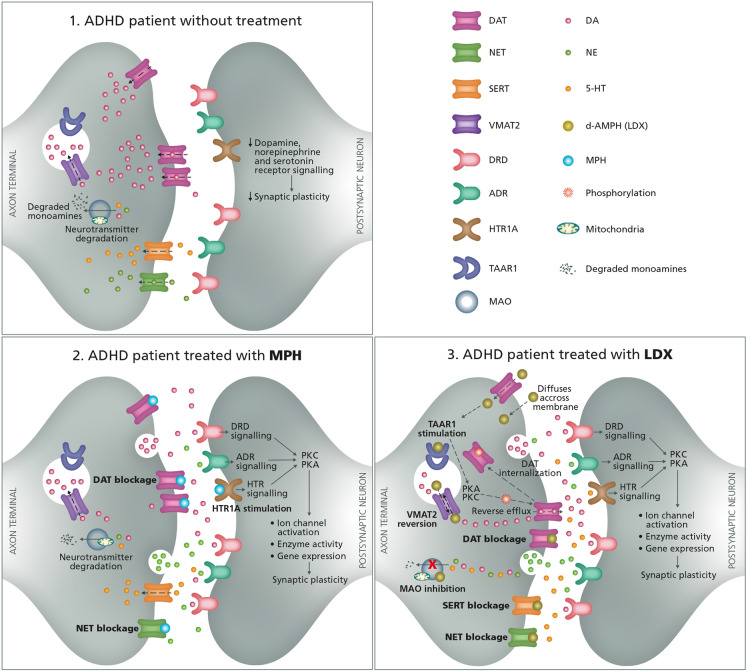
- MPH directly inhibits DAT (SLC6A3) and NET (SLC6A2) and agonizes HTR1A (3 targets), whereas LDX directly activates TAAR1 and inhibits SLC18A2, DAT, NET, SERT, MAOA, and MAOB (7 targets); both activate DRD1, DRD5, ADRA2A, ADRA2B and induce TNF, while LDX also modulates IL-4, IL-6, and IL-10.
- MPH has broader reported drug-induced changes including apoptosis/neural viability proteins (BCL2, BAX, CASP3, CYC1), circadian-related CREB1, and pro-inflammatory TNFα/IL-1β; LDX has oxidative stress effects via decreased CAT, GSH-Px, and SOD and a possible anti-inflammatory IL-4/IL-10 profile.
- Few data are available on neuroinflammation/immunoregulation and circadian effects for both drugs; no evidence was found on whether LDX improves circadian rhythm in ADHD.
Methods
- Narrative review, not a formal systematic review, using structured PubMed/MEDLINE searches plus handsearching of reference lists and PubMed “related articles.”
- One search (January 2020) covered ADHD molecular pathophysiology reviews; another (April 2020) covered molecular/mechanism terms for stimulant drugs using generic and commercial names, with results contextualised for clinical implications.
- The article is based on previously conducted studies and contains no new studies with human participants or animals performed by the authors.
Limitations
- Stated: ADHD aetiology and pathophysiology are incompletely understood; few published molecular studies evaluate the mechanism of action of MPH and LDX in ADHD, and most are based on animal models.
- Stated: available information may be biased because it only informs on data reported for one of the drugs; the inflammatory profile of LDX has not been evaluated in an ADHD context, and no evidence was found on LDX effects on circadian rhythm in ADHD.
- Evident from the text: as a narrative review without a formal systematic protocol, many mechanistic claims derive from animal or non-ADHD models, and MPH effects on BDNF, c-FOS, apoptosis, and oxidative stress are reported as inconsistent or dependent on age, dose, and brain region.
Model-written summary. Check it against the paper before relying on it.
Integrity signals
Registry
Cites
Statistics
Figures
Verification
Claims the paper makes
89 No full text of the sources · 57 Partly supported · 32 Own interpretation · 25 Supported · 10 Couldn’t confirm · 8 No basis given · 5 Supported so far · 5 Sources not found · 4 Not checked yet · 2 Own method · 1 Not supported · accuracy not yet measured
Every source the paper cites for this claim was checked and supports it.
In the paper
“Another factor that supports an ADHD genetic background is the probability of developing ADHD being around 2–8 times more likely in the close relatives of patients with ADHD than relatives of unaffected individuals [58].”
§ Molecular Characterisation of the Mechanism of Action of Stimulant Drugs Lisdexamfetamine and Methylphenidate on ADHD Neurobiology: A Review > ADHD Aetiology and Pathophysiology > ADHD Aetiology
What the sources say
- Supportedcites [58] Thapar A, Cooper M, Eyre O, Langley K. What have we learnt about the causes of ADHD? J Child Psychol Psychiatry. 2013;54(1):3–16. source
The section ‘An inherited contribution to ADHD’ states that first-degree relatives of people with ADHD are two to eight times more likely to also have ADHD than relatives of unaffected individuals. This directly supports the cited comparison. (LLM, conf=0.95)
plaincorrelational- Asserted: passes — The authors put it forward as true.
- Checkable: passes — It can be checked against evidence.
- Load-bearing: unclear — It is unclear whether the paper’s conclusions depend on it.
- Based: passes — The paper gives a reason why it holds.
- Supported
The cited sources support only part of this claim — read each source’s verdict below.
In the paper
“Genome-wide association studies (GWAS) have indicated genes playing a role in ADHD that could be linked to neuronal plasticity mechanisms (neuronal migration, cell adhesion and neuron proliferation) [61] or to deficiencies in the synthesis or release of neurotransmitters (NTs), mainly DA, but also serotonin and NE [56, 62].”
§ Molecular Characterisation of the Mechanism of Action of Stimulant Drugs Lisdexamfetamine and Methylphenidate on ADHD Neurobiology: A Review > ADHD Aetiology and Pathophysiology > ADHD Aetiology
What the sources say
- Partly supportedcites [61] Ribasés M, Ramos-Quiroga JA, Sánchez-Mora C, et al. Contribution of LPHN3 to the genetic susceptibility to ADHD in adulthood: a replication study. Genes Brain Behav. 2011;10(2):149–57. sourceExperimental — accuracy not yet measured
The passage indexed under Abstract (page not supplied) says dopaminergic and serotonergic candidate genes have been examined in ADHD and suggests that the LPHN receptor family is involved in synaptic neurotransmitter release. It does not establish deficiencies in neurotransmitter synthesis or release, mention norepinephrine, or present these findings as GWAS results. The separate neuronal-plasticity clause is attached to citation [61], not this source. (LLM, conf=0.86)
- Partly supportedcites [56] Faraone SV, Larsson H. Genetics of attention deficit hyperactivity disorder. Mol Psychiatry. 2019;24(4):562–75. sourceExperimental — accuracy not yet measured
In “Genome-wide Significant Common Variants” (page not provided), the paper says analyses of ADHD GWAS data implicated pathways regulating neurotransmitter release, neurite outgrowth and axon guidance; it also describes GWAS-linked genes affecting dopamine levels and neuronal wiring. It does not say GWAS established deficiencies in neurotransmitter synthesis or release, nor does it link the GWAS findings specifically to serotonin or norepinephrine. Neuronal proliferation appears in its discussion of candidate-gene studies, not as a GWAS finding. (LLM, conf=0.88)
- Not checked — no full text of the sourcecites [62] Lange M, Norton W, Coolen M, et al. The ADHD-susceptibility gene lphn3.1 modulates dopaminergic neuron formation and locomotor activity during zebrafish development. Mol Psychiatry. 2012;17(9):946–54. source
hedgedcorrelational- Asserted: passes — The authors put it forward as true.
- Checkable: passes — It can be checked against evidence.
- Load-bearing: unclear — It is unclear whether the paper’s conclusions depend on it.
- Based: passes — The paper gives a reason why it holds.
- Partly supported
The cited sources support only part of this claim — read each source’s verdict below.
In the paper
“Genetics has a great weight in ADHD, with a heritability ranging from 60% to 90% according to several studies carried out in twins [54, 56].”
§ Molecular Characterisation of the Mechanism of Action of Stimulant Drugs Lisdexamfetamine and Methylphenidate on ADHD Neurobiology: A Review > ADHD Aetiology and Pathophysiology > ADHD Aetiology
What the sources say
- Supportedcites [54] Curatolo P, D’Agati E, Moavero R. The neurobiological basis of ADHD. Ital J Pediatr. 2010;36(1):79. source
The genetic basis for ADHD section states that twin, family, and adoption studies support a strong genetic contribution to ADHD, with heritability ranging from 60% to 90%. This supports the cited sentence’s claim about twin-study evidence and the reported range. (LLM, conf=0.93)
- Partly supportedcites [56] Faraone SV, Larsson H. Genetics of attention deficit hyperactivity disorder. Mol Psychiatry. 2019;24(4):562–75. sourceExperimental — accuracy not yet measured
The ‘Evidence for Heritability’ section reports a 74% mean across 37 twin studies and estimates of 77–88% for studies using categorical ADHD measures, supporting a substantial genetic contribution. It does not give a 60–90% range; the ‘Developmental Effects’ section also reports lower estimates from adult self-report twin studies. No page numbers are available in our copy. (LLM, conf=0.87)
plaincorrelational- Asserted: passes — The authors put it forward as true.
- Checkable: passes — It can be checked against evidence.
- Load-bearing: unclear — It is unclear whether the paper’s conclusions depend on it.
- Based: passes — The paper gives a reason why it holds.
- Supported
Every source the paper cites for this claim was checked and supports it.
In the paper
“The ADHD aetiology is complex with a multiple pathophysiological entity involving multiple genetic and environmental factors, acting together, and creating a spectrum of neurobiological responsibility [54]”
§ Molecular Characterisation of the Mechanism of Action of Stimulant Drugs Lisdexamfetamine and Methylphenidate on ADHD Neurobiology: A Review > ADHD Aetiology and Pathophysiology > ADHD Aetiology
What the sources say
- Supportedcites [54] Curatolo P, D’Agati E, Moavero R. The neurobiological basis of ADHD. Ital J Pediatr. 2010;36(1):79. source
The Etiology section states that ADHD has a complex etiology and that multiple genetic and environmental factors act together to create a spectrum of neurobiological liability. The citing sentence’s “responsibility” appears to paraphrase that liability rather than add a distinct claim. (LLM, conf=0.94)
plaindirect- Asserted: passes — The authors put it forward as true.
- Checkable: passes — It can be checked against evidence.
- Load-bearing: unclear — It is unclear whether the paper’s conclusions depend on it.
- Based: passes — The paper gives a reason why it holds.
- Supported
The cited sources support only part of this claim — read each source’s verdict below.
In the paper
“Stimulants have generally been used as first-line pharmacologic treatment owing to a higher efficacy in symptomatology reduction compared to nonstimulant medications in all groups of age (children, adolescents and adults) [17, 33, 34].”
§ Molecular Characterisation of the Mechanism of Action of Stimulant Drugs Lisdexamfetamine and Methylphenidate on ADHD Neurobiology: A Review > Introduction
What the sources say
- Not checked — no full text of the sourcecites [17] Cortese S. Pharmacologic treatment of attention deficit-hyperactivity disorder. N Engl J Med. 2020;383(11):1050–6. source
- Supportedcites [33] Faraone SV. The pharmacology of amphetamine and methylphenidate: relevance to the neurobiology of attention-deficit/hyperactivity disorder and other psychiatric comorbidities. Neurosci Biobehav Rev. 2018;87:255–70. source
The Introduction states that stimulants are considered first-line therapy for children, adolescents, and adults with ADHD because they are more effective than nonstimulants. This directly supports the attributed claim about ADHD symptom treatment across those age groups. (LLM, conf=0.95)
- Partly supportedcites [34] Cortese S, Adamo N, Del Giovane C, et al. Comparative efficacy and tolerability of medications for attention-deficit hyperactivity disorder in children, adolescents, and adults: a systematic review and network meta-analysis. Lancet Psychiatry. 2018;5(9):727–38. sourceExperimental — accuracy not yet measured
The Discussion supports stimulant medications as first pharmacological choices: methylphenidate for children and adolescents, and amphetamines for adults. But it bases those choices on efficacy, tolerability, and acceptability, not efficacy alone. It also says atomoxetine, a nonstimulant, had efficacy comparable with methylphenidate in adults, so the claimed efficacy advantage over nonstimulants across all age groups is too broad. (LLM, conf=0.88)
plaindirect- Asserted: passes — The authors put it forward as true.
- Checkable: passes — It can be checked against evidence.
- Load-bearing: passes — The paper’s conclusions depend on it.
- Based: passes — The paper gives a reason why it holds.
Every source the paper cites for this claim was checked and supports it.
In the paper
“In this sense, a systematic review and network meta-analysis carried out in 2018 using 133 double-blind randomised controlled trials positioned MPH in children and adolescents, and amphetamines in adults, as preferred first-choice medications for the short-term treatment of ADHD [34].”
§ Molecular Characterisation of the Mechanism of Action of Stimulant Drugs Lisdexamfetamine and Methylphenidate on ADHD Neurobiology: A Review > Introduction
What the sources say
- Supportedcites [34] Cortese S, Adamo N, Del Giovane C, et al. Comparative efficacy and tolerability of medications for attention-deficit hyperactivity disorder in children, adolescents, and adults: a systematic review and network meta-analysis. Lancet Psychiatry. 2018;5(9):727–38. source
The Abstract Findings report inclusion of 133 double-blind randomised controlled trials. The Abstract Interpretation explicitly supports methylphenidate (MPH) for children and adolescents and amphetamines for adults as preferred first-choice medications for short-term ADHD treatment. (LLM, conf=0.95)
plain- Asserted: passes — The authors put it forward as true.
- Checkable: passes — It can be checked against evidence.
- Load-bearing: unclear — It is unclear whether the paper’s conclusions depend on it.
- Based: passes — The paper gives a reason why it holds.
- Supported
Every source the paper cites for this claim was checked and supports it.
In the paper
“Moreover, DAT-1 is a DA transporter whose function is the reuptake of extracellular DA in the synaptic space [83].”
§ Molecular Characterisation of the Mechanism of Action of Stimulant Drugs Lisdexamfetamine and Methylphenidate on ADHD Neurobiology: A Review > ADHD Aetiology and Pathophysiology > Pathophysiological Processes and Specific Molecules Involved in ADHD
What the sources say
- Supportedcites [83] Engert V, Pruessner JC. Dopaminergic and noradrenergic contributions to functionality in ADHD: the role of methylphenidate. Curr Neuropharmacol. 2008;6(4):322–8. source
In “Neurochemical Mechanisms of MPH” (page not provided), the paper identifies DAT as the dopamine transporter and says it removes released dopamine from the synapse. This supports the claimed reuptake function; the paper calls it DAT rather than DAT-1. (LLM, conf=0.90)
plaindirect- Asserted: passes — The authors put it forward as true.
- Checkable: passes — It can be checked against evidence.
- Load-bearing: passes — The paper’s conclusions depend on it.
- Based: passes — The paper gives a reason why it holds.
- Supported
The sources with a verdict support this claim; the rest weren’t checked yet, have no full text we could read, or their verdicts aren’t rated yet.
In the paper
“Deficiencies in catecholamines such as NE and DA [75, 79, 80] or dysregulation of such NTs, which are essential for normal brain function, including executive and attentional functions [33], are among the causing physiological alterations that have been reported to explain ADHD development.”
§ Molecular Characterisation of the Mechanism of Action of Stimulant Drugs Lisdexamfetamine and Methylphenidate on ADHD Neurobiology: A Review > ADHD Aetiology and Pathophysiology > Pathophysiological Processes and Specific Molecules Involved in ADHD
What the sources say
- Not checked — no full text of the sourcecites [75] Sharma A, Couture J. A review of the pathophysiology, etiology, and treatment of attention-deficit hyperactivity disorder (ADHD). Ann Pharmacother. 2014;48(2):209–25. source
- Not checked — no full text of the sourcecites [79] Del Campo N, Chamberlain SR, Sahakian BJ, Robbins TW. The roles of dopamine and noradrenaline in the pathophysiology and treatment of attention-deficit/hyperactivity disorder. Biol Psychiat. 2011;69(12):e145–57. source
- Not checked — no full text of the sourcecites [80] Tripp G, Wickens JR. Neurobiology of ADHD. Neuropharmacology. 2009;57(7–8):579–89. source
- Supportedcites [33] Faraone SV. The pharmacology of amphetamine and methylphenidate: relevance to the neurobiology of attention-deficit/hyperactivity disorder and other psychiatric comorbidities. Neurosci Biobehav Rev. 2018;87:255–70. source
The Conclusions state that dysfunction in dopamine and norepinephrine systems likely accounts for some ADHD pathophysiology and that these systems are critical to cortical and striatal function. They also identify those brain regions as involved in executive and attentional function. The separate claim about catecholamine deficiencies is attached to other citations, not this one. (LLM, conf=0.92)
plainconditional- Asserted: passes — The authors put it forward as true.
- Checkable: passes — It can be checked against evidence.
- Load-bearing: passes — The paper’s conclusions depend on it.
- Based: passes — The paper gives a reason why it holds.
Every source the paper cites for this claim was checked and supports it.
In the paper
“Dysregulation of the dopaminergic system is related to the ADHD symptoms and signs [54].”
§ Molecular Characterisation of the Mechanism of Action of Stimulant Drugs Lisdexamfetamine and Methylphenidate on ADHD Neurobiology: A Review > ADHD Aetiology and Pathophysiology > Pathophysiological Processes and Specific Molecules Involved in ADHD
What the sources say
- Supportedcites [54] Curatolo P, D’Agati E, Moavero R. The neurobiological basis of ADHD. Ital J Pediatr. 2010;36(1):79. source
The Introduction’s Treatment section states that ADHD involves dysregulation of dopamine (DA) neurotransmission. The Conclusions also identify neurotransmitter dysregulation as part of susceptibility to ADHD. The supplied passages do not provide page numbers. (LLM, conf=0.93)
plaincorrelational- Asserted: passes — The authors put it forward as true.
- Checkable: passes — It can be checked against evidence.
- Load-bearing: passes — The paper’s conclusions depend on it.
- Based: passes — The paper gives a reason why it holds.
- Supported
The cited sources support only part of this claim — read each source’s verdict below.
In the paper
“DA plays an essential role in mediating regulation of the cortical system, memory, mood, vascular structure, anticipation of events, motivation, behaviour inhibition, decision-making and problem-solving [16, 81, 82].”
§ Molecular Characterisation of the Mechanism of Action of Stimulant Drugs Lisdexamfetamine and Methylphenidate on ADHD Neurobiology: A Review > ADHD Aetiology and Pathophysiology > Pathophysiological Processes and Specific Molecules Involved in ADHD
What the sources say
- Not checked — no full text of the sourcecites [16] Klein MO, Battagello DS, Cardoso AR, Hauser DN, Bittencourt JC, Correa RG. Dopamine: functions, signaling, and association with neurological diseases. Cell Mol Neurobiol. 2019;39(1):31–59. source
- Partly supportedcites [81] Volkow ND, Wang GJ, Newcorn JH, et al. Motivation deficit in ADHD is associated with dysfunction of the dopamine reward pathway. Mol Psychiatry. 2011;16(11):1147–54. sourceExperimental — accuracy not yet measured
The introductory passage (indexed as Keywords; page unavailable) says the dopamine pathway is critically involved in reward and motivation. The Limitations section also links dopamine measures to motivation in adults with ADHD, while cautioning that the correlations do not establish causality. The paper does not support the sentence’s broader list of roles, including memory, mood, vascular structure, behavioural inhibition, decision-making, and problem-solving. (LLM, conf=0.88)
- Not checked — no full text of the sourcecites [82] Staller JA, Faraone SV. Targeting the dopamine system in the treatment of attention-deficit/hyperactivity disorder. Expert Rev Neurother. 2007;7(4):351–62. source
plaindirect- Asserted: passes — The authors put it forward as true.
- Checkable: passes — It can be checked against evidence.
- Load-bearing: passes — The paper’s conclusions depend on it.
- Based: passes — The paper gives a reason why it holds.
- Probably not a substantial claim. 51
- It may state two separate claims as one. 98
At least one cited source doesn’t support this claim or points to a different paper, and none confirmed it — see the verdicts below.
In the paper
“Circadian rhythm regulates some biological activities such as sleep and mood [113] through various mechanisms such as the transcription-translation feedback loop (TTFL), which includes two transcription activators: circadian locomotor output cycles kaput (CLOCK) and brain and muscle ARNT-like protein 1 (BMAL1). Both activators create a heterodimer, which inhibits the transcription of repressor pro”
§ Molecular Characterisation of the Mechanism of Action of Stimulant Drugs Lisdexamfetamine and Methylphenidate on ADHD Neurobiology: A Review > ADHD Aetiology and Pathophysiology > Pathophysiological Processes and Specific Molecules Involved in ADHD
What the sources say
- Not checked — no full text of the sourcecites [113] Lee YA, Goto Y. Habenula and ADHD: convergence on time. Neurosci Biobehav Rev. 2013;37(8):1801–9. source
- Disputedcites [114] Xie Y, Tang Q, Chen G, et al. New insights into the circadian rhythm and its related diseases. Front Physiol. 2019;10:682. sourceExperimental — accuracy not yet measured
Split into 3 atoms — 2 confirmed, 0 partially supported, 1 disputed, 0 misattributed, 0 unverifiable. Expand the claim to see per-atom verdicts.
Checked by a reasoning model — may be wrong.
plaindirect- Asserted: passes — The authors put it forward as true.
- Checkable: passes — It can be checked against evidence.
- Load-bearing: fails — The paper’s conclusions may not depend on it.
- Based: passes — The paper gives a reason why it holds.
Probably not a substantial claim. The paper’s conclusions may not depend on it. It may state two separate claims as one.
The cited sources support only part of this claim — read each source’s verdict below.
In the paper
“Some stimulants, such as amphetamines, and non-stimulants, such as atomoxetine, have been reported to be substrates of cytochrome P450s, and their performance has been linked to CYP2D6 genotype [41, 42].”
§ Molecular Characterisation of the Mechanism of Action of Stimulant Drugs Lisdexamfetamine and Methylphenidate on ADHD Neurobiology: A Review > Introduction
What the sources say
- Partly supportedcites [41] Kam H, Jeong H. Pharmacogenomic biomarkers and their applications in psychiatry. Genes. 2020;11(12):1445. sourceExperimental — accuracy not yet measured
Section 5.2 says atomoxetine is metabolized by CYP2D6 and that poor metabolizers may have different therapeutic outcomes or adverse effects. Section 5.1 says CYP2D6 metabolizes amphetamine, but only suggests its metabolism may vary across populations; it does not link amphetamine's clinical performance to CYP2D6 genotype. Page numbers are not available in our copy. (LLM, conf=0.86)
- Not matchedcites [42] FDA. Table of pharmacogenomic biomarkers in drug labeling. https://www.fda.gov/drugs/science-and-research-drugs/table-pharmacogenomic-biomarkers-drug-labeling. Accessed Aug 2021.
Couldn’t be matched to a paper in Crossref, so it can’t be checked.
plaincorrelational- Asserted: passes — The authors put it forward as true.
- Checkable: passes — It can be checked against evidence.
- Load-bearing: fails — The paper’s conclusions may not depend on it.
- Based: passes — The paper gives a reason why it holds.
Probably not a substantial claim. The paper’s conclusions may not depend on it. It may state two separate claims as one.
- Partly supported
The cited sources support only part of this claim — read each source’s verdict below.
In the paper
“Moreover, ADHD is commonly associated with other comorbid diseases (depression, anxiety, bipolar disorder, etc.) [5]”
§ Molecular Characterisation of the Mechanism of Action of Stimulant Drugs Lisdexamfetamine and Methylphenidate on ADHD Neurobiology: A Review > Introduction
What the sources say
- Partly supportedcites [5] Posner J, Park C, Wang Z. Connecting the dots: a review of resting connectivity MRI studies in attention-deficit/hyperactivity disorder. Neuropsychol Rev. 2014;24(1):3–15. sourceExperimental — accuracy not yet measured
The Systematic Review of the Literature section says comorbid disorders are extremely common in ADHD, affecting an estimated 50–70% of individuals. It does not identify depression, anxiety, or bipolar disorder as examples, so the cited paper supports the general association but not the specific list. (LLM, conf=0.88)
plaincorrelational- Asserted: passes — The authors put it forward as true.
- Checkable: passes — It can be checked against evidence.
- Load-bearing: fails — The paper’s conclusions may not depend on it.
- Based: passes — The paper gives a reason why it holds.
Probably not a substantial claim. The paper’s conclusions may not depend on it.
- Partly supported
Every source the paper cites for this claim was checked and supports it.
In the paper
“Attention-deficit/hyperactivity disorder (ADHD) is a common childhood-onset neurodevelopmental disorder characterised by a symptomatology based on persistent inattention, hyperactivity, and impulsivity that has been considered a progressively ceaseless condition [1].”
§ Molecular Characterisation of the Mechanism of Action of Stimulant Drugs Lisdexamfetamine and Methylphenidate on ADHD Neurobiology: A Review > Introduction
What the sources say
- Supportedcites [1] Franke B, Faraone SV, Asherson P, et al. The genetics of attention deficit/hyperactivity disorder in adults, a review. Mol Psychiatry. 2012;17(10):960–87. source
The Adult ADHD section describes ADHD as a common, childhood-onset, chronic disorder characterized by inattentiveness, impulsivity, and hyperactivity. It also reports that follow-up studies documented persistence into adulthood, supporting the citing sentence’s reference to an enduring condition. (LLM, conf=0.94)
plain- Asserted: passes — The authors put it forward as true.
- Checkable: passes — It can be checked against evidence.
- Load-bearing: fails — The paper’s conclusions may not depend on it.
- Based: passes — The paper gives a reason why it holds.
Probably not a substantial claim. The paper’s conclusions may not depend on it.
- Supported
The cited sources support only part of this claim — read each source’s verdict below.
In the paper
“Several risk genes have been found in the human genome [59], but only a limited number of small impact size ADHD genes have been identified [60].”
§ Molecular Characterisation of the Mechanism of Action of Stimulant Drugs Lisdexamfetamine and Methylphenidate on ADHD Neurobiology: A Review > ADHD Aetiology and Pathophysiology > ADHD Aetiology
What the sources say
- Supportedcites [59] Grimm O, Kranz TM, Reif A. Genetics of ADHD: what should the clinician know? Curr Psychiatry Rep. 2020;22(4):18. source
The citation [60] attaches to the second clause. The GWAS section reports only 12 genome-wide significant loci covering 16 genes, and the Heritability in ADHD section links the small number of hits to rare alleles or low effect sizes. Together, these support the claim that relatively few ADHD-associated genes with small effects had been identified. (LLM, conf=0.89)
- Could not verifycites [60] Verlaet AA, Noriega DB, Hermans N, Savelkoul HF. Nutrition, immunological mechanisms and dietary immunomodulation in ADHD. Eur Child Adolesc Psychiatry. 2014;23(7):519–29. sourceExperimental — accuracy not yet measured
Citation [60] is attached to the claim that only a limited number of small-effect ADHD genes have been identified. The retrieved passages from our indexed copy contain bibliographic information and ADHD-related keywords, but none addresses the number or effect size of identified genes (searched for genetic factors, ADHD risk genes, and small effect size). (LLM, conf=0.70)
plain- Asserted: passes — The authors put it forward as true.
- Checkable: passes — It can be checked against evidence.
- Load-bearing: fails — The paper’s conclusions may not depend on it.
- Based: passes — The paper gives a reason why it holds.
Probably not a substantial claim. The paper’s conclusions may not depend on it. It may state two separate claims as one.
- Supported
The cited sources support only part of this claim — read each source’s verdict below.
In the paper
“several biological pathways have been suggested to potentially affect MPH mechanisms through patient genotype, mostly concerning monoamine pathways [43–48].”
§ Molecular Characterisation of the Mechanism of Action of Stimulant Drugs Lisdexamfetamine and Methylphenidate on ADHD Neurobiology: A Review > Introduction
What the sources say
- Partly supportedcites [43] da Silva BS, Leffa DT, Beys-da-Silva WO, et al. Integrative proteomics and pharmacogenomics analysis of methylphenidate treatment response. Transl Psychiatry. 2019;9(1):308. sourceExperimental — accuracy not yet measured
The Discussion (page unavailable) suggests that genetic variants in neurotransmitter-release and GABA-transmission pathways could affect MPH treatment response. The Introduction identifies dopamine and norepinephrine transporters as MPH’s main direct targets, but the paper does not establish that genotype-related pathways are mostly monoamine pathways; its Discussion emphasizes effects beyond dopamine and norepinephrine. (LLM, conf=0.84)
- Not checked — no full text of the sourcecites [44] Angyal N, Horvath EZ, Tarnok Z, et al. Association analysis of norepinephrine transporter polymorphisms and methylphenidate response in ADHD patients. Prog Neuropsychopharmacol Biol Psychiatry. 2018;84(Pt A):122–8. source
- Supportedcites [45] Gomez-Sanchez CI, Carballo JJ, Riveiro-Alvarez R, et al. Pharmacogenetics of methylphenidate in childhood attention-deficit/hyperactivity disorder: long-term effects. Sci Rep. 2017;7(1):10391. source
The Introduction (page unavailable) says that many ADHD candidate genes play a role in psychostimulant mechanisms and may be associated with treatment response. The Method’s gene table (page unavailable) includes numerous dopamine, norepinephrine, and serotonin genes alongside genes from other pathways, and the Discussion reports genotype associations with MPH response. Together, these passages support the hedged claim. (LLM, conf=0.88)
- Supportedcites [46] Joensen B, Meyer M, Aagaard L. Specific genes associated with adverse events of methylphenidate use in the pediatric population: a systematic literature review. J Res Pharm Pract. 2017;6(2):65–72. source
The Discussion says the candidate-gene studies focused mainly on noradrenergic and dopaminergic genes because MPH is suspected to act through those pathways. The Results also list polymorphisms in these and other genes examined for associations with MPH adverse events in children and adolescents. This supports the claim as a suggestion about genotype-related pathways, not an established mechanism. (LLM, conf=0.84)
- Supportedcites [47] Myer NM, Boland JR, Faraone SV. Pharmacogenetics predictors of methylphenidate efficacy in childhood ADHD. Mol Psychiatry. 2018;23(9):1929–36. source
The Introduction says genetic factors may influence MPH response and describes both metabolic and monoaminergic mechanisms. It specifically links polymorphisms in monoaminergic genes to stimulant response, while noting that the evidence is conflicting; the Results also discuss variants in other pathways. (LLM, conf=0.92)
- Supportedcites [48] Yuan D, Zhang M, Huang Y, Wang X, Jiao J, Huang Y. Noradrenergic genes polymorphisms and response to methylphenidate in children with ADHD: a systematic review and meta-analysis. Medicine. 2021;100(46):e27858. source
The Introduction (page not provided) describes dopamine- and noradrenergic-system genes as associated with methylphenidate response, and explains that methylphenidate acts on dopamine and norepinephrine transporters. This supports the hedged claim that genotype-related monoamine pathways may affect how methylphenidate works. (LLM, conf=0.88)
hedgedconditional- Asserted: passes — The authors put it forward as true.
- Checkable: passes — It can be checked against evidence.
- Load-bearing: fails — The paper’s conclusions may not depend on it.
- Based: passes — The paper gives a reason why it holds.
Probably not a substantial claim. The paper’s conclusions may not depend on it.
- Partly supported
The cited sources support only part of this claim — read each source’s verdict below.
In the paper
“In this sense, gender may play a role in ADHD aetiology with an incidence rate of 2:1 in boys versus girls [55].”
§ Molecular Characterisation of the Mechanism of Action of Stimulant Drugs Lisdexamfetamine and Methylphenidate on ADHD Neurobiology: A Review > ADHD Aetiology and Pathophysiology > ADHD Aetiology
What the sources say
- Partly supportedcites [55] Cabral MDI, Liu S, Soares N. Attention-deficit/hyperactivity disorder: diagnostic criteria, epidemiology, risk factors and evaluation in youth. Transl Pediatr. 2020;9(Suppl 1):S104–13. sourceExperimental — accuracy not yet measured
The Epidemiology section reports that more boys than girls are diagnosed with ADHD, at a 2:1 ratio. It does not describe that ratio as an incidence rate or establish that gender plays a role in ADHD’s aetiology; the Risk factors section discusses other potential causes. (LLM, conf=0.89)
hedgedconditional- Asserted: passes — The authors put it forward as true.
- Checkable: passes — It can be checked against evidence.
- Load-bearing: fails — The paper’s conclusions may not depend on it.
- Based: passes — The paper gives a reason why it holds.
Probably not a substantial claim. The paper’s conclusions may not depend on it.
- Partly supported
The cited sources that could be checked couldn’t confirm or dispute this claim.
In the paper
“The ADHD symptomatology interferes with subject function and development according to the Diagnostic and Statistical Manual of Mental Disorders, fifth edition (DSM-5) diagnostic criteria [2] impairing daily function [3, 4].”
§ Molecular Characterisation of the Mechanism of Action of Stimulant Drugs Lisdexamfetamine and Methylphenidate on ADHD Neurobiology: A Review > Introduction
What the sources say
- Could not verifycites [2] Regier DA, Kuhl EA, Kupfer DJ. The DSM-5: classification and criteria changes. World Psychiatry. 2013;12(2):92–8. sourceExperimental — accuracy not yet measured
The DSM-5 CLASSIFICATION passage says ADHD is grouped with autism spectrum disorder among neurodevelopmental disorders. Our copy does not state that ADHD symptoms interfere with functioning or development; searches for ADHD, functional impairment, and diagnostic criteria did not find that point. No page number was provided for the passage. (LLM, conf=0.73)
- Not checked — no full text of the sourcecites [3] Feldman HM, Reiff MI. Clinical practice. Attention deficit-hyperactivity disorder in children and adolescents. N Engl J Med. 2014;370(9):838–46. source
- Not checked — no full text of the sourcecites [4] Dalsgaard S, Leckman JF, Mortensen PB, Nielsen HS, Simonsen M. Effect of drugs on the risk of injuries in children with attention deficit hyperactivity disorder: a prospective cohort study. Lancet Psychiatry. 2015;2(8):702–9. source
plaindirect- Asserted: passes — The authors put it forward as true.
- Checkable: passes — It can be checked against evidence.
- Load-bearing: fails — The paper’s conclusions may not depend on it.
- Based: passes — The paper gives a reason why it holds.
Probably not a substantial claim. The paper’s conclusions may not depend on it.
- Could not verify
The cited sources support only part of this claim — read each source’s verdict below.
In the paper
“and in adult age it is a risk factor for various mental disorders [6, 7].”
§ Molecular Characterisation of the Mechanism of Action of Stimulant Drugs Lisdexamfetamine and Methylphenidate on ADHD Neurobiology: A Review > Introduction
What the sources say
- Partly supportedcites [6] Libutzki B, Ludwig S, Jacobsen RH, Reif A, Hartman CA. Direct medical costs of ADHD and its comorbid conditions on basis of a claims data analysis. Eur Psychiatry. 2019;58:38–44. sourceExperimental — accuracy not yet measured
The Results (section 3.3, p. 3) report substantially higher rates of mood, anxiety and substance use disorders among adults with ADHD than among reference patients. The Discussion (section 4.2, p. 5) says ADHD *may* be a risk factor for these comorbidities; the citing sentence states that conclusion without the paper’s qualification. (LLM, conf=0.84)
- Supportedcites [7] Wilens TE, Spencer TJ. Understanding attention-deficit/hyperactivity disorder from childhood to adulthood. Postgrad Med. 2010;122(5):97–109. source
The Psychiatric Comorbidity section (page not supplied) reports high rates of adult antisocial disorders among adults with ADHD. Its Mood & Anxiety subsection says ADHD increases the likelihood of depression at least two-fold and describes high rates of anxiety symptoms, supporting the broad risk-factor claim. (LLM, conf=0.88)
plaindirect- Asserted: passes — The authors put it forward as true.
- Checkable: passes — It can be checked against evidence.
- Load-bearing: fails — The paper’s conclusions may not depend on it.
- Based: passes — The paper gives a reason why it holds.
Probably not a substantial claim. The paper’s conclusions may not depend on it.
- Partly supported
Every source the paper cites for this claim was checked and supports it.
In the paper
“ADHD, as with other psychiatric disorders, is not easy to diagnose. In this sense, their diagnosis has been criticized because it is not based on a biological testing, and it has been considered subjective [14].”
§ Molecular Characterisation of the Mechanism of Action of Stimulant Drugs Lisdexamfetamine and Methylphenidate on ADHD Neurobiology: A Review > Introduction
What the sources say
- Supportedcites [14] Faraone SV, Banaschewski T, Coghill D, et al. The World Federation of ADHD International Consensus Statement: 208 evidence-based conclusions about the disorder. Neurosci Biobehav Rev. 2021;128:789–818. source
The “How is ADHD diagnosed?” section explicitly says that ADHD diagnosis has been criticized as subjective because it is not based on a biological test. The paper calls that criticism unfounded, but the citing sentence attributes the existence of the criticism, not its validity, to the source. (LLM, conf=0.95)
plaindirect- Asserted: passes — The authors put it forward as true.
- Checkable: passes — It can be checked against evidence.
- Load-bearing: fails — The paper’s conclusions may not depend on it.
- Based: passes — The paper gives a reason why it holds.
Probably not a substantial claim. The paper’s conclusions may not depend on it. It may state two separate claims as one.
- Supported
Every source the paper cites for this claim was checked and supports it.
In the paper
“no clear guidelines have been developed and there is still much to understand in this regard [50].”
§ Molecular Characterisation of the Mechanism of Action of Stimulant Drugs Lisdexamfetamine and Methylphenidate on ADHD Neurobiology: A Review > Introduction
What the sources say
- Supportedcites [50] Elsayed NA, Yamamoto KM, Froehlich TE. Genetic influence on efficacy of pharmacotherapy for pediatric attention-deficit/hyperactivity disorder: overview and current status of research. CNS Drugs. 2020;34(4):389–414. source
The Current Challenges and Future Directions section contrasts a published atomoxetine pharmacogenomic guideline with the limited research on methylphenidate and says understanding of ADHD medication response remains imperfect. The Conclusions state that personalized predictive ADHD care has not yet arrived and call for further research. Together, these support the paraphrase about the lack of clear MPH pharmacogenomic guidance and remaining uncertainty; page numbers were not available in our copy. (LLM, conf=0.86)
plain- Asserted: passes — The authors put it forward as true.
- Checkable: passes — It can be checked against evidence.
- Load-bearing: unclear — It is unclear whether the paper’s conclusions depend on it.
- Based: passes — The paper gives a reason why it holds.
It may state two separate claims as one.
- Supported
The cited sources support only part of this claim — read each source’s verdict below.
In the paper
“However, other studies using single-nucleotide polymorphism (SNP) analysis have estimated that SNP-based heritability ranged between 10% and 28% [57].”
§ Molecular Characterisation of the Mechanism of Action of Stimulant Drugs Lisdexamfetamine and Methylphenidate on ADHD Neurobiology: A Review > ADHD Aetiology and Pathophysiology > ADHD Aetiology
What the sources say
- Partly supportedcites [57] Lee SH, Ripke S, Neale BM, et al. Genetic relationship between five psychiatric disorders estimated from genome-wide SNPs. Nat Genet. 2013;45(9):984–94. sourceExperimental — accuracy not yet measured
The Discussion reports an ADHD SNP-based heritability estimate of 0.28 (28%). The Results describe variation between ADHD subsets, but the passages found do not give a 10% estimate or establish a 10%–28% range. (LLM, conf=0.87)
hedged- Asserted: passes — The authors put it forward as true.
- Checkable: passes — It can be checked against evidence.
- Load-bearing: fails — The paper’s conclusions may not depend on it.
- Based: passes — The paper gives a reason why it holds.
Probably not a substantial claim. The paper’s conclusions may not depend on it.
- Partly supported
The cited sources support only part of this claim — read each source’s verdict below.
In the paper
“Most of these conditions/disorders usually appear later in development and can manifest as a result of ADHD, but this is not always the case with early stage behavioural problems directly related to ADHD [58].”
§ Molecular Characterisation of the Mechanism of Action of Stimulant Drugs Lisdexamfetamine and Methylphenidate on ADHD Neurobiology: A Review > ADHD Aetiology and Pathophysiology > ADHD Aetiology
What the sources say
- Partly supportedcites [58] Thapar A, Cooper M, Eyre O, Langley K. What have we learnt about the causes of ADHD? J Child Psychol Psychiatry. 2013;54(1):3–16. sourceExperimental — accuracy not yet measured
In “The overlap of ADHD with other developmental and psychiatric disorders” (page not provided), the review says some comorbid problems can present later and might arise as a consequence of ADHD, with an exception for early-onset conduct problems. It does not say that most comorbid conditions usually appear later; the claim overstates that part. (LLM, conf=0.86)
plainconditional- Asserted: passes — The authors put it forward as true.
- Checkable: passes — It can be checked against evidence.
- Load-bearing: fails — The paper’s conclusions may not depend on it.
- Based: passes — The paper gives a reason why it holds.
Probably not a substantial claim. The paper’s conclusions may not depend on it. It may state two separate claims as one.
- Partly supported
The cited sources support only part of this claim — read each source’s verdict below.
In the paper
“Furthermore, ADHD has demonstrated a high degree of comorbidity of other psychological and mental conditions such as insomnia, anxiety, conduct disorder, sleep disturbance, oppositional defiant disorder, binge eating disorder, tic disorder, bipolar disorder, personality disorder, drug and substance dependence and mood disturbances, among others [72, 74].”
§ Molecular Characterisation of the Mechanism of Action of Stimulant Drugs Lisdexamfetamine and Methylphenidate on ADHD Neurobiology: A Review > ADHD Aetiology and Pathophysiology > ADHD Aetiology
What the sources say
- Not checked — no full text of the sourcecites [72] Wu J, Xiao H, Sun H, Zou L, Zhu LQ. Role of dopamine receptors in ADHD: a systematic meta-analysis. Mol Neurobiol. 2012;45(3):605–20. source
- Partly supportedcites [74] Ivanchak N, Fletcher K, Jicha GA. Attention-deficit/hyperactivity disorder in older adults: prevalence and possible connections to mild cognitive impairment. Curr Psychiatry Rep. 2012;14(5):552–60. sourceExperimental — accuracy not yet measured
The “Adult ADHD-Associated Cognitive Impairment and Comorbidities” section (page unavailable) associates ADHD with depression, anxiety, and alcohol/drug dependency; its Depression and Anxiety subsections give further support for those conditions. The copy does not support the sentence’s additional examples, including insomnia, conduct disorder, oppositional defiant disorder, binge eating disorder, tic disorder, bipolar disorder, and personality disorder. (LLM, conf=0.90)
boostedcorrelational- Asserted: passes — The authors put it forward as true.
- Checkable: passes — It can be checked against evidence.
- Load-bearing: fails — The paper’s conclusions may not depend on it.
- Based: passes — The paper gives a reason why it holds.
Probably not a substantial claim. The paper’s conclusions may not depend on it.
The cited sources support only part of this claim — read each source’s verdict below.
In the paper
“Environmental factors such as chemical contaminants (pesticides and harmful agricultural chemicals) may promote the neural structure impairments involved in ADHD [58].”
§ Molecular Characterisation of the Mechanism of Action of Stimulant Drugs Lisdexamfetamine and Methylphenidate on ADHD Neurobiology: A Review > ADHD Aetiology and Pathophysiology > ADHD Aetiology
What the sources say
- Partly supportedcites [58] Thapar A, Cooper M, Eyre O, Langley K. What have we learnt about the causes of ADHD? J Child Psychol Psychiatry. 2013;54(1):3–16. sourceExperimental — accuracy not yet measured
The Environmental toxins section says organic pollutants may damage neural systems implicated in ADHD. The Pesticides section reports associations between pesticide exposure and ADHD-related outcomes, but does not show that pesticides cause structural neural impairments; it also notes inconsistent findings. No page numbers are available in our copy. (LLM, conf=0.84)
hedgedconditional- Asserted: passes — The authors put it forward as true.
- Checkable: passes — It can be checked against evidence.
- Load-bearing: fails — The paper’s conclusions may not depend on it.
- Based: passes — The paper gives a reason why it holds.
Probably not a substantial claim. The paper’s conclusions may not depend on it.
- Partly supported
The cited sources support only part of this claim — read each source’s verdict below.
In the paper
“This system is involved in motivation and reward/avoidance behaviours; in this sense, lower DA levels in the PFC could lead to less motivation, resulting in inattention. This might also be the reason for the promiscuous reward-seeking behaviours found in hyperactive-impulsive patients with ADHD [83].”
§ Molecular Characterisation of the Mechanism of Action of Stimulant Drugs Lisdexamfetamine and Methylphenidate on ADHD Neurobiology: A Review > ADHD Aetiology and Pathophysiology > Pathophysiological Processes and Specific Molecules Involved in ADHD
What the sources say
- Partly supportedcites [83] Engert V, Pruessner JC. Dopaminergic and noradrenergic contributions to functionality in ADHD: the role of methylphenidate. Curr Neuropharmacol. 2008;6(4):322–8. sourceExperimental — accuracy not yet measured
The Introduction links prefrontal dopamine to cognitive function, while the “Saliency Enhancing” Model links dopamine-mediated motivation to attention. But those passages concern different pathways: the paper does not say that low dopamine in the PFC reduces motivation or causes inattention, or that it explains promiscuous reward-seeking in hyperactive-impulsive ADHD. (LLM, conf=0.84)
hedgedconditional- Asserted: passes — The authors put it forward as true.
- Checkable: passes — It can be checked against evidence.
- Load-bearing: unclear — It is unclear whether the paper’s conclusions depend on it.
- Based: passes — The paper gives a reason why it holds.
It may state two separate claims as one.
- Partly supported
The cited sources support only part of this claim — read each source’s verdict below.
In the paper
“Regarding the influence of psychosocial adversity in ADHD disorder development, extreme parental discord, poor socioeconomic status, paternal violence, inconsistent parent–child relationships, maternal psychiatric disability, parental disapproval, family anxiety and foster placement have been reported as family random factors associated with behavioural disorders in childhood [58, 70].”
§ Molecular Characterisation of the Mechanism of Action of Stimulant Drugs Lisdexamfetamine and Methylphenidate on ADHD Neurobiology: A Review > ADHD Aetiology and Pathophysiology > ADHD Aetiology
What the sources say
- Partly supportedcites [58] Thapar A, Cooper M, Eyre O, Langley K. What have we learnt about the causes of ADHD? J Child Psychol Psychiatry. 2013;54(1):3–16. sourceExperimental — accuracy not yet measured
The ‘Family adversity and early care-giving’ section reports associations of low income, family adversity, maltreatment and family conflict with child mental health problems, including ADHD. It does not report the full list of specific factors in the claim, such as paternal violence, maternal psychiatric disability and parental disapproval. It also cautions that, except for rare extreme early deprivation, psychosocial adversity has not clearly been shown to cause ADHD. (LLM, conf=0.86)
- Not checked — no full text of the sourcecites [70] Biederman J, Faraone SV. Attention-deficit hyperactivity disorder. Lancet. 2005;366(9481):237–48. source
plaincorrelational- Asserted: passes — The authors put it forward as true.
- Checkable: passes — It can be checked against evidence.
- Load-bearing: fails — The paper’s conclusions may not depend on it.
- Based: passes — The paper gives a reason why it holds.
Probably not a substantial claim. The paper’s conclusions may not depend on it.
- Partly supported
The cited sources support only part of this claim — read each source’s verdict below.
In the paper
“highlighting prenatal, perinatal and postnatal difficulties, psychological adversities, exposure to chemical contaminants, or iron deficiency as factors that increase the probability of developing ADHD [54]”
§ Molecular Characterisation of the Mechanism of Action of Stimulant Drugs Lisdexamfetamine and Methylphenidate on ADHD Neurobiology: A Review > ADHD Aetiology and Pathophysiology > ADHD Aetiology
What the sources say
- Partly supportedcites [54] Curatolo P, D’Agati E, Moavero R. The neurobiological basis of ADHD. Ital J Pediatr. 2010;36(1):79. sourceExperimental — accuracy not yet measured
The Introduction’s “environmental basis of ADHD” section (page unavailable) links prenatal and perinatal factors to ADHD and identifies postnatal social deprivation and iron deficiency as possible contributors. It does not identify exposure to chemical contaminants as an ADHD risk factor, and its statements about social deprivation and iron deficiency are narrower and more tentative than the citing sentence. (LLM, conf=0.86)
plaindirect- Asserted: passes — The authors put it forward as true.
- Checkable: passes — It can be checked against evidence.
- Load-bearing: unclear — It is unclear whether the paper’s conclusions depend on it.
- Based: passes — The paper gives a reason why it holds.
It may state two separate claims as one.
- Partly supported
The cited sources support only part of this claim — read each source’s verdict below.
In the paper
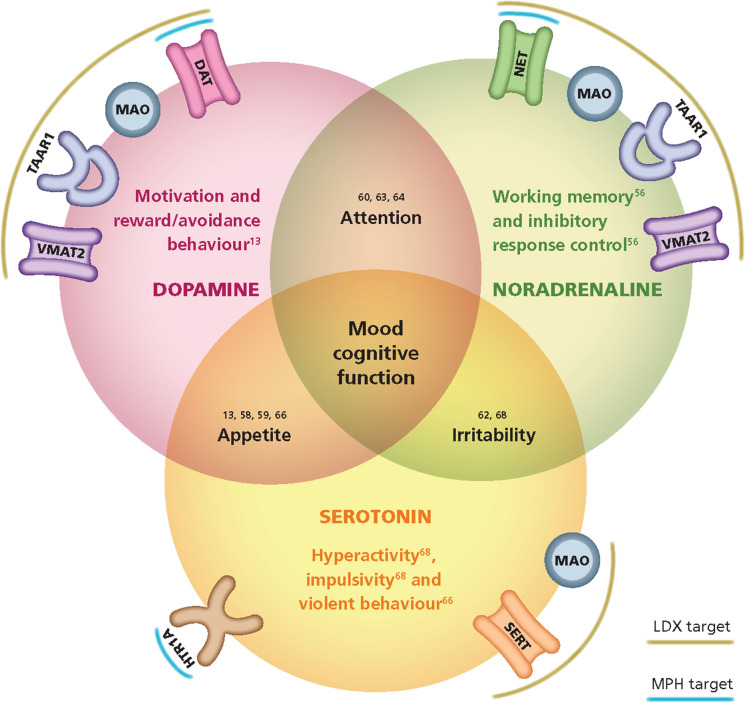
“NE, also known as noradrenaline (NA), is an important NT in behaviour control, playing a key role in high-level cognitive processes such as working memory and inhibitory response, which appear to be disrupted in ADHD [79], producing irritability and anxiety [85].”
§ Molecular Characterisation of the Mechanism of Action of Stimulant Drugs Lisdexamfetamine and Methylphenidate on ADHD Neurobiology: A Review > ADHD Aetiology and Pathophysiology > Pathophysiological Processes and Specific Molecules Involved in ADHD
What the sources say
- Not checked — no full text of the sourcecites [79] Del Campo N, Chamberlain SR, Sahakian BJ, Robbins TW. The roles of dopamine and noradrenaline in the pathophysiology and treatment of attention-deficit/hyperactivity disorder. Biol Psychiat. 2011;69(12):e145–57. source
- Partly supportedcites [85] Yamamoto K, Shinba T, Yoshii M. Psychiatric symptoms of noradrenergic dysfunction: a pathophysiological view. Psychiatry Clin Neurosci. 2014;68(1):1–20. sourceExperimental — accuracy not yet measured
The Discussion (page not provided) says overactivity of the noradrenergic system could manifest as anxiety and irritability. That supports the symptoms linked to citation [85], but the paper does not establish that disrupted working memory or inhibitory responses in ADHD produce them; it also presents the symptom link as a possibility, not a certainty. (LLM, conf=0.83)
hedgeddirect- Asserted: passes — The authors put it forward as true.
- Checkable: passes — It can be checked against evidence.
- Load-bearing: passes — The paper’s conclusions depend on it.
- Based: passes — The paper gives a reason why it holds.
It may state two separate claims as one.
The cited sources support only part of this claim — read each source’s verdict below.
In the paper
“Slower maturation or decreased size of the PFC and also diminished PFC, caudate or cerebellum activation have been found in patients with ADHD [77, 78].”
§ Molecular Characterisation of the Mechanism of Action of Stimulant Drugs Lisdexamfetamine and Methylphenidate on ADHD Neurobiology: A Review > ADHD Aetiology and Pathophysiology > Pathophysiological Processes and Specific Molecules Involved in ADHD
What the sources say
- Not checked — no full text of the sourcecites [77] Valera EM, Faraone SV, Murray KE, Seidman LJ. Meta-analysis of structural imaging findings in attention-deficit/hyperactivity disorder. Biol Psychiat. 2007;61(12):1361–9. source
- Partly supportedcites [78] Shaw P, Eckstrand K, Sharp W, et al. Attention-deficit/hyperactivity disorder is characterized by a delay in cortical maturation. Proc Natl Acad Sci USA. 2007;104(49):19649–54. sourceExperimental — accuracy not yet measured
The Discussion reports that cortical maturation delay in ADHD was most prominent in the lateral prefrontal cortex and describes prefrontal hypoactivation in children with ADHD. It does not establish decreased PFC size or diminished caudate or cerebellar activation; the study measured cortical thickness and its maturation, not activation in those regions. (LLM, conf=0.86)
plaincorrelational- Asserted: passes — The authors put it forward as true.
- Checkable: passes — It can be checked against evidence.
- Load-bearing: unclear — It is unclear whether the paper’s conclusions depend on it.
- Based: passes — The paper gives a reason why it holds.
It may state two separate claims as one.
The cited sources support only part of this claim — read each source’s verdict below.
In the paper
“ADHD disorder is usually accompanied by other comorbid conditions. In fact, patients with ADHD are frequently diagnosed with another neuropsychiatric conditions, which can mask ADHD [71].”
§ Molecular Characterisation of the Mechanism of Action of Stimulant Drugs Lisdexamfetamine and Methylphenidate on ADHD Neurobiology: A Review > ADHD Aetiology and Pathophysiology > ADHD Aetiology
What the sources say
- Partly supportedcites [71] Rothenberger LG. Molecular genetics research in ADHD: ethical considerations concerning patients’ benefit and resource allocation. Am J Med Genet B Neuropsychiatr Genet. 2012;159B(8):885–95. sourceExperimental — accuracy not yet measured
In “A Brief Summary on ADHD” (page unavailable), the paper says comorbidities such as depression, anxiety, and conduct disorder are common in children with ADHD. It does not say that patients are frequently diagnosed with another condition or that such a diagnosis can mask ADHD, and its statement about comorbidity is limited to children. (LLM, conf=0.87)
plaincorrelational- Asserted: passes — The authors put it forward as true.
- Checkable: passes — It can be checked against evidence.
- Load-bearing: fails — The paper’s conclusions may not depend on it.
- Based: passes — The paper gives a reason why it holds.
Probably not a substantial claim. The paper’s conclusions may not depend on it. It may state two separate claims as one.
- Partly supported
The cited sources support only part of this claim — read each source’s verdict below.
In the paper
“Reduced maternal thyroid capacity, poor maternal wellness, maternal age, post-maturity of the foetus, long working hours, maternal stress, foetal stress, prenatal exposure to alcohol and tobacco, and antepartum haemorrhage are prenatal factors that could influence ADHD development [54, 58, 65].”
§ Molecular Characterisation of the Mechanism of Action of Stimulant Drugs Lisdexamfetamine and Methylphenidate on ADHD Neurobiology: A Review > ADHD Aetiology and Pathophysiology > ADHD Aetiology
What the sources say
- Partly supportedcites [54] Curatolo P, D’Agati E, Moavero R. The neurobiological basis of ADHD. Ital J Pediatr. 2010;36(1):79. sourceExperimental — accuracy not yet measured
The Introduction’s “The environmental basis of ADHD” section links prenatal alcohol exposure and maternal smoking to ADHD-related outcomes, and mentions pregnancy and birth complications generally. It does not identify reduced thyroid capacity, poor maternal wellness, maternal age, post-maturity, long working hours, maternal or foetal stress, or antepartum haemorrhage as factors. (LLM, conf=0.90)
- Partly supportedcites [58] Thapar A, Cooper M, Eyre O, Langley K. What have we learnt about the causes of ADHD? J Child Psychol Psychiatry. 2013;54(1):3–16. sourceExperimental — accuracy not yet measured
The “Pre and perinatal risks” section associates maternal smoking and stress with offspring ADHD and reports a less consistent association for prenatal alcohol exposure. It does not identify reduced maternal thyroid capacity, poor maternal wellness, maternal age, post-maturity, long working hours, foetal stress, or antepartum haemorrhage as ADHD risks; it discusses prematurity, not post-maturity. The review also cautions that causation has not been established. (LLM, conf=0.88)
- Not checked — no full text of the sourcecites [65] D’Onofrio BM, Van Hulle CA, Waldman ID, Rodgers JL, Rathouz PJ, Lahey BB. Causal inferences regarding prenatal alcohol exposure and childhood externalizing problems. Arch Gen Psychiatry. 2007;64(11):1296–304. source
hedgedconditional- Asserted: passes — The authors put it forward as true.
- Checkable: passes — It can be checked against evidence.
- Load-bearing: fails — The paper’s conclusions may not depend on it.
- Based: passes — The paper gives a reason why it holds.
Probably not a substantial claim. The paper’s conclusions may not depend on it. It may state two separate claims as one.
- Partly supported
The cited sources support only part of this claim — read each source’s verdict below.
In the paper
“Obesity and nutritional deficiencies (deficiency in the intake of essential fatty acids), lower serum levels of ferritin, and iron deficiency, as postnatal factors, have been suggested to promote abnormalities in the brain and thereby influence the onset of ADHD [66–69].”
§ Molecular Characterisation of the Mechanism of Action of Stimulant Drugs Lisdexamfetamine and Methylphenidate on ADHD Neurobiology: A Review > ADHD Aetiology and Pathophysiology > ADHD Aetiology
What the sources say
- Not checked — no full text of the sourcecites [66] Alwan NA, Hamamy H. Maternal iron status in pregnancy and long-term health outcomes in the offspring. J Pediatr Genet. 2015;4(2):111–23. source
- Not checked — no full text of the sourcecites [67] San Maurotín I, Blumenfeld Olivares JA, Garicano Vilar E, et al. Nutritional and environmental factors in attention-deficit hyperactivity disorder (ADHD): a cross-sectional study. Nutr Neurosci. 2018;21(9):641–7. source
- Partly supportedcites [68] Tong L, Xiong X, Tan H. Attention-deficit/hyperactivity disorder and lifestyle-related behaviors in children. PLoS ONE. 2016;11(9): e0163434. sourceExperimental — accuracy not yet measured
The Introduction reports an association between obesity and ADHD, which supports only the broad link between them. It does not describe obesity as causing brain abnormalities or influencing ADHD onset, and the searched passages do not address ferritin, iron deficiency, or essential fatty acid deficiency as postnatal factors. (LLM, conf=0.78)
- Partly supportedcites [69] Tseng PT, Cheng YS, Yen CF, et al. Peripheral iron levels in children with attention-deficit hyperactivity disorder: a systematic review and meta-analysis. Sci Rep. 2018;8(1):788. sourceExperimental — accuracy not yet measured
The Introduction links prenatal and postnatal iron deficiency to impaired neurodevelopment, and the Discussion proposes mechanisms by which low iron and ferritin might relate to ADHD. The Conclusions report lower ferritin in children with ADHD and an association between iron deficiency and ADHD, while cautioning that the predominantly cross-sectional evidence cannot establish directionality. This paper does not support the sentence’s claims about obesity or essential fatty acid deficiency. Page numbers are not provided in our copy. (LLM, conf=0.88)
hedgedconditional- Asserted: passes — The authors put it forward as true.
- Checkable: passes — It can be checked against evidence.
- Load-bearing: fails — The paper’s conclusions may not depend on it.
- Based: passes — The paper gives a reason why it holds.
Probably not a substantial claim. The paper’s conclusions may not depend on it.
Every source the paper cites for this claim was checked and supports it.
In the paper
“NE is also involved in regulating attention [86], in particular those related to emotional and neutral emotions [87], and this signalling network has been found altered in different brain areas in patients with ADHD [88].”
§ Molecular Characterisation of the Mechanism of Action of Stimulant Drugs Lisdexamfetamine and Methylphenidate on ADHD Neurobiology: A Review > ADHD Aetiology and Pathophysiology > Pathophysiological Processes and Specific Molecules Involved in ADHD
What the sources say
- Supportedcites [86] Dahl MJ, Mather M, Sander MC, Werkle-Bergner M. Noradrenergic responsiveness supports selective attention across the adult lifespan. J Neurosci. 2020;40(22):4372–90. source
Citation [86] is attached only to the claim that NE is involved in regulating attention. The Introduction states that NE is strongly implicated in attentional processes, and the Discussion reports positive associations between noradrenergic responsiveness and attention. The emotional-versus-neutral and ADHD claims carry separate citations and are not attributed to this source. (LLM, conf=0.94)
- Supportedcites [87] De tino B, Strange BA, Dolan RJ. Noradrenergic neuromodulation of human attention for emotional and neutral stimuli. Psychopharmacology. 2008;197(1):127–36. source
Citation [87] is attached to the claim about attention to emotional and neutral stimuli, not the separate ADHD claim attributed to [88]. The Results report that propranolol impaired detection of both emotional and neutral targets, while reboxetine improved detection of emotional targets but not neutral ones. Our copy provides no page number for this passage. (LLM, conf=0.93)
- Supportedcites [88] Ulke C, Rullmann M, Huang J, et al. Adult attention-deficit/hyperactivity disorder is associated with reduced norepinephrine transporter availability in right attention networks: a (S,S)-O-[11C]methylreboxetine positron emission tomography study. Transl Psychiatry. 2019;9(1):301. source
Citation [88] is attached to the claim that the NE signalling network is altered in brain areas of patients with ADHD, not to the preceding claims about attention or emotion. The Discussion reports reduced norepinephrine transporter availability in attention-related regions of adults with ADHD, especially in the right hemisphere, compared with controls. (LLM, conf=0.92)
plaincorrelational- Asserted: passes — The authors put it forward as true.
- Checkable: passes — It can be checked against evidence.
- Load-bearing: passes — The paper’s conclusions depend on it.
- Based: passes — The paper gives a reason why it holds.
It may state two separate claims as one.
- Supported
Every source the paper cites for this claim was checked and supports it.
In the paper
“Moreover, a deficit in melatonin levels has been found in adults and children with ADHD [117], and melatonin has been used as a treatment for children with sleep problems diagnosed with ADHD [118].”
§ Molecular Characterisation of the Mechanism of Action of Stimulant Drugs Lisdexamfetamine and Methylphenidate on ADHD Neurobiology: A Review > ADHD Aetiology and Pathophysiology > Pathophysiological Processes and Specific Molecules Involved in ADHD
What the sources say
- Supportedcites [117] Spruyt K, Gozal D. Sleep disturbances in children with attention-deficit/hyperactivity disorder. Expert Rev Neurother. 2011;11(4):565–77. source
This source is cited as [118] for the treatment claim; the melatonin-deficit claim has a separate citation, [117]. In “Sleep–ADHD management,” the paper reports improved sleep-onset latency and sleep duration in children with stimulant-treated ADHD after bedtime melatonin, supporting the claim that melatonin has been used to treat their sleep problems. (LLM, conf=0.93)
- Supportedcites [118] Masi G, Fantozzi P, Villafranca A, et al. Effects of melatonin in children with attention-deficit/hyperactivity disorder with sleep disorders after methylphenidate treatment. Neuropsychiatr Dis Treat. 2019;15:663–7. source
Citation [118] is attached to the claim that melatonin has been used to treat sleep problems in children with ADHD, not to the separate melatonin-deficit claim cited to [117]. The Discussion reports treating children with ADHD who developed sleep problems after methylphenidate with melatonin. (LLM, conf=0.94)
plaincorrelational- Asserted: passes — The authors put it forward as true.
- Checkable: passes — It can be checked against evidence.
- Load-bearing: fails — The paper’s conclusions may not depend on it.
- Based: passes — The paper gives a reason why it holds.
Probably not a substantial claim. The paper’s conclusions may not depend on it. It may state two separate claims as one.
- Supported
The cited sources support only part of this claim — read each source’s verdict below.
In the paper
“This dysfunction of the immunoregulation by Treg cells and imbalance in the Th1/Th2 response might be a crucial factor in the development of allergies in children with ADHD [110], or a factor relating Th2-mediated hypersensitivity to ADHD development [111, 112].”
§ Molecular Characterisation of the Mechanism of Action of Stimulant Drugs Lisdexamfetamine and Methylphenidate on ADHD Neurobiology: A Review > ADHD Aetiology and Pathophysiology > Pathophysiological Processes and Specific Molecules Involved in ADHD
What the sources say
- Partly supportedcites [110] Miyazaki C, Koyama M, Ota E, et al. Allergic diseases in children with attention deficit hyperactivity disorder: a systematic review and meta-analysis. BMC Psychiatry. 2017;17(1):120. sourceExperimental — accuracy not yet measured
The Discussion suggests a possible link between immune regulation and asthma in children with ADHD, but discusses Th17 differentiation, not Treg-cell dysfunction or a Th1/Th2 imbalance. It also says the mechanisms remain unclear and that the review does not establish causative pathways, so it does not support calling the proposed mechanism a crucial factor. (LLM, conf=0.78)
- Partly supportedcites [111] Pelsser LM, Buitelaar JK, Savelkoul HF. ADHD as a (non) allergic hypersensitivity disorder: a hypothesis. Pediatr Allergy Immunol. 2009;20(2):107–12. sourceExperimental — accuracy not yet measured
The Abstract hypothesizes that hypersensitivity to environmental stimuli may contribute to ADHD in some children. It does not identify Treg dysfunction or a Th1/Th2 imbalance as the factor linking hypersensitivity to ADHD; searches for those terms found no matching passage in our copy. (LLM, conf=0.78)
- Not checked — no full text of the sourcecites [112] Scahill L, de Graft-Johnson A. Food allergies, asthma, and attention deficit hyperactivity disorder. J Child Adolesc Psychiatr Nurs. 1997;10(2):36–40 (quiz 1–2). source
hedgedconditional- Asserted: passes — The authors put it forward as true.
- Checkable: passes — It can be checked against evidence.
- Load-bearing: unclear — It is unclear whether the paper’s conclusions depend on it.
- Based: passes — The paper gives a reason why it holds.
It may state two separate claims as one.
- Partly supported
The cited sources support only part of this claim — read each source’s verdict below.
In the paper
“Serotonin dysfunction plays a mediator role in ADHD-related hyperactive and impulsive behaviours [91] inducing impaired control of impulses, violent behaviour, concentration and appetite [89].”
§ Molecular Characterisation of the Mechanism of Action of Stimulant Drugs Lisdexamfetamine and Methylphenidate on ADHD Neurobiology: A Review > ADHD Aetiology and Pathophysiology > Pathophysiological Processes and Specific Molecules Involved in ADHD
What the sources say
- Partly supportedcites [91] Wang CH, Liu C, Cong EZ, et al. Association of tryptophan hydroxylase-2 polymorphisms with oppositional defiant disorder in a Chinese Han population. Behav Brain Funct. 2016;12(1):30. sourceExperimental — accuracy not yet measured
The citation [91] is attached to the first clause; the later list of effects is cited to [89]. The Background says serotonin dysfunction is correlated with impulsivity, a characteristic of ADHD, and the Discussion links reduced serotonin activity to impulsive behavior. Neither passage establishes a mediating role or specifically links serotonin dysfunction to ADHD-related hyperactivity. (LLM, conf=0.85)
- Not checked — no full text of the sourcecites [89] Kent L, Doerry U, Hardy E, et al. Evidence that variation at the serotonin transporter gene influences susceptibility to attention deficit hyperactivity disorder (ADHD): analysis and pooled analysis. Mol Psychiatry. 2002;7(8):908–12. source
plaindirect- Asserted: passes — The authors put it forward as true.
- Checkable: passes — It can be checked against evidence.
- Load-bearing: unclear — It is unclear whether the paper’s conclusions depend on it.
- Based: passes — The paper gives a reason why it holds.
It may state two separate claims as one.
- Partly supported
Every source the paper cites for this claim was checked and supports it.
In the paper
“These impairments might be the result of neurodegeneration, neurogenesis problems, altered proliferation–differentiation balance, deficient neurotrophic factors and, thereby, loss of neuronal viability [92].”
§ Molecular Characterisation of the Mechanism of Action of Stimulant Drugs Lisdexamfetamine and Methylphenidate on ADHD Neurobiology: A Review > ADHD Aetiology and Pathophysiology > Pathophysiological Processes and Specific Molecules Involved in ADHD
What the sources say
- Supportedcites [92] Dark C, Homman-Ludiye J, Bryson-Richardson RJ. The role of ADHD associated genes in neurodevelopment. Dev Biol. 2018;438(2):69–83. source
Section 2, “Neurogenesis” (page unavailable), says that disrupted proliferation–differentiation balance has consequences for brain development. Section 8, “Selective cell death” (page unavailable), describes neuronal degeneration and links reduced BDNF activity to neuronal loss and survival, supporting the sentence’s hedged explanation. (LLM, conf=0.88)
hedgedconditional- Asserted: passes — The authors put it forward as true.
- Checkable: passes — It can be checked against evidence.
- Load-bearing: unclear — It is unclear whether the paper’s conclusions depend on it.
- Based: passes — The paper gives a reason why it holds.
It may state two separate claims as one.
- Supported
The cited sources support only part of this claim — read each source’s verdict below.
In the paper
“Alteration of glutamate/GABA equilibrium has been related to a diminished capability to focus on demanding tasks [98] and to result in DA dysregulation, causing inhibition of defective pyramidal neurons and a decrease shift in excitation towards tasks regulated in the PFC [99, 100].”
§ Molecular Characterisation of the Mechanism of Action of Stimulant Drugs Lisdexamfetamine and Methylphenidate on ADHD Neurobiology: A Review > ADHD Aetiology and Pathophysiology > Pathophysiological Processes and Specific Molecules Involved in ADHD
What the sources say
- Partly supportedcites [98] Hu Y, Chen X, Gu H, Yang Y. Resting-state glutamate and GABA concentrations predict task-induced deactivation in the default mode network. J Neurosci. 2013;33(47):18566–73. sourceExperimental — accuracy not yet measured
Split into 2 atoms — 0 confirmed, 2 partially supported, 0 disputed, 0 misattributed, 0 unverifiable. Expand the claim to see per-atom verdicts.
- Partly supportedcites [99] Arnsten AF. The emerging neurobiology of attention deficit hyperactivity disorder: the key role of the prefrontal association cortex. J Pediatr. 2009;154(5):I-S43. sourceExperimental — accuracy not yet measured
Split into 2 atoms — 0 confirmed, 2 partially supported, 0 disputed, 0 misattributed, 0 unverifiable. Expand the claim to see per-atom verdicts.
- Not checked — no full text of the sourcecites [100] Gilbert DL, Ridel KR, Sallee FR, Zhang J, Lipps TD, Wassermann EM. Comparison of the inhibitory and excitatory effects of ADHD medications methylphenidate and atomoxetine on motor cortex. Neuropsychopharmacology. 2006;31(2):442–9. source
plaindirect- Asserted: passes — The authors put it forward as true.
- Checkable: passes — It can be checked against evidence.
- Load-bearing: unclear — It is unclear whether the paper’s conclusions depend on it.
- Based: passes — The paper gives a reason why it holds.
It may state two separate claims as one.
- Partly supported
The cited sources support only part of this claim — read each source’s verdict below.
In the paper
“Pro-inflammatory cytokines such as tumour necrosis factor beta (TNFβ), interferon alpha (IFNα), interleukin-1 (IL-1), IL-5, and IL-16 are found upregulated, whereas the anti-inflammatory cytokines IL-4 and IL-13 are downregulated, resulting in an inflammatory process that causes neuronal damage and contributes to ADHD symptomatology [60].”
§ Molecular Characterisation of the Mechanism of Action of Stimulant Drugs Lisdexamfetamine and Methylphenidate on ADHD Neurobiology: A Review > ADHD Aetiology and Pathophysiology > Pathophysiological Processes and Specific Molecules Involved in ADHD
What the sources say
- Partly supportedcites [60] Verlaet AA, Noriega DB, Hermans N, Savelkoul HF. Nutrition, immunological mechanisms and dietary immunomodulation in ADHD. Eur Child Adolesc Psychiatry. 2014;23(7):519–29. sourceExperimental — accuracy not yet measured
Split into 2 atoms — 0 confirmed, 1 partially supported, 0 disputed, 0 misattributed, 1 unverifiable. Expand the claim to see per-atom verdicts.
plaindirect- Asserted: passes — The authors put it forward as true.
- Checkable: passes — It can be checked against evidence.
- Load-bearing: unclear — It is unclear whether the paper’s conclusions depend on it.
- Based: passes — The paper gives a reason why it holds.
It may state two separate claims as one.
- Partly supported
The cited sources that could be checked couldn’t confirm or dispute this claim.
In the paper
“This promotes an imbalance in pro-inflammatory T helper 1 cell (Th1)/anti-inflammatory T helper 2 cell (Th2) cytokine profile making a more pro-inflammatory environment in ADHD [60, 102], which can be related to a defective regulatory T cell (Treg) regulation.”
§ Molecular Characterisation of the Mechanism of Action of Stimulant Drugs Lisdexamfetamine and Methylphenidate on ADHD Neurobiology: A Review > ADHD Aetiology and Pathophysiology > Pathophysiological Processes and Specific Molecules Involved in ADHD
What the sources say
- Could not verifycites [60] Verlaet AA, Noriega DB, Hermans N, Savelkoul HF. Nutrition, immunological mechanisms and dietary immunomodulation in ADHD. Eur Child Adolesc Psychiatry. 2014;23(7):519–29. sourceExperimental — accuracy not yet measured
No passage from our indexed copy addresses the proposed link between low cortisol, a Th1/Th2 cytokine imbalance, and defective Treg regulation in ADHD. Searches for cortisol, Th1, Treg, and pro-inflammatory cytokines returned no substantive passage; the only returned text was bibliographic information with no section or page. (LLM, conf=0.70)
- Not checked — no full text of the sourcecites [102] Ma L, Chen YH, Chen H, Liu YY, Wang YX. The function of hypothalamus-pituitary-adrenal axis in children with ADHD. Brain Res. 2011;12(1368):159–62. source
plaindirect- Asserted: passes — The authors put it forward as true.
- Checkable: passes — It can be checked against evidence.
- Load-bearing: unclear — It is unclear whether the paper’s conclusions depend on it.
- Based: passes — The paper gives a reason why it holds.
It may state two separate claims as one.
- Could not verify
The sources with a verdict support this claim; the rest weren’t checked yet, have no full text we could read, or their verdicts aren’t rated yet.
In the paper
“ADHD seems to present a morphogenesis dysregulation [92, 121], with a high number of neurophysiological difficulties caused by neuronal network dysfunctions in the brain.”
§ Molecular Characterisation of the Mechanism of Action of Stimulant Drugs Lisdexamfetamine and Methylphenidate on ADHD Neurobiology: A Review > ADHD Aetiology and Pathophysiology > Pathophysiological Processes and Specific Molecules Involved in ADHD
What the sources say
- Supportedcites [92] Dark C, Homman-Ludiye J, Bryson-Richardson RJ. The role of ADHD associated genes in neurodevelopment. Dev Biol. 2018;438(2):69–83. source
The citation follows the claim about morphogenesis dysregulation, not the later statement about neuronal network dysfunction. The Introduction describes macroanatomical changes in ADHD resulting from disrupted neurodevelopmental mechanisms, including altered brain-region volumes and delayed cortical thickening. (LLM, conf=0.88)
- Not checked — no full text of the sourcecites [121] Donev R, Thome J. Inflammation: good or bad for ADHD? Atten Defic Hyperact Disord. 2010;2(4):257–66. source
hedgeddirect- Asserted: passes — The authors put it forward as true.
- Checkable: passes — It can be checked against evidence.
- Load-bearing: unclear — It is unclear whether the paper’s conclusions depend on it.
- Based: passes — The paper gives a reason why it holds.
It may state two separate claims as one.
- Supported
Every source the paper cites for this claim was checked and supports it.
In the paper
“The HpA axis is a hormonal system that controls stress responses [106] and affects several hormonal behaviours [107, 108].”
§ Molecular Characterisation of the Mechanism of Action of Stimulant Drugs Lisdexamfetamine and Methylphenidate on ADHD Neurobiology: A Review > ADHD Aetiology and Pathophysiology > Pathophysiological Processes and Specific Molecules Involved in ADHD
What the sources say
- Supportedcites [106] Stephens MA, Wand G. Stress and the HPA axis: role of glucocorticoids in alcohol dependence. Alcohol Res. 2012;34(4):468–83. source
The citation is attached to the statement that the HPA axis is a hormonal system involved in stress responses, not to the separate claim about hormonal behaviours. The Physiology of the HPA Axis section describes its activation as a major component of the stress response and explains the hormone pathway involved. (LLM, conf=0.93)
- Supportedcites [107] Smith SM, Vale WW. The role of the hypothalamic-pituitary-adrenal axis in neuroendocrine responses to stress. Dialogues Clin Neurosci. 2006;8(4):383–95. source
The citation attached to this source supports the clause about stress responses, not the separately cited clause about hormonal behaviours. The 'Anatomy of the stress response' section identifies the HPA axis as the principal structures mediating the stress response, and 'The HPA axis' section describes its hormonal response to stress. (LLM, conf=0.92)
- Supportedcites [108] Bao AM, Swaab DF. The human hypothalamus in mood disorders: the HPA axis in the center. IBRO Rep. 2019;6:45–53. source
The citation immediately after “controls stress responses” is attached to that part of the sentence. In the Introduction’s “The HPA axis” section, the paper describes the HPA axis as part of the stress system and says environmental stress can activate it. The separate claim about hormonal behaviours carries different citations and is not assessed here. (LLM, conf=0.88)
plaindirect- Asserted: passes — The authors put it forward as true.
- Checkable: passes — It can be checked against evidence.
- Load-bearing: fails — The paper’s conclusions may not depend on it.
- Based: passes — The paper gives a reason why it holds.
Probably not a substantial claim. The paper’s conclusions may not depend on it. It may state two separate claims as one.
- Supported
The cited sources support only part of this claim — read each source’s verdict below.
In the paper
“In children with ADHD, irregular sleep cycles, troubled sleep initiation, reduced sleep effectiveness with greater wakefulness periods and increased nocturnal activity have been observed, among others [117].”
§ Molecular Characterisation of the Mechanism of Action of Stimulant Drugs Lisdexamfetamine and Methylphenidate on ADHD Neurobiology: A Review > ADHD Aetiology and Pathophysiology > Pathophysiological Processes and Specific Molecules Involved in ADHD
What the sources say
- Partly supportedcites [117] Spruyt K, Gozal D. Sleep disturbances in children with attention-deficit/hyperactivity disorder. Expert Rev Neurother. 2011;11(4):565–77. sourceExperimental — accuracy not yet measured
The sections on sleep initiation and maintaining sleep report sleep-onset insomnia, increased night-time awakenings, and higher nocturnal activity in children with ADHD. The sleep-duration section describes variable sleep–wake patterns, but calls reduced sleep efficiency an anticipated complaint rather than a consistently observed finding; the review also notes that objective sleep findings are inconsistent. Page numbers are not available in our copy. (LLM, conf=0.82)
plaincorrelational- Asserted: passes — The authors put it forward as true.
- Checkable: passes — It can be checked against evidence.
- Load-bearing: unclear — It is unclear whether the paper’s conclusions depend on it.
- Based: passes — The paper gives a reason why it holds.
It may state two separate claims as one.
- Partly supported
The cited sources support only part of this claim — read each source’s verdict below.
In the paper
“In this sense, higher glutamate levels and reduced GABA levels have been observed in children with ADHD, which indicates a bias towards neuron excitation that might be implicated in hyperactivity induction, although without a firm conclusion [101].”
§ Molecular Characterisation of the Mechanism of Action of Stimulant Drugs Lisdexamfetamine and Methylphenidate on ADHD Neurobiology: A Review > ADHD Aetiology and Pathophysiology > Pathophysiological Processes and Specific Molecules Involved in ADHD
What the sources say
- Partly supportedcites [101] Naaijen J, Bralten J, Poelmans G, et al. Glutamatergic and GABAergic gene sets in attention-deficit/hyperactivity disorder: association to overlapping traits in ADHD and autism. Transl Psychiatry. 2017;7(1): e999. sourceExperimental — accuracy not yet measured
The Introduction reports decreased prefrontal GABA in children with ADHD and increased glutamatergic levels in a separate study. The Results and Discussion link glutamate-related genetic variation to hyperactivity/impulsivity, but the Discussion says the study cannot determine the direction of effects; it does not establish an excitatory bias or show that such a bias induces hyperactivity. (LLM, conf=0.84)
hedgedconditional- Asserted: passes — The authors put it forward as true.
- Checkable: passes — It can be checked against evidence.
- Load-bearing: unclear — It is unclear whether the paper’s conclusions depend on it.
- Based: passes — The paper gives a reason why it holds.
It may state two separate claims as one.
- Partly supported
Every source the paper cites for this claim was checked and supports it.
In the paper
“Furthermore, HpA axis involvement in typical ADHD comorbidities has been reported [109].”
§ Molecular Characterisation of the Mechanism of Action of Stimulant Drugs Lisdexamfetamine and Methylphenidate on ADHD Neurobiology: A Review > ADHD Aetiology and Pathophysiology > Pathophysiological Processes and Specific Molecules Involved in ADHD
What the sources say
- Supportedcites [109] Buitelaar JK. The role of the HPA-axis in understanding psychopathology: cause, consequence, mediator, or moderator? Eur Child Adolesc Psychiatry. 2013;22(7):387–9. source
In the paper’s discussion of externalizing psychopathology, the author reports HPA-axis findings for oppositional defiant and conduct disorder. The paper also discusses HPA-axis associations with anxiety and depression and explicitly refers to anxiety and depression as possible ADHD comorbidities. These passages support the broad claim that HPA-axis involvement in typical ADHD comorbidities has been reported; page numbers were not supplied in our copy. (LLM, conf=0.88)
plaincorrelational- Asserted: passes — The authors put it forward as true.
- Checkable: passes — It can be checked against evidence.
- Load-bearing: fails — The paper’s conclusions may not depend on it.
- Based: passes — The paper gives a reason why it holds.
Probably not a substantial claim. The paper’s conclusions may not depend on it.
- Supported
The cited sources support only part of this claim — read each source’s verdict below.
In the paper
“Glutamate signalling is the most common excitatory synapse NT [93] and deficiencies in this signalling has been associated with ADHD symptoms [94], although it is unknown whether ADHD is associated with differences in glutamate levels [95–97].”
§ Molecular Characterisation of the Mechanism of Action of Stimulant Drugs Lisdexamfetamine and Methylphenidate on ADHD Neurobiology: A Review > ADHD Aetiology and Pathophysiology > Pathophysiological Processes and Specific Molecules Involved in ADHD
What the sources say
- Not matchedcites [93] Bruce A, Johnson A, Ian L, Tin R, Keith R, Peter W. Internal organization of the cell; channels and the electrical properties. In: Molecular biology of the cell. 4th ed. New York: Garland Science; 2002.
Couldn’t be matched to a paper in Crossref, so it can’t be checked.
- Not checked — no full text of the sourcecites [94] Medin T, Jensen V, Skare O, Storm-Mathisen J, Hvalby O, Bergersen LH. Altered alpha-amino-3-hydroxy-5-methyl-4-isoxazolepropionic acid (AMPA) receptor function and expression in hippocampus in a rat model of attention-deficit/hyperactivity disorder (ADHD). Behav Brain Res. 2019;15(360):209–15. source
- Not checked — no full text of the sourcecites [95] Puts NA, Ryan M, Oeltzschner G, Horska A, Edden RAE, Mahone EM. Reduced striatal GABA in unmedicated children with ADHD at 7T. Psychiatry Res Neuroimaging. 2020;30(301): 111082. source
- Supportedcites [96] Edden RA, Crocetti D, Zhu H, Gilbert DL, Mostofsky SH. Reduced GABA concentration in attention-deficit/hyperactivity disorder. Arch Gen Psychiatry. 2012;69(7):750–3. source
The citation [95–97] is attached to the uncertainty about glutamate levels, not the preceding claims about glutamate signalling. In the Comment section (page unavailable), the paper notes that earlier ADHD studies found elevated Glx, while its own Results (page unavailable) found no significant Glx difference. It also cautions that Glx is not a straightforward measure of excitatory glutamate signalling, supporting the citing sentence’s uncertainty rather than a definite conclusion about glutamate levels. (LLM, conf=0.86)
- Partly supportedcites [97] Hammerness P, Biederman J, Petty C, Henin A, Moore CM. Brain biochemical effects of methylphenidate treatment using proton magnetic spectroscopy in youth with attention-deficit hyperactivity disorder: a controlled pilot study. CNS Neurosci Ther. 2012;18(1):34–40. sourceExperimental — accuracy not yet measured
The Results section reports no statistically significant difference between untreated ADHD participants and controls in this small sample, supporting uncertainty about glutamate-related levels. But the Introduction and Discussion describe earlier studies reporting significant glutamatergic differences in ADHD. The paper therefore does not support an unqualified statement that it is unknown whether any such differences are associated with ADHD; citations [93] and [94] attach to the other clauses. (LLM, conf=0.78)
plaincorrelational- Asserted: passes — The authors put it forward as true.
- Checkable: passes — It can be checked against evidence.
- Load-bearing: fails — The paper’s conclusions may not depend on it.
- Based: passes — The paper gives a reason why it holds.
Probably not a substantial claim. The paper’s conclusions may not depend on it. It may state two separate claims as one.
- Not matched
The cited sources support only part of this claim — read each source’s verdict below.
In the paper
“Neuroinflammation is hypothesized to affect brain growth and thereby raises the risk of neurodevelopmental disorders through pathways such as glial activation, increased oxidative stress, problems related to neuronal growth and impaired NT activity [60].”
§ Molecular Characterisation of the Mechanism of Action of Stimulant Drugs Lisdexamfetamine and Methylphenidate on ADHD Neurobiology: A Review > ADHD Aetiology and Pathophysiology > Pathophysiological Processes and Specific Molecules Involved in ADHD
What the sources say
- Partly supportedcites [60] Verlaet AA, Noriega DB, Hermans N, Savelkoul HF. Nutrition, immunological mechanisms and dietary immunomodulation in ADHD. Eur Child Adolesc Psychiatry. 2014;23(7):519–29. sourceExperimental — accuracy not yet measured
Split into 2 atoms — 0 confirmed, 2 partially supported, 0 disputed, 0 misattributed, 0 unverifiable. Expand the claim to see per-atom verdicts.
hedgedconditional- Asserted: passes — The authors put it forward as true.
- Checkable: passes — It can be checked against evidence.
- Load-bearing: fails — The paper’s conclusions may not depend on it.
- Based: passes — The paper gives a reason why it holds.
Probably not a substantial claim. The paper’s conclusions may not depend on it.
- Partly supported
The cited sources support only part of this claim — read each source’s verdict below.
In the paper
“Also, it has been shown that ephrin stimulates excitatory synapses development [127–129] and is closely related to neurogenesis, plasticity and learning [93].”
§ Molecular Characterisation of the Mechanism of Action of Stimulant Drugs Lisdexamfetamine and Methylphenidate on ADHD Neurobiology: A Review > ADHD Aetiology and Pathophysiology > Pathophysiological Processes and Specific Molecules Involved in ADHD
What the sources say
- Partly supportedcites [127] Homman-Ludiye J, Kwan WC, de Souza MJ, Rodger J, Bourne JA. Ephrin-A2 regulates excitatory neuron differentiation and interneuron migration in the developing neocortex. Sci Rep. 2017;7(1):11813. sourceExperimental — accuracy not yet measured
The citation [93] is attached to the claim about neurogenesis, plasticity and learning; the separate citations [127–129] accompany the synapse-development claim. The Discussion states that ephrin-A2 regulates neurogenesis, but our copy does not establish a relationship with plasticity or learning. (LLM, conf=0.88)
- Partly supportedcites [128] Henderson NT, Le chand SJ, Hruska M, Hippenmeyer S, Luo L, Dalva MB. Ephrin-B3 controls excitatory synapse density through cell-cell competition for EphBs. Elife. 2019;21:8. sourceExperimental — accuracy not yet measured
The source is cited for the first clause, not the neurogenesis, plasticity, and learning clause, which has a separate citation. Its Introduction and Discussion support a role for ephrin-B3 in regulating excitatory synapse density during development, but the Introduction explicitly says it is not required for synapse formation; it controls the local distribution of synapses instead. Thus, saying broadly that ephrin stimulates synapse development overstates the finding. (LLM, conf=0.83)
- Not checked — no full text of the sourcecites [129] Calo L, Cinque C, Patane M, et al. Interaction between ephrins/Eph receptors and excitatory amino acid receptors: possible relevance in the regulation of synaptic plasticity and in the pathophysiology of neuronal degeneration. J Neurochem. 2006;98(1):1–10. source
- Not matchedcites [93] Bruce A, Johnson A, Ian L, Tin R, Keith R, Peter W. Internal organization of the cell; channels and the electrical properties. In: Molecular biology of the cell. 4th ed. New York: Garland Science; 2002.
Couldn’t be matched to a paper in Crossref, so it can’t be checked.
plaindirect- Asserted: passes — The authors put it forward as true.
- Checkable: passes — It can be checked against evidence.
- Load-bearing: fails — The paper’s conclusions may not depend on it.
- Based: passes — The paper gives a reason why it holds.
Probably not a substantial claim. The paper’s conclusions may not depend on it. It may state two separate claims as one.
- Partly supported
The cited sources that could be checked couldn’t confirm or dispute this claim.
In the paper
“Interestingly, canonical inflammation mediators, such as interleukin-1 beta (IL-1B) and TNF are induced in MPH treatment, suggesting a potential immunomodulatory role for the drug, although the evidence does not readily support it.”
§ Molecular Characterisation of the Mechanism of Action of Stimulant Drugs Lisdexamfetamine and Methylphenidate on ADHD Neurobiology: A Review > Molecular Mechanism of Stimulant Treatments > Methylphenidate (MPH)
What the sources say
- Could not verifycites [125] Joseph N, Zhang-James Y, Perl A, Faraone SV. Oxidative stress and ADHD: a meta-analysis. J Atten Disord. 2015;19(11):915–24. sourceExperimental — accuracy not yet measured
The Discussion describes stimulant treatment in relation to oxidative stress, but does not address whether methylphenidate induces IL-1B or TNF or has an immunomodulatory role. Searches for those mediators and for inflammatory cytokines induced by methylphenidate found no passage addressing the claim. (LLM, conf=0.75)
hedgeddirect- Asserted: passes — The authors put it forward as true.
- Checkable: passes — It can be checked against evidence.
- Load-bearing: unclear — It is unclear whether the paper’s conclusions depend on it.
- Based: passes — The paper gives a reason why it holds.
It may state two separate claims as one.
- Could not verify
The sources with a verdict support this claim; the rest weren’t checked yet, have no full text we could read, or their verdicts aren’t rated yet.
In the paper
“LDX is the first stimulant prodrug indicated and recommended by guidelines in children at least 6 years of age when the MPH treatment is not optimal [132, 150], and also as first-line treatment in adults [133, 151] and for binge eating disorder [40] in the USA.”
§ Molecular Characterisation of the Mechanism of Action of Stimulant Drugs Lisdexamfetamine and Methylphenidate on ADHD Neurobiology: A Review > Molecular Mechanism of Stimulant Treatments > Lisdexamfetamine Dimesylate (LDX)
What the sources say
- Not matchedcites [132] National Institute for Health and Care Excellence. Attention deficit hyperactivity disorder: diagnosis and management. https://www.nice.org.uk/guidance/NG87. NICE guideline NG87. 2018.
Couldn’t be matched to a paper in Crossref, so it can’t be checked.
- Not checked — no full text of the sourcecites [150] Frampton JE. Lisdexamfetamine dimesylate: a review in paediatric ADHD. Drugs. 2018;78(10):1025–36. source
- Supportedcites [133] Kooij JJS, Bijlenga D, Salerno L, et al. Updated European consensus statement on diagnosis and treatment of adult ADHD. Eur Psychiatry. 2019;56:14–34. source
The citation to this paper is attached to the adult first-line treatment claim, not the child or binge-eating indications. Section 7.4.1 (p. 9) identifies LDX as a formulation of dexamphetamine and reports amphetamines as the first pharmacological choice for adults with ADHD. (LLM, conf=0.87)
- Not checked — no full text of the sourcecites [151] Frampton JE. Lisdexamfetamine: a review in ADHD in adults. CNS Drugs. 2016;30(4):343–54. source
- Not matchedcites [40] VYVANSE® (lisdexamfetamine dimesylate) capsules, for oral use, CII. VYVANSE ® (lisdexamfetamine dimesylate) chewable tablets, for oral use, CII. Initial U.S. Approval: 20. https://www.accessdata.fda.gov/drugsatfda_docs/label/2017/208510lbl.pdf.
Couldn’t be matched to a paper in Crossref, so it can’t be checked.
plain- Asserted: passes — The authors put it forward as true.
- Checkable: passes — It can be checked against evidence.
- Load-bearing: unclear — It is unclear whether the paper’s conclusions depend on it.
- Based: passes — The paper gives a reason why it holds.
It may state two separate claims as one.
- Not matched
Every source the paper cites for this claim was checked and supports it.
In the paper
“Alterations in glutamate receptors (GRM-1, GRM-5, GRM-7 and GRM-8) have been associated with ADHD [124].”
§ Molecular Characterisation of the Mechanism of Action of Stimulant Drugs Lisdexamfetamine and Methylphenidate on ADHD Neurobiology: A Review > ADHD Aetiology and Pathophysiology > Pathophysiological Processes and Specific Molecules Involved in ADHD
What the sources say
- Supportedcites [124] Elia J, Glessner JT, Wang K, et al. Genome-wide copy number variation study associates metabotropic glutamate receptor gene networks with attention deficit hyperactivity disorder. Nat Genet. 2011;44(1):78–84. source
The paper’s Abstract reports that copy-number variants affecting metabotropic glutamate receptor genes were enriched in ADHD cases and specifically identifies GRM1, GRM5, GRM7 and GRM8. It describes deletions in GRM5, GRM7 and GRM8 and duplications in GRM1, supporting the claimed association. (LLM, conf=0.94)
plaincorrelational- Asserted: passes — The authors put it forward as true.
- Checkable: passes — It can be checked against evidence.
- Load-bearing: fails — The paper’s conclusions may not depend on it.
- Based: passes — The paper gives a reason why it holds.
Probably not a substantial claim. The paper’s conclusions may not depend on it.
- Supported
The cited sources support only part of this claim — read each source’s verdict below.
In the paper
“Moreover, it has been suggested that ephrin family members have a role in ADHD-related synaptogenesis alterations [92, 130].”
§ Molecular Characterisation of the Mechanism of Action of Stimulant Drugs Lisdexamfetamine and Methylphenidate on ADHD Neurobiology: A Review > ADHD Aetiology and Pathophysiology > Pathophysiological Processes and Specific Molecules Involved in ADHD
What the sources say
- Partly supportedcites [92] Dark C, Homman-Ludiye J, Bryson-Richardson RJ. The role of ADHD associated genes in neurodevelopment. Dev Biol. 2018;438(2):69–83. sourceExperimental — accuracy not yet measured
Section 5, “Synaptogenesis” (page unavailable), identifies ephrin type-B receptor 2 (EPHB2) as a surface protein involved in stabilising synaptic contacts. It also discusses possible synaptic-density alterations in ADHD, but does not specifically link ephrin family members to ADHD-related alterations. (LLM, conf=0.82)
- Partly supportedcites [130] Sheleg M, Yochum CL, Wagner GC, Zhou R, Richardson JR. Ephrin-A5 deficiency alters sensorimotor and monoaminergic development. Behav Brain Res. 2013;236(1):139–47. sourceExperimental — accuracy not yet measured
The Discussion (page unavailable) suggests that loss of ephrin-A5 may contribute to ADHD-like behavioral phenotypes through neurodevelopmental alterations, citing its role in neurite outgrowth and axon targeting. It does not specifically identify ADHD-related alterations in synaptogenesis; that part of the claim is unsupported by our copy. (LLM, conf=0.84)
hedgedcorrelational- Asserted: passes — The authors put it forward as true.
- Checkable: passes — It can be checked against evidence.
- Load-bearing: fails — The paper’s conclusions may not depend on it.
- Based: passes — The paper gives a reason why it holds.
Probably not a substantial claim. The paper’s conclusions may not depend on it.
- Partly supported
Every source the paper cites for this claim was checked and supports it.
In the paper
“Glutamate and some of its receptors are also involved in neurogenesis and proliferation [92].”
§ Molecular Characterisation of the Mechanism of Action of Stimulant Drugs Lisdexamfetamine and Methylphenidate on ADHD Neurobiology: A Review > ADHD Aetiology and Pathophysiology > Pathophysiological Processes and Specific Molecules Involved in ADHD
What the sources say
- Supportedcites [92] Dark C, Homman-Ludiye J, Bryson-Richardson RJ. The role of ADHD associated genes in neurodevelopment. Dev Biol. 2018;438(2):69–83. source
Section 2, “Neurogenesis,” describes glutamate as a positive regulator of neurogenesis and says that metabotropic glutamate receptors play roles in that process. It also reports that GRM5 activation increases expression of a factor that induces neural proliferation, while GRM7 knockdown increases proliferation. (LLM, conf=0.94)
plaincorrelational- Asserted: passes — The authors put it forward as true.
- Checkable: passes — It can be checked against evidence.
- Load-bearing: fails — The paper’s conclusions may not depend on it.
- Based: passes — The paper gives a reason why it holds.
Probably not a substantial claim. The paper’s conclusions may not depend on it.
- Supported
The cited sources support only part of this claim — read each source’s verdict below.
In the paper
“It is the first-line pharmacological treatment recommended in current guidelines [132, 133] for children of at least 6 years of age and adults with ADHD.”
§ Molecular Characterisation of the Mechanism of Action of Stimulant Drugs Lisdexamfetamine and Methylphenidate on ADHD Neurobiology: A Review > Molecular Mechanism of Stimulant Treatments > Methylphenidate (MPH)
What the sources say
- Not matchedcites [132] National Institute for Health and Care Excellence. Attention deficit hyperactivity disorder: diagnosis and management. https://www.nice.org.uk/guidance/NG87. NICE guideline NG87. 2018.
Couldn’t be matched to a paper in Crossref, so it can’t be checked.
- Partly supportedcites [133] Kooij JJS, Bijlenga D, Salerno L, et al. Updated European consensus statement on diagnosis and treatment of adult ADHD. Eur Psychiatry. 2019;56:14–34. sourceExperimental — accuracy not yet measured
Section 7.4.1 (p. 9) says methylphenidate was among the stimulants recommended as first-line pharmacotherapy for adults in an earlier European consensus statement, and reports methylphenidate as the first pharmacological choice for children and adolescents. It does not specify a minimum age of 6, and the more recent evidence it discusses favors amphetamines, rather than methylphenidate, as the first choice for adults. (LLM, conf=0.88)
plain- Asserted: passes — The authors put it forward as true.
- Checkable: passes — It can be checked against evidence.
- Load-bearing: fails — The paper’s conclusions may not depend on it.
- Based: passes — The paper gives a reason why it holds.
Probably not a substantial claim. The paper’s conclusions may not depend on it.
- Not matched
The cited sources support only part of this claim — read each source’s verdict below.
In the paper
“MPH is the most commonly prescribed medication to treat ADHD [134, 135].”
§ Molecular Characterisation of the Mechanism of Action of Stimulant Drugs Lisdexamfetamine and Methylphenidate on ADHD Neurobiology: A Review > Molecular Mechanism of Stimulant Treatments > Methylphenidate (MPH)
What the sources say
- Partly supportedcites [134] Pitzianti MB, Spiridigliozzi S, Bartolucci E, Esposito S, Pasini A. New insights on the effects of methylphenidate in attention deficit hyperactivity disorder. Front Psychiatry. 2020;11: 531092. sourceExperimental — accuracy not yet measured
The Introduction states that MPH is the most commonly prescribed psychostimulant for patients with ADHD. The claim broadens that comparison to all medications, which this passage does not establish. (LLM, conf=0.88)
- Not checked — no full text of the sourcecites [135] Semrud-Clikeman M, Filipek PA, Biederman J, et al. Attention-deficit hyperactivity disorder: magnetic resonance imaging morphometric analysis of the corpus callosum. J Am Acad Child Adolesc Psychiatry. 1994;33(6):875–81. source
plain- Asserted: passes — The authors put it forward as true.
- Checkable: passes — It can be checked against evidence.
- Load-bearing: fails — The paper’s conclusions may not depend on it.
- Based: passes — The paper gives a reason why it holds.
Probably not a substantial claim. The paper’s conclusions may not depend on it.
- Partly supported
The cited sources that could be checked couldn’t confirm or dispute this claim.
In the paper
“Neurotrophin-3 (NTF-3) has been also related to neuron survival [92].”
§ Molecular Characterisation of the Mechanism of Action of Stimulant Drugs Lisdexamfetamine and Methylphenidate on ADHD Neurobiology: A Review > ADHD Aetiology and Pathophysiology > Pathophysiological Processes and Specific Molecules Involved in ADHD
What the sources say
- Could not verifycites [92] Dark C, Homman-Ludiye J, Bryson-Richardson RJ. The role of ADHD associated genes in neurodevelopment. Dev Biol. 2018;438(2):69–83. sourceExperimental — accuracy not yet measured
Section 8, “Selective cell death” (page not provided), links nerve growth factor and BDNF to neuronal survival, but does not identify neurotrophin-3 (NTF-3). Searches for “NTF-3 neurotrophin-3 neuron survival” and “NTF3 neuronal survival” found no passage in our copy addressing NTF-3’s role. (LLM, conf=0.72)
plaincorrelational- Asserted: passes — The authors put it forward as true.
- Checkable: passes — It can be checked against evidence.
- Load-bearing: fails — The paper’s conclusions may not depend on it.
- Based: passes — The paper gives a reason why it holds.
Probably not a substantial claim. The paper’s conclusions may not depend on it.
- Could not verify
The cited sources support only part of this claim — read each source’s verdict below.
In the paper
“LDX inhibits the activity of two other important proteins, not shared with MPH, involved in the monoaminergic system described in ADHD: SERT [164] and MAO [165].”
§ Molecular Characterisation of the Mechanism of Action of Stimulant Drugs Lisdexamfetamine and Methylphenidate on ADHD Neurobiology: A Review > Molecular Mechanism of Stimulant Treatments > MPH vs LDX: Similarities and Differences
What the sources say
- Partly supportedcites [164] Guerdjikova AI, Mori N, Casuto LS, McElroy SL. Novel pharmacologic treatment in acute binge eating disorder - role of lisdexamfetamine. Neuropsychiatr Dis Treat. 2016;12:833–41. sourceExperimental — accuracy not yet measured
The Pharmacology section says that d-amphetamine, the active metabolite of LDX, is a weak MAO inhibitor. The Pharmacodynamics section says LDX itself is inactive at enzymes in vitro, and the paper does not establish that MAO inhibition is absent with MPH. SERT is separately cited to [164] in the citing sentence, so it is not judged against this source. (LLM, conf=0.86)
- Not checked — no full text of the sourcecites [165] Popovic B, Bhattacharya P, Sivaswamy L. Lisdexamfetamine: a prodrug for the treatment of attention-deficit/hyperactivity disorder. Am J Health Syst Pharm. 2009;66(22):2005–12. source
plaindirect- Asserted: passes — The authors put it forward as true.
- Checkable: passes — It can be checked against evidence.
- Load-bearing: passes — The paper’s conclusions depend on it.
- Based: passes — The paper gives a reason why it holds.
It may state two separate claims as one.
- Partly supported
The cited sources support only part of this claim — read each source’s verdict below.
In the paper
“LDX is also a specific agonist of TAAR1 [169], a protein involved in DA pathway modulation [170].”
§ Molecular Characterisation of the Mechanism of Action of Stimulant Drugs Lisdexamfetamine and Methylphenidate on ADHD Neurobiology: A Review > Molecular Mechanism of Stimulant Treatments > MPH vs LDX: Similarities and Differences
What the sources say
- Partly supportedcites [169] Moore CF, Sabino V, Cottone P. Trace amine associated receptor 1 (TAAR1) modulation of food reward. Front Pharmacol. 2018;9:129. sourceExperimental — accuracy not yet measured
The Discussion and Conclusions section (page unavailable) says that amphetamine, the active metabolite of LDX, activates TAAR1 and suggests that LDX and TAAR1 agonism may work through similar mechanisms. It does not establish that LDX itself is a specific TAAR1 agonist. The separate dopamine-pathway clause is attached to citation [170], not this source. (LLM, conf=0.86)
- Supportedcites [170] Sotnikova TD, Caron MG, Gainetdinov RR. Trace amine-associated receptors as emerging therapeutic targets. Mol Pharmacol. 2009;76(2):229–35. source
This source supports the clause attached to [170], which describes TAAR1 as involved in dopamine-pathway modulation. The “TAAR1 Knockout Mice” section discusses mechanisms by which TAAR1 may modulate dopaminergic neurotransmission. The claim that LDX is a specific agonist is attached to [169], not this source. (LLM, conf=0.93)
plaindirect- Asserted: passes — The authors put it forward as true.
- Checkable: passes — It can be checked against evidence.
- Load-bearing: passes — The paper’s conclusions depend on it.
- Based: passes — The paper gives a reason why it holds.
It may state two separate claims as one.
- Partly supported
The cited sources support only part of this claim — read each source’s verdict below.
In the paper
“In PFC neurons, MPH indirectly activates the postsynaptic DRD1 and DRD5 [142] that uptake DA and transmit the signal in postsynaptic neurons [175].”
§ Molecular Characterisation of the Mechanism of Action of Stimulant Drugs Lisdexamfetamine and Methylphenidate on ADHD Neurobiology: A Review > Impact of Mechanisms on Clinical Observations > Neurotransmitter Imbalance
What the sources say
- Partly supportedcites [142] Zhang CL, Feng ZJ, Liu Y, et al. Methylphenidate enhances NMDA-receptor response in medial prefrontal cortex via sigma-1 receptor: a novel mechanism for methylphenidate action. PLoS ONE. 2012;7(12): e51910. sourceExperimental — accuracy not yet measured
The Introduction says MPH indirectly activates D1 receptors in PFC neurons. It does not establish indirect activation of D5 receptors or identify D1 and D5 as postsynaptic receptors in this claim; the Results instead identify postsynaptic σ1 signaling in the NMDA-receptor response. The later statement about dopamine uptake carries a different citation and is not assessed here. (LLM, conf=0.87)
- Not checked — no full text of the sourcecites [175] Gronier B. In vivo electrophysiological effects of methylphenidate in the prefrontal cortex: involvement of dopamine D1 and alpha 2 adrenergic receptors. Eur Neuropsychopharmacol. 2011;21(2):192–204. source
plaindirect- Asserted: passes — The authors put it forward as true.
- Checkable: passes — It can be checked against evidence.
- Load-bearing: unclear — It is unclear whether the paper’s conclusions depend on it.
- Based: passes — The paper gives a reason why it holds.
It may state two separate claims as one.
- Partly supported
The cited sources support only part of this claim — read each source’s verdict below.
In the paper
“MPH exerts its action promoting the downregulation of DA and NE transporter (DAT and NET) (protein targets) [139]. This leads to an increase of DA and NE levels in the prefrontal cortex (synaptic cleft) that control hyperactivity and deficits in inhibitory behaviour (improvement in attentional deficit and cognitive functioning) [139, 171].”
§ Molecular Characterisation of the Mechanism of Action of Stimulant Drugs Lisdexamfetamine and Methylphenidate on ADHD Neurobiology: A Review > Impact of Mechanisms on Clinical Observations > Neurotransmitter Imbalance
What the sources say
- Partly supportedcites [139] Rajala AZ, Populin LC, Jenison RL. Methylphenidate affects task-switching and neural signaling in non-human primates. Psychopharmacology. 2020;237(5):1533–43. sourceExperimental — accuracy not yet measured
The Introduction states that MPH blocks DAT and NET, increasing extracellular dopamine and norepinephrine, and that low doses improve focused attention. It does not describe transporter downregulation. The Discussion says that, in non-human primates, increased dopamine was documented in the striatum and caudate, not the PFC; it also does not establish that the proposed PFC increase controls hyperactivity or inhibitory-behaviour deficits. (LLM, conf=0.88)
- Not checked — no full text of the sourcecites [171] Volkow ND, Fowler JS, Wang GJ, Ding YS, Gatley SJ. Role of dopamine in the therapeutic and reinforcing effects of methylphenidate in humans: results from imaging studies. Eur Neuropsychopharmacol. 2002;12(6):557–66. source
plaindirect- Asserted: passes — The authors put it forward as true.
- Checkable: passes — It can be checked against evidence.
- Load-bearing: passes — The paper’s conclusions depend on it.
- Based: passes — The paper gives a reason why it holds.
It may state two separate claims as one.
- Partly supported
The cited sources that could be checked couldn’t confirm or dispute this claim.
In the paper
“Neuroinflammation is hypothesized to increase the risk of neurodevelopmental disorders and impaired NT activity [60].”
§ Molecular Characterisation of the Mechanism of Action of Stimulant Drugs Lisdexamfetamine and Methylphenidate on ADHD Neurobiology: A Review > Impact of Mechanisms on Clinical Observations > Neuroinflammation and Defective Immunoregulation
What the sources say
- Could not verifycites [60] Verlaet AA, Noriega DB, Hermans N, Savelkoul HF. Nutrition, immunological mechanisms and dietary immunomodulation in ADHD. Eur Child Adolesc Psychiatry. 2014;23(7):519–29. sourceExperimental — accuracy not yet measured
No eligible full-text passage in our copy addresses whether neuroinflammation increases the risk of neurodevelopmental disorders or impairs neurotransmitter activity. Searches for neuroinflammation, neurodevelopmental disorders, and neurotransmitters returned no matching full-text passage; the only substantive match was labeled Abstract, which cannot decide this verdict. (LLM, conf=0.68)
hedgedconditional- Asserted: passes — The authors put it forward as true.
- Checkable: passes — It can be checked against evidence.
- Load-bearing: fails — The paper’s conclusions may not depend on it.
- Based: passes — The paper gives a reason why it holds.
Probably not a substantial claim. The paper’s conclusions may not depend on it. It may state two separate claims as one.
- Could not verify
The cited sources support only part of this claim — read each source’s verdict below.
In the paper
“Recent evidence suggests the involvement of the immune system in several psychiatric conditions [203–205]; one of the most studied in this respect is depression [206–208].”
§ Molecular Characterisation of the Mechanism of Action of Stimulant Drugs Lisdexamfetamine and Methylphenidate on ADHD Neurobiology: A Review > Impact of Mechanisms on Clinical Observations > Neuroinflammation and Defective Immunoregulation
What the sources say
- Supportedcites [203] Muller N. Inflammation in schizophrenia: pathogenetic aspects and therapeutic considerations. Schizophr Bull. 2018;44(5):973–82. source
The citation is attached to the first clause, about immune involvement in several psychiatric conditions; the depression clause has separate citations. The Introduction states that increased pro-inflammatory cytokines occur not only in schizophrenia but also in other psychiatric disorders. No page number is available in our copy. (LLM, conf=0.90)
- Supportedcites [204] Perry BI, Upthegrove R, Kappelmann N, Jones PB, Burgess S, Khandaker GM. Associations of immunological proteins/traits with schizophrenia, major depression and bipolar disorder: a bi-directional two-sample mendelian randomization study. Brain Behav Immun. 2021;97:176–185. source
The Introduction (page unavailable) discusses immune dysregulation as a possible mechanism in schizophrenia, depression and bipolar disorder, and reports studies linking inflammatory markers to all three. This supports the immune-involvement clause; the separate claim that depression is among the most studied conditions carries different citations. (LLM, conf=0.91)
- Supportedcites [205] Sakrajda K, Szczepankiewicz A. Inflammation-related changes in mood disorders and the immunomodulatory role of lithium. Int J Mol Sci. 2021;22(4):1532. source
Section 2.1 (Inflammation Theory; page unavailable) says immune dysfunction and chronic inflammation have been implicated in numerous psychiatric disorders, then describes longstanding research linking immune activity to depression. Section 2.2 (Cytokines as Markers of Microglial Activation; page unavailable) reviews immune-marker studies in major depressive disorder and bipolar disorder, supporting the characterization of depression as a well-studied example. (LLM, conf=0.88)
- Partly supportedcites [206] Alvarez-Mon MA, Gomez-Lahoz AM, Orozco A, et al. Blunted expansion of regulatory T lymphocytes is associated with increased bacterial translocation in patients with major depressive disorder. Front Psychiatry. 2020;11: 591962. sourceExperimental — accuracy not yet measured
The Introduction (page unavailable) describes extensive research linking immune dysfunction with major depressive disorder, including consistent reports of elevated proinflammatory cytokines. It does not compare depression with other psychiatric conditions, so it does not establish that depression is one of the most studied in this respect. (LLM, conf=0.78)
- Supportedcites [207] Sakamoto S, Zhu X, Hasegawa Y, et al. Inflamed brain: targeting immune changes and inflammation for treatment of depression. Psychiatry Clin Neurosci. 2021;75(10):304–11. source
The citation to this source is attached to the clause about depression, not the preceding claim about several psychiatric conditions. The Introduction describes accumulating clinical and preclinical evidence linking inflammation to depression and identifies that link as the review’s focus. (LLM, conf=0.93)
- Not checked — no full text of the sourcecites [208] Troubat R, Barone P, Leman S, et al. Neuroinflammation and depression: a review. Eur J Neurosci. 2021;53(1):151–71. source
hedgedcorrelational- Asserted: passes — The authors put it forward as true.
- Checkable: passes — It can be checked against evidence.
- Load-bearing: fails — The paper’s conclusions may not depend on it.
- Based: passes — The paper gives a reason why it holds.
Probably not a substantial claim. The paper’s conclusions may not depend on it. It may state two separate claims as one.
- Supported
The cited sources that could be checked couldn’t confirm or dispute this claim.
In the paper
“This PKC activation decreases DAT1 [181], NET1 [182] and SERT [183] cell surface expression, intensifying the direct blockage of monoamine transporters by LDX and improving the neurotransmission imbalance in ADHD.”
§ Molecular Characterisation of the Mechanism of Action of Stimulant Drugs Lisdexamfetamine and Methylphenidate on ADHD Neurobiology: A Review > Impact of Mechanisms on Clinical Observations > Neurotransmitter Imbalance
What the sources say
- Could not verifycites [181] Peterson SM, Pack TF, Wilkins AD, et al. Elucidation of G-protein and beta-arrestin functional selectivity at the dopamine D2 receptor. Proc Natl Acad Sci USA. 2015;112(22):7097–102. sourceExperimental — accuracy not yet measured
Citation [182] is attached to the claim that PKC activation decreases NET1 cell-surface expression. The Results passage describes cell-surface internalization of engineered dopamine D2 receptors, not NET1. Searches for PKC, NET1, and norepinephrine-transporter internalization found no passage addressing that claim; the downstream claims about LDX and ADHD are likewise not established by this copy. (LLM, conf=0.76)
- Not checked — no full text of the sourcecites [182] Bermingham DP, Blakely RD. Kinase-dependent regulation of monoamine neurotransmitter transporters. Pharmacol Rev. 2016;68(4):888–953. source
- Not checked — no full text of the sourcecites [183] Jayanthi LD, Samuvel DJ, Blakely RD, Ramamoorthy S. Evidence for biphasic effects of protein kinase C on serotonin transporter function, endocytosis, and phosphorylation. Mol Pharmacol. 2005;67(6):2077–87. source
plaindirect- Asserted: passes — The authors put it forward as true.
- Checkable: passes — It can be checked against evidence.
- Load-bearing: passes — The paper’s conclusions depend on it.
- Based: passes — The paper gives a reason why it holds.
It may state two separate claims as one.
- Could not verify
The cited sources support only part of this claim — read each source’s verdict below.
In the paper
“Several studies have exposed that the long-term use of MPH induces the DA neuron loss and microglia activation causing an increase in pro-inflammatory markers TNFα and IL-1β, among others, resulting in the activation of neuroinflammation and triggering a neurodegenerative process [192, 193].”
§ Molecular Characterisation of the Mechanism of Action of Stimulant Drugs Lisdexamfetamine and Methylphenidate on ADHD Neurobiology: A Review > Impact of Mechanisms on Clinical Observations > Neuroinflammation and Defective Immunoregulation
What the sources say
- Partly supportedcites [192] Sadasivan S, Pond BB, Pani AK, Qu C, Jiao Y, Smeyne RJ. Methylphenidate exposure induces dopamine neuron loss and activation of microglia in the basal ganglia of mice. PLoS ONE. 2012;7(3): e33693. sourceExperimental — accuracy not yet measured
The Discussion reports that chronic 10 mg/kg MPH caused a small but significant loss of dopamine neurons in mice, and the Results report increased activated microglia at that dose. But the Results found increased TNFα and IL-6 expression only after an acute dose; the Discussion explicitly says inflammatory gene expression did not increase after chronic administration. IL-1β was examined but is not reported as increased, and the proposed link between inflammation and neuronal loss is a hypothesis rather than an established causal chain. Page numbers are unavailable in our copy. (LLM, conf=0.90)
- Partly supportedcites [193] Yamamoto BK, Raudensky J. The role of oxidative stress, metabolic compromise, and inflammation in neuronal injury produced by amphetamine-related drugs of abuse. J Neuroimmune Pharmacol. 2008;3(4):203–17. sourceExperimental — accuracy not yet measured
The “Neurotoxicity profile of METH and MDMA” section reports long-lasting dopaminergic deficits and increases in TNF-α and IL-1β for methamphetamine (METH) and MDMA, not methylphenidate (MPH). The “Mechanisms of toxicity > Inflammation” section says microglial activation may contribute to neurotoxicity, but the role of these cytokines remains uncertain. The source therefore supports parts of the proposed pathway for different drugs, not the claim that long-term MPH use causes it. (LLM, conf=0.88)
plaindirect- Asserted: passes — The authors put it forward as true.
- Checkable: passes — It can be checked against evidence.
- Load-bearing: passes — The paper’s conclusions depend on it.
- Based: passes — The paper gives a reason why it holds.
It may state two separate claims as one.
- Partly supported
The cited sources that could be checked couldn’t confirm or dispute this claim.
In the paper
“It has been assessed in ADHD comorbid disease, such as bipolar disorder in animal models [160], in which LDX increased the pro-inflammatory cytokines TNFα and IL-6, and also the anti-inflammatory cytokines IL-4 and IL-10 in the frontal cortex, striatum and serum [160, 198].”
§ Molecular Characterisation of the Mechanism of Action of Stimulant Drugs Lisdexamfetamine and Methylphenidate on ADHD Neurobiology: A Review > Impact of Mechanisms on Clinical Observations > Neuroinflammation and Defective Immunoregulation
What the sources say
- Not checked — no full text of the sourcecites [160] Valvassori SS, Resende WR, Varela RB, et al. The effects of histone deacetylase inhibition on the levels of cerebral cytokines in an animal model of mania induced by dextroamphetamine. Mol Neurobiol. 2018;55(2):1430–9. source
- Could not verifycites [198] Pinsonneault JK, Han DD, Burdick KE, et al. Dopamine transporter gene variant affecting expression in human brain is associated with bipolar disorder. Neuropsychopharmacology. 2011;36(8):1644–55. sourceExperimental — accuracy not yet measured
The Clinical Association Analyses section describes genotyping human subjects with bipolar disorder, schizophrenia, and matched controls. Our copy contains no passage addressing LDX treatment or its effects on TNFα, IL-6, IL-4, or IL-10 in animal models; searches for those terms and for inflammatory cytokines found none. (LLM, conf=0.76)
plaindirect- Asserted: passes — The authors put it forward as true.
- Checkable: passes — It can be checked against evidence.
- Load-bearing: unclear — It is unclear whether the paper’s conclusions depend on it.
- Based: passes — The paper gives a reason why it holds.
It may state two separate claims as one.
The sources with a verdict support this claim; the rest weren’t checked yet, have no full text we could read, or their verdicts aren’t rated yet.
In the paper
“Several studies have shown that MPH modulates oxidative stress in the brain [223, 224], either increasing or reducing reactive oxygen species (ROS) depending on age, drug dose and brain region, and relate that to neural viability.”
§ Molecular Characterisation of the Mechanism of Action of Stimulant Drugs Lisdexamfetamine and Methylphenidate on ADHD Neurobiology: A Review > Impact of Mechanisms on Clinical Observations > Altered Neural Viability and Neurodegeneration
What the sources say
- Supportedcites [223] Gomes KM, Inacio CG, Valvassori SS, et al. Superoxide production after acute and chronic treatment with methylphenidate in young and adult rats. Neurosci Lett. 2009;465(1):95–8. source
The Results (section labeled Abstract; page unavailable) report increased superoxide in young rats after acute MPH treatment and decreased superoxide in adult rats after chronic treatment, with effects varying by dose and brain region. The discussion in the same section links oxidative species to neuronal toxicity and describes possible protection from oxidative insult; it does not report a direct measure of neural viability. (LLM, conf=0.89)
- Not checked — no full text of the sourcecites [224] tins MR, Reinke A, Petronilho FC, Gomes KM, Dal-Pizzol F, Quevedo J. Methylphenidate treatment induces oxidative stress in young rat brain. Brain Res. 2006;1078(1):189–97. source
plaindirect- Asserted: passes — The authors put it forward as true.
- Checkable: passes — It can be checked against evidence.
- Load-bearing: passes — The paper’s conclusions depend on it.
- Based: passes — The paper gives a reason why it holds.
It may state two separate claims as one.
- Supported
The cited sources that could be checked couldn’t confirm or dispute this claim.
In the paper
“This mechanism observed with the use of amphetamines leads to neurodegeneration and lower cell survival [216].”
§ Molecular Characterisation of the Mechanism of Action of Stimulant Drugs Lisdexamfetamine and Methylphenidate on ADHD Neurobiology: A Review > Impact of Mechanisms on Clinical Observations > Altered Neural Viability and Neurodegeneration
What the sources say
- Could not verifycites [216] Guo W, Crossey EL, Zhang L, et al. Alcohol exposure decreases CREB binding protein expression and histone acetylation in the developing cerebellum. PLoS ONE. 2011;6(5):e19351. sourceExperimental — accuracy not yet measured
The Results and Discussion address ethanol exposure in the developing cerebellum, not amphetamine use. The Discussion mentions apoptosis after high-dose ethanol exposure but does not establish that the proposed CBP mechanism causes neurodegeneration or reduced cell survival. Searches for amphetamines and for the claimed survival outcome found no passage addressing the claim. (LLM, conf=0.76)
plaindirect- Asserted: passes — The authors put it forward as true.
- Checkable: passes — It can be checked against evidence.
- Load-bearing: unclear — It is unclear whether the paper’s conclusions depend on it.
- Based: passes — The paper gives a reason why it holds.
It may state two separate claims as one.
- Could not verify
The cited sources support only part of this claim — read each source’s verdict below.
In the paper
“LDX increases the thiobarbituric acid-reactive substances in the cerebellum, hippocampus and cerebral cortex, although its MoA is unknown [225].”
§ Molecular Characterisation of the Mechanism of Action of Stimulant Drugs Lisdexamfetamine and Methylphenidate on ADHD Neurobiology: A Review > Impact of Mechanisms on Clinical Observations > Altered Neural Viability and Neurodegeneration
What the sources say
- Partly supportedcites [225] Eger GA, Ferreira VV, Batista CR, et al. Antioxidant effect of simvastatin throught oxidative imbalance caused by lisdexamfetamine dimesylate. An Acad Bras Cienc. 2016;88(1):335–48. sourceExperimental — accuracy not yet measured
The TBARS section reports that repeated LDX exposure increased TBARS in the cerebellum, hippocampus and cerebral cortex of rats. The discussion says the mechanisms responsible for LDX-induced oxidative stress have not been fully identified, but suggests dopamine metabolism and oxidation as a possible mechanism. Calling LDX’s mode of action simply “unknown” overstates that qualification. (LLM, conf=0.85)
plaindirect- Asserted: passes — The authors put it forward as true.
- Checkable: passes — It can be checked against evidence.
- Load-bearing: unclear — It is unclear whether the paper’s conclusions depend on it.
- Based: passes — The paper gives a reason why it holds.
It may state two separate claims as one.
- Partly supported
The cited sources that could be checked couldn’t confirm or dispute this claim.
In the paper
“LDX promotes the activation of pro-inflammatory cytokines such as TNFα and IL-6, although it also promotes the expression of the anti-inflammatory cytokines IL-4 and IL-10 in the frontal cortex, striatum and serum.”
§ Molecular Characterisation of the Mechanism of Action of Stimulant Drugs Lisdexamfetamine and Methylphenidate on ADHD Neurobiology: A Review > Conclusions
What the sources say
- Not checked — no full text of the sourcecites [160] Valvassori SS, Resende WR, Varela RB, et al. The effects of histone deacetylase inhibition on the levels of cerebral cytokines in an animal model of mania induced by dextroamphetamine. Mol Neurobiol. 2018;55(2):1430–9. source
- Could not verifycites [198] Pinsonneault JK, Han DD, Burdick KE, et al. Dopamine transporter gene variant affecting expression in human brain is associated with bipolar disorder. Neuropsychopharmacology. 2011;36(8):1644–55. sourceExperimental — accuracy not yet measured
The 3′ UTR reporter-assay and Clinical Association Analyses passages concern dopamine transporter gene variants, not LDX or cytokine expression. Searches for LDX, TNFα, IL-6, IL-4, IL-10, and inflammatory cytokines found no passage in our copy addressing the claim; page numbers were not available. (LLM, conf=0.78)
plaindirect- Asserted: passes — The authors put it forward as true.
- Checkable: passes — It can be checked against evidence.
- Load-bearing: passes — The paper’s conclusions depend on it.
- Based: passes — The paper gives a reason why it holds.
It may state two separate claims as one.
The paper states this without a source or data behind it here, so there is nothing to check it against. The quote shows it is in the paper.
In the paper
“ADHD pathophysiology is largely unknown.”
- Also stated in: § Abstract · hedged
“The aetiology and pathophysiology of ADHD are incompletely understood; both genetic and environmental factors have been associated with the disorder and its grade of burden, and also the relationship between the molecular mechanisms of pharmacological treatments and their clinical implications.”
§ Molecular Characterisation of the Mechanism of Action of Stimulant Drugs Lisdexamfetamine and Methylphenidate on ADHD Neurobiology: A Review > ADHD Aetiology and Pathophysiology > Pathophysiological Processes and Specific Molecules Involved in ADHD
plain- Asserted: passes — The authors put it forward as true.
- Checkable: passes — It can be checked against evidence.
- Load-bearing: passes — The paper’s conclusions depend on it.
- Based: fails — The paper may give no reason why it holds.
Probably not a substantial claim. The paper may give no reason why it holds.
- Also stated in: § Abstract · hedged
The paper states this without a source or data behind it here, so there is nothing to check it against. The quote shows it is in the paper.
In the paper
“There are several causative cellular and molecular processes related to the ADHD development, among which NT imbalances or alterations in neuronal plasticity and neuronal survival are very well described.”
§ Molecular Characterisation of the Mechanism of Action of Stimulant Drugs Lisdexamfetamine and Methylphenidate on ADHD Neurobiology: A Review > ADHD Aetiology and Pathophysiology > Pathophysiological Processes and Specific Molecules Involved in ADHD
boosteddirect- Asserted: passes — The authors put it forward as true.
- Checkable: passes — It can be checked against evidence.
- Load-bearing: unclear — It is unclear whether the paper’s conclusions depend on it.
- Based: passes — The paper gives a reason why it holds.
It may state two separate claims as one.
The paper states this without a source or data behind it here, so there is nothing to check it against. The quote shows it is in the paper.
In the paper
“Nevertheless, other less studied processes are gaining relevance as regards their involvement in ADHD, such as the role of neuroinflammation and alteration of circadian rhythms.”
§ Molecular Characterisation of the Mechanism of Action of Stimulant Drugs Lisdexamfetamine and Methylphenidate on ADHD Neurobiology: A Review > ADHD Aetiology and Pathophysiology > Pathophysiological Processes and Specific Molecules Involved in ADHD
plaincorrelational- Asserted: passes — The authors put it forward as true.
- Checkable: passes — It can be checked against evidence.
- Load-bearing: fails — The paper’s conclusions may not depend on it.
- Based: fails — The paper may give no reason why it holds.
Probably not a substantial claim. The paper’s conclusions may not depend on it. The paper may give no reason why it holds.
The paper states this without a source or data behind it here, so there is nothing to check it against. The quote shows it is in the paper.
In the paper
“Few published studies evaluating molecular data on the mechanism of action (MoA) of MPH and LDX on ADHD are available and most of them are based on animal models.”
§ Molecular Characterisation of the Mechanism of Action of Stimulant Drugs Lisdexamfetamine and Methylphenidate on ADHD Neurobiology: A Review > Abstract
plain- Asserted: passes — The authors put it forward as true.
- Checkable: passes — It can be checked against evidence.
- Load-bearing: passes — The paper’s conclusions depend on it.
- Based: fails — The paper may give no reason why it holds.
Probably not a substantial claim. The paper may give no reason why it holds. It may state two separate claims as one.
The paper states this without a source or data behind it here, so there is nothing to check it against. The quote shows it is in the paper.
In the paper
“and also the relationship between the molecular mechanisms of pharmacological treatments and their clinical implications.”
§ Molecular Characterisation of the Mechanism of Action of Stimulant Drugs Lisdexamfetamine and Methylphenidate on ADHD Neurobiology: A Review > Abstract
plain- Asserted: passes — The authors put it forward as true.
- Checkable: passes — It can be checked against evidence.
- Load-bearing: passes — The paper’s conclusions depend on it.
- Based: passes — The paper gives a reason why it holds.
Probably not a substantial claim.
What the paper did — it cites no source for this, so there is none to check. The quote shows it is in the paper.
In the paper
“In addition, we performed handsearching of reference lists in the articles identified through the structured searches.”
§ Molecular Characterisation of the Mechanism of Action of Stimulant Drugs Lisdexamfetamine and Methylphenidate on ADHD Neurobiology: A Review > Methodology
plain- Asserted: passes — The authors put it forward as true.
- Checkable: passes — It can be checked against evidence.
- Load-bearing: fails — The paper’s conclusions may not depend on it.
- Based: passes — The paper gives a reason why it holds.
Probably not a substantial claim. The paper’s conclusions may not depend on it.
What the paper did — it cites no source for this, so there is none to check. The quote shows it is in the paper.
In the paper
“While it is not a formal systematic review, we applied structured search strategies covering PubMed/MEDLINE database.”
§ Molecular Characterisation of the Mechanism of Action of Stimulant Drugs Lisdexamfetamine and Methylphenidate on ADHD Neurobiology: A Review > Methodology
plain- Asserted: passes — The authors put it forward as true.
- Checkable: passes — It can be checked against evidence.
- Load-bearing: fails — The paper’s conclusions may not depend on it.
- Based: passes — The paper gives a reason why it holds.
Probably not a substantial claim. The paper’s conclusions may not depend on it.
In the paper
“Nonstimulants are considered as second-line medication and are administered when stimulants are contraindicated or because of lack of response or intolerance [35].”
§ Molecular Characterisation of the Mechanism of Action of Stimulant Drugs Lisdexamfetamine and Methylphenidate on ADHD Neurobiology: A Review > Introduction
What the sources say
- Not checked — no full text of the sourcecites [35] Caye A, Swanson JM, Coghill D, Rohde LA. Treatment strategies for ADHD: an evidence-based guide to select optimal treatment. Mol Psychiatry. 2019;24(3):390–408. source
plain- Asserted: passes — The authors put it forward as true.
- Checkable: passes — It can be checked against evidence.
- Load-bearing: unclear — It is unclear whether the paper’s conclusions depend on it.
- Based: passes — The paper gives a reason why it holds.
It may state two separate claims as one.
In the paper
“It is presumed that is likely related to a blockage of the reuptake of NE and DA into the presynaptic neuron and an increase in the release of these monoamines into the extraneuronal space [39].”
§ Molecular Characterisation of the Mechanism of Action of Stimulant Drugs Lisdexamfetamine and Methylphenidate on ADHD Neurobiology: A Review > Introduction
What the sources say
- Not matchedcites [39] Ficha Tecnica Elvanse 30 mg capsulas duras. https://cima.aemps.es/cima/dochtml/ft/77642/FT_77642.html.
Couldn’t be matched to a paper in Crossref, so it can’t be checked.
hedgedconditional- Asserted: passes — The authors put it forward as true.
- Checkable: passes — It can be checked against evidence.
- Load-bearing: unclear — It is unclear whether the paper’s conclusions depend on it.
- Based: passes — The paper gives a reason why it holds.
It may state two separate claims as one.
- Not matched
In the paper
“Pharmacologic treatment is based on stimulants [amphetamines, such as the prodrug lisdexamfetamine dimesylate (LDX), and methylphenidate (MPH)] and nonstimulants (atomoxetine, guanfacine, clonidine, bupropion, modafinil) [17].”
§ Molecular Characterisation of the Mechanism of Action of Stimulant Drugs Lisdexamfetamine and Methylphenidate on ADHD Neurobiology: A Review > Introduction
What the sources say
- Not checked — no full text of the sourcecites [17] Cortese S. Pharmacologic treatment of attention deficit-hyperactivity disorder. N Engl J Med. 2020;383(11):1050–6. source
plain- Asserted: passes — The authors put it forward as true.
- Checkable: passes — It can be checked against evidence.
- Load-bearing: fails — The paper’s conclusions may not depend on it.
- Based: passes — The paper gives a reason why it holds.
Probably not a substantial claim. The paper’s conclusions may not depend on it.
In the paper
“Moreover, a nocebo effect affecting patient tolerability is reported, and it is mainly translated into dropouts due to adverse events or any other reason, and weight loss [37]”
§ Molecular Characterisation of the Mechanism of Action of Stimulant Drugs Lisdexamfetamine and Methylphenidate on ADHD Neurobiology: A Review > Introduction
What the sources say
- Not checked — no full text of the sourcecites [37] Faraone SV, Newcorn JH, Cipriani A, et al. Placebo and nocebo responses in randomised, controlled trials of medications for ADHD: a systematic review and meta-analysis. Mol Psychiatry. 2022;27(1):212–9. source
plaindirect- Asserted: passes — The authors put it forward as true.
- Checkable: passes — It can be checked against evidence.
- Load-bearing: unclear — It is unclear whether the paper’s conclusions depend on it.
- Based: passes — The paper gives a reason why it holds.
It may state two separate claims as one.
A conclusion the paper draws from its own results — it cites no other source for it, so there is none to check. The quote shows it is in the paper.
In the paper
“In fact, intellectual disability appears before ADHD and it might condition the presence of ADHD.”
§ Molecular Characterisation of the Mechanism of Action of Stimulant Drugs Lisdexamfetamine and Methylphenidate on ADHD Neurobiology: A Review > ADHD Aetiology and Pathophysiology > ADHD Aetiology
hedgedconditional- Asserted: passes — The authors put it forward as true.
- Checkable: passes — It can be checked against evidence.
- Load-bearing: unclear — It is unclear whether the paper’s conclusions depend on it.
- Based: passes — The paper gives a reason why it holds.
It may state two separate claims as one.
In the paper
“The estimated involvement of environmental factors in ADHD pathogenesis is around 20–30% [64]”
§ Molecular Characterisation of the Mechanism of Action of Stimulant Drugs Lisdexamfetamine and Methylphenidate on ADHD Neurobiology: A Review > ADHD Aetiology and Pathophysiology > ADHD Aetiology
What the sources say
- Not checked — no full text of the sourcecites [64] Wallis D, Russell HF, Muenke M. Review: genetics of attention deficit/hyperactivity disorder. J Pediatr Psychol. 2008;33(10):1085–99. source
hedgedconditional- Asserted: passes — The authors put it forward as true.
- Checkable: passes — It can be checked against evidence.
- Load-bearing: fails — The paper’s conclusions may not depend on it.
- Based: passes — The paper gives a reason why it holds.
Probably not a substantial claim. The paper’s conclusions may not depend on it.
In the paper
“A wide variety of other neurodevelopmental disorders and cognitive and behavioural problems have been found in ADHD: dyslexia, reasoning disorder, dyscalculia, written language expression disorder, language difficulties, motor control difficulties and also autism spectrum disorders [72].”
§ Molecular Characterisation of the Mechanism of Action of Stimulant Drugs Lisdexamfetamine and Methylphenidate on ADHD Neurobiology: A Review > ADHD Aetiology and Pathophysiology > ADHD Aetiology
What the sources say
- Not checked — no full text of the sourcecites [72] Wu J, Xiao H, Sun H, Zou L, Zhu LQ. Role of dopamine receptors in ADHD: a systematic meta-analysis. Mol Neurobiol. 2012;45(3):605–20. source
plaincorrelational- Asserted: passes — The authors put it forward as true.
- Checkable: passes — It can be checked against evidence.
- Load-bearing: fails — The paper’s conclusions may not depend on it.
- Based: passes — The paper gives a reason why it holds.
Probably not a substantial claim. The paper’s conclusions may not depend on it.
In the paper
“DA interacts with five different receptors localized in postsynaptic neurons [75], which are dysregulated in several brain regions of patients with ADHD.”
§ Molecular Characterisation of the Mechanism of Action of Stimulant Drugs Lisdexamfetamine and Methylphenidate on ADHD Neurobiology: A Review > ADHD Aetiology and Pathophysiology > Pathophysiological Processes and Specific Molecules Involved in ADHD
What the sources say
- Not checked — no full text of the sourcecites [75] Sharma A, Couture J. A review of the pathophysiology, etiology, and treatment of attention-deficit hyperactivity disorder (ADHD). Ann Pharmacother. 2014;48(2):209–25. source
plaincorrelational- Asserted: passes — The authors put it forward as true.
- Checkable: passes — It can be checked against evidence.
- Load-bearing: unclear — It is unclear whether the paper’s conclusions depend on it.
- Based: passes — The paper gives a reason why it holds.
It may state two separate claims as one.
In the paper
“However, ADHD-associated mutations have been reported to include a wide range of different physiological processes including circadian rhythm mechanisms [63].”
§ Molecular Characterisation of the Mechanism of Action of Stimulant Drugs Lisdexamfetamine and Methylphenidate on ADHD Neurobiology: A Review > ADHD Aetiology and Pathophysiology > ADHD Aetiology
What the sources say
- Not checked — no full text of the sourcecites [63] Bijlenga D, Vollebregt MA, Kooij JJS, Arns M. The role of the circadian system in the etiology and pathophysiology of ADHD: time to redefine ADHD? Atten Defic Hyperact Disord. 2019;11(1):5–19. source
plaincorrelational- Asserted: passes — The authors put it forward as true.
- Checkable: passes — It can be checked against evidence.
- Load-bearing: fails — The paper’s conclusions may not depend on it.
- Based: passes — The paper gives a reason why it holds.
Probably not a substantial claim. The paper’s conclusions may not depend on it.
In the paper
“Neuronal network morphogenesis is based on an effective equilibrium between neuroplasticity and neurodegeneration, as well as the formation of new cells through proliferation/survival signalling and cytoskeletal structures [120].”
§ Molecular Characterisation of the Mechanism of Action of Stimulant Drugs Lisdexamfetamine and Methylphenidate on ADHD Neurobiology: A Review > ADHD Aetiology and Pathophysiology > Pathophysiological Processes and Specific Molecules Involved in ADHD
What the sources say
- Not checked — no full text of the sourcecites [120] Lewis TL Jr, Polleux F. Neuronal morphogenesis: Golgi outposts, acentrosomal microtubule nucleation, and dendritic branching. Neuron. 2012;76(5):862–4. source
plaindirect- Asserted: passes — The authors put it forward as true.
- Checkable: passes — It can be checked against evidence.
- Load-bearing: unclear — It is unclear whether the paper’s conclusions depend on it.
- Based: passes — The paper gives a reason why it holds.
It may state two separate claims as one.
In the paper
“In this sense, the dopaminergic DA receptor 4 (DRD4) gene is strongly involved in translating light into electrical signals in the retina, and there is a strong circadian pattern in its transcription [63].”
§ Molecular Characterisation of the Mechanism of Action of Stimulant Drugs Lisdexamfetamine and Methylphenidate on ADHD Neurobiology: A Review > ADHD Aetiology and Pathophysiology > Pathophysiological Processes and Specific Molecules Involved in ADHD
What the sources say
- Not checked — no full text of the sourcecites [63] Bijlenga D, Vollebregt MA, Kooij JJS, Arns M. The role of the circadian system in the etiology and pathophysiology of ADHD: time to redefine ADHD? Atten Defic Hyperact Disord. 2019;11(1):5–19. source
boosteddirect- Asserted: passes — The authors put it forward as true.
- Checkable: passes — It can be checked against evidence.
- Load-bearing: fails — The paper’s conclusions may not depend on it.
- Based: passes — The paper gives a reason why it holds.
Probably not a substantial claim. The paper’s conclusions may not depend on it. It may state two separate claims as one.
In the paper
“Although delayed sleep-phase is not enough to developed ADHD symptoms, it has been reported that treatments for sleep problems have promoted a reduction of ADHD symptoms [63].”
§ Molecular Characterisation of the Mechanism of Action of Stimulant Drugs Lisdexamfetamine and Methylphenidate on ADHD Neurobiology: A Review > ADHD Aetiology and Pathophysiology > Pathophysiological Processes and Specific Molecules Involved in ADHD
What the sources say
- Not checked — no full text of the sourcecites [63] Bijlenga D, Vollebregt MA, Kooij JJS, Arns M. The role of the circadian system in the etiology and pathophysiology of ADHD: time to redefine ADHD? Atten Defic Hyperact Disord. 2019;11(1):5–19. source
plaindirect- Asserted: passes — The authors put it forward as true.
- Checkable: passes — It can be checked against evidence.
- Load-bearing: unclear — It is unclear whether the paper’s conclusions depend on it.
- Based: passes — The paper gives a reason why it holds.
It may state two separate claims as one.
A claim is checked only against the cited paper’s full text, never its abstract, and none is available for its sources.
In the paper
“Moreover, serotonin regulates DA activity through its receptors 5-hydroxytryptamine receptor 1B (5-HTR1B) or 5-hydroxytryptamine receptor 2A (5-HTR2A). The dysfunction of these receptors can lead to problems of serotonin–DA dynamics, resulting in ADHD symptoms [89, 90].”
§ Molecular Characterisation of the Mechanism of Action of Stimulant Drugs Lisdexamfetamine and Methylphenidate on ADHD Neurobiology: A Review > ADHD Aetiology and Pathophysiology > Pathophysiological Processes and Specific Molecules Involved in ADHD
What the sources say
- Not checked — no full text of the sourcecites [89] Kent L, Doerry U, Hardy E, et al. Evidence that variation at the serotonin transporter gene influences susceptibility to attention deficit hyperactivity disorder (ADHD): analysis and pooled analysis. Mol Psychiatry. 2002;7(8):908–12. source
- Not checked — no full text of the sourcecites [90] Hawi Z, Dring M, Kirley A, et al. Serotonergic system and attention deficit hyperactivity disorder (ADHD): a potential susceptibility locus at the 5-HT(1B) receptor gene in 273 nuclear families from a multi-centre sample. Mol Psychiatry. 2002;7(7):718–25. source
plaindirect- Asserted: passes — The authors put it forward as true.
- Checkable: passes — It can be checked against evidence.
- Load-bearing: unclear — It is unclear whether the paper’s conclusions depend on it.
- Based: passes — The paper gives a reason why it holds.
It may state two separate claims as one.
In the paper
“Sleep disturbances and deficit of alertness have also been found to be linked to abnormal eating behaviours, including binge eating, which is a common ADHD comorbidity; this link is hypothesized to involve the hypocretin/orexin system through hypoactivation of hypocretin/orexin neurons from perifornical and dorsomedial hypothalamic neurons (involved in arousal) and overactivation of hypocretin/ore”
§ Molecular Characterisation of the Mechanism of Action of Stimulant Drugs Lisdexamfetamine and Methylphenidate on ADHD Neurobiology: A Review > ADHD Aetiology and Pathophysiology > Pathophysiological Processes and Specific Molecules Involved in ADHD
What the sources say
- Not checked — no full text of the sourcecites [119] Cortese S, Konofal E, Lecendreux M. Alertness and feeding behaviors in ADHD: does the hypocretin/orexin system play a role? Med Hypotheses. 2008;71(5):770–5. source
hedgedcorrelational- Asserted: passes — The authors put it forward as true.
- Checkable: passes — It can be checked against evidence.
- Load-bearing: fails — The paper’s conclusions may not depend on it.
- Based: passes — The paper gives a reason why it holds.
Probably not a substantial claim. The paper’s conclusions may not depend on it. It may state two separate claims as one.
A claim is checked only against the cited paper’s full text, never its abstract, and none is available for its sources.
In the paper
“Mutations in CLOCK gene have been associated with ADHD, indicating that the disrupted circadian pathways could exacerbate the symptoms of this disease [113], including ADHD-associated aggressiveness symptoms [115].”
§ Molecular Characterisation of the Mechanism of Action of Stimulant Drugs Lisdexamfetamine and Methylphenidate on ADHD Neurobiology: A Review > ADHD Aetiology and Pathophysiology > Pathophysiological Processes and Specific Molecules Involved in ADHD
What the sources say
- Not checked — no full text of the sourcecites [113] Lee YA, Goto Y. Habenula and ADHD: convergence on time. Neurosci Biobehav Rev. 2013;37(8):1801–9. source
- Not checked — no full text of the sourcecites [115] Mogavero F, Jager A, Glennon JC. Clock genes, ADHD and aggression. Neurosci Biobehav Rev. 2018;91:51–68. source
hedgedconditional- Asserted: passes — The authors put it forward as true.
- Checkable: passes — It can be checked against evidence.
- Load-bearing: unclear — It is unclear whether the paper’s conclusions depend on it.
- Based: passes — The paper gives a reason why it holds.
It may state two separate claims as one.
In the paper
“Moreover, the circadian system regulates dopaminergic system and therefore DA production is subjected to circadian rhythm variations [113].”
§ Molecular Characterisation of the Mechanism of Action of Stimulant Drugs Lisdexamfetamine and Methylphenidate on ADHD Neurobiology: A Review > ADHD Aetiology and Pathophysiology > Pathophysiological Processes and Specific Molecules Involved in ADHD
What the sources say
- Not checked — no full text of the sourcecites [113] Lee YA, Goto Y. Habenula and ADHD: convergence on time. Neurosci Biobehav Rev. 2013;37(8):1801–9. source
plaindirect- Asserted: passes — The authors put it forward as true.
- Checkable: passes — It can be checked against evidence.
- Load-bearing: unclear — It is unclear whether the paper’s conclusions depend on it.
- Based: passes — The paper gives a reason why it holds.
It may state two separate claims as one.
A claim is checked only against the cited paper’s full text, never its abstract, and none is available for its sources.
In the paper
“ADHD also involves a delayed sleep-phase symptom (sleep disturbances) typical of sleep onset insomnia [116] and other behavioural symptoms related to ADHD [63].”
§ Molecular Characterisation of the Mechanism of Action of Stimulant Drugs Lisdexamfetamine and Methylphenidate on ADHD Neurobiology: A Review > ADHD Aetiology and Pathophysiology > Pathophysiological Processes and Specific Molecules Involved in ADHD
What the sources say
- Not checked — no full text of the sourcecites [116] Corkum P, Tannock R, Moldofsky H. Sleep disturbances in children with attention-deficit/hyperactivity disorder. J Am Acad Child Adolesc Psychiatry. 1998;37(6):637–46. source
- Not checked — no full text of the sourcecites [63] Bijlenga D, Vollebregt MA, Kooij JJS, Arns M. The role of the circadian system in the etiology and pathophysiology of ADHD: time to redefine ADHD? Atten Defic Hyperact Disord. 2019;11(1):5–19. source
plaincorrelational- Asserted: passes — The authors put it forward as true.
- Checkable: passes — It can be checked against evidence.
- Load-bearing: unclear — It is unclear whether the paper’s conclusions depend on it.
- Based: passes — The paper gives a reason why it holds.
It may state two separate claims as one.
In the paper
“One such protein involved is BDNF, which stimulates neuronal development and maintenance, regulates NT function and contributes in neuronal plasticity processes, such as long-term potentiation and learning [122].”
§ Molecular Characterisation of the Mechanism of Action of Stimulant Drugs Lisdexamfetamine and Methylphenidate on ADHD Neurobiology: A Review > ADHD Aetiology and Pathophysiology > Pathophysiological Processes and Specific Molecules Involved in ADHD
What the sources say
- Not checked — no full text of the sourcecites [122] Shim SH, Hwangbo Y, Kwon YJ, et al. Increased levels of plasma brain-derived neurotrophic factor (BDNF) in children with attention deficit-hyperactivity disorder (ADHD). Prog Neuropsychopharmacol Biol Psychiatry. 2008;32(8):1824–8. source
plaindirect- Asserted: passes — The authors put it forward as true.
- Checkable: passes — It can be checked against evidence.
- Load-bearing: fails — The paper’s conclusions may not depend on it.
- Based: passes — The paper gives a reason why it holds.
Probably not a substantial claim. The paper’s conclusions may not depend on it. It may state two separate claims as one.
In the paper
“MPH is a NE–DA reuptake inhibitor; therefore, it causes an increase of catecholamines in the synaptic cleft [shown by positron emission tomography (PET) imaging] [131].”
§ Molecular Characterisation of the Mechanism of Action of Stimulant Drugs Lisdexamfetamine and Methylphenidate on ADHD Neurobiology: A Review > Molecular Mechanism of Stimulant Treatments > Methylphenidate (MPH)
What the sources say
- Not checked — no full text of the sourcecites [131] Volkow ND, Fowler JS, Wang G, Ding Y, Gatley SJ. Mechanism of action of methylphenidate: insights from PET imaging studies. J Atten Disord. 2002;6(Suppl 1):S31-43. source
plaindirect- Asserted: passes — The authors put it forward as true.
- Checkable: passes — It can be checked against evidence.
- Load-bearing: passes — The paper’s conclusions depend on it.
- Based: passes — The paper gives a reason why it holds.
It may state two separate claims as one.
A claim is checked only against the cited paper’s full text, never its abstract, and none is available for its sources.
In the paper
“LDX has been reported to modulate with pharmacological action of seven human protein targets (Table 2). On the one hand, it acts as activator of TAAR1. On the other hand, six protein targets are inhibited by LDX: synaptic vesicular amine transporter (SLC18A2), DAT (SLC6A3), NET (SLC6A2), SERT (SLC6A4) and amine oxidase [flavin-containing] (MAO) A and B [153–157].”
§ Molecular Characterisation of the Mechanism of Action of Stimulant Drugs Lisdexamfetamine and Methylphenidate on ADHD Neurobiology: A Review > Molecular Mechanism of Stimulant Treatments > Lisdexamfetamine Dimesylate (LDX)
What the sources say
- Not checked — no full text of the sourcecites [153] Hutson PH, Pennick M, Secker R. Preclinical pharmacokinetics, pharmacology and toxicology of lisdexamfetamine: a novel d-amphetamine pro-drug. Neuropharmacology. 2014;87:41–50. source
- Not checked — no full text of the sourcecites [154] Dew RE, Kollins SH. Lisdexamfetamine dimesylate: a new option in stimulant treatment for ADHD. Expert Opin Pharmacother. 2010;11(17):2907–13. source
- Not checked — no full text of the sourcecites [155] Ekstrand E, Murphy HM, Wideman CH. The effects of the prodrug Vyvanse on spatial working memory and adiposity in rats. Pharmacol Biochem Behav. 2019;186: 172765. source
- Not checked — no full text of the sourcecites [156] Heal DJ, Cheetham SC, Smith SL. The neuropharmacology of ADHD drugs in vivo: insights on efficacy and safety. Neuropharmacology. 2009;57(7–8):608–18. source
- Not checked — no full text of the sourcecites [157] Strajhar P, Vizeli P, Patt M, et al. Effects of lisdexamfetamine on plasma steroid concentrations compared with d-amphetamine in healthy subjects: a randomized, double-blind, placebo-controlled study. J Steroid Biochem Mol Biol. 2019;186:212–25. source
hedgeddirect- Asserted: passes — The authors put it forward as true.
- Checkable: passes — It can be checked against evidence.
- Load-bearing: passes — The paper’s conclusions depend on it.
- Based: passes — The paper gives a reason why it holds.
It may state two separate claims as one.
In the paper
“Furthermore, it has been reported that NTF-3 promotes bone marrow neural stem cell proliferation and differentiation into cholinergic neurons [123].”
§ Molecular Characterisation of the Mechanism of Action of Stimulant Drugs Lisdexamfetamine and Methylphenidate on ADHD Neurobiology: A Review > ADHD Aetiology and Pathophysiology > Pathophysiological Processes and Specific Molecules Involved in ADHD
What the sources say
- Not checked — no full text of the sourcecites [123] Yan YH, Li SH, Gao Z, et al. Neurotrophin-3 promotes proliferation and cholinergic neuronal differentiation of bone marrow-derived neural stem cells via notch signaling pathway. Life Sci. 2016;1(166):131–8. source
plaindirect- Asserted: passes — The authors put it forward as true.
- Checkable: passes — It can be checked against evidence.
- Load-bearing: fails — The paper’s conclusions may not depend on it.
- Based: passes — The paper gives a reason why it holds.
Probably not a substantial claim. The paper’s conclusions may not depend on it.
A claim is checked only against the cited paper’s full text, never its abstract, and none is available for its sources.
In the paper
“All of these targets are involved in the presynaptic signalling, and LDX therefore has a role in regulating three main NT pathways: DA, NE and serotonin.”
§ Molecular Characterisation of the Mechanism of Action of Stimulant Drugs Lisdexamfetamine and Methylphenidate on ADHD Neurobiology: A Review > Molecular Mechanism of Stimulant Treatments > Lisdexamfetamine Dimesylate (LDX)
What the sources say
- Not checked — no full text of the sourcecites [153] Hutson PH, Pennick M, Secker R. Preclinical pharmacokinetics, pharmacology and toxicology of lisdexamfetamine: a novel d-amphetamine pro-drug. Neuropharmacology. 2014;87:41–50. source
- Not checked — no full text of the sourcecites [154] Dew RE, Kollins SH. Lisdexamfetamine dimesylate: a new option in stimulant treatment for ADHD. Expert Opin Pharmacother. 2010;11(17):2907–13. source
- Not checked — no full text of the sourcecites [155] Ekstrand E, Murphy HM, Wideman CH. The effects of the prodrug Vyvanse on spatial working memory and adiposity in rats. Pharmacol Biochem Behav. 2019;186: 172765. source
- Not checked — no full text of the sourcecites [156] Heal DJ, Cheetham SC, Smith SL. The neuropharmacology of ADHD drugs in vivo: insights on efficacy and safety. Neuropharmacology. 2009;57(7–8):608–18. source
- Not checked — no full text of the sourcecites [157] Strajhar P, Vizeli P, Patt M, et al. Effects of lisdexamfetamine on plasma steroid concentrations compared with d-amphetamine in healthy subjects: a randomized, double-blind, placebo-controlled study. J Steroid Biochem Mol Biol. 2019;186:212–25. source
plaindirect- Asserted: passes — The authors put it forward as true.
- Checkable: passes — It can be checked against evidence.
- Load-bearing: passes — The paper’s conclusions depend on it.
- Based: passes — The paper gives a reason why it holds.
It may state two separate claims as one.
In the paper
“The active form of the drug has a central nervous system stimulating activity by the primary inhibition of DAT, NET, trace amine-associated receptor 1 (TAAR1) and vesicular monoamine transporter 2 (SLC18A2), among other targets, therefore regulating the reuptake and release of catecholamines (primarily NE and DA) on the synaptic cleft [153].”
§ Molecular Characterisation of the Mechanism of Action of Stimulant Drugs Lisdexamfetamine and Methylphenidate on ADHD Neurobiology: A Review > Molecular Mechanism of Stimulant Treatments > Lisdexamfetamine Dimesylate (LDX)
What the sources say
- Not checked — no full text of the sourcecites [153] Hutson PH, Pennick M, Secker R. Preclinical pharmacokinetics, pharmacology and toxicology of lisdexamfetamine: a novel d-amphetamine pro-drug. Neuropharmacology. 2014;87:41–50. source
plaindirect- Asserted: passes — The authors put it forward as true.
- Checkable: passes — It can be checked against evidence.
- Load-bearing: passes — The paper’s conclusions depend on it.
- Based: passes — The paper gives a reason why it holds.
It may state two separate claims as one.
A claim is checked only against the cited paper’s full text, never its abstract, and none is available for its sources.
In the paper
“Furthermore, MPH has been reported to modulate neurotrophic factors involved in neuronal survival and plasticity, such as BDNF and its BDNF/NT-3 growth factor receptor (NTRK2); the effect of MPH over these factors is unclear, since some experiments report inhibition [145], whereas others report activation, improving BDNF plasma concentrations in children with ADHD [146].”
§ Molecular Characterisation of the Mechanism of Action of Stimulant Drugs Lisdexamfetamine and Methylphenidate on ADHD Neurobiology: A Review > Molecular Mechanism of Stimulant Treatments > Methylphenidate (MPH)
What the sources say
- Not checked — no full text of the sourcecites [145] Wetzell BB, Muller MM, Cobuzzi JL, Hurwitz ZE, DeCicco-Skinner K, Riley AL. Effect of age on methylphenidate-induced conditioned taste avoidance and related BDNF/TrkB signaling in the insular cortex of the rat. Psychopharmacology. 2014;231(8):1493–501. source
- Not checked — no full text of the sourcecites [146] Amiri A, Torabi Parizi G, Kousha M, et al. Changes in plasma brain-derived neurotrophic factor (BDNF) levels induced by methylphenidate in children with attention deficit-hyperactivity disorder (ADHD). Prog Neuropsychopharmacol Biol Psychiatry. 2013;2(47):20–4. source
hedgedconditional- Asserted: passes — The authors put it forward as true.
- Checkable: passes — It can be checked against evidence.
- Load-bearing: unclear — It is unclear whether the paper’s conclusions depend on it.
- Based: passes — The paper gives a reason why it holds.
It may state two separate claims as one.
A conclusion the paper draws from its own results — it cites no other source for it, so there is none to check. The quote shows it is in the paper.
In the paper
“All these targets are involved in the presynaptic signalling; therefore, MPH has a role in regulating three main NT pathways: DA, NE and serotonin (Fig. 2).”
§ Molecular Characterisation of the Mechanism of Action of Stimulant Drugs Lisdexamfetamine and Methylphenidate on ADHD Neurobiology: A Review > Molecular Mechanism of Stimulant Treatments > Methylphenidate (MPH)
plaindirect- Asserted: passes — The authors put it forward as true.
- Checkable: passes — It can be checked against evidence.
- Load-bearing: passes — The paper’s conclusions depend on it.
- Based: passes — The paper gives a reason why it holds.
It may state two separate claims as one.
A claim is checked only against the cited paper’s full text, never its abstract, and none is available for its sources.
In the paper
“MPH has a broader range of modulation encompassing dopaminergic and adrenergic neurotransmission, inducing the activation of ADRB1 and DRD2 [143, 144] and modulating proteins involved in neuronal survival such as BCL2, BAX, CASP3 and CYC1 [147], acting as an immunoregulator owing to its effect on TNF [148] and affecting circadian rhythm through CREB1, involved in its synchronization [148].”
§ Molecular Characterisation of the Mechanism of Action of Stimulant Drugs Lisdexamfetamine and Methylphenidate on ADHD Neurobiology: A Review > Molecular Mechanism of Stimulant Treatments > MPH vs LDX: Similarities and Differences
What the sources say
- Not checked — no full text of the sourcecites [143] Pascoli V, Valjent E, Corbille AG, et al. cAMP and extracellular signal-regulated kinase signaling in response to d-amphetamine and methylphenidate in the prefrontal cortex in vivo: role of beta 1-adrenoceptors. Mol Pharmacol. 2005;68(2):421–9. source
- Not checked — no full text of the sourcecites [144] Motaghinejad M, Motevalian M, Fatima S, Beiranvand T, Mozaffari S. Topiramate via NMDA, AMPA/kainate, GABAA and Alpha2 receptors and by modulation of CREB/BDNF and Akt/GSK3 signaling pathway exerts neuroprotective effects against methylphenidate-induced neurotoxicity in rats. J Neural Transm. 2017;124(11):1369–87. source
- Not checked — no full text of the sourcecites [147] Reus GZ, Scaini G, Jeremias GC, et al. Brain apoptosis signaling pathways are regulated by methylphenidate treatment in young and adult rats. Brain Res. 2014;2(1583):269–76. source
- Not checked — no full text of the sourcecites [148] Motaghinejad M, Motevalian M, Falak R, Heidari M, Sharzad M, Kalantari E. Neuroprotective effects of various doses of topiramate against methylphenidate-induced oxidative stress and inflammation in isolated rat amygdala: the possible role of CREB/BDNF signaling pathway. J Neural Transm. 2016;123(12):1463–77. source
plaindirect- Asserted: passes — The authors put it forward as true.
- Checkable: passes — It can be checked against evidence.
- Load-bearing: passes — The paper’s conclusions depend on it.
- Based: passes — The paper gives a reason why it holds.
It may state two separate claims as one.
A claim is checked only against the cited paper’s full text, never its abstract, and none is available for its sources.
In the paper
“DA accumulation after MPH blockade of DAT induces disinhibition (upregulation) of the presynaptic receptor DRD2 (dopaminergic neuron) and activates D1 receptors on the postsynaptic neuron that uptake DA, continuing the neuronal transmission and therefore improving attention, focus and organized thoughts and actions [172, 173].”
§ Molecular Characterisation of the Mechanism of Action of Stimulant Drugs Lisdexamfetamine and Methylphenidate on ADHD Neurobiology: A Review > Impact of Mechanisms on Clinical Observations > Neurotransmitter Imbalance
What the sources say
- Not checked — no full text of the sourcecites [172] Seeman P, Madras BK. Anti-hyperactivity medication: methylphenidate and amphetamine. Mol Psychiatry. 1998;3(5):386–96. source
- Not checked — no full text of the sourcecites [173] Wilens TE. Effects of methylphenidate on the catecholaminergic system in attention-deficit/hyperactivity disorder. J Clin Psychopharmacol. 2008;28(3 Suppl 2):S46-53. source
plaindirect- Asserted: passes — The authors put it forward as true.
- Checkable: passes — It can be checked against evidence.
- Load-bearing: passes — The paper’s conclusions depend on it.
- Based: passes — The paper gives a reason why it holds.
It may state two separate claims as one.
In the paper
“On the other hand, MPH activates HTR1A and DRD2 (and potentially other G-coupled receptors) that might have a reinforcing feedback role on MPH modulation of the NT imbalance through further regulation of DAT1 [174].”
§ Molecular Characterisation of the Mechanism of Action of Stimulant Drugs Lisdexamfetamine and Methylphenidate on ADHD Neurobiology: A Review > Impact of Mechanisms on Clinical Observations > Neurotransmitter Imbalance
What the sources say
- Not checked — no full text of the sourcecites [174] Contini V, Victor MM, Marques FZC, et al. Response to methylphenidate is not influenced by DAT1 polymorphisms in a sample of Brazilian adult patients with ADHD. J Neural Transm. 2010;117(2):269–76. source
hedgedconditional- Asserted: passes — The authors put it forward as true.
- Checkable: passes — It can be checked against evidence.
- Load-bearing: unclear — It is unclear whether the paper’s conclusions depend on it.
- Based: passes — The paper gives a reason why it holds.
It may state two separate claims as one.
A claim is checked only against the cited paper’s full text, never its abstract, and none is available for its sources.
In the paper
“The modulation of LDX involves dopaminergic and adrenergic neurotransmission, inducing upregulation of ADRA2A, ADRA2B, ADRA2C, DRD1 and DRD5 [155, 158, 159], and immunomodulation by modulating several interleukins, mainly IL-4 and IL-10 that present an anti-inflammatory profile [160].”
§ Molecular Characterisation of the Mechanism of Action of Stimulant Drugs Lisdexamfetamine and Methylphenidate on ADHD Neurobiology: A Review > Molecular Mechanism of Stimulant Treatments > MPH vs LDX: Similarities and Differences
What the sources say
- Not checked — no full text of the sourcecites [155] Ekstrand E, Murphy HM, Wideman CH. The effects of the prodrug Vyvanse on spatial working memory and adiposity in rats. Pharmacol Biochem Behav. 2019;186: 172765. source
- Not checked — no full text of the sourcecites [158] Heal DJ, Hallam M, Prow M, et al. Dopamine and mu-opioid receptor dysregulation in the brains of binge-eating female rats - possible relevance in the psychopathology and treatment of binge-eating disorder. J Psychopharmacol. 2017;31(6):770–83. source
- Not checked — no full text of the sourcecites [159] Solanto MV. Neuropsychopharmacological mechanisms of stimulant drug action in attention-deficit hyperactivity disorder: a review and integration. Behav Brain Res. 1998;94(1):127–52. source
- Not checked — no full text of the sourcecites [160] Valvassori SS, Resende WR, Varela RB, et al. The effects of histone deacetylase inhibition on the levels of cerebral cytokines in an animal model of mania induced by dextroamphetamine. Mol Neurobiol. 2018;55(2):1430–9. source
plaindirect- Asserted: passes — The authors put it forward as true.
- Checkable: passes — It can be checked against evidence.
- Load-bearing: passes — The paper’s conclusions depend on it.
- Based: passes — The paper gives a reason why it holds.
It may state two separate claims as one.
A conclusion the paper draws from its own results — it cites no other source for it, so there is none to check. The quote shows it is in the paper.
In the paper
“Likewise, TNF is indirectly activated by both drugs, which implies a potential immunomodulatory role for MPH and LDX.”
§ Molecular Characterisation of the Mechanism of Action of Stimulant Drugs Lisdexamfetamine and Methylphenidate on ADHD Neurobiology: A Review > Molecular Mechanism of Stimulant Treatments > MPH vs LDX: Similarities and Differences
hedgeddirect- Asserted: passes — The authors put it forward as true.
- Checkable: passes — It can be checked against evidence.
- Load-bearing: unclear — It is unclear whether the paper’s conclusions depend on it.
- Based: passes — The paper gives a reason why it holds.
It may state two separate claims as one.
None of the sources cited for this claim have been checked yet.
In the paper
“MPH activates HTR1A [140, 141], which induces a partial release of DA, thereby improving the presynaptic signalling.”
§ Molecular Characterisation of the Mechanism of Action of Stimulant Drugs Lisdexamfetamine and Methylphenidate on ADHD Neurobiology: A Review > Molecular Mechanism of Stimulant Treatments > MPH vs LDX: Similarities and Differences
What the sources say
- Not checked — no full text of the sourcecites [140] kowitz JS, DeVane CL, Pestreich LK, Patrick KS, Muniz R. A comprehensive in vitro screening of d-, l-, and dl-threo-methylphenidate: an exploratory study. J Child Adolesc Psychopharmacol. 2006;16(6):687–98. source
- Not matchedcites [141] kowitz JS, DeVane CL, Ramamoorthy S, Zhu HJ. The psychostimulant d-threo-(R,R)-methylphenidate binds as an agonist to the 5HT(1A) receptor. Pharmazie. 2009;64(2):123–5.
Couldn’t be matched to a paper in Crossref, so it can’t be checked.
plaindirect- Asserted: passes — The authors put it forward as true.
- Checkable: passes — It can be checked against evidence.
- Load-bearing: passes — The paper’s conclusions depend on it.
- Based: passes — The paper gives a reason why it holds.
It may state two separate claims as one.
A conclusion the paper draws from its own results — it cites no other source for it, so there is none to check. The quote shows it is in the paper.
In the paper
“As it occurs with MPH, TNF is induced upon LDX treatment, suggesting a potential immunomodulatory role for the drug.”
§ Molecular Characterisation of the Mechanism of Action of Stimulant Drugs Lisdexamfetamine and Methylphenidate on ADHD Neurobiology: A Review > Molecular Mechanism of Stimulant Treatments > Lisdexamfetamine Dimesylate (LDX)
hedgeddirect- Asserted: passes — The authors put it forward as true.
- Checkable: passes — It can be checked against evidence.
- Load-bearing: unclear — It is unclear whether the paper’s conclusions depend on it.
- Based: passes — The paper gives a reason why it holds.
It may state two separate claims as one.
A claim is checked only against the cited paper’s full text, never its abstract, and none is available for its sources.
In the paper
“MPH and LDH have similar targets and act in the same way: both promote the inhibition of DAT and NET [153, 156, 157].”
§ Molecular Characterisation of the Mechanism of Action of Stimulant Drugs Lisdexamfetamine and Methylphenidate on ADHD Neurobiology: A Review > Molecular Mechanism of Stimulant Treatments > MPH vs LDX: Similarities and Differences
What the sources say
- Not checked — no full text of the sourcecites [153] Hutson PH, Pennick M, Secker R. Preclinical pharmacokinetics, pharmacology and toxicology of lisdexamfetamine: a novel d-amphetamine pro-drug. Neuropharmacology. 2014;87:41–50. source
- Not checked — no full text of the sourcecites [156] Heal DJ, Cheetham SC, Smith SL. The neuropharmacology of ADHD drugs in vivo: insights on efficacy and safety. Neuropharmacology. 2009;57(7–8):608–18. source
- Not checked — no full text of the sourcecites [157] Strajhar P, Vizeli P, Patt M, et al. Effects of lisdexamfetamine on plasma steroid concentrations compared with d-amphetamine in healthy subjects: a randomized, double-blind, placebo-controlled study. J Steroid Biochem Mol Biol. 2019;186:212–25. source
plaindirect- Asserted: passes — The authors put it forward as true.
- Checkable: passes — It can be checked against evidence.
- Load-bearing: passes — The paper’s conclusions depend on it.
- Based: passes — The paper gives a reason why it holds.
It may state two separate claims as one.
A conclusion the paper draws from its own results — it cites no other source for it, so there is none to check. The quote shows it is in the paper.
In the paper
“Other cytokines stimulated by LDX are IL-4, IL-6 and IL-10, with IL-4 and mainly IL-10 showing an anti-inflammatory profile, suggesting LDX may have a role in the reduction of inflammatory response.”
§ Molecular Characterisation of the Mechanism of Action of Stimulant Drugs Lisdexamfetamine and Methylphenidate on ADHD Neurobiology: A Review > Molecular Mechanism of Stimulant Treatments > Lisdexamfetamine Dimesylate (LDX)
hedgedconditional- Asserted: passes — The authors put it forward as true.
- Checkable: passes — It can be checked against evidence.
- Load-bearing: unclear — It is unclear whether the paper’s conclusions depend on it.
- Based: passes — The paper gives a reason why it holds.
It may state two separate claims as one.
A claim is checked only against the cited paper’s full text, never its abstract, and none is available for its sources.
In the paper
“Regarding the indirect drug-induced molecular changes, both drugs promote the activation of DRD1, DRD5, ADRA2A and ADRA2B, then modulate the dopaminergic and adrenergic signalling, therefore regulating the reuptake and release of catecholamines (primarily NE and DA) on the synaptic cleft [131, 153].”
§ Molecular Characterisation of the Mechanism of Action of Stimulant Drugs Lisdexamfetamine and Methylphenidate on ADHD Neurobiology: A Review > Molecular Mechanism of Stimulant Treatments > MPH vs LDX: Similarities and Differences
What the sources say
- Not checked — no full text of the sourcecites [131] Volkow ND, Fowler JS, Wang G, Ding Y, Gatley SJ. Mechanism of action of methylphenidate: insights from PET imaging studies. J Atten Disord. 2002;6(Suppl 1):S31-43. source
- Not checked — no full text of the sourcecites [153] Hutson PH, Pennick M, Secker R. Preclinical pharmacokinetics, pharmacology and toxicology of lisdexamfetamine: a novel d-amphetamine pro-drug. Neuropharmacology. 2014;87:41–50. source
plaindirect- Asserted: passes — The authors put it forward as true.
- Checkable: passes — It can be checked against evidence.
- Load-bearing: passes — The paper’s conclusions depend on it.
- Based: passes — The paper gives a reason why it holds.
It may state two separate claims as one.
In the paper
“Another target protein activated by LDX is SLC18A2 (also known as VMAT2) that contributes to regulating the reuptake and release of catecholamines (primarily NE and DA) on the synaptic cleft [153].”
§ Molecular Characterisation of the Mechanism of Action of Stimulant Drugs Lisdexamfetamine and Methylphenidate on ADHD Neurobiology: A Review > Molecular Mechanism of Stimulant Treatments > MPH vs LDX: Similarities and Differences
What the sources say
- Not checked — no full text of the sourcecites [153] Hutson PH, Pennick M, Secker R. Preclinical pharmacokinetics, pharmacology and toxicology of lisdexamfetamine: a novel d-amphetamine pro-drug. Neuropharmacology. 2014;87:41–50. source
plaindirect- Asserted: passes — The authors put it forward as true.
- Checkable: passes — It can be checked against evidence.
- Load-bearing: unclear — It is unclear whether the paper’s conclusions depend on it.
- Based: passes — The paper gives a reason why it holds.
It may state two separate claims as one.
A conclusion the paper draws from its own results — it cites no other source for it, so there is none to check. The quote shows it is in the paper.
In the paper
“Then the activation of TNF could improve the synaptic signalling.”
§ Molecular Characterisation of the Mechanism of Action of Stimulant Drugs Lisdexamfetamine and Methylphenidate on ADHD Neurobiology: A Review > Molecular Mechanism of Stimulant Treatments > MPH vs LDX: Similarities and Differences
hedgedconditional- Asserted: passes — The authors put it forward as true.
- Checkable: passes — It can be checked against evidence.
- Load-bearing: fails — The paper’s conclusions may not depend on it.
- Based: passes — The paper gives a reason why it holds.
Probably not a substantial claim. The paper’s conclusions may not depend on it.
In the paper
“Although the role of the effect of both drugs on TNF is unknown, it has been reported that TNFα promotes astrocyte activation [161].”
§ Molecular Characterisation of the Mechanism of Action of Stimulant Drugs Lisdexamfetamine and Methylphenidate on ADHD Neurobiology: A Review > Molecular Mechanism of Stimulant Treatments > MPH vs LDX: Similarities and Differences
What the sources say
- Not checked — no full text of the sourcecites [161] Farina C, Aloisi F, Meinl E. Astrocytes are active players in cerebral innate immunity. Trends Immunol. 2007;28(3):138–45. source
plaindirect- Asserted: passes — The authors put it forward as true.
- Checkable: passes — It can be checked against evidence.
- Load-bearing: fails — The paper’s conclusions may not depend on it.
- Based: passes — The paper gives a reason why it holds.
Probably not a substantial claim. The paper’s conclusions may not depend on it.
A conclusion the paper draws from its own results — it cites no other source for it, so there is none to check. The quote shows it is in the paper.
In the paper
“Therefore, their long-term use must be considered the result of loss of DA transmission and, in turn, efficacy.”
§ Molecular Characterisation of the Mechanism of Action of Stimulant Drugs Lisdexamfetamine and Methylphenidate on ADHD Neurobiology: A Review > Impact of Mechanisms on Clinical Observations > Neuroinflammation and Defective Immunoregulation
plaindirect- Asserted: passes — The authors put it forward as true.
- Checkable: passes — It can be checked against evidence.
- Load-bearing: passes — The paper’s conclusions depend on it.
- Based: passes — The paper gives a reason why it holds.
It may state two separate claims as one.
In the paper
“The effects on D1 receptors increase the locomotor activity [189], and the stimulation of ADRA2 receptors results in a profound inhibition of the spontaneous firing rate of locus coeruleus neurons [190] that could improve the efficacy of LDX on symptom control.”
§ Molecular Characterisation of the Mechanism of Action of Stimulant Drugs Lisdexamfetamine and Methylphenidate on ADHD Neurobiology: A Review > Impact of Mechanisms on Clinical Observations > Neurotransmitter Imbalance
What the sources say
- Not checked — no full text of the sourcecites [190] Graham AW, Aghajanian GK. Effects of amphetamine on single cell activity in a catecholamine nucleus, the locus coeruleus. Nature. 1971;234(5324):100–2. source
hedgeddirect- Asserted: passes — The authors put it forward as true.
- Checkable: passes — It can be checked against evidence.
- Load-bearing: passes — The paper’s conclusions depend on it.
- Based: passes — The paper gives a reason why it holds.
It may state two separate claims as one.
In the paper
“Moreover, d-amphetamine phosphorylates GRIA and, as with MPH, it could derive from the stimulation of dopamine D1/D5 receptors [143].”
§ Molecular Characterisation of the Mechanism of Action of Stimulant Drugs Lisdexamfetamine and Methylphenidate on ADHD Neurobiology: A Review > Impact of Mechanisms on Clinical Observations > Neurotransmitter Imbalance
What the sources say
- Not checked — no full text of the sourcecites [143] Pascoli V, Valjent E, Corbille AG, et al. cAMP and extracellular signal-regulated kinase signaling in response to d-amphetamine and methylphenidate in the prefrontal cortex in vivo: role of beta 1-adrenoceptors. Mol Pharmacol. 2005;68(2):421–9. source
hedgedconditional- Asserted: passes — The authors put it forward as true.
- Checkable: passes — It can be checked against evidence.
- Load-bearing: unclear — It is unclear whether the paper’s conclusions depend on it.
- Based: passes — The paper gives a reason why it holds.
It may state two separate claims as one.
A conclusion the paper draws from its own results — it cites no other source for it, so there is none to check. The quote shows it is in the paper.
In the paper
“Given the role of LDX in modulating inflammatory and immunomodulatory molecules in psychiatric condition settings, a possible role of LDX in modulating the immune system in other psychiatric conditions, such as depression or ADHD, could be expected.”
§ Molecular Characterisation of the Mechanism of Action of Stimulant Drugs Lisdexamfetamine and Methylphenidate on ADHD Neurobiology: A Review > Impact of Mechanisms on Clinical Observations > Neuroinflammation and Defective Immunoregulation
hedgedconditional- Asserted: passes — The authors put it forward as true.
- Checkable: passes — It can be checked against evidence.
- Load-bearing: fails — The paper’s conclusions may not depend on it.
- Based: passes — The paper gives a reason why it holds.
Probably not a substantial claim. The paper’s conclusions may not depend on it.
In the paper
“ADRA blockers did not inhibit the ERK phosphorylation although its effect was slightly reduced; this reflects the major role of DRD in ERK activation by d-amphetamines with a slight contribution of ADRA2 [143].”
§ Molecular Characterisation of the Mechanism of Action of Stimulant Drugs Lisdexamfetamine and Methylphenidate on ADHD Neurobiology: A Review > Impact of Mechanisms on Clinical Observations > Neurotransmitter Imbalance
What the sources say
- Not checked — no full text of the sourcecites [143] Pascoli V, Valjent E, Corbille AG, et al. cAMP and extracellular signal-regulated kinase signaling in response to d-amphetamine and methylphenidate in the prefrontal cortex in vivo: role of beta 1-adrenoceptors. Mol Pharmacol. 2005;68(2):421–9. source
plaindirect- Asserted: passes — The authors put it forward as true.
- Checkable: passes — It can be checked against evidence.
- Load-bearing: unclear — It is unclear whether the paper’s conclusions depend on it.
- Based: passes — The paper gives a reason why it holds.
It may state two separate claims as one.
A conclusion the paper draws from its own results — it cites no other source for it, so there is none to check. The quote shows it is in the paper.
In the paper
“LDX controls the neuronal transmission, both at presynaptic (direct) and postsynaptic (indirect) levels. This results in an amplification of DA activity and an improvement in attentional deficit and cognitive functioning, as well as a reduction in hyperactivity (Fig. 3).”
§ Molecular Characterisation of the Mechanism of Action of Stimulant Drugs Lisdexamfetamine and Methylphenidate on ADHD Neurobiology: A Review > Impact of Mechanisms on Clinical Observations > Neurotransmitter Imbalance
plaindirect- Asserted: passes — The authors put it forward as true.
- Checkable: passes — It can be checked against evidence.
- Load-bearing: passes — The paper’s conclusions depend on it.
- Based: passes — The paper gives a reason why it holds.
It may state two separate claims as one.
In the paper
“Motaghinejad et al. showed that MPH downregulates CREB1 [148], a major transcription factor in brain development and neurogenesis [215], and its product BDNF, which acts downstream in the CREB pathway signalling [148].”
§ Molecular Characterisation of the Mechanism of Action of Stimulant Drugs Lisdexamfetamine and Methylphenidate on ADHD Neurobiology: A Review > Impact of Mechanisms on Clinical Observations > Altered Neural Viability and Neurodegeneration
What the sources say
- Not checked — no full text of the sourcecites [148] Motaghinejad M, Motevalian M, Falak R, Heidari M, Sharzad M, Kalantari E. Neuroprotective effects of various doses of topiramate against methylphenidate-induced oxidative stress and inflammation in isolated rat amygdala: the possible role of CREB/BDNF signaling pathway. J Neural Transm. 2016;123(12):1463–77. source
plaindirect- Asserted: passes — The authors put it forward as true.
- Checkable: passes — It can be checked against evidence.
- Load-bearing: passes — The paper’s conclusions depend on it.
- Based: passes — The paper gives a reason why it holds.
It may state two separate claims as one.
In the paper
“BAX (pro-apoptotic) and BCL2, CASP3 and CYC1 (anti-apoptotic) proteins have been regulated by MPH, although the MoA of MPH remains elusive as MPH effects were dependent on age and brain area [147].”
§ Molecular Characterisation of the Mechanism of Action of Stimulant Drugs Lisdexamfetamine and Methylphenidate on ADHD Neurobiology: A Review > Impact of Mechanisms on Clinical Observations > Altered Neural Viability and Neurodegeneration
What the sources say
- Not checked — no full text of the sourcecites [147] Reus GZ, Scaini G, Jeremias GC, et al. Brain apoptosis signaling pathways are regulated by methylphenidate treatment in young and adult rats. Brain Res. 2014;2(1583):269–76. source
plaindirect- Asserted: passes — The authors put it forward as true.
- Checkable: passes — It can be checked against evidence.
- Load-bearing: unclear — It is unclear whether the paper’s conclusions depend on it.
- Based: passes — The paper gives a reason why it holds.
It may state two separate claims as one.
A conclusion the paper draws from its own results — it cites no other source for it, so there is none to check. The quote shows it is in the paper.
In the paper
“Long-term use of stimulant medication could cause loss of DA transmission and, therefore, efficacy.”
§ Molecular Characterisation of the Mechanism of Action of Stimulant Drugs Lisdexamfetamine and Methylphenidate on ADHD Neurobiology: A Review > Conclusions
hedgedconditional- Asserted: passes — The authors put it forward as true.
- Checkable: passes — It can be checked against evidence.
- Load-bearing: passes — The paper’s conclusions depend on it.
- Based: unclear — It is unclear why the paper says it holds.
It may state two separate claims as one.
In the paper
“MPH increases the activity at mid-to-late night and leads to a delay in sleep relative to the light–dark cycle [209]; but the mechanisms of MPH involved in the circadian rhythm are unknown.”
§ Molecular Characterisation of the Mechanism of Action of Stimulant Drugs Lisdexamfetamine and Methylphenidate on ADHD Neurobiology: A Review > Impact of Mechanisms on Clinical Observations > Circadian System Dysfunction
What the sources say
- Not checked — no full text of the sourcecites [209] Antle MC, van Diepen HC, Deboer T, Pedram P, Pereira RR, Meijer JH. Methylphenidate modifies the motion of the circadian clock. Neuropsychopharmacology. 2012;37(11):2446–55. source
plaindirect- Asserted: passes — The authors put it forward as true.
- Checkable: passes — It can be checked against evidence.
- Load-bearing: unclear — It is unclear whether the paper’s conclusions depend on it.
- Based: passes — The paper gives a reason why it holds.
It may state two separate claims as one.
In the paper
“MPH increases plasma concentrations of BDNF in children with ADHD, although in that study the authors found that lower baseline plasma BDNF levels have a positive effect on hyperactivity symptoms [146].”
§ Molecular Characterisation of the Mechanism of Action of Stimulant Drugs Lisdexamfetamine and Methylphenidate on ADHD Neurobiology: A Review > Impact of Mechanisms on Clinical Observations > Altered Neural Viability and Neurodegeneration
What the sources say
- Not checked — no full text of the sourcecites [146] Amiri A, Torabi Parizi G, Kousha M, et al. Changes in plasma brain-derived neurotrophic factor (BDNF) levels induced by methylphenidate in children with attention deficit-hyperactivity disorder (ADHD). Prog Neuropsychopharmacol Biol Psychiatry. 2013;2(47):20–4. source
plaindirect- Asserted: passes — The authors put it forward as true.
- Checkable: passes — It can be checked against evidence.
- Load-bearing: unclear — It is unclear whether the paper’s conclusions depend on it.
- Based: passes — The paper gives a reason why it holds.
It may state two separate claims as one.
A claim is checked only against the cited paper’s full text, never its abstract, and none is available for its sources.
In the paper
“It has been postulated that higher levels of BDNF could compensate dysfunctions of DA and 5-HT systems observed in neurodevelopmental disorders [122, 220], suggesting that higher levels of BDNF in subjects with ADHD are related to more profound NT dysfunction [146].”
§ Molecular Characterisation of the Mechanism of Action of Stimulant Drugs Lisdexamfetamine and Methylphenidate on ADHD Neurobiology: A Review > Impact of Mechanisms on Clinical Observations > Altered Neural Viability and Neurodegeneration
What the sources say
- Not checked — no full text of the sourcecites [122] Shim SH, Hwangbo Y, Kwon YJ, et al. Increased levels of plasma brain-derived neurotrophic factor (BDNF) in children with attention deficit-hyperactivity disorder (ADHD). Prog Neuropsychopharmacol Biol Psychiatry. 2008;32(8):1824–8. source
- Not checked — no full text of the sourcecites [220] Corominas-Roso M, Ramos-Quiroga JA, Ribases M, et al. Decreased serum levels of brain-derived neurotrophic factor in adults with attention-deficit hyperactivity disorder. Int J Neuropsychopharmacol. 2013;16(6):1267–75. source
- Not checked — no full text of the sourcecites [146] Amiri A, Torabi Parizi G, Kousha M, et al. Changes in plasma brain-derived neurotrophic factor (BDNF) levels induced by methylphenidate in children with attention deficit-hyperactivity disorder (ADHD). Prog Neuropsychopharmacol Biol Psychiatry. 2013;2(47):20–4. source
hedgedcorrelational- Asserted: passes — The authors put it forward as true.
- Checkable: passes — It can be checked against evidence.
- Load-bearing: fails — The paper’s conclusions may not depend on it.
- Based: passes — The paper gives a reason why it holds.
Probably not a substantial claim. The paper’s conclusions may not depend on it. It may state two separate claims as one.
In the paper
“Healthy children have higher 5-HT concentrations in the morning compared with patients with ADHD, with very similar concentrations in the evening [212].”
§ Molecular Characterisation of the Mechanism of Action of Stimulant Drugs Lisdexamfetamine and Methylphenidate on ADHD Neurobiology: A Review > Impact of Mechanisms on Clinical Observations > Circadian System Dysfunction
What the sources say
- Not checked — no full text of the sourcecites [212] Molina-Carballo A, Naranjo-Gómez A, Uberos J, et al. Methylphenidate effects on blood serotonin and melatonin levels may help to synchronise biological rhythms in children with ADHD. J Psychiatr Res. 2013;47(3):377–83. source
plaincorrelational- Asserted: passes — The authors put it forward as true.
- Checkable: passes — It can be checked against evidence.
- Load-bearing: unclear — It is unclear whether the paper’s conclusions depend on it.
- Based: passes — The paper gives a reason why it holds.
It may state two separate claims as one.
A conclusion the paper draws from its own results — it cites no other source for it, so there is none to check. The quote shows it is in the paper.
In the paper
“Taken in combination, MPH could induce apoptosis and neurodegeneration through its action on the CREB signalling pathway and oxidative stress generation through RAC1 and CAMK4.”
§ Molecular Characterisation of the Mechanism of Action of Stimulant Drugs Lisdexamfetamine and Methylphenidate on ADHD Neurobiology: A Review > Impact of Mechanisms on Clinical Observations > Altered Neural Viability and Neurodegeneration
hedgedconditional- Asserted: passes — The authors put it forward as true.
- Checkable: passes — It can be checked against evidence.
- Load-bearing: passes — The paper’s conclusions depend on it.
- Based: passes — The paper gives a reason why it holds.
It may state two separate claims as one.
In the paper
“Other proteins related to neural viability are MAPK3 and AK1, both downregulated by MPH [148].”
§ Molecular Characterisation of the Mechanism of Action of Stimulant Drugs Lisdexamfetamine and Methylphenidate on ADHD Neurobiology: A Review > Impact of Mechanisms on Clinical Observations > Altered Neural Viability and Neurodegeneration
What the sources say
- Not checked — no full text of the sourcecites [148] Motaghinejad M, Motevalian M, Falak R, Heidari M, Sharzad M, Kalantari E. Neuroprotective effects of various doses of topiramate against methylphenidate-induced oxidative stress and inflammation in isolated rat amygdala: the possible role of CREB/BDNF signaling pathway. J Neural Transm. 2016;123(12):1463–77. source
plaindirect- Asserted: passes — The authors put it forward as true.
- Checkable: passes — It can be checked against evidence.
- Load-bearing: passes — The paper’s conclusions depend on it.
- Based: passes — The paper gives a reason why it holds.
It may state two separate claims as one.
A claim is checked only against the cited paper’s full text, never its abstract, and none is available for its sources.
In the paper
“BDNF has a relevant role in synaptogenesis regulation and stimulates neuronal development and maintenance [122, 217].”
§ Molecular Characterisation of the Mechanism of Action of Stimulant Drugs Lisdexamfetamine and Methylphenidate on ADHD Neurobiology: A Review > Impact of Mechanisms on Clinical Observations > Altered Neural Viability and Neurodegeneration
What the sources say
- Not checked — no full text of the sourcecites [122] Shim SH, Hwangbo Y, Kwon YJ, et al. Increased levels of plasma brain-derived neurotrophic factor (BDNF) in children with attention deficit-hyperactivity disorder (ADHD). Prog Neuropsychopharmacol Biol Psychiatry. 2008;32(8):1824–8. source
- Not checked — no full text of the sourcecites [217] Xu L, Hu Y, Huang L, et al. The association between attention deficit hyperactivity disorder and general anaesthesia - a narrative review. Anaesthesia. 2019;74(1):57–63. source
plaindirect- Asserted: passes — The authors put it forward as true.
- Checkable: passes — It can be checked against evidence.
- Load-bearing: unclear — It is unclear whether the paper’s conclusions depend on it.
- Based: passes — The paper gives a reason why it holds.
It may state two separate claims as one.
In the paper
“In that study, MPH treatment induced a decrease of 5-HT levels in the evening (without changes in the morning); the effect of MPH on melatonin concentrations was a decrease in the morning and an increase in the evening, normalizing these values to those observed in the non-ADHD population [212].”
§ Molecular Characterisation of the Mechanism of Action of Stimulant Drugs Lisdexamfetamine and Methylphenidate on ADHD Neurobiology: A Review > Impact of Mechanisms on Clinical Observations > Circadian System Dysfunction
What the sources say
- Not checked — no full text of the sourcecites [212] Molina-Carballo A, Naranjo-Gómez A, Uberos J, et al. Methylphenidate effects on blood serotonin and melatonin levels may help to synchronise biological rhythms in children with ADHD. J Psychiatr Res. 2013;47(3):377–83. source
plaindirect- Asserted: passes — The authors put it forward as true.
- Checkable: passes — It can be checked against evidence.
- Load-bearing: unclear — It is unclear whether the paper’s conclusions depend on it.
- Based: passes — The paper gives a reason why it holds.
It may state two separate claims as one.
In the paper
“Another protein related to oxidative stress is CAMK4, whose expression is activated by MPH; it has been suggested that CAMK4 increase could amplify calcium influx and be involved in the increase of oxidative stress and inflammation [148].”
§ Molecular Characterisation of the Mechanism of Action of Stimulant Drugs Lisdexamfetamine and Methylphenidate on ADHD Neurobiology: A Review > Impact of Mechanisms on Clinical Observations > Altered Neural Viability and Neurodegeneration
What the sources say
- Not checked — no full text of the sourcecites [148] Motaghinejad M, Motevalian M, Falak R, Heidari M, Sharzad M, Kalantari E. Neuroprotective effects of various doses of topiramate against methylphenidate-induced oxidative stress and inflammation in isolated rat amygdala: the possible role of CREB/BDNF signaling pathway. J Neural Transm. 2016;123(12):1463–77. source
hedgedconditional- Asserted: passes — The authors put it forward as true.
- Checkable: passes — It can be checked against evidence.
- Load-bearing: passes — The paper’s conclusions depend on it.
- Based: passes — The paper gives a reason why it holds.
It may state two separate claims as one.
A conclusion the paper draws from its own results — it cites no other source for it, so there is none to check. The quote shows it is in the paper.
In the paper
“LDX regulates more receptors (TAAR1, VMAT2, SERT, MAOA and MAOB) than MPH in neurotransmission, and minimal differences, such as ERK2 phosphorylation and the action on locus coeruleus neurons by LDX, could differentiate efficacy between both drugs.”
§ Molecular Characterisation of the Mechanism of Action of Stimulant Drugs Lisdexamfetamine and Methylphenidate on ADHD Neurobiology: A Review > Conclusions
hedgedconditional- Asserted: passes — The authors put it forward as true.
- Checkable: passes — It can be checked against evidence.
- Load-bearing: passes — The paper’s conclusions depend on it.
- Based: passes — The paper gives a reason why it holds.
It may state two separate claims as one.
In the paper
“In this regard, the mechanisms of action of MPH involved in the circadian rhythm are unknown, although it has been shown that the use of MPH in children with ADHD normalizes serotonin and melatonin levels to those of non-ADHD population.”
§ Molecular Characterisation of the Mechanism of Action of Stimulant Drugs Lisdexamfetamine and Methylphenidate on ADHD Neurobiology: A Review > Conclusions
What the sources say
- Not checked — no full text of the sourcecites [212] Molina-Carballo A, Naranjo-Gómez A, Uberos J, et al. Methylphenidate effects on blood serotonin and melatonin levels may help to synchronise biological rhythms in children with ADHD. J Psychiatr Res. 2013;47(3):377–83. source
plaindirect- Asserted: passes — The authors put it forward as true.
- Checkable: passes — It can be checked against evidence.
- Load-bearing: passes — The paper’s conclusions depend on it.
- Based: passes — The paper gives a reason why it holds.
It may state two separate claims as one.
In the paper
“Apoptotic enzymes have been related to MPH although its MoA in that regard remains unclear.”
§ Molecular Characterisation of the Mechanism of Action of Stimulant Drugs Lisdexamfetamine and Methylphenidate on ADHD Neurobiology: A Review > Conclusions
What the sources say
- Not checked — no full text of the sourcecites [147] Reus GZ, Scaini G, Jeremias GC, et al. Brain apoptosis signaling pathways are regulated by methylphenidate treatment in young and adult rats. Brain Res. 2014;2(1583):269–76. source
plaincorrelational- Asserted: passes — The authors put it forward as true.
- Checkable: passes — It can be checked against evidence.
- Load-bearing: unclear — It is unclear whether the paper’s conclusions depend on it.
- Based: passes — The paper gives a reason why it holds.
It may state two separate claims as one.
A conclusion the paper draws from its own results — it cites no other source for it, so there is none to check. The quote shows it is in the paper.
In the paper
“On the contrary, TNFα promotes astrocyte activation reducing glutamate on the synaptic cleft, which could improve the synaptic signalling.”
§ Molecular Characterisation of the Mechanism of Action of Stimulant Drugs Lisdexamfetamine and Methylphenidate on ADHD Neurobiology: A Review > Conclusions
hedgeddirect- Asserted: passes — The authors put it forward as true.
- Checkable: passes — It can be checked against evidence.
- Load-bearing: passes — The paper’s conclusions depend on it.
- Based: fails — The paper may give no reason why it holds.
Probably not a substantial claim. The paper may give no reason why it holds. It may state two separate claims as one.
A conclusion the paper draws from its own results — it cites no other source for it, so there is none to check. The quote shows it is in the paper.
In the paper
“MPH, as well as LDX, promotes the activation of IL-1 and TNF but the role of TNF must be studied in more depth.”
§ Molecular Characterisation of the Mechanism of Action of Stimulant Drugs Lisdexamfetamine and Methylphenidate on ADHD Neurobiology: A Review > Conclusions
plaindirect- Asserted: passes — The authors put it forward as true.
- Checkable: passes — It can be checked against evidence.
- Load-bearing: passes — The paper’s conclusions depend on it.
- Based: passes — The paper gives a reason why it holds.
It may state two separate claims as one.
A claim is checked only against the cited paper’s full text, never its abstract, and none is available for its sources.
In the paper
“Moreover, MPH has been shown to promote ROS via RAC1and CAMK4 activation, although the evidence regarding whether MPH use indeed induces or reduces oxidative stress is not clear.”
§ Molecular Characterisation of the Mechanism of Action of Stimulant Drugs Lisdexamfetamine and Methylphenidate on ADHD Neurobiology: A Review > Conclusions
What the sources say
- Not checked — no full text of the sourcecites [149] Coelho-Santos V, Socodato R, Portugal C, et al. Methylphenidate-triggered ROS generation promotes caveolae-mediated transcytosis via Rac1 signaling and c-Src-dependent caveolin-1 phosphorylation in human brain endothelial cells. Cell Mol Life Sci. 2016;73(24):4701–16. source
- Not checked — no full text of the sourcecites [148] Motaghinejad M, Motevalian M, Falak R, Heidari M, Sharzad M, Kalantari E. Neuroprotective effects of various doses of topiramate against methylphenidate-induced oxidative stress and inflammation in isolated rat amygdala: the possible role of CREB/BDNF signaling pathway. J Neural Transm. 2016;123(12):1463–77. source
plaindirect- Asserted: passes — The authors put it forward as true.
- Checkable: passes — It can be checked against evidence.
- Load-bearing: passes — The paper’s conclusions depend on it.
- Based: passes — The paper gives a reason why it holds.
It may state two separate claims as one.
A conclusion the paper draws from its own results — it cites no other source for it, so there is none to check. The quote shows it is in the paper.
In the paper
“Both LDX and MPH have improve the neuronal signalling that leads to an increase of DA and NE levels in the prefrontal cortex, by acting on DAT and NET and improving attentional deficit and cognitive functions.”
§ Molecular Characterisation of the Mechanism of Action of Stimulant Drugs Lisdexamfetamine and Methylphenidate on ADHD Neurobiology: A Review > Conclusions
plaindirect- Asserted: passes — The authors put it forward as true.
- Checkable: passes — It can be checked against evidence.
- Load-bearing: passes — The paper’s conclusions depend on it.
- Based: passes — The paper gives a reason why it holds.
It may state two separate claims as one.
The paper relies on this without support.
There is no medical test that determines the presence of ADHD.
“There is no medical test that determines the presence of the condition.”
The paper relies on this without support.
Predisposing environmental factors increase the risk of developing ADHD based on a genetically or biologically determined vulnerability pattern.
“predisposing environmental factors increase the risk of developing ADHD based on a genetically or biologically determined vulnerability pattern.”
The paper relies on this without support.
Increased density of DAT-1 in patients with ADHD results in inadequate extracellular DA levels in these brain regions.
“Increased density of DAT-1 in patients with ADHD has been reported, resulting in inadequate extracellular DA levels in these brain regions.”
The paper relies on this without support.
Abnormalities in NET function contribute to ADHD development by decreasing the extracellular NE levels.
“Abnormalities in NET function contribute to ADHD development by decreasing the extracellular NE levels.”
The paper relies on this without support.
BDNF dysregulation is associated with ADHD.
“BDNF dysregulation is associated with ADHD.”
The paper relies on this without support.
Findings from animal models and in vitro studies on the molecular effects of MPH and LDX are applicable to human ADHD pathophysiology and treatment.
“Despite the studies published on the effect of MPH and LDX on pathophysiological processes and their specific molecules involved in ADHD, there are few data published on the subject and some are based on investigations run in animal models.”
The paper relies on this without support.
The pathophysiological processes (NT imbalance, neuroinflammation and defective immunoregulation, circadian system dysfunction, altered neural viability and neurodegeneration) are causally involved in ADHD.
“MPH and LDX show an impact on the aforementioned causative processes related to ADHD development (NT imbalance, neuroinflammation and defective immunoregulation, circadian system dysfunction and altered neural viability and neurodegeneration) owing to both drugs’ activity in ADHD symptomatology control.”
The paper relies on this without support.
The drug-induced molecular changes observed in the reviewed studies are responsible for the clinical efficacy of MPH and LDX in ADHD.
“Both LDX and MPH have improve the neuronal signalling that leads to an increase of DA and NE levels in the prefrontal cortex, by acting on DAT and NET and improving attentional deficit and cognitive functions.”
Self-check
Percentages, sums and reported differences re-computed from the paper’s own numbers.
Each contradiction between two passages listed here was confirmed by an independent check.
Rated minor: it would not touch a result — a value no result rests on, a p-value that stays on the same side of the significance level, or a conflict that is clerical, resolved elsewhere in the paper, or outside its own findings.
In the paper
§ Molecular Characterisation of the Mechanism of Action of Stimulant Drugs Lisdexamfetamine and Methylphenidate on ADHD Neurobiology: A Review > Molecular Mechanism of Stimulant Treatments > Methylphenidate (MPH)
“it acts as an inhibitor of DAT (SLC6A3) [139] and NET (SLC6A2) [139] (both transporters of DA and NE, respectively), and as an agonist for the 5-hydroxytryptamine (serotonin) receptor 1A (HTR1A) [140, 141].”
§ Molecular Characterisation of the Mechanism of Action of Stimulant Drugs Lisdexamfetamine and Methylphenidate on ADHD Neurobiology: A Review > Impact of Mechanisms on Clinical Observations > Circadian System Dysfunction
“the role of MPH as an inhibitor of DAT1 [174] and 5-HT1A [141] leads to inhibition of circadian clock regulators CRY1 and CRY2.”
Rated minor: it would not touch a result — a value no result rests on, a p-value that stays on the same side of the significance level, or a conflict that is clerical, resolved elsewhere in the paper, or outside its own findings.
In the paper
§ Molecular Characterisation of the Mechanism of Action of Stimulant Drugs Lisdexamfetamine and Methylphenidate on ADHD Neurobiology: A Review > Molecular Mechanism of Stimulant Treatments > Lisdexamfetamine Dimesylate (LDX)
“six protein targets are inhibited by LDX: synaptic vesicular amine transporter (SLC18A2), DAT (SLC6A3), NET (SLC6A2), SERT (SLC6A4) and amine oxidase [flavin-containing] (MAO) A and B”
§ Molecular Characterisation of the Mechanism of Action of Stimulant Drugs Lisdexamfetamine and Methylphenidate on ADHD Neurobiology: A Review > Molecular Mechanism of Stimulant Treatments > MPH vs LDX: Similarities and Differences
“Another target protein activated by LDX is SLC18A2 (also known as VMAT2) that contributes to regulating the reuptake and release of catecholamines (primarily NE and DA) on the synaptic cleft [153].”
Rated minor: it would not touch a result — a value no result rests on, a p-value that stays on the same side of the significance level, or a conflict that is clerical, resolved elsewhere in the paper, or outside its own findings.
In the paper
§ Molecular Characterisation of the Mechanism of Action of Stimulant Drugs Lisdexamfetamine and Methylphenidate on ADHD Neurobiology: A Review > Molecular Mechanism of Stimulant Treatments > Lisdexamfetamine Dimesylate (LDX)
“The active form of the drug has a central nervous system stimulating activity by the primary inhibition of DAT, NET, trace amine-associated receptor 1 (TAAR1) and vesicular monoamine transporter 2 (SLC18A2), among other targets”
§ Molecular Characterisation of the Mechanism of Action of Stimulant Drugs Lisdexamfetamine and Methylphenidate on ADHD Neurobiology: A Review > Molecular Mechanism of Stimulant Treatments > Lisdexamfetamine Dimesylate (LDX)
“On the one hand, it acts as activator of TAAR1.”
Citations
Cites
da Luz, A. C. D. D. S., Dias, G. P., Bevilaqua, M. C. D. N., Cocks, G. D., Gardino, P. F., Thuret, S., & Nardi, A. E. (2013) · Neuropsychobiology · doi:10.1159/000353269 · Cited by 4,015
Kessler, R. C., Adler, L., Barkley, R., Biederman, J., Conners, C. K., Demler, O., Faraone, S. V., Greenhill, L. L., Howes, M. J., Secnik, K., et al. (2006) · American Journal of Psychiatry · doi:10.1176/ajp.2006.163.4.716 · Cited by 3,886
FARAONE, S. V., BIEDERMAN, J., & MICK, E. (2006) · Psychological Medicine · doi:10.1017/s003329170500471x · Cited by 2,267 · cited 1×
“Hyperactivity and impulsivity in adults seem to be reduced, as hyperactivity is expressed as an inner tension, and impulsivity becomes more verbal than physical, while inattentiveness can be retained [12, 13].”
BackgroundGenetic relationship between five psychiatric disorders estimated from genome-wide SNPs
Cross-Disorder Group of the Psychiatric Genomics Consortium (2013) · Nature Genetics · doi:10.1038/ng.2711 · Cited by 2,263 · cited 1×
“polymorphism (SNP) analysis have estimated that SNP-based heritability ranged between 10% and 28% [57].”
BackgroundSubcommittee on Attention-Deficit/Hyperactivity Disorder, S. C. O. Q. I. A. M. (2011) · Pediatrics · doi:10.1542/peds.2011-2654 · Cited by 2,185
The role of the hypothalamic-pituitary-adrenal axis in neuroendocrine responses to stress
Smith, S. M., & Vale, W. W. (2006) · Dialogues in Clinical Neuroscience · doi:10.31887/dcns.2006.8.4/ssmith · Cited by 1,948 · cited 1×
“The HpA axis is a hormonal system that controls stress responses [106] and affects several hormonal behaviours [107, 108].”
BackgroundPolanczyk, G. V., Willcutt, E. G., Salum, G. A., Kieling, C., & Rohde, L. A. (2014) · International Journal of Epidemiology · doi:10.1093/ije/dyt261 · Cited by 1,822
Attention-deficit/hyperactivity disorder is characterized by a delay in cortical maturation
Shaw, P., Eckstrand, K., Sharp, W., Blumenthal, J., Lerch, J. P., Greenstein, D., Clasen, L., Evans, A., Giedd, J., & Rapoport, J. L. (2007) · Proceedings of the National Academy of Sciences · doi:10.1073/pnas.0707741104 · Cited by 1,819 · cited 1×
“Slower maturation or decreased size of the PFC and also diminished PFC, caudate or cerebellum activation have been found in patients with ADHD [77, 78].”
BackgroundPliszka, S. (2007) · Journal of the American Academy of Child & Adolescent Psychiatry · doi:10.1097/chi.0b013e318054e724 · Cited by 1,765
Faraone, S. V., Banaschewski, T., Coghill, D., Zheng, Y., Biederman, J., Bellgrove, M. A., Newcorn, J. H., Gignac, M., Al Saud, N. M., Manor, I., et al. (2021) · Neuroscience & Biobehavioral Reviews · doi:10.1016/j.neubiorev.2021.01.022 · Cited by 1,545 · cited 2×
“In this sense, their diagnosis has been criticized because it is not based on a biological testing, and it has been considered subjective [14].”
Background
Cited by
Sorted by citations
Schnorr, I., Siegl, A., Luckhardt, S., Wenz, S., Friedrichsen, H., Jomaa, H. E., Steinmann, A., Kilencz, T., Arteaga-Henríquez, G., Ramos-Sayalero, C., et al. (2024) · Translational Psychiatry · doi:10.1038/s41398-023-02729-3 · Cited by 40
“Next to an imbalance of the neurotransmitters dopamine (DA) and noradrenaline (NA) [6, 7], genetic [8], environmental and etiopathological factors [9], recent literature suggests (neuro-)in fl ammation and defective immune regulation as potential contributing factors to ADHD [10, 11].”
BackgroundGrünblatt, E., Homolak, J., Perhoč, A. B., Virag, D., Knezović, A., Barilar, J. O., Riederer, P., Walitza, S., Tackenberg, C., & Šalković‐Petrišić, M. (2023) · Frontiers in Neuroscience · doi:10.3389/fnins.2023.1104985 · Cited by 26
“The effects of MPH are usually attributed to its ability to block the reuptake of dopamine, noradrenaline, and (in low affinity) serotonin to potentiate the effects of monoamines in the synaptic cleft (Quintero et al., 2022).”
BackgroundFrom neurons to brain networks, pharmacodynamics of stimulant medication for ADHD
Parlatini, V., Bellato, A., Murphy, D., & Cortese, S. (2024) · Neuroscience & Biobehavioral Reviews · doi:10.1016/j.neubiorev.2024.105841 · Cited by 26
Saif, M. G. M., & Sushkova, L. (2023) · Psychiatry Research Neuroimaging · doi:10.1016/j.pscychresns.2023.111723 · Cited by 24
Neuropharmacology of synaptic plasticity: pathways to cognitive resilience in healthy aging
Goel, F., Singh, P., Nand, S., & Yadav, D. K. (2026) · 3 Biotech · doi:10.1007/s13205-025-04673-z · Cited by 24
“Modafinil has a multifactorial action pro - file, including modulation of dopamine transporters and glutamatergic signaling, and reduced cortical inhibition (via GABA receptors) that has been shown to induce cortical excitability and synaptic plasticity (Quintero et al. 2022).”
Metadata
- Authors
- Quintero, J., Gutiérrez-Casares, J. R., & Álamo, C.
- Affiliations
- Universidad Complutense de Madrid (ES)
- Hospital Perpetuo Socorro (ES)
- Universidad de Alcalá (ES)
- Corresponding author
- Gutiérrez-Casares, José R.
- Venue
- Neurology and Therapy
- Published
- 2022-08-11
- Volume
- 11
- Issue
- 4
- Pages
- 1489-1517
- ISSN
- 2193-6536 (ISSN-L)
- 2193-8253
- PMC
- PMC9588136
- OpenAlex
- W4291015895
- Semantic Scholar
- 8bfc1ac28e6a2eb156f729a7686eeaa2697c7df7
- Cited by
- 70
- References
- 222
- Citations by year
- 2026: 18 · 2025: 31 · 2024: 15 · 2023: 6
- FWCI
- 7.52
- Type
- journal article
- Language
- en
- Open access
- gold
- doi.org
- Licence
- Locations
- Neurology and Therapy (publishedVersion, cc-by-nc)
- PubMed (publishedVersion)
- PubMed Central (submittedVersion, cc-by-nc)
- Funders
- Takeda
- Topics
- Health Sciences › Medicine › Psychiatry and Mental health › Attention Deficit Hyperactivity Disorder
- Life Sciences › Neuroscience › Cellular and Molecular Neuroscience › Neurotransmitter Receptor Influence on Behavior
- Life Sciences › Neuroscience › Cellular and Molecular Neuroscience › Neuroscience and Neuropharmacology Research
- Keywords
- attention deficit hyperactivity disorder, lisdexamfetamine, methylphenidate, stimulants, mechanism of action, ADHD pathophysiology, molecular pathways, ADHD comorbidity, animal model of ADHD
About these checks
Registry, retraction, Cites and statistics results are computed, not judged, with one exception: a printed reference that no index lists is read once by a model before it counts as a citation error. Claims are extracted by a model and kept only when their quote appears verbatim in the text; each cited source is then checked, with a model’s help, for whether it says what the claim relies on. Those verdicts can be wrong — read the claim’s quote and the cited source before relying on one.
A language model drew the claims from the paper on 2026-10-23, under version 3 of the claim definition (model deepseek-v4.1-flash, prompt extract-v3).
A second model labelled each claim on 2026-10-23 (model jev-1.13-20260917, definition revision gold-guideline-v0.2).
Cited sources are checked with a language model’s help (gpt-6-sol).
Statistics and arithmetic are recomputed, not judged.
Confidence bands are shown only for fields calibrated on our annotated test set. None is calibrated yet, so no band is shown.
What counts as a claim ›How we measure confidence ›How we check this ›
Are you an author, or do you see a problem with this page? Request a review
