

The DOI matches its Crossref record; 239 of the 239 references it cites were found in a registry or an index; 10 of the 182 sources its claims cite were checked for support.
Social “wanting” dysfunction in autism: neurobiological underpinnings and treatment implications
Open accessAbstract
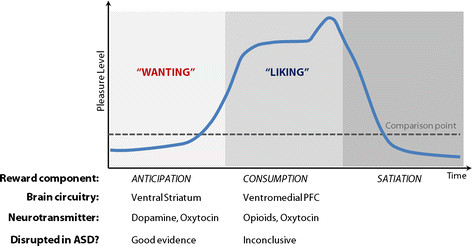
Most behavioral training regimens in autism spectrum disorders (ASD) rely on reward-based reinforcement strategies. Although proven to significantly increase both cognitive and social outcomes and successfully reduce aberrant behaviors, this approach fails to benefit a substantial number of affected individuals. Given the enormous amount of clinical and financial resources devoted to behavioral interventions, there is a surprisingly large gap in our knowledge of the basic reward mechanisms of learning in ASD. Understanding the mechanisms for reward responsiveness and reinforcement-based learning is urgently needed to better inform modifications that might improve current treatments. The fundamental goal of this review is to present a fine-grained literature analysis of reward function in ASD with reference to a validated neurobiological model of reward: the 'wanting'/'liking' framework. Despite some inconsistencies within the available literature, the evaluation across three converging sets of neurobiological data (neuroimaging, electrophysiological recordings, and neurochemical measures) reveals good evidence for disrupted reward-seeking tendencies in ASD, particularly in social contexts. This is most likely caused by dysfunction of the dopaminergic-oxytocinergic 'wanting' circuitry, including the ventral striatum, amygdala, and ventromedial prefrontal cortex. Such a conclusion is consistent with predictions derived from diagnostic criteria concerning the core social phenotype of ASD, which emphasize difficulties with spontaneous self-initiated seeking of social encounters (that is, social motivation). Existing studies suggest that social 'wanting' tendencies vary considerably between individuals with ASD, and that the degree of social motivation is both malleable and predictive of intervention response. Although the topic of reward responsiveness in ASD is very new, with much research still needed, the current data clearly point towards problems with incentive-based motivation and learning, with clear and important implications for treatment. Given the reliance of behavioral interventions on reinforcement-based learning principles, we believe that a systematic focus on the integrity of the reward system in ASD promises to yield many important clues, both to the underlying mechanisms causing ASD and to enhancing the efficacy of existing and new interventions.
Overview
AI snapshot
Written from the paper’s full text.
TL;DR
This review applies the Berridge ‘wanting’/‘liking’ framework to autism spectrum disorder (ASD) and concludes that social reward ‘wanting’ is disrupted, most likely via dopaminergic–oxytocinergic circuitry including the ventral striatum, amygdala, and ventromedial prefrontal cortex, whereas evidence for compromised ‘liking’ is inconclusive. It argues that social motivation varies among individuals with ASD, is malleable, and predicts intervention response, with implications for reinforcement-based treatments.
Key findings
- Across three converging neurobiological data sets (fMRI, electrophysiology, neurochemistry), the review finds good evidence for disrupted reward-seeking tendencies in ASD, particularly in social contexts; this is attributed to dysfunction of dopaminergic–oxytocinergic ‘wanting’ circuitry (ventral striatum, amygdala, ventromedial prefrontal cortex).
- Four out of five published fMRI studies reported diminished ventral striatum activation in ASD compared with typically developing controls when processing social or monetary reward versus non-reward; vmPFC (‘liking’) findings were mixed, with two studies reporting stronger and two reporting lower activation in ASD for monetary reward.
- ERP evidence from only three reports suggested outcome-related responses (e.g., FRN/P3 to monetary gain/loss) were relatively intact in ASD, whereas anticipatory responses (e.g., cue-related P3, SPN) were atypical, especially for social reward.
- The paper states that the percentage of affected children who profit from behavioral treatment, let alone reach optimal outcome, ranges from 3% to 50%, and that stronger social approach/‘wanting’ at treatment onset predicts better response to early intensive behavioral interventions.
Methods
- Design: narrative literature review using the validated ‘wanting’/‘liking’ neurobiological model of reward as an analytic framework.
- Data: published functional neuroimaging, electrophysiological (ERP/EEG), and neurochemical/neuropeptide studies of reward responsiveness in ASD, with emphasis on social versus non-social reward.
- Analysis: qualitative synthesis evaluating whether findings support predicted disruptions in ‘wanting’ (ventral striatum, dopamine, anticipatory ERPs) versus ‘liking’ (vmPFC, opioids, outcome ERPs); no meta-analysis or systematic search strategy is reported.
Limitations
- The paper states that the ASD reward literature is very new, with few studies and inconsistent findings, making firm conclusions premature; it also notes methodological shortcomings such as lack of research on biological rewards, neglected physiological/drive states, and low ecological validity of many reward stimuli.
- The paper states that phenotypic heterogeneity, comorbid traits (e.g., depression, anxiety, inattention/hyperactivity), sleep deficits, and temperament/intrinsic motivation differences can affect reward sensitivity and treatment response, and that laboratory-based measures quantifying reward responsiveness in ASD are lacking.
- Evident from the text: as a narrative review, it does not report a systematic search strategy, formal risk-of-bias assessment, or quantitative synthesis, so the conclusions rest on a small and methodologically varied set of studies.
Model-written summary. Check it against the paper before relying on it.
Integrity signals
Registry
Cites
Statistics
Figures
Verification
Claims the paper makes
96 Not checked yet · 34 Own interpretation · 4 Partly supported · 2 Supported · 1 No basis given · accuracy not yet measured
Every source the paper cites for this claim was checked and supports it.
In the paper
“An early study by Schmitz and colleagues applied a monetarily rewarded sustained attention task to adults with and without ASD, but did not report VS activation in either group [63].”
§ Social ‘wanting’ dysfunction in autism: neurobiological underpinnings and treatment implications > Review > Reward responsiveness at the neurobiological level in ASD
What the sources say
- Supportedcites [63] Schmitz N, Rubia K, van Amelsvoort T, Daly E, Smith A, Murphy DGM: Neural correlates of reward in autism. Br J Psychiatry. 2008, 192: 19-24. source
The paper describes a sustained-attention task with monetary reward in adults with autistic-spectrum disorder and matched controls. In Imaging data and Table 1, the reported reward-related activations for each group do not include the ventral striatum. This supports the claim about what was reported, not a claim that ventral-striatal activation was absent. (LLM, conf=0.92)
plain- Asserted: passes — The authors put it forward as true.
- Checkable: passes — It can be checked against evidence.
- Load-bearing: unclear — It is unclear whether the paper’s conclusions depend on it.
- Based: passes — The paper gives a reason why it holds.
- Supported
The cited sources support only part of this claim — read each source’s verdict below.
In the paper
“The inconsistent finding might be due to the different ages studied in the two papers, as other data suggest that there could be an abnormal developmental trajectory of amygdala reactivity to social incentives in ASD [74,75].”
§ Social ‘wanting’ dysfunction in autism: neurobiological underpinnings and treatment implications > Review > Reward responsiveness at the neurobiological level in ASD
What the sources say
- Not checked yetcites [74] Tottenham N, Sheridan MA: A review of adversity, the amygdala and the hippocampus: a consideration of developmental timing. Front Hum Neurosci. 2010, 3: 68-
- Partly supportedcites [75] Schumann CM, Bauman MD, Amaral DG: Abnormal structure or function of the amygdala is a common component of neurodevelopmental disorders. Neuropsychologia. 2011, 49: 745-759. sourceExperimental — accuracy not yet measured
The Introduction (page unavailable) says age is a critical factor in inconsistent findings about amygdala volume in autism and proposes an atypical growth trajectory. It also discusses abnormal amygdala activation to socially relevant stimuli, but does not establish an age-dependent trajectory of reactivity to social incentives or link age to the Dichter–Kohls discrepancy. (LLM, conf=0.84)
hedgedconditional- Asserted: passes — The authors put it forward as true.
- Checkable: passes — It can be checked against evidence.
- Load-bearing: unclear — It is unclear whether the paper’s conclusions depend on it.
- Based: passes — The paper gives a reason why it holds.
The cited sources support only part of this claim — read each source’s verdict below.
In the paper
“Four out of five published fMRI studies reported diminished VS activation in individuals with ASD compared with TDC when processing either social or monetary reward versus non-reward [30,60-62].”
§ Social ‘wanting’ dysfunction in autism: neurobiological underpinnings and treatment implications > Review > Reward responsiveness at the neurobiological level in ASD
What the sources say
- Not checked yetcites [30] Kohls G, Schulte-Rüther M, Nehrkorn B, Müller K, Fink GR, Kamp-Becker I, Herpertz-Dahlmann B, Schultz RT, Konrad K: Reward System Dysfunction in Autism Spectrum Disorders. Soc Cogn Affect Neurosci. 2012, in press
- Supportedcites [60] Dichter GS, Felder JN, Green SR, Rittenberg AM, Sasson NJ, Bodfish JW: Reward circuitry function in autism spectrum disorders. Soc Cogn Affect Neurosci. 2012, 7: 160-172. source
The fMRI task section (page unavailable) describes monetary win and non-win trials. The Anticipation phase and Outcome phase results (pages unavailable) report lower nucleus accumbens activation in the ASD group than in controls during monetary reward processing. This paper supports the monetary-reward study represented by its citation; it does not itself establish the four-out-of-five tally across studies. (LLM, conf=0.88)
- Partly supportedcites [61] Dichter GS, Richey JA, Rittenberg AM, Sabatino A, Bodfish JW: Reward circuitry function in autism during face anticipation and outcomes. J Autism Dev Disord. 2012, 42: 147-160. sourceExperimental — accuracy not yet measured
The Results (fMRI Responses to Monetary Incentives; page unavailable) report reduced right nucleus accumbens activation in the ASD group during monetary anticipation, so this paper supports one instance of the cited pattern. It does not establish the aggregate count of four out of five studies. Its Methods (Imaging Data Analysis; page unavailable) describe activation estimates relative to baseline, rather than clearly establishing the claimed reward-versus-non-reward contrast; the Discussion (Responses to Social Rewards; page unavailable) reports no group difference in nucleus accumbens activation for faces. (LLM, conf=0.84)
- Supportedcites [62] Scott-Van Zeeland AA, Dapretto M, Ghahremani DG, Poldrack RA, Bookheimer SY: Reward processing in autism. Autism Res. 2010, 3: 53-67. source
The Social Reward Response results report significantly lower bilateral ventral striatum activity in children with ASD than in typically developing children for positive versus negative social feedback. This paper therefore supports its inclusion as one of the fMRI studies cited for diminished activation during social reward processing; the four-of-five tally belongs to the group of citations, not this paper alone. (LLM, conf=0.90)
plain- Asserted: passes — The authors put it forward as true.
- Checkable: passes — It can be checked against evidence.
- Load-bearing: passes — The paper’s conclusions depend on it.
- Based: passes — The paper gives a reason why it holds.
Every source the paper cites for this claim was checked and supports it.
In the paper
“Lastly, one investigation found greater activation in the vmPFC in response to autism-specific objects of interest in individuals with ASD relative to typical control participants [60].”
§ Social ‘wanting’ dysfunction in autism: neurobiological underpinnings and treatment implications > Review > Reward responsiveness at the neurobiological level in ASD
What the sources say
- Supportedcites [60] Dichter GS, Felder JN, Green SR, Rittenberg AM, Sasson NJ, Bodfish JW: Reward circuitry function in autism spectrum disorders. Soc Cogn Affect Neurosci. 2012, 7: 160-172. source
The Outcome phase reports greater VMPFC activation in the ASD group than in controls while viewing salient object incentives. The Discussion describes the images as drawn from categories associated with restricted interests in ASD; they were standardized images, not objects selected for each participant's personal interests. (LLM, conf=0.92)
plaincorrelational- Asserted: passes — The authors put it forward as true.
- Checkable: passes — It can be checked against evidence.
- Load-bearing: unclear — It is unclear whether the paper’s conclusions depend on it.
- Based: passes — The paper gives a reason why it holds.
- Supported
The paper states this without a source or data behind it here, so there is nothing to check it against. The quote shows it is in the paper.
In the paper
“Taken together, blunted VS activity is a replicated phenomenon in children and adults with ASD, and might represent a neurobiological marker for diminished incentive salience (‘wanting’) related to social and/or monetary reward.”
§ Social ‘wanting’ dysfunction in autism: neurobiological underpinnings and treatment implications > Review > Reward responsiveness at the neurobiological level in ASD
hedged- Asserted: passes — The authors put it forward as true.
- Checkable: passes — It can be checked against evidence.
- Load-bearing: passes — The paper’s conclusions depend on it.
- Based: passes — The paper gives a reason why it holds.
- Rests on an assumption: To date, little is known about reward function in ASD, and conflicting evidence comes from intervention programs versus experimental research.
In the paper
“Dopamine is the neurotransmitter predominately associated with reward processing [12].”
§ Social ‘wanting’ dysfunction in autism: neurobiological underpinnings and treatment implications > Review > A heuristic of reward responsiveness: the ‘wanting’/’liking’ model
What the sources say
- Not checked yetcites [12] Schultz W: Multiple dopamine functions at different time courses. Annu Rev Neurosci. 2007, 30: 259-288. source
plaincorrelational- Asserted: passes — The authors put it forward as true.
- Checkable: passes — It can be checked against evidence.
- Load-bearing: passes — The paper’s conclusions depend on it.
- Based: passes — The paper gives a reason why it holds.
None of the sources cited for this claim have been checked yet.
In the paper
“Stimulus–reward association learning has been repeatedly highlighted as an area of difficulty for children with ASD [34,35]”
§ Social ‘wanting’ dysfunction in autism: neurobiological underpinnings and treatment implications > Review > A heuristic of reward responsiveness: the ‘wanting’/’liking’ model
What the sources say
- Not checked yetcites [34] Dawson G, Osterling J, Rinaldi J, Carver L, McPartland J: Brief report: recognition memory and stimulus-reward associations: indirect support for the role of ventromedial prefrontal dysfunction in autism. J Autism Dev Disord. 2001, 31: 337-341. source
- Not checked yetcites [35] Dawson G, Meltzoff AN, Osterling J, Rinaldi J: Neuropsychological correlates of early symptoms of autism. Child Dev. 1998, 69: 1276-1285. source
boostedcorrelational- Asserted: passes — The authors put it forward as true.
- Checkable: passes — It can be checked against evidence.
- Load-bearing: passes — The paper’s conclusions depend on it.
- Based: passes — The paper gives a reason why it holds.
In the paper
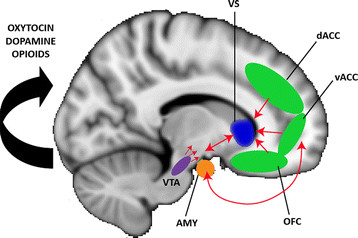
“Animal research using in vivo neurochemical methods indicates that phasic dopamine signals in the VS, potentially influenced by input from the midbrain, amygdala, and ventromedial prefrontal cortex (vmPFC), underlie non-social and social reward-seeking behaviors, including eating, drinking, reproduction, and other species-specific interactions [14].”
§ Social ‘wanting’ dysfunction in autism: neurobiological underpinnings and treatment implications > Review > A heuristic of reward responsiveness: the ‘wanting’/’liking’ model
What the sources say
- Not checked yetcites [14] Robinson DL, Zitzman DL, Williams SK: Mesolimbic dopamine transients in motivated behaviors: focus on maternal behavior. Front. Psychiatry. 2011, 2: 23- source
hedgeddirect- Asserted: passes — The authors put it forward as true.
- Checkable: passes — It can be checked against evidence.
- Load-bearing: passes — The paper’s conclusions depend on it.
- Based: passes — The paper gives a reason why it holds.
None of the sources cited for this claim have been checked yet.
In the paper
“Diminished activity in the OFC has been found after a specific food item has been eaten to satiety, thereby decreasing its hedonic value and subjective pleasantness [25,26].”
§ Social ‘wanting’ dysfunction in autism: neurobiological underpinnings and treatment implications > Review > A heuristic of reward responsiveness: the ‘wanting’/’liking’ model
What the sources say
- Not checked yetcites [25] Kringelbach ML, O’Doherty J, Rolls ET, Andrews C: Activation of the human orbitofrontal cortex to a liquid food stimulus is correlated with its subjective pleasantness. Cereb Cortex. 2003, 13: 1064-1071. source
- Not checked yetcites [26] O’Doherty J, Rolls ET, Francis S, Bowtell R, McGlone F, Kobal G, Renner B, Ahne G: Sensory-specific satiety-related olfactory activation of the human orbitofrontal cortex. Neuroreport. 2000, 11: 399-403. source
plaindirect- Asserted: passes — The authors put it forward as true.
- Checkable: passes — It can be checked against evidence.
- Load-bearing: unclear — It is unclear whether the paper’s conclusions depend on it.
- Based: passes — The paper gives a reason why it holds.
A conclusion the paper draws from its own results — it cites no other source for it, so there is none to check. The quote shows it is in the paper.
In the paper
“Thus, the variable treatment response rate of individuals with ASD might indicate that reward systems are more efficient in those for whom behavioral interventions are most effective than in those who profit only minimally or not at all.”
§ Social ‘wanting’ dysfunction in autism: neurobiological underpinnings and treatment implications > Review > Introduction
hedgedconditional- Asserted: passes — The authors put it forward as true.
- Checkable: passes — It can be checked against evidence.
- Load-bearing: passes — The paper’s conclusions depend on it.
- Based: passes — The paper gives a reason why it holds.
- Rests on an assumption: Most behavioral training regimens in ASD rely on reward-based reinforcement strategies.
- It may state two separate claims as one. 49
- Probably not a substantial claim. 8
The cited sources support only part of this claim — read each source’s verdict below.
In the paper
“Interestingly, the deficit in reward learning (and its link to social skills) seems to persist through to adulthood, as evidenced by impairments in the rapid formation of reward–stimulus associations and its correlation with clinical symptoms of social dysfunction [37-39].”
§ Social ‘wanting’ dysfunction in autism: neurobiological underpinnings and treatment implications > Review > A heuristic of reward responsiveness: the ‘wanting’/’liking’ model
What the sources say
- Not checked yetcites [37] Zalla T, Sav A-M, Leboyer M: Stimulus-reward association and reversal learning in individuals with asperger syndrome. Research in Autism Spectrum Disorders. 2009, 3: 913-923. source
- Partly supportedcites [38] Solomon M, Smith AC, Frank MJ, Ly S, Carter CS: Probabilistic reinforcement learning in adults with autism spectrum disorders. Autism Res. 2011, 4: 109-120. sourceExperimental — accuracy not yet measured
The Results (Early Learning on PS Task; page unavailable) report poorer early reward-based learning and win–stay performance in adults with ASD, supporting the adult learning-deficit portion of the claim. The Methods describe an assessment of social-communication behavior, but the retrieved Results and Discussion do not report a correlation between reward learning and clinical symptoms of social dysfunction. The Discussion also says performance reached typical levels over time. (LLM, conf=0.87)
- Partly supportedcites [39] Solomon M, Frank MJ, Smith AC, Ly S, Carter CS: Transitive inference in adults with autism spectrum disorders. Cogn Affect Behav Neurosci. 2011, 11: 437-449. sourceExperimental — accuracy not yet measured
The Discussion reports reduced associative learning in high-functioning young adults with autism spectrum disorders and suggests they may benefit less from reward-related feedback. It does not report a correlation between learning performance and clinical symptoms of social dysfunction, and its interpretation of the reward-learning impairment is more cautious than the citing sentence suggests. (LLM, conf=0.85)
hedgedcorrelational- Asserted: passes — The authors put it forward as true.
- Checkable: passes — It can be checked against evidence.
- Load-bearing: passes — The paper’s conclusions depend on it.
- Based: passes — The paper gives a reason why it holds.
It may state two separate claims as one.
The cited sources support only part of this claim — read each source’s verdict below.
In the paper
“co-morbid traits, such as depression, anxiety, or inattention/hyperactivity, are often associated with ASD [212], and are known to affect general reward processing [213,214] and intervention response [215].”
§ Social ‘wanting’ dysfunction in autism: neurobiological underpinnings and treatment implications > Discussion > Obstacles and recommendations for future research
What the sources say
- Supportedcites [212] Levy SE, Mandell DS, Schultz RT: Autism. Lancet. 2009, 374: 1627-1638. source
The Assessment section says comorbid disorders are common in children with autism spectrum disorders and specifically lists inattention, ADHD symptoms, depression, and anxiety. Citation [212] is attached to that association; the claims about reward processing and intervention response are attributed to other citations. (LLM, conf=0.94)
- Partly supportedcites [213] Treadway MT, Zald DH: Reconsidering anhedonia in depression: lessons from translational neuroscience. Neurosci Biobehav Rev. 2011, 35: 537-555. sourceExperimental — accuracy not yet measured
Section 3.4 reports altered reward-related activity in people with major depression, and section 3.2 discusses how anxiety symptoms may affect responses during reward anticipation. These passages support the reward-processing part of the sentence for depression and anxiety, but not its inclusion of inattention/hyperactivity. The ASD association and intervention-response clauses carry different citations and are not assessed here. (LLM, conf=0.85)
- Not checked yetcites [214] Luman M, Tripp G, Scheres A: Identifying the neurobiology of altered reinforcement sensitivity in adhd: a review and research agenda. Neurosci Biobehav Rev. 2010, 34: 744-754. source
- Not checked yetcites [215] Antshel KM, Polacek C, McMahon M, Dygert K, Spenceley L, Dygert L, Miller L, Faisal F: Comorbid ADHD and anxiety affect social skills group intervention treatment efficacy in children with autism spectrum disorders. J Dev Behav Pediatr. 2011, 32 (6): 439-446. 32 source
boostedcorrelational- Asserted: passes — The authors put it forward as true.
- Checkable: passes — It can be checked against evidence.
- Load-bearing: passes — The paper’s conclusions depend on it.
- Based: passes — The paper gives a reason why it holds.
It may state two separate claims as one.
- Supported
In the paper
“Although dopamine had long been thought to mediate ‘liking’, recent evidence indicates that dopamine is neither necessary nor sufficient for generating ‘liking’ responses, but plays a more important role in the motivational component (‘wanting’) of reward [8].”
§ Social ‘wanting’ dysfunction in autism: neurobiological underpinnings and treatment implications > Review > A heuristic of reward responsiveness: the ‘wanting’/’liking’ model
What the sources say
- Not checked yetcites [8] Berridge KC, Robinson TE: Parsing Reward. Trends Neurosci. 2003, 26: 507-513. source
hedgeddirect- Asserted: passes — The authors put it forward as true.
- Checkable: passes — It can be checked against evidence.
- Load-bearing: passes — The paper’s conclusions depend on it.
- Based: passes — The paper gives a reason why it holds.
It may state two separate claims as one.
In the paper
“On the one hand, behavior analytic intervention programs, which place reward-based reinforcement at the heart of their treatment system, have been repeatedly found to improve socially appropriate behavior and cognitive skills while diminishing dysfunctional activities [32].”
§ Social ‘wanting’ dysfunction in autism: neurobiological underpinnings and treatment implications > Review > A heuristic of reward responsiveness: the ‘wanting’/’liking’ model
What the sources say
- Not checked yetcites [32] Matson JL, Benavidez DA, Compton LS, Paclawskyj T, Baglio C: Behavioral treatment of autistic persons: a review of research from 1980 to the present. Res Dev Disabil. 1996, 17: 433-465. source
boosteddirect- Asserted: passes — The authors put it forward as true.
- Checkable: passes — It can be checked against evidence.
- Load-bearing: unclear — It is unclear whether the paper’s conclusions depend on it.
- Based: passes — The paper gives a reason why it holds.
It may state two separate claims as one.
None of the sources cited for this claim have been checked yet.
In the paper
“This medial–lateral gradient interacts with a second hedonic gradient along the posterior–anterior axis, which represents secondary reinforcers (such as money), more anteriorly in the OFC than primary reinforcers (such as odors, food, touch, sexual pleasure, or drugs) [15,28,29].”
§ Social ‘wanting’ dysfunction in autism: neurobiological underpinnings and treatment implications > Review > A heuristic of reward responsiveness: the ‘wanting’/’liking’ model
What the sources say
- Not checked yetcites [15] Berridge KC, Kringelbach ML: Building a neuroscience of pleasure and well-being.Psychology of Well-Being. Theory, Research and Practice. 2011, 1: 3-
- Not checked yetcites [28] Sescousse G, Redouté J, Dreher J-C: The architecture of reward value coding in the human orbitofrontal cortex. J Neurosci. 2010, 30: 13095-13104. source
- Not checked yetcites [29] Smith DV, Hayden BY, Truong T-K, Song AW, Platt ML, Huettel SA: Distinct value signals in anterior and posterior ventromedial prefrontal cortex. J Neurosci. 2010, 30: 2490-2495. source
plaincorrelational- Asserted: passes — The authors put it forward as true.
- Checkable: passes — It can be checked against evidence.
- Load-bearing: fails — The paper’s conclusions may not depend on it.
- Based: passes — The paper gives a reason why it holds.
Probably not a substantial claim. The paper’s conclusions may not depend on it. It may state two separate claims as one.
In the paper
“Research has indeed shown that reward is not a unitary construct, but is actually comprised of different components, which can be dissociated both psychologically and neurobiologically [8].”
§ Social ‘wanting’ dysfunction in autism: neurobiological underpinnings and treatment implications > Review > A heuristic of reward responsiveness: the ‘wanting’/’liking’ model
What the sources say
- Not checked yetcites [8] Berridge KC, Robinson TE: Parsing Reward. Trends Neurosci. 2003, 26: 507-513. source
boosted- Asserted: passes — The authors put it forward as true.
- Checkable: passes — It can be checked against evidence.
- Load-bearing: passes — The paper’s conclusions depend on it.
- Based: passes — The paper gives a reason why it holds.
It may state two separate claims as one.
In the paper
“Medial OFC activity is related to the positive value of reinforcers (for example, winning money), whereas the lateral OFC is associated with evaluating the unpleasant aspects of reinforcement (for example, losing money).”
§ Social ‘wanting’ dysfunction in autism: neurobiological underpinnings and treatment implications > Review > A heuristic of reward responsiveness: the ‘wanting’/’liking’ model
What the sources say
- Not checked yetcites [27] Kringelbach ML, Rolls ET: The functional neuroanatomy of the human orbitofrontal cortex: evidence from neuroimaging and neuropsychology. Prog Neurobiol. 2004, 72: 341-372. source
plaincorrelational- Asserted: passes — The authors put it forward as true.
- Checkable: passes — It can be checked against evidence.
- Load-bearing: unclear — It is unclear whether the paper’s conclusions depend on it.
- Based: passes — The paper gives a reason why it holds.
It may state two separate claims as one.
A conclusion the paper draws from its own results — it cites no other source for it, so there is none to check. The quote shows it is in the paper.
In the paper
“As summarized in this paper, there is good evidence to suggest that reward ‘wanting’ is disrupted in ASD, particularly in the social domain, whereas the available data for reward ‘liking’ are inconclusive (see below for details).”
§ Social ‘wanting’ dysfunction in autism: neurobiological underpinnings and treatment implications > Review > A heuristic of reward responsiveness: the ‘wanting’/’liking’ model
hedgedcorrelational- Asserted: passes — The authors put it forward as true.
- Checkable: passes — It can be checked against evidence.
- Load-bearing: passes — The paper’s conclusions depend on it.
- Based: passes — The paper gives a reason why it holds.
It may state two separate claims as one.
- Rests on an assumption: There are currently no data available to suggest that the ‘wanting’/’liking’ model would apply differently to social and non-social types of reward.
In the paper
“Typically, rewards that are ‘liked’ are also ‘wanted’.”
§ Social ‘wanting’ dysfunction in autism: neurobiological underpinnings and treatment implications > Review > A heuristic of reward responsiveness: the ‘wanting’/’liking’ model
What the sources say
- Not checked yetcites [7] Berridge KC, Robinson TE, Aldridge JW: Dissecting components of reward: “liking”, “wanting”, and learning. Curr Opin Pharmacol. 2009, 9: 65-73. source
hedgedcorrelational- Asserted: passes — The authors put it forward as true.
- Checkable: passes — It can be checked against evidence.
- Load-bearing: fails — The paper’s conclusions may not depend on it.
- Based: passes — The paper gives a reason why it holds.
Probably not a substantial claim. The paper’s conclusions may not depend on it.
In the paper
“Cued anticipation of monetary gains has been consistently found to recruit the VS, including the NAcc, with greater VS activity for more salient incentives (for example, $1 versus $5; [18]).”
§ Social ‘wanting’ dysfunction in autism: neurobiological underpinnings and treatment implications > Review > A heuristic of reward responsiveness: the ‘wanting’/’liking’ model
What the sources say
- Not checked yetcites [18] Knutson B, Taylor J, Kaufman M, Peterson R, Glover G: Distributed neural representation of expected value. J Neurosci. 2005, 25: 4806-4812. source
boostedcorrelational- Asserted: passes — The authors put it forward as true.
- Checkable: passes — It can be checked against evidence.
- Load-bearing: passes — The paper’s conclusions depend on it.
- Based: passes — The paper gives a reason why it holds.
It may state two separate claims as one.
In the paper
“Most dopaminergic neurons within the core reward circuitry, particularly in the VS, show short bursts of phasic activation in response to reward and, after learning, in response to conditioned cues that signal a potential reward [13].”
§ Social ‘wanting’ dysfunction in autism: neurobiological underpinnings and treatment implications > Review > A heuristic of reward responsiveness: the ‘wanting’/’liking’ model
What the sources say
- Not checked yetcites [13] Schultz W: Predictive reward signal of dopamine neurons. J Neurophysiol. 1998, 80: 1-27. source
plaincorrelational- Asserted: passes — The authors put it forward as true.
- Checkable: passes — It can be checked against evidence.
- Load-bearing: passes — The paper’s conclusions depend on it.
- Based: passes — The paper gives a reason why it holds.
It may state two separate claims as one.
In the paper
“Accumulating evidence from over 40 years of research indicates that these reinforcement-based interventions significantly increase both cognitive and social outcomes, and successfully reduce aberrant behaviors [3].”
§ Social ‘wanting’ dysfunction in autism: neurobiological underpinnings and treatment implications > Review > Introduction
What the sources say
- Not checked yetcites [3] Virués-Ortega J: Applied behavior analytic intervention for autism in early childhood: meta-analysis, meta-regression and dose–response meta-analysis of multiple outcomes. Clin Psychol Rev. 2010, 30: 387-399. source
hedgeddirect- Asserted: passes — The authors put it forward as true.
- Checkable: passes — It can be checked against evidence.
- Load-bearing: passes — The paper’s conclusions depend on it.
- Based: passes — The paper gives a reason why it holds.
It may state two separate claims as one.
In the paper
“Whereas ‘wanting’ is mainly driven by phasic dopaminergic neural firing in the ventral striatum (including the nucleus accumbens), ‘liking’ is largely influenced by the opioid system, and recruits the ventromedial prefrontal cortex (vmPFC).”
§ Social ‘wanting’ dysfunction in autism: neurobiological underpinnings and treatment implications > Review > A heuristic of reward responsiveness: the ‘wanting’/’liking’ model
What the sources say
- Not checked yetcites [8] Berridge KC, Robinson TE: Parsing Reward. Trends Neurosci. 2003, 26: 507-513. source
plaindirect- Asserted: passes — The authors put it forward as true.
- Checkable: passes — It can be checked against evidence.
- Load-bearing: passes — The paper’s conclusions depend on it.
- Based: passes — The paper gives a reason why it holds.
It may state two separate claims as one.
In the paper
“The participants with PDD-NOS did not differ from a TDC group in their outcome-evoked P3, suggesting that feedback processing was intact in this patient group.”
§ Social ‘wanting’ dysfunction in autism: neurobiological underpinnings and treatment implications > Review > Event-related brain potentials and resting-state EEG
What the sources say
- Not checked yetcites [101] Groen Y, Wijers AA, Mulder LJM, Waggeveld B, Minderaa RB, Althaus M: Error and feedback processing in children with ADHD and children with Autistic Spectrum Disorder: an EEG event-related potential study. Clin Neurophysiol. 2008, 119: 2476-2493. source
hedged- Asserted: passes — The authors put it forward as true.
- Checkable: passes — It can be checked against evidence.
- Load-bearing: unclear — It is unclear whether the paper’s conclusions depend on it.
- Based: passes — The paper gives a reason why it holds.
It may state two separate claims as one.
In the paper
“The study by Dichter and colleagues [61] on reward processing revealed hyperactivation in the amygdala in adult participants with ASD while they were anticipating social reward. This activation correlated positively with social symptom severity (Autism Diagnostic Observation Schedule-Generic ADOS-G).”
§ Social ‘wanting’ dysfunction in autism: neurobiological underpinnings and treatment implications > Review > Reward responsiveness at the neurobiological level in ASD
What the sources say
- Not checked yetcites [61] Dichter GS, Richey JA, Rittenberg AM, Sabatino A, Bodfish JW: Reward circuitry function in autism during face anticipation and outcomes. J Autism Dev Disord. 2012, 42: 147-160. source
plaincorrelational- Asserted: passes — The authors put it forward as true.
- Checkable: passes — It can be checked against evidence.
- Load-bearing: passes — The paper’s conclusions depend on it.
- Based: passes — The paper gives a reason why it holds.
It may state two separate claims as one.
In the paper
“For instance, in an interesting fMRI study, Grelotti and colleagues [72] found weaker amygdala activation for faces than for cartoon characters (for example, Digimon ‘Digital Monsters’) in an autistic boy with a strong preoccupation with these characters, whereas a matched typical control boy showed the expected opposite neural activation pattern.”
§ Social ‘wanting’ dysfunction in autism: neurobiological underpinnings and treatment implications > Review > Reward responsiveness at the neurobiological level in ASD
What the sources say
- Not checked yetcites [72] Grelotti DJ, Klin AJ, Gauthier I, Skudlarski P, Cohen DJ, Gore JC, Volkmar FR, Schultz RT: fMRI activation of the fusiform gyrus and amygdala to cartoon characters but not to faces in a boy with autism. Neuropsychologia. 2005, 43: 373-385. source
plaincorrelationalSingle case- Asserted: passes — The authors put it forward as true.
- Checkable: passes — It can be checked against evidence.
- Load-bearing: passes — The paper’s conclusions depend on it.
- Based: passes — The paper gives a reason why it holds.
It may state two separate claims as one.
A conclusion the paper draws from its own results — it cites no other source for it, so there is none to check. The quote shows it is in the paper.
In the paper
“In summary, the vmPFC–VS–amygdala circuitry seems to be dysfunctional in ASD, and to form, at least partially, the basis for atypical reward responsiveness in individuals with ASD.”
§ Social ‘wanting’ dysfunction in autism: neurobiological underpinnings and treatment implications > Review > Reward responsiveness at the neurobiological level in ASD
hedgedconditional- Asserted: passes — The authors put it forward as true.
- Checkable: passes — It can be checked against evidence.
- Load-bearing: passes — The paper’s conclusions depend on it.
- Based: passes — The paper gives a reason why it holds.
It may state two separate claims as one.
In the paper
“In addition, VS activation to social reward predicted social capacities (as measured by the Social Responsiveness Scale) within the TDC group, but not the ASD group.”
§ Social ‘wanting’ dysfunction in autism: neurobiological underpinnings and treatment implications > Review > Reward responsiveness at the neurobiological level in ASD
What the sources say
- Not checked yetcites [62] Scott-Van Zeeland AA, Dapretto M, Ghahremani DG, Poldrack RA, Bookheimer SY: Reward processing in autism. Autism Res. 2010, 3: 53-67. source
plaincorrelational- Asserted: passes — The authors put it forward as true.
- Checkable: passes — It can be checked against evidence.
- Load-bearing: passes — The paper’s conclusions depend on it.
- Based: passes — The paper gives a reason why it holds.
It may state two separate claims as one.
In the paper
“However, whereas the P3 has been found to be sensitive to reward magnitude (that is, larger amplitudes for high versus low reward) and reward valence (that is, larger amplitudes for reward gain versus loss), the FRN is modulated almost exclusively by reward valence, with more negative waveforms in response to non-reward outcome relative to reward gain [90].”
§ Social ‘wanting’ dysfunction in autism: neurobiological underpinnings and treatment implications > Review > Event-related brain potentials and resting-state EEG
What the sources say
- Not checked yetcites [90] Wu Y, Zhou X: The P300 and reward valence, magnitude, and expectancy in outcome evaluation. Brain Res. 2009, 1286: 114-122. source
plaincorrelational- Asserted: passes — The authors put it forward as true.
- Checkable: passes — It can be checked against evidence.
- Load-bearing: unclear — It is unclear whether the paper’s conclusions depend on it.
- Based: passes — The paper gives a reason why it holds.
It may state two separate claims as one.
None of the sources cited for this claim have been checked yet.
In the paper
“Importantly, however, although monetary reinforcers have predominantly been operationalized and used as non-social stimuli, money is imbued with social connotations and exerts a substantial influence on pro-social behavior [64-66].”
§ Social ‘wanting’ dysfunction in autism: neurobiological underpinnings and treatment implications > Review > Reward responsiveness at the neurobiological level in ASD
What the sources say
- Not checked yetcites [64] Vohs KD, Mead NL, Goode MR: The psychological consequences of money. Science. 2006, 314: 1154-1156. source
- Not checked yetcites [65] Zhou X, Vohs KD, Baumeister RF: The symbolic power of money: reminders of money alter social distress and physical pain. Psychol Sci. 2009, 20: 700-706. source
- Not checked yetcites [66] Warneken F, Tomasello M: Extrinsic rewards undermine altruistic tendencies in 20-month-olds. Dev Psychol. 2008, 44: 1785-1788. source
plaindirect- Asserted: passes — The authors put it forward as true.
- Checkable: passes — It can be checked against evidence.
- Load-bearing: passes — The paper’s conclusions depend on it.
- Based: passes — The paper gives a reason why it holds.
It may state two separate claims as one.
A conclusion the paper draws from its own results — it cites no other source for it, so there is none to check. The quote shows it is in the paper.
In the paper
“It seems likely that the combination of facial rewards with praise may represent a stronger social incentive with correspondingly greater reward system responsiveness, primarily in TDC, making it more probably that activation differences are detected between individuals with and without ASD within the VS.”
§ Social ‘wanting’ dysfunction in autism: neurobiological underpinnings and treatment implications > Review > Reward responsiveness at the neurobiological level in ASD
hedgedconditional- Asserted: passes — The authors put it forward as true.
- Checkable: passes — It can be checked against evidence.
- Load-bearing: passes — The paper’s conclusions depend on it.
- Based: unclear — It is unclear why the paper says it holds.
It may state two separate claims as one.
In the paper
“In this study, the ASD group displayed diminished activation in the VS for social reward, but not for monetary reward.”
§ Social ‘wanting’ dysfunction in autism: neurobiological underpinnings and treatment implications > Review > Reward responsiveness at the neurobiological level in ASD
What the sources say
- Not checked yetcites [62] Scott-Van Zeeland AA, Dapretto M, Ghahremani DG, Poldrack RA, Bookheimer SY: Reward processing in autism. Autism Res. 2010, 3: 53-67. source
plain- Asserted: passes — The authors put it forward as true.
- Checkable: passes — It can be checked against evidence.
- Load-bearing: passes — The paper’s conclusions depend on it.
- Based: passes — The paper gives a reason why it holds.
It may state two separate claims as one.
None of the sources cited for this claim have been checked yet.
In the paper
“However, research and theory suggests that the P3 is more closely related to reward-seeking behaviors (‘wanting’) and the FRN to reward consumption (‘liking’ or ’disliking’) [88,89].”
§ Social ‘wanting’ dysfunction in autism: neurobiological underpinnings and treatment implications > Review > Event-related brain potentials and resting-state EEG
What the sources say
- Not checked yetcites [88] Holroyd CB, Coles MGH: The neural basis of human error processing: reinforcement learning, dopamine, and the error-related negativity. Psychol Rev. 2002, 109: 679-709. source
- Not checked yetcites [89] Nieuwenhuis S, Aston-Jones G, Cohen JD: Decision making, the p3, and the locus coeruleus–norepinephrine system. Psychol Bull. 2005, 131: 510-532. source
hedgedcorrelational- Asserted: passes — The authors put it forward as true.
- Checkable: passes — It can be checked against evidence.
- Load-bearing: passes — The paper’s conclusions depend on it.
- Based: passes — The paper gives a reason why it holds.
It may state two separate claims as one.
In the paper
“First, they tested brain responses to money and typical autism-specific objects of interest (for example, trains, cars, plastic bricks) and found decreased VS activation in ASD during periods of money anticipation and outcome, whereas VS activity was present for typical autism-specific objects of interest [60].”
§ Social ‘wanting’ dysfunction in autism: neurobiological underpinnings and treatment implications > Review > Reward responsiveness at the neurobiological level in ASD
What the sources say
- Not checked yetcites [60] Dichter GS, Felder JN, Green SR, Rittenberg AM, Sasson NJ, Bodfish JW: Reward circuitry function in autism spectrum disorders. Soc Cogn Affect Neurosci. 2012, 7: 160-172. source
plain- Asserted: passes — The authors put it forward as true.
- Checkable: passes — It can be checked against evidence.
- Load-bearing: passes — The paper’s conclusions depend on it.
- Based: passes — The paper gives a reason why it holds.
It may state two separate claims as one.
In the paper
“However, recent studies using a range of pleasant stimuli, including positive words, faces, sounds, film clips, erotic pictures, and sweet drinks, have highlighted that the ability to experience pleasure is generally intact in individuals with schizophrenia, whereas the capacity to pursue and achieve a pleasurable goal (that is, the ‘wanting’ component of reward), is significantly disrupted [50].”
§ Social ‘wanting’ dysfunction in autism: neurobiological underpinnings and treatment implications > Review > A heuristic of reward responsiveness: the ‘wanting’/’liking’ model
What the sources say
- Not checked yetcites [50] Cohen AS, Minor KS: Emotional experience in patients with schizophrenia revisited: meta-analysis of laboratory studies. Schizophr Bull. 2010, 36: 143-150. source
plain- Asserted: passes — The authors put it forward as true.
- Checkable: passes — It can be checked against evidence.
- Load-bearing: unclear — It is unclear whether the paper’s conclusions depend on it.
- Based: passes — The paper gives a reason why it holds.
It may state two separate claims as one.
In the paper
“In a follow-up study applying the same paradigm but with a focus on social (for example, faces) versus monetary reward, adults with ASD again showed lower brain activation in the VS during money anticipation, but did not reveal VS hypoactivation for face rewards [61].”
§ Social ‘wanting’ dysfunction in autism: neurobiological underpinnings and treatment implications > Review > Reward responsiveness at the neurobiological level in ASD
What the sources say
- Not checked yetcites [61] Dichter GS, Richey JA, Rittenberg AM, Sabatino A, Bodfish JW: Reward circuitry function in autism during face anticipation and outcomes. J Autism Dev Disord. 2012, 42: 147-160. source
plain- Asserted: passes — The authors put it forward as true.
- Checkable: passes — It can be checked against evidence.
- Load-bearing: passes — The paper’s conclusions depend on it.
- Based: passes — The paper gives a reason why it holds.
It may state two separate claims as one.
In the paper
“Children with ASD who showed left frontal EEG asymmetry were reported by their parents to have fewer symptoms of social impairment compared with children with right frontal asymmetry; however, the former was accompanied by greater levels of social anxiety and stress.”
§ Social ‘wanting’ dysfunction in autism: neurobiological underpinnings and treatment implications > Review > Event-related brain potentials and resting-state EEG
What the sources say
- Not checked yetcites [110] Sutton SK, Burnette CP, Mundy PC, Meyer J, Vaughan A, Sanders C, Yale M: Resting cortical brain activity and social behavior in higher functioning children with autism. Journal of Child Psychology and Psychiatry. 2005, 46: 211-222. source
plaincorrelational- Asserted: passes — The authors put it forward as true.
- Checkable: passes — It can be checked against evidence.
- Load-bearing: passes — The paper’s conclusions depend on it.
- Based: passes — The paper gives a reason why it holds.
It may state two separate claims as one.
In the paper
“increases cooperative behaviors, trust, and attention to socially informative stimuli (for example, eyes) [166]”
§ Social ‘wanting’ dysfunction in autism: neurobiological underpinnings and treatment implications > Review > Neurotransmitters and neuropeptides
What the sources say
- Not checked yetcites [166] Andari E, Duhamel J-R, Zalla T, Herbrecht E, Leboyer M, Sirigu A: Promoting social behavior with oxytocin in high-functioning autism spectrum disorders. PNAS. 2010, 107: 4389-4394. source
plaindirect- Asserted: passes — The authors put it forward as true.
- Checkable: passes — It can be checked against evidence.
- Load-bearing: passes — The paper’s conclusions depend on it.
- Based: passes — The paper gives a reason why it holds.
It may state two separate claims as one.
A conclusion the paper draws from its own results — it cites no other source for it, so there is none to check. The quote shows it is in the paper.
In the paper
“both the dopamine-mediated ‘wanting’ system and particularly the oxytocin system are promising candidates for contribution to atypical reward-related behaviors in ASD.”
§ Social ‘wanting’ dysfunction in autism: neurobiological underpinnings and treatment implications > Review > Neurotransmitters and neuropeptides
hedgedconditional- Asserted: passes — The authors put it forward as true.
- Checkable: passes — It can be checked against evidence.
- Load-bearing: passes — The paper’s conclusions depend on it.
- Based: passes — The paper gives a reason why it holds.
It may state two separate claims as one.
In the paper
“The authors concluded that social attention as expressed by direct eye contact may not be socially rewarding for children with ASD, and thus, does not properly activate their approach-related brain mechanisms.”
§ Social ‘wanting’ dysfunction in autism: neurobiological underpinnings and treatment implications > Review > Event-related brain potentials and resting-state EEG
What the sources say
- Not checked yetcites [115] Kylliäinen A, Wallace S, Coutanche MN, Leppänen JM, Cusack J, Bailey AJ, Hietanen JK: Affective-motivational brain responses to direct gaze in children with autism spectrum disorder. Journal of Child Psychology and Psychiatry. 2012, in press
hedgedconditional- Asserted: passes — The authors put it forward as true.
- Checkable: passes — It can be checked against evidence.
- Load-bearing: passes — The paper’s conclusions depend on it.
- Based: passes — The paper gives a reason why it holds.
It may state two separate claims as one.
None of the sources cited for this claim have been checked yet.
In the paper
“This reduction fundamentally alters how individuals with ASD attend to and interact with the world, depriving them of crucial social perceptual and social cognitive learning opportunities [2,4,40,41,54,183]).”
§ Social ‘wanting’ dysfunction in autism: neurobiological underpinnings and treatment implications > Discussion > Social motivation theory of ASD
What the sources say
- Not checked yetcites [2] Chevallier C, Kohls G, Troiani V, Brodkin ES, Schultz RT: The social motivation theory of autism. Trends Cogn Sci. 2012, 16: 231-239. source
- Not checked yetcites [4] Helt M, Kelley E, Kinsbourne M, Pandey J, Boorstein H, Herbert M, Fein D: Can children with autism recover? If so, How?. Neuropsychol Rev. 2008, 18: 339-366. source
- Not checked yetcites [40] Dawson G, Webb SJ, Wijsman E, Schellenberg G, Estes A, Munson J, Faja S: Neurocognitive and electrophysiological evidence of altered face processing in parents of children with autism: implications for a model of abnormal development of social brain circuitry in autism. Dev Psychopathol. 2005, 17: 679-697. source
- Not checked yetcites [41] Schultz RT: Developmental deficits in social perception in autism: the role of the amygdala and fusiform face area. Int J Dev Neurosci. 2005, 23: 125-141. source
- Not checked yetcites [54] Mundy P: Joint attention and social-emotional approach behavior in children with autism. Dev Psychopathol. 1995, 7: 63-82. source
- Not checked yetcites [183] O’Connor K, Kirk I: Brief report: atypical social cognition and social behaviours in autism spectrum disorder: a different way of processing rather than an impairment. J Autism Dev Disord. 2008, 38: 1989-1997. source
plaindirect- Asserted: passes — The authors put it forward as true.
- Checkable: passes — It can be checked against evidence.
- Load-bearing: passes — The paper’s conclusions depend on it.
- Based: passes — The paper gives a reason why it holds.
It may state two separate claims as one.
In the paper
“Indeed, reward-predicting signals and behaviorally important events (for example, novel stimuli) elicit brief, phasic, bursts of dopamine impulses, which last less than 500 ms, and prompt reward anticipation [12].”
§ Social ‘wanting’ dysfunction in autism: neurobiological underpinnings and treatment implications > Review > Neurotransmitters and neuropeptides
What the sources say
- Not checked yetcites [12] Schultz W: Multiple dopamine functions at different time courses. Annu Rev Neurosci. 2007, 30: 259-288. source
plaindirect- Asserted: passes — The authors put it forward as true.
- Checkable: passes — It can be checked against evidence.
- Load-bearing: passes — The paper’s conclusions depend on it.
- Based: passes — The paper gives a reason why it holds.
It may state two separate claims as one.
A conclusion the paper draws from its own results — it cites no other source for it, so there is none to check. The quote shows it is in the paper.
In the paper
“Considering that endogenous opioids mediate the hedonic aspect of reward, this conclusion is in line with the neurophysiological findings that reward ‘liking’ is less compromised than ‘wanting’ in affected individuals.”
§ Social ‘wanting’ dysfunction in autism: neurobiological underpinnings and treatment implications > Review > Neurotransmitters and neuropeptides
plaincorrelational- Asserted: passes — The authors put it forward as true.
- Checkable: passes — It can be checked against evidence.
- Load-bearing: passes — The paper’s conclusions depend on it.
- Based: passes — The paper gives a reason why it holds.
It may state two separate claims as one.
In the paper
“It has been shown that some striatal cell groups encode primary reinforcers (for example, water, food, sexual intercourse), whereas others are thought to be ‘idle’ and modifiable through reward-based learning (for example, drug conditioning [131]).”
§ Social ‘wanting’ dysfunction in autism: neurobiological underpinnings and treatment implications > Review > Neurotransmitters and neuropeptides
What the sources say
- Not checked yetcites [131] Grigson PS: Like drugs for chocolate: separate rewards modulated by common mechanisms?. Physiol Behav. 2002, 76: 389-395. source
boosted- Asserted: passes — The authors put it forward as true.
- Checkable: passes — It can be checked against evidence.
- Load-bearing: passes — The paper’s conclusions depend on it.
- Based: passes — The paper gives a reason why it holds.
It may state two separate claims as one.
A conclusion the paper draws from its own results — it cites no other source for it, so there is none to check. The quote shows it is in the paper.
In the paper
“This could indicate that greater social interest (‘wanting’) may obscure social symptom presentation in young children, resulting in delayed identification.”
§ Social ‘wanting’ dysfunction in autism: neurobiological underpinnings and treatment implications > Review > Event-related brain potentials and resting-state EEG
hedgedconditional- Asserted: passes — The authors put it forward as true.
- Checkable: passes — It can be checked against evidence.
- Load-bearing: fails — The paper’s conclusions may not depend on it.
- Based: passes — The paper gives a reason why it holds.
Probably not a substantial claim. The paper’s conclusions may not depend on it. It may state two separate claims as one.
In the paper
“postmortem brain analyses were found to have a specific decrease in oxytocin mRNA in the temporal cortex in ASD, which was associated with hypermethylation [171].”
§ Social ‘wanting’ dysfunction in autism: neurobiological underpinnings and treatment implications > Review > Neurotransmitters and neuropeptides
What the sources say
- Not checked yetcites [171] Gregory S, Connelly J, Towers A, Johnson J, Biscocho D, Markunas C, Lintas C, Abramson R, Wright H, Ellis P: others: Genomic and epigenetic evidence for oxytocin receptor deficiency in autism. BMC Med. 2009, 7: 62- source
plaincorrelational- Asserted: passes — The authors put it forward as true.
- Checkable: passes — It can be checked against evidence.
- Load-bearing: unclear — It is unclear whether the paper’s conclusions depend on it.
- Based: passes — The paper gives a reason why it holds.
It may state two separate claims as one.
In the paper
“Consistent with the findings of Groen et al. [102] and Larson et al. [103], the outcome-related P3 did not differentiate between ASD and TDC participants. However, whereas the TDC group exhibited an increased P3 in response to cues that signaled a potential social or monetary reward, relative to non-reward, the ASD group did not show this enhancement effect, and even showed diminished P3 activity”
§ Social ‘wanting’ dysfunction in autism: neurobiological underpinnings and treatment implications > Review > Event-related brain potentials and resting-state EEG
What the sources say
- Not checked yetcites [92] Kohls G, Peltzer J, Schulte-Rüther M, Kamp-Becker I, Remschmidt H, Herpertz-Dahlmann B, Konrad K: Atypical brain responses to reward cues in autism as revealed by event-related potentials. J Autism Dev Disord. 2011, 41: 1523-1533. source
plain- Asserted: passes — The authors put it forward as true.
- Checkable: passes — It can be checked against evidence.
- Load-bearing: passes — The paper’s conclusions depend on it.
- Based: passes — The paper gives a reason why it holds.
It may state two separate claims as one.
None of the sources cited for this claim have been checked yet.
In the paper
“the social motivation theory of ASD posits that ASD can be construed as an extreme case of reduced social interest.”
§ Social ‘wanting’ dysfunction in autism: neurobiological underpinnings and treatment implications > Discussion > Social motivation theory of ASD
What the sources say
- Not checked yetcites [2] Chevallier C, Kohls G, Troiani V, Brodkin ES, Schultz RT: The social motivation theory of autism. Trends Cogn Sci. 2012, 16: 231-239. source
- Not checked yetcites [4] Helt M, Kelley E, Kinsbourne M, Pandey J, Boorstein H, Herbert M, Fein D: Can children with autism recover? If so, How?. Neuropsychol Rev. 2008, 18: 339-366. source
- Not checked yetcites [40] Dawson G, Webb SJ, Wijsman E, Schellenberg G, Estes A, Munson J, Faja S: Neurocognitive and electrophysiological evidence of altered face processing in parents of children with autism: implications for a model of abnormal development of social brain circuitry in autism. Dev Psychopathol. 2005, 17: 679-697. source
- Not checked yetcites [41] Schultz RT: Developmental deficits in social perception in autism: the role of the amygdala and fusiform face area. Int J Dev Neurosci. 2005, 23: 125-141. source
- Not checked yetcites [54] Mundy P: Joint attention and social-emotional approach behavior in children with autism. Dev Psychopathol. 1995, 7: 63-82. source
- Not checked yetcites [183] O’Connor K, Kirk I: Brief report: atypical social cognition and social behaviours in autism spectrum disorder: a different way of processing rather than an impairment. J Autism Dev Disord. 2008, 38: 1989-1997. source
plaindirect- Asserted: passes — The authors put it forward as true.
- Checkable: passes — It can be checked against evidence.
- Load-bearing: passes — The paper’s conclusions depend on it.
- Based: passes — The paper gives a reason why it holds.
Probably not a substantial claim.
In the paper
“However, conflicting results have been found in studies measuring peripheral (for example, blood, urine) or central (for example, cerebrospinal fluid (CSF)) levels of dopamine and its metabolites, with some studies reporting atypical dopamine turnover in patients [121].”
§ Social ‘wanting’ dysfunction in autism: neurobiological underpinnings and treatment implications > Review > Neurotransmitters and neuropeptides
What the sources say
- Not checked yetcites [121] Lam KSL, Aman MG, Arnold LE: Neurochemical correlates of autistic disorder: a review of the literature. Res Dev Disabil. 2006, 27: 254-289. source
plain- Asserted: passes — The authors put it forward as true.
- Checkable: passes — It can be checked against evidence.
- Load-bearing: unclear — It is unclear whether the paper’s conclusions depend on it.
- Based: passes — The paper gives a reason why it holds.
It may state two separate claims as one.
A conclusion the paper draws from its own results — it cites no other source for it, so there is none to check. The quote shows it is in the paper.
In the paper
“Although it is premature to draw conclusions from only three ERP reports, the evidence suggests that outcome-related neural responses are less impaired in ASD (reflective of relatively intact ‘liking’) than are brain potentials related to the anticipatory period preceding reward consumption (reflective of disrupted ‘wanting’), based on the incentives used to date.”
§ Social ‘wanting’ dysfunction in autism: neurobiological underpinnings and treatment implications > Review > Event-related brain potentials and resting-state EEG
hedged- Asserted: passes — The authors put it forward as true.
- Checkable: passes — It can be checked against evidence.
- Load-bearing: passes — The paper’s conclusions depend on it.
- Based: passes — The paper gives a reason why it holds.
It may state two separate claims as one.
A conclusion the paper draws from its own results — it cites no other source for it, so there is none to check. The quote shows it is in the paper.
In the paper
“This raises the possibility of a dysfunction in the phasic rather than the tonic dopamine metabolism in ASD, which would be more consistent with the neuroimaging and electrophysiological findings of atypical reward ‘wanting’.”
§ Social ‘wanting’ dysfunction in autism: neurobiological underpinnings and treatment implications > Review > Neurotransmitters and neuropeptides
hedgedconditional- Asserted: passes — The authors put it forward as true.
- Checkable: passes — It can be checked against evidence.
- Load-bearing: passes — The paper’s conclusions depend on it.
- Based: passes — The paper gives a reason why it holds.
Probably not a substantial claim. It may state two separate claims as one.
In the paper
“Genetic associations between ASD and the oxytocin receptor gene, and with the closely related vasopressin gene, have also been reported [170].”
§ Social ‘wanting’ dysfunction in autism: neurobiological underpinnings and treatment implications > Review > Neurotransmitters and neuropeptides
What the sources say
- Not checked yetcites [170] Campbell DB, Datta D, Jones ST, Batey Lee E, Sutcliffe JS, Hammock EAD, Levitt P: Association of oxytocin receptor (OXTR) gene variants with multiple phenotype domains of autism spectrum disorder. Journal of Neurodevelopmental Disorders. 2011, 1: 12-
plaincorrelational- Asserted: passes — The authors put it forward as true.
- Checkable: passes — It can be checked against evidence.
- Load-bearing: unclear — It is unclear whether the paper’s conclusions depend on it.
- Based: passes — The paper gives a reason why it holds.
It may state two separate claims as one.
A conclusion the paper draws from its own results — it cites no other source for it, so there is none to check. The quote shows it is in the paper.
In the paper
“The idea that dopaminergic cell activity tracks different reward types is intriguing, because it might offer a simplistic, although plausible, explanation as to why some incentives (for example, objects of circumscribed interest) induce goal-directed approach behavior in individuals with ASD, whereas others (for example, social reward) do not.”
§ Social ‘wanting’ dysfunction in autism: neurobiological underpinnings and treatment implications > Review > Neurotransmitters and neuropeptides
hedgedconditional- Asserted: passes — The authors put it forward as true.
- Checkable: passes — It can be checked against evidence.
- Load-bearing: fails — The paper’s conclusions may not depend on it.
- Based: passes — The paper gives a reason why it holds.
Probably not a substantial claim. The paper’s conclusions may not depend on it.
A conclusion the paper draws from its own results — it cites no other source for it, so there is none to check. The quote shows it is in the paper.
In the paper
“These findings suggest that children with ASD with left frontal asymmetry might be more motivated to participate in social interactions, possibly because of stronger ‘wanting’ tendencies.”
§ Social ‘wanting’ dysfunction in autism: neurobiological underpinnings and treatment implications > Review > Event-related brain potentials and resting-state EEG
hedgedconditional- Asserted: passes — The authors put it forward as true.
- Checkable: passes — It can be checked against evidence.
- Load-bearing: passes — The paper’s conclusions depend on it.
- Based: passes — The paper gives a reason why it holds.
It may state two separate claims as one.
In the paper
“Similar to the findings by Groen [101], the ERPs evoked by reward outcome did not differ between the experimental groups. The authors concluded that the neural response to concrete, external feedback, that is, monetary gain (‘liking’) and loss (‘disliking’), is intact in ASD, reflected in normal FRN and P3 effects.”
§ Social ‘wanting’ dysfunction in autism: neurobiological underpinnings and treatment implications > Review > Event-related brain potentials and resting-state EEG
What the sources say
- Not checked yetcites [103] Larson MJ, South M, Krauskopf E, Clawson A, Crowley MJ: Feedback and reward processing in high-functioning autism. Psychiatry Res. 2011, 187: 198-203. source
plain- Asserted: passes — The authors put it forward as true.
- Checkable: passes — It can be checked against evidence.
- Load-bearing: passes — The paper’s conclusions depend on it.
- Based: passes — The paper gives a reason why it holds.
It may state two separate claims as one.
A conclusion the paper draws from its own results — it cites no other source for it, so there is none to check. The quote shows it is in the paper.
In the paper
“This neural dysfunction involves both social and non-social (for example, monetary) reward, with a more pronounced deficit for social incentives.”
§ Social ‘wanting’ dysfunction in autism: neurobiological underpinnings and treatment implications > Review > Event-related brain potentials and resting-state EEG
plaincorrelational- Asserted: passes — The authors put it forward as true.
- Checkable: passes — It can be checked against evidence.
- Load-bearing: passes — The paper’s conclusions depend on it.
- Based: passes — The paper gives a reason why it holds.
It may state two separate claims as one.
A conclusion the paper draws from its own results — it cites no other source for it, so there is none to check. The quote shows it is in the paper.
In the paper
“It seems that children with greater inherent social interest engage more actively and constructively in the intervention procedures, which results in greater benefits.”
§ Social ‘wanting’ dysfunction in autism: neurobiological underpinnings and treatment implications > Discussion > Implications for treatment
hedgeddirect- Asserted: passes — The authors put it forward as true.
- Checkable: passes — It can be checked against evidence.
- Load-bearing: passes — The paper’s conclusions depend on it.
- Based: passes — The paper gives a reason why it holds.
It may state two separate claims as one.
A conclusion the paper draws from its own results — it cites no other source for it, so there is none to check. The quote shows it is in the paper.
In the paper
“Taken together, impaired social motivation, a core deficit with considerable variation among individuals with ASD, is malleable, and its successful treatment contributes to better functional outcome.”
§ Social ‘wanting’ dysfunction in autism: neurobiological underpinnings and treatment implications > Discussion > Implications for treatment
plaindirect- Asserted: passes — The authors put it forward as true.
- Checkable: passes — It can be checked against evidence.
- Load-bearing: passes — The paper’s conclusions depend on it.
- Based: passes — The paper gives a reason why it holds.
It may state two separate claims as one.
In the paper
“An alternative, but not mutually exclusive explanation is that social anxiety, as opposed to diminished social motivation, contributes to social avoidance behaviors in ASD [185].”
§ Social ‘wanting’ dysfunction in autism: neurobiological underpinnings and treatment implications > Discussion > Social motivation theory of ASD
What the sources say
- Not checked yetcites [185] Wood JJ, Gadow KD: Exploring the nature and function of anxiety in youth with autism spectrum disorders, exploring the nature and function of anxiety in youth with autism spectrum disorders. Clinical Psychology: Science and Practice, Clinical Psychology: Science and Practice. 2010, 17: 281-292. source
hedgedconditional- Asserted: passes — The authors put it forward as true.
- Checkable: passes — It can be checked against evidence.
- Load-bearing: fails — The paper’s conclusions may not depend on it.
- Based: passes — The paper gives a reason why it holds.
Probably not a substantial claim. The paper’s conclusions may not depend on it.
None of the sources cited for this claim have been checked yet.
In the paper
“unpredictability has recently been reported to elicit anxiety-like behavior in humans and mice, reflected in amygdala involvement at the brain level [70,187].”
§ Social ‘wanting’ dysfunction in autism: neurobiological underpinnings and treatment implications > Discussion > Social motivation theory of ASD
What the sources say
- Not checked yetcites [70] Adolphs R: What does the amygdala contribute to social cognition?. Ann N Y Acad Sci. 2010, 1191: 42-61. source
- Not checked yetcites [187] Herry C, Bach DR, Esposito F, Di Salle F, Perrig WJ, Scheffler K, Lüthi A, Seifritz E: Processing of temporal unpredictability in human and animal amygdala. J Neurosci. 2007, 27: 5958-5966. source
plaindirect- Asserted: passes — The authors put it forward as true.
- Checkable: passes — It can be checked against evidence.
- Load-bearing: unclear — It is unclear whether the paper’s conclusions depend on it.
- Based: passes — The paper gives a reason why it holds.
It may state two separate claims as one.
In the paper
“The unpredictable nature inherent in social encounters might be particularly challenging for individuals with ASD [186], and could promote symptoms of anxiety and withdrawal.”
§ Social ‘wanting’ dysfunction in autism: neurobiological underpinnings and treatment implications > Discussion > Social motivation theory of ASD
What the sources say
- Not checked yetcites [186] Klin A, Lin DJ, Gorrindo P, Ramsay G, Jones W: Two-year-olds with autism orient to nonsocial contingencies rather than biological motion. Nature. 2009, 459: 257- source
hedgedconditional- Asserted: passes — The authors put it forward as true.
- Checkable: passes — It can be checked against evidence.
- Load-bearing: fails — The paper’s conclusions may not depend on it.
- Based: passes — The paper gives a reason why it holds.
Probably not a substantial claim. The paper’s conclusions may not depend on it. It may state two separate claims as one.
A conclusion the paper draws from its own results — it cites no other source for it, so there is none to check. The quote shows it is in the paper.
In the paper
“the data published to date indicate the importance of social motivation (‘wanting’) and of the forces that propel social striving as crucial to understanding and treating autism.”
§ Social ‘wanting’ dysfunction in autism: neurobiological underpinnings and treatment implications > Conclusion
hedgedcorrelational- Asserted: passes — The authors put it forward as true.
- Checkable: passes — It can be checked against evidence.
- Load-bearing: passes — The paper’s conclusions depend on it.
- Based: passes — The paper gives a reason why it holds.
It may state two separate claims as one.
None of the sources cited for this claim have been checked yet.
In the paper
“individual differences in temperament and achievement/intrinsic motivation tendencies have been documented in ASD [220,221], and can result in differential responsiveness to reward [222,223].”
§ Social ‘wanting’ dysfunction in autism: neurobiological underpinnings and treatment implications > Discussion > Obstacles and recommendations for future research
What the sources say
- Not checked yetcites [220] Garon N, Bryson SE, Zwaigenbaum L, Smith IM, Brian J, Roberts W, Szatmari P: Temperament and its relationship to autistic symptoms in a high-risk infant sib cohort. J Abnorm Child Psychol. 2008, 37: 59-78. source
- Not checked yetcites [221] Joosten AV, Bundy AC, Einfeld SL: Intrinsic and extrinsic motivation for stereotypic and repetitive behavior. J Autism Dev Disord. 2009, 39: 521-531. source
- Not checked yetcites [222] Yacubian J, Büchel C: The genetic basis of individual differences in reward processing and the link to addictive behavior and social cognition. Neuroscience. 2009, 164: 55-71. source
- Not checked yetcites [223] Murayama K, Matsumoto M, Izuma K, Matsumoto K: Neural basis of the undermining effect of monetary reward on intrinsic motivation. PNAS Proceedings of the National Academy of Sciences of the United States of America. 2010, 107: 20911-20916. source
plainconditional- Asserted: passes — The authors put it forward as true.
- Checkable: passes — It can be checked against evidence.
- Load-bearing: unclear — It is unclear whether the paper’s conclusions depend on it.
- Based: passes — The paper gives a reason why it holds.
It may state two separate claims as one.
The paper relies on this without support.
Most behavioral training regimens in ASD rely on reward-based reinforcement strategies.
“Most behavioral training regimens in autism spectrum disorders (ASD) rely on reward-based reinforcement strategies.”
The paper relies on this without support.
There is a surprisingly large gap in knowledge concerning basic reward mechanisms in ASD.
“Given the enormous amount of clinical and financial resources devoted to behavioral interventions, there is a surprisingly large gap in our knowledge of the basic reward mechanisms of learning in ASD.”
The paper relies on this without support.
Current ASD research lacks a clear reference to any validated neurobiological model of reward.
“Because current ASD research lacks a clear reference to any validated neurobiological model of reward, we introduce a well-established framework of reward responsiveness formulated by Berridge and colleagues: the ‘wanting’/’liking’ model [7,8].”
The paper relies on this without support.
There are currently no data available to suggest that the ‘wanting’/’liking’ model would apply differently to social and non-social types of reward.
“To our knowledge, there are currently no data available to suggest that the ‘wanting’/’liking’ model would apply differently to social and non-social types of reward.”
The paper relies on this without support.
To date, little is known about reward function in ASD, and conflicting evidence comes from intervention programs versus experimental research.
“To date, little is known about reward function in ASD, and conflicting evidence comes from intervention programs versus experimental research.”
The paper relies on this without support.
The paradoxical finding of efficacious treatments rooted in reinforcement strategies in combination with weaker reward systems in ASD has received little attention.
“To date, the paradoxical finding of efficacious treatments rooted in reinforcement strategies in combination with weaker reward systems in ASD has received little attention in the field.”
The paper relies on this without support.
Current experimental and intervention research in ASD tends to construe reward as a unitary phenomenon, lacking a clear reference to any validated neurobiological model.
“In particular, a potentially important limitation of current experimental and intervention research in ASD is that it tends to construe reward as a unitary phenomenon, lacking a clear reference to any validated neurobiological model of reward; however, a critical examination of reward function in ASD requires a more fine-grained analytic approach.”
The paper relies on this without support.
There are currently no objective behavioral markers of ‘liking’ and ‘wanting’, so it is necessary to draw on neurobiological measures.
“Given that there are currently no objective behavioral markers of ‘liking’ and ‘wanting’, it is necessary to draw on neurobiological measures.”
The paper relies on this without support.
It is not yet understood how and why behavioral approaches work well for some people with ASD but not for others.
“It is not yet understood how and why behavioral approaches work well for some people with ASD but not for others.”
The authors state this as an assumption.
The social motivation impairment in ASD is attributable, at least partially, to dysfunction of the dopaminergic–oxytocinergic vmPFC–VS–amygdala brain network.
“The theory assumes that the social motivation impairment is attributable, at least partially, to dysfunction of the dopaminergic–oxytocinergic vmPFC–VS–amygdala brain network [2,40].”
Claims other papers make about this one
Each is checked against this paper’s own text: does it say what the citing paper says it does?
The source backs part of the claim, not all of it — or backs it for a different population, condition or comparison.
In the citing paper
“Children diagnosed with autism spectrum disorder (ASD) show deficits in social play (Mundy, 1995;Jordan, 2003) which are likely due to disrupted reward-seeking tendencies, especially in social contexts (Chevallier et al., 2012;Kohls et al., 2012Kohls et al., , 2013)).”
From Vasopressin regulates social play behavior in sex-specific ways through glutamate modulation in the lateral septum (2025) · cites this paper as Kohls et al., 2012
Experimental — accuracy not yet measuredIn the citing paper
“In this regard, aberrant ventral striatum reactivity for monetary reward is not necessarily at odds with the core ASD social phenotype (Kohls et al., 2012).”
From Differentiating neural reward responsiveness in autism versus ADHD (2014) · cites this paper as Kohls et al., 2012
In the citing paper
“In the field of ASD, it has been suggested that the core social-communicative symptoms in affected individuals are closely linked to an under-responsiveness to social incentives, apparent as a lack of motivation to attend to social stimuli, and to seek and enjoy reciprocal social interactions and relationships (Chevallier et al., 2012, Dawson et al., 2005, Kohls et al., 2012, Mundy, 1995, Schultz,”
From Differentiating neural reward responsiveness in autism versus ADHD (2014) · cites this paper as Kohls et al., 2012
In the citing paper
“However, the specificity of reward dysfunction for social rewards has also been questioned given behavioral and neural evidences in support of a more generalized reward processing deficit comprising social as well as nonsocial types of reward (Kohls et al., 2012).”
From Differentiating neural reward responsiveness in autism versus ADHD (2014) · cites this paper as Kohls et al., 2012
Self-check
Percentages, sums and reported differences re-computed from the paper’s own numbers.
Each contradiction between two passages listed here was confirmed by an independent check.
Rated minor: it would not touch a result — a value no result rests on, a p-value that stays on the same side of the significance level, or a conflict that is clerical, resolved elsewhere in the paper, or outside its own findings.
In the paper
§ Social ‘wanting’ dysfunction in autism: neurobiological underpinnings and treatment implications > Review > Event-related brain potentials and resting-state EEG
“Groen and colleagues [101] investigated ERP responses in a mildly impaired group of children with pervasive developmental disorder not otherwise specified (PDD-NOS)”
§ Social ‘wanting’ dysfunction in autism: neurobiological underpinnings and treatment implications > Review > Event-related brain potentials and resting-state EEG
“Consistent with the findings of Groen et al. [102] and Larson et al. [103]”
Rated minor: it would not touch a result — a value no result rests on, a p-value that stays on the same side of the significance level, or a conflict that is clerical, resolved elsewhere in the paper, or outside its own findings.
In the paper
§ Social ‘wanting’ dysfunction in autism: neurobiological underpinnings and treatment implications > Review > Neurotransmitters and neuropeptides
“postmortem brain analyses were found to have a specific decrease in oxytocin mRNA in the temporal cortex in ASD, which was associated with hypermethylation [171].”
§ Social ‘wanting’ dysfunction in autism: neurobiological underpinnings and treatment implications > Review > Neurotransmitters and neuropeptides
“The reduced expression of oxytocin receptors in the temporal lobe of persons with ASD is interesting”
Citations
Cites
Diagnostic and Statistical Manual of Mental Disorders, Fourth Edition, Text Revision (DSM-IV-TR)
American Psychiatric Association (2000) · doi:10.1176/appi.books.9780890423349 · Cited by 11,069
The neural basis of drug craving: An incentive-sensitization theory of addiction
Robinson, T. (1993) · Brain Research Reviews · doi:10.1016/0165-0173(93)90013-p · Cited by 7,346
Predictive reward signal of dopamine neurons
Schultz, W. (1998) · Journal of Neurophysiology · doi:10.1152/jn.1998.80.1.1 · Cited by 4,564
Holroyd, C. B., & Coles, M. G. H. (2002) · Psychological Review · doi:10.1037/0033-295x.109.4.679 · Cited by 4,027
The reward circuit: linking primate anatomy and human imaging
Haber, S. N., & Knutson, B. (2010) · Neuropsychopharmacology · doi:10.1038/npp.2009.129 · Cited by 3,718
The oxytocin receptor system: structure, function, and regulation
Gimpl, G., & Fahrenholz, F. (2001) · Physiological Reviews · doi:10.1152/physrev.2001.81.2.629 · Cited by 3,089
Beyond diathesis stress: differential susceptibility to environmental influences
Belsky, J., & Pluess, M. (2009) · Psychological Bulletin · doi:10.1037/a0017376 · Cited by 3,039
The Neural Basis of Addiction: A Pathology of Motivation and Choice
Kalivas, P. W., & Volkow, N. D. (2005) · American Journal of Psychiatry · doi:10.1176/appi.ajp.162.8.1403 · Cited by 2,757
Wing, L., & Gould, J. (1979) · Journal of Autism and Developmental Disorders · doi:10.1007/bf01531288 · Cited by 2,587 · cited 1×
“Gould [112], whereas the right asymmetry group is more”
BackgroundAnticipation of Increasing Monetary Reward Selectively Recruits Nucleus Accumbens
Knutson, B., Adams, C. M., Fong, G. W., & Hommer, D. (2001) · The Journal of Neuroscience · doi:10.1523/jneurosci.21-16-j0002.2001 · Cited by 2,244
The social motivation theory of autism
Chevallier, C., Kohls, G., Troiani, V., Brodkin, E. S., & Schultz, R. T. (2012) · Trends in Cognitive Sciences · doi:10.1016/j.tics.2012.02.007 · Cited by 2,072
Self-citationKRINGELBACH, M. (2004) · Progress in Neurobiology · doi:10.1016/j.pneurobio.2004.03.006 · Cited by 1,977
Dissecting components of reward: ‘liking’, ‘wanting’, and learning
Berridge, K. C., Robinson, T. E., & Aldridge, J. W. (2009) · Current Opinion in Pharmacology · doi:10.1016/j.coph.2008.12.014 · Cited by 1,942
Berridge, K. C., & Robinson, T. E. (2003) · Trends in Neurosciences · doi:10.1016/s0166-2236(03)00233-9 · Cited by 1,869
Grace, A. A. (1991) · Neuroscience · doi:10.1016/0306-4522(91)90196-u · Cited by 1,831
Oxytocin and vasopressin in the human brain: social neuropeptides for translational medicine
Meyer-Lindenberg, A., Domes, G., Kirsch, P., & Heinrichs, M. (2011) · Nature Reviews Neuroscience · doi:10.1038/nrn3044 · Cited by 1,688
Decision making, the P3, and the locus coeruleus–norepinephrine system
Nieuwenhuis, S., Aston-Jones, G., & Cohen, J. D. (2005) · Psychological Bulletin · doi:10.1037/0033-2909.131.4.510 · Cited by 1,678
Oxytocin Modulates Neural Circuitry for Social Cognition and Fear in Humans
Kirsch, P., Esslinger, C., Chen, Q., Mier, D., Lis, S., Siddhanti, S., Gruppe, H., Mattay, V. S., Gallhofer, B., & Meyer-Lindenberg, A. (2005) · The Journal of Neuroscience · doi:10.1523/jneurosci.3984-05.2005 · Cited by 1,639
Behavioral manifestations of autism in the first year of life
Zwaigenbaum, L., Bryson, S., Rogers, T., Roberts, W., Brian, J., & Szatmari, P. (2005) · International Journal of Developmental Neuroscience · doi:10.1016/j.ijdevneu.2004.05.001 · Cited by 1,602
Just, M. A. (2004) · Brain · doi:10.1093/brain/awh199 · Cited by 1,589
Social effects of oxytocin in humans: context and person matter
Bartz, J. A., Zaki, J., Bolger, N., & Ochsner, K. N. (2011) · Trends in Cognitive Sciences · doi:10.1016/j.tics.2011.05.002 · Cited by 1,581 · cited 5×
“Oxytocin is best known for its contribution to numerous social functions in humans and animals, including social recognition, species-specific interactions, attachment, and other pro-social behavior [120,149-151].”
BackgroundInfluentialReconsidering anhedonia in depression: Lessons from translational neuroscience
Treadway, M. T., & Zald, D. H. (2011) · Neuroscience & Biobehavioral Reviews · doi:10.1016/j.neubiorev.2010.06.006 · Cited by 1,579
Gaze fixation and the neural circuitry of face processing in autism
Dalton, K. M., Nacewicz, B. M., Johnstone, T., Schaefer, H. S., Gernsbacher, M. A., Goldsmith, H. H., Alexander, A. L., & Davidson, R. J. (2005) · Nature Neuroscience · doi:10.1038/nn1421 · Cited by 1,543
Reward representations and reward-related learning in the human brain: Insights from neuroimaging
O’Doherty, J. P. (2004) · Current Opinion in Neurobiology · doi:10.1016/j.conb.2004.10.016 · Cited by 1,426
Journal of Experimental Research in Personality
(1965) · Nature · doi:10.1038/2061296c0 · Cited by 1,426
Multiple dopamine functions at different time courses
Schultz, W. (2007) · Annual Review of Neuroscience · doi:10.1146/annurev.neuro.28.061604.135722 · Cited by 1,415
FMRI visualization of brain activity during a monetary incentive delay task
Knutson, B., Westdorp, A., Kaiser, E., & Hommer, D. (2000) · NeuroImage · doi:10.1006/nimg.2000.0593 · Cited by 1,414
Autism spectrum disorders: developmental disconnection syndromes
Geschwind, D. H., & Levitt, P. (2007) · Current Opinion in Neurobiology · doi:10.1016/j.conb.2007.01.009 · Cited by 1,411
HARLEY, J. B. (1989) · Cartographica · doi:10.3138/e635-7827-1757-9t53 · Cited by 1,366
The psychological consequences of money
Vohs, K. D., Mead, N. L., & Goode, M. R. (2006) · Science · doi:10.1126/science.1132491 · Cited by 1,337
Acute effects of cocaine on human brain activity and emotion
Breiter, H. C., Gollub, R. L., Weisskoff, R. M., Kennedy, D. N., Makris, N., Berke, J. D., Goodman, J. M., Kantor, H. L., Gastfriend, D. R., Riorden, J. P., et al. (1997) · Neuron · doi:10.1016/s0896-6273(00)80374-8 · Cited by 1,270
Oxytocin shapes the neural circuitry of trust and trust adaptation in humans
Baumgartner, T., Heinrichs, M., Vonlanthen, A., Fischbacher, U., & Fehr, E. (2008) · Neuron · doi:10.1016/j.neuron.2008.04.009 · Cited by 1,258
Journal of Child Psychology and Psychiatry
&NA; (2008) · Journal of the American Academy of Child & Adolescent Psychiatry · doi:10.1097/01.chi.0000313990.41405.42 · Cited by 1,244
Early behavioral intervention, brain plasticity, and the prevention of autism spectrum disorder
Dawson, G. (2008) · Development and Psychopathology · doi:10.1017/s0954579408000370 · Cited by 1,138 · cited 2×
“Such knowledge should advance our understanding of the etiological and phenotypic complexities of the autism spectrum, but may also lead to an understanding of the unique risk and protective factors that can be specifically targeted by intervention and prevention researchers [182].”
BackgroundThe neurobiology of anhedonia and other reward-related deficits
Der-Avakian, A., & Markou, A. (2012) · Trends in Neurosciences · doi:10.1016/j.tins.2011.11.005 · Cited by 1,130
Schultz, R. T. (2005) · International Journal of Developmental Neuroscience · doi:10.1016/j.ijdevneu.2004.12.012 · Cited by 1,071
Self-citationLandgraf, R., & Neumann, I. D. (2004) · Frontiers in Neuroendocrinology · doi:10.1016/j.yfrne.2004.05.001 · Cited by 1,059
Insel, T. R. (2010) · Neuron · doi:10.1016/j.neuron.2010.03.005 · Cited by 1,044
Cortico-Basal Ganglia Reward Network: Microcircuitry
Sesack, S. R., & Grace, A. A. (2010) · Neuropsychopharmacology · doi:10.1038/npp.2009.93 · Cited by 985
Intranasal oxytocin improves emotion recognition for youth with autism spectrum disorders.
Guastella, A. J., Einfeld, S. L., Gray, K. M., Rinehart, N. J., Tonge, B. J., Lambert, T. J., & Hickie, I. B. (2010) · Biological Psychiatry · doi:10.1016/j.biopsych.2009.09.020 · Cited by 962
depue, R. A., & morrone-strupinsky, J. V. (2005) · Behavioral and Brain Sciences · doi:10.1017/s0140525x05000063 · Cited by 958
Distributed Neural Representation of Expected Value
Knutson, B., Taylor, J., Kaufman, M., Peterson, R., & Glover, G. (2005) · The Journal of Neuroscience · doi:10.1523/jneurosci.0642-05.2005 · Cited by 955
Kasari, C., Freeman, S., & Paparella, T. (2006) · Journal of Child Psychology and Psychiatry · doi:10.1111/j.1469-7610.2005.01567.x · Cited by 951
Promoting social behavior with oxytocin in high-functioning autism spectrum disorders.
Andari, E., Duhamel, J.-R., Zalla, T., Herbrecht, E., Leboyer, M., & Sirigu, A. (2010) · Proceedings of the National Academy of Sciences · doi:10.1073/pnas.0910249107 · Cited by 941
Two-year-olds with autism orient to non-social contingencies rather than biological motion
Klin, A., Lin, D. J., Gorrindo, P., Ramsay, G., & Jones, W. (2009) · Nature · doi:10.1038/nature07868 · Cited by 921
Liu, X., Hairston, J., Schrier, M., & Fan, J. (2011) · Neuroscience & Biobehavioral Reviews · doi:10.1016/j.neubiorev.2010.12.012 · Cited by 916
What does the amygdala contribute to social cognition
Adolphs, R. (2010) · Annals of the New York Academy of Sciences · doi:10.1111/j.1749-6632.2010.05445.x · Cited by 836
Kringelbach, M. L. (2003) · Cerebral Cortex · doi:10.1093/cercor/13.10.1064 · Cited by 824
A Systematic Review of Early Intensive Intervention for Autism Spectrum Disorders
Warren, Z., McPheeters, M. L., Sathe, N., Foss-Feig, J. H., Glasser, A., & Veenstra-VanderWeele, J. (2011) · Pediatrics · doi:10.1542/peds.2011-0426 · Cited by 790
Intensive Behavioral Treatment for Children With Autism: Four-Year Outcome and Predictors
Sallows, G. O., & Graupner, T. D. (2005) · American Journal on Mental Retardation · doi:10.1352/0895-8017(2005)110[417:ibtfcw]2.0.co;2 · Cited by 788
Oxytocin attenuates amygdala responses to emotional faces regardless of valence
Domes, G., Heinrichs, M., Gläscher, J., Büchel, C., Braus, D. F., & Herpertz, S. C. (2007) · Biological Psychiatry · doi:10.1016/j.biopsych.2007.03.025 · Cited by 774 · cited 1×
“[157-163].”
Adult attachment predicts maternal brain and oxytocin response to infant cues.
Strathearn, L., Fonagy, P., Amico, J., & Montague, P. R. (2009) · Neuropsychopharmacology · doi:10.1038/npp.2009.103 · Cited by 773
Oxytocin enhances amygdala-dependent, socially reinforced learning and emotional empathy in humans
Hurlemann, R., Patin, A., Onur, O. A., Cohen, M. X., Baumgartner, T., Metzler, S., Dziobek, I., Gallinat, J., Wagner, M., Maier, W., et al. (2010) · The Journal of Neuroscience · doi:10.1523/jneurosci.5538-09.2010 · Cited by 771
Value, pleasure and choice in the ventral prefrontal cortex
Grabenhorst, F., & Rolls, E. T. (2011) · Trends in Cognitive Sciences · doi:10.1016/j.tics.2010.12.004 · Cited by 766
Meta-Analysis of Early Intensive Behavioral Intervention for Children With Autism
Eldevik, S., Hastings, R. P., Hughes, J. C., Jahr, E., Eikeseth, S., & Cross, S. (2009) · Journal of Clinical Child & Adolescent Psychology · doi:10.1080/15374410902851739 · Cited by 747
Neuronal activity in monkey ventral striatum related to the expectation of reward
Schultz, W., Apicella, P., Scarnati, E., & Ljungberg, T. (1992) · Journal of Neuroscience · doi:10.1523/jneurosci.12-12-04595.1992 · Cited by 744
Plasma oxytocin levels in autistic children
Modahl, C., Green, L. A., Fein, D., Morris, M., Waterhouse, L., Feinstein, C., & Levin, H. (1998) · Biological Psychiatry · doi:10.1016/s0006-3223(97)00439-3 · Cited by 728
Anticipatory affect: neural correlates and consequences for choice
Knutson, B. D., & Greer, S. M. (2008) · Philosophical Transactions of the Royal Society B Biological Sciences · doi:10.1098/rstb.2008.0155 · Cited by 720
Oxytocin Increases Retention of Social Cognition in Autism
Hollander, E., Bartz, J., Chaplin, W., Phillips, A., Sumner, J., Soorya, L., Anagnostou, E., & Wasserman, S. (2007) · Biological Psychiatry · doi:10.1016/j.biopsych.2006.05.030 · Cited by 693
Oxytocin Infusion Reduces Repetitive Behaviors in Adults with Autistic and Asperger's Disorders
Hollander, E., Novotny, S., Hanratty, M., Yaffe, R., DeCaria, C. M., Aronowitz, B. R., & Mosovich, S. (2003) · Neuropsychopharmacology · doi:10.1038/sj.npp.1300021 · Cited by 689
Abnormal functional connectivity of default mode sub-networks in autism spectrum disorder patients
Assaf, M., Jagannathan, K., Calhoun, V. D., Miller, L., Stevens, M. C., Sahl, R., O'Boyle, J. G., Schultz, R. T., & Pearlson, G. D. (2010) · NeuroImage · doi:10.1016/j.neuroimage.2010.05.067 · Cited by 680
Self-citationThe amygdala, reward and emotion
Murray, E. A. (2007) · Trends in Cognitive Sciences · doi:10.1016/j.tics.2007.08.013 · Cited by 679
A review of adversity, the amygdala and the hippocampus: a consideration of developmental timing
Tottenham, N. (2009) · Frontiers in Human Neuroscience · doi:10.3389/neuro.09.068.2009 · Cited by 651
Levy, S. E., Mandell, D. S., & Schultz, R. T. (2009) · The Lancet · doi:10.1016/s0140-6736(09)61376-3 · Cited by 651
Self-citationVirués-Ortega, J. (2010) · Clinical Psychology Review · doi:10.1016/j.cpr.2010.01.008 · Cited by 615
Negative Symptoms in Schizophrenia: Avolition and Occam's Razor
Foussias, G., & Remington, G. (2010) · Schizophrenia Bulletin · doi:10.1093/schbul/sbn094 · Cited by 594
Addiction circuitry in the human brain
Volkow, N. D., Wang, G.-J., Fowler, J. S., & Tomasi, D. (2012) · Annual Review of Pharmacology and Toxicology · doi:10.1146/annurev-pharmtox-010611-134625 · Cited by 592
The Peptide That Binds: A Systematic Review of Oxytocin and its Prosocial Effects in Humans
MacDonald, K., & MacDonald, T. M. (2010) · Harvard Review of Psychiatry · doi:10.3109/10673220903523615 · Cited by 585
Genomic and epigenetic evidence for oxytocin receptor deficiency in autism
Gregory, S. G., Connelly, J. J., Towers, A. J., Johnson, J., Biscocho, D., Markunas, C. A., Lintas, C., Abramson, R. K., Wright, H. H., Ellis, P., et al. (2009) · BMC Medicine · doi:10.1186/1741-7015-7-62 · Cited by 576
Systematic Review of Early Intensive Behavioral Interventions for Children With Autism
Howlin, P., Magiati, I., & Charman, T. (2009) · American Journal on Intellectual and Developmental Disabilities · doi:10.1352/2009.114:23-41 · Cited by 572
Erratum to: “Parsing reward” [Trends Neurosci. 26 (2003) 507–513]
Berridge, K. C., & Robinson, T. E. (2003) · Trends in Neurosciences · doi:10.1016/j.tins.2003.09.001 · Cited by 562
Emotional Experience in Patients With Schizophrenia Revisited: Meta-analysis of Laboratory Studies
Cohen, A. S., & Minor, K. S. (2010) · Schizophrenia Bulletin · doi:10.1093/schbul/sbn061 · Cited by 541
ERP Correlates of Feedback and Reward Processing in the Presence and Absence of Response Choice
Yeung, N., Holroyd, C. B., & Cohen, J. D. (2005) · Cerebral Cortex · doi:10.1093/cercor/bhh153 · Cited by 520
Gujar, N., Yoo, S.-S., Hu, P., & Walker, M. P. (2011) · The Journal of Neuroscience · doi:10.1523/jneurosci.3220-10.2011 · Cited by 491
Carlson, J. M., Foti, D., Mujica-Parodi, L. R., Harmon‐Jones, E., & Hajcak, G. (2011) · NeuroImage · doi:10.1016/j.neuroimage.2011.05.037 · Cited by 490
Different amygdala subregions mediate valence-related and attentional effects of oxytocin in humans
Gamer, M., Zurowski, B., & Büchel, C. (2010) · Proceedings of the National Academy of Sciences · doi:10.1073/pnas.1000985107 · Cited by 487 · cited 1×
“[157-163].”
Aberrant Striatal Functional Connectivity in Children with Autism
Di Martino, A., Kelly, C., Grzadzinski, R., Zuo, X.-N., Mennes, M., Mairena, M. A., Lord, C., Castellanos, F. X., & Milham, M. P. (2011) · Biological Psychiatry · doi:10.1016/j.biopsych.2010.10.029 · Cited by 483
Sensory-specific satiety-related olfactory activation of the human orbitofrontal cortex
OʼDoherty, J., Rolls, E. T., Francis, S., Bowtell, R., McGlone, F., Kobal, G., Renner, B., & Ahne, G. (2000) · NeuroReport · doi:10.1097/00001756-200002070-00035 · Cited by 482
Reward value of attractiveness and gaze
Kampe, K. K. W., Frith, C. D., Dolan, R. J., & Frith, U. (2001) · Nature · doi:10.1038/35098149 · Cited by 475
The P300 and reward valence, magnitude, and expectancy in outcome evaluation
Wu, Y., & Zhou, X. (2009) · Brain Research · doi:10.1016/j.brainres.2009.06.032 · Cited by 471
Foti, D., Weinberg, A., Dien, J., & Hajcak, G. (2011) · Human Brain Mapping · doi:10.1002/hbm.21182 · Cited by 467
Extrinsic rewards undermine altruistic tendencies in 20-month-olds
Warneken, F., & Tomasello, M. (2008) · Developmental Psychology · doi:10.1037/a0013860 · Cited by 463 · cited 1×
“Importantly, however, although monetary reinforcers have predominantly been operationalized and used as non-social stimuli, money is imbued with social connotations and exerts a substantial influence on pro-social behavior [64-66].”
BackgroundScott‐Van Zeeland, A. A., Dapretto, M., Ghahremani, D. G., Poldrack, R. A., & Bookheimer, S. Y. (2010) · Autism Research · doi:10.1002/aur.122 · Cited by 458
A prospective case series of high-risk infants who developed autism
Bryson, S. E., Zwaigenbaum, L., Brian, J., Roberts, W., Szatmari, P., Rombough, V., & McDermott, C. (2007) · Journal of Autism and Developmental Disorders · doi:10.1007/s10803-006-0328-2 · Cited by 455
Atypical eye contact in autism: models, mechanisms and development
Senju, A., & Johnson, M. H. (2009) · Neuroscience & Biobehavioral Reviews · doi:10.1016/j.neubiorev.2009.06.001 · Cited by 454
Mundy, P. C. (2003) · Journal of Child Psychology and Psychiatry · doi:10.1111/1469-7610.00165 · Cited by 452
If it's not left, it's right: Electroencephalograph asymmetry and the development of emotion.
Fox, N. A. (1991) · American Psychologist · doi:10.1037/0003-066x.46.8.863 · Cited by 438 · cited 1×
“The strength of reward approach tendencies can be assessed across the age spectrum with active- and resting-state EEG by calculating hemispheric alpha power asymmetries over the frontal cortex [106].”
BackgroundReichow, B., & Wolery, M. (2009) · Journal of Autism and Developmental Disorders · doi:10.1007/s10803-008-0596-0 · Cited by 430
Spreckelmeyer, K. N., Krach, S., Kohls, G., Rademacher, L., Irmak, A., Konrad, K., Kircher, T., & Gründer, G. (2009) · Social Cognitive and Affective Neuroscience · doi:10.1093/scan/nsn051 · Cited by 425
Self-citationOxytocin Attenuates Affective Evaluations of Conditioned Faces and Amygdala Activity
Petrovic, P., Kalisch, R., Singer, T., & Dolan, R. J. (2008) · Journal of Neuroscience · doi:10.1523/jneurosci.4572-07.2008 · Cited by 424 · cited 1×
“[157-163].”
Joint attention and social-emotional approach behavior in children with autism
Mundy, P. (1995) · Development and Psychopathology · doi:10.1017/s0954579400006349 · Cited by 415
Exploring the nature and function of anxiety in youth with autism spectrum disorders.
Wood, J. J., & Gadow, K. D. (2010) · Clinical Psychology: Science and Practice · doi:10.1111/j.1468-2850.2010.01220.x · Cited by 407 · cited 1×
“An alternative, but not mutually exclusive explanation is that social anxiety, as opposed to diminished social motivation, contributes to social avoidance behaviors in ASD [185].”
BackgroundGrelotti, D. J., Gauthier, L., & Schultz, R. T. (2002) · Developmental Psychobiology · doi:10.1002/dev.10028 · Cited by 406
Self-citationOxytocin and autistic disorder: alterations in peptide forms
Green, L., Fein, D., Modahl, C., Feinstein, C., Waterhouse, L., & Morris, M. (2001) · Biological Psychiatry · doi:10.1016/s0006-3223(01)01139-8 · Cited by 404
The orbitofrontal-amygdala circuit and self-regulation of social-emotional behavior in autism
Bachevalier, J., & Loveland, K. A. (2006) · Neuroscience & Biobehavioral Reviews · doi:10.1016/j.neubiorev.2005.07.002 · Cited by 402
Processing of Temporal Unpredictability in Human and Animal Amygdala
Herry, C., Bach, D. R., Esposito, F., Di Salle, F., Perrig, W. J., Scheffler, K., Lüthi, A., & Seifritz, E. (2007) · The Journal of Neuroscience · doi:10.1523/jneurosci.5218-06.2007 · Cited by 401
The Symbolic Power of Money: Reminders of Money Alter Social Distress and Physical Pain
Zhou, X., Vohs, K. D., & Baumeister, R. F. (2009) · Psychological Science · doi:10.1111/j.1467-9280.2009.02353.x · Cited by 388
Behavioral treatments in autism spectrum disorder: what do we know?
Vismara, L. A., & Rogers, S. J. (2010) · Annual Review of Clinical Psychology · doi:10.1146/annurev.clinpsy.121208.131151 · Cited by 376 · cited 1×
“Later programs focusing on the functional (that is, contextual) analysis of problem behaviors were more successful in addressing core deficits [3,5,6,32,42,190-196].”
BackgroundSala, M., Braida, D., Lentini, D., Busnelli, M., Bulgheroni, E., Capurro, V., Finardi, A., Donzelli, A., Pattini, L., Rubino, T., et al. (2011) · Biological Psychiatry · doi:10.1016/j.biopsych.2010.12.022 · Cited by 375
The pleasures of play: pharmacological insights into social reward mechanisms
Trezza, V., Baarendse, P. J. J., & Vanderschuren, L. J. M. J. (2010) · Trends in Pharmacological Sciences · doi:10.1016/j.tips.2010.06.008 · Cited by 372
Ospina, M. B., Krebs Seida, J., Clark, B., Karkhaneh, M., Hartling, L., Tjosvold, L., Vandermeer, B., & Smith, V. (2008) · PLoS ONE · doi:10.1371/journal.pone.0003755 · Cited by 366
Riem, M. M. E., Bakermans-Kranenburg, M. J., Pieper, S., Tops, M., Boksem, M. A. S., Vermeiren, R. R. J. M., van IJzendoorn, M. H., & Rombouts, S. A. R. B. (2011) · Biological Psychiatry · doi:10.1016/j.biopsych.2011.02.006 · Cited by 366
Neural basis of the undermining effect of monetary reward on intrinsic motivation
Murayama, K., Matsumoto, M., Izuma, K., & Matsumoto, K. (2010) · Proceedings of the National Academy of Sciences · doi:10.1073/pnas.1013305107 · Cited by 365
A Systematic Review of Medical Treatments for Children With Autism Spectrum Disorders
McPheeters, M. L., Warren, Z., Sathe, N., Bruzek, J. L., Krishnaswami, S., Jerome, R. N., & Veenstra-VanderWeele, J. (2011) · Pediatrics · doi:10.1542/peds.2011-0427 · Cited by 356
Sleep in children with autistic spectrum disorder
Cortesi, F., Giannotti, F., Ivanenko, A., & Johnson, K. (2010) · Sleep Medicine · doi:10.1016/j.sleep.2010.01.010 · Cited by 355
Can Children with Autism Recover? If So, How?
Helt, M., Kelley, E., Kinsbourne, M., Pandey, J., Boorstein, H., Herbert, M., & Fein, D. (2008) · Neuropsychology Review · doi:10.1007/s11065-008-9075-9 · Cited by 353
The Architecture of Reward Value Coding in the Human Orbitofrontal Cortex
Sescousse, G., Redouté, J., & Dreher, J.-C. (2010) · The Journal of Neuroscience · doi:10.1523/jneurosci.3501-10.2010 · Cited by 353
Brain Serotonin and Dopamine Transporter Bindings in Adults With High-Functioning Autism
Nakamura, K., Sekine, Y., Ouchi, Y., Tsujii, M., Yoshikawa, E., Futatsubashi, M., Tsuchiya, K. J., Sugihara, G., Iwata, Y., Suzuki, K., et al. (2010) · Archives of General Psychiatry · doi:10.1001/archgenpsychiatry.2009.137 · Cited by 352
Dissociation of neural networks for anticipation and consumption of monetary and social rewards
Rademacher, L., Krach, S., Kohls, G., Irmak, A., Gründer, G., & Spreckelmeyer, K. N. (2010) · NeuroImage · doi:10.1016/j.neuroimage.2009.10.089 · Cited by 347
Self-citationThe brain opioid theory of social attachment: a review of the evidence
Machin, A. J., & Dunbar, R. I. M. (2011) · Behaviour · doi:10.1163/000579511x596624 · Cited by 343
Dopaminergic-neuropeptide interactions in the social brain
Skuse, D. H., & Gallagher, L. (2009) · Trends in Cognitive Sciences · doi:10.1016/j.tics.2008.09.007 · Cited by 340
Frontal Brain Asymmetry and Reward Responsiveness
Pizzagalli, D. A., Sherwood, R., Henriques, J. B., & Davidson, R. J. (2005) · Psychological Science · doi:10.1111/j.1467-9280.2005.01618.x · Cited by 339
Attentional skills during the first 6 months of age in autism spectrum disorder
MAESTRO, S., MURATORI, F., CAVALLARO, M. C., PEI, F., STERN, D., GOLSE, B., & PALACIO-ESPASA, F. (2002) · Journal of the American Academy of Child & Adolescent Psychiatry · doi:10.1097/00004583-200210000-00014 · Cited by 336
Luman, M., Tripp, G., & Scheres, A. (2010) · Neuroscience & Biobehavioral Reviews · doi:10.1016/j.neubiorev.2009.11.021 · Cited by 335 · cited 1×
“For instance, co-morbid traits, such as depression, anxiety, or inattention/ hyperactivity, are often associated with ASD [212], and are known to affect general reward processing [213,214] and intervention response [215].”
BackgroundA neurochemical theory of autism
Panksepp, J. (1979) · Trends in Neurosciences · doi:10.1016/0166-2236(79)90071-7 · Cited by 326
Neurochemical correlates of autistic disorder: a review of the literature
Lam, K. S. L., Aman, M. G., & Arnold, L. E. (2006) · Research in Developmental Disabilities · doi:10.1016/j.ridd.2005.03.003 · Cited by 318
Tanaka, J. W., Wolf, J. M., Klaiman, C., Koenig, K., Cockburn, J., Herlihy, L., Brown, C., Stahl, S., Kaiser, M. D., & Schultz, R. T. (2010) · Journal of Child Psychology and Psychiatry · doi:10.1111/j.1469-7610.2010.02258.x · Cited by 318
Self-citationSasson, N. J., Turner‐Brown, L. M., Holtzclaw, T. N., Lam, K. S. L., & Bodfish, J. W. (2008) · Autism Research · doi:10.1002/aur.4 · Cited by 311
Betancur, C., Sakurai, T., & Buxbaum, J. D. (2009) · Trends in Neurosciences · doi:10.1016/j.tins.2009.04.003 · Cited by 304
Rilling, J. K., DeMarco, A. C., Hackett, P. D., Thompson, R., Ditzen, B., Patel, R., & Pagnoni, G. (2012) · Psychoneuroendocrinology · doi:10.1016/j.psyneuen.2011.07.013 · Cited by 303
Opioids, Reward and Addiction: An Encounter of Biology, Psychology, and Medicine
van Ree, J. M., Gerrits, M. A. F. M., & Vanderschuren, L. J. M. J. (1999) · Pharmacological Reviews · doi:10.1016/s0031-6997(24)01405-4 · Cited by 301
Distinct Value Signals in Anterior and Posterior Ventromedial Prefrontal Cortex
Smith, D. V., Hayden, B. Y., Truong, T.-K., Song, A. W., Platt, M. L., & Huettel, S. A. (2010) · The Journal of Neuroscience · doi:10.1523/jneurosci.3319-09.2010 · Cited by 300
Reward circuitry function in autism spectrum disorders
Dichter, G. S., Felder, J. N., Green, S. R., Rittenberg, A. M., Sasson, N. J., & Bodfish, J. W. (2012) · Social Cognitive and Affective Neuroscience · doi:10.1093/scan/nsq095 · Cited by 296
Neuropsychological Correlates of Early Symptoms of Autism
Dawson, G., Meltzoff, A. N., Osterling, J., & Rinaldi, J. (1998) · Child Development · doi:10.1111/j.1467-8624.1998.tb06211.x · Cited by 289
Neuropsychological Correlates of Early Symptoms of Autism
Dawson, G., Meltzoff, A. N., Osterling, J., & Rinaldi, J. (1998) · Child Development · doi:10.2307/1132265 · Cited by 289
Prosocial effects of oxytocin and clinical evidence for its therapeutic potential
Striepens, N., Kendrick, K. M., Maier, W., & Hurlemann, R. (2011) · Frontiers in Neuroendocrinology · doi:10.1016/j.yfrne.2011.07.001 · Cited by 283
Journal of Child Psychology and Psychiatry
(1960) · Nature · doi:10.1038/186935d0 · Cited by 278
Behavioral treatment of autistic persons: A review of research from 1980 to the present
Matson, J. (1996) · Research in Developmental Disabilities · doi:10.1016/s0891-4222(96)00030-3 · Cited by 275
Banaschewski, T., & Brandeis, D. (2006) · Journal of Child Psychology and Psychiatry · doi:10.1111/j.1469-7610.2006.01681.x · Cited by 275
THE INFLUENCE OF CHILD‐PREFERRED ACTIVITIES ON AUTISTIC CHILDREN'S SOCIAL BEHAVIOR
Koegel, R. L., Dyer, K. D., & Bell, L. K. (1987) · Journal of Applied Behavior Analysis · doi:10.1901/jaba.1987.20-243 · Cited by 273
Messinger, J. W., Trémeau, F., Antonius, D., Mendelsohn, E., Prudent, V., Stanford, A. D., & Malaspina, D. (2011) · Clinical Psychology Review · doi:10.1016/j.cpr.2010.09.002 · Cited by 271
Reward system dysfunction in autism spectrum disorders
Kohls, G., Schulte-Rüther, M., Nehrkorn, B., Müller, K., Fink, G. R., Kamp-Becker, I., Herpertz-Dahlmann, B., Schultz, R. T., & Konrad, K. (2013) · Social Cognitive and Affective Neuroscience · doi:10.1093/scan/nss033 · Cited by 259
Self-citationGrelotti, D. J., Klin, A. J., Gauthier, I., Skudlarski, P., Cohen, D. J., Gore, J. C., Volkmar, F. R., & Schultz, R. T. (2005) · Neuropsychologia · doi:10.1016/j.neuropsychologia.2004.06.015 · Cited by 254 · cited 2×
“We extend this idea by hypothesizing that diminished activation associated with social ‘wanting’ may additionally be affected by exaggerated brain receptivity for non-social objects of high autism salience [60,72,184].”
BackgroundSelf-citationPivotal Response Intervention II: Preliminary Long-Term Outcome Data
Koegel, L. K., Koegel, R. L., Shoshan, Y., & McNerney, E. (1999) · Journal of the Association for Persons with Severe Handicaps · doi:10.2511/rpsd.24.3.186 · Cited by 248
DAWSON, G., WEBB, S. J., WIJSMAN, E., SCHELLENBERG, G., ESTES, A., MUNSON, J., & FAJA, S. (2005) · Development and Psychopathology · doi:10.1017/s0954579405050327 · Cited by 247
Low medial prefrontal dopaminergic activity in autistic children
Ernst, M., Zametkin, A., Matochik, J., Pascualvaca, D., & Cohen, R. (1997) · The Lancet · doi:10.1016/s0140-6736(05)63326-0 · Cited by 246
Pivotal Areas in Intervention for Autism
Koegel, R. L., Koegel, L. K., & McNerney, E. K. (2001) · Journal of Clinical Child & Adolescent Psychology · doi:10.1207/s15374424jccp3001_4 · Cited by 243 · cited 7×
“A weak social ‘wanting’ circuitry suggests that particularly strong social cues, in combination with other strategies to boost attention and engagement [2], might be necessary for individuals with ASD to help them establish motivational salience and initiate desired behaviors [4,42].”
BackgroundInfluentialInter-Regional Brain Communication and Its Disturbance in Autism
Schipul, S. E., Keller, T. A., & Just, M. A. (2011) · Frontiers in Systems Neuroscience · doi:10.3389/fnsys.2011.00010 · Cited by 243
Temperament and its relationship to autistic symptoms in a high-risk infant sib cohort
Garon, N., Bryson, S. E., Zwaigenbaum, L., Smith, I. M., Brian, J., Roberts, W., & Szatmari, P. (2009) · Journal of Abnormal Child Psychology · doi:10.1007/s10802-008-9258-0 · Cited by 234
Langen, M., Leemans, A., Johnston, P., Ecker, C., Daly, E., Murphy, C. M., dell’Acqua, F., Durston, S., & Murphy, D. G. M. (2012) · Cortex · doi:10.1016/j.cortex.2011.05.018 · Cited by 234
Oxytocin and human social behavior.
Campbell, A. (2010) · Personality and Social Psychology Review · doi:10.1177/1088868310363594 · Cited by 232
Individual Behavioral Profiles and Predictors of Treatment Effectiveness for Children With Autism.
Sherer, M. R., & Schreibman, L. (2005) · Journal of Consulting and Clinical Psychology · doi:10.1037/0022-006x.73.3.525 · Cited by 230
Building a neuroscience of pleasure and well-being
Berridge, K. C., & Kringelbach, M. L. (2011) · Psychology of Well-Being: Theory, Research and Practice · doi:10.1186/2211-1522-1-3 · Cited by 229
Oxytocin, vasopressin, and autism: Is there a connection?
Insel, T. R., O’Brien, D. J., & Leckman, J. F. (1999) · Biological Psychiatry · doi:10.1016/s0006-3223(98)00142-5 · Cited by 226
Reward circuitry function in autism during face anticipation and outcomes
Dichter, G. S., Richey, J. A., Rittenberg, A. M., Sabatino, A., & Bodfish, J. W. (2012) · Journal of Autism and Developmental Disorders · doi:10.1007/s10803-011-1221-1 · Cited by 222
Neurofunctional mechanisms in autism
Waterhouse, L., Fein, D., & Modahl, C. (1996) · Psychological Review · doi:10.1037/0033-295x.103.3.457 · Cited by 218
The oxytocin system in drug discovery for autism: Animal models and novel therapeutic strategies
Modi, M. E., & Young, L. J. (2012) · Hormones and Behavior · doi:10.1016/j.yhbeh.2011.12.010 · Cited by 218
Oxytocin and social motivation
Gordon, I., Martin, C., Feldman, R., & Leckman, J. F. (2011) · Developmental Cognitive Neuroscience · doi:10.1016/j.dcn.2011.07.007 · Cited by 211
Oxytocin, Vasopressin, and Autism: Is There a Connection?
Insel, T. R., O’Brien, D. J., & Leckman, J. F. (2002) · The MIT Press eBooks · doi:10.7551/mitpress/3077.003.0049 · Cited by 211
THE TRAINING AND GENERALIZATION OF SOCIAL INTERACTION SKILLS WITH AUTISTIC YOUTH
Gaylord‐Ross, R., Haring, T. G., Breen, C. G., & Pitts‐Conway, V. (1984) · Journal of Applied Behavior Analysis · doi:10.1901/jaba.1984.17-229 · Cited by 201
Melis, M. R., Melis, T., Cocco, C., Succu, S., Sanna, F., Pillolla, G., Boi, A., Ferri, G., & Argiolas, A. (2007) · European Journal of Neuroscience · doi:10.1111/j.1460-9568.2007.05721.x · Cited by 198
Phenomenology and measurement of circumscribed interests in autism spectrum disorders
Turner‐Brown, L., Lam, K. S. L., Holtzclaw, T. N., Dichter, G. S., & Bodfish, J. W. (2011) · Autism · doi:10.1177/1362361310386507 · Cited by 196
Spreckley, M., & Boyd, R. (2009) · The Journal of Pediatrics · doi:10.1016/j.jpeds.2008.09.012 · Cited by 195
Boyd, B. A., Conroy, M. A., Mancil, G. R., Nakao, T., & Alter, P. J. (2006) · Journal of Autism and Developmental Disorders · doi:10.1007/s10803-006-0286-8 · Cited by 195
ESTABLISHING OPERATIONS AND REINFORCEMENT EFFECTS
Vollmer, T. R., & Iwata, B. A. (1991) · Journal of Applied Behavior Analysis · doi:10.1901/jaba.1991.24-279 · Cited by 187
Sustained attention in children with autism
Garretson, H. B., Fein, D., & Waterhouse, L. (1990) · Journal of Autism and Developmental Disorders · doi:10.1007/bf02206860 · Cited by 186
Anhedonia and Emotional Experience in Schizophrenia: Neural and Behavioral Indicators
Dowd, E. C., & Barch, D. M. (2010) · Biological Psychiatry · doi:10.1016/j.biopsych.2009.10.020 · Cited by 184
Event Related Potentials in the Understanding of Autism Spectrum Disorders: An Analytical Review
Jeste, S. S., & Nelson, C. A. (2009) · Journal of Autism and Developmental Disorders · doi:10.1007/s10803-008-0652-9 · Cited by 179
Subgroups of autistic children based on social behavior display distinct patterns of brain activity
Dawson, G., Klinger, L. G., Panagiotides, H., Lewy, A., & Castelloe, P. (1995) · Research on Child and Adolescent Psychopathology · doi:10.1007/bf01447662 · Cited by 179
Abnormal structure or function of the amygdala is a common component of neurodevelopmental disorders
Schumann, C. M., Bauman, M. D., & Amaral, D. G. (2011) · Neuropsychologia · doi:10.1016/j.neuropsychologia.2010.09.028 · Cited by 178
Forbes, E. E., Olino, T. M., Ryan, N. D., Birmaher, B., Axelson, D., Moyles, D. L., & Dahl, R. E. (2010) · Cognitive, Affective, & Behavioral Neuroscience · doi:10.3758/cabn.10.1.107 · Cited by 178
Jansen, L. M. C., Gispen-de Wied, C. C., Wiegant, V. M., Westenberg, H. G. M., Lahuis, B. E., & van Engeland, H. (2006) · Journal of Autism and Developmental Disorders · doi:10.1007/s10803-006-0124-z · Cited by 177
Using Perseverative Interests to Elicit Joint Attention Behaviors in Young Children With Autism
Vismara, L. A., & Lyons, G. L. (2007) · Journal of Positive Behavior Interventions · doi:10.1177/10983007070090040401 · Cited by 176
Waiting to perceive: Reward or punishment?
Brunia, C. H. M., Hackley, S. A., van Boxtel, G. J. M., Kotani, Y., & Ohgami, Y. (2011) · Clinical Neurophysiology · doi:10.1016/j.clinph.2010.12.039 · Cited by 176
Reward-related brain function and sleep in pre/early pubertal and mid/late pubertal adolescents
Holm, S. M., Forbes, E. E., Ryan, N. D., Phillips, M. L., Tarr, J. A., & Dahl, R. E. (2009) · Journal of Adolescent Health · doi:10.1016/j.jadohealth.2009.04.001 · Cited by 174
Campbell, D. B., Datta, D., Jones, S. T., Batey Lee, E., Sutcliffe, J. S., Hammock, E. A. D., & Levitt, P. (2011) · Journal of Neurodevelopmental Disorders · doi:10.1007/s11689-010-9071-2 · Cited by 170 · cited 1×
“Genetic associations between ASD and the oxytocin receptor gene, and with the closely related vasopressin gene, have also been reported [170].”
BackgroundSerotonin and dopamine transporter binding in children with autism determined by SPECT
Makkonen, I., Riikonen, R., Kokki, H., Airaksinen, M. M., & Kuikka, J. T. (2008) · Developmental Medicine & Child Neurology · doi:10.1111/j.1469-8749.2008.03027.x · Cited by 169
Building social behavior in autistic children by use of electric shock.
Lövaas, O. I., Schaeffer, B., & Simmons, J. Q. (1965) · Cited by 166
Groen, Y., Wijers, A. A., Mulder, L. J. M., Waggeveld, B., Minderaa, R. B., & Althaus, M. (2008) · Clinical Neurophysiology · doi:10.1016/j.clinph.2008.08.004 · Cited by 153
Neural correlates of reward in autism
Schmitz, N., Rubia, K., van Amelsvoort, T., Daly, E., Smith, A., & Murphy, D. G. M. (2008) · British Journal of Psychiatry · doi:10.1192/bjp.bp.107.036921 · Cited by 153
A Shift to Randomness of Brain Oscillations in People with Autism
Lai, M.-C., Lombardo, M. V., Chakrabarti, B., Sadek, S. A., Pasco, G., Wheelwright, S. J., Bullmore, E. T., Baron-Cohen, S., & Suckling, J. (2010) · Biological Psychiatry · doi:10.1016/j.biopsych.2010.06.027 · Cited by 153
Establishment of social reinforcers in two schizophrenic children on the basis of food
Lovaas, O. I., Freitag, G., Kinder, M. I., Rubenstein, B. D., Schaeffer, B., & Simmons, J. Q. (1966) · Journal of Experimental Child Psychology · doi:10.1016/0022-0965(66)90011-7 · Cited by 146
Mercier, C., Mottron, L., & Belleville, S. (2000) · Autism · doi:10.1177/1362361300004004006 · Cited by 144
Functional connectivity of reward processing in the brain
Camara, E. (2008) · Frontiers in Human Neuroscience · doi:10.3389/neuro.09.019.2008 · Cited by 141
Antshel, K. M., Polacek, C., McMahon, M., Dygert, K., Spenceley, L., Dygert, L., Miller, L., & Faisal, F. (2011) · Journal of Developmental & Behavioral Pediatrics · doi:10.1097/dbp.0b013e318222355d · Cited by 134
Oberg, D. (2007) · School Libraries Worldwide · doi:10.29173/slw6968 · Cited by 134
Grigson, P. S. (2002) · Physiology & Behavior · doi:10.1016/s0031-9384(02)00758-8 · Cited by 130
Systematic reviews of psychosocial interventions for autism: an umbrella review
SEIDA, J. K., OSPINA, M. B., KARKHANEH, M., HARTLING, L., SMITH, V., & CLARK, B. (2009) · Developmental Medicine & Child Neurology · doi:10.1111/j.1469-8749.2008.03211.x · Cited by 128
Demurie, E., Roeyers, H., Baeyens, D., & Sonuga‐Barke, E. (2011) · Journal of Child Psychology and Psychiatry · doi:10.1111/j.1469-7610.2010.02374.x · Cited by 127
Behavioral approach and reward processing: Results on feedback-related negativity and P3 component
Lange, S., Leue, A., & Beauducel, A. (2011) · Biological Psychology · doi:10.1016/j.biopsycho.2011.12.004 · Cited by 122
Neurobiological correlates of social functioning in autism
Neuhaus, E., Beauchaine, T. P., & Bernier, R. (2010) · Clinical Psychology Review · doi:10.1016/j.cpr.2010.05.007 · Cited by 122
Resting cortical brain activity and social behavior in higher functioning children with autism
Sutton, S. K., Burnette, C. P., Mundy, P. C., Meyer, J., Vaughan, A., Sanders, C., & Yale, M. (2005) · Journal of Child Psychology and Psychiatry · doi:10.1111/j.1469-7610.2004.00341.x · Cited by 120
MOTIVATION IN CHILDHOOD AUTISM: CAN THEY OR WON'T THEY?
Koegel, R. L., & Mentis, M. (1985) · Journal of Child Psychology and Psychiatry · doi:10.1111/j.1469-7610.1985.tb02259.x · Cited by 113
Contributions of the amygdala and medial prefrontal cortex to incentive cue responding
Ishikawa, A., Ambroggi, F., Nicola, S. M., & Fields, H. L. (2008) · Neuroscience · doi:10.1016/j.neuroscience.2008.06.037 · Cited by 110
Affective–motivational brain responses to direct gaze in children with autism spectrum disorder
Kylliäinen, A., Wallace, S., Coutanche, M. N., Leppänen, J. M., Cusack, J., Bailey, A. J., & Hietanen, J. K. (2012) · Journal of Child Psychology and Psychiatry · doi:10.1111/j.1469-7610.2011.02522.x · Cited by 109
Intrinsic and Extrinsic Motivation for Stereotypic and Repetitive Behavior
Joosten, A. V., Bundy, A. C., & Einfeld, S. L. (2009) · Journal of Autism and Developmental Disorders · doi:10.1007/s10803-008-0654-7 · Cited by 108
Brain opioids and autism: An updated analysis of possible linkages
Sahley, T. L., & Panksepp, J. (1987) · Journal of Autism and Developmental Disorders · doi:10.1007/bf01495056 · Cited by 105
Chamberlain, R., & Herman, B. H. (1990) · Biological Psychiatry · doi:10.1016/0006-3223(90)90513-2 · Cited by 102
The role of oxytocin-dopamine interactions in cocaine-induced locomotor hyperactivity
Kovàcs, G. L., Sarnyai, Z., Babarczi, E., Szabó, G., & Telegdy, G. (1990) · Neuropharmacology · doi:10.1016/0028-3908(90)90095-9 · Cited by 101
Atypical brain responses to reward cues in autism as revealed by event-related potentials
Kohls, G., Peltzer, J., Schulte-Rüther, M., Kamp-Becker, I., Remschmidt, H., Herpertz-Dahlmann, B., & Konrad, K. (2011) · Journal of Autism and Developmental Disorders · doi:10.1007/s10803-011-1177-1 · Cited by 101
Self-citationGeurts, H. M., Luman, M., & Van Meel, C. S. (2008) · Journal of Child Psychology and Psychiatry · doi:10.1111/j.1469-7610.2008.01916.x · Cited by 98 · cited 1×
“In fact, in behavioral treatment programs, young children with ASD profit less from the use of social rewards than from nonsocial reinforcers [42,43], and several experimental studies have confirmed that, relative to typically developing children (TDC), the performance of children with ASD is only minimally affected b…”
BackgroundProbabilistic reinforcement learning in adults with autism spectrum disorders
Solomon, M., Smith, A. C., Frank, M. J., Ly, S., & Carter, C. S. (2011) · Autism Research · doi:10.1002/aur.177 · Cited by 97
Journal of Pediatric Neurology
Sahin, A. T. Y. B. T. C. (2025) · Journal of Pediatric Neurology · doi:10.1055/s-00029030 · Cited by 95
Allen, J. J. B., & Cohen, M. X. (2010) · Frontiers in Human Neuroscience · doi:10.3389/fnhum.2010.00232 · Cited by 94
Using Objects of Obsession as Token Reinforcers for Children with Autism
Charlop‐Christy, M. H., & Haymes, L. K. (1998) · Journal of Autism and Developmental Disorders · doi:10.1023/a:1026061220171 · Cited by 93
Incentive motivation is associated with striatal dopamine asymmetry
Tomer, R., Goldstein, R. Z., Wang, G.-J., Wong, C., & Volkow, N. D. (2008) · Biological Psychology · doi:10.1016/j.biopsycho.2007.08.001 · Cited by 93
Hettinger, J. A., Liu, X., Schwartz, C. E., Michaelis, R. C., & Holden, J. J. A. (2008) · American Journal of Medical Genetics Part B Neuropsychiatric Genetics · doi:10.1002/ajmg.b.30655 · Cited by 90
Feedback and reward processing in high-functioning autism
Larson, M. J., South, M., Krauskopf, E., Clawson, A., & Crowley, M. J. (2011) · Psychiatry Research · doi:10.1016/j.psychres.2010.11.006 · Cited by 90
Robinson, P. D., Schutz, C. K., Macciardi, F. M., White, B. N., & Holden, J. J. A. (2001) · American Journal of Medical Genetics · doi:10.1002/ajmg.1187 · Cited by 90
Mesolimbic Dopamine Transients in Motivated Behaviors: Focus on Maternal Behavior
Robinson, D. L., Zitzman, D. L., & Williams, S. K. (2011) · Frontiers in Psychiatry · doi:10.3389/fpsyt.2011.00023 · Cited by 89
Cited by
Sorted by citations
Oxytocin enhances brain function in children with autism
Gordon, I., Vander Wyk, B. C., Bennett, R. H., Cordeaux, C., Lucas, M. V., Eilbott, J. A., Zagoory-Sharon, O., Leckman, J. F., Feldman, R., & Pelphrey, K. A. (2013) · Proceedings of the National Academy of Sciences · doi:10.1073/pnas.1312857110 · Cited by 336
Evaluation of the Social Motivation Hypothesis of Autism: A Systematic Review and Meta-analysis
Clements, C. C., Zoltowski, A. R., Yankowitz, L. D., Yerys, B. E., Schultz, R. T., & Herrington, J. D. (2018) · JAMA Psychiatry · doi:10.1001/jamapsychiatry.2018.1100 · Cited by 316
Self-citationStriatal Circuits as a Common Node for Autism Pathophysiology
Fuccillo, M. V. (2016) · Frontiers in Neuroscience · doi:10.3389/fnins.2016.00027 · Cited by 269
Acute social isolation evokes midbrain craving responses similar to hunger
Tomova, L., Wang, K. L., Thompson, T., Matthews, G. A., Takahashi, A., Tye, K. M., & Saxe, R. (2020) · Nature Neuroscience · doi:10.1038/s41593-020-00742-z · Cited by 283
Chevallier, C., Parish‐Morris, J., McVey, A., Rump, K. M., Sasson, N. J., Herrington, J. D., & Schultz, R. T. (2015) · Autism Research · doi:10.1002/aur.1479 · Cited by 256
Self-citation
Metadata
- Authors
- Kohls, G., Chevallier, C., Troiani, V., & Schultz, R. T.
- Affiliations
- Children's Hospital of Philadelphia (US)
- Corresponding author
- Kohls, Gregor
- Venue
- Journal of Neurodevelopmental Disorders
- Published
- 2012-06-27
- Volume
- 4
- Issue
- 1
- Pages
- 10-10
- ISSN
- 1866-1947 (ISSN-L)
- 1866-1955
- PMC
- PMC3436671
- OpenAlex
- W2164121118
- Cited by
- 197
- References
- 239
- Citations by year
- 2026: 4 · 2025: 14 · 2024: 11 · 2023: 14 · 2022: 11 · 2021: 17 · 2020: 18 · 2019: 19 · 2018: 14 · 2017: 10 · 2016: 15 · 2015: 20 · 2014: 19 · 2013: 9 · 2012: 2
- FWCI
- 8.20
- Type
- journal article
- Language
- en
- Open access
- gold
- doi.org
- Licence
- Locations
- Journal of Neurodevelopmental Disorders (publishedVersion, cc-by)
- Europe PMC (PubMed Central) (publishedVersion, cc-by)
- PubMed Central (publishedVersion, cc-by)
- PubMed (publishedVersion)
- DOAJ (DOAJ: Directory of Open Access Journals) (submittedVersion)
- Funders
- National Science Foundation
- Robert Wood Johnson Foundation (66727)
- Pennsylvania Department of Health (4100042728, 4100047863)
- National Institute of Mental Health (R01-MH073084)
- Topics
- Life Sciences › Neuroscience › Cognitive Neuroscience › Autism Spectrum Disorder Research
- Life Sciences › Neuroscience › Endocrine and Autonomic Systems › Neuroendocrine regulation and behavior
- Life Sciences › Neuroscience › Cellular and Molecular Neuroscience › Neurotransmitter Receptor Influence on Behavior
- Keywords
- autism spectrum disorder, reward processing, social motivation, ventral striatum, amygdala, ventromedial prefrontal cortex, behavioral interventions, individual differences in treatment response
About these checks
Registry, retraction, Cites and statistics results are computed, not judged, with one exception: a printed reference that no index lists is read once by a model before it counts as a citation error. Claims are extracted by a model and kept only when their quote appears verbatim in the text; each cited source is then checked, with a model’s help, for whether it says what the claim relies on. Those verdicts can be wrong — read the claim’s quote and the cited source before relying on one.
A language model drew the claims from the paper on 2026-10-10, under version 3 of the claim definition (model deepseek-v4.1-flash, prompt extract-v3).
A second model labelled each claim on 2026-10-10 (model jev-1.13-20260917, definition revision gold-guideline-v0.2).
Cited sources are checked with a language model’s help (gpt-6-sol).
Statistics and arithmetic are recomputed, not judged.
Confidence bands are shown only for fields calibrated on our annotated test set. None is calibrated yet, so no band is shown.
What counts as a claim ›How we measure confidence ›How we check this ›
Are you an author, or do you see a problem with this page? Request a review
