

The DOI matches its Crossref record; 219 of the 220 references it cites were found in a registry or an index, and 1 are not checked yet; 162 of the 329 sources its claims cite were checked for support.
Evolution of Gestational Diabetes Mellitus across Continents in 21st Century
Open accessAbstract
Over the last few decades, several definitions of gestational diabetes mellitus (GDM) have been described. There is currently not enough research to show which way is the best to diagnose GDM. Opinions differ in terms of the optimal screening and diagnostic measures, in part due to the differences in the population risks, the cost-effectiveness considerations, and the lack of an evidence base to support large national screening programs. The basic method for identifying the disease is the measurement of glucose plasma levels which may be determined when fasting, two hours after a meal, or simply at any random time. The currently increasing incidence of diabetes in the whole population, the altering demographics and the presence of lifestyle changes still require better methods of screening for hyperglycemia, especially during pregnancy. The main aim of this review is to focus on the prevalence and modifications to the screening criteria for GDM across all continents in the 21st century. We would like to show the differences in the above issues and correlate them with the geographical situation. Looking at the history of diabetes, we are sure that more than one evolution in GDM diagnosis will occur, due to the development of medicine, appearance of modern technologies, and the dynamic continuation of research.
Verified 2026-10-20 · 1 reference not checked yet
Overview
AI snapshot
Written from the paper’s full text.
TL;DR
This narrative review surveys global variation in gestational diabetes mellitus (GDM) prevalence and screening/diagnostic criteria across continents in the 21st century. It shows that prevalence estimates and diagnostic practices remain highly heterogeneous, with adoption of IADPSG/WHO 2013 criteria often increasing diagnosed GDM and many regions lacking uniform or population-based data.
Key findings
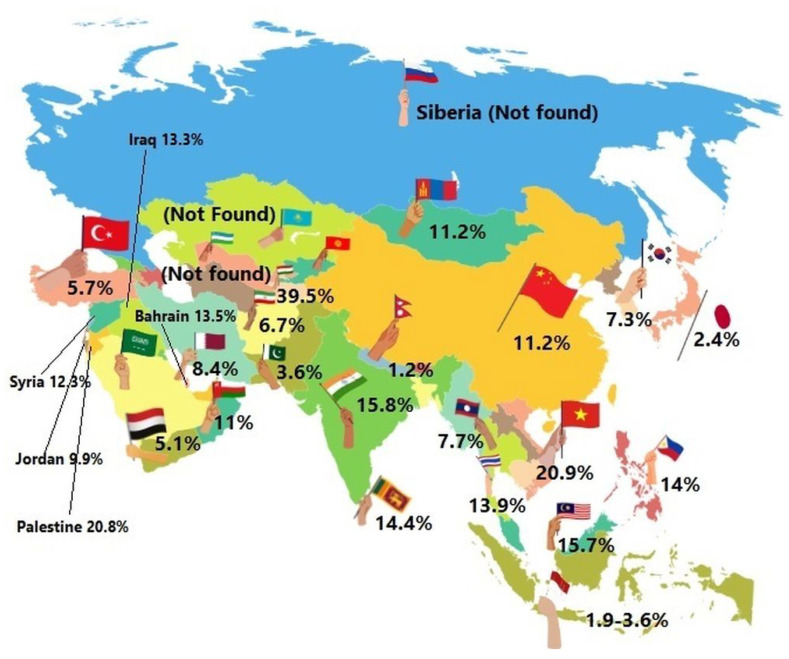
- Pooled/regional GDM prevalence estimates vary widely: IDF 2021 reported 7.1% in North America and the Caribbean, 10.4% in South and Central America, and 7.8% in Europe; Asian country estimates ranged from 1.2% to 49.5%.
- Switching to IADPSG/WHO 2013 criteria commonly raised diagnosed prevalence: Australia’s incidence increased from 20% to 75%; Canada from 7.0% (two-step) to 16.1% (one-step); Switzerland from 3.3% to 11.8%; Slovenia from 2.6% to 9.7%; Ireland from 3.1% in 2008 to 14.8% in 2017.
- In Africa, pooled GDM prevalence was 13.61% overall and 14.28% in sub-Saharan Africa, with the lowest in Northern Africa (7.57%) and highest in Central Africa (20.4%); risk factors included overweight/obesity (OR 3.51), previous GDM (OR 14.16), and hypertension (OR 2.49).
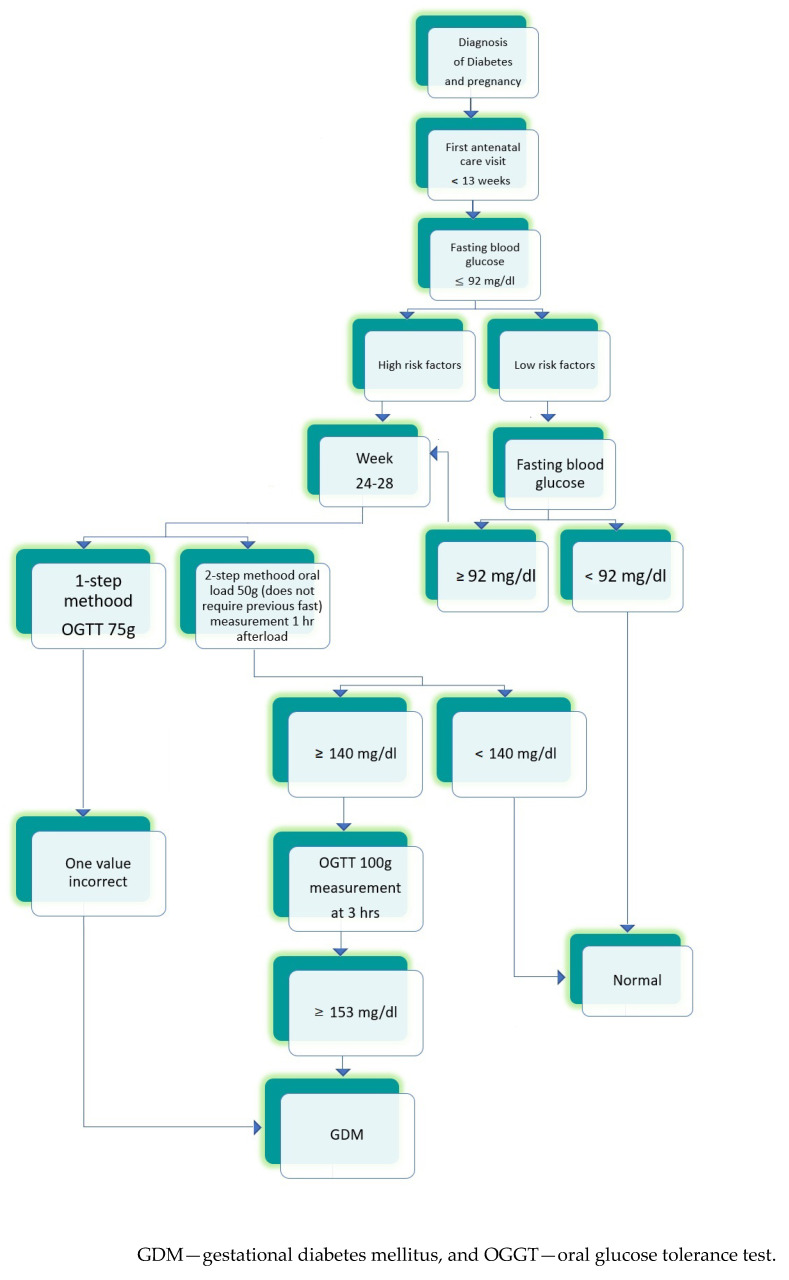
- Screening approaches remain non-uniform: the US uses one-step or two-step strategies, Mexico has no recommended screening protocol, the UK uses selective NICE risk-factor screening, and many countries/territories (e.g., Paraguay, Suriname, Bolivia, Venezuela; Lebanon, Syria; several European countries) had no studies found.
Methods
- Design: narrative review of published literature and national/international guidelines on GDM prevalence and screening/diagnostic criteria.
- Data: studies and reports from Australia/New Zealand, Africa, North America, South America, Europe, and Asia, including IDF Diabetes Atlas 2021 regional estimates and country-specific prevalence studies.
- Analysis: descriptive, country-by-country synthesis of prevalence estimates and criteria; no new primary data collection or formal meta-analysis is reported.
Limitations
- The paper states there is insufficient research to determine the best GDM diagnostic approach, a lack of evidence for large national screening programs, and non-uniform diagnostic protocols that hinder prevalence comparisons.
- It also notes absent or limited population-based data for many regions/countries (e.g., Mexico, South America, Africa, and numerous European and Asian countries).
- Evident from the text: as a narrative review without a described systematic search or quality appraisal, it draws on heterogeneous studies and criteria, so the reported prevalence figures are not directly comparable.
Model-written summary. Check it against the paper before relying on it.
Integrity signals
Registry
Cites
Statistics
Figures
Verification
Claims the paper makes
75 Supported · 65 No full text of the sources · 63 Not checked yet · 55 Partly supported · 9 Couldn’t confirm · 7 Not supported · 4 Supported so far · 3 Mixed support · 3 No basis given · 2 Sources not found · 1 Own interpretation · accuracy not yet measured
Some cited sources support this claim and some don’t — read each source’s verdict below.
In the paper
“Researchers from Australia showed that after the adoption of the IADPSG standards the incidence of GDM increased from 20 to 75%, but it was also justified by improvements in the potential long-term benefits and perinatal morbidity [17,18,19].”
§ Evolution of Gestational Diabetes Mellitus across Continents in 21st Century > 2. Australia and New Zealand > 2.1. Australia
What the sources say
- Partly supportedcites [17] Saeedi, 2021, Increasing prevalence of gestational diabetes mellitus when implementing the IADPSG criteria: A systematic review and meta-analysis, Diabetes Res. Clin. Pract. sourceExperimental — accuracy not yet measured
The Results report higher GDM prevalence under IADPSG criteria, and the Australian studies in Table 2 likewise generally show increases. But Table 2 does not show Australian GDM incidence rising from 20% to 75%; it reports prevalence comparisons, including 17.8% versus 15.0% and 13.0% versus 9.6%. The Introduction discusses benefits of treating GDM, but does not establish that adopting these criteria improved long-term outcomes or perinatal morbidity. (LLM, conf=0.88)
- Not checked — no full text of the sourcecites [18] Laafira, 2016, Impact of the new IADPSG gestational diabetes diagnostic criteria on pregnancy outcomes in Western Australia, Aust. N. Z. J. Obstet. Gynaecol. source
- Disputedcites [19] Brown, 2017, Application of One-Step IADPSG Versus Two-Step Diagnostic Criteria for Gestational Diabetes in the Real World: Impact on Health Services, Clinical Care, and Outcomes, Curr. Diab. Rep. sourceExperimental — accuracy not yet measured
In the 'Prevalence of GDM With the Application of IADPSG Criteria' section (Table 2; page unavailable), the Western Australia row reports prevalence of 3.4% under regional criteria and 3.5% under IADPSG criteria. That contradicts the attributed increase from 20% to 75%, although the paper reports increases in other settings. (LLM, conf=0.88)
Checked by a reasoning model — may be wrong.
plaindirect- Asserted: passes — The authors put it forward as true.
- Checkable: passes — It can be checked against evidence.
- Load-bearing: unclear — It is unclear whether the paper’s conclusions depend on it.
- Based: passes — The paper gives a reason why it holds.
- Partly supported
Some cited sources support this claim and some don’t — read each source’s verdict below.
In the paper
“Even after changing the criteria for a GDM diagnosis in the WHO/IADPSG 2013, the overall prevalence of GDM is still unknown.”
§ Evolution of Gestational Diabetes Mellitus across Continents in 21st Century > 3. Africa > 3.1. Attempts at Assessing the Prevalence, Screening Methods and Risk Factors of GDM throughout the Entire African Continent
What the sources say
- Disputedcites [30] Natamba, B.K., Namara, A.A., and Nyirenda, M.J. (2019). Burden, risk factors and maternal and offspring outcomes of gestational diabetes mellitus (GDM) in sub-Saharan Africa (SSA): A systematic review and meta-analysis. BMC Pregnancy Childbirth, 19. sourceExperimental — accuracy not yet measured
The Results section estimates overall GDM prevalence in sub-Saharan Africa at 9% (95% CI, 7–12%) and gives a separate estimate of 16% (11–21%) for studies using IADPSG or WHO 2013 criteria. The Background says prevalence in the general population was largely unknown before this review, but the paper does not present it as still unknown after its analysis. (LLM, conf=0.88)
Checked by a reasoning model — may be wrong.
- Supportedcites [31] Macaulay, S., Dunger, D.B., and Norris, S.A. (2014). Gestational diabetes mellitus in Africa: A systematic review. PLoS ONE, 9. source
The Discussion says none of the reviewed studies used the WHO 2013 or IADPSG criteria, and questions whether their prevalence figures reflect the African situation. Although it estimates prevalence at approximately 5% from those studies, it calls for further research to establish reliable continent-wide figures. (LLM, conf=0.87)
plain- Asserted: passes — The authors put it forward as true.
- Checkable: passes — It can be checked against evidence.
- Load-bearing: unclear — It is unclear whether the paper’s conclusions depend on it.
- Based: passes — The paper gives a reason why it holds.
- Disputed
At least one cited source doesn’t support this claim or points to a different paper, and none confirmed it — see the verdicts below.
In the paper
“In Thailand, an increase in the prevalence of GDM from 22.2% to 32.76% was observed when changing from the C&C criteria to the NDGG criteria.”
§ Evolution of Gestational Diabetes Mellitus across Continents in 21st Century > 7. Asia > 7.5. Southeast Asia
What the sources say
- Disputedcites [229] Luewan, 2018, Comparison of the Screening Tests for Gestational Diabetes Mellitus between “one-Step” and “two-Step” Methods among Thai Pregnant Women, Obstet. Gynecol. Int. sourceExperimental — accuracy not yet measured
The Results (page unavailable) report 32.0% GDM prevalence with one-step screening versus 10.3% with two-step screening among Thai women, not 22.2% versus 32.76%. The Introduction identifies the compared criteria as IADPSG and ACOG, not C&C and NDGG. (LLM, conf=0.88)
Checked by a reasoning model — may be wrong.
plaindirect- Asserted: passes — The authors put it forward as true.
- Checkable: passes — It can be checked against evidence.
- Load-bearing: unclear — It is unclear whether the paper’s conclusions depend on it.
- Based: passes — The paper gives a reason why it holds.
- Disputed
At least one cited source doesn’t support this claim or points to a different paper, and none confirmed it — see the verdicts below.
In the paper
“The researchers showed that the most valuable screening test in Thailand was the 100 g, two-hour OGTT [229].”
§ Evolution of Gestational Diabetes Mellitus across Continents in 21st Century > 7. Asia > 7.5. Southeast Asia
What the sources say
- Disputedcites [229] Luewan, 2018, Comparison of the Screening Tests for Gestational Diabetes Mellitus between “one-Step” and “two-Step” Methods among Thai Pregnant Women, Obstet. Gynecol. Int. sourceExperimental — accuracy not yet measured
The Methods describe the 100 g OGTT as part of a two-step approach, with measurements through three hours; the two-hour OGTT uses 75 g. The Discussion questions routine use of the 75 g one-step test in this Thai clinic, but does not identify a 100 g, two-hour OGTT as the most valuable test in Thailand. (LLM, conf=0.89)
Checked by a reasoning model — may be wrong.
boosted- Asserted: passes — The authors put it forward as true.
- Checkable: passes — It can be checked against evidence.
- Load-bearing: unclear — It is unclear whether the paper’s conclusions depend on it.
- Based: passes — The paper gives a reason why it holds.
- Disputed
At least one cited source doesn’t support this claim or points to a different paper, and none confirmed it — see the verdicts below.
In the paper
“In 2013 Oman introduced new criteria to detect GDM.”
§ Evolution of Gestational Diabetes Mellitus across Continents in 21st Century > 7. Asia > 7.6. West Asia
What the sources say
- Disputedcites [232] Subhi, 2021, Prevalence of Gestational Diabetes Mellitus Using the Latest World Health Organization Diagnostic Criteria among Omani Women in Muscat, Oman, Oman. Med. J. sourceExperimental — accuracy not yet measured
The Introduction says Oman adopted its new national GDM protocol in March 2015, not 2013. The protocol was based on the 2013 WHO criteria; 2013 dates the WHO criteria, not their introduction in Oman. No page number is supplied in our copy. (LLM, conf=0.90)
Checked by a reasoning model — may be wrong.
plain- Asserted: passes — The authors put it forward as true.
- Checkable: passes — It can be checked against evidence.
- Load-bearing: unclear — It is unclear whether the paper’s conclusions depend on it.
- Based: passes — The paper gives a reason why it holds.
- Disputed
At least one cited source doesn’t support this claim or points to a different paper, and none confirmed it — see the verdicts below.
In the paper
“It dropped to 26.4% when applying the new WHO criteria [232].”
§ Evolution of Gestational Diabetes Mellitus across Continents in 21st Century > 7. Asia > 7.6. West Asia
What the sources say
- Disputedcites [232] Subhi, 2021, Prevalence of Gestational Diabetes Mellitus Using the Latest World Health Organization Diagnostic Criteria among Omani Women in Muscat, Oman, Oman. Med. J. sourceExperimental — accuracy not yet measured
The Results and Discussion state the opposite: GDM incidence was 48.5% under the new WHO criteria and 26.4% under the old criteria. Applying the new criteria increased, rather than decreased, the reported incidence. (LLM, conf=0.95)
Checked by a reasoning model — may be wrong.
plaindirectn = 613- Asserted: passes — The authors put it forward as true.
- Checkable: passes — It can be checked against evidence.
- Load-bearing: unclear — It is unclear whether the paper’s conclusions depend on it.
- Based: passes — The paper gives a reason why it holds.
- Disputed
At least one cited source doesn’t support this claim or points to a different paper, and none confirmed it — see the verdicts below.
In the paper
“In 2012, GDM was assessed at 10.1%.”
§ Evolution of Gestational Diabetes Mellitus across Continents in 21st Century > 7. Asia > 7.6. West Asia
What the sources say
- Disputedcites [239] Nagalla, 2005, A population-based screening for gestational diabetes mellitus in non-diabetic women in Bahrain, Ann. Saudi Med. sourceExperimental — accuracy not yet measured
The Methods describe screening in Bahrain from January 2001 to December 2002, not in 2012. The Results report GDM in 13.3% of the screened non-diabetic pregnant women, rather than 10.1%. The supplied copy gives no page numbers for these sections. (LLM, conf=0.89)
Checked by a reasoning model — may be wrong.
plain- Asserted: passes — The authors put it forward as true.
- Checkable: passes — It can be checked against evidence.
- Load-bearing: unclear — It is unclear whether the paper’s conclusions depend on it.
- Based: passes — The paper gives a reason why it holds.
- Disputed
The cited sources support only part of this claim — read each source’s verdict below.
In the paper
“Untreated glucose intolerance increases the risk of maternal and neonatal complications.”
§ Evolution of Gestational Diabetes Mellitus across Continents in 21st Century > 1. Introduction
What the sources say
- Partly supportedcites [2] McIntyre, 2016, Issues with the Diagnosis and Classification of Hyperglycemia in Early Pregnancy, Diabetes Care sourceExperimental — accuracy not yet measured
The main text (pp. 53–54) reports that elevated early-pregnancy HbA1c was associated with maternal and neonatal complications, including preeclampsia, congenital anomalies, and perinatal death. It does not establish that leaving glucose intolerance untreated increases those risks; the authors note a lack of trial data on the benefits of detecting and treating milder early-pregnancy hyperglycemia. (LLM, conf=0.87)
plaindirect- Asserted: passes — The authors put it forward as true.
- Checkable: passes — It can be checked against evidence.
- Load-bearing: unclear — It is unclear whether the paper’s conclusions depend on it.
- Based: passes — The paper gives a reason why it holds.
- Partly supported
The cited sources support only part of this claim — read each source’s verdict below.
In the paper
“Laurie et al. confirmed the almost quadrupled prevalence of GDM between 2010 and 2019 in Australia.”
§ Evolution of Gestational Diabetes Mellitus across Continents in 21st Century > 2. Australia and New Zealand > 2.1. Australia
What the sources say
- Partly supportedcites [20] Laurie, J.G., and McIntyre, H.D. (2020). A Review of the Current Status of Gestational Diabetes Mellitus in Australia-The Clinical Impact of Changing Population Demographics and Diagnostic Criteria on Prevalence. Int. J. Environ. Res. Public Health, 17. sourceExperimental — accuracy not yet measured
The Prevalence section (page unavailable) supports a substantial rise in Australian GDM diagnoses, reporting about 41,000 diagnoses in 2019. It describes a doubling of the number of affected women over the last decade, but does not establish that prevalence nearly quadrupled specifically between 2010 and 2019. (LLM, conf=0.78)
plaincorrelationaln = 40,848- Asserted: passes — The authors put it forward as true.
- Checkable: passes — It can be checked against evidence.
- Load-bearing: unclear — It is unclear whether the paper’s conclusions depend on it.
- Based: passes — The paper gives a reason why it holds.
- Partly supported
Every source the paper cites for this claim was checked and supports it.
In the paper
“According to them, the pooled prevalence of GDM in Africa was 13.61% (OR: 95%CI: 10.99–16.23; I2 = 96.1%)”
§ Evolution of Gestational Diabetes Mellitus across Continents in 21st Century > 3. Africa > 3.1. Attempts at Assessing the Prevalence, Screening Methods and Risk Factors of GDM throughout the Entire African Continent
What the sources say
- Supportedcites [34] Muche, 2019, Prevalence and determinants of gestational diabetes mellitus in Africa based on the updated international diagnostic criteria: A systematic review and meta-analysis, Arch. Public Health source
The Results section (‘Prevalence of GDM in Africa’) reports the same pooled prevalence, 95% confidence interval, and I² value. The citing sentence’s ‘OR’ label is not used by the source, which identifies the interval as a 95% CI. (LLM, conf=0.95)
plain- Asserted: passes — The authors put it forward as true.
- Checkable: passes — It can be checked against evidence.
- Load-bearing: unclear — It is unclear whether the paper’s conclusions depend on it.
- Based: passes — The paper gives a reason why it holds.
- Supported
The cited sources support only part of this claim — read each source’s verdict below.
In the paper
“One thing was obvious: for all of the studies, the GDM prevalence was higher, which was confirmed by Olumodeji et al. [33].”
§ Evolution of Gestational Diabetes Mellitus across Continents in 21st Century > 3. Africa > 3.1. Attempts at Assessing the Prevalence, Screening Methods and Risk Factors of GDM throughout the Entire African Continent
What the sources say
- Partly supportedcites [33] Olumodeji, 2020, Implementing the 2013 WHO diagnostic criteria for gestational diabetes mellitus in a Rural Nigerian Population, Pan Afr. Med. J. sourceExperimental — accuracy not yet measured
The Discussion reports higher GDM prevalence under the 2013 WHO criteria in this rural Nigerian study and in an Ekiti study. It does not confirm a higher prevalence for all African studies: it notes that a study in Jos, Nigeria found no significant difference between the 1999 and 2013 criteria. (LLM, conf=0.86)
boosted- Asserted: passes — The authors put it forward as true.
- Checkable: passes — It can be checked against evidence.
- Load-bearing: unclear — It is unclear whether the paper’s conclusions depend on it.
- Based: passes — The paper gives a reason why it holds.
- Partly supported
Every source the paper cites for this claim was checked and supports it.
In the paper
“Additionally, their data showed that advanced maternal age was connected with GDM only with high parity [41].”
§ Evolution of Gestational Diabetes Mellitus across Continents in 21st Century > 3. Africa > 3.2. The Prevalence, Screening Methods and Risk Factors of GDM in Selected Countries or Parts of Africa
What the sources say
- Supportedcites [41] Lendoye, 2022, Prevalence and factors associated to gestational diabetes mellitus among pregnant women in Libreville: A cross-sectional study, Pan Afr. Med. J. source
The Results state that maternal age and parity were not individually associated with GDM, but age over 35 combined with parity of at least five was associated with GDM in the studied Gabonese urban population under WHO 1999 criteria. The Discussion likewise says maternal age became an associated factor only when combined with high parity. (LLM, conf=0.94)
plaincorrelational- Asserted: passes — The authors put it forward as true.
- Checkable: passes — It can be checked against evidence.
- Load-bearing: unclear — It is unclear whether the paper’s conclusions depend on it.
- Based: passes — The paper gives a reason why it holds.
- Supported
Every source the paper cites for this claim was checked and supports it.
In the paper
“Other parameters (e.g., HIV infection) were not statistically significant [30].”
§ Evolution of Gestational Diabetes Mellitus across Continents in 21st Century > 3. Africa > 3.1. Attempts at Assessing the Prevalence, Screening Methods and Risk Factors of GDM throughout the Entire African Continent
What the sources say
- Supportedcites [30] Natamba, B.K., Namara, A.A., and Nyirenda, M.J. (2019). Burden, risk factors and maternal and offspring outcomes of gestational diabetes mellitus (GDM) in sub-Saharan Africa (SSA): A systematic review and meta-analysis. BMC Pregnancy Childbirth, 19. source
Table 2 in the Results section reports a pooled risk ratio of 1.14 for HIV status and GDM, with a 95% confidence interval of 0.90–1.43. Because that interval includes 1, the reported association was not statistically significant in the sub-Saharan African studies pooled. (LLM, conf=0.94)
plain- Asserted: passes — The authors put it forward as true.
- Checkable: passes — It can be checked against evidence.
- Load-bearing: unclear — It is unclear whether the paper’s conclusions depend on it.
- Based: passes — The paper gives a reason why it holds.
- Supported
The cited sources support only part of this claim — read each source’s verdict below.
In the paper
“Egbe et al., using WHO/AIDPSG 2013, confirmed in their study that the highest prevalence of GDM is in Central Africa-Cameroon (20.4%).”
§ Evolution of Gestational Diabetes Mellitus across Continents in 21st Century > 3. Africa > 3.2. The Prevalence, Screening Methods and Risk Factors of GDM in Selected Countries or Parts of Africa
What the sources say
- Partly supportedcites [37] Egbe, 2018, Prevalence and risk factors of gestational diabetes mellitus in a population of pregnant women attending three health facilities in Limbe, Cameroon: A cross-sectional study, Pan Afr. Med. J. sourceExperimental — accuracy not yet measured
The Discussion (Prevalence of gestational diabetes mellitus; page not provided) reports a high GDM prevalence in the Limbe, Cameroon study, but gives 20.5%, not 20.4%, and says the study used IADPSG criteria rather than a combined WHO/IADPSG 2013 standard. It does not establish that Cameroon had the highest prevalence in Central Africa. (LLM, conf=0.88)
boosted- Asserted: passes — The authors put it forward as true.
- Checkable: passes — It can be checked against evidence.
- Load-bearing: unclear — It is unclear whether the paper’s conclusions depend on it.
- Based: passes — The paper gives a reason why it holds.
- Partly supported
Every source the paper cites for this claim was checked and supports it.
In the paper
“The lowest prevalence was in Northern Africa at 7.57% (95% CI: 5.89–9.25)”
§ Evolution of Gestational Diabetes Mellitus across Continents in 21st Century > 3. Africa > 3.1. Attempts at Assessing the Prevalence, Screening Methods and Risk Factors of GDM throughout the Entire African Continent
What the sources say
- Supportedcites [34] Muche, 2019, Prevalence and determinants of gestational diabetes mellitus in Africa based on the updated international diagnostic criteria: A systematic review and meta-analysis, Arch. Public Health source
The Abstract’s Results report that Northern Africa had the lowest estimated gestational diabetes mellitus prevalence among the African subregions, at 7.57% (95% CI: 5.89–9.25). The Discussion also identifies Northern Africa as the lowest-prevalence subregion. (LLM, conf=0.95)
plain- Asserted: passes — The authors put it forward as true.
- Checkable: passes — It can be checked against evidence.
- Load-bearing: unclear — It is unclear whether the paper’s conclusions depend on it.
- Based: passes — The paper gives a reason why it holds.
- Supported
The cited sources support only part of this claim — read each source’s verdict below.
In the paper
“On the African continent, a few ways diagnosing GDM diagnosis have still exist. The WHO 1985, WHO 1999, WHO 2006, CC criteria, ADA 2003/2004, WHO/IADPSG 2013 or individual protocols are taken into account [30,31].”
§ Evolution of Gestational Diabetes Mellitus across Continents in 21st Century > 3. Africa > 3.1. Attempts at Assessing the Prevalence, Screening Methods and Risk Factors of GDM throughout the Entire African Continent
What the sources say
- Supportedcites [30] Natamba, B.K., Namara, A.A., and Nyirenda, M.J. (2019). Burden, risk factors and maternal and offspring outcomes of gestational diabetes mellitus (GDM) in sub-Saharan Africa (SSA): A systematic review and meta-analysis. BMC Pregnancy Childbirth, 19. source
Table 1 in the Results (page unavailable) lists studies in sub-Saharan African countries using WHO 1985, WHO 1999, WHO 2006, CC, ADA 2003/4, IADPSG, and studies’ own or institutional criteria. The Results also identify WHO/IADPSG 2013 criteria among those used. (LLM, conf=0.94)
- Partly supportedcites [31] Macaulay, S., Dunger, D.B., and Norris, S.A. (2014). Gestational diabetes mellitus in Africa: A systematic review. PLoS ONE, 9. sourceExperimental — accuracy not yet measured
The Results (Study Characteristics, Table 3; page not provided) document African studies using WHO 1985, WHO 1999, Carpenter and Coustan criteria, and an institutional protocol. They do not document use of WHO 2006 or ADA 2003/2004 criteria, and the Discussion (page not provided) explicitly says none of the reviewed studies used WHO 2013 or IADPSG criteria. (LLM, conf=0.90)
plain- Asserted: passes — The authors put it forward as true.
- Checkable: passes — It can be checked against evidence.
- Load-bearing: unclear — It is unclear whether the paper’s conclusions depend on it.
- Based: passes — The paper gives a reason why it holds.
- Supported
The cited sources support only part of this claim — read each source’s verdict below.
In the paper
“These results were connected with an epidemic of obesity caused by incorrect dietary habits and a low level of physical activity.”
§ Evolution of Gestational Diabetes Mellitus across Continents in 21st Century > 3. Africa > 3.2. The Prevalence, Screening Methods and Risk Factors of GDM in Selected Countries or Parts of Africa
What the sources say
- Partly supportedcites [37] Egbe, 2018, Prevalence and risk factors of gestational diabetes mellitus in a population of pregnant women attending three health facilities in Limbe, Cameroon: A cross-sectional study, Pan Afr. Med. J. sourceExperimental — accuracy not yet measured
The Discussion (Risk factors for gestational diabetes mellitus; page not provided) links the study’s high GDM prevalence to increased BMI and suggests dietary habits contribute to obesity. It also says very few women lived a sedentary lifestyle, so low physical activity does not explain the high BMI and GDM in this study. (LLM, conf=0.88)
plaincorrelational- Asserted: passes — The authors put it forward as true.
- Checkable: passes — It can be checked against evidence.
- Load-bearing: unclear — It is unclear whether the paper’s conclusions depend on it.
- Based: passes — The paper gives a reason why it holds.
- Partly supported
Every source the paper cites for this claim was checked and supports it.
In the paper
“and 14.28% (95% CI: 11.39–17.16; I2 = 96.4%) in subSaharan countries.”
§ Evolution of Gestational Diabetes Mellitus across Continents in 21st Century > 3. Africa > 3.1. Attempts at Assessing the Prevalence, Screening Methods and Risk Factors of GDM throughout the Entire African Continent
What the sources say
- Supportedcites [34] Muche, 2019, Prevalence and determinants of gestational diabetes mellitus in Africa based on the updated international diagnostic criteria: A systematic review and meta-analysis, Arch. Public Health source
The Results section, under “Prevalence of GDM in Africa,” reports the sub-Saharan Africa subgroup estimate as 14.28%, with a 95% CI of 11.39–17.16 and I² of 96.4%. Table 2 reports the same figures for sub-Saharan African countries. (LLM, conf=0.95)
plain- Asserted: passes — The authors put it forward as true.
- Checkable: passes — It can be checked against evidence.
- Load-bearing: unclear — It is unclear whether the paper’s conclusions depend on it.
- Based: passes — The paper gives a reason why it holds.
- Supported
Every source the paper cites for this claim was checked and supports it.
In the paper
“The results showed that using the one-step strategy, GDM was diagnosed in doubled number of women in comparison with the two-step method.”
§ Evolution of Gestational Diabetes Mellitus across Continents in 21st Century > 4. North America > 4.1. The United States of America
What the sources say
- Supportedcites [44] Hillier, 2021, A Pragmatic Randomized Clinical Trial of Gestational Diabetes Screening, N. Engl. J. Med. source
The Results (Primary Outcomes) report GDM diagnoses in 16.5% of pregnancies randomized to one-step screening versus 8.5% randomized to two-step screening (RR 1.94). The Discussion explicitly describes this as twice as many women being diagnosed with the one-step approach. (LLM, conf=0.95)
plaindirect- Asserted: passes — The authors put it forward as true.
- Checkable: passes — It can be checked against evidence.
- Load-bearing: unclear — It is unclear whether the paper’s conclusions depend on it.
- Based: passes — The paper gives a reason why it holds.
- Supported
The cited sources support only part of this claim — read each source’s verdict below.
In the paper
“The weighted incidence of GDM in North Africa was 13.5% (95% CI: 7.4–20.9, I2 = 98.9%).”
§ Evolution of Gestational Diabetes Mellitus across Continents in 21st Century > 3. Africa > 3.2. The Prevalence, Screening Methods and Risk Factors of GDM in Selected Countries or Parts of Africa
What the sources say
- Partly supportedcites [40] Abdo, 2021, Prevalence of Gestational Diabetes Mellitus in the Middle East and North Africa, 2000–2019: A Systematic Review, Meta-Analysis, and Meta-Regression, Front. Endocrinol. sourceExperimental — accuracy not yet measured
The Results section, “Subregional Specific Pooled GDM Prevalence,” gives the North African estimate as 13.5% (95% CI, 7.4–20.9%; I², 98.9%). It identifies this as weighted prevalence, not incidence; the cited paper therefore supports the figures but not the measure named in the claim. (LLM, conf=0.88)
plain- Asserted: passes — The authors put it forward as true.
- Checkable: passes — It can be checked against evidence.
- Load-bearing: unclear — It is unclear whether the paper’s conclusions depend on it.
- Based: passes — The paper gives a reason why it holds.
- Partly supported
Every source the paper cites for this claim was checked and supports it.
In the paper
“They also found positive correlations between hyperglycemia and previous history of GDM and hypertension, weight ≥ 90 kg, and age ≥ 35 years [39].”
§ Evolution of Gestational Diabetes Mellitus across Continents in 21st Century > 3. Africa > 3.2. The Prevalence, Screening Methods and Risk Factors of GDM in Selected Countries or Parts of Africa
What the sources say
- Supportedcites [39] Nwali, S.A., Onoh, R.C., Dimejesi, I.B., Obi, V.O., Jombo, S.E., and Edenya, O.O. (2021). Universal versus selective screening for gestational diabetes mellitus among antenatal clinic attendees in Abakaliki: Using the one-step 75 gram oral glucose tolerance test. BMC Pregnancy Childbirth, 21. source
The Results section reports that previous GDM, known hypertension, pregnancy weight ≥90 kg, and age ≥35 years were all significantly associated with hyperglycemia on multivariate analysis. Table 5 shows odds ratios above 1 for each factor. The claim's “positive correlations” is a reasonable paraphrase of those associations. (LLM, conf=0.94)
plaincorrelationaln = 400- Asserted: passes — The authors put it forward as true.
- Checkable: passes — It can be checked against evidence.
- Load-bearing: unclear — It is unclear whether the paper’s conclusions depend on it.
- Based: passes — The paper gives a reason why it holds.
- Supported
The cited sources support only part of this claim — read each source’s verdict below.
In the paper
“They showed that the GDM prevalence was higher using the WHO 1999 (10.4%) than using the WHO/IADPSG 2013 criteria (4.5%).”
§ Evolution of Gestational Diabetes Mellitus across Continents in 21st Century > 3. Africa > 3.2. The Prevalence, Screening Methods and Risk Factors of GDM in Selected Countries or Parts of Africa
What the sources say
- Partly supportedcites [41] Lendoye, 2022, Prevalence and factors associated to gestational diabetes mellitus among pregnant women in Libreville: A cross-sectional study, Pan Afr. Med. J. sourceExperimental — accuracy not yet measured
The Discussion and Abstract Results report a higher GDM prevalence under WHO 1999 criteria than under WHO 2013 criteria. But they give the WHO 1999 figure as 10.2%, not the cited 10.4%; the 4.5% figure matches. (LLM, conf=0.94)
plain- Asserted: passes — The authors put it forward as true.
- Checkable: passes — It can be checked against evidence.
- Load-bearing: unclear — It is unclear whether the paper’s conclusions depend on it.
- Based: passes — The paper gives a reason why it holds.
- Partly supported
Every source the paper cites for this claim was checked and supports it.
In the paper
“but if the IADPSG criteria were used the prevalence was approximately 16% in sub-Saharan Africa [30].”
§ Evolution of Gestational Diabetes Mellitus across Continents in 21st Century > 3. Africa > 3.1. Attempts at Assessing the Prevalence, Screening Methods and Risk Factors of GDM throughout the Entire African Continent
What the sources say
- Supportedcites [30] Natamba, B.K., Namara, A.A., and Nyirenda, M.J. (2019). Burden, risk factors and maternal and offspring outcomes of gestational diabetes mellitus (GDM) in sub-Saharan Africa (SSA): A systematic review and meta-analysis. BMC Pregnancy Childbirth, 19. source
The Results section (‘Prevalence of GDM in sub-Saharan Africa’) reports a combined prevalence of 16% (95% CI 11–21%) for studies using IADPSG or WHO 2013 criteria. This supports the citing sentence’s approximate figure, though the subgroup includes both criteria. (LLM, conf=0.94)
hedged- Asserted: passes — The authors put it forward as true.
- Checkable: passes — It can be checked against evidence.
- Load-bearing: unclear — It is unclear whether the paper’s conclusions depend on it.
- Based: passes — The paper gives a reason why it holds.
- Supported
Every source the paper cites for this claim was checked and supports it.
In the paper
“This prevalence was 32% higher in North African countries with a maternal mortality ratio (MMR) > 100/100,000 live births than in North African countries with an MMR ≤ 100/100,000 live births [40].”
§ Evolution of Gestational Diabetes Mellitus across Continents in 21st Century > 3. Africa > 3.2. The Prevalence, Screening Methods and Risk Factors of GDM in Selected Countries or Parts of Africa
What the sources say
- Supportedcites [40] Abdo, 2021, Prevalence of Gestational Diabetes Mellitus in the Middle East and North Africa, 2000–2019: A Systematic Review, Meta-Analysis, and Meta-Regression, Front. Endocrinol. source
The Results section, “Subregional Specific Pooled GDM Prevalence,” states that GDM prevalence in North African countries with an MMR >100 per 100,000 live births was 32.0% higher than in those with an MMR ≤100 per 100,000. This directly matches the cited claim. (LLM, conf=0.95)
plaincorrelational- Asserted: passes — The authors put it forward as true.
- Checkable: passes — It can be checked against evidence.
- Load-bearing: unclear — It is unclear whether the paper’s conclusions depend on it.
- Based: passes — The paper gives a reason why it holds.
- Supported
Every source the paper cites for this claim was checked and supports it.
In the paper
“and the highest was in Central Africa at 20.4% (95% CI: 1.55–38.54) [34].”
§ Evolution of Gestational Diabetes Mellitus across Continents in 21st Century > 3. Africa > 3.1. Attempts at Assessing the Prevalence, Screening Methods and Risk Factors of GDM throughout the Entire African Continent
What the sources say
- Supportedcites [34] Muche, 2019, Prevalence and determinants of gestational diabetes mellitus in Africa based on the updated international diagnostic criteria: A systematic review and meta-analysis, Arch. Public Health source
The Abstract (Result) states that GDM prevalence was highest in Central Africa at 20.4% (95% CI: 1.55–38.54). The Discussion also identifies Central Africa as the highest-prevalence sub-region. Table 2 gives a slightly different point estimate, 20.04%, with the same confidence interval. (LLM, conf=0.92)
plain- Asserted: passes — The authors put it forward as true.
- Checkable: passes — It can be checked against evidence.
- Load-bearing: unclear — It is unclear whether the paper’s conclusions depend on it.
- Based: passes — The paper gives a reason why it holds.
- Supported
The cited sources support only part of this claim — read each source’s verdict below.
In the paper
“GDM is the most frequent endocrinopathy during pregnancy in Canada [63]”
§ Evolution of Gestational Diabetes Mellitus across Continents in 21st Century > 4. North America > 4.3. Canada
What the sources say
- Partly supportedcites [63] Amiri, 2019, The impact of diagnostic criteria for gestational diabetes on its prevalence: A systematic review and meta-analysis, Diabetol. Metab. Syndr. sourceExperimental — accuracy not yet measured
The Background (page unavailable) calls GDM “one of the most common endocrinopathies during pregnancy,” supporting the general point. It does not say GDM is the single most frequent endocrinopathy, specifically in Canada. The Results (page unavailable) include Canadian GDM prevalence studies but do not compare GDM with other endocrinopathies there. (LLM, conf=0.88)
plain- Asserted: passes — The authors put it forward as true.
- Checkable: passes — It can be checked against evidence.
- Load-bearing: unclear — It is unclear whether the paper’s conclusions depend on it.
- Based: passes — The paper gives a reason why it holds.
- Partly supported
None of the sources cited for this claim have been checked yet.
In the paper
“A growing trend of GDM prevalence has been observed [56,57,58,59,60,61].”
§ Evolution of Gestational Diabetes Mellitus across Continents in 21st Century > 4. North America > 4.2. Mexico
What the sources say
- Not checked yetcites [56] 1993, Experiencia con un programa de escrutinio de diabetes gestacional, Rev. Investig. Clin.
- Not checked yetcites [57] 1997, Incidence of gestational diabetes in a group of women receiving treatment at the Mexican Institute of Social Security in Aguascalientes, Mexico, Arch. Med. Res.
- Not checked yetcites [58] 2005, Gestational diabetes mellitus. Experience at a third level hospital [Diabetes mellitus gestacional. Experiencia en una institución de tercer nivel de atención], Ginecol. Obstet. Mex.
- Not checked — no full text of the sourcecites [59] 2011, Prediction of alterations in glucose metabolism by glucose and insulin measurements in early pregnancy, Arch. Med. Res. source
- Not checked — no full text of the sourcecites [60] Parra, 2012, The risk of gestational diabetes mellitus among Mexican women with a history of infertility and polycystic ovary syndrome, Fertil. Steril. source
- Could not verifycites [61] Huerta-Chagoya, A., Vázquez-Cárdenas, P., Moreno-Macías, H., Tapia-Maruri, L., Rodríguez-Guillén, R., López-Vite, E., García-Escalante, G., Escobedo-Aguirre, F., Parra-Covarrubias, A., and Cordero-Brieño, R. (2015). Genetic determinants for gestational diabetes mellitus and related metabolic traits in Mexican women. PLoS ONE, 10. sourceExperimental — accuracy not yet measured
The Introduction reports one Mexican GDM prevalence estimate, 12.9%, and says no nationwide prevalence has been reported. The Results describe a case-control sample, not prevalence over time. Searches for an increasing prevalence or temporal trend found no passage establishing that GDM prevalence has grown in Mexico. (LLM, conf=0.75)
plaincorrelational- Asserted: passes — The authors put it forward as true.
- Checkable: passes — It can be checked against evidence.
- Load-bearing: unclear — It is unclear whether the paper’s conclusions depend on it.
- Based: passes — The paper gives a reason why it holds.
Every source the paper cites for this claim was checked and supports it.
In the paper
“In a study performed among users of the Brazilian Unified Health System (UHS) in the city of Caxias do Sul, State of Rio Grande do Sul, the estimated prevalence of GDM was 5.4%.”
§ Evolution of Gestational Diabetes Mellitus across Continents in 21st Century > 5. South America > 5.1. Brazil
What the sources say
- Supportedcites [80] Madi, 2020, Gestational Diabetes in the Population Served by Brazilian Public Health Care. Prevalence and Risk Factors, Rev. Bras. Ginecol. Obstet. source
The Discussion states that 5.4% of pregnant women cared for by the Unified Health System in Caxias do Sul in 2016 had gestational diabetes mellitus. The Materials and Methods section identifies the study population as pregnant UHS users attending prenatal visits in that city. (LLM, conf=0.95)
hedged- Asserted: passes — The authors put it forward as true.
- Checkable: passes — It can be checked against evidence.
- Load-bearing: unclear — It is unclear whether the paper’s conclusions depend on it.
- Based: passes — The paper gives a reason why it holds.
- Supported
Every source the paper cites for this claim was checked and supports it.
In the paper
“Nevertheless, there was no disparity between maternal and perinatal outcomes, while more pregnant women were treated for GDM after diagnosis with the one-step method [44].”
§ Evolution of Gestational Diabetes Mellitus across Continents in 21st Century > 4. North America > 4.1. The United States of America
What the sources say
- Supportedcites [44] Hillier, 2021, A Pragmatic Randomized Clinical Trial of Gestational Diabetes Screening, N. Engl. J. Med. source
The Discussion reports no significant differences in maternal or perinatal outcomes between the one-step and two-step screening groups. It also states that the one-step approach diagnosed and treated many more women with GDM. The claim is supported when “no disparity” is read as no statistically significant difference, not identical outcomes. (LLM, conf=0.92)
plain- Asserted: passes — The authors put it forward as true.
- Checkable: passes — It can be checked against evidence.
- Load-bearing: unclear — It is unclear whether the paper’s conclusions depend on it.
- Based: passes — The paper gives a reason why it holds.
- Supported
Every source the paper cites for this claim was checked and supports it.
In the paper
“while more pregnant women were treated for GDM after diagnosis with the one-step method [44].”
§ Evolution of Gestational Diabetes Mellitus across Continents in 21st Century > 4. North America > 4.1. The United States of America
What the sources say
- Supportedcites [44] Hillier, 2021, A Pragmatic Randomized Clinical Trial of Gestational Diabetes Screening, N. Engl. J. Med. source
The Discussion says the one-step approach resulted in diagnosing and treating many more women for GDM. The Results report GDM diagnoses in 16.5% of pregnancies assigned to one-step screening versus 8.5% assigned to two-step screening. No page number is available in our copy. (LLM, conf=0.91)
plaindirect- Asserted: passes — The authors put it forward as true.
- Checkable: passes — It can be checked against evidence.
- Load-bearing: unclear — It is unclear whether the paper’s conclusions depend on it.
- Based: passes — The paper gives a reason why it holds.
- Supported
Every source the paper cites for this claim was checked and supports it.
In the paper
“Filipina, Pacific Islander/Hawaiian, and other Asian pregnant patients had increased risk of GDM versus white women using a bivariate analysis [52].”
§ Evolution of Gestational Diabetes Mellitus across Continents in 21st Century > 4. North America > 4.1. The United States of America
What the sources say
- Supportedcites [52] Tsai, P.J., Roberson, E., and Dye, T. (2013). Gestational diabetes and macrosomia by race/ethnicity in Hawaii. BMC Res. Notes, 6. source
The Results section states that Hawaiian/Pacific Islander women, Filipinas, and other Asians all had increased odds of GDM compared with white women in a bivariate analysis. This directly supports the attributed claim. (LLM, conf=0.95)
plaincorrelational- Asserted: passes — The authors put it forward as true.
- Checkable: passes — It can be checked against evidence.
- Load-bearing: unclear — It is unclear whether the paper’s conclusions depend on it.
- Based: passes — The paper gives a reason why it holds.
- Supported
Every source the paper cites for this claim was checked and supports it.
In the paper
“Similar results for GDM prevalence at 10.3% were presented by Leonco et al. in their prospective study performed in French Guiana, an overseas department of France, in South America [79].”
§ Evolution of Gestational Diabetes Mellitus across Continents in 21st Century > 5. South America
What the sources say
- Supportedcites [79] Leonco, 2021, Does Universal Screening for Gestational Diabetes Mellitus Improve Neonatal Outcomes in a Socially Vulnerable Population: A Prospective Study in French Guiana, Front. Endocrinol. source
The Discussion reports GDM prevalence of 10.3% of pregnancies at Cayenne Hospital in French Guiana. The Materials and Methods section identifies the study as prospective. The estimate is from one maternity hospital, not a territory-wide survey. (LLM, conf=0.94)
plain- Asserted: passes — The authors put it forward as true.
- Checkable: passes — It can be checked against evidence.
- Load-bearing: unclear — It is unclear whether the paper’s conclusions depend on it.
- Based: passes — The paper gives a reason why it holds.
- Supported
The cited sources support only part of this claim — read each source’s verdict below.
In the paper
“This increase in the number of GDM cases occurred, due to the fact that only one elevated value is required to make the diagnosis [45].”
§ Evolution of Gestational Diabetes Mellitus across Continents in 21st Century > 4. North America > 4.1. The United States of America
What the sources say
- Partly supportedcites [45] Sacks, 2012, Frequency of Gestational Diabetes Mellitus at Collaborating Centers Based on IADPSG Consensus Panel-Recommended Criteria: The Hyperglycemia and Adverse Pregnancy Outcome (HAPO) Study, Diabetes Care sourceExperimental — accuracy not yet measured
The Research Design and Methods section (p. 1) says the IADPSG criteria diagnose GDM when one or more glucose values meet a threshold. The Results (p. 1) report a 17.8% frequency under those criteria, but the paper does not compare that frequency with a prior method or establish that requiring only one elevated value caused an increase in cases. (LLM, conf=0.84)
plaindirect- Asserted: passes — The authors put it forward as true.
- Checkable: passes — It can be checked against evidence.
- Load-bearing: passes — The paper’s conclusions depend on it.
- Based: passes — The paper gives a reason why it holds.
- Partly supported
Every source the paper cites for this claim was checked and supports it.
In the paper
“In turn, using the one-step 2-h 75 g OGTT approximately 17.8% of pregnant women would be classified as having GDM, which would almost double the frequency of GDM in the US [4].”
§ Evolution of Gestational Diabetes Mellitus across Continents in 21st Century > 4. North America > 4.1. The United States of America
What the sources say
- Supportedcites [4] Lende, M., and Rijhsinghani, A. (2020). Gestational Diabetes: Overview with Emphasis on Medical Management. Int. J. Environ. Res. Public Health, 17. source
Section 4 (Antenatal Glucose Screening) states that under the one-step IADPSG criteria, 17.8% of pregnant patients in the USA would test positive for GDM, nearly doubling its incidence there. The same section identifies the one-step test as a 2-hour test using a 75-g glucose load. (LLM, conf=0.95)
hedgeddirect- Asserted: passes — The authors put it forward as true.
- Checkable: passes — It can be checked against evidence.
- Load-bearing: unclear — It is unclear whether the paper’s conclusions depend on it.
- Based: passes — The paper gives a reason why it holds.
- Supported
The cited sources support only part of this claim — read each source’s verdict below.
In the paper
“The data were collected in 4 major cities in Mexico: (Mexico City, Guadalajara, Monterrey, and Merida) in 2017, and an overall predicted GDM prevalence at the level of 23.7% was reported [54].”
§ Evolution of Gestational Diabetes Mellitus across Continents in 21st Century > 4. North America > 4.2. Mexico
What the sources say
- Partly supportedcites [54] Dainelli, 2018, Screening and Management of Gestational Diabetes in Mexico: Results from a Survey of Multilocation, Multi-Health Care Institution Practitioners, Diabetes Metab. Syndr. Obes. sourceExperimental — accuracy not yet measured
The Materials and methods section says the survey was conducted in Mexico City, Guadalajara, Monterrey, and Merida in June–July 2017. The Results section reports a total predicted GDM clinician-reported proportion of 23.7%. Calling that figure GDM prevalence omits the important qualifier that it was based on clinicians’ reports, not a directly measured population prevalence. Page numbers were not available in our copy. (LLM, conf=0.86)
plain- Asserted: passes — The authors put it forward as true.
- Checkable: passes — It can be checked against evidence.
- Load-bearing: unclear — It is unclear whether the paper’s conclusions depend on it.
- Based: passes — The paper gives a reason why it holds.
- Partly supported
The cited sources support only part of this claim — read each source’s verdict below.
In the paper
“Additionally, pregnant women who were obese, ≥35 years, and those with three or more pregnancies were more likely to develop GDM during pregnancy than women with a normal BMI, <35 years, and primiparous [80].”
§ Evolution of Gestational Diabetes Mellitus across Continents in 21st Century > 5. South America > 5.1. Brazil
What the sources say
- Partly supportedcites [80] Madi, 2020, Gestational Diabetes in the Population Served by Brazilian Public Health Care. Prevalence and Risk Factors, Rev. Bras. Ginecol. Obstet. sourceExperimental — accuracy not yet measured
The Results report higher unadjusted odds of GDM for women aged ≥35 and women with three or more pregnancies. They also report higher odds for BMI ≥25 versus BMI <25, but do not separately establish the claimed comparison of obese women with normal-BMI women. The Discussion adds that the association with three or more pregnancies lost significance after adjustment. Page numbers were not available in our copy. (LLM, conf=0.88)
hedgedcorrelational- Asserted: passes — The authors put it forward as true.
- Checkable: passes — It can be checked against evidence.
- Load-bearing: unclear — It is unclear whether the paper’s conclusions depend on it.
- Based: passes — The paper gives a reason why it holds.
- Partly supported
Every source the paper cites for this claim was checked and supports it.
In the paper
“The study performed by Melero et al. using the IADPSG criteria, analyzed the nutritional intervention, the Mediterranean diet and its influence on GDM, the results showed lower GDM prevalence in the Mediterranean diet group, than in the control group at 14.8% and 25.8%, respectively [108].”
§ Evolution of Gestational Diabetes Mellitus across Continents in 21st Century > 6. Europe > 6.2. Spain
What the sources say
- Supportedcites [108] Melero, V., García de la Torre, N., Assaf-Balut, C., Jiménez, I., Del Valle, L., Durán, A., Bordiú, E., Valerio, J.J., Herraiz, M.A., and Izquierdo, N. (2020). Effect of a Mediterranean Diet-Based Nutritional Intervention on the Risk of Developing Gestational Diabetes Mellitus and Other Maternal-Fetal Adverse Events in Hispanic Women Residents in Spain. Nutrients, 12. source
The Methods (section 2.3) state that GDM screening used IADPSG criteria. The Results (section 3) report GDM rates of 14.8% in the Mediterranean-diet intervention group and 25.8% in the control group. (LLM, conf=0.94)
plaincorrelational- Asserted: passes — The authors put it forward as true.
- Checkable: passes — It can be checked against evidence.
- Load-bearing: unclear — It is unclear whether the paper’s conclusions depend on it.
- Based: passes — The paper gives a reason why it holds.
- Supported
The cited sources support only part of this claim — read each source’s verdict below.
In the paper
“The national prevalence in Trinidad and Tobago was estimated at 14.5% using the IADPSG/WHO 2013 criteria [97].”
§ Evolution of Gestational Diabetes Mellitus across Continents in 21st Century > 5. South America > 5.9. Trinidad and Tobago
What the sources say
- Partly supportedcites [97] Khan, 2020, Prevalence rates of impaired glucose tolerance and gestational diabetes mellitus amongst expectant mothers and undiagnosed diabetes mellitus in walk-in patients at health centres in North Central Trinidad, J. Fam. Med. Prim. Care sourceExperimental — accuracy not yet measured
The Discussion mentions a national prevalence of 14.5% alongside its GDM findings, but later identifies 14.5% as an International Diabetes Federation estimate for diabetes mellitus, not a national GDM estimate. The Methodology refers to WHO criteria for the study’s local GDM diagnoses; it does not say the 14.5% estimate used IADPSG/WHO 2013 criteria. No page numbers are available in our copy. (LLM, conf=0.88)
hedged- Asserted: passes — The authors put it forward as true.
- Checkable: passes — It can be checked against evidence.
- Load-bearing: unclear — It is unclear whether the paper’s conclusions depend on it.
- Based: passes — The paper gives a reason why it holds.
- Partly supported
Every source the paper cites for this claim was checked and supports it.
In the paper
“A study performed by Cichocka and Gumprecht found that more pregnant women were diagnosed with GDM based on the fasting glucose level [102].”
§ Evolution of Gestational Diabetes Mellitus across Continents in 21st Century > 6. Europe > 6.1. Poland
What the sources say
- Supportedcites [102] Cichocka, E., and Gumprecht, J. (2022). Does the Change in the Diagnostic Criteria for Gestational Diabetes in Poland Affect Maternal and Fetal Complications? A Prospective Study. Medicina, 58. source
The Conclusions state that, in this Polish study, GDM was diagnosed significantly more often based on fasting glucose in the 2017–2018 group than in the 2015–2016 group. The Discussion likewise says it is now more often diagnosed based on abnormal fasting glucose levels. (LLM, conf=0.94)
plain- Asserted: passes — The authors put it forward as true.
- Checkable: passes — It can be checked against evidence.
- Load-bearing: unclear — It is unclear whether the paper’s conclusions depend on it.
- Based: passes — The paper gives a reason why it holds.
- Supported
Every source the paper cites for this claim was checked and supports it.
In the paper
“Additionally, researchers found that mid-pregnancy obesity, and family history of diabetes, had increased odds ratios of GDM [94].”
§ Evolution of Gestational Diabetes Mellitus across Continents in 21st Century > 5. South America > 5.6. Peru
What the sources say
- Supportedcites [94] Larrabure-Torrealva, G.T., Martinez, S., Luque-Fernandez, M.A., Sanchez, S.E., Mascaro, P.A., Ingar, H., Castillo, W., Zumaeta, R., Grande, M., and Motta, V. (2018). Prevalence and risk factors of gestational diabetes mellitus: Findings from a universal screening feasibility program in Lima, Peru. BMC Pregnancy Childbirth, 18. source
The Results section (page not specified) reports increased adjusted odds of GDM for both mid-pregnancy obesity (OR 1.64) and family history of diabetes (OR 1.51) among pregnant women in Lima, Peru. (LLM, conf=0.94)
plaincorrelational- Asserted: passes — The authors put it forward as true.
- Checkable: passes — It can be checked against evidence.
- Load-bearing: unclear — It is unclear whether the paper’s conclusions depend on it.
- Based: passes — The paper gives a reason why it holds.
- Supported
The cited sources support only part of this claim — read each source’s verdict below.
In the paper
“They probably adopted the WHO/IADPSG criteria with regional modifications to diagnose GDM [78,96].”
§ Evolution of Gestational Diabetes Mellitus across Continents in 21st Century > 5. South America > 5.10. Paraguay, Suriname, Bolivia, Venezuela
What the sources say
- Partly supportedcites [78] Bhavadharini, 2016, Screening and diagnosis of gestational diabetes mellitus—Relevance to low and middle income countries, Clin. Diabetes Endocrinol. sourceExperimental — accuracy not yet measured
The Background section, “Criteria for GDM diagnosis in South and Central America and Europe” (page unavailable), says some Latin American countries adopted IADPSG criteria and many incorporated local modifications. It does not identify Paraguay, Suriname, Bolivia, or Venezuela as countries that did so; the countries it names are different. (LLM, conf=0.82)
- Could not verifycites [96] Pereda, 2020, Excessive Maternal Weight and Diabetes Are Risk Factors for Macrosomia: A Cross-Sectional Study of 42,663 Pregnancies in Uruguay, Front. Endocrinol. sourceExperimental — accuracy not yet measured
The Discussion says the WHO adopted the IADPSG criteria and that diagnostic practices vary across countries. The Materials and Methods describe their use in a Uruguayan study, but neither passage addresses whether Paraguay, Suriname, Bolivia, or Venezuela adopted the criteria with regional modifications. Searches for those countries and for regional diagnostic modifications found no supporting passage. (LLM, conf=0.77)
hedged- Asserted: passes — The authors put it forward as true.
- Checkable: passes — It can be checked against evidence.
- Load-bearing: unclear — It is unclear whether the paper’s conclusions depend on it.
- Based: unclear — It is unclear why the paper says it holds.
- Partly supported
Every source the paper cites for this claim was checked and supports it.
In the paper
“According to a meta-analysis prepared by Paulo et al., the overall weighted prevalence of GDM from 24 European countries was 10.9%.”
§ Evolution of Gestational Diabetes Mellitus across Continents in 21st Century > 6. Europe
What the sources say
- Supportedcites [99] Paulo, 2021, Gestational Diabetes Mellitus in Europe: A Systematic Review and Meta-Analysis of Prevalence Studies, Front. Endocrinol. source
The Abstract’s Results state that the overall weighted GDM prevalence across 24 European countries was 10.9%. This directly matches the claim. (LLM, conf=0.95)
plain- Asserted: passes — The authors put it forward as true.
- Checkable: passes — It can be checked against evidence.
- Load-bearing: unclear — It is unclear whether the paper’s conclusions depend on it.
- Based: passes — The paper gives a reason why it holds.
- Supported
The cited sources support only part of this claim — read each source’s verdict below.
In the paper
“The GDM prevalence was estimated at 22% using only fasting glucose level ≥ 5.3 mmol/L (≥92 mg/dL).”
§ Evolution of Gestational Diabetes Mellitus across Continents in 21st Century > 5. South America > 5.8. Uruguay
What the sources say
- Partly supportedcites [96] Pereda, 2020, Excessive Maternal Weight and Diabetes Are Risk Factors for Macrosomia: A Cross-Sectional Study of 42,663 Pregnancies in Uruguay, Front. Endocrinol. sourceExperimental — accuracy not yet measured
The Results (Table 1) report gestational diabetes in 22% of the Uruguayan cohort, and Materials and Methods say it was classified using fasting glucose alone because 2-hour OGTT data were unavailable. But the paper specifies a threshold of ≥92 mg/dL, approximately 5.1 mmol/L—not ≥5.3 mmol/L. The citing sentence therefore gives an incorrect mmol/L threshold. (LLM, conf=0.90)
hedged- Asserted: passes — The authors put it forward as true.
- Checkable: passes — It can be checked against evidence.
- Load-bearing: unclear — It is unclear whether the paper’s conclusions depend on it.
- Based: passes — The paper gives a reason why it holds.
- Partly supported
The cited sources support only part of this claim — read each source’s verdict below.
In the paper
“López-de-Andrés et al. in a population-based study performed between 2009 and 2015 using the DDG criteria assessed GDM at 5.27% [106].”
§ Evolution of Gestational Diabetes Mellitus across Continents in 21st Century > 6. Europe > 6.2. Spain
What the sources say
- Partly supportedcites [106] López-de-Andrés, A., Perez-Farinos, N., Hernández-Barrera, V., Palomar-Gallego, M.A., Carabantes-Alarcón, D., Zamorano-León, J.J., de Miguel-Diez, J., and Jimenez-Garcia, R. (2020). A Population-Based Study of Diabetes During Pregnancy in Spain (2009-2015): Trends in Incidence, Obstetric Interventions, and Pregnancy Outcomes. J. Clin. Med., 9. sourceExperimental — accuracy not yet measured
The Results report 130,980 gestational-diabetes deliveries among 2,481,479 deliveries in Spain during 2009–2015, approximately 5.28%, close to the claimed 5.27%. But Materials and Methods (§2.1; page unavailable) says the study classified cases using ICD-9-CM discharge codes and describes Spanish screening recommendations; it does not say the study used DDG criteria. (LLM, conf=0.88)
plain- Asserted: passes — The authors put it forward as true.
- Checkable: passes — It can be checked against evidence.
- Load-bearing: unclear — It is unclear whether the paper’s conclusions depend on it.
- Based: passes — The paper gives a reason why it holds.
- Partly supported
The cited sources support only part of this claim — read each source’s verdict below.
In the paper
“The results presented a 16% GDM prevalence among pregnant women.”
§ Evolution of Gestational Diabetes Mellitus across Continents in 21st Century > 5. South America > 5.6. Peru
What the sources say
- Partly supportedcites [94] Larrabure-Torrealva, G.T., Martinez, S., Luque-Fernandez, M.A., Sanchez, S.E., Mascaro, P.A., Ingar, H., Castillo, W., Zumaeta, R., Grande, M., and Motta, V. (2018). Prevalence and risk factors of gestational diabetes mellitus: Findings from a universal screening feasibility program in Lima, Peru. BMC Pregnancy Childbirth, 18. sourceExperimental — accuracy not yet measured
The Abstract Results report that approximately 16% of pregnant women were diagnosed with GDM, and the Abstract Methods identify a sample of 1,300 women in Lima assessed using IADPSG criteria. The Methods describe the study as cross-sectional, not prospective, and do not identify the diagnostic criteria as WHO criteria. No page numbers are available in our copy. (LLM, conf=0.86)
plain- Asserted: passes — The authors put it forward as true.
- Checkable: passes — It can be checked against evidence.
- Load-bearing: unclear — It is unclear whether the paper’s conclusions depend on it.
- Based: passes — The paper gives a reason why it holds.
- Partly supported
Every source the paper cites for this claim was checked and supports it.
In the paper
“Similar results were presented by Kotzaeridi et al., with an incidence of GDM at 17.8% [136].”
§ Evolution of Gestational Diabetes Mellitus across Continents in 21st Century > 6. Europe > 6.9. Austria
What the sources say
- Supportedcites [136] Kotzaeridi, 2021, Characteristics of gestational diabetes subtypes classified by oral glucose tolerance test values, Eur. J. Clin. Investig. source
The Methods describe a pregnancy cohort at the Medical University of Vienna with 1,087 eligible participants. Table 1 in the Results lists 67, 83, and 44 participants in the three GDM groups—194 of 1,087, or 17.8%. This is the proportion in the Vienna cohort, not a nationwide Austrian incidence estimate; the claim does not explicitly call it nationwide. (LLM, conf=0.90)
plain- Asserted: passes — The authors put it forward as true.
- Checkable: passes — It can be checked against evidence.
- Load-bearing: unclear — It is unclear whether the paper’s conclusions depend on it.
- Based: passes — The paper gives a reason why it holds.
- Supported
Every source the paper cites for this claim was checked and supports it.
In the paper
“According to study performed by Costa et al., the authors also presented the increase of GDM incidence between two- and one-step screening from 3.4% to 16.28% [143].”
§ Evolution of Gestational Diabetes Mellitus across Continents in 21st Century > 6. Europe > 6.11. Belgium
What the sources say
- Supportedcites [143] Costa, E., Kirckpartick, C., Gerday, C., De Kempeneer, A., Derisbourg, S., Vercoutere, A., Haumont, S., Pintiaux, A., and Daelemans, C. (2019). Change in prevalence of gestational diabetes and obstetric complications when applying IADPSG screening criteria in a Belgian French speaking University Hospital. A retrospective cohort study. BMC Pregnancy Childbirth, 19. source
The Abstract Results report GDM prevalence rising from 3.4% in group A to 16.28% in group B. The Abstract Methods identify these as the two-step and IADPSG one-step screening groups at a Belgian hospital. The paper calls the measure prevalence rather than incidence, but the attributed comparison and figures match. (LLM, conf=0.93)
plaindirect- Asserted: passes — The authors put it forward as true.
- Checkable: passes — It can be checked against evidence.
- Load-bearing: unclear — It is unclear whether the paper’s conclusions depend on it.
- Based: passes — The paper gives a reason why it holds.
- Supported
Every source the paper cites for this claim was checked and supports it.
In the paper
“The GDM prevalence, as assessed by Varela et al., was 14.5% [127].”
§ Evolution of Gestational Diabetes Mellitus across Continents in 21st Century > 6. Europe > 6.7. Greece
What the sources say
- Supportedcites [127] Varela, 2017, Association between gestational diabetes and perinatal depressive symptoms: Evidence from a Greek cohort study, Prim. Health Care Res. Dev. source
The Findings section reports a GDM prevalence of 14.5% in Varela et al.’s sample of pregnant women in Greece. This is a cohort estimate, not a national prevalence estimate. (LLM, conf=0.94)
plain- Asserted: passes — The authors put it forward as true.
- Checkable: passes — It can be checked against evidence.
- Load-bearing: unclear — It is unclear whether the paper’s conclusions depend on it.
- Based: passes — The paper gives a reason why it holds.
- Supported
Every source the paper cites for this claim was checked and supports it.
In the paper
“In a study performed by researchers from Linz, GDM prevalence was assessed at 16.8% using the new criteria for GDM diagnosis [134].”
§ Evolution of Gestational Diabetes Mellitus across Continents in 21st Century > 6. Europe > 6.9. Austria
What the sources say
- Supportedcites [134] Weiss, 2019, The participation rate of migrant women in gestational diabetes screening in Austria: A retrospective analysis of 3293 births, Arch. Gynecol. Obstet. source
The Results (Groups) state that 16.8% of mothers in the study met the definition of GDM, including 6.7% with pathological OGTT results who received no further care. The Introduction describes the diagnostic thresholds used under current guidelines, supporting the reference to newer criteria. The figure applies to the study group, not to Austria as a whole. (LLM, conf=0.92)
plain- Asserted: passes — The authors put it forward as true.
- Checkable: passes — It can be checked against evidence.
- Load-bearing: unclear — It is unclear whether the paper’s conclusions depend on it.
- Based: passes — The paper gives a reason why it holds.
- Supported
Every source the paper cites for this claim was checked and supports it.
In the paper
“The results showed a statistically significant increase in the GDM prevalence rate from 9.0% in 2019 to 13.5% in 2020 [119].”
§ Evolution of Gestational Diabetes Mellitus across Continents in 21st Century > 6. Europe > 6.5. Italy
What the sources say
- Supportedcites [119] Zanardo, 2022, COVID-19 pandemic: Impact on gestational diabetes mellitus prevalence, Diabetes Res. Clin. Pract. source
The Results report significantly higher GDM prevalence in the 2020 study group than in the 2019 control group: 13.5% versus 9.0% (p = 0.01). The Materials and Methods locate the study in Northeast Italy; these are rates for that study cohort, not national estimates. (LLM, conf=0.93)
plaindirect- Asserted: passes — The authors put it forward as true.
- Checkable: passes — It can be checked against evidence.
- Load-bearing: unclear — It is unclear whether the paper’s conclusions depend on it.
- Based: passes — The paper gives a reason why it holds.
- Supported
Every source the paper cites for this claim was checked and supports it.
In the paper
“There was a 45% increase in the number of diagnosed cases (32% in the AIDPSG/WHO 2013 group, and 22% in the WHO 1999 group) [146].”
§ Evolution of Gestational Diabetes Mellitus across Continents in 21st Century > 6. Europe > 6.12. Netherlands
What the sources say
- Supportedcites [146] Koning, 2018, New diagnostic criteria for gestational diabetes mellitus and their impact on the number of diagnoses and pregnancy outcomes, Diabetologia source
The Results section reports that applying WHO 2013 criteria rather than WHO 1999 criteria would increase GDM diagnoses by 45% (32% versus 22%) among women at higher risk of GDM. The Methods locate the study in the north of the Netherlands. Page numbers are not available in our copy. (LLM, conf=0.95)
plaindirect- Asserted: passes — The authors put it forward as true.
- Checkable: passes — It can be checked against evidence.
- Load-bearing: unclear — It is unclear whether the paper’s conclusions depend on it.
- Based: passes — The paper gives a reason why it holds.
- Supported
Every source the paper cites for this claim was checked and supports it.
In the paper
“Similar outcomes were assessed by Bogdanet et al., in their study GDM prevalence was 11.4% [161].”
§ Evolution of Gestational Diabetes Mellitus across Continents in 21st Century > 6. Europe > 6.14. Ireland
What the sources say
- Supportedcites [161] Bogdanet, 2022, The utility of first trimester plasma glycated CD59 (pGCD59) in predicting gestational diabetes mellitus: A prospective study of non-diabetic pregnant women in Ireland, Diabetes Res. Clin. Pract. source
The Results report that 230 of 2,017 remaining participants were diagnosed with GDM, giving a prevalence of 11.4% in this Irish study cohort. This supports the prevalence attributed to Bogdanet et al. (LLM, conf=0.95)
plain- Asserted: passes — The authors put it forward as true.
- Checkable: passes — It can be checked against evidence.
- Load-bearing: unclear — It is unclear whether the paper’s conclusions depend on it.
- Based: passes — The paper gives a reason why it holds.
- Supported
The cited sources support only part of this claim — read each source’s verdict below.
In the paper
“A similar result—at 6.77% was estimated by Martine-Edith et al. in Born in Bradford (BiB) cohort study using modified WHO 1999 criteria, according to local recommendations at the time of the study (2007–2010): fasting glucose level ≥ 6.1 mmol/L (≥110 mg/dL) and 2 h post-load glucose level ≥ 7.8 mmol/L (≥140 mg/dL) [156].”
§ Evolution of Gestational Diabetes Mellitus across Continents in 21st Century > 6. Europe > 6.13. United Kingdom
What the sources say
- Partly supportedcites [156] Johnson, 2021, Associations between maternal characteristics and pharmaceutical treatment of gestational diabetes: An analysis of the UK Born in Bradford (BiB) cohort study, BMJ Open sourceExperimental — accuracy not yet measured
Methods (Screening and diagnosis of GDM; page unavailable) confirms that the BiB study used modified 1999 WHO criteria with the stated glucose thresholds, and the Participants section gives recruitment as 2007–2010. Results reports 844 women diagnosed with GDM, but our copy does not report a 6.77% prevalence or provide a denominator that verifies it. The paper specifies that either glucose threshold could meet the diagnostic criterion. (LLM, conf=0.86)
hedged- Asserted: passes — The authors put it forward as true.
- Checkable: passes — It can be checked against evidence.
- Load-bearing: unclear — It is unclear whether the paper’s conclusions depend on it.
- Based: passes — The paper gives a reason why it holds.
- Partly supported
The cited sources support only part of this claim — read each source’s verdict below.
In the paper
“For the last 20 years, three ways to diagnose GDM (i.e., the WHO 1999; the AIDPSG/WHO 2013 and the Norwegian guidelines) were used.”
§ Evolution of Gestational Diabetes Mellitus across Continents in 21st Century > 6. Europe > 6.19. Norway
What the sources say
- Partly supportedcites [176] Rai, A.S., Sletner, L., Jenum, A.K., Øverby, N.C., Stafne, S.N., Lekva, T., Pripp, A.H., and Sagedal, L.R. (2021). Identifying women with gestational diabetes based on maternal characteristics: An analysis of four Norwegian prospective studies. BMC Pregnancy Childbirth, 21. sourceExperimental — accuracy not yet measured
The Background says the 1999 WHO criteria were used in Norway until 2017, and the Methods say the study applied the 1999 WHO, 2013 WHO, and 2017 Norwegian criteria. But the Methods specify that diagnoses during data collection used the 1999 WHO criteria; the other two were applied for this study. The paper therefore does not support saying that all three were used to diagnose GDM in Norway over the last 20 years. (LLM, conf=0.87)
plain- Asserted: passes — The authors put it forward as true.
- Checkable: passes — It can be checked against evidence.
- Load-bearing: unclear — It is unclear whether the paper’s conclusions depend on it.
- Based: passes — The paper gives a reason why it holds.
- Partly supported
Every source the paper cites for this claim was checked and supports it.
In the paper
“A similar result in the GDM incidence was presented by Tryggvadottir et al., at 14.9% [170].”
§ Evolution of Gestational Diabetes Mellitus across Continents in 21st Century > 6. Europe > 6.17. Iceland
What the sources say
- Supportedcites [170] Tryggvadottir, 2021, Early pregnancy plasma fatty acid profiles of women later diagnosed with gestational diabetes, BMJ Open Diabetes Res. Care source
The Results report that 14.9% (127 of 853) of women in the Icelandic study cohort received a GDM diagnosis. The paper calls this the prevalence of diagnoses, rather than a national incidence estimate. (LLM, conf=0.91)
plain- Asserted: passes — The authors put it forward as true.
- Checkable: passes — It can be checked against evidence.
- Load-bearing: unclear — It is unclear whether the paper’s conclusions depend on it.
- Based: passes — The paper gives a reason why it holds.
- Supported
The cited sources support only part of this claim — read each source’s verdict below.
In the paper
“There is a lack of systematically synthesized and integrated data on the GDM incidence in Norway [175].”
§ Evolution of Gestational Diabetes Mellitus across Continents in 21st Century > 6. Europe > 6.19. Norway
What the sources say
- Partly supportedcites [175] Behboudi-Gandevani, S., Parajuli, R., and Vaismoradi, M. (2021). A Systematic Review of the Prevalence of Gestational Diabetes in Norway. Int. J. Environ. Res. Public Health, 18. sourceExperimental — accuracy not yet measured
The Abstract states that integrated, systematically synthesized knowledge about GDM prevalence in Norway was lacking. The citing sentence substitutes incidence for prevalence; the paper’s stated gap does not establish a lack of synthesized incidence data. (LLM, conf=0.87)
plain- Asserted: passes — The authors put it forward as true.
- Checkable: passes — It can be checked against evidence.
- Load-bearing: unclear — It is unclear whether the paper’s conclusions depend on it.
- Based: passes — The paper gives a reason why it holds.
- Partly supported
Every source the paper cites for this claim was checked and supports it.
In the paper
“According to this study, hypertension, gestational hypertension, history of fetal macrosomia, GDM in previous pregnancies, maternal age, and weight gain during pregnancy were significantly correlated with GDM [166].”
§ Evolution of Gestational Diabetes Mellitus across Continents in 21st Century > 6. Europe > 6.16. Romania
What the sources say
- Supportedcites [166] Preda, 2022, Analysis of Risk Factors for the Development of Gestational Diabetes Mellitus in a Group of Romanian Patients, J. Diabetes Res. source
The Results report significant differences between the GDM and non-GDM groups for maternal age, fetal macrosomia, high blood pressure before pregnancy, gestational high blood pressure, and pregnancy weight gain. They describe prior GDM as differing at the limit of statistical significance (p = 0.05); the paper's Abstract > Results includes it among the statistically significant differences. (LLM, conf=0.92)
plaincorrelational- Asserted: passes — The authors put it forward as true.
- Checkable: passes — It can be checked against evidence.
- Load-bearing: unclear — It is unclear whether the paper’s conclusions depend on it.
- Based: passes — The paper gives a reason why it holds.
- Supported
Every source the paper cites for this claim was checked and supports it.
In the paper
“In a single center cohort study from Utrecht de Wit et al. confirmed an increase in GDM prevalence using the IADPSG/WHO 2013 criteria compared to the WHO 1999 strategy, at 32.4% vs. 19.3% [149].”
§ Evolution of Gestational Diabetes Mellitus across Continents in 21st Century > 6. Europe > 6.12. Netherlands
What the sources say
- Supportedcites [149] Zijlmans, 2021, Estimated impact of introduction of new diagnostic criteria for gestational diabetes mellitus, World J. Diabetes source
The Research methods section identifies a single-center cohort tested at University Medical Center Utrecht. The Results section reports GDM diagnoses of 32.4% under the retrospectively applied WHO 2013 criteria versus 19.3% under WHO 1999. Page numbers are not provided in our copy. (LLM, conf=0.94)
boosteddirect- Asserted: passes — The authors put it forward as true.
- Checkable: passes — It can be checked against evidence.
- Load-bearing: unclear — It is unclear whether the paper’s conclusions depend on it.
- Based: passes — The paper gives a reason why it holds.
- Supported
The cited sources support only part of this claim — read each source’s verdict below.
In the paper
“Using this three ways, Rai et al. assessed GDM prevalence at 10.3% (WHO 1999); 10.7% (Norwegian); and 16.9% (IADPSG/WHO2013) [176].”
§ Evolution of Gestational Diabetes Mellitus across Continents in 21st Century > 6. Europe > 6.19. Norway
What the sources say
- Partly supportedcites [176] Rai, A.S., Sletner, L., Jenum, A.K., Øverby, N.C., Stafne, S.N., Lekva, T., Pripp, A.H., and Sagedal, L.R. (2021). Identifying women with gestational diabetes based on maternal characteristics: An analysis of four Norwegian prospective studies. BMC Pregnancy Childbirth, 21. sourceExperimental — accuracy not yet measured
The Discussion reports 16.9% under the 2013 WHO criteria, as claimed. It assigns 10.7% to the 1999 WHO criteria and 10.3% to the 2017 Norwegian criteria; the citing sentence reverses those two figures. (LLM, conf=0.94)
plain- Asserted: passes — The authors put it forward as true.
- Checkable: passes — It can be checked against evidence.
- Load-bearing: unclear — It is unclear whether the paper’s conclusions depend on it.
- Based: passes — The paper gives a reason why it holds.
- Partly supported
Every source the paper cites for this claim was checked and supports it.
In the paper
“A population- based cohort study from Sweden, performed between 1998 and 2012, assessed GDM prevalence for 1%.”
§ Evolution of Gestational Diabetes Mellitus across Continents in 21st Century > 6. Europe > 6.20. Sweden
What the sources say
- Supportedcites [179] Hanson, 2019, Gestational diabetes and adiposity are independent risk factors for perinatal outcomes: A population based cohort study in Sweden, Diabet. Med. source
The Methods describe a population-based cohort study in Sweden covering births between 1998 and 2012. The Results report that 14,833 of 1,294,006 women in the study cohort were diagnosed with GDM, a proportion reported as 1%. (LLM, conf=0.94)
plain- Asserted: passes — The authors put it forward as true.
- Checkable: passes — It can be checked against evidence.
- Load-bearing: unclear — It is unclear whether the paper’s conclusions depend on it.
- Based: passes — The paper gives a reason why it holds.
- Supported
The cited sources support only part of this claim — read each source’s verdict below.
In the paper
“Cuschieri et al. decided to perform universal screening in their study, and GDM was diagnosed in 136 cases (33.9%) using the OGTT according to the IADPSG criteria [201].”
§ Evolution of Gestational Diabetes Mellitus across Continents in 21st Century > 6. Europe > 6.31. Malta
What the sources say
- Partly supportedcites [201] Cuschieri, 2016, The Role of Untimed Blood Glucose in Screening for Gestational Diabetes Mellitus in a High Prevalent Diabetic Population, Scientifica sourceExperimental — accuracy not yet measured
Materials and Methods reports that 136 of 401 women (33.9%) had GDM confirmed by OGTT under IADPSG criteria. It says all women attending a first antenatal visit were invited, but only about 10% of the obstetric population underwent OGTT; the Discussion describes the participants as a convenience sample with possible selection bias. Calling the study universal screening therefore overstates what was performed. (LLM, conf=0.90)
plainn = 136- Asserted: passes — The authors put it forward as true.
- Checkable: passes — It can be checked against evidence.
- Load-bearing: unclear — It is unclear whether the paper’s conclusions depend on it.
- Based: passes — The paper gives a reason why it holds.
- Partly supported
The cited sources support only part of this claim — read each source’s verdict below.
In the paper
“The latest data on the prevalence of GDM from Bosnia and Herzegovina are dated for the years 2010–2011. A total of 285 pregnant women with singleton pregnancies participated in the study. They underwent a 75 g OGTT between 22 and 32 weeks of gestation. The incidence of GDM was assessed at 10.9% according to the WHO 1999 criteria.”
§ Evolution of Gestational Diabetes Mellitus across Continents in 21st Century > 6. Europe > 6.26. Bosnia and Herzegovina
What the sources say
- Partly supportedcites [194] Tomic, 2016, Prevalence of gestational diabetes in the southern part of Bosnia and Herzegovina, Mater. Sociomed. sourceExperimental — accuracy not yet measured
The Methods and Results report a 2010–2011 study of 285 women with singleton pregnancies who underwent a 75 g OGTT at 22–32 weeks; 31 (10.9%) had GDM under WHO criteria. The paper calls 10.9% a prevalence estimate, not an incidence estimate. It also describes the study as taking place in southern Bosnia and Herzegovina, rather than across the country. (LLM, conf=0.86)
plainn = 285- Asserted: passes — The authors put it forward as true.
- Checkable: passes — It can be checked against evidence.
- Load-bearing: unclear — It is unclear whether the paper’s conclusions depend on it.
- Based: passes — The paper gives a reason why it holds.
- Partly supported
The cited sources support only part of this claim — read each source’s verdict below.
In the paper
“The only article, that presented the GDM prevalence in Macedonia/Northern Macedonia assessed the incidence at 66.1% [193].”
§ Evolution of Gestational Diabetes Mellitus across Continents in 21st Century > 6. Europe > 6.25. Macedonia/Northern Macedonia
What the sources say
- Partly supportedcites [193] Brankica, 2016, Maternal 75-g OGTT glucose levels as predictive factors for large-for-gestational age newborns in women with gestational diabetes mellitus, Arch. Endocrinol. Metab. sourceExperimental — accuracy not yet measured
The Results report that 78 of 118 women (66.1%) screened in Skopje had GDM. But the Subjects and Methods describe a single-hospital sample, and the Discussion says it was enriched for women with GDM risk factors; the figure is not established as national prevalence or incidence. The paper also does not establish that it was the only article reporting GDM prevalence in Macedonia/Northern Macedonia. (LLM, conf=0.89)
plain- Asserted: passes — The authors put it forward as true.
- Checkable: passes — It can be checked against evidence.
- Load-bearing: unclear — It is unclear whether the paper’s conclusions depend on it.
- Based: passes — The paper gives a reason why it holds.
- Partly supported
Every source the paper cites for this claim was checked and supports it.
In the paper
“A lower GDM incidence (19.5%) was presented by Milovanovic et al. in their study assessing usefulness of thyroid screening in GDM prediction [191].”
§ Evolution of Gestational Diabetes Mellitus across Continents in 21st Century > 6. Europe > 6.24. Serbia
What the sources say
- Supportedcites [191] Milovanović, Z., Filimonović, D., Soldatović, I., and Karadžov Orlić, N. (2022). Can Thyroid Screening in the First Trimester Improve the Prediction of Gestational Diabetes Mellitus?. J. Clin. Med., 11. source
The Results report that 45 of 230 pregnant women (19.5%) met the criteria for GDM. Materials and Methods places the study in Belgrade, and the Discussion says all participants were from Serbia. The figure describes this study cohort, not a nationwide incidence estimate. (LLM, conf=0.92)
plain- Asserted: passes — The authors put it forward as true.
- Checkable: passes — It can be checked against evidence.
- Load-bearing: unclear — It is unclear whether the paper’s conclusions depend on it.
- Based: passes — The paper gives a reason why it holds.
- Supported
The cited sources support only part of this claim — read each source’s verdict below.
In the paper
“Another study showed results from between November 2013 and March 2015, the GDM prevalence was estimated at 28.1% [197].”
§ Evolution of Gestational Diabetes Mellitus across Continents in 21st Century > 6. Europe > 6.28. Estonia
What the sources say
- Partly supportedcites [197] Tagoma, 2022, Plasma cytokines during pregnancy provide insight into the risk of diabetes in the gestational diabetes risk group, J. Diabetes Investig. sourceExperimental — accuracy not yet measured
The Study population section (page unavailable) reports that 60 of 213 women recruited in Estonia between November 2013 and March 2015 had GDM—approximately 28.2%, close to the cited 28.1%. But every participant belonged to a GDM risk group, so this is not an estimate of GDM prevalence among pregnant women in Estonia generally. (LLM, conf=0.88)
hedged- Asserted: passes — The authors put it forward as true.
- Checkable: passes — It can be checked against evidence.
- Load-bearing: unclear — It is unclear whether the paper’s conclusions depend on it.
- Based: passes — The paper gives a reason why it holds.
- Partly supported
The cited sources support only part of this claim — read each source’s verdict below.
In the paper
“After adopting the IADPSG criteria to diagnose GDM, the total prevalence of the disease was 31.2% [218].”
§ Evolution of Gestational Diabetes Mellitus across Continents in 21st Century > 7. Asia > 7.3. South Asia
What the sources say
- Partly supportedcites [218] Dias, 2018, Comparing Different Diagnostic Guidelines for Gestational Diabetes Mellitus in Relation to Birthweight in Sri Lankan Women, Front. Endocrinol. sourceExperimental — accuracy not yet measured
The Results (Table 1; page not provided) report 31.2% GDM prevalence under IADPSG criteria among 795 pregnant women at two Sri Lankan hospitals. The paper does not report prevalence after Sri Lanka adopted those criteria nationwide; the Discussion says further studies are needed before changing current guidelines. (LLM, conf=0.87)
plaindirect- Asserted: passes — The authors put it forward as true.
- Checkable: passes — It can be checked against evidence.
- Load-bearing: unclear — It is unclear whether the paper’s conclusions depend on it.
- Based: passes — The paper gives a reason why it holds.
- Partly supported
Every source the paper cites for this claim was checked and supports it.
In the paper
“The overall prevalence of GDM in Bangladesh was 35% (95/272) [216].”
§ Evolution of Gestational Diabetes Mellitus across Continents in 21st Century > 7. Asia > 7.3. South Asia
What the sources say
- Supportedcites [216] Mazumder, T., Akter, E., Rahman, S.M., and Islam, M.T. (2022). Prevalence and Risk Factors of Gestational Diabetes Mellitus in Bangladesh: Findings from Demographic Health Survey 2017-2018. Int. J. Environ. Res. Public Health, 23. source
The Results (section 3.1, page not provided) state that the overall weighted prevalence of GDM in Bangladesh was 35% (95/272). The paper identifies its data as coming from the 2017–2018 Bangladesh Demographic and Health Survey. (LLM, conf=0.95)
plain- Asserted: passes — The authors put it forward as true.
- Checkable: passes — It can be checked against evidence.
- Load-bearing: unclear — It is unclear whether the paper’s conclusions depend on it.
- Based: passes — The paper gives a reason why it holds.
- Supported
Every source the paper cites for this claim was checked and supports it.
In the paper
“Recently there has still been a lack of consensus regarding the use of diagnostic criteria for GDM in Southeast Asia.”
§ Evolution of Gestational Diabetes Mellitus across Continents in 21st Century > 7. Asia > 7.5. Southeast Asia
What the sources say
- Supportedcites [228] Kunasegaran, T., Balasubramaniam, V.R.M.T., Arasoo, V.J.T., Palanisamy, U.D., and Ramadas, A. (2021). Gestational Diabetes Mellitus in Southeast Asia: A Scoping Review. Int. J. Environ. Res. Public Health, 18. source
The Discussion explicitly identifies a lack of consensus on GDM diagnostic criteria and calls for a standardized approach to comparing GDM burdens among Southeast Asian countries. The Conclusions likewise notes that differing diagnostic guidelines make prevalence difficult to compare across the region. (LLM, conf=0.94)
plain- Asserted: passes — The authors put it forward as true.
- Checkable: passes — It can be checked against evidence.
- Load-bearing: unclear — It is unclear whether the paper’s conclusions depend on it.
- Based: passes — The paper gives a reason why it holds.
- Supported
Every source the paper cites for this claim was checked and supports it.
In the paper
“The incidence rates of GDM diagnosed with the NDDG1979 and WHO 1985 guidelines were significantly less than the 7th edition textbook criteria [227].”
§ Evolution of Gestational Diabetes Mellitus across Continents in 21st Century > 7. Asia > 7.4. East Asia
What the sources say
- Supportedcites [227] He, 2019, Influence of different diagnostic criteria on gestational diabetes mellitus incidence and medical expenditures in China, J. Diabetes Investig. source
The Abstract’s Results state that GDM incidence under the NDDG 1979 and WHO 1985 guidelines was significantly lower than under the 7th edition textbook criteria (P < 0.001). The Results section’s Table 4 also shows a lower rate for WHO 1985 than for the textbook criteria. Page numbers are not available in our copy. (LLM, conf=0.94)
plain- Asserted: passes — The authors put it forward as true.
- Checkable: passes — It can be checked against evidence.
- Load-bearing: unclear — It is unclear whether the paper’s conclusions depend on it.
- Based: passes — The paper gives a reason why it holds.
- Supported
The cited sources support only part of this claim — read each source’s verdict below.
In the paper
“Between January and August 2017 Wali et al. conducted a study with the main goal of assessing the prevalence of GDM and 21.8% of pregnant women were diagnosed with GDM [219].”
§ Evolution of Gestational Diabetes Mellitus across Continents in 21st Century > 7. Asia > 7.3. South Asia
What the sources say
- Partly supportedcites [219] Wali, 2020, High proportion of overt diabetes mellitus in pregnancy and missed opportunity for early detection of diabetes at a tertiary care centre in Pakistan, Pak. J. Med. Sci. sourceExperimental — accuracy not yet measured
The Abstract Methods describe a review of women registered from January 1 to August 31, 2017, supporting the timeframe. The Results report that 21.8% had diabetes in pregnancy, but only 17.8% of screened women had GDM; the claim incorrectly labels the 21.8% figure as GDM. (LLM, conf=0.91)
plain- Asserted: passes — The authors put it forward as true.
- Checkable: passes — It can be checked against evidence.
- Load-bearing: unclear — It is unclear whether the paper’s conclusions depend on it.
- Based: passes — The paper gives a reason why it holds.
- Partly supported
The cited sources that could be checked couldn’t confirm or dispute this claim.
In the paper
“It is estimated that the highest GDM prevalence is approximately 49.5%.”
§ Evolution of Gestational Diabetes Mellitus across Continents in 21st Century > 7. Asia > 7.6. West Asia
What the sources say
- Could not verifycites [2] McIntyre, 2016, Issues with the Diagnosis and Classification of Hyperglycemia in Early Pregnancy, Diabetes Care sourceExperimental — accuracy not yet measured
The paper’s discussion of GDM diagnosis in early pregnancy (pp. 53–54) does not report a prevalence estimate for Saudi Arabia. Searches for “Saudi Arabia” and “49.5%” found no passage supporting the claimed figure. (LLM, conf=0.78)
hedged- Asserted: passes — The authors put it forward as true.
- Checkable: passes — It can be checked against evidence.
- Load-bearing: unclear — It is unclear whether the paper’s conclusions depend on it.
- Based: passes — The paper gives a reason why it holds.
- Could not verify
Every source the paper cites for this claim was checked and supports it.
In the paper
“A total of 613 Omani women took part in a study conducted by Subshi et al., which was based on the current diagnostic criteria, and the incidence of GDM was 48.5%.”
§ Evolution of Gestational Diabetes Mellitus across Continents in 21st Century > 7. Asia > 7.6. West Asia
What the sources say
- Supportedcites [232] Subhi, 2021, Prevalence of Gestational Diabetes Mellitus Using the Latest World Health Organization Diagnostic Criteria among Omani Women in Muscat, Oman, Oman. Med. J. source
The Methods identify the target population as Omani pregnant women. The Results report that 613 women were included and that GDM incidence under the new diagnostic criteria was 48.5% (297 women). (LLM, conf=0.95)
plainn = 613- Asserted: passes — The authors put it forward as true.
- Checkable: passes — It can be checked against evidence.
- Load-bearing: unclear — It is unclear whether the paper’s conclusions depend on it.
- Based: passes — The paper gives a reason why it holds.
- Supported
The cited sources that could be checked couldn’t confirm or dispute this claim.
In the paper
“The incidence of GDM was higher in the 31–35 age group.”
§ Evolution of Gestational Diabetes Mellitus across Continents in 21st Century > 7. Asia > 7.6. West Asia
What the sources say
- Could not verifycites [2] McIntyre, 2016, Issues with the Diagnosis and Classification of Hyperglycemia in Early Pregnancy, Diabetes Care sourceExperimental — accuracy not yet measured
The paper’s main section (pp. 53–54) discusses diagnostic thresholds for GDM in early pregnancy, including evidence from Italy and China. A search for Saudi Arabia and the 31–35 age group found no passage reporting GDM incidence by age in Saudi Arabia. (LLM, conf=0.78)
plaincorrelational- Asserted: passes — The authors put it forward as true.
- Checkable: passes — It can be checked against evidence.
- Load-bearing: unclear — It is unclear whether the paper’s conclusions depend on it.
- Based: passes — The paper gives a reason why it holds.
- Could not verify
The cited sources that could be checked couldn’t confirm or dispute this claim.
In the paper
“Between 2002 and 2010, there was an increase in GDM detection from 7.2% to 12.5%.”
§ Evolution of Gestational Diabetes Mellitus across Continents in 21st Century > 7. Asia > 7.6. West Asia
What the sources say
- Could not verifycites [239] Nagalla, 2005, A population-based screening for gestational diabetes mellitus in non-diabetic women in Bahrain, Ann. Saudi Med. sourceExperimental — accuracy not yet measured
The Subjects and Methods section describes screening in Bahrain from January 2001 through December 2002, and the Results report a GDM prevalence of 13.3%. Our copy does not report a 2002–2010 trend or detection rates of 7.2% and 12.5% (searched for those figures and the date range). (LLM, conf=0.78)
plaindirect- Asserted: passes — The authors put it forward as true.
- Checkable: passes — It can be checked against evidence.
- Load-bearing: unclear — It is unclear whether the paper’s conclusions depend on it.
- Based: passes — The paper gives a reason why it holds.
- Could not verify
The cited sources support only part of this claim — read each source’s verdict below.
In the paper
“The main risk factors are weight and maternal age [239].”
§ Evolution of Gestational Diabetes Mellitus across Continents in 21st Century > 7. Asia > 7.6. West Asia
What the sources say
- Partly supportedcites [239] Nagalla, 2005, A population-based screening for gestational diabetes mellitus in non-diabetic women in Bahrain, Ann. Saudi Med. sourceExperimental — accuracy not yet measured
The Discussion lists pre-pregnancy weight and age among several risk factors for GDM, so it supports identifying both as risk factors. It does not identify them as the main risk factors in Bahrain; instead, it emphasizes the Bahraini population’s high-risk ethnic status. (LLM, conf=0.86)
plaincorrelational- Asserted: passes — The authors put it forward as true.
- Checkable: passes — It can be checked against evidence.
- Load-bearing: unclear — It is unclear whether the paper’s conclusions depend on it.
- Based: passes — The paper gives a reason why it holds.
- Partly supported
The cited sources that could be checked couldn’t confirm or dispute this claim.
In the paper
“No data exist concerning GDM prevalence [243].”
§ Evolution of Gestational Diabetes Mellitus across Continents in 21st Century > 7. Asia > 7.6. West Asia
What the sources say
- Could not verifycites [243] Agarwal, 2010, Gestational diabetes mellitus: Simplifying the international association of diabetes and pregnancy diagnostic algorithm using fasting plasma glucose, Diabetes Care sourceExperimental — accuracy not yet measured
The background passage reports GDM prevalence in the United Arab Emirates, and the Results report prevalence in the study sample; neither addresses Lebanon. Searches for Lebanon and Lebanese GDM prevalence found no passage stating whether prevalence data exist for Lebanon. (LLM, conf=0.74)
plain- Asserted: passes — The authors put it forward as true.
- Checkable: passes — It can be checked against evidence.
- Load-bearing: unclear — It is unclear whether the paper’s conclusions depend on it.
- Based: passes — The paper gives a reason why it holds.
- Could not verify
Every source the paper cites for this claim was checked and supports it.
In the paper
“In the UEA different kind of criteria for diagnosis GDM exist.”
§ Evolution of Gestational Diabetes Mellitus across Continents in 21st Century > 7. Asia > 7.6. West Asia
What the sources say
- Supportedcites [242] Agarwal, M.M. (2020). Gestational Diabetes in the Arab Gulf Countries: Sitting on a Land-Mine. Int. J. Environ. Res. Public Health, 17. source
Section 7.5 (United Arab Emirates) explicitly says that, without a national guideline, UAE hospitals use various criteria to diagnose GDM. This directly supports the claim. (LLM, conf=0.95)
plain- Asserted: passes — The authors put it forward as true.
- Checkable: passes — It can be checked against evidence.
- Load-bearing: unclear — It is unclear whether the paper’s conclusions depend on it.
- Based: passes — The paper gives a reason why it holds.
- Supported
The cited sources that could be checked couldn’t confirm or dispute this claim.
In the paper
“No data exist concerning GDM prevalence [243].”
§ Evolution of Gestational Diabetes Mellitus across Continents in 21st Century > 7. Asia > 7.6. West Asia
What the sources say
- Could not verifycites [243] Agarwal, 2010, Gestational diabetes mellitus: Simplifying the international association of diabetes and pregnancy diagnostic algorithm using fasting plasma glucose, Diabetes Care sourceExperimental — accuracy not yet measured
The Abstract’s background passage reports GDM prevalence in the United Arab Emirates, and the Results report prevalence under two diagnostic criteria. Searches for Syria, Syrian, and the claimed absence of prevalence data found no passage addressing whether GDM prevalence data exist for Syria. The absence of a Syria discussion in this paper does not establish that no such data exist. (LLM, conf=0.75)
plain- Asserted: passes — The authors put it forward as true.
- Checkable: passes — It can be checked against evidence.
- Load-bearing: unclear — It is unclear whether the paper’s conclusions depend on it.
- Based: passes — The paper gives a reason why it holds.
- Could not verify
Every source the paper cites for this claim was checked and supports it.
In the paper
“Of the 868 mothers with no prior history of diabetes mellitus, 109 reported were given a GDM diagnosis, resulting in 12.6% [234].”
§ Evolution of Gestational Diabetes Mellitus across Continents in 21st Century > 7. Asia > 7.6. West Asia
What the sources say
- Supportedcites [234] Groof, 2019, Prevalence, Risk Factors, and Fetomaternal Outcomes of Gestational Diabetes Mellitus in Kuwait: A Cross-Sectional Study, J. Diabetes Res. source
The Abstract Results state that, among 868 mothers with no prior history of diabetes mellitus, 109 (12.6%) reported having been given a GDM diagnosis during their last pregnancy. Results §3.1 confirms the 109/868 figure and identifies the measure as self-reported GDM. (LLM, conf=0.95)
plain- Asserted: passes — The authors put it forward as true.
- Checkable: passes — It can be checked against evidence.
- Load-bearing: unclear — It is unclear whether the paper’s conclusions depend on it.
- Based: passes — The paper gives a reason why it holds.
- Supported
Every source the paper cites for this claim was checked and supports it.
In the paper
“Due to the political situation no recent data concerning GDM prevalence exist [242].”
§ Evolution of Gestational Diabetes Mellitus across Continents in 21st Century > 7. Asia > 7.6. West Asia
What the sources say
- Supportedcites [242] Agarwal, M.M. (2020). Gestational Diabetes in the Arab Gulf Countries: Sitting on a Land-Mine. Int. J. Environ. Res. Public Health, 17. source
Section 7.18 (Yemen) says that political strife has limited the available data and that the only GDM study predates the current war and pandemic. This supports the claim that no recent GDM prevalence data are available for Yemen. (LLM, conf=0.93)
plaindirect- Asserted: passes — The authors put it forward as true.
- Checkable: passes — It can be checked against evidence.
- Load-bearing: unclear — It is unclear whether the paper’s conclusions depend on it.
- Based: passes — The paper gives a reason why it holds.
- Supported
Every source the paper cites for this claim was checked and supports it.
In the paper
“The prevalence of GDM in the UAE varies from 7.9 to 37.7%.”
§ Evolution of Gestational Diabetes Mellitus across Continents in 21st Century > 7. Asia > 7.6. West Asia
What the sources say
- Supportedcites [242] Agarwal, M.M. (2020). Gestational Diabetes in the Arab Gulf Countries: Sitting on a Land-Mine. Int. J. Environ. Res. Public Health, 17. source
Section 7.5 (United Arab Emirates) states that GDM prevalence in the UAE varies from 7.9% to 37.7%. It specifies that the range depends on the diagnostic criteria used. (LLM, conf=0.95)
plain- Asserted: passes — The authors put it forward as true.
- Checkable: passes — It can be checked against evidence.
- Load-bearing: unclear — It is unclear whether the paper’s conclusions depend on it.
- Based: passes — The paper gives a reason why it holds.
- Supported
The paper states this without a source or data behind it here, so there is nothing to check it against. The quote shows it is in the paper.
In the paper
“Studies on the GDM prevalence and screening methods in Paraguay, Suriname, Bolivia, and Venezuela were not found.”
§ Evolution of Gestational Diabetes Mellitus across Continents in 21st Century > 5. South America > 5.10. Paraguay, Suriname, Bolivia, Venezuela
plain- Asserted: passes — The authors put it forward as true.
- Checkable: passes — It can be checked against evidence.
- Load-bearing: unclear — It is unclear whether the paper’s conclusions depend on it.
- Based: passes — The paper gives a reason why it holds.
The paper states this without a source or data behind it here, so there is nothing to check it against. The quote shows it is in the paper.
In the paper
“Studies concerning GDM prevalence and screening in Slovakia, Ukraine, Belarus, Latvia, San Marino, Liechtenstein, Monaco, Luxembourg, Moldova, Andorra, Georgia, Armenia and Azerbaijan were not found.”
§ Evolution of Gestational Diabetes Mellitus across Continents in 21st Century > 6. Europe > 6.33. Slovakia, Ukraine, Belarus, Latvia, San Marino, Liechtenstein, Monaco, Luxembourg, Moldova, Andorra, Georgia, Armenia, and Azerbaijan
plain- Asserted: passes — The authors put it forward as true.
- Checkable: passes — It can be checked against evidence.
- Load-bearing: unclear — It is unclear whether the paper’s conclusions depend on it.
- Based: passes — The paper gives a reason why it holds.
In the paper
“It is estimated that GDM in Asian countries ranges from 1.2 to 49.5% (Figure 2).”
§ Evolution of Gestational Diabetes Mellitus across Continents in 21st Century > 7. Asia
What the sources say
- Not checked yetcites [205] Amani, 2017, Gestational diabetes prevalence and risk factors among pregnant women—Jazan Region, Saudi Arabia, Diabetol. Prakt.
hedged- Asserted: passes — The authors put it forward as true.
- Checkable: passes — It can be checked against evidence.
- Load-bearing: unclear — It is unclear whether the paper’s conclusions depend on it.
- Based: passes — The paper gives a reason why it holds.
None of the sources cited for this claim have been checked yet.
In the paper
“There is currently not enough research to show which way is the best at diagnosing GDM.”
§ Evolution of Gestational Diabetes Mellitus across Continents in 21st Century > 1. Introduction
What the sources say
- Not checked yetcites [1] Eknoyan, 2005, A history of diabetes mellitus or how a disease of the kidneys evolved into a kidney disease, Adv. Chronic Kidney Dis. source
Checked before — its earlier verdict is held back until a new check runs.
plain- Asserted: passes — The authors put it forward as true.
- Checkable: passes — It can be checked against evidence.
- Load-bearing: unclear — It is unclear whether the paper’s conclusions depend on it.
- Based: passes — The paper gives a reason why it holds.
- Not checked yet
In the paper
“which resulted in approximately 14% incidence of GDM in Australia [21].”
§ Evolution of Gestational Diabetes Mellitus across Continents in 21st Century > 2. Australia and New Zealand > 2.1. Australia
What the sources say
- Not checked yetcites [21] (2022, July 22). Australian Institute of Health and Welfare, Australia’s Mothers and Babies Data Visualisations, Available online: https://www.aihw.gov.au/reports/mothers-babies/australias-mothers-babies-visualisations/data.
plain- Asserted: passes — The authors put it forward as true.
- Checkable: passes — It can be checked against evidence.
- Load-bearing: unclear — It is unclear whether the paper’s conclusions depend on it.
- Based: passes — The paper gives a reason why it holds.
None of the sources cited for this claim have been checked yet.
In the paper
“Additionally, some local drivers such as infections or undernutrition may play a role in the higher risk for GDM development [36].”
§ Evolution of Gestational Diabetes Mellitus across Continents in 21st Century > 3. Africa > 3.1. Attempts at Assessing the Prevalence, Screening Methods and Risk Factors of GDM throughout the Entire African Continent
What the sources say
- Not checked yetcites [36] Nyirenda, 2016, Non-communicable diseases in sub-Saharan Africa: Understanding the drivers of the epidemic to inform intervention strategies, Int. Health source
Checked before — its earlier verdict is held back until a new check runs.
hedgedconditional- Asserted: passes — The authors put it forward as true.
- Checkable: passes — It can be checked against evidence.
- Load-bearing: unclear — It is unclear whether the paper’s conclusions depend on it.
- Based: passes — The paper gives a reason why it holds.
- Not checked yet
A conclusion the paper draws from its own results — it cites no other source for it, so there is none to check. The quote shows it is in the paper.
In the paper
“This lack of uniformity in GDM diagnosis protocols between countries and within countries create problems when comparing the prevalence of GDM on this continent.”
§ Evolution of Gestational Diabetes Mellitus across Continents in 21st Century > 3. Africa > 3.1. Attempts at Assessing the Prevalence, Screening Methods and Risk Factors of GDM throughout the Entire African Continent
plaindirect- Asserted: passes — The authors put it forward as true.
- Checkable: passes — It can be checked against evidence.
- Load-bearing: passes — The paper’s conclusions depend on it.
- Based: passes — The paper gives a reason why it holds.
In the paper
“These criteria were adopted by the American College of Obstetricians and Gynecologists (ACOG).”
§ Evolution of Gestational Diabetes Mellitus across Continents in 21st Century > 4. North America > 4.1. The United States of America
What the sources say
- Not checked — no full text of the sourcecites [47] Committee on Practice Bulletins-Obstetrics (2018). ACOG Practice Bulletin No. 190: Gestational Diabetes Mellitus. Obstet. Gynecol., 131, e49–e64. source
plaindirect- Asserted: passes — The authors put it forward as true.
- Checkable: passes — It can be checked against evidence.
- Load-bearing: unclear — It is unclear whether the paper’s conclusions depend on it.
- Based: passes — The paper gives a reason why it holds.
In the paper
“However, in 1988, the first paper was published reporting the incidence of GDM—the level estimated was at 4% [55].”
§ Evolution of Gestational Diabetes Mellitus across Continents in 21st Century > 4. North America > 4.2. Mexico
What the sources say
- Not checked — no full text of the sourcecites [55] Forsbach, 1988, Prevalence of Gestational Diabetes and Macrosomic Newborns in a Mexican Population, Diabetes Care source
hedged- Asserted: passes — The authors put it forward as true.
- Checkable: passes — It can be checked against evidence.
- Load-bearing: unclear — It is unclear whether the paper’s conclusions depend on it.
- Based: passes — The paper gives a reason why it holds.
In the paper
“The results showed that the GDM incidence in Argentina using the IADPSG criteria was 2.54 higher (24.9%) than the prevalence according to the ALAD guidelines (9.8%).”
§ Evolution of Gestational Diabetes Mellitus across Continents in 21st Century > 5. South America > 5.2. Argentina
What the sources say
- Not checked — no full text of the sourcecites [83] Sucani, 2021, Prevalence of gestational diabetes mellitus in Argentina according to the Latin American Diabetes Association (ALAD) and International Association of Diabetes and Pregnancy Study Groups (IADPSG) diagnostic criteria and the associated maternal-neonatal complications, Health Care Women Int. source
plaincorrelational- Asserted: passes — The authors put it forward as true.
- Checkable: passes — It can be checked against evidence.
- Load-bearing: unclear — It is unclear whether the paper’s conclusions depend on it.
- Based: passes — The paper gives a reason why it holds.
None of the sources cited for this claim have been checked yet.
In the paper
“The incidence achieved more than 30% in 2016 [62].”
§ Evolution of Gestational Diabetes Mellitus across Continents in 21st Century > 4. North America > 4.2. Mexico
What the sources say
- Not checked yetcites [62] 2017, Enfermedades metabólicas maternas asociadas a sobrepeso y obesidad pregestacional en mujeres mexicanas que cursan con embarazo de alto riesgo, Cirugia. y Cirujanos. source
Checked before — its earlier verdict is held back until a new check runs.
plain- Asserted: passes — The authors put it forward as true.
- Checkable: passes — It can be checked against evidence.
- Load-bearing: unclear — It is unclear whether the paper’s conclusions depend on it.
- Based: passes — The paper gives a reason why it holds.
- Not checked yet
In the paper
“No differences were found in BMI, maternal age or pregnancy length between pregnant patients diagnosed using the ALAD and IADPSG guidelines.”
§ Evolution of Gestational Diabetes Mellitus across Continents in 21st Century > 5. South America > 5.2. Argentina
What the sources say
- Not checked — no full text of the sourcecites [83] Sucani, 2021, Prevalence of gestational diabetes mellitus in Argentina according to the Latin American Diabetes Association (ALAD) and International Association of Diabetes and Pregnancy Study Groups (IADPSG) diagnostic criteria and the associated maternal-neonatal complications, Health Care Women Int. source
plain- Asserted: passes — The authors put it forward as true.
- Checkable: passes — It can be checked against evidence.
- Load-bearing: unclear — It is unclear whether the paper’s conclusions depend on it.
- Based: passes — The paper gives a reason why it holds.
In the paper
“According to the IDF Diabetes Atlas 2021 the standardized pooled prevalence of GDM in South America and Central America (SACA) was 10.4%.”
§ Evolution of Gestational Diabetes Mellitus across Continents in 21st Century > 5. South America
What the sources say
- Not checked — no full text of the sourcecites [42] Wang, 2022, IDF Diabetes Atlas Committee Hyperglycaemia in Pregnancy Special Interest Group. IDF Diabetes Atlas: Estimation of Global and Regional Gestational Diabetes Mellitus Prevalence for 2021 by International Association of Diabetes in Pregnancy Study Group’s Criteria, Diabetes Res. Clin. Pract. source
plain- Asserted: passes — The authors put it forward as true.
- Checkable: passes — It can be checked against evidence.
- Load-bearing: unclear — It is unclear whether the paper’s conclusions depend on it.
- Based: passes — The paper gives a reason why it holds.
None of the sources cited for this claim have been checked yet.
In the paper
“Additionally, it cannot be forgotten the increased number of obese, ethnically diverse, and maternal aged patients, who had a large contribution to the increase in the GDM prevalence [73].”
§ Evolution of Gestational Diabetes Mellitus across Continents in 21st Century > 4. North America > 4.3. Canada
What the sources say
- Not checked yetcites [73] Agarwal, 2015, Gestational diabetes mellitus: An update on the current international diagnostic criteria, World J. Diabetes source
Checked before — its earlier verdict is held back until a new check runs.
plaindirect- Asserted: passes — The authors put it forward as true.
- Checkable: passes — It can be checked against evidence.
- Load-bearing: unclear — It is unclear whether the paper’s conclusions depend on it.
- Based: passes — The paper gives a reason why it holds.
- Not checked yet
In the paper
“The results showed that one-sixth of GDM cases would have been missed by selective screening [115].”
§ Evolution of Gestational Diabetes Mellitus across Continents in 21st Century > 6. Europe > 6.4. France
What the sources say
- Not checked — no full text of the sourcecites [115] Miailhe, 2015, Selective rather than universal screening for gestational diabetes mellitus?, Eur. J. Obstet. Gynecol. Reprod. Biol. source
hedgeddirect- Asserted: passes — The authors put it forward as true.
- Checkable: passes — It can be checked against evidence.
- Load-bearing: unclear — It is unclear whether the paper’s conclusions depend on it.
- Based: passes — The paper gives a reason why it holds.
None of the sources cited for this claim could be matched to a paper in Crossref, so there is nothing to check it against.
In the paper
“The highest prevalence was estimated among women with GDM ≥ 40 years [110,111].”
§ Evolution of Gestational Diabetes Mellitus across Continents in 21st Century > 6. Europe > 6.3. Portugal
What the sources say
- Not matchedcites [110] (2022, July 20). (In Portuguese).
Couldn’t be matched to a paper in Crossref, so it can’t be checked.
- Not matchedcites [111] (2022, July 20). (In Portuguese).
Couldn’t be matched to a paper in Crossref, so it can’t be checked.
hedgedcorrelational- Asserted: passes — The authors put it forward as true.
- Checkable: passes — It can be checked against evidence.
- Load-bearing: unclear — It is unclear whether the paper’s conclusions depend on it.
- Based: passes — The paper gives a reason why it holds.
- Not matched
In the paper
“Additionally, an increasing trend in the GDM frequency from 3.81% in 2009 to 6.53% in 2015 was observed [107].”
§ Evolution of Gestational Diabetes Mellitus across Continents in 21st Century > 6. Europe > 6.2. Spain
What the sources say
- Not checked — no full text of the sourcecites [107] Gortazar, 2019, Trends in prevalence of gestational diabetes and perinatal outcomes in Catalonia, Spain, 2006 to 2015: The Diagestcat Study, Diabetes Metab. Res. Rev. source
plaincorrelational- Asserted: passes — The authors put it forward as true.
- Checkable: passes — It can be checked against evidence.
- Load-bearing: unclear — It is unclear whether the paper’s conclusions depend on it.
- Based: passes — The paper gives a reason why it holds.
In the paper
“In a study performed between 2013 and 2017 in Zapatoka, the Santander mixed criteria were used to diagnose GDM, and the prevalence was estimated at 4.46% [91].”
§ Evolution of Gestational Diabetes Mellitus across Continents in 21st Century > 5. South America > 5.5. Colombia
What the sources say
- Not checked yetcites [91] 2018, Prevalencia de diabetes gestacional en el Hospital Gestionar Bienestar, Zapatoca, Santander 2013–2017, Med. UIS
hedged- Asserted: passes — The authors put it forward as true.
- Checkable: passes — It can be checked against evidence.
- Load-bearing: unclear — It is unclear whether the paper’s conclusions depend on it.
- Based: passes — The paper gives a reason why it holds.
In the paper
“Another study estimated the GDM prevalence in Chile at 6.6% among pregnant women [88].”
§ Evolution of Gestational Diabetes Mellitus across Continents in 21st Century > 5. South America > 5.3. Chile
What the sources say
- Not checked yetcites [88] Huidobro, 2017, Association of ABO blood groups with gestational diabetes mellitus, Rev. Med. Chile
hedged- Asserted: passes — The authors put it forward as true.
- Checkable: passes — It can be checked against evidence.
- Load-bearing: unclear — It is unclear whether the paper’s conclusions depend on it.
- Based: passes — The paper gives a reason why it holds.
In the paper
“Seventeen studies were analyzed by the IDF to assess the regional standardized GDM prevalence in Europe—7.8% [42].”
§ Evolution of Gestational Diabetes Mellitus across Continents in 21st Century > 6. Europe
What the sources say
- Not checked — no full text of the sourcecites [42] Wang, 2022, IDF Diabetes Atlas Committee Hyperglycaemia in Pregnancy Special Interest Group. IDF Diabetes Atlas: Estimation of Global and Regional Gestational Diabetes Mellitus Prevalence for 2021 by International Association of Diabetes in Pregnancy Study Group’s Criteria, Diabetes Res. Clin. Pract. source
plain- Asserted: passes — The authors put it forward as true.
- Checkable: passes — It can be checked against evidence.
- Load-bearing: unclear — It is unclear whether the paper’s conclusions depend on it.
- Based: passes — The paper gives a reason why it holds.
In the paper
“These results are similar to data presented by Gortazar from Katalonia—the mean GDM prevalence between 2009 and 2015 was estimated at 4.8% [107].”
§ Evolution of Gestational Diabetes Mellitus across Continents in 21st Century > 6. Europe > 6.2. Spain
What the sources say
- Not checked — no full text of the sourcecites [107] Gortazar, 2019, Trends in prevalence of gestational diabetes and perinatal outcomes in Catalonia, Spain, 2006 to 2015: The Diagestcat Study, Diabetes Metab. Res. Rev. source
hedged- Asserted: passes — The authors put it forward as true.
- Checkable: passes — It can be checked against evidence.
- Load-bearing: unclear — It is unclear whether the paper’s conclusions depend on it.
- Based: passes — The paper gives a reason why it holds.
In the paper
“The Portuguese Gynecological Society uses the IADPSG criteria for screening and diagnosing GDM [109].”
§ Evolution of Gestational Diabetes Mellitus across Continents in 21st Century > 6. Europe > 6.3. Portugal
What the sources say
- Not checked — no full text of the sourcecites [109] Chaves, 2021, Metformin combined with insulin in women with gestational diabetes mellitus: A propensity score-matched study, Acta Diabetol. source
plain- Asserted: passes — The authors put it forward as true.
- Checkable: passes — It can be checked against evidence.
- Load-bearing: unclear — It is unclear whether the paper’s conclusions depend on it.
- Based: passes — The paper gives a reason why it holds.
None of the sources cited for this claim have been checked yet.
In the paper
“Additionally, the authors presented an almost two-fold increase in the GDM prevalence [83] in comparison to the years: 1995 (5.0%) [84] and 2009 (5.8%) [85].”
§ Evolution of Gestational Diabetes Mellitus across Continents in 21st Century > 5. South America > 5.2. Argentina
What the sources say
- Not checked — no full text of the sourcecites [83] Sucani, 2021, Prevalence of gestational diabetes mellitus in Argentina according to the Latin American Diabetes Association (ALAD) and International Association of Diabetes and Pregnancy Study Groups (IADPSG) diagnostic criteria and the associated maternal-neonatal complications, Health Care Women Int. source
- Not checked yetcites [84] Salzberg, 1995, Recomendationes para gestantes con diabetes, Rev. SAD
- Not checked — no full text of the sourcecites [85] McCarthy, 2010, Universal versus selective screening for the detection, control and prognosis of gestational diabetes mellitus in Argentina, Acta Diabetol. source
plaincorrelational- Asserted: passes — The authors put it forward as true.
- Checkable: passes — It can be checked against evidence.
- Load-bearing: unclear — It is unclear whether the paper’s conclusions depend on it.
- Based: passes — The paper gives a reason why it holds.
In the paper
“Additionally, researchers presented the risk factors for GDM: age, civil status, education, family history of T2DM, personal history of GDM, preeclampsia, hypertension, pre-gestational nutritional status, smoking, and alcohol [87].”
§ Evolution of Gestational Diabetes Mellitus across Continents in 21st Century > 5. South America > 5.3. Chile
What the sources say
- Not checked — no full text of the sourcecites [87] Garmendia, 2020, Trends and predictors of gestational diabetes mellitus in Chile, Int. J. Gynaecol. Obstet. source
plaincorrelational- Asserted: passes — The authors put it forward as true.
- Checkable: passes — It can be checked against evidence.
- Load-bearing: unclear — It is unclear whether the paper’s conclusions depend on it.
- Based: passes — The paper gives a reason why it holds.
None of the sources cited for this claim have been checked yet.
In the paper
“The GDM prevalence in Ecuador is estimated at approximately 10% [89].”
§ Evolution of Gestational Diabetes Mellitus across Continents in 21st Century > 5. South America > 5.4. Ecuador
What the sources say
- Not checked yetcites [89] Andrade, 2019, Diabetes gestacional: Incidencias, complicaciones y manejo a nivel mundial y en Ecuador, RECIMUNDO source
Checked before — its earlier verdict is held back until a new check runs.
hedged- Asserted: passes — The authors put it forward as true.
- Checkable: passes — It can be checked against evidence.
- Load-bearing: unclear — It is unclear whether the paper’s conclusions depend on it.
- Based: passes — The paper gives a reason why it holds.
- Not checked yet
In the paper
“In another study from Colombia, using the IADPSG/WHO 2013 criteria, which took place between July 2017 and March 2018 at the Hospital Universitario San José in Popayán, the estimated prevalence of GDM was 16.32%.”
§ Evolution of Gestational Diabetes Mellitus across Continents in 21st Century > 5. South America > 5.5. Colombia
What the sources say
- Not checked yetcites [92] 2021, Prevalence of gestational diabetes and identification of associated factors and maternal-perinatal outcomes in Colombia following the implementation of the IADPSG criteria, Rev. Fac. Med.
hedged- Asserted: passes — The authors put it forward as true.
- Checkable: passes — It can be checked against evidence.
- Load-bearing: unclear — It is unclear whether the paper’s conclusions depend on it.
- Based: passes — The paper gives a reason why it holds.
In the paper
“In a study comparing the criteria from 1979 and the IADPSG/WHO 2013 guidelines, the results were surprising: the GDM prevalence changed dramatically from 10.6% using old criteria to 35.5% using the new criteria [105].”
§ Evolution of Gestational Diabetes Mellitus across Continents in 21st Century > 6. Europe > 6.2. Spain
What the sources say
- Not checked — no full text of the sourcecites [105] Duran, 2014, Introduction of IADPSG criteria for the screening and diagnosis of gestational diabetes mellitus results in improved pregnancy outcomes at a lower cost in a large cohort of pregnant women: The St. Carlos Gestational Diabetes Study, Diabetes Care source
plaindirect- Asserted: passes — The authors put it forward as true.
- Checkable: passes — It can be checked against evidence.
- Load-bearing: unclear — It is unclear whether the paper’s conclusions depend on it.
- Based: passes — The paper gives a reason why it holds.
None of the sources cited for this claim have been checked yet.
In the paper
“In 2012 two-steps screening of GDM with a 50 g—GCT and a 75 g—OGTT was inaugurated in Germany [120].”
§ Evolution of Gestational Diabetes Mellitus across Continents in 21st Century > 6. Europe > 6.6. Germany
What the sources say
- Not checked yetcites [120] Melchior, 2017, The Prevalence of Gestational Diabetes, Dtsch. Arztebl. Int. source
Checked before — its earlier verdict is held back until a new check runs.
plain- Asserted: passes — The authors put it forward as true.
- Checkable: passes — It can be checked against evidence.
- Load-bearing: unclear — It is unclear whether the paper’s conclusions depend on it.
- Based: passes — The paper gives a reason why it holds.
- Not checked yet
In the paper
“Researchers from the North Rhine region analyzed data from 12 months before and 12 months after the introduction of universal screening with an incidence of 6.02% before, and 6.81% after.”
§ Evolution of Gestational Diabetes Mellitus across Continents in 21st Century > 6. Europe > 6.6. Germany
What the sources say
- Not checked — no full text of the sourcecites [125] Tamayo, 2016, Prevalence of gestational diabetes and risk of complications before and after initiation of a general systematic two-step screening strategy in Germany (2012-2014), Diabetes Res. Clin. Pract. source
plain- Asserted: passes — The authors put it forward as true.
- Checkable: passes — It can be checked against evidence.
- Load-bearing: unclear — It is unclear whether the paper’s conclusions depend on it.
- Based: passes — The paper gives a reason why it holds.
In the paper
“Vasileiou et al. showed that a GDM diagnosis is related to seasons, the highest prevalence was assessed in the summer, and the lowest in the winter [129].”
§ Evolution of Gestational Diabetes Mellitus across Continents in 21st Century > 6. Europe > 6.7. Greece
What the sources say
- Not checked — no full text of the sourcecites [129] Vasileiou, 2018, The impact of environmental temperature on the diagnosis of gestational diabetes mellitus, Eur. J. Endocrinol. source
plaincorrelational- Asserted: passes — The authors put it forward as true.
- Checkable: passes — It can be checked against evidence.
- Load-bearing: unclear — It is unclear whether the paper’s conclusions depend on it.
- Based: passes — The paper gives a reason why it holds.
In the paper
“The results showed an enormous increase in the GDM prevalence rate from, 3.3% in period 1 to 11.8% in period 2 [132].”
§ Evolution of Gestational Diabetes Mellitus across Continents in 21st Century > 6. Europe > 6.8. Switzerland
What the sources say
- Not checked — no full text of the sourcecites [132] Huhn, 2017, Fourfold increase in prevalence of gestational diabetes mellitus after adoption of the new International Association of Diabetes and Pregnancy Study Groups (IADPSG) criteria, J. Perinat. Med. source
plaindirect- Asserted: passes — The authors put it forward as true.
- Checkable: passes — It can be checked against evidence.
- Load-bearing: unclear — It is unclear whether the paper’s conclusions depend on it.
- Based: passes — The paper gives a reason why it holds.
In the paper
“They found that the prevalence rate relatively increased by approximately 13.12% after the beginning of universal screening.”
§ Evolution of Gestational Diabetes Mellitus across Continents in 21st Century > 6. Europe > 6.6. Germany
What the sources say
- Not checked — no full text of the sourcecites [125] Tamayo, 2016, Prevalence of gestational diabetes and risk of complications before and after initiation of a general systematic two-step screening strategy in Germany (2012-2014), Diabetes Res. Clin. Pract. source
plaindirect- Asserted: passes — The authors put it forward as true.
- Checkable: passes — It can be checked against evidence.
- Load-bearing: unclear — It is unclear whether the paper’s conclusions depend on it.
- Based: passes — The paper gives a reason why it holds.
In the paper
“Additionally, they consented that with the lack of proper screening—only 55% performed OGTTs according national guidelines.”
§ Evolution of Gestational Diabetes Mellitus across Continents in 21st Century > 6. Europe > 6.5. Italy
What the sources say
- Not checked — no full text of the sourcecites [117] Gualdani, 2017, Screening for gestational diabetes in Tuscany, Italy. A population study, Diabetes Res. Clin. Pract. source
plain- Asserted: passes — The authors put it forward as true.
- Checkable: passes — It can be checked against evidence.
- Load-bearing: unclear — It is unclear whether the paper’s conclusions depend on it.
- Based: passes — The paper gives a reason why it holds.
In the paper
“Additionally, the GDM prevalence was the highest among women between 36 and 40 years [125].”
§ Evolution of Gestational Diabetes Mellitus across Continents in 21st Century > 6. Europe > 6.6. Germany
What the sources say
- Not checked — no full text of the sourcecites [125] Tamayo, 2016, Prevalence of gestational diabetes and risk of complications before and after initiation of a general systematic two-step screening strategy in Germany (2012-2014), Diabetes Res. Clin. Pract. source
plaincorrelational- Asserted: passes — The authors put it forward as true.
- Checkable: passes — It can be checked against evidence.
- Load-bearing: unclear — It is unclear whether the paper’s conclusions depend on it.
- Based: passes — The paper gives a reason why it holds.
In the paper
“Orecchio et al. in 2004–2005 performed a study among 1042 pregnant women, and the prevalence was 4.8%.”
§ Evolution of Gestational Diabetes Mellitus across Continents in 21st Century > 6. Europe > 6.8. Switzerland
What the sources say
- Not checked — no full text of the sourcecites [131] Orecchio, 2014, Incidence of gestational diabetes and birth complications in Switzerland: Screening in 1042 pregnancies, Gynecol. Endocrinol. source
plain- Asserted: passes — The authors put it forward as true.
- Checkable: passes — It can be checked against evidence.
- Load-bearing: unclear — It is unclear whether the paper’s conclusions depend on it.
- Based: passes — The paper gives a reason why it holds.
None of the sources cited for this claim have been checked yet.
In the paper
“The overall prevalence was estimated at 13.2%, with the highest rate among women ≥ 45 years at 26% [120].”
§ Evolution of Gestational Diabetes Mellitus across Continents in 21st Century > 6. Europe > 6.6. Germany
What the sources say
- Not checked yetcites [120] Melchior, 2017, The Prevalence of Gestational Diabetes, Dtsch. Arztebl. Int. source
Checked before — its earlier verdict is held back until a new check runs.
hedged- Asserted: passes — The authors put it forward as true.
- Checkable: passes — It can be checked against evidence.
- Load-bearing: unclear — It is unclear whether the paper’s conclusions depend on it.
- Based: passes — The paper gives a reason why it holds.
- Not checked yet
None of the sources cited for this claim have been checked yet.
In the paper
“The overall prevalence was estimated at 13.2%, with the highest rate among women ≥ 45 years at 26% [120].”
§ Evolution of Gestational Diabetes Mellitus across Continents in 21st Century > 6. Europe > 6.6. Germany
What the sources say
- Not checked yetcites [120] Melchior, 2017, The Prevalence of Gestational Diabetes, Dtsch. Arztebl. Int. source
Checked before — its earlier verdict is held back until a new check runs.
hedgedcorrelational- Asserted: passes — The authors put it forward as true.
- Checkable: passes — It can be checked against evidence.
- Load-bearing: unclear — It is unclear whether the paper’s conclusions depend on it.
- Based: passes — The paper gives a reason why it holds.
- Not checked yet
In the paper
“Di Canni et al. confirmed the GDM prevalence rate—at 11% when analyzing data from Tuscany.”
§ Evolution of Gestational Diabetes Mellitus across Continents in 21st Century > 6. Europe > 6.5. Italy
What the sources say
- Not checked — no full text of the sourcecites [117] Gualdani, 2017, Screening for gestational diabetes in Tuscany, Italy. A population study, Diabetes Res. Clin. Pract. source
boosted- Asserted: passes — The authors put it forward as true.
- Checkable: passes — It can be checked against evidence.
- Load-bearing: unclear — It is unclear whether the paper’s conclusions depend on it.
- Based: passes — The paper gives a reason why it holds.
In the paper
“A similar result was estimated by Papachatzopoulou et al. in their prospective cohort study, at 11.5% [128].”
§ Evolution of Gestational Diabetes Mellitus across Continents in 21st Century > 6. Europe > 6.7. Greece
What the sources say
- Not checked — no full text of the sourcecites [128] Papachatzopoulou, 2020, Abnormal fasting, post-load or combined glucose values on oral glucose tolerance test and pregnancy outcomes in women with gestational diabetes mellitus, Diabetes Res Clin. Pract. source
hedged- Asserted: passes — The authors put it forward as true.
- Checkable: passes — It can be checked against evidence.
- Load-bearing: unclear — It is unclear whether the paper’s conclusions depend on it.
- Based: passes — The paper gives a reason why it holds.
None of the sources cited for this claim have been checked yet.
In the paper
“A study from Brest confirmed that obesity is related to GDM (OR 5.83, 95%CI: 4.37–7.79) [116].”
§ Evolution of Gestational Diabetes Mellitus across Continents in 21st Century > 6. Europe > 6.4. France
What the sources say
- Not checked yetcites [116] Lautredou, 2022, Excessive gestational weight gain is an independent risk factor for gestational diabetes mellitus in singleton pregnancies: Results from a French cohort study, Eur. J. Obstet. Gynecol. Reprod. Biol. source
Checked before — its earlier verdict is held back until a new check runs.
plaincorrelational- Asserted: passes — The authors put it forward as true.
- Checkable: passes — It can be checked against evidence.
- Load-bearing: unclear — It is unclear whether the paper’s conclusions depend on it.
- Based: passes — The paper gives a reason why it holds.
- Not checked yet
In the paper
“The threefold increase in GDM prevalence was observed between these two periods from 2.7% in the first period to 8.3% in the second period [133].”
§ Evolution of Gestational Diabetes Mellitus across Continents in 21st Century > 6. Europe > 6.8. Switzerland
What the sources say
- Not checked — no full text of the sourcecites [133] Aubry, 2021, Effect of the IADPSG screening strategy for gestational diabetes on perinatal outcomes in Switzerland. Diabetes, Res. Clin. Pract. source
plaincorrelational- Asserted: passes — The authors put it forward as true.
- Checkable: passes — It can be checked against evidence.
- Load-bearing: unclear — It is unclear whether the paper’s conclusions depend on it.
- Based: passes — The paper gives a reason why it holds.
In the paper
“Before the introduction of the new guidelines approximately 7–10% pregnant women were affected by GDM according to the literature [135].”
§ Evolution of Gestational Diabetes Mellitus across Continents in 21st Century > 6. Europe > 6.9. Austria
What the sources say
- Not checked yetcites [135] Handisurya, 2009, Gestationsdiabetes, J. Klin. Endokrinol. Stoffw.
plain- Asserted: passes — The authors put it forward as true.
- Checkable: passes — It can be checked against evidence.
- Load-bearing: unclear — It is unclear whether the paper’s conclusions depend on it.
- Based: passes — The paper gives a reason why it holds.
In the paper
“Before starting universal screening in Germany, a trend of increasing GDM prevalence rates was observed [124].”
§ Evolution of Gestational Diabetes Mellitus across Continents in 21st Century > 6. Europe > 6.6. Germany
What the sources say
- Not checked yetcites [124] (2022, July 20). Institut für Qualitätssicherung und Transparenz im Gesundheits—Wesen (IQTIG): Beschreibung der Qualitätsindikatoren für das Erfassungsjahr 2015—Geburtshilfe. (In German).
plaincorrelational- Asserted: passes — The authors put it forward as true.
- Checkable: passes — It can be checked against evidence.
- Load-bearing: unclear — It is unclear whether the paper’s conclusions depend on it.
- Based: passes — The paper gives a reason why it holds.
None of the sources cited for this claim have been checked yet.
In the paper
“The GDM prevalence in Iceland is estimated between 15.5 and 19% using the IADPSG criteria [168,169].”
§ Evolution of Gestational Diabetes Mellitus across Continents in 21st Century > 6. Europe > 6.17. Iceland
What the sources say
- Not checked yetcites [168] (2022, July 15). Available online: https://throunarmidstod.is/library/Files/GDM%20mataræði%20leiðbeiningar.pdf.
- Not checked yetcites [169] Juliusdottir, 2019, Prescribing physical activity after labour, for women diagnosed with gestational diabetes mellitus, Laeknabladid
hedged- Asserted: passes — The authors put it forward as true.
- Checkable: passes — It can be checked against evidence.
- Load-bearing: unclear — It is unclear whether the paper’s conclusions depend on it.
- Based: passes — The paper gives a reason why it holds.
In the paper
“Using this criteria Kun et al. estimated the GDM prevalence in Hungary at 16.6% retrospectively [164].”
§ Evolution of Gestational Diabetes Mellitus across Continents in 21st Century > 6. Europe > 6.15. Hungary
What the sources say
- Not checked — no full text of the sourcecites [164] Kun, 2011, The prevalence and predictors of gestational diabetes mellitus in Hungary, Horm. Metab. Res. source
hedged- Asserted: passes — The authors put it forward as true.
- Checkable: passes — It can be checked against evidence.
- Load-bearing: unclear — It is unclear whether the paper’s conclusions depend on it.
- Based: passes — The paper gives a reason why it holds.
In the paper
“The GDM prevalence in the Netherlands is estimated at approximately 5% using the WHO 1999 criteria [145].”
§ Evolution of Gestational Diabetes Mellitus across Continents in 21st Century > 6. Europe > 6.12. Netherlands
What the sources say
- Not checked yetcites [145] Kwee, 2016, External validation of prognostic models to predict risk of gestational diabetes mellitus in one Dutch cohort: Prospective multicentre cohort study, BMJ
hedged- Asserted: passes — The authors put it forward as true.
- Checkable: passes — It can be checked against evidence.
- Load-bearing: unclear — It is unclear whether the paper’s conclusions depend on it.
- Based: passes — The paper gives a reason why it holds.
In the paper
“The results showed an increase in GDM incidence from 1.7% in 2004 to 2.9% in 2012.”
§ Evolution of Gestational Diabetes Mellitus across Continents in 21st Century > 6. Europe > 6.18. Denmark
What the sources say
- Not checked — no full text of the sourcecites [172] Jeppesen, 2017, National study of the prevalence of gestational diabetes mellitus among Danish women from 2004 to 2012, Scand. J. Public Health source
plaindirectn = 566,083- Asserted: passes — The authors put it forward as true.
- Checkable: passes — It can be checked against evidence.
- Load-bearing: unclear — It is unclear whether the paper’s conclusions depend on it.
- Based: passes — The paper gives a reason why it holds.
None of the sources cited for this claim have been checked yet.
In the paper
“Other researchers confirmed that GDM was more frequently diagnosed in immigrants from South Asia than in women of Norwegian origin [177].”
§ Evolution of Gestational Diabetes Mellitus across Continents in 21st Century > 6. Europe > 6.19. Norway
What the sources say
- Not checked yetcites [177] Strandberg, 2021, Gestational diabetes mellitus by maternal country of birth and length of residence in immigrant women in Norway, Diabet. Med. source
Checked before — its earlier verdict is held back until a new check runs.
plaincorrelational- Asserted: passes — The authors put it forward as true.
- Checkable: passes — It can be checked against evidence.
- Load-bearing: unclear — It is unclear whether the paper’s conclusions depend on it.
- Based: passes — The paper gives a reason why it holds.
- Not checked yet
In the paper
“GDM prevalence was diagnosed in 6.8% cases using the NICE 2015 guidelines [155].”
§ Evolution of Gestational Diabetes Mellitus across Continents in 21st Century > 6. Europe > 6.13. United Kingdom
What the sources say
- Not checked — no full text of the sourcecites [155] Plant, 2020, Unmet needs of women with GDM: A health needs assessment in Sandwell, West Midlands, J. Public Health source
plain- Asserted: passes — The authors put it forward as true.
- Checkable: passes — It can be checked against evidence.
- Load-bearing: unclear — It is unclear whether the paper’s conclusions depend on it.
- Based: passes — The paper gives a reason why it holds.
In the paper
“After changing the criteria, the GDM prevalence increased from 1.28% in 2010 to 2.54% in 2012 [157].”
§ Evolution of Gestational Diabetes Mellitus across Continents in 21st Century > 6. Europe > 6.13. United Kingdom
What the sources say
- Not checked — no full text of the sourcecites [157] Stirrat, 2015, Screening and management of gestational diabetes mellitus in Scottish obstetric units: A national survey, Scott. Med. J. source
plaindirect- Asserted: passes — The authors put it forward as true.
- Checkable: passes — It can be checked against evidence.
- Load-bearing: unclear — It is unclear whether the paper’s conclusions depend on it.
- Based: passes — The paper gives a reason why it holds.
In the paper
“Data collected between 2009 and 2017 and presented also by Kun et al. showed an increase in the GDM incidence from 12.4% in 2009 to 18.5% in 2017 [165].”
§ Evolution of Gestational Diabetes Mellitus across Continents in 21st Century > 6. Europe > 6.15. Hungary
What the sources say
- Not checked yetcites [165] Kun, A., Szabó, E., Tornoczky, J., Kerenyi, Z., and Tabák, Á.G. (2022, July 10). Increasing Prevalence of Gestational Diabetes According to the Results of a Population-Based Screening Programme in Hungary Between 2009–2017. Available online: https://www.easd.org/virtualmeeting/home.html%20#!resources/increasing-prevalence-of-gestational-diabetes-according-to-the-results-of-a-population-based-screening-programme-in-hungary-between-2009-2017.
plaincorrelational- Asserted: passes — The authors put it forward as true.
- Checkable: passes — It can be checked against evidence.
- Load-bearing: unclear — It is unclear whether the paper’s conclusions depend on it.
- Based: passes — The paper gives a reason why it holds.
In the paper
“Another study from Denmark conducted in years 2004–2017 estimated GDM prevalence on 2.5% [173].”
§ Evolution of Gestational Diabetes Mellitus across Continents in 21st Century > 6. Europe > 6.18. Denmark
What the sources say
- Not checked — no full text of the sourcecites [173] Thacher, 2021, Transportation noise and gestational diabetes mellitus: A nationwide cohort study from Denmark, Int. J. Hyg. Environ. Health source
hedged- Asserted: passes — The authors put it forward as true.
- Checkable: passes — It can be checked against evidence.
- Load-bearing: unclear — It is unclear whether the paper’s conclusions depend on it.
- Based: passes — The paper gives a reason why it holds.
In the paper
“Xuereb et al. using the IADPSG and WHO 2006 criteria estimated GDM prevalence in 21.2% cases with universal screening [202].”
§ Evolution of Gestational Diabetes Mellitus across Continents in 21st Century > 6. Europe > 6.31. Malta
What the sources say
- Not checked — no full text of the sourcecites [202] Xuereb, 2019, Gestational Glycemic Parameters and Future Cardiometabolic Risk at Medium-Term Follow Up, Can. J. Diabetes source
hedged- Asserted: passes — The authors put it forward as true.
- Checkable: passes — It can be checked against evidence.
- Load-bearing: unclear — It is unclear whether the paper’s conclusions depend on it.
- Based: passes — The paper gives a reason why it holds.
None of the sources cited for this claim have been checked yet.
In the paper
“Perovic estimated the GDM prevalence in high-risk patients for 25.7% [189].”
§ Evolution of Gestational Diabetes Mellitus across Continents in 21st Century > 6. Europe > 6.24. Serbia
What the sources say
- Not checked yetcites [189] Perovic, 2015, Relationship between mid-trimester ultrasound fetal liver length measurements and gestational diabetes mellitus, J. Diabetes source
Checked before — its earlier verdict is held back until a new check runs.
hedged- Asserted: passes — The authors put it forward as true.
- Checkable: passes — It can be checked against evidence.
- Load-bearing: unclear — It is unclear whether the paper’s conclusions depend on it.
- Based: passes — The paper gives a reason why it holds.
- Not checked yet
In the paper
“Lucovnik et al. analyzed the data before and after changing the GDM diagnostic criteria from 276 210 deliveries. An increase in the GDM prevalence from 2.6% to 9.7% of cases was observed [186].”
§ Evolution of Gestational Diabetes Mellitus across Continents in 21st Century > 6. Europe > 6.22. Slovenia
What the sources say
- Not checked — no full text of the sourcecites [186] Lucovnik, 2020, Changes in perinatal outcomes after implementation of IADPSG criteria for screening and diagnosis of gestational diabetes mellitus: A national survey, Int. J. Gynaecol. Obstet. source
plaincorrelational- Asserted: passes — The authors put it forward as true.
- Checkable: passes — It can be checked against evidence.
- Load-bearing: unclear — It is unclear whether the paper’s conclusions depend on it.
- Based: passes — The paper gives a reason why it holds.
In the paper
“According to the WHO 1999 criteria, GDM was diagnosed in 6.9% of obese patients vs. 2.9% in the controls (p = 0.195, OR 2.43 (95% CI (0.61–9.68)).”
§ Evolution of Gestational Diabetes Mellitus across Continents in 21st Century > 6. Europe > 6.29. Lithuania
What the sources say
- Not checked yetcites [199] (2022, July 20). Available online: https://hdl.handle.net/20.500.12512/96184.
plain- Asserted: passes — The authors put it forward as true.
- Checkable: passes — It can be checked against evidence.
- Load-bearing: unclear — It is unclear whether the paper’s conclusions depend on it.
- Based: passes — The paper gives a reason why it holds.
In the paper
“The prevalence of GDM in primiparous women in Finland was assessed at 16.5% [182].”
§ Evolution of Gestational Diabetes Mellitus across Continents in 21st Century > 6. Europe > 6.21. Finland
What the sources say
- Not checked — no full text of the sourcecites [182] Laine, 2018, Gestational diabetes in primiparous women-impact of age and adiposity: A register-based cohort study, Acta. Obstet. Gynecol. Scand. source
plain- Asserted: passes — The authors put it forward as true.
- Checkable: passes — It can be checked against evidence.
- Load-bearing: unclear — It is unclear whether the paper’s conclusions depend on it.
- Based: passes — The paper gives a reason why it holds.
In the paper
“Croatia used the WHO 1999 criteria before changing to the IADPSG guidelines.”
§ Evolution of Gestational Diabetes Mellitus across Continents in 21st Century > 6. Europe > 6.23. Croatia
What the sources say
- Not checked yetcites [187] Kralik, 2013, Redefinition of gestational diabetes mellitus: Implications for laboratory practice in Croatia, Biochem. Med.
plain- Asserted: passes — The authors put it forward as true.
- Checkable: passes — It can be checked against evidence.
- Load-bearing: unclear — It is unclear whether the paper’s conclusions depend on it.
- Based: passes — The paper gives a reason why it holds.
In the paper
“In another study, Nilsson et al. estimated the incidence of GDM in south Sweden at 2.2% for the years 2012–2013. They used a 75 g OGTT with a 2 h cut-off value of 10 mmol/L (180 mg/dL) to diagnose GDM [180].”
§ Evolution of Gestational Diabetes Mellitus across Continents in 21st Century > 6. Europe > 6.20. Sweden
What the sources say
- Not checked — no full text of the sourcecites [180] Nilsson, 2015, Outcomes of women with gestational diabetes mellitus in Sweden, Eur. J. Obstet. Gynecol. Reprod. Biol. source
hedged- Asserted: passes — The authors put it forward as true.
- Checkable: passes — It can be checked against evidence.
- Load-bearing: unclear — It is unclear whether the paper’s conclusions depend on it.
- Based: passes — The paper gives a reason why it holds.
In the paper
“Using the IADPSG criteria, GDM was diagnosed in 41.2% cases of obese pregnant women vs. 9.8% in the control group (p = 0.0001, OR 6.44 (95% CI (3.00–13.81)) [199].”
§ Evolution of Gestational Diabetes Mellitus across Continents in 21st Century > 6. Europe > 6.29. Lithuania
What the sources say
- Not checked yetcites [199] (2022, July 20). Available online: https://hdl.handle.net/20.500.12512/96184.
plaincorrelational- Asserted: passes — The authors put it forward as true.
- Checkable: passes — It can be checked against evidence.
- Load-bearing: unclear — It is unclear whether the paper’s conclusions depend on it.
- Based: passes — The paper gives a reason why it holds.
In the paper
“According to Bojadzhieva et al., the GDM prevalence in 2010 was estimated at 11.3% using the ADA criteria for GDM diagnosis [203].”
§ Evolution of Gestational Diabetes Mellitus across Continents in 21st Century > 6. Europe > 6.32. Bulgaria
What the sources say
- Not checked yetcites [203] Bojadzhieva, 2010, Screening for gestational diabetes in Bulgaria--preliminary results, Akush. Ginekol.
hedged- Asserted: passes — The authors put it forward as true.
- Checkable: passes — It can be checked against evidence.
- Load-bearing: unclear — It is unclear whether the paper’s conclusions depend on it.
- Based: passes — The paper gives a reason why it holds.
In the paper
“Kirss et al. conducted their research in 2012, and the GDM incidence was 6.0% [196].”
§ Evolution of Gestational Diabetes Mellitus across Continents in 21st Century > 6. Europe > 6.28. Estonia
What the sources say
- Not checked yetcites [196] Kirss, 2015, Gestational diabetes: Risk factors and prevalence at the Women’s Clinic of Tartu University Hospital 2012–2013, Est. Physician
plain- Asserted: passes — The authors put it forward as true.
- Checkable: passes — It can be checked against evidence.
- Load-bearing: unclear — It is unclear whether the paper’s conclusions depend on it.
- Based: passes — The paper gives a reason why it holds.
In the paper
“Ellenberg et al., analyzing data from the Hospital Discharge Register and the Finnish Medical Birth Register in the years 2006–2008 and 2010–2012 found an increase in GDM incidence from 7.2% to 11.2% [185].”
§ Evolution of Gestational Diabetes Mellitus across Continents in 21st Century > 6. Europe > 6.21. Finland
What the sources say
- Not checked — no full text of the sourcecites [185] Ellenberg, 2017, New guidelines for screening, diagnosing, and treating gestational diabetes—Evaluation of maternal and neonatal outcomes in Finland from 2006 to 2012, Acta Obstet. Gynecol. Scand. source
plaincorrelational- Asserted: passes — The authors put it forward as true.
- Checkable: passes — It can be checked against evidence.
- Load-bearing: unclear — It is unclear whether the paper’s conclusions depend on it.
- Based: passes — The paper gives a reason why it holds.
In the paper
“Positive results were noted in 13.9% of the participants [217].”
§ Evolution of Gestational Diabetes Mellitus across Continents in 21st Century > 7. Asia > 7.3. South Asia
What the sources say
- Not checked — no full text of the sourcecites [217] Sudasinghe, 2016, Prevalence of gestational diabetes mellitus in a Suburban District in Sri Lanka: A population-based study, Ceylon Med. J. source
plain- Asserted: passes — The authors put it forward as true.
- Checkable: passes — It can be checked against evidence.
- Load-bearing: unclear — It is unclear whether the paper’s conclusions depend on it.
- Based: passes — The paper gives a reason why it holds.
None of the sources cited for this claim have been checked yet.
In the paper
“Moreover, women who were screened for GDM using random plasma glucose and a 50 g GCT had a significantly higher incidence of GDM (6.6% vs. 8.9%, p < 0.0001) [226].”
§ Evolution of Gestational Diabetes Mellitus across Continents in 21st Century > 7. Asia > 7.4. East Asia
What the sources say
- Not checked yetcites [226] Morikawa, M., Sugiyama, T., Hiramatsu, Y., and Sagawa, N. (2022). Screening methods for gestational diabetes mellitus in Japan in 2018: A retrospective cohort study using a national surveillance questionnaire. Endocr. J., EJ22-0072. source
Checked before — its earlier verdict is held back until a new check runs.
plaincorrelational- Asserted: passes — The authors put it forward as true.
- Checkable: passes — It can be checked against evidence.
- Load-bearing: unclear — It is unclear whether the paper’s conclusions depend on it.
- Based: passes — The paper gives a reason why it holds.
- Not checked yet
In the paper
“In 2010 the Japan Society of Obstetrics and Gynecology (JSOG) changed the diagnostic guidelines for detecting GDM to the IADPSG criteria [224].”
§ Evolution of Gestational Diabetes Mellitus across Continents in 21st Century > 7. Asia > 7.4. East Asia
What the sources say
- Not checked — no full text of the sourcecites [224] Shindo, 2021, Effect of interventions in pregnant women with mildly impaired glucose tolerance, J. Obstet. Gynaecol. Res. source
plain- Asserted: passes — The authors put it forward as true.
- Checkable: passes — It can be checked against evidence.
- Load-bearing: unclear — It is unclear whether the paper’s conclusions depend on it.
- Based: passes — The paper gives a reason why it holds.
None of the sources cited for this claim have been checked yet.
In the paper
“The percentage of women screened using 5.3 mmol/L (95 mg/dL) as the cut-off value for random plasma glucose was significantly higher in comparison to those who were tested using 5.55 mmol/L (100 mg/dL) as the cut-off value for random plasma glucose (2.7% and 6.9%, p < 0.0001).”
§ Evolution of Gestational Diabetes Mellitus across Continents in 21st Century > 7. Asia > 7.4. East Asia
What the sources say
- Not checked yetcites [226] Morikawa, M., Sugiyama, T., Hiramatsu, Y., and Sagawa, N. (2022). Screening methods for gestational diabetes mellitus in Japan in 2018: A retrospective cohort study using a national surveillance questionnaire. Endocr. J., EJ22-0072. source
Checked before — its earlier verdict is held back until a new check runs.
plain- Asserted: passes — The authors put it forward as true.
- Checkable: passes — It can be checked against evidence.
- Load-bearing: unclear — It is unclear whether the paper’s conclusions depend on it.
- Based: passes — The paper gives a reason why it holds.
- Not checked yet
In the paper
“In Jordan between 2015 and 2016, the GDM prevalence was assessed on 13.5%.”
§ Evolution of Gestational Diabetes Mellitus across Continents in 21st Century > 7. Asia > 7.6. West Asia
What the sources say
- Not checked — no full text of the sourcecites [241] Basha, 2018, Prevalence of gestational diabetes and contributing factors among pregnant Jordanian women attending Jordan University hospital, Int. J. Diabetes Dev. Ctries. source
plain- Asserted: passes — The authors put it forward as true.
- Checkable: passes — It can be checked against evidence.
- Load-bearing: unclear — It is unclear whether the paper’s conclusions depend on it.
- Based: passes — The paper gives a reason why it holds.
In the paper
“In Iran during 2015–2016, 1010 pregnant women took part in a screening program. The risk of GDM was 10.1%.”
§ Evolution of Gestational Diabetes Mellitus across Continents in 21st Century > 7. Asia > 7.6. West Asia
What the sources say
- Not checked — no full text of the sourcecites [236] Najafi, 2020, Estimation of gestational diabetes mellitus and dose-response association of BMI with the occurrence of diabetes mellitus in pregnant women of the west of Iran, Health Care Women Int. source
plainn = 1,010- Asserted: passes — The authors put it forward as true.
- Checkable: passes — It can be checked against evidence.
- Load-bearing: unclear — It is unclear whether the paper’s conclusions depend on it.
- Based: passes — The paper gives a reason why it holds.
In the paper
“Due to the political situation no recent data concerning GDM prevalence exist [236].”
§ Evolution of Gestational Diabetes Mellitus across Continents in 21st Century > 7. Asia > 7.6. West Asia
What the sources say
- Not checked — no full text of the sourcecites [236] Najafi, 2020, Estimation of gestational diabetes mellitus and dose-response association of BMI with the occurrence of diabetes mellitus in pregnant women of the west of Iran, Health Care Women Int. source
plaindirect- Asserted: passes — The authors put it forward as true.
- Checkable: passes — It can be checked against evidence.
- Load-bearing: unclear — It is unclear whether the paper’s conclusions depend on it.
- Based: passes — The paper gives a reason why it holds.
In the paper
“Maternal age, parity, gravidity, maternal BMI and pre-pregnancy BMI were risk factors [241].”
§ Evolution of Gestational Diabetes Mellitus across Continents in 21st Century > 7. Asia > 7.6. West Asia
What the sources say
- Not checked — no full text of the sourcecites [241] Basha, 2018, Prevalence of gestational diabetes and contributing factors among pregnant Jordanian women attending Jordan University hospital, Int. J. Diabetes Dev. Ctries. source
plaincorrelational- Asserted: passes — The authors put it forward as true.
- Checkable: passes — It can be checked against evidence.
- Load-bearing: unclear — It is unclear whether the paper’s conclusions depend on it.
- Based: passes — The paper gives a reason why it holds.
None of the sources cited for this claim have been checked yet.
In the paper
“The GDM prevalence in 2014 in Iraq was estimated on 7% [237].”
§ Evolution of Gestational Diabetes Mellitus across Continents in 21st Century > 7. Asia > 7.6. West Asia
What the sources say
- Not checked yetcites [237] Aziz, 2018, Maternal and fetal outcome in gestational diabetic women, Zanco J. Med. Sci. source
Checked before — its earlier verdict is held back until a new check runs.
hedged- Asserted: passes — The authors put it forward as true.
- Checkable: passes — It can be checked against evidence.
- Load-bearing: unclear — It is unclear whether the paper’s conclusions depend on it.
- Based: passes — The paper gives a reason why it holds.
- Not checked yet
In the paper
“In 2020 120 pregnant women took part in a study, in which approximately 13.3% GDM was detected [238].”
§ Evolution of Gestational Diabetes Mellitus across Continents in 21st Century > 7. Asia > 7.6. West Asia
What the sources say
- Not checked — no full text of the sourcecites [238] Mohammed, 2020, Estimating the difference of glucose levels during 1st and 3rd trimester of pregnancy in Tikrit city in Iraq, Ann. Trop. Med. Public Health source
plainn = 120- Asserted: passes — The authors put it forward as true.
- Checkable: passes — It can be checked against evidence.
- Load-bearing: unclear — It is unclear whether the paper’s conclusions depend on it.
- Based: passes — The paper gives a reason why it holds.
None of the sources cited for this claim have been checked yet.
In the paper
“The prevalence of GDM in the Qatari population in 2017 was 24.25%.”
§ Evolution of Gestational Diabetes Mellitus across Continents in 21st Century > 7. Asia > 7.6. West Asia
What the sources say
- Not checked yetcites [235] Bayoumi, M., Masri, R.M., Matani, N., Hendaus, M.A., and Masri, M.M. (2021). Maternal and neonatal outcomes in mothers with diabetes mellitus in qatari population. BMC Pregnancy Childbirth, 24. source
Checked before — its earlier verdict is held back until a new check runs.
plainn = 1,260- Asserted: passes — The authors put it forward as true.
- Checkable: passes — It can be checked against evidence.
- Load-bearing: unclear — It is unclear whether the paper’s conclusions depend on it.
- Based: passes — The paper gives a reason why it holds.
- Not checked yet
None of the sources cited for this claim have been checked yet.
In the paper
“A higher maternal age and obesity were significantly associated with an increased risk of GDM [235].”
§ Evolution of Gestational Diabetes Mellitus across Continents in 21st Century > 7. Asia > 7.6. West Asia
What the sources say
- Not checked yetcites [235] Bayoumi, M., Masri, R.M., Matani, N., Hendaus, M.A., and Masri, M.M. (2021). Maternal and neonatal outcomes in mothers with diabetes mellitus in qatari population. BMC Pregnancy Childbirth, 24. source
Checked before — its earlier verdict is held back until a new check runs.
plaincorrelational- Asserted: passes — The authors put it forward as true.
- Checkable: passes — It can be checked against evidence.
- Load-bearing: unclear — It is unclear whether the paper’s conclusions depend on it.
- Based: passes — The paper gives a reason why it holds.
- Not checked yet
None of the sources cited for this claim have been checked yet.
In the paper
“The HbA1C% before delivery was significantly higher in women with GDM in comparison to healthy ones.”
§ Evolution of Gestational Diabetes Mellitus across Continents in 21st Century > 7. Asia > 7.6. West Asia
What the sources say
- Not checked yetcites [235] Bayoumi, M., Masri, R.M., Matani, N., Hendaus, M.A., and Masri, M.M. (2021). Maternal and neonatal outcomes in mothers with diabetes mellitus in qatari population. BMC Pregnancy Childbirth, 24. source
Checked before — its earlier verdict is held back until a new check runs.
plaincorrelational- Asserted: passes — The authors put it forward as true.
- Checkable: passes — It can be checked against evidence.
- Load-bearing: unclear — It is unclear whether the paper’s conclusions depend on it.
- Based: passes — The paper gives a reason why it holds.
- Not checked yet
- It may state two separate claims as one. 111
- The quote only partly states this claim. 1
- Probably not a substantial claim. 27
Some cited sources support this claim and some don’t — read each source’s verdict below.
In the paper
“Several studies concerning GDM in Africa were performed to try to fill in the gap regarding GDM prevalence, risk factors, outcomes and management, but the majority of them focused on specific populations [30,31,32].”
§ Evolution of Gestational Diabetes Mellitus across Continents in 21st Century > 3. Africa > 3.1. Attempts at Assessing the Prevalence, Screening Methods and Risk Factors of GDM throughout the Entire African Continent
What the sources say
- Partly supportedcites [30] Natamba, B.K., Namara, A.A., and Nyirenda, M.J. (2019). Burden, risk factors and maternal and offspring outcomes of gestational diabetes mellitus (GDM) in sub-Saharan Africa (SSA): A systematic review and meta-analysis. BMC Pregnancy Childbirth, 19. sourceExperimental — accuracy not yet measured
The Results report 33 eligible studies from 12 sub-Saharan African countries, supporting the statement that several GDM studies had been performed. The Background notes limited data for the general population and cites an earlier review of high-risk individuals, but this paper does not establish that a majority of studies focused on specific populations. Its stated review scope covers prevalence, risk factors and outcomes, not management. (LLM, conf=0.82)
- Disputedcites [31] Macaulay, S., Dunger, D.B., and Norris, S.A. (2014). Gestational diabetes mellitus in Africa: A systematic review. PLoS ONE, 9. sourceExperimental — accuracy not yet measured
The Results (Study Characteristics; page not available in our copy) confirm that multiple African GDM studies were conducted, but contradict the claim about the majority: nine of 14 studies used universal screening of pregnant women, while five selected or compared women by risk factors. The Discussion likewise says only some studies examined women already at high risk. (LLM, conf=0.88)
Checked by a reasoning model — may be wrong.
- Not checked — no full text of the sourcecites [32] Mwanri, 2015, Gestational diabetes mellitus in sub-Saharan Africa: Systematic review and metaregression on prevalence and risk factors, Trop. Med. Int. Health source
plain- Asserted: passes — The authors put it forward as true.
- Checkable: passes — It can be checked against evidence.
- Load-bearing: unclear — It is unclear whether the paper’s conclusions depend on it.
- Based: passes — The paper gives a reason why it holds.
It may state two separate claims as one.
- Partly supported
At least one cited source doesn’t support this claim or points to a different paper, and none confirmed it — see the verdicts below.
In the paper
“At that time a pooled GDM prevalence was assessed at 8.9%.”
§ Evolution of Gestational Diabetes Mellitus across Continents in 21st Century > 7. Asia > 7.3. South Asia
What the sources say
- Disputedcites [220] Li, 2018, Screening and diagnosis of gestational diabetes in India: A systematic review and meta-analysis, Acta Diabetol. sourceExperimental — accuracy not yet measured
Split into 2 atoms — 1 confirmed, 0 partially supported, 1 disputed, 0 misattributed, 0 unverifiable. Expand the claim to see per-atom verdicts.
Checked by a reasoning model — may be wrong.
plain- Asserted: passes — The authors put it forward as true.
- Checkable: passes — It can be checked against evidence.
- Load-bearing: unclear — It is unclear whether the paper’s conclusions depend on it.
- Based: passes — The paper gives a reason why it holds.
It may state two separate claims as one. The quote only partly states this claim.
- Disputed
At least one cited source doesn’t support this claim or points to a different paper, and none confirmed it — see the verdicts below.
In the paper
“In 2019, it was assessed that approximately 3.9% of women had GDM.”
§ Evolution of Gestational Diabetes Mellitus across Continents in 21st Century > 7. Asia > 7.6. West Asia
What the sources say
- Disputedcites [242] Agarwal, M.M. (2020). Gestational Diabetes in the Arab Gulf Countries: Sitting on a Land-Mine. Int. J. Environ. Res. Public Health, 17. sourceExperimental — accuracy not yet measured
The Yemen section (7.18) gives 3.9% as the 2019 IDF estimate for diabetes prevalence in Yemen, not GDM prevalence among women. It reports GDM prevalence of 5.1% in a cohort of 311 women instead. (LLM, conf=0.90)
Checked by a reasoning model — may be wrong.
hedged- Asserted: passes — The authors put it forward as true.
- Checkable: passes — It can be checked against evidence.
- Load-bearing: fails — The paper’s conclusions may not depend on it.
- Based: passes — The paper gives a reason why it holds.
Probably not a substantial claim. The paper’s conclusions may not depend on it.
- Disputed
The sources with a verdict support this claim; the rest weren’t checked yet, have no full text we could read, or their verdicts aren’t rated yet.
In the paper
“Currently, there are many scientific papers emphasizing the validity of screening for GDM in the first trimester of pregnancy [6,7,8,9].”
§ Evolution of Gestational Diabetes Mellitus across Continents in 21st Century > 1. Introduction
What the sources say
- Not checked yetcites [6] Lewandowski, 2022, High prevalence of early (1st trimester) gestational diabetes mellitus in Polish women is accompanied by marked insulin resistance—Comparison to PCOS model, Endokrynol. Pol. source
Checked before — its earlier verdict is held back until a new check runs.
- Not checked — no full text of the sourcecites [7] Corrado, 2012, Correspondence between first-trimester fasting glycaemia, and oral glucose tolerance test in gestational diabetes diagnosis, Diabetes Metab. source
- Supportedcites [8] Tong, J.N., Chen, Y.X., and Guan, X.N. (2022). Association between the cut-off value of the first trimester fasting plasma glucose level and gestational diabetes mellitus: A retrospective study from southern China. BMC Pregnancy Childbirth, 22. source
The Discussion recommends assessing fasting plasma glucose at the first visit in the first trimester to identify GDM risk. The Conclusions likewise recommend first-trimester testing as a screening marker, while noting that it cannot replace the diagnostic OGTT. (LLM, conf=0.88)
- Not checked — no full text of the sourcecites [9] Sesmilo, 2020, First-trimester fasting glycemia as a predictor of gestational diabetes (GDM) and adverse pregnancy outcomes, Acta Diabetol. source
plain- Asserted: passes — The authors put it forward as true.
- Checkable: passes — It can be checked against evidence.
- Load-bearing: fails — The paper’s conclusions may not depend on it.
- Based: passes — The paper gives a reason why it holds.
Probably not a substantial claim. The paper’s conclusions may not depend on it.
- Not checked yet
The sources with a verdict support this claim; the rest weren’t checked yet, have no full text we could read, or their verdicts aren’t rated yet.
In the paper
“The first-trimester glycated hemoglobin (HbA1c) assessment is pointed out to be an additional prognostic marker and should not be analyzed separately.”
§ Evolution of Gestational Diabetes Mellitus across Continents in 21st Century > 1. Introduction
What the sources say
- Supportedcites [10] Valadan, M., Bahramnezhad, Z., and Golshahi, F. (2022). The role of first-trimester HbA1c in the early detection of gestational diabetes. BMC Pregnancy Childbirth, 22. source
The Conclusion (page not provided) says first-trimester HbA1c identifies women at higher risk of gestational diabetes but cannot replace the oral glucose tolerance test because its sensitivity or specificity is insufficient. This supports its use as an additional marker rather than a stand-alone assessment. (LLM, conf=0.86)
- Not checked — no full text of the sourcecites [11] Kattini, 2020, Early Gestational Diabetes Mellitus Screening with Glycated Hemoglobin: A Systematic Review, J. Obstet. Gynaecol. Can. source
plain- Asserted: passes — The authors put it forward as true.
- Checkable: passes — It can be checked against evidence.
- Load-bearing: fails — The paper’s conclusions may not depend on it.
- Based: passes — The paper gives a reason why it holds.
Probably not a substantial claim. The paper’s conclusions may not depend on it. It may state two separate claims as one.
- Supported
The cited sources that could be checked couldn’t confirm or dispute this claim.
In the paper
“Offspring whose mothers had GDM are more likely to be overweight, and obese, and they may develop glucose intolerance and type 2 diabetes mellitus (T2DM) in the future [2].”
§ Evolution of Gestational Diabetes Mellitus across Continents in 21st Century > 1. Introduction
What the sources say
- Could not verifycites [2] McIntyre, 2016, Issues with the Diagnosis and Classification of Hyperglycemia in Early Pregnancy, Diabetes Care sourceExperimental — accuracy not yet measured
The main text (pp. 53–54) discusses diagnosis of hyperglycemia in early pregnancy and maternal or perinatal outcomes, not offspring health later in life. Searches for offspring overweight, obesity, glucose intolerance, and type 2 diabetes found no passage addressing those outcomes. (LLM, conf=0.75)
hedgedcorrelational- Asserted: passes — The authors put it forward as true.
- Checkable: passes — It can be checked against evidence.
- Load-bearing: unclear — It is unclear whether the paper’s conclusions depend on it.
- Based: passes — The paper gives a reason why it holds.
It may state two separate claims as one.
- Could not verify
The sources with a verdict support this claim; the rest weren’t checked yet, have no full text we could read, or their verdicts aren’t rated yet.
In the paper
“Its insufficient sensitivity and specificity may not detect the whole population of patients [10,11].”
§ Evolution of Gestational Diabetes Mellitus across Continents in 21st Century > 1. Introduction
What the sources say
- Supportedcites [10] Valadan, M., Bahramnezhad, Z., and Golshahi, F. (2022). The role of first-trimester HbA1c in the early detection of gestational diabetes. BMC Pregnancy Childbirth, 22. source
The Conclusion states that first-trimester HbA1c cannot replace OGTT for diagnosing gestational diabetes because of insufficient sensitivity or specificity. The Discussion also reports overlap between the HbA1c values of women with and without gestational diabetes, consistent with the claim that the test may miss patients. (LLM, conf=0.93)
- Not checked — no full text of the sourcecites [11] Kattini, 2020, Early Gestational Diabetes Mellitus Screening with Glycated Hemoglobin: A Systematic Review, J. Obstet. Gynaecol. Can. source
hedged- Asserted: passes — The authors put it forward as true.
- Checkable: passes — It can be checked against evidence.
- Load-bearing: unclear — It is unclear whether the paper’s conclusions depend on it.
- Based: passes — The paper gives a reason why it holds.
It may state two separate claims as one.
- Supported
The cited sources support only part of this claim — read each source’s verdict below.
In the paper
“The results showed that the GDM incidence was higher with the universal screening (11.51%) than for the selective screening (7.93%), which provided a miss rate of 31.11%.”
§ Evolution of Gestational Diabetes Mellitus across Continents in 21st Century > 3. Africa > 3.2. The Prevalence, Screening Methods and Risk Factors of GDM in Selected Countries or Parts of Africa
What the sources say
- Partly supportedcites [39] Nwali, S.A., Onoh, R.C., Dimejesi, I.B., Obi, V.O., Jombo, S.E., and Edenya, O.O. (2021). Universal versus selective screening for gestational diabetes mellitus among antenatal clinic attendees in Abakaliki: Using the one-step 75 gram oral glucose tolerance test. BMC Pregnancy Childbirth, 21. sourceExperimental — accuracy not yet measured
The Results report 11.51% with universal screening, 7.93% with selective screening, and a 31.11% selective-screening miss rate. The paper calls these figures point prevalence, not incidence; it does not measure new cases over time. (LLM, conf=0.88)
plaincorrelationaln = 400- Asserted: passes — The authors put it forward as true.
- Checkable: passes — It can be checked against evidence.
- Load-bearing: unclear — It is unclear whether the paper’s conclusions depend on it.
- Based: passes — The paper gives a reason why it holds.
It may state two separate claims as one.
- Partly supported
The cited sources support only part of this claim — read each source’s verdict below.
In the paper
“The GDM prevalence was lower (4.3%) than the pooled prevalence in all of Africa.”
§ Evolution of Gestational Diabetes Mellitus across Continents in 21st Century > 3. Africa > 3.2. The Prevalence, Screening Methods and Risk Factors of GDM in Selected Countries or Parts of Africa
What the sources say
- Partly supportedcites [38] Mghanga, 2020, Prevalence and associated factors of gestational diabetes mellitus among rural pregnant women in southern Tanzania, Ghana Med. J. sourceExperimental — accuracy not yet measured
The Abstract Results report a GDM prevalence of 4.3% among pregnant women in southern Tanzania. The Introduction cites a meta-analysis reporting a 2–6% range for sub-Saharan Africa, and the Discussion says the study's prevalence was lower than rates in other African studies. Neither passage establishes that 4.3% was lower than a pooled prevalence for all of Africa. (LLM, conf=0.87)
plain- Asserted: passes — The authors put it forward as true.
- Checkable: passes — It can be checked against evidence.
- Load-bearing: unclear — It is unclear whether the paper’s conclusions depend on it.
- Based: passes — The paper gives a reason why it holds.
It may state two separate claims as one.
- Partly supported
Every source the paper cites for this claim was checked and supports it.
In the paper
“Furthermore, they agreed with other researchers that macrosomia (OR = 8.5, 95% CI: 3.8–19.0, p < 0.001), past history of unexplained stillbirth (OR = 5.7, 95% CI: 2.5–12.9, p < 0.001), BMI ≥ 30 kg/m2 (OR = 6.2, 95% CI: 2.9–13.1, p < 0.001), and advanced maternal age (OR = 3.4, 95% CI: 1.7–7.0, p < 0.001) were significantly related to GDM [37].”
§ Evolution of Gestational Diabetes Mellitus across Continents in 21st Century > 3. Africa > 3.2. The Prevalence, Screening Methods and Risk Factors of GDM in Selected Countries or Parts of Africa
What the sources say
- Supportedcites [37] Egbe, 2018, Prevalence and risk factors of gestational diabetes mellitus in a population of pregnant women attending three health facilities in Limbe, Cameroon: A cross-sectional study, Pan Afr. Med. J. source
The Abstract > Results reports all four associations with GDM, including the odds ratios, confidence intervals, and p-values quoted in the citing sentence. The paper specifies that the macrosomia association concerns a history of macrosomia. (LLM, conf=0.94)
plaincorrelational- Asserted: passes — The authors put it forward as true.
- Checkable: passes — It can be checked against evidence.
- Load-bearing: unclear — It is unclear whether the paper’s conclusions depend on it.
- Based: passes — The paper gives a reason why it holds.
It may state two separate claims as one.
- Supported
Every source the paper cites for this claim was checked and supports it.
In the paper
“The scientists believed that a few things contributed to this situation: changes in the criteria of a GDM diagnosis, rising rates of obesity and overweight, diversity of ethnicity, and increasing maternal age [20].”
§ Evolution of Gestational Diabetes Mellitus across Continents in 21st Century > 2. Australia and New Zealand > 2.1. Australia
What the sources say
- Supportedcites [20] Laurie, J.G., and McIntyre, H.D. (2020). A Review of the Current Status of Gestational Diabetes Mellitus in Australia-The Clinical Impact of Changing Population Demographics and Diagnostic Criteria on Prevalence. Int. J. Environ. Res. Public Health, 17. source
The Introduction and Background explicitly attributes the increase in GDM prevalence in Australia to maternal overweight and obesity, advancing maternal age, greater representation of higher-risk ethnic groups, and changed diagnostic processes and criteria. The Conclusions likewise lists all four as contributing factors. (LLM, conf=0.95)
hedgeddirectn = 40,848- Asserted: passes — The authors put it forward as true.
- Checkable: passes — It can be checked against evidence.
- Load-bearing: fails — The paper’s conclusions may not depend on it.
- Based: passes — The paper gives a reason why it holds.
Probably not a substantial claim. The paper’s conclusions may not depend on it. It may state two separate claims as one.
- Supported
The cited sources support only part of this claim — read each source’s verdict below.
In the paper
“Additionally, an age greater than 25 years, overweight, or obesity, and mutliparity also increased the risk of GDM, but primiparity decreased this risk.”
§ Evolution of Gestational Diabetes Mellitus across Continents in 21st Century > 3. Africa > 3.1. Attempts at Assessing the Prevalence, Screening Methods and Risk Factors of GDM throughout the Entire African Continent
What the sources say
- Partly supportedcites [30] Natamba, B.K., Namara, A.A., and Nyirenda, M.J. (2019). Burden, risk factors and maternal and offspring outcomes of gestational diabetes mellitus (GDM) in sub-Saharan Africa (SSA): A systematic review and meta-analysis. BMC Pregnancy Childbirth, 19. sourceExperimental — accuracy not yet measured
The Results section, “Risk factors for GDM in sub-Saharan Africa” (page unavailable), reports increased GDM risk for women older than 25, those overweight or obese, and multiparous women. It reports reduced risk for primigravida women (in their first pregnancy), not specifically for primiparous women (who have given birth once). (LLM, conf=0.88)
plaindirect- Asserted: passes — The authors put it forward as true.
- Checkable: passes — It can be checked against evidence.
- Load-bearing: unclear — It is unclear whether the paper’s conclusions depend on it.
- Based: passes — The paper gives a reason why it holds.
It may state two separate claims as one.
- Partly supported
The cited sources support only part of this claim — read each source’s verdict below.
In the paper
“This is connected with urbanization, changing lifestyles, and newer and more common GDM screening methods [30,31].”
§ Evolution of Gestational Diabetes Mellitus across Continents in 21st Century > 3. Africa > 3.1. Attempts at Assessing the Prevalence, Screening Methods and Risk Factors of GDM throughout the Entire African Continent
What the sources say
- Partly supportedcites [30] Natamba, B.K., Namara, A.A., and Nyirenda, M.J. (2019). Burden, risk factors and maternal and offspring outcomes of gestational diabetes mellitus (GDM) in sub-Saharan Africa (SSA): A systematic review and meta-analysis. BMC Pregnancy Childbirth, 19. sourceExperimental — accuracy not yet measured
The Discussion (page unavailable) says GDM prevalence in sub-Saharan Africa appears to have risen since around 2010 and that adoption of newer diagnostic criteria has increased the proportion diagnosed. It suggests obesity as a possible contributor, but does not link the rise to urbanization or changing lifestyles; it says evidence on lifestyle factors is limited. The paper documents growing adoption of new criteria, not more frequent screening. (LLM, conf=0.86)
- Partly supportedcites [31] Macaulay, S., Dunger, D.B., and Norris, S.A. (2014). Gestational diabetes mellitus in Africa: A systematic review. PLoS ONE, 9. sourceExperimental — accuracy not yet measured
The Introduction links urbanisation and lifestyle changes to an expected rise in GDM, and the Discussion says newer diagnostic criteria would likely increase measured prevalence. But the Discussion says none of the reviewed studies used those newer criteria, while the Introduction says the proportion of pregnant women screened is unclear. The paper therefore does not support attributing higher observed prevalence to newer and more common screening. (LLM, conf=0.88)
plaincorrelational- Asserted: passes — The authors put it forward as true.
- Checkable: passes — It can be checked against evidence.
- Load-bearing: unclear — It is unclear whether the paper’s conclusions depend on it.
- Based: passes — The paper gives a reason why it holds.
It may state two separate claims as one.
- Partly supported
The cited sources support only part of this claim — read each source’s verdict below.
In the paper
“A total of 14,225 GDM cases were diagnosed in 2010 and 40,848 cases in 2019 (one fifth were cases of repeated diagnoses of GDM) [20]”
§ Evolution of Gestational Diabetes Mellitus across Continents in 21st Century > 2. Australia and New Zealand > 2.1. Australia
What the sources say
- Partly supportedcites [20] Laurie, J.G., and McIntyre, H.D. (2020). A Review of the Current Status of Gestational Diabetes Mellitus in Australia-The Clinical Impact of Changing Population Demographics and Diagnostic Criteria on Prevalence. Int. J. Environ. Res. Public Health, 17. sourceExperimental — accuracy not yet measured
Section 2 (Prevalence; page unavailable) reports that almost 41,000 Australian women were diagnosed with GDM in 2019, one fifth with a repeat diagnosis. This supports the approximate 2019 figure and the repeat-diagnosis proportion, but our copy does not give the exact figure of 40,848 or the claimed 14,225 cases in 2010. (LLM, conf=0.86)
plainn = 40,848- Asserted: passes — The authors put it forward as true.
- Checkable: passes — It can be checked against evidence.
- Load-bearing: unclear — It is unclear whether the paper’s conclusions depend on it.
- Based: passes — The paper gives a reason why it holds.
It may state two separate claims as one.
- Partly supported
The cited sources support only part of this claim — read each source’s verdict below.
In the paper
“The researchers also found an association between GDM and overweight/obesity (p = 0.0498), GDM in previous pregnancy (p < 0.0001), and frequency of C-section (p = 0.0334) and macrosomia (p = 0.0082).”
§ Evolution of Gestational Diabetes Mellitus across Continents in 21st Century > 3. Africa > 3.2. The Prevalence, Screening Methods and Risk Factors of GDM in Selected Countries or Parts of Africa
What the sources say
- Partly supportedcites [41] Lendoye, 2022, Prevalence and factors associated to gestational diabetes mellitus among pregnant women in Libreville: A cross-sectional study, Pan Afr. Med. J. sourceExperimental — accuracy not yet measured
The Discussion (page unavailable) identifies overweight or obesity at screening and a personal history of GDM as associated factors. The Results section on delivery outcomes (page unavailable) reports C-section at p=0.0334 under WHO 1999 criteria and macrosomia at p=0.0082 under WHO 2013 criteria. The cited p=0.0498 is assigned to high maternal weight, whereas overweight at recruitment is reported at p=0.0246, so that numerical attribution is not supported. (LLM, conf=0.88)
plaincorrelational- Asserted: passes — The authors put it forward as true.
- Checkable: passes — It can be checked against evidence.
- Load-bearing: unclear — It is unclear whether the paper’s conclusions depend on it.
- Based: passes — The paper gives a reason why it holds.
It may state two separate claims as one.
- Partly supported
The cited sources support only part of this claim — read each source’s verdict below.
In the paper
“They also found significant correlations between overweight/obesity (p < 0.001), past history of preterm delivery (p < 0.001), macrosomia (p < 0.001), stillbirth (p < 0.001), alcohol consumption (p < 0.001), and family history of DM (p < 0.001) and GDM [38].”
§ Evolution of Gestational Diabetes Mellitus across Continents in 21st Century > 3. Africa > 3.2. The Prevalence, Screening Methods and Risk Factors of GDM in Selected Countries or Parts of Africa
What the sources say
- Partly supportedcites [38] Mghanga, 2020, Prevalence and associated factors of gestational diabetes mellitus among rural pregnant women in southern Tanzania, Ghana Med. J. sourceExperimental — accuracy not yet measured
The Results (Table 3; page not provided) report significant associations with GDM for all six listed factors. The citing sentence gives alcohol consumption a p-value of <0.001, but Table 3 and the Abstract Results report p=0.001. (LLM, conf=0.94)
plaincorrelational- Asserted: passes — The authors put it forward as true.
- Checkable: passes — It can be checked against evidence.
- Load-bearing: unclear — It is unclear whether the paper’s conclusions depend on it.
- Based: passes — The paper gives a reason why it holds.
It may state two separate claims as one.
- Partly supported
The cited sources support only part of this claim — read each source’s verdict below.
In the paper
“According to Natamba et al.’s systematic review, the incidence of GDM was assessed at 3% before 2010 and approximately 13% between 2010 and 2018”
§ Evolution of Gestational Diabetes Mellitus across Continents in 21st Century > 3. Africa > 3.1. Attempts at Assessing the Prevalence, Screening Methods and Risk Factors of GDM throughout the Entire African Continent
What the sources say
- Partly supportedcites [30] Natamba, B.K., Namara, A.A., and Nyirenda, M.J. (2019). Burden, risk factors and maternal and offspring outcomes of gestational diabetes mellitus (GDM) in sub-Saharan Africa (SSA): A systematic review and meta-analysis. BMC Pregnancy Childbirth, 19. sourceExperimental — accuracy not yet measured
The Results section (‘Prevalence of GDM in sub-Saharan Africa’) reports the cited 3% and 13% estimates for studies published in 1969–2009 and 2010–2018, respectively. These are pooled prevalence estimates, not incidence estimates; the periods describe when the studies were published, not necessarily when cases occurred. Page numbers are not available in the supplied copy. (LLM, conf=0.90)
plain- Asserted: passes — The authors put it forward as true.
- Checkable: passes — It can be checked against evidence.
- Load-bearing: unclear — It is unclear whether the paper’s conclusions depend on it.
- Based: passes — The paper gives a reason why it holds.
It may state two separate claims as one.
- Partly supported
The cited sources support only part of this claim — read each source’s verdict below.
In the paper
“The risk factors for GDM are not well documented in African countries, but typical risk factors for GDM should be the same as in other populations [32,35].”
§ Evolution of Gestational Diabetes Mellitus across Continents in 21st Century > 3. Africa > 3.1. Attempts at Assessing the Prevalence, Screening Methods and Risk Factors of GDM throughout the Entire African Continent
What the sources say
- Not checked — no full text of the sourcecites [32] Mwanri, 2015, Gestational diabetes mellitus in sub-Saharan Africa: Systematic review and metaregression on prevalence and risk factors, Trop. Med. Int. Health source
- Partly supportedcites [35] Lee, K.W., Ching, S.M., Ramachandran, V., Yee, A., Hoo, F.K., Chia, Y.C., Wan Sulaiman, W.A., Suppiah, S., Mohamed, M.H., and Veettil, S.K. (2018). Prevalence and risk factors of gestational diabetes mellitus in Asia: A systematic review and meta-analysis. BMC. Pregnancy Childbirth, 18. sourceExperimental — accuracy not yet measured
The Results (Risk factors of GDM; page unavailable) identify several GDM risk factors in Asian populations, and the Discussion describes some overlapping risk factors in guidelines from other countries. The paper does not say that risk factors are poorly documented in African countries or establish that African populations should have the same risk factors. (LLM, conf=0.84)
hedged- Asserted: passes — The authors put it forward as true.
- Checkable: passes — It can be checked against evidence.
- Load-bearing: unclear — It is unclear whether the paper’s conclusions depend on it.
- Based: passes — The paper gives a reason why it holds.
It may state two separate claims as one.
The cited sources support only part of this claim — read each source’s verdict below.
In the paper
“The prevalence of GDM in New Zealand has not been definitively understood, or reported according to small studies performed in small catchment areas [23,24,25,26,27], but the latest studies assessed it at approximately 6% (5.7–6.2%).”
§ Evolution of Gestational Diabetes Mellitus across Continents in 21st Century > 2. Australia and New Zealand > 2.2. New Zealand
What the sources say
- Partly supportedcites [28] Chepulis, L., Morison, B., Lawrenson, R., and Paul, R. (Intern. Med. J., 2022). Prevalence of gestational diabetes in the Waikato region of New Zealand, Intern. Med. J., ahead of print. sourceExperimental — accuracy not yet measured
The Abstract says earlier New Zealand studies estimated GDM prevalence at approximately 6%, generally for particular regions or cohorts. The Discussion reports 5.7% for Waikato births in 2018, not a definitive national estimate. The copy does not support the claimed 5.7–6.2% range: 6.2% is not reported as a GDM prevalence estimate. (LLM, conf=0.86)
- Partly supportedcites [29] Lawrence, R.L., Wall, C.R., and Bloomfield, F.H. (2019). Prevalence of gestational diabetes according to commonly used data sources: An observational study. BMC Pregnancy Childbirth, 19. sourceExperimental — accuracy not yet measured
The Background says New Zealand’s GDM prevalence was not definitively known and earlier reports came from small catchment-area studies. The Results report 6.2% for the Growing Up in New Zealand cohort, supporting the approximate 6% estimate, but the paper does not establish the claimed 5.7–6.2% range. The Discussion also cautions that the cohort data were collected about 10 years earlier and may not reflect current prevalence. (LLM, conf=0.86)
hedged- Asserted: passes — The authors put it forward as true.
- Checkable: passes — It can be checked against evidence.
- Load-bearing: unclear — It is unclear whether the paper’s conclusions depend on it.
- Based: passes — The paper gives a reason why it holds.
It may state two separate claims as one.
- Partly supported
Every source the paper cites for this claim was checked and supports it.
In the paper
“Chepulis et al. presented that GDM more likely affects women at an advanced age, as well as Māori, Pacific, and Asian women [28].”
§ Evolution of Gestational Diabetes Mellitus across Continents in 21st Century > 2. Australia and New Zealand > 2.2. New Zealand
What the sources say
- Supportedcites [28] Chepulis, L., Morison, B., Lawrenson, R., and Paul, R. (Intern. Med. J., 2022). Prevalence of gestational diabetes in the Waikato region of New Zealand, Intern. Med. J., ahead of print. source
The Abstract (page not provided) explicitly says GDM is more likely to affect Asian, Pacific and Māori women and those of advanced maternal age. The study concerns births in New Zealand’s Waikato region. (LLM, conf=0.94)
hedgedcorrelational- Asserted: passes — The authors put it forward as true.
- Checkable: passes — It can be checked against evidence.
- Load-bearing: unclear — It is unclear whether the paper’s conclusions depend on it.
- Based: passes — The paper gives a reason why it holds.
It may state two separate claims as one.
- Supported
Every source the paper cites for this claim was checked and supports it.
In the paper
“According to Natamba et al. the most important risk factors for GDM in subSaharan Africa were: GDM, stillbirth, abortion, macrosomia in previous pregnancies, family history of T2DM and hypertension.”
§ Evolution of Gestational Diabetes Mellitus across Continents in 21st Century > 3. Africa > 3.1. Attempts at Assessing the Prevalence, Screening Methods and Risk Factors of GDM throughout the Entire African Continent
What the sources say
- Supportedcites [30] Natamba, B.K., Namara, A.A., and Nyirenda, M.J. (2019). Burden, risk factors and maternal and offspring outcomes of gestational diabetes mellitus (GDM) in sub-Saharan Africa (SSA): A systematic review and meta-analysis. BMC Pregnancy Childbirth, 19. source
The Results section, “Risk factors for GDM in sub-Saharan Africa,” identifies prior GDM, stillbirth, macrosomia and abortion as the most important risk factors in its pooled analyses. It also names family history of type 2 diabetes and hypertension as important risk factors. No page number is provided in our copy. (LLM, conf=0.95)
plaincorrelational- Asserted: passes — The authors put it forward as true.
- Checkable: passes — It can be checked against evidence.
- Load-bearing: unclear — It is unclear whether the paper’s conclusions depend on it.
- Based: passes — The paper gives a reason why it holds.
It may state two separate claims as one.
- Supported
Every source the paper cites for this claim was checked and supports it.
In the paper
“The pooled GDM prevalence was 10.9%, but a higher incidence of GDM was confirmed in Filipina (13.1%) and Pacific Islander/Hawaiian (12.1%) pregnant women. The lowest rate of GDM was among White women (7.4%).”
§ Evolution of Gestational Diabetes Mellitus across Continents in 21st Century > 4. North America > 4.1. The United States of America
What the sources say
- Supportedcites [52] Tsai, P.J., Roberson, E., and Dye, T. (2013). Gestational diabetes and macrosomia by race/ethnicity in Hawaii. BMC Res. Notes, 6. source
The Results section reports data representing pregnancies resulting in live births in Hawaii from 2009–2011. It gives an overall GDM prevalence of 10.9%, with the highest prevalence in Filipina (13.1%) and Hawaiian/Pacific Islander (12.1%) women and the lowest in white women (7.4%). (LLM, conf=0.95)
boostedcorrelational- Asserted: passes — The authors put it forward as true.
- Checkable: passes — It can be checked against evidence.
- Load-bearing: unclear — It is unclear whether the paper’s conclusions depend on it.
- Based: passes — The paper gives a reason why it holds.
It may state two separate claims as one.
- Supported
The sources with a verdict support this claim; the rest weren’t checked yet, have no full text we could read, or their verdicts aren’t rated yet.
In the paper
“While in 1961 the incidence of GDM was estimated to be less than 1% [49,50], it increased from 0.3% in 1979–1980 to 5.8% in 2008–2010 [51].”
§ Evolution of Gestational Diabetes Mellitus across Continents in 21st Century > 4. North America > 4.1. The United States of America
What the sources say
- Not checked — no full text of the sourcecites [49] 1961, Gestational Diabetes. Unsuspected, Asymptomatic Diabetes in Pregnancy, N. Engl. J. Med. source
- Not checked — no full text of the sourcecites [50] Gellis, 1966, Gestational Blood Glucose Levels in Normal and Potentially Diabetic Women Related to the Birth Weight of Their Infants, Diabetes source
- Supportedcites [51] Lavery, 2017, Gestational Diabetes in the United States: Temporal Changes in Prevalence Rates between 1979 and 2010, BJOG Int. J. Obstet. Gynaecol. source
The Abstract Results report that the GDM rate rose from 0.3% in 1979–1980 to 5.8% in 2008–2010. This is the portion of the citing sentence attributed to this source by citation [51]; the separate 1961 estimate is attributed to [49,50]. (LLM, conf=0.93)
hedgeddirect- Asserted: passes — The authors put it forward as true.
- Checkable: passes — It can be checked against evidence.
- Load-bearing: unclear — It is unclear whether the paper’s conclusions depend on it.
- Based: passes — The paper gives a reason why it holds.
It may state two separate claims as one.
The cited sources support only part of this claim — read each source’s verdict below.
In the paper
“The problem that exists in South America is a lack of uniform criteria for diagnosing GDM and a lack of population-based incidence studies on the condition.”
§ Evolution of Gestational Diabetes Mellitus across Continents in 21st Century > 5. South America
What the sources say
- Partly supportedcites [78] Bhavadharini, 2016, Screening and diagnosis of gestational diabetes mellitus—Relevance to low and middle income countries, Clin. Diabetes Endocrinol. sourceExperimental — accuracy not yet measured
The Background section on South and Central America describes different GDM diagnostic criteria and procedures across countries, supporting the lack of uniform criteria. It does not state that South America lacks population-based incidence studies; the study figure it gives concerns prevalence, not incidence (page unavailable in our copy). (LLM, conf=0.86)
plain- Asserted: passes — The authors put it forward as true.
- Checkable: passes — It can be checked against evidence.
- Load-bearing: unclear — It is unclear whether the paper’s conclusions depend on it.
- Based: passes — The paper gives a reason why it holds.
It may state two separate claims as one.
- Partly supported
Every source the paper cites for this claim was checked and supports it.
In the paper
“Approximately 70% of the patients were overweight or obese, 78.6% of them had GDM and 21.4% had diabetes mellitus in pregnancy [81].”
§ Evolution of Gestational Diabetes Mellitus across Continents in 21st Century > 5. South America > 5.1. Brazil
What the sources say
- Supportedcites [81] Sampaio, 2021, Gestational diabetes and overt diabetes first diagnosed in pregnancy: Characteristics, therapeutic approach and perinatal outcomes in a public healthcare referral center in Brazil, Arch. Endocrinol. Metab. source
The Materials and Methods section identifies a retrospective cohort, and the Discussion places the study at a public healthcare center in Brazil. The Discussion reports that 70% had pre-gestational overweight or obesity; the Results report 78.6% with gestational diabetes and 21.4% with overt diabetes first diagnosed in pregnancy. (LLM, conf=0.94)
plain- Asserted: passes — The authors put it forward as true.
- Checkable: passes — It can be checked against evidence.
- Load-bearing: unclear — It is unclear whether the paper’s conclusions depend on it.
- Based: passes — The paper gives a reason why it holds.
It may state two separate claims as one.
- Supported
Every source the paper cites for this claim was checked and supports it.
In the paper
“Nowadays, the prevalence of GDM was estimated by the Centers for Disease Control (CDC) to be approximately 10% in the United States (US), using the two-step OGTT as a screening.”
§ Evolution of Gestational Diabetes Mellitus across Continents in 21st Century > 4. North America > 4.1. The United States of America
What the sources say
- Supportedcites [4] Lende, M., and Rijhsinghani, A. (2020). Gestational Diabetes: Overview with Emphasis on Medical Management. Int. J. Environ. Res. Public Health, 17. source
The Introduction attributes a roughly 10% US GDM estimate to the CDC. The Discussion specifies that the approximately 10% figure uses two-step glucose tolerance testing for screening. (LLM, conf=0.90)
hedged- Asserted: passes — The authors put it forward as true.
- Checkable: passes — It can be checked against evidence.
- Load-bearing: fails — The paper’s conclusions may not depend on it.
- Based: passes — The paper gives a reason why it holds.
Probably not a substantial claim. The paper’s conclusions may not depend on it.
- Supported
Every source the paper cites for this claim was checked and supports it.
In the paper
“According to Dainelli et al. the most popular screening method is the 75 g one- step OGTT (46.6% of the total cases) [54].”
§ Evolution of Gestational Diabetes Mellitus across Continents in 21st Century > 4. North America > 4.2. Mexico
What the sources say
- Supportedcites [54] Dainelli, 2018, Screening and Management of Gestational Diabetes in Mexico: Results from a Survey of Multilocation, Multi-Health Care Institution Practitioners, Diabetes Metab. Syndr. Obes. source
The Results section (GDM screening test) reports that the 75 g one-step OGTT was used in 46.6% of surveyed cases, more than any of the other three screening methods. The Discussion likewise identifies it as the choice of 46.6% of the survey sample in Mexico. (LLM, conf=0.94)
plain- Asserted: passes — The authors put it forward as true.
- Checkable: passes — It can be checked against evidence.
- Load-bearing: fails — The paper’s conclusions may not depend on it.
- Based: passes — The paper gives a reason why it holds.
Probably not a substantial claim. The paper’s conclusions may not depend on it.
- Supported
Every source the paper cites for this claim was checked and supports it.
In the paper
“Some Latin American countries have adopted the IADSPG criteria, but many of them have made locally adapted modifications due to the practical problems of implementing them in a resource-constrained environment [78].”
§ Evolution of Gestational Diabetes Mellitus across Continents in 21st Century > 5. South America
What the sources say
- Supportedcites [78] Bhavadharini, 2016, Screening and diagnosis of gestational diabetes mellitus—Relevance to low and middle income countries, Clin. Diabetes Endocrinol. source
The Background section, under “Criteria for GDM diagnosis in South and Central America and Europe,” states that some Latin American countries adopted the IADPSG criteria while many incorporated local modifications because implementation was difficult in low-resource settings. It also gives examples of countries using the criteria with a modified two-step process. (LLM, conf=0.95)
plaindirect- Asserted: passes — The authors put it forward as true.
- Checkable: passes — It can be checked against evidence.
- Load-bearing: unclear — It is unclear whether the paper’s conclusions depend on it.
- Based: passes — The paper gives a reason why it holds.
It may state two separate claims as one.
- Supported
Every source the paper cites for this claim was checked and supports it.
In the paper
“Women age > 30 years, overweight/obesity, and a GDM diagnosis in the third trimester were risk factors for the increased prevalence of GDM [99].”
§ Evolution of Gestational Diabetes Mellitus across Continents in 21st Century > 6. Europe
What the sources say
- Supportedcites [99] Paulo, 2021, Gestational Diabetes Mellitus in Europe: A Systematic Review and Meta-Analysis of Prevalence Studies, Front. Endocrinol. source
The Results (Sub-Group Analysis) report significantly higher GDM prevalence among pregnant women aged ≥30, those who were overweight or obese, and those in the third rather than second trimester. The claim closely paraphrases these findings, although the paper uses ≥30 rather than >30 years. (LLM, conf=0.92)
plaindirect- Asserted: passes — The authors put it forward as true.
- Checkable: passes — It can be checked against evidence.
- Load-bearing: unclear — It is unclear whether the paper’s conclusions depend on it.
- Based: passes — The paper gives a reason why it holds.
It may state two separate claims as one.
- Supported
The cited sources support only part of this claim — read each source’s verdict below.
In the paper
“It has had an influence on the GDM prevalence, which was estimated at approximately 5% in 2004–2005 [112], 11.6% in 2013 [113], and even up to 22.5% in 2016 [114].”
§ Evolution of Gestational Diabetes Mellitus across Continents in 21st Century > 6. Europe > 6.4. France
What the sources say
- Not checked — no full text of the sourcecites [112] Vendittelli, 2008, Réseau sentinelle Audipog 2004-2005. Partie 1: Résultats des principaux indicateurs périnatals, Gynecol. Obstet. Fertil. source
- Not matchedcites [113] (2022, July 24). (In French).
Couldn’t be matched to a paper in Crossref, so it can’t be checked.
- Partly supportedcites [114] Cosson, E., Bentounes, S.A., Nachtergaele, C., Berkane, N., Pinto, S., Sal, M., Bihan, H., Tatulashvili, S., Portal, J.J., and Carbillon, L. (2021). Prognosis Associated with Sub-Types of Hyperglycaemia in Pregnancy. J. Clin. Med., 10. sourceExperimental — accuracy not yet measured
The Results (§3.1, page unavailable) report 10.8% early-diagnosed GDM and 11.7% later-diagnosed GDM, totaling 22.5%. But this is a selected cohort at one hospital near Paris across 2012–2016, not a France-wide prevalence estimate for 2016. The earlier percentages have separate citations in the citing sentence and are not attributed to this source. (LLM, conf=0.86)
hedged- Asserted: passes — The authors put it forward as true.
- Checkable: passes — It can be checked against evidence.
- Load-bearing: unclear — It is unclear whether the paper’s conclusions depend on it.
- Based: passes — The paper gives a reason why it holds.
It may state two separate claims as one.
Every source the paper cites for this claim was checked and supports it.
In the paper
“In their study, the GDM incidence in 2012 was 4.0% and in 2017 it was 6.2% [101].”
§ Evolution of Gestational Diabetes Mellitus across Continents in 21st Century > 6. Europe > 6.1. Poland
What the sources say
- Supportedcites [101] Wojtyla, C., Stanirowski, P., Gutaj, P., Ciebiera, M., and Wojtyla, A. (2021). Perinatal outcomes in a population of Diabetic and obese pregant women- the results of the Polish National Survey. Int. J. Environ. Res. Public Health, 18. source
The Results report that diabetes complicated 4.5% of pregnancies in 2012 and 7.2% in 2017, and that GDM accounted for 89.0% and 85.6% of those cases, respectively. Multiplying those figures gives approximately 4.0% and 6.2% of the study populations. (LLM, conf=0.93)
plain- Asserted: passes — The authors put it forward as true.
- Checkable: passes — It can be checked against evidence.
- Load-bearing: unclear — It is unclear whether the paper’s conclusions depend on it.
- Based: passes — The paper gives a reason why it holds.
It may state two separate claims as one.
- Supported
Every source the paper cites for this claim was checked and supports it.
In the paper
“The highest GDM prevalence was in Eastern Europe—31.5%, and the lowest was in Northern Europe—8.9%. The values for Western Europe and Southern Europe were 10.7% and 12.3%, respectively.”
§ Evolution of Gestational Diabetes Mellitus across Continents in 21st Century > 6. Europe
What the sources say
- Supportedcites [99] Paulo, 2021, Gestational Diabetes Mellitus in Europe: A Systematic Review and Meta-Analysis of Prevalence Studies, Front. Endocrinol. source
The Results section, under “Sub-Regional Weighted GDM Prevalence,” reports Eastern Europe as highest at 31.5%, Northern Europe as lowest at 8.9%, Western Europe at 10.7%, and Southern Europe at 12.3%. These are the sub-regional weighted estimates from the countries included in the review. (LLM, conf=0.95)
plain- Asserted: passes — The authors put it forward as true.
- Checkable: passes — It can be checked against evidence.
- Load-bearing: unclear — It is unclear whether the paper’s conclusions depend on it.
- Based: passes — The paper gives a reason why it holds.
It may state two separate claims as one.
- Supported
The cited sources support only part of this claim — read each source’s verdict below.
In the paper
“The GDM frequency in 2005, 2006, and 2007 was 1.67%, 4.58%, and 6.67% respectively with a mean incidence of 4.31%, and a predicted value of 9.31% for 2008.”
§ Evolution of Gestational Diabetes Mellitus across Continents in 21st Century > 5. South America > 5.9. Trinidad and Tobago
What the sources say
- Partly supportedcites [98] Clapperton, 2009, Is gestational diabetes mellitus an important contributor to metabolic disorders in Trinidad and Tobago?, Obstet. Gynecol. Int. sourceExperimental — accuracy not yet measured
The Results report all three annual percentages, the overall 4.31%, and the predicted 9.31% for 2008. However, the Methodology says these figures come from a sample at Mt. Hope Women’s Hospital, which mainly serves northern Trinidad; the paper does not establish them as frequencies for Trinidad and Tobago as a whole. The Results also caution that the actual 2008 value was expected to lie between 6.67% and 9.31%. (LLM, conf=0.85)
plain- Asserted: passes — The authors put it forward as true.
- Checkable: passes — It can be checked against evidence.
- Load-bearing: unclear — It is unclear whether the paper’s conclusions depend on it.
- Based: passes — The paper gives a reason why it holds.
It may state two separate claims as one.
- Partly supported
Every source the paper cites for this claim was checked and supports it.
In the paper
“In contrast, a cross-sectional study from north central Trinidad, which lasted from January 2012 to December 2016 estimated the prevalence of GDM at 2%, but the authors mentioned that the real prevalence might be higher and further investigations were needed [97].”
§ Evolution of Gestational Diabetes Mellitus across Continents in 21st Century > 5. South America > 5.9. Trinidad and Tobago
What the sources say
- Supportedcites [97] Khan, 2020, Prevalence rates of impaired glucose tolerance and gestational diabetes mellitus amongst expectant mothers and undiagnosed diabetes mellitus in walk-in patients at health centres in North Central Trinidad, J. Fam. Med. Prim. Care source
The Design section describes a cross-sectional study from January 2012 to December 2016. The Discussion reports a 2% GDM prevalence at the North Central Trinidad health centres and says missing records and loss to follow-up may have led to an underestimate, warranting further investigation. (LLM, conf=0.92)
hedged- Asserted: passes — The authors put it forward as true.
- Checkable: passes — It can be checked against evidence.
- Load-bearing: fails — The paper’s conclusions may not depend on it.
- Based: passes — The paper gives a reason why it holds.
Probably not a substantial claim. The paper’s conclusions may not depend on it. It may state two separate claims as one.
- Supported
Every source the paper cites for this claim was checked and supports it.
In the paper
“In addition, they found that age, ethnicity, family history, GDM in previous pregnancies, and obesity were risk factors for GDM [98].”
§ Evolution of Gestational Diabetes Mellitus across Continents in 21st Century > 5. South America > 5.9. Trinidad and Tobago
What the sources say
- Supportedcites [98] Clapperton, 2009, Is gestational diabetes mellitus an important contributor to metabolic disorders in Trinidad and Tobago?, Obstet. Gynecol. Int. source
The Results report associations between GDM and age, BMI, ethnicity, family history, and prior GDM. The Discussion identifies elevated risks for older women, South East Asian women, women with a family or personal history of GDM, and obese women. The study was conducted in Trinidad and Tobago. (LLM, conf=0.94)
plaincorrelational- Asserted: passes — The authors put it forward as true.
- Checkable: passes — It can be checked against evidence.
- Load-bearing: unclear — It is unclear whether the paper’s conclusions depend on it.
- Based: passes — The paper gives a reason why it holds.
It may state two separate claims as one.
- Supported
Every source the paper cites for this claim was checked and supports it.
In the paper
“The rate was absolutely higher (31.7%) than in singleton pregnancies [138].”
§ Evolution of Gestational Diabetes Mellitus across Continents in 21st Century > 6. Europe > 6.9. Austria
What the sources say
- Supportedcites [138] Hager, M., Ott, J., Castillo, D.M., Springer, S., Seemann, R., and Pils, S. (2020). Prevalence of Gestational Diabetes in Triplet Pregnancies: A Retrospective Cohort Study and Meta-Analysis. J. Clin. Med., 9. source
The Results (section 3.1; page not provided) report GDM in 19 of 60 triplet pregnancies (31.7%) at the Vienna cohort site, significantly higher than the 11.7% in age- and BMI-matched singleton pregnancies. The 31.7% figure describes this Austrian cohort, not the paper’s pooled meta-analysis estimate. (LLM, conf=0.94)
plaincorrelational- Asserted: passes — The authors put it forward as true.
- Checkable: passes — It can be checked against evidence.
- Load-bearing: unclear — It is unclear whether the paper’s conclusions depend on it.
- Based: passes — The paper gives a reason why it holds.
It may state two separate claims as one.
- Supported
Every source the paper cites for this claim was checked and supports it.
In the paper
“Austria adopted the IADSPG criteria in 2010. The OGTT is administered between 25 and 28 weeks of gestation [134].”
§ Evolution of Gestational Diabetes Mellitus across Continents in 21st Century > 6. Europe > 6.9. Austria
What the sources say
- Supportedcites [134] Weiss, 2019, The participation rate of migrant women in gestational diabetes screening in Austria: A retrospective analysis of 3293 births, Arch. Gynecol. Obstet. source
The citation is attached to the OGTT-timing sentence. The Introduction states that testing is to be carried out between 25 + 0 and 28 + 0 weeks of gestation; it also reports that mandatory GDM screening was introduced in Austria in 2010. (LLM, conf=0.94)
plain- Asserted: passes — The authors put it forward as true.
- Checkable: passes — It can be checked against evidence.
- Load-bearing: fails — The paper’s conclusions may not depend on it.
- Based: passes — The paper gives a reason why it holds.
Probably not a substantial claim. The paper’s conclusions may not depend on it. It may state two separate claims as one.
- Supported
The cited sources support only part of this claim — read each source’s verdict below.
In the paper
“Until this time, different strategies for GDM diagnosis existed; therefore, the prevalence rates were very variable between 2% and approximately 18% [121,122,123].”
§ Evolution of Gestational Diabetes Mellitus across Continents in 21st Century > 6. Europe > 6.6. Germany
What the sources say
- Partly supportedcites [121] Beyerlein, A., Koller, D., Ziegler, A.G., Lack, N., and Maier, W. (2016). Does charge-free screening improve detection of gestational diabetes in women from deprived areas: A cross-sectional study. BMC Pregnancy Childbirth, 16. sourceExperimental — accuracy not yet measured
The Background describes changes to German GDM diagnostic criteria in 2011 and screening in 2012, supporting the point that diagnostic approaches changed. It gives a prevalence of 2–6% for industrialized countries, not a German range of 2% to approximately 18%; the Results report 3.4% in the Bavarian study population in 2008. No passage found supports the claimed 18% upper bound. (LLM, conf=0.87)
- Not checked yetcites [122] Huy, 2012, Prävalenz, Trend und Determinanten des Gestationsdiabetes in Deutschland, Geburtsh Frauenheilkd
- Not checked yetcites [123] Reeske, 2012, Unterschiede in der Gestationsdiabetes inzidenz im Vergleich zwischen türkischstämmigen und deutschen Frauen: Eine Analyse von Abrechnungsdaten der AOK Berlin, 2005–2007, Geburtsh Frauenheilkd
plaindirect- Asserted: passes — The authors put it forward as true.
- Checkable: passes — It can be checked against evidence.
- Load-bearing: unclear — It is unclear whether the paper’s conclusions depend on it.
- Based: passes — The paper gives a reason why it holds.
It may state two separate claims as one.
- Partly supported
The cited sources support only part of this claim — read each source’s verdict below.
In the paper
“Reitzle et al. [126] presented data on the GDM incidence from 2016 to 2018, in 2016 was 5.3% and in 2018 was 6.8%.”
§ Evolution of Gestational Diabetes Mellitus across Continents in 21st Century > 6. Europe > 6.6. Germany
What the sources say
- Partly supportedcites [126] Reitzle, 2021, Gestational diabetes in Germany: Development of screening participation and prevalence, J. Health Monit. sourceExperimental — accuracy not yet measured
Results §3.3 reports documented GDM prevalence of 6.8% in 2018. It also reports a 6.8% positive diagnostic-test rate in 2016, 1.5 percentage points above documented GDM prevalence, implying 5.3% for that year. The figures match, but the paper measures prevalence among women giving birth in hospital, not incidence. (LLM, conf=0.88)
plain- Asserted: passes — The authors put it forward as true.
- Checkable: passes — It can be checked against evidence.
- Load-bearing: unclear — It is unclear whether the paper’s conclusions depend on it.
- Based: passes — The paper gives a reason why it holds.
It may state two separate claims as one.
- Partly supported
The cited sources support only part of this claim — read each source’s verdict below.
In the paper
“Belgium has no consensus on a GDM diagnosis, two methods are used at the same time. Additionally, there is a lack of accurate data on the GDM prevalence in this country [141].”
§ Evolution of Gestational Diabetes Mellitus across Continents in 21st Century > 6. Europe > 6.11. Belgium
What the sources say
- Partly supportedcites [141] Benhalima, K., Robyns, K., Van Crombrugge, P., Deprez, N., Seynhave, B., Devlieger, R., Verhaeghe, J., Mathieu, C., and Nobels, F. (2015). Differences in pregnancy outcomes and characteristics between insulin- and diet-treated women with gestational diabetes. BMC Pregnancy Childbirth, 15. sourceExperimental — accuracy not yet measured
The Methods section states that accurate GDM prevalence data are lacking in Belgium and that screening practices vary across centers. It does not explicitly say there is no national consensus on diagnosis. The Methods and Results describe one diagnostic approach for the study cohort and 14 women in a separate study using different criteria, but do not establish that two diagnostic methods were generally used concurrently in Belgium. (LLM, conf=0.84)
plain- Asserted: passes — The authors put it forward as true.
- Checkable: passes — It can be checked against evidence.
- Load-bearing: unclear — It is unclear whether the paper’s conclusions depend on it.
- Based: passes — The paper gives a reason why it holds.
It may state two separate claims as one.
- Partly supported
Every source the paper cites for this claim was checked and supports it.
In the paper
“The one-step criteria were endorsed by Gropuement des Gynécologues Obstétriciens de Langue Française de Belgique (GGOLFB) [143].”
§ Evolution of Gestational Diabetes Mellitus across Continents in 21st Century > 6. Europe > 6.11. Belgium
What the sources say
- Supportedcites [143] Costa, E., Kirckpartick, C., Gerday, C., De Kempeneer, A., Derisbourg, S., Vercoutere, A., Haumont, S., Pintiaux, A., and Daelemans, C. (2019). Change in prevalence of gestational diabetes and obstetric complications when applying IADPSG screening criteria in a Belgian French speaking University Hospital. A retrospective cohort study. BMC Pregnancy Childbirth, 19. source
The Background states that GGOLFB, the Belgian association of French-speaking obstetricians and gynecologists, endorsed the one-step IADPSG criteria for gestational diabetes screening. (LLM, conf=0.95)
plain- Asserted: passes — The authors put it forward as true.
- Checkable: passes — It can be checked against evidence.
- Load-bearing: fails — The paper’s conclusions may not depend on it.
- Based: passes — The paper gives a reason why it holds.
Probably not a substantial claim. The paper’s conclusions may not depend on it.
- Supported
Every source the paper cites for this claim was checked and supports it.
In the paper
“In 2008–2010, the estimated GDM prevalence was 2.9%; in 2011–2019 it was 4.38% [137].”
§ Evolution of Gestational Diabetes Mellitus across Continents in 21st Century > 6. Europe > 6.9. Austria
What the sources say
- Supportedcites [137] Muin, 2022, Universal gestational diabetes screening and antepartum stillbirth rates in Austria-A population-based study, Acta. Obstet. Gynecol. Scand. source
Table 1 in Results (“GDM screening and stillbirth rate”; page not available) reports gestational diabetes in 2.90% of the included Austrian pregnancies in 2008–2010 and 4.38% in 2011–2019. These are the figures and periods cited. (LLM, conf=0.95)
hedged- Asserted: passes — The authors put it forward as true.
- Checkable: passes — It can be checked against evidence.
- Load-bearing: unclear — It is unclear whether the paper’s conclusions depend on it.
- Based: passes — The paper gives a reason why it holds.
It may state two separate claims as one.
- Supported
Every source the paper cites for this claim was checked and supports it.
In the paper
“Benhalima et al. compared the Carpenter and Coustan (C&C) criteria- old criteria and the IADSPG guidelines analyzing data from 6727 pregnant women. Using the old guidelines the GDM prevalence was 3.3% and using the new it was 5.7% [142].”
§ Evolution of Gestational Diabetes Mellitus across Continents in 21st Century > 6. Europe > 6.11. Belgium
What the sources say
- Supportedcites [142] Benhalima, 2013, Analysis of Pregnancy Outcomes Using the New IADPSG Recommendation Compared with the Carpenter and Coustan Criteria in an Area with a Low Prevalence of Gestational, Diabetes Int. J. Endocrinol. source
Split into 2 atoms — 2 confirmed, 0 partially supported, 0 disputed, 0 misattributed, 0 unverifiable. Expand the claim to see per-atom verdicts.
plainn = 6,727- Asserted: passes — The authors put it forward as true.
- Checkable: passes — It can be checked against evidence.
- Load-bearing: unclear — It is unclear whether the paper’s conclusions depend on it.
- Based: passes — The paper gives a reason why it holds.
It may state two separate claims as one.
- Supported
The cited sources support only part of this claim — read each source’s verdict below.
In the paper
“Researchers signaled two things: the data were taken from hospital records, and several percent of German women still have not had a GDM screening [126].”
§ Evolution of Gestational Diabetes Mellitus across Continents in 21st Century > 6. Europe > 6.6. Germany
What the sources say
- Partly supportedcites [126] Reitzle, 2021, Gestational diabetes in Germany: Development of screening participation and prevalence, J. Health Monit. sourceExperimental — accuracy not yet measured
The Abstract says the study used inpatient obstetrics quality-assurance documentation covering hospital births, and the Key statements report that 10.1% of women who gave birth in hospital had not been screened in 2018. The claim calls the GDM measure “incidence,” but the paper reports documented prevalence; 2016–2018 is the period given for screening participation, not GDM incidence. (LLM, conf=0.87)
plain- Asserted: passes — The authors put it forward as true.
- Checkable: passes — It can be checked against evidence.
- Load-bearing: unclear — It is unclear whether the paper’s conclusions depend on it.
- Based: passes — The paper gives a reason why it holds.
It may state two separate claims as one.
- Partly supported
The cited sources support only part of this claim — read each source’s verdict below.
In the paper
“Founger et al. showed that GDM was much more frequently diagnosed in pregnant women with polycystic ovary syndrome (PCOS) than in the general population. This depended on which criteria were used, as the GDM prevalence was 27.2% using the Norwegian criteria, 28.3% using the WHO 1999 criteria, and 41.2% using the AIDPSG/WHO 2013 criteria [178].”
§ Evolution of Gestational Diabetes Mellitus across Continents in 21st Century > 6. Europe > 6.19. Norway
What the sources say
- Partly supportedcites [178] Fougner, S.L., Vanky, E., Løvvik, T.S., and Carlsen, S.M. (2021). No impact of gestational diabetes mellitus on pregnancy complications in women with PCOS, regardless of GDM criteria used. PLoS ONE, 16. sourceExperimental — accuracy not yet measured
The Results (GDM and baseline characteristics) report exactly 27.2% under Norwegian 2017 criteria, 28.3% under WHO 1999, and 41.2% under WHO 2013. However, the Discussion (GDM prevalence) says this cohort had no control group without PCOS, so the study did not itself show a higher rate than in the general population. The Patients and methods section also says participants came from Norway, Sweden, and Iceland, not Norway alone. (LLM, conf=0.88)
plaincorrelational- Asserted: passes — The authors put it forward as true.
- Checkable: passes — It can be checked against evidence.
- Load-bearing: unclear — It is unclear whether the paper’s conclusions depend on it.
- Based: passes — The paper gives a reason why it holds.
It may state two separate claims as one.
- Partly supported
Every source the paper cites for this claim was checked and supports it.
In the paper
“Other researchers from the Netherlands using the IADPSG/WHO 2013 criteria diagnosed GDM in 8.2% of patients and in 13.2% of GDM high-risk patients [148].”
§ Evolution of Gestational Diabetes Mellitus across Continents in 21st Century > 6. Europe > 6.12. Netherlands
What the sources say
- Supportedcites [148] Scheepers, 2021, Adherence rates to a prediction tool identifying women with an increased gestational diabetes risk: An implementation study, Int. J. Gynaecol. Obstet. source
Materials and Methods states that this Netherlands cohort evaluated OGTT results using IADPSG criteria. Results reports 66 of 805 women (8.2%) diagnosed with GDM and 51 diagnoses among 385 women identified as having increased risk (13.2%). The paper does not separately name WHO 2013 criteria, but the cited figures and IADPSG-based diagnosis match the claim. (LLM, conf=0.88)
plain- Asserted: passes — The authors put it forward as true.
- Checkable: passes — It can be checked against evidence.
- Load-bearing: unclear — It is unclear whether the paper’s conclusions depend on it.
- Based: passes — The paper gives a reason why it holds.
It may state two separate claims as one.
- Supported
Every source the paper cites for this claim was checked and supports it.
In the paper
“Collier et al. analyzed data from the Scottish Morbidity Record 02 between 1981 and 2012, and they showed 9-fold increase in the GDM prevalence during this time, with a result of 1.9% in 2012.”
§ Evolution of Gestational Diabetes Mellitus across Continents in 21st Century > 6. Europe > 6.13. United Kingdom
What the sources say
- Supportedcites [159] Collier, 2017, Reported prevalence of gestational diabetes in Scotland: The relationship with obesity, age, socioeconomic status, smoking and macrosomia, and how many are we missin?, J. Diabetes Investig. source
The Methods (Data source) state that the study used Scottish Morbidity Record 02 data for delivery episodes from 1981 through 2012. The Results report an overall ninefold increase in GDM prevalence over that period and a 2012 prevalence of 1.92%, which rounds to 1.9%. (LLM, conf=0.95)
plaindirect- Asserted: passes — The authors put it forward as true.
- Checkable: passes — It can be checked against evidence.
- Load-bearing: unclear — It is unclear whether the paper’s conclusions depend on it.
- Based: passes — The paper gives a reason why it holds.
It may state two separate claims as one.
- Supported
The cited sources support only part of this claim — read each source’s verdict below.
In the paper
“They presented a five-fold increase in the GDM incidence from 3.1% in 2008 to 14.8% in 2017, which is closely connected with changing guidelines for GDM diagnosis [163].”
§ Evolution of Gestational Diabetes Mellitus across Continents in 21st Century > 6. Europe > 6.14. Ireland
What the sources say
- Partly supportedcites [163] McMahon, L.E., O’Malley, E.G., Reynolds, C.M.E., and Turner, M.J. (2020). The impact of revised diagnostic criteria on hospital trends in gestational diabetes mellitus rates in a high income country. BMC Health Serv. Res., 20. sourceExperimental — accuracy not yet measured
The Results report an almost five-fold rise in GDM diagnosis from 3.1% in 2008 to 14.8% in 2017, with variation becoming more pronounced after the new diagnostic criteria were introduced in 2011. The Discussion associates the national increase with the more sensitive test and guideline implementation. However, these figures cover maternity hospitals across Ireland, not one Irish hospital. (LLM, conf=0.90)
plaincorrelational- Asserted: passes — The authors put it forward as true.
- Checkable: passes — It can be checked against evidence.
- Load-bearing: unclear — It is unclear whether the paper’s conclusions depend on it.
- Based: passes — The paper gives a reason why it holds.
It may state two separate claims as one.
- Partly supported
Every source the paper cites for this claim was checked and supports it.
In the paper
“In addition, they confirmed that BMI, maternal age, social deprivation, and multiparity were positively correlated with GDM [159].”
§ Evolution of Gestational Diabetes Mellitus across Continents in 21st Century > 6. Europe > 6.13. United Kingdom
What the sources say
- Supportedcites [159] Collier, 2017, Reported prevalence of gestational diabetes in Scotland: The relationship with obesity, age, socioeconomic status, smoking and macrosomia, and how many are we missin?, J. Diabetes Investig. source
The Discussion states that the study confirmed associations between GDM and maternal BMI, age, multiparity, and social deprivation. The Results section reports positive associations with BMI, age, and parity, and higher GDM prevalence in more deprived groups. (LLM, conf=0.93)
plaincorrelational- Asserted: passes — The authors put it forward as true.
- Checkable: passes — It can be checked against evidence.
- Load-bearing: unclear — It is unclear whether the paper’s conclusions depend on it.
- Based: passes — The paper gives a reason why it holds.
It may state two separate claims as one.
- Supported
The cited sources support only part of this claim — read each source’s verdict below.
In the paper
“Romania accepted the IADPSG guidelines for diagnosing GDM, but the OGTT test is performed only if risk factors for GDM are confirmed [166].”
§ Evolution of Gestational Diabetes Mellitus across Continents in 21st Century > 6. Europe > 6.16. Romania
What the sources say
- Partly supportedcites [166] Preda, 2022, Analysis of Risk Factors for the Development of Gestational Diabetes Mellitus in a Group of Romanian Patients, J. Diabetes Res. sourceExperimental — accuracy not yet measured
Section 2.3 says the Romanian study used IADPSG criteria to diagnose GDM, but it does not establish that Romania adopted those guidelines nationally. Sections 2.1–2.2 describe OGTT testing in the study without stating that it was performed only when GDM risk factors were confirmed. The Conclusions recommend screening women both with and without risk factors. (LLM, conf=0.85)
plain- Asserted: passes — The authors put it forward as true.
- Checkable: passes — It can be checked against evidence.
- Load-bearing: unclear — It is unclear whether the paper’s conclusions depend on it.
- Based: passes — The paper gives a reason why it holds.
It may state two separate claims as one.
- Partly supported
Every source the paper cites for this claim was checked and supports it.
In the paper
“Chelu et al. presented data from 2017 to 2021, in which the average GDM prevalence was estimated at 5.78% with the lowest result of 2.77% in 2017 and the highest outcome in 2021 at 8.48% [167].”
§ Evolution of Gestational Diabetes Mellitus across Continents in 21st Century > 6. Europe > 6.16. Romania
What the sources say
- Supportedcites [167] Chelu, S., Bernad, E., Craina, M., Neamtu, R., Mocanu, A.G., Vernic, C., Chiriac, V.D., Tomescu, L., and Borza, C. (2022). Prevalence of Gestational Diabetes in preCOVID-19 and COVID-19 Years and Its Impact on Pregnancy: A 5-Year Retrospective Study. Diagnostics, 12. source
The Results section reports data from a hospital in Timișoara, Romania, for 2017–2021. It gives 5.78% for the study period, with the lowest annual prevalence in 2017 (2.77%) and the highest in 2021 (8.48%). (LLM, conf=0.94)
hedged- Asserted: passes — The authors put it forward as true.
- Checkable: passes — It can be checked against evidence.
- Load-bearing: unclear — It is unclear whether the paper’s conclusions depend on it.
- Based: passes — The paper gives a reason why it holds.
It may state two separate claims as one.
- Supported
The cited sources support only part of this claim — read each source’s verdict below.
In the paper
“Lackovic et al. assessed the incidence of GDM at 24.6%. In addition, they found positive correlations between GDM and BMI at delivery, gestational weight gain (GWG), pre-pregnancy BMI, positive family history for cardiovascular disease, LGA, mode of delivery, congenital thrombophilia, and hypertension in pregnancy [190].”
§ Evolution of Gestational Diabetes Mellitus across Continents in 21st Century > 6. Europe > 6.24. Serbia
What the sources say
- Partly supportedcites [190] Lackovic, M., Milicic, B., Mihajlovic, S., Filimonovic, D., Jurisic, A., Filipovic, I., Rovcanin, M., Prodanovic, M., and Nikolic, D. (2021). Gestational Diabetes and Risk Assessment of Adverse Perinatal Outcomes and Newborns Early Motoric Development. Medicina, 57. sourceExperimental — accuracy not yet measured
Split into 2 atoms — 0 confirmed, 2 partially supported, 0 disputed, 0 misattributed, 0 unverifiable. Expand the claim to see per-atom verdicts.
plaincorrelational- Asserted: passes — The authors put it forward as true.
- Checkable: passes — It can be checked against evidence.
- Load-bearing: unclear — It is unclear whether the paper’s conclusions depend on it.
- Based: passes — The paper gives a reason why it holds.
It may state two separate claims as one.
- Partly supported
Every source the paper cites for this claim was checked and supports it.
In the paper
“Prenatal cigarette smoking, C-section rate, GDM in a previous pregnancy, and neonatal hypoglycemia were significantly more frequent in the GDM group compared to the controls [194].”
§ Evolution of Gestational Diabetes Mellitus across Continents in 21st Century > 6. Europe > 6.26. Bosnia and Herzegovina
What the sources say
- Supportedcites [194] Tomic, 2016, Prevalence of gestational diabetes in the southern part of Bosnia and Herzegovina, Mater. Sociomed. source
The Results section reports that prenatal cigarette smoking and previous GDM were significantly more frequent in the GDM group than in pregnancies with normal glucose tolerance (p = 0.015 and p < 0.001). It also reports significant differences in cesarean deliveries and neonatal hypoglycemia (p = 0.015 and p = 0.002). (LLM, conf=0.94)
plaincorrelational- Asserted: passes — The authors put it forward as true.
- Checkable: passes — It can be checked against evidence.
- Load-bearing: unclear — It is unclear whether the paper’s conclusions depend on it.
- Based: passes — The paper gives a reason why it holds.
It may state two separate claims as one.
- Supported
Every source the paper cites for this claim was checked and supports it.
In the paper
“In another study, Rönö et al. estimated a GDM prevalence of 13.0% in first the pregnancy, and 17.6% in the second pregnancy. GDM recurrence rate was 62.8% [184].”
§ Evolution of Gestational Diabetes Mellitus across Continents in 21st Century > 6. Europe > 6.21. Finland
What the sources say
- Supportedcites [184] Masalin, 2020, The impact of educational attainment on the occurrence of gestational diabetes mellitus in two successive pregnancies of Finnish primiparous women: A population-based cohort study, Acta Diabetol. source
The Results section reports GDM in 13.0% of first pregnancies and 17.6% of second pregnancies, with a 62.8% recurrence rate. These figures are for the study’s cohort of Finnish primiparous women. (LLM, conf=0.95)
hedged- Asserted: passes — The authors put it forward as true.
- Checkable: passes — It can be checked against evidence.
- Load-bearing: unclear — It is unclear whether the paper’s conclusions depend on it.
- Based: passes — The paper gives a reason why it holds.
It may state two separate claims as one.
- Supported
The cited sources support only part of this claim — read each source’s verdict below.
In the paper
“The actual criteria for a GDM diagnosis in Estonia were established in 2011. That year, the Estonian Gynecologists’ Society approved new guidelines based on the IADPSG recommendations. Estonians perform a 75 g OGTT test in pregnant women with a risk of GDM.”
§ Evolution of Gestational Diabetes Mellitus across Continents in 21st Century > 6. Europe > 6.28. Estonia
What the sources say
- Not checked yetcites [196] Kirss, 2015, Gestational diabetes: Risk factors and prevalence at the Women’s Clinic of Tartu University Hospital 2012–2013, Est. Physician
- Partly supportedcites [197] Tagoma, 2022, Plasma cytokines during pregnancy provide insight into the risk of diabetes in the gestational diabetes risk group, J. Diabetes Investig. sourceExperimental — accuracy not yet measured
Split into 2 atoms — 1 confirmed, 1 partially supported, 0 disputed, 0 misattributed, 0 unverifiable. Expand the claim to see per-atom verdicts.
plain- Asserted: passes — The authors put it forward as true.
- Checkable: passes — It can be checked against evidence.
- Load-bearing: unclear — It is unclear whether the paper’s conclusions depend on it.
- Based: passes — The paper gives a reason why it holds.
It may state two separate claims as one.
The cited sources support only part of this claim — read each source’s verdict below.
In the paper
“In Serbia the ADA or IADPSG criteria for GDM diagnosis are used [189,190,191]. Earlier, the 100 g OGTT was used in high-risk patients [189].”
§ Evolution of Gestational Diabetes Mellitus across Continents in 21st Century > 6. Europe > 6.24. Serbia
What the sources say
- Not checked yetcites [189] Perovic, 2015, Relationship between mid-trimester ultrasound fetal liver length measurements and gestational diabetes mellitus, J. Diabetes source
Checked before — its earlier verdict is held back until a new check runs.
- Partly supportedcites [190] Lackovic, M., Milicic, B., Mihajlovic, S., Filimonovic, D., Jurisic, A., Filipovic, I., Rovcanin, M., Prodanovic, M., and Nikolic, D. (2021). Gestational Diabetes and Risk Assessment of Adverse Perinatal Outcomes and Newborns Early Motoric Development. Medicina, 57. sourceExperimental — accuracy not yet measured
Methods §2.1 reports that this Serbian study diagnosed GDM using ADA recommendations and a 75 g OGTT, with higher-risk patients screened earlier in pregnancy. It does not report earlier use of a 100 g OGTT in high-risk patients or establish that IADPSG criteria are used in Serbia. (LLM, conf=0.88)
- Partly supportedcites [191] Milovanović, Z., Filimonović, D., Soldatović, I., and Karadžov Orlić, N. (2022). Can Thyroid Screening in the First Trimester Improve the Prediction of Gestational Diabetes Mellitus?. J. Clin. Med., 11. sourceExperimental — accuracy not yet measured
Materials and Methods §2.2 (page unavailable) says this Serbian study diagnosed GDM using IADPSG/WHO criteria with a 75 g OGTT. It does not establish that ADA criteria are used in Serbia or say that high-risk patients previously received a 100 g OGTT. (LLM, conf=0.88)
plain- Asserted: passes — The authors put it forward as true.
- Checkable: passes — It can be checked against evidence.
- Load-bearing: unclear — It is unclear whether the paper’s conclusions depend on it.
- Based: passes — The paper gives a reason why it holds.
It may state two separate claims as one.
- Not checked yet
The cited sources support only part of this claim — read each source’s verdict below.
In the paper
“In Malta screening is based on the IADPSG guidelines, but only high-risk patients are qualified for an OGTT test between 24 and 28 weeks of gestation [201].”
§ Evolution of Gestational Diabetes Mellitus across Continents in 21st Century > 6. Europe > 6.31. Malta
What the sources say
- Partly supportedcites [201] Cuschieri, 2016, The Role of Untimed Blood Glucose in Screening for Gestational Diabetes Mellitus in a High Prevalent Diabetic Population, Scientifica sourceExperimental — accuracy not yet measured
The Introduction (page unavailable) says Malta primarily identifies high-risk women for GDM screening and increasingly accepts the IADPSG diagnostic criterion. It does not say that only high-risk women qualify for an OGTT at 24–28 weeks; the Materials and Methods instead say the study invited all women at their first antenatal visit and included both high- and low-risk participants. (LLM, conf=0.88)
plain- Asserted: passes — The authors put it forward as true.
- Checkable: passes — It can be checked against evidence.
- Load-bearing: unclear — It is unclear whether the paper’s conclusions depend on it.
- Based: passes — The paper gives a reason why it holds.
It may state two separate claims as one.
- Partly supported
Every source the paper cites for this claim was checked and supports it.
In the paper
“Koivunen et al. compared the IADPSG and NICE to diagnose GDM among 4033 pregnant women, and the results were 31.0% and 13.1% respectively [183].”
§ Evolution of Gestational Diabetes Mellitus across Continents in 21st Century > 6. Europe > 6.21. Finland
What the sources say
- Supportedcites [183] Koivunen, S., Viljakainen, M., Männistö, T., Gissler, M., Pouta, A., Kaaja, R., Eriksson, J., Laivuori, H., Kajantie, E., and Vääräsmäki, M. (2020). Pregnancy outcomes according to the definition of gestational diabetes. PLoS ONE, 15. source
The Results report that 4,033 women underwent OGTT at the study hospitals and that 1,249 (31.0%) met the IADPSG criteria, while 529 (13.1%) met the NICE criteria. The Methods section, “GDM screening in Finland,” establishes the Finnish setting. (LLM, conf=0.95)
plainn = 4,033- Asserted: passes — The authors put it forward as true.
- Checkable: passes — It can be checked against evidence.
- Load-bearing: unclear — It is unclear whether the paper’s conclusions depend on it.
- Based: passes — The paper gives a reason why it holds.
It may state two separate claims as one.
- Supported
Every source the paper cites for this claim was checked and supports it.
In the paper
“In 2015 the Swedish National Board of Health recommended the IADPSG/WHO 2013 criteria for a GDM diagnosis [181].”
§ Evolution of Gestational Diabetes Mellitus across Continents in 21st Century > 6. Europe > 6.20. Sweden
What the sources say
- Supportedcites [181] Fadl, H., Saeedi, M., Montgomery, S., Magnuson, A., Schwarcz, E., Berntorp, K., Sengpiel, V., Storck-Lindholm, E., Strevens, H., and Wikström, A.K. (2019). Changing diagnostic criteria for gestational diabetes in Sweden—A stepped wedge national cluster randomised controlled trial—The CDC4G study protocol. BMC Pregnancy Childbirth, 19. source
The Background states that in June 2015 the Swedish National Board of Health and Welfare recommended a move to the 2013 WHO diagnostic criteria for GDM. The claim accurately paraphrases that recommendation; the passage specifies that it used venous sampling. (LLM, conf=0.92)
plain- Asserted: passes — The authors put it forward as true.
- Checkable: passes — It can be checked against evidence.
- Load-bearing: fails — The paper’s conclusions may not depend on it.
- Based: passes — The paper gives a reason why it holds.
Probably not a substantial claim. The paper’s conclusions may not depend on it.
- Supported
Every source the paper cites for this claim was checked and supports it.
In the paper
“In 2018 subset meta-analyses showed that the IADPSG diagnostic criteria found significantly more GDM cases with a total incidence of 19.19% in comparison to the WHO 1999 criteria at 10.13%. The DIPSI criteria estimated the total prevalence of GDM at 7.37% [220].”
§ Evolution of Gestational Diabetes Mellitus across Continents in 21st Century > 7. Asia > 7.3. South Asia
What the sources say
- Supportedcites [220] Li, 2018, Screening and diagnosis of gestational diabetes in India: A systematic review and meta-analysis, Acta Diabetol. source
The Abstract (Results) reports that subset meta-analyses found significantly more GDM cases using IADPSG criteria (19.19%) than WHO 1999 criteria (10.13%), and gives a DIPSI estimate of 7.37%. The Results (Meta-analysis results) repeats these pooled estimates. (LLM, conf=0.94)
plaincorrelational- Asserted: passes — The authors put it forward as true.
- Checkable: passes — It can be checked against evidence.
- Load-bearing: unclear — It is unclear whether the paper’s conclusions depend on it.
- Based: passes — The paper gives a reason why it holds.
It may state two separate claims as one.
- Supported
Every source the paper cites for this claim was checked and supports it.
In the paper
“According to a report conducted in 2019 the overall prevalence of GDM was described for: Thailand and Singapore (24.7% vs. 23.5%), Malaysia (22.5%) and Vietnam (21.3%).”
§ Evolution of Gestational Diabetes Mellitus across Continents in 21st Century > 7. Asia > 7.5. Southeast Asia
What the sources say
- Supportedcites [228] Kunasegaran, T., Balasubramaniam, V.R.M.T., Arasoo, V.J.T., Palanisamy, U.D., and Ramadas, A. (2021). Gestational Diabetes Mellitus in Southeast Asia: A Scoping Review. Int. J. Environ. Res. Public Health, 18. source
The Introduction reports the same four country-specific GDM prevalence figures—Thailand 24.7%, Singapore 23.5%, Malaysia 22.5%, and Vietnam 21.3%—and attributes them to a 2019 IDF report. The different medians in the Results are estimates from the review’s findings, not a contradiction of the reported figures. (LLM, conf=0.94)
plain- Asserted: passes — The authors put it forward as true.
- Checkable: passes — It can be checked against evidence.
- Load-bearing: unclear — It is unclear whether the paper’s conclusions depend on it.
- Based: passes — The paper gives a reason why it holds.
It may state two separate claims as one.
- Supported
The cited sources that could be checked couldn’t confirm or dispute this claim.
In the paper
“In the western part of Asia, the one-step test to detect GDM is mostly used in countries such as Saudi Arabia, Quatar, Yeman, and the UAE. The two-step test is more popular in Oman, Bahrain and Turkey [2].”
§ Evolution of Gestational Diabetes Mellitus across Continents in 21st Century > 7. Asia > 7.6. West Asia
What the sources say
- Could not verifycites [2] McIntyre, 2016, Issues with the Diagnosis and Classification of Hyperglycemia in Early Pregnancy, Diabetes Care sourceExperimental — accuracy not yet measured
The discussion of GDM testing in “Issues With the Diagnosis and Classification of Hyperglycemia in Early Pregnancy” (pp. 53–54) concerns early-pregnancy thresholds, not which countries use one-step or two-step testing. Searches for the named countries and for regional screening practices found no passage addressing the claim. (LLM, conf=0.76)
plain- Asserted: passes — The authors put it forward as true.
- Checkable: passes — It can be checked against evidence.
- Load-bearing: unclear — It is unclear whether the paper’s conclusions depend on it.
- Based: passes — The paper gives a reason why it holds.
It may state two separate claims as one.
- Could not verify
Every source the paper cites for this claim was checked and supports it.
In the paper
“Referring to the WHO 2013 criteria, the scientists found a very high rate of GDM in Tajikistan which was approximately 32.4%. The patients with GDM were older, and had a higher BMI [207].”
§ Evolution of Gestational Diabetes Mellitus across Continents in 21st Century > 7. Asia > 7.1. Central Asia
What the sources say
- Supportedcites [207] Pirmatova, D., Dodkhoeva, M., Hasbargen, U., and Flemmer, A.W. (2022). Screening for Gestational Diabetes Mellitus and Pregnancy Outcomes: Results from a Multicentric Study in Tajikistan. Exp. Clin. Endocrinol. Diabetes, 26. source
Split into 2 atoms — 2 confirmed, 0 partially supported, 0 disputed, 0 misattributed, 0 unverifiable. Expand the claim to see per-atom verdicts.
plaincorrelationaln = 2,438- Asserted: passes — The authors put it forward as true.
- Checkable: passes — It can be checked against evidence.
- Load-bearing: unclear — It is unclear whether the paper’s conclusions depend on it.
- Based: passes — The paper gives a reason why it holds.
It may state two separate claims as one.
- Supported
Every source the paper cites for this claim was checked and supports it.
In the paper
“Lowering the two-hour OGTT threshold values may detect more cases of GDM and enable the use of an appropriate treatment as soon as possible [228].”
§ Evolution of Gestational Diabetes Mellitus across Continents in 21st Century > 7. Asia > 7.5. Southeast Asia
What the sources say
- Supportedcites [228] Kunasegaran, T., Balasubramaniam, V.R.M.T., Arasoo, V.J.T., Palanisamy, U.D., and Ramadas, A. (2021). Gestational Diabetes Mellitus in Southeast Asia: A Scoping Review. Int. J. Environ. Res. Public Health, 18. source
The Results (§3.2.1; page unavailable) say that lowering two-hour OGTT thresholds could identify borderline women at risk and provide better disease management. The same section explains that diagnosis occurs with time remaining for therapy to take effect, supporting the claim's qualified point about enabling treatment. (LLM, conf=0.85)
hedgedconditional- Asserted: passes — The authors put it forward as true.
- Checkable: passes — It can be checked against evidence.
- Load-bearing: fails — The paper’s conclusions may not depend on it.
- Based: passes — The paper gives a reason why it holds.
Probably not a substantial claim. The paper’s conclusions may not depend on it. It may state two separate claims as one.
- Supported
Every source the paper cites for this claim was checked and supports it.
In the paper
“The scientists proposed a 12.3 mmol/L (222 mg/dL) level in the 50 g OGTT [223].”
§ Evolution of Gestational Diabetes Mellitus across Continents in 21st Century > 7. Asia > 7.4. East Asia
What the sources say
- Supportedcites [223] Cha, 2022, Diagnosis of gestational diabetes: Are five rounds of blood sampling necessary?, Medicine source
The Discussion states that the authors' results support 222 mg/dL in the 50-g OGTT as an upper cutoff for omitting the 100-g OGTT. The Introduction places the two-step testing approach in South Korea; 222 mg/dL is approximately 12.3 mmol/L. (LLM, conf=0.94)
plainn = 1,441- Asserted: passes — The authors put it forward as true.
- Checkable: passes — It can be checked against evidence.
- Load-bearing: passes — The paper’s conclusions depend on it.
- Based: passes — The paper gives a reason why it holds.
Probably not a substantial claim.
- Supported
Every source the paper cites for this claim was checked and supports it.
In the paper
“In Vietnam GDM was diagnosed in 6.1% using the ADA criteria and in 20.3% using the IADPSG criteria [230].”
§ Evolution of Gestational Diabetes Mellitus across Continents in 21st Century > 7. Asia > 7.5. Southeast Asia
What the sources say
- Supportedcites [230] Hirst, J.E., Tran, T.S., Do, M.A.T., Morris, J.M., and Jeffery, H.E. (2012). Consequences of gestational diabetes in an urban hospital in Viet Nam: A prospective cohort study. PLoS. Med. Public. Libr. Sci., 9. source
The Results section (Maternal Glycaemia and Prevalence of Gestational Diabetes, Table 2; page not provided) reports 6.07% by ADA criteria and 20.36% by IADPSG criteria in the study cohort. These support the citing sentence’s approximately stated 6.1% and 20.3%. (LLM, conf=0.93)
plain- Asserted: passes — The authors put it forward as true.
- Checkable: passes — It can be checked against evidence.
- Load-bearing: unclear — It is unclear whether the paper’s conclusions depend on it.
- Based: passes — The paper gives a reason why it holds.
It may state two separate claims as one.
- Supported
Every source the paper cites for this claim was checked and supports it.
In the paper
“The incidence of occurrence of GDM based on the ADA 2011 and NICE were 22.94% and 21.72%, over threefold higher than implementing the 7th edition textbook criteria.”
§ Evolution of Gestational Diabetes Mellitus across Continents in 21st Century > 7. Asia > 7.4. East Asia
What the sources say
- Supportedcites [227] He, 2019, Influence of different diagnostic criteria on gestational diabetes mellitus incidence and medical expenditures in China, J. Diabetes Investig. source
Split into 2 atoms — 2 confirmed, 0 partially supported, 0 disputed, 0 misattributed, 0 unverifiable. Expand the claim to see per-atom verdicts.
plaindirect- Asserted: passes — The authors put it forward as true.
- Checkable: passes — It can be checked against evidence.
- Load-bearing: unclear — It is unclear whether the paper’s conclusions depend on it.
- Based: passes — The paper gives a reason why it holds.
It may state two separate claims as one.
- Supported
Every source the paper cites for this claim was checked and supports it.
In the paper
“A total of 93 out of 423 (22%) in this group were diagnosed with GDM according to the C&C criteria.”
§ Evolution of Gestational Diabetes Mellitus across Continents in 21st Century > 7. Asia > 7.4. East Asia
What the sources say
- Supportedcites [223] Cha, 2022, Diagnosis of gestational diabetes: Are five rounds of blood sampling necessary?, Medicine source
Split into 2 atoms — 2 confirmed, 0 partially supported, 0 disputed, 0 misattributed, 0 unverifiable. Expand the claim to see per-atom verdicts.
plainn = 1,441- Asserted: passes — The authors put it forward as true.
- Checkable: passes — It can be checked against evidence.
- Load-bearing: unclear — It is unclear whether the paper’s conclusions depend on it.
- Based: passes — The paper gives a reason why it holds.
It may state two separate claims as one.
- Supported
The cited sources that could be checked couldn’t confirm or dispute this claim.
In the paper
“Saudi Arabia is on the top ten countries in the world with the highest prevalence of T2DM.”
§ Evolution of Gestational Diabetes Mellitus across Continents in 21st Century > 7. Asia > 7.6. West Asia
What the sources say
- Could not verifycites [2] McIntyre, 2016, Issues with the Diagnosis and Classification of Hyperglycemia in Early Pregnancy, Diabetes Care sourceExperimental — accuracy not yet measured
The main text (pp. 53–54) discusses diagnosing hyperglycemia in early pregnancy, and the references list studies on pregnancy-related diabetes. Searches for Saudi Arabia and a top-ten ranking for T2DM prevalence found no passage addressing the claim. (LLM, conf=0.78)
plain- Asserted: passes — The authors put it forward as true.
- Checkable: passes — It can be checked against evidence.
- Load-bearing: fails — The paper’s conclusions may not depend on it.
- Based: passes — The paper gives a reason why it holds.
Probably not a substantial claim. The paper’s conclusions may not depend on it.
- Could not verify
The cited sources support only part of this claim — read each source’s verdict below.
In the paper
“A family history of GDM, age > 30 years, history of PCOS, and previous GDM were risk factors.”
§ Evolution of Gestational Diabetes Mellitus across Continents in 21st Century > 7. Asia > 7.6. West Asia
What the sources say
- Partly supportedcites [242] Agarwal, M.M. (2020). Gestational Diabetes in the Arab Gulf Countries: Sitting on a Land-Mine. Int. J. Environ. Res. Public Health, 17. sourceExperimental — accuracy not yet measured
Section 7.18 (Yemen) identifies age ≥30 years, previous GDM, family history of diabetes, and history of PCOS as independent risk factors in a Yemeni cohort. The claim changes family history of diabetes to family history of GDM and ≥30 to >30, neither of which matches the reported finding. (LLM, conf=0.88)
plaincorrelational- Asserted: passes — The authors put it forward as true.
- Checkable: passes — It can be checked against evidence.
- Load-bearing: unclear — It is unclear whether the paper’s conclusions depend on it.
- Based: passes — The paper gives a reason why it holds.
It may state two separate claims as one.
- Partly supported
The cited sources support only part of this claim — read each source’s verdict below.
In the paper
“Furthermore, different cut-off values of 5.1 mmol/L 92 mg/dL or 5.3 mmol/L 95 mg/dL for the 75 g OGTT were used [2].”
§ Evolution of Gestational Diabetes Mellitus across Continents in 21st Century > 7. Asia > 7.6. West Asia
What the sources say
- Partly supportedcites [2] McIntyre, 2016, Issues with the Diagnosis and Classification of Hyperglycemia in Early Pregnancy, Diabetes Care sourceExperimental — accuracy not yet measured
The main text (pp. 53–54) describes varying approaches to diagnostic thresholds and identifies 5.1 mmol/L as an IADPSG fasting-glucose threshold. It does not report use of a 5.3 mmol/L (95 mg/dL) cutoff, specify these as alternative cutoffs for a 75-g OGTT, or discuss their use in Saudi Arabia. (LLM, conf=0.88)
plain- Asserted: passes — The authors put it forward as true.
- Checkable: passes — It can be checked against evidence.
- Load-bearing: unclear — It is unclear whether the paper’s conclusions depend on it.
- Based: passes — The paper gives a reason why it holds.
It may state two separate claims as one.
- Partly supported
The cited sources support only part of this claim — read each source’s verdict below.
In the paper
“The main risk factors for GDM development are parity, obesity, and glucose intolerance in young girls [242].”
§ Evolution of Gestational Diabetes Mellitus across Continents in 21st Century > 7. Asia > 7.6. West Asia
What the sources say
- Partly supportedcites [242] Agarwal, M.M. (2020). Gestational Diabetes in the Arab Gulf Countries: Sitting on a Land-Mine. Int. J. Environ. Res. Public Health, 17. sourceExperimental — accuracy not yet measured
Section 7.5 (UAE; page unavailable) says obesity and multiparity are common in the UAE and that adolescent girls with glucose intolerance may develop GDM if they become pregnant. Section 3 identifies obesity as a strong GDM risk factor. The paper does not establish parity as a GDM risk factor in the UAE or identify these three as its main risk factors. (LLM, conf=0.86)
plaincorrelational- Asserted: passes — The authors put it forward as true.
- Checkable: passes — It can be checked against evidence.
- Load-bearing: unclear — It is unclear whether the paper’s conclusions depend on it.
- Based: passes — The paper gives a reason why it holds.
It may state two separate claims as one.
- Partly supported
The cited sources that could be checked couldn’t confirm or dispute this claim.
In the paper
“The reason for such a high score may be a genetic predisposition to insulin resistance compared to Caucasians.”
§ Evolution of Gestational Diabetes Mellitus across Continents in 21st Century > 7. Asia > 7.6. West Asia
What the sources say
- Could not verifycites [2] McIntyre, 2016, Issues with the Diagnosis and Classification of Hyperglycemia in Early Pregnancy, Diabetes Care sourceExperimental — accuracy not yet measured
The paper’s discussion of GDM in early pregnancy (pp. 53–54) concerns diagnostic thresholds and evidence from Italy and China. Our copy does not address Saudi Arabian GDM prevalence or genetic predisposition to insulin resistance relative to Caucasians; searches for those terms found no relevant passage. (LLM, conf=0.75)
hedgedconditional- Asserted: passes — The authors put it forward as true.
- Checkable: passes — It can be checked against evidence.
- Load-bearing: fails — The paper’s conclusions may not depend on it.
- Based: passes — The paper gives a reason why it holds.
Probably not a substantial claim. The paper’s conclusions may not depend on it.
- Could not verify
In the paper
“Australia and New Zealand are multiethnic territories with communities, who have a higher prevalence of incorrect BMI and GDM, such as Pacific women, or Māori women [13].”
§ Evolution of Gestational Diabetes Mellitus across Continents in 21st Century > 2. Australia and New Zealand
What the sources say
- Not checked — no full text of the sourcecites [13] Metcalf, 2000, Ethnic differences in perceptions of body size in middle-aged European, Maori and Pacific people living in New Zealand, Int. J. Obes. Relat. Metab. Disord. source
plaincorrelational- Asserted: passes — The authors put it forward as true.
- Checkable: passes — It can be checked against evidence.
- Load-bearing: unclear — It is unclear whether the paper’s conclusions depend on it.
- Based: passes — The paper gives a reason why it holds.
It may state two separate claims as one.
None of the sources cited for this claim have been checked yet.
In the paper
“Opinions differ in terms of the optimal screening and diagnostic measures, in part due to the differences in population risks, cost-effectiveness considerations, and lack of an evidence base to support large national screening programs [1].”
§ Evolution of Gestational Diabetes Mellitus across Continents in 21st Century > 1. Introduction
What the sources say
- Not checked yetcites [1] Eknoyan, 2005, A history of diabetes mellitus or how a disease of the kidneys evolved into a kidney disease, Adv. Chronic Kidney Dis. source
Checked before — its earlier verdict is held back until a new check runs.
plaincorrelational- Asserted: passes — The authors put it forward as true.
- Checkable: passes — It can be checked against evidence.
- Load-bearing: fails — The paper’s conclusions may not depend on it.
- Based: passes — The paper gives a reason why it holds.
Probably not a substantial claim. The paper’s conclusions may not depend on it. It may state two separate claims as one.
- Not checked yet
In the paper
“Mwanri et al., in their review, suggested that the incidence of GDM in sub-Saharan Africa is approximately 14% among high- risk patients [32]”
§ Evolution of Gestational Diabetes Mellitus across Continents in 21st Century > 3. Africa > 3.1. Attempts at Assessing the Prevalence, Screening Methods and Risk Factors of GDM throughout the Entire African Continent
What the sources say
- Not checked — no full text of the sourcecites [32] Mwanri, 2015, Gestational diabetes mellitus in sub-Saharan Africa: Systematic review and metaregression on prevalence and risk factors, Trop. Med. Int. Health source
hedged- Asserted: passes — The authors put it forward as true.
- Checkable: passes — It can be checked against evidence.
- Load-bearing: fails — The paper’s conclusions may not depend on it.
- Based: passes — The paper gives a reason why it holds.
Probably not a substantial claim. The paper’s conclusions may not depend on it.
In the paper
“According to the International Diabetes Federation (IDF) for 2021, the pooled prevalence of GDM in North America and the Caribbean (NAC) was assessed as 7.1%. The result was the lowest among the IDF regions.”
§ Evolution of Gestational Diabetes Mellitus across Continents in 21st Century > 4. North America
What the sources say
- Not checked — no full text of the sourcecites [42] Wang, 2022, IDF Diabetes Atlas Committee Hyperglycaemia in Pregnancy Special Interest Group. IDF Diabetes Atlas: Estimation of Global and Regional Gestational Diabetes Mellitus Prevalence for 2021 by International Association of Diabetes in Pregnancy Study Group’s Criteria, Diabetes Res. Clin. Pract. source
plain- Asserted: passes — The authors put it forward as true.
- Checkable: passes — It can be checked against evidence.
- Load-bearing: unclear — It is unclear whether the paper’s conclusions depend on it.
- Based: passes — The paper gives a reason why it holds.
It may state two separate claims as one.
In the paper
“but the prevalence of GDM in the general population throughout all African countries was like a blank space.”
§ Evolution of Gestational Diabetes Mellitus across Continents in 21st Century > 3. Africa > 3.1. Attempts at Assessing the Prevalence, Screening Methods and Risk Factors of GDM throughout the Entire African Continent
What the sources say
- Not checked — no full text of the sourcecites [32] Mwanri, 2015, Gestational diabetes mellitus in sub-Saharan Africa: Systematic review and metaregression on prevalence and risk factors, Trop. Med. Int. Health source
plain- Asserted: passes — The authors put it forward as true.
- Checkable: passes — It can be checked against evidence.
- Load-bearing: fails — The paper’s conclusions may not depend on it.
- Based: passes — The paper gives a reason why it holds.
Probably not a substantial claim. The paper’s conclusions may not depend on it.
In the paper
“Nowadays, in Mexico, there is no protocol, recommended to perform GDM screening. The National Center for Health Technology Excellence (CENETEC) only presents the possibilities for diagnosing GDM [53]”
§ Evolution of Gestational Diabetes Mellitus across Continents in 21st Century > 4. North America > 4.2. Mexico
What the sources say
- Not checked yetcites [53] (2022, June 22). Guia de Practica Clinica Diagnostico y Tratamiento de Diabetes en el Embarazo, CENETEC 2016. Available online: http://www.cenetecdifusion.com/CMGPC/IMSS-320-10/ER.pdf.
plain- Asserted: passes — The authors put it forward as true.
- Checkable: passes — It can be checked against evidence.
- Load-bearing: unclear — It is unclear whether the paper’s conclusions depend on it.
- Based: passes — The paper gives a reason why it holds.
It may state two separate claims as one.
In the paper
“In 90% of the cases, they used a two-step screening protocol to diagnose GDM [77].”
§ Evolution of Gestational Diabetes Mellitus across Continents in 21st Century > 4. North America > 4.3. Canada
What the sources say
- Not checked — no full text of the sourcecites [77] Poirier, 2020, Screening for gestational diabetes in pregnancy in Northwestern Ontario, Can. J. Rural Med. source
plain- Asserted: passes — The authors put it forward as true.
- Checkable: passes — It can be checked against evidence.
- Load-bearing: fails — The paper’s conclusions may not depend on it.
- Based: passes — The paper gives a reason why it holds.
Probably not a substantial claim. The paper’s conclusions may not depend on it.
The paper states this without a source or data behind it here, so there is nothing to check it against. The quote shows it is in the paper.
In the paper
“In Mexico, no official data on the GDM prevalence are available.”
§ Evolution of Gestational Diabetes Mellitus across Continents in 21st Century > 4. North America > 4.2. Mexico
plain- Asserted: passes — The authors put it forward as true.
- Checkable: passes — It can be checked against evidence.
- Load-bearing: fails — The paper’s conclusions may not depend on it.
- Based: passes — The paper gives a reason why it holds.
Probably not a substantial claim. The paper’s conclusions may not depend on it.
None of the sources cited for this claim have been checked yet.
In the paper
“Analyzing the data, the incidence of GDM changed from 3.8 to 6.5% (SOGC) or 2.0–4.0% (DA) in 1992 to 7.0% using the two-step method or to 16.1% using the one-step method.”
§ Evolution of Gestational Diabetes Mellitus across Continents in 21st Century > 4. North America > 4.3. Canada
What the sources say
- Not checked yetcites [64] SOGC Expert Panel Committee (1992). Diabetes in Pregnancy: Routine screening for gestational diabetes mellitus in pregnancy. J. Obstet. Gynaecol. Can., 1, 1–3.
- Not checked — no full text of the sourcecites [65] SOGC Expert Panel Committee (2002). Screening for gestational diabetes mellitus. J. Obstet. Gynaecol. Can., 24, 894–912. source
- Not checked — no full text of the sourcecites [66] (2016). RETIRED: Diabetes in Pregnancy. J. Obstet. Gynaecol. Can., 38, 667–679. source
- Not checked — no full text of the sourcecites [67] (2019). Guideline No. 393-Diabetes in Pregnancy. J. Obstet. Gynaecol. Can., 41, 1814–1825. source
- Not checked yetcites [68] Canadian Diabetes Association Expert Panel Committee (1998). 1998 clinical practice guidelines for the management of diabetes in Canada. Canadian Diabetes Association. Can. Med. Assoc. J., 159, S1–S29.
- Not checked yetcites [69] Canadian Diabetes Association Expert Panel Committee (2003). Canadian Diabetes Association 2003 Clinical Practice Guidelines for the Prevention and Management of Diabetes in Canada. Can. J. Diabetes, 27, S1–S3.
- Not checked yetcites [70] Canadian Diabetes Association Expert Panel Committee (2008). Canadian Diabetes Association 2008 Clinical Practice Guidelines for the Prevention and Management of Diabetes in Canada. Can. J. Diabetes, 32, S168–S180.
- Not checked yetcites [71] Canadian Diabetes Association Expert Panel Committee (2013). Diabetes Canada 2013 Clinical Practice Guidelines for the Prevention and Management of Diabetes in Canada. Can. J. Diabetes, 37, S168–S183.
- Not checked yetcites [72] Canadian Diabetes Association Expert Panel Committee (2018). Diabetes Canada 2018 Clinical Practice Guidelines for the Prevention and Management of Diabetes in Canada. Can. J. Diabetes, 42, S255–S282.
plain- Asserted: passes — The authors put it forward as true.
- Checkable: passes — It can be checked against evidence.
- Load-bearing: passes — The paper’s conclusions depend on it.
- Based: passes — The paper gives a reason why it holds.
It may state two separate claims as one.
In the paper
“In spite of the ADA endorsement for one-step OGGT, the National Institutes of Health (NIH) in the US recommend the two-step criteria for a GDM diagnosis [46].”
§ Evolution of Gestational Diabetes Mellitus across Continents in 21st Century > 4. North America > 4.1. The United States of America
What the sources say
- Not checked yetcites [46] Vandorsten, 2013, NIH Consensus Development Conference: Diagnosing Gestational Diabetes Mellitus, NIH Consens. State Sci. Statements
plain- Asserted: passes — The authors put it forward as true.
- Checkable: passes — It can be checked against evidence.
- Load-bearing: unclear — It is unclear whether the paper’s conclusions depend on it.
- Based: passes — The paper gives a reason why it holds.
It may state two separate claims as one.
A claim is checked only against the cited paper’s full text, never its abstract, and none is available for its sources.
In the paper
“Maternal obesity is a well-known, independent risk factor for GDM.”
§ Evolution of Gestational Diabetes Mellitus across Continents in 21st Century > 4. North America > 4.1. The United States of America
What the sources say
- Not checked — no full text of the sourcecites [49] 1961, Gestational Diabetes. Unsuspected, Asymptomatic Diabetes in Pregnancy, N. Engl. J. Med. source
- Not checked — no full text of the sourcecites [50] Gellis, 1966, Gestational Blood Glucose Levels in Normal and Potentially Diabetic Women Related to the Birth Weight of Their Infants, Diabetes source
boosteddirect- Asserted: passes — The authors put it forward as true.
- Checkable: passes — It can be checked against evidence.
- Load-bearing: fails — The paper’s conclusions may not depend on it.
- Based: passes — The paper gives a reason why it holds.
Probably not a substantial claim. The paper’s conclusions may not depend on it.
In the paper
“They performed an 8-year retrospective analysis, that found that the average annual GDM prevalence was 12% (8–17%), two times higher than in all of Ontario.”
§ Evolution of Gestational Diabetes Mellitus across Continents in 21st Century > 4. North America > 4.3. Canada
What the sources say
- Not checked — no full text of the sourcecites [77] Poirier, 2020, Screening for gestational diabetes in pregnancy in Northwestern Ontario, Can. J. Rural Med. source
plaincorrelational- Asserted: passes — The authors put it forward as true.
- Checkable: passes — It can be checked against evidence.
- Load-bearing: unclear — It is unclear whether the paper’s conclusions depend on it.
- Based: passes — The paper gives a reason why it holds.
It may state two separate claims as one.
In the paper
“The GDM prevalence in Guyana, in GPHC, and in HCs was 22.1%, 25.9%, and 2.6% respectively [95].”
§ Evolution of Gestational Diabetes Mellitus across Continents in 21st Century > 5. South America > 5.7. Guyana
What the sources say
- Not checked yetcites [95] Lowe, J., Ostrow, B., Derkenne, R., France, N., Nandalall, L., Pak, J., Ricardo, T., and Moses, S. (2022, June 17). Adaptation of the IDF WINGS programme for Hyperglycaemia in Pregnancy in Guyana, South America. Authorea Prepr., Available online: https://www.authorea.com/users/321583/articles/450808-adaptation-of-the-idf-wings-programme-for-hyperglycaemia-in-pregnancy-in-guyana-south-america.
plain- Asserted: passes — The authors put it forward as true.
- Checkable: passes — It can be checked against evidence.
- Load-bearing: unclear — It is unclear whether the paper’s conclusions depend on it.
- Based: passes — The paper gives a reason why it holds.
It may state two separate claims as one.
None of the sources cited for this claim could be matched to a paper in Crossref, so there is nothing to check it against.
In the paper
“GDM prevalence was estimated at 3.4% in 2005, 6.7% in 2014, and 8.8% in 2018, which is 2.58-fold increase in frequency after changing the diagnostic guidelines for GDM.”
§ Evolution of Gestational Diabetes Mellitus across Continents in 21st Century > 6. Europe > 6.3. Portugal
What the sources say
- Not matchedcites [110] (2022, July 20). (In Portuguese).
Couldn’t be matched to a paper in Crossref, so it can’t be checked.
- Not matchedcites [111] (2022, July 20). (In Portuguese).
Couldn’t be matched to a paper in Crossref, so it can’t be checked.
hedgeddirect- Asserted: passes — The authors put it forward as true.
- Checkable: passes — It can be checked against evidence.
- Load-bearing: unclear — It is unclear whether the paper’s conclusions depend on it.
- Based: passes — The paper gives a reason why it holds.
It may state two separate claims as one.
- Not matched
In the paper
“France accepted new IADPSG criteria in 2010 and uses one-step strategy to screen for GDM.”
§ Evolution of Gestational Diabetes Mellitus across Continents in 21st Century > 6. Europe > 6.4. France
What the sources say
- Not checked — no full text of the sourcecites [112] Vendittelli, 2008, Réseau sentinelle Audipog 2004-2005. Partie 1: Résultats des principaux indicateurs périnatals, Gynecol. Obstet. Fertil. source
plain- Asserted: passes — The authors put it forward as true.
- Checkable: passes — It can be checked against evidence.
- Load-bearing: unclear — It is unclear whether the paper’s conclusions depend on it.
- Based: passes — The paper gives a reason why it holds.
It may state two separate claims as one.
In the paper
“The mean prevalence of GDM was 7.6% (95% CI: 7.5–7.8) with increasing values from 4.4% in 2002 to 13.0% in 2015.”
§ Evolution of Gestational Diabetes Mellitus across Continents in 21st Century > 5. South America > 5.3. Chile
What the sources say
- Not checked — no full text of the sourcecites [87] Garmendia, 2020, Trends and predictors of gestational diabetes mellitus in Chile, Int. J. Gynaecol. Obstet. source
plaindirectn = 86,362- Asserted: passes — The authors put it forward as true.
- Checkable: passes — It can be checked against evidence.
- Load-bearing: unclear — It is unclear whether the paper’s conclusions depend on it.
- Based: passes — The paper gives a reason why it holds.
It may state two separate claims as one.
In the paper
“The data showed that: age > 35 years, indigenous race, history of fetal macrosomia, and BMI > 25, had a significant association with GDM [92].”
§ Evolution of Gestational Diabetes Mellitus across Continents in 21st Century > 5. South America > 5.5. Colombia
What the sources say
- Not checked yetcites [92] 2021, Prevalence of gestational diabetes and identification of associated factors and maternal-perinatal outcomes in Colombia following the implementation of the IADPSG criteria, Rev. Fac. Med.
plaincorrelational- Asserted: passes — The authors put it forward as true.
- Checkable: passes — It can be checked against evidence.
- Load-bearing: unclear — It is unclear whether the paper’s conclusions depend on it.
- Based: passes — The paper gives a reason why it holds.
It may state two separate claims as one.
None of the sources cited for this claim have been checked yet.
In the paper
“Bomba-Opoń et al. in a retrospective multicenter cohort study presented the most actual data regarding the GDM prevalence in Poland—at 6.62% and it increased two-fold over the last 20 years [100].”
§ Evolution of Gestational Diabetes Mellitus across Continents in 21st Century > 6. Europe > 6.1. Poland
What the sources say
- Not checked yetcites [100] Bomba-Opoń, D.A., Godek, B., Czekaj, L., Huras, H., Jakubiec-Wiśniewska, K., Janowiec, K., Leszczyńska-Gorzelak, B., Słodzińska, M., Zimmer, M., and Bek, W. (Ginekol. Pol., 2022). Hyperglycemia in pregnancy—Prevalence and perinatal outcomes. A retrospective multicenter cohort study in Poland, Ginekol. Pol., ahead of print. source
Checked before — its earlier verdict is held back until a new check runs.
plaindirect- Asserted: passes — The authors put it forward as true.
- Checkable: passes — It can be checked against evidence.
- Load-bearing: unclear — It is unclear whether the paper’s conclusions depend on it.
- Based: passes — The paper gives a reason why it holds.
It may state two separate claims as one.
- Not checked yet
In the paper
“Other researchers from Greece suggested that there is higher rate of GDM prevalence among in vitro fertilization pregnancies [130].”
§ Evolution of Gestational Diabetes Mellitus across Continents in 21st Century > 6. Europe > 6.7. Greece
What the sources say
- Not checked — no full text of the sourcecites [130] Thomakos, 2021, The diagnosis of Gestational Diabetes Mellitus and its impact on In Vitro Fertilization pregnancies. A pilot study, J. Diabetes Complicat. source
hedgedcorrelational- Asserted: passes — The authors put it forward as true.
- Checkable: passes — It can be checked against evidence.
- Load-bearing: fails — The paper’s conclusions may not depend on it.
- Based: passes — The paper gives a reason why it holds.
Probably not a substantial claim. The paper’s conclusions may not depend on it.
In the paper
“Before changing the criteria Czech doctors alarmed that the GDM prevalence would be higher using the new guidelines [139].”
§ Evolution of Gestational Diabetes Mellitus across Continents in 21st Century > 6. Europe > 6.10. Czech Republic/Czechia
What the sources say
- Not checked yetcites [139] 2014, Alarmující výskyt gestačního diabetes mellitus při použití stávajících i nových mezinárodních diagnostických kritérií, Ceska Gynekol.
plain- Asserted: passes — The authors put it forward as true.
- Checkable: passes — It can be checked against evidence.
- Load-bearing: fails — The paper’s conclusions may not depend on it.
- Based: passes — The paper gives a reason why it holds.
Probably not a substantial claim. The paper’s conclusions may not depend on it.
In the paper
“Their results showed that the prevalence of GDM was 10.9% and 25% higher than when using the old criteria.”
§ Evolution of Gestational Diabetes Mellitus across Continents in 21st Century > 6. Europe > 6.5. Italy
What the sources say
- Not checked — no full text of the sourcecites [118] Lacaria, 2015, Selective screening for GDM in Italy: Application and effectiveness of National Guidelines, J. Matern. Fetal. Neonatal. Med. source
plaindirect- Asserted: passes — The authors put it forward as true.
- Checkable: passes — It can be checked against evidence.
- Load-bearing: unclear — It is unclear whether the paper’s conclusions depend on it.
- Based: passes — The paper gives a reason why it holds.
It may state two separate claims as one.
In the paper
“They found a statistically significant association between GDM and Asiatic origin, and GDM diagnosed during a previous pregnancy [131].”
§ Evolution of Gestational Diabetes Mellitus across Continents in 21st Century > 6. Europe > 6.8. Switzerland
What the sources say
- Not checked — no full text of the sourcecites [131] Orecchio, 2014, Incidence of gestational diabetes and birth complications in Switzerland: Screening in 1042 pregnancies, Gynecol. Endocrinol. source
plaincorrelational- Asserted: passes — The authors put it forward as true.
- Checkable: passes — It can be checked against evidence.
- Load-bearing: unclear — It is unclear whether the paper’s conclusions depend on it.
- Based: passes — The paper gives a reason why it holds.
It may state two separate claims as one.
A claim is checked only against the cited paper’s full text, never its abstract, and none is available for its sources.
In the paper
“In 2010 Italy accepted and adopted the IADPSG/WHO 2013 as the universal screening criteria for GDM, but in September 2011, the Italian Public Health Authority changed the GDM guidelines and decided on selective screening. The reason was due to the fact that the level of GDM diagnoses was too high using the new criteria.”
§ Evolution of Gestational Diabetes Mellitus across Continents in 21st Century > 6. Europe > 6.5. Italy
What the sources say
- Not checked — no full text of the sourcecites [117] Gualdani, 2017, Screening for gestational diabetes in Tuscany, Italy. A population study, Diabetes Res. Clin. Pract. source
- Not checked — no full text of the sourcecites [118] Lacaria, 2015, Selective screening for GDM in Italy: Application and effectiveness of National Guidelines, J. Matern. Fetal. Neonatal. Med. source
plaindirect- Asserted: passes — The authors put it forward as true.
- Checkable: passes — It can be checked against evidence.
- Load-bearing: unclear — It is unclear whether the paper’s conclusions depend on it.
- Based: passes — The paper gives a reason why it holds.
It may state two separate claims as one.
In the paper
“Moreover, the researchers also suggested the need for universal screening, due to the relatively high (7.0%) GDM prevalence level among non-eligible pregnant patients [117].”
§ Evolution of Gestational Diabetes Mellitus across Continents in 21st Century > 6. Europe > 6.5. Italy
What the sources say
- Not checked — no full text of the sourcecites [117] Gualdani, 2017, Screening for gestational diabetes in Tuscany, Italy. A population study, Diabetes Res. Clin. Pract. source
hedged- Asserted: passes — The authors put it forward as true.
- Checkable: passes — It can be checked against evidence.
- Load-bearing: passes — The paper’s conclusions depend on it.
- Based: passes — The paper gives a reason why it holds.
Probably not a substantial claim. It may state two separate claims as one.
In the paper
“In opposition to these results, Krejčí et al. found that using the old Czech criteria, the GDM prevalence was 20.3%, and according to the new guidelines the incidence was 14.3% [140].”
§ Evolution of Gestational Diabetes Mellitus across Continents in 21st Century > 6. Europe > 6.10. Czech Republic/Czechia
What the sources say
- Not checked yetcites [140] 2019, The incidence of gestational diabetes mellitus before and after the introduction of HAPO diagnostic criteria, Ceska Gynekol.
plain- Asserted: passes — The authors put it forward as true.
- Checkable: passes — It can be checked against evidence.
- Load-bearing: unclear — It is unclear whether the paper’s conclusions depend on it.
- Based: passes — The paper gives a reason why it holds.
It may state two separate claims as one.
In the paper
“Additionally, most of the tests were performed between 24 and 28 weeks of gestation, which departs from the new Italian guidelines (between 16 and 18 weeks of gestation in GDM high-risk pregnancies, between 24 and 28 weeks of gestation in medium-risk pregnancies; no OGTT in low-risk pregnancies) [118].”
§ Evolution of Gestational Diabetes Mellitus across Continents in 21st Century > 6. Europe > 6.5. Italy
What the sources say
- Not checked — no full text of the sourcecites [118] Lacaria, 2015, Selective screening for GDM in Italy: Application and effectiveness of National Guidelines, J. Matern. Fetal. Neonatal. Med. source
plain- Asserted: passes — The authors put it forward as true.
- Checkable: passes — It can be checked against evidence.
- Load-bearing: unclear — It is unclear whether the paper’s conclusions depend on it.
- Based: passes — The paper gives a reason why it holds.
It may state two separate claims as one.
None of the sources cited for this claim have been checked yet.
In the paper
“The results presented 12.5%, 6.5%, 7.9%, 8.0%, and 8.9% GDM incidence, respectively [144].”
§ Evolution of Gestational Diabetes Mellitus across Continents in 21st Century > 6. Europe > 6.11. Belgium
What the sources say
- Not checked yetcites [144] Benhalima, 2019, Risk factor screening for gestational diabetes mellitus based on the 2013 WHO criteria, Eur. J. Endocrinol. source
Checked before — its earlier verdict is held back until a new check runs.
plain- Asserted: passes — The authors put it forward as true.
- Checkable: passes — It can be checked against evidence.
- Load-bearing: unclear — It is unclear whether the paper’s conclusions depend on it.
- Based: passes — The paper gives a reason why it holds.
It may state two separate claims as one.
- Not checked yet
In the paper
“The Czech criteria with cut-off values for plasma glucose levels: for fasting at—5.6 mmol/L (100 mg/dL), 1 h—at 8.9 mmol/L (160 mg/dL), and 2 h—at 7.7 mmol/L (140 mg/dL) provided the GDM prevalence of 22.26%. The IADPSG guidelines resulted in a 31.89% incidence of GDM [139].”
§ Evolution of Gestational Diabetes Mellitus across Continents in 21st Century > 6. Europe > 6.10. Czech Republic/Czechia
What the sources say
- Not checked yetcites [139] 2014, Alarmující výskyt gestačního diabetes mellitus při použití stávajících i nových mezinárodních diagnostických kritérií, Ceska Gynekol.
plain- Asserted: passes — The authors put it forward as true.
- Checkable: passes — It can be checked against evidence.
- Load-bearing: unclear — It is unclear whether the paper’s conclusions depend on it.
- Based: passes — The paper gives a reason why it holds.
It may state two separate claims as one.
In the paper
“According to the Atlantic Diabetes in Pregnancy (DIP), GDM was diagnosed in 12.4% cases. Additionally, there was a confirmation of the mothers age and obesity as risk factors for GDM [160].”
§ Evolution of Gestational Diabetes Mellitus across Continents in 21st Century > 6. Europe > 6.14. Ireland
What the sources say
- Not checked yetcites [160] Avalos, 2012, Atlantic DIP: The prevalence and consequences of gestational diabetes in Ireland, Ir. Med. J.
plaincorrelational- Asserted: passes — The authors put it forward as true.
- Checkable: passes — It can be checked against evidence.
- Load-bearing: unclear — It is unclear whether the paper’s conclusions depend on it.
- Based: passes — The paper gives a reason why it holds.
It may state two separate claims as one.
In the paper
“In patient with a prudent dietary pattern and correct BMI, GDM appeared in 2.3% cases and among 18.3% of overweight/obese patients [171].”
§ Evolution of Gestational Diabetes Mellitus across Continents in 21st Century > 6. Europe > 6.17. Iceland
What the sources say
- Not checked — no full text of the sourcecites [171] Tryggvadottir, 2016, Association between healthy maternal dietary pattern and risk for gestational diabetes mellitus, Eur. J. Clin. Nutr. source
plaincorrelational- Asserted: passes — The authors put it forward as true.
- Checkable: passes — It can be checked against evidence.
- Load-bearing: unclear — It is unclear whether the paper’s conclusions depend on it.
- Based: passes — The paper gives a reason why it holds.
It may state two separate claims as one.
In the paper
“Nielsen et al. wanted to present situation, where GDM was diagnosed in 2.7% cases, but 23% from these cases were migrants [174].”
§ Evolution of Gestational Diabetes Mellitus across Continents in 21st Century > 6. Europe > 6.18. Denmark
What the sources say
- Not checked yetcites [174] Andersen, 2020, Gestational Diabetes Risk in Migrants. A Nationwide, Register-Based Study of all Births in Denmark 2004 to 2015, J. Clin. Endocrinol. Metab.
plain- Asserted: passes — The authors put it forward as true.
- Checkable: passes — It can be checked against evidence.
- Load-bearing: unclear — It is unclear whether the paper’s conclusions depend on it.
- Based: passes — The paper gives a reason why it holds.
It may state two separate claims as one.
In the paper
“In another Atlantic DIP study, the higher prevalence of GDM in the lowest socioeconomic group was found. The increase was approximately 8.6% [162].”
§ Evolution of Gestational Diabetes Mellitus across Continents in 21st Century > 6. Europe > 6.14. Ireland
What the sources say
- Not checked yetcites [162] Cullinan, 2012, Is there a socioeconomic gradient in the prevalence of gestational diabetes mellitus?, Ir. Med. J.
plaincorrelational- Asserted: passes — The authors put it forward as true.
- Checkable: passes — It can be checked against evidence.
- Load-bearing: unclear — It is unclear whether the paper’s conclusions depend on it.
- Based: passes — The paper gives a reason why it holds.
It may state two separate claims as one.
In the paper
“Additionally, these criteria were not accepted by all obstetric units in Scotland, and universal screening was performed only in 20% of them.”
§ Evolution of Gestational Diabetes Mellitus across Continents in 21st Century > 6. Europe > 6.13. United Kingdom
What the sources say
- Not checked — no full text of the sourcecites [157] Stirrat, 2015, Screening and management of gestational diabetes mellitus in Scottish obstetric units: A national survey, Scott. Med. J. source
plain- Asserted: passes — The authors put it forward as true.
- Checkable: passes — It can be checked against evidence.
- Load-bearing: unclear — It is unclear whether the paper’s conclusions depend on it.
- Based: passes — The paper gives a reason why it holds.
It may state two separate claims as one.
In the paper
“The GDM prevalence is estimated at approximately 5% [153].”
§ Evolution of Gestational Diabetes Mellitus across Continents in 21st Century > 6. Europe > 6.13. United Kingdom
What the sources say
- Not checked yetcites [153] Diabetes, UK (2022, June 30). US, Diabetes and a Lot of Facts and STATs. London. Available online: www.diabetes.org.uk.
hedged- Asserted: passes — The authors put it forward as true.
- Checkable: passes — It can be checked against evidence.
- Load-bearing: fails — The paper’s conclusions may not depend on it.
- Based: passes — The paper gives a reason why it holds.
Probably not a substantial claim. The paper’s conclusions may not depend on it.
None of the sources cited for this claim have been checked yet.
In the paper
“Data from Scotland, collected between 2010 and 2012, presented that for this part of the United Kingdon, the AIDPSG/WHO 2013 guidelines to diagnose GDM are recommended, but using only fasting and 2 h blood glucose levels [157]. In addition SIGN recommends the same criteria for diagnosing GDM but in high-risk patients [158].”
§ Evolution of Gestational Diabetes Mellitus across Continents in 21st Century > 6. Europe > 6.13. United Kingdom
What the sources say
- Not checked — no full text of the sourcecites [157] Stirrat, 2015, Screening and management of gestational diabetes mellitus in Scottish obstetric units: A national survey, Scott. Med. J. source
- Not checked yetcites [158] (2022, June 30). Available online: https://www.sign.ac.uk/assets/sign116.pdf.
plain- Asserted: passes — The authors put it forward as true.
- Checkable: passes — It can be checked against evidence.
- Load-bearing: unclear — It is unclear whether the paper’s conclusions depend on it.
- Based: passes — The paper gives a reason why it holds.
It may state two separate claims as one.
None of the sources cited for this claim have been checked yet.
In the paper
“Garcia et al. analyzed data from Luton between 2008 and 2013 to assess the GDM prevalence among White British, Indian, Bangladeshi, and Pakistani pregnant women, which was the highest in Bangladeshi (2.1%) and the lowest in White British (0.4%). They used the NICE 2015 criteria retrospectively [154].”
§ Evolution of Gestational Diabetes Mellitus across Continents in 21st Century > 6. Europe > 6.13. United Kingdom
What the sources say
- Not checked yetcites [154] Garcia, 2021, Analysis of routinely collected data: Determining associations of maternal risk factors and infant outcomes with gestational diabetes, in Pakistani, Indian, Bangladeshi and white British pregnant women in Luton, England, Midwifery source
Checked before — its earlier verdict is held back until a new check runs.
plain- Asserted: passes — The authors put it forward as true.
- Checkable: passes — It can be checked against evidence.
- Load-bearing: unclear — It is unclear whether the paper’s conclusions depend on it.
- Based: passes — The paper gives a reason why it holds.
It may state two separate claims as one.
- Not checked yet
None of the sources cited for this claim have been checked yet.
In the paper
“GDM is diagnosed if the woman has a fasting plasma glucose level ≥ 5.6 mmol/L (≥100 mg/dL) or a 2-h plasma glucose level ≥ 7.8 mmol/L (≥140 mg/dL) [151,152].”
§ Evolution of Gestational Diabetes Mellitus across Continents in 21st Century > 6. Europe > 6.13. United Kingdom
What the sources say
- Not checked yetcites [151] (2022, June 30). Available online: https://www.nice.org.uk/guidance/ng3/resources/diabetes-in-pregnancy-management-of-diabetes-and-its-complications-from-preconception-to-the-postnatal-period-51038446021.
- Not checked yetcites [152] (2022, June 30). Available online: https://www.rcog.org.uk/for-the-public/browse-all-patient-information-leaflets/gestational-diabetes.
plain- Asserted: passes — The authors put it forward as true.
- Checkable: passes — It can be checked against evidence.
- Load-bearing: fails — The paper’s conclusions may not depend on it.
- Based: passes — The paper gives a reason why it holds.
Probably not a substantial claim. The paper’s conclusions may not depend on it.
None of the sources cited for this claim have been checked yet.
In the paper
“Soytac Inancli et al. performed a study between 2013 and 2014 using 100 g OGTT, according to the National Diabetes Data Group (NDDG), between 24 and 28 weeks of gestation. The GDM prevalence was 19.6% among Turkish Cypriot [200].”
§ Evolution of Gestational Diabetes Mellitus across Continents in 21st Century > 6. Europe > 6.30. Cyprus
What the sources say
- Not checked yetcites [200] Yayci, 2016, Is maternal Vitamin D associated with gestational diabetes mellitus in pregnant women in Cyprus?, Clin. Exp. Obstet. Gynecol. source
Checked before — its earlier verdict is held back until a new check runs.
plain- Asserted: passes — The authors put it forward as true.
- Checkable: passes — It can be checked against evidence.
- Load-bearing: unclear — It is unclear whether the paper’s conclusions depend on it.
- Based: passes — The paper gives a reason why it holds.
It may state two separate claims as one.
- Not checked yet
In the paper
“According to the Finnish Current Care Guidelines for GDM, since 2008 a 75 g OGTT has been performed among all pregnant women without a very low risk of GDM. The diagnostic thresholds are: a fasting plasma glucose ≥ 5.3 mmol/L (≥92 mg/dL), 1 h glucose ≥ 10.0 mmol/L (≥180 mg/dL), and a 2 h glucose ≥ 8.6 mmol/L (≥155 mg/dL).”
§ Evolution of Gestational Diabetes Mellitus across Continents in 21st Century > 6. Europe > 6.21. Finland
What the sources say
- Not checked — no full text of the sourcecites [182] Laine, 2018, Gestational diabetes in primiparous women-impact of age and adiposity: A register-based cohort study, Acta. Obstet. Gynecol. Scand. source
plain- Asserted: passes — The authors put it forward as true.
- Checkable: passes — It can be checked against evidence.
- Load-bearing: fails — The paper’s conclusions may not depend on it.
- Based: passes — The paper gives a reason why it holds.
Probably not a substantial claim. The paper’s conclusions may not depend on it. It may state two separate claims as one.
In the paper
“In this study 4646 pregnant women took part. In 23.1% of cases, GDM was diagnosed using an OGTT test performed between 24 and 32 weeks of gestation according to the IADPSG guidelines. The NICE criteria met 17.8% of patients [188].”
§ Evolution of Gestational Diabetes Mellitus across Continents in 21st Century > 6. Europe > 6.23. Croatia
What the sources say
- Not checked — no full text of the sourcecites [188] Djelmis, 2016, Prevalence of gestational diabetes mellitus according to IADPSG and NICE criteria, Int. J. Gynaecol. Obstet. source
plainn = 4,646- Asserted: passes — The authors put it forward as true.
- Checkable: passes — It can be checked against evidence.
- Load-bearing: unclear — It is unclear whether the paper’s conclusions depend on it.
- Based: passes — The paper gives a reason why it holds.
It may state two separate claims as one.
In the paper
“In June 2011, Slovenia accepted the IADPSG guidelines and started universal screening for GDM. Before this date a two-step test that used C&C criteria for pregnant women with risk factors for GDM were performed [186].”
§ Evolution of Gestational Diabetes Mellitus across Continents in 21st Century > 6. Europe > 6.22. Slovenia
What the sources say
- Not checked — no full text of the sourcecites [186] Lucovnik, 2020, Changes in perinatal outcomes after implementation of IADPSG criteria for screening and diagnosis of gestational diabetes mellitus: A national survey, Int. J. Gynaecol. Obstet. source
plain- Asserted: passes — The authors put it forward as true.
- Checkable: passes — It can be checked against evidence.
- Load-bearing: unclear — It is unclear whether the paper’s conclusions depend on it.
- Based: passes — The paper gives a reason why it holds.
It may state two separate claims as one.
In the paper
“All glycemia values were significantly higher in obese women than in the normal weight women group.”
§ Evolution of Gestational Diabetes Mellitus across Continents in 21st Century > 6. Europe > 6.29. Lithuania
What the sources say
- Not checked yetcites [199] (2022, July 20). Available online: https://hdl.handle.net/20.500.12512/96184.
plaincorrelational- Asserted: passes — The authors put it forward as true.
- Checkable: passes — It can be checked against evidence.
- Load-bearing: unclear — It is unclear whether the paper’s conclusions depend on it.
- Based: passes — The paper gives a reason why it holds.
It may state two separate claims as one.
In the paper
“The only study from Albania describing GDM prevalence and screening was performed between 2005 and 2012. GDM was diagnosed if the fasting plasma glucose was ≥120 mg/dL or the postprandial glucose level was ≥180 mg/dL. The prevalence of GDM was estimated at 2.8% [195].”
§ Evolution of Gestational Diabetes Mellitus across Continents in 21st Century > 6. Europe > 6.27. Albania
What the sources say
- Not checked yetcites [195] Ajazi, 2015, Gestational diabetes as a risk factor for preeclampsia, Alban. Med. J.
hedged- Asserted: passes — The authors put it forward as true.
- Checkable: passes — It can be checked against evidence.
- Load-bearing: unclear — It is unclear whether the paper’s conclusions depend on it.
- Based: passes — The paper gives a reason why it holds.
It may state two separate claims as one.
In the paper
“According to researchers from Vilnius, the GDM prevalence in Lithuania increased 6.7-fold from 2001 to 2014 (2.7%). They did not write which criteria were used to diagnose GDM, but underlined that GDM screening became universal in Lithuania after decision made by the Lithuanian Ministry of Health [198].”
§ Evolution of Gestational Diabetes Mellitus across Continents in 21st Century > 6. Europe > 6.29. Lithuania
What the sources say
- Not checked yetcites [198] Basys, 2016, Trends in maternal health in Lithuania 1995–2014, Acta Med. Litu.
plain- Asserted: passes — The authors put it forward as true.
- Checkable: passes — It can be checked against evidence.
- Load-bearing: unclear — It is unclear whether the paper’s conclusions depend on it.
- Based: passes — The paper gives a reason why it holds.
It may state two separate claims as one.
None of the sources cited for this claim have been checked yet.
In the paper
“According to data obtained from Macedonia/Northern Macedonia the AIDPSG guidelines are used to diagnose GDM. An OGTT test with 75 g of glucose is performed between 24 and 28 weeks of gestation [192].”
§ Evolution of Gestational Diabetes Mellitus across Continents in 21st Century > 6. Europe > 6.25. Macedonia/Northern Macedonia
What the sources say
- Not checked yetcites [192] Krstevska, 2014, Effect of lipid parameters on foetal growth in gestational diabetes mellitus pregnancies, Prilozi source
Checked before — its earlier verdict is held back until a new check runs.
plain- Asserted: passes — The authors put it forward as true.
- Checkable: passes — It can be checked against evidence.
- Load-bearing: unclear — It is unclear whether the paper’s conclusions depend on it.
- Based: passes — The paper gives a reason why it holds.
It may state two separate claims as one.
- Not checked yet
In the paper
“The results were 9.7% according to the WHO 1999 guidelines and 12.9% according to the ADA criteria [215].”
§ Evolution of Gestational Diabetes Mellitus across Continents in 21st Century > 7. Asia > 7.3. South Asia
What the sources say
- Not checked — no full text of the sourcecites [215] Jesmin, 2014, Screening for gestational diabetes mellitus and its prevalence in Bangladesh, Diabetes Res. Clin. Pract. source
plainn = 3,447- Asserted: passes — The authors put it forward as true.
- Checkable: passes — It can be checked against evidence.
- Load-bearing: unclear — It is unclear whether the paper’s conclusions depend on it.
- Based: passes — The paper gives a reason why it holds.
It may state two separate claims as one.
In the paper
“After 60 min, a significantly high level of glucose was observed in 53.7% of the participants. A total prevalence was assessed at 10.5% [209].”
§ Evolution of Gestational Diabetes Mellitus across Continents in 21st Century > 7. Asia > 7.1. Central Asia
What the sources say
- Not checked yetcites [209] Nilufar, I., Iroda, T., Muborak, A., and Sherzod, D. (2019). The Frequency of Occurrence of GDM in Pregnant Women of the Uzbek Population in the Fergana Valley of Uzbekistan, International Diabetes Federation Congress.
plain- Asserted: passes — The authors put it forward as true.
- Checkable: passes — It can be checked against evidence.
- Load-bearing: unclear — It is unclear whether the paper’s conclusions depend on it.
- Based: passes — The paper gives a reason why it holds.
It may state two separate claims as one.
In the paper
“The available reports on the incidence of GDM provide very diverse data, which may be related to the divergence in the methods of estimating the prevalence and different diagnostic criteria in individual countries [205].”
§ Evolution of Gestational Diabetes Mellitus across Continents in 21st Century > 7. Asia
What the sources say
- Not checked yetcites [205] Amani, 2017, Gestational diabetes prevalence and risk factors among pregnant women—Jazan Region, Saudi Arabia, Diabetol. Prakt.
hedgedconditional- Asserted: passes — The authors put it forward as true.
- Checkable: passes — It can be checked against evidence.
- Load-bearing: unclear — It is unclear whether the paper’s conclusions depend on it.
- Based: passes — The paper gives a reason why it holds.
It may state two separate claims as one.
In the paper
“Between 2012 and 2016 Jung et al. performed a cross-sectional study on the basis of which the GDM occurrence was assessed at 11.1% [222].”
§ Evolution of Gestational Diabetes Mellitus across Continents in 21st Century > 7. Asia > 7.4. East Asia
What the sources say
- Not checked — no full text of the sourcecites [222] Jung, 2021, Gestational diabetes in Korea: Temporal trends in prevalence, treatment, and short-term consequences from a national health insurance claims database between 2012 and 2016, Diabetes Res. Clin. Pract. source
plain- Asserted: passes — The authors put it forward as true.
- Checkable: passes — It can be checked against evidence.
- Load-bearing: unclear — It is unclear whether the paper’s conclusions depend on it.
- Based: passes — The paper gives a reason why it holds.
It may state two separate claims as one.
None of the sources cited for this claim have been checked yet.
In the paper
“A study performed by Borrisov et al. showed that the incidence of GDM using the latest guidelines was assessed at 13.2%. Additionally, they found positive correlations between obesity, maternal age, GDM in previous pregnancy, family history of diabetes previous GDM, and high blood sugar before pregnancy and GDM [204].”
§ Evolution of Gestational Diabetes Mellitus across Continents in 21st Century > 6. Europe > 6.32. Bulgaria
What the sources say
- Not checked yetcites [204] Borissov, 2021, Age, Obesity, Family History, Previous Gestational Diabetes Are Major Risk Factors for Hyperglycemia in Pregnant Bulgarian Women, Eur. J. Prev. Med. source
Checked before — its earlier verdict is held back until a new check runs.
plaincorrelational- Asserted: passes — The authors put it forward as true.
- Checkable: passes — It can be checked against evidence.
- Load-bearing: unclear — It is unclear whether the paper’s conclusions depend on it.
- Based: passes — The paper gives a reason why it holds.
It may state two separate claims as one.
- Not checked yet
In the paper
“The WHO diagnostic criteria were established in 2013. They include the 75-g, two-hour OGTT test. The new guidelines for detecting GDM lower the total prevalence of the disease in Singapore [231].”
§ Evolution of Gestational Diabetes Mellitus across Continents in 21st Century > 7. Asia > 7.5. Southeast Asia
What the sources say
- Not checked — no full text of the sourcecites [231] Yew, 2014, The prevalence of gestational diabetes mellitus among asian females is lower using the new 2013 world health organization diagnostic criteria, Endocr. Pract. source
plaindirect- Asserted: passes — The authors put it forward as true.
- Checkable: passes — It can be checked against evidence.
- Load-bearing: unclear — It is unclear whether the paper’s conclusions depend on it.
- Based: passes — The paper gives a reason why it holds.
It may state two separate claims as one.
In the paper
“A positive screening test was confirmed in 22.7% of the patients. A total of 70 % of them underwent an OGTT test, and 39.5% of the women were diagnosed with GDM. The overall prevalence was assessed at 6.3% [206].”
§ Evolution of Gestational Diabetes Mellitus across Continents in 21st Century > 7. Asia > 7.1. Central Asia
What the sources say
- Not checked — no full text of the sourcecites [206] Parhofer, 2014, Gestational diabetes in Turkmenistan: Implementation of a screening program and first results, Arch. Gynecol. Obstet. source
plainn = 1,738- Asserted: passes — The authors put it forward as true.
- Checkable: passes — It can be checked against evidence.
- Load-bearing: unclear — It is unclear whether the paper’s conclusions depend on it.
- Based: passes — The paper gives a reason why it holds.
It may state two separate claims as one.
None of the sources cited for this claim have been checked yet.
In the paper
“In 2022 Pashupati et al. analyzed 20,865 cases and estimated the total incidence of GDM at 6.56% using the IADPSG criteria, 4.81% using the (WHO) criteria and 4.71% using the Diabetes in Pregnancy Study Group of India (DIPSI) guidelines [214].”
§ Evolution of Gestational Diabetes Mellitus across Continents in 21st Century > 7. Asia > 7.3. South Asia
What the sources say
- Not checked yetcites [214] Pokharel, 2022, Prevalence of Gestational Diabetes Mellitus in Nepal: A Systematic Review and Meta-analysis, J. Nepal. Health Res. Counc. source
Checked before — its earlier verdict is held back until a new check runs.
hedgedn = 20,865- Asserted: passes — The authors put it forward as true.
- Checkable: passes — It can be checked against evidence.
- Load-bearing: unclear — It is unclear whether the paper’s conclusions depend on it.
- Based: passes — The paper gives a reason why it holds.
It may state two separate claims as one.
- Not checked yet
None of the sources cited for this claim have been checked yet.
In the paper
“According to the WHO criteria approximately 2.5% had GDM and while using the IADPSG criteria 6.6% had positive results [213].”
§ Evolution of Gestational Diabetes Mellitus across Continents in 21st Century > 7. Asia > 7.3. South Asia
What the sources say
- Not checked yetcites [213] Thapa, 2015, Gestational Diabetes Mellitus—A Public Health Concern in Rural Communities of Nepal, J. Nepal. Health Res. Counc. source
Checked before — its earlier verdict is held back until a new check runs.
plain- Asserted: passes — The authors put it forward as true.
- Checkable: passes — It can be checked against evidence.
- Load-bearing: unclear — It is unclear whether the paper’s conclusions depend on it.
- Based: passes — The paper gives a reason why it holds.
It may state two separate claims as one.
- Not checked yet
In the paper
“The results showed that the incidence of GDM during that period was 7.5% in 2009–2011, 5.7% in 2009, 7.8% in 2010, and 9.5% in 2011 [221].”
§ Evolution of Gestational Diabetes Mellitus across Continents in 21st Century > 7. Asia > 7.4. East Asia
What the sources say
- Not checked — no full text of the sourcecites [221] Koo, B.K., Lee, J.H., Kim, J., Jang, E.J., and Lee, C.H. (2016). Prevalence of Gestational Diabetes Mellitus in Korea: A National Health Insurance Database Study. PLoS ONE, 5. source
plain- Asserted: passes — The authors put it forward as true.
- Checkable: passes — It can be checked against evidence.
- Load-bearing: unclear — It is unclear whether the paper’s conclusions depend on it.
- Based: passes — The paper gives a reason why it holds.
It may state two separate claims as one.
In the paper
“Six years later a diagnosis of GDM was determined using the criteria of the Japan Diabetes Society (JDS) and a total prevalence was assessed at 2.30% [225].”
§ Evolution of Gestational Diabetes Mellitus across Continents in 21st Century > 7. Asia > 7.4. East Asia
What the sources say
- Not checked — no full text of the sourcecites [225] Mizuno, 2016, Japan Environment & Children’s Study Group. Association between social capital and the prevalence of gestational diabetes mellitus: An interim report of the Japan Environment and Children’s Study, Diabetes Res. Clin. Pract. source
plain- Asserted: passes — The authors put it forward as true.
- Checkable: passes — It can be checked against evidence.
- Load-bearing: unclear — It is unclear whether the paper’s conclusions depend on it.
- Based: passes — The paper gives a reason why it holds.
It may state two separate claims as one.
None of the sources cited for this claim have been checked yet.
In the paper
“Eleven percent of pregnant women developed GDM [233].”
§ Evolution of Gestational Diabetes Mellitus across Continents in 21st Century > 7. Asia > 7.6. West Asia
What the sources say
- Not checked yetcites [233] Chitme, 2016, Risk Factors and Plasma Glucose Profile of Gestational Diabetes in Omani Women, Oman. Med. J. source
Checked before — its earlier verdict is held back until a new check runs.
plain- Asserted: passes — The authors put it forward as true.
- Checkable: passes — It can be checked against evidence.
- Load-bearing: fails — The paper’s conclusions may not depend on it.
- Based: passes — The paper gives a reason why it holds.
Probably not a substantial claim. The paper’s conclusions may not depend on it.
- Not checked yet
Self-check
Percentages, sums and reported differences re-computed from the paper’s own numbers.
Each contradiction between two passages listed here was confirmed by an independent check.
Rated minor: it would not touch a result — a value no result rests on, a p-value that stays on the same side of the significance level, or a conflict that is clerical, resolved elsewhere in the paper, or outside its own findings.
In the paper
§ Evolution of Gestational Diabetes Mellitus across Continents in 21st Century > 5. South America > 5.2. Argentina
“If a patient has glycemia < 7.77 mmol/L (<140 mg/dL) in the second hour, she will be considered as a woman without GDM”
§ Evolution of Gestational Diabetes Mellitus across Continents in 21st Century > 5. South America > 5.2. Argentina
“if the value is ≥7.7 (≥140 mg/dL), GDM is diagnosed.”
Rated minor: it would not touch a result — a value no result rests on, a p-value that stays on the same side of the significance level, or a conflict that is clerical, resolved elsewhere in the paper, or outside its own findings.
In the paper
§ Evolution of Gestational Diabetes Mellitus across Continents in 21st Century > 5. South America > 5.8. Uruguay
“fasting glucose level ≥ 5.3 mmol/L (≥92 mg/dL)”
§ Evolution of Gestational Diabetes Mellitus across Continents in 21st Century > 4. North America > 4.3. Canada
“fasting glucose: ≥5.3 mmol/L (≥95 mg/dL)”
Rated minor: it would not touch a result — a value no result rests on, a p-value that stays on the same side of the significance level, or a conflict that is clerical, resolved elsewhere in the paper, or outside its own findings.
In the paper
§ Evolution of Gestational Diabetes Mellitus across Continents in 21st Century > 6. Europe > 6.21. Finland
“a fasting plasma glucose ≥ 5.3 mmol/L (≥92 mg/dL)”
§ Evolution of Gestational Diabetes Mellitus across Continents in 21st Century > 4. North America > 4.3. Canada
“fasting glucose: ≥5.3 mmol/L (≥95 mg/dL)”
Rated minor: it would not touch a result — a value no result rests on, a p-value that stays on the same side of the significance level, or a conflict that is clerical, resolved elsewhere in the paper, or outside its own findings.
In the paper
§ Evolution of Gestational Diabetes Mellitus across Continents in 21st Century > 7. Asia > 7.4. East Asia
“The percentage of women screened using 5.3 mmol/L (95 mg/dL) as the cut-off value for random plasma glucose was significantly higher in comparison to those who were tested using 5.55 mmol/L (100 mg/dL) as the cut-off value for random plasma glucose”
§ Evolution of Gestational Diabetes Mellitus across Continents in 21st Century > 7. Asia > 7.4. East Asia
“(2.7% and 6.9%, p < 0.0001).”
Rated minor: it would not touch a result — a value no result rests on, a p-value that stays on the same side of the significance level, or a conflict that is clerical, resolved elsewhere in the paper, or outside its own findings.
In the paper
“Laurie et al. confirmed the almost quadrupled prevalence of GDM between 2010 and 2019 in Australia. A total of 14,225 GDM cases were diagnosed in 2010 and 40,848 cases in 2019”
§ Evolution of Gestational Diabetes Mellitus across Continents in 21st Century > 2. Australia and New Zealand > 2.1. Australia
Reported 4 · recomputed 2.871564
Rated minor: it would not touch a result — a value no result rests on, a p-value that stays on the same side of the significance level, or a conflict that is clerical, resolved elsewhere in the paper, or outside its own findings.
In the paper
§ Evolution of Gestational Diabetes Mellitus across Continents in 21st Century > 5. South America > 5.5. Colombia
“between 5.3–and 6.94 mmol/L (92–125 mg/dL) GDM is diagnosed.”
§ Evolution of Gestational Diabetes Mellitus across Continents in 21st Century > 4. North America > 4.3. Canada
“fasting glucose: ≥5.3 mmol/L (≥95 mg/dL)”
Citations
Cites
2. Classification and Diagnosis of Diabetes: Standards of Medical Care in Diabetes—2022
American Diabetes Association Professional Practice Committee (2022) · Diabetes Care · doi:10.2337/dc22-s002 · Cited by 4,792
ACOG Practice Bulletin No. 190: Gestational Diabetes Mellitus
(2018) · Obstetrics & Gynecology · doi:10.1097/aog.0000000000002501 · Cited by 1,820
6. Glycemic Targets: Standards of Medical Care in Diabetes—2022
American Diabetes Association Professional Practice Committee (2022) · Diabetes Care · doi:10.2337/dc22-s006 · Cited by 1,403
Wang, H., Li, N., Chivese, T., Werfalli, M., Sun, H., Yuen, L., Hoegfeldt, C. A., Elise Powe, C., Immanuel, J., Karuranga, S., et al. (2022) · Diabetes Research and Clinical Practice · doi:10.1016/j.diabres.2021.109050 · Cited by 1,260
Booth, G. L., & CHENG, A. Y. Y. (2013) · Canadian Journal of Diabetes · doi:10.1016/j.jcjd.2013.01.010 · Cited by 1,218
CHENG, A. Y. Y. (2013) · Canadian Journal of Diabetes · doi:10.1016/j.jcjd.2013.01.009 · Cited by 744
Sacks, D. A., Hadden, D. R., Maresh, M., Deerochanawong, C., Dyer, A. R., Metzger, B. E., Lowe, L. P., Coustan, D. R., Hod, M., Oats, J. J. N., et al. (2012) · Diabetes Care · doi:10.2337/dc11-1641 · Cited by 687
Hoffman, L., Nolan, C. J., Wilson, J. D., Oats, J. J. N., & Simmons, D. S. (1998) · The Medical Journal of Australia · doi:10.5694/j.1326-5377.1998.tb140192.x · Cited by 572
Lee, K. W., Ching, S. M., Ramachandran, V., Yee, A., Hoo, F. K., Chia, Y. C., Wan Sulaiman, W. A., Suppiah, S., Mohamed, M. H., & Veettil, S. K. (2018) · BMC Pregnancy and Childbirth · doi:10.1186/s12884-018-2131-4 · Cited by 546 · cited 1×
“The risk factors for GDM are not well documented in African countries, but typical risk factors for GDM should be the same as in other populations [32,35].”
Background1998 clinical practice guidelines for the management of diabetes in Canada
Meltzer, S. J., Leiter, L. A., Daneman, D., Gerstein, H. C., Lau, D. C. W., Ludwig, S. M., Yale, J., Zinman, B., Lillie, D., & Steering, C. (1998) · Canadian Medical Association Journal · Cited by 378
Research works printed but not linked: 15
- Lewandowski, 2022, High prevalence of early (1st trimester) gestational diabetes mellitus in Polish women is accompanied by marked insulin resistance—Comparison to PCOS model, Endokrynol. Pol., 73, 1
- Berghella, 2019, The One Step test: The better diagnostic approach for gestational diabetes mellitus, OBG Manag., 31, 22
- 1993, Experiencia con un programa de escrutinio de diabetes gestacional, Rev. Investig. Clin., 45, 453
- Salzberg, 1995, Recomendationes para gestantes con diabetes, Rev. SAD, 29, 49
- Lagos, 2015, Diabetes gestacional en el Hospital de Carabineros de Chile, Rev. Obstet. Gynecol., 10, 81
- Huidobro, 2017, Association of ABO blood groups with gestational diabetes mellitus, Rev. Med. Chile, 145, 431
- 2021, Prevalence of gestational diabetes and identification of associated factors and maternal-perinatal outcomes in Colombia following the implementation of the IADPSG criteria, Rev. Fac. Med., 69, e200
- Huy, 2012, Prävalenz, Trend und Determinanten des Gestationsdiabetes in Deutschland, Geburtsh Frauenheilkd, 72, 311
- Reeske, 2012, Unterschiede in der Gestationsdiabetes inzidenz im Vergleich zwischen türkischstämmigen und deutschen Frauen: Eine Analyse von Abrechnungsdaten der AOK Berlin, 2005–2007, Geburtsh Frauenheilkd, 72, 305
- Handisurya, 2009, Gestationsdiabetes, J. Klin. Endokrinol. Stoffw., 2, 7
- 2014, Alarmující výskyt gestačního diabetes mellitus při použití stávajících i nových mezinárodních diagnostických kritérií, Ceska Gynekol., 79, 213
- Juliusdottir, 2019, Prescribing physical activity after labour, for women diagnosed with gestational diabetes mellitus, Laeknabladid, 105, 555
- Ajazi, 2015, Gestational diabetes as a risk factor for preeclampsia, Alban. Med. J., 2, 47
- Kirss, 2015, Gestational diabetes: Risk factors and prevalence at the Women’s Clinic of Tartu University Hospital 2012–2013, Est. Physician, 94, 75
- (2022, July 20). Available online: https://hdl.handle.net/20.500.12512/96184.
Cited by
Sorted by citations
Tranidou, A., Tsakiridis, I. G., Apostolopoulou, A., Xenidis, T., Pazaras, N., Mamopoulos, A. M., Athanasiadis, A. P., Chourdakis, M., & Dagklis, T. (2023) · Nutrients · doi:10.3390/nu16010120 · Cited by 23
Life-course management of gestational diabetes mellitus: A narrative review
Luo, Q.-J., & Ni, Q. (2025) · World Journal of Clinical Cases · doi:10.12998/wjcc.v13.i29.111096 · Cited by 15
Body Esteem and Self-Efficacy of Pregnant Women with Gestational Diabetes Mellitus
Bień, A., Pieczykolan, A., Korżyńska‐Piętas, M., & Grzesik‐Gąsior, J. (2023) · International Journal of Environmental Research and Public Health · doi:10.3390/ijerph20032171 · Cited by 12
Byrne, J., Ranaei‐Zamani, N., Hutchinson, J. C., et al. (2025) · Placenta · doi:10.1016/j.placenta.2025.02.008 · Cited by 10
Muntean, M., Săsăran, V., Luca, S.-T., Suciu, L. M., Nyulas, V. A., Elena, M. I., & Claudiu, M. (2024) · Medicina · doi:10.3390/medicina60091544 · Cited by 10
“[14].”
Metadata
- Authors
- Dłuski, D. F., Ruszała, M., Rudziński, G., Pożarowska, K., Brzuszkiewicz, K., & Leszczyńska-Gorzelak, B.
- Affiliations
- Medical University of Lublin (PL)
- Chair and Department of Obstetrics and Perinatology, Medical University of Lublin, 20-954 Lublin, Poland
- Corresponding author
- Dłuski, Dominik Franciszek
- ORCID
- Venue
- International Journal of Environmental Research and Public Health
- Publisher
- MDPI AG
- Published
- 2022-11-28
- Volume
- 19
- Issue
- 23
- Pages
- 15804
- ISSN
- 1660-4601 (ISSN-L)
- PMC
- PMC9738915
- OpenAlex
- W4310230692
- Semantic Scholar
- 26dc5f29c27745d09642aaa5eedb461b7ab89f5d
- Cited by
- 41
- References
- 218
- Citations by year
- 2026: 14 · 2025: 11 · 2024: 13 · 2023: 3
- FWCI
- 5.81
- Type
- journal article
- Language
- en
- Open access
- gold
- doi.org
- Licence
- Locations
- International Journal of Environmental Research and Public Health (publishedVersion, cc-by)
- PubMed (publishedVersion)
- PubMed Central (submittedVersion, cc-by)
- RePEc: Research Papers in Economics (submittedVersion)
- DOAJ (DOAJ: Directory of Open Access Journals) (submittedVersion, cc-by-sa)
- Topics
- Health Sciences › Medicine › Obstetrics and Gynecology › Gestational Diabetes Research and Management
- Health Sciences › Medicine › Endocrinology, Diabetes and Metabolism › Diabetes Management and Research
- Health Sciences › Medicine › Endocrinology, Diabetes and Metabolism › Diabetes, Cardiovascular Risks, and Lipoproteins
- Keywords
- gestational diabetes mellitus, GDM diagnosis, hyperglycemia in pregnancy, history of diabetes, cost-effectiveness of screening
- MeSH terms
- Blood Glucose, Fasting, Female, Glucose Tolerance Test, Humans, Hyperglycemia, Pregnancy, Diabetes, Gestational
About these checks
Registry, retraction, Cites and statistics results are computed, not judged, with one exception: a printed reference that no index lists is read once by a model before it counts as a citation error. Claims are extracted by a model and kept only when their quote appears verbatim in the text; each cited source is then checked, with a model’s help, for whether it says what the claim relies on. Those verdicts can be wrong — read the claim’s quote and the cited source before relying on one.
A language model drew the claims from the paper on 2026-10-20, under version 3 of the claim definition (model deepseek-v4.1-flash, prompt extract-v3).
A second model labelled each claim on 2026-10-20 (model jev-1.13-20260917, definition revision gold-guideline-v0.2).
Cited sources are checked with a language model’s help (gpt-6-sol).
Statistics and arithmetic are recomputed, not judged.
Confidence bands are shown only for fields calibrated on our annotated test set. None is calibrated yet, so no band is shown.
What counts as a claim ›How we measure confidence ›How we check this ›
Are you an author, or do you see a problem with this page? Request a review
