

The DOI matches its Crossref record; 355 of the 355 references it cites were found in a registry or an index; 122 of the 334 sources its claims cite were checked for support.
The cingulum bundle: Anatomy, function, and dysfunction
Open accessAbstract
The cingulum bundle is a prominent white matter tract that interconnects frontal, parietal, and medial temporal sites, while also linking subcortical nuclei to the cingulate gyrus. Despite its apparent continuity, the cingulum's composition continually changes as fibres join and leave the bundle. To help understand its complex structure, this review begins with detailed, comparative descriptions of the multiple connections comprising the cingulum bundle. Next, the impact of cingulum bundle damage in rats, monkeys, and humans is analysed. Despite causing extensive anatomical disconnections, cingulum bundle lesions typically produce only mild deficits, highlighting the importance of parallel pathways and the distributed nature of its various functions. Meanwhile, non-invasive imaging implicates the cingulum bundle in executive control, emotion, pain (dorsal cingulum), and episodic memory (parahippocampal cingulum), while clinical studies reveal cingulum abnormalities in numerous conditions, including schizophrenia, depression, post-traumatic stress disorder, obsessive compulsive disorder, autism spectrum disorder, Mild Cognitive Impairment, and Alzheimer's disease. Understanding the seemingly diverse contributions of the cingulum will require better ways of isolating pathways within this highly complex tract.
Overview
AI snapshot
Written from the paper’s full text.
TL;DR
This review integrates anatomical tracing, lesion, cingulotomy, and diffusion MRI evidence to argue that the cingulum bundle is not a unitary tract: its connections and functions change along its length, with anterior/dorsal portions linked to executive-attentional processes and parahippocampal portions to memory. It finds cingulum abnormalities across many psychiatric and neurological conditions, yet lesion and cingulotomy effects are often surprisingly mild, likely because cingulum functions are distributed and supported by alternate routes.
Key findings
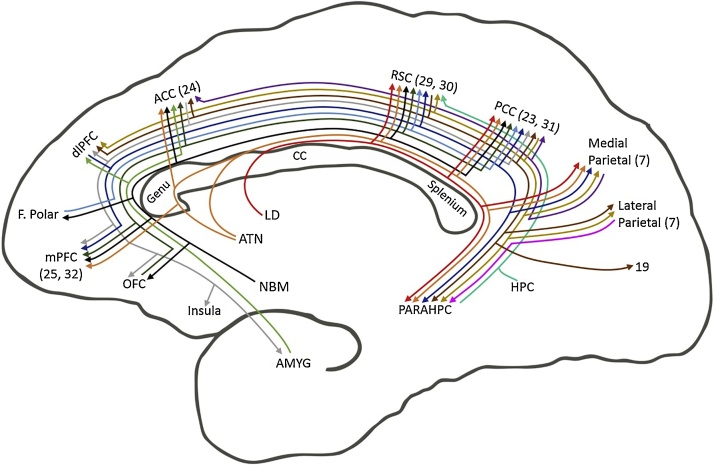
- The cingulum contains short and long sagittal association fibres plus fibres radiating to cortical and subcortical sites; few, if any, connections extend its entire length. The authors recommend five subdivisions—subgenual, anterior cingulate, midcingulate, retrosplenial, and parahippocampal—based on Heilbronner and Haber (2014) plus the midcingulate area.
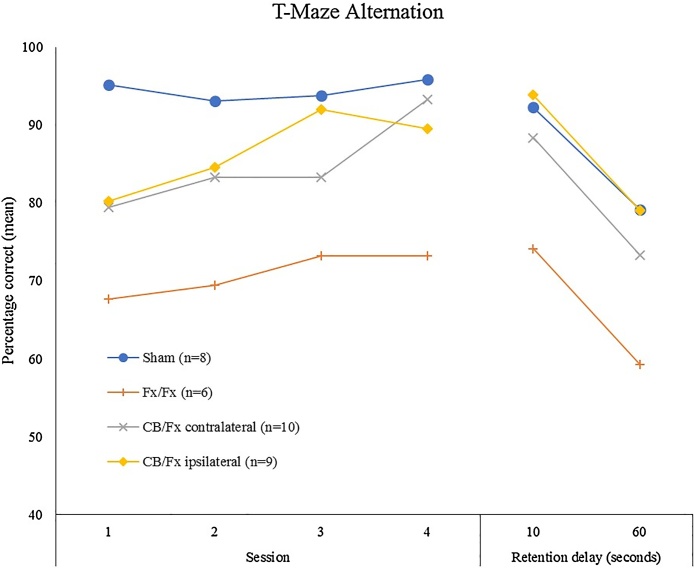
- Dorsal/anterior cingulum microstructure correlates with executive function and attention, while parahippocampal cingulum is more linked to memory. In rats, cingulum bundle lesions most consistently affect allocentric spatial tasks but are far less disruptive than anterior thalamic lesions, and fornix lesions produce more severe spatial memory deficits; crossed unilateral cingulum/fornix lesions had little or no apparent effect on T-maze alternation or radial-arm maze working memory (unpublished data), whereas bilateral fornix lesions severely disrupted both.
- dMRI studies commonly report reduced FA and increased diffusivity in the cingulum across schizophrenia, ADHD, depression, PTSD, OCD, and ASD, most consistently in OCD, ASD, and PTSD and concentrated in the dorsal cingulum. Cited meta-analytic/review figures include OCD: 22 datasets/537 cases; ASD: 33 studies, though a five-study meta-analysis found no significant cingulum FA difference; PTSD: seven studies with mixed FA increases/decreases.
- A prospective series of 198 cingulotomy cases reported lasting improvement in approximately half treated for OCD, with slightly better outcomes for anxiety/affective disorders, and over 50% of chronic pain patients had appreciable relief; cognition was often preserved, though attention/executive deficits were reported. The cingulum is one of the last major tracts to mature, with mean age to peak FA reported as 42 years.
Methods
- Narrative review; no primary data collection. It synthesizes cross-species axonal tracing (rat, macaque), lesion studies in rodents and nonhuman primates, human cingulotomy clinical literature, and human diffusion MRI/DTI studies.
- Evidence is organized into tables: Table 1 compares cingulum bundle lesion effects with anterior cingulate, retrosplenial, anterior thalamic, and fornix lesions; Table 2 lists dMRI findings in psychiatric conditions; Table 3 maps functions to cingulum subdivisions. Cited samples include 202 community adults, 220 healthy older adults, 257 healthy individuals aged 13–84, and 25 MCI patients vs 20 controls.
- Main analysis is qualitative synthesis and cross-species comparison, with a recommendation for five cingulum subdivisions and discussion of dMRI methodological limitations.
Limitations
- Paper-stated: dMRI is correlative, not causal; it cannot determine afferent/efferent direction; fibre crossing and tracking limitations can cause streamlines to jump pathways; CSF partial-volume effects can bias FA/MD; cingulum subdivisions and terminology are inconsistent. Lesion studies often lack verification of disconnection extent; cingulotomy literature often lacks formal post-operative assessments, controls, and blinding; no selective cingulum bundle lesions have been investigated in nonhuman primates, and selective parahippocampal cingulum pathology is lacking.
- Evident from text: as a narrative review, no systematic search or inclusion criteria are reported, and conclusions draw on heterogeneous studies and methods; some key crossed-lesion data are unpublished.
Model-written summary. Check it against the paper before relying on it.
Integrity signals
Registry
Cites
Statistics
Figures
Verification
Claims the paper makes
69 No full text of the sources · 46 Own interpretation · 40 Partly supported · 38 Supported · 38 Sources not found · 17 Supported so far · 17 Not checked yet · 17 No basis given · 6 Own method · 5 Couldn’t confirm · 3 Own result · 1 Not supported · accuracy not yet measured
At least one cited source doesn’t support this claim or points to a different paper, and none confirmed it — see the verdicts below.
In the paper
“In contrast, combat veterans with PTSD had increased cingulum FA (Davenport et al., 2015).”
§ The cingulum bundle: Anatomy, function, and dysfunction > Diffusion MRI (dMRI) studies of the human cingulum bundle > Post-Traumatic stress disorder
What the sources say
- Disputedcites Davenport et al., 2015 sourceExperimental — accuracy not yet measured
The Voxelwise Comparisons section reports higher GFA in a cluster including the cingulum, but states that PTSD effects on FA were not significant. The Conclusion likewise identifies higher GFA—not FA—in the bilateral cingulum. The claim substitutes FA for the measure on which the paper found an increase. (LLM, conf=0.88)
Checked by a reasoning model — may be wrong.
plaincorrelational- Asserted: passes — The authors put it forward as true.
- Checkable: passes — It can be checked against evidence.
- Load-bearing: unclear — It is unclear whether the paper’s conclusions depend on it.
- Based: passes — The paper gives a reason why it holds.
- Disputed
The cited sources support only part of this claim — read each source’s verdict below.
In the paper
“Consequently, few, if any, connections extend the entire length of the tract (Heilbronner and Haber, 2014).”
§ The cingulum bundle: Anatomy, function, and dysfunction > Structure & connections > Structure
What the sources say
- Partly supportedcites Heilbronner and Haber, 2014 sourceExperimental — accuracy not yet measured
The Abstract (page unavailable) says many brain regions send projections through only part of the cingulum bundle, supporting the general point that connections need not span it. But “few, if any” is stronger than the paper establishes: the Segmenting the CB section (page unavailable) says many fibers travel through all four segments, without establishing how many individual connections traverse the tract’s full length. (LLM, conf=0.81)
hedged- Asserted: passes — The authors put it forward as true.
- Checkable: passes — It can be checked against evidence.
- Load-bearing: unclear — It is unclear whether the paper’s conclusions depend on it.
- Based: passes — The paper gives a reason why it holds.
- Partly supported
The sources with a verdict support this claim; the rest weren’t checked yet, have no full text we could read, or their verdicts aren’t rated yet.
In the paper
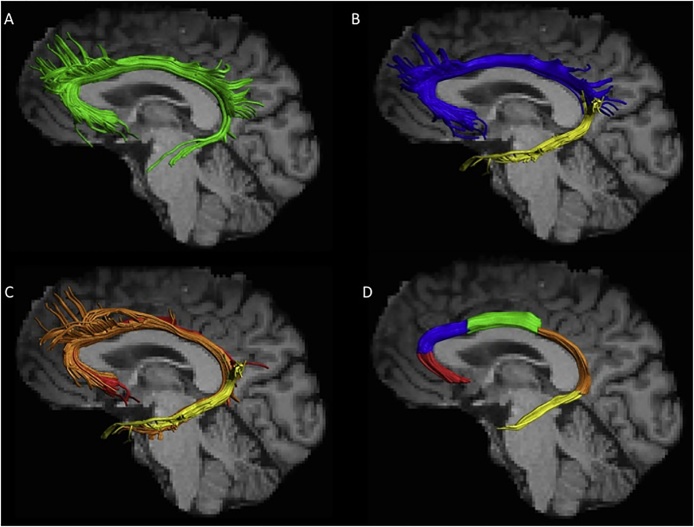
“Initial DTI tractography studies portrayed the cingulum as a unitary bundle (e.g., Catani et al., 2002; Xie et al., 2005; see Fig. 6A).”
§ The cingulum bundle: Anatomy, function, and dysfunction > Structure & connections > Connections
What the sources say
- Supportedcites Catani et al., 2002 source
The Long Association (Intrahemispheric) Fibers section describes one reconstructed trajectory of the cingulum, and Figure 10 presents it as the left cingulum. The paper distinguishes long and short fibers within that tract, but does not portray them as separate bundles. Page numbers are unavailable in our copy. (LLM, conf=0.87)
- Not checked — no full text of the sourcecites Xie et al., 2005 source
- Not matchedcites Fig. 6A
Couldn’t be matched to a paper in Crossref, so it can’t be checked.
plain- Asserted: passes — The authors put it forward as true.
- Checkable: passes — It can be checked against evidence.
- Load-bearing: unclear — It is unclear whether the paper’s conclusions depend on it.
- Based: passes — The paper gives a reason why it holds.
- Supported
Every source the paper cites for this claim was checked and supports it.
In the paper
“However, to better reflect its changing anatomical properties, reconstructions increasingly distinguished between the ‘dorsal’ and ‘ventral’ cingulum, i.e., above or below the splenium (e.g., Budisavljevic et al., 2015; Fig. 6B) which roughly corresponds to the distinction between cingulum cingulate gyrus and cingulum angular bundle (e.g., Ezzati et al., 2016).”
§ The cingulum bundle: Anatomy, function, and dysfunction > Structure & connections > Connections
What the sources say
- Supportedcites Budisavljevic et al., 2015 source
Split into 2 atoms — 2 confirmed, 0 partially supported, 0 disputed, 0 misattributed, 0 unverifiable. Expand the claim to see per-atom verdicts.
- Supportedcites Ezzati et al., 2016 source
Split into 2 atoms — 2 confirmed, 0 partially supported, 0 disputed, 0 misattributed, 0 unverifiable. Expand the claim to see per-atom verdicts.
plaincorrelational- Asserted: passes — The authors put it forward as true.
- Checkable: passes — It can be checked against evidence.
- Load-bearing: unclear — It is unclear whether the paper’s conclusions depend on it.
- Based: passes — The paper gives a reason why it holds.
- Supported
Every source the paper cites for this claim was checked and supports it.
In the paper
“there is a marked extension as the tract contains some fibres from across almost all parts of the prefrontal cortex (Heilbronner and Haber, 2014)”
§ The cingulum bundle: Anatomy, function, and dysfunction > Structure & connections > Connections
What the sources say
- Supportedcites Heilbronner and Haber, 2014 source
The Results sections on frontal polar, orbitofrontal, and dorsal and lateral frontal cortex describe fibres from multiple prefrontal regions travelling through the cingulum bundle. The Summary of noncingulate cortical fibers confirms this broad frontal contribution while noting that different fibres use different portions of the bundle. Page numbers are not provided in our copy. (LLM, conf=0.90)
plain- Asserted: passes — The authors put it forward as true.
- Checkable: passes — It can be checked against evidence.
- Load-bearing: unclear — It is unclear whether the paper’s conclusions depend on it.
- Based: passes — The paper gives a reason why it holds.
- Supported
Every source the paper cites for this claim was checked and supports it.
In the paper
“Accordingly, Heilbronner and Haber (2014) used monkey connectivity to help subdivide the primate cingulum into four divisions; subgenual, rostral dorsal (anterior cingulate), caudal dorsal (retrosplenial), and temporal (parahippocampal).”
§ The cingulum bundle: Anatomy, function, and dysfunction > Structure & connections > Connections
What the sources say
- Supportedcites Heilbronner and Haber, 2014 source
In “Segmenting the CB” (page unavailable), the authors say they used connections through the bundle to divide it into four portions: rostral subgenual, rostral dorsal, caudal dorsal, and temporal. The Introduction (page unavailable) specifies that they identified those connections in monkeys. The citing sentence paraphrases that division. (LLM, conf=0.93)
hedged- Asserted: passes — The authors put it forward as true.
- Checkable: passes — It can be checked against evidence.
- Load-bearing: passes — The paper’s conclusions depend on it.
- Based: passes — The paper gives a reason why it holds.
- Supported
The cited sources support only part of this claim — read each source’s verdict below.
In the paper
“Furthermore, some dMRI studies have added additional cingulum subdivisions (Kennis et al., 2016; Metzler-Baddeley et al., 2012b; Whitford et al., 2014).”
§ The cingulum bundle: Anatomy, function, and dysfunction > Structure & connections > Connections
What the sources say
- Supportedcites Kennis et al., 2016 source
The Material and methods > Statistical analyses passage lists five cingulum subdivisions—rostral, caudal, posterior, isthmus and hippocampal—compared using diffusion images. This supports citing the study as an example of dMRI research using additional cingulum subdivisions. The indexed passage provides no page number. (LLM, conf=0.92)
- Not matchedcites Metzler-Baddeley et al., 2012b
Couldn’t be matched to a paper in Crossref, so it can’t be checked.
- Supportedcites Whitford et al., 2014 source
The Materials and methods section describes using DTI tractography to extract five cingulum-bundle subcomponents, defined by the regions they connect. This supports citing Whitford et al. as an example of a dMRI study that used additional cingulum subdivisions. (LLM, conf=0.92)
plain- Asserted: passes — The authors put it forward as true.
- Checkable: passes — It can be checked against evidence.
- Load-bearing: unclear — It is unclear whether the paper’s conclusions depend on it.
- Based: passes — The paper gives a reason why it holds.
- Supported
The cited sources support only part of this claim — read each source’s verdict below.
In the paper
“For this reason, it is difficult to interpret differences/changes in FA and diffusivity metrics in terms of any specific biophysical property of white matter (Wheeler-Kingshott and Cercignani, 2009; Jones, 2010).”
§ The cingulum bundle: Anatomy, function, and dysfunction > Structure & connections > Connections
What the sources say
- Supportedcites Wheeler-Kingshott and Cercignani, 2009 source
The Discussion says it is extremely difficult to associate changes in DTI-derived parameters unambiguously with specific biophysical changes. The paper identifies FA as a DTI-derived parameter, although its detailed caution focuses on axial and radial diffusivities. Page numbers are not available in the supplied copy. (LLM, conf=0.89)
- Not matchedcites Jones, 2010
Couldn’t be matched to a paper in Crossref, so it can’t be checked.
plain- Asserted: passes — The authors put it forward as true.
- Checkable: passes — It can be checked against evidence.
- Load-bearing: unclear — It is unclear whether the paper’s conclusions depend on it.
- Based: passes — The paper gives a reason why it holds.
- Supported
Every source the paper cites for this claim was checked and supports it.
In the paper
“Similar lesions also affect effort-based decision making (Walton et al., 2002).”
§ The cingulum bundle: Anatomy, function, and dysfunction > Functional analyses of the cingulum bundle – lesion analyses > Rodent studies
What the sources say
- Supportedcites Walton et al., 2002 source
The Discussion reports a profound change in effort-based decision making in rats with medial frontal cortex lesions: after surgery, they shifted from choosing the high-reward arm to choosing the low-reward arm. This directly supports the cited claim. (LLM, conf=0.95)
plaindirect- Asserted: passes — The authors put it forward as true.
- Checkable: passes — It can be checked against evidence.
- Load-bearing: unclear — It is unclear whether the paper’s conclusions depend on it.
- Based: passes — The paper gives a reason why it holds.
- Supported
The cited sources support only part of this claim — read each source’s verdict below.
In the paper
“Lesions of the anterior cingulate cortex disrupt performance on the 5-Choice Serial Reaction Time Task (5-CSRTT) (Dalley et al., 2004)”
§ The cingulum bundle: Anatomy, function, and dysfunction > Functional analyses of the cingulum bundle – lesion analyses > Rodent studies
What the sources say
- Partly supportedcites Dalley et al., 2004 sourceExperimental — accuracy not yet measured
The Introduction (page unavailable) reports that lesions of the entire medial prefrontal cortex disrupt 5-CSRT task performance, but it does not establish that lesions specifically of the anterior cingulate cortex do so. It also reports performance changes after lesions that spare the anterior cingulate cortex. The paper’s own results concern cholinergic lesions of the medial prefrontal cortex, not isolated anterior cingulate lesions. (LLM, conf=0.86)
plaindirect- Asserted: passes — The authors put it forward as true.
- Checkable: passes — It can be checked against evidence.
- Load-bearing: passes — The paper’s conclusions depend on it.
- Based: passes — The paper gives a reason why it holds.
- Partly supported
Every source the paper cites for this claim was checked and supports it.
In the paper
“Related evidence comes from the disruptive effects of medial frontal lesions when switching between stimulus classes (‘extra-dimensional shift’) during serial discriminations (Birrell and Brown, 2000).”
§ The cingulum bundle: Anatomy, function, and dysfunction > Functional analyses of the cingulum bundle – lesion analyses > Rodent studies
What the sources say
- Supportedcites Birrell and Brown, 2000 source
The ID versus ED shifts section reports that medial frontal cortex lesions selectively impaired the extra-dimensional shift, in which rats switched attention to a previously irrelevant perceptual dimension. The Discussion likewise identifies a selective ED-shift impairment in rats with medial frontal lesions. (LLM, conf=0.94)
plaindirect- Asserted: passes — The authors put it forward as true.
- Checkable: passes — It can be checked against evidence.
- Load-bearing: unclear — It is unclear whether the paper’s conclusions depend on it.
- Based: passes — The paper gives a reason why it holds.
- Supported
Every source the paper cites for this claim was checked and supports it.
In the paper
“The finding that electrical stimulation of the cingulum bundle reduces formalin-test pain (Fuchs et al., 1996) was interpreted as a disruption of patterned activity that would normally signal pain.”
§ The cingulum bundle: Anatomy, function, and dysfunction > Functional analyses of the cingulum bundle – lesion analyses > Rodent studies
What the sources say
- Supportedcites Fuchs et al., 1996 source
The Discussion (pp. 121–122) reports that cingulum-bundle stimulation significantly decreased formalin pain responses in rats. It also offers disruption of patterned neural activity as a possible explanation, consistent with the citing sentence’s description of an interpretation. (LLM, conf=0.94)
plaindirect- Asserted: passes — The authors put it forward as true.
- Checkable: passes — It can be checked against evidence.
- Load-bearing: unclear — It is unclear whether the paper’s conclusions depend on it.
- Based: passes — The paper gives a reason why it holds.
- Supported
Every source the paper cites for this claim was checked and supports it.
In the paper
“but did disrupt the retention of these discriminations (Buckley and Mitchell, 2016).”
§ The cingulum bundle: Anatomy, function, and dysfunction > Functional analyses of the cingulum bundle – lesion analyses > Nonhuman primates (macaque monkeys)
What the sources say
- Supportedcites Buckley and Mitchell, 2016 source
The Materials and Methods section says the researchers used an aspirator to remove tissue in and around the retrosplenial cortex. The Discussion reports that this damage impaired postoperative retention of previously learned object-in-place scene discriminations in monkeys. (LLM, conf=0.94)
plaindirect- Asserted: passes — The authors put it forward as true.
- Checkable: passes — It can be checked against evidence.
- Load-bearing: passes — The paper’s conclusions depend on it.
- Based: passes — The paper gives a reason why it holds.
- Supported
The cited sources support only part of this claim — read each source’s verdict below.
In the paper
“Aspiration lesions centred on retrosplenial cortex also spared the acquisition of scene discriminations (Buckley and Mitchell, 2016; see also Parker and Gaffan, 1997)”
§ The cingulum bundle: Anatomy, function, and dysfunction > Functional analyses of the cingulum bundle – lesion analyses > Nonhuman primates (macaque monkeys)
What the sources say
- Supportedcites Buckley and Mitchell, 2016 source
The Materials and Methods describe aspiration lesions targeting retrosplenial cortex. In Results, Experiment 3, lesioned monkeys did not differ significantly from controls in acquiring 100 new object-in-place scene discriminations; the Discussion also describes new learning as intact. Page numbers are unavailable in our copy. (LLM, conf=0.93)
- Not matchedcites Parker and Gaffan, 1997
Couldn’t be matched to a paper in Crossref, so it can’t be checked.
plain- Asserted: passes — The authors put it forward as true.
- Checkable: passes — It can be checked against evidence.
- Load-bearing: passes — The paper’s conclusions depend on it.
- Based: passes — The paper gives a reason why it holds.
- Supported
Every source the paper cites for this claim was checked and supports it.
In the paper
“Using the latter information, Heilbronner and Haber (2014) concluded that typical cingulotomies compromise a great many fibres in the supracallosal cingulum bundle, involving a wide variety of cortical and subcortical sites, including both amygdala and anterior thalamic fibres.”
§ The cingulum bundle: Anatomy, function, and dysfunction > Functional analyses of the cingulum bundle – lesion analyses > Humans - cingulotomy
What the sources say
- Supportedcites Heilbronner and Haber, 2014 source
In “Neurotherapeutic target placement,” the authors model the range of cingulotomy lesions and conclude that the lesion would ablate substantial cingulate, noncingulate cortical, and subcortical fibers. They specifically identify its location as containing both amygdala and AV/LD thalamic fibers. The passage does not provide a page number. (LLM, conf=0.93)
plaindirect- Asserted: passes — The authors put it forward as true.
- Checkable: passes — It can be checked against evidence.
- Load-bearing: passes — The paper’s conclusions depend on it.
- Based: passes — The paper gives a reason why it holds.
- Supported
The cited sources support only part of this claim — read each source’s verdict below.
In the paper
“In one of the very few such studies, removal of the supracallosal parts of areas 29, 30 and 23 (Mansouri et al., 2015) had no apparent effect on a computerised version of the WCST”
§ The cingulum bundle: Anatomy, function, and dysfunction > Functional analyses of the cingulum bundle – lesion analyses > Nonhuman primates (macaque monkeys)
What the sources say
- Partly supportedcites Mansouri et al., 2015 sourceExperimental — accuracy not yet measured
The WCST results and Discussion report that posterior-cingulate-lesioned monkeys were unimpaired on the computerized WCST analog. The Results describe lesions of the posterior cingulate cortex extending into area 31, with only some damage to the anterior portions of areas 29 and 30; they do not establish removal of the specified supracallosal parts of areas 29, 30, and 23. (LLM, conf=0.84)
hedged- Asserted: passes — The authors put it forward as true.
- Checkable: passes — It can be checked against evidence.
- Load-bearing: passes — The paper’s conclusions depend on it.
- Based: passes — The paper gives a reason why it holds.
- Partly supported
The sources with a verdict support this claim; the rest weren’t checked yet, have no full text we could read, or their verdicts aren’t rated yet.
In the paper
“This placement is interesting as it should affect medial prefrontal, anterior cingulate, and amygdala interactions thought to be involved in emotion and cognitive processing (Heilbronner and Haber, 2014; Steele and Lawrie, 2004).”
§ The cingulum bundle: Anatomy, function, and dysfunction > Functional analyses of the cingulum bundle – lesion analyses > Humans - cingulotomy
What the sources say
- Supportedcites Heilbronner and Haber, 2014 source
The “Neurosurgical interventions for psychiatric disorders” section says cingulotomy lesions are positioned to interrupt connections linking the amygdala and prefrontal cortices with cingulate and dorsomedial frontal cortex. It also describes the dorsal anterior cingulate and dorsomedial frontal cortex as linking affective and cognitive-control systems. The precise placement behind the genu is the citing authors’ framing, not a location established by this source. (LLM, conf=0.89)
- Not checked — no full text of the sourcecites Steele and Lawrie, 2004 source
plainconditionaln = 8- Asserted: passes — The authors put it forward as true.
- Checkable: passes — It can be checked against evidence.
- Load-bearing: passes — The paper’s conclusions depend on it.
- Based: passes — The paper gives a reason why it holds.
- Supported
The cited sources support only part of this claim — read each source’s verdict below.
In the paper
“Concerning apathy, it is the case that limbic-frontal-subcortical circuits are frequently implicated in the pathophysiology of this condition in clinical populations (van Reekum et al., 2005; Kos et al., 2016).”
§ The cingulum bundle: Anatomy, function, and dysfunction > Functional analyses of the cingulum bundle – lesion analyses > Humans - cingulotomy
What the sources say
- Not checked — no full text of the sourcecites van Reekum et al., 2005 source
- Partly supportedcites Kos et al., 2016 sourceExperimental — accuracy not yet measured
The indexed Abstract reports that abnormalities in fronto-striatal circuits are most consistently associated with apathy across neurological and psychiatric conditions. This supports the frontal-subcortical and clinical-population portions of the claim, but the passage does not identify a limbic component of those circuits. (LLM, conf=0.82)
plaincorrelational- Asserted: passes — The authors put it forward as true.
- Checkable: passes — It can be checked against evidence.
- Load-bearing: passes — The paper’s conclusions depend on it.
- Based: passes — The paper gives a reason why it holds.
Every source the paper cites for this claim was checked and supports it.
In the paper
“Across differing underlying pathologies and neuroimaging methods, the anterior cingulate cortex, orbital frontal cortex, and medial thalamus exhibit some of the most robust changes associated with apathy (Le Heron et al., 2018).”
§ The cingulum bundle: Anatomy, function, and dysfunction > Functional analyses of the cingulum bundle – lesion analyses > Humans - cingulotomy
What the sources say
- Supportedcites Le Heron et al., 2018 source
The ‘Summary: common themes across diseases’ section says that studies across pathologies and imaging techniques consistently associate apathy with changes involving the ACC, OFC, and medial thalamus. The Alzheimer’s disease summary calls ACC and OFC the most robust cortical associations and medial thalamus one of the strongest subcortical associations. Page numbers are not provided in our copy. (LLM, conf=0.92)
plaincorrelational- Asserted: passes — The authors put it forward as true.
- Checkable: passes — It can be checked against evidence.
- Load-bearing: passes — The paper’s conclusions depend on it.
- Based: passes — The paper gives a reason why it holds.
- Supported
The sources with a verdict support this claim; the rest weren’t checked yet, have no full text we could read, or their verdicts aren’t rated yet.
In the paper
“This overall pattern is continued in clinical brain imaging studies as correlations between executive functions and cingulum white matter properties have been reported in depression (with DTI in Schermuly et al., 2010), in bipolar disorder (with DTI in Poletti et al., 2015; with Positron Emission Tomography in Li et al., 2012), and schizophrenia (with DTI in Kubicki et al., 2009; Takei et al., 200”
§ The cingulum bundle: Anatomy, function, and dysfunction > Diffusion MRI (dMRI) studies of the human cingulum bundle > Executive function and memory
What the sources say
- Not checked — no full text of the sourcecites Schermuly et al., 2010 source
- Not checked — no full text of the sourcecites Poletti et al., 2015 source
- Supportedcites Kubicki et al., 2009 source
The Kubicki et al. citation is attached to the schizophrenia portion of the sentence, not the depression or bipolar-disorder portions. The Discussion (page not provided) reports that, in patients with schizophrenia, Stroop reaction times and the Stroop effect correlated with left cingulum bundle fractional anisotropy, a DTI measure of white matter integrity. (LLM, conf=0.94)
plaincorrelational- Asserted: passes — The authors put it forward as true.
- Checkable: passes — It can be checked against evidence.
- Load-bearing: unclear — It is unclear whether the paper’s conclusions depend on it.
- Based: passes — The paper gives a reason why it holds.
Every source the paper cites for this claim was checked and supports it.
In the paper
“The cingulum is affected in many neurological conditions, including multiple sclerosis, Parkinson’s disease, the behavioural variant of frontemporal dementia (Mahoney et al., 2014), Mild Cognitive Impairment (MCI), and Alzheimer’s disease (AD).”
§ The cingulum bundle: Anatomy, function, and dysfunction > Diffusion MRI (dMRI) studies of the human cingulum bundle > Introduction
What the sources say
- Supportedcites Mahoney et al., 2014 source
The citation is attached to behavioural variant frontotemporal dementia, not to the other listed conditions. The Discussion (page not provided) reports prominent cingulum-bundle involvement in patients with bvFTD compared with healthy older individuals. (LLM, conf=0.93)
plaincorrelational- Asserted: passes — The authors put it forward as true.
- Checkable: passes — It can be checked against evidence.
- Load-bearing: unclear — It is unclear whether the paper’s conclusions depend on it.
- Based: passes — The paper gives a reason why it holds.
- Supported
The cited sources support only part of this claim — read each source’s verdict below.
In the paper
“A well-replicated finding concerns microstructural changes in the posterior and parahippocampal cingulum associated with both MCI and AD (Bozzali et al., 2012; Choo et al., 2010; Metzler-Baddeley et al., 2012a; Remy et al., 2015; Wang et al., 2017; Zhang et al., 2007; Zhuang et al., 2012; 2013, for review see Chua et al., 2008; Yu et al., 2017).”
§ The cingulum bundle: Anatomy, function, and dysfunction > Diffusion MRI (dMRI) studies of the human cingulum bundle > Mild cognitive impairment (MCI) and Alzheimer’s disease (AD)
What the sources say
- Partly supportedcites Bozzali et al., 2012 sourceExperimental — accuracy not yet measured
The Discussion and ‘WM Damage to the Cingulum Bundles’ results report altered diffusion measures in the cingulum in both AD and amnestic MCI, supporting the central association. The passages describe widespread or diffuse changes, but do not establish that both the posterior and parahippocampal segments are specifically affected in both groups; the reported parahippocampal gray-matter findings are distinct from changes in that cingulum segment. Page numbers are unavailable in our copy. (LLM, conf=0.78)
- Not checked — no full text of the sourcecites Choo et al., 2010 source
- Not matchedcites Metzler-Baddeley et al., 2012a
Couldn’t be matched to a paper in Crossref, so it can’t be checked.
boostedcorrelational- Asserted: passes — The authors put it forward as true.
- Checkable: passes — It can be checked against evidence.
- Load-bearing: unclear — It is unclear whether the paper’s conclusions depend on it.
- Based: passes — The paper gives a reason why it holds.
- Rests on an assumption: Amnestic MCI is often considered a prodromal condition for AD.
- Partly supported
The cited sources support only part of this claim — read each source’s verdict below.
In the paper
“In contrast to the evidence from healthy populations, correlations between cingulum microstructure and memory are more often described within clinical groups, e.g., in cerebral small vessel disease (van der Holst et al., 2013), mild traumatic injury (Wu et al., 2010), Mild Cognitive Impairment (e.g., Metzler-Baddeley et al., 2012a, b, for meta-analysis see Yu et al., 2017) and Alzheimer’s disease”
§ The cingulum bundle: Anatomy, function, and dysfunction > Diffusion MRI (dMRI) studies of the human cingulum bundle > Executive function and memory
What the sources say
- Supportedcites van der Holst et al., 2013 source
The Discussion (page not provided) reports a relationship between cingulum microstructural integrity and verbal memory performance in 503 non-demented elderly people with cerebral small vessel disease. This supports the clinical-group example attributed to this citation; the other conditions have separate citations. (LLM, conf=0.94)
- Not matchedcites Wu et al., 2010
Couldn’t be matched to a paper in Crossref, so it can’t be checked.
- Not matchedcites Yu et al., 2017
Couldn’t be matched to a paper in Crossref, so it can’t be checked.
plaincorrelational- Asserted: passes — The authors put it forward as true.
- Checkable: passes — It can be checked against evidence.
- Load-bearing: unclear — It is unclear whether the paper’s conclusions depend on it.
- Based: passes — The paper gives a reason why it holds.
- Supported
The sources with a verdict support this claim; the rest weren’t checked yet, have no full text we could read, or their verdicts aren’t rated yet.
In the paper
“Diffusion imaging studies have revealed an extended period of cingulum maturation through adolescence and beyond, often not reaching its adult characteristics until the mid twenties or later (Lebel and Beaulieu, 2011; Lebel et al., 2012).”
§ The cingulum bundle: Anatomy, function, and dysfunction > Diffusion MRI (dMRI) studies of the human cingulum bundle > Introduction
What the sources say
- Supportedcites Lebel and Beaulieu, 2011 source
The Discussion reports continued cingulum maturation beyond adolescence: approximately 40% of subjects aged 22–32 had decreasing mean diffusivity between scans. The Tract volume section also reports volume increases in 40–53% of the oldest subjects. These findings support the claim that cingulum characteristics can continue developing into the mid-twenties or later, though the paper does not define a precise age at which they become adult characteristics. (LLM, conf=0.88)
- Not checked — no full text of the sourcecites Lebel et al., 2012 source
plain- Asserted: passes — The authors put it forward as true.
- Checkable: passes — It can be checked against evidence.
- Load-bearing: unclear — It is unclear whether the paper’s conclusions depend on it.
- Based: passes — The paper gives a reason why it holds.
- Supported
Every source the paper cites for this claim was checked and supports it.
In the paper
“Nevertheless, correlations between episodic memory and left parahippocampal cingulum FA that were independent of hippocampal volume were also found in non-dementing elderly adults (Ezzati et al., 2016).”
§ The cingulum bundle: Anatomy, function, and dysfunction > Diffusion MRI (dMRI) studies of the human cingulum bundle > Executive function and memory
What the sources say
- Supportedcites Ezzati et al., 2016 source
The Abstract reports that, in non-demented adults over 70, left cingulum angular (parahippocampal) bundle FA and left hippocampal volume were each independently associated with verbal episodic memory. The Discussion likewise identifies lower left parahippocampal bundle FA as associated with poorer verbal memory in non-demented older adults. (LLM, conf=0.94)
plaincorrelational- Asserted: passes — The authors put it forward as true.
- Checkable: passes — It can be checked against evidence.
- Load-bearing: unclear — It is unclear whether the paper’s conclusions depend on it.
- Based: passes — The paper gives a reason why it holds.
- Supported
Every source the paper cites for this claim was checked and supports it.
In the paper
“Indeed, the growing realisation that experience can alter white matter microstructure (Metzler-Baddeley et al., 2017; (McKenzie et al., 2014) Zatorre et al., 2012) highlights the problems of separating cause from effect.”
§ The cingulum bundle: Anatomy, function, and dysfunction > Diffusion MRI (dMRI) studies of the human cingulum bundle > Introduction
What the sources say
- Supportedcites Metzler-Baddeley et al., 2017 source
The Abstract reports white matter microstructural changes associated with adaptive working-memory training, relative to nonadaptive comparison activities. The Discussion likewise describes positive microstructural changes with adaptive training and negative changes with comparison activities, supporting the broad claim that experience can alter white matter microstructure. (LLM, conf=0.92)
- Supportedcites McKenzie et al., 2014 source
The Abstract states that learning a motor skill alters white-matter structure and reports MRI-detected changes after sensorimotor training. The ‘Running stimulates OP proliferation and OL production’ section also describes evidence that experience regulates cells involved in myelination. The paper notes that the histological basis of the MRI changes is not known, but the broad claim is supported. (LLM, conf=0.92)
- Supportedcites Zatorre et al., 2012 source
The Myelin section reports changes in white matter structure with learning and describes a rat training study in which corpus callosum imaging changes were associated with increased myelin staining. The Concluding remarks also identify experience-dependent changes in white matter, while noting that the cellular mechanisms underlying human imaging findings remain to be established. (LLM, conf=0.91)
plaindirect- Asserted: passes — The authors put it forward as true.
- Checkable: passes — It can be checked against evidence.
- Load-bearing: passes — The paper’s conclusions depend on it.
- Based: passes — The paper gives a reason why it holds.
- Supported
The cited sources support only part of this claim — read each source’s verdict below.
In the paper
“Compared with other limbic white matter pathways, correlations between white matter microstructure and episodic memory in healthy populations are much more reliably found for the fornix than the cingulum (e.g., Douet and Chang, 2015; Metzler-Baddeley et al., 2011; Rudebeck et al., 2009).”
§ The cingulum bundle: Anatomy, function, and dysfunction > Diffusion MRI (dMRI) studies of the human cingulum bundle > Executive function and memory
What the sources say
- Partly supportedcites Douet and Chang, 2015 sourceExperimental — accuracy not yet measured
The Introduction describes the fornix as a robust predictor of episodic memory performance, and “Normal development and aging of the fornix” reports correlations in healthy children and adults. Neither section establishes that these correlations are more reliably found for the fornix than for the cingulum. The indexed passages provide no page numbers. (LLM, conf=0.86)
- Supportedcites Metzler-Baddeley et al., 2011 source
The Results section reports significant correlations between fornix fractional anisotropy and all four memory components, but none between those components and parahippocampal cingulum fractional anisotropy. It also reports no significant cingulum–episodic-memory correlations after correction, though some trends remained. The Discussion describes the fornix association as specific in this normal population. (LLM, conf=0.90)
- Partly supportedcites Rudebeck et al., 2009 sourceExperimental — accuracy not yet measured
The Results (Imaging Results; page not provided) report a significant correlation between fornix microstructure and recollection in healthy participants. The paper does not establish that such correlations are more reliably found for the fornix than for the cingulum or other limbic pathways; its reported analyses focus on the fornix. (LLM, conf=0.85)
plaincorrelational- Asserted: passes — The authors put it forward as true.
- Checkable: passes — It can be checked against evidence.
- Load-bearing: unclear — It is unclear whether the paper’s conclusions depend on it.
- Based: passes — The paper gives a reason why it holds.
- Partly supported
The cited sources support only part of this claim — read each source’s verdict below.
In the paper
“Some of the evidence is consistent with an age-related gradient along the long axis of the cingulum, in which frontal parts of the bundle appear most affected (Catheline et al., 2010; Mårtensson et al., 2018; Sibilia et al., 2017; Yoon et al., 2008; see for review Chua et al., 2008).”
§ The cingulum bundle: Anatomy, function, and dysfunction > Diffusion MRI (dMRI) studies of the human cingulum bundle > Healthy aging of the cingulum bundle
What the sources say
- Not checked — no full text of the sourcecites Catheline et al., 2010 source
- Partly supportedcites Mårtensson et al., 2018 sourceExperimental — accuracy not yet measured
The indexed Abstract (no page given) reports that age-related changes differ between segments of the cingulate bundle, supporting variation along the tract. It does not say that frontal segments are the most affected, so the proposed direction of the gradient is not supported by our copy. (LLM, conf=0.82)
- Could not verifycites Sibilia et al., 2017 sourceExperimental — accuracy not yet measured
The available passages contain the title and publication metadata but no findings about which part of the cingulum is most affected. Searches for frontal, anterior–posterior, and age-related differences returned no results passage that could establish the claimed gradient. (LLM, conf=0.72)
hedgedcorrelational- Asserted: passes — The authors put it forward as true.
- Checkable: passes — It can be checked against evidence.
- Load-bearing: unclear — It is unclear whether the paper’s conclusions depend on it.
- Based: passes — The paper gives a reason why it holds.
The cited sources that could be checked couldn’t confirm or dispute this claim.
In the paper
“In the anterior portion of the cingulum, RD values increased from the age of 28.”
§ The cingulum bundle: Anatomy, function, and dysfunction > Diffusion MRI (dMRI) studies of the human cingulum bundle > Healthy aging of the cingulum bundle
What the sources say
- Could not verifycites Mårtensson et al., 2018 sourceExperimental — accuracy not yet measured
The available indexed passages (labeled Abstract; no page given) identify a paper about aging and the cingulum but do not report RD values or an age at which they began to increase. Searches for anterior cingulum, radial diffusivity, and age 28 found no passage addressing the specific claim. (LLM, conf=0.72)
plaindirectn = 257- Asserted: passes — The authors put it forward as true.
- Checkable: passes — It can be checked against evidence.
- Load-bearing: unclear — It is unclear whether the paper’s conclusions depend on it.
- Based: passes — The paper gives a reason why it holds.
- Could not verify
The cited sources support only part of this claim — read each source’s verdict below.
In the paper
“Lee et al. (2013) reported reduced FA in both the left and right cingulum of 17 first episode patients.”
§ The cingulum bundle: Anatomy, function, and dysfunction > Diffusion MRI (dMRI) studies of the human cingulum bundle > Schizophrenia and autism spectrum disorders (ASD)
What the sources say
- Partly supportedcites Lee et al. (2013) sourceExperimental — accuracy not yet measured
The Results (Fractional Anisotropy; page unavailable) report lower cingulum FA in first-episode schizophrenia patients than in healthy controls, and the Discussion (page unavailable) states that 17 patients were scanned. The available Results passages do not specify reduced FA in both the left and right cingulum, so the bilateral detail is not verified. (LLM, conf=0.83)
plainn = 17- Asserted: passes — The authors put it forward as true.
- Checkable: passes — It can be checked against evidence.
- Load-bearing: unclear — It is unclear whether the paper’s conclusions depend on it.
- Based: passes — The paper gives a reason why it holds.
- Partly supported
Every source the paper cites for this claim was checked and supports it.
In the paper
“reduced frontal and posterior cingulate interconnectivity, as measured from resting state fMRI, is one the most reported effects (Rane et al., 2015)”
§ The cingulum bundle: Anatomy, function, and dysfunction > Diffusion MRI (dMRI) studies of the human cingulum bundle > Schizophrenia and autism spectrum disorders (ASD)
What the sources say
- Supportedcites Rane et al., 2015 source
The Results (RS fMRI) report that reduced long-range connectivity involving the prefrontal cortex was the most frequently reported finding (ten studies), followed by the posterior cingulate cortex (eight studies). The Results (Combined Studies) also describe reduced connectivity specifically from the posterior cingulate cortex to the medial prefrontal cortex, though the review does not say that this particular connection was among the most frequently reported. (LLM, conf=0.87)
plaincorrelational- Asserted: passes — The authors put it forward as true.
- Checkable: passes — It can be checked against evidence.
- Load-bearing: unclear — It is unclear whether the paper’s conclusions depend on it.
- Based: passes — The paper gives a reason why it holds.
- Supported
The sources with a verdict support this claim; the rest weren’t checked yet, have no full text we could read, or their verdicts aren’t rated yet.
In the paper
“As CSF based partial volume effects are known to result in artificial FA reductions and MD increases (Alexander et al., 2001; Vos et al., 2011; Metzler-Baddeley et al., 2012a), differences between patients and controls may be overestimated and could potentially reflect atrophy rather than intrinsic white matter microstructural changes.”
§ The cingulum bundle: Anatomy, function, and dysfunction > Diffusion MRI (dMRI) studies of the human cingulum bundle > Mild cognitive impairment (MCI) and Alzheimer’s disease (AD)
What the sources say
- Supportedcites Alexander et al., 2001 source
The Simulations section (page not provided) reports that in the white-matter–CSF partial-volume model, tensor trace is high and anisotropy is low at low diffusion weighting. Trace divided by three is MD, so this supports the attributed MD increase and FA reduction. The paper notes that both effects depend strongly on diffusion weighting. (LLM, conf=0.90)
- Not checked — no full text of the sourcecites Vos et al., 2011 source
- Not matchedcites Metzler-Baddeley et al., 2012a
Couldn’t be matched to a paper in Crossref, so it can’t be checked.
boosteddirect- Asserted: passes — The authors put it forward as true.
- Checkable: passes — It can be checked against evidence.
- Load-bearing: passes — The paper’s conclusions depend on it.
- Based: passes — The paper gives a reason why it holds.
- Supported
The cited sources support only part of this claim — read each source’s verdict below.
In the paper
“Evidence that white matter, including the cingulum, is especially sensitive to the effects of aging in schizophrenia (Kochunov et al., 2013)”
§ The cingulum bundle: Anatomy, function, and dysfunction > Diffusion MRI (dMRI) studies of the human cingulum bundle > Schizophrenia and autism spectrum disorders (ASD)
What the sources say
- Partly supportedcites Kochunov et al., 2013 sourceExperimental — accuracy not yet measured
The Results (page unavailable) report accelerated age-related white-matter decline in schizophrenia, with numerically greater decline across all twelve tracts. They do not identify the cingulum as especially sensitive: the regional Results name five tracts with nominally significant age-by-diagnosis interactions, and the cingulum is not among them. (LLM, conf=0.83)
plaincorrelational- Asserted: passes — The authors put it forward as true.
- Checkable: passes — It can be checked against evidence.
- Load-bearing: unclear — It is unclear whether the paper’s conclusions depend on it.
- Based: passes — The paper gives a reason why it holds.
- Partly supported
The cited sources support only part of this claim — read each source’s verdict below.
In the paper
“FA correlations were found between the right genu cingulum and hallucinations”
§ The cingulum bundle: Anatomy, function, and dysfunction > Diffusion MRI (dMRI) studies of the human cingulum bundle > Schizophrenia and autism spectrum disorders (ASD)
What the sources say
- Partly supportedcites Whitford et al., 2014 sourceExperimental — accuracy not yet measured
The Results report a significant negative correlation between hallucination severity and FA in the right I1 cingulum sub-connection in patients with schizophrenia. The Methods define I1 as fibers connecting the rostral and caudal anterior cingulate gyri, but the paper does not identify that sub-connection as the right genu cingulum. (LLM, conf=0.84)
plaincorrelational- Asserted: passes — The authors put it forward as true.
- Checkable: passes — It can be checked against evidence.
- Load-bearing: unclear — It is unclear whether the paper’s conclusions depend on it.
- Based: passes — The paper gives a reason why it holds.
- Partly supported
The sources with a verdict support this claim; the rest weren’t checked yet, have no full text we could read, or their verdicts aren’t rated yet.
In the paper
“In those ASD studies focussing on just the cingulum, reduced FA is again found (Ameis et al., 2013; Ikuta et al., 2014)”
§ The cingulum bundle: Anatomy, function, and dysfunction > Diffusion MRI (dMRI) studies of the human cingulum bundle > Schizophrenia and autism spectrum disorders (ASD)
What the sources say
- Not checked — no full text of the sourcecites Ameis et al., 2013 source
- Supportedcites Ikuta et al., 2014 source
The Results report significantly lower bilateral cingulum-bundle FA in the ASD group than in the neurotypical group (p = 0.032). The Introduction identifies the study’s focus as the cingulum bundle in adolescents and early adults. Page numbers are not provided in the supplied copy. (LLM, conf=0.94)
plaincorrelational- Asserted: passes — The authors put it forward as true.
- Checkable: passes — It can be checked against evidence.
- Load-bearing: unclear — It is unclear whether the paper’s conclusions depend on it.
- Based: passes — The paper gives a reason why it holds.
The cited sources support only part of this claim — read each source’s verdict below.
In the paper
“Arguably, more consistent cingulum FA correlations with executive function have been found in schizophrenia (Kubicki et al., 2009; Spalletta et al., 2014; Takei et al., 2009; see Table 2).”
§ The cingulum bundle: Anatomy, function, and dysfunction > Diffusion MRI (dMRI) studies of the human cingulum bundle > Schizophrenia and autism spectrum disorders (ASD)
What the sources say
- Partly supportedcites Kubicki et al., 2009 sourceExperimental — accuracy not yet measured
The Results (Correlation analyses) report significant correlations between left cingulum FA and Stroop reaction times and the Stroop effect in patients with schizophrenia. The paper compares those patients with healthy controls, not people with ASD, so it does not establish that the correlations are more consistent in schizophrenia than in ASD. (LLM, conf=0.86)
- Could not verifycites Spalletta et al., 2014 sourceExperimental — accuracy not yet measured
The Results report correlations between cingulum white-matter volume and metacognitive insight in patients with schizophrenia, not between cingulum fractional anisotropy (FA) and executive function. The Methods describe T1-weighted volumetric imaging, and the Discussion does not compare schizophrenia with ASD on the claimed correlation. Searches for cingulum FA, executive function, and ASD did not locate that comparison in our copy. (LLM, conf=0.76)
- Not checked — no full text of the sourcecites Takei et al., 2009 source
hedgedcorrelational- Asserted: passes — The authors put it forward as true.
- Checkable: passes — It can be checked against evidence.
- Load-bearing: unclear — It is unclear whether the paper’s conclusions depend on it.
- Based: passes — The paper gives a reason why it holds.
- Partly supported
Every source the paper cites for this claim was checked and supports it.
In the paper
“with radial diffusivity correlating with the severity of delusions of reference.”
§ The cingulum bundle: Anatomy, function, and dysfunction > Diffusion MRI (dMRI) studies of the human cingulum bundle > Schizophrenia and autism spectrum disorders (ASD)
What the sources say
- Supportedcites Fitzsimmons et al., 2014 source
The Discussion reports a significant correlation between cingulum bundle radial diffusivity and severity of delusions of reference in first-episode schizophrenia patients. It specifies that the correlation was negative; the claim does not assert a direction. (LLM, conf=0.95)
plaincorrelationaln = 18- Asserted: passes — The authors put it forward as true.
- Checkable: passes — It can be checked against evidence.
- Load-bearing: unclear — It is unclear whether the paper’s conclusions depend on it.
- Based: passes — The paper gives a reason why it holds.
- Supported
The sources with a verdict support this claim; the rest weren’t checked yet, have no full text we could read, or their verdicts aren’t rated yet.
In the paper
“Structural MRI studies indicate that cingulate cortex volume is reduced in ADHD (Amico et al., 2011; Makris et al., 2007)”
§ The cingulum bundle: Anatomy, function, and dysfunction > Diffusion MRI (dMRI) studies of the human cingulum bundle > Attention deficit hyperactivity disorder
What the sources say
- Not checked — no full text of the sourcecites Amico et al., 2011 source
- Supportedcites Makris et al., 2007 source
The Introduction reports that adults with ADHD had an anterior cingulate cortex (ACC) volume approximately 14% smaller than controls in a structural MRI study. Although this paper reports that finding from an earlier study rather than measuring ACC volume itself, it supports the citing sentence’s statement about what structural MRI studies indicate. (LLM, conf=0.92)
hedgedcorrelational- Asserted: passes — The authors put it forward as true.
- Checkable: passes — It can be checked against evidence.
- Load-bearing: unclear — It is unclear whether the paper’s conclusions depend on it.
- Based: passes — The paper gives a reason why it holds.
The sources with a verdict support this claim; the rest weren’t checked yet, have no full text we could read, or their verdicts aren’t rated yet.
In the paper
“Overall, there is a recurrent pattern of reduced FA and increased diffusivity, consistent with altered development (Ameis and Catani, 2015; Rane et al., 2015; Travers et al., 2012).”
§ The cingulum bundle: Anatomy, function, and dysfunction > Diffusion MRI (dMRI) studies of the human cingulum bundle > Schizophrenia and autism spectrum disorders (ASD)
What the sources say
- Not checked — no full text of the sourcecites Ameis and Catani, 2015 source
- Supportedcites Rane et al., 2015 source
The Results > DTI section says most reviewed studies found lower fractional anisotropy (FA) and higher mean diffusivity in ASD than in typically developing groups. The Discussion > Diffusion Connectivity calls this an overall pattern, while Discussion > Resting State Connectivity suggests altered childhood growth and pruning as a developmental explanation. Page numbers are unavailable in our copy. (LLM, conf=0.90)
- Supportedcites Travers et al., 2012 source
The Summary of Findings reports that children over four and young adults with ASD tend to have decreased FA, often accompanied by increased MD and RD. The Developmental Trajectory section describes age-related DTI differences that suggest atypical white-matter development in ASD. The review also notes exceptions, particularly in very young children, but the claim describes a recurrent pattern rather than a universal one; page numbers were not provided. (LLM, conf=0.91)
plaincorrelational- Asserted: passes — The authors put it forward as true.
- Checkable: passes — It can be checked against evidence.
- Load-bearing: passes — The paper’s conclusions depend on it.
- Based: passes — The paper gives a reason why it holds.
The cited sources support only part of this claim — read each source’s verdict below.
In the paper
“though other studies have failed to find clear cingulum correlations (Rane et al., 2015).”
§ The cingulum bundle: Anatomy, function, and dysfunction > Diffusion MRI (dMRI) studies of the human cingulum bundle > Schizophrenia and autism spectrum disorders (ASD)
What the sources say
- Partly supportedcites Rane et al., 2015 sourceExperimental — accuracy not yet measured
The Discussion (Synthesis; page unavailable) says connectivity changes have not yet been clearly correlated with behavioral findings, supporting the claim's general point. But the Results (Behavioral Findings; page unavailable) note a preponderance of reported behavioral correlations involving region pairs associated with the cingulum; the review does not specifically say that studies failed to find clear cingulum correlations. (LLM, conf=0.82)
plain- Asserted: passes — The authors put it forward as true.
- Checkable: passes — It can be checked against evidence.
- Load-bearing: unclear — It is unclear whether the paper’s conclusions depend on it.
- Based: passes — The paper gives a reason why it holds.
- Partly supported
The cited sources support only part of this claim — read each source’s verdict below.
In the paper
“reduced FA in the dorsal cingulum is also a frequent feature of ASD (Rane et al., 2015; Shukla et al., 2011; Travers et al., 2012; but see Aoki et al., 2013; Table 2).”
§ The cingulum bundle: Anatomy, function, and dysfunction > Diffusion MRI (dMRI) studies of the human cingulum bundle > Schizophrenia and autism spectrum disorders (ASD)
What the sources say
- Partly supportedcites Rane et al., 2015 sourceExperimental — accuracy not yet measured
The Results (DTI; page unavailable) identify the cingulum among the commonly reported regions with reduced fractional anisotropy in ASD, and the Discussion (Diffusion Connectivity; page unavailable) says it was not far behind the most reported regions. Neither passage specifies the dorsal cingulum, so the source supports the frequency claim for the cingulum generally but not that anatomical qualifier. (LLM, conf=0.87)
- Partly supportedcites Shukla et al., 2011 sourceExperimental — accuracy not yet measured
The Results report reduced FA in the cingulum in the ASD group, and the Discussion reiterates that finding. Neither passage identifies the affected portion as the dorsal cingulum or establishes how frequently this specific finding occurs in ASD. (LLM, conf=0.84)
- Partly supportedcites Travers et al., 2012 sourceExperimental — accuracy not yet measured
The “Group Differences in the Cingulum Bundle” section reports that multiple studies found decreased FA and/or increased MD in the anterior cingulum in ASD, and cautiously suggests that decreased cingulum FA may be common. The review supports a recurring cingulum finding, but it does not specifically establish reduced FA in the dorsal cingulum as a frequent feature. (LLM, conf=0.85)
plaincorrelational- Asserted: passes — The authors put it forward as true.
- Checkable: passes — It can be checked against evidence.
- Load-bearing: unclear — It is unclear whether the paper’s conclusions depend on it.
- Based: passes — The paper gives a reason why it holds.
- Partly supported
Every source the paper cites for this claim was checked and supports it.
In the paper
“Similarly, bilateral increases in both axial and radial cingulum diffusivity were found in 18 first episode cases (Fitzsimmons et al., 2014)”
§ The cingulum bundle: Anatomy, function, and dysfunction > Diffusion MRI (dMRI) studies of the human cingulum bundle > Schizophrenia and autism spectrum disorders (ASD)
What the sources say
- Supportedcites Fitzsimmons et al., 2014 source
The Abstract identifies 18 first-episode patients and reports bilateral increases in axial and radial cingulum diffusivity compared with matched controls. The Results likewise report bilateral increases for both measures. (LLM, conf=0.94)
plaindirectn = 18- Asserted: passes — The authors put it forward as true.
- Checkable: passes — It can be checked against evidence.
- Load-bearing: unclear — It is unclear whether the paper’s conclusions depend on it.
- Based: passes — The paper gives a reason why it holds.
- Supported
The cited sources support only part of this claim — read each source’s verdict below.
In the paper
“may account for the greater prevalence of cingulum changes in those with well-established psychotic states.”
§ The cingulum bundle: Anatomy, function, and dysfunction > Diffusion MRI (dMRI) studies of the human cingulum bundle > Schizophrenia and autism spectrum disorders (ASD)
What the sources say
- Partly supportedcites Kochunov et al., 2013 sourceExperimental — accuracy not yet measured
The Results and Discussion report accelerated white-matter aging in schizophrenia and greater vulnerability in some tracts. They do not establish a greater prevalence of cingulum changes in people with well-established psychotic states, or test whether accelerated aging accounts for that prevalence. (LLM, conf=0.85)
hedgedconditional- Asserted: passes — The authors put it forward as true.
- Checkable: passes — It can be checked against evidence.
- Load-bearing: passes — The paper’s conclusions depend on it.
- Based: passes — The paper gives a reason why it holds.
- Partly supported
Every source the paper cites for this claim was checked and supports it.
In the paper
“while right parahippocampal cingulum status correlated with negative symptoms (Whitford et al., 2014).”
§ The cingulum bundle: Anatomy, function, and dysfunction > Diffusion MRI (dMRI) studies of the human cingulum bundle > Schizophrenia and autism spectrum disorders (ASD)
What the sources say
- Supportedcites Whitford et al., 2014 source
The Results report that fractional anisotropy in the right I4 cingulum sub-connection was significantly negatively correlated with two negative-symptom subscales: affective flattening and anhedonia/asociality. The Discussion identifies right I4 as fibers connecting the cingulate isthmus with the parahippocampal cortex, matching the cited claim. (LLM, conf=0.94)
plaincorrelational- Asserted: passes — The authors put it forward as true.
- Checkable: passes — It can be checked against evidence.
- Load-bearing: unclear — It is unclear whether the paper’s conclusions depend on it.
- Based: passes — The paper gives a reason why it holds.
- Supported
Every source the paper cites for this claim was checked and supports it.
In the paper
“Such correlations were found for behavioural regulation scores (Ikuta et al., 2014)”
§ The cingulum bundle: Anatomy, function, and dysfunction > Diffusion MRI (dMRI) studies of the human cingulum bundle > Schizophrenia and autism spectrum disorders (ASD)
What the sources say
- Supportedcites Ikuta et al., 2014 source
The Results report a significant negative correlation between cingulum fractional anisotropy (FA) and the BRIEF Behavioral Regulation Index score in the ASD group. The correlation was not significant in the neurotypical group. (LLM, conf=0.94)
plaincorrelational- Asserted: passes — The authors put it forward as true.
- Checkable: passes — It can be checked against evidence.
- Load-bearing: unclear — It is unclear whether the paper’s conclusions depend on it.
- Based: passes — The paper gives a reason why it holds.
- Supported
Every source the paper cites for this claim was checked and supports it.
In the paper
“while resting state disturbances suggest either hyperconnectivity or hypoconnectivity (Konrad and Eickhoff, 2010).”
§ The cingulum bundle: Anatomy, function, and dysfunction > Diffusion MRI (dMRI) studies of the human cingulum bundle > Attention deficit hyperactivity disorder
What the sources say
- Supportedcites Konrad and Eickhoff, 2010 source
The “DMN in ADHD” section says that models describe ADHD in terms of either hyperconnectivity or hypoconnectivity of the default-mode network. It also notes that findings on resting-state DMN connectivity are inconsistent, matching the citing sentence’s cautious wording. (LLM, conf=0.91)
hedgedcorrelational- Asserted: passes — The authors put it forward as true.
- Checkable: passes — It can be checked against evidence.
- Load-bearing: unclear — It is unclear whether the paper’s conclusions depend on it.
- Based: passes — The paper gives a reason why it holds.
- Supported
Every source the paper cites for this claim was checked and supports it.
In the paper
“In a study of 19 adolescents with ADHD that focussed specifically on the cingulum (Cooper et al., 2015), ADHD severity was associated with the status of the left cingulum close to the genu”
§ The cingulum bundle: Anatomy, function, and dysfunction > Diffusion MRI (dMRI) studies of the human cingulum bundle > Attention deficit hyperactivity disorder
What the sources say
- Supportedcites Cooper et al., 2015 source
The Abstract Methods report 19 adolescents with ADHD, and the Introduction says the study focused on the subgenual cingulum, the rostral section near the anterior cingulate. The Results report a significant association between ADHD severity and fractional anisotropy in the left subgenual cingulum. Page numbers are not provided in our copy. (LLM, conf=0.93)
plaincorrelational- Asserted: passes — The authors put it forward as true.
- Checkable: passes — It can be checked against evidence.
- Load-bearing: unclear — It is unclear whether the paper’s conclusions depend on it.
- Based: passes — The paper gives a reason why it holds.
- Supported
Every source the paper cites for this claim was checked and supports it.
In the paper
“e.g., cingulum FA correlates with default-mode functional connectivity (van den Heuvel et al., 2008).”
§ The cingulum bundle: Anatomy, function, and dysfunction > Diffusion MRI (dMRI) studies of the human cingulum bundle > Overview of psychiatric conditions and the cingulum bundle
What the sources say
- Supportedcites van den Heuvel et al., 2008 source
The Results report a significant positive association between cingulum FA and unique default-mode PCC–MFC functional connectivity (r = 0.29, p < 0.05). An alternative age-adjusted analysis also found a significant association (r = 0.34, p < 0.05). (LLM, conf=0.92)
plaincorrelational- Asserted: passes — The authors put it forward as true.
- Checkable: passes — It can be checked against evidence.
- Load-bearing: unclear — It is unclear whether the paper’s conclusions depend on it.
- Based: passes — The paper gives a reason why it holds.
- Supported
Every source the paper cites for this claim was checked and supports it.
In the paper
“The lack of reliable cingulum bundle changes may relate to the need to separate different subtypes of ADHD”
§ The cingulum bundle: Anatomy, function, and dysfunction > Diffusion MRI (dMRI) studies of the human cingulum bundle > Attention deficit hyperactivity disorder
What the sources say
- Supportedcites Svatkova et al., 2016 source
The Introduction says that inconsistent ADHD diffusion-imaging findings may stem partly from previous studies not separating clinical presentations. The Discussion reports different cingulum-bundle findings for ADHD-C and ADHD-PI, supporting the suggested explanation for unreliable findings across ADHD groups. Page numbers are unavailable in our copy. (LLM, conf=0.90)
hedgedconditional- Asserted: passes — The authors put it forward as true.
- Checkable: passes — It can be checked against evidence.
- Load-bearing: passes — The paper’s conclusions depend on it.
- Based: passes — The paper gives a reason why it holds.
- Supported
The cited sources support only part of this claim — read each source’s verdict below.
In the paper
“alterations in the default mode network have been reported in schizophrenia (Öngür et al., 2010), ADHD (Konrad and Eickhoff, 2010), depression (Öngür et al., 2010; Zhu et al., 2012), PTSD (Bluhm et al., 2009), OCD (Peng et al., 2014), and ASD (Padmanabhan et al., 2017).”
§ The cingulum bundle: Anatomy, function, and dysfunction > Diffusion MRI (dMRI) studies of the human cingulum bundle > Overview of psychiatric conditions and the cingulum bundle
What the sources say
- Not matchedcites Öngür et al., 2010
Couldn’t be matched to a paper in Crossref, so it can’t be checked.
- Supportedcites Konrad and Eickhoff, 2010 source
The Konrad and Eickhoff citation is attached to ADHD, not to the other conditions in the sentence. The “DMN in ADHD” section reports altered functional connectivity within the default-mode network and reduced connectivity involving its nodes in patients with ADHD. (LLM, conf=0.93)
- Supportedcites Bluhm et al., 2009 source
The Bluhm et al. citation is attached specifically to PTSD, not to the other listed disorders. The paper’s Limitations section reports impaired resting-state default-network connectivity in patients with PTSD, supporting the claim that alterations have been reported; the study population was women with chronic PTSD related to early-life trauma. (LLM, conf=0.94)
plaincorrelational- Asserted: passes — The authors put it forward as true.
- Checkable: passes — It can be checked against evidence.
- Load-bearing: unclear — It is unclear whether the paper’s conclusions depend on it.
- Based: passes — The paper gives a reason why it holds.
- Not matched
Every source the paper cites for this claim was checked and supports it.
In the paper
“Meanwhile clusters of dMRI changes were most evident in the cingulum and the superior longitudinal fasciculus in a meta-analysis of adult onset PTSD from seven studies (Daniels et al., 2013).”
§ The cingulum bundle: Anatomy, function, and dysfunction > Diffusion MRI (dMRI) studies of the human cingulum bundle > Post-Traumatic stress disorder
What the sources say
- Supportedcites Daniels et al., 2013 source
The Meta-analysis section reports seven DTI studies of trauma-exposed adults and identifies clusters of fractional-anisotropy changes in both the cingulum and superior longitudinal fasciculus. It says the largest cluster was in the right cingulum. The authors caution that each cluster was reported by only one study, so the findings are preliminary. (LLM, conf=0.88)
plaincorrelational- Asserted: passes — The authors put it forward as true.
- Checkable: passes — It can be checked against evidence.
- Load-bearing: unclear — It is unclear whether the paper’s conclusions depend on it.
- Based: passes — The paper gives a reason why it holds.
- Supported
The cited sources support only part of this claim — read each source’s verdict below.
In the paper
“A recent study of noncombat PTSD sufferers, found reduced FA in cingulate white matter just above the genu (Olson et al., 2017).”
§ The cingulum bundle: Anatomy, function, and dysfunction > Diffusion MRI (dMRI) studies of the human cingulum bundle > Post-Traumatic stress disorder
What the sources say
- Partly supportedcites Olson et al., 2017 sourceExperimental — accuracy not yet measured
The Results (§3.1; page unavailable) report significantly lower FA in PTSD patients than in trauma-exposed controls in a left frontal cluster involving cingulate-gyrus fibers. The Discussion (§4; page unavailable) places the fibers near the rostral anterior cingulate cortex. The copy does not specify that the cluster was just above the genu, so that more precise location is not established. (LLM, conf=0.78)
plaincorrelational- Asserted: passes — The authors put it forward as true.
- Checkable: passes — It can be checked against evidence.
- Load-bearing: passes — The paper’s conclusions depend on it.
- Based: passes — The paper gives a reason why it holds.
- Partly supported
The cited sources support only part of this claim — read each source’s verdict below.
In the paper
“ADHD severity correlated with increased FA and reduced radial diffusivity (Cooper et al., 2015).”
§ The cingulum bundle: Anatomy, function, and dysfunction > Diffusion MRI (dMRI) studies of the human cingulum bundle > Attention deficit hyperactivity disorder
What the sources say
- Partly supportedcites Cooper et al., 2015 sourceExperimental — accuracy not yet measured
The Results report that greater ADHD severity was significantly associated with higher FA in the left subgenual cingulum, but the association with lower radial diffusivity was only a trend (p = 0.067). The Methods report 19 adolescents with ADHD were recruited; the Results clarify that two were excluded and the correlations used 17. (LLM, conf=0.92)
plaincorrelational- Asserted: passes — The authors put it forward as true.
- Checkable: passes — It can be checked against evidence.
- Load-bearing: unclear — It is unclear whether the paper’s conclusions depend on it.
- Based: passes — The paper gives a reason why it holds.
- Partly supported
Every source the paper cites for this claim was checked and supports it.
In the paper
“where more constrained cingulum diffusion can be positively correlated with the severity of symptoms (Cooper et al., 2015; but see also Chiang et al., 2016).”
§ The cingulum bundle: Anatomy, function, and dysfunction > Diffusion MRI (dMRI) studies of the human cingulum bundle > Overview of psychiatric conditions and the cingulum bundle
What the sources say
- Supportedcites Cooper et al., 2015 source
The Results report a significant positive correlation between ADHD symptom severity and fractional anisotropy in the left subgenual cingulum, supporting the claim’s cautious wording. The accompanying negative correlation with radial diffusivity was only a trend; no page number is available in our copy. (LLM, conf=0.92)
plaincorrelational- Asserted: passes — The authors put it forward as true.
- Checkable: passes — It can be checked against evidence.
- Load-bearing: unclear — It is unclear whether the paper’s conclusions depend on it.
- Based: passes — The paper gives a reason why it holds.
- Supported
The cited sources support only part of this claim — read each source’s verdict below.
In the paper
“In the right parahippocampal cingulum and right arcuate fasciculus these FA values related to autistic social-deficit symptoms.”
§ The cingulum bundle: Anatomy, function, and dysfunction > Diffusion MRI (dMRI) studies of the human cingulum bundle > Overview of psychiatric conditions and the cingulum bundle
What the sources say
- Partly supportedcites Chiang et al., 2017 sourceExperimental — accuracy not yet measured
The Results (Correlations with Clinical Measures in ASD) link the right arcuate fasciculus and right hippocampal cingulum to social-deficit subscale scores in men with ASD. However, the measured values were generalized fractional anisotropy (GFA), not FA; the Discussion distinguishes those metrics. (LLM, conf=0.88)
plaincorrelational- Asserted: passes — The authors put it forward as true.
- Checkable: passes — It can be checked against evidence.
- Load-bearing: unclear — It is unclear whether the paper’s conclusions depend on it.
- Based: passes — The paper gives a reason why it holds.
- Partly supported
The sources with a verdict support this claim; the rest weren’t checked yet, have no full text we could read, or their verdicts aren’t rated yet.
In the paper
“highlight the variable pattern of changes in which reduced FA in the cingulum is sometimes, but not consistently, reported (Makris et al., 2007; Pavuluri et al., 2009; Chiang et al., 2016; Table 2).”
§ The cingulum bundle: Anatomy, function, and dysfunction > Diffusion MRI (dMRI) studies of the human cingulum bundle > Attention deficit hyperactivity disorder
What the sources say
- Supportedcites Makris et al., 2007 source
The FA Differences section reports significantly lower FA in the right cingulum bundle in adults with childhood ADHD than in controls. Makris et al. therefore supports the ‘sometimes reported’ part of the multi-citation sentence; the sentence does not attribute the cross-study inconsistency to this paper alone. (LLM, conf=0.91)
- Supportedcites Pavuluri et al., 2009 source
The Results (DTI Data; page unavailable) report no significant FA difference in the cingulum (CG) among the ADHD, pediatric bipolar disorder, and control groups. This study therefore supports the cited sentence as an example in which reduced cingulum FA was not found; it does not itself establish how often other studies report it. (LLM, conf=0.90)
- Not checked — no full text of the sourcecites Chiang et al., 2016 source
plaincorrelational- Asserted: passes — The authors put it forward as true.
- Checkable: passes — It can be checked against evidence.
- Load-bearing: unclear — It is unclear whether the paper’s conclusions depend on it.
- Based: passes — The paper gives a reason why it holds.
- Supported
Every source the paper cites for this claim was checked and supports it.
In the paper
“While the largest cluster related to decreased FA in the right cingulum”
§ The cingulum bundle: Anatomy, function, and dysfunction > Diffusion MRI (dMRI) studies of the human cingulum bundle > Post-Traumatic stress disorder
What the sources say
- Supportedcites Daniels et al., 2013 source
The META-ANALYSIS section explicitly identifies the largest cluster as an FA decrease in the right cingulum in its analysis of trauma-exposed adults. It cautions that each cluster was reported by only one study, but that does not change the stated cluster finding. (LLM, conf=0.94)
plaincorrelational- Asserted: passes — The authors put it forward as true.
- Checkable: passes — It can be checked against evidence.
- Load-bearing: unclear — It is unclear whether the paper’s conclusions depend on it.
- Based: passes — The paper gives a reason why it holds.
- Supported
The cited sources support only part of this claim — read each source’s verdict below.
In the paper
“Dorsal cingulum changes occur in PTSD, as measured both by dMRI indices (Table 2) and tract volume (Daniels et al., 2013).”
§ The cingulum bundle: Anatomy, function, and dysfunction > Diffusion MRI (dMRI) studies of the human cingulum bundle > Post-Traumatic stress disorder
What the sources say
- Partly supportedcites Daniels et al., 2013 sourceExperimental — accuracy not yet measured
The Summary reports cingulum white-matter volume changes in studies of adult-onset PTSD, supporting the tract-volume part of the citation. It locates those changes in anterior or posterior cingulum sections, but does not identify a dorsal cingulum volume change. The paper's mention of a dorsal subregion concerns FA-based white-matter integrity, not tract volume; the citing sentence attributes its dMRI evidence to Table 2 rather than to Daniels et al. (LLM, conf=0.84)
plaincorrelational- Asserted: passes — The authors put it forward as true.
- Checkable: passes — It can be checked against evidence.
- Load-bearing: unclear — It is unclear whether the paper’s conclusions depend on it.
- Based: passes — The paper gives a reason why it holds.
- Partly supported
Every source the paper cites for this claim was checked and supports it.
In the paper
“ADHD offers a different profile where raised FA can be found in some tracts (Davenport et al., 2010)”
§ The cingulum bundle: Anatomy, function, and dysfunction > Diffusion MRI (dMRI) studies of the human cingulum bundle > Overview of psychiatric conditions and the cingulum bundle
What the sources say
- Supportedcites Davenport et al., 2010 source
The Discussion reports that the ADHD patients had higher FA in bilateral frontostriatal tracts, matching the claim that raised FA can occur in some tracts. It also locates both regions of abnormally high FA in the anterior corona radiata. (LLM, conf=0.94)
plaincorrelational- Asserted: passes — The authors put it forward as true.
- Checkable: passes — It can be checked against evidence.
- Load-bearing: unclear — It is unclear whether the paper’s conclusions depend on it.
- Based: passes — The paper gives a reason why it holds.
- Supported
The cited sources support only part of this claim — read each source’s verdict below.
In the paper
“In the case of military personnel, there is the contributing complication that blast exposure (without PTSD) can affect cingulum FA (e.g., Ivanov et al., 2017; MacDonald et al., 2011)”
§ The cingulum bundle: Anatomy, function, and dysfunction > Diffusion MRI (dMRI) studies of the human cingulum bundle > Post-Traumatic stress disorder
What the sources say
- Partly supportedcites Ivanov et al., 2017 sourceExperimental — accuracy not yet measured
The Results (Predicting FA Values; page not provided) report that greater blast exposure predicts lower cingulum FA in models that include PTSD symptom severity. But the Methods (Participants; page not provided) report that 42% of assessed veterans met PTSD criteria, so the study does not establish this finding specifically in personnel without PTSD. (LLM, conf=0.88)
- Partly supportedcites MacDonald et al., 2011 sourceExperimental — accuracy not yet measured
The Results (Findings on DTI and Conventional MRI; page unavailable) report cingulum abnormalities and reduced relative anisotropy in military personnel with blast-related traumatic brain injury. The Methods (Subjects; page unavailable) exclude a history of psychiatric disorder but do not establish that participants were free of PTSD. The paper measures relative anisotropy rather than cingulum fractional anisotropy (FA), and the Discussion says it cannot isolate the effect of blast exposure from other injury mechanisms. (LLM, conf=0.88)
plaindirect- Asserted: passes — The authors put it forward as true.
- Checkable: passes — It can be checked against evidence.
- Load-bearing: unclear — It is unclear whether the paper’s conclusions depend on it.
- Based: passes — The paper gives a reason why it holds.
- Partly supported
The cited sources support only part of this claim — read each source’s verdict below.
In the paper
“Further support comes from the finding that neonatal complications, a common risk factor for many neuropsychiatric conditions, can lead to cingulum bundle diffusion changes (Schiller et al., 2017a,b).”
§ The cingulum bundle: Anatomy, function, and dysfunction > Diffusion MRI (dMRI) studies of the human cingulum bundle > Overview of psychiatric conditions and the cingulum bundle
What the sources say
- Partly supportedcites Schiller et al., 2017a,b sourceExperimental — accuracy not yet measured
The DTI results report lower fractional anisotropy in the left cingulum bundle of school-age children who survived neonatal ECMO than in controls. This supports a cingulum diffusion difference after a specific neonatal critical illness, but the cross-sectional comparison does not establish that neonatal complications generally cause such changes. No page number is provided in our copy. (LLM, conf=0.85)
plaindirect- Asserted: passes — The authors put it forward as true.
- Checkable: passes — It can be checked against evidence.
- Load-bearing: unclear — It is unclear whether the paper’s conclusions depend on it.
- Based: passes — The paper gives a reason why it holds.
- Partly supported
Every source the paper cites for this claim was checked and supports it.
In the paper
“as increased FA has been reported in the cingulum bundle in ‘combined’ but not ‘inattentive’ types of ADHD (Svatkova et al., 2016; Table 2).”
§ The cingulum bundle: Anatomy, function, and dysfunction > Diffusion MRI (dMRI) studies of the human cingulum bundle > Attention deficit hyperactivity disorder
What the sources say
- Supportedcites Svatkova et al., 2016 source
The Results (DTI measures; page not provided) report significantly higher FA in the bilateral cingulum bundle for ADHD-C versus controls. The ADHD-PI FA findings list other tracts, not the cingulum bundle; its right-cingulum difference was in axial diffusivity, not FA. (LLM, conf=0.94)
hedgedcorrelational- Asserted: passes — The authors put it forward as true.
- Checkable: passes — It can be checked against evidence.
- Load-bearing: passes — The paper’s conclusions depend on it.
- Based: passes — The paper gives a reason why it holds.
- Supported
Every source the paper cites for this claim was checked and supports it.
In the paper
“different sections of the cingulum were associated with both increases and decreases of FA (Daniels et al., 2013; Table 2).”
§ The cingulum bundle: Anatomy, function, and dysfunction > Diffusion MRI (dMRI) studies of the human cingulum bundle > Post-Traumatic stress disorder
What the sources say
- Supportedcites Daniels et al., 2013 source
The Meta-Analysis section reports FA increases and decreases in different sections of the cingulum in trauma-exposed adults. The adult-onset PTSD section also describes studies finding both directions of change. The authors caution that each meta-analytic cluster was supported by only one study. (LLM, conf=0.93)
plaincorrelational- Asserted: passes — The authors put it forward as true.
- Checkable: passes — It can be checked against evidence.
- Load-bearing: unclear — It is unclear whether the paper’s conclusions depend on it.
- Based: passes — The paper gives a reason why it holds.
- Supported
The cited sources support only part of this claim — read each source’s verdict below.
In the paper
“when ASD was compared with ADHD (Chiang et al., 2017), the ASD participants had reduced FA in six tracts, including the right cingulum bundle (parahippocampal).”
§ The cingulum bundle: Anatomy, function, and dysfunction > Diffusion MRI (dMRI) studies of the human cingulum bundle > Overview of psychiatric conditions and the cingulum bundle
What the sources say
- Partly supportedcites Chiang et al., 2017 sourceExperimental — accuracy not yet measured
The Results and Table 2 report lower values in six tracts for men with ASD than for men with ADHD, including the right cingulum (hippocampal part). The measured quantity was generalized fractional anisotropy (GFA), not FA, and the comparison was limited to men. (LLM, conf=0.90)
plain- Asserted: passes — The authors put it forward as true.
- Checkable: passes — It can be checked against evidence.
- Load-bearing: unclear — It is unclear whether the paper’s conclusions depend on it.
- Based: passes — The paper gives a reason why it holds.
- Partly supported
Every source the paper cites for this claim was checked and supports it.
In the paper
“While the evidence from posterior cingulotomy in humans is very limited, it does not indicate obvious memory loss (Turner, 1973).”
§ The cingulum bundle: Anatomy, function, and dysfunction > Conclusions and future directions
What the sources say
- Supportedcites Turner, 1973 source
In the Posterior cingulectomy section (page not supplied), Turner reports 37 operations and states that there was no effect on memory. He also says posterior cingulectomy was not followed by a memory defect. This supports the citing sentence’s cautious claim, although Turner calls the procedure cingulectomy rather than cingulotomy. (LLM, conf=0.92)
hedged- Asserted: passes — The authors put it forward as true.
- Checkable: passes — It can be checked against evidence.
- Load-bearing: passes — The paper’s conclusions depend on it.
- Based: passes — The paper gives a reason why it holds.
- Supported
Every source the paper cites for this claim was checked and supports it.
In the paper
“In that study, area associations were found with at least seven different processes. These were: Emotion, dorsal anterior cingulate, as well as pregenual and subgenual cortex; Reward, dorsal anterior cingulate above the genu, as well as subgenual ventromedial frontal cortex; Pain, anterior and mid cingulate cortex (see also Vogt and Sikes, 2009); Motor, mid cingulate cortex (overlapping with ‘pain”
§ The cingulum bundle: Anatomy, function, and dysfunction > Conclusions and future directions
What the sources say
- Supportedcites Beckmann et al., 2009 source
The “Meta-analysis of functional studies” section explicitly lists pain, motor function, emotion, error, conflict, reward, and memory as the seven conditions examined. It reports collecting cingulate activation coordinates from functional neuroimaging studies, including fMRI studies. (LLM, conf=0.94)
plaincorrelational- Asserted: passes — The authors put it forward as true.
- Checkable: passes — It can be checked against evidence.
- Load-bearing: passes — The paper’s conclusions depend on it.
- Based: passes — The paper gives a reason why it holds.
- Supported
The sources with a verdict support this claim; the rest weren’t checked yet, have no full text we could read, or their verdicts aren’t rated yet.
In the paper
“the finding that different parts of the cingulum may show opposite changes in diffusivity in both PTSD (Daniels et al., 2013) and OCD (Cannistraro et al., 2007)”
§ The cingulum bundle: Anatomy, function, and dysfunction > Diffusion MRI (dMRI) studies of the human cingulum bundle > Overview of psychiatric conditions and the cingulum bundle
What the sources say
- Supportedcites Daniels et al., 2013 source
The Meta-analysis section reports FA increases and decreases in different sections of the cingulum among trauma-exposed adults. The Adult-onset PTSD section also describes both higher and lower cingulum FA in PTSD groups. Daniels et al. is cited for the PTSD portion of the sentence, not the OCD portion. (LLM, conf=0.91)
- Not checked — no full text of the sourcecites Cannistraro et al., 2007 source
hedgedcorrelational- Asserted: passes — The authors put it forward as true.
- Checkable: passes — It can be checked against evidence.
- Load-bearing: unclear — It is unclear whether the paper’s conclusions depend on it.
- Based: passes — The paper gives a reason why it holds.
- Supported
The cited sources that could be checked couldn’t confirm or dispute this claim.
In the paper
“emphasising a specific role in landmark navigation (Auger et al., 2012).”
§ The cingulum bundle: Anatomy, function, and dysfunction > Conclusions and future directions
What the sources say
- Could not verifycites Auger et al., 2012 sourceExperimental — accuracy not yet measured
The Discussion links retrosplenial cortex (RSC) activity to processing permanent landmarks, but does not establish a specific role for the cingulum. Searches for the cingulum and its role in landmark navigation found no passage addressing that structure; the paper's RSC finding cannot verify the claim about the cingulum. (LLM, conf=0.76)
plaincorrelational- Asserted: passes — The authors put it forward as true.
- Checkable: passes — It can be checked against evidence.
- Load-bearing: passes — The paper’s conclusions depend on it.
- Based: passes — The paper gives a reason why it holds.
- Could not verify
The cited sources support only part of this claim — read each source’s verdict below.
In the paper
“Part of the explanation for the relative sparing after cingulum damage may come from evidence that retrosplenial amnesias can be transient (Kim et al., 2007; Saito et al., 2005)”
§ The cingulum bundle: Anatomy, function, and dysfunction > Conclusions and future directions
What the sources say
- Supportedcites Kim et al., 2007 source
The Discussion states that retrosplenial amnesia generally recovers rapidly. The Case Report also documents marked improvement in this patient's visual and verbal memory impairments two months after onset, supporting the claim that such amnesia can be transient. (LLM, conf=0.94)
- Not matchedcites Saito et al., 2005
Couldn’t be matched to a paper in Crossref, so it can’t be checked.
plain- Asserted: passes — The authors put it forward as true.
- Checkable: passes — It can be checked against evidence.
- Load-bearing: passes — The paper’s conclusions depend on it.
- Based: passes — The paper gives a reason why it holds.
- Supported
Every source the paper cites for this claim was checked and supports it.
In the paper
“One such contribution relates to motor function, given the cluster of fMRI activations seen around the mid supracallosal cingulate cortex and adjacent motor areas (Beckmann et al., 2009).”
§ The cingulum bundle: Anatomy, function, and dysfunction > Conclusions and future directions
What the sources say
- Supportedcites Beckmann et al., 2009 source
The Motor function section reports that activation in 23 neuroimaging studies was found predominantly in the mid supracallosal cingulate cortex, with motor-related peaks prominent in clusters 4–6. This supports the activation pattern for which the citation is offered; the suggestion about the cingulum bundle is the citing authors’ inference, not a finding attributed to this source. No page number is supplied in our copy. (LLM, conf=0.92)
hedgedconditional- Asserted: passes — The authors put it forward as true.
- Checkable: passes — It can be checked against evidence.
- Load-bearing: unclear — It is unclear whether the paper’s conclusions depend on it.
- Based: passes — The paper gives a reason why it holds.
- Supported
Every source the paper cites for this claim was checked and supports it.
In the paper
“It is, for example, clear from structural imaging that cingulotomies should create substantial cingulate disconnections (Heilbronner and Haber, 2014)”
§ The cingulum bundle: Anatomy, function, and dysfunction > Conclusions and future directions
What the sources say
- Supportedcites Heilbronner and Haber, 2014 source
The Neurotherapeutic target placement section states that a modeled cingulotomy lesion would ablate substantial amounts of cingulate fibers. The Neurosurgical interventions section also says the lesion is positioned to interrupt widespread connections. (LLM, conf=0.91)
boosteddirect- Asserted: passes — The authors put it forward as true.
- Checkable: passes — It can be checked against evidence.
- Load-bearing: passes — The paper’s conclusions depend on it.
- Based: passes — The paper gives a reason why it holds.
- Supported
The cited sources support only part of this claim — read each source’s verdict below.
In the paper
“It is now known that task learning can alter dMRI attributes (Hofstetter et al., 2013; McKenzie et al., 2014; Sampaio-Baptista et al., 2013; Xiao et al., 2016)”
§ The cingulum bundle: Anatomy, function, and dysfunction > Conclusions and future directions
What the sources say
- Supportedcites Hofstetter et al., 2013 source
The Discussion reports changes in fornix diffusion indices after training in a learning task. DTI-derived diffusion indices are dMRI attributes, so this supports the cited claim. (LLM, conf=0.94)
- Partly supportedcites McKenzie et al., 2014 sourceExperimental — accuracy not yet measured
The Abstract reports MRI-detected white-matter changes during motor training, and the discussion cites MRI evidence of changes during several kinds of learning. Our copy does not identify those measurements as diffusion MRI or specify dMRI attributes, so it supports the learning-related MRI change but not the more specific dMRI claim. (LLM, conf=0.82)
- Supportedcites Sampaio-Baptista et al., 2013 source
The Discussion reports that learning a skilled reaching task in rats was associated with changes detected by diffusion MRI. Figure 2 reports significantly higher fractional anisotropy (FA) in trained animals than in controls; FA is the dMRI attribute supporting the claim. (LLM, conf=0.92)
boosteddirect- Asserted: passes — The authors put it forward as true.
- Checkable: passes — It can be checked against evidence.
- Load-bearing: passes — The paper’s conclusions depend on it.
- Based: passes — The paper gives a reason why it holds.
- Supported
The cited sources support only part of this claim — read each source’s verdict below.
In the paper
“It has, for example, been shown that two months of working memory training can cause dMRI changes in healthy young adults, including within the left parahippocampal cingulum (Caeyenberghs et al., 2016; Metzler-Baddeley et al., 2017).”
§ The cingulum bundle: Anatomy, function, and dysfunction > Conclusions and future directions
What the sources say
- Partly supportedcites Caeyenberghs et al., 2016 sourceExperimental — accuracy not yet measured
The Participants and Abstract sections describe eight weeks of working-memory training in healthy adults (mean age 26.5 years), and the Results report training-related structural-network changes. But the Results describe diffusion-derived network effects as only marginally significant, while the significant global-efficiency effect used an MR relaxation metric. The regional analyses identify the right anterior cingulate and right inferior ventrolateral prefrontal cortex, not the left parahippocampal cingulum; page numbers are unavailable in our copy. (LLM, conf=0.88)
- Supportedcites Metzler-Baddeley et al., 2017 source
The Methods (Participants; WM Training, page not provided) describe healthy adults aged 19–40 who completed eight weeks of training. The Discussion (page not provided) reports training-related changes in diffusion MRI measures, including increased fractional anisotropy and reduced radial diffusivity in the left parahippocampal cingulum. (LLM, conf=0.93)
plaindirect- Asserted: passes — The authors put it forward as true.
- Checkable: passes — It can be checked against evidence.
- Load-bearing: passes — The paper’s conclusions depend on it.
- Based: passes — The paper gives a reason why it holds.
- Partly supported
The cited sources support only part of this claim — read each source’s verdict below.
In the paper
“A further implication is that fornix pathology might lead to a greater reliance on the retrosplenial and parahippocampal cingulum, as appears to occur in MCI (Metzler-Baddeley et al., 2012a; Ray et al., 2015).”
§ The cingulum bundle: Anatomy, function, and dysfunction > Conclusions and future directions
What the sources say
- Not matchedcites Metzler-Baddeley et al., 2012a
Couldn’t be matched to a paper in Crossref, so it can’t be checked.
- Partly supportedcites Ray et al., 2015 sourceExperimental — accuracy not yet measured
The Abstract and Discussion report that, in MCI, recall becomes more dependent on the parahippocampal cingulum as the association with the damaged fornix weakens. The paper does not establish greater reliance on the retrosplenial cingulum; its reported shift concerns the left parahippocampal cingulum. (LLM, conf=0.88)
hedgedconditional- Asserted: passes — The authors put it forward as true.
- Checkable: passes — It can be checked against evidence.
- Load-bearing: passes — The paper’s conclusions depend on it.
- Based: passes — The paper gives a reason why it holds.
- Not matched
A result the paper reports from its own data — it cites no other source for it, so there is none to check. The quote shows it is in the paper.
In the paper
“Despite the cingulum bundle lesions being made at two levels (one retrosplenial, one close to the genu), the contralateral cingulum-fornix surgery had little or no apparent effect on T-maze alternation or working memory in a radial-arm maze (Fig. 7, unpublished data).”
§ The cingulum bundle: Anatomy, function, and dysfunction > Functional analyses of the cingulum bundle – lesion analyses > Rodent studies
hedged- Asserted: passes — The authors put it forward as true.
- Checkable: passes — It can be checked against evidence.
- Load-bearing: passes — The paper’s conclusions depend on it.
- Based: passes — The paper gives a reason why it holds.
A result the paper reports from its own data — it cites no other source for it, so there is none to check. The quote shows it is in the paper.
In the paper
“Table 1 demonstrates how fornix lesions produce more severe spatial memory deficits than cingulum bundle lesions.”
§ The cingulum bundle: Anatomy, function, and dysfunction > Functional analyses of the cingulum bundle – lesion analyses > Rodent studies
boosteddirect- Asserted: passes — The authors put it forward as true.
- Checkable: passes — It can be checked against evidence.
- Load-bearing: passes — The paper’s conclusions depend on it.
- Based: passes — The paper gives a reason why it holds.
The paper states this without a source or data behind it here, so there is nothing to check it against. The quote shows it is in the paper.
In the paper
“These cingulum effects become more robust as more lesions are placed along the tract.”
§ The cingulum bundle: Anatomy, function, and dysfunction > Functional analyses of the cingulum bundle – lesion analyses > Rodent studies
plaindirect- Asserted: passes — The authors put it forward as true.
- Checkable: passes — It can be checked against evidence.
- Load-bearing: unclear — It is unclear whether the paper’s conclusions depend on it.
- Based: passes — The paper gives a reason why it holds.
The paper states this without a source or data behind it here, so there is nothing to check it against. The quote shows it is in the paper.
In the paper
“Nevertheless, despite the dense contributions to the bundle from the anterior thalamic projections to the cingulate cortices, cingulum bundle lesions are far less disruptive than anterior thalamic lesions.”
§ The cingulum bundle: Anatomy, function, and dysfunction > Functional analyses of the cingulum bundle – lesion analyses > Rodent studies
plain- Asserted: passes — The authors put it forward as true.
- Checkable: passes — It can be checked against evidence.
- Load-bearing: passes — The paper’s conclusions depend on it.
- Based: passes — The paper gives a reason why it holds.
The paper states this without a source or data behind it here, so there is nothing to check it against. The quote shows it is in the paper.
In the paper
“The first is that cingulum bundle lesions most consistently affect spatial tasks involving allocentric cues, i.e., when the relationships between distal cues specify location.”
§ The cingulum bundle: Anatomy, function, and dysfunction > Functional analyses of the cingulum bundle – lesion analyses > Rodent studies
plaindirect- Asserted: passes — The authors put it forward as true.
- Checkable: passes — It can be checked against evidence.
- Load-bearing: passes — The paper’s conclusions depend on it.
- Based: passes — The paper gives a reason why it holds.
The paper states this without a source or data behind it here, so there is nothing to check it against. The quote shows it is in the paper.
In the paper
“Table 1 also highlights the close correspondence between the effects of retrosplenial cortex lesions and cingulum bundle lesions on spatial memory.”
§ The cingulum bundle: Anatomy, function, and dysfunction > Functional analyses of the cingulum bundle – lesion analyses > Rodent studies
plaincorrelational- Asserted: passes — The authors put it forward as true.
- Checkable: passes — It can be checked against evidence.
- Load-bearing: passes — The paper’s conclusions depend on it.
- Based: passes — The paper gives a reason why it holds.
In the paper
“The cingulum is not a unitary pathway.”
§ The cingulum bundle: Anatomy, function, and dysfunction > Structure & connections > Structure
What the sources say
- Not matchedcites Yakolev et al., 1961
Couldn’t be matched to a paper in Crossref, so it can’t be checked.
plain- Asserted: passes — The authors put it forward as true.
- Checkable: passes — It can be checked against evidence.
- Load-bearing: passes — The paper’s conclusions depend on it.
- Based: passes — The paper gives a reason why it holds.
- Not matched
None of the sources cited for this claim could be matched to a paper in Crossref, so there is nothing to check it against.
In the paper
“Among its sagittal connections are many short cortico-cortical association fibres (‘U-fibres’) that interlink medial parts of the frontal, parietal, and temporal lobes (Schmahmann and Pandya, 2006; Yakolev et al., 1961).”
§ The cingulum bundle: Anatomy, function, and dysfunction > Structure & connections > Structure
What the sources say
- Not matchedcites Schmahmann and Pandya, 2006
Couldn’t be matched to a paper in Crossref, so it can’t be checked.
- Not matchedcites Yakolev et al., 1961
Couldn’t be matched to a paper in Crossref, so it can’t be checked.
plaincorrelational- Asserted: passes — The authors put it forward as true.
- Checkable: passes — It can be checked against evidence.
- Load-bearing: unclear — It is unclear whether the paper’s conclusions depend on it.
- Based: passes — The paper gives a reason why it holds.
- Not matched
A conclusion the paper draws from its own results — it cites no other source for it, so there is none to check. The quote shows it is in the paper.
In the paper
“Consequently, interventions at different levels would be expected to have different outcomes.”
§ The cingulum bundle: Anatomy, function, and dysfunction > Structure & connections > Connections
hedgedconditional- Asserted: passes — The authors put it forward as true.
- Checkable: passes — It can be checked against evidence.
- Load-bearing: passes — The paper’s conclusions depend on it.
- Based: passes — The paper gives a reason why it holds.
In the paper
“It comprises both short and long sagittal association fibres.”
§ The cingulum bundle: Anatomy, function, and dysfunction > Structure & connections > Structure
What the sources say
- Not matchedcites Yakolev et al., 1961
Couldn’t be matched to a paper in Crossref, so it can’t be checked.
plain- Asserted: passes — The authors put it forward as true.
- Checkable: passes — It can be checked against evidence.
- Load-bearing: unclear — It is unclear whether the paper’s conclusions depend on it.
- Based: passes — The paper gives a reason why it holds.
- Not matched
None of the sources cited for this claim have been checked yet.
In the paper
“A related feature of some cingulum connections is the existence of parallel routes in other pathways, e.g., to parahippocampal areas (Shibata, 1993a; Wouterlood et al., 1990; Zhou and Azmitia, 1983).”
§ The cingulum bundle: Anatomy, function, and dysfunction > Structure & connections > Connections
What the sources say
plaincorrelational- Asserted: passes — The authors put it forward as true.
- Checkable: passes — It can be checked against evidence.
- Load-bearing: unclear — It is unclear whether the paper’s conclusions depend on it.
- Based: passes — The paper gives a reason why it holds.
In the paper
“In addition, other cingulum fibres radiate across the tract to reach cortical and subcortical sites (Yakolev et al., 1961).”
§ The cingulum bundle: Anatomy, function, and dysfunction > Structure & connections > Structure
What the sources say
- Not matchedcites Yakolev et al., 1961
Couldn’t be matched to a paper in Crossref, so it can’t be checked.
plain- Asserted: passes — The authors put it forward as true.
- Checkable: passes — It can be checked against evidence.
- Load-bearing: unclear — It is unclear whether the paper’s conclusions depend on it.
- Based: passes — The paper gives a reason why it holds.
- Not matched
In the paper
“The cingulum bundle is one of the most distinctive fibre tracts in the brain, forming a near-complete ring from the orbital frontal cortices, along the dorsal surface of the corpus callosum, then down the temporal lobe towards the pole (Fig. 1).”
§ The cingulum bundle: Anatomy, function, and dysfunction > Introduction
What the sources say
- Not matchedcites Fig. 1
Couldn’t be matched to a paper in Crossref, so it can’t be checked.
plain- Asserted: passes — The authors put it forward as true.
- Checkable: passes — It can be checked against evidence.
- Load-bearing: unclear — It is unclear whether the paper’s conclusions depend on it.
- Based: passes — The paper gives a reason why it holds.
- Not matched
In the paper
“The cingulum is also the principal route for anterior cingulate and retrosplenial projections (as well as the lighter pregenual cortical projections) to the parahippocampal region, including inputs to the entorhinal cortex, postrhinal cortex, parasubiculum, and presubiculum (Jones and Witter, 2007).”
§ The cingulum bundle: Anatomy, function, and dysfunction > Structure & connections > Connections
What the sources say
- Not checked — no full text of the sourcecites Jones and Witter, 2007 source
plaincorrelational- Asserted: passes — The authors put it forward as true.
- Checkable: passes — It can be checked against evidence.
- Load-bearing: unclear — It is unclear whether the paper’s conclusions depend on it.
- Based: passes — The paper gives a reason why it holds.
In the paper
“an effect not due to adjacent cortical inactivation (Vaccarino and Melzack, 1989)”
§ The cingulum bundle: Anatomy, function, and dysfunction > Functional analyses of the cingulum bundle – lesion analyses > Rodent studies
What the sources say
- Not checked — no full text of the sourcecites Vaccarino and Melzack, 1989 source
plain- Asserted: passes — The authors put it forward as true.
- Checkable: passes — It can be checked against evidence.
- Load-bearing: passes — The paper’s conclusions depend on it.
- Based: passes — The paper gives a reason why it holds.
In the paper
“Given its importance for the cingulum bundle, it is important to appreciate that there are strong homologies between the cytoarchitecture of the rodent and primate (including human) cingulate cortex, including its major subdivisions (Vogt and Paxinos, 2014).”
§ The cingulum bundle: Anatomy, function, and dysfunction > Structure & connections > Connections
What the sources say
- Not checked — no full text of the sourcecites Vogt and Paxinos, 2014 source
boostedcorrelational- Asserted: passes — The authors put it forward as true.
- Checkable: passes — It can be checked against evidence.
- Load-bearing: passes — The paper’s conclusions depend on it.
- Based: passes — The paper gives a reason why it holds.
A conclusion the paper draws from its own results — it cites no other source for it, so there is none to check. The quote shows it is in the paper.
In the paper
“These factors show how the choice of dMRI data acquisition, processing, and tracking algorithm methods can influence the status of the derived cingulum bundle.”
§ The cingulum bundle: Anatomy, function, and dysfunction > Structure & connections > Connections
plainconditional- Asserted: passes — The authors put it forward as true.
- Checkable: passes — It can be checked against evidence.
- Load-bearing: unclear — It is unclear whether the paper’s conclusions depend on it.
- Based: passes — The paper gives a reason why it holds.
A claim is checked only against the cited paper’s full text, never its abstract, and none is available for its sources.
In the paper
“Initial research showed that blockade of the rat cingulum bundle can cause analgesia (Vaccarino and Melzack, 1989; 1992)”
§ The cingulum bundle: Anatomy, function, and dysfunction > Functional analyses of the cingulum bundle – lesion analyses > Rodent studies
What the sources say
plaindirect- Asserted: passes — The authors put it forward as true.
- Checkable: passes — It can be checked against evidence.
- Load-bearing: unclear — It is unclear whether the paper’s conclusions depend on it.
- Based: passes — The paper gives a reason why it holds.
In the paper
“More recently, MRI-based evidence of cingulum dysfunctions in a wide range of neurological and psychiatric disorders (Section 4) has boosted further interest in this fibre bundle.”
§ The cingulum bundle: Anatomy, function, and dysfunction > Introduction
What the sources say
- Not matchedcites Section 4
Couldn’t be matched to a paper in Crossref, so it can’t be checked.
plaincorrelational- Asserted: passes — The authors put it forward as true.
- Checkable: passes — It can be checked against evidence.
- Load-bearing: passes — The paper’s conclusions depend on it.
- Based: passes — The paper gives a reason why it holds.
- Not matched
In the paper
“In contrast, stimulation of the cingulum can precipitate self-mutilation (Pellicer et al., 1999).”
§ The cingulum bundle: Anatomy, function, and dysfunction > Functional analyses of the cingulum bundle – lesion analyses > Rodent studies
What the sources say
- Not checked — no full text of the sourcecites Pellicer et al., 1999 source
plaindirect- Asserted: passes — The authors put it forward as true.
- Checkable: passes — It can be checked against evidence.
- Load-bearing: unclear — It is unclear whether the paper’s conclusions depend on it.
- Based: passes — The paper gives a reason why it holds.
The paper states this without a source or data behind it here, so there is nothing to check it against. The quote shows it is in the paper.
In the paper
“The anteromedial thalamic nucleus is closely connected with the anterior cingulate region (area 24, but also areas 25 and 32).”
§ The cingulum bundle: Anatomy, function, and dysfunction > Structure & connections > Connections
plaincorrelational- Asserted: passes — The authors put it forward as true.
- Checkable: passes — It can be checked against evidence.
- Load-bearing: unclear — It is unclear whether the paper’s conclusions depend on it.
- Based: passes — The paper gives a reason why it holds.
In the paper
“When interpreting DTI indices as measures of white matter microstructure, it is important to recognise that they are not only influenced by biological properties of white matter such as axon myelin, diameter, and density but also by the orientational complexity and organisation of the fibre architecture (Beaulieu and Allen, 1994).”
§ The cingulum bundle: Anatomy, function, and dysfunction > Structure & connections > Connections
What the sources say
- Not checked — no full text of the sourcecites Beaulieu and Allen, 1994 source
plaindirect- Asserted: passes — The authors put it forward as true.
- Checkable: passes — It can be checked against evidence.
- Load-bearing: unclear — It is unclear whether the paper’s conclusions depend on it.
- Based: passes — The paper gives a reason why it holds.
What the paper did — it cites no source for this, so there is none to check. The quote shows it is in the paper.
In the paper
“A limitation of all of these studies is that they are not accompanied by experiments that identify the extent of disconnection caused by the various interventions.”
§ The cingulum bundle: Anatomy, function, and dysfunction > Functional analyses of the cingulum bundle – lesion analyses > Rodent studies
plain- Asserted: passes — The authors put it forward as true.
- Checkable: passes — It can be checked against evidence.
- Load-bearing: unclear — It is unclear whether the paper’s conclusions depend on it.
- Based: passes — The paper gives a reason why it holds.
A claim is checked only against the cited paper’s full text, never its abstract, and none is available for its sources.
In the paper
“Many cholinergic fibres from nucleus basalis of Meynert in the basal forebrain join the cingulum to run above the corpus callosum and innervate the length of the cingulate gyrus, as well as superior frontal cortices (Kitt et al., 1987; see also Selden et al., 1998 for corresponding human data).”
§ The cingulum bundle: Anatomy, function, and dysfunction > Structure & connections > Connections
What the sources say
plaindirect- Asserted: passes — The authors put it forward as true.
- Checkable: passes — It can be checked against evidence.
- Load-bearing: unclear — It is unclear whether the paper’s conclusions depend on it.
- Based: passes — The paper gives a reason why it holds.
In the paper
“Other lateral parts of the parietal lobe have efferents that cross through the cingulum bundle to reach the cingulate cortices (Schmahmann and Pandya, 2006).”
§ The cingulum bundle: Anatomy, function, and dysfunction > Structure & connections > Connections
What the sources say
- Not matchedcites Schmahmann and Pandya, 2006
Couldn’t be matched to a paper in Crossref, so it can’t be checked.
plaindirect- Asserted: passes — The authors put it forward as true.
- Checkable: passes — It can be checked against evidence.
- Load-bearing: unclear — It is unclear whether the paper’s conclusions depend on it.
- Based: passes — The paper gives a reason why it holds.
- Not matched
None of the sources cited for this claim have been checked yet.
In the paper
“These parietal connections include the precuneus and may also include more dorsal parts of the superior parietal lobule (areas PE and PM) and the inferior parietal lobule (PG) (Catani and Thiebaut de Schotten, 2012; Schmahmann and Pandya, 2006).”
§ The cingulum bundle: Anatomy, function, and dysfunction > Structure & connections > Connections
What the sources say
- Not checked — no full text of the sourcecites Catani and Thiebaut de Schotten, 2012 source
- Not matchedcites Schmahmann and Pandya, 2006
Couldn’t be matched to a paper in Crossref, so it can’t be checked.
hedgedcorrelational- Asserted: passes — The authors put it forward as true.
- Checkable: passes — It can be checked against evidence.
- Load-bearing: unclear — It is unclear whether the paper’s conclusions depend on it.
- Based: passes — The paper gives a reason why it holds.
A claim is checked only against the cited paper’s full text, never its abstract, and none is available for its sources.
In the paper
“Related studies described how cingulum bundle anaesthesia delays the onset of self-mutilation following peripheral neurectomy (Vaccarino and Melzack, 1991; see also Magnusson and Vaccarino, 1996).”
§ The cingulum bundle: Anatomy, function, and dysfunction > Functional analyses of the cingulum bundle – lesion analyses > Rodent studies
What the sources say
plaindirect- Asserted: passes — The authors put it forward as true.
- Checkable: passes — It can be checked against evidence.
- Load-bearing: unclear — It is unclear whether the paper’s conclusions depend on it.
- Based: passes — The paper gives a reason why it holds.
A conclusion the paper draws from its own results — it cites no other source for it, so there is none to check. The quote shows it is in the paper.
In the paper
“These findings implicate the cingulum given its role in providing cholinergic inputs to medial frontal and cingulate areas.”
§ The cingulum bundle: Anatomy, function, and dysfunction > Functional analyses of the cingulum bundle – lesion analyses > Rodent studies
plaincorrelational- Asserted: passes — The authors put it forward as true.
- Checkable: passes — It can be checked against evidence.
- Load-bearing: passes — The paper’s conclusions depend on it.
- Based: passes — The paper gives a reason why it holds.
In the paper
“Likewise, monkeys with anterior cingulate lesions seemed to show no consistent, overt changes in social behaviour, activity, or vocalisation (Pribram and Fulton, 1954).”
§ The cingulum bundle: Anatomy, function, and dysfunction > Functional analyses of the cingulum bundle – lesion analyses > Nonhuman primates (macaque monkeys)
What the sources say
- Not checked — no full text of the sourcecites Pribram and Fulton, 1954 source
hedged- Asserted: passes — The authors put it forward as true.
- Checkable: passes — It can be checked against evidence.
- Load-bearing: unclear — It is unclear whether the paper’s conclusions depend on it.
- Based: passes — The paper gives a reason why it holds.
In the paper
“While retrosplenial lesions impaired both reference and working memory tasks in the water maze, these deficits were not exacerbated by additional cingulum bundle damage.”
§ The cingulum bundle: Anatomy, function, and dysfunction > Functional analyses of the cingulum bundle – lesion analyses > Rodent studies
What the sources say
- Not checked — no full text of the sourcecites Harker and Whishaw, 2002 source
plaindirect- Asserted: passes — The authors put it forward as true.
- Checkable: passes — It can be checked against evidence.
- Load-bearing: unclear — It is unclear whether the paper’s conclusions depend on it.
- Based: passes — The paper gives a reason why it holds.
In the paper
“This result also matches the finding of similar effects on water-maze tasks after separate retrosplenial and cingulum bundle lesions (Harker and Whishaw, 2004; see Table 1)”
§ The cingulum bundle: Anatomy, function, and dysfunction > Functional analyses of the cingulum bundle – lesion analyses > Rodent studies
What the sources say
- Not checked — no full text of the sourcecites Harker and Whishaw, 2004 source
plain- Asserted: passes — The authors put it forward as true.
- Checkable: passes — It can be checked against evidence.
- Load-bearing: passes — The paper’s conclusions depend on it.
- Based: passes — The paper gives a reason why it holds.
A claim is checked only against the cited paper’s full text, never its abstract, and none is available for its sources.
In the paper
“Extensive cingulate resections (anterior plus posterior cortices) had little apparent effect on social group affinity or individual aspects of affective behaviour in free ranging rhesus monkeys (Franzen and Myers et al., 1973; Myers et al., 1973).”
§ The cingulum bundle: Anatomy, function, and dysfunction > Functional analyses of the cingulum bundle – lesion analyses > Nonhuman primates (macaque monkeys)
What the sources say
hedged- Asserted: passes — The authors put it forward as true.
- Checkable: passes — It can be checked against evidence.
- Load-bearing: unclear — It is unclear whether the paper’s conclusions depend on it.
- Based: passes — The paper gives a reason why it holds.
In the paper
“or the ability to learn a scene discrimination task thought to capture elements of episodic memory (Parker and Gaffan, 1997)”
§ The cingulum bundle: Anatomy, function, and dysfunction > Functional analyses of the cingulum bundle – lesion analyses > Nonhuman primates (macaque monkeys)
What the sources say
- Not matchedcites Parker and Gaffan, 1997
Couldn’t be matched to a paper in Crossref, so it can’t be checked.
plain- Asserted: passes — The authors put it forward as true.
- Checkable: passes — It can be checked against evidence.
- Load-bearing: passes — The paper’s conclusions depend on it.
- Based: passes — The paper gives a reason why it holds.
- Not matched
In the paper
“In contrast, orbital frontal lesions (which spare the cingulum) additionally disrupt emotional responsiveness to non-social cues, e.g., to a snake (Rushworth et al., 2007).”
§ The cingulum bundle: Anatomy, function, and dysfunction > Functional analyses of the cingulum bundle – lesion analyses > Nonhuman primates (macaque monkeys)
What the sources say
- Not checked — no full text of the sourcecites Rushworth et al., 2007 source
plaindirect- Asserted: passes — The authors put it forward as true.
- Checkable: passes — It can be checked against evidence.
- Load-bearing: unclear — It is unclear whether the paper’s conclusions depend on it.
- Based: passes — The paper gives a reason why it holds.
In the paper
“Consequently, there are additive effects as more anterior cingulate and retrosplenial cortex disconnections occur (see Vann et al., 2003).”
§ The cingulum bundle: Anatomy, function, and dysfunction > Functional analyses of the cingulum bundle – lesion analyses > Rodent studies
What the sources say
- Not checked — no full text of the sourcecites Vann et al., 2003 source
plaindirect- Asserted: passes — The authors put it forward as true.
- Checkable: passes — It can be checked against evidence.
- Load-bearing: unclear — It is unclear whether the paper’s conclusions depend on it.
- Based: passes — The paper gives a reason why it holds.
In the paper
“Other anterior cingulate lesions around the genu reduced responsiveness to social cues, implying that this region helps evaluate such stimuli (Rudebeck et al., 2006).”
§ The cingulum bundle: Anatomy, function, and dysfunction > Functional analyses of the cingulum bundle – lesion analyses > Nonhuman primates (macaque monkeys)
What the sources say
- Not checked — no full text of the sourcecites Rudebeck et al., 2006 source
hedgeddirect- Asserted: passes — The authors put it forward as true.
- Checkable: passes — It can be checked against evidence.
- Load-bearing: passes — The paper’s conclusions depend on it.
- Based: passes — The paper gives a reason why it holds.
In the paper
“Regarding other functions, extensive cingulate resections above corpus callosum, which again involved the cingulum bundle, had no apparent effect on T-maze alternation (Murray et al., 1989)”
§ The cingulum bundle: Anatomy, function, and dysfunction > Functional analyses of the cingulum bundle – lesion analyses > Nonhuman primates (macaque monkeys)
What the sources say
- Not checked — no full text of the sourcecites Murray et al., 1989 source
hedged- Asserted: passes — The authors put it forward as true.
- Checkable: passes — It can be checked against evidence.
- Load-bearing: passes — The paper’s conclusions depend on it.
- Based: passes — The paper gives a reason why it holds.
In the paper
“Other anterior cingulate lesions around the genu reduced responsiveness to social cues, implying that this region helps evaluate such stimuli (Rudebeck et al., 2006).”
§ The cingulum bundle: Anatomy, function, and dysfunction > Functional analyses of the cingulum bundle – lesion analyses > Nonhuman primates (macaque monkeys)
What the sources say
- Not checked — no full text of the sourcecites Rudebeck et al., 2006 source
plaindirect- Asserted: passes — The authors put it forward as true.
- Checkable: passes — It can be checked against evidence.
- Load-bearing: unclear — It is unclear whether the paper’s conclusions depend on it.
- Based: passes — The paper gives a reason why it holds.
A conclusion the paper draws from its own results — it cites no other source for it, so there is none to check. The quote shows it is in the paper.
In the paper
“Finally, there is evidence that connections within the rostral cingulum bundle support attentional processes.”
§ The cingulum bundle: Anatomy, function, and dysfunction > Functional analyses of the cingulum bundle – lesion analyses > Rodent studies
plaindirect- Asserted: passes — The authors put it forward as true.
- Checkable: passes — It can be checked against evidence.
- Load-bearing: unclear — It is unclear whether the paper’s conclusions depend on it.
- Based: passes — The paper gives a reason why it holds.
A conclusion the paper draws from its own results — it cites no other source for it, so there is none to check. The quote shows it is in the paper.
In the paper
“This dissociation shows that for some classes of spatial memory the dominant interactions are hippocampal – thalamic – frontal, but using routes that are not cingulum dependent.”
§ The cingulum bundle: Anatomy, function, and dysfunction > Functional analyses of the cingulum bundle – lesion analyses > Rodent studies
boosted- Asserted: passes — The authors put it forward as true.
- Checkable: passes — It can be checked against evidence.
- Load-bearing: passes — The paper’s conclusions depend on it.
- Based: passes — The paper gives a reason why it holds.
In the paper
“These additive effects (Dumont et al., 2010) support the results of the cingulum/fornix disconnection study (Fig. 7) by emphasising differences in the functional contributions of these two major tracts to spatial learning and memory.”
§ The cingulum bundle: Anatomy, function, and dysfunction > Functional analyses of the cingulum bundle – lesion analyses > Rodent studies
What the sources say
- Not checked — no full text of the sourcecites Dumont et al., 2010 source
plaincorrelational- Asserted: passes — The authors put it forward as true.
- Checkable: passes — It can be checked against evidence.
- Load-bearing: passes — The paper’s conclusions depend on it.
- Based: passes — The paper gives a reason why it holds.
In the paper
“It was also reported that large medial frontal lesions around the genu (involving areas 24, 32, 25) reduce social interactions and vocalisations (Hadland et al., 2003).”
§ The cingulum bundle: Anatomy, function, and dysfunction > Functional analyses of the cingulum bundle – lesion analyses > Nonhuman primates (macaque monkeys)
What the sources say
- Not checked — no full text of the sourcecites Hadland et al., 2003 source
plaindirect- Asserted: passes — The authors put it forward as true.
- Checkable: passes — It can be checked against evidence.
- Load-bearing: unclear — It is unclear whether the paper’s conclusions depend on it.
- Based: passes — The paper gives a reason why it holds.
In the paper
“While retrosplenial lesions impaired both reference and working memory tasks in the water maze, these deficits were not exacerbated by additional cingulum bundle damage.”
§ The cingulum bundle: Anatomy, function, and dysfunction > Functional analyses of the cingulum bundle – lesion analyses > Rodent studies
What the sources say
- Not checked — no full text of the sourcecites Harker and Whishaw, 2002 source
plain- Asserted: passes — The authors put it forward as true.
- Checkable: passes — It can be checked against evidence.
- Load-bearing: passes — The paper’s conclusions depend on it.
- Based: passes — The paper gives a reason why it holds.
In the paper
“A prospective analysis of 198 cases with bilateral cingulum bundle lesions (Ballantine et al., 1987) pointed to lasting improvements in approximately half of those treated for obsessive compulsive disorders (OCD)”
§ The cingulum bundle: Anatomy, function, and dysfunction > Functional analyses of the cingulum bundle – lesion analyses > Humans - cingulotomy
What the sources say
- Not checked — no full text of the sourcecites Ballantine et al., 1987 source
plaindirectn = 198- Asserted: passes — The authors put it forward as true.
- Checkable: passes — It can be checked against evidence.
- Load-bearing: unclear — It is unclear whether the paper’s conclusions depend on it.
- Based: passes — The paper gives a reason why it holds.
In the paper
“Related results include how anterior cingulate lesions can spare spatial delayed response (Pribram and Fulton, 1954)”
§ The cingulum bundle: Anatomy, function, and dysfunction > Functional analyses of the cingulum bundle – lesion analyses > Nonhuman primates (macaque monkeys)
What the sources say
- Not checked — no full text of the sourcecites Pribram and Fulton, 1954 source
plain- Asserted: passes — The authors put it forward as true.
- Checkable: passes — It can be checked against evidence.
- Load-bearing: passes — The paper’s conclusions depend on it.
- Based: passes — The paper gives a reason why it holds.
A claim is checked only against the cited paper’s full text, never its abstract, and none is available for its sources.
In the paper
“Taken together, these findings indicate a preservation of working memory per se following dorsal cingulum bundle damage (Meunier et al., 1997; Murray et al., 1989; Pribram and Fulton., 1954).”
§ The cingulum bundle: Anatomy, function, and dysfunction > Functional analyses of the cingulum bundle – lesion analyses > Nonhuman primates (macaque monkeys)
What the sources say
hedged- Asserted: passes — The authors put it forward as true.
- Checkable: passes — It can be checked against evidence.
- Load-bearing: passes — The paper’s conclusions depend on it.
- Based: passes — The paper gives a reason why it holds.
None of the sources cited for this claim have been checked yet.
In the paper
“with over 50% having appreciable relief (Rawlings et al., 1992; Sharim and Pouratian, 2016).”
§ The cingulum bundle: Anatomy, function, and dysfunction > Functional analyses of the cingulum bundle – lesion analyses > Humans - cingulotomy
What the sources say
- Not checked — no full text of the sourcecites Rawlings et al., 1992 source
- Not matchedcites Sharim and Pouratian, 2016
Couldn’t be matched to a paper in Crossref, so it can’t be checked.
plaindirect- Asserted: passes — The authors put it forward as true.
- Checkable: passes — It can be checked against evidence.
- Load-bearing: unclear — It is unclear whether the paper’s conclusions depend on it.
- Based: passes — The paper gives a reason why it holds.
In the paper
“Anxiety, OCD, and bipolar depression patients are sometimes jointly seen as exhibiting less anxiety, depression, hostility and obsessional thinking post-cingulotomy (Brown and Lighthill, 1968)”
§ The cingulum bundle: Anatomy, function, and dysfunction > Functional analyses of the cingulum bundle – lesion analyses > Humans - cingulotomy
What the sources say
- Not checked — no full text of the sourcecites Brown and Lighthill, 1968 source
hedgedconditional- Asserted: passes — The authors put it forward as true.
- Checkable: passes — It can be checked against evidence.
- Load-bearing: passes — The paper’s conclusions depend on it.
- Based: passes — The paper gives a reason why it holds.
In the paper
“Meanwhile, no alterations were observed in measures of self-perceived energy and emotional vibrancy (Cohen et al., 2001).”
§ The cingulum bundle: Anatomy, function, and dysfunction > Functional analyses of the cingulum bundle – lesion analyses > Humans - cingulotomy
What the sources say
- Not checked — no full text of the sourcecites Cohen et al., 2001 source
plainn = 18- Asserted: passes — The authors put it forward as true.
- Checkable: passes — It can be checked against evidence.
- Load-bearing: unclear — It is unclear whether the paper’s conclusions depend on it.
- Based: passes — The paper gives a reason why it holds.
In the paper
“A year after surgery, the cingulotomy patients, compared to controls, showed the greater improvement on tension and anger scales (Cohen et al., 2001).”
§ The cingulum bundle: Anatomy, function, and dysfunction > Functional analyses of the cingulum bundle – lesion analyses > Humans - cingulotomy
What the sources say
- Not checked — no full text of the sourcecites Cohen et al., 2001 source
plaincorrelationaln = 18- Asserted: passes — The authors put it forward as true.
- Checkable: passes — It can be checked against evidence.
- Load-bearing: unclear — It is unclear whether the paper’s conclusions depend on it.
- Based: passes — The paper gives a reason why it holds.
In the paper
“of which a common feature appears to be a lessening in attention to negative thoughts, anxieties, and tension (Cohen et al., 2001).”
§ The cingulum bundle: Anatomy, function, and dysfunction > Functional analyses of the cingulum bundle – lesion analyses > Humans - cingulotomy
What the sources say
- Not checked — no full text of the sourcecites Cohen et al., 2001 source
hedgedcorrelational- Asserted: passes — The authors put it forward as true.
- Checkable: passes — It can be checked against evidence.
- Load-bearing: unclear — It is unclear whether the paper’s conclusions depend on it.
- Based: passes — The paper gives a reason why it holds.
What the paper did — it cites no source for this, so there is none to check. The quote shows it is in the paper.
In the paper
“Because studies have not targeted the cingulum itself, but often included it within larger lesions, some of the most telling findings are null results.”
§ The cingulum bundle: Anatomy, function, and dysfunction > Functional analyses of the cingulum bundle – lesion analyses > Nonhuman primates (macaque monkeys)
plaindirect- Asserted: passes — The authors put it forward as true.
- Checkable: passes — It can be checked against evidence.
- Load-bearing: passes — The paper’s conclusions depend on it.
- Based: passes — The paper gives a reason why it holds.
A claim is checked only against the cited paper’s full text, never its abstract, and none is available for its sources.
In the paper
“with slightly better outcomes for anxiety disorders and affective disorders, including depression (Ballantine et al., 1987; Shields et al., 2008).”
§ The cingulum bundle: Anatomy, function, and dysfunction > Functional analyses of the cingulum bundle – lesion analyses > Humans - cingulotomy
What the sources say
plaincorrelationaln = 198- Asserted: passes — The authors put it forward as true.
- Checkable: passes — It can be checked against evidence.
- Load-bearing: unclear — It is unclear whether the paper’s conclusions depend on it.
- Based: passes — The paper gives a reason why it holds.
In the paper
“although more extensive anterior cingulate removals above and below the genu (Meunier et al., 1997) may cause mild deficits on spatial reversal learning, delayed response, and object recognition memory.”
§ The cingulum bundle: Anatomy, function, and dysfunction > Functional analyses of the cingulum bundle – lesion analyses > Nonhuman primates (macaque monkeys)
What the sources say
- Not checked — no full text of the sourcecites Meunier et al., 1997 source
hedgedconditional- Asserted: passes — The authors put it forward as true.
- Checkable: passes — It can be checked against evidence.
- Load-bearing: unclear — It is unclear whether the paper’s conclusions depend on it.
- Based: passes — The paper gives a reason why it holds.
In the paper
“Importantly, the beneficial impact on OCD on those who respond has been shown to persist for at least two years (Jung et al., 2006)”
§ The cingulum bundle: Anatomy, function, and dysfunction > Functional analyses of the cingulum bundle – lesion analyses > Humans - cingulotomy
What the sources say
- Not checked — no full text of the sourcecites Jung et al., 2006 source
boosteddirect- Asserted: passes — The authors put it forward as true.
- Checkable: passes — It can be checked against evidence.
- Load-bearing: unclear — It is unclear whether the paper’s conclusions depend on it.
- Based: passes — The paper gives a reason why it holds.
None of the sources cited for this claim have been checked yet.
In the paper
“it should be noted that behavioural passivity and apathy remain frequently reported by families of patients (Cohen et al., 1999b, 2001).”
§ The cingulum bundle: Anatomy, function, and dysfunction > Functional analyses of the cingulum bundle – lesion analyses > Humans - cingulotomy
What the sources say
- Not matchedcites Cohen et al., 1999b
Couldn’t be matched to a paper in Crossref, so it can’t be checked.
- Not checked — no full text of the sourcecites Cohen et al., 2001 source
plain- Asserted: passes — The authors put it forward as true.
- Checkable: passes — It can be checked against evidence.
- Load-bearing: unclear — It is unclear whether the paper’s conclusions depend on it.
- Based: passes — The paper gives a reason why it holds.
- Not matched
In the paper
“but that this executive control function may not always be revealed by selective lesions as this function is shared with other frontal areas (Mansouri et al., 2017).”
§ The cingulum bundle: Anatomy, function, and dysfunction > Functional analyses of the cingulum bundle – lesion analyses > Nonhuman primates (macaque monkeys)
What the sources say
- Not checked — no full text of the sourcecites Mansouri et al., 2017 source
hedgedconditional- Asserted: passes — The authors put it forward as true.
- Checkable: passes — It can be checked against evidence.
- Load-bearing: unclear — It is unclear whether the paper’s conclusions depend on it.
- Based: passes — The paper gives a reason why it holds.
In the paper
“While rostral cingulate gyrus lesions centred around the genu and involving the cingulum failed to affect a visual discrimination learning task, they did impair a conditional task in which different rewards were linked with different actions (Hadland et al., 2003).”
§ The cingulum bundle: Anatomy, function, and dysfunction > Functional analyses of the cingulum bundle – lesion analyses > Nonhuman primates (macaque monkeys)
What the sources say
- Not checked — no full text of the sourcecites Hadland et al., 2003 source
plain- Asserted: passes — The authors put it forward as true.
- Checkable: passes — It can be checked against evidence.
- Load-bearing: passes — The paper’s conclusions depend on it.
- Based: passes — The paper gives a reason why it holds.
In the paper
“While rostral cingulate gyrus lesions centred around the genu and involving the cingulum failed to affect a visual discrimination learning task, they did impair a conditional task in which different rewards were linked with different actions (Hadland et al., 2003).”
§ The cingulum bundle: Anatomy, function, and dysfunction > Functional analyses of the cingulum bundle – lesion analyses > Nonhuman primates (macaque monkeys)
What the sources say
- Not checked — no full text of the sourcecites Hadland et al., 2003 source
plaindirect- Asserted: passes — The authors put it forward as true.
- Checkable: passes — It can be checked against evidence.
- Load-bearing: passes — The paper’s conclusions depend on it.
- Based: passes — The paper gives a reason why it holds.
A claim is checked only against the cited paper’s full text, never its abstract, and none is available for its sources.
In the paper
“From this and related findings (Kennerley et al., 2006; Rushworth et al., 2004), it was proposed that the macaque anterior cingulate cortex helps in monitoring and reacting to particular forms of conflict”
§ The cingulum bundle: Anatomy, function, and dysfunction > Functional analyses of the cingulum bundle – lesion analyses > Nonhuman primates (macaque monkeys)
What the sources say
plaindirect- Asserted: passes — The authors put it forward as true.
- Checkable: passes — It can be checked against evidence.
- Load-bearing: passes — The paper’s conclusions depend on it.
- Based: passes — The paper gives a reason why it holds.
A claim is checked only against the cited paper’s full text, never its abstract, and none is available for its sources.
In the paper
“Similar studies have again found no long term changes in the performance of other memory tasks, including the Hopkins Verbal Learning Test (Kim et al., 2003; Jung et al., 2006).”
§ The cingulum bundle: Anatomy, function, and dysfunction > Functional analyses of the cingulum bundle – lesion analyses > Humans - cingulotomy
What the sources say
plain- Asserted: passes — The authors put it forward as true.
- Checkable: passes — It can be checked against evidence.
- Load-bearing: unclear — It is unclear whether the paper’s conclusions depend on it.
- Based: passes — The paper gives a reason why it holds.
In the paper
“In an extensive study of cingulotomy for pain or depression, Corkin (1980) found no deficits on multiple tests of frontal-lobe function including fluency tests, delayed-alternation, maze tracing and the WCST for 34 patients tested both before and over one year after surgery.”
§ The cingulum bundle: Anatomy, function, and dysfunction > Functional analyses of the cingulum bundle – lesion analyses > Humans - cingulotomy
What the sources say
- Not matchedcites Corkin, 1980
Couldn’t be matched to a paper in Crossref, so it can’t be checked.
plainn = 34- Asserted: passes — The authors put it forward as true.
- Checkable: passes — It can be checked against evidence.
- Load-bearing: unclear — It is unclear whether the paper’s conclusions depend on it.
- Based: passes — The paper gives a reason why it holds.
- Not matched
In the paper
“In addition, there were improvements in paired-associate learning and spatial working memory.”
§ The cingulum bundle: Anatomy, function, and dysfunction > Functional analyses of the cingulum bundle – lesion analyses > Humans - cingulotomy
What the sources say
- Not checked — no full text of the sourcecites Steele et al., 2008 source
plaindirectn = 8- Asserted: passes — The authors put it forward as true.
- Checkable: passes — It can be checked against evidence.
- Load-bearing: unclear — It is unclear whether the paper’s conclusions depend on it.
- Based: passes — The paper gives a reason why it holds.
In the paper
“Indeed, neuroimaging studies have consistently found this same region to function abnormally in disorders such as major depression (Drevets, 2000)”
§ The cingulum bundle: Anatomy, function, and dysfunction > Functional analyses of the cingulum bundle – lesion analyses > Humans - cingulotomy
What the sources say
- Not checked — no full text of the sourcecites Drevets, 2000 source
boostedcorrelational- Asserted: passes — The authors put it forward as true.
- Checkable: passes — It can be checked against evidence.
- Load-bearing: passes — The paper’s conclusions depend on it.
- Based: passes — The paper gives a reason why it holds.
A conclusion the paper draws from its own results — it cites no other source for it, so there is none to check. The quote shows it is in the paper.
In the paper
“the likely disruption of many of these fibres in anterior cingulotomy may explain the prevalence of apathetic characteristics in this patient group.”
§ The cingulum bundle: Anatomy, function, and dysfunction > Functional analyses of the cingulum bundle – lesion analyses > Humans - cingulotomy
hedgedconditional- Asserted: passes — The authors put it forward as true.
- Checkable: passes — It can be checked against evidence.
- Load-bearing: passes — The paper’s conclusions depend on it.
- Based: passes — The paper gives a reason why it holds.
In the paper
“In contrast, a smaller group of cingulotomy patients (n = 14) treated for OCD showed impaired WCST performance (Kim et al., 2003).”
§ The cingulum bundle: Anatomy, function, and dysfunction > Functional analyses of the cingulum bundle – lesion analyses > Humans - cingulotomy
What the sources say
- Not checked — no full text of the sourcecites Kim et al., 2003 source
plaincorrelationaln = 14- Asserted: passes — The authors put it forward as true.
- Checkable: passes — It can be checked against evidence.
- Load-bearing: unclear — It is unclear whether the paper’s conclusions depend on it.
- Based: passes — The paper gives a reason why it holds.
A conclusion the paper draws from its own results — it cites no other source for it, so there is none to check. The quote shows it is in the paper.
In the paper
“It is striking that surprisingly few lasting cognitive disturbances are described after anterior cingulotomies.”
§ The cingulum bundle: Anatomy, function, and dysfunction > Functional analyses of the cingulum bundle – lesion analyses > Humans - cingulotomy
plain- Asserted: passes — The authors put it forward as true.
- Checkable: passes — It can be checked against evidence.
- Load-bearing: unclear — It is unclear whether the paper’s conclusions depend on it.
- Based: passes — The paper gives a reason why it holds.
In the paper
“Likewise, in eight patients surgically treated for depression, performance on tests of executive function and memory, including block design, verbal fluency and digit span, appeared unaltered (Steele et al., 2008).”
§ The cingulum bundle: Anatomy, function, and dysfunction > Functional analyses of the cingulum bundle – lesion analyses > Humans - cingulotomy
What the sources say
- Not checked — no full text of the sourcecites Steele et al., 2008 source
hedgedn = 8- Asserted: passes — The authors put it forward as true.
- Checkable: passes — It can be checked against evidence.
- Load-bearing: unclear — It is unclear whether the paper’s conclusions depend on it.
- Based: passes — The paper gives a reason why it holds.
None of the sources cited for this claim have been checked yet.
In the paper
“Despite its many limitations, the consistent lack of a deficit on the Wechsler Memory Scale after anterior cingulotomy is striking (Fedio and Ommaya, 1970; Corkin, 1980; Cohen et al., 199b).”
§ The cingulum bundle: Anatomy, function, and dysfunction > Functional analyses of the cingulum bundle – lesion analyses > Humans - cingulotomy
What the sources say
- Not checked — no full text of the sourcecites Fedio and Ommaya, 1970 source
- Not matchedcites Corkin, 1980
Couldn’t be matched to a paper in Crossref, so it can’t be checked.
- Not matchedcites Cohen et al., 199b
Couldn’t be matched to a paper in Crossref, so it can’t be checked.
boosted- Asserted: passes — The authors put it forward as true.
- Checkable: passes — It can be checked against evidence.
- Load-bearing: unclear — It is unclear whether the paper’s conclusions depend on it.
- Based: passes — The paper gives a reason why it holds.
In the paper
“Post-surgical deficits were also found in older patients on a test of visual perception (Thurstone’s Hidden Figures) that potentially taxes executive functions (Corkin, 1979).”
§ The cingulum bundle: Anatomy, function, and dysfunction > Functional analyses of the cingulum bundle – lesion analyses > Humans - cingulotomy
What the sources say
- Not matchedcites Corkin, 1979
Couldn’t be matched to a paper in Crossref, so it can’t be checked.
hedgeddirect- Asserted: passes — The authors put it forward as true.
- Checkable: passes — It can be checked against evidence.
- Load-bearing: unclear — It is unclear whether the paper’s conclusions depend on it.
- Based: passes — The paper gives a reason why it holds.
- Not matched
None of the sources cited for this claim have been checked yet.
In the paper
“This same study of 8 cases found that lesions placed a little behind the genu were associated with better outcomes than those more caudal, at mid cingulate levels (Steele et al., 2008; see also Corkin, 1980; Richter et al., 2004).”
§ The cingulum bundle: Anatomy, function, and dysfunction > Functional analyses of the cingulum bundle – lesion analyses > Humans - cingulotomy
What the sources say
plaincorrelationaln = 8- Asserted: passes — The authors put it forward as true.
- Checkable: passes — It can be checked against evidence.
- Load-bearing: passes — The paper’s conclusions depend on it.
- Based: passes — The paper gives a reason why it holds.
In the paper
“Difficulties have been reported for self-initiated responding, e.g., spontaneous verbal utterances, leading to reduced behavioural spontaneity (Cohen et al., 1999a,b).”
§ The cingulum bundle: Anatomy, function, and dysfunction > Functional analyses of the cingulum bundle – lesion analyses > Humans - cingulotomy
What the sources say
- Not matchedcites Cohen et al., 1999a,b
Couldn’t be matched to a paper in Crossref, so it can’t be checked.
hedgeddirect- Asserted: passes — The authors put it forward as true.
- Checkable: passes — It can be checked against evidence.
- Load-bearing: passes — The paper’s conclusions depend on it.
- Based: passes — The paper gives a reason why it holds.
- Not matched
None of the sources cited for this claim have been checked yet.
In the paper
“Meanwhile, IQ measures typically remain the same or even slightly improve post-surgery (Ballantine et al., 1967, 1987; Brown and Lighthill, 1968; Cohen et al., 1999a,b; Corkin, 1980; Fedio and Ommaya, 1970; Kim et al., 2003; Steele et al., 2008)”
§ The cingulum bundle: Anatomy, function, and dysfunction > Functional analyses of the cingulum bundle – lesion analyses > Humans - cingulotomy
What the sources say
plain- Asserted: passes — The authors put it forward as true.
- Checkable: passes — It can be checked against evidence.
- Load-bearing: unclear — It is unclear whether the paper’s conclusions depend on it.
- Based: passes — The paper gives a reason why it holds.
In the paper
“a study of major depression found that smaller lesion volumes were associated with better results (Steele et al., 2008).”
§ The cingulum bundle: Anatomy, function, and dysfunction > Functional analyses of the cingulum bundle – lesion analyses > Humans - cingulotomy
What the sources say
- Not checked — no full text of the sourcecites Steele et al., 2008 source
plaincorrelationaln = 8- Asserted: passes — The authors put it forward as true.
- Checkable: passes — It can be checked against evidence.
- Load-bearing: unclear — It is unclear whether the paper’s conclusions depend on it.
- Based: passes — The paper gives a reason why it holds.
None of the sources cited for this claim have been checked yet.
In the paper
“Other formal tests of memory, including recall of the Rey-Taylor complex, also show preserved performance (Corkin, 1980; Jung et al., 2006).”
§ The cingulum bundle: Anatomy, function, and dysfunction > Functional analyses of the cingulum bundle – lesion analyses > Humans - cingulotomy
What the sources say
- Not matchedcites Corkin, 1980
Couldn’t be matched to a paper in Crossref, so it can’t be checked.
- Not checked — no full text of the sourcecites Jung et al., 2006 source
plain- Asserted: passes — The authors put it forward as true.
- Checkable: passes — It can be checked against evidence.
- Load-bearing: passes — The paper’s conclusions depend on it.
- Based: passes — The paper gives a reason why it holds.
- Not matched
A claim is checked only against the cited paper’s full text, never its abstract, and none is available for its sources.
In the paper
“Reflecting these roles, cingulate projections may be involved in the maintenance and cortical integration of information from limbic structures, which includes conflict between the current status and perceived indicators of change (Mansouri et al., 2017; Rushworth et al., 2004).”
§ The cingulum bundle: Anatomy, function, and dysfunction > Functional analyses of the cingulum bundle – lesion analyses > Humans - cingulotomy
What the sources say
hedgedconditional- Asserted: passes — The authors put it forward as true.
- Checkable: passes — It can be checked against evidence.
- Load-bearing: unclear — It is unclear whether the paper’s conclusions depend on it.
- Based: passes — The paper gives a reason why it holds.
In the paper
“Remarkably, the mean age to reach peak fractional anisotropy was found to be 42 years (Lebel et al., 2012), making the cingulum one of the last major tracts to mature by this measure.”
§ The cingulum bundle: Anatomy, function, and dysfunction > Diffusion MRI (dMRI) studies of the human cingulum bundle > Introduction
What the sources say
- Not checked — no full text of the sourcecites Lebel et al., 2012 source
plain- Asserted: passes — The authors put it forward as true.
- Checkable: passes — It can be checked against evidence.
- Load-bearing: unclear — It is unclear whether the paper’s conclusions depend on it.
- Based: passes — The paper gives a reason why it holds.
A conclusion the paper draws from its own results — it cites no other source for it, so there is none to check. The quote shows it is in the paper.
In the paper
“There is accumulating evidence that the cingulum bundle, notably its dorsal/anterior portions, mediates performance in ‘frontal’ tests of cognitive control and executive function.”
§ The cingulum bundle: Anatomy, function, and dysfunction > Diffusion MRI (dMRI) studies of the human cingulum bundle > Executive function and memory
hedgeddirectn = 202- Asserted: passes — The authors put it forward as true.
- Checkable: passes — It can be checked against evidence.
- Load-bearing: passes — The paper’s conclusions depend on it.
- Based: passes — The paper gives a reason why it holds.
In the paper
“Overall, many of the descriptions of cingulotomy appear consistent with the anterior cingulate and adjacent cingulum bundle having a role in the integration of visceral, and affective processes (Dalgleish, 2004), e.g., causing less attention to negative states.”
§ The cingulum bundle: Anatomy, function, and dysfunction > Functional analyses of the cingulum bundle – lesion analyses > Humans - cingulotomy
What the sources say
- Not checked — no full text of the sourcecites Dalgleish, 2004 source
hedgedcorrelational- Asserted: passes — The authors put it forward as true.
- Checkable: passes — It can be checked against evidence.
- Load-bearing: passes — The paper’s conclusions depend on it.
- Based: passes — The paper gives a reason why it holds.
In the paper
“The cingulum can also play a related role in amplifying or attenuating emotional responses to pain signals (Cohen et al., 1999b).”
§ The cingulum bundle: Anatomy, function, and dysfunction > Functional analyses of the cingulum bundle – lesion analyses > Humans - cingulotomy
What the sources say
- Not matchedcites Cohen et al., 1999b
Couldn’t be matched to a paper in Crossref, so it can’t be checked.
plainconditional- Asserted: passes — The authors put it forward as true.
- Checkable: passes — It can be checked against evidence.
- Load-bearing: unclear — It is unclear whether the paper’s conclusions depend on it.
- Based: passes — The paper gives a reason why it holds.
- Not matched
In the paper
“Another study (Metzler-Baddeley et al., 2012b) used DTI tractography to reconstruct anterior, middle, posterior and parahippocampal cingulum portions of the cingulum and found individual FA differences in the anterior and posterior cingulum portion but not the middle or the parahippocampal portion to correlate with executive function tasks (Category Fluency and Stroop Test).”
§ The cingulum bundle: Anatomy, function, and dysfunction > Diffusion MRI (dMRI) studies of the human cingulum bundle > Executive function and memory
What the sources say
- Not matchedcites Metzler-Baddeley et al., 2012b
Couldn’t be matched to a paper in Crossref, so it can’t be checked.
plaincorrelational- Asserted: passes — The authors put it forward as true.
- Checkable: passes — It can be checked against evidence.
- Load-bearing: unclear — It is unclear whether the paper’s conclusions depend on it.
- Based: passes — The paper gives a reason why it holds.
- Not matched
In the paper
“They reported decreased FA in anterior and anterior superior portions of the cingulum in older versus younger adults.”
§ The cingulum bundle: Anatomy, function, and dysfunction > Diffusion MRI (dMRI) studies of the human cingulum bundle > Healthy aging of the cingulum bundle
What the sources say
- Not checked — no full text of the sourcecites Jang et al., 2016 source
plaincorrelationaln = 90- Asserted: passes — The authors put it forward as true.
- Checkable: passes — It can be checked against evidence.
- Load-bearing: unclear — It is unclear whether the paper’s conclusions depend on it.
- Based: passes — The paper gives a reason why it holds.
In the paper
“while hypermetabolism in the subgenual cingulate and prefrontal cortex may predict favourable responses to anterior cingulotomies in this disorder (Dougherty et al., 2003).”
§ The cingulum bundle: Anatomy, function, and dysfunction > Functional analyses of the cingulum bundle – lesion analyses > Humans - cingulotomy
What the sources say
- Not checked — no full text of the sourcecites Dougherty et al., 2003 source
hedgedconditional- Asserted: passes — The authors put it forward as true.
- Checkable: passes — It can be checked against evidence.
- Load-bearing: unclear — It is unclear whether the paper’s conclusions depend on it.
- Based: passes — The paper gives a reason why it holds.
None of the sources cited for this claim have been checked yet.
In the paper
“The discovery of selective deficits in attention and cognitive control also points to a contribution to executive tasks (Cohen et al., 1999a,b; Janer and Pardo, 1991).”
§ The cingulum bundle: Anatomy, function, and dysfunction > Functional analyses of the cingulum bundle – lesion analyses > Humans - cingulotomy
What the sources say
- Not matchedcites Cohen et al., 1999a,b
Couldn’t be matched to a paper in Crossref, so it can’t be checked.
- Not checked — no full text of the sourcecites Janer and Pardo, 1991 source
hedgeddirect- Asserted: passes — The authors put it forward as true.
- Checkable: passes — It can be checked against evidence.
- Load-bearing: passes — The paper’s conclusions depend on it.
- Based: passes — The paper gives a reason why it holds.
- Not matched
In the paper
“However, as age-related changes were also observed in the number of reconstructed fibres in the parahippocampal cingulum they proposed that aging may affect both ends of the cingulum across the lifespan (see also Chua et al., 2008).”
§ The cingulum bundle: Anatomy, function, and dysfunction > Diffusion MRI (dMRI) studies of the human cingulum bundle > Healthy aging of the cingulum bundle
What the sources say
- Not checked — no full text of the sourcecites Chua et al., 2008 source
hedgedconditionaln = 90- Asserted: passes — The authors put it forward as true.
- Checkable: passes — It can be checked against evidence.
- Load-bearing: unclear — It is unclear whether the paper’s conclusions depend on it.
- Based: passes — The paper gives a reason why it holds.
What the paper did — it cites no source for this, so there is none to check. The quote shows it is in the paper.
In the paper
“Throughout, it is important to remember that such dMRI analyses are only correlative and not causal in nature.”
§ The cingulum bundle: Anatomy, function, and dysfunction > Diffusion MRI (dMRI) studies of the human cingulum bundle > Introduction
plaincorrelational- Asserted: passes — The authors put it forward as true.
- Checkable: passes — It can be checked against evidence.
- Load-bearing: unclear — It is unclear whether the paper’s conclusions depend on it.
- Based: passes — The paper gives a reason why it holds.
In the paper
“While cingulum integrity was associated with positive prodromal symptoms of psychosis”
§ The cingulum bundle: Anatomy, function, and dysfunction > Diffusion MRI (dMRI) studies of the human cingulum bundle > Schizophrenia and autism spectrum disorders (ASD)
What the sources say
- Not matchedcites Kates et al., 2015
Couldn’t be matched to a paper in Crossref, so it can’t be checked.
plaincorrelational- Asserted: passes — The authors put it forward as true.
- Checkable: passes — It can be checked against evidence.
- Load-bearing: unclear — It is unclear whether the paper’s conclusions depend on it.
- Based: passes — The paper gives a reason why it holds.
- Not matched
In the paper
“with diffusivity increases (e.g., mean and radial) most evident in young (<11 years) ASD participants (Ameis et al., 2013).”
§ The cingulum bundle: Anatomy, function, and dysfunction > Diffusion MRI (dMRI) studies of the human cingulum bundle > Schizophrenia and autism spectrum disorders (ASD)
What the sources say
- Not checked — no full text of the sourcecites Ameis et al., 2013 source
plaindirect- Asserted: passes — The authors put it forward as true.
- Checkable: passes — It can be checked against evidence.
- Load-bearing: unclear — It is unclear whether the paper’s conclusions depend on it.
- Based: passes — The paper gives a reason why it holds.
A conclusion the paper draws from its own results — it cites no other source for it, so there is none to check. The quote shows it is in the paper.
In the paper
“A concern, however, is that these studies may be underpowered given the need to adjust for the degree of penetrance.”
§ The cingulum bundle: Anatomy, function, and dysfunction > Diffusion MRI (dMRI) studies of the human cingulum bundle > Schizophrenia and autism spectrum disorders (ASD)
hedgedconditional- Asserted: passes — The authors put it forward as true.
- Checkable: passes — It can be checked against evidence.
- Load-bearing: unclear — It is unclear whether the paper’s conclusions depend on it.
- Based: passes — The paper gives a reason why it holds.
In the paper
“these changes may be modified by medication (Kates et al., 2015).”
§ The cingulum bundle: Anatomy, function, and dysfunction > Diffusion MRI (dMRI) studies of the human cingulum bundle > Schizophrenia and autism spectrum disorders (ASD)
What the sources say
- Not matchedcites Kates et al., 2015
Couldn’t be matched to a paper in Crossref, so it can’t be checked.
hedgedconditional- Asserted: passes — The authors put it forward as true.
- Checkable: passes — It can be checked against evidence.
- Load-bearing: unclear — It is unclear whether the paper’s conclusions depend on it.
- Based: passes — The paper gives a reason why it holds.
- Not matched
In the paper
“In schizophrenia, cingulum FA changes are part of more widespread disruptions to frontotemporal and frontolimbic pathways (Samartzis et al., 2014).”
§ The cingulum bundle: Anatomy, function, and dysfunction > Diffusion MRI (dMRI) studies of the human cingulum bundle > Schizophrenia and autism spectrum disorders (ASD)
What the sources say
- Not checked — no full text of the sourcecites Samartzis et al., 2014 source
plaincorrelational- Asserted: passes — The authors put it forward as true.
- Checkable: passes — It can be checked against evidence.
- Load-bearing: unclear — It is unclear whether the paper’s conclusions depend on it.
- Based: passes — The paper gives a reason why it holds.
In the paper
“Carriers of variants of neuregulin 1 associated with schizophrenia may also show anterior cingulum dMRI changes (Wang et al., 2009).”
§ The cingulum bundle: Anatomy, function, and dysfunction > Diffusion MRI (dMRI) studies of the human cingulum bundle > Schizophrenia and autism spectrum disorders (ASD)
What the sources say
- Not matchedcites Wang et al., 2009
Couldn’t be matched to a paper in Crossref, so it can’t be checked.
hedgedconditional- Asserted: passes — The authors put it forward as true.
- Checkable: passes — It can be checked against evidence.
- Load-bearing: unclear — It is unclear whether the paper’s conclusions depend on it.
- Based: passes — The paper gives a reason why it holds.
- Not matched
In the paper
“More consistent cingulum bundle changes are seen in the 22q11.2 deletion syndrome (Kates et al., 2015)”
§ The cingulum bundle: Anatomy, function, and dysfunction > Diffusion MRI (dMRI) studies of the human cingulum bundle > Schizophrenia and autism spectrum disorders (ASD)
What the sources say
- Not matchedcites Kates et al., 2015
Couldn’t be matched to a paper in Crossref, so it can’t be checked.
plaincorrelational- Asserted: passes — The authors put it forward as true.
- Checkable: passes — It can be checked against evidence.
- Load-bearing: unclear — It is unclear whether the paper’s conclusions depend on it.
- Based: passes — The paper gives a reason why it holds.
- Not matched
In the paper
“alongside the loss of cingulum correlations with executive functions seen in controls.”
§ The cingulum bundle: Anatomy, function, and dysfunction > Diffusion MRI (dMRI) studies of the human cingulum bundle > Attention deficit hyperactivity disorder
What the sources say
- Not checked — no full text of the sourcecites Chiang et al. (2016) source
plain- Asserted: passes — The authors put it forward as true.
- Checkable: passes — It can be checked against evidence.
- Load-bearing: unclear — It is unclear whether the paper’s conclusions depend on it.
- Based: passes — The paper gives a reason why it holds.
In the paper
“Following another disaster, survivors with PTSD had reduced FA in the right subgenual region (Zhang et al., 2011).”
§ The cingulum bundle: Anatomy, function, and dysfunction > Diffusion MRI (dMRI) studies of the human cingulum bundle > Post-Traumatic stress disorder
What the sources say
- Not checked — no full text of the sourcecites Zhang et al., 2011 source
plaincorrelational- Asserted: passes — The authors put it forward as true.
- Checkable: passes — It can be checked against evidence.
- Load-bearing: unclear — It is unclear whether the paper’s conclusions depend on it.
- Based: passes — The paper gives a reason why it holds.
In the paper
“Divergent changes in corpus callosum radial diffusivity pointed to further white matter differences in these two conditions (Nenadic et al., 2017).”
§ The cingulum bundle: Anatomy, function, and dysfunction > Diffusion MRI (dMRI) studies of the human cingulum bundle > Overview of psychiatric conditions and the cingulum bundle
What the sources say
- Not checked — no full text of the sourcecites Nenadic et al., 2017 source
plaincorrelational- Asserted: passes — The authors put it forward as true.
- Checkable: passes — It can be checked against evidence.
- Load-bearing: unclear — It is unclear whether the paper’s conclusions depend on it.
- Based: passes — The paper gives a reason why it holds.
In the paper
“In one study of PTSD survivors of a fire disaster, lower FA was found in the left rostral, subgenual, and dorsal cingulum (Kim et al., 2006).”
§ The cingulum bundle: Anatomy, function, and dysfunction > Diffusion MRI (dMRI) studies of the human cingulum bundle > Post-Traumatic stress disorder
What the sources say
- Not checked — no full text of the sourcecites Kim et al., 2006 source
plaincorrelational- Asserted: passes — The authors put it forward as true.
- Checkable: passes — It can be checked against evidence.
- Load-bearing: unclear — It is unclear whether the paper’s conclusions depend on it.
- Based: passes — The paper gives a reason why it holds.
In the paper
“Likewise, in studies of combat veterans, dorsal cingulum FA was positively associated with the persistence and severity of symptoms (Kennis et al., 2015, 2017).”
§ The cingulum bundle: Anatomy, function, and dysfunction > Diffusion MRI (dMRI) studies of the human cingulum bundle > Post-Traumatic stress disorder
What the sources say
- Not matchedcites Kennis et al., 2015, 2017
Couldn’t be matched to a paper in Crossref, so it can’t be checked.
plaincorrelational- Asserted: passes — The authors put it forward as true.
- Checkable: passes — It can be checked against evidence.
- Load-bearing: unclear — It is unclear whether the paper’s conclusions depend on it.
- Based: passes — The paper gives a reason why it holds.
- Not matched
A conclusion the paper draws from its own results — it cites no other source for it, so there is none to check. The quote shows it is in the paper.
In the paper
“Together, these overlapping patterns support transdiagnostic views of psychiatric states.”
§ The cingulum bundle: Anatomy, function, and dysfunction > Diffusion MRI (dMRI) studies of the human cingulum bundle > Overview of psychiatric conditions and the cingulum bundle
plaincorrelational- Asserted: passes — The authors put it forward as true.
- Checkable: passes — It can be checked against evidence.
- Load-bearing: passes — The paper’s conclusions depend on it.
- Based: passes — The paper gives a reason why it holds.
In the paper
“A review of dMRI findings in bipolar disorders and schizophrenia (O’Donoghue et al., 2017), concluded that frontal disconnection is common to both illnesses.”
§ The cingulum bundle: Anatomy, function, and dysfunction > Diffusion MRI (dMRI) studies of the human cingulum bundle > Overview of psychiatric conditions and the cingulum bundle
What the sources say
- Not checked — no full text of the sourcecites O’Donoghue et al., 2017 source
plaincorrelational- Asserted: passes — The authors put it forward as true.
- Checkable: passes — It can be checked against evidence.
- Load-bearing: unclear — It is unclear whether the paper’s conclusions depend on it.
- Based: passes — The paper gives a reason why it holds.
A conclusion the paper draws from its own results — it cites no other source for it, so there is none to check. The quote shows it is in the paper.
In the paper
“the distributed nature of these functions, combined with the presence of alternate routes of communication, helps to ensure that the effects of cingulum disconnection often remain surprisingly mild and difficult to detect.”
§ The cingulum bundle: Anatomy, function, and dysfunction > Conclusions and future directions
plaindirect- Asserted: passes — The authors put it forward as true.
- Checkable: passes — It can be checked against evidence.
- Load-bearing: passes — The paper’s conclusions depend on it.
- Based: passes — The paper gives a reason why it holds.
A claim is checked only against the cited paper’s full text, never its abstract, and none is available for its sources.
In the paper
“Meanwhile, unilateral retrosplenial damage, which presumably involves the cingulum, can cause topographic disorientation (Maguire, 2001; Takahashi et al., 1997)”
§ The cingulum bundle: Anatomy, function, and dysfunction > Conclusions and future directions
What the sources say
plaindirect- Asserted: passes — The authors put it forward as true.
- Checkable: passes — It can be checked against evidence.
- Load-bearing: passes — The paper’s conclusions depend on it.
- Based: passes — The paper gives a reason why it holds.
In the paper
“Indeed, the midcingulate area contains multiple motor areas (Vogt et al., 2005) that in monkeys are found in the lower bank of the cingulate sulcus (Morecraft and Tanji, 2009).”
§ The cingulum bundle: Anatomy, function, and dysfunction > Conclusions and future directions
What the sources say
- Not checked — no full text of the sourcecites Vogt et al., 2005 source
plain- Asserted: passes — The authors put it forward as true.
- Checkable: passes — It can be checked against evidence.
- Load-bearing: unclear — It is unclear whether the paper’s conclusions depend on it.
- Based: passes — The paper gives a reason why it holds.
A conclusion the paper draws from its own results — it cites no other source for it, so there is none to check. The quote shows it is in the paper.
In the paper
“This mismatch presumably indicates that while cingulum fibres support these various abilities”
§ The cingulum bundle: Anatomy, function, and dysfunction > Conclusions and future directions
hedgeddirect- Asserted: passes — The authors put it forward as true.
- Checkable: passes — It can be checked against evidence.
- Load-bearing: passes — The paper’s conclusions depend on it.
- Based: passes — The paper gives a reason why it holds.
None of the sources cited for this claim have been checked yet.
In the paper
“In contrast, both fornix and anterior thalamic lesions in monkeys impair these same behavioural tasks (Gaffan, 1994; Parker and Gaffan, 1997; see Table 1 for corresponding rat results).”
§ The cingulum bundle: Anatomy, function, and dysfunction > Conclusions and future directions
What the sources say
- Not checked — no full text of the sourcecites Gaffan, 1994 source
- Not matchedcites Parker and Gaffan, 1997
Couldn’t be matched to a paper in Crossref, so it can’t be checked.
plaindirect- Asserted: passes — The authors put it forward as true.
- Checkable: passes — It can be checked against evidence.
- Load-bearing: passes — The paper’s conclusions depend on it.
- Based: passes — The paper gives a reason why it holds.
A conclusion the paper draws from its own results — it cites no other source for it, so there is none to check. The quote shows it is in the paper.
In the paper
“Consequently, cingulum dMRI studies will often be biased to this group of connections.”
§ The cingulum bundle: Anatomy, function, and dysfunction > Conclusions and future directions
hedgeddirect- Asserted: passes — The authors put it forward as true.
- Checkable: passes — It can be checked against evidence.
- Load-bearing: passes — The paper’s conclusions depend on it.
- Based: passes — The paper gives a reason why it holds.
A claim is checked only against the cited paper’s full text, never its abstract, and none is available for its sources.
In the paper
“Furthermore, damage to the fornix, as well as the anterior thalamus, causes anterograde amnesia in humans (Aggleton and Brown, 1999; Aggleton et al., 2000; Carlesimo et al., 2011; Gaffan and Gaffan, 1991).”
§ The cingulum bundle: Anatomy, function, and dysfunction > Conclusions and future directions
What the sources say
plaindirect- Asserted: passes — The authors put it forward as true.
- Checkable: passes — It can be checked against evidence.
- Load-bearing: passes — The paper’s conclusions depend on it.
- Based: passes — The paper gives a reason why it holds.
A conclusion the paper draws from its own results — it cites no other source for it, so there is none to check. The quote shows it is in the paper.
In the paper
“it should be no surprise that these different attributes often interact with each other, blurring their distinctions.”
§ The cingulum bundle: Anatomy, function, and dysfunction > Conclusions and future directions
plaincorrelational- Asserted: passes — The authors put it forward as true.
- Checkable: passes — It can be checked against evidence.
- Load-bearing: unclear — It is unclear whether the paper’s conclusions depend on it.
- Based: passes — The paper gives a reason why it holds.
In the paper
“it is notable that these functional categories have comparative support (Table 3).”
§ The cingulum bundle: Anatomy, function, and dysfunction > Conclusions and future directions
What the sources say
- Not matchedcites Table 3
Couldn’t be matched to a paper in Crossref, so it can’t be checked.
plaincorrelational- Asserted: passes — The authors put it forward as true.
- Checkable: passes — It can be checked against evidence.
- Load-bearing: unclear — It is unclear whether the paper’s conclusions depend on it.
- Based: passes — The paper gives a reason why it holds.
- Not matched
In the paper
“The differences between the effects of fornix and cingulum bundle lesions are highly informative as both tracts contain many hippocampal and parahippocampal connections”
§ The cingulum bundle: Anatomy, function, and dysfunction > Conclusions and future directions
What the sources say
- Not matchedcites Aggleton, 2012
Couldn’t be matched to a paper in Crossref, so it can’t be checked.
plaincorrelational- Asserted: passes — The authors put it forward as true.
- Checkable: passes — It can be checked against evidence.
- Load-bearing: passes — The paper’s conclusions depend on it.
- Based: passes — The paper gives a reason why it holds.
- Not matched
In the paper
“Those functions most strongly linked to different parts of the cingulum bundle are emotion (including social interactions), motivation, executive functions (including aspects of attention), pain, and memory.”
§ The cingulum bundle: Anatomy, function, and dysfunction > Conclusions and future directions
What the sources say
- Not matchedcites Table 3
Couldn’t be matched to a paper in Crossref, so it can’t be checked.
boostedcorrelational- Asserted: passes — The authors put it forward as true.
- Checkable: passes — It can be checked against evidence.
- Load-bearing: passes — The paper’s conclusions depend on it.
- Based: passes — The paper gives a reason why it holds.
- Not matched
The paper states this without a source or data behind it here, so there is nothing to check it against. The quote shows it is in the paper.
In the paper
“A principal driver of the cingulum is the cingulate gyrus.”
§ The cingulum bundle: Anatomy, function, and dysfunction > Conclusions and future directions
plaindirect- Asserted: passes — The authors put it forward as true.
- Checkable: passes — It can be checked against evidence.
- Load-bearing: passes — The paper’s conclusions depend on it.
- Based: unclear — It is unclear why the paper says it holds.
A conclusion the paper draws from its own results — it cites no other source for it, so there is none to check. The quote shows it is in the paper.
In the paper
“The numerous similarities across species make it extremely likely that the human cingulum bundle contains the same, core connections as those found in other mammals.”
§ The cingulum bundle: Anatomy, function, and dysfunction > Conclusions and future directions
hedged- Asserted: passes — The authors put it forward as true.
- Checkable: passes — It can be checked against evidence.
- Load-bearing: passes — The paper’s conclusions depend on it.
- Based: passes — The paper gives a reason why it holds.
A conclusion the paper draws from its own results — it cites no other source for it, so there is none to check. The quote shows it is in the paper.
In the paper
“pointing again to surviving, complementary routes.”
§ The cingulum bundle: Anatomy, function, and dysfunction > Conclusions and future directions
hedgedconditional- Asserted: passes — The authors put it forward as true.
- Checkable: passes — It can be checked against evidence.
- Load-bearing: passes — The paper’s conclusions depend on it.
- Based: passes — The paper gives a reason why it holds.
None of the sources cited for this claim have been checked yet.
In the paper
“extensive lesions of the monkey anterior and posterior cingulate cortices, which involve the bundle, spare both spatial alternation and scene discrimination learning (Murray et al., 1989; Parker and Gaffan, 1997; but see Buckley and Mitchell, 2016)”
§ The cingulum bundle: Anatomy, function, and dysfunction > Conclusions and future directions
What the sources say
- Not checked — no full text of the sourcecites Murray et al., 1989 source
- Not matchedcites Parker and Gaffan, 1997
Couldn’t be matched to a paper in Crossref, so it can’t be checked.
plain- Asserted: passes — The authors put it forward as true.
- Checkable: passes — It can be checked against evidence.
- Load-bearing: passes — The paper’s conclusions depend on it.
- Based: passes — The paper gives a reason why it holds.
A claim is checked only against the cited paper’s full text, never its abstract, and none is available for its sources.
In the paper
“as cingulum bundle damage appears to be a consistent feature of retrosplenial amnesia (e.g., Yasuda et al., 1997; Heilman et al., 1990)”
§ The cingulum bundle: Anatomy, function, and dysfunction > Conclusions and future directions
What the sources say
hedgedcorrelational- Asserted: passes — The authors put it forward as true.
- Checkable: passes — It can be checked against evidence.
- Load-bearing: passes — The paper’s conclusions depend on it.
- Based: passes — The paper gives a reason why it holds.
A conclusion the paper draws from its own results — it cites no other source for it, so there is none to check. The quote shows it is in the paper.
In the paper
“its importance for episodic memory would seem highly likely.”
§ The cingulum bundle: Anatomy, function, and dysfunction > Conclusions and future directions
hedgedcorrelational- Asserted: passes — The authors put it forward as true.
- Checkable: passes — It can be checked against evidence.
- Load-bearing: passes — The paper’s conclusions depend on it.
- Based: passes — The paper gives a reason why it holds.
A conclusion the paper draws from its own results — it cites no other source for it, so there is none to check. The quote shows it is in the paper.
In the paper
“suggests that there can be opposing effects relating to which connections dominate the cingulum signal at that location.”
§ The cingulum bundle: Anatomy, function, and dysfunction > Diffusion MRI (dMRI) studies of the human cingulum bundle > Overview of psychiatric conditions and the cingulum bundle
hedgedconditional- Asserted: passes — The authors put it forward as true.
- Checkable: passes — It can be checked against evidence.
- Load-bearing: passes — The paper’s conclusions depend on it.
- Based: passes — The paper gives a reason why it holds.
The paper states this without a source or data behind it here, so there is nothing to check it against. The quote shows it is in the paper.
In the paper
“Cingulum bundle lesions in humans at the level of the anterior cingulate cortex have little or no effect on standard tests of memory.”
§ The cingulum bundle: Anatomy, function, and dysfunction > Conclusions and future directions
plain- Asserted: passes — The authors put it forward as true.
- Checkable: passes — It can be checked against evidence.
- Load-bearing: passes — The paper’s conclusions depend on it.
- Based: passes — The paper gives a reason why it holds.
The paper states this without a source or data behind it here, so there is nothing to check it against. The quote shows it is in the paper.
In the paper
“it is principally the cortico-cortical connections and the subcortical efferents to the cingulate gyrus that join its long axis.”
§ The cingulum bundle: Anatomy, function, and dysfunction > Conclusions and future directions
plaincorrelational- Asserted: passes — The authors put it forward as true.
- Checkable: passes — It can be checked against evidence.
- Load-bearing: passes — The paper’s conclusions depend on it.
- Based: passes — The paper gives a reason why it holds.
In the paper
“It is also presumed that the human cingulum bundle contains additional frontal and parietal connections (Fig. 1), e.g., as indicated by fMRI studies of effective connectivity.”
§ The cingulum bundle: Anatomy, function, and dysfunction > Conclusions and future directions
What the sources say
- Not matchedcites Fig. 1
Couldn’t be matched to a paper in Crossref, so it can’t be checked.
hedged- Asserted: passes — The authors put it forward as true.
- Checkable: passes — It can be checked against evidence.
- Load-bearing: unclear — It is unclear whether the paper’s conclusions depend on it.
- Based: passes — The paper gives a reason why it holds.
- Not matched
A conclusion the paper draws from its own results — it cites no other source for it, so there is none to check. The quote shows it is in the paper.
In the paper
“At the same time, some of the most relevant cingulum connections, e.g., those involving prefrontal and parahippocampal areas, are supported by alternate routes, including some via the fornix.”
§ The cingulum bundle: Anatomy, function, and dysfunction > Conclusions and future directions
plaincorrelational- Asserted: passes — The authors put it forward as true.
- Checkable: passes — It can be checked against evidence.
- Load-bearing: passes — The paper’s conclusions depend on it.
- Based: passes — The paper gives a reason why it holds.
A conclusion the paper draws from its own results — it cites no other source for it, so there is none to check. The quote shows it is in the paper.
In the paper
“The implication is that one or more of these fornix connections have a critical status with respect to episodic memory.”
§ The cingulum bundle: Anatomy, function, and dysfunction > Conclusions and future directions
hedgeddirect- Asserted: passes — The authors put it forward as true.
- Checkable: passes — It can be checked against evidence.
- Load-bearing: passes — The paper’s conclusions depend on it.
- Based: passes — The paper gives a reason why it holds.
A conclusion the paper draws from its own results — it cites no other source for it, so there is none to check. The quote shows it is in the paper.
In the paper
“Finally, cingulum bundle changes occur across a remarkably wide range of clinical conditions.”
§ The cingulum bundle: Anatomy, function, and dysfunction > Conclusions and future directions
plaincorrelational- Asserted: passes — The authors put it forward as true.
- Checkable: passes — It can be checked against evidence.
- Load-bearing: passes — The paper’s conclusions depend on it.
- Based: passes — The paper gives a reason why it holds.
A conclusion the paper draws from its own results — it cites no other source for it, so there is none to check. The quote shows it is in the paper.
In the paper
“These changes relate to the structure, shape, and size of the tract, as well as to measures of microstructure derived from dMRI.”
§ The cingulum bundle: Anatomy, function, and dysfunction > Conclusions and future directions
plaincorrelational- Asserted: passes — The authors put it forward as true.
- Checkable: passes — It can be checked against evidence.
- Load-bearing: passes — The paper’s conclusions depend on it.
- Based: passes — The paper gives a reason why it holds.
In the paper
“As Beevor (1891) appreciated long ago, the cingulum is not a unitary tract”
§ The cingulum bundle: Anatomy, function, and dysfunction > Conclusions and future directions
What the sources say
- Not matchedcites Beevor (1891)
Couldn’t be matched to a paper in Crossref, so it can’t be checked.
plain- Asserted: passes — The authors put it forward as true.
- Checkable: passes — It can be checked against evidence.
- Load-bearing: passes — The paper’s conclusions depend on it.
- Based: passes — The paper gives a reason why it holds.
- Not matched
A conclusion the paper draws from its own results — it cites no other source for it, so there is none to check. The quote shows it is in the paper.
In the paper
“Amongst the many implications is the realisation that separating cause and effect when examining white matter status in clinical conditions is going to be highly challenging.”
§ The cingulum bundle: Anatomy, function, and dysfunction > Conclusions and future directions
boosted- Asserted: passes — The authors put it forward as true.
- Checkable: unclear — It is unclear whether it could be checked against evidence.
- Load-bearing: passes — The paper’s conclusions depend on it.
- Based: passes — The paper gives a reason why it holds.
In the paper
“While dMRI measures can correlate with memory scores (Sections 4.2,4.4)”
§ The cingulum bundle: Anatomy, function, and dysfunction > Conclusions and future directions
What the sources say
- Not matchedcites Sections 4.2,4.4
Couldn’t be matched to a paper in Crossref, so it can’t be checked.
plaincorrelational- Asserted: passes — The authors put it forward as true.
- Checkable: passes — It can be checked against evidence.
- Load-bearing: unclear — It is unclear whether the paper’s conclusions depend on it.
- Based: passes — The paper gives a reason why it holds.
- Not matched
In the paper
“This apparent reliance is reflected in a greater use of ‘knowing’ rather than ‘remembering’ (Metzler-Baddeley et al., 2012a)”
§ The cingulum bundle: Anatomy, function, and dysfunction > Conclusions and future directions
What the sources say
- Not matchedcites Metzler-Baddeley et al., 2012a
Couldn’t be matched to a paper in Crossref, so it can’t be checked.
hedgedcorrelational- Asserted: passes — The authors put it forward as true.
- Checkable: passes — It can be checked against evidence.
- Load-bearing: passes — The paper’s conclusions depend on it.
- Based: passes — The paper gives a reason why it holds.
- Not matched
In the paper
“yet only the fornix provides the direct hippocampal inputs to sites such as the anterior thalamic nuclei, the mammillary bodies, and the prefrontal cortex (Aggleton, 2012).”
§ The cingulum bundle: Anatomy, function, and dysfunction > Conclusions and future directions
What the sources say
- Not matchedcites Aggleton, 2012
Couldn’t be matched to a paper in Crossref, so it can’t be checked.
plain- Asserted: passes — The authors put it forward as true.
- Checkable: passes — It can be checked against evidence.
- Load-bearing: passes — The paper’s conclusions depend on it.
- Based: passes — The paper gives a reason why it holds.
- Not matched
The paper states this without a source or data behind it here, so there is nothing to check it against. The quote shows it is in the paper.
In the paper
“The fornix also contains inputs to the hippocampus from sites such as the septum and supramammillary nucleus.”
§ The cingulum bundle: Anatomy, function, and dysfunction > Conclusions and future directions
plaindirect- Asserted: passes — The authors put it forward as true.
- Checkable: passes — It can be checked against evidence.
- Load-bearing: unclear — It is unclear whether the paper’s conclusions depend on it.
- Based: passes — The paper gives a reason why it holds.
A conclusion the paper draws from its own results — it cites no other source for it, so there is none to check. The quote shows it is in the paper.
In the paper
“suggesting a more dynamic role for white matter.”
§ The cingulum bundle: Anatomy, function, and dysfunction > Conclusions and future directions
hedged- Asserted: passes — The authors put it forward as true.
- Checkable: passes — It can be checked against evidence.
- Load-bearing: passes — The paper’s conclusions depend on it.
- Based: passes — The paper gives a reason why it holds.
A conclusion the paper draws from its own results — it cites no other source for it, so there is none to check. The quote shows it is in the paper.
In the paper
“These same dMRI effects are rarely uniform along the length of the tract, presumably reflecting changing underlying connections.”
§ The cingulum bundle: Anatomy, function, and dysfunction > Conclusions and future directions
hedgedconditional- Asserted: passes — The authors put it forward as true.
- Checkable: passes — It can be checked against evidence.
- Load-bearing: passes — The paper’s conclusions depend on it.
- Based: passes — The paper gives a reason why it holds.
- Probably not a substantial claim. 25
- It may state two separate claims as one. 71
The sources with a verdict support this claim; the rest weren’t checked yet, have no full text we could read, or their verdicts aren’t rated yet.
In the paper
“Other researchers using the constrained spherical deconvolution algorithm (Tournier et al., 2004) for fibre tracking have divided the tract three-ways, e.g., into its ‘subgenual’, ‘retrosplenial’ (supracallosal), and ‘parahippocampal’ (ventral) components (Jones et al., 2013; see Fig. 6C).”
§ The cingulum bundle: Anatomy, function, and dysfunction > Structure & connections > Connections
What the sources say
- Not checked — no full text of the sourcecites Tournier et al., 2004 source
- Supportedcites Jones et al., 2013 source
The Introduction identifies subgenual, retrosplenial, and parahippocampal as the three selected cingulum subdivisions. Materials and methods (Tract reconstructions; page unavailable) states that fibre tracking followed peaks reconstructed using constrained spherical deconvolution (CSD). (LLM, conf=0.92)
- Not matchedcites Fig. 6C
Couldn’t be matched to a paper in Crossref, so it can’t be checked.
plain- Asserted: passes — The authors put it forward as true.
- Checkable: passes — It can be checked against evidence.
- Load-bearing: fails — The paper’s conclusions may not depend on it.
- Based: passes — The paper gives a reason why it holds.
Probably not a substantial claim. The paper’s conclusions may not depend on it.
The sources with a verdict support this claim; the rest weren’t checked yet, have no full text we could read, or their verdicts aren’t rated yet.
In the paper
“The laterodorsal nucleus projects to area 23 (Shibata and Yukie, 2003) and 30 (Morris et al., 1999b), with both the laterodorsal and anterior thalamic nuclei also reaching medial parietal area 7 m (precuneus) (Heilbronner and Haber, 2014), while laterodorsal fibres also extend to more lateral parietal areas (Mufson and Pandya, 1984).”
§ The cingulum bundle: Anatomy, function, and dysfunction > Structure & connections > Connections
What the sources say
- Not checked — no full text of the sourcecites Shibata and Yukie, 2003 source
- Not matchedcites Morris et al., 1999b
Couldn’t be matched to a paper in Crossref, so it can’t be checked.
- Supportedcites Heilbronner and Haber, 2014 source
The AV/LD thalamus section reports that fibers from the anterior ventral/lateral dorsal thalamic region terminate in the precuneus. Table 1 identifies parietal area 7M as the precuneus and lists it among the thalamic fibers’ terminal areas. The other projections in the citing sentence have separate citations and are not assessed here. (LLM, conf=0.88)
plaincorrelational- Asserted: passes — The authors put it forward as true.
- Checkable: passes — It can be checked against evidence.
- Load-bearing: unclear — It is unclear whether the paper’s conclusions depend on it.
- Based: passes — The paper gives a reason why it holds.
It may state two separate claims as one.
Every source the paper cites for this claim was checked and supports it.
In the paper
“These three subdivisions were found to exhibit distinct FA measures and occupied different medial-lateral positions within the bundle, even in areas where they overlapped (Jones et al., 2013).”
§ The cingulum bundle: Anatomy, function, and dysfunction > Structure & connections > Connections
What the sources say
- Supportedcites Jones et al., 2013 source
The Results (Tract reconstructions) describe the subdivisions’ medial-to-lateral positions, including where the retrosplenial and parahippocampal subdivisions overlap. The Discussion states that the reconstructed tracts had different FA measures and topographies. (LLM, conf=0.93)
plaincorrelational- Asserted: passes — The authors put it forward as true.
- Checkable: passes — It can be checked against evidence.
- Load-bearing: unclear — It is unclear whether the paper’s conclusions depend on it.
- Based: passes — The paper gives a reason why it holds.
It may state two separate claims as one.
- Supported
The cited sources support only part of this claim — read each source’s verdict below.
In the paper
“Meanwhile, the problem of disentangling complex fibre architecture (Fischer et al., 2012; Jeurissen et al., 2017) helps to explain why the reconstructed cingulum sometimes appears to extend rostrally beyond the limit of the tract (Heilbronner and Haber, 2014), suggesting that streamlines have jumped into adjacent pathways.”
§ The cingulum bundle: Anatomy, function, and dysfunction > Structure & connections > Connections
What the sources say
- Supportedcites Fischer et al., 2012 source
The Discussion says fiber crossings make part of the cingulate bundle less reliably trackable and that probabilistic algorithms are especially suited to detecting crossings. This supports the fibre-architecture difficulty attributed to Fischer et al.; the rostral extent of the tract is cited to a different source. (LLM, conf=0.90)
- Not matchedcites Jeurissen et al., 2017
Couldn’t be matched to a paper in Crossref, so it can’t be checked.
- Partly supportedcites Heilbronner and Haber, 2014 sourceExperimental — accuracy not yet measured
The Results describe the cingulum bundle’s anatomical course and its proximity to the uncinate fasciculus, providing a basis for identifying the tract’s limits. They do not report that reconstructed cingulum streamlines extend rostrally beyond those limits or jump into adjacent pathways; that reconstruction-specific part is unsupported by this source. (LLM, conf=0.78)
hedgeddirect- Asserted: passes — The authors put it forward as true.
- Checkable: passes — It can be checked against evidence.
- Load-bearing: unclear — It is unclear whether the paper’s conclusions depend on it.
- Based: passes — The paper gives a reason why it holds.
It may state two separate claims as one.
- Supported
The cited sources support only part of this claim — read each source’s verdict below.
In the paper
“In contrast, both fornix and anterior thalamic lesions, as well as hippocampal and medial prefrontal lesions (Aggleton et al., 1992, 1995), persistently impair this task.”
§ The cingulum bundle: Anatomy, function, and dysfunction > Functional analyses of the cingulum bundle – lesion analyses > Rodent studies
What the sources say
- Not checked — no full text of the sourcecites Aggleton et al., 1992 source
- Partly supportedcites Aggleton et al., 1995 sourceExperimental — accuracy not yet measured
The introduction reports that hippocampal, fornix, and anterior thalamic lesions produce severe deficits on spatial tasks including delayed nonmatching-to-position. The paper also reports fornix and medial prefrontal DNMP deficits when rats were retested about six weeks after surgery (Subjects; Comparisons among animals with medial prefrontal lesions). It does not establish that the hippocampal and anterior thalamic deficits persist, so the claim’s persistence qualifier is not supported for all four lesion types. (LLM, conf=0.82)
plaindirect- Asserted: passes — The authors put it forward as true.
- Checkable: passes — It can be checked against evidence.
- Load-bearing: passes — The paper’s conclusions depend on it.
- Based: passes — The paper gives a reason why it holds.
It may state two separate claims as one.
The cited sources support only part of this claim — read each source’s verdict below.
In the paper
“Another issue is that the pathways between the hippocampal formation, anterior thalamic nuclei, and retrosplenial cortex might contain sufficient crossed projections to nullify the impact of the disconnection (Mathiasen et al., 2017).”
§ The cingulum bundle: Anatomy, function, and dysfunction > Functional analyses of the cingulum bundle – lesion analyses > Rodent studies
What the sources say
- Partly supportedcites Mathiasen et al., 2017 sourceExperimental — accuracy not yet measured
The Discussion (Functional considerations; page unavailable) describes crossed projections and suggests that they may contribute to gradual improvement after crossed disconnection lesions. It does not say they are sufficient to nullify the disconnection’s impact; it instead notes that such lesions can substantially disrupt spatial memory. (LLM, conf=0.84)
hedgedconditional- Asserted: passes — The authors put it forward as true.
- Checkable: passes — It can be checked against evidence.
- Load-bearing: fails — The paper’s conclusions may not depend on it.
- Based: passes — The paper gives a reason why it holds.
Probably not a substantial claim. The paper’s conclusions may not depend on it.
- Partly supported
Every source the paper cites for this claim was checked and supports it.
In the paper
“One potential example of the latter concerns landmark and head-direction information within retrosplenial cortex (Jacob et al., 2016), which presumably reflect its cingulum connections.”
§ The cingulum bundle: Anatomy, function, and dysfunction > Functional analyses of the cingulum bundle – lesion analyses > Rodent studies
What the sources say
- Supportedcites Jacob et al., 2016 source
The Abstract (page not provided) reports landmark-influenced head-direction activity in dysgranular retrosplenial cortex, supporting the point immediately preceding the citation. The cingulum-connections explanation follows the citation as the citing authors’ inference, rather than a finding attributed to this source. (LLM, conf=0.90)
hedgedconditional- Asserted: passes — The authors put it forward as true.
- Checkable: passes — It can be checked against evidence.
- Load-bearing: fails — The paper’s conclusions may not depend on it.
- Based: passes — The paper gives a reason why it holds.
Probably not a substantial claim. The paper’s conclusions may not depend on it.
- Supported
Every source the paper cites for this claim was checked and supports it.
In the paper
“Further, evidence that anterior cingulate lesions can decrease social responsiveness and the memory of social stimuli in rats (Rudebeck et al., 2007) points to the likely involvement of the bundle.”
§ The cingulum bundle: Anatomy, function, and dysfunction > Functional analyses of the cingulum bundle – lesion analyses > Rodent studies
What the sources say
- Supportedcites Rudebeck et al., 2007 source
The Abstract reports that ACC lesions diminished interest in other rats and reduced memory for social stimuli. The Discussion likewise reports reduced social behaviour and impaired use of social information, while the Results (Thirty-min delay condition) document impaired social recognition memory. (LLM, conf=0.94)
plaindirect- Asserted: passes — The authors put it forward as true.
- Checkable: passes — It can be checked against evidence.
- Load-bearing: passes — The paper’s conclusions depend on it.
- Based: passes — The paper gives a reason why it holds.
It may state two separate claims as one.
- Supported
Every source the paper cites for this claim was checked and supports it.
In the paper
“while related studies show how cholinergic activity is intrinsic to 5-CSRTT performance (Dalley et al., 2004).”
§ The cingulum bundle: Anatomy, function, and dysfunction > Functional analyses of the cingulum bundle – lesion analyses > Rodent studies
What the sources say
- Supportedcites Dalley et al., 2004 source
The Discussion reports that disrupting cholinergic transmission in the rat medial prefrontal cortex produces attentional and executive deficits on the 5-CSRT task. The scopolamine results also show that blocking muscarinic receptors impairs aspects of task performance. Together, these passages support the broad paraphrase that cholinergic activity contributes to performance. (LLM, conf=0.88)
plaindirect- Asserted: passes — The authors put it forward as true.
- Checkable: passes — It can be checked against evidence.
- Load-bearing: fails — The paper’s conclusions may not depend on it.
- Based: passes — The paper gives a reason why it holds.
Probably not a substantial claim. The paper’s conclusions may not depend on it.
- Supported
The sources with a verdict support this claim; the rest weren’t checked yet, have no full text we could read, or their verdicts aren’t rated yet.
In the paper
“In contrast, other studies suggest that anterior cingulate lesions cause monkeys to become more docile and less shy of humans (Anand et al., 1957; Glees et al., 1950; Ward, 1948).”
§ The cingulum bundle: Anatomy, function, and dysfunction > Functional analyses of the cingulum bundle – lesion analyses > Nonhuman primates (macaque monkeys)
What the sources say
- Not matchedcites Anand et al., 1957
Couldn’t be matched to a paper in Crossref, so it can’t be checked.
- Supportedcites Glees et al., 1950 source
The Summary reports increased tameness and reduced aggressiveness after anterior cingular lesions in five of seven monkeys. The Behaviour section describes reduced apprehension, including toward humans. The changes were generally temporary, and two monkeys did not show the increased tameness. (LLM, conf=0.93)
- Not checked — no full text of the sourcecites Ward, 1948 source
hedgeddirect- Asserted: passes — The authors put it forward as true.
- Checkable: passes — It can be checked against evidence.
- Load-bearing: fails — The paper’s conclusions may not depend on it.
- Based: passes — The paper gives a reason why it holds.
Probably not a substantial claim. The paper’s conclusions may not depend on it. It may state two separate claims as one.
- Not matched
The sources with a verdict support this claim; the rest weren’t checked yet, have no full text we could read, or their verdicts aren’t rated yet.
In the paper
“The advent of computerised tomography and subsequent MR imaging, confirmed that although anterior cingulotomies do compromise the cingulum (Steele et al., 2008; Turner., 1973), they cause additional cortical damage, principally in area 24 (Spangler et al., 1996; Steele et al., 2008).”
§ The cingulum bundle: Anatomy, function, and dysfunction > Functional analyses of the cingulum bundle – lesion analyses > Humans - cingulotomy
What the sources say
- Not checked — no full text of the sourcecites Steele et al., 2008 source
- Supportedcites Turner., 1973 source
Turner is cited for the claim that anterior cingulotomies compromise the cingulum, not for the subsequent claim about cortical damage in area 24. In the “Posterior cingulectomy” section, Turner describes cingulotomy as a destructive lesion in the cingulate bundle. (LLM, conf=0.92)
- Not checked — no full text of the sourcecites Spangler et al., 1996 source
plaindirect- Asserted: passes — The authors put it forward as true.
- Checkable: passes — It can be checked against evidence.
- Load-bearing: unclear — It is unclear whether the paper’s conclusions depend on it.
- Based: passes — The paper gives a reason why it holds.
It may state two separate claims as one.
The sources with a verdict support this claim; the rest weren’t checked yet, have no full text we could read, or their verdicts aren’t rated yet.
In the paper
“Related evidence from monkeys performing a Wisconsin Card Sorting Test (WCST) again points to a role for the anterior cingulate cortex in representing error likelihoods and adjusting behavioural patterns following an error (Buckley et al., 2009; Kuwabara et al., 2014).”
§ The cingulum bundle: Anatomy, function, and dysfunction > Functional analyses of the cingulum bundle – lesion analyses > Nonhuman primates (macaque monkeys)
What the sources say
- Not checked — no full text of the sourcecites Buckley et al., 2009 source
- Supportedcites Kuwabara et al., 2014 source
The Introduction reports that ACC lesions abolished behavioural modulation by recent response history, including whether the preceding trial was an error, and proposes that ACC represents error likelihood to guide action selection. The Discussion describes error feedback as potentially initiating a shift in response-selection mode. The supplied passages have section labels but no page numbers. (LLM, conf=0.92)
hedgeddirect- Asserted: passes — The authors put it forward as true.
- Checkable: passes — It can be checked against evidence.
- Load-bearing: unclear — It is unclear whether the paper’s conclusions depend on it.
- Based: passes — The paper gives a reason why it holds.
It may state two separate claims as one.
The sources with a verdict support this claim; the rest weren’t checked yet, have no full text we could read, or their verdicts aren’t rated yet.
In the paper
“In addition, apathy is a well-recognized feature of strokes affecting similar portions of the medial frontal cortex (Kang & Kim, 2008; Le Heron et al., 2018) and the medial and anterior thalamus (Carrera & Bogousslavsky, 2006; Krause et al., 2012; Serra et al., 2013) respectively.”
§ The cingulum bundle: Anatomy, function, and dysfunction > Functional analyses of the cingulum bundle – lesion analyses > Humans - cingulotomy
What the sources say
- Not checked — no full text of the sourcecites Kang & Kim, 2008 source
- Supportedcites Le Heron et al., 2018 source
In the Stroke section, the paper calls the medial frontal cortex the classical cortical location linked to post-stroke apathy. It also reports apathy following infarction of the paramedian or anterior thalamus. The citation to Le Heron et al. is attached specifically to the medial-frontal portion of the citing sentence, which the paper supports. (LLM, conf=0.94)
- Not checked — no full text of the sourcecites Carrera & Bogousslavsky, 2006 source
boostedcorrelational- Asserted: passes — The authors put it forward as true.
- Checkable: passes — It can be checked against evidence.
- Load-bearing: passes — The paper’s conclusions depend on it.
- Based: passes — The paper gives a reason why it holds.
It may state two separate claims as one.
The cited sources support only part of this claim — read each source’s verdict below.
In the paper
“Both informal reports (Tow and Whitty, 1953; Turner, 1973) and formal assessments (Cohen et al., 1999a,b; Corkin, 1980) often indicate preserved cognition, although transient confusion, disorientation, and memory loss can occur (Dougherty et al., 2003; Sharim and Pouratian, 2016; Whitty and Lewin, 1960).”
§ The cingulum bundle: Anatomy, function, and dysfunction > Functional analyses of the cingulum bundle – lesion analyses > Humans - cingulotomy
What the sources say
- Supportedcites Tow and Whitty, 1953 source
In the ‘Personality Changes After Cingulectomy’ section (page not available), the authors say patients appear normal in conversation, their work performance seems unimpaired, and they found no evidence of impaired recent or remote memory. This supports the informal impression of broadly preserved cognition, although the authors also note some slowing and reduced comprehension. The cited sentence attributes the separate claim about transient confusion and memory loss to other sources, not to Tow and Whitty. (LLM, conf=0.86)
- Partly supportedcites Turner, 1973 sourceExperimental — accuracy not yet measured
In the Posterior cingulectomy section (page unavailable), Turner says anterior cingulectomy appears to have no permanent effect on memory. He also says he could not find a clear account of its effects on mentality or performance, so the paper supports preserved memory but not the broader claim of preserved cognition after anterior cingulotomy. The sentence attributes the transient symptoms to other citations, not Turner. (LLM, conf=0.84)
- Not matchedcites Cohen et al., 1999a,b
Couldn’t be matched to a paper in Crossref, so it can’t be checked.
hedged- Asserted: passes — The authors put it forward as true.
- Checkable: passes — It can be checked against evidence.
- Load-bearing: unclear — It is unclear whether the paper’s conclusions depend on it.
- Based: passes — The paper gives a reason why it holds.
It may state two separate claims as one.
- Supported
The cited sources that could be checked couldn’t confirm or dispute this claim.
In the paper
“They found age-related FA differences in the anterior and posterior but not in the inferior portions of the cingulum whilst RD, AD and MD showed also effects in the inferior portion.”
§ The cingulum bundle: Anatomy, function, and dysfunction > Diffusion MRI (dMRI) studies of the human cingulum bundle > Healthy aging of the cingulum bundle
What the sources say
- Could not verifycites Mårtensson et al., 2018 sourceExperimental — accuracy not yet measured
The retrieved passages contain bibliographic information and keywords, but no Results passage reporting FA, RD, AD, or MD by cingulum portion. Searches for anterior, posterior, and inferior cingulum effects did not locate evidence for the claimed pattern in the indexed copy. (LLM, conf=0.70)
plaincorrelationaln = 257- Asserted: passes — The authors put it forward as true.
- Checkable: passes — It can be checked against evidence.
- Load-bearing: passes — The paper’s conclusions depend on it.
- Based: passes — The paper gives a reason why it holds.
It may state two separate claims as one.
- Could not verify
The cited sources that could be checked couldn’t confirm or dispute this claim.
In the paper
“For example, older versus younger adults exhibited lower FA and AD as well as increased RD in the left subgenual cingulum, but not in the retrosplenial or parahippocampal cingulum (Sibilia et al., 2017).”
§ The cingulum bundle: Anatomy, function, and dysfunction > Diffusion MRI (dMRI) studies of the human cingulum bundle > Healthy aging of the cingulum bundle
What the sources say
- Could not verifycites Sibilia et al., 2017 sourceExperimental — accuracy not yet measured
The passages available from our copy are bibliographic metadata (labeled Abstract, no page), not study results. Searches for FA, AD, RD, the left subgenual cingulum, and the retrosplenial and parahippocampal cingulum found no passage reporting the claimed comparison, so it cannot be verified from this copy. (LLM, conf=0.72)
plain- Asserted: passes — The authors put it forward as true.
- Checkable: passes — It can be checked against evidence.
- Load-bearing: unclear — It is unclear whether the paper’s conclusions depend on it.
- Based: passes — The paper gives a reason why it holds.
It may state two separate claims as one.
- Could not verify
The cited sources support only part of this claim — read each source’s verdict below.
In the paper
“Post-operative reductions in aggression were reported, while memory was thought to be unaffected, although formal assessments were lacking (Turner, 1973).”
§ The cingulum bundle: Anatomy, function, and dysfunction > Functional analyses of the cingulum bundle – lesion analyses > Humans - cingulotomy
What the sources say
- Partly supportedcites Turner, 1973 sourceExperimental — accuracy not yet measured
The Posterior cingulectomy section reports reduced chronic aggression after 37 operations and says memory was unaffected. But the paper also says suitable patients underwent psychometric testing before and after surgery, including tests of recent and distant memory. The claim that formal assessments were lacking is therefore not supported. (LLM, conf=0.90)
hedgeddirectn = 5- Asserted: passes — The authors put it forward as true.
- Checkable: passes — It can be checked against evidence.
- Load-bearing: unclear — It is unclear whether the paper’s conclusions depend on it.
- Based: passes — The paper gives a reason why it holds.
It may state two separate claims as one.
- Partly supported
Every source the paper cites for this claim was checked and supports it.
In the paper
“However, such cingulum associations with episodic memory are not always observed in healthy older individuals (Metzler-Baddeley et al., 2011) nor are they always confined to its parahippocampal subdivision (e.g., Kantarci et al., 2011).”
§ The cingulum bundle: Anatomy, function, and dysfunction > Diffusion MRI (dMRI) studies of the human cingulum bundle > Executive function and memory
What the sources say
- Supportedcites Metzler-Baddeley et al., 2011 source
The Discussion reports no correlations between episodic-memory measures and the parahippocampal cingulum in this study. The study examined 40 healthy older adults, so it supports the claim that such associations are not always observed in that population. The separate claim about associations beyond the parahippocampal subdivision is attributed to Kantarci et al., not to this source. (LLM, conf=0.93)
- Supportedcites Kantarci et al., 2011 source
Kantarci et al. is cited for the second clause only. The “Diffusivity and memory domain function” section (page unavailable) reports associations between memory impairment and both anterior and posterior cingulum tract integrity, so the associations were not confined to the parahippocampal subdivision. The “Neuropsychological testing” section identifies delayed-recall measures used for the memory domain. (LLM, conf=0.93)
plaincorrelational- Asserted: passes — The authors put it forward as true.
- Checkable: passes — It can be checked against evidence.
- Load-bearing: unclear — It is unclear whether the paper’s conclusions depend on it.
- Based: passes — The paper gives a reason why it holds.
It may state two separate claims as one.
- Supported
The cited sources support only part of this claim — read each source’s verdict below.
In the paper
“They found individual FA differences in the dorsal cingulum to contribute independently to all executive functions whilst prefrontal cortex grey matter volume did not independently predict executive performance.”
§ The cingulum bundle: Anatomy, function, and dysfunction > Diffusion MRI (dMRI) studies of the human cingulum bundle > Executive function and memory
What the sources say
- Partly supportedcites Bettcher et al., 2016 sourceExperimental — accuracy not yet measured
Results §3.4 reports that dorsal cingulum FA independently contributed to both executive-function factors in separate models. But in the final model that also included corpus callosum FA, cingulum FA was independently related only to updating/working memory, not all executive functions. The Discussion confirms that prefrontal grey matter volume did not independently predict executive function after accounting for global atrophy. (LLM, conf=0.88)
plaincorrelationaln = 202- Asserted: passes — The authors put it forward as true.
- Checkable: passes — It can be checked against evidence.
- Load-bearing: passes — The paper’s conclusions depend on it.
- Based: passes — The paper gives a reason why it holds.
It may state two separate claims as one.
- Partly supported
The cited sources support only part of this claim — read each source’s verdict below.
In the paper
“They found FA differences in the anterior cingulum to correlate with differences in attention/executive and memory performance, while FA in the posterior dorsal cingulum appeared to contribute to all four cognitive domains.”
§ The cingulum bundle: Anatomy, function, and dysfunction > Diffusion MRI (dMRI) studies of the human cingulum bundle > Executive function and memory
What the sources say
- Partly supportedcites Kantarci et al., 2011 sourceExperimental — accuracy not yet measured
The attention/executive results and Table 2 report correlations between anterior cingulum FA and both attention/executive and memory performance. The Abstract and Figure 1 passage report that posterior cingulum FA was associated with all four cognitive domains. The paper does not identify that posterior cingulum measurement as dorsal; its reference to a dorsal component concerns the superior longitudinal fasciculus. (LLM, conf=0.84)
hedgedcorrelationaln = 220- Asserted: passes — The authors put it forward as true.
- Checkable: passes — It can be checked against evidence.
- Load-bearing: unclear — It is unclear whether the paper’s conclusions depend on it.
- Based: passes — The paper gives a reason why it holds.
It may state two separate claims as one.
- Partly supported
The cited sources that could be checked couldn’t confirm or dispute this claim.
In the paper
“In the posterior cingulum, FA reached a maximum in early adulthood up to the age of 40 and then declined, whilst RD was lowest at midlife and increased thereafter with age.”
§ The cingulum bundle: Anatomy, function, and dysfunction > Diffusion MRI (dMRI) studies of the human cingulum bundle > Healthy aging of the cingulum bundle
What the sources say
- Could not verifycites Mårtensson et al., 2018 sourceExperimental — accuracy not yet measured
The available passages labelled Abstract contain bibliographic details and keywords, including cingulum and fractional anisotropy, but no results describing their age trajectories. Searches for posterior cingulum, FA, RD, and the age-40 peak found no passage in our copy that verifies the claimed pattern. (LLM, conf=0.70)
plaincorrelationaln = 257- Asserted: passes — The authors put it forward as true.
- Checkable: passes — It can be checked against evidence.
- Load-bearing: passes — The paper’s conclusions depend on it.
- Based: passes — The paper gives a reason why it holds.
It may state two separate claims as one.
- Could not verify
The cited sources support only part of this claim — read each source’s verdict below.
In the paper
“Only a minority of these familial studies find cingulum changes, with other structures more often affected (e.g., Clark et al., 2011; Hoptman et al., 2008; Karlsgodt et al., 2009; Maniega et al., 2008).”
§ The cingulum bundle: Anatomy, function, and dysfunction > Diffusion MRI (dMRI) studies of the human cingulum bundle > Schizophrenia and autism spectrum disorders (ASD)
What the sources say
- Supportedcites Clark et al., 2011 source
The Results (Genetic liability effects; page unavailable) identify changes in unaffected first-degree relatives in the IFO, ILF and left tSLF—tracts other than the cingulum. Clark et al. is cited as an example among several studies, and its findings support that use. (LLM, conf=0.88)
- Not checked — no full text of the sourcecites Hoptman et al., 2008 source
- Partly supportedcites Karlsgodt et al., 2009 sourceExperimental — accuracy not yet measured
The Methods (Participants; Data Analysis) describe an ultra-high-risk group defined by prodromal criteria, not a specifically familial high-risk sample, and include the cingulate bundle among the regions examined. The Results (Analysis I) find reduced FA in the superior longitudinal fasciculus but no significant difference in the other regions. This supports the paper as an example of a non-cingulum finding, but it does not establish that only a minority of familial studies find cingulum changes. (LLM, conf=0.88)
plain- Asserted: passes — The authors put it forward as true.
- Checkable: passes — It can be checked against evidence.
- Load-bearing: passes — The paper’s conclusions depend on it.
- Based: passes — The paper gives a reason why it holds.
It may state two separate claims as one.
- Supported
Every source the paper cites for this claim was checked and supports it.
In the paper
“while cingulum abnormalities are most often seen near the genu, they may also occur in the parahippocampal cingulum (e.g. Whitford et al., 2014).”
§ The cingulum bundle: Anatomy, function, and dysfunction > Diffusion MRI (dMRI) studies of the human cingulum bundle > Schizophrenia and autism spectrum disorders (ASD)
What the sources say
- Supportedcites Whitford et al., 2014 source
Whitford et al. is cited as an example of abnormalities occurring in the parahippocampal cingulum. The Discussion reports abnormal fibers connecting the cingulate isthmus with the parahippocampal cortex in patients with schizophrenia; the citation need not establish the separate claim about where abnormalities are most often seen. (LLM, conf=0.91)
hedgedcorrelational- Asserted: passes — The authors put it forward as true.
- Checkable: passes — It can be checked against evidence.
- Load-bearing: unclear — It is unclear whether the paper’s conclusions depend on it.
- Based: passes — The paper gives a reason why it holds.
It may state two separate claims as one.
- Supported
The cited sources support only part of this claim — read each source’s verdict below.
In the paper
“Studies relating the severity of ADHD symptoms with dMRI indices (Angriman et al., 2014) reveal that clinical symptoms and executive dysfunctions correlate best with the status of fronto-striatal tracts, while cingulum bundle changes are less reliable.”
§ The cingulum bundle: Anatomy, function, and dysfunction > Diffusion MRI (dMRI) studies of the human cingulum bundle > Attention deficit hyperactivity disorder
What the sources say
- Partly supportedcites Angriman et al., 2014 sourceExperimental — accuracy not yet measured
The Key points and Starting Point sections report correlations between ADHD symptom severity, executive functioning, and fronto-striatal tract integrity. The Starting Point section reports reduced fractional anisotropy in fronto-striatal tracts but not mid-cingulum bundles; it also reports an association between cingulum integrity and reaction-time variability. The paper does not establish that fronto-striatal correlations are the strongest or that cingulum changes are generally less reliable. (LLM, conf=0.86)
plaincorrelational- Asserted: passes — The authors put it forward as true.
- Checkable: passes — It can be checked against evidence.
- Load-bearing: unclear — It is unclear whether the paper’s conclusions depend on it.
- Based: passes — The paper gives a reason why it holds.
It may state two separate claims as one.
- Partly supported
The cited sources support only part of this claim — read each source’s verdict below.
In the paper
“There is evidence that tract volume changes are most frequent in the left hemisphere, while the dMRI changes occur in the dorsal cingulum (e.g., Sanjuan et al., 2013).”
§ The cingulum bundle: Anatomy, function, and dysfunction > Diffusion MRI (dMRI) studies of the human cingulum bundle > Post-Traumatic stress disorder
What the sources say
- Partly supportedcites Sanjuan et al., 2013 sourceExperimental — accuracy not yet measured
The Discussion (section 4) reports DTI differences in both the left and right dorsal cingulum, supporting the dMRI portion. The Methods (section 2.2) describe measurements of diffusion metrics using the same regional volume across subjects; they do not support a claim that tract-volume changes are most frequent in the left hemisphere. Page numbers were unavailable in our copy. (LLM, conf=0.88)
hedgedcorrelational- Asserted: passes — The authors put it forward as true.
- Checkable: passes — It can be checked against evidence.
- Load-bearing: unclear — It is unclear whether the paper’s conclusions depend on it.
- Based: passes — The paper gives a reason why it holds.
It may state two separate claims as one.
- Partly supported
The sources with a verdict support this claim; the rest weren’t checked yet, have no full text we could read, or their verdicts aren’t rated yet.
In the paper
“It is, of course, most likely that some processes, such as pain and emotion (Shackman et al., 2011), or motor control and aspects of attention (Paus, 2001) will overlap given their close relationships with one another.”
§ The cingulum bundle: Anatomy, function, and dysfunction > Conclusions and future directions
What the sources say
- Supportedcites Shackman et al., 2011 source
Shackman et al. are cited for the pain-and-emotion overlap, not the motor-control-and-attention example. In “Evidence of functional convergence” (page not supplied), the paper reports overlapping aMCC activation for pain and negative affect, supporting that attribution. (LLM, conf=0.93)
- Not checked — no full text of the sourcecites Paus, 2001 source
hedgedcorrelational- Asserted: passes — The authors put it forward as true.
- Checkable: passes — It can be checked against evidence.
- Load-bearing: fails — The paper’s conclusions may not depend on it.
- Based: passes — The paper gives a reason why it holds.
Probably not a substantial claim. The paper’s conclusions may not depend on it. It may state two separate claims as one.
- Supported
Every source the paper cites for this claim was checked and supports it.
In the paper
“the presumption that such cingulotomies will disconnect many anterior thalamic efferents (Heilbronner and Haber, 2014)”
§ The cingulum bundle: Anatomy, function, and dysfunction > Conclusions and future directions
What the sources say
- Supportedcites Heilbronner and Haber, 2014 source
The Neurotherapeutic target placement section says the modeled cingulotomy lesion will ablate the investigated fiber types and lies in a location containing AV/LD thalamic fibers. The AV/LD thalamus section identifies these as projections from the anterior thalamic nuclei. This supports the citing sentence’s presumption of disconnection, rather than documenting disconnection measured after surgery. (LLM, conf=0.90)
hedgeddirect- Asserted: fails — The authors may not put it forward as true.
- Checkable: passes — It can be checked against evidence.
- Load-bearing: passes — The paper’s conclusions depend on it.
- Based: fails — The paper may give no reason why it holds.
Probably not a substantial claim. The authors may not put it forward as true. The paper may give no reason why it holds.
- Supported
The paper states this without a source or data behind it here, so there is nothing to check it against. The quote shows it is in the paper.
In the paper
“Our literature review reveals much heterogeneity in cingulum reconstructions across different studies.”
§ The cingulum bundle: Anatomy, function, and dysfunction > Structure & connections > Connections
plain- Asserted: passes — The authors put it forward as true.
- Checkable: passes — It can be checked against evidence.
- Load-bearing: fails — The paper’s conclusions may not depend on it.
- Based: passes — The paper gives a reason why it holds.
Probably not a substantial claim. The paper’s conclusions may not depend on it.
A result the paper reports from its own data — it cites no other source for it, so there is none to check. The quote shows it is in the paper.
In the paper
“In contrast, bilateral fornix lesions severely disrupted both tasks.”
§ The cingulum bundle: Anatomy, function, and dysfunction > Functional analyses of the cingulum bundle – lesion analyses > Rodent studies
plaindirect- Asserted: passes — The authors put it forward as true.
- Checkable: passes — It can be checked against evidence.
- Load-bearing: passes — The paper’s conclusions depend on it.
- Based: passes — The paper gives a reason why it holds.
It may state two separate claims as one.
The paper states this without a source or data behind it here, so there is nothing to check it against. The quote shows it is in the paper.
In the paper
“Neither cingulum bundle nor cingulate cortex lesions have any apparent effect on this task.”
§ The cingulum bundle: Anatomy, function, and dysfunction > Functional analyses of the cingulum bundle – lesion analyses > Rodent studies
hedged- Asserted: passes — The authors put it forward as true.
- Checkable: passes — It can be checked against evidence.
- Load-bearing: passes — The paper’s conclusions depend on it.
- Based: passes — The paper gives a reason why it holds.
It may state two separate claims as one.
The paper states this without a source or data behind it here, so there is nothing to check it against. The quote shows it is in the paper.
In the paper
“Selective cingulum bundle lesions have not been investigated in nonhuman primates.”
§ The cingulum bundle: Anatomy, function, and dysfunction > Functional analyses of the cingulum bundle – lesion analyses > Nonhuman primates (macaque monkeys)
plain- Asserted: passes — The authors put it forward as true.
- Checkable: passes — It can be checked against evidence.
- Load-bearing: passes — The paper’s conclusions depend on it.
- Based: fails — The paper may give no reason why it holds.
Probably not a substantial claim. The paper may give no reason why it holds.
The paper states this without a source or data behind it here, so there is nothing to check it against. The quote shows it is in the paper.
In the paper
“Further distinctions include the anterior (close to the genu) and posterior (close to the splenium) cingulum.”
§ The cingulum bundle: Anatomy, function, and dysfunction > Structure & connections > Connections
plain- Asserted: passes — The authors put it forward as true.
- Checkable: passes — It can be checked against evidence.
- Load-bearing: fails — The paper’s conclusions may not depend on it.
- Based: passes — The paper gives a reason why it holds.
Probably not a substantial claim. The paper’s conclusions may not depend on it.
The paper states this without a source or data behind it here, so there is nothing to check it against. The quote shows it is in the paper.
In the paper
“In contrast, many of the cortico-cortical connections are not only light, but other components link directly across the cortex, i.e., do not join the bundle.”
§ The cingulum bundle: Anatomy, function, and dysfunction > Structure & connections > Connections
plain- Asserted: passes — The authors put it forward as true.
- Checkable: passes — It can be checked against evidence.
- Load-bearing: unclear — It is unclear whether the paper’s conclusions depend on it.
- Based: passes — The paper gives a reason why it holds.
It may state two separate claims as one.
A conclusion the paper draws from its own results — it cites no other source for it, so there is none to check. The quote shows it is in the paper.
In the paper
“Like the rat, the monkey cingulum contains many short projection fibres but, in comparison, it innervates more cortical areas.”
§ The cingulum bundle: Anatomy, function, and dysfunction > Structure & connections > Connections
plaincorrelational- Asserted: passes — The authors put it forward as true.
- Checkable: passes — It can be checked against evidence.
- Load-bearing: fails — The paper’s conclusions may not depend on it.
- Based: fails — The paper may give no reason why it holds.
Probably not a substantial claim. The paper’s conclusions may not depend on it. The paper may give no reason why it holds. It may state two separate claims as one.
A conclusion the paper draws from its own results — it cites no other source for it, so there is none to check. The quote shows it is in the paper.
In the paper
“Overall, the rat cingulum bundle principally provides subcortical connections for cortical regions close to the midline, i.e., with medial frontal, cingulate and parahippocampal cortices, as well as interlinking these same cortical areas.”
§ The cingulum bundle: Anatomy, function, and dysfunction > Structure & connections > Connections
plaincorrelational- Asserted: passes — The authors put it forward as true.
- Checkable: passes — It can be checked against evidence.
- Load-bearing: passes — The paper’s conclusions depend on it.
- Based: passes — The paper gives a reason why it holds.
It may state two separate claims as one.
In the paper
“It is, however, clear from Fig. 5 that no single site dominates the tract, as its component connections shift along the length of the bundle.”
§ The cingulum bundle: Anatomy, function, and dysfunction > Structure & connections > Connections
What the sources say
- Not matchedcites Fig. 5
Couldn’t be matched to a paper in Crossref, so it can’t be checked.
boosted- Asserted: passes — The authors put it forward as true.
- Checkable: passes — It can be checked against evidence.
- Load-bearing: passes — The paper’s conclusions depend on it.
- Based: passes — The paper gives a reason why it holds.
It may state two separate claims as one.
- Not matched
The paper states this without a source or data behind it here, so there is nothing to check it against. The quote shows it is in the paper.
In the paper
“In fact, that part of the bundle above the corpus callosum largely consists of thalamic connections with the cingulate cortices, as well as ascending cholinergic, noradrenergic and serotonergic projections.”
§ The cingulum bundle: Anatomy, function, and dysfunction > Structure & connections > Connections
plaincorrelational- Asserted: passes — The authors put it forward as true.
- Checkable: passes — It can be checked against evidence.
- Load-bearing: unclear — It is unclear whether the paper’s conclusions depend on it.
- Based: passes — The paper gives a reason why it holds.
It may state two separate claims as one.
The paper states this without a source or data behind it here, so there is nothing to check it against. The quote shows it is in the paper.
In the paper
“Again, as in the rat, the cingulum connections include noradrenergic, serotonergic, and cholinergic fibres.”
§ The cingulum bundle: Anatomy, function, and dysfunction > Structure & connections > Connections
plain- Asserted: passes — The authors put it forward as true.
- Checkable: passes — It can be checked against evidence.
- Load-bearing: fails — The paper’s conclusions may not depend on it.
- Based: fails — The paper may give no reason why it holds.
Probably not a substantial claim. The paper’s conclusions may not depend on it. The paper may give no reason why it holds.
None of the sources cited for this claim have been checked yet.
In the paper
“While DTI based tractography (Basser et al., 2000) has been widely applied, it has difficulties in resolving fibre tracking in areas with mixed fibre orientations due to, for instance, intra-voxel fibre crossing (Jones and Cercignani, 2010; Jeurissen et al., 2017).”
§ The cingulum bundle: Anatomy, function, and dysfunction > Structure & connections > Connections
What the sources say
plaindirect- Asserted: passes — The authors put it forward as true.
- Checkable: passes — It can be checked against evidence.
- Load-bearing: fails — The paper’s conclusions may not depend on it.
- Based: passes — The paper gives a reason why it holds.
Probably not a substantial claim. The paper’s conclusions may not depend on it.
The paper states this without a source or data behind it here, so there is nothing to check it against. The quote shows it is in the paper.
In the paper
“Having said this, DTI metrics are known to be sensitive indices of white matter microstructural changes and the in vivo investigation of the cingulum bundle in humans is predominately based on DTI techniques.”
§ The cingulum bundle: Anatomy, function, and dysfunction > Structure & connections > Connections
boostedcorrelational- Asserted: passes — The authors put it forward as true.
- Checkable: passes — It can be checked against evidence.
- Load-bearing: fails — The paper’s conclusions may not depend on it.
- Based: passes — The paper gives a reason why it holds.
Probably not a substantial claim. The paper’s conclusions may not depend on it. It may state two separate claims as one.
A conclusion the paper draws from its own results — it cites no other source for it, so there is none to check. The quote shows it is in the paper.
In the paper
“Thus, there is clearly need for a consensus on how best to subdivide the cingulum in dMRI research.”
§ The cingulum bundle: Anatomy, function, and dysfunction > Structure & connections > Connections
boosted- Asserted: passes — The authors put it forward as true.
- Checkable: fails — It may be too vague to check against evidence.
- Load-bearing: passes — The paper’s conclusions depend on it.
- Based: passes — The paper gives a reason why it holds.
Probably not a substantial claim. It may be too vague to check against evidence.
In the paper
“Whilst these methods can improve fibre tracking (Jeurissen et al., 2017), it is worth remembering that current shortcomings of dMRI tractography also include an inability to determine the direction of white matter (afferent or efferent), a limitation that is highly problematic for studies of the cingulum bundle.”
§ The cingulum bundle: Anatomy, function, and dysfunction > Structure & connections > Connections
What the sources say
- Not matchedcites Jeurissen et al., 2017
Couldn’t be matched to a paper in Crossref, so it can’t be checked.
plain- Asserted: passes — The authors put it forward as true.
- Checkable: passes — It can be checked against evidence.
- Load-bearing: unclear — It is unclear whether the paper’s conclusions depend on it.
- Based: passes — The paper gives a reason why it holds.
It may state two separate claims as one.
- Not matched
None of the sources cited for this claim could be matched to a paper in Crossref, so there is nothing to check it against.
In the paper
“Given the length and complexity of the cingulum bundle (Fig. 5, Fig. 6) it is to be expected that finer detailed tract subdivisions might provide even better correspondence with potential functional changes.”
§ The cingulum bundle: Anatomy, function, and dysfunction > Structure & connections > Connections
What the sources say
- Not matchedcites Fig. 5
Couldn’t be matched to a paper in Crossref, so it can’t be checked.
- Not matchedcites Fig. 6
Couldn’t be matched to a paper in Crossref, so it can’t be checked.
hedgedconditional- Asserted: passes — The authors put it forward as true.
- Checkable: fails — It may be too vague to check against evidence.
- Load-bearing: passes — The paper’s conclusions depend on it.
- Based: passes — The paper gives a reason why it holds.
Probably not a substantial claim. It may be too vague to check against evidence.
- Not matched
In the paper
“This cortical relationship was clarified by Beevor (1891) who realised that fibres continuously join and leave the cingulum, emphasising its affinity with the cingulate gyrus.”
§ The cingulum bundle: Anatomy, function, and dysfunction > Introduction
What the sources say
- Not matchedcites Beevor, 1891
Couldn’t be matched to a paper in Crossref, so it can’t be checked.
plaincorrelational- Asserted: passes — The authors put it forward as true.
- Checkable: passes — It can be checked against evidence.
- Load-bearing: fails — The paper’s conclusions may not depend on it.
- Based: passes — The paper gives a reason why it holds.
Probably not a substantial claim. The paper’s conclusions may not depend on it. It may state two separate claims as one.
- Not matched
None of the sources cited for this claim have been checked yet.
In the paper
“These differences, which suggest qualitative changes along the length of the tract, add support to similar tract subdivisions used in other dMRI studies (e.g., Concha et al., 2005; Kates et al., 2015; Lin et al., 2014; Metzler-Baddeley et al., 2017).”
§ The cingulum bundle: Anatomy, function, and dysfunction > Structure & connections > Connections
What the sources say
- Not checked — no full text of the sourcecites Concha et al., 2005
- Not matchedcites Kates et al., 2015
Couldn’t be matched to a paper in Crossref, so it can’t be checked.
- Not checked — no full text of the sourcecites Lin et al., 2014 source
hedgedcorrelational- Asserted: passes — The authors put it forward as true.
- Checkable: passes — It can be checked against evidence.
- Load-bearing: passes — The paper’s conclusions depend on it.
- Based: passes — The paper gives a reason why it holds.
It may state two separate claims as one.
In the paper
“While this concern is difficult to disprove, a complex disconnection procedure (Dumont et al., 2010) found evidence that anterior thalamic lesions and retrosplenial cortex lesions have additive effects, implying different contributions to hippocampal function.”
§ The cingulum bundle: Anatomy, function, and dysfunction > Functional analyses of the cingulum bundle – lesion analyses > Rodent studies
What the sources say
- Not checked — no full text of the sourcecites Dumont et al., 2010 source
plaindirect- Asserted: passes — The authors put it forward as true.
- Checkable: passes — It can be checked against evidence.
- Load-bearing: passes — The paper’s conclusions depend on it.
- Based: passes — The paper gives a reason why it holds.
It may state two separate claims as one.
In the paper
“This difference reveals the relative importance of those anterior thalamic connections that avoid the cingulum bundle, e.g., its inputs from the hippocampal region, the mammillary bodies, and frontal cortices, while also signifying how these thalamic nuclei are a key point of convergence for spatial processing (Bubb et al., 2017).”
§ The cingulum bundle: Anatomy, function, and dysfunction > Functional analyses of the cingulum bundle – lesion analyses > Rodent studies
What the sources say
- Not matchedcites Bubb et al., 2017
Couldn’t be matched to a paper in Crossref, so it can’t be checked.
hedgeddirect- Asserted: passes — The authors put it forward as true.
- Checkable: passes — It can be checked against evidence.
- Load-bearing: passes — The paper’s conclusions depend on it.
- Based: passes — The paper gives a reason why it holds.
It may state two separate claims as one.
- Not matched
A conclusion the paper draws from its own results — it cites no other source for it, so there is none to check. The quote shows it is in the paper.
In the paper
“This pattern presumably reflects how cortical fibres join and leave the tract along its length.”
§ The cingulum bundle: Anatomy, function, and dysfunction > Functional analyses of the cingulum bundle – lesion analyses > Rodent studies
hedgedconditional- Asserted: passes — The authors put it forward as true.
- Checkable: passes — It can be checked against evidence.
- Load-bearing: fails — The paper’s conclusions may not depend on it.
- Based: passes — The paper gives a reason why it holds.
Probably not a substantial claim. The paper’s conclusions may not depend on it.
A conclusion the paper draws from its own results — it cites no other source for it, so there is none to check. The quote shows it is in the paper.
In the paper
“The lack of a disconnection effect indicates that information in the cingulum bundle either duplicates or is qualitatively different from that in the fornix.”
§ The cingulum bundle: Anatomy, function, and dysfunction > Functional analyses of the cingulum bundle – lesion analyses > Rodent studies
hedged- Asserted: passes — The authors put it forward as true.
- Checkable: passes — It can be checked against evidence.
- Load-bearing: passes — The paper’s conclusions depend on it.
- Based: passes — The paper gives a reason why it holds.
It may state two separate claims as one.
A conclusion the paper draws from its own results — it cites no other source for it, so there is none to check. The quote shows it is in the paper.
In the paper
“Despite the presumed disconnections caused by the various surgeries, the impact on social behaviour, emotion, memory, and executive control is often slight, implying that damage more confined to the bundle might be even less disruptive.”
§ The cingulum bundle: Anatomy, function, and dysfunction > Functional analyses of the cingulum bundle – lesion analyses > Nonhuman primates (macaque monkeys)
hedged- Asserted: passes — The authors put it forward as true.
- Checkable: passes — It can be checked against evidence.
- Load-bearing: passes — The paper’s conclusions depend on it.
- Based: passes — The paper gives a reason why it holds.
It may state two separate claims as one.
- The authors state this as an assumption: In nonhuman primate studies, surgical lesions in adjacent cingulate areas consistently involved the cingulum bundle unless otherwise stated.
A claim is checked only against the cited paper’s full text, never its abstract, and none is available for its sources.
In the paper
“Patients are reported as continuing to experience pain but to perceive it as less distressing or less worrying (Foltz and White, 1962; Corkin and Hebben, 1981)”
§ The cingulum bundle: Anatomy, function, and dysfunction > Functional analyses of the cingulum bundle – lesion analyses > Humans - cingulotomy
What the sources say
plaindirect- Asserted: passes — The authors put it forward as true.
- Checkable: passes — It can be checked against evidence.
- Load-bearing: passes — The paper’s conclusions depend on it.
- Based: passes — The paper gives a reason why it holds.
It may state two separate claims as one.
In the paper
“In other reports, delayed alternation was spared, even though the anterior cingulate gyrus lesions again consistently involved the cingulum bundle (Rushworth et al., 2003).”
§ The cingulum bundle: Anatomy, function, and dysfunction > Functional analyses of the cingulum bundle – lesion analyses > Nonhuman primates (macaque monkeys)
What the sources say
- Not checked — no full text of the sourcecites Rushworth et al., 2003 source
plain- Asserted: passes — The authors put it forward as true.
- Checkable: passes — It can be checked against evidence.
- Load-bearing: passes — The paper’s conclusions depend on it.
- Based: passes — The paper gives a reason why it holds.
It may state two separate claims as one.
None of the sources cited for this claim have been checked yet.
In the paper
“This retention deficit is informative as both anterior thalamic nuclei and fornix lesions impair the initial learning of these same problems (Gaffan, 1994; Parker and Gaffan, 1997).”
§ The cingulum bundle: Anatomy, function, and dysfunction > Functional analyses of the cingulum bundle – lesion analyses > Nonhuman primates (macaque monkeys)
What the sources say
- Not checked — no full text of the sourcecites Gaffan, 1994 source
- Not matchedcites Parker and Gaffan, 1997
Couldn’t be matched to a paper in Crossref, so it can’t be checked.
plaindirect- Asserted: passes — The authors put it forward as true.
- Checkable: passes — It can be checked against evidence.
- Load-bearing: passes — The paper’s conclusions depend on it.
- Based: passes — The paper gives a reason why it holds.
It may state two separate claims as one.
A claim is checked only against the cited paper’s full text, never its abstract, and none is available for its sources.
In the paper
“yet both tasks are hippocampal sensitive (Gaffan, 1994; Murray et al., 1989).”
§ The cingulum bundle: Anatomy, function, and dysfunction > Functional analyses of the cingulum bundle – lesion analyses > Nonhuman primates (macaque monkeys)
What the sources say
plaincorrelational- Asserted: passes — The authors put it forward as true.
- Checkable: passes — It can be checked against evidence.
- Load-bearing: passes — The paper’s conclusions depend on it.
- Based: passes — The paper gives a reason why it holds.
It may state two separate claims as one.
None of the sources cited for this claim have been checked yet.
In the paper
“As no lasting benefits occurred (Corkin, 1980), cingulotomy for psychotic patients was generally abandoned (Ballantine et al., 1967).”
§ The cingulum bundle: Anatomy, function, and dysfunction > Functional analyses of the cingulum bundle – lesion analyses > Humans - cingulotomy
What the sources say
- Not matchedcites Corkin, 1980
Couldn’t be matched to a paper in Crossref, so it can’t be checked.
- Not checked — no full text of the sourcecites Ballantine et al., 1967 source
plaindirect- Asserted: passes — The authors put it forward as true.
- Checkable: passes — It can be checked against evidence.
- Load-bearing: unclear — It is unclear whether the paper’s conclusions depend on it.
- Based: passes — The paper gives a reason why it holds.
It may state two separate claims as one.
- Not matched
What the paper did — it cites no source for this, so there is none to check. The quote shows it is in the paper.
In the paper
“Difficulties in interpreting this clinical literature include the lack of formal post-operative assessments in early studies, the frequent absence of appropriate controls, and the failure to test blind to surgical treatment.”
§ The cingulum bundle: Anatomy, function, and dysfunction > Functional analyses of the cingulum bundle – lesion analyses > Humans - cingulotomy
plain- Asserted: passes — The authors put it forward as true.
- Checkable: passes — It can be checked against evidence.
- Load-bearing: passes — The paper’s conclusions depend on it.
- Based: passes — The paper gives a reason why it holds.
It may state two separate claims as one.
In the paper
“Frontal-type deficits have also been seen in a Stroop Interference task, with borderline deficits on a Go/No-Go executive task (Cohen et al., 1999b).”
§ The cingulum bundle: Anatomy, function, and dysfunction > Functional analyses of the cingulum bundle – lesion analyses > Humans - cingulotomy
What the sources say
- Not matchedcites Cohen et al., 1999b
Couldn’t be matched to a paper in Crossref, so it can’t be checked.
plaincorrelational- Asserted: passes — The authors put it forward as true.
- Checkable: passes — It can be checked against evidence.
- Load-bearing: passes — The paper’s conclusions depend on it.
- Based: passes — The paper gives a reason why it holds.
It may state two separate claims as one.
- Not matched
In the paper
“It is notable that spontaneous response initiation and generation were both reduced in a study of 12 cingulotomy patients when tested over a year post-surgery (Cohen et al., 1999b).”
§ The cingulum bundle: Anatomy, function, and dysfunction > Functional analyses of the cingulum bundle – lesion analyses > Humans - cingulotomy
What the sources say
- Not matchedcites Cohen et al., 1999b
Couldn’t be matched to a paper in Crossref, so it can’t be checked.
plaindirectn = 12- Asserted: passes — The authors put it forward as true.
- Checkable: passes — It can be checked against evidence.
- Load-bearing: passes — The paper’s conclusions depend on it.
- Based: passes — The paper gives a reason why it holds.
It may state two separate claims as one.
- Not matched
None of the sources cited for this claim have been checked yet.
In the paper
“Furthermore, OCD sufferers after cingulotomy showed poorer WCST performance on several measures (Kim et al., 2003; but see Corkin, 1980, Cohen et al., 1999b), consistent with a loss of executive control.”
§ The cingulum bundle: Anatomy, function, and dysfunction > Functional analyses of the cingulum bundle – lesion analyses > Humans - cingulotomy
What the sources say
- Not checked — no full text of the sourcecites Kim et al., 2003 source
- Not matchedcites Corkin, 1980
Couldn’t be matched to a paper in Crossref, so it can’t be checked.
- Not matchedcites Cohen et al., 1999b
Couldn’t be matched to a paper in Crossref, so it can’t be checked.
plaindirect- Asserted: passes — The authors put it forward as true.
- Checkable: passes — It can be checked against evidence.
- Load-bearing: passes — The paper’s conclusions depend on it.
- Based: passes — The paper gives a reason why it holds.
It may state two separate claims as one.
A conclusion the paper draws from its own results — it cites no other source for it, so there is none to check. The quote shows it is in the paper.
In the paper
“Together, these observations point to an involvement of the anterior cingulate/cingulum area in high-level processing and selection, though the lack of consistent deficits points to contributions from other pathways.”
§ The cingulum bundle: Anatomy, function, and dysfunction > Functional analyses of the cingulum bundle – lesion analyses > Humans - cingulotomy
hedgedcorrelational- Asserted: passes — The authors put it forward as true.
- Checkable: passes — It can be checked against evidence.
- Load-bearing: passes — The paper’s conclusions depend on it.
- Based: passes — The paper gives a reason why it holds.
It may state two separate claims as one.
In the paper
“Finally, while stimulation of the left cingulum bundle in five patients disrupted a verbal working memory task, subsequent cingulotomy for pain relief did not affect levels of performance (Fedio and Ommaya, 1970).”
§ The cingulum bundle: Anatomy, function, and dysfunction > Functional analyses of the cingulum bundle – lesion analyses > Humans - cingulotomy
What the sources say
- Not checked — no full text of the sourcecites Fedio and Ommaya, 1970 source
plaindirectn = 5- Asserted: passes — The authors put it forward as true.
- Checkable: passes — It can be checked against evidence.
- Load-bearing: unclear — It is unclear whether the paper’s conclusions depend on it.
- Based: passes — The paper gives a reason why it holds.
It may state two separate claims as one.
In the paper
“Other evidence points, however, to post-surgical deficits in focused and sustained attention, as well as mild changes in executive function (Cohen et al., 1999a,b).”
§ The cingulum bundle: Anatomy, function, and dysfunction > Functional analyses of the cingulum bundle – lesion analyses > Humans - cingulotomy
What the sources say
- Not matchedcites Cohen et al., 1999a,b
Couldn’t be matched to a paper in Crossref, so it can’t be checked.
hedgeddirect- Asserted: passes — The authors put it forward as true.
- Checkable: passes — It can be checked against evidence.
- Load-bearing: passes — The paper’s conclusions depend on it.
- Based: passes — The paper gives a reason why it holds.
It may state two separate claims as one.
- Not matched
None of the sources cited for this claim have been checked yet.
In the paper
“The same study (Steele et al., 2008) also found no deficits on the Trail Making Test, which taxes visual attention and task switching, although borderline deficits had previously been reported in a larger cohort of 18 cases (Cohen et al., 1999b).”
§ The cingulum bundle: Anatomy, function, and dysfunction > Functional analyses of the cingulum bundle – lesion analyses > Humans - cingulotomy
What the sources say
- Not checked — no full text of the sourcecites Steele et al., 2008 source
- Not matchedcites Cohen et al., 1999b
Couldn’t be matched to a paper in Crossref, so it can’t be checked.
plainn = 8- Asserted: passes — The authors put it forward as true.
- Checkable: passes — It can be checked against evidence.
- Load-bearing: unclear — It is unclear whether the paper’s conclusions depend on it.
- Based: passes — The paper gives a reason why it holds.
It may state two separate claims as one.
A conclusion the paper draws from its own results — it cites no other source for it, so there is none to check. The quote shows it is in the paper.
In the paper
“Nevertheless, it is the apparent lack of more overt cognitive changes after anterior cingulotomy that is often most striking, a finding that echoes the earlier review of monkey research (Section 3.2).”
§ The cingulum bundle: Anatomy, function, and dysfunction > Functional analyses of the cingulum bundle – lesion analyses > Humans - cingulotomy
hedged- Asserted: passes — The authors put it forward as true.
- Checkable: passes — It can be checked against evidence.
- Load-bearing: unclear — It is unclear whether the paper’s conclusions depend on it.
- Based: passes — The paper gives a reason why it holds.
It may state two separate claims as one.
A conclusion the paper draws from its own results — it cites no other source for it, so there is none to check. The quote shows it is in the paper.
In the paper
“A number of studies suggest that aging does not affect the cingulum uniformly but that region-specific effects can be observed.”
§ The cingulum bundle: Anatomy, function, and dysfunction > Diffusion MRI (dMRI) studies of the human cingulum bundle > Healthy aging of the cingulum bundle
hedgeddirect- Asserted: passes — The authors put it forward as true.
- Checkable: passes — It can be checked against evidence.
- Load-bearing: unclear — It is unclear whether the paper’s conclusions depend on it.
- Based: passes — The paper gives a reason why it holds.
It may state two separate claims as one.
A conclusion the paper draws from its own results — it cites no other source for it, so there is none to check. The quote shows it is in the paper.
In the paper
“Consequently, while there is an overall shift from genual parts of the cingulum (executive function) to parahippocampal parts (memory), this shift appears to be gradual in nature and the latter association appears more robust in some clinical populations.”
§ The cingulum bundle: Anatomy, function, and dysfunction > Diffusion MRI (dMRI) studies of the human cingulum bundle > Executive function and memory
hedgedcorrelational- Asserted: passes — The authors put it forward as true.
- Checkable: passes — It can be checked against evidence.
- Load-bearing: passes — The paper’s conclusions depend on it.
- Based: passes — The paper gives a reason why it holds.
It may state two separate claims as one.
A conclusion the paper draws from its own results — it cites no other source for it, so there is none to check. The quote shows it is in the paper.
In the paper
“The commonest reported changes are reduced FA and increased diffusivity, both of which are though to reflect a disruption of white matter integrity.”
§ The cingulum bundle: Anatomy, function, and dysfunction > Diffusion MRI (dMRI) studies of the human cingulum bundle > Introduction
plainconditional- Asserted: passes — The authors put it forward as true.
- Checkable: passes — It can be checked against evidence.
- Load-bearing: fails — The paper’s conclusions may not depend on it.
- Based: fails — The paper may give no reason why it holds.
Probably not a substantial claim. The paper’s conclusions may not depend on it. The paper may give no reason why it holds. It may state two separate claims as one.
- Rests on an assumption: Reductions in FA and increases in diffusivity reflect a loss of white matter integrity.
A claim is checked only against the cited paper’s full text, never its abstract, and none is available for its sources.
In the paper
“This study reported reduced FA in the parahippocampal cingulum in both MCI and Alzheimer’s patients, with additional FA changes in the posterior retrosplenial cingulum in the Alzheimer’s group (Choo et al., 2010; see also Ito et al., 2015).”
§ The cingulum bundle: Anatomy, function, and dysfunction > Diffusion MRI (dMRI) studies of the human cingulum bundle > Mild cognitive impairment (MCI) and Alzheimer’s disease (AD)
What the sources say
plaincorrelational- Asserted: passes — The authors put it forward as true.
- Checkable: passes — It can be checked against evidence.
- Load-bearing: unclear — It is unclear whether the paper’s conclusions depend on it.
- Based: passes — The paper gives a reason why it holds.
It may state two separate claims as one.
In the paper
“Studies that employed ROI analysis, including tractography, showed consistent reductions in FA and increases in MD in the fornix, the parahippocampal cingulum, and the uncinate fasciculus, whilst whole brain analysis study based on TBSS or VBA demonstrated significant FA reductions in the posterior corona radiata.”
§ The cingulum bundle: Anatomy, function, and dysfunction > Diffusion MRI (dMRI) studies of the human cingulum bundle > Mild cognitive impairment (MCI) and Alzheimer’s disease (AD)
What the sources say
- Not matchedcites Yu et al., 2017
Couldn’t be matched to a paper in Crossref, so it can’t be checked.
plaindirect- Asserted: passes — The authors put it forward as true.
- Checkable: passes — It can be checked against evidence.
- Load-bearing: passes — The paper’s conclusions depend on it.
- Based: passes — The paper gives a reason why it holds.
It may state two separate claims as one.
- Not matched
A conclusion the paper draws from its own results — it cites no other source for it, so there is none to check. The quote shows it is in the paper.
In the paper
“Overall, the cingulum is not uniquely affected in schizophrenia, but is part of a wider network of disrupted pathways.”
§ The cingulum bundle: Anatomy, function, and dysfunction > Diffusion MRI (dMRI) studies of the human cingulum bundle > Schizophrenia and autism spectrum disorders (ASD)
plain- Asserted: passes — The authors put it forward as true.
- Checkable: passes — It can be checked against evidence.
- Load-bearing: passes — The paper’s conclusions depend on it.
- Based: passes — The paper gives a reason why it holds.
It may state two separate claims as one.
A conclusion the paper draws from its own results — it cites no other source for it, so there is none to check. The quote shows it is in the paper.
In the paper
“differences between patients and controls may be overestimated and could potentially reflect atrophy rather than intrinsic white matter microstructural changes.”
§ The cingulum bundle: Anatomy, function, and dysfunction > Diffusion MRI (dMRI) studies of the human cingulum bundle > Mild cognitive impairment (MCI) and Alzheimer’s disease (AD)
hedgedconditional- Asserted: passes — The authors put it forward as true.
- Checkable: passes — It can be checked against evidence.
- Load-bearing: passes — The paper’s conclusions depend on it.
- Based: passes — The paper gives a reason why it holds.
It may state two separate claims as one.
In the paper
“Chiang et al. (2016) reported lower cingulum FA in ADHD that correlated with inattention”
§ The cingulum bundle: Anatomy, function, and dysfunction > Diffusion MRI (dMRI) studies of the human cingulum bundle > Attention deficit hyperactivity disorder
What the sources say
- Not checked — no full text of the sourcecites Chiang et al. (2016) source
plaincorrelational- Asserted: passes — The authors put it forward as true.
- Checkable: passes — It can be checked against evidence.
- Load-bearing: unclear — It is unclear whether the paper’s conclusions depend on it.
- Based: passes — The paper gives a reason why it holds.
It may state two separate claims as one.
In the paper
“Meanwhile, Nenadic et al. (2017) found evidence of increased radial diffusivity in the cingulum in schizophrenia but not bipolar disorder.”
§ The cingulum bundle: Anatomy, function, and dysfunction > Diffusion MRI (dMRI) studies of the human cingulum bundle > Overview of psychiatric conditions and the cingulum bundle
What the sources say
- Not checked — no full text of the sourcecites Nenadic et al. (2017) source
plain- Asserted: passes — The authors put it forward as true.
- Checkable: passes — It can be checked against evidence.
- Load-bearing: unclear — It is unclear whether the paper’s conclusions depend on it.
- Based: passes — The paper gives a reason why it holds.
It may state two separate claims as one.
In the paper
“Cingulum dMRI changes, which appear most consistently in OCD, ASD and PTSD, are concentrated in the dorsal cingulum (Table 2).”
§ The cingulum bundle: Anatomy, function, and dysfunction > Diffusion MRI (dMRI) studies of the human cingulum bundle > Overview of psychiatric conditions and the cingulum bundle
What the sources say
- Not matchedcites Table 2
Couldn’t be matched to a paper in Crossref, so it can’t be checked.
hedgedcorrelational- Asserted: passes — The authors put it forward as true.
- Checkable: passes — It can be checked against evidence.
- Load-bearing: unclear — It is unclear whether the paper’s conclusions depend on it.
- Based: passes — The paper gives a reason why it holds.
It may state two separate claims as one.
- Not matched
In the paper
“dMRI data reveal overlapping patterns of fronto–cortical and fronto-limbic changes across a variety of disorders, with cingulum alterations a frequent component (Table 2).”
§ The cingulum bundle: Anatomy, function, and dysfunction > Diffusion MRI (dMRI) studies of the human cingulum bundle > Overview of psychiatric conditions and the cingulum bundle
What the sources say
- Not matchedcites Table 2
Couldn’t be matched to a paper in Crossref, so it can’t be checked.
plaincorrelational- Asserted: passes — The authors put it forward as true.
- Checkable: passes — It can be checked against evidence.
- Load-bearing: passes — The paper’s conclusions depend on it.
- Based: passes — The paper gives a reason why it holds.
It may state two separate claims as one.
- Not matched
A conclusion the paper draws from its own results — it cites no other source for it, so there is none to check. The quote shows it is in the paper.
In the paper
“while also showing that FA can increase as well as decrease in this condition.”
§ The cingulum bundle: Anatomy, function, and dysfunction > Diffusion MRI (dMRI) studies of the human cingulum bundle > Post-Traumatic stress disorder
plaincorrelational- Asserted: passes — The authors put it forward as true.
- Checkable: passes — It can be checked against evidence.
- Load-bearing: passes — The paper’s conclusions depend on it.
- Based: passes — The paper gives a reason why it holds.
It may state two separate claims as one.
In the paper
“In bipolar disorders, abnormalities in interhemispheric and posterior limbic connectivity appeared more prominent, while schizophrenia was more linked with frontotemporal changes (O’Donoghue et al., 2017).”
§ The cingulum bundle: Anatomy, function, and dysfunction > Diffusion MRI (dMRI) studies of the human cingulum bundle > Overview of psychiatric conditions and the cingulum bundle
What the sources say
- Not checked — no full text of the sourcecites O’Donoghue et al., 2017 source
hedgedcorrelational- Asserted: passes — The authors put it forward as true.
- Checkable: passes — It can be checked against evidence.
- Load-bearing: passes — The paper’s conclusions depend on it.
- Based: passes — The paper gives a reason why it holds.
It may state two separate claims as one.
In the paper
“even though the latter task is regarded as a behavioural test of episodic memory (Gaffan, 1994).”
§ The cingulum bundle: Anatomy, function, and dysfunction > Conclusions and future directions
What the sources say
- Not checked — no full text of the sourcecites Gaffan, 1994 source
plain- Asserted: passes — The authors put it forward as true.
- Checkable: passes — It can be checked against evidence.
- Load-bearing: passes — The paper’s conclusions depend on it.
- Based: passes — The paper gives a reason why it holds.
Probably not a substantial claim.
What the paper did — it cites no source for this, so there is none to check. The quote shows it is in the paper.
In the paper
“At present, dMRI reconstructions fail to distinguish short association fibres, while also failing to identify the direction of a pathway.”
§ The cingulum bundle: Anatomy, function, and dysfunction > Conclusions and future directions
plain- Asserted: passes — The authors put it forward as true.
- Checkable: passes — It can be checked against evidence.
- Load-bearing: passes — The paper’s conclusions depend on it.
- Based: unclear — It is unclear why the paper says it holds.
It may state two separate claims as one.
A conclusion the paper draws from its own results — it cites no other source for it, so there is none to check. The quote shows it is in the paper.
In the paper
“In contrast, cingulate projections to subcortical sites more typically cross the bundle and, hence, are less easy to detect.”
§ The cingulum bundle: Anatomy, function, and dysfunction > Conclusions and future directions
plaindirect- Asserted: passes — The authors put it forward as true.
- Checkable: passes — It can be checked against evidence.
- Load-bearing: passes — The paper’s conclusions depend on it.
- Based: passes — The paper gives a reason why it holds.
It may state two separate claims as one.
A conclusion the paper draws from its own results — it cites no other source for it, so there is none to check. The quote shows it is in the paper.
In the paper
“While most clinical studies that report a change in the cingulum, find increased diffusion associated with reduced FA, the opposite is sometimes found, e.g., in PTSD and ADHD.”
§ The cingulum bundle: Anatomy, function, and dysfunction > Diffusion MRI (dMRI) studies of the human cingulum bundle > Overview of psychiatric conditions and the cingulum bundle
plaincorrelational- Asserted: passes — The authors put it forward as true.
- Checkable: passes — It can be checked against evidence.
- Load-bearing: unclear — It is unclear whether the paper’s conclusions depend on it.
- Based: passes — The paper gives a reason why it holds.
It may state two separate claims as one.
A claim is checked only against the cited paper’s full text, never its abstract, and none is available for its sources.
In the paper
“This outcome is to be expected as both retrosplenial damage and hippocampal damage can cause anterograde amnesia (Spiers et al., 2001; Valenstein et al., 1987; Vann et al., 2009)”
§ The cingulum bundle: Anatomy, function, and dysfunction > Conclusions and future directions
What the sources say
plaindirect- Asserted: passes — The authors put it forward as true.
- Checkable: passes — It can be checked against evidence.
- Load-bearing: passes — The paper’s conclusions depend on it.
- Based: passes — The paper gives a reason why it holds.
It may state two separate claims as one.
A conclusion the paper draws from its own results — it cites no other source for it, so there is none to check. The quote shows it is in the paper.
In the paper
“The present review reveals a remarkable contrast: dMRI indices reveal an array of correlations with cognitive functions, which differ along the main axis of the pathway, yet lesion studies with nonhuman primates and clinical descriptions of cingulotomies typically fail to report robust changes in these same attributes.”
§ The cingulum bundle: Anatomy, function, and dysfunction > Conclusions and future directions
plaincorrelational- Asserted: passes — The authors put it forward as true.
- Checkable: passes — It can be checked against evidence.
- Load-bearing: passes — The paper’s conclusions depend on it.
- Based: passes — The paper gives a reason why it holds.
It may state two separate claims as one.
A claim is checked only against the cited paper’s full text, never its abstract, and none is available for its sources.
In the paper
“the anterior thalamic nuclei are seen as critical components of the pathology responsible for diencephalic amnesia (Aggleton and Brown, 1999; Carlesimo et al., 2011).”
§ The cingulum bundle: Anatomy, function, and dysfunction > Conclusions and future directions
What the sources say
plaindirect- Asserted: passes — The authors put it forward as true.
- Checkable: passes — It can be checked against evidence.
- Load-bearing: passes — The paper’s conclusions depend on it.
- Based: passes — The paper gives a reason why it holds.
Probably not a substantial claim.
In the paper
“Furthermore, current cingulum subdivisions are based on the long axis of the bundle (Fig. 6). Although clearly better than treating the tract as a single entity, this approach still fails to isolate specific connections.”
§ The cingulum bundle: Anatomy, function, and dysfunction > Conclusions and future directions
What the sources say
- Not matchedcites Fig. 6
Couldn’t be matched to a paper in Crossref, so it can’t be checked.
boosted- Asserted: passes — The authors put it forward as true.
- Checkable: passes — It can be checked against evidence.
- Load-bearing: passes — The paper’s conclusions depend on it.
- Based: passes — The paper gives a reason why it holds.
It may state two separate claims as one.
- Not matched
A conclusion the paper draws from its own results — it cites no other source for it, so there is none to check. The quote shows it is in the paper.
In the paper
“One explanation for this array of dMRI effects stems from the wide range of connections within the cingulum.”
§ The cingulum bundle: Anatomy, function, and dysfunction > Conclusions and future directions
hedgedconditional- Asserted: passes — The authors put it forward as true.
- Checkable: passes — It can be checked against evidence.
- Load-bearing: passes — The paper’s conclusions depend on it.
- Based: passes — The paper gives a reason why it holds.
Probably not a substantial claim.
What the paper did — it cites no source for this, so there is none to check. The quote shows it is in the paper.
In the paper
“the position of the parahippocampal cingulum with respect to the adjacent angular bundle leaves concern about reconstructed fibre traces jumping pathways.”
§ The cingulum bundle: Anatomy, function, and dysfunction > Conclusions and future directions
plaindirect- Asserted: passes — The authors put it forward as true.
- Checkable: passes — It can be checked against evidence.
- Load-bearing: passes — The paper’s conclusions depend on it.
- Based: fails — The paper may give no reason why it holds.
Probably not a substantial claim. The paper may give no reason why it holds.
A conclusion the paper draws from its own results — it cites no other source for it, so there is none to check. The quote shows it is in the paper.
In the paper
“Unfortunately, the normal significance of the parahippocampal cingulum for memory remains largely unknown.”
§ The cingulum bundle: Anatomy, function, and dysfunction > Conclusions and future directions
plain- Asserted: passes — The authors put it forward as true.
- Checkable: passes — It can be checked against evidence.
- Load-bearing: passes — The paper’s conclusions depend on it.
- Based: fails — The paper may give no reason why it holds.
Probably not a substantial claim. The paper may give no reason why it holds.
A conclusion the paper draws from its own results — it cites no other source for it, so there is none to check. The quote shows it is in the paper.
In the paper
“While many of the psychiatric conditions, as well as healthy aging, appear to be more related to changes in anterior parts of the bundle, neurodegenerative conditions such as Alzheimer’s disease appear linked with parahippocampal regions.”
§ The cingulum bundle: Anatomy, function, and dysfunction > Conclusions and future directions
hedgedcorrelational- Asserted: passes — The authors put it forward as true.
- Checkable: passes — It can be checked against evidence.
- Load-bearing: passes — The paper’s conclusions depend on it.
- Based: unclear — It is unclear why the paper says it holds.
It may state two separate claims as one.
A conclusion the paper draws from its own results — it cites no other source for it, so there is none to check. The quote shows it is in the paper.
In the paper
“One barrier to research in this area has been the inconsistent array of cingulum subdivisions used in dMRI studies and the associated inconsistent terminology.”
§ The cingulum bundle: Anatomy, function, and dysfunction > Conclusions and future directions
plaindirect- Asserted: passes — The authors put it forward as true.
- Checkable: passes — It can be checked against evidence.
- Load-bearing: passes — The paper’s conclusions depend on it.
- Based: passes — The paper gives a reason why it holds.
Probably not a substantial claim.
The paper relies on this without support.
Attempts to integrate anatomical and functional knowledge about the cingulum tract remain rare.
“Nevertheless, attempts to integrate anatomical and functional knowledge about this tract remain rare, yet this integration is needed to understand this highly complex pathway.”
The paper relies on this without support.
The set of subcortical–cortical connections that appear to dominate the rat cingulum bundle are duplicated in the primate brain, including humans.
“There seems every reason to believe that the set of subcortical – cortical connections, which appear to dominate the rat cingulum bundle, are duplicated in the primate brain, including humans.”
The authors state this as an assumption.
In nonhuman primate studies, surgical lesions in adjacent cingulate areas consistently involved the cingulum bundle unless otherwise stated.
“It can be assumed that, unless otherwise stated, these surgeries consistently involved the bundle.”
The authors state this as an assumption.
The Papez circuit is vital for normal cognition.
“which is assumed to be vital for normal cognition (Aggleton and Brown, 1999; Rolls, 2015).”
The paper relies on this without support.
Reductions in FA and increases in diffusivity reflect a loss of white matter integrity.
“The commonest reported changes are reduced FA and increased diffusivity, both of which are though to reflect a disruption of white matter integrity.”
The paper relies on this without support.
Amnestic MCI is often considered a prodromal condition for AD.
“Amnestic MCI is often considered a prodromal condition for AD.”
The paper relies on this without support.
Both schizophrenia and autism spectrum disorders are seen as developmental in origin with overlapping features.
“Both schizophrenia and ASDS are seen as developmental in origin with overlapping features.”
The paper relies on this without support.
In none of the clinical conditions described is pathology restricted to the cingulum bundle.
“It must also be remembered that in none of the clinical conditions described is pathology restricted to the cingulum bundle.”
Citations
Cites
Selective Cortical Undercutting As a Means of Modifying and Studying Frontal Lobe Function in Man
Scoville, W. B. (1949) · Journal of neurosurgery · doi:10.3171/jns.1949.6.1.0065 · Cited by 7,374
Tract-based spatial statistics: Voxelwise analysis of multi-subject diffusion data
Smith, S. M., Jenkinson, M., Johansen‐Berg, H., Rueckert, D., Nichols, T. E., Mackay, C. E., Watkins, K. E., Ciccarelli, O., Cader, M. Z., Matthews, P. M., et al. (2006) · NeuroImage · doi:10.1016/j.neuroimage.2006.02.024 · Cited by 6,598 · cited 4×
“In addition, dMRI allows the reconstruction of white matter bundles by means of fibre tractography (Basser et al., 2000; Tournier et al., 2004; Jeurissen et al., 2011, 2017) or, alternatively, the reconstruction of a white matter skeleton from voxels that exceed a predefined FA threshold with tract based spatial stati…”
InfluentialBasser, P. J., & Pierpaoli, C. (1996) · Journal of Magnetic Resonance, Series B · doi:10.1006/jmrb.1996.0086 · Cited by 4,306 · cited 14×
“While DTI based tractography (Basser et al., 2000) has been widely applied, it has difficulties in resolving fibre tracking in areas with mixed fibre orientations due to, for instance, intra-voxel fibre crossing (Jones and Cercignani, 2010; Jeurissen et al., 2017).”
InfluentialEstimation of the Effective Self-Diffusion Tensor from the NMR Spin Echo
Basser, P. J., Mattiello, J., & Bihan, D. L. (1994) · Journal of Magnetic Resonance Series B · doi:10.1006/jmrb.1994.1037 · Cited by 3,656 · cited 13×
“While DTI based tractography (Basser et al., 2000) has been widely applied, it has difficulties in resolving fibre tracking in areas with mixed fibre orientations due to, for instance, intra-voxel fibre crossing (Jones and Cercignani, 2010; Jeurissen et al., 2017).”
InfluentialA PROPOSED MECHANISM OF EMOTION
PAPEZ, J. W. (1937) · Archives of Neurology And Psychiatry · doi:10.1001/archneurpsyc.1937.02260220069003 · Cited by 3,563 · cited 2×
“Schematic diagram of Papez circuit (Papez, 1937), showing the central”
Bardo, M. T., & Hammer, R. P. (1991) · Neuroscience · doi:10.1016/0306-4522(91)90226-e · Cited by 3,229
Toward a quantitative assessment of diffusion anisotropy
Pierpaoli, C. M., & Basser, P. J. (1996) · Magnetic Resonance in Medicine · doi:10.1002/mrm.1910360612 · Cited by 2,392 · cited 2×
“Diffusion tensor imaging (DTI) (Basser et al., 1994; Basser and Pierpaoli, 1996) has been the most influential dMRI method.”
Development of the adolescent brain: implications for executive function and social cognition
Blakemore, S., & Choudhury, S. (2006) · Journal of Child Psychology and Psychiatry · doi:10.1111/j.1469-7610.2006.01611.x · Cited by 2,328 · cited 1×
“An example of the former would be the ways in which cingulum bundle changes contribute to the shifting landscape of adolescence (Blakemore and Choudhury, 2006), while remembering the complex issue of distinguishing cause from effect.”
Tournier, J., Calamante, F., & Connelly, A. (2007) · NeuroImage · doi:10.1016/j.neuroimage.2007.02.016 · Cited by 2,191
Resting-State Functional Connectivity Reflects Structural Connectivity in the Default Mode Network
Greicius, M. D., Supekar, K., Menon, V., & Dougherty, R. F. (2009) · Cerebral Cortex · doi:10.1093/cercor/bhn059 · Cited by 2,175
Research works printed but not linked: 2
- Reil, 1809, Untersuchungen über den Bau des grossen Gehirns im Menschen, Arch. Physiol., 9, 136
- Schmahmann, 2006, Oxford; OUP
Cited by
Sorted by citations
Herbet, G., & Duffau, H. (2020) · Physiological Reviews · doi:10.1152/physrev.00033.2019 · Cited by 321
Structure–function coupling in macroscale human brain networks
Fotiadis, P., Parkes, L., Davis, K. A., Satterthwaite, T. D., Shinohara, R. T., & Bassett, D. S. (2024) · Nature reviews. Neuroscience · doi:10.1038/s41583-024-00846-6 · Cited by 280
Deconstructing the Posterior Medial Episodic Network
Ritchey, M., & Cooper, R. A. (2020) · Trends in Cognitive Sciences · doi:10.1016/j.tics.2020.03.006 · Cited by 236
Pando‐Naude, V., Toxto, S., Fernandez‐Lozano, S., Parsons, C. E., Alcauter, S., & Garza‐Villarreal, E. A. (2021) · Translational Psychiatry · doi:10.1038/s41398-020-01128-2 · Cited by 195
MRI findings in posttraumatic stress disorder
Kunimatsu, A., Yasaka, K., Akai, H., Kunimatsu, N., & Abe, O. (2019) · Journal of Magnetic Resonance Imaging · doi:10.1002/jmri.26929 · Cited by 173
“The cingulum bundle, closely lying behind the corpus callosum, interconnects the frontal, parietal, and medial temporal sites while also linking the subcortical nuclei to the cingulate gyrus.(60) According to a recent DTI study,(61) the posterior cingulum tract may be associated with multiple cognitive domain function…”
Background
Metadata
- Authors
- Bubb, E. J., Metzler-Baddeley, C., & Aggleton, J. P.
- Affiliations
- Cardiff University (GB)
- Corresponding author
- Aggleton, John P.
- ORCID
- Aggleton, John P.
- Venue
- Neuroscience & Biobehavioral Reviews
- Publisher
- Elsevier BV
- Published
- 2018-09
- Volume
- 92
- Pages
- 104-127
- ISSN
- 0149-7634 (ISSN-L)
- PMC
- PMC6090091
- OpenAlex
- W2804164821
- Semantic Scholar
- be9c1248e636da000e14d95a1fce664a604cf308
- Cited by
- 740
- References
- 353
- Citations by year
- 2026: 69 · 2025: 117 · 2024: 106 · 2023: 92 · 2022: 113 · 2021: 99 · 2020: 92 · 2019: 47 · 2018: 4
- FWCI
- 38.04
- Type
- journal article
- Language
- en
- Open access
- hybrid
- doi.org
- Licence
- Locations
- Neuroscience & Biobehavioral Reviews (publishedVersion, cc-by)
- PubMed (publishedVersion)
- ORCA Online Research @Cardiff (Cardiff University) (acceptedVersion)
- Europe PMC (PubMed Central) (submittedVersion, cc-by)
- PubMed Central (submittedVersion, cc-by)
- Funders
- Wellcome Trust (103722/Z14/Z)
- BBSRC (L021005/1)
- Alzheimer’s Society and BRACE research fellowship (208/506818)
- Topics
- Health Sciences › Medicine › Radiology, Nuclear Medicine and Imaging › Advanced Neuroimaging Techniques and Applications
- Life Sciences › Neuroscience › Cognitive Neuroscience › Neural and Behavioral Psychology Studies
- Life Sciences › Neuroscience › Cognitive Neuroscience › Memory and Neural Mechanisms
- Keywords
- cingulum, white matter tracts, cingulate cortex, executive function, emotions, pain, episodic memory, schizophrenia, depression, post-traumatic stress disorder, obsessive-compulsive disorder, autism spectrum disorder, mild cognitive impairment, Alzheimer's disease
- MeSH terms
- Animals, Brain Injuries, Gyrus Cinguli, Humans, Nerve Fibers, Myelinated, Neuropsychological Tests, White Matter
About these checks
Registry, retraction, Cites and statistics results are computed, not judged, with one exception: a printed reference that no index lists is read once by a model before it counts as a citation error. Claims are extracted by a model and kept only when their quote appears verbatim in the text; each cited source is then checked, with a model’s help, for whether it says what the claim relies on. Those verdicts can be wrong — read the claim’s quote and the cited source before relying on one.
A language model drew the claims from the paper on 2026-10-18, under version 3 of the claim definition (model deepseek-v4.1-flash, prompt extract-v3).
A second model labelled each claim on 2026-10-18 (model jev-1.13-20260917, definition revision gold-guideline-v0.2).
Cited sources are checked with a language model’s help (gpt-6-sol).
Statistics and arithmetic are recomputed, not judged.
Confidence bands are shown only for fields calibrated on our annotated test set. None is calibrated yet, so no band is shown.
What counts as a claim ›How we measure confidence ›How we check this ›
Are you an author, or do you see a problem with this page? Request a review
